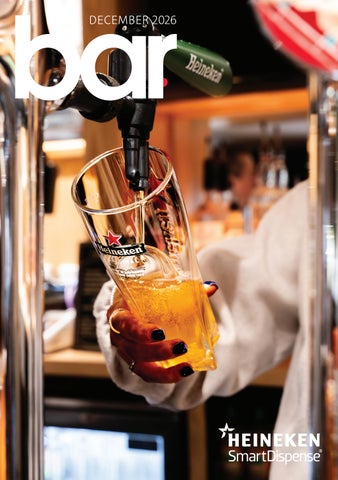
DECEMBER 2026
Image courtesy of The American Bar at The Gleneagles Hotel
Everything works better when everything works together Connected solutions from Tyl by NatWest and our tech partners help hospitality businesses operate more efficiently, serve customers seamlessly and grow with confidence. • Speedy and secure card payments. • EPOS, bookings and more. • Reliable, UK-based support. • Trusted NatWest heritage and security.
Ready to connect the dots? Scan the QR code to get in touch. tylbynatwest.com
Additional fees may apply for data usage or app downloads. Tyl eligibility criteria, terms, conditions and fees apply. TBNW_BarMagazine_Doublepagespread_3mm bleed.indd All Pages
08/09/2026 14:46
EDITOR’S NOTE
DECEMBER 2026
I
’ve spent the last few weeks out and about in the industry, and almost every operator I’ve spoken to has had the same glint in their eye when the conversation turns to Christmas. After the year many of them have had, the festive rush is the stretch that can make a real difference to the numbers, and the smartest venues are already working out how to get the most from every table. Our Low & No feature makes the case that the guest who isn’t drinking is often the one deciding where the group books, and that a lemonade and a shrug can cost a venue the whole party. The sustainability feature follows a similar line of thinking, tracing waste from the cellar to the back door and showing how much margin leaves with it, while Sotiris Konomi, now running Raffles London’s beverage operation, reminds us in The Managers’ Club that a busy bar is not necessarily a profitable one. It isn’t all spreadsheets, mind. Alessandro Palazzi looks back on nearly two decades at Dukes Bar and a career built on looking after his team, and Eljesa Saciri explains why Waeska at The Mandrake, our Venue of the Month, turns down most private parties to protect its regulars. Elsewhere, Lorraine Copes and Michael Kill share First Orders, on progression for the people behind the bar and a proper voice for our industry in government. Before we know it, the Bar Magazine Awards will be here. The finalists are inside, and with the night just a month away, I can’t think of a better way to start the new year. Pernod Ricard is taking over the cocktail menu at Troxy, and we’ve got the full rundown of every serve guests can look forward to. Merry Christmas, and I’ll see you there.
TOM WOOLLIN DIRECTOR OF CONTENT, PARTNERSHIPS & EDITORIAL
DECEMBER 2026
On the cover: HEINEKEN SmartDispense® smartdispense.heineken.co.uk © 2026 Cogent Multimedia Limited, 1st Floor, Saphir House, 5 Jubilee Way, Faversham, Kent, ME13 8GD. No part of this magazine may be reproduced or stored in a retrieval system or transmitted in any form – electronic, mechanical or physical – without express prior permission and written consent of the publisher. Contributions are invited and when not accepted will be returned only if accompanied by a fully stamped and addressed envelope. Manuscripts should be type written. No responsibility can be taken for drawings, photographs or literary contributions during transmission or in the editor’s hands. In the absence of an agreement the copyright of all contributions, literary, photographic or artistic, belongs to Cogent Multimedia Limited. The publisher accepts no responsibility in respect of advertisements appearing in the magazine and the opinions expressed do not necessarily represent the views of the Publisher. The Publisher cannot accept liability for any loss arising from the late appearance or non publication of any advertisement.
6
www.barmagazine.co.uk
CONTENTS
10
FIRST ORDERS
Lorraine Copes makes the case for fair progression, while Michael Kill calls for a real industry voice in government.
12
HOSPITALITY HEROES
Alessandro Palazzi talks us through perfect martinis, mentoring and nearly two decades running Dukes Bar.
16
BAR MAGAZINE AWARDS
The 2027 finalists are revealed, and Pernod Ricard details the cocktails guests will be drinking at Troxy.
30
THE MANAGERS’ CLUB
Sotiris Konomi explains how he keeps a close eye on the numbers across Raffles London’s entire beverage operation.
32
BEHIND THE BRAND
Joe McCanta tells us why the martini is Grey Goose’s big opportunity, and introduces Berry Rouge.
30
37
LOW & NO
Our contributors show how pricing and serving alcohol-free properly can win you the whole Christmas table.
57
SUSTAINABILITY
Operators and suppliers follow the waste from cellar to bin, and show how much margin goes with it.
68
VENUE OF THE MONTH
Eljesa Saciri explains how Waeska at The Mandrake became a destination in its own right.
32 DIRECTOR OF CONTENT, PARTNERSHIPS & EDITORIAL Tom Woollin tom@cogentmultimedia.com
PUBLICATION MANAGER Manjeet Griffiths mg@barmagazine.co.uk Tel 01795 509109
HEAD OF BUSINESS DEVELOPMENT Jazmine Davis jazmine@thehotelmagazine.co.uk
ACCOUNT MANAGER
SOCIAL MEDIA MANAGER
Harrison Hume hh@barmagazine.co.uk
Lily Lawson socials@cimltd.co.uk
HEAD OF DIGITAL
DESIGN & PRODUCTION
Xhulio Bishtaja digital@cimltd.co.uk
James Taylor Grant Waters
CREDIT FACILITIES MANAGER
MANAGING DIRECTOR
Gwen Lee cc@cogentmultimedia.com
John Denning
MARKETING MANAGER Lucas Payne lucas@cogentmultimedia.com www.barmagazine.co.uk
7
FIRST ORDERS
A SEAT AT THE TABLE DECEMBER’S FIRST ORDERS COME FROM MICHAEL KILL, CEO OF THE NIGHT TIME INDUSTRIES ASSOCIATION, WHO TELLS US WHY AN INDUSTRY WORTH BILLIONS STILL HAS NO PROPER VOICE IN WHITEHALL, AND WHAT A NATIONAL BODY WITH REAL INFLUENCE WOULD LOOK LIKE.
T
here is something fundamentally wrong with the way we represent the night-time economy at the highest levels of government. This industry contributes billions to the UK economy, supports hundreds of thousands of jobs and defines the cultural identity of our towns and cities, yet it still lacks a coordinated voice within central government. That should concern us all. Successive governments have talked about growth, regeneration, high streets, tourism and culture. The night-time economy sits at the heart of every one of those ambitions, yet when it comes to shaping the policies that determine its future, we are too often consulted rather than involved. Therein lies the problem. The night-time economy does not fit neatly into one department. Its responsibilities are spread across at least six, covering business, culture, licensing, planning, transport, policing and public health. Each approaches the sector through its own priorities, often without recognising how decisions in one area affect another. One department talks about growth while another introduces regulation that undermines it. Cultural strategies sit disconnected from licensing, transport or the commercial realities of running a business after dark. The result is a system that lacks coordination, accountability and, most importantly, a consistent industry voice at the centre of decision-making. This is not about criticising individual departments. It is about recognising that the infrastructure built around this industry is no longer fit for the challenges it faces. What frustrates me most is that we continue to develop policy for the night-time economy rather than with the people who understand it best. There are examples elsewhere that should encourage us. New South Wales has made real progress through its Vibrancy Reforms, backed by a dedicated 24-Hour Economy Commissioner and a more coordinated approach across government. The lesson is not simply about licensing or red tape. It is about treating the night-time economy as a strategic priority that needs focused leadership and joined-up decision-making. The UK needs that same ambition, but I would go further. We need a formal mechanism that places the night-time economy directly within the machinery of central government, with meaningful industry representation and a mandate to work across departmental boundaries. Not another advisory group that meets periodically, produces recommendations and hopes someone is listening, but a properly constituted, industry-led national body
8
www.barmagazine.co.uk
Michael Kill with a recognised role in policy development, direct access to ministers and the ability to coordinate priorities across every department that touches our sector. Government must retain its democratic accountability, but industry should be a genuine partner in developing the policies that shape its future, not a stakeholder invited in once the direction has already been decided. That means bringing together operators, independent businesses, cultural organisations and workers to build a national strategy grounded in commercial reality, cultural value and long-term sustainability. Representation without influence changes very little. If government is serious about unlocking growth, rebuilding our high streets and protecting the cultural identity of our towns and cities, the night-time economy needs more than recognition. It needs a seat at the table where national decisions are made.
Extraordinary nuts & snacks Specialists at baking, seasoning and caramelising the best grades of nuts
info@cambrookfoods.co.uk +44 (0)1264 319980 www.cambrookfoods.co.uk
#122-BarMag-210x148mm-AW.indd 1
Winners of multiple Great Taste Awards
17/12/2025 16:25
FIRST ORDERS
PEOPLE ARE THE FUTURE LORRAINE COPES, FOUNDER AND CEO OF BE INCLUSIVE HOSPITALITY, TELLS US WHY WORKFORCE DECISIONS DESERVE THE SAME ATTENTION AS DRINKS LISTS AND REFITS, AND WHY CLEAR PROGRESSION AND FAIR ACCESS TO OPPORTUNITY DECIDE WHO STAYS AND WHO LEAVES.
W
hen we talk about the future of hospitality, we tend to focus on what customers will want next. For me, an equally pressing question is whether the people delivering those experiences can see a future for themselves in our industry, because they are the beating heart of a business and the key to its success. After 24 years in hospitality, I know how much this sector has to offer. It can open doors, build confidence and create opportunities people never imagined possible. But that opportunity, and the progression that should follow it, is not available to everyone. That has to change, or operators will keep losing people to employers who actively demonstrate fair and inclusive pathways. As bar operators plan for 2027, workforce decisions deserve the same attention as drinks lists, menus and investment in venues. Commercial pressure can make development feel like something to revisit when trading improves. Postponing it only risks losing the very people a business needs to move forward. In bars this becomes tangible very quickly. Who gets access to training? Who is encouraged to apply for a management role? How are extra responsibilities recognised? Does a talented bartender know what they need to demonstrate to become a supervisor, or does progression depend on being noticed by the right person? These everyday decisions shape whether people feel valued and choose to stay. They also determine whose talent grows, who reaches leadership and how diverse the industry becomes. This is the thinking behind Better Hospitality, led by Be Inclusive Hospitality. By bringing employee evidence together with the experience of senior industry leaders, it examines pay, progression and workplace experience, with a particular focus on race and ethnicity, and sets out six priorities for operators to act on. Its role is to help employers turn insight into practical action while creating space for the sector to learn together. That focus matters for both a bar’s people and its performance. A diverse workforce does not automatically mean opportunities are equally accessible. Understanding who progresses, who leaves and what employees actually experience helps leaders spot barriers that would otherwise stay invisible. A useful starting point is to make promotion criteria clear, check who receives development opportunities and equip managers to respond consistently when concerns are raised. Ask employees what helps them do their best work, then tell them what will change as a result. Even where budgets are tight,
10
www.barmagazine.co.uk
clarity and follow-through cost very little. There is also value in sharing what works across different businesses, which is something Better Hospitality enables. An independent bar and a national group have very different resources, but both can contribute to better practice. My hope is that we become as intentional about the experience of our teams as we are about the experience of our customers. Building businesses where people can belong, contribute and progress should be part of how we plan for an industry that is stronger, fairer and more inclusive.
Margot Pendant
Porter Armchair
Wilbur Bar Stool
Exclusive 20% OFF IN STOCK ITEMS Email us quoting code BAR20
Soho Pouffe
HOSPITALITY HEROES
EXECUTING THE BASICS HALF A CENTURY IN HOSPITALITY AND NEARLY TWO DECADES RUNNING ONE OF LONDON'S MOST FAMOUS BARS HAVE TAUGHT ALESSANDRO PALAZZI PLENTY. THE DUKES BAR MANAGER TALKS US THROUGH PERFECT MARTINIS, MENTORING AND WHY YOU ALWAYS LOOK AFTER YOUR TEAM FIRST.
12
www.barmagazine.co.uk
HOSPITALITY HEROES
A
lessandro Palazzi has run Dukes Bar since 2007. His education in the trade began in 1975, arriving in London from Italy to learn English and taking his first job as a kitchen porter. "Admittedly, when I was at catering school I used to be quite arrogant with the kitchen porters," says the Dukes Bar manager. "I turned up and suddenly realised how hard the job was. I was treated very badly, but that taught me a valuable lesson: you must be respectful and work together, especially in hospitality." His fondest memory came in the 80s at the George V in Paris, as sommelier and bartender in the main restaurant, his first fivestar house. "What I learnt was how to give five-star service but also enjoy the time you spend with your colleagues. I learnt from my boss: if you look after your team, the team will look after you." "Two of my colleagues have been with me 19 years, another one, 10 years. Without the team, Dukes Bar wouldn't be as well regarded as it is today." The serve that made the bar famous follows the same thinking: no gimmicks, just discipline. The spirit and the glass live in the freezer, the vermouth comes from a micro distillery in Highgate, and the lemons are always from Amalfi. "Our philosophy is simple: executing the basics well, using the best ingredients," Alessandro explains. "At catering college we were taught the classics and there was no room for imagination; mixing vodka and gin was seen as a sin. Bartenders are now lucky enough to take classic cocktails and put a personal touch on them. Guests such as Fleming drank here long before I joined, so rather than creating new and extravagant cocktails, our menu is a homage to his life and books. The martini trolley allows us to interact with the guests, and it is something I believe is timeless." Ask him to describe the job and he gives three words, passed
on to every bartender he has trained: diplomatic, acrobatic and charismatic. "We are fortunate to have some very high-profile guests, and it is essential we respect their privacy. We treat every guest the same, and we don't allow any guest to be bothered for pictures." Acrobatic, because the job is never just drinks: "We sometimes act as concierges. I have been fortunate to introduce guests to each other, which has led to some getting married, and some going into business together." And charismatic? "A little touch of my service is throwing the vermouth onto the carpet. It's a tiny part which engages the customers and allows me to have a joke with them." Then there is the famous two-martini limit: restraint as both duty of care and good business. "As bartenders we have a responsibility of care for our customers. There is no dilution in our martini, and as it is frozen spirit it is quite smooth and easy to drink. Dukes is like a private members' club, but it is open to everyone. Our guests come here to relax, and it is important that all guests are respected." Half a century in, what still gets him through the door? "The most rewarding part of my job is mentoring the younger generations. No matter how much bars change, the guest will always be the centre of service. It still excites me to walk in every day, knowing each service is unique. Now the white truffle season is starting we will be serving our white truffle martini, while in summer we served our lemon verbena martini, infused with lemon verbena from my garden." As for the future of the hotel bar, he is untroubled. "Renowned hotel bars are now becoming destination points. As long as bars provide outstanding service and well-made drinks, there will always be a place for them." From kitchen porter to custodian of London's most famous martini, the thread never breaks: respect the team, respect the guest, and execute the basics well. www.barmagazine.co.uk
13
TICKETS AVAILABLE NOW!
WWW.BARMAGAZINEAWARDS.CO.UK
BAR MAGAZINE AWARDS
THE 2027 FINALISTS THE FINALISTS FOR THE 2027 BAR MAGAZINE AWARDS ARE OUT. ACROSS TEN CATEGORIES, MORE THAN 110 VENUES, GROUPS AND INDIVIDUALS FROM A RECORD NUMBER OF ENTRIES NOW GO BEFORE THE JUDGES, WITH THE WINNERS ANNOUNCED AT TROXY ON 25TH JANUARY. HERE IS THE FULL LINE-UP.
UNSUNG HERO
BEST HOSPITALITY GROUP
Nathan Jones, Isle of Wight Distillery Jose Gabriel Feliz Moreta, Gaucho Connor Wren, Elements Restaurant Morgan Hooper, Professionals At Play Gracie Goggins, The Last Word Adhwaith Chandran, Browns Brasserie & Bar Kelly Danischewsky, The Cocktail Trading Co., Murder Inc. and London Cocktail Exchange Rachel Orange, Glory Days Hospitality Joe Scott, The Ticket Office Simone Crepaldi, Callooh Callay Vijay Sanas, Aqua Restaurant Group Akhil Joseph, Archive & Myth
The Alchemist Bars Big Mamma Group Sport London Vagabond Wines Hawksmoor ETM Collection San Carlo Cicchetti THE ENTOURAGE GROUP Beannchor Group Caprice Restaurants Bocconcino Restaurants ART Hospitality
16
www.barmagazineawards.co.uk
BAR MAGAZINE AWARDS
BEST DINING CONCEPT
LIFETIME ACHIEVEMENT
Dishoom sketch London Bar Kroketa Nammos London Eve Bar Nine Lives Bacchanalia Hutong, The Shard The Chapter Collection, Stonegate Group La Maison Ani London
Jesse Estes, Tequila Ocho Carl Newey, Stonegate Group Ian Burrell, The Rum Experience Georgi Radev, Laki Kane Simon Rowe, The Dorchester Allan Gage, Sweet & Chilli and Nine Lives Chris Jones, Paragon Brands Massimo Lisi, Knockinaam Lodge Hotel & Restaurant Xavier Landais, Caprice Holdings Sandrae Lawrence, The Cocktail Lovers Lauren Mote - PATRÓN Tequila & Agaves
MARKETING INNOVATION Flight Club Over & Above Ronnie’s Whisky Bar Rake’s Café Bar, Andaz London Liverpool Street J. Sheekey ASASE COYA Restaurants Understory Bar Laki Kane Hidden Society
THE ENVIRONMENT AWARD Wild Shropshire Restaurant TIMBERYARD Silo London Sprout Bar at Miiro Templeton Garden Tom Thumb Cocktail Bar Kiki Lounge The American Bar, The Gleneagles Hotel Dover Yard, 1 Hotel Mayfair
BEST MIXOLOGIST Carrie Smith, Hawksmoor Edinburgh Alex Goacher, The Morris Emanuele Mensah, ASASE David Riera, The Rivoli Bar at The Ritz Hotel Anas El Bahhaj, Waeska Bar at The Mandrake Carlos García Picón, Bar Antoine at Four Seasons Hotel London at Park Lane Federico Manganaro, The Guards Bar & Lounge at Raffles London at The OWO James Tamang, Brooklands Bar at The Peninsula London Donato Pasquariello, Velvet by Salvatore Calabrese Janis Muzikants, Gordon Ramsay Restaurants Vasilis Sgouromallis, Jul’s Restaurants Mitsuhiro Nakamura, Park Hyatt London River Thames Martha May Markham, Nancy’s Cocktail Bar Jack Sotti, Archive & Myth Miley Penndragon, The Domino Club Storm Anh Thu Le, Bacchanalia
BEST VENUE MANAGER Dereece Gardner, Desire Cocktail Bar Andrea Gardiner, The American Bar, The Gleneagles Hotel Alice Ford, Opium Cocktail Bar Rich Hamer, Over & Above Nick Graham, Seed Library Shoreditch Max Wolff, Nancy’s Cocktail Bar Jefferson Coltro, Amazónico Emanuele Pedrazzani, Nightjar Marco Matesi, Savage Garden Rooftop Bar Christopher Wareing, Rattlebag Enrico Perri, BAR 45 at 45 Park Lane Giovanni Spezziga, The Coral Room, The Bloomsbury Hotel Kosmas Manentis, Sexy Fish Mayfair Jordan Wilson, Buzzworks Holdings
VENUE OF THE YEAR Bar Glue Rattlebag Archive & Myth Bar Prince at The Balmoral, a Rocco Forte Hotel 8 at The Londoner Punch Room at The London EDITION FlipDog American Bar at The Savoy GAIA Mayfair CÉ LA VI London BrewDog Waterloo Hanover Bar, Mandarin Oriental Mayfair, London Sexy Fish Mayfair Nightjar
INCLUSIVE EMPLOYER AWARD The Cocktail Trading Co. Sabine London Bar Lotus The Domino Club Dover Yard, 1 Hotel Mayfair Greene King Marston’s
www.barmagazineawards.co.uk
17
BAR MAGAZINE AWARDS
AN INVITATION TO CREATE XIX, THE BRITISH VODKA CREATED WITH THE SIDEMEN, IS BACK AT THE BAR MAGAZINE AWARDS FOR 2027, WHERE GUESTS WILL FIND ITS ORIGINAL AND FLAVOURED VODKAS BEHIND THE XIX BAR. WE FIND OUT WHY THE BRAND WANTS BARTENDERS TO MAKE THE LIQUID THEIR OWN. TELL OUR READERS ABOUT YOUR BRAND AND WHAT SETS YOU APART WITHIN THE HOSPITALITY SECTOR. Created with the Sidemen, XIX is a British vodka brand bringing together a global audience, distinctive flavours and an invitation to create. Launched in 2022, the range now runs from our Original vodka to flavoured expressions including Mixed Berry, Tropical Ice and Gumball Orange, with limited editions such as Toffee Apple joining along the way. Our Original and flavoured vodkas give bartenders scope to experiment, reinterpret familiar cocktails and develop something their guests will love. XIX is known for a set of distinctive signature serves, but it’s at its best when bartenders and bar teams take the liquid and make it their own. Our XIXstar Martini is a good example. It began with a bartender experimenting with our flavoured vodkas during a Sidemen shoot, creating a cocktail that became part of the brand’s repertoire and is now one of the first drinks venues ask us about. That collaborative approach matters to us. XIX has an enthusiastic following among 18 to 34-year-olds, who are excited to see the brand in venues. Bartenders bring their own expertise, imagination and understanding of their guests, turning that excitement into drinks worth coming back for. We want to give teams the freedom to shape serves that suit their space and audience.
WHAT INSPIRED YOUR DECISION TO SPONSOR THE 2027 BAR MAGAZINE AWARDS, AND HOW DOES THIS ALIGN WITH YOUR BRAND’S VALUES AND VISION? 2027 is an exciting year for XIX: we’re growing in the on-trade, returning to RTDs and continuing as one of the UK’s top-selling alcohol brands on TikTok Shop. Our partnership with Red Star Brands, agreed at the end of 2025, gives us the distribution to take the brand into many more bars and venues across the country, and the on-trade is where we want to see the biggest change over the next twelve months. Returning to sponsor the Bar Magazine Awards gives us an opportunity to build on that momentum and strengthen relationships with the people who bring brands like ours to life. Our pop-up bar at the Awards will let guests experience XIX through cocktails and give us a chance to hear their ideas. We want to build relationships with people who see possibilities
18
www.barmagazineawards.co.uk
in the liquid and can take it somewhere we might not have imagined ourselves.
HOW IMPORTANT ARE EVENTS LIKE THE BAR MAGAZINE AWARDS TO THE INDUSTRY? Great hospitality takes creativity, care and an enormous amount of work, much of which happens behind the scenes. The Awards give that work the recognition it deserves, celebrating the teams as well as the venues. They also bring people together to share ideas and learn from one another. A conversation between bartenders, operators or brands can spark something that finds its way onto a menu months later. Creating space for those connections is valuable for everyone involved, and it is exactly the kind of conversation we hope to be having at the XIX bar on 25th January. www.xixvodka.com
Every Table. Every Opportunity. Make Wenlock Spring part of every occasion.
Family owned premium British spring water, bottled in glass and available in still and sparkling, adding a touch of quality to every table and an opportunity to increase drinks sales. Wenlock Spring, Proud to Support British Hospitality. Follow us on Instagram: @wenlockspring | Connect on LinkedIn: Wenlock Spring Water
COCKTAIL TAKEOVER
A
ltos Tequila was created by bartenders, for bartenders. That truth sits at the heart of everything the brand represents and explains why it has become one of the world’s most respected tequilas within the global bar community. Born from a collaboration between internationally renowned bartenders Henry Besant and Dré Masso and Maestro Tequilero Jesús Hernández, Altos was designed with one goal: to create a tequila that performed exceptionally well in cocktails. Produced in the Los Altos region of Jalisco, Mexico, Altos is made using 100% blue agave and combines traditional tequila-making methods with modern innovation. The brand famously incorporates the centuries-old tahona process alongside contemporary production techniques, creating a liquid known for its balance, versatility and agave-forward character. What makes Altos unique is its unwavering focus on the needs of bartenders. Every aspect of the brand, from liquid development to advocacy programmes, is shaped by the realities of working behind the bar. Its flavour profile was specifically developed to perform in cocktails, particularly the Margarita, where Altos has become one of the category’s most trusted serving recommendations. The brand is currently recognised as the number one tequila for Margaritas among leading bars internationally. Altos celebrates creators, makers and craftspeople, from Mexican sign painters and artists to bartenders experimenting with new serves. Its philosophy values imperfection, experimentation and creativity over polish and convention. This “maker mindset” reflects the reality of hospitality, where skill, passion and hands-on craft matter more than appearances. As tequila continues its growth across the UK and internationally, Altos remains committed to championing cocktail culture rather than chasing trends. Its recent “Altos Always Works” campaign reinforces a message long understood by bartenders: when the foundation is right, great cocktails become easier, more consistent and more enjoyable to create.
olmecaaltos.com
J
ameson is one of the world’s most recognised Irish whiskeys and its enduring success has been built not simply on scale, but on its genuine connection to the bartender community. For decades, the brand has invested in hospitality culture through education, advocacy, competitions, guest shifts and industry events that help bartenders learn, collaborate and grow.
Produced at the Midleton Distillery in County Cork, Jameson is triple distilled for exceptional smoothness. This approachable style has helped introduce generations of drinkers to Irish whiskey while simultaneously giving bartenders a versatile spirit capable of performing across classic serves, contemporary cocktails and simple mixed drinks. The signature balance of orchard fruits, vanilla, toasted wood and gentle spice makes it equally comfortable in a Whiskey Sour, Irish Coffee or Highball. Jameson’s advocacy approach is notably bartender-first. Rather than talking at the industry, it aims to participate within it. Events are built around connection, creativity and peer-to-peer learning, with emphasis placed on authentic experiences rather than traditional brand-led education. This philosophy has helped Jameson become a trusted presence within bars around the world. Today, Jameson continues to evolve through innovation, collaborations and cultural partnerships while remaining rooted in the values that made it successful: warmth, inclusivity and genuine hospitality. For many bartenders, it is one of the first spirits they learn to work with and one they continue to reach for throughout their careers. In a category often defined by heritage and tradition, Jameson combines authenticity with accessibility, making it not only an iconic Irish whiskey, but also one of the industry’s strongest supporters of the people behind the bar.
jamesonwhiskey.com
A
bsolut is much more than a premium vodka. It is one of the modern cocktail world’s most influential brands and a long-standing champion of creativity, culture and mixing. Since launching in 1979, Absolut has built its reputation not only through the quality of its liquid, but through its deep connection with artists, musicians, designers and bartenders who continuously redefine contemporary drinking culture. Produced exclusively in Åhus, southern Sweden, Absolut follows a unique “One Source” philosophy. Every bottle is made using winter wheat grown near the distillery and water drawn from local deep wells, creating a consistent, high-quality vodka with a clean, smooth character. The brand continues to use the continuous distillation process introduced by founder L.O. Smith in the nineteenth century, ensuring purity while retaining the subtle grain character that has become a hallmark of the liquid. Behind the bar, Absolut has earned its place through versatility. Its clean profile makes it an ideal base for classic cocktails such as the Espresso Martini, Cosmopolitan, Bloody Mary and Vodka Soda, while its flavoured range continues to provide bartenders with creative inspiration. The brand was also one of the pioneers of premium flavoured vodka, helping define a category that remains influential today. What truly distinguishes Absolut is its belief that great ideas emerge when different people, perspectives and influences come together. This philosophy is captured through its long-standing “Born To Mix” platform, which celebrates creativity, collaboration and self-expression. From iconic art collaborations to cultural partnerships with musicians and fashion designers, Absolut has consistently positioned itself at the intersection of drinks and culture. Absolut represents a spirit that understands the value of mixing in every sense of the word. It is a vodka built on quality, crafted with transparency, and supported by a brand that continues to invest in creativity, hospitality and cultural relevance. Whether poured in a simple highball or a boundary-pushing cocktail, Absolut remains one of the defining spirits of the modern bar.
absolut.com
L
illet is one of the drinks industry’s great insider stories. For years it was a favourite among bartenders, sommeliers and aperitif enthusiasts, quietly appearing on wine lists and cocktail menus long before it became part of the broader spritz movement. Today, the brand is emerging from that insider status to become one of the most exciting aperitif brands in the UK on-trade.
Produced in France, Lillet is a wine-based aperitif that sits naturally between wine, cocktails and spritz serves. This versatility is central to its appeal behind the bar. It can function as a standalone aperitif, a low-ABV cocktail ingredient, a spritz base or a modifier in classic recipes, giving bartenders flexibility across multiple occasions and menus. In recent years, Lillet has benefited from major shifts in drinking culture. Consumers are increasingly seeking lighter serves, elevated daytime occasions, premium simplicity and lower-alcohol alternatives. Lillet sits directly at the intersection of these trends, offering an elegant drinking experience without the intensity of traditional spirits-based cocktails. For bartenders, perhaps the most important serve is the Lillet Rosé Spritz. Easy to execute and highly repeatable, it delivers the sociability consumers love in a spritz while offering a lower-ABV alternative to many competing serves. Training and perfect serve execution remain key priorities because the brand performs best when guests experience it exactly as intended. The brand is also evolving creatively. Moving beyond traditional French elegance, Lillet’s latest direction embraces a more confident and distinctive personality described as “Unapologetically French”. Sophisticated yet contemporary, the brand is carving out a position that feels equally relevant in modern cocktail bars, neighbourhood terraces and premium dining venues. Lillet is a reminder that simplicity can be powerful. It combines versatility, elegance and easy-drinking appeal while offering genuine opportunities across spritz, aperitif and low-ABV occasions.
lillet.com
H
avana Club is more than simply a spirit, it represents the heritage, creativity and hospitality of Cuba, carrying the story of the island into bars around the world.
Produced in Cuba and protected by the Denominación de Origen Protegida Ron de Cuba designation, Havana Club remains deeply connected to its origins. Every bottle is distilled, aged and blended in Cuba, preserving traditions that have shaped the country’s rum culture for generations. At the heart of this process are the Maestros del Ron Cubano, an elite group of master blenders whose expertise has been passed down over decades and who maintain one of the most respected rum-making traditions in the industry. Havana Club’s significance extends far beyond its production credentials. The brand is inseparable from the history of the Mojito, Daiquiri and Cuba Libre, cocktails that helped define modern drinking culture. During the twentieth century, Havana became a global destination for travellers, musicians and artists, and Cuban cantineros developed many of the techniques and serves that continue to influence bartenders today. Havana Club sees itself as the direct inheritor of that legacy. This connection to bartending culture is reflected in Havana Club Cocktail Maestros, one of the industry’s most respected rum-led competitions. Focused on teamwork, hospitality, creativity and cultural exchange, the programme brings together bartenders from around the world to learn from each other while celebrating Cuban cocktail traditions. The liquid itself combines freshness and complexity through a distinctive continuous ageing process that creates continuity between generations of rum. Every expression carries a link to the rums that came before it, creating a living history within the blend. Havana Club remains the benchmark for authentic Cuban rum, equally at home in a classic Daiquiri as it is in contemporary rum cocktails. It is a brand that champions craft, culture and conviviality, while continuing to inspire the next generation of rum enthusiasts and cocktail makers.
havana-club.com
BAR MAGAZINE AWARDS
BUILT BY BARTENDERS TITO’S HANDMADE VODKA BRINGS ITS POP-UP BAR TO THE 2027 BAR MAGAZINE AWARDS, POURING THE TEXAS SPIRIT THAT BARTENDERS TURNED INTO ONE OF AMERICA’S FAVOURITE VODKAS. MEL GOLDING, HEAD OF MARKETING FOR EUROPE AND APAC, TELLS US MORE. TELL OUR READERS ABOUT YOUR BRAND AND WHAT SETS YOU APART WITHIN THE HOSPITALITY SECTOR. Crafted in old-fashioned pot stills and inspired by the distillation methods of fine single malt Scotches and high-end French cognacs, each sip of Tito’s goes down with an impeccably smooth finish. It is made from corn, so it is naturally gluten-free, and it is still distilled and bottled in Austin, Texas, on the same patch of land where founder Bert “Tito” Beveridge rigged up his first pot still in the mid-1990s and secured the first legal distilling licence in the state. Tito’s grew because bartenders, mixologists and key on-trade operators tasted the quality, shared it with their guests and championed us. Because we owe our success to the hospitality community, we prefer to find ways for genuine collaboration with bars and restaurants. That shows up in how we work: trade education, serve support and a team that spends its time in venues rather than behind a desk, listening to what bartenders actually need.
WHAT INSPIRED YOUR DECISION TO SPONSOR THE 2027 BAR MAGAZINE AWARDS, AND HOW DOES THIS ALIGN WITH YOUR BRAND’S VALUES AND VISION? The Tito’s story didn’t start with a massive marketing plan. It began with bartenders who took a chance on the brand back when it was just an unknown Texas craft spirit. While Tito’s is now one of America’s favourite vodkas, the brand is keen to spread the love internationally, including in the UK. Sponsoring the BMAs provides an incredible opportunity to connect directly with ambitious UK on-trade partners, cementing Tito’s as a key choice behind the world’s best bars, and to give back to the hospitality professionals and industry heroes who keep the on-trade thriving. Giving back is part of how the brand has always operated, and supporting the people behind the bar in the UK is a natural extension of that.
HOW IMPORTANT ARE EVENTS LIKE THE BAR MAGAZINE AWARDS TO THE INDUSTRY? Hospitality is an incredibly demanding industry: long hours, high pressure, customer facing and intense physical work. Events like this offer formal recognition for the bartenders, mixologists and floor staff, and allow a rare opportunity to network with others in the trade, share ideas, talk through industry-wide issues and
26
www.barmagazineawards.co.uk
highlight their wins. That recognition matters more than people outside the trade realise, and it is why we wanted to be part of it. For a brand that was built on word of mouth from behind the bar, a room full of 300 of the people who make this industry run is exactly where we want to be. We look forward to meeting as many of them as we can at the Tito’s pop-up bar on the night. www.titosvodka.com
BAR MAGAZINE AWARDS
ONE PARTNER, FOR EVERY POUR MATTHEW CLARK BIBENDUM IS THE UK’S MOST COMPLETE ON-TRADE DRINKS PARTNER, SUPPLYING WINE, SPIRITS, BEER, CIDER AND SOFT DRINKS TO VENUES FROM INDEPENDENTS TO NATIONAL GROUPS. AS HEADLINE SPONSOR OF THE BEST HOSPITALITY GROUP AWARD, WE FIND OUT WHAT SETS THE BUSINESS APART. TELL OUR READERS ABOUT MATTHEW CLARK BIBENDUM. Matthew Clark Bibendum is the partner hospitality businesses trust to elevate their drinks offer, grow their revenue and keep consumers coming back. As the UK’s leading and most complete on-trade drinks partner, we bring together the depth of a premium specialist and the scale of a national operator, backed by trusted producer partnerships and C&C Group’s award-winning portfolio. The two names behind the business have long histories of their own. Matthew Clark was founded in 1810 as a wine and spirits broker and remained family owned for six generations, while Bibendum built its reputation as a premium wine specialist from 1982. Both joined C&C Group in 2018 and in 2026 came together as a single integrated business. For our customers, that means simplicity. We can stock your bar on a single order, with online ordering available 24/7, all managed through one invoice and one delivery, and serviced through one of our nationwide depots. Behind that sits a dedicated team of wine specialists and regional account managers, so customers get the convenience of a national supplier with the attention of a local one.
WHAT SETS YOUR BRAND APART WITHIN THE INDUSTRY? With a wine portfolio that includes over 250 producers from across the globe, alongside soft drinks, spirits, cider and beer, we have an unrivalled breadth of products for our customers to choose from. But we are more than a drinks supplier. We know that no two hospitality businesses are the same, and our combination of category expertise, unmatched commercial intelligence and a nationwide distribution network means we can provide our customers with a support programme to develop a more compelling drinks offer. That support covers the detail that makes a difference on the floor: wine training for front-of-house teams, market insight drawn from the venues we work with, and help building a range that fits the venue rather than the other way round. Whether a customer is a single independent site or a group operating across the country, the aim is the same. We want to help our customers grow sales and serve more and better drinks. One partner, for every pour.
HOW IMPORTANT ARE EVENTS LIKE THE BAR MAGAZINE AWARDS TO THE INDUSTRY? The BMAs are one of the most respected awards in UK hospitality,
recognising the people and businesses pushing the bar sector forward. What makes the awards particularly special is the energy in the room and the genuine celebration of innovation, passion and excellence. As headline sponsor of the Best Hospitality Group award, we are especially pleased to be recognising the multi-site operators who manage to keep standards high and ideas fresh across every venue they run. It is a category that reflects a large part of our own customer base, and the challenges those businesses face are ones we work on with them every day. As a business built around hospitality, supporting the BMAs is about more than sponsorship for us at Matthew Clark Bibendum. It is an opportunity to recognise and celebrate the creativity, dedication and talent that make this industry so unique. www.mcbdrinks.co.uk www.barmagazineawards.co.uk
27
SPONSORED
A VERY SILENT NIGHT THIS YEAR, PPL PRS INVITES YOU TO IMAGINE A WORLD WITHOUT CHRISTMAS MUSIC. ITS RESEARCH SHOWS HOW A FESTIVE PLAYLIST LIFTS CUSTOMERS’ MOOD AND TEAM MORALE OVER THE BUSIEST WEEKS OF THE YEAR, AND WHAT VENUES NEED TO PLAY IT.
I
t’s Christmas time, but not as we know it. As December arrives and the festivities begin, one thing is noticeably absent: music. Office Christmas parties have been booked with the expectation of nostalgic classics and party favourites, very possibly ending with the Head of Finance singing ‘All I Want for Christmas is You’ on karaoke. But not this year. The speakers have fallen silent. Christmas Eve is approaching, and families and friends are gathering at a local pub to exchange gifts, enjoy some seasonal food and watch a local acoustic singer provide the soundtrack to the most wonderful time of the year. But not this year. There is no singer, and the microphone has been turned off.
CHRISTMAS JUST FEELS DIFFERENT WITHOUT MUSIC, DOESN’T IT? Why play Christmas music? PPL PRS has conducted research* into how consumers feel about Christmas music, showing its benefits and the best ways to use it to enhance the customer experience. With 53% saying Christmas music boosts their mood, it can add real value over the busy period. When they are out celebrating, 63% of Brits prefer to hear 80s Christmas music, while 45% say they’d also like a mix including some pop music, so PPL PRS suggests including other music and genres that are not considered Christmas songs. For the big day itself, 60% of respondents said they would like to hear Christmas music in restaurants and pubs on Christmas Day.**
CREATE A FESTIVE CUSTOMER EXPERIENCE A carefully chosen playlist helps customers feel welcome, relaxed and ready to enjoy their festive visit. Playing different styles and genres can help all demographics feel included, and mixing traditional carols with up-to-date Christmas releases can bring families together and spark conversations.
BOOST TEAM MORALE Christmas music can bring festive energy to a pub or bar throughout the season, and not just for customers. Staff benefit too, with the tempo changed throughout the day to add a burst of energy where needed. Adding in some non-festive tunes will also ensure teams don’t become fatigued by the sound of sleigh bells and reindeer hooves. Operators could even involve their staff in the Christmas
28
www.barmagazine.co.uk
playlist. Staff hear the playlist for their whole shift, and the same songs on loop can become repetitive and stressful, which can affect motivation.
DO I NEED THEMUSICLICENCE FOR CHRISTMAS MUSIC? Venues planning to play music this Christmas, or already doing so, will usually need a music licence. By purchasing TheMusicLicence, businesses support the future of music by helping to ensure its creators are fairly rewarded. TheMusicLicence covers virtually all commercially released music, millions of songs and recordings from the UK and around the world, allowing venues to choose the music that reflects them and their customers this Christmas. *A survey commissioned by PPL PRS of 500 UK respondents in October 2023 **A survey commissioned by PPL PRS of 2,000 UK respondents in November 2022 For more information, visit pplprs.co.uk/christmas/
THE SOUNDTRACK TO BETTER SHIFTS Hospitality Under Pressure Hospitality businesses may seem like fun and sociable places to work. However, research from PPL PRS found that many people working in the sector are experiencing poor health as a result of workplace stress. Out of more than 350 hospitality workers surveyed: 45% reported an inability to relax 44% experienced feelings of anxiety 43% suffered with sleep problems
Music Comes Out on Top Despite the challenges hospitality workers face, many are taking steps to manage workplace stress. When asked what helps them most, music was the number one choice, selected by over a third of respondents (38%) Other popular methods included: Prioritising rest (28%) Spending time with friends and family (26%)
More Than Just Background Music The right soundtrack can help create a positive atmosphere throughout your venue, supporting both staff wellbeing and the customer experience. Whether it’s helping employees feel more motivated during a busy shift or creating an environment customers want to spend time in, music can make a meaningful difference.
Help your team find their groove again Get TheMusicLicence. 0800 0720 808 (Mon-Thurs 8am-6pm & Fri 8am-3pm)
pplprs.co.uk * A survey commissioned by PPL PRS of 350 UK hospitality workers in July 2025.
Bar Magazine Full Page Spread - Magazine FP.indd 1
Scan the QR code to find out more!
18/11/2026 09:44:59
THE MANAGERS' CLUB
SECRET SERVICE TWO YEARS AFTER OPENING THE SPY BAR AT THE OWO, SOTIRIS KONOMI NOW RUNS THE WHOLE OF RAFFLES LONDON'S BEVERAGE OPERATION. HE TELLS US ABOUT READING GUESTS, KNOWING YOUR NUMBERS AND TAKING A HIDDEN LONDON BAR OUT INTO THE WORLD.
F
ew bars guard their mystique like The Spy Bar, tucked inside Raffles London at The OWO and run on a strict no-camera policy. Sotiris Konomi opened it, spent two years building its name, and in May was handed the beverage operation for the entire hotel. He takes this month's seat in The Managers' Club.
YOU JOINED THE OWO TO RUN THE SPY BAR, AND TWO YEARS LATER WERE HANDED THE WHOLE OF RAFFLES LONDON'S BEVERAGE OPERATION. TAKE US THROUGH THE CAREER THAT BUILT TO THAT PROMOTION, AND THE HIGHLIGHT SO FAR. “I started working in hospitality at the age of 14 in a beach bar in Chalkidiki, Greece, where I come from. When I realised hospitality was the career I wanted to pursue, I moved to London in 2019 to develop my skills further. I began at Galvin at Windows, then moved to Coq d'Argent, where I took my first role as Bar Manager, gaining valuable experience in high-volume operations, commercial performance and team leadership. I then joined the
30
www.barmagazine.co.uk
pre-opening team at Noble Palace, challenging myself with the opportunity to build the bars from the ground up. “Joining Raffles London at The OWO to open The Spy Bar brought these experiences together. Being entrusted with the wider beverage operation has been a proud milestone, but my biggest highlight has been seeing The Spy Bar grow into a recognised name within the international bar community while delivering strong commercial results.”
YOUR REMIT NOW RUNS FROM A HIDDEN, RESERVATION-LED COCKTAIL BAR TO RESTAURANTS, EVENTS AND A WINE DEPARTMENT, EACH WITH ITS OWN TEAM. HOW DOES THE WAY YOU LEAD CHANGE ACROSS SUCH DIFFERENT ROOMS, AND WHAT DO YOU LOOK FOR IN FUTURE LEADERS? “Every venue has its own identity, clientele and operational rhythm. The Spy Bar is built around intimacy, storytelling and attention to detail, while restaurants, events and wine operations require different approaches to service, coordination and
THE MANAGERS' CLUB
commercial management. Each department is run by incredibly talented teams and heads of department, so my role is to adapt my leadership to each environment while ensuring consistent standards. “When developing future leaders, I look beyond technical ability. I value people who take ownership, understand the commercial impact of their decisions and can inspire and develop others. Ultimately, the real measure of a leader is how well their team performs, even when they are not in the room.”
EVERYONE IN THE TRADE HAS THEIR OWN DEFINITION OF HOSPITALITY. WHAT IS YOURS, AND HOW DO YOU KEEP GENUINE WARMTH AT THE CENTRE OF A BAR BUILT ON SECRECY AND THEATRE? “For me, genuine hospitality is the balance between technical excellence, attention to detail and, above all, the ability to create a genuine personal connection with the guest. A great cocktail can impress someone, but it cannot compensate for a poor hospitality experience. “At The Spy Bar, the secrecy and theatre are part of the concept, but they are never the purpose in themselves. Our nocamera policy is an extension of that philosophy: the experience is there to be lived, not photographed. The most important skill for our team is the ability to read the guest. The concept might create the anticipation, but it is the genuine connection with our team that makes the experience memorable.”
WHAT DO YOU MONITOR MOST CLOSELY TO PROTECT REVENUE AND MARGIN ACROSS AN OPERATION OF THIS SCALE, AND WHAT COULD AN INDEPENDENT OPERATOR BORROW FROM HOW A LUXURY HOTEL RUNS ITS NUMBERS?
creativity alone does not build a sustainable business. Across an operation of this scale, I focus on revenue against budget and previous-year performance, beverage cost of sales, payroll, stock control and, ultimately, departmental profit. If costs increase or profitability drops, I want to identify the reason, whether it is purchasing, wastage, staffing levels or the sales mix, and address it before it becomes a bigger issue. “Independent operators can learn a lot from the discipline of a luxury hotel without needing the same resources. Set clear targets, cost every drink properly, maintain accurate stock control and review your performance regularly. Most importantly, understand that revenue and profit are two different things. A busy bar is not necessarily a profitable one.”
THE SPY BAR HAS STARTED TO TRAVEL, WITH RESIDENCIES ABROAD AND THE COVERT OPERATIONS SERIES AT HOME. WHAT IS THE PLAN FOR THE NEXT FEW YEARS, BOTH FOR THE BARS AT THE OWO AND FOR YOU? “The priority is to continue developing the beverage operation at The OWO, ensuring every venue has its own identity, a strong team and sustainable commercial performance. For The Spy Bar, I want to take the concept to new audiences through carefully selected collaborations and residencies across Europe and Asia, while Covert Operations will continue bringing exceptional bars and bartenders to London, among them Purovoku Project from Thessaloniki, Passing Fancies from Birmingham and Cambridge Public House from Paris. “I am ambitious about how far we can take The Spy Bar, but the focus is on growing with purpose rather than simply expanding for the sake of it.” theowo.london/dine/the-spy-bar
“One of the biggest shifts in my career was realising that www.barmagazine.co.uk
31
BEHIND THE BRAND
THE MARTINI MOMENT THE MARTINI COCKTAIL IS BACK AT THE CENTRE OF BRITISH DRINKING, AND GREY GOOSE INTENDS TO KEEP IT THERE. JOE MCCANTA, GLOBAL DIRECTOR OF BRAND EXPERIENCE, TELLS US ABOUT SERVES, PARTNERSHIPS AND THE BRAND’S BIGGEST FLAVOUR LAUNCH IN OVER A DECADE.
F
ew job titles in the drinks business cover as much ground as Joe McCanta’s. Grey Goose’s Global Director of Brand Experience has spent nearly two decades with the vodka, and arrived at it sideways: a trained jazz pianist who paid his way through music school working in a wine shop, became a sommelier in New York, and ran bars before the brand came calling. “It all feels like the same job in different clothes,” he says. “Jazz taught me timing and how to read a room. You learn the standards inside out so you can improvise when the moment calls for it, and that’s exactly how a great bar team works. Wine gave me the language of provenance and craft. Bars taught me the most important lesson: none of it matters if the guest isn’t having a brilliant time and the venue isn’t making money from it.” That last point runs through everything he does, from single serves to major activations like the recent Laver Cup in London. “I ask the same questions. Is it crafted, is it generous, and does it work commercially for the venue and guest?” The commercial opportunity of the moment, as Joe sees it, is the martini. “Guests want drinks that feel like an occasion, and the martini cocktail does that better than almost anything. It’s
32
www.barmagazine.co.uk
elegant, a little theatrical, and guests now know exactly how they like it, which gives them real ownership of the order. Bartenders have run with it too, from Tiny ‘Tinis to trolley service to house signatures.” His advice to operators is to treat it as a ritual rather than a menu line. “Frozen glassware, a considered moment of serve, and a few clear routes in: a house classic, a dirty version and one signature that’s yours, a garnish you can own as well. It’s also one of the best trade-up opportunities on the menu. In a drink this simple there’s nowhere to hide, so the base of your martini is what matters most.” The guest ordering it has changed over his years with the brand. “When I started, the Grey Goose drinker was often defined by the bottle on the table: status and celebration. That guest is still there, but today’s drinker is more curious and more knowledgeable. They care how something is made, they’re ordering martini cocktails and well-made highballs, and they value the experience around the drink as much as the drink itself. The big shift is that luxury has moved from showing off to quality and feeling. Guests want the best version of a simple thing.” That shift pairs with another: guests drinking less but drinking
BEHIND THE BRAND
better. Joe’s advice is to lean into it. “If a guest is only having one or two drinks, each one needs to earn its place, so the list should be tighter and more intentional, with premium options that feel worth the price. Smaller formats like mini martini cocktails let guests try something special without a big commitment, and lighter, longer serves work well for daytime and early evening. A great highball can be every bit as premium as a stirred classic if the ingredients and serve are right. Fewer, better drinks can protect spend per head.” So what does working with the brand actually involve? “At its best it’s a partnership, not a listing. We sit down with operators, understand their guests and what they’re trying to build, and work out where we can genuinely add value. That could be staff training through our Les Fondations programme, co-creating a signature serve, building out a martini moment, or an activation that drives footfall.” He is equally clear about what operators should demand in return. “Ask what we bring beyond an exceptional vodka. Ask about training, because confident staff sell better drinks. Ask how we’ll help you tell a story on your menu and on your back bar. And agree upfront how we’ll both measure success. The strongest partnerships I’ve had are the ones where that’s clear from day one.”
There is plenty landing to back it up. Grey Goose cocktails have just debuted at Seabird at The Hoxton, Southwark alongside an eight-week Ronnie Scott’s jazz residency, complete with an in-room martini experience, and serves with origin stories linking New York and London arrive at the newly opened Rosewood Chancery in November. The headline act for the coming year, though, is Grey Goose Berry Rouge, the brand’s biggest flavour launch in more than a decade, now in selected premium UK venues after a strong start in the US, France and global travel retail. “The liquid combines the natural essences of four Mediterranean berries with the quality and smoothness of Grey Goose,” Joe explains, and it moves easily from a spritz to a martini to a simple serve over ice. Its UK signature serve, the Berry Blossom, pairs it with pink lemonade and soda water, finished with fresh raspberries and plenty of ice. “Over the coming year, our focus will be on working closely with operators to build awareness, encourage trial and bring the launch to life through great drinks, education and memorable guest experiences.” A jazz residency, a martini revival and a new flavour to play with: for a man who learned the standards so he could improvise, the next twelve months follow the theme. Operators who want in should take Joe at his word, and ask. www.barmagazine.co.uk
33
SPONSORED
SUSHI JUST GOT CRUNCHY BIRDS EYE FOODSERVICE HAS LAUNCHED CRUSHI INTO THE UK FOODSERVICE MARKET, A CRUNCHY, BREADCRUMB-COATED TAKE ON SUSHI BUILT FOR PUBS AND CASUAL DINING. FOUR MINUTES FROM FROZEN, NO SPECIALIST SKILLS, AND A GENUINE POINT OF DIFFERENCE FOR BAR SNACK MENUS.
S
ushi has long since moved beyond the specialist restaurant, but now there’s a new way to serve it. Crushi combines crunchy breadcrumb-coated rolls with sushiinspired fillings, creating a snack that is crisp on the outside and packed with flavour inside. And for operators, it’s designed to make serving something different remarkably straightforward. Crushi can be cooked straight from frozen and prepared in around four minutes, with options including the oven, air fryer or deep fryer. Simply cook, rest, cut and serve. The result is a visually appealing snack that can work across menus, from a sharing plate with drinks to a casual lunch, starter or lighter bite. “Crunchy outside, sushi inside” is the simple proposition, but the possibilities for pubs and casual dining are much bigger.
THREE TO CHOOSE FROM The range currently includes Spicy Californian Rolls, Salmon Supreme and Veggie Rolls, giving operators the flexibility to offer seafood and plant-based choices. The Spicy Californian Rolls combine MSC-certified surimi, Tamago yaki and edamame paste with spinach, chilli flakes and sesame oil. Salmon Supreme features ASC-certified salmon tartare, edamame paste and Tamago yaki, while the completely plant-based Veggie Rolls bring together carrot, grilled peppers and edamame paste with spinach and sesame oil. For busy kitchens, Crushi’s frozen format means consistent portioning, simple preparation and zero waste, without the specialist skills traditionally associated with preparing sushi. For sites working with a compact kitchen, or little more than a fryer and a combi oven, that is the difference between putting an Asian-inspired snack on the menu and leaving it to someone else.
BUILT FOR THE SNACKING OCCASION Sharing plates have become one of the more dependable parts of the food-led bar offer, with customers ordering something to pick at alongside a round rather than committing to a full meal. A plate that looks unfamiliar earns its place twice over in that setting, once with the table that ordered it and again with every table it passes on the way. It also opens up plenty of menu creativity. Serve the rolls as a sharing platter with dips, build a dedicated Asian-inspired small-plates section, or create a distinctive bar snack that gives customers something they may not have tried before. For pubs, where standing out from the standard offering of
34
www.barmagazine.co.uk
wings, nachos and loaded fries is increasingly important, Crushi brings a completely different proposition. It has the familiarity of a snack, the visual appeal of sushi and the satisfying crunch of a crispy coating. And that combination could make Crushi a particularly interesting addition to the modern pub and casual dining menu. It has recently launched into foodservice through Birds Eye Foodservice. For more information, visit birdseyefoodservice.co.uk
LOW & NO THE NON-DRINKER IN EVERY CHRISTMAS BOOKING IS WORTH PROPER MONEY, AND OFTEN PICKS THE VENUE. BRANDS, BARS AND RESEARCHERS TELL US HOW TO SERVE THEM SO EVERY ROUND COUNTS.
Image © Punch Room www.barmagazine.co.uk
37
LOW & NO - ESSENTIAL 5
SELLING THE SOBER SERVE PARTY SEASON IS WHEN THE GUEST WHO ISN’T DRINKING MATTERS MOST, AND MOST VENUES TREAT THEM AS AN AFTERTHOUGHT. DONE PROPERLY, LOW AND NO IS ONE OF THE BEST-MARGIN SERVES ON THE LIST AND THE REASON A WHOLE GROUP BOOKS. HERE ARE FIVE FIXES TO MAKE IT PAY THIS MONTH.
1
CHANGE THE QUESTION AT THE POINT OF ORDER
The damage is usually done in the first five seconds. “Anything else?” or “just a soft drink?” tells the non-drinker they are an inconvenience. Train the team to ask every guest the same way: “What are you drinking?”, then offer two named options rather than a shrug towards the fridge. Give bartenders a line for each alcohol-free serve, the same way they would describe a cocktail. If staff can’t recommend it with confidence, nobody orders it, and the margin stays on the shelf.
2
PUT IT WHERE PEOPLE CAN SEE IT
A low and no section hidden at the back of the menu under “softs” is a decision not to sell it. Give it its own heading near the cocktails, name the drinks properly rather than listing brands, and write a line of description for each. Price it on the same page and in the same format as everything else. If the alcohol-free Negroni sits beside the real one, with a short note on how it’s made, the guest reads it as a choice rather than a consolation.
3
SERVE IT LIKE YOU MEAN IT
Packaged products are the easy part. The opportunity is the alcohol-free cocktail, and it lives or dies on the serve. Use the proper glass, build it with the same care, garnish it as you would the alcoholic version and send it out with the same ceremony. Nobody wants a tumbler of juice next to a friend’s coupe. A drink that looks the part photographs well, gets talked about across the table, and justifies a price that makes the whole exercise worth doing.
4
BUILD A SHORT RANGE THAT DOES A JOB
More lines is not a better offer. Aim for one credible option in each of the occasions a guest actually orders: a beer, a sparkling serve, a spirit-led cocktail, an aperitivo-style drink and something grown-up and soft. Five or six well-chosen lines beat fifteen that gather dust, because the team can learn them and the stock turns. Cut anything that hasn’t sold in a month. A tight, confident range also makes the menu easier to read and the conversation at the bar easier to have.
5
WRITE THE NON-DRINKER INTO THE CHRISTMAS PACKAGE
December bookings are where the money is, and most party packages quietly assume everyone drinks. Build a priced alcohol-free option into every package: a welcome serve, a paired drink with each course, a dedicated toast. Put it on the booking form so the organiser can count it in rather than apologise for it on the night. The driver, the pregnant guest and the person pacing themselves are all in that group, and the venue that plans for them properly is the one the group books again next year.
38
www.barmagazine.co.uk
LOW & NO - ESSENTIAL 5
www.barmagazine.co.uk
39
LOW & NO - NEW CREATIONS
0% SPICY 50 FOR DECEMBER’S NEW CREATIONS, EVERLEAF REWORKS A MODERN CLASSIC WITHOUT THE ALCOHOL. THE 0% SPICY 50, DEVELOPED BY BIAGIO FRENI, BAR MANAGER AT CLAYS BIRMINGHAM, TAKES SALVATORE CALABRESE’S SPICY FIFTY AND REBUILDS IT AROUND EVERLEAF FOREST CHIPOTLE HOT HONEY, KEEPING THE ELDERFLOWER, HONEY, LIME AND CHILLI OF THE ORIGINAL.
40
www.barmagazine.co.uk
LOW & NO - NEW CREATIONS
E
verleaf is a non-alcoholic aperitif made from what the brand describes as the world’s most wonderful plants, and it started life behind a bar rather than in a boardroom. Founder Paul Mathew, a bartender and conservation biologist, began working on it more than nine years ago because the non-alcoholic options he was serving were an afterthought: fruity juice blends or a regular recipe with the spirit left out. He wanted something as storied and complex as the best brands on his back bar, a drink the team would be proud to upsell rather than apologise for. The core range takes its cue from three natural ecosystems. Forest brings together vanilla, orange blossom, gentian root and saffron; Mountain is built on cherry blossom, rosehip, wormwood and strawberry; Marine blends Calabrian bergamot, olive leaf and seaweeds. More than 50 plants go into the three, and each carries a measure of bitterness so it sits properly in the aperitif category and works in spritzes, highballs and stirred or shaken cocktails. The business has been a B Corp since 2023 and gives at least one percent of turnover to plant conservation, and the bulk of its trade is with the UK on-trade. Everleaf Forest Chipotle Hot Honey is the brand’s first limited edition, made in partnership with JD’s Hot Honey. It takes the Forest expression as its base, keeping the bittersweet botanicals of saffron, Madagascan vanilla and orange blossom, and layers in the smoked chipotle peppers from the hot honey. The result is warmer and smokier than the standard Forest, with a slow build of heat that gives bartenders something to play with beyond the spritz. For a venue it is also a conversation starter: a limited run with a recognisable food partner behind it is easier to sell at the table than another bottle quietly added to the back bar. The 0% Spicy 50 was developed by Biagio Freni, Bar Manager at Clays Birmingham, as a modern, alcohol-free twist on the Spicy Fifty, the drink Salvatore Calabrese created at Salvatore at Fifty and which has since become a modern classic. The original is a vanilla vodka sour sharpened with elderflower cordial, honey, lime and a red chilli, and the clever part of Biagio’s version is how little of that structure has to change. Everleaf Forest already carries vanilla and orange blossom, so it steps into the role the vanilla vodka played, and the chipotle hot honey brings the heat from inside the glass rather than relying on the chilli alone. Around that base Biagio keeps the supporting cast faithful to Calabrese’s build. Elderflower cordial adds the delicate floral notes, honey syrup gives a smooth, rounded sweetness that echoes the hot honey, and fresh lime juice brings the bright acidity that keeps the whole thing in balance between sweet and sour. On the palate it opens with floral aromatics, settles into that sweetand-sour middle, and finishes with a lingering chipotle kick, the smoke arriving a beat after the fruit. For an operator this is a useful drink to have in the repertoire. It is a fouringredient shake, double strained into a coupette, so it fits the pace of a busy service and can be taught to the team in minutes. It gives the non-drinking or moderating guest something with the same ceremony and glassware as the alcoholic version, which is precisely what
Everleaf’s own research says those guests are looking for, and it supports a price point closer to the full-strength cocktail than a soft drink. The chilli on the rim does the selling at the pass: it looks like a proper cocktail because it is one, built with the same care as anything else on the list and with a name that nods to a bartender most of the trade will recognise.
0% SPICY 50 INGREDIENTS: 50ml Everleaf Forest Chipotle Hot Honey Limited Edition 15ml elderflower cordial 15ml lime juice 10ml honey syrup Red bird's eye chilli, to garnish
METHOD: 1. Combine all the ingredients in a shaker filled with cubed ice and shake. 2. Double strain into a chilled coupette glass. 3. Garnish with a red bird's eye chilli placed on the rim of the glass. www.barmagazine.co.uk
41
LOW & NO
EVERY ROUND COUNTS THE GUEST WHO ISN’T DRINKING THIS DECEMBER IS WORTH PROPER MONEY, AND OFTEN DECIDES WHERE THE WHOLE GROUP GOES. BRANDS, BARS AND RESEARCHERS TELL US HOW TO RANGE, SERVE AND PRICE LOW AND NO SO NOBODY SETTLES FOR A LEMONADE.
E
very Christmas booking has one. The designated driver, the colleague with an early start, the friend pacing themselves through a long night, the one who doesn’t drink at all. For years the trade’s answer was a lemonade and a shrug, and nobody counted the money that left with them. This December it’s worth counting, because the person not drinking is often the person deciding where the table books.
42
www.barmagazine.co.uk
Start with how many of them there are. “Moderation is now very much a mainstream behaviour,” says Nick Terry, Director of Commercial Development and Relationships at Drinkaware. The 2026 Drinkaware Monitor found that 91% of UK drinkers use at least one technique to moderate, which works out at around 42 million people, and a further 16% of adults don’t drink at all. Nick is firm that this isn’t a separate tribe of customers. “One
LOW & NO
of the biggest misconceptions is that there is a distinct ‘low and no customer’ who sits separately from people who drink alcohol. In reality, the lines are much more blurred.” Almost half of UK drinkers, 48%, currently drink low or alcohol-free products, with barely any variation from Gen Z at 46% to baby boomers at 49%, and KAM research found that 97% of people who buy low and no monthly also drink alcohol. Camille Vidal, Founder and Director of La Maison Wellness and Mindfully Cami, who trains bar teams on the category, has a phrase for what those guests want that is worth pinning above the bar: “keeping the ritual, but changing the recipe. People still want the flavour, the beautiful glass, the garnish, the theatre and the social experience. They just don’t necessarily want the alcohol.” The cost of ignoring them has a number. According to KAM Insight, 24% of customers still default to tap water when they’re not drinking, which Camille says represents an estimated £800 million missed opportunity for the UK on-trade. Julian Ebbutt, Managing Director of Alfresco Drinks and ANON Drinks, breaks the damage into three parts: the group you never win, the rounds you don’t sell and the evening that ends early. A strong offer, in his words, “effectively says, ‘everyone in this group can have a proper night out here.’” A weak one costs more than a lost cocktail. “It can be lost drinks across the evening, shorter visits, poorer repeat behaviour and, most importantly, losing the
entire group’s booking to somewhere that caters properly for everyone.” The clearest numbers on the group effect come from cider. James Palmer, Head of On-Trade at Thatchers Cider, says the brand’s research found that 62% of consumers think the cider drinker influences venue choice, rising to 81% among 25 to 34 year olds. “If you’re not catering for everyone in the group, you risk losing the occasion altogether.” The gap is stark: 53% of cider drinkers want more alcohol-free cider in pubs and bars, rising to 78% among 25 to 34s, “yet only 7% of draught apple cider stockists currently offer a zero-alcohol apple cider.” His point is that cider drinkers are loyal to the category. “If they’re moderating, they still want a cider, not necessarily a beer or soft drink.” Will Snowden, On Trade Director at Lucky Saint, puts it plainly: “A poor alcohol-free offering could preclude the whole group from coming down, with the group’s spend on drinks and food going elsewhere.” Then there’s the margin. Nothing under 1.2% ABV pays alcohol duty, so a well-bought alcohol-free beer, cider or aperitif can be one of the best-GP serves on the list. Most venues still price and present it as a soft drink, which Julian argues is a selfinflicted wound. “If an alcohol-free spirit and mixer appears under Soft Drinks, the venue has effectively supplied the customer with a reference price: Coke, tonic, juice.” Put the same serve among www.barmagazine.co.uk
43
LOW & NO
the cocktails and the comparison becomes the venue’s £10 to £14 cocktails rather than its £3 soft drinks, and “a £7 to £10 alcohol-free cocktail can then represent a modest saving from the alcoholic cocktail rather than an extraordinarily expensive soft drink.” Paul Mathew, Founder of Everleaf Drinks, is the only contributor to put a figure on it, and it’s a useful one. “The serve should reflect the price, and we find the sweet spot is around 75% of the price of alcoholic serves. Guests recognise they are paying for a thoughtfully crafted, adult option rather than a cheap soft drink, driving higher margin and overall spend.” Everleaf’s surveys with KAM show those sales are incremental rather than eating into alcohol. “In short, a great list sells more drinks to more people.” The same goes for the soft drinks list, which is still where plenty of non-drinkers end up. Jenny Chu, Brand Manager at Frobishers, is blunt about the default: “If the offer starts and ends with lemonade and cola, it just isn’t going to cut it.” Her pricing advice matches Paul’s. “Operators shouldn’t automatically make a premium soft drink the cheapest option on the menu simply because it contains no alcohol. If the liquid, presentation and experience are premium, price it with confidence.” Ignacio Grimaldi, Head of Bars at Punch Room, built the alcohol-free serves into the main menu rather than a section
44
www.barmagazine.co.uk
of their own. “The moment you box those drinks off on their own, you signal they are a compromise. Listing Coco Blanc and Passion In Milan alongside everything else, with the same billing and the same menu space, tells the guest we took them just as seriously.” He adds a corrective to the duty argument for anyone making their own drinks. “The price sits in the work, not in the duty on a bottle.” Some alcohol-free spirits now cost more than a bottle of gin, he points out, and “a clarified, house-made serve built over several stages can take as much ingredient, time and skill as anything spirit-forward on the list, so it earns its price the same way any cocktail does.” Camille agrees: “The value isn’t in the alcohol. The value is in the ingredients, craft, creativity, service and more importantly experience.” For beer, the argument has moved from the fridge to the font. Bill Shufelt, Co-Founder and CEO of Athletic Brewing Company, says an Athletic survey with KAM Insight found 94% of alcohol-free beer drinkers also drink alcoholic beer, and nearly half of Brits now alternate between the two over an evening, the habit known as zebra striping. “There’s a meaningful difference between asking what alcohol-free bottles might be tucked away in a fridge and simply walking up to the bar and ordering a pint.” When it’s poured as a proper pint alongside the rest of the range, “alcohol-free becomes a genuine choice rather than an alternative.” Pricing should follow: 60% of drinkers believe
LOW & NO
alcohol-free beer is as premium as, or more premium than, alcoholic beer. Will has a stat that explains why the font matters. “Recent KAM Insight data found 4 in 10 people have ordered a ‘stealth pint’ without telling their group.” Draught does the signposting for them. “They’ll spot the badge as they walk up to the bar, and it’s a very visible option for them.” Demand rises ahead of Christmas every year, and Will’s advice for December is practical: “Operators should look at having a strong alcohol-free offering as part of their festive packages, in order to make it as inclusive as possible.” Asahi UK has the numbers from the big occasions. Rob Hobart, Marketing Director, says Peroni Nastro Azzurro 0.0% went on draught for the first time this summer at Royal Ascot and BST Hyde Park; sales at Ascot are up 90% between 2023 and 2026, and the draught offer at BST grew the 0.0% share of total beer sales by 83%. Asahi’s research puts younger drinkers at the front of the shift, with 92% of 18 to 27 year olds likely to buy a flavoured alcohol-free beer, hence the brand’s Limone di Sicilia and Arancia Rossa variants. Set against Drinkaware’s flat line across the generations, that gives two readings of the same market: younger guests are the loudest about it, but the opportunity isn’t confined to them. James’s advice for cider applies across the fridge: “merchandise
46
www.barmagazine.co.uk
it like a premium cider, not a soft drink. Put it in the main cider fridge, place it on menus. If consumers can see it, they are more likely to choose it.” The aperitif moment is where December spend concentrates, and Tristram Fini, Campari Academy and Trade Advocacy Manager for the UK at Campari Group, argues the ritual does the pricing for you. Non-alcoholic aperitifs such as Crodino 0.0 Spritz “can see a larger spend per transaction and trade-up moment due to the perceived value of a ritual that matches the occasion.” The ready-to-serve format makes a second, quieter case for the margin: “it offers a zero product wastage solution for operators worrying about the stability of open non-alcoholic spirits or alcohol-free sparkling wines going flat.” Paul’s serve spec for Everleaf is deliberately ordinary: a wine glass or highball, plenty of cubed ice, 50ml to 150ml of mixer and a fresh garnish. “Getting the serve right isn’t any different to any other drink on the list!” His menu advice is blunter. “Ditch ‘virgin’ terminology and use evocative names. Sticking ‘virgin’ on a menu name diminishes value on lots of levels.” Wine has lagged beer and spirits, and the toast is where it shows. Paul Beavis, CEO of Wild Idol, which makes an alcoholfree sparkling white and rosé, says a premium bottle on the table moves a guest from water to something celebratory and keeps them in the moment. “People shouldn’t have to ask for a
LOW & NO
special exception to enjoy the celebration. Someone who wants a Champagne moment without the alcohol should still be able to have that experience.” On the cocktail list, Chris Jones, Managing Director at Paragon Brands, points to The Hari in London, which now offers a nonalcoholic option for nearly every signature cocktail with Caleño as the go-to non-alcoholic option. Camille’s warning for anyone doing the same is not to simply lift the spirit out. “Alcohol brings a lot to a drink. It brings body, texture, length, heat and flavour delivery. If you remove it, you have to understand what has disappeared and rebuild those elements in another way.” All of which comes to nothing if the team can’t sell it. Laura Willoughby, Co-Founder of Club Soda, cites the KAM and Everleaf “Raising the Bar” research: 70% of venues now stock alcohol-free spirits, up from 47% in 2024, and draught alcoholfree beer has gone from 16% to 26% of venues. “But there’s still a gap between stocking something and giving someone a good experience.” Alcohol-free cocktails weren’t visible from the bar in 39% of venues, 43% had nothing about them online, and only 65% of guests agreed their drink arrived in appropriate, clean glassware. “If you treat it like cola from a hose then no one will pay a premium price, or come back for a second and third drink.” Staff are the biggest lever. The research found 79% of guests
said their server responded confidently, but only 61% said the server named a specific alcohol-free cocktail or ingredient. Laura’s fix is a question. “‘Do you like something dry and bitter, or fruity and refreshing?’ opens up a much better conversation than ‘We’ve got this one.’” Camille’s is about language. “Don’t lead with what a drink doesn’t contain. Sell me the flavour and the experience first. Tell me it’s bright, bitter, botanical, spicy, refreshing or complex. Make me want to drink it.” Range needn’t be big. “Three alcohol-free lagers won’t help someone who doesn’t like beer,” says Laura. “Think about a refreshing pint, something to go with food, and a grown-up drink to start the evening.” And December promotions should include it. “If everyone else gets a happy-hour offer or a welcome drink, don’t leave the non-drinker out.” The thread running through every contributor is that the non-drinker was never the problem; the lemonade was. Price the category against the cocktails rather than the colas, put it on the font and the front of the menu, and give the team the words to sell it. Julian’s version is the one to take into the festive rota: “Don’t build a consolation prize for the designated driver. Build another profitable drinks occasion.” Ignacio’s is shorter: “guests remember who looked after them.” And Laura’s is the reason it belongs in December at all. “Looking after one non-drinking guest can help you win the entire table.” www.barmagazine.co.uk
47
THE BEER OF BARCELONA
NOW ALSO ALCOHOL FREE
SPONSORED
SOFT DRINKS WORTH CHOOSING JENNY CHU, BRAND MANAGER AT FROBISHERS, TELLS US WHY A PREMIUM SOFT DRINKS OFFER SHOULD BE A PRIORITY OVER THE BUSY FESTIVE SEASON, HOW THE FUSION RANGE IS OUTPACING THE COMPETITION, AND WHY THE OPPORTUNITY CARRIES ON WELL INTO JANUARY. CHRISTMAS IS A PREMIUM OCCASION. SOFT DRINKS NEED TO DELIVER “Christmas is one of the biggest trading opportunities of the year, so a premium soft drinks offer has to be a priority, not an afterthought,” says Jenny Chu, Brand Manager at Frobishers. “Guests are drinking differently, but their expectations have never been higher. Whether it’s a Christmas lunch, office party or family celebration, people are increasingly seeking elevated socialising experiences and are willing to pay more for premium drinks that deliver on quality. In fact, 48% of guests are willing to pay more for a high-quality serve, showing that what’s in the glass needs to feel as special as the moment.[1] “That’s where Frobishers Fusion comes in. Our premium, fruitled soft drinks range offers a refreshing alternative to traditional soft drinks. Made with 70% real fruit juice and purée, 30% water and zero artificial sweeteners, Fusion combines exceptional flavour with quality ingredients for a refreshingly lighter drinking experience. “With three distinctive flavours, Orange & Passionfruit, Apple & Raspberry and Apple & Mango, Fusion gives operators a readymade premium addition to their festive menu. Delivering real fruit and the flavour complexity suited to an adult palate, and served chilled in an elegant glass bottle, it delivers an elevated serve without complicated prep: exactly what busy venues need during the Christmas rush.”
FROBISHERS IS SETTING THE PACE: FUSION VOLUME IS UP 11% “With Pure Juice and Juice Drinks growing by 10% in licensed venues[2], the category is gaining serious momentum, so simply having an alcohol-free option on the menu isn’t enough. Operators need to give guests something that’s worth trading up for. “At Frobishers, we’re not just responding to demand for premium soft drinks. We’re driving it. Our Fusion range is outpacing the competition, growing five times faster with 11% volume growth versus 2%.[3] “It’s clear evidence of a rising appetite for more considered soft drinks where quality ingredients and exceptional flavour take centre stage.”
THE OPPORTUNITY DOESN’T END WHEN CHRISTMAS DOES “January sparks a shift towards more mindful drinking, but it
50
www.barmagazine.co.uk
doesn’t mean anyone expects less from the drinks they’re picking up. From prioritising mental clarity, to partaking in Dry January and making more conscious choices when eating and drinking out, people are actively seeking quality options that complement their lifestyle. Being more mindful around drinking doesn’t have to mean missing out, and Fusion is the ideal alternative. “For operators, January presents an opportunity to build on the momentum built over Christmas and meet growing demand for more mindful choices while continuing to deliver the quality and experience guests expect. “Ultimately, soft drinks should be something guests choose, not settle for. That’s the standard Frobishers is setting for the category, at Christmas and beyond.” For more information, visit frobishers.com [1] Worldpanel by Numerator, Alcovision, data to 30-Sep-25; Fentimans Premium Soft Drinks & Mixers Market Report 2026; £sales: CGA w/e 30 June 26, Licensed [2] Worldpanel by Numerator, Alcovision, data to 30-Sep-25; Fentimans Premium Soft Drinks & Mixers Market Report 2026; £sales: CGA w/e 30 June 26, Licensed [3] NiQ Discover, latest 12 months w/e 31/01/26
• • • •
SPONSORED
CROWNING THE 2026 CHAMPION MATTHEW CLARK BIBENDUM’S COCKTAIL CHALLENGE RETURNED FOR A FOURTH YEAR WITH PERNOD RICARD UK, SENDING ONE BARTENDER TO THE HOME OF ABSOLUT. WE LOOK AT THE SERVES THAT GOT THE THREE FINALISTS THERE, AND THE ONE THAT WON.
M
atthew Clark Bibendum’s annual cocktail-making challenge has again seen bartenders from across the UK battle it out to be crowned the winner of Bartender Battles, competing for the 2026 title and a trip to Åhus, Sweden, the home of Absolut Vodka. Across three knockout rounds held online via Instagram, bartenders created cocktails in response to a series of briefs. The field was whittled down to three finalists, who met at the Pernod Ricard UK offices on Thursday 17th September for the in-person final. Returning to be crowned champion This year’s winner, Beth Cunningham from Hickory’s Smokehouse in Wakefield, returned for a second year after finishing as runner-up in 2025. She earned her place among the final three again, then went one better. A winning entry The final kicked off with all three contestants putting their own twist on the classic Passionfruit Martini, served as mini cocktails and put to an audience vote. Then came the showstopper challenge. At the heart of Absolut is a story of one source and one community in Åhus. Each contestant had to take inspiration from that and create a showstopping Absolut cocktail experience celebrating community and shared moments. Beth’s winning serve, Street Party, was built around Absolut Raspberri and inspired by the street parties of her childhood. “All the neighbours would bring their chairs and tables out, there would be games, and someone would bring a CD player and terrible speaker with an extension lead coming out of the kitchen window,” she said. “Because it was a small village, we would use each other’s ingredients all the time. I wanted my drink to capture the spirit of those parties and the community that made them happen.” Showstopping serves all round It was not only the winning cocktail that impressed. All three finalists brought very different serves and stories. Alannah’s serve, The Absolut Scumbag, was inspired by Warlords and Scumbags, a card game her parents picked up while backpacking around Australia, and the possibilities that come from one source. Following that Australian thread, she explored flavours including BBQ and Vegemite, with Absolut Watermelon at its heart. Cairo took a different direction with The Woman in Ice. Made with Absolut Pear, his serve drew on his Scottish roots and the legend of the Cailleach, an old woman who sought shelter in
52
www.barmagazine.co.uk
a remote glen during a winter storm. The community shared what little they had, and by morning she had vanished and their supplies had been replenished. The judges had a tough decision, but it was Beth’s Street Party that took the title. Congratulations to Beth, and thank you to all the bartenders who took part. For more information, visit mcbdrinks.co.uk
The Official Whisky Glass
Over the past 25 years, more than 50 million Glencairn Glasses have been trusted by bars, restaurants, distilleries, and whisky events across the globe. Scan here to visit the Glencairn Whisky Hub for the latest whisky news, events, and history.
BUSINESS REPORT - MENU DEVELOPMENT
SOHO’S HOME OF AGAVE WHAT DOES IT TAKE TO TURN GUEST DEMAND INTO A FINISHED MENU? FOLLOWING THE 10TH SEPTEMBER LAUNCH OF ‘SOHO’S HOME OF AGAVE’ AT THE PERCEPTION BAR AT W LONDON, WE SPOKE TO F&B MANAGER KEANU RUDDEN TO TRACE THE PROCESS FROM FIRST SPARK TO OPENING NIGHT, PROBLEMS, SOLUTIONS AND ALL.
F
ew things test a bar operation like ripping up the menu and starting again. On 10th September, The Perception Bar at W London did exactly that, launching ‘Soho’s Home of Agave’, a four-chapter menu built around tequila, mezcal and agave spirits from as far afield as India, South Africa and Australia, backed by an ambition to build one of London’s most extensive world agave collections. We asked F&B Manager Keanu Rudden how it happened, from first signs of demand to launch day. That demand, he says, showed up in two places at once. “It was really a combination of clear market momentum and what we were seeing directly on the floor. Agave is currently the fastest-growing spirit category across both the UK and the US,
54
www.barmagazine.co.uk
and since those two regions make up the primary target audience for our hotel, that surge in demand was impossible to ignore.” Plenty of venues would have slotted a few extra agave serves into the existing list. That was never the plan. “Seeing a trend is one thing, but what we didn’t want to do was simply react with a simple menu. If we do something, we like to go all-in,” Keanu explains. “W Hotels is founded on curiosity, and our curiosity took us on a journey with agave, beyond surface-level tequilas and into terroir, artisanal products and unique expressions. When we became captivated, we knew we were onto a winner. That’s why we added so many layers, so many avenues for our guests to discover, whether they are newly converted drinkers or agave aficionados.”
BUSINESS REPORT - MENU DEVELOPMENT
That idea of a journey became the organising principle for the menu, which moves through four chapters: Reimagined Classics, Agave Exploration, Signature Palomas and AlcoholFree Favourites. “It starts with the expected, then allows us to re-frame some classic cocktails, then we begin on the agave exploration. Our vision is to make the experience more than just a glass, but an experience that sparks curiosity.” Competitor research shaped the menu’s centrepiece. “When looking at the wider market, we noticed that most agave-led bars lean heavily into Margaritas, often leaving the Paloma overlooked. We wanted to build a unique identity by focusing on how the Paloma could be completely reimagined,” says Keanu, while the team took ownership elsewhere. “To keep the bar team truly inspired, our Assistant Bar Manager, Mario Giaconia, led the creation of our House of Infusions chapter. This gave our bartenders free rein to experiment with complex flavour profiles and distinct agave expressions.” From initial concept to final menu production, the process took around six months. Much of that time went on the supply chain. “Sourcing came down to extensive research to find the right independent producers and establish new partnerships. Because many of these international agave spirits aren’t part of standard distribution routes, we spent a lot of time reaching out directly to distillers and suppliers. The response was incredible. Everyone we contacted was genuinely excited to be part of the concept.” Then there is the question any operator would ask of a collection this broad: won’t people just order what they know? “I heard this question in the early stages, but it comes back to our passion for inspiring curiosity and giving a stage for guests to find an expression that resonates. It’s the unique stock, the
infusions, the less expected which are really moving from a sales perspective. Consumption may be down as a whole, particularly with younger consumers, but they are more mindful, having less but paying more attention to the what and the why.” The roll-out brought hurdles of its own. “Training the bar team on niche flavour profiles was essential, but our biggest priority was ensuring the entire hotel staff understood the concept and felt confident speaking about it to guests. From a positioning standpoint, the elephant in the room is ‘but why tequila?’ and ‘why at W London?’ We aren’t a Mexican bar, but we like to represent Soho’s unmistakable curiosity and passion for exploration. Agave spirits gave us an incredible platform for this.” So what would he say to operators weighing up a demand-led overhaul of their own in 2027? “A successful refresh shouldn’t be driven by guest demand alone. It needs to be a balanced mix of smart, business-oriented strategy and genuine passion for the concept itself. You have to work side by side with your marketing team. It’s about finding the story that resonates with your why, then going so deeply into that story that everything else naturally falls into place. It’s also important to reflect honestly on whether this is a fad or a spark which creates change with longevity. And does it embody who you are? “Looking back, I wouldn’t change our approach. We certainly ran into our fair share of hiccups along the way, but those challenges were essential learning experiences that helped us refine the final product into what it is today.” Six months from spark to launch, and the best sellers are the bottles nobody had heard of. The numbers can tell you where to look, it seems, but conviction decides how far you go. www.barmagazine.co.uk
55
c
c
LW_Baglietti Christmas Ad_v1.indd 1
13/11/2026 11:30
SUSTAINABILITY EVERYTHING A BAR THROWS AWAY WAS PAID FOR FIRST. OPERATORS AND SUPPLIERS TELL US WHERE THE SAVINGS ARE HIDING. Image © Silo www.barmagazine.co.uk
57
SUSTAINABILITY - ESSENTIAL 5
SMALL FIXES, REAL SAVINGS FOLLOW THE WASTE THROUGH ANY VENUE, ZONE BY ZONE, AND THE LESSON IS THE SAME AT EVERY STOP: THE GREENER CHOICE IS USUALLY THE CHEAPER ONE. THESE FIVE ARE THE FIXES THAT RARELY MAKE THE HEADLINES, COST LITTLE TO PUT IN PLACE, AND PAY BACK EVERY WEEK OF THE YEAR.
1
STOP PAYING FOR WATER TWICE
Every litre you buy, you also pay to heat. Fit flow restrictors and aerators on bar and kitchen taps, run the glasswasher only when the rack is full and check its rinse setting, which is often set far higher than it needs to be. Ice machines are the hidden one: a unit that’s scaled, serviced and not sitting next to a heat source makes the same ice for less water and less electricity. None of this is visible to the guest and all of it shows up on the bill.
2
PUT THE LIGHTS AND HEATING ON A TIMER
Walk through the venue on a quiet afternoon and count what’s on that doesn’t need to be. Cellar lights, back-of-house corridors, kitchen extraction running at full tilt for one pan and patio heaters warming an empty terrace. Sensors and timers are cheap and fit in an afternoon. Switch any remaining halogen or fluorescent to LED and drop the thermostat a degree in the areas where guests keep their coats on. The saving per fixture is small. Across a building, running seven days a week, it isn’t.
3
MAKE YOUR SUPPLIERS CARRY LESS PACKAGING
Deliveries are where a lot of the waste arrives before you’ve sold anything. Ask every supplier for returnable crates, bulk formats and fewer, fuller drops, and tell them you’ll be weighing what goes in the bin. Consolidating orders cuts delivery charges, cuts the time staff spend breaking down cardboard and cuts collection costs at the other end. Most wholesalers have reusable options already; they just don’t offer them unless asked. If a supplier can’t help, that’s useful information when the contract comes up.
4
PRINT LESS, AND PRINT SMARTER
A menu reprinted every time a price moves is an expensive habit. Design the printed list so that the things that change, specials, guest beers and prices, sit on a separate insert or a chalkboard, and keep the main menu stable for months. Use recycled or uncoated stock, drop the lamination so it can actually be recycled, and move the full drinks list online through a QR code for guests who want to browse. Fewer reprints means fewer bin bags of glossy card and a design bill that stops repeating.
5
MAKE IT A SHIFT HABIT, NOT A POLICY
Most waste happens in the small decisions a team makes a hundred times a night: overfilling ice buckets, free-pouring garnish, running taps while polishing, leaving fridge doors open on a busy service. A laminated policy on the office wall changes none of it. Pick three behaviours, put them in the pre-shift briefing, measure something simple like bin weight or the number of ice refills, and share the result with the team. Tie a small reward to it. Staff cut waste quickly when they can see the number moving.
58
www.barmagazine.co.uk
SUSTAINABILITY - ESSENTIAL 5
www.barmagazine.co.uk
59
SUSTAINABILITY
FOLLOW THE WASTE MOST OF A BAR’S ENVIRONMENTAL FOOTPRINT LEAVES THROUGH THE CELLAR, THE FRIDGE, THE PREP BENCH AND THE BIN, AND SO DOES A SURPRISING AMOUNT OF MARGIN. OPERATORS AND SUPPLIERS WALK US THROUGH A VENUE TO SHOW WHERE BOTH ARE LEAKING.
A
sk most operators where their sustainability effort goes and they’ll point at the bin: the recycling, the paper straws, the compost. Douglas McMaster, Chef and Founder of Silo, billed as the world’s first zero-waste restaurant, would have you look the other way. “Don’t start with the bin. Start with the design of the system that’s filling it.” His case is as much about the P&L as the planet. “Waste is quite literally money being thrown away. You’ve paid for the ingredients, energy, transport and labour, then you pay someone to take what’s left away. It’s a pretty absurd economic model.” So this feature follows the waste back through the building, cellar to
60
www.barmagazine.co.uk
back door, and asks at each stop where the money goes with it. The cellar first, because it runs around the clock and nobody watches it. James Woodman, Director of Heineken SmartDispense, puts a figure on what a ten-tap outlet on a three-pint pull sends down the drain: up to 18,000 pints a year of water, beer, gas and line-cleaning chemicals, with the beer and cider wastage alone at around 1,500 pints. The company’s Cellar Manager and Remote Manager systems, he says, “can deliver a 30% reduction in cellar electricity usage”, and a more efficient system “naturally offers higher yields, allowing our customers to benefit from greater volumes of sales.”
SUSTAINABILITY
Next door is the fridge, and Karl Hodgson, Managing Director of Adande Refrigeration, talks about it in kilowatt hours rather than carbon. “Refrigeration is one of the biggest energy users in any kitchen or bar, and it runs 24 hours a day, so it’s quietly expensive.” A conventional unit loses its cold every time the door opens; Adande’s insulated drawers hold it in, and Karl says one of them uses about 0.84 kWh a day as a fridge, “roughly £77 a year” at 25p a unit. A comparison on the company’s energy label, he says, showed a market leader costing about £245 more a year to run, and Beefeater told Adande it cut energy costs by 46% after switching. His buying advice is the useful part. “Ask what it costs to run each year, not just to buy. Look at the energy label, ask for the kWh per day figure, and check what temperature range and ambient conditions it’s tested for.” Ask what the warranty covers and how the unit copes in a hot room with the door opening all service. Then there’s the stock inside. Adande cools without fans, “so food isn’t dried out”, which means fish, meat, garnish and salad last longer “with less dehydration, drip loss and waste”. Follow the waste further back and you reach the delivery door, which Nathan Wildbore, Head of Operational Change at Bidfood, argues is where most of it starts. “The least glamorous improvements are often the most profitable. Most operators focus on the price of individual products, but not enough
attention is paid to how products are ordered, delivered, stored and ultimately used.” His list of where venues lose money without noticing will be familiar to anyone who has done a stock take: over-ordering just in case, stock expiring before it’s used, ingredients bought for one dish that rarely sells, and looking only at case price rather than usable yield, portion cost and likely waste. “Every item that ends up in a bin has already been purchased, transported, stored and handled.” His single most practical tip costs nothing. “Measure waste by cause, rather than simply by weight. Separating spoilage, preparation waste, overproduction and plate waste makes it much easier to identify whether the solution lies in purchasing, menu design, portion control or stock management.” The prep bench is where bars have most to gain, because what they throw away is still full of flavour. Alexandros Kaloudas, Food and Drink Director at the Hilton London Metropole, whose Bow Bar has taken the Bar Magazine Awards’ environment award more than once, runs the bar on four words: “use, infuse, transform, re-use. Nothing gets one use if it can do two or three.” Surplus frozen berries are infused into the hotel’s own 225 Gin, then cooked with sugar into a berry leather that garnishes the same drink. Pink grapefruit and ginger infuse a tequila before becoming a fruit leather; pistachios fat-wash a rye and are dried into a garnish powder. “It has cut our product costs by 15%, www.barmagazine.co.uk
61
SUSTAINABILITY
because we’re getting more out of ingredients we’ve already paid for.” At the other end of the scale, Jamie Garfield, owner of Tom Thumb in Newquay, has the clearest single number in the feature. The bar was getting through around 150 limes a week, about £3,000 a year, before switching to a house super juice, the technique that stretches citrus with its own peel and acids. “Our own recipe to bring the zing and all the good stuff uses 16 limes for 2 litres. This saves me about £2,300 a year.” The old way bothered him beyond the cost. “The carbon footprint for one daiquiri was mind blowing.” Jonathan Moncur, Bar Lead at Sprout, designs the drink around the ingredient rather than the other way round, and lets the seasons move the menu one serve at a time. “Rather than changing an entire menu based on the changing seasons, we get ingredients at their peak time within their season. Once an ingredient has reached its peak, we change the drink, sometimes we might change six drinks, or just one.” Using every part of the ingredient cuts waste, and letting it carry the drink means fewer bought-in modifiers. Kelly Scott-Masson, Brand Manager at Nine Lives and Experience and Advocacy Manager at Sweet&Chilli, applies
62
www.barmagazine.co.uk
the same discipline to the back bar itself. Nine Lives keeps nine of each category, “four you know, four you should know and one that’s a bit of a wildcard. It’s about curation, but it also means we’re not buying bottles just to have them sitting around gathering dust.” Jamie’s point is that most of the savings are nowhere near the drinks. “For a bartender I spend a lot of time chatting about composting, waste, bin size, recycling, urinals and water wastage. But as the owner these conversations bring cumulative savings that have a huge impact on the bar’s profitability.” The seven LED bulbs above his bar have been there eight years. A new motion-activated, restricted-flush cistern in the gents will save around 30,000 litres of water a year. His starter questions for any independent are plain ones. “Can you reduce the bin size or move to a pickup fortnightly instead of weekly? What if you switched your electric to a 100% green supplier? Have you got a brick in your cisterns to reduce water usage at the flush point?” What the Metropole has that Tom Thumb doesn’t is a system: renewable electricity, continuous energy tracking, oil to biofuel, coffee grounds collected, food waste composted and nothing to landfill, and surplus food to The Felix Project, which has turned it into more than 73,000 meals. What scale makes harder,
SUSTAINABILITY
Alexandros says, is consistency. “With 1,100 bedrooms, more than 35 meeting and event spaces and a lot of hands on every shift, a habit only works if every bartender does it every time.” His advice to operators of any size closes the gap between the two venues. “Start with what’s already on your back bar. You don’t need a corporate system to turn leftover citrus into a garnish powder or berries into leather.” At the guest end, the test is whether a supplier can answer a straight question. Paul Goodwin, Director of Client Experience at EcoScent, says a scent system shouldn’t run at full intensity all day, and that operators should push suppliers to be specific about usage, packaging and what happens to the kit when needs change. “Those answers are more useful than a label saying ‘eco-friendly’.” On cost, “rather than assuming a more considered choice must be more expensive, I’d look at the full picture: the equipment, fragrance, servicing and how long the system can remain useful.” Kelly widens the word itself. Nine years in, Nine Lives has had to ask what sustainability means “in a city with more competition, higher costs and more choice than ever”, and the answer has come back to “making things last, making thoughtful choices, being resourceful and sustaining our beautiful bar in terms of
keeping the doors open in tough times.” Some ideas, she admits, “haven’t survived contact with an actual bar shift”. In 2023, with money tight, the bar built a new kitchen, “a pretty risky move, but it ended up being one of the main things that helped us through.” Her lesson: “sometimes sustainability means using less, sometimes it means changing direction and sometimes it means making a slightly scary investment to make sure the business can still be here in another nine years.” Which brings the tour back to where it started. The contributors don’t all call it the same thing, but they agree on how it pays: fewer pints down the drain, fewer limes in the bin, a fridge that costs £77 a year to run, an order built on demand rather than habit. “Sustainability shouldn’t be an expensive addition to an inefficient business,” says Douglas. “It should make the business fundamentally more efficient.” Nathan puts it from the supplier’s side: “the same actions which strengthen sustainability credentials also deliver measurable commercial benefits.” And Jamie, from behind a small bar in Cornwall, says what most owners will feel once they’ve done the sums. “To save money and help the planet and community came as a welcome surprise.” www.barmagazine.co.uk
63
SPONSORED
TURN UP THE HEAT AS FESTIVE CELEBRATIONS FILL BRITAIN’S PUBS, BARS AND HOTELS, CUSTOMERS WANT MORE THAN A GREAT PINT OR COCKTAIL. THE HOT NUT COMPANY IS HELPING HOSPITALITY OPERATORS DELIVER A WARMER WELCOME, A BETTER BAR SNACK AND A PROFITABLE OPPORTUNITY THIS DECEMBER. A SMALL ADDITION WITH BIG PROFIT POTENTIAL Could your bar be missing out on valuable snack revenue? The Hot Nut Company reports an average 49% increase in bar snack sales and estimates that its offering could help generate an additional £5,000 in bar profits. While results vary by venue, the opportunity is clear: a well-positioned snack display can encourage customers to add something delicious to their drinks order. Our compact Hot Nut warming machine sits neatly on the bar, keeping snacks ready to serve and encouraging impulse purchases. The machine is also available free on loan with a qualifying nut order, subject to terms. Simply plug in, fill up and serve, with no complicated installation or kitchen preparation required.
THREE SIGNATURE FLAVOURS, SERVED WARM
RETAIL-PACKAGED SNACK RANGES
Bring something distinctive to your bar with three coated peanut flavours suitable for our warming machines: Spicy Chilli, Smoked Paprika and Tikka Masala. Bold, crunchy and full of character, they’re ideal alongside a cold beer, winter cocktail or festive round with friends. Served warm in individual portions, they turn an everyday bar snack into an experience worth repeating.
Alongside our traditional bar snack offering, we proudly supply two retail-packaged brands. Munchkings Pretzel Crush brings bold flavours and irresistible crunch in convenient 125g bags. Available in Jalapeño, Honey Mustard & Onion and Cheddar Cheese, the range is GMO-free, palm-oil-free, Vegetarian Approved and Halal certified. With no VAT and a competitive recommended selling price, it’s a compelling grab-and-go addition to any bar. Elit Coated Peanuts offers a colourful selection of flavourpacked peanuts in convenient 70g retail packs. From BBQ and Chilli to Wasabi, Paprika and Sour Cream & Onion, there’s a flavour for every taste.
OVER 20 SNACKS SERVED STRAIGHT FROM THE JAR Our offering goes far beyond hot nuts. Choose from 20-plus bar snack products suitable for serving from traditional countertop jars. Whether you operate a traditional pub, bustling cocktail bar or hotel lounge, our selection makes it easy to offer customers quality snacks without the need for additional preparation.
MORE THAN JUST A FESTIVE OPPORTUNITY For over 15 years, our independent, family-run business has supplied hospitality venues across the UK with quality snacks and dependable service. Christmas is the perfect opportunity to refresh your bar snack offering, but the benefits can continue throughout the year. Make this festive season warmer, tastier and more profitable. Visit www.hotnutcompany.co.uk to discover our range and enquire about a Hot Nut warming machine.
64
www.barmagazine.co.uk
The UK’s leading supplier of Hot nuts • Bar nuts • Pretzels Supplying top-quality pub snacks for 15+ years, we help bars, hotels, and restaurants serve the perfect mix—great taste, great value, zero compromise – with free on-loan nut warming machines. hotnutcompany.co.uk • 020 3012 0162 • enquiries@hotnutcompany.co.uk
SPONSORED
FESTIVE MENUS MADE SIMPLE JON BODY, FOODSERVICE DIRECTOR, AND RACHEL DEVLIN, MARKETING MANAGER AT GLENHAVEN FOODS, TELL US HOW COATED CHICKEN AND CHEESE CAN BRING VARIETY TO A FESTIVE BAR MENU WITHOUT PILING EXTRA PRESSURE ON THE KITCHEN OVER THE BUSIEST WEEKS OF THE YEAR. FOR OPERATORS WHO DON’T KNOW GLENHAVEN, WHERE DO COATED CHICKEN AND CHEESE FIT INTO A BAR’S FOOD OFFER? We’re an Irish manufacturer specialising in coated chicken and cheese products, developing foodservice solutions for customers across Ireland and the UK. Our proximity to both markets gives us a valuable understanding of what pub and bar operators need from their food offering. Chicken remains at the heart of the business, but the portfolio extends well beyond traditional favourites, from crispy goujons, fillets and shredded chicken to boneless wings, curry balls, cheese and onion toasties and Camembert rounds. For pub and bar operators that creates opportunities across the entire menu, whether it’s an indulgent starter, a sharing platter, a main course or a quick bar snack.
CHRISTMAS IS THE BUSIEST PERIOD OF THE YEAR. HOW CAN OPERATORS REFRESH A MENU WITHOUT ADDING PRESSURE TO THE TEAM? Christmas is one of the most exciting trading periods for hospitality, but it also brings significant pressure for kitchen teams. The key is finding the balance between innovation, convenience and consistency. Operators don’t need to reinvent their menus to create excitement. Introducing a few standout products or giving familiar favourites a seasonal twist can make a real difference. Our Camembert rounds offer an indulgent option for festive starters, while our cheese and onion toasties bring a comforting, nostalgic element that works well as a bar snack or as part of a sharing menu. Our boneless wings, available in Korean BBQ, Lemon Pepper and Buffalo, tap into the growing appetite for bold, globally inspired flavours without adding complexity to the kitchen.
WHERE DO YOUR PRODUCTS WORK HARDEST ON A FESTIVE MENU? Sharing platters are a particularly strong opportunity during the festive season. Christmas naturally brings people together, and sharing-style dining is a great fit for bars and pubs catering for groups and celebrations. A platter featuring our boneless wings, crispy chicken goujons, curry balls and cheese bites offers a combination of flavours and textures, with dipping sauces providing further opportunities for
66
www.barmagazine.co.uk
customisation. Chicken remains incredibly versatile, too. From crispy shredded chicken with Asian-inspired sauces to goujons, fillets and popcorn chicken, there are opportunities to build dishes around products customers already know.
INNOVATION AND CONVENIENCE ARE OFTEN TREATED AS OPPOSITES. WHAT SHOULD OPERATORS BE LOOKING FOR IN A SUPPLIER THIS CHRISTMAS? Innovation and convenience should go hand in hand. Innovation isn’t simply about developing something new, it’s about creating products that respond to consumer trends while solving real challenges for operators. For operators choosing a supplier, particularly during the Christmas period, we’d encourage them to consider three things: product quality, versatility and innovation. A strong supplier should offer more than a catalogue of products. They should understand the challenges facing hospitality businesses and provide practical, menu-ready solutions. That’s what we’re focused on at Glenhaven, combining our expertise in coated chicken and cheese with a close understanding of the market to deliver insight-led innovation that works for both the kitchen and the consumer. For more information, visit glenhaven.ie
EASE WORKFLOW WITH
TOUCH OF EXCELLENCE The New A Line’s intuitive touchscreen simplifies operation and maintenance – making it easier for staff to work efficiently, and for customers to enjoy great coffee with ease.
It’s all about the moment
Discover more at uk.franke.coffee
VENUE OF THE MONTH
TURNING MOMENTS INTO MEMORIES ELJESA SACIRI, MANAGING DIRECTOR OF THE MANDRAKE, HAS OVERSEEN ONE OF THE MOST STRIKING TRANSFORMATIONS IN LONDON HOSPITALITY. SHE TELLS US HOW WAESKA BECAME A DESTINATION IN ITS OWN RIGHT, AND WHY PROTECTING WHAT MAKES IT SPECIAL BEATS SHORT-TERM REVENUE.
YOU ARRIVED AS THE MANDRAKE’S FIRST FEMALE GENERAL MANAGER AND HAVE SINCE STEPPED UP TO MANAGING DIRECTOR. WHAT WAS YOUR VISION WHEN YOU TOOK OVER, AND HOW MUCH OF IT HAVE YOU BROUGHT TO LIFE SO FAR? My mission upon joining The Mandrake was clear: to breathe new life into the original vision of its founder, Rami, and bring it to its fullest expression. The Mandrake was never conceived as simply a hotel, but as a world of its own; an immersive, transformative experience designed to transport guests beyond the familiar. It’s been my role to reignite that into reality, whilst ensuring the business continues to be commercially and financially driven.
ONE OF YOUR FIRST MOVES WAS STRENGTHENING THE F&B OPERATION, BRINGING IN PEOPLE YOU HAD WORKED WITH BEFORE. HOW IMPORTANT HAS IT BEEN TO BUILD A TEAM AROUND PEOPLE WHOSE STANDARDS YOU ALREADY TRUST, AND WHAT DIFFERENCE HAS THAT MADE TO WAESKA? Given the creativity, passion and attention to detail woven into every aspect of The Mandrake, it was essential for me to build a team that not only shared these values but embodied them. A team driven by imagination, individuality and, above all, an insatiable curiosity to explore the unfamiliar and challenge convention. This shared mindset has translated into tangible results, from the creativity and innovation behind our evolving menus to the growing number of returning guests and increased footfall at Waeska.
WHAT DOES GREAT HOSPITALITY MEAN TO YOU PERSONALLY, WHAT MAKES A GOOD VENUE IN YOUR EYES, AND WHAT DOES SUCCESS LOOK LIKE FOR WAESKA BEYOND A BUSY ROOM? I have never been secretive about what great hospitality means to me: turning mere moments into memories. It is that simple, and that complicated, all at once. A good venue, in my eyes, is one that feels cared for. It doesn’t need to be new, extravagant
68
www.barmagazine.co.uk
or even particularly polished, but it needs to have soul. Energy is everything to me. When you walk into a room and feel your energy elevated simply by being there, that is what makes a venue special. It is something you cannot manufacture through design alone. Success for Waeska has to be viewed through more than one lens. There is no point romanticising hospitality to the extent that we forget the importance of a healthy bottom line. But alongside that, success means breaking barriers, challenging the status quo and creating an environment where my team feels empowered to push beyond the limits traditionally placed on what a hotel bar can be. I want Waeska to be commercially successful, creatively fearless and, above all, a place that people remember not simply
VENUE OF THE MONTH
for what they drank or how it looked, but for how it made them feel.
HOTEL BARS CAN STRUGGLE TO ATTRACT GUESTS WHO AREN’T STAYING UPSTAIRS. DOES WAESKA OPERATE AS PART OF THE HOTEL OR AS A DESTINATION IN ITS OWN RIGHT, AND WHAT GENUINELY WORKS WHEN IT COMES TO BUILDING FOOTFALL? One of the greatest luxuries of having a space like Waeska, with its distinctive design, incredible location and, most importantly, its people, is that we have cultivated an almost cult-like following of guests who see it as a destination in its own right, independent of The Mandrake’s hotel guests. That is something quite rare in hospitality. Creativity and innovation remain essential, and we continuously evolve our offering. But what I’ve found genuinely drives footfall is consistency in the experience, authenticity in the relationships, and giving people a reason to feel connected to a place.
WAESKA FEELS UNIQUE AND GENUINELY FUN WHILE REMAINING UNMISTAKABLY HIGH END. HOW DO YOU STRIKE THAT BALANCE, AND HOW MUCH DO REVENUE STREAMS SUCH AS PRIVATE PARTIES AND EVENT BOOKINGS CONTRIBUTE COMMERCIALLY? The balance comes from understanding that true luxury
doesn’t have to be formal, predictable or overly serious. At The Mandrake, we’ve always believed that exceptional hospitality should feel effortless, immersive and, above all, enjoyable. The quality of the offering, the attention to detail and the level of service are uncompromising, but the atmosphere remains playful, expressive and refreshingly unpretentious. It’s about creating an environment where guests feel equally comfortable being themselves as they do indulging in something extraordinary. When it comes to additional revenue streams, we take an unconventional approach. As a general rule, we very rarely host private parties or exclusive events in Waeska. While the immediate commercial return can certainly be attractive, I firmly believe that the short-term revenue rarely outweighs the longterm value of keeping the bar accessible to our loyal regulars and resident guests. Events account for approximately 8% of Waeska’s annual revenue, and that’s a balance we’re very comfortable with. We’re fortunate to have a collection of equally striking and distinctive event spaces throughout The Mandrake, which allows us to accommodate private bookings without compromising the identity or accessibility of the bar. Ultimately, I believe the strongest commercial strategy is to protect what makes Waeska special in the first place. The loyalty we’ve cultivated, the atmosphere our team creates, and the consistency of the guest experience are far more valuable to us over time than maximising short-term revenue from any single evening. www.barmagazine.co.uk
69
NEW CREATIONS
CLEAR CUT THIS MONTH'S NEW CREATIONS COMES FROM ABDUL HANNAN MOHAMMED, BAR MANAGER AT BENARES COCKTAIL BAR IN MAYFAIR, WHO TALKS US THROUGH CLEAR CUT: A COFFEE, HAZELNUT AND CHOCOLATE DRINK BUILT ON NEON COFFEE VODKA AND CLARIFIED UNTIL IT LOOKS LIKE WATER.
70
www.barmagazine.co.uk
NEW CREATIONS
A
bdul Hannan Mohammed has spent 15 years in international hospitality, and his career has been built around exceptional drinks, refined service and creative mixology. The route to Mayfair took in some serious addresses: Le Méridien Dubai, Shangri-La Abu Dhabi, the Michelin-starred Jamavar and Lima Peruvian, each of which shaped the way he thinks about flavour, culture and contemporary cocktail craftsmanship. He is now Bar Manager at Benares Cocktail Bar in Mayfair, where Indian heritage meets contemporary craftsmanship, and that is the lens he brings to the menu. His drinks draw on his own Indian background, the global influences picked up along the way and modern technique, with the aim of creating distinctive drinking experiences rather than simply well-made versions of the classics. NEON is the spirit at the centre of this month's drink, and it is a vodka with a point of view. The brand approaches the category through provenance, ingredients and flavour rather than neutrality. NEON Coffee Vodka is produced and bottled in Goa and infused with Monsoon Malabar coffee, and the infusion is designed so the character of the coffee stays present in the spirit. That opens up possibilities behind the bar that a flavourless base can't: a vodka that brings something to the glass rather than just alcohol and dilution. For a bartender like Abdul, with an Indian coffee culture to draw on, it is a natural fit, and Clear Cut is the drink that came out of it. "Clarity in appearance. Complexity in character." That is how Abdul sums up Clear Cut. The drink is inspired by the belief that true luxury lies in simplicity, and the idea was to challenge expectations: something visually pure, yet deeply expressive in flavour. "Indian coffee forms the soul of the drink, bringing warmth, nostalgia and a connection to India's coffee culture," Abdul explains. NEON Coffee Vodka provides the foundation, with 70ml of Indian coffee alongside it. Hazelnut liqueur, cocoa and chocolate bitters then add layers of indulgence and depth, so on paper this is a dark, rich, almost dessert-like build. The trick is what happens next. Through GiroVap distillation and centrifugation, those bold, dark ingredients are transformed into a crystal-clear liquid, and the contrast between what the guest sees and what they taste is the whole point. It is served in a frozen glass over a pristine block of clear ice, with a chocolatecoated raisin standing in for a coffee bean as the garnish. "Clear Cut celebrates the art of transformation," says Abdul. "What you see is simplicity. What you taste is a revelation." The kit involved puts the exact method beyond most bars, but the thinking travels. A clarified coffee cocktail is a strong signature for a venue that wants a talking point, and pairing a flavour-led vodka with a complementary liqueur and bitters is a sound template whatever equipment you have. Without a rotary evaporator or centrifuge, the same five ingredients can be batched and served as a short, stirred drink and still carry the coffee, hazelnut and chocolate story.
CLEAR CUT INGREDIENTS: 50ml NEON Coffee Vodka 70ml Indian coffee 5ml hazelnut liqueur 5ml cocoa 2 dashes chocolate bitters Chocolate-coated raisin, to garnish
METHOD:
Clarity in appearance. Complexity in character.
1. Combine all five ingredients. 2. Process the mixture in a GiroVap. 3. Clarify further using a centrifuge. 4. Serve in a frozen glass over a crystal-clear block of ice. 5. Garnish with a chocolate-coated raisin resembling a coffee bean. www.barmagazine.co.uk
71
SPONSORED
COCKTAILS WITH A FOLLOWING BABCO DIRECTOR LEWIS BOWEN AND TV PRESENTER OLIVIA ATTWOOD TELL US HOW THEY RELAUNCHED SAVANO, WHY THE READY-TO-DRINK COCKTAIL BRAND STANDS OUT IN A BUSY CATEGORY, AND HOW VENUES SHOULD BE SERVING IT, RIGHT DOWN TO THE GLASSWARE AND GARNISH.
R
eady-to-drink cocktails have earned a place in the on-trade over the past few years, giving busy venues a consistent serve with no prep and very little waste. Savano is one of the newest names in the category, and it arrives with something most RTD brands do not have: a face that a huge audience already follows. Babco acquired the business earlier this year and relaunched it as Savano, with TV presenter Olivia Attwood involved in every part of the brand. The range now runs to three serves: Hot Honey Margarita, Caipirinha and Moscow Mule. “Savano is worlds apart in terms of its creative direction and brand positioning from when we acquired the brand,” says Lewis Bowen, Director of Babco. “The portfolio of cocktails originally available had fantastic liquids, such as the Hot Honey Margarita
72
www.barmagazine.co.uk
and Caipirinha, but we have since evolved those recipes, as well as introducing a new serve, the Moscow Mule, which has always been Olivia’s favourite cocktail.”
MORE THAN A NAME ON THE CAN For Attwood, Savano was never meant to be another ambassador deal. “I’ve wanted to create my own brand for such a long time, but it had to be something I genuinely loved and believed in,” she says. “When Savano came along, it just felt right. I knew from the beginning that I didn’t want to just put my name to something. I wanted to be involved in absolutely everything and really build something from the ground up.” “I’m involved in everything, from the creative direction and
SPONSORED
how the brand looks and feels, right down to the cocktails themselves and, obviously, how they taste! I’m really passionate about the little details because I want people to see that this isn’t just another collaboration.” Attwood credits Bowen and the Babco team with bringing it to life. “They really know their stuff, and I love that we can bounce ideas off each other,” she says. The Moscow Mule is the proof. “It’s my absolute favourite cocktail, so I was determined we had to have one in the range. And we made it happen!”
STANDING OUT IN A BUSY CATEGORY There is no shortage of RTDs on the market, and Bowen is clear about where Savano sits among them. “There are plenty of RTDs on the shelf, but there is most definitely a space for a brand that not only delivers quality, premium, on-trend and innovative cocktails, but one that also has the ability to feel more of a connection to the consumer,” he says. “The huge traction we have had so far is testament to the brand appeal that Savano can have, particularly with Olivia supporting it.” That traction includes a nationwide listing in Sainsbury’s since the brand launched in July. For operators, Bowen says, the benefit is twofold. “Not only are they getting a tasty, bartenderquality cocktail with all the benefits of less prep, less waste and faster service, they have the pull of offering a serve that consumers are wanting to see and purchase.”
DESIGNED TO BE NOTICED The cans were Attwood’s other big focus. “Oh, I was particular about everything!” she says. “I wanted Savano to feel really beautiful and instantly recognisable. Something you’d spot across a room and immediately want to pick up.” She worked with designer Henry Davis to get there. “I wanted that glamorous, slightly nostalgic 1970s beach club feeling, but
with a really modern, elevated twist. The colours, the typography, the finishes, how the can actually feels in your hand.”
SERVE IT LIKE A COCKTAIL “For me, the whole point of Savano is that you’re getting a genuinely delicious, proper cocktail, just without all the fuss of having to make it from scratch,” says Attwood. “If I’m having friends over, I’ll always get out my favourite glasses, make sure everything is lovely and chilled and add plenty of ice where it suits the drink. And I love a garnish! It’s such a simple thing, but it makes everything feel that little bit more special, and it can really bring out the flavours too. “I’d love venues to treat it exactly as they would any other premium cocktail. Beautiful glassware, the right garnish and a really lovely serve. Just because it comes in a can doesn’t mean it should feel any less special. It absolutely deserves its place on a cocktail menu alongside everything else.”
WHERE THE ON-TRADE FITS Babco is taking a considered approach to the on-trade rather than chasing listings. “We are aware that there are plenty of venues in the on-trade that are offering pre-batched serves and are open to considering stocking Savano, but it is a channel that we are not rushing into,” says Bowen. “We are currently listed in Harry Gordon’s Bar & Kitchen, where it is being enjoyed and has been a great way to showcase the power of the brand in the on-trade.” “We are also very aware of the potential for the hotel sector, with in-room availability,” he says. “With this in mind, support can be tailored for those accounts looking to stock Savano, whether it is from a POS or an activation perspective.” For more information, visit savano.co.uk www.barmagazine.co.uk
73
Image courtesy of The Hawksmoor Martini Terrace by GREY GOOSE®, photography by Cal Holland
• • • •