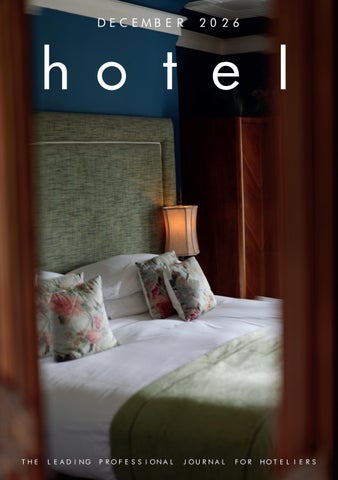
DECEMBER 2026
THE LEADING PROFESSIONAL JOURNAL FOR HOTELIERS
Image courtesy of The Lovat Hotel
Apply
Now
www.hotelmagazineawards.co.uk/apply
Find Your One-Stop Shop for Hotel Room Products at
www.outofeden.co.uk
EDITOR’S NOTE
December 2026 A
s we reach the final edition of Hotel Magazine for 2026, it feels like the right time to take stock of a year that has continued to challenge, shape and redefine the hospitality industry – and to look ahead at what comes next. Our 2026 Year in Review brings together industry experts, each reflecting on the moments, lessons and developments that have mattered most to them over the past 12 months. Just as importantly, they share what they believe the industry should leave behind as we move into a new year. It’s an opportunity to pause, reflect and consider which ideas, habits and approaches still serve hotels well, and which might be holding them back. Looking ahead, few areas are evolving as quickly as technology. Hotels are increasingly reliant on a growing ecosystem of platforms, from property management and revenue management systems to guest apps, digital keys, payment solutions and workforce tools. Individually, these systems promise greater efficiency, better insight and a more seamless guest experience. But when does the pursuit of a smarter hotel begin to make life more complicated for the people running it? Our main technology feature explores whether the modern hotel tech stack is genuinely making operations easier, or whether the industry needs to rethink how its systems work together. We also look at five essential cybersecurity checks every hotel should make before 2027 – a timely reminder that greater connectivity must go hand in hand with greater vigilance. Technology is also transforming how hotels approach the bottom line. In our feature, The New Revenue Playbook, we explore what effective revenue management will look like in 2027, from AI-powered forecasting and dynamic pricing to smarter segmentation, direct bookings and the growing importance of total revenue management. As hotels look beyond room rates to unlock opportunities across food and beverage, experiences and ancillary services, the challenge is to turn increasingly sophisticated data into decisions that deliver meaningful commercial results. The opportunity is significant, but so is the need to ensure that technology and automation support the judgement and expertise of the people behind the numbers. Elsewhere in this edition, we speak to Massimo Varriale, General Manager of The Webster Covent Garden, for In the Hot Seat, gaining insight into his career and approach to leadership. Our Hotel of the Month takes us to Chewton Glen, where a distinctive combination of luxury, experiences and considered hospitality offers plenty of inspiration for operators looking to differentiate their businesses. We are also delighted to feature The Lovat as our Cover Story, exploring the thinking behind a hotel that has made sustainability central to its identity. As our 2026 Hotel Magazine Environment Award winner, The Lovat provides a timely example of how environmental responsibility can be embedded into a hotel’s wider business strategy, rather than treated as a separate initiative. As we head into 2027, the opportunities for hospitality remain considerable, but success will depend on more than adopting the latest technology or pursuing the next commercial trend. It will come from knowing where to invest, understanding what guests genuinely value, supporting the teams delivering the experience and having the confidence to simplify where necessary. Thank you for reading Hotel Magazine throughout 2026. From all of us, we wish you a very happy Christmas and a successful start to the new year.
Jade Evans, Editor-in-Chief © 2026 Cogent Multimedia Limited, 1st Floor, Saphir House, 5 Jubilee Way, Faversham, Kent, ME13 8GD. No part of this magazine may be reproduced or stored in a retrieval system or transmitted in any form – electronic, mechanical or physical – without express prior permission and written consent of the publisher. Contributions are invited and when not accepted will be returned only if accompanied by a fully stamped and addressed envelope. Manuscripts should be type written. No responsibility can be taken for drawings, photographs or literary contributions during transmission or in the editor’s hands. In the absence of an agreement the copyright of all contributions, literary, photographic or artistic, belongs to Cogent Multimedia Limited. The publisher accepts no responsibility in respect of advertisements appearing in the magazine and the opinions expressed do not necessarily represent the views of the Publisher. The Publisher cannot accept liability for any loss arising from the late appearance or non publication of any advertisement.
8
www.thehotelmagazine.co.uk
CONTENTS
12 Cover Story
The Lovat, winner of the 2026 Hotel Magazine Environment Award, features this December as our cover star, with an in-depth Cover Story exploring its approach to sustainable hospitality.
42
46
21 Technology
We explore the Hotel Tech Stack and pose the question ‘are we making hotels too complicated?’ Industry figures have the answers.
35 2026 - Year in Review We speak to a selection of industry experts as they summarise the last twelve months in their own words, including their key takeaways and what they want to leave in 2026.
46 Hotel of the Month
50
Chewton Glen takes centre stage as our Hotel of the Month, where timeless country-house charm meets contemporary luxury and exceptional hospitality.
64 Revenue Management We explore what modern hotel revenue management actually looks like in 2027? Revenue directors, general managers and commercial leaders reveal the biggest shifts they expect to see.
77 Hotel Magazine Awards
60
70
Editor-in-Chief
Administration Manager
Head of Business Development
Design and Production
Jade Evans jevans@thehotelmagazine.co.uk
Jazmine Davis jazmine@thehotelmagazine.co.uk Tel: 01795 509 105
Account Manager Harrison Hume hh@cimltd.co.uk Tel: 01795 509 105
Marketing Manager
Lucas Payne lucas@cogentmultimedia.com
Natalie Woollin admin@cimltd.co.uk
Grant Waters grant@cimltd.co.uk
James Taylor james@cimltd.co.uk
Head of Digital
Xhulio Bishtaja digital@cimltd.co.uk
Social Media Manager
Head over here to find out all the latest details on the 2027 HMAs as we get closer to the applications drawing to a close.
Credit Facilities Manager Gwen Lee creditcontrol@cimltd.co.uk Tel: 01795 509 103
Director
Declan Wale declan@thehotelmagazine.co.uk Tel: 01795 509 112 Tom Woollin tom@cogentmultimedia.com
Managing Director John Denning
Lily Lawson socials@cimltd.co.uk
www.thehotelmagazine.co.uk
9
WELLNESS LUXURY LIVING
INTRODUCING THE SAND STONE COLLECTION Step into a warm, refined aesthetic that blends Italian design with cutting-edge innovation to redefine the most exclusive wellness spaces.
Call +44 20 3907 5000 (UK) or visit technogym.com
Discover Sand Stone
COVER STORY
The Lovat Scotland
A
t the southern tip of Loch Ness, The Lovat is carving its own path in Highland hospitality. Combining more than 160 years of history with a progressive approach to sustainability, food and guest experience, the 29-bedroom hotel is demonstrating how independent hospitality businesses can build a distinctive identity while remaining commercially focused. Owned and run by Caroline Gregory and her husband, Head Chef Sean Kelly, The Lovat has spent more than two decades developing an approach to hospitality that puts people, place and purpose at its heart. Its philosophy is captured in one word: ‘Coftie’ – a combination of cosy, comfy and coorie, meaning feeling at home in wild, beautiful places. More than a design concept, Coftie is a way of hosting that influences every aspect of the guest journey, from the team’s approach to service to the food on the plate and the hotel’s wider environmental commitments. Sustainability has been embedded in the business for over 20 years, with The Lovat becoming the first hotel in the Highlands to install a biomass boiler in 2006. Today, it is working towards B Corp certification and following a net zero roadmap through Climate Springboard. Recognition has followed, with the hotel winning Hotel Magazine’s 2026 Environment Award, alongside Best Restaurant & Eating Experience at the Highlands & Islands Food & Drink Awards and Best Hotel at the Regional Thistle Awards. For Caroline, who took on the hotel at the age of 25 and
12
www.thehotelmagazine.co.uk
has now spent more than 20 years developing the business, success is about remaining true to its values while continually finding ways to evolve.
Investing in people and purpose
For Caroline, one of the biggest challenges of the past 12 months has been navigating an unpredictable trading environment while maintaining investment in the hotel’s long-term future. Despite enjoying a strong season, rising costs and squeezed margins have reinforced the importance of looking beyond occupancy and revenue when assessing business performance. “As it turned out, we’ve had a fantastic season, but busy isn’t the same as profitable. Margins have been squeezed, so we’ve had to keep a tight rein on costs while still pushing projects forward to grow the business,” she explained. The experience has highlighted the importance of balancing financial discipline with continued investment, particularly in the people and projects that will support the hotel’s future growth. For Caroline, building meaningful career paths for the team has been a key focus, with colleagues encouraged to embrace the journey and play an active role in shaping what comes next. Her advice to fellow hotel leaders is to begin with a clear understanding of their business’s purpose and ensure that everyone, from the leadership team to the front line,
COVER STORY understands and believes in it. “Invest in the people who deliver your vision. Get them out of the building. Send them to the farm, the potter’s kiln, another chef’s kitchen or let them be the guest for a day. A team that has lived the story doesn’t need a script.” She also believes that authenticity has a direct commercial benefit. Guests recognise when a business genuinely delivers on its values, and that connection is what encourages loyalty and willingness to pay. “Cut the team budget and you cut the very thing guests are paying for,” she said.
Finding its own place in Highland hospitality
The Lovat’s ambition is to be a thriving hotel that operates seamlessly, with its approach to training, development and commercial growth all driven by this objective. Rather than following a conventional luxury hotel model, the business has developed a proposition around slow, intentional and purposeful travel. Its location provides an immediate connection to the outdoors, attracting guests who want to walk, swim, run or paddleboard before returning to a welcoming hotel that rewards their efforts. Loch Ness remains a significant part of its appeal, bringing international recognition, history and heritage to the doorstep. However, The Lovat is increasingly establishing itself as a food destination in its own right, with its restaurant and wider culinary experiences providing an additional reason to visit. This diversification is important to the hotel’s commercial strategy, allowing it to build on its established location while creating a stronger identity beyond the destination itself. There are also several development projects in the pipeline. An architect is redesigning the hotel’s lawn to accommodate a new outdoor dining space, with potential plans for garden rooms and a barbecue hut. A Polycrub growing structure is also planned, allowing the team to produce more of its own ingredients. Elsewhere, the hotel is exploring the addition of a woodfired mobile sauna, while refurbishment plans include improvements to public spaces and a phased upgrade of the bathrooms. A website redevelopment will further support the hotel’s positioning and visibility. The approach is one of considered growth, with each development intended to strengthen the guest experience while remaining consistent with the hotel’s environmental and commercial priorities.
experience. The hotel is currently trialling an AI voice agent to handle telephone enquiries, with the intention of freeing up colleagues to spend more time looking after guests in person. People development is equally important. The Lovat works with Hospitality Apprenticeship Scotland to train apprentices, while six members of the team are certified mental health first aiders. Every employee also receives a paid volunteering day each year. This commitment reflects Caroline’s wider passion for developing young people within hospitality, which extends beyond the hotel through her involvement with Hospitality Connect and Hospitality Apprenticeship Scotland. Sustainability is also woven into the everyday guest
The meaning of Coftie
At The Lovat, Coftie is the guiding principle behind the guest experience. It gives the team a shared purpose and provides a framework for delivering hospitality that feels personal, intuitive and connected to its surroundings. Rather than relying on an extensive list of additional amenities, the focus is on recognising what individual guests need and responding thoughtfully. That might mean providing somewhere to dry wet walking boots and outdoor clothing, finding a quiet table or offering a recommendation for the following morning. These seemingly small details are considered an essential part of creating a stay that guests remember. Technology has a supporting role, rather than leading the
Carol ine Gre g
ory
www.thehotelmagazine.co.uk
13
COVER STORY experience. From the provenance of ingredients on the plate to the energy used to heat the water and herbs growing in reused wine bottles, environmental responsibility is demonstrated through practical decisions rather than presented as a separate message. It is this combination of thoughtful service, engaged colleagues and a genuine connection to place that gives Coftie its meaning.
A taste of the Highlands
Food is central to The Lovat’s identity, with Station Road restaurant at the heart of the business. Led by Head Chef Sean Kelly, the restaurant follows a philosophy of forage, gather and grow, drawing inspiration from 16th to 18th-century Highland food history and bringing it to life through contemporary cooking techniques. The kitchen holds three AA Rosettes, is listed in the Michelin Guide and won Best Restaurant & Eating Experience at the 2026 Highlands & Islands Food & Drink Awards. It has also been shortlisted for Hotel Restaurant Team of the Year at the Catey Awards. Seasonal tasting menus celebrate the changing availability of local produce, reinforcing the hotel’s wider commitment to provenance and sustainability. Beyond the restaurant, The Lovat offers a programme of experiences designed to deepen guests’ connection with the surrounding area. These include whisky and UK sparkling wine tastings, guided foraging trips, bread and chocolate-making courses, and the opportunity for braver visitors to take a dook in Loch Ness. The hotel also has Waypoint bar, providing a more relaxed space for guests to gather. Its leisure proposition is closely connected to the natural environment, with Loch Ness, the Great Glen Way and the surrounding hills providing opportunities for walking, paddling, wild swimming and outdoor exploration. Rather than relying on conventional leisure facilities, the hotel uses its location as an integral part of the experience.
For the business, this offering extends well beyond providing activities for existing guests. Station Road and its associated food and drink experiences have become important reasons for people to visit The Lovat in their own right, helping to attract a wider audience and encouraging longer stays. Looking to the coming year and beyond, The Lovat’s ambition is to continue doing what it already does well, but to do it better. Planned developments across the gardens, dining spaces, bedrooms and wellness offering will help strengthen the guest proposition, while the hotel’s commitment to sustainability and commercial performance will remain central to its decision-making. Working towards B Corp certification and progressing its net zero roadmap are important parts of that journey, alongside continued investment in its people and the development of career opportunities within the business. For Caroline, however, the most exciting part of the future is seeing the team grow alongside the hotel. “This hotel has a beating heart and we need to keep it pumping – the team keep it alive. What excites me most is watching them respond, flex and flourish as the business grows.” In an industry where businesses can often feel pressure to follow established models of luxury and growth, The Lovat offers a different perspective. Its success is being built around a clearly defined purpose, a strong connection to its surroundings and a belief that sustainability, commercial performance and exceptional hospitality can work together. It may be a small hotel, but its ambitions are anything but. By remaining true to its values while continually finding new ways to evolve, The Lovat is demonstrating that the future of Highland hospitality can be both commercially resilient and deeply rooted in a sense of place. thelovat.com
14
www.thehotelmagazine.co.uk
OaTLY IS ON TOp! NEW!
AT LAST: A cloud you can eat! Oatly Barista Cold Foam is a plantbased topping that tastes amazing and adds some creativity to anything that needs an extra little fluff. Chill before use. Enjoy!
SPA, WELLNESS & AMENITIES
A New Language of Luxury As fashion and lifestyle brands increasingly shape the luxury guest experience, La Bottega Collective is bringing iconic design identities into hospitality through exclusive textile partnerships, bespoke collections and specialist Italian craftsmanship, transforming everyday guest essentials into opportunities for hotels to express their identity.
T
he relationship between luxury hospitality, fashion and lifestyle brands continues to evolve as hotels look beyond traditional brand partnerships to create more distinctive and considered guest experiences. The concept of luxury itself is also changing. From designer suites and exclusive retail collaborations to branded beach clubs and beauty essentials, luxury fashion and lifestyle brands are extending their presence beyond traditional retail and into the world of hospitality. For hotels, these partnerships offer new opportunities to connect guests with brands they know and love, bringing familiar design identities into the spaces, products and everyday rituals that shape their stay. Thoughtfully executed, these collaborations become an extension of the hotel’s identity, contributing to an experience that feels both distinctive and cohesive. Recognising this evolution, La Bottega Collective is extending these brand collaborations through exclusive textile licensing partnerships, bringing iconic fashion and lifestyle houses into the guest room. At the forefront of this approach is La Bottega Collective’s partnership with iconic British design house Paul Smith. Renowned for its distinctive interpretation of classic British style, signature stripes and use of colour, Paul Smith brings more than five decades of creative heritage into the world of luxury hospitality. The exclusive hotel textile collection translates the brand’s recognisable aesthetic into a curated range of in-room essentials, including bed linens, robes, kimonos, pyjamas, eye masks and slippers. From the first touch of a robe to the experience of beautifully designed sleepwear, each piece brings together the creative identity of the fashion house with the comfort, quality and functionality expected within a luxury hotel environment. The partnership extends beyond textiles, with Paul Smith’s Botanist Beauty Essentials collection introduced
16
www.thehotelmagazine.co.uk
through La Bottega, the Collective’s beauty essentials pillar. Together, the collections create a consistent expression of the brand across the bathroom, connecting guest touchpoints through a shared design identity. For hoteliers, this extends beyond traditional amenities, introducing globally recognised brands through collections tailored to the hospitality environment.
SPA, WELLNESS & AMENITIES Beyond its exclusive licensing partnerships, La Bottega Collective develops fully bespoke collections, shaped by the individual character, design and positioning of each property. At Carlton Cannes, this approach comes to life through bespoke Beauty Essentials by La Bottega and inroom textiles, extending to the hotel’s beach club, where branded fans, pool floats and other carefully curated details create a cohesive guest experience, brought together through Palatino, the Collective’s OS&E pillar. Together, each element creates a seamless guest experience, carrying the hotel’s identity naturally from one space to the next. As the boundaries between fashion, lifestyle and hospitality continue to evolve, the role of brand collaborations is moving beyond visibility and recognition towards a more integrated guest experience. The world’s leading fashion houses are increasingly defined not only by the products they create, but by the wider experiences they build around their distinctive identities. This offers brands an opportunity to extend their identities into hospitality, where touchpoints from bathroom fragrances to bedroom textiles allows guests to experience the brand beyond its traditional retail environment. Alongside these design-led collaborations, La Bottega Collective is home to Beltrami, a contemporary Italian textile house shaped by decades of expertise in high hospitality environments. Born in the province of Bergamo, where textile tradition is deeply rooted in the region’s history, Beltrami brings together Italian craftsmanship, material intelligence and a considered approach to comfort, quality and lasting beauty. Across bed, bath and table linens, each collection reflects an understanding of the role textiles play in shaping the
guest experience. The weight of a sheet, the softness of a towel and the quality of a material against the skin all contribute to how a space is experienced. These details may not always be consciously recognised by guests but together contribute to the sense of comfort and quality that defines a luxury stay. Beltrami’s expertise can be found in some of the world’s most prestigious properties, including The Arts Club and Four Seasons Hotel George V, Paris, with its work extending beyond hospitality to private residences, luxury spas, jets and yachts. Made in Italy, each collection combines the finest materials and exceptional attention to detail, tailored to each client’s identity. Bringing together exclusive brand licensing partnerships, specialist textile expertise and fully bespoke collections, La Bottega Collective offers a unique ecosystem designed to curate every touchpoint of the luxury guest experience. Spanning The Bath, The Room, The Dressing and The Bed, La Bottega Collective connects beauty essentials, textiles, merchandising and OS&E, allowing hotels to consider each element of the guest journey as one cohesive experience. As luxury hospitality continues to evolve, the opportunity for hotels is not simply to introduce more recognisable brands, but to consider how those brands can become part of the experience itself. La Bottega Collective is redefining the roles of these brand partnerships, transforming everyday guest essentials into an opportunity for hotels to express their identity, tell their story and connect with their guests. Discover labottegacollective.com www.thehotelmagazine.co.uk
17
GUEST EXPERIENCE
Setting the Standard Wellbeing is already reshaping what guests expect from a hotel, and they judge their night by the room they are given. Making every bedroom pass the sleep test, including on the warmest night of summer, is the priority worth planning in January.
W
ellbeing is already one of the biggest forces shaping hospitality, and sleep sits at the centre of it. Guests pay closer attention to how they sleep at home, and they bring those expectations with them when they book. Going into 2027, sleep is something a hotel is chosen on, and reviewed on. Much of the sector’s investment so far has gone into the rooms that sell a property: the refurbished suites and the rooms that appear in the photography. That makes sense. The difficulty is that guests judge their night by the room they were actually given, and in many hotels the quality of sleep varies far more from room to room than the brochure suggests. Few hotels refurbish every bedroom at once. Rooms come back into service in phases and budgets get reallocated, so over a few years an estate drifts into a mix of ages and conditions. A mattress near the end of its working life tends to decline gradually, softening and dipping where guests have slept night after night. Ahead of a refurbishment, the best and worst beds in a single building can be years apart, and guests feel that difference long before it shows up on a maintenance schedule. The guest in that room doesn’t know the hotel has invested elsewhere. They know they slept badly, and that is what goes into the review. Heat is the second test, and it is getting harder to pass. Recent UK summers have brought more warm nights, and
much of the country’s hotel stock was built for a cooler climate. Top-floor and south-facing rooms can hold heat well into the night, particularly where there is no air conditioning. A guest who is too warm will struggle to sleep, however good the bed is. Where the warmest rooms and the oldest beds coincide, that is where the worst nights in the building happen. Breathability is part of the answer. Silentnight Contract’s Lune mattress uses Airmesh™, the most advanced airflow technology in the range. Air keeps moving through the mattress, so guests sleep cooler and operators field fewer heat-related complaints when a hot spell arrives. January is the right moment to act, while your summer budgets and refurbishment plans are still taking shape. The most useful step is a simple one. Walk the building room by room and note two things for each bedroom: the age and condition of the bed, and how warm the room runs in summer. Your housekeeping team will already know much of this. Rooms that score badly on both go to the top of the list, and replacement starts to follow condition rather than the calendar. Lighter summer bedding can be bought now and stored, ready for the first warm week. The hotels that get sleep right in 2027 will treat it as a standard every bedroom meets, on every night of the year. The suites will keep selling the property. A good night in every room is what brings guests back. Discover more at silentnightcontract.co.uk
18
www.thehotelmagazine.co.uk
GREAT HOSPITALITY DESERVES RECOGNITION
Introducing the first NoVacancy London Awards, celebrating outstanding hotels, accommodation businesses and the people behind them
FOUR AWARDS. YOUR TIME TO SHINE Independent Hotel of the Year Accommodation Operator of the Year Hospitality Leader of the Year Future Hospitality Leader of the Year
ENTER NOW
→ 24-25 February 2027 | ExCeL, London Terrapinn.com/novacancyldn/awards
Technology
www.thehotelmagazine.co.uk
21
TECHNOLOGY – ESSENTIAL 5
22
www.thehotelmagazine.co.uk
TECHNOLOGY – ESSENTIAL 5
Stay Cyber Safe With cyber threats continuing to evolve, cybersecurity should be treated as an operational priority rather than simply an IT concern. Before the new year, here are five practical steps you can take to review your defences and address potential weaknesses. Audit who has access to what
Staff turnover, seasonal recruitment and changing responsibilities can leave former employees or outdated user accounts with access to hotel systems. Review access permissions across property management systems (PMS), point-of-sale (POS) platforms, booking tools and corporate networks, removing accounts that are no longer needed. Adopt the principle of least privilege, giving each employee access only to the information and systems required for their role. Multi-factor authentication (MFA) should also be enabled wherever possible, particularly for administrator accounts, remote access and email. This adds an extra layer of protection if passwords are compromised.
Check your payment systems and guest data
Payment terminals, reservation platforms and guest databases are attractive targets for cybercriminals. Confirm that payment systems are appropriately secured, software is up to date and any payment service providers meet relevant security requirements. Hotels should also review how personal information is collected, stored, accessed and eventually deleted. Under UK GDPR, businesses must implement appropriate technical and organisational measures to protect personal data. Ensure staff understand how to handle sensitive information and that card details are never recorded or shared through insecure channels. Where card payments are concerned, check with your payment provider or acquiring bank that the hotel’s arrangements meet applicable PCI DSS requirements.
Update systems and close known vulnerabilities
Outdated software can provide attackers with an entry point into hotel networks. Check that operating systems, applications, network equipment and connected devices are receiving security updates, with a clear process for applying critical patches promptly. Pay particular attention to internet-connected devices,
including smart-room controls, CCTV, door locks and guest Wi-Fi equipment. Where possible, separate these devices from systems holding sensitive business or payment data. Any technology that is no longer supported by its manufacturer should be identified, with a plan to replace it or reduce its exposure to risk.
Test your backup and recovery plan
A cyber incident can disrupt reservations, check-in, payment processing and communication between departments. Reliable backups are therefore essential, particularly in the event of ransomware, which can encrypt business-critical files. Check that important data is backed up regularly and that at least one backup copy is isolated from the main network or otherwise protected against unauthorised access. Crucially, do not assume that a successful backup means a successful recovery: test whether data and essential systems can actually be restored. Document who is responsible for responding to an incident, how operations would continue and how guests, suppliers and relevant authorities would be contacted if systems became unavailable.
Review supplier security and staff awareness
Hotels rely on external providers for everything from reservations and payment processing to marketing, maintenance and building management. A vulnerability in a supplier’s systems can create risks for the hotel, too. Identify which third parties can access hotel networks or sensitive information, check their security arrangements and ensure access is restricted appropriately. Contracts should clearly address data protection, incident reporting and responsibilities in the event of a breach. Finally, equip staff to recognise phishing emails, suspicious links and requests for confidential information. Short, regular training sessions and clear reporting procedures can help employees identify threats before they escalate.
www.thehotelmagazine.co.uk
23
Hospitality Technology at the
Step into the future of hospitality with an innovative technology ecosystem for PMS, POS, Golf, Spa & Club
When guest expectations rise, your technology should keep up. The Agilysys ecosystem unifies data, intelligence, and workflows across your entire hospitality operation with the power of AI to anticipate, respond, and personalise every guest moment in real time.
Interested? Snap to get started!
EMEASales@agilysys.com www.agilysys.com
TECHNOLOGY
The Hotel Tech Stack From PMS platforms and revenue management systems to guest apps, AI and digital payments, hotels have never had more technology at their disposal. But as systems multiply, are they genuinely making operations easier, or creating another layer of complexity for already stretched teams? We ask eight hospitality experts where the industry needs to get smarter. 26
www.thehotelmagazine.co.uk
TECHNOLOGY
T
echnology has become an increasingly integral part of modern hotel operations. From the moment a guest makes a booking to the final bill at check-out, an increasingly sophisticated network of systems works behind the scenes to support the experience. Property management systems, central reservations, booking engines, CRM platforms, payment solutions, revenue management, housekeeping technology and guest-facing applications have all become familiar components of the hotel technology stack. And the opportunities are considerable. Better connected systems can improve operational efficiency, unlock commercial opportunities, strengthen guest relationships and give hotel operators greater visibility across their businesses. Yet as the number of platforms continues to grow, a question is increasingly emerging: are hotels becoming more efficient, or simply more complicated? For hotel teams, the distinction matters. Technology introduced to eliminate manual processes can sometimes create new ones, with colleagues switching between systems, duplicating information and navigating increasingly fragmented workflows. The challenge is no longer simply deciding which technology to invest in, but understanding how it fits into the wider operation. For Matt Wesson, CEO of Hotel IT Company and author of The Hotel Technology Playbook, the issue is not necessarily the number of systems a hotel operates, but whether they genuinely deliver value. “Hotel technology has never offered so much opportunity. From property management and restaurant systems to spa bookings, revenue management, guest engagement and AI, hotels have access to an incredible range of solutions. And that’s a good thing. “There’s absolutely nothing wrong with having multiple systems, just as there’s nothing wrong with choosing a more consolidated technology platform. Different hotels have different requirements, and what works brilliantly for one property may not be suitable for another. “The important thing is choosing technology that genuinely fits the hotel’s operations, delivers measurable value and works effectively with the wider environment.” The idea that a hotel should simply reduce its technology stack to a handful of platforms is perhaps too simplistic. A large resort with multiple restaurants, spa facilities, golf, leisure and events will naturally require a different infrastructure from a smaller boutique property. Specialist technology can bring considerable advantages, particularly where functionality is tailored to the specific needs of an operation. The real challenge is ensuring those systems work together. Oliver Baxter, IT Director at Clermont Hotel Group, believes the warning signs of an overly complicated technology environment are usually visible in everyday operations. “I don’t think there’s a magic number of systems where a technology stack becomes too complicated. For me, it’s when that complexity starts becoming visible to the people using it. “The warning signs are usually quite practical, such as colleagues entering the same information more than once, moving data between systems manually, relying on spreadsheets to join things together, or having to work out www.thehotelmagazine.co.uk
27
TECHNOLOGY which system holds what information. “Ultimately, if colleagues or guests are having to compensate for the technology, something needs to change.” It is a sentiment shared by Kelly Elton, Group Director of Sales at Foxhills Club & Resort, where the breadth of facilities and membership operations creates particularly complex data requirements. “Hotels can easily accumulate systems over time. One department identifies a problem, purchases a solution, and gradually you end up with multiple platforms that work perfectly well individually but require teams to move between a range of systems, often duplicating information or manually reconciling data. “If colleagues are maintaining spreadsheets alongside expensive technology, repeatedly entering the same guest information, or relying on manual workarounds to connect departments, the technology stack is no longer doing its job.” At Foxhills, the focus has increasingly shifted towards ensuring technology collectively provides a better understanding of guests and members, rather than simply having the best individual system for each department. “A guest may stay in the hotel, attend a corporate event, play golf, visit the spa and later become a member. From their perspective, that is one relationship with Foxhills. Our technology needs to recognise those touch points in the same way.” For resorts and multi-facility properties, this joinedup approach is particularly important. Without it, guest information risks becoming fragmented across departments, limiting opportunities for personalisation, repeat business and meaningful engagement. If there is one recurring theme among our contributors, it is that integration should be at the heart of hotel technology strategy. A system may be exceptional at its individual function, but if it cannot reliably communicate with the wider infrastructure, the benefits can quickly diminish. Chas Scarantino, CEO of RoomPriceGenie, highlighted how even relatively modest technology environments
28
www.thehotelmagazine.co.uk
can experience significant integration challenges. “A manageable tech stack isn’t necessarily one with fewer systems. Research by RoomPriceGenie and RMS found that even hotels using just one to three systems experienced issues with incorrect rates, missing data and failed connections. “There’s a temptation to solve this by putting everything into one platform, but that can mean compromising on the depth and expertise that specialist solutions provide. “The focus should be on choosing systems that do their individual jobs well and connect seamlessly, so hoteliers can benefit from the technology without having to manage the complexity behind it.” For revenue management in particular, the quality of integration can directly influence commercial performance. “A revenue management system, for example, might have an excellent pricing algorithm, but if it isn’t receiving accurate, up-to-date information from the PMS, its recommendations will be based on an incomplete picture of the hotel’s performance,” Chas explained. “Equally, if pricing changes aren’t flowing back into the PMS and distribution channels reliably, hotels risk losing revenue or creating unnecessary work for staff.” The implications extend well beyond revenue management. Jonathan Grant, Director of Technical Sales at Zonal, believes integration should eliminate unnecessary touchpoints throughout the guest journey. “If a guest charges a restaurant bill to their room, for example, that information should flow across the system without the need for staff input. “Operators should move beyond asking whether a system is integrated and instead ask vendors how those integrations work in practice.” Jonathan pointed to real-time connectivity as another important consideration, with scheduled data exchanges potentially creating delays and operational inefficiencies. “Ultimately, successful integration is about creating a technology environment that removes friction for guests and staff as well as providing a single, reliable view of the business.” For Matt, however, integration should not be viewed
TECHNOLOGY
as an automatic solution in itself. “An integration being available doesn’t automatically mean it delivers the outcomes the hotel needs. “Before introducing another platform, hotels should understand how it will connect with existing technology, what information will be shared and whether it will genuinely simplify the guest or employee journey. “If a new system requires constant manual intervention, duplicate data entry or additional administration, we should be questioning whether it has been implemented correctly or whether it’s the right solution at all.” While much of the conversation around hotel technology focuses on data, automation and commercial performance, its impact on employees remains one of the most important measures of success. Hospitality is fundamentally a people business, and technology should ultimately support the teams responsible for delivering memorable guest experiences. Liutauras Vaitkevičius, CEO at Apex Alliance, believes this balance is central to how hotel operators should approach technology. “Guest experience, in particular, is the mirror of these wider efforts – whatever the background tech, we all still very much rely on our teams, their collective and individual creativity and initiatives, to create those great experiences. “Mine, and my teams’ efforts these days are not so much about using more tech, but being smarter and more efficient – all while buying back time on our front-line employees to practice their craft to best of their abilities.” The distinction between technology that supports employees and technology that adds to their workload is becoming increasingly important as hotels face ongoing productivity pressures. Nicola Longfield, Chief Commercial Officer, Global Accommodation & Payments at Access Hospitality, pointed to the considerable amount of time lost when systems fail to communicate effectively. “Our research found that hotel staff lose an average of 322 hours a year switching between systems. That is
time that could be spent supporting guests, improving operations or finding ways to grow revenue. “Hoteliers should start by identifying where information is duplicated or where manual workarounds are needed. Then they should prioritise integration between core systems such as central reservations, CRM, property management and booking engines.” The opportunity is not simply to provide employees with more information, but to make the information they need easier to access and act upon. Managers, Nicola argued, should not have to navigate multiple reports to understand what is happening across their operation. Connected systems can bring relevant information together, highlight issues and opportunities, and allow teams to ask questions about performance in everyday language. Jonathan also highlighted the importance of maintaining the human element, pointing to Zonal’s People vs Tech Report 2026, which found that 48% of consumers believe human interactions are the most critical factor in their hospitality experience. “However, with 52% also saying that technology plays a key role in delivering the best guest experiences when combined with face-to-face service, operators should focus on using technology to streamline operational tasks so employees can spend more time engaging with guests.” The objective, therefore, should not be to remove people from the guest journey, but to remove the administrative tasks that prevent them from being present within it. Artificial intelligence is increasingly being positioned as the next major opportunity for hospitality technology, with the potential to automate processes, interpret data and simplify interactions across existing systems. For some operators, this could represent an opportunity to reduce the burden of managing increasingly complex technology environments without necessarily replacing the platforms themselves. At Apex Alliance, Liutauras believes AI is already opening www.thehotelmagazine.co.uk
29
TECHNOLOGY up new possibilities. “Where even three or four years ago, we needed specialist solutions for specific tasks, we are now easily able to build our own dashboards, our own mini-systems simply by using very, very clever AI models. At Apex Alliance, we have plenty of working examples already, which, of course, is allowing us to supercharge our efficiencies.” Oliver, meanwhile, believes the pace of AI development makes it difficult for hotel groups to establish rigid long-term strategies. “For us, it’s about staying close to that change as our strategy develops, while getting the foundations right around data, security and governance. “I don’t think you can define a three-year AI plan today and assume it will still be the right plan in three years. You need direction, but also enough flexibility to respond as the technology and the use cases mature.” For Chas, the next major development will be technology that moves beyond reporting to actively supporting decision-making. “Rather than expecting someone to analyse multiple reports to spot a change in booking demand, technology should be able to identify an opportunity, explain what’s driving it and recommend an appropriate response. “AI will accelerate this, but the real value will come
30
www.thehotelmagazine.co.uk
from making those insights accessible within the systems hoteliers already use, such as their PMS, while drawing on specialist technology behind the scenes.” Nicola believes the next step will be software capable of carrying out routine tasks, rather than simply presenting information for employees to interpret. “The biggest shift for 2027 will be from software that reports to software that can carry out routine tasks. Hotels already use technology to spot trends and support decisions. The next step is tools that act on connected information, with appropriate human oversight.” At Wyndham Hotels & Resorts, Dimitris Manikis, President EMEA, believes this transformation could fundamentally change how hotel teams interact with technology. “We are in the middle of the biggest technology transformation of our lifetime with AI, and its impact on the hospitality industry will be immense. “We can already deploy agentic workflows that remove a lot of friction and complexity from the existing tech stack for most hotels, and it will only get better from here without changing the tech stack, which is a much heavier lift. “For most of us, we will no longer spend most of our day managing systems. We will finally get to focus on the hospitality side of our jobs and get back to being hoteliers.” However, the promise of AI should not distract operators from the underlying infrastructure required to make it effective. Poor-quality data, fragmented systems and unclear governance will inevitably limit its potential. With new platforms and capabilities entering the market at an extraordinary pace, how can hotel operators determine which investments genuinely deserve a place within their technology environment? For Matt, the answer begins with looking at what is already in place. “Before buying something new, look at what you already have. “Speak to the teams using the systems every day. Identify which processes work well, where staff are relying on manual workarounds and where technology is creating frustration rather than removing it. “Review whether existing platforms already provide functionality the hotel isn’t using. “Of course, there will be times when investing in additional technology is absolutely the right decision. But that investment should be driven by a genuine business requirement, not simply because a new product has entered the market.” Oliver similarly believes the selection process needs to begin with the business problem rather than the product. “It’s very easy to buy a good product that solves one problem but creates another platform, dataset and integration to support. “I’d want to understand and test that properly during selection, not after we’ve signed a contract. What data can actually be exchanged, how reliable is the integration, and who owns it when something doesn’t work?” For Dimitris, technology should be assessed against its ability to deliver value across the guest journey and wider business. “At Wyndham Hotels & Resorts, technology is not about replacing hospitality, it’s about giving hotel teams better tools to serve guests more effectively and efficiently.”
TECHNOLOGY
He points to Wyndham Connect as an example of technology delivering measurable commercial and operational outcomes. Used by more than 5,000 hotels, the platform has facilitated approximately 56 million AI-driven guest interactions and generated close to $9 million in approved upsell revenue. For Jonathan, measuring technology against commercial performance is equally important. “Technology investments should also be measured against clear commercial outcomes. Operators should benchmark metrics such as RevPAR, check-in times, shares of direct bookings and F&B spend and assess whether they’re delivering value.” Liutauras, however, acknowledges that measuring the complete return on technology investment is not always straightforward. “Good tech provides multi-layered benefits such as time saved, automations, reporting, speed of delivery, and even improved employee morale. However, it is truly difficult to measure entirety through simple KPIs. Yet when you have the right solutions – you know.” Ultimately, one of the greatest challenges facing hotel operators is ensuring that technology decisions are considered collectively rather than in isolation. Revenue management, operations, finance, marketing, F&B and guest experience teams all have different requirements, and individual departments will naturally identify solutions that address their immediate priorities. But without someone responsible for the wider technology environment, hotels risk accumulating overlapping functionality, disconnected data and increasingly complicated workflows. Matt believes clear ownership is essential - “I believe every hotel needs clear ownership of its overall technology environment. “That could be an internal IT director, an in-house team or a specialist hospitality technology partner. “The important point is having someone who understands both technology and hotel operations, and
who can look beyond individual systems to consider the wider business.” For hotel groups, the challenge also involves balancing consistency across properties with the flexibility required to accommodate individual operational requirements. Dimitris recognises a scalable infrastructure can help simplify technology management across multiple hotels. “It is almost always better to have one scalable solution across hotels of all types. For companies managing multiple properties, this enables better control in enforcing company standards for data, service, and compliance, while reducing the complexity of implementation, integration, and ongoing maintenance. “The key is to implement the right tech stack that allows for flexibility across multiple jurisdictions, star ratings, and types so the shared infrastructure works for all kinds of hotels in your portfolio.” For independent properties, however, the responsibility may fall to general managers or operational teams who already have considerable demands on their time. This makes the need for specialist support, clear accountability and effective supplier relationships particularly important. As the hotel technology landscape continues to evolve, the industry may ultimately need to reconsider what a successful technology strategy looks like. It is not necessarily about having fewer systems, nor about adopting every new innovation that promises to improve efficiency. Instead, it is about creating an environment in which technology works quietly and effectively behind the scenes, enabling employees to deliver better service, managers to make more informed decisions and businesses to operate more profitably. The most sophisticated technology stack is not necessarily the one with the greatest number of platforms, the most advanced features or the highest level of automation. It is the one that gives hoteliers back their time. www.thehotelmagazine.co.uk
31
TECHNOLOGY
Driving Total Revenue Journey’s Experience Management System (EMS) is Journey’s nextgeneration platform for managing spa, leisure and hotel experiences. Built on more than 30 years of hospitality expertise following Journey’s acquisition of Premier Software in 2023, the management system brings these bookable experiences into one connected platform. Simon Bullingham, Founder and CEO of Journey, explains how EMS drives commercial growth for hotel operators. Wellness and experiences are no longer seen as amenities. How does an Experience Management System deliver this operationally?
Hotels have spent years optimising room inventory, but non-room assets are often fragmented, manually managed, or not treated as bookable inventory at all. Our management system provides the operational backbone to change this. It delivers a centralised, realtime diary that gives teams visibility of staff, facilities, and resources alongside bookings, guest arrivals, and billing. Instead of piecing together information from multiple systems, commercial leaders get a single view of what has been booked and where capacity remains to identify opportunities to improve performance.
How does this apply to the wider hotel offering beyond the spa?
Anything with time, capacity, and demand can become inventory. While a spa treatment relies on therapist availability and a tennis court has a fixed number of sessions, EMS allows hoteliers to manage and yield less obvious assets across the property. Whether it is a highlydemanded cabana, a private dining space, or a fire pit, our Experience Management System allows hotels to control and sell this capacity in advance. By defining this inventory, operators ensure these assets are visible and bookable across the entire guest journey.
How does EMS fit into a hotel’s existing technology ecosystem?
Experiences cannot be managed in a silo, so EMS provides an operational layer that integrates directly with property management systems including Oracle’s OPERA, Mews, and Guestline. It also works seamlessly alongside Journey’s booking engine and gift voucher technology. This connected approach ensures that commercial and operational teams have a unified flow, from how experiences are marketed and booked to how they are managed and delivered on property.
32
www.thehotelmagazine.co.uk
What does this mean for on-property teams and capturing guest spend?
Our hotel partner data proves frictionless operations drive higher ancillary revenue. EMS incorporates Journey Pay to give teams flexibility in how they capture spend. A virtual terminal supports remote payments, while mobile PDQ connectivity allows staff to take card payments anywhere around the property. Furthermore, the tablet-friendly ePOS enables teams to process retail purchases or add items directly to a guest’s tab from the treatment room or leisure facility, removing the need to bring the guest back to a fixed till.
Ultimately, what is the strategic advantage for general managers and commercial directors?
As experiences become a primary driver of hotel demand, their distribution will inevitably expand. The strategic advantage of EMS is that it allows hotels to retain control of their underlying inventory, pricing, availability, and guest data before somebody else becomes the gatekeeper. Hoteliers are highly sophisticated at managing room inventory; EMS gives them the infrastructure to apply that exact same commercial discipline to everything else the property sells. journey.travel
This winter, stop paying to heat empty rooms.
Every unoccupied room held at full temperature is profit walking out the door. Verdant’s smart thermostat stops it, quietly and automatically. Comfort stays exactly as guests left it. Costs drop the moment they leave. Stop managing energy. Start controlling it.
Book a free demo this winter
verdant.copeland.com
Personalized comfort, automatically restored when guest returns
Automatic setback with predefined setpoint limits Up to 45% reduction in HVAC runtime Seamless, invisible energy management
Smart thermostats. Smarter energy savings. *Estimated energy savings reflect an average 45% HVAC runtime reduction compared to traditional thermostats without occupancy-based setbacks. Actual results may vary.
THE GUEST EXPERIENCE CURATORS
Introducing La Bottega Collective
A multidisciplinary collective of excellences: La Bottega, Vanity Group, Palatino, Beltrami, White Privé, and Colosseo. Through our integrated expertise across beauty, textiles, OS&E and design-driven consulting, La Bottega Collective partners with the world’s most discerning hospitality clients, from hoteliers to developers and designers, to transform the guest journey into memorable experiences. Because excellence is never an accident. labottegacollective.com
Year In Review
Image courtesy of Raffles London at The OWO
www.thehotelmagazine.co.uk
35
2026 – YEAR IN REVIEW
Jane Pendlebury CEO of HOSPA.
W
hat has struck me most about 2026 is how much hoteliers continue to achieve despite shrinking financial headroom. Employment and energy costs have squeezed margins, and busy hotels have not necessarily been more profitable. I admire the teams adapting while continuing to deliver warm hospitality. New openings and continued demand for luxury offer reasons for optimism, reinforcing the importance of understanding guests and giving them compelling reasons to choose you. Security failings across the sector have also highlighted our responsibilities. Guest safety must remain paramount, with clear policies backed by regular training, even when budgets are tight. I was delighted to see the home of HOSPACE - The Royal Lancaster London named the UK’s number one hotel in Tripadvisor’s 2026 Travellers’ Choice Best of the Best Awards. Its warmth and attention to detail exemplify hospitality at its best. That is what I take into 2027: confidence in our people and the difference they make every day.
36
www.thehotelmagazine.co.uk
2026 – YEAR IN REVIEW
Robert Richardson FIH MI Hon DLitt
Chief Executive, Institute of Hospitality.
R
eflecting on 2026, I think not only of the challenges facing hospitality, but the extraordinary people continuing to move it forward. At its best, our profession changes lives, creates opportunities and enables people from every background to realise their potential. However, the cumulative burden of taxation remains a significant concern for our members. I would like to leave behind another year without meaningful progress in addressing these pressures. Our businesses need an environment where they can invest, grow and thrive. Despite this, I remain optimistic. Institute of Hospitality membership has reached its highest level in more than two decades, demonstrating the continued commitment to professional development, learning and connection. Our work with Skills England, government and industry partners also reinforces the importance of investing in people. Looking towards 2027, I hope government helps create the conditions for hospitality to thrive, not simply survive. We all share responsibility for building a profession where future generations can flourish.
www.thehotelmagazine.co.uk
37
2026 – YEAR IN REVIEW
Mark Lewis Chief Executive, Hospitality Action
W
hile LinkedIn may suggest AI has dominated hospitality’s concerns in 2026, commercial resilience and, for many, business survival have been the real priorities. Despite navigating foot and mouth, bird flu, Brexit, financial crashes, Covid and global conflicts over 25 years, many operators describe today’s trading environment as the toughest they have experienced. At Hospitality Action, increased demand for support reflects the industry’s growing pressures.
38
www.thehotelmagazine.co.uk
However, I will also remember 2026 as the year hospitality fought back. Tom Kerridge’s VATs the Problem campaign has gained significant traction, while leading chefs have brought the industry’s challenges into the national conversation. Regardless of whether VAT reform is achieved, the campaign has successfully highlighted an industry in crisis. Ultimately, I hope the public embraces the ‘use it or lose it’ message and continues supporting local hospitality businesses.
2026 – YEAR IN REVIEW
Ed Hooper CEO, LQA
T
his year has reinforced what we’ve been seeing at LQA for some time: luxury hospitality continues to outperform luxury goods, with people prioritising experiences over purchases. Value has also become more important, but in luxury it’s about uniqueness and ensuring every moment justifies the price. Authentic service remains central, making attracting and retaining talent increasingly challenging, but also creating opportunities for hoteliers from developing markets and bringing economic benefits to local communities. Locally
rooted teams also offer guests a more genuine sense of place. AI has continued to transform operations, but at the world’s best hotels its impact is almost invisible, quietly managing preferences and administration to give staff more time to personalise stays. While luxury hotels use AI to enhance experiences, much of the wider market uses it to cut costs. What I hope stays in 2026? AI telephone agents. Guests quickly recognise when technology is doing a job a person should, and, frankly, they’re painful.
www.thehotelmagazine.co.uk
39
2026 – YEAR IN REVIEW
Allen Simpson Chief Executive, UKHospitality
A
s 2026 draws to a close, there is much to be proud of in how hospitality has united to stand up for our businesses, people and communities. But let’s be clear: it has been another tough year. Rising employment and operating costs have continued to constrain investment and job creation, with businesses working incredibly hard to absorb the pressure. Yet we’ve made progress. October’s Budget brought the first positive news for hospitality in years, particularly for hotels. Changes to business rates will offer meaningful protection to many businesses. We asked for change and got it, demonstrating that sustained campaigning works.
40
www.thehotelmagazine.co.uk
That collective effort has also driven #VATsTheProblem, with more than 400,000 signatures delivered to Downing Street, putting hospitality VAT firmly on the political map. Meanwhile, our campaign against the holiday tax has seen more than 34,000 people write to their MPs. We’ve also championed hospitality’s role in creating opportunities for young people, calling for 100,000 paid jobs. There is still a long way to go. In 2027, we must keep pushing for lower VAT and employment costs, and oppose the holiday tax. Together, we can turn this year’s progress into lasting change.
2026 – YEAR IN REVIEW
Simon Numphud Managing Director, AA Media
L
ooking back on 2026, I’ve been struck by the resilience and creativity of hospitality businesses across the UK. Operators have faced difficult decisions as costs rise, household budgets tighten and investment competes with protecting value for guests. These pressures have made alignment between government and industry more important than ever. Despite the challenges, hotels are making real progress in expressing their individuality and connecting with their communities. The strongest experiences are rooted in place: good local food, genuine producer relationships, a welcome for local diners and hotel guests alike, and personal service. “Local” matters not as a label, but when it shapes the experience. There is also growing recognition that quality is built by people. Talented teams are finding new ways to create memorable stays, combining clear standards with warmth and character. Innovation works best when it improves the guest experience or helps businesses operate more effectively. In 2027, we should leave short-term thinking behind and focus on supporting people, championing distinctive businesses, and making the UK easier to visit and do business in. www.thehotelmagazine.co.uk
41
In the Hot Seat
Massimo Varriale As The Webster makes its debut in the hotel world with its first property in London’s Covent Garden, General Manager Massimo Varriale discusses launching a new lifestyle brand, building a team from the ground up and why, after more than two decades in hospitality, human connection remains at the heart of everything he does. 42
www.thehotelmagazine.co.uk
INTERVIEW
F
or Massimo Varriale, a great hotel has little to do with the building itself. Having worked across London, Edinburgh, Italy and New York, and held roles spanning F&B, front office, sales and general management, he has come to believe that the most memorable hospitality experiences are defined by something far less tangible than facilities or service standards. “Earlier in my career, I probably thought that great hospitality was about getting everything right – the perfect room, the perfect service, the perfect detail,” he explained. “Of course, those things matter. But over time I’ve realised that the things guests remember most are often much less tangible: a conversation, a sense of being recognised, someone noticing that you need something before you ask, or simply feeling that the people looking after you genuinely care.” For Massimo, the distinction lies in creating an authentic human connection, knowing when to engage with a guest and when to give them space. “I’m less interested in perfection for perfection’s sake and much more interested in authenticity. A hotel should have a soul, and that soul comes from its people.” It is a philosophy that underpins his latest challenge: opening The Webster Covent Garden, the first hotel from the fashion and lifestyle retailer The Webster, with a second property planned for New York next year. Launching an entirely new brand presents both an opportunity and a responsibility. Without an established hotel portfolio to draw upon, the team has the freedom to define its identity from the outset, but must also establish what makes it distinctive in an increasingly competitive London market. “There is something incredibly exciting about having a blank page,” said Massimo. “When you open an established brand, there is a history, a set of expectations and a framework that already exists. With The Webster, we have the opportunity, and the responsibility, to define what the brand means from the very beginning.” That process starts with its surroundings. Rather than simply occupying a building in Covent Garden, Massimo wants the hotel to feel like a natural part of the neighbourhood, reflecting its history, energy and social character. “We want it to feel lived-in, social and connected. A place where you might come for a morning espresso, meet someone for lunch, stay for a late dinner or simply sit at the bar and have a conversation. Somewhere guests and locals can naturally become part of the same social world.” Creating that atmosphere cannot be achieved through design alone. The food, music, people and conversations must all contribute to a coherent identity, while allowing the experience to develop organically. “You cannot manufacture authenticity. You have to create the right environment and then allow the people, the food, the music, the design and the conversations to bring it to life.” Having been involved in several hotel openings throughout his career, Massimo knows that translating a concept into a functioning operation is rarely straightforward. Even the most carefully considered plans will encounter unexpected challenges once a hotel opens its doors. “A hotel opening is one of the great exercises in
humility!” he said. “You can have the most detailed opening plan in the world, but the reality is that something will always surprise you. A delivery will arrive late, a piece of equipment will decide it doesn’t want to work, a room will reveal something you hadn’t noticed, or you will discover that a process which looked perfect on paper simply doesn’t work in real life.” For Massimo, the ability to adapt is what separates theory from experience. “The textbook gives you the plan. Opening a hotel teaches you how to adapt.” Beyond operational readiness, however, the success of an opening comes down to the people delivering it. A team must understand the wider vision, be prepared to solve problems and feel personally invested in what they are creating. Massimo believes that sense of ownership is particularly important during the intensity of an opening, when the excitement of bringing a new property to life can quickly be overshadowed by long days and unexpected setbacks. “If people feel that they are just opening another hotel, they will approach it as a job. If they feel that they are creating something that will belong to people and to a neighbourhood for years to come, they approach it very differently.” www.thehotelmagazine.co.uk
43
INTERVIEW Building that commitment starts with recruitment. While technical expertise is important, Massimo prioritises character, warmth and curiosity when assembling a team. “I have always believed that character is more important than credentials. Of course, technical knowledge matters, but you can teach someone a system. It is much harder to teach warmth, curiosity, judgement or genuine interest in other people.” At The Webster, he has looked for colleagues who are comfortable striking up conversations, attentive to their surroundings and genuinely enjoy interacting with others. From there, the focus is on empowering them to make decisions rather than simply follow a script. “I don’t want colleagues to feel that they are simply following a script. I want them to understand why we do things and to feel confident enough to use their own judgement.” Leadership also means being present, particularly when pressure is mounting. Massimo believes managers must demonstrate the behaviours they expect from their teams, remaining visible and willing to get involved in the dayto-day operation. “You cannot ask a team to be present if you are hiding in an office. During an opening, I want to be amongst the team, listening, helping, talking, laughing and occasionally getting my hands dirty.”
This emphasis on people reflects his wider view of how guest expectations have evolved. Having worked within both large international hotel groups and independent lifestyle hotels, he has seen the traditional markers of luxury, from room size to amenities and formal service, give way to a greater appetite for personal, locally rooted experiences. “I think guests today are looking for connection rather than simply service,” he said. “People are increasingly looking for experiences that feel personal and genuine. They want to discover something, meet people, feel connected to a neighbourhood and perhaps feel like they have found somewhere that isn’t exactly the same as everywhere else.” At The Webster, this means creating an environment that appeals to different audiences without losing its identity. Business travellers, local residents and hotel guests should be able to share the same spaces, each using them in their own way. Whether it is a guest enjoying a drink before dinner, a local meeting a friend over breakfast or someone spending an hour with a coffee and a book, these everyday moments help establish a hotel’s personality. “Those moments are important because they make a hotel feel like a real place rather than a product,” said
44
www.thehotelmagazine.co.uk
INTERVIEW
Massimo. “And perhaps most importantly, I think people want to feel seen. Not processed. There is a huge difference between service and hospitality. Service is what we do. Hospitality is how we make someone feel.” More than two decades into his career, it is this human element that continues to motivate him. The unpredictability of the industry, the opportunity to meet people from around the world and the constant learning that comes with each new experience remain as compelling as ever. If he could offer his younger self one piece of advice, it would be to slow down. Early in a career, the next position or promotion can easily become the focus, but Massimo believes some of the most valuable lessons are found by paying attention to the people and places around you. “Listen to the person in front of you. Learn from the colleague who has been there longer than you. Spend time in the kitchen. Have a cup of coffee in the housekeeping office. Sit in the lobby. Watch how guests behave. Ask questions. Travel. Read. Be curious.” He also stressed the importance of enjoying the journey,
rather than viewing each role as a stepping stone to the next. Every interaction, he believes, offers an opportunity to learn and grow, both professionally and personally. Reflecting on the people who have supported his career, Massimo is particularly grateful to the leaders who have trusted him with their projects and ambitions. “I have had the privilege of working alongside some amazing people and leaders who have believed in me and trusted me with their projects, their dreams. They have given me the opportunity to bring them to life and for that I will forever be grateful because it has given me the opportunity to live my dream.” As The Webster establishes itself in Covent Garden, that appreciation for people will remain central to the hotel’s development. For Massimo, the ultimate measure of success is not simply whether a hotel operates seamlessly, but whether it creates a lasting impression on the people who walk through its doors. “Hospitality is ultimately about people, and people are unpredictable, fascinating and wonderfully human. After more than two decades, that’s still the part I love most.” www.thehotelmagazine.co.uk
45
HOTEL OF THE MONTH
A Country House Hotel with Room to Grow Set between the New Forest and the Hampshire coast, Chewton Glen brings together country house heritage, distinctive accommodation, destination dining and a comprehensive leisure offering. Its approach offers a useful lesson in creating multiple reasons for guests to visit, return and spend and this December features as our Hotel of the Month. 46
www.thehotelmagazine.co.uk
F
HOTEL OF THE MONTH
ew hotels can offer the combination of woodland seclusion and coastal proximity quite like Chewton Glen. Set within 130 acres of gardens, parkland and woodland on the edge of the New Forest, the five-star country house hotel in Hampshire has built its reputation around space, privacy and an experience that extends well beyond the bedroom. The property’s history dates back to the early eighteenth century, with a literary connection to Captain Frederick Marryat, whose novel The Children of the New Forest was published in 1847. That heritage remains woven into the hotel, with accommodation named after the author’s novels and characters. Today, Chewton Glen is part of Iconic Hotels & Resorts and a member of Relais & Châteaux. Its offering balances traditional country house character with contemporary luxury, while its varied facilities allow it to appeal to couples, families, leisure travellers and corporate groups alike. The hotel’s 72 individually designed rooms and suites span the main house and its collection of 14 treehouse suites. In the main house, antique and contemporary furnishings sit alongside modern comforts, creating accommodation that retains a distinct sense of character rather than a uniform look. The treehouses, however, provide a particularly compelling example of how a hotel can create a signature experience. Elevated among the woodland canopy, the suites feature floor-to-ceiling windows, vaulted ceilings, wood burners, private decks and outdoor hot tubs. Some also include concealed bunk rooms, making them suitable for families as well as couples seeking a secluded escape. The largest, The Yews, accommodates up to eight adults and four children. Breakfast hampers, featuring freshly baked bread and pastries alongside locally sourced produce, allow guests to start the day privately, while lunch, afternoon tea and supper hampers extend that flexibility. There is also a practical sustainability consideration as the treehouses incorporate rainwater harvesting, airsource heat pumps, solar panels and low-energy lighting, demonstrating how distinctive accommodation can be designed with its environmental footprint in mind. For hoteliers, the wider lesson is the value of developing a recognisable accommodation concept that gives guests a compelling reason to choose one property over another, while opening up opportunities for premium pricing and longer stays. Food and beverage at Chewton Glen is built around two complementary experiences. The Dining Room, recently renovated and spread across five rooms, caters for everything from breakfast and afternoon tea to celebratory meals and wine-led private dining. Executive Head Chef Luke Matthews and his team focus on seasonal ingredients, British menus and established hotel favourites, with produce from the kitchen garden travelling less than 100 yards to the kitchen. The Wine Room adds another layer to the offer alongside private parties for up to 20 guests, it hosts tastings and regular Saturday evening sessions for hotel residents. Its extensive list also features wines from the UK, giving the hotel an opportunity to turn specialist
knowledge into a guest experience. At The Kitchen, a more relaxed restaurant sits alongside a 12-station cookery school developed in association with chef James Martin. Courses and demonstrations provide an activity in their own right, while the open-plan restaurant allows guests to see the culinary operation at work. Together, the venues illustrate how a well-considered F&B strategy can serve different occasions and spending preferences without relying on a single restaurant format. Dining becomes both a core service and a reason to visit in its own right. The spa and leisure facilities further broaden the hotel’s appeal with guests able to make use of indoor and outdoor swimming pools, a hydrotherapy pool, whirlpool, treatment rooms, saunas and steam rooms, alongside a gym, fitness classes and a nail studio. Outdoor pursuits include golf, tennis, croquet and woodland walking trails. Families are also catered for through the purpose-built Beehive Kids Club, children’s swimming times, cookery lessons and activities ranging from nature rambles to sheep walking. This helps parents enjoy some downtime without compromising the family experience. Beyond leisure, Chewton Glen offers meeting and banqueting facilities for up to 140 guests, with options for team-building activities, cookery masterclasses, wine tasting and exclusive-use events. Its 130 acres provide a flexible backdrop for incentives, corporate entertaining and weddings, while its proximity to road, rail and air links supports accessibility. The breadth of the operation is central to the hotel’s commercial proposition. By combining accommodation with dining, wellness, activities and events, Chewton Glen can cater for a variety of guest needs across different seasons and occasions. For the wider hotel sector, its example reinforces the importance of looking beyond room sales alone. A strong sense of place, distinctive experiences and complementary revenue streams can help a property make better use of its facilities, attract different audiences and give guests more reasons to return. www.thehotelmagazine.co.uk
47
GUEST EXPERIENCE
The Experiential Shift Lavazza on redefining the role of coffee in hospitality.
I
n contemporary hospitality, distinction is increasingly found in the moments between the grand gestures. Exceptional dining, intuitive service and a beautifully appointed suite establish the foundations of a memorable stay, but smaller rituals often shape a guest’s lasting impression. A perfectly prepared cappuccino or a welcoming café can become as integral to a hotel’s identity as its architecture. As the industry looks towards 2027, coffee is stepping out of the background and into the spotlight. No longer just a morning pick-me-up, it’s becoming part of what makes a stay memorable - a small everyday luxury that reflects a property’s personality and gives guests another reason to pause, indulge and connect. According to Allegra’s Project Café UK 2026 report, the UK branded coffee shop market has reached £6.8 billion, growing by 5.5% year on year. For hotels, the opportunity lies in translating consumers’ appetite for quality coffee experiences that feels distinctive and worth returning for.
The Evolution of Experience: Beyond the Guest Room
Modern hotels are no longer defined solely by their accommodation. Lobbies become social destinations, cafés welcome the neighbourhood and restaurants adapt to the rhythm of the day. Coffee connects these experiences. At Four Seasons Hotel London at Park Lane, the hotel embraces the quiet art of the morning, offering a Michelinstarred breakfast through chef Yannick Alléno’s
La Croissanterie, reimagining French pastries with unexpected fillings, including Wagyu and Scottish lobster. Served alongside a dedicated Yannik Alléno signature blend which is part of the 1895 Coffee Designers collection by Lavazza, this culinary vision demonstrates how thoughtful pairings can transform a familiar ritual into a memorable part of a hotel’s identity.
Personalisation: A Coffee Experience for Every Occasion
Whether seeking a quick espresso before a meeting, a leisurely breakfast cappuccino or a refreshing, iced drink in the afternoon, guests increasingly expect choice without compromising quality. At The Shepherd Mayfair, a café-style space, outdoor terrace and street-facing takeaway hatch sit alongside a brasserie that transitions from artisan coffee and
48
www.thehotelmagazine.co.uk
GUEST EXPERIENCE fresh pastries at breakfast to seasonal dining later in the day. Served throughout the venue, Noble Volcano from 1895 Coffee Designers by Lavazza is a single-origin Brazilian specialty coffee with notes of macadamia nut, milk chocolate and caramel, bringing a refined touch of indulgence to the guest experience. The wider beverage market reinforces the importance of variety. Allegra’s 2026 research records year-on-year price growth of 6.1% for standard iced coffee and 9.2% for iced matcha. Cold coffee, alternative milks, decaffeinated options and flavour-led creations offer opportunities to refresh menus and engage guests beyond breakfast.
Affordable Luxury: The Value of Thoughtful Detail
Luxury need not mean excess. Increasingly, it is about quality, care and the details that make an experience feel special. Creative coffee recipes and seasonal serves can transform familiar flavours into accessible indulgences. This summer at Roast in Borough Market, the Eton Mess Latte reimagined a quintessentially British dessert as a coffee creation. Made with Lavazza espresso, meringue milk, and strawberry whipped cream, it captured the seasonal sweetness of the much-loved pudding. Building on that culinary creativity, Roast is now expanding to its second space at Virgin Hotels London-Shoreditch. The hotel caters to distinct moods throughout the day, balancing the newly launched Roast experience and in-room convenience with the music-led energy of Hidden Grooves. Serving Lavazza coffee alongside two inventive coffee cocktails, Hidden Grooves underlines the growing guest appetite for atmosphere, ritual, and experiential hospitality. Similarly, South Place Hotel creates opportunities to tailor experiences to different occasions, offering contrasting dining across Michelin-starred Angler and Bluebird City. Here, Bluebird City introduced two distinctive cocktails made with Lavazza espresso: the Heart Beet gave the Espresso Martini a striking pink twist, combining natural beetroot juice with vanilla vodka and cacao liqueur, while the Smoked Negroni offered a contemporary interpretation of the classic by pairing coffee with passion fruit syrup. These serves demonstrate how quality espresso can become a versatile ingredient for menu innovation. By combining Lavazza espresso with unexpected flavours, hotels can create distinctive experiences that encourage discovery and give guests another reason to return. Looking beyond 2026, the experiential shift is an invitation to rethink the everyday details that define a property. Distinction rarely comes from one single grand statement; it is built through the consistency and care given to familiar routines. Through premium coffee, thoughtful personalisation, and creative serves, hotels can turn everyday rituals into lasting memories. Sometimes, the most memorable expression of luxury is not an elaborate gesture, but an exceptional cup of coffee that surprises, delights, and exceeds expectations. For more information on how Lavazza’s coffee portfolio can work for your business, contact uk.salesorders@ lavazza.com or visit www.lavazza.co.uk/en/contact-us www.thehotelmagazine.co.uk
49
RE-LAUNCH NEWS
A New Chapter in the Art of Expression Montcalm Royal London House has unveiled a new chapter in its story, joining Marriott International’s Autograph Collection following a refurbishment of its guest rooms and public spaces. Drawing on its heritage as the former Royal Mail headquarters, the City of London hotel is putting art, literature and creative expression at the heart of its guest experience.
A
hotel’s identity is shaped by more than its interiors. Its history, the experiences it offers and the connections it creates with its surroundings all contribute to what makes a stay memorable. At Montcalm Royal London House, these elements have come together in a new chapter for the property, marked by its arrival into the Autograph Collection and a renewed focus on the building’s heritage. The hotel recently celebrated the occasion with an event showcasing its refurbished guest rooms and public spaces, alongside a series of creative experiences developed around the theme of the Art of Expression. The concept draws inspiration from the building’s former life as the Royal Mail headquarters, placing the written word, artistic expression and communication at the centre of its identity. For a hotel operating in the competitive City of London market, this approach offers a way to distinguish the guest experience beyond the physical product. While refurbishment can refresh a property’s appeal, a stronger sense of identity gives guests something more tangible to connect with, creating opportunities to engage with the venue in ways that extend beyond an overnight stay. The unveiling of the refurbished rooms and public spaces marks an important milestone for Montcalm Royal London House as it joins the Autograph Collection. The collection brings together individual hotels with distinct identities, making the character of each property an important part of its appeal. At Royal London House, that character is closely linked to its architectural and cultural heritage. Rather than treating the building’s past as a footnote, the hotel is using it as a starting point for a contemporary hospitality offering, connecting its history with experiences designed for today’s guests. This is reflected in the Art of Expression concept, which provides a thread running through the hotel’s new creative partnerships. By bringing together visual art, writing
50
www.thehotelmagazine.co.uk
RE-LAUNCH NEWS
and cultural programming, the property is developing an identity that can be experienced in different ways throughout a guest’s visit. The approach also creates scope for the hotel to keep its offering evolving. Through exhibitions, workshops and literary events, the guest experience can change with the programme, encouraging repeat visits and giving local audiences reasons to engage with the venue beyond accommodation. One of the evening’s highlights was the exclusive launch of Threads of the Land, a new collection by British artist and printmaker Emma Lawrenson, presented in collaboration with Rise Art. The collection will be exhibited in the hotel lobby as part of a seasonally rotating gallery, bringing original artwork into a shared space that guests pass through as part of their stay. Beyond its visual contribution to the interiors, the initiative introduces an element of discovery, giving visitors the opportunity to encounter contemporary art within a hospitality setting. For hotels, partnerships with artists and galleries can provide an alternative to purely decorative design. Carefully selected works can help communicate a property’s personality, while a changing programme keeps public spaces feeling fresh and creates new points of conversation. The collaboration with Rise Art also supports the hotel’s wider ambition to make creativity an active part of the www.thehotelmagazine.co.uk
51
RE-LAUNCH NEWS
guest journey, rather than something confined to the walls. The building’s history has also informed a new partnership with London Writers’ Salon. During the launch event, guests took part in calligraphy taster sessions, offering a first introduction to a programme of workshops, writing salons and literary events inspired by the written word. The initiative brings a participatory element to the hotel’s cultural offering. Whereas an exhibition invites guests to observe, writing workshops provide an opportunity to take part, learn something new and connect with others through a shared interest. This kind of programming can broaden a hotel’s appeal, particularly where the aim is to attract both overnight guests and a local audience. Cultural events create additional reasons to visit, while partnerships with specialist organisations allow venues to introduce new experiences through established creative communities. Alongside its collaboration with Rise Art, the London Writers’ Salon partnership gives Montcalm Royal London House two complementary ways to explore the Art of Expression, linking visual creativity with the written word. The relaunch celebrations continued at Aviary Rooftop Bar & Restaurant, where cocktails, canapés and music were accompanied by panoramic views across the London skyline. The rooftop venue adds another dimension to the property’s offering, providing a setting for social occasions as well as a destination for guests staying at the hotel. Taken together, the refurbishment, cultural partnerships and creative programming point towards a considered approach to repositioning the property. The physical environment remains central, but the experience is being shaped by what happens within it: the artwork guests encounter, the activities they can join and the spaces in which they gather.
52
www.thehotelmagazine.co.uk
For hotel operators, the wider lesson is that heritage can be a valuable commercial asset when it informs more than a design scheme. A building’s story can provide the foundation for partnerships, programming and experiences that feel specific to the property, helping it establish a clearer identity in a crowded market. As Montcalm Royal London House begins its next chapter within the Autograph Collection, the Art of Expression offers a unifying idea for its evolving guest experience. By bringing together a refreshed setting and a programme rooted in art and literature, the hotel is looking to make its history relevant to a new generation of visitors - and give them more than one reason to walk through its doors. montcalmcollection.com/montcalm-royal-londonhouse/
PANEL DISCUSSION
Turning up the Heat From recruitment and rising costs to seasonality, AI and the next generation, four of the capital’s most respected chefs spoke candidly at an Act Clean panel lunch about what is really happening behind the pass.
I
t was a warm afternoon, and the room was warmer for it. As host, Bronwyn Groves, Director at Act Clean opened by acknowledging how hard it is for anyone to step away from a kitchen at the moment, with teams across the industry running leaner than ever. Turning up the Heat was designed as an honest conversation rather than a showcase: what is difficult, what is working, and how the industry is getting through it together. Act Clean works behind the scenes with many of London’s leading kitchens, supporting them with cleaning and stewarding, and the panel was drawn from chefs it knows well. What followed was a frank hour on the pressures facing every operator in the room, and some practical answers to them.
Recruitment: still the hardest problem
Asked what keeps them awake at night, the panel’s first answer was staffing. Anthony Demetre, who entered the industry in the late 1980s, said recruitment has been a challenge throughout his career. Brexit and the pandemic made it harder, as many people left hospitality and the sector has had to work to attract new talent. He was keen to point out that hospitality is not alone: with family members working in the NHS, he sees the same strain across other sectors. Part of the shift, he suggested, is generational. Where his own generation was taught to build a career, buy a house and plan for a pension, younger chefs want to work and travel. Some stay 18 months, take a year out to see Japan or Scandinavia, and return. He wishes them well, but for an employer who values stability, continuity and consistency, it is a real adjustment. What has changed for the better is the working culture. Anthony recalled the 15 and 16-hour days and 75 to 80-hour weeks of his early career, and the damage that culture did. In his kitchen today the working week is 48 hours, overtime is paid, and chefs are encouraged to have a life outside
The panel
• Anthony Demetre, Wild Honey St James (opened Arbutus in 2006 and Wild Honey in 2007) • Neil Borthwick, head chef, The French House, Soho • David Stevens, executive chef, Simpson’s in the Strand • Andrew Sawyer, executive chef, Brown’s Hotel
54
www.thehotelmagazine.co.uk
work. Limited opening and set days off, he argued, make a kitchen attractive, whereas relying on short-staffed teams to cover seven days with six or seven-day weeks is a shortterm fix that costs more in the end. He was also candid about the commercial backdrop, pointing to rising employer National Insurance contributions and minimum wage increases. The industry supports fair pay, he said, but the impact on businesses is real, and standalone restaurants in particular are finding it very tough. Barely a week goes by without another fine restaurant coming up for sale.
PANEL DISCUSSION
Hire for attitude, then train the rest
On how to spot and nurture talent, the panel was unanimous: attitude comes first. Anthony said he does not expect super-chefs to walk through the door. What he looks for is willingness to learn and a respect for the craft. Passion, he added, is not something people arrive with; it is the job of the senior team to instil and nurture it. His analogy was theatre: with a lunch service and an evening service, “it has to be the same show”, and that consistency comes from discipline, standards and precision passed down from one generation of chefs to the next. David Stevens backed this with a striking example. When Simpson’s in the Strand opened its new kitchen, it needed around 50 chefs and received more than 600 applications. With the senior brigade already in place, David sat his team down and agreed to recruit purely on attitude. “We can train everything else,” he said, and it has made a significant difference across the building. Andrew Sawyer, meanwhile, spoke warmly about the apprentices coming through Bournemouth College, three of whom he has hand-picked, with another due to start in January.
The evolving role of the chef
David observed that chefs are now far more responsible for their own destiny than a decade ago. They run their own budgets and carry accountability for results, and knowledge is more accessible than ever through social media and books. His advice to young chefs is to get a solid grounding in technique first, so they understand the why behind what they do, and then go out and gather knowledge. Neil Borthwick called the abundance of information a double-edged sword. He remembered writing letters to kitchens in France and queuing at the post office to send them, and getting replies from five. Today’s young chefs, he said, have everything at their fingertips, but still need to put in some investment of their own. Senior chefs can guide, but must also let juniors make a few mistakes to learn. The panel also touched on teaching the business side of the job. Referring to the transparent approach of New Zealand chef Josh Emett, they argued that sharing financial knowledge and offering bonus schemes helps motivate teams and prepares young chefs to run their own kitchens one day. Neil, who began by washing pots at 14 and later trained in France at Maison Pic and Maison Bras, also had a reminder for everyone. A chef writing a menu is only one link in a long chain, he said, and the best menu in the world is www.thehotelmagazine.co.uk
55
PANEL DISCUSSION
worthless without everyone behind it. Whether you are peeling an onion or washing pots, do it to the best of your ability.
satisfied. He pointed out that it has become more expensive to give someone a meal than a glass of champagne.
Costs, suppliers and the value equation
Andrew was open about how climate change is already affecting what arrives in the kitchen. Seasons are shifting, new species are appearing in British waters, and the prices of lobster, crab and scallops are being pushed up. His response at Brown’s has been to keep sourcing close to home wherever possible. • Buying within roughly a two-hour drive of the hotel, including eggs from a dedicated farm, with produce reaching the plate within 24 hours. • Backing regenerative farming, accepting that a farmer raising cattle over 18 months to three years needs the longterm commitment of a buyer. • Putting deposits down on land to secure fruit crops such as strawberries, raspberries, blackberries, apples and pears. • Buying day-boat fish where possible, and changing the menu to suit. As one example, he bought a 2.5kg bonito this very week, something he would not have seen without warming seas. The menu itself has to be flexible, he argued: it may now only last a week or two before it needs to evolve with the season. If an invasive species such as octopus shows up in British waters, put it on the menu, learn how to treat and cook it, and educate your juniors. Spain and other countries long ago made it an everyday ingredient. He acknowledged the difficulty of guests who expect
With ingredient prices volatile, how do you protect margins without short-changing guests? The panel’s answers were refreshingly practical. Build long-term supplier relationships. David has worked with some suppliers for more than 20 years and talks to them every morning. Don’t drop a supplier because someone else is offering a few pence less per kilo, he said: people have bills to pay too, and trust pays back when it matters. Andrew agreed that a supplier you trust will call you with the best monkfish or mullet of the day, and that this relationship also gives you the flexibility to change the menu around what is best. Cook seasonally and engineer the menu. David credited smart menu writing and menu engineering, using products in season, as the main lever on cost. Keep it simple. Neil shared advice from a friend, one of the most influential figures in British cooking: don’t mess with it. Choose a simple, excellent ingredient, cook it well and look after your suppliers. He believes that is what guests will keep coming back for. Value is relative. A grouse at £75 would have been unthinkable ten years ago, Neil noted, but set against everything else people spend money on, it is not so expensive if it is beautifully cooked and the guest leaves
56
www.thehotelmagazine.co.uk
Sustainability: adapt, or be left behind
PANEL DISCUSSION
strawberries or avocados in December, particularly in a five-star hotel. His aim is to apply the same thinking across the whole property, from banqueting to breakfast, while accepting that some staples, like avocado on toast or smoked salmon, raise real questions about farming practices that the industry has not yet resolved. His advice: keep true to what you believe in, and keep trying.
AI: an ally in the kitchen
From the audience came a question about the impact of AI. Anthony does not see it as a threat to practical chefs, though he thinks designers of restaurants and menus may have more to worry about. His view is that the industry has to embrace it. His greater concern is for Gen Z: one of his children, looking for a degree placement, sent about 300 applications and received five replies. Other panellists said they are already using AI for tasks such as writing and ordering. For them, the point is not to remove people from the business but to get chefs back where they should be: in the kitchen with their teams, rather than in the office with rotas and admin. If AI can take away some of the menial work, they agreed, it is a welcome tool.
The next generation
A guest from the Royal Academy of Culinary Arts asked which chefs the panel would point young people towards, noting that young women often cite the same few famous names. Anthony said he gets most excited by the new generation: small, independent places led by talented young cooks who do not have a PR budget behind them, and who rarely
58
www.thehotelmagazine.co.uk
make the headlines. He encouraged the room to seek them out, spend their money there and champion them. He also welcomed the growth of exciting food scenes in Bristol, Birmingham and Manchester. David named Polly Norman, a chef at Simpson’s in the Strand who did well on MasterChef: The Professionals, as one to watch. He also highlighted a Sydney bakery-café owner who, over 16 years, has built a business in which her team shares in every decision. Neil predicted the return of small, owner-run places cooking simple, honest food, with sometimes just two people in the kitchen. He praised husband-and-wife restaurants where passion and integrity are plain to see.
Key takeaways for hoteliers
• Recruit for attitude. Skills can be taught; willingness to learn and care for the craft cannot. • Make the job sustainable. Reasonable hours, paid overtime, set days off and clear career paths are now core retention tools. • Invest in supplier relationships. Loyalty and open daily dialogue deliver quality, flexibility and resilience when prices move. • Build menus that can change. Seasonality, menu engineering and shorter menu cycles protect margin and keep dishes relevant. • Use technology to free up skilled people. AI is most valuable when it takes admin out of the chef’s day. • Remember the whole chain. From the pot wash to the pass, every role is essential to what reaches the guest.
68% of UK consumers say they would trade up to freshly ground bean coffee*
ELEVATE YOUR COFFEE MENU
TODAY
2_DE Dark Beans Hotel advert.indd 1
NEW
*Versus instant coffee. Mortar Research (n=2,000), July 2026, commissioned by JDE Peet’s UK & Ireland.
DELIVER A PREMIUM COFFEE EXPERIENCE, EVERY TIME
02/09/2026 13:21
SPA, WELLNESS & AMENITIES
Where the Journey Begins The team at Aromatherapy Associates explore how personalised treatments, expert therapist training and thoughtful consultation can transform the spa experience, strengthen guest relationships and create new opportunities for revenue.
T
he moment a therapist collects a guest from the reception area, the treatment has already begun. Not the massage, not the ritual, not the oil selection. But the understanding. A skilled therapist uses that walk, that first exchange, to begin learning why the guest has come and how they feel that day. By the time they reach the treatment room, they already know something meaningful about the person in front of them. This is what separates a good spa experience from one a guest describes to someone else. The technique matters, the products matter, but the quality of attention that shapes everything around them matters most. Ask guests what they want from a spa visit and many will use similar words: relaxing, restorative, a chance to switch off. Yet the experience each person is looking for can be very different. A guest who describes feeling stressed may be carrying physical tension from months of disrupted
sleep. Another using the same word may be emotionally depleted in a way that has nothing to do with their body. The word is the same, but the visit that would best serve each of them is different. Understanding those nuances, from how a guest wants to feel to the type of sensorial experience they are drawn to, is where meaningful personalisation begins. The most skilled therapists know how to turn that understanding into a truly individual experience. Through thoughtful consultation, expert product knowledge and an intuitive approach to aroma, they can guide each guest towards the blend and treatment experience that feels
60
www.thehotelmagazine.co.uk
SPA, WELLNESS & AMENITIES right for them. Personalisation becomes part of the entire journey, rather than simply a choice made from a treatment menu. That skill is developed through training, supported by the right treatment framework, and expressed through the aromatic selection process, which at its best is collaborative: guest and therapist arriving at the right blend together, guided by how the guest feels rather than a fixed formula. The way consumers relate to wellbeing is shifting, evolving to become increasingly daily, personalised and integrated into everyday life. Spas are well placed to support their guests with their wellness needs and routines, the question is whether their teams are equipped to deliver on it. Consistent personalisation across a spa team is an operational challenge. A single talented therapist can create remarkable experiences. Replicating that quality across a full team, across multiple shifts, for guests with widely varying needs, requires something more structural. Delivering that level of personalisation consistently requires education. When therapists understand the essential oils they are working with, the craftsmanship behind each blend and the sensorial experience each one creates, they can make recommendations with greater confidence and authenticity. This is the standard that Aromatherapy Associates holds its training to. The brand has worked in professional spa settings for more than forty years, and its education programme reflects that depth of experience. Every blend in the range is formulated around a specific wellbeing purpose, hand-crafted in its London laboratory from 100% natural, ethically sourced essential oils. The training that accompanies those blends is designed to give spa teams not just product knowledge but genuine understanding: the kind that shows in how a therapist conducts a consultation, not just how they perform a treatment. Earlier this year, Aromatherapy Associates worked with Kallima Health Club and Spa at Hilton London Syon Park to
support the launch of the spa’s own wellbeing philosophy. The collaboration involved an immersive two-week training programme with fourteen therapists and operational leaders, covering product knowledge, consultation techniques, practical assessments and roleplay. Kyode Walker, Spa Director at Hilton Syon Park, developed The Kallima Method as the spa’s own approach to guest care. Of the collaboration with Aromatherapy Associates, he reflected: “The starting point is always the individual. Aromatherapy and the treatment techniques are tools that help us respond thoughtfully to that person’s needs.” A treatment that has been genuinely tailored to a guest creates a natural opening at the end. A therapist who has listened carefully, chosen a blend collaboratively and delivered something that answered what the guest needed is the right person to suggest how that experience might continue at home. The recommendation carries weight because it follows from understanding rather than a retail prompt. For the spa, it creates a considered commercial opportunity and a reason for the guest to return. The spas that build this into their culture, where homecare advice flows as naturally from the visit as the treatment itself, tend to develop stronger guest relationships over time. A product connected to an experience a guest found genuinely meaningful keeps the spa present between visits. The right treatment partner makes all of this more achievable. The question worth asking is whether yours equips your team to truly understand the individual in front of them, and respond with the confidence that understanding deserves. To explore a partnership with Aromatherapy Associates, contact spanewbusiness@aromatherapy associates. com or visit www.aromatherapyassociates.com/pages/ become-a-partner www.thehotelmagazine.co.uk
61
WASTE MANAGEMENT
Taking Control The room is ready. But where did the waste go?
H
otels generate waste across bedrooms, kitchens, restaurants and events, but cannot fully control what enters the waste stream because much of it comes from guests. Occupancy, guest behaviour and food and beverage activity change the volume and mix of materials produced daily. Operators do control what happens next: how waste is gathered, separated, stored and presented for collection. Those decisions affect housekeeping time, space, costs and recycling performance.
The bin is only the beginning
Designing the guest-facing solution before checking what happens behind the scenes risks missing the real problem. A second bedroom bin helps only if housekeeping can keep materials separate, trolleys have capacity, storage is organised and collections accept those materials. Before buying containers, trace the route from room to loading bay. Where are sacks changed? Are recyclables combined to save space? Observe a peak checkout shift to check whether separation survives each handover. The system should enable segregation at source, not rely on staff recovering items from mixed rubbish.
Use that walkthrough to identify the point where the process becomes difficult. If there is nowhere to hold separated materials between floors, changing the bedroom bins alone will leave that gap unresolved. Agree how each stream will move through the building before asking guests or staff to change their habits. Work backwards from collection arrangements. A recyclable label means little if the property’s recycling stream cannot accept the item. Coffee cups may need a specialist route, such as Biffa’s specialist takeback services.
Measure the pressure on space, not just weight Reports often focus on tonnes. Hotel teams encounter waste as full trolley bags, crowded storage areas and collections competing for loading-bay access. Lightweight packaging, including drinks bottles, can create a space problem before a weight problem. There is good reason to look more closely. Biffa’s 2024 assessment of bedroom waste across 14 hotels and 250 rooms found that more than 45% of the material examined was recyclable, with plastics, largely drinks bottles, particularly prominent.
62
www.thehotelmagazine.co.uk
WASTE MANAGEMENT
Assess volume alongside weight. Better segregation or different containers may help where recyclables fill bins quickly. Larger general waste bins risk masking the issue.
Ask whether the numbers reflect performance
A hotel can generate less waste in a quiet month without improving anything. Equally, a busy conference week can increase general waste tonnage even if segregation is working well. Compare bedroom general waste per occupied room and food waste against covers served. Track contamination too: more material collected for recycling does not necessarily mean more successfully recycled. Establish a baseline before making changes, then compare similar operating periods. Record occupancy and relevant events alongside the waste figures so the results have context. This gives operators a more useful basis for deciding whether a trial should continue, be adjusted or be extended to other properties across the estate. Review collections against the property’s rhythm. Are bins overfilled after busy checkouts but partly used otherwise? Appropriate servicing helps manage costs and space while meeting hygiene and collection requirements.
Pilot with housekeeping before rolling out
Estates need consistency, not identical equipment. City-centre hotels and seasonal resorts face different constraints. Standardise principles, labels and training, but adapt equipment and processes to each property’s layout and operating model.
Staff turnover and limited training time make behaviours harder to embed. Keep guidance visual, include it in induction and reinforce it through practical training. Design changes with housekeeping and test them during busy checkouts. Check that materials stay separate, trolleys and service areas cope, and the process avoids unnecessary handling. A pilot should answer three questions: Did segregation improve? Did the process remain practical? Can the benefits justify the cost of scaling it? Biffa can support that process with dedicated training and engagement, packaging expertise and trial opportunities, backed by waste reporting. The aim is to turn findings into a practical plan for each site: what needs to change, what support teams need and how progress will be reviewed once the new arrangements are in place. “The value of a waste audit is turning what we find into changes hotel teams can put into practice. At Biffa, we combine that insight with recycling and collection expertise to help operators connect what happens in the bedroom with what can actually be recovered, and build a system that works for each property.” Mark Chapman, Head of Corporate Accounts, Biffa Could your hotel be getting more from its waste? Discover how Biffa’s hospitality waste management solutions can support your hotel’s waste and recycling strategy. Search Biffa Hospitality to find out more
www.thehotelmagazine.co.uk
63
REVENUE MANAGEMENT
The New Revenue Playbook As hotel revenue management moves towards a more holistic, guest-led approach, we spoke to experts to explore how technology, total revenue management and customer insight are reshaping commercial strategies ahead of 2027.
R
evenue management has evolved considerably beyond the traditional focus on occupancy, room rates and RevPAR. As hotels face rising operating costs, shifting booking patterns and increasingly discerning guests, commercial teams are being challenged to understand profitability across the entire guest journey, from accommodation and dining to spa treatments, golf, events and experiences. For luxury hotels and destination resorts in particular, the opportunity lies in understanding the value of each guest relationship rather than simply maximising individual transactions. At the same time, AI forecasting and increasingly sophisticated dynamic pricing systems are transforming how businesses interpret demand and respond to market conditions. However, as technology becomes more influential, the importance of human judgement, customer insight and genuine hospitality remains firmly in focus. At Farlam Hall, Finance Director Karen Baybutt has witnessed a fundamental shift in how revenue management is approached, with the emphasis moving from rooms alone towards the entire guest experience. “Completely evolved from just room rates and occupancy to total revenue management, including the full guest journey, optimising restaurant spend and experiences,” she explained. Dynamic pricing has also become increasingly important, particularly as booking lead times shorten and demand becomes less predictable. While the luxury market remains strong, Karen noted that guests are increasingly booking later, looking for value and prioritising personalised services. Looking ahead, increasing direct bookings will be a key commercial priority for Farlam Hall, helping the property maximise revenue while maintaining the personal connection that encourages repeat visits. For Katie Niland, Commercial Director at The Belfry Hotel & Resort, the shift towards total revenue management is particularly significant given the complexity of operating a destination resort.
64
www.thehotelmagazine.co.uk
“At The Belfry, we’re not managing one business; we’re effectively managing several interconnected businesses, each with different customer types, booking patterns and revenue opportunities,” she said. Traditional measures such as occupancy, average daily rate (ADR) and revenue per available room (RevPAR) remain relevant, but they provide only part of the picture. The resort is increasingly focused on total revenue contribution, profitability and understanding the overall value each guest brings. “The role has shifted from managing room rates to managing the overall commercial performance of the resort,” Katie explained. This requires closer collaboration across revenue, sales, marketing and operations, ensuring commercial decisions reflect the performance of the wider business rather than
REVENUE MANAGEMENT
individual departments working independently. Technology is becoming an increasingly powerful tool in revenue management, particularly when it comes to forecasting, pricing and understanding market demand. Karen highlighted how dynamic pricing systems provide insights that would have been difficult to generate manually just a few years ago, allowing hotels to monitor competitor activity, understand booking pace, forecast demand and react more quickly to market changes. At The Belfry, AI is similarly helping commercial teams make faster, more informed decisions across pricing, forecasting and demand analysis. “With multiple guest segments across leisure, golf, spa and conferences, real-time insight allows us to react more quickly to changing demand,” Katie said. Yet both agree that technology cannot replace commercial instinct, particularly in luxury hospitality, where guest behaviour is often influenced by factors that systems cannot fully interpret. For Karen, understanding returning guests and their individual preferences remains an essential part of the decision-making process, requiring experience and intuition alongside data. Katie believes the greatest opportunity lies in combining technological insight with direct customer intelligence. “Data can tell you what’s happening, but it doesn’t always tell you why,” she says. “The data tells us what customers did yesterday, while our sales teams can often tell us what customers are going to do tomorrow.” At The Belfry, sales and reservations teams regularly speak with conference organisers, corporate clients, golf groups and spa guests, providing valuable insight into changing budgets, buying behaviour and future demand
before these shifts become apparent in the numbers. For both properties, the future of revenue management is therefore not about choosing between technology and human judgement, but ensuring the two work together. As total revenue management becomes increasingly important, hotels are exploring how to maximise spend across food and beverage, spa, leisure, events and other experiences without compromising guest satisfaction. Karen believes the key is increasing value rather than simply encouraging guests to spend more. “Guests should feel that every additional purchase enhances their experience, and that means understanding your guest and what they want from their stay,” she said. At Farlam Hall, this means creating packages and experiences that complement the accommodation naturally, whether through tasting menus, wine pairings, cookery demonstrations, local excursions or private dining. The objective is to offer experiences guests genuinely want, while ensuring departments work together towards both revenue generation and guest satisfaction. Katie shares a similar philosophy at The Belfry, arguing that the industry can sometimes become too focused on upselling rather than understanding what guests are actually seeking. “Guests don’t come to The Belfry looking for ways to spend more money. They come for an experience, whether that’s a golf break, a conference, a spa escape or a weekend away. For us, the opportunity isn’t about selling more – it’s about helping guests get more from their stay.” As a destination resort, The Belfry has multiple opportunities to connect its offerings more effectively, from encouraging guests to extend their stay to enhancing conference programmes or introducing visitors to www.thehotelmagazine.co.uk
65
REVENUE MANAGEMENT
experiences they may not have previously considered. Understanding the different motivations of golf guests, conference delegates and spa visitors is central to developing relevant propositions that deliver genuine value. “We’re also seeing increasing demand for experiences over products,” Katie added. “Guests are looking for flexibility, choice and memorable experiences, so our role is to create propositions that deliver genuine value rather than simply drive additional spend.” When this approach is successful, increased spend becomes a natural consequence of a better guest experience rather than the primary objective. Beyond revenue generation, rising operating costs are placing greater emphasis on the importance of protecting margins and maintaining operational efficiency. Karen believes the most successful hotels will be those that balance revenue growth with disciplined cost management, using technology to streamline administration, forecast staffing requirements more accurately and reduce waste without affecting service standards. Retaining talented employees will also be crucial, she says, with recruitment and training costs substantial and consistent service delivery dependent on an engaged team. “Investing in people often generates one of the strongest returns available to a hotel business,” she explained. Strong market positioning will remain equally important, particularly for luxury properties seeking to maintain premium pricing. Karen believes a clear brand identity and distinctive offering will allow hotels to retain pricing power, provided the experience consistently justifies the rates charged. Ultimately, she argued, occupancy alone will no longer
66
www.thehotelmagazine.co.uk
be an adequate measure of success. “Profitability will come from attracting the right guests, delivering exceptional experiences, managing costs intelligently and maximising the value of every guest relationship.” As revenue management continues to evolve, both experts anticipate a more commercially integrated approach, with technology increasingly automating routine forecasting and reporting while teams focus on strategy, customer insight and growth. Katie believes revenue management and commercial leadership will become increasingly intertwined, with greater emphasis on total revenue, profitability and overall guest value rather than traditional room-led performance measures. However, she sees customer understanding as the defining competitive advantage for hotels moving forward. “The industry talks a lot about being data-led, but sometimes not enough about being customer-led,” she said. “The skill isn’t accessing data anymore – everyone has data. The skill is knowing which insights matter and turning those insights into action.” For Karen, the priorities remain equally clear: increasing direct bookings, delivering personalised experiences, retaining loyal guests and ensuring every element of the business contributes to sustainable profitability. As the industry enters 2027, the new revenue playbook is increasingly about understanding the guest, connecting the commercial operation and using technology intelligently. The hotels that succeed will be those that recognise revenue management is no longer simply about selling rooms at the right price, but about creating experiences that guests value, businesses can profit from and customers want to return for.
VALUES MEET SMARTER CARE faircosmethics. Powered by SmartCare.
Thoughtfully developed body care combines exceptional care with values that matter, turning everyday hotel cosmetics into a more meaningful guest experience. Presented in SmartCare – the world’s most hygienic and sustainable dispenser system. Exceptional care. A more responsible choice.
SCAN FOR YOUR SAMPLE
ADA Cosmetics is part of the Pink Planet Group sales.uk@ada-cosmetics.com | ada-cosmetics.com
SPA, WELLNESS & AMENITIES
It Just Works How refilling streamlined hotel housekeeping.
A
t the Best Western Premier Mount Pleasant Hotel in Doncaster, consistency is central to the guest experience. The 91-room property welcomes business travellers during the week and leisure guests at weekends, so its operational processes need to be reliable, flexible and easy for staff to manage. Having worked at the property for 22 years, General Manager Richard Tyas understands the importance of practical routines that support both employees and guests. Since 2023, the hotel has worked with ADA Cosmetics, initially introducing the Eco Boutique range in its standard rooms. The next step was the introduction of ADA Cosmetics Refillution. For Tyas, the appeal extended beyond
ADA Cosmetics Refillution, the world’s first automatic refill system for hotel cosmetics:
• Up to 95% less plastic waste • Up to 30% less liquid waste • Up to 30% cost savings • Certified hygienic: validated by the Rhine Waal University of Applied Sciences • Automated refill process for speed and consistency, with refilling in seconds using fully emptied 10-litre SmartCubes • Refill process complies with applicable EU cosmetic regulations as well as the requirements of the U.S. Modernization of Cosmetics Regulation Act (MoCRA), ensuring full safety and traceability and giving hoteliers complete confidence in daily operation. • Seamless integration into housekeeping workflows
68
www.thehotelmagazine.co.uk
sustainability. The system also offered a straightforward way to simplify stock handling and create a more structured housekeeping process. “When you look at it, you think, ‘Why haven’t we done this years ago?’” he said. “It’s a bag-in-box concept, but it has been packaged really well and made very easy to use.” Ease of use was essential. With around 140 employees at the property, any new system must fit naturally into daily operations. “If staff find something difficult to use, difficult to maintain or difficult to stock, it’s not going to work,” Tyas explained. “But this slotted into place. The training was really easy, and once the machine is set up, you put the bottles underneath, press the button and it fills.” Refillution has enabled the housekeeping team to replace an ad hoc process with a regular, clearly defined routine. Rather than handling individual dispensers whenever they run low, the team now follows a structured refill process twice a week. “We changed how we operated,” said Tyas. “We now look at it twice a week, change the bottles, refill the others and put them back in the rack. It has streamlined the process and made it much more disciplined for the staff.” The system allows the hotel to keep dispensers consistently replenished without discarding partially used bottles. This has made the workflow more orderly while reducing avoidable product and packaging waste. “There’s no worry about throwing a quarter-full bottle away,” he said. “You can bring it out, refill it and put it back.” For Tyas, the benefit is also reflected in the guest experience. Full or nearly full dispensers reinforce the impression that each room has been carefully prepared for arrival.
SPA, WELLNESS & AMENITIES
“You’re adding value back to the guest,” he said. “When they see a full bottle, the perception is that it is a fresh product for them.” Refillution also supports the hotel’s wider sustainability objectives. By reusing dispensers and ordering products in larger refill containers, the property has reduced its reliance on replacement packaging. Bulk refills also reduce ordering frequency, depending on stock levels and consumption. The same equipment can accommodate different product ranges. The hotel uses Eco Boutique in its standard rooms and The White Company amenities in its premium accommodation, allowing it to tailor the product experience to each room category without changing the underlying system. Tyas sees this flexibility as relevant across hospitality segments, from budget and boutique hotels to premium and luxury properties. “For me, it’s a really simple, streamlined solution to your soap, shampoo and body wash needs,” he said. “The stock control is much better, it’s very easy to use and it does what it says on the tin. I would recommend it to any hotel.”
Richard Ty a s
ada-cosmetics.com www.thehotelmagazine.co.uk
69
VENUE SPOTLIGHT
Gravetye Manor: A Sussex Original We highlight how Gravetye Manor’s rich history, celebrated gardens and seasonal dining capture the individuality of PoB Hotels, where distinctive stays across the British Isles offer the gift of memorable experiences.
S
ome hotels make an impression the moment you arrive, but the best continue to reveal their charms long after you’ve checked in. Gravetye Manor is one of them. Tucked into the Sussex countryside, this 17-bedroom Elizabethan manor is surrounded by 35 acres of gardens that give the hotel much of its character. The house dates back to 1598, but it was William Robinson, who bought Gravetye in 1885, who left the defining mark. One of the most influential figures in English gardening, he rejected rigid Victorian formality in favour of a looser, more natural style of planting, and that philosophy still shapes the estate today. The gardens are not just there to be admired from a window; they set the pace of a stay. Paths wind through woodland, meadows and flower borders, while the kitchen garden connects the landscape directly to the restaurant. That sense of place is one of the reasons Gravetye feels
70
www.thehotelmagazine.co.uk
so at home within PoB Hotels, the collection of more than 50 independent luxury hotels across the British Isles. Founded in 1982 by a group of like-minded hoteliers, PoB Hotels brings together hotels with a distinct identity, rooted in their landscape, history and community rather than shaped to fit a formula. Gravetye embodies that approach, feeling more country house than grand hotel. The rooms carry their age lightly, the public spaces are warm and, despite its pedigree, there is little ceremony for ceremony’s sake. It is polished, but never precious. The same is true of the food. Gravetye’s Michelin-starred restaurant, led by Executive Chef Martin Carabott, is closely tied to the estate and its seasons, with produce from the kitchen garden forming an important part of the menu. Guests can often see the ingredients growing in the garden before enjoying them at dinner. Much of the pleasure of staying at Gravetye comes from experiences that need no elaborate planning: a morning walk through the gardens, a long lunch overlooking the grounds, an afternoon by the fire or simply soaking up the atmosphere of a house with more than four centuries of history.
VENUE SPOTLIGHT
Perhaps that is why independent hotels continue to appeal. At their best, they offer something difficult to replicate: not just a room or a restaurant, but the feeling of having arrived somewhere truly distinctive. For PoB Hotels, that is the common thread. Together, its hotels offer a broad picture of British hospitality in all its variety, from the Scottish Highlands to the South Coast and the Channel Islands. Whether it’s a secluded country house, a grand estate or even a floating hotel, each offers a different way to explore and enjoy the British Isles. Some invite guests to slow down and stay a little longer, while others provide a wonderful base for discovering somewhere new. With Christmas approaching, that variety makes the collection an attractive choice for anyone looking to give something a little more personal. Available in physical and digital formats, PoB Hotels gift vouchers can be redeemed across the collection for overnight stays, dining, afternoon tea, spa experiences and other breaks. This allows the recipient to choose not only where they go, but what they do when they get there. A voucher could become a spring stay as gardens return to life, a Michelin-starred lunch, a weekend by the sea or a few restorative days in the countryside. That sense of possibility is the idea behind PoB Hotels gift vouchers, with
the emphasis less on something to unwrap and more on giving someone something to look forward to. Gravetye Manor is a reminder of what makes a stay at an independent hotel so memorable. Its history, gardens and food combine to create something that feels entirely its own. While every property in the PoB Hotels collection has a unique story to tell, it is their individuality that unites them. @gravetyemanor
www.thehotelmagazine.co.uk
71
GUEST EXPERIENCE
Three Myths About TV Licences for Hotels Television remains an essential amenity in hotels, and guests expect it. Yet offering TV carries legal responsibilities that hoteliers often overlook.
U
nder UK law, communicating copyright content in a TV broadcast to the public requires authorisation from the creators, who should be fairly compensated for the use of their works. Businesses must therefore obtain the necessary licences. The requirement applies to TVs in guest bedrooms, as well as in communal areas of the premises, such as lounges, restaurants, bars, gyms and spas. Operating without the right licences represents copyright infringement and can lead to legal and reputational risks. The AVLA licence is one of them. AVLA (Audiovisual Licensing Alliance) is a UK not-for-profit collective management organisation set up by associations of producers, writers, performers, directors and visual artists. It represents tens of thousands of rights-holders. The licence allows hotels, aparthotels, serviced apartments, B&Bs and similar establishments to offer guests access to TV channels featuring films, series, documentaries, cartoons and other shows from AVLA’s repertoire. This comprises hundreds of thousands of British and international titles. Three misconceptions about the licence are worth clarifying.
Myth 1: “I already have other licences, so I’m covered.”
Not necessarily. The TV licence and a pay-tv subscription each serve a different purpose, so additional copyright licences may still be required. Licences from other providers may not be enough either. The AVLA licence covers works and rights not licensed by other organisations. If your guests can watch channels featuring works from AVLA’s repertoire, you need the AVLA licence in addition to any other licences you hold.
Myth 2: “Guest rooms are private spaces, so no licence is needed.” Watching television at home is private use. Offering it to guests in a commercial setting is not, and hotels benefit from providing the service. The courts have clarified that guest bedrooms count as a “public place” for copyright purposes, even when occupied by one person at a time.
72
www.thehotelmagazine.co.uk
Organisations in the UK have been licensing on this basis for many years. The same principles apply to TVs in communal areas.
Myth 3: “We only offer Freeview.”
Free-to-air does not mean licence-free. Works in AVLA’s repertoire are regularly broadcast on the main UK channels, so premises offering only free-to-air networks most likely still need an AVLA licence.
Why it matters
The programmes guests enjoy are the work of many creative professionals. AVLA distributes almost all the licence fees it collects to the rights-holders it represents, retaining only a portion for operating costs. Taking the licence therefore achieves more than legal compliance: it shows respect for creative work and helps sustain the production of future content. If you’re unsure of your position, it’s worth checking now rather than waiting to be contacted. Acting promptly can also save money: under AVLA’s current policy, businesses that take the licence before being contacted are not asked to pay fees for previous years. To find out more, visit www.avla.uk
SECURITY
When the Safe Comes Out of the Closet As hotel rooms become smarter and more space-conscious, guest room safes must balance security with design, durability and practicality. Safemark explores how thoughtful specification can enhance the guest experience while delivering long-term value for hotel operators.
F
or decades, the hotel safe was designed to do one thing well: disappear. Tucked inside a closet, it quietly protected the valuables guests left behind when they headed to the pool, out to dinner or across a new city. But the guest room is changing. As hotels make smarter use of smaller footprints, every inch must work harder. Safes are moving out of the closet and into more visible spaces. And when a practical product becomes part of the room, it needs to look like it belongs there. Safemark has focused on guest room security since 1983, with more than three million safes installed across hotels, resorts, cruise ships and timeshare properties. Working closely with hotel chains and brands, Safemark develops products that exceed industry standards while giving guests a secure place for the valuables they travel with. And what guests need to secure has changed. Today, the laptop can be as important as the passport. Size, location and accessibility all matter, whether a safe is wall-mounted, recessed or integrated into casegoods. Behind the scenes, a robust audit trail also gives hotel teams visibility into safe activity when support is needed. Getting those decisions right before rollout is where Safemark takes a different approach. Complimentary safe samples for hotel mock-up rooms allow owners, designers and operators to experience the product in the actual room environment before committing to a wider rollout. It is an opportunity to test the specification, placement and guest experience early, helping avoid costly changes later in the project. As safes become more visible, design matters too. Safemark’s recently launched CG15 and CG17 Classy Glassy models reflect that shift. Their contemporary glass-fronted design means a product traditionally hidden away can now sit naturally within the modern guest room. There is another consideration that is becoming harder to ignore: how long a product lasts. Safemark safes typically have a life expectancy of around 20 years, backed by a five-year warranty, 24/7 technical support and a $10,000
74
www.thehotelmagazine.co.uk
warranty against theft by forced entry. The focus on more eco-friendly products and longer life cycles can also mean fewer unnecessary replacements and greater value from the original investment. That thinking is now extending into complementary guest room products. But the objective is not to fill the room with more things. It is to make every product earn its place through security, design, durability and everyday usefulness. After all, in a smaller, smarter hotel room, there is nowhere for bad design to hide. safemark.com
Designed to be seen. Built to protect. G L A SS F IN ISH
INTE R IO R L IGHTIN G
SE CUR IT Y
Customizable tempered glass front
Bright LED lighting for easy visibility
Dual steel locking bolts for trusted protection
SE L F - DI AG N O S T ICS
ACCE S SIB ILIT Y
E ME R GE N CY ACCE SS
Predictive maintenance alerts to reduce downtime
ADA-compliant keypad for an inclusive guest experience
Concealed override system for discreet access
Safemark CG Series When every detail shapes the guest experience, security should be no exception. The CG Series brings design and security together, combining a customizable glass finish with the trusted protection guests expect. Safemark ranks among the top 35% of companies assessed by EcoVadis for environmental and social performance.
In collaboration with: Safemark.com | sales@safemark.com
aslotel.co.uk | asl@aslotel.co.uk
E L E VA T I N G H O S P I T A L I T Y E XC E L L E N C E
HUMAN ONE GLOBAL EXCEPTIONAL TALENT, PERFECTLY PL ACED GLOBAL TALENT AC Q UISITION SOLU TIONS C ONNECTING GLOBAL TALENT WITH LOND ON, THE MIDDLE E AST & BEYOND
+ 4 4 (0) 20 8129 5555 HELLO @HUMANONE.GLOBAL HUMANONE.GLOBAL
Hotel Magazine Awards
www.hotelmagazineawards.co.uk
77
HOTEL MAGAZINE AWARDS
Hospitality’s Best With applications now open for the Hotel Magazine Awards 2027, hotels, hospitality teams and industry professionals are invited to put themselves forward for recognition. Returning on Wednesday 14 April at the Royal Lancaster London, the event will celebrate the people, properties and businesses shaping the future of the hotel sector.
T
he countdown to the Hotel Magazine Awards 2027 is officially on, and now is the time for the hospitality industry to start thinking about who deserves to be recognised. Applications are open for next year’s awards, giving hotels, individuals, teams and businesses the opportunity to showcase their achievements, share their successes and gain recognition for the work that makes a difference across the sector. Taking place on Wednesday 14 April 2027, the awards will return for another evening celebrating excellence across hospitality, with a new home at the Royal Lancaster London. Overlooking Hyde Park, the hotel will provide a fitting backdrop for an occasion dedicated to recognising the ambition, innovation and commitment that keep the industry moving forward. But before the industry gathers for the celebrations, there is an important first step: getting applications in.
Putting your achievements forward
The Hotel Magazine Awards exist to shine a light on the people, properties, teams and businesses making a meaningful contribution to hospitality. From outstanding hotel operations and guest experiences to innovative marketing, environmental progress and inspirational leadership, the awards recognise the breadth of talent and expertise that exists across the sector. Whether you are a hotelier leading a successful property, a team delivering exceptional results, a business introducing new ideas or an individual whose contribution deserves greater recognition, the awards provide an opportunity to put those achievements in the spotlight. Entering is also a chance to reflect on the progress made over the past year. In a sector that moves at pace, the day-to-day demands of running a hotel can leave little time to pause and recognise what has been accomplished. An application offers the opportunity to bring those successes together, demonstrate the impact of your work and share the story behind the results. With 12 awards up for grabs in 2027, there are plenty of opportunities for the industry’s achievements
78
www.hotelmagazineawards.co.uk
HOTEL MAGAZINE AWARDS to be recognised. Applications are now open at hotelmagazineawards.co.uk, and interested entrants are encouraged to begin preparing their submissions ahead of the closing date at the beginning of February. With the deadline approaching early in the new year, now is the time to identify the right category, gather the relevant information and make sure your achievements are represented.
Twelve ways to celebrate excellence
The 2027 awards will feature a mix of established favourites and two new categories, reflecting the different contributions that make hospitality successful. Returning categories include The Environment Award, Marketing Innovation Award, Best Spa and Wellness Venue, Hotel of the Year, Hotel Bar of the Year, Hotel Restaurant of the Year, Inclusive Employer Award, Unsung Hero, Technology Award and Hotelier of the Year. Together, they recognise achievements spanning sustainability, commercial creativity, guest-facing experiences, workplace culture, technology and leadership. Two new accolades will make their debut in 2027. Hotel Team of the Year will recognise the collective effort behind successful hospitality, celebrating the colleagues working together on the frontline and behind the scenes to deliver results. The introduction of the category reflects the importance of collaboration in an industry where exceptional experiences depend on people across multiple departments working towards a shared goal. The Lifetime Achievement Award will honour an individual whose career and contribution have left a lasting mark on the hotel industry. It will provide an opportunity to celebrate the experience, dedication and influence of someone who has helped shape hospitality over the course of their career. The expanded line-up creates further opportunities to recognise both individual excellence and the collective achievements that underpin successful hotel businesses.
An evening for the whole industry
While recognition is at the heart of the Hotel Magazine Awards, the evening is about more than the presentation of trophies. It is an opportunity for the industry to come together, celebrate its achievements and connect with the people and businesses contributing to its future. The Royal Lancaster London offers an impressive setting for the 2027 event, combining classic elegance with contemporary design. Its selection is particularly fitting following the hotel’s success in taking home Hotel of the Year at the 2026 awards. Guests can look forward to a gala dinner, an exclusive cocktail menu created specifically for the event and unlimited complimentary drinks throughout the evening, alongside entertainment and opportunities to catch up with colleagues, meet industry peers and build new connections. Supported by an impressive line-up of industry-leading brands, the awards bring together hoteliers, suppliers, hospitality businesses and professionals for a shared celebration of the sector. For finalists and winners, the evening will offer a moment to celebrate the hard work and achievements behind their success. For everyone attending, it is a chance to be part
of a gathering that recognises the people and ideas helping hospitality evolve.
Make 2027 your year
The strength of the Hotel Magazine Awards lies in the achievements of the industry itself. Every successful opening, innovative initiative, inspiring leader, dedicated team and positive step forward contributes to the wider story of hospitality. The awards provide a platform to share those stories and ensure that the work happening across the sector receives the recognition it deserves. As preparations begin for 2027, hotels and hospitality businesses are encouraged to consider which achievements they could put forward and which colleagues deserve to be celebrated. Do not leave it until the last minute to start thinking about your entry. Applications are now open at hotelmagazineawards. co.uk and will close at the beginning of February. With 12 categories to enter and a new venue awaiting the industry, there is every reason to get involved. Join us at the Royal Lancaster London on Wednesday 14 April 2027 as we celebrate the people, properties, teams and businesses making hospitality what it is. If you have achieved something worth celebrating, now is the time to tell us about it. www.hotelmagazineawards.co.uk
79
HOTEL MAGAZINE AWARDS 2027
Meet the Sponsor As LEMI returns as sponsor of the Best Spa & Wellness Venue Award at the 2027 Hotel Magazine Awards, General Manager Matteo Brusaferri discusses the importance of recognising excellence, supporting innovation and celebrating the people shaping the future of hospitality. Tell us about your brand and what sets you apart within the hotel sector?
Founded in Italy in 1989, LEMI Group designs and manufactures professional equipment for the spa, wellness, beauty and medical sectors. Today, we are present in more than 130 countries worldwide, while maintaining our entire design and manufacturing process in Italy. Within the hotel sector, what sets LEMI apart is our ability to combine Italian design, advanced technology, ergonomics and craftsmanship to create solutions that enhance both the work of spa professionals and the guest experience. Our 100% Made in Italy certification, extensive customisation possibilities and continuous investment in innovation allow us to support luxury hotels and spas with solutions designed around their individual environments and needs.
What inspired your decision to sponsor the 2027 Hotel Magazine Awards, and how does this align with your brand’s values and vision? Hospitality is built around creating exceptional experiences, and behind those experiences are people, teams and companies continuously working to raise standards. Supporting the 2027 Hotel Magazine Awards reflects values that are also central to LEMI: quality, innovation, attention to detail and continuous improvement. It is an opportunity for us to support and celebrate the people and projects contributing to the evolution of contemporary hospitality.
How does supporting industry recognition impact your brand and the wider sector?
We believe recognition encourages progress. Celebrating excellence gives visibility to outstanding work while creating opportunities to share ideas, inspire others and establish new benchmarks across the industry. For LEMI, supporting initiatives like this also means strengthening our connection with the international hospitality community and remaining close to the professionals who are shaping its future.
80
www.hotelmagazineawards.co.uk
M atteo Bru
saferri
Why do you think events like the Hotel Magazine Awards matter in today’s hospitality landscape?
The hospitality industry is evolving rapidly, particularly as guest expectations around experience, design and wellness continue to grow. Events such as the Hotel Magazine Awards bring the industry together, encourage dialogue and recognise the creativity and expertise behind exceptional hospitality experiences. They remind us that progress comes not only from innovation, but also from sharing ideas, recognising excellence and learning from one another. lemispa.com
HOTEL BREAKS FOR
HIDDEN HEROES Join our Journey • Donate an Unsold Room • Make a Difference Room to Reward is a unique charity created to say ‘thank you’ to the Hidden Heroes - inspirational volunteers who give up their time to make a difference to those who need it most. Our hotel partners donate their unsold rooms, charities and community groups nominate their Hidden Heroes for a break - we make it happen!
R2R IMPACT
GET INVOLVED
Can you put a few unsold rooms to good use? Register here to find out more. Thank you!
Find out more about the hotels and organisations involved and meet some of the Hidden Heroes
950+
Hotels
4000+
Nominations
1000+ Charities
“I would urge anyone out there who has not signed up to this wonderful charity to reach out and do that today.” - Robert Richardson, CEO: Institute of Hospitality & Room to Reward Trustee. With less than 1% of annual unsold rooms, we can donate £1million worth of breaks to the Hidden Heroes helping people and places in need. Find out more & get involved: joe@roomtoreward.org roomtoreward.org @roomtoreward Image: A volunteer from National Autistic Society arriving for a Room To Reward break at Champneys Eastwell Manor. 09
INSIDE HOUSEKEEPING - IN PARTNERSHIP WITH
AND
The Details That Matter Violeta Majeri, Director of Housekeeping & Butlers at The Twenty Two, shares lessons from more than 25 years in hospitality, and explores how thoughtful leadership, evolving technology and a focus on the guest experience can raise standards and support the next generation of housekeeping professionals. Could you share your journey to becoming Head of Housekeeping, and the key experiences that shaped your leadership style?
I listen, remain open to other opinions and adapt my decisions as each day unfolds.
What lesser-known tips or efficiencies help maintain high standards while keeping your team motivated?
I began my hospitality career in Romania as a receptionist, helping to prepare a 33-bedroom hotel I believe the best inspection for its opening. After moving to begins before a room is finished. London, I joined Hilton Metropole At the start of the day, we look at as a Room Attendant and worked maintenance concerns, special my way through the department, requests and guest preferences becoming a Floor Supervisor, so that we can prevent problems Junior Housekeeping Manager rather than correct them later. and eventually Contract Our morning briefings also allow Housekeeping Manager. colleagues to share observations A defining stage in my career and useful ideas. was becoming an Area Manager I encourage the team to pause for WGC, responsible for eight at the doorway of a completed hotels with more than 3,400 Violeta M aje room and experience it as the rooms. Managing different ri guest will. What do they notice brands, teams, budgets and first? Does the room smell fresh? client expectations taught me Is the presentation balanced? to think quickly while never losing sight Does every detail feel considered? of the people delivering the service. Cleanliness is essential, but it is the thoughtful touches I later held senior housekeeping roles at Park Plaza and personalisation that make a stay memorable. Westminster Bridge, Park Plaza Victoria, InterContinental I stay close to the team, listen to their ideas and London – The O2, South Place Hotel and Treehouse acknowledge good work when I see it. Careful Hotel London before joining The Twenty Two. I have also management of linen, amenities and supplies also helps helped with seven hotel openings, where preparation, us reduce waste without compromising the standards our communication and the ability to adapt are vital. guests expect. Throughout my career, I have enjoyed mentoring colleagues and encouraging them to take pride in their How has technology changed housekeeping work. Housekeeping gives you the opportunity to be in recent years? Are there any tools you now present throughout the hotel every day, meeting guests consider indispensable? and colleagues and understanding what is really happening Technology has made information clearer and within the property. I try not to be rigid in my approach.
82
www.thehotelmagazine.co.uk
INSIDE HOUSEKEEPING - IN PARTNERSHIP WITH
communication much faster. Room status, arrival times, guest preferences and maintenance concerns can now be shared and acted upon almost immediately. This is particularly helpful when early arrivals, late departures and special requests all happen at once. Data also helps us identify recurring faults, manage payroll and stock, and understand patterns in guest feedback. However, technology is not limited to computer systems. The equipment used by housekeeping teams has also improved considerably. In the past, the work depended heavily on corded vacuum cleaners and traditional mops. Today, cordless vacuums, powered mops and intelligent cleaning machines make many tasks faster, safer and less physically demanding. For me, the best technology is technology that makes life easier for the team while still leaving room for human judgement and personal service.
What advice would you offer someone aspiring to a long-term career in hotel housekeeping or hospitality management? Do not be in too much of a hurry to move beyond operational roles. What I learned as a Room Attendant and Supervisor still guides the decisions I make today. Take the time to understand how long each task genuinely takes, what makes the work physically demanding and what colleagues need in order to perform at their best. Learn beyond cleaning standards. Develop your knowledge of budgets, payroll, purchasing, health and safety, recruitment and guest feedback. Whenever possible, become involved in projects and hotel openings, as they show you how closely every department is connected. Most importantly, remain curious and use your imagination. Housekeeping has changed enormously, and something that worked three years ago may no longer be the best solution today.
AND
With ongoing staffing challenges and shifting guest expectations, what strategies have you found effective in maintaining service quality and team morale?
When resources are limited, fairness and clear communication become even more important. Everyone should understand the day’s priorities, how the workload has been allocated and where support is available. If a colleague is struggling, we should notice and step in to help. I would never ask my team to do something I would not do myself. When needed, I will help clean a room or carpet, assist with guest laundry or iron a shirt. It is important for the team to know that we share responsibility for the final result. I also ask colleagues to tell us about the guest preferences they notice while servicing rooms. Sometimes, small observations can reveal what would make someone’s stay more comfortable. This helps us see the individual behind the room number and provide service that feels thoughtful rather than routine.
What would you like to see evolve in hotel housekeeping over the next one to three years? I would like housekeeping to be included in hotel planning from the very beginning, rather than consulted only after decisions have been made. When selecting bedroom finishes, planning refurbishments, choosing amenities or investing in technology, housekeeping can offer valuable practical advice and insights into sustainability. I would also like to see clearer qualifications and progression routes for future housekeeping leaders, covering finance, technology, sustainability and people management. Housekeeping does much more than maintain a hotel. It influences its atmosphere, design, efficiency and reputation, and ultimately shapes how guests remember their stay. www.thehotelmagazine.co.uk
83
BUSINESS
Cutting Through the AI Noise Jane Pendlebury, CEO of HOSPA discusses what actually delivered ROI in 2026.
M
any hotels will be signing off their 2027 budgets over the next few weeks, and I’d guess AI has its own line in a good number of them. But before that line gets approved, it’s worth looking back at what this year’s spend actually achieved. Hoteliers are rightly sceptical of any investment that can’t show its worth. Margins are thin, and every pound we commit to one thing is a pound we can’t put somewhere else. I don’t see why AI should be judged any differently. On that measure, the industry has some work to do. h2c’s AI Opportunity Study 2026 found that 91% of participating hotel chains now use AI, yet only 13% report a measurable return. That’s a striking gap. It tells me plenty of hotels have bought in without being clear on what success should look like. There are areas where it’s working, though, and revenue management is one. When a big concert is announced down the road or a rival drops its rates, AI can pick up the change in demand and suggest a pricing response within minutes. A revenue manager working from yesterday’s report would be a step behind. With better information arriving sooner, they can act before the market moves rather than after. The back office is another. Think of the month-end reports, or the same handful of guest emails answered over and over again. Someone has to deal with them, but it’s rarely the best use of an experienced person’s day. When AI takes on some of that load, the real benefit is what your people do with the time it frees up. This is where our idea of ROI may be too narrow. We look first for higher revenue or lower costs, and quite right. Some returns are harder to pin down, however. If your reservations team spends more time with guests and less on admin, the effects will spread across the business without ever appearing as one tidy number. The task is to find a way to track that, rather than taking it on faith. Some projects have disappointed. A tool bolted on without thought for how it works with the systems you already run will create fresh headaches. Speed isn’t the same as service either. A guest who gets a prompt reply that misses the point will judge the hotel on the answer, not on how fast it arrived. The biggest factor is still the team. If we invest in AI but
84
www.thehotelmagazine.co.uk
Jane Pendl
ebury
not in the people who use it, we only get half the value. Staff need the skills to question what the system tells them. A revenue manager should know when a recommendation doesn’t fit what they know about their own city. A general manager should feel free to call a guest when a human conversation will do the job far better than an automated message. At HOSPA we see this link between technology and professional development every day. Good tools give capable people room to perform. They don’t make that capability any less valuable. I expect next year’s debate to shift towards proof, and I think we’ll be better off for it. Hotels don’t need new technology for its own sake. They need it to solve problems they actually have, with results they can point to. So when that AI line comes up in your budget meeting, start by asking what this year’s spend gave you back. If nobody can answer, that’s worth knowing before you commit any more.
Easy to use
Effortless Operation. It Pays Off. Experience superior performance from day one with the Benchmark range of commercial washers and dryers – Engineered for maximum efficiency and unmatched quality. Designed with you in mind for effortless operation with impressive OneFingerTouch door technology and a wide variety of programmes for every use – all whilst delivering significant energy and cost savings. It Pays Off. Learn more about the Benchmark models at www.miele.co.uk/pro/benchmark
Miele Professional. Immer Besser. 25-1092_02_e_Benchmark_Launch_PrintAd_Door_210x297mm_GB.indd 1
02.09.25 10:15
BUSINESS
Room to Grow Allen Simpson, Chief Executive of UKHospitality, reflects on a positive Budget for hotels, why campaigning works and the tax reforms still needed to unlock investment and growth.
L
ast month I wrote in these pages that hotels desperately needed some positive news from the Budget. This year, we got some. The changes to business rates are a real and meaningful win for hospitality. For eligible businesses in England, bills will either be frozen in real terms, reduced or cut to zero for two years from April. That matters enormously for hotels, which has been the sector hardest hit by an outdated business rates system and the revaluation last year. And we are already seeing just how significant these changes could be. One major hospitality business has estimated that the measures announced in the Budget could reduce its annual business rates costs by as much as £60 million by 2029, compared with what it had previously expected to pay. That is a striking example of why this intervention was so important. Money that would otherwise have gone straight out of the door in tax can instead support investment, jobs and growth. It is also proof that campaigning works. Hospitality went
Allen Simps
on
into the Budget paying 82p in business taxes for every pound it makes, the highest burden in the economy and more than double that of banks. We were clear that this had to change and we were one of the only sectors to receive specific support from the Chancellor. But this is only a first step. The proposed holiday tax risks piling another cost onto hotels and their guests, and we will continue to oppose it. At the same time, we need to keep pushing for a VAT cut that would bring us more closely into line with Europe, as well as a reduction in employer NICs to bring down the cost of employing people. This was the first Budget in several years to contain genuinely positive news for hospitality, but we still need the Government needs to go further and faster. This Budget showed that change is possible. Now we need to build on it and secure the fairer tax system hospitality needs to invest, grow and create jobs. Allen Simpson Chief Executive UKHospitality
86
www.thehotelmagazine.co.uk
Employee Assistance Programme. Support your team, strengthen your business. For hospitality businesses that truly care, Hospitality Action’s industry-specific wellbeing products provide comprehensive, round-the-clock support tailored to your team’s needs. With no shareholders to satisfy, our sole focus is to deliver the best possible service for the lowest price to improve the wellbeing of your team and the wider hospitality community. Affordable. Effective. Built for hospitality.
Scan to learn more
https://www.hospitalityaction.org.uk/eap/
GIVE BACK YOUR COMM TO THIS FESTIV UNITY E PERIOD
HOW TO
ENTER
PURCHASE A CASE OF PRINGLES
SCAN THE QR CODE
UPLOAD YOUR RECEIPT*
*GB residents only. 18+. Opens 00:00 on 21.10.26 and closes at 23:59 on 31.12.26. Purchase necessary. Promotion open to business owners and employees of trading businesses or sole traders who are registered customers of Buying Groups, Bestway, Booker, Brakes, Bidfood, Country Range Group, Caterforce, Nisa and Spar. Internet access and employee/employer consent required. To enter the prize draw, purchase at least x1 qualifying case of Pringles (40g/70g/160g/165g), as listed in the full Terms and Conditions, Scan QR code in-depot or visit https://www.kelloggsvantage.co.uk/Xmas2026 and enter your full name, email address, mobile number and upload a photo of your receipt. Multiple entries permitted. There are ten prizes available to be won. Each prize consists of: 1x £1,000 cash prize, awarded via BACS payment to winner and £1,000 cash to be donated to a charity of the winner’s choice. Retain receipt. Exclusions apply. For full terms and conditions visit: www.pringles.com/uk/tsandcs.html. Promoter: Kellogg Marketing and Sales Company (UK) Limited, Orange Tower, MediaCityUK, Salford, M50 2HF.