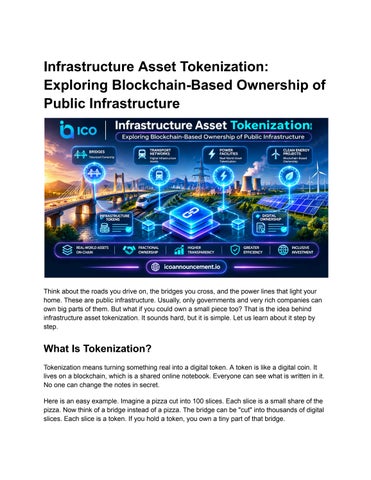
Infrastructure Asset Tokenization: Exploring Blockchain-Based Ownership of Public Infrastructure
Think about the roads you drive on, the bridges you cross, and the power lines that light your home. These are public infrastructure. Usually, only governments and very rich companies can own big parts of them. But what if you could own a small piece too? That is the idea behind infrastructure asset tokenization. It sounds hard, but it is simple. Let us learn about it step by step.
What Is Tokenization? Tokenization means turning something real into a digital token. A token is like a digital coin. It lives on a blockchain, which is a shared online notebook. Everyone can see what is written in it. No one can change the notes in secret. Here is an easy example. Imagine a pizza cut into 100 slices. Each slice is a small share of the pizza. Now think of a bridge instead of a pizza. The bridge can be "cut" into thousands of digital slices. Each slice is a token. If you hold a token, you own a tiny part of that bridge.
What Is Public Infrastructure? Public infrastructure is the big stuff that helps a whole town or country. Here are some examples: ● ● ● ● ● ●
Roads and highways Bridges and tunnels Airports and train lines Solar and wind farms Water pipes and dams Schools and hospitals
These things cost a lot of money to build and fix. A single bridge can cost millions of dollars. Governments often do not have enough money to build everything people need.
Why Do We Need a New Way to Pay? Cities grow fast. More people means more roads, more power, and more water. But building takes money, and public money is limited. Old ways of paying have problems. Banks may charge high fees. Loans take a long time to get. Many people cannot join in because the minimum amount is too high. Tokenization can help fix these problems. If you are curious about how new blockchain projects raise money in general, you can look at a crypto presale list. It shows how teams offer tokens to the public before they launch fully. Infrastructure projects can use a similar idea to find people who want to join early.
How Does Infrastructure Tokenization Work? The steps are easy to follow. Here is how it usually goes: 1. Pick the asset. A team chooses a real project, like a solar farm. 2. Check its value. Experts study the asset and decide what it is worth. 3. Create tokens. The asset is split into many digital tokens. 4. Sell the tokens. People buy tokens using money or crypto. 5. Share the income. When the asset earns money, token holders get a share. Let us say a solar farm sells electricity every month. That money can be shared with all the token holders. The more tokens you hold, the bigger your share.
The Good Things About Tokenization
Tokenization has many strong points. Let us look at the main ones.
1. Small Amounts Are Enough In the past, you needed a huge sum to invest in a bridge or a power plant. With tokens, you may start with a very small amount. This opens the door for everyday people.
2. Everything Is Clear A blockchain keeps a record of every deal. You can see who owns what. This makes cheating much harder.
3. It Is Faster Old systems use lots of paper and many middlemen. Blockchain can cut the steps. Deals can finish in minutes instead of weeks.
4. It Can Be Sold Easily Real buildings and roads are hard to sell. A token can be traded much faster. If you need your money back, you may find a buyer quickly.
5. People From Anywhere Can Join Someone in India can help fund a project in Europe. The blockchain does not care about borders.
Real Examples Around the World Many places are trying this idea. Some groups have tokenized buildings, so people can own a small part of an office. Others have tokenized green energy projects, like solar panels and wind turbines. Some cities are studying how to fund local projects, like parks or parking lots, with tokens. The field is still young. But it is growing every year. Big banks and large firms are also watching it closely. That tells us the idea has real power.
Staying Up to Date on New Projects New token projects appear all the time. Some are about infrastructure. Others are about games, money apps, or art. It can be hard to keep track of them all. A good list of upcoming ICOs can help you see what is coming next. You can learn what each team plans to build and when their token sale starts.
Always remember to learn before you join. Reading about a project helps you make smart choices.
The Risks You Should Know No idea is perfect. Tokenization has some risks too. It is good to know them.
Rules Are Not Clear Everywhere Each country has its own laws. Some countries allow tokenized assets. Others do not yet. The rules may also change over time.
Prices Can Go Up and Down Token prices can change fast. You could earn money, but you could also lose some.
Technology Can Fail A blockchain is strong, but the apps built on it can have bugs. Hackers may try to attack weak spots.
Not Every Project Is Honest Some teams make big promises and then disappear. This is why research matters. Here are a few quick tips to stay safe: ● ● ● ● ●
Check who is on the team. Read the plan carefully. Make sure the real asset exists. Never invest more than you can afford to lose. Ask questions if something feels unclear.
Who Controls the Asset? This is a big question. If you own a token of a bridge, do you own the bridge? Not fully. You own a share of its income or value. The government or a company still runs the bridge. The rules for this are set in a legal plan. A smart contract, which is a small computer program, can also help. It follows the rules on its own. For example, it can send money to token holders every month without anyone pressing a button.
Why Governments Like This Idea Governments are also interested. Tokenization can bring in new money without raising taxes. It can also bring people closer to their city. When citizens own a small part of a project, they care more about it. Think about a local school bus system. If neighbors own tokens, they may want it to run well. They may even give good ideas. This builds trust between people and leaders.
How Teams Can Share Their News If you are building a tokenization project, people need to hear about it. Good news travels best when it is told well. You can use ICO press release submission to share your launch, your plan, or your big updates with a wider crowd. A clear press release helps investors understand what you do and why it matters. Keep your message short and honest. Tell people what the project is, who it helps, and how it works. Simple words win.
Exploring More Topics in Crypto Infrastructure is just one corner of the crypto world. There are many other areas to learn about, like finance apps, gaming, real estate, and artificial intelligence. If you want to explore them all in one place, you can browse the crypto categories and pick the topics that interest you most. It is a nice way to see how wide this field has grown.
What Might Happen in the Future? Experts believe tokenization will keep growing. In the future, we may see: ● ● ● ●
Roads funded by thousands of small owners Solar farms owned by whole neighborhoods Airports and ports with digital shares Easy apps where anyone can buy a token in a few taps
As laws become clearer, more people may feel safe joining. Technology will also get easier to use. Maybe one day, owning a piece of a bridge will feel as normal as buying a snack.
A Simple Summary Let us go over the big points again:
● ● ● ● ● ●
Tokenization turns real things into digital tokens. Public infrastructure can be split into many small shares. Small investors can join with little money. Blockchain makes records clear and fast. There are risks, so careful research is a must. Governments and companies are starting to take notice.
Final Thoughts Infrastructure asset tokenization is a bold new idea. It lets regular people take part in building and owning the things that help whole communities. It can make funding faster, fairer, and more open. But it is still early. We must learn, ask questions, and move with care. If you want to keep learning about new projects, token sales, and fresh crypto news, visit the ICO Announcement homepage. It is a handy place to stay informed. The future of public ownership may be digital. And with the right steps, more of us may get a seat at the table.