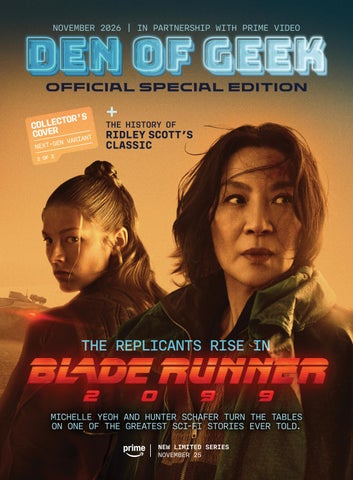
NOVEMBER 2026 | IN PARTNERSHIP WITH PRIME VIDEO
OFFICIAL SPECIAL EDITION
THE HISTORY OF
RIDLEY SCOTT’S CLASSIC
THE REPLICANTS RISE IN
MICHELLE YEOH AND HUNTER SCHAFER TURN THE TABLES ON ONE OF THE GREATEST SCI-FI STORIES EVER TOLD. NEW LIMITED SERIES NOVEMBER 25
CONTENTS BLADE RUNNER 2099
STILL DREAMING OF ELECTRIC SHEEP IMAGE CREDIT: PRIME VIDEO/ SUNSET BOULEVARD/CORBIS VIA GETTY IMAGES
Blade Runner 2099 creator and showrunner Silka Luisa and stars Michelle Yeoh and Hunter Schafer tease a world in which replicants are supreme and humans are hunted. PG. 20
TIMELINE:FROM 2019 TO 2099 Need help with the Blade Runner timeline? We guide you through the events of the original and Denis Villeneuve’s 2049, along with every anime and short in between. PG. 7
MEET THE NEXT GENERATION OF BLADE RUNNERS
Learn all about Michelle Yeoh’s Olwen, Hunter Schafer’s Cora, and a supporting cast of humans and replicants alike. PG. 12
CREATING THE FUTURE Production designer Paul Inglis, costume designer Helen Huang, and composer Leo Ross reveal the sights and sounds of 2099 Los Angeles. PG. 8, 28 & 32 DEN OF GEEK
3
TWO YOUNG WOMEN SIT IN A DARK ROOM PUNCTUATED BY LIGHT AND SHADOW. The rhythmic churn of a fan creates a false sense of serenity, but for Hunter Schafer’s Cora, a human trying to play a replicant, the stakes could not be more dire. Across from her sits a little girl—or possibly a replicant pretending to be a little girl. Either way, this uncanny child is administering an exam that will decide whether Cora lives or dies. It will decide if she’s human. The scenario is, of course, familiar to longtime fans of Blade Runner and all its permutations, and yet it is so singularly of our current moment in Blade Runner 2099 that it leaves me reeling. Instead of a human testing a proverbial robot for a lack of empathy, the toaster (or the toaster’s most trusted collaborator) is now trying to discern if you’re human. It’s an inversion of the infamous Voight4
DEN OF GEEK
Kampff exam in Ridley Scott’s Blade Runner, and as creator and showrunner Silka Luisa says, a riff on Blade Runner 2049 too, where the “baseline” established whether Ryan Gosling’s robo-enforcer was getting too emotional about a replicant underclass he’s tasked with bringing to heel. “The idea is if you have too much empathy, it’s going to make it difficult for you to police a human population,” Luisa says of her own version of human-replicant word association games in 2099. “And now they’re using a human kid to give those tests because it immediately triggers empathy for some.” For some, perhaps, but not for Schafer’s Cora. And the audience? That becomes an even greater variable in 2026. Forty-four years ago, viewers were meant to feel a shiver of dread when a guy calling himself Leon was unable to display empathy for an imaginary
tortoise tipped over on its back, or the main course at a feast of boiled dog. But nowadays, we’re eager, cheering even, for a human to prove her utility in a brave new world of artificial intelligence and synthetic efficiency. How can Cora, or any of us, survive this future?, you might ask. It doesn’t feel like a coincidence that Blade Runner 2099 comes to us now, then. When Philip K. Dick penned Do Androids Dream of Electric Sheep?, he offered a grim prophecy for how we were inevitably building our own obsolescence. The androids were something to be feared on the page, but Scott’s classic 1982 big-screen adaptation flipped the script, dreaming that there must be a greater humanity in an oppressed workforce, mechanical or otherwise, than modern society and its current trajectory can offer. Cut to a little past Blade Runner’s original 2019 setting, and AI is no longer an abstraction or potent
PHOTO CREDIT: PRIME VIDEO
THE FUTURE’S NEXT BIG TEST
MAGAZINE Yaniv Ben-Atia CEO
Matthew Sullivan-Pond Publisher
Chris Longo Chief Creative Officer
EDITORIAL David Crow Senior Editor-at-Large Alec Bojalad Managing Editor Michael Ahr Newsletter Editor
PRODUCTION Kyle Christine Darnell Magazine Production Rosie Fletcher Magazine Sub Editor Sarah Litt Magazine Copy Editor
allegory for the exploitation of tomorrow. In fact, it might just be the tool of exploitation today. In this context, Blade Runner 2099 comes with its role reversal of humans and replicants—a fulfillment of Scott’s implicit prayer for revolution that, inevitably, has still left someone holding the bag and underfoot. This is where we find Cora entering a room that is, by design, constructed to make her feel the pressure of the moment, with the set built so that wee little Greta is in an open space whilst Schafer’s heroine is interrogated in a cell that’s not much bigger than a cubicle. It’s a metaphor for 2099 and 2026 alike, with us all trying to squeeze through a future where technology holds the power. “It gives a feeling of compression,” Luisa muses about the deliberate set design. She also teases that it is only the first glimpse of Greta, a character whom more than one crew member suspects could become a fan-favorite replicant. Or human. In this world,
you’re always encouraged to secondguess what you see, but never what you feel. That consistent ambiguity of what it feels like to be human is what gives Blade Runner life in all its iterations. And in this special edition issue of Den of Geek magazine, you will get a far better idea of how the synthetic dreamscapes have come into being on Prime Video, from Luisa’s drive to make what was retro in 1982 seem new again, to Schafer and the legendary Michelle Yeoh’s quest to find humanity and hope on the other side of the robo-uprising. Also, it’s a chance to bask in how cool it all looks, from Paul Inglis’ ingenious production designs to Helen Huang’s costumes, and more! So have a seat, turn the page, and your test can begin.
PHOTO & VIDEO PRODUCTION Nick Morgulis Senior Video Producer Andrew Halley Head of Video Production
ART Jessica Koynock Art Director
Literally Media is a network of legacy, iconic internet brands, boasting the #1 humor network on comScore, and creating content daily in the meme, comedy and entertainment space.
COVER PHOTO CREDIT: PRIME VIDEO ©2026 LITERALLY MEDIA ALL RIGHTS RESERVED
David Crow, Senior Editor-at-Large
WANT TO SUBSCRIBE TO DEN OF GEEK?
Scan the QR code for more information! DEN OF GEEK
5
KEYS TO THE
REPLICANT KINGDOM Building on the world of the films, Blade Runner 2099 is part of Alcon co-founders Andrew Kosove and Broderick Johnson’s measured plan for the franchise. BY MICHAEL AHR AND CHRIS LONGO RIDLEY SCOTT’S BLADE RUNNER IS INCLUDED ON ANY LIST RANKING THE BEST SCIENCE FICTION FILMS of all time, but its
success came not in the theaters in 1982 but at home on VHS. Alcon Entertainment co-founders Andrew Kosove and Broderick Johnson both recall discovering the original movie this way. Now decades later, they’ve taken stewardship of the film’s legacy, first partnering with director Denis Villeneuve for Blade Runner 2049, and next expanding the universe to television with Prime Video’s limited series Blade Runner 2099. As executive producers, Kosove 6
DEN OF GEEK
and Johnson knew bringing such a visually evocative franchise to television was about taking full advantage of what episodic content has to offer. “There’s something about seeing a movie in a theater on a big screen from a visual standpoint… that is just different and superior to seeing something on a TV,” Kosove admits. “Having said that, there are certain aspects of long-form storytelling where you can delve into character and mythology and story in more depth than you can in a film.” Set half a century after Blade Runner 2049, the eight-episode series
presents a narrative twist that shifts the power dynamic between humans and the artificial replicants they’ve created. Creator and showrunner Silka Luisa won over Kosove and Johnson with her idea that essentially subverted the core narrative of the previous films. “The reason we went with Silka is very simple: her idea was the best idea,” says Kosove. “The idea of ‘What happens when the replicants are the apex and the humans are the underclass?’ Which, of course, is flipping the canon of the two movies on their head.” This inversion feels particularly relevant in today’s landscape of societal uncertainty about the dangers of artificial intelligence. As Kosove notes, good sci-fi like Blade Runner reflects the anxieties of the present, even in a story that unfolds decades apart. “Science fiction isn’t about the future; it’s about today,” he says. “We’re living in a world where all of a sudden there’s this angst, whether you believe it’s exaggerated or not, [where] people are like, ‘Oh my god, what happens when we’re no longer in charge of our own destiny?’” Translating Blade Runner’s massive visual landscape to television required immense collaborative effort. Guided by production designer and resident movie canon expert Paul Inglis, as well as executive producer Jonathan van
Tulleken and cinematographer Rob Hardy, the production emphasized the physical scale of practical sets in real locations. “Job number one was to bring this back in a theatrical form in a way where you’ve sort of reinvigorated the IP and brought it into… this new age of premium television where you have the budgets and scope, and the resources to bring something like Blade Runner to a [streaming] platform,” explains Johnson. “This was more ambitious to some extent than what we did on the film, with many locations throughout Prague, Barcelona, and even Berlin.” At the heart of Blade Runner 2099 are performances by lead actors Michelle Yeoh and Hunter Schafer, with Yeoh’s expertise bringing a commanding presence to an intensive shoot. “Michelle Yeoh’s career has been remarkable, and she was everything we hoped and then some,” Kosove says. “She’s a phenomenal actress; she’s incredible how physical she still is… and she is just an incredibly warm, collaborative person. She’s a leader; everyone looks up to Michelle.” Opposite Yeoh’s replicant character Olwen is Schafer’s human fugitive Cora. It’s a star turn that represents the next generation of talent driving the franchise forward. “Hunter is a revelation because she doesn’t have a significant body of work yet; she’s still very much at the beginning of her career,” Kosove says. “Hunter Schafer’s going to be a big star. She is a terrific actress— she’s authentic. She’s also incredibly physical and loves action, and the world is her oyster.” But don’t think that Blade Runner 2099 represents the first of many television adaptations. Alcon is determined to preserve the franchise’s integrity by avoiding the trap of endless spinoffs that other IPs have fallen prey to. That patience is reflected in the nearly 10 years since Blade Runner 2049 was released in 2017. “We have been careful in the curation of Blade Runner,” Kosove
stresses. “If you oversaturate the marketplace with too much of something, no matter how beloved it may be, people tire of it… The goal
is, we’re going to come back from time to time when we think we have something really special that the moment really calls for.”
How did we get to the world of Blade Runner 2099 where replicants hunt rogue humans? Here’s a guide to get you up to speed on replicant history. 2019 BLADE RUNNER (FEATURE FILM)
The first film sets up a world where replicants with brief lifespans are hunted down by human Blade Runners when they outlive their usefulness. The rogue replicants here are Nexus-6 models manufactured by the Tyrell Corporation. Rachael (Sean Young) is the first Nexus-7 model, with implanted memories that make replicants harder to detect. Her unlikely union with Deckard (Harrison Ford) sets the stage for further revelations.
2022 BLADE RUNNER BLACK OUT 2022 (ANIME SHORT) This introduces Nexus-8 replicants, boasting normal lifespans, among other innovations. When a “human supremacy movement” leads to widespread violence, rogue replicants detonate a nuclear device to create an electromagnetic pulse, wiping databases clean and making replicants harder to track. This spells the end for the Tyrell Corporation.
2032 BLADE RUNNER: BLACK LOTUS (ANIME SERIES) While primarily the story of Elle, a replicant out for revenge, this also explores how replicants are integrated with human society. In some cases, they’re used as
athletes in combat sports. In others, they’re prey for depraved elites, illustrating how antireplicant sentiment continues. It also details the rise of Niander Wallace, a replicant tech innovator, and his Wallace Corporation.
2036 NEXUS DAWN (SHORT FILM)
With replicant technology currently banned, Niander Wallace (Jared Leto) introduces the Nexus-9 model to lawmakers as a means to help fix Earth’s ongoing ecological collapse. He also shows off just how subservient they are, in rather uncomfortable fashion.
2048 NOWHERE TO RUN (SHORT FILM)
This introduces Nexus-8 replicant Sapper Morton (Dave Bautista) while providing a snapshot of just how far Earth’s environment has deteriorated and the conditions humans now live under.
2049 BLADE RUNNER 2049 (FEATURE FILM)
The line between human and replicant blurs further, as we learn that models as far back as the Nexus-7 could reproduce biologically. Nexus-9 replicant K (Ryan Gosling) is in a position of authority over other replicants and a harbinger of the world of Blade Runner 2099, where android Blade Runners hunt rogue humans.
DEN OF GEEK
7
FADED GLORY Blade Runner 2099 production designer Paul Inglis takes us inside how the noir-ish future of the franchise took shape. BY MIKE CECCHINI
BLADE RUNNER 2099 production designer Paul Inglis is not only a self-described “blue-blooded Blade Runner addict” and fan of Ridley Scott’s classic sci-fi film, he’s already put in considerable time with replicants. Before landing the production designer job on the new Prime Video limited series, Inglis served as supervising art director on Blade Runner 2049 and production designer on the two short film prequels that accompanied it. And while he’s careful to point out that he had plenty of help (“It’s impossible for any one person to envision that world in its entirety,” he says), it’s clear that the team behind Blade Runner 2099 took great care to live up to the legacy of what has come before.
8 DEN OF GEEK
Key to the franchise’s visual appeal has always been that it takes place in a world that is recognizably its own, complete with notable, real-world landmarks, although one that took a different path somewhere along the way. Considering that the first film took place in 2019, the Blade Runner franchise occupies a unique space of both traditional science fiction and alternate history. “[With] Blade Runner,” Inglis says, “you’ve got to look backward to look forward. So you look back to basically the mid-20th century and you diverge from that both ways. Some things might be 1920s or ’30s in their inspiration, some might go up to the early ’80s, but you take that architecture and those objects, and
Los Angeles of the future employs a "sunshine-noir" look in Blade Runner 2099.
you extrapolate from there. You don’t use them as-is: you add to them, you glue them together, you mutate them, you do whatever you need to, but you create the Blade Runner-ized version of how those things started.” While the first film took place almost entirely at night, usually in the rain, Blade Runner 2099 leans into Earth’s overall environmental decline even as technology continues to advance–and encroach–upon human society. Inglis applies terms like “sunshine noir” and “faded glory” to describe capturing the series’ unique look. “This is a world in decay, a world with loss,” he says. That sense of loss permeates Blade Runner 2099. “It’s surfaces, it’s textures, it’s not just color, it’s where
light comes from,” he says. “It’s that our light sources were always kind of broken, you know, that there’s never anything that looks like that pure, perfect white light of more standard sci-fi… All those ways that this world is in decay and isn’t quite right, you hope also make the image richer and more beautiful.” What’s especially striking about the series is that it not only looks like a natural evolution of the world of the films, but it feels, for lack of a better term, painstakingly consistent with the visual language of the noirish futurism that informed the original. “The language around design and how things looked changed around the mid-’80s because of computers,” Inglis says. “All of a sudden there was DEN OF GEEK
9
Production Designer Paul Inglis shapes the look of Blade Runner 2099.
this new way of approaching how you could prototype and conceptualize what things could look like… You’ve almost got to think like the art department of 1981. What resources did they have? What were their references? What were they using as inspiration? You kind of have to shut off what came afterward [and] limit yourself a little. You still find so much that’s new and new ways of looking at things, but if you can do that, it feels like you intrinsically end up with maybe a better representation of what that art department would have done if they had the scripts that you have now. Sometimes you almost have to kind of roleplay, put yourself in a situation where you discard some of what you know.” The original Blade Runner primarily used nighttime settings to help channel film noir. Its sequel added more color and daylight to help illustrate the effects of climate change on the world and society, and Blade Runner 2099 is hotter still. The show 10 DEN OF GEEK
conveys the literal heat of its future with an aggressive daylight that is contrasted with long shadows and moody lighting to create a different kind of effect. “I think the key thing was designing architecture that could restrict that light,” Inglis says. “To bring the noir, you need the shadow even more than you need the light. The two go hand in hand, but you have to design to create artificial darkness in a space that would otherwise be brightly lit because the mystery lies in the shadows. You want the imagination to thrive and not see everything explicitly, even with the visual-effects shots. To my way of thinking, the most successful parts of the films and this TV series are when you don’t see the entirety of a building, when you don’t see the top or bottom of it, because that somehow normalizes it. But when you can conceal part of it, when you can keep the veil in place, the mystery is in there. And in the mystery lies imagination.”
“YOU’VE ALMOST GOT TO THINK LIKE THE ART DEPARTMENT OF 1981. WHAT RESOURCES DID THEY HAVE? WHAT WERE THEIR REFERENCES? WHAT WERE THEY USING AS INSPIRATION?” PAUL INGLIS, PRODUCTION DESIGNER
Muscle Car of the Future
IMAGE CREDITS: CLAY ENOS/ PRIME VIDEO/ WARNER BROS./ARCHIVE PHOTOS/GETTY IMAGES
ONE OF THE MOST recognizable visuals in the Blade Runner universe is the flying car known as the spinner. Blade Runner 2099 delivers a fresh take on the iconic vehicle. “When it came to the new spinner… [it’s] a bit more muscular and a bit more hardy than we've seen before,” Inglis tells us. “There are attachment points all over the outside, and you’ve got steering mechanisms where you can see all of the workings. It's all visible… It’s not just there because it looks cool. It’s there because of what we’re saying the purpose of this is.” Part of that purpose is pure functionality, but some of it is intimidation. The title of “Blade Runner” was first used for humans hunting down rogue replicants, then replicants hunting other replicants in Blade Runner 2049, and now replicants hunting humans in Blade Runner 2099. This means their vehicles need to not only appear functional, but powerful. “If you're trying to scare people, if you’re trying to intimidate them,
what better than this kind of muscle car coming in to land? You know you’re in trouble.” In addition to a half-spinner for filming (“Famously, the spinner is not a four-person vehicle… so you can’t fit a camera person in the back at all.”), the production built two full-sized spinners. “We created a lot of different props that could be dressed onto it,” Inglis says, listing off examples. “A searchlight, armament, longrange fuel tanks, more complex
communications equipment. We had four or five different configurations we could fit any of the vehicles out with.” That commitment to realism has its limits. It’s still a flying car, after all. “Sometimes, the less attention you draw to things, the fewer questions get asked; people will accept it,” he says. “You’ve got to be a little careful about not taking it too far, because at some point, it is still a little preposterous.”
Above: A spinner flying car takes off in a scene from Ridley Scott's futuristic thriller Blade Runner. Left: An updated spinner from Blade Runner 2099. DEN OF GEEK
11
MORE HUMAN THAN HUMAN:
THE CHARACTERS OF
2099
To understand the world of Blade Runner 2099, you’ll need to get to know the occupants of 2099 Los Angeles. In the pages that follow, delve into the careers of leads Michelle Yeoh and Hunter Schafer, and learn what’s to come from Matthew Needham, Dimitri Abold, and Lewis Gribben. BY ALEC BOJALAD | PHOTOGRAPHY BY NICK MORGULIS
HUNTER SCHAFER
AS CORA
The artist/actor/model is moving from Euphoria’s East Highland High to the world of Los Angeles 2099.
12
DEN OF GEEK
5 THINGS TO KNOW: 1 Raleigh, North Carolina where her father
Born in Trenton, New Jersey and raised in
was a pastor for a local congregation.
2 teenager for her social conscienceness, as Schafer came to prominence online as a
well as her art where she shared visual creations in watercolor painting, photography, and her own fashion design. She counts Tim Burton among her earliest influences.
3 high school, Schafer was cast as Jules
While working as a fashion model after
Vaughn in HBO high school drama Euphoria. The role launched a successful acting career that included roles in the Hunger Games franchise and horror movie Cuckoo.
4 character Cora, a human going undercover In Blade Runner 2099, Schafer plays lead
as a replicant to survive in a brave new world of andriod supremacy. "There's been a complete role reversal compared to the last two movies," Schafer says. "It's creating a completely new dynamic, and I think it's really fun and exciting to watch what replicants being in power looks like and feels like."
5 co-lead Michelle Yeoh helped the actress According to Schafer, her action star
prepare for such a physically demanding role. "How lucky was I to have her—like the expert of all experts—there to give me pointers immediately?!”
DEN OF GEEK
13
14
DEN OF GEEK
MICHELLE YEOH
AS OLWEN
The action movie icon steps into the role of lead Blade Runner.
5 THINGS TO KNOW: 1 attended London’s Royal Academy of Dance. Though a severe back injury The Malaysian-born actress began studying ballet at age four and
cut her ballerina ambitions short, her training came in handy later as an action movie star.
2 Story 3: Supercop with Jackie Chan, Yeoh performed many of her own Originally credited as Michelle Khan in early films, including Police
stunts despite never receiving formal martial arts training. Rotten Tomatoes ranked her the greatest action heroine of all time in 2008.
3 in multiverse drama Everything Everywhere All At Once. She told Den of
Yeoh won the Academy Award for Best Actress in 2023 for her lead role
Geek that she “had no idea what the hell it was about” upon initially receiving the script, but trusted the vision of the directors Daniels.
4 as replicant Blade Runner Olwen. “The first thing is to respect the
The actress now lends her gravitas and star power to Blade Runner 2099
franchise, then try your best to understand the story that's going to be told. How do you make it original yet in the same world as the iconic movies or TV series that came before us?”
5 “Everything was made. There was so much layering! In the winter time,
Yeoh says the costuming of the new series helped her get into character.
when it was cooler, it was fun. But when we were shooting out in summer, it was not so fun anymore.”
DEN OF GEEK
15
DIMITRI ABOLD AS BEBETO
16
DEN OF GEEK
The stars open up about finding the human side of resistance in a synthetic future. What first drew you into the world of Blade Runner? Was it the original 1982 movie, Philip K. Dick’s story, or something else? DIMITRI ABOLD: I was too young to watch the movie in theaters, but of course when I had the chance to watch the movie digitally, I did, as well as the Ryan Gosling movie that came out a couple of years ago from Denis Villeneuve. But I think the thing that really got me into it, if I’m gonna be honest, is that I love anime, so I actually got into Blade Runner deeply through Blade Runner: Black Lotus. It just sort of melded cyberpunk, anime, and music, and I love the director as well, so that was my entrance. LEWIS GRIBBEN: Mine was also Blade Runner 2049. I saw it in cinemas when it first came out. I was blown away by the visuals of it, the distinctness of it, just the color. I found it one of Ryan Gosling’s most interesting performances; it was so muted and so held back for most of the film, which was really different from what I’d usually seen him in. So that film and the visuals of it, and then that fight that he and Harrison Ford have in the [holographic nightclub] was just so cool.
LEWIS GRIBBEN
AS ELIAS
Dimitri, home seems to be a big aspect for your character Bebeto. He’s a human who says he was born in Los Angeles and he’s not leaving. How did that inform your performance? DA: [My character] lives in a context now that is so far removed from what it used to be, from what I’d grown up in, what I was comfortable with; the place where I felt like I was safe with my family, and to see that space deteriorate over time is, firstly, heartbreaking, and secondly, you want to return to old form. Using that DEN OF GEEK
17
as the central thread for Bebeto’s entire arc was my little cheating way of really getting in. Also, I was born in Jamaica, right? And Bebeto’s character and family are very much tied to Jamaican history, Jamaican culture. And one of the things that I noticed that made me feel right at home is that the first day I came into the set, they had a pot boiling. Food was cooking, real food, and there was one pot that I was supposed to dish something out from. The pot smelled like, and also looked so much like Jamaican cornmeal porridge. I don’t know if it was planned like this, but I was like, ‘Yo, why do I feel like I’m at home right now when my mom is cooking up a nice pot of cornmeal porridge?’[so there is] no gap between Dimitri and Bebeto. They feel very synonymous with each other.
Elias is so mysterious in the first two episodes, even though he is the driving force behind Cora’s journey. What was it like embodying that and not giving too much away? LG: Elias goes through a major change even in the first two episodes: from being physically disabled to having to walk again, and always having to rely on what Cora wants to do. He just starts to feel a bit like a burden; he doesn’t feel like he has his own motivation. But it’s one of those things where [we have] a guy who changes so much throughout the show, and where he ends up is drastically different from where he started. The thing is, he loves his sister, and there’s a real core relationship there, but obviously he knows that they can’t keep running from the Blade Runners forever.
It’s interesting that Bebeto is described as a doctor, and the replicants let him continue that work. Do you think, when he helps Cora go undercover as a replicant, that he views it as an act of resistance, or is he just trying to make ends meet? DA: I’d say that if he does see it as an act of revenge or an act of protest, I don’t think that he is necessarily actively thinking of it. I think he’s utilizing the skill set he’s developed through his entire life in order to bring about the change that he wants to bring about.
How do you think he’d react if he knew his sister was interacting with replicants and even living amongst them? She might even be helping them. LG: It would be a big no for him, I think. [Laughs] I think it would be the main source of tension, and he would absolutely want to fight his sister verbally about it. He would just fundamentally disagree. It would be such a point of tension and, interestingly, the kind that develops as the show goes on.
“I LOVE ANIME, SO I ACTUALLY GOT INTO BLADE RUNNER DEEPLY THROUGH BLADE RUNNER: BLACK LOTUS. IT JUST SORT OF MELDED CYBERPUNK, ANIME, AND MUSIC, AND I LOVE THE DIRECTOR AS WELL, SO THAT WAS MY ENTRANCE.” DIMITRI ABOLD 18
DEN OF GEEK
5 THINGS TO KNOW: 1 screen actor, Matthew Needham A classically trained stage and
studied at the London Academy of Music and Dramatic Art. He has acknowledged in more than one interview that acting is a form of “therapy.”
2 professional debut on BBC’s While Needham made his
medical drama Casualty in 2007, he admitted to Zero.Nine Magazine that his first love is the theater: “I think the challenges in film and TV are actually knottier than theatre, the out of sequenceness of it all.” Appropriate for an actor who has also participated in the Royal Shakespeare Company.
3 House of the Dragon came during
Needham’s breakthrough role in
the pandemic when he sent in a video audition for the Game of Thrones prequel. Initially auditioning for another part, he was asked to send another video over for Larys Strong, the underestimated and Machiavellian second son of Harrenhal.
4 Needham plays Yahya, a replicant In Blade Runner 2099,
MATTHEW NEEDHAM AS YAHYA Westeros’ strongest player from House of the Dragon is putting on the infamous Blade Runner coat and making it his own.
Blade Runner who hunts humans trying to pass as synthetic. “The way I thought of him is he’s an oppressed person who is now put in charge of his oppressors, and I’d love to say that if the same happened to me, I would be magnanimous and would be kind. But I don’t know if I would be.”
5 Needham focused on the
To play the role of a replicant,
infamous uncanny movements of replicant performers in the 1982 film, yet he wanted to maintain a certain degree of humanness. “I didn’t get too hung up on moving like something that wasn’t [natural] because they’re human. I think that’s what makes it interesting. They’re indistinguishable.” DEN OF GEEK
19
Blade Runner 2099 creator and showrunner Silka Luisa and stars Michelle Yeoh and Hunter Schafer take us inside the latest story in the sprawling sci-fi universe. BY MAX EVRY
20
DEN OF GEEK
LIGHT BLASTING THROUGH TWIRLING FANS. Grime on wet streets. Electronic music tones. Trench coats. Flying spinner vehicles. Off-world colonies. “Tell me only the good things that come into your mind about your mother?” We are definitely back in the world of Blade Runner. The new eight-part Prime Video limited series Blade Runner 2099 tackles the double challenge of honoring Ridley Scott’s 1982 masterpiece, Blade Runner (and its many alternate cuts), while simultaneously evolving its dystopian world in ways that push the story into brave new territory. From the jump, viewers will feel instantly transported back to the moody futuristic cityscapes that defined sci-fi aesthetics for decades. “In terms of honoring the legacy of Blade Runner, there are worldbuilding principles fundamental to how you create the look,” says Silka Luisa, the series creator and showrunner. “In order to imagine the future, you look to the past. That was an idea that we talked about within all the departments, using real-world references from all over the world outside of our era; so looking to the ’80s, to the ’40s, to the ’30s, to the ’70s, and collaging them together so that you create something that feels ‘other’ but with components that are familiar.” Adding to that familiarity is a tone and pace set by director Jonathan van Tulleken (Shōgun), who directs episodes one and two, and cinematographer Rob Hardy (Mission: Impossible – Fallout), which announces itself in the first episode with a scene pre-dating the original film. Towers of flame flank the fortress-like Tyrell Corporation as two execs discuss the possible downsides of the Nexus-4 replicants (forerunners of the bioengineered humanoid slaves played
DEN OF GEEK
21
Clockwise from left: Michelle Yeoh plays replicant Olwen. Opposite: real life inspirations were used to create Blade Runner 2099’s world.
by Rutger Hauer and company in the first film) should they rebel. The original Blade Runner features Harrison Ford’s Rick Deckard as a seemingly human cop hunting down runaway Nexus-6s who’ve gone off the reservation. Fast-forward to 2099, and both Deckard and his replicant replacement K (Ryan Gosling) from Denis Villeneuve’s 2017 sequel Blade Runner 2049 are long past their sell-by date. In the interim, a war has been waged between humans and the artificial beings they created, with the latter coming out on top. The downsides of a replicant rebellion have become a reality. “The big update with our series is that there’s been a complete role reversal compared to the last two movies,” explains Hunter Schafer, the Euphoria star now stepping into Blade Runner 2099 to embody Cora, a human going undercover as a replicant. “It’s creating a completely new dynamic, and I think it’s really fun and exciting to watch what replicants being in power looks like and feels like.” Surviving humans are now made to serve, and those who do not fall in line are hunted down by replicants going under the familiar name of Blade Runners. “They took the name that caused them the most fear, which is a really human thing to do,” says Matthew Needham, who plays a particularly vindictive replicant Blade Runner named Yahya. “It’s a triumphant thing to be the oppressed and to take the identity of your oppressor and use it for your own. I don’t think my character has much sympathy with humans. He’s got a deep-seated resentment 22
DEN OF GEEK
“
CORA’S BEEN RUNNING AWAY SO LONG, SHE’S LOST HER HUMANITY IN A WAY THAT EVEN OLWEN CANNOT DETECT ANYTHING IN HER ANYMORE.”
MICHELLE YEOH, OLWEN
and hatred for them. He’s on a mission to eradicate them all.” If a show follows in the footsteps of Ford and Gosling, you need someone with comparable status as the standard bearer, and those shoes are filled by iconic Oscar-winner Michelle Yeoh (Everything
Everywhere All at Once). As Luisa notes, “You need an icon in that role because the world is so foreign. You need someone you would follow to the ends of the earth, and that is Michelle Yeoh. The role demanded incredible physicality. You had to be terrified of her. She had to feel unpredictable and stronger than humans. At the same time, her arc over the season takes her to very fragile places. Her story is a mirror of [Rutger Hauer’s replicant] Roy Batty, where in these last days, as you’re slipping away from life, your humanity becomes unlocked.” The Everything Everywhere All at Once star plays Olwen, a replicant Blade Runner reaching the end of her lifecycle in nine days (the show’s ticking clock) while trying to uncover the mystery of another Blade Runner compatriot named Marek (Johnny Harris), who has gone mysteriously dark. To track him down, Olwen takes on a new partner in Schafer’s Cora, a resistant human disguised as a replicant in order to infiltrate the Blade Runner ranks. “[Replicants] are now in charge,” Yeoh tells us. “It’s their time, right? And humans are obviously not giving up on humanity and are wanting to claw their way back. I think Olwen’s biggest challenge is that she’s a replicant running out of time, and Cora’s a human trying to be a replicant. Because Cora’s been running away so long, she’s lost her humanity in a way that even Olwen cannot detect anything in her anymore. The danger of being found out… can you imagine?” If that “mole encroaching on the enemy from within” plot sounds familiar, that’s because Infernal Affairs/The Departed
was one of several neo-noir touchstones Luisa and her team drew on for inspiration, alongside Donnie Brasco and Chinatown. Although the showrunner remains mum on the perennial “Deckard: replicant or human?” debate, the thin line between the two species remains a major source of both paranoia and tension throughout the eight episodes, right down to the distinguishing behavioral traits of the replicants. “It’s a psychological thing of just moving cleaner, moving quicker,” expresses Needham. “I tried to shut down the part of my brain that cared about other people’s feelings. It’s amazing how direct you can be when you’re not worried about offending someone or how you’re going to be perceived. Physically, that adds a bluntness and extremeness without excess movement.” “I think the idea that you can’t tell a replicant from a human is baked into the franchise,” Luisa adds. “It’s important because as an audience member, you can never really get on completely solid ground, because you never know who anyone is, and that puts you in the mindset of the characters in the show.” This is appropriate because Blade Runner originator Philip K. Dick’s stock-in-trade was very much about asking the question, “What does it mean to be human?” The showrunner is also a longtime fan of PKD, the late sci-fi literary legend who penned the 1968 novella Do Androids Dream of Electric Sheep?, which Blade Runner is adapted from. Dick fans can also keep an eye out for easter eggs paying tribute to his work, from the photo of electric sheep in the police chief’s office to a toy robot called My Lord from the author’s short story “The Little Movement.” With help from the author’s daughter/Blade Runner 2099 executive producer Isa Dick Hackett, the show will incorporate several new elements from the source material, including a cyber cult called Mercerism. “We excavated a lot from the novel, even more so than the films,” Luisa reveals. “Mercerism was always very interesting to me. The idea that there could be this religion that is technologically based and is somehow teaching collective empathy, even though you’re never in a room with other DEN OF GEEK
23
Clockwise from left: Lewis Gribben plays Cora’s disabled brother Elias. Hunter Schafer as Cora with Matthew Needham as Yahya. Dimitri Abold plays mercenary medical doctor Bebeto. 24
DEN OF GEEK
production team at all, but rather discovered while lensing in the Czech Republic: various rising/falling platforms with mounted cameras placed around futuristic Los Angeles: “Those platforms were taken from the Social Security office in Prague. That’s their filing system. They go up to the desk, and the slot comes out, and there are all these paper cards; then they fill them out and put them back in. It’s so stunning, so bureaucratic, but it’s incredibly functional. That’s how you can use real-world references and put them in this totally new context… it creates some of that Blade Runner magic.” Another way the series recaptures that old Blade Runner magic is through the grueling stunt work the entire cast did. After all, it wouldn’t be Blade Runner without lots of cuts, bruises, and people being pushed through walls. This time around, the dynamic sees lots of camaraderie between the two leads, but that didn’t mean the fight scenes between their characters were anything short of brutal. “I’ve done action for 30-something odd years,” Yeoh laughs. “We come with a lot of experience; you learn the hard way. I adore this young lady and didn’t want her to get hurt, because when I started watching her do stunt rehearsals, I would go, ‘Stop!’ Too late… Hunter had already hurt herself, and I’m like, ‘You actually didn’t have to do that, Hunter.’” “How lucky was I to have her, the expert of all experts?” Schafer gushes. “She was there to give me pointers immediately, right away!” “It was wonderful to watch someone so fearless,” adds Yeoh. “When I look at her, I remember myself when I first started. That was the right way to approach it, because that’s the only way to learn, unfortunately, but you have to do it within reasonable measures. When she took a bad knock on the head, I was like, ‘Baby helmet, put it on now.’ I made her walk around in this goofy little shark helmet.” While the main dangling thread from Blade Runner 2049
IMAGE CREDIT: AMAZON PRIME VIDEO
people. We had a really good time building that into the series.” Actor Lewis Gribben, who plays Cora’s brother Elias, adds, “There is kind of a cult element in the show through a resistance movement that we start planting the seeds for in episode three or four. We meet a mysterious character who starts turning the wheels in Elias’ head toward having his own path. You see this leadership thing start to emerge throughout the show. He loves his sister, but he knows they can’t keep running from the Blade Runners forever… he starts feeling that there’s something else out there for him. Elias and Cora start to go different ways, shall we say?” Bebeto (Dimitri Abold), a human veteran of the war, is now a civil servant who works for the city performing the administrative function of giving out city IDs. He sends Cora undercover to infiltrate the LAPD to retrieve an item that was confiscated. “He’s utilizing his skills,” Abold says of his character. “He sees his medical expertise as another strategy to bring about the change that he’s looking for.” Ridley Scott once described his style of visually layered filmmaking as akin to an 88-layer cake. Blade Runner 2099 adheres to this ethos with almost fanatical dedication. “Bebeto’s home is filled with little trinkets, gadgets, and gizmos that historically span a bunch of different ages,” says Abold, whose engraver surgery device in episode one was refashioned out of an old typewriter with added components. “They encapsulate his character, and it’s that level of detail and meticulousness that was really built into every single fabric of this production.” Adds Needham, “For the police station, any drawer you opened was going to have something that belonged in that world. The entire set was full.” One of Luisa’s favorite sets was not invented by the
of Deckard’s daughter Ana Stelline (Carla Juri) will not be addressed in the show, per Luisa, the showrunner says that she hopes there will be more Blade Runner movies in our future to go down those rabbit holes, preferring to make Blade Runner 2099, the TV show, work as a standalone experience. “Purely as a fan, I had a lot of those same questions,” she says. “I wanted to know where that story went. For our show, it was really important that we introduce new characters and touch on lore. There definitely are historical moments in our
investigation; we wanted to create completely independent characters so it didn’t feel like you needed to have seen 2049 in order to understand the show.” Adds Yeoh, “I think the first thing is to respect the franchise, then try your best to understand the story that’s going to be told. ‘How do you make it original yet in the same world as the iconic movies or TV series that came before us?’ My biggest thanks would be to Silka, who imagined this new Blade Runner series and gave us a good, solid premise to build on.”
BLADE RUNNER 2099 DEBUTS ON PRIME VIDEO ON NOV. 25, 2026. DEN OF GEEK
25
FROM THE DEN OF GEEK ARCHIVES
CHASING PERFECTION
THE THEATRICAL CUT (1982)
If you try to rent Blade Runner online, one of the most common versions you’ll find is the Theatrical Cut. How will you know? The short answer is that this version has voiceover narration from Harrison Ford’s character, Rick Deckard. This is one of 13 separate voiceovers throughout the Theatrical Cut, and if you’ve ever had a conversation about Blade Runner cuts, the voiceovers are almost always the most universally derided. As much as we’d love to embrace a contrarian viewpoint and argue in favor of the existing narration in the Theatrical Cut, we can only do so on theoretical grounds. Yes, the idea of 1940s-style Raymond Chandler narration is appealing and certainly has a place in Blade Runner, but the fact the voice is a poorly written studio mandate makes it laughably bad. Sure, this is an opinion we have the luxury of having post-1982, but it’s still valid.
26
DEN OF GEEK
But the reason why the Theatrical Cut cannot be considered the best Blade Runner extends well beyond bad scripting. Infamously, the film also sports a “happy ending” in which Deckard and Rachael ride off into the literal countryside, which, bizarrely enough, incorporates stock footage from The Shining.
THE INTERNATIONAL CUT (1982 et al.)
When Blade Runner was released theatrically in the U.S. in 1982, a slightly different version was released for international audiences. This cut is virtually identical to the theatrical version aside from being gorier and more violent. This means that Deckard shoots Zhora a few more times while Roy digs his fingers into the eye sockets of Tyrell a bit longer. For what it’s worth, most of these extra bits of gore made it into The Final Cut in 2007 because it’s Ridley Scott.
Bottom line: The International Cut isn’t different enough from the Theatrical Cut to be the best Blade Runner. Mostly, this version is a curiosity now, a kind of stepping stone to what came next.
THE WORKPRINT (1989-1991)
As its name suggests, the Workprint was a rough cut of the film discovered by Michael Arick, a film preservationist, in 1989. This 70mm print is thought to have been shown at test screenings in the U.S. prior to release. This version does not have a voiceover and lacks “the happy ending.” It also has sound errors, and in the final fight between Deckard, Pris, and Batty in the Bradbury hotel, some placeholder musical cues were used, including Jerry Goldsmith’s
music from Planet of the Apes and Alien. The importance of the Workprint’s discovery is significant. If Arick hadn’t accidentally found this Blade Runner, the idea of releasing new, more definitive versions to the public probably would have never happened. By 1991, sold-out screenings of the Workprint in California proved that the cult obsession with Blade Runner was alive and well. Is this the “best” version of Blade Runner? No. But in 1991, when it was hitting arthouse theaters in California, it certainly was.
THE “DIRECTOR’S CUT” (1992) Based on the success of the limited theatrical rerelease of the Workprint, doing an actual cleanedup director’s cut of Blade Runner was suddenly
IMAGE CREDIT: WARNER BROS./ARCHIVE PHOTOS/GETTY IMAGES, SUNSET BOULEVARD/CORBIS
Since 1982, there hasn’t been one Blade Runner movie directed by Ridley Scott, but several. So which version is the best? BY RYAN BRITT
THE FINAL CUT (2007)
Left: ‘Blade Runner’ Rick Deckard (Harrison Ford) pursues the replicant Zhora through the streets of Los Angeles in a scene from Ridley Scott’s futuristic thriller. Below: Blade Runner’s impressive cityscape.
viable. Weirdly enough, the Workprint was being advertised as “the director’s cut” anyway, which apparently frustrated Scott. Still, this was in 1991, and Scott was busy shooting the film 1492: Conquest of Paradise. Because of his hectic schedule, Scott wasn’t actually the only person involved in what was sold as the “Director’s Cut.” Warner Bros. executive Peter Gardiner and Arick both worked on
the project, while Scott basically told them what he wanted. This included fixing technical aspects of the film, including moments where dialogue wasn’t synced correctly, and reinserting several small shots missing from the theatrical cut. But the big stuff was essentially built on the Workprint: this “Director’s Cut” cut out all the voiceover and ended the film with Rachael and Deckard walking into the elevator, just as Deckard
notices the tinfoil unicorn left behind by Gaff. This was also the first version to incorporate the unicorn dream sequence, which Scott had wanted reinserted from the beginning. Overall, however, both Scott and Arick claimed they weren’t totally happy with this cut of Blade Runner. As Scott said in 1995, “The so-called ‘Director’s Cut’ isn’t, really. But it’s close. And at least I got my unicorn.”
Since 2007, The Final Cut has effectively erased all other versions except the Theatrical Cut, with both popping up on streaming. By now you can probably predict the ways in which this film differs from the Theatrical Cut: no voiceover, no happy ending, unicorns both tinfoil and actual abound. So, what else is different between The Final Cut and the other almost-director’s cuts? This version contains a few scenes reshot only for it, notably the scene where Deckard kills Zhora. In other versions, the stunt double for Joanna Cassidy was utterly unconvincing, which is also fixed. The dove released by Batty at the end of this cut flies into a nighttime sky rather than an inexplicable daytime sky, as in previous cuts. After several years of back-and-forth, Bryant’s line at the beginning of the film about one replicant being fried in an electrical field is changed to two. This fixes a longstanding continuity error where Bryant mentioned one replicant, which contradicts the idea that six replicants escaped. Plot wonkiness aside, Blade Runner: The Final Cut is undeniably the best version of the film. This version was fully remastered for picture and sound, and if you watch it back-to-back with any of the other cuts, you’ll see why these superficial changes make all the difference.
DEN OF GEEK
27
Cora (Hunter Schafer) wears the updated Blade Runner uniform.
SUNSHINE NOIR
THEY SAY YOU SHOULD DRESS FOR ANY OCCASION, but in the
realm of science fiction, and even more so in Blade Runner, that really can mean any occasion—or time period. Often all at once. This is the challenge, and the opportunity, facing Helen Huang, the costume designer on Blade Runner 2099, who’s tasked with building off the 1982 original’s iconic looks, including Harrison Ford’s Blade Runner uniform and Sean Young’s massive
28
DEN OF GEEK
fur coat, and making them her own. It’s a responsibility to stay true to the source material, but also an imperative to adapt unique looks for this project’s role reversal. Replicants now rule, and humans are the lower class. Clothing, self-expression, and consumer culture will be different in this
BY GRACE SCHMIDT brave new world. So the first step in entering it? Extensive research and narrowing down what specific elements to experiment with. “I do take a look at a lot of images,” Huang tells us, “whether it’s clothes or art installations, everything that informs the overall picture.”
IMAGE CREDITS: PRIME VIDEO, ILLUSTRATIONS CREDITS: DAVID MASSON SAN GABRIEL
DRESSING FOR
COSTUME DESIGNER HELEN HUANG BRINGS COLOR AND A FASHION REVOLUTION TO BLADE RUNNER 2099.
“We did want to give her a shield-like silhouette for her character. So even though she’s afraid on the inside, visually she looks very powerful and very in command of her surroundings.” HELEN HUANG, COSTUME DESIGNER
She describes her pitch deck for Blade Runner 2099 as nonlinear. “I talked a lot about how there are certain things that feel more human than synthetically made fabrics. Blade Runner is about finding your humanity, your soul, and with clothing, that’s being reflected; it’s really about textile exploration, and overall textile exploration for the world.” Exploration befits this take on Blade Runner’s dystopian future. As creator and showrunner Silka Luisa DEN OF GEEK
29
Costume designer Helen Huang explores colors and fabrics for Blade Runner 2099’s clothing.
notes, unlike the rainsoaked original movie, she wanted the weather and costuming to reflect a world that’s very hot and very dry. “I’m from Miami, and there’s something about having very volatile weather,” Luisa says. “It creates this sense of unease, because you don’t know if it’s going to rain or start downpouring, but you’re always hot and sticky, so it makes you a little crazy.” Huang built on this concept and embraced what folks on the production call “sunshine noir.” “Silka wrote about sunshine noir, [which made me think] about color,” the designer says. “Color is inherently very human, and people are extremely reactive to it, so I chose to explore that, too. Those are 30
DEN OF GEEK
the things that I really wanted to use as the foundation of costume design for this project.” Color was Huang’s main tool when it came to creating something new while keeping the project’s inherent ’80s roots at the center. Says Huang, “We used a lot of 1980s sportswear, we even had a Talking Heads reference. It was anything and everything from the ’80s we referenced in the show, but in our own way. We tried to make the colors interesting.” Inspiration was also piqued in unexpected ways while the series was shooting in Prague. “We were really lucky, because there was a costume house in the studio and they had a lot of vintage clothing. Things as far back as
World War I all the way to the ’70s. We pulled a lot of things to look at for inspiration. I like to look at older things where the colors seem odd, or the texture seems odd, but they made perfect sense at that time.” The Blade Runner uniform is a key costume in this universe, and in this story, it is no longer a symbol of power over replicants; instead it is now the humans living in fear of its silhouette. For Hunter Schafer’s protagonist Cora, the uniform conceals her true identity, a representation of her need to play pretend. “Putting on the Blade Runner uniform and feeling like it takes up more space, there was a power in it,” Schafer tells us. To Huang, that outward power is part of the deceptive appeal. “We did want to give her a shield-like silhouette for her character,” she says. “So even though she’s afraid on the inside, visually she looks very powerful and very in command of her surroundings.” For Michelle Yeoh’s authoritative replicant, the uniform features a large, floor-length trench coat, inspired by Harrison Ford’s Deckard and his famous rainwear in the original film. “Deckard had the trench coat; Ryan Gosling’s character in the second film also had a trench coat, so we decided to continue that for Michelle,” Huang says. “Silka really wanted those things to stay for the duration of the show because she felt like they were important to the storytelling.” Huang also gave Yeoh her flowers when it came to the challenges of performing stunts in the attire. “When you have a long coat, it’s always hard. But Michelle is an expert, as you can imagine, in all things stunts, so she was like, ‘Give me the long coat. I’ll work it as I’m fighting.’” It comes through in sequences where Yeoh compares the garment to a cape. “Batman, step aside!” the star muses with a wry smile.
Huang mentions other re-creations she was proud of. “We remade Roy Batty’s jacket, the famous Rachael fur coat [worn by Young], and all of her suits for a different actress. Another antagonist had J.F. Sebastian’s jacket. We remade his doublet jacket that they used in the 1980s as a flight jacket. There was a lot of referencing, but turning things into something else.” It is about making the old seem new again and finding our future in the past. Like fashion itself, it’s an expression of being human, no matter how synthetic the world outside becomes.
“When you have a long coat, it’s always hard. But Michelle is an expert, as you can imagine, in all things stunts, so she was like, ‘Give me the long coat. I’ll work it as I’m fighting.’” HELEN HUANG, COSTUME DESIGNER
Replicant Olwen (Michelle Yeoh) wears a long trench coat inspired by Harrison Ford’s rainwear in the original film.
DEN OF GEEK
31
THE SOUNDS Composer Leopold Ross talks following Vangelis, building a new sound for 2099, and the emotions at the center of the series. BY ISABELLA ARDETTO From touring in rock bands to scoring film and television, Leopold Ross has built a career on following his instincts into the unknown. Those same instincts, along with a deep love of instrumental, atmospheric music, eventually led him to composing for the screen, culminating this month in Prime Video’s limited series Blade Runner 2099. With the new series, the musician is carrying the spirit of Vangelis’ iconic original Blade Runner score forward without copying it, searching for what he and creator and showrunner Silka Luisa describe as “a sense of otherness.” Ahead of the premiere, Ross sat down with Den of Geek to discuss his creative process, the “uncanny valley” sounds that defined the series, and the feelings of yearning and loneliness he hoped to put at the center of the score.
32
DEN OF GEEK
The 1982 film score is nearly inseparable from the franchise. What specifically about it did you want to keep alive or the same? Sonically, I knew I wanted the CS-80 to play a role because of how iconic and tied to that world it is. Melodically and harmonically, I wanted to create our own themes. [Vangelis] picked that synthesizer because it was the most cutting-edge piece of equipment
Michelle Yeoh’s Olwen has synthesizer sounds as her key motif.
he could find at the time. I wanted to carry that spirit forward and find the most cutting-edge equipment I could find at this time, and use that as the next step forward. The show is set 50 years after Blade Runner 2049. How does music change in that gap, and what does a score set in 2099 sound like? There’s been such a shift in the power dynamic, story-wise. Essentially, humans are now the underclass and replicants have control. I wanted a very organic, evocative sound, so I
IMAGE CREDITS: IOANNA GIKA/ PRIME VIDEO
Q: Do you remember the first time you saw the original Blade Runner and heard Vangelis’ score? LEOPOLD ROSS: I do. Vangelis, for me, was one of the first times I was really cognizant of score music. I have a very clear memory of being a kid and watching Chariots of Fire, and thinking to myself, “I love this, why do I love this?” And I realized it was the music. That was a lightbulb moment. And then obviously I remember
watching Blade Runner and having the same feeling. [Vangelis] used a particular synthesizer called the Yamaha CS-80; it’s like a combination of the visual aesthetic that Ridley Scott and his whole team created. Vangelis’ music marries those two elements; it’s so strong and unique. So for me, when I got the opportunity to do [Blade Runner 2099], it was extremely exciting just to kind of feel as though I’m becoming a small part of that legacy.
OF 2099 “A lot of Olwen’s sounds, both her scary killer sounds and her more evocative sounds, came from that synthesizer.” LEOPOLD ROSS, COMPOSER
used the saxophone, partly because I liked that it was very driven by human breath; you can hear the breathing, you can hear the soul in the instrument. It can play very softly, and it can play really, really over the top. So I felt that it fit into the dynamic of the score really well and made [Cora’s] themes stand out very much as the representative of humans and where they’re at in the world in 2099. And what about Olwen? Does she have her own musical theme or sound? I used a particular synthesizer; this
goes back to wanting to use the most futuristic sounds available to me. When I came on board for the show, I was so excited I reached out to a synthesizer company I really like, SOMA Laboratory. I said, “Hey, don’t tell anyone, but I’m doing Blade Runner. Have you got anything cooking up that you can send me?” [Laughs] They sent me this synthesizer that they hadn’t released yet. It’s released now, called the Flux. But since it was a prototype, it didn’t have a manual or anything like that, so I just started messing around with it. [I was] in this
kind of blissful ignorance and dreaming of Olwen. So a lot of Olwen’s sounds, both her scary killer sounds and her more evocative sounds, came from that synthesizer. I’ve always found it intriguing how well these movies portray the human and the robotic, and how those two sides can clash but also work together. Were there specific moments where you found it especially compelling to show that contrast, or to bring the two together through music? I was excited by the idea of an DEN OF GEEK
33
“Her story arc is about reconnecting with what it is to be human, so I wanted there to be that feeling of yearning and loneliness—the feeling of being human, essentially.” LEOPOLD ROSS, COMPOSER uncanny valley feeling of “is that a synthesizer that sounds like a saxophone, or is that a saxophone that sounds like a synthesizer? Is that a human voice, or is that a real voice, or is that a synthesizer voice?” I was interested in kind of blurring that line between electronic and organic. But then I think that there was a real strength in having a counterpoint to the electronic. That’s where I felt like I wanted to use the organic saxophone, specifically with Cora, in her very evocative moments. Not wanting to give away story points, but when there’s, like, heightened emotion, oftentimes it’ll be like a very 34
DEN OF GEEK
upfront, very unashamedly saxophone blasting [Laughs]. When people think of Blade Runner, many of them think of Vangelis’ score. When they hear yours, what do you want them to feel? What emotions did you put into your score that you hope people will connect with? First of all, that’s why it was so exciting for me to be on board the Blade Runner project, because I am one of those people who still listens to the original Blade Runner score regularly. So for me, I think it was more about carrying the spirit
Ross uses organic saxophone to score Cora’s most evocative moments.
forward and carrying the sense of otherness that it created. Emotionally, I always felt that [the original score] was very romantic. I don’t mean romance like romance between two people. I mean there’s a sense of richness and lush romance in the music, and also a sense of loneliness that always came through to me. Like Cora, for example, she’s essentially a child of war; she’s got PTSD. Her story arc is about reconnecting with what it is to be human, so I wanted there to be that feeling of yearning and loneliness— the feeling of being human, essentially.