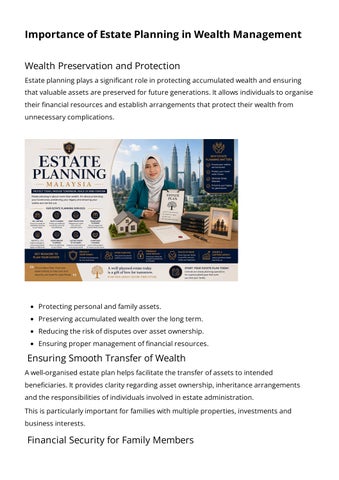
Importance of Estate Planning in Wealth Management Wealth Preservation and Protection Estate planning plays a significant role in protecting accumulated wealth and ensuring that valuable assets are preserved for future generations. It allows individuals to organise their financial resources and establish arrangements that protect their wealth from unnecessary complications.
Protecting personal and family assets. Preserving accumulated wealth over the long term. Reducing the risk of disputes over asset ownership. Ensuring proper management of financial resources.
Ensuring Smooth Transfer of Wealth A well-organised estate plan helps facilitate the transfer of assets to intended beneficiaries. It provides clarity regarding asset ownership, inheritance arrangements and the responsibilities of individuals involved in estate administration. This is particularly important for families with multiple properties, investments and business interests.
Financial Security for Family Members
Estate planning provides financial protection for dependants, including spouses, children and elderly parents. It helps ensure that family members have access to financial resources and assets when the primary income earner passes away. Key considerations: Maintaining financial support for dependants. Protecting children's future financial needs. Providing for elderly family members. Ensuring continuity of household financial stability.
Minimising Family Conflicts and Inheritance Disputes Unclear inheritance arrangements can create disagreements among family members. Estate planning helps establish clear instructions and arrangements regarding the distribution of assets. It also encourages open communication among family members about financial responsibilities and future wealth distribution.
Supporting Business Continuity and Succession For business owners, estate planning is important in ensuring that business operations can continue when ownership or management changes due to death or incapacity. It helps address: Future ownership arrangements. Transfer of business interests. Appointment of successors. Management responsibilities. Protection of business assets and investments.
Effective Management of Financial Liabilities Estate planning also considers outstanding financial commitments and obligations. Proper arrangements help ensure that liabilities are identified and addressed during estate administration. Examples include: Outstanding housing loans. Personal financing commitments. Business-related debts. Other financial obligations. Relevant legal and administrative expenses.
Intergenerational Wealth Transfer One of the major purposes of estate planning is to facilitate the transfer of wealth between generations. It allows families to prepare for the long-term distribution of assets while maintaining financial stability across generations. This can involve property inheritance, family businesses, investment portfolios and other valuable assets.
Improving Financial Organisation and Accountability Estate planning encourages individuals to maintain updated financial information and organise their assets systematically. A proper financial record should identify: Asset ownership and documentation. Bank accounts and investments. Property and business interests. Insurance and takaful arrangements. Beneficiary information. Relevant legal documents.
Enhancing Islamic Wealth Management in Malaysia In Malaysia, estate planning is particularly relevant to Islamic wealth management because Muslims need to consider Shariah principles when managing and transferring their wealth. Important Islamic estate planning instruments include: Faraid: Islamic inheritance principles governing the distribution of a deceased Muslim's estate. Wasiat: Islamic bequest arrangements subject to Shariah requirements. Hibah: Voluntary lifetime transfer of assets. Trust (Amanah): An arrangement for managing assets for designated beneficiaries. These instruments help Muslims organise their wealth transfer arrangements in accordance with applicable Islamic principles and laws.
Long-Term Financial and Legacy Planning Estate planning is not limited to distributing assets after death. It is also part of a broader wealth management strategy that supports long-term financial objectives and family legacy preservation.
It enables individuals to: Establish long-term family financial goals. Protect wealth accumulated throughout their lifetime. Prepare future generations for financial responsibilities. Maintain family financial values and traditions. Create a lasting financial legacy.
Overall Significance Estate planning strengthens wealth management by connecting asset protection, inheritance arrangements, family financial security and long-term wealth preservation. In Malaysia, it is particularly important because individuals must consider different legal and Islamic inheritance requirements when preparing their estate arrangements.
Contact Us: Location: Elmina Green Three, 40160 Shah Alam Mail: saidah@solusiringgit.com Phone: +6017-6939757 Website: https://solusiringgit.com/