A JOHN DEERE COMPANY
We’re 300+ dealer locations across North America
close. CLOSE TO OUR CUSTOMERS
Close to our customers means we deliver sales, service, and parts support in every U.S. state and Canadian province. We work in close collaboration with our dealers across North America, to provide a strong local presence, so you have the support you need, when and where you need it.
wirtgen-group.com
WIRTGEN
ACON1226_02-7_TOC MM FINAL.indd 2
VÖGELE
HAMM
KLEEMANN
11/12/26 12:13 PM
2027 GENCOR SERVICE SCHOOL Be prepared to get the most out of your plant this season by attending the 2027 Gencor University Training. Our expert instructors provide step-by-step comprehensive hands-on training through our state-of-the-art control simulators and actual plant equipment. Benefit from decades of industry experience and knowledge in the science of hot mix asphalt production to get the most out of your plant.
e.
* Improve plant production * Optimize plant efficiency * Reduce plant maintenance
2027 DATES
• Week 1: January 18 - 21
REGISTRATION
Go to www.gencor.com/training
• Week 2: January 25 - 28 • Week 3: February 1 - 4 • Week 4: February 8 - 11
INFORMATION Call us at: 407-290-6000 ext. 342 Email us at: training@gencor.com CLASS SIZE IS LIMITED! To secure your seat, please register before December 15, 2026.
One Company ACON1226_02-7_TOC MM FINAL.indd 3
One Source
One Solution 11/12/26 12:13 PM
TABLE OF CONTENTS | DECEMBER 2026 TECHNOLOGY UPDATE
18 5 Ways Asphalt Contractors Can Put AI to Work Today Autonomous pavers get the headlines, but asphalt contractors can already use AI to plan hauling, sharpen estimates, and win more work, starting in the estimating office.
FACE OF THE INDUSTRY
30 Building a New Kind of Legacy in the Asphalt Industry Chelsea Ellis-Hogan, CEO of Jim Reynolds Asphalt, shares how she is modernizing a family business, investing in employees and building a different kind of construction workplace.
JOBSITE INNOVATIONS
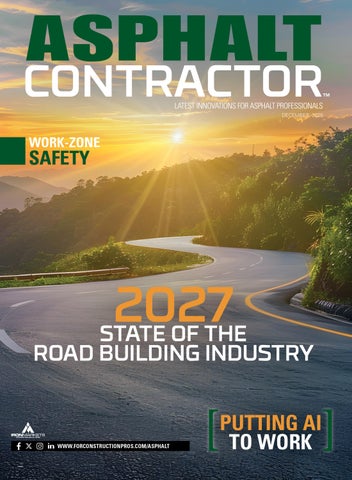
COVER STORY State of the Road Building Industry: 5 Trends to Watch in 2027
From labor shortage issues to AI adoption, here’s a 30,000-foot view of what’s impacting the industry right now and a preview of what to look for next year and beyond. | 24 PRODUCTION GAINS
34 How Royal Truck & Equipment’s Commitment to Safety Ensured WorkZone Crash Didn’t End in Tragedy
In d p h fo
Why your TMAs must be outfitted for maximum protection against accidents and liability claims.
PRESERVATION & SUSTAINABILITY
36 Maximizing RAP Utilization Without Compromising Asphalt Quality Standards
O la o
Ammann provides updates on the road ahead and the sustainability initiatives coming for asphalt producers.
14 How Pavement Design Catalogs Save Engineering Time and Resources WWW.FORCONSTRUCTIONPROS.COM/ASPHALT
IN EVERY ISSUE 8 Editor’s Perspective
Stop reinventing the wheel and standardize pavement designs for faster, smarter decisions.
CONTRACTOR WWW.FORCONSTRUCTIONPROS.COM/ASPHALT WWW.FORCONSTRUCTIONPROS.COM/ASPHALT
CONTRACTOR LATEST INNOVATIONS FOR ASPHALT PROFESSIONALS
ASPHALT ASPHALT
DECEMBER 2026 Vol. 40 No.8
CONTRACTOR CONTRACTOR LATEST INNOVATIONS FOR ASPHALT PROFESSIONALS
LATEST INNOVATIONS FOR ASPHALT PROFESSIONALS LATEST INNOVATIONS FOR ASPHALT PROFESSIONALS
Published by IRONMARKETS
Asphalt
Asphalt CONTRACTOR
CONTRACTOR
LATEST INNOVATIONS INNOVATIONS FOR ASPHALT ASPHALT PROFESSIONALS 201 N. Main Street Ste 350, Fort Atkinson, WIFOR 53538 LATEST PROFESSIONALS (800) 538-5544 • WWW.IRON.MARKETS www.ForConstructionPros.com/Asphalt LATEST INNOVATIONS FOR ASPHALT PROFESSIONALS
Published and copyrighted 2026 by IRONMARKETS. All rights reserved. No part of this publication may be reproduced or transmitted in any form or by any means, electronic or mechanical, including photocopy, recording or any information storage or retrieval system, without written permission from the publisher. Asphalt Contractor (ISSN 1055-9205, USPS 0020-688): is published ten times per year: January, February/March, April, May, June/July, August, September, October, November, December by IRONMARKETS, 201 N. Main St. Ste 350, Fort Atkinson, Wisconsin 53538. Periodicals postage paid at Fort Atkinson, Wisconsin and additional entry offices. POSTMASTER: Please send change of address to ASPHALT CONTRACTOR, 201 N. Main St. Ste. 350, Fort Atkinson, WI 53538. Printed in the U.S.A. SUBSCRIPTION POLICY: Individual subscriptions are available without charge only in the USA. The Publisher reserves the right to reject nonqualifying subscribers. One-year subscription to nonqualifying individuals: U.S. $45.00, Canada & Mexico $65.00, and $95.00 all other countries (payable in U.S. funds, drawn on U.S. bank). Single copies available (prepaid only) $10.00 each (U.S., Canada & Mexico), $15.00 each (International).
4 ASPHALT CONTRACTOR DECEMBER 2026 ACON1226_02-7_TOC MM FINAL.indd 4
2
40 Last Exit
LATEST INNOVATIONS INNOVATIONS FOR FOR ASPHALT ASPHALT PROFESSIONALS PROFESSIONALS LATEST
G B
www.ForConstructionPros.com/Asphalt
11/16/26 12:00 PM
I
C E
E
BLAW-KNOX UNIVERSITY PAVER TRAINING Increase your paving knowledge at the Blaw-Knox University designed for paver operators and foreman looking to improve paving skills. Our proven combination of classroom, and hands-on training instruction, teaches you everything you need for optimum paving performance. Our course instructors share decades of field experience on the latest paving techniques on a variety of topics including proper operation, maintenance and safety fundamentals. Get the most out of your paver this paving season by attending Blaw-Knox University.
e
g
2027 DATES Week 1: January 18 - 21 Week 2: January 25 - 28 Week 3: February 1 - 4
Go to: www.blawknox.com/training
Week 4: February 8 - 11
I
e o
REGISTRATION
INFORMATION Call us at 407-290-6000 ext. 342 Email us at: training@blawknox.com
ACON1226_02-7_TOC MM FINAL.indd 5
RESERVE YOUR SEAT TODAY! CLASS SIZE IS LIMITED! To secure your seat, please register before December 15, 2026.
11/12/26 12:13 PM
DIGITAL CONNECTION www.ForConstructionPros.com/Asphalt
Contractors Go Head-to-Head For Ultimate Bragging Rights | Watch FCP Contractors went head to head on a timed operator course at the Ocean County Construction Career Expo. Read more at: https://asph.link/ p0joqxbg
A Practical Guide to the ‘Repair, Rebuild or Replace’ Question How do you decide when to repair, rebuild or replace a machine? The answer hinges on which of these option offers the most dependable production at an acceptable total cost and within the required timeframe. Watch more at: https://asph. link/bbghmxad
Construction’s Financial Blind Spots Are Costing Contractors Time and Money AI, automated reporting and connected workflows are helping contractors reduce manual data work, improve financial visibility and manage project costs. Read more at: http://asphalt. com/n5bu9u84
The Future of Labor Scheduling: Safer, Smarter Jobsites | WEBINAR If you missed it went it live, this on-demand webinar offers straight talk on how to modernize your scheduling, protect your margins, reinforce site safety and stop relying on memory to protect your most valuable asset. Read more at: https://asph. link/8uyhwa27
Study Finds Asphalt Pavement Emissions 250 Times Lower Than Previous Estimates UC Riverside research finds emissions from in-place asphalt pavements are minimal compared with previous laboratory-based estimates. Read more at: https://asph. link/r59mdldc
Sign up for the Roadbuilding Update, a free bi-monthly newsletter for the most up-to-date asphalt industry news.
6 ASPHALT CONTRACTOR DECEMBER 2026 ACON1226_02-7_TOC MM FINAL.indd 6
www.ForConstructionPros.com/Asphalt
11/12/26 12:13 PM
N
A PARTNER THAT SHOWS UP
alt ons
mal
Rock to Road solutions backed by real commitment.
t:
c
e
Astec’s partnership doesn’t start when the order is placed or end when the equipment is delivered. From system design and training to service, parts, and optimization, we stay involved through the life of your operation. Because asphalt plant operators don’t just need machines—they need a partner who’s there when performance matters most.
Scan to learn more
ACON1226_02-7_TOC MM FINAL.indd 7
BUILT TO CONNECT
11/12/26 12:13 PM
EDITOR’S PERSPECTIVE
Jared Bilski, Editor-in-Chief
EDITORIAL Editor-In-Chief ................................................................ Jared Bilski
jbilski@iron.markets
jbilski@iron.markets
Falling for a ‘Fool’s Errand’
Content Director, Marketing Services ...........Jessica Lombardo
Why predicting the next big industry story is impossible— and why we keep trying anyway.
Art Director ............................................................... April Van Etten
I
don’t think there has ever been a time in modern history when we knew what the biggest news story of the next five years was going to be preemptively. That’s a claim made by Morgan Housel, author of “The Psychology of Money.’” Mr. Housel is a big believer that trying to forecast short-term events, stock market movements or technological timelines is a “fool’s errand” when you consider the accuracy of those types of predictions is damn near zero. (His words, not mine. For the record, I’m still enough of a sucker to play the lottery and occasionally bet on the Philadelphia 76ers.) Even the best journalists around can’t foretell the next Earth-shaking global (or industry) news story, just like even the most brilliant economists and financial wizards can’t guarantee what the market’s going to do next. But boy do we try. The Asphalt Contractor’s State of the Industry, page 24, is an exercise in looking back at the highlights of the previous year with an eye toward what to expect next year. As someone new to the industry, reporting on this story was an eye-opening experience. It gave me that 30,000-foot view of such a vast, complex and utterly fascinating industry. Anchored by the expert insights of Zack Fritz of the Sage Policy Group, and Amanda Mays, Executive Director of Transportation, Infrastructure, and Supply Chain Policy at the U.S. Chamber of Commerce in Washington, D.C., writing this piece gave me a perspective that may have taken months to gain otherwise.
jlombardo@iron.markets
Managing Editor ......................................................Allyson Sherrier asherrier@iron.markets
AUDIENCE Audience Development Director ......................... Angela Franks PRODUCTION Senior Production Manager ...................................... Cindy Rusch crusch@iron.markets
Elsewhere in the issue, you’ll find practical ways you can use AI right now from Ryan Clark (page 18), best practices in TMA safety that took shape after reading a LinkedIn post where a customer paid homage to a trucking company following a scary, but ultimately best case, work zone crash (page 34), and a profile on Anderson Striping’s Dejah Anderson (page 30). AdobeStock_jzehnder
ADVERTISING/SALES Brand Director ........................................................... Amy Schwandt aschwandt@iron.markets
Brand Manager ..................................................... Megan Perleberg mperleberg@iron.markets
Sales Representative ..................................................Sean Dunphy sdunphy@iron.markets Sales Representative ................................................... Kris Flitcroft kflitcroft@iron.markets IRONMARKETS Chief Executive Officer.................................................. Ron Spink Chief Revenue Officer ............................................Amy Schwandt VP, Finance .......................................................................Greta Teter VP, Operations & IT ....................................................Nick Raether Brand Director, Construction, OEM & IRONPROS .....................................................Sean Dunphy Brand Director, Supply Chain ....................................Brian Hines Director, Content ......................................................Marina Mayer Director, Marketing Services ...............................Lauren Hunter Director, Event Content & Programming........ Jess Lombardo Director, Lead Generation Operations ................. Bailey Acton CIRCULATION & SUBSCRIPTIONS 201 N. Main St. Ste. 350, Fort Atkinson, WI 53538 afranks@iron.markets
LIST RENTAL Sr. Account Manager ....................................Bart Piccirillo | Data Axle (518) 339 4511 | bart.piccirillo@infogroup.com
This is Asphalt Contractor’s final issue of a very interesting 2026. This time of the year naturally lends itself to contemplation; it’s an opportunity to pause and reflect before jumping back onto the treadmill. Whether you shattered expectations at your business, experienced record growth or withstood the type of torture that made you rethink your career choice on multiple occasions, the finish line is right around the corner. Happy Holidays. Thanks for all your support. We’ll see you next year!
REPRINT SERVICES Brand Manager ..................................................... Megan Perleberg mperleberg@iron.markets | (800) 538-5544 Published and copyrighted 2026 by IRONMARKETS. All rights reserved. No part of this publication may be reproduced or transmitted in any form or by any means, electronic or mechanical, including photocopy, recording, or any information storage or retrieval system, without written permission from the publisher.
@ASPHALTCONTRACTOR @ASPHALTCONTRCTR @ASPHALTCONTRACTOR @ASPHALT-CONTRACTOR-MAGAZINE
Published by IRONMARKETS 201 N. Main St. Ste 350, Fort Atkinson, WI 53538 (800) 538-5544 • WWW.IRON.MARKETS
SCAN TO READ MORE
8 ASPHALT CONTRACTOR DECEMBER 2026 ACON1226_08-9_Editor MM FINAL.indd 8
www.ForConstructionPros.com/Asphalt
11/12/26 12:17 PM
2026 Mag
ski
ets
do
ets
er
ets
ks
ch
ets
en
dt
ets
rg
ets
hy ts
oft ts
nk dt er er
hy es er er do on
xle
om
rg
44
TS. or al, val er.
E
I 53538 TS
DESIGN, DETAILS, AND DURABILITY. We don’t just build asphalt plants—we help contractors build stronger businesses. Every ALmix system is engineered around your operation, combining industry-leading durability, advanced technology, and decades of expertise to maximize productivity for years to come.
10106 Smith Road, Fort Wayne, IN | 260.672.3004 | ALmix.com
2026 Magazine Ad (Q3) - Asphalt Contractor copy.indd 1 ACON1226_08-9_Editor MM FINAL.indd 9
7/14/26 10:27 AM 11/12/26 12:17 PM
NEW PRODUCTS CHECK OUT OUR NEW PRODUCT DIRECTORY
LeeBoy PR900 DualTank Distributor Truck
OneCrew Paving Platform This all-in-one software platform is built exclusively for asphalt and concrete paving contractors by a team of expert software engineers and product builders. It replaces scattered spreadsheets, text messages, and generic construction tools with a single operational environment. Features include CRM and customer portal, estimating and AI takeoffs, scheduling and dispatch, mobile field management, job costing and analytics and invoicing and accounting.
The PR900 is a dual-tank maintenance distributor that offers versatility and precision with its independent front and rear tanks. Operators benefit from an advanced in-cab controller that gives the ability to control material application rates and make adjustments to spray widths. Offering a range of optional accessories such as hand spray wands and convenient tool storage, the PR900 is designed for efficient and adaptable performance on various jobsites.
Eagle Crusher TalonTrax Mobile Crushing Plant Eagle Crusher developed the TalonTrax to ensure customers have the right equipment for the job, no matter the size or scale. The TalonTrax mobile crushing plant features the new TalonMax impactor that features a newly designed open-style rotor, reducing overall weight, thus making moving the plant easier without sacrificing capabilities or overall performance.
Wirtgen Vögele Super 2000-5 X Road Paver
CM Labs Single Drum Roller Simulation Training CM Labs Simulations Intellia Single Drum Roller Simulator Curriculum is the industry’s first single drum roller simulation training. Designed to equip new operators with essential skills, the realistic simulator curriculum integrates with CM Labs’ Intellia Workforce Training System and joins a full equipment catalog for a complete training solution for operators of all levels. Built by subject matter experts, the new training solution delivers a highly realistic training experience tailored to beginners with no prior experience operating heavy equipment. It includes a comprehensive nine-exercise curriculum and more.
10 ASPHALT CONTRACTOR DECEMBER 2026 ACON1226_10-13_Products MM FINAL.indd 10
Developed as part of VÖGELE’s X-Tier “Dash 5” generation, the SUPER 2000-5 X meets the growing demand for paving quality, automation, and efficiency while preparing contractors for digital jobsites. This tracked paver combines high output with intelligent process control through systems like Smart Pave and Auto Grade Plus. The ErgoPlus 5 operating concept reduces operator workload, while advanced material management supports continuous flow. EcoPlus drive technology lowers fuel consumption without sacrificing performance. The result is a future-ready machine delivering reliable, high-quality paving across demanding applications.
VSS Macropaver CR Designed with patented technology, the Macropaver-CR excels in applying all slurry and polymer-modified micro surfacing materials with ease. The Macropaver-CR features a patented ground drive system that uses a variable displacement hydrostatic pump to drive two bent axis motors, enabling the machine to reach speeds of up to 25 mph in both forward and reverse directions. The loading conveyor, with a capacity of 12,400 lbs./min, features a 20-in. cleated belt that is fully enclosed with return idlers and lift cylinders for quick access cleanout hatch. The patented hydraulic system includes three variable displacement pressure-compensated pumps dedicated to the paving and loading circuits, a variable displacement hydrostatic pump for the closed-loop ground drive circuit, and more.
www.ForConstructionPros.com/Asphalt
11/12/26 12:18 PM
ACON1226_10-13_Products MM FINAL.indd 11
11/12/26 12:18 PM
NEW PRODUCTS Vectigo RoadwayEmbedded Safety & Data Platform
New Holland W100D Compact Wheel Loader
Vectigo developed a roadway-embedded technology platform that combines sensors, wireless communications and intelligent lighting to help infrastructure operators monitor road conditions and respond to potential hazards. The system uses embedded Vectigo PODs, SmartHubs, environmental sensors and a cloud-based data platform to collect information on road and ambient temperature, humidity, vehicle speed, vehicle classification and device status. The platform combines sensor data with analytics and configurable response systems to identify conditions that may require attention, including potential freezing risks, unusual traffic patterns and roadway obstructions.
The W100D is a compact wheel loader designed for operator comfort and allaround jobsite performance. Targeted for use in landscaping, agriculture, snow removal and more, the W100D features a redesigned cab, upgraded controls and flexible attachment options. The W100D’s cab offers expanded space, improved visibility, and a seat-mounted joystick that moves with the operator, enhancing control and reducing fatigue. Standard features include a heated air-ride seat, HVAC, Bluetooth radio, LED lighting, a rearview camera and an in-cab display for real-time machine data.
Georgia Boot Women’s Romeo SuperLyte Chelsea
MILESEEY TOOLS GripSound Xmini Speaker The GripSound Xmini is a compact wearable speaker designed for construction workers and mobile tradespeople. The device uses the company’s GripSense SmartAudio System to support music playback and calls in noisy work environments. The Xmini features AI-powered voice processing, Bluetooth connectivity and two oversized buttons for controlling music, volume and calls while wearing gloves. Its reinforced clip attaches to workwear.
Georgia Boot introduced the Women’s Romeo SuperLyte Chelsea, a lightweight leather boot designed for everyday wear. The boot features a full-grain leather upper, 3D knitted gore panels and nylon pull loops for easy on and off. A moisture-wicking lining and removable AMP X-Lite memory foam insole provide cushioning and comfort. Additional features include a slipresistant EVA/rubber outsole and sidewall stitch detailing.
Trimble Connect Scheduling Solution Trimble Connect SchedulingTM is an integrated, AI-assisted solution for real-time visibility and optimization of construction scheduling and planning. Trimble Connect Scheduling transforms how teams in the field and office can plan activities, identify scheduling risks and respond to dynamic changes to meet the critical industry challenge of completing projects on time and within budget. Trimble Connect Scheduling connects a master schedule directly to live project data — from look-aheads and RFIs to weather forecasts, daily reports, submittals and other data. Powered by agentic AI, the solution continuously tracks shifting variables, evaluates risk and suggests actionable schedule adjustments for teams to review and approve, helping shift project management from reactive delay tracking to proactive delay prevention.
12 ASPHALT CONTRACTOR DECEMBER 2026 ACON1226_10-13_Products MM FINAL.indd 12
T P P
More has in pa
Komatsu K-Tec Scraper Komatsu approved the use of the K-Tec 1237 ADT scraper with its HM460-6 articulated dump truck, creating a mass earthmoving combination designed for long-distance hauling. The 518-hp truck pairs with the scraper’s 37-cu.-yd. capacity and allows one operator to move material. The HM460-6 can also be converted back to a traditional dump truck, giving contractors flexibility across applications. The HM460-6 features a nine-speed transmission, traction control system and cross-axle differential locks for operation across challenging terrain. Its DBA127 diesel engine delivers 518 hp and 23% more torque than the HM400-5 it replaces.
www.ForConstructionPros.com/Asphalt
11/12/26 12:18 PM
CRACK
MAS
se
L
THE ROAD TO PAVEMENT PRESERVATION
LIQUID ROAD SURFACE TREATMENT
More than 55 years of material and equipment innovation has positioned SealMaster as an industry leader in pavement preservation technologies.
COOL PAVEMENT TECHNOLOGY
COLD-APPLIED CRACK SEALANTS
CRACK SEALING EQUIPMENT / MATERIALS
TRAFFIC MARKING PAINTS
MASTIC EQUIPMENT / MATERIALS
sealmaster.net | 800-395-7325
LOCATIONS NATIONWIDE
ACON1226_10-13_Products MM FINAL.indd 13
Booth 713 Jan. 25-27, 2027 Savannah, GA
Booth 5437 Mar. 15-17, 2027 New Orleans, LA
11/17/26 9:14 AM
PRODUCTION GAINS Residential roadway_shutterstock_2471742427
How Pavement Design Catalogs Save Engineering Time and Resources .
Stop reinventing the wheel and standardize pavement designs for faster, smarter decisions
E
very year, public works departments plan pavement work across networks that carry different traffic loads, sit on different soils, and face different performance demands. A local street, a bus route, or a heavily traveled arterial each requires something different from the pavement beneath it. Yet many agencies must make those plans with limited engineering staff, tight budgets, and a growing list of projects. A pavement design catalog provides a portfolio of pre-engineered pavement sections for common conditions and applications. Instead of starting from scratch with every project, agencies can use established designs as a starting point and focus engineering resources on locations that present unusual conditions or greater risk. THE CATALOG SOLUTION A pavement design catalog is a structured engineering decision framework. It connects pavement sections to the conditions where they are appropriate and explains how staff is to choose among them. This differs from a typical detail sheet, which usually shows how to build a particular feature, or a collection of standard sections, which offers several
14 ASPHALT CONTRACTOR DECEMBER 2026 ACON1226_14-17_ProdGains MM FINAL.indd 14
assemblies without explaining when each one fits. A pavement catalog, for example, might show an eight-inch concrete pavement over a specified base. It then sets out the conditions that support that choice, such as accepted pavement design methodology, roadway classification, traffic and vehicle loading, subgrade support, design life, materials properties, drainage assumptions, and performance criteria. It also marks the boundaries of the design and identifies conditions that require additional investigation. The catalog can cover concrete pavement, asphalt pavement, reconstruction, widening, overlays, or rehabilitation. Agencies can develop separate decision paths for different applications, as new construction and rehabilitation call for different information. In every case, the catalog should reflect the agency’s network, accepted design practices, available materials, and performance goals. WHAT THE CATALOG CONTAINS An actionable catalog provides staff with enough information to make a defensible selection and to recognize when they need more help. Depending on its purpose, it may include: • Roadway or functional classification • Current and projected traffic, truck percentages or loading categories • Design life and performance expectations • Subgrade strength, soil category, moisture sensitivity and stabilization needs
• Pavement type, layer thicknesses, base and subbase requirements • Drainage, climate and environmental assumptions • Material specifications and construction requirements • Agency standards and state or national guidance • Selection tables, decision trees or flowcharts • Quality assurance, performance or warranty provisions • Assumptions, exclusions and triggers for further investigation or customized design The information should be specific enough to guide decisions without making the catalog cumbersome to use. Clear categories and decision paths help agency engineers, inspectors and consultants apply the catalog consistently. Plainly stated limits are just as important: Users need to know when a design fits and when the project requires another level of review. HOW TO DEVELOP A CATALOG Build the catalog around the agency’s network and operating needs. A useful process includes these steps: 1. Define the purpose. Set the intended applications, performance goals, design criteria and decision-making needs. 2. Review the network. Identify recurring combinations of roadway classification, traffic, subgrade, materials and service expectations. 3. Gather the evidence. Compile traffic forecasts, geotechnical
www.ForConstructionPros.com/Asphalt
11/12/26 12:18 PM
information, climate and drainage conditions, material availability, pavement condition records, construction history, and maintenance data. Use applicable state DOT manuals, municipal standards, AASHTO guidance and ASTM, ACI or asphalt-industry resources. 4. Engineer and review the sections. Apply accepted design methods and jurisdictional requirements. Compare proposed sections with agency standards, specifications, and local construction experience. Complete technical review and quality control checks, and document assumptions. 5. Make it usable. Organize selection criteria in clear tables or flowcharts, then train staff and consultants in the process and its limits. Catalog-based pavement sections should be treated as pre-engineered alternatives for defined conditions rather than universally applicable designs. The responsible engineer should verify their suitability for each project and determine whether additional analysis or modifications are warranted. APPLY THE CATALOG TO EACH PROJECT A catalog makes routine decisions easier to organize, but every selection still needs a project-level check. 1. Confirm the roadway classification and intended use. 2. Estimate current and future traffic or loading. 3. Evaluate subgrade, drainage, and other site conditions. 4. Identify appropriate pavement and material alternatives. 5. Match the project to the relevant catalog category. 6. Verify that conditions fall within the design’s assumptions and limits. 7. Additional investigation should be carried out where available information is insufficient. That final check protects the value of the entire framework. A project may appear to fit a standard category while carrying a different risk because of soil variability, drainage, unusual vehicle traffic, or other site conditions. When
www.ForConstructionPros.com/Asphalt
ACON1226_14-17_ProdGains MM FINAL.indd 15
evidence falls outside the catalog’s assumptions, an engineer should investigate and develop a tailored design. Rehabilitation deserves particular care. Before selecting an overlay or repair strategy, an agency may need pavement condition data, structural testing, cores, materials evaluation, drainage review, and an understanding of the distress mechanism. A catalog can organize recurring rehabilitation options, but the team must diagnose the existing pavement before choosing a treatment.
Agencies can estimate avoided annual design effort by multiplying average hours saved per eligible project by the number of eligible projects completed each year. If, for example, records show 12 hours saved on each of 25 projects, the result is 300 hours, an illustrative calculation, not a claim about a specific agency or project. Applying documented labor or consultant rate will produce an estimate of financial value. KEEP THE CATALOG CURRENT To be useful, the catalog must stay aligned with changing conditions. • Monitor pavement performance. • Capture construction lessons. • Review maintenance and warranty experience. • Update traffic, material, cost, and specification assumptions as needed. • Schedule periodic reviews. • Retrain staff when standards, practices, or personnel change.
KNOW WHEN TO STEP OUTSIDE THE CATALOG Some projects call for deeper investigation from the start. Unusual or unstable soils, unexpected heavy loading, persistent drainage problems, severe or unexplained distress, specialized facilities and other conditions outside the catalog’s assumptions require deeper analysis. The catalog should identify these triggers and provide a clear path to geotechnical testing, structural evaluation, specialist review or customized KEY TAKEAWAY design. A pavement design catalog That process helps cannot make every staff explain why a project routine, and project follows a it should not try to. standard path or Its strength lies in needs an exceporganizing recurtion, while directring engineering ing engineering decisions, docueffort to the menting the condilocations where it tions that support can have the greatest each design and showeffect. ing staff when a project Terracon needs a closer look. For agencies managing extensive MEASURE RESULTS networks with limited staff and budgets, Agencies can assess a catalog’s value by that framework can reduce repetitive tracking the work it changes. Common design effort, improve consistency measures include: and speed routine planning. It also • Engineering hours per routine design can make exceptions easier to identify and average design or review time and explain. By standardizing what • Share of projects eligible for catalog is repeatable, pavement professionals designs and consultant cost per can focus more attention on unusual routine project conditions, higher-risk locations and the • Design revisions, construction change long-term performance of the network. orders and bid variability • Early repairs, warranty claims, maintenance interventions and by Hossam Abohamer, Pavement pavement condition over time Engineering Professional with Terracon.
DECEMBER 2026 ASPHALT CONTRACTOR 15
11/12/26 12:18 PM
January 25-27, 2027 | Savannah Convention Center | Savannah, GA
REGISTRATION IS This IMMERSIVE EXPERIENCE is designed to enhance your business through a full three-day schedule. Our agenda covers fun and engaging networking opportunities, ample time on the show floor to view new products and equipment and over 60+ hours of educational offerings to learn from industry experts. The PAVE/X difference starts with education designed to make an impact. The robust program goes beyond traditional conference learning, delivering practical, relevant content across Paving & Compaction, Pavement Preservation, Sweeping, Sealcoating, Technology, Striping and Business Management. With a wide range of sessions to choose from, contractors can build an experience around the topics, challenges and opportunities that matter most to their businesses. In addition to education, Outdoor demos are BACK—and we’re taking them to the extreme. This year, we’re bringing equipment out of the booth and into the action with an expanded outdoor experience where contractors can see machines perform in real-world conditions. Fire up equipment, put it through its paces, and let the product speak for itself. And the excitement doesn’t stop there. The Roller Rodeo and Striping Competition are back, giving contractors a chance to test their skills. With expanded seating, big-screen displays, food trucks, live music and cold beer, the outdoor demo lot becomes the place to be—where contractors stay longer, engage more and discover what the equipment can do. The final leg to the PAVE/X experience is creating meaningful connections. Over the three-day event, there will be ample opportunity for next-level networking that will create and strengthen the relationships that are vital to the success of business owners working to grow. “Every year, our goal is to deliver the best possible experience for contractors. That means listening to their feedback, thinking outside the box, and continually challenging ourselves to create an event that goes beyond expectations,” says Amy Schwandt, Co-Founder of PAVE/X. “This year, we heard loud and clear that contractors want to see equipment in action, so we’re bringing our outdoor demo experience to an entirely new level. We’re creating an immersive space where contractors can experience equipment firsthand, putting PAVE/X in a position to set a new standard for industry events.” We hope you can join us in Savannah, January 25-27, 2027, for an immersive trade show environment you won’t want to miss! Brought to You By:
Previously Known as AC Business Media
ACON1226_14-17_ProdGains MM FINAL.indd 16
11/12/26 12:18 PM
L
N IS OPEN
Savannah
Savannah Convention Center
Dueling Pianos
LIVE DEMONSTRATIONS
FOR MORE INFORMATION, VISIT:
PAVEXSHOW.COM
ACON1226_14-17_ProdGains MM FINAL.indd 17
11/12/26 12:18 PM
TECHNOLOGY MATTERS
5
Ways Asphalt Contractors Can Put AI to Work Today
Autonomous pavers get the headlines, but asphalt contractors can already use AI to plan hauling, sharpen estimates, and win more work, starting in the estimating office.
E
very time I read another article about artificial intelligence (AI) in our industry, the conversation turns to autonomous pavers, intelligent compaction, 3D machine control, and plants that practically run themselves. Those developments are real. But most of the decisions that make or lose money on a paving job still happen before the paver ever starts: in the estimate, the plant selection, the trucking plan, and the conversation with the client. That’s where AI can help right now, whether you run two paving crews or 20. Most industry leaders aren’t looking to replace operators with robots. We’re trying to win profitable work, control material and trucking costs, keep crews productive with less available labor, and get the estimating, scheduling, and paperwork done before going home. That’s where the conversation about AI has been missing the mark. Over the past year, I’ve been testing tools like ChatGPT and Claude to see what AI can actually do for an asphalt contractor, not 10 years from now, but today. Some of the most useful applications have nothing to do with operating paving equipment. Here are five ways you can put AI to work, starting with the
18 ASPHALT CONTRACTOR DECEMBER 2026 ACON1226_18-23_Tech MM FINAL.indd 18
The Pavement Directory
one closest to the asphalt itself: getting mix from the plant to the paver.
➊ BUILD YOUR OWN HAULING AND ESTIMATING TOOLS One of the more surprising things is that you can now use AI to build your own software tools just by describing what you want them to do. Software developers have started calling this “vibe coding.” I use a combination of Claude Code and OpenAI’s Codex, but Claude Code is my go-to. For example, on a paving job, one of the decisions to make is which asphalt plant to buy material from. The plant with the lowest price per ton isn’t necessarily the cheapest once you factor in trucking. Before AI, I would look up several plants, calculate the driving distance from each to the jobsite, and estimate each round trip. If I didn’t know the routes, it was nearly impossible to account for traffic throughout the day. Then I’d account for the fact that a loaded Super 10 travels much slower
than a passenger car, especially on hills or in traffic. I’d estimate loading and unloading times, figure out how many trips each truck could realistically make, and calculate how many trucks we’d need to keep the paving crew supplied. Then I’d repeat the whole process for every other plant in the vicinity that might have cheaper material costs. The math wasn’t complicated, but it was time-consuming, and there were plenty of chances to overlook something. Using AI-assisted coding, I built a tool to automate most of that. I enter a jobsite address, estimated tonnage, trucking rates, and material prices. The tool compares plants, estimates truck cycle times, calculates loads and trucks required, and identifies the lowest total delivered material cost. The first working version took about two hours. You can find tonnage and trucking calculators online. That’s nothing new. The difference is that AI lets you build a tool around how your company operates instead of forcing your company to work around somebody else’s software. I enter our own numbers: our hourly
www.ForConstructionPros.com/Asphalt
11/12/26 12:19 PM
trucking rate and the hauler’s minimum, the dump fee for the old asphalt we haul off, the paving rate our crew can hold in tons per hour, and what the crew costs us per hour, overtime included. If we put a different paver, milling machine, or crew on the job, I change those numbers. The tool uses road drive times with live traffic, slowed down for loaded trucks, and tells us how many trucks it takes to keep the paver fed and the grinder moving. When I want something new, like comparing five plants instead of two, I ask AI to add it. What started as a simple trucking calculator grew into a hauling and job-planning application. It scans plant weigh tickets, tracks tons delivered against the order, and tells us when to order the last load. It checks the pavingday forecast against our temperature limits and warns us when a haul is long enough for the mix to cool. With live traffic, it can also alert us to accidents or delays that could hold up deliveries. The project manager taps when each truck reaches the job and again when it leaves, so the app measures real cycle times and tells us when we need another truck to keep the paver fed. At the end of the job, it lines up the estimate against the weigh tickets and invoices. Temperature warnings still have to be checked against actual mix temperatures, of course. You don’t have to build something this elaborate to benefit. Maybe all your company needs is a tonnage calculator built around your own mix designs and compaction factors, a crack-sealing material estimator, or a tool for figuring out how much tack coat to order. Start simple and improve it as your needs change. One word of caution: you still need to understand the calculations well enough to check the results. AI can write incorrect formulas just as easily as correct ones, and a calculator that consistently underestimates trucking costs will lose money faster than doing the math by hand.
in filing cabinets, spreadsheets, and project folders: years of job history. Every estimate, every job you made money on, and every job you wish you’d never taken. Most of us barely use that information. Here’s what happened when I tried it though. We use HubSpot to track estimates and sales activity. I had AI help me sort bid history by job type, size, and customer. Patterns jumped out right away that I’d never have spotted flipping through proposals one at a time. It showed us the kinds of work where we’re most competitive, and that changed where we focus our estimating hours. You can ask the same kinds of questions of your own data: • Which types of projects consistently generate highest margins? • How do our estimated tons compare with the plant tickets on finished jobs? • Are we underestimating labor on small repair jobs? • How much does production drop when we pave around traffic or occupied sites compared with open, closed-off work areas? • How much time do our trucks lose waiting at the plant or the jobsite? • Which types of jobs generate the most change orders? Where this gets interesting is estimating. Instead of asking a generic AI model how many tons a crew should place in a shift, ask how many tons our crews actually place under similar conditions. With enough reliable job-cost data, AI will eventually help produce estimates based on how your company actually performs, and may handle many routine estimates as well as an experienced estimator. We’re not there yet. Plans still need interpretation, site conditions vary, and AI can make costly mistakes. It also depends entirely on good data. Feeding an AI system years of bad estimates won’t magically make it a good estimator.
➋ FIND OUT WHAT YOUR OLD JOBS ARE TELLING YOU Every contractor who’s been around for a while has something valuable sitting
PROPOSALS AND CUSTOMER EMAILS As contractors, we’re constantly communicating with owners, property
www.ForConstructionPros.com/Asphalt
ACON1226_18-23_Tech MM FINAL.indd 19
➌ WRITE BETTER
managers, general contractors, and subcontractors. We’re following up on bids, explaining scope and pricing, and trying to convince potential customers that we’re the right company for their project. Most of the time, I know exactly what I want to say. I just don’t have the time or patience to sit down and write the perfect email. So I type or dictate what’s on my mind and ask AI to clean it up while keeping my meaning. For example, you mill a section and find the base underneath has failed. The general contractor needs an answer today, the owner’s rep is going to push back on the cost, and the crew is standing around waiting. Instead of writing that email from scratch on a tailgate, I give AI the situation in my own words: “Milled the east drive aisle, base is pumping in about 1,200 sq ft. Needs full-depth repair before we pave, can’t just overlay it or it fails in a year. Need GC approval today so the crew isn’t sitting. Added cost $14,500. Keep it clear and professional, not defensive.” Here’s what comes back after a quick edit: “During milling on the east drive aisle today, we found about 1,200 square feet where the base has failed. Paving over it would put the new surface on a soft section that is likely to crack and settle within the first year. We recommend full-depth repair of that area before paving. The added cost is $14,500, and photos are attached. If we can get your approval today, the crew can complete the repair and keep the job on schedule.” The facts are the same either way. What changes is that the general contractor gets a clear problem, a reason, a price, and a deadline, and the email doesn’t read like an upsell. The same approach works on proposals. When I reached out to a large apartment community in the East Bay with a tight first-year budget, I used AI to turn my notes into an offer to help them prioritize the work over three years instead of a generic sales pitch. They called me back that same day, and later we were awarded the job.
DECEMBER 2026 ASPHALT CONTRACTOR 19
11/12/26 12:19 PM
TECHNOLOGY MATTERS That’s what I find valuable about AI in sales. It doesn’t necessarily come up with something I wouldn’t have thought of myself. It helps me organize my thoughts and say them more effectively. It’s just as useful for other hard conversations, like why our price is higher than the low bid or why a paving date has to move for weather. A poorly worded response can make you sound defensive or uninterested, even when that’s not your intention. One caution: be careful about pasting customer names, pricing, or contract terms into a free or personal AI account. Give it enough context to write a good message, and leave out what it doesn’t need.
➍ FIND CUSTOMERS AND KEEP TRACK OF THEM Finding qualified customers is another area where AI has been extremely useful. We pursue commercial properties, apartment communities, HOAs, and property management companies throughout the Bay Area. We know the customers we want. The hard part is finding them, identifying the right decision-makers, getting accurate contact information, and following up consistently. Traditionally, that means hours spent searching online, visiting company websites, digging through property management portfolios, and organizing everything into spreadsheets. AI can streamline much of that. I can ask it to research property management companies operating multiple apartment communities in a particular city, identify which ones fit our ideal customer, and organize the results for review. We combine that research with business contact databases to find the people who actually make pavement decisions: regional property managers, facilities directors, and maintenance supervisors. Then we bring that information into HubSpot, where we track opportunities, schedule follow-ups, and keep a record of communications. I’ve also built AI-assisted cold email tools that tailor outreach to the type of customer we’re approaching. An
20 ASPHALT CONTRACTOR DECEMBER 2026 ACON1226_18-23_Tech MM FINAL.indd 20
apartment manager may be concerned about resident disruption, parking restrictions, and annual maintenance budgets. A commercial property manager might care more about liability, tenant access, and keeping the lot safe and presentable. We’re offering many of the same services, but the reasons each customer might hire us are different. Contact information needs verification, outreach should be relevant, and you still need to follow email marketing rules, including honoring opt-outs. The goal isn’t to blast thousands of generic AI-generated emails. It’s to spend less time researching and more time talking with qualified prospects. There’s another benefit: consistency. Most contractors are good at following up when work is slow. When the schedule fills up, sales activity falls behind. Connecting lead research, outreach, and follow-up reminders to a CRM helps keep good opportunities from slipping through the cracks. Your customer list may look different from ours. If you mainly bid public work, the same approach applies to tracking lettings, plan holders, and the prime contractors you work for. AI won’t replace relationships or the ability to sell a project. But it can make finding and staying in touch with customers more efficient.
➎ BUILD A WEBSITE THAT BRINGS IN WORK AI coding tools can also help build a fast company website without an agency budget. I built Forticon’s new site with Astro, a framework suited to fast, lightweight sites. I describe what I want, such as a page about commercial paving in the East Bay with our services, project photos, and an estimate request form, and AI helps write the code. But a good-looking website and one that generates business are two different things. AI can create 20 nearly identical city pages in minutes, and they’ll likely do little for your search rankings. Ranking still takes useful content, a sound site structure, and technical details like page speed and structured data. If you’re new to this, have someone with real
SEO experience review the site before you count on it for leads. AI ISN’T ALWAYS RIGHT AI doesn’t get everything right. I’ve seen it make incorrect calculations, misunderstand construction specifications, write faulty code, and recommend work sequences that look reasonable on paper but make no sense in the field. And sometimes it presents those mistakes with complete confidence. That’s why I treat AI as an assistant, not an authority. The better you understand the task, the better you’ll be at catching its mistakes. Be careful about what business information you give it access to. Contractors handle customer records, pricing, employee data, and confidential project details. Before connecting any AI system to that information, understand how your data is stored and protected. And building your own software isn’t automatically free. Mapping services, traffic data, databases, hosting, and other integrations can carry ongoing costs. START WITH ONE TASK You don’t need a big investment to start. The paid versions run about $20 a month with a free trial to start. If you’ve never used AI before, don’t try to build a trucking application or automate your estimating on day one. Start with one difficult customer email, one calculator for a material you order every week, or a handful of old job-cost reports. You don’t need to know programming, but you do need to understand the work you’re asking AI to help with and check the results. I believe AI will change how asphalt contractors estimate, schedule, market, and manage their businesses, not by replacing the people doing those jobs, but by giving them capabilities that used to require more office staff, expensive software, or an IT department. by Ryan Clark, Estimator and Project Manager with Forticon Inc.
www.ForConstructionPros.com/Asphalt
11/12/26 12:19 PM
TRUST THE STRENGTH
m
Tackle the toughest crushing applications with the industry’s highest performing equipment—Eagle Crusher, delivering world-class innovation, year after year. Discover E-Plant®, just one of many innovative products from Eagle Crusher.
TRUST THE STRENGTH OF EAGLE CRUSHER®
800-25-EAGLE www.EagleCrusher.com
JOIN US AT BOOTH 4446
ACON1226_18-23_Tech MM FINAL.indd 21
11/12/26 12:19 PM
BEHIND EVERY ROAD, THERE IS A STORY BEHIND EVERY ROAD, THERE IS A STORY.
Your first stop in the FAYAT GROUP road lifecycle, ADM makes the plants that make the hot mix. When it comes to North American roadbuilding, FAYAT Group brands including ADM, BOMAG, Dynapac, LeeBoy, and Mecalac have you covered.
260-637-5729 admasphaltplants.com
Visit Us at World of Asphalt ACON1226_18-23_Tech MM FINAL.indd 22
11/12/26 12:19 PM
M
AD,
alt
March 15-17 Booth 1621 ACON1226_18-23_Tech MM FINAL.indd 23
11/12/26 12:19 PM
SPECIAL REPORT | By Jared Bilski, Editor-in-Chief
STATE OF THE ROAD BUILDING INDUSTRY: 5 Trends to Watch in
2027
AdobeStock_816046809
24 ASPHALT CONTRACTOR DECEMBER 2026 ACON1226_24-29_SpecialReport MM FINAL.indd 24
www.ForConstructionPros.com/Asphalt
11/16/26 12:05 PM
816046809
From labor shortage issues to AI adoption, here’s a 30,000-foot view of what’s impacting the industry right now and a preview of what to look for next year and beyond.
T
here’s no shortage of challenges facing workers in the asphalt and road building industry. Between rising fuel and materials costs stemming from the largest oil supply disruption in the history of the oil supply market, the ongoing struggle to find qualified labor and leadership to fill the giant hole left by a rapidly retiring Baby Boomer contingent, and the federal funding issues caused by the sunsetting of the Infrastructure Investment and Jobs Act (IIJA) and the uncertain future of the Highway Trust Fund, it’s easy to see why some would fear what lies ahead. Still, the industry is in a much better place than many sectors right now. The ARTBA expects the U.S. transportation construction market to grow by 3% and reach a record $209.1 billion in 2026. Recently, road and highway construction activity increased through the end of 2026, according to IBISWorld. Plus, technological innovations, such as intelligent compaction, are starting to take hold across the industry, and contractors are becoming more attuned to the difference between hype and reality with this AI and finding practical ways to integrate AI into their workflow. This is the time of year when everybody, from contractors to asphalt producers to public works specifiers, tends to reflect on the previous year in an attempt to predict what’s in store for the upcoming one. Asphalt Contractor spoke to Zack Fritz, Chief Operating Officer for Sage Policy Group, and Amanda Mays, Executive Director of Transportation, Infrastructure, and Supply Chain Policy at the U.S. Chamber of Commerce, to reflect on the most pressing issues the asphalt industry faces right now and what the future may next hold next year and beyond.
www.ForConstructionPros.com/Asphalt
ACON1226_24-29_SpecialReport MM FINAL.indd 25
While it’s true that industry experts aren’t psychics, between the insight of Fritz and Mays and the additional background research and trend analysis provided by multiple sources, this State of the Industry Report should give readers a decent picture of the biggest trends in the industry right now and what to expect to see in the near future. 1. RISING MATERIALS COSTS, PAYMENT DELAYS AND CASHFLOW ISSUES Listing rising costs as a trend may seem too vague and obvious to warrant being a “trend.” But there’s an important story about converging details behind this industrywide issue. The Iran-War and the oil supply disruption played a major role, for sure. With increases in crude oil prices impacting the industry on multiple fronts, affecting asphalt (a petroleum-based product) production costs and diesel prices for the heavy equipment needed to pave, repair and resurface highways, bridges and local roads. As did global economic factors like tariffs. “Tariffs had led to significant increases in affected material prices, and many affected materials like iron, steel and copper products are still experiencing double-digit annual price increases, according to the Bureau of Labor Statistics (BLS),” says Fritz. Still, rising prices were an issue before these geopolitical factors even came into play. In fact, according to the U.S. Bureau of Transportation, increases in highway construction costs reduced the economic value of Transportation’s IIJA Funding by 32% from 2022-2025 (FY). Rising costs combined with ubiquitous payment delays faced by contractors who depend on adequate cash flow to pay employees, subcontractors, equipment costs, suppliers, insurance costs and miscellaneous project expense before projects are complete, and they are made whole, and you have a very stressful financial landscape where minor issues can snowball quickly into major problems. The numbers on
ZACK FRITZ
Zack Fritz is Chief Operating Officer for Sage Policy Group, an economic and policy consulting firm headquartered in Baltimore, Maryland. pavement delays are stark. Approximately 70% of contractors and subcontractors experience payment delays on a regular basis, according to a 2026 PYMNTS Intelligence report. The payment delay problem has become so rampant that it’s led directly to groundbreaking legislation like New Jersey Assembly Bill A5335, which was introduced on June 28, and referred to the Assembly State and Local Government Committee. If enacted, it would prohibit public and governmental entities from withholding an otherwise-due partial payment solely because a contractor’s payment application or supporting documentation contains a de minimis clerical, administrative or technical error. As this issue went to press, the bill remains pending. However, should this become a law, it’s not hard to envision other states and municipalities following the Garden State’s lead. 2. LABOR SHORTAGES PERSIST, BUT THERE’S REASON FOR CAUTIOUS OPTIMISM It’s no surprise that recruiting and retaining qualified workers remains one of the most pressing challenges for employers in the asphalt and road building industry, and if things continue, that problem is only going to get worse. Just look at the numbers. Deloitte’s 2026 Engineering and Construction Industry Outlook projects that 41% of today’s construction workforce will retire by 2031, and that exodus is
DECEMBER 2026 ASPHALT CONTRACTOR 25
11/16/26 12:05 PM
SPECIAL REPORT creating a gap the industry isn’t ready for. In fact, the Deloitte report found that for every experienced tradesperson who retires, only approximately 0.6 new workers enter the pipeline afterward. And the problem goes beyond the bodies the industry is losing; it’s also about the transfer of knowledge, or lack thereof, that these workers have acquired over the years. Only 54% of Baby Boomers say they’ve shared the knowledge their successor needs before they retired. “The supply of construction workers is still being constrained by factors like immigration policy and the data center segment’s insatiable demand for labor, yet there is reason to think that labor availability has improved in recent months,” says Fritz. His evidence is job opening data published at the end of a long summer. “The industry’s job opening rate fell to 2.9% in August, a five-month low,” he says. “That indicates softening demand for labor, especially in certain segments. To the extent contractors are competing with firms in other segments, like the particularly weak residential side of the industry, workers’ availability should be improved from early 2026 levels.” An interesting facet of the skilled labor shortage is its impact on technological solutions. The market has responded by expediting solutions that provide more smart features, automation and control. The labor shortage will likely continue to plague the industry in 2027 and beyond, and according to Fritz, will negatively impact other areas of the industry. “The labor supply will be a critical determinant of cost escalation over the coming years. Recent Bureau of Labor Statistics data has shown a sharp uptick in the rate at which construction workers are quitting, and that’s a strong indication of reemerging labor shortages,” he said, adding: “As workers become increasingly difficult to find, labor cost escalation will weigh on contractor margins.”
26 ASPHALT CONTRACTOR DECEMBER 2026 ACON1226_24-29_SpecialReport MM FINAL.indd 26
3. LEGISLATIVE WHIPLASH, TRUST FUND UNCERTAINTY Last year at this time, the asphalt and road building industry was preparing for the end of the IIJA, with contractors, producers and DOT offices throughout the country left wondering what the future would hold in terms of federal funding, what replacement legislation would look like and how quickly it could realistically be passed. For its part, the American Road & Transportation Builders Association (ARTBA), with representation from 27 leaders across the transportation construction sector, put together a comprehensive reauthorization blueprint to aid in creation of a new bill. The blueprint touched on everything from the need for even greater federal investment to workforce training, AI and human capital. In the months that followed, the Build America 250 Act was approved by the House Transportation and Infrastructure Committee by a bipartisan vote of 62-2 on May 22. However, the House has yet to bring the bill to the floor for a full vote. Instead, Congress extended transportation funding in the IIJA through Dec. 11 (right around the time this issue is set to print). With the major changes to the House and Senate, the future of IIJA replacement legislation is uncertain. Still, the Build America 250 Act did include funding provisions over the next five years that directly impact the future of the road building industry in a very positive way. While there is no doubt the federal funding allotted by the Build America 250 Act, $580 over five years is a much-needed infusion of federal resources for an industry weighing the reality of funding insolvency in the near future, experts believe the total won’t be enough. “The $580 billion will help but is probably insufficient to hold funding steady at inflation-adjusted IIJA levels,” says Fritz. When asked how BUILD America 250 compares with the IIJA for the road building market and whether the $580 billion over five years is enough to hold investment steady, Mays says,
“The BUILD America 250 Act does a good job at continuing to put forth a high level of investment in our nation’s infrastructure. It would allow our country to continue the progress we’ve seen in modernizing and strengthening transportation infrastructure. However, that $580 billion figure BUILD would supply (only $474.4 billion of which is guaranteed) already buys less than it did in 2021 when Congress passed the Infrastructure Investment and Jobs Act. She points out the impact of inflation and the impact a shortfall in funding could have for the U.S.
L
AMANDA MAYS
Amanda Mays is the Executive Director of Transportation, Infrastructure, and Supply Chain Policy at the U.S. Chamber of Commerce in Washington, D.C. “Construction costs have risen sharply since IIJA passed, so the same dollar buys noticeably less actual road/bridge/ transit work today than it did in 2021. Adjusted for inflation, the guaranteed funding in the BUILD is a 27% cut from IIJA funding. This means fewer projects will get done, and it will be difficult to maintain the progress we’ve seen in the state of our infrastructure,” says Mays. “In their 2024 Bridging the Gap report, the American Society of Civil Engineers warned that failure to keep investment levels high could cost the U.S. economy $637 billion in GDP, add roughly $700 per year in added costs for the average household, and over 20 years, result in $5 trillion in lost economic output. It would also lead to 344,000 lost jobs and $1.9 trillion in lost household disposable income. Therefore, even a partial cut in funding
E12
www.ForConstructionPros.com/Asphalt
11/16/26 12:05 PM
Weiler MT
LEADING THE WAY Weiler Material Transfer Vehicles lead the way with proven innovations to provide the lowest cost per ton of operation.
Variable speed elevator and conveyors meet production requirements while minimizing wear.
Innovative and reliable operator friendly features such as paver hopper management system with distance to paver, storage hopper management and auto chain tensioning.
Clam shell doors and full width drop down floors provide unmatched access for cleanout and maintenance.
E1250C
E1650A
The multiple, incremental improvements to the 4th generation of chains, sprockets and augers are retrofittable to all machines and provide increased wear life.
E2850C
E2860C weilerproducts.com
Weiler MTV Ad_Asphalt Contractor.indd 1 ACON1226_24-29_SpecialReport MM FINAL.indd 27
12/12/2025 7:32:43 AM 11/16/26 12:05 PM
SPECIAL REPORT
could undo much of the progress made under IIJA.” Mays then goes on to point out others important provisions in BUILD America 250 that would positively impact asphalt contractors and the industry as a whole. “Delivering highway funding through formula programs is important for asphalt contractors, since it gives state DOTs and the businesses that serve them the multi-year funding certainty needed to plan, hire, and invest with confidence,” she says. “Growth in core programs like the Surface Transportation Block Grant and the Bridge Formula Program directly translates into a larger, more predictable pipeline of paving and resurfacing work without fear of funding shortfalls. These provisions reflect exactly the kind of durable, business-friendly infrastructure policy
28 ASPHALT CONTRACTOR DECEMBER 2026 ACON1226_24-29_SpecialReport MM FINAL.indd 28
needed to sustain private-sector investment and job creation in the construction industry.” It’s impossible to talk about road building without addressing the Highway Trust Fund situation. Fritz and Mays outlined what a realistic path to solvency might look like, and both saw various avenues for solvency ranging from changes to the gas tax to a modernized user fee model. “The realistic path to solvency is a sizable infusion of federal spending, although it should be noted that changing the way fuel taxes are computed could make a considerable difference,” says Fritz. “Because the gas tax is set in absolute terms — $0.184 per gallon since 1993 — and cars have become significantly more efficient, revenues have not kept pace with needed transportation expenditures; when the tax
was initially implemented it equated to more than 15% of gas prices. As of 2025, it was just 6%. Switching to an index-adjusted fuel tax would help fund transportation into the future.” Mays offered other potential paths to solvency, starting with a clear-eyed look at the problem. “Congress has to have the difficult conversation of determining a solution for the highway trust fund’s insolvency. We are continuing to rely indefinitely on a revenue system that is steadily losing purchasing power and becoming less connected to actual road use. It is not a sustainable long-term strategy. The U.S. Chamber would like to see this addressed in the next multiyear surface reauthorization, before this becomes an issue competing with Social Security and Medicare trust funds reaching insolvency,” she says. “We
www.ForConstructionPros.com/Asphalt
11/16/26 12:05 PM
AdobeStock_ Momin Photo Gallery
believe that Congress has to restore the user fee as the primary funding source of infrastructure funding. They have to modernize the user fee model in a way that accounts for today’s vehicle fleet and fuel efficiency. All vehicles should contribute to maintaining our transportation network in an equitable way. This isn’t just about fiscal responsibility; it’s about creating a predictable funding mechanism that gives state and local governments an ability to plan long-term investments with certainty that they’ll be able to pay for it. That strengthens economic competitiveness, safety, and communities.” 4. SUSTAINABILITY’S STAYING POWER The emphasis on sustainability was alive and well this year. Instead of being
www.ForConstructionPros.com/Asphalt
ACON1226_24-29_SpecialReport MM FINAL.indd 29
seen purely from an environmental and sustainability perspective, RAP is being seen as competitive selling point for producers (check ou page 36 for more). Educating and selling RAP to contractors has given way to questions about how to bolster RAP usage without sacrificing pavement performance, manage stockpiles, make better use of rejuvenators and warm-mix tech. According to NAPA’s 15th Annual Asphalt Pavement Industry Survey on Recycled Materials and Warm-Mix Asphalt Usage (the most recent survey released, for the 2024 construction season), producers reused more than 101 million tons of RAP in 2024, saving an estimated $4.7 billion in material costs. Warm-mix technologies accounted for around 40% of production. Asphalt itself has long been a leading industry in sustainability, primarily through its recycling efforts. According the Asphalt Pavement Alliance, asphalt is recycled at a higher rate than any other material in the U.S. In a more recent win for the asphalt and road building industry’s push for more sustainable, environmentally friendly solutions, a peer-reviewed study led by researchers at the University of California, Riverside, found that emissions from in-place asphalt pavements are minimal, localized and more than 250 times lower than previously reported estimates. 5. THE ERA OF DIGITAL, DATA-DRIVEN AND AI-ENHANCED TECHNOLOGIES Like most industries, asphalt is at an inflection point in terms of technology. While the market continues to push for more digitization, with AI at the forefront, you find the end-users of technology falling into one of two categories: The adopters and the resisters. At this moment, the global machine control system sector — driven by GPS-integrated 3D machine guidance, telematics (allowing operators to monitor equipment location, operating
hours, idle time, maintenance schedules, fuel consumption and machine performance from virtually anywhere), and fleet connectivity that operators access via an in-cab interface — on its own is slated to reach $8.93 billion by 2030. But these technologies are far from the only tools that promise to improve the precision, quality and efficiency of road building. AI platforms promise to help project managers improve everything from scheduling to detecting potential delays before they impact the project. Digital twins, created with a combination of survey, drone imagery and infrastructure records, are an accurate, detailed virtual model so contractors and engineers can visualize the project and address potential issues, long before everything is ready to go on site. Intelligent compaction technology, while certainly not new, has advanced by leaps and bounds. New systems provide operators with real-time data to track roller coverage and pavement density by using sensors, GPS positioning and temperature monitoring. Of course, to many, constant innovation and more sophisticated AI technology are bound to lead us to one game-changing solution: full autonomous machines. In fact, in an interview with Asphalt Contractor, Jean-Claude Fayat, the president of FAYAT Group, said: What I am sure is that everything that we will bring on a machine to help the driver — and that you need of course, in a fully autonomous machine — will be sold, because at the end, it’s more and more difficult to find skilled operators. So all what we can bring on a machine to help the operator will be welcome.” Of course, the asphalt and road building industry is so large, diverse and nuanced that we couldn’t cover all the issues, priorities and pain points. But the areas we touched on in this report are the ones we heard about most often and will likely hear about into 2027 and beyond.
DECEMBER 2026 ASPHALT CONTRACTOR 29
11/16/26 12:05 PM
FACE OF THE INDUSTRY | By Allyson Sherrier, Managing Editor Photos by: Chelsea Ellis-Hogan; Jim Reynolds Asphalt
Building a New Kind of Legacy in the Asphalt Industry Chelsea Ellis-Hogan, CEO of Jim Reynolds Asphalt, shares how she is modernizing a family business, investing in employees and building a different kind of construction workplace.
S
uccess in the asphalt industry isn’t about following a traditional path. As a third-generation owner of Jim Reynolds Asphalt Contractor in Louisville, Chelsea Ellis-Hogan knows that firsthand. Now, she’s helping move a family business forward by combining its foundation with new technology, employee development and a willingness to do things differently.
30 ASPHALT CONTRACTOR DECEMBER 2026 ACON1226_30-33_Face MM.indd 30
AN ENTREPRENEUR IS BORN Ellis-Hogan grew up around entrepreneurship and construction. Her great-uncle founded Jim Reynolds Asphalt Contractor, while her father owned a commercial cleaning company that operated street sweepers. As a child, she was exposed to different aspects of the industry: asphalt maintenance, street sweeping and decorative asphalt
stamping. Those experiences helped spark an interest in business and construction, but it was the opportunity for continued growth that ultimately drew her toward entrepreneurship. “Entrepreneurship seemed like it was a career that allowed you to be able to have no limits to your growth,” Ellis-Hogan said. That mindset has carried through
www.ForConstructionPros.com/Asphalt
11/12/26 12:19 PM
ACON1226_30-33_Face MM.indd 31
11/18/26 8:32 AM
FACE OF THE INDUSTRY
her career at Jim Reynolds Asphalt Contractor, where she has served as vice president, president and CEO. Each role brought a different perspective on what it takes to grow and manage a construction business. As vice president and president, Ellis-Hogan focused heavily on sales, expanding the company’s commercial work and long-term planning with technology investments and creating opportunity. Her current CEO responsibilities bring her closer to the day-to-day operation, from solving equipment problems to addressing immediate challenges in the field. While she enjoys the variety, she says planning remains her favorite part of leadership. “It’s always great to be able to put together a plan that you can then see come to life,” she said.
32 ASPHALT CONTRACTOR DECEMBER 2026 ACON1226_30-33_Face MM.indd 32
MODERNIZING A FAMILY BUSINESS One of Ellis-Hogan’s biggest challenges has been introducing change while respecting the company’s existing legacy. When she became more involved in the business, many processes were still handled the old-fashioned way, with pen and paper and limited computer-based systems. Some maintenance work was even completed with buckets rather than dedicated equipment. Modernizing those operations required more than purchasing technology or upgrading equipment. It meant bringing employees into the process and helping them understand how changes would benefit their work. “Communication has played the biggest role with allowing our team to feel a part of the changes,” Ellis-Hogan said. The company now gives employees opportunities to offer input on new equipment, technology and other initiatives. One example came when Jim Reynolds Asphalt introduced a smartphone app that allowed crew members to clock in and out, view daily schedules and check the materials needed for each job. She tells the story of one longtime employee who had worked for the company since before she was born. “He was still using a flip phone, but after seeing the rest of the crew adopt the new system, he showed up with a smartphone of his own and asked for help setting it all up.” For Ellis-Hogan, the moment demonstrated how involving employees in change can encourage them to embrace new tools and recognize their value. She also places a lot of emphasis on employee development, retention and creating a workplace where people feel truly appreciated.
INVESTING IN THE PEOPLE BEHIND THE WORK Here’s where Ellis-Hogan sets her and her business apart from others across the industry – employee development and a focus on mental health. Annual employee retreats introduce experiences not traditionally associated with the construction industry. The company has brought in yoga instructors and artists to teach employees techniques for breathing, stretching and managing stress while building stronger relationships with co-workers. The approach was developed in part to help retain good employees and give them opportunities to grow, in more ways than one. Ellis-Hogan recognizes that crews spend significant time together and play a crucial role in building the business. She invests in them as people, not just employees. “That’s what helps you not burn out in business and in a career, is when you’re able to create it in a way that you can enjoy it and other people enjoy it.” The company also conducts 30-day employee check-ins, providing time for workers to discuss concerns or other issues. Ellis-Hogan’s sister leads community outreach and serves as a resource for employees who may need assistance finding community services or mental health support. For Ellis-Hogan, these efforts are part of building a workplace where employees can see a future for themselves. LEARNING, LEADING AND FINDING HER OWN LANE Ellis-Hogan’s leadership philosophy centers on three words: learn, implement and teach. She makes a point of staying
www.ForConstructionPros.com/Asphalt
11/12/26 12:19 PM
.
involved in industry education through conferences, trade publications and relationships with other industry leaders. She believes remaining a student of the business is essential to becoming a better leader. That willingness to learn has also helped her navigate the experience of being a woman and a woman of color in a traditionally male-dominated industry. Rather than viewing her differences as limitations, she has learned to recognize the perspective and skills she brings to the table. “Construction offers room for businesses and individuals to develop specialties and work together.” Ellis-Hogan has carried that message into her writing. Her book, Fail to Success, grew out of her own early career experiences and the lessons she gathered from mentors. She wanted to create something that would encourage others to keep moving forward, even when they make mistakes or question their path. “It’s what you do after that that truly matters in your journey,” she said. The book also reflects her experience as a third-generation owner who didn’t necessarily fit the traditional image of a construction business leader. She wanted to reinforce that people can bring their own personalities and strengths to the industry while defining success on their own terms. Ultimately, Ellis-Hogan hopes her legacy reflects the philosophy behind her book: continuing to try new things, learning from mistakes and finding success through the process. “Just continue to fail to success, continue to try new things, be okay with making mistakes, and knowing that that’ll lead you to whatever version of success is for you,” she said. “And enjoy it.” Hear more of Ellis-Hogan’s story on www.forconstructionpros.com/ videos/watch-fcp.
www.ForConstructionPros.com/Asphalt
ACON1226_30-33_Face MM.indd 33
DECEMBER 2026 ASPHALT CONTRACTOR 33
11/12/26 12:19 PM
JOBSITE INNOVATIONS | By Jared Bilski, Editor-in-Chief
The aftermath of an incident where two of Pacific Northwest Traffic Control & Supply’s TMAs were struck by a vehicle that entered its work zone.
Keone Padilla/Pacific Northwest Traffic Control & Supply
Royal Truck & Equipment’s Commitment to Safety Ensured Work-Zone Crash Didn’t End in Tragedy How to ensure TMAs are outfitted for maximum protection against accidents and liability claims.
I
n July, two of Pacific Northwest Traffic Control & Supply’s Truck Mounted Attenuators (TMAs) that were stationed to protect workers picking up signs during one of the company’s largest traffic operations were struck by a vehicle carrying two young children.
34 ASPHALT CONTRACTOR DECEMBER 2026 ACON1226_34-35_Jobsite MM FINAL.indd 34
It could have easily ended in the type of work zone tragedy that is far too common in the construction industry. Instead, the driver, their two children and both TMA operators walked away with no serious injuries. As Keone Padilla, Owner of Pacific Northwest Traffic Control & Supply, put it in a LinkedIn post about the accident: “In our industry, that’s the outcome we pray for every day.” Padilla credits the equipment that bore the brunt of the impact as a major reason the crash wasn’t another fatality statistic. “When a vehicle impacts a properly
equipped and properly positioned TMA truck, it does exactly what it was designed to do — it sacrifices itself to protect the people behind it,” he said. “I’d also like to recognize our partners at Royal Truck & Equipment. Time and time again, their equipment has proven why we trust it to protect our people.” Asphalt Contractor recently spoke with Taylor Wills, Marketing Manager for Royal Truck & Equipment, about the importance of work-zone safety, specifically what contractors need from the TMAs they rely on to keep their workers safe.
www.ForConstructionPros.com/Asphalt
11/16/26 8:38 AM
Asphalt Contractor (AC): What should contractors look for beyond the MASH-testing label when they buy or lease a TMAs? Taylor Wills (TW): All that a MASH-testing label says is that the attenuator itself has passed all the tests that make it crashworthy. That’s a nonnegotiable first step. If you’re not using a MASH unit, not only would you probably be out of spec, out of regulation, but at that point you’re also not protecting your crew like to the best of your ability. Beyond the MASH label, you need to focus on the truck body. That makes a massive difference from a safety perspective because realistically, you could put that MASH-approved attenuator onto the body of any vehicle, and it’s going to perform differently if the vehicle isn’t up to what we call our best practices. It isn’t only about what the entire truck weighs, but it’s also about how that truck is ballasted to achieve that weight. We always recommend about 20,000 pounds unless your state or region requires more. This recommendation is set to minimize the roll-ahead distance. When an attenuator truck is struck, by default, it’s going to roll ahead some distance. With a truck that’s underweight, you’re liable to be rolling into the crew that you’re there to protect. AC: Can you elaborate on what you mean when you say, “It’s not only what it weighs, but also how it is weighed?” TW: What we’ve seen in the past is that when states are lowly regulated or without regulation, we’ve seen people just chain down concrete slabs or jersey barriers onto the bed of the truck. It achieves the weight, but it could become a projectile. It could break apart, and it’s dangerous. This adds another variable that could potentially create a massive, massive problem like a secondary impact. You need proper ballasting, and you need to make sure all the smaller things are taken care of. We always say to look for a final stage manufacturer, where the manufacturer is taking ownership of that decal on the truck and essentially saying,
www.ForConstructionPros.com/Asphalt
ACON1226_34-35_Jobsite MM FINAL.indd 35
“We built this truck, and we’re liable for the build of this truck.” AC: Is that an issue contractors are actually facing regularly? TW: We worked with an insurance agency a few years ago and found that there’s been a massive rise in liability cases where people are striking an attenuator truck or entering the work zone and then turning around and suing the company, suing the contractor. Obviously, making sure the men and women in work zones are safe and able to go home every night is the number one priority for all contractors. But for a contractor, there is also a massive liability issue to worry about. It’s one of those things where, 99 times out of 100 you’re fine, but on the 100th time, there’s an intrusion that becomes a massive liability issue. Based on the statistics that the government puts out each year, there are more than 100,000 work zone crashes each year. It’s not a matter of if someone is going to enter your work zone, it’s a matter of when. From a liability standpoint, you could really be in some trouble financially if you aren’t doing everything perfectly. AC: How do varying state regulations impact job-site safety? TW: The regulations surrounding these trucks are on a state-to-state level, not a federal one. You have some states where they tell you everything about the [TMA] build that you need to do, and how many trucks need to be in each kind of operation. Then, there are some states where build specifications literally aren’t mentioned in their state regulations. That’s where you get some people who either don’t use a truck or do the bare minimum. In states where the regulations aren’t there or are kind of loosely there, it does leave the door open for contractors to do whatever they want. But the contractors who really prioritize safety are the ones who aren’t cutting these corners. They are doing everything they can from a safety standpoint because those steps are protecting the workers who are actually out there and exposed.
AC: In states where the regulations aren’t as stringent or clearly defined, how can equipment vendors and contractors go beyond the minimum needed to meet regulations? TW: Leveraging technology can help a lot here. We try to incorporate more technology into our builds in ways it can help prevent safety issues stemming from distracted driving and speeding. We break it down in three areas: What are you doing before the crash to help prevent it? What is the build doing to help increase safety during the crash? And then from an after standpoint, how could we keep low? Before an incident occurs, speed is a major factor in the likelihood of a crash, but then also how bad the actual crash is. In a lot of our builds, we’ve introduced technology advancements where a radar board off the back of your truck will say, “Here’s the speed limit; here’s how fast you’re going.” When people see their speed, they slow down. A slower speed helps give drivers more decision time to react to changing traffic patterns. We’re always thinking about how we help minimize these crash scenarios. The goal is zero, but anything that can be done to reduce the likelihood as much as possible makes a huge difference. So if and when a crash does happen, these warnings help lessen potentially fatal accidents. Also, from a contractor’s perspective, anytime we can avoid what we call “boots on the ground” is an ideal situation. A lot of these operations are doing a lane closure, physically setting a taper and closing off a lane to do some sort of operation on the side of the road. Any time we could accomplish setting up these cones or removing these cones from a vehicle instead of having someone physically on the road and walking around, it’s one less variable to worry about. A worker walking on the road is only so protected. A person on the road is still a variable that you don’t expect to be there. Whereas, a truck is going to be outfitted with lights, warning systems, whatever the case may be. By taking the boots off the ground, your workers are more protected and your operations are actually more efficient.
DECEMBER 2026 ASPHALT CONTRACTOR 35
11/12/26 12:20 PM
PRESERVATION & SUSTAINABILITY | By Jared Bilski, Editor-in-Chief
Maximizing RAP Utilization Without Compromising Asphalt Quality Standards Chris Perkins, Director of North America for Ammann, provided updates on the road ahead and the sustainability initiatives coming for asphalt producers.
A
sphalt Contractor asked Ammann a series of questions on the company’s sustainability technology, increased RAP utilization and more.
Ammann
36 ASPHALT CONTRACTOR DECEMBER 2026 ACON1226_36-39_Pres MM FINAL.indd 36
Asphalt Contractor (AC): Ammann has been in the forefront of sustainability in asphalt production for quite some time. A huge part of that is the ability for customers and clients to use a high percentage of recycled material in their mix while still maintaining the same high level of strength, reliability and longevity found using virgin material. Chris Perkins (CP): It’s essential that asphalt producers have both recycling capabilities and practicality. We must provide recycling opportunities while never, ever sacrificing quality. Our asphalt-mixing plants are world renowned for their performance, efficiency, high-quality mix output and innovative recycling processes. Our customers are on the record as saying that the recycled mix produced by Ammann asphalt plants has quality that surpasses their expectations and the expectations of their customers, too.
www.ForConstructionPros.com/Asphalt
11/16/26 8:39 AM
These end-users say it’s better than mix made with 100% virgin aggregate. Of course, RAP utilization provides significant cost savings. Industry leaders increasingly see green practices as not only a way to better the world, but also as a tactic to improve profitability, too. The longevity of the Ammann recycled mix is exceptional. We’ve been doing this for a long time, all around the world, and the recycled mixes monitored by governmental agencies actually last longer than mix with purely virgin aggregate. We also offer both batch and continuous plants to ensure our customers have the configuration they’re most comfortable with. AC: I think in the past 40% was an attainable goal for many, but I understand Ammann can go well beyond that level today. Where does
that attainable level stand now, and are more producers upping that use of reclaimed material? CP: There needs to be an overall focus on practicality in this area, too. We have a plant that produces high-quality mix with 100% recycled materials. But we also have options for lower percentages of RAP utilization.
What has changed in the last decade is more RAP utilization. What we’ve seen around the world is governmental agencies requiring some RAP usage and then customers being amazed by the quality and value it brings. It doesn’t take long before these customers start using higher percentages of RAP without governmental prompting.
AC: Are there any quantifiable numbers, percentages and/or thoughts on how RAP has continued to be so beneficial in cost savings and environmentally sound practices in road construction, say now versus 5, 10, or more years ago? CP: Increased use of RAP improves the bottom line. Every percentage increase means that much less is spent on virgin aggregate. Ammann has gentle heating processes as well, which minimizes fuel needs.
AC: With the rising interest in ‘green’ initiatives, do you find that state DOTs are showing greater interest going forward in allowing increased RAP and other environmentally friendly methods? CP: DOTs are showing greater interest, though of course that varies from one state to another. Overall, there was some initial hesitancy about the quality and longevity. That slowly but surely is diminishing. Plant owners will likely push this movement forward because of the cost savings they are starting to realize.
Mastic Kettle
1333 South Daysville Road Oregon, Illinois 61061 Sales: 815-732-2116 Sales: sales@etnyre.com Parts/Service: 888-586-1899
www.ForConstructionPros.com/Asphalt
ACON1226_36-39_Pres MM FINAL.indd 37
DECEMBER 2026 ASPHALT CONTRACTOR 37
11/12/26 12:20 PM
PRESERVATION & SUSTAINABILITY
AdobeStock_mr_marcom
AC: Are there retrofit advancements that you offer for producers unwilling to invest in an entirely new facility, especially if they serve in areas where DOT RAP restrictions are currently in place? In such cases, is it possible for a retrofit to be a ‘bridge’ to more use of RAP in the mix if (and when) state agencies adopt more sustainable guidelines for road construction? CP: Asphalt producers might be surprised by how much they can accomplish with their existing plant. A retrofit costs a fraction of the price of a new plant. A retrofit has a host of options you can choose from, including recycling solutions. A retrofit enables the use of foam bitumen, waxes and other additives. Special bitumen and alternative mixing cycles can be utilized as well. The plant owner can determine the level of the commitment. Many retrofit customers incorporate a new dryer, which optimizes heat transfer, reduces emissions and enables the employment of an expanded range of materials, including RAP. A retrofit can include environmental upgrades to the bitumen tank and
38 ASPHALT CONTRACTOR DECEMBER 2026 ACON1226_36-39_Pres MM FINAL.indd 38
baghouse. It can incorporate noise reduction solutions, too. A host of technological improvements can be made, including revamped burners, mixers and the control system. Also, Ammann plants are engineered for easy integration of future options and technologies such as enhanced use of additives, fibers and more recyclable materials. Retrofits provide these benefits, too. You won’t just be up to date today but tomorrow, too. AC: Have producers and agencies in any U.S. states been in the forefront of increased recycled content in asphalt mix along with other environmental initiatives (neighborhood noise reduction, emission controls other green methods)? CP: A shortage of industrial land means that asphalt plants increasingly must be located closer to residential areas. Local governments can have very strict standards when it comes to noise, so we have to make the plants as quiet as possible. Ammann has been very proactive on this front. We offer varied soundsuppression packages to meet our customers’ specific needs. Some customers
need to lower sound a bit, while others have to take more substantial measures. The efforts start with equipping burners with variable speed motor drives, which are much quieter, and stack silencers, which control exhaust noise. We offer more and more sound-suppression options, all the way to cladding the entire plant. That cladding, by the way, makes the plants look like commercial buildings. They are beautiful facilities that fit nicely in urban office parks. Passersby would never guess there is an asphaltmixing plant inside. Regarding dust, Ammann’s asphaltmixing plants remove dust through a highly efficient baghouse filter. It actually lowers exhaust dust to less than 0.0044 gr/ft3, which is an exemplary benchmark. We are currently working on reducing this value significantly again, to < 0.0022 gr/ft3. We focus on dust reduction points for further improvement. Taking measures at the cold feeder, load-out, skip hood, overflow silo, filler loading area, screen, belts and transfer points makes a big difference. That’s in addition to the efforts provided through the baghouse. Regarding emissions, yhe biggest reductions in indirect CO2 emissions result from the implementation of RAP. I would say the main focus is on trimming CO2, VOCs and NOx in the combustion process and on reducing the residual dust content after the baghouse. We continually work to reduce CO₂ emissions. This can be accomplished by actively cooling the drum, increasing drying efficiency and utilizing energy sources such as biofuels and wood dust. Ammann technology can diminish CO₂ by 10% or even considerably more, depending on the age of the plant and the technology chosen. There are other somewhat hidden opportunities to trim CO2 emissions, including the bitumen tank farm. A traditional farm consists of horizontal tanks heated with thermal oil. Changing to an electrically heated, vertical tank farm results in considerable
www.ForConstructionPros.com/Asphalt
11/12/26 12:20 PM
advantages. There is no oil consumption and therefore no emissions. Electric heating is cost-effective, too. In fact, electrically heated bitumen tanks have become standard in all of Europe and other parts of the world. Warm-mix asphalt is another opportunity that is becoming more prevalent. While conventional asphalt is produced at around 338°F, the low temperature processes of today allow production temperatures of around 212°F. Lowering the manufacturing temperature eases energy needs, and therefore emissions, too.
that a true statement, and if so, do you see that changing dramatically especially with the focus now on infrastructure development, an area that some say has been sorely needed around the country? CP: Many countries that did not initially adopt recycling are now moving ahead rather quickly. China is an example of this. The country is leveraging some of Ammann’s most advanced recycling plants and creating mix with extremely high percentages of RAP. The earlier adopters are now recycling even more. That can result from governments lifting restrictions, but increasingly it’s because the asphalt producers see the value of RAP. The U.S. has lagged behind some countries, particularly those in
AC: It appears that the U.S., although very environmentally conscious, still lags behind many other countries when it comes to increasing RAP percentages in asphalt mix. Is
Europe. But recycling is starting to be emphasized more here and we expect it to grow exponentially. AC: Ammann maintains a patented “zero waste system” in continuous plants. How does that work and what are the key quantifiable benefits? CP: With continuous asphalt-mixing plants, the first and last few tons of every shift are waste. An Ammann team of experts developed a patented solution that ensures all mix has the proper percentage of larger aggregates and fines from the very start to the very end. The creative solution prevents up to 5 tons of mix per plant per shift from going into the scrap pile every day.
CLASSIFIEDS
@ PLANT OPERATION AND MAINTENANCE @ PLANT SAFETY
e ee NEW!
PUBLIC OR PRIVATE, IN PERSON CLASSES
On Demand, Online Training
Available: Feb 02-Mar 12, 2027
Available: 24hrs/day, 7days/week
0 REGISTER TODAY!
2027 LOCATIONS AND DATES: Denver, CO - Jan 26-29 Dallas, TX - Feb 02-05 Chicago, IL - Feb 09-12 Nashville, TN - Feb 16-19 Orlando, Fl - Feb 23-26
Private Workshops available upon request
carrie@clarencerichard.com CLARENCE RICHARD COMPANY
952.939.6000 EzFloWei hin .com
www.ForConstructionPros.com/Asphalt
ACON1226_36-39_Pres MM FINAL.indd 39
DECEMBER 2026 ASPHALT CONTRACTOR 39
11/12/26 12:20 PM
THE LAST EXIT
Cybersecurity Risks That Can Derail Construction Projects
AdobeStock_Images for you
Construction firms are connecting more people, platforms and project systems than ever. That creates speed and visibility, but also creates more paths into the business.
T
oday’s construction projects run on a combination of people, equipment and technology. The digital tools that connect offices, jobsites and project partners have become critical to day-to-day operations. Estimating tools, accounting platforms, cloud storage, scheduling software, procurement systems, building information modeling systems, email and mobile devices all connect the office to the jobsite. Owners, general contractors, subcontractors, suppliers and consultants
40 ASPHALT CONTRACTOR DECEMBER 2026 ACON1226_40-44_LastExit MM FINAL.indd 40
may share files and credentials across the same project ecosystem. That connectivity is productive, but it’s also where cybersecurity risk can become a construction risk. In 2024, a multinational contractor experienced a phishing attack that compromised an Office 365 account and exposed customer and employee information, including personal checks with names, bank account information and billing addresses. And the stakes can be even higher for contractors involved in government, military, critical infrastructure or data center work, where sensitive project plans could be attractive targets. In July, a major U.S. contractor suffered a ransomware attack that exposed sensitive personal information for more than 13,000 people, along with confidential military project files and agreements. A cyberattack can do far more than expose information: it can interrupt
payroll, delay procurement, lock up project files or disrupt communications, turning a technical event into missed milestones, recovery costs and strained relationships. These risks underscore why construction companies must think about cybersecurity across the entire project ecosystem – not just within the office. THE PROJECT NETWORK IS THE REAL PERIMETER Many construction companies still think about cyber protection as an office technology issue. That view is too narrow for the way projects now operate. The effective perimeter includes every person, device and organization that can access project information or influence a business process. A stolen password can expose plans or contracts. A vendor connection can become a route into systems that the contractor believed were protected.
www.ForConstructionPros.com/Asphalt
11/12/26 12:21 PM
LEADING ASPHALT TRADE SHOW AND CONFERENCE • See the Latest Equipment • Learn Best Practices and Techniques • Improve your Jobsite and Business
March 15-17, 2027 | New Orleans, LA
250K
Net Square Feet
450+ Exhibitors
120
Education Sessions
Co-Located with
AGG1
Scan the QR code to learn more and register for World of Asphalt 2027
WOA27 7.875x10.75+.125 Bleed Print Ad 052226.indd 2 ACON1226_40-44_LastExit MM FINAL.indd 41
5/27/26 2:26 PM 11/16/26 8:51 AM
THE LAST EXIT The more connected construction projects become, the more important it is to understand where information is being shared, who can access it and what happens when key systems are interrupted. THREE EXPOSURES THAT DESERVE IMMEDIATE ATTENTION 1. Phishing and business email compromise Construction companies can be attractive targets for business email compromise (BEC) because project payments are often high-value and time-sensitive. The FBI has warned that cybercriminals impersonate construction companies to redirect ACH or direct-deposit payments to fraudulent accounts. Phishing is often a starting point: a deceptive email may try to steal an employee’s credentials or deliver malware. If a recipient shares credentials or clicks a malicious link, attackers may gain access to an email account and use it to impersonate a trusted sender or insert fraudulent payment instructions into an existing thread. Consider a project accountant who receives an email that appears to come from a trusted supplier, directing future payments to a new bank account. The request may appear legitimate, making the fraud difficult to detect until it’s too late. These schemes remain one of the most financially damaging forms of cybercrime, with U.S. businesses losing more than $3 billion in 2025. The strongest defense goes beyond asking employees to recognize every email scam. It means designing processes that make a single deceptive email less powerful. Payment changes should receive independent verification through a known phone number or separate channel. Sensitive requests should not be approved solely because they appear to come from a familiar address. 2. Ransomware and operational disruption Ransomware is often described as a data security problem, but for a contractor
42 ASPHALT CONTRACTOR DECEMBER 2026 ACON1226_40-44_LastExit MM FINAL.indd 42
it can quickly become an operations problem. If schedules, estimating files, accounting systems or project documents are locked up, work may slow or stop while the company tries to restore access. Backups are essential, but a backup strategy should be tested rather than assumed. Companies should know which systems are covered, how quickly data can be restored and who has authority to make decisions during an outage. Paper workarounds, alternate communication methods and a prioritized list of critical functions can help turn an unexpected shutdown into a managed interruption. 3. Third-party and access risk A project may involve dozens of businesses, each with different cybersecurity practices. Not every partner needs the same level of access, and access should not remain open indefinitely. Contractors can reduce exposure by limiting permissions, using multifactor authentication, removing access when roles change and reviewing the security expectations built into subcontractor and vendor agreements. Access should reflect a project’s actual needs and be reviewed as those needs change. ARTIFICIAL INTELLIGENCE ADDS A NEW LAYER Public AI tools can help teams draft communications, summarize documents and work through routine tasks, but they can also create a new path for sensitive information to leave the organization when employees use them without clear guardrails. According to Nationwide’s 2026 Cybersecurity Survey, more than half of businesses reported that employees use public AI tools for work-related tasks, while only about one-third had a written policy or formal training in place to guide that use. A practical AI policy does not have to be complicated. It should explain what information may be entered into an AI tool, what information must stay inside approved systems, which tools are authorized and where employees should
go with questions. Training matters because a policy that no one understands will not protect project data. The same principle applies to AIenabled scams. Messages produced or refined by AI tools may be more polished and more personalized than traditional phishing attempts. Verification procedures are therefore more reliable than relying on tone, spelling or visual cues as warning signs. CYBER READINESS IS PART OF PROJECT READINESS Cybersecurity is most effective when it is treated like other forms of project risk: identified early, assigned to owners, discussed with the people doing the work and revisited as conditions change. A construction company can start with five practical steps: • Map the systems and information essential to keeping projects moving. • Require multifactor authentication for email, financial systems and remote access. • Train employees to report suspicious messages quickly, without fear of blame. • Review third-party access and remove permissions no longer needed. • Maintain and test an incidentresponse plan that includes operational, legal, communications and insurance contacts. Cyber insurance should be part of a construction business’ plan, but it should not be treated as a substitute for prevention. Businesses should work with their insurance agent and carrier to understand what their cyber policy covers, what services may be available after an incident and which security controls could affect eligibility or claims handling. The industry’s digital transformation is not slowing down. The businesses that treat cybersecurity as part of how they plan, build and manage projects will be better positioned to protect their information, their schedules and the trust that keeps the work coming.
2
w
by Grant Hilton, Construction Risk Mgmt Technical Dir. at Nationwide.
www.ForConstructionPros.com/Asphalt
11/16/26 12:06 PM
For
For information right away, please call 800-257-8163
We make it easier for you to get a price quote. Visit our web site at eagerbeavertrailers.com, and you're a "click" away from getting all the information you need from our nearest dealer. Simple, Fast... Guaranteed!
25 XPL
• CAPACITY: 50,000 lbs. • Air lift front axle standard
20 XPT
w/ Hydraulic Ramps • CAPACITY: 40,000 lbs.
35 GSL/PT
• CAPACITY: 70,000 lbs.
50 GSL/PT
• CAPACITY: 100,000 lbs.
For a quote on any model, please call 800-257-8163
ACON1226_40-44_LastExit MM FINAL.indd 43
EagerBeaverTrailers.com
11/12/26 12:21 PM
MILL CLEANER. PAVE SMARTER. FINISH STRONG. When the job demands precision, productivity, and results you can stand behind, contractors trust Astec Road Construction—powered by Roadtec® and Carlson® equipment. From milling to final mat, these machines are built to meett specs, maximize uptime, and protect your bottom line. Roadtec cold planers deliver accurate cuts and consistent profiles across everything from tight urban jobs to full-lane highway work. Then the powerhouse combination of a Roadtec Shuttle Buggy® MTV feeding a Roadtec highway-class paver paired with and industry leading Carlson screed produces smooth, uniform mats with excellent density and clean edge quality, job after job. Roadtec and Carlson. Built for today’s jobsite. Built to perform. Built to last.
ACON1226_40-44_LastExit MM FINAL.indd 44
11/17/26 1:46 PM