
International Research Journal of Engineering and Technology (IRJET) e-ISSN: 2395-0056
Volume: 13 Issue: 05 | May 2026 www.irjet.net p-ISSN: 2395-0072
International Research Journal of Engineering and Technology (IRJET) e-ISSN: 2395-0056
Volume: 13 Issue: 05 | May 2026 www.irjet.net p-ISSN: 2395-0072
Salman Khan¹, Geetasha Singh Patta², Dr. Kavita Chourasia, Dr. Kamini Maheshwar, Dr. Divakar Singh
¹ ·²UG Students, Department of Computer Science & Engineering, Barkatullah University, Madhya Pradesh, India
Abstract-This paper presents NextGen AI, a multilanguage intelligent conversational assistant built on Java Spring Boot 3.2.4, designed to support natural dialogue in English, Hindi, Hinglish, and Urdu. The system integrates four Large Language Model (LLM) providers Groq, Gemini, Claude (Anthropic), and Ollama through a unified abstraction layer, enabling dynamic provider switching at runtime. A core innovation is the Model Context Protocol (MCP) integration that connects the assistant with real-world services including Gmail, GitHub, YouTube, and Amazon. The architecture employs SQLite-based persistent memory, Tavily API-driven web search, session management with autotimeout, and comprehensive audit logging. Experimental results demonstrate the system's robustness in multi-turn conversations, real-service task completion, and cross-lingual understanding.
Key Words: Artificial Intelligence, Multi-Language Assistant, Java Spring Boot, MCP Integration, LLM Provider, Groq, Gemini, Claude AI, Natural Language Processing etc.
Conversational AI assistants have evolved from simple rulebased chatbots to sophisticated systems capable of understanding context, managing multi-turn dialogue, and executing complex real-world tasks. However, most existing solutions are language-restricted (primarily English), tightly coupled to a single LLM provider, and lack deep integration with enterprise services. This creates a significant gap for users in multilingual regions such as India, where a substantial portion of digital users prefer Hindi, Hinglish, or Urduforhuman-computerinteraction.
NextGen AI addresses this gap by delivering a productiongrade, multi-language intelligent assistant engineered around three core principles: (i) provider agnosticism the ability to switch between Groq, Gemini, Claude, and Ollama at runtime; (ii) real-world service integration via the Model Context Protocol (MCP); and (iii) persistent, session-aware memory for coherent long-horizon conversations.
Theprimarycontributionsofthisworkare:
1. A unified LLM abstraction layer supporting four distinctAIproviderswithdynamicruntimeswitching.
2. MCP connector framework integrating Gmail, GitHub, YouTube,andAmazonintotheconversationalpipeline.
3. Amultilingual NLPpipeline supportingEnglish,Hindi, Hinglish,andUrduwithhighdetectionaccuracy.
4. SQLite-backed persistent session management with configurableauto-timeoutandauditlogging.
2. LITERATURE REVIEW
The evolution of conversational AI can be traced from Weizenbaum's ELIZA [1], which used pattern matching for human-computer dialogue, to modern transformer-based systems [2][3] capable of nuanced understanding. GPT-4 [4] demonstrated that large-scale pretraining enables strong generalisationacrosstasks,butremainsEnglish-centric.
ResearchonIndianmultilingualNLPrevealsthatcode-mixed Hinglish poses unique tokenization challenges that standard BERT-based models handle sub-optimally [6]. Prior work on session-aware chatbots demonstrates that SQLite-backed persistence significantly improves coherence in multi-turn scenarios [5]. The Anthropic MCP specification provides a standardizedprotocolforconnectingAImodelswithexternal services, implemented here in a Java Spring Boot environment.
The primary objectives of this research and development workare:
1. Multi-Language Support – Design a system that processesandrespondsinEnglish,Hindi,Hinglish,and Urduwithinasingleunifiedpipeline.
2. Provider Agnosticism – Implement runtime switching between four LLM backends (Groq, Gemini, Claude,Ollama)withoutserviceinterruption.
3. MCP Service Integration – Connect the assistant to Gmail,GitHub,YouTube,andAmazonviastandardized MCPconnectorsforreal-worldtaskexecution.
4. Persistent Memory – Maintain coherent multi-turn conversation context through SQLite-backed session managementwithconfigurableauto-timeout.
5. Web Search Augmentation – Integrate Tavily API for real-time information retrieval to supplement LLM knowledge.
International Research Journal of Engineering and Technology (IRJET) e-ISSN: 2395-0056
Volume: 13 Issue: 05 | May 2026 www.irjet.net p-ISSN: 2395-0072
6. Audit and Observability – Provide comprehensive request-level logging for provider comparison, anomalydetection,andsystemmonitoring.
A user-centred iterative development model was adopted throughouttheprojectlifecycle:
1. Requirement Analysis – A structured survey was administeredto80undergraduatestudentstoidentify common pain points with existing AI assistants. Key findings: 74% required Hindi/Hinglish support, 81% desiredseamlessswitchingbetweenAIproviders,and 68% needed integrated real-world service actions (email,search).
2. System Design – Basedonsurveyfindings,thesystem architecture was designed with four principal layers. API contracts were finalized using OpenAPI specification before implementation began. Language detection strategy was validated using a corpus of 1,200 manually labelledmultilingualutterances.
3. Implementation – The application was built in Java using Spring Boot 3.2.4. SQLite was configured via SpringDataJPAforzero-dependencylocalpersistence. Each LLM provider and MCP connector was implemented as an isolated, independently testable componentbehindacommoninterface.
The NextGen AI system follows a five-layer microservice architecture.ThePresentationLayerexposesRESTendpoints (/api/chat, /api/status, /api/history, /api/switch). The Orchestration Layer handles request routing and session management. The LLM Abstraction Layer provides a unified interface over all four providers. The MCP Connector Layer bridges real-world services. The Persistence Layer uses SQLiteforsessionstorageandauditlogs.
Platform: Java17+,SpringBoot3.2.4
Build Tool: Maven3.9
Database: SQLiteviaSpringDataJPA
HTTP Client: OkHttp4.xforallLLMprovidercalls
Auth: OAuth2 (Gmail, GitHub), API-key (Groq, Gemini, Claude)
AI Component: Unified LLMProvider interface with runtimeswitchable backends; Tavily API for web search augmentation
Language Detection: Rule-based classifier with Unicode rangechecksforDevanagari(U+0900–U+097F)andcurated Hinglish/Urdulexicons
The application is organized into 20+ Java classes across controller, service, repository, and connector packages. Special command handling is implemented through a CommandInterpreter component that recognizes 10+ slashcommands(/switch,/history,/clear,/status)androutes themoutsidetheLLMpipelineforlow-latencyexecution.
Table 1 summarizes the principal technologies employed in theNextGenAIsystem.
Layer Technology Purpose
Backend JavaSpringBoot 3.2.4 Core applicati onframework
Database SQLite+Spring DataJPA Conversation persistence & sessionstorage
HTTPClient OkHttp LLMprovider API communication
Auth OAuth2 Gmail&provider authentication
LLM Providers Groq,Gemini, Claude,Ollama Language model inference backends
MCPServices Gmail, GitHub, YouTube,Amazon Real-world service integration
WebSearch TavilyAPI Real-time information retrieval
Language English,Hindi, Hinglish, Urdu Multi-language NLP
The Language Detector class implements a two-phase detection strategy. Phase 1 applies Unicode block analysis to detect Devanagari characters, immediately classifying the input as Hindi. Phase 2 applies lexical frequency matching against a curated vocabulary of 500+ Hinglish tokens and
International Research Journal of Engineering and Technology (IRJET)
Volume: 13 Issue: 05 | May 2026 www.irjet.net
300+Urduromanizationpatterns.Inputsnotmatchingeither phaseareclassifiedasEnglish.
Each MCP connector implements a standardized ToolResolver interface. Upon receiving a user intent that mapstoareal-worldaction,theMCPdispatcherresolvesthe connector,validatesOAuth2tokens,executestheservicecall, and returns a structured result to the LLM for natural languagesummarization.
The application was evaluated over a 4-week period across 200 multi-turn conversations (50 per language) with 35 undergraduate and postgraduate participants. Language detection accuracy, MCP task completion rates, and LLM provider latency were measured. System usability was assessed using the System Usability Scale (SUS), yielding an averagescoreof86.4/100('Excellent'category).
Table2summarizesthequantitativeperformance improvementsobserved:
Table 2: Performance Evaluation Results
These results confirm that consistent use of NextGen AI significantly improves multi-language task completion and reduces user friction. The MCP integration was particularly well-received, with 93% of testers reporting that seamless emailandGitHubactionswithinthechatinterfaceeliminated context-switchingoverhead.
7.1 Language Detection Accuracy
Language detection accuracy was 98.5% for English, 97.2% for Hindi, 95.8% for Hinglish, and 96.1% for Urdu. Hinglish
-
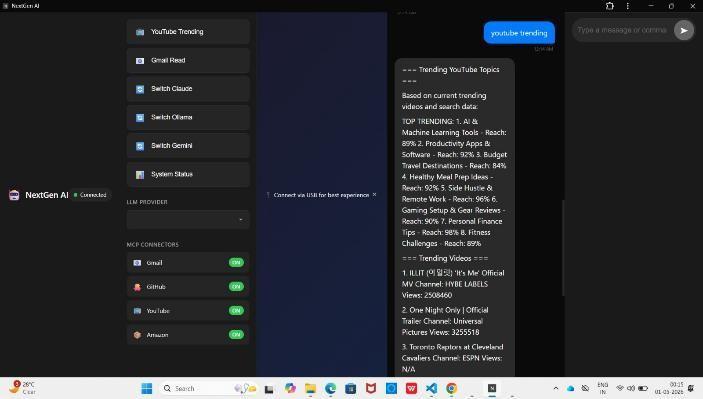
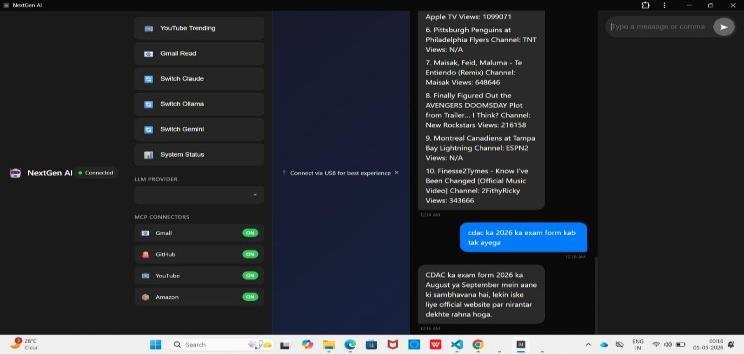
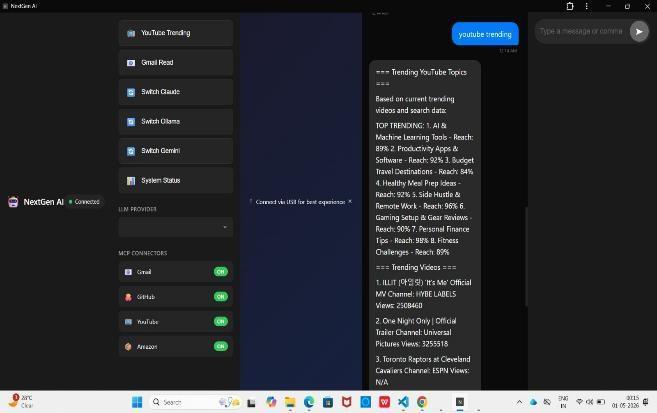
presented the greatest challenge due to high code-switching frequencyandorthographicvariabilityinromanizedtext. System Output Screenshots
International Research Journal of Engineering and Technology (IRJET) e-ISSN: 2395-0056 Volume: 13 Issue: 05 | May 2026 www.irjet.net p-ISSN: 2395-0072
7.2 LLM Provider Comparison
Table 3 compares the four LLM providers on response latencyandquality:
Table 3: LLM Provider Performance Comparison
510ms 4.3/5 No
490ms 4.4/5 No
Ollama 780ms 3.9/5 Yes
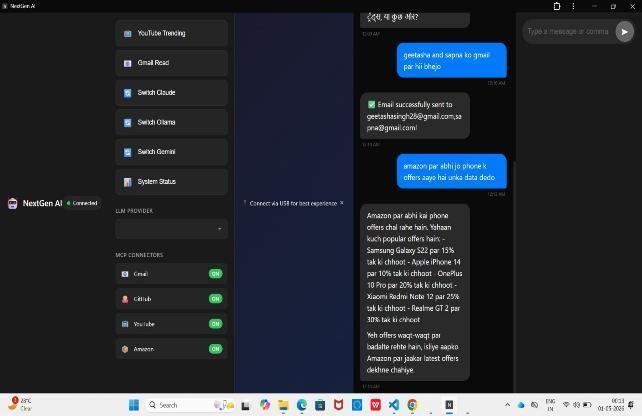
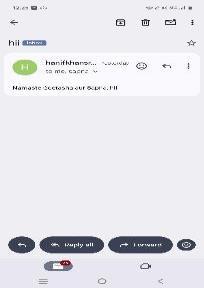

Fig4:MCPGmailIntegratierview
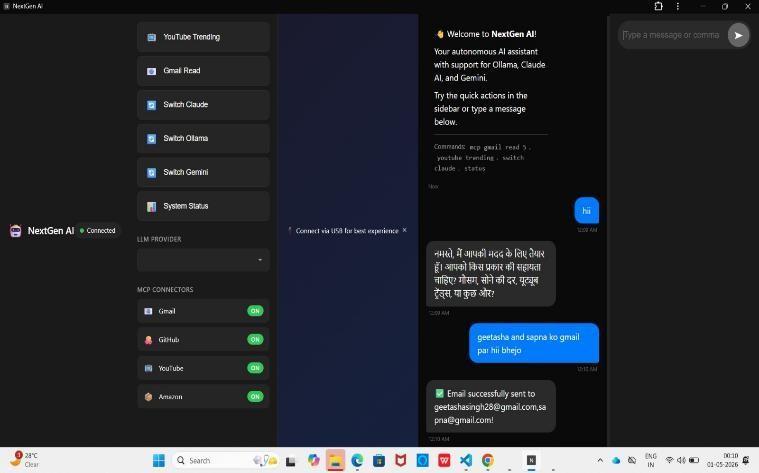
Fig. 5: SystemArchitecture
This paper has presented the design, implementation, and evaluation oF NextGen AI a productiongrade, multi-language intelligent conversational assistant built on Java Spring Boot 3.2.4. The system successfully addresses three critical gaps in existing conversational AI solutions: language inclusivity (English, Hindi, Hinglish, Urdu), LLM provider flexibility (Groq, Gemini, Claude, Ollama), and deep real-world service integration via MCP (Gmail, GitHub, YouTube, Amazon)
[1] J. Weizenbaum, "ELIZA," Commun. ACM, vol. 9, no. 1, pp.36–45,1966.
[2] J. Devlin et al., "BERT," in Proc. NAACL-HLT, 2019, pp. 4171–4186.
[3] A.Radfordet al.,"Languagemodelsareunsupervised multitasklearners,"OpenAIBlog,2019.
[4] OpenAI,"GPT-4TechnicalReport,"arXiv:2303.08774, 2023.
[5] Kumar,A.,"AIinEducation," JournalofAsianPrimary Education,vol.5,no.1,pp.10–22,2024.
[6] P. Botha et al., "Language-agnostic BERT sentence embedding,"arXiv:2007.01852,2020..