T h e o f f i c i a l P u b l i c a t i o n o f t h e A r k a n s a s Wa t e r E n v i r o n m e n t A s s o c i a t i o n
THEDIGESTER ISSUE 4 2026
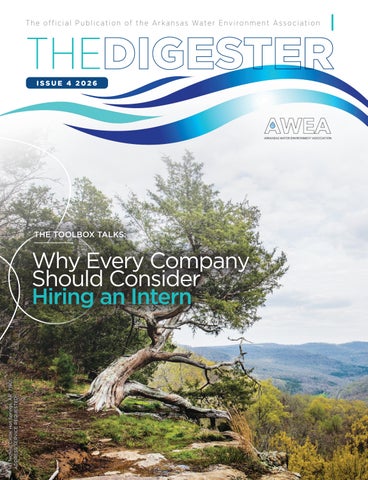
THE TOOLBOX TALKS:
141 Technic Circle, Hot Springs, AR 71901 ADDRESS SERVICE REQUESTED
Why Every Company Should Consider Hiring an Intern
Delta™
ISSUE 4 2026
The official Publication of the Arkansas Water Environment Association
THEDIGESTER
Arkansas Water Environment Association 100 Rock Street, Little Rock, AR 72201
9
EDITOR L. Keith Carpenter EXECUTIVE COMMITEE Outgoing President Vicki Stanley Incoming President Andy Robinson Secretary Rebecca Burkman Treasurer Max Hicks Past President Tonya Wallace WEF Delegate Tonya Wallace
FEATURES 17 18
The Digester is published by:
Tel: 866-985-9780 Fax: 866-985-9799 www.kelman.ca Design/layout: Dia Chea Managing Editor: Julia Waterer Marketing Manager: Megan Stanley Advertising Coordinator: Stefanie Hagidakow The Digester is published quarterly by Craig Kelman and Associates for the Arkansas Water Environment Association. All rights reserved. The contents of this publication may not be reproduced in whole or in part without the express consent of the publisher. © 2026
21
Update from the Water Environment Federation House of Delegates Arkansas Water Environment Association Specialty Conference Photo Gallery
24 26
Addressing Cyclospora Through Science and Collaboration Solids Content of Wastewater and Manure
The Toolbox Talks: Why Every Company Should Consider Hiring an Intern
DEPARTMENTS 4 Message from the Outgoing President 9 Message from the Incoming President 11 Treasurer’s Corner
15 Shovelers Corner 29 AWEA Awards Nominations 30 Advertiser Product and Service Center
13 Letter From the Editor ISSUE 4 2026
THEDIGESTER
3
A MESSAGE FROM THE OUTGOING PRESIDENT
The People Who May Never Know They Influenced Me By Vicki Stanley, AWEA Outgoing President
T
here are people who make a big difference in our lives without ever knowing it. They may not remember a conversation or the advice they gave us. They may not even realize we were paying attention. But we were, and sometimes those moments stay with us for years. Over the years, I have had the privilege of working in the water and wastewater industry alongside some remarkable people. When I look back at my journey, I realize it wasn’t shaped by one person, one job, or one big moment. It was shaped by many people who taught me something along the way, sometimes without even realizing it. Some taught me what to do. Others taught me what not to do. Some gave me opportunities, while others challenged me when I probably didn’t appreciate it at the time. And some simply showed me, through their actions, the kind of person I wanted to be. Not every lesson comes from a classroom or training session. Some of the best lessons I have learned came from watching people do their jobs. One lesson that has always stayed with me is the importance of being willing to say, “I don’t know, but I’ll find out.” I have worked with people who disagreed with me, questioned my ideas, and expected more from me than I thought I could give. At the time, I may not have been especially grateful for the challenge. Looking back, I am. Being challenged makes us think about what we believe. It encourages us to prepare, listen, and consider another point of view. And sometimes, it means admitting the other person was right. That may not be the most enjoyable lesson, but it is certainly an
4 THEDIGESTER
ISSUE 4 2026
educational one. Those people helped make me better. I have also learned that leadership isn’t always about having a title. Some of the people who influenced me most were not the ones sitting at the head of the table. They were the ones who showed up, kept their word, treated people fairly, and helped when nobody was watching. They understood that our industry is about more than pumps, pipes, instruments, regulations, and treatment processes. It is about people. It is about the people who depend on us to do our jobs well, the people who make decisions, the people who operate our systems, and the people who repair them when something goes wrong. Just as importantly, it is about those who take the time to teach the next person that comes along. One of the things I love about this industry is that relationships matter. Over the years, I have attended countless meetings, conferences, and exhibit halls. But some of the most important moments happened in the hallways. Someone is almost always willing to introduce you to someone else. “Have you met...?” Those three words can open doors we never knew existed. One introduction leads to a conversation. A conversation leads to an opportunity, and an opportunity leads to another relationship. That is why I have always believed the hallway track at a conference can be just as valuable as what happens in the classroom.
The People Who May Never Know I want to thank the people who probably have no idea how much they have influenced me.
Over the years, I have met people who may never realize that I remember something they said or did. Maybe it was a kind word when I needed it most. Maybe it was watching them handle a difficult situation with grace. Maybe they stood up for something they believed was right. Or perhaps they simply treated me with respect when they didn’t have to. We never know when someone is watching or which small act of kindness will stay with them for years. That is both a wonderful thought and a big responsibility. Because whether we realize it or not, we are influencing people, too. Someone is watching how we handle a difficult customer. Someone is watching how we treat a new employee. Someone notices whether we give others credit for their work, help someone who doesn’t know the answer, or make room at the table for another person. Someday, that person may look back and say, “They influenced me.” And we may never know it. I would like to recognize a few people who may not realize how much they have influenced my life and career. This is certainly not a complete list. It would take another article, or perhaps even a book, to recognize everyone who has helped me along the way. But there are several people I want to acknowledge, in no particular order, and let them know that their influence has not gone unnoticed.
Lane Crider, Beaver Water Lane has been a blessing to me since the first time I met him and his wonderful wife, Stacy. Through the many conferences and board meetings we have attended together, Lane has always been kind, helpful, understanding, and patient. CONTENTS
A MESSAGE FROM THE OUTGOING PRESIDENT
I have enjoyed watching him work with his colleagues and encourage his staff to get involved in their communities. He leads by example, supports others, and doesn’t seem to need the spotlight for himself. Lane and Stacy also showed me a kindness I will never forget. After my husband passed away, I saw them at a conference. They made sure I felt welcome, cared for, and protected during a time when I needed that kindness more than they probably realized. Sometimes, the greatest influence we can have on someone is simply helping them feel less alone. Lane and Stacy may never fully understand what that meant to me, but I will always remember it. I am grateful for both Lane and Stacy and for the example they set.
Lance McAvoy, City of Fort Smith Oh, my goodness! Where do I begin with Lance? He has made such a positive difference in my life. Lance is one of those people who makes a point of checking on everyone at our conferences. He visits, shares his knowledge, teaches, and takes part in just about every aspect of our industry. He doesn’t simply show up. He gets involved and makes connections with the people around him. But one particular memory stands out. After teaching a class in Hot Springs, Lance stayed around so my granddaughter could meet her favorite YouTuber. She was eight years old at the time, and after meeting him, she announced that she could officially cross something off her bucket list! Lance could have easily gone on about his day, but he took the time to make that meeting happen. More importantly, he treated my granddaughter as though she were the most important person in the world. The more I think about it, the more I realize that is simply how Lance treats people. He makes time for them, listens to them, and makes them feel important. Whether he is talking CONTENTS
with an industry professional or an eight-year-old girl, he gives that person his attention. Lance, thank you for sharing your knowledge, for your friendship, and for reminding me that sometimes the smallest gestures leave the biggest impressions. I suspect you have influenced far more people than you realize.
People like Jane remind us that knowledge becomes even more valuable when we share it. Her willingness to help others benefits not only the people she assists but also our entire industry. Jane, the world would be a better place if more of us approached life and worked the way you do. Thank you for being such a wonderful example.
Thea Hughes, Jacksonville Wastewater Utility
And So Many More…
What a gem Thea is! During my year as AWEA President, Thea has been one of my most dependable supporters. I have called her countless times to ask questions, get her opinion, seek advice, or ask for help with a task. Every time, she has been there for me, and she never seems to run out of patience. She always ends our conversations with the same reassuring words: “If you need anything else, just give me a call.” Those words may sound simple, but when you are serving in a leadership position, knowing you have people you can count on makes all the difference. Thea has given me more than answers and assistance. She has given me the confidence that comes from knowing someone is in my corner and willing to help when I need it. Thea, thank you for your support, generosity, and friendship. You have made my year as President a little easier and a whole lot more enjoyable.
Lane Hurley, Central Arkansas Water Who doesn’t love Jane? Jane is an absolute joy to be around. She is energetic, enthusiastic, and always ready to help. I don’t know what it would take to rattle her, but I suspect it would take quite a bit! Jane freely shares her knowledge, gives generously of her time, and is always willing to go the extra mile for someone else. She makes being involved look easy, although I know it takes time, dedication, and a genuine desire to see others succeed.
Brad Hammond, Dan Dawson, Scotty Boggs, Heath Ward, Johnny Lunsford, Lisa Ellington, Aaron Benzing, Larry Oelrich, David Poe… and the list goes on. Each of these individuals has influenced me in a positive way. Some have shared their knowledge, some have offered advice, and some have encouraged me when I needed it. Others have influenced me simply through the way they conduct themselves. I have learned from watching them, listening to them, working alongside them, and sometimes just visiting with them in a conference hallway. If I told each of them how much they have influenced me, I suspect most would look at me and say, “Who, me?” But I would be remiss if I didn’t recognize the one person who has had the greatest influence on my career and on the lives of countless others.
Newton White, The Man Who Opened the Door Newton doesn’t know I am writing this and won’t find out until someone tells him or he reads it for himself. He does not like the spotlight and has even requested that he not receive any recognition for his help as membership chair of AWEA. Newton has shared his knowledge, wisdom, and understanding with me while teaching me the importance of patience along the way. He gave me a chance, opened the door, and then pushed me through it. He taught me that honest competition is a good thing. He taught me that God gave us two ears and one mouth for a reason: we should listen ISSUE 4 2026
THEDIGESTER
5
A MESSAGE FROM THE OUTGOING PRESIDENT
“
NEWTON HAS INFLUENCED MY CAREER, BUT HE HAS ALSO INFLUENCED THE WAY I LOOK AT PEOPLE, LEADERSHIP, AND LIFE. I KNOW I AM NOT THE ONLY PERSON WHO CAN SAY THAT. HE HAS SHARED HIS KNOWLEDGE AND EXPERIENCE WITH COUNTLESS PEOPLE THROUGHOUT THE YEARS, OFTEN WITHOUT REALIZING JUST HOW MUCH THOSE LESSONS WOULD MEAN TO THEM.
more than we speak. Most importantly, he taught me that being a leader is far more important than simply being the boss. During my nearly 30 years at Instrument & Supply, Newton has shown me what leadership looks like. He encourages employees to pursue education and training. He believes in treating people fairly and equally, and he understands the value of investing in the people who work for him. Many of our employees have been with the company for more than ten years, and about a quarter of our employees have been here for more than twenty years. I believe that says something important about the kind of workplace Newton has helped build. His influence on me, however, goes far beyond the workplace. When I lost my son, Christopher, and later my husband, Larry, Newton called me and asked, “When are you planning on coming back to work?” Someone might have misunderstood that question as a boss simply wanting an employee back on the job. But I knew Newton better than that. He understood that I needed a reason to get up, stay busy, and keep moving forward rather than allow myself to be swallowed up by grief. He wasn’t an overbearing boss. He was looking out for me in the way he knew best. That call has stayed with me because it reminded me that leadership isn’t always about knowing the right thing to say. Sometimes, it is about knowing what someone needs, even when they may not know how to ask for it. Newton has influenced my career, but he has also influenced the way I look at people, leadership, and life.
6 THEDIGESTER
ISSUE 4 2026
CONTENTS
A MESSAGE FROM THE OUTGOING PRESIDENT
I know I am not the only person who can say that. He has shared his knowledge and experience with countless people throughout the years, often without realizing just how much those lessons would mean to them. And that brings me back to the point of this article. We don’t always recognize the impact we have on others. A conversation we barely remember may stay with someone for years. A few words of encouragement may give someone the confidence to take on a challenge. An example we set without thinking twice may become a lesson someone carries throughout their career.
CONTENTS
We never really know who is watching, who is listening, or who is learning from us.
The Greatest Compliment As I look back on my years in this industry and my involvement with AWEA, I realize that the people who influenced me did more than help shape my career. They helped shape who I am. To everyone who taught me something, challenged me, encouraged me, opened a door, answered a question, shared a story, offered an opportunity, or simply took the time to be kind, thank you. You may not remember me. You may not remember what you said.
You may not even know that you influenced me. But I remember. Perhaps one of the greatest gifts we can give another person is letting them know that something they did mattered. We may never know the difference we make in someone’s life, but that doesn’t make the difference any less important. To all the people who have been part of my journey, whether you realize it or not, please know that you have left a mark on my life. And I hope that somewhere along the way, I have left a good one on someone else’s.
ISSUE 4 2026
THEDIGESTER
7
DRINKING WATER
STATE REVOLVING LOAN FUND FINANCIAL ASSISTANCE FOR PUBLIC WATER PROJECTS
WATER LINE REPLACEMENT & DISTRIBUTION SYSTEMS
ENERGY AND WATER CONSERVATION
TREATMENT SYSTEMS AND COMPLIANCE ASSISTANCE
FEDERAL PROGRAMS
STATE PROGRAMS
FEDERAL PROGRAM LENDING RATES
STATE PROGRAM LENDING RATES
1% 3.5% for a ten (10) year repayment period 1.75% 4.0% for a twenty (20) year repayment period 2.25% 4.5% for a thirty (30) year repayment period
4.5% for a ten (10) year repayment period 5.0% for a twenty (20) year repayment period 5.5% for a thirty (30) year repayment period
• Clean Water State Revolving Fund (CWSRF) • Drinking Water State Revolving Fund (DWSRF) • Emerging Contaminants in Small and Disadvantaged Communities • Small and Disadvantaged Communities • Sewer Overflow and Stormwater Reuse (OSG)
• • • •
Water Sewer & Solid Waste Fund (WSSW) General Obligation Bond Program (GO) Water Development Fund (WDF) Water and Sewer Treatment Facilities Matching Grant Program (WSTFG)
FUNDING SUBJECT TO AVAILABILITY Arkansas Department of Agriculture
Debby Dickson, Water Development Section Manager (501) 682-0548 | debra.dickson@arkansas.gov
agriculture.arkansas.gov Terri Woodard, Program Outreach Coordinator (501) 682-0547 | terri.m.woodard@arkansas.gov
MESSAGE FROM THE INCOMING PRESIDENT
AWEA Looks Ahead: New Leadership and a Successful 2026 Specialty Conference By Andy Robinson, AWEA Incoming President
A
s I step into the role of President of the Arkansas Water Environment Association (AWEA), I am excited about what lies ahead for our organization. It is an honor to have the opportunity to serve, and I look forward to working with our members, volunteers, and industry partners to continue growing AWEA and supporting the water and wastewater industry throughout Arkansas. Joining me in the new leadership team will be Rebecca Burkman Keckler as Vice President and Tiffani Newsom as Secretary. I am looking forward to working alongside both as we continue the work of those who have helped make AWEA what it is today. Looking back, our 2026 AWEA Specialty Conference in Bentonville was a great success. This year’s conference brought together approximately 86 attendees, including speakers and guests, for two days of education, networking, and conversations about the challenges and opportunities facing our industry. One of the things I enjoyed most was seeing familiar faces from years past, including people who have mentored me, shared their knowledge, and helped shape my own career. Just as rewarding was seeing younger professionals come in with fresh perspectives and genuine excitement for what they do. Having that range of experience and enthusiasm in one room is a reminder that this industry is full of people who genuinely care about their work, the communities they serve, and the people coming up behind them. That kind of commitment doesn’t fade with time; it is something that stays with you throughout your career and, I believe, lasts a lifetime. CONTENTS
One of the highlights was our field trip to the Bentonville Water Resource Recovery Facility. It was a great opportunity to get out of the conference room and see firsthand the work and infrastructure that go into treating wastewater and protecting our water resources. I think opportunities like this add a lot of value to our conferences and give attendees a chance to learn from facilities and professionals doing the work every day. Most importantly, I want to give a special thank-you to our AWEA committee members. The amount of time, planning, and effort that goes into putting on an event like this is easy to overlook, but it certainly does not go unnoticed. From coordinating speakers and sponsors to handling registration, outreach, logistics, and all the details in between, our committee members stepped up and
helped make this conference what it was. Much of this work happens behind the scenes, often outside of regular work hours, and I sincerely appreciate everyone’s willingness to give their time to this organization. AWEA would not be where it is today without the people who continue to volunteer and take ownership of making things happen. I also want to thank our sponsors, speakers, and everyone who attended and supported this year’s event. Your continued involvement is what allows us to bring these opportunities to our members and industry partners. As we move forward, I hope we can continue building on this momentum, bring more people into the organization, and find new ways to make AWEA valuable to those working in our industry. I am excited to get started and look forward to working with everyone in the year ahead. ISSUE 4 2026
THEDIGESTER
9
LET’S BUILD TOGETHER CONSTRUCTION MANAGEMENT | DESIGN BUILD | GENERAL CONTRACTING
www.archerwestern.com | @TheBigGreenW
TREASURER’S CORNER
Reflecting on Another Successful Year
A
Max Hicks, PE, Treasurer
s we approach the end of the year, I would like to take a moment to thank all of our members, sponsors, volunteers, and industry partners who continue to support the Arkansas Water Environment Association. The strength of AWEA comes from the dedication of professionals across Arkansas who work every day to protect public health and improve our water and wastewater infrastructure. Whether through attendance at conferences and training events, participation on committees, sponsorships, or volunteer service, your involvement helps advance our mission and strengthens our organization. As Treasurer, I have had the opportunity to see firsthand how membership dues, sponsorships, conference participation, and training events support the many programs AWEA offers. Thanks to the continued support of our members and industry partners, AWEA has remained financially healthy and positioned to invest in scholarships, professional development, operator training, young professional programs, and initiatives that strengthen our profession.
CONTENTS
As we look toward the coming year, AWEA’s Board remains focused on maintaining the financial strength necessary to support our mission. Like many organizations, we continue to face increasing costs and must carefully consider those impacts when developing our annual budget. However, the long-term success of AWEA depends on more than sound financial planning. It depends on providing meaningful value to our members and ensuring that our organization remains relevant, beneficial, and worth supporting. Through our conferences, training programs, scholarships, student outreach efforts, and professional networking opportunities, we strive to invest in the future of Arkansas’s water and wastewater industry. We are committe d to ensuring that every dollar entrusted to AWEA is used responsibly and in a manner that advances our mission and benefits our members. Thank you for your commitment to AWEA and to the communities we serve. We look forward to building on this year’s successes and continuing to provide value to our members in the coming year.
ISSUE 4 2026
THEDIGESTER
11
Talk is easy. Impact is earned. At Carollo, we approach innovation as something to be built, tested, and proven in the field, not just imagined. From breakthroughs like XBAT, Blue Plan-It®, and I-FLOAT® to integrated AI/ML solutions, we focus ingenuity where it matters most: solving water challenges for our clients and communities. The result is progress you can measure in real terms—protecting public health, strengthening ecosystems, and delivering resilience that lasts. That’s Carollo Innovation. 800.523.5826 / carollo.com
Asa Baker, Regional Director Midwest Infrastructure Coatings Cell: 573-466-3530 | Office: 573-437-5637 Email: abaker@midwestinfrastructurecoatings.com
America's infrastructure is aging and failing especially its underground infrastructure. Ground water infiltration, and corrosion are just a few of the major problems that municipalities and sewer districts are faced with daily with underground infrastructure failure. Midwest Infrastructure Coatings LLC has the trenchless solution to these failing issues by rehabilitating the underground infrastructures, rather than the costly replacement method.
BEFORE
AFTER
BEFORE
AFTER
Products We are trained and experienced in the installation of OBIC liner systems. Each offers a range of advantages to repair and rehabilitate various structures and surfaces, while meeting specific mechanical and operating requirements. These solutions are cost-effective alternatives to excavation, reconstruction or complete replacement. OBIC 1000 Liner System • OBIC 1100 PW
12 THEDIGESTER
ISSUE 4 2026
CONTENTS
LETTER FROM THE EDITOR
Saying Big Thank Yous By L. Keith Carpenter, AWEA Editor
“
L
WE HAD SOME AMAZING ARTICLES THAT WERE VERY INFORMATIVE NOT ONLY TO ME BUT TO OUR READERS AS WELL. I LOOK FORWARD TO NEXT YEAR TO SEE WHAT YOU ALL COME UP WITH TO SEND IN!
et me begin by saying that it has been an amazing year for the Digester and myself as the Editor. I would like to thank everyone that has submitted their articles to make this the best year for the Digester. And also, a big THANK YOU to all the advertisers that have come on board. We had some amazing articles that were very informative not only to me but to our readers as well. I look forward to next year to see what you all come up with to send in! The AWEA just finished with their Specialty Conference which was held in Bentonville, Arkansas and I must say they had a great attendance. The speakers were just amazing with their topics. The start of the conference started out with the business meeting from the President Vicki Stanley who turned over her gavel to the new President Andy Robinson. I look forward to working with Andy this next year to provide more insightful articles to publish. To my assistant Jeff Harrison, thank you sir for keeping me on track and making sure that I get everything out in a timely manner. A special and heartfelt thank you goes out to Vicki Stanley and Newton White for believing in me to perform CONTENTS
this task for the AWEA. It has been a great pleasure to work with them on this publication.
In closing out this year I hope everyone enjoys this last issue for the year, and I can’t wait to see what next year brings!
PROVIDING OPTIMUM
ENVIRONMENTAL SOLUTIONS WE specialize in equipment applications for:
• WASTEWATER TREATMENT • WATER TREATMENT • SOLIDS HANDLING • AIR EMISSIONS CONTACT US CHAD COOLEY TODD RIGBY TEAGUE COOLEY
CCOOLEY@ETEC-SALES.COM TRIGBY@ETEC-SALES.COM TCOOLEY@ETEC-SALES.COM
900 S. SHACKLEFORD, STE. 300 - LITTLE ROCK, AR 72211
PHONE: 501.978.1025 • 800.251.1047 w w w. e t e c - s a l e s . c o m ISSUE 4 2026
THEDIGESTER
13
Aftermarket Parts Services Expert Support
From Starup to Serivce Calls, We’re Built for the Long Haul
LOCAL SUPPORT WHEN IT COUNTS MOST Your Arkansas BEFORE THE SALE AFTER THE INSTALL ALWAYS ON CALL Jeremy Nelc: 859-609-6788 www.newmanregencygroup.com jnelc@newmanregency.com
Service Partner.
SHOVELERS CORNER
Arkansas Select Society of Sanitary Sludge Shovelers By Newton White, Influent Integrator
T
he Arkansas Rural Water Association luncheon was held September 1, 2026, in Horner Hall of the Hot Springs Convention Center. Arkansas Attorney General Tim Griffin, also an Honorary Sludge Shoveler, was the keynote speaker. AG Griffin was wearing a lapel pin of the Great Seal of Arkansas AND his Sludge Shovel lapel pin on the left side of his jacket. The Attorney General delivered an address to approximately 650 attendees and directed his comments
on several concerning threats to our society, including cyber security. Mr. Griffin explained that attacks are not only being experienced by water and wastewater systems but also by the energy infrastructure sector and the evidence of such attacks may not be immediately recognized but instead lie in wait. He suggested that critical infrastructures partner with consultants and cybersecurity providers and register suspicious cyber activity with the local office of the FBI.
Pictured left to right: Chris Enloe, Vicki Stanley, AG Tim Griffin and Newton White
CONTENTS
ISSUE 4 2026
THEDIGESTER
15
UPDATE FROM THE WATER ENVIRONMENT FEDERATION
HOUSE OF DELEGATES Tonya Wallace, WEF Arkansas Delegate
A
s your Arkansas Delegate to the Water Environment Federation (WEF) House of Delegates (HOD), and an active member of both the WEF Budget Committee and the Water AI Workgroup, I am excited to share an update on the initiatives, priorities, and collaborations currently underway within the Federation. The new 2026–2027 House year is off to a strong start, with Delegates focusing on strengthening engagement, elevating the value of water, and supporting Member Associations (MAs) across the country and around the world. BUILDING MOMENTUM AFTER WEFTEC The HOD kicked off the new year with an in-person session at WEFTEC. Delegates were introduced to updated resources, new workgroups, and opportunities to involve our home Member Associations. All Delegates, including new members, were encouraged to stay connected through the WEFUnity HOD group, where essential documents, onboarding materials, and discussion spaces are housed. KEY HOD WORKGROUP INITIATIVES Be Bold for Water: This workgroup is leading an effort to elevate the public’s understanding of the essential role water plays in daily life. The team is researching successful national campaigns, coordinating with WEF’s CONTENTS
100-Year Committee, and developing a communications playbook that utilities and MAs can use to educate communities about water’s value. WEF Internal Engagement: To strengthen connections across WEF, this group is fostering collaboration between Delegates, WEF staff, the Committee Leadership Council (CLC), and the Board of Trustees. Their work includes pairing MAs for best-practice sharing and developing talking points for Trustee visits, resources that directly benefit local organizations like AWEA. International Member Association Support: With WEF’s global footprint continuing to grow, this workgroup is expanding outreach to international MAs through mentoring partnerships, onboarding tools, and increased visibility during HOD events. Water AI: A timely and rapidly evolving area of focus, this group is assessing the impacts of artificial intelligence on the water sector, including data center water use, cybersecurity concerns, and regulatory developments. A toolkit is in development to help utilities navigate the changing landscape. Delegates-at-Large: The 12 Delegates-at-Large (DALs) continue serving as an internal advisory caucus, helping streamline communication and strategy across the House. They will also provide an annual summary of HOD activities.
ONGOING HOD COMMITTEES SUPPORTING MAS Several standing committees are also active this year: • WEFMAX Committee: Planning future WEFMAX locations and updating host guidelines. • Budget Committee: Oversees budget planning aligned with WEFMAX and broader HOD needs. • Nominating Committee: Reviews candidates for key leadership roles within the HOD. • Water Advocacy Committee: Provides advocacy tools, quarterly updates, and resources to help MAs engage effectively with elected officials. • Culture & Belonging Committee: Supports DEI initiatives and resources for MAs to build an inclusive water workforce. • Communications Committee: Manages HOD updates, social media, welcome packets for new Delegates, and quarterly spotlights. It is an honor to represent Arkansas within the Federation’s House of Delegates. These initiatives are designed to strengthen all Member Associations, support utilities, and elevate the importance of water across our communities. I look forward to another year of serving Arkansas and contributing to the important work of our industry. ISSUE 4 2026
THEDIGESTER
17
AWEA SPECIALTY
CONFERENCE PHOTO GALLERY
18 THEDIGESTER
ISSUE 4 2026
CONTENTS
Awards handed out at the conference by outgoing president Vicki Stanley. Left to right: Meghan Post, Max Hicks (Treasurer), Chris Enloe (Collections Chair).
Left to right: Newton White (Shovelers Integrator), Andy Robinson (Incoming President), Chene Bailey (YP Chair).
Left to right: Tonya Wallace (WEF Delegate), Keith Carpenter (Magazine Editor).
CONTENTS
ISSUE 4 2026
THEDIGESTER
19
20 THEDIGESTER
ISSUE 4 2026
CONTENTS
THE TOOLBOX TALKS:
Why Every Company Should Consider Hiring an Intern By Kelley Coakley M.D., Biomedical Engineer, Construction Civil Engineering Student, & Intern at Instrument & Supply, Inc.
A
few weeks ago, I received an email that stopped me in my tracks.
Ms. Coakley, Your answer is the best answer I have received in three years!!!! 1. Age of concrete alone does not answer this question, and you noted that 2. A contractor should know what loads are going to be applied, and you can estimate the strength of that concrete based on the psi specified 3. There are risks at 10 days and you noted both risks, not fully cured based on code and what loads will be applied 4. You nailed it!!! Chris P. Corbitt, P.E., Esq. For any student, receiving praise from a professor is encouraging. Receiving praise from a professor who is both a Professional Engineer and an attorney is something entirely different. What meant the most to me was not the compliment itself. It was the realization that only a few months earlier, I would not have known how to answer that question. CONTENTS
The answer was not found in a single textbook, lecture, or homework assignment. It came from every lesson, mistake, conversation, submittal review, code discussion, project meeting, and mentorship opportunity. That email confirmed something I had been discovering throughout my internship: knowledge becomes valuable when it can be applied to real-world problems. That realization inspired this article and a new series for The Digester called The Toolbox Talks. The Bridge Between School and Industry As a Construction Civil Engineering student at the University of Arkansas at Little Rock (UALR), I am required to complete approximately 800 hours of internship experience before graduation. Initially, I viewed the internship requirement as just another item on my degree checklist. I could not have been more wrong. College provides the foundation. We learn mathematics, engineering principles, estimating, specifications, project management, and design. However, there is a gap between knowing something academically and applying it professionally. The email from Professor Corbitt was proof that I had begun crossing that bridge. ISSUE 4 2026
THEDIGESTER
21
My answer did not come from specific knowledge of concrete design. It came from understanding how to identify and interpret applicable specifications, codes, and project requirements. Without knowing the governing standards, loading conditions, and design criteria, there is no single correct answer. The response reflected an understanding that additional information was required before a technically valid conclusion could be made. These skills are developed through experience. My internship at Instrument & Supply, Inc. (ISI) in Hot Springs, Arkansas provided that experience. This article is not simply about why students should pursue internships. It is about why companies should consider hiring interns, especially small and mid-sized engineering, construction, water, wastewater, and contracting firms that may never have hired one before. The People Who Helped Build My Toolbox Every successful internship requires people willing to invest in someone else’s future. Looking back, I can trace much of my growth to three individuals who each filled a different role in my development. Although I mention only three in this article, every employee at ISI has had a positive impact on my experience and growth during my internship. The Visionary: Newton White, P.E. Newton White, CEO of Instrument & Supply, reminds me of Shel Silverstein’s The Giving Tree. Not because he gives away resources, but because he freely gives knowledge. Every time I approached him with a question, I rarely received a simple answer. Instead, I received a lesson. Whether the topic involved engineering, construction, controls, contracts, specifications, leadership, or business, Newton always took the time to explain not just what to do, but why it should be done. Newton also observed my growth throughout the internship: “You have developed intelligent and thoughtful suggestions and have come up with time-saving methods.” Perhaps his most powerful message to employers considering an internship program was this: “If you bring in the ‘right’ intern, you could be looking at your next full-time employee already trained.” As workforce shortages continue to affect engineering, construction, and water professions, that statement alone demonstrates the value of investing in young professionals. Newton summarized internships best: “A good internship should be a win-win.” I could not agree more. The Manager: Cooper White If Newton taught me how to think strategically, Cooper White taught me how projects move from concept to completion. Through project coordination, planning discussions, client communication, and daily operations, I learned how decisions made in the office influence outcomes in the field. When I asked Cooper about the value of hiring interns, he was honest about the challenges. “Anytime you bring someone
22 THEDIGESTER
ISSUE 4 2026
new into a company, there is going to be a learning curve.” Honesty is important because many companies worry that internships will slow productivity. “The initial learning period takes some patience, but once the intern understands the work and becomes more independent, they can become a real asset to the company. In some respects, they do initially. But often they can increase productivity.” Internships don’t just develop students. They also develop mentors, leaders, and future managers. The Mentor: Stormi Sutton If there is one person most responsible for the number of tools added to my toolbox, it is Stormi Sutton. Stormi was the first person I was paired with when I arrived at ISI. Since then, she has become a mentor, teacher, trusted advisor, and close friend. Ironically, Stormi insists she never really had to train me. “I don’t think I ever had to train you. I do think you were contributing from day one.” Stormi taught me countless technical skills, but perhaps her most important lesson involved communication. She described one of her core professional principles as: “Communication and transparency while not saying too much and being discreet.” Perhaps the greatest compliment Stormi ever gave me was this: “Just having someone that wanted to learn, wanted to do the work themselves and not pass the work off was a breath of fresh air.” For companies wondering whether an internship is worth the effort, that statement offers an important reminder: motivated interns are not looking to avoid work. They are looking for opportunities to contribute. One of the most valuable parts of my internship has been gaining a firsthand appreciation for everything Stormi does behind the scenes. As a Project Coordinator, Stormi is involved in nearly every stage of a project, from plans and specifications to submittals, documentation, equipment tracking, warranties, and client communication. As an engineering student, having a front-row seat to everything Stormi manages daily has given me a deep appreciation for the critical role Project Coordinators play in the success of every project. Thank you, Stormi, for your patience, mentorship, friendship, and for sharing your knowledge so selflessly. Your influence has played a significant role in my growth as both an engineering student and future professional, and I am grateful for every tool you helped place in my toolbox. One of the Hardest Tools in My Toolbox: Patience Not every lesson I learned during my internship was technical. One of the most valuable lessons was learning patience. As a non-traditional student with previous professional experience and multiple degrees, I sometimes found myself identifying opportunities for improvement before fully understanding all the factors behind an existing process. Early on, I learned there is a difference between capability and authority. Just because you can solve a problem does not always mean it is your place to immediately solve it. CONTENTS
Through the guidance of ISI, I learned that influence is earned through trust, consistency, and understanding the bigger picture. I discovered that the best professionals do not rush to change a process; they first seek to understand why it exists. Today, when I identify an opportunity for improvement, my first question is no longer, “How do I fix this?” Instead, I ask, “What am I missing?” That simple shift in perspective has become one of the most valuable tools in my toolbox. Why Companies Should Consider Hiring Interns Many small companies hesitate to hire interns. Training takes time. Questions take patience. Mistakes happen. The immediate return on investment may not be obvious. I understand those concerns because I have heard them discussed openly. Yet my experience at ISI demonstrates that hiring interns is not merely an expense. It is an investment.
professionals, and encourage companies to consider giving someone the same opportunity that was given to me. Because nobody starts a career with a full toolbox. Someone must be willing to hand them the first tool. And sometimes, that single decision changes everything. Acknowledgement A special thank you to Vicki Stanley, President of AWEA, for giving me the opportunity to write this article. More than just a chance to share my experiences, it was an opportunity to reflect on the lessons, relationships, and growth that have shaped my journey. Thank you for providing a platform for students and young professionals to have a voice. This experience helped me sharpen a few more tools in my toolbox, and for that, I am truly grateful.
Internships provide: • Workforce development • Future employees already trained in company culture • Fresh ideas and perspectives including new technology and methods • Increased employee engagement • Knowledge transfer from experienced professionals • Stronger connections between industry and education Most importantly, internships help transform students into professionals. The water and wastewater industry has provided me with a unique opportunity to see how engineering, construction, operations, instrumentation, controls, and project management come together to serve communities. Through organizations such as AWEA, experienced professionals are investing in the next generation and helping ensure that critical knowledge is passed forward. This industry faces an ongoing need for engineers, contractors, technicians, operators, and project managers. The future of our profession depends on experienced professionals being willing to share their knowledge before it disappears. Mentorship is not a luxury. It is a responsibility. Introducing The Toolbox Talks Throughout my internship at ISI, I added another tool to my toolbox each week. Some tools were technical. Some were managerial. Some involved communication, leadership, specifications, pumps, controls, engineering judgment, contracts, or project coordination. Others were lessons about humility, patience, and professionalism. In future editions of The Digester, I will share those tools through a series called The Toolbox Talks. My hope is that these articles will encourage students to seek internships, encourage mentors to invest in future CONTENTS
ISSUE 4 2026
THEDIGESTER
23
Addressing
Cyclospora
THROUGH SCIENCE AND COLLABORATION Source: WEF WaterBlog
24 THEDIGESTER
ISSUE 4 2026
CONTENTS
S
ince May 1st and through August 18th, the Food and Drug Administration (FDA) has confirmed over 15,000 cases of cyclosporiasis in the United States with nearly 11,000 cases attributed to a multistate outbreak from contaminated iceberg lettuce. Illnesses from such an infection can result in gastrointestinal distress lasting for up to 14 days. The number of cases confirmed this year is a significant increase from the past and highlights the necessity of robust safety protocols to protect public health and the nation’s food supply. There is currently no direct evidence of the cause of the current cyclosporiasis outbreak, but more specific information may be publicly announced in the future. Concerns about cyclosporiasis and the absence of a direct source have raised questions for the water sector. Members of the Water Environment Federation’s Disinfection and Public Health Community have responded to these questions with a fact sheet tailored to the needs of water professionals. As detailed in the fact sheet, cyclosporiasis is caused by the parasite Cyclospora cayetanensis, and outbreaks are generally foodborne and believed to be caused by contaminated irrigation water or wash water used in the production of produce that is eaten raw. What does this mean for water professionals? There is currently limited data available on the fate of Cyclospora through the wastewater treatment process. There is evidence of limited removal through secondary wastewater treatment, but some commonly used disinfection practices such as chlorination are considered to be largely ineffective. However, according to the World Health Organization, filtration processes that effectively remove well-studied pathogens such as Cryptosporidium should also remove Cyclospora. Filtration removes pathogens primarily through size-exclusion, and Cyclospora is approximately twice the size of Cryptosporidium, giving credence to this assertion. For professionals working at water resource recovery facilities, there are practical steps, identified in a 2020 BlueRibbon Panel, that can be taken to protect themselves from the risk of infection. The first step is proper hygiene practices such as hand washing and wearing personal protective equipment such as gloves, boots, coveralls, face shields, and safety goggles to prevent contact with wastewater. In addition, it is important for professionals to understand the limitations of chemical disinfectants, such as chlorine and other sanitizing agents, against Cyclospora and other protozoa. We encourage WEF members and the water sector to read the fact sheet to learn more. What does this mean for water reuse? Since contaminated agricultural irrigation water can be the cause of a cyclosporiasis outbreak, it is natural to have questions about the use of recycled municipal wastewater in agricultural irrigation. However, it is important to understand the robust safeguards and regulations currently in place for water reuse for agricultural irrigation. In the United States, water reuse is regulated by the states rather than the Environmental Protection Agency. The level of treatment and monitoring required will vary depending on the irrigation method and the type of crop being grown. Some states allow recycled water to be used in the irrigation CONTENTS
of food crops eaten raw, including where there is direct contact with the edible portion. This method of irrigation is considered to carry the most risk. However, across the states, and internationally, these regulations are frequently the most stringent and often require filtration in addition to secondary treatment and disinfection. For example, California and Arizona are the leading producers of leafy greens and other produce like raspberries that are considered to be most at risk for Cyclospora. In both states, irrigation with recycled water for such crops is covered by the most stringent water reuse regulations they have for agricultural irrigation, with explicit requirements for filtration in addition to secondary treatment and disinfection. Aside from state water reuse regulations, the FDA has regulations for pre-harvest agricultural water (i.e., irrigation water) quality through the Food Safety Modernization Act (FSMA). While the FSMA regulations from 2015 included microbial standards, state water reuse regulations are considered to be significantly more stringent. More specifically, according to a 2019 review of those 2015 regulations, “In comparison to metrics in states that currently regulate the use of recycled water for irrigation of food crops eaten fresh, the FDA FSMA water quality metrics are less stringent and therefore the use of recycled water presents a reduced risk to consumers than the FDA regulations.” It should be noted that in 2024 FDA replaced the 2015 microbial standards and testing requirements under FSMA with a systems-based approach to managing risk that cannot be easily compared to state water reuse regulations. When considering the treatment systems in place, the regulatory safeguards associated with recycled water, the available information on the current outbreak, and the decades of history of agricultural water reuse, there is no evidence indicating that recycled water used for agricultural irrigation increases the risk of contamination by Cyclospora or other pathogens. How can the water sector prepare for the future? Even with no reason for immediate concern, there is still more that can be done to understand Cyclospora and how the water sector can better support public health. For example, laboratory methods for detecting and measuring Cyclospora are in need of improvement. Methods that incorporate the viability of oocysts or the identification of reliable Cyclospora surrogates could create a better understanding of the fate of Cyclospora through different treatment processes or other processing steps. Additionally, development of robust molecular methods would be invaluable for implementing wastewater surveillance initiatives that were pioneered during the COVID-19 pandemic. This would empower the public health community to better determine the scope of outbreaks and assist in deploying interventions and other initiatives. As the public and water sector continues to have important questions about Cyclospora, WEF stands ready to respond to such questions and challenges. We will accomplish this through our global network of experts, education of the water sector workforce, and our ability to bring people together to develop solutions and build public trust, all in pursuit of a life free of water challenges. Contact: Justin Mattingly, WEF Senior Advisor, Resource Recovery | jmattingly@wef.org ISSUE 4 2026
THEDIGESTER
25
EXTENSION SOLIDS CONTENT OF
Wastewater and Manure Doug Hamilton. Waste Management Specialist, Biosystems and Agricultural Engineering Hailin Zhang, Waste Nutrient Management Specialist, Plant and Soil Sciences
Source: Wikimedia Commons.
K
nowing the solids content of a liquid or slurry is an important first step in understanding its physical properties. But, you might ask, “How can a liquid be solid?” It’s a matter of terminology; ‘solid’ and ‘solids’ are two different things. Solid is a physical state of matter – ice is solid water. Solids are the portion of a liquid or slurry that is left when the water is removed. The amount of solids in wastewater and manure affects nutrient content, treatment processes and handling procedures. This factsheet highlights definitions and relationships among different types of solids in wastewater and manure.
SOLIDS AND MOISTURE CONTENT The Total Solids (TS) content of a sample is the mass of solids remaining after a sample has been dried in a 103-degree Celsius oven for 24 hours, divided by the original mass of the
26 THEDIGESTER
ISSUE 4 2026
sample. TS content of thick slurries are reported on a mass percent (%) basis. For dilute slurries and liquids, TS is usually expressed as mass per volume, most commonly mg/l. Units for solids content are discussed in more detail at the end of this article. As TS concentration increases, and slurries start acting as semi-solids, the method of expressing solid/liquid relationship of mixtures switches from solids content to moisture content. Moisture content is defined as the mass of water in semisolid material divided by the wet mass of the material. As long as you stick to a wet mass basis for determining solids and moisture content, the two values add up to 100: Moisture Content (%) + Solids Content (%) = 100 You will sometimes see solids content referred to as Dry Matter (DM) content. CONTENTS
SOLIDS FRACTIONS Total solids tell how many solids are in a liquid or slurry. It does not say much about what kind of solids are present. Total solids are broken into seven fractions based on two distinctions: 1. Are the solids suspended or dissolved in liquid? 2. Are the solids made of organic or inorganic material?
SUSPENDED OR DISSOLVED SOLIDS Total Dissolved Solids (TDS) only appear as solid mate rial when the sample is dried. For example, solid salt (NaCl) and sugar dissolve in water and appear to be invisible. Dry the sample and crystals reappear. Total Suspended Solids (TSS) are solids that remain intact when added to water. Actually, the distinction between TDS and TSS is a little more complicated. A particle is considered dissolved (TDS) if it can pass through a filter with 1.5-micron openings (1/17,000 inch). If the 1.5-micron filter stops a particle, it is considered to be suspended (TSS). This may seem arbitrary, and many particles smaller than 1.5 microns in size are definitely not dissolved (Figure 1). This division between dissolved and suspended at 1.5 microns is actually quite practical, however. Given the density of natural materials, a particle with a diameter of 2 microns is the smallest size that is easily removed by settling.
ORGANIC OR INORGANIC SOLIDS To the layman, organic matter is material that is living or was once alive. Chemists determine whether a substance is organic or inorganic based on its carbon content. The organic portion of wastewater or manure solids is the part that burns. The portion of TS that remains after heating at 550 degrees Celsius for one hour is called Total Fixed Solids (TFS); the portion lost during heating is Total Volatile Solids (TVS). Sometimes the fixed solids content is called the Ash Content. Volatile Solids is a measure of the organic matter content of a liquid or slurry, but you need to be careful; most organic materials have some ash content. For instance, fresh manure is usually 80 percent volatile and 20 percent fixed. https://www.dreamstime.com/stock-photo-piglets-sucklingenclosure-cute-sow-modern-clean-floor-farm-heating-lightsbackground-image73077759
RELATIONSHIP BETWEEN SOLIDS FRACTIONS The two distinctions can be defined mathematically as: 1. TS = TDS + TSS 2. TS = TFS + TVS We also could place the solids left on the filter used to determine TSS and the liquid passing through the filter into a 550-degree Celsius furnace and divide them into fixed and volatile fractions: • TSS = FSS (Fixed Suspended Solids) + VSS (Volatile Suspended Solids) • TDS = FDS (Fixed Dissolved Solids) + VDS (Volatile Dissolved Solids) CONTENTS
Figure 1. Size of common particles found in liquids and slurries.
And the fixed and volatile fractions add up to give: • TVS = VSS + VDS • TFS = FSS + VSS The relationship between solids fractions is shown visually in Figure 2. The nice thing about relationship between fractions is if you know any four measurements, you can figure out the other four. This is routinely done in the lab using the analyses TS/TVS and TSS/TVS: TS/TVS: A sample is placed into a crucible, dried in an oven at 103 degrees Celsius for 24 hours (TS), then placed in a furnace for one hour at 550 degrees Celsius (TVS). TSS/VSS: A sample is filtered through a glass fiber filter with 1.5-micron openings. The filter is dried in an oven at 103oC for 24 hours (TSS) and then placed in a 550 degrees Celsius furnace for one hour (VSS). With TS, TVS, TSS and VSS in hand; numbers for TDS, TFS, FSS and FDS fall into place.
SOLIDS SPECIES TS are divided into four characteristic fractions, sometimes called solids species: TS = VSS + FSS + VDS + FDS These four fractions are called species because they define the nature of a liquid or slurry. VSS are the volatile portion of settleable organic particles. FSS are inorganic particles suspended in the liquid; such as undissolved salt crystals and silt particles. VDS are organic compounds dissolved in the liquid; such as sugars, fatty acids, and organic colloids. FDS are inorganic compounds dissolved in the liquid. FDS and, more commonly, TDS are used to represent the salt content of a liquid. Remember, FDS also may contain clay particles and the fixed portion of some microbial bodies. ISSUE 4 2026
THEDIGESTER
27
SPECIES VISUALIZATION Figure 3 shows a method of visualizing the character of a liquid or slurry sample using solids species. TS content is represented by the size (the area) of the circle. The circle is broken into four pie pieces representing VSS, VDS, FDS and FSS. Concentration of each species is represented by size of the slice. Volatile solids are represented by green. Fixed solids are red. Suspended solids are dark, and dissolved solids are light colored. Figure 3 contains graphics of two samples: thin slurry of swine manure and liquid swine lagoon effluent. Notice the circle of the manure sample is larger, since its TS concentration is nearly twice that of the effluent. Volatile solids dominate the manure, while more than half of the effluent solids are fixed. The effluent sample is almost all dissolved solids. Think of these two as a pair. Swine manure is treated by the lagoon to become effluent. Volatile solids are converted to carbon dioxide and methane. Undigested manure TSS and flocculated microbes settle as sludge. The net result is effluent with lower total solids, higher salt content and lower organic matter than the manure.
Figure 2. Relationship between solids fractions.
UNITS OF SOLIDS CONTENT The solids contents of liquids and slurries are expressed on either a volume or mass basis.
MASS PER VOLUME BASIS Milligrams per liter (mg/l): The mass of solids contained in a sample are divided by the volume of the sample. The most common units are mg/l, although in extra thick slurries, units are sometimes given in g/l.
MASS PER MASS BASIS Parts per Million (ppm): If the density of the sample is assumed to be 1,000 g/l (this is the density of water), then units of mg/l convert directly to ppm – there are 1 million mg in a liter of water. These units may not be valid for slurries, since the density of slurry may be greater than 1,000 g per liter. Percent Solids on Wet Basis (% wb): The mass of solids in a sample are divided by the original weight of the sample and multiplied by 100. This is usually the more accurate method for reporting solids contents of slurries. An easy conversion to remember is: % wb = ppm x 10,000. Percent Solids on Dry Basis (% db): These units are sometimes used when reporting the volatile solids content of a sample. Essentially, this gives the percentage of TS that are volatile, since the dry content of the sample is, by definition, TS.
UNITS OF MOISTURE CONTENT Moisture content is almost always reported on a mass per mass basis, but there are two ways of reporting: percent wet basis and percent dry basis. Percent Moisture Content on Wet Basis (% wb): The mass of liquids in a sample is divided by the original mass of the sample and multiplied by 100. This is the most common method of reporting moisture content of food and agricultural products. Percent Moisture Content on Dry Basis (% db): The mass of liquids in a sample is divided by TS content and multiplied by 100. These units are rarely used for food and agricultural
28 THEDIGESTER
ISSUE 4 2026
Figure 3. Graphic visualization of solids contents and species.
products but widely used in soil analyses. Dry basis moisture content divided by dry bulk density gives the volumetric moisture content of a sample.
REFERENCE American Public Health Association. 1998. 2540 Solids, pp 2-54 – 2-60 in Standard Methods for the Examination of Water and Wastewater, 20th ed. Washington DC: APHA. CONTENTS
AWARD NOMINATIONS
The Select Society of Sanitary Sludge Shovelers By Newton White, Influent Integrator & Vicki Stanley, Sludge Shoveler
Deadline to submit is January 15, 2027. Download nomination forms at wea-ar.org/award-nominations and submit to info@awea-ar.org.
WASTEWATER MANAGER OF THE YEAR
YOUNG PROFESSIONAL OF THE YEAR
An award designed to recognize a wastewater utility manager who has shown excellence in community service, employee mentoring, or environmental stewardship.
An award designed to recognize a Young Professional who demonstrated outstanding professionalism and performance in the wastewater industry.
LABORATORY ANALYST OF THE YEAR
JAMES BAILEY MEMORIAL EDUCATOR OF THE YEAR
An award designed to recognize a laboratory analyst who has demonstrated outstanding professionalism and performance and has made significant contributions to the water quality analysis profession.
This honor is awarded to an Arkansan who strives to inspire fellow Arkansans, young and old, with enthusiasm and desire to protect the States’s water environment, understand environmental issues and further environmental education.
PRETREATMENT PROFESSIONAL OF THE YEAR
WEF AWARDS
An award designed to recognize a pretreatment professional in an industry or a utility who has demonstrated outstanding professionalism and performance and has made significant contributions to the pretreatment profession.
NOTE: You must be a WEF Member to receive a WEF Award
COLLECTION SYSTEM AWARD An award designed to recognize an individual who has dedicated their career to the wastewater collection field and has made outstanding contributions in the area of wastewater collection systems.
SAFETY AWARD FOR CITIES WITH POPULATIONS ABOVE OR BELOW 20,000 An award designed to recognize a safety program that has shown excellence or has shown great strides to improve the safety for the utility/city with a population greater than 20,000. SAFETY PROFESSIONAL OF THE YEAR An award designed to recognize a safety professional who has shown excellence in improving or increasing the awareness of safety in a utility/city. INDUSTRIAL SAFETY AWARD An award designed to recognize a safety program within an industrial facility that has shown excellence or has shown great strides to improve the safety of its employees.
THROOP SCHOLARSHIP This scholarship is named in honor of Mr. William “Bill” Throop, who served the AWEA in numerous capacities during his career until his death during his term as WEF Director for Arkansas. The scholarship amount is $1,000. CONTENTS
WEF BURKE AWARD A Water Environment Federation Award named after George W. Burke, Jr. This award recognizes active and effective safety programs in municipal and industrial wastewater facilities. The award is presented to an individual safety professional or manager as a representative of the specific municipality or industry. WEF BEDELL AWARD The Bedell Award was established to acknowledge extraordinary personal service to a WEF Member Association. The award is named for Arthur Sidney Bedell, WEF’s second president, for his long devotion and service to the New York Sewage and Industrial Wastes Association, now the New York Water Environment Association. WEF HATFIELD AWARD The Hatfield Award is presented to operators of wastewater treatment plants for outstanding performance and professionalism. The award was established in honor of Dr. William D. Hatfield, Superintendent of the Decatur, Illinois Sanitary District, who was President of the Central States Sewage Works Association in 1944-45 and served as President of the Federation in 1958-59. WEF LAB ANALYST AWARD Recognizes individuals for outstanding performance, professionalism and contributions to the water quality analysis profession.
ISSUE 4 2026
THEDIGESTER
29
ADVERTISER PRODUCT AND SERVICE CENTER
THEDIGESTER is made possible by the companies that convey their important
messages on our pages. We thank them for their support of the Arkansas Water Environment Association and its publication, and encourage you to contact them when making your purchasing decisions. To make it easier to contact these companies, we have included the page numbers of their advertisements, their phone numbers, and, where applicable, their websites.
COMPANY
PAGE
PHONE
Archer Western Construction
10
972-457-8500
www.archerwestern.com
Arkansas Department of Agriculture
8
501-225-1598
www.agriculture.arkansas.gov
Carollo Engineers
12
800 523-5826
www.carollo.com
Crist Engineers, Inc.
20
501-664-1552
www.cristengineers.com
Crossland Heavy Contractors
16
479-464-7077
www.crossland.com
ETEC (Vessco Group)
13
800-251-1047
www.etec-sales.com
Harmsco Filtration Products
11
800-327-3248
www.harmsco.com
Haynes Equipment Co.
32
800-832-1580
www.haynes-equipment.com
Instrument & Supply, Inc.
20
501-262-328
www.isiequip.com
Leher Painting Enterprises
23
501-470-9675
Midwest Infrastructure Coatings
12
417-631-7064
www.midwestinfrastructurecoatings.com
Newman Regency Group
14
859-609-6788
www.newmanregencygroup.com
The Valve Agency, Inc.
2
281-883-4331
www.valveagency.com
Veolia North America
31
617-849-6600
www.veolianorthamerica.com
T h e o f f i c i a l P u b l i c a t i o n o f t h e A r k a n s a s Wa t e r E n v i r o n m e n t A s s o c i a t i o n
THEDIGESTER ISSUE 4 2026
THE TOOLBOX TALKS:
Why Every Company Should Consider Hiring an Intern
THEDIGESTER To reach professionals through the AWEA’s The Digester and its targeted readership, contact Megan at your earliest convenience to discuss your company’s promotional plans.
Megan Stanley, Marketing Strategist
141 Technic Circle, Hot Springs, AR 71901 ADDRESS SERVICE REQUESTED
30 THEDIGESTER
Phone: 866-690-2808 Email: megan@kelman.ca ISSUE 4 2026
WEBSITE
YOUR TRUSTED PARTNER IN WATER & WASTEWATER OPERATIONS
Compliance isn’t optional. Peace of mind is. From staffing and compliance to asset management and emergency response, Veolia delivers full-service O&M solutions tailored to municipal needs, backed by decades of operational expertise and the resources of a global leader in water services.
What we deliver: Regulatory Compliance ---------------------------------------------------------------Certified Operators & Workforce Solutions ---------------------------------------------------------------24/7 Emergency Response ---------------------------------------------------------------Asset Management & Optimization ---------------------------------------------------------------Reliable, Cost-effective Operations -------------------------------------------------------
IL MO
KS
TN OK
AR MS
TX
A Proven Track Record:
200+
Municipal Partnerships in North America
A Regional Presence in Arkansas
KY
LA
Veolia is ready to bring proven O&M expertise to your project. We currently manage 31 O&M projects in the region, including our Gum Springs waste treatment operation in Arkansas. With a workforce of over 580 employees across these sites, we’re committed to creating local job opportunities, including for SWMBEs and interns.
1/16 People in the U.S. have their wastewater, water and/or biosolids needs met by Veolia
IS YOUR CITY NEXT?
Scan to learn more about our O&M Partnerships
50+
Years Serving O&M Clients in the US
Veolia | North America
veolianorthamerica.com tel: +1 833-4-VEOLIA Linkedin: Veolia | North America
HAYNES EQUIPMENT COMPANY YOUR TRUSTED PARTNER SINCE 1961
For over 60 years, Haynes Equipment Company has provided industry-leading water & wastewater treatment solutions—selling and servicing the highest-quality equipment and SCADA systems at competitive prices.
•• COMPREHENSIVE COMPREHENSIVE WATER WATER & & WASTEWATER WASTEWATER SOLUTIONS SOLUTIONS •• IN-HOUSE IN-HOUSE SCADA SCADA & & CONTROL CONTROL INTEGRATION INTEGRATION •• TURNKEY TURNKEY EQUIPMENT EQUIPMENT SALES SALES & & SERVICE SERVICE •• FACTORY-TRAINED FACTORY-TRAINED TECHNICIANS TECHNICIANS & & FIELD FIELD SUPPORT SUPPORT •• STRATEGIC STRATEGIC MANUFACTURER MANUFACTURER PARTNERSHIPS PARTNERSHIPS •• REGIONAL REGIONAL COVERAGE COVERAGE WITH WITH LOCAL LOCAL EXPERTISE EXPERTISE
"IF WE SUPPLY IT, WE MAKE IT WORK"
ISN'T JUST A SLOGAN—IT'S HOW HAYNES DELIVERS RELIABLE, LONG-TERM VALUE FOR ITS CLIENTS
405.755.1357
121 NW 132ND OKLAHOMA CITY, OK 73114
info@haynes-equipment.com
haynes-equipment.com
800.832.1580
101 MURPHY DRIVE MAUMELLE, AR 72113