insurancebusinessonline.com.au Issue 6.05
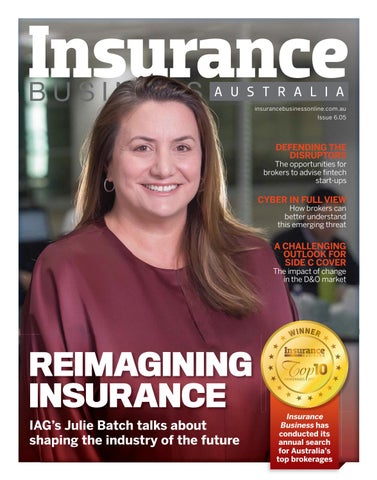
DEFENDING THE DISRUPTORS
The opportunities for brokers to advise fintech start-ups
CYBER IN FULL VIEW How brokers can better understand this emerging threat
A CHALLENGING OUTLOOK FOR SIDE C COVER
The impact of change in the D&O market
REIMAGINING INSURANCE IAG’s Julie Batch talks about shaping the industry of the future
OFC and spine_subbed.indd 1
Insurance Business has conducted its annual search for Australia’s top brokerages
12/09/2017 10:43:15 AM
IFC-01_Contents_subbed.indd 2
12/09/2017 10:41:47 AM
ISSUE 6.05
CONNECT WITH US Got a story, suggestion or just want to find out some more information?
CONTENTS
@InsuranceBizAU facebook.com/InsuranceBusinessAU
UPFRONT 02 Editorial
Championing workforce diversity
FEATURES
36
DEFENDING THE DISRUPTORS The fintech world provides opportunities for brokers to advise burgeoning start-ups
SPECIAL REPORT
22
PEOPLE
REIMAGINING INSURANCE
As IAG opens its Sydneybased innovation incubator, chief customer officer Julie Batch talks about the ongoing mission of its Customer Labs division
18
The boom of the Chinese insurance industry is felt around the globe
06 Head to Head
Can robots really replace insurance brokers?
08 Opinion
The role of telematics in shaping the motor insurance space
10 News analysis
Big changes could mean big opportunities for brokers
12 Intelligence
Chaucer acquires SLE and Ken Keenan announced as next Pen chief
14 Insurer update
TOP 10 BROKERAGES 2017
For the sixth consecutive year, Insurance Business names Australia’s top brokerages
04 Statistics
FEATURES
46
A CHALLENGING OUTLOOK FOR SIDE C COVER The changing D&O insurance market and how brokers should respond
The industry responds to the Senate Economics References Committee’s report on general insurance
16 Underwriting agencies update
A Lloyd’s report puts the potential cost of a global cyberattack in plain terms
FEATURES
40 Brokerage insight
Greg Arms talks about the Suncorpbacked Resilium Insurance Brokers
42 Cyber in full view
Brokers must properly understand cyber risk before seeking coverage
48 A spotlight on exclusion clauses
Recent court cases highlight where exclusion clauses may be vulnerable
FEATURES
50
EXCELLING AS A WOMAN IN BUSINESS
Fifteen strategies to deal with common leadership challenges
PEOPLE
55 Career path
Gary Okely’s three decades at JLT
56 Other life
AJG’s Julian Jemmott recently represented Australia in softball
INSURANCEBUSINESSONLINE.COM.AU
CHECK IT OUT ONLINE www.insurancebusinessonline.com.au
IFC-01_Contents_subbed.indd 1
1
12/09/2017 11:59:25 AM
UPFRONT
EDITORIAL
www.insurancebusinessonline.com.au
Championing workforce diversity
O
nly 45 years ago, women were admitted to the underwriting room at Lloyd’s of London for the first time. Today, Inga Beale is in her fourth year as the insurance giant’s global CEO, driving a transformation that seeks to modernise not only Lloyd’s systems, but also the make-up of its marketplace. One of the key pillars of Lloyd’s ambitious Vision 2025 strategy is to ensure it becomes a truly diverse market. While strides have been made in the insurance sector – Beale is the first woman (and member of the LGBTQI community) to ascend to the top job in the world-famous Lloyd’s market, and more females are now employed in Australia’s general insurance industry than males – there remains substantial work to be done in order for the sector to be able to legitimately describe itself as diverse and inclusive. It was under Beale’s leadership that Lloyd’s global Dive In Festival was born, the first of which had just been held in London when I spoke to her on a visit to Singapore in late 2015.
The consensus is that there is so much to be gained by ensuring diversity of thought is represented at the decisionmaking table This month, Australia will host its own Dive In Festival for the second consecutive year in three cities – Sydney, Melbourne and Perth. Not only is Lloyd’s partnering with a raft of organisations to create an event impressively bigger and better than the last, but it has recently launched an Australian-first Insurance Industry Diversity Survey as a means of measuring and driving diversity and inclusion in the 60,000-people-strong local industry. The Lloyd’s-driven work on the D&I front should be lauded. It’s not difficult to comprehend the logic of striving for organisations to be as diverse as their customer bases. And from a commercial perspective, the consensus is that there is so much to be gained by ensuring diversity of thought is represented at the decision-making table. In a study (released in March) commissioned by the Bankwest Curtin Economics Centre and the Workplace Gender Equality Agency, entitled Gender Equity Insights 2017: Inside Australia’s Gender Pay Gap, WGEA director Libby Lyons said: “Research shows that diverse work teams lead to better workplace culture, greater innovation and improved performance.” I wish the festival organisers the best of luck with Dive In 2017 and look forward to having the opportunity to report on the gains made as a result of this initiative.
Tim Garratt, editor
EDITORIAL Editor Tim Garratt News Editor Jordan Lynn Writers Libby MacDonald, Lucy Hook Production Editors Jo Crichton, Roslyn Meredith
CONTRIBUTORS Fred Curtis, Tanya Stevenson, Tracy Grant, Paul Baxter, Karen Gately
ART & PRODUCTION Design Manager Daniel Williams Designer Joenel Salvador Traffic Coordinator Freya Demegelio
SALES & MARKETING General Manager Peter Smith Commercial Development Manager Sophie Knight Marketing & Communications Manager Lisa Narroway
CORPORATE Chief Executive Officer Mike Shipley Chief Operating Officer George Walmsley Managing Director Justin Kennedy Chief Information Officer Colin Chan Human Resources Manager Julia Bookallil
EDITORIAL ENQUIRIES tim.garratt@keymedia.com.au
SUBSCRIPTION ENQUIRIES
subscriptions@keymedia.com.au
ADVERTISING ENQUIRIES
sophie.knight@keymedia.com.au peter.smith@keymedia.com.au
Key Media Regional head office, Level 10, 1–9 Chandos St, St Leonards, NSW 2065, Australia tel: +61 2 8437 4700 • fax: +61 2 9439 4599 www.keymedia.com Offices in Sydney, Auckland, Denver, London, Singapore, Toronto, Manila, Bengaluru
Insurance Business is part of an international family of B2B publications and websites for the insurance industry INSURANCE BUSINESS AMERICA cathy.masek@keymedia.com T +1 720 316 0151
INSURANCE BUSINESS CANADA john.mackenzie@kmimedia.ca T +1 416 644 874O
INSURANCE BUSINESS NZ peter.smith@keymedia.com.au T +61 2 8437 47OO
INSURANCE BUSINESS UK jonathan.connelly@keymedia.com T +44 20 7193 0935
INSURANCE BUSINESS ASIA peter.smith@keymedia.com.au T +61 2 8437 4700
2
www.insurancebusinessonline.com.au
02-03_Eds letter_subbed_V2.indd 2
Copyright is reserved throughout. No part of this publication can be reproduced in whole or part without the express permission of the editor. Contributions are invited, but copies of work should be kept, as Insurance Business magazine can accept no responsibility for loss.
12/09/2017 10:54:45 AM
02-03_Eds letter_subbed_V2.indd 3
12/09/2017 10:54:52 AM
UPFRONT
STATISTICS
AROUND THE WORLD
Canada
MANULIFE (#12)
Industry momentum is shifting eastward as China’s insurance companies continue to boom
THE WORLD’S largest insurer isn’t located in the US, UK or Europe – it’s in China. Ping An Insurance Group rocketed to the top of Forbes’ list of the world’s largest insurance companies, beating out industry stalwarts such as Allianz (which fell to number two) and AXA (number three). In fact, Asia-based companies occupied four of the slots on the list of top 10 insurance companies, which was rounded out
318,588
People employed by Ping An, the world’s largest insurance company
US$106.6bn Revenue recorded by Ping An for the most recent fiscal year
by European and British multinationals. US companies, meanwhile, failed to crack the top 10; the largest American insurer, MetLife, came in at number 16, just behind China Pacific and Tokio Marine. The increasing dominance of Asian insurers demonstrates the rapid growth of the industry in the region, in contrast to more mature markets in Europe, Britain and the US.
8.8%
Insurance spending as a percentage of GDP within OECD countries between 1996 and 2015
United States
METLIFE (#16) TRAVELERS (#17) AFLAC (#20)
LEADING THE WORLD The 25 largest insurers in the world are scattered across the globe, but Asia is now on equal footing with the traditional insurance stronghold of Europe. Each region lays claim to 40% of the group; North America is home to the remaining 20%.
2
Insurers named among the top 100 most valuable brands globally Sources: Forbes, OECD, Brand Finance
MOST VALUABLE BRANDS
TOP INSURERS BY ASSETS
Chinese insurer Ping An ranks as the highest-value insurance brand, with a brand value of US$16.3bn, overtaking Allianz, which is valued at US$15.1bn. 1 Brand value rank
50
#79
#85
100
#127 #143
150
200
#165
1
AXA
US$944bn
2
Allianz
US$935bn
3
MetLife
US$899bn
Ping An Insurance Prudential 5 Financial Japan Post 6 Insurance Nippon Life 7 Insurance Co. Berkshire 8 Hathaway
US$803bn
9 Prudential PLC
US$578bn
Legal & General
US$575bn
4
10
Ping An Insurance
Allianz
Anthem
AXA
Aetna
Source: Global 500, 2017; Brand Finance
4
France’s AXA Group holds the position of world’s largest insurance company by total assets. The top 10 also includes three US companies and three based in Asia.
US$784bn US$691bn US$621bn US$621bn
US$0
US$100 billion
US$200 billion
US$300 billion
US$400 billion
US$500 US$600 billion billion
US$700 billion
US$800 billion
US$900 billion
US$1 trillion
Source: Relbanks.com, as of 31/12/16
www.insurancebusinessonline.com.au
04-05_Statistics_subbed.indd 4
12/09/2017 10:13:46 AM
United Kingdom
PRUDENTIAL (#6) LEGAL & GENERAL (#18) AVIVA (#23)
Japan
JAPAN POST HOLDINGS (#4) TOKIO MARINE HOLDINGS (#14) DAI-ICHI LIFE INSURANCE (#19) MS&AD INSURANCE (#22)
Germany
ALLIANZ (#2) MUNICH RE (#10)
Italy
GENERALI GROUP (#13) France
AXA GROUP (#3)
Switzerland
ZURICH INSURANCE GROUP (#7) CHUBB (#8) SWISS RE (#11) China
PING AN INSURANCE GROUP (#1) CHINA LIFE INSURANCE (#5) CHINA PACIFIC INSURANCE (#15) PEOPLE’S INSURANCE COMPANY OF CHINA (#24)
Hong Kong
AIA GROUP (#9) Taiwan
CATHAY FINANCIAL (#25)
Source: The World’s Biggest Public Companies 2017, Forbes
TOP INSURERS BY MARKET CAP
RANKING BROKERS
American multinational conglomerate Berkshire Hathaway, which operates in both the insurance and reinsurance space, vastly overshadows other insurance companies in terms of market capitalisation.
The highest-ranking insurance broker among the world’s biggest public companies is UK-based Aon, which came in at number 444.
350
1
300
#444
US$bn
250
#458
500
200
1,000
150
#1,362
100
AIA Group
AIG
AXA
Chubb
4
5
6
7
8
$48 bn
Allianz
$48 bn
$55 bn
3
$59 bn
2
$61 bn
1
$67 bn
Berkshire China Life Ping An Hathaway Insurance Insurance
$74 bn
$87 bn
$346 bn
0
$91 bn
1,500
50
Prudential MetLife PLC 9
10
Source: Relbanks.com, as of 31/12/16
2,000
Aon
Assets: US$27bn
Marsh & McLennan Assets: US$18bn
Arthur J. Gallagher Assets: US$11.5bn
Source: The World’s Biggest Public Companies 2017, Forbes
www.insurancebusinessonline.com.au
04-05_Statistics_subbed.indd 5
5
12/09/2017 10:13:58 AM
UPFRONT
HEAD TO HEAD
Can robots really replace insurance brokers? More than half of all consumers are open to using robo-advisers, so is this the end for the flesh-and-blood broker?
Michael Gottlieb
Lambros Lambrou
Andrew Barile
Founder and CEO BizCover
CEO Aon Risk Solutions Australia
President and CEO Andrew Barile Consulting Corporation
Yes … and no. Yes, because part of the market is interested in self-education and self-service and is comfortable doing this on their own. As technology improves and people gain more confidence in the technology, more and more people will shift to self-service. However, if a better outcome is achieved by using a broker, people will stick with a broker; specifically, this includes those whose insurance needs are more complex and require the assistance of an expert. Brokers who are able to demonstrate knowledge in their area and add value to the process will be the ones sought after.
Technological advances will not be able to completely replace brokers. Insurance has always been a ‘people’ business; the inability of robots to replicate human interaction is key to brokers’ sustainability. Robots and AI will certainly be able to bring efficiencies and drive a new level of analytical insight. However, it will be the ability of brokers and advisers to create trust, responsibility and accountability in the client relationship that robots and AI will struggle to compete with. In the future, our industry will invest in both talent and robotics, each achieving what they are ideally suited for today and tomorrow.
The robot will not be able to completely replace the personal service provided by insurance brokers for years. Many insurance products, such as alternative risk insurance products, require a good deal of creativity and negotiation. Agency captives, deductible buy-back policies and fronting insurance products are beyond the scope of robots. Brokers who are flexible enough to embrace those insurance products that are simplistic in nature, like a renter’s policy, will be serviced by robots. Technology will make the broker more efficient and help to drive prices down.
CUTTING OUT THE MIDDLE (HU)MAN According to a report from consulting firm Accenture, almost three-quarters of consumers worldwide would be amenable to basing their insurance purchases solely on the opinion of a robo-advice platform, which they deem to be faster, less expensive and more impartial than a human. What’s more, a recent study from Oxford University put insurance underwriting in the top five jobs most vulnerable to automation out of the 702 professions surveyed. However, brokers shouldn’t panic just yet. Trevor Maynard, head of innovation at Lloyd’s, recently told the Financial Times, “The bespoke risks in society will never go away, as there is always innovation in the economy. Providing underwriters embrace the new technology, they have a very strong future.”
6
www.insurancebusinessonline.com.au
06-07_Head to Head_SUBBED.indd 6
12/09/2017 10:14:42 AM
06-07_Head to Head_SUBBED.indd 7
12/09/2017 10:14:47 AM
UPFRONT
OPINION
GOT AN OPINION THAT COUNTS? ibo@keymedia.com.au
UBI AND TELEMATICS Fred Curtis of Intelematics Australia discusses the impact that telematics and usage-based insurance will have on the motor insurance space AUTOMOTIVE INSURANCE premiums have traditionally been determined by an individual’s age, vehicle type, gender and driving history, which has been used as a proxy to assess the risk associated with issuing a premium. However, by using telematics technology, the idea is to bypass such factors, and measure risk on an individual basis. The incorporation of new telematics technology in vehicles represents a fundamental shift in this industry. From on-board diagnostics to long-distance fleet management, a new dimension of data is being made available for collection and analysis. As a result of this, the industry is witnessing a rise of Usage Based Insurance (UBI). UBI provides many advantages to insurance brokers and end users alike, entwining the future of insurance with the development and adoption of telematics technologies.
Advantages of UBI The value of real and accurate driving behaviour data is undeniable. In fact, UBI is already being trialled by various Australian insurance companies via black boxes, devices, mobile applications and manual reporting. From driving behaviour to car diagnostics, telematics provides an entirely new data set for insurance brokers to leverage. An advantage is that it enables insurance brokers to tailor premiums to a commercial fleet’s collective driving behaviours and usage patterns. Fleets with drivers that have been deemed safer by these new and more accurate devices may enjoy cheaper premiums that accurately reflect their driving habits, while insurance brokers obtain
8
access to more profitable customers. Research conducted by EY suggests this could reduce claim costs by 40% and policy administration by 50%, while simultaneously reducing acquisition and policy costi by substantial amounts. In an environment with multiple drivers and vehicles, telematics will provide insurance agencies and fleet management with a holistic understanding of their users and assets. For example, telematics can identify risky driving
coil and failing exhaust gas recirculation.ii In having access to individual driving data, brokers are able to create a win-win situation for insurance companies and the end user. As UBI continues to develop and is more widely adopted, the information and data collected can be utilised to provide tailored insurance packages with add-ons that are bespoke to the customer. Brokers can subsequently leverage these custom insurance packages to attract commercial clients.
Implementation of UBI The idea of UBI is definitely gaining traction. A recent study found that four out of five consumers would be willing to share their driving data in exchange for a personalised insurance quote.iii During the infancy stage of UBI development and implementation, early adopters of telematics technology will gain a competitive advantage as they will be able to attract good risks by promising significant discounts. By acquiring fleets with safe drivers early, insurance brokers can promote customer loyalty and retention while offering increasingly tailored packages to end users. On the other hand, those that implement at a
From on-board diagnostics to long-distance fleet management, a new dimension of data is being made available for collection and analysis behaviours, such as increased acceleration or extended driving hours. Fleets that can demonstrate they employ safer drivers across the board could leverage this data to negotiate better insurance premiums. Furthermore, telematics data has implications that go far beyond the actual driver. Data Loggers installed into vehicles can provide real-time diagnostics of the vehicle, so vehicle breakdowns can be predicted before they occur. By pre-empting maintenance and minimising downtime, insurance agencies and fleet management will benefit by saving costs and increasing efficiency. Devices like British motoring association AA’s Car Genie, for example, can detect standard faults like degrading battery health, issues with the ignition
later stage will experience a disadvantage as they will lack the statistically credible UBI data to make informed decisions when it comes to customer acquisition. This will ultimately result in lessprofitable premiums. i EY – Usage Based Insurance: The New Normal? ii www.independent.co.uk/life-style/gadgets-and-tech/news/car-genie-aa-device-app-predict-car-breakdown-service-save-people-fuelcustomer-drivers-a7648736.html iii www.glassbytes.com/2017/07/u-s-drivers-are-open-to-sharingdata-to-save-on-auto-insurance/ Fred Curtis is the group product and innovation manager at Intelematics Australia. With his extensive experience in digital content and app development, Fred continues to drive growth via innovative products and development.
www.insurancebusinessonline.com.au
08-09_Opinion2_subbed.indd 8
12/09/2017 10:15:20 AM
08-09_Opinion2_subbed.indd 9
12/09/2017 10:15:32 AM
UPFRONT
NEWS ANALYSIS
THE SHIFTING LANDSCAPE Despite regular warnings that the end is nigh, it’s not all doom and gloom for brokers – a changing world is bringing about new markets and new opportunities
WITH THE global business landscape in a state of flux, the warning has been issued time and again that insurance brokers are under threat from myriad challenges, both internal and external. From aggressive consolidation trends to the digital revolution and insurers edging towards direct offerings, there are certainly obstacles in the road ahead. But for some, those challenges are nothing more than veiled opportunities that could herald the rise of a new era for brokers. The explosive growth of technology has undoubtedly been one of the most talkedabout potential threats to the intermediated
– many of which are focusing on direct models of business. Major insurers, too, have been emboldened by new digital platforms that allow them to cut out the middleman and communicate directly with consumers, a trend that is not music to brokers’ ears. But while the plates may be shifting beneath them, brokers continue to provide an invaluable service, according to José Manuel Fonseca, CEO of global firm Brokerslink. “Brokers have a great asset, which is the knowledge of the client and the relationship with the client, and that is critical,” he says. “If brokers can integrate
“Brokers have a great asset, which is the knowledge of the client and the relationship with the client” José Manuel Fonseca, Brokerslink channel. Digital transformation itself has been inescapable across almost all industries but has presented a specific set of challenges for insurance. While technology has had a positive impact in areas such as productivity, efficiency and analytics, it has also brought with it a stream of new entrants to the industry
10
technology and form some partnerships with new entrants, I think there is a lot to do, and I see this as a huge opportunity.” The accusation often thrown at insurance – that it has been too slow to adapt to the fast pace of digital change – is an unfair one, Fonseca adds. “We are not the fastest industry
to change,” he admits, “but I think there is some explanation for that. Insurance is very much related to nature, to ‘acts of God’. You cannot predict or always understand that. I think insurance is much more complex than, say, banking. We deal with nature; we deal with people; we deal with lots of different lines of business.” The fast-changing world has not just created new technologies, but new risks, too, many of which are opening up new markets for brokers. The cyber market, for example, was nonexistent 15 years ago but is seeing huge growth globally as cyberattacks on businesses increase in frequency and impact. “That’s one of the beauties of insurance – we are always adapting to new risks and to the new behaviours of society,” Fonseca says. “From natural disasters to terrorism to
www.insurancebusinessonline.com.au
10-11_News Analysis_subbed.indd 10
12/09/2017 10:31:39 AM
NEW THREATS, NEW OPPORTUNITIES
According to Clyde & Co., there were 170 M&A deals in the global insurance industry during the first six months of this year
More than US$1.97bn has been invested into insurtech worldwide since 2016
The global cyber market is expected to generate US$20bn in premiums annually by 2025
Four-fifths of members of UK association Airmic do not think insurers are innovating enough to cope with new risks such as cyber and reputational damage Sources: Clyde & Co., Tällt Ventures, Allianz, Airmic
cyber, they are all becoming more and more important and require a lot of consulting. Brokers have an important role there.”
continuing to add irreplaceable value. “While [going direct] might herald some benefits in pricing for the insured,
“Brokers need to establish a niche and their own distribution platforms to avoid missing out on these opportunities” David M. Dickson, Safeonline Lloyd’s cyber broker David M. Dickson, head of technology, cyber and media at Safeonline, says it’s no secret that a number of insurers and MGAs are now going direct to clients, but he adds that in those emerging and niche lines, where “coverage and appetite continuously change and evolve”, brokers are
when it comes to specialist or technical lines of business, such as technology E&O, cyber, media and intellectual property, I am confident about the role of the London broker and the value we continue to add,” he says. “As an industry, insurance is ripe for disruption, and with an increasing number of ways in
which insurance products are distributed, clients are undoubtedly benefiting from more options to access the market and coverage. Brokers need to establish a niche and their own distribution platforms to avoid missing out on these opportunities.” Ultimately, they are left with two options, he adds: accept and adapt, or deny and die. Given all that change, is the environment for brokers today more challenging than it was 20 years ago? “I wouldn’t say so – we are still growing; we are still relevant,” Fonseca says, pointing to the continued interest in the industry from the equity world as evidence that there is still more growth to come. In fact, the need for knowledge, consulting and advice is even more important today as the world faces up to some increasingly complex risks. “I would not dramatise,” Fonseca says, “but I think [these are] very challenging times.”
www.insurancebusinessonline.com.au
10-11_News Analysis_subbed.indd 11
11
12/09/2017 10:31:47 AM
UPFRONT
INTELLIGENCE CORPORATE ACQUIRER
TARGET
PRODUCTS COMMENTS
Chaucer
SLE Holdings
Chaucer is a leading specialty insurance group with its headquarters in London. It belongs to the Hanover Insurance Group
Hollard Insurance Company
Calibre Insurance
Calibre policies, which are currently underwritten by Great Lakes Australia, will be underwritten by Hollard from 1 April 2018
PSC Insurance Group
Insurance Marketing Group of Australia (IMGA)
PSC acquired IMGA for $5.7m
PSC Insurance Group
Medisure Indemnity Australia (MIA)
PSC acquired MIA for $2.9m
PSC Insurance Group
National Franchise Insurance Brokers
PSC paid an initial deposit of $200,000, with quarterly instalments to be paid over a year, based on revenue received, bringing the total consideration to approximately $1.2m
PSC Insurance Group
Riley and Associates
PSC paid a purchase price of approximately $1.2m, with $800,000 paid upfront and the balance paid on an adjustable basis after 12 months
PSC Insurance Group
Clover
PSC invested $1.1m for a 16% ownership interest in Clover, a fintech firm
SWISS RE’S NEW SUITE OF PRODUCTS
Swiss Re Corporate Solutions has launched into the primary market for financial lines and casualty insurance with a range of products including professional indemnity, D&O, crime and general liability. “We are coming to the market with a fresh suite of new policies, a team of industry-recognised experts, quality capacity and the ability to work with brokers and corporations to write financial lines and casualty business in Australia,” said Jeremy Scott-Mackenzie, head of casualty and FinPro for Australia and New Zealand.
BROKERS GET FUNDING BOOST FROM INSUREPITCH
CHAUCER ACQUIRES SLE HOLDINGS
Specialist insurer Chaucer has announced its acquisition of SLE Holdings, known in the market as SLE Worldwide Australia. John Fowle, CEO of Chaucer, described the acquisition as an excellent strategic fit. “It will enable us to increase our presence in this important market, giving us greater access to high-quality business and bringing us closer to our customers, while providing for a broader distribution of other Chaucer products in the future,” Fowle said. Brad French, managing director of SLE said: “Chaucer has a strong and well-recognised Lloyd’s brand and we are excited about working with the Chaucer team to expand our current business offering.”
12
A new initiative, InsurePitch, gives brokers the chance to put forward their business concepts, and the best that apply will be offered technology resources, business support and capital to bring those ideas to life. Additionally, they will be able to call on a distribution network of more than 1,000 brokers and their clients to boost their ideas. InsurePitch was conceived by Premium Funding and has received support from Ausure, Insurance House Group, PSC insurance, the Hollard Group and Resilium Insurance Brokers. Anyone can apply, with applications closing 31 October 2017.
www.insurancebusinessonline.com.au
12-13_Intelligence_subbed_V2.indd 12
12/09/2017 10:32:17 AM
XL CATLIN INTRODUCES NEW CYBER COVER
XL Catlin has launched its Cyber and Data Protection Insurance policy in Asia-Pacific. The policy covers business interruption arising from a network compromise, associated extortion demands and first party incident response costs such as notification of the compromise of the network, forensic investigations and public relations support. The policy also covers third party liability costs that organisations face because of a data breach, including any regulatory investigation or contractual liability associated with the Payment Card Industry Data Security Standard. Additionally, it offers broad coverage for liability associated with media exposures, including copyright infringement, invasion of privacy and false advertising, in both offline and online content as well as social media.
VERO’S UPGRADED PLATFORM FOR BROKERS
Vero is now providing brokers with access to SME Packages on its VeroEdge online platform. ‘SME Packages on VeroEdge’ features simplified business-acceptance rules, a clearer risk appetite, updates to wordings and faster referral turnaround times. Additionally, it features improvements to the occupation and address search and the document management functions, the ability to generate on-demand certificates of currency, and greater access to Vero’s technical underwriting capability.
AIG AUSTRALIA RELEASES IMI 2017
AIG Australia has announced that it has revitalised its investment management liability insurance product, in order to enhance its offerings to investment managers. The funds management industry continues to evolve and faces increasing regulatory requirements and oversight. With that in mind, the insurer says, its IMI 2017 product now combines D&O covers already available under its Gold Complete product. Other highlights of IMI 2017 include specific coverage extensions for pre-claim enquiries and mitigation, as well as for social engineering/impersonation fraud.
PEOPLE NAME
LEAVING
JOINING
NEW POSITION
Emily Walker
n.a.
Axis Underwriting
National development manager
David Rogers
n.a.
Berkley Insurance Australia
National manager, corporate solutions
Jon Wilmott
ProRisk
Berkley Insurance Australia
NSW state manager
David Lloyd
Zurich Financial Services Australia
HDI Global
Regional claims manager, ASEAN and Australasia
Kevin Sullivan
QBE
HDI Global
Claims manager
Mark Drasutis
News Corp Australia
IAG
Chief digital officer
Mark Milliner
n.a.
IAG
CEO, Australia
Fiona Cameron
n.a
Insurance Council of Australia
General manager policy, consumer outcomes
Ken Keenan
Arthur J. Gallagher
Pen Underwriting
Chief executive officer
David Abbott
Vero
Zurich Financial Services Australia
Construction underwriter
David Haberland
Iron Mountain
Zurich Financial Services Australia
Global relationship leader, commercial insurance
Claudio Lupieri
Vero
Zurich Financial Services Australia
Construction underwriter
Jane Holling
Tabcorp
Zurich Financial Services Australia
Global relationship leader, commercial insurance
Jason Henry
CGU
Zurich Financial Services Australia
Liability underwriting manager – Vic, Tas, SA and WA
Vince Banton
Munich Re
Zurich Financial Services Australia
Construction underwriter
KEN KEENAN IS NEW CHIEF OF PEN
Ken Keenan will become chief executive of Pen Underwriting with effect from 1 January 2018, replacing Gary Marshall who retires at the end of this year. Keenan recently relocated to Australia to become Arthur J. Gallagher’s general manager, branch operations, following a successful stint as CEO of its Canadian broking division. It’s expected he will transition into the Pen business from September. Steve Lockwood, AJG’s managing director, Australia and New Zealand, said Keenan’s move to Pen would “bring a number of benefits to the team including his depth of experience in the international markets we operate in”.
ROGERS JOINS BERKLEY
Berkley Insurance Australia has announced that David Rogers has joined the business, leading an area that will look to utilise the global reach of Berkley and its US operations. According to Berkley, Rogers will focus on developing products and expertise in the transactional insurance market, specialising in warranties and indemnities, tax opinion and contingent liability cover. Rogers was previously CEO of Ironshore Australia and, in his new role, will oversee products in cyber, product recall, life sciences and environmental liability.
www.insurancebusinessonline.com.au
12-13_Intelligence_subbed_V2.indd 13
13
12/09/2017 10:32:24 AM
UPFRONT
INSURER UPDATE
INDUSTRY RESPONDS TO SENATE REPORT NIBA and ICA CEOs weigh in on the recommendations made with respect to the general insurance industry
not the same, and therefore it can be a challenge for people to get the cover they need. If you don’t know what you are doing, you’ve got to get advice, and sometimes Government agencies, parliamentary committees [and] regulators tend not to recommend people get advice. I don’t understand why that is the case.” The report also recommends the Government complete a “detailed proposal” for a price comparison service for consumers. Rob Whelan, CEO of the ICA, questioned the push towards a price comparison service on the basis of evidence from consumer groups,
“A lot of problems in insurance would be resolved if more people got good advice”
The Senate Economics References Committee has called on the Federal Government to increase mitigation spending and the industry to improve disclosure practices. The inquiry released its report on the general insurance industry in Australia in August. It was tasked with reviewing competition and transparency in the strata, home and car insurance markets, with a focus on examining the performance of the industry in respect of product disclosure and comparability. The report’s 15 recommendations included a call to the Government to release
NEWS BRIEFS
its long-awaited response to the final report of the Northern Australia Insurance Premiums Taskforce. The report’s final recommendation was that the Government should, “as a matter of urgency”, work with states and territories to reform natural disaster funding arrangements. NIBA CEO Dallas Booth told Insurance Business that the report could strengthen the case for seeking insurance advice from a broker: “A lot of problems in insurance would be resolved if more people got good advice,” Booth said. “All products are not the same, all risks are
IAG’s FY17 result is ‘sound’, Harmer says
IAG announced an FY17 insurance profit of $1.3bn and a reported insurance margin of 14.9%, representing a 6.8% increase on FY16. Gross written premium (GWP) grew by 3.9% to $11.8bn, with like-for-like growth in excess of 4%. The Group’s underlying insurance margin fell 2.1% to 11.9%, while its net profit after tax (NPAT) increased 48.6% to $929m. Managing director and CEO Peter Harmer said IAG had delivered “a sound result”.
14
regulators and the industry, pointing to such sites not empowering customers to choose the best product. “You can’t compare insurance products as though you’re comparing cans of soft drink, and each insurer’s product is competitive on its features as well as its price,” Whelan said. “The ICA … believes enough evidence has already been provided to demonstrate a government-run aggregator would not stand up to a cost-benefit analysis,” Whelan said. Whelan said many of the issues raised by the report are already being addressed by the industry, such as the Disclosure Taskforce and the review of the general insurance code of practice.
AIG talks technology
Ben Vale, AIG’s head of multinational, Australasia, talked about the insurer’s tech priorities moving forward at the RIMS Risk Forum. The insurer will look to connected works, cyber, fleet, industrials, properties and supply chains, as it invests in technology for the commercial insurance market. Vale noted AIG’s tech strategy focuses on five areas, including identifying innovation; backing several ‘big bets’; joining with client partners to further innovation; leaning on the sharing economy; and becoming a thoughtleader through research.
www.insurancebusinessonline.com.au
14-15_Insurer Update_subbed.indd 14
12/09/2017 10:32:54 AM
Q&A
AUTOMATING INSURANCE Harel Tayeb CEO KRYON SYSTEMS
Fast facts Harel is a serial entrepreneur with over 15 years of vast experience in the technology ecosystem. Harel was AVG (acquired by Avast) Israel’s country manager and was responsible for the site’s revenues, product strategy, M&A and all other aspects of its activities. Prior to his time at AVG, Harel spent four years leading Como (Conduit Mobile), a fast-growing mobile app-maker platform.
How advanced has Robotic Process Automation (RPA) technology become? RPA ... has quickly evolved into a necessity for businesses who are serious about optimising employees and resources. RPA combines image recognition capabilities with workflow automation tools to create virtual employees who could be trained to execute repetitive, rules-based processes on virtual machines.
What key benefits can RPA offer businesses? RPA offers businesses the opportunity to boost profitability, increase operational efficiency, and maintain a competitive advantage by automating many of the high-volume, manual workflow processes. Businesses in every sector would benefit greatly from implementing RPA as part of their workforce, as it enables the offloading of time-consuming and mundane tasks to virtual employees, allowing human workers to focus on more interesting tasks. In turn, this boosts employee satisfaction while also minimising the amount of errors and inconsistencies that occur with manual labour. Additionally, RPA robots can work around the clock, making the company more efficient.
How cost-effective has the use of RPA become for businesses? The higher the volume of rules-based processes that can be automated, the more cost-effective implementing RPA will be for businesses. While the total cost of ownership differs between various types of RPA platforms, a business that requires employees
QBE announces interim results
In its announcement, QBE reported a statutory net profit of $345m, up 30% from the prior period, and an adjusted combined operating ratio of 95.3%, compared with 94.5% in the first half of 2016. QBE’s GWP globally was up 3% on a constant currency basis, while its Australian and New Zealand operations saw GWP rise 5% on a constant currency basis. QBE also announced its Emerging Markets division has reverted to two separately managed divisions in AsiaPacific and Latin America.
to complete rules-based and repetitive tasks can benefit from investing in a technology that speeds up operational efficiency and saves resources like manpower, time and costs. Users of RPA can be confident that the return on investment will more than justify the costs of implementing RPA, especially when a company sets up an internal automation development centre so as not to rely on third party professional services.
How significantly do you foresee RPA being utilised by insurers? In the next few years most insurance companies will likely implement RPA. Insurers constantly deal with tasks like claims processing, underwriting, and providing policy quotes – all processes which can be easily automated. By using RPA to execute backoffice processes, insurers can ensure that customer claims will be handled in a timely and effective manner. The dexterity of RPA means that underwriting or initial claims processes that require retrieval of information from multiple sources and subsequent input into databases is made simple, while ongoing activity logs mean that regulatory compliance can be monitored consistently. Insurance companies will also find that the offering helps them scale their business as needed. They can easily increase the amount of working software robots and maintain internal growth to meet longterm demand. Overall, the sky’s the limit in terms of how RPA can benefit the insurance industry, and those that fail to adopt it will quickly find themselves falling behind.
Suncorp announces full-year profit of $1.075bn
Suncorp Group reported NPAT for FY17 of $1.075bn, an increase of 3.6% on FY16. Its insurance business delivered NPAT of $723m, up 30% from FY16, with GWP up 3.9% to $8.111bn. The general insurance underlying insurance trading ratio (ITR) was 11.5% compared with 10.6% in FY16. However, Suncorp’s commercial insurance business saw GWP reduced by 2.2%, as pricing increases and strong SME retention rates were offset by lower retention in the corporate segment.
Survey focuses on female SMEs
Female SME business owners differ somewhat from their male counterparts, according to Vero’s SME Insurance Index. It found more females (79%) than males (73%) believe that getting the right business insurance is important to them. Additionally, female SME owners are less likely than males are to use brokers – 29% of females reported using a broker, as opposed to 33% of men. A further 9% use both brokers and direct channels.
www.insurancebusinessonline.com.au
14-15_Insurer Update_subbed.indd 15
15
12/09/2017 10:33:01 AM
UPFRONT
UNDERWRITING AGENCIES UPDATE NEWS BRIEFS Brooklyn opens offices in Vic and Qld
Brooklyn Underwriting has announced the opening of offices in Melbourne and Brisbane. The agency was acquired by XL Catlin last September and has relocated in Sydney to the global insurance giant’s Australian head office. It has mirrored XL Catlin’s geographical spread with the opening of its two new branches. David Porteous, director of Brooklyn Underwriting, told Insurance Business: “It is just one more benefit of the Brooklyn-XL tie-up that we can now deploy resources to different parts of the country, all with the view of helping service our brokers in those regions.” Alex Coombes, manager of professional risks, is heading up the new Collins Street office in Melbourne, while Louise Sutherland, an underwriter in IT liability and cyber cover, will front the new Brisbane office on Eagle Street.
Lawsons becomes SURA Specialty
SURA announced in late July that Lawsons Underwriting Australasia would now be branded as SURA Specialty. An agency that specialises in dealing in hard-to-place liability risks in sectors crucial to both the economy and broker businesses, SURA Specialty offers liability coverage up to $250m. In a statement, Kevin Corkery, managing director of SURA Specialty, said brokers and clients can expect the same focused approach to complex liability risks to be paired with additional depth in service and new opportunity.
MECON celebrates 15 years
Specialist construction underwriting agency MECON has announced a competition to celebrate its 15th anniversary. One lucky broker
16
and their guest will win a six-night stay in New York with $2,000 spending money. MECON will also give away a $250 gift voucher to a broker once a month until April 2018. The competition is open to any broker who uses the firm in either Australia or New Zealand. Brokers will be entered into the draw once they place a new policy or renewal with MECON and the policy is paid.
UAC hosts annual expo in Adelaide
The Underwriting Agencies Council (UAC) held its Adelaide Expo in August. A record number of 68 exhibitors attended the Adelaide Expo and almost 200 brokers visited throughout the day. UAC general manager William Legge described it as a very successful day for all exhibitors and said the Adelaide Expo would continue to be a key event on the annual UAC event calendar. During the Expo, UAC donated $2,000 to the Royal Flying Doctor Service (RFDS). To date, UAC has donated a total of $14,000 to RFDS in Adelaide.
Veteran broker unveils cyber business
Experienced broker Mike Newbigin and cyber security expert Paul Waite have announced the launch of Cyber Plus, a new cyber risk and insurance venture, which will help clients understand, transfer and respond to their cyber risk. Small businesses will be able to bundle cyber tools and insurance in a firstof-its-kind for the Australian market. Small business clients will be able to prepare, protect and respond to cyber breaches with the insurance policy tailored to each individual business with “certain Lloyd’s underwriters” underwriting the policy, Newbigin told Insurance Business.
CYBER COSTS COULD BE CATACLYSMIC A Lloyd’s report explains in plain – and terrifying – terms the possible cost of a major cyberattack A global cyberattack could result in economic losses in the vicinity of those caused by 2012’s Hurricane Sandy, the second most expensive tropical cyclone in US history. That’s according to a scenario in a Lloyd’s research report, released in July in partnership with cyber risk analytics modelling firm Cyence. The Counting the cost: Cyber exposure decoded report details the potential economic impact of two scenarios. The first scenario involves a malicious hack taking down a cloud service provider, causing estimated losses of US$53bn (A$67.06bn), while the second involves attacks on computer operating systems, run by a large number of businesses worldwide, causing estimated losses of US$28.7bn (A$36.31bn). Hurricane Sandy, according to Lloyd’s, is generally regarded as having caused losses totalling between US$50bn and $70bn. The report also found that while there’s a rising demand for cyber insurance, most cyber losses aren’t currently insured, with the insurance gap reaching into the tens of billions of dollars. “This report gives a real sense of the scale of damage a cyberattack could cause the global economy,” said Inga Beale, CEO of Lloyd’s, in a statement. “Just like some of the worst natural catastrophes, cyber events can cause a severe impact on businesses and economies, trigger multiple claims and dramatically increase insurers’ claims costs. Underwriters need to consider cyber cover in this way and ensure that premium calculations keep pace with the
www.insurancebusinessonline.com.au
16-17_Update UAs_subbed.indd 16
12/09/2017 10:33:34 AM
S
C
cyber threat reality. Reports say cybercrime now costs businesses around US$450bn (A$569bn) a year. Currently worth between US$3bn and $3.5bn (A$3.80bn and $4.43bn), PricewaterhouseCoopers says some analysts estimate the global cyber insurance market could be worth US$7.5bn (A$9.49bn) by 2020. When it comes to the local response to the emerging cyber threat, Greg Hodgkiss, CEO of Cyber Indemnity Solutions (CIS), told Insurance Business he believes Australia is progressing in terms of its understanding of cyber insurance and risk. While the US continues to lead the way both in its understanding and take-up of the cover,
“There is a real need for the insurers to provide products that are relevant” Australia is transitioning so that the risk is becoming a board-level issue, which is vital for insurance take-up. “In America, that transition took place 18 to 23 months ago; today, it is happening in Australia,” Hodgkiss said. “Most of our directors on boards don’t have a compliance, insurance or cyber risk background, so there is a great need for understanding at board-room level on how to do this and also a real need for the insurers to provide products that are relevant.”
Q&A
DIVE IN 2017 Angie Zissis Managing director SURA
Why did SURA specifically decide to become involved in Dive In 2017? AZ: Bringing the Dive In Festival to Melbourne for the first time gives us a chance to support an important industry initiative that’s made headway since 2015 both locally and globally. Together with Wotton + Kearney and Liberty International Underwriters, we thought it was a chance to put on a genuinely innovative event the Melbourne industry can use and build on in the years to come.
David Kearney Chief executive partner WOTTON + KEARNEY
Fast fact SURA, Wotton + Kearney and Liberty International Underwriters have teamed up to deliver a world-first Melbourne Dive In Festival event around the theme of ‘Tackling Unconscious Bias’ on 27 September. Tickets can be booked at diveinfestival.com
Why is diversity and inclusion a strategic priority for Wotton + Kearney (W+K)? DK: W+K is a people business built on the back of providing advice to insurance industry participants to assist them in achieving superior business results. Our insurance clients have a broad range of customers who have a diverse range of issues requiring risk solutions. Our Focus on Diversity – which is one of our three core values – allows us to respond more effectively to the challenges of providing sustainable solutions to these issues. Our advice is also assisted by our focus on achieving an inclusive work culture where the uniqueness of our backgrounds, talents, capabilities and beliefs are recognised and brought together.
Why is unconscious bias an important part of the broader D&I conversation? AZ: Our industry is full of great people, but none of us is perfect. Research shows that unconscious bias can impact important business functions like recruitment and selection, based on race, age and gender. If we don’t work to make these biases conscious and part of our everyday conversation, they may continue to hinder best practice and potentially our industry’s long-term performance.
DK: Recognising the nature of unconscious biases and developing an action plan to remove these biases is important in achieving effective Diversity and Inclusion at W+K. We recognise that unconscious bias can mean talented people do not progress as appropriate and diverse voices aren’t heard in meetings and at other important forums. This ultimately has the potential to impact on the quality of our advice to our insurer clients and is an important reason why unconscious biases must be recognised and removed. Do you think Dive In has the ability to affect real change in insurance? AZ: We wouldn’t be involved if we didn’t think it could impact our industry for the better. This is a long-term cultural shift that will take time, but as the AFL’s Jan Cooper will make clear at our Melbourne event, we can make real change through persistence and education. I’m already proud of the way the SURA team are getting behind this initiative, and I think we have a great opportunity.
www.insurancebusinessonline.com.au
16-17_Update UAs_subbed.indd 17
17
12/09/2017 10:33:44 AM
PEOPLE
THE BIG INTERVIEW
REIMAGINING INSURANCE Julie Batch talks about innovation in IAG’s Customer Labs division and what the insurance giant hopes to accomplish in its newly established Firemark Labs IN HER own words, Julie Batch has “insurance genes”. Part of a family with a long history in the business, she began her own career in reinsurance and has since worked in France, the UK and Japan. But a desire to better understand the workings of the customer ultimately saw Batch switch out of reinsurance. At IAG, her roles have included chief risk officer in its direct insurance division, as well as chief analytics officer. In December 2015, she became IAG’s chief customer officer, heading up its Customer Labs division. “It’s a great role,” she says. “It’s very exciting in the context of IAG, which is looking at transformation.” It was a couple of years ago when IAG embarked on a project to determine what could potentially disrupt its insurance business. “We brought a group of our best and brightest people together to think about what the industry might look like 10 years out, which is very difficult for us because we often operate annually, in terms of the way we buy and sell policies,” Batch says. Key issues to emerge from that work included the perceived role of big data. “Interestingly, big data’s a term that’s not used so widely now, as we’ve realised that all data is valuable,” she says. “We looked at the role of partnerships. For us to be able to be relevant in the future, we need to move outside our own vertical and think about how we partner with other businesses in other industries to create
18
complementary products and services for our customers.” Batch also talks about the prototyping of new products. “Our industry has been fantastic at selling highly commoditised products at scale … and we’ve built amazing service models around that across insurance, generally,” she says. “We’re not so great at building new products and services and rapidly iterating them. When we look at how many new
“When we set up Customer Labs, we were trying to figure out what it was that we needed to do, and there were a few things that were really critical for us,” Batch says. “The first thing we did – which we’re still building – is create a single central repository for all of our company’s information. We call that our Enterprise Data Hub, and that data hub is essentially a platform that pulls every piece of knowledge and information that IAG has collected, for as much of its history as we can find, into the one place.”
“We need to create the right environment for innovation, creativity and new thinking to flourish … What we don’t want to do is use the word ‘innovation’ for innovation’s sake” products we’ve launched over the last 10 years, there’s less than a handful. You look outside the industry, and they’re releasing new products and services every day. We felt we needed to create that capability.” Batch says the project team also turned its thinking to how IAG could benefit from some of the new capability being built in the start-up space, and that was the catalyst for creating its venture fund.
The story so far Since those conversations began, considerable work on the innovation front has been undertaken.
In Customer Labs’ early days, this work was carried out by a group comprising only 10–15 people. “It’s actually been a relatively inexpensive project for our organisation, and I think that’s helped us be more innovative in the way we’ve approached it,” she says. “As much as lots of funds drive some speed, they also maybe result in you making lazier decisions.” Batch says the building of the data hub has been an “exciting piece of work”. “We’re now in a position where we can stream into this hub, in real time, a huge amount of knowledge, and we’re building out new services from that now. That’s kind of the
www.insurancebusinessonline.com.au
18-21_The Big Interview_subbed.indd 18
12/09/2017 10:34:11 AM
PROFILE Name: Julie Batch Company: Insurance Australia Group (IAG) Title: Chief customer officer Number of years with IAG: 12 Fast facts: Batch joined IAG in 2005 as group general manager, reinsurance. She is a graduate of Charles Sturt University and holds a Masters of Applied Finance
www.insurancebusinessonline.com.au
18-21_The Big Interview_subbed.indd 19
19
12/09/2017 10:34:21 AM
PEOPLE
THE BIG INTERVIEW
“In trying to think about what the future looks like and imagine it, we want people that are outside of our current paradigm, our current frame, to be able to help shape it for us” foundation of all the work that we’re doing.” Another key focus of Customer Labs has been customer segmentation. Batch says the business saw an opportunity to think differently about customer needs. “We used the data, we combined it with some information that we’d sourced through one of our venturing investments, and then attached that to our 5.5m customer records. We were able to build a really rich customer segmentation model that goes far beyond the insurance opportunities that we’ve seen before and it’s now being deployed across our company,” she explains. Batch says Customer Labs works closely with CEO Australia, Mark Milliner, ascertaining how to create reimagined customer experiences on the back of this work. “It gives us visibility of new products that we don’t currently sell, the way that we might partner, how we might build adjacencies,
20
how we should best deliver to the customer, and the new technologies that are going to be most relevant for each of those customer groups,” she says. Batch says the division’s work in redefining its approach to pricing is also starting to pay dividends. “We have again used the data and brought a lot of new analytical capability into our organisation, particularly through our [2014] acquisition of Ambiata, a data science company that we acquired from NITCA – now Data61 – which is part of the CSIRO,” she says. Batch says that acquisition has meant the adoption of a completely different approach to pricing. “We’ve looked at our pricing models, we’re building machine learning into those models … and we’re now generating some very significant pricing benefits as a result of
re-thinking the way that we analyse and go to market,” she says.
The next chapter In July, IAG opened its new innovation incubator, Firemark Labs Sydney. Batch discusses the concept and its role in IAG’s strategic direction going forward. “It’s one of my beliefs that we need to create the right environment for innovation, creativity and new thinking to flourish,” she says. “What we don’t want to do is use the word ‘innovation’ for innovation’s sake. I think it’s a widely used word and a poorly used word often.” She says Firemark Labs is a means of accelerating innovation. “Sometimes, corporate structures aren’t the right places to facilitate rapid development prototyping. So this environment, where people are provided with a collaborative space to work, [and] they’re given tools and services to help them work quickly, is really what Firemark Sydney is about.” She talks about the occupants of Firemark Labs Sydney. “A big part of this strategy is about taking amazing thinking from within IAG – so, a lot of our entrepreneurs – and then bringing
www.insurancebusinessonline.com.au
18-21_The Big Interview_subbed.indd 20
12/09/2017 10:34:31 AM
great talent from outside and joining it together and creating a space where people can co-create products and services for our customers,” she says. IAG has also opened a Firemark Lab in Singapore, in collaboration with the Monetary Authority of Singapore (MAS). “We’ve had a long association with [MAS] because we obviously have strong business ties in Asia, and Singapore is a hub for us,” she says. “So, that’s about looking at prototyping new technologies [and] new businesses that may be a little outside of our core insurance offering.” And there’s also Firemark Ventures, IAG’s $75m venture capital fund launched in 2016. “Firemark Ventures … is about investing outside our organisation and finding new capabilities that we can bring back in and help enhance the insurance product and service offerings.” Batch cites examples of how IAG is currently working to bring the best of the small-scale disruption into its business in efforts to shift and change the customer experience. “We’ve invested in a cyber business, UpGuard, and we’re now co-creating a product with them,” she says. “We’ve invested in a company named Pocketbook and we’ve worked really closely with them, looking at the way that we might better understand our customers; we’re working with the University of Sydney with their data and analytics department, looking at how we bring capability and then start to focus on artificial intelligence. “We see all of those things as being ways that we can accelerate and improve the experience that the customer has every day, and so it’s critical to our strategy.”
Landscape and culture Asked about innovative businesses in the marketplace that have piqued her interest based on what they potentially offer the insurance space, Batch mentions the publicity around Lemonade, the growing New York-based property and casualty
insurer launched last year. “I certainly think that anybody who’s looking at using machine learning, rapid solutions for customers and artificial intelligence to develop a new business is on the cutting edge, and that will increasingly be how things will move in the future, in my opinion,” she says. “There are other businesses we look at around the world – companies like Friendsurance, looking at more collaborative peer-to-peer sharing models. That’s something that’s really important to us to consider. It’s essentially the foundation of insurance in many ways, so we talk frequently with companies like that to help understand how they’re thinking about disruption across the industry. We also then look at how we can build products and services to meet some of those customer needs.” Of course, having the right people on board driving Customer Labs is crucial, and Batch says there’s been a strong focus on creating diversity of thinking within the team. “We’ve pulled together the best analytical people we could find, the best data wranglers we could find, people with deep customer empathy, we’ve pulled people out of organisations who are used to working with entrepreneurs and scaling businesses,” she says. Batch refers to the recent appointment of chief marketing officer Brent Smart, who joined IAG after three years as Saatchi and Saatchi’s global CEO, and Mark Drasutis, who’s now the group’s chief digital officer after a number of years spent with News Corporation. “In trying to think about what the future looks like and imagine it, we want people that are outside of our current paradigm, our current frame, to be able to help shape it for us,” Batch says. “Bringing that team together has been one of the most exciting parts … and sitting around a table with that sort of different thinking, that’s assimilating fantastically well into an insurance environment … has been one of the most rewarding pieces of the role.”
FUTURE GAZING What will the industry of 2025 look like? “I don’t know, and I’m actually okay with that because I think, right now, we’re creating that future,” Julie Batch says. But she adds that there are a few things that she could imagine:
THE COMPANIES “I think you have companies ... delivering amazing, beautiful experiences for customers that are comprehensive and suit a wide range of needs.”
PRODUCT DEVELOPMENT “I think you’re going to see a continued refinement and simplification of the product development elements of any industry.”
ARTIFICIAL INTELLIGENCE “I think there will be a continued rise of artificial intelligence. As scary as it is, as much as we don’t like to imagine it, I think that bringing that capability together with the empathy and customer understanding that exists in the insurance industry is going to cause a fairly significant shift in the way that we do things.”
www.insurancebusinessonline.com.au
18-21_The Big Interview_subbed.indd 21
21
12/09/2017 10:34:35 AM
SPECIAL REPORT
TOP 10 BROKERAGES 2017
For the sixth year in a row, Insurance Business has set out to find the nation’s top-performing brokerages – and exactly what it is they are doing right WELCOME TO the 2017 Insurance Business Top 10 Brokerages Special Report. Another year of peaks and troughs has passed, and brokers around Australia have continued working hard to ensure clients can secure the very best risk transfer solutions to meet their specific needs. As always, it’s a pleasure to have the opportunity to recognise a handful of businesses that are reaping the rewards of their hard work.
22
We had a record number of entries for our 2017 Top 10 Brokerages list, and it’s enormously encouraging to see brokerages stepping forward to take part for the first time. The approach Insurance Business takes to ranking brokerages – using a range of criteria and adopting a ‘handicap’ method of scoring – ensures that smaller players find themselves on a level playing field with larger businesses, allowing the Insurance Business team to
www.insurancebusinessonline.com.au
22-35_Top 10 Brokerages 2017_SUBBED.indd 22
12/09/2017 11:23:39 AM
THE METHODOLOGY The Insurance Business Top 10 Brokerages ranking is an objective means of ranking the top-performing brokerages in the country across eight businesscritical criteria, covering:
total revenue policies written revenue per broker policies per broker new clients per broker new revenue per broker company growth client retention As in previous years, each brokerage that entered was required to supply its own details for the 2016/17 financial year to Insurance Business. Brokerages were ranked according to each of the above criteria, and all of their rankings were then added together. Just like a golf score, those brokerages with the lowest overall scores achieved the highest rankings. The Insurance Business ranking system means businesses are rewarded for business per broker rather than pure critical mass, in order to ensure that the very best brokerages are singled out.
determine the businesses that are truly the best. On behalf of the team, I’d like to sincerely congratulate all of our entrants on their ongoing work for the wider Australian community, which crucially ensures that the cogs continue to move in a time of crisis. I’ve said this now for the last three years, but it warrants further repetition: your work continues to attest to how much there is to be proud of within the general insurance industry in Australia. I wish you all the very best for the year to come.
Tim Garratt, editor, Insurance Business
TOP 10 BROKERAGES
1 2 3 4 5 6 7 8 9 10
BizCover
Insure 247
GSK Insurance Brokers
IPS Insurance Brokers
Roderick Insurance Brokers
Sound Insurance Services
allinsure
Elliott Australia Group
Experien Insurance Services
Apollo Risk Services
www.insurancebusinessonline.com.au
22-35_Top 10 Brokerages 2017_SUBBED.indd 23
23
12/09/2017 11:23:33 AM
SPECIAL REPORT
TOP 10 BROKERAGES 2017 APOLLO RISK SERVICES Do you think the market is now hardening? Carl King: “Yes, absolutely. Some major insurers are making a huge mistake by placing double-digit increases across the board. To the experienced broker, this will only be to their detriment. The public are more educated these days and won’t accept double-digit increases with little or no claims incurred. Although we accept there should be increases, insurers need to work with their partners to ensure the increases are acceptable and within reason.”
Western Australia’s Apollo Risk Services once again finds itself on the Insurance Business Top 10 Brokerages list. “We are delighted with the result and our consistency in our constant improvement strategies,” says Carl King, managing director of Apollo. Talking about the business, King says Apollo Risk Services manages and services a wide range of risks. “We do not specialise in any particular occupation or industry,” he says. “Our staff are experienced and work in 99% of the market. The management team are currently researching to find a niche market we can be leaders in.” King reflects on how the last 12 months have been for Apollo Risk Services. “Our staff have been presented with various challenges throughout the year and managed them very professionally,” he says. “Apollo’s constant improvement model ensures we revalue our processes to ensure the clients, both internal and external, experience the best possible service.” King describes the business’s approach as ‘Cover over premium every time’. “As we are aware, the last three years have been particularly difficult in the west,” he says. “Business owners have tightened their belts and tried to select
24
10 policies based on premium, not coverage. During our process, we ensure the client understands the coverage and any consequences.” Asked to cite the biggest challenge Apollo has faced over the past year, King mentions technology and direct insurers, referring to them as “any broker’s nightmare”. “Any future successful brokerage will have
Getting the best out of your people CK: “The staff at Apollo Risk Services are mature, experienced and professional. We empower them to put forward changes which add to the clients’ experience or improve company standards.”
“We are constantly improving our processes and are always looking to acquire the right portfolio which fits our growth model” to invest heavily in technology to keep up with this ever-changing world,” he says. “We do not have the funds or the resources to keep up with the constant bombardment of commercials from the direct insurers. We must work smarter to ensure our market share is not eroded.” But on the subject of technology, King also stresses the importance of brokers having proper guidance. “I have friends who have invested heavily to see little or no return,” he says.
“Brokers need partners to educate and travel [with] them throughout the journey to ensure the funds are not wasted.” Looking forward, King provides an insight into where his team’s attention will be focused. “We are constantly improving our processes and are always looking to acquire the right portfolio which fits our growth model.” Congratulations to Apollo Risk Services for making into Insurance Business’s Top 10 Brokerages of 2017.
www.insurancebusinessonline.com.au
22-35_Top 10 Brokerages 2017_SUBBED.indd 24
12/09/2017 11:23:56 AM
EXPERIEN INSURANCE SERVICES Do you think the market is now hardening? Clive Levinthal: “Yes, it appears to be hardening for professional indemnity, business insurance and income protection insurance.”
The team at Sydney-headquartered Experien Insurance Services is excited to be ranked in the Top 10 once again, says CEO Clive Levinthal. “It was fantastic to be named in 2016 and even better to achieve it two years in a row,” he tells Insurance Business. “It shows we are consistent and have a sustainable, unique and leading value proposition.” Experien is a national business specialising in the medical sector, including doctors and dentists. “Medical professionals have very unique needs and we have spent over 10 years learning to understand these and develop appropriate services and solutions for them,” Levinthal says.
9 says. “We are seeing an enhanced understanding and appreciation of the benefits of not dealing directly with an insurer or association and rather
“Our culture is based on teamwork, exceptional customer service and a passion for understanding and supporting medical professionals. The combination is proving to be successful” “We also understand the unique characteristics of the many subsectors of each medical sector and the resulting insurance needs. The risks we place include medical indemnity insurance, business insurance and life and income protection insurance.” Levinthal talks about the highlights for Experien over the past 12 months. “Doctors and dentists now realise the value of using a broker like us for their professional indemnity (medical malpractice) insurance,” he
using a broker for this category of insurance. We like to think we are leading the market in this regard.” Levinthal believes what sets Experien apart is a combination of focus and culture. “Our focus is laser-like on the medical sector, and our culture is based on teamwork, exceptional customer service and a passion for understanding and supporting medical professionals,” he says. “The combination is proving to be successful.” So, how does Levinthal think a brokerage
gets the very best out its people? “It’s all to do with culture and leading by example,” he says. “For us, the culture starts with teamwork. We are passionate about encouraging and rewarding teamwork, as opposed to individualism.” And is it important for brokers today to be embracing new technology? “Absolutely, and wherever possible,” he says. “But a personal touch will always be needed in the sector we operate in.” Levinthal talks about times to come for Experien. “We work exclusively with Vero with our dental professional indemnity product and are continually investing in the product and services and plan to continue this investment in the year ahead,” he says. Experien is an organisation that also strives to be an excellent corporate citizen and contribute to both the local community and the client segment it supports. It’s proactive in bringing new brokers into the market and training staff members who have no prior broking or insurance experience.
www.insurancebusinessonline.com.au
22-35_Top 10 Brokerages 2017_SUBBED.indd 25
25
12/09/2017 11:24:07 AM
SPECIAL REPORT
TOP 10 BROKERAGES 2017
8 ELLIOTT AUSTRALIA GROUP Elliott Australia Group has featured in the Top 10 Brokerages list a number of times and has made the cut once again in 2017. “As we continue to evolve as a business and our goals as an organisation change, to still be able to compete on a level with others in our industry is something which our team here are very proud of,” says CEO John Elliott. Elliott talks about the client base of the business, which he founded in 2008. “We focus on serving small to medium business clients; however, with our company base and our unique relationship with our ARs, we have been able to continue expanding our specialist fields … We have even partnered with ARs when they have come to us with a viable opportunity, or [where] we have an opportunity that has been better suited to their specialist field. “I would say we are an opportunistic broker, and when we see an opportunity [and] we feel we can assemble a team that brings value to the project, then we throw everything we have at it.” So, what sets Elliott Australia Group aside from its competitors? “We have always walked to the beat of our
26
own drum, sometimes with failure and, thankfully, slightly more with success,” he says. “But we are not scared to consistently look at ourselves individually and, as a whole, to challenge ourselves and others in the industry [about] the role we can play inside and outside our industry … Being one of the youngest brokerages in age, we understand we have a big role to play in the future of our industry, and we want to ensure that we play an integral part in this industry being viewed inside and out as one that everyone can be proud to be a part of.” And what does Elliott believe a brokerage can do to get the best out of its people? “Encouragement, training and open-minded management strategies, which take into consideration its staff ’s personalities, professional and personal goals [and] strengths, and stream it into the company’s vision,” he says. “Leadership is a critical and evolving role which can, at times, be our greatest strength and also weakness. I feel we currently have the elements we have been looking for for a long time, and grow more and more confident that at every level we are continuing to evolve and improve, which is allowing individuals in our company to achieve success alongside the company also reaching the goals we set.” Elliott also talks about what’s ahead for his organisation.
Giving back to the global community John Elliott: “Last year, as CEO, I made a decision to engage 100% of the company profits to not just donate, but to complete an investigation into looking at the full impact of our company existing. We have been working with several international organisations, partnering with a local university, working with several NGO and charity organisations locally and abroad, and inviting staff suppliers and customers to participate in ensuring we have a positive impact on people and our planet. “One of our initiatives has seen us fund the purchase of a rural property in Soy Kenya, [where] we are building a sustainable children’s eco village [and] changing the lives of thousands in the local community. This is something that has come out of this process, which the team and I are especially proud to be a part of.”
“We are engaging in research, seeing how the role of the broker can bring value and credibility to a new industry, and we look forward to continuing to push the boundaries in this research and test outcomes as we bring a range of new products and services to assist our clients in ensuring they have the tools they need to not just survive but thrive in the years to come.”
www.insurancebusinessonline.com.au
22-35_Top 10 Brokerages 2017_SUBBED.indd 26
12/09/2017 11:24:07 AM
www.insurancebusinessonline.com.au
22-35_Top 10 Brokerages 2017_SUBBED.indd 27
27
12/09/2017 11:24:14 AM
SPECIAL REPORT
TOP 10 BROKERAGES 2017 ALLINSURE Do you think the market is now hardening? Peter Chamberlain: “Whilst we believe that quality risks will always attract competitive premiums, the second half of 2017 FY finally saw insurers increase rates across specific product classes. “Again, the key to combating this is educating our clients on why this is happening, what to expect and how to implement risk management measures to reduce the impact, which we have been working on over the past 12 months.”
Canberra-based allinsure is another business that has ranked in Insurance Business’s annual Top 10 Brokerages list on several occasions. Director Peter Chamberlain discusses having reached the Top 10 again in 2017. “As always, it’s a fantastic acknowledgement of the hard work and dedication put in by the entire team throughout the previous 12 months,” he says. “We could not have achieved this without the invaluable support of Insurance Advisernet, our insurer partners, business partners and, of course, loyal clients.” It’s been a busy time for allinsure, which opened its second office in 2017. “Earlier this year we officially launched our Melbourne office, run by two experienced and respected local advisers, Pete Davey and Brett Gniel,” Chamberlain says. “In March, we celebrated our 10th anniversary, which is an incredible achievement in itself. I’m proud to see how far we have come and excited for what the future has to offer.” The brokerage has a strong focus on SME businesses. “We work with clients that value the advice we provide, rather than being simply price-driven,” Chamberlain says. “Our advisers work across a wide range of industries and occupations; however, we have extensive experience in construction, property, strata, professional services, trades and hospitality.”
28
7 Chamberlain also talks about the biggest obstacles that have faced allinsure in recent times. “Financial pressures faced by our clients have had a direct effect on our business over the past year,” he explains. “We have seen a small number of clients become priceconscious, thanks to market conditions, resulting in them defecting to the direct market – and potentially compromising on
“I’m proud to see how far we have come, and excited for what the future has to offer ” coverage. This is where partnering with your clients and educating them becomes very important.” Chamberlain talks about allinsure’s approach to its broking activities. “We partner with our clients to become a trusted and valued business partner, as well as focus on being advice and service-oriented,” he says. “From the initial meeting or phone call, we work hard to establish a trusting relationship, educate them on insurance matters and market
conditions and, most importantly, become their advocate when it matters most.” Additionally, he talks about challenges facing the broader general insurance industry. “Changing technologies and ways of doing business have introduced a number of new risks that we need to consider,” he says. “Increased competition in the general insurance sector from the direct market will continue to challenge us, particularly when consumers are already price-conscious. “Brokers need to focus on proving our value to clients, and we can only achieve this through building strong and trusting relationships focused on value and advice.” Chamberlain emphasises the need to educate clients on emerging risks and the changing insurance landscape. “It is up to us as their advisers to ensure that they are equipped with the right knowledge to make the right decisions for their businesses.” So, what lies ahead for allinsure? According to Chamberlain, its geographical footprint may grow further. “Our focus over the next 12 months is to build our presence in Melbourne, and potential expansion elsewhere in Australia,” he says. “We will continue to strengthen our community focus and give back to the community that has supported us for over 10 years.”
www.insurancebusinessonline.com.au
22-35_Top 10 Brokerages 2017_SUBBED.indd 28
12/09/2017 11:25:35 AM
www.insurancebusinessonline.com.au
22-35_Top 10 Brokerages 2017_SUBBED.indd 29
29
12/09/2017 11:24:26 AM
SPECIAL REPORT
TOP 10 BROKERAGES 2017 SOUND INSURANCE SERVICES Do you think the market is now hardening? Simon Feldman: “Yes, absolutely the market is hardening, and we have seen rates correcting over the last 12 months. This puts a lot more pressure on brokers and clients to make sure they understand the importance of good risk management.”
Melbourne’s Sound Insurance Services has ranked in the Top 10 Brokerages list for the second consecutive year. “This is a great achievement for Sound Insurance,” says director Simon Feldman. “We would also like to congratulate the other winners.” Sound Insurance specialises in all classes of commercial insurance. “We place particular emphasis on the large SME market as well as small corporate, whereby we offer tailored advice and bespoke cover,” he tells Insurance Business. When it comes to singling out recent highlights, Feldman says the business is especially proud of its retention levels over the past 12 months. “Given the hardening market, we have had to approach clients early and educate them on the market cycle,” he says. “Our high retention rates mean that our clients are happy with what we do.” What approach does the brokerage take that Feldman sees as distinguishing it from competitors? “For Sound Insurance, it’s all about continuing to focus on the same aspects that it always has,” he says. “We are focused on advice and service, and our strategy for success over the six years since we started has not changed. “We also concentrate heavily on underwriting partnerships. We are extremely conscious of making sure our relationships
30
6 “We are focused on advice and service, and our strategy for success over the six years since we started has not changed” with the insurers are mutually beneficial and trusting. “Lastly, we are also focused on claims and making sure that clients are looked after during claim time.” Looking back on the last year, Feldman says the biggest challenge the business has faced has been the hardening market. “We have had to have some very difficult conversations with both clients and insurers,” he says. Feldman believes that, over the coming years, the biggest challenge for brokers is going to be around training and retaining quality staff. “We are in an ageing workforce and it is hard to recruit and retain bright young people into the insurance industry,” he says. Does he think it’s important for brokers today to be embracing new technology?
Getting the best out of your people SF: “We trust our staff to deliver our customer service expectation, and we are very flexible around working hours and location. As long as the job gets done, then our staff can work from the office or remotely.”
“New technology is the key to driving efficiencies through the business,” he says. “At Sound Insurance, we try to adopt these new methods to allow us to free up time that we can spend with clients.” And what is on the horizon for Sound Insurance? “We are always looking at how we run the business and are constantly challenging ourselves about not doing business as usual,” Feldman says.
www.insurancebusinessonline.com.au
22-35_Top 10 Brokerages 2017_SUBBED.indd 30
12/09/2017 11:24:51 AM
RODERICK INSURANCE BROKERS Do you think the market is now hardening? Paul Codd: “There are certainly signs that the market is hardening across most product lines.”
Paul Codd, sales manager of Roderick Insurance Brokers based in regional Victoria, says the team is “extremely excited” to have ranked as one of the Top 10 Brokerages. “The entire team has worked tirelessly over the last 12 months, so it’s great to receive such glowing acknowledgement,” Codd tells Insurance Business. The award-winning business has grown over the last 30 years into one of the largest regional brokerages in Victoria. Codd says it specialises in providing highly personalised insurance advice to the SME and retail market segments. “We place business across all industries, with strong market shares within commercial motor, farm, strata management and tourismrelated insurance lines,” he says. Codd talks about the high points for Roderick in recent times. “Our customer retention rates have improved significantly, which has been very pleasing, particularly given the increasing competition stemming from the direct market,” he says. So, how does the business stand out from the pack? “Our strong technical knowledge, along with our personalised service and customer-centric approach, has been an increasingly important competitive advantage for our organisation,” Codd says. Insurance Business also asked him to explain how Roderick Insurance Brokers gets the best out of its people. “We offer flexible working arrangements for staff with family and other important commitments,” he says. “We also invest significantly in their training to ensure they
5 “We invest significantly in [staff ] training to ensure they are empowered to achieve their various growth and compliance targets” are empowered to achieve their various growth and compliance targets.” Codd says there have been a number of significant challenges across the business over the past year. “The most pressing challenge this year has been finding suitably qualified staff to help manage the growth we are currently experiencing,” he says. And what does he see as the greatest challenges ahead for the broker community? “The biggest challenge brokers will face is continuing to differentiate ourselves from the commodity-driven direct market,” Codd says. “It’s important that we can articulate our
Should brokers be embracing new technologies? PC: “It’s imperative that brokers embrace new technologies across every aspect of their business. The drive to simplify customer transactions and back-end processing should be the number one priority for most brokerages.”
customer value proposition to ensure customers see the value in our advice and technical knowledge over cheaper off-the-shelf options.” On the subject of Roderick’s focus over the next 12 months, Codd says simplification is its big goal. “There is considerable scope to improve efficiencies across our various systems and processes, which will ultimately free up time to better engage our existing client base, along with sourcing new business opportunities.” When it comes to making a difference in the wider community, Roderick Insurance Brokers has sponsored more than 50 sporting and community organisations across Victoria’s Geelong and Werribee region over the last financial year, as well as providing support for several charities.
www.insurancebusinessonline.com.au
22-35_Top 10 Brokerages 2017_SUBBED.indd 31
31
12/09/2017 11:25:32 AM
SPECIAL REPORT
TOP 10 BROKERAGES 2017 IPS INSURANCE BROKERS Do you think the market is now hardening? Frank Cusmano: “Yes, the market is beginning to harden, which will present brokers with an additional challenge as clients have seen decreases in premiums over the previous years.”
IPS Insurance Brokers is another business that is no stranger to the Top 10 Brokerages list. According to company founder and managing director Frank Cusmano, the team is proud to once again receive this acknowledgment. Cusmano provides an insight into the WA-based brokerage. “IPS Insurance Brokers is a division of the wider IPS Group. IPS offers the full spectrum of financial services, for individuals, small to medium businesses, and large corporations,” he tells Insurance Business. “[IPS Insurance Brokers’] service offering extends to a broad range of industries, including transport, construction, technology, and recruitment.” So, how does IPS get the best out of its staff ? “We invest in our people through open communication, and ongoing professional and personal development, taking the time to get to know the person and leading by example,” Cusmano says. Asked about the brokerage’s highlights of the last year, Cusmano cites IPS’s successful retention and growth of its existing client base. “Whilst growing our client base we also implemented many improvements to our systems by utilising cloud-based technology,” he adds. He also discusses the biggest challenge IPS has faced within the same time frame. “The last year has brought increased competition not only from other brokerages but also an increased presence of the direct market that is now targeting SME businesses,” he says. “The current WA economy is also proving to be challenge for
32
4 How IPS sets itself apart FC: “We specialise in protecting our clients. We analyse our clients’ circumstances and assets to allow us to provide tailored advice and insurance solutions for their precise needs. “If the client has additional needs that are outside of the scope for our insurance brokers, we have the facilities to refer them to our in-house financial planning, accounting or finance divisions.”
a lot of our clients and their businesses.” When asked about the biggest challenges he expects brokers to be faced with over the coming years, Cusmano mentions emerging risks. “Emerging risks will play an important role in the coming years as the world continues to evolve around us,” he explains. “Keeping abreast of these new risks and ways in which to communicate these risks to our clients will become paramount in effectively managing the increased exposures we all face.” Cusmano agrees that it’s important for brokers to be embracing new technology. “Without embracing technology, brokers will
“Emerging risks will play an important role in the coming years as the world continues to evolve around us” be left behind by their competitors,” he says. “Whilst client service remains the top focus for brokers, there are many advances in technology that can assist in more efficient work practices, which can in turn translate to improved business performance.” Cusmano shares an insight into what’s ahead for IPS. “We will continue to utilise technology to improve our processes and procedures to ensure that we can continue to offer our clients a high level of service in an ever-changing market,” he says. “IPS will continue to invest in the development of our staff as this will be a vital area if we are to continue to expand our client base and service offering.”
www.insurancebusinessonline.com.au
22-35_Top 10 Brokerages 2017_SUBBED.indd 32
12/09/2017 11:25:24 AM
3 GSK INSURANCE BROKERS Do you think the market is now hardening? Graham Knight: “I think we are starting to see a slight hardening in the market, particularly in property and workers’ compensation.”
Located in Belmont, WA, GSK Insurance Brokers has been in operation since 1981, managing director Graham Knight tells Insurance Business. “We have a diverse client base that spans Australia and ranges from domestic to large corporate clients,” he says. “We manage all types of risk and pride ourselves on creating innovative risk management solutions for our clients.” A stalwart of the Perth broking scene, Knight has almost 50 years’ experience in the industry. He is passionate about client service. He says “outstanding service, prudent advice and innovative solutions to meet our clients’
“If you are willing to invest in the right people and absolutely commit to providing the best levels of service you can, you will see results” needs” are what sets the business apart. Knight is particularly proud of the progress made by GSK’s recently established office in Victoria. “We commenced operations in Melbourne in April 2016 and have seen steady growth to date,” he says. “To me, this is proof that if you are willing to invest in the right people and absolutely commit to providing the best levels of service you can, you will see results.” Asked about the biggest challenge the business has faced in the last 12 months, Knight says: “The past year has been a
challenging time in the West Australian economy, with many companies making corrections within their businesses.” And what does he think will be the biggest challenge Australian brokers will face over the next couple of years? “Increasing competition from the direct insurance market and insurtechs, [and] clients that are still struggling, facing the prospect of increased rates,” he says. Does Knight think it’s important for brokers today to be embracing new technology? “Absolutely,” he says. “We live in a world of constant change. As a business, in order to stay relevant we need to firstly ensure we are aware of what new technologies are entering the market; secondly, to remain open to the possibilities of what they have to offer; and thirdly, to determine whether new technologies fi t within the longer-term plans for our business.” The GSK team also strongly believes in giving back to its local community and has provided sponsorship to a number of local sporting clubs and charities over the years. It’s also a major sponsor of the MS Society of WA and sponsors the Variety Club Bash, Ronald McDonald House and the Ride to Conquer Cancer.
www.insurancebusinessonline.com.au
22-35_Top 10 Brokerages 2017_SUBBED.indd 33
33
12/09/2017 11:25:02 AM
SPECIAL REPORT
TOP 10 BROKERAGES 2017
2 INSURE 247 Do you think the market is now hardening? Stephen Sloan: “We have noticed the early signs of a hardening market on renewal; however, the market appears to have enough appetite to avoid large increases.”
A business that continually strives to be at the cutting edge of the industry, Insure 247 is the number two brokerage for 2017. Based on the Gold Coast and led by CEO Stephen Sloan, Insure 247 works with micro SMEs, offering mainly business packs and public liability policies. “Sixty per cent of our business is tradies, and for many it’s their first business insurance purchase,” Sloan tells Insurance Business. Insure 247 recently expanded its support staff and moved into a new office. In fact, its team has doubled in size over the past year and is set to grow again over the next 12 months. Very recently, it received the prize for ‘Fastest
34
“We created a place that people like to come to work in – a fun environment with a good vibe, not an old-school brokerage” Growing Branch’ at the 2017 Ausure Awards. So, what does Sloan think sets Insure 247 aside from its competitors? “We like the market to decide; we have no favourite insurer and provide the client with the information they need to make an informed choice,” he says. “We also offer our clients the ability to communicate with us 24/7.” And how does he think a brokerage gets the very best out of its people? “We created a place that people like to come to work in – a fun environment with a good vibe, not an old-school brokerage,” Sloan says. “We like to get the right combination of new and experienced heads, then pick a team that is generally very competitive and flexible with their approach to traditional work hours.” Sloan explains the biggest challenge Insure 247 has been confronted with in recent times. “We are a family business that is growing fast, and maintaining the family values and
company culture as we grow presents challenges,” he says. “Finding, recruiting and training new staff is now a constant in the business and this challenges our team.” Does Sloan think it’s important for brokers today to embrace new technology? “Brokers must move with technology as clients do,” he says. “CRM, cloud computing and cyber risk will need to be well understood by brokers as most of their clients move to different platforms. “Insurers also need to review the way they process and maintain business as they all spend money on their own systems and seem to move further away from the intermediated market.” What’s ahead for Insure 247? “We are investing a lot of time and money in our client management, call solution and business process systems, to continue to strive for growth in a low-margin, high-volume market,” Sloan says.
www.insurancebusinessonline.com.au
22-35_Top 10 Brokerages 2017_SUBBED.indd 34
12/09/2017 11:25:11 AM
1
BIZCOVER Do you think the market is now hardening? Michael Gottlieb: “No. There’s a lot of commentary out there that’s saying so, and we do see it in pockets but not across the board ... There is still enormous capacity in the market for prices to stay lower for longer.”
BizCover is again number one on the Insurance Business Top 10 Brokerages list. “We’ve been fortunate enough to be ranked on top of this list for several years now, which is an indication to us that we’re on the right track and really kicking goals,” says CEO Michael Gottlieb. “We can’t afford to get too wrapped up in it all, though. If anything, it serves as a reminder that we need to maintain the level of service and delivery that our clients and peers have come to expect, and keep getting better at what we do.” Gottlieb outlines the focus of BizCover’s business. He says: “We cater to the SME segment that has relatively standard insurance needs and a minimum of tailoring. We understand our clients are price conscious, but we don’t encourage buying on price alone. The policy they buy must have the right coverage for their business, so we work very hard with our insurers to make sure
the policies we sell have the right terms.” Gottlieb says BizCover is genuinely obsessed with providing the best possible service to clients. “We’re also constantly trying to rethink and re-evaluate the way insurance should be distributed, and we place a strong emphasis on our data and analytics capabilities,” he says. When it comes to getting the best out of people, Gottlieb is a firm believer in promoting “a real culture of execution”. “These aren’t just buzzwords to us – we strive for high performance across the entire business and really pitch in together to get stuff done. “Goals are important, as are KPIs, but you need to develop a plan and actively commit to a set of actions if you’re ever going to achieve anything. Naturally, you make mistakes along the way. We’re OK with that. We have a ‘fail-fast’ mindset where, if you hit a dead end, you just learn a lesson, reboot and move on.” Training is also key, Gottlieb says. “You have to empower your staff with the knowledge they need to perform, and then give them free rein to come up with ideas. Don’t be afraid to invest time and money in people. When Tom O’Toole was asked, ‘What if you invest all this money on staff and they leave?’, his response was, ‘Yes, but what if I don’t invest all that money and they stay?’ I love that, because you really do get the best out of people by believing in their abilities.” Gottlieb thinks brokers need to focus on
Should brokers be embracing new technologies? MG: “We’re in the midst of a rapid evolution in the way business is being conducted – it’s about more than just the procurement of insurance now; it’s about using technology to figure out exactly what the customer wants, and then leveraging that same technology to heighten their experience. Services are being enhanced to an incredible degree, which is great for consumers and pushes us to constantly innovate and improve. “I also see collaboration in fintech becoming a key ingredient as we move forward. For us this means working with other industry leaders, including banks and insurance companies, rather than disrupting them.”
understanding their proposition and their market. “As the specialists continue to improve, the generalists will continue to be marginalised,” he says. “The features that set you apart should be the bedrock of your business, because it’s these differentiators that will give you a slice of the market. Choose a group of occupations, a specific industry or a type of risk and have a laser focus on it, because if you’re trying to cater to everyone and everything, you’re going to struggle in tomorrow’s market.”
www.insurancebusinessonline.com.au
22-35_Top 10 Brokerages 2017_SUBBED.indd 35
35
12/09/2017 11:25:37 AM
FEATURES
FINTECH START-UP INSURANCE
DEFENDING THE DISRUPTORS The growing fintech industry brings with it an opportunity for brokers to become trusted risk advisers to disruptive start-ups 36
WITH A view to shaking up the world of financial services by facilitating customers’ experiences above and beyond those traditionally provided by incumbents, the fintech space is continuing its evolution both in Australia and across the globe. Many established financial institutions are partnering with fintech companies to take advantage of the innovations they can offer. In KPMG’s Pulse of Fintech Q1’17 report, the professional services firm detailed that global investment in fintech companies totalled US$3.2bn (A$4.03bn) in the first three months of this year. It also reported the strong interest shown by global fintech players in Asia within the same timeframe, specifically citing American online finance company SoFI’s intention to leverage its most recent funding round to drive expansion into Australia and Asia. Meanwhile, online lender Prospa’s recent receipt of A$25m in funding was one of the largest ever venture capital investments in an Australian fintech organisation. Additionally, Deloitte’s Connecting Global FinTech: Interim Hub Review 2017 reports that Sydney fintech hub Stone and Chalk, which opened its doors in 2015, has connected start-ups to A$100m in seed and angel investment, as well as 23 corporates, since its launch. The global industry is burgeoning. According to global services provider Capgemini (in its World Fintech Report 2017), 50.2% of consumers globally advised that they transact with at least one non-traditional firm. And in recent research from the World Economic Forum and Deloitte, Beyond Fintech: A Pragmatic Assessment Of Disruptive Potential in Financial Services, it’s reported that fintechs have succeeded in reshaping customer expectations, setting higher bars for user experience by demonstrating that the experience bar set by large technology companies is achievable in financial services. But as the fintech space continues its evolution, and the Australian industry works to
www.insurancebusinessonline.com.au
36-39_Fintech_subbed.indd 36
12/09/2017 10:35:29 AM
brought to you by
catch up with the global hubs of London, New York and California, a number of challenges arise that the industry’s players must address. Among those is the ability of fintech companies to protect themselves against the cavalcade of risks that confront them. The question therefore arises whether fintechs are properly aware of those risks, including their insurable exposures.
Knowing the risks “Fintech start-up businesses can find themselves vulnerable to a number of exposures that might lead them into severe financial difficulty and irreversible reputational damage,” says Declan Rye, director of London Australia Underwriting (LAUW). “As a start-up company, assuming your risk exposures are insignificant can be devastating for the business.” He says that while those in the fintech space with a financial services background will appreciate the need for a start-up business to have professional indemnity coverage and directors’ and officers’ (D&O) liability insurance, those without that background may lack such appreciation unless certain cover is required to progress the process of regulatory authorisation. “Many fintech start-ups actually have a limited understanding of the financial and regulatory compliance obligations including licensing and capital requirements,” Rye says. “The purpose of the typical fintech business is to disrupt the traditional financial institutions and their often laborious platforms for financial transactions through the provision of automated digital and online services. The often highvolume nature of the transactions throws up the possibility of large aggregated losses from a single act, error or breach.” And just how aware are brokers of the types of exposures that are common to fintechs? “Brokers with a financial lines/tech background will have a decent level of understanding of the exposures that fintech companies could potentially face,” Rye says. “However, fintech has a broad scope and each
company can be very different, therefore each will need to be considered carefully for their insurance needs.” Rye continues: “Many fintech companies offer services to retail consumers, and so companies will need to ensure they are treating customers fairly, otherwise they could find themselves exposed to the FOS [Financial Ombudsman Service] or class actions which could prove to be extremely costly, especially for companies in their infancy.”
regulatory requirement for many – and D&O liability insurance will be key to attracting top management. “For fintech businesses, which will have a combination of technology, money and personal data at their core, protection against cyber risks and theft is also an essential part of comprehensive cover. Quality cyber and crime policies are key ingredients to the overall insurance portfolio,” Rye adds.
“Many fintech start-ups actually have a limited understanding of the financial and regulatory compliance obligations including licensing and capital requirements” Declan Rye, London Australia Underwriting Rye highlights the fact of fintechs being particularly exposed to cybercrime and cyberattacks, given the nature of the services they offer. “Companies need to ensure that they have adequate IT security and controls in place to avoid becoming the victim of a cyberattack,” he says.
Knowing how to respond As part of the financial services sector, Rye says professional indemnity insurance is essential for fintechs – as well as being a compulsory
Rye emphasises that it’s vital for fintech companies to take steps to mitigate their exposures to risk, and having the correct fintech insurance policy is one component of that strategy. “The financial and regulatory needs of a particular fintech business must be addressed,” he also says. “Licensing requirements often play a part and can delay the launch of a capital-starved start-up.” Rye also stresses that all of these risks are not only start-up considerations. “Ongoing capitalisation is required to
LONDON AUSTRALIA UNDERWRITING Established in 2005, London Australia Underwriting provides brokers and clients with innovative products backed by first-class security. Any broker wishing to establish a trading arrangement with LAUW is strongly advised to contact the management team. Details available at www.lauw.com.au
www.insurancebusinessonline.com.au
36-39_Fintech_subbed.indd 37
37
12/09/2017 10:35:38 AM
FEATURES
FINTECH START-UP INSURANCE brought to you by
THE GROWING INSURTECH SPACE According to KPMG’s Pulse of Fintech Q1’17 report, US$243m was invested in insurtech companies worldwide between the start of 2017 and 31 March. Capital invested ($M) 175
# of deals closed
160
*as of 31/3/2017
114
All figures in the table are in USD 105 92
71 46 43
$188m
$219m
$332m
$367m
$1.009bn
$1.131bn
$1.726bn
$243m
2010
2011
2012
2013
2014
2015
2016
2017* Source: KPMG, Pulse of Fintech Q1’17
solutions for these start-ups? Rye says the best place to start is the business plan. “ This will give brokers a clear understanding of the idea of the business, the target customer, the financial projections, and the internal controls and procedures amongst other things,” he says. “Alongside the business plan, brokers should request the client complete a proposal form tailored for fintech companies. From here, brokers will be able to assess the exposures and source adequate insurance cover for their client.” Rye says the broker should have a full understanding of the start-up’s tech platform and its desired outcome. “How does the client deliver the platform? Is it web-based, app-based, or both? What volume of transactions do they anticipate? Do they have any regulatory considerations which could open the door to fines and penalties? If the platform
fund risk-aversion strategies and evolution of the technology platforms,” he explains. Ideally, Rye says, fintech start-ups should seek advice on all parts of their risk mitigation plan. “For insurance, companies should be speaking to an experienced insurance broker to understand which is the right insurance policy and level of cover for their needs.”
“We see too many brokers taking the easy one-size-fits-all approach to placing risks in the market, leaving insureds either uninsured or underinsured”
Knowing the opportunities
taking the easy one-size-fits-all approach to placing risks in the market, leaving insureds either uninsured or underinsured. We are clearly still at the beginning of the fintech journey so the longevity is there for the broker who is prepared to immerse themselves in the space.”
Rye sees good opportunities in the fintech space for brokers to expand their own businesses. “I strongly believe the fintech space is a potential goldmine for the broker who is prepared to go the extra mile to develop an understanding of the space itself and the specific exposures faced by the typical fintech business,” he says. “It is an area that requires specialist know-how. “Sadly today, we see too many brokers
38
Declan Rye, London Australia Underwriting
Knowing where to begin So, what do brokers need to know about their fintech clients, in order to be able to start sourcing appropriate risk transfer
provides cross-border services then does the client comply with any sanctions or money-laundering legislation? What is the exposure to employee or third party theft?” Rye says that in order to better understand a fintech company’s insurance needs, brokers should take time to understand the nuances of the fintech industry. And on top of that, he says, they should be working to align themselves with knowledgeable underwriters of fintech risks.
www.insurancebusinessonline.com.au
36-39_Fintech_subbed.indd 38
12/09/2017 10:35:56 AM
www.insurancebusinessonline.com.au
36-39_Fintech_subbed.indd 39
39
12/09/2017 10:36:04 AM
FEATURES
BROKERAGE INSIGHT
RESILIUM INSURANCE BROKERS Managing director Greg Arms talks about supporting a growing network of authorised representatives, the allure of the AR model, and what’s on the horizon for the budding RIB business IN AUGUST 2014, Resilium Insurance Brokers (RIB) was established. A subsidiary of Resilium, the Suncorp-owned authorised representative distributor, it operates through an AR network providing insurance broking services. Greg Arms has led RIB since day one. He’s an insurance industry veteran with over 30 years’ experience, encompassing time in the general insurance, life insurance and financial planning sectors. Before joining RIB, Arms was general manager of partner development at Austbrokers, where he worked for 17 years. Back at the end of 2014, it was Brisbane-based Goldsworthy Investments that became the first business to sign up to RIB. “At the end of the [last] financial year … we had 146 practices under our licence,” Arms tells Insurance Business. RIB works to provide a one-stop shop that ensures that customers’ coverage needs are addressed through RIB or its parent company, Resilium. “We have our own brand of product plus the ability to go out and sell into the marketplace as a broker,” Arms says. He also talks about how RIB supports its network of ARs. “Because of our parentage, we’ve been able to provide our ARs with a steady stream of leads …
40
[In] June, we provided the group with 1,000 leads … We provide them with people who want insurance,” he says. “That doesn’t happen every month, but it certainly happened in June. We’re actually putting money in their pocket, rather than taking money from them.” Arms also says that, as a licensee, RIB works with its ARs to make sure they provide them with what they’re looking for. “It’s not just about the dollars,” he says. “The dollars are part of it, but it’s also about giving them the education [and] giving them the ability to develop.” Arms agrees that ARs are becoming an increasingly important part of the insurance landscape in Australia.
“The guys that want to become ARs are actually looking to grow their own practice, grow their own future, and give themselves a nest egg to retire with,” he says. “As an AR, the entry cost is not high compared to buying into a broker … A good part about insurance broking is that if you do it well, you can make a lot of money. But to buy in costs a lot of money.” Arms points out that when it comes to younger insurance professionals, who may be paying off mortgages and supporting growing families, enough spare cash to buy into broking may be hard to find. “By becoming an AR, you can start off at a relatively low cost and get all the benefits of being in a large practice at the same time,” he says.
GREG ARMS TALKS BROKERS AND TECHNOLOGY The role of technology in the brokerages of tomorrow remains a hot topic of conversation. So, how important does Greg Arms think it is for brokers to be utilising new technologies in their businesses? “I think that’s just part of the evolution of the business,” he says. “Technology is going to have a significant influence, and brokers need to move with it and still show their value by giving their clients advice, but also using technology to their advantage to provide that advice and to give their customers what they’re actually looking for.”
www.insurancebusinessonline.com.au
40-41_Broker Insight_SUBBED.indd 40
12/09/2017 10:36:31 AM
RIB FAST FACTS Servicing: SMEs, particularly in local communities Year founded: 2014 Number of brokers and ARs: 146 practices Headquarters: Sydney Leadership: Greg Arms, managing director; Angela O’Neil, senior account manager; Mark Wilson, training and transition coordinator; and Michael Maksoud, transition and training manager
“We have our own brand of product plus the ability to go out and sell into the marketplace as a broker”
Insurance Business asks Arms whether there are any new or emerging risks he sees as offering significant opportunities to SME brokers. “I think the one that’s probably on everyone’s lips is cyber,” he says. “I think … there’s a limited understanding from all sectors, whether it be client all the way to insurer, of how it needs to be sold and what price is appropriate. “Cyber is going to be something that everyone should be considering. It is going to be part of our landscape.” Arms also discusses what his focus will be at RIB over the next 12 months. “Growth is still very important to us; we’re only two years old, so we still have to grow the practice,” he says. “When we started two and a half years ago, we made some promises to our stakeholders, our insurance partners, and we’ve been able to follow through with that. We want to continue to build our relationships, to continue with the education of our ARs and make sure that they are in the best possible position to give the best advice that they can to their clients, and we want ARs to build solid businesses so that we have long-term partners going forward as well.”
www.insurancebusinessonline.com.au
40-41_Broker Insight_SUBBED.indd 41
41
12/09/2017 10:36:48 AM
FEATURES
CYBER RISK
CYBER IN FULL VIEW Before seeking cyber coverage, it’s essential for brokers and clients to have an accurate and complete picture of what requires protection SEVERAL HIGH-PROFILE attacks have compromised systems across the globe, and targeted organisations have incurred multimillion-dollar losses. It seems impossible now for businesses to hide from the reality of cybersecurity threats. But despite an apparently growing general awareness of such threats, are Australian businesses responding appropriately? Are companies proactively pursuing measures to minimise the impact of a cyberattack on their operations? Talking about awareness specifically among SME business owners, Andrew Faber, branch manager of Arthur J. Gallagher Parramatta, refers to a recent study by the New South Wales Government’s Small Business Commissioner. That study revealed that 80% of business owners felt their businesses could adequately respond in the wake of an attack.
But there’s more to the story. “When 40% of the same respondents listed Google as their ‘go to’ for seeking help, the awareness of what actually can go wrong is very limited,” Faber tells Insurance Business. “Whilst the vast majority of business owners wanted a tool to assist in combating the risk of cybercrime, more than three quarters were wanting that tool at no cost, or would be unwilling to pay more than $1 per day to assist in that risk management strategy. This demonstrates that whilst the understanding of the risk is there, the lack of awareness of the damage to the business is exceptionally low.” Cybersecurity Ventures’ 2016 Cybercrime Report estimated that cybercrime could cost the world more than US$6trn (A$7.53trn) a year by 2021. Regardless of organisation type or industry, everyone is a potential target. “Business owners will see large, global
AUGMENTOR Augmentor is a prominent insurtech provider and manager of innovative cyber risk and advisory solutions. Our objective is to simplify and disrupt what appears to be a very complex and congested cyber risk market. Using innovative technologies and processes we help our clients to improve their cyber risk resilience. Our team consists of people with significant business and risk management expertise in developing innovative risk mitigation solutions.
42
brands such as Amazon and Facebook as those with the real risk whilst seeing their own business as ‘too small’ to be of value to a hacker, and thus not worth the effort of a cyberattack,” Faber says. “There is also a strong belief that either engaging off-the-shelf anti-virus software or using third party IT consultants to manage their risk is sufficient to ward off any attack.”
The brokers’ knowledge gap And it’s not just businesses themselves failing to appreciate the extent of the cyber threat. “As cyberattacks are a relatively new insurable risk, without the years of claims data and the personal experience of having clients suffer cyberattack losses, the level of awareness within the broking community is still low,” Faber says. “Much like when the market saw the introduction of management liability programs into the SME space, take-up of cyber protection policies is low as brokers are not able to talk with the same knowledge and authority to their clients about cyber exposure as they can with fire, theft and liability matters. “To be able to advise clients on their risk, brokers need to develop their knowledge of IT systems and how vulnerable they are to outside attack.” Faber adds that brokers must also understand the actual costs to a business of responding to a cyberattack. “In the example of a ransomware attack, it is not simply the cost of the ransomware but also the cost in IT support, rewriting of records, crisis management and potential notification of a breach under the Privacy Act, not to mention the actual loss of business revenue,” he explains. “These costs will often run into the tens of thousands of dollars for the smallest of SMEs.” Reid Sawyer, senior vice president of credit, political and security risks at JLT Specialty USA, emphasises the need for brokers to sit
www.insurancebusinessonline.com.au
42-45_Cyber_SUBBED_V2.indd 42
12/09/2017 10:37:19 AM
Brought to you by
with their clients and apprise them of their unique cyber risk and how they can minimise their liabilities. He says the most important way in which organisations can understand their risk is by first identifying the assets at risk. “Often, identifying assets at risk is not as straightforward as some organisations would think,” Sawyer says. “It is a bit of a discovery exercise through the organisation to understand where the critical systems are [and] where the loss of those systems or information poses a material risk to the organisation.” He also emphasises the need to move the conversation beyond data privacy and for the
“It is really about how we help our clients think about integrated cover and what the implications are across the entirety of the enterprise” Reid Sawyer, JLT risk to be understood from a business and strategic level. “How do you calculate that risk in business terms? What is the impact to your organisation if you lose contracts or market value because
of a breach? That then lets you set limits and retentions and design your optimal program.” Discussing how brokers can ensure their clients have up-to-date knowledge of the biggest types of cyber threat they face, Sawyer
www.insurancebusinessonline.com.au
42-45_Cyber_SUBBED_V2.indd 43
43
12/09/2017 10:37:28 AM
FEATURES
CYBER RISK Brought to you by
THE IMPACT OF CYBER Telstra’s Cyber Security Report 2017 surveyed 360 respondents from businesses across Australia and Asia to obtain insights around the subject of cybersecurity. Among the questions asked, the survey canvassed Australian respondents’ views on what represented the most detrimental outcome of a cyber security incident Loss of intellectual property 15.1%
recommends continued dialogue between broker and client about the risk itself, as well as not treating cyber risk in linear fashion. “It is not just a cyber broker talking to the risk manager, and then the property broker talking to the risk manager or D&O and financial lines manager. It is really about how we help our clients think about integrated cover and what the implications are across the entirety of the enterprise,” Sawyer says.
Bridging the knowledge gap So, how can brokers ensure they can assist clients in obtaining proper cyber protection? Dougal Hawkes is the founder and CEO of insurtech provider Augmentor, which focuses on simplifying cyber risk advice and assessment
Hawkes talks about Augmentor’s work to raise awareness of the cyber threat. “Augmentor provides a resilience maturity rating to both the broker and the insurer, which enables them to better understand their risks and book quality,” he explains. “In addition to providing a rating, Augmentor also provides the business a cost-effective means to educate themselves on the related issues, as well as recommendations and templated plans to assist the business in reaching cyber risk resilience. Augmentor also introduces the business to services and products that can help.” Hawkes outlines the key benefits of working with such an organisation. “Brokers can become far more proactive and create a relationship-driven business if
Reputational loss 14.5%
Corrupted business data 13.8%
Revenue loss 12.5%
Productivity loss 12.5%
Distrust from consumers and/or partners 9.2%
Losing customers 5.9%
Lawsuits 5.9%
Psychological stress for workers 4.6%
Massive fines to be paid to authorities 3.9%
Loss of jobs for key executives 2.3% Source: Telstra Cyber Security Report 2017, March 2017
44
“Brokers can become far more proactive and create a relationshipdriven business if they partner with a cyber risk assessment and education company” Dougal Hawkes, Augmentor for its clients. He too says general awareness of cyber risk among Australian insurance brokers is poor, specifically highlighting a failure to appreciate the critical impacts. He illustrates the point by making a comparison to home and contents insurance. “A simple question of ‘Do you have a deadlock?’ or ‘Do you have an intrusion alarm?’ is relatively easily answered,” Hawkes says. “In the cyber risk environment, asking questions such as ‘How well do you understand the cyber threats to your business?’ or ‘How prepared are you for the next cyber breach?’ will often be met with confusion or overly optimistic assumptions, due to lack of information at the executive level.”
they partner with a cyber risk assessment and education company such as Augmentor,” he says. “By sharing clients, working together and educating them on the impacts of cybercrime, we can establish how best to mitigate and transfer risks. This is an important aspect of combating cybercrime.” Cyber risk is continuously increasing, and the need to take steps to properly respond is evergrowing. Andrew Faber says the volume of cyberattacks increased by 300% between 2015 and 2016. “It is a growing risk faced by each and every business, regardless of size, that needs to be addressed and understood better by both SME business owners and brokers alike.”
www.insurancebusinessonline.com.au
42-45_Cyber_SUBBED_V2.indd 44
12/09/2017 10:37:33 AM
www.insurancebusinessonline.com.au
42-45_Cyber_SUBBED_V2.indd 45
45
12/09/2017 10:37:39 AM
FEATURES
D&O INSURANCE
A CHALLENGING OUTLOOK FOR SIDE C COVER
Securities class actions are driving significant change in the D&O liability market. What does that mean for brokers and their clients? Willis Towers Watson’s Tanya Stevenson and Tracy Grant report AUSTRALIA IS second only to the USA as the most litigious jurisdiction for companies facing a securities class action. Traditionally, cover for companies’ exposures to such class actions has been included as part of insurers’ D&O products, known as ‘Side C’ cover. But the outlook for this type of cover is now very challenging. Growth in the number and size of Side C claims is driving significant remediation in the D&O liability market. When Side C cover was introduced in Australia in the ’90s, it was offered as a new insuring clause or extension to the D&O policy, generally at no additional premium or minimal additional premium. Then, insurers were prepared to offer large amounts of Side C capacity, encouraging companies to transfer this exposure for a competitive price. But the proliferation of class actions here, due in no small way to the advent and success of litigation funders, has changed the landscape. Since 2010, securities class action settlements have exceeded $925m from 17 separate actionsi. The largest shareholder class action settlement to date in Australia was the Centro settlement for $200m in 2012. The average settlement of a shareholder class action is approximately $62m. This substantial deterioration in the claims environment, particularly in the last five years, is occurring in an Australian D&O
46
marketplace that only has a premium pool of an estimated $250m. Despite the losses, years of global and local soft market conditions prevailed and D&O insurers have previously been unable to properly adjust their premiums to reflect the D&O risk profile of listed entities in Australia. Market analysts now suggest, on the basis of D&O loss ratios, that D&O premium rates would need to increase by 70% for D&O if target returns on capital are to be achievedii.
filing a class action as a financial remedy is showing no signs of abating. Indeed, the rising number of litigation funders is creating competition between funders and lawyers and resulting in a race to file. Even more concerning is the emerging trend where secondary actions are being launched, arising from the same or similar allegations as referenced in the original filing but from a separate class of litigants. A recent example of this is the competing
Growth in the number and size of Side C claims is driving significant remediation in the D&O liability market And there’s more in the pipeline The frequency of class actions persists, with 35 new class actions filed in the 2015/16 period that follow 40 class actions filed the previous year. Also, 2017 has seen a number of new filings, and, more recently, the threat of Australia’s largest shareholder class action as law firm Maurice Blackburn, in conjunction with litigation funder IMF Bentham, investigates a potential action against the Commonwealth Bank. These new class actions send a strong signal to D&O insurers that the trend of
class actions filed against Bellamy’s Australia by plaintiff lawyers on behalf of different classes of shareholders in the Federal Court of Australia. Central to the claims made are alleged breaches of the continuous disclosure obligations relating to lower than anticipated revenue and regulatory changes in China.
How are insurers responding? The pressures underlying the D&O market conditions are amplified by the broader difficulties facing the insurance industry with low levels of growth and lower returns on
www.insurancebusinessonline.com.au
46-47_D&O_subbed.indd 46
12/09/2017 10:38:25 AM
D&O marketplaces, including London. However, these marketplaces are also being cautious in underwriting Australian Side C risks, as they do not wish to replicate the untenable situation that has developed here.
What types of allegations are being claimed? Securities class actions in Australia iii commonly include allegations of misleading, deceptive or unconscionable conduct, breach of fiduciary duty, breach of continuous disclosure obligations and failing to disclose a material fact. Such claims also typically allege a company’s financial position/profit guidance was misstated. In this jurisdiction, it is only necessary for claimants to prove the company delayed the release of information to the market or that it was materially incorrect or misleading. Under ASX Listing Rules specific to the disclosure of market sensitive information, there is no requirement for the act to be deliberate or negligent for an action to be successful. Directors face similar scrutiny where it is suspected they were knowingly involved in the company’s conduct.
What is the role of brokers?
equity than that enjoyed in previous years. Soft market forces had contained pressures on D&O premiums for years, with insurers focusing instead on reducing their Side C capacity. The abundance of local capacity meant that this capacity management had minor impact on companies until relatively recently despite some industry consolidation. The tide has now turned. Over the past 12 months, the major D&O insurers in Australia that have appetite for underwriting public-listed companies with Side C exposures have announced significant portfolio remediation strategies. The most immediate effe ct of this was a more highly disciplined capacity
management strategy, with most insurers no longer offering more than $10m of D&O limit where Side C cover was included, irrespective of size, industry sector, profitability or wider relationship. Following recent changes to underwriting guidelines, some insurers will not offer any Side C capacity below a $50m attachment point. Further, the major D&O insurers have now implemented more discipline and rigour to their underwriting process, and are regularly seeking substantial premium and deductible increases. As a result, a number of larger Australian D&O risks have transferred, or are considering transferring, to international
In a hardening D&O market, brokers will need to leverage their networks and relationships to obtain the best possible outcome for their clients but it’s equally important that they have a full understanding of a company’s risk exposures as well as knowledge of stressed industry sectors and changes to insurers’ underwriting guidelines in those areas. i King & Wood Mallesons, The Review, Class Actions in Australia 2015/2016 ii Finity Consulting/Deutsche Bank, Industry Pendulum, GI Review 2016 iii Wotton + Kearney white paper series on securities class actions and the Australian D&O market
Tanya Stevenson is an account director and Tracy Grant is NSW state manager in the FINEX team at Willis Towers Watson.
www.insurancebusinessonline.com.au
46-47_D&O_subbed.indd 47
47
12/09/2017 10:38:35 AM
FEATURES
LEGAL
A SPOTLIGHT ON EXCLUSION CLAUSES
Recent Federal Court cases show where exclusions in insurance policies may be vulnerable, writes Paul Baxter of law firm Hall & Wilcox
WOULD THE exclusions in your insurance policies stand up when put to the test? Insurers and insurance brokers need to be aware that many exclusion clauses in policies won’t have the effect that may have been intended when they are tested before a court or tribunal. A recent case highlights the danger in relying on broad or vague terminology. Chubb Insurance Company of Australia v Robinson [2016] FCAFC 17 (Chubb v Robinson), focused on a professional services exclusion in a ‘directors and officers’ policy. Professional services are commonly listed as exclusions in case the insured undertakes specialised services they may not be qualified or expected to provide: for example, if an engineer offers legal advice, this would understandably trigger a professional services exclusion clause. Insurers need to be protected against policy-holders taking unreasonable professional risks by offering services above and beyond their capabilities. But an interesting situation of increasing prevalence is now muddying the professional services exclusion waters. We are seeing a trend where more jobs and duties are being considered ‘professions’ for the purposes of professional indemnity cover, creating potential difficulties around interpretation. Difficulties arise because insurers use
48
‘professional’ as a broad term when giving cover. But courts will typically seek to give ‘professional’ a narrow definition when taking away cover as an exclusion. Insurers can be caught unawares if they don’t understand the potential for misinterpretation. Chubb v Robinson is a textbook example of differing interpretations on professional services. Chubb sought to recover a payout to Reed Constructions, which was contracted to build a high-rise in St Kilda. Mr Robinson, chief operations officer of Reed Constructions, was responsible for providing statutory declarations to trigger progress payments for the project. When Robinson’s company, Reed
case was project management. The Court accepted that in certain circumstances project management could count as a profession, but cast doubt on that categorisation in context of the policy and the exclusion. Critically to the interpretation, the Court found that much of what Reed Constructions
Many exclusion clauses in policies won’t have the effect that may have been intended when they are tested before a court or tribunal Constructions, went into liquidation, property developer 470 St Kilda Road sued Mr Robinson for giving a negligent or misleading statutory declaration for a payment. Mr Robinson sought cover under Reed’s D&O policy to fund his defence. Chubb invoked the professional services exclusion, arguing that the profession in this
did day to day would trigger the exclusion if interpreted this way. They also found that Robinson was merely performing a routine task to complete a payment, and that it was not an act of rendering highly skilled professional services. Chubb’s decline of indemnity was overturned and they were required to honour Robinson’s claim.
www.insurancebusinessonline.com.au
48-49_Legal_subbed.indd 48
12/09/2017 10:39:11 AM
Chubb v Robinson hinged strongly on the interpretation, rather than the wording of the exclusion. While it’s perfectly reasonable to include a professional services exclusion, it will be interpreted narrowly and in the context of the business services involved. A professional services exclusion may have been relevant if Robinson had provided other, highly specialised services, such as engineering advice, delivered outside of his normal duties. But project management tasks can be regarded as an expected service in the context of a construction company. Insurers and insurance brokers need to understand that professional services exclusions will not be all-encompassing. While their wording may seem broad at first blush, when put under scrutiny a court will apply a narrow definition relating to the context of the case. In Robinson’s case, project management was a perfectly reasonable and expected service for his company to be
delivering, and not capable of triggering a professional services exclusion. If insurers truly believe a more borderline professional service is better covered under separate professional indemnity insurance, then specific reference to the profession or policy covering it can be made in the policy exclusions to remove any ambiguity for the Courts to read down.
Loose wording undoes financial services exclusions Financial advice is a risky business, and justifies tight insurance coverage. A recent case shows the importance of getting the wording correct when drafting exclusions. In the case, Todd v Alterra at Lloyds Ltd (on behalf of the underwriting members of Syndicate 1400) [2016] FCAFC 15, financial adviser Mr Todd was sued by clients for bad advice after several risky investments recommended by him performed badly. The
clients reached a settlement with Todd, but his entitlement to indemnity against his insurer, Alterra, was an issue at trial. Alterra relied on a coverage clause and complementary exclusion clause, which sought to specify it would only cover advice encompassing ‘approved investment products’ and would exclude advice relating to non-approved products. This is a common exclusion in financial adviser cover, but the wording needs to be spot-on. Unfortunately for Alterra, the way this exclusion was worded could be interpreted in multiple ways, and this cast doubt on the meaning of ‘approved investment products’. In fact, the wording in the clause suggested advice may cover all aspects of financial planning, provided the planning contained some element of advice on approved investment products. When drafting an exclusion along these lines, the wording needs to be specific. For example, it may be appropriate to exclude cover on advice provided outside the ‘approved product lists’ of that firm. In this case, what constituted that list was not defined and left open to a Court to adopt a number of possible meanings. Without strongly defined terminology, a court is highly unlikely to apply a narrow definition. If any ambiguities exist, and this cannot be resolved by context or commercial necessities, the Court will be forced to apply a broad view in favour of the insured, understanding that it may be interpreted in several ways. Getting the words right requires rigorous consideration of any benefit of the doubt that could be given to an insured, and removing that doubt in the eyes of a court.
Paul Baxter is a partner at independent business law firm Hall & Wilcox. He has over 20 years’ experience in insurance and commercial litigation.
www.insurancebusinessonline.com.au
48-49_Legal_subbed.indd 49
49
12/09/2017 10:39:18 AM
FEATURES
LEADERSHIP
EXCELLING AS A WOMAN IN BUSINESS Being a woman in business still brings with it a particular set of challenges, but there are some easily implemented, practical solutions, writes management specialist Karen Gately
FOR ANYONE, growing and leading a small business can be tough. Maintaining focus on working in the business as well as on it is a challenge faced by most business leaders. In a services industry, it can be especially difficult to maintain a high standard of service delivery while also investing the time and energy needed to successfully manage financial, operational and people performance. For many women, the journey of business ownership can be especially difficult to navigate. When working in a traditionally male-dominated industry, the path to success can be even more challenging. Juggling the demands of family and work, overcoming prejudice, and having the self-belief needed to succeed are among the common challenges faced by female leaders in small business.
The challenge: work–life balance The demands of any small business can be unpredictable and at times intense. Being available to meet these demands can be difficult with children to raise and care for. A growing concern for many women in the
50
later stages of their careers is the need to care for aging parents while at the same time maintaining the focus required to effectively lead their businesses. Managing time in and out of the business is another common challenge women face. For those who choose to have children, taking maternity leave and then returning to work
Allow people to play the role they are capable of. Reflect carefully on what you can and should be delegating. Encourage people to use their best judgement and make decisions in your absence. While of course there will always be things that need to be escalated to you, reflect on the decisions you make each day and look for opportunities to empower others to take ownership of them. The more your team is empowered to do while you are in the office, the more they will feel confident doing when you are not. Hire well. Employ people who want to make a positive difference and behave with integrity. Look for those who want to invest their full potential in supporting you to deliver to a high standard, regardless of whether you are at work or not. Finding the right people is key! Reflect on how much time and energy is wasted when we get hiring decisions wrong. Choose to share the load. Carrying a larger burden of family responsibilities will inevitably undermine your ability to succeed in all areas of your life. Changing this reality begins by first understanding the role you
Reflect on the decisions you make each day and look for opportunities to empower others to take ownership of them can create additional complexities. When you consider that for some women this means leaving and re-entering their business on numerous occasions, the potential impacts on their ability to succeed become evident.
Strategies Empower the people on your team to assume leadership roles irrespective of the positions they hold. Every member of your team needs to feel responsible for the success of not only their job, but also your business.
are choosing to play and how your own behaviours influence the extent to which you have the support you need. Ask for support. Expect other members of your family or household to step up and do their part. Don’t hesitate to put your hand up when the load of responsibility gets to be too much to carry. While it might take time and persistence to shift the motivation and behaviours of some, setting new expectations and enforcing them is essential.
www.insurancebusinessonline.com.au
50-53_BizStrat Women in small business_subbed.indd 50
12/09/2017 10:39:42 AM
Allow people to help you. It’s common to hear women say they would rather do things themselves because that way they will get them done properly. How often have you heard men complain that they can never seem to meet their partners’ expectations when it comes to loading the dishwasher, organising the kids or doing the laundry? Reflect carefully on the expectations you hold and whether you are allowing people to do more.
The challenge: self-belief and sacrifice Low self-confidence and a tendency towards self-sacrificing behaviour are common traits that hold many women back from pursuing – let alone achieving – their professional aspirations. All too often, women choose
to forgo opportunities because they feel obligated to put the needs of other people ahead of their own. Women are less likely to ask their family to make sacrifices so that they can achieve their career goals. Women often believe they need to be more qualified or experienced than they in fact do to embark on a business venture. Compared with many of their male counterparts, women are more likely to be hesitant about stepping forward to seize opportunities. Some women even have a fear of being seen as asking for something they haven’t yet earned. Many women enter the world of business ownership believing they need to act in a certain way to get ahead and survive in a man’s world. Some feel they need to adopt a stereotypical male attitude towards
doing business. It’s common to hear people complain about female leaders who are unnecessarily forceful and demanding in their approach to exerting influence.
Strategies Understand you. We all have the power to choose our thoughts, to choose the emotions we invest in and ultimately to choose the ways in which we behave. With greater awareness, we are able to make more deliberate choices that allow us to achieve the outcomes we want. Reflect for a moment on the thoughts, emotions and behaviours that enable not only your own success, but also that of your team and business. Reflect on those that undermine success. What impact do you have, and what do you need to change?
www.insurancebusinessonline.com.au
50-53_BizStrat Women in small business_subbed.indd 51
51
12/09/2017 10:39:50 AM
FEATURES
LEADERSHIP Value you. Understand the qualities and talents you bring. Have self-respect and give yourself fair credit for the things you achieve and the impact you have. Recognise the ways in which you are able to support your clients to achieve their objectives and the value you bring to your team. Appreciate your own strengths and how these can be leveraged to drive the performance of your organisation. Never be afraid to stand in your spotlight and showcase the talents that will build confidence in your brand and team.
confidence in your readiness to take on a challenge, and find the courage to ask for the opportunity. Find strength in your experience; understand all of the qualities that have allowed you to achieve everything you have already. Never allow limiting beliefs to hold you back from choosing to give things a go. As Nelson Mandela famously put it, courage isn’t the absence of fear, but the triumph over it.
Prioritise you. There is a reason airlines tell you to put on your own oxygen mask before assisting others in case of an emergency. While as a parent, you may want
Generating leads and finding new customers are challenges that many women in business find difficult – the reasons for which are reflected in everything we have explored thus
The challenge: networking
Having a clear view of how and why you have been successful in the past will help you to challenge any thoughts you are entertaining about likely failure to first ensure your child’s safety, the reality is that if you are unconscious, that’s difficult to achieve. Putting ourselves first is not about being selfish – it’s about ensuring we have the health, vitality and resources needed to succeed. Having strength – whether that be financial security, family support or emotional resilience – positions us to help other people. Be you. Choose to be who you truly are. Strive to be the best possible version of yourself, not an imitation of someone else. While we can always learn from how other leaders approach their roles, have confidence in your own character and capabilities. Understand that it isn’t necessary for women to act like men. What really matters is your ability to be assertive, to act with courage and behave with conviction. Step forward. Don’t be afraid to ask for the opportunities you want. Have
52
far. A lack of time, energy and confidence stand in the way of many women building and leveraging their professional networks to win new business. It’s not difficult to appreciate how challenging it can be to weave time spent networking into a hectic business and personal schedule. Networking events typically occur outside business hours, so it can at times be impractical to attend. Many women opt out of events they would benefit from participating in because it’s simply too complex and draining to do otherwise.
Strategies Be targeted. Choose to spend your time at events or in meetings from which you believe you can extract real value. Know who it is you want to meet, what impact you want to have, the messages you want to convey and ultimately the actions you want them to take. While you may not have a certain person or even organisation in mind when attending a
function, understand the profile of your ideal client or prospect and how to identify them. Extract value. Follow-up is key to realising the value of your time and energy spent networking. There is little point in having someone’s business card if you don’t reconnect. It’s naive to think people will remember you months or years down the line when they suddenly have a need for what you do. If you believe someone is a good prospect for a particular reason, validate that fact by taking the time to talk to him or her further. Recognise your fears. If meeting new people and engaging in meaningful conversations at networking events seems uncomfortable, understand the fears standing in your way. Do you fear not being good enough or taken seriously, or not being able to respond to questions intelligently? Do you worry that you will struggle to connect with people and inspire them to listen to what you have to say? Understanding what you are fearful of is an essential first step to moving forward with confidence. Recognise what you offer. Overcoming fear requires that you recognise contrary evidence. For example, having a clear view of how and why you have been successful in the past will help you to challenge any thoughts you are entertaining about likely failure. Knowing you are capable and able to find solutions to challenges that arise, and remembering when you have been able to come back from setbacks and hardship, will allow you to step forward with confidence.
Karen Gately is a leadership and peoplemanagement specialist and a founder of Ryan Gately. Gately works with leaders and HR teams to drive business results through the talent and energy of people. She is the author of The People Manager’s Toolkit: A Practical Guide to Getting the Best from People and The Corporate Dojo: Driving Extraordinary Results Through Spirited People.
www.insurancebusinessonline.com.au
50-53_BizStrat Women in small business_subbed.indd 52
12/09/2017 10:39:55 AM
www.insurancebusinessonline.com.au
50-53_BizStrat Women in small business_subbed.indd 53
53
12/09/2017 10:40:01 AM
A10K ABEX Affiliated Brokers Exchange AgPro Insurance Brokers All Sport Insurance Marketing Allianz Global Assistance Allianz Global Corporate & Specialty Allied PEOPLE World Insurance AM Fredericks Underwriting Management Anderson McTague & Associates Angus Miller Insurance Approved Surety Company APRIL Canada Arch Capital Group Atrium Underwriters Aurora Underwriting Services Aviva Canada Avro Insurance Managers AXIS Canada Beacon Underwriting Belec & Company Berkley Canada Berkshire Hathaway Specialty Insurance Brownstone Insurance Group Burns & Wilcox Canada Cambrian Special Risks Insurance Services Canadian Resources Insurance Solutions Canadian Specialty Underwriting Canadian Sports Insurance Brokers CanAm Special Risk Insurance Agency Can-Sure Underwriting Ltd XL Catlin CFC Underwriting CFSU CHES Special Risk Chubb Insurance Company of Canada Chutter Underwriting Services CNA Canada Coachman Insurance Company Coast Underwriters Creechurch International Underwriters CSP CanadaDAS Legal Protection DUAL Commercial E. Paul Abbott Financial Eagle Underwriting Ecclesiastical Echelon Insurance Economical Insurance ENCON Group EPA Ultimate Concepts Equine Insurance Underwriters Everest Insurance Company Canada Evolution Insurance Fenchurch General Insurance www.insurr.com TRY ITYof . A Company Frank Company GameDay Insurance Global Aerospace Global TODCowan . E Risk ManagementFRGlobal Special Risks GMS Great American Insurance Group 'S E GroupassurITGroupOne Insurance Services Hagerty Heartland Farm Mutual i3 Underwriting Managers Intact Insurance Company Ironshore Canada Liberty International Underwriters MedThree Insurance Group Moorgate Underwriting Managers National Brokerage Services Inc / Brokerage Services de Courtage OA Jewellers Insurance Services OWL Underwriting Agency PAL Insurance Brokers Canada Peace Hills General Insurance Pirbright Professions Pistagnesi Doyon Plus Underwriting Managers Portage Mutual Insurance Premier Group of Companies Professional Risk Underwriters Pro-Form Insurance Services (BC) QBE Red River Mutual Red Rock Insurance Services Risk-Can Underwriting Managers RMA Insurance Solutions RSA Signature Risk Partners South Western Insurance Group Special Risk Insurance Managers Sports & Fitness Insurance Canada STARR Companies Sterlon Underwriting Managers Strategic Underwriting Managers Sutton Special Risk TCB Underwriters Tern Financial Group The Boiler Inspection Unlimited search a single click Submit enquiries direct toCompany company and Insurance Company ofwith Canada ThetoCUMIS Group Ltd The Guarantee access comprehensive results for every underwriters for quick responses on of North America The Sovereign General Insurance Company The Wawanesa Mutual specialty market in Australia quotes and product specifics Insurance Company Thistle Canada Totten Insurance Group Towerhill Insurance GainCanada immediate access to over 5000 immediate access Mutual to new products Brokers Trans Insurance Marketing Travelers Get Canada Trillium original product documents and relevant updates Insurance Company Trinity Underwriting Managers Trisura Guarantee Insurance Company TRU Underwriters TSW Management Services Ufans ViewTransportation full product profilesRisk including Bookmark and use as many times asLP Insurance Services Underwriting Contract Administrators Underwriting Solutions target markets, coverage areas and you like absolutely free of either cost VAL International Inc WEDensure Western Surety Company Western Underwriting exclusions or commitment Managers Wynward Insurance Group XN Holdings Zurich Canada
CAREER PATH
EVERYTHING YOU NEED WHEN PLACING SPECIALTY RISK
Sign-in
Sign-in
www.insurr.com
Sign-in
Search by keyword
ACCESS 130+ PROVIDERS AND 1,300+ PRODUCTS IN SECONDS
54
www.insurancebusinessonline.com.au
Insurr_FP Ad_Sign Up Today.indd541 54-55_Career Path_subbed.indd
www.insurr.com 5/07/2017 10:40:30 1:08:53 PM 12/09/2017 AM
ce PEOPLE
CAREER PATH
h
n
s
P g
8:53 PM
A LOCAL SPECIALIST
Gary Okely’s insurance career has encompassed many roles and much experience over three decades and across three continents – and it’s all happened at JLT Okely began his career in a junior administrative role at JLT, giving him a strong overall understanding of a broking business. He moved on to managing claims, before becoming an account broker in JLT’s corporate business and then a senior account manager. “In days prior to email and internet technology, manual deliveries to clients [and] underwriters were [how] many people understood the principles of how the insurance industry worked.”
1983 JOINS JLT
1993
RETURNS TO AUSTRALIA On his return, Okely began leading a project reviewing opportunities for JLT to deliver a variety of services to public sector agencies in Asia. “This role introduced to me the significant differences in government structures that exist in the different Asian countries, as well as [giving me the opportunity] to learn the different ways these governments transact.”
2007 LEADS COMMUNITY INSURANCE INITIATIVE Having supported local government and community organisations through the HIH collapse, Okely developed JLT’s national community insurance operation, named Local Community Insurance Services (LCIS). “We were aware that community groups couldn’t access insurance protection that they could afford, so we partnered with QBE to develop LCIS so that local community groups were able to obtain all the different covers they require.”
2017 STEPS UP ONCE AGAIN In January, Okely was appointed JLT’s CEO public sector, which he describes as a “great opportunity to work with JLT’s senior executives and our leaders in the different states and territories”. “A range of independent reports have confirmed that JLT’s role has added over $500m to just the local government sector and we will continue to look at new initiatives to expand this value well into the future.”
1990 HEADS TO HONG KONG Okely took up the opportunity to work with JLT Hong Kong as their new account manager of major accounts. After only 12 months, his role expanded and he became manager for multinational accounts.
The Hong Kong experience was a great opportunity to be involved in a different global insurance market … with different cultures across a range of different countries 1994
LOCALISES HIS FOCUS Okely was then appointed branch manager of JLT’s specialist local government business in South Australia. SA was the first operation to develop mutual selfinsurance schemes for local governments in Australia. Exposure to claims management services via the mutual schemes led to the establishment of a specialist claims service in Adelaide for both corporate and affinity groups. “Evolving trends in the insurance sector resulted in the re-engineering of the SA business to become a specialist risk services provider that encompassed risk advice, claims and insurance transfer opportunities.”
2012 RECEIVES INDUSTRY RECOGNITION NIBA awarded Okely its SA Broker of the Year Award, and he joined the JLTA Trading Board. Okely was also promoted to JLT state senior executive for South Australia. “This was an exciting time as I retained my role as general manager of our public sector operations, while becoming JLT SA senior executive. This provided opportunities to support all segments of our South Australian business.”
www.insurancebusinessonline.com.au
54-55_Career Path_subbed.indd 55
55
12/09/2017 10:40:39 AM
PEOPLE
OTHER LIFE
PITCH PERFECT Arthur J. Gallagher’s Julian Jemmott recently hit the diamond in Canada to represent Australia JULIAN JEMMOTT began playing softball at the age of five. “I basically grew up on the diamond watching the elites play and haven’t missed playing a season yet,” Jemmott says.
56
TELL US ABOUT YOUR OTHER LIFE Email ibo@keymedia.com.au
In recent times, he’s spent a couple of seasons playing softball in the US, which he describes as “an amazing experience”. “You get to play with other players from around the world in a tournament every weekend, which is unlike anything else in Australia,” he says. In July, Jemmott was part of the Australian team that took silver at the WBSC Men’s Softball World Championship in Canada. “It was like nothing I’ve ever experienced before in a tournament,” he says. “It was intense and exciting with plenty of laughs all throughout.” Jemmott is now back playing in his local club competition. “I’ll compete later in the year in the state titles, aiming to be selected for Queensland to compete at nationals and, fingers crossed, be selected in the next Australian squad for the upcoming tours.”
1966
The year of the first Men’s Softball World Championship in Mexico City
16
In 2017, the 16 best teams in the world competed in the event
2ND
The Australian team took home the silver medal in 2017
www.insurancebusinessonline.com.au
56-IBC_Other Life_SUBBED.indd 56
12/09/2017 10:41:06 AM
56-IBC_Other Life_SUBBED.indd 57
12/09/2017 10:41:18 AM
000_OBC.indd 55
12/09/2017 10:08:50 AM