THE TRUSTED RESOURCE FOR FINANCIAL ADVISORS
INVESTMENTNEWS.COM
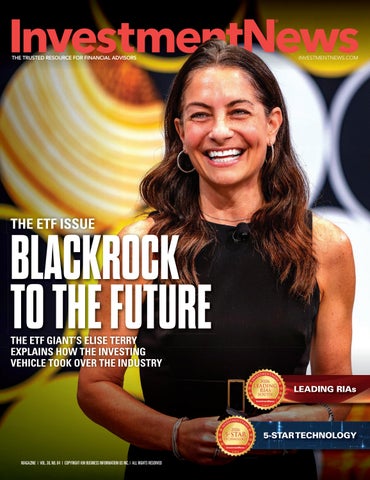
THE ETF ISSUE
BLACKROCK TO THE FUTURE THE ETF GIANT’S ELISE TERRY EXPLAINS HOW THE INVESTING VEHICLE TOOK OVER THE INDUSTRY
LEADING RIAs
5-STAR TECHNOLOGY MAGAZINE | VOL. 30, NO. 04 | COPYRIGHT KM BUSINESS INFORMATION US INC. | ALL RIGHTS RESERVED
Exclusive Experience. Elite Advisors. Elevated Independence.
Broker-Dealer of the Year Runner-Up*
Corporate Social Responsibility**
#1
10X
Highest Percentage of Women Advisors***
Inc. 5000 Fastest Growing Private Companies****
At IFG, accomplished advisors experience more than independence. They have the freedom, resources and personal support to grow, lead and build what’s next. Join a community of top-producing advisors where independence comes with genuine connection and the opportunity to take your success further.
Dedicated Transition Services & Onboarding Package
Personalized Service with No Call Centers
Succession Planning & Acquisition Support
Leading Technology & Integrated Solutions
Optional Hybrid or Corporate RIA Affiliation
Family-Oriented Events & Elite Advisor Recognition
SCAN HERE FOR MORE INFORMATION
Discover the IFG Experience Call us at 800.269.1903 Visit us at www.ifgsd.com *According to the InvestmentNews Awards, 2026. **According to WealthManagement.com, Industry Awards, 2026. ***As reported by Financial Planning Magazine, “IBD Elite Survey,” 2025. ****As reported by Inc. Magazine, Inc. 500|5000 Company Awards, 2006, 2010-2016, 2020, 2026, based on total revenue. Independent Financial Group, LLC is a member of FINRA/SIPC.
CONNECT WITH US Got a story or suggestion, or just want to find out some more information?
Contents
x.com/investmentnews facebook.com/newsfromIN
UPFRONT 2 Editorial
The rise of ETFs brings opportunity but also new demands
4 Statistics
ETF investors have a home bias
NEWS ANALYSIS
6
The ETF boom Alternative ETFs are on a tear even as many advisors flee alternative funds
8
10
COVER STORY
BlackRock to the future
21 Leading RIAs Celebrating the niche expertise of RIAs in the southern US
SECTOR FOCUS 16 Thematic investing Lauren Pfendt on WisdomTree’s bespoke portfolio consultation
18 Active ETFs Federated Hermes’ Brandon Clark sees an unusually open market
OPINION 20 Technology Why AI agents are so important
INPROFILE 25 Vestwell Award-winning fintech powers retirement for Wall Street
BlackRock’s Elise Terry offers her outlook for the ETF industry
NEWS ANALYSIS
27
SPECIAL REPORT
The search for ETF quality and value Wealth managers reveal which ETFs they’re buying, avoiding, and holding
Newswrap
34 Industry 36 Regulation 38 Retirement 40 Your Practice 42 Investing
VIDEOS
SPECIAL REPORT
5-Star Technology We salute the year’s best in wealth management technology
13
SIRION SKULPONE OF GOLDMAN SACHS ASSET MANAGEMENT SITS DOWN WITH INVESTMENTNEWS ANCHOR GREGG GREENBERG TO HIGHLIGHT THE HUGE SPIKE IN DEMAND FOR DERIVATIVE INCOME ETFS
SECTOR FOCUS
Active ETFs surge Actively managed ETFs are reshaping how advisors build portfolios
INVESTMENTNEWS.COM Contents © Copyright 2026 by KM Business Information US Inc. All rights reserved. Vol. 30, No. 4. InvestmentNews (ISSN 1098-1837) is published by KM Business Information US Inc., 3190 S Vaughn Way, Suite 550 Aurora, CO 80014.
CHECK IT OUT ONLINE
Subscription questions? Please email customerservice@investmentnews.com.
InvestmentNews.com
IN 30.04 | 1
Editorial
More ETFs, more opportunity, more homework BY JAMES ROGERS
O
ne of the big things that emerged from my meetings with industry leaders at the Exchange ETF conference in Las Vegas earlier this year was the impact that the asset class, and its current explosion, is having on advisors. Scott Davis, head of ETFs at investment management giant Capital Group, told me that the tax-efficient nature of the asset class can help free up advisors’ time and even boost succession planning when onboarding new ETF-focused advisors. Certainly, the ETF market has exploded in recent years. Data released recently by Cerulli Associates said that there were 2,692 ETFs in the marketplace in 2021, a figure that had ballooned to nearly 5,000 ETF strategies by the end of 2025. Within that number, active ETFs continue to skyrocket – there were 953 strategies launched last year, accounting for 84 percent of all new ETFs. For context, that number exceeds the 797 ETFs launched in 2021. It also dwarfs the 308 active strategies introduced that same year. Advisors should be paying close attention to this trend – research released last year by Capital Group found that active ETFs could serve as a client acquisition magnet for
advisors looking to attract Gen X, millennial, and Gen Z clients. This trend was also in evidence at the Exchange conference, where Megan Rust, vice president of ETF capital markets at Franklin Templeton, told me that younger investors are likely to fuel the growth in active ETFs, continuing the inexorable rise of the asset class. Set against this backdrop, active ETFs have seen their market share triple in recent years – the asset class
The Trusted Resource for Independent-Minded Advisors InvestmentNews.com
“You don’t have to only go to the biggest names to get it … it’s not just the Goldmans and the Franklins doing it.” As Bonacci explains, with technology, now you don’t have to have an ETF with half a billion dollars; you can have an ETF with $50 million and still be “very profitable.” But the democratization of ETFs cuts both ways. The recent data from Cerulli Associates also found that most ETF closures have involved “subscale ETFs” with assets under management of less than $50 million. These did not attract advisor and end-investor interest, according to Cerulli, which notes that, since 2021, more than 85 percent of ETF closures have occurred in these products, peaking at 92 percent last year. While not an impediment to the broader ETF industry, this trend highlights the need for due diligence from advisors. Clearly, they face a widening ETF menu with a shrinking amount of track record to use in evaluating a single fund. More choice is not, by itself, more clarity. Regulators are paying attention too. On June 30, the SEC opened a 60-day public comment period on ETFs looking to invest in innovative asset classes or engage in novel investment strategies, asking foundational questions about how such funds should be classified and registered. For advisors who’ve spent the last few years fielding pitches for newly launched ETFs, that’s a signal worth watching − not because it will slow the pace of launches but because it suggests the compliance bar for recommending
The democratization of ETFs cuts both ways
EDITORIAL VP - Editorial: James Burton Managing Editor: James Rogers Senior Columnist: Bruce Kelly Retirement & Planning Editor, Multimedia Anchor: Gregg Greenberg Journalists: Andrew Cohen, Leo Almazora Senior Sponsored Content Writer: Manal Ali SALES Chief Revenue Officer: Dane Taylor dane.taylor@keymedia.com Business Development Managers: Catherine Reale catherine.reale@keymedia.com; Victoria Hamilton victoria.hamilton@keymedia.com; Barry Echavarria barry.echavarria@keymedia.com Lead - Fulfillment Team: Cole Dizon Fulfillment Coordinators: Cyrus Arroyo, Pauline Talosig PRODUCTION VP – Production: Monica Lalisan Production Editors: Tara Tovell, Christina Jelinek, Karen Atienza, Allison Ingusan Production Coordinators: Kat Guzman, Loiza Razon Designers: Joenel Salvador, Aira Olgado, Juan Ramos Design Manager: Sheila San Miguel Creative Director: Marla Morelos EVENTS VP – Events: Katie Jones Head of Event Marketing: Oliver McCourt Awards Director: Jessica Duce Head of Event Production: Jesse Friedl Marketing Coordinators: Princess Capili, Ara Briones Event Coordinators: Dyan Del Rosario, Honey Gonzaga, Sara Sousa, Ann Tayao MARKETING & RESEARCH Global Director: Claire Preen Marketing and Operations Director: Danica Mendoza Managing Editor – Special Reports: Chris Sweeney VP – Marketing Services: Lauren Counce Marketing Activation Manager: Rissa De Leon Project Manager: Kristyn Dougall CORPORATE President: Tim Duce Director, People and Culture: Julia Bookallil CIO: Terry Szames CEO: Mike Shipley COO: George Walmsley
KM Business Information US, Inc. 3190 S Vaughn Way, Suite 550 Aurora, CO 80014 InvestmentNews is part of an international family of B2B publications, websites, and events for the finance and insurance industries INSURANCE BUSINESS AMERICA cathy.masek@keymedia.com INSURANCE BUSINESS AUSTRALIA sophie.knight@keymedia.com
accounted for 12 percent of the $14.9 trillion US ETF market last year, up from just 4 percent in 2021, according to data from UMB Fund Services and FUSE Research Network. “I would say in the last 12 months, maybe 24 months, we’ve seen a dramatic increase in the interest and demand of the active ETFs,” Tim Bonacci, CEO of Luma Financial Technologies, told me during a recent meeting in New York. Indeed, ETF wrappers are enabling large and even medium-sized RIAs to create their own ETFs and offer them to their clients, according to Bonacci.
them is about to get more explicit, not less. None of this diminishes the opportunities that ETFs present to advisors. But the same forces expanding advisors’ toolkits − cheaper access, faster launches, and tax benefits compared to mutual funds − are also expanding their responsibilities. The advisors who benefit most from this boom won’t just be the ones who move fastest into the asset class. They’ll be the ones who keep asking hard questions as the menu keeps growing.
INSURANCE BUSINESS CANADA chad.beck@keymedia.com INSURANCE BUSINESS UK gemma.powell@keymedia.com BENEFITS & PENSIONS MONITOR WEALTH PROFESSIONAL CANADA abhiram.prabhu@keymedia.com
Please recycle this newspaper
Comments? Questions? Send your thoughts to james.rogers@keymedia.com
2 | IN 30.04
InvestmentNews.com
FLCV
FLCG
FLCC
FSCC
MKTN
At Federated Hermes, we put the investments in our MDT active ETFs
through a ruthless, alpha-seeking model. Analyzing thousands of stocks every day and adjusting for evolving market dynamics. Because no one wants a flat investment. Visit federatedhermes.com/us for details.
Alpha is a measure of excess return. The quantitative models may not perform as intended which could negatively affect performance. Stocks are subject to risk and may lose value. Federated Securities Corp., Distributor.
Before investing, carefully consider the fund's investment objectives, risks, charges and expenses. Read this and more information in the prospectus or summary prospectus available at FederatedHermes.com/us
THE ETF ISSUE IN NUMBERS STOCK ETFS DOMINATE AMONG ADVISORS In a poll by Cerulli, 97% of advisors said they currently use US equity ETFs, while 78% said they are using international or global stock ETFs.
What types of ETFS are advisors using right now?
ETFS SHINE IN MODEL PORTFOLIOS Since 2021, ETFs have overtaken mutual funds as the top underlying investment vehicle by percentage of assets in the typical model portfolio. As of March 2026, more than half of the average model portfolio held its assets in ETFs, compared to about one-third for mutual funds.
ETF
Mutual Fund Bond
Stock
Close-End Fund
Money Market Fund Other
0.5% 0.4% 0.3% 1.2%
8.2%
97%
Large-cap domestic equity ETFs have long had a stranglehold on the US ETF space, consistently accounting for the largest proportion of net assets. By year-end 2025, they held $5 trillion, accounting for nearly two-fifths of all US ETF assets.
Large-cap domestic equity
US equity
Other domestic equity
34.0%
Global/ international equity
55.4%
78%
Bond Hybrid and commodity
International/global equity
72%
ETF INVESTORS HAVE A HOME BIAS
Source: Morningstar 2026 US Model Portfolio Landscape report, June 2026
ALTERNATIVE ETFS: A LONG-TERM STRATEGY
US fixed income
64% Sector strategy
51%
When asked how they would use alternative ETF strategies, 49% of advisors said they consider it as part of a long-term strategic allocation. Another 47% consider them useful when paired with traditional hedging instruments, while 45% use them for dynamic risk-allocation strategies, like targeting a specific level of total volatility within a portfolio.
As a long-term strategic allocation: 49% As a complement to traditional hedging instruments (e.g., futures, options, swaps): 47% For dynamic risk allocation (e.g., targeting a total portfolio volatility level): 45% For a specific market condition/event: 37%
Emerging markets
As a tactical/opportunistic overlay for alpha: 27%
Source: Cerulli Edge – US Asset and Wealth Management Edition, August 2025 Source: State Street’s ETFs in Focus: Risk Management Attitudes & Behaviors report, 2025
4 | IN 30.04
InvestmentNews.com
13,373
US ETF ASSETS, BILLIONS
10,305 8,086 7,191 2,250
5,449 1,564
2020
185
2021
2,704
3,583
181
1,106
1,321
1,054
1,054
2022
3,060
2,396
2,011
1,262 1,054
3,827
1,930
2,270
1,617 1,030 1,054
6,477
5,027
168
2023
2,134 1,451 1,054
169
2024
1,054 208
389
2025
Source: Investment Company Institute, The US ETF Market: FAQs (https://www.ici.org/faqs/faqs_etfs_market), accessed August 7, 2026.
A BOOMING OUTLOOK FOR OUTCOME ETFS After showing 50x growth over the past six years, driven by strong demand for incomeoriented products in particular, outcome-oriented ETFs are expected to boom further from $265 billion into a $650 billion category by 2030.
ACTIVE ETFS GAINING GROUND IN MODELS Active strategies have come to represent 29% of underlying ETF assets within model portfolios, a long way from just 9% as of March 2021. Active
$650B
91%
78%
$550B
Passive
78%
71%
39%
$272B
35% 33%
$61B $5B 2019
23% 9% 2022
2025
2028P
2030P
Source: BlackRock, Outcome ETFs & Income Strategies: How Do They Work?, https://www.ishares.com/us/insights/outcome-etfs-income-strategies, accessed August 8, 2026
InvestmentNews.com
29%
31%
March 2021
March 2026 Source: Morningstar 2026 US Model Portfolio Landscape report, June 2026
IN 30.04 | 5
THE ETF ISSUE NEWS ANALYSIS
ALTERNATIVE ETFS BOOM IN 2026
Alternative ETFs are on a tear this year, with Morningstar reporting $10.7 billion of net inflows through July. This comes as some semiliquid alternative funds, particularly private credit, struggle BY BRUCE KELLY
I
nvestors and financial advisors this year have turned to exchange-traded funds that invest in a variety of alternative strategies, even as many investors and advisors decide to flee alternative funds that have far fewer opportunities for investors to sell and cash out. According to fund tracker Morningstar Inc., alternative ETF estimated net asset flows totaled $10.7 billion for the first seven months of the year, or more than four times the total amount of new money tallied last year. Meanwhile, customers and clients of financial advisors sold back or redeemed $5.9 billion
alternative funds flows – a huge increase for ETFs and sizable outflows for nontraded funds; but the disparity is an indication that clients and advisors are skittish about traditional bond investments, particularly as many believe interest rates could rise. “People are freaking out about the traditional 60/40, stock/bond mix,” said Jason Kephart, senior principal, multi-asset manager research at Morningstar. “The 40 hasn’t worked for a while now.” “It’s the story of people diversifying away from traditional fixed income,” Kephart said. “One of
“People are freaking out about the traditional 60/40, stock/bond mix. The 40 hasn’t worked for a while now” JASON KEPHART, MORNINGSTAR of shares to nontraded business development companies in the second quarter, according to alternative fund tracker Robert A. Stanger & Co. Inc., raising the total of investor funds sold back to companies to $12.7 billion this year. Nontraded BDCs, sold for their high yields, have been an extremely popular alternative investment with advisors and clients in the past few years. Unlike ETFs, nontraded BDCs and other semiliquid alternative funds sold today have a redemption cap each quarter; that means clients can sell typically 5 percent of the fund’s NAV back to the company every three months. ETFs are traded on exchanges. Industry executives said there was no one over-arching reason for the different directions in
6 | IN 30.04
the reasons private credit funds and BDCs got so popular was due to traditional fixed income being challenged by rising interest rates.” “The broader market has gone to cash for the short term,” said an alternative investment industry executive who spoke privately to InvestmentNews about the matter. “There’s a lot of noise in world, with Iran the loudest.” Indeed, liquid alternative ETFs are having a renaissance; a few years ago it was a wasteland, executives noted. But will they perform? “To my mind, the broader story is, yes, there’s a lot of money going to alternative ETFs, but will the returns be any good?” the executive said. “Remember back to the push of liquid alternatives
after the credit crisis, and all the focus on long/short mutual funds.” “None of them performed because they held too many public securities and too much cash,” the executive noted. “We’re in the same spot with these current ETFs.” As investors and their financial advisors buy alternative ETFs, a few prominent funds in 2026 have emerged, according to industry executives. Prominent among them is IALT – the ticker symbol for iShares Systematic Alternatives Active ETF. Launched in December, the fund invests in “a range of global asset classes and a diversified set of alternative − or nontraditional − strategies that seek to provide total return in both periods of strong returns and periods of market stress,” according to Morningstar. Not even a year old, the fund already had $5.6 billion in assets on August 24. And Wall Street has taken a shine to ETFs with alternative strategies, which means financial advisors will see more pitches for such products from asset managers in the future.
InvestmentNews.com
ALT ETF ASSETS ARE GROWING
“Investors used to mutual funds and ETFs who look at semiliquid options are in for sticker shock” MORNINGSTAR REPORT Goldman Sachs Asset Management in August said it was expanding its footprint in options-based ETFs, agreeing to acquire NEOS Investments, a $30 billion income-ETF specialist, deepening a buildout that began with its purchase of Innovator Capital Management last year. The combined platform from the deal will place Goldman among the top 10 active ETF providers by assets, according to the company. The transaction, worth up to $2.25 billion in cash and equity, will fold NEOS’s 19 systematic options-based income ETFs into a platform that already includes Innovator’s defined-outcome lineup. “As investor demand for active ETFs grows, NEOS’ disciplined investment approach is highly complementary to our capabilities across buffer,
InvestmentNews.com
ETF ALTERNATIVE TOTAL NET ASSETS
$9.6 billion December 2025
managed outcome, and income strategies,” Goldman Sachs’ chair and CEO David Solomon said in a statement. “Together, we will give investors a diverse toolkit for different market environments.” Meanwhile, the differences – particularly expenses – between nontraded or semiliquid alternative funds like private credit BDCs and alternative ETFs or mutual funds remain stark. “Investors used to mutual funds and ETFs who look at semiliquid options are in for sticker shock,” according to a report this June from Morningstar. “The average annual report net expense ratio, adjusted for borrowing costs, for semiliquid funds was just over 3 percent.” “That number, however, understates the true costs on account of inconsistently disclosed
$20.8 billion July 2026
Source: Morningstar
incentive fees and, at funds of funds, acquired fund fees and expenses,” the report added. “Semiliquid funds have more complex fee structures than mutual funds or ETFs,” according to the report. “First, many employ leverage or use debt or debtlike instruments to increase their asset bases. That leverage comes with costs. Semiliquid funds also often charge incentive fees, which can rival− or even exceed− management fees.”
IN 30.04 | 7
THE ETF ISSUE NEWS ANALYSIS
ADVISORS FAVOR QUALITY AND VALUE ETFS AS LEVERAGE RISKS BUILD Three wealth managers reveal which ETFs they’re buying, avoiding, and holding as small caps and non-US stocks rally BY GREGG GREENBERG
W
ealth advisors are tilting client portfolios toward quality- and value-focused ETFs as they watch leverage build up beneath an otherwise strong US economy in 2026. Even with corporate earnings holding up, several advisors say borrowing tied to artificial intelligence infrastructure and cracks surfacing in the private credit market are early warning signs worth positioning around. “The backdrop is that even though the economy is charging ahead and the earnings season has been strong, there is still a lot of leverage that is being built into the system,” says Anna Rathbun, founder and chief executive of Grenadilla Advisory. “We can see this through headlines for AI-related borrowing as well as the deals that fall through in the private credit market.”
LEVERAGE CONCERNS PUSH ADVISORS TOWARD QUALITY AND VALUE
Rathbun says that as risk builds in the system, it can make sense to lean portfolios toward factors that have historically held up better when investor sentiment turns. “As risks build into the system, it may be wise to lean the portfolio toward quality and value,”Rathbun says. “Don’t bet the farm on it, but understand that these positions have traditionally done better when fear creeps into market sentiment.” Her preferred vehicles for that tilt are the Vanguard Quality Factor ETF (VFQY) for broadmarket quality exposure and the Vanguard US Value Factor ETF (VFVA) for value.
DIVERSIFICATION INTO SMALL CAPS AND NON-US STOCKS PAYS OFF
Not every advisor is framing 2026 around defense. Jeffrey Ingraham, managing director and head of portfolio strategy at EP Wealth Advisors, says
8 | IN 30.04
this year has finally rewarded clients who stayed diversified beyond US large-cap stocks. “Diversification in equity portfolios has finally paid off this year as non-US equities and US smallcap equities have outperformed US large cap for the first time in a long while,” Ingraham says.“While this may not necessarily be considered the ‘hottest’ trade in markets right now from a flows or maximum return perspective, it’s nice to see investors who have a longer-term perspective be rewarded for their patience and discipline.” Ingraham says his firm allocates to the Vanguard Small Cap Growth ETF (VBK) and the Dimensional US Targeted Value ETF (DFAT) within US small caps. For non-US exposure, he points to the iShares Core MSCI Emerging Markets ETF (IEMG), citing
“As risks build into the system, it may be wise to lean the portfolio toward quality and value” ANNA RATHBUN, GRENADILLA ADVISORY the importance of understanding how a country is classified. “It’s important to note the distinction in which countries are classified as developed versus emerging, as we’ve seen that can potentially have a huge impact on returns this year with South Korea,” he says. “We allocate to the iShares Core MSCI Emerging Markets ETF, which provides the broadest exposure to EM from both a country and market cap perspective.”
5 FACTORS OF HIGHQUALITY STOCKS High profitability Stable, consistent earnings growth Low financial leverage Durable competitive advantages Defensive, lower-volatility behavior
LEVERAGED AND THINLY TRADED ETFS DRAW THE SHARPEST WARNINGS
Both Rathbun and Ingraham single out leveraged and single-stock ETFs as products to avoid, echoing scrutiny the products have drawn from regulators, including a recent SEC warning over plans for higherleverage ETF products. “Any leveraged and single-theme products, such as 3x levered index funds (like SOXL among others) and the newer single-stock leverage ETFs” should generally be avoided, Rathbun says. “I know it can be tempting when the market runs upward and you want to ‘juice’ your returns, but these leveraged instruments do not work the way one might assume.
InvestmentNews.com
The daily-reset mechanics of these leveraged ETFs mean that volatility decay works against you – the underlying index can go up but you might still lose money. If the underlying index is up 5 percent over time, you won’t necessarily see 15 percent gain. You might have lost money depending on how the market moved in the interim.” Rathbun also flags newer, low-asset thematic launches as a closure risk. “A fund that screens well on trailing performance or is started by a star analyst/manager but only holds $50 million ... means that you are exposed to real closure risk,” she says. “If the fund closes due to low AUM and the theme runs out of fashion, you will realize all the gains even if you do not make the decision to sell, and you’ll suddenly have a lot of taxable gains on your hands ... product proliferation, especially of leveraged products, tells me that we may be heading into the late-cycle market dynamics.” Ingraham is similarly direct. “We’ve observed the significant increase in leveraged ETFs over the past several years – both index-based and single stock – but caution our clients against utilizing these strategies,” he says. “The leveraged daily return aspect from these strategies introduces a volatility decay and sequence of returns risk that is often misunderstood by investors and doesn’t fit with our goals-based, long-term investment philosophy.”
CORE HOLDINGS AND SECTOR BETS STAY BROAD-BASED
For core exposure, both advisors lean on low-cost, broad-market funds rather than tactical bets. Rathbun holds general market ETFs tracking the Russell 1000 growth and value indexes, the Russell 2000, and
InvestmentNews.com
“When you have a booming economy, we would stay away from defensive areas like consumer staples − which we would underweight − healthcare, and utilities” EDDIE GHABOUR, KEY ADVISORS WEALTH MANAGEMENT the MSCI ACWI ex-US index, alongside actively managed fixed income ETFs such as the T. Rowe Price Total Return ETF (PSDM), where she believes active management adds value. Ingraham’s core equity holdings include the Vanguard Growth ETF (VUG), the Vanguard Value ETF (VTV), and the Vanguard International Dividend Growth ETF (VIGI), alongside IEMG, with fixed income anchored by the iShares Core US Aggregate Bond ETF (AGG), the iShares 1−5 Year Investment Grade Corporate Bond ETF (IGSB), and the Janus Henderson Securitized Income ETF (JSCP). Eddie Ghabour, co-founder and chief executive of Key Advisors Wealth Management, is leaning into sectors he expects to benefit from an accelerating economy. “We believe this economy is going to accelerate in the coming months due to the productivity boom from AI and an accommodative monetary policy cycle we are still in,” Ghabour says. He names industrials, citing data-center buildouts; small caps, which he says could gain the most productivity benefit from AI; financials, which he calls “a goldilocks scenario”; and software, where he says companies “have much easier comps over the next 6−12 months and have already lived through a correction.”
5 BIGGEST LEVERAGED ETF RISKS Volatility decay from daily resets Unsuitable for buy-and-hold investors Losses even when your market call is right Elevated costs and liquidity risk Concentration and single-stock exposure
On the other side, Ghabour says he is avoiding defensive sectors. “When you have a booming economy, we would stay away from defensive areas like consumer staples − which we would underweight − healthcare, and utilities,” he says.
IN 30.04 | 9
THE ETF ISSUE C-SUITE
ETFS COME OF AGE Elise Terry, BlackRock’s co-head of the Americas for global product solutions and head of Americas iShares, offers her outlook for the ETF industry BY GREGG GREENBERG GLOBAL ETF assets under management hit a record $23.09 trillion at the end of June 2026, according to ETFGI, a London-based independent research firm that has tracked the industry since 2012. BlackRock’s iShares accounts for 27 percent of that total, or $6.2 trillion – a figure that would have seemed fantastical when BlackRock acquired iShares from Barclays Global Investors in 2009 for $13.5 billion, at a moment when the entire platform held only $300 billion in assets and the firm was navigating the wreckage of the global financial crisis. Elise Terry was in sales at BlackRock when that deal closed. She did not foresee the scale to which the ETF business would eventually grow – few people on Wall Street did, save perhaps her boss, BlackRock co-founder and chief executive Larry Fink – but she saw something else: a structural solution to problems that had plagued investors for decades. “ETFs solved real problems for investors: lower costs, greater transparency, liquidity, and tax efficiency,” Terry says. “As investing became more outcome-oriented and advisors increasingly built portfolios instead of picking individual securities, ETFs became the natural vehicle.” In other words, the ETF didn’t change investing. It changed how investing gets delivered. It also changed the trajectory of Terry’s career. She rose through BlackRock’s ranks over the next two decades to become co-head of the Americas for global product solutions and head of Americas iShares – a division that now accounts for 10 | IN 30.04
approximately 40 percent of the firm’s $15.3 trillion in total assets under management, according to BlackRock’s second-quarter 2026 earnings results. She is the public voice of the platform for advisors, institutions, and individual investors alike, overseeing a product suite that now spans index ETFs, active fixed income, options-based outcome strategies, and liquid alternatives. “I certainly didn’t map out my career thinking I’d one day lead iShares. I’ve been fortunate to grow alongside this business, learning from incredible colleagues and, most importantly, from our clients. Today, what stands out to me isn’t the prominence of the role – it’s the responsibility,” Terry says.
LET IT FLOW – AND ACTIVELY SO
iShares led global ETF industry inflows in the first half of 2026, gathering a record $310 billion in net inflows for the period. That result came atop a record first quarter of $132 billion, with active ETFs contributing more than $70 billion in net inflows over the trailing 12 months – cementing iShares as the third-largest active ETF issuer globally. Terry believes the sustained move into ETFs is considerably larger than a market cycle. In her view, investors are choosing ETFs as their preferred investment vehicle because they combine efficiency with flexibility – a pairing that has made them central to long-term portfolio construction across
InvestmentNews.com
ELISE TERRY HOMETOWN: Long Island, NY CURRENT RESIDENCE: Princeton, NJ
“The future isn’t one wrapper winning − it’s giving investors better ways to access investment opportunities” every client channel, from individual retail investors to the largest sovereign wealth funds. BlackRock’s November 2025 “People and Money” survey of more than 5,000 US adults found that an estimated 24 million Americans now own ETFs, representing roughly 23 percent of all investors in the country. At the same time, the use cases for ETFs continue to expand. Strategies like the BINC iShares Flexible Income Active ETF – launched in 2023 and managing approximately $16.2 billion in assets as of late July 2026 – demonstrate the surging demand for active fixed income management delivered through the ETF structure. The IALT iShares Systematic Alternatives Active ETF, launched in December 2025, reflects a different kind of expansion: making hedge fundstyle alternative strategies – equity market neutral, managed futures, and diversified bonds – accessible to investors at institutional scale through a dailyliquidity wrapper. “The story isn’t that investors are buying more ETFs – it’s that they’re building more portfolios with ETFs. And that shift has years, not quarters, ahead of it,” Terry says. The trend toward actively managed ETFs has complicated the industry’s traditional narrative around cost. Passively managed ETFs were the standard when the structure was introduced in the early 1990s and have been celebrated for
InvestmentNews.com
driving fees toward zero. Active ETFs carry higher expense ratios – BINC charges 0.52 percent, IALT 0.25 percent – and have attracted scrutiny from those who see their growth as diluting the original value proposition of the ETF wrapper. Terry does not see it that way. “Investors have become much more discerning about fees, recognizing that you should pay less for beta and pay for alpha only when it’s truly differentiated. Active ETFs make that possible while preserving many of the structural advantages that made ETFs so compelling in the first place,” she says.
BETTER INNOVATION, NOT SIMPLY MORE PRODUCTS
The global ETF industry comprised 17,404 ETFs as of the end of June 2026, according to ETFGI’s June 2026 report – a figure that stands in stark contrast to the roughly 1,100 funds that were trading when BlackRock purchased iShares in 2009. The expansion has not been universally welcomed. Some market participants argue that the proliferation of funds – many of which attract minimal assets and trade thinly – is unhealthy for the industry and ultimately disorienting for investors. Terry acknowledges the tension but does not frame it as a critical problem. In her view, the next chapter for ETFs will be defined by better innovation, not simply more
EDUCATIONAL BACKGROUND: BS degree in finance and marketing from Fairfield University
FAMILY: Husband, two stepdaughters, and an energetic black lab puppy HOBBIES: Hiking, exploring nature products. Investor needs are evolving, creating legitimate room for new solutions – but not every investment idea belongs in an ETF wrapper. “At iShares, we focus on strategies with a clear client need, strong investment merit, and a structure that works well in the ETF wrapper. Success is not measured by how many ETFs you launch, but by how many investor problems you solve,” Terry says. The reference point she has in mind is easy to name. With approximately $900 billion in assets as of mid-2026, the IVV iShares Core S&P 500 ETF has become one of the most trusted investment vehicles in the world – held by institutions, financial advisors, and individual investors alike as a low-cost, tax-efficient core equity holding that consistently delivers what it promises. Terry stresses that she protects that trust by obsessing over execution every day, from index-tracking precision to liquidity management and tax efficiency. “In our business, trust compounds faster than returns. That’s the moat we’re focused on protecting,” she says.
LEVERAGED ETFS, IVV, AND IQQ
One area where iShares has taken a deliberate stand is leveraged ETFs – the high-octane, daily-reset products offered by competitors like ProShares and Direxion that amplify both gains and losses by a fixed multiple each trading day. BlackRock has not built a traditional daily leveraged ETF, and under Terry’s stewardship, the firm shows no urgency to do so.
IN 30.04 | 11
C-SUITE “Cost will always matter, but it’s only one part of the value proposition. We launched IQQ to provide investors with efficient access to one of the world’s most important equity benchmarks, while also expanding a broader Nasdaq toolkit,” Terry says.
BLACKROCK TO THE FUTURE
Looking ahead, Terry sees two emerging growth vectors that could significantly expand the number of Americans participating in capital markets through iShares ETFs. The first is Trump Accounts – the taxadvantaged children’s savings vehicles created under the One Big Beautiful Bill Act, signed on July 4, 2025, and opened for contributions on July 4, 2026. Under the program, children under 18 whose funds are in the growth phase must be invested in low-cost, broad US equity index funds or ETFs with annual expense ratios capped at 0.10 percent. The US Treasury’s initial approved fund list included the IVV iShares Core S&P 500 ETF and the ITOT iShares Core S&P Total US Stock Market ETF – both of which carry expense ratios of 0.03 percent. The BlackRock Foundation committed an additional $1 million grant to Invest America in March 2026 to support enrollment awareness campaigns for the program.
“Success is not measured by how many ETFs you launch, but by how many investor problems you solve” ISHARES ETFS (AS OF JUNE 30, 2026) Total BlackRock AUM: $15.3 trillion iShares total AUM: $6.2 trillion Total # of ETFs: 1,600+ Total # of active ETFs: 158 global, 72 in US Largest ETF: iShares Core S&P 500 ETF (IVV), $888 billion (as of July 10, 2026) Instead, in January 2025, BlackRock launched the TWOX iShares Large Cap Accelerated Outcome ETF – a meaningfully different structure. TWOX uses a quarterly options strategy to target approximately twice the upside of IVV up to a defined cap, while seeking to track IVV’s downside one for one. It is not a traditional leveraged ETF: it does not reset daily and it does not amplify losses. The distinction matters considerably for long-term holders.
12 | IN 30.04
“We believe complex strategies should have a clear investment purpose and investors should fully understand how they’re expected to behave,” Terry says. “That’s why we’ve taken a different approach with products like TWOX, which was designed around a specific investment outcome rather than daily leverage. Innovation isn’t about complexity – it’s about clarity. We’ll continue expanding where we believe we can improve investor outcomes.” On the competitive front, this summer BlackRock launched the IQQ iShares Nasdaq 100 ETF – entering one of the most contested corners of the ETF market with a 0.10 percent expense ratio, undercutting Invesco’s QQQ Trust at 0.18 percent and its institutional share class QQQM at 0.15 percent. IQQ joins State Street’s SPDR Portfolio Nasdaq 100 ETF (QNDX), which launched in June 2026, as the second significant challenger to Invesco’s decades-long grip on Nasdaq-100 index fund flows.
“We’re honored that IVV and ITOT were selected because they provide simple, diversified, low-cost building blocks for those beginning their investment journey,” Terry says. “The greatest investment isn’t just in markets – it’s in creating more informed, longterm investors.” The second is the longer horizon: what eventually displaces the ETF as the industry’s dominant investment wrapper. Terry is clear that she does not expect the ETF to be unseated by a single successor. The future of asset management, in her view, is about expanding choice rather than replacing one structure with another. “ETFs will continue to play a foundational role, but they’ll exist alongside SMAs, private markets, and increasingly tokenized assets, each serving different investor needs,” she says. “Our job is to give clients access to the right vehicle for the right objective. The future isn’t one wrapper winning – it’s giving investors better ways to access investment opportunities.” From a sales rep who spotted a structural shift that most of Wall Street missed to the executive overseeing a $6.2 trillion platform that has reshaped how the world invests, Terry’s career arc tracks almost precisely with the arc of the ETF. Whether the next chapter belongs equally to both remains the industry’s most interesting open question.
InvestmentNews.com
SECTOR FOCUS THE ETF ISSUE
ACTIVE ETFS RESHAPE HOW ADVISORS BUILD PORTFOLIOS Actively managed ETFs are capturing an outsized share of flows as advisors lean on them to complement passive strategies and scale their practices BY ANDREW COHEN
A
ctive ETFs have taken an oversized chunk of all flows into ETFs this year despite the sector’s total asset figure still being dominated by passive funds. About 88 percent of all new ETFs launched this year through the end of June were actively managed, according to mid-year data tracked by J.P. Morgan Asset Management. Active ETFs have taken about 38 percent, worth $450 billion, of all flows into ETFs
InvestmentNews.com
at this year’s halfway point as the strategy has seen steady annual increases since it held 9 percent of all ETF flows in 2021. “It’s no longer an active versus passive [ETF] story when we talk to our clients,” says Julie Guntz, global head of ETF strategy and partnerships at AllianceBernstein. “It’s how do we use passive core building blocks along with active solutions to create portfolios for our clients. And I think that passive
and active dialogue in portfolio construction will continue into the future.” Actively managed ETFs can prove to be particularly beneficial for investors leaning into themes like the crowded artificial intelligence ecosystem, according to Jon Maier, chief ETF strategist at J.P. Morgan Asset Management. “Certain companies are overvalued, particularly on the AI spectrum, from the hyperscalers to the
IN 30.04 | 13
SECTOR FOCUS ACTIVE ETFS BY THE NUMBERS
38%
share of all ETF flows captured by active ETFs in H1 2025, worth $450 billion (J.P. Morgan Asset Management)
12–13%
of total ETF AUM is actively managed, up from 2% in 2019
88%
of new ETFs launched through June were actively managed
$180B
in derivative income ETF AUM, with 70%+ CAGR since 2021 (Morningstar)
$25T
projected size of US ETF market by 2030 (J.P. Morgan)
“It’s no longer an active versus passive story. It’s how do we use passive core building blocks along with active solutions to create portfolios” JULIE GUNTZ, ALLIANCEBERNSTEIN broadening out of the AI trade into infrastructure, into semis [semiconductors], energy,” says Maier. “Finding those individual companies that have better valuations that are leveraging their capex spending, that’s what an active manager can do.” Active ETFs account for about 12 percent of all assets under management in the total ETF market, which J.P. Morgan tracks at $16 trillion. Part of J.P. Morgan’s active ETF growth has been driven by the popularity of its derivative income exchange-traded funds such as JEPI and JEPQ. “We have roughly 50 percent of that marketplace. But there’s certainly other competitors, and that provides a really interesting place in the marketplace when you’re seeing volatility under the surface,” says Maier. “Derivative income type strategies has really played into that category, where our fund JEPI, for example, has 60 percent of the volatility of the S&P 500 and yields roughly 8 percent.” Derivative income ETFs have grown to approximately $180 billion in assets under management, with a compound annual growth rate of more than 70 percent since 2021, according to Morningstar.
14 | IN 30.04
Firms are taking notice, with Goldman Sachs making a move in August to buy the $30 billion active ETF manager NEOS, which launched its first options-based derivative income ETFs in 2022. “ETFs have been around for over 30 years, and when they started, they were largely synonymous with index-based investment strategies,” Scott Davis, head of ETFs at Capital Group, tells InvestmentNews. “But that’s all changed. With the advent of active ETFs, the Rule 6c-11 passage in 2019, you’ve seen [active ETFs] go from 2 percent [of total ETF assets] in the year the SEC passed the rule − now they’re 12 percent, almost 13 percent. And that’s a trend I think that will persist.” Capital Group spans $157 billion in ETF assets, all of which are actively managed. Research from Capital Group found that 45 percent of Gen Z, millennial, and Gen X investors said they would be more likely to choose a financial professional who includes active ETFs in their investment approach. “Many advisors are looking to scale their practices and gain efficiency by leveraging model portfolios, and ETFs are a great ingredient in those model
portfolios,” says Davis. “It gives the advisor more time to spend with clients, [and] the ability to grow their practice and spend more time on that. It delivers a consistent, repeatable outcome to the clients in that advisor’s book of business.” Surging inflows into active ETFs have J.P. Morgan projecting that the entire US ETF market will reach $25 trillion by 2030. J.P. Morgan also forecasts that the global fixed-income ETF market will nearly double from roughly $3.6 trillion today to $7 trillion by 2030. Municipal bond ETFs account for a growing fixed income product within AllianceBernstein. “Fixed income continues to grow, especially active fixed income,” Guntz says . “In the US, the muni space with an ever-increased focus on taxes, we’ve seen a lot of conversations around our muni ETF lineup and how clients can use that in their portfolios.” The ETF marketplace has grown to about 420 providers, according to Maier. Fee dynamics for RIAs to access ETFs from distributors like Fidelity and Schwab are changing. Since 2024, Fidelity has charged a service fee to ETF providers that can take as much as 15 percent of a fund’s annual revenue. More recently, Barron’s reported that Fidelity has penalized ETF companies that won’t pay service placement fees, charging the ETFs’ end investors 5 percent of each trade’s value, up to a maximum of $100. The number of ETFs subject to Fidelity’s 5 percent service fee surcharge more than tripled − from 28 to 97 − between November 2025 and August 2026, per Fidelity’s website. “Our longstanding approach has been to maintain a consistent framework across investment products. As the support, service, and infrastructure required to serve the growing ETF marketplace have expanded in recent years, that approach has evolved accordingly,” a Fidelity spokesperson tells
InvestmentNews.com
InvestmentNews. “We continue to work closely with asset managers, as we always have, to reach outcomes that support investors and reflect a more consistent approach across mutual funds and ETFs.” ETF platform fees are also coming to Schwab, the leading custodian for RIAs ahead of Fidelity. “At Schwab, we remain committed to working in close partnership with the asset management community
taking effect no later than Q1 2027. Our goal is to maintain and enhance the platform so we can continue delivering value to both asset managers and Schwab clients,” says Schwab. Smaller ETFs run by boutique firms make up most of Fidelity’s eligible service fee list, with Roundhill Investments having the biggest presence as of August. The Roundhill Memory ETF consisting
FIDELITY FEE SURGE, BY THE NUMBERS
“Many advisors are looking to scale their practices and gain efficiency by leveraging model portfolios, and ETFs are a great ingredient in those model portfolios” SCOTT DAVIS, CAPITAL GROUP to deliver solutions that serve our clients’ best interests,” says a spokesperson for Schwab, adding the fees will start by early next year. “As our ETF platform grows in scale and sophistication, we have begun thoughtful, often bespoke, conversations with asset managers regarding platform fees. These discussions are expected to take place throughout this year, with implementation
of microchip stocks amassed $25 billion in assets after hitting $1 billion within its first 10 days in April. “I think distributors are looking at fee structures going forward as the marketplace changes, as there’s conversions from mutual funds to ETFs. That potentially could increase costs on the issuer side,” says Maier. “So I think you’ll see changing dynamics, and the markets will adjust accordingly.”
Fidelity’s 5% trade surcharge now applies to 97 ETFs, up from 28 in November 2025 − a more than 3x increase in nine months
Fidelity’s service fee can take up to 15% of a fund’s annual revenue
Schwab platform fees expected to take effect no later than Q1 2027
InvestmentNews’ special reports provide an expert-collated resource for the industry, highlighting best-in-class partners, leading service providers, and the professionals driving innovation across the wealth management sector. In 2027, InvestmentNews will produce a comprehensive portfolio of special reports covering topics and trends that are top of mind for industry professionals. •
$100M Club: Top Female Advisors
•
Best Places to Work
•
5-Star Financial Planners
•
Hot List
•
5-Star Technology
•
Rising Stars
•
5-Star Wealth Management Teams
•
Top Advisors
If you would like further details on how to be involved, please get in touch via email at sophia.egho@keymedia.com.
InvestmentNews.com
IN 30.04 | 15
THE ETF ISSUE SECTOR FOCUS
A well-diversified portfolio can still hold unwelcome surprises
In partnership with
The broad building blocks of portfolio construction are usually there. At WisdomTree, closer examination begins inside each allocation
T
wo funds can carry different names, different managers, and different investment philosophies. They can also own many of the same companies. An advisor holds what appears to be a large value strategy alongside a core equity position. On paper, the two funds are meant to play different roles. Then the holdings are laid side by side. “Large value funds sometimes have a lot of overlap with core strategies, and core holdings can overlap significantly with growth. When you look under the hood, what are supposed to be different exposures often behave quite similarly,” says Lauren Pfendt, senior associate for portfolio solutions at WisdomTree. Sometimes the overlap is intentional; often, though, it comes as a surprise. “An advisor will look at the two side by side and say, ‘I didn’t realize how similar these actually are. Maybe I don’t need both.’ That’s where the conversation gets productive.” In her daily review of advisor portfolios as part of WisdomTree’s Portfolio Consultation offering, Pfendt rarely finds any missing entire asset classes. It’s inside those allocations that the picture becomes more complicated, with overlapping holdings, unintended credit exposure, and strategies that don’t always deliver the role they were expected to play.
MORE CHOICE HASN’T MADE PORTFOLIOS SIMPLER
When Pfendt joined WisdomTree, many advisors were looking for help replacing legacy mutual fund portfolios with ETFs while maintaining similar riskand-return characteristics. Those conversations still happen. Increasingly, though, advisors arrive with more specific questions about where to express a market view. “Thematic investing has definitely been top of mind this year. Advisors are asking how to incorporate thematics, how to get exposure to particular subregions. We show them how to carve out space for these more opportunistic asset classes in the context of their own portfolio – what to buy and what to sell.” Pfendt has watched interest follow performance. “When you see momentum in an asset class, people start to flood to it and pay attention to it,” she says, pointing to last year’s run in gold, silver, and commodities. “Most portfolios I review have the top-level diversification covered – developed international, emerging markets, fixed income, an alternatives sleeve. But within those sleeves, there are often opportunities to diversify further and improve factor exposures. That’s usually where we find the most room to add value.” Pfendt leads “with the highest conviction ideas tailored to each advisor and their objectives. That might mean a handful of asset-allocation suggestions and fund-replacement ideas.”
16 | IN 30.04
“An advisor will look at the two side by side and say, ‘I didn’t realize how similar these actually are. Maybe I don’t need both.’ That’s where the conversation gets productive” LAUREN PFENDT, WISDOMTREE FIXED INCOME RARELY GETS IGNORED. IT OFTEN GETS DELEGATED
Bond portfolios often receive less scrutiny – not because advisors dismiss fixed income but because many outsource those decisions to active managers. “The majority of fixed income portfolios I review use strategies that combine several fixed income asset classes into one wrapper,” Pfendt says. “That can make it difficult to know what duration, sector, and credit risk you’re taking on. Unless you periodically review the exposures and unpack what’s in there, it’s not always obvious that you know what you own.” WisdomTree’s own CIO-managed models take a different structure: a core bond fund as the anchor, with satellite fixed income exposures around it that the Model Portfolio Investment Committee adjusts deliberately. “When we want to be overweight a specific fixed income asset class, we add that exposure to the portfolio via a dedicated position,” Pfendt says. “For example, when our investment committee decided to overweight agency mortgage-backed securities, we added targeted exposure through a dedicated ETF.” With WisdomTree’s current expectation that interest rates will remain higher for longer, many of Pfendt’s conversations come back to the same trade-off. “How can we mitigate duration and credit risk while still maintaining attractive income?” The answer isn’t always to add another fund but to start by examining what’s already there. Once active bond strategies are unpacked, advisors can see where duration sits, how much credit risk they’ve
taken on, and whether those exposures still reflect what they intended.
WHAT COMES NEXT
As portfolios become more specialized, advisors need to spend more time understanding how each holding contributes to the whole. “We’re very bespoke with our proposals,” she says. “If an advisor wants to deep-dive their international equity sleeve, we focus there – custom commentary, proposed changes, all tailored to their unique objectives. It’s never a cookie-cutter report.” She expects advisors to keep looking for outside perspectives as their responsibilities continue to grow. With The Great Wealth Transfer accelerating, advisors will be managing more assets and more relationships than ever. A second set of eyes can reveal where two funds are doing the same job, where risk has accumulated without anyone noticing, or where an allocation has drifted from its original purpose. The portfolio still belongs to the advisor. The consultation simply gives them a clearer understanding of what they’ve already built. Scan for more information and important disclaimers
InvestmentNews.com
WT_Fut
WisdomTree
Portfolio Consultations
Your portfolios, our insights Visit WisdomTree.com/PortfolioConsultations and schedule an introductory call to get your personalized report.
InvestmentNews.com
WT_FutureProof_MagAd_10x13_Aug26Revision_V3_FINAL.indd 1
IN 30.02 | 17
8/14/26 2:33 PM
THE ETF ISSUE SECTOR FOCUS
The race to define active ETFs is wide open Federated Hermes’ Brandon Clark sees an unusually open market as advisors become more selective about the risks they own
A
lmost every active ETF on the market today is, in a sense, roughly the same age. After years on the indexing side of the industry, Brandon Clark saw something unusual in active ETFs: few entrenched positions and plenty still to be built. “We all started from scratch around 2020, with the passage of the ETF rule,” says Clark, director of ETF business at Federated Hermes. Mutual funds carry a century of track record behind
18 | IN 30.04
their leaderboard; active ETFs do not. “There’s no predetermined position on where anybody lives in that leaderboard,” he says. That open field is what drew Clark to Federated Hermes nearly six years ago, and why he sees the roughly $12 trillion still in actively managed mutual funds (as of June 30, 2026, per Investment Company Institute) as available territory for the ETF wrapper. What advisors are asking that wrapper to do, however, has become more specific.
INCOME HAS CHANGED SHAPE, NOT DISAPPEARED
Income is one place where the appeal of a more targeted approach is becoming clearer. Rate uncertainty has kept some advisors focused on the front end of the curve, where Clark sees an attractive trade-off between the yield available and the duration risk required to earn it. “Clients are trying to manage duration, not knowing the path of travel for rates,” he says.“Can I lock in those yields without going all the way out and introducing that volatility again?” That matters because extending farther out no longer necessarily buys an advisor substantially more income. Clark’s point is that much of the available yield potential may still be captured at the short end, allowing advisors to potentially limit interest-rate sensitivity rather than taking additional duration risk for a relatively modest pickup in yield. Federated Hermes has built several strategies around that trade-off. Federated Hermes Ultrashort Bond ETF (FUSD) targets duration of one year or less, giving advisors a way to move beyond money markets while remaining close to the front of the curve. The same principle applies in high yield. Short Duration High Yield ETF (FHYS) seeks to capture
InvestmentNews.com
In partnership with
“Advisors worry when five to 10 stocks are driving outcomes. So they’re thinking about how to best manage that risk” BRANDON CLARK, FEDERATED HERMES competitive yield with lower duration than the overall high-yield market. That is what can make the short end more than a temporary parking place. For advisors, it can be used to fine-tune a core fixed income allocation while preserving flexibility if the rate outlook changes. Clark says covered-call strategies have continued to attract interest since 2022 as advisors rethink how clients can generate cash flow without giving up equity exposure altogether. “The question becomes, what’s my equity risk mix look like?” he says. “I might be able to actually keep some equity risk on the table using some of these covered-call strategies.” That broadens the income decision considerably. Advisors can now choose among short-duration bonds, longer duration credit, and options-enhanced equities, each with a different mix of duration, volatility, and market exposure.
CONCENTRATION RISK IS PROMPTING REAL PORTFOLIO CHANGES, NOT JUST CONVERSATION
Concentration in a handful of mega-cap names is no longer only a talking point for advisors, according to Clark. It is showing up in how they build portfolios. “Advisors worry when five to 10 stocks are driving outcomes,” he says,“so they’re thinking about how to best manage that risk.” Clark does not see concentration as a new phenomenon. Market-cap-weighted indexes have always allowed successful companies to become larger positions. What has changed is the degree to which advisors are considering whether that concentration still suits the role an allocation is meant to play. Based on his conversations with advisors, Clark sees some advisors responding by leaning into equity exposures built on a different set of rules, tilting toward dividend-paying, lower-volatility names and increasing allocations to companies with durable fundamentals as market winners have extended their gains. Federated Hermes’ equity income ETF lineup is built around that same tilt. Federated Hermes US Dividend ETF (FDV), a US dividend strategy, and Federated Hermes Enhanced Income ETF (PAYR), which has an option overlay on that dividend franchise, both give advisors defensive equity exposure without the same reliance on a small number of names driving returns.
InvestmentNews.com
THE WRAPPER MATTERS TOO
Implementation can change the result as much as the exposure itself. “The wrapper makes a huge difference,” Clark says. His analysis shows that active ETFs exhibited an average annual tax burden 1.26 percent lower than active mutual funds for the five-year period ending April 30, 2026, and 1.48 percent lower for the three-year period ending April 30, 2026.1 Asset location across taxable and tax-deferred accounts can further affect returns. Daily trading volume can also be misleading. A lightly traded ETF is not necessarily illiquid, since the underlying securities and the creation and redemption process also determine how easily it can trade. As the active ETF market fills out, Clark expects advisors to become more selective, not less. He believes “more advisors are going to look for alternative ways to get exposures other than just through index-tracking funds.”
Source: Morningstar, Inc., as of April 30, 2026. The analysis covers 2,518 US equity mutual funds and ETFs across nine Morningstar categories. “Tax burden” (tax drag) is defined as the difference between total return and Morningstar’s pre-liquidation after-tax return, which reflects taxes paid on income and capital gain distributions but excludes taxes that would be incurred upon liquidation of fund shares. Results represent averages of fund-level tax drag for the specified periods. Comparisons are based on actively managed ETFs versus actively managed open-end mutual funds. All returns are net of expenses and calculated using Morningstar’s standardized methodology, which assumes the highest applicable US federal marginal tax rates and reinvestment of after-tax distributions. The analysis does not account for state or local taxes, investor-specific tax circumstances, transaction timing, or holding period differences, and actual investor outcomes may vary. 1
Please carefully consider the funds’ investment objectives, risks, charges and expenses before investing. For this and other information, call 1-800-341-7400 or visit FederatedHermes. com for a summary prospectus or prospectus. Read it carefully before you invest. Federated Securities Corp., Distributor Past performance is no guarantee of future results. The yield curve compares yields according to maturity.
Duration is a measure of a security’s price sensitivity to changes in interest rates. Securities with longer durations are more sensitive to changes in interest rates than securities of shorter durations. Investing in options involves risks different from, or possibly greater than investing in traditional investments. Stocks may decline in value because of an increase in interest rates or changes in the market. There are no guarantees that dividend-paying stocks will continue to pay dividends and they may not have the same capital appreciation potential as other stocks. Federated Hermes Enhanced Income Fund (PAYR) seeks to distribute current monthly income. Distributions may vary widely and may not be paid every month. FUSD is not a “money market” mutual fund. Some money market mutual funds attempt to maintain a stable net asset value through compliance with relevant Securities and Exchange Commission (SEC) rules. The fund is not governed by those rules, and its shares will fluctuate in value. Bond prices are sensitive to changes in interest rates and a rise in interest rates can cause a decline in their prices. In addition, fixed-income investors should be aware of other risks such as credit risk, inflation risk, call risk and liquidity risk. An investment in an exchange-traded fund (“ETF”) generally presents the same primary risks as an investment in a fund that is not exchange traded and may also be subject to other risks, such as: (i) ETF shares may trade above or below their net asset value; (ii) an active trading market for an ETF’s shares may not develop or be maintained and (iii) trading of an ETF’s shares may be halted by the listing exchange’s officials. ETFs can be tax-efficient because of their unique structure, which involves using an in-kind trading process, meaning that managers trade securities in “units,” also known as blocks or baskets of securities, which are exempt from capital gains due to a tax law that rules that funds can avoid triggering a tax event by trading in-kind, rather than in cash. When investors sell shares, which could normally trigger a tax event (such as capital gains tax on profits), investors either trade the ETF inkind to one another on the secondary market or ETF managers redeem the shares by transacting in units, with the help of APs. If these transactions are in-kind rather than cash, which they typically are, no tax event is triggered. ETFs and mutual funds are subject to risks and fluctuate in value. Note that ETFs are not immune to capital gains and many equity ETFs do pay dividends on which taxes are owed. High-yield, lower-rated securities generally entail greater market, credit/default and liquidity risks and may be more volatile than investment grade securities. Views are as of 8/17/26 and subject to change. This material is not intended to provide and should not be relied on for accounting, legal or tax advice, or investment recommendations.
IN 30.02 | 19
Column ‘What does this agent actually do?’ T
he rise of AI within advisor technology has come along with a lot of new jargon for users and evaluators of new technology to learn. Words like “context,” “instance,” and “intelligence,” which are all common words outside of AI, have completely different meanings when used in regard to AI. But one of the most confusing AI-related words right now is “agent.”
ADVISORTECH
BEN HENRY-MORELAND AND MICHAEL KITCES So many different technology providers today have some version of an AI agent doing things within their software, and yet few take the time to explain to (usually non-expert) users what an agent does or why it’s important. Broadly speaking, an AI agent is a system that’s trained to perform a narrow, specialized task – in other words, a robot that does a job. For example, an AI agent might be trained to perform an advisor’s pre-client meeting workflow: scheduling the meeting, sending a follow-up reminder and data-gathering questionnaire, preparing an agenda and client snapshot for the advisor, etc. (Somewhat confusingly, AI agents are different from what’s generally referred to as “agentic AI” – the agents are akin to workers performing specific tasks, while agentic AI is a system that’s made to coordinate higher-level, multistep workflows that often involves managing multiple individual agents.) While agents can be custom-built using an AI tool like Claude, in the financial advisor world – where few advisors are interested in building their own agents – most AI agents are made to be used out-of-the-box within a software platform. Some software might be built around a single agent (e.g., to open client custodial accounts), while others might make and use multiple agents for different functions. Some agents are made to run autonomously in the background with little input from the user, while others only function when given an order from a human. But the bottom line is that an AI agent is a robot that does stuff, which makes it distinct from other forms of AI like generative AI ‘word calculators’ (e.g., chatbots and meeting note tools).
20 | IN 30.04
And with the proliferation of all things AI on the AdvisorTech Map, it’s hard to distinguish the “word calculator” tools from the agents that actually do things, and at a micro level, to distinguish one AI agent from another. If there are seven different tools that say they automate advisory firm workflows, how do you find out which one actually solves the workflows you need done? That’s why it’s notable that the technology consultancy (and Kitces AdvisorTech Map collaborator) Ezra Group has introduced this month a new directory of “AI agents for Advisors.” Currently listing 51 different financial advisor-specific AI agents (but likely to expand in size as more providers add their own agents), the directory is broken down by category (e.g., Workflow Support, Financial Planning, Tax, Client Meeting Support, etc.), and includes data points for the type of firms they serve and pricing structure (e.g., seat-based or usage-based), and will eventually include an ‘Autonomy Score’ on a 0−5 scale of how much human input is needed for the agent to do its job. On an individual RIA level a resource like Ezra Group’s AI Agents directory can help advisory firms get a grasp on what’s out there in a rapidly growing and evolving technology landscape, while cutting past the marketing language that dominates most technology websites to focus on whatever it is that the technology actually does – which is a version of what we’ve tried to do with the Kitces AdvisorTech Map and Directory, but at an even more granular level since many of the agents in Ezra Group’s directory are effectively sub-components of software providers listed on the Map. This gives advisors yet another resource to evaluate and compare software in a standardized way to determine which one really best meets the advisory firm’s needs. But on a broader industry level, it will be fascinating to track how the AI Agents directory grows and evolves over time, as it reflects how technology providers are packaging agents and incorporating them into their offerings. In theory, it’s possible for a provider to sell a single pre-built agent for an advisor to run on their own, or a collection of agents that
If there are seven different tools that say they automate advisory firm workflows, how do you find out which one actually solves the workflows you need done? solve multiple tasks on an a la carte basis, or one or more agents that run under the umbrella of a broader technology platform, which will make it interesting to see which ones advisory firms actually buy and incorporate – or conversely, which get co-opted by bigger incumbent firms who release their own versions to their users? Will some software providers ultimately become more of a marketplace for different AI agents for firms to pick and choose from, while others focus more on building the infrastructure for agents to work in to maximize their functionality? Ultimately, as some of the froth around the AI notetakers and other generative tools seems to have settled, the focus appears to be shifting to AI that can actually do things, which is still very much up in the air in terms of which use cases will prove useful and popular and which of today’s startups will become the market-leading incumbents in the future. Much as the AdvisorTech
Map provides a snapshot of the shifting trends in the AdvisorTech space, Ezra Group’s AI Agents Directory will be worth following to trace the outlines of the AI agents movement in the months and years ahead. This article first appeared on the Nerd’s Eye View at Kitces.com at https://kitc. es/advisortech-august2026, and has been reprinted here with permission. Ben Henry-Moreland is a senior financial planning nerd at Kitces.com, where he specializes in writing and speaking on financial planning topics including tax, practice management, and technology. He also co-authors the monthly Kitces #AdvisorTech column. Drawing from his experience as a financial planner and a solo advisory firm owner, Ben is passionate about fulfilling the site’s mission of making financial advicers better and more successful. Michael Kitces is head of planning strategy at Focus Partners Wealth, which provides an evidence-based approach to private wealth management for near- and current retirees, and Focus Partners Advisor Solutions, a turnkey wealth management services provider supporting thousands of independent financial advisors through the scaling phase of growth. In addition, he is a co-founder of the XY Planning Network, AdvicePay, fpPathfinder, and New Planner Recruiting, the former practitioner editor of the Journal of Financial Planning, the host of the Financial Advisor Success podcast, and the publisher of the popular financial planning industry blog Nerd’s Eye View through his website Kitces.com, dedicated to advancing knowledge in financial planning. In 2010, Michael was recognized with one of the FPA’s “Heart of Financial Planning” awards for his dedication and work in advancing the profession.
InvestmentNews.com
THE TRUSTED RESOURCE FOR FINANCIAL ADVISORS
LEADING RIAs RIAs SOUTH 2026
The region’s standout firms show that concentrated services, unified teams, and close relationships can outperform industry scale
InvestmentNews.com
CONTENTS
PAGE
Introduction ........................................................... 22 Leading RIAs - South 2026: Alabama, ................. 23 Florida, Georgia, Kentucky, North Carolina, South Carolina, Tennessee, Virginia
IN 30.04 | 21
LEADING RIAs - SOUTH 2026
SOUTHERN RIAs FIND STRENGTH IN NICHE EXPERTISE SOUTHERN REGISTERED investment advisors (RIAs) are proving that in a consolidating wealth management industry, tight specialization beats scale. This report looks at the firms, across the 16 states that make up the south, building a distinct edge suited to their region and clientele, from boutique independence to niche retirement planning to unified, one-roof advisory teams. At Aviance Capital Partners in Naples, FL, partner and portfolio manager Alex Crevi says independence is central to the firm’s edge. “We believe this independence is one of our biggest assets,” Crevi says, noting it gives clients, advisors, and support staff confidence in the
Coastline Complete Wealth Phone: 843 379 1300 Email: info@coastlinecw.com Website: coastlinecw.com
22 | IN 30.04
firm’s stability as the wealth management industry consolidates. Clients work directly with the portfolio managers making their investment decisions rather than through layers of institutional bureaucracy. That structure, Crevi adds, is also what attracts talent – experienced portfolio managers who want to focus on their craft and build real client relationships rather than get absorbed into a consolidating industry. The firm’s investment team includes CFA® charter holders and a CFP® professional, with several strategies approaching 20-year track records. Naples’ rapid economic growth has brought younger business owners diversifying
away from a single business, alongside retirees and pre-retirees translating savings into a sustainable income plan.
Creating a better retirement RIA In Bluffton, SC, Brandon M. Cox of Coastline Complete Wealth has taken specialization further, building the firm entirely around retirees and those nearing retirement. “Most of our clients spent decades saving for retirement with the expectation that they’d be in a lower tax bracket later,” Cox says. “Then retirement arrives, and they’re surprised to discover those savings have created the very tax problem they hoped to avoid.”
Coastline Complete Wealth LLC is a premier, independent registered investment advisor (RIA) headquartered in Bluffton, SC. Built upon a steadfast commitment to the pure fiduciary standard, the firm provides comprehensive wealth management, proactive tax planning, and customized income strategies tailored specifically for individuals and families navigating or approaching retirement. Led by founder Brandon M. Cox, a Certified Financial Planner™ and Certified Financial Fiduciary®, Coastline Complete Wealth operates under a strict fee-only business model. By entirely eliminating commission-based broker-dealer alignments, the firm ensures that every financial recommendation is completely transparent, objective, and aligned solely with the client’s best interests. Specializing in the unique needs of the Lowcountry community, the firm blends sophisticated financial architecture with deeply personalized service. From detailed retirement income modeling to forward-looking tax mitigation strategies, Coastline Complete Wealth empowers clients to preserve their wealth, optimize their legacy, and move forward into their next chapter with absolute financial confidence.
InvestmentNews.com
LEADING RIAs IN THE SOUTHERN UNITED STATES Louisville, Kentucky
Reston, Virginia
KPP Advisory Services LLC
Acorn Financial Advisory Services Inc.
Retirement Planning Solutions LLC
Hopwood Financial Services Inc.
Saling Wealth Advisors
Nashville, Tennessee
Reston Wealth Management
Stegner Investment Associates Inc.
Creative Investment Group
Sentinel Wealth Management Inc.
West Virginia
Strategic Wealth Investment Group LLC
The Burney Company
12th Street Asset Management AJ Advisors Fielder Capital Group LLC
Virginia
Kentucky
Oasis Wealth Planning Advisors
Cary, North Carolina Family Legacy Financial Solutions LLC
North Carolina Tennessee
Independent Wealth Advisors LLC Raleigh Capital Management Inc. Veratis Advisors Inc. Wealthshield Partners LLC
Arkansas
South Carolina
Bluffton, South Carolina
Birmingham, Alabama Johnson Sterling Inc. Mainsail Asset Management LLC
Mississippi
Alabama
Meld Financial Inc.
Georgia
Coastline Complete Wealth LLC Metis Wealth Management & Planning LLC Oak Advisors LLC
Money Management Services Inc.
The Bedminster Group
Southern Financial Group LLC
Tidal Creek Capital Advisors
Louisiana
Atlanta, Georgia Advisory Services Network Ira Group Inc. LCP Institutional LLC Montag Naples, Florida
Nicholas Hoffman & Company LLC
Aviance Capital Partners LLC Capital Wealth Planning LLC
Florida
Ciccarelli Advisory Services Inc. Fifth Avenue Family Office The High Net Worth Advisory Group LLC
InvestmentNews.com
IN 30.04 | 23
LEADING RIAs - SOUTH 2026
That insight drives the firm’s tech-supported approach to retirement income: the team uses RightCapital to build out comprehensive retirement plans and Holistiplan to comb tax returns for proactive planning opportunities. Cox’s biggest move of the past year was going independent, launching the firm’s own RIA after longtime partner Commonwealth Financial Network was acquired. “It gave us the independence to create the client experience we envisioned,” he says.
Integration as a financial advantage Acorn Financial Advisory Services in Reston, VA, took a different route to the same principle: consolidating
Creative Investment Group Phone: (615) 359 1825 Email: skye@creativeinvests.com Website: creativeinvests.com
Acorn Financial Advisory Services Phone: 703 293 3100 Website: acorn-financial.com
24 | IN 30.04
expertise under one roof instead of narrowing by client type. Director of operations Justin Gambaccini says the firm was built to close the gaps between separate tax strategists, wealth advisors, and estate planners. “This unified structure ensures our clients receive proactive advice, completely eliminating the need for them to play the middleman between isolated professionals,” he says. That model has become especially valuable for a specific clientele: executives navigating complex equity compensation and liquidity events, including leaders at major technology companies such as Amazon, Google, Meta, Anthropic, and SpaceX
who, as Gambaccini puts it, can focus on their profession while Acorn focuses on their prosperity.
Where depth becomes the differentiator For the South’s leading RIAs, the throughline is consistent: the edge still comes down to depth of relationship, not size. What ties InvestmentNews’ winners together is conviction. Each firm looked at where the industry was consolidating and chose the opposite direction: fewer clients, deeper relationships, sharper specialization. Bigger isn’t winning in the South’s wealth management market right now. Focus is.
Creative Investment Group is an independent, SEC-registered wealth management firm headquartered in Nashville, TN, serving high-net-worth and ultra-high-net-worth individuals and families nationwide. It was founded in 2020 on a simple observation that as wealth grows, financial lives become more complex, and managing that complexity requires more than traditional investment advice. The firm delivers a modern family-office experience, coordinating investment management, financial planning, tax-aware strategy, and multigenerational estate planning within a single framework built around each family. Technology is central to that model. The firm has integrated artificial intelligence across its platform – from research and meeting documentation to planning workflows – to reduce administrative burden so advisors can devote more time to the decisions and relationships that matter most to clients. Rather than applying standardized solutions, the firm works alongside clients and their attorneys, CPAs, and other professional advisors, providing the coordination and perspective traditionally reserved for families with a dedicated family office. As Creative Investment Group grows, its objective remains constant: pair sophisticated advice and modern technology with deeply personal service to help families preserve, grow, and transition wealth across generations.
Acorn Financial Advisory Services was founded over 30 years ago after its founders saw too many successful families falling through the cracks of a flawed model. Certified Public Accountants, attorneys, and investment advisors were working in isolated silos, leaving clients to play the middleman. This lack of coordination was costing clients time, peace of mind, and millions of dollars in preventable taxes. To create a better way, Acorn was built from the ground up to be the antithesis of the siloed model. The firm brought the industry’s top tax strategists, wealth architects, and estate planners into the same room. Today, led by managing partner and principal wealth advisor James Gambaccini, CFP®, the Acorn team offers institutional-grade management, retirement design, education and milestone planning, and lifestyle asset advisory services. Acorn’s wealth advisors know that significant wealth requires more than just good advice. It requires transparency and diligent coordination. When they bring their expertise to the same table, they ensure that every move is synchronized and every strategy works toward a singular vision. Acorn is proud to offer its clients the ultimate competitive advantage: your wealth, one team.
InvestmentNews.com
INProfile V
estwell has turned profitable as the New York-based retirement fintech powers the workplace savings programs for more than 750,000 employers and many of Wall Street’s biggest firms. “We sell more in a day now than we used to sell in an entire year in the early days of Vestwell,” founder and CEO Aaron Schumm tells InvestmentNews. “We have plenty of cash; we’re profitable now. We can continue to fund the business in a self-sustaining way.” Annual recurring revenue for Vestwell has surpassed $200 million as the company nears its 10-year mark since launching in late 2016. Vestwell now has more than 2.55 million active savers with $56 billion in assets saved across its platform, equating to roughly $22,000 in assets per active saver. Some of the financial giants relying on Vestwell’s savings infrastructure to help their advisors serve clients include JPMorgan Chase, Morgan Stanley at Work, BlackRock, Franklin Templeton, and TIAA, as well as what Schumm describes as “hundreds if not thousands” of RIA firms, including Carson Group, Mariner, OneDigital, and Savvy Wealth.
“We sell more in a day now than we used to sell in an entire year in the early days of Vestwell” Aaron Schumm, Vestwell
POWERING RETIREMENT FOR WALL STREET Retirement fintech Vestwell has hit profitability and $200 million in annual recurring revenue, powering savings programs for 750,000 employers and Wall Street’s biggest firms BY ANDREW COHEN
InvestmentNews.com
In February, Vestwell added 30,000 employers spanning 350,000 employee accounts through its acquisition of Accrue 401k. Accrue 401k previously was part of retirement provider Guideline before Guideline was bought by the HR and payroll platform Gusto, signaling an active M&A market that Vestwell expects to remain part of. “We say no 95 percent of the time. But occasionally, something shows up as a really interesting asset and makes a lot of sense,” says Schumm.“But I’m sure we’ll make another acquisition or two or three or five, or I don’t know how many.” Vestwell also partners with payroll providers such as Paylocity, Toast, and QuickBooks to serve as the 401(k) engine for the small businesses that use those platforms. Vestwell has expanded beyond 401(k) to include workplace-linked accounts across various retirement plans, education and disability accounts, emergency and child savings, and student debt repayment programs. Schumm previously co-founded FolioDynamix, the advisor technology platform that sold in 2014 to Actua for about $200 million. Schumm recalls that the 401(k) program he tried to set up for his employees at FolioDynamix was “really clunky, super expensive, just very outdated,” becoming an experience that spurred him to pursue building Vestwell. “I recognized that the underlying infrastructure was really flawed. It was 30, 40 years old at this
IN 30.04 | 25
VESTWELL BY THE NUMBERS
$200M+
Annual recurring revenue
2.55M Active savers
$56B
Assets on platform
750,000+ Employers served
547
Full-time employees
$2B
Company valuation (Series E, February 2026)
16 of 17
State-sponsored retirement programs powered by Vestwell time,” says Schumm. “People would put stuff on the peripheral to offer as part of that savings program, but it wasn’t really solving the core issue of how do you actually process someone’s savings, how do you get money from a paycheck in a tax-deferred way into a system that can help people save for the long term? And then when they need that money out, how do you transfer that out? So, that was the initial idea.” A recent growing portion of Vestwell’s business has been government savings programs. Vestwell powers 16 out of the 17 states that enacted statesponsored mandatory retirement savings programs for workers. As of July 31, 2026, state auto-IRA programs had amassed more than $3.27 billion in retirement assets across more than 1.36 million funded accounts, according to Georgetown University’s Center for Retirement Initiatives. “When the states put something in place that says you need to do something as an employer, we see the rising tide of the private sector,” says Schumm. “You see a huge spike in the private sector population in 401(k) plans when the states have an initiative that’s rolled out alongside.” Vestwell has grown to 547 full-time employees following the firm’s $385 million Series E funding round in February. The round was led by Blue Owl Capital and Sixth Street Growth, bringing
26 | IN 30.04
“When the states put something in place that says you need to do something as an employer, we see the rising tide of the private sector” Aaron Schumm, Vestwell Vestwell’s total capital raised to $660 million at a $2 billion valuation. The capital will help fuel Vestwell’s development of AI features, including a “true next best dollar engine” that will leverage data from more than 200 payroll provider integrations to craft AI-generated allocation suggestions for individuals. “Should it go to that emergency bucket? Should it go to their kids’ education, or should it go to their retirement? We can start to help show people where those dollars should go, and plan for those future savings needs,” says Schumm. Vestwell has assembled an extraordinary roster of investors spanning asset managers, private-markets giants, and financial institutions − including Blue Owl Capital, Sixth Street, Franklin Templeton, Point 72 Ventures, Neuberger Berman, Silver Lake Waterman, HarbourVest, Morgan Stanley, and Goldman Sachs. Many of these firms could benefit from the Trump administration’s push to expand exposure to private equity and other alternative investments in 401(k) plans.
“Obviously, for the alternative asset managers, they all want additional product distribution,” Schumm says. “And I think there’s a lot of great alternative assets out there that the private sector should have access to. A lot of them are getting super close to having products that I think are going to be really well consumed by the overall population.” But Schumm says expanding access will require asset managers to adapt their products to the economics of workplace retirement plans, particularly by lowering fees. “The products themselves have to be constructed in a way that’s more palatable for a defined contribution long-term retirement asset,” he says. “The fees have to come down in offering it, because right now if you’re in a pure alt asset class, it [is] more expensive than someone should be paying within their retirement program, because those will erode the upside that someone’s going to have, and ultimately what they save over time.”
InvestmentNews.com
SPECIAL REPORT
THE TRUSTED RESOURCE FOR FINANCIAL ADVISORS
5-STAR TECHNOLOGY 2026
InvestmentNews names its 2026 5-Star Technology winners, where AI governance and data unity beat feature lists
InvestmentNews.com
CONTENTS
PAGE
Feature article ........................................................ 28 Methodology .......................................................... 29 5-Star Technology Winners 2026 ......................... 33
IN 30.04 | 27
SPECIAL REPORT
5-STAR TECHNOLOGY 2026
WHY THE BEST WEALTH MANAGEMENT TECHNOLOGY ISN’T ABOUT FEATURE COUNT A PLATFORM can list 50 integrations and still fail the tests that matter: does it make an advisor better at the job or help wealth management firms deliver improved service? InvestmentNews’ third annual 5-Star Technology awards, announced in 2026, set out to answer that question for the best new technology and software for investment management professionals, and this year’s field delivered a clear verdict. From Vestmark’s proactive AI monitoring platform (Pulse) to Alaris Acquisitions’ AI-driven M&A matchmaking tool (Lens) to Orion Advisor Solutions’ governed intelligence layer (Denali AI), this year’s
winning wealth management technology and financial advisor software didn’t come from the tools with the longest feature list, the most integrations, or the most AI bolted on for its own sake. The point was whether a platform made investment advisors and wealth managers better equipped to do the one thing their clients are actually paying for: the best possible service, delivered with judgment, speed, and confidence. Of this year’s 42 ranked winners, 21 qualified under the New Technology category, reserved for solutions launched within the past 24 months, according to IN’s own award data. Top-ranked
AI ADOPTION INTEGRATION GAP
TOP OBSTACLES TO DEEPER AI ADOPTION
Most advisors have adopted AI. Almost none have integrated it
Trust, not budget, is holding back deeper AI adoption
Share of advisory firms reporting each level of AI usage, 2026 (571 advisors surveyed Dec 2025, released Feb 2026)
Top obstacles advisory firms cite to expanding AI use, 2026 (571 advisors surveyed Dec 2025, released Feb 2026)
Using AI in some capacity
Accuracy and client-trust concerns
49%
49%
73% 42% Compliance and regulatory uncertainty
Using agentic AI workflows
6%
37% Limited internal expertise or training
Cross-system AI integration
37%
5% 0
25
50
75
100
Source: Orion Advisor Wealthtech Survey
28 | IN 30.04
0
20
40
ALLEN DARBY, ALARIS ACQUISITIONS
wealth management technology providers like april, Dispatch, and Wealth.com proved they made advisors sharper and more capable in front of clients, not just busier behind the scenes, a distinction borne out across InvestmentNews’ own reporting on wealth management AI budgets and returns. Robert Norris, partner at Capco in Fort Collins, CO, captures the shift bluntly: a leading platform “will not be defined by whether it has customer relationship management (CRM), planning, portfolio management, communications, or AI,” but by whether a firm can make those tools work from the same trusted data toward a clear outcome.
INDUSTRY CONTEXT
42%
a 67–68 point adoption–integration gap
“We are the best in the country at how we go to market, and that’s our differentiator”
60
Source: Orion Advisor Wealthtech Survey
Why wealth management technology is winning on trust That distinction between aggregation and intelligence runs through this year’s best new technology and software winners. Matthew Berkowitz, MBA, CAIA, managing principal at Capco in New York, describes the industry as “closer to aggregation than intelligence,” noting that many firms can now collect client information in one place but few can make it useful in the moment.
InvestmentNews.com
ALARIS LENS SPOTLIGHT
TRADITIONAL M&A PROCESS
STEP 1 Broad outreach to as many buyers as possible
STEP 2 Screen and narrow the field on price alone
STEP 3 Culture and fit assessed last, if at all
STEP 2 Curate a small, high-conviction buyer shortlist
STEP 3 Economics follow – fit drives the valuation
vs
THE ALARIS MODEL
STEP 1 Vet strategic, cultural, and operational fit first
AI-driven matchmaking evaluates strategic, financial, operational, and cultural compatibility between RIA owners and buyers, and surfacing the counterparties most likely to understand, preserve, and pay for what makes a firm valuable, not just the largest buyer pool.
ALARIS ACQUISITIONS
LENS 140%+
100+
2021
ARR growth claimed in submission overview
successful deals/client engagements, zero breakups
year founded 3 Wealth Management Industry Awards finalist honors in 2025
Source: Alaris Acquisitions 5-Star Technology 2026 Nomination Submission, InvestmentNews
Thomas H. Ruggie, ChFC, CFP, founder and CEO of Destiny Wealth Partners in Florida, expresses the same concern from the advisor’s side of the table: “Too many systems are bolted together and held in place with hope, and they come apart the first time one piece changes. A long menu of features and a page full of integration logos is easy to buy and easy to demo, but it rarely changes the quality of the advice a client actually receives.” This message is echoed by Norris, who says, “The feature race is becoming less useful. The real test is whether a firm can move faster while keeping trust, security, and control intact.”
Allen Darby Alaris Acquisitions Allen Darby, founder of Alaris Acquisitions, a wealth management mergers-and-acquisitions (M&A) advisory firm, has more than doubled the business in the past 12 months, growing the team from nine people to 18, as wealth management M&A dealmaking races to a record pace industrywide in 2026. The firm’s 5-Star Technology recognition centers on its AI-driven approach to buyer-seller matchmaking, a model Darby built specifically to solve what he sees as a structural flaw in how most M&A advisory firms bring wealth management sellers to market.
InvestmentNews.com
That flaw, Darby argues, is the auction. Competing firms invite dozens of buyers into a process and use price as the primary filter, narrowing the field only after offers are in. For most industries, that works fine. But in wealth management, the seller doesn’t disappear once the deal closes. They join the buyer’s team, and their staff and clients go with them. Screening on price before culture and compatibility, in Darby’s view, gets the sequence backwards. Alaris inverts it. The firm onboards buyers directly into its platform, spending 30 to 50 hours collecting detailed data from each one, covering deal structure, integration requirements, and the qualitative traits that make one buyer a fit for one seller and not another. More than 80 buyers have gone through this process. Rather than running a broad auction, Alaris uses that data to curate a shortlist, typically five buyers, who are matched to a seller on compatibility before economics ever enter the conversation. “Unlike my competitors who literally prevent them from talking, the sell-side advisor is a gatekeeper between the parties. We don’t do that,” explains Darby. “I tell my buyers, ‘Look, once we invite you to the process, you don’t need my permission to call them, to go see them, to interact with them as much as you want to develop your own conviction.’ I want them to have conviction, because that’s what’s going to make them aggressive when it comes to putting their offer in.” Artificial intelligence is what makes that curation possible at scale. Some buyer criteria are straightforward: for instance, does a buyer work with
a given custodian? Others are harder to systematize, such as whether a buyer’s investment philosophy fits a seller’s, or whether a buyer who previously ruled out a market has since developed a succession need that changes their position. Darby says reasoning through that kind of shifting, contextual fit across dozens of buyers by hand was never realistic. AI made it possible to surface matches a human team couldn’t have found on its own. “Most M&A advisory firms have deal people who are siloed, like a headhunter trying to get their own deals. We are all one firm. We don’t have deals assigned to people in my organization. It’s the entire organization on every deal. We’ve got a team of seniors and a team of really young people, and the young people really energize us – it’s a bunch of self-starters,” says Darby. The firm’s next development extends the same logic to the negotiation itself. Alaris is building what it calls a conviction score: an AI-driven feedback loop that captures how both the buyer’s and seller’s teams feel after each meeting and aggregates that into a running measure of how the deal is trending for each side. The goal is to catch miscommunications early, rather than let a wrong impression fester until a deal falls apart. Darby points to a case in which a seller was on the verge of eliminating a buyer over a misunderstanding about centralized planning resources; once flagged, the buyer clarified its position and went on to win the deal. Looking ahead, Darby expects the firm’s AI investment to keep compounding. He describes Alaris as already leading its niche in AI adoption, with further capability rolling out over the next six months that he expects will shift market share away from competitors still running traditional auction processes, a trend consistent with how AI is reshaping M&A evaluation and execution across wealth management more broadly.
METHODOLOGY For the third annual InvestmentNews 5-Star Technology awards, recognizing the best new technology and software for investment management professionals, technology service providers from across the United States were invited to submit nominations showcasing how their solutions address specific challenges faced by wealth management professionals, and how each product or service differentiates itself from others in the marketplace. The InvestmentNews team conducted a rigorous and impartial evaluation of each entry, assessing the quality and depth of information provided, the level of genuine innovation, and the overall value the solution brings to the industry, benchmarking submissions against one another to determine the top performers. The team additionally recognized standout innovations in the New Technology category, open to technologies or software solutions launched within the past 24 months and specifically designed for financial advisors and the broader financial management sector.
IN 30.04 | 29
SPECIAL REPORT
5-STAR TECHNOLOGY 2026
ORION ADVISOR SOLUTIONS ORION ADVISOR TECHNOLOGY | Denali AI Built to be both open and governed, not forced to choose
Denali AI is Orion’s enterprise intelligence layer, designed to avoid the two traps of wealth management AI: closed ecosystems that lock firms in and open overlays with too little governance to trust.
STAYS OPEN Connected data lake capabilities and integration with other data lakes
STAYS GOVERNED
ORION ADVISOR SOLUTIONS
DENALI AI
Firm-level controls and single-tenant data isolation
AN OPEN, GOVERNED ENTERPRISE INTELLIGENCE LAYER
27 yrs
Data Portability Guarantee – no forced lock-in to one vendor
No model training on firm data, ever
Orion track record
#1
Market share, all-in-one software
Multi-model orchestration across Anthropic, OpenAI, and AWS
ISO/IEC 42001 certification earned, June 2026
17/20
Barron’s Top RIA firms use Orion
WHAT THAT UNLOCKS FOR ADVISORS STAYSdata OPEN Plain-English queries
Proactive client outreach flags
Meeting prep and reports
Contextual client communications
Source: Orion 5-Star Technology 2026 Nomination Submission, InvestmentNews
Q&A with Allen Darby Alaris Acquisitions Over the past 12 months, how would you sum up Alaris’s growth? “Explosive would be a word I would use. We more than doubled in the last 12 months, not only in revenue but also our team. We were right at nine people a year ago. That’s a different company, just given the growth and the new talent we’ve brought on. I thought we had one of, if not the best, M&A advisory teams in the country. I know we do now.”
What makes your process different from the standard M&A auction model?
“What we’ve done at Alaris that no one else has done is we’ve inverted the process. We actually onboard buyers into our platform and we capture all of their data. Today, we have over 80 buyers that have engaged Alaris in this way. When we bring our client through, I can match make on compatibility. I’m not casting a net into the marketplace and getting buyers to compete on price. I take the entire buyer universe and measure it against these compatibility points, and it produces the list of buyers who should be invited. It’s not blind. I reason to a fit.”
Why doesn’t inviting more buyers to the table simply drive up the price? “People perceive that more bidders equals higher price. Sophisticated buyers in an auction process know it’s a multi-round process, so they don’t put
30 | IN 30.04
their best offer forward early because they know they have to negotiate in later rounds. In doing so, they risk being eliminated before they’ve ever demonstrated real interest. Conviction is what drives an aggressive offer, not competition. A buyer who has spent real time with a seller and believes in the fit will go further than one who has never met the firm.”
How has AI changed what you can do for clients?
“I can produce such a granular level rationale of why you’re a fit for this seller and vice versa – it’ll blow your mind. I could never do this two years ago. We had the data two years ago, but AI can take hundreds of potential buyers and shrink the field down to the handful who are genuinely a fit, including the context that changes overnight, like a buyer who ruled out a market six months ago but now has a partner retiring there.”
What’s next for Alaris?
“We’re trying to solve that by creating an AI-driven feedback loop that allows the buyer and the seller to measure in real time the conviction. We’re calling it the conviction score. Both sides will be able to see the divergence in conviction between the two parties as it’s happening, not after the fact. We had a case where our client was about to eliminate a buyer over a miscommunication about centralized planning resources. Once we flagged it, the buyer corrected it and ended up winning the deal. That’s the kind of thing we want to catch early, every time.”
“We believe AI should not live in a separate app. Intelligence belongs inside the tools advisors use every day” REED COLLEY, ORION ADVISOR SOLUTIONS
Reed Colley Orion Advisor Solutions Reed Colley, president of Orion Advisor Solutions, leads a firm whose 5-Star Technology win centers on Denali AI, an intelligence layer built directly into advisors’ existing workflows rather than sold as a standalone tool. Orion became one of the first wealthtech firms, and the first portfolio accounting provider, to earn ISO’s official AI management systems standard
InvestmentNews.com
VESTMARK VESTMARK | Pulse The AI layer that watches so advisors don’t have to
SURFACES PROACTIVE ACTION
Vestmark Pulse is built to run continuously in the background, not wait to be asked – turning portfolio, market, and compliance data into proactive suggestions while the advisor keeps the final say.
Morning brief CONTINUOUSLY MONITORS
Portfolio positions, restrictions, and tax lots
Market signals and SEC filings
Personalized daily digest of overnight market moves, prioritized by client
VESTMARK
Proactive client outreach
PULSE PROACTIVE, NOT REACTIVE – RUNS 24/7 IN THE BACKGROUND
Continuous portfolio management
$2T+
Surfaces trade suggestions against tax and policy constraints
Platform assets
Client CRM data and communication history
25 yrs
Meeting preparation Client snapshot: allocation, performance, liquidity, talking points
Vestmark track record
5
Investment policy statements and compliance limits
Flags affected clients, drafts advisor-ready talking points
Compliance pre-flight
Core use cases live
Screens every suggestion against IPS and concentration limits first
Source: Vestmark 5-Star Technology 2026 Nomination Submission, InvestmentNews
certification, ISO/IEC 42001, the international standard for AI management systems. Colley describes Denali AI’s design philosophy as deliberately different from the point solutions that dominate much of the wealthtech market. Rather than sitting alongside an advisor’s existing systems, it pulls together data already flowing through Orion’s platform, spanning portfolio management, planning, CRM, risk, trading, and billing, into a single adaptive layer. An advisor can ask a plain-English question, such as which clients are underweight in fixed income or which households have required minimum distributions coming due and get a data-backed answer without switching between systems. “The AI landscape changes every single day, so we are constantly evaluating what is next, integrating what matters, and shipping innovation advisors can trust. We do not ask advisors to learn a whole new system. We put the intelligence into the tools they already use,” says Colley. That connectivity was a deliberate choice, according to him, in a market where firms often patch together disconnected tools that each see only part of an advisor’s business. Denali AI’s advantage, Colley says, comes from seeing more of the full picture than a bolt-on tool touching only one corner of the tech stack. The ISO 42001 certification matters to Colley beyond the credential itself. Advisors won’t adopt AI, he argues, unless they trust how it’s governed, and the certification backs up the oversight,
InvestmentNews.com
accountability, and risk management built into Denali AI from the outset. That governance extends to firm-level controls: single-tenant isolation, no model training on firm data, and multi-model orchestration across providers including Anthropic, OpenAI, and AWS. Firms also retain a Data Portability Guarantee and the ability to integrate with other data lakes, a structure meant to avoid locking clients into a single vendor’s ecosystem. Personalization is central to how the platform is built, Colley says, because Denali AI draws on a firm’s own systems and data, its insights reflect that firm’s specific business rather than a generic template. Orion’s Skills Builder pushes this further, letting firms build and deploy their own purpose-built AI agents for tasks like meeting preparation or client outreach, while retaining control over permissions, data access, and governance throughout. Colley identifies the biggest barrier to AI adoption in wealth management as a combination of fragmented data, clunky workflows, and governance concerns, all of which Denali AI was built to address directly. Looking ahead, he expects Orion to keep deepening that workflow integration rather than pursuing AI as a separate destination, with the goal of giving advisors more time for the parts of the job that depend on human judgment.
Q&A with Reed Colley Orion Advisor Technology What is the standout feature of your tech?
“The standout feature of Orion Denali AI is that it is not a bolt-on tool or a point solution. It is an open, governed intelligence platform that sits on top of Orion’s connected data and is built right into the advisor’s day-to-day workflow. Because it lives inside the platform advisors already use, it sees more of the picture than standalone tools that only touch one corner of the tech stack.”
How big an achievement has it been to earn the ISO/IEC 42001 certification? “It is a big deal, because it backs up the trust and governance we built into Denali AI from day one. We were one of the first wealthtech firms to earn it and the first portfolio accounting provider to get there. Advisors are not going to adopt AI unless they are confident it is built and managed the right way. This certification proves Denali AI is held to real standards for oversight, accountability, and risk management.” What issues do you feel your tech solves, and who is it built for? “Denali AI is built to knock down the biggest barriers to AI adoption in wealth management: fragmented data, clunky workflows, governance worries, and technology lock-in. Unlike point solutions, it lives inside Orion’s ecosystem and connects trusted, permissioned data across portfolio management, trading, billing, CRM, planning, and operations. It is especially valuable for firms that want to unify data across systems, lift productivity,
IN 30.04 | 31
SPECIAL REPORT
5-STAR TECHNOLOGY 2026
KEY INSIGHTS: THE NUMBERS BEHIND THIS YEAR’S WINNERS
21 of 39
ranked winners qualified under the New Technology category for solutions launched within the past 24 months
9
18
Alaris Acquisitions’ team growth in 12 months, powered by AI-driven buyer-seller matching
1st
Orion Advisor Technology – first portfolio accounting provider to earn ISO/ IEC 42001 AI governance certification
0
of this year’s top 5 winners are generic AI chatbots – all solve tax, estate, data, or alternatives problems
Source: InvestmentNews 5-Star Technology 2026 Award Data
scale client engagement, and adopt AI in a way that fits the governance and oversight a regulated industry requires.”
How much can clients personalize the platform to suit themselves individually? “Personalization is at the core of how Denali AI is built. It connects the systems, data, and workflows a firm already runs and creates an adaptive layer grounded in that firm’s own business. Our Skills Builder takes it further. Firms can create, test, and deploy their own purpose-built agents for things like meeting prep or client outreach, and they stay in control of permissions, data access, and governance throughout.” What future plans do you have for the platform? “We will keep expanding Denali AI with deeper workflow integration, smarter automation, and more personalized advisor experiences. The focus stays the same: AI that helps advisors work more efficiently, serve clients better, and adopt what is next with trust and confidence.”
SME perspectives: what separates leaders from checklist platforms Beyond this year’s winners, a handful of industry voices offered a consistent read on where wealth tech is heading, and where it still falls short. Capco’s wealth and asset management team was blunt about the limits of feature comparisons. Phil Kerkel, partner, wealth and asset management at Capco in New York, argues that self-service access is now the baseline expectation for clients, but that automation should remove friction around the advisor relationship rather than replace it: “The point is not to automate the relationship away. It is to make the advisor better prepared, faster to respond, and less buried in manual work.” Luke Penca, executive director at Capco in Westerville, OH, drew a similar line around agentic AI specifically, calling it useful “when it has clean data, clear permissions, and a
32 | IN 30.04
specific job,” but warning that firms treating an AI agent purchase as a new operating model are overestimating what the technology alone can deliver. Ruggie frames the same tension through three decades of running an advisory practice. His test for any new technology is simple: does a human still own the decision and stand behind it? “In a fiduciary business, the advice is the one thing I will not turn over to a model,” he says, adding that the real, measurable value of AI this year has been in giving advisors back the hours they spend on meeting prep, notes, and compliance work rather than in replacing judgment calls with clients. On vendor evaluation, both sides converge again. Berkowitz describes a modern vendor review as “a data risk, AI risk, cyber risk, and third-party governance issue,” not a one-time technology checkpoint, a framing that lines up with the Financial Industry Regulatory Authority’s regulatory guidance on AI for member firms evaluating AI-driven tools and vendors. Ruggie puts it more bluntly: he pays less attention to a vendor’s polished security page than to how plainly they answer pointed questions about where client data goes and whether it trains their models.“When someone gets vague or defensive, I consider that an answer too,” he says.
INDUSTRY OUTLOOK Looking to the next 12 to 24 months, the winners and SMEs interviewed for this report point toward the same unresolved problem: most firms have made progress on aggregating client data but have not yet turned that data into usable intelligence. Norris identifies the structural barriers holding firms back as “legacy architecture, inconsistent data quality, unclear data ownership, and governance models built for reporting instead of real-time advisor guidance,” a gap that this year’s top-ranked winners, particularly the data orchestration and tax-intelligence platforms, are explicitly built to close.
Governance is likely to become a harder requirement than a nice-to-have differentiator. The US Securities and Exchange Commission’s own withdrawal of its predictive data analytics rule proposal in 2025 means there is no formal federal AI rule for investment advisers, but that hasn’t relaxed scrutiny: examiners have continued to request AI inventories, vendor diligence files, and evidence of human review during routine exams. Orion’s ISO/IEC 42001 certification signals a direction other vendors will likely be pushed to follow as advisors and compliance teams grow more comfortable asking pointed questions about data handling, model training, and explainability before adopting new tools. At the same time, firms like Alaris show that AI’s value isn’t confined to advisor-facing platforms: back-office and advisory processes, such as M&A matchmaking, stand to see similar gains from AI-driven pattern recognition once enough proprietary data has been collected to make it reliable.
What this year’s top financial advisor software and wealth management technology have in common The best new technology and software for investment management professionals of 2026 share a common thread that goes beyond any single feature: each demonstrates that trustworthy, wellgoverned data infrastructure now matters more to advisors and their clients than the length of a platform’s capability list. As Ruggie puts it, “the biggest mistake is treating a rollout as an event instead of a habit you build,” a caution that applies as much to vendors chasing this year’s AI trend as to the firms adopting their tools. The financial advisor software and investment management platforms recognized in this report are the ones treating trust as infrastructure, not an afterthought. Every vendor on IN’s list has solved one problem well instead of solving a group of problems adequately.
INSIGHTS As part of our editorial process, InvestmentNews’ researchers interviewed the subject matter experts below for an independent analysis of this report and its findings. Thomas H. Ruggie, ChFC®, CFP® Founder and CEO Destiny Family Office Phil Kerkel Partner, Wealth and Asset Management Capco Robert Norris Partner Capco Luke Penca Executive Director Capco Matthew Berkowitz, MBA, CAIA Managing Principal Capco
InvestmentNews.com
5-STAR TECHNOLOGY 2026 Alaris Acquisitions Phone: 704 756 7160 Email: allen.darby@alarisacquisitions.com Website: alarisacquisitions.com
Cognicor d1g1t Inc. DeepVest Dispatch
Vestmark Phone: 781 224 3640 Email: communications@vestmark.com Website: vestmark.com
ExchangiFi Feathery FINNY
eMoney Advisor
Fispoke
Phone: 215 990 1469 Email: jarmandi@emoneyadvisor.com Website: emoneyadvisor.com
FMG
Orion Advisor Solutions Phone: 402 895 1600 Website: orion.com
Seeds Email: hello@useseeds.com Website: useseeds.com
FP Alpha Fynancial Gregory Jump Nitrogen OneVest Quik!
Advisor360°
RegEd
AdvizorPro
RightCapital
Advyzon
Sapphire Software Services
Alphathena
Seismic
Amplify Technology
Slant
april
Snappy Kraken
Arch
Vanilla
Asset-Map
Wealth.com
AssetMark
Wealthtender
InvestmentNews.com
IN 30.04 | 33
Industry FOCUS
RIA dealmaking races to a record pace as consolidators bulk up on scale THE RIA M&A space is barreling toward a record year, with dealmakers announcing 120 transactions in the second quarter alone and total 2026 volume on pace to reach approximately 500 deals, according to ECHELON Partners’ latest RIA M&A Deal Report. The deal consulting firm’s latest projection, assuming it comes to pass, would eclipse the prior high of 466 last year and mark the busiest stretch in the industry’s history for change of ownership among advisory firms. The 262 combined deals announced across the first half of 2026 run well ahead of the 220 recorded in the same period last year. Total transacted assets under management hit $378 bil-
lion in the second quarter, while the median target size climbed 16.6 percent year over year to $733 million – a sign that acquirers are willing to pay up for scale even as overall deal count moderated slightly from the first quarter’s all-time high of 142. Private equity’s fingerprints are on nearly all of it. PE-backed buyers completed 91 of the quarter’s 120 deals, or 75.8 percent, an all-time high. And the market is consolidating fast: 24 firms announced two or more transactions in the quarter, together representing 62.5 percent of total volume. Stratos Wealth Network led the pack with 11 deals, followed by Wealth Enhancement Group with seven and Carson Wealth with six.
Allworth deepens tax-advisory push with $1.1B Sachetta acquisition FOUR MONTHS after bringing a new institutional investor to the table, Allworth Financial recently enhanced its wealth capabilities by acquiring a fully integrated tax-advisory and wealth practice – and it’s not stopping at one deal. The Folsom, California-based national RIA announced August 4, 2026, that it has acquired Sachetta, a Lynnfield, Massachusetts-based wealth and tax advisory firm managing $1.1 billion in assets. The deal brings 21 professionals – including 13 wealth and tax advisors – and roughly 630 client households into Allworth’s fold, expanding its footprint in the Greater Boston market. Sachetta’s model folds tax planning directly into every client relationship, a structure Allworth says complements its own push toward coordinated financial planning, investment management, and tax services. “What stood out about Sachetta is that their entire firm is built
34 | IN 30.04
around the idea that tax planning and wealth management can’t be separated,” said John Bunch, Allworth’s chief executive officer, adding that Sachetta’s leadership bench and succession planning strengthen the firm’s ability to serve business-owner clients across its national platform.
Expect more hood-popping for continuation vehicles amid SEC scrutiny, says legal expert THE SEC’s reported move to probe continuation vehicles, the fund structure increasingly used by private equity managers to roll over assets they can’t sell through traditional exits, should send a strong signal to financial advisors steering clients into such private-market opportunities. According to investment bank Evercore, fund manager-led secondary transactions – the lion’s share of which occurred through continuation vehicles – hit $106 billion in 2025, up from $70 billion in 2024. Separately, Bain & Co. reported that, as of June, PE firms were facing a backlog of roughly 33,000 unsold portfolio companies globally, increasing the pressure to use continuation vehicles as a release valve in cases where a profitable external sale or IPO isn’t an option. Nick Tsafos, partner in charge of EisnerAmper’s New York office, says the SEC’s attention on continuation vehicles should push advisors
Vanguard names former Lazard CEO Kenneth Jacobs as board chairman VANGUARD, the Valley Forge, Pennsylvania-based investment giant with approximately $12 trillion in global assets under management, has
considering those investments to do more homework through “independent due diligence teams, carefully vetted manager lists, and a deep understanding of the portfolio companies and their industries. “These investments should be evaluated with the same rigor as any other investment opportunity, and advisors must be prepared to walk away if the opportunity does not align with their investment criteria,” Tsafos told InvestmentNews. In an interview, Tsafos said he isn’t surprised regulators are circling given how the structure is built. He highlighted the unavoidable tension that exists in recommendations for a continuation vehicle, where the same investment advisor typically represents both the investors selling out of the original fund and the new investors buying in. “How is the investment advisor that’s selling and continuing on making sure
announced that Kenneth Jacobs has been elected non-executive chairman of its board of directors. The election follows the retirement announcement of current chairman Mark Loughridge, who will step down from Vanguard’s board and from the boards of trustees for each of the Vanguard funds, effective December 31, 2026. The move marks the latest in a string of high-profile governance changes at Vanguard, which has been reshaping its leadership since bringing in its first-ever external chief executive, Salim Ramji, in July 2024. InvestmentNews reported at the time that Ramji, a former senior leader at BlackRock’s iShares division, was
InvestmentNews.com
Corient welcomes $21B Summit Trail Advisors in supersize deal
NICK TSAFOS
“These investments should be evaluated with the same rigor as any other investment opportunity”
CORIENT, which has built up a strong claim as the world’s largest multi-family office and nonbank wealth manager focused on ultra-high-net-worth clients, announced that it is adding a New York-based registered investment advisor with more than $21 billion in assets under management to its growing roster. The deal to add Summit Trail Advisors marks Corient’s latest and largest US move in a run of
acquisitions that has made it one of the most prolific consolidators in the RIA space over the past 18 months. Founded in 2015, Summit Trail is an independent advisor built to serve ultra-high-net-worth individuals and families whose complex financial needs have outgrown traditional wealth management, acting as an outsourced family office and chief investment officer across public and private markets.
NICK TSAFOS, EISNERAMPER that the selling investors are getting proper value for the risk they took, and the [incoming] investors are getting the best price for the risk that they’re taking on?” Tsafos said. “That is a tightrope.” In remarks at the MFA Legal & Compliance 2026 Conference, the SEC’s division of enforcement director David Woodcock, who took on the post in May after the sudden March exit of Margaret Ryan, said the agency is “attuned to potential risks relating to
liquidity, fees, valuations, and conflicts of interest – not only at the private fund adviser level but throughout the distribution chain.” He added that firms must ensure their representatives understand the products they sell relative to clients’ risk profiles. According to Tsafos, the torrent of deals now flowing through the continuation vehicle space makes it statistically inevitable that the SEC would be on the lookout for bad actors.
Hamilton Lane-Savant deal flags new PE exit route for RIAs appointed to steer Vanguard through a pivotal period for index investing and ETFs. “For nearly 15 years, Mark has helped guide Vanguard through a period of significant growth and change while remaining steadfast in his commitment
InvestmentNews.com
to our mission of giving investors the best chance for investment success,” Ramji said. “His wisdom, integrity, and thoughtful leadership have strengthened our governance and positioned Vanguard for continued success.”
A DECADE after Cynosure Partners’ initial investment in Savant Wealth Management, the private equity firm is now leveraging a continuation fund led by Hamilton Lane to inject further capital into the RIA aggregator. Cynosure’s single-asset continuation vehicle of $270 million invested into Savant is fully funded by Hamilton Lane, the alternative investment manager that oversees $1 trillion in assets. The strategy to provide liquidity comes
as Savant manages over $57 billion, making it 25 times larger than it was during Cynosure’s initial investment in the RIA 10 years ago. “I think we are going to see these types of announcements more and more in the RIA space,” M&A strategist Corey Kupfer told InvestmentNews. “Investors in PE funds are usually looking to take returns on their investments in 5–7 years, often with a 10-year maximum end date for the fund – subject to certain extension rights.”
IN 30.04 | 35
Regulation FOCUS
Semi-annual reporting will bring big changes, but the fiduciary duty remains Edelman and Prime Capital end legal battle with advisor transition rules PRIME CAPITAL FINANCIAL and Edelman Financial Engines have reached a settlement in their legal battle over alleged advisor poaching and client data theft, establishing terms for future advisor transitions between the two RIAs. Court filings submitted on August 4, 2026, in the US District Court for the District of Delaware show that the two firms have agreed to a joint stipulated permanent injunction governing the movement of financial planners. The settlement is conditioned on the court’s entry of the injunction, after which
the parties have agreed to file a stipulation of dismissal. “We are pleased to have reached a resolution that reflects the importance of protecting client relationships and the confidential information entrusted to our business,” Edelman Financial Engines wrote in a statement to InvestmentNews. “Our focus remains on investing in our planners, empowering them to do their best work, and helping more people achieve their financial goals through trusted, long-term relationships.”
THE SEC wants to let public companies report to investors half as often as they do now; wealth managers are assessing what that means for those who rely on the filings. On May 5, 2026, the SEC proposed letting US public companies file a single semi-annual report on a new Form 10-S instead of the three quarterly Form 10-Q filings mandatory since 1970. The option is elected annually; public comments were due by July 6, 2026. SEC Chairman Paul Atkins has cast the proposal as part of his “Make IPOs Great Again” agenda. “Public companies have an obligation under the federal securities laws to provide information that is material to investors,” he said in a statement that described materiality as the disclosure regime’s north star. Nevertheless, the proposal shifts additional responsibilities for analysis and documentation onto RIAs. That is the view of Sarah Razaq Sallis, a partner in the financial services and
capital markets group at Husch Blackwell in Washington DC and a former FINRA regulation attorney, whose practice now centers on securities enforcement matters.
“[In securities enforcement,] the timeline is everything” SARAH RAZAQ SALLIS, HUSCH BLACKWELL For advisors, there is a crucial distinction between what the proposal changes and does not change. “The quarterlyfiling requirement has always been the mechanism that forces the materiality application, and forces it onto a schedule,” Sallis says. “Making that mechanism optional does not necessarily remove
Fed and FDIC ease bank insider lending rules in latest deregulatory push FEDERAL REGULATORS are continuing to roll back the compliance burden on financial institutions, with the Federal Reserve Board and the Federal Deposit Insurance Corporation both moving to overhaul rules governing how much credit banks can extend to their own insiders, such as executives, board members, and major shareholders who hold the power to influence lending decisions.
36 | IN 30.04
The twin proposals are the latest in a sustained deregulatory push that has defined federal banking oversight in 2026, and they carry practical implications for advisors and their clients who are investors in community banks, sit on bank boards, or manage businesses with existing lending relationships with local institutions. Regulators have been steadily unwinding post-financial-crisis constraints throughout 2026. In
April 2026, the Federal Reserve, the FDIC, and the Office of the Comptroller of the Currency finalized a rule lowering the community bank leverage ratio (the simplified capital adequacy measure used by smaller banks) from 9 percent to 8 percent. That rule took effect on July 1, 2026, and the agencies stated explicitly that its purpose was to provide “more meaningful regulatory burden relief to community banking organizations.”
InvestmentNews.com
AI compliance testing surges as SEC steps up scrutiny of advisors AFTER SPENDING the better part of three years debating where artificial intelligence belongs in compliance programs, investment advisors are now moving on to the harder work of governing the technology, according to a survey. The Investment Management Compliance Testing Survey by ACA Group, the Investment Adviser Association, and Yuter Compliance Consulting found that 85 percent of respondents named AI as the hottest compliance topic of 2026, a 28 percentage-point jump from the 2025 survey and the widest margin recorded in the survey’s 21-year history. Cybersecurity ranked a distant second at 37 percent, followed by privacy and Regulation S-P at 35 percent. “What makes this year’s results particularly meaningful is that firms are no longer just naming AI as a concern; they are allocating
the obligation. It just kind of changes the cadence.” In securities enforcement, Sallis says, “the timeline is everything” – every inquiry into insider trading, accounting fraud, or a material omission brings the question, “What did they know, and when did they know it?” Quarterly filings have long anchored that timeline. Widen the interval, she warns, and “that gap is opportunity – and not for investors.” Additionally, the scrutiny is sharpest where the data is thinnest. The
companies most likely to elect semiannual reporting are small-to-mid-cap companies, which are “precisely the type of companies that are harder to value in the first place,” Sallis says. A six-month reporting gap forces a choice: “You can either hold a position based on the stale data, or you can build out some sort of alternative data sourcing to fill the gap … either of those paths comes with the risk and the cost.” It adds to an industry with an already deepening appetite for investment risk.
PDT rule removal opens active trading to millions of retail investors A REGULATORY wall that shaped the behavior of retail traders for a quarter century came down in June, as the SEC and FINRA’s Pattern Day Trading rule’s $25,000 minimum equity requirement was officially replaced. Instead, an exposure-based intraday margin framework ties buying power to actual market risk rather than a flat account balance. As a result, traders who previously had to maintain a $25,000 cushion to execute more
InvestmentNews.com
than three-day trades in a rolling fivebusiness-day period are now assessed on real-time position risk instead.
compliance resources, standing up governance committees, and increasing testing,” said Carlo di Florio, president of ACA. “But the gaps in human oversight, output validation, and third-party AI policies tell us the work is far from done.”
How FINRA’s updated gift rule forces firms to rethink compliance workflows WHEN FINRA raised its gift limit from $100 to $300 as of March 30, many wealth management firms would have been forgiven for seeing the move as a straightforward and long-overdue policy update. But for Steve Brown, a regulatory technology expert at StarCompliance, the threshold change is the easy part. The harder question – one that will define which firms pass regulatory scrutiny – is whether compliance teams can prove that what was approved on the front end matches what was spent on the back end. “It depends on the level of workflow processes,” said Brown, head of business development at StarCompliance. In an interview with InvestmentNews, he said his firm has served more than 500 financial services clients globally for 27 years, helping them manage employee conflicts of interest, including gifts, entertainment, political contributions, and personal account dealings. “Are firms using a manual workflow where they’re still receiving requests for gifts or entertainment via email? If so, how are they going
to meet the books-and-records obligations that regulators are going to expect?” Brown asked. The question is pointed at a real operational gap. Under FINRA Rule 3220 and SEC Rule 206(4)-5, firms are required not only to track gift and entertainment requests but also to demonstrate that approvals were honored in practice. Brown said the biggest compliance challenge he sees across his client base is not the threshold itself but the disconnect between approval workflows and actual expenditure monitoring.
IN 30.04 | 37
Retirement Why half of wealthy families still don’t have a complete wealth transfer plan: BNY Wealth ADVISORS WORKING on the so-called Great Wealth Transfer should expect to find extremely varied levels of preparation from their clients, according to the latest research from BNY Wealth. BNY Wealth’s 2026 Wealth in Motion study surveyed over 500 ultra-high-net-worth (UHNW) families with net assets of $10 million and above and offers another perspective on how the Great Wealth Transfer will play out. For decades, the wealth management industry has expected this to be a sweeping event as assets pass from older to younger generations,
the research notes. But, instead, the process has been slower and more complex than expected, largely as a result of longer lifespans, especially among UHNW individuals with better healthcare and nutrition, according to BNY Wealth. “We’ve been talking about this Great Wealth Transfer, the silver tsunami, for a long time,” Alvina Lo, head of advice, planning, and fiduciary services at BNY Wealth, told InvestmentNews. “I think the great wealth transfer is still happening, but the way people are thinking about the ‘when’ and the ‘how’ is shifting.”
Rising costs top retirees’ worries, but most remain financially stable INFLATION IS reshaping retirement, but gaps in life planning rather than finances are leaving many Americans short of the retirement they envisioned. Rising grocery bills, utility costs, and gas prices have become the biggest financial concern for retirees and pre-retirees heading into the second half of 2026, according to a new survey released by the Oath Money & Meaning Institute, the research arm of Oath, a full-service financial and estate planning firm headquartered in Tulsa, Oklahoma.
38 | IN 30.04
The Q3 2026 retirement survey, which drew 322 responses from Americans at or near retirement age with an average of $500,000 in savings, found that 25 percent of respondents identified rising costs of groceries, utilities, and gas as their top financial worry for the remainder of the year. That figure outpaced concerns about investment or market losses, cited by 17 percent, and unexpected medical or health care expenses, at 11 percent. Meanwhile, nearly one in four respondents said they have no major financial worries at all.
FOCUS
Younger Americans fear AI’s retirement impact, Thrivent finds NEARLY HALF of Americans are skeptical they will ever be able to fully retire, with Gen Zers and millennials being particularly fearful of job reductions from AI having a negative impact on their ability to retire, according to a new study from financial services firm Thrivent. Gen Z (63 percent) and millennials (59 percent) are more likely than Gen X and boomers (49 percent each) to anticipate a negative impact on their retirement from AI reducing the number of jobs. Surveyed retirees are also concerned, with 29 percent saying AI-driven changes to work have negatively affected their retirement, up from 20 percent in 2025. “More of the young people, whether it’s Gen Z or millennials, are more concerned about some of these AI-based job
reductions over a period of time,” Thrivent financial advisor Jason Rogoff tells InvestmentNews. “It’s still too early to know how that will reshape the workforce over a long period. But instead of trying to predict the change, we’re better served focusing on the factors that we can control – such as saving habits, spending habits, maintaining flexibility in retirement plans.” AI was the top reason cited by US employers for job cuts during three straight months from March to May, according to outplacement firm Challenger, Gray & Christmas. Companies in the wealth management industry, such as estate planning fintech Trust & Will, recently cited AI disruption in their decision to lay off workers.
Voya expands advisor managed accounts to add private market assets
VOYA FINANCIAL is expanding its advisor managed accounts (AMA) program to let registered investment advisors allocate retirement plan participants’ savings to private equity, private credit, and private real estate. The move pushes alternative assets further into the 401(k) mainstream at a moment when federal regulators are reconsidering how much latitude plan fiduciaries should have to offer them. The New York-based retirement and benefits company, which serves more than 18 million customer relationships, said the enhanced capabilities build on the AMA platform it launched in 2021, which already lets independent RIAs pair participant education with profes-
InvestmentNews.com
Alternatives gain traction in 401(k) plans as DOL rules open the door
JASON ROGOFF
“It’s still too early to know how [AI-based job reductions] will reshape the workforce over a long period” JASON ROGOFF, THRIVENT “We’ve got rising living costs, we’ve got people living longer. We’ve got economic uncertainty, and then major questions about how technology like AI could affect jobs. It’s making it harder for people to picture what a traditional retirement looks like,” says Rogoff. Thrivent’s 2026 Retirement Expectations Survey polled 2,032 general population Americans. Market research company Ipsos conducted the poll during June 2026. The survey found that 47 percent of non-
retirees are skeptical they will ever be able to fully retire, with 36 percent anticipating earning income at some point after retiring from their primary career. “Not everyone works in retirement because they need money. There’s some people that work in retirement to keep busy,” adds Rogoff. “I think the questions that we have to ask our clients are: Do you fully want to be retired? Do you want to work part time, or is it a have-to-work versus want-to-work kind of an idea?”
sionally managed, personalized portfolios inside employer-sponsored plans. In 2024, Voya opened up an expanded range of non-core investments in
the AMA program, giving third-party RIAs the ability to offer investment options beyond a plan’s menu of core investments.
InvestmentNews.com
NEARLY HALF of defined contribution (DC) plan sponsors want to know more about adding alternative investments to their 401(k) menus, with the largest plans showing the sharpest jump in interest, according to new research. Escalent’s 2026 Retirement Planscape report, part of its Cogent Syndicated series, found that 44 percent of DC plan sponsors are interested in learning more about alternatives. The annual study polls more than 1,000 401(k) plan sponsors and tracks how leading recordkeepers and DC investment managers stack up on brand strength and sponsor experience.
Appetite was strongest among the biggest plans. Large plans, those holding between $100 million and $500 million, posted 62 percent interest, while mega plans above $500 million came in at 50 percent. Hedge funds topped the list of alternative asset classes drawing sponsor curiosity, cited by 75 percent, a sharp rise from 62 percent in the 2025 edition of the study. Private credit, private equity, and private infrastructure followed closely at 75 percent, 75 percent, and 73 percent respectively, with venture capital at 72 percent. Private real estate trailed the pack but still registered solid interest at 61 percent.
Pre-retirees want guaranteed income, but advisors aren’t excited to deliver NEARLY NINE in ten Americans approaching retirement have thought about how they will generate income once their paychecks stop, but half of them have no recently updated plan for doing it, according to research from LIMRA. The new research from LIMRA’s Retirement Income Readiness Report helps frame a persistent gap between what pre-retirees want and what the retirement industry – and their advisors – are delivering. Drawing on an April survey of 486 pre-retirees and 804 retirees aged 45 and older, the LIMRA report found most respondents self-rating as reasonably prepared. Fifty-nine percent of pre-retirees and 63 percent of retirees scored themselves in the “high” end on a 0−10 preparedness scale. LIMRA found that confidence
tracks closely with financial guidance rather than assets alone. Preretirees working with a financial advisor or planner reported high preparedness 77 percent of the time, versus 47 percent for those without one – yet only 40 percent of pre-retirees currently work with an advisor, and just 8 percent of the least-prepared group does.
IN 30.04 | 39
YourPractice
Client optimism rises despite inflation, CFP Board summer survey finds FINANCIAL PLANNERS’ clients are entering the back half of 2026 with more confidence in their financial futures than they had three months ago, according to new survey data from CFP Board, even as inflation and affordability concerns continue to weigh on household budgets nationwide. According to CFP Board’s Summer 2026 CFP Professionals Sentiment Indices, half of certified financial planners describe their clients’ current financial outlook as positive, up from 36 percent in the spring survey. The share of CFP professionals reporting a negative client outlook fell to 8 percent, marking a meaningful thawing in bearish sentiment since Winter 2025. The
index measuring clients’ financial outlook climbed to 71 this summer from 61 in spring. CFP Board noted that the improvement in sentiment “comes despite heightened national concern about inflation and affordability and greater market volatility driven by the conflict in the Middle East.” The survey drew responses from 423 CFP professionals collected between July 7 and July 19. CFP professionals themselves are feeling similarly optimistic, with 61 percent reporting a positive personal financial outlook and 70 percent saying their client bases have grown over the past year. A similar share expects further growth in the year ahead.
Advisors face an awareness gap: most clients can’t name the fraud tactics likely to target them ADVISORS LOOKING to sharpen client conversations around fraud prevention now have data pointing to where the biggest blind spots sit: outside of identity theft, most Americans struggle to name the scam tactics most likely to be used against them. New research from the FINRA Investor Education Foundation, conducted with RAND, found that when 1,509 US adults were asked to describe fraud schemes in their own words, only half brought up
40 | IN 30.04
identity-based fraud, the category involving stolen Social Security numbers, account passwords or other personal data. Awareness of every other major fraud category was far lower: 20 percent named threat-based fraud, 17 percent cited opportunity-based fraud, 16 percent mentioned consumer-based fraud and just 14 percent referenced imposter schemes, where a fraudster poses as a trusted contact, business or agency.
FOCUS
Why the biggest risk in wealth transfer isn’t taxes. It’s silence THE GREAT WEALTH TRANSFER is reshaping the financial advice industry, but Charles Massimo, senior vice president and financial advisor at Wealth Enhancement in New York, says advisors are focused on the wrong problem.
Massimo, whose team stewards more than $1 billion for high-net-worth families and who recently published a book called The Kindness Portfolio: Investing with Heart in a World of Numbers, spoke with InvestmentNews about the forces reshaping generational wealth
“The real risk is that heirs inherit the money without inheriting the meaning behind it” CHARLES MASSIMO, WEALTH ENHANCEMENT Moving money efficiently, he argues, is the easy part. The harder challenge and the one most families never tackle, is transferring the judgment, values, and sense of purpose that give wealth its meaning.
planning and why silence is the most expensive habit a wealthy family can have. When asked what advisors and families consistently underestimate in wealth transfer, Massimo said the dollars are the easy part.
24-hour trading is coming – is your advisory practice ready? THE OLD advice to steer clients away from after-hours trading – citing thin liquidity and punishing spreads is rapidly becoming a relic. According to James St. Clair, co-founder and president of ViewTrade, the overnight session has grown so quickly that the concerns that once defined it no longer apply in the same way, at least for the largest, most actively traded names.
“This may have been the case two years ago, but with the exponential growth in the overnight session, neither is as big of an issue,” St. Clair told InvestmentNews. “Spreads are tightening and the liquidity is present, especially in the larger names.” The implications for financial advisors and wealth managers are significant. As exchanges explore always-on trading and retail participation in overnight
InvestmentNews.com
Back-to-school debt: 39 percent of parents borrowing to keep up with classmates NEARLY FOUR in ten American parents are expecting to take on debt this back-to-school season, driven not just by higher prices but by the fear of their children feeling left out.
A survey of 2,000 US parents of school-aged children has found that 70 percent feel pressure to buy the same clothes, technology, and supplies as other families, and 61 percent have purchased items specifically so their child wouldn’t feel excluded. Meanwhile, 39 percent say they plan to go into debt to cover back-to-school costs this year, with 15 percent turning to personal or payday loans and 8 percent admitting they have gambled to cover expenses. “Parents naturally want to protect their children from feeling left out, but comparison can quietly become one of the most expensive parts of back-to-school season,” said Dr. Erika Rasure, chief financial wellness advisor at Beyond Finance and a certified financial therapist. The survey was conducted July 20–27, 2026 by Talker Research on behalf of the debt consolidation firm.
CHARLES MASSIMO
“We know how to move money efficiently – that’s plumbing, and any competent advisor can do it. What families underestimate is that you can transfer the assets flawlessly and still transfer nothing that matters,” he says. “The real risk is that heirs inherit the money without inheriting the meaning behind it. Nobody ever sat them down and explained what the money is for and what it was built to protect, who it was built to serve, what the family actually believes.” Massimo says this means that the wealth arrives, but the judgment
sessions surges, the industry is being asked a pointed question: adapt now, or risk shortchanging clients. The overnight session today is predominantly a retail phenomenon, but that is changing. St. Clair said ViewTrade is seeing increasing institutional flow move into the session, a shift that gives the market more depth and signals that professional money is beginning to take the hours seriously. “Every day we hear of new connections being made to the overnight session, primarily broker-dealers,” he said. “If advisors are holding back, they are doing their clients a disservice, potentially missing marketmoving events.”
InvestmentNews.com
and the sense of stewardship don’t come with it and that’s when you see fortunes evaporate in a generation and “families come apart.” That conviction underpins The Kindness Portfolio, which argues that stewardship and kindness aren’t soft additions to a financial plan − they are the competitive advantage that determines whether money holds a family together or pulls it apart. For financial advisors working with affluent clients navigating succession, that reframe has real practice implications.
Family businesses face succession test as next generation prepares to lead LEADERSHIP TRANSITIONS are becoming an increasingly urgent issue for family-owned businesses, creating new opportunities for financial advisors to help clients navigate one of the most significant moments in preserving both a business and a family’s long-term wealth. According to a new report from Deloitte, 40 percent of family businesses either are currently undergoing or expect to undergo a leadership transition within the next decade. While 82 percent of businesses report having some form of succession plan, only about half describe those plans as thorough and well developed.
The findings suggest that many family enterprises have begun planning but may still lack the governance structures and leadership preparation needed for a successful transition. The report shone a spotlight on the biggest challenges when it comes to next-gen succession. Thirty-five percent of respondents said the next generation lacks sufficient experience or qualifications, while 33 percent cited difficulty identifying an appropriate successor. Another 32 percent said current leaders are reluctant to relinquish control.
IN 30.04 | 41
Investing FOCUS
Global ETF diversification is now a riskmanagement imperative, says Dina Ting FOR YEARS, the case for international equities was easy to dismiss. US large-cap stocks, led by a concentrated group of artificial intelligence winners, delivered returns that made global diversification look like a drag. But Dina Ting, CFA, head of global index portfolio management at Franklin Templeton ETFs in San Mateo, California, told InvestmentNews that the calculus is now changing. “It’s understandable that many investors have stayed concentrated in US large-cap stocks given the strong returns of some AI leaders,” Ting said. “But diversification
can become a risk-management decision without sacrificing performance. At that point, the question shifts from ‘What’s worked?’ to ‘Where could the next phase of growth come from?’” Ting makes that case in a new Franklin Templeton research piece co-authored with Marcus Weyerer, CFA, senior ETF investment strategist at Franklin Templeton ETFs EMEA. The paper argues that the AI investment story, which drove much of the US market’s outperformance in recent years, is now expanding geographically in ways advisors cannot afford to ignore.
Companies like SpaceX don’t need IPOs to fund growth, says fund manager Kevin Moss THE SPACEX acquisition of AI coding startup Cursor for $60 billion landed just four days after the company completed what is now the largest IPO in history. For most investors watching from the public markets, it was a reminder of how much they had already missed. Kevin Moss, co-founder and portfolio manager of the Private Shares Fund, saw it differently. His fund held SpaceX as its largest position (at 23.8 percent of the portfolio) before the company ever listed on the Nasdaq. In his view, investors who wanted exposure to Cursor’s explosive growth had a better path: own SpaceX while it was still private. “If you only invest through public markets, you may be showing up after a lot of the growth has already happened,” Moss tells InvestmentNews. The Private Shares Fund focuses
on late-stage private companies, and Moss has watched the mechanics of that market evolve substantially over the past decade. The reasons companies are staying private longer are no longer primarily cultural; they are structural. “There’s far more private capital available than ever, so companies don’t need the public markets to fund growth,” he says. “Regulation played a role too – the JOBS Act in 2012 raised the shareholder threshold that used to force companies to go public, so they can stay private much longer without tripping into public reporting.” The result is a growing gap between where value is created and where most advisors’ clients are positioned to capture it. “Waiting for the IPO could make you miss some potentially compelling growth opportunities,” Moss says. “If you want
Americans back sharing AI wealth as debate over industry’s economic benefits grows THE AI boom has sparked debate over who should benefit from the technology’s enormous economic potential, and many Americans say the answer shouldn’t be AI companies alone. Nearly seven in 10 Americans support requiring AI firms to transfer 50 percent of their stock to a public fund, according to a survey from research firm Verasight. Support remained at a healthy majority share of 64 percent, even when respondents were told the proposal was backed
42 | IN 30.04
by divisive Democratic Senator Bernie Sanders, suggesting the concept itself carries broad appeal beyond a single political figure or affiliation. The survey found Americans are increasingly interested in policies that would spread AI’s financial gains beyond the companies developing the technology. Verasight CEO and co-founder Ben Leff said the findings reflect bipartisan support for ensuring AI’s economic benefits are shared more broadly.
InvestmentNews.com
Fidelity is boarding the ETF share class express FIDELITY INVESTMENTS is entering the ETF share class arena for the first time, adding exchangetraded fund versions of three established mutual fund strategies to its lineup. The Boston-based asset manager announced the launch of the Fidelity Intermediate Municipal Income ETF (FIMU), the Fidelity Real Estate Income ETF (FREI), and the Fidelity
Short-Term Bond ETF (FSTB), with each serving as a share class of an existing mutual fund rather than a standalone product. The move marks a significant step for one of the country’s largest asset managers and signals the broader normalization of a structure that, until recently, only one firm was authorized to use. “We are at an inflection point in the ETF industry, with exemptive relief providing the opportunity to offer additional product choice for investors,” said Greg Friedman, head of ETFs at Fidelity Investments in Boston, highlighting the strategies’ “longterm historical performance” and the “experienced portfolio management teams” running them.
KEVIN MOSS
“If you only invest through public markets, you may be showing up after a lot of the growth has already happened” KEVIN MOSS, PRIVATE SHARES FUND exposure to these companies, you increasingly have to access them while they’re private.” SpaceX announced the acquisition
of Cursor for $60 billion in an all-stock transaction just days after its historic public debut. Cursor had hit $4 billion in annualized revenue and was used by 67 percent of the Fortune 500, generating 150 million lines of enterprise code per day. For Moss, the deal illustrated two things simultaneously: the scale of value creation happening inside private companies and the speed at which that value can be captured or redirected before public investors participate. “SpaceX folded xAI into its operations, and acquiring Cursor provides software tools and talent as it operates in the evolving AI landscape,” he says. “It also demonstrates SpaceX using its newly public stock as acquisition currency to expand.”
Advisor alts appetite shifts: infrastructure rises, private credit cools FINANCIAL ADVISORS are still expanding their use of alternative investments, but the leaderboard of asset classes where they want to put new money is flipping fast. A survey by ISS Market Intelligence this month found nearly half of US advisors (48 percent) are currently allocating to alternatives, with wirehouse-affiliated advisors continuing to lead adoption across all channels. While overall appetite for the asset class remains firm, the composition of demand has rotated sharply away
InvestmentNews.com
from private credit, the strategy that dominated inflows for much of the past three years. Private credit remains the most widely used alternative strategy, with 60 percent of advisors surveyed reporting existing exposure. But the forward-looking picture has deteriorated markedly. Just 23 percent of advisors now plan to increase their private credit allocation over the next 12 months, according to ISS Market Intelligence – down from 64 percent at the end of 2024.
IN 30.04 | 43
Investing
Webull moves into robo-advised bond portfolios for the masses WEBULL HAS launched Managed Bond Portfolios, giving retail investors in the US access to professionally managed individual bond portfolios. With a starting minimum investment of $500, the firm says the offering requires only a fraction of the $250,000-plus minimums that have historically kept this category of fixed income investing out of reach for most Americans. The firm claims it is the first robo-advised individual bond portfolio available to retail investors. The offering, delivered through Webull Advisors, is powered by Moment, a New York-based
fixed income infrastructure firm whose technology is used by firms managing more than $10 trillion in client assets, including Edward Jones, LPL Financial, and Hightower Advisors. The launch arrives as financial advisors and wealth managers increasingly field client demand for income-generating strategies. Individual bond ownership, which differs from bond funds or exchange-traded funds by offering defined maturity dates and greater principal visibility, has grown in appeal since the Federal Reserve’s aggressive rate-hiking cycle that began in 2022 reshaped the fixed income landscape.
Private markets convergence is reshaping how advisors build portfolios THE WAY financial advisors approach portfolio construction is shifting fundamentally. Speaking with InvestmentNews, Brad Walker, partner and co-president at alternative investment platform CAIS, says the industry has moved from a period of simply gaining exposure to private markets into a full integration of public and private investments into a single, unified approach. “Over the last few years, advisors were in what we call the ‘Era of Access,’” Walker said. “They were gaining exposure to private markets, capital markets, and building more diversified portfolios. But access was just the first step. We’ve now entered the ‘Era of Convergence,’ where ad-
visors are no longer thinking about public and private markets as separate allocations.” That shift is already visible in how advisors operate day to day. Rather than treating alternatives as a bolton, advisors are looking to manage public and private market allocations through a single platform – researching investments, executing transactions, and monitoring portfolios within one continuous workflow. “Technology is what makes this convergence possible,” Walker said. “A fully connected, technology-enabled platform has become essential for advisors looking to manage public and private market exposures efficiently and at scale.”
Active ETF assets hit record $2.59 trillion in July THE GLOBAL active exchange-traded fund industry reached an all-time high of $2.59 trillion in assets under management at the end of July 2026, surpassing the prior record of $2.56 trillion set just a month earlier, according to data published by London-based research firm ETFGI LLP. The milestone caps a remarkable first seven months of the year for active ETFs with net inflows for the year through July totaling $590.46 billion, nearly double the $322.69 billion recorded over the same period in 2025, per ETFGI. Assets have grown 35.6 percent since the start of the year, up from $1.91 trillion at year-end 2025. July alone brought $89.58 billion in net new assets into active ETFs globally, extending a streak that now spans
44 | IN 30.04
76 consecutive months of positive inflows – more than six years without a single month of net redemptions. Equity-focused active ETFs led the charge, pulling in $355.77 billion year to date through July, almost double the $183.36 billion gathered over the same stretch of 2025. Fixed income active ETFs attracted $178.75 billion in year-to-date inflows, outpacing the $123.80 billion recorded a year earlier. The explosive growth of active ETFs over recent years has frequently exceeded industry forecasts. The structure has drawn assets away from both traditional mutual funds and passive ETF products as advisors seek tax efficiency, intraday liquidity, and active management in a single wrapper.
InvestmentNews.com
AWARDS 2026
NOVEMBER 5, 2026 | 583 PARK AVENUE, NYC
GET READY TO SHINE FRONT AND CENTER Book your tables now for the Women to Watch Awards Get ready for the annual Women to Watch Awards, the premier event celebrating trailblazing women in wealth management and financial advice! Don’t miss this night of inspiration and celebration! Book your tables now and secure your place at the 2026 Women to Watch Awards. The 2026 Women to Watch Awards will take place at 583 Park Avenue in New York City on November 5, 2026. DIAMOND EVENT PARTNER
SILVER AWARDS SPONSOR
SOCIAL MEDIA SPONSOR
MEDIA PARTNER
OFFICIAL MEDIA
PREFERRED HOTEL PARTNER
ORGANIZER
InvestmentNews
For table reservations or sponsorship opportunities, contact events@keymedia.com.
Planning for fun Get guaranteed lifetime income and help secure the retirement you want.
Scan the QR code to see how lifetime income could fit into your plan. Annuities are issued by Jackson National Life Insurance Company® (Home Office: Lansing, Michigan) and in New York by Jackson National Life Insurance Company of New York® (Home Office: Purchase, New York). Variable annuities are distributed by Jackson National Life Distributors LLC, member FINRA. These products have limitations and restrictions. Contact Jackson for more information. Guarantees are backed by the claims-paying ability of the issuing insurance company.
Not FDIC/NCUA insured • May lose value • Not bank/CU guaranteed • Not a deposit • Not insured by any federal agency CMC25777AD 01/26