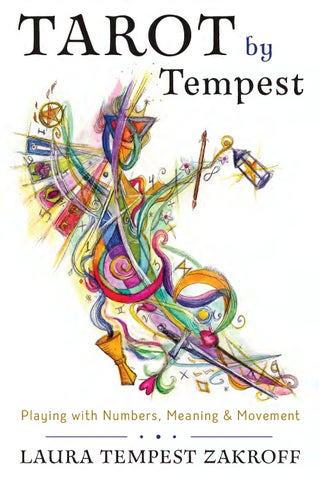
TAROToH .
·.
,
jJ{·1empest
'
Playing with Numbers, •
Meaning & Movement
• •
LAURA TEMPEST ZAKROFF
Praise for Tarot by Tempest “Tempest’s perspective is uniquely refreshing, offering readers an intuitive and embodied way to engage with the cards. … She is one of the most insightful and influential magickal voices of our time, and this book is a vibrant expression of her vision and understanding of the tarot.” —Mat Auryn, author of The Psychic Art of Tarot and Psychic Witch “Zakroff cuts through Tarot’s clutter with a system that’s lean, striking, and alive with pattern. It turns every deck into a tool you can read with precision and confidence, no memorization needed.” —Nancy Hendrickson, author of Ancestral Tarot, Ancestral Grimoire, and Ancestral Séance “Tempest skillfully weaves the technical and approachable, spiritual and practical, hilarious and sincere, to create a vital, original, and enjoyable guide to the art of tarot reading.” —Enfys J. Book, author of Queer Rites “A potent and refreshing guide that invites readers to experience tarot as a full-body, intuitive practice. Blending art, movement, numerology, and personal insight, Zakroff offers a holistic approach that empowers both beginners and seasoned readers to connect deeply with their tarot cards, grounding the tarot beyond memorized meanings. … This book is an inspiring resource for anyone ready to make tarot their own.” —Ethony Dawn, author of Become an Exceptional Tarot Reader “Whether you’re new to tarot or a seasoned reader, Tarot by Tempest offers up a complete, clear, and profoundly insightful system. It’s a full vision that transforms tarot’s centuries-old tradition from mysterious to logical and approachable. Even the math-averse will find magic in numbers here. …If you’ve ever found tarot intimidating, this is the guide that will shift everything.” —Rissa Miller, historian and tasseographer “Absolutely anyone of any skill level can benefit from Tempest’s take on the Tarot! She delves into it all: shapes and symbols, colors, card composition, bringing movement into your interpretation …even how to read the cards for yourself and others (with FAQs). All in a richly illustrated, accessible
format with easy-to-understand explanations, Tarot by Tempest will enable you to feel more confident.” —Kajira Djoumahna, artist and crone “This book strips Tarot down to its bones and rebuilds it with numbers, symbols, and movement that make it fresh, sharp, and relevant. It’s the kind of method you’ll return to again and again, no matter how many decks or years you’ve been reading.” —Erika Robinson, author of The Language of Lenormand “Tempest couldn’t be a more appropriate moniker for Zakroff, their books, and their writing style. They are a force. This book is a shake-up and a game changer. It’s a wild storm that stirs and breaks up a sea of monotonous, regurgitated information. It’s the epitome of embodied. You are invited, required to utilize your mind, body, and soul while engaging with the lessons and tips. If you do that, if you show up for yourself and open your mind, Tarot becomes tangible. You will be a better reader for it, because of it. … What a fresh, new take on the system of Tarot.” —Jaclyn Cherie, owner of the Nephilim Rising, algorithm magick creator, folk herbalist, magickal consultant, ordained minister, word alchemist, Usui Reiki Master, and author and editor for Girl God Books “Whether you are just starting out on the Fool’s Journey or are a seasoned traveller, Zakroff breathes new life into the bones of Tarot by inviting the reader to explore a novel and engaging multisensory, five-dimensional interaction with the cards.” —Kenn Payne, author of Oracle of the Hekatean Path “Laura’s unique voice and approach to Tarot, incorporating math (of all things) and movement, is something new and different. Having been a reader for 40 years, it is really hard for me to find something that fits that description. … Like all Laura’s work, this book is a gift.” —Raven Morgaine, author of Yemaya: Orisha Goddess and Queen of the Sea “Dance the tarot? Math-infused magick? Tarot by Tempest takes on those seemingly quixotic quests and succeeds beautifully.” —Rick de Yampert, author of Crows and Ravens
TAROT
by Tempest
© Carrie Meyer/Insomniac Studios
About the Author Laura Tempest Zakroff (she/they) is a professional artist, author, performer, and Modern Traditional Witch based in New England. She holds a BFA from the Rhode Island School of Design, and her artwork has received awards and honors worldwide. Her work embodies myth and the esoteric through her drawings and paintings, jewelry, talismans, and other designs. Laura is the author of several best-selling Llewellyn books, including Weave the Liminal, Sigil Witchery, Visual Alchemy, and Anatomy of a Witch, as well as the artist and author of the Sigil Witchery Oracle, Anatomy of a Witch Oracle, and Liminal Spirits Oracle. She edited The New Aradia: A Witch’s Handbook to Magical Resistance, The Gorgon’s Guide to Magical Resistance, and Serpents of Circe: A Manual to Magical Resilience from Revelore Press. Laura is the creative force behind several community events and teaches workshops online and worldwide. Find out more at www.lauratempestzakroff.com and https://linktr.ee/owlkeyme.
TAROT
by Tempest Playing with Numbers, Meaning & Movement LAURA TEMPEST ZAKROFF
Tarot by Tempest: Playing with Numbers, Meaning & Movement Copyright © 2026 by Laura Tempest Zakroff. All rights reserved. No part of this book may be used or reproduced in any manner whatsoever, including internet usage, without written permission from Llewellyn Worldwide Ltd., except in the case of brief quotations embodied in critical articles and reviews. No part of this book may be used or reproduced in any manner for the purpose of training artificial intelligence technologies or systems. First Edition First Printing, 2026 Book design by Donna Burch-Brown Cover art by Laura Tempest Zakroff Cover design by Kevin R. Brown Interior art by Laura Tempest Zakroff Tarot Original 1909 Deck © 2021 with art created by Pamela Colman Smith and Arthur Edward Waite. Used with permission of Lo Scarabeo. Llewellyn Publications is a registered trademark of Llewellyn Worldwide Ltd. Photography is used for illustrative purposes only. The persons depicted may not endorse or represent the book’s subject. Library of Congress Cataloging-in-Publication Data (Pending) ISBN: 978-0-7387-7946-1 Llewellyn Worldwide Ltd. does not participate in, endorse, or have any authority or responsibility concerning private business transactions between our authors and the public. All mail addressed to the author is forwarded but the publisher cannot, unless specifically instructed by the author, give out an address or phone number. Any internet references contained in this work are current at publication time, but the publisher cannot guarantee that a specific location will continue to be maintained. Please refer to the publisher’s website for links to authors’ websites and other sources. Llewellyn Publications A Division of Llewellyn Worldwide Ltd. 2143 Wooddale Drive Woodbury, MN 55125-2989 www.llewellyn.com Printed in the United States of America GPSR Representation: UPI-2M PLUS d.o.o., Meduli eva 20, 10000 Zagreb, Croatia matt.parsons@upi2mbooks.hr
Other Works by Laura Tempest Zakroff Books & Oracles Sigil Witchery Oracle (Llewellyn, 2024) Serpents of Circe: A Manual to Magical Resilience (Coeditor, Revelore, 2024) Visual Alchemy (Llewellyn, 2022) Anatomy of a Witch Oracle (Llewellyn, 2022) The Gorgon’s Guide to Magical Resistance (Editor, Revelore, 2022) Anatomy of a Witch (Llewellyn, 2021) Liminal Spirits Oracle (Llewellyn, 2020) Weave the Liminal (Llewellyn, 2019) Sigil Witchery (Llewellyn, 2018) The Witch’s Altar (with Jason Mankey) (Llewellyn, 2018) The New Aradia (Editor, Revelore, 2018) The Witch’s Cauldron (Llewellyn, 2017)
Coloring Books Myth & Magick (2016) The Art of Bellydance (2016)
Witch’s Brew (2016) Steampunk Menagerie (2015)
Instructional DVDs DecoDance (2015) Bellydance Artistry (2011)
Contributions A Witch’s Ally Oracle (by Dodie Graham McKay) (Artist, Llewellyn, 2026) Gemini Witch (by Ivo Dominguez, Jr.) (Llewellyn, 2023) Llewellyn’s 2023 Magical Moon Calendar (Artist, Llewellyn, 2023) Llewellyn’s Witches’ Spell-A-Day Almanac (Artist, Llewellyn, 2019–) Witches & Pagans and SageWoman magazines (Illustrator, BBI Media)
To Professor Robert Mathiesen—thank you for helping to reveal the Tarot and other occult mysteries to me with such kindness and consideration when I was just starting to figure all of this (and myself) out. To the unsung heroes of metaphysical shops everywhere—those who create spaces for community to gather and for services like Tarot readings to take place—especially the employees who are on the front lines of assisting the general public every day, often wrangling both clients and readers alike. I see and appreciate you!
Contents Introduction … 1 What You Can Expect to Learn from This Book
3
My Tarot Journey 5
Chapter 1: Meet the Tarot … 13 A Quick Look at the Big Three Choosing a Tarot Deck 16
14
What Do You Want in a Deck? 16 What to Look Out For 17 Getting Acquainted
20
Chapter 2: The Magic of Numbers, Meaning & Movement … 23 Rethinking Our Feelings About Math, Art, and Movement Magic, Math, and the Tarot The Shape of Meaning
33
Shapes and Symbols
33
Colors
28
35
Composition in the Cards 36 Meaning in Movement 41 Figure This
48
Hear the Rhythm of the Universe
49
Chapter 3: The Major Arcana—from 0 to 10 … 53 The Fool
55
The Magician
58
The High Priestess The Empress
64
The Emperor
67
The Hierophant 70
61
23
xii
Contents
The Lovers
73
The Chariot
76
Strength
79
The Hermit
82
The Wheel of Fortune 85
Chapter 4: The Major Arcana—from 11 to 21 … 89 Justice
91
The Hanged One Death
93
95
Temperance
98
The Devil
101
The Tower
104
The Star
107
The Moon
110
The Sun
112
Judgement
114
The World
117
Chapter 5: Minor Arcana—the Number Cards … 119 It’s Elemental, My Dear Reader 119 Tempest’s Elements and Suits Associations Zodiac Interplay
124
Aces Through Tens 125 Aces
126
Twos
127
Threes
128
Fours
129
Fives
130
Sixes
131
Sevens
132
Eights
133
124
Contents
Nines
134
Tens
135
The Court Cards
136
Courting the Numbers
136
Age and Gender Expression 138 Pages
140
Knights
141
Queens
142
Kings
143
Chapter 6: Holding All the Cards … 145 Breathe by Three
145
Three Breaths Exercise with Your Whole Body 145 Three Breaths Exercise from a Seated Position Taroruffle Shuffle
146
146
What If a Card Goes Flying?
149
Touchy or No Touchy? 149 Cleansing the Cards 150 A Mobile Altar 153 Suggested List for Your Tarot Setup
154
Chapter 7: Tarot Spreads—Mapping the Meaning … 155 What Is a Tarot Spread?
155
Doing the Math: Assessing Spreads and Adding Up Meaning 156 Which Major Arcana Cards Showed Up? 156 How Many Cards of Each Suit Are Present? 156 Which Court Cards Are Present?
157
What Are the Numbers? Do Any Repeat?
157
What Relationships Do You Spot Between the Numbers and Placement of the Cards? 157 Does Anything Else Stand Out? 159
xiii
xiv
Contents
What About Reversals? 160 How Does Timing Work with the Tarot? 160 Simple Threefold Spread (The 4-Card Pull)
162
Example of a Simple Threefold Spread Reading (4-Card Pull) The OG Threefold Spread (The 10-Card Pull)
163
165
Example of an OG Threefold Spread Reading (10-Card Pull) 167 The Relationship Spread (A 14-Card Pull)
170
Example of a Relationship Spread Reading 172 Designing Spreads by Number 174 The Decision of the Magician Spread 177 The Challenge of the High Priestess Spread 179 The Throne of the Empress Spread
181
The Emperor’s Cornerstone Spread 183 The Hierophant at the Crossroads Spread 185 Spread Design Notes 186
Chapter 8: Thinking Outside the Spread— More Tarot Number Ideas … 187 Divination for the Year (A Winter Solstice Ritual) 187 What’s Your Tarot Card for the Year?
189
The Cards as Archetypes for Problem-Solving and Spellcraft Dance the Tarot for Daily Meditation and Path Building
190
192
Chapter 9: Tarot Talk! … 195 Reading for Yourself
195
Q. What’s the Best Way to Phrase My Question?
195
Q. Is It Okay to Do a Daily Reading? 196 Q. How Do I Get Out of My Own Head? 197 Q. What If I Use an App Versus Pulling a Physical Card for a Daily Pull? 197 Q. This One Card Keeps Coming Up Again and Again—and Flying Out of My Deck at Me! What Does It Mean?? 198
Contents
Reading for Others
xv
198
Q. What’s the Best Way to Gain Experience Reading for Others?
198
Q. I Would Like to Read Professionally. How Much Should I Charge? 199 Q. Should I Charge for Readings in the First Place? 200 Q. What If Someone Isn’t Taking Their Reading Seriously?
201
Q. What If Someone I’m Reading for Is Very Guarded or Even Antagonistic? 201 Q. What If Someone Doesn’t Believe What I’m Telling Them?
203
Q. Can I Read for Someone Who Isn’t Present? 203 Q. A Client Keeps Asking the Same Question Over and Over Again and/or Is Constantly Wanting Readings. What Do I Do? 204 Q. How Do I Deliver Very Bad News?
205
Q. Is There Such a Thing as Client Privacy and Confidentiality When It Comes to Tarot Readings? 206 Q. What About Privacy and Safety for Myself ? Deck Tech
206
207
Q. Someone Gifted Me a Deck and I’m Not Sure What to Do with It. 207 Q. What Should I Do If I Stop Connecting with a Deck? 207 Q. Oh No! Disaster Has Happened! What Do I Do with My Damaged Deck? 208 Tempest’s Tarot Thoughts: Musings, Confessions, and Philosophies 208 Conclusion
213
Acknowledgments Bibliography
215
217
Suggested Resources 219 Quick Number Reference 221
Introduction Have you ever thought about what part of your body is used for divination? Where are psychic ability and intuition housed or do they originate from? How do you physically and mentally glean the answers to discover the meaning of cards laid out before you? Do you use your mind, your body, your spirit, or something else? I believe the answer is all of the above and more. We use our hands to shuffle the deck and lay out spreads, our eyes to see the cards, our mind to remember, formulate, and decipher symbols and patterns, our spirit or proverbial gut to listen to what our intuition may offer, and our voice to speak the stories revealed by the cards. Our imagination allows us to both play and problem-solve as we consider the cards. We truly perceive with the whole of our being in order to interpret the cards before us. That may seem like a whole lot of parts to get on board in order to become a proficient reader—and well, yes, technically it can be—but the journey doesn’t have to be overly complicated or a massive ordeal. The process can actually be fun and enlightening and ultimately enhance the whole of your magical practice. The pages ahead of you hold my multilayer approach to deepening your understanding of the Tarot. The techniques will fascinate your mind, inspire your heart, and be felt in your bones. You’ll not only be able to read the cards more quickly and summon their meaning but also learn to recognize how the cards are speaking to you on an emotional and a spiritual level—and unlock parts of your unconscious understanding through movement. 1
2
Introduction
I know that sounds very metaphysical and lovely, but what on earth does that mean in practical terms? Well, what if I told you there’s a way you can learn to effectively read the Tarot without memorizing every single card beforehand? And that, using this method, you would be able to pick up almost any Tarot deck— including one you’ve never seen before—and be able to give an accurate reading? Not only that, but you can also use this same method to dive deeper into your decks and train your brain to recognize how symbols, colors, and visual composition reveal the story of each card. Elemental correlations will take on new meaning and movement in how they bring energy to the Tarot. You’ll be more conscious of the patterns inherent in the cards and how they can interact with each other. This approach brings the cards to life in new ways. Lastly, this method can also guide your body to explore even deeper meaning within the cards and connect with your intuition at a core, primal level. Your body can be your most primary magical tool, regardless of your age, size, or physical ability. The mysteries that life dances are stored within your own blood, breath, and bone—and they can be revealed through movement. What is this Witchcraft, you ask? It’s the magic that happens when we combine practices rooted in math, art, and movement. What? Math? Art? And DANCE? Yes, I’m well aware that each one of these words by itself can summon some uncomfortable feelings for a lot of adults when presented with the possible task of having to draw, move their bodies, or do some calculations on the spot. And here I am mentioning a possibly terrifying trinity of all three combined. I understand the discomfort and even fear that may arise due to past bad experiences. But I promise that it’s worth the work. I’ve come to realize that both my calling and one of my apparent superpowers in this life is getting folks on board with ideas that are not as scary
Introduction
3
as social programming would have us believe.1 Math doesn’t have to be complicated, art isn’t just for gallery walls, and moving your body doesn’t require choreography or a sweat-worthy workout. I believe in accessibility and demystification—as well as recognizing that our brains and bodies respond to a wide range of stimuli for effective learning. It doesn’t matter how many times I’ve taught classes and workshops, I am endlessly delighted by the feedback from folks that my approach excites and inspires them. That’s why I do the work I do. So many people have told me after taking my Tarot workshops that “I’ve been reading for decades and you taught me a whole new way of looking at the cards that is exciting and fresh.” Others have confided to me, “I always hated math, and you just opened up the cards AND MATH to me in ways I didn’t think possible.” I’ve had folks confess they were really scared to take one of my Sigil Witchery classes because they are decidedly “not an artist,” and those same individuals still send me photos of the art they’re making now. I’ve had countless participants nervously eye the door for their escape route when I mention dance in a class or ritual, and they’re always the ones sharing with me that they didn’t know how badly they needed to move. It’s important to me to help folks overcome their fears, to realize there isn’t just one way to do the thing, and to assure them that they’re in a safe place to explore new things. I feel this way because I have been there myself and I want others to have the opportunity to enjoy the process—which means I know you can do the thing! I invite you to come on a journey that can help revolutionize how you look at the Tarot and your own magical practice.
What You Can Expect to Learn from This Book This book explores my unique approach to reading the Tarot, which I have developed over the last twenty-five-plus years. It is the culmination of the work I have done as an artist, a writer, a Witch, a dancer, and a performer— 1. My other superpower is being able to tell if a lead singer of a band is a jerk or not depending on their vocals. It’s actually more handy than you might expect if you’re in the music scene, but also kind of a bummer.
4
Introduction
filtered through my neurospicy brain. My background, observations, and experiences as an artist and a dancer have deeply influenced and informed how I use numbers and shapes and combine them with symbolism and meanings. I am a Witch who loves the Tarot. I am constantly curious about the correlations and patterns present in our lives and why we do what we do. And as a Gemini, OMG I love sharing helpful information with others. My hope and focus is to make this method available as an accessible format for a wide range of folks and experience levels. Here are some of the goals I have for you: • Learn an accessible and easy-to-remember way to read the Tarot without memorizing the little white book (LWB). • Acquire the ability to pick up nearly any deck (or even playing cards) and read effectively without having studied the deck in depth. • Build your confidence as a reader and learn to be guided by your intuition with a solid foundation. • Form skills for better observation and pattern recognition. • Enhance and empower your ability to decipher meaning from symbols, colors, shapes, composition, and other imagery. • Discover new ideas for designing your own spreads and using established spreads. • Consider innovative ways to build meditations and personal practices using the cards with math. • Learn to embody magic accessibly and creatively while uncovering meaning in movement—and, let’s face it, we could all use a little more movement in our modern lives! I am also including some Tarot basics in case you are fairly new in your own Tarot journey. My hope is that with this book, I’m providing insight to both new and seasoned readers alike. If you consider yourself an old pro, please keep in mind that not everything in this book is directed at you. But brushing up on the basics doesn’t hurt—especially if you’re going to
Introduction
5
be instructing others at some point. I find that it always helps to see how others cover the basics in genres I am already familiar with, as there’s the potential for seeing something I know in a new way. For the newbies, some ideas may initially go over your head, but please remember that we can only absorb so much material at once. I find that we recognize and respond to the material that we need to in the moment—and the rest you will become aware of once you’ve gained more experience. Hopefully you understand that I’m not going to be asking you to do advanced algebra or calculus here, but rather I’m opening the doors to a process that is actually rather fun and can enhance your entire magical practice in new ways. We will be looking at the symbolism of the numbers and discovering the energetic motion and shapes they can embody. We will be enlisting the simple applications of addition, subtraction, division, and multiplication. These processes can lend insight not only to how you interpret spreads but also to how you can connect more deeply with the cards themselves. The numbers we will explore together are a guide to the energy of the Tarot. They will give you a solid foundation to build upon. At a glance, you will be able to get a quick yet fairly accurate overview of what you’re looking at. You will be able to assess the numbers set before you and get a sense of the story happening in the cards. Then you can use your intuitive impressions of the images, symbols, and colors to glean more information that is specific to the situation. You can also tap into spiritual connection for additional messages, which means consulting with spirits, ancestors, etc., if that is part of your practice. By the end of this book, I hope you will also find a new appreciation for math, an affinity for art, and an enthusiasm for movement exploration— and, of course, get a lot more out of your Tarot readings!
My Tarot Journey Before we truly begin, I feel it’s important to share with you how I got into reading Tarot. This background will give some context to how I developed my approach and fine-tuned it over the years.
6
Introduction
My journey with the Tarot began when I was eighteen and someone gifted me a copy of Legend: The Arthurian Tarot from Llewellyn. I immediately dove into uncovering the symbolism, learning how to read for myself and others as well as thinking about making my own decks (as one does when one is a young artist going to art school and full of vigor—and a bit of a habitual overachiever. As it happened, I was also taking a liberal arts class that centered on Arthurian romances. As part of the curriculum, we read Sir Gawain and the Green Knight, Malory’s Le Morte d’Arthur, Tennyson’s Idylls of the King, and Spenser’s The Faerie Queene. These fascinating texts gave me another level of mythology to merge with my Tarot deck, as the cards referenced figures and situations from those tales. The Arthurian stories helped to illuminate what I saw in the cards. I recognized that, despite the age of these myths and their often archaic language,2 human nature has common themes that we all tend to experience in one way or another. I decided to try this experiment for myself. I created a Major Arcana– only deck based on Tennyson’s poem “The Lady of Shalott,” using handpulled etchings to create the cards. I went through the poem and pulled out lines that I felt connected best with each trump card, illustrated them, and then made a folded booklet of the whole poem to accompany it. Both the deck and the booklet printed all on one large plate—very much like how modern decks are printed on one sheet and then cut. I carved and block printed a stamp on the back of each card and even hand-made boxes and bags for each deck! But let’s back this train up a bit. Before I got serious about making art involving the Tarot, I first worked on learning how to read my deck. After familiarizing myself with the cards and the little white book, I practiced reading online for folks I encountered on IRC.3 They would type out a question and I would shuffle and pull some cards. Since I was just starting 2. I did get to add smote to my vocabulary, a definite bonus to working through Middle English texts. 3. Internet Relay Chat—basically a digital grandparent of today’s Discord. Same core idea, but without any graphics. This was in the time before emojis or being able to post photos, animated GIFs, memes, etc.
Introduction
7
out, I would first follow my intuition to see what the cards were saying and then check the LWB to see if there was anything else I should know about the cards. Then I would type up the response and send that to the person. It was a low-stress situation since I wasn’t face-to-face with anyone, but I was still surprised to get consistent feedback that I was spot-on with my readings.
The Lady of Shalott Tarot Created by the Author in the Late ’90s
I also learned some tips from one of my college professors about nontraditional spreads and other ways to further develop my intuition and understanding of the cards. Thanks to his guidance, I developed my go-to spread and several related variations on it, which you’ll learn about in chapter 7. This step was so important for me, as I wasn’t a fan of the Celtic Cross spread—which seemed to be included with the instructions of every Tarot deck at that time. I needed something that gelled better with my brain and gave me a sense of time and movement in the spread. Soon I started offering readings on my lunch breaks. I worked at the RISD Store (an art supply/college bookstore), and on nice summer days I
8
Introduction
would go outside and sit at one of the picnic benches along the downtown waterfront with my cards and a little painted wooden sign, which I still have today!
Hand-Painted Sign by the Author
This situation not only brought in a little extra money with tips but also gave me experience reading for a more diverse group of people faceto-face. I soon started reading at local metaphysical shops on evenings and weekends. I also began doing psychic fairs that were within an hour’s drive of where I lived, often doing readings as well as vending my artwork. When I moved to the Bay Area in California a year after graduating from RISD, I thought I’d go to work at a gallery (which was what I had been doing in Rhode Island shortly after graduation) or, even better, a museum. However, a few days after arriving in the South Bay, I happened upon one of the largest metaphysical stores I’d ever seen. It was called the
Introduction
9
Psychic Eye and was part of a small chain of stores located throughout California and Nevada. The shop had anywhere from four to eight psychic readers on the schedule at any given time. I figured picking up a reading gig was worth a shot while I sorted out getting an art job. I had to give a reading to the store manager as an interview, which was probably the most nervous I’ve ever been to give someone a reading. The manager was an imposing person, both gruff and guarded energetically. But I pulled my shit together, gave them a reading, and was hired on the spot! On my first day on the job, I was introduced trial-by-fire style to doing phone readings. No one had mentioned this delivery system was a thing I’d be doing when I interviewed for the job,4 but it ended up being not that much different from doing readings on IRC—except, of course, it was more immediate. Instead of typing, I needed to talk through the cards and be a careful listener. Pretty soon I was very much in demand, often doing anywhere from six to eight readings a day, depending on the length of the reading. Over the next three years, I’d end up providing over three thousand readings, according to the daily record book I kept. As we were situated in Silicon Valley, I read for an incredible assortment of people, especially those in the tech industry, and people from every background you can imagine. And with phone readings, people called in from all over the world. I learned a whole lot about both people and Tarot reading during those few years. Occasionally a phone client would make an appearance in the shop to get a reading in person. They were often surprised to find that I was a young twenty-something person versus someone much older, like they pictured me to be,5 partly because of the context and depth of the readings I gave them and partly because I developed a soothing phone voice for the job. 4. This is probably part of the reason why I greatly dislike talking on the phone today with strangers. 5. This was the early days of the internet, so there weren’t bios or photos of the readers on a website. People would call to book a reading and the front-of-store folks would tell them who was available and maybe a little bit about us. That was all they had to go on.
10
Introduction
Then one day the shop closed rather unexpectedly. (This is where some may want to make a joke about psychics not seeing that coming—but the hilarious thing is that I did have a dream just beforehand! Oh, that one anxiety dream was supposed to actually mean something??) The abrupt closure turned out to be a very good thing for me personally, as doing readings full-time took up a lot of my focus and energy. I quickly pivoted and found a smaller local shop to do readings at occasionally for my regular clients. I also switched to an arts-based job for my main work. My visual art and dancing careers blossomed, as I had more energy and brainpower to devote to them. In the years that followed, I would offer readings less and less as a professional service. It eventually got to the point where I would just do readings for friends and family who needed them—and, of course, for myself. However, my love for the Tarot has remained and continues to be a major influence on my work and my spiritual practice. In my book Anatomy of a Witch: A Map to the Magical Body, the reader journeys through the first ten cards of the Major Arcana as they work through the material. Every Winter Solstice on my Patreon, we pull thirteen cards for the year to come, one for each month and one overall. During the COVID-19 pandemic when everything was happening strictly online, I began offering “Tempest’s Tips for Tarot,” which is a class I started teaching way back when I was reading at the Psychic Eye in the Bay Area. I was surprised by the enthusiastic response to my approach, especially from folks who had been reading as long as I had or longer. When things opened back up for in-person events, I was invited to teach at Witch City Tarot Gathering in Salem, Massachusetts. I decided to test the waters with a sampling of the very material you are holding right now. The response was phenomenal—I had expected to be run out of the room for heresy, but instead I received a standing ovation! I tested it again in a shorter format for the Northwest Tarot Symposium (NWTS) in Portland, Oregon, that fall. The attendees at NWTS were a different crowd from those at the Witch City event in many ways, but the response to my class was similar. And so now, nearly thirty years of my Tarot experience has found its way
Introduction
11
into book format, with the hope of inspiring and aiding more people on their own Tarot journey. Of course, there’s probably one burning question you’re wondering about if you’re familiar with my work: Why haven’t I made a whole Tarot deck yet? After all, I’ve created and published several popular oracle decks. Well, I have brainstormed many a Tarot deck over the years—easily over a dozen different concepts. But for me, it’s one thing to create my own system from scratch (such as my oracles) and another to pay homage to an established system while also having the stamina to do artwork for 78 cards. I know that might seem silly, because I’ve done numerous oracle decks now with anywhere from 42 to 60 cards each. I guess it comes down to settling on the right idea that I feel both pays respect to Tarot and integrates my own unique voice into the format. Really, it’s just a matter of time, so depending on when you’re reading this book, this whole paragraph will likely have become moot. Decades after getting my first deck, the Tarot is still a major influence on my work and my spiritual practice. The Tarot has been a constant companion and guide—and I’m excited to share what I’ve learned along the way with you! Now let’s get shuffling!
CHAPTER 1
Meet the Tarot If you are new to Tarot, I want to make sure you have a good understanding of the basics before moving forward. If you consider yourself intermediate to advanced, it doesn’t hurt to get a quick refresher, especially if you’re introducing others to the Tarot. What is the Tarot essentially? Tarot is a card-based tool used for divination. Methods of divination that use paper cards fall under the category of cartomancy. The Tarot not only can help us look into the future but can also reveal the present and the past. It may seem odd in the context of “fortune-telling” to note that the past and the present are just as important as the future, but we often miss big clues in our own lives. The Tarot gives us insight into the patterns that surround us and the choices we have or can make—or have made. The exact origins of the Tarot are unknown and fakelore abounds about where it came from. The Tarot is a culmination of many roots and is actively used by a wide array of people from all over the world. Educated theories from historians suggest that the earliest roots come from Arabic and/or Chinese card games printed on paper. We know that the closest versions of what we see today emerged from mid-fifteenth-century decks originating in Italy that later spread throughout Europe. These cards were developed further by artists and occultists in France, Germany, England, and far beyond.6 Whole books have been written on the history of the Tarot and who has used it, so I will point you to the “Suggested Resources” section at the end of the book for further exploration. A word of caution 6. Kaplan, The Encyclopedia of Tarot, Volume 1, 23. 13
14
Chapter 1
about online information: Be wary of the hot takes that regularly cycle through the interwebs, sparking controversy without much basis in fact. The Tarot traditionally consists of 78 cards, of which there are 22 Major Arcana cards and 56 Minor Arcana cards. I say “traditionally” in reference to the standard number of cards for Tarot decks published in the last two centuries, particularly the Rider-Waite-Smith (RWS), the Tarot of Marseilles, and the Thoth deck—and all decks that are inspired by those three.
A Quick Look at the Big Three The Rider-Waite-Smith (RWS) Tarot is one of the most popular, widely available decks. It was created through the joint efforts of two members of the Hermetic Order of the Golden Dawn—written by A. E. Waite and illustrated by Pamela Colman Smith—and was published by William Rider & Son in 1909. Initially it was referred to as the Rider-Waite Tarot, but “Smith” was more recently added to give proper credit to the artist. As Rider is no longer the publisher, many enthusiasts now refer to the deck as the Smith-Waite. The Thoth Tarot was painted by Frieda Harris with direction from Aleister Crowley. Crowley’s The Book of Thoth was published in 1944 and serves as a basis for the deck, but the actual deck wouldn’t be published until 1967 by Llewellyn, years after both Harris and Crowley had passed. The Thoth deck utilizes several titles for the cards that differ from those in the RWS, adds additional symbolism and systems, and uses keywords, and some of the number associations are altered as well. The Tarot of Marseille is a French interpretation of historical Italian Tarot decks that were popular in the seventeenth and eighteenth centuries. The first modern Tarot de Marseille was printed by Pierre Madenie of Dijon in 1709. The art on the cards of the Minor Arcana more closely resembles that of traditional playing cards than the pictorial representations we see in the RWS and Thoth.
Meet the Tarot
15
The 22 Major Arcana cards emphasize the greater mysteries of life. They can be viewed as a journey or parts of a cycle, starting with the Fool. These cards describe big ideas, concepts, and themes happening in the querent’s life. Think large paint strokes to get a feel for the setting or situation. They are the drumbeats that drive the song of life. The 56 Minor Arcana cards guide us through the little mysteries. These cards point out the details that help define our journey, made up of the fine lines and sketches that help describe those details. They are the melodic instrumentation that builds on the rhythm set by the Major Arcana. Think of the Minor Arcana as the equivalent of the guitar, the violin, or the wind instruments that help tell the story and bring us in deeper. The Minor Arcana is made up of four suits, typically some variation of Wands, Swords, Cups, and Pentacles. These correspond to the four suits of playing cards: Clubs, Swords, Hearts, and Diamonds. Each suit has Ace through Ten and then four court cards (traditionally Page, Knight, Queen, and King). Each of the four suits typically has an elemental correspondence (Earth, Air, Fire, Water) as well, which adds another layer of meaning and insight. We will dive deeper into elemental correspondences and variations in chapter 5. You may find decks that include additional trump cards that have been included to fit the creator’s vision or to offer alternatives. An example would be decks that include multiple Lovers cards—featuring a woman and a man, two women, two men, or two folks outside of the gender binary. Depending on the querent, the reader can choose the card that fits the situation more appropriately. It behooves you to be aware of extra cards outside of the standard 78 before you start working with the deck so you understand whether or not you want to include them in your readings. Some people ask why there are so many decks. Why do people keep revisiting the Tarot and adding their own take to it? Well, I believe there are so many ways to see life and be inspired, and the Tarot provides an excellent foundation for exploration. It’s also important to keep in mind that the Tarot is an ever-evolving system. Over the centuries we’ve seen changing names and shifting meanings, as well as many approaches to
16
Chapter 1
illustrating the cards, how many cards are included, and even how they’re used. In another fifty to a hundred years, Tarot enthusiasts may be pointing to some of our modern-day decks as historical offshoots of diversion from the proverbial Tarot tree in new directions.
Choosing a Tarot Deck At this point in the timeline, there are thousands of Tarot decks out there to consider. The choice can be overwhelming, especially if you search online or simply see a full shelf of decks in a store. There’s a theme deck for almost anything you can think of and probably some things you haven’t. This cornucopia of cartomancy doesn’t mean that every deck is thoughtfully designed and well crafted or will be a good fit for you. So how do you choose? Sometimes what is locally available to you might be a pretty slim selection, depending on a shop’s inventory and personal preferences. For those with choice paralysis, this minimizing of the options can be a good thing. There are some shops that specialize in stocking decks, and they might have hundreds to choose from. A lot of shops offer sample decks of what they have for sale so you can flip through the cards and get a feel for them in your hands before deciding. If they don’t, search for the deck on YouTube and you’ll likely find that some helpful person has made a flipthrough video showcasing all the cards in the deck. Or you might find a website that shows some of the cards (like www.aeclectic.net). If you like what you see, you can pick up the deck right there on the spot and support your local business—which is awesome! You might even be able to buy the deck directly from the creator as well. If you’re buying a deck online, just make sure it is from a reputable site, as there are plenty of sites peddling poor-quality knock-off decks.
What Do You Want in a Deck? For me, the biggest thing is that the artwork must be pleasing to my eye— not just a few cards but the vast majority. This is why being able to flip through a deck or see all the cards in a video is helpful, as publishers tend
Meet the Tarot
17
to highlight some of the best cards and the rest may not be as successful visually. Another thing to consider is whether I like how both the Major and the Minor Arcana have been illustrated. Can I easily tell the cards apart and read any necessary text or numbers? Some decks don’t have very legible fonts or the symbols used to represent the suits may be hard to decipher. If there’s a border, does it distract from or enhance the art? Moving from visual to technical details, I evaluate how the cards fit and feel in my hands. Are they easy for me to shuffle? Is the cardstock too thick or too thin? Does the paper texture obscure or enhance the look and feel of the cards? One of the most crucial things overall is that when I look at the cards, are they talking to me or feeling chatty? You might be wondering what the heck I mean by that. No, the cards aren’t physically talking to me.7 I’m referring to a sensation that’s part intuitive feeling and part discernment. I get the sense that the deck is telling me a story and wants to engage with me. Some decks are very beautiful, yet they feel devoid of that vital spark. Something I may not instantly click with on an aesthetic level could be very interesting to read with nonetheless. Every deck has a personality, so see what gels with yours!
What to Look Out For Here is a list of things to consider or be aware of when selecting a deck. Representation: Do you find yourself being visually or conceptually represented in the cards? Traditional (and even some modern) decks can be very cisgendered, white, and heteronormative in their presentation. Do you see yourself reflected in the skin colors, body types, ages, gender expressions, and sexuality shown by the deck? The great news is that newer, more diverse decks are coming out daily, so there are definitely some excellent choices out there. Also, consider who your target audience or querents may be if you’re reading for other people. Will they 7. But I do suspect it’s only a matter of time before someone makes a deck with microchips in the cards or a QR code you scan for the cards to speak or to project a hologram that explains your selection.
18
Chapter 1
also see themselves in the cards? Some people solve this conundrum by selecting a deck that’s more fantastical, featuring plants or animals instead of humans, abstract designs, or otherworldly imagery. Find a balance between what inspires and connects with you and what may click with your querents. A Perfect Fit and Feel: Get a deck that fits comfortably in your hands, so it’s easy to shuffle and work with. There are also many cardstocks and paperweights as well as textures and finishes out there. Thick cards look beautiful and feel sturdy, but they can be really hard to shuffle and may even slice up your hands. Thin cards can damage easily. Some people love a linen texture because they say it’s easier to shuffle. I prefer a smooth surface because I think the linen pattern interrupts the artwork, especially when there’s a lot of fine detail. Foil edging is gorgeous, but it can wear off on your hands with use. It can take a while to figure out what the perfect combination is for you when it comes to size and finish. If you can, definitely see if you can try a sample of the deck that visually appeals to you so you know the size and feel also work. The Whole Deal: Make sure it’s a complete Tarot deck with 78 cards. Some artist explorations contain only the Major Arcana. These are handy for certain exercises and exploration, but if you think you’re getting a full deck for the price and it’s just a partial one, disappointment is on the immediate horizon. Read product descriptions carefully! Which of the Big Three? As discussed earlier, the most common kinds of Tarot decks fall in one of three categories: the Rider-Waite-Smith Tarot, which most newer decks are based on or inspired by; the Tarot of Marseille, where the Minor Arcana cards are most akin to playing cards in visual presentation, as they have an antique look to them; and the Thoth Tarot. What we will cover in this book can be applied to all three, but there are differences that are particular to each deck. I typically recommend a RWS deck variation when starting out—but that doesn’t mean you have to use the version you see in this book or a similar one. As I mentioned in the introduction, I started with Legend: The Arthurian
Meet the Tarot
19
Tarot, which is based on the RWS but looks completely different visually. Go with what calls to you. That’s what’s most important here. Tarot Is Tarot Is Tarot: Don’t confuse an oracle deck for a Tarot deck. Oracle cards are their own systems and absolutely have their uses, but they’re not the same as the Tarot. People tend to use these terms interchangeably all the time, causing even more confusion. Tarots are technically cartomancy oracles, but not all oracles are Tarot. Lenormand is another cartomancy system that is similar to the Tarot, but again is its own animal. The Real Deal: Avoid purchasing a knock-off deck. These are fairly easy to spot in person because they often sport a QR code on the box instead of containing the actual booklet (despite what the box says). Watch for not only a QR code but also flimsy slipcover boxes and bad shrink-wrap. These decks are rarely the same size as the originals, are poorly manufactured, and are ripping off artists and authors in your community. They may be cheaper, but do you really want to read with a deck that’s been made with such bad intent? Support Human Creators: Similar to knowing where a deck legitimately comes from is the issue of AI-generated Tarot decks. Please note that I am talking about decks that are created by feeding prompts into a computer versus digitally designed art created by an artist. As both an artist and an author, I am very much not a fan of AI-generated work, though I understand why some artists may use it. From an intellectual and artistic copyright standpoint, my own work has been pirated to generate such works, and that’s bullshit. As a Tarot reader, I find AI-generated decks on the whole—besides being ethically dubious—to be lackluster and derivative. Why? In many cases, most if not all of the visual and symbolic design choices and decisions are not being made by a human being, with purpose and clarity. It may take more time to generate each image from scratch, whether by traditional media or digitally painted, but I believe the result is far more potent. Most publishers are avoiding AI-generated decks because of the copyright issues, but you might
20
Chapter 1
come across some indie decks that are elusive in their language about how the deck was created. (End soapbox scene.) You may have heard the “lore” that you cannot purchase your own deck—that it must be gifted. This “wisdom” makes the rounds online every few years and sometimes even shows up in books. Whether this fakelore is the product of gatekeeping (someone trying to curb others from trying the Tarot for themselves) or misplaced mysticism, it’s pure nonsense. While I will say it is certainly nice to be gifted a deck, you can absolutely buy your own. Just ask me about the obscene number of decks my partner and I have collected over the years.8 Again, I know it’s easy to be overwhelmed with all these choices, but do allow yourself to start somewhere. I tend to be of the mind that whatever deck you start with—however it comes to you—is the right one to set you on your Tarot path. If after a while a deck doesn’t seem like the right fit for you anymore, you can always trade, sell, or gift it to someone else,9 or maybe just put it aside for a while and explore whatever else comes your way! You’re not signing a blood oath to work with one deck to rule them all—or at least you shouldn’t be!
Getting Acquainted Before you begin to actively use a new deck, I recommend taking some time to connect with it and get a feel for the cards. I call this practice “attuning to the deck,” and it helps to build a relationship with your chosen tool. Think of attuning like this: If you’re going to spend a lot of time with someone, asking intimate questions, it’s best to get to know their name, preferences, and personality quirks. Start by flipping through the cards, looking at each image briefly until you’ve gone through the whole deck. (Later you can do daily pulls to familiarize yourself with each card one at a time, discovering each card more intimately.) Next, shuffle the deck for a bit to get a feel for it in your hands. 8. We don’t have a Tarot problem. I like to think of it as a Tarot solution. 9. Tarot swaps are a lot of fun at conventions and festivals, and since the decks are almost always open, you can check them out first!
Meet the Tarot
21
When you’re done, you can wrap it firmly in a cloth or place it in a sturdy bag that matches the feel of your deck. You can use the original box the deck came in as well, depending on the durability of the box. A lot of newer decks have very sturdy boxes that are quite nice, but some still come in slipcases or tuck boxes that are a pain in the ass to get the deck in and out of easily—and offer little protection. Or they come in oversize boxes that are difficult to easily transport. I find it’s best to transfer the deck to an easy-to-carry zipper pouch or drawstring bag. My primary reading deck is also wrapped in a larger reading cloth and placed inside a bag, so I just need to grab the bag and go. A protective bag is often the easiest to travel with. If you find yourself acquiring multiple decks and placing them in bags, I recommend adding a tag to the outside (to the zipper pull or string) and labeling which deck it is. You think you will remember what deck is in there, but chances are good that you won’t. Travel Tip: If you plan to do a lot of traveling with your deck, I highly recommend placing your bag or box in a ziplock or similar waterproof bag. You never know when rain, spilled coffee, wine, etc. is coming for your pocket, backpack, purse, or luggage, especially if you’re going camping. You’ll thank me later. If you can, carry the wrapped deck on your person (in a purse or backpack or coat pocket) when you go out into the world. For at least three nights, sleep with the deck under your pillow or bed or place it somewhere nearby. You can also place the deck on your altar if you have one. The idea is that you’re establishing a connection with the deck to the rhythm of your life.
22
Chapter 1
You may also want to get a little notebook that will fit in your Tarot bag. This notebook acts as a mini journal where you can keep track of daily pulls, insights, and other thoughts. I recommend starting a daily practice where you shuffle and pull a single card for yourself. A good time to do your pull is either first thing in the morning as you start your day or as you’re winding down for the night. Write down your impressions of the card and anything else that comes to you. How does it make you feel? What do you notice about it? Then—and only after you’ve worked your own intuition—you can refer to the booklet and compare notes. Add any additional information you discovered that feels relevant to your little journal. If you do this on a daily or at least semi-regular basis, you’ll become much more familiar with your deck quickly. The act of writing down your thoughts also aids in building memory, so you’re more likely to remember this information in the future! By the way, if you keep pulling the same card, make a note of that too, then pull an additional card to examine why it keeps coming up. The deck is definitely sharing a message with you about that card, which is why I think it’s key to recognize the frequency of the card. But when you’re starting out and getting to know a deck, it’s best to make sure you’re meeting the other cards too, despite what the deck insists upon. Most importantly, play, practice, and learn to trust your intuition.
“Zakroff cuts through Tarot’s clutter with a system that’s lean, striking, and alive with pattern. It turns every deck into a tool you can read with precision and confidence.” —Nancy Hendrickson, author of Ancestral Tarot “A potent and refreshing guide that invites readers to experience tarot as a full-body, intuitive practice.” —Ethony Dawn, author of Become an Exceptional Tarot Reader
Revolutionize the Way You Look at Tarot Through Numbers, Magic, and Motion Discover Tarot the Tempest way with this creative approach to the numbers, elements, and energies of the cards. With over twenty-five years of experience, Laura Tempest Zakroff has crafted a unique and accessible system to help you read Tarot without needing to memorize each card’s meaning. Build both your confidence and intuition through understanding how symbolic meaning, movement, and math weave together, revealing the mysteries of Tarot. Celebrated by Tarot students and adepts alike, Tempest’s methods will unlock the cards for you in new ways. Learn her signature spreads as well as how to design your own spreads to fit your unique needs. Improve your powers of observation so that you will be able to pick up nearly any deck and read it accurately. With Tempest’s guidance, move from just reading about the cards and instead start dancing with the wisdom they hold.
Facebook.com/LlewellynBooks © Carrie Meyer / Insomniac Studios
X: @LlewellynBooks Instagram: @LlewellynBooks
$18.99 US
ZAKROFF
Laura Tempest Zakroff (she/they) is a professional artist, author, performer, and Modern Traditional Witch. She holds a BFA from the Rhode Island School of Design, and her artwork has received awards and honors worldwide. Tempest is the author of several bestselling books, including Weave the Liminal, Sigil Witchery, Visual Alchemy, and Anatomy of a Witch. She is also the artist and author of Sigil Witchery Oracle, Anatomy of a Witch Oracle, and Liminal Spirits Oracle. Visit her at LauraTempestZakroff.com.
TAROT BY TEMPEST
Body, Mind & Spirit / Tarot
TAROT by
Tempest
Playing with Numbers, Meaning & Movement
www.Llewellyn.com
LAURA TEMPEST ZAKROFF