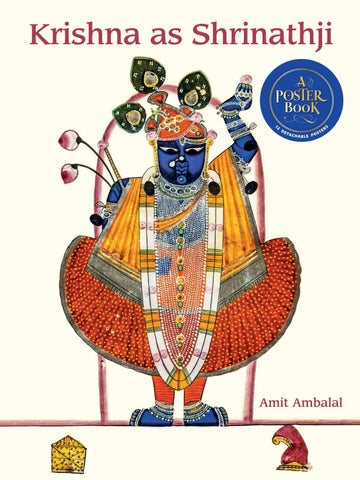
Krishna as Shrinathji A POSTER BOOK 12
DE
TA C
HABLE P
T OS
ER
S
Amit Ambalal
Krishna as Shrinathji A Poster Book
from the collection of Amit Ambalal
In the 15th century, perhaps as a reaction to the increasingly ascetic direction in which Hinduism was going, there was born in Vraj, in north India, a new offset of Krishna worship called Pushtimarg, the Path of Grace. The founder, Vallabhacharya, stressed worship through the joys of life and living and devotion to Krishna as the royal child Shrinathji through kirtan (devotional poem-songs), bhog (offerings of sumptuous food and beverages), shringara (offerings of adornment, through dressing and ornamentation) and painting. The paintings constitute the Nathdwara school, so named because the image of Shrinathji is enshrined in a temple in Nathdwara, Rajasthan. Usually with Shrinathji as their focus, these paintings evolved from several traditional and indigenous styles, from murals and miniatures, and from classical, court and rural modes; yet, they developed their own particularly vivid and lively detailing, reflecting the joyful world of Shrinathji.
Amit Ambalal is an eminent contemporary Indian artist whose work forms a part of prestigious collections in India and abroad, including the Lalit Kala Akademi, Delhi, and the Gujarat Lalit Kala Akademi, the British Museum and Victoria & Albert Museum, London. Recipient of both the Gujarat Lalit Kala Akademi and the Ahmedabad Municipal Corporation awards, he is the author of the landmark volume Krishna as Shrinathji: Rajasthani Paintings from Nathdvara (Mapin, 1987) on the subject of Pushtimarg and Nathdwara paintings and has recently written the Foreword to In the Service of Krishna (Mapin, 2019) and contributed to Gates of the Lord: The Tradition of Krishna Paintings (2015) and Shringara of Shrinathji: From the Collection of the Late Gokal Lal Mehta (Mapin, 2021).
First published in 2026 by Mapin Publishing Pvt. Ltd 706 Kaivanna, Panchvati, Ellisbridge, Ahmedabad 380006 INDIA T: +91 79 40 228228 E: mapin@mapinpub.com www.mapinpub.com All rights reserved under international copyright conventions. No part of this book may be reproduced or transmitted in any form or by any means, electronic or mechanical, including photocopy, recording or any other information storage and retrieval system, without prior permission in writing from the publisher. Text © Amit Ambalal Illustrations © Amit Ambalal ISBN: 978-93-94501-76-8 Printed in China
Front-cover: Shrinathji in mukuta and mor kachhani (detail), Nathdwara, Rajasthan, c. 1830, gauche on paper, 10.23 x 6.7 in. © Amit Ambalal
Shrinathji and the Sacred Images of Pushtimarg
S
svarupa (an image identified as living deity) in Pushtimarg. He
the hilltop, “Ari Naro, dudh lao”—“Naro, bring me milk.” Vallabhacharya
is a manifestation of Lord Krishna as a seven-year-old. Shrinathji is
was surprised as the voice was the one he had heard at Jharkhand. He
depicted with his left arm held above his head in the act of lifting Mount
was convinced that it was the voice of the Lord and resolved to find
Govardhana, while his right hand rests on his waist. The image is about
things out for himself the next morning.
hrinathji (the Lord of Shri, goddess of beauty and prosperity),
there with his wife Bhavani and daughter Naro in a modest dwelling.
enshrined at Nathdwara, Rajasthan, is the most important
While they were conversing, a voice was heard calling out to Naro from
1.37 m high in relief on a rectangular stele. The entire stele that frames the image represents Mount Govardhana, and several other forms can
That evening, Sadu Pande told Vallabhacharya the story of how
also be seen on it. There is a parrot near the top centre with a sage
Devadamana, as they called Him, had made Himself known to the
seated near it, on the left corner of the stele. Near Shrinathji’s left hand,
villagers. He said that the villagers had noticed that a certain cow left to
two sages can be seen in postures of meditation. Below them is a snake
graze on the hill had stopped giving milk for no apparent reason. One
with a spread hood, while another figure resembling a tiger, identified as
day, an observant cowherd saw the cow standing over a cleft in the
Narasimhaji, is seen below the snake. Beneath the tiger are two peacocks.
rocks and milk from her udders poured into the cleft. Curious villagers
Also seen on the left, below the sage, are a ram, a snake and two cows,
moved the rocks and discovered a handsome seven-year-old boy. They
all evidently inhabitants of Mount Govardhana. They are represented as
offered him milk, curd and butter. After this, the boy joined the village
watching Shrinathji reverently. There are numerous explanations of these
children at play. He identified himself as Devadamana and the villagers
forms on the stele, and scholars differ regarding the details.
understood that he was the same Lord of Mount Govardhana who had in an earlier era saved the people of Vraj from Lord Indra’s wrath.
There are certain small images placed near Shrinathji in the sanctum at Nathdwara. These are known as Gaud ke Thakurji, “images of the
The next morning Vallabhacharya, along with his entourage, climbed
lap”, and are kept near the main image. On Shrinathji’s left are two
the hill. As they approached the summit, the divine child came
tiny metal images. The one of Madanamohanji—a standing, fluting
running forward and embraced Vallabhacharya joyfully. He asked
Krishna image—was once presented to Achyutadasa, a Gauda Brahmin,
Vallabhacharya to place Him in a shrine so that regular seva (ritualistic
by the founder of the Pushtimarg sect, Vallabhachaya, himself. It was
service) could be performed. He affirmed that divine grace would
returned after Vallabhacharya’s death and placed in the shrine. During
descend on those who worshipped Him and added, “That is why I
the monsoon month of Shravana, the image is placed on swings; in
have revealed myself here.” Vallabhacharya named the image Gopalaji,
summer, it is seated in a boat. Balakrishnaji—the other image—is
keeper of the cows, thus installed at the shrine built in obedience of
of the infant Krishna crawling on the floor, holding a ball of butter in
the divine command. Later, Vitthalnathji named it as Govardhananathji.
one hand. It was found by Vallabhacharya when he was bathing in the
Gokulanath, Vitthalnathji’s son, called the image Shrinathji, a name
river Yamuna. During the festivals of Janmashtami, Vamana Dvadashi,
that continues to be used even today.
Prabodhini Ekadashi and Ramanavami, the ritual of panchamrita snana (bathing with the five ‘nectars’, namely milk, curd, clarified butter, honey
The accession of Mughal emperor Aurangzeb to the throne of Delhi in
and sugar) is performed over this image.
1658 brought in an era of religious intolerance towards Hindus. Systematic destruction of temples by the imperial army followed in Mathura and the
A shaligrama is a black pebble symbolic of Vishnu. This particular
entire north India. This threat prompted Tilkayat Damodarji, then a mere
shaligrama was acquired by Vallabhacharya in South India and is
boy, and his uncle Govindji, to move the image to safety. On the ı8th of
kept to Shrinathji’s right. Shaligramaji, as it is called, is bathed with
September 1670, a convoy led by Gangabai, an old Vaishnava lady, along
panchamrita on the festival of Narasimha Jayanti. Giriraja Shila is a
with several devotees, concealed the image of Shrinathji in a bullock cart
tiny stone from Mount Govardhana, picked up from the mountain when
and departed from Mount Govardhana. They headed towards Mewar in
Shrinathji started towards Rajasthan from Vraj. It represents Mount
hopes of asylum as the Maharana, Raja Singh, was a staunch devotee.
Govardhana recreated in the Govardhana Puja Chowk of the haveli
An emissary was sent to the Maharana who agreed to provide shelter
(a temple in the Pushtimarg sect) at Nathdwara.
to the convoy. As they reached the village of Sinhad near Udaipur, a wheel of the cart carrying Shrinathji got stuck in deep mud. In spite of
‘Vallabhacharya Ki Charana Paduka’ is a single wooden sandal that
all efforts, the wheel could not be dislodged. Taking this as a sign from
belonged to Vallabhacharya. Placed on a small cot known as a palangadi,
the Lord himself, they decided to proceed no further and Sinhad became
the paduka is worshipped every day and is offered consecrated food.
the final abode of Shrinathji. A temple was built there and the image was installed on the ı0th of February 1672. This village subsequently came to
The Origins
be known as Nathdwara, the Portal of the Lord.
According to a popular legend, in 1493, Vallabhacharya along with his disciples arrived at Mount Govardhana on a pilgrimage in response to
Bhavanas in Pushtimarg
the divine instructions he had received at Jharkhand, near the border of
In Pushtimarg, Parabrahma, the Supreme Power, is Sat, Chit and
Marwar. A disembodied voice informed him of the Lord’s manifestation
Ananda—existence, pure consciousness and bliss. But He is also a
on Mount Govardhana and asked him to go there. Halting at Gokula on
personality with a divine non-material body and qualities. He is known
the way, he woke up from a deep sleep at midnight to find Lord Shrinathji
as Krishna, though He may be known by other names, and He has once
before him. The Lord authorized him to initiate all true seekers by means
appeared on earth, at Vraj, in his true form. In this form, He partakes
of the “naam” or divine name, which would secure for them the grace of
of the joy of His own creation, in a lila (divine play), encompassing the
the Lord. Overcome with emotion, Vallabhacharya garlanded the Lord
physical world, all the things created within, the cosmos and what
with a pavitra, a garland of cotton threads, and presented Him with an
lies beyond. Devotion to Krishna and the constant remembrance
uparna (shawl), and offerings of misri (sugar), which he had kept aside
of Him during worldly pursuits is the only way to achieve spiritual
for the next day’s worship.
enlightenment.
Early next morning, Vallabhacharya and his party hastened to Mount
True devotion to the svarupa, the image identified with the Lord himself,
Govardhana. They were greeted at Anyor, the village at the base of the
allows full play to the emotions of a bhakta (devotee). To the young,
hill, by the chief cowherd of the village, Sadu Pande. Sadu Pande lived
Krishna is a companion to share in their pranks. Lovers see in Him
Dol Utsav, Nathdwara, Rajasthan, mid-18th century, opaque watercolour on paper heightened with gold on paper, 11.5 x 6.6 in. © Amit Ambalal • Krishna as Shrinathji (1987), Mapin Publishing
Nanda Mahotsav at Kankroli, Nathdwara or Kankroli, Rajasthan, early 19th century, opaque watercolour on paper, 12 x 8.8 in. © Amit Ambalal
Dauji ll Performing Aarti on Sharad Purnima, Nathdwara, Rajasthan, first quarter of 19th century, opaque watercolour heightened with gold on paper, 9.8 x 13.6 in. © Amit Ambalal • Krishna as Shrinathji (1987), Mapin Publishing
Krishna as Shrinathji A POSTER BOOK
Amit Ambalal 28 pages, 14 illustrations 12 x 16” (305 x 406 mm), SC, produced on art card ISBN: 978-93-94501-76-8 ₹1750 | $35 | £25 Spring 2027 | World rights
Kamalan ki Pichhvai (detail), Nathdwara, Rajasthan, early 20th century, cotton painted with pigments, 70.06 x 60.8 in. © Amit Ambalal • Krishna as Shrinathji (1987), Mapin Publishing
₹1750 | $35 | £25 ISBN 978-93-94501-76-8
www.mapinpub.com