The Inner Worlds of V. Ramesh
ABOUT THE GALLERY
The Inner Worlds of V. Ramesh
Founded in 1997 by Tunty Chauhan, Threshold Art Gallery has established itself as an important space for contemporary art in New Delhi. Over the years, the gallery has developed a distinctive identity through its commitment to presenting thoughtful, research-driven exhibitions and nurturing meaningful conversations around Indian modern and contemporary art. The gallery has worked with a diverse range of artists, representing different generations, practices and mediums and other contemporary practices,
www.mapinpub.com
Mapin Publishing www.mapinpub.com
Printed in India
Threshold Art Gallery C 221 Sarvodaya Enclave, New Delhi 110017, India www.gallerythreshold.com | @gallerythreshold thresholdart@gmail.com +91 9810401265 | +91 9818807440
₹4000 | $70 | £50 ISBN 978-93-94501-25-6
allowing artists to explore both traditional references and new forms of expression. A particular strength of Threshold has been its engagement with artists whose work is intellectually rigorous yet deeply connected to personal, cultural and social histories. More than simply a commercial art space, Threshold has sought to create a platform for dialogue. Its exhibitions often bring together artists and ideas that encourage viewers to look beyond the immediate visual experience and consider wider questions of history, identity, memory and place. Situated within Delhi’s vibrant art ecosystem, Threshold continues to play a significant role in shaping conversations around contemporary Indian art. Its sustained commitment to artists, experimentation and thoughtful curatorial practice has helped establish the gallery as a respected and distinctive presence in India’s contemporary art landscape.
The Inner Worlds of V. Ramesh offers an intimate exploration of an artist whose practice brings together mythology, memory, spirituality, and the complexities of human existence. At the heart of his artistic journey lies a profound spiritual engagement, shaped by both inquiry and devotion, particularly through the teachings of Sri Ramana Maharishi, whose philosophy of self-enquiry and inward contemplation has deeply informed Ramesh’s visual imagination. Ramesh’s paintings are rooted in Indian philosophical and mythological traditions, yet remain distinctly contemporary in their exploration of identity, desire, suffering, and the nature of existence. His densely layered compositions unfold like dreamscapes, populated by human and animal forms, mythological references, memories, imagined landscapes, and fragments of everyday life. The body emerges as a recurring site of transformation: vulnerable, sensual, spiritual, and symbolic. Through these shifting forms, Ramesh moves between the physical and the spiritual, the visible and the unseen. The influence of Ramana Maharishi is evident in Ramesh’s persistent inward turn, an inquiry of the self beyond the boundaries of the physical body and the material world. His paintings often evoke states of searching, contemplation, and dissolution, where individual identity becomes fluid and the visible world opens towards something more elusive and profound. Beneath this inquiry lies a quiet devotion, expressed not through narrative or iconography alone, but through a sustained commitment to introspection and the search for inner truth. This book traces the evolution of Ramesh’s visual language, highlighting his distinctive handling of colour, line, and surface, alongside his engagement with Indian print and miniature traditions and contemporary painting. More than a record of his artistic journey, it offers a glimpse into an artist for whom painting has become a means of looking inward, making sense of the visible world, and searching for what lies beyond it. With 217 colour plates.
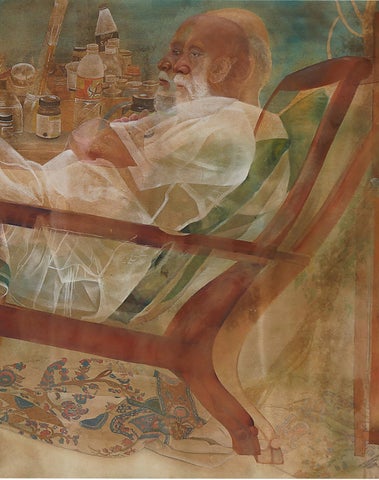
Jacket: Self Portrait in the Studio with Single Malt Watercolour on Arches paper, 92 x 214 cms., 2023
The Inner Worlds of V. Ramesh
2
The Inner Worlds of V. Ramesh CONTRIBUTORS Gayatri Sinha Georgina Maddox Indrapramit Roy Kamala Kapoor Kristine Michael Madhu Jain Ranjit Hoskote Sadanand Menon Shruti Parthasarathy Varsha Das
EDITED BY Kristine Michael
3
First published in India in 2026 by Threshold Art Gallery C-221, Block C, Sarvodaya Enclave New Delhi 110017 email: thresholdart@gmail.com www.gallerythreshold.com +91 9810401265 | +91 9818807440 Co-published and distributed by Mapin Publishing Pvt. Ltd. 706 Kaivanna, Panchvati, Ellisbridge Ahmedabad 380006, India T: +91 79 4022 8228 E: mapin@mapinpub.com www.mapinpub.com Text © authors Paintings © V. Ramesh All rights reserved. No part of this publication may be reproduced, stored in a retrieval system, or transmitted in any form or by any means, electronic, mechanical, photocopying, recording, or otherwise, without prior written permission from the publishers and the respective copyright holders. Moral rights of authors are asserted. ISBN: 978-93-94501-25-6 Photographer: Akula Raja Ramesh Design and production: Paulomi Shah Printed and bound in India
Captions: Cover: Self Portrait in the Studio with Single Malt, Watercolour on Arches paper, 92 x 214 cms., 2023 Endpapers: Dark Woods, see pages 194–195 Page 1: In Grace He Made Me His Own Oil on canvas, 213 x 152 cms., 2010–2011 Pages 2–3: Invocation (detail), see pages 20–21 Pages 4–5: My Lord White as Jasmine Oil on canvas, 152 x 213 cms., 2014 Page 8: Body/Offering Watercolour on paper, 61 x 46 cms., 2026 4
5
Foreword My own association with Ramesh began thirty years ago. Over time, our relationship grew into one of mutual trust and respect, often remarked upon by peers as an example of the enduring bonds that can develop between an artist and a gallery. Throughout these years, Ramesh has remained a constant presence in the life of the gallery. His support for its evolving vision has always been understated yet deeply affirming. Never announced but always present. Equally significant is his role as a mentor and teacher. His studio reflects the ethos of the guru-śis. ya paramparā, where artistic knowledge and discipline are transmitted through close engagement and generous sharing with many younger artists. Representing V. Ramesh over the years has been both a privilege and a profound learning experience. His association with Threshold Art Gallery has been defined not merely by professional collaboration but by a shared commitment to artistic integrity, trust, and a deep respect for the creative journey. Quietly and persistently, his presence has shaped the gallery’s sensibility and direction, influencing not only the exhibitions we have presented but also my own evolving understanding of art. Ramesh’s practice is informed by rigorous scholarship and a sustained engagement with spiritual inquiry that distinguish it within the landscape of contemporary Indian painting. His works do not demand attention through spectacle; rather, they unfold gradually, drawing the viewer into a reflective space where memory, devotion, and narrative converge. The large fresco-like canvases carry an allegorical tenor, their surfaces layered with fragments drawn from cultural memory, traditional storytelling, imagery from ancient manuscripts and visual echoes that seem to travel across time. These elements are never presented as direct citations. Instead, they appear as subtle presences embedded within the pictorial field, inviting the viewer into a slow process of discovery. In Ramesh’s work, the borrowed image or text from traditional narrative sources, is merely the point of departure. Through translucent washes, fluid overlays, and delicate accretions of pigment, these references gradually dissolve and transform. The paintings move away from the literal towards the experiential. About his search for a personal visual language, Ramesh observed, “I wanted to find a language which was also one that was a reference no other contemporary painter had tackled. I found it in the idea of devotion; no one had done it in the allegorical way – it mostly remained literal illustration.” Devotion, in Ramesh’s hands, is not presented through fixed iconography or overt religious 6
imagery. Instead, it emerges through atmosphere and suggestion, through a quiet emotional register that permeates the painting. The works evoke experiences that exist in more elusive realms of consciousness. Few practices carry this contemplative authority. They recall the fragile territory of dream moments glimpsed briefly before waking and then quickly dissolving. Familiar images appear and recede, resisting precise definition. Another important source within his practice is his collection of old oleographs and devotional prints. Revisited through watercolour washes and silkscreen processes, these images appear as shimmering outlines rather than solid forms. Figures emerge only partially, hovering between visibility and disappearance, as though suspended within memory itself. It is precisely this willingness to embrace ambiguity that gives his paintings their distinctive emotional resonance. His images exist within a delicate balance between the temporary and the eternal, the remembered and the imagined. Alongside his large canvases, Ramesh has also developed an exceptional body of work in watercolour. The fluidity and immediacy of watercolour have allowed him to explore a more intimate register of observation and reflection. In these works, the ordinary is gently transformed into something contemplative and poetic, demonstrating the artist’s remarkable sensitivity to the expressive possibilities of the medium. At this mid-career juncture, this book seeks to illuminate an artist whose contributions to contemporary Indian art are both profound and richly layered. It offers an opportunity to engage more deeply with a body of work that continues to evolve with quiet intensity and philosophical depth. At the same time, it acknowledges the personal qualities that define Ramesh himself – discipline, generosity, humility, and a steadfast commitment to the practice of art. For those of us who have had the privilege of witnessing his journey over the years, his work stands as a reminder that the most enduring artistic voices often emerge not from spectacle or urgency, but from patience, reflection, and an unwavering devotion to the act of painting. This book is more than anything a ‘Thank you’ for a friendship I treasure more than I could ever put into words. Tunty Chauhan Director, Threshold Art Gallery 7
8
Contents
Foreword
Tunty Chauhan
06
V. Ramesh: A Conversation
Indrapramit Roy
10
Let Me At All Times Remain In Your Presence 2026
Excerpt from Varsha Das
18
Transition
54
The Journey 1980–1993
Excerpts from Shruti Parthasarathy Ranjit Hoskote 56
A Story and the Genesis of an Exhibition
V. Ramesh
72
A Thousand and One Desires 2004–2006
Excerpts from Ranjit Hoskote Georgina Maddox
84
Straight from the Heart
V. Ramesh
102
Painted Hymns: Darshan/Gaze 2006–2008 Excerpt from Gayatri Sinha
108
Assault
V. Ramesh
134
My Heart Would Be Enough 2008
Excerpt from Madhu Jain
142
Why Cross The Boundary 2011
Excerpt from Kamala Kapoor
158
Sanctum Sanctorum 2012
Excerpt from Georgina Maddox
182
The Passion of the Poet 2014–2016
V. Ramesh
196
The Presence of Absence
Excerpt from Sadanand Menon
202
Vignettes from an Epic
V. Ramesh
222
Pandemic Still Life 2021
Excerpt from Kristine Michael
240
Love Stories 2024
Excerpt from Gayatri Sinha
270
वीी. रमेेश: रंंग, चेेतनाा और कलाात्मक जीीवन दर्शशन
वषााश दाास
290
Biography
294
Contributors
302
9
V. Ramesh – A Conversation Indrapramit Roy
I travelled to Vizag to meet Ramesh Vedhanbatla or simply Ramesh, as I call him, with the express purpose of seeing his latest body of work. I arrived at night and went straight to his studio. What demanded immediate attention in his spacious studio was the profusion of imagery on the rather large canvases that covered much of the wall space. Most works were in various stages of completion. It was evident that simultaneous work was happening. A few former students who assist him were also there. It was truly a buzzing space. The first thing that hit me as a fellow artist was the delicate richness of the layering, the fine tracery of linear elements combined with details that demanded closer attention. Each image also signalled that they were crafted and calibrated with a care for the latent abstraction that sets them apart from each other. The palette of earthy tones of warm ochre, sienna, umber and terre-verte greens suddenly bursts with electric pinks and deep reds. They had a compelling demand on the retina. On closer inspection they revealed image-quotes blown up from wood block prints, a tradition found in the much smaller format of early printed books, harking back to a popular genre of illustration from a bygone era. Over the next two days, the arc of the free wheeling conversation covered many questions ranging from the unpacking of the dense imagery in the paintings to the artist’s world view. Ramesh with his infectious enthusiasm shared his collection of rare books, antique prints accompanied with anecdotes of how he chanced upon quite a few of them and played devotional songs that are repositories of wisdom. In short, all that inspire him. Sometimes the conversation, like any exchange between friends, went on a tangent. What we have here is an edited version culled from those conversations that reveal important aspects of Ramesh, the person, his beliefs and convictions and his works. IR – Let us go back a bit. The first time I saw your work shifting majorly, both in technique as well as imagery was in the exhibition Back to School, which Veer Munshi curated in 2000. Before that, the works that I remember celebrated the fisher-folk of Vizag area; their toil, their glistening towering bodies by their catamarans, the sun and the sea. The work in the Back to School show looked like something fundamental has changed. It was just an image of a flowering tree. From there your work evolved in a different trajectory in the last two and a half decades. 10
VR – I stopped painting the Fisher-Folk around 1998–99. I felt I had already reached the end of that cycle. Things got so comfortable that I could just do it blindly, there was no excitement of discovering something in my own work, which I think is essential. So, I stopped painting in oil and stopped doing large-size works. I would just take a small sketch-book of A4 size and try things out. I only did dry-pastels for two years. I would smudge dry-pastel powder on paper, draw lines and watch what was happening. It was almost like going back to school. In a sense I was rediscovering - I would not use the word potency, but the power, which a line is capable of conveying, how simple things like variations in colour and tones lead to radically different results. This was purely for myself. To verbalise all these now sounds rather simplistic but they were important reconnects and rediscoveries for me at that point because I had lost sight of the material, the means that was instrumental in creating the image. For me, that material was paint. Then, in 1998 I took a trip to Tiruvannamalai and something happened there. IR – What exactly happened? VR – It was serendipity – that’s the only way I can describe it. I was in Chennai for a show and it was pouring that day. I said to myself, what should I do? I thought I would go to Cholamandal. I knew some people there. I was waiting at the bus stop to catch a bus to Cholamandal and this bus came and stopped right before me. I asked, where was it going? It was going to Tiruvannamalai – Ramanashram. I had heard about Ramana Maharishi and I was curious because I had read a few books on him. So, I just hopped on the bus and after four hours of travel eventually landed at the ashram. They didn’t generally give you accommodation unless you’d booked in advance but I just walked in and said – I have come here, can I get a room? Very fortunately for me they made an exception and gave me a room. I stayed for three days or so. I wouldn’t say it was a great, grand moment of revelation but it did something and I felt drawn to the place. After that trip, I would revisit the place whenever I could find the time. Over a period of time, 11
The Journey 1980–1993 Excerpts from
Shruti Parthasarathy Ranjit Hoskote
56
57
A Splendrous Sorrow, Oil on canvas, 180 x 240 cms., 1995
V. RAMESH is perhaps one of the best known Indian figurative painters from the generation of artists that would fall between what could be termed the late moderns and senior contemporaries. Among them, he has earned a justifiable name as an artist of the ‘sacred’, evolving a unique pictorial language that both views the world as and creates, palimpsests of layers of image, narrative, histories, and time. These accrete in a continual process of making, unmaking and remaking, so that in his work and worldview, certitude and the definitive stance are traded for flux, fluidity, and the still-forming. Ramesh trained in painting at the MS University, Baroda, from 1976–84, seen as an important experiment that inculcated in its students a spirit of questioning and an openness to the new, which the artist regards his most significant learning. A time filled with vibrant discussions on art behind the library and in the canteen among students, teachers, visiting artists and others, Ramesh recalls it allowed students to pick up things outside of the school’s itinerary. Despite favouring the figure and narrative, Baroda’s spirit of openness finds reflection in the thriving of such avowed abstractionists as Nasreen Mohamedi, Jeram Patel, or Shanti Dave. 58
Ramesh became a figurative painter interested in the narrative, but it is Mohamedi and her Sufi bent he shared the closest artistic alignment with. Ramesh moved to the coastal town of Vishakhapatnam to teach art at Andhra University, though the greater desire was to connect with his cultural Andhra roots, having grown up itinerant in India – a question of identity and belonging he muses, ‘arises afresh for each generation’. This quest emerged in painting from old, found family photographs of his grandparents and parents; family was also the site of childhood fascination with the image, coming upon photographs floating in a bucket of water, developed by his amateur-photographer father in the night. Vishakhapatnam offered the opportunity to closely observe the local fisherfolk: their lives filled with labour, vitality and an old communitarian rhythm. In place of the more expected and problematic, documentary or ethnographic mode in these genre paintings – the urban artist depicting a subaltern rural people engaged in a traditional occupation – Ramesh’s
In the Shadow of the Dog Oil on canvas, 147 x 86 cms., 1993
paintings instead reveal something of his subjects’ private lives. Individual gestures and glimpsed moments paint a complex portrait: at work on the nets, boat sterns, in the marketplace, at an afternoon game with cowrie shells, in reverie and exhausted sleep. An everyday sensuousness permeates these works, of toiling muscular bodies in the daytime but surprisingly, too, the nighttime, capturing private moments and familial intimacy inasmuch as it’s played out in public. Not fetishised, they possess a flesh and blood quality of individuality and the unexpected arrested moment, to which is added the oneiric and the fantastical: the glimpsed alongside the dreamed-up and extrapolated, as of a naked couple on a boat at night, in a postcoital sleep of abandon. This strangeness is accentuated by the confident use of striking reds and oranges, silvery blacks and lapis, as also the large scale (to come to mark his work), in triptychs busy with multiple figures and scenes. A brief, prolific phase c. 1996, of abstract compositions comprising linear, planar patterns bleached of colour and form, deserves mention: seemingly a rebellion as a figurative artist, they recalled the mid-century Western art theorising of the grid form. Excerpt from Shruti Parthasarathy essay “Of Polysemy and Allusion; A Critical Biography of V. Ramesh”, 2024 1980–1993 | 59
A Thousand and One Desires Excerpts from
Ranjit Hoskote Georgina Maddox
84
85
This was when I first started using the idea of wood cuts from a book called Melodrama in Four Acts. The first image is of a child born and the last wood cut is of a funeral so the whole gamut spectrum of life between these two brackets seem to be like a huge melodrama that we are enacting. V. Ramesh, 2025
Melodrama in Four Acts, Oil on canvas, 183 x 244 cms., 2004–2006
101
Straight from the Heart V. Ramesh
103
Straight from the Heart V. Ramesh
A sixteen year old boy left his family in 1896 and driven by an inner urge, made his way to Arunachala, a holy mountain in South India, a place he never left again. Here, he surrendered himself to a newly discovered awareness that his real nature was formless, immanent consciousness. His awareness of himself as consciousness was to remain continuous and undimmed for the rest of his life. In common parlance, he had realised the self; that is to say indivisible and universal consciousness, which was experienced in its manifest form as the appearance of the universe. As the years passed and he became more and more well-known, thousands of people flocked to him, attracted by the peace they felt in his presence. Whatever their reasons for coming, everyone who came into contact with him was impressed by his simplicity and humility – his only private possessions were a loincloth, a water pot and a walking stick. He refused to accept anything except what could be shared equally by everyone. When visitors came to see him, they would all be treated with equal respect and consideration, irrespective of their status and his equalitarian concern even extended to the animals and the local trees. On April 14th 1950, he shed his mortal coil. Years later in 1998, during my first serendipitous visit to Ramanashram, when my glance fell on a black and white photograph of his, I was instantly captivated by his glance. It was an image full of ineffable tenderness – of grace, of wisdom and childlike innocence. But above it all, was the stillness which permeated these photographs which bewildered me and drew me closer to them. It was the stillness of a person who was supremely content to be in the moment, desiring nothing, accepting nothing – one who lived in the serene, boundlessness of being. The first impression sank deep in my memory and has abided when others have faded, resurfacing recurringly. Many before me had attempted to capture that face of eternity, the most notable of course, being the well-known photographs by Henri Cartier-Bresson. Though I have been painting his image intermittently it was in the beginning of 2006, that I began a series of works, endeavouring to formulate and devise a language and vocabulary, which would in a simple and straightforward manner enable me to pay a personal tribute, straight from the heart. 104
Head, Watercolour and gouache on paper, 36 x 27 cms., 2007–2008
Head, Watercolour and gouache on paper, 36 x 27 cms., 2007–2008
Pundole Art Gallery, Mumbai and Threshold Art Gallery, New Delhi, 2007 | 105
108
Painted Hymns
Darshan/Gaze 2004–2006 Excerpt from Gayatri Sinha
109
Painted Hymns Darshan/Gaze
Central to this exhibition is the concept of darshan or the gaze, which carries within it a unique method of transaction. In the Hindu system of sanatana dharma the devotee gazes at the image of the deity which in turn gazes back, completing an act of mutual benediction. In the daily prayer of Hindus, segments such as the kavach (of Shiva, Devi etc.) graphically describe the divinity as gazing back at the devotee, locating one or other of his divine forms in every part of the devotee’s body like numerous protective talismans. Thus the devotee praises the body of the deity, as for instance the eyes, and the gaze with its manifest spiritual authority. The eyes of divinity draw a number of poetic comparisons; in the case of Devi they “move like fish in the streams of beauty flowing from her face” but also as witness of the Supreme Lord Shiva’s awesome cosmic dance at the end of the creative cycle” (verse 232, Sri Lalita Sahasranam). How does the idea of darshan cohere with gaze theory, and its implications for a contemporary artist? Christopher Pinney analyses the place of darshan even when accorded to the printed image. He writes “darshan’s mode of interaction mobilises vision as part of a unified human sensorium, and visual interaction can be physically transformative.” Ramesh uses as his source the corpus of photographs shot before and during the passing away of the saint, drawn from the ashram archive. The material artefact of the photograph (Wellings 1948, Life Magazine, 1949, Henri Cartier-Bresson 1950) locates the aging saint in his ashram, throngs of the devout, and the everyday life of the ashram, located and rendered selective and ‘real’ by the eye of the camera.
110
Untitled, Oil on canvas, 183 x 122 cms., 2007 Following pages: Untitled, Oil on canvas, 183 x 122 cms., 2007
Painted Hymns: V. Ramesh at Threshold Art Gallery, New Delhi, 2007 | 111
My Heart Would Be Enough Excerpt from
Madhu Jain
142
143
A Poet’s Prayer, Watercolour and gouache on paper, 122 x 107 cms., 2008
144
“My Heart Would Be Enough”
V. Ramesh has given a curious but apt title to his current exhibition. The canvas has, for the last few years, been a site of devotion for the artist. The act of painting seems to be an exercise in self-exploration and self-expression. However, what emerges as well is the bhakt in the artist as pilgrim-in-progress. The line taken from a poem by the eighth century Tamil Poet-saint Sundarar is part of the following stanza: “...except when I am in trouble, I don’t realise how much I need him. I used to think My heart would be enough.” V. Ramesh continues his painterly journey into the labyrinth of transcendence. The point of departure, trigger really, was a black and white photograph of Ramana Maharishi that he chanced upon in the library of the Ramanashram, when he first went to the ashram in 1998. Instantly captivated by the penetrating gaze of the sage, even more so by the combination of grace and child-like wisdom he saw in it – Ramesh began to paint the image of the rishi reformer – but only intermittently. It wasn’t until early 2006 that he embarked on a series of works on the subject. Gradually, the image became “the face of eternity” for the artist. “Painted Hymns”, an exhibition held in two parts in 2007, was a tribute to the sage. It was, as Ramesh puts it, “an outpouring of adoration, a personal homage to someone I respect – revere as well.” It would be simplistic, even inaccurate, to describe these oils on canvas as religious paintings. These are not objects of worship. The seductively meditative paintings reflect the search of a contemporary man for the unity underlying the disparate elements of the universe. Here, the boundaries between man and nature and the worlds within and without blur. The search for universal truths that exist beneath the ever-accelerating flux of today’s world propels the artist on his quest. In this exhibition, Ramesh has eschewed oils and canvas for gouache and watercolours in this new body of work, comprised of thirty-four enchanting My Heart Would Be Enough: V. Ramesh at Threshold Art Gallery, New Delhi, 2008 | 145
Why Cross the Boundary Excerpt from
Kamala Kapoor
159
Flood My Heart With Your Tender Love, Oil on canvas, 244 x 183 cms., 2010–2011
160
Sanctum Sanctorum 2012 Excerpt from
Georgina Maddox
Sanctum Sanctorum: A Corner for Four Sisters
184
185
A Poet’s Prayer, Watercolour on paper, 163 x 102 cms., 2008
197
202
The Presence of Absence Excerpt from
Sadanand Menon
203
The Presence Of Absence
V. Ramesh’s large canvases painted over the past decade are the subject of curiosity and debate for their unique concern with the idea of faith and renunciation in contemporary times. For example, the concept of withdrawal from worldly concerns by renouncing creature comforts on the one hand, and going against the conventions of devotional practice on the other, is foregrounded in all its complexity in the series Sanctum Sanctorum: A Corner for Four Sisters. It explores the quest of four savants from different historical and geographic moments, whose devotional postures read like a protest against blind faith and soulless ritual. The artist celebrates the quest for transcendent truth in the disconnected figures of Karaikkal Amma (5th c), Manikkavachagar (8th c), Lal Ded (14th c) and Ramana Maharishi (20th c), all of whom embody the curious concept of the sacred heretic. In the series, which includes works like Remembering Lalla Moj, The Poet’s Passion and Karaikkal Amma, the background absorbs details of the calligraphic surface, even as sandwiched and vaporous figures, like the emaciated physical frame of Karaikkal Amma framed in thorny foliage, gesture to her prayer for being de-fleshed, strongly hinting at the transience of the body. Similarly, in an earlier work Untitled, 2006, the modern-day sage of Tiruvannamalai, Ramana Maharishi’s face is rendered in some detail even as his frail frame gets distributed within the landscape – akin to a molecular dis/integration in nature. The idea of transcendence is predominant in Ramesh’s work. The dialogue that he sets up between the ambiguities of the material and the immanence of the transcendent, is a modern-day problematic located in the dialectic of individuation and differentiation. Self-assured and in control of his material, the artist seeks to trace the complex and agonising pathways along which the sub-conscient elevates and achieves supra consciousness. It is almost an anticipation of a future, evolving humanity that would stay perennially in touch with its consciousness. 204
Andal, Oil on canvas, 213 x 152 cms., 2014–2015
Remembrances of Voices Past – NGMA, Bangalore, 2014 & Katzen Art Center, Washington DC, 2015 | 205
Pandemic Still Life 2021 Excerpt from
Kristine Michael
240
241
From the Ordinary to the Extraordinary: Pandemic Still Life
One of the themes that have occupied V. Ramesh is the connectedness of mankind through the oneness of human experience or existence. He constantly questions the physicality of the body and tries to go beneath the skin in order to develop a plural idiom in his art practice. The idea of the sacred runs through his works as a muted melody, however this coexists in a dynamic diversity of images from disparate origins, through sustained connections. Ramesh speaks of suffusing his subjects with his feelings and strong emotional resonances during the act of painting. This makes the ordinary-looking mundane daily objects become extraordinary. The still life series carries strong emotional resonance and is much more than the physical objects it represents as either memento mori or vanitas genres. The various stations of his quest reappear transformed into a fuller experience. Ramesh looks for that transparency of being able to look through a membrane of a vessel and see whole worlds in its interior. Rather like the doha of Kabir which invokes the image of transformed worlds in the inner space contained in the water pot. Ramesh’s watercolour works have that same quality – of allowing the viewer to be able to look through something that is impermeable and instilling or imbuing these images with poetic metaphors.
Facing page: Untitled, Watercolour on paper, 117 x 92 cms., 2021
242
Love Stories 2024 Excerpt from
Gayatri Sinha
270
271
272
Love Stories 2024
A collection of old oleographs and prints, some tracing back to the turn of the century, become an unlikely yet completely plausible source of inspiration. Over the last few decades V. Ramesh has been strongly identified with art as spiritual quest, seen through the prism of classical temple sculpture, or his visualisation of Ramana Maharishi, the saint of Arunachala. In the present series, it was the innocence, and postures of the amorous couples on the bazaar prints that invited the revisitation of his early study on popular prints under Gulam Mohammed Sheikh, at MSU, Baroda. In his words: “I have retained a fascination for banner paintings, posters and cinema hoardings, which reach a wider audience, with the drama and simplistic manner of making an image.” While the prints themselves have the bright chroma, defined interiors and architectural details of popular prints, Ramesh invokes a playful iteration, to lend a nebulous nostalgia for the expressions of love. Created at the cusp of mid 20th century cinema and popular mythic narrative, these prints are in fact the obverse of the sacred and literary culture in which Ramesh has been so immersed. In referencing mass circulated posters that have wide recall, he is choosing to couch his images within the sphere of public memory. However, by working in watercolour wash and silk screen, which receives the outline rather than the substance and volume of the figure, he creates shimmering presences, suggestive of a receding past. “There is nothing definite, I allowed myself an amorphous feeling.”
Untitled, Watercolour and gouache on paper, 122 x 92 cms., 2026
Love Stories: Focus Projects – India Art Fair, 2024 | 273
ART
The Inner Worlds of V. Ramesh Edited by Kristine Michael
304 pages, 217 colour plates 8 x 10.25” (203 x 260 mm), hc ISBN: 978-93-94501-25-6 ₹4000 | $70 | £50 Nov. 2027 • World Rights
The Inner Worlds of V. Ramesh
ABOUT THE GALLERY
The Inner Worlds of V. Ramesh
Founded in 1997 by Tunty Chauhan, Threshold Art Gallery has established itself as an important space for contemporary art in New Delhi. Over the years, the gallery has developed a distinctive identity through its commitment to presenting thoughtful, research-driven exhibitions and nurturing meaningful conversations around Indian modern and contemporary art. The gallery has worked with a diverse range of artists, representing different generations, practices and mediums and other contemporary practices,
www.mapinpub.com
Mapin Publishing www.mapinpub.com
Printed in India
Threshold Art Gallery C 221 Sarvodaya Enclave, New Delhi 110017, India www.gallerythreshold.com | @gallerythreshold thresholdart@gmail.com +91 9810401265 | +91 9818807440
₹4000 | $70 | £50 ISBN 978-93-94501-25-6
allowing artists to explore both traditional references and new forms of expression. A particular strength of Threshold has been its engagement with artists whose work is intellectually rigorous yet deeply connected to personal, cultural and social histories. More than simply a commercial art space, Threshold has sought to create a platform for dialogue. Its exhibitions often bring together artists and ideas that encourage viewers to look beyond the immediate visual experience and consider wider questions of history, identity, memory and place. Situated within Delhi’s vibrant art ecosystem, Threshold continues to play a significant role in shaping conversations around contemporary Indian art. Its sustained commitment to artists, experimentation and thoughtful curatorial practice has helped establish the gallery as a respected and distinctive presence in India’s contemporary art landscape.
The Inner Worlds of V. Ramesh offers an intimate exploration of an artist whose practice brings together mythology, memory, spirituality, and the complexities of human existence. At the heart of his artistic journey lies a profound spiritual engagement, shaped by both inquiry and devotion, particularly through the teachings of Sri Ramana Maharishi, whose philosophy of self-enquiry and inward contemplation has deeply informed Ramesh’s visual imagination. Ramesh’s paintings are rooted in Indian philosophical and mythological traditions, yet remain distinctly contemporary in their exploration of identity, desire, suffering, and the nature of existence. His densely layered compositions unfold like dreamscapes, populated by human and animal forms, mythological references, memories, imagined landscapes, and fragments of everyday life. The body emerges as a recurring site of transformation: vulnerable, sensual, spiritual, and symbolic. Through these shifting forms, Ramesh moves between the physical and the spiritual, the visible and the unseen. The influence of Ramana Maharishi is evident in Ramesh’s persistent inward turn, an inquiry of the self beyond the boundaries of the physical body and the material world. His paintings often evoke states of searching, contemplation, and dissolution, where individual identity becomes fluid and the visible world opens towards something more elusive and profound. Beneath this inquiry lies a quiet devotion, expressed not through narrative or iconography alone, but through a sustained commitment to introspection and the search for inner truth. This book traces the evolution of Ramesh’s visual language, highlighting his distinctive handling of colour, line, and surface, alongside his engagement with Indian print and miniature traditions and contemporary painting. More than a record of his artistic journey, it offers a glimpse into an artist for whom painting has become a means of looking inward, making sense of the visible world, and searching for what lies beyond it. With 217 colour plates.
Jacket: Self Portrait in the Studio with Single Malt Watercolour on Arches paper, 92 x 214 cms., 2023