TREE & SERPENT
Early Buddhist Art in India
A pioneering study of the emergence of Buddhist art in southern India, featuring vibrant photography of rare works, many published here for the first time
Named for two primary motifs in Buddhist art, the sacred bodhi tree and the protective snake, Tree & Serpent: Early Buddhist Art in India is the first publication to foreground devotional works produced in the Deccan from 200 BCE to 400 CE. Unlike traditional narratives, which focus on northern India (where the Buddha was born, taught, and died), this groundbreaking book presents Buddhist art from monastic sites in the south. Long neglected, this is among the earliest surviving bodies of Buddhist art, and among the most sublimely beautiful. An international team of researchers contributes new scholarship on the sculptural and devotional art associated with Buddhism, and masterpieces from recently excavated Buddhist sites are published here for the first time—including Kanaganahalli and Phanigiri, the most important new discoveries in a generation. With its exploration of Buddhism’s emergence in southern India, as well as of India’s deep commercial and cultural engagement with the Hellenized and Roman worlds, this definitive study expands our understanding of the origins of Buddhist art itself.
344 pages; 322 illustrations; 3 maps; bibliography; glossary; gazetteer; index
TREE & SERPENT
TREE & SERPENT
Early Buddhist Art in India
John Guy
CONTENTS
Sponsors’ Statements 6 | Director’s Foreword 7
Preface 8 | Acknowledgments 10 Note to the Reader 12
Lenders to the Exhibition 13 | Contributors 13
MAPS
Indian Subcontinent 14
India’s Global Setting 15
Major Buddhist Sites Active in the Deccan, 200 bce–400 ce 15
BEGINNINGS OF BUDDHIST IMAGERY
Early Buddhist Landscape of Southern India 18
John Guy
CATALOGUE 26
John Guy
RELICS, STŪPAS, AND TEXTS
Stūpas, Footprints, and Imagination in Early Buddhism 76
Peter Skilling
Stūpas and the Cult of Relics 82
John Guy
Celebrating the Buddha in Early Southern India 88
John Guy
CATALOGUE 96
John Guy
MONASTIC BUDDHISM, COMMERCE, AND PATRONAGE
The Business Side of a Buddhist Monastery 118
Gregory Schopen
Buddhist Patronage and Monastic Institutions in Āndhra:
Epigraphic Evidence 123
Vincent Tournier
Maritime Networks of Coastal Āndhradeśa 129
Himanshu Prabha Ray
CATALOGUE 132
John Guy
GLOBAL SETTING
Rome and Its Connections with India 160
Norman Underwood
Evoking the Buddha in Peninsular India, Sri Lanka, and Southeast Asia 166
Sunil Gupta
CATALOGUE 170
John Guy
THE BUDDHA
REVEALED
The Development of Buddhist Image Worship in Early Āndhradeśa 198
Akira Shimada
Buddhist Narratives at Kanaganahalli 203
Monika Zin
The Buddhist Stone of Āndhradeśa 207
Federico Carò
CATALOGUE 210
John Guy
Early India: Chronology and Key Events 280
Gazetteer of Buddhist Sites, Principally in the Deccan 282
John Guy and Vaishnavi Patil
Glossary 290 | Notes to Essays and Catalogue 296
Bibliography 310 | Index 332 | Photograph Credits 343
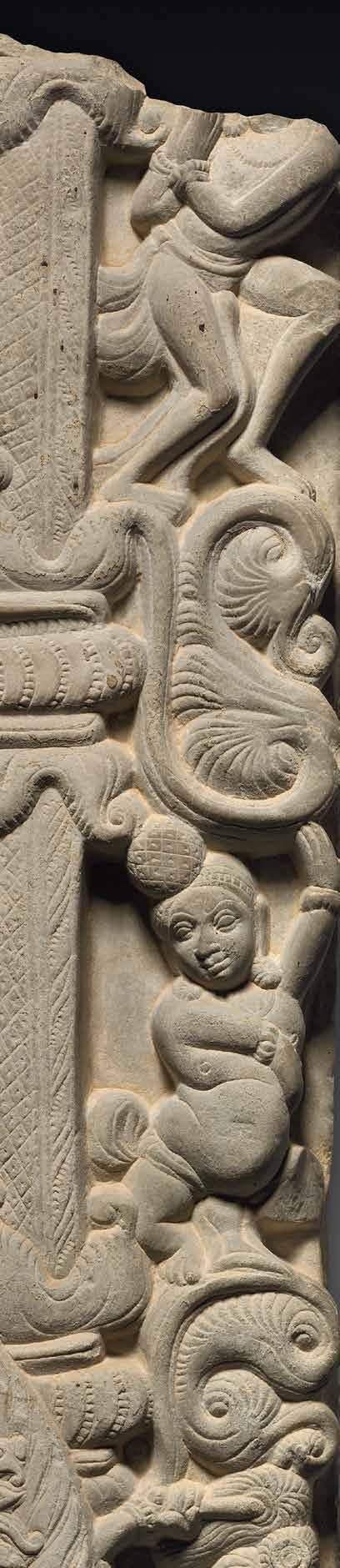
SPONSORS’ STATEMENTS
It is our great joy and privilege to support the exhibition Tree and Serpent: Early Buddhist Art in India, 200 bce–400 ce at The Metropolitan Museum of Art. At Reliance Foundation, we are committed to preserving and promoting Indian heritage and shining a spotlight on Indian art on the global stage. This exhibition traces the origins of early Buddhist imagery and showcases newly discovered and never before seen masterpieces of Buddhist art. In the “cradle of Buddhism,” the teachings of the Buddha are entwined with an Indian ethos, and continue to shape global thought, culture, and ways of life. We are excited to collaborate with The Met and John Guy, Florence and Herbert Irving Curator of the Arts of South and Southeast Asia, and to celebrate this confluence of spirituality, religion, and art. Buddha’s message enlightens the hearts and minds of devotees around the world, and I hope this exhibition gives them and others an opportunity to immerse themselves in the philosophy of Buddhism.
Inspired and informed by interconnectedness, The Robert H. N. Ho Family Foundation Global supports programs in arts, culture, and Buddhism, and funds initiatives that enhance the well-being of humanity, wildlife, and the environment.
With our first major collaboration with The Metropolitan Museum of Art, we are proud to support Tree and Serpent: Early Buddhist Art in India, 200 bce–400 ce, an exhibition closely aligned with our interest in activating art resources for broad, nonsectarian learning of Buddhism and Buddhist art on the worldwide level.
We are honored to support The Met in welcoming visitors from across the globe to learn and engage with Buddhist teachings and the origins of Buddhist art.

Phillip Henderson Chief Executive
Officer, The Robert H. N. Ho Family Foundation Global
Nita M. Ambani Founder Chairperson, Reliance Foundation
It is an honor to support The Metropolitan Museum of Art’s commitment to opening new vistas on the ancient arts of South and Southeast Asia, and the curatorial vision and groundbreaking research that John Guy, Florence and Herbert Irving Curator of the Arts of South and Southeast Asia, brought us with Lost Kingdoms: Hindu-Buddhist Sculpture of Early Southeast Asia in 2014 and now with Tree and Serpent: Early Buddhist Art in India, 200 bce–400 ce. I first met John almost twenty years ago in London while auditing lectures in the postgraduate diploma program in Asian art at the School of Oriental and African Studies, where I encountered a number of influential teachers. John and the inimitable scholar Pratapaditya Pal inspired me and so many other students of Asian art for decades, and I owe them an enormous debt. Congratulations to The Met for the courage in bringing us yet another transformative exhibition that will add much to our understanding of the origins of Buddhist art and the lessons of the Buddha, so relevant to our needs today.
Fred Eychaner
Fred Eychaner Fund
DIRECTOR’S FOREWORD
With Tree and Serpent: Early Buddhist Art in India, 200 bce –400 ce, The Metropolitan Museum of Art celebrates the extraordinary artistry of this early period in India and continues its commitment to presenting exhibitions that open new frontiers on the past for our visitors, both in terms of popular awareness and new scholarship. The message that the Buddha taught in the fourth century bce, and was memorialized in rock-cut edicts by the Mauryan emperor Aśoka in the mid-third century bce, remains starkly relevant to us today. His call to not slaughter the animals of the forests nor burn their habitats addresses contemporary agendas of environmental awareness and care for the planet under our stewardship. One of the Buddhist jātaka stories from this time tells of a king of Vārāṇasī who put the forest at Sarnath under his protection so that the deer could roam free of the fear of hunters, thus creating perhaps the first national park. Above all else, the Buddha’s message was compassion for all living creatures. The serenely beautiful art that was produced in service of Buddhism, and is presented in this exhibition and book, celebrates the outstanding artistic achievements of this time and addresses universal concerns principally through storytelling, a simple and accessible pathway that the disciples of the Buddha and their lineage descendants developed, following the Buddha’s example.
This exhibition and publication featuring the arts associated with the earliest Buddhist stūpas represent a monumental undertaking on the part of the Museum and an expression of trust and goodwill on the part of our lenders. This assembly of rare early Buddhist works of art includes a number of objects that have recently been excavated from monastic sites in India, and have never before been publicly exhibited. It is our privilege to present these outside India for the first time.
Foremost, I wish to express profound appreciation to the Government of India’s Ministry of Culture, thanks to whom we have been able to present so many extraordinary works of art from India, gathered from numerous museums and archaeological sites across multiple states. We express our deep gratitude to their governments: Andhra Pradesh, Bihar, Maharashtra, Tamil Nadu, Telangana, Uttar Pradesh, and West Bengal. The many individuals who generously assisted are listed in the Acknowledgments. I am delighted to also thank our lenders from Europe, notably the British Museum and the Victoria and Albert Museum, London, and the Museum für Asiatische Kunst – Staatliche Museen zu Berlin. In the United States, my appreciation goes to the Brooklyn Museum, the Cleveland Museum of Art, and the Norton Simon Museum, Pasadena.
Exhibitions of antiquities of this kind are expensive undertakings, and we are indebted to the sponsors who generously stepped forward to help us realize this milestone in U.S.-Indian cultural cooperation. Tremendous thanks are owed to Reliance Industries Limited, The Robert H. N. Ho Family Foundation Global, and the Fred Eychaner Fund for making this exhibition possible. We are also grateful to the Estate of Brooke Astor, the Florence and Herbert Irving Fund for Asian Art Exhibitions, the E. Rhodes and Leona B. Carpenter Foundation, the Lavori Sterling Foundation Endowment Fund, and Usha M. and Marti G. Subrahmanyam for their generous support. This wonderful catalogue is made possible by the Florence and Herbert Irving Fund for Asian Art Publications, with additional funding from Albion Art Co., Ltd., and I gratefully acknowledge their support. The symposium is presented with the support of the Fred Eychaner Fund and organized in cooperation with the New York Center for Global Asia, NYU Shanghai Center for Global Asia, and the Lakshmi Mittal and Family South Asia Institute, Harvard University.
Tree and Serpent was conceived by John Guy, Florence and Herbert Irving Curator of South and Southeast Asian Art, and realized over several years, extended by the interruption of the worldwide pandemic. His resolute commitment brought this exhibition and publication to fruition, in what became something of a Herculean challenge. Curatorship today requires a particular mix of scholarship, connoisseurship, and diplomacy to realize an exhibition of this complexity. Skilled teams of colleagues across the Museum came together in collaboration, and I thank them all for their dedication. The Department of Asian Art, led by Douglas Dillion Chair Maxwell K. Hearn, provided leadership as did Deputy Director for Exhibitions Quincy Houghton, along with Deputy Director for Collections and Administration Andrea Bayer. We are further grateful to the international scholars in the field of Buddhist studies who contributed texts to the present volume.
In a world of growing uncertainties, this exhibition and publication remind us of all that we share. Beyond the aesthetic experience and the quietude that this art invokes, it brings a deeper message built on mutual understanding and respect. India is the home of many faiths, including Buddhism, and in sharing this rich heritage it allows art to be its ambassador.
Max Hollein
Marina Kellen French Director
The Metropolitan Museum of Art, New York
PREFACE
Tree & Serpent: Early Buddhist Art in India presents the story of the origins of Buddhist art in India. In so doing, it examines these sources through a less familiar lens, that of the art of the Sātavāhana and Ikṣvāku dynasties of southern India, who variously ruled the region from the first century bce to the early fourth century ce. To better understand the processes by which the Buddhist faith and culture were disseminated, the focus is shifted away from the heartland of Buddhism, the greater Magadha region of northern India where the Buddha was born, taught, and died, to the territories of the Dakṣiṇāpatha, the regions of the south, and the roads that led there. The southern region, the Deccan, was home to some of the greatest early monasteries of Buddhist India. Today, we turn to Bharhut, Sanchi, and Amaravati when we seek to understand the majesty of this architecture and its adornment. The enclosure railing at Bharhut, the ceremonial gateways at Sanchi, and the first copings at Amaravati are the earliest and best preserved of their kind from the early Buddhist world. They are rich in visual narrative, using their surfaces as tableaux for the storytelling that made Buddhism accessible to a wide community of believers.
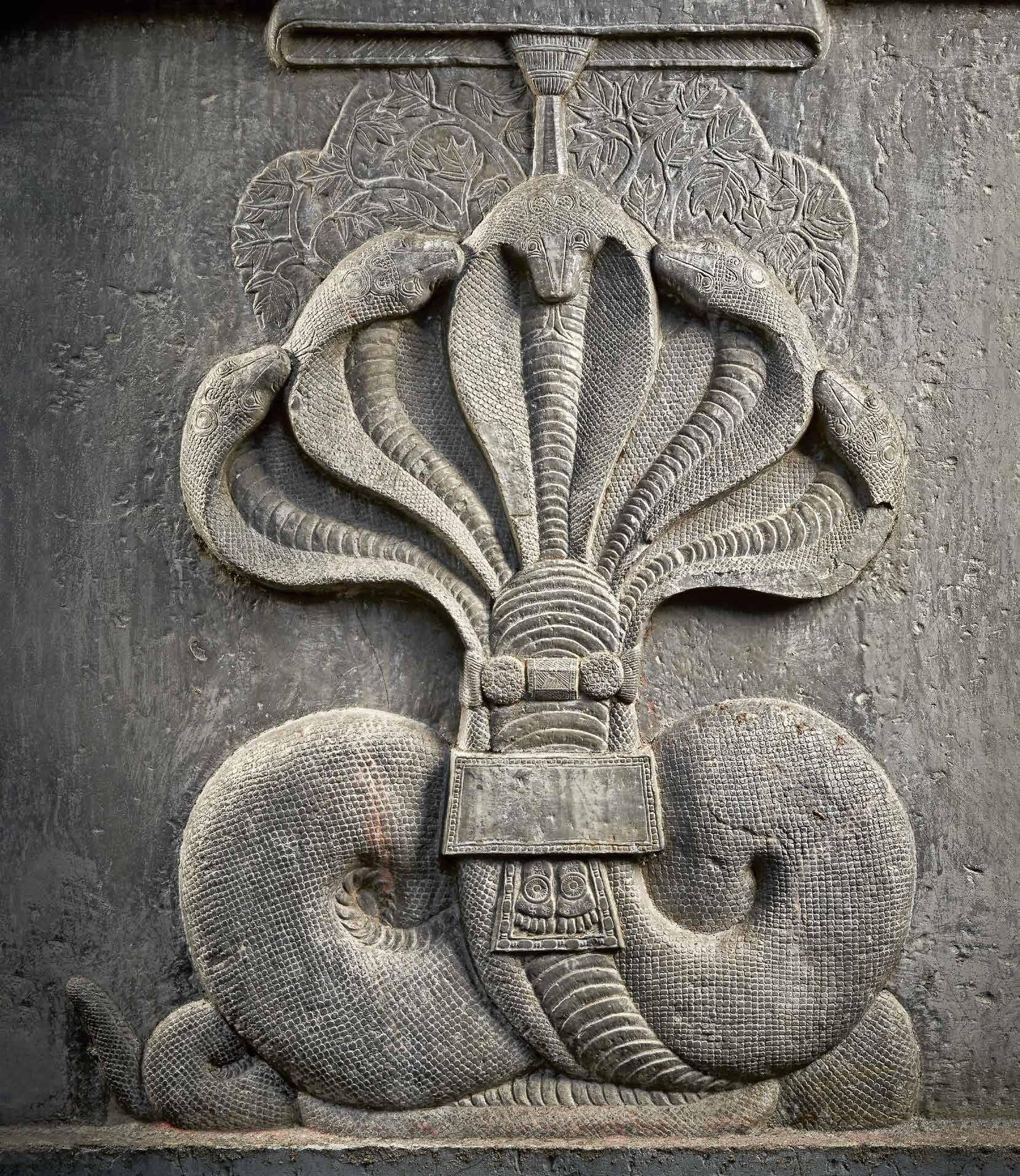
The exhibition takes the stūpa (a dome-shaped structure originating as a funerary mound) as its central motif, embodying as it does the essence of Buddhism, the person of the Buddha (his relics), and his teachings (Dharma). The architectural components of stūpas provided the platform for Buddhist teachings, deploying auspicious signs and symbolic representations in narrative settings to convey the essential teachings. Almost all the works of art presented here once formed an integral part of the adornment of this pivotal Buddhist monument that emerged— lotus-like—from the earthen funerary mound that was the stūpa’s genesis. Two iconographic devices were privileged above all others in the adornment of the southern stūpa: the branching bodhi tree and the snake (nāga). Their ubiquitous presence in southern Indian stūpa decor prompted James Fergusson, an early student of Buddhist architecture, to title his 1868 publication Tree and Serpent Worship: Or, Illustrations of Mythology and Art in India in the First and Fourth Centuries after Christ. The present exhibition and publication seek both to recognize the pioneers in the field of Buddhist architectural and art historical studies, and to reposition the field going forward.
Two historical correctives are in order. The first is to give due recognition to the importance of southern Buddhism, here defined as that of the Deccan and its parallel life in Sri Lanka. Early Buddhist art history has long been focused on the art of Mathurā and Sarnath, along with other sites in the Gangetic Basin of northern India, and
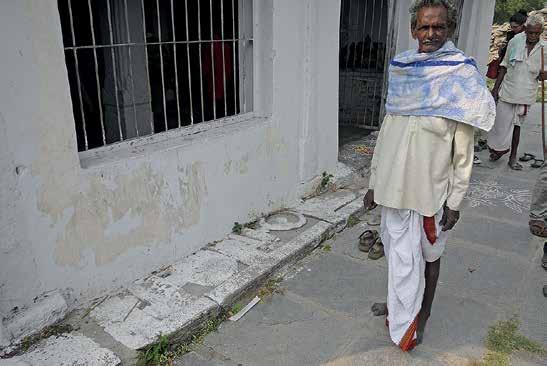
Fig. 1. A village elder at the entrance to the medieval Hindu temple at Chandavaram, Guntur district, Andhra Pradesh. Two limestone panels with bodhi tree, stūpa, and Dharma-wheel design, removed from the nearby Sātavāhana-era stūpa site, are installed as doorway paving. Photographed in 2017
the Gandhāra region of the northwest, present-day Pakistan, largely to the exclusion of the myriad developments taking place in the south. Recent studies, including those of scholars contributing to this publication, have begun to recognize the importance of the Buddhist Deccan, spanning from the rock-cut vihāras of the Western Ghats to the riverine and coastal monasteries along the Bay of Bengal.
The second corrective is to realign the study of the Buddhist legacy of the Deccan within the wider field of Indian Ocean studies and global history. Much that we need to learn about Buddhist India in the early centuries ce is increasingly recognized as being shaped by the dynamics of global exchange. The western Indian Ocean trade with the Red Sea and Mediterranean was a major factor, as were the less well understood exchange systems of the Bay of Bengal with Southeast Asia and China. The Romans prepared papyrus bills of loading for cargoes of ivory and pepper shipped from the Konkan Coast of western India to the Mediterranean (fig. 81). No such primary sources exist for Southeast Asia, but the recovery of Mauryan stone artifacts there makes clear that deep commercial—and cultural—engagements began much earlier than previously acknowledged (figs. 77–79).
This exhibition and publication are privileged to foreground two recently excavated stūpa sites that have redefined much of what we understand about Southern Buddhism. Both sites have been found relatively intact, a rarity in the Deccan, where natural and human attrition has taken a heavy toll. Kanaganahalli stūpa in northern Karnataka, and the hilltop monastic complex of Phanigiri in Telangana, have added two major sites to the already extensive corpus of Buddhist sites in the Deccan (see Maps). Sculptures from both stūpa complexes are presented here for the first time, along with masterpieces from such little-known sites as Pauni, Brahmapurī,
Dhulikatta, Dupadu, Jaggayyapeta, Chandavaram, and Goli. The important contributions made by the excavators of these two new sites, the Archaeological Survey of India and the Department of Heritage, Telangana, are here respectfully acknowledged.
The showering of mercantile wealth, built largely on interregional trade and by the stimulus of a burgeoning international exchange with the Roman world, resulted in much of the finest Buddhist art preserved in India. With the waning of that trade, support for the monastic communities also subsided, and Buddhism gradually faded from the Indian landscape. The monasteries were abandoned and their majestic architecture pillaged, the limestone adornments crushed and burned to produce lime and the brick core of the stūpas quarried for building materials. These practices are witnessed today at the village of Chandavaram in Andhra Pradesh, where two sculpted limestone panels from the nearby stūpa complex have been used to decorate the threshold of a local Hindu temple (fig. 1). At another village in the district, Velpuru, limestone āyāka pillars have been refashioned as Śaiva lingas. The appropriation and repurposing of religious sites and their architectural remains is not a new phenomenon in India; the sacred landscape has always been contested. The Buddhists were not shy in the propagation of their faith and, for more than a millennium, succeeded. But just as they appropriated and subjugated the nature cults of early India, so Buddhist sites were in turn either abandoned or given over to Hindu temples.
Early Buddhist art was also shaped in part by external stimuli, present across India from the Mauryan period as West Asian Hellenism and then Roman influences left their marks on the arts of the subcontinent. The participation of the ivory guild of Ujjain in the funding of a monumental stone gateway at Sanchi signals the importance of
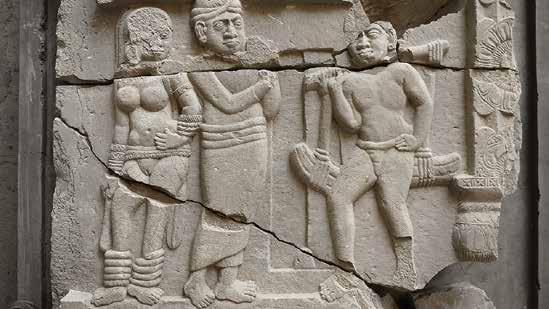
the ivory trade to the economy of early India. This involvement is mirrored in a jātaka story popular in Sātavāhanaera art, the Chaddanta-jātaka. The disturbing tale of jealousy, revenge, cruelty, and remorse, is first told in the south at Kanaganahalli (fig. 2). Ivory traders would have been a familiar sight at the marts of the Konkan Coast, from where great quantities of ivory and luxury objects made from the material were shipped west, as witnessed at Pompeii (cat. 85).
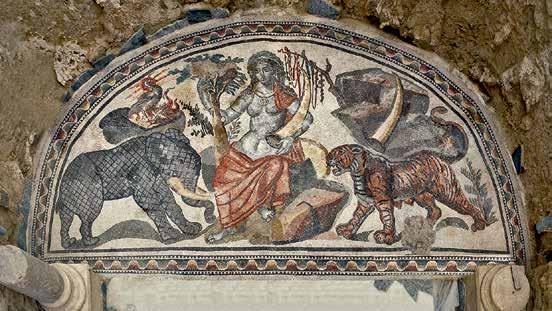
The Roman trade with India in the early centuries ce is increasingly regarded by modern Roman historians as a crucial factor in sustaining the expansive campaigns of the Roman Empire. Arguably, this trade is what we are witnessing in a fourth-century apse mosaic decorating the luxury Villa Romana del Casale in Piazza Armerina, Sicily (fig. 3). A goddess, flanked by an elephant and tigress, displays a cornucopia-like tusk and is surrounded by black pepper plants and a tree that is likely the aromatic agarwood. She wears a diaphanous garment suggestive of Indian muslin, a favorite in Roman couture, and may be identified as the personification of India. While her identity may be contested, what is indisputable is the role that Sātavāhana trade in ivory, pepper, aromatics, and cotton goods played in the Mediterranean world. Likewise, the wealth it engendered in India, especially in the Āndhradeśa territories of the Deccan, contributed to a boom period in the patronage of Buddhist monasteries when much of the sculptural art was added in the form of new encasement panels and enclosures. It is this chapter of early Buddhist art that is celebrated here.
John Guy
Florence and Herbert Irving Curator of the Arts of South and Southeast Asia
The Metropolitan Museum of Art, New York
Fig. 3. Mosaic depicting an unnamed goddess, probably the personification of India, displaying ivory, pepper, aromatic wood, and textiles, and commanding an elephant and tigress. South apse, Villa Romana del Casale, Piazza Armerina, Sicily, 4th century ce
Fig. 2. Ṣaḍdanta-jātaka (of the elephant “Six-Tusks”) drum panel depicting the hunter Sonuttara presenting the tusks of Chaddanta, the king of the elephants and the bodhisattva in disguise. Inscribed: Chaddanta-jātaka. Kanaganahalli, Sannati, Gulbarga district, Karnataka. Sātavāhana, 1st century bce . Limestone
ACKNOWLEDGMENTS
This exhibition and publication could not have happened without the support and vision of the director and leadership of The Metropolitan Museum of Art, who entrusted me to develop two major exhibitions that would extend the boundaries of scholarship in the field of Indian and Southeast Asian art history. The first was Lost Kingdoms: Hindu-Buddhist Sculpture of Early Southeast Asia, mounted in 2014, and the second, prepared with the unstinting support of Marina Kellen French Director Max Hollein, is Tree and Serpent: Early Buddhist Art in India, 200 bce–400 ce, presented here. Deputy Director for Collections and Administration Andrea Bayer and Deputy Director for Exhibitions Quincy Houghton have further helped sustain our commitment to this exhibition in many ways. I am grateful to them all.
The field research that underpins this exhibition and publication took place over an extended period, commencing in earnest in 2014. I returned to India repeatedly thereafter, investigating the many stūpa sites that mark the monastic landscape of ancient Andhra Pradesh and Telangana. The associated sculptural remains are dispersed in museums spanning the country. In the course of this fieldwork I enjoyed the generous support of numerous colleagues who facilitated access to museums and storerooms, and at times accompanied me to the more remote sites.
To colleagues in India, I begin by expressing my deep gratitude to the Hon. Minister of Tourism, Shri G. Kishan Reddy; Hon. Minister of State for External Affairs and Culture, Smt. Meenakashi Lekhi; Secretary of Culture, Shri Govind Mohan; and Joint Secretary Smt. Mugdha Sinha. They are responsible for the guardianship of India’s heritage, and their support was central to the success of this cultural cooperation between India and the United States. The Indian Ambassador to the United States, HE Taranjit Singh Sandhu, and the Indian Consul General in New York, Randhir Jaiswal, are owed special mention for their vision and steadfast support. I thank Smt. Lily Pandeya, Director General of the National Museum, New Delhi, for her support, along with her exceptional team in the International Exhibitions Department, led by curators Zahid Ali Ansari and Visetuonuo Kiso. They have been pivotal in managing the loans from India and are thanked for their professionalism and grace. I am grateful to Jawhar Sircar, the former Secretary of Culture under whose benevolent eye this project began, and to Venu Vasudevan, former Director General of the National Museum, New Delhi.
The Archaeological Survey of India, charged with the enormous responsibility of protecting more than three thousand heritage sites throughout India, is among the oldest such organizations in the world. I extend my deep
appreciation to the Director General, V. Vidyavathi, along with Joint Director General M. Nambirajan and many other colleagues there, including D. N. Dimri, Sanjay Kumar Manjul, N. K. Sinha, Anil K. Tiwari, and Vinay Gupta. I also note with gratitude the support of retired Directors Generals Rakesh Tewari and B. R. Mani, both of whom gave essential support in the formative phase of this project.
Beyond New Delhi, we have engaged with, and are indebted to, seven state governments and the numerous museums and archaeological sites that are under their watch: The Government of Andhra Pradesh: Hon. Chief Minister Shri Y. S. Jagan Mohan Reddy; Dr. Mukthapuram Harikrishna of the Chief Minister’s Office, Velagapudi; Hon. Minister of Tourism, Culture & Youth Advancement Smt. R. K. Roja; Principal Secretary to Government (Sports & Youth Services) Dr. G. Vani Mohan, also Commissioner of the Department of Archaeology & Museums; that Department’s Assistant Director Shri R. Phalguna Rao; and the Department’s staff. The Government of Bihar: Hon. Chief Minister Shri Nitish Kumar; Principal Secretary of Art, Culture and Youth Affairs Shri Ravi Manubhai Parmar; Director General of the Bihar Museum Shri Anjani Kumar Singh; Additional Director Shri Ranbeer Singh Rajput; and their curatorial team. The State Government of Maharashtra: Hon. Chief Minister of Maharashtra Shri Eknath Shinde; Additional Chief Secretary Shri Bhushan Gagrani; Principal Secretary of Tourism and Cultural Affairs Shri Saurabh Vijay; Director of the State Directorate of Archaeology and Museums Shri Tejas Garge; and Kolhapur Town Hall Museum curator Shri Amrut Patil. The State Government of Tamil Nadu: Hon. Minister for Industries, Tamil Official Language and Tamil Culture and Archaeology Shri Thangam Thennarasu; Principal Secretary for Tourism, Culture and Religious Endowments Shri B. Chandra Mohan; Director of the Government Museum, Chennai, Shri Sandeep Nanduri; Assistant Director Shri K. Sekar; and curator Shri S. Paneerselvam. Thanks also to former Director Ms. Kavitha Ramu. The State Government of Telangana: Hon. Chief Minister Shri K. Chandrashekar Rao; Secretary of Youth Advancement, Tourism, Culture & Sports Shri Sandeep Kumar Sultania, also Director of the Department of Heritage, Telangana; that Department’s Deputy Directors Shri Bavandla Narayana and Shri P. Nagaraju; and Assistant Director Ms. V. Nagalaxmi. Thanks are also extended to former advisor of the Chief Minister, Shri B. V. Papa Rao, and to the former Director of the Department of Heritage, Telangana Shri N. R. Visalatchy. The Government of Uttar Pradesh: Hon. Chief Minister Shri Yogi Adityanath; Allahabad Museum
Yandrisevits. I am further grateful to Research Scientist Federico Carò in the Department of Scientific Research. The Department of Institutional Advancement worked closely with the curatorial team in expertly securing funds for this project, and I am grateful to Stephen A. Manzi, John L. Wielk, Jason Herrick, Kimberly McCarthy, and Evie Chabot. In the External Affairs Department, Stella Kim led the press and media promotions, working closely with the Digital Department’s team, headed by Douglas Hegley. The Education Department, led by Heidi Holder, Frederick P. and Sandra P. Rose Chair of Education, placed talented interns and developed a rich array of programming, for which I thank Francesca D’Alessio, Elizabeth Perkins, Marianna Siciliano, and Sherri Williams.
Members of the Publications and Editorial Department are to be thanked for their usual professionalism in seeing this book to fruition: Publisher and Editor in Chief Mark Polizzotti; Associate Publisher for Production Peter Antony; Associate Publisher for Editorial Michael Sittenfeld; Senior Editor Elizabeth L. Block, with Sarah McFadden; Senior Production Manager Christopher Zichello; Image Acquisitions Specialist Josephine Rodriguez; Editor Elizabeth Benjamin; Associate Editor Cecilia Weddell; designer Laura Lindgren; and bibliographer Amelia Kutschbach. Yael Shiri provided expert proofreading of the Middle Indo-Aryan and Sanskrit terminology. The publication is greatly enhanced by the photography of Thierry Ollivier,
NOTE TO THE READER
Abbreviations
ASI Archaeological Survey of India
alt. alternate anc. ancient mod. modern lit. literally Skt. Sanskrit Tib. Tibetan var. variant
Unless otherwise noted, catalogue entries are written by John Guy.
Note on Translation
Unless otherwise noted, translations of quotations are by the authors.
Note on Transliteration
Dealing primarily with art of the Indian subcontinent, many of the terms and toponyms discussed in this book originate from a variety of Indic languages and their spelling in English can therefore vary. Some of these terms, such as Buddha or Dharma, have entered common use in contemporary English. However, in order to offer consistency and clarity but also to be as loyal to their original pronunciation as possible, many of these words have been transliterated.
whose extraordinarily beautiful photographs were produced often in the most challenging of circumstances. The contributors to this publication deserve special mention: Shailendra Bhandare, Pia Brancaccio, Federico Carò, Parul Pandya Dhar, Sunil Gupta, Himanshu Prabha Ray, Gregory Schopen, Peter Skilling (Bhadra Rujirathat), Akira Shimada, Elizabeth Rosen Stone, Vincent Tournier, Norman Underwood, and Monika Zin.
On a personal note, I extend thanks to Romila Thapar, Kesavan Veluthat, Oskar von Hinüber, Harry Falk, Naman Ahuja, and Suchandra Ghosh for their scholarship and friendship over the years. Akira Shimada served as an advisor to this project and on occasion an agreeable travel companion in the Andhra territories. I thank him on both counts. Arlo Griffiths and Vincent Tournier generously shared their groundbreaking contributions to Andhra epigraphy, along with contributors Stefan Baums, Emmanuel Francis, and Ingo Strauch, in the Early Inscriptions of Andhradesa (EIAD) online project. Thanks are due to Annette Giesecke on matters botanical and to William Dalrymple for his encouragement. The generous support of our sponsors is detailed above, but I wish to record my personal appreciation to Anita Chung and Fred Eychaner for their belief in this project. Finally, I am indebted to colleagues in India for their extraordinary acts of kindness to me on this project. These friendships are the bedrock of international cooperation and understanding.
John Guy
Florence and Herbert Irving Curator of the Arts of South and Southeast Asia
Place names in particular posed a challenge as they occur in various forms in the available literature, and modern place names have become invariably associated with their ancient history. In this book, places of archaeological significance as well as ancient toponyms have been transliterated, while for other place names they have been omitted.
The transliteration of words in Devanagari and related Indic scripts has been rendered with diacritics, to indicate a diversity of phonetic sounds not always reflected in Latin script, following the ISO 15919 Romanization standard established by the International Organization for Standardization (2001). For consistency, when a term or proper name can occur variously in different languages, the Sanskrit spelling was prioritized over others. All nonEnglish terms appear in italics. At times, the book makes use of epigraphic evidence, in which cases the inscribed spelling of proper names and toponyms was preserved. As for the names of rulers, whose names have been spelled in epigraphic records in various ways, a standardized spelling was used throughout. In the case of the Sātavāhana dynasty, a standardized Prakrit spelling has been opted for.
LENDERS TO THE EXHIBITION
INDIA
Government of India, Ministry of Culture
Archaeological Survey of India, Archaeological Museum
ASI, Amavarati, Guntur District, Andhra Pradesh
Archaeological Survey of India, Kanaganahalli Archaeological Site ASI, Sannati, Gulbarga District, Karnataka
Archaeological Survey of India, Nagarjunakonda, Archaeological Museum ASI, Nagarjunakonda, Andhra Pradesh
Government of Andhra Pradesh, Amaravati Heritage Centre and Museum, Department of Archaeology and Museums
Government of Andhra Pradesh, Baudhasri Archaeological Museum, Guntur, Guntur District, Department of Archaeology and Museums
Government of Bihar, Bihar Museum, Patna
Government of Maharashtra, Town Hall Museum, Kolhapur, Department of Archaeology and Museums
Government of Tamil Nadu, Government Museum, Chennai
Government of Telangana, Karimnagar Archaeology Museum, Department of Archaeology and Museums
Government of Telangana, Phanigiri Stūpa Site, Department of Heritage Telangana, Hyderabad
Government of Telangana, State Archaeology Museum, Department of Heritage Telangana, Hyderabad
Government of Uttar Pradesh, Allahabad Museum, Prayagraj
Government of West Bengal, Indian Museum, Kolkata
National Museum, New Delhi
EUROPE
Museum für Asiatische Kunst – Staatliche Museen zu Berlin
The British Museum, London
Nick Gilbey and Mrs. Thomasin Nares
National Archaeological Museum, Naples
Victoria and Albert Museum, London
Private collection
UNITED STATES OF AMERICA
Brooklyn Museum
Cleveland Museum of Art
Norton Simon Foundation, Pasadena
Private collections
CONTRIBUTORS
AUTHOR
John Guy, Florence and Herbert Irving Curator of the Arts of South and Southeast Asia, The Metropolitan Museum of Art, New York
CONTRIBUTORS
Shailendra Bhandare, Curator of South Asian and FarEastern Coins and Paper Money, Ashmolean Museum of Art and Archaeology, Oxford, England
Pia Brancaccio, Professor of Art History, Drexel University, Philadelphia
Federico Carò, Research Scientist, The Metropolitan Museum of Art, New York
Parul Pandya Dhar, Associate Professor of Art History, University of Delhi, New Delhi
Sunil Gupta , Former Director In Charge, Allahabad Museum, Prayagraj. Ministry of Culture, Government of India
Himanshu Prabha Ray, Professor, Centre for Historical Studies, Jawaharlal Nehru University, New Delhi
Gregory Schopen, Distinguished Professor Emeritus, Department of Asian Languages and Cultures, University of California, Los Angeles
Akira Shimada , Professor, Department of History, State University of New York at New Paltz
Peter Skilling, Adjunct Professor, Savitribai Phule Pune University, Pune, India
Elizabeth Rosen Stone, Independent Scholar, New York
Vincent Tournier, Professor of Classical Indology, Institut für Indologie und Tibetologie, Ludwig Maximilian University of Munich
Norman Underwood, Visiting Assistant Professor, Department of History, New York University
Monika Zin, Professor of Art History and Asian Studies, Saxon Academy of Sciences and Humanities and Leipzig University, Leipzig
BEGINNINGS OF BUDDHIST IMAGERY