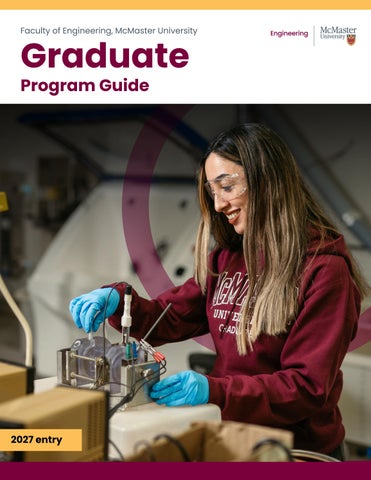
Faculty of Engineering, McMaster University
Graduate Program Guide
2027 entry
Table of contents Welcome
5
Life in Hamilton
6
World-class facilities
8
Co-op, career and experience
10
Programs
12
Engineering Graduate Society
33
Funding and awards
34
Admission requirements
35
page 3
Welcome Ranked as one of the world’s top engineering schools, the Faculty of Engineering plays a significant role in elevating McMaster University’s reputation as one of Canada’s most innovative and research-intensive universities.
Collaboration with industry partners, access to a network of leading researchers, co-op options and professional development experiences are just some of the ways Mac Eng helps fast-track you toward a fulfilling career.
“Working together in the spirit of collaboration, not competition, providing mentorship and resources to our students and creating unforgettable memories as an inclusive Fireball Family are at the heart of our unparalleled student experience.”
“Our graduate students have the opportunity to learn on a campus equipped with some of the most cutting-edge research facilities in the world. Paired with mentorship by our exceptional faculty, we are empowering the next generation of engineering leaders to create a brighter future.”
Heather Sheardown Dean, Faculty of Engineering
Kathryn Grandfield Associate Dean, Graduate Studies Faculty of Engineering
#18
in the world for global impact Times Higher Education Impact Rankings 2026
#3
in Canada for graduate student research intensity
30
graduate programs for you to discover
Research Infosource 2025
page 5
Experience your new city Check out Tourism Hamilton’s Instagram account.
Royal Botanical Gardens nearby campus
Life in Hamilton McMaster University’s campus is in Hamilton, Ontario - a vibrant, multicultural community rich in history. The city has a thriving arts scene, delicious restaurants and cafés to satisfy any craving, as well as a lively nightlife. With more than 100 waterfalls to discover and breathtaking trails and forests, Hamilton is the perfect balance of bustling city life and tranquil green spaces. It is conveniently positioned an hour away from Toronto and Niagara Falls, with excellent public transportation systems available to and from campus.
10 Bay Residence Live in the heart of the city with a dedicated shuttle to campus!
McMaster has resources to support you in finding housing options. Residence spaces are available to graduate students nearby campus; just a bus ride away.
om h w e n r u o y Get to know
e!
page 6
Did you know? A 10-minute walk from campus, Westdale Village is the hub for student off-campus living.
Businesses in Westdale Village
Our campus backs onto Cootes Paradise a natural sanctuary with 18 km of trails
Hamilton Farmers’ Market
Learn more about housing options at McMaster
Smokey Hollow Waterfalls
page 7
World-class facilities
#3
most researchintensive university in Canada for graduate students Research Infosource 2025
Where groundbreaking research happens
Our renowned research centres and institutes that house top-tier equipment help facilitate discovery and innovation. Students learn in these facilities, which equip them with experience using the latest technologies before entering the workforce.
In keeping with our collaborative approach to research, our facilities are also used by faculty members across the university, government and the private sector. Discover some of the spaces you can access as a graduate student.
Full-motion simulator on campus
page 8
Centres and institutes snapshot These innovative spaces are where faculty, students and industry work together across disciplines, sectors and borders to develop knowledge, tackle global issues and advance human understanding.
McMaster Manufacturing Research Institute (MMRI) The MMRI meets sophisticated research and development needs of leading manufacturers in the automotive, aerospace, biomedical and consumer goods industries.
Canadian Centre for Electron Microscopy (CCEM) The CCEM provides world-class electron microscopy capabilities and expertise to Canadian researchers and industry partners working in a broad range of fields.
Centre for Emerging Device Technologies (CEDT) The CEDT facilitates the study of the optical, electrical, mechanical and biological properties of semiconductors and related materials.
McMaster Automotive Resource Centre (MARC) MARC is one of the world’s leading academic research facilities in transportation electrification and smart mobility.
McMaster Nuclear Reactor (MNR) The MNR is Canada’s most powerful research reactor and the nation’s only major neutron source. This 5 MW multipurpose reactor provides neutrons for research and medical isotope production.
Centre of Excellence in Protective Equipment and Materials (CEPEM) CEPEM assists research and development for Canadian companies and develops the next generation of personal protective equipment to meet immediate and future needs.
Explore more of our research centres, institutes and facilities
page 9
Co-op, career and experience Invest in future you. Let’s get started. The Centre for Career Growth & Experience (the Centre) is where your academic and career goals unite. We know every student’s career journey is unique. That’s why we have a team available to help graduate students enrolled in co-op design a plan to achieve their career goals. Graduate co-op students complete a comprehensive 9-week co-op preemployment course and receive dedicated support from their Career Educator to prepare them for the co-op job search process and on-the-job success. The Centre’s suite of career and employment services will help position you for success now and in the future.
3rd
largest co-op program in Canada
Co-op
4-12 month cobl-oe p terms availa
Co-op enables you to establish a network of industry contacts and develop a range of valuable skills to enhance your graduate studies and career prospects. A term of paid work experience is a great addition to your master’s or doctoral studies. You’ll benefit by gaining valuable industry experience with leading employers, which can influence and inform your research. Co-op eligibility is dependent on permission from your research supervisor.
1,300+
local and international partner employers
page 10
Graduate career planning
Industry connections
Preparing and equipping graduate students with the knowledge and skills to navigate their own career journeys is a priority within the Faculty of Engineering at McMaster University.
The Centre team cultivates relationships with leading employers, connects students with industry professionals and offers careerplanning tools and resources. Graduate students can gain significant industry experience while completing their degrees.
The Centre delivers a career planning session for graduate students* to ensure early exposure to and awareness of career and employment principles and opportunities. Participating students learn about the career planning process, effective job search techniques and resources available at McMaster to support them in understanding and working towards their individual career goals, including how their graduate education can provide a competitive edge within industry.
Employment preparation courses and workshops Dedicated Career Educators for graduate students in co-op 1:1 appointments and job search support On-the-job check-ins and work term reflections
Interested in graduate co-op? Scan to learn more.
*Students in W Booth School programs, UNENE and Industrial PhDs are welcome to enrol; however, this course is not a requirement.
page 11
Chemical Engineering
Amirhossein Kora Rakish Chemical Engineering, PhD Embracing electrochemistry for a more sustainable future Kora is using renewable energy to electrochemically convert carbon dioxide into fuels and chemicals. His work at the Higgins Lab aims to store green energy for future generations while removing carbon dioxide from the atmosphere to address global warming.
The Department of Chemical Engineering is one of the most distinguished and researchintensive chemical engineering departments in Canada. Four of the 20 chemical engineers selected by the Canadian Society for Chemical Engineering for making the greatest Canadian contributions to the discipline in the 20th century were professors in our faculty.
page 12
Faculty of Engineering
Degrees offered: Chemical Engineering - MASc, PhD Entry dates: September, January, May Admission requirements: Visit page 35 Study options: Full- or part-time for all degrees offered (co-op available)
McMaster is engaged in cutting-edge chemical engineering research and has concentrated research groups that collaborate with international industrial sponsors. Notable Chemical Engineering facilities include the: Centre for Advanced Polymer Processing & Design (CAPPA-D) McMaster Advanced Control Consortium McMaster Centre for Pulp and Paper Research McMaster Manufacturing Research Institute
MEET YOUR MENTOR Explore faculty members currently accepting graduate students
Research areas of specialization Bioengineering A longstanding strength of the Department that includes a number of sub-areas such as biomaterials and bioseparation. Polymer materials and manufacturing The study and design of polymers for bio applications, as well as polymer manufacturing and sustainability. Process systems engineering Development of knowledge and skills to analyze integrated processes using mathematical methods and computer tools. Water-energy technologies Development of knowledge and skills needed to tackle current and future challenges in water and energy provision with an emphasis on sustainability.
page 13
Civil Engineering
Lily Wilson Civil Engineering, PhD Designing earthquake-resilient structures Lily’s research in structural and earthquake engineering focuses on Controlled Rocking Braced Frames. They help allow the structure to uplift and move during an earthquake to keep people safe and reduce building damage. Her goal is to provide design guidance that can be incorporated into steel design standards for all engineers to use.
The Department of Civil Engineering facilitates one of the top civil engineering programs in Canada. We are a vibrant multi-disciplinary research-intensive department focused on building healthier communities to create a brighter world. Our strong connections with industry are evident by our multiple research chairs and strong record of successful application-based research funding. Our laboratory facilities allow us to conduct world-class research supported by multiple research centres, networks and institutes.
page 14
Faculty of Engineering
Degrees offered: Civil Engineering - MEng, MASc, PhD Entry dates: September, January Admission requirements: Visit page 35 Study options: Full- or part-time for all degrees offered (co-op available)
McMaster is engaged in leading research in the field of civil engineering and has concentrated research groups that collaborate with international industrial sponsors, including the: Applied Dynamics Laboratory Centre for Effective Design of Structures Geotechnical Laboratory McMaster Institute of Transportation and Logistics Water and Environmental Engineering Laboratories
MEET YOUR MENTOR Explore faculty members currently accepting graduate students
Research areas of specialization INTELLIGENT ENERGY SYSTEMS Integration and optimization of multiple energy sources with the primary goal of providing sustainable energy to communities across the globe. RESILIENT INFRASTRUCTURE SYSTEMS Development of innovative infrastructure systems to withstand, adapt and rebound from extreme events. SMARTER MOBILITY Smart transit systems, rapid evacuation from hazard areas, connected communities and intelligent and integrated shared transportation systems. WATER SECURITY UNDER CLIMATE CHANGE Mobilization of emerging technologies through multi-disciplinary initiatives to address water security risks, particularly those induced by climate change challenges.
page 15
Computing & Software
Jongjun Park Computer Science, PhD Improving AI models through smarter data AI systems, especially deep learning models, rely on quality data to perform well. But real-world data isn’t straight forward. Jongjun’s research centres on identifying patterns within complex datasets to develop tailored models. He is collaborating with an industry partner to analyze historical aircraft maintenance and predict when components will need servicing.
The Department of Computing and Software advances the field of computing through education and research. We focus on computing research problems that involve scientific theory, engineering practice and the interface between the two. We seek to address society’s need for better methods of developing information systems and dependable, safe, secure and high-quality software.
page 16
Faculty of Engineering
Degrees offered: Computer Science - MSc, PhD; Computing and Software - MEng, Software Engineering - MASc, PhD Entry dates: September Admission requirements: Visit page 35 Study options: Full- or part-time for all degrees offered (co-op available)
Computing and Software advances the field of computing through education and research. We focus on computing research problems that involve scientific theory, engineering practice and the interface between the two. We seek to address society’s need for better methods of developing information systems and dependable, safe, secure, high-quality software.
MEET YOUR MENTOR Explore faculty members currently accepting graduate students
Research areas of specialization APPLIED COMPUTING Scientific computing, optimization, bioinformatics, signal processing and control theory COMPUTING METHODOLOGIES Artificial intelligence, digital twins, machine learning, robotics, graphics and animation, natural language processing, computer vision and quantum computing HUMAN-CENTRED COMPUTING Augmented reality, virtual reality, social computing, human-computer interaction and human-robot interaction INFORMATION SYSTEMS Big data, data science and databases NETWORKED AND DISTRIBUTED COMPUTING Cloud, edge and fog computing, mobile and pervasive computing, computer networking (wired/wireless), Internet of Things (IoT), distributed systems PRIVACY, SECURITY AND TRUST Network and information security, data cleaning, data privacy, privacy and security of AI systems, Trustworthy and responsible AI SOFTWARE AND ITS ENGINEERING Programming languages, software engineering, software safety and performance of software systems THEORY OF COMPUTATION Design and analysis of algorithms, computer logic, geometry and discrete structures, queuing theory and cryptography
page 17
Electrical & Computer Engineering
Zhou Han Electrical & Computer Engineering, PhD Restoring images through deep learning Zhou’s research focuses on computer vision and image restoration. She is studying various low-level vision challenges such as dehazing, enhancing low-light images and removing shadows from RGB images. Zhou aims to develop more powerful and efficient deep learning algorithms to tackle these complex problems.
Faculty members in the Department of Electrical and Computer Engineering have received prestigious recognition including the Premier Research Excellence Award (PREA), OCUFA Teaching Award, the McMaster Student Union Teaching Award, Booker Gold Medal and the Signal Processing Society Education Award.
page 18
Faculty of Engineering
Degrees offered: Electrical and Computer Engineering - MEng, MASc, PhD Entry dates: September, January, May Admission requirements: Visit page 35 Study options: Full- or part-time for all degrees offered (co-op available)
McMaster’s Electrical and Computer Engineering department is internationally and nationally recognized as one of the leading departments in its field. In the PhD program, we enable students to enhance their knowledge and skills and seek to provide an environment that fosters creativity and research excellence on an international scale in a particular field of electrical and computer engineering. We also aim to inspire students to a career of contributions in our communities through leadership of advances in the state-of-the-art in their fields of interest.
MEET YOUR MENTOR Explore faculty members currently accepting graduate students
Research areas of specialization BIOMEDICAL TECHNOLOGIES These technologies aim to enhance healthcare by developing tools, devices and systems that can improve the diagnosis, monitoring and treatment of medical conditions. COMMUNICATION TECHNOLOGIES, SYSTEMS & NETWORKS A multidisciplinary field that focuses on the development, implementation and optimization of various technologies and systems for effective communication. This encompasses a broad spectrum, including telecommunications, network infrastructure, wireless systems, internet technologies and emerging communication platforms. ELECTRIFIED & AUTONOMOUS TRANSPORTATION This dynamic field aims to enhance sustainability, increase safety and reshape the entire transportation ecosystem, paving the way for a more efficient, environmentally conscious and technologically advanced era of transportation. ELECTROMAGNETICS & PHOTONICS An interdisciplinary field of study that focuses on the generation, transmission and manipulation of electromagnetic waves and photons. INTEGRATED, EMBEDDED AND INTERCONNECTED SYSTEMS The design and implementation of complex systems that seamlessly combine various components, technologies and functionalities to achieve specific objectives. MICROELECTRONICS & VLSI Research focused on microelectronic, nanoelectronic and optoelectronic components and systems. OPTIMIZATION, LEARNING & CONTROL Pioneering work in the development of the space mapping optimization technique has enabled rapid optimization of high-fidelity systems and devices that rely on complex multi-physics simulations at substantially reduced computational cost. POWER ELECTRONICS & ELECTRIC MACHINES The study, design and application of electronic devices and systems for the control and conversion of electrical power. This field encompasses the integration of power electronic converters and electric machines, focusing on the efficient and precise management of electrical energy. SIGNAL, IMAGE & VIDEO PROCESSING Signal processing research with activities that cover a wide range from theoretical research to the design of VLSI, optical and opto-electronic systems for fast implementation of signal processing algorithms. page 19
Engineering Physics
Paramita Bhattacharyya Engineering Physics, PhD Designing colourful solar cells for electric vehicles Paramita is researching how to obtain colours from firstgeneration solar cells. Cells with active materials like silicon or CIGS have the potential to be integrated directly into the bodies of electric vehicles (EVs) due to their stability in various environmental conditions. By replacing the anti-reflective coating with a notch filter, Paramita is designing optical filters that give a distinct colour rendering to solar-charged EVs.
The Department of Engineering Physics is pushing the forefront of modern physics to better the world through technological advancement. We are solving the grand challenges of the future such as sustainable energy supply, human health, digital information and communications technology.
page 20
Faculty of Engineering
Degrees offered: Engineering Physics - MEng, MASc, PhD; UNENE Nuclear Engineering - MEng Entry dates: September, January, May (MASc, PhD) | September (MEng) Admission requirements: Visit page 35 Study options: Full- or part-time offered (co-op available)
Engineering Physics at McMaster is engaged in leading-edge research in biomedical engineering, nuclear and energy systems engineering, nano- and micro-device engineering, and photonics engineering. Research facilities for Engineering Physics include the: Centre for Emerging Device Technologies McMaster Centre for Advanced Light Microscopy McMaster Nuclear Reactor McMaster Biointerfaces Centre for Advanced Nuclear Systems McMaster Intense Positron Beam Facility
MEET YOUR MENTOR Explore faculty members currently accepting graduate students
Research areas of specialization BIOMEDICAL ENGINEERING Application of light (photonics) and nano- and micro-devices in health and medicine. INTERDISCIPLINARY ENGINEERING New and advanced materials, devices and systems engineered based on a fundamental understanding of physics. NANOTECHNOLOGY AND MICRO-SYSTEMS ENGINEERING Technologies at the core of the current computer and communications revolution driven by the potential impacts on society and the environment. NUCLEAR ENGINEERING AND ENERGY SYSTEMS Application of scientific principles, engineering design and analysis, and computer modeling and simulation for the peaceful use of nuclear energy. PHOTONICS ENGINEERING Exploration of the generation, control and detection of light to provide useful applications for society. QUANTUM COMPUTING MATERIALS AND DEVICES Quantum Computing, quantum materials and devices SEMICONDUCTOR DEVICE TECHNOLOGY Device design, device fabrication, semiconductor physics, device testing, materials growth, materials characterization and III-V epitaxy SMART SYSTEMS Integration of various sensors and actuators to analyze and control a process.
page 21
Materials Science & Engineering
Bavley Guerguis Materials Science and Engineering, PhD Pushing boundaries in semiconductor technology Bavley’s research uses atom probe tomography to improve the accuracy of dopant measurement in semiconductors. This technique is critical for advanced materials characterization in microelectronics. Bavley’s work is contributing to advancements in semiconductor technology, which are vital for developing faster and more efficient microchips.
The Department of Materials Science and Engineering is internationally renowned as the place where students, scholars, alumni and employers partner in a journey of learning, discovery and innovation.
page 22
Faculty of Engineering
Degrees offered: Materials Science and Engineering - MASc, PhD Entry dates: September, January, May Admission requirements: Visit page 35 Study options: Full- or part-time for all degrees offered (co-op available)
McMaster is engaged in leading edge materials science and engineering research and has concentrated research groups that collaborate with international industrial sponsors including: Canadian Centre for Electron Microscopy Steel Research Centre Centre for Automotive Materials and Corrosion
MEET YOUR MENTOR Explore faculty members currently accepting graduate students
Research areas of specialization BIOMATERIALS Design and development of new biomaterials for applications in implants, tissue engineering, drug-delivery and biosensing. DATA ANALYTICS AND COMPUTATIONAL MATERIALS Use of data analytics and advanced modelling to better understand the use, selection, manufacturing and discovery of materials. MATERIALS FOR MANUFACTURING AND INFRASTRUCTURE Design of processes and materials for the automotive, aerospace, energy and infrastructure industries. SMART MATERIALS AND DEVICES Discovery of new materials and modification to existing ones in order to achieve desired electronic, magnetic and optical properties.
page 23
Mechanical Engineering
Anooshe Mirhakimi Mechanical Engineering, PhD Building resilience through bio-inspired design Anooshe designs bio-inspired metamaterials for enhanced energy absorption using metal additive manufacturing. Inspired by natural structures like honeycombs, her goal is to tailor mechanical performance under a range of loading conditions. Anooshe’s work has wide applications from advancing crashworthiness of automotive components to protecting spacecrafts from collisions with space debris.
The Department of Mechanical Engineering is one of the largest departments in the Faculty. Our research funding per faculty member is amongst the highest in the country, and we benefit from state-of-the-art laboratories with established international reputations.
page 24
Faculty of Engineering
Degrees offered: Mechanical Engineering - MASc, PhD Entry dates: September, January, May Admission requirements: Visit page 35 Study options: Full- or part-time for all degrees offered (co-op available)
Our research is heavily supported by industry and is in areas of strategic interest including hybrid vehicles, energy and environment, sustainable energy, biomechanics, materials and manufacturing, MEMS and mechatronics. Some of our facilities include the: Centre of Excellence in Protective Equipment and Materials Centre for Mechatronics and Hybrid Technologies McMaster Institute for Energy Studies McMaster Manufacturing Research Institute
MEET YOUR MENTOR Explore faculty members currently accepting graduate students
Research areas of specialization ADVANCED MANUFACTURING The use of innovative technologies, processes and systems to enhance efficiency, precision and customization in the production of goods. BIOMECHANICS Use of principles from physics and engineering to analyze and quantify the mechanics of movement, providing insights into the functioning of biological systems. ENERGY AND FLUID SYSTEMS Analysis of interactions between heat, fluid flow and mechanical systems. MECHANICS AND DESIGN The study of forces, motion and the principles of mechanical systems to design and create innovative solutions. SMART SYSTEMS The study and development of technology-driven systems that use sensors, data processing and machine learning to perceive, analyze and respond intelligently to their environment or user inputs.
page 25
School of Biomedical Engineering
Arjun Raha Biomedical Engineering, PhD Targeting brain cancer through cellular mechanics Arjun’s research explores how brain cancer cells detect and respond to mechanical forces in their environment. By analyzing mechanotransduction and other aspects of cell behavior, his goal is to identify new therapeutic strategies that disrupt how tumors spread. This could lead to better outcomes for patients with glioblastoma – the most aggressive and deadly form of brain cancer.
The School of Biomedical Engineering is the result of a partnership between the Faculty of Engineering and the Faculty of Health Sciences. We provide a collaborative environment that leverages expertise in medical sciences and engineering and links current and emerging areas of molecular, medical and bioengineering research. Our goal is to leverage McMaster’s internationally recognized strengths and resources toward the development of new approaches in biomedical science and technology, through both fundamental and more goal-oriented translational research programs.
page 26
Faculty of Engineering
Degrees offered: Biomedical Engineering - MASc, Accelerated MASc, MD/PhD, PhD Entry dates: September, January, May Admission requirements: Visit page 35 Study options: Varies by degree (co-op available)
McMaster’s School of Biomedical Engineering is home to various research centres including the: Brockhouse Institute for Materials Research Centre for Emerging Device Technologies Centre for Minimal Access Surgery Juravinski Cancer Centre McMaster Institute for Applied Radiation Sciences McMaster Manufacturing Research Institute Thrombosis and Atherosclerosis Research Institute
MEET YOUR MENTOR Explore faculty members currently accepting graduate students
Research areas of specialization BIOMATERIALS AND DEVICES Focus on the growth or regeneration of cells, tissues and organs. The technology includes development of biomaterials, implantable devices and sensors and other biologically compatible materials with applications in numerous medical devices and therapies. IMAGING, SENSING AND DETECTION Development and application of imaging technologies applicable to cells, tissues, organs and the brain for diagnostic and therapeutic purposes. THERAPEUTICS Development of novel drugs and drug delivery methods, including the development of biodegradable polymers and other materials for tissue engineering of cellular scaffold and release of signaling molecules.
page 27
W Booth School of Engineering Practice & Technology
Maged Eid Systems and Technology, MEng Optimizing analysis of diagrams with AI Maged is using advanced computer vision techniques to automate the interpretation of complex process-related engineering diagrams. Manual analysis often leads to errors, labour-intensive work and delays. Maged’s goal is to provide a scalable, accurate and efficient means to extract and analyze information.
The W Booth School of Engineering Practice and Technology offers six dynamic Master’s programs where students can become innovative problem solvers and lead creations of sustainable solutions in the connected world. Each program is eligible for co-op. Our students are also intricately involved in entrepreneurship for start-up companies and development of engineering based policy decisions. A combination of in-depth technical expertise with project management and communication skills position students to become leaders in their field.
page 28
Faculty of Engineering
Master of Engineering Design A project-based degree that develops your skills in designing valueadded solutions for industry and society while considering users, customers, economies and ecosystems. Learn to design and engineer elegant solutions to complex problems, and discover insights about users through the philosophy of humancentred design. Build a portfolio of design work that demonstrates your capabilities. Gain experience by leveraging design thinking techniques as well as technologies, methods, and tools. Admission
Start date
Full-time length
Part-time length
STEM degree, B- average in last 10 technical courses
September
24 months 12 months (accelerated option)
40 months
30%
continue the venture they started in the program and go on to develop it as a business
Applicants who did not attain the required standing in their undergraduate degree, but who have at least four years of relevant work experience may be considered.
Master of Engineering in Systems & Technology A course or project-based degree focusing on building smart and connected systems that revolutionize work, lifestyle, connectivity, leisure and health.
Available in either a project-based option (8 courses plus project) or a course-based option (10 courses) Specialize in the following areas: Automation and Smart Systems
Only one of its kind in Canada that delivers specialized training in digital manufacturing, automotive, automation, and smart and connected systems.
Automotive
Admission
Start date
Full-time length
Part-time length
Process Systems
Honours bachelor's degree (4 year) in engineering, sciences, technology or equivalent, B average in last 20 technical courses
September or January
24 months 12 months (accelerated option)
40 months
Digital Manufacturing
page 29
Shelby Amponsah Manufacturing Engineering: Biomanufacturing, MEng
Master of Engineering Entrepreneurship and Innovation and Master of Technology Entrepreneurship and Innovation A project-based degree that equips early- and mid-career professionals, executives and entrepreneurs with skills in corporate innovation and corporate strategy. Future-forward digital pedagogy will help train students as innovation leaders, building their capacity to bring innovations to the market. To enhance the quality of training, we’ll leverage our strong ties with community partners, and integrate industry leaders and top tech entrepreneurs into the classroom experience. Admission Honours bachelor's degree (4 year) in engineering, sciences, technology or equivalent (for MEEI) or any honours bachelor’s degree (for MTEI), B- average In the last 10 technical courses
Start date
Full-time length
Part-time length
September or January
24 months 12 months (accelerated option)
40 months
page 30
Faculty of Engineering
Master of Engineering and Public Policy A project-based degree that equips you to develop scientifically sound public policies, using your technical knowledge to provide a solid foundation for decision making. Gain the skills that will allow you to work across business, government and communities Develop the research, analytical and communication skills the policy profession demands Admission
Start date
Full-time length
Part-time length
STEM degree or a non-STEM degree in a public-policy related field, B- average in last 10 technical courses
September or January
24 months 12 months (accelerated option)
40 months
Applicants who did not attain the required standing in their undergraduate degree, but who have at least four years of relevant work experience may be considered.
Master of Engineering Manufacturing Engineering A course or project-based degree that will develop your skills to enhance and sustain manufacturing processes, which are fundamental in improving lives and adding societal value.
Available in either a projectbased option (8 courses plus project) or a course-based option (10 courses)
Through this program, you’ll connect with Canadian industry, learn about and analyze industry practices and explore the latest methods of producing goods for industry and consumers.
Specialize in the following areas:
Biomanufacturing Discrete Manufacturing
Industry leaders engage our students to develop and design solutions to manufacturing issues.
Admission
Start date
Full-time length
Part-time length
Honours bachelor's degree (4 year) in engineering, sciences, technology or equivalent, B average in degree in last 20 technical courses
September or January
24 months 12 months (accelerated option)
40 months
Applicants who did not attain the required standing in their undergraduate degree, but who have at least four years of relevant work experience may be considered.
page 31
UNENE Nuclear Engineering – MEng and UNENE Diploma UNENE is an industry-university partnership which supplies highlyqualified graduates, supports nuclear research and creates respected university-based experts. Research and education are the two tools used in this mission. This section covers the upgrading of knowledge of people working in the industry via formal academic education programs in the UNENE Master’s of Engineering and UNENE Diploma.
Scan to learn more about UNENE
Program highlights: The MEng presents a unique, innovative learning experience. The University Network of Excellence in Nuclear Engineering (UNENE) offers courses outside of working hours to accommodate people with a full-time job. 10 in-depth half courses (or 8 half courses plus a project) cover all the major disciplines in nuclear power reactor engineering The UNENE MEng is offered on a part-time basis only and is not suitable for most international students.
McMaster is Canada’s nuclear university with the country’s largest research reactor on campus.
Engineering Graduate Society The Engineering Graduate Society (EGS) is a student-run organization dedicated to supporting engineering graduate students in any way they need. It hosts fun events, runs professional development workshops and provides travel bursaries for experiential learning opportunities.
The Engineering Graduate Society works to:
Represent the interests of engineering graduate students so your voice is heard.
Learn more about the Engineering Graduate Society
Help create an open and welcoming community of engineering graduate students.
Advance academic and professional development.
page 33
Funding and awards
Scan here for more info
Many graduate students at McMaster are eligible for financial support. This includes:
Teaching assistantships
Research funds
University graduate scholarships
Doctoral students
The Faculty of Engineering has a minimum funding package for full-time domestic and international doctoral students enrolled in research-based programs (excluding the Industrial PhD). This minimum amount is $21,000 plus tuition.
Research master’s students
The Faculty of Engineering has a minimum funding package for all incoming full-time domestic and international research-based Master’s students. This new minimum amount is $19,500 plus tuition. Departments may have their own minimums, which are higher than the Faculty minimum.
External scholarships
Bursaries
Indigenous and Black Engineering/Technology (IBET) PhD Momentum Fellowship
The IBET Momentum Fellowship aims to address the urgent need to encourage and support the pursuit of graduate studies by underrepresented groups. The Fellowship is valued at up to $25,000 per year for up to four years for doctoral students in the Faculty of Engineering and is available annually.
Scan to learn more about IBET
McMaster ensures that full-time graduate students in PhD programs and research-based Master’s programs receive scholarships (awarded annually).
page 34
Admission requirements Minimum requirements
Degree program
Degree
Grades
Master of Applied Science (MASc)/Master of Science (MSc)
Biomedical Engineering Chemical Engineering Computer Science Electrical & Computer Engineering Materials Science & Engineering Software Engineering
B+ (77-79%)
Civil Engineering
B (75%)
Engineering Physics
B (73-76%)
Mechanical Engineering
B- (70-72%)
Four steps to joining our worldclass university
Master of Engineering (MEng)/Technology (MTech)
Computing and Software Engineering Engineering Physics Civil Engineering Electrical and Computer Engineering Master of Engineering Design (MEng Design)
B- (70-72%)
Honours bachelor’s degree (4 year) in engineering, sciences or equivalent
B (73-76%) B (75%) B+ (77-79%) B- (70-72%) in last 10 STEM and relevant courses
Master of Engineering Entrepreneurship &Innovation/Technology Entrepreneurship & Innovation (MEEI/MTEI)
B- (70-72%) in last 10 relevant courses
Master of Engineering in Manufacturing Engineering (MEME)
B (73-76%) in last two years of study (20 technical courses)
Master of Engineering in Systems & Technology (MEST)
B (73-76%) in last 20 STEM and relevant courses
Master of Engineering & Public Policy (MEPP)
Honours bachelor’s degree (4 year)
B- (70-72%) in last 10 STEM and relevant courses or non-STEM degree in a public policy-related field
Doctor of Philosophy (PhD) A- (80-84%), including a min B (73-76%) in final two years of bachelor’s degree
Civil Engineering Biomedical Engineering Chemical Engineering Computer Science Computing & Software Engineering Electrical & Computer Engineering Materials Science & Engineering Mechanical Engineering Software Engineering Engineering Physics
B+ (77-79%)
Master’s degree (MASc, MSc or equivalent)* B (73-76%)
MD/PhD
Biomedical Engineering
B+ (77-79%) and acceptance into McMaster MD program
Averages are calculated over the last two years of study, unless otherwise noted. *Under unique circumstances students may apply for direct entry into some PhD programs without having a Masters.
page 35
Contact us
Email: enggrad@mcmaster.ca McMaster University 1280 Main Street West Hamilton, Ontario L8S 4L8 Canada
Stay connected to McMaster Engineering McMaster UEngineering
@McMasterEngineering
@mcmastereng
Faculty of Engineering - McMaster University
This program guide was produced in August 2026. For the most current information, please download this document from the Faculty of Engineering website.
Visit our website