An independent supplement by Mediaplanet to USA Today
November 2026 | futureofpersonalhealth.com
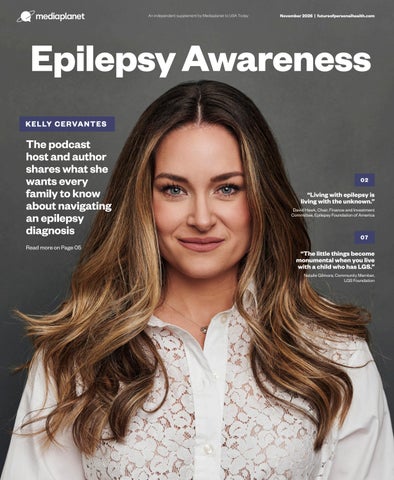
Epilepsy Awareness KELLY CERVANTES
The podcast host and author shares what she wants every family to know about navigating an epilepsy diagnosis Read more on Page 05
02
“Living with epilepsy is living with the unknown.” David Hawk, Chair, Finance and Investment Committee, Epilepsy Foundation of America
07
“The little things become monumental when you live with a child who has LGS.” Natalie Gilmore, Community Member, LGS Foundation
Living With the Unknown: David Hawk’s Journey With Epilepsy For David Hawk, epilepsy has always meant living with uncertainty.
I
t began during high school, with an aura that caused intense déjà vu. The episodes returned monthly, but a neurologist found nothing unusual. The answer came when Hawk experienced his first tonic-clonic seizure. He was diagnosed with epilepsy and prescribed medication. In November 1998, he underwent a left temporal lobectomy. Over time, Hawk tapered off medication and achieved 25 years without a seizure. Then, in August 2023, he experienced a tonic-clonic seizure. Four seizures followed over five months. He has remained seizure-free since, but the recurrence revived fear, exhaustion, and uncertainty.
An unexpected gift Hawk joined the Epilepsy Foundation of America’s national board in 2019. At the 2019 National Epilepsy Walk, seeing thousands united around a shared cause made the mission deeply personal. “I didn’t feel like we were there just for the Epilepsy Foundation,” he said. “I felt like we were there for epilepsy as a whole.” For all its challenges, epilepsy has brought an unexpected gift: connection. It introduced Hawk to families, physicians, advocates, and lifelong friends. His life is full, but underneath it is a lesson shaped by decades with the condition: “Living with epilepsy is living with the unknown.” For Hawk, that uncertainty no longer means standing still. It drives him to advocate, connect, and remind people with epilepsy that they are not navigating the unknown alone. Written by Kaitlyn Gallagher, Public Relations Manager, Epilepsy Foundation of America
INTERVIEW WITH
David Hawk Chair, Finance and Investment Committee, Epilepsy Foundation of America
Beyond Seizures: Understanding Epilepsy and Its Impact Epilepsy is more than a medical diagnosis, and greater understanding can help replace fear and stigma with support for those affected.
W
hen most people hear the word “seizure,” they may picture someone falling to the ground and experiencing uncontrollable shaking. However, seizures can look very different from one person to another. A seizure is a temporary disruption of the brain’s normal electrical activity. Depending on which areas of the brain are involved, a person may experience changes in awareness, movement, sensation, emotions, or behavior. Some seizures are obvious, while others may be subtle and difficult for someone nearby to recognize. Not every seizure means a person has epilepsy. Seizures can have a variety of causes, and a healthcare professional may need to conduct a detailed evaluation to determine what is happening.
There is no one-size-fits-all epilepsy Every person’s experience with epilepsy is different. Seizures can vary in their appearance, duration, frequency, and impact. Some people may achieve seizure control with treatment, while others continue to experience seizures despite treatment. That uncertainty can be one of the most difficult parts of living with epilepsy. A seizure can happen unexpectedly, creating concerns about safety, school, work, driving, social activities, and independence.
Knowledge can make a difference Education is one of the most powerful
@futureofpersonalhealth
@MediaplanetUSA
Photo courtesy of Epilepsy Foundation of America
tools for supporting people with epilepsy. Knowing what a seizure may look like and understanding how to respond can help families, friends, educators, coworkers, and communities feel more prepared when a seizure occurs. A seizure can be a medical emergency. Call 911 when a seizure lasts more than five minutes, another seizure begins before the person recovers, or the person is experiencing a first-time seizure. Follow any individualized seizure action plan when one is available.
No one should face epilepsy alone For someone living with epilepsy, support can mean knowing where to turn after a diagnosis, finding reliable information before making healthcare decisions, learning how to prepare for seizures, or simply connecting with someone who understands. Support may come from many places, including neurologists and other healthcare professionals, comprehensive epilepsy centers, local support groups, community organizations, and trusted family members and friends. Epilepsy can be unpredictable, but the way communities respond does not have to be. Learning about seizures, challenging misconceptions, supporting access to quality care, advocating for the rights of people with epilepsy, and investing in research are all steps toward a more informed and compassionate world. Written by Kaitlyn Gallagher, Public Relations Manager, Epilepsy Foundation of America
Contact information: US.editorial@mediaplanet.com
Please recycle
Publisher Gretchen Freedberg Managing Director Samantha Taylor Production Manager Dustin Brennan Creative Director Kylie Armishaw Product Strategy & Growth Director Joelle Hernandez Copy Editor Taylor Rice Cover Photo by Justin Patterson All photos are credited to Getty Images unless otherwise specified. This section was created by Mediaplanet and did not involve USA Today. 02
MEDIAPLANET
READ MORE AT FUTUREOFPERSONALHEALTH.COM
Sponsored
How a College Student Turned Epilepsy Misconceptions Into Conversations Vivien Knox has lived with epilepsy her entire life. Today, the 19-year-old college student studies communication and creative writing, writes short stories, and advocates for greater understanding of epilepsy. But her journey began when she experienced her first seizure at age 2.
B
ecause her early seizures were not immediately recognizable, Knox wasn’t formally diagnosed until she was 3. Between the ages of 2 and 8, she was frequently in and out of the hospital as doctors worked to manage her seizure activity. She often experienced partial-focal seizures at night or in the morning. Despite taking several anti-seizure medications, Knox’s seizures continued. Some required rescue medication or a trip to the hospital. Each seizure left her exhausted, with brain fog and memory loss that made it difficult to remember what had happened before the seizure or what she had learned in school. “I couldn’t be me. I couldn’t live the life that a child should be living,” Knox said. After trying multiple medications without achieving sustained seizure control, Knox’s doctors diagnosed her with drug-resistant epilepsy. For Knox and her parents, the diagnosis opened the door to exploring treatment options beyond medication.
Finding another treatment option Knox’s parents and doctors discussed several possibilities, including additional medications and brain surgery. Eventually, one of her doctors recommended VNS Therapy™, an add-on implanted device to reduce seizures for people age 4+ with drug-resistant focal onset seizures. The VNS Therapy™ device is placed under the skin of the
Vivien Knox with her family | Photo courtesy of LivaNova
chest and connected to the left vagus nerve in the neck during an outpatient procedure. It delivers mild electrical pulses to areas of the brain associated with seizures. Knox received VNS Therapy™ at age 8. A few weeks after being implanted, her device was turned on. At first, stimulation felt strange and caused her voice to modulate, but she gradually became accustomed to it. Not long after implantation, Knox experienced a seizure and used her magnet. Initially, she was upset because she thought the seizure meant VNS Therapy™ would not help. But then she realized something: She remembered the seizure and everything leading up to it. Before receiving VNS Therapy™, she had never remembered her seizures. Over the next two years, Knox
READ MORE AT FUTUREOFPERSONALHEALTH.COM
began recovering more quickly after seizures. Instead of feeling groggy for days, she was able to return to her life sooner. Her memory and school performance improved, too.
Turning experience into advocacy While Knox continues to take one medication, she says her quality of life is significantly different from what it was before VNS Therapy™. Greater control over her seizure activity helped her go from struggling academically to becoming an honors student with hobbies and extracurricular activities. Her experiences also shaped her passion for epilepsy advocacy. Growing up, Knox often encountered misconceptions at school. Some teachers assumed she wasn’t applying herself — they
didn’t understand how seizures and memory loss affected her ability to learn. She missed school because of seizures and medical appointments, and her family had to advocate for both her education and her safety. Rather than staying silent, Knox chose to educate others. She spoke with her classmates about epilepsy and seizure first aid, discovering that many of them had relatives or friends with epilepsy but had never learned about the condition. Knox and her parents also supported California Assembly Bill 1810, which established requirements for epilepsy training and seizure recognition in schools. Today, she has seen teachers become more informed and more likely to ask about her VNS Therapy™ device and seizure action plan. Knox encourages people living with epilepsy to work with their healthcare providers to find the treatment approach that best supports their quality of life. She also hopes people will ask questions, listen to those with epilepsy, and remember that no two people experience the condition in the same way.
Written by LivaNova
To learn more about VNS Therapy™, visit VNSTherapy.com/safety
MEDIAPLANET
03
Improving Treatment for Drug-Resistant Epilepsy
Giving Epilepsy a Stronger Voice in National Health Policy
Sometimes medication fails to control seizures. New research is helping scientists map the brain and find better treatment options.
Epilepsy has historically had a relatively limited presence in national health policy discussions. What do you see as the biggest advocacy and policy gaps that need to be addressed to better serve people with epilepsy?
forward. Predictable funding matters because meaningful discoveries require years of work, and promising investigators need a viable path to remain in epilepsy research.
One of the biggest gaps is the distance between what we know can improve epilepsy care and what people can actually access. Our policy priorities address issues impacting timely diagnosis, access to specialized care and appropriate treatments, sustained research investment, and a workforce equipped to meet the needs of people with epilepsy. We also need policymakers to understand the full impact of epilepsy on individuals and families, including its effects on mental health, education, employment, and quality of life. The American Epilepsy Society (AES) is building an advocacy program to bring the expertise of epilepsy professionals into those discussions and help translate the challenges they encounter into practical policy solutions.
The epilepsy community includes clinicians, researchers, patients, caregivers, industry, and advocacy organizations. Why is collaboration across these groups so important?
E
pilepsy is the fourth most common neurological condition, affecting 50 million people worldwide. Most patients diagnosed with epilepsy can control their seizures with medication. However, that leaves millions of others who have drug-resistant epilepsy. There are a variety of potential treatment solutions when anti-seizure medications are not effective. If seizures are linked to another underlying condition, therapies targeting that condition can be effective. In some cases, dietary adjustments can help reduce seizures. Neurostimulation devices are improving and becoming more widely available. To identify the origin points of seizures, test new medications, and improve neurostimulation and surgery, scientists need to better understand the brain’s signaling pathways. Peter Hadar, M.D., and Mark Bowren, Ph.D., have recently received research grants funded by the American Brain Foundation, the American Epilepsy Society, and the Epilepsy Foundation to improve the mapping of these signals. Hadar is using machine-learning modeling to create “atlases” of nerve cell activity in the brain. This could then be used to predict how well a patient with drug-resistant epilepsy would respond to neurostimulation of specific brain regions. Bowren is exploring ultra-high frequency stimulation, which uses electrical pulses to test how different brain regions communicate with each other. This could lead to new tools for even more precise surgeries with less risk of adverse effects. Written by American Brain Foundation
04
MEDIAPLANET
Epilepsy has long been overlooked in national health policy, but a growing advocacy push aims to bring it to the forefront.
Collaboration is essential because no single organization holds all the expertise needed to improve life for people with epilepsy. People with epilepsy, caregivers, clinicians, researchers, and advocates each bring knowledge that should shape our priorities.
What would you like to see change in the way epilepsy is represented in national health policy over the next 5-10 years?
Research funding is a critical component of advancing epilepsy care. Where do you see the greatest unmet needs in epilepsy research today? We need better treatments for people whose seizures remain uncontrolled, approaches that could prevent epilepsy or change its course, and a deeper understanding of sudden unexpected death in epilepsy. We also need research that addresses cognitive and mental health conditions, along with other challenges that can accompany epilepsy. Advocacy helps explain why these scientific questions deserve sustained federal investment and what answering them could mean for people with epilepsy and their families. That includes supporting the researchers who will carry the field
We would like to see epilepsy become a sustained national health policy priority, with attention that reflects its impact on individuals, families, and communities. That means consistent investment in research, stronger public health efforts, and policies that make high-quality care more accessible. We also want people with epilepsy, caregivers, and the professionals who serve them to have an established role in shaping those decisions. Building AES’s advocacy program, gaining representation, and working in coalition on a national plan are steps toward that future.
INTERVIEW WITH
Adam B. Eickmeyer, MPH Senior Director of Advocacy, Access, and Impact, American Epilepsy Society (AES)
READ MORE AT FUTUREOFPERSONALHEALTH.COM
Kelly Cervantes and her family | Photo by Jennifer Loomis
From Unknown to Understood: Navigating The Rare Epilepsy Diagnostic Journey If you have a child experiencing seizures, every day and every episode without an answer feels like an eternity.
Kelly Cervantes Wants No Epilepsy Family to Feel Alone Epilepsy advocate Kelly Cervantes, host of CURE Epilepsy’s “Seizing Life” podcast, shares what her late daughter Adelaide taught her about resilience. What’s something you’d like every family to keep in mind on the day they receive an epilepsy diagnosis? What I want them to know is that they are not alone, and that there is an incredible community of people they are about to meet. I found that community through CURE Epilepsy. I also found it by talking and posting online, finding other people who were experiencing something similar, and then meeting up with them in real life. It’s important to have other caregivers around you who are living a parallel life.
What do you wish more people understood about epilepsy? I wish people understood that there are so many different types of seizures. Epilepsy is a spectrum disorder. You can have someone like my daughter, who was nonmobile, nonverbal, and completely debilitated by her seizures. But I also know incredible humans who are at the top of their careers and have beautiful families.
What did Adelaide’s journey teach you about resilience and navigating uncertainty? Before Adelaide’s diagnosis, I sold and
coordinated events for a major restaurant group. It was literally my job to make sure everything went according to plan. Then I had this child for whom nothing was going to go according to plan. I had to completely restructure the way I responded to situations. I had to learn how to go with the flow. There is a term called “inch stones.” Instead of meeting milestones, you’re meeting inch stones, because your child may not meet that milestone, but you are going to celebrate every inch stone they reach along the way. It’s about celebrating those inch stones, those good moments, and not taking them for granted, so that when disappointment does arrive, you don’t feel it as heavily.
What gives you hope when you think about the future of epilepsy care? I think social media has really blown the door open on epilepsy. We’re seeing stigma around epilepsy melt away a bit because more people are talking about it. As parents, we are not as isolated as we were before the internet. We can find other people who are living a life similar to ours. I really hope that allows people with epilepsy and caregivers to feel less alone on this journey.
READ MORE AT FUTUREOFPERSONALHEALTH.COM
W
e spoke with Kelley Coleman, mom to 13-year-old Aaron, and Jessica Swanson, mom to daughter Isla, to share the barriers and hope experienced firsthand on their path to answers. When asked about their family’s experience, Swanson described, “The hardest part of being undiagnosed was not knowing what the future might look like for our daughter or whether we were making the right decisions for her. Getting a diagnosis was not a single moment; it took years.” Coleman shared, “Aaron began his genetic testing odyssey at 3 months old. When we met with our Undiagnosed Diseases Network (UDN) geneticist 12 years in, we never expected Dr. Martinez to walk in and say, ‘We have a diagnosis.’” Similarly, Swanson shared, “Receiving that diagnosis was difficult, but it was also incredibly important. After years of searching, we finally had a direction. We could connect with specialists, find other families, and make decisions based on her specific disorder.” When you’re standing at the edge of science, especially with a child experiencing seizures, you mobilize every resource you have and try to find experts willing to push the boundaries to find answers. Our responsibility is to ensure those families have the support, access, and innovation needed to find answers and improved health outcomes. We must end the diagnostic odyssey.
WRITTEN BY
Danielle Carnival, Ph.D. CEO, Undiagnosed Diseases Network Foundation (UDNF)
MEDIAPLANET
05
Post-Traumatic Epilepsy: From Prediction to Prevention Researchers are working to predict and prevent epilepsy after brain injury, offering new hope to those at risk of developing seizures.
Y
ou may not have heard of post-traumatic epilepsy (PTE), but it can affect anyone who experiences a traumatic brain injury (TBI). Each year, approximately 2.5 million people in the United States sustain a TBI, and an estimated 15% will go on to develop PTE. Despite its prevalence, PTE remains one of epilepsy’s greatest challenges. Seizures may not appear until months or even years after the initial injury, making it difficult to identify who is at risk and when to intervene. By the time PTE is diagnosed, the biological changes in the brain that lead to seizures have been underway for some time. That delay may also represent our greatest opportunity.
Researchers call the process by which a healthy brain develops epilepsy “epileptogenesis.” Understanding what happens during the period between injury and the first seizure could allow us to stop PTE before it starts. Scientists are investigating biomarkers to assess whether they can help predict who will develop PTE. Identifying these biomarkers will bring us closer to a future where clinicians can intervene before seizures occur. But another critical gap remains: We still do not have a therapy that can prevent epilepsy from developing. An anti-epileptogenic treatment would do more than control seizures; it would prevent the brain changes that lead to PTE in the first place.
Preventing epilepsy after brain injury is no longer an impossible goal.
WRITTEN BY
Laura Lubbers, Ph.D. Chief Scientific Officer, CURE Epilepsy
Preventing epilepsy after brain injury is no longer an impossible goal. With continued investment in collaborative, patient-centered research, we have an unprecedented opportunity to move from predicting who will develop PTE to preventing it altogether.
Living With Epilepsy Means Learning to Advocate for Yourself Managing epilepsy means more than managing seizures; it also means learning to understand your rights and advocate for yourself.
L
iving with epilepsy asks a lot of a person. Whether it’s managing medications and their side effects, regular doctor’s appointments, independence lost from not being able to drive, or taking seizures into consideration when making social plans, epilepsy is ever-present. Then, beyond managing the condition itself, there is the ongoing work of learning how to advocate for your needs.
Advocacy can take many forms In the doctor’s office, it might be
speaking up about how medication side effects are impacting your life or asking a question that you’ve been hesitant to ask. In school or work settings, it could be sharing your seizure action plan with teachers, managers, and peers, or requesting accommodations that help you thrive. In personal relationships, it could be being open about how that person can support your needs both physically and emotionally. Having these conversations before a seizure happens can help ensure that those
Self-advocacy is a skill. Like any skill, it can take time to feel comfortable using it. 06
MEDIAPLANET
around you are equipped to prioritize your safety and well-being. Self-advocacy is a skill. Like any skill, it can take time to feel comfortable using it. You do not have to become an expert communicator overnight. The more you use this skill, the more your confidence grows. While self-advocacy can sometimes feel intimidating, the foundation of it is much simpler than it seems: noticing what you need, trusting that it matters, and being willing to say it out loud. Epilepsy can take away a certain amount of control. Speaking up for yourself is one way of taking some of it back.
WRITTEN BY
Cassie Corral Community Engagement Manager, Epilepsy Alliance America
READ MORE AT FUTUREOFPERSONALHEALTH.COM
Knowledge Saves Lives: Understanding SUDEP And Reducing Risk Sudden unexpected death in epilepsy (SUDEP) is the most common seizure-related cause of death, yet it remains a topic that is too often left out of routine epilepsy care.
F
or too long, the likelihood of someone learning about SUDEP has depended on where they receive care, which healthcare professional they see, or whether they know enough to ask about it themselves. As a result, people can miss information that could help them better understand their epilepsy and take a more active role in decisions about their care. Many clinicians have hesitated to discuss SUDEP out of concern that it may increase anxiety, but most people living with epilepsy want to know about SUDEP soon after diagnosis,
independent of personal risk. They want the opportunity to ask questions, understand their individual risk, and learn what they can do to stay as safe as possible. Research has identified several factors associated with increased SUDEP risk, with uncontrolled generalized tonic-clonic seizures being the strongest known risk factor. That means conversations about seizure control, medication adherence, treatment options, sleep, and individualized safety planning are not simply good clinical practice; they are opportunities to reduce risk.
The aim is not to frighten people. It is to make sure questions are welcomed, decisions are shared, and people know they can come back to the conversation as their needs change. If you or someone you love lives with epilepsy, consider asking your healthcare provider, “Can we talk about my risk for SUDEP and what I can do to reduce it?” That one question can open the door to a broader discussion about seizure control, treatment options, lifestyle considerations, and safety strategies that make sense for the individual.
WRITTEN BY
WRITTEN BY
WRITTEN BY
Alison Kukla, MPH Senior Advisor, Partners Against Mortality in Epilepsy
Jeffrey Buchhalter, M.D., Ph.D. Co-Chair, Partners Against Mortality in Epilepsy
Gardiner Lapham, RN, MPH Co-Chair, Partners Against Mortality in Epilepsy
Stealing Moments in Between Every Crisis: Life With Lennox-Gastaut Syndrome (LGS) For one mother, an ordinary Wednesday with her daughter means constant vigilance and gratitude for the moments that go right.
M
y alarm rings on what should be a typical Wednesday morning, but a typical day is a lucky one for us: no hospital trip, no seizure accident, or, worst of all, losing our daughter to sudden unexpected death in epilepsy. This is life with Lennox-Gastaut syndrome (LGS), a rare, treatment-resistant epilepsy that develops in young children and often leads to lifelong disability. Lili, our 25-year-old daughter, began seizing at 6 months old; the diagnosis became LGS by age 3.
A day of small reliefs I hear Lili’s night nurse singing to wake her, and I sigh in relief, knowing she’s OK. The nurse reports seizures overnight. Overnight seizures have become our new normal, and I find myself thinking, “Well, she’s alive, and we have this morning together.” Lili and I get through breakfast easily. More READ MORE AT FUTUREOFPERSONALHEALTH.COM
medication, and she’s ready to rest again. Lili’s day-shift nurse arrives to take over so I can run to my physical therapy appointment. Years of lifting her and sleeping upright at her bedside have left my back in pain. The afternoon disappears into doctor’s appointments and calls, but there’s no emergency room trip. We’re home, and Lili gets her favorite thing: a bubble bath with music. The little things become monumental when you live with a child who has LGS. A simple bubble bath, and Lili is happy. LGS has taught me not to sweat the small stuff, because I count on the good moments. As we end our day, I say to myself, “Well, today was a ‘decent day,’ and hopefully many more to follow.” Written by Natalie Gilmore, Community Member, LGS Foundation
Lili and Natalie Gilmore | Photo courtesy of LGS Foundation
MEDIAPLANET
07