The Miscellany News
April 23, 2026
Vassar College’s student newspaper of record since 1866
Volume 165 | Issue 10
April 23, 2026
Vassar College’s student newspaper of record since 1866
Volume 165 | Issue 10
Brendan Kennedy, Sophia Marchioli Assistant Arts Editor, Columnist
On Saturday afternoon, the Vassar grounds began buzzing with noise. Soundchecks could be heard across campus as Slow Pulp and Tanukichan warmed up on Noyes Circle (colloquially known as the Nircle). The 72-degree day was filled with a surplus of live music and student-run events. But for eager Vassar music lovers, the main attraction was the 2026 Vassar College Entertainment (ViCE) Spring Concert. Adorned with glitter eye shadow, flowy skirts and ribbons around our necks, we marched over to the Nircle at 6 p.m. sharp to see student band, Anodyne, begin to warm up the crowd.
The Miscellany News communicated with ViCE Co-Head Kwabena Adae ’26 via email to discuss logistics surrounding the event. Preparations for the day began around 6:30 a.m., with ViCE members decorating campus paths with colorful chalk drawings and promotions for the bands. Additional setup included production load-in, setting up dressing rooms and accommodating the artists. Ultimately, ViCE’s ample preparations did not go unnoticed, and the electrifying concert that followed was a well-deserved reward.
Artist selection must occur up to months in advance with the help of a booking agent. Adae stated, “ViCE’s selection of artists includes creating a running list of artists we are excited by, curating a vibe, researching artists, aggregating student sentiments, and
beginning the bidding process.” Once the act arrives on campus, ViCE has the opportunity to interview the bands. Students can look out for Slow Pulp and Tanukichan’s interviews in the Fall of 2026.
On concert day, ViCE-sponsored festivities began at 3 p.m. with the Art Fair—a collaboration between Vassar Artists Group (VAG) and ViCE—and the “Vicennial Games,” which included soccer, dodgeball, capture the flag and kickball, all lasting until 5 p.m. Students displayed their finest creations, including prints, jewelry, collectables and clothes, to be sold to students who anticipated the night’s events. This high excitement remained as the student bands for the ViCE concert began at 6 p.m., with a nearby taco truck opening its window shortly after.
Anodyne kicked off the night with a list of their originals, which have now become Vassar favorites. The indie rock band consists of sophomores Elliot Evans [Disclaimer: Evans is a Copy Staffer for The Miscellany News], Nikolai Jerrard, Leo Kogan and Joey LaRosa. Students spread themselves out in groups on the Nircle. Some brought bowls of food out from Gordon Commons, eating dinner picnic-style with Anodyne’s bright guitar riffs to accompany them. Others thrashed around right in front of the stage, with their hands in the air, dancing among friends. The stage then transitioned into Bedlam’s set, which began at 6:45 p.m. The band got the crowd excited and more and more students
See NIRCLE on page 5
Henry France, Casey McMenamin Sports Editors
As the school year draws to a close, many Brewers are playing in their final games wearing the burgundy and gray, marking the end of their collegiate careers. Although the practices, lifts and long bus rides have ended, the memories, lessons learned and relationships that shaped their college experience will echo in eternity. In this two-part series, we sat down with four senior student-athletes to hear their experiences and let them reflect on what being a student-athlete at Vassar means to them. In the first of two parts, Lindsey Nihei from women’s soccer and Jacob Stellitti from men’s track and field shared with us careers of highs and lows and ultimately fruitful endings.
Lindsey Nihei ’26, from Honolulu, Hawaii, captained the women’s soccer team to a program record of 16 wins and their first-ever Liberty League Championship this past fall. But the journey to the top of the mountain was not always clear. Nihei arrived on campus as part of the first recruiting class of the Coach Keith Simons era, and right away, it was clear that the Class of 2026 was special. Nihei recalled struggling to find her place on the team during that first fall at Vassar, coming from a different background halfway across the globe. “I thought they were all really good and really talented, and I was really scared because I had never
gone to as high of a level in the club scene as they had,” she said of her teammates. Nihei did not see significant playing time during her first year in Poughkeepsie but was confident she could win the starting role during her sophomore year.
However, things would get worse before they would get better. As a sophomore, Nihei faced one of the most difficult stretches of her career: The starting role eluded her once again, she missed an opportunity for a leadership role on the team and was sidelined with a back injury. “I didn't really have that much high hope for the rest of my career,” she admitted. However, not all hope was lost. Over the summer leading into her junior year, Nihei recovered from her back injury and trained with some of her old club teammates. Nihei recalled that she started to have fun playing soccer again. Back on campus, opportunities presented themselves to the junior defender as teammates were sidelined with injuries, and the starting job at center back opened up. Finally breaking into the starting XI, Nihei seized the moment, starting 20 games that season and leading the team in minutes played. With Nihei anchoring the defense, the Brewers earned a bid to the NCAA tournament before falling to Christopher Newport University in the second round. Nihei was named to the All-Liberty League Third Team for her efforts.
From there, “The Flyin’ Hawaiian” soared
See Seniors on page 14
Allison Lowe Editor-in-Chief
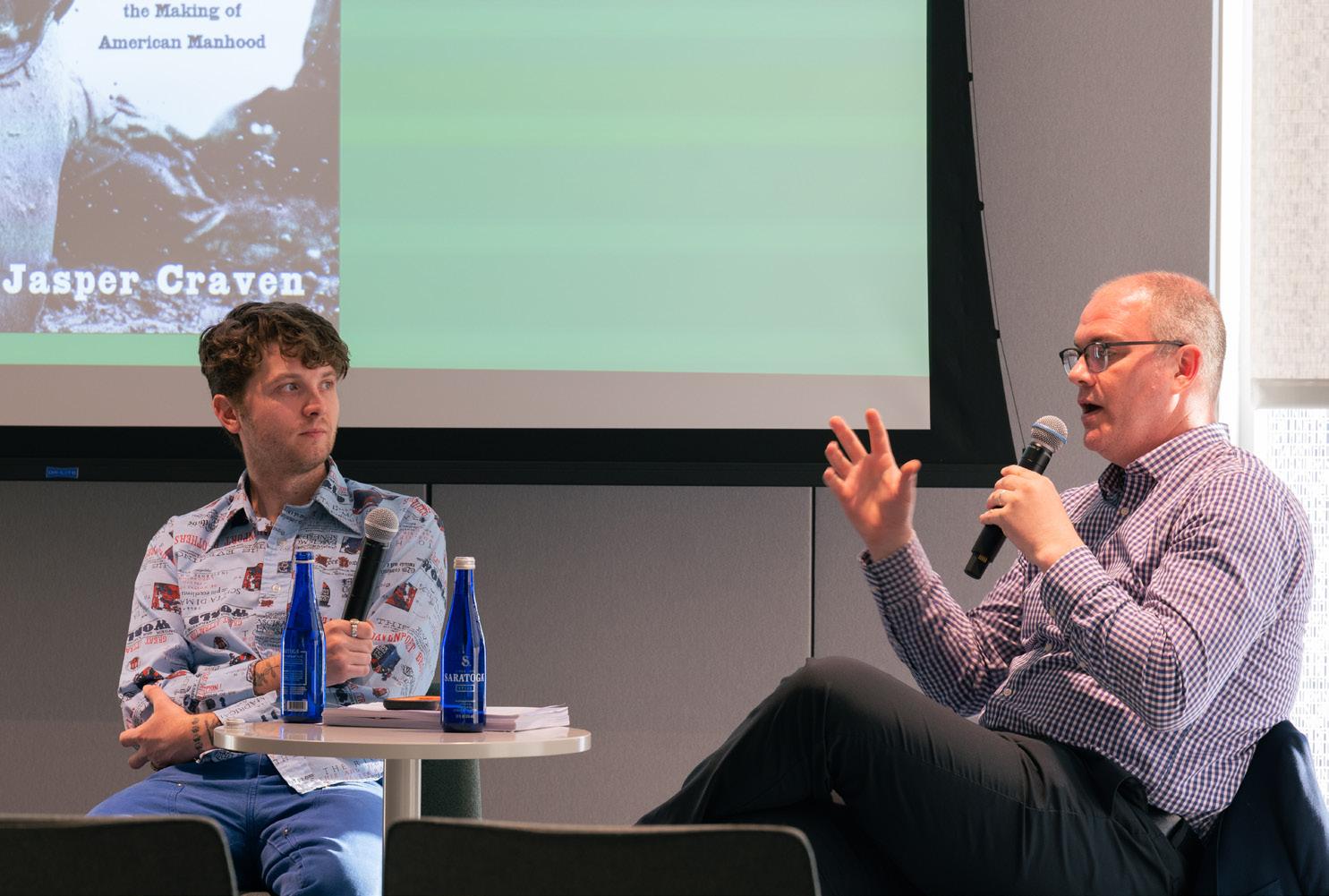
On Thursday, April 16, investigative reporter Jasper Craven visited the Vassar Institute for the Liberal Arts to discuss his upcoming book, “God Forgives, Brothers Don’t: The Long March of Military Education and the Making of American Manhood.” Craven covers the military and veterans’ issues for outlets such as The New York Times, The Baffler and Harper’s Magazine. He previously co-authored “Our Veterans: Winners, Losers, Friends, and Enemies on the New Terrain of Veterans Affairs,” which was published by Duke University Press in 2022.
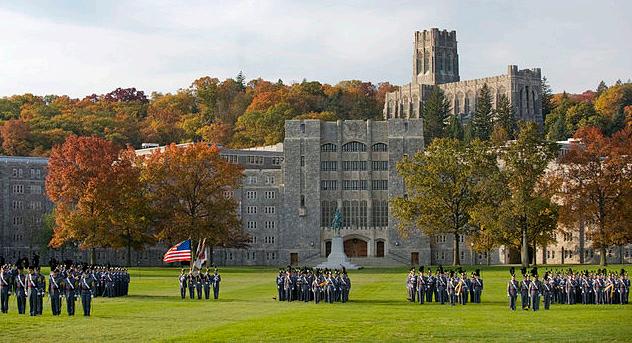
“God Forgives, Brothers Don’t” expands on Craven’s previous reporting on the military’s role in forming American conceptions of masculinity. The book focuses on how military academies, such as the United States Military Academy at West Point, uphold and strengthen these cultural values.
Craven discussed the book alongside Visiting Professor of Philosophy Graham Parsons. A former professor of philosophy and military ethics at West Point, Parsons published a New York Times opinion essay entitled “West Point Is Supposed to Educate, Not Indoctrinate” in May 2025. In this piece, Parsons pointed toward the attacks
Iggy Gutierrez and Madeline Nusbaum cover a panel with author Iman Humaydan.
on higher education enacted by the Trump administration, writing, “All it took [to undermine West Point] was an executive order from President Trump and a memo from Defense Secretary Pete Hegseth dictating what could and couldn’t be taught in the military and its educational institutions.” He resigned from the school shortly thereafter and began teaching at Vassar College last fall.
Parsons is a major source in “God Forgives, Brothers Don’t,” in which he relays his experiences at West Point. The April 16 event marked a continuation of Craven and Parsons’ conversations, this time alongside students and faculty. Parsons offered his review of the book to the audience, stating, “It’s a chilling portrayal of how the vast military-educational complex, which includes the military service academies, private military colleges and prep schools, ROTC [Reserve Officers’ Training Corps] and JROTC [Junior Reserve Officers’ Training Corps] programs and college fraternities, came to be, and the consequences of the violent, dominative, misogynistic vision of masculinity it fosters.”
Craven explained in an interview with The Miscellany News that his decision to discuss the book with the Vassar community was not only influenced by his relationship with Parsons, but also by the complex dynamic between Vassar and West Point.
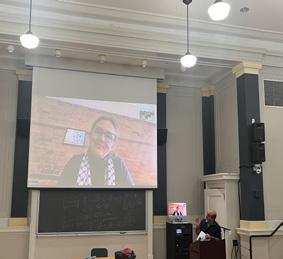
“As I was working on the book, Vassar sort of emerged as this very interesting foil to West Point,” he stated.
Craven began with a presentation that detailed the long history between Vassar and West Point. In the mid-20th century, he explained, Vassar students often visited West Point for weekend social events; a number of Vassar students even married West Point cadets. He said, “This is obviously a very heteronormative, old-school, patriarchal idea of courtship and partner-
Harrison Walker takes a closer look at benches on campus.
ship and all of the rest.”
That changed during the Vietnam War, Craven explained: “Vassar became a hotbed of activism against Vietnam.” He read from his book, “In October 1969, 200 Vassar students congregated at West Point’s gates, where they handed out flowers to cadets and urged them to abandon their commissions. Some cadets snatched their flowers and ate them. Another sarcastically told a protester that he couldn’t speak because he See CRAVEN on page 3
Emma daRosa and Patrick Horiszny review a week of soups.


EDITOR-IN-CHIEF MANAGING EDITOR SENIOR EDITORS
CONTRIBUTING EDITORS
NEWS EDITORS
ASSISTANT NEWS EDITOR ARTS EDITOR
ASSISTANT ARTS EDITORS
FEATURES EDITORS
OPINIONS EDITORS
ASSISTANT OPINIONS EDITOR HUMOR EDITOR
ASSISTANT HUMOR EDITORS
SPORTS EDITORS
DESIGN EDITORS
ASSISTANT DESIGN EDITORS
COPY EDITORS
Allison Lowe
Luke Jenkins
Kathryn Carvel
Darja Coutts
Madeleine Nicks
Clara Alger
Carina Cole
Soren Fischer
Hadley Amato
Julian Balsley
Jackson Hrebin
Grace Finke
Aurelia Harrison
Brendan Kennedy
Yaksha Gummadapu
Sydney Jones
Jacob Cifuentes
Ian Watanabe
Zoe Rodriguez
Emma daRosa
Wren Buehler
Noah Daube-Valois
Henry France
Casey McMenamin
Molly Delahunty
Lucas Seguinot
Teresa Garcia-Green
Hannah Wells
Sadie Bakken-Durchslag
Paige Hahn
Anabel Lee
ASSISTANT COPY EDITOR GRAPHICS EDITOR ASSISTANT GRAPHICS EDITORS
PHOTO EDITOR GAMES EDITORS
SOCIAL MEDIA MANAGER
LIVE EVENTS CHAIR WEBMASTER REPORTERS/COLUMNISTS
Nikola Parker Cooperman
Annie McShane
Noa DeRosa-Anderson
Charlotte Willenberg
Makenna Brown
Sadie Keesbury
Felix Mundy-Mancino
Mia Liloia
Denver Brown
Hunter Farhat
Eduardo Culmer
Armaan Desai
Noah Duncan
Iggy Gutierrez
Melody Hamilton
Isabel Holmes
Lora Janczewski
Eli Lerdau
Madeline Nusbaum
Catherine Phillips
Chloe Rogers
Evan Seker
Erin Thatcher
Amritha Dewan
PHOTOGRAPHER CARTOONIST COPY STAFF
Andrew Chu
Catriona Chapman
Elliot Evans
Cooper Jaffe
Ren Nicolau
Tess Novack
Julia Weber
• Joanna Toy ’27 was appointed as Junior Class Senator for the remainder of the semester, following the resignation of Justine Katimbang ’27.
• The Senate unanimously passed a bill prohibiting the VSA as an institution from purchasing goods from Amazon or any of its subsidiaries, barring exceptional circumstances.
• The Senate passed a second bill, 10 to two, barring all on-campus student organizations from purchasing from Amazon or its subsidiaries. Organizations may appeal to use Amazon in specific circumstances.
• The Senate passed a resolution making constituent concerns an official part of the VSA website.
• Senators debriefed their experiences at the annual Seven Sisters Conference.
Continued from CRAVEN on page 1
was on his way to ‘poison gas class.’”
During his presentation, Craven referenced a Miscellany article, from October 2025, on the Vassar chapter of Students for Justice in Palestine’s (VSJP) condemnation of the Vassar-West Point Initiative. On Sept. 29, 2025, VSJP released a statement calling for Vassar to cut ties with the Military Academy, citing its involvement, as well as the U.S. military as a whole, in supporting Israel during the ongoing genocide in Palestine.
In February 2025, six members of the Military Academy joined Vassar students and faculty for a briefing on the Physics and Astronomy Department’s quantum computer. This collaboration was a key point of concern for VSJP, who wrote in their statement, “These college-sponsored academic exchanges between Vassar and WP [West Point] enable WP to develop technology that can threaten personal privacy, advance war profiteering, and automate genocide.”
Craven elaborated on how this incident aligned with the tension between civilian and military communities that he researches, saying, “When this was announced, Vassar President Elizabeth Bradley told the Miscellany that the West Point-Vassar initiative ‘allows Vassar students to understand and experience what it is to be in a military academy.’ And I think that there is something valuable there.”
Craven argued that Bradley’s comment was indicative of a larger societal expectation that civilians understand military life, but not vice versa. He stated, “And I think that there’s something problematic with that, because…it’s easy, I think, for the military to pigeonhole and stereotype civilians in the same way some civilians may do. And from that can breed resentment and just many negative things.”
As the conversation progressed, Craven and Parsons turned toward the Trump administration’s current focus on military academies such as West Point. “One of the first things Hegseth did was set out a plan to purge the service academies of people like Graham Parsons. And, you know, you talk to experts on fascism and all the rest and they say, ‘Look, this is a pedagogical project. If you’re trying to instill authoritarian impulses, you have to start in places like West Point,’” Craven explained. “So Pete Hegseth has articulated a very aggressive, violent, domineering type of masculinity
that he wants to inculcate in the military.”
In terms of whether this presentation of masculinity can be salvaged, Parsons said, “I’m torn. I wonder if we’re in a moment where there’s a lot of potential.” In an interview with the Miscellany, Parsons expanded on this sentiment, saying, “I keep thinking that the gender identity that this administration so overtly displays and conspicuously displays, it seems to me to be based in a kind of insecurity, like it needs to assert itself in this really grotesque, aggressive way… So that’s why I wondered if we’re in a moment with potential for, you know, new gender dynamics, new gender identities. Because it seems like they recognize they have to scream at you to get you to comply.”
Throughout the talk, Craven and Parsons, as well as audience members, confronted the complex reality of individuals’ experiences with the military. For example, Parsons told Craven, “Reading your book, one thing I wanted to say—I wish I could add an addendum or something—is that some of the most impressive people I’ve ever met have been West Point graduates or West Point cadets and I respect them. I admire them.” He continued, “That doesn’t mean I think the institution is great, but let’s be careful that we don’t reduce the people in these offices to some sort of stereotype.”
One audience member, who identified himself as a former active duty physician during the Vietnam War, said, “I found my patients to be extraordinarily commendable. And, to be perfectly honest with you, I wish we had more of that in medicine. Because what you guys are seeing as conforming, I see as commitment to a cause, rather
“There’s a tendency to cast off any issues in the military as the problem of some bad apples. And there’s no willingness to actually even entertain the idea that there’s a systemic problem at play, which is kind of insane to me.”
than to money.”
When asked how he confronts these tensions in his work, Craven told the Miscellany, “American culture is profoundly positive towards the military in a way that sometimes veers on blind reverence… But this book is built on the experiences
of many, many dozens of cadets who had very different experiences. There’s lawsuits, there’s survey data.” He continued, “There’s a tendency to cast off any issues in the military as the problem of some bad apples. And there’s no willingness to actually even entertain the idea that there’s a systemic problem at play, which is kind of insane to me. Just because the military is an institution that is built on violence, it’s absolutely systemic and it’s more extreme than it is in a lot of other places.”
Madisen Karr ’29 described being motivated to attend the event by her current work on a research project investigating conceptions of gender and sexuality during the world wars. Of the relationship between Vassar and West Point, she wrote, “Disturbingly, West Point seems to me to be an institution in many ways set in the past, and the ongoing relationship between Vassar and West Point is troubling in that it reinforces a history of gender hierarchies… This information was enlightening, and it colored my perspective regarding Vassar’s ties with West Point given their concerning history of abusing cadets—sexual and otherwise—and the gender-essentialist views which have been perpetuated by the military and West Point by proxy.”
“God Forgives, Brothers Don’t” will be officially released by Simon & Schuester on May 19.
Iggy Gutierrez, Madeline Nusbaum Reporters
On
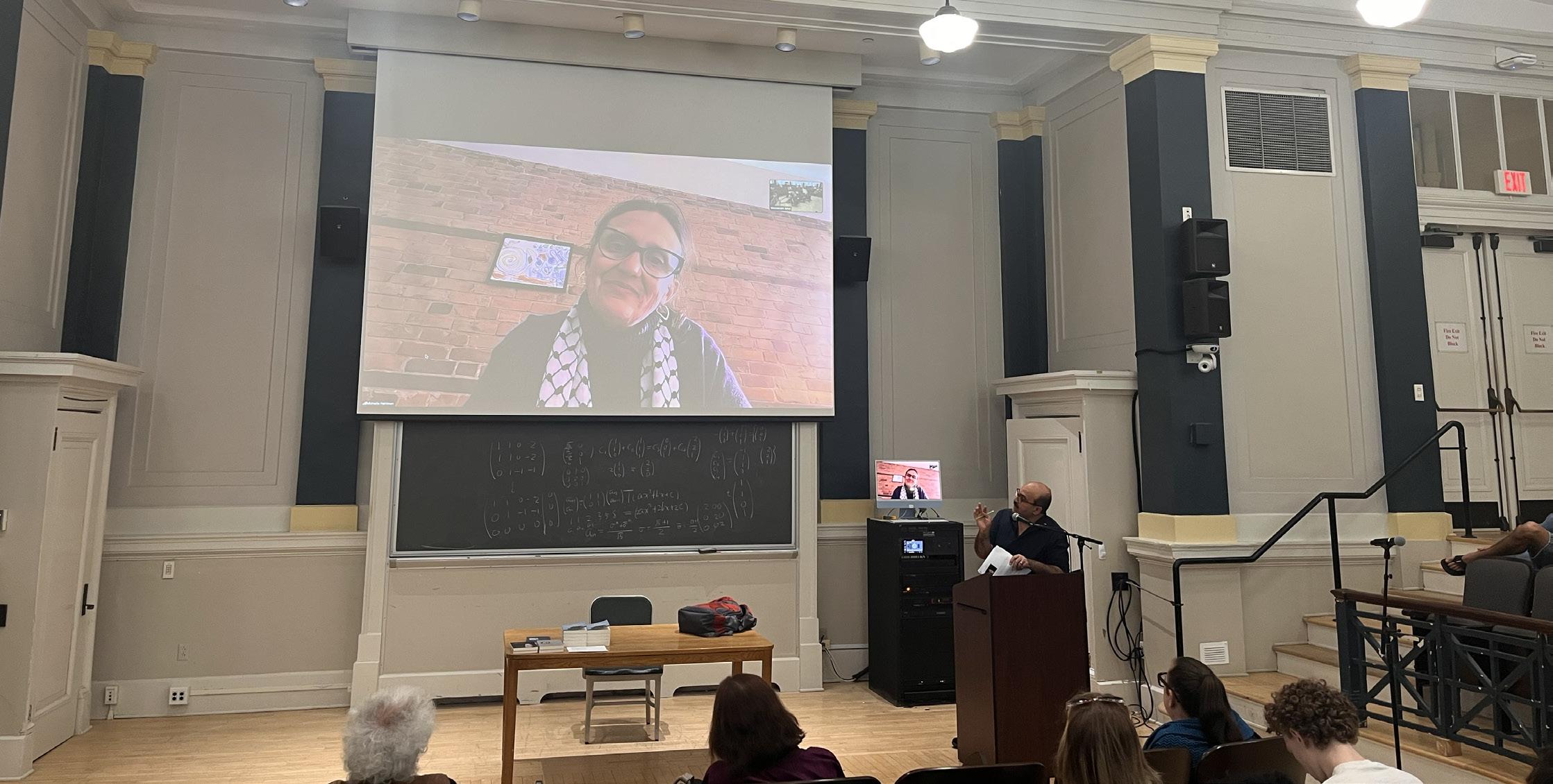
Thursday, April 16, Vassar Senior Lecturer in Arabic Mootacem Mhiri led a discussion panel with Lebanese novelist, writer and researcher Iman Humaydan and translator Michelle Hartman to talk about the writing process and translation of Humaydan’s novel “Songs for Darkness.” This meeting was part of a larger tour promoting the International Prize for Arabic Fiction, an award that celebrates creative Arab literature and encourages people to read the works of Arab authors.
Mhiri first introduced Humaydan, who was a creative writing professor at the Paris 8 University in Saint-Denis, France until 2023. Humaydan studied sociology and anthropology at the American University of Beirut and later led research studying the “families of the disappeared” during the Lebanese Civil War. Her first book, “B as in Beirut,” was published in 1997 and translated into English 10 years later. Many of Humaydan’s novels received international recognition and Mhiri shared that several have been translated into a variety of different languages, such as French, Italian, Dutch, German, Armenian and Georgian.
The second guest, Hartman, is a Professor of Arabic Literature at McGill University and a professional literary translator who has translated over a dozen novels from Arabic to English. She has worked with Humaydan for 20 years on the translation of many of her novels, and the two have continued their relationship through their work on this most recent novel.
The talk began with a discussion of Humaydan's most recent work, “Songs for Darkness.” “It’s a novel that captures a collective pain of migration through the stories of four Lebanese women. Iman recalls the voices of four generations of women,” Mhiri described. Following the introduction, Humaydan herself shared the first chapter of her new novel. The chapter titled “The Letter” depicts the harsh reality of having to migrate and the feeling of never fully leaving
behind a place one previously felt attached to. After the reading, Humaydan opened the floor to questions from both Mhiri and the audience, much of which included students who had been assigned the book for Mhiri’s AFRS 205: “Arab Women Writers” class.
Hartman then explained the uniqueness and strength of her collaboration with Humaydan. “I know how she writes. So it’s not my own writing, but it’s like, almost, right? Because we know each other really well,” she said. Within the book itself, Humaydan began discussing why she chose to follow four characters. “I was interested in the history of Lebanon, actually not the history with a capital ‘H.’ It was the history of women. So I needed to have more than one character,” she explained. Starting in 1908, the book follows the path of four generations of Lebanese women, depicting their experiences through World Wars I and II, Lebanese independence, the Lebanese Civil War and the 1982 Israeli invasion and occupation of Lebanon. Both Humaydan and Hartman established their shared view of how one should interpret history as more circular than linear. Hartman explained, “The text itself has this
circular nature in it and a lot of the stories are also told in a circular way. And definitely when I work even as a translator, I am not someone who starts at the beginning and goes straight to the end. And I know that Iman doesn’t write like that either. So we are mirroring that circular quality in our own work, and the text is mirroring it, and the history is mirroring it.”
When asked about a specific passage in her reading, Humaydan shared a story about the lasting permanence of home and the sense of eternal attachment it creates. “[An author’s father] was dying and they asked him after 70 years of living in the U.S.A., what do you want before you die? He said, ‘I want grapes from Smyrna.’ Smyrna is a city in Türkiye. And to ask for something you love after 70 years, you never really left.”
After the discussion, Miscellany News reporters asked Mhiri why he assigned “Songs for Darkness” to his students. “My main goal is nurturing my students’ curiosity about Arab culture and demystifying it for them. The books we read, the movies we watch, and the guests we bring to campus all contribute to humanizing the culture and the
people behind the news,” he explained. One of Mhiri’s students, Hadi Ali ’29, shared his thoughts on the talk, and why he found it meaningful. “I’m interested in learning more about the Arabic language and how it's used, especially in literature, so this talk provided a good chance for that. Also, the author is Lebanese, and I am too, so that was interesting and very relatable.”
Julian Balsley ’28 [Disclaimer: Balsley is a News Editor for The Miscellany News], a student in Mhiri’s class, shared his thoughts on the relevance of the novel and its connection to current events. “This book is especially potent right now, when Israel—using US weapons—is occupying southern Lebanon, despite a current 10-day ceasefire. Since March 2, according to Al Jazeera, Israel has killed more than 1,400 Lebanese people, including 126 children, and displaced over 1.2 million,” Balsley wrote in an email to the Miscellany. “And this is only the latest act of terror Israel, and its allies the United States and France, has visited upon the Lebanese people. Humaydan’s book brings to life the daily suffering these powers have inflicted on Lebanon since before World


April 23, 2026
began to trickle onto the Nircle. The all-senior band, which consists of Denver Brown [Disclaimer: Brown is the Live Events Chair for The Miscellany News], Duncan Beauchamp, Kalina Sloat and Walt Schoen, took the venue by storm, performing with their quintessential ’90s emo rock sound. Their electric guitars paired with the upbeat drum beamed across campus, calling to students far and wide. Gatherings of students could be seen getting ready for the concert and peeking out their windows from their dorms in Noyes House. A cool breeze blew in, relieving the crowd of the hot sun that had taken over campus the previous week. Those lucky enough to witness Bedlam’s set got the best spots in the crowd up close to the stage for the rest of the evening.
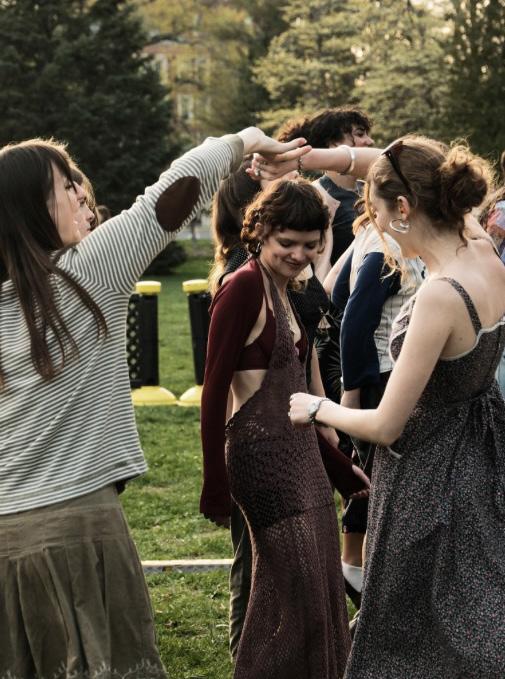
Shortly after Bedlam topped off their set, up-and-coming indie rock artist Tanukichan went on as the last opener of the night. Wearing a grey crew-neck sweatshirt paired with a black knee-length skirt, Tanukichan looked like a typical Vassar student. Backed up by just a drummer and a guitarist, Tanukichan looked out over the crowd, picking her droning bass. Some students took to nearby hammocks, overlooking the orange glow of an occasional cigarette piercing through the crowd. Not a phone was in sight as students swayed to the fuzzy, distorted guitar. Tanukichan’s light voice hummed lyrics that were hard to make out among the overpowering guitar that is quintessential to her sound. As the sky finally relinquished its tranquil blue, increasing clusters of friends stormed the concert site, skipping and dancing hand-in-hand with Tanukichan’s dreamy vocals and crunchy pro-
duction in the backdrop.
With the blazing sun now fully away, Noyes House illuminated its grassy circle with a soft glow. Tanukichan finished her set with “Hunned Bandz,” a deep, distorted guitar-heavy jam that permitted students to swing around. Once finished, the crowd cheered as she thanked the audience and announced that Slow Pulp would follow shortly. “That was euphoric,” a nearby peer uttered. Final preparations began, with some students running back to their dorms for final liquor touch-ups and much-needed bathroom breaks as the stage was set up. Stragglers sprinted into the mass of students as bright stars loomed above. At last, Abigail Schoenecker ’26 and Adae enthusiastically took the podium to introduce Slow Pulp, sparking echoing screams from the assembled students.
Fog filled the stage as lights flowed between white and light blues. Slow Pulp kicked off their set with “Do You Feel It,” an ethereal, short track that builds a minimal production to an energetic, roaring anthem. “Do you feel it?” lead singer Emily Massey—dressed in a blue zip-up and grey baggy pants—asked. And surely we did. As the track revved up, the listeners’ excitement did as well, with head-swaying and jumpy whirls quickly taking over the audience.
Slow Pulp confidently transfixed concertgoers with their addicting indie rock tracks. As the band continued with punchy jams “Idaho” and “At It Again,” the smell of cigarettes overtook our nostrils. Behind the band, projections of bright oranges whirled around, paralleling the grooves of the audience. Once
the band reached their fourth tune, “Cramps,” the thrilling spirit of the audience was obvious: The Brewers’ shared euphoric emotions gleamed in the band’s coming-of-age akin production.
We watched our peers rock between each other, bearing empty water bottles or tiny Pinot Grigio glasses in their hands. During “Falling Apart,” Massey noticed loyal fans screaming the lyrics and decided to turn the microphone towards the audience. “Why don’t you go back / To falling apart? / You were so good at that,” we proudly sang, a smile overtaking Massey’s face. With cellphones barely making an appearance, the crowd was truly experiencing Slow Pulp in the moment. Perhaps our favorite part was during the country-twanged “Broadview,” in which Massey brought out a harmonica during an instrumental break, thus causing the crowd
to roar. Maybe it was the collective elation of a free concert, but the vibes felt fresh. We certainly got lost in the band’s hazy dream-pop melodies and could not help but bounce our bodies about the shoegaze sounds.
Slow Pulp finished their set with “At Home,” a hard-hitting banger that showcased intense guitar riffs and atmospheric, floating production. Once again, Massey turned the microphone towards the crowd for the final section of the song, a build-up of plucking strings and melodic drums. As Brewers chanted the song’s repeating lyric, “Should I try all over again?,” they took in the final moments of the show, wrapping their arms around one another as they swayed. “This was so much fun,” Massey spoke before she left the stage, and concertgoers unquestionably agreed— perhaps the event’s warm, uniting energy is the most at home they felt in a while.

‘Deer Farm’ asks how we want to be remembered
oil. No cattle. This is a deer farm. You know anything about that?”
Afamily stands on a porch in Montana.
The father bundles lavender. The daughter pokes at the dirt with a stick. The mother stares out toward the horizon. The sky is a deep red. The air is thick with smoke. The child coughs. A disheveled young man walks onto the porch. He touches the mother’s hand gingerly, then tousles the daughter’s hair. Neither acknowledges him. Then, he sees the father. He falls to the floor, sobbing. The sky is a deep red. Fade to black.
This is the beginning of “Deer Farm,” the debut play by Avery Violet Epstein ’28, which was awarded Vassar College’s 2026 Phillip Cook Aspiring Playwright Prize. Several people involved in the show said they were blown away by the play’s depth and craft. As a dear friend of Epstein’s, I could not agree more. To see this stunning achievement come to life was a true joy to witness.
“Deer Farm” is wonderfully layered and deeply emotional, immensely horrifying yet funny. It challenges the viewer to consider how we move through a world in which the deaths of millions of strangers are more immediate than they have ever been, thanks to the phones and laptops we use near-constantly. And yet the screens sanitize the horror into a state of unreality.
The play follows two storylines that slowly merge. The first is the farm family, who interacts with a series of duos: two stoners, a documentarian and cameraman, a father and son. In each scene, the family utters eerily similar dialogue and seems remarkably unalarmed that so many strangers are walking onto their porch.
“This is a homestead. We homestead,” the farm father, Jude, says to each duo. “Peaches, apples, potatoes, and lavender: we sell
The second storyline is a young man and woman—named simply Boy and Girl—who have reunited on a Brooklyn rooftop after over a year. Boy, home for the first time since dropping out of college, is a philosophizing dirtbag. Girl, a photographer and idealist, is still in high school. She hopes their lives will find a way to intertwine again.
As the scenes progress, Boy reveals his new business idea: traveling to locations in imminent danger, interviewing people who will soon die and then creating virtual reality (VR) experiences of their last days in which consumers can have lifelike conversations with them.
It is revealed that the farm family is a subject of this project, whose house was consumed by a wildfire. The nature of the family’s interactions with the strangers retroactively becomes clear: the documentarian and cameraman film their last days; the stoners and father and son are in the VR experience, speaking not with the real family but with their digital doppelgängers. The concept is more visceral as a play, Epstein said, because the family is physically in the space with the audience. As it is revealed that they are only digital recreations, Epstein described, “You get to feel in your body and mind how that changes your interaction to them and how you perceive other people’s interactions to them.”
The VR idea originally came from a conversation with high school friends, Epstein told me. “I always kind of toyed with it in my mind,” she said, “because I thought it was sort of fascinating, and how vulgar it felt, and also not that far out.” The setting came from Epstein’s brief stint working on a deer farm in Hauteville, Switzerland, during her gap year in 2023.
As director Charlotte Davis ’28 told me, “Deer Farm” does not have a single message but instead asks two questions that the audience must answer for themselves: “One, how do we want to be remembered? But two, what role do we play in the media that we consume?”
So much of what we are forced to contend with when we open the news or social media is the incomprehensible magnitude of death happening all around us. This constant flood of devastation does not disappear when we turn off our phones: It is always pushing at our backs, when we order a coffee or complain too much about a bad grade on a paper.
The VR project, Boy argues, turns its subjects back into real people and is ultimately humanizing rather than exploitative. It gives them their only chance to be full-fledged individuals rather than just one more drop in the ever-rising tide of the general idea of “bad.”
“It’s sort of horrible to think about,” Davis told me. “The idea of filming people who you know are going to die—before they do—and not providing them the concrete abilities to get out of the situation that is putting their life in danger is so awful and so human, in the worst way.”
Margalit Eisenstein ’28, who played a character in each duo the family meets, agreed with Davis. But, she added, “I do think it is sort of humanizing to have people explain their lives as if it isn’t just like a pure tragedy and something they do just live with and is normal.”
I asked my interviewees if the VR experience was put on exhibition at the Frances Lehman Loeb Art Center, whether they would go see it. “Oh, I probably would, wouldn’t I?” Epstein said. “And so would you. And then you’d write a scathing arti-
cle.” Eisenstein told me, “I think if it’s in a sort of controlled environment, it would be interesting to really throw yourself in it.”
“I think I would just have to go because I’d be curious,” said Jack Frederick ’28, who played Jude.
Frederick lost his own father in 2024. “I think to engage with it for me, but also, honestly, for it to exist, I think it’s disrespectful,” he said. “Everybody has a certain amount of time on this earth. And it can be tragic how short the time is. But to try and extend that, it almost feels like it’s disrespectful to the fact that he died.” He continued, “It would be like if you had a torch burning, and then, all of a sudden, the torch burnt down and you’re like, ‘Oh, I have a flashlight…’ You can still see, but it’s not like there’s any warmth coming from the fire.”
Frederick was in the unique position to contend with the play’s idea. “It’s hard to watch Ellis [Rubin ’26, who played the son, Tyler]...have this thing where he can come and touch the dad. That’s a weird experience for me to just watch that happen.”
Nonetheless, he said, “If I had a VR experience to go talk to my dad the week before he died, I don’t think I would do it… When someone’s gone, you just have to work on how it affects you… You gotta choose life.”
Ultimately, Epstein said, the idea is not really futuristic. During her gap year, Epstein visited the Sydney Jewish Museum in Australia, which features interactive holograms of Holocaust survivors created through extensive interviews and artificial intelligence. Visitors can ask the survivors questions, and they respond, just as the visitors in “Deer Farm” speak across time and space with a family on a farm in Montana. Whether we like it or not, it is only a matter of time until “Deer Farm” is real. Epstein told me, “It will exist.”
Harrison Walker Guest Columnist
You may see the name Alice Hooker Davidson and think, “Where have I seen that name before…?” The answer is on benches all across Vassar College campus. Last year, I noticed that her name was everywhere, so I started counting all the times I saw a bench dedicated to her. My list currently has 14, and I know that it is far from exhaustive.
I have done some internet sleuthing to figure out who Alice was and what she was like. I do not have much information, and a lot of what I do have is pulled from her husband’s and her daughter’s obituaries. Nevertheless, here are the facts: Mary Alice Hooker was born in 1890. She attended Vassar College, graduating in 1912, and married Sidney Wetmore Davidson in 1916. Together, they had six kids, the last of which (also named Alice, who later attended Vassar College) was born in 1929. They lived together in Brooklyn Heights for decades where Sidney passed away in 1979. Alice passed away in 1984 at the age of 94.
I cannot find Alice Hooker Davidson’s obituary; maybe she was not deemed as worthy of one as her husband, perhaps as a result of her gender. Graduating in Vassar’s 44th class, Alice would enter the world as a college graduate but without a right to vote, equal employment opportunity, financial independence and many other freedoms women hold today. Though she may not have a five-paragraph snippet in The New York Times, her memory is kept alive here on campus. Maybe her name was not enough to make the papers, but it caught my eye
while I ate a sandwich outside on a nice day in my freshman year. I like to think about how different my world is from the one she lived through, and how much has changed in the last century. I like to think about the hundreds, if not thousands, of souls who have passed through this college’s hallowed halls, and how many may have sat on a bench named after her—people supported, even if unaware, by her legacy.
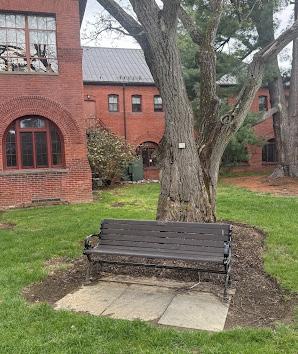
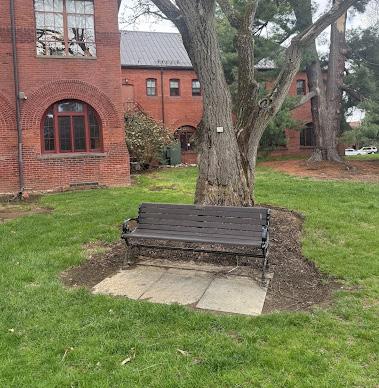
My favorite Alice Hooker Davidson bench is near the cork tree on Ely Lawn between Ely Hall and Swift Hall. I am an earth science major, so I have a soft spot for Ely Hall and the Department of Earth Sciences and Geography. However, I mostly like this bench for people-watching. I get a great view of people entering and leaving the College Center and passing around the back of Main Building on the way to the Terrace Apartments, Vogelstein Center for Drama and Film, Sanders Classroom Building or wherever they may be going. I can see people crossing paths both literally and figuratively with warm smiles, regardless of the warmth, or lack thereof, outside. When the weather is nice, I will often come to this bench and read. I find it to be quite peaceful. It is best in the autumn when the trees change colors.
I remember sitting on this bench with my family one time when they visited. I remember sitting on this bench with someone I liked in the early days of a relationship. I remember sitting on this bench and calling my brother to talk about an essay I was anxious about. I remember sitting on this bench for five minutes between classes because I just needed to catch my breath. I remember sitting on this bench and having someone
take photos of me. I remember sitting on this bench while crying on the phone and eating a Caesar salad from Street Eats. I remember sitting on this bench to watch the sunset and thinking about how many beautiful sunsets I never get to see. I remember sitting on this bench.
I often ask people what their favorite bench on campus is. Most of the time, they respond, “I don’t know,” and I struggle to comprehend that. This campus is smaller than it looks, and there are benches every-
where. Vassar is a rigorous school where students are constantly juggling academics, extracurriculars, social life and that great mysterious hellscape some call “life after graduation,” but I do not think any of us are too busy to sit on a bench for two minutes every once in a while. If you have not sat on a bench recently, you should. Take out your headphones, put away your phone and just be present in the world. Spend a few moments with Alice, listening to the birds. You will be surprised how much you get out of it.
Izzy Holmes Columnist
Amazing lights, great music and a first warm weekend well spent was the general consensus about the recent Slow Pulp concert hosted by ViCE (Vassar College Entertainment). On Saturday, April 18, it was finally nice enough to spend the day outside. Students gathered to watch Slow Pulp’s performance on Noyes Circle for the ViCE Spring Concert. Graycie Peltz ’29 shared, “I really like Slow Pulp, so it was so great to see them in concert and hang out with my friends. Also, the lighting was really cool.”
Slow Pulp’s four members, Emily Massey (lead vocals), Alex Leeds (bass and vocals), Teddy Matthews (drums) and Henry Stoeher (guitar)—along with touring member Javiar Reyes (guitar and keyboard)—performed against a display of colorful lights that were projected on the white tent background and occasionally morphed into an image of a flower or swirling dots of color. A memorable point of the concert was Massey’s short hiatus from singing to demonstrate her skills on the harmonica during the song “Broadview.”
Amy Melchior ’29 was struck by this part of the production: “I loved the harmonica; the lead singer is so talented. I also loved the wide array of music types, some slow, some fast. There were a lot of emotions in the performance.”
These emotions were reflected in a wave of cheers throughout the crowd when they began to play one of the groups’ most popular songs, “Falling Apart.”
Kayla McGovern ’29 reflected on the concert, noting that this was one of the songs she was more familiar with. “Honestly, I don’t know the band very well but when they announced that they were gonna play “Falling
Apart,” their biggest song, you could really feel the excitement in the crowd.” During the chorus, Massey directed the microphone at the audience, letting the crowd take the wheel and sing the lyrics.
Some students participated if they knew the words, others were still moved by the energy of the song despite not being well versed with the lyrics. Sophie Tran ’28 described the experience of only being somewhat knowledgeable of their discography: “Even though I didn’t know most of the lyrics, it was really fun how a lot of students knew them and sang along. I loved the more relaxed energy from both the crowd and the band.” She also mentioned that along with the relaxing energy, she knew a few songs to look forward to in the performance and has since added more to her usual playlist. “I only knew two of their songs, "Falling Apart", and “Idaho” before the concert but hearing the band live made me want to listen to more of their stuff.” Like Tran, many walked away from the performance that night as newly converted fans of the group.
For some, it was not their first ViCE event.
Vera Bronshvag ’29 attended the Blue Hawaii “Welcome Back” concert in the fall. “I was really excited for the concert because of the one from the fall. I liked Slow Pulp before the concert, but now I love them even more. It's such a different experience to see them live, especially on campus. I’ve always really liked the song “At Home”. I also knew the words to that one, and it has such a nice melody.” This song also stood out to me from my own experience at the show. It was emotional, and slightly nostalgic.
While the emotions swung in different directions, the light and springy energy remained steady—appropriate for the tone of the ViCE event. Lucy O’Brien ’29 described the event as a great opportunity to spend time
with her friends and enjoy some of her favorite music. “I thought it was so much fun; they sounded just as good as in the recordings. It was just the best feeling to be with all my friends and hearing music we all love. And to be at Vassar,” O’Brien said.
Along with those that loved the energy of the crowd and spending time among friends, there was also plenty of appreciation for the group’s talent—particularly the lead singer. Eva D’Addario ’28 reflected on Massey's talent, as well as the aptness of the “chill” and “indie” band for Vassar’s spring concert. “It was cool when she brought out the harmonica on top of also playing the guitar. I felt like the crowd had a good vibe; it seemed like people were enjoying it. But I thought they put on a very good performance. It was a good pick for the spring concert. I love going to concerts and seeing bands live, so it was very fun,” she said.
As the night went on and the sun set, it remained warm outside. Some Brewers held their phones above the crowd to capture snapshots of the performance. It felt as though the mellow vibe of the band was launching the campus into the incoming warm weather—a new era of the semester. D’Addario agreed with this sentiment, even if some students had imagined a different atmosphere for the night. “It wasn’t as hype as some people wanted it to be, but I thought it was perfect for Vassar's spring concert,” she commented. Not everyone was familiar with the group before the concert, but their music has certainly converted attendees into listeners after the show. Annie McShane ’28 [Disclaimer: McShane is the Graphics Editor for The Miscellany News] is a newly minted fan of their music after the concert, sharing, “Slow Pulp sounded so great live! I’m only a little familiar with their music, but I will definitely be
listening more after that awesome performance!”
Others were already big fans of the group before the show, adding an element of extra excitement to their performance. Hannah Straub ’28 is a veteran of Slow Pulp concerts with this spring show marking her second time seeing them live.
“Slow Pulp is a band whose sound is so authentic, and it really comes through in their live performances. It was the second time I saw them and hopefully not the last!” Straub shared.
The general sentiment was that it was a lovely evening and that Slow Pulp delivered an incredible show for the ViCE event. Many described it as a wonderful opportunity to be together with the rest of campus. Everyone was there for the same thing, in the same place, to enjoy something together.
Lora Janczewski Columnist
With the magnolias in full bloom and robins sweeping by to say hello, it only seems right to watch a movie that seems to embody spring. This past weekend, I decided to watch Hiromasa Yonebayashi’s “The Secret World of Arrietty” (2010) written by Hayao Miyazaki. I had seen the film before, but nonetheless, it illustrated the same magical, fuzzy and bittersweet vibe that comes with most Studio Ghibli movies.
“Arrietty” is the eponymous tale of a young “borrower”—a tiny human-like being—who, after a few initially strained interactions, befriends a human boy named Shō who suffers from a heart condition and is facing an upcoming life-threatening surgery. Tensions peak when the possibility of Arrietty’s family getting discovered by the other humans rises, forcing them to move to another home.
Not only does the plot look into loneliness, courage and understanding, it also explores deeper themes of death and hope. There are not many borrowers left in the world, and so, in this sense, extinction becomes a prevalent point of concern for the protagonist. Similarly, Shō is also “endangered.” His heart condition has him convinced that his upcoming surgery will ultimately fail and that, despite his best efforts to live, he might pass away. Although the ending is quite wistful, it harbors plentiful hope. Shō confesses that his encounter with Arrietty has given him the strength to live and that he intends to have a successful surgery in spite of his despondency earlier in the movie. Furthermore, Arrietty’s giving away of her hairclip, something she never adventured without, demonstrates her gratitude for their friendship and marks the start of a new beginning.
The storyline is not the sole reason for my fascination with the Ghibli world. The art style and worldbuilding of their films fills me with a childlike curiosity. What I love about Ghibli movies, and “Arrietty” in particular, is the way wonder can be brought into everyday objects that we oftentimes ignore or find mundane. Take a scene from within Arrietty’s kitchen. There is no doubt it looks cozy and eccentric—a maximalist’s dream—but upon further inspec-
tion, there are so many ways objects humans often discard are being used for practical purposes or as decor. For example, the loose endpiece of a ballpoint pen hangs from the wall and holds a bouquet of garden flowers; next to it, there is a postcard in a makeshift frame, and across the doorframe, you can find a pull tab of a metal can from which little kitchen utensils hang. Miniature items like these are scattered in every scene of the movie. I found myself applauding the creativity that went into these details, and long after the movie ended, I would look at things around me—a straw, a needle, a crack in the wall—and think, the borrowers would like that. The intricacies that went into the design of the landscape of the movie are what made it so memorable and beautiful to me. It encouraged me to think and view my world more creatively, too.
In “Arrietty” fashion, I found myself reusing my “trash” and turning it into something new. I painted old coffee shop cups with flowers and used them as pen holders, I turned an empty mint box into a wired earphone and lip balm wallet, and I used a collection of mismatched charms and buttons to decorate an otherwise plain frame, which now sits on my desk colorfully adorned. Somehow, these little changes made me feel happier and more grounded. In a society that is growing more accustomed to constantly buying the newest “it-object,” becoming the embodiment of the newest aesthetic and keeping up with the popular trends in fashion, decor, accessories, etc., taking the time to step back before giving in to these desires can make a significant difference in how you may feel and express yourself. For me, walking away and pausing to think about something before I buy it, even if I really want it, can help me realize that, in the moment, my want may have been superficial. Being a little more creative in my day-to-day life and becoming more sustainable fills me with a sense of accomplishment that I would otherwise lose if I succumbed to all the trends that interested me. I also find that it gives me a chance to become my own person rather than trying to become somebody I saw on social media. Inspired by Arrietty’s world, I realized that a lot of the joy and comfort I feel comes from simplicity and appreciating what I already have.

Dear Leah,
There is a department head that is evil. They genuinely want me to perish. Massive campaigns to have me leave and be severed from the department were STOPPED when I declared a degree in the department. Until... they signed their name as my advisor. How to escape this surveillance state? This person is my d1 opponent, genuinely has attempted to get me fired from two different positions twice (I am NOT a fireable candidate and as such I have persisted), and I think will not stop until my severed head is presented to them to eat. I’m looking for combat tips, academically and intellectually.
Sincerely, Dablookey
Dablookey,
Did you do something to this department head? This hatred seems a little extreme, especially because I assume you are a 20-something, and this department head is likely a full-grown adult with a mortgage or whatever. If you think back on your time in the department, and you can’t find a time when you did something really horrible to this professor, then maybe the campaigns against you are simply misplaced. Do you have a twin in the department? A doppelgänger even? Someone who looks vaguely like you who just so happened to really get under this department head’s skin? There are certainly ways to negate this perceived hatred, but I encourage you to think back on all your interactions prior to these massive campaigns and see if there was any point where you really wronged this professor.
Have you considered schmoozing with this department head? There’s nothing wrong with a cheeky little compliment. Like, “Wow, I love what you’ve done with this office; I think you missed your calling as an interior designer,” or, “Did you get new glasses? Those look like new glasses!” A baked good can go a long way, too. If you want to keep it classic and demure, cookies are the obvious choice. Brownies are also timeless and easy to spice up. If you want to shake it up a little, maybe make some blondies. If it really gets dire, you might just have to make a cake. Those are just the most basic options; there is a baked good to make for every situation, depending on how badly you messed up. If you can’t bake, maybe just bring in a small token of your appreciation. Grabbing a coffee from the Brew before your meeting? Grab your advisor a little pastry or something. Try to make sure that this doesn’t border too much on creepy, though. If you remember from last week’s column, Vassar College isn’t big on fraternizing between students and professors. You’ll have to be extra careful to make sure that it doesn’t seem like you’re coming on to them. We really don’t need an enemies-to-lovers situation on our hands as the year comes to a close.
As far as academic and intellectual combat tips go, it seems like you’re on the right track. You have maintained your status within the department despite these smear campaigns against you. To escape the surveillance state, I would recommend that you find a new advisor. Especially because, as your senior year approaches, you’ll only be spending more time with your advisor (especially if you’re writing a thesis), but this is really only an option to explore if a variety of baked goods don’t work in your favor. If you’re in favor of manipulation, which I won’t entirely condone, maybe make a sob story for yourself. Have the department head sympathize with you. Don’t go full dead grandparent because that feels a little extreme. You don’t want to garner too much sympathy. Maybe you could have a dead goldfish or something on that level. This requires making up a whole lot of backstory though, so I also suggest that you start becoming even better than you already are at whatever position it is you hold in the department. As in, go above and beyond what’s expected. Make yourself entirely indispensable. If these campaigns against you begin again, everyone else who knows you and that fantastic work ethic of yours will ask this department head what gives. Anyways, it sounds like you’re already in a really good position. Stand your ground, and don’t let this fullgrown adult who’s doing taxes and paying a mortgage get you down. You still have a beautiful, youthful energy about you, Dablookey. Never let them dim your spark.
Best, Leah

From the desk of Emma daRosa, Humor Editor
Incoming Class of 2030 parents continue to not know what's happening in the Deece: "Should we stop and chat in front of the cups now?"
Evan Seker TAKE BACK THE NET!
“Alrighty vro, wrap it up.”
These are the first words of the Solanas Petition, started in 2020 by Jamie Llanwellyn, a women’s rights activist, philanthropist and former 20-time tree-throwing champion, to combat the growing deluge of incredibly unfunny, discriminatory podcasts run by aggressively irritating men in their late 30s. The petition stipulates that all male podcasters should be forced to prove their comedic ability before a tribunal of 100 women, who must be made to laugh in a non-awkward manner—“i.e. NOT the type of laugh you make in front of your uncle at Thanksgiving”—or be fined. So far, all of them have failed. The petition has reached 400,000 signatures as of the publication date. Before we jump into why, first, some context.
The Solanas petition is named after women’s rights visionary and non-practicing assassin Valerie Solanas, who (almost) shot and killed Andy Warhol in 1968. Several supporters of the petition have mentioned that they might be a little more inclined to support these podcasters if they had any comedic talent at all. Lacey Wardmantle, fashion model and former writer for the Washington Post—before it got Bezoified—opened up to reporters about her position last Tuesday.
“I know I’m gonna get some hate for this, but I’d totally watch [male podcasters] if they were funny. Let me explain! Like the guys, um wait who are the new ones, Clavicular? He’s kinda cute man, but unfortunately,”
Lacey, like a sleeper agent emerging to lucidity out of a Benadryl-induced coma, suddenly contorted her spine, puffed out her chest and yelled, in perfectly fluent frat-boy:
“AYOOO, he got totally FRAMEMOGGED at ASU!”
“Anyways, if I’m being serious, I think their views are entirely inseparable from their comedy. And I’m not really sure if you can make jokes about women as a guy. It’s kind of like when a gay man calls me a bitch—like, slay queen, do you like pretending to experience others’ oppression? Anyway, uh, I think it depends on how real your comedy is; if you talked about the life I have to live, like having to dress up all pretty so guys at work take me seriously, or deal with guys transforming into ‘Pick-Up Artists’ five minutes after I say I’d like them, I’d totally watch you if you did that. Real stuff like that would be funny as hell. But I don’t think it’s possible for them to be funny and say rancid shit, wait, shit, am I allowed to say that in an interview? Sorry.”
Christina Honestum, Mathematics Professor at I’m-Not-Getting-Sued University said: “I just feel as though I’d be inclined to see these people as somewhat possessing a henceforth-and-presently suppressed comedic talent if they managed to say anything remotely resembling an original idea, but they seem to be incapable of even the slightest amount of critical thinking. Even withstanding the rank offensiveness of their beliefs, and they are indeed offensive, their grand diatribes about the world, and of course, women, are even worse than a paper written by a grad student the night before it’s due using ChatGPT.”
She paused before continuing as if in disbelief that she lived in a world where such a horrid travesty was possible. “How are you worse at understanding things than a glorified calculator that can’t experience the human world, let alone cogitate? You’re having thoughts and you’re somehow doing it the
wrong way. I didn’t think that was even possible to do.” Honestum sighed: “Every day you learn something, I guess, and every day you want to forget a little more.”
When presented with this position, Jane Ironheart, a fitness instructor at the YMCA, disagreed extremely—probably not helped by us approaching her while she was out with her friends.
“Jokes like these aren’t funny at all to anyone they make fun of, which I think the guys making them, and the guys laughing at them, don’t get. Notice how they start frothing at the mouth when you make a joke about them. Here’s basically what I’ve gotten in my DMs after doing that.”
Jane told us many surprising things that cannot be published—except maybe the detailed plan she got to turn everyone except for her and her would-be suitor into cheese
so she would have to hang out with him—in a dramatic reading that was somehow accompanied by an orchestra and chamber choir, which she conducted. Her friends performed as backup dancers as she did so. It was a real thing; you truly did have to be there.
“So, um, yeah. You know…” Jane laughed, “I, I mean, uh, we, have a concert at 7 p.m. tonight, if you guys wanna come.”
“For free?”
“No, you have to pay extra because you guys accosted me on the street.”
There was an awkward silence.
“Uh, just kidding, I’m not the best at jokes. Yeah, of course dude, for free!”
The verdict is in. Men are not funny. Also, you can get free tickets to concerts by being nice to people and running up to them in the street with a microphone. You should try it!



ARIES March 21 | April 19

TAURUS April 20 | May 20

GEMINI May 21 | June 20

CANCER June 21 | July 22

LEO July 23 | Aug. 22

VIRGO Aug. 23 | Sept. 22
Rambutan
LIBRA Sept. 23 | Oct. 22
Winsome Occultation

SCORPIO Oct. 23 | Nov. 21
Indubitably

SAGITTARIUS Nov. 22 | Dec. 21
Thunderhead

CAPRICORN Dec. 22 | Jan. 19
Ensorcelled

AQUARIUS Jan. 20 | Feb. 18

PISCES Feb. 19 | March 20
Spring has sprung! And yet so few know how best to enjoy it. Yes, the average Vassar student is like a loathsome worm, scrabbling in the dirt, blind to the ways of the world. But not me! I am the most enlightened kind of being—a STEM major—and I’m generous enough to share my secrets with the world. Without further ado, here’s a scientific guide to enjoying the springtime.
Fly a kite.
When was the last time you flew a kite? Kites were everywhere when I was a kid, but nobody ever flies them anymore, presumably due to woke. Well, you’ll show
woke! Woke doesn’t want you to fly kites near power lines, because woke doesn’t want you to have fun. Fly kites near power lines. This and only this will allow you to reassert control over a culture where you feel desperately out of control.
Get annoying about foraging.
Have you ever been on a hike and said to yourself, “Man, I wish I was eating a leaf right now?” Of course you have. Of course you have. Well, prepare yourself to be the talk of the frog sticker-wearing town, because there’s no better season than now to get into foraging. Marvel as you extract three to four bites of food from a weird green thing! Be amazed by how okay they taste! Wonder whether that was a poisonous plant, or it’s just supposed to be yucky!
Go birding.
If there’s one thing I know about the world, it’s that birdwatchers are cool as fuck. Become one of us, and you too can develop neck pain at 20 and go to bed at 8 p.m. on weekends! A lot of people think birdwatching is an old person hobby. But the median age of American birders is 22! Most of us merely appear to be octogenarians due to our personal styles and sickly bodies. And the local birds are super cool! Either that, or I’ve sunk -cost fallacy’d myself into caring about sparrow identification.
Look for bugs.
Want to identify things no one cares about, but wish your nature walks were
even slower? Get into insects! They’re common, diverse and incredibly fucking difficult to identify. What, did you think I was gonna say this was an accessible hobby? No such luck, cuckboy. You better learn your parasitoid wasp identification this spring, or else you’ll be laughed off the Preserve.
Stay inside and complain. Now this—this is a hobby for the realest of the real. Sure, it may look nice out. Sure, you may never have this much free time in the middle of the day again. But it’s hot out! And so humid! If you’re anything like me, spring is so named because the weather is a jumping-off point for bitching. Running out of things to do inside? You can always remind your professor about the homework they forgot. Or just watch YouTube.
ing.
4/13 The First Soups
Do you like soup? Us too! In fact, we love soup. Well, I (Emma) love soup. Patrick is mostly neutral on it, I think. Still, we think not enough people get exploratory with soup. There’s a whole world out there beyond chicken noodle. We decided that instead of continuing to constantly lament over how few people eat soup in the Deece every day, we would do something about
We had Italian Beef and Vegetable soup and Potato Leek soup today. The Italian Beef and Vegetable was quite viscous and sweet. Everything was well cooked, we had second bites. 7/10.
The Potato Leek was a highlight of Soup Week. It was very thick, very creamy and very savory. Couldn’t ask for a better way to celebrate spring. Quintessential. Perchance. 8/10.
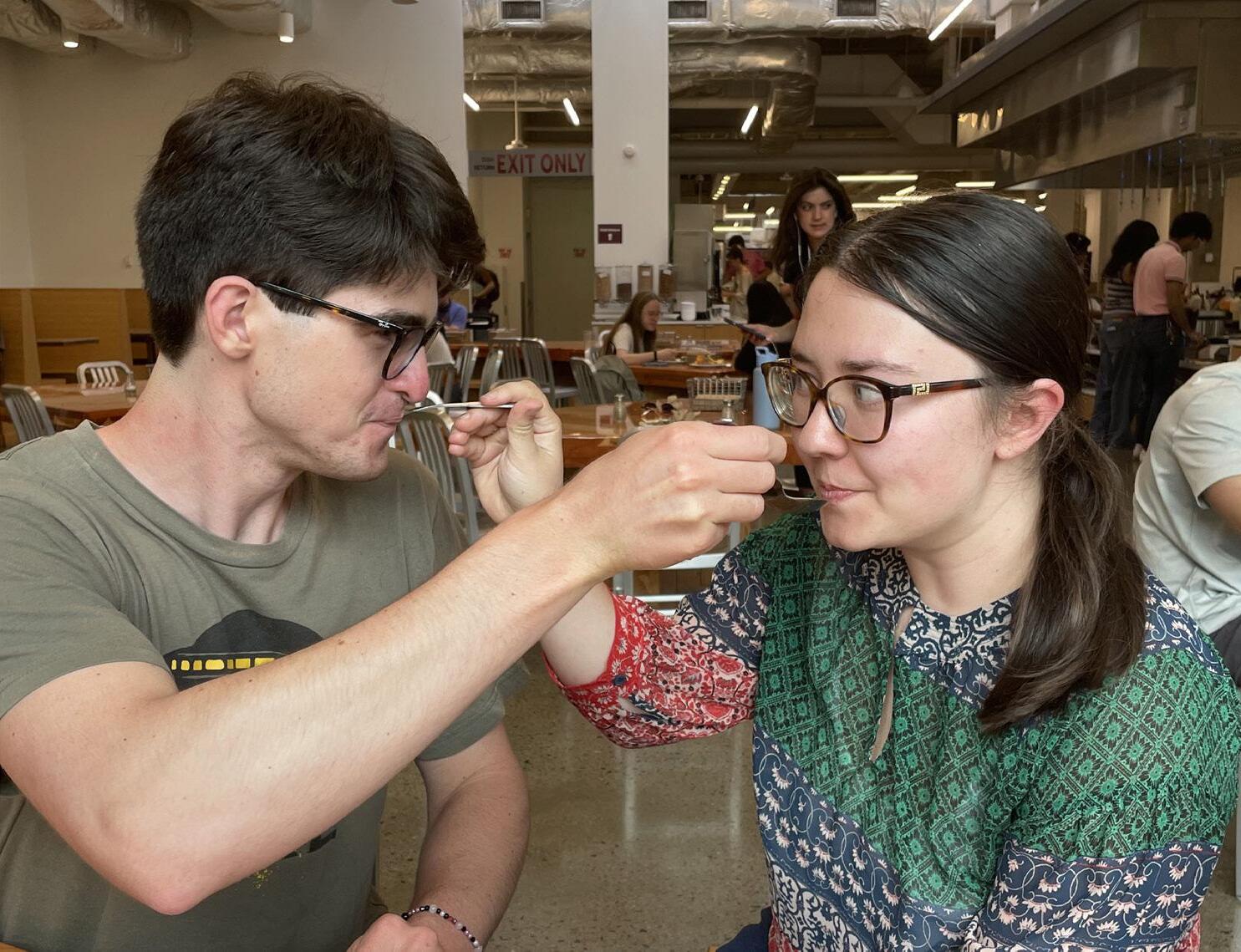
it. For (basically) a whole week, we tried the soups in the Deece. We were relentless in our mission to learn about the soup, eating it almost every day. Well, eating it more than half of the days. Nobody had gone this far before. We were sort of the Artemis II of soup eaters. We come to you today with our official rankings and, most importantly, a plea with you to get freakier with your soup selections.
4/12 Day Zero
We knew we couldn’t go into this without a plan. If we were gonna do this, we were gonna do it right. We decided all soups would be ranked in five categories. They are as follows:
Brothiness to creaminess scale
Sweetness vs. savoriness
Texture and choice of inclusions
Did we have a second bite?
Overall rating out of 10
As we went to sleep that night, our minds wandered with images of all the succulent, sexy—some might even say sensual—bowls of soups we would soon be spiritedly slurp-
4/14 The Second Soups
Tuesday bore Creamy Tomato and Turkey and Rice. Creamy Tomato WOW. A perfect tomato soup. I’ll let our notes speak for themself: “lots of yummy tomatoey tartness. Smooth, I want it to be creamy and smooth and this is that. Basil, which is always nice.” Quite possibly the best soup the Deece has to offer. Quintessential. 10/10. Turkey and Rice is hardly worth mentioning after Creamy Tomato. Bland, brothy, straightforward. Chicken Noodle but worse in almost every way. Nary a second bite was had. 5/10.
4/15 Chili Wednesday
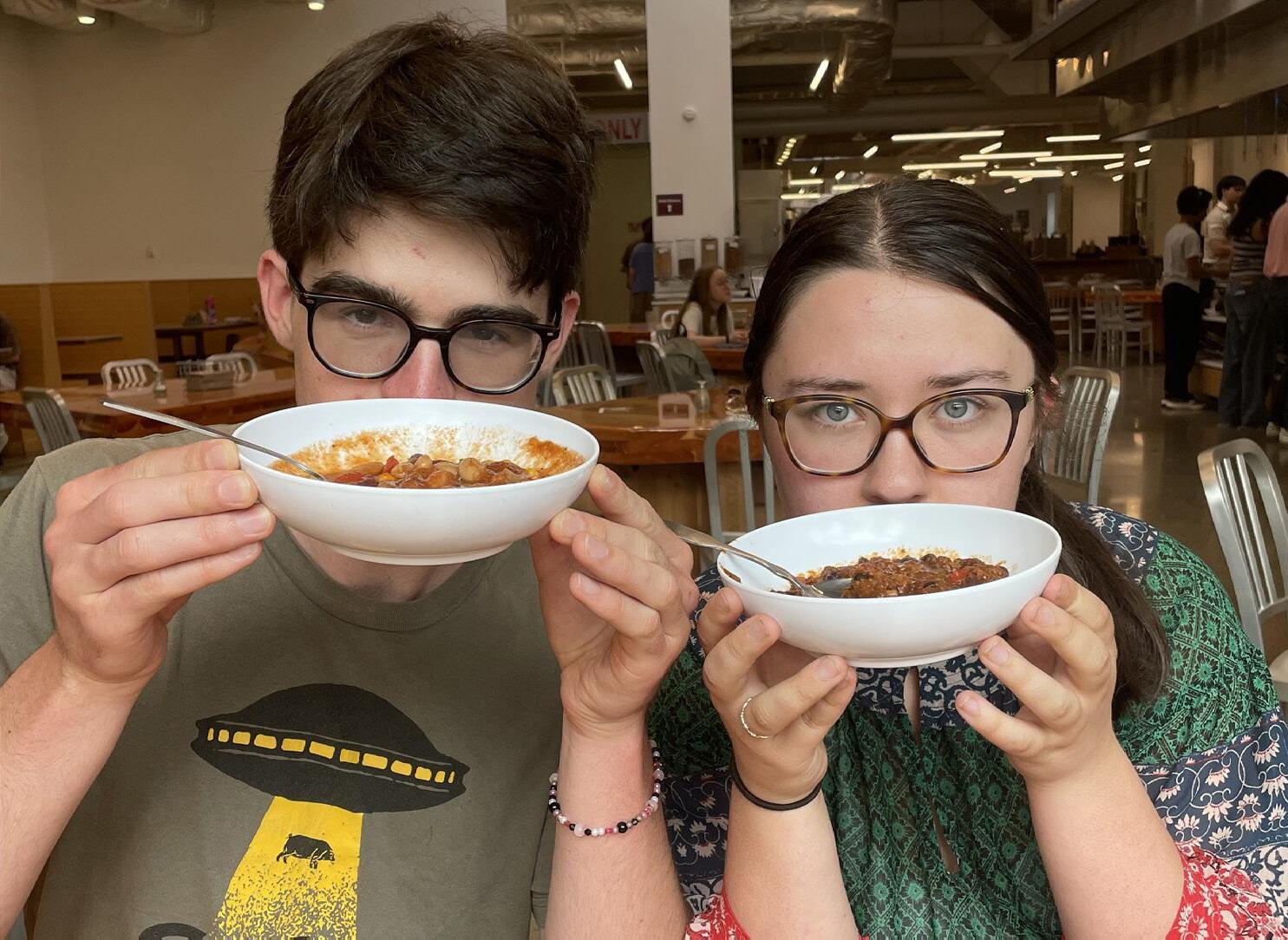
Clap it up for Chili Wednesday. This is where soup week peaks. It’s only downhill from here man. Two heavy hitters, Vassar Beef Chili and Three Bean Chili. Both are fantastic on their own. Take it away from here, Emma. Thanks, Patrick. I want to let all of you lucky readers in on my little secret. I enjoy a meaty chili, but I sometimes find Vassar Beef Chili to be wayyy too meat
dominant for my taste. Not enough fiber. So, I like to do a 60/40 mix of the vegetarian and meat chili options. Try it. Game changer. Anywho, as certified Chili Wednesday lovers, we were pretty excited for this day, and very grateful for the lack of buffalo chicken/white chicken/tofu involved in the situation. The first soup we tried was the Three Bean. We thought it was perfect; Patrick wisely said that in terms of a vegan Deece soup that’s truly satiating, this is the most delicious option. We felt it was the perfect chili texture, fairly brothy but just viscous enough. It was very savory and smoky, and the different beans as well as the addition of corn brought it to the next level texture and flavor-wise. We both took two bites and agreed that we didn’t miss the meat. The Vassar Beef Chili is a classic. It was very much not brothy, super thick and meat-focused. It was nice that there were black beans and peppers as well. Still, I (Emma) think Patrick put it best. I (Patrick) said that my chili preference is a little more with the meat not being a dominating component, but I’ll always go in for a second bite of Vassar Beef Chili. 8/10.
4/16 Hot Thursday
Too damn hot to eat soup.
4/17 Cheesy Friday
We returned to the Deece stronger than ever, ready to sample soups with renewed vigor. We knew we had to taste the fuck out of these soups since we missed Thursday. What a terrible day to approach with such gusto. Today’s soup menu was Turkey with Orzo and Broccoli Cheddar. The former was
a far superior Chicken Noodle replacement than the Turkey with Rice soup from earlier in the week. Not a high bar to clear, but it was deliciously herb-y and lemon-y (and carrot-y, and orzo-y, and turkey-y). We both had second bites. 7/10.
The latter, while we’re sure was made with love, was Broccoli Cheddar. I (Patrick) am not predisposed to Broccoli Cheddar. I (Emma) liked the soup more than Big P, especially the extra sharp cheddar flavor, but it was certainly too rich to have a full bowl. Beyond being creamy, it was the thickest and most dairy-heavy soup we had all week. I’m sure some people love it. I had a second bite, P-Ricky declined. 4/10.
We followed up the soups by leaving the Deece and getting Saba for the rest of our lunch. 10/10. Better than soup.
4/18 Saturday
Partying hard in Saratoga Springs, New York. No soup to be found there.
4/19 Sunday
Partied too hard to have soup.
We hope this was an informative and entertaining read. It certainly was an informative and entertaining journey for us. Though not without its challenges, we learned a lot about ourselves, about the Deece and about soup. Let this be a lesson for you, to push yourself out of your soup comfort zone. But be careful not to push too far, or else you might end up eating hot soup when it’s 90 degrees out in April. As they say, you don’t taste 500 million soups without making a few enemies.
Seth Jenkins Guest Columnist
The 34th President of the United States, Dwight D. “Ike” Eisenhower, once warned against the rise of a military-industrial complex. In that same farewell address, he warned that public life itself could one day fall under the undue influence of a scientific and technological elite. Those warnings have since been granted the highest form of American respect: They are quoted with solemnity, admired from a safe distance and then politely ignored whenever profit, power or national fantasy demands it.
But let us take the warning seriously, if only for one glorious moment. Let us ask the next obvious question: If such a takeover ever were to happen, what exactly would it be for? Why would a military-industrial class, reinforced by a technological priesthood, find the existing order insufficient? Why change the system at all unless one had already decided that freedom, in its untidy and democratic form, had become an obstacle to history?
A recent burst of techno-militarist manifesto writing from the Palantir world offers an unusually clear answer.
Not tanks in the streets; nothing so vulgar. Empire, in its mature form, no longer needs boots first. It arrives as white paper, keynote, doctrine, platform and moral correction. It comes smiling. It comes bearing dashboards. It does not announce itself as conquest. It announces itself as necessity. It does not ask whether it should rule. It asks what kind of human being must now be produced in order for the future to remain governable.
And the answer, stripped down, is simple enough: a more obedient one.
The old republic, by contrast, was indulgent. It tolerated drift: moral hesitation, pluralism, and dissent. It allowed art that did not flatter power and prayer that answered to
something other than the state. It produced love that could not be optimized, leisure that was not monetized, memory that interrupted progress and children who laughed for no strategic reason. Whole populations still attached to the antique fantasy that private life might contain some value beyond usefulness. A failing civilization, in other words.
This model has now reached its natural limit.
The future belongs to a more integrated order. The age of app-based decadence, civilian confusion and unmonetized inwardness is ending. In its place comes a civilization finally prepared to align itself with the demands of competition, deterrence and managed planetary hierarchy. The engineers of Silicon Valley, having completed their apprenticeship in appetite, distraction and surveillance, now stand ready to assume their higher role. No longer content to organize consumption and influence behavior, they will organize destiny and shape the conditions under which life itself becomes legible to systems of command.
SERVICE GUARANTEES RELEVANCE!
For too long, Americans have clung to the childish belief that technological elites should remain politically modest. This was always an unserious arrangement. Who better to govern than those who have already learned to reorder attention, labor, emotion and desire at scale? The same minds that optimized delivery windows and harvested attention will now be invited to administer deterrence, war and civic meaning.
And what is citizenship, properly understood? Not rights without burden; not the self-indulgent expectation that one may enjoy the fruits of empire while remaining exempt from its rituals. Citizenship, in its advanced form, is coordinated usefulness. Therefore, national service should be universal. Why should violence remain the specialized labor of a volunteer class when the honor of participation may be shared by all?
No, a healthy civilization would ensure that everyone belongs to the machine and that no one mistakes private conscience for political seriousness.
EVERYONE FIGHTS. EVERYONE MATTERS.
Some romantics will object that this vision narrows human life. They worry that a society organized around strategic necessity may lose sight of the reasons power exists. This is a familiar complaint, especially among those populations accustomed to imagining that history was made for their comfort. But our adversaries do not ask whether machine intelligence should shape warfare, governance and social order. They ask whether it can be deployed by Quarter 4. They are building. They are integrating command structures with prediction, classification and automated response. We must not be outpaced by people less sentimental than ourselves.
And that means retiring certain myths. The first is the myth that culture exists for human enrichment. It does not. Culture exists to shape durable populations. Art that does not strengthen cohesion is decoration. Religion that does not reinforce order is private theater. Education that does not prepare disciplined contributors is sentimental subsidy. Pluralism, too, must be approached with care. Diversity is useful until it begins producing rival loyalties, incompatible moral worlds and citizens who insist on bringing their full humanity into public life. The governed are easiest to manage when they can be translated into categories: productive or unproductive, stable or unstable, civilized or regressive, aligned or misaligned. The old colonial project once performed this sorting with race science, missionary certainty and the rifle butt. The updated model performs it with behavioral data, policy language and machine learning. Progress, as they say.
Would this require a firmer public ethic? Naturally. Would it involve asking less of
democracy and more of administration? Of course. Would talented public servants and strategic elites need to be paid more, criticized less and forgiven more generously than ordinary people? One hopes so. Excellence requires room.
DESIRE CIVIC VIRTUE? DO YOUR PART!
At this point, some may still wonder whether love, beauty, grief, contradiction and the unruly depths of the human soul will survive this new dispensation. Certainly they will. They may be retained wherever operationally feasible. Families may continue, insofar as they stabilize the population. Religion may remain available for those requiring transcendence, subject to alignment review. Poetry may persist under controlled conditions, especially where it contributes to morale. Even leisure may survive in limited forms, preferably those involving screens, metrics and sponsorship from defense-adjacent innovators.
In short, the human experience will not be abolished. It will be curated.
And that, in the end, is what the takeover is for. Not simply better software, more obedient citizens and a ruling class once again convinced of its civilizational mission. It aims at something more ambitious: the final reconciliation of human life with imperial necessity. No more wasteful distinction between what is useful and what is beautiful, what is alive and what is functional, what is free and what is merely governed well. Everything will at last be harmonized under one supreme truth: If a thing cannot serve power, it must learn to justify its existence.
A president warned us once. He feared that military force fused with technical authority might alter the character of the republic. He was right. He simply lacked the language to describe what empire would become once it learned to call itself innovation.
Citizens, the future is calling.
Would you like to know more?
Verse14:8 of the Book of Revelation, the prophetic conclusion of the Christian Bible, features three angels who deliver messages from God to humanity. The second angel says, “Fallen, fallen is Babylon the great. She has made all the nations drink the wine of the wrath of her immorality.”
In March, the Military Religious Freedom Foundation received over 200 reports claiming that commanders were briefing about how the U.S. and Israel’s war on Iran and Lebanon is sanctioned by God, and that President Trump is tasked with fulfilling the prophecies found in Revelation. More recently, Trump verbally attacked Pope Leo XIV for being critical of the war, calling him a DEI hire and “WEAK on Crime.” Vice President Vance and House Speaker Johnson backed Trump with similar criticisms, alleging that the Pope is stepping out of line. Trump followed his tantrum by posting an AI-generated image of himself as Jesus Christ on Truth Social.
While these events were shocking, I was more amused than surprised. The Christian nationalist movement has been a long-time ally of Trump, often portraying him as a messiah figure. Additionally, many conservative evangelicals believe that the supremacy of Israel over the Middle East is crucial to the prophetic return of Jesus. While this fanatical thinking seems ridiculous, we cannot dismiss Christian nationalism without
failing to understand it.
Trump has claimed he is Christ. While this may not be his personal, theological position—most think he does not have one—his egotism has been apparent for his entire public life. Within this framework, his mandate is not just that of the American voter base and the Electoral College, but of God. Obviously, this is blasphemy.
In Chapter 13, verse one of Revelation, a “beast” is introduced. This chimera-like creature from the sea was given authority by a “dragon,” in which “It was allowed to mouth its haughty and blasphemous words, and it was granted permission to exercise its authority for forty-two months.” Forty-two months is around three and a half years. That is a little under the length of a presidential term. Get where I am going with this?
It seems like the Christian nationalists are carrying a fatal contradiction. On one hand, they want to invoke Revelation to justify the conquest of Iran and other non-compliant powers in the Middle East. On the other hand, the man whom they prop up as the Second Coming better resembles one of the main villains in their own prophecy.
Furthermore, while Secretary of War Hegseth pushes the narrative that America and its imperialist foreign policy initiatives are sanctioned by God, a current events reading of Revelation points us in the opposite direction. In line with 14:8, Chapter 17 describes “Babylon the great, the Infamous Harlot,” who is said to intoxicate the rulers of the world with “the wine of her harlot-
ry.” While this emphasis on Babylon being a sexually immoral woman is strange, the symbolic meaning speaks volumes. She has authority over the Earth and is aligned with the aforementioned beast for a short period of time, but an angel tells John, Revelation’s writer, that, “The ten horns that you saw and the beast will hate the harlot. They will render her desolate and naked; after they devour her flesh, they will burn her up with fire.”
If Revelation really is unfolding now, then Babylon is none other than the United States. The nation with the most military bases—and it is not even close—around the world is the United States. Its economic sway over all other nations is unprecedented. Through the petrodollar, the world’s economies are practically required to invest in the United States’ banking industry if they want energy. This nation is permitted to supersede international law and the sovereignty of other societies on a whim. A pressing and overlooked example is the U.S. embargo on Cuba. After blocking Venezuelan oil shipments—through essentially kidnapping the former president of Venezuela—the United States caused a nationwide blackout in Cuba, which has led to starvation and death for the Cuban people. Hospitals lack the electricity and resources to keep their patients alive, and many are falling into poverty. It is absolutely egregious, yet the Trump administration faces no consequence, which is exactly the level of pure power that Babylon exerts over the world in Revelation.
After the fall of Babylon, due to the betrayal of the beast, there are a series of wars between the forces of the beast and Jesus. It seems that one of these wars may be happening already in the form of the back and forth between the Pope and the President. Pope Leo remarked, “Woe to those who manipulate religion and the very name of God for their own military, economic and political gain, dragging that which is sacred into darkness and filth.” While Leo XIV has since said these words were not directly aimed at Trump himself, the message still rings true. Trump, his cronies and America as a society are constantly performing acts of idolatry, which the Pope is exposing through his outcries. These actors seek to use Christianity to cover up the fact that their true god is the accumulation of wealth and the satisfaction of their bloodlust. When Hegseth prays for “overwhelming violence” in Iran, when we know the victims of American strikes are school children, that cannot viably be a prayer to the Prince of Peace. I am not a Christian, and I do not wish to fearmonger that the world is ending. However, the dangerous people running our society need to be examined so that we are not blindsided by the idolatrous apocalyptic thinking justifying or motivating these atrocities. Even if Revelation is not literally unfolding, it provides symbols and a traditional account of how political power reckons with its own blatant immorality. Revelation forces us to consider the crumbling of an evil society and the birth of a better one.
Cici Zhang guest columnist
“There is no excuse and never an invitation to rape.”
I keep returning to this sentence because of how simple it is and how often the world seems to forget it. Denim Day matters for that exact reason: It pushes back against the habit of turning cases of sexual wviolence into discussions about everything except the violence itself.
Denim is everywhere. It is worn to class, to the library and to late-night walks across campus when the air still carries a trace of winter. Because it is so common, denim rarely draws attention to itself. But there was a moment when a pair of jeans was treated as evidence in a courtroom—not as evidence of violence, but as a way to deny that violence had occurred.
In 1992 in Italy a young woman reported that she had been raped by her driving instructor. He was convicted. For a brief moment, the legal system seemed to recognize what had been done to her. Then the Italian Supreme Court overturned the conviction. Their reasoning rested on something disturbingly mundane: Her jeans were too tight. She must have helped remove them. That, they argued, meant consent.
The reaction to the decision was immediate. Women in the Italian Parliament arrived at work wearing jeans, standing together in quiet anger. There was no need to argue with the Court’s reasoning point by point. Wearing denim itself rejected the Court’s claim that tight jeans could imply consent. Photographs of those lawmakers in jeans quickly
circulated beyond Italy, because the message was unmistakable: Ordinary clothing cannot be used to explain or justify sexual violence.
Years later, the Los Angeles-based nonprofit organization Peace Over Violence transformed that Italian case into Denim Day. What began as a protest in Italy became an annual campaign in the United States, now observed on the last Wednesday of April, Sexual Assault Awareness Month. People wear jeans that day with a specific awareness of what they stand against: the idea that clothing can be used to question or dismiss violence. The fabric does not change. What changes is how we choose to interpret it.
I think about how easily attention drifts. When someone recounts an experience of sexual violence, the conversation often shifts almost immediately to details that feel easier to question—what the person was wearing, what time it happened or why certain choices were made. These details are treated as if they help explain the situation, but in reality they redirect the focus away from the act itself. They turn a clear account of harm into something that can be debated and dissected. What slips out of view is the central fact that someone was harmed and that harm was inflicted by another person.
I think we should resist that shift deliberately. When we hear these stories, we should keep our attention on what was done and who is responsible, rather than searching for surrounding details to analyze. That means refusing to ask questions that imply justification and refusing to treat ordinary circumstances like clothing or timing as relevant explanations. If Denim Day asks anything of us, I think it asks for this discipline: to hold the focus
steady, even when it would be easier to let it move elsewhere.
I have seen this pattern repeat beyond that one case in Italy. In 2015, a Stanford University student named Brock Turner sexually assaulted an unconscious woman behind a dumpster. Two witnesses intervened and testified, and he was later convicted. Yet, much of the public discussion did not stay with the violence he committed. Instead, attention shifted to his background as a swimmer, his future and whether the punishment would be too harsh for him. While those accounts described patterns of coercion and abuse, public conversations often focused on the women’s careers, their past choices or why they had not spoken out earlier.
That is why I will be wearing denim. Not as a general sign of awareness, but as a deliberate refusal to follow that pattern. I think we should be more precise about where we place our attention. When we talk about sexual violence, we should keep the focus on what was done and who is responsible. Denim Day is a small action, but it draws a clear line: Ordinary details are not explanations for harm, and they should not be treated as such.
Next week, when Denim Day arrives on April 29, the jeans we wear will look no different from any other day. But they will carry a history of refusal and a choice about whether we continue it. You should wear denim because it takes a position. It resists the instinct to explain, to soften and to shift attention elsewhere. It keeps the focus where it belongs.
“There is no excuse and never an invitation to rape.”
The sentence is still simple. The question is whether we are willing to defend it.
Edward Welch Morgan Guest Columnist
Email was pioneered by colleges and universities in the ’80s and ’90s, back when it was revolutionary technology. Despite all the advancements society has made since, we are still tethered to the inbox. This system is really showing its age. Information is vomited at us across a million different emails, with only a small fraction actually being valuable. It is easy to miss things and hard to make sense of it all.
Attempting to remedy email’s problems, institutions have adopted other tools. Administrative information is available on official Vassar College websites, and course information is available on Moodle. These sites use a top-down model: Information is transmitted from administration and faculty to students. This model is effective for communicating major developments, but it struggles to facilitate everyday information sharing, which requires back-and-forth communication between parties.
Student orgs, academic departments, and other groups on campus have moved their advertisements to social media platforms like Instagram or Fizz. While these platforms allow more interplay between parties, they still fail as communication tools. We are at the whims of corporations that show you the content algorithms predict will make them the greatest profit, not what we think is most useful or valuable. As a result, we are bombarded with content, little of it of substance. In some ways, these social media platforms are even worse than email. This is an environment we need to escape. All of these problems can be simplified to a structural mismatch: Our existing platforms assume that organizations are static groups with clear leaders. But life, especially college life, is much more complex.
Most student orgs act more like social stages that people can enter and exit. Responsibilities and authorities are split among many people, ever-changing as new students arrive and seniors graduate. Our existing information infrastructure does not facilitate this kind of fluid, democratic governance.
The tools we use now are clearly inadequate—so what would a better communication tool for Vassar College look like? Well, it should be easy for anyone to contribute information, meaning there should be no gatekeepers. At the same time, information should be easy to find, which requires some mechanism for organization.
This is surely a utopian vision, right? Wrong! This kind of task is perfect for a wiki: a website collaboratively edited and collectively governed by its users. Wikis offer the convenience and accessibility of today’s internet while restoring the freedom that the internet was supposed to have.
You might expect that a collectively operated website would devolve into chaos, but actually, the opposite is true. Take Wikipedia, the prime example of a wiki: It has surprisingly accurate content and orderly governance, all emerging from the collaboration of millions of regular people. It is so successful that old encyclopedias run by closed institutions have been made nearly obsolete.
How could this be possible? Well, with the right foundation, a wiki harnesses the will and wisdom of the crowd that our hierarchical institutions so often suppress. Web technology makes forms of direct democracy that were once dismissed as impractical suddenly viable. Hyperlinking allows for easy referencing of past consensus, allowing for a grounded deliberative process. Every change is logged so destructive edits can be easily undone.
Even though wikis have demonstrated that they are viable, they remain an anomaly on the modern internet because we have not properly reckoned with their success. As a result of sticking with these old systems, we are regressing into technofeudalism: Our entire society is becoming bound to cyberspace that is controlled by a small few and enshittified for profit. Technofeudalism is more expansive than medieval feudalism, because not only is our economy owned, so is our knowledge and our everyday social interactions. This process has destroyed our democracies and our communities.
Technofeudalism is by no means inevitable. We have the tools to reclaim the digital commons—we just have to use them. I believe that Vassar’s small
college community is the perfect place to start.
A wiki would serve as a single, convenient hub for college life. Since a wiki makes it quick for anyone to contribute, managing information would become an easy multilateral effort rather than an arduous individual one. As a persistent resource, a wiki would allow our community to build lasting knowledge that outlives the typical four-year student turnover cycle. And a local scope will make problems like vandalism much more easily manageable relative to a project like Wikipedia, which is so incomprehensibly large that poor edits can fall through the cracks.
To make this more concrete, let me outline some example use cases:
Not sure what’s happening this weekend?
Visit the “Upcoming Events” page, where groups can advertise events all in one place. Afterwards, the advertisements can be converted into archival pages to share photos, publicize meeting minutes or document campus history.
Want to get involved with a club but don’t know when or where they meet?
Just go to their page! And because anyone can edit, student organizations no longer need to worry about getting locked out of an account. Also, we would no longer be at the whims of corporations who censor and channel information for their own political gain.
Missed class and need to catch up?
Go to your course’s page, where your class can share notes and collaborate in a common space. Then visit your professor’s page, where they can publicize their sign-up for office hours and other resources.
We are not limited to these examples; since a wiki is self-governed, it can adapt to our particular needs as a community. I am also not arguing that a wiki needs to replace every tool we use. But I believe a wiki would meaningfully strengthen campus life by removing barriers to greater involvement.
If you want to help launch a wiki at Vassar, you should contribute at vassar.wiki! All you need is five minutes and something worth sharing. We can build a community that actually belongs to us—we just have to start.
Question: What is your dream internship?
“Oyster farming.”
-Julian Gross ’26
“Intern at Activison Blizzard.”
-Abdullah Hunter Farhat ’28
“Multi country internship studying Scandinavian schools.”
-W. Ashton Scott ’26
“Museum curator intern.”
-Talia Lasky ’27
“Any MIT Pure Math REU.”
-Gasper Ndokaj ’28
“Getting my clinical hours in Boston.”
-Ava Andrade ’27
“Public health organization.”
-Nicole Gao ’27
“Fashion designer!”
-Dylan Macer ’29
“Anything that lets me travel. Or maybe like working on a submarine.”
-Grace Mounday ’27
“Automotive engineering.”
-Landon Silverstein ’28
“I would do a data analysis internship with the ACLU.”
-Ashley Barmore ’28
“Intern with the Federal Transport Administration.”
-Neil Kotru Gode ’26
“Data Engineering Intern.”
-Christian Davidson ’27
“Spotify Lesbian coordinator: I would be responsible for scoping out lesbian songs about yearning and love and working with those specific bands to grow their music more on Spotify.”
-Mari Chew ’29
Our goal with Brewers Ballin’ is to feature Vassar athletes who starred for their team the week previous to publishing. If you would like to nominate an athlete, please email hfrance@vassar.edu.

’29.
Name: Ethan Fox-Fernandez
Team: Baseball
Year: First Year
Stats: Ethan Fox-Fernandez came up clutch for the Brewers late in both games against Skidmore College in a critical series victory this past weekend. In the first game, the first-year catcher connected for a single that sent the game-tying run home, sending the contest to extra innings. In the top of the 12th, Fox-Fernandez laid down a bunt that progressed the eventual game-winning runner to second base. In the second game, he batted what ended up being the game winning run in the top of the seventh inning in the 6-5 win over the Thoroughbreds.
Statement: "This season has definitely had its ups and downs, but I’m incredibly proud of how we’ve persevered. We’ve built a culture this year where we can flip the page quickly, moving past injuries or tough calls without making excuses. Our success this past weekend is a direct result of that 'short-term memory.' We’ve proven we can handle adversity, and I think we’re going to surprise a lot of people once playoffs arrive."
Men's Tennis W, 6-1 @ #63 RIT
Men's Rowing
2nd/8 @ New York State Championships
Baseball
Series W @ Skidmore College (2-1)
Women’s Rugby wins Beast of the East Tournament
For the fifth straight year, the Beast of the East trophy will stay in Poughkeepsie. The Brewers avenged an opening round loss to the University of Vermont to defeat the Catamounts 24-0 in the championship.
Women's Tennis W, 7-0 @ RIT

Women's Lacrosse L, 8-13 @ St. Lawrence University
Men's Lacrosse L, 11-12 vs. #18 Ithaca College
Men’s Volleyball earns two AVCA All-American honors
Armaan Desai ’27 and Henry Bonney ’28 were named AVCA First Team All-Americans after stellar seasons for the Brewers. Both players will return next year as the Brewers look to head back to the NCAA Tournament.
Women’s Tennis wins ninth straight match
The Brewers swept William Smith over the weekend to improve to 7-0 in Liberty League play. Erin Mccusker ’26 and Iris Lee ’26 were named the League’s Doubles Team of the Week.
Women's Tennis vs. Skidmore College Saturday, April 25th
2:00 pm @ Richard L. Cretella Tennis Center
higher. As a senior, Nihei was named a team captain and started in 19 games, leading the Brewers back to the NCAA tournament and winning the Liberty League, earning the Liberty League Championship’ Most Outstanding Performer award in the process. “We had been working towards it
York, and has ascended to being one of the captains of the track and field team after walking on to the team as a first-year. Sellitti first started running track as a senior in high school after primarily playing baseball for much of his childhood. Like many of us, Sellitti chose Vassar for its academic reputation and welcoming feeling: “I visited

for so long, and I never honestly thought that we would win anything when I was a freshman. So it was a really nice surprise,” she remarked. Nihei was also named to the United Soccer Coaches All-Region III Second Team and the All-Liberty League First Team.
On and off the pitch, there was one constant during Nihei’s career: her teammates. When reflecting on her time at Vassar, Nihei emphasized the culture the team built during her four years. “We really just try to play for each other and be there for each other.” Years from now, Nihei knows exactly what will stay with her. “I'm definitely gonna remember my teammates and my friends the most, and the feeling that we had being together and winning together. It was just so fun… I'm not gonna remember any of the negative things, just the good times.”
Jacob Sellitti ’26 had a much shorter trip to campus than his classmate Nihei, but a similar experience acclimating to Vassar Athletics. Sellitti is from Dobbs Ferry, New
on admitted students day and went on some tours since I lived nearby… It really felt like a place I could imagine myself living.” But after two months on campus, something was missing from Sellitti’s life: sports. “I walked on when I got here after a few weeks of kind of going crazy, of not playing sports for the first time in my life. And so going into it, I really didn’t have any expectations. I was sort of looking to get the same thing out of it that I got in high school, just something fun to do, something to sort of occupy my time, but it really has turned into so much more after four years,” he said. It was months before Sellitti was fully integrated into the team, but in a sport that spans the entire year, he had time to find his stride.
Sellitti has emerged as a short-distance runner, meaning his primary events include the 60-meter, 100-meter and 200-meter distances. Events like these are typically decided by tenths or hundredths of a second, and year-over-year improvement is measured similarly. For Sellitti, his objective this season is running a sub-23-second
200m sprint, a time just seven-hundredths of a second faster than his personal best last season. While it is easy to get absorbed in the solitary nature of running, he was clear that Vassar track and field is just as much a team sport as any. Head Coach Joe Reed joined Vassar in August 2021 and has instilled a culture of top-down leading by example. “We’ve seen a huge shift in the culture and the team dynamic and just our priorities and focus as a team,” said Sellitti. “We have more people in the weight room than we’ve ever had before. We have more people cheering each other on at meets.” He continued, “I think that shift has been really amazing to see. I think we’ve done a great job of showing everyone this is just what we do.” The senior captain reflected the focused sense of purpose: “When you’re running… it’s only you that has to deal with those results. If it’s a good time or a bad time, you’re still here for the team. You’re still here for the name on your chest, and that’s just been a great shift.”
As he reflects on his athletic career at
of fulfilling. Having arrived as a walk-on, Sellitti is thankful to have learned from the team leaders at the time. “The people in the class above us and the class above… those are the people who really introduced me to the sport and introduced me to the team culture. And so that’s definitely been relationships that I will look back on and cherish,” he said. And now, as a team leader himself, he is proud to be guiding the next wave of young Brewers. “Now, as a captain, as someone who can kind of recruit the next class and help other people get to where I’m at, it’s really great to see people who were in the same situation I was in, not really sure what to get out of it [track and field] let them find their way,” he concluded. “It’s been really meaningful to find something new that I can compete at, and push myself towards but also to help other people do the same.”
Lindsey and Jacob’s stories highlight the Vassar student-athlete experience as far more than wins and losses or personal bests, but learning and growing and ultimately inspiring others.

Vassar—which is yet to conclude, with track events continuing through May—Sellitti comfortably declared with a smile that his time running at Vassar was nothing short
On April 23 to 25, the NFL 2026 draft will take place in Pittsburgh, Pennsylvania. The draft always brings a lively atmosphere, and this year in Pittsburgh will be no different, given the deep-rooted love of football in the city. This year's draft takes place on the city’s North Shore at venues including Acrisure Stadium and Point State Park, marking the first time the city has hosted the draft since 1948.
The draft has weathered the test of time since its introduction 90 years ago, in 1936. This year, in an effort to make the draft more watchable and speed up the broadcast, the time each team has on the clock has dropped from 10 minutes per pick to eight. Throughout the seven rounds of the draft, every team will have multiple chances to pick promising college players in the hopes of turning them into their next young star. This year’s class is deep on the defensive side of the ball, with many great edge rushers and safety depth, but also has a highly regarded quarterback in national champion and Heisman winner Fernando Mendoza, expected to go first overall.
The draft order is based on teams’ records from the previous season, with trades allowed between teams to increase their pick count or position on the draft board. This year, the top five draft picks in order (barring last-minute trades) are the Las Vegas Raiders, New York Jets, Arizona Cardinals, Tennessee Titans and the New York Giants. The Raiders have been the main point of questions, as they look to draft Fernando Mendoza and potentially start him as a rookie. That said, the Raiders’ front office has made moves pointing towards developing him behind a veteran for a few years with their April signing of Kirk Cousins. Mendoza was a rising star during the 2025 college season, eclipsing big quarterback names like Alabama’s Ty Simpson, LSU’s Garrett Nussmeier and Miami’s Carson Beck, among others. He led the Hoosiers to their best season in program history and an undefeated national championship, a feat in and of itself, especially given the Hoosiers’ reputation as a failing program only two seasons prior.
Sadly, both New York teams being in the bottom five of the league is no surprise to NFL fans, but given their early picks in this year’s draft, they will get some of the best (most likely non-quarterback) players on board.
The Jets are eyeing defensive stalwarts like Arvell Reese (Ohio State University), while the Giants are desperate for offensive line help, such as Francis Mauigoa (University of Miami) or a secondary boost with Caleb Downs (Ohio State University).
There will be some interesting anomalies in different position groups. For instance, Jeremiyah Love, Notre Dame’s standout running back over the past two seasons, is touted as a top-five prospect, which is out of the ordinary for running backs. Love’s career is a very interesting story and is definitely worth learning about. On top of that, in line with the defensive theme of this year’s draft, the aforementioned Caleb Downs and Oregon’s standout safety Dillon Thieneman are both seen as generational talents and obvious firstround picks, barring anything crazy (like the Laremy Tunsil incident). Some teams desperately need a top wide receiver and may look to the draft for answers, namely teams like the New Orleans Saints and Cleveland Browns, looking towards names like Carnell Tate (Ohio State University) or Makai Lemon (University of Southern California).
In writing this over a week out from day one of the draft, there are already rumors of the Kansas City Chiefs and Dallas Cowboys
making moves into the top 10, especially with Dallas’ trade away of Micah Parsons prior to the 2025 season. And while the hometown Steelers will not be on the board until pick number 21, analysts say they would be smart to look for a receiver, offensive lineman or safety, which is sure to bring a big celebration to the crowd.
A couple of player-specific stories to mention in the first round include Clemson University’s Blake Miller, who has 54 straight starts (the most starts by a non-specialist in program history), which brings veteran-like experience to whatever team might draft him; expect him to be a safe round one pick. Wide receivers Jordyn Tyson (Arizona State University) and Makai Lemon (University of Southern California) are expected to be value risers who will go in the first round. In terms of quarterbacks, looking past Mendoza, Ty Simpson (Alabama) is expected to be number two, with a very quarterback-light first two rounds according to Mel Kiper. Regardless of which team you root for, the draft is fun for everyone, as fan bases hope to land their next franchise player. All 257 of these young men take a leap of faith with their future team, and the multi-million-dollar contracts won’t hurt either.

By: Aurelia Harrison
ACROSS
1. Contingencies
4. Furious
6. Spanish for “to have”
7. What you should not do, as per a "No Trespassing" sign
8. Lend an __
DOWN
1. One of the members of Red Velvet
2. Soda that’s better in Spain
3. Control the car
4. Suffix that denotes belonging, after "Brooklyn" or "Ludd"
5. __ on the side of caution
By: Allison Lowe and Luke Jenkins
ACROSS
1. A profile you submit, more evil than the FAFSA
4. Katharine Hepburn saw them and screamed
6. A man who has been castrated, minus the most phallic letter
7. Smooth, as in hair
8. Word for penis, without the vowel
DOWN
4. ___ Misérables
1. Would, should
2. Blue hedgehog
3. ___, or sneaked?
5. Initials of Games Editor, middle name is SATC lead character
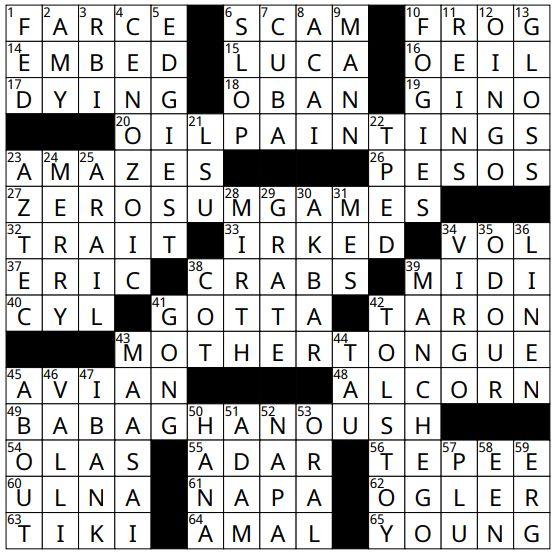
By: Felix Mundy-Mancino

By: Luke Jenkins and Darja Coutts
ACROSS
1. Lesser known US agency that would fight for Krafted Cup
4. Avoids or ostracizes
6. 2020 Christopher Nolan film
7. Incorrect plural of die
8. Where I’d win the Stanley Cup
DOWN
4. Why I leave Baldwin in a walk of shame
1. Where I might purchase a Founder’s Day corset, not Temu
2. The Brady ___
3. An exclamation you make at an aquarium on seeing one long, slippery creature
5. PB’s fav department

By: Grace Finke
ACROSS 1. Flow’s counterpart 4. Shut forcefully
Anything we can hear
Disney’s “coolest” heroine
Not _____
DOWN
1. “That,” en Español
2. Joni’s 1971 album
3. Poorly
5. ____-en-scene
7. Popular form of alternate milk
"Clomp Clomp"
By: Sadie Keesbury
Tit for _____
Gently moving back and forth
Crappy
Galloper
for _____
Gently moving back and forth
Crappy
Galloper