F6F-5N Nightfighter
7079
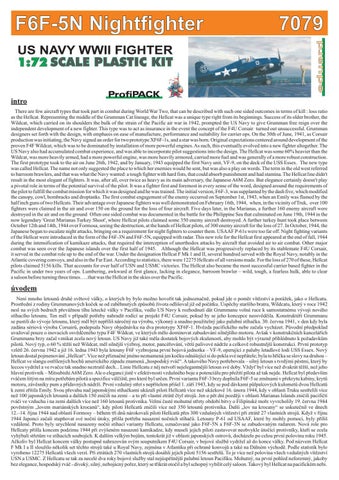
US NAVY WWII FIGHTER 1:72 SCALE PLASTIC KIT intro There are few aircraft types that took part in combat during World War Two, that can be described with such one sided outcomes in terms of kill : loss ratio as the Hellcat. Representing the middle of the Grumman Cat lineage, the Hellcat was a unique type right from its beginnings. Success of its older brother, the Wildcat, which carried on its shoulders the bulk of the strain of the Pacific air war in 1942, prompted the US Navy to give Grumman free reign over the independent development of a new fighter. This type was to act as insurance in the event the concept of the F4U Corsair turned out unsuccessful. Grumman designers set forth with the design, with emphasis on ease of manufacture, performance and suitability for carrier ops. On the 30th of June, 1941, as Corsair production was initiating, the Navy signed an order for two prototype XF6F-1s, and a star was born. Original expectations centered around development of the proven F4F Wildcat, which was to be dominated by installation of more powerful engines. As such, this eventually evolved into a new fighter altogether. The US Navy also had accumulated combat experience, and was able to incorporate pilot suggestions into the design. The Hellcat was some 60% heavier than the Wildcat, was more heavily armed, had a more powerful engine, was more heavily armored, carried more fuel and was generally of a more robust construction. The first prototype took to the air on June 26th, 1942, and by January, 1943 equipped the first Navy unit, VF-9, on the deck of the USS Essex. The new type was called Hellcat. The name not only suggested the place to which her enemies would be sent, but was also a play on words. The term in the old west referred to barroom brawlers, and that was what the Navy wanted: a tough fighter with hard fists, that could absorb punishment and had stamina. The Hellcat line didn't result in the most elegant of fighters. It was, after all, over twice as heavy as its main adversary, the Japanese A6M Zero. But elegance certainly doesn't play a pivotal role in terms of the potential survival of the pilot. It was a fighter first and foremost in every sense of the word, designed around the requirements of the pilot to fulfill the combat mission for which it was designed and he was trained. The initial version, F6F-3, was supplanted by the dash five, which modified the canopy, cowl, bombracks and droptanks. The first combat engagement of the enemy occurred on September 1st, 1943, when an Emily was flamed by the half inch guns of two Hellcats. Their advantage over Japanese fighters was well demonstrated on February 16th, 1944, when, in the vicinity of Truk, over 100 fighters were claimed in the air and over 150 on the ground for the loss of four aircraft. Five days later, in the Marianas, a further 160 enemy aircraft were destroyed in the air and on the ground Often one sided combat was documented in the battle for the Philippine Sea that culminated on June 19th, 1944 in the now legendary 'Great Marianas Turkey Shoot', where Hellcat pilots claimed some 350 enemy aircraft destroyed. A further turkey hunt took place between October 12th and 14th, 1944 over Formosa, seeing the destruction, at the hands of Hellcat pilots, of 300 enemy aircraft for the loss of 27. In October, 1944, the Japanese began to escalate night attacks, bringing on a requirement for night fighters to counter them. USAAF P-61s were too far off. Night fighting variants of the Hellcat were introduced in the form of the F6F-3N and F6F-5N, equipped with radar. This new role for the Hellcat first appeared at the end of fall, 1944 during the intensification of kamikaze attacks, that required the interception of unorthodox attacks by aircraft that avoided air to air combat. Other major combat was seen over the Japanese islands over the first half of 1945. Although the Hellcat was progressively replaced by its stablemate F4U Corsair, it served in the combat role up to the end of the war. Under the designation Hellcat F Mk 1 and II, several hundred served with the Royal Navy, notably in the Atlantic covering convoys, and also in the Far East. According to statistics, there were 12275 Hellcats of all versions made. For the loss of 270 of these, Hellcat pilots claimed 5156 kills. That accounts for over half of USN and USMC victories. The Hellcat also became the most successful carrier based fighter in the Pacific in under two years of ops. Lumbering, awkward at first glance, lacking in elegance, barroom brawler – wild, tough, a fearless hulk, able to clear a saloon before turning three times…..that was the Hellcat in the skies over the Pacific.
úvodem Není mnoho letounù druhé svìtové války, o kterých by bylo možno hovoøit tak jednoznaènì, pokud jde o pomìr vítìzství a porážek, jako o Hellcatu. Prostøední z rodiny Grummanových koèek se od zabìhnutých zpùsobù života odlišoval již od poèátku. Úspìchy staršího bratra, Wildcatu, který v roce 1942 nesl na svých bedrech pøevážnou tíhu letecké války v Pacifiku, vedlo US Navy k rozhodnutí dát Grummanu volné ruce k samostatnému vývoji nového stíhacího letounu. Ten mìl v pøípadì potøeby nahradit rodící se projekt F4U Corsair, pokud by se jeho koncepce neosvìdèila. Konstruktéøi Grummanu se pustili do vývoje letounu, který mìl být nepøíliš nároèný na výrobu, výkonný a snadno použitelný jako palubní stíhaèka. 30. èervna 1941, v den kdy byla zadána sériová výroba Corsairù, podepsala Navy objednávku na dva prototypy XF6F-1. Hvìzda pacifického nebe zaèala vycházet. Pùvodní pøedpoklad uvažoval pouze o inovacích osvìdèeného typu F4F Wildcat, ve kterých mìlo dominovat zabudování silnìjšího motoru. Avšak v konstrukèních kanceláøích Grummanu brzy zaèal vznikat zcela nový letoun. US Navy již také mìla dostatek bojových zkušeností, aby mohlo být výraznì pøihlédnuto k požadavkùm pilotù. Nový typ, o 60 % tìžší než Wildcat, mìl silnìjší výzbroj, motor, pancéøování, vìtší palivové nádrže a celkovì robustnìjší konstrukci. První prototyp vzlétl 26. èervna 1942 a již 16. ledna 1943 byla letouny F6F vyzbrojena první bojová jednotka – VF-9, operující z paluby letadlové lodi USS Essex. Nový letoun dostal pojmenování „Hellcat“. Více než pøíznaèné jméno neznamená jen koèku odnášející si do pekla své nepøátele; byla to høíèka se slovy na druhou – Hellcat ve slangu ostøílených hochù amerického západu znamená „hospodský rváè“. A takového Navy potøebovala – silný letoun s tvrdými pìstmi, který by leccos vydržel a ve rvaèce tak snadno neztratil dech... Linie Hellcatu z nìj netvoøí nejelegantnìjší letoun své doby. Vždy byl více než dvakrát tìžší, než jeho hlavní protivník – Mitsubishi A6M Zero. Ale o eleganci jistì v efektivnosti vzdušného boje a potenciálu pro pøežití pilota až tak nejde. Hellcat byl pøedevším rváèem šitým na míru potøebám pilotù a specifice válèištì, pro které byl urèen. První variantu F6F-3 brzy doplnila F6F-5 se zmìnami v pøekrytu kabiny, krytù motoru, závìsníky pum a pøídavných nádrží. První vzdušný støet s nepøítelem pøišel 1. záøí 1943, kdy se pod dávkami pùlpalcových kulometù dvou Hellcatù k zemi zøítila Emily. Svou pøevahu nad japonskými stíhaèkami ukázali piloti Hellcatù více než ukázkovì 16. února 1944, kdy v oblasti Truku sestøelili více než 100 japonských letounù a dalších 150 znièili na zemi – a to pøi vlastní ztrátì ètyø strojù. Jen o pìt dní pozdìji v oblasti Marianas Islands znièili pacifiètí rváèi ve vzduchu i na zemi dalších více než 160 letounù protivníka. Velmi èasté mohutné støety období bitvy o Filipínské moøe vyvrcholily 19. èervna 1944 povìstným „lovem mariánských krocanù“, kdy piloti Hellcatù znièili více než 350 letounù protivníka. Další „lov na krocany“ se uskuteènil ve dnech 12.–14. øíjna 1944 nad oblastí Formosy – bìhem tøí dnù nárokovali piloti Hellcatù pøes 300 vzdušných vítìzství pøi ztrátì 27 vlastních strojù. Když v øíjnu 1944 Japonci zaèali stupòovat své noèní útoky, pøišla potøeba nasazení noèních stíhaèù. Letouny P-61 od USAAF, které by mohly pomoci, byly pøíliš vzdálené. Proto byly urychlenì nasazeny noèní stíhací varianty Hellcatu, oznaèované jako F6F-5N a F6F-3N se zabudovaným radarem. Nová role pro Hellcaty pøišla koncem podzimu 1944 pøi zvýšeném nasazení kamikadze, kdy museli jejich piloti zastavovat neobvykle útoèící protivníky, kteøí se zcela vyhýbali støetùm ve stíhacích soubojích. K dalším velkým bojùm, tentokrát již v oblasti japonských ostrovù, docházelo po celou první polovinu roku 1945. Aèkoliv byl Hellcat koncem války postupnì nahrazován svým souputníkem F4U Corsair, v bojové službì vydržel až do konce války. Pod názvem Hellcat F Mk I a II sloužilo nìkolik set tìchto strojù také u Royal Navy, zejména v Atlantiku pøi ochranì konvojù a také na Dálném východì. Podle statistik bylo vyrobeno 12275 Hellcatù všech verzí. Pøi ztrátách 270 vlastních strojù dosáhli jejich piloti 5156 sestøelù. To je více než polovina všech vzdušných vítìzství USN a USMC. Z Hellcatu se tak za necelé dva roky bojové služby stal nejúspìšnìjší palubní letoun Pacifiku. Mohutný, na první pohled neforemný, jakoby bez elegance, hospodský rváè - divoký, silný, nebojácný poøez, který se tøikrát otoèil a byl schopný vybílit celý saloon. Takový byl Hellcat na pacifickém nebi.
ATTENTION
UPOZORNÌNÍ
ACHTUNG
ATTENTION
Carefully read instruction sheet before assembling. When you use glue or paint, do not use near open flame and use in well ventilated room. Keep out of reach of small children. Children must not be allowed to suck any part, or pull vinyl bag over the head. Pøed zapoèetím stavby si peèlivì prostudujte stavební návod. Pøi používání barev a lepidel pracujte v dobøe vìtrané místnosti. Lepidla ani barvy nepoužívejte v blízkosti otevøeného ohnì. Model není urèen malým dìtem, mohlo by dojít k požití drobných dílù.
INSTRUCTION SIGNS
INSTR. SYMBOLY
BEND OHNOUT
OPTIONAL VOLBA
SYMETRICAL ASSEMBLY SYMETRICKÁ MONTÁŽ
OPEN HOLE VYVRTAT OTVOR
PARTS
INSTRUKTION SINNBILDEN
DÍLY
NOTCH ZÁØEZ
SYMBOLES
REMOVE ODØÍZNOUT
TEILE
APPLY EDUARD MASK AND PAINT POUŽÍT EDUARDS MASK NABARVIT
PIECES
PLASTIC PARTS
A>
C>
7065A 1
3
2
eduard 5
4
6 1 3
7065C 2 7
9
8
4
11 10
D> 1
4
3
5
2
6
3
1
2
4
7065E
20
19 9
PE - PHOTO ETCHED DETAIL PARTS
E>
7065D 7 8 17
11
10
21
12
15
14
13
18
5
8
21
45
22
16
7 23
27 24
29
28
26
25
6
30
36
36
37
37
34 33
32
35
31 40
38
42
43 44
41
3
39
-Parts not for use. -Teile werden nicht verwendet. -Pieces a ne pas utiliser. -Tyto díly nepoužívejte pøi stavbì. -
COLOURS
BARVY
FARBEN
PEINTURE
GSi Creos (GUNZE) AQUEOUS
2
AQUEOUS
Mr.COLOR
AQUEOUS
Mr.COLOR
H4
C4
YELLOW
H58
C27
INTERIOR GREEN
H 11
C62
FLAT WHITE
H77
C137
TIRE BLACK
H 12
C33
FLAT BLACK
H80
C54
H 13
C3
FLAT RED
H306
H54
C14
NAVY BLUE
H316
Mr.COLOR C344
RUST
Mr.METAL COLOR
KHAKI GREEN
MC214
DARK IRON
C306
GRAY
MC218
ALUMINIUM
C316
WHITE
PE17 OPTIONAL: DECAL 35
PE3
H 12 C33
D45
PE16
H 12 C33
H 58 C27
D8
PE4
D44 H 58 C27
PE2
PE10 plastic PE1 - 1,3mm l - 1,5mm
PE18 D41
D9
PE25
H 58 C27
PE6
PE21 PE20
PE5
PE13 OPTIONAL: DECAL 34, 36, 37, 38
A
PE15
B
PE24
PE15
PE14
OPTIONAL: DECAL 33
PE11
H 58 C27
PE9
PE9
H 58 C27
PE30
PE19 D7 H 12 C33
A D19 D41
H 12 C33
D35
PE8 H 58 C27
D45
PE7
D23
B D7
H 58 C27
D41
D7, D8 3
E1 - MARKING
A
E1
ONLY
E3 H 77 C137
D27 H 58 C27
PE29
H 54 C14
A7
H 58 C27
PE22
OPEN FOR EXT. FUEL TANK VYØÍZNOUT JEN PØI INSTALACI PØÍDAVNÉ NÁDRŽE
PE12 H 58 C27
PE29
D34
H 58 C27
A6 E2 E4 - MARKING
C1
C2
D11
D10
MC214
MC214
FILL ALL 6 HOLES FILL ALL 6 HOLES
C3 C4
MARKINGS
C , D ONLY
MARKINGS
C , D ONLY
MC214
MC214
4
C1, C3
D28
D29
C2, C4
E4 A
ONLY
A11
GLUE TO LINE LEPIT K LINCE
GLUE TO LINE LEPIT K LINCE
A5
H 12 C33
D40
PE27
MC218
D4
H 12 C33
PE27
D4 D31
D14 H 306 C306 H 306 C306
D31
PE26
D40
D16 H 12 C33
PE23
H 344
A9
H 58 C27
H 58 C27
PE28 A10
MC218
A8
5
L
R H 54 C14
D17
D3
H 77 C137
H 77 C137
D18
H 77 C137
H 77 C137 H 54 C14
D18
D3
D17 D43 H 54 C14
H 54 C14
D6
D42 D5
L R H 54 C14
D24
H 54 C14 H 54 C14
D13 D25
H54 C14
D12
D20 6
9,5mm
D2 D26 MC218
D38
PE31 4 pcs.
7
LIQUID MASK MASKOL
E6
LIQUID MASK MASKOL
E8 - OPEN
E5 - CLOSED
E5 - CLOSED E8 - OPEN
E6
H 12 C33
D22
8
D15
A F6F-5N, flown by LT William E. Henry, VF(N)-41, USS Independence, September, 1944 This Hellcat was flown by LT William E. 'Bill' Henry, the most successful nighfighter ace in the US Navy. He is credited with 9.5 kills achieved in the period from September, 1944 to January, 1945. Three of them were 'Emily' flying boats. This F6F-5N is sprayed Glossy Sea Blue and represents the standard late-war Navy camouflage scheme. The markings and the radar cover were white.
9
H54 14
8
10
23 7
H54 14
1
H4 4
6
H54 14
H316 316
H12 33
22 39
H54 14
ÈESKOU VERZI TEXTU NALEZNETE NA www.eduard.com/s/7079
6 CUT OFF THE LEFT BAR AT THE EDGE OF THE RADOME 9
9
32
2+4
6 3+5
40
H54 14
H54 14
8 10
23
H54 14
9
6
7
H54 14
32
1
WHITE
H316 316
YELLOW
H4 4
H54
NAVY BLUE 14
BLACK
H316 316
H12 33
9
B F6F-5N, VMF-511, USS Block Island, April 1945 The first aircraft carrier to have a US Marine Corps nightfighter unit assigned to it was USS Block Island (CVE-106). VMF-511 embarked on Block Island in March, 1945, and was a mixed group of eight Corsairs, two photorecce F6F-5P Hellcats and eight F6F-5N Hellcat nightfighters. The squadron joined the battle for Okinawa on May 10, 1945 and was consequently sent to the eastern coast of Borneo to support landing operations at Balikpapan. The first and only success came on July 3, 1945 when 1stLt. Bruce Reuter shoot down an E13A „Jake“ floatplane. The Hellcat nicknamed 'Butch' was one of eight VMF-511 nightfigher Hellcats aboard Block Island. The White block with Blue 'I' is a carrier indentification symbol, while the small Blue 'M' signifies the USMC.
14
16
H54 14
12
H54 14
1
H54 14
MC28
H4 4
6
H54 14
H12 33
22 39
H316 316
ÈESKOU VERZI TEXTU NALEZNETE NA www.eduard.com/s/7079
6 CUT OFF THE LEFT BAR AT THE EDGE OF THE RADOME 14
14
32
2+4
6 3+5
40
H54 14
H54 14
16
H54 14
15 14
6 13
H54 14 H316 316
1 ALUMINIUM MC28
WHITE
10
H316 316
YELLOW
H4 4
H54
NAVY BLUE 14
BLACK
H12 33
C NF Mk.II, No. 892 Naval Air Squadron, Drem Airbase, Great Britain, May to August, 1945 No. 892 Naval Air Squadron was reformed in April 1945 as a night fighter squadron with 16 Hellcat NF Mk.IIs. After a short deployment onboard HMS Premier, the squadron was subsequently undertaking night fighter training at Drem Airbase till the end of the WWII. The Hellcat depicted was built for the US Navy and bore the BuNo.79015. It was purchased then by the Royal Navy and coded KD 127. The British roundels are applied on the original US camouflage scheme. The wing armament is not clear from the reference photo, but 20mm cannon seem to be the most likely.
H54 14
23
21
18
H13 3
1
30
11
17
H4 4 H54 14
H12 33
22 39
H54 14
ÈESKOU VERZI TEXTU NALEZNETE NA www.eduard.com/s/7079
31
20
20
31
2+4
17 3+5
40
H54 14
H54 14
H54 14
21
23
11
30
19
H13 3
1
YELLOW
H4 4
H54
NAVY BLUE 14
RED
H13 3
BLACK
H12 33
11
D F6F-5N, BuNo. 78669, Maj. Bruce Porter, CO of VMF(N)-542, Yontan airfield, Okinawa, May 1945 Hellcat BuNo. 78669 was the personal mount of five kill ace Maj. Bruce Porter, Commanding Officer of VMF(N)-542. He inherited this F6F-5N from his predecessor. The Hellcat carried a big red heart and the white name 'Millie Lou' on the nose. Porter ordered his ground crew to overpaint it immediately after his arrival and a big bottle of Schenley´s whiskey and ‚Black Death‘ in white appeared in its place. Porter downed three Zeros in June/July 1943 over the Solomons while serving with VMF-121. On June 15, 1945 he added two more to his tally, shooting down a Kawasaki Ki-45 'Nick' heavy fighter and a 'Betty' bomber carrying an Ohka suicide rocket plane.
25
H54 14
22
27 24
23
H54 14
1
H54 14
MC28
28
6
H54 14
H12 33
22 39
H316 316
ÈESKOU VERZI TEXTU NALEZNETE NA www.eduard.com/s/7079
6 CUT OFF THE LEFT BAR AT THE EDGE OF THE RADOME 29
29
32 28
2+4
6 3+5
40
H54 14
H54 14
27
H316 H54 14 316
26
6
24
23
22
H54 14
1
ALUMINIUM MC28
WHITE
12
H316 316
YELLOW
© EDUARD M.A., 2012
H4 4
H54
NAVY BLUE 14
BLACK
H12 33
www.eduard.com
Printed in Czech Republic