DH-2
8094
BRITISH WWI FIGHTER 1:48 SCALE PLASTIC KIT
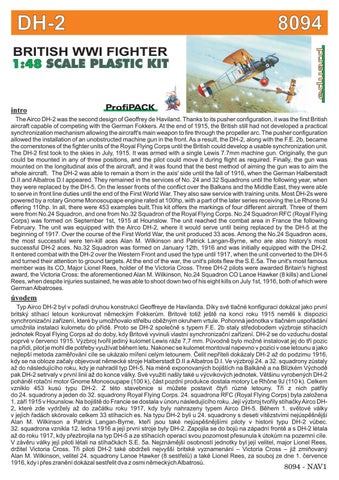
intro The Airco DH-2 was the second design of Geoffrey de Haviland. Thanks to its pusher configuration, it was the first British aircraft capable of competing with the German Fokkers. At the end of 1915, the British still had not developed a practical synchronization mechanism allowing the aircraft's main weapon to fire through the propeller arc. The pusher configuration allowed the installation of an unobstructed machine gun in the front. As a result, the DH-2, along with the F.E. 2b, became the cornerstones of the fighter units of the Royal Flying Corps until the British could develop a usable synchronization unit. The DH-2 first took to the skies in July, 1915. It was armed with a single Lewis 7.7mm machine gun. Originally, the gun could be mounted in any of three positions, and the pilot could move it during flight as required. Finally, the gun was mounted on the longitudinal axis of the aircraft, and it was found that the best method of aiming the gun was to aim the whole aircraft. The DH-2 was able to remain a thorn in the axis' side until the fall of 1916, when the German Halberstadt D.II and Albatros D.I appeared. They remained in the services of No. 24 and 32 Squadrons until the following year, when they were replaced by the DH-5. On the lesser fronts of the conflict over the Balkans and the Middle East, they were able to serve in front line duties until the end of the First World War. They also saw service with training units. Most DH-2s were powered by a rotary Gnome Monosoupape engine rated at 100hp, with a part of the later series receiving the Le Rhone 9J offering 110hp. In all, there were 453 examples built.This kit offers the markings of four different aircraft. Three of them were from No.24 Squadron, and one from No.32 Squadron of the Royal Flying Corps. No.24 Squadron RFC (Royal Flying Corps) was formed on September 1st, 1915 at Hounslow. The unit reached the combat area in France the following February. The unit was equipped with the Airco DH-2, where it would serve until being replaced by the DH-5 at the beginning of 1917. Over the course of the First World War, the unit produced 33 aces. Among the No.24 Squadron aces, the most successful were ten-kill aces Alan M. Wilkinson and Patrick Langan-Byrne, who are also history's most successful DH-2 aces. No.32 Squadron was formed on January 12th, 1916 and was initially equipped with the DH-2. It entered combat with the DH-2 over the Western Front and used the type until 1917, when the unit converted to the DH-5 and turned their attention to ground targets. At the end of the war, the unit's pilots flew the S.E.5a. The unit's most famous member was its CO, Major Lionel Rees, holder of the Victoria Cross. Three DH-2 pilots were awarded Britain's highest award, the Victoria Cross: the aforementioned Alan M. Wilkinson, No.24 Squadron CO Lanoe Hawker (8 kills) and Lionel Rees, when despite injuries sustained, he was able to shoot down two of his eight kills on July 1st, 1916, both of which were German Albatroses.
úvodem Typ Airco DH-2 byl v pořadí druhou konstrukcí Geoffreye de Havilanda. Díky své tlačné konfiguraci dokázal jako první britský stíhací letoun konkurovat německým Fokkerům. Britové totiž ještě na konci roku 1915 neměli k dispozici synchronizační zařízení, které by umožňovalo střelbu oběžným okruhem vrtule. Pohonná jednotka v tlačném uspořádání umožnila instalaci kulometu do přídě. Proto se DH-2 společně s typem F.E. 2b staly středobodem výzbroje stíhacích jednotek Royal Flying Corps až do doby, kdy Britové vyvinuli vlastní synchronizační zařízení. DH-2 se do vzduchu dostal poprvé v červenci 1915. Výzbroj tvořil jediný kulomet Lewis ráže 7,7 mm. Původně bylo možné instalovat jej do tří pozic na přídi, pilot je mohl dle potřeby využívat během letu. Nakonec se kulomet montoval napevno v pozici v ose letounu a jako nejlepší metoda zaměřování cíle se ukázalo míření celým letounem. Čelit nepříteli dokázaly DH-2 až do podzimu 1916, kdy se na obloze začaly objevovat německé stroje Halberstadt D.II a Albatros D.I. Ve výzbroji 24. a 32. squadrony zůstaly až do následujícího roku, kdy je nahradil typ DH-5. Na méně exponovaných bojištích na Balkáně a na Blízkém Východě pak DH-2 setrvaly v první linii až do konce války. Své využití našly také u výcvikových jednotek. Většinu vyrobených DH-2 poháněl rotační motor Gnome Monosoupape (100 k), část pozdní produkce dostala motory Le Rhône 9J (110 k). Celkem vzniklo 453 kusů typu DH-2. Z této stavebnice si můžete postavit čtyři různé letouny. Tři z nich patřily do 24. squadrony a jeden do 32. squadrony Royal Flying Corps. 24. squadrona RFC (Royal Flying Corps) byla založena 1. září 1915 v Hounslow. Na bojiště do Francie se dostala v únoru následujícího roku. Její výzbroj tvořily stíhačky Airco DH2, které zde vydržely až do začátku roku 1917, kdy byly nahrazeny typem Airco DH-5. Během 1. světové války v jejích řadách skórovalo celkem 33 stíhacích es. Na typu DH-2 byli u 24. squadrony s deseti vítězstvími nejúspěšnější Alan M. Wilkinson a Patrick Langan-Byrne, kteří jsou také nejúspěšnějšími piloty v historii typu DH-2 vůbec. 32. squadrona vznikla 12. ledna 1916 a její první stroje byly DH-2. Zapojila se do bojů na západní frontě a s DH-2 létala až do roku 1917, kdy přezbrojila na typ DH-5 a ze stíhacích operací svou pozornost přesunula k útokům na pozemní cíle. V závěru války její piloti létali na stíhačkách S.E. 5a. Nejznámější osobností jednotky byl její velitel, major Lionel Rees, držitel Victoria Cross. Tři piloti DH-2 také obdrželi nejvyšší britské vyznamenání – Victoria Cross – již zmiňovaný Alan M. Wilkinson, velitel 24. squadrony Lanoe Hawker (8 sestřelů) a také Lionel Rees, za souboj ze dne 1. července 1916, kdy i přes zranění dokázal sestřelit dva z osmi německých Albatrosů.
8094 - NAV1
ATTENTION
UPOZORNĚNÍ
ACHTUNG
ATTENTION
Carefully read instruction sheet before assembling. When you use glue or paint, do not use near open flame and use in well ventilated room. Keep out of reach of small children. Children must not be allowed to suck any part, or pull vinyl bag over the head. Před započetím stavby si pečlivě prostudujte stavební návod. Při používání barev a lepidel pracujte v dobře větrané místnosti. Lepidla ani barvy nepoužívejte v blízkosti otevřeného ohně. Model není určen malým dětem, mohlo by dojít k požití drobných dílů.
INSTRUCTION SIGNS
BEND OHNOUT
OPTIONAL VOLBA
INSTR. SYMBOLY
SYMETRICAL ASSEMBLY SYMETRICKÁ MONTÁŽ
OPEN HOLE VYVRTAT OTVOR
PARTS
INSTRUKTION SINNBILDEN
DÍLY
NOTCH ZÁŘEZ
SYMBOLES
REMOVE ODŘÍZNOUT
TEILE
APPLY EDUARD MASK AND PAINT POUŽÍT EDUARDS MASK NABARVIT
PIECES
PLASTIC PARTS
A> 14
3
B>
FILM
16
1 11
1 3
12 5
5
2
1 1
13
12
eduard 13
4
14 9
11
8
10
2
1
15
6
1 6
5
7 17
5
16
5
1
3
8
7
19
18
9
1
20
20
10
1
15
4
C> 1
1 2
1
6
1 3
10
8 9
13
11
10
PE - PHOTO ETCHED DETAIL PARTS
8
3
5
4
8
7
1
14
10
10
12 15
19 17
18
16
21
20 21
21
22
23
24
25
26
21
21
-Parts not for use. -Teile werden nicht verwendet. -Pieces a ne pas utiliser. -Tyto díly nepoužívejte při stavbě. -
COLOURS
BARVY
PEINTURE GSi Creos (GUNZE)
GSi Creos (GUNZE)
2
FARBEN
AQUEOUS
Mr.COLOR
AQUEOUS
Mr.COLOR
H 11
C62
FLAT WHITE
H 309
C309
H 12
C33
FLAT BLACK
H 338
C338
H 37
C43
WOOD BROWN
H 47
C41
RED BROWN
MC214
DARK IRON
H 57
C73
AIRCRAFT GRAY
MC218
ALUMINIUM
H 85
C45
SAIL COLOR
MC219
BRASS
GREEN LIGHT GRAY
Mr.METAL COLOR
DECAL
H 85 45
PE2
PE29
A B + + PE35 PE35
C D + + PE15 PE35 PE32
MC218
H 37 43
MC219
A11
C22
A7 C22
PE16 H 338 338
H 12 33
E + PE14
J K + + PE12 PE14
MC218
H 37 43
DECAL G
A10
H 85 45
H 47 41
C12
I + PE14
E F + + PE12 PE13
A2
C26 H 338 338
A15
L + PE34
H 338 338
H 37 43
H 338 338
H 85 45
A8
A4
H 338 338
A9
H 37 43
PE36 PE25
A12
H 47 41
H 338 338
A13
PE25 DO NOT CEMENT HERE!! NELEPIT!! C15 H 338 338
A
H 37 43
C
H 37 43
MC214
H 37 43 MC214
A11
A16 A10 H 37 43
C19
PE27
PE15 PE12
C8 3 pcs.
MC219
H 37 43
PE14
PE31
PE35
H 338 338
MC219
C23
H 37 43
A15
PE34 PE12
B A16
H 37 43
A14
PE13
A16
MC219
PE17
PE35 MC219
A ,B
A16 C13
C
A16 C13
PE14 A7 PE35 MC219
PE14
MC214
H 37 43
C10 4pcs.
MC214
PE28 C19
C26
C19
C26
3
C25
MC218
MC214
PE20
PE11 2 pcs. H 47 41
MC214
PE21
H 47 41
B13 B16 B6
D C20
MC214
MC218
B6
B13 MC214
H 338 338
PE23 H 338 338
A1
E
B1
H 338 338
B8
PE22
H 338 338
B7
PE23 H 338 338
A1 A1
B1
E
B1
B1 A5 B1
E
E A5
A5
B1
B1
A5
F
E B1
F
B1
B1 PE30
4
A3 A3 2pcs.
A3 2pcs.
H 338 338
H 338 338
B3
B14
FWD B5
H 338 338
A3
PE23
MARKING H 338 338
MARKING
MARKING
C
B
A
ONLY
ONLY
ONLY
C2
C9
C16
A2
PE23 H 338 338
A2
B11 MARKING
H 37 43
D H 338 338
B2
H 338 338
B2
B12
H 338 338
MC219
MC219
H 37 43
H 37 43
D
B12
MC219
B12 MARKINGS
A ,B,C
MC219
B2
5
B15
PE23 PE23
PE23
B4
C17
B10
C18
B15 C18 C17
MC219
C24
C5
C4 MC219
C24 C5
6
G
PE33
H
H 47 41
PE33
MC214
A16 C13
H 47 41
MC214
C1
C21
C19 PE19
PE18
MC214
C26
MC214
FILM B MC214
FILM A
PE26
PE26
MC214
PE24 C6
G
H
MC214
ONLY
PE3
MC214
C6
PE9
PE4
MC214
MC214
C13
PE7 PE8
G
H
H 338 338
H 338 338
PE1
H
PE6
PE5
C3 H 338 338
MARKINGS A ;C
H 338 338 H 338 338
PE10
MARKING
MARKING
D
B
7
MARKINGS A ,C ONLY
8
A No. 6011, No. 24 squadron RFC, 1916 Arthur Gerald Knight gained his first aerial victory on this aircraft on June 22nd, 1916. His victim was identified as a two-seat German LVG, destroyed in the vicinity of Courcelette in France. Knight shot down eight enemy aircraft up to the time of his death, all of which were gained flying the DH-2. On October 28th, 1916, he participated in combat that saw a collision between Jasta 2 CO Oswald Boelcke and his colleague Erwin Boehme, which saw his death as a result. On December 20th, 1916, Knight and his DH-2 became the thirteenth victim of German legend Manfred von Richthofen. For Knight, the encountered proved fatal. ČESKOU VERZI TEXTU NALEZNETE NA
eduard
www.eduard.com/info/photos/8094
ALUMINIUM MC218 WHITE
H11 62 H85
DOPPED LINEN 45
GRAY
H53 13
WOOD
H37 43
PINK
H19 63
GREEN
H309 309
RED
H13 3
9
B No. 7851, No. 32 squadron RFC, Flight C, France, 1916 William G. S. Curphey gained a kill identified as a two-seat LVG on August 22, 1916, flying this airplane. Curphey shot down six enemy aircraft before his death on May 15th, 1917, all flying the DH-2 with No. 32 Sqdn. The service career of this aircraft ended on January 7th, 1917 at 1230h, when it was shot down by Lt. d.R. Erwin Boehme of Jasta 2. Sitting in the cockpit of the DH-2 was E.G.S. Wagner, who did not survive. Wagner, a member of No. 32 Sqdn RFC, thus became Boehme's ninth victim. Boehme reached a total of 24 kills by the end of the war. The black wheel discs with white centres and the 'C 1' code identify this aircraft as a No. 32 Sqdn 'C' Flight member. ČESKOU VERZI TEXTU NALEZNETE NA www.eduard.com/info/photos/8094
ALUMINIUM MC218 WHITE
H11 62 H85
DOPPED LINEN 45
10
GRAY
H53 13
WOOD
H37 43
PINK
H19 63
GREEN
H309 309
C No. 5998, Capt. John Oliver Andrews, No. 24 Squadron, RFC, France, 1916 5998 was flown by twelve-kill ace Capt. John O. Andrews. His flying career began as an observer/gunner in an Avro 504 with No.5 Sqdn, RFC. He received his pilot rating on October 14th, 1915, and was assigned to the DH-2 equipped No.24 Sqdn, RFC. He flew combat against German aces. On April 27th, 1916, he damaged an Eindecker flown by Max Immelmann. On November 22, 1916, he gained his seventh and last kill with No.24 Sqdn. His victim that day appears to have been Stefan Kirmaier, CO of Jasta 2, and an eleven kill ace. The following day, he took part in combat that claimed the life of seven kill ace and No.24 Sqdn CO Lanoe Hawker, at the hands of Manfred Freiherr von Richthofen. Andrews was transferred to No. 66 Sqdn thereafter, and flew the Sopwith Pup. In all, he gained nine kills confirmed, and two listed as 'out of control'. The second ace that flew this aircraft was Sidney Edward Cowan. Flying this airplane, he shot down a German two-seat LVG at Le Sars, thus gaining his fifth of seven kills. He died on November 17th, 1916. ČESKOU VERZI TEXTU NALEZNETE NA
www.eduard.com/info/photos/8094
ALUMINIUM MC218 WHITE
H11 62 H85
DOPPED LINEN 45
GRAY
H53 13
WOOD
H37 43
PINK
H19 63
GREEN
H309 309
RED
H13 3
11
D No. 5967, Robert H. M. S. Saundby, No. 24 Squadron RFC, 'A' flight, France, July 1916 This pilot of No.24 Sqdn, who's full name was Robert Henry Magnus Spencer Saundby, gained a total of five kills over the First World War, three of which were flown from the cockpit of a DH-2. His first victory was acquired flying this aircraft. On July 31st, 1916, he claimed a German Fokker Eindecker, which was credited as 'out of control'. During the course of the same combat, which reportedly took place east of Roisel, he was wounded. Evidently, this was not overly serious, as by August 6th, he shared another kill with John O. Andrews. Later, he was transferred to No.41 Sqdn. His last victim was the airship Zeppelin L48. During the Second World War, as a staff member of Bomber Command, RAF, he took part in the planning phases of carpet bombing plans of German cities. He received a list of British and foreign awards, was knighted, and left the service in 1946 as Air Vice Marshall. ČESKOU VERZI TEXTU NALEZNETE NA www.eduard.com/info/photos/8094
ALUMINIUM MC218 H85
DOPPED LINEN 45
12
GRAY
© EDUARD M.A., 2015
H53 13
WOOD
H37 43
PINK
www.eduard.com
H19 63
GREEN
H309 309
RED
H13 3
Printed in Czech Republic