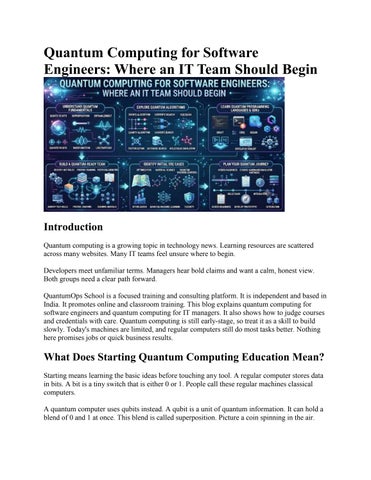
Quantum Computing for Software Engineers: Where an IT Team Should Begin
Introduction Quantum computing is a growing topic in technology news. Learning resources are scattered across many websites. Many IT teams feel unsure where to begin. Developers meet unfamiliar terms. Managers hear bold claims and want a calm, honest view. Both groups need a clear path forward. QuantumOps School is a focused training and consulting platform. It is independent and based in India. It promotes online and classroom training. This blog explains quantum computing for software engineers and quantum computing for IT managers. It also shows how to judge courses and credentials with care. Quantum computing is still early-stage, so treat it as a skill to build slowly. Today's machines are limited, and regular computers still do most tasks better. Nothing here promises jobs or quick business results.
What Does Starting Quantum Computing Education Mean? Starting means learning the basic ideas before touching any tool. A regular computer stores data in bits. A bit is a tiny switch that is either 0 or 1. People call these regular machines classical computers. A quantum computer uses qubits instead. A qubit is a unit of quantum information. It can hold a blend of 0 and 1 at once. This blend is called superposition. Picture a coin spinning in the air.
Qubits can also link together. This link is called entanglement. Linked qubits share one state. A quantum gate is a small step that changes qubits. Many gates in a row form a quantum circuit, which is a full recipe of steps. Quantum computing is early-stage. Today's machines are small and noisy. Noise means stray signals that cause errors. Quantum computers will not replace classical ones. Researchers and companies are exploring where quantum may help.
Why This Matters for IT Professionals and Teams Quantum topics now show up in cloud talks and research news. Teams want to understand them without hype. Three reasons stand out. First, awareness. Staff who know the basics can read news calmly. They spot weak claims faster. Second, skills. Quantum work needs new habits, so early practice helps. Small examples on a simulator are a safe start. A simulator is software that mimics a quantum computer on a normal machine. Third, planning. Leaders can decide what to watch and what to skip. A small learning effort is easier to defend than a big bet. Learning is not the same as buying. Most teams do not need a quantum project today.
Quantum Cloud Computing Training Most people reach quantum machines through the cloud. A provider hosts the hardware. Users send jobs over the internet, much like renting computing power from any cloud service. Quantum cloud computing training teaches this access model. You learn to write a job, send it, and read the results. Simulators come first because they are simple to start with. Good quantum cloud computing training also covers queues and limits. Real devices are shared, so jobs may wait. Results can vary between runs because of noise. Cloud basics matter too, such as accounts, access control, and usage tracking. Cloud engineers already know many of these ideas. So this training builds on a familiar base.
Quantum Computing for Software Engineers Developers think in loops, variables, and functions. Quantum programs work differently. You describe gates acting on qubits. Then you measure the qubits. Measuring means reading the result, and it ends the quantum state.
Results come as odds. You run a circuit many times. Then you count how often each answer appears. A normal program gives one answer per run. Quantum computing for software engineers starts with qubits, gates, circuits, and measurement. Next come small algorithms. An algorithm is a set of steps that solves a problem. Quantum algorithms use superposition and entanglement in clever ways. Patience helps. This path rewards steady practice more than quick wins.
Qiskit Programming Course Qiskit is a programming toolkit for quantum circuits. A toolkit is a set of ready-made code pieces. A Qiskit programming course usually teaches how to build a circuit, add gates, and run it on a simulator. Some courses also show real devices where access exists. Learners then read the output and see why runs differ. A strong Qiskit programming course explains each step. Copying code without the reasoning teaches little. Also learn the ideas behind the tool, so your skills carry over to others, such as Cirq.
AWS Braket Training A cloud quantum service is an online platform for running quantum jobs. AWS Braket is one such platform that learners may study. AWS Braket training generally covers account setup, writing circuits, choosing where to run them, and reading results. It also covers security basics, such as who may run jobs. Cost tracking matters too, so learners practice checking usage. Check the provider's current details for prices, features, and limits. Strong AWS Braket training pairs labs with clear explanations of each step.
Hybrid Quantum Classical Computing Training Many ideas mix classical and quantum steps. A classical computer prepares data and runs the control loop. A quantum device runs a small circuit. Then the classical side reads the result and adjusts the next run. This pattern is called hybrid computing. Hybrid quantum classical computing training shows how to split work between both sides. It also covers delays, because every cloud call takes time. For a team, this means regular IT skills still matter. Data pipelines, APIs, monitoring, and testing stay important. Good hybrid quantum classical computing training shows quantum as one part of
a larger system. Researchers and companies are exploring hybrid methods, but the field remains early-stage.
Quantum Computing Architecture Course Architecture describes how the parts of a system fit together. A quantum computing architecture course looks at three layers. The hardware layer holds the physical qubits and their control systems. The software layer includes compilers, which turn circuits into steps a device can run. The cloud layer handles access, queues, and storage. Error correction also belongs here. It means methods that find and fix errors caused by noise. It is hard, and research continues. Architects ask practical questions. Where do jobs run? Where does data live? How is access secured? A good quantum computing architecture course answers these with diagrams and tradeoffs.
Quantum Computing for IT Managers Managers need plain ideas, not equations. Quantum computing for IT managers should cover five areas:
Concepts: what qubits and circuits do, in simple words. Timelines: stay realistic, because the field is early-stage. Risk: skill gaps, wasted effort, vendor lock-in, and security. Skills planning: who learns what, and in what order. Vendor questions: what will be taught or delivered, and what is left out.
This work also means saying no to hype. Ask trainers and vendors to define the scope clearly. Honest providers answer plainly.
Quantum Computing Certification Course A certificate shows that you finished a program. When you review a quantum computing certification course, check four things. First, the syllabus. Basics should come before tools. Second, hands-on practice, such as labs and simulations. Third, assessment. Ask how skill is checked. Fourth, clear details on what the credential means and who issues it. Details vary by program. Ask for a sample syllabus and check the provider's current details. A trustworthy quantum computing certification course states its limits plainly.
QuantumOps Certification QuantumOps School advertises four tracks: Architect, Engineer, Manager, and Professional. The names point to different roles. Read each track page for its exact scope. The site advertises exams and credentials for QuantumOps certification. Readers should check details on the site. Ask whether the credential is accredited or recognized by employers. Also ask whether QuantumOps certification fits your needs and goals. Nothing here claims such recognition. Treat any credential as proof of study, not a promise of work.
Quantum Computing Consulting Services Consulting means outside help with planning or building. Quantum computing consulting services generally cover learning plans, small tests, and idea reviews. The site advertises integration, algorithm development, workload optimization, hybrid systems, cloud security, and strategy. The platform offers access to this kind of support. Outcomes vary and are not guaranteed. Before hiring, ask a few questions. Who will do the work? How will progress be reported? What happens if a test shows no benefit? Today's machines are limited, so careful scoping protects your budget.
Common Mistakes Learners and Teams Make 1. Expecting quick business results. The field is early-stage, and gains are not guaranteed. 2. Skipping the basics. Tools make little sense without qubits, gates, and measurement. 3. Treating quantum as a replacement for classical computing. The two work side by side. 4. Learning one tool without the ideas behind it. Tools change, but core ideas last. 5. Ignoring security. Cloud access needs clear rules and careful review. 6. Treating a certificate as the finish line. Skills fade without regular practice. 7. Hiring quantum computing consulting services without checking scope. Ask for written details. 8. Skipping simulators. Practice there before you try real devices. 9. Learning without a plan. Set small goals and review them often.
A Simple Example Fictional example: A backend developer at a small software firm wants to learn quantum basics. They read QuantumOps School articles on qubits and cloud platforms. Then they build a tiny circuit on a simulator and write notes on what each gate did.
Their IT manager asks for a plain summary and a list of questions for trainers. The two agree to review progress after a few weeks. No result is promised here. The example only shows a calm, step-by-step start.
How QuantumOps School Can Help QuantumOps School is a specialized quantum computing education, certification, and consulting platform. It aims to bridge quantum technologies and practical IT operations. It is independent. It is not affiliated with IBM, Amazon Web Services, Microsoft, or any tool maker. It is not endorsed by any of them. The site pairs its four tracks with listed topics. These include qubits, quantum gates, superposition, entanglement, and quantum algorithms. Others include quantum hardware architecture, quantum error correction, cloud-based quantum computing, and workload optimization. The curriculum uses tools such as Qiskit, Cirq, and AWS Braket. It also names Microsoft Quantum Development Kit, IBM Quantum, and Azure Quantum. Formats include instructor-led sessions, practical labs, simulations, case studies, technical assessments, and capstone projects. Learners can study online or in a classroom. The site also advertises consulting and freelance support for cloud integration and implementation strategy. Finally, it publishes articles and tutorials on quantum security and infrastructure operations.
Frequently Asked Questions About Starting Quantum Computing Education 1. What is quantum cloud computing training? It teaches you to use quantum machines and simulators over the internet. You practice sending jobs and reading results. Most courses also cover access rules and usage tracking. Details vary by program, so review each syllabus closely before you enroll. 2. Do I need strong math to begin quantum computing for software engineers? No. Many learners begin with diagrams and short code samples. Basic algebra helps, yet it is not required on day one. Start with qubits, gates, and measurement. Then add math slowly as topics get harder. Steady practice matters more than speed. 3. Is a Qiskit programming course enough on its own? No single course is enough on its own. A Qiskit programming course gives hands-on skill with one toolkit. You also need the core ideas, cloud basics, and steady practice. Learning does not guarantee a job. Check what the course covers and what it leaves out. 4. Does AWS Braket training include real quantum hardware?
Details vary by program. Some lessons use simulators only. Others may use real devices if access exists, and access depends on your account. Ask the trainer which labs are hands-on. Also ask which cloud tasks you will practice before you sign up. 5. Why do teams need hybrid quantum classical computing training? Many current ideas mix both kinds of computers. Teams must know which steps belong on each side. They also need to handle data flow, delays, and testing. Without that view, a project can focus on the wrong part. Classical skills remain very useful. 6. Who should take a quantum computing architecture course? System architects and senior engineers gain the most. The course shows how hardware, control software, and cloud services connect. It also covers security and monitoring. Managers who review designs can benefit too. No prior physics is needed if the course starts with basics. 7. What should quantum computing for IT managers include? It should help managers explain the field to their teams. Look for short lessons, a glossary, and honest examples of where classical computers still win. A useful course also gives a checklist for talking with trainers and vendors. Avoid material that leans on hype. 8. Can a quantum computing certification course help my career? It can show effort and give you structured learning. It cannot promise a job, a raise, or a promotion. Employers decide for themselves. Pair any quantum computing certification course with projects you can explain. Ask each provider how its credential is viewed. 9. Where can I learn more about QuantumOps School? Start with the articles and tutorials the site publishes on quantum basics, hardware, and cloud platforms. Then compare your goals with the four track names. Contact the site about QuantumOps certification, including exam format and scope. Keep the replies for your records before you pay. 10. When should a company hire quantum computing consulting services? Consider it when your team has a clear question but lacks skills. A good start is a small, defined review or test. Ask for scope, deliverables, and security practices in a clear document. Outcomes vary and are not guaranteed. Sometimes classical methods fit better.
Final Thoughts Quantum computing is early-stage, and today's machines are limited. Regular computers still do most work better. Start with the basics. Then add practice step by step.
Quantum computing for software engineers and quantum computing for IT managers serve different needs. A quantum computing architecture course suits system designers. Quantum cloud computing training and hybrid quantum classical computing training show how the pieces connect. A Qiskit programming course, AWS Braket training, and QuantumOps certification each have their own scope. Before joining any quantum computing certification course, check the syllabus and credential details. Ask about recognition, and weigh whether quantum computing consulting services fit your plans. Details vary, so confirm them with each provider. QuantumOps School is one place to begin learning with care.