What Is a Qubit? A Friendly Map of Quantum Computing From Basics to Security
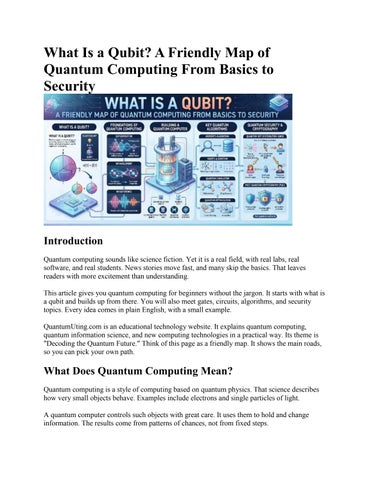
Introduction Quantum computing sounds like science fiction. Yet it is a real field, with real labs, real software, and real students. News stories move fast, and many skip the basics. That leaves readers with more excitement than understanding. This article gives you quantum computing for beginners without the jargon. It starts with what is a qubit and builds up from there. You will also meet gates, circuits, algorithms, and security topics. Every idea comes in plain English, with a small example. QuantumUting.com is an educational technology website. It explains quantum computing, quantum information science, and new computing technologies in a practical way. Its theme is "Decoding the Quantum Future." Think of this page as a friendly map. It shows the main roads, so you can pick your own path.
What Does Quantum Computing Mean? Quantum computing is a style of computing based on quantum physics. That science describes how very small objects behave. Examples include electrons and single particles of light. A quantum computer controls such objects with great care. It uses them to hold and change information. The results come from patterns of chances, not from fixed steps.
Today's machines are young. They are small, delicate, and noisy. Noise means stray errors that disturb the work. So researchers spend much effort on control and error fixing.
Why Learners and Professionals Are Paying Attention Different groups study this field for different reasons. Students want a head start in a young subject. Software developers want to understand the tools before they spread. Security teams watch for long-term changes to encryption. Encryption is the scrambling of data so only the right person can read it. Updating systems takes years, so early awareness saves effort. Scientists look at chemistry and materials, among other areas. The real-world applications of quantum computing are still mostly research. So the right mood is steady curiosity, not hype.
Quantum Computing for Beginners: The Big Picture Quantum computing for beginners starts with one clear idea. A quantum computer is a special tool for special problems. It is not a magic box. Picture a workshop. A hammer is great for nails but poor for screws. A quantum machine is like a rare tool that suits only some jobs. This comparison stops short in one way. A hammer has no chances in it. Everyday tasks will stay on classical computers. These include email, video, games, and spreadsheets. Quantum machines may one day help with a few narrow tasks. Today they remain limited, delicate, and noisy.
What Is a Qubit? Chances Instead of Certainty A qubit is a basic unit of quantum information. A normal bit stores 0 or 1. A qubit is described by the chances of getting 0 or 1 when measured. Imagine a coin spinning in the air. Until it lands, you cannot say heads or tails. Superposition is the quantum version of this idea. It means the qubit's state mixes chances for each result. But the picture stops short here. A spinning coin is a normal object with a hidden side, and a qubit is not. Measurement is like catching the coin. You get one result, either 0 or 1. The act changes the state, and the old mix is gone. So what is a qubit? It is a carrier of chances that becomes one answer when you look.
Entanglement: A Strong Link Qubits can also be entangled. Entanglement is a strong link between qubits. You cannot describe them one by one. It does not carry messages faster than light.
QuantumUting.com has explainers on qubits, quantum states, superposition, measurement, and entanglement.
Quantum Computing vs Classical Computing: Two Tools, Two Jobs A classical computer stores information in bits. Each bit is 0 or 1. Your phone and laptop work this way. A quantum computer uses qubits instead. The heart of quantum computing vs classical computing is the kind of problem. Classical machines handle almost every daily task well. They are cheap, fast, and dependable. Quantum machines are expected to help only with certain tasks. A common myth says a quantum computer tries all answers at once. That is not accurate. Instead, careful steps make right answers more likely and wrong ones less likely. So the two will work as a team. The classical side prepares jobs and reads results. The quantum side handles one narrow part.
Quantum Gates Explained With Simple Moves A quantum gate is one step that changes qubit states. Gates are the moves in a quantum program. Here is quantum gates explained with everyday pictures. Pauli-X flips a state, like turning a coin over. A basic 0 becomes a 1, and the reverse. Hadamard creates an even mix of outcomes from a basic state. After it, measuring gives 0 or 1 with equal chances. Pauli-Z changes a sign. You cannot spot this by measuring right away. Yet it affects what happens in later steps. CNOT flips one qubit depending on another. Imagine a rule that says, flip lamp B only if lamp A is on. Combined with Hadamard, CNOT can help create entanglement.
A Quantum Circuits Tutorial You Can Follow in Words A quantum circuit is a list of gates followed by a measurement. Think of a recipe. The ingredients are qubits, the steps are gates, and the tasting is measurement. This quantum circuits tutorial uses a two-step recipe. First, start a qubit in its basic 0 state. Next, apply Hadamard. Then measure.
You will see 0 or 1. One run proves little. So run the circuit many times. Roughly half the results should show each value. That pattern confirms the even mix. Frameworks such as Qiskit help people build and run circuits. They also offer simulators. A simulator is a program that imitates a quantum computer on an ordinary computer. It is a safe place to practice.
Quantum Computing Algorithms Explained: Recipes for Qubits An algorithm is a set of steps that solves a problem. Quantum computing algorithms explained in one sentence: they are step sets made for qubits and gates. Their job is to raise the chance of a right answer. They do this by arranging the gates with care. Quantum search is one idea. It looks for a target in a large, unsorted collection. It needs fewer steps than a simple classical search. How much it helps depends on the problem. Quantum factoring is another. Factoring means breaking a number into smaller numbers that multiply to make it. For example, 21 is 3 times 7. Large numbers make this task hard for classical methods.
Shor's Algorithm Explained: Why Security Teams Care Shor's algorithm explained simply: it is a quantum method for finding the factors of large numbers. This section keeps the math out. It gets attention because of public-key cryptography. That is a way to share secrets over open networks. Picture a padlock that anyone can close, though only the key holder can open it. Many such systems rely on factoring, or related math, being very hard. Running Shor's algorithm on numbers used in real encryption needs a large, error-corrected quantum computer. Error-corrected means mistakes are found and fixed during the run. Such machines do not exist today. Current quantum computers cannot break real encryption. We offer no dates. Security teams plan with care, not fear.
Post-Quantum Cryptography Explained: Stronger Locks on Today's Machines Post-quantum cryptography explained: these are new encryption methods built to resist attacks from classical and quantum computers. They run on ordinary computers. No quantum hardware is needed.
Do not mix this up with quantum cryptography. That field uses quantum physics directly, as in quantum key distribution. Think of it as upgrading old locks to a new design. The doors stay the same, but the lock changes. The change is slow, because encryption hides inside many apps, devices, and services. Standards bodies have been working on and publishing standards. Check current official sources. For security planning, check current guidance from official standards bodies and security experts.
Real-World Applications of Quantum Computing: The Honest Status Researchers and companies are exploring several fields. Chemistry is a leading idea, since molecules follow quantum rules. Materials science is a close cousin. Optimization means picking the best option from a huge set of choices. Security work is a fourth area. Honesty matters here. Most real-world applications of quantum computing are still research projects. No proven business benefit is claimed here. We make no claim of quantum advantage for any real-world problem. That term means a quantum machine beats the best classical method on a useful task. When you read news, look for careful words like "early" and "exploring."
How to Learn Quantum Computing Step by Step How to learn quantum computing becomes easier with a plan. Start with ideas before code. Helpful background includes basic probability, some linear algebra, and basic programming. Beginners can start with concepts and add math later. A simple path looks like this:
First, study qubits, superposition, measurement, and entanglement. Second, move to gates and circuits. Third, try a framework such as Qiskit on a simulator. Fourth, read quantum computing algorithms explained in plain terms. Finally, explore security topics, including Shor's algorithm explained and post-quantum cryptography explained.
QuantumUting.com supports this path. Its quantum circuits tutorial pages use frameworks such as Qiskit. Its quantum gates explained pages cover Hadamard, Pauli-X, Pauli-Z, and CNOT.
Slips That Confuse Beginners
Taking "both 0 and 1" literally. It is a loose picture, and a qubit really holds chances. Imagining a quantum computer tries all answers at once. It does not. Assuming quantum wins everywhere. Quantum computing vs classical computing is about matching the tool to the job. Rushing past the basics. Lessons on quantum gates explained work best after qubit ideas are clear. Memorizing gate names without circuits. A gate has meaning only as part of a sequence. Treating headlines as proof that encryption is broken today. Reading Shor's algorithm explained pages should bring understanding, not alarm. Mixing up post-quantum and quantum cryptography. One runs on ordinary computers, and the other uses quantum physics. Sticking to a single tool. Tools change, but the ideas carry over. Reading entanglement as instant messaging. It carries no messages faster than light.
A Simple Example: One Analyst's Learning Path This is a fictional example. A security analyst works with ordinary encryption and wants to follow quantum news. He starts on QuantumUting.com with what is a qubit. He writes one sentence in his own words, then checks it. Next, he follows a quantum circuits tutorial on a simulator. Before each run, he guesses the pattern of results. Later, he reads quantum computing algorithms explained in plain terms, then turns to Shor's algorithm. His notes stay short. He treats how to learn quantum computing as a set of small steps. He takes one topic at a time.
How QuantumUting Can Help QuantumUting.com is an educational resource for people curious about quantum computing. It publishes tutorials, beginner guides, technical explanations, and educational articles. Readers can find explainers on qubits, quantum states, superposition, measurement, and entanglement. Gate articles cover Hadamard, Pauli-X, Pauli-Z, and CNOT. Circuit tutorials use examples built with frameworks such as IBM's Qiskit. The site also covers quantum algorithms. Topics include quantum search, quantum factoring, quantum software engineering, and quantum machine learning. Security articles discuss postquantum cryptography, quantum-safe encryption, and risks to existing public-key systems. The content serves students, developers, computer science professionals, researchers, and tech fans. Each piece aims to be practical and easy to follow. The site is not affiliated with any company or university.
Frequently Asked Questions About Quantum Computing 1. Is quantum computing for beginners too hard without a physics degree? No. Beginner lessons use pictures, stories, and plain words. You can learn the main ideas before touching any math. Physics helps, but it is not required at first. Start with qubits and measurement, then build up slowly. Small steps work well. 2. What is a qubit doing when you measure it twice in a row? A qubit gives one result when measured, either 0 or 1. If you measure it again right away, you usually see the same result. That is because the first measurement changed its state. To learn the hidden chances, you repeat the whole circuit many times. 3. Does quantum computing vs classical computing mean I should stop learning normal programming? No. Classical programming remains the base skill. Quantum programs still need ordinary code to prepare jobs, send them, and read results. Think of quantum parts as a special tool inside a larger classical workflow. Strong everyday coding makes quantum learning easier. 4. Can quantum gates explained in words replace hands-on practice? Words build the picture, but practice makes it stick. After reading about each gate, try it in a simulator. Predict the result first. Then compare. Mismatches are useful, because they show which part of your picture needs repair. Repeat with a new gate each time. 5. Why does a quantum circuits tutorial end with a measurement? Measurement is how you read anything out. Without it, the qubits hold chances that you cannot see. The final step turns those chances into plain 0 and 1 results. Repeating the circuit many times then reveals the pattern behind them. This habit is worth learning early. 6. Are quantum computing algorithms explained anywhere without heavy math? Yes. Many explainers describe the goal, the input, and the output in plain words. They skip the equations. You can learn what an algorithm is for before learning how it works inside. Detail can come later, when you feel ready. Both levels are valid. 7. Why does Shor's algorithm explained content appear in so many security talks? The method targets factoring, and many public-key systems lean on factoring being hard. That link makes it a common example in security talks. It does not mean today's machines can break real encryption. Experts discuss it to plan, not to alarm.
8. Do ordinary users need post-quantum cryptography explained, or is it only for experts? Most people will never choose these methods themselves. Software makers, banks, and security teams do that work. Still, a basic understanding helps you follow news. Awareness is the first step. For planning decisions, check current guidance from official standards bodies and security experts. 9. Which real-world applications of quantum computing should a student watch? Watch research on chemistry, materials, optimization, and security. Read each claim with care. Ask whether the test was small, simulated, or on real hardware. Early results are not proof of business value. Check current official sources for updates. Patience pays off here. 10. How can QuantumUting.com help me with how to learn quantum computing? QuantumUting.com is an educational technology website. It offers tutorials, beginner guides, technical explanations, and articles on qubits, gates, circuits, algorithms, and security. You can follow topics in order or jump to what you need. It is an educational resource for readers worldwide.
Final Thoughts Quantum computing is early-stage. Machines are small and noisy, and big claims need care. Yet the core ideas are friendly once you take them in order. Begin with quantum computing for beginners, then build toward gates, circuits, and algorithms. Keep the big picture in mind. Quantum and classical computers will work together. Quantum computing vs classical computing is not a contest. Real-world applications of quantum computing are mostly research today. Security readers should follow post-quantum cryptography explained in current official guidance, and check current official sources for standards and news. QuantumUting.com is here to help you keep learning, one clear explainer at a time.