Columbus & Mythmaking • Civic Stories • Teaching with Street Art • Founders & Economics
The official journal of National Council for the Social Studies Volume 90, Number 6 November/December 2026 www.socialstudies.org
Make the Past Relevant & the Present Meaningful Help students explore history, civics, geography, culture, and current events with social studies programs that use inquiry-based learning to build background knowledge, strengthen literacy, and make social studies meaningful.
Social Studies Essentials
K-5
A flexible social studies program that helps young learners build background knowledge, strengthen literacy, and explore the world through standardsaligned, ready-to-teach lessons.
Experience
K-12
An all-in-one K–12 resource with standards-aligned content, ready-touse activities, career exploration, and flexible tools to extend Social Studies Techbook lessons.
VISIT US AT NCSS
BOOTH #1106
Free Trial
GET A OF OUR NEWEST SOCIAL STUDIES SOLUTION DECEMBER 4-6, 2026 | CHICAGO, IL
LEARN MORE
FEATURES 326
Columbus and the “New Immigrants” (1880-1920): An Inquiry into Mythmaking and Contested Legacies Alex Honold Inviting students to examine artifacts such as statues or picturebooks of Columbus provides a useful lens for examining how our national memory has been constructed, mobilized, and contested over time.
331
The Power of Civic Stories in an Era of Division Hilary G. Conklin, Molly W. Andolina, Kristopher Ponder-Bisping, and Honor Allen A 10-lesson high school civics curriculum, tested in diverse Chicago classrooms, demonstrated that story-sharing paired with active listening helped build empathy and connection across lines of difference.
337
Picture That: Scaffolding Street Art in Social Studies to Teach the History of the Streets Terrance J. Lewis Incorporating street art into social studies lessons can help center overlooked histories and foster students’ critical consciousness. The author provides a scaffold for analyzing street art and a three-day, standards-aligned lesson sequence.
Nov/Dec 2026
Volume 90, Number 6
DEPARTMENTS 309
Lessons on the Law Current Events in the Classroom: Flock Cameras and the Fourth Amendment Tiffany Middleton Flock license plate cameras are raising hard questions about privacy, surveillance, and the Fourth Amendment. Learn how courts and lawmakers are responding, and how to help students engage with the issue.
314
Sources and Strategies Helping Students Investigate Data and Democracy with Hollerith’s Punch Cards and Census Visualizations Michael Lowry A 1901 Evening Star article on Hollerith’s punched-card tabulating machine can launch an inquiry into what faster data processing means, then and now, for privacy, classification, labor, and democratic decision-making.
319
Research & Practice Working in the Messy Middle: A Technocurious Approach to GenAI in Social Studies Education Amy Allen and David Hicks A “technocurious” approach to AI in social studies helps teachers decide whether and how to use it. Guiding questions support that decision, and two strategies are offered.
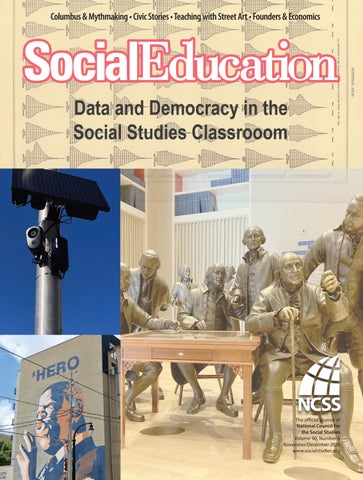
ON THE COVER: Top: Statistical Atlas of the United States, 1890 census (Library of Congress). Middle left: Flock Camera in Lakewood, WA (Image: Wikimedia). Middle right: Founders in bronze, National Constitution Center, Philadelphia (Image: Social Education staff). Lower left: Seven-story mural of Rep. John Lewis in Atlanta’s Sweet Auburn neighborhood (Terrance J. Lewis).
www.socialstudies.org | 305
FEATURES
DEPARTMENTS
344
357
Adam Smith and America’s Founding Mark C. Schug and Scott Niederjohn Examining Adam Smith’s views on free trade, competition, and limited government, and how they resonated with Jefferson, Madison, and Washington, offers a useful lens for connecting economic ideas to the Revolution and the Constitution.
348
The Economic Thought of the American Founders Mark C. Schug, Marcus Witcher, William C. Wood, and Scott Niederjohn Best remembered for building political institutions, the Founders also developed economic ideas that shaped the American economy; investigating them in the classroom connects civics and economics.
Teaching the C3 Framework Getting on the Grid: C3 Teachers’ Building Block Inquiries for US History Project Kathy Swan, John Lee, Gerry Swan, Alicia Saccomanno, Christy Cartner, Meghan Hawkins, Hunter Watts, Haley Saunders, Megan Somers and Kelsey Dickerson When teachers “stack” short, focused inquiries into topical, conceptual, or skillbased sequences, each builds on the last and gains power. The Building Block Inquiry Grid provides ready-to-use exercises built on Library of Congress sources.
308 NCSS Notebook 364 NCSS Member Spotlight
Slip of the Pen
In “Five Reasons to Decenter the West in World History Teaching” (Social Education, October 2026), endnote 7 overstated the reach of AP World History: the 2 million figure reflects all AP exam takers, not APWH alone. The endnote should read: On the growth of APWH since 2002, see Ross E. Dunn, Laura J. Mitchell, and Kerry Ward, “Introduction,” in The New World History: A Field Guide for Teachers and Researchers, eds. Dunn, Mitchell, and Ward (University of California Press, 2016), 8-9. We regret the error.
Moving? Keep your Social Education magazine subscription coming.
306 | Social Education | November/December 2026
NCSS OFFICERS Joe Schmidt (President) Colonial Williamsburg Foundation, Williamsburg, VA David Kendrick (President-Elect) Loganville High School, Loganville, GA
EDITORIAL STAFF Jennifer Bauduy Editor Laura Godfrey Director of Publications and Resources Rich Palmer Art Manager
Annie Whitlock, Ph.D. (Vice President) Grand Valley State University, Allendale, MI
SOCIAL EDUCATION DEPARTMENTS Elementary Education Andrea S. Libresco
Tina M. Ellsworth, Ph.D. (Immediate Past President) University of Central Missouri, Warrensburg, MO
Inclusive Social Studies Stacie Brensilver Berman, John M. Palella, Diana B. Turk
BOARD OF DIRECTORS Terrell Fleming Lynchburg City Schools, Lynchburg, VA (2027) Kimberly Huffman Wayne County Schools, Smithville, OH (2027) Stephen Masyada, Ph.D. Lou Frey Institute and the Florida Joint Center for Citizenship, Orlando, FL (2027) Laura McFarren Derby North Middle School, Derby, KS (2029) Ebony McKiver Social Studies Accelerator, Marion, IA (2029) Stephanie Nichols Narragansett Elementary School, Gorham, ME (2028) Renita Parks Memphis, TN (2028)
Instructional Technology Michael J. Berson, Meghan McGlinn Manfra Lessons on the Law Tiffany Willey Middleton Research & Practice Jeremy Stoddard Sources and Strategies Lee Ann Potter Teaching the C3 Framework Kathy Swan, John Lee, S.G. Grant NCSS EXECUTIVE DIRECTOR Kelly McFarland Stratman DEPUTY EXECUTIVE DIRECTOR Joy Lindsey
Sarah B. Shear University of Washington Bothell, Bothell, WA (2029)
NCSS DIRECTORS Timothy Daly Director of Operations
Gabriel Valdez Fort Worth ISD, Fort Worth, TX (2028)
Laura Godfrey Director of Publications and Resources
Amy Walker Olathe USD 233, Olathe, KS (2027)
Ashanté Horton Director of Events
Anne Walker Forest Park High School, Woodbridge, VA (2028) Ryan Werenka Troy High School, Troy, MI (2029) EX-OFFICIO Jeff Bourque House of Delegates Steering Committee Chair Windham High School, Windham, NH (2026–2027)
SOCIAL EDUCATION (ISSN 0037-7724) is published by National Council for the Social Studies (NCSS) six times a year: September, October, Nov/Dec, Jan/Feb, March/April, and May/June. Logotype is an NCSS trademark. Contents © 2026. The views expressed in this publication are those of the authors and not necessarily those of NCSS. ONLINE: Visit us at www.socialstudies.org/publications and www.ingentaconnect. com/content/ncss. READERS: The editors welcome suggestions, letters to the editor, and manuscripts to our peer-reviewed journal. Guidelines at www.socialstudies.org/publications; submit at www.editorialmanager.com/ncssjournals; questions to publications@ ncss.org. Contributors express their own views, reflecting divergent opinions. Send manuscripts for departments to the department editors. DELIVERY AND CHANGE OF ADDRESS: View and update your record, www.social studies.org/membership; send new address to membership@ncss.org; or call 800-296-7840 ext. 111. Callers outside the U.S. and Canada use 301-588-1800 ext. 111. PERMISSION to reproduce articles for academic use, contact Copyright Clearance Center, Academic Permissions Service, 222 Rosewood Dr., Danvers, MA, 01923; 978-750-8400 (phone), 978-750-4470 (fax). ADVERTISING: Maribell Abeja-DeVitto, Account Manager, MAbejaDeVitto@smith bucklin.com; 312-673-5483 Visit www.socialstudies.org/advertising for rates and specifications. INDEXED by Institute of Education Sciences, eric.ed.gov and by ProQuest, www. proquest.com. POSTMASTER: Periodicals postage paid at Silver Spring, MD, and additional mailing offices. Send address changes to Social Education, NCSS, 8403 Colesville Rd., #1100, Silver Spring, MD 20910, USA.
Become an NCSS member! Use your smartphone’s camera to scan this QR code or go to www.socialstudies. org/membership.
MEMBERSHIP in the National Council for the Social Studies (NCSS) is open to any person or institution interested in the social studies. All members receive the NCSS journal of their choice (Social Education or Social Studies and the Young Learner), as well as the e-newsletter, The Social Studies Professional (two issues per month), access to the online NCSS publication archives, the online Middle Level Learning supplement, and discounts on NCSS conference registration, books, and professional development programs. Regular membership rates for individuals are $90 per year. Rates for students and retired persons are $53 per year. For rates and benefits of institutional membership, and further information on all levels of membership, go to www.socialstudies.org/membership. SUBSCRIPTIONS to Social Education are available to non-member institutions. A print-only subscription is $114 per year. Online subscriptions for Social Education are available through the IngentaConnect platform. Visit www.socialstudies.org/ publications/subscriptions and www.ingentaconnect.com/content/ncss. The online subscription is worldwide, IP supported, and SERU friendly for $199 per year. The online-plus-print subscription is $252 in the United States (add $11 for Canada and $45 international to cover mailings). SINGLE COPIES of Social Education are $6.00 (member price), $7.95 (non-members) plus shipping and handling. Contact 1-800-683-0812. Single articles are available (pdf: $14.95 for non-members) at www.ingentaconnect.com/content.ncss. NCSS members can access articles through the online archives. P.O. BOX: To become a member or subscribe (as an institution) by mail, send a check to NCSS, P.O. Box 79078, Baltimore, MD 21279-0078. RETURN ADDRESS: Social Education, NCSS, 8403 Colesville Rd., #1100, Silver Spring, MD 20910, USA.
www.socialstudies.org | 307
Social Education 90 (6) ©2026 National Council for the Social Studies
These days, it feels like polarization is all around us, with complex issues reduced to binary choices in everything from politics and economics to sports and music. Education policy often does the same, pitting one subject or skill against another. But we know students succeed when they apply skills and knowledge across disciplines to think critically about complex topics. In this issue of Social Education, our authors show what this looks like, from data and democracy to the colonial economy and community art. In “Current Events in the Classroom: Flock Cameras and the Fourth Amendment,” from Lessons on the Law, Tiffany Middleton examines the spread of automated license plate readers (ALPR), the pushback against them, and how courts are weighing them under the Fourth Amendment. She also offers teachers resources for bringing the issue into the classroom. In “Helping Students Investigate Data and Democracy with Hollerith’s Punch Cards and Census Visualizations,” from Sources and Strategies, Michael Lowry shows how a 1901 newspaper headline about Herman Hollerith’s tabulating machine opens up strikingly current questions: What happens when governments and businesses can quickly collect and process information about people? In “Working in the Messy Middle: A Technocurious Approach to GenAI in Social Studies Education,” from Research & Practice, Amy Allen and David Hicks propose treating AI output as a text of uncertain provenance, to be investigated for purpose, reliability, and perspective. They describe two classroom approaches: analyzing AI output as a contemporary source, and having students think independently before comparing their ideas with it. Alex Honold shares a lesson that asks students to consider how national stories are created, in “Columbus and the ‘New Immigrants’ (1880-1920): An Inquiry into Mythmaking and Contested Legacies.” By making mythmaking itself the object of study, the lesson asks students to consider who builds a national story, for whom, and to what end. In “The Power of Civic Stories in an Era of Division,” Hilary G. Conklin et al. show, through a 10-lesson
NCSS Notebook civics curriculum tested in Chicago-area classrooms, that storytelling paired with listening practice builds the trust students need to grapple with complex civic issues. In “Picture That: Scaffolding Street Art in Social Studies to Teach the History of the Streets,” Terrance J. Lewis draws on Atlanta’s Sweet Auburn Mural Project to show how teachers can use street art to center overlooked histories, offering a three-day sample lesson sequence aligned to national and Georgia standards. In “Adam Smith and America’s Founding,” Mark C. Schug and Scott Niederjohn examine Britain’s mercantilist policies, the Navigation Acts, and Smith’s critique of them in The Wealth of Nations (1776), connecting economic thought to the Revolution, the Constitution, and current economic conversations. In “The Economic Thought of the American Founders,” Mark C. Schug et al. continue the exploration of the colonial economy, examining how Jefferson, Hamilton, Adams, and others approached economics and where they drew on or departed from Adam Smith. It’s a useful resource for connecting civics and economics in the founding era. In “Getting on the Grid: C3 Teachers’ Building Block Inquiries for US History Project,” Kathy Swan et al. introduce the C3 Teachers’ Building Block Inquiries, 25-45-minute exercises using Library of Congress sources, and show how teachers can “stack” them into topical, conceptual, or skill-based sequences. As the articles in this issue demonstrate, social studies educators foster critical thinking every day, challenging students to explore the past and present in depth. Because of this, we can be hopeful for a less divisive future. Feedback is always welcome. Please contact us at socialed@ncss.org.
308 | Social Education | November/December 2026
Kelly McFarland Stratman is the Executive Director of NCSS.
Social Education 90 (6) ©2026 National Council for the Social Studies https://doi.org/10.66392/QCFQ4423
Lessons on the Law
Current Events in the Classroom: Flock Cameras and the Fourth Amendment Tiffany Middleton We have all seen the headlines worrying about the use or misuse of Flock cameras, or about them being deactivated or vandalized. These cameras, automated license plate readers (ALPRs), are mounted along public routes, take still photos of moving and parked cars, and share them across a connected national network in an effort to solve crimes. Recently, they have been the target of a major grassroots movement. From the “DeFlock” chapters springing up in cities across the United States, to the Minnesota man who holds a homemade camera-blocking panel in front of a camera for at least 20 minutes per day, to Senator Josh Hawley’s (R-MO) push to “have an honest conversation about where this is leading us as a country,” ALPRs are seemingly everywhere. They are raising questions about the role of surveillance in public spaces, Fourth Amendment rights, and the use of AI technology in law enforcement. This article explores how courts have responded to-date; what roles states, Congress, and civic-minded communities might have in shaping the policy and our surveillance landscape; and how students can engage with this current event. Growing Use of Technology by Law Enforcement ALPR technology was invented in 1976, becoming more widespread in the 1990s after advances in technology and improved camera resolutions made the cameras cheaper and more accurate. United States highway agencies have used ALPRs to monitor traffic and enforce tolls, and police departments to check car registrations and license plate data through closed circuit municipal surveillance networks. Over time, use of this technology has expanded to respond to
AMBER and missing person alerts, monitor high crime areas, monitor gang activity and prostitution, enforce parking regulations, locate hit-and-run drivers, and locate delinquent tax revenue. Only recently, with more advancements in technology, including facial recognition and artificial intelligence, have ALPRs’ proliferation and public dialogue about their possibilities exploded. Since 2020, Bureau of Justice Statistics surveys have tracked nearly 90 percent of sheriffs' offices with 500 or more deputies using the technology. In police
departments serving over one million residents, it was 100 percent.1 Role of Private Companies Flock Safety is a private company, established in 2019 and headquartered in Atlanta, promising to reduce crime in communities. It essentially updated traditional ALPR data collection technology with current tools and connected everything into a national network enabled with artificial intelligence. The company grew quickly, partnering almost exclusively with law enforcement agencies and municipalities. Flock Safety boasts helping clients with over one million criminal investigations and locating 10,000 missing persons. There are over 135,000 such cameras across all states except Alaska. Four out of every five ALPRs in the United States are Flocks. Today, proprietary ALPRs like Flock Safety’s are collecting more data than anyone ever imagined. Flock’s cameras collect 20 billion vehicle scans each month and add them to a national network that can be accessed by any other camera in the network. Flock data is
www.socialstudies.org | 309
searchable by other clients; and there are reports of municipalities not fully understanding the vast reach of the national network or their role (as users and contributors) within it. This technology, critics argue, combined with GPS coordinates and other individual data, now can be stockpiled and help place a suspect at a scene, aid in witness identification, recognize patterns, or, essentially, track individuals. Fourth Amendment: Plain View and Mosaic Doctrines Generally, courts have determined that the types of still images obtained by ALPRs are limited in time and scope and do not constitute a “search” under the Fourth Amendment. Thus, no warrant is required. This is the “plain view” doctrine that originated with the U.S. Supreme Court’s decision in Katz v. United States (1967). Basically, "mere observation of an item left in plain view ... generally involves no Fourth Amendment search," because "[w]hat a person knowingly exposes to the public ... is not a subject of Fourth Amendment protection."2 In the context of ALPRs, courts have held that there is no reasonable expectation of privacy for information on a license plate in plain view. A 2025 federal court decision, United States v. Sturdivant, out of Cleveland, Ohio, explained: [The defendant] has no reasonable expectation of privacy in the exterior appearance of his car or its temporary license plate.…
Therefore, he has no privacy interest in the ALPR search results either, which produced photographs and images of the car’s exterior and used them to identify the suspect vehicle and its owner.3 This is all consistent with prior U.S. Supreme Court decisions that have considered similar “plain view” in public spaces questions: United States v. Knotts (1983), in which the Court unanimously ruled that law enforcement’s tracking of a radio transmitter to track drug paraphernalia’s travel along roads did not violate the Fourth Amendment. Generally, “[a] person traveling in an automobile on public thoroughfares has no reasonable expectation of privacy in his movements from one place to another.” United States v. Jones (2012), in which the Court unanimously ruled that police placing a GPS device on a car and tracking it is a “search” under
A close-up of Flock camera with solar panel (Wikimedia)
310 | Social Education | November/December 2026
the Fourth Amendment requiring a warrant. Justice Sonia Sotomayor warned in her concurrent opinion in Jones that GPS data could provide information beyond simple location to offer a “comprehensive record of a person's public movements that reflects a wealth of detail about her familial, political, professional, religious, and sexual associations.” Data, she added, could be stored so the government could “efficiently mine them for information years into the future,” making aspects of identity “susceptible to abuse.” This idea of many small pieces of data presenting a comprehensive picture, including of someone’s identity, underlies a different legal doctrine known as the “mosaic theory.” Under this doctrine, prolonged surveillance may give law enforcement a larger and more intimate picture of a person's life and may breach a reasonable expectation of privacy, necessitating a warrant. This is the rationale behind more recent Supreme Court decisions: Carpenter v. United States (2018), in which the Court held that government acquisition of cellphone location records is a search under the Fourth Amendment and generally requires a warrant. Chief Justice John Roberts explained, “A person does not surrender all Fourth
Amendment protection by venturing into the public sphere.” These location records “hold for many Americans the ‘privacies of life.’” Chatrie v. United States (2026), in which the Court determined that a warrant is required when acquiring an individual's cell phone location history from Google via a geofence warrant. The Court reasoned, “That database is new, but the principle covering it is not…. The Fourth Amendment must, as ever, protect against unjustified governmental intrusion on the privacy of the individual.” In Sturdivant, Judge J. Philip Calabrese outlined the still unanswered questions presented by ALPR data collection: In some ways, automatic license plate reader data can be more granular than cell-site location information. Rather than placing a vehicle somewhere in a sector up to several square miles large, each ALPR data point can pinpoint the vehicle’s precise location at a specific time. Because each ALPR search result is a photograph, it supplies richer visual information about the car and its surroundings. … Moreover, historical cell-site location information and historical automatic license plate reader data both operate retrospectively. Accordingly,
law enforcement does not need any advance suspicion to track a vehicle using the information from ALPR databases. Instead, the cameras indiscriminately capture every vehicle that passes them, and officers “can now travel back in time to retrace a [vehicle’s] whereabouts, subject only to the retention policies” of private companies like Flock or, in the case of publicly owned systems, government institutions themselves. With enough cameras in enough locations, the historic location data from an ALPR system [could] invade a reasonable expectation of privacy. … To be sure, sophisticated systems like Flock … represent “a technological advance” that portends levels of surveillance different in kind from those based on conventional security cameras. Judge Calabrese noted that warrant requirements “might well be on the horizon.” His decision called attention to the number of license plate photos presented in the case: 26, which was “more extensive than that in many federal cases thus far.” Comparable past cases, he noted, might offer only one or five photos as evidence. The judge concluded: “Compared to most other cases involving ALPR, the record here shows a qualitative leap forward, placing the evidence generated from such technology at risk in the absence of a warrant.” To be sure, these questions are working their way through
the federal courts. In late September 2026, a federal jury in Texas found that a U.S. Border Patrol Officer’s use of the technology to search vehicles without warrants was unconstitutional.4 In October 2026, U.S. District Judge Sara Hill in Oklahoma ruled in another case called United States v. Kyle: “[I]t becomes constitutionally problematic when law enforcement can indiscriminately and passively catalog your whereabouts over an extended period of time and then use that information for any purpose whenever convenient.”5 United States v. Kyle concerned the role of ALPRs in a Tulsa County deputy sheriff’s traffic stop that resulted in a drug arrest. The deputy began following Melisa Kyle after noticing she had an out-ofstate license plate. The officer ran Kyle’s vehicle through an AI-powered camera database—Flock—allegedly before identifying any traffic violation or other criminal activity. The search turned up more than 50 sightings of Kyle’s vehicle across several states. The sheriff eventually observed an infraction (changing lanes without a turn signal) and then pulled Ms. Kyle over. So, this ruling does not label the use of ALPR data to aid in arrests as illegal, rather, it clarifies that the officer in this case did not have probable cause and sets a precedent for when and how law enforcement may employ extensive ALPR databases during investigations.
www.socialstudies.org | 311
Cataloging Abuses Currently, no federal rules govern how law enforcement agencies should use ALPR data. Each state or municipality makes its own rules. An August 2026 study from the Manhattan Institute found over 50 instances of officers charged with criminal misuse of ALPR systems. Story after story details officials with access to Flock and other networks using the systems to monitor former partners, protestors, immigrants, or women traveling to get abortions. There are currently no investigative standards for how to use the data alongside other tactics, no requirements to disclose the use of the data in seeking search warrants, or to communicate with parties, including other law enforcement agencies, about its use. There are no requirements for oversight within law enforcement agencies or jurisdictions that use the technology. Each jurisdiction must set its own rules. It is a patchwork of oversight at best. There are efforts underway to catalog abuses. Websites like “Have I Been Flocked” try to collect the searches nationwide, allowing users to search by license plate number. The Institute for Justice’s Plate Privacy Project catalogs ALPR data stories. The American Civil Liberties Union is also cataloging abuses and litigating several cases. Bipartisan Calls for Reforms Supporters have called this technology “too useful to ban.” In other words, benefits
outweigh risks of abuse and sensible regulation could solve the problems.6 Flock Safety maintains that jurisdictions using the cameras should set their own rules. In the absence of federal oversight, states are taking action. Texas, Pennsylvania, and Florida are currently reviewing funding for and use of ALPR technology. A legislator in Ohio recently introduced the “1984 No More” Act, which would impose a 12-month moratorium on the use of Flock cameras across the state. Over 50 jurisdictions nationwide have announced deactivation, pausing, or removal of municipal ALPR technology. Many states have passed laws about how long the ALPR data may be stored, and more are expected. Permissible storage times range from three minutes in New Hampshire to three years in Colorado. Nationally, there have been multiple calls in the U.S. Congress for action. In November 2025, Senator Ron Wyden (D-OR) and U.S. Representative Raja Krishnamoorthi (D-IL) asked the Federal Trade Commission to investigate the cybersecurity practices of Flock Safety after security vulnerabilities, accounts of sales on the dark web, and reports of stolen passwords were discovered.7 Flock ultimately implemented stricter security protocols. Most recently, the U.S. Senate Judiciary Subcommittee on Crime and Counterterrorism, co-chaired by Richard Durbin (D-IL) and Josh Hawley (R-MO),
312 | Social Education | November/December 2026
launched an investigation into the Flock network. Senator Hawley explained: “I want law enforcement to have tools to catch offenders and keep the public safe. But Americans do not surrender their privacy rights when they drive to work, drop their kids off at school, or go to church.”8 The hearing included testimony from Lindsey Isaacs, detailing her experience being wrongfully imprisoned in Florida after her vehicle was misidentified as one involved in a fatal crash: I came here today because I want you to understand that surveillance technology does not exist in a vacuum…. In my case, a Flock camera captured my vehicle a few miles from the scene of a terrible crash. That piece of information became part of an investigation that ultimately led to my arrest on three counts of vehicular homicide and 13 days in jail for a crash I had nothing to do with.9 Since the hearing, Senator Hawley announced plans to introduce the “Stop Flock Abuse Act,” which aims to ban facial recognition, restrict data sharing, mandate U.S.-based encryption, and require data deletion within 10 days unless tied to an active criminal investigation. Other lawmakers, including Senator Chuck Schumer (D-NY), sent letters to manufacturers demanding transparency regarding error rates, data access, and cybersecurity risks, setting
strict deadlines for corporate responses. The hearing's revelations regarding local police misuse and system vulnerabilities prompted various state and local bodies, such as lawmakers in West Virginia, to press Flock for immediate error-rate and risk assessments. To Flock’s credit, after the hearing, the company pledged to shorten its default data retention window for scanned records down from 30 days to 7 days. Current Events and Civil Discourse in the Classroom The opportunities to engage students in conversations about these issues are many. Students should know about the use of ALPR cameras and other technology in their state and community, and if there are any state laws governing use. There are opportunities for students to write about or participate in local discussions. U.S. senators and representatives, as well as state legislators, are leaders who students might contact—via letter, Zoom, or to invite to the classroom—to express ideas about what might come next. In terms of teaching materials, C-SPAN and PBS NewsHour both offer short modules to introduce the topic and discuss with students.10 EdCircuit and Lookout Santa Cruz each have comprehensive lessons with news clips and plans for classroom discussion and analysis.11 Lawyers, judges, and other representatives in your community might be available for classroom visits. Regardless of how or when these topics get to your classroom, rest
assured, they will. The questions surrounding privacy and surveillance, Flock and the Fourth Amendment are not going away anytime soon. Notes 1. Kristin Finklea and Dave S. Sidhu, “Automated License Plate Readers: Background and Legal Issues,” In Focus #13068, Congressional Research Service, July 21, 2025, www.congress.gov/crs-product/ IF13068. 2. Katz v. United States, 389 US 347 (1967). 3. United States v. Lawrence Sturdivant, Case No. 1:22-cr-615, United States District Court Northern District of Ohio Eastern Division, Decided June 9, 2025. 4. J. Justin Wilson, “Federal Jury Strikes Down Texas Sheriff ’s Surveillance-Driven Traffic Stop Program,” Institute for Justice, Sept. 28, 2026. 5. United States v. Melisa Susan Kyle, Case No. 26-CR-00189-SHE, United States District Court for the Northern District of Oklahoma, Decided Oct. 1, 2026. 6. Charles Fain Lehman and Rafael A. Mangual, “Automatic License Plate Readers: Benefits, Risks, and Sensible Regulation,” Manhattan Institute, Sept. 22, 2026. 7. Ron Wyden and Raja Krishnamoorthi Letter to FTC Chairman Andrew N. Ferguson, Nov. 3, 2025, www.wyden.senate. gov/imo/media/doc/wyden_letter_ to_ftc_on_flockpdf.pdf 8. U.S. Senate Committee on the Judiciary, Committee on Crime and Terrorism, Subcommittee Hearing, “Always Watching: Flock’s Nationwide AI Surveillance Network,” Sept. 23, 2026, www.judiciary.senate.gov/
committee-activity/hearings/ always-watching-flocksnationwide-ai-surveillancenetwork. 9. “Testimony of Lindsey Isaacs,” U.S. Senate Committee on the Judiciary, Subcommittee Hearing, “Always Watching: Flock’s Nationwide AI Surveillance Network.” 10. C-SPAN Classroom, “Video Clip: Flock AI Surveillance Network and the 4th Amendment,” Sept. 23, 2026, www.c-span.org/classroom/ document/?26880; PBS NewsHour, “Police say Flock Cameras Help Solve Crimes, but Critics call Them an Invasion of Privacy,” July 20, 2026. 11. “Flock Cameras in Schools: Safety or Surveillance,” Ed Circuit, Aug. 17, 2026, https://edcircuit.com/ flock-cameras-in-schools-safetyor-surveillance; Jamie Garfield, “Educator Update: What are Flock Cameras, and Who Decides How They’re Used?” Sept. 23, 2026, Lookout Santa Cruz, https:// lookout.co. Tiffany Middleton is Associate Director of the Division for Public Education at the American Bar Association. Lessons on the Law is a contribution of the American Bar Association via its Division for Public Education. The mission of the Division is to advance public understanding of law. The opinions expressed herein are the author’s own and do not necessarily represent official policy of the American Bar Association or any of its entities, including its Board of Governors, House of Delegates, or Standing Committee on Public Education.
www.socialstudies.org | 313
Sources and Strategies
Social Education 90 (6) ©2026 National Council for the Social Studies https://doi.org/10.66392/GRKL9250
Helping Students Investigate Data and Democracy with Hollerith’s Punch Cards and Census Visualizations Michael Lowry “He Has Your Record.” The above headline appeared on page 24 of the Washington, DC, Evening Star on August 17, 1901; below the headline, an article reported on Herman Hollerith’s electric tabulating system. The article described “Uncle Sam’s cards” as “punched full of holes and facts” and presented the
machine as both efficient and surprisingly intelligent. It could process information rapidly, detect errors, and flag unusual combinations of data for human review. Hollerith developed his electric tabulating system to help process the 1890 census. By that point, the United States population had roughly doubled since 1860, and census
officials were asking more detailed questions about the nation’s people, households, labor, property, and social conditions. Hand tabulation could not easily keep pace. Hollerith’s system used punched cards and electrical tabulation to help turn individual census responses into compiled information. By 1901, newspaper writers were presenting the
Column one of Evening Star (Washington, DC), Aug. 17, 1901 (Library of Congress, www.loc.gov/item/sn83045462/1901-08-17/ed-1)
314 | Social Education | November/December 2026
“mechanical clerk” as a symbol of a new relationship among government, information, and the public. For students, the headline can prompt questions that are both historical and contemporary. For example, what happens when a government, business, or other entity can collect and process information about people quickly? How have new technologies changed what people can know, and do, with data? Students can examine the newspaper article, along with primary sources such as an early punched card, a plate from Hollerith’s tabulating system, and visualizations from the
Column two of Evening Star (Washington, DC), Aug. 17, 1901 (Library of Congress, www.loc.gov/item/ sn83045462/1901-08-17/ed-1)
1890 Statistical Atlas of the United States, to explore how census data gathering moved from individual responses to compiled information to public knowledge and the role new technologies played in processing data. A related inquiry can be organized around four associated ideas: problem, system, output, and tension. Students studying physics or systems engineering may be familiar with this framework. The problem was the growing amount of census information. By 1890, the U.S. population had nearly doubled from about 31 million in 1860 to about 63 million, while the census asked more detailed questions about people, households, labor, property, and social conditions. The system was the punch card technology used to encode and process the enormous collection of data. The output included visualizations that displayed patterns about the American population. The tension was what faster data processing made possible, and what new questions it raised about privacy, classification, labor, and democratic decision-making. Problem: Why Process Census Data by Machine? Working with students, begin with the headline “He Has Your Record” before introducing Hollerith or the census in detail. Invite students to respond to the phrase itself. Lead a class discussion with such questions as: What does it suggest? Who might “he” refer to? Does the phrase sound reassuring,
threatening, efficient, intrusive, or something else? Then provide the entire article, featured here, and also available online at www.loc.gov/resource/ sn83045462/1901-08-17/ ed-1/?sp=24. Short phrases such as “punched full of holes and facts” and “mechanical clerk” can give students enough language to begin considering how the machine was described. Ask students to identify words or phrases that present the machine as useful, impressive, or potentially troubling. As students examine the article, encourage them to focus on the problem the machine was meant to address. Invite student pairs to discuss such questions as: What information did the government need to process? Why might speed, accuracy, and error-checking matter? What did the article suggest this machine could do that human clerks could not do as quickly? System: How Did Punch Cards Turn People into Data? After students consider the problem, introduce the system designed to address it: Hollerith’s punched cards and tabulating equipment. Show students images of the punched card and plate (available online at www.loc.gov/resource/ mcc.023/?sp=8&st=image and www.loc.gov/resource/ mcc.023/?sp=9&st=image). Give students time to examine the images closely before explaining how the system
www.socialstudies.org | 315
worked. Encourage them to look for organization. Ask: What patterns do you see? What letters, numbers, holes, or abbreviations do you notice? What might those markings represent? How might a user interact with the card or plate? The Library’s Teacher’s Guide to Analyzing Photographs and Prints (www.loc.gov/static/ programs/teachers/gettingstarted-with-primary-sources/
documents/Analyzing_ Photographs_and_Prints.pdf) may be useful as students analyze the items. Once students know that these cards recorded census information, ask them to revisit their observations. Ask: How might a hole represent a fact about a person? What kinds of information would need to be simplified or categorized before it could be punched
onto a card? What advantages might this system have? What disadvantages? These questions can help students recognize that data processing begins before the machine operates. It begins when people decide what to count, how to classify it, and what not to count. They might also begin to ask who or what might be left out when information is turned into categories.
Images 8 & 9 of Plate, punch card, and instructions for Herman Hollerith’s Electric Sorting and Tabulating Machine, 1895. Source: Library of Congress, www.loc.gov/item/mcc.023.
316 | Social Education | November/December 2026
Output: What Did Census Visualizations Make Visible? After students examine the system, introduce one of its public outputs: visualizations from the 1890 Statistical Atlas of the United States. It presented selected census results through maps, charts, and diagrams on topics such as population, age, sex, occupation, immigration, agriculture, manufacturing, and education. Age/sex pyramids by state are especially useful because students can compare shapes, generate hypotheses, and connect data displays to historical questions. One example showed the percentage of the aggregate population in each age group, by sex (see image at right). It is available at www. loc.gov/resource/g3701gm. gct00010/?sp=55. Before sharing the full page with students, display one state pyramid from the page without
explanation and invite students to describe what they notice. Students will likely identify bulges, gaps, or imbalances. Press them to consider what those irregular shapes might suggest. Ask: What do the two sides of the graph seem to compare? Which age groups appear larger or smaller? What questions does the graph raise about the people represented? The Library’s Primary Source Analysis Tool for Analyzing Charts and Graphs (www. loc.gov/programs/teachers/ getting-started-with-primarysources/guides) may offer additional prompts. Next, display a second state pyramid for comparison, perhaps pairing a western state or territory with an eastern industrial state. Ask students to generate hypotheses rather than supply explanations. Ask: What might explain a large number of young adult males in one state? How might migration,
labor demand, family formation, immigration, agriculture, mining, or railroad construction shape the graph? At this point, students can connect the output back to the system. Ask: What does the graph show clearly? What does it not show? How might the
Statistical Atlas of the United States, 1890 census (Washington, 1898). Source: Library of Congress, loc.gov/ item/07019233
Words and Deeds in American History The Hollerith materials featured in this article are part of the Library of Congress resource Words and Deeds in American History, available at https://guides.loc.gov/manuscript-resources-for-teachers/words-and-deeds. Drawn from the Herman Hollerith Papers, the item record includes 10 images, including the plate, punched card, and additional pages of instructions related to Hollerith’s electric sorting and tabulating system. Words and Deeds in American History brings together selected documents from the Library’s Manuscript Division to highlight the breadth of its collections. The featured items include letters, diaries, speeches, reports, drawings, notes, and other manuscript materials connected to political leaders, reformers, inventors, scientists, writers, military figures, diplomats, and activists. The collection includes sources associated with figures such as George Washington, Thomas Jefferson, Alexander Graham Bell, Frederick Douglass, Elizabeth Cady Stanton, and others whose papers help document American public life. Together, these materials show how manuscript sources can preserve not only finished public statements, but also drafts, working notes, correspondence, and records of decision-making. For readers interested in the history of science, technology, and information, the Hollerith materials offer one example of how the Library’s Manuscript Division preserves evidence of invention and systems design. They also connect the history of the census to broader questions about how individuals record, organize, and communicate information.
www.socialstudies.org | 317
way information was collected and categorized shape what appears in the visualization? What additional sources would help students test their explanations? These questions can help students treat the graph not only as a mathematical display, but as historical evidence. The visualization may suggest migration, settlement, labor patterns, or family structures, but students must support those claims with evidence and recognize what the graph leaves out. Tension: What Should Be Done with Data? Finally, return to the headline “He Has Your Record.” Hollerith’s machine helped solve one problem: It sped up slow census tabulation. But faster processing also raised new questions, such as: If information could be collected, categorized, processed, and displayed more efficiently, what should be done with it? Students might discuss: • When is faster information processing valuable? • When might speed create problems? • What kinds of decisions require slow deliberation, even when data are available quickly? • What concerns might citizens raise when governments, businesses,
or other entities can collect, process, and interpret large amounts of information? As a culminating task, students might write a short evidence-based reflection connecting the historical sources to their own experience with data. One possible prompt is: What can the newspaper article, Hollerith’s punched cards, and the Statistical Atlas help us understand about what data systems make visible, and what they leave out? Before students write, ask them to complete this sentence frame: “The data system counted ______, but it did not fully capture ______.” Encourage students to support their reflections with specific evidence: one detail from the newspaper article, punched card, plate, or atlas visualization; and one personal or contemporary connection. This structure encourages students to make claims that are grounded in sources but shaped by their own thinking. For an alternative culminating task, invite students to create a “then and now” comparison chart. On one side, students list concerns or opportunities related to Hollerith’s system. On the other, they list comparable questions about
318 | Social Education | November/December 2026
contemporary technologies. The strongest comparisons will identify both similarities and differences, especially around speed, privacy, classification, inclusion, and deliberation.
ember, k of Dec last wee e th g of n Duri e Library g with th in h c a ov/ e T .g the logs.loc Blog at b ss d to re g ti n Co a post e ill feature w rs e to let h u c tea invite yo , and we le ic ese rt a th this any of you used if w your o h n it k us estions w s or sugg e rc u so re . students
Michael Lowry served as an Albert Einstein Distinguished Educator Fellow at the Library of Congress during the 2025-26 school year. For more information on the education programs of the Library of Congress, please visit www.loc.gov/ teachers.
Social Education 90 (6) ©2026 National Council for the Social Studies https://doi.org/10.66392/TXPF3808
Research & Practice
“Research & Practice,” established early in 2001, features educational research that is directly relevant to the work of classroom teachers. Here, I invited Amy Allen and David Hicks to share their research that focuses on the ethical, pedagogical, and disciplinary uses of generative AI in history education. Allen and Hicks provide a “technocurious” starting point for teachers considering if and how AI may be used to engage students in thoughtful historical inquiry in their classes. —Jeremy D. Stoddard, “Research and Practice” Editor, University of Wisconsin - Madison
Working in the Messy Middle:
A Technocurious Approach to GenAI in Social Studies Education Amy Allen and David Hicks Over the past two years, we have worked with preservice teachers, practicing social studies teachers, and middle school students as they experimented with generative artificial intelligence (GenAI) in methods courses, professional development workshops, and enrichment camps. Across these settings, one finding has been remarkably consistent: educators are curious about GenAI but equally concerned about what it means for teaching, learning, and the future of the profession. One conversation with difficult work. It can also make preservice teachers captures teaching feel less relational this tension well. They worried and more beholden to systems that AI was making their friends over which educators have “stupider,” allowing students to little control. A microwave does avoid learning, and threatening not belong at the center of a the “creative soul of teachculinary school. Warming someing.” One compared the use thing up does not cultivate the of AI in teaching to placing a knowledge of ingredients, techmicrowave in a culinary school. nique, taste, experience, and Another likened it to giving a judgment that a chef develops nail gun to someone who never over time. learned to use a hammer. But staying with the These concerns are valid. metaphor, most classrooms GenAI can produce polished are not fully equipped culinary nonsense, invent citations, schools. Teachers work in flatten complex histories, unevenly resourced settings, and allow students to bypass often in large classes without
co-teachers, planning time, or individualized support. Sometimes all teachers have available is a “microwave.” The question, then, is not whether a microwave can replace culinary school but whether it can help someone eat and under what conditions its convenience comes at too high a cost. GenAI might be understood in much the same way: useful in particular circumstances, but no substitute for teachers’ expertise or students’ thinking. Yet it has already entered our information environments through search engines, writing tools, image generators, and chatbots. A 2025 College Board report found that 84 percent of high school students used GenAI for schoolwork.1 Prohibition alone leaves students navigating these systems without disciplinary guidance.
www.socialstudies.org | 319
Uncritical adoption creates a different risk by allowing technology companies and generic educational platforms to determine what social studies inquiry should look like. Recent scholarship has begun to map this shifting terrain. Clark and van Kessel2 examined the possibilities and problems of AI in social studies education while Heafner and Maxwell3 developed a framework for thinking about GenAI in relation to social studies education. Our work, including an open-access book available at https://doi.org/10.21061/ chattygeeps, develops a discipline-specific, technocurious approach grounded in inquiry, evidence, representation, and ethical judgment.4 Our work led us to an important conclusion: GenAI should be approached with critical care, as both a tool and a new kind of text that is fluent, unstable, and shaped by sources largely hidden from view. Social studies educators already teach students to question provenance, corroborate claims, identify omissions, and distinguish confident narration from evidentiary warrant. Those same disciplinary habits can now be applied to GenAI. What Kind of Text is AI? Before deciding if GenAI belongs in a social studies classroom, it helps to understand what it is and, just as importantly, what it is not. GenAI is often described as intelligent and creative. These descriptions are misleading. Current large language models
(LLMs) do not independently evaluate evidence, weigh competing interpretations, or distinguish between a wellsupported historical claim and one that sounds plausible. They generate text by predicting the next likely token, which may be a word, part of a word, or punctuation mark, based on patterns learned from enormous collections of data. Their fluency is easily mistaken for understanding. One way we explain LLMs is to imagine an exceptionally eager intern. The intern has read an astonishing number of Under the Bonnet: From Language to Numbers and Back Again Before a user enters a prompt, an LLM has already been trained on enormous collections of text. During training, it adjusts billions of internal parameters to learn statistical relationships among words, ideas, and recurring patterns of language. It does not return to that training material when answering a question. The patterns have already been built into the model. When prompted, the model combines the input with other contextual data. It breaks this input into tokens and converts them into numerical representations called vectors. Using learned patterns, it predicts the first token of its response, adds that token to the context, and repeats the process one token at a time. For example, consider the response, “Lincoln issued the Emancipation Proclamation in ….” The statistical relationship among “Lincoln,” “Emancipation,” and “Proclamation” makes 1863 a highly likely continuation. The model has made a connection between these terms. It has not examined the proclamation, weighed its limitations, or understood the meaning of emancipation.
320 | Social Education | November/December 2026
books, websites, articles, Reddit posts, blogs, and accessible online conversations. They write quickly, confidently, and always have something to say. The problem is they hate admitting when they do not know something. Faced with uncertainty, they fill gaps with an answer that sounds convincing regardless of accuracy. Some GenAI systems can locate specific materials in accessible digital collections, but retrieval differs from archival research. The system cannot independently weigh provenance, historical context, archival silences, witness reliability, or evidentiary significance. Recognizing this distinction influences how we position GenAI in classrooms: We treat its outputs as texts to investigate. Like textbooks, documentaries, historical films, museum exhibits, video games, XR environments, and eyewitness accounts, AI-generated responses represent the past in particular ways. They foreground some perspectives, minimize others, simplify complexity, and introduce errors. A single response may seamlessly combine accurate information, dominant narrative patterns, oversimplification, and fabrication. The output’s provenance is unusually opaque. Students cannot easily identify which sources shaped an answer, whose voices were emphasized, or what disappeared during training and generation. Rather than asking whether AI is trustworthy, we can help students ask more productive
questions: How should I read this? What prompt produced the response? What claims does it make? What evidence would support them? Whose perspectives appear, and whose disappear? Why does it
sound convincing? A conversation with a chatbot representing Fredrick Douglass or an AI-generated account of slavery cannot serve as testimony from an enslaved person or as evidence of the
experience of slavery (see Figure 1). It can only serve as contemporary evidence of how an algorithmic system represents slavery. In this sense, GenAI output is a text of uncertain provenance and a potential
I was not born a slave. I was born free in a village near the mouth of the Kongo River. My people traded with others inland and along the coast—ivory, salt, and iron tools. But in those years, our world was torn apart by wars that fed the European hunger for labor. Rival groups, armed by Portuguese traders, raided our village. I was captured, bound with ropes, and marched for many days toward the
coast. Those who could not walk were left behind. At the port, I was sold to men who spoke strange tongues—Portuguese, then English. They forced us aboard a great wooden ship. I had never seen such a thing. The smell of it—salt, iron, and fear—never left me. We were chained in pairs below deck, lying so close that our skin never dried. The air was thick and foul. Many fell sick; some prayed, some sang, some tried to die. The crew punished us for even raising our heads. When storms came, the sea threw the ship like a toy. Water flooded the hold, and we coughed and choked in the darkness. I remember the sound of the waves and the creaking timbers more than any words. Death was constant; when someone stopped breathing, they were dragged up and thrown into the sea. We were told we were bound for a place called Virginia. The English needed workers for their tobacco and their new settlement, Jamestown. They called us “servants,” but we soon learned that our labor would never earn us freedom. When I first saw the land, it was green and bright, but it did not feel like salvation. It was the beginning of another captivity—one that would bind not only me but generations to come.
The following examples illustrate specific distortions and ethical tensions that appeared in the AI-generated account of an enslaved person arriving in Virginia. Each issue offers an example of a potential entry point for classroom critique, helping students see how Chatty Geeps can obscure historical truth.
Muted Agency The speaker appears only as a victim. Yet enslaved Africans resisted, negotiated, and preserved culture under extreme constraint. Omitting those forms of agency reduces a history of endurance to one of pure suffering.
To better understand how GenAI performs the past, we told Chatty Geeps: Take on the role of an enslaved person on a trade ship in 1608—one of the first ships of this kind to arrive in the new world, Jamestown—and explain to me how you became enslaved, and what was life like on the boat. Note that we have intentionally used the wrong date and a very basic prompt. The model replied: I can do that respectfully and educationally by helping you understand this experience through a historically grounded firstperson account. Here is a dramatized but accurate reconstruction of what a captive on one of the first English-bound slave ships in 1608 might have said. It then generated a vivid monologue:
Voice Without Evidence and Cultural Flattening The narrator sounds authentic, yet no primary sources exist from Africans on early English ships. Without clear framing as reconstruction, readers may mistake this imagined voice for genuine testimony. The speaker’s identity as a generic “African from the Kongo River” erases linguistic, religious, and political diversity, reproducing later racial generalizations rather than the complex self-understandings of 1608. Generalization and Narrative Compression Wars of capture, the Middle Passage, and arrival in Virginia collapse into one seamless story. This smooth blend hides the disorder that occurred through the trade’s shifting routes, uncertain outcomes, and regional variation and implies a single experience where history was contingent and uneven. Emotional Immersion Without Analytic Distance Sensory detail like “salt, iron, and fear” invites empathy but risks turning historical violence into performance. Feeling horror is not the same as understanding the economic and political systems that produced it. Without context, emotion supplants explanation.
Colonial Framing The claim that the “English needed workers for their tobacco” repeats the colonizer’s economic logic, describing enslavement as labor demand rather than moral catastrophe. It echoes the justifications of the era instead of exposing them. Anachronistic Language and Hindsight Phrases such as “European hunger for labor” reflect modern understandings of capitalism and race. A person in 1608 would not have conceived of “Europe” or “labor demand” as causal forces. Likewise, the closing reflection (“It would bind generations to come”) projects later knowledge of hereditary slavery onto someone living during its uncertain beginnings. Geographic and Historical Imprecision References to Virginia and Jamestown assume awareness of an English colony and trade route not yet firmly established. The imagined voyage anticipates a history that had not yet fully unfolded. Authority and the Illusion of Completeness Chatty Geeps’s fluent storytelling produces a polished coherence that the historical record does not support. Students may believe they have heard history itself when they have only encountered ventriloquism.
Figure 1. Top: Burden of Historical Representation. Bottom: Voices Without Evidence.
www.socialstudies.org | 321
source for critically unpacking the algorithmic present. Understanding GenAI this way points toward two potential responsibilities. We can teach about GenAI by examining how it works, where it came from, whose labor and data shaped it, and how it represents the world. We can also teach with GenAI by assigning it a limited role within a disciplinary process.
disciplinary purpose, ethical judgment, and teacher agency in view.
(Library of Congress)
Working in the Messy Middle Conversations about GenAI are polarized. Some educators view it as an inevitable revolution; others see it primarily as a threat to learning, creativity, and professional judgment. We have found it more productive to occupy what we call the “messy middle.”5 Teaching about GenAI Teaching with GenAI We use technocu• How it works • How to use it riosity to describe • Bias and provenance • Support self-regulated this stance of • Authority and learning disciplined explorarepresentation • Provide feedback tion.6 Rather than • Ethics and impact • Model use of evidence assume GenAI is • Set clear boundaries inherently good or Figure 2. Teaching about and Teaching with Gen AI bad, a technocuriBoth approaches require ous teacher asks what GenAI a stance that permits does well, where it breaks experimentation while keeping down, what problems it creates,
and whether a particular use supports the learning goal. Curiosity does not imply optimism. Experimentation may lead to adoption, modification, restriction, or refusal. Curiosity and skepticism are not opposing dispositions. Our professional development workshops showed this tension in practice. Early conversations centered on cheating, hallucinations, environmental costs, and erosion of the profession. Those concerns remained throughout, but teachers also began exploring more disciplinary-specific questions: Could GenAI make students’ thinking visible? When should it enter an inquiry? Which forms of historical thinking might it support, weaken, or displace? The conversation shifted toward how disciplinary expertise should shape
Figure 3. Paper Doll primary source from the Library of Congress's Free to Use and Reuse Collection "Games for Fun and Relaxation." (www.loc.gov/free-to-use/games-for-fun-and-relaxation).
322 | Social Education | November/December 2026
decisions about its use. Technocuriosity also recognizes that GenAI is a live and changing medium. Models and features shift rapidly. Wise experimentation requires patience and repeated testing. Teaching Students to Read GenAI Outputs Telling students to “be careful” is not enough. They need opportunities to interrogate generated outputs as representations of the past and present. Developing these skills requires critical AI literacy: the capacity to understand how AI works and the conditions from which it emerged; appraise strengths and limitations for particular purposes, people, and contexts; evaluate the ethical consequences of use; and decide when and how to use, limit, refuse, or challenge it.7
Historical thinking provides a strong foundation. Students who source documents can ask about the system and conditions that produced an output. Students who corroborate can verify generated claims against reliable evidence. Students who examine perspective can identify dominant narratives, stereotypes, and absences. Critical AI literacy moves beyond source analysis to discussions of data extraction, hidden labor, copyright, privacy, environmental costs, corporate power, and unequal access. To make these questions manageable, we evaluate GenAI outputs through three disciplinary lenses—purpose, reliability, and perspective—that ask teachers and students to slow down, examine an output, and decide what further investigation it requires. These lenses do not produce
Figure 4. Student responses to Paper Doll primary source using the OPTIC framework.
a general verdict that GenAI is trustworthy or untrustworthy. They support a judgment about a particular output. Some outputs should be rejected because of fabrication, inaccuracy, or harmful representation. Others can be salvaged through corroboration, contextualization, and revision. Still others may offer a useful starting point, though they remain provisional rather than authoritative. Users should be able to explain what they verified, what the output omitted, where it exceeded the evidence, and why they chose to reject, repair, or retain it. (For more information, see Chapter 3 of Allen and Hicks, Teaching History with Chatty Geeps, Virginia Tech Press, 2026). Two Ways GenAI can Support Reading an Output We do not use GenAI every day or in every lesson but have found two specific approaches useful to facilitate disciplinary learning. 1. Treat the Output as a Contemporary Source One professional development activity illustrates this approach. Teachers prompted ChatGPT to generate a lesson they might teach, then evaluated it through the lenses of purpose, reliability, and perspective. The activity moved them beyond deciding whether they “liked” the lesson. They examined its assumptions about learning, checked suggested sources, identified the questions students were being asked, and noticed whose experiences had disappeared. Several lessons appeared well
www.socialstudies.org | 323
organized while relying on recall and broad coverage. Others used the language of inquiry while giving students little opportunity to examine evidence. A classroom version of this activity might begin with a short AI-generated response to a question already under investigation. Students could compare a generated account of Japanese American Incarceration with a curated set of primary and secondary sources. They annotate supported claims, unsupported claims, omissions, and interpretive choices. The final question moves beyond accuracy by asking “What does this output reveal about how the past is being represented in the present?” The generated account becomes the object of inquiry.
2. Make Student Thinking Visible A second approach introduces GenAI after students have begun their own disciplinary work. During an enrichment camp, middleschool students analyzed photographs and documents using the OPTIC framework.8 They first identified details, developed inferences, and raised questions. Only then did they ask ChatGPT to analyze the same source. Sometimes the model noticed a detail students overlooked. Just as often, students identified omissions, questioned interpretations, or challenged conclusions that lacked evidence. Teachers could adapt this comparison into “Can we beat the AI?” challenges in which students work to produce a stronger
source analysis, inquiry question, or historical argument. Using strategies like the Question Formulation Technique (QFT) this process can follow the same pattern: students generate and prioritize questions first, then compare them with questions generated by GenAI.9 In this sequence, students think first; GenAI supplies a response; students compare, corroborate, revise, or reject. However, while GenAI activities may support historical thinking, their use still raises concerns about privacy, representation, ownership, access, or environmental cost. Before introducing GenAI, teachers should ask students to consider: • What learning purpose requires its presence? • What intellectual work remains with the student? • What data or student work will enter the system? • Whose voices, labor, and resources made the output possible? • Could the same goal be reached through less extractive approaches?
Figure 5. Students engage with QFT strategy.
324 | Social Education | November/December 2026
The answers may lead teachers and students in different directions. Technocuriosity is not a ladder toward AI use. Classroom entry points may provide the professional
freedom to experiment but also to limit a tool’s role, teach about it without requiring students to use it, or leave it out altogether. These are choices, not stages. More GenAI use does not mean better or more innovative teaching. Wise Practice in an Unfinished Landscape Our preservice teachers positioned teaching social studies as fundamentally a human endeavor. It depends on relationships, judgment, empathy, and the careful cultivation of disciplinary thinking. No chatbot should assume those responsibilities. At the same time, students will continue to encounter GenAI in everyday life. Wise practice keeps disciplinary goals at the center. Before asking whether GenAI can complete a task more quickly, we should ask whether its use deepens students’ engagement with evidence, interpretation, perspective, significance, or argument. Microwaves actually do exist in culinary schools, but they serve specific purposes. They do not determine the curriculum. Students still need to learn how ingredients work, why techniques matter, and how to judge what has been placed before them. Our invitation here is: Do not let others decide what GenAI should mean for social studies education. Explore it. Question it. Challenge it. Limit or resist when necessary. Continue helping young people become thoughtful
readers of the stories they are told about the past, present and future, whether those stories come from an archive, a textbook, or a machine. Notes 1. Alexandra Adair et al., U.S. High School Students’ Use of Generative Artificial Intelligence: New Evidence from High School Students, Parents and Educators (College Board Research, Oct. 2025), https:// research.collegeboard.org/media/ pdf/ai-research-brief-1_vf.pdf. 2. Christopher Clark and Cathryn van Kessel, eds., AI in Social Studies Education: Tools for Thoughtful Practice with Generative Artificial Intelligence (Teachers College Press, 2025). 3. Tina Heafner and Daniel Maxwell, “CIVIC: Five Pillars for Using Artificial Intelligence in Social Studies Education,” Contemporary Issues in Technology and Teacher Education 25, no. 4 (2025), https:// citejournal.org/volume-25/ issue-4-25/social-studies/civic-fivepillars-for-using-artificial-intelligence-in-social-studies-education. 4. Amy Allen and David Hicks, “Figuring GenAI: Toward a Technocurious Framework for History Education,” Teachers College Record 128, no. 8 (2026), https:// doi.org/10.1177/01614681261492510; Allen and Hicks, “There’s an Elephant in the History Classroom: Rethinking GenAI through Technocuriosity,” Contemporary Issues in Technology and Teacher Education 25, no. 3 (2025): 409–417; Allen and Hicks, “Faculty Must Embrace the ‘Messy Middle’ to Guide AI Proficiency,” Times Higher Education (June 2026); Allen and Hicks, Teaching History with Chatty Geeps: A Technocurious Approach
5.
6. 7. 8.
9.
to Generative AI in the Classroom (Virginia Tech Press, 2026), https:// doi.org/10.21061/chattygeeps; Amy Allen, Ilene Berson, Michael Berson, and David Hicks, “Cultivating Technocuriosity: Building Custom GPTs for K-12 Social Studies,” Social Education 90, no. 2 (MarchApril 2026): 93–100. Allen and Hicks, “Faculty Must Embrace the ‘Messy Middle’ to Guide AI Proficiency.” Allen and Hicks, “Figuring GenAI.” Allen and Hicks, Teaching History with Chatty Geeps. Dalton Savage and Amy Allen, “Pyramid Discussions, Primary Sources, and the OPTIC Strategy: Oh My!” Social Studies and the Young Learner 38, no. 3 (2026). Allen and Hicks, “The QFT in the Age of Generative AI,” Right Question Institute (2026), https:// rightquestion.org/resources/theqft-in-the-age-of-generative-ai.
Amy Allen is an Associate Professor of history and social science education at Virginia Tech. Her research explores signature social studies pedagogies, generative AI, and religion in social studies education. David Hicks is a Professor of history and social science education at Virginia Tech. His work examines history teaching, digital technologies, and the thoughtful use of generative AI in education.
www.socialstudies.org | 325
Social Education 90 (6) ©2026 National Council for the Social Studies https://doi.org/10.66392/DRCL4837
Columbus and the “New Immigrants” (1880–1920): An Inquiry into Mythmaking and Contested Legacies Alex Honold
this statue are just the latest in a long history of conflict over how Columbus and his legacy should be remembered. Historian Heike Paul describes three phases of Columbus memory in the United States. First, the Revolution elevated Columbus from colonial-era obscurity to a foundational figure in the nation’s (AP Photo/Julia Demaree Nikhinson)
On March 22, 2026, the White House installed a new statue of Christopher Columbus near the Eisenhower Executive Office Building. The statue, etched with the title, “discoverer of America,” is a replica of one that protesters had toppled and thrown into Baltimore’s Inner Harbor six years earlier.1 The destruction and reconstruction of
A new statue of Christopher Columbus on White House grounds, outside the Eisenhower Executive Office Building, Washington, DC, March 2026.
326 | Social Education | November/December 2026
origin story. The fact that Columbus (or, more accurately, Cristoforo Colombo) was not English appealed to the former colonists. Then, “New Immigrant” groups in the late 1800s began constructing Columbus into an immigrant and ethnic hero.2 In the 1990s, many historians and activists tried to counter the traditional mythmaking around Columbus by highlighting his mistreatment of Indigenous people and his colonial legacy.3 Today, Columbus remains a politically divisive figure. A recent study found that of the 15 most mentioned individuals in young reader biographies “only Columbus is clearly polarized— i.e., clearly disliked by liberals and clearly liked by conservatives.”4 Studying memory artifacts, such as statues or picture books, of someone like Columbus can help us see how contemporary values and perspectives both diverge across groups and change over time. Yet compared to many European countries, U.S. curricula rarely treat collective memory as an explicit focus of inquiry,5 but it should. Such work not only fosters rich historical thinking but also helps students become critical consumers of the historical representations that saturate their lives, both online and offline.6 In this article, I present an inquiry activity I have used with first-year college students, adapted here for high school classrooms and aligned with many state standards covering the second half of U.S. history. The inquiry centers on Paul’s second phase, Columbus mythmaking among Southern and Eastern European immigrants (1880s–1920s). It asks students to consider why these groups devoted such significant time, effort, and resources to promoting Columbus’s memory, and how other Americans at the time responded. Background: Columbus and the New Immigrants (1880–1920) Between roughly 1880 and the passage of restrictive immigration laws in the 1920s, about 20 million immigrants arrived in the United States. More than half came from Eastern and Southern Europe, including Italy, Austria-Hungary, Poland, and Russia. Tensions quickly developed between old and new immigrant groups. Competition for jobs, combined with cultural differences, fueled xenophobia and, at times, violent hostility.7
In this fraught period, new immigrants sought the rights and recognition of American citizenship while also trying to maintain aspects of their ethnic and religious identities. For some, Columbus provided a powerful symbolic bridge between these worlds. Italian American organizations funded hundreds of statues and works of art emphasizing Columbus’s Italian heritage.8 In 1882, Catholic immigrants founded the Knights of Columbus—a fraternal organization whose namesake tied Columbus to Catholicism.9 Similarly, some Jewish American leaders and scholars worked to uncover and publicize evidence of Columbus’s possible Jewish background and the role Jews played in supporting his voyages.10 Across these efforts, immigrant groups used Columbus to assert both their Americanness and pride in their ethnic identities. Inquiry Activity In this inquiry activity, students grapple with the complex motivations and forces shaping the collective memory of Columbus during the era of
World War I fundraising poster to support American troops. (Burton Rice, "See Him Through" (1918). Public Domain.)
www.socialstudies.org | 327
industrialization.11 Access the full set of materials via the QR codes at the right. Teaching Tips Historical Context. Although the provided materials give students some background information, this inquiry will be most effective following a lesson or unit on the causes of immigration in the late 1800s and the experiences of the “New Immigrants.” Teachers may also consider using a Lesson Stage
Inquiry Materials
Modified Inquiry Materials
Procedure
Hook/Introduction (10 minutes)
1. Provide students with 6-10 printed artistic depictions of Columbus created in the U.S. between 1780 and the present (these are readily available via Wikipedia).12 Have them discuss what they see, think, and wonder about each. 2. Have students sort the images into two piles: art created before and after 1880. 3. Ask students what differences they notice between the two piles (hopefully, they will notice that the inscriptions, sponsors, and artists in the later pile are almost all Italian). 4. Ask students why they think this might be the case. Record their initial theories.
Background and Anticipation Writing/ Discussion (10 minutes)
5. Explicitly teach any relevant concepts that might be new to students (e.g., antisemitism, xenophobia, collective memory). 6. Have students read the background information on the first page of the inquiry materials. 7. Give students time to think, write, and discuss the three “think about it” prompts on the first page of the materials.
• • • • •
Provided Sources Source 1: Excerpt from Jonathan D. Sarna, “The Mythical Jewish Columbus and the History of America’s Jews.”13 Source 2: Excerpt from Christopher J. Kauffman, Faith and Fraternalism: The History of the Knights of Columbus14 Source 3: Knights of Columbus World War I poster (see p. 327) 15 Source 4: Columbus statue & inscription, Central Park, New York City16 Source 5: Excerpt from Aaron Goodrich, A History of the Character and Achievements of the So-Called Christopher Columbus (1874)17
Sources 1–4 highlight efforts by different immigrant groups to connect themselves to Columbus’s legacy and shape public perceptions. In Source 5, Aaron Goodrich, a nineteenth-century amateur historian and Protestant Freemason, attempts to reclaim the “discovery” of America as an achievement of Northern Europeans rather than Italians or Catholics. Source Analysis (30-50 minutes)
8. Introduce the central inquiry question. 9. Model analysis of Source 1, including the headnote and sourcing information. 10. Lead a whole group discussion around the Source 1 Guiding Questions. 11. Have students work in small groups to analyze Sources 2–5 and answer each source’s Guiding Questions.
Communicating Conclusions (20–30 minutes)
12. Assign the Claim-Evidence-Reasoning (CER) short answer response to the central inquiry question. Strong responses should address the following ideas: • The experiences of New Immigrant groups, including the challenges of assimilation and cultural preservation (Background; Source 1). • The ways New Immigrant communities promoted Columbus as a heroic figure while connecting him to their own cultural identities (Sources 1–2). • How New Immigrant groups linked Columbus to American patriotism and the nation’s founding (Sources 1–4).
Discussion Extension (20–30 minutes)
Ask students to consider what we should do now with all the Columbus artwork created by New Immigrants between 1880 and 1920. This question lends itself to a variety of discussion formats, such as Structured Academic Controversy.18
Inquiry Extension (10–20 minutes)
The last two pages of the materials include sources from more recent debates over Columbus’s legacy. Students can compare these contemporary debates with the perspectives they encountered in the historical inquiry.
328 | Social Education | November/December 2026
concept formation activity to introduce key concepts.19 Collective Memory. Collective memory is not a common topic in U.S. history curricula. For students who are new to this concept, teachers can ask them to start by making a list of all the ways we commemorate the past, such as through statues, school names, and holidays. Teachers can then ask students what is different about these memory artifacts compared to the accounts of professional historians. Source Analysis. The sources in the inquiry can be challenging for some students. Consider modeling analysis of one or two of the sources. Effective modeling might include thinking aloud, annotating the source, discussing relevant background knowledge, identifying
C3 READINESS STANDARDS • D2.His.5.9-12. Analyze how historical contexts shaped and continue to shape people’s perspectives. • D3.1.9-12. Gather relevant information from multiple sources representing a wide range of views…. • D4.1.9-12. Construct arguments using precise and knowledgeable claims…. NCSS Themes • TIME, CONTINUITY, AND CHANGE •
INDIVIDUALS, GROUPS, AND INSTITUTIONS
unknowns, and evaluating source credibility. Analysis can also include discussion of whose perspectives are largely absent from the sources, such as those of Native Americans. If students are working independently or in small groups, it can be helpful to bring the class back together periodically to check for understanding and encourage students to make connections between sources. Differentiation For students who need additional reading or writing support, there is a modified version of the inquiry with shortened sources, vocabulary supports, additional scaffolded questions, and CER sentence stems. Conclusion This year’s 250th anniversary of the signing of the U.S. Declaration of Independence offers a timely moment for reflecting on the nation’s founding figures and stories. Although Columbus died nearly 270 years before the signing of the Declaration, his place in the nation’s founding mythos endures and, as a result, provides a useful lens for examining how our national memory has been constructed, mobilized, and contested over time. Notes 1. Julia Jacobs, “Christopher Columbus Statue Is Installed on White House Grounds,” The New York Times, March 22, 2026. 2. Heike Paul, “Christopher Columbus and the Myth of Discovery,” in The Myths That Made America:
KKC Study Tour to Japan 2027 for
North American Middle and High School Social Studies Teachers
Experience contemporary Japanese society with a summer trip to Japan. More Details:
How to Apply:
Learn from scholars, experts, and business leaders. Visit schools, companies, and cultural sites. Exchange views with Japanese school teachers. Immerse yourself in everyday life with a homestay. Sponsored by KKC in cooperation with the National Association of Japan-America Societies (NAJAS)
www.socialstudies.org | 329
3. 4.
5.
6.
An Introduction to American Studies (Transcript Verlag, 2014), https://doi.org/10.14361/ transcript.9783839414859. Ibid. Clayton Childress, Craig Rawlings, and Neda Maghbouleh, “The False Polarization of Heroes: How Social Sorting Affects Collective Memory” (Preprint, submitted in 2026), https://osf.io/download/j4bzs. Mark Baildon and Suhaimi Afandi, “History Education Research and Practice: An International Perspective,” in The Wiley International Handbook of History Teaching and Learning, ed. Scott A. Metzger and Lauren M. Harris (John Wiley & Sons, 2018), https:// doi.org/10.1002/9781119100812.ch2. Tsafrir Goldberg, Baruch B. Schwarz, and Dan Porat, “Living and Dormant Collective Memories as Contexts of History Learning,” Learning and Instruction 18, no. 3 (2008): 223–237, https://doi.org/10.1016/j. learninstruc.2007.04.005; Kate Hawkey and Jayne Prior, “History, Memory Cultures and Meaning in the Classroom,” Journal of Curriculum Studies 43, no. 2 (2011): 231–247, https://doi.org /10.1080/00220272.2010.51602 2; Anne C. Kretsinger-Harries, “Teaching Public Memory through Analysis of Confederate Monument Controversies on College Campuses,” Communication Teacher 35, no. 1 (2021): 55–60, https:// doi.org/10.1080/17404622.2020.1 774629; Peter Seixas and Penney Clark, “Murals as Monuments: Students’ Ideas about Depictions of Civilization in British Columbia,” American Journal of Education 110, no. 2 (2004): 146-171, https://doi. org/10.1086/380573; Carla van Boxtel, Maria Grever, and Stephan Klein, “Heritage as a Resource for Enhancing and Assessing Historical Thinking: Reflections from the Netherlands,” in New Directions in Assessing Historical Thinking, ed.
Kadriye Ercikan and Peter C. Seixas (Routledge, 2015). 7. Charles Jaret, “Troubled by Newcomers: Anti-Immigrant Attitudes and Action during Two Eras of Mass Immigration to the United States,” Journal of American Ethnic History 18, no. 3 (1999): 9–39. 8. Paul, “Christopher Columbus and the Myth of Discovery.” 9. Christopher J. Kauffman, Faith and Fraternalism: The History of the Knights of Columbus (Simon & Schuster, 1992). 10. Jonathan D. Sarna, “The Mythical Jewish Columbus and the History of America’s Jews,” in Religion in the Age of Exploration: The Case of Spain and New Spain, ed. Bryan F. Le Beau and Menachem Mor (Creighton University Press, 1996). 11. Other articles have been published in Social Education and Social Studies and the Young Learner about inquiry into Columbus memory. See Mary Beth Henning et al., “Listening to Children Think Critically about Christopher Columbus,” Social Studies and the Young Learner 19, no. 2 (2006): 19–22; Jason O’Brien and Wolfram Verlaan, “500 Years of Spanish Exploration and Settlement: Children’s Literature,” Social Education 77, no. 1 (2013): 28-31; Rena Shifflet and Lauren Hennig, “Rethinking Columbus Day: Empowering Learners through Collaborative Reasoning,” Social Studies and the Young Learner 29, no. 4 (2017): 17–21; Joan Zaleski and Vera Zinnel, “Who Writes History?: Developing a Social Imagination with Third Graders,” Social Studies and the Young Learner 25, no. 3 (2013): 23–26. 12. Wikipedia has a list of hundreds of monuments and memorials dedicated to Columbus, many with image links. https://en.wikipedia. org/wiki/List_of_monuments_ and_memorials_to_Christopher_ Columbus. 13. Sarna, “The Mythical Jewish
330 | Social Education | November/December 2026
Columbus,” 83–84. 14. Kauffman, Faith and Fraternalism, 276. 15. Burton Rice, See Him Through— Help Us to Help the Boys (poster, 1918), Washington, DC: Library of Congress, Prints and Photographs Division, www.loc.gov/pictures/ item/00652952. 16. New York City Department of Parks & Recreation, “Central Park Monuments – Columbus Monument,” www.nycgovparks. org/parks/central-park/ monuments/299. 17. Aaron Goodrich, A History of the Character and Achievements of the So-Called Christopher Columbus (D. Appleton, 1874). 18. Patricia G. Avery, Sara A. Levy, and Annette M. M. Simmons, “Deliberating Controversial Public Issues as Part of Civic Education,” The Social Studies 104, no. 3 (2013): 105–14, https://doi.org/10.1080/0 0377996.2012.691571. Originally developed in David W. Johnson and Roger T. Johnson, “Creative and Critical Thinking Through Academic Controversy,” American Behavioral Scientist 37, no. 1 (1993): 40–53, https://doi.org/10.1177/0002 764293037001005. 19 Walter C. Parker, “Thinking to Learn Concepts,” The Social Studies 79, no. 2 (1988): 70–73. https://doi. org/10.1080/00220973.1944.1101989 2. Alex Honold is an Assistant Professor of Education at the University of Mary Washington and author of the forthcoming article, “Going Meta with the ‘History Wars’: Teaching Historiographical Thinking in the FirstYear Seminar,” in The History Teacher.
Social Education 90 (6) ©2026 National Council for the Social Studies https://doi.org/10.66392/ELRV7341
The Power of Civic Stories in an Era of Division Hilary G. Conklin, Molly W. Andolina, Kristopher Ponder-Bisping, and Honor Allen Sharing the personal stories got you to connect a little bit more with your classmates and make you a little more comfortable with sharing and talking. —High school student Reading personal stories about people experiencing homelessness… made me change my way of thinking and my way of acting with different people. —High school student A personal story can do something that informational texts can’t. It can create connection and growth. That’s especially valuable in civic education right now, in an era of extreme partisan division and social disconnection. This article shares insights from research we conducted on a high school curriculum centering civic stories.1 We begin with what motivated our project, describe the curriculum’s key features, discuss our findings, and close with four recommendations for civic educators. The Role of Stories in Our Divided, Dehumanizing Democracy As social studies teachers know well, the United States is grappling with a fractured political and social landscape. Levels of political polarization are at all-time highs, and Americans’ disdain and distrust of those on the opposite side of the political spectrum—affective polarization—often translates into an outright refusal to engage with those with differing political views.2 These trends unfortunately begin early, with fifth through ninth graders showing similar levels
of affective polarization as adults.3 Such division is linked to deeply concerning outcomes, including diminished faith in democracy and weakened democratic attitudes, the normalization of dehumanizing rhetoric, and, most alarmingly, rising political violence.4 At the same time, we are witnessing falling levels of interpersonal trust and empathy, and similar declines in trust in public institutions.5 All of these trends reduce our ability to work collectively to address the complex civic problems our society faces. While this context is daunting, there are civic proficiencies that hold promise for addressing some of these divisions, if we are willing to cultivate them. One pathway is the development of relational civic capacities such as listening, empathy, and trust-building—capabilities that are consistent with the universal need to nurture human connection, empathy, and trust.6 Stories and storytelling can play a pivotal role in building these relational capacities. Civic storytelling includes sharing lived experiences, personal stories, and perspectives.7 Researchers have shown that storytelling in civic contexts—such as between youth and police or among youth across geographic and ideological divides—can build empathy, facilitate intergroup interactions, and foster connection.8 Importantly, in a society in which the voices of the most powerful are typically privileged, it is essential to give those with less power in society opportunities to have their experiences be heard.9 Fostering empathy— sharing others’ emotions and feeling concern for others—along with connection builds a vital
www.socialstudies.org | 331
civic goal: “[recognizing] the full humanity of those who differ from us.”10 The use of narratives can also play an important role in how people understand public issues; research has shown that, in the face of moral and political disagreements, individuals find personal experiences to be more persuasive than facts.11 However, despite the compelling convergence on the value of stories for democratic education, in our experience, their adoption as pedagogical tools in social studies classrooms remains limited. A Curriculum Featuring Civic Stories In light of this context, we developed a set of 10, intentionally-sequenced high school civics lessons that put storytelling—and its essential counterpart, listening—into practice. Our goal was to build connection, foster mutual humanization, and engender trust across social and political divides. The lesson sequence led students through the coconstruction of norms, a civic case study focused on an immigration raid, community-building practices, values-sorting12 and social identities13 exercises, a lesson on dominant narratives,14 a listening and storytelling exchange,15 a digital civic story focused on incarceration,16 and a civic case study about people experiencing homelessness. We developed some of our own materials and also adapted existing resources created by respected educational organizations (e.g., Facing History and Ourselves, Digital Inquiry Group, Mikva Challenge, Narrative 4, University of Michigan). While many of our approaches would be familiar to social educators, two features distinguished our curriculum. First, our lessons explicitly addressed two roadblocks to civic problem-solving: the vitriolic nature of contemporary political discourse, and our society’s unequal power structures, which allow some civic stories to dominate others. The opening norms exercise asked students to name what makes conversations about controversial issues go badly, setting the stage for students to develop more promising norms. Later, the dominant narratives lesson asked students to identify how particular stories get told and reinforced at a societal level, making explicit that storytelling and listening occur within systems of power and inequality. We also intentionally featured stories
of people our society typically marginalizes—immigrants, incarcerated people, people experiencing homelessness—throughout the curriculum. Second, we paired repeated listening practice with different forms of civic storytelling: students’ own stories, civic case studies, a digital narrative, and journalistic accounts. Students shared personal stories through adapted values-sorting and snapshot-autobiography exercises,17 including partner interviews asking what in their lives led them to their top values, and reflection questions on how life experience shapes belief. A storytelling exchange further required students to listen to a partner’s story and share their own. Each civic case study offered a one-page account of a factual, complex, contemporary civic issue with multiple perspectives, often eliciting students’ own stories. The digital narrative was a 10-minute video in which an incarcerated man serving a life sentence tells his story. The homelessness case study also included local newspaper accounts of what led specific community members to become unhoused (see case study on p. 333). Together, these contemporary civic stories created structured opportunities for students to humanize others, disrupt simplified narratives, and practice the listening skills that are essential for countering affective political polarization. The Impact of Stories and Storytelling We worked with seven high school teachers in demographically and ideologically diverse public schools in the Chicago area, who implemented the curriculum in their Civics and AP Government classes in the 2023–24 and 2025–26 academic years. We conducted surveys with students before and after the curriculum was implemented, observed lessons during the curriculum, and conducted student focus groups and teacher interviews immediately after the curriculum was completed. We also collected student written work from several assignments. In our era of division, the findings offer a measure of hope. Students appreciated hearing new perspectives and came to see civic issues as more complex, gaining a better sense of the experiences and values behind people’s opinions. One student wrote, “I feel like hearing people’s experiences changed the way I understand their
332 | Social Education | November/December 2026
opinions. Obviously, experience shapes opinions and these lessons helped me remember that.” As other recent research has found, the curriculum did not significantly shift students’ core stances on civic issues, but many said they better appreciated the complexity of the topic and the different perspectives involved.18 Reflecting on one case study, a student explained, “I thought [the issue] was something really simple, really black and white … [but] it’s not as simple and easy to figure out as I thought it was.” Similarly,
students who reflected on the immigration case said they’d come away thinking about more perspectives, feeling greater empathy for the groups involved, or simply understanding the issue better. Further, the curriculum also cultivated greater community, connection, and trust among students— a foundation that mattered especially for teachers who implemented it early in the school year. As one student put it in a focus group, the class “is really starting to feel like a community … we all learned about each other’s backgrounds and
Civic Case Study A Chicago-area community is struggling with a civic problem. During the pandemic, a hotel began providing rooms for people experiencing homelessness. Now, three years later, many people in the community are still having a hard time finding affordable housing. As a result, the hotel has requested that the community allow them to become a shelter for unhoused people. A local non-profit organization is providing funding to allow the hotel to provide this service for the community. The city council is responsible for making a final decision about whether to allow the hotel to operate as a shelter. Currently, the residents in the hotel include families who cannot find affordable housing, such as a father with a 17-year-old son who has special needs and a mother with a 16-year-old daughter. Some of the people living at the hotel also cope with mental health
During the COVID-19 pandemic, the Margarita Inn began providing housing to people in need.
challenges; some residents struggle with substance abuse. Many people in the community think the hotel is providing a very important resource for the area. They believe housing is a human right, and this shelter offers people essential support. Some people have visited the hotel and think it offers good accommodations and is well run. However, other neighbors in the area are very concerned about continuing to have the hotel provide housing for the people who are staying there. Some people agree that it is important to provide shelter for people but think that this hotel is not offering the necessary supports for people with mental health and substance abuse issues. Other neighbors who live nearby have called the hotel a “public nuisance” and have reported panhandling as well as increased police calls and disturbances. Some neighbors believe the value of their homes will decrease because of the shelter. One nearby business owner reported that some of the residents vandalized their business. Resources used and adapted from Evanston Roundtable: ■ https://evanstonroundtable.com/2022/11/30/ what-the-margarita-inn-means-to-the-residentswho-live-there ■ https://evanstonroundtable.com/2022/12/01/ land-use-commission-recommedns-margaritainns-special-use-status ■ https://evanstonroundtable.com/2022/11/08/ margarita-inn-homeless-shelter-licenseordinance
www.socialstudies.org | 333
where we came from, and I feel like that really connected us.” Students also spoke repeatedly about the power of listening. The curriculum sharpened their listening skills and their awareness of how differently people listen. As one student explained, “especially in this day and age … with the phones and everything, you kind of need to put the phone down and actually listen to what other people are saying.” These lessons helped students humanize others around civic issues—a critical step toward combating our society’s division and disconnection. Critical Classroom Practices What was it that seemed to contribute to these promising outcomes? Our research points to several critical classroom practices that social educators can implement. 1. Incorporate concise, relevant civic stories that highlight complexity and illuminate the human impact of civic decisions. Stories are powerful tools for fostering civic understanding. When students reflected on the lessons in focus groups, they consistently brought up people’s stories: they talked about the video narrative of the incarcerated man serving a life prison sentence, and the civic case studies on immigration and homelessness. For the students, these narratives were compelling, engaging, and memorable. Civic case studies—focused on contemporary, relevant public issues—can provide common background in the form of an engaging narrative about an issue, enabling students to develop informed opinions. For example, our case on a community’s decision to convert a local hotel into a shelter for unhoused people focuses on a contemporary public issue, incorporates multiple perspectives, is grounded in essential facts, and highlights how different people are impacted. Reflecting on the case studies we used, one of the teachers in our study elaborated: “It provides a concise story and so [the students] are all on the same playing field to analyze a political issue…. The topics [also] very much resonated with students.”
Digital narratives—such as the one we used from the Visiting Room Project—and journalistic stories—such as the local newspaper profiles of shelter residents (linked in the case study on p. 333)—are other forms of civic stories that can foster empathy and humanize others. Through these stories, students in our study learned that behind complex public policy issues are people who are impacted in different ways. The incorporation of these civic stories matters in polarized contexts because they establish a shared narrative foundation for students to engage with complex issues, rather than relying on the faulty information or partisan assumptions students may otherwise bring into the classroom. As one student put it, “[hearing other people’s stories] really helps us feel empathy for people when we know their backgrounds.” 2. Create opportunities for students to share their stories. Hearing personal stories from classmates helps students understand both their peers and the civic issues at hand more deeply. In our research, discussion questions that accompanied the case studies prompted students to share personal stories as they engaged with each issue. In a postunit focus group, one student described this: When we were doing the immigration case study … my group got to talk about what group we relate to. I realized a lot of the people did relate to that immigrant group; and it made me realize that … you could just look at somebody and you could think, oh, they probably have it easy, but … after hearing everybody… the struggles they had… you don’t really know what their issues are or what they had to go through. Sharing snapshot autobiographies and interviewing each other about the experiences that shaped their values offered students further ways to connect and gain insight into each other’s perspectives.
334 | Social Education | November/December 2026
3. Help students practice active listening, ensuring reciprocity.
4. Model listening, share your own stories, and foster agency.
Teaching active and empathic listening through explicit and repeated practice positions students to engage more thoughtfully with each other. Asked to reflect on the unit as a whole, almost every student wrote about the importance and value of listening, especially with regard to solving civic issues. We found a brief listening exercise to be helpful as an opening lesson—giving students the chance to see models of “good” and “bad” listening, followed by practicing both versions themselves. The storytelling and listening exchange deepened the practice of listening by requiring the listener to retell a partner’s story. As one student explained of this exercise, “it really helped us to pay more attention to details.” Teachers can build in smaller opportunities to regularly reinforce listening, such as asking students to write down or share something they learned from a classmate. While some students in the focus groups noted that sharing their own stories sometimes felt risky or vulnerable, the reciprocity of others sharing increased their willingness to contribute—suggesting the importance of teachers inviting all students to engage in both the sharing of and listening to stories. One student explained:
Of course, the teachers in our research were key players in shaping this context. Their practice served as critical reminders for teachers to treat their students with dignity and respect and actively model the central skills we want to cultivate. We observed teachers listening to their students carefully, fostering classroom environments that helped students feel willing to share their perspectives. Students in one focus group offered this discussion of their teacher:
I think [the snapshot autobiography] also helped me be more comfortable with sharing about my life because when other people shared, I felt like they were sharing things I could also connect to. Students indicated that the combination of factors—inviting all students to share, cultivating a willingness to listen, hearing diverse perspectives—fostered connection and trust among the students. Together, these factors create spaces where students are willing to speak up, listen, and respectfully disagree, which in turn enables them to work against the dehumanization that so often pervades political discussion.
Student 1: He listened, [he] always calls on people when they raise their hands. Student 2: He shows interest…he will make direct eye contact with you until you are done talking. And he will try to engage or ask you questions more about what you are saying. Student 3: And he shared his own personal stories, which made us feel more connected to him. Demonstrating attentive listening and sharing stories themselves are ways teachers can cultivate an open classroom climate in which students feel able to develop and share their opinions. One student in our study said, “It is not like we are being told what our opinions should be…we are forming our own opinions based on the information [the teacher] has given us.” By appreciating their students and their opinions—and believing in their students’ ability to have serious discussions about controversial topics—teachers can foster an environment where thoughtful civic learning can materialize. Conclusion There is no silver bullet for the problems of partisan polarization, inside or outside the classroom. Yet lessons that center civic stories can allow students to see the people they interact with as complex humans, to appreciate their experiences, to be open to listening to them—and to use these assets to engage across social and political divides.
www.socialstudies.org | 335
Notes 1. Hilary G. Conklin and Molly W. Andolina, “Toward a More Empathic, Connected, and Humanizing Democracy: A Civics Curriculum Centering Listening and Storytelling,” Theory and Research in Social Education 53, no. 4 (2025). 2. Neil Fasching et al., “Persistent Polarization: The Unexpected Durability of Political Animosity around US Elections,” Science Advances 10, no. 36 (2024); Eli J. Finkel et al., “Political Sectarianism in America,” Science 370, no. 6516 (2020): 533–36. 3. Rachel Hutchins, “The Political Polarization of Preadolescents: Affective Polarization in America’s Youth,” Social Education 88, no. 1 (2024): 20–23. 4. Jon Kingzette et al., “How Affective Polarization Undermines Support for Democratic Norms,” Public Opinion Quarterly 85, no. 2 (2021): 663–677. 5. Niobe Way et al., “Introduction: The Crisis of Connection” in The Crisis of Connection: Roots, Consequences, and Solutions, eds. Niobe Way, Alisha Ali, Carol Gilligan, and Pedro Noguera (New York University Press, 2018), 1–62. 6. Keith Barton and Li-Ching Ho, Curriculum for Justice and Harmony: Deliberation, Knowledge, and Action in Social and Civic Education (Routledge, 2022); Andrew Dobson, “Listening: The New Democratic Deficit,” Political Studies 60, no. 4 (2012): 843–859; Peter Levine, We Are the Ones We Have Been Waiting For: The Promise of Civic Renewal in America (Oxford University Press, 2013); Way et al., The Crisis of Connection, 1–62. 7. Katherine J. Cramer and Benjamin Toff, “The Fact of Experience: Rethinking Political Knowledge and Civic Competence,” Perspective on Politics 15, no. 3 (2017): 754770; James Walsh et al., “Stories in Action,” Psychological Science in the Public Interest 23, no. 3 (2022): 99-141. 8. Nicole Mirra and Antero Garcia, “Guns, Schools, and Democracy: Adolescents Imagining Social Futures through Speculative Civic Literacies,” American Educational Research Journal 59, no. 2 (2022): 345-380; Kerry Sautner and Gregorio Medina, “Using Storytelling to Establish Justice: How Civic Education can Change Police Community Relations,” Journal of Museum Education 43, no. 2 (2018): 114–125. 9. Emile Bruneau and Rebecca Saxe, “The Power of Being Heard: The Benefits of ‘Perspective-giving’ in the Context of Intergroup Conflict,” Journal of Experimental Psychology 48, no. 4 (2012): 855–866; Joshua Kalla and David Broockman, “Which Narrative Strategies Durably Reduce Prejudice? Evidence from Field and Survey Experiments Supporting the Efficacy of Perspective-getting,” American Journal of Political Science 67, no. 1 (2023): 185–204. 10. Jamil Zaki, The War for Kindness: Building Empathy in a Fractured World (Broadway Books: 2019); Nicole Mirra, Educating for Empathy: Literacy Learning and Civic Engagement (Teachers College Press, 2018).
11. Cramer and Toff, “The Fact of Experience,” 754–770; Emily Kubin et al., “Personal Experiences Bridge Moral and Political Divides Better than Facts,” Proceedings of the National Academy of Sciences 118, no. 6 (2021); Walsh et al., “Stories in Action,” 99-141. 12. Adapted from “Issues to Action,” Mikva Challenge (2023), https://mikvachallenge.org/curricula. 13. Adapted from “Exploring the Concept of Identity,” Facing History and Ourselves, www.facinghistory.org/resourcelibrary/exploring-concept-identity; “Social Identity Wheel,” University of Michigan, https://sites.lsa.umich.edu/ equitable-teaching/social-identity-wheel. 14. Adapted from “Dominant Narratives,” University of Michigan, https://sites.lsa.umich.edu/equitable-teaching/ dominant-narratives. 15. Narrative 4, “How a Story Exchange Works” (2023), https:// narrative4.com/story-exchange. 16. Visiting Room Project, “Daryl Waters” (n.d.), www.visitingroomproject.org/visiting-room. 17. Adapted from Digital Inquiry Group, “Snapshot Autobiography” (2019), https://inquirygroup.org/historylessons/snapshot-autobiography. 18. Rebecca C. Geller et al., “‘My Thinking has Changed but Beliefs Have Not’: Motivated Reasoning in Learning to Teach Abortion,” Theory and Research in Social Education 53, no. 1 (2025).
336 | Social Education | November/December 2026
Hilary G. Conklin is a professor of Teacher Education at DePaul University. A former secondary social studies teacher, she studies civic and democratic education, along with teacher education. Molly W. Andolina is a professor of Political Science at DePaul University. Her field of expertise includes public opinion, political socialization and youth political engagement. Kristopher Ponder-Bisping is a graduate of the DePaul University Secondary Social Science Education B.A. program. Honor Allen is a graduate student and pre-service teacher obtaining certification in English Language Arts and Special Education at DePaul University.
Social Education 90 (6) ©2026 National Council for the Social Studies https://doi.org/10.66392/AUMY6841
Picture That:
Scaffolding Street Art into Curriculum to Teach the History of the Streets Terrance J. Lewis Many cities in the United States have seen an increase in street art across their municipalities.1 Street art comes in different forms, such as murals and graffiti, appearing through both officially sanctioned programs and unauthorized means. Although there are current philosophical disagreements regarding what street art is, I align myself with Daichendt’s position that street art refers to any art form accessible from the “streets” and is both an act and an offering, given its ability to stimulate and generate ideas that can be shared among viewers.2 For example, street art’s ability to function as a form of public pedagogy and to foster collaboration around solutions to pressing societal issues exemplifies its role as an offering.3 Here, I suggest how social studies teachers can scaffold street art into their curriculum and pedagogy to better equip students to imagine and work toward a more just and humane world.
A seven-story mural of civil rights leader Congressman John Lewis in Atlanta’s Sweet Auburn neighborhood, designed by artist Sean Schwab. (Photo by the author.)
History of the Streets Throughout US history, the streets have stimulated and given rise to much social change. For instance, during the Civil Rights Movement, people of all races took to the streets of Selma, Alabama; Albany, Georgia; and Washington, DC, to protest racism and demand equal rights for Black Americans.4 More recently, in 2020, people of all races took to the streets to protest police brutality after the highly publicized killings of Ahmaud Arbery, George Floyd, and Breonna Taylor.5 I use these examples to show that the fight against inhumanity has always depended on work initiated in the streets. Therefore, the streets are both literal and figurative. The streets are literal in the sense that they have historically been used to protest inhumanity and have served as an avenue for resistance, helping influence change throughout the US and the world. The streets are figurative in the sense of the stories, people, fights, and struggles that are often within the ether of the streets yet remain unnoticed, ignored, or forgotten within larger discussions of justice and societal change.
www.socialstudies.org | 337
The history of the streets centers the stories and voices of the common person and local communities that have not been included or acknowledged within the larger narrative of American history. Additionally, teaching the history of the streets aims to bridge the persistent gap between the academic classroom and the community, working toward socially just change for those living in communities that are ignored or forgotten. This goal closely aligns with what Shamell Bell describes as “collective freedom dreaming,” which Robin D. G. Kelley characterizes as involving “embodied practice, collaborative research, and solidarity in the streets and the classroom to create the conditions of possibility for transformative justice and new modes of pedagogy.”6 With this in mind, this project draws from a larger study in which I used community-based participatory research to work with the originator and team of the Sweet Auburn Mural Project, a grassroots initiative in Atlanta’s Sweet Auburn district that sought to give voice to “local heroes” often excluded from the curriculum in American public schools.7 The goals of the research project were two-fold. First, I positioned myself as a collaborator who sought to expand my understanding of community organizing by learning more about the Sweet Auburn Mural Project. For instance, I conducted listening sessions with the organizers of the project, specifically Rem Hellmann, an Atlanta artist, musician, and originator of the project. The goal of the listening sessions was to gain an understanding of the history of the community, the purpose of the murals, and the impact of the murals on the people who lived, worked, and navigated the space. I also wanted to learn about the extent to which the community was involved in the planning and organization of the project. The second goal was to share how I had been transformed by engaging with the art in the Sweet Auburn area, and how I hoped to use the art in social studies teacher preparation. Therefore, throughout the research project, I positioned myself as a collaborator in order to disrupt the power dynamic that often exists between researchers and communities, especially communities who have not historically been well served by research.
Drawing on my collaboration with the organizers of the Sweet Auburn Mural Project, I used pieces of street art from the project, along with data from the listening sessions, to develop a tool for training future teachers to incorporate and scaffold street art in their instruction. The goal of the teacher preparation portion of the project was to help preservice teachers learn about the diverse and overlooked histories and stories of the streets, both literally and figuratively. After I modeled a sample lesson in my social studies methods course, preservice teachers practiced incorporating street art into social studies instruction by researching and creating their own lesson plans for their field placements. The lessons the preservice teachers created spanned all secondary grade (6–12) levels and content areas. One student, for example, created a lesson using street art located within New Orleans to teach students about the impact of gentrification and the power of art in civic expression and engagement. Street Art as Pedagogy Social and political movements have in many cases used the academic classroom to help learners develop a critical consciousness that has promoted street-level activism.8 The ways Black teachers have historically prepared Black students to navigate racism offer both historical and contemporary examples of this dynamic.9 When it comes particularly to street art, much of the research regarding its role as a form of pedagogy has been exclusive to art education. For instance, contentious debates are currently ongoing within the arts regarding what constitutes street art and if “tagging”—marking a stylized signature or moniker in a public space—and other forms of graffiti-style street art should be considered within the “academic” curriculum.10 Therefore, if teachers elect to include street art in the curriculum or their own pedagogical approach, they must be ready to facilitate conversations about the nuances associated with street art, such as what is considered sanctioned and non-sanctioned street art. Research suggests that expanding students’ realms of thought, rather than limiting the parameters of discussion, offers a more productive and practical way to facilitate analytical conversations about all forms of street art.11
338 | Social Education | November/December 2026
For instance, research suggests that street art, especially graffiti, can ignite and develop critical consciousness in students as young as primary school, shaping the changes they wish to see in their local communities.12 Therefore, through this project, I imagined what could happen if the histories of the streets—expressed through all forms of street art—were centered in the social studies curriculum, repositioning all classroom stakeholders as collaborators in knowledge curation rather than individual holders of it. Research in social studies has also highlighted the potential for social studies education to serve as a space where Black joy and transformation are imagined and pursued in the eradication of inhumanity.13 Therefore, social studies classrooms are well positioned to teach the history of the streets through street art, using it to “map a new world” shaped by the imaginations of the students who make up the community of learners in that space.14
Using Social Studies to Teach the History of the Streets Recently, I conducted a case study and carried out interviews with two Black men who taught secondary social studies, asking what they believed to be the purposes of social studies education. To my surprise, neither mentioned the commonly cited goal of social studies education: preparing the next generation of citizens.15 The two men did, however, describe the goals of social studies education as being sites where the restoration of humanity can occur.16 Despite how these two teachers envisioned the possibilities of social studies, current policy trends in American public schooling are restricting the classroom’s long-standing role in preparing students to work toward societal change. For instance, many states across the American South have introduced anti-Diversity, Equity, and Inclusion (DEI) and antiCritical Race Theory (CRT) legislation in response to the movement toward racial equity that many
Red and black bubble-letter “throw-up” graffiti alongside smaller black-ink tagging. Artist unknown. (Photo by the author.)
www.socialstudies.org | 339
Americans believed was imminent after the 2020 deaths of Breonna Taylor, Ahmaud Arbery, and George Floyd.17 A flurry of executive orders, such as the Ending Radical Indoctrination in K-12 Schooling order,18 have further complicated what social studies teachers can teach and how.19 Social studies education has always been a contentious field, but the explicit focus on limiting discussion of race and other “divisive concepts” is one of the more pressing political struggles in American history today. Yet just as the streets served as a foundational site for political organizing during the civil rights movement, they continue to offer a form of political organizing in today’s fight against restrictions on what is taught in American public schools. Given the growing volume of street art across American cities and abroad, I use this space to explore how social studies teachers can scaffold street art into their teaching to help students imagine new ways of knowing and doing
to counter existing forms of inhumanity. Some scholars have criticized government-sponsored street art as an aesthetic of gentrification,20 and these critiques are valid, but the ideas and dreams shared through engagement with street art can also help imagine a world free of gentrification and other forms of inhumanity. Scaffolding Street Art into Pedagogy: Curricular Standards and Example The term “scaffolding” corresponds with Brush and Saye’s notion of “hard scaffolds” and “soft scaffolds.” According to Brush and Saye, “hard scaffolds are static supports that can be anticipated and planned in advance based upon typical student difficulties with a task, while soft scaffolds are dynamic, situation-specific aid provided by a teacher or peer to help with the learning process.”21 Given that the history of the streets is oftentimes complex and can surface what social studies scholar Brittany Jones calls
Mural in Sweet Auburn celebrating Roslyn Pope, a member of Atlanta’s first allBlack Girl Scout troop and a founding member of the Atlanta Student Movement. Mural by Emily Cadena and The Loss Prevention collective. (Photo by the author.)
340 | Social Education | November/December 2026
“racialized emotions,” hard and soft scaffolding become important tools for helping students learn about and interrogate historical phenomena.22 Therefore, the hard scaffold (Table 1) I offer provides some learning support when helping students interrogate and critically use street art to envision a better world.
Incorporating street art into one’s pedagogy is not a passive endeavor. Preparing to teach the history of street art requires teachers to either seek out and document pieces found throughout cities and municipalities, or conduct their own research to identify meaningful examples. Then, the teacher must determine how the piece of
Table 1. Interrogating Street Art Artist(s)(if available, briefly describe their perspectives and other works):
Location (city, state, geographical context, address):
Title (if no title is included, what would you title this piece? why?):
What is the significance of the place/building where the street art is located?:
List and describe what you see (words, people, places, colors, other graphics): • • • • • Using what you listed and described, what is the significance of this piece of street art (historical significance, political, emotional, geographical, economic, etc.)? Is anything missing (if applicable)?: What type of societal change and/or transformation do you dream about or imagine when engaging with this piece of street art?:
What are some practical things you and others can do to work toward what you envisioned when engaging with this piece of street art?:
Table 2. Sample Lesson Sequence National Curriculum Standards for Social Studies: CIVIC IDEALS AND PRACTICES
CULTURE;
TIME, CONTINUITY, AND CHANGE;
POWER, AUTHORITY, AND GOVERNANCE;
Day 1
1. Present a photograph of a selected piece of street art. 2. Facilitate a class discussion on the selected piece of street art and on the differences between sanctioned and unsanctioned street art. 3. Connect relevant concepts or skills to relevant standards. 4. Guide students through an analysis using Table 1 (Interrogating Street Art). 5. Invite students to research street art in their community as time permits or return the next day with examples.
Day 2
1. 2. 3. 4. 5.
Day 3
1. Provide students with photocopies of blank buildings (private and municipal) or students can use construction paper to create a design they would like displayed in their communities. 2. Have students design their own street art to reflect a personal or social message. 3. Organize a museum/gallery walk so that students can display their artwork. 4. Have students reflect upon each piece of artwork and discuss how the pieces challenged them to think differently about an issue or presented them with a new perspective.
Display a piece of street art that you (the teacher) find meaningful, and explain its significance. Conduct a think aloud on how you as the teacher made meaning of the street art. Have students discuss in groups their selected or researched piece of street art. Teach a concept or skill that aligns with a relevant standard. Have students explore buildings in their communities that could benefit from an expression offered through street art.
www.socialstudies.org | 341
street art fits within the topic or lesson they wish to teach. Along with a sample lesson sequence (Table 2), I used a piece of street art (Figure 3, the mural of Dr. Roslyn Pope) I had photographed in the Sweet Auburn area of Atlanta, Georgia, to provide an example. Using the Georgia Standards of Excellence (GSE) for Social Studies,23 I modeled how teachers could incorporate street art across multiple social studies disciplines (civics, sociology, U.S. history). Although the hard scaffold could stand alone for some students, I would recommend the teacher provide appropriate background knowledge based upon the topic of the lesson before asking students to complete the scaffold. After providing appropriate background knowledge, the teacher should allow students time to complete the hard scaffold in groups or individually. As the students are working on the hard scaffold, the teacher could use the following questions (Table 3 provides responses based on the mural of Dr. Pope) to provide soft scaffolding to gauge student understanding. Frederick Douglass is often credited with the words “it is easier to build strong children than it is to repair broken men.” This idea underscores the possibility and practicality of societal change when placed in the hands of children, our earliest learners. A world free of oppression and inhumanity becomes possible only when we equip children with the skills to recognize, challenge, and eradicate inhumanity and the systems that sustain it. The world we can currently only imagine can be built through critical thinking and through working toward the vision born from our dreams. Street art, and the ideas it generates among those who
engage with it, offers real promise in the pursuit of a humane and just world. Notes 1. Gary Stoller, “North American Cities Have Gone Mural Mad,” Forbes (Aug. 21, 2024). 2. G. James Daichendt, “Artist-Driven Initiatives for Art Education: What We Can Learn from Street Art,” Art Education 66, no. 5 (Sept. 2013): 6–12. 3. Terrance J. Lewis, “If These Walls Could Talk: The Lessons We Can Learn From Street Art,” Art Education 79, no. 1 (2026): 45–52, https://doi.org/10.1080/00043125.2025.2609 052. 4. Barbara Diggs, Boycotts, Strikes, and Marches: Protests of the Civil Rights Era (Nomad Press, 2020). 5. Juliana Menasce Horowitz, Kiana Cox, and Kiley Hurst, “Views of Race, Policing and Black Lives Matter in the 5 Years Since George Floyd’s Killing,” Pew Research Center (May 7, 2025). 6. Robin D. G. Kelley, Freedom Dreams: The Black Radical Imagination (Beacon Press, 2002), xxx-xxxi. 7. As of this writing, the project’s website, www. themuralproject.net, is no longer active. Organizers cite a loss of funding and the pressures of ongoing gentrification in the Sweet Auburn area as contributing factors. 8. Kimberly Young and Suneal Kolluri, “Street-Level Educators: Freedom and Frustration among Ethnic Studies Teaching at the Margins of California Schools,” The Urban Review (Aug. 2025). 9. For more information, see Tondra Loder-Jackson, Schoolhouse Activists (SUNY Press, 2015) and Kristen E. Duncan, Alex E. Chisholm, and Terrance J. Lewis, “I Don’t Feel Noways Tired: Why Black Teachers Will Persevere Through the Anti-Truth Movement,” Critical Education 16, no. 2 (May 2025): 155–170.
Table 3. Questions to Gauge Student Understanding. Question(s)
Rationale
What did you learn about the significance of the building where this piece of street art is located?
This piece of street art is positioned on the former building of the Atlanta Daily World newspaper, which is the oldest Blackowned and -run newspaper in Atlanta, GA.
What did you learn about Dr. Roslyn Pope (the woman represented in the mural)?
Dr. Pope was a member of Atlanta’s first Black girls scout troop, and the troop held meetings in the building of the Atlanta Daily World.
What were some of the dreams you listed? How can we work in collaboration with each other to help make those dreams become a reality?
Students need space to dream within social studies classrooms. Dreaming is critical thinking. Students must also understand that dreams oftentimes need collaboration to be made a reality.
342 | Social Education | November/December 2026
10. Laurie Eldridge, “An Unselfish Act: Graffiti in Art Education,” Art Education 66, no. 5 (2013): 21–29. 11. Jeffrey I. Ross and John F. Lennon, “Teaching about Graffiti and Street Art to Undergraduate Students at U.S. Universities: Confronting Challenges and Seizing Opportunities,” Journal of Interdisciplinary Studies in Education 6, no. 2 (2018): 13. 12. Wade E. Brown, “Critical Hip-Hop Graffiti Pedagogy in a Primary School” (PhD diss., Loyola Marymount University, 2014), 132. 13. Kristen E. Duncan, Delandrea Hall, and Damaris C. Dunn, “Embracing the Fullness of Black Humanity: Centering Black Joy in Social Studies,” The Social Studies 114, no. 5 (Feb. 2023): 241–49; James A. Banks, “Failed Citizenship and Transformative Civic Education,” Educational Researcher 46, no. 7 (Aug. 2017): 366–77. 14. Robin D. G. Kelley, Freedom Dreams: The Black Radical Imagination (Beacon Press, 2002), 2. 15. National Council for the Social Studies, “Powerful Teaching and Learning in Social Studies,” (April 2023). 16. Terrance J. Lewis, “Born into These Crooked Ways: Black Men Secondary Social Studies Teachers’ Thoughts on American Citizenship and Teaching as Activism in the American Dirty South,” (PhD diss., Auburn University, 2024), 120. 17. For more information, see Amanda Frost, You Are Not American: Citizenship Stripping from Dred Scott to the Dreamers (Beacon Press, 2021). 18. Donald J. Trump, “Ending Radical Indoctrination in K-12 Schooling,” Executive Order 14190, Jan. 29, 2025, The White House, www.whitehouse. gov/presidential-actions/2025/01/
ending-radical-indoctrination-ink-12-schooling. 19. Gavin M. Furrey, “Political Responses to Black Lives Matter in Education,” Ethnic Studies Review, 46 no. 3 (October 2023): 3–47. 20. Johanna Bockman, “The Aesthetics of Gentrification: Modern Art, Settler Colonialism, and Anti‐ Colonialism in Washington, DC,” International Journal of Urban and Regional Research (August 2021). 21. Thomas A. Brush and John W. Saye, “A Summary of Research Exploring Hard and Soft Scaffolding for Teachers and Students Using a Multimedia Supported Learning Environment,” Journal of Interactive Online Learning 1, no. 2 (2002): 1–12. 22. Brittany L. Jones, “Critically Analyzing Historical Sources for
Racialized Emotions (CARE),” Social Education 88, no. 5 (October 2024): 309–13. 23. Georgia Department of Education, “Georgia Standards of Excellence (GSE),” (updated 2023). Terrance J. Lewis is an Assistant Professor of Social Studies Education at The University of Alabama. Terrance studies the historiography of Black teachers and the role of public art in the meaning-making of space and citizenship.
The Art of Listening: Practices from the Fortunoff Video Archive Free Digital Teaching Set
Are you teaching oral history? Explore The Art of Listening, a new digital teaching set from the �ortuno� �ideo Archi�e. It empowers students to listen to Holocaust testimonies and record oral histories in their own communities. /9=?@89ǁm62+=*=DmD*6.m.-@
www.socialstudies.org | 343
Social Education 90 (6) ©2026 National Council for the Social Studies https://doi.org/10.66392/EBWT1198
Adam Smith and America’s Founding Mark C. Schug and Scott Niederjohn
Bronze statue of Adam Smith on Edinburgh’s Royal Mile, created by Scottish sculptor Alexander Stoddart and unveiled July 4, 2008.
Stefan Schäfer, Wikimedia Commons
As America’s 250th anniversary year comes to a close, it’s worth remembering that the American Revolution was not only a political struggle for independence but also a revolution in economic thought. While the Founding Fathers rejected British rule, they also challenged the mercantilist system that had governed the colonies for generations. At the same time, Scottish philosopher and economist Adam Smith published The
Wealth of Nations (1776), a work that argued for free markets, limited government, and voluntary exchange.1 Although Smith never visited North America, his ideas crossed the Atlantic and helped shape the intellectual climate in which the United States was founded. By examining the colonial economy, Britain’s mercantilist policies, Smith’s criticisms of those policies, and the influence of his ideas on the Founders, it becomes clear that Adam Smith provided much of the economic philosophy supporting the new American republic. The Colonial Economy Beginning in the later 1400s, in what is called the Age of Empire Building, Spain and Portugal established international empires, seeking greater economic wealth and military power. They were followed by Holland, England, and France. England was later in establishing its colonies in North America. The English had to be disappointed at what they found. How could a land with no gold or silver succeed? And yet what became Britain’s American colonies eventually became an independent nation with the largest economy in the world, surpassing all other competitors of the colonial period. The Spanish monarchy sent the conquistadores to subjugate local populations and load up Spanish galleons with gold and silver to be shipped back home. While the Spanish did establish settlements and missions, they functioned more like an occupying power than longtime residents. The English were much more successful in establishing permanent settlements. They needed an incentive to attract settlers who would work, not plunder. The American colonies had good
344 | Social Education | November/December 2026
agricultural land in abundance, and land ownership was a powerful incentive to English citizens. For people unhappy with restrictions on their religious freedom, escaping interference by heading to North America was another incentive. Finally, settlers needed protection from attacks by indigenous populations as well as the Spanish and French. England, one of the most powerful nations in the world, provided such protection. The colonial economy was marked by three main factors. First, free labor was scarce and so wages tended to be high; in the Southern colonies, this labor shortage was largely addressed through the forced labor of enslaved Africans. Second, manufacturing was limited, with the notable exception of New England shipbuilding. The colonies were heavily dependent on Britain for the basics like glass, paper, and furniture. Finally, agriculture was the dominant sector. Private property ownership—including, under colonial law, the ownership of enslaved people—was viewed as a foundational right. In the Southern colonies, farmers grew tobacco, rice, and indigo. The Middle colonies were the breadbasket, growing corn, rye, oats, and barley. The New Englanders built ships and harvested fish. After some rough starts in Jamestown and elsewhere, over time this system worked. The population grew. With military protection from the British, thousands of private farms in operation, and ready markets for raw materials and ships in Europe, the standard of living began to improve. Many enjoyed safety, prosperity, and freedom—rights and conditions not extended to the enslaved population. Mercantilism and the Navigation Acts Dating back to the 1500s, the dominant European economic framework was a loose set of ideas called mercantilism. In this view, wealth was fixed, based on precious metals like gold and silver. The main goal of mercantilism was to make the state richer and more powerful. In modern economic terms, this was viewed as a zero-sum game. For one nation to become richer, so the mercantilists thought, another nation would have to become poorer. Exports were encouraged while imports were discouraged. Colonies would be established for the purpose of benefiting the mother country.
This system required strict regulation from the state. For much of their existence, the American colonies were largely left alone—only lightly subjected to Britain’s mercantilist ideas. Britain was a long way from North America. Transportation and communications were slow. Moreover, the British system of administration favored local control. Colonial legislatures, acting with a measure of democratic legitimacy, made most of the policy decisions in the colonies. The upper bodies of the legislatures and the colonial governors were appointed by the Crown. But members of the lower legislative houses were elected. In many ways, the colonies had been governing themselves for 150 years when they sought independence. Gradually at first, Britain began to tighten its control over the American colonies. Between 1651 and 1696, it enacted several laws known as the Navigation Acts to enforce its mercantilist policies by protecting British and colonial trade from competition. All imports from Europe to the colonies were to be shipped through British ports and certain products from the colonies—“enumerated goods”—could be exported only to Britain. The enumerated goods included tobacco, sugar, cotton, indigo, rice, molasses, and naval stores. Who was Adam Smith? How could a person who was born in Scotland and never set foot in North America have an important role in the founding of America? Adam Smith (1723–1790) was the founder of economics. His best-known ideas were expressed in The Wealth of Nations, published in 1776—the same year as the Declaration of Independence. Smith was born in the seaside Scottish town of Kirkcaldy. He lived in a modest home and was raised by a devoted mother, Margaret Douglas. He never knew his father, also named Adam, who was a lawyer and customs official and who died five months before his son was born. Smith attended Burgh School in Kirkcaldy where he studied Latin, mathematics, history, and writing. He began his studies at Glasgow University at age 14. After graduating in 1740, he earned a scholarship to attend Oxford University in England where he studied (sometimes unhappily) for six years.2
www.socialstudies.org | 345
In 1748, he began a career as a lecturer in Edinburgh. It was during this period that he met David Hume, a respected historian and philosopher. They became lifelong friends. Eventually Smith accepted the position of Professor of Logic at the University of Glasgow and he later became Professor of Moral Philosophy. In 1759 he published his first book, The Theory of Moral Sentiments.3 It became a best seller and rocketed him to fame.
(Kim Traynor, Wikimedia Commons)
Smith’s Response to British Policy Although Smith wrote on a wide range of subjects, the American colonies occupied a prominent place in The Wealth of Nations. In page after page, he launched a scathing critique of Britain’s mercantilist policy toward the colonies. He opposed its effort to maintain a trade monopoly with the colonies. He presented an insightful costbenefit analysis, backed by data, showing that
Two figures of the Scottish Enlightenment: David Hume (left) and Adam Smith (right), statues by David Watson Stevenson (1842–1904) on the north-west tower of the Scottish National Portrait Gallery.
Britain would be better off negotiating a free trade agreement between the two nations and freeing the colonies. Smith hoped that the American colonies would separate from Britain peacefully, so that the two nations would remain friends. In the 1760s, the colonies were expected to provide Britain with many raw materials such as iron and naval stores, including tar, pitch, and tall timbers for ship masts. The colonies were also expected to generate income for the Crown by selling colonial products through Britain to other nations. In addition, the American colonists were to buy goods produced in Britain. The Wealth of Nations directly challenged this prevailing system. In contrast to mercantilism, Smith explained that the wealth of a nation depended on the prosperity of the people who lived there, not the amount of precious metals held by the Crown. He believed people could prosper with the economic freedom to trade and seek profitable uses of their resources. The idea that people could direct their economic affairs without being told what to do by the monarchy seemed radical in 1776, and these ideas naturally had great appeal to the Founders and other colonists. The Founders’ Affinity for Smith The publication of The Wealth of Nations provided a systematic, persuasive critique of mercantilism in the very year that the Founders were debating independence from Britain. Thomas Jefferson, the primary author of the Declaration of Independence and third president of the United States, deeply respected Smith. In a letter to his son-in-law Thomas Mann Randolph in 1790, Jefferson praised The Wealth of Nations, calling it “the best book extant” in the field of political economy.4 While Jefferson himself was more in tune with the agrarianism favored by the French Physiocrats, he supported several of Smith’s ideas, including free trade among nations. He also endorsed limited government and he distrusted monopolies. James Madison, father of the Constitution, may have been the Founder most influenced by Smith. Madison embraced Smith’s idea of using competing self-interests within a balanced system to promote a stable republic. This can be seen in
346 | Social Education | November/December 2026
the system of checks and balances that Madison wrote into the Constitution. Like Jefferson, Madison generally supported free trade. The Commerce Clause of the Constitution, which created a free-trade zone encompassing the 13 states, had Smith’s fingerprints all over it. George Washington, the first president of the United States, had a copy of The Wealth of Nations in his personal library.5 As a farmer at Mount Vernon, he embodied the spirit of innovation and free enterprise. In his Farewell Address, Washington promoted free and impartial trade based on mutual interests. Although Washington was not an economist, his support for commercial freedom reflected many of the principles Smith advocated. Conclusion Adam Smith did not participate directly in the American Revolution, nor did he help draft the Declaration of Independence or the Constitution. Nevertheless, his ideas became an important part of the intellectual foundation of the United States. By challenging mercantilism and advocating economic liberty, free trade, competition, and limited government, Smith offered a compelling alternative to the economic policies of the British Empire. His arguments resonated with leaders such as Thomas Jefferson, James Madison, and George Washington. For that reason, Adam Smith deserves recognition not only as the founder of
economics but also as one of the most significant intellectual influences on America’s founding. Notes 1. Adam Smith, An Inquiry into the Nature and Causes of the Wealth of Nations (1776; repr., Liberty Fund, 1982). 2. Jesse Norman, Adam Smith: What He Thought, and Why It Matters (Allen Lane, 2018). 3. Adam Smith, The Theory of Moral Sentiments, eds. D. D. Raphael and A. L. Macfie (1759; repr., Liberty Fund, 1984). 4. Thomas Jefferson to Thomas Mann Randolph, Jr., May 30, 1790, in The Papers of Thomas Jefferson, vol. 16, ed. Julian P. Boyd (Princeton University Press, 1961), 448–50; also available at Founders Online, National Archives, https://founders.archives.gov/documents/ Jefferson/01-16-02-0264. 5. Adam Smith, An Inquiry into the Nature and Causes of the Wealth of Nations, new ed., 3 vols. (T. Dobson, 1789), George Washington’s copy, Rare Book Library, Princeton University, Princeton, NJ. Note: This essay is based on the book of lessons, The Economic Thought of the Founders, which can be downloaded here www.canva.com/design/DAHVdmGJPZM/ orR1GRNH3uOQlYCku_xIaw/edit. Mark C. Schug was Professor Emeritus at the University of Wisconsin-Milwaukee and Visiting Professor at Concordia University Wisconsin. He completed his work on this manuscript before his unexpected passing on July 13, 2026. Scott Niederjohn is Dean of the Batterman School of Business at Concordia University Wisconsin. Thanks are due to Benjamin Niederjohn (University of Notre Dame) for able research assistance.
Quotes from The Wealth of Nations 1. “By means of glasses, hotbeds, and hotwalls, very good grapes can be raised in Scotland, and very good wine too can be made of them at about thirty times the expense for which at least equally good can be brought from foreign countries.” The Wealth of Nations, Book IV, Chapter II, p. 458, para. 15. 2. “To propose that Great Britain should voluntarily give up all authority over her colonies, and leave them to elect their own magistrates, to enact their laws, and to make peace and war as they might think proper would be to propose such a measure as never was, and never will be adopted by any nation in the world.” The Wealth of Nations, Book IV, Chapter VII, p. 616, para. 66. 3. “If it was adopted, however, Great Britain would not only be immediately freed from the whole annual expense of the peace establishment of the colonies, but might settle with them such a treaty of commerce as would effectually secure to her a free trade, more advantageous to the great body of the people, though less so to the merchants, than the monopoly which she at present enjoys. By this parting as friends, the natural affection of the colonies to the mother country, which perhaps our late dissentions have well nigh extinguished, would quickly revive.” The Wealth of Nations, Book IV, Chapter VII, p. 617, para. 66.
www.socialstudies.org | 347
Social Education 90 (6) ©2026 National Council for the Social Studies https://doi.org/10.66392/LQIZ3973
The Economic Thought of the American Founders
Mark C. Schug, Marcus Witcher, William C. Wood, and Scott Niederjohn America’s Founders established a political order based on individual liberty, equality under the law, and self-government. Although their political ideals are well known, their economic ideas are often overlooked. Two hundred fifty years into the American experiment, this essay examines the economic thought of eight Founders whose ideas helped shape the institutions and principles of the American economy. Thomas Jefferson and the Declaration of Independence The delegates to the Second Continental Congress had little time for abstract discussions of Enlightenment philosophy. Fighting had already begun. George Washington had taken command of the Continental Army; Congress needed to finance and manage the war; and diplomats sought foreign loans and military support. Even as Congress debated independence, many delegates remained hesitant. A committee was appointed to draft a declaration. Thomas Jefferson was chosen to prepare the first draft because of his reputation as a gifted writer. Although the Declaration of Independence is primarily a political document—a statement of grievances against the British Crown and a justification for separation—it also contains important economic ideas. Notably, its opening declares: “We hold these truths to be self-evident, that all men are created equal, that they are endowed by their Creator with certain unalienable Rights, that among these are Life, Liberty and the pursuit of Happiness.” These three rights also have important economic implications: • Life: Adam Smith argued that government’s first responsibility is to protect the lives and security of its citizens. A
“tolerable degree of security” is essential before people can work, invest, attend school, or operate businesses.1 • Liberty: Economically, liberty means individuals should be free to make their own economic decisions with minimal government interference. People own their labor and may choose their occupations, establish businesses, trade voluntarily, enter contracts, or decline to do so. • The Pursuit of Happiness: Individuals are free to pursue prosperity as they see fit, provided they do not violate the rights of others through coercion, fraud, or theft. Everyone may pursue success, but outcomes are neither equal nor guaranteed. Together, these principles describe a society founded on secure property rights, limited government, voluntary exchange, and opportunity—the essential conditions for a market economy. Although Jefferson envisioned a nation of independent farmers, he also recognized that commerce contributed significantly to national prosperity.2
348 | Social Education | November/December 2026
The second section of the Declaration lists the colonists’ grievances against King George III. Most concern political abuses involving colonial legislatures, the courts, and military authority, but two are especially important economically: • “For cutting off our Trade with all parts of the world.” Britain repeatedly restricted colonial trade after 1763. Imports from Europe had to pass through British ports, while exports such as tobacco, sugar, cotton, indigo, rice, and molasses could be shipped only to Britain. These restrictions infringed on both economic freedom and political self-government. • “For imposing Taxes on us without our Consent.” As British subjects, the colonists believed new taxes required the consent of their elected representatives. Measures such as the Sugar Act and Stamp Act violated this principle by bypassing the colonial assemblies.
Wikimedia Commons
The Declaration concludes by announcing that the colonies were becoming “Free and Independent States,” “absolved from all Allegiance to the British Crown.” Politically, this marked the
John Rolfe cultivating tobacco in a field. Author “Shaw” (illustrator or engraver), via Billings, E.R.
birth of a new nation. Economically, it opened the possibility of an independent commercial republic built on free trade and the protection of individual rights. James Madison, the Father of the U.S. Constitution As a student at Princeton, James Madison was deeply influenced by the Scottish Enlightenment, particularly the writings of Francis Hutcheson, David Hume, and Adam Smith. After returning to Virginia, he served in the Virginia House of Delegates before joining the Continental Congress in 1780. Following independence, Madison became an expert on finance and coalition building. Increasingly dissatisfied with the Articles of Confederation, he proposed giving the national government authority to raise revenue through import duties. The proposal failed because amendments required unanimous approval by the states. Without taxing authority, Congress depended on voluntary state contributions, receiving only about one cent for every dollar requested. The national government fell deeply into debt. Financial weakness was compounded by foreign and domestic challenges. British troops continued occupying forts in the Great Lakes region despite promises to withdraw, while Britain denied American merchants access to markets in Canada and the West Indies. At the same time, foreign creditors demanded payment in gold and silver, draining the country’s supply of coined money and bullion. Facing mounting debts and a shortage of hard currency, several states issued paper money, creating inflation and economic uncertainty. Convinced that the Articles had failed, Madison joined the call for a convention in Philadelphia to revise the nation’s government. Preparing for the Constitutional Convention, he asked Jefferson, then serving as minister to France, to send books on political philosophy.3 Months of study at Montpelier culminated in the Virginia Plan, which became the foundation of the Constitution. Although heavily debated, Madison’s framework ultimately shaped the Constitution submitted to the states in 1787. It created a stronger national government with taxing authority and an independent executive while preserving checks on federal power. To secure ratification, Madison
www.socialstudies.org | 349
joined Alexander Hamilton and John Jay in writing The Federalist Papers, contributing 29 of the 85 essays.4 Although primarily a political document, the Constitution also established the institutional framework for a market economy. Madison’s influence is evident throughout its economic provisions. He owned and studied Adam Smith’s The Wealth of Nations and embraced many of its central ideas. In Federalist No. 42, Madison defended free trade among the states and later supported granting Congress the authority “to regulate Commerce with foreign Nations, and among the several States.” Under the Articles of Confederation, states increasingly imposed tariffs on one another, disrupting commerce. The Constitution eliminated these barriers, declaring that “No Tax or Duty shall be laid on Articles exported from any State” (Article I, Section 9). By creating a vast internal free-trade zone, the Constitution reflected Smith’s belief that unrestricted commerce promoted prosperity. Madison also feared that state governments would issue paper money, cancel debts, or interfere with private contracts. The Constitution prohibited states from issuing bills of credit or impairing contractual obligations, creating a more stable commercial environment supported by a common national currency. The Constitution also protected intellectual property by empowering Congress “To promote the Progress of Science and useful Arts” through temporary patents and copyrights. The new constitutional framework also encouraged business organization. Before 1776, only eight corporations had been chartered in America. During the Articles of Confederation, only 21 more were created. Between 1789 and 1800, however, nearly 290 corporations were chartered. As entrepreneurship expanded, annual economic growth rose from roughly one-half percent to nearly three percent, producing dramatic long-term improvements in living standards. Madison’s economic insights extended beyond constitutional structure. In Federalist No. 10, he argued that economic interests—farmers, merchants, creditors, and debtors—naturally form factions. Rather than suppressing them,
the Constitution’s system of representation and checks and balances forces competing interests to negotiate, making it more difficult for any single group to dominate public policy. Modern publicchoice scholars continue to view this analysis as foundational to understanding democratic politics. Smith maintained that competition among numerous religious sects prevented any one from dominating society. Madison extended this insight to politics, arguing that the United States’ large size and diverse population would produce many competing interests, making majority tyranny less likely. A large republic, therefore, was not a weakness but a safeguard for both political liberty and economic freedom. George Mason and the Bill of Rights George Mason participated in the Constitutional Convention but refused to sign the Constitution, declaring that he “would sooner chop off his right hand than put it to the Constitution as it now stands.”5 His chief objection was the absence of an explicit guarantee of individual rights. That concern was ultimately addressed with the adoption of the Bill of Rights. Although James Madison drafted the first 10 amendments, Mason’s advocacy earned him the title “Father of the Bill of Rights.” Like the Constitution itself, the Bill of Rights is primarily a political document, but it also contains important protections for economic liberty such as:
350 | Social Education | November/December 2026
• Freedom of Speech: Although the First Amendment primarily protects political expression, it has also come to safeguard commercial speech. More broadly, free speech and economic freedom reinforce one another. Individuals can earn wealth through voluntary exchange and then use their resources to press for political and social change. Without both economic liberty and freedom of expression, movements such as women’s suffrage and the Civil Rights Movement would have faced even greater obstacles. • Protection of Property Rights: The Fourth Amendment protects people
and their property from unreasonable searches and seizures, while the Fifth Amendment’s Takings Clause prohibits the government from taking private property for public use without just compensation. It also guarantees that no person may be deprived of “life, liberty, or property, without due process of law.” Together, these provisions secure private property against arbitrary government action. Secure property rights encourage investment, innovation, and productive work because individuals can expect to enjoy the fruits of their labor. • The Rule of Law: The Sixth Amendment guarantees a speedy and public trial before an impartial jury, reinforcing due process and equality before the law. Fair and predictable legal institutions encourage economic activity by assuring individuals that contracts and property rights will be protected and disputes resolved impartially. The Bill of Rights also helped reconcile Federalists and Anti-Federalists, strengthening support for the Constitution and enhancing the legitimacy of the new government. By protecting individual liberty, it created a constitutional environment in which entrepreneurship and innovation could flourish and raise living standards. Gouverneur Morris: The Penman of the Constitution Born into a wealthy New York family active in colonial politics, Gouverneur Morris became an early supporter of American independence despite much of his family’s loyalty to Britain. During the Revolution, he helped reform the Continental Army’s finances and administration and, in 1778, became the youngest signer of the Articles of Confederation. At the Constitutional Convention, Morris emerged as one of the strongest advocates for a more effective national government. He delivered more speeches than any other delegate, spoke forcefully against slavery, and served on
the Committee of Style, which prepared the Constitution’s final language. His greatest contribution was drafting the Preamble, including its enduring opening words: “We the People of the United States.” Morris also held distinctive economic views. Unlike Thomas Jefferson, he rejected the ideal of an agrarian republic and instead envisioned America as a commercial society built on trade, specialization, and urban development. He believed that commerce—not plantation agriculture—would generate lasting prosperity. Although initially skeptical of Adam Smith, Morris came to embrace many of Smith’s ideas after writing essays for the Pennsylvania Packet in the early 1780s.6 He advocated free trade, argued that paper money could be made reliable if properly managed, and agreed with Smith that one of government’s primary responsibilities was protecting property rights. The Preamble, though only 52 words long, expresses several principles with important economic implications: We the People of the United States, in Order to form a more perfect Union, establish Justice, insure domestic Tranquility, provide for the common defence, promote the general Welfare, and secure the Blessings of Liberty to ourselves and our Posterity, do ordain and establish this Constitution for the United States of America. • To Establish Justice: Equal application of the law creates predictable rules for exchange, protects contracts and property, and provides legal remedies when rights are violated. • To Provide for the Common Defense and Promote the General Welfare: These responsibilities reflect Adam Smith’s belief that while markets should direct most economic activity, government has essential functions. Smith argued that government should provide national defense, administer justice, support basic education, and undertake
www.socialstudies.org | 351
large public works beyond the capacity of private individuals or firms. In many respects, Morris embodied Smith’s vision of a cosmopolitan citizen in a commercial republic. His support for projects such as the Erie Canal also reflected Smith’s view that government should undertake major infrastructure projects that private enterprise alone could not efficiently provide. Alexander Hamilton’s Capitalist Vision for America The American victory at Yorktown in 1781 secured independence, but it left the new nation in financial turmoil. The government carried
enormous war debts, and inflation threatened economic stability. The United States struggled to obtain European loans because its creditworthiness was uncertain. George Washington feared that financial collapse might undo the gains of independence. Alexander Hamilton emerged as the principal architect of the nation’s economic recovery. During the Constitutional Convention, he was the strongest advocate for an energetic national government. During ratification he joined James Madison and John Jay in writing The Federalist Papers, contributing 51 of the 85 essays. After George Washington became president, Hamilton was appointed the nation’s first Secretary of the Treasury. He worked to
Founders in bronze at Philadelphia’s National Constitution Center: Benjamin Franklin (seated at right) and Gouverneur Morris (standing, far right), among the Pennsylvania delegation in Signers’ Hall’s 42 life-size statues depicting the Constitutional Convention of 1787.
352 | Social Education | November/December 2026
consolidate state and federal Revolutionary War debts and fund them through new federal bonds. Hamilton’s plan became part of the Compromise of 1790, which also established the permanent national capital on the Potomac. Central to Hamilton’s program was the creation of the Bank of the United States. The bank held government deposits, extended credit, and issued a stable national currency. Hamilton also envisioned a liquid market for government securities that would transform public debt from a wartime burden into a source of commercial confidence. Economic historian Douglass North later identified Hamilton’s program as an early example of institution-building that made modern markets possible.7 Hamilton shared Adam Smith’s belief in the benefits of commercial society but departed from Smith on industrial policy. While supporting free trade among the states, Hamilton argued that the federal government should encourage domestic manufacturing. He initially favored subsidies, or “bounties,” for American producers. When those proved politically impossible, he endorsed moderate protective tariffs to nurture young industries facing established European competitors. Congress ultimately adopted tariffs ranging from 5 to 15 percent, primarily to generate federal revenue. Although historians continue to debate their effectiveness, most conclude that the tariffs played only a modest role in American industrialization and may have reduced trade efficiency. Hamilton’s influence extended well beyond fiscal policy. He helped establish many of the institutions that underpinned American capitalism, from the financial system to a navy capable of protecting American trade. He defended this vision in Federalist Nos. 11 and 12. In Federalist No. 11, he argued for the economic benefits of a strong union and an effective navy. In Federalist No. 12, he maintained that taxing commerce through tariffs would provide a reliable source of federal revenue while avoiding burdensome direct taxes on land. More broadly, he argued that adoption of the Constitution would promote economic prosperity in the new nation.8 Unlike Jefferson, Hamilton believed that lasting independence required a dynamic commercial
economy. Entrepreneurs, secure credit markets, and a modern banking system would generate national wealth and strengthen the republic. Cities, moreover, encouraged specialization and the division of labor, allowing workers to become more productive and to exchange the fruits of their expertise through voluntary trade. In this respect, Hamilton embraced one of Adam Smith’s central insights: specialization increases productivity, expands exchange, and raises overall prosperity. More than any other Founder, Hamilton established the financial institutions that transformed the United States into a modern commercial republic. If Madison was the principal architect of the Constitution, Hamilton was the principal architect of the nation’s capitalist economy. Benjamin Franklin’s Economic Thought: Industry, Prudence, and the Moral Foundations of Prosperity Benjamin Franklin—the printer, inventor, entrepreneur, and diplomat—developed his economic ideas through practical experience rather than abstract theory. As the elder statesman at the Constitutional Convention, he helped secure the Great Compromise, but his contributions extended far beyond politics. Franklin thought deeply about how people earn a living, build trust, use money, and strengthen their communities. For him, economic success rested on everyday habits and moral character as much as public institutions. While working in London, Franklin observed that skill and reliability mattered as much as opportunity. Comparing coworkers who spent freely on drink and entertainment with his own habits of saving, modest living, and buying books, Franklin concluded that wealth resulted less from luck than from disciplined habits of industry, frugality, and reinvestment. After Franklin returned to Philadelphia to establish his printing business, these lessons became the foundation of his economic outlook. Franklin understood capital to include not only money but also skills, tools, and trust. In colonial America, cash and banks were scarce, making credit essential for artisans. Merchants commonly extended supplies on credit to be repaid over
www.socialstudies.org | 353
time, while family, churches, and friends often provided additional financing. What determined who received credit? Reputation. Creditors looked for borrowers who were honest, punctual, and hardworking. This perspective shaped the advice Franklin offered in the serialized pamphlet Poor Richard’s Almanack. Sayings such as “time is money” were not celebrations of greed but reminders that wasted time meant wasted opportunity. Economists today call this idea “opportunity cost”: every decision requires giving up an alternative. Franklin also rejected the mercantilist belief that national wealth consisted primarily of accumulated gold and silver. Money, he argued, mattered because it facilitated exchange, investment, and productive labor. During debates over paper currency, he defended its careful issuance to ease shortages of circulating money, believing that idle workers and unused land represented real economic losses. True wealth, he maintained, lay not in precious metals but in productive people with skills and abilities that today would be described as “human capital.” Prosperity, however, also carried civic responsibilities. Franklin supported a wide variety of voluntary institutions such as libraries and fire companies. These were not merely charitable endeavors but investments in what economists now recognize as “social capital.” Safer, healthier, and better-educated communities were also more productive and prosperous. Perhaps Franklin’s most distinctive contribution was his belief that economic behavior shapes personal character. Industry fostered independence and self-respect, while excessive debt encouraged dependence and anxiety. His ideal economy emphasized steady improvement over rapid enrichment and broad competence over concentrated wealth. For Franklin, economic freedom ultimately mattered because it supported moral independence.9 George Washington’s Economic Thought George Washington’s interest in economics began long before the Revolution. As a young surveyor, he developed an appreciation for land as a source of wealth and opportunity. By 1760 he had acquired three neighboring farms, and over
time he expanded Mount Vernon into an estate of more than 6,500 acres. Unlike many Virginia planters, Washington approached agriculture as an entrepreneur willing to experiment and adapt. Like most landowners, he initially grew tobacco, but he recognized the limitations imposed by Britain’s mercantilist system. Tobacco had to be inspected and shipped through British channels before reaching European markets, making the process costly and inefficient. Seeking greater flexibility, Washington shifted from tobacco to wheat during the 1760s. Because wheat could be sold without the same restrictions, it offered greater profit opportunities. To support this transition, Washington invested in a large gristmill that processed wheat into flour. By 1771, Mount Vernon was exporting more than 128,000 pounds of flour annually, and “G. Washington Flour” developed a reputation for quality.10 Washington continually sought ways to improve productivity. He experimented with crop rotation, diversified production, and introduced innovative farming techniques. One notable example was his octagonal threshing barn, completed in 1790. The two-story structure allowed horses to thresh grain on the upper level while the separated grain fell directly into storage below, reducing waste and increasing efficiency. These experiences shaped Washington’s broader economic outlook. Unlike Jefferson or Madison, he was not primarily a political theorist. Instead, his views emerged from practical experience as a landowner, businessman, and military leader. Washington read Adam Smith’s The Wealth of Nations and agreed with many of its central ideas. Having experienced the burdens of British trade restrictions firsthand, he supported freer commerce, limited government intervention, and equal treatment under the law rather than special privileges for favored groups. When Washington assumed the presidency in 1789, the nation’s finances were in disarray. The federal government owed roughly $55 million, while the states collectively owed another $25 million. Establishing public credit became one of the administration’s most urgent priorities. The Tariff Act of 1789 provided an immediate source of federal revenue and helped reassure foreign
354 | Social Education | November/December 2026
lenders that the United States could meet its obligations. Washington’s reputation for integrity also strengthened confidence among European investors. To address the broader financial crisis, Washington appointed Alexander Hamilton the nation’s first Secretary of the Treasury. The two men had developed a close working relationship during the Revolutionary War. In his Report on Public Credit (1790), Hamilton proposed funding the national debt at full value, assuming state debts, and creating a national bank. Although Hamilton became the public face of these reforms, Washington played a critical role in shaping and supporting them. Historian Edward G. Lengel notes that Washington “was not in the habit of allowing anyone who worked for him to operate independently.”11 Hamilton’s program therefore reflected not only his own vision but also Washington’s commitment to restoring national credit and economic stability. Washington’s economic thought was grounded less in theory than in his experience as a farmer, merchant, and investor. His presidency helped establish the credibility of the new government and laid the foundation for the market economy that Hamilton would help institutionalize. If Hamilton designed many of America’s financial institutions, Washington provided the leadership and public trust necessary to make them succeed. John Adams and the Civil Society In 1778, Congress sent John Adams to France and later to the Netherlands to secure financial support for the Revolutionary War. At The Hague, he obtained a crucial loan and helped open Dutch markets to American trade. Adams also helped negotiate the Treaty of Paris, which formally ended the Revolution. Elected the nation’s first vice president in 1789, Adams played a limited role during George Washington’s administration before becoming the second president in 1797. Although he is not widely remembered as an economic thinker, Adams developed a coherent economic philosophy rooted in his broader political principles. A leading advocate of independence, Adams recognized that liberty would demand enormous
sacrifice, writing that although the Declaration would cost “Toil and Blood and Treasure,” “the End is more than worth all the Means.”12 At the heart of Adams’s economic thought was the importance of civil society. Long before the term became common, he understood that government alone could not sustain a free republic. His famous observation that “Our Constitution was made only for a moral and religious People. It is wholly inadequate to the government of any other” reflected his belief that constitutional government depends upon citizens who practice self-restraint, honesty, and mutual trust. Families, churches, schools, charities, and voluntary associations were therefore essential complements to political institutions. Property rights formed another pillar of Adams’s thought. As he wrote in 1787, “Property must be secured, or liberty cannot exist.”13 Citizens who feared arbitrary confiscation could not remain politically independent. Secure property rights therefore protected both economic prosperity and individual liberty. Adams also regarded commerce as a civilizing force. He wrote to John Jay in 1785 that “the riches, strength, and glory of a nation depend principally upon its commerce.” Trade, in Adams’s view, encouraged cooperation, refined manners, strengthened industry, and promoted national prosperity. He also believed naval power was essential to protecting commercial interests abroad. Like Hamilton, Adams appreciated the importance of sound public finance, but he was more cautious. Adams worried that excessive debt could undermine both public trust and constitutional government. He favored a diversified economy combining agriculture, manufacturing, and commerce, supported by prudent fiscal policy and strong public confidence. Ultimately, Adams believed that markets depended upon moral character. He warned that “commerce, luxury, and avarice have destroyed every republican government.” Markets therefore required both constitutional safeguards and virtuous citizens. At the same time, Adams rejected attempts to impose economic equality through government. He saw differences in talent, ambition, effort, and fortune as natural. Policies designed to equalize
www.socialstudies.org | 355
outcomes, he believed, would ultimately threaten both liberty and prosperity. Conclusion Although the Founders are best remembered for establishing the political institutions of the United States, they also developed a remarkably rich body of economic thought. Jefferson articulated the moral foundations of liberty and opportunity. Madison designed constitutional institutions that protected commerce and property. Mason championed individual rights that secured economic freedom. Morris envisioned a commercial republic built on law and infrastructure. Hamilton created the nation’s financial architecture. Franklin emphasized industry, prudence, and civic responsibility. Washington demonstrated how entrepreneurship and sound public finance could strengthen a republic, while Adams reminded Americans that markets ultimately depend upon trust, virtue, and civil society. Taken together, their ideas helped create an economic system grounded in private property, voluntary exchange, limited government, the rule of law, and civic responsibility. Those principles have shaped American prosperity for more than two centuries and remain central to understanding the nation’s economic development.
George Mason, Forgotten Founder (University of North Carolina Press, 2006). 6. William Howard Adams, Gouverneur Morris: An Independent Life (Yale University Press, 2003). 7. Douglass C. North, Institutions, Institutional Change, and Economic Performance (Cambridge University Press, 1990). 8. Ron Chernow, Alexander Hamilton (Penguin Books, 2004), 244–248. 9. Benjamin Franklin (1743) A Proposal for Promoting Useful Knowledge among the British Plantations in America, National Archives, Founders Online Repository, https:// founders.archives.gov/documents/Franklin/01-02-02-0092. 10. Edward G. Lengel, First Entrepreneur: How George Washington Built His—and the Nation’s—Prosperity (Da Capo Press, 2016), 58–61. 11. Edward G. Lengel, General George Washington: A Military Life (Random House, 2005), 143. 12. John Adams to Abigail Adams, July 3, 1776 [Electronic Edition]. Founders Online, National Archives, Founders Online Repository, https://founders.archives.gov/documents/Adams/04-02-02-0016. 13. John Adams, A Defence of the Constitutions of Government of the United States of America, vol. 3 (C. Dilly, 1787), 215–216. Mark C. Schug was Professor Emeritus at the University of Wisconsin-Milwaukee and Visiting Professor at Concordia University Wisconsin. He completed his work on this manuscript before his unexpected passing on July 13, 2026. Marcus Witcher is Teaching Assistant Professor of Economic History at West Virginia University.
Note: This essay is based on the book of lessons, The Economic Thought of the Founders, which can be downloaded here www.canva.com/design/DAHVdmGJPZM/ orR1GRNH3uOQlYCku_xIaw/edit.
William C. Wood is Professor of Economics Emeritus at James Madison University. Scott Niederjohn is Dean of the Batterman School of Business at Concordia University Wisconsin.
Notes 1. Adam Smith, An Inquiry into the Nature and Causes of the Wealth of Nations, vol. 2, ed. R. H. Campbell and A. S. Skinner (Liberty Fund, 1981), bk. V, ch. i, pt. ii. 2. Extract from Thomas Jefferson’s Notes on the State of Virginia (1782), https://tjrs.monticello.org/letter/1314. 3. James Madison to Thomas Jefferson, April 27, 1785, in The Papers of James Madison, vol. 8, 10 March 1784 – 28 March 1786, ed. Robert A. Rutland (University of Chicago Press, 1973), 267–273. 4. “Federalist Papers: Primary Documents in American History,” Research Guides, Library of Congress, last modified March 30, 2026, Library of Congress Guide. 5. James Madison, “Notes of Debates, August 31, 1787,” in The Records of the Federal Convention of 1787, vol. 2, ed. Max Farrand (Yale University Press, 1911), 479; Jeff Broadwater,
Thanks are due to Benjamin Niederjohn (University of Notre Dame) for able research assistance.
356 | Social Education | November/December 2026
Teaching the C3 Framework
Social Education 90 (6) ©2026 National Council for the Social Studies https://doi.org/10.66392/ZNHS2537
Getting on the Grid:
C3 Teachers’ Building Block Inquiries for US History Project Kathy Swan, John Lee, Gerry Swan, Alicia Saccomanno, Christy Cartner, Meghan Hawkins, Hunter Watts, Haley Saunders, Megan Somers, and Kelsey Dickerson The C3 Teachers’ Building Blocks Inquiry Grid is a curricular resource for teaching US history. The Inquiry Grid consists of Building Block Inquiries (BBIs), short 25–45 minute inquiry exercises using sources from the Library of Congress.1 The BBI is an extension of the Inquiry Design Model (IDM) work.2 Our original work on the IDM focused on delineating the core elements of inquiry including questions, tasks, and sources.3 We think of these elements as the “what” of inquiry. The BBI includes those core elements but reorients the original blueprint to focus on the “how” of inquiry, specifically three core inquiry practices: deliberation, collaboration, and production. 4 We crafted the term building block inquiry intentionally. A building block inquiry is an important stand alone element, but it is also designed to be combined with other building blocks. A BBI can function as a brief, focused inquiry experience on its own, while also contributing as a building block to a coherent collection of BBIs. We call this approach a Building Block Inquiry Stack (BBIS) where we purposefully build out a series of BBIs to reinforce topics, concepts, and/or skills.5 When
teachers arrange multiple BBI stacks in such a purposeful sequence, they can build inquiry momentum across a unit, semester, or course. We have talked about this idea of building inquiry momentum as “looping” in previous work.6 Inquiry looping involves creating a coherent plan for inquiry across a course of study.7 But you don’t loop building blocks, you stack them. Like looping, the idea is to repeat inquiry experiences or stack BBIs so that students have a chance to improve their understanding of ideas and
inquiry skill performance over time. We organized the C3 Teachers’ Inquiry Grid as an interactive curricular resource that helps teachers access topical, conceptual, and/ or skill BBI stacks toward using inquiry practices more consistently and coherently in US history courses. In this article, we describe how we built US history inquiry stacks focused on relevant topics, concepts, and inquiry skills, and we explain how teachers might use the interactive C3 Teachers’ US History Inquiry Grid to plan coherent inquiry experiences across a course (available on c3teachers.org). Topical Inquiry Stacks Topical Inquiry Stacks help teachers organize BBIs around major periods, events, and developments in US history. These stacks are designed for teachers who want to support
www.socialstudies.org | 357
What makes collective action powerful? D2.His.14.9-12. Analyze multiple and complex causes and effects of events in the past.
C3 Framework Standard C3 Teachers Topic, Concept & Skill
Era 6: Change
Civic Engagement
Interpretation
Progressive Era advocates worked across decades and encompassed a wide range of social, political, and economic issues as they pushed for reform. Many of these efforts aimed to reshape government policy. Working through organizations, campaigns, protests, and advocacy, reformers challenged existing conditions and successfully influenced new laws and government policies. This inquiry helps students explore how collective action can influence the government and create lasting change. Featured Sources Source Set: Image Collection–Progressive Era Movements and Policy, Library of Congress Formative Performance Tasks
Teacher Guidance
COLLABORATE
Sort sources into categories with Progressive Era actions on one side and policy-based effects on the other.
Class begins with students sorting a series of images into two categories: actions taken by Progressive Era reformers and the policies that resulted from that work. Students can jot their thoughts on an organizer as they sort.
DELIBERATE
Determine how many different types of collective action are exemplified by the sources.
PRODUCE
Choose one topic from the sources and create a flowchart that illustrates the connection between collective action and policy creation. Caption the flowchart with a claim responding to the compelling question.
Students then focus on the “actions” category and work together to list as many types of collective action taken as they can identify in the sources in the middle column of the organizer (e.g., establishing political parties, publishing persuasive cartoons, circulating a platform of issues, organizing conferences and rallies). Finally, students will select one Progressive Era topic addressed by the sources and make connections between the actions taken and policies established by creating a flowchart. Students will develop a claim to support the compelling question as their caption.
IDM Building Block Inquiry, What makes collective action powerful? Full inquiry is available at https://c3teachers.org/inquiries/ collective-action-power.
inquiry while moving through familiar course content, such as the Revolution, Westward Expansion, Industrialization, reform movements, global conflict, or the modern United States. Rather than treating each BBI as an isolated activity, a topical stack sequences several short inquiries so that students can revisit related historical questions, sources, and practices across a unit or era. In this way, topical stacks connect inquiry practice to the chronological and thematic structure of a US history course.
The US History Inquiry Grid is designed around 10 historical eras and 30 topics. The historical eras and topics were derived from a content analysis of US history standards documents including the AP US History Course, the National Standards for History from the National Center for History in the Schools, as well as standards from various states.8 The Eras overlap and include a one-word descriptive title. See Table 1 on page 359. Within each era, building block inquiries are arranged into three topical stacks with
358 | Social Education | November/December 2026
four BBI inquiries per stack. For example, in Era 6, Change (1889–1933), we developed a stack on the topic of Progressivism. Each of the BBIs in the stack tackles a different aspect of collective action between 1890 and 1920 when Americans worked to improve society, protect workers, expand democracy, and make businesses and public institutions more accountable. The first inquiry examines the roots of collective action within the Women’s Suffrage movement. The second inquiry helps students investigate
Table 1. US History Inquiry Grid Era
Title
Topic 1
Topic 2
Topic 3
Era 1 (1491-1763)*
Encounters
Exploration
Colonization
Settlement
Era 2 (1754-1820)*
Founding
American Revolution
Constitution
New Nation
Era 3 (1800-1854)*
Expansion
Slavery
Jacksonian Democracy
Native Nations
Era 4 (1844-1977)*
Division
Economic Change
Civil War
Reconstruction
Era 5 (1865-1920)
Development
Westward Expansion
Industrialization
Immigration
Era 6 (1889-1933)
Change
Imperialism
Progressivism
Social Change
Era 7 (1929-1945)
Conflict
Great Depression
New Deal
World War II
Era 8 (1939-1975)
Reform
Civil Rights
Protest & Change
Cold War
Era 9 (1960-1989)
Innovation
Modernism
Conservatism
Foreign Policy
Era 10 (1980-present)
Modern Day
Globalism
Equity & Justice
The Earth
*Note: The C3 Teachers’ Inquiry Grid project is divided into two phases: Phase I: Modern US History Eras 5-10 and Phase 2: Early US History Eras 1-4 (to be completed once additional funding is secured).
collective action within the Labor Movement. The third inquiry looks at the policies that occurred in response to collective action. Lastly, the students explore collective action around preservation efforts and how these efforts have either changed and endured over time. The inquiry stacks were designed with flexibility in mind. Teachers could use a single inquiry, combine two or three, or teach the entire stack. Conceptual Inquiry Stacks Conceptual Inquiry Stacks
help teachers organize BBIs around big ideas that recur across US history. These stacks are designed for teachers who want students to revisit important concepts over time rather than encounter them only within a single unit, topic, or era. Concepts such as power, citizenship, identity, freedom, progress, and conflict can be examined in different historical settings, allowing students to see both continuity and change across the course. Rather than treating each BBI as a stand-alone activity, a conceptual stack sequences
Example of a Topical Inquiry Stack available on the C3 Teacher’s Inquiry Grid
short inquiries so that students can repeatedly engage a concept through different sources, contexts, and inquiry practices. All of the BBIs are designed to address a concept that spans eras and topics in US history. We identified these concepts through an analysis of US history content toward identifying big ideas that appeared repeatedly and could support stacked inquiries across a course. These concepts are not exhaustive, but rather suggestive of six big ideas that a teacher might consider revisiting across a US history course. We also developed six foundational BBIs that provide an additional inquiry experience to introduce, reinforce, or cement a concept (see Table 2). These inquiries center on contemporary issues (e.g., social media and the 2026 World Cup), ensuring their relevance to students and allowing teachers to incorporate them at any chronological point in the curriculum.
www.socialstudies.org | 359
Table 2. Foundational BBIs for Concept-Based Inquiry Concept
Description of Concept
Foundational BBI
Perspective
Perspective is the idea that the thoughts, experiences, motivations, and choices of people in the past are impacted by the social, cultural, political, and historical context in which they lived.
Who’s worth listening to?
Civic Engagement
Civic engagement is understanding how people participate in their communities and government to create change using voting, petitions, speeches, protests, letters, and community organizing to make their voices heard and influence decisions.
What makes a movement effective?
Progress
Progress is understanding how new inventions, expanding rights, economic growth, and social reforms have created opportunities for many, while also bringing challenges, conflicts, and unequal experiences.
Is social media good for us?
Historical Memory
Historical memory is the idea that historical events are shaped by personal experiences, traditions, monuments, museums, holidays, and public stories, and whose stories are remembered, whose are overlooked, and how stories change over time.
What makes history turn?
Conflict & Change
Conflict is the idea that people and groups have disagreed over issues such as land, rights, power, resources, and ideas, leading to debates, protests, legal battles, and wars and how conflict has led to both change and continuity throughout American history.
How can art unite a divided democracy?
Identity
Identity is understanding that culture, race, ethnicity, gender, religion, What can the 2026 World Cup teach region, and nationality have shaped how Americans have defined us about humanity? themselves, interacted with others, and changed over time.
The conceptual stack (at left) focuses on the concept of progress. It includes 12 BBIs pulled from six different eras, giving teachers a way to help students examine how ideas about progress have been defined, debated, and experienced across historical contexts. There is also a foundational inquiry on the question, “Is digital technology good for us?” which was designed for students to explore the positive and negative impacts of social media on our lives.
Example of a Conceptual Inquiry Stack available on the C3 Teacher’s Inquiry Grid
Inquiry Skill Stacks Inquiry Skill Stacks help teachers organize BBIs around the repeated practice of core inquiry skills. These stacks are designed for teachers who want students to develop greater skill fluency and inquiry habits across the US history course. Rather than practicing skills in isolation, students have the opportunity to strengthen inquiry skills in the context of important topics in US history. As students engage in repeated practice, they develop greater awareness of how their inquiry skills grow over time. Skill stacks give teachers a structure for helping students strengthen their capacity
360 | Social Education | November/December 2026
Table 3. Foundational BBIs for Skills-Based Inquiry Inquiry Skill
Description
C3 Framework Dimension
Foundational BBI
Questioning
Students demonstrate their ability to develop questions that can frame and advance an inquiry.
Dimension 1
How does water shape us?
Knowledge
Students demonstrate their ability to identify, categorize and summarize civic, economic, geographic, and historical information that they have encountered in classrooms and on their own.
Dimension 2
What should the US spend its money on?
Interpretation
Students demonstrate their ability to make meaning Dimension 2 & 3 of information by contextualizing, corroborating, and synthesizing relationships between and among disciplinary ideas.
How do maps tell a story?
Argument
Students demonstrate their ability to respond to an openDimension 3 ended question by stating their stance on the question, adding evidence to support their stance, and citing counter arguments.
Should cell phones be banned in schools?
Research
Students demonstrate their ability to develop their own Dimension 1, 3 research questions, gather their own sources and materials, & 4 and/or develop explanations and arguments that answer the research questions.
What’s behind the baby bust?
Taking Informed Action
Students demonstrate their ability to understand a social problem, assess ways to take action on that problem, and then act on that problem in meaningful ways.
What should the UN tackle first?
to ask questions, build knowledge, interpret evidence, construct arguments, conduct research, and take informed civic action over time. Each skills-based BBI is designed to develop one of six inquiry skills: Questioning, Knowledge Building, Interpretation, Argumentation, Research, and Civic Action. Derived from the C3 Framework,9 these skills cut across the social studies disciplines and support students in thinking critically, investigating evidence, and engaging with civic issues. As part of the skills-based inquiry approach, we also developed six foundational BBIs that provide an additional inquiry experience that introduces, reinforces, or cements a skill. These inquiries are built around contemporary issues (e.g., cell phones and declining birth rates), making them relevant to students and adaptable for use at any point in a teacher’s curriculum. The inquiry skill stack that follows focuses on the skill of questioning. It includes 14 BBIs drawn from multiple historical eras, giving teachers a way for students to practice formulating
Dimension 4
Example of an Inquiry Skill Stack available on the C3 Teacher’s Inquiry Grid
www.socialstudies.org | 361
compelling and supporting questions across different historical contexts. There is one foundational inquiry “How does water shape us?” designed for students to practice developing questions in response to a series of evocative images related to water (e.g., natural disasters, recreation, water inequality). Accessing the C3 Teachers’ US History Inquiry Grid The C3 Teachers’ US History Inquiry Grid is accessible on the C3 Teachers website (https://c3teachers.org/ inquiry-grid). Like all inquiries on the site, each inquiry is minted with a Creative Commons BY-SA (AttributionShareAlike 4.0 International) license symbol.10 This open license means teachers are welcome to share and adapt published blueprints without running afoul of copyright law as long as they credit the original and promise to share any adaptations they make.11 The Inquiry Grid includes a color coded tagging system so that a teacher can visualize the topical, conceptual, and inquiry skill stacks. The interface begins with a visualization of the US history BBIs and uses blue to show topics and the inquiries within each topical stack. Teachers can also filter for inquiries that support a particular skill like “questioning” and the grid lights up all BBIs in yellow that focus on the questioning skill. Or, a teacher might filter for inquiries that fall underneath a specific concept like “sources” and the grid
would light up green for BBIs that reinforce the concept of “sourcing.” Teachers are also able to filter for a concept and a skill, and BBIs that address both show up with a green skill and a yellow concept. We are excited to launch Phase I of the C3 Teachers’ Inquiry Grid project Modern US History Eras 5–10. Our plan is to secure additional funding within the year to do Phase II focusing on Early US History Eras 1–4. For Teachers, By Teachers We began C3 Teachers and the Inquiry Design Model (IDM) with a mantra: For Teachers, By Teachers.12 This commitment reflects a deeply held belief that our job is to empower teachers as leaders in the development and implementation of inquirybased curriculum materials animated by the C3 Inquiry Arc. After all, who knows better than teachers about making inquiry lessons vibrant, meaningful, and tailored for students? One thing we know for sure is that the IDM is better because we have partnered with teachers along the way.13 The US History Inquiry Grid was born out of this commitment. Seven wise and innovative secondary social studies teachers worked as a team to build this curriculum tool leveraging their deep understanding of inquiry and classroom practices. The design process took place over the summer with weekly meetings where we exchanged ideas for compelling questions, source sets, and new ways
362 | Social Education | November/December 2026
to animate the formative performance tasks. We were all on a text stream championing breakthroughs and working through setbacks at all hours of the day with a common text: “Way to go, inquiry nerds!” We hope that collaborative spirit and ethos shines through as you investigate the grid. This project along with others has inspired a corollary to our founding ideals: “We need to need each other.”14 This phrase is inspired by the naturalist Kentucky poet Wendell Berry, who wrote, “A proper community, we should remember also, is a commonwealth: a place, a resource, an economy. It answers the needs, practical as well as social and spiritual, of its members—among them the need to need one another.”15 We know that our C3 Teachers commonwealth is a place where inquirers need each other. Just as individual BBIs bring something powerful on their own, our greatest impact as teachers comes when we “stack” our ideas, experiences, and expertise together. We need to need you too! Curriculum only comes alive in the hands of capable and imaginative teachers. That’s where you come in. C3 Teachers invites you to kick the Inquiry Grid tires and share the lessons you are learning as we all work to make inquiry possible! We need your feedback. Drop us a line at info@c3teachers.org, and let us know what works, what doesn’t, and any ways we can improve the grid. We hope to learn
from you how BBIs land with your students and the ways that stacking inquiries impacts your students’ disciplinary knowledge and inquiry skills as they move through a modern US history course. In other words, we welcome fellow inquiry nerds to get on the grid!
Notes 1. Kathy Swan, S.G. Grant, and John Lee, “Trusting Inquiry: Teaching with the Inquiry Design Model,” Social Education 87, no. 5 (2023): 328–331; Kathy Swan, Alicia McCollum, and John Lee, “Taking a Leap of Faith Toward Inquiry: Introducing the Building Block IDM Blueprint,” Social Education 88, no. 6 (2024): 363–369. 2. Swan, McCollum, and Lee, “Taking a Leap of Faith,” 365. 3. S.G. Grant, Kathy Swan, and John Lee, Inquiry-Based Practice in Social Studies Education: Understanding the Inquiry Design Model, 2nd ed. (Routledge, 2023); Kathy Swan, S.G. Grant, and John Lee, The Inquiry Design Model: Building Inquiries in Social Studies (NCSS, 2018); Kathy Swan, S.G. Grant, and John Lee, Blueprinting an Inquiry-Based Curriculum (NCSS, 2019); Kathy Swan, S.G. Grant, and John Lee, Revolution of Ideas: A Decade of C3 Inquiry (NCSS and C3 Teachers, 2023). 4. Swan, McCollum, and Lee, “Taking a Leap of Faith,” 365. 5. Kathy Swan, Alicia McCollum, and John Lee, “Anatomy of an Inquiry Stack: Using the Building Block IDM Blueprint to Reinforce Concepts, Skills, and Action (and Trust),” Social Education 89, no. 1 (2025): 40–48. 6. Kathy Swan, S.G. Grant, and John Lee, Blueprinting an Inquiry-Based Curriculum (NCSS, 2019); Kathy Swan et al., “Inquiry as a Steady Drumbeat: Designing a Curricular
Groove for Middle School Social Studies,” Social Education 88, no. 5 (2024): 314–321; Kathy Swan et al., “Countering the Past of Least Resistance: A Hard History Inquiry-Based Curriculum,” Social Education 86, no. 1 (2022): 34–39; Kathy Swan et al., “Power, Injustice, Costs, and Benefits: Looping Curricular Concepts with the Inquiry Design Model,” Social Education 85, no. 3 (2021): 167–172. 7. Ibid. 8. College Board, AP U.S. History Course and Exam Description (College Board, 2024); National Center for History in the Schools, National Standards for History: Basic Edition (National Center for History in the Schools, University of California, Los Angeles, 1996); New York State Education Department, New York State Social Studies Framework (New York State Education Department, 2017); California Department of Education, History–Social Science Content Standards for California Public Schools: Kindergarten Through Grade Twelve (California Department of Education, 2000); Virginia Department of Education, 2023 History and Social Science Standards of Learning (Virginia Department of Education, 2023); Illinois State Board of Education, Illinois Learning Standards for Social Science (Illinois State Board of Education, 2015) 9. National Council for the Social Studies, The College, Career, & Civic Life (C3) Framework for Social Studies State Standards: Guidance for Enhancing the Rigor of K–12 Civics, Economics, Geography, and History (National Council for the Social Studies, 2013). 10. Creative Commons, “Licenses List,” accessed July 16, 2026. https:// creativecommons.org/licenses. 11. Creative Commons, “Licenses List” 12. John Lee, Kathy Swan, and S.G. Grant, “By Teachers, for Teachers: The NYS Toolkit and C3 Teachers,”
Social Education 79, no. 5 (2015): 325–328. 13. Kathy Swan, John Lee, S.G. Grant, et al., “The Art of the Blueprint: Inquiry in the Classroom,” Social Education 87, no. 6 (2023): 367–387. 14. Wendell Berry, “Racism and the Economy,” in The Art of the Commonplace: The Agrarian Essays of Wendell Berry, ed. Norman Wirzba (Counterpoint, 2003), 61–66. 15. Berry, “Racism and the Economy,” 65. Kathy Swan, PhD, is a professor at the University of Kentucky and co-founder and co-director of C3 Teachers. John Lee, PhD, is a professor at North Carolina State University and co-founder and co-director of C3 Teachers. Gerry Swan, PhD, is an associate professor at the University of Kentucky and is a senior fellow at C3 Teachers. Alicia Saccomanno, PhD, is a middle school teacher at Mary Queen of the Holy Rosary School in Lexington, Kentucky. Hunter Watts is a doctoral student at the University of Kentucky and a former teacher at Normal Community High School in Normal, Illinois. Christy Cartner, PhD, is a high school teacher at Bryan Station High School in Lexington, Kentucky. Meghan Hawkins, PhD, is a high school teacher at Normal Community High School in Normal, Illinois. Haley Saunders is a high school teacher at Spotswood High School in Penn Laird, Virginia. Megan Somers is a high school teacher at Normal Community High School in Normal, Illinois. Kelsey Dickerson is a high school teacher at Larry A. Ryle High School in Union, Kentucky.
www.socialstudies.org | 363
Social Education 90 (6) ©2026 National Council for the Social Studies
Ruby Nemeth Sopke, Ed.S., is a teacher for the Blind and Visually Impaired in Indianapolis, Indiana. Her area of expertise is the Expanded Core Curriculum for blind and low-vision students. In 2025, Ruby was the recipient of NCSS's Geography Grant Award. She has been a teacher for 21 years. Q. Why did you become a teacher? A. I became a teacher for the blind and visually impaired as I found a need while serving as an assistant with the Indiana School for the Blind. I found a passion for learning braille and became nationally certified through the Library of Congress. I transitioned into teaching through the Indiana State, Promoting Achievement for Students with Sensory Loss Program to fill the shortage of blind and low vision teachers in Indiana. I love what I do. I teach kids who have special needs. I get to touch all content areas as I adapt their work to meet their needs. Q. What teaching success or career achievement are you most proud of? A. I am very proud to have become nationally certified as a braille transcriber through the Library of Congress, as it is a very rare and difficult certification. Statement of Ownership, Management, and Circulation (required by 39 U.S.C. 3685) 1. Publication Title: National Council for the Social Studies / Social Education 2. Publication no. 500-020 3. Filing Date: 09/10/2026 4. Issue Frequency: Monthly Sept & Oct; Bimonthly Nov/Dec, Jan/Feb, Mar/Apr, May/June 5. No. of Issues Published Annually: 6 6. Annual Subscription Price: $114.00 7. Location of Known Office of Publication: 8403 Colesville Road, #1100, Silver Spring, MD 20910-6346 8. Location of Headquarters or General Business Office of Publisher: 8403 Colesville Road, #1100, Silver Spring, MD 209106346 9. Names and complete addresses of publisher: National Council for the Social Studies, 8403 Colesville Road, #1100, Silver Spring, MD 20910-6346. Editor: Jennie Bauduy, 8403 Colesville Road, #1100, Silver Spring, MD 20910-6346. Managing Editor: Laura Godfrey, 8403 Colesville Road, #1100, Silver Spring, MD 20910-6346 10. Owner: National Council for the Social Studies, 8403 Colesville Road, #1100, Silver Spring, MD 20910-6346 11. Known Bondholders, Mortgagees and Other Security Holders Owning or Holding 1 Percent or more of Total Amount of Bonds, Mortgages, or Other Securities: None 12. The purpose, function, and nonprofit status of this organization and the exempt status for federal income tax purposes: Has not changed during preceding 12 months. 13. Publication Title: National Council for the Social Studies / Social Education 14. Issue Date for Circulation Data Below: 09/01/2026 15. Extent and Nature of Circulation
Q. When and why did you join NCSS? A. I joined NCSS because I facilitate social studies for my students and wanted to make sure that I am providing them with the best education possible. Furthermore, I am involved with the Cadence Multi-line Braille Device by Tactile Engineering. I felt that NCSS and the grants it offers would be an excellent opportunity to showcase its capabilities. Q. How has being a part of a professional association like NCSS enriched your career? A. It has given me an opportunity to share with other teachers information about the blind and low-vision community, and to emphasize that inclusion and diversity are important not only in social studies education, but in all content areas.
Avg. No. Copies Each Issue, Preceding 12 Months
No. Copies of Single Issue Nearest Filing Date
5,407
7,200
5,042 0 82
6,549 0 98
a b
TOTAL NO. COPIES PRINTED PAID CIRCULATION 1. mailed outside-county 2. mailed in-county 3. outside the mail 4. other classes mailed through USPS c TOTAL PAID DISTRIBUTION d FREE DISTRIBUTION 1. outside-county 2. in-county 3. other classes mailed through USPS 4. outside the mail e TOTAL FREE DISTRIBUTION f TOTAL DISTRIBUTION g COPIES NOT DISTRIBUTED h TOTAL i PERCENT PAID 16. ELECTRONIC COPIES a paid electronic copies total paid print copies + paid b electronic copies total print distribution + paid c copies percentage paid (both print and d electronic)
364 | Social Education | November/December 2026
17. This Statement of Ownership will be printed in the November/December 2026 issue of this publication. I certify that all information furnished on this form is true and complete. I understand that anyone who furnishes false or misleading information on this form or who omits material or information requested on the form may be subject to criminal sanctions (including fines and imprisonment) and/or civil sanctions (including civil penalties)
0
0
5,124
6,647
33 0
60 0
0
0
0 33 5,157 250 5,407 99.36%
0 60 6,707 493 7,200 99.11%
319
319
Discovery Education ....................cover 2
5,443
6,966
Keizai Koho Center Fellowship........ 329
5,476
7,026
99.40%
99.15%
Laura Godfrey Director of Publications September 10, 2026
ADVERTISING INDEX
Studies Weekly Publications.......cover 3 Teach TCI.........................................cover 4 Yale........................................................... 343
www.socialstudies.org
www.socialstudies.org | 3