SINCE
1951
ALWAYS FREE
200.1 | JANUARY 2026
THEONTARION.COM
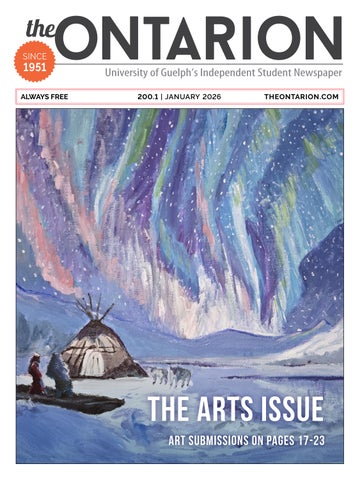
The Arts Issue Art submissions on pageS 17-23
TABLE OF CONTENTS ARTS NEWS
3. 4. 5.
Beloved local author Robert Munsch donating personal archives to Guelph Public Library Best of the Beatles Are art heists back, or have we been simply neglecting them? Guelph Arts Council celebrates golden anniversary A new space for the pottery and art centre
ARTS & CULTURE 6. 7. 8. 9. 10. 11. 12. 13.
Busy Reading: Words to transform worlds A brief history of pole dancing It’s more than just jazz Single Woman Seeking Child An AI song hit Billboard charts. What does this mean for music? Nick Craine isn’t finished making his mark Brush strokes into the void A splash from the past: The Hydrotonics are putting surf rock back on the map Two-month musicals: how Curtain Call Productions gets it done So you need to pay your tuition? Take art commissions 101
Volume 200 More thaN... 2,250 issues 45,000 pages 100,000 stories ... aND WE'RE JUST GETTING STARTED
ARTS SPORTS & HEALTH 14. 15. 16.
Breaking the ice with Guelph’s varsity figure skating team Guelph Naach to compete in the Borderless Revival Competition Bridging gaps and building relationships through art Surviving grief through art New year, new crafts
ART SUBMISSIONS 17. 18. 19. 20. 21. 22. 23.
Hanna Huschilt's digital art & paintings Denver Bakhareva's mixed media art Amaza Payne's artwork on paper Maia Dartsch's drawings & paintings Tegwyn Kelly's paintings Zahra Zandiyeh's watercolour paintings Lei Kathleen Manalang's mixed media self portraits Chloe Wong's paintings Luke Schmidt's paintings
ART REVIEWS 24. 25.
School of Rock: Bringing a classic back to class Wicked: For Good defies expectations Guelph Little Theatre’s production of Alice in Wonderland is a success
ART OPINIONS 26. 27.
All art is art therapy The ultimate dilemma of modern-day dating
POETRY 28. 29. 30. 31.
32.
Various works by Priyanka Kalla An Elephant Never Forgets, But I Wish I Could by Elyse Armstrong Various works by Manzil Grover Letter to Katemore Dr by Alyssa Cunningham Various works by Maia Dartsch All the times you've died over passion by Amaza Payne late bloomer by Ashley Marozsan Various works by Sharon Huang
FUN STUFF 33. 34. 35. 36. 37. 38. 39.
January to-do list Pets of the month Aditya Parameswaran's nature photography Arts quiz: What medium should you learn? Artsy horoscopes Get crafty: Collage cut outs Puzzle page
COVER ART BY MAIA DARTSCH
That’s a lot of ink. And a lot of sweat and tears, too. But it’s also a legacy, one built not just by writers, but by readers. So, whether you’ve been reading for years or this is your first issue, thank you for being part of our story. -The Ontarion
THEONTARION.COM
ARTS NEWS 5 | GUELPH ARTS COUNCIL
4 | LOUVRE HEIST
3
5 | POTTERY
Beloved local author Robert Munsch donating personal archives to Guelph Public Library The storyteller’s archives will be available for public viewing at the new Central Library in 2027 EMMERSON JULL
G
uelph’s future Central Library will feature more than just books—it’s set to house the personal archives of Robert Munsch, best-selling children’s author and beloved Guelph community member. News broke in November that Robert Munsch will donate his personal archives to the Guelph Public Library Archives for research and display at the future Central Library location, set to open in early 2027.
The collection will include original drafts of Munsch’s stories, letters from fans and publishers, photographs and many of his published works, in addition to an assortment of other artifacts documenting four decades of his career. Munsch has lived in Guelph for over 50 years, since he and his wife worked in a preschool lab at the University of Guelph. He loved telling stories at the daycare, and Munsch’s colleagues encouraged him to turn these naptime stories
Seeing Red, Too Much Stuff! and Moose! are just three of the signed Munsch books the library already has in their collection. Emmerson Jull/THE ONTARION
into children’s books. This led to Munsch publishing his first book, Mud Puddle, in 1979. The Munsch family are longtime friends of the Guelph Public Library. In fact, Robert used to bring his children to the library every week to pick out new books. Many families in Guelph have also enjoyed Munsch’s tradition of storytelling at community spaces, including the River Run Centre and the Tea’n’Tales storytime event at Riverside Park. “He has such a rich history, as a local author and also as a storyteller. We’re very honoured for [the Munsch family] to trust us with this collection,” Eleni Hughes, supervisor of archives and records management, told The Ontarion. The Guelph Public Library Archives preserve local civic and
cultural history. The microfilm collection is currently available at the main library branch on Norfolk St., but much of the archives are stored offsite. “The archives are about preserving and telling and celebrating Guelph’s history, and [Munsch] is certainly a huge part of that,” Hughes said. The new Central Library will include a dedicated space on the third floor for displaying the archives’ collections. Hughes is excited that the new location will also have environment-controlled storage to carefully preserve artifacts not on display. Much of Munsch’s archives will be displayed prominently for enjoyment by library visitors, while some will be carefully stored. Library archivists will as-
Best of the Beatles A night to celebrate favourite songs From left to right, the Pamati Children’s Choir of Guelph, conductor Adam Johnson, and the University of Guelph Industry Ensemble take their bows. Photo provided by Edita Treacy
EDITA TREACY
O
n Nov. 8, the River Run Centre of Guelph hosted Symphony and Steel: The Best of the Beatles. The lobby of the River Run Centre held great energy, and there was an exciting buzz in the air. The anticipation of this performance could be encapsulated by an eager attendee in the lobby, who exclaimed: “Who could resist, it’s the Beatles!” This performance featured several songs performed by University of Guelph Industry Ensemble musicians, including the
classic, “All You Need Is Love,” the catchy “Ticket to Ride,” and the crowd favourite, “Hey Jude.” Irine Gregorio, a professor at the University of Guelph, led the Pamati Children’s Choir of Guelph: a group of Filipino children aged five to 14. The choir performed a charming rendition of “Yellow Submarine,” and provided the backup vocals for Guelph’s First Lady Rachel Guthrie’s performance of “Let it Be.” The Guelph Symphony Or-
chestra performed layered and emotional renditions of classic songs, including “Yesterday” and “Blackbird.” Not to be missed was the talent of Adam Johnson, the charismatic conductor of the Guelph Symphony Orchestra. This two hour long performance provided a wonderful range of classic songs and emerging talent. An eye should be kept on the talent of the University of Guelph Industry Ensemble, whose dynamic and vocals were
reminiscent of the Beatles themselves. Eleven of the performances presented this season by the River Run Centre were offered on a “sliding scale,” meaning that attendees had the option of choosing from a variety of prices for their ticket. Kasia Rusiniak, program manager of development and marketing at the River Run Centre, provided some information on the motive behind the dynam-
sist anyone who would like to see the complete collection. Munsch’s stories are so beloved by library patrons, they need to be constantly reordered and are “never on the shelf,” Hughes shared. She believes Munsch’s stories are the most signed-out children’s books at the Guelph Public Library. Now, the chance to have a glimpse at the creative process behind over 75 of Munsch’s published picture books will attract visitors, researchers, classes, families and lifelong fans of Munsch’s work to the Guelph Public Library for years to come. “It’s a very exciting opportunity for us, that we’ll be the steward of this collection and that we get to preserve his legacy,” Hughes said. ic pricing system. “We do want to make it accessible to folks to come out who otherwise may not be able to enjoy regional theatre. At the same time, I think it’s important for people to try new music, see a new show,” Rusiniak said. The rest of this season at the River Run Centre includes exciting Christmas singalongs and intriguing new performances. “We do like to say that we have something for everyone, we do try to present quite a range. We’ve got some big names coming, we have Jann Arden coming, Serena Ryder coming…a traditional Irish music group coming…a lot of comedy and family shows,” Rusiniak said. The River Run Centre presents a vibrant range of music and comedy to the Guelph community. For those interested in classical music, upcoming performances by the Guelph Symphony Orchestra include Beneath Silver Skies in March, and Music of the Silver Screen - GSO Movie Magic in May!
THE ARTS ISSUE | ARTS NEWS
4
THE ONTARION
Are art heists back, or have we been simply neglecting them? A look into some of history’s greatest art thefts, inspired by the Louvre heist of October 2025 ABBY COUNAHAN
T
he Parisian Louvre Museum is the most heavily frequented in the world thanks to its vast collection of prestigious art pieces and historical artifacts, notably Leonardo da Vinci’s Mona Lisa and Alexandros of Antioch’s Venus de Milo. The museum’s historical prestige and prized artifacts are features
Valuable historical artifacts were stolen from the Louvre; only one has been recovered. Photo provided by The Louvre
that have made the Louvre a desirable target for art thieves throughout history and most recently, this past October. On Oct. 22, Louvre president-director Laurence des Cars issued a press release saying the robbers targeted the Crown Jewels collection in the Apollo Gallery. The thieves stole eight pieces of jewelry in less than seven minutes and only left behind one damaged crown and some equipment. The heist captivated the internet, and many asked “why now?” Art theft is more common than it seems, and similar heists have played a significant role in defining cultural moments throughout history. In fact, the Louvre has been broken into several times since its opening in 1793. According to Town & Country magazine, 1911 marks the year of one of the most wide-
BUY 1 GET 1 ENTRÉE
50% OFF
$6
99*
MON–FRI 7AM–9AM
Breakfast Special *Taxes apply | Not valid on statuatory holidays | Valid dine-in only
Buy 1 entrée + 2 beverages & get the 2nd entrée 50% off
Limited Time Offer. Valid at 20 Woodlawn Rd. E, Guelph location only.
2nd entrée must be of equal or lesser value before tax. Offers cannot be combined. Not valid on statutory holidays. Valid Monday–Thursday, dine-in only. UFG50
BUY 1 GET 1 ENTRÉE
50% OFF
Buy 1 entrée + 2 beverages & get the 2nd entrée 50% off
Limited Time Offer. Valid at 20 Woodlawn Rd. E, Guelph location only.
2nd entrée must be of equal or lesser value before tax. Offers cannot be combined. Not valid on statutory holidays. Valid Monday–Thursday, dine-in only. UFG50
Express (710-950 Cals)
BUY 1 GET 1 ENTRÉE
50% OFF
Buy 1 entrée + 2 beverages & get the 2nd entrée 50% off
Limited Time Offer. Valid at 20 Woodlawn Rd. E, Guelph location only.
2nd entrée must be of equal or lesser value before tax. Offers cannot be combined. Not valid on statutory holidays. Valid Monday–Thursday, dine-in only. UFG50
BUY 1 GET 1 ENTRÉE
FIND US AT 20 WOODLAWN RD. E, GUELPH 519-265-5155 OPEN EVERY DAY 7AM-3PM
50% OFF
Buy 1 entrée + 2 beverages & get the 2nd entrée 50% off
Limited Time Offer. Valid at 20 Woodlawn Rd. E, Guelph location only.
2nd entrée must be of equal or lesser value before tax. Offers cannot be combined. Not valid on statutory holidays. Valid Monday–Thursday, dine-in only. UFG50
This necklace, formerly owned by Marie Louise, Duchess of Parma, was among the artifacts stolen. Photo provided by The Louvre
ly-known art thefts in recent history: the Mona Lisa robbery. Vincenzo Peruggia, an Italian immigrant and former Louvre employee, entered the museum unnoticed and concealed himself in a broom closet on a Sunday night. The following morning, Peruggia wrapped a sheet around the painting and successfully made his escape, completely undetected. Peruggia’s motive was to return the painting to Italy where he and others believed it rightfully belonged. The Mona Lisa would not be found until Peruggia attempted to sell it in Florence in 1913, after which he would serve time in jail. The era of the Second World War also saw threats to the Louvre Museum. Upon Nazi invasion into France in 1940, the museum's director Jacques Jaujard facilitated precautionary measures taken to assure that most of the artwork and artifacts could be protected. Jaujard closed the museum under the guise of maintenance work, and for three days and nights, staff, art students and department store employees delicately packed various artworks into wooden crates. During that period, over 1800 crates were sent to the French countryside to be hidden. When the German troops arrived in Paris, they were met with a nearly-empty museum. The last major Louvre heist occurred in 1998 with the theft of Jean-Baptiste Camille Corot’s Le Chemin de Sèvres. After removing its security pegs, the small painting, only measuring 17.7 by 26.6 inches, was cut from its frame in daylight hours and quietly stolen. It wasn’t until a staff member noticed that the painting was not in its designated spot that the museum went into lockdown and the police dusted the frame and glass for fingerprints. The painting remains yet to be found. Aside from the Louvre, one of the oldest art heists in history was carried out in 1473 by Polish pirates. According to an ARTnews article, the pirates boarded a ship that was headed for Florence and was carrying Hans
Memling’s The Last Judgement, a triptych that depicted the second coming of Christ. Upon disembarkation, the pirates had secured the painting and were headed back to Poland. To the dismay of the Italians, the painting has since remained at the National Museum in Gdańsk, Poland. More recently, in 2020, a Vincent van Gogh painting was stolen from the Singer Laren museum in the Netherlands. The painting, The Parsonage Garden at Nuenen in Spring, was on loan from the Groninger Museum and then stolen after a thief broke into the museum using a sledgehammer and successfully made it past the many security measures in place. That heist took place during the beginning of the COVID-19 pandemic, when many museums had shut their doors to the public. The robbers took advantage of this eerie, vulnerable moment. The painting was recovered in 2023, when it was brought to a Dutch art detective in a blue Ikea bag, according to artnet. Art heists may seem like a product of antiquity—something that is far removed from the world we live in today—but that is far from the truth. Works of art hold immeasurable value and are some of the most desirable items on the planet. Art also holds cultural significance and its transfers often mark notable signs of the times.
This necklace, worn by Marie Amelie once Queen of France, was among the artifacts stolen in the heist. Photo provided by The Louvre
ISSUE 200.1 | ARTS NEWS
THEONTARION.COM
5
Guelph Arts Council celebrates golden anniversary After five decades of supporting the local arts community, council members and friends reflect on the state of art in Guelph ARTICLE & PHOTOS BY EMMERSON JULL
T
he Guelph Arts Council’s (GAC) 50th anniversary celebration brought together friends of the local arts scene with live performances, food and music in the Old Quebec Street Shoppes on Nov. 22, 2025. Opening the event were a series of speakers, including Member of Parliament Dominique O’Rourke, Member of Provincial Parliament Mike Schreiner and Mayor Cam Guthrie, followed by introductions from GAC President Susan Carey and Vice President Paul Barson. The 50th anniversary celebration featured the unveiling of the new Sally Wismer Gallery, named after GAC’s longtime executive director. The gallery showcases a vibrant array of visual art by GAC members. Playing at the back of the gal-
lery was Niche, a VHS video documentary about the 1995 collective art installation that transformed downtown Guelph. Live performances included improvised dance by Heather Cornell and Georgia Simms, theatre and comedy by Jay Wilson, and live music by Arshia Shah and jazz duo Confluence. Guests were encouraged to take part in a collaborative community literature project by writing down their favourite Guelph arts memories to be bound into a book. They could also engage in an interactive beading workshop with Marlene Paibomesai. GAC’s golden anniversary marks five decades of growth for one of the oldest community arts councils in Ontario. For many members and friends of the GAC, the anniversary is also a testament
Improv dancers Heather Cornell (left) and Georgia Simms (right).
Families and visitors took part in an interactive beading workshop with Marlene Paibomesai.
to the evolution of Guelph’s identity as a city now known for its art. Nancy Coates is one of the founding members of GAC. She recounts an early report on recreation in Guelph being the impetus for founding the council. In 1975, Edith Kidd, concert manager at the University of Guelph, prepared a civic centre report at the request of city council. According to a Guelph Mercury clipping from June of that year, Kidd’s report found that “the local arts scene in Guelph is frustrated with poor facilities.” The Guelph Arts Council focused their initial efforts on building a performing arts centre, which would become the River Run Centre, officially opening in 1997. Coates is pleased that Guelph is a community now known for its art scene, after decades of dedicating her life to supporting the work of the arts council. Coates recalled that while travelling, people would recognize Guelph for the veterinary college. Now, she said, “They know about the arts. We’ve done enough to make a name for ourselves.” Eric Montgomery, a visual artist, shared about his introduction to the Guelph art community. Montgomery moved to
Guelph in the summer of 2008 and soon stumbled upon Art on the Street, an annual event held by GAC and the Downtown Guelph Business Association. He loved the event and became a GAC member that year. “When I first came here, the thing that really struck me with Guelph was that it was large enough to be interesting, but small enough to be neighbourly. And that certainly applies within the arts community and creative community,” Montgomery said. Although Guelph’s arts identity is cemented enough to have an official city Culture Plan, funding remains precarious. Addressing the audience at the Nov. 22 event, Guthrie apologized for previously considering cancelling arts funding in his 2026 proposed city budget. “I’m sorry,” Guthrie said, citing respectful conversations with members of Guelph’s arts community as the reason he eventually reversed the budget decision. The Ontarion reached out to the City of Guelph to clarify how much funding arts programming would receive in the 2026 budget. According to Shanna O’Dwyer, city treasurer and chief financial officer, the mayor’s 2026 draft budget update included reductions of $140,000 in funding for museum and cultural program-
ming, and $65,000 for market square, culture and civic events. The mayor’s proposed budget update added back $102,000 for museum and cultural programming and the full $65,000 for market square, culture and civic events. This indicates a $38,000 loss in the city’s budget for museum and cultural programming. The final budget will be approved following the local boards and shared services budget meeting on Feb. 4, 2026. Following the draft budget update, community organizations like 10C shared concerns that these cuts would be detrimental to initiatives like Movies in the Park, Culture Days and the Artist in Residence program. O’Dwyer said that the most recent budget updates are not “expected to result in reduced programming, but rather efficiencies in how we operationalize the service delivery.” Schreiner hopes to secure more funding for the arts community through provincial funds. “Tell everybody in Guelph to write the premier and say, ‘increase funding for the Ontario Arts Council’,” he said. Artists make “vital contributions” to the livability of communities and the vitality of economies, Schreiner continued, “Now more than ever, we need artists.”
A new space for the pottery and art centre The relocation allows for greater community impact and use MADISON WOLF
O
n Oct. 25, 2025, Guelph’s Pottery and Art Centre relocated from 14 Edinburgh Rd S to the West End Community Centre. The new space makes room for increased capacity in the centre’s already existing programs, as
well as a variety of new programs and an expansion of the child, youth, adult and older adult programs. Guelph’s pottery centre programs are inclusive, designed to generate creativity, connection and community. There is room for participants of all skill levels,
from beginner to expert and everywhere in between. Some examples of available programs are: Pottery and Hand Building Studio, Adult Art Space, Children’s Art Zone and Kids’ Camps. All of the programs are designed with the intention
to create personal growth, enable artistic exploration and improve confidence. The new pottery studio is equipped with all of the necessary materials to explore clay through wheel-throwing, hand-building, glazing and firing. The Adult Art
Space is a flexible workspace for drawing, painting and mixed-media art forms in courses led by experts. Learn more about the Pottery and Art Centre on the City of Guelph website, or register at recenroll.ca.
6
ARTS & CULTURE 10 | NICK CRAINE
9 | AI POP STAR
Busy Reading: Words to transform worlds Lessons on reading and writing from the 2025 Wild Writers’ Literary Festival EMMERSON JULL
W
elcome back to Busy Reading, a monthly column for bookworms and library lovers. Each month, our Associate Editor shares the joy of reading by profiling local writers, exploring emerging genres and compiling book reviews. Don’t forget to check out the Busy Reading Book Club’s monthly pick! The Wild Writers’ Literary Festival, hosted by The New Quarterly in Waterloo from Nov. 7 to 9, 2025, offered the Canadian literary community a place to contemplate the craft of writing. Canadian writers Shani Mootoo and Madeleine Thien were the festival’s guests of honour for opening night. Befitting the opening showcase, the authors had much to say on the craft of writing. I was roused by Mootoo’s literary journey. She began her career as a celebrated visual artist and video maker, living and exhibiting in Vancouver and New York City in the 1990s. “I was scribbling about things that were weighing on me heavily, emotionally, while I was making my artwork. My artwork was my job and when I was not doing that, I was being harassed by things that were going on in my life,” Mootoo said, recalling the personal subject matter that snuck into her earliest writings. Mootoo entrusted some of these “scribbles” to Persimmon Blackbridge, a fellow Canadian writer and artist, who passed them on to a publisher. Though the publisher was eager to publish the manuscript in a novel or short story collection, the work was too raw, too unfiltered and too personal for Mootoo to be ready to publish. “I knew from art making,” Mootoo said, “that catharsis has not reached the stage of art. It needs to be pushed beyond that.” For almost 40 years, the personal stories within those seminal writings dogged Mootoo’s conscience, re-appearing in her peripheral vision between publications and stories. She felt that she lacked the skill necessary to sculpt the ma-
terial into a novel. It wasn’t until her 10th publication, Starry Starry Night, that Mootoo was ready to return to the material and transform it into a work of autofiction. For myself, and I suspect other writers too, Mootoo’s path to writing Starry Starry Night resonates. Sure, we have material stirring beneath our skin, but sometimes these ideas deserve better execution than what’s possible with the skill that we currently possess. This conundrum begs the question: what can a writer write if they’re not prepared to work with the material clawing up from within them? I found a partial answer in the next day’s Spoken Word 101 masterclass, hosted by poet and University of Guelph graduate student, Qurat Dar. The three-hour workshop was an introduction to the art of spoken word poetry and walked participants through multiple exercises to create, and optionally, to perform their own work. When discussing the kind of work typically presented at poetry slams and open mics, Dar let on that confessional-style poems are popular. In Dar’s opinion, one of the vices of poetry slam is how the format “champion[s] work that is heavier or more traumatic.” Part of the reason that writing about darker and heavier material comes easy is because these feelings are so emotionally charged. Human brains are “negativity-biased,” according to Psychology Today, because we’ve evolved to remember and recognize threats to our wellbeing. In comparison to positive memories, negative ones tend to be more intense and vivid. Writing about heavy subject matter acts as an outstretched hand, beckoning for connection between writer and reader. As James Baldwin said: “You read something which you thought only happened to you, and you discover that it happened 100 years ago to Dostoyevsky. This is a very great liberation for the suffering, struggling person, who always thinks that he is alone.” Performing poetry about joy,
love, happiness and hope might feel disingenuous when the world seems to be up in flames around us. But art gives life meaning, and in the worst of times, it helps us remember why we’re holding on so tightly. “I think there needs to be a bit of a paradigm shift in poetry slam, but even, I think writing in general, for us to value joy and to value hope,” Dar said. “The heaviness of a topic doesn’t necessarily equate to its artistic merit.” By the time I attended my second session of the day, I wanted to learn more about the possibility of writing joy into being. I believed in the value of a story that shows people they’re not alone—what about a story where everything worked out in the end? Thankfully, Other Worlds: Romantasy and the Politics of Emotion, was the perfect session to mull over this question. The panel hosted fantasy and romance authors J.M. Frey, Shade Lapite and Nicki Pau Preto to discuss the significance of love in stories. Love is a powerful drug. Protagonists fall in love and find the courage to tear down old political structures and build new ones. Romance sparks recognition of one’s agency to enact change. To write a convincing romance, authors must flesh out the individual characters and their non-romantic relationships; thus sub-plots about familial healing and old friendships teach the readers about other kinds of love too. Before Frey decided her newest novel, Nine-Tenths, would feature shapeshifting dragons and fire breath-roasted coffee, Frey knew it would be a contemporary, queer and “very Canadian” romance. It’s a work of magical realism, set in an alternate version of Canada. But, in her book, COVID-19 still happened, and her Canada still had a settler colonialist government. My question about writing “happily ever afters” was transformed. In a genre criticized for escapist tendencies, Frey wrote a hyper-realis-
THE ONTARION
12 | ANASTASIA tic world—if not for the dragons. I longed to know why. “Once I decided that I wasn’t going to ignore the real history, the real world we were living in,” Frey said, “that informed some of the political choices I made in the story.” Happy endings are characteristic of the romance genre, and in this novel, Frey had the power to invent optimistic resolutions we haven’t reached in the real world. She wrote a world with no homophobia, and a path towards reconciliation between settlers and original caretakers of the land. “I always try to make the world that my characters inhabit a little bit nicer than mine, because that’s the world I want us to live in,” Frey said. “But I’m also aware that that might be a fantasy as much as the dragons.” Writing hopeful stories about love is not a foolishly optimistic endeavour. Stories are one of the greatest tools we have as humans to inspire change. Frey agreed and hopes her readers will remember the lessons of her books and “strive for something better when it’s their turn.” As I sat for my final session of the weekend, I was feeling quite hopeful about the potential for writing to help us make sense of our world. I listened to panelists Saeed Teebi, Pacinthe Mattar and Gary Bardwin discuss what it means to be a writer in times of crisis, focused specifically on the political and moral crisis in Gaza. As the panelists mused on the role of writers, I heard similar sentiments repeated from the rest of the weekend. Storytelling is a form of agency, and writers have the power to reframe the way their
audiences view the world. I was gripped by reflections from Teebi, author of Her First Palestinian and You Will Not Kill Our Imagination. He spoke about the role of artists as producers of culture. Artists become the symbol for resistance, he said, naming Chinua Achebe, the prominent Nigerian novelist, as a key example. Artists and writers say the unsayable. They capture truth and communicate it to the world. We, as humans, are united by narratives of hope, loss, love, courage, resistance and hardship. Such stories give people reason to keep going, to witness, to survive through the most unimaginable terrors. Artists ferment action—and they keep culture alive, Teebi explained. That’s why fascism has always targeted art and its creators. In my opinion, the power of narrative is the reason behind Israel’s ban on independent press access to Gaza since 2023. Similarly, it’s why the Nazis banned and burned books, and why they censored films, then used cinema as a propaganda mill. The pen is mightier than the sword, so goes the old adage. At the end of the weekend, I didn’t walk away from the Wild Writers’ Literary Festival with new tips or tricks to the craft I yearned to perfect. My ideas still refused to germinate. The page leading to this article remained blank far longer than I’m proud to admit. All that remained was the sense that writing something, anything, is the secret itself. I must write and continue reading, and so should we all. Together, we can allow these stories to guide us towards our own happy ending—towards a better world.
Busy Reading Book Club: Fight Night by Miriam Toews Welcome back to the Busy Reading Book Club! Featuring monthly reads with an emphasis on diverse voices and thoughtful stories, we hope to connect with fellow readers to share the joy of great books. Our January read is Fight Night by Miriam Toews, Canadian bestselling author of Women Talking and A Complicated Kindness. Fight Night is told through the eyes of nine-year-old Swiv, living in Toronto with her pregnant mother and elderly yet “extraordinarily lively” Grandma. When Swiv is expelled from school, Grandma gives her the task of writing to her absent father about their home life. In turn, Swiv tells Grandma to write a letter to “Gord,” her unborn grandchild. Swiv’s observations of her chaotic family are frank, tender and funny, shedding light on the ferocity binding these three generations of women. It’s a story of fighting to survive against the odds: a difficult pregnancy, illness, grief, stiff religious leaders, academic expulsion and husbands who walk out. Most importantly, Fight Night is about finding joy in the silliest places and sharing it with the people that keep us going, even when the going gets tough. Our January book club will be held in UC 264 on Feb. 4, 2026 at 4 p.m. Tell us if you’re reading along by emailing ae@theontarion.com, or stay tuned via Instagram, @ontarionupdates, for book club updates.
ISSUE 200.1 | ARTS & CULTURE
THEONTARION.COM
A brief history of pole dancing Getting in shape has never looked so good
ALEX GRANT
P
ole dancing's emergence as a form of exercise and creative expression has a long and fascinating history that spans across the world. The earliest dances to involve poles are believed to have begun in the 12th century, with practices being found across the world. For example, Pagan maypole fertility rituals involved women holding colourful ribbons tied to the top of a wooden pole and dancing around it, wrapping and unwrapping the ribbons. The Indian sport of Mallakhamb is a strength and endurance gymnastics done by men on a large wooden pole. Alternatively, Chinese pole, known in China as “acrobatic pole,” is a practice done using multiple rubber coated poles that are often 30 feet tall. Acrobates leap between poles and hold poses, but unlike modern pole dancing, dancers are required to be fully clothed to avoid friction burns. Modern pole dancing as we know it can trace its roots back to “Little Egypt” circuses and sensual dances known as Hoochie Coochie. These circuses often included Middle Eastern and Ro-
mani dancers, who realised that the central pole of a tent could be used to perform. In a time where women were expected to dress modestly, these dancers caused a sensation in midriff tops and short skirts. The practice became more recognizable during the Prohibition era. More “acceptable” forms of sensual dance—contortion, silks, acrobatics—went to circuses and were known as vaudeville. Raunchier strip teases went to speakeasies as burlesque. The limited space available in speakeasies led performers to dance on counters, tables and small stages where poles were added for safety so dancers could hold onto them as they stripped. By the end of Prohibition, these dances had become so popular that many speakeasies converted to bars with a heavier focus on table and pole dances. Over time, this is what evolved into modern pole dancing. If you want to become a part of pole dancing's future, there is a studio right here in Guelph that would love to have you. The Ontarion sat down with Nia Hughes, an instructor at Royal City Ae-
Pole dancing is an equally artistic and athletic form of self-expression. Photo provided by Royal City Aerials
rials who has been dancing for seven years and teaching for five. Hughes laughed about getting into the sport “kicking and screaming” as her friends dragged her to classes, but she quickly grew to love it. Like many other dancers,
pole has had a huge impact on her life. “It really helped me make friends with my body,” she said, “I think a lot of femme people show up in the world with all this baggage and think about their bodies a lot. And through pole,
7
we’re friends now. I don’t think about it that much and when I do, it’s about how cool it is that I can do this stuff.” On top of this, pole has been a great way to make friends. When asked about her favourite part of the community, Hughes responded, “Is it corny to say the people?” “Everyone in the pole dancing community is so supportive, so lovely, everyone is just so excited for everybody else,” Hughes said. This also feeds into her experience with teaching, about which she said, “It’s so cool to have a bunch of people come in and learn a really difficult skill together.” Hughes believes that the history of pole dancing and its unbreakable links with sex workers is something that deserves to be acknowledged. She spoke about what the attitude towards pole dancing was when she began. “It was like, ‘I do pole dance, but it’s not like I’m stripping,’ and over time I’ve found that everybody in the studio and the pole community has gotten a lot better about standing ten toes down for the sex worker community,” she said. If pole dancing is something you have been considering, but nerves are getting the better of you, Hughes has some advice: “Just show up. You don’t have to prepare, you don’t have to get a gym routine and be strong enough to go. The pole will make you strong. Just show up and trust that you’ve got this.” Whether it is something you have considered for a while, or never thought about before, why not try pole dancing? Royal City Aerials is only a 15-minute journey from campus and offers a course designed for complete beginners. Happy dancing!
It’s more than just jazz The sixth annual Improvisational Festival was ‘profoundly inspiring’ and ‘deeply resonant’ KYLE SALTER
T
he sixth annual Improvisational Festival (IF) ran from Nov. 28 to 29 in the University of Guelph’s ImprovLab. IF is curated by Eric Fillion, the current director of the International Institute for Critical Studies in Improvisation (IICSI). Fillion’s approach to curation emphasizes experimental music forms beyond free form jazz. In Fillion’s words, IF is “an aesthetic mode of communication, an embodied strategy for negotiating difference, and a means of en-
acting new modes of thinking and being," he said, which acts as “a site of activism, equity and community building.” This year, IF focused on featuring Canadian artists—most local to the Guelph area—with a few artists from across Canada more broadly. The festival, which is “interested in the power of improvisation within and across the arts and beyond, not just music,” featured artists curated by Fillion in collaboration with Audiopol-
lination Guelph, the Musagetes Foundation’s Wet Sounds series and coexisDance series. Many of the people behind the scenes for IF are students from the University of Guelph’s doctoral program in Critical Studies in Improvisation. Students participated in a variety of roles, from graphic design to tech work, or as performers in the festival. Next year IF will be hosted in Belfast, presented as part of the biennial Sonorities Music Festival.
Matt Rogalsky and Dimitri Georgaras. Photo provided by Gabrielle Tyrie
In 2024 IF was hosted in Mexico City, in collaboration with 17, Institute of Critical Studies. The festival began in 2020, where it was originally a 24-hour online presentation which featured over 150 artists in a variety of disciplines from across the globe. IF was created as a response to the
COVID-19 pandemic with the goal to “commission new, improvised performances, and showcase these innovative pieces for a global audience via online streaming.” If you want to learn more, visit the IICSI’s website or Improvfest.ca and follow their Instagram @improvcommunity
8
THE ARTS ISSUE | ARTS & CULTURE
THE ONTARION
Single Woman Seeking Child Short film on single motherhood screened at the University of Guelph ZAHRA ZANDIYEH
S
ingle Woman Seeking Child, screened recently at the University of Guelph, and examined single motherhood in Canada with restraint, humor and emotional clarity. Directed by Blaine Watters, the short film follows a woman who chooses to pursue parenthood independently and confronts the practical, social and psychological complexities that come with that decision. Without relying on dramatic highs, the film focuses on personal reflections, small domestic gestures and the inner tension that accompanies reproductive choices. The protagonist is based on Watters’ mother. According to the filmmaker, was among the early women in Canada to intentionally become pregnant and raise a child on her own without a romantic partner. Her decision was made at a time when independent motherhood was uncommon and
carried a social stigma, providing the film’s grounding. Through this lens, Single Woman Seeking Child observes motherhood not as an assumed path, but as a conscious choice shaped by cultural pressures, financial limits and uncomfortable risks. Watters explained that the film originated from a search for a story rooted in lived experience. “I was looking for a script to write,” he said, adding that he often tells students to “mine your own life for stories.” His attention turned to his mother’s journals, where he encountered entries expressing hesitation about whether she was ready to continue her pregnancy. “I found that she was very unsure if she wanted to have me or not, and I thought that was more interesting than trying to make a statement about motherhood,” Watters said. That discovery altered the direction of
GOLD AWARD WINNER for Favourite Moving Company gold award, good trucks, gold service
U OF G CAMPUS MOVER SINCE 1972 Please call 519-821-6683 Ontario-wide, quality service Local and long distance Antique and piano specialists Professional packing Heated storage Free no obligation estimates
BONUS COUPON
$50 OFF cost of move
25% OFF
of all packing supplies purchased from Guelph Head Office
a replacement day before filming. Two actors withdrew shortly before their scenes, and an early shooting location was rendered unusable by construction equipment. “We had three days to get another DP… and the first Vanessa showed up, she'd been throwing up all night from food poisoning. She still did the work,” Watters said. According to Watters, these circumstances shaped the atmosphere of the set. He emphasized the importance of maintaining a collaborative environment. “There’s a lot of ego being thrown around [in filmaking],” Watters said, but his goal was different. “I just wanted it to be a nice set Single Woman seeking child explores the internal conflicts that people where people felt experience when trying for a child, through the lens of a woman who is wanted and needtrying to become a single mother. Photo provided by Blaine Watters ed…everyone had a the script. Instead of presenting mother- hand in what we made.” hood as a certainty or moral obligation, the Watters connected this approach to film frames it ambiguously as a balance of his childhood, recalling that his mother desire and fear. later became a foster parent so she could According to Watters, the journals remain at home while providing childshaped the tone of the second draft, which care. “I’ve had kind of 30 foster siblings was informed not only by his mother’s written reflections but also by the private emo- throughout my life,” he said, noting that tional costs of her decision. “She was dead his mother specifically housed teenage set on having this baby, but at the same girls because most foster programs prioritized infants. time it's very scary,” he said. That background is reflected in the Watters said this uncertainty resonated with his own experience entering parent- film’s thematic interest in shared care nethood later in life. Despite wanting children works. Rather than centering motherhood for years, reality brought unfamiliar appre- on romantic relationships or traditional hension. family structures, the film highlights so“When we got pregnant…it just be- cial labor, emotional resourcefulness and comes a scary proposition. Your life is the value of supportive communities. about to change. You know that, but you When asked about his mother’s reaction to seeing the film, Watters said she don’t really know it,” Watters said. For Watters, the vulnerability sur- found it intensely personal. Watching the rounding parenthood was more compelling events of her early adulthood restaged on than any ideological statement, and that be- screen, his mother described the expericame the film’s emotional centre. ence as “stepping into your past.” Casting reflected this emphasis on While the film originates from priemotional nuance. Watters sought an actor vate history, Watters stressed that it also capable of improvisation and subtlety, over reaches outward. He hopes viewers will consider the material and emotional conphysical resemblance. “I was looking for an improvisational ditions facing single parents, as well as actor,” he said, and he ultimately chose Va- broader questions of reproductive freenessa Smythe after seeing the boldness of dom: “If it starts a conversation…especialher interpretation. “She knocked it out of ly about women’s bodily autonomy, that the park…better than I think anyone else would be the pinnacle.” Single Woman Seeking Child presents could have been.” Smythe’s performance echoes the motherhood as a choice, not an inevitabilfilm’s understated tone, conveying the pro- ity. Through small and grounded details, tagonist’s mixture of humor, uncertainty the film considers what it means to accept and resolve. uncertainty, navigate judgment and build Production was confronted by multi- a future without idealized guarantees. Its ple disruptions. Watters said that the cin- perspective is quiet but contemporary, ematographer originally attached to the acknowledging risk without reducing it, project could not travel due to complica- and portrays the complexity of parenthood tions abroad, forcing the team to secure with clarity rather than sentiment.
ISSUE 200.1 | ARTS & CULTURE
THEONTARION.COM
9
An AI song hit Billboard charts. What does this mean for music? The R&B track, titled “How Was I Supposed to Know?” invokes a discussion of ethics, technology and authentic artistry ANDREEA BURLACU
O
n Nov. 1, 2025, Xania Monet hit the Billboard Adult R&B Airplay chart at number 30 with the track, “How Was I Supposed to Know?” Monet was created by the Mississippi-based poet Telisha Jones, who set her lyrics to R&B music through the AI music program Suno. This marks the first time an AI-generated artist has debuted on a Billboard chart, raising eyebrows and provoking questions of authenticity in today’s music scene. Monet first appeared online in mid-July 2025. She has since released around 44 songs on Spotify and accumulated over 1.4 million monthly listeners. Monet also gained traction on online platforms like Instagram, YouTube and TikTok. At time of writing, she has 860,000 followers combined across these sites. We love artists with a strong, personable voice—but when AI sings, apparently people listen. Forbes reported that in September 2025, Monet was signed to a $3 million record deal. She is having the come-up of a breakout star, despite not actually existing in human form. Perspectives are varied: should AI in music be considered a tool, a cheat or an earsore? Jones, the person behind Monet, told CBS Mornings that the AI avatar “is an extension of [her].” “I look at her as a real person,” she said. “I’m just taking what I love doing and mixing it with tech. I just feel like AI… it’s the new era that we’re in. And I look at it as a tool, as an instrument, and utilize it.” U of G music professor James Harley considered that AI isn’t autonomous, instead inquiring about the people that train the systems. People have to program AI to analyze existing music data, compose melodies and perform songs. “There’s a lot behind that,”
Harley said. “My concern at the moment is that we don’t know anything about that part. I’d really like to know, who is it? Who’s working on this? They need to know a lot about music.” There is a human element in both training AI music programs and in coming up with inspiration for tracks. Jones said that “How Was I Supposed to Know?” was inspired by her losing her dad when she was eight years old. She affirmed that her lyrics were 100 per cent her own, based on true experiences. Jones inputs this writing into Suno, adding prompts like “female soulful vocals,” “slow tempo R&B,” and “light guitar, heavy drums.” From this perspective, Jones uses AI as a collaborator to fulfill her artistic vision. Yet it is difficult to regard AI in music as a net positive. One problem that arises is a lack of originality. AI is hard-pressed for novelty as it operates on a pre-existing data set. It’s great at mimicking artists like Adele, Taylor Swift and The Weekend based on their vocal profiles. Artists commonly use samples and attribute influence to others, so originality can be difficult to pin down in music. But Xania Monet clearly alludes to Janelle Monae and Victoria Monét, who also perform R&B. In a Vanity Fair interview, Monét described that Xania’s resemblance to her felt uncanny. “It’s hard to comprehend that, within a prompt, my name was not used for this artist to capitalize on,” she said. “I don’t support that. I don’t think that’s fair.” Monét said that her friends asked ChatGPT to generate a photo of “Victoria Monét making tacos,” and the output looked eerily like Xania Monet. There’s no way to prove AI generators weren’t trained on data from existing artists. Once a likeness is established, this counter-
Xania Monet represents a new frontier in AI art. Aditya Parameswaran/THE ONTARION
part could be easier to exploit. AI can replicate a person’s artistry without having the same human needs. It doesn’t need to eat, rest or manage its mental and physical health. “The eight hours, nine hours that we’re resting, an AI artist could potentially still be running, studying, and creating songs like a machine,” Monét said. “How would any human ever compete with that?” Without regulations in place, AI could threaten the livelihoods of human artists. If AI is on Billboard charts, it takes the place of emerging performers. Passionate people are waiting to be heard— student bands with big dreams, songwriters fine-tuning their lyrics, people drumming and strumming guitars. Streaming platforms already make it harder for artists to earn a living. Shouldn’t we prioritize supporting artists who need to pay rent? Furthermore, it’s notable that the AI Monet performs R&B, a genre full of many deserving Black women. R&B and soul music originated in African-American communities in the 1940s. Since then, artists like Tina Turner, Lauryn Hill, Aaliyah, Beyoncé and SZA have shifted the culture with songs that share lived experiences, inviting listeners to bare their hearts. R&B has become a comfort genre for so many. How can an AI “soul” artist replicate a soul? Harley described that music
is “very emotional” and that it produces a strong response in the brain. “When they analyze what happens in your brain when you’re listening to music, it triggers all over the place,” he said. “It’s not restricted to left brain or right brain. It’s actually all over your brain… it does seem to be a very direct and deep connection to our emotions.” Music is a vulnerable experience for both the artist and their listeners. It’s cathartic to hear a song that sounds exactly how you’re feeling, proving you’re not alone. People want to have a person behind the music to connect with and root for. “I’m not sure I want to open my emotional reactions to something a computer produced,” Harley said. Previously, AutoTune technology has started similar discussions about authenticity in music. Harley said that with or without listeners realizing, “the software can take your recording of your voice and make it sound in tune.” People wondered: are singers truly talented, or just relying on software to make them sound good? However, recent music trends show that AutoTune is regarded as a viable artistic tool. Charli XCX’x BRAT, PinkPantheress’ Fancy That and Lily Allen’s West End Girl, among other works, audibly employ AutoTune and are critically acclaimed. As AI emerges as a bigger
threat to artistry, the conversation has shifted. “I think the power of computing now is just so incredible, so powerful beyond what anybody could have imagined,” Harley said. Could AI artists one day stand up against human ones? They could go on tour, with virtual avatars like the holographs of the existing group Gorillaz. Last summer, a band called The Velvet Sundown got over one million streams on Spotify before admitting they were entirely AI. A discerning ear has become more important than ever. There is a chance most of Monet’s listeners are bots. Still, as AI “art” progresses further, it is even more necessary to champion local creatives. Listen to voices you identify with and go support artists at live music venues like Sonic Hall, Jimmy Jazz and The Bullring. A computer cannot empathise with its environment. It does not know loss, love, the warmth of sunshine or the relief after the rain stops. It is the antithesis of feeling. We judge artists like Taylor Swift for being out of touch, but at least Swift has had the breakups and makeups she sings about. As Xania Monet emerges with emotional ballads”like “Let Go, Let God” and “They Don’t Love Like Grandma Did,” the AI avatar has never experienced an emotion in her lack of life.
10
THE ARTS ISSUE | ARTS & CULTURE
THE ONTARION
Nick Craine isn’t finished making his mark The Ontarion alum and Guelphite recently published Line Work: 1994-2025, a collection spanning decades of his illustrious career EMMERSON JULL
N
ick Craine is a fond friend of The Ontarion. After all, it was the first home of his comic series, Cheese Heads, in the 1980s. Now, Craine has returned to finish the comic along with the publication of Line Work: 1994-2025, a collection spanning three decades of his career as a professional artist. Craine’s love for illustration began all the way back in grade school, when he noticed that drawing for other kids earned him social capital. He grew up on Carden Street, in downtown Guelph, and unofficially took up residence at Card’n’Comics, a comic book store a block away from home. By age 11, he was hired at the store to run errands and organize stock. Craine was paid half of his wage in comics and half in cash, which is any comic-loving kid’s dream. The owner of the store, Shane Kenny, was a “very artistic hippie,” said Craine, and a “surrogate father figure” for him at the time, according to an interview in a 2018 issue of Tales of a Guelphite #1. Kenny was Craine’s introduction to the art world and told him about a comic book idea he called “Attack of the Killer Cheese Heads.” Craine was drawn to the idea and started to develop it into a “typical, cheesy Marvel radioactive origin story.” Craine had a mentor, Bill, from the Big Brothers Association, who was a student at the
Ontario Veterinary College and soon encouraged Craine to take his comic concept to The Ontarion. So, Craine pitched his comic to the editor-in-chief at the time, David Akin. Akin liked the idea, and Craine ran The Cheese Heads as a weekly comic strip. By the time he was in grade 12, Craine was working as The Ontarion’s production manager and art director. On Mondays, Craine would fall asleep at school after pulling all-nighters for news production on Sundays. Though spending his nights at The Ontarion may have ruined Craine’s sleep schedule, it gave him something more: a lifelong sense of dedication to his craft. “My best education was having a deadline every week that had to stick, no matter what, and we had to create something that was going to be print ready,” Craine said. “It's that sense of care and discipline to meet deadlines, that’s something I've carried on through my entire life because of The Ontarion.” Craine took The Cheese Heads from a newspaper comic strip to a full comic book in the early 90s. He and Kenny formed Tragedy Strikes Press, a comic publishing house, in the basement of Kenny’s store. Later, while attending the Ontario School of Art, now known as OCAD University, Craine met
Michel Vrana, who would become a lifelong friend and collaborator. Vrana was hired on at Tragedy Strikes Press, and would go on to found his own comic press, Black Eye Productions. In 2019, Vrana relaunched the business as a micro-press and graphic design studio, Black Eye Books. Craine went on to complete five issues of The Cheese Heads. “By the third issue, things really start to get refined,” he said. “By the fifth issue, there's a very, very big arc of development, as I'm learning how to draw in public.” After the dissolution of Tragedy Strikes Press around 1993 and sometime after publishing its fifth issue, Craine shelved The Cheese Heads with no intention to ever return to the series. The comic, which in many ways was formative to Craine’s career and his relationships within the art community, carried emotional weight. It wasn’t until assembling Line Work that Vrana encouraged Craine to pick it back up, three decades later. “With 30 years of living, it has now become a deeply personal work. That juvenile work is also autobiographical,” Craine said. “It’s a love letter to comics as well.” In that way, Line Work is greater than a culmination of Craine’s career; it’s a visual representation of his storied history, one interwoven with local Guelph
The cover of Line Work: 1994-2025. Photo provided by Nick Craine
legends and fellow Canadian artists. That includes Vrana, who helped Craine materialize Line Work by organizing a crowdfunding campaign and publishing it under Black Eye Books. Line Work ranges from cartoons to children’s book covers, to editorial portraits and an impressive landscape of Shakespeare’s London. All of Craine’s works speak in a similar dialect, but none adhere to a distinct “visual vocabulary,” his term for an artist’s particular and recognizable style. Just because Craine refuses to be pigeonholed doesn’t mean he hasn’t experienced the grind of a professional art career. He compares his career to a balancing act between creating art to make money and making personally fulfilling art. Trudging through corporate-commissioned art might feel uninspiring to young artists, but saying yes to as many creative assignments as possible is key to developing one’s artistic DNA.
Experiment with form and content, which “should always be married,” according to Craine. He advises young artists to stop fussing over developing a recognizable style. Instead, try to empty the noise between your brain and the paper. Make marks “in a meaningful way, in an intentional way,” Craine said. As you create, your style will reveal itself in the body of work you’ve established over time. While art makes our lives better, it can’t sustain us entirely. Craine doesn’t subscribe to the tortured artist trope: "I think there are a lot of tortured people out there, but me, personally, I can only really perform at top level when I'm feeling joy,” he said. Line Work tells the story of Craine’s profound dedication to his craft. From the first Cheese Heads strip in The Ontarion, to the final 34 pages drawn three decades later, Craine has settled into a routine of sitting down and making marks on the world, again and again and again.
SPECIALIZING IN: Barber Cuts Hair Botox Smoothing Japanese Straightening Balayage Extensions Precision Cuts Multidimensional Hair STUDENT DISCOUNT Wednesdays 15% off
IT’S NOT JUST A COLOUR, IT’S A FEELING
ISSUE 200.1 | ARTS & CULTURE
THEONTARION.COM
Brush strokes into the void A close look at Wyndham Arts and featured artist Danny Fury ARTICLE & PHOTOS BY VALERIE MONTERROZA PRIETO
A
Guelph staple for over thirty years, Wyndham Arts Supply has crafted a space for creativity since 1992. The Ontarion spoke to owner Chris Ahler about the store's history and what’s on the horizon for 2026. Originally founded at 164 Wyndham St., the store was first owned and operated by Ahler’s parents. In 2008, when the city of Guelph began expropriating lands for the Guelph Public Library, the store moved locations across the
street—where it now resides at 125 Wyndham St. Today, the store is owned and operated by Ahlers and his wife, Tammy Ratcliff. Wyndham Arts Supply is divided into three floors, which house the Guelph School of Art and the 3rd Floor Gallery in addition to the store itself. According to Ahlers, the Guelph School of Art was founded by a University of Guelph fine arts professor in the late ’90s. Prior to the store taking over school, it hosted lessons from artist Nan Hogg. Later, Wyndham Arts would take over the Guelph School of Art, helping it become what it is today. Now, embracing circularity, the store will be expanding into a building across the street where they plan to move the current gallery and host their art classes. The building will also feature a retail shop with artist merchandise to accompany the exhibitions they will be hosting in 2026 and beyond. The Ontarion also spoke to
Danny Fury, the artist behind the 3rd Floor Gallery’s current exhibition. Fury moved to Guelph at 21 years old after growing up in Penetanguishene, north of Barrie. Fury’s creative history spans over 20 years as a musician, but he’s recently transitioned into the visual art space. Despite being a multi-instrumentalist, Fury mainly plays the drums. Having played in metal, rock, country and folk bands, he doesn’t necessarily stick to a single genre. Along with curating a gallery exhibition, Fury also makes his own music, with an album currently in the works. Fury’s exhibition, Welcome to the Void, is a collection of pieces that represent a place somewhere in between. Fury explained the void as “a kind of twilight zone, a space where you’re awake at 3 a.m. in bed but your mind is kind of racing and thinking about something that you’re worried or uncertain about. I’ve always been fascinated with those kinds of concepts of an alternate space that’s in between,” he said. Fury described the collection as a haunting, post-apocalyptic image of the world inspired by the forest fires from the summer of 2025. He said, “If the void was an actual physical place, it would be in the distant future when humans no longer live on the planet, loosely.” As a self taught artist, Fury became obsessed with creating art during the pandemic in 2020, when no one was performing.
“My art is always driven by listening to music and inspired by music. I feel like my ideas are often conceived by being inspired by a specific album or song. I think they go hand in hand for me,” Fury said. Many of the titles of the pieces in this collection reference artists such as Mazzy Star and the rock band, Siouxsie and the Banshees. Fury worked on the collection in October and wanted the pieces to have a dark theme, originally planning for only black and white pieces to create a monochromatic collection. Instead, the collection became a series of repetition using black, white, and red along with different textures cut and pasted onto the canvas of different pieces. When asked about the re-
A splash from the past: The Hydrotonics are putting surf rock back on the map This local band is making a name for themselves in Guelph and beyond MADISON BOUTILIER
T
he Hydrotonics are an instrumental surf rock band based in Guelph, composed of drummer Mick Oakley, bass guitarist Tyler Neely, and guitarist Paul Vanderwielen. The three have had their respective beginnings in music but started playing together a couple of years ago, experimenting with different forms of rock before landing on their upbeat and nautical rhythm. “Mick played a surf beat and we randomly jammed along to it, and it felt really good,” Neely said. “It was a magical moment where
we were like, '’should we just do this now?’” Despite the lack of a prominent surf rock scene in Canada, the trio is determined to spread joy with the music they play in the community. Surf themes in music began in Southern California in the late 1950s and early 1960s with Dick Dale, The Ventures, and The Beach Boys pioneering the genre to the top of the charts. The sounds were overwhelmed by the new rhythms brought by the British Invasion in the mid-sixties and eventually faded out. The unique beats had a small
revival in the mid-nineties with the release of Quentin Tarantino’s Pulp Fiction, before losing momentum again and going back underground. “Surf rock was a big thing back then for about five to six years, everybody was in a surf band, and then it just kind of died, but it still maintained a small community that spread across the globe,” Vanderwielen said. The band released their first album Octoloco in October 2024 and released their first music video for the track “Problem at Party Pier” this past September. The album comprises eight songs that
Sharply dressed with sharper music, Hydroponics is a surf rock band to keep an eye out for. Photo provided by Madison Boutilier
get crowds moving during their live performances. They first appeared at Brothers Brewing Company and they’ve quickly expanded to other local venues in the downtown area. Most recently, they’ve been heard at Jimmy Jazz and The Wooly Pub, with additional collaborative popups in the Waterloo region. In conversation with The Ontarion, Vanderwielen and Neely touched on their unique band name and their creative song nam-
11
lationship between life and art, Fury summarized his collection and creative process as a whole. He feels that people, as individuals, have unique life experiences and ways of interpreting their day-to-day lives. “There’s no such thing as an artist or a non-artist,” Fury said. “The joy that someone could experience making art and immediately being told that they’re not an artist or [they are] untalented, kills a person's potential.” Fury hopes that new artists are confident enough to follow their curiosity, even if their work isn’t perfect. In the heart of Guelph, Wyndham Arts is the best place for emerging artists to learn new skills and build community–and maybe buy a new paintbrush while they’re at it. ing process. “I like to think of it as ‘hydro’ is water themed and the majority of these songs use the root of chord, which is called the tonic,” Vanderwielen said. Additionally, they draw themes from chord progression and use word association and previous experiences in songwriting to find a creative fit for each song. The two added that the turbulent and thundery sounds they were able to produce on their guitar rigs led to the naming of their fourth song, “Storm City.” The band has plans to record new songs and release them in the new year. They also strive to reach beyond the Guelph and Waterloo regions for future shows. In closing, Vanderwielen said, “For me [it’s about] trying to inspire more people to become aware of this kind of music and play it, because I just think it’s fun.” “I have to admit, I have become a better bass player playing surf music because it is a little more freeing,” Neely said. The band can be seen back onstage Jan. 17 at The Union in Kitchener, playing alongside other artists on a retro beach-themed evening.
12
THE ARTS ISSUE | ARTS & CULTURE
THE ONTARION
Two-month musicals: how Curtain Call Productions gets it done Including a sneak peek of this year’s show, Anastasia Curtain Call Production’s collaborative structure is what allows them to produce a high quality stage production in a matter of Months. Photo provided by Scott Roberts
HANNAH DICKHOFF
H
ow does a student club stage a full-length Broadway musical in just two months? It may seem impossible, but Curtain Call Productions (CPP) has been doing it for decades! In such a short timeline, CCP manages to plan, rehearse and perform impressive shows year after year. Last year’s Spring Awakening was nothing short of spectacular, and rehearsals have recently begun on this year’s production of Anastasia. Let’s take a closer look at this group’s process for bringing their creative vision to life! One of the most integral aspects of theatre production is collaboration, and the collaborative structure of CCP is part of what makes their timelines possible. There are many teams involved that must communicate with each other on a regular basis. For example, dance numbers don’t only need the choreographers’ input, they are also influenced by other teams. J Godwin-Sens, one of Anastasia’s co-choreographers, said, “I have to communicate with so many people to be able to put this together. Costume designers: some people can’t move in hoop skirts. Hair design: what can we do when someone has huge curls around their face? Tech: how are we playing with the lights? What areas are being lit? It’s so many moving parts, such a big collaboration.” In addition to team collaboration, actors freely communicate with the rehearsal team at CCP to bring their characters to life.
Vocal director Matt Curran provided some personal insight and said,: “In other productions that I’ve been in, the rehearsal team tells other people what to do, but this is so collaborative. Actors will say ‘I have an idea for this character choice!’ and we adapt it, working on it together instead of it being one person’s thing.” A good theatre production requires strong leadership to drive its creative vision. Anastasia’s director, Nikhil Attanasi, is responsible for the overall creative vision of the show across both rehearsal and production departments. The role of director can be a challenging one, as Attanasi described and said, “As a student leader, the main challenge is time management. [It involves] balancing both academic responsibilities with extracurriculars, and also managing a large team of people.” Despite the challenges that come with the role, Attanasi said, “It’s always incredibly rewarding at the very end when you see it all come together.” As director, Attanasi’s guidance has already begun to inspire other members of the cast and crew. Kezia Raine Hart, who plays the main character Anya, described Attanasi as “very intentional about everything and it’s super helpful.” From a choreographic perspective, Godwin-Sens said that “[Attanasi] kind of gives us the vibes… and then we put our own spin on it.”
Attanasi’s role as director is a vital one: transforming ideas into final products, all while working directly with various teams to create the musical he envisions. At CCP, everyone is welcome. As stage manager Charlotte Markovsky said, “Curtain Call has many people who don’t come from theatre backgrounds. They come into this knowing nothing about musicals and love being a part of the club.” CCP places a special emphasis on the learning aspects of musical theatre. Curran, who learned how to read sheet music from doing a show, likes to “go over songs in a way that makes sense not only to seasoned performers, but to beginners as well…People have completely changed how their voices sound from when they started to when they perform.” Teaching and mentorship are directly built into rehearsals and growth is prioritized over perfection. Godwin-Sens said, “It’s really not experience-based—we hone in on people’s strengths. It’s about finding where someone fits best.” By focusing on gradual improvement in a community setting, newcomers and experienced performers alike can be a part of something meaningful and fun at CCP. While CCP’s rehearsal process is learning-based and not perfection-oriented, they still strive to use all of their time wisely. CCP’s rehearsals are extremely valuable, and the team never takes a second
CCP Focuses on learning and growing, not perfection, making them an excellent choice for those interested in musical theater. Photo provided by Scott Roberts
for granted. “The biggest challenge is probably scheduling–getting everyone together to do these things… but once we’re all together, everything is very intentional,” Hart said. The two-month time constraint puts pressure on these students to use all of the time they can get. Markovsky provided insight on time management and said, “[It is] a lot of time commitment, but everyone is very passionate. They show up and they do the work.” Such a big commitment usually adds more stress onto a student’s life, but several members of CCP have expressed that they feel less overwhelmed while in rehearsal. Attanasi described it as “a creative outlet,” and Hart said that “it is kind of a relief. You're just here for rehearsal…everything else disappears.” Anastasia is based on real historical events, and is set in the middle of the Russian Revolution and centers on the famous disappearance of Grand Duchess Anastasia Romanov. Attanasi shared that CCP will be “taking a big perspective on the history…honing in on stories grounded in real things.” The historical grounding of Anastasia is a significant aspect that the cast and crew are working towards communicating effectively. CCP is also looking at in-depth character choices, particularly for the main character Anya. When asked about her character, Hart said, “Anya is definitely a dream role of mine. She has been since I was probably 12, so this opportunity is very important to me. She’s a really powerful character and a powerful woman and I’d like to play her that way…I want to bring out her power as well as her feistiness.” Hart also spoke about how Anya’s personal journey ties into the overall theme of the show and said, “We want to focus on her desperation for finding home and finding out who she is. The show is a lot about identity, so we’re really
emphasizing what it is to learn who you are and step into that world.” Many university students can relate to the journey of self-discovery, and musical theatre is a unique environment that fosters this growth. Hart’s experience is proof. “As rehearsals go on, I’m going to learn more about my character, but also more about myself,” Hart said. The club’s overarching foundation is made of belonging and community. “It has the perfect balance of professionalism and friendship. I’ve worked with a lot of different theatre companies, and it’s really rare to find a good place like this. [Attanasi] has been really focused on that aspect of it. He said that he wants to have people who are kind and positive, and to have a welcoming space… It’s the only way we can get it done in two months,” Godwin-Sens said. Regardless of skill level or experience, CCP succeeds because everyone wants to be there. The club’s community environment is integral. Markovsky stated that her favourite part about CCP is “getting to meet people from different backgrounds who all have a common interest in making the show happen.” Curran said, “[They] expected to be a lot more separated from the rest of the cast and crew, but it is so integrated and community-driven…That’s why I love it so much, it’s so rewarding to be in a room full of people and create something as magical as theatre with them all.” Each and every person involved in the club has expressed the utmost gratitude and fulfillment just from being a part of it, and that is the real reason Broadway shows can be put together in two months. A safe, positive and welcoming environment full of creative possibilities and support is what Curtain Call Productions is all about. Anastasia hits the stage in March 2026! Be ready to buy your tickets and support the arts at U of G!
ISSUE 200.1 | ARTS & CULTURE
THEONTARION.COM
13
So you need to pay your tuition? Take art commissions 101 From determining your wage to choosing your style, here’s what you need to know ARTICLE & ILLUSTRATIONS BY OLIVER BARKLEY
T
imes are tough and money is short, especially for students. Classes, labs, exams, tests—it’s tough to find a way to work while you’re in school. Well, fear not! Social media has given students a way to provide themselves with some sort of financial aid, in the form of doing art commissions online. Art commissions fit the ideal structure of a student’s schedule because they can be picked up in greater force during lull periods, and slowed or halted during exams or midterms. Commissions have a rather low bar to entry, and while you need at least some previous art experience, nothing’s stopping you from starting your journey into the wonderful world of online art commissions! Starting is always the hardest part of doing commissions. Money won’t come instantly. Sometimes, it can take up to a year or more until you get your first commission! You have to go out and find people, then show them what you can do. Let’s go through all the starting steps you’ll have to consider.
PLATFORM Different platforms have different clients with varying commission rates. Some platforms are very artist friendly but don’t have many users, while others are a cesspit but a cesspit with clients. Bluesky is a popular pick for starting out, but if you have a specialization in mind, a site specific for that community will always be better. Do your research of each plat-
form’s pros and cons to make sure it will be a good fit. Watch tutorials and learn the ins and outs. Once you’re ready, make an account. Pick a catchy username, something alliterative or related to your art. Don’t spread yourself too thin right away—stick to one platform at first and then slowly add pages on other sites. You don’t want to get overwhelmed too fast!
POSTING When people are commissioning, they want to see past work you’ve done. No one wants to risk getting scammed, so you have to flex your art skills and show potential clients why they should pick you. You’ll want to post semi-regularly and consistently, slowly building up your following. Bi-weekly or weekly is recommended, but keep your academic commitments front of mind. This is when it’s best to try and find your niche, be it cutesy illustrations or graphic horror comics.
If you want to boost engagement, run free art raffles or similar events. These tend to induce short-term gain rather than long-term, but they can help get your art out to more people. Your goal in this stage is to get your art out there, show people what you can do and build up your portfolio! So, you’ve built up your platform and have a handful of followers, now what? It’s commission time! Now, this is going to be scary and overwhelming but you’ve got this. Commissions can be broken into three main steps: Communicate, allocate and calculate.
COMMUNICATE There are some questions you want to have answered before clients even reach out to you. You should know your prices and terms of service. Your prices should be set at the minimum hourly wage multiplied by however long the piece takes to complete, if not more. Art is a luxury good, so don’t sell yourself short. You’ll also want to communicate what platform you use to accept payment, so that clients can ensure that method works for them as well. As you get more established you can up your prices, so don’t feel like they’re set in stone. Next, decide on your terms of service. Specify what you will and won’t draw, expectations of client behaviour, rules around use of your art—whatever you feel may be relevant. These can be changed as time goes on, so just set some general
rules at the start. When a potential client reaches out, you want to get all of the information you can about what they want. Ask questions to make sure you know exactly what they’re looking for. It’s better to avoid mistakes before they happen. You’ll want references for any characters featured and a vague text description of what they envision for the piece. If they can send photos of other pieces similar to what they have in mind, amazing! If not, that’s okay too. As you do more commissions you’ll learn which details are important and which can be figured out later, so just sit back and get ready to start working on it.
ALLOCATE Okay, you’ve got the commission, you’ve got the details. But, you also have a lab in thirty minutes. No worries, that’s where the allocate step comes in! You’re a student first and foremost, so turn to scheduling. Pick some time during the week where you don’t have classes, clubs or any other commitments, and set that as your “work time.” Find a good, quiet place to sit and work for a set amount of time. When you finish a stage of the commission (for example, the sketch, lineart, flat colour, etc.), take a break. Send it to the client for approval, go for a walk or work on something else. Burnout is your worst enemy. It’s not worth it to torture yourself to get a commission finished slightly earlier. Make a checklist of what you need to do with due dates, including each stage of the commission, along with your schoolwork. It sucks to have to plan your week out, but you want to make sure everything gets done in good time!
CALCULATE Upon finishing and sending each stage to the client for approval, you’ll want to figure out when payment is expected. I usually do so after flat colour, but before
shading and lighting. Some artists prefer being paid all up front, or half up front and half after the sketch, so find out what works for you. You’ll want to communicate this up front or when you begin the commission. I suggest setting up a Paypal account or something similar for accepting payment, making sure it’s separate from your personal finances. This is handy for tracking sales and being able to declare your income when tax season comes around. Keep a list of any purchases you make for your business (such as materials or con passes) and ideally use the payment account you set up earlier to pay for them as they are business expenses, not personal. Once the payment has been processed, complete the commission and send it to the client. Most platforms will have some way to send images, but if not, there are other options as well. Discord tends to be the most popular, but it can compress files if you don’t have nitro, so I’d also suggest sending a Google Drive folder with copies of the piece if you’re using that method. Email is another good option, but you’ll need an account specific to your business, and clients may be wary of sending their personal email addresses. I find the best way to go about it is presenting multiple options and letting the client pick which one works best for them. Congratulations, you’ve completed your first commission! As you do more commissions you’ll get more and more comfortable with the process, until it’s basically second nature. So take a breath, pat yourself on the back and get back out there. You’ve got this!
14
THE ONTARION
ARTS SPORTS & HEALTH 15 | GRIEVING THROUGH ART
15 | HOPE HOUSE
Breaking the ice with Guelph’s varsity figure skating team An interview with the co-captain reveals the sport’s artistry and athleticism SARAH D’AVILA ALEMAN
F
igure skating is often described as art in motion. But behind every graceful performance, there is an accumulation of early mornings, focused training sessions and poised determination of athletes who make the impossible look so easy. Most people are aware of figure skating, but may not know that there is a varsity-level team at the University of Guelph. This presented an exciting opportunity to sit down with one of the co-captains of the team, Catherine Carle. The third-year animal
biology student is also a longtime competitive figure skater that has now moved into retirement as the co-captain in the varsity level team. Using her experience, she provided insight into the behindthe-scenes happenings of the figure skating world. In many other sports, varsity level infers that you are starting your career. In this instance, it means that one is moving out of the pre-professional world. In this manner, the dynamics of varsity and competitive figure skating are very different. Carle
Guelph Naach to compete in the Borderless Revival Competition Learn about the South Asian dance team on campus and the cultural traditions they represent RACHEL FIORET
G
uelph Naach is the official South Asian dance team at the University of Guelph, and they share Bollywood culture through the form of dance, music, storytelling and clothing. Founded just over two years
ago by students Insia Merchant and Maahi Joshi, the club was created out of a passion for dance. Merchant and Joshi met in their second year and bonded over their love of dance, and their friendship developed as they de-
First year dance competition. Photo provided by Urvi Punyamurtula
expressed that the competitive world is much more cut-throat, as one might expect, and teammates are also competitiors. When stepping into the varsity world, the relationships with teammates and coaches changes significantly. It becomes a highly encouraging, collaborative and exciting environment to be a part of. With this also comes a change in the events in which the teams participate. Varsity-level competitions open up a door to new possibilities that are rarely seen in the pre-professioncided to create a community of Desi dancers in Guelph who wanted to feel more connected to their culture. The team consists of 17 students, and dance routines are choreographed by Merchant and Joshi. “We like to include everyone who enjoys dancing,” Merchant said. The team offers both a recreational and competitive division. As a group, they attend campus events each semester, including events hosted by the Indian Student Association, Pakistan Student Association and The Citizens Foundation. Attending these events allows them to increase South Asian representation on campus. In addition to performing on campus and competing across the province, they also offer the student population insight into their culture. “We choose music that is trending,” Joshi said. She added that they portray Indian cultural clothing and relationships in Bollywood cinema. Watching a Guelph Naach performance is a chance to learn about the art of Bollywood dance, fashion and music. “I’ve been dancing ever since I was six,” said Urvi Punyamurtula, a member of the team. Punyamurtula hopes to share how hard the team has
al world. Events such as a synchronized dance—where multiple skaters are on the ice at the same time performing a routine—set varsity apart from traditional competitions. A team such as this one requires skaters of all different levels, and Carle wishes more people tried out for their varsity team. With 20 members, the figure skating team is ready to reach some milestones. They have one competition under their belt and are gearing up for another this coming winter. It’s safe to say that things are going smoothly for the team. A lot of hard work is required to prepare for varsity events. Their days start early at 6 a.m., where they train on- and off-ice, as a team and individually. While there is a consensus that focus and determination must be top priorities, there’s also room for camaraderie and fun. “Not only are we there to build muscles and get better physically, but we are pushing each other to get better together,” Carle said, expressing that this is what makes their dynamic stand
16 | CRAFTS out in the figure skating world. The team's supportive dynamic doesn’t just appear—it is achieved through the hard work of Carle and her co-captain, Logan Baker. Some of the main responsibilities of her role include communicating with the coaches and team members, which Carle feels have allowed her to become a more communicative and empathetic person. As an aspiring vet, she believes these are important traits to have; being a team captain is an avenue for gaining that valuable experience. With that being said, Carle would like to continue in her role during the remainder of her time as an undergraduate student. Guelph’s figure skating team promotes the collaboration of arts and sport. Through the coordination of determined teammates, figure skating helps to keep art and sport alive and healthy at the university. “If you are a skater and left the sport hating it, you need to try out for varsity because it is a completely different environment,” Carle said. The team always has room for more.
Team photo (from left to right, back row): Puja, Maahi, Urvi, Akshaya, Aisha, Anoushka, Vrinda, Insia, Kavishya, (from left to right, front row): Tanvi, Jiya, Medha. Photo provided by Urvi Punyamurtula
worked to succeed. “We want to raise awareness and boost student spirit and showcase the work our team has been putting in.” “If people have a passion to dance, put yourself out there and come join,” Joshi said. “You never know what might come of it, you could make a new friend.” The team is now preparing to enter into a competition again,
with passion, teamwork and representing Desi dance with pride. Guelph Naach will compete against York University, University of Waterloo, McMaster University and Western University in the inter-university Bollywood dance competition, the Borderless Revival Competition, which will take place in Scarborough on Thursday, Jan. 16.
ISSUE 200.1 | ARTS SPORTS & HEALTH
THEONTARION.COM
15
Bridging gaps and building relationships through art Exploring the Arts Etc. program at Hope House Guelph SANA GURUNATHAN
L
ocal not-for-profit organization Hope House Guelph aims to support the physical, health and wellness needs of Guelph community members facing poverty. Their Arts Etc. program is a unique way the organization builds community while encouraging creativity and wellbeing. Arts Etc. is a drop-in program that meets every Saturday from 2 to 4 p.m. in the cafe at Hope House. A variety of art supplies are available at no cost, including can-
Arts Etc. is a program for artists of all ages and stripes. Photo provided by Hope House Guelph
vases, paint, brushes, clay, paper, beads, pencil crayons and colouring books. Artists may bring their own supplies as well. In addition, homemade soup, dessert, coffee and snacks are served. The program aims to provide a safe, inclusive and encouraging space where all community members feel welcomed. Participants are able to create art while sharing a meal, building relationships and discovering new skills. Hope House Guelph has been around since 2011, and the organization has worked to advocate for and increase the well-being of vulnerable adults, youth and children since then. The Arts Etc. program has demonstrated an inspiring impact on the community so far. A testimonial about artist Ame Papatsie on the Hope House website reads, “Always a friendly face, Ame can often be found creating art with other community members or peacefully rocking babies in his arms while their parents shop or take a break to socialize.” Papatsie’s testimonial also shared about his upbringing and his connection to art and to Hope
Surviving grief through art Art is a critical endeavour to process and find community in grief PAIGE FIRMAN
H
umans do not necessarily need art to survive. Art does not help us find food, hunt, stay safe or protect us from the elements—and yet, anyone who creates art is likely to benefit from it. Art has been a catalyst for connection and communication throughout our history. The Ontarion talked to Michelle Wilson, assistant professor within the School of Fine Art and Music at the University of Guelph, to learn more about the connection between grief and art. Wilson is a conceptual artist and a textile artist developing community-based programs that inte-
grate the creative arts with health and wellness. Wilson told The Ontarion about the history of art and the tradition of artists expressing grief. In 1991, Felix Gonzalez-Torres created Untitled (Portrait of Ross in L.A.). Wilson explained that Gonzalez-Torres “made deeply personal works that made us feel both the embodied grief that he was suffering, but also the profound love that he shared with others who succumbed to HIV and AIDS” in a public act of mourning. While discussing the implications of this piece, Wilson explained how the sweetness of love is
House. “I used to be a chef, and due to health issues I was kind of forced to turn my career somewhere else so art was my hobby and it ended up being my career,” he said. “I lived in Ottawa for a while and then I lived in Toronto teaching art for different universities. Mostly carving. I was doing culture talks on Inuit. I was teaching lithography. I needed to get away from the city and I had some friends here [in Guelph] and they said it was a nice small town. Friendly and artistic. I have been here for 4 years.”
Arts Etc. represents a place where artists of all ages can come and participate. Photo provided by Hope House Guelph
Papatsie is a regular at Hope House Guelph, just like many others who seek community and support. Through programs such as Art Etc., Hope House demonstrates their values rooted in be-
longing, dignity and empowerment. If you wish to support Hope House’s work, you can go to the “Ways to Help!” page on their website at hopehouseguelph.ca
Arts Etc. presents an opportunity to meet people and make friends. Photo provided by Hope House Guelph
tied to the vanishing of the body. As the exhibition goes on, the pile diminishes, and “we feel this kind of dispersal of the person, but also that we've taken them into ourselves,” Wilson said. Each person participating in the exhibition becomes a part of the artwork themselves. Art allows us to be messy and vulnerable, to sit with our emotions and know we are not alone. It helps us get through when the odds are stacked against us. It welcomes us on the best days—and the worst— without judgement. Another example of grief being expressed through art is the Worried Earth project led by Melanie Zurba from Dalhousie University and Erica Mendritzki from NSCAD University. The project focuses on people’s emotions surrounding climate change and environmental grief. According to the project’s website, “The works in this exhibition sit with and in this grief.” Art in any form is a life raft to cling to in the darkest of times and this has been seen throughout history. Today, collective art is being
made, art being the way for communities to cope with death, loss and tragedy happening around the world. Grief-fuelled art is creation coming from destruction, both inexplicably intertwined. Wilson asks us to reflect on the emotions that drive our creative practices, quoting a passage from poet Ross Gay, in his essay collection Inciting Joy: “But what happens if joy is not separate from pain? What if joy and pain are fundamentally tangled up with one another? Or even more to the point, what if joy is not only entangled with pain, or suffering, or sorrow, but is also what emerges from how we care for each other through those things? What if joy, instead of refuge or relief from heartbreak, is what effloresces from us as we help each other carry our heartbreaks?” When talking about community art and the art being created from so much loss, devastation and grief, Wilson said, “I think that this kind of documented loss implicates all of us and we have these intense feelings of grief, but we have to keep going in our in our daily life,
there's this pressure to keep going. Community engaged art is so powerful because it acknowledges that we are all grieving and that this loss is real.” The type of art Wilson is referencing is often made more powerful because it is temporary. The art’s temporality reminds the viewer that nothing is truly permanent. Grief is messy. It can be difficult to talk about in a world where our phones offer quick dopamine and a connection to everything. With the world at our fingertips and the opportunity of AI, it is hard to break out of our fast-paced lives. Creating art is inherently a slow process. Processing grief is even slower. But creation connects us; the benefits you reap from showing up time and time again will offer you community and a sense of belonging that cannot be found from avoiding messy feelings. When grief is transformed into art, we see reflections of ourselves, our pain and our sadness, and we find it does not have to be carried alone.
THE ARTS ISSUE | ARTS SPORTS & HEALTH
16
New year, new crafts
Affirmation mirrors As the prevalence of social media increases, it’s easy to get lost in beauty standards and focus solely on appearances. The purpose of affirmation mirrors is to step away from your physical attributes and focus on what is underneath. With a marker and mirror, or on paper, list all of your skills, talents and positive traits until all you can see are the beautiful things about yourself. This is a great reflection exercise that promotes self-affirmation and selflove.
Arts and crafts designed to improve your mental wellbeing ATHAVI NISHAANTHAN
A
rts and crafts may seem like a fun activity just for kids, but they are filled with endless mental health benefits. Studies have found that arts and crafts can reduce stress, anxiety and depression by acting as a distraction and giving your brain a break from negative thoughts. Creating art is a mindfulness practice. Requiring patience and concentration, art allows one to stay present in the moment. Additionally, arts and crafts are great at boosting self-esteem. Each completed piece replenishes one’s sense of accomplishment and pride. If your New Year’s resolution was to build healthier habits, consider the activities listed below.
THE ONTARION
Vision boards Vision boards are a great project that can be done before any journey. Whether you’re planning your new year, starting a new job or beginning a new semester at school, vision boards are an amazing tool to think positively and create goals. With only cutouts from magazines or online printouts and a glue stick, you can create a board of everything you look forward to and hope to achieve. You can easily assemble your board online too, using tools like Canva or Pinterest. As an added benefit, you can continue to add to your online board throughout the year as you grow.
Paint-by-numbers and colour-by-numbers If you’re like me, and art isn’t your strong suit, I highly recommend a paint-by-numbers or colour-by-numbers kit. With this activity, the pressure of creating something spectacular is alleviated as all of the colour choices and designs are made for you. All you have to do is follow the instructions and colour away. With these kits, you can practice mindfulness by concentrating on matching the colours and staying within the lines, and receive the same sense of accomplishment when your art piece is done. This activity is especially useful for those who are
Colouring books offer a relaxing way to unwind after studying. Painting them is also a fun approach. Aditya Parameswaran/THE ONTARION
easily overwhelmed by decision making or have limited energy to deliberate on artistic choices. Sidewalk chalk Sidewalk chalk is a wonderful way to take advantage of good weather. With sidewalk chalk, the world is your canvas, and the fear of making a mistake is eliminated, as nothing is permanent. Choices can easily be erased with water, letting you start over at any time. As an added bonus, by being outside, your brain enjoys a change of scenery and your body a chance to soak in the fresh air and sunlight, all of which have been shown to positively affect mood.
Join a class Joining any type of art class is perfect for anyone looking to step outside of their comfort zone, learn a new skill or expand their social circle. Attending community classes, workshops or online forums gives you the chance to meet others, spark a new passion and cultivate your artistic ability. Look into your local libraries and community centres to see what’s available for you. Overall, there are a variety of artistic avenues one can explore to improve their mental health and wellness. As we start the new year, reflect and think about what resolutions you’d like to start. Consider reconnecting with your youth by engaging in arts and crafts today.
Rebel Knowledge Symposium 2026
HERE WE GO AGAIN d ig g
i
... ws in a l c s ng it
Feb 6, 7, 8 University Centre
Fa sc is
m
is
Fighting Fascism Then & Now
Free event, free food, free childcare crewed? ...are we s Not yet– we’re fighting back
Learn More & Register
Speakers, workshops, art spaces, and more
THEONTARION.COM
ART SUBMISSIONS 22 | LEI K ATHLEEN MANALANG
21 | ZAHRA ZANDIYEH
Valerie Digital
Goddess Isis, Digital
17
23 | CHLOE WONG
Cotar Digital
R.J., Digital
Alias, Digital
The Dead Sea Textured acrylic on canvas Otherworldly Textured acrylic on canvas
Golden Angel Textured acrylic on canvas
Hanna Huschilt
18
THE ARTS ISSUE | ART SUBMISSIONS
THE ONTARION
Denver Bakhareva Seen Mixed media
Amaza Payne
The Teenage Years Pencil on paper 27.9 x 21.5 cm
Sunken teeth in tender places Pencil & washable paint on paper, 27.9 x 21.5 cm
ISSUE 200.1 | ART SUBMISSIONS
THEONTARION.COM
Maia Dartsch Drawings & paintings
19
20
THE ARTS ISSUE | ART SUBMISSIONS
THE ONTARION
Tegwyn Kelly
Two 11”x14", Acrylic on wood panel 2025
Blurred flower field study I & II 22”x30”, Oil on paper 2025
Puking Pussy 9”x12”, Acrylic and charcoal on paper 2024
A Garden 8.5”x11”, Photopolymer gravure print 2025
THEONTARION.COM
Zahra Zandiyeh Watercolour paintings
ISSUE 200.1 | ART SUBMISSIONS
21
22
THE ARTS ISSUE | ART SUBMISSIONS
Lei Kathleen Manalang
THE ONTARION
Lei Self-portraits April 2025 Mixed media collage
Instagram: @page.11o1
THE EVERYDAY ESSENTIAL
14 Commercial St Downtown Guelph Mon-Fri 9am-6pm Sat 9am-5pm
Our classic canvas tote is just $12.00 (tax included) Email outreach@theontarion.com to grab yours!
ISSUE 200.1 | ART SUBMISSIONS
THEONTARION.COM
23
Chloe Wong
Acrylic on wood
Oil on canvas
Luke Schmidt
24
ART REVIEWS
THE ONTARION
School of Rock: Bringing a classic back to class From classroom to concert hall Preston’s performance of Dewey Finn manages to hit all of the high notes that Jack Black’s did, while adding his own material to the character. Photo provided by Jason Hartog
GABE BERTUOLA
F
rom Nov. 19-23, the River Run Centre and Royal City Musical Production hosted School of Rock The Musical in all of its glory. If you haven’t taken the time to visit the centre already, you should reevaluate your weekend plans. For those who aren’t already familiar with School of Rock, it was originally a movie about a failed rock musician, Dewey Finn (Jack Black). He poses as a substitute teacher at a prestigious prep school to make extra money, teaching a class of straight-A students how to shred and rock. I remember watching this movie in seventh-grade English class, seemingly because my teach-
er related to the plight of a failed rock star who switched career paths to become an educator. I was mesmerized by the sheer talent and passion that Black brought to the role of Dewey Finn, which was why I figured this show had no chance of meeting my sky-high expectations. However, the talented Mathieu Preston, our local Dewey Finn, did a terrific job at filling those gigantic shoes. While Black’s persona is not an easy one to emulate, Preston hit those scratchy high notes and delivered his wily humour all the same. The show was a standout among most other plays, having
employed an actual live band and actual live children. Some standout performances included Jaxson Grant playing the role of Zack Mooneyham—and possibly the reincarnation of Jimi Hendrix. Grant's guitar skills spoke volumes with impressive riffs and a behindthe-head solo that only the legends attempted in front of a crowd. Another tremendous performance was by Tara Rajesh who played the role of Tomika Williams. Rajesh didn’t get her flowers until the second act when she completely stole the show with her groundbreaking vocals. I could list the whole band and their impressive performances, but
word limits exist for a reason, so I’ll just say that I haven't seen a group of more talented kids since I watched School of Rock on the big screen. As for the theatre-going experience, I was pleasantly surprised. I can admit that upon entrance to the show, I had low expectations for the big show. Yet, the house was packed, the set was impressive, the orchestra was grand and the lighting made you feel like you were really at a rock concert. As someone who once performed on that stage as a child, I remember the intense feeling of the warm, blinding lights erasing any hopes of seeing a familiar face
in the crowd. Yet that will never stop a proud parent. In every character-defining moment, the guardians of cast members leapt to their feet, cheering on their young performers in a touching display of pride. The play itself featured many powerful themes and moments, with the overarching message being a call to pursue your dreams no matter what society expects of you. The presentation of upstanding, prestigious students was challenged by Dewey Finn, who encouraged them to let loose and embrace the core tenets of rock and roll: do what you want and have fun while doing it.
ISSUE 200.1 | ART REVIEWS
THEONTARION.COM
Wicked: For Good defies expectations Even witches can teach us how to be good RACHEL SANTIZO-VILLAGRAN
W
icked: For Good is a musical fantasy film starring Cynthia Erivo as Elphaba and Ariana Grande as Glinda, directed by Jon Chu. Released on Nov. 21, many fans of the original Broadway musical have been excited to see this new adaptation on the big screen. I am a big fan of Wicked and musical theatre and I was truly delighted to see the second half of the film come out. Wicked is a film adaptation of The Wizard of Oz set in the Land of Oz before and during Dorothy's arrival. It explores the evolving friendship between Elphaba and Glinda as they challenge the Wizard, re-
vealing the complex origins of the Wicked Witch of the West and the Good Witch. Erivo and Grande have irresistibly enchanting and captivating vocals, capturing the full emotions within the songs. The musical excelled with its exceptional music, choreography, ensemble performance and vocals, creating a fantastical experience that mirrored the movie's essence. Erivo and Jonathan Bailey had amazing chemistry and ethereal vocals in the song “As Long As You’re Mine,” with Bailey convincingly portraying profound love. Although I found there was
Wicked: For Good stars Cynthia Erivo as Elphaba and Ariana Grande as Glinda. Photo provided by Rachel Santizo-Villagran
not much of a build up of Elphaba and Glinda’s friendship. Grande and Erivo did a wonderful acting job, creating a bond that seemed like they’ve known each other for a lifetime. Ethan Slater did an amazing job in his scenes, bringing out his true musical theatre
talents. I did find the pacing of the movie to be a little slow but then rushed at the end, having everything happen all too quickly, when it could have been better spaced out to make the film more emotional. However, the visuals
25
and costume design make up for this, making the world of Oz feel surreal with all its magic and wonder. The contrast between the wedding scene and Elphaba’s discovery showed true meaning behind beautiful distractions versus reality. Glinda's wedding was majestic with light colours and pink surrounding the screen, while Elphaba in dark green showed the darkness of the truth. I felt the movie was impactful because it displays the truth of good and evil. Nobody is perfect, everyone makes mistakes and does wrong, but in the end it’s up to us to fix it and to forgive. Through transformations of the self, we can do good and be good, despite what others may think. Elphaba and Glinda being able to forgive one another and learn from their own mistakes inspires the viewers to always be the good in the world. We will cross paths with people in our lives for a reason –it’s so that we can learn, transform, and come out better. By embracing empathy and challenging conceived notions, we can defy labels that continue to forge our own destinies just as Elphaba did. We are unlimited in what we can do! If I were to say this film was good or wicked, I would have to say it was wickedly good!
Guelph Little Theatre’s production of Alice in Wonderland is a success Rediscovering theatre is a magical way to experience the arts CAITLIN BUCK
W
hen was the last time you saw a play at the theatre? Maybe it has been a few months, or maybe you love it so much that you attend regularly. The theatre seems to be becoming a less popular leisure activity for young adults, even though it is both a fulfilling and fun experience to share with friends. There’s something special about seeing acting in person: every show is slightly different from the next and there is spontaneity in every scene. Guelph Little Theatre is one of Guelph’s several local theatres where you can see your favorite stories come to life. It is a hidden gem just outside the downtown area that has hosted amateur theatrical productions for close to 90 years. The theatre started with a small group of people expressing
Guelph Little Theater captures the magic of Alice in Wonderland with their latest performance. Photo provided by Caitlin Buck
their love for live performance through productions hosted in schools and in church basements around town, and it has been hosting shows in its own theatre since the ’60s. Most recently, Guelph Little Theatre produced Alice and Wonderland. Attending the play reminded me of the magic of theatre. Unfortunately, I belong to the group of people who do not usually consider the theatre as a place to spend free time, so I was happy to rediscover it. The show I attended was the first Alice in Wonderland production of the season, and as a treat, we were exclusively able to see both of the actors playing Alice in the show. The first scene opened with Alice, played by an enthusiastic young actress who represented Alice’s sense of self-conviction well.
Simple props made for meaningful items that portrayed the world in which Alice sees herself. As the play progressed, we saw the familiar Hatter and his tea party guests, the rabbit racing away with his pocket watch, a caterpillar perched impressively on a giant mushroom, the Queen of Hearts with her flamingo croquet bats played by young ballerinas (which, quite objectively, was very sweet to see), and a mock turtle with an engaging musical performance. After the intermission, the play continued with the second Alice actress—a different take on the main character as a reminder of how unique every single production is. After the famous trial (where many heads were ordered off by the Queen of Hearts), all of the cast members, a colorful mix of young
and old, came together for the final applause. The cast consisted of actors new to theatre as well as actors who have been in multiple productions at the Guelph Little Theatre and abroad. Tom Auger, who started acting when he was 13, says he “caught the acting bug” during his first performance. He shared the stage with his son, Nic Auger, who played the March Hare. “I decided to pick up Alice in Wonderland as the March Hare as it was a fun experience to go through with my father, who plays the Mock Turtle. Acting is one of my favorite things to do,” he said in the show program. Other actors were newer to theatre and just as passionate. “This is my second play at Guelph Little Theatre,” Ethan Squire, who
played a frog footman and a card, said in the program. “I personally think these plays are super fun and that you should try one if you can.” The production involved three months of rehearsals, and the actors are excited for the locals to experience it for themselves. If you find yourself missing the real-life experience of seeing actors up close and are looking to see some of your favorite stories played out on stage, support your local actors and watch a play at the Guelph Little Theatre! Don’t be afraid to approach the actors after the show. It’s a great way to hear about the behind-the-scenes process and the magic these people feel when they act. Most importantly, it is a way to give a voice to actors who are passionate about their productions.
ART OPINIONS
26
All art is art therapy Creating your own unique art is a therapeutic approach ELLA CHASE
A
rt therapy is an impactful mode of psychotherapy that combines traditional therapeutic methods with art making and creative expression. However, students may lack the time and the resources necessary to access traditional art therapy. Thankfully, the healing nature of art exists outside of therapeutic settings, and it can be accessed by any person with the will to pick up a tool and begin creating. In a time when we parcel out much of our experience to a source that claims to know more than us–professors, AI, bosses, the trend cycle, our parents and friends–reclaiming and fostering an innate understanding of oneself through art can be a powerful path to growing self-esteem and self-love. Art is a form of sacred communion with oneself, one that does not have to be mediated by experts or institutions. I returned to the practice of creation,
Drones, pastel, 11" x 14", 2025. Photo provided by Ella Chase
one that I fondly remember loving as a child, after years of feeling stifled, unmoored and unable to articulate or even understand what I wanted or needed out of life. I began making abstract art by disregarding technique or talent, and rather honing in on what my body wanted to tell my conscious mind. Art can help us access parts of ourselves that lie dormant and unable to be captured by words, bringing them into a physical form warranting examination. When I look at what I’ve created, I can sense two sides of my brain speaking to each other, coming together to understand and
Welcome back, Gryphons! See more shows, cheap!
meld the separate pieces of myself into one cohesive whole. Everyone should spend hours carelessly and unconsciously laying down colours and shapes, only to step back minutes, hours or days later to see an entirely legible story staring back at them. A pattern willed into existence by hands operating on a different plane of experience and existence than the mind. I did this by myself, and in turn I grew to trust what my mind and body were telling me and to love whatever I create and do. However, I contradict myself in the sense that I am a client of art therapy as well. A contra-
THE ONTARION
diction that lies in the eternal complexity of each human being and the knowledge that no one can do everything on their own. This is a call to create art for yourself and trust what it has to say, not a call to eschew traditional therapy if that is what you need. The expert knowledge and outside perspective of a therapist can be crucial in recognizing harmful patterns and imagining possibilities of escape. Nonetheless, only you have an expert knowledge of yourself, and only you possess the perspective that can see, experience and define the path that your life will take. The images that reoccur in art can be signposts that guide us into the worlds and modes of existence that we long to experience. We all need to create more to uncover these possibilities of being and independently explore the lives we can live, regardless of the many demands that weigh heavily upon us. In a world where we endlessly consume the thoughts, experiences and emotions of others through social media, creating for ourselves may be the only way to return to ourselves. It is enticing to imagine our society in a different light and demand our involvement in its creation. The discovery that we can effect an irreversible change in the fabric of the world, regardless of the constraints and concerns of others and regardless of how small, is a powerful one. Everyone in the world can watch a TikTok, but there is art that only you can create.
Do you like it dirty? Get a taste of Utah in Guelph Coming soon to I SPEC AL I ZED
S
CR
AF
Dir Dirty irt ir rty tS y oda Girls rlls ls S
DA
UNDER 30 TICKETS
G
2
5
Under 30? Get great discounts on live shows
NG
O
30
Flamingos — Main Stage with dance floor | May 1, 2026
TI
UE
LPH
- SINC
E
20
33 Quebec St, Guelph dirtysodagirls.ca dirtysodagirls
ISSUE 200.1 | ART OPINIONS
THEONTARION.COM
The ultimate dilemma of modern-day dating Why romantic novels and movies leave us disappointed in the real dating game ABBIE SAKAMOTO
M
ost of us have sat on the couch, eating a pint of ice cream under a fuzzy blanket while watching The Notebook, or laid in bed after a long week reading the next chapter of Heart Stopper, swooning with each page. But then you go on a date (that felt like pulling teeth to plan), endlessly swipe on Tinder and Hinge with no promising prospects, and feel tired. Where’s my Noah Calhoun? Or my Alex Volkov? Not on campus. Not at work. Not on dating apps. The closest things I find next to fictional characters are TikTok stars (who let’s face it, we’re probably never going to meet). The talking stage lasts a lifetime. Labels never make it past “situationship.” No one wants to commit without the fear of missing out on someone else or losing their freedom. Dates aren’t even dates anymore–it’s just “Netflix and chill,” or mindless texting that leads to nowhere. Yet, in all these books and movies, two attractive people meet by chance, and either sparks fly immediately, or they go from enemies to lovers (a favourite story archetype). The chemistry and compatibility are undeniable. Even throughout a story’s inevitable obstacles, the characters usually end up happily together or have some sort of closure. Couples grow old and stay together forever. They sacrifice everything for each other. No one gets divorced–the spark doesn’t die. So, why can’t we find these once-in-a-lifetime intoxicating connections in real life? What’s the rush? The media and growing up too fast Much of the media we enjoyed during our younger years revolved around romance. Take some of our favourite childhood film corporations: Disney and Pixar, DreamWorks, Universal Studios–many of their stories involve a romantic arc. Then you get to your awkward tween and early teen phase, where you finally get to watch rom-coms and romantic dramas: The Kissing Booth, The Vampire Diaries, Twilight. Each of these franchises depict different scenarios but with the
same outcome–a rare and reciprocal love in the end. Despite toxicity, family disapproval, vampire wars and diverging circumstances, each of these film’s power couples end up together in one way or another. In our middle school and high school years, girls expect boys to look and act like Robert Pattinson (who was 22 while filming Twilight, not 17). Then, after we watch the movie for the first time, we become hyper aware that our dating pool doesn’t look or act like him. When we don’t meet these kinds of people in everyday dating, it leaves us disappointed and dissatisfied.
It might be fun to read a steamy romantic novel, but are they colouring our expectations for partners? Photo provided by Abbie Sakamoto
Times have changed…and so have the norms of dating
What happens if I miss the bus?
Numerous TikTok trends remind us that it’s nearly impossible to find love in “this generation.” Many of our parents and grandparents met in the most unexpected ways: from community gatherings, high school sweethearts, introductions through mutual family friends, or by-chance meetings at a local bar. Now, social media and dating apps are the main forums for connection and meeting potential partners. Approaching others in person is rare out of fear of rejection or awkwardness. The ageold romances we see depicted in these novels and films are accepted in fiction, but these moments that sweep us off of our feet are never replicated in our own stories. Love letters and confessions aren’t a part of our culture anymore–but ghosting and remaining in liminal spaces are. So, when we hear our parents’ and grandparents’ stories of how they fell in love at first sight, or found each other in a random country on business, those experiences seem just as fabricated as the films and books we love. Why is it now that romance and chivalry have dissipated? The bare minimum has become a luxury–which is a reason why movies and books leave us disappointed, because they have that old-timey love transcending any period (whether set in the 1800s or 21st century).
In these changing times, many women are now focusing on things outside of the romance department: education, career, financial independence, friendships, self-improvement and self-fulfilment. Statistically, women and men are now marrying later in life for these reasons. According to Brides, the percent of adults getting married at 21 years old has dropped drastically. In 1980, 33 per cent of people were married by 21, while today, the average marriage age is 28 for women and 30 for men. Instead of treating marriage as a stepping stone to adulthood, many Millennials and Gen Z view marriage as something to be done after other milestones. Still, we can’t escape the societal pressure of “missing the bus” or “beating the clock” despite changing cultural attitudes. But isn’t it for the plot? You may be thinking “isn’t the whole point of books and movies for the exhilaration of non-realistic realities? The same way Harry Potter films are exciting because magic and wizards aren’t real?” While it is true that media provides a way to live vicariously through our favourite characters, the painful truth is this: love is a real, plausible and expected outcome for us in some shape
or form, at some point in our life. The media emphasizes rare and idealized relationships as if they’re a guarantee for everyone. For example, I would love a date that incorporates elements of Luke Collin’s planned date in The Longest Ride–the best takeout in town at picnic benches on the water. These aren’t fantastical ideas–not the way hoping my date will arrive on a rainbow unicorn would be; making it all the more disappointing. These are all plausible date ideas, but not many people put in the thought or effort to make them happen. In the dating scene these days, grand gestures aren’t rewarded the way they are in films and books, even if we crave them. So instead of writing 365 letters, we settle for opened doors and not splitting the bill. Perhaps we’re expecting far too much… The stories made up by our favourite writers instill a false hope that we’ll find the perfect partner–one that embodies all the traits our favourite characters have: good looks, charm, self-awareness, humour, care and tenderness. However, most dates lack the highly romantic and charged undertones we see on screen and on the page, but then these expectations can also rob us of giving someone a chance. It leaves people disappointed and burnt out. With the influence of the
27
media, it’s becoming harder and harder to both fulfill our wildest dreams, but also find a fine line between fantasy and reality. Deep down, many of us are “lover” boys and girls, but we’re trapped in a generation of non-chalance when everyone actually wants a “chalant” partner. Meanwhile, a lot of people avoid commitment. It's as if we all crave the emotionally-rich relationships we watch and read about, but we have an anxious avoidance when it comes to acting those out in our own stories. We collectively tend to shrink ourselves and conform to the norm out of fear of being too much or being rejected. According to CBC, people are burning out from dating, particularly on dating apps. From ghosting, novelty texting, catfishing, and the same mundane conversations over and over with little to no payoff, the apps get old fast. Interviewees agreed that the traditional approach to dating has become unconventional and even weird. Dating apps have contributed to the loss of human connection in dating–which is yet another issue. Now, it’s not to say that true, fulfilling love only exists in fiction. We witness tender and stable love every day: the old couple grocery shopping, a pair sitting in a coffee shop engulfed in each other’s presence, two people holding hands as they walk down the street. When nothing lives up to the couples we worship, we can get trapped in the perpetual mindset that “real connection and love isn’t for me”–because why would you ever settle for anything less than what you deserve? Just like characters such as Rosie Dunne in Love, Rosie, she didn’t finally end up with Alex until the very end, when they matured. It wasn’t love at first sight. They left each other and met other people. But once they found themselves, they too found their way back. So, it doesn’t have to be perfect. It might just take a little bit longer to find. And just like Alex and Rosie, your relationship won’t follow the typical plot progression–and that’s what movies and novels don’t prepare us for. They don’t show all of the work that goes into fostering a relationship (since there’s only so many pages and so much screentime available). But that’s where you can write your own plot—that not only contains the electric love of fiction, but the reality of love’s responsibilities. For now, curl up with that book or movie and enjoy it–even if you feel envy creeping in, even if your last date was a flop, or if it’s the 100th time your family asks when you’ll bring a partner home. Maybe that scene in your story hasn’t been written yet.
28
POETRY
29 | ELYSE ARMSTRONG
Priyanka Kalla “Dear Flower, I apologize...” I plucked you from your home Another monument just for me It won’t matter if the world loses your smell, as long as you’re with me I’ll take care of you As long as I can That is, until you dry on me I’ll walk around in melancholy Till I find one to replace you with Don’t blame it on me Blame it on the season Making me act out for no particular reason I’m seeing a green world after many months once again, I’m basking in the sun Allow me to breathe in the salty sea Allow me to sleep atop the flowers and weeds I apologize for crushing them into the ground For driving around so often and polluting the sea I apologize for plucking you from your home I haven’t felt alive in many moons I can’t simply stop making mistakes I’m only a child, it’s too soon I promise I’ll be better in another life, maybe come as a flower to be with you Be kinder to your home, to the sea, to you You’ll forgive me, won’t you?
“Skin” Do we know why The soil is brown, like our skin Why it is brown, like our eyes And why, when all the colours combine, it’s brown like our hair. Do we know why, No amount of black or white Could transform brown to another colour. Do we know why, The sun adores our skin, so That it gives us a tint of its own gold. Do we know why, Our skin is like the trunks of a tree providing warmth, a home, and sanctuary to all beings alike. Do we know why, Our browns live in the words, And the papers of a book Hidden between a flashy cover, Unseen, until you really look. I suppose some questions don’t have an answer. Some questions simply exist, With many theories within Some questions need not be answered, For finite solutions don’t give way To introspection, reflection or inquisition, It only leads to an existence, So vain, There’d be no space for ponder, Or question, with words at play. And it seems unfair, To see my skin in every nook of the world To feel the rough texture of my skin in all the things we could ever need Whether to touch or move or breathe The essence of our beings were planted in the earth Like a small, forgotten little seed, Growing upon the structures nearby for support, too frail on its own We are not enough, we are so often told And I write with my brown, textured pencil, With my soft, brown hand, to break the mold They will always exist, the lies we are told We were never “not enough” or “too much” There simply isn’t enough love So we carry it within ourselves, To support the other frail vines and seeds nearby I accept, I will never know why Brown is the colour of all thing real, And why we fight so hard to make it anything but, Keep your razors and creams and bleach away from me, All this rich, saturated skin Is sacred to me.
30 | MANZIL GROVER
THE ONTARION
31 | MAIA DARTSCH
The Hare and The Girl Once upon a time, there was a Hare. He lived in a hut in the greenest, richest meadow and surrounded by cabbages, fruits, flowers, and butterflies, he could find a new wonder in every corner. Every day, he went out there to play with his brothers and sisters, and he had befriended the squirrels, the chipmunks, the birds and even a bear. But one evening, he felt a strange presence. A little girl had wandered into his home, lost and confused. She kneeled beneath the banana trees, her fingers thrummed on the surface of the river and in it, the reflection of the Hare’s meadow was a dreamy coalescence. She picked at the flowers and reached for the fruits, and her chubby, careless hands broke them too. “Tell her to go away,” ordered the Hare’s older brother, “It will be nightfall soon.” The Hare hopped across the steps of his hut, “It will be nightfall soon,” he said to the girl, “Go away.” The girl played with the petals of the flower she broke and said, “Take my hand and show me the way.” The Hare crinkled his nose and turned away. The next day the girl came again, now much less lost and confused, more so excited for the flowers and the fruits. So the older hare said to his brother, "Tell her to go away, it will be nightfall soon.” The Hare stepped out into the doorway of his hut, “Go away” he said to the girl, “it will be nightfall soon.” The girl said, “Take my hand and show me the way, or I might not move.” The Hare went back inside to his room. On the third day, the girl came again and the Hare, tired of the routine antics of the little stranger, decided to finally leave the threshold. He took her hand to show her the way and off they wandered towards the setting sun. Here he could see where the meadow turned into concrete and suddenly he felt cold. But he felt responsible for this reckless child, he could not run. When they reached her home, she put him into a little shoe box that sat beside her front door, “Now I will take care of you. Sit still, I’m going out to invite the guests to meet you.” Then all of the friends and guests arrived. Who were the guests? Somebody else had told me, so I can tell you. They were all little children, and a little baby was the guest of honour, and he took the Hare and held him against his chest. But the Hare felt the safest in the little girl’s hold, and whenever it was her turn, he felt elated. Elated, he felt. And happy. And happy, some more. Till he knew, he would not be able to go home. When nightfall came, the spirits did too. They had come hunting for the strange little girl who had passed the threshold and left open the gate—the one who had treated the enchanted meadow as a playground to roam. They floated and gloated around her home, they knew they would catch her soon. The girl slept peacefully, but the Hare was sad. He knew what awaited outside, and he rued not telling the girl about the age-old story his brother told him. “Never pass the threshold, if you are alone and without the rest.” “Never pass the threshold, if you cannot see four steps ahead.” “Never pass the threshold, if you know what’s best.” The Hare knew what had to be done. He hopped around the darkened room, searching for something as long and wide as he. And when he spotted the rocking horse made of straw, swaying beside the fireplace, he rushed towards it and put it on his head. He pulled the little girl’s velveteen blue cape with his teeth and wrapped it around the horse’s wooden neck, covering its face and his own body. “Come out, come out, little one.” The spirits cooed outside, as the little girl remained asleep. “Come out, come out, little one!” The spirits spat, as the Hare snuck outside from the side door. “Come out, come out, little one—” the spirits demanded and halted, as they spotted the caped silhouette sneaking away. The little girl woke from the creak of the door and watched in horror, from the foggy window, as they struck the silhouette on the back of its head. Satisfied with their triumph, the spirits watched it crumble to the ground, and grinned and wooed before floating back to their enchanted hut, far, far away. The Hare, untouched, dragged the dented straw horse and the rugged, muddy cape back inside. The little girl lifted the Hare into her hands and brushed the mud away from his eyes, “Go” she whispered to him kindly, “When it’s nightfall, I’ll stay away.” She decided then, she will be the happiest thing under the sun, she’ll play with the flowers and won’t pick one. He smiled as he hopped back on the ground, skipping with his paws towards his home, already awaiting his friend, longing to take her hand and show her the way.
THEONTARION.COM
ISSUE 200.1 | POETRY
29
An Elephant Never Forgets, But I Wish I Could You woke up this morning with a pain in your head –the usual side effect of Mambo Martin’s $2 tequila shot Tuesdays. You paw for your alarm, By the Seaside ringing in your head. You stare at your ceiling fan as it swings round and round, drying out your tired eyes. You roll your sore body out of bed, suddenly remembering the ‘worm’ you tried to pull off on the dance floor last night. You groan and meagrely slide into your slippers. You trudge to the kitchen to turn on the coffee maker. As you reach for the beans, you notice the messy counter. Your student house isn’t the epitome of cleanliness, but this is extreme. Little crumbs cover every surface. Your head pounds as you look closer at them. They’re peanut shells. As you examine the pulverized legumes, your roommate opens her door down the hall. She stomps down the hallway, each step sending thunderous shockwaves through your hungover head. You turn to ask her what’s going on with the peanuts, but when you turn, you’re horrified. You trip backwards, falling to the ground. Your headache stabs. You look up at the creature that has replaced your roommate and let out a scream. Its grey appendage reaches out to touch you. You writhe away with fear as the creature grabs your wrist and lifts you to your feet with ease. “Woah! Still drunk from last night?” It trumpets with a laugh. But the voice of this beast isn’t foreign. And the smile it gives is unmistakable. This thing didn’t replace your roommate, it is your roommate. “Savannah?...Hey,” you say, lacking confidence. “Let’s get this girl a water!” She smacks you playfully on the back with her fleshy growth. You rub your eyes hard, little brown spots exploding in your vision. You leave your eyes closed for a moment, praying this is all a mind trick, but when you open them, it’s undeniable: your roommate has the trunk of an elephant. You watch, shaking, as she grabs at the cupboard knobs with her trunk like an anteater reaching its grotesque tongue into a hill. Your stomach gurgles at the sight of the disgusting beast. You gag and run to the bathroom. Throwing your head straight into the toilet bowl, you vomit a swirl of brown, lingering a while to ensure it’s all out. You stand slowly, wiping your mouth with your sleeve and shuffle over to the sink. You pause before reaching the mirror. Whispering a little prayer, you count to three and turn quickly to face your reflection. It’s still you. No unwanted protuberance to take up your precious real estate. You turn your head to the side, up, down, examining every and all angles, never feeling fonder of your side profile. Once you confirm the state of your schnoz, you kiss your reflection and rinse your mouth out with water. From outside the bathroom, you hear the front door open and the unmistakably cheery voice of your roommate, Ellie. “Hey guys!” She rings out with a toot. She begins chatting to Savannah about the class she’s failing. You slowly open the bathroom door, peeking your head around the corner. Your suspicion is confirmed as you see Ellie sitting on the couch, trunk proudly on display. Your headache has finally dimmed, so you’re able to examine the full state of her growth. It’s elongated and hairy, with a blueish-grey hue. It looks just like any other elephant’s trunk, but you can see the veins of a human running through it. Savannah joins her on the couch and they laugh like it’s any other day. Witnessing this freakshow, you silently dart into your room, grab your backpack and walk slowly to the front door, trying not to attract suspicion or start a stampede. Ellie and Savannah wave goodbye to you with their trunks. You just smile. You stand at the bus stop, picking at your nails and thinking about your next move. You wonder if you should call the police, but assume this is out of their jurisdiction. You consider animal control, but fear that may be inhumane. How can you be inhumane to something that isn’t human? You wonder to yourself, looking up at the clouds. They take the shape of shot glasses and you swear you’ll never drink again. The bus pulls up in front of you. You get a text from your mom asking how your week’s been while you tap your card on the bus. “Have a good one!” You hear a low voice say. You look up to see this elephant curse has not been contained to your home. The bus driver gives you a wide smile, blocked by his own grey trunk which is gripping the steering wheel. “…Thank you,” you mutter. You turn to take your seat, giving an exhausted sigh. You’re met with a wall of grey appendages filling up the seats. You tiptoe your way through the sea of trunks, finding an empty seat between two freaks. You want to escape the situation, so you put on your headphones, closing your eyes and letting the music carry you somewhere else. Unfortunately, you’re thrusted right back into reality when you feel a trunk to your right brushing against your leg. You try to ignore it, but the warmth of it reminds you of skin. The woman attached to it moves it off your leg and apologizes. You look over at her, thinking: Talk about the elephant in the room. You can’t help but giggle. The humour of the situation is beginning to reveal itself to you, but maybe you’re just delirious from the hangover. The bus pulls up to campus and you run off, thanking the driver who responds with a toot from his trunk. You suppose there’s nothing to do now but go to class. You keep your head down as you walk, you’re sick of seeing these hanging eyesores. Still, they sway in your periphery. You make it to your building and go to enter, but you’re forced back by a parade of mutants coming out. You hold the door for them as they walk through, each giving you a hushed “thanks” in typical human fashion. You don’t see the humour this time and you’re sent over the edge. How can they walk around like nothing is going on? They don’t even notice my normal face. Why did this happen?–Your thoughts begin to spiral as the reality of the situation suffocates you. You reach the classroom with no fight left to give and open the big wooden door. You look up to see seats full of elephant people, as expected. You scan the room for the most secluded spot, but see something else instead: a pair of panicked brown eyes which stare desperately at you. You stare back in complete shock. It’s a man, and not an elephant man, a normal human man with a normal human nose. He motions to the seat beside him. You strut over hastily. Why isn’t he an elephant? You think, but your thoughts are interrupted. “What is going on?” He whispers. “I seriously don’t know.” You respond.
Elyse Armstrong
30
THE ARTS ISSUE | POETRY
THE ONTARION
Manzil Grover
FUNERAL
ECLIPSE
People circled around me And I could only see you And the eternity of the dusk behind and above you Ahead and above me
It is a tale so rare And is heard twice a year When the day turns into night They meet again Devoid of all the fears Their times spent in the absence of each other Were worth all the wait The Sun and the Moon They burn for each other every day In the promise of a love so ephemeral Their tale comes alive again Even the people down hither come together to witness As they merge into one and part into two The cycle shall be completed For the tale to be heard again
I saw a funeral in my brain Where there lay flowers and so And the casket lays low
The moon stared at me that night And so did you I didn’t see the stars behind you I queried their absence at my funeral But then in your eyes, I saw the proof I have all my life wondered What rising to the moon would feel like It was kind of a giddy feeling When I was about to fly, too Isn’t death the most feared beauty of the world? Cause when I left the ground I rose higher and higher Above everything else Leaving everything behind It felt lighter and beautiful I looked down hoping to find you looking above But your eyes lay on the casket Trembling and shaking staring below Look above and watch me fly Turning into a cosmic star Look above and watch me rise Away from all Away from this night For all the joy lies in the journey From this barren land to the eternal sky And I shall forever wait hither For the ultimate reunion of you and I
Alyssa Cunningham Are you passionate about your U of G experience? Do you want to help future students discover what makes our campus community special?
Share your Gryphon pride,
BECOME A
U OF G AMBASSADOR! First year students: Showcase your residence room or be our welcoming crew. Second year and up: Lead campus tours for Future Gryphons. Any year: Greet and direct visitors during campus events.
QUESTIONS? Email ambassad@uoguelph.ca Apply online by February 6, at uoguel.ph/uoga
Letter to Katemore Dr When you have forgotten the early morning knocks On the door, coming home to hearty bowls, Glasses topped with red wine & a ginger ale, couches Filled with warm bodies, late-night gatherings of tranquillity, When you have forgotten the Starkey Hill trips, sitting Beneath the dusted sky, moonlit glow in our eyes Ambitions, hopes, and dreams on the rise, When you have forgotten our minds interweaving, the constant mimicry of our thoughts, the Bullring visits where bodies swayed, writhing to Life through constant melodies, being mesmerized By the Golden Boy, when you have forgotten The made-up names of all the faces passed, Our laughter etched in moments gone too fast. When you have forgotten little flea markets, pool table Matches, and the cottage of Ellis, coffee by the lake, With babies on the way, just a fortnight away when the nights of wonder have slipped into a daze, And the days are blurred in a nostalgic haze, Remember the warmth of each shared embrace, The stories spun, the love that filled this place.
ISSUE 200.1 |
THEONTARION.COM
Maia Dartsch DAYDREAMING Don’t feel afraid to sit awhile, To ponder, think or dream; You aren’t doing nothing, Though that is what it would seem. Though you may feel you’re wasting time You never will gain back, They’re hours well spent after all If they keep you on track, If those moments spent imagining And gazing into space Can unscramble all your jumbled thoughts And put them back in place. So when worry starts to weigh on you, When focus needs redeeming, Find a quiet place to stay And fall to dreaming.
It’s fun to draw a picture, It’s fun to write a rhyme; It’s fun to sing a song Or write a story, anytime. It’s fun to tell a story, Hang a picture on the wall, For sharing it is half of why You’re doing it at all.
There’s poetry in everything: The dandelions in the spring; The flowers of summer, short and tall; The leaves that tumble in the fall. The frost and ice and winter snows, And everything that lives and grows, And anything the year will bring There’s poetry in everything.
POETRY
31
When the winter nights are cold and dark Remember the sunshine; remember the park; The fields, and the balls, and the slides, and the swings, And all of those summery, sunshiney things. Remember the rainbows, the cool summer rains, The puddles, the mud, and the soggy grass stains. Remember the seagulls out prowling the beach Searching for any nice snack within reach. Remember the running, the thrill of the races, Remember the people, remember the places. But mostly, when winter is getting you down, Remember the feeling, the sweet summer feeling, The happy and joyful and cheerful, grand feeling, And do all you can do to feel that way now.
THE UNIVERSAL LANGUAGE Whenever words fail to express the different things I feel Then I find music is the art form to which I appeal. CONFIDANTS I tell my feelings to the grass; It listens to my words. I tell my feelings to the flowers And butterflies and birds. To talk to others I feel shy, Scared they won’t understand, But when I am beneath the sky, Alone out on the land, I let what’s in my heart out And I share my every thought, And the grass, it never interrupts So it gets what I’ve got. With others, when I try to say What I feel deep inside, After one word, or two or three, Before I’ve even tried, They shout in their remarks, So I can’t express a thought. But the grasses never interrupt, So they get what I’ve got.
All the times you’ve died over passion and you are ready to die in this swimming pool because you wanted to touch his hands and lips and this means Your life is over anyway. You’re in the eighth grade. You know these things. - A Primer for the Small Weird Loves, Crush- Richard Siken remember that time you jumped in the water? a flurry of splashes and splayed hair and for a moment, you were all light I was a moth to you, a hungry dog chasing scraps I wish you stayed with me by the towels but you were destined to take flight I laugh and call out “Polo!” you’re stumbling in the dark, all hands over your eyes and you are ready to die in this swimming pool a different memory now, we’re on the front porch I’m wiping blood out of the scratches on your face while the tire swing squeaks and billows lamely in the wind you’re hiding your eyes, puddles now, turned away from me I’m thinking of you in the water, a knot of limbs and soundless shouts back to the wall, white waving flag, you’re pinned I want to tell you it’ll all be alright ‘cause that’s what you say when someone’s upset but the new boy holds your head underwater and you’re losing to win because you wanted to touch his hands and lips and this means what you always knew and had to say aloud a boy who likes boys is a dead boy, but you didn’t keep your mouth shut I wanted to be him desperately, so you would really look at me
If I have idle moment I will grab a pen and steal Away into a quiet spot and watch the pen reveal. My innermost emotions, as I write each note and beat, And as it seems effective, it’s a practice I repeat. So when short poems such as these don’t capture quite enough Then music I will turn to, and it’s really magic stuff, For, in such ways that words cannot, it somehow can convey The many things I feel inside, but can’t find words to say.
INSPIRATION I can feel, I can feel there’s a poem inside, All curled up and ready to blossom with pride. I can feel, I can feel there’s a feeling in there, That’s buried so deeply and caught in a snare. The poem and the feeling are both intertwined, And both are stuck fast in the depths of my mind, But I know pretty soon they’ll burst out with a ping Like the sprouts of the plants that pop up in the spring.
he is a gun that you’re in love with, holding my hand only for solace I scrape my nails in the grooves of the tiles at the edge of the swimming pool and watch the bubbles rise ‘cause you can’t breathe y’know the story of the princess and the knight in shining armour? you’re up in the tower and my sword’s too heavy, but in your version I’m the dragon I want to save you but I’m not the knight so I can only bare my teeth Your life is over anyway. remember that time you fell in the water? we were in PE class and all the other boys pointed and laughed the lifeguard came too slowly, and you almost died you never talked about it, just went home and threw yourself off the tire swing I should’ve jumped in the water after you but you only cared for him, addicted to his light he never looked at you but that didn’t matter you’d stay underwater forever, but you’ll never be saved fast enough you’re falling out of the tower but you’re a prince, not the princess The knight doesn’t care about your life You’re in the eighth grade. You know these things.
Amaza Payne
Ashley Marozsan late bloomer a solitary seed lay buried beneath stone cold earth in the early spring chill, nervously awaiting the first warm day to rise through the soil and radiate hope, promised to spring’s first bloom the cold lingered, overstayed its welcome at summer’s first signs, a torrential downpour hit so the seed lay dormant unsure of when to bloom hiding out ‘till the end of summer i was walking by the creek one morning and only a few flowers were left in bloom the asters, the feverfew her small head turned up toward the sun one lonesome goldenrod shone more brightly than that dreary November day i walked by the creek again this morning where the flowers had been just a couple weeks ago i left behind nothing but my own footprints in the snow when i came back, they were already covered by a fresh layer it's funny sometimes the poems write themselves
32
THE ARTS ISSUE |
POETRY
THE ONTARION
Sharon and the Moon
Solitude
Mooncakes represent unity and oneness; Gratitude for the harvest moon. On a stroll through the park Three heads face the yellow swell Hung up amid black sky. Two parents and The offspring Among three One pretender. Footsteps mismatched She wanders at her own pace Away from them And with time The chasm between herself and the two grows wider, While the space fills with A viscous silence. The distance now Is not unlike that which Separates the earth from the moon, Or the truth from that which eclipses it: She deigns to conceal her Longing for the feminine By toying with men. Not unlike Chang’e, She contemplates the moon, Wishing for eternal solitude. Though her feet plod softly through the park On dew-dropped grasses, With her mother and father trailing behind, She dreams to take herself to the Infinite span of deep darkness where she is Unbound by the expectations that Force her upon earth.
The little faces hide in grass with blue and white stripes upon their cheeks and leaves like hands That reach to greet me as a baby reaches With arms outstretched for a piece of candy I collect these new friends and put them in Shirt pockets to keep me company To soothe the loneliness that I Recall the summertime brings. Lonely stings Less under cool shade coloured green, or on Warm grass and wearing pollen—yellow dust On jeans of blue amid a crowd of pert And fuzzy little lions roaring loudly With the sickeningly sweet scent of honey.
Sharon Huang
I try to capture wings that flutter fast But I give up to watch them from afar So they don’t know that I, a giant, stand Above them wishing I could be carefree And sit my little butt on flowers too.
Cigarette
A Sweet Memory of Sweet Potato Leaves
I perch upon a bench while I light up A cig between forked long fingers, talk About life’s meaning with a stranger, while A plume of smoke unfurls itself beneath My nose. A rush arose behind my eyes. And on my face a flush of crimson creeps. It’s not so hard now, inhaling poison. Coquettish taps release gray ash above The mud beneath our feet. Our cynical Indulgences suffuse the lonely park.
A bite of boiled and stir-fried leaves reminds Me of the summer when my mother learned To transplant cuttings of vegetable stalks, Impaling tilled earth with greenery, and Attracting miniscule golden beetles. How sweet and delicate are these heart-shaped Delights when plucked straight off their rigid stems. They’re good simply blanched, though superior When stir-fried with garlic, salt, and sugar.
WANT STUDENTS TO KNOW YOUR NAME? We offer competitive rates, custom ad design at no extra cost, flexible sizes, and discounted bundles to fit your advertising needs!
Call or email us to learn more Phone | 519 824 4120 ext 58267 Email | outreach@theontarion.com
FUN PAGES JANUARY TO-DO LIST
ISSUE 200.1 | FUN STUFF
THEONTARION.COM
MON JAN 5
MON JAN 12
THURS JAN 22
Snow Days: Craft Your Semester • 5:30 p.m. • Location: Peter Clark Hall • Enjoy a fun, hands-on crafting session where you can unwind, meet new people, and tap into your artistic side • Explore multiple craft stations • Painting your own plant pot • Designing a personalized pencil case • Customizing a planner with stickers, decorative tape, markers, and more • Perfect for decorating your study space, getting organized for the semester, or taking a peaceful, creative break • Free admission
Nourishing Connections: Cooking for One • 11 a.m. - 12:30 p.m. • Location: Church of Apostles / 86 Glasgow Street North • Learn how to make sheet pan dinners that offer variety, balance, minimal hands-on time, and easy clean-up for one person • Tickets: sliding scale price, i.e. PWYC
Stargazing at The Arboretum • 6:30 - 8:30 p.m. • Location: The Arboretum • Bundle up and brave the cold for an evening of stargazing and view winter constellations such as Taurus, Gemini, and Orion, along with star clusters, nebulae, and other fascinating objects in the winter Milky Way • Hosted by Kitchener-Waterloo Royal Astronomical Society of Canada (RASC) • Tickets: $19 plus tax • Register on The Arboretum workshops website
TUES JAN 6
Snow Days: Karaoke Night at The Bullring • 5:15 - 8 p.m. • Location: The Bullring • Come out to The Bullring for a fun night of singing and dancing to your favourite musical theatre tunes • Enjoy a playlist full of musical theatre hits—and yes, requests are welcome! • Hosted by Curtain Call Productions • Free admission
Indigenous Student Winter Welcome Social • 12 - 1:30 p.m. • Location: Indigenous Student Centre / 620 Gordon St • Enjoy food, drinks, games, resources, and a warm, welcoming atmosphere. • Reconnect with—or meet—the ISC team, Indigenous Student Society executive, and ISC Peer Helpers. • Stop by to say hi to old friends or meet new ones! • Open to all self-identified First Nations, Inuit, and Métis students. • Free admission
WED JAN 7 Meal Planning Made Easy • 2:30 - 3:20 p.m. • Location: JT Powell building / Room 2259 • Join Jessie Trupp, Hospitality Services Registered Dietitian, to learn about: • Meal planning strategies and help ful cooking methods • Recipes and practical resources • Tips for eating nutritiously on a budget • In-person event with the option to join virtually • Free admission
THURS JAN 15
TUES JAN 20 Snow Days - Take a Paws | Hang out with Therapy Dogs • 5 - 6 p.m. • Location: Athletic Centre/Gryphons Lounge 131 • Take a “Paws” from studying and spend time with therapy dogs from St. John Ambulance! • Event runs every Tuesday! • Spots are limited, so be sure to register ahead of time using the link on GryphLife • Free admission
WED JAN 21 JAN 9 - 11 Galaxy - Guelph Psychic & Crystal Fair • Jan 9 / 2 p.m.- 10 p.m. • Jan 10 / 11 a.m. - 10 p.m. • Jan 11 / 11 a.m. - 6 p.m. • Location: Royal Canadian Legion Branch / 234 – 57 Watson Parkway South • Explore dozens of vendor booths offering: psychics, mediums, clairvoyants, astrologers, tarot & rune readers, aura photography, energy healers, and more • $10 admission for whole weekend
SAT JAN 24 Owl Prowl • 6 - 8 p.m. • Location: The Arboretum • Enjoy an educational evening focused on Ontario’s owls and their unique roles in the ecosystem • Hosted by Wild Ontario and The Arboretum Naturalists • Tickets: 16$ plus HST • Register on The Arboretum workshops website
JAN 30 - 31 Hillside Inside • Jan 30 / Royal City Mission / 8 p.m. / $35 • Jan 31 / River Run Centre / 8 p.m. / $45 - $55 • Winter celebration bringing music, art and community together in downtown Guelph • Will feature local and touring artists with workshops, dancing and creative activities
Indigenous Faculty Tea and Chat • 1:30 - 2:30 p.m. • Location: Indigenous Student Centre • The Indigenous Student Centre welcomes Dr. Diana Lewis, Assistant Professor and Canada Research Chair in Indigenous Environmental Health Governance, and Director of the IndigenERA Lab, for a Tea & Chat. • This is an open opportunity for all students to connect with Dr. Lewis, ask questions, and learn about her work, interests, and publications. • Free admission ICON BY FREEPIK
33
34
THE ARTS ISSUE | FUN STUFF
THE ONTARION
PETS OF THE MONTH MEET MOJO! Breed: Champagne ferret Photo: Marissa Zahra Age: 5 Fun Fact: She loves hiding tiny little rubber chickens everywhere!
MEET BELLA! Breed: Barn cat Photo: Nina Rataux Age: 9 Fun Fact: She once escaped and survived four nights outside!
MEET CAIRO!
MEET LOKI!
Breed: Husky
Breed: Husky
Photo: Olivia McIntosh
Photo: Olivia McIntosh
Age: 4
Age: 5
Fun Fact: Cairo came from Egypt (hence the name)
Fun Fact: Loki came from northern British Columbia
WANT YOUR PET TO BE FEATURED? Email editor@theontarion.com with a photo & the info above!
CFRU's MONTHLY TOP 10 1. COMPUTER* Station on the Hill (Dine Alone)
6. FITTONIA* Fittonia (Watch That Ends the Night)
2. SHAD* Start Anew (Secret City)
7. THE DEARS* Life Is Beautiful! Life Is Beautiful! Life Is Beautiful! (Next Door)
3. JESSICA MOSS* Unfolding (Constellation) 4. MERFOLK* Sundaland (Self-Released) 5. ANDY HAAS & BRIAN g SKOL* The Honeybee Twist (Resonantmusic) *CANADIAN ARTIST
CFRU 93.3FM
@CFRULIVE
CFRU_radio
WWW.cfru.ca
8. LEANNE BETASAMOSAKE SIMPSON* Live Like the Sky (You’ve Changed)
For the creator in all of us!
9. THE BOOJUMS* The Boojums (Having Fun)
CFRU offers FREE training, use of high-quality recording equipment, and (remote) opportunities for on-air and behind-the-scenes projects.
10. NEKO CASE Neon Grey Midnight Green (Anti-)
Give it a try today! Email volunteer@cfru.ca to learn more.
ISSUE 200.1 | FUN STUFF
THEONTARION.COM
ADITYA PARAMESWARAN Nature photography
WE ARE MORE THAN A PAPER FOLLOW US
@ontarionupdates STAY INFORMED, ENTERTAINED, AND IN THE KNOW
35
36
THE ARTS ISSUE | FUN STUFF
THE ONTARION
Arts Quiz:
What Art Medium Should You Learn? 1. What is your ideal treat-yourself night? A) Staying in and doing a craft B) Staying in and reading C) Staying in and baking D) Going out on the town E) Going out to the movie theatre
4. Pick a movie A) Alice in Wonderland B) The Notebook C) Mamma Mia! D) Dirty Dancing E) Coraline
2. How do you find motivation? A) Force myself to get up and moving B) Create a plan pen and paper style C) Plan my outfit for the day D) Play music to refocus my mind E) Play games to refocus my mind
5. What is your favourite nostalgic digital activity? A) MS Paint B) The Legend of Zelda C) Purble Place cake factory D) Rockband/Guitar Hero E) Super Mario Bros.
7. What would be most important to you in your dream house? A) A balcony with a view B) A stone fireplace C) A big kitchen island D) An exercise room E) Home movie theatre 8. Pick a famous piece of art: A) The Birth of Venus, Sandro Botticelli B) Street in Saintes-Maries-de-la-Mer, Vincent van Gogh C) The Meidias Hydria D) At the Moulin Rouge, Henri de Toulouse-Lautrec E) Janvier L’attente, La Robotte
3. Your friends would describe you as: A) Spontaneous, eccentric B) Focused, meticulous C) Diligent, effervescent D) Energetic, outgoing E) Adventurous, creative
6. Pick a travel destination: A) Italy B) France C) Egypt D) Brazil E) Japan
MOSTLY A's
PAINTING
MOSTLY B's
DRAWING
MOSTLY C's
POTTERY
MOSTLY d's
DANCE
MOSTLY e's
DIGITAL ART
ICON BY BZZRINCANTATION
You are an unapologetically eccentric and spirited individual, and painting would be a great medium to channel that energy into.
You are a thoughtfully organized and creative mastermind, which is why drawing would be the perfect medium for you to try.
You are a lively and gentle soul with a knack for hands-on activities, all of which are attributes that would make you a great ceramicist.
You are an electric individual who finds it rewarding to step out of your comfort zone, which is why the dance floor is literally calling your name.
You are an inspired visionary who has an appreciation for technology, and digital art would be a great avenue for you to share your innovative artistry with the world.
ISSUE 200.1 | FUN STUFF
THEONTARION.COM
37
ARTSY HOROSCOPES ARIES
LEO
SAGITTARIUS
(March 21 - April 19)
(July 23 - August 22)
Aries, this month you’ll find yourself Footloose and fancy-free as you stay Dirty Dancing downtown from dusk till dawn. Brave the lines and hold onto that Saturday Night Fever!
Leo, you’ll want to take up crocheting this month, but your cat has other plans. Every time you “yarn over," you’ll notice the yarn is soggy… and tangled.
Sagittarius, if your month was an art gallery, it would include The Birth of Venus, Sunflowers, and Starry Night. Good omens abound.
TAURUS
VIRGO
CAPRICORN
(April 20 - May 20)
(Aug 23 - Sept 22)
Taurus, don’t fall victim to another trendy, crafty hobby this month. You have enough crusty air-dry clay and dusty punch needle kits to last a lifetime. Back away from Michaels!
Virgo, are you a priceless collection of Napoleonic jewels? This month, you’ll have a French hottie scheming to whisk you away on an international vacation. My my, how thrilling!
GEMINI
(May 21 - June 20) Gemini, improve your illustration skills this month by drawing your enemies as caricatures. Really, if the drawings suck, it will only make you feel better.
CANCER
(June 21 - July 22) Cancer, this month urges you to release fear and wholly embrace your craft. Get vulnerable with yourself and feel free to create, even if it’s “bad”—you can mine diamonds from rough drafts.
LIBRA (Sept 23 - Oct 22) Libra, this month is for binge-watching The Joy of Painting with Bob Ross. There are no mistakes, just happy accidents!
SCORPIO
(Oct 23 - Nov 21) Scorpio, this month has granted you permission to pretend that vintage shopping is equivalent to art curation. Go forth to discover the rarities hidden in Goodwill; you’ve earned it.
(Nov 22 - Dec 21)
(Dec 22 - Jan 19)
Capricorn, if you need a date idea this month, take your crush to pottery night and channel Patrick Swayze from Ghost. If you don’t get this reference, please look it up on Youtube.
AQUARIUS
(Jan 20 - Feb 18) Aquarius, inspiration strikes this month as you saunter down the sidewalk. Walking has been shown to increase creativity, so leave your headphones at home and allow your mind to ramble!
PISCES
(Feb 19 - March 20) Pisces, discover a new form of artistic expression this month. Try arranging flower stems, collaging magazine clippings, or writing poetry. You will discover a hidden talent.
38
THE ARTS ISSUE | FUN STUFF
Get crafty!
THE ONTARION
Use these U of G-inspired illustrations to get your creative juices flowing. Cut them out for collages, journaling, moodboards... the opportunities are endless.
ISSUE 200.1 | FUN STUFF
THEONTARION.COM
PUZZLE PAGE
The Ontarion Inc. University Centre Room 264 University of Guelph N1G 2W1 ontarion@uoguelph.ca
CROSSWORD 1
2
3
4
5
6
7
8
9
10
11
12
7–Thaw before takeoff
37–Bahamanian island
13
14
15
8–Scoffs
41–Hot
16
17
18
9–Chocolate chewy cake
44–Inspiring amazement
10–Flood survivor
45–Permit
11–Mercury or Saturn
47–Impassive
12–___ boy!
49–Allotted amount
14–Side covering on a hat
51–Perfect score
19
20
21
23 27
28
24
25
29
30
35
36
39
40
43
44
31
32
42
50 54
58
59
60
61
62
63
32–Hackneyed
62–Devices for fishing
72
73
33–Duck with soft down
63–Votes for
34–Reduces speed
66–French article
48–Reply 50–Disperses 52–Catchall abbr. 54–Black-and-white cookie 55–It's as good as a mile 58–Boy king 60–Like some bagels 64–Choir member 65–Poker declaration 67–Large Indigenous nation 68–500 sheets 69–Bay window 70–Hollywood Golden Age dog 71–Eye sore 72–Scottish loch, home to a monster! 73–A pitcher may take one
1–Pearl Mosque city
4
5
R
U
L
U
T
O
S
A G
O
F
T
A
R
I
17
A
23
27
32
T
44
S
50
A 20
28
A
A O
S
U
A
36
45
H
N 46
A
47
P
E
A
T
A
T
R
A
D
54
60
S
A M
A
R
A
T
E
N
64
67
S
14 18
C
K
E
24
E
N
I 25
R A
33
H A
7
A
8
N
9
K
B
A
N
E
S
I
S
D
E
A
T
H
S
T
21
34
35
L
30
I
31
E
A M
N
T
H
A
R
O R
E
L
Y
55
E
61
K
65
G
56
57
S M
B
48
51
52
A
N
L
I
49
N
O C O 58
62
L
E
P
T
E
T
S
O N
D
E
E
P
68
A
A
O M S
12
N
E
G
19
N
A
A
P
E
S M
A
N
H O
L
D
I
A
22
26
G U
R
11
E
16
A
C O U
41
T
29
N
10 15
C
37
S
6
38
B
R 39
L
42
40
E
R
I
V
A
S
E
53
T
N
S
E
T
59
43
A
C T 63
A
N
I
N
E
D
S
E
R
E
S
66
69
CROSSWORD
A
For your chance to win two Bobs dog’s and two pops, just complete the crossword, snap a picture, and send it to puzzles@theontarion.com by January 22 at 3 p.m. Winners are announced in each issue and can arrange a pickup of their voucher by emailing the same address. Last issue’s winning puzzle was submitted by Charlie Case!
SUDOKU 1
3–Say for sure
2
4–Dakar's land 5–Armed conflict
2
6–Blues singer James
3 2 8 5 6 1 4 9 7
6 5 7 4 3 9 2 8 1
9 4 1 2 8 7 3 5 6
1 7 3 6 9 8 5 2 4
8 9 4 7 5 2 1 6 3
SUDOKU
5 6 2 1 4 3 9 7 8
6
6
2–Animal house
7 8 9 3 2 4 6 1 5
4 1 5 9 7 6 8 3 2
4
7 2 3 6 8 1 5 7 4 9
© 2013 KrazyDad.com
5 6
8 4
7
1
3 1
5 9
2
8
4 3 1
5
7
PRODUCTION STAFF Graphic Designer/Art Director Paige Stampatori Photo & Graphics Editor Aditya Parameswaran OFFICE STAFF Executive Director Patrick Sutherland Accountant Laurie Arnold Marketing Coordinator Lucca Maggiolo
BOB'S DOGS CROSSWORD CONTEST
9
Down
ANSWERS FROM ISSUE 199.4 3
59–Mai ___
29–Gathers
70
66
Across 1–Woe is me! 5–Unites 9–___ B'rith 13–Gifted 14–Taken in 15–Defeat decisively 16–Nothing, in Nice 17–Bandleader Shaw 18–Cereal grain 19–Debt that remains unpaid 21–Very skilled person 22–Rider's command 23–Nonsense 25–The Emerald Isle 27–Harem 31–Strikes 35–Genesis shepherd 36–"Puppy Love" singer 38–Jeopardy 39–Born in the ___ 40–Singer Bryson 42–Words of commitment 43–Sherpa's home 46–Actress Cannon 47–Bouillabaisse, e.g.
2
57–Remain
69
71
O H M S
28–Buddy of classic Hollywood
61–Estimator's phrase
68
13
56–Belinda Carlisle's "Should ___ You In?"
30–Rubber-stamps
65
1
27–Hot spot
67
64
EDITORIAL STAFF Editor-in-Chief Rachel Fioret Associate Editor Emmerson Jull News Editor Abby Counahan Arts & Culture Editor Andreea Burlacu Copy Editor & Fact Checker Carlota Sousa Digital Editor Alyssa Cunningham
55–Roman god of war
26–Mischievous child
51
519-824-4120 Editorial: x 58250 Advertising: x 58267 Accounts: x 53534
53–"Filthy" money
24–Penalized
47
53
57
34
20–Summer mo.
46
52
33
38 41
49
56
26
37
45
48
55
22
39
8
© 2013 KrazyDad.com
Fill in the empty squares so that each of the digits 1 through 9 appear once in each row, column, and 3-by-3 block.
BOARD OF DIRECTORS Chair Katelynn Huong Vice Chair Paula Henry-Duru Treasurer Denver Bubelich Secretary OPEN POSITION DIRECTORS Mariana Erazo Oliver Bullingham Simran Aujla Maia Galletta CONTRIBUTORS ELYSE ARMSTRONG DENVER BAKHAREVA OLIVER BARKLEY GABE BERTUOLA MADISON BOUTILIER CAITLIN BUCK ELLA CHASE MAIA DARTSCH SARAH D’AVILA ALEMAN HANNAH DICKHOFF PAIGE FIRMAN ALEX GRANT MANZIL GROVER SANA GURUNATHAN SHARON HUANG HANNA HUSCHILT PRIYANKA KALLA TEGWYN KELLY LEI KATHLEEN MANALANG ASHLEY MAROZSAN VALERIE MONTERROZA PRIETO ATHAVI NISHAANTHAN AMAZA PAYNE ABBIE SAKAMOTO KYLE SALTER RACHEL SANTIZO-VILLAGRAN LUKE SCHMIDT EDITA TREACY MADISON WOLF CHLOE WONG ZAHRA ZANDIYEH The Ontarion is a non-profit organization governed by a Board of Directors. Since The Ontarion undertakes the publishing of student work , the opinions expressed in this publication do not necessarily reflect those of The Ontarion staff and Board of Directors. The Ontarion reserves the right to edit or refuse all material deemed sexist, racist, homophobic, or otherwise unfit for publication as determined by the Editor-in-Chief. Material of any form appearing in this newspaper is copyrighted 2026 and cannot be reprinted without the approval of the Editor-in-Chief. The Ontarion retains the right of first publication on all material. In the event that an advertiser is not satisfied with an advertisement in the newspaper, they must notify The Ontarion within four working days of publication. The Ontarion will not be held responsible for advertising mistakes beyond the cost of advertisement. The Ontarion is printed by Master Web, Inc. Funded in part by the Government of Canada