To my father, Larry, my mother, Diane (a.k.a. Dice), and my brother, Tye—my life was shaped by you, in ways both seen and unseen, and I carry that foundation with deep gratitude and love.
Contents
Contents
19
Preface Virginia T. Burt
21
Foreword Charles A. Birnbaum
23
Introduction
27
Acadia Point
41
Norma’s Garden at The Gathering Place
53
A Rooftop for Living
65
Schneider Healing Garden at Seidman Cancer Center, University Hospitals
79
Modernist Reflection
91
A Tale of Two Houses
105 Grounded in Symmetry
117
131
143 The Cove
Itabashi Japanese Garden
153 Lake Rosseau Cottage
Morgan’s Garden at Monarch Lifeworks
165 Chebucto Head Battery
181
Blueberry Island
207 Art Belongs in the Garden
193 Hatt Street
217
Nature and Architecture in Harmony
227 Bluff Point Cottage 241 Before and After 252 Project Credits 257 Photography Credits 258 About 259 Acknowledgments
Preface My father was a biologist by training. He was equally at home as a teacher, a stonemason, a ski area manager, a heavy-equipment operator, a live television news anchor, a lifelong skier, and a college football star. From this rich and varied life flowed a steady current of lessons— rooted in science, shaped by practice, and always offered with generosity and love. I grew up on our family apple farm, where Mother Nature was a daily companion. Each season arrived with its own rhythm and character, and I loved them all—the low hum of bees moving through apple blossoms, the sweet scent of apples at harvest as my mother drove the tractor with the wagon piled high, and the mischief of my brother, who delighted in using me for target practice, selecting apples at every stage from hard green orbs to soft, overripe mush. It was amid these orchards and open skies that I began to sketch and color, while long drives to ski hills and ocean shores were punctuated by my father’s impromptu lessons on photosynthesis and the Krebs cycle. Beautiful, energetic, and full of spirit, my mother was the steady force that kept our family moving forward. She seemed to know exactly when to offer guidance and when to step aside, allowing resilience to take root. Thoughtfully prepared, she created moments of care and delight wherever we found ourselves, serving up gourmet picnics on our family sailboat and on ski slopes alike. Moving comfortably between worlds, she was equally at ease in the city in go-go boots, on a tennis court, or carving her way down a mountainside, teaching me early how to meet life with curiosity and resolve. It was my brother who, unknowingly, revealed the path I would follow. One Thanksgiving, he brought home a university friend— someone studying landscape architecture at the University of Guelph. In that moment, I understood that the things I had always loved—drawing, observation, and the beauty of nature—could exist within a single discipline. Here was a field where art and science intersect, where land and its character inform design, where interior and exterior spaces converge, and where people’s dreams are shaped into place. From there, my future was undeniable. This brings me to more than three decades of owning my own practice. The decision to start my own firm emerged from what I can only describe as a dark night of the soul, a
moment when I realized I was no longer willing to practice landscape architecture as I had during the first eleven years of my career. The reasons were many, but the knowing was clear. On the evening I walked away from my final position working for another firm, I volunteered to assist a process known as World Council, guided by the phrase “Access greatness within to act with greatness beyond yourself.” During a break, a woman approached me to offer her gratitude and casually asked what I did in my “real job.” Without hesitation—and to my great surprise—I heard myself say, “I am a landscape architect, and I design healing and spirit gardens.” She clapped her hands together and exclaimed, “Oh my goodness—help me understand what that means!” Caught in the immediacy of the moment, I hesitated and replied breathlessly, “May I get back to you on that?” Still in a state of wonder, I shared the story over dinner with friends the following evening. A man seated across from me paused, then quietly said, “I’d like a garden like that.” The next day, June 16, 1996, Virginia Burt Designs was born from a moment of clarity and purpose: to heal the earth, one garden at a time. The projects presented in the following pages exist only through the contributions of mentors, researchers, landscape architects and collaborators, contractors, supporters, and, most importantly, clients. Over several decades, my mentor and dear friend, Cornelia Hahn Oberlander, profoundly influenced my work through her rigor, clarity of purpose, and deep respect for the land. When I began my practice in 1996, there were few publications devoted explicitly to healing gardens. Yet the pioneering research of early advocates such as Clare Cooper Marcus and Marni Barnes offered invaluable guidance. What I understood intuitively—that landscapes could restore and heal—was further affirmed by wanderings in the varied worlds of philosophy, geography, neuroscience, spirituality, environmental science, and so many more. The writings of such authors as John Roger, Thoreau, Gyorgy Doczi, David Bayles, Ted Orlando, Julie Moir Messervy, and Paul Devereux; by the nature poetry of William Wordsworth and Mary Oliver; and by the thoughtful research of Masaru Emoto, Christopher Alexander, Lauren Artress, and many others who helped articulate the deep relationship between people and place. Over the past three decades of creating, I have come to trust what I first knew intuitively: that nature heals on every level of
19
being—physical, mental, emotional, and spiritual—and that designing for others requires a holistic, deeply considered approach. This understanding revealed itself as my calling and instilled in me a profound respect for the people I serve—the ultimate clients for whom these landscapes are shaped. Each project I undertake is grounded in a restorative and regenerative intention, a space where people, art, and nature intersect and coexist in harmony. These gardens represent my ongoing journey of making love tangible through place—spaces where beauty and imagination are nurtured in a carefully choreographed dance. I am reminded of walking the mystical path with practical feet. That inspiration comes in all forms and at all times. There is no difference for any of us—we all receive inner guidance as a continuous flow, a quiet current that we both cultivate and wait for. Inspiration, insights and next steps often appear in unexpected moments: in the shower, in the car, standing alone in a quiet forest, in meditation, or even in a dream. This journey is one of trust—trust that the guidance will arrive, and that it will arrive at precisely the right time. My life has been shaped by curiosity and adventure: by voracious reading, skiing down snowy slopes, and sailing across the open ocean. Even the quiet moments—the soft glow of evening fires, dog walks on misty mornings, coffee in hand—stir creativity, heighten
1
20
awareness, and remind me to act with intention. My intent for this book is to share the thirty-year journey of Virginia Burt Designs, capturing the pivotal moments, insights, and landscapes that define it. I hope that these pages offer a glimpse into the care, creativity, and enduring beauty that shape each of the landscapes I have been honored to create. For me, cultivating a rich, spiritual life— through meditation, reflection, and trust in the inner voice—deepens the work we do. At Virginia Burt Designs, our purpose is to create gardens and landscapes of meaning; spaces that transform both people and place. These gardens restore the land and, if we allow them, they restore us too. They remind us of what is essential—that we are not separate from nature, but an integral part of its great unfolding. Landscape, ultimately, is a language beyond words, a reminder that we are one. This book is inspired by the words of Mary Oliver:
Instructions for living a life: Pay attention. Be astonished. Tell about it. —Mary Oliver Virginia Burt
1 Bonsai drawing by Virginia Burt. A sketching and meditation trip to Japan was inspirational.
Foreword Advancing Garden Design Traditions while Sating our Need for Nature Charles A. Birnbaum, FASLA, FAAR
Charles A. Birnbaum, FASLA, FAAR is the founding president and CEO of The Cultural Landscape Foundation, an education and advocacy non-profit that is also home to the Cornelia Hahn Oberlander International Landscape Architecture Prize.
Cornelia Hahn Oberlander, called “the grand dame of landscape architecture” by The New York Times and the namesake of a global biennial prize created by The Cultural Landscape Foundation, was a mentor and friend to both Virginia and me. In 2008 while I was videotaping an oral history with Cornelia about her life and work at her home in Vancouver, B.C., Cornelia proclaimed, “Inspiration comes from the site, from looking at the land, how it falls, what the sunlight is on it, and the wind. That gives me the initial instinct of what to do. But the inspiration of how I deal with it comes from what is on the site, like the building, and how you relate that site to the landscape beyond.” One can imagine Cornelia conveying this personal mantra to her friend, Virginia; and it isn’t a big leap to see how Virginia adopted— and adapted—this sage counsel as one surveys the seventeen distinct and often sumptuous North American gardens in this revelatory book. The deft choreography of engaging photography, richly articulated plans, annotated sections and perspectives, and evocative sketches thoughtfully captures the essence of Virginia’s personal approach to garden planning, design, and craftsmanship, one she has refined over three decades of practice. In fact, surveying the book’s more than 470 color and black and white photographs brought to mind Cornelia’s book review in 1956 in Landscape Architecture magazine of Ernst Baumann’s Neue Gärten—New Gardens (1955); in it she stated, “we can learn a great deal from this book if we allow the pictures to speak to us directly.” In addition to honoring Cornelia’s design ethos, one can also sense the presence of Cornelia’s approach to working with clients, which is a process of nurturing a relationship so that the client assumes the role of patron of the land who collaborates in advancing the art of landscape architecture. The intimate nature of working with clients, as Susan Herrington observes in Cornelia Hahn Oberlander: Making the Modern Landscape (2013), means that “designing for a family’s private life mean[s] getting to know its members and understanding their interpersonal relationships, in short, their psychology.” Here again, as Virginia recounts in her design process for The Cove, a historic Atlantic home property, the commission offered her “one of the highest privileges . . . to collaborate with [the] family.” Moreover, in deploying a strategy of slow looking and listening hard, Virginia works in
partnership with her clients—and the land—to advance many of the values that have been core tenets of landscape architectural practice in residential design since modernism took hold (Hatt Street); the rise of environmental ethics (Acadia Point, Blueberry Island); and a foundational recognition that nature has the power to heal (Norma’s Garden, Schneider Healing Garden, Morgan’s Garden). In addition to these universals, Virginia’s work goes further. She approaches each site with the quest to lay lightly on the land, and to foster a visual dialogue between architecture and landscape architecture. Importantly, she maintains a foundational principle “that landscape is as important as buildings” (Acadia Point, Bluff Point Cottage). Virginia’s work also embraces a nature-culture design and stewardship ethic that utilizes extant cultural fabric and a site’s inherent cultural lifeways to inform form-giving while triggering lost or forgotten memories or meaning. She is also mindful of the motto that “less is more,” a quest for simplicity and clarity popularized by Mies van der Rohe. Here Virginia’s approach deploys selective editing, or subtraction, aspiring to make the landscape look “as if it had always been there” (Acadia Point, A Tale of Two Houses), while also harmonizing with, rather than imposing on, nature (Blueberry Island). Melding change with continuity is essential to her garden making, and as she notes in A Tale of Two Houses, her aim is to “honor the old giving birth to the new,” while at the Itabashi Japanese Garden, where “reclaimed limestone boulders, once scattered arbitrarily across the site, now emerge from the earth with intentional naturalism.” For this reader, Virginia’s embrace of a landscape’s authentic cultural history is brilliantly demonstrated with her surgical landscape transformation at the Chebucto Head Battery, where its reinforced concrete emplacements and their associated magazines overlooking Halifax Harbor serve as witnesses to World War II and become portals for storytelling that make the site’s complicated history visible for its present-day residents. It seems appropriate to end these personal thoughts with a statement Cornelia made some seventy years ago in that above mentioned book review, which could just as well apply to this survey of Virginia’s three decades of built work: “The gardens described here emphasize the great human need for nature, not in the romantic sense of the nineteenth century, but in the physiological sense of our times.”
21
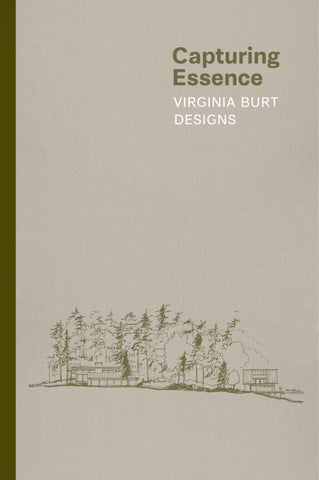
Introduction Every body of work has an origin, and for Virginia Burt it began on the land itself. Growing up on an apple farm in Brooklin, Ontario, she learned early that nature is not static—it moves, shifts, rests, and renews. Seasons arrived with purpose. Trees bloomed, bore fruit, and returned to stillness. The landscape was both a workplace and a teacher, shaping an understanding that land responds to care, patience, and time. That early immersion fostered a deep respect for the living systems that sustain us and an instinctive awareness of their power. Nature was never something separate from daily life— it was home. It fed, sheltered, and sustained, offering lessons that were both practical and quietly profound. Watching fruit grow and ripen revealed something essential to Virginia: there is an energy far greater than ourselves, one that is rich in meaning and possibility. That understanding—part spiritual, part grounding—has stayed with Virginia and continues to inform the way she approaches design. In her words: “Walking the mystical path with practical feet.” Founded in 1996, Virginia Burt Designs (VBD) has grown into an award-winning landscape architecture firm with offices in Ohio and Ontario, working on projects across the United States and Canada. The firm’s work spans residential and estate landscapes, therapeutic and healing gardens, institutional projects, urban environments, and native landscape restoration. While the settings vary, the intention remains consistent: to understand each site deeply and respond with clarity, care, and respect. Virginia leads a collaborative team of landscape architects and designers whose influences extend well beyond the discipline itself. Art, travel, poetry, photography, history, and close partnerships with artists, craftspeople, quarry workers, and nursery growers all shape the firm’s work. Clients range from healthcare organizations and academic institutions to public agencies and private individuals, all seeking landscapes that feel considered, personal, and alive. Capturing Essence, created to mark the firm’s thirtieth anniversary, is both a celebration and a reflection. It offers a window into the firm’s process and philosophy, sharing landscapes that were imagined, drawn, refined, and built through years of collaboration. These are places designed to engage the senses,
1
1 An adventurous soul on the zipline at Common Ground, The Cindy Nord Center for Renewal, near Oberlin, Ohio.
support well-being, and create moments of calm, connection, and renewal. Together, they reveal a practice rooted in listening and shaped by experience. At the heart of VBD’s work is a belief that our connection to nature is essential. Research increasingly supports what many people feel instinctively—that time spent in natural environments reduces stress, restores balance, and supports healing. Virginia Burt Designs works with this understanding, shaping landscapes that allow nature’s inherent benefits to be felt more fully. Design, ecology, science, craftsmanship, and long-term stewardship are brought together in a holistic approach that values both beauty and responsibility. The projects featured in this book reflect that range of thinking. Acadia Point transforms a former industrial site into a place of environmental restoration and renewal, where home, sea, and land exist in careful balance. The Schneider Healing Garden at Cleveland’s University Hospitals Seidman Cancer Center was designed specifically to support patients, families, and caregivers through quiet engagement with nature. Though different in scale and context, both share a commitment to healing, balance, and purpose. People are central to every project. The firm’s process is collaborative and inclusive, built on deep listening and meaningful engagement. Clients, architects, consultants, and future users all contribute to shaping the outcome. Just as important is respect for the land itself—working with existing ecologies, restoring damaged environments, and designing spaces that are meant to endure. United by a shared belief in the power of thoughtful design, the firm’s work seeks to create places where people, art, and nature intersect. Like a nurturing river, this belief flows through every project: that landscape architecture can elevate quality of life, protect the natural world, and address contemporary challenges such as climate change—transforming ideas into meaningful, life-affirming places. This approach is especially evident in VBD’s early work: the master landscape plan for Common Ground, The Cindy Nord Center for Renewal, near Oberlin, Ohio. Set in a wooded valley along the Vermilion River, a highly participatory planning process involving seventy people tapped into the collective wisdom of the community. Paths, adventure courses, and gathering places unfold across the site,
23
encouraging reflection and discovery while supporting the center’s mission of learning, growth, and renewal. The project received a national American Society of Landscape Architects award in 1999. Throughout all this work runs a shared belief: thoughtful landscape design makes a meaningful difference. It supports health, strengthens connection, protects the environment, and responds to the challenges of our time, including climate change. These landscapes are not decorative additions—they are essential spaces that support both human and ecological well-being. Sea, sky, stone, forest, light, and air—these simple elements speak to our most fundamental experience of place. We respond to them instinctively through our senses, our bodies, and our emotions. As landscape architects, the firm embraces a sacred responsibility: to foster these experiences, to remove barriers where they exist, and to restore balance where it has been lost. To renew, rewild, and heal the land so that harmony between people and nature can once again be felt.
24
The landscapes in this book heighten that awareness, inviting us to slow down, to notice, and to reconnect with what grounds us. That is the quiet strength of Virginia’s work. The projects that follow are thoughtful, soulful expressions of a practice built on care— for people, for land, and for the interstitial spaces where the two meet. Together, they capture the essence of what landscape architecture can be when it is done with intention, humility, and heart.
27
Acadia Point
41
Norma’s Garden at The Gathering Place
53
A Rooftop for Living
65 Schneider Healing Garden at Seidman Cancer Center, University Hospitals 79
Modernist Reflection
91
A Tale of Two Houses
105
Grounded in Symmetry
117
Morgan’s Garden at Monarch Lifeworks
131
Itabashi Japanese Garden
143
The Cove
153
Lake Rosseau Cottage
165
Chebucto Head Battery
181
Blueberry Island
193
Hatt Street
207
Art Belongs in the Garden
217
Nature and Architecture in Harmony
227
Bluff Point Cottage
0
Acadia Point
27 27
0
Grounded in Symmetry
105 105
112
Grounded in Symmetry
1 Ped modignis re id quia simolorum expliqui conempor aute eos explit, volest aut magnam, cum vendae remporehenim adis ant alignis aut quibusd aerferum fugitiores dolori volupta tiatate nitiunti occatiis magni.
2 The sea, finally
revealed, seems to envelop the “floating” slate sunset terrace. Os id quisqua musam, ipient fugitios quia, cum vendae remporehenim adis.
3 Ped modignis re
id quia simolorum expliqui conempor aute eos explit, volest aut magnam, cum vendae remporehenim adis ant alignis aut quibusd aerferum fugitiores dolori volupta tiatate nitiunti occatiis magni.
4 The sea, finally
revealed, seems to envelop the “floating” slate sunset terrace. Os id quisqua musam, ipient fugitios quia, cum vendae remporehenim adis.
113
1
1
2
2
3 1 A master plan of
humble dimensions resonates with depth. Paths, dry streams, interweave with a dense palette of plants, rocks, ornament.
140
Itabashi Japanese Garden
4
6
5
2 Throughout chang-
ing seasons and conditions, the sekito provides a visual anchor and orientation in the garden. Captivating after snowfall, unusual evergreens create small mounds that elevate a meandering stroll.
3 Detailed sketch
for planting, maintenance, and position of Japanese maple. The garden holds twenty-three species of the tree, comingling with proud Canadian natives.
4 The garden has
become a place of celebration, realization, and exploration for people of all ages and abilities. Tai chi classes for seniors are held every other day, sun or snow!
5 Elevation and
section sketches for rolled steel hoop edging—a Canadian take on the bamboo edging employed in Japan.
6 Corten steel
hoop edging ages gracefully while subtly defining garden spaces.
141
1
178
Dunbar
2
3
↑ Locally sourced
slate meanders through native grasses and plants on the green roof, set in frame of corten steel. The “new” plants blend seamlessly into existing established blueberries, bayberry, and bearberry.
1 Second floor bedroom views are directed by arbor beams past the former gun emplacement, over green roof, to a contemplative view of the sea and starry sky. The channel marker beckons.
4
2 Thermally modified
to withstand harsh outdoor environments, sustainable ash decking directs the eye—a beautiful reuse of a species under duress from emerald ash borer.
3 Joists and beams
for the arbor are finished in the shō sugi ban style, a traditional Japanese burning technique for preservation and beauty that joins aesthetics with practicality.
4 A precarious edge
is made secure while transparency allows a safe and comfortable experience of promontory, overlooking the sea.
179
188
Blueberry Island
1 Ped modignis re id quia simolorum expliqui conempor aute eos explit, volest aut magnam, cum vendae remporehenim adis ant alignis aut quibusd aerferum fugitiores dolori volupta tiatate nitiunti occatiis magni.
2 The sea, finally
revealed, seems to envelop the “floating” slate sunset terrace. Os id quisqua musam, ipient fugitios quia, cum vendae remporehenim adis.
3 Ped modignis re
id quia simolorum expliqui conempor aute eos explit, volest aut magnam, cum vendae remporehenim adis ant alignis aut quibusd aerferum fugitiores dolori volupta tiatate nitiunti occatiis magni.
4 The sea, finally
revealed, seems to envelop the “floating” slate sunset terrace. Os id quisqua musam, ipient fugitios quia, cum vendae remporehenim adis.
189
222
Nature and Architecture in Harmony
1 Ped modignis re id quia simolorum expliqui conempor aute eos explit, volest aut magnam, cum vendae remporehenim adis ant alignis aut quibusd aerferum fugitiores dolori volupta tiatate nitiunti occatiis magni.
2 The sea, finally
revealed, seems to envelop the “floating” slate sunset terrace. Os id quisqua musam, ipient fugitios quia, cum vendae remporehenim adis.
3 Ped modignis re
id quia simolorum expliqui conempor aute eos explit, volest aut magnam, cum vendae remporehenim adis ant alignis aut quibusd aerferum fugitiores dolori volupta tiatate nitiunti occatiis magni.
4 The sea, finally
revealed, seems to envelop the “floating” slate sunset terrace. Os id quisqua musam, ipient fugitios quia, cum vendae remporehenim adis.
223
234
Bluff Point Cottage
1 Ped modignis re id quia simolorum expliqui conempor aute eos explit, volest aut magnam, cum vendae remporehenim adis ant alignis aut quibusd aerferum fugitiores dolori volupta tiatate nitiunti occatiis magni.
2 The sea, finally
revealed, seems to envelop the “floating” slate sunset terrace. Os id quisqua musam, ipient fugitios quia, cum vendae remporehenim adis.
3 Ped modignis re
id quia simolorum expliqui conempor aute eos explit, volest aut magnam, cum vendae remporehenim adis ant alignis aut quibusd aerferum fugitiores dolori volupta tiatate nitiunti occatiis magni.
4 The sea, finally
revealed, seems to envelop the “floating” slate sunset terrace. Os id quisqua musam, ipient fugitios quia, cum vendae remporehenim adis.
235
Before and After
About Virginia Burt Designs (VBD) specializes in creating engaging, beautiful, and deeply meaningful landscapes and gardens for private residences, public institutions, and healthcare organizations. Our design studio comprises a small, dedicated, and passionate team united by a shared love of landscape architecture. We are specialized, collaborative, supportive, and creative professionals. Since founding the firm in 1996, Virginia Burt has dedicated her career to creating spaces that uplift the human spirit, foster connection, and invite wonder and reflection. At the time of the firm’s inception, the importance of healing gardens was not yet widely understood. Virginia emerged as a pioneer in this field, developing a holistic approach that attends to the physical, emotional, mental, and spiritual dimensions of experience, while weaving together the meaning of place, the genius loci, and stakeholder insights—all grounded in evidence-based design. Over three decades, this approach has shaped gardens and landscapes of meaning across North America and beyond, earning Virginia recognition as one of only seven women worldwide to hold fellowships from both the American and Canadian Societies of Landscape Architects for outstanding contributions to the public and the profession. Virginia has established herself as an internationally acclaimed leader in designing landscapes of meaning and healing, receiving praise for her skill in shaping environments that are engaging, inclusive, and emotionally impactful. Virginia has designed and directed over four hundred private and public landscapes, receiving numerous awards, including honors from the Canadian and American Societies of Landscape Architects, the Palladio Award, and the Parks and Recreation Ontario Award of Excellence. Virginia brings this depth of expertise, insight, and vision to every project and has cultivated a strong, passionate studio team deeply committed to creating landscapes that are timeless, engaging, and responsive. The VBD studio is driven by a passion for creating rich, layered, and meaningful experiences. Inspiration comes from many sources, be it a children’s poem, a luminous sunset, exposed bedrock, or a fleeting moment in nature when a flower finally opens. Each project is rooted in an intimate understanding of the land. The team “reads the site,” carefully observing conditions such as bedrock, microclimates, existing vegetation, patterns of
258
use, and ecological systems to ensure that our designs are both contextually responsive and environmentally sensitive. With extensive experience working in remote and sensitive landscapes across North America, VBD is adept at preserving and integrating existing site elements with care and creativity. Environmental and cultural sustainability are central to our firm’s approach. Every project begins with a deep understanding of the needs, abilities, and desires of those who will experience the space. VBD designs gardens that are accessible, inclusive, and inviting, helping thousands of people reconnect with the land, themselves, and one another. Following in the footsteps of Virginia’s mentor and close friend, Cornelia Hahn Oberlander, CC, research forms the foundation for taking design to its highest level. Whether through careful statistical research or the thoughtful selection of a single plant, evidence-based design is a defining strength of the firm. A deep understanding of materials and an emphasis on detailed design transform our ideas into built form. Virginia Burt Designs is dedicated to creating moments of beauty where art and science meet. When passion, experience, and research come together, landscapes transcend function and become meaningful places. At VBD, ideas are realized with rigor, care, and craftsmanship—and they are built beautifully.
Acknowledgments This book exists because of the generosity, patience, and belief of many hands and hearts along the way. To my father, Larry, my mother, Diane (aka Dice), and my brother, Tye—my life was shaped by you, in ways both seen and unseen, and I carry that foundation with deep gratitude. To my dear wife, Davee, you have my heart and my thanks for the thoughtful edits that kept me moving forward when the path grew long. And to the remarkable people of Virginia Burt Designs, past, present, and those yet to come: your talent, care, and collaboration are the reason these landscapes and this book could take root and endure. With sincere gratitude, I acknowledge our remarkable clients, whose trust and long view make this work possible. It is a true privilege to walk alongside you as stewards of these landscapes—from the earliest conversations and shared aspirations, through realization, and into the attentive care that allows each garden to deepen over time. Your commitment to thoughtful, long-term guardianship elevates design into something enduring: living places that grow richer with age, grounded in beauty, purpose, and a profound connection to their setting. I also extend my deep appreciation to all who fostered connections with like-minded professionals—consultants, architects,
contractors, subcontractors, landscape contractors, suppliers, and fabricators—whose expertise, rigor and collaboration bring these projects to life. Each of you has made a meaningful difference through your skill, ingenuity, and steadfast commitment to doing the work well and with integrity. Each contribution has quietly but profoundly helped shape the landscapes presented in these pages. To the artists and craftspeople: your vision, mastery, and handwork elevate these landscapes beyond the bounds of design and construction, shaping them into places of enduring beauty and cultural resonance. I remain in constant admiration for your contributions to these projects and the broader community enriched by your work. To my esteemed publisher, Gordon Goff at ORO, and to editor Kirby Anderson, to Jessica Sullivan and Naomi MacDougall of DSGN Dept: you and your team have made creating this book a joyful experience. And to my contributing writer, Douglas Curran, thank you. It has been a pleasure to work alongside you in giving voice to these landscapes. To my beloved spiritual family—JohnRoger, John Morton, Lawrence Caminite, Mark Samuel, and the many others who walk this path with me. Your steady presence and loving light have given me both the strength and the courage to trust that all things are possible. For your guidance, compassion, and quiet grace, I offer my deepest thanks. Among the colleagues who became dear friends during those formative early years are Bonny and Mark Hershberger, Sylvia Behr and Karen McCoy, to name just a few. And to those who have continued to offer steadfast support in countless ways: Arnis Budrevics, William Childs, Jack Bialosky, Eileen Saffran, Danette Kauffman and others, I am profoundly grateful. There are so many more who deserve acknowledgement, and please know that this work is never accomplished alone. It thrives on your lively banter, critical thinking, and generous creative exchange. To our generous sponsors at every level, a warm thank you and much appreciation. Your support has been essential to the realization of this book. Finally, to our planet for sustaining us, for the fresh air we breathe, and the water that nourishes all life. May our work continue to honor this gift: planting trees, cultivating green spaces, and nurturing landscapes that give back to the world in beauty, vitality, and life.
259