Contents Book Synopsis Acknowledgements List of Image Credits
4 6 8
Foreword David Turnbull
16
Preface Steffen Lehmann
20
Photo Series by Cida de Aragon: The Edge of the City Photo Series by Steffen Lehmann: Mojave
24 34
Introduction Desert Urbanism — Lessons from the Cactus and the Camel
40
Bibliography and Further Reading
66
Illustrated Part
68
Part I Setting the Scene: Architects and Authors Reflecting on 110 the Desert
1.1 Statement Alan Hess 1.2 Statement Daniel J. Chenin 1.3 Statement Mark Mueckenheim 1.4 Statement Joseph Ewan 1.5 Statement Cade M. Hayes, DUST 1.6 Statement Susan Roaf 1.7 Statement Woods + Dangaran 1.8 Statement Tom Rivard 1.9 Statement Passaint Massoud
116 117 118 120 122 123 125 126 128
Part II Making the Case: Toward a Deeper Understanding of the Desert as 132 a Place of Possibility
2.1 T.E. Lawrence of Arabia and Gertrude Bell: the European View of the Desert 2.2 Desert Highway: the Rise and Fall of Route 66 2.3 Oppenheimer’s Headquarters in the High Desert of Los Alamos, New Mexico 2.4 Area 51: a Secret Military Base and an Extraterrestrial Highway 2.5 Making Desert Movies: Paris, Texas; No Country for Old Men; and Breaking Bad
132 138 144 150 156
Part III Imaginary Places: Urbanism and Utopian Communities in 162 the Desert
3.1 Shibam and Siwa: two Ancient Desert Cities in Yemen and Egypt 3.2 Frank Lloyd Wright and Taliesin West, Arizona 3.3 Arcosanti and the Utopian Vision of Paolo Soleri 3.4 California City: How a Bold Vision for a Desert Metropolis Turned to Dust 3.5 Biosphere II: a Laboratory for Earth’s Systems in the Sonoran Desert 3.6 Burning Man: from Event to Temporary Black Rock City 3.7 Masdar, Smart Desert City in Abu Dhabi 3.8 Neom, The Line: a New Type of Desert City in Saudi Arabia?
162 168 176 184 190 196 204 212
Part IV Designing for the Desert: Climate-Responsive Architecture 220 for Present Challenges and Future Needs
4.1 Hassan Fathy, Building in the Egyptian Desert 4.2 Desert Modernism in Palm Springs: Albert Frey and Richard Neutra 4.3 Desert Modernism in Tucson: Arthur T. Brown, Judith Chafee, and Rick Joy 4.4 Steel Prefab Masters: from Craig Ellwood and Pierre Koenig to the IT_ House 4.5 Kellogg Doolittle House and Elrod House in Joshua Tree, California 4.6 Designing with the Desert: Antoine Predock from Albuquerque 4.7 The ESO Hotel and the CID Interpretation Centre in the Atacama Desert, Chile 4.8 Learning in Extreme Climates: Two Schools in Jaisalmer and Burkina Faso 4.9 Desert Architecture in Australia and Namibia: Reframing the Desert 4.10 Building for Heat: Rethinking the Desert House in the American Southwest
Part V Desert Dreamers: Artists of the Desert
220 226 236 242 250 256 262 268 274 284
300
5.1 Marta Becket and the Amargosa Opera House in Death Valley 300 5.2 The Abiquiú Home and Studio of Painter Georgia O’Keeffe 306 5.3 Public Art in the Desert: Donald Judd in Marfa, Texas 312 5.4 Monumental Works: Michael Heizer’s ‘City’ and Richard Serra’s ‘East-West/West-East’ 320
Part VI Researching the Desert City: Methods and Measurement
328
Conclusion Desert Urbanism: The Desert City of the Future
338
A. Passive Cooling Strategies: Integrating Traditional Knowledge and Contemporary Innovation for Sustainable Urban Development
338
B. The Case of Las Vegas. What Does the Desert City of the Future Look Like?
358
About the Author Introducing the Research of Former Ph.D. Students Index Advance Praise
380 382 384 390
Book Synopsis
“
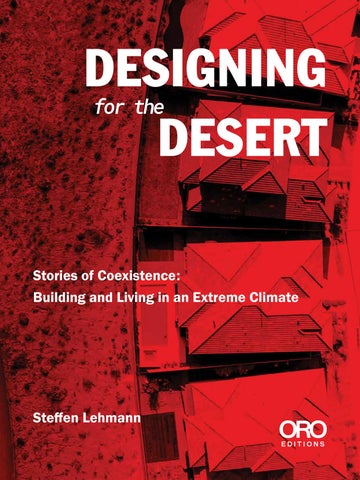
The desert is not just a place of escape - it’s a place of possibility. It’s a place where it is possible to take knowledge and traditions from elsewhere and replant them, allowing them to take shape in new ways. – Adam Lerner, 2024 Desert cities are among the fastest-growing urban environments on the planet, yet they remain one of the least studied in architectural and urban design literature. Today, more than one billion people live in desert regions, and urbanisation rates in arid zones are accelerating worldwide. This imbalance between rapid growth and limited research is precisely the gap this book addresses. Designing for the Desert: Stories of Coexistence — Building and Living in an Extreme Climate takes a rigorous and wide-ranging look at the myth of the desert, the realities of designing for extreme arid climates, and the architectural precedents that point toward a more sustainable future. Drawing on original research and direct conversations with architects, planners, and decision-makers shaping tomorrow’s desert cities, the book examines a diverse range of built cases and narratives through the dual lens of researcher and practitioner. Extensively illustrated, the book investigates the history, present transformation, and future prospects of desert urbanism — with particular focus on the rapidly expanding cities of the US Sun Belt and the Middle East, where mass migration and explosive growth have made the challenge of coexistence with harsh natural environments both urgent and unavoidable. By identifying persistent knowledge gaps and analysing exemplary design responses, the book offers essential guidance for architects, urban designers, engineers and policymakers working at the frontier of one of the most consequential built environment challenges of our time. The author examines desert narratives across diverse cultures and centuries, tracing how desert settlements function as oases, trading posts. Retreats that embody shared cultural, environmental and social values. The book contends that this role remains undiminished. It is evolving. This study argues that achieving thermal comfort in desert climates requires more than the provision of air-conditioning. The study investigates natural, passive strategies for ventilating and cooling buildings. Using a comparative case study approach, the book analyses ancient and traditional desert cities together with next-generation urban developments currently planned in Saudi Arabia and elsewhere, emphasising hybrid models that integrate time-tested passive cooling strategies and vernacular solutions with modern active technologies. The discussion extends to the future of public space in desert cities, the critical need for shade and vegetation, and how desert environments will continue to evolve under climate change, water scarcity and rapid urbanisation. The book offers a compelling survey of structures by architects designing for desert environments, illustrating how historical precedents inform and actively shape contemporary practice. Selection criteria prioritised the degree to which projects integrate desert architecture principles across diverse climatic and cultural contexts. 4
Desert cities exist within complex, multidimensional relationships — shaped by cultural, environmental and societal forces, by the surrounding landscape, and by the broader knowledge systems they inhabit. Yet the Desert City of the Future remains largely undefined in terms of its optimal performance, spatial character and architectural identity. The book’s second part explores both the opportunities and challenges of that definition, examining new approaches alongside the rediscovery of traditional methods for achieving thermal comfort in extreme urban conditions. In a fragile desert environment, reducing construction footprints, minimising waste and sourcing materials locally are not merely best practice — they are imperatives. This study contends that, fundamentally, the desert constitutes a site of opportunity. The work details design initiatives born of the desert condition, where light, water and shade function as the important ingredients of Desert Urbanism. One of the book’s central arguments is that desert cities will continue to grow. That this growth, if well managed, offers opportunity: employment, housing, healthcare and access to recreation within compact, liveable distances. Written by an architect with extensive research experience and deep professional engagement with desert environments, and richly illustrated with exemplary cases of climate-responsive design, this book serves as both an academic resource and a practical reference — for architects, urban designers, planners, engineers, students and researchers, and for anyone with a stake in the future of desert cities and the architecture that will define them. Book Highlights • The study explores the contradictions and paradoxes of building and living in the desert. • Designing and building in desert cities is one of the most demanding challenges in architecture. This book presents a curated selection of historically significant and contemporary projects, identifies emerging trends relevant to the profession, and offers rare insight into the realities of building in extreme heat and aridity. • According to the United Nations, more than one billion people worldwide live in desert regions, and urbanisation in arid zones is accelerating. The book uncovers the stories, strategies, and design thinking behind exemplary desert projects — examining both the challenges and the climate-responsive solutions they pioneered. • Part I features statements by leading architects and academics actively working in desert environments — firsthand perspectives on modern desert thinking from the field. There is a range of different approaches, and the publication reflects this. • Desert architecture has become a crucible for combining traditional passive approaches with innovative technology and forward-looking social vision. A recurring lesson from historical cases: thick walls, small windows, shaded courtyards, local materials, and stone floors are not vernacular nostalgia — they are proven climate logic. • Despite the scale and urgency of desert urbanisation, climate-responsive design for arid environments remains undertheorised and underrepresented in the literature. The book addresses this gap through a focused selection of contemporary projects across the US, Saudi Arabia, the UAE, Australia, Namibia and India. • A central conclusion is that interdisciplinary research is essential to defining a viable model for the Desert City of the Future — one that is polycentric, walkable, mixed-use, cool and grounded in its social, environmental, climatic, and cultural context. 5
Foreword
David Turnbull
I’ve been through the desert on a horse with no name / It felt good to be out of the rain / In the desert you can’t remember your name . . . ― Song lyrics by America, 1971 In early 1972, in Britain, it felt good to be dreaming about America. I was fourteen, listening to Radio One, watching ‘Top of the Pops’ on the BBC. The band ‘America’, had a hit single — ‘A Horse with No Name’ (1971). Their songwriter, British-born American, Dewey Bunnell grew up on USAF bases, in the UK and USA. As a teenager he explored the deserts of California, Arizona and New Mexico. For Bunnell, the desert is complex but comforting, his relationship with it, like Steffen Lehmann’s — affectionate. After two days in the desert sun / My skin began to turn red . . . And after three days . . . I was looking at a river bed / And the story it told of a river that flowed / Made me sad to think it was dead... I have been through the desert many times. In my dreams, in Egypt, with the Desert Fathers and Mothers, whose sayings are collected in the ‘Apophthegmata Patrum’. In reality, with engineers from Dar Al-Handasah, in 1997, working on plans for a new town between Cairo and Suez. Since 2004, in ‘America Deserta’, frequently, guided by Reyner Banham (1922 - 1988), not cycling . . . walking, like Leto, in Frank Herbert’s ‘Children of Dune’, Book 3 of the Dune Chronicles (1976), purposefully out of step, or driving, like Jean Baudrillard, at speed. Not crawling on bloody hands and knees . . . like Edward Abbey (1927 - 1989), who wrote his introduction to ‘Desert Solitaire’ (1968) in a bar, in Hoboken, New Jersey. A detail, I know, but significant enough for the author to acknowledge where he was on the day, in April 1967, when he was done, when the book was complete and he could declare that ‘most of what I write about is already gone or going fast.’ Abbey was a Fulbright Scholar at the University of Edinburgh for the academic year 1951/52. He completed his thesis on ‘Anarchy and the Morality of Violence’ at the University of New Mexico. He loves the desert . . . ‘Why? — Because there’s something about the desert’ . . . and . . . the desert has been neglected. ‘Not entirely, of course. There was T.E. Lawrence who liked the desert because, as he said, “it is clean,” and another mad Englishman, C.M. Doughty — Travels in Arabia Deserta (1888) — who almost never came back . . .’ Abbey adds a short list of American authors who ‘tried to understand the desert . . .’ however, none of them, however mad, attempt an answer to his profoundly vexing question — “what is the peculiar quality or character of the desert that distinguishes it, in spiritual appeal, from other forms of landscape?” 16
Abbey concludes his introduction, with a challenge: ’This is not a travel guide but an elegy. A memorial. You’re holding a tombstone in your hands. A bloody rock. Don’t drop it on your foot — throw it at something big and glassy. What have you got to lose?’ My thoughts return to Gaston Bachelard’s ‘The Poetics of Space’ (1958), specifically his chapter on ‘Intimate Immensity’, provoked by Edward Abbey’s question, and the relationship of the ocean and the desert, in my life, as I move between Los Angeles and Phoenix, regularly. For me there is ‘something’ about the desert and the ocean, considered together and apart. I am drawn to both. Recalling the intimacy of water and ‘the drama of drought’, Bachelard discusses images of the desert found in ‘Le plus beau désert du monde!’ (1955), translated as, ‘The Most Beautiful Desert of All’ (1956), written by Philippe Diolé (1908 - 1977) . . . an undersea explorer. The deep-sea diver ’does not detach himself from the ocean, and, in fact, desert space, far from contradicting deep-sea space, is expressed in Diolé’s dreams in terms of water’ — without substance, without dimension, without limits . . . After nine days I let the horse run free / ‘Cause the desert had turned to sea . . . The ocean is a desert with its life underground / And a perfect disguise above . . . I have been searching for a memory, real or imagined, turning the pages of Deleuze and Guattari’s ‘Treatise on Nomadology’, no longer an everyday reference for me, but somehow, persistent. The memory — a passage about the Sudanese conflict, Khartoum, Gordon, the Mahdi, generalised in my imagination as hierarchical discipline disrupted by desert intelligence. Concealed, under the sand, breathing through small diameter pipes — snorkels — the Ansār wait patiently, to attack by surprise, in all directions, from beneath and within the advancing British regiments. I could not find it, or them. At CIAM IX, in Aix-en-Provence, in 1952, French teams from the Maghreb, North Africa, undermined the authority of the Charter of Athens — Roland Simounet’s sophisticated freehand drawings of living conditions and daily routines in the ‘Mahieddine’ bidonville submitted by Team Alger, George Candilis’ Team Maroc, from Casablanca, both, had the audacity to suggest to the leaders of CIAM that there were lessons to be learned from indigenous people who knew how to live in the desert. In the same year, encouraged by Jørn Utzon, the Norwegian architect and member of PAGON, the Progressive Architects of Norway, Sverre Fehn, traveled to Morocco, to study architecture in the desert. Some of the many sketches and notes from his journey were summarised and presented in Byggekunst no. 5, 1952, including this: ‘If you sat in southern Morocco for two years, blindfolded, just listening, feeling the scent of the nature and the people, and then took off your blindfold, you would have learned nothing.’ This ‘nothing’ is, of course, everything. Fehn concludes with this insight: ‘Architecture works towards ”perfection”, because it works in a timeless space. Its signature is “anonymous”, for it is nature itself.’ One year later, in no. 6-7, 1953: ‘Gammelt og Nytt’ — ‘Old and New’, Byggekunst published a response to the deliberations at CIAM IX, and the provocation represented by Sverre Fehn’s Moroccan sketchbooks. Important in this context because the photographs and drawings were made by an exceptional architect and 17
future collaborator with Fehn, Geir Grung (1926 - 1989), who also wrote a highly speculative, poetic text, that ends with a proposition. Grung’s photographs are tantalising, a camel train crossing the Sahara, a small boy on a donkey in a ‘desert city’ — his name is Muhamid — ’new’ traditional buildings in the desert, and the Temple of Agrigento in Sicily, courtyards in fishing towns on Ibiza, solaria in Madrid. ‘Muhamid’, the desert city, and the temple are placed on the right hand side of a double page spread, to be seen in juxtaposition, with a very strange view of the roof of Le Corbusier’s ‘Unite d’Habitation’ in Marseilles, and a sketch, by Grung, of a building in the Gullimin oasis in the Sahara. The careful combination of images is wonderfully suggestive. The proposition — inferred from another juxtaposition, a profoundly ambiguous photograph, ‘Jern og fjell’, with its textual counterpart, ‘Jern - Fjell’ without a conjunction, ‘iron-mountain’: Architecture will be discovered, while fishing for iron mountains, in the desert. ― Geir Grung, 1953 Paolo Soleri (1919 - 2013) lived in the desert . . . on a mountain in Arizona, in a tent, while building the ‘Dome House’ (1949 - 1950), in a valley, building ‘Cosanti’ (1956 - ), and ultimately, on a mesa, building ‘Arcosanti’ (1970 - ). Listening to the desert, bearing witness to the consumption of the desert by the city, and the desertification of the city, exhausted by ‘bigness, flatness, isolation, logistical crippling, land destruction, soil decay, aquifer degradation . . . pollution . . . ’, Soleri makes a commitment to frugality, and ‘leanness’ as ‘exuberant frugality’. Arcosanti is an urban laboratory for ‘lean minds’ living and working together in a ‘lean habitat’ in the desert. In 1995, after more than forty-five years of reflection, recording his thoughts, every day, he asks — ‘What have I been doing?’ His answers compress many thousands of words into five short statements, beginning, ‘I have been working’, at or on . . . five issues, including ‘the demise of the single home for the sake of community’ . . . ‘the demise of the suburban diaspora for the sake of the urban effect’ . . . and, third ‘the demise of hyperconsumption for the sake of frugality and the culture of excellence it may generate’. In 1990, the British Architect, Alison Smithson (1928 - 1993), juxtaposed two early Renaissance images of St. Jerome, in the Desert, and the Study, with a text drawn from her lecture Fragment of an Enclave given in Barcelona in 1985, and Stockholm in 1986. The diptych, made for the furniture manufacturer, TECTA, from Lauenforde, Germany, for their stand at the Salone Internazionale del Mobile di Milano, 1991, presented the desert as the paradigmatic setting for solitary contemplation, and encounters with divinity. Without Architecture . . . without Architects. The protective enclosure of the Study, on the contrary, represented, ‘the desire to enjoy built order . . . the support by civilised services . . . the shutting out of inclement weather . . . the ability to temper the climate . . . and a perfected sufficiency in the functional place of work, with the tools of the profession, trade, housekeeping, to hand’. For me, for many years, Antonello da Messina’s painting ‘Saint Jerome in his Study’ (c. 1474), has been a defining image, used frequently, a ‘leitbild’, a condensation of thoughts about the construction of an ideal place for reading or writing. Alison Smithson’s juxtaposition of St. Jerome’s two habitats —the Desert and the Study, has more generalisable implications, promoting ‘a change in attitudes towards the use of the earth, a use of things without excess, of enjoyment in a less wasteful way’, suggesting, gently, that a ‘merging of the old reciprocity will allow us to begin to think of a new form of restorative habitat for a future light touch inhabitation of the earth.’ 18
As Gianni Pettena (b. 1940), put it, in ‘Radicals: Design and Architecture 1960/75’ published in 1996 — ‘Being radical means going to the roots, finding architecture in the world, in nature . . . even in the desert!’ For Sverre Fehn and Geir Grung, the ‘timeless space’ of the desert is a setting in which architecture and nature, become one. The desert provokes Paolo Soleri to theorise ‘exuberant frugality’. Alison Smithson to call for a ‘future light touch inhabitation of the earth’. Eremos, Eremia . . . Midbar, Arabah, Chorbah, Yeshimon — the Biblical wilderness, Angelus Silesius’ ‘pure place’, and, in America, the proving ground for weapons of mass destruction, the desert holds the secret to eternal life and universal death. Steffen Lehmann loves the desert, like Edward Abbey. He lives in a desert city. He admires the peculiar character of the desert that distinguishes it, in spiritual appeal, from other forms of landscape. He respects its secrets. Both he and I would take issue with Pettena’s ‘even’, and disagree with Abbey on one point — that most of what he writes about is already gone or going fast. The desert, wherever we may find it, is being transformed. As temperatures soar and aquifers are drained, in the time of the end, the desert has become the proving ground for a new architecture, of the earth, for humanity. Prove it . . . we must. What have we got to lose? Everything.
David Turnbull is an architect, thinker, and educator based in Los Angeles who previously served as President of The Cosanti Foundation in Scottsdale, Arizona. His thirty years of design education across four continents have produced an unusually broad international perspective on architectural practice and pedagogy. His academic career commenced in 1989 at the Architectural Association in London, concurrent with his work at the office of James Stirling, Michael Wilford and Associates on major projects in Spain, Japan and Singapore. He has served as the Eero Saarinen Visiting Professor of Architecture at Yale University and has held visiting professorships at Columbia University’s GSAPP, the University of Toronto, and Cornell University. He was Professor of Architecture at the University of Bath from 2000 to 2005, at the Cooper Union in New York from 2006 to 2017, and Visiting Professor at the African University of Science and Technology in Abuja, Nigeria, in 2012 and 2013. Between 2003 and 2018, he held the positions of Director of ATOPIA Innovation and Design Director of ATOPIA Research Inc / PITCHAfrica. Since 2024, he has held the position of Senior Transformation Fellow at the Las Vegas Urban Futures Lab. 19
Preface Designing for the Desert – Toward a Climate-Responsive Architecture Stories of Coexistence: Building and Living in an Extreme Climate Steffen Lehmann
“
I don’t see the desert as barren at all; I see it as full and ripe. It doesn’t need to be flattered with rain. It certainly needs rain, but it makes do with what it has, and creates amazing beauty.
― Joy Harjo, 2019
Background: What Defines a Desert? Although cities are frequently celebrated as humankind’s greatest invention, they impose an enormous environmental cost. The built environment consumes vast resources and accounts for approximately 55% of global greenhouse gas emissions. Construction and demolition activities generate over 35% of all waste, a proportion whose contribution to biodiversity loss has received far less scholarly and policy attention than the scale of the problem warrants. The combined production of concrete and steel contributes more than 10% of global greenhouse gas emissions. Average global temperatures exceeded pre-industrial levels by more than 1.5°C in 2025, quantifying the current scale of the challenge. Heat waves are increasing in duration and intensity, with desert cities experiencing these effects most severely. The built environment drives this trajectory, accelerating environmental degradation, ecosystem damage, and biodiversity loss. In desert cities, chronic dependence on air-conditioning, car-oriented urban form and water scarcity compound these pressures, creating cascading consequences. A desert is a geographically defined region characterised by arid, largely barren terrain that receives no more than 250 mm (10 inches) of precipitation per year. Hot and cold deserts feature sparse vegetation, yet resilient species including agaves, yuccas and thorny shrubs persist in these environments. The word itself derives from the Latin “desertum”, meaning “abandoned” or “left behind,” and the prevailing perception aligns with this etymology: deserts are often imagined as vast, empty expanses of scorching heat, inhospitable terrain. Sparse life, spaces awaiting exploitation and resource extraction. Wendl (2023) notes that deserts have historically been regarded, largely through a Eurocentric lens, as precarious environments, where extreme temperatures and climatic conditions hinder the flourishing of life. Death Valley’s stark topography and extreme summer temperatures make it the most vivid North American embodiment of this reputation (see Figure 14), yet the desert resists such reductions. In his 1943 novel, Antoine de Saint-Exupéry captured this idea beautifully through the Little Prince, who observes that “the desert’s beauty lies in its concealment of a well” and that true beauty in any place is invisible. In recent years, I have found myself increasingly drawn to the deserts of this world and their particular qualities, qualities that are real but difficult to define. Desert ecosystems exhibit a 20
degree of complexity and fragility that the broader literature consistently finds surprising. In his 1988 work, Paulo Coelho observed that the immense scale and distant horizons of a desert evoke a feeling of smallness, rendering silence the only fitting response. Deserts occupy 33% of the global land surface on every continent, spanning both hot and cold environments. Among the current global population of 8.4 billion, roughly 1.1 billion individuals, comprising 13%, reside in desert cities and regions that are frequently expanding at remarkable speed. The population trajectories of Las Vegas, Phoenix, Dubai, Riyadh, Cairo, Karachi and Lima over the past three decades demonstrate the scale of this phenomenon. Designing for the desert, from nomadic camps and ancient adobe pueblos to tiny trade outposts and modern urban centres, has always been a demanding task and remains a critically important field of study. Why do so many architects and urban designers remain largely unfamiliar with it? Western authors such as Doughty, Van Dyke and Nash have romanticised desert landscapes as a tabula rasa or terrain vague, framing them as blank slates primed for urban development, a characterisation that warrants critical resistance. Eurocentric frameworks have systematically excluded millennia of Indigenous knowledge and practices developed for desert environments. The American continents encompass some of the planet’s most extensive and biodiverse arid regions, ranging from the northern Chihuahuan, Mojave, Sonoran, and Great Basin deserts to the southern Atacama and Patagonian deserts (see the map on p. 15). These environments hold extraordinary value but have frequently been treated as convenient sites for waste disposal or nuclear testing. In “Scenes in America Deserta” (1982), architectural historian Reyner Banham records his unexpected fascination with the Mojave Desert, framing the text as a tribute to the vast horizons, special light and deep solitude of Death Valley and Joshua Tree. The apparent oxymoron of desert cities arises from their inherent solitude, yet this exact contradiction, with its specific constraints, needs, and challenges, renders them highly compelling. Despite those constraints, desert cities have grown rapidly, nowhere more visibly than in the US Sun Belt. Year-round outdoor living has made them genuinely popular places to call home. Las Vegas and Phoenix show this pattern most starkly: both cities are fast growing, energy-intensive and almost entirely car-dependent. Las Vegas is a desert city marked by pioneer spirit, urban experimentation, and big dreams. Before the introduction of air conditioning, this young city existed merely as a transit point on the highway to the West. Las Vegas ranks as the fastest-warming city in the United States and is among its least walkable. Located in North America’s most arid desert, it faces a convergence of environmental and infrastructural pressures that render it one of the country’s most demanding urban environments. Architects and planners frequently display limited awareness regarding the specific environmental constraints and design imperatives of desert construction. The question this raises concerns not whether we can respond, but how. Extreme temperatures and intense solar radiation can be repurposed from environmental constraints into assets for energy production and material processing. For an architecture school located in Las Vegas, in the heart of the Mojave Desert, this question is the defining one. Desert architecture provides unequivocal confirmation of this. The desert’s harsh conditions, intense sunlight and arid climate, render it both inhospitable and exceptionally rich in solar energy, making the using of this clean, abundant resource a striking transformation. 21
What is the Purpose of the Study and why is it Relevant? This study examines sustainable architecture, urban planning and environmental strategies specifically adapted to arid climates. This approach addresses extreme heat, water scarcity, and resource efficiency within expanding desert regions, encouraging climate-resilient development that balances human needs with ecological conservation. Desert urbanism and architecture for hot, arid environments require a fundamentally different approach than designing for temperate or cool climates. Overheating risks, water scarcity, and the absence of shade constitute the primary design constraints, whereas sharp nocturnal temperature drops offer significant potential for passive cooling strategies. At the UNLV Urban Futures Lab’s Desert Design Research Studio, students aim to develop a deep understanding of this environment’s special challenges and opportunities. Like, it is now understood that glazed towers disregarding solar gain are inefficient in desert climates and fundamentally inappropriate. Preventing the urban heat island effect requires more vegetation and a strict urban growth boundary in Las Vegas to stop indefinite sprawl into the Mojave’s fragile ecosystem. Urban planning must prioritise the reduction of the urban footprint, construction waste, and vehicular travel requirements. “Designing for the Desert. Stories of Coexistence: Building and Living in an Extreme Climate” reexamines community architecture through case studies of Spanish missions and utopian settlements, including Taliesin West, Arcosanti, Biosphere II, and Marfa, and investigates emerging strategies for coexistence. This study examines the desert visions of Frank Lloyd Wright, Paolo Soleri, Hassan Fathy, Luis Barragán, Antoine Predock, Richard Neutra, Albert Frey, Judith Chafee, John Lautner, Norman Foster, Will Bruder, Rick Joy, Nina Maritz, Donald Judd, Michael Heizer, Nancy Holt and Richard Long. Their work demonstrates how careful design and material selection can address the demands of arid climates. The arid scene is an expansive site, revealing a fundamental affinity between architectural intervention and the desert environment. This book project emerged from my graduate seminars, AAE660 “Challenges and Solutions for Contemporary Urbanism” and AAE770 “Research Methods in Environmental Design,” as well as the Desert Design Research Studios AAE789 and AAE790 at the Las Vegas School of Architecture, conducted between 2023 and 2025. In addition, 28 chapters compile distinct perspectives on the desert, its buildings, cities, and the particular histories that have taken shape there. The study asks a central questions: How is sustainable desert urbanisation possible? How can we sustainably build and inhabit this fragile desert ecology without fundamentally transforming or destroying the magical desert landscape? Analysis across cases demonstrates that the most effective responses to extreme desert climates share common features: thick walls, small windows, shaded outdoor structures, covered courtyards for cross-ventilation; and stone floors that moderate interior temperatures through passive means. Kripa, Marullo, and Mueller (2023, p. 204) observe that communities across the Arabian Peninsula relied on wind towers for natural ventilation and cooling prior to the advent of modern air-conditioning. These precedents constitute valuable design intelligence, poised for reactivation in tandem with contemporary technologies. In “Deserts Are Not Empty” (2022), Samia Henni calls for questioning and remapping representations, histories and stories of arid lands. Architecture and the arts have long played a role in this 22
reappraisal. Influential figures who have encountered the desert have remarked, often with surprise, on the singular beauty of its golden light, vast scale, and open sky. Land artists such as Walter de Maria, Michael Heizer, Nancy Holt and Donald Judd intuitively grasped this principle, installing monumental works in remote settings to transform “nowhere” into one of America’s most distinctive artistic phenomena. Scale is important, as visitors comprehend these works fully only when they step back and walk farther into the desert, allowing the piece and its context to merge. –The desert made me do it! The Desert as a Place of Possibility The desert is not lifeless; it is full of quiet lessons if you listen. The austere beauty and atmospheric mystery of the desert scene captivate architects, artists, and others seeking respite from urban existence. The dry, clean atmosphere renders the outdoors genuinely pleasurable, as shade, open air, and the particular quality of desert light function as inherent amenities. Arid climates confer distinct health advantages, including decreased infection risk and bacterial growth due to reduced humidity, year-round accessibility of active outdoor lifestyles, and measurable improvement in chronic conditions under warm, arid conditions. What, then, is the future of desert cities, their neighbourhoods, buildings, streets and public spaces, and how do we make them healthier, greener, cooler, more compact, walkable, and resilient? The Urban Futures Lab conducts independent scientific research to provide an evidence base that enables municipalities, governments, developers, and the private sector to make better-informed decisions. Rigorous, objective analysis, free from both alarmism and false optimism, is what equips cities to plan ahead and make the complex, costly infrastructural decisions that cannot be deferred. Current discourse requires an emphasis on ideas rather than ideologies. The desert is a site of possibility. This region is also, as the stories in this book demonstrate a place of complex ecosystems, design innovation, and cultural depth; it has been long misunderstood and is overdue for reappraisal. The Desert City of the Future warrants consideration as a rigorous scientific and design research endeavor. The growing disconnection between human populations and the natural environment makes this an opportune moment to reconsider the relationship between the built and natural worlds. The desert maintains a special position throughout this process. References Banham, Reyner (1982). Scenes in America Deserta, Thames & Hudson, London. Coelho, Paulo (1988). The Alchemist, Harper Torch, New York. Henni, Samia (Ed.) (2022). Deserts are not empty, Columbia University Press, New York. Kripa, E., Marullo, F. and Mueller, S. (2023). “Deserts”, Journal of Architectural Education, Vol. 77, Issue 2, Fall 2023, Washington, DC, p. 204-207. Lehmann, Steffen (2019). Urban Regeneration. A Manifesto, Palgrave Macmillan, London. Lehmann, Steffen (2024). The Desert City of the Future, TEDx talk presented Feb. 2024 in Las Vegas. Saint-Exupéry, Antoine de (1943). The Little Prince, Reynald & Hitchcock/ Harcourt Brace, New York. Wendl, Nora (2023). “There is no distance between ourselves and our deserts”, Journal of Architectural Education, Vol. 77, Issue 2, Fall 2023, Washington, DC, p. 203. 23
The Edge of the City Photographs of the suburban edges of Las Vegas and their transformation, 2023–2024, by artist Cida de Aragon. Courtesy Gallery Eigen + Art, Berlin. For more information: cidadearagon.com
24
25
Illustrated Part The following 75 illustrations, drawn from the author’s lecture material in no particular order, offer a visual introduction to the theme of ‘Designing for the Desert’.
“
Urban densities are declining worldwide. Between 2000 and 2020, the expansion of urbanised land outpaced population growth across all regions of the world, including desert cities, resulting in declining urban densities and increased urban sprawl. According to UN-Habitat, sustainable neighbourhood planning requires a population density of 15,000 people per square kilometer (or 150 people per hectare).
Fig. 1: Traditional windcatchers for passive cooling and airflow Before fossil-fuel-powered air-conditioning became widespread, natural ventilation was the primary way to control indoor temperatures. Ancient civilisations in Western Asia (particularly Egypt and Persia) and North Africa developed windcatchers — also known as wind towers or badgir — for effective passive cooling. These traditional chimney-like structures, typically built from clay or brick, capture cooler winds at higher altitudes and channel them downward through vertical shafts, displacing warmer indoor air. 68
Fig. 2: Two different value systems of interspecies cooperation The diagram illustrates two contrasting value and belief systems. The left side depicts humans positioned above the ecosystem of plants and animals, with the intent to conquer and exploit it. Human intervention in this model negatively impacts the ecosystem. The right side presents a different perspective: humankind is an integral part of the same ecosystem as plants and animals — flora and fauna — living in harmony with the natural world rather than apart from it. (Diagram: Steffen Lehmann, 2008)
Fig. 3: The environmental pollution of deserts Urban waste is accumulating in deserts due to weak environmental protections. Chile’s Atacama Desert, for example, has become a global dumping ground. Mountains of discarded clothing and shoes, along with graveyards of cars and tires, threaten the fragile ecosystem; much of the waste is toxic and will take centuries to biodegrade. Other deserts have been scarred by intensive mining and nuclear testing (as in Nevada and New Mexico). 69
Fig. 20: Regenerative landscaping: greening desert cities with native plants Using drought-resistant native plants helps restore urban ecosystems, supports pollinators and saves water. Native gardens can use 70 to 90% less water than lawns and non-native planting. They also reduce maintenance such as mowing, fertilising and applying pesticides. Regenerating ecosystems in desert cities involves planting urban forests, native orchards and community gardens to increase tree cover and help keep the urban microclimate cool.
Fig. 21: Desert-adapted crops: How can deserts become productive agricultural landscapes? Israel leads in desert agriculture, growing more than 50% of its vegetables in the desert. The country pioneered drip irrigation technology, which makes highly efficient use of scarce water resources. Collecting every drop of rainwater in tanks or ponds is one of the simplest ways to improve soil moisture, increase green cover and boost crop production in arid areas. 78
Fig. 22: Agrivoltaic installation: combining agriculture with photovoltaic (PV) installations It is possible to co-locate solar and agriculture on the same land, delivering benefits to both sectors. The dual use of land for agriculture and solar photovoltaic energy generation allows shade beneath the panels to support high-value crops, and increasing yields while reducing water needs (shade-tolerant crops can see a 20–30% yield increase).
Fig. 23: Urban farming using hydroponics to grow plant-based food in greenhouses Most desert cities import over 90% of their food, and urban farming can reduce this dependence by growing produce locally through vertical hydroponic and aquaponic greenhouses. Hydroponics grows plants without soil, using water-based mineral nutrient solutions in a controlled environment that requires far less water. It reduces the need to transport food over long distances (food miles). 79
Fig. 36: Richard Neutra’s Kaufmann Desert House, Palm Springs, California, 1946 Modernism arriving in the desert: the Kaufmann Desert House is an architectural landmark and one of the most significant desert residences of the 20th century. Airy and open, it offers shaded outdoor spaces and terraces for varied activities. In response to the hot climate, it combines vertical aluminium louvers and wide roof overhangs on the south and west with large north-facing glass sliding doors that promote natural ventilation. Using a covered walkway and patio, the plan branches out like a pinwheel in every direction. (See Chapter 4.2)
Fig. 37: The architect’s own House II, Albert Frey, Palm Springs, California, 1964 This modest house is built from industrial components and uses cool night air for passive cooling. Constructed on a dramatic, otherwise unbuildable site overlooking the town, it incorporates a gigantic existing boulder into the living space, literally inviting the desert landscape inside. Frey, along with later architects Pierre Koenig and Craig Ellwood, pioneered lightweight buildings using standardised, off-the-shelf metal components and plans that embrace indoor-outdoor living. 86
Fig. 38: Desert residence designed by Barclay & Crousse, Urubamba High Desert, Peru, 2018 The Lima-based studio has created this house with reddish stone and concrete walls and dramatically slanted mono-pitched roofs that echo the mountains and blend with the natural setting. “In the afternoon, the stone-covered roof protects the house from strong sunshine, but its thermal inertia allows the accumulated heat to radiate during the night, when temperatures drop due to the altitude,” say the architects.
Fig. 39: The IT_House by Taalman & Koch Architecture, Joshua Tree, California, 2020 The IT_House has a raw industrial aesthetic, using prefabricated, off-the-shelf lightweight aluminium framing components assembled on site. This minimal off-grid home tests the limits of light living in the desert near Joshua Tree National Park. The architect envisages IT villages of four or five houses where residents can share resources such as a swimming pool and solar panels. The desert climate encourages such architecture that is bare-bones and authentic. 87
Fig. 74: Solar PV fields: Do they take up too much desert land? The largest solar and battery storage farm in the US is Gemini, spanning 5,000 acres in Nevada’s Mojave Desert (2024 data). It features 1.8 million panels and meets about 10% of Nevada’s peak energy demand. Battery storage is essential for scaling solar, as it helps meet higher evening power needs. Although expanding clean solar power is vital, rooftop installations across the city would have been preferable to distant desert projects. A decentralised system near consumption points would cut transmission losses—currently around 30%. Solar panels could also serve as shading canopies over parking lots and warehouses in urban areas. Additional concerns remain: energy costs in Southern Nevada have more than doubled in four years. The panels need daily cleaning due to dust buildup, and their disposal in under 15 years poses landfill challenges. Installation also disrupts desert ecosystems, displacing wildlife and native vegetation. Moreover, LLC-structured energy companies may abandon projects after 15 years, leaving taxpayers with cleanup costs.
“
Ultimately, all energy generation will be solar. 108
— Elon Musk, 2024
Fig. 75: The environmental impact of Lithium extraction in Chile’s Atacama Desert Satellite image of evaporation ponds. Battery production requires large quantities of lithium, mainly sourced from South America (Chile, Bolivia, and Argentina), Western Australia, and the United States. Extracting lithium is a chemically intensive process that generates substantial toxic waste and poses serious threats to local ecosystems, harming soil health, contributing to air pollution, and depleting water resources. Lithium is extracted from brine in salt flats and pumped into large evaporation ponds, where water evaporates over 18–24 months, leaving a concentrated lithium solution (95% of the brine water evaporates). The process consumes massive amounts of fresh water—a scarce resource in these arid regions—diverting it from local communities and wildlife. Currently, only two companies produce lithium in Chile: Sociedad Química y Minera (with China as its second-largest shareholder) and U.S. competitor Albemarle. The image above shows the largest lithium extraction operation south of San Pedro de Atacama, near the Bolivian border. The Atacama is the driest and oldest desert on Earth.
109
Part I Setting the Scene: Architects, Academics and Authors Reflecting on the Desert To set the scene, the following section brings together quotations and short statements that explore the theme of Designing for the Desert. Some are drawn from previous publications and interviews, while others have been written specifically for this volume. The contributions are by Albert Frey, Richard Neutra, Hassan Fathy, Jean Baudrillard, Edmond Jabès, Raymond Depardon, Sverre Fehn, Yasmeen Lari, Wim Wenders, Rem Koolhaas, Antoine Predock, Linda Taalman, Kim Stringfellow, Alan Hess, Daniel J. Chenin, Rick Joy, Passaint Massoud, Mark Mueckenheim, Joseph Ewan, Woods + Dangaran, Cade M. Hayes, Susan Roaf, and Tom Rivard. Authors of the Short Statements Special thanks to the following authors and architects for contributing short statements exploring the theme of Designing for the Desert: • Alan Hess lives in Irvine CA. He is a licensed architect, historian and the
p. 116
• Daniel J. Chenin, FAIA, is based in Las Vegas, NV. He is an award-winning
p. 117
• Mark Mueckenheim is the former Graduate Director, Academy of Art University,
p. 118
• Joseph Ewan lives in Phoenix, AZ. He is Emeritus Professor of Landscape
p. 120
• Cade M. Hayes is based in Tucson, AZ. He is an architect and principal of the
p. 122
• Susan Roaf is a British architect, scholar and Emeritus Professor of
p. 123
• Woods + Dangaran is an architectural practice led by founding partners
p. 125
• Tom Rivard is based in Sydney, NSW, Australia. He is an urbanist, landscape
p. 126
• Passaint Massoud lives in desert city Cairo, Egypt. She is Vice Dean and an
p. 128
architecture critic of the San Jose Mercury News, California.
architect and interior architect, and principal of Daniel Joseph Chenin, Ltd.
San Francisco, Professor at TH Ingolstadt and principal of MCKNHM Architects. Architecture at Arizona State University.
multidisciplinary design studio DUST in Tucson.
Architectural Engineering at Heriot-Watt University in Edinburgh, Scotland. Brett Woods and Joseph Dangaran, based in Los Angeles.
architect, educator and principal of REALM studios in Sydney.
Associate Professor in Environmental Architecture at the British University. 110
“ “ “
The sun, the pure air and the simple forms of the desert create perfect conditions for architecture. – Albert Frey, Palm Springs CA, 1935
Architecture is about light and shadow; and the desert is all about light and shadow. – Albert Frey, Palm Springs CA, 1991
I was convinced that high-density design could succeed in a fully human way, and I saw my own new house as a concrete pilot project. I wanted to demonstrate that human beings, brought together in close proximity, can be accommodated in very satisfying circumstances, taking in that precious amenity called privacy. – Richard Neutra, Los Angeles, 1963
French philosopher Jean Baudrillard published in 1986 the seminal book America, which is a series of poetic observations centered on his twin concepts of ‘hyperreality’ and ‘simulation’. The final chapter of the book is entitled “Desert for Ever”, where he describes the deserts of the American Southwest:
“
The sunsets are giant rainbows lasting for an hour. The seasons here make no sense: in the morning it is spring, at noon it is summer, and the desert nights are cold without it ever being winter. (…) I speak of the American deserts and of the cities, which are not cities. No oases, no monuments; infinite panning shots over mineral landscapes and freeways. Everywhere: Los Angeles or Twenty-Nine Palms, Las Vegas or Borrego Springs … The power of pure open space, the kind you find in the deserts. The power of the desert form: it is the erasure of traces in the desert, of the signified signs in the cities, of any psychology in bodies. (…) The wonder of the heat is metaphysical. The very colours ― pastel blue, mauve, lilac ― are the products of a slow, geological, timeless combustion. The mineral quality of the earth breaks through the surface in the crystalline flora. All the natural elements here have known their ordeal by fire. The desert is no longer a landscape, it is a pure form produced by the abstraction of all others. Its definition is absolute, its frontier initiatory, its ridges steep, its contours cruel. It is a place of signs of an imperious necessity, an ineluctable necessity ― but void of all meaning, arbitrary and inhuman, and one crosses it without deciphering them. Irrevocable transparency. The towns of the desert also end abruptly: they have no surround. And they have about them something of the mirage, which may vanish at any instant. You have only to see Las Vegas, sublime Las Vegas, rise in its entirety from the desert at nightfall bathed in phosphorescent lights, and return to the desert when the sun rises, after exhausting its intense, superficial energy all night long, still more intense in the first light of dawn, to understand the secret of the desert and the signs to be found there: a spellbinding discontinuity, an all-enveloping, intermittent radiation. – Jean Baudrillard, Paris, 1986 111
130
Part II Making the Case: Toward a Deeper Understanding of the Desert as a Place of Possibility
2.1 T.E. Lawrence of Arabia and Gertrude Bell: the European View of the Desert
Summary This chapter examines the influence of T.E. Lawrence and Gertrude Bell on Western perceptions of the Middle Eastern deserts in the early twentieth century. Lawrence, widely known as Lawrence of Arabia, portrayed the desert as a mystical realm for personal transformation in his celebrated work Seven Pillars of Wisdom (1926). His romanticised depiction was closely tied to British imperial aims as he engaged with the region’s complex tribal politics during World War I. In contrast, Bell, a pioneering archaeologist and diplomat, approached the desert with a scholarly eye. She helped shape modern Iraq while navigating its intricate tribal structures. Despite their deep admiration for the region, both figures operated within an Orientalist framework — romanticising the desert while often overlooking the realities of its people. Their legacies, blending adventure and imperialism, continue to influence Western views and politics in the contemporary Middle East. Introduction The Eurocentric fascination with desert environments, as reflected in the writings of T.E. Lawrence and the pioneering archaeologist and diplomat Gertrude Bell, has profoundly shaped Western perceptions of the desert as a place of mystery, isolation, and secrecy. Since the publication of Charles Doughty’s seminal Travels in Arabia Deserta in 1888, the desert has been romanticised as an exotic, almost mythical space awaiting exploration. For centuries, the vast, unforgiving deserts of the Middle East — and their complex tribal societies — have captivated the Western imagination. Lawrence and Bell were two of the most influential figures in shaping early twentieth-century European views of the region. Their direct involvement in the geopolitics of the area, especially during and after World War I, had far-reaching consequences. Their legacies are complex, marked by genuine cultural admiration intertwined with British imperial interests. Through their writings, travels, and political actions, they not only influenced European perceptions but also helped reshape the modern political map of the Middle East. The Fascinaton with the Arabian Desert: Travel Books and Movies In two volumes, Charles Doughty vividly recounts his experiences in Arabia Deserta, often idealising the desert landscape and its inhabitants as otherworldly. Other notable works include John Van Dyke’s The Desert (1901) and German geographer Albrecht Zehme’s accounts (1875), both centred on travels through the Arabian Peninsula. Lawrence and Bell, being well-read, were familiar with these earlier narratives. 132
T.E. Lawrence: The Myth of the Desert Hero Thomas Edward (T.E.) Lawrence (1888–1935) was a British Army officer, archaeologist, diplomat, and writer, best known for his pivotal role in the Arab Revolt and the Sinai and Palestine Campaign against the Ottoman Empire during the First World War. His firsthand account of these events, most famously captured in Seven Pillars of Wisdom, has shaped his enduring legacy. Lawrence’s life remains inseparable from the legend that grew around him—a romanticised image of the desert hero that continues to captivate the public imagination. Lawrence began his career as an archaeologist, work that first drew him to the Middle East and gave him an intimate knowledge of its landscapes and peoples. This expertise proved invaluable when British intelligence recruited him to support the Arab Revolt in 1916. His deep understanding of tribal politics, combined with exceptional leadership and adaptability, allowed him to rise quickly within the campaign. Yet while his military contributions were significant, his most lasting influence may lie in his vivid literary portrayal of the desert and its inhabitants, which profoundly shaped Western perceptions of the region. In Seven Pillars of Wisdom, Lawrence depicts the desert not merely as a harsh physical environment but as a mystical space of transformation—for both himself and the Arab fighters he led. He describes its austere beauty, unforgiving nature, and ability to strip away illusions and reveal true character. This romantic vision aligns closely with the Western tradition of Orientalism, a concept famously analysed by Edward Said in his seminal 1978 work. Said argued that Western Europecentric representations often portrayed Eastern societies as exotic, mysterious, and fundamentally different from the rational, progressive West. In many ways, Lawrence’s narrative fits within this framework, framing the desert and its people as both a formidable challenge and a catalyst for personal and cultural revelation. However, Lawrence’s relationship with the desert and the Arabs was far more complex and ambivalent than the popular myth suggests. While he genuinely admired the tribesmen with whom he fought and lived, his actions were always bound to British imperial interests. The secret Sykes-Picot Agreement of 1916, which divided the Middle East between Britain and France, ultimately betrayed the promises of Arab independence that Lawrence had helped convey. This betrayal damaged his reputation as a champion of Arab self-determination and left a bitter legacy across the region. His private writings reveal a man torn by internal conflict: an admirer of Arab culture who remained, at heart, a product of his colonial era, shaped by assumptions of Western superiority and control. T.E. Lawrence’s life was defined by adventure, heroism, and profound contradictions. After the war, he largely withdrew from public life, adopting pseudonyms and enlisting in the ranks under assumed names. Haunted by the political betrayal of the Arab cause, he lived much of his final years in self-imposed isolation. On 19 May 1935, at the age of 46, Lawrence died in Dorset following a motorcycle accident. He suffered severe head injuries and lingered in a coma for six days before succumbing. While the official verdict was a tragic accident—exacerbated by the lack of helmet protection at the time—conspiracy theories have long persisted, suggesting he was assassinated for his outspoken views on Middle Eastern politics. Most historians, however, find no credible evidence to support these claims. In the end, Lawrence’s premature death only enhanced the mythology surrounding him. His central role in the Arab Revolt, his literary genius, and his complex position as both liberator and instrument 133
Hess, Alan (1986). Googie: Fifties Coffee Shop Architecture, Chronicle Books, San Francisco, CA. Kelly, S.C. (1990). Route 66: The Highway and its People, University of Oklahoma Press. McHenry, R. (n.d.). Route 66. Encyclopedia Britannica. https://www.britannica.com/topic/ Route-66 (visited Sep. 1, 2024). Milowski, Daniel (2023). Route 66 and the Formation of a National Cultural Icon, Rowman & Littlefield, Lanham, MD. Steinbeck, J. (1939). The Grapes of Wrath, Penguin Publishing Group, New York, NY. The History of Roy’s Motel & Café: A Route 66 Landmark in Amboy, CA. Roy’s Motel & Cafe. (n.d.). https://visitamboy.com/the-history/ (visited Sep. 1, 2024). U.S. Department of the Interior. (n.d.). Route 66: 1926-1945, National Parks Service. https:// www.nps.gov/articles/route-66-1926-1945.htm Welcome to Roy’s Motel & Café (n.D.). https://visitamboy.com/ (visited Sep. 1, 2024).
Figure 2.2.1: Map of historic Route 66, which connected Chicago to Santa Monica, California, from 1926 to 1985. Along its 2,248-mile journey, roadside motels and their iconic neon signs have been celebrated in books, songs, and movies, as driving west became a quintessential expression of American independence, freedom, and car culture. 142
Figure 2.2.2: Route 66 enthusiasts are optimistic that the restoration of Roy’s Motel and Café in Amboy, California—one of the highway’s most iconic landmarks—will spark a revival of both classic motel culture and Route 66 tourism. The route’s unique blend of utility and adventure has made it an enduring symbol of American car culture and road travel, particularly through the striking desert landscapes it traverses. 143
Figure 2.5.1: Stills from the opening scene of Paris, Texas (1984), in which Travis walks purposefully through the desert, his expression revealing both pain and confusion. His journey is driven by a deep desire to reconnect with his estranged family. Director Wim Wenders developed a profound fascination with the desert, viewing it as the very epicenter of the American Dream.
160
Figure 2.5.2: Top: The three main characters of Breaking Bad (2008) deal with Mexican drug cartels in the vast High Desert of New Mexico—a landscape that evokes a timeless, almost mythic quality. Here, the desert serves as a stark, lawless place to dispose of bodies. Below: “This country is hard on people,” says the sheriff in No Country for Old Men (2007). The film’s setting and cinematic treatment portray the desert as a desolate, alien landscape of extreme violence. 161
Paolo Soleri created the Earth House at Cosanti using his signature earthcasting method. By piling local soil, pouring concrete with minimal formwork, and then excavating the interior, he produced an organic, sculptural form that harmonises with the desert landscape.
Figure 3.3.2: Interior view of the Earth House at Cosanti in Paradise Valley. One of Paolo Soleri’s earliest and most significant experimental structures (1956), it is a semi-subterranean prototype that launched his innovative earth-casting techniques—methods he later scaled up at Arcosanti. 182
Figure 3.3.3: Arcosanti, the experimental desert community north of Phoenix, in 2025. Soleri designed its sculptural architecture—featuring vaults, stepped terraces, and an amphitheater— with inspiration drawn from ancient forms. It remains a powerful symbol of both the promise and the practical difficulties of utopian ideals. 183
There are also critical voices. Nacym Baghli called Burning Man “a Disneyland for the elite. A civilisation that has lost its centre has built a temporary one in the desert. For eight days. Then it dismantles it and drives home. (…) Every year the journalists celebrate Black Rock City as the great experiment in temporary urbanism. Black Rock City has the morphology of a city without accepting the burden of one.” (2024).
Figure 3.6.1: Aerial view of Black Rock City, the temporary metropolis created each year in the Black Rock Desert, Nevada, for the Burning Man festival. The city exists for approximately ten days and hosts over 80,000 participants. Landscape architect Rod Garrett first designed its iconic concentric circular layout in 1997. The image clearly shows the vast expanse of tents and camper vans organised into neighbourhoods for this celebrated festival of art and self-expression. 202
Figure 3.6.2: Right top: In 2023, tens of thousands of attendees began leaving the Burning Man festival after several days stranded on the playa. Heavy rainfall had turned the remote desert site into a vast mud bath, flooding roads and trapping approximately 80,000 people. In temperatures exceeding 38°C (100°F), long lines of cars, trucks, and RVs waited up to ten hours to exit. 203
Figure 4.4.2: The Smith House in Brentwood, Los Angeles (1955-1958) by Craig Ellwood. Perched on a steep slope, this elegant residence features an exposed steel frame and seamless indooroutdoor connections that frame the surrounding landscape. Ellwood designed three homes for the influential Case Study House program, which championed innovative, affordable postwar modernism. 248
Figure 4.4.3: The IT_House by Taalman Koch Architects employs a kit-of-parts system featuring precision-engineered aluminum posts and beams. Designed specifically for off-grid living in extreme desert environments like the Mojave (e.g., Joshua Tree, near Los Angeles), the first prototype was completed in 2009. Fully solar-powered and manufactured off-site, it enables rapid assembly or self-build construction—ideal for remote desert sites with limited infrastructure. 249
Brown, P. (2002). ‘Sustainable Desert Architecture: Insights from Antoine Predock.’ Architectural Review, May 2002. Gebhard, David (2000). ‘Antoine Predock: The Art of Place.’ Rizzoli International Publications, New York. Hill, John (2024). ‘Six Decades of Antoine Predock’s Architecture.’ World-Architects, April 22, 2024. Nicoletta, Julie (2019). ‘Las Vegas Library and Lied Discovery Museum.’ SAH-Archipedia. (2019, June 17). https://sah-archipedia.org/buildings/NV-01-SO02 Paoletta, Kyle (2025). ‘American Oasis. Finding the Future in the Cities of the Southwest,’ Penguin Random House, New York. Predock, A. (1995/2006). ‘Architectural Journeys: From the Desert to the City.’ Rizzoli, New York. Predock, A. (2024). ‘Ride: Antoine Predock: 65 Years of Architecture.’ University of New Mexico Press, Albuquerque/Rizzoli, New York. Schwartz, Chad J. (2026). ‘Constructing Arizona: Embracing an Architecture of Place in the Sonoran Desert,’ Routledge, New York. Smith, Thomas E. (2005). ‘Designing for the Desert: Lessons from the American Southwest.’ University of Arizona Press, Tucson.
“
My buildings are like motorcycle rides. Architecture should move you — choreographically, physically, intellectually. It’s an adventure, a journey toward the unexpected. — Antoine Predock, 2024
Figure 4.6.1: La Luz townhouse development, Albuquerque, New Mexico (1967–1974). Built on terraced land between the Rio Grande and Sandia Mountains, its exposed adobe walls, earth tones and curving clustered forms nestle organically into the landscape. Modern yet vernacular, the design balances private and communal outdoor spaces.
260
Figure 4.6.2-3: Top: Las Vegas Central Library and Children’s Museum (1986–1990). The original dual-use facility served as a cultural hub until the museum relocated to a larger venue in 2013. Below: Nelson Fine Arts Center, Arizona State University, Tempe (1987–1989). Housing a museum, theatre, and dance facilities, this was Predock’s first major institutional project outside New Mexico. 261
’
Figure 5.2.2-3: Exterior and patio views of Georgia O’Keeffe’s home and studio in Abiquiú, New Mexico. The house took four years to restore before O’Keeffe moved in permanently in 1949. The character and isolation of the property, a quiet sanctuary, perfectly suited the artist’s needs. © 2026 The Georgia O’Keeffe Museum / Artists Rights Society (ARS), New York. 310
Figure 5.2.4-5: The Home and Studio reflects a synthesis of Native American and Spanish Colonial building traditions, rooted in centuries-old regional architectural practices. The house was expanded in the nineteenth century into a pueblo-style adobe hacienda, constructed from traditional mud brick. 311
Using the Recommendations: Applications and Future Research Needs The goal is to develop science-based solutions that help all cities, not just desert cities, to remain livable in a warming climate. There is no inherent competition among the various heat-mitigation strategies; rather, significant synergies exist between them. The principal objective should therefore be the combined application of multiple, integrated approaches. The desert city of the future will necessarily incorporate and deploy a wide range of strategies holistically. Maximum effectiveness is achieved through the combination of complementary measures encompassing both passive and active strategies. The severe climatic conditions, constrained water resources, high levels of solar irradiance and pronounced car dependency constitute an extreme context that must inform every architectural and planning decision. The future urban model will be more compact, walkable, mixed-use, green, healthy, polycentric and resource-efficient. In the ideal desert city, each building will have an optimal orientation, carefully proportioned and positioned fenestration, effective shading, efficient cooling and ventilation systems, and high-performance thermal insulation. Advances in simulation and computational modelling have further transformed climate-responsive design by enabling environmental performance to be evaluated before construction. Digital simulation tools allow architects and planners to predict solar exposure, wind behaviour, daylight availability and thermal performance with increasing accuracy, thereby informing decisions concerning building orientation, massing, façade design and material selection. Thermal modelling likewise facilitates the assessment of heat absorption, thermal conductivity and long-wave radiation, supporting the optimisation of both traditional and innovative construction systems. With the rapid advancement of artificial intelligence, significant further progress in this field can be expected over the coming years. Significant research is currently being undertaken at the Urban Futures Lab into the urban heat island effect and ways in which sustainable urban development and building construction can mitigate the impacts of global warming. This programme of work includes: • the broader dissemination of new knowledge concerning the urban heat island effect; • collaboration with policymakers to revise roofing, road and car-park construction codes, encouraging the incorporation of additional vegetation into projects and the adoption of materials and construction systems that reduce heat absorption and urban heating; and • advancing understanding of less anticipated heat-related hazards, including pavement burns and the influence of surface colour and material properties on heat retention. However, there are limitations: cultural context rarely transfers across settings, and effectiveness of data for these strategies becomes unreliable when it omits confounding variables Capacity building in desert design principles is equally essential. This requires education and training for all stakeholders, together with the upskilling of the supply side, including engineers, architects, construction workers, developers and other professionals involved in the planning, design and delivery of the built environment. When I was born, there were 3.2 billion people on the planet; now, there are over 8.2 billion, 356
and a large portion is living in desert cities. As urban and suburban areas continue to expand, the effective management of heat and the improvement of energy efficiency are becoming increasingly critical. The recommendations presented here should therefore be understood not as isolated solutions, but as interconnected strategies that can be combined and adapted to the specific climatic, environmental, technological and socio-economic conditions of each desert city.
Diagram Fig. C-4: Sectional drawing: reinventing the windcatcher as a retrofit strategy. Contemporary windcatchers can capture prevailing breezes and evaporative cooling to condition indoor space passively — but performance is climate- and orientation-specific, not a plug-in solution. Tower height, throat width and opening count must be tuned to the local wind rose, then integrated with the building’s mechanical system as a low-energy assist rather than a standalone fix. This makes the typology especially suited to retrofit: fitted into setbacks, light wells and party-wall gaps in dense urban housing where new footprint is not available. 357
378
About the Author
Dr. Steffen Lehmann, a tenured senior Professor of Architecture & Urbanism at the University of Nevada, holds his academic base in desert city Las Vegas, USA, where he also previously served as Director of the Las Vegas School of Architecture. He is an urbanist, educator and author, and he founded the interdisciplinary Urban Futures Lab. Academic Leadership Steffen has led three architecture schools as head of school, executive director and head of department: in Las Vegas, USA; Perth and Brisbane, Australia. He has been a full professor since January 2003 and has spent more than thirty-five years teaching, researching and practicing architecture—regarding these not as separate disciplines but as complementary facets of a single pursuit. His creative inspiration stems from the desert landscapes of the American Southwest. Appointed inaugural chair-holder of the UNESCO Chair for Sustainable Urban Development in the Asia-Pacific in 2008, he received this distinction in recognition of his work’s international significance. He advised the United Nations’ Sustainable Development Goals (2010-2015) and helped launch the U.S.-based Journal of Green Building in 2006, serving as Editor-in-Chief until 2014. Education Steffen was born in Stuttgart, Germany. He graduated from the Architectural Association School of Architecture in London in 1991 on a DAAD scholarship, completed a Master’s degree at the University of Applied Sciences in Mainz, Germany (1988), and earned his Ph.D. in Architecture and Urbanism at the Technical University of Berlin in April 2003. Influences Steffen’s thinking, as an ambassador of sustainable design and holder of the UNESCO Chair for Sustainable Urban Development, has been shaped by three formative experiences: studying at the Architectural Association in London during the 1980s; working as a young architect with Sir James Stirling in London and Arata Isozaki in Tokyo, where he engaged deeply with British and Japanese modernism; and designing major urban and architectural projects for the “New Berlin” in the 1990s and early 2000s following the fall of the Wall. Since 1990, he has travelled regularly to China and the Middle East, witnessing firsthand the scale and pace of urban transformation there. 380
Leadership in Practice Prior to establishing Steffen Lehmann Architekten + Stadtplaner GmbH in Berlin in January 1993, Steffen Lehmann worked under Pritzker Prize laureates Sir James Stirling and Arata Isozaki. He obtained his architectural license in Germany and the European Union that year to pursue a more ethical practice. In 2021, he and Professor Igor Peraza co-founded the Dubai-based global firm steffen + igor_architecture + urban design LLC. Both principals have directed significant public and private building projects and are united by a strong dedication to sustainable architectural practice. From 1993 to 2003, Steffen served as lead architect on construction projects with a combined value exceeding $1.5 billion. His built work derives substantially from design competition victories at historically significant sites, among them mixed-use complexes at Potsdamer Platz and the Quarter at the Museumsinsel in the ‘New Berlin’, both recognised as exemplars of sustainable design. From 1997 to 2002, his practice was Generalplaner for the French Embassy in Berlin, working in partnership with Christian de Portzamparc. Exhibitions, Professional Memberships and Advisory Positions His work has been widely published and is the subject of two monographs: Steffen Lehmann: Breite x Hoehe x Tiefe (Junius Verlag, Hamburg) and Steffen Lehmann: Works (AEDES, Berlin). It has been exhibited internationally, including solo shows at the Bauhaus in Dessau, AEDES Gallery in Berlin, Plan ‘99 in Cologne and QUT in Brisbane. In 2019, he became an associate member of the American Institute of Architects (AIA) and served on the AIA Nevada Chapter Board of Directors. In 2016, he was elected to the UK’s Academy of Urbanism, and the Royal Institute of British Architects (RIBA). He joined the Australian Institute of Architects (RAIA) in 2003 and was appointed Freier Architekt BDA in Berlin in 1995. He has advised more than a dozen cities on sustainable urban development, including Berlin, Stuttgart, Hamburg, Dresden, Shanghai, Singapore, Sydney, Melbourne, Adelaide, Brisbane, Abu Dhabi, Riyadh, Ho Chi Minh-City, Helsinki, Brighton, Las Vegas, Reno and Honolulu. Strategic Leadership in Research and Teaching Over the past 25 years, Steffen has held tenured chair professorships at five research-intensive universities across three continents—the US, the UK, Australia—and has led and transformed three schools of architecture. He has founded three successful interdisciplinary research institutes and managed over $18 million in external research funding from the NSF, ESRC, Innovate UK, AHRC, Belmont Forum, the British Council and other funding bodies. Credited with introducing the concept of Green Urbanism in the late 1990s, he subsequently developed the urban concepts of Density without High-Rise, Zero Waste City and The City of Short Distances. He has delivered more than 700 public presentations, including over 150 invited keynote addresses, in 44 countries. Since 1991, he has continuously taught urban and architectural design studios and research methods, developing highly effective pedagogical approaches recognised by the University’s Award for Teaching Excellence, the Top 100 Global Leader Award (2021), and the Athena City Award from KTH Stockholm (2022), a lifetime achievement award for integrating sustainability into the teaching–research nexus. He is regularly invited as a Visiting Professor to leading universities worldwide, accepting positions that contribute meaningful impact and collaborative value to his work, including: The University of California, Berkeley, USA; TU Munich (as DAAD Professor) and TU Berlin, Germany; National University of Singapore; Tongji University Shanghai, Tianjin University and Xi’an Jiaotong University, China; Universidad Iberoamericana, Mexico City; and Keio University, Tokyo, Japan. For more information, please visit: www.Lehmann-Cities.com
or www.si-architecture.com
Introducing the Research of Selected Former Ph.D. Students Since 2003, Steffen Lehmann has supervised numerous Ph.D. candidates and postdoctoral fellows. The following is a selection of former doctoral researchers who completed their theses within his research centre, the Urban Futures Lab, spanning a broad range of themes and inquiry.
Dr. Wenli Dong Lecturer in Architecture at Zhejiang University, Hangzhou, China Ph.D. completed in 2013 Dissertation topic: “An Integrated Decision Framework for Density and Sustainability in Regenerating Chinese Cities”, supervised by Prof Steffen Lehmann. This thesis at the University of Newcastle (NSW) explored the density and urban form of regeneration projects in China and established a methodology for holistic evaluation for decision-makers.
Dr. Atiq U. Zaman Associate Professor, Environment & Climate Emergency at Curtin University, Perth, Australia Ph.D. completed in 2015 Dissertation topic: “A Strategic Waste Management Framework and Tool for the Development of Zero-Waste Cities”, supervised by Prof Steffen Lehmann. This thesis at the University of South Australia investigated waste management and avoidance strategies, establishing a new analytical framework for Zero Waste Cities, the ‘Zero Waste Index’.
Dr. Ehsan Sharifi Senior Lecturer, Architecture and Built Environment at the University of Adelaide, Australia Ph.D. completed in 2016 Dissertation topic: “Public Spaces for Liveable and Sustainable Cities: the UHI Effect and the Urban Microclimate of Australian Cities”, supervised by Prof Steffen Lehmann. This thesis completed at the University of South Australia explored the effectiveness of urban cooling strategies and urban greening in public space and place-making practices. 382
Dr. John Shiel Managing Principal and Lead Consultant at EnviroSustain, New South Wales, Australia Ph.D. completed in 2018 Dissertation topic: “Low-carbon Affordable Retrofits of Australia’s Existing Building Stock for Climate Change and Scarce Resource Scenarios”, supervised by Prof Steffen Lehmann. This thesis completed at the University of Newcastle (NSW) explored the parameters and analysed the experiences from case studies for the most cost-effective low-carbon retrofitting.
Dr. Monika Szopinska-Mularz Assistant Professor in Architecture at Rzeszów University of Technology, Rzeszów, Poland Ph.D. completed in 2020 Dissertation topic: “The Adaptive Reuse of Inner-city Car Parking Structures for Urban Farming”, supervised by Prof Steffen Lehmann. This thesis completed at the University of Portsmouth (UK) investigated the potential of urban regeneration and adaptive reuse of inner-city car parking structures for local food production.
Dr. Fortino Acosta Lecturer in Landscape Architecture at the University of Vermont, Burlington, USA Ph.D. completed in 2022 Dissertation topic: “The Food-Water-Energy Nexus in a City-Region Framework: the Role of Landscape Design Narratives”, supervised by Prof Steffen Lehmann. This thesis at the University of Nevada Las Vegas explored how landscape characterisation and backcasting for circular economy goals contribute to Food-Water-Energy Nexus’ strategic solutions. 383