CONTENTS 06 08 12 162 164 166
FOREWORD INTRODUCTION THE HUMAN CONDITION AFTERWORD ABOUT THE AUTHOR ACKNOWLEDGMENTS
FOREWORD JAMES CORNER
6
I should let these paintings speak for themselves—they do so beautifully, without need of words. Yet here I am, compelled to write, perhaps because wonder demands some form of witness. Each painting addresses a specific animal with such humor, empathy and quiet respect that intellectualization feels almost like intrusion, and certainly inadequate. Still, I find myself wanting to linger with them, not as a critic but as someone unexpectedly moved. I had no idea Richard was working on this project. I didn’t know he painted at all. Over the years I’d seen a few collages, some drawings, but nothing prepared me for this—for the devotion evident in every brushstroke, the attention to composition and color, the way light seems to breathe across these small surfaces. Most are roughly nine inches square, painted on marine plywood whose coarse grain shows through like memory beneath skin. Each requires such precision, such patience. And somehow, despite their individual palettes and worlds, they hold together as a
constellation—each distinct, each necessary to the whole. The technical skill matters because it earns our trust. These aren’t whimsical sketches or political cartoons. They’re serious paintings that happen to be strangely playful yet rigorous works that refuse solemnity. Look long enough and you move past beauty into deeper worlds. Some animals gaze back with unmistakably human emotion—joy, fear, hope flickering in their eyes and postures. We recognize ourselves in their faces: the animal as mirror. But others resist such easy kinship. They deploy the surrealist’s tools— montage, displacement, juxtaposition—to create scenes both bewildering and strange. Association, collaboration and co-option emerge. Boundaries dissolve. Human and non-human, natural and cultural, wild and domestic—these distinctions begin to seem like fictions we’ve been telling ourselves. What remains is something more true: an interconnected world that was always there, waiting for us to see and to feel.
The paintings never scold. They don’t traffic in guilt or demand your conversion to ecological correctness. Instead, they invite you into play, into genuine encounter. And here’s the paradox: this imaginative world Richard has created feels more actual than imagined. Each painting contains some kernel of truth, some moment of recognition where the distance between species collapses and we understand, perhaps for the first time, what we’ve always known—that we are not separate, that empathy is not charity but sight, that responsibility might simply mean remembering we were never alone nor omnipotent. Animal as other. Animal as kin. Animal as mirror. All three, always. The paintings hold this complexity with such grace.
INTRODUCTION RICHARD WELLER
8
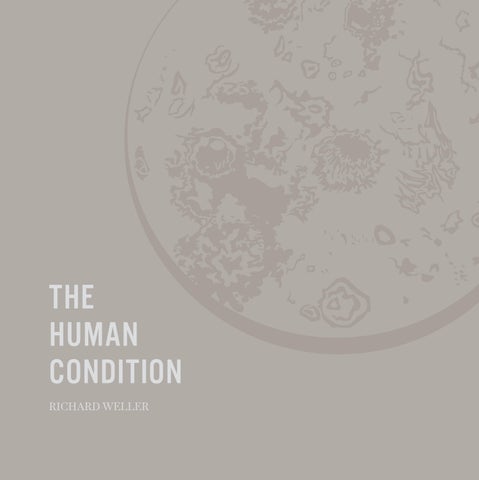
In his 1933 painting The Human Condition, Henri Magritte replaces the landscape seen out of a window with a painting of the same landscape. While purporting to be the real thing, Magritte’s landscape also exposes itself as merely an image, thus capturing a certain self-consciousness of perception as fundamental to the human condition. John Berger assumes a similar position in his book, Why Look at Animals? (Penguin, 2009). The obvious answer is that in doing so, for better or worse, we construct what it means to be human. That is, we construct culture through assertions of its differences and similarities to that which we simultaneously imagine to be nature. As is now apparent on a planetary scale, these assertions have life and death consequences for all living things. While not organized into any kind of taxonomy or wanting to be encyclopedic, this collection of works about animals is not entirely random. Animals have been selected because they represent certain aspects of evolution or historical
periods and worldviews such as classical antiquity, Judeo-Christianity, modernity and contemporary environmentalism. The images also coalesce around certain themes, for example, the animal as mythic symbol, the animal as machine, the animal as resource, the animal as idiot, the animal as wild, and—perhaps most particular to our time—the animal as victim or survivor. What unites the entire collection, however, is that in some way every image presents the animal as a mirror. These mirrors ask how—with climate change and human activity leading us irrevocably toward the sixth extinction—we should conceive of and represent the relationship between culture and nature. One answer to that question might be that one should not do what I have done here: namely, continue the anthropomorphic tradition of presenting individual species as isolated objects projected through human eyes. One could attempt to show the world from the animal’s perspective, or, in a more ecological vein, insist on representing the
relationships between things, not so much the things themselves. Much as I admire artists who go down these paths, there is nonetheless a lingering suspicion that they, too, are just variations of the anthropomorphic. As such, I decided not to attempt to transcend anthropomorphism in depicting the animals as if it were false consciousness. Instead, I have tried to map anthropomorphism’s various guises, emphasizing how it implicates humans and non-humans in what is now a denatured world. Irrespective of whether one gets there by trying to see through animal eyes, or by highlighting ecological relationships, or, in my case, flaunting anthropomorphism, the aim these three approaches share is to forge greater empathy with the more-thanhuman world. Recalling Henri Magritte’s insistence on reality as a human construct, the overarching title for this series of images of animals-as-mirrors is “The Human Condition.” Each of the works is then simply assigned the common name of the species that it depicts in its exploration
of the relationship between culture and nature, the gap between us and them.
10
The artworks reproduced herein are acrylic, pencil and collage on board (21.5 x 21.5 cm).
Having returned to Australia from a 10-year stint as professor and chair of landscape architecture at the University of Pennsylvania in Philadelphia, these artworks were produced between April 2024 and April 2025 in my back shed in Subiaco, Western Australia. This flurry of activity was inspired by four things: first, some builders working on our home left a bunch of marine-ply offcuts, which caught my eye as ready-made canvases. Second, I was undergoing various treatments for cancer and so I wanted a project to keep me active and distracted. Third, although I had given away my library to faculty and students at the UPenn Weitzman School of Design, I did retain one set of books—the marvelous series “Animal” by Reaktion. My original intention was to complete one painting for each of the 104 animals featured in the series, but as it happened, I drifted from this plan and ended up with a more personalized (and Australian)
menagerie. I also ran out of time to do any more than the 75 gathered here. The fourth motivation was that the art collector Janet Holmes à Court took an interest in the work and offered to show them in her eponymous gallery in Perth, an event which took place in November 2024 with the first 48 paintings in the series. As well as Janet, my old friends Fran Cassidy, Peter England and Chris Packer, and my wife and eternal collaborator Tatum Hands, were constant sources of encouragement during the production of these works. I thank them all. Richard Weller May 2025
MICROBE 12
We live in an age of extreme scales, an age concerned with understanding how micro events cause macro effects, an age in which technology seeks to fully understand and harness the power of both the cell and the atom, an age in which a human is understood more as a symbiotic collection of microbes than an autonomous self, let alone something made by a god.
LIZARD 22
The shock of seeing a blue-tongue lizard in the Australian suburbs in summer, opens the door to evolution’s monstrous shadows.
TASMANIAN DEVIL 32
This depiction of a Tasmanian devil grafts the animal’s ferocious jaw onto maps of sea level rise over the ages that led to the formation of Tasmania.
OWL 38
Athena, goddess of Athens, was represented as an owl because she could see in all directions. Here, an owl’s skull is montaged into the topography of the Acropolis.
DUGONG 66
This dugong, coupled with infrastructure from the petrochemical industry, suggests that (like all species) the dugong’s fate is bound up with climate change. It can also imply that our own fate is linked to that of the dugong.
VULTURE 76
The building depicted in this work is known as a Tower of Silence and is used for funereal rites by the Parsis in India. Corpses of men, women, and children are laid on the concentric rings of slabs and left to be stripped of flesh by vultures. The bones remaining after this ritual are swept into the dark well at the center.
ABOUT THE AUTHOR
164
Richard Weller was emeritus professor and chair of landscape architecture at the University of Pennsylvania, where he also held the Meyerson Chair of Urbanism. He was co-founder (with Fritz Steiner) of the Ian L. McHarg Center for Urbanism and Ecology, co-founder (with Tatum Hands) and former creative director of LA+ Interdisciplinary Journal of Landscape Architecture and founding director (with Vladimir Sitta) of Australian design firm Room 4.1.3. He held adjunct professorships at the University of Western Australia and the University of New South Wales. Richard’s design work was frequently awarded in international competitions and has been exhibited at the Guggenheim Museum in New York, the Venice and Rotterdam Architecture Biennales, the MAXXI National Museum of 21st Century Art in Rome, the Museum of Contemporary Art in Sydney, the Isabella Stewart Gardner Museum in Boston, the Canadian Design Museum in Toronto, and the Central Academy of Fine Arts in Beijing, among
others. His most-recognised built work—the iconic Garden of Australian Dreams at the National Museum of Australia in Canberra— has been hailed as a culturally significant project challenging and reimagining how Australians interpret their landscape and cultural identity. Throughout his academic career, Richard was a prolific writer publishing over 150 articles, essays and books. His books include Room 4.1.3: Innovations in Landscape Architecture (University of Pennsylvania Press, 2005), Boomtown 2050: Scenarios for a Rapidly Growing City (University of Western Australia Press, 2009), Made in Australia: The Future of Australian Cities (UWAP, 2013), Transects (ORO Editions, 2014), Design with Nature Now (Lincoln Institute of Land Policy, 2019), Beautiful China: Reflections on Landscape Architecture in Contemporary China (ORO Editions, 2020), The Landscape Project (AR+D Publishing, 2022), An Art of Instrumentality (ORO Editions, 2023), and To the Ends of the Earth: A Grand Tour for the 21st Century (Birkhäuser, 2024).
The online platform Atlas for the End of the World, which documents Richard’s awardwinning research work on global flashpoints between biodiversity and urban growth, has been published in National Geographic and Scientific American, while his related World Park design project is currently being considered for implementation by UNESCO. These research endeavors are likely to be counted among his most enduring legacies, and their core message of thoughtful ecological stewardship is reflected in many of the artworks reproduced in this volume. In 2023 Richard’s contribution to landscape architecture was recognized with the inaugural Legacy Award from the Landscape Architecture Foundation in Washington, DC, and in 2024 he was honored with the Australian Institute of Landscape Architecture President’s Award for lifetime achievement. Richard passed away after a four-year struggle with cancer on 15 May 2025 at the age of 61.
ACKNOWLEDGMENTS TATUM L. HANDS
166
In addition to those mentioned by Richard Weller in the introduction to this book, I would like to acknowledge some people without whom this small volume would not have been possible.
artworks and who has since kindly lent the initial series of 48 artworks for exhibition and photography on multiple occasions. The paintings in this book were photographed by Robert Frith and Richard Weller.
First, a heartfelt thank you to Gordon Goff and Federica Ewing of ORO Editions who together proposed the idea of making the PDF booklet of these artworks that Richard had circulated among his friends and colleagues in the weeks before his death in May 2025 into a publication in remembrance of him. Gordon and Federica, along with Jake Anderson, helped shepherd this volume into existence.
Finally, I thank Richard’s colleagues Jim Corner and Laurie Olin for contributing the foreword and afterword to this volume. Their words add to the many tributes to Richard collected online in various forums and which speak to his enduring legacy and impact as an educator, thinker, designer and friend. He is much mourned and greatly missed.
I would also like to thank Colin Curley, who worked for many years side-by-side with me and Richard on the production of LA+ Journal, for his enthusiastic embrace of this project and for creating the design of this book and its cover. My sincere thanks go to Janet Holmes à Court AC, who, as mentioned in Richard’s introduction, encouraged him in the creation of the
For more on Richard Weller’s research, writing, artwork and design—including full-text copies of many of his articles—see www.richardweller.net.