SUNLIGHT
MATE LEC
w w w. e m e o u t l o o k m a g . c o m
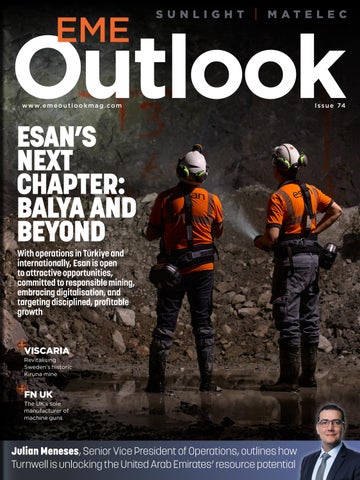
ESAN’S NEXT CHAPTER: BALYA AND BEYOND With operations in Türkiye and internationally, Esan is open to attractive opportunities, committed to responsible mining, embracing digitalisation, and targeting disciplined, profitable growth
VISCARIA
Revitalising Sweden’s historic Kiruna mine
FN UK
The UK’s sole manufacturer of machine guns
Julian Meneses, Senior Vice President of Operations, outlines how Turnwell is unlocking the United Arab Emirates’ resource potential
I s s u e 74
RICHGLEN MAINTENANCE SERVICES
T R I - STA R CO N ST R U C T I O N
SUNLIGHT
MATE LEC
NATIONAL COMMERCIAL BANK JAMAICA LIMITED
EQUINOX GOLD
TURNER MINING GROUP
HUNTER VALLEY OPERATIONS
L O S
A N G E L E S
G E N E R A L
End-to-end solutions from exploration to extraction
Issue 82
PNG POWER LTD
Creating lasting value through responsible mining
Stefanutti Stocks is reshaping Southern Africa’s construction landscape through multidisciplinary expertise, digital innovation, and sustainable infrastructure solutions
www. northame ricaoutlookmag.com
Issue 38
On a coal mining mission to champion sustainable practices
EATON Resilience, reliability, and efficiency
VULCAN MOZAMBIQUE
HUNTSVILLE UTILITIES
M Resources delivers a suite of essential steelmaking raw materials, infrastructure, and mining and logistics services to steelmakers across the globe. Matt Latimore, Founder and President, details the company’s futurefacing approach to investment and market growth
The trustworthy utility steward
For Maersk Canada, the box is only the beginning; connected logistics, intelligent technology, and resilient networks are transforming complex journeys into seamless supply chains
FN UK
The UK’s sole manufacturer of machine guns
The banker, the one that couldn’t fail
Across Asia Pacific, Hitachi Energy’s focus is on the priorities utilities are wrestling with. Massimo Danieli, Executive Vice President and CEO – Grid Automation Business Unit, reveals more
MARTIN-BAKER AMERICA , INC . • CEMENTIS GROUP
Julian Meneses, Senior Vice President of Operations, outlines how Turnwell is unlocking the United Arab Emirates’ resource potential
A M A Z O N B U S I N E S S • U N I L E V E R • G E P • O R I TA I N
COCA-COLA EUROPACIFIC PARTNERS PAPUA NEW GUINEA
On a mission to be a leading integrated green coal mining operation
Thermo Fisher Scientific has reinforced its position as a trusted biologics manufacturing partner
Jason Bontempo, CEO of Gladiator Metals, discusses the resurgence of the Whitehorse Copper Belt in Canada’s historic Yukon mining district
Satellites on Fire detects, alerts, and monitors fires from the earliest moments, as we learn from co-Founder and CEO, Franco Rodríguez Viau
MBA ENERGY & INDUSTRIAL
DIALOG FITZROY
NEBRASKA PUBLIC POWER DISTRICT
Crafting cuisine La Famiglia style
EMIRATES RAWABI
w w w. s u p p ly c h a i n - o u t l o o k . c o m
Issue 14
EUROPEAN SUBSEA CABLES ASSOCIATION
Uniting food and beverage production under one national banner www.foodbeverage-outl ook.com
Iss ue 1 0
Bringing humanoid robots to the factory floor and reshaping industrial automation
BRITISH PORTS ASSOCIATION
Our latest catch-up with the British Ports Association and CEO, Richard Ballantyne OBE, outlines the strong investment in decarbonisation and infrastructure across UK ports in recent years
Chris Pattinson, CEO, tells us how SAESL has become an indispensable component of the Singapore aerospace ecosystem, keeping airlines flying to connect the world
Steven Johnson, Managing Director, UKIE, Nordics, and Eastern Europe Network Operations, explains why operations leadership is critical Network Operations, explains why operations leadership is critical Steven Johnson, Managing Director, UKIE, Nordics, and Eastern Europe
of the Singapore aerospace ecosystem, keeping airlines flying to connect the world Chris Pattinson, CEO, tells us how SAESL has become an indispensable component
decarbonisation and infrastructure across UK ports in recent years Richard Ballantyne OBE, outlines the strong investment in Our latest catch-up with the British Ports Association and CEO,
and reshaping industrial automation Bringing humanoid robots to the factory floor
Traditional Automation and Virtual Worlds Humanoid: Bridging the Beyond Real
Group CEO, John Freeman, shifts the narrative to reflect on how the platform has evolved
Jacob Latter, CEO, discusses Sitzler’s next phase of growth, and continuing a legacy of resilience, capability, and confident delivery
Built for resilience
Traditional Automation
solutions optimized packaging More efficient,
Partnerships built on trust and thinking outside the box
Digital Edge DC
ATEC FACADES
RADIANT LOGISTICS
More efficient, optimized packaging solutions
UPRITE CONSTRUCTION www.sustainabilityoutlookmag.com • I s s u e 3
STEFANUTTI STOCKS
BUILT WITH CONFIDENCE
Delivering advanced medicines from Australia to the world
SHORR PACKAGING
Powering Nebraska’s future
OUTLOOK
Duratec’s newly established specialist arm
THERMO FISHER SCIENTIFIC
Bridging the Beyond Real Humanoid: and Virtual Worlds
W W W .CONST RUCT ION-OUT L OOK.COM • ISSUE 5
The multidisciplinary construction group with a difference
Connecting nations and driving innovation
Garry Edwards, VP EMEA at Wolters Kluwer, emphasises the need for formalised, organisation-wide frameworks to ensure responsible use of artificial intelligence
M E T R O P O L I TA N WAT E R D I S T R I C T O F S A LT L A K E & S A N DY
L’OSTERIA
ISSUE 11
www.mfg-outlook.com
ASSOCIATION BRITISH PORTS
Burgermeister was founded two decades ago in Berlin and has since grown into a globally renowned cult burger chain
Dan Vass, Head of Category and Commercial Strategy, explains how Danone is shaping the design and delivery of the Deposit Return Scheme in the UK is shaping the design and delivery of the Deposit Return Scheme in the UK Dan Vass, Head of Category and Commercial Strategy, explains how Danone
Colliers combines project management discipline, cost intelligence, and sustainability expertise to help occupiers and asset owners deliver capital projects that work harder beyond completion
We discuss the Shubh Mint programme and its impact on farming communities in India with Mars Snacking in The 1-2-1
to help occupiers and asset owners deliver capital projects that work harder beyond completion Colliers combines project management discipline, cost intelligence, and sustainability expertise
farming communities in India with Mars Snacking in The 1-2-1 We discuss the Shubh Mint programme and its impact on
cult burger chain grown into a globally renowned decades ago in Berlin and has since Burgermeister was founded two
PACKAGING SHORR
capability, and confident delivery continuing a legacy of resilience, Sitzler’s next phase of growth, and Jacob Latter, CEO, discusses
Built for resilience
CONFIDENCE BUILT WITH
LOGISTICS RADIANT Australia to the world medicines from Delivering advanced
TELL US YOUR STORY, AND WE’LL TELL THE WORLD
SCIENTIFIC FISHER THERMO
specialist arm established Duratec’s newly
Issue 14
ASSOCIATION SUBSEA CABLES EUROPEAN
w w w. s u p p ly c h a i n - o u t l o o k . c o m ISSUE 11
the platform has evolved the narrative to reflect on how Group CEO, John Freeman, shifts
ATEC FACADES
innovation nations and driving Connecting
www.mfg-outlook.com
www.foodbeverage-outl ook.com
Digital Edge DC
with a difference construction group The multidisciplinary
Iss ue 1 0
banner under one national beverage production Uniting food and
RAWABI EMIRATES
STOCKS STEFANUTTI
W W W .CONST RUCT ION-OUT L OOK.COM • ISSUE 5
OUTLOOK
COCA-COLA EUROPACIFIC PARTNERS PAPUA NEW GUINEA
and thinking outside the box Partnerships built on trust
CONSTRUCTION UPRITE DISTRICT PUBLIC POWER NEBRASKA
L’OSTERIA
A M A Z O N B U S I N E S S • U N I L E V E R • G E P • O R I TA I N
www.sustainabilityoutlookmag.com • I s s u e 3
future Powering Nebraska’s
La Famiglia style Crafting cuisine
MARTIN-BAKER AMERICA , INC . • CEMENTIS GROUP
Modernising and transforming health systems
ARGO NATURAL RESOURCES
Revitalising Sweden’s historic Kiruna mine
AMP BANK
www.healthcare-outlook.com
www.mining-outlook.com • Issue 16
VISCARIA
Trusted partners in technical excellence and expertise
Rita Apell Akot, CIO at Stanbic Bank Uganda, outlines an ambitious initiative to make banking technology more connected and interoperable across the continent
I s s u e 74
With operations in Türkiye and internationally, Esan is open to attractive opportunities, committed to responsible mining, embracing digitalisation, and targeting disciplined, profitable growth
DIALOG FITZROY
Five years of institutional reform
w w w. e m e o u t l o o k m a g . c o m
ESAN’S NEXT CHAPTER: BALYA AND BEYOND
Responsible for generating, transmitting, distributing, and retailing electricity in Papua New Guinea
GALIANO GOLD
EASTERN CAPE DEPARTMENT OF HEALTH
w w w. a p a c o u t l o o k m a g . c o m
Issue 122
STEFANUTTI STOCKS
Meeting the dynamic demands of the Ghanaian mining industry
C E N T E R
ST. JOSEPH’S HEALTH SYSTEM
Elevating the patient experience
DIGITAL HEALTH ASSOCIATION
w w w. a f r i c a o u t l o o k m a g . c o m
PAMICOR LIMITED
M E D I C A L Issue 15
WEIR
MBA ENERGY & INDUSTRIAL
DIALOG FITZROY
M E T R O P O L I TA N WAT E R D I S T R I C T O F S A LT L A K E & S A N DY
Africa Outlook, APAC Outlook, EME Outlook, North America Outlook, Mining Outlook, Healthcare Outlook, Manufacturing Outlook, Supply Chain Outlook, Food & Beverage Outlook, Construction Outlook, and Sustainability Outlook are digital publications aimed at boardroom and hands-on decision-makers, reaching an audience of more than 800,000 people around the world. With original and exclusive content compiled by our experienced editorial team, we look to promote the latest in engaging news, industry trends, and success stories from across the globe. Your company can join the leading industry heavyweights enjoying the free exposure we provide across our platforms with a free marketing brochure, extensive social media saturation, enhanced B2B networking opportunities, and a readymade forum to attract new investment and help you grow your business. Visit www.outpb.com/work-with-us for details on how your company can feature for free in one of our upcoming editions.
www.outpb.com/work-with-us
WELCOME FROM THE EDITOR
METALS, MINERALS, AND MORE
EDITORIAL Head of Editorial: Jack Salter jack.salter@outpb.com Deputy Head of Editorial: Lucy Pilgrim lucy.pilgrim@outpb.com Senior Editor: Lily Sawyer lily.sawyer@outpb.com
Welcome to our 74th edition of EME Outlook magazine.
Editor: Ed Budds ed.budds@outpb.com
The Balya Lead, Zinc, Copper, and Silver Mine (Balya) is
Editor: Rachel Carr rachel.carr@outpb.com
one of the clearest examples of our cover star’s mining
Copy Editor: Lauren Kania lauren.kania@outpb.com
and engineering capabilities.
PRODUCTION
Esan, an affiliate of Eczacıbaşı Group, continues to invest in the long-term
Art Director: Stephen Giles steve.giles@outpb.com Senior Designer: Devon Collins devon.collins@outpb.com Designer: Louisa Martin louisa.martin@outpb.com Production Manager: Alex James alex.james@outpb.com Digital Marketing Director: Fox Tucker fox.tucker@outpb.com Senior Website Content Manager: Oliver Shrouder oliver.shrouder@outpb.com Social Media Executive: Jake Crickmore jake.crickmore@outpb.com
Digital Content Executive: Tara Steele tara.steele@outpb.com BUSINESS Chief Executive Officer: Ben Weaver ben.weaver@outpb.com Managing Director: James Mitchell james.mitchell@outpb.com Chief Technology Officer: Nick Norris nick.norris@outpb.com Content Director: Neil Perry neil.perry@outpb.com Global Head of Media: Lewis Hammond lewis.hammond@outpb.com Global Media Executive: Kai Boyle-Vennard kai@outpb.com A D M I N I S T R AT I O N Finance Director: Suzanne Welsh suzanne.welsh@outpb.com Finance Manager: Victoria McAllister victoria.mcallister@outpb.com E M E O U T LO O K Norvic House, 29-33 Chapelfield Road Norwich, NR2 1RP, United Kingdom Sales: +44 (0) 1603 804 445 Editorial: +44 (0) 1603 853 874 SUBSCRIPTIONS Tel: +44 (0) 1603 853 874 jack.salter@outpb.com www.emeoutlookmag.com Follow us on Linkedin: EME Outlook Magazine Follow us on X: @OutlookPublish
future of Balya, one of Europe’s deepest underground mines located in Türkiye. Elsewhere in the country, Esan’s active production network also includes its Çine, Yeniköy, Bozüyük, İnlice, and Niğde operations. Outside Türkiye, the company’s most significant current exploration and development activities are in Uzbekistan and Kazakhstan. “We continue to invest both around our existing operations and in new geographies, focusing particularly on base metals, precious metals, and critical minerals. We remain open to attractive opportunities in Türkiye and internationally, whether through exploration, resource development, partnerships, joint ventures, or selective acquisitions of operating assets and projects,” states Emre Kayışoğlu, CEO. As Europe looks to strengthen its domestic copper supply, Viscaria is revitalising Sweden’s historic, mineral-rich Kiruna mine. Swedish banking entrepreneur, Jörgen Olsson, took ownership of the mine in May 2020 along with a select group of co-investors and inaugurated Viscaria, where he is CEO. Olsson continues to lead the company and define its role in supporting Sweden’s future. “We want to help build a Swedish-based industrial company with a long-term future, supplying copper to Europe directly,” he states. Michelle Cantoni, meanwhile, has a clear passion and long-term devotion to the defence industry, leading her to make a real impact in her role as CEO of FN UK – the country’s only onshore machine gun manufacturer – since 2023. “I’ve now been in the role for just over three years; I’ve implemented a lot of changes, but there’s still lots to do,” Michelle points out. There’s likewise a lot being done at Sunlight, Matelec, and EDF Middle East, as we find out in the remainder of this issue. We hope that you enjoy your read. Jack Salter Head of Editorial, Outlook Publishing EME Outlook Issue 74 | 3
TO P I C A L F O C U S
26 Construction From Power Station to Standing Ovation Apple’s first live music venue
74 | C O N T E N T S REGULARS
6 EXPERT EYE London to browse, EU to buy
BUS INE SS INSIGHTS
8 Thales Group
14 OI L & G AS
14 Turnwell Delivering the UAE’s Unconventional Resources World-class unconventional energy discovery for the Middle East and the world
Halfway is No Way
EN ER GY & U T I LI TI E S
The future of digital security
20 Orcan Energy Waste Heat into Electricity
26
80 THE FINAL WORD What have you learnt about yourself this year?
Converting the world’s largest untapped energy source
8
4 | EME Outlook Issue 74
20
80
EME OUTLOOK CONTENTS
F E AT U R E S MINING
34 Esan
M A N U FAC T U R I N G
56 FN UK Built in Britain, Trusted Worldwide The UK’s sole manufacturer of machine guns
Esan’s Next Chapter: Balya and Beyond Opportunities in Türkiye and internationally
70 E N E R GY & U TI L I TI E S
70 Matelec Energy Brings Life
56
44 Viscaria
Empowering a sustainable and inclusive energy future
66 Sunlight
Mining for a Stronger Europe
A Shining Example of Engineering for Exploration
Revitalising Sweden’s historic Kiruna mine
The spirit of adventure
76
76 EDF Middle East Electrifying the Middle East
44
66
Low-carbon projects powering the region’s energy transition
EME Outlook Issue 74 | 5
EUROPE’S MOST N EXPENSIVE SHOWROOM Visitors and British shoppers alike are now using London to browse and the EU to buy, writes Sacha Zackariya, CEO of Prosegur ChangeGroup Writer: Sacha Zackariya, CEO, Prosegur ChangeGroup 6 | EME Outlook Issue 74
ew Bond Street in London now has the highest shop rents in the world, yet a growing share of what shoppers admire in its windows is bought somewhere else. Visitors from outside Europe browse in London and buy in Paris or Milan, where they can still reclaim VAT on what they carry home, and since Brexit, British shoppers have learnt to do exactly the same. Until January 2021, visitors from outside the EU could reclaim the 20 percent VAT on goods bought in British shops and carried home. The government ended that scheme after Brexit, leaving Britain the only major European economy without tax-free
EXPERT EYE RETAIL
shopping for international visitors, whilst British residents, now outside the EU themselves, gained the right to claim refunds in France, Italy, and Spain. Burberry says its London tourist business has halved since 2019 whilst its Paris tourist business is up 30 percent, and Global Blue found that a fifth of the non-EU shoppers who once claimed refunds only in Britain now claim them in the EU, spending more per head when they do. The Association of International Retail found that British spending on VAT-free shopping in the EU rose from £147 million in 2021 to £742 million in 2024. France accounted for 35 percent of that spending, with Paris taking nearly 75 percent of the French total. The first 22 weeks of 2025 were already running 16 percent ahead of the same period the previous year. London is therefore losing the sale twice, once to the overseas visitor who never buys here, and again to the British shopper who saves the purchase for a weekend in Paris. That spending does not disappear but moves across the Channel, and for the British shopper it takes the hotel nights, restaurant bills, and taxi fares with it.
RETAILERS KEEP PAYING Retailers have not walked away, which is what makes this a showroom rather than a ghost town. Savills ranked London first in Europe for new international store openings in 2025, ahead of Milan, Paris, and Madrid. That demand is also reflected in rental values, with Cushman & Wakefield reporting a 22 percent increase in New Bond Street rents last year. For the biggest luxury houses, a Bond Street flagship can still justify its cost as much as a statement of presence as a place to make sales. For smaller brands, however, the economics are harder to sustain. Mulberry closed on Bond Street
after tax-free shoppers fell from close to half of its sales there to between five percent and 10 percent. Harvey Nichols fell into administration this summer, and more than 40 watch boutiques are estimated to have closed across the UK in five years. Newer brands are drawing their own conclusions. Pop Mart chose Paris for its first European flagship despite already trading on Oxford Street, Chicjoc opened its first European store in Paris with Milan, New York, and Tokyo next, and Amiri opened in Milan a year before London, because a brand proving its model in Europe will go where overseas customers pay less.
A WARNING FOR LANDLORDS Cushman & Wakefield puts New Bond Street’s rent rise down to strong demand and limited supply. However, rents set by scarcity and brand ambition can outrun the sales a store actually takes, and whilst shoppers spend in Paris, that gap is carried by the tenant until the lease comes up for renewal. Oxford Street’s recent past, when the space left by Topshop, Debenhams, and House of Fraser was filled for a time by sweet shops, vape counters, and souvenir outlets, shows how quickly a prime street can trade down once the numbers stop working. Since 26th October, the busiest stretch of Oxford Street has been closed to traffic, backed by £150 million of public money, and a better street will bring people back. But footfall is not London’s problem, because shoppers already look in its windows and simply have more reason to buy in Paris.
would add £44.5 million a year to the bills of two-thirds of its members, so the UK now charges retailers more to occupy its best streets whilst giving their customers, foreign and British, a reason to buy elsewhere. The Chancellor’s recent budget will take the smallest high street shops out of business rates from April 2027, which is welcome, but it left tax-free shopping untouched, which is the one change that would help bring the sale back to London. The Treasury’s case rests on the VAT it keeps, yet it collects nothing on a handbag bought in Paris, whether by a visitor from Riyadh or a shopper from Surrey, and nothing in business rates from a store that never opens. Retailers have not given up on London, so the question for the next budget is whether Britain wants its best stores to keep selling, or to become the world’s most expensive advertising hoardings.
ABOUT THE EXPERT Sacha Zackariya is CEO of one of the world’s largest foreign exchange providers. He co-founded ChangeGroup in 1992 from a single bureau on London’s Regent Street, with the business majority acquired by Prosegur in 2022. Zackariya is the author of the awardwinning book Leading Travel and Tourism Retail and co–Founder of the Tree Foundation Charity.
WHAT GOVERNMENT SHOULD WEIGH Since April, properties with a rateable value above £500,000 pay a higher business rates multiplier, which the New West End Company estimated EME Outlook Issue 74 | 7
HALFWAY IS NO WAY Positioning itself at the forefront of global cybersecurity, Thales Group recently brought together international experts and industry leaders at the Thales Cyber Summit in Paris to examine the future of digital security.
Attending the summit, we sat down in person with Philippe Vallée, Executive Vice President, Cybersecurity and Digital Identity, to discuss navigating the evolving threat landscape, developing quantum readiness, and building trust in an artificial intelligence-driven world Writer: Lily Sawyer
© Lily Sawyer
THALES BUSINESS INSIGHTS
A
s artificial intelligence (AI) brings new capabilities to cyberthreats, data and identity theft are becoming a significant source of disruption and reputational damage for businesses today. Having developed new solutions focused on data protection and strengthening cybersecurity, Thales Group (Thales) is working hard to address the rapidly evolving digital threat landscape. “Over the last 20 to 30 years, cybersecurity systems such as firewalls have largely focused on perimeter protection, whereas today’s complex cyberthreats pervade both on-premises and in the cloud, which creates a much larger surface area for attack,” opens Philippe Vallée, Executive Vice President, Cybersecurity and Digital Identity at Thales. Indeed, previous systems were primarily deterministic, whereas now they’re increasingly probabilistic, which means AI agents can navigate across multiple systems and environments, introducing a new level of uncertainty into the software environment.
Another important development in protecting data is the growing adoption of ‘zero trust’, a principle which dictates that no agent within an organisation – whether human or non-human – should be automatically trusted, particularly when it comes to ensuring security permissions are appropriate for each individual identity. “These permissions need to remain up-to-date and agile because employees often move around within organisations – they might be promoted, change roles, or leave. We’re still seeing companies failing to revoke an employee’s access rights when they leave, for example, which is a basic issue that needs to be addressed as a priority,” Vallée emphasises. “In short, AI certainly makes the cybersecurity equation more complex, but before businesses use AI to defend against AI threats, they need to get the fundamentals right.”
PREPARING FOR THE QUANTUM THREAT In today’s technologically advanced world, Vallée shines a light on what it
means to be ‘quantum ready’. “The first question we ask ourselves as specialists in this industry is: when will a quantum computer be ready? The reality is we simply don’t know yet – nobody does,” he insights. What Thales does know is that quantum computing, particularly in relation to encryption algorithms drawn from public key cryptography, presents a significant security challenge. The first step in addressing this challenge is to make an exhaustive inventory of where cryptographic processors are being used across a given company. “They are present in almost every part of the organisation – used to sign payment transactions, verify identities, secure access to web applications, and secure identity cards – so understanding exactly where they are deployed is essential,” Vallée shares. Once their location has been established, the next step is to upgrade each algorithm within the cryptographic processor to make it resistant to quantum computing, which involves sophisticated mathematical tools to test their strength. EME Outlook Issue 74 | 9
THALES CYBER SUMMIT Marking the start of Cybersecurity Awareness Month, Thales brought together cybersecurity experts, industry leaders, and international media at the Thales Cyber Summit held in Paris, France, on 1st October 2026. The day of expert discussions, customer insights, and live demonstrations spanned AI, quantum computing, identity, and data sovereignty, exploring how organisations can protect their most critical assets and strengthen resilience in today’s evolving cyber threat landscape. The summit’s central theme, ‘HALFWAY IS NO WAY’, emphasised Thales’ comprehensive and continuous approach to cyber threats, with four key areas of interest – identity, quantum, AI and cyber, and cyber platforms – explored in a series of dedicated demonstration zones. For organisations facing an evolving threat landscape, the summit demonstrated how resilience depends on bringing together secure identities, protected data, robust infrastructure, advanced threat detection, and security capabilities that can adapt as quickly as the threats themselves. w
A particularly important third party in this process is the National Institute of Standards and Technology (NIST), which regularly runs competitions for organisations to submit their algorithms for evaluation. “NIST assesses the design and suitability of a given algorithm, providing an important level of validation. Although we cannot know exactly how long an algorithm will remain secure, this process gives us a degree of confidence in the solutions we can offer our clients,” he explains. Thanks to its in-house mathematical and research laboratory capabilities, Thales benefits from a high level of expertise in this area, with its Cybersecurity and Digital Identity division regularly submitting new algorithms to NIST for assessment. Elsewhere, the group has begun adapting its algorithms so they can 10 | EME Outlook Issue 74
be integrated into smart cards, one of which was certified for government use in identity applications by the French National Cybersecurity Agency (ANSSI), recognising the post-quantum cryptography (PQC) algorithm it contains. For Thales, the next step is to work with its clients to establish optimum pace for system migration given the increasing threat of quantum computing. However, upgrading existing systems to withstand quantum computing is not something that will happen overnight – it’s a long process which organisations need to prioritise. “They should start by upgrading their weakest algorithms before moving onto others,” Vallée advises. He points out how trying to upgrade everything at once would exceed most companies’ budgets,
so migrating systems progressively over the course of the next few years will allow organisations to spread the cost and make the transition more manageable.
LUNA 8 HSM Central to the Thales Cyber Summit was the group’s new Luna 8 hardware security module (HSM), which has been designed to help users anticipate potential future quantum cryptography threats. Arguably, Luna 8’s most important function is its ability to generate completely unpredictable data through a dedicated random number generator, allowing users to create incredibly strong cryptographic keys or ‘digital padlocks’ to protect their information. Each key generated within the HSM acts as a secure master key, from
THALES NOKIA BUSINESS INSIGHTS
“We have a culture of ‘cyber by design’, which means cybersecurity is incorporated into a product’s architecture from day one, rather than being left until the end of development when time and budget may already be limited” – P H I L I P P E VA L L É E , EX E C U T I V E V I C E P R E S I D E N T, C Y B E RS E C U R I T Y A N D D I G I TA L I D E N T I T Y, T H A L E S G RO U P
© Lily Sawyer
which additional keys can be created and distributed across the group’s network and databases. “An important part of protecting an organisation’s architecture is regularly refreshing these keys as frequently as every week,” says Vallée. The Luna 8 HSM and associated CipherTrust Data Security Platform
manage this entire lifecycle, safely automating the roll-out of updated keys throughout the organisation. A second function of the technology is to run specific algorithms that require an extremely high level of protection, with the hardware itself designed to be tamper-resistant.
“If someone attempts to interfere with the HSM or access one of its chips, tamper-detection mechanisms are triggered. “These can generate a signal that effectively destroys the chip, rendering it unusable. It’s like something out of Mission Impossible – the device will stop functioning if someone attempts to compromise its physical security,” he exemplifies. These highly protected algorithms can be used within sensitive operations. Before issuing employee access badges within a company, for example, there is typically an HSM working in the background to generate a unique certificate associating the badge with the individual employee. Designed by Thales in Paris, the Luna 8 HSM incorporates sovereign chip design, whilst the software running inside is also designed in France. “Whilst we don’t manufacture the chips ourselves, we’re heavily involved in the design process before they’re manufactured by STMicroelectronics at their facility in Crolles,” Vallée tells us. EME Outlook Issue 74 | 11
ADDRESSING CYBER THREATS As the group accelerates its cybersecurity capabilities, Thales has recently launched five major solutions designed to address the rapidly evolving cyber threat landscape: • Luna 8 – This new HSM is designed to help organisations protect themselves against the emerging quantum computing threat, leveraging advanced postquantum cryptography. • CipherTrust Data Security Posture Management – A security solution boosted by AI, helping organisations protect their sensitive data. • Sentinel Envelope Plus – Thales’ advanced software protection against new AI-powered attacks. • Partnership with Google Cloud – A unified approach designed to protect AI agents, data, and interactions across the AI lifecycle. • Global cybersecurity protection framework – A global response to the challenges created by frontier AI models.
CYBER BY DESIGN As it continues to develop innovative solutions such as the Luna 8 HSM, Thales’ R&D innovation pipeline has been instrumental, as have its talent development processes and intergenerational collaboration efforts. As a group, Thales currently employs more than 40,000 engineers – a number that only 12 | EME Outlook Issue 74
continues to grow. “Within our Cybersecurity and Digital Identity division, we have approximately 5,500 engineers, most of whom work in software development, with some specialising in embedded software such as what is used in our HSM,” Vallée reveals. A global enterprise, Thales’ R&D teams span Singapore, India, France, the US, and several other countries.
“Having our competencies distributed around the world allows us to better understand and respond to the varying demands of our diverse client base,” he adds. One of Thales’ priorities is ensuring cybersecurity is built into its own products from the outset – a principle that applies across the group. “We have a culture of ‘cyber by design’, which means cybersecurity is incorporated into a product’s architecture from day one, rather than being left until the end of development when time and budget may already be limited,” affirms Vallée. When it comes to enhancing its future engineering capabilities, Thales is naturally focusing on integrating AI – however, the group needs to be cautious about where and how it does so. “The software we put into aircraft defence systems, for example, requires particular care because safety and security are at stake,” he outlines. As such, Thales is currently testing various large language models (LLMs) with the aim of understanding how AI will affect its development processes and, more importantly, its people. In addition, with the EU’s Cyber Resilience Act introducing new requirements around understanding, identifying, and documenting newly developed software, there is also a regulatory dimension to consider – particularly around open-source components. “There are two important reasons for this. First, open-source licensing and copyright conditions can sometimes be complicated, and software is not always as unrestricted as people might assume. “Second, open-source components can be vulnerable to security threats and may not always be patched as quickly as commercially developed software,” Vallée sets out. Therefore, understanding exactly which open-source components are included in each piece of software
THALES NOKIA BUSINESS INSIGHTS
“Ultimately, Thales is building trust through simplicity, keeping people in control, and using AI responsibly and effectively” – P H I L I P P E VA L L É E , EX E C U T I V E V I C E P R E S I D E N T, C Y B E RS E C U R I T Y A N D D I G I TA L I D E N T I T Y, T H A L E S G RO U P
Thales produces is extremely important for compliance. “In short, the way we’re deploying AI across the organisation is bringing AI and people together – not replacing them,” he assures.
THE FUTURE OF AI With younger generations amongst the most familiar with AI and, having embraced it within their day-to-day routines, Vallée believes they are the future of the industry. He also sings the praises of Thales’ more experienced engineers, whose years of expertise allow them to
specify the methodology and underlying rationale they expect AI software to follow. “The question, therefore, is how we bring younger and more experienced engineers together in front of AI tools, ensuring we clearly define what we expect – no more and no less – before delivering the final software. “This is not just a question of AI; it is also a question of organisation and process,” Vallée notes. Historically, Thales’ Cybersecurity and Digital Identity division may have had a product management team of three or four people working
alongside 150 software developers to develop a new product. Today, it is moving towards a more agile, squad-based approach, bringing together three key elements: AI, product management, and software developers. “Rather than relying on huge development centres with hundreds of engineers, we are moving towards a flatter organisation with smaller teams working on specific elements of a product and strong coordination at the top,” he elaborates. This is fundamentally reshaping Thales’ engineering organisations, streamlining the entire process, and rethinking how its teams are structured, coordinated, and equipped to develop software. Reflecting on the key takeaways of the Thales Cyber Summit, Vallée outlines how the group’s objective going forwards is to simplify the use of its software services and build customer trust in them. “To create that trust, people need to remain in control of the software – which means simplifying cybersecurity, eliminating passwords, and making security systems easier to use. “We also need to see AI as our friend, whilst remembering to neither overuse nor underuse it, but applying it where it can deliver genuine value and improve efficiency,” Vallée asserts. This includes using AI to defend against AI-driven threats, make software development more efficient, and enable legal teams to spend more time on discussions rather than reviewing contracts. “Ultimately, Thales is building trust through simplicity, keeping people in control, and using AI responsibly and effectively,” he passionately concludes.
EME Outlook Issue 74 | 13
Delivering the UAE’s Unconventional Resources
TURNWELL OIL & GAS
Turnwell is a United Arab Emirates-based integrated unconventional drilling and completions company created through a strategic joint venture between ADNOC Drilling, SLB, and Patterson-UTI. Julian Meneses, Senior Vice President of Operations, outlines how the company is unlocking the nation’s resource potential Writer: Ed Budds
EME Outlook Issue 74 | 15
TURNWELL OIL & GAS
A
bu Dhabi is estimated to hold approximately 22 billion barrels of unconventional oil and 160 trillion cubic feet of unconventional recoverable gas in place. Developing even part of that resource requires technologies and operating methods different from those used in conventional fields. The bold step is therefore not simply drilling unconventional wells – it is establishing a United Arab Emirates (UAE)-based operating ecosystem that can support and deliver safely, predictably, and economically at industrial scale. Unconventional development behaves more like a continuous manufacturing system rather than a sequence of traditional megaprojects. Similar to a high-performance manufacturing system, unconventional operations demand tight cycle times, repeatable designs, multi-well pad execution, coordinated drilling and stimulation, reduced stage-to-stage time, real-time data, integrated supply chains, and the rapid transfer of learning across successive wells and pads. This is the operating model Turnwell was specifically built around. “We represent genuine innovation 16 | EME Outlook Issue 74
for the region because we combine three forms of capability – the UAE’s deep knowledge of its reservoirs and operating environment, our partner’s global unconventional experience, and advanced digital, drilling, and completion technologies,” introduces Julian Meneses, Senior Vice President of Operations. “The objective is not just to copy a North American operating model and import it wholesale; it is to adapt the most effective unconventional practices to the UAE’s geology, high-pressure and high-temperature conditions, sour-service requirements, environmental context, and national priorities,” he affirms. The result is a new national capability that can support long-term energy resilience, strengthen the local industrial base, and reinforce the UAE’s role as a reliable energy supplier. A proof point of this statement was ADNOC Onshore’s (ADNOC)
recent final investment decision (FID) announcement for their first large-scale unconventional gas development in Ruwais, where Turnwell spearheaded the exploration and appraisal phases of this basin. As public statements have noted, development beyond the initial campaign could require many thousands of wells, making the capabilities established today a strategically important foundation for the future ahead.
UNLOCKING VAST POTENTIAL Purpose-built to unlock the UAE’s unconventional oil and gas resources, Turnwell’s scope covers the complete well delivery cycle, including well planning, drilling, horizontal well construction, hydraulic stimulation, completions, well testing, and integrating digital, flowback, and subsurface solutions. The company brings together local
“At Turnwell, the important point is not any single technology – it is the way technologies are integrated across the well lifecycle” – J U L I A N M E N E S E S , S E N I O R V I C E P R E S I D E N T O F O P E R AT I O N S , T U R N W E L L
scale and operational leadership focusing on integrated end-to-end delivery including subsurface drilling, stimulation, digital and production capabilities, and extensive experience in high-efficiency unconventional operations. “Rather than operating these as separate activities, we bring them together within one coordinated delivery model,” Meneses elaborates. The company’s main office is based in the city of Abu Dhabi, whilst its primary field operations are in the Liwa and Ruwais regions within the Emirate of Abu Dhabi. Today, the organisation operates across drill rigs and fracturing activities in support of oil and gas appraisal and development activity. “Our company has just under 50 employees, yet our operating footprint exceeds over 400 people,
integration, and close alignment across these disciplines are fundamental to delivering unconventional wells at scale.
WHAT IS THE SECRET TO DELIVERING A PROJECT FROM CONCEPT TO REALITY? Julian Meneses, Senior Vice President of Operations: “First, the project must start with a clear definition of value. Everyone must understand what success means in terms of safety, well delivery, production potential, schedule, cost, and long-term capability. If different parties optimise different outcomes, integration breaks down. “Second, the interfaces must be designed outside of the project. Subsurface, drilling, completions, production, logistics, and supply chain cannot work in silos; they need one integrated plan, a unified operating rhythm, and a shared set of performance data. “Turnwell’s own experience shows that standardised execution, real-time data
“Third, performance must become repeatable. One record-breaking well is encouraging, but it is not yet an operating model. Sustainable value comes from understanding why the result occurred, converting that learning into a standard and reproducing it across several rigs, crews, and pads. “The team must be willing to learn quickly without compromising control. Our test-learnstandardise approach allows innovation, but it also requires evidence. A practice becomes standard only when it proves itself under repeatable field conditions. “Finally, people and culture make the system work. Technology can reveal a problem, but people solve it. Contracts can define accountability, but collaboration creates momentum. The most successful projects combine clarity of purpose, technical rigour, rapid decision-making, and a culture in which every team understands both its own role and its impact on the next operation.”
EME Outlook Issue 74 | 17
with field staff from our partners and third-party providers under our direct management and supervision,” he adds. Turnwell’s initial and principal client is ADNOC, with its activities aligned to the broader strategic direction and asset-development framework established by the ADNOC Group. “Our role is to translate that resource strategy into safe, repeatable, and commercially competitive execution in the field,” Meneses explains. “What makes us different is we are not adapting a conventional drilling model to unconventional reservoirs – we are building an operating system specifically for highvolume, continuous unconventional development, combining international best practices with our local reservoir knowledge and UAE-based capabilities,” he sets out.
FLAGSHIP CAMPAIGN Turnwell’s flagship undertaking is the integrated delivery of 128 unconventional horizontal oil and gas wells under a contract valued at 18 | EME Outlook Issue 74
approximately USD$1.7 billion. The campaign objective was established to help appraise and unlock Abu Dhabi’s unconventional resource base and to create the technical and operating foundation for potentially much larger-scale development in the future. “This project is special because it is not a conventional sequence of isolated wells. It is a continuous, multi-rig, multi-pad programme in which planning, drilling, completions, stimulation, logistics, and production readiness must operate as one system,” Meneses describes. That integration is what allows lessons from one well or drilling section to be transferred rapidly across the fleet. The early performance has demonstrated the potential of the model. A record oil well was drilled in just 13.5 days, representing a 68 percent improvement from the project’s starting baseline, whilst well delivery time across a four-well pad was reduced by 53 percent. Similar gains have been achieved
in hydraulic fracturing, with pumping efficiency reaching 20 hours per day. Across drilling, hydraulic fracturing, coiled tubing cleanouts, and flowback, Turnwell has continued to raise the performance benchmark, introducing multiple technologies to the UAE for the first time whilst steadily improving the speed, efficiency, and integration of well delivery. “Those results were supported by technologies including advanced measurement-while-drilling (MWD) tools optimised drill-bit designs, and new-generation rotary steerable systems,” he tells us. Since then, the company’s emphasis has moved from isolated records to repeatable, fleet-wide performance.
EXPLORING WATER REUSE Another project Turnwell is particularly proud of is its work with ADNOC to reuse produced water in hydraulic-fracturing operations. In arid environments, water is both an operational constraint and environmental consideration.
MCLAREN TURNWELL GOLF MANUFACTURING OIL & GAS
Reusing produced water can reduce freshwater demand, truck movements, storage requirements, cost, and field exposure, whilst supporting a continuous stimulation schedule. The project is important in that the water-treatment process is not only demonstrated in a laboratory or a small pilot. It gets integrated into active operations and proven under the high-pressure, high-temperature, and sour conditions associated with numerous formations. “For us, this is a strong example of how operational performance and environmental responsibility can reinforce one another. “The aim is not simply to use less water as a separate sustainability initiative – it is to engineer a more resilient completions system in which growth is less dependent on freshwater logistics,” Meneses expands. Elsewhere, the company is also helping develop the industrial ecosystem required to sustain unconventional operations over many years. Large-scale development requires continuous access to proppant, specialised fluids, cementing systems, downhole technology, equipment maintenance, and trained technical personnel.
ADVANCED TECHNOLOGY EXPLORATION Unconventional reservoirs require a different well architecture and development philosophy. Turnwell drills the vertical and curved sections of the wells before steering into extended horizontal laterals within the target interval. That horizontal exposure combined with several fracturing stages creates substantially more contact with the reservoir than a vertical well alone. Once the lateral has been drilled and completed, hydraulic fracturing is conducted in multiple engineered stages.
“Our responsibility is to ensure we possess the operating maturity, talent, technology, supply chain, and safety culture required to support future growth responsibly” – J U L I A N M E N E S E S , S E N I O R V I C E P R E S I D E N T O F O P E R AT I O N S , T U R N W E L L
Fluid and proppant are pumped at controlled rates and pressures to create and support pathways through which hydrocarbons can flow into the wellbore. The process depends on precise integration between geology, geomechanics, completion design, fluid chemistry, perforating, pumping, and real-time monitoring. The logistics behind this are not small – each of these wells can include 25 Olympic swimming pools of water, and 25 million pounds (lbs) of sand, which is equivalent to the weight of 1.5 Eiffel Towers. “At Turnwell, the important point is not any single technology – it is the way technologies are integrated across the well lifecycle. “We use our partner’s advanced MWD systems to understand wellbore position and downhole conditions, next-generation rotary steerable systems to improve directional control, optimised drill bits and bottom-hole assemblies to increase drilling efficiency, and digital workflows to compare performance across rigs and wells,” details Meneses.
FUTURE ASPIRATIONS Moving forwards, Turnwell’s priority is to build on the delivery platform it has already established and continue improving the safety, consistency, and cost competitiveness of every well. “The next stage is about establishing a high-performance routine across our gas drilling programme. “Secondly, we intend to expand the integration to target production workflows. As the drilling and
completion programme develops, opportunities within the production optimisation space increase – such as facilities and secondary recovery,” Meneses excites. “We will continue scaling digital decision support with a focus that will remain practical – using technology to identify performance variation earlier, improve planning, optimise parameters, and enable faster transfer of learning across the fleet,” he adds. Meanwhile, water management and logistics will remain important priorities as Turnwell sees produced water reuse as an operational capability that can support stimulation throughput, reduce freshwater dependence, and lower the logistical footprint of the programme. “We will also continue strengthening the UAE’s supply chain which includes local sourcing, technical workforce development, equipment sourcing, and the creation of durable in-country expertise. “Each investment should improve today’s execution whilst leaving behind a stronger national industrial base,” Meneses acclaims. “Our responsibility is to ensure we possess the operating maturity, talent, technology, supply chain, and safety culture required to support future growth responsibly,” he finishes boldly.
EME Outlook Issue 74 | 19
Waste Heat into Electricity Around half of the energy consumed today is lost in the form of waste heat, which makes it the world’s largest untapped energy source. Orcan Energy develops, produces, distributes, and finances energy modules for the conversion of waste heat into clean and cheap electricity, as Markus Lintl, Sales Director Europe, informs us Writer: Jack Salter
EME Outlook (EO): Firstly, how exactly does Orcan Energy’s technology work? Markus Lintl, Sales Director Europe (ML): Our efficiency PACKs operate on the Organic Rankine Cycle (ORC), which functions like a traditional steam power plant but uses an organic working fluid that boils at much lower temperatures. We capture the unused heat from industrial exhaust, power generation assets, or cooling systems to vaporise this fluid.
20 | EME Outlook Issue 74
ORCAN ENERGY ENERGY & UTILITIES
EME Outlook Issue 74 | 21
ORCAN ENERGY ENERGY & UTILITIES
“ORC utilises the exhaust gas and cooling water to generate the same volume of power with less fuel, so the benefit obviously results from the saved fuel – natural gas or diesel” – MARKUS LINTL, SALES D I R E C TO R E U R O P E , O R C A N ENERGY
The resulting pressure drives an expander, spinning a generator to produce clean electricity before the fluid is condensed and reused in a continuous closed loop. We package this entire thermodynamic process into a robust, standardised, and factory-tested 22 | EME Outlook Issue 74
module that integrates directly into existing plant infrastructure. EO: Why is the Middle East a priority market for Orcan Energy right now? ML: The region runs some of the world’s most important oil and gas
facilities. Rising pressure to be more efficient and reduce operating costs creates real demand for efficiency technology. The waste heat potential in a single refinery can exceed 150 megawatts (MW) - that’s a significant opportunity. Also, a lot
ORCAN ENERGY ENERGY & UTILITIES
of decentralised power generation assets have no potential heat sink for their exhaust heat – for example, district heating grids in Europe – a further sweet spot for our baseloadcapable, carbon-free power generation.
EO: What is the benefit for applying ORC to power generation assets like gas turbines and gensets? ML: ORC utilises the exhaust gas and cooling water to generate the same volume of power with less fuel, so the
benefit obviously results from the saved fuel – natural gas or diesel. From an economic perspective – for example, Saudi Arabia – this fuel, typically produced in the country itself by state-owned companies, can be sold to the world market at respective prices. EME Outlook Issue 74 | 23
For gas/diesel importing countries, the same logic applies: waste heat-topower reduces the import demand of, for example, liquefied natural gas (LNG) at its respective market price, which by far exceeds the subsidised price for domestic consumption. However, for many applications, ORC is also competitive against subsidised grid offtake. 24 | EME Outlook Issue 74
EO: What makes refineries particularly suitable for ORC waste heat recovery?
instead, turning cost into profit and avoiding energy consumption for cooling.
ML: Refineries produce large volumes of process heat that currently require active cooling – heat that is essentially being destroyed at considerable cost. Our technology captures that heat and converts it into clean electricity
EO: How does Orcan Energy’s modular approach suit the scale of Middle Eastern oil and gas operations? ML: A single refinery can accommodate around 100 of our modules.
ORCAN MCLAREN ENERGY GOLF ENERGY MANUFACTURING & UTILITIES
Because the system is modular, operators can start with a defined scope and expand based on actual performance data. There’s no need to commit to a full installation upfront. EO: Are Orcan Energy’s systems suited to the environmental conditions in the Gulf region? ML: Our efficiency PACKs are built for demanding industrial environments, including high ambient temperatures, which are a standard design consideration for Gulf deployments. The systems operate fully autonomously, with no on-site personnel required and only a single annual service visit. EO: Beyond power generation assets and refineries, where else in the oil and gas value chain does ORC apply? ML: Compressor stations in pipeline networks are a strong application. They run continuously, generate significant waste heat, and are often in remote locations where autonomous operation matters. Upstream production facilities and petrochemical plants are also firmly in scope. Many players in the oil and gas sector explore geothermal projects as well due to their subsurface experience – with geothermal heat, our system produces green baseload electricity.
“The pipeline is building, and we expect the Middle East to become one of our most significant markets over the next few years” – M A R K U S L I N T L , S A L E S D I R E C TO R EUROPE, ORCAN ENERGY
EO: How does waste heat recovery address Scope 1 and 2 emissions for oil and gas operators? ML: Converting waste heat into electricity for on-site consumption directly reduces the need to draw power from the grid or from additional generation, cutting Scope 2 emissions. Where the recovered heat also replaces active cooling processes or uses heat from on-site power
generation assets, such as diesel gensets, the overall energy consumption of the facility drops, reducing Scope 1 as well. EO: Does Orcan Energy offer financing options for Middle Eastern operators? ML: Yes. We offer capital expenditure (CapEx)-free financing structures that make projects cash flow positive from day one. For operators weighing efficiency investment against competing capital priorities, that removes a significant barrier. EO: Finally, what is Orcan Energy’s current footprint in the Middle East and what’s the outlook? ML: We are actively in discussions with operators across the region in power generation, steel, oil and gas, and cement. The pipeline is building, and we expect the Middle East to become one of our most significant markets over the next few years.
From Power Station to Standing Ovation
TOPICAL FOCUS CONSTRUCTION
B
After revolutionising music with the iPod and iTunes, Apple is poised to do the same with live concerts. By transforming an iconic London landmark into an intimate club with arena-quality sound, Apple Music Hall is on track to become a must-visit venue for audiophiles everywhere Writer: Rachel Carr
attersea Power Station (Battersea) once supplied a fifth of London’s electricity, powering well-known spots including Buckingham Palace and the Houses of Parliament. Today, a different kind of energy draws audiences inside – Apple Music Hall is the core of an authentic audio experience as a live concert venue designed to bring fans close to performers. With space for just 600 guests, the hall combines the intimacy of a small venue with the capabilities of a major production facility. A configurable stage, spatial audio system, and on-site recording studios connect the in-room experience with what audiences can hear and watch elsewhere. For a landmark already woven into music history, it is a fitting next chapter. Battersea’s four-chimney silhouette appeared on the cover of Pink Floyd’s 1977 album ‘Animals’, securing its place in popular culture alongside its industrial legacy. EME Outlook Issue 74 | 27
Indeed, construction of the Art Deco power station began in 1929 as the brainchild of Sir Giles Gilbert Scott, whose work also includes the red telephone box and Liverpool Cathedral, contributing to its distinctive design. Built in two stages, Battersea A and Battersea B, the building became a familiar presence on London’s skyline. After decades of generating electricity, the power station fell silent for nearly 30 years, before an extensive redevelopment transformed it into a riverside destination for shopping, dining, and culture. Battersea’s monumental scale earned it the nickname ‘temple of power’. Now, within the wider 28 | EME Outlook Issue 74
landmark, Apple is creating a more intimate setting for music.
TURNING UP THE VOLUME At the heart of the listening experience is a 48-speaker spatial audio system that surrounds the eager audience with sound. Rather than presenting music mainly through left and right channels, like traditional stereo, spatial audio adds a sense of depth and height. Individual musical elements can be positioned around the listener, making their location and movement part of the performance and creating a complete 3D sphere of sound. Music can appear to come from precise locations, including in front,
behind, above, or below the listener. In a live setting, this gives artists another creative dimension to explore: the room becomes part of how the music is presented. This distinction matters because intimacy is not simply a question of capacity. Alongside a clear view of the performer, the sound helps shape how connected an audience feels to what is happening onstage. Ultimately, spatial audio aims to replicate how humans perceive sound in 3D, making digital audio feel more natural, lifelike, and immersive.
STRIKING A CHORD Apple Music Hall draws on its industrial surroundings to create a
TOPICAL FOCUS CONSTRUCTION
SOUND IN EVERY DIMENSION Spatial audio describes techniques that give sound a sense of position in a 3D space. The technology varies between speaker systems and headphone listening; however, not all set-ups use every technique below. Object-based audio: Each sound is treated as a separate object with its own 3D position. Head-related transfer functions (HRTFs): These model how the ears, head, and shoulders shape incoming sound waves, helping the brain locate sound direction and height. Dynamic head tracking: Sensors in compatible headphones allow the sound field to respond as the listener moves, keeping audio anchored to a screen or surrounding environment. Virtualisation: Software can simulate the effect of multiple speakers through headphones, creating a sense of sound beyond the usual left and right channels. Beyond the concert hall Music services such as Apple Music offer spatial mixes that give recordings depth and dimension. In contrast, film and television use spatial sound to position dialogue, music, and effects, whilst games use directional cues to help players locate activity. Elsewhere, in virtual and augmented reality (AR and VR), responsive audio helps connect sound with movement and the surrounding environment.
setting characterised by brickwork, fluted arches, and bronze balconies that echo the power station’s historic oriel windows. A vast glass wall also visually connects the venue to the building, offering views across the concourse and towards the curving silver ribbon of the River Thames. Inside, proximity is part of the appeal. Every seat is close to the performer, whilst a 38-foot-wide stage and supporting infrastructure give artists room to realise ambitious productions. Configurable seating and a movable stage turn a conventional, frontfacing performance into an in-theround show, with fans immersed in the action. Rather than asking every artist to work within the same arrangement, the space can adapt to the performance. That flexibility extends beyond the room. Streaming and recording facilities let a concert experienced by a small audience in London reach listeners worldwide, linking Apple Music’s digital streaming service to the physical place where performances are created. Elton John gave the venue a highprofile opening chapter. Since then, its line-up has included Baby Keem, Skye Newman, Troye Sivan, Arlo Parks, and Burna Boy. With subsequent shows from Chase & Status and Charli XCX, the programme reflects the venue’s appeal across different musical styles. For Apple, the venue brings live performance, recording, and distribution into one setting, carrying music far beyond Battersea’s walls. EME Outlook Issue 74 | 29
Furthermore, it offers a way to connect listeners with Apple Music through something more tangible than a streaming catalogue – the shared experience of a concert. Its lasting appeal, however, will depend on more than prominent names or technical specifications. The challenge is to build a programme that gives artists a reason to perform and audiences a reason to return. 30 | EME Outlook Issue 74
Moreover, in a world increasingly shaped by artificial intelligence (AI) and concerns about isolation, the venue offers fans a place to gather around live music whilst allowing online audiences to share an authentic audio experience. Ultimately, cultivating a genuine community and giving people an opportunity to not only listen but also participate in a brand rooted in music, whether physical or
digital, is the key to Apple Music Hall’s success.
WHERE LIVE BECOMES LASTING Offstage, Apple Music Hall functions as a fully equipped production facility. Two professional-standard recording and mixing studios allow performances to be captured as multitrack recordings and mixed in spatial audio, either live or afterwards.
TOPICAL FOCUS CONSTRUCTION
Video production is equally embedded in the venue. At least 16 hardwired cameras feed into a purpose-built broadcast control room, with support for iPhone capture alongside traditional broadcast cameras. For artists, this means a single performance can become several finished productions – a spatial audio recording, a broadcast-ready mix, and a multicamera video.
The infrastructure brings those possibilities together without treating recording and filming as an afterthought. Livestreaming also gives fans beyond London a way to share in the event as it unfolds. The audience in the room remains small, but the performance need not end at the venue’s doors. Where Battersea once supplied the energy that kept London moving,
Apple Music Hall offers a different kind of power – the connection between artists and audiences. By pairing an intimate setting with technology that carries performances worldwide, it points towards a future in which a small concert need not have a finite reach. For this enduring London landmark, the next chapter is less about generating electricity and more about creating a spark. EME Outlook Issue 74 | 31
Discover our exclusive content, delivered straight to your inbox As mining organisations worldwide confront unprecedented change, embracing technological innovations and incorporating critical environmental sustainability agendas, now more than ever is the time to showcase the strides being taken in this dynamic sector. A multi-channel brand, Mining Outlook brings you the positive developments driven by organisations across the global mining industry through its various platforms. Discover exclusive content distributed through its website, online magazine, social media campaigns and digital dispatches, delivered straight to your inbox with a bi-weekly newsletter. Through these compelling media channels, Mining Outlook continues to foreground the movers and shakers of the industry. To participate as a featured company and join us in this exciting endeavour, contact one of our Project Managers today.
SUBSCRIBE NOW TO THE DIGITAL MAGAZINE
www.mining-outlook.com
ESAN’S NEXT CHAPTER:
B A LYA A N D B E YO N D 34 | EME Outlook Issue 74
ESAN MINING
Emre Kayışoğlu, CEO, outlines Esan’s operations in Türkiye and internationally, emphasising how the company is open to attractive opportunities, committed to responsible mining, embracing digitalisation, and targeting disciplined, profitable growth Writer: Jack Salter | Project Manager: Josh Whiteside
“T
he Balya Lead, Zinc, Copper, and Silver Mine (Balya) is one of the clearest examples of Esan’s mining and engineering capabilities.” As mining progresses to deeper levels at Balya – one of Europe’s deepest underground mines located in Türkiye – technical capability, safety, mine planning, and operational discipline become increasingly important. Esan, an affiliate of Eczacıbaşı Group, a leading Turkish producer and exporter of industrial and metallic minerals, continues to invest in Balya’s long-term future, both by developing the existing 50 million tonnes (t) of
resources and through near-mine exploration. Elsewhere in Türkiye, Esan’s active production network also includes its Çine, Yeniköy, Bozüyük, İnlice, and Niğde operations. Today, the company offers more than 129 products to customers in over 34 countries, supported by capabilities spanning exploration, mining, beneficiation, R&D, logistics, and international sales. Türkiye’s mining industry is going through an important period. The country has significant geological diversity, a strong industrial base, and a strategic position between major markets. EME Outlook Issue 74 | 35
At the same time, growing global demand for industrial, base, precious, and critical minerals is creating new opportunities. “I also believe the discussion needs to move beyond extraction alone. The real opportunity is to create more value from our mineral resources through beneficiation, technology, specialised products and, where economically viable, further downstream processing,” emphasises Emre Kayışoğlu, CEO of Esan since April 2024. “Of course, the sector faces challenges. Commodity price volatility, cost pressures, and increasing environmental and social expectations require greater discipline and adaptability, but this is also what makes mining exciting today. “The companies that succeed will be those that can combine resource quality with operational excellence, 36 | EME Outlook Issue 74
“Balya is one of the clearest examples of Esan’s mining and engineering capabilities” – E M R E K AY I Ş O Ğ L U , C E O , E S A N
technology, safety, sustainability, and stakeholder trust. Türkiye has the geological potential, industrial capabilities, and know-how to play a much stronger role in this transformation,” he asserts.
UZBEK AND KAZAKH ACTIVITIES Outside Türkiye, Esan’s most significant current exploration and development activities are in Uzbekistan and Kazakhstan. In the former, its Uchkulach leadzinc project is particularly exciting. The company is currently progressing the project through the pre-feasibility stage, and the work completed so
far indicates a substantial mineral resource of approximately 56 million t. “We are evaluating a potential operation with a processing capacity of approximately 1.5 to 2 million t per year,” Kayışoğlu informs us. The scale of the resource means Uchkulach could become a significant long-term mining operation. As the project progresses through pre-feasibility, and Esan gains greater confidence around the resource, mine plan, and economics, it will evaluate the optimal development and financing structure. In Kazakhstan, meanwhile, the company is continuing its exploration programme, including drilling at
ESAN MINING
Kokzharly-2, targeting copper and other base and precious metal opportunities. “Kazakhstan has a strong mining tradition and significant geological potential, and we see it as an important part of our longer-term exploration pipeline,” highlights Kayışoğlu. Across these programmes, Esan is increasingly using data analytics, artificial intelligence (AI), geographic information systems, and advanced geological modelling to assess targets more efficiently. “Ultimately, exploration is how we build the mines of the future, so we see it as a strategic investment rather than simply a technical activity,” he outlines.
OPEN TO OPPORTUNITIES Central Asia currently holds some of the most tangible opportunities in Esan’s pipeline, particularly the scale of Uchkulach in Uzbekistan and its exploration programme in Kazakhstan. However, the company’s ambitions are not limited to Central Asia or its existing footprint. “We continue to invest both around our existing operations and in new geographies, focusing particularly on base metals, precious metals, and critical minerals. We remain open to attractive opportunities in Türkiye and internationally, whether through exploration, resource development, partnerships, joint ventures (JVs), or selective acquisitions of operating assets and projects,” Kayışoğlu tells us. “Our approach is disciplined rather than geography-driven. We look for opportunities where the resource is compelling, the economics are robust, the jurisdiction is workable, and Esan’s technical, operational, and commercial capabilities can create additional value.” Ukraine has likewise been an important part of Esan’s international
ESAN’S AMBITION “Our ambition for Esan is not simply to become a larger mining company. “We want to build a company that creates more value from its resources, develops its people and capabilities, and grows responsibly over the long term. “Mining depends as much on people, expertise, and trust as it does on engineering and technology. Our performance rests on the knowledge of our employees, their experience in the field, and a culture of continuous improvement. “We therefore continue to invest in capability development, accountable teams, open communication, and leadership that remains visible and engaged in the field. “We also recognise that our responsibility extends beyond our operations. Local employment and procurement, education, biodiversity, and engagement with communities are all part of earning the right to operate and grow. “If we can combine these capabilities with disciplined investment and the right growth opportunities, I believe Esan has a very strong platform for its next chapter.”
- Emre Kayışoğlu, CEO
operations for many years. “What I am particularly proud of is the resilience our team has demonstrated since the beginning of the war,” recognises Kayışoğlu. Despite extremely challenging circumstances, the business has continued its mining operations and is one of very few international mining companies to have opened a new mine in Ukraine during the war. “For me, this says a great deal about Esan and our people. Mining is a longterm business, and difficult conditions test not only your operations but also your commitment, adaptability, and
ability to stand by your people and investments,” he acknowledges. Esan’s Ukrainian team has demonstrated exceptional resilience, continuing to operate under circumstances that few mining businesses ever have to experience. “Ukraine is one part of a much broader international growth story for Esan,” Kayışoğlu states.
RESPONSIBLE MINING Sustainability is another important part of how Esan operates as it informs investment decisions rather than being a separate activity. EME Outlook Issue 74 | 37
Tüfekçioğlu: Engineering Experience Shaped by Over 70 Years in Mineral Processing
I
n mineral processing, reliable equipment is not simply a component of production; it is one of the foundations of operational continuity, efficiency, and long-term plant performance. For more than seven decades, Tüfekçioğlu Kauçuk ve Makina Sanayi has developed its engineering and manufacturing capabilities around this principle, providing solutions for some of the most demanding applications in the mining and mineral processing industry.
processing equipment and, eventually, turnkey flotation plants.
Founded in 1954, Tüfekçioğlu began its industrial journey with the production of rubber spare parts for mineral processing equipment. Over the years, this experience in rubber technology, wear resistance, and field performance evolved into the design and manufacturing of complete mineral
One of Tüfekçioğlu’s key strengths has always been its ability to combine practical field experience with continuous engineering development.
Today, Tüfekçioğlu serves the mining, glass and ceramics, and aggregate industries with a broad portfolio that includes flotation cells, slurry pumps, hydrocyclones, mill liners, conditioner tanks, attrition scrubbers, valves, and various wear-resistant components.
From Spare Engineering
Parts
to
Original
Mining equipment operates under extremely challenging conditions. Abrasive slurries, continuous operation,
variable feed conditions, and demanding production targets can rapidly increase maintenance requirements and operating costs. For this reason, Tüfekçioğlu approaches equipment design not only from the perspective of initial performance, but also by considering wear life, maintenance requirements, energy efficiency, and spare-parts availability throughout the equipment’s operating life. The company’s long history in rubber manufacturing has become an important engineering advantage in this respect. Wear-resistant rubber and polyurethane components are extensively used in Tüfekçioğlu equipment, particularly in slurry handling and flotation applications, where abrasion can significantly affect equipment lifespan.
Flotation Cells Flotation Technology at the Core of Innovation Flotation technology represents one of the most important areas of Tüfekçioğlu’s research and development activities. In cooperation with TÜBİTAK and universities, the company initiated research into tank-type flotation cells and subsequently developed its own patented TK Tank flotation technology. The development of these cells represents an important transition from conventional equipment manufacturing to proprietary process technology. Using Computational Fluid Dynamics (CFD), Tüfekçioğlu engineers have studied rotor-stator geometry, pulp circulation, air dispersion, and energy consumption to improve flotation performance and optimise cell design. Following extensive research and industrial-scale development, Tüfekçioğlu successfully designed and manufactured large-volume flotation cells with unit capacities of up to 200 m³. The company continues its R&D activities for even larger 300 m³ and 500 m³ flotation cell designs. This development capability allows Tüfekçioğlu to support both existing concentrators and new projects requiring higher throughput, reduced plant footprint, and improved process efficiency. For plant operators, however, flotation performance is only one part of the equation. Equipment reliability, automation capability, ease of maintenance, and availability of spare parts are equally important. TK Tank flotation cells are designed with these
Hydrocyclones
Slurry Pumps
operational requirements in mind, providing solutions suitable for modern mineral processing plants.
technical assistance, and continuous communication with operating teams form an important part of this approach.
Engineering Supply
More than 70 years after its foundation, Tüfekçioğlu continues to combine its experience in rubber technology with modern mechanical engineering, mineral processing expertise, and researchdriven product development.
Beyond
Equipment
Modern mining projects increasingly require suppliers to contribute more than individual machines. Process conditions can vary significantly from one orebody to another, which means equipment selection cannot rely solely on standard capacities or catalogue data. Tüfekçioğlu places considerable emphasis on engineering studies, laboratory testing, pilot-scale evaluation, and close cooperation with plant operators. This approach allows operating parameters, equipment dimensions, and materials of construction to be adapted according to the characteristics of each application. The company’s R&D facilities support mineral processing studies as well as the development of new machine designs and wear solutions. These capabilities are increasingly important as mining operations seek to process more complex ores whilst simultaneously improving recovery, energy efficiency, and equipment availability.
A Long-Term Partner for Mineral Processing Operations In an industry where unplanned downtime can quickly translate into significant production losses, accessibility and after-sales support are essential. Tüfekçioğlu’s philosophy is built around maintaining a close relationship with its customers throughout the life of the equipment. Rapid spare parts supply,
From flotation cells and slurry pumps to hydrocyclones, mill liners, and complete process solutions, the company’s objective remains consistent: to develop durable, efficient, and practical technologies that respond to the real operating conditions of mineral processing plants. As the mining industry moves towards larger capacities, increasingly complex ores, and greater pressure to improve operational efficiency, Tüfekçioğlu continues to invest in engineering and innovation — building on more than seven decades of experience whilst developing the mineral processing technologies of the future.
www.tk.com.tr +903122671090
ESAN MINING
CAN YOU TELL US MORE ABOUT YOUR MULTIPLE SUSTAINABILITY AND EXPANSION PROJECTS? Emre Kayışoğlu, CEO: “We see sustainability, operational improvement, and growth as interconnected. One of our most important investments is the transformation of Balya. “The shaft project is a strategic part of its long-term development as mining progresses to deeper levels. It improves underground logistics and operational efficiency whilst supporting safer and more sustainable production. “Our cooperation with the European Bank for Reconstruction and Development is also an important part of this journey. The sustainability-linked financing of USD$50 million supports a broader programme of operational efficiency, decarbonisation, and sustainability investments. “Investment in renewable energy is central to our transition to low-carbon production. As of 2025, our installed renewable energy capacity stood at 10.4 megawatts peak (MWp). We complement our own solar power generation with renewable electricity procurement and energy efficiency initiatives to reduce the carbon footprint of our operations. “Building on this progress, Eczacıbaşı Energy Investments is undertaking the Aksaray solar power plant on behalf of Esan, representing an investment of USD$34 million and a capacity of 50 MW alternating current. The project will contribute to our efforts to meet approximately 50 percent of Esan’s electricity needs from renewable sources and advance our low-carbon production objectives. “We are also investing in improving the performance of our existing assets. At our İnlice gold operation, for example, we are investing in process improvements designed to increase recovery and create more value from the existing resource. “Together, these investments reflect our approach: improving the performance of the assets we already have whilst preparing them for a safer, more efficient, and lowercarbon future.”
“For us, responsible mining starts with safety and extends to how efficiently we use energy, water, and natural resources, manage emissions and waste, and interact with the communities around our operations,” explains Kayışoğlu. The company has calculated its Scope 1, 2, and 3 emissions in line with international standards and developed a low-carbon transition strategy and roadmap. Water efficiency, reuse of waste 40 | EME Outlook Issue 74
streams, and biodiversity protection are likewise important areas of focus. “Our sustainability performance has been recognised externally. Esan received a Bronze Medal from EcoVadis, assessing performance across environment, labour and human rights, ethics, and sustainable procurement,” Kayışoğlu acclaims. The company also published its Integrated Sustainability Report
in 2026, bringing its performance, priorities, and long-term value creation approach together within a single framework. “Ultimately, I believe sustainability and competitiveness reinforce each other. Using less energy, recovering more value from the same resource, reducing waste, and making operations safer and more predictable are good environmental practices, but they are also good business,” he insights.
Developing the People Who Power Industry Helping organisations build the leadership and capability their strategy depends on Since 2011, Istanbul-based SRL Consulting has partnered with more than 150 leading organisations across a broad range of industries, including energy, mining, manufacturing, insurance, retail, finance and FMCG, to strengthen leadership, culture and organisational capability.
BUILT AROUND EACH ORGANISATION Programmes are shaped around participants’ roles, and case studies are drawn from the organisation’s own work. SRL Intelligence, SRL’s AI-powered learning platform, supports participants throughout their development journey.
Each engagement begins with the organisation’s strategy and what it asks of its people. SRL then designs organisational development solutions and tailored programmes for employees at every level, from individual contributors to executive teams. The focus is on building the capabilities people need to contribute to the organisational priorities and put strategy into practice in their everyday work.
“We believe that sustainable growth begins with people. As we continue to strengthen our organisation and foster a culture of continuous improvement, SRL Consulting has been a trusted partner in enhancing our leadership capabilities and supporting the development of our teams. Their ability to understand our evolving needs and translate our strategic priorities into meaningful development programmes has made a valuable contribution to our long-term success.” Emre Kayışoğlu, CEO, Esan
SIX PRACTICE AREAS, ONE INTEGRATED PARTNER SRL brings together six complementary areas of expertise: • Leadership Development: Programmes for first-line managers through to executive teams, supported by coaching, mentoring and leadership assessment. • Organisational Development: Corporate academies, competency frameworks, and internal trainer and coaching programmes. • Individual Development: Competency-based training, development planning and one-to-one coaching. • Culture and Change: Vision and values work, feedback culture and team development. • Employee Experience: Experience measurement, process improvement, workplace climate and well-being. • Customer Experience and Sales: Process redesign and sales development academies.
COMMITTED TO LONG-TERM PARTNERSHIP Many organisations work with SRL over several years, adding new practice areas as their priorities change. Each year, SRL’s programmes reach approximately 4,500 participants across 60 organisations. SRL Consulting has received multiple Brandon Hall Group HCM Excellence Awards for its programmes. In 2026, a leadership development programme in the energy sector won Gold, and another in the insurance sector received Silver, both in the Best Leadership Development Programme category. Earlier achievements include Silver and Bronze for Leadership Development in 2025 and Gold for Sales Performance in 2023.
To discuss your organisation’s priorities, get in touch with SRL Consulting. SRL Consulting (SRL Danışmanlık) www.srldanismanlik.com | info@srldanismanlik.com | +90 216 330 34 29 | LinkedIn: SRL Danışmanlık
ESAN MINING
DIGITALISATION AT ESAN Digitalisation is an important area for Esan. At Balya, for example, its AI-supported Signal Optimisation project improves the flow of underground operations. This helps move ore to the surface more efficiently, reduces vehicle waiting time, and contributes to lower associated emissions. Technology is a strategic enabler of transformation. By harnessing the power of data analytics, digital monitoring, AI, and advanced modelling, Esan is redefining how it operates – unlocking new levels of mineral recovery, energy efficiency, operational safety, and resource optimisation. The company’s ambition is not simply to improve today’s performance, but to shape the future of mining through smarter, safer, and more sustainable operations. Esan does not see digitalisation as a collection of standalone technology projects. The objective is to use technology where it creates measurable value – making its mines safer, more efficient, and more predictable.
DISCIPLINED AND PROFITABLE GROWTH Esan’s direction for 2027 is clear: disciplined and profitable growth. The first priority is to create more value from its existing assets. That means stronger operational excellence, higher productivity and recovery, disciplined capital allocation and, above all, safe and predictable operations. At Balya in particular, the shaft and continued development of the mine 42 | EME Outlook Issue 74
create important opportunities for the next phase. “We will continue strengthening standard ways of working, total productive maintenance, and our integrated management systems. We want to reduce losses, rework, waiting time, and operational bottlenecks whilst making safety part of everyday working practices,” elaborates Kayışoğlu. The company’s second priority is transforming its industrial minerals
business. “We want to move increasingly from a product-orientated model towards a customer and applicationdriven business, combining our resources with R&D, market knowledge, and commercial capabilities to develop higher-value solutions,” he reveals. Third is growth, and exploration will remain an important part of this. Esan will continue near-mine exploration around its existing assets whilst
ESAN MINING
Demma is a long-established industrial steel manufacturer specialising in welded mesh systems for protection, storage, and demanding industrial applications. With over 50 years of experience and a 30,000 m² production facility in Türkiye, Demma looks beyond the individual product to understand the whole system and turn engineering expertise into solutions built for real-world conditions. For mining and heavy industry, this means steel mesh, panels, fencing, mesh decks, and dividers engineered for demanding operating conditions, giving partners across Europe and the UK the confidence that every part will perform as expected. UK Office: Unit VF7, Vicarage Farm, Brington Rd., Flore, Northamptonshire, NN7 4NQ, United Kingdom EU Offices: Brabantsestraat 16 3074 HS Rotterdam – NETHERLANDS, Holzgassacker 5 - 89584 Ehingen GERMANY
demma.com export@demma.com
Istanbul Office: Oruçreis Mah. Tekstilkent Cad. B Blok Kapı No:12A D.No:333, 34235 Esenler / İstanbul, Türkiye
in Türkiye and internationally across the development spectrum – from exploration and resource development to operating assets – and is open to partnerships, JVs, and selected inorganic opportunities. Financial discipline will remain fundamental throughout this process. Esan wants to invest where it has a clear competitive advantage, the economics are strong, and it can create sustainable long-term value. “Our international growth will therefore be ambitious, but selective. That is what we mean by disciplined and profitable growth,” closes Kayışoğlu. building its pipeline in Türkiye and internationally. “We will progress Uchkulach through its next development stage and continue our exploration programme in Kazakhstan,” Kayışoğlu adds. The scale of these opportunities
may also create attractive possibilities for strategic partnerships and different financing structures as the projects mature. At the same time, Esan’s growth strategy is not restricted to these countries. The company will continue to evaluate opportunities
Tel: +90 216 581 64 00 esan@esan.com.tr
www.esan.com.tr EME Outlook Issue 74 | 43
VISCARIA MINING
MINING FOR A STRONGER EUROPE As Europe looks to strengthen its domestic copper supply, Viscaria is revitalising Sweden’s historic Kiruna mine, combining responsible mining with community collaboration and long-term industrial ambition. We sit down with Jörgen Olsson, CEO, to learn more Writer: Lily Sawyer | Project Manager: Thomas Arnold
I
nitially operated under Sweden’s state-owned iron ore mining company Luossavaara-Kiirunavaara Aktiebolag (LKAB) and Finnish mining company Outokumpu, the Kiruna copper mine is a historically important, mineral-rich site located in Kiruna, Swedish Lapland. In the early 1990s, Outokumpu began a broader strategic shift away from standard base-metal mining to focus entirely on stainless steel. Against a backdrop of declining copper prices, the Kiruna mine was closed in 1997, the site rehabilitated, and all processing equipment removed. From 1997 to 2019, it was owned by various international exploration companies who focused largely on drilling before Swedish banking entrepreneur Jörgen Olsson took ownership of the mine in May 2020, along with a select group of co-investors, and inaugurated the current operating parent company, Viscaria. Following the acquisition of the Kiruna copper mine, one of Viscaria’s first major steps towards reopening the site was submitting its environmental permit application in March 2022, which gained legal force in April 2025, securing the necessary environmental approvals for the project. Since taking ownership, Viscaria has also raised SEK5.4 billion in equity to support the mine’s redevelopment. As Swedish law allows certain construction work to proceed at the developer’s own risk before permits become legally effective, Viscaria was able to begin investing in its infrastructure back in Autumn 2022. “Although blasting was restricted, we were able to carry out groundworks and construct buildings. By the time our permits became fully effective in April 2025, we had already invested approximately SEK2 billion into completing substantial construction work, giving the project a significant head start,” introduces Jörgen Olsson, CEO. EME Outlook Issue 74 | 45
VISCARIA MINING
Today, Viscaria’s main site infrastructure is nearing completion, whilst dewatering and rehabilitation of the existing underground mine infrastructure are underway, supported by an on-site state-of-theart water treatment plant. “The treated water is almost as pure as distilled water, meaning we can produce our own drinking water on-site. We believe we are the first mine site of this scale in Sweden to do so,” Olsson prides. The company has also completed and inaugurated its rail yard, which connects the site to the main Malmbanan railway line enabling electrified rail transport of copper and iron ore concentrates to customers, whilst also facilitating inbound deliveries of equipment and supplies. As Viscaria prepares to ship its first copper concentrate to German smelter Aurubis in April 2028, it is moving steadily towards full production, supported by a team of 75 direct employees. “In addition, we have 40 full-time consultants working on two to threeyear contracts, and a further 200 people working manually on-site, bringing our total workforce to more than 300,” he adds. 46 | EME Outlook Issue 74
When major installation work begins on the processing plant at the end of 2026, Olsson expects the on-site employee count to reach approximately 500.
VISCARIA VILLAGE With construction activity intensifying, Viscaria is welcoming a growing number of temporary construction workers, many following a seven-days-on, seven-days-off rotation. To accommodate this influx without placing additional pressure on Kiruna’s housing market, the company has developed Viscaria Village. The accommodation is intended for the two-year construction phase, reflecting Viscaria’s long-term commitment to having its permanent employees live, work, and pay taxes in Kiruna.
With the ambition of creating one of the world’s best construction sites to work on, Viscaria is deeply committed to safeguarding the wellbeing of everyone involved in the project. “On a large construction site, fatigue and anxiety can become major concerns, which is why providing world-class accommodation is an important part of this commitment,” Olsson shares. Indeed, rather than simply providing temporary accommodation barracks for staff, Viscaria Village features hotel-standard modular housing units in collaboration with Strawberry – the Nordic region’s second-largest hotel operator. The spacious and comfortable rooms feature 90-centimetre (cm)wide beds which are 210 cm long to accommodate taller workers, alongside hotel-standard mattresses, bed linen, and pillows. “We have also created high-quality communal lounges and provided a staffed reception desk each afternoon and evening,” he adds. Outside, the accommodation is set within a landscaped park featuring a football pitch, outdoor gym, and putting green, in addition to an outdoor sauna and barbecue area which are currently under construction. Charging just €30 per night per room, Viscaria’s competitive pricing and best-in-class facilities make it near impossible for contractors to justify placing their workers in lower quality, basic accommodation.
VISCARIA MINING
“Whilst providing this standard of housing comes at a cost, we see it as an investment or insurance premium. When people sleep well, feel comfortable, and look forward to returning to their accommodation, they are more likely to work safely, maintain high standards, and feel motivated,” Olsson smiles. “Viscaria Village also creates a sense of pride across the whole company – people can see that we are approaching this project differently in a way that makes a real difference to our workplace culture,” he voices.
UNITING KIRUNA
“I started Kiruna Växer because I felt we needed a platform where employers, the municipality, and a state-owned mining company could work together,” explains Olsson. “It has been a real success, with over 135 paying employer members representing virtually all the employers of any significant size in the area,” he adds. Olsson’s vision for Kiruna Växer focuses on four main areas; housing, funding, transport links, and culture. “First, we want to help build more houses and apartments, which are urgently needed as Kiruna grows. Second, we are working to improve
funding for the municipality. Third, we aim to improve transport around rail, air, and bus connectivity. Finally, we want to expand the range of cultural activities available,” he notes. Since 2022, the annual culture festival Kultura Kiruna has included outdoor activities such as skiing and walking, alongside art, dancing, and painting. “Kultura Kiruna has been a tremendous success, helping make Kiruna more attractive as a destination and encouraging people from elsewhere to visit. Our long-term ambition is for the annual celebration to become known throughout Sweden,” says Olsson.
In 2022, Viscaria introduced Kiruna Växer to support community development in the town, bringing employers and the municipality together under one umbrella to give them a common voice and platform. In essence, Kiruna Växer leans into a model of corporate social responsibility (CSR) that mirrors the historic ‘company town’ concept. The idea is that employers have a duty not only to provide jobs, but also to help create a good place to live, providing suitable housing, good schools for employees’ children, and a thriving community.
“When people sleep well, feel comfortable, and look forward to returning to their accommodation, they are more likely to work safely, maintain high standards, and feel motivated” – JÖRGEN OLSSON, CEO, VISCARIA
EME Outlook Issue 74 | 47
A Q&A WITH EME OUTLOOK AND GRANITOR. Interview contributions from Joel Lybert, CEO of Granitor Systems, and Mikael Vestlund, CEO of Granitor Electro.
fits each individual project. We do not have preferred systems or products that we seek to impose; instead, we can combine different brands and technologies to find the right solution for the task. Our people also have experience with a wide range of systems and approaches, and are skilled at developing concepts and putting them into practice. What has working in different mining environments taught you about delivering projects internationally?
This is Granitor How do Granitor Systems and Granitor Electro bring together the different technical disciplines from power supply and process equipment to automation and digital platforms in a mine? Granitor Systems and Granitor Electro together offer a strong and, in some respects, distinctive proposition. By combining systems integration, industrial IT and electrical installation with security systems such as CCTV and fire protection, we can deliver complete technical solutions. Our project delivery capability enables us to take responsibility for integrated solutions rather than isolated subsystems or individual services. How can early involvement from contractors such as Granitor improve the outcome of a mining project?
By contributing our experience early, we can help assess different solutions, simulate how they will work and identify bottlenecks before decisions are finalised. We work across different industries such as steel mills, automotive and power generation, which allows us to contribute ideas and perspectives that cross traditional industry boundaries. The digital simulation developed in early stages can be developed throughout the project into a digital twin of the facility and its systems. It can, for example, support virtual commissioning, reducing commissioning time and project costs by allowing issues to be identified and resolved throughout the project. What is the practical value of vendor independence? We can select the solution that best
The most important lesson is probably that, in the end, it is always about people. Cultures, technologies and climates differ, but people remain at the centre. Helping create safe, supportive and developmental working environments is an important part of what we do. Wherever we work in the world, this is a shared priority. Where can an external technology partner add the most value when a mine is being built or modernised? We are not a mining company, so we cannot speak for operators directly. More generally, it can be challenging for one company to follow every relevant technology area. A partner can bring broader experience, help identify opportunities and contribute to more innovative solutions. How do you establish clear accountability and effective coordination in projects involving several technical disciplines and suppliers? We have extensive experience of complex, multidisciplinary projects across many industries. Project management and coordination are specialist disciplines in their own right and should not be confused with technical expertise. We put considerable emphasis on project
CONTRACTS WITH VISCARIA Viscaria and Granitor have signed two new contracts covering detailed electrical engineering for the concentrator and control and automation systems for the wider operation. The scope includes programming, hardware, enclosures and automation cabinets, as well as support during testing and commissioning. The partners will develop an integrated control system for the mine, concentrator and water management systems, allowing operators to monitor and control processes from a shared control room. The contracts build on a collaboration that began during the feasibility phase.
governance and coordination. Combined with the right technical specialists, this helps identify critical interfaces early and resolve issues before they lead to additional costs or delays. What distinguishes a genuine project partner from a supplier? From our perspective, it is important to be, and to want to be, a partner, not simply a supplier. Partnership depends on relationships and trust, which are built over time and earned mutually; they cannot be created through contractual terms alone. Investing time and resources in the relationship can prevent misunderstandings, improve collaboration and help create a
Joel Lybert
more constructive and productive working environment. That is when people can perform at their best and innovation can flourish. How can integrated solutions support safer working conditions, more efficient use of energy and resources and more reliable production? By integrating systems and connecting data from multiple sources, we can give operators better visibility and decision support. Combined with welldesigned operator environments, this can help reduce safety risks, optimise energy use and improve availability and production.
How do you balance proven technical approaches with local needs? Local adaptation is always essential. As we have said, people are at the centre. Technical solutions can be found and adapted to local needs, but technology alone cannot address every challenge if the people and their needs are overlooked. The key is being able to work with technology and people at the same time.
Read more at: www.granitor.se
Mikael Vestlund
CEO, Granitor Systems AB
CEO, Granitor Electro AB
+46 706569014
+46 701801170
joel.lybert@granitor.se
mikael.vestlund@granitor.se
VISCARIA MINING
The success of Kultura Kiruna gave the municipality the confidence to apply to become the European Capital of Culture 2029 and, following a rigorous selection process, it was officially selected for the prestigious title in December 2024. As the city prepares to hold the title in 2029, extensive plans are underway including open project calls to explore Kiruna’s cultural identity, using the festival framework to anchor these municipal efforts.
STAKEHOLDER ENGAGEMENT Balancing its industrial development with respect for both local cultural and environmental interests, Viscaria has signed a collaboration agreement with the local Laevas Sámi village to signify its commitment to reindeer grazing as part of its environmental permit. “It is worth clarifying that a Sámi village is a legal entity rather than a ‘village’ in the conventional sense, and
the Sámi people are part of everyday life in Kiruna: they live alongside everyone else and many Sámi people work with or for Viscaria,” Olsson insights. Thus, the term Sámi encompasses a wide range of people and experiences. Some have never been involved in reindeer herding, whilst others rely primarily on it for their livelihood. “This diversity is one reason why it is so important to approach every stakeholder with the same respect,” he muses. For those who do herd reindeer and need to pass through the mine site, Viscaria does everything it can to accommodate their needs. “When they need to move their reindeer through particular areas, we can pause blasting in that direction for a few days, or for as long as necessary. We can also help clear trees to improve their route and provide additional feed if the animals need to stop along the way,” Olsson shares.
COLLABORATIVE PARTNERSHIPS Having recently signed major contracts with Sandvik for the underground production fleet at the Kiruna copper mine, and with Nordec for the processing plant structure, these partnerships have significantly accelerated the project’s momentum. A third important contract is Viscaria’s collaboration with Metso, who will supply the processing equipment, mills, and flotation technology for the processing plant being built by Nordec. “These agreements, alongside our other supply contracts, are important because they involve well-established, world-leading names in the mining industry,” Olsson highlights. Indeed, their involvement helps Viscaria to attract leading suppliers who are willing to adapt their equipment to meet the mine’s specific requirements. “Having these major industry players involved – who evidently want to be part of bringing the mine back into operation – clearly demonstrates the project’s credibility,” he points out.
50 | EME Outlook Issue 74
VISCARIA MINING
MINING
Expertise and reliable data for
Safer, smarter
mining operations.
Surveying | Geotechnics | Laboratory Environment | Monitoring Explore our services
In principle, Viscaria’s collaboration agreement with the Sámi people is not especially complicated; it is about being good neighbours – proactive, humble, and respectful – and recognising that the relationship works both ways. Some members of the Laevas Sámi village also depend on the mine for employment, so by formalising the agreement, Viscaria has made a clear statement that mining companies and reindeer-herding families can work together in harmony. “It requires the right attitude, a willingness to listen, empathy, humility, and a genuine ambition to collaborate,” he emphasises. In addition, Olsson points out how it is important to recognise that the Sámi are not Viscaria’s only local stakeholders – indeed, everyone who lives in Kiruna has a stake in the future of the area. The company therefore has a very ambitious approach to stakeholder
engagement, acknowledging that everyone deserves respect and to be treated fairly. Whilst domestic copper mining has become especially important in reducing European reliance on international imports, Olsson also understands the environmental impact it can have. “We must recognise that mining inevitably affects the natural environment. Where there was once forest here in Kiruna, there will now be an open industrial landscape visible from the city. “For everyone that lives here, that represents a significant shift, which is why we’re working in partnership with communities to help mitigate those effects to the best of our ability” he surmises.
BOLSTERING A HISTORIC INDUSTRY Having raised SEK5.4 billion in equity financing so far, around 90 percent
mitta.se
of Viscaria’s investment capital has come from Swedish investors. Several factors have contributed to this strong local support, including an enduring Europe-wide sentiment to reduce reliance on imported copper. “Currently, the continent imports around half the copper it consumes. This includes materials from Latin America which come with a high carbon footprint, as well as other places where labour practices and environmental standards may not be up to scratch,” reveals Ollson. At the same time, Viscaria has demonstrated to investors that it is committed to developing the Kiruna copper mine to the highest standards whilst maintaining the utmost respect for the surrounding environment. “This is not simply a marketing message or forward-looking statement – it’s something we’ve put into practice,” he emphasises. Olsson believes these efforts have helped the company secure its EME Outlook Issue 74 | 51
VISCARIA MINING
environmental permit in a remarkably short time, supplemented by an ambitious approach to stakeholder engagement, nature protection, and water treatment. As one of Sweden’s four major industries, mining has been historically important to the nation alongside forestry, fishing, and farming. “These industries helped build the country’s wealth during the 18th, 19th, and early 20th centuries, with mining making a particularly significant contribution. Over the past 50 to 70 years, however, Sweden and other European countries have increasingly relied on imports. “I believe there is now a growing recognition that we cannot continue relying on other regions to meet our needs without considering the consequences. We need to take responsibility for producing essential materials ourselves, and do so to high standards,” Olsson asserts. When it comes to the ongoing SEK5 billion project-debt financing package, Olsson confirms the Société Générale of France and Internationale Nederlanden Groep (ING Group) of the Netherlands are leading the banking consortiums, whilst the company expects to onboard four 52 | EME Outlook Issue 74
“We want to help build a Swedish-based industrial company with a long-term future, supplying copper to Europe directly” – JÖRGEN OLSSON, CEO, VISCARIA
additional syndication banks. “We are also negotiating credit guarantees with Finland and Germany; the former’s involvement reflects the significant amount of equipment we are purchasing from
Finnish suppliers, whilst the latter has an interest in supporting its copper smelting industry,” details Olsson. Whilst this is a conventional project-financing structure, mining ventures are often subject to particularly rigorous legal, environmental, and financial scrutiny, which is why, having worked with the banks since October last year, the project-debt financing package is anticipated to be completed by the turn of the new year. “The additional scrutiny only provides further reassurance to everyone involved that the project has been thoroughly assessed,” he confirms.
STRONG AMBITIONS FOR THE FUTURE Having been recently added to the EU’s Strategic Project list, Viscaria is proud that the Kiruna copper mine has been recognised amongst the critical initiatives chosen under the Critical Raw Materials Act (CRMA), positioning it as a strategically important European project that financiers can take pride in supporting. At its core, the Kiruna copper mine is a cornerstone of European copper supply, and Olsson is invested in more than just its financial return as he
VISCARIA MINING
continues to lead Viscaria and define the company’s role in supporting Sweden’s future. “We want to help build a Swedishbased industrial company with a long-term future, supplying copper to Europe directly,” he states. Olsson highlights how, given the strong global demand for copper, Viscaria could have chosen to sell its output to international commodity traders who had demonstrated considerable interest. Instead, it will sell approximately 50 percent of its copper concentrate to Aurubis and is in discussion with other European smelters, doubling down on
its ambition to produce responsibly sourced copper in Europe, for Europe. “We are incredibly proud of Viscaria and have high ambitions for the future. Coming from a banking background, people were initially sceptical I was simply pursuing a financial opportunity. “Now, people can see we are doing things differently, which is why we’ve built such a strong reputation here,” he smiles. As it looks to grow its employee count from 75 direct employees to 250, the company has received over 2,500 applications through its website so far.
“This level of interest doesn’t happen by accident; it reflects the brand we’ve built – from our sites to our accommodation to our wider culture.” “Ultimately, we’ve chosen to invest in these areas because we genuinely enjoy creating an environment that reflects our ambitions,” Olsson passionately concludes.
info@viscaria.com
www.viscaria.com EME Outlook Issue 74 | 53
A production-line of exclusive content, delivered straight to your inbox As manufacturing organisations worldwide confront unprecedented change, embracing technological innovations and incorporating critical environmental sustainability agendas, now more than ever is the time to showcase the strides being taken in this dynamic sector. A multi-channel brand, Manufacturing Outlook brings you the positive developments driven by organisations across the global manufacturing industry through its various platforms. Discover exclusive content distributed through its website, online magazine, social media campaigns and digital dispatches, delivered straight to your inbox with a bi-weekly newsletter. Through these compelling media channels, Manufacturing Outlook will continue to foreground the movers and shakers of the industry. To participate as a featured company and join us in this exciting endeavour, contact one of our Project Managers today.
SUBSCRIBE NOW TO THE DIGITAL MAGAZINE
Manufacturing
OUTLOOK
www.mfg-outlook.com/work-with-us
B U I LT I N
B R I TA I N , TRUSTED WORLDWIDE
As the sole onshore manufacturer of machine guns in the UK, FN UK ensures armed forces both in-country and overseas are mission-ready with dependable defence and security solutions. We speak to Michelle Cantoni, CEO, about her storied career and efforts to drive production across the organisation as it prepares for notable global defence contracts Writer: Lucy Pilgrim | Project Manager: Rob Payne
56 | EME Outlook Issue 74
FN UK MANUFACTURING
S
ince her undergraduate degree in mechanical engineering with aeronautics at Brunel University London, Michelle Cantoni has had a clear passion for the defence industry – a long-term devotion that has led her to make a real impact in her role as CEO of FN UK. Having completed her industrial placement at the UK Ministry of Defence (MOD), Michelle immediately secured a job at the institution after graduating. As a safety advisor for munitions, she gained valuable experience in various defence manufacturing areas, including antiair missile systems.
From here, she built up her knowledge base completing a MODbacked master’s degree in explosive ordnance engineering at Cranfield University, whilst also progressing within the MOD into medium-calibre ammunition. “This was during the Afghanistan and Iraq wars, so it was a very busy time. There were many items to purchase to make sure that the soldiers got what they needed,” Michelle recalls. She then progressed to small arms ammunition and special projects, which was highly varied and multifunctional role.
“Not only was I the project manager, but also the engineer signing off safety cases as well as planning how much we had to procure, working with the commercial teams on how we would go about the tendering process. I also made sure all the products were qualified, negotiated contracts, put in place rectification plans, and critical to everything, ensured my customer, the Front Line Commands, had everything they needed,” outlines Michelle. Later promoted to Head of Dismounted Munitions, her responsibilities increased significantly.
EME Outlook Issue 74 | 57
FN UK MANUFACTURING
“I had a large funding portfolio with over 300 different line items, making it a very interesting job.” Building a comprehensive understanding of the munitions sector and its increasingly complex requirements, Michelle then moved to the British Army headquarters, where she was promoted to Government Major Project and Programme Manager for the Mechanised Infantry Vehicle (MIV) programme – a major turning point in her career. “That role was very different to everything I’d done before because I was in frontline command, managing not just what was to be procured but also the training element, the infrastructure that goes with storing and maintaining the vehicles, and the whole doctrine behind the new capability,” she outlines. “As well as coordinating these activities, I was also the lead author for the business case that went to
the approvals committee and HM Treasury. Today, the programme is one of the British Army’s most successful projects,” prides Michelle. “All these roles had the reward of knowing that you were providing the people defending the country with what they needed, and in doing so, they gave me their support and trust. Not only did this enable me to do a better job but also do things that not many civilians have the opportunity to.” Having made a major impact in the MOD, she transferred over to the commercial side of the industry at the beginning of the COVID-19 pandemic, progressing to Managing Director of military distribution partner, Level Peaks. In this role, she utilised her wealth of experience to restructure and mature the business, enhancing its ability to respond to higher value tenders and overseeing its day-to-day activities.
A great team and a wide variety of products under the business meant Michelle was able to translate between the requirements of the MOD and industry. As a people person, Michelle believes that building a strong team is core to the success of any business. Communication and trust are key aspects of this ethos. “Information is not power, it should be shared so that everyone knows where they are, what they need to do, and critically, enable them to succeed.”
EMPOWERING THOSE WHO SERVE Michelle was offered the role of CEO of FN UK in 2023. “It was a business that needed support in changing because it became part of a larger group and there were some historical ways of working that needed a bit of a
“We’re pitching ourselves as a strategic partner to the MOD. FN already produces in the country, has done for half a century, and will continue to do so. We’re showing them that FN UK is worth the trust in being awarded the contract” – MICHELLE CANTONI, CEO, FN UK
shake-up. The company also required someone that understood the UK defence industry and had the right contacts to build that network back up. “I’ve now been in the role for just over three years; I’ve implemented a lot of changes, but there’s still lots to do,” Michelle points out. FN UK is proud to be the country’s only onshore machine gun manufacturer. Its world-class defence and innovation capabilities reinforce the UK’s industrial resilience, supported by a strong nationwide supply chain footprint. Established in 1975 as Manroy Engineering – a portmanteau of the couple who founded the business, Madeleine and Roy Swainbank – it first began producing spare parts for machine guns for the MOD. Over
time, this grew into the full-scale production of the 50-calibre heavy machine gun and the 7.62 generalpurpose machine gun. Fast forward to 2014, when the company was purchased by the FN Browning Group, before the official name change came three years later. In 2025, FN UK celebrated 50 years of domestic design and manufacturing excellence. Over this period, the company has expanded to make mounts and parts that are sold across the globe, including the manufacturing and assembly of pistols and machine gun and rifle parts for sister companies. As part of her responsibility, Michelle has broadened the company’s customer base from predominantly military clients into law
enforcement agencies. “At the beginning of 2026, we were awarded a framework contract for a police rifle, the first of which we delivered to Kent Police a few weeks ago. This was a highly successful project and the first time FN UK has sold into the UK police,” she exemplifies.
SCALING PRODUCTION EFFICIENCY There is no doubt the recent geopolitical landscape has made for a highly volatile and fast-moving defence industry over the last few years, driven by ongoing conflict in the Middle East and Europe, as well as the continued policies of the Trump administration. EME Outlook Issue 74 | 59
FN UK MANUFACTURING
FN UK IN NUMBERS • Amongst the top three players in its field within the NATO and allied countries • 4,200 employees worldwide • Two divisions: Defence and Security and Hunting and Sports Shooting • 20+ industrial facilities • 15+ iconic brands • 100 percent trusted supplier to all armed forces in Europe and North America • Industrial presence in nine NATO countries
“I think President Trump coming into power gave European nations a shake. A lot of them have started investing more in defence; you’re starting to see in the news that they are not only arming themselves but supporting Ukraine further,” muses Michelle. As a result, FN UK has seen a serious uptake in product orders – a reflection of the growing global defence supply chain. As such, the company has worked hard to increase its capacity, with significant production improvements taking place over the last six months to streamline its output and on-time delivery. “When I joined FN UK, the first thing I looked at was putting a good business development team in place because without it, we’d have nothing to produce,” she explains. “I then started improving the production side, knowing that we were trying to align ourselves more closely with our sister company in Belgium, FN Herstal – using the same production methods and techniques 60 | EME Outlook Issue 74
makes sense.” To help support these developments, Michelle wanted to learn more herself whilst also improving the knowledge and understanding of her team, conducting thorough research and completing numerous training courses. When taking on the role as CEO, production was the steepest learning curve for Michelle, as she did not have a strong background in the area. After reading ‘The Goal’ by Eliyahu M. Goldratt, she came across Goldratt Consulting UK (Goldratt), who could implement the teachings of the novel to businesses across the country. Michelle subsequently called the business in to help ramp up FN UK’s production. “What was really nice about it was the person that came in was a former production director, so they were able to speak the same language as the team. “The best thing about Goldratt was that they didn’t just come in, review what the issues were, deliver some training, and leave. They
worked alongside us to ensure we all understood the problems, trained us, and helped us implement solutions so that when they left, we could easily continue ourselves.” Production improvements included reducing batch sizes so each unit was more streamlined, and identifying bottlenecks in the production process. This allowed FN UK to implement simple measures such as introducing alternating breaks to secure the continuous running of machines and monitoring parts shortages to ensure assembly never stopped – all of which ultimately improved production throughput. The growing volume of orders meant this had to be implemented quickly, and having Goldratt alongside the company helped implement these measures seamlessly, particularly as each change was carefully explained to the production teams so they could understand the benefits. “This meant that business morale surged as it was really clear to each team member what their priorities were for the day, week, and year.”
ING UR CT ING A F R EE NU MA NGIN E &
N
TIO UC TR S N
E E NC PAC FE S DE ERO &A
CO
AIN CH LY ICS P T P SU OGIS &L
E TIV T MO POR O T AU RANS &T
This wasn’t about a one-off improvement.
What’s holding your organisation back from achieving more? Michelle Cantoni kickstarted FN UK’s transformation journey by introducing her leadership team to the thinking behind The Goal. Today, she shares that journey in this issue.
It changed the way we think about problems and make decisions.” - Michelle Cantoni, CEO, FN UK
Where could you achieve more? Operations Improve flow, capacity, and delivery performance across operations.
For over 30 years, Goldratt UK has helped leaders identify the constraints and assumptions limiting performance, then turn insight into action, action into results, and results into lasting capability. We’re proud to have supported FN UK on its transformation journey.
Project Management Deliver more projects, faster and with greater reliability.
Give your leadership team something to think about.
Maintenance, Repair, and Overhaul Increase asset availability by improving the flow of maintenance and repair.
Discover the thinking that helped challenge assumptions and start a different conversation at FN UK. Start your own conversation. Request your complimentary copy of The Goal.
Contact the Team:
info@goldratt.co.uk 01234 834510
People change through experience. We build capability, not dependency - enabling organisations to continue improving long after we’re gone.
www.goldratt.co.uk
ACQUISITION OF ACCURACY INTERNATIONAL On 30th October 2026, the FN Browning Group completed the acquisition of Accuracy International, uniting two major industry players and strengthening the group’s leading sovereign defence capabilities. Founded in 1980, Accuracy International is a global frontrunner in precision bolt-action and extreme long-range rifle systems, delivering ammunitions to 50 countries across the world. For FN UK, the acquisition is an opportunity to work closer alongside the company and synergise their production processes, making the FN Browning Group the UK’s sole manufacturer of both military machine guns and rifles. “We’ve already identified certain elements, such as the fact Accuracy International outsources specific types of work, whilst we have those in-house. The acquisition means that we can keep more work within the group,” notes Michelle. As part of the acquisition, there is also the potential of co-locating to Portsmouth, where Accuracy International is currently based. Ultimately, as the country’s only established manufacturers of machine guns and precision rifles, the merger will represent a significant step forward for the UK’s defence industrial sovereignty and reinforce the country’s position as one of the FN Browning Group’s key centres of industrial expertise, innovation, and defence manufacturing.
62 | EME Outlook Issue 74
Having implemented an improved production flow, FN UK has since increased its production output by 70 percent without recruiting more staff or acquiring new machinery. It is for this reason the company was nominated in the ‘Innovation’ category at Make UK’s Manufacturing Awards 2026.
PROJECT GRAYBURN In a bid to replace up to 178,000 ageing small arms across the UK Armed Forces, the MOD has recently announced Project Grayburn – a contract estimated to run from July 2029 to 2045. As the country’s sole manufacturer of small arms, FN UK would be the perfect fit for the requirements of the contract, which stipulate winning designs must be manufactured in the UK in order to boost sovereign industrial resilience.
FN UK MANUFACTURING
“We’re pitching ourselves as a strategic partner to the MOD. FN already produces in the country, has done so for over half a century, and will continue to do so. We’re showing them that FN UK is worth the trust in being awarded the contract,” urges Michelle. The FN Browning Group has very recently completed the acquisition of British precision rifle manufacturer Accuracy International, further bolstering the company’s capabilities and supply chain to meet the requirements of Project Grayburn, with further capacity to grow as it obtains new supply networks with smaller businesses. The Project Grayburn contract would additionally generate new skilled jobs and apprenticeships, not only in Portsmouth where the group rifle is likely to be manufactured, but across the UK as it will require an extensive supply chain. With Michelle increasing her responsibility by being a Board Member of Accuracy International, and taking over as CEO of the company through a transition phase, she is well placed to ensure the FN UK resources in the UK are ready to meet the delivery requirements of such a large contract.
COMMITTED TO THE UK In 2025, the FN Browning Group made a capital investment of £13 million into FN UK, reflecting the group’s commitment to UK businesses and building domestic industrial capability. More broadly, it also strengthens the bond between the group and the MOD, illustrating its dedication to meeting the needs of small arms manufacturers. “It also demonstrates how far FN UK is committed to remaining in-country, investing and creating skilled jobs. We’ve got an established facility and are looking to co-locate to Portsmouth following the acquisition of Accuracy International,” Michelle informs.
The investment also bodes well as the company preps the groundwork for the potential of Project Grayburn, which requires a significant industrial ramp-up. Initiatives such as these also give the company the freedom to invest in the long-term progression of its employees.
“I’m a huge fan of bringing people in and up through the business. We currently have four apprentices – one in engineering and three in operations. The manufacturing skills learnt on these apprenticeships help revive what was once a dying industry in the UK,” Michelle tells us. EME Outlook Issue 74 | 63
“I’m a huge fan of bringing people in and up through the business. We currently have four apprentices – one in engineering and three in operations. The manufacturing skills learnt on these apprenticeships help revive what was once a dying industry in the UK” – MICHELLE CANTONI, CEO, FN UK
Recruitment more broadly has remained strong for FN UK this year, as the company has seen highly skilled employees enter the workforce. “It’s about ensuring we can maintain that skill level as people retire and that we’ve got a succession plan in place,” she adds. As recipients of the Armed Forces Covenant Silver award, FN UK is also an avid supporter of recruiting ex-military and reservist personnel, with over 10 percent of the company’s workforce falling into this category.
DEPENDABLE SMALL ARMS DELIVERY In 2025, the company was awarded a £20 million 10-year contract by the 64 | EME Outlook Issue 74
MOD for the mid-life improvement and through-life support of the UK Army’s fleet of L111A1 heavy machine guns. The contract will involve the refurbishment of 2,200 weapons for both the British Army and Royal Navy, marking a renewal of the armed forces’ entire heavy machine gun fleet. This will ensure that soldiers are always equipped with mission-ready, dependable heavy machine guns. The contract also champions local investment, growth, and job creation, once again strengthening the UK’s supply chain and strategic autonomy in the field of small arms. For FN UK, the contract will involve
stripping the weapons to identify and replace outdated parts with cuttingedge developments. “We will fully reassemble the weapons, test them, and return them to the MOD as new, keeping the armed forces fleet going for another 10 to 30 years,” outlines Michelle. The contract has also guaranteed business security over the next decade, with majority of the operations occurring between years one to three and the remaining tender reserved for spares, maintenance, repairs, and long-term support. Due to the resource-intensive nature of the programme, FN UK has onboarded a new cohort of staff. “We have to break the weapons down, and that’s harder than it sounds because it requires removing all the rivets amongst other parts. Then, we’ve got to have people inspecting all these parts and making the technical decision on whether they are good enough before re-assembly,” Michelle substantiates. The contract has also provided FN UK’s supplier network with more
FN UK MANUFACTURING
stability. Any parts the company doesn’t make in-house are outsourced to suppliers with a specific timeframe and product quantity. This is a large amount of work for many of the small to medium-sized enterprises (SME) involved. In a similar vein, FN UK also works closely with its customers, holding monthly meetings and quarterly reviews to ensure production is on track to meet the necessary requirements, thus maintaining strong relationships throughout the manufacturing process. This once again ensures the end user gets a product they can rely on to work when they need it most. “As we say at FN UK – we empower those who serve, defend, and protect us with the most dependable defence and security solutions.”
the idea would be to get as much as possible from the UK. “Even some of the machine gun parts we are currently purchasing from abroad we are beginning to industrialise in the UK within existing supply chains or in-house,” notes Michelle. This approach also helps to de-risk the supply chain because team members are in close proximity to suppliers and can travel to speak to partners directly, meaning the company can better understand any problems, how they can be solved, and negotiate delivery schedules. “Our next step is to work with our suppliers to identify what support they may need to ramp up production to support Project Grayburn rifle production,” she adds.
STRENGTHENING UK SUPPLIERS
The next five years are filled with opportunity for FN UK, with numerous contracts in the pipeline to sustain the company’s growth and supply chain in the long-term. FN UK is simultaneously looking to grow the number of exports through its own routes and via its international sister companies. For example, the company exports products to FN Herstal in Belgium,
FN UK has recently made a concerted effort to build up its national supplier base, leveraging over 500 UK suppliers to support production. This is further driven by a consideration of the UK defence investment strategy and escalating military sovereignty. “Although we do have a few items and materials that come from abroad,
LOOKING AHEAD
who is currently at maximum capacity, which are then sold to customers worldwide. This is a great advantage of being part of a larger group with several manufacturing sites, as subsidiaries are able to support each other with surge demands and spread the workload. This also keeps supply and demand within the FN Browing Group, therefore bolstering the in-house capabilities as its weapon systems continue to play a central role in ongoing geopolitical conflicts. “The FN® M2HB QCB MK2 Heavy Machine Gun has been around for over 100 years, with very few changes to its core design. It has recently even been adapted for counter-unmanned aerial system (UAS) purposes. Feedback from Ukraine is that it’s still one of the best small arms weapon systems they have,” highlights Michelle. Elsewhere, FN UK is also exploring how it can create a more holistic weapon system for its customers to further bolster soldiers’ defence capabilities. Indeed, the company is currently developing noise suppressors for its weapons after claims of hearing damage on the frontline, as well as fitting optics and fire control systems into its tactical firearms. Similarly, FN UK is working with the wider group to reduce the weight of its equipment. “We’re also trying to identify other UK partners to build up the country’s sovereign defence capability and provide the UK armed forces with an optimised system,” Michelle concludes optimistically.
Tel: 01322 338052 bd@fnuk.co.uk
fnuk.co.uk EME Outlook Issue 74 | 65
A Shining Example of Engineering for Exploration Born amidst Southern Germany’s mountains and forests, Sunlight creates adventure-ready campervans and motorhomes for those who refuse to stand still. Managing Director, Stephan Brutscher, reveals how the spirited brand is accelerating its global journey Writer: Rachel Carr | Project Manager: Robert Payne
S
outhern Germany’s landscape is diverse and dramatic, defined by towering alpine peaks, dense rolling forests, limestone plateaus, and mirrored lakes. With its action-packed terrain and outdoor thrills, the region is home to Sunlight, a German campervan and motorhome business whose spirit embodies adventure. Close to Switzerland, Austria, and the Alps, which define the company’s outdoor and sporting ethos, nearly all 66 | EME Outlook Issue 74
Sunlight vehicles are built in Germany at the Capron factory in Neustadt, Saxony. Part of the Erwin Hymer Group, the company launched in 2005 as an entry-level brand. From day one, the aim was to offer the best value for money alongside giving as many people as possible the chance to live out their dream of a camping adventure. “We started as the underdog, but quickly proved that our
Stephan Brutscher, Managing Director
unconventional approach filled a real gap in the market. Adventure runs through everything we do – our vehicles, brand, and every single member of our team,” introduces Stephan Brutscher, Managing Director. “We have always done things our own way: our look is distinctive and progressive, and our focus is firmly on adventure-ready capability and flexibility. As a result, we’ve built a dedicated community that is genuinely exceptional in our industry.”
SUNLIGHT MANUFACTURING
Today, Sunlight is proudly an international brand, and its latest UK success means a great deal to the company. “We know how strong the spirit of adventure is here. The British love of the great outdoors seems to be part of their DNA,” Brutscher observes.
ADVENTURE AT THE CORE Sunlight appeals to ‘young-atheart’ customers, which influences its products, branding, and wider business strategy. “We want to provide the home base for truly special adventures. I think that’s what really defines being young at heart: endless curiosity and a thirst for exploration. It’s what drives us as a brand, too – we are constantly coming up with new ideas and solutions for our vehicles,” outlines Brutscher. “Our Adventure Crew is another thing that sets us apart in the industry; it’s a team of international athletes, from snowsports to biking and surfing, who travel to the wildest spots. They are demanding, push our vehicles to their limits, and give us invaluable feedback.”
Sunlight is reportedly the first campervan and motorhome company to introduce a fully digital sales enquiry process. How does this system work, and how has it changed the customer experience? Stephan Brutscher, Managing Director: “We are very much a digital brand. We have always believed in technological progress and have led the way within our industry. At the same time, we have built a deep relationship with our community through grassroots events and close, direct contact; we want and need the exchange and times shared outdoors together. “The digital sales enquiry process was simply the next step in our digital journey. The sales staff involved are trained to work with it, and it’s part of a change process that has been under way for some time.”
“We want to provide the home base for truly special adventures. I think that’s what really defines being young at heart: endless curiosity and a thirst for exploration” – ST E P H A N B R U TS C H E R , M A N AG I N G D I R ECTO R , S U N L I G H T
Moreover, balancing German quality with accessible pricing sets the company apart from its competitors. “We know the value of German quality and how much ruggedness and reliability matter to our customers because they are always setting out to discover new places. A Sunlight vehicle must be able to keep up with their adventures. “Design, engineering, and build are all rooted in Germany. At the same time, we have deliberately standardised our production processes and kept the number of variants low. That combination is what allows us to deliver high quality at a fair price – and it’s key to set us apart from the competition,” Brutscher states. EME Outlook Issue 74 | 67
SUNLIGHT MANUFACTURING
BUILT FOR THE WILD The recently launched Sunlight IBEX 4x4 series is suited to adventurous travel and reflects the company’s broader product strategy and ambitions in the campervan market. “Our new IBEX 4x4 off-road vehicles are our boldest and most ambitious line-up to date. They mark the next step in our evolution and show our commitment to building the best vehicle for each of our target groups – in this case, people who seek the extraordinary, far off the beaten track.
“They are rugged, powerful, thoughtfully engineered, and generously equipped. The flagship IBEX 604D, for example, is built on a Volkswagen Crafter chassis, with fourwheel drive, 163 Pferdestärke (PS), and an automatic gearbox. It offers almost two metres (m) of standing height in a nimble 6-m package,” informs Brutscher. Behind these innovations are Sunlight’s employees, who are integral to the company’s ideas. “Our team is small, creative, curious, and ambitious. Believe me, they are
“We are living proof that a passion for the product, lifestyle, and community can produce something exceptional. Innovation and creativity thrive in a dynamic, trust-based working environment” – ST E P H A N B R U TS C H E R , M A N AG I N G D I R ECTO R , S U N L I G H T
68 | EME Outlook Issue 74
simply not built to stand still; that’s what fuels the brand. Everyone has the freedom to explore and take new routes, and the team is really shaping Sunlight – I couldn’t be prouder. “We are living proof that a passion for the product, lifestyle, and community can produce something exceptional. Innovation and creativity thrive in a dynamic, trust-based working environment,” Brutscher emphasises.
POWERING THE ROAD AHEAD Beyond its internal team, Sunlight works with major manufacturers such as Volkswagen, Ford, and Fiat, as well as specialist interior suppliers. Building a product as complex and demanding as a campervan or motorhome requires reliable specialists from other fields, and the company has sought out the
SUNLIGHT MANUFACTURING
Sunlight UK dealer list • GOODMANS MOTOR HOMES LTD. – 1 Mossburn Avenue, Harthill, ML7 5PX • KIRKCALDY CARAVANS – Randolph Place 9, Kirkcaldy, KY1 2YX • LANCASTER MOTORHOMES AND CARAVANS LTD. – Slyne Road 70, Bolton le Sands, Carnforth, LA57AL
strongest partner for each area, purpose, and target group. “It’s great to push and learn from each other and see how it all comes together into something special. We have planned a strong product offensive for the next model year across our UNLTD and IBEX ranges – continuous development is simply part of how we work. “Looking further ahead, we firmly believe in compact, capable 4x4 vehicles for the outdoor community – that’s a clear priority for us. Selfsufficiency will become an even stronger theme, because the more independent you are, the more freedom and flexibility you have to go wherever adventure takes you,” Brutscher finishes optimistically.
• RED LION CARAVAN CENTRE LTD. – 300 Southport Road, Southport, PR8 5LF • KENMORE CARAVANS LTD. – Units 1&2 Junction 25 Business Park Huddersfield Road, Mirfield, WF14 9DA • CARA MOTORHOMES LTD. – Butterhill Bank, Burston, Stafford, ST18 0DT • LOWDHAM LEISUREWORLD LTD. – Lowdham Road, Gunthorpe, Nottinghamshire, NG14 7ES • ELITE MOTORHOMES LTD. – Thorpe Road, Middleton Cheney, Oxon, OX17 2QY • M5 LEISURE LTD. – Haydon Road, Cheltenham, GL51 0SN • CONTINENTAL LEISURE VEHICLES LTD. – Cross Hands Business Park, Llanelli, SA14 6RE • GOODMANS MOTOR HOMES LTD. – Shephalbury Park, Broadhall Way, Stevenage, SG2 8NP • HIGHBRIDGE CARAVAN CENTRE LTD. – A38 Bristol Road, Highbridge, Somerset, TA9 4EX • PULLINGER LEISURE VEHICLES LTD. – Sudbury Road, Main A131, Halstead/Essex, C09 2SE • HIGHBRIDGE CARAVAN CENTRE LTD. – Higher Brocks Plantation, Teigngrace, Newton Abbot, TQ12 6QZ • CARA MOTOR HOMESBALLYWILLIAM – Coolanoran, Newcastle West Co. Limerick, V42 NV34
www.sunlight.de
• COOKSTOWN CARAVANS LIMITED – 8 Cloghog Road, Cookstown, BT80 8RN • LPC LEISURE LIMITED – 5 Balloo Place, Bangor, County Down, BT19 7BP
EME Outlook Issue 74 | 69
70 | EME Outlook Issue 74
MATELEC ENERGY & UTILITIES
E N E R GY BRINGS LIFE Empowering a sustainable and inclusive energy future, Matelec is an industry stalwart in all things energy and utilities. Cesar Lutfallah, Engineering and Contracting Division Director, tells us more about the company’s capabilities and plans for the future Writer: Lauren Kania | Project Manager: Seif Faour
W
ith over 50 years of expertise, operations in 35+ countries, and more than 300 completed projects, Matelec is a trusted leader in energy infrastructure. Combining power equipment manufacturing with turnkey engineering and contracting solutions, the company’s portfolio ranges from power and distribution transformers and switchgear to substations and complete turnkey power projects across transmission and distribution, power generation, and renewables. “We operate across Europe, the Middle East, and Africa, serving
utilities, energy developers, engineering, procurement, and construction (EPC) contractors, industrial clients, and other major players in the energy sector. More than 650 skilled professionals support our manufacturing operations and extensive international project network,” introduces Cesar Lutfallah, Engineering and Contracting Division Director. Matelec’s capabilities include power transformers up to 125 megavoltamperes (MVA) and 220 kilovolts (kV), mobile substations up to 63 MVA and 220 kV, and gas- and air-insulated substations up to 400 kV.
EME Outlook Issue 74 | 71
MATELEC ENERGY & UTILITIES
“Energy underpins economic development, industry, and everyday life, and I remain motivated by the opportunity to combine engineering expertise, strong partnerships, and responsible execution to support the transition towards cleaner and more resilient energy systems” – C E S A R L U T FA L L A H , E N G I N E E R I N G A N D C O N T R A C T I N G D I V I S I O N D I R E C T O R , M AT E L E C
“With strong technical capabilities and long-term customer and partner relationships, Matelec is more than an equipment supplier – we are an integrated energy infrastructure partner,” affirms Lutfallah. The company differentiates itself by combining manufacturing, engineering, and contracting under one integrated model, enabling it to deliver energy infrastructure from equipment to execution. This integrated approach enables Matelec to support customers throughout the entire project lifecycle, from equipment selection and customisation to engineering, execution, and delivery. Its in-house manufacturing capabilities ensure greater quality control, responsiveness, and technical flexibility, whilst its international experience allows it to adapt solutions to diverse markets and operating environments.
MORE RESILIENT ENERGY SYSTEMS Lutfallah joined Matelec in 1987 as a project engineer, beginning a career that has allowed him to 72 | EME Outlook Issue 74
MATELEC ENERGY & UTILITIES
CAN YOU EXPAND UPON MATELEC’S SUPPLIER RELATIONSHIPS AND THEIR IMPORTANCE TO YOUR CONTINUED SUCCESS? Cesar Lutfallah, Engineering and Contracting Division Director: “These relationships are absolutely critical; our ability to deliver reliable, high-quality solutions depends on a strong and resilient supply chain. We, therefore, see suppliers and partners as long-term stakeholders rather than simply vendors. “We work closely with them on quality, reliability, delivery, sustainability, and responsible business practices, whilst increasingly incorporating environmental, social, and governance (ESG) criteria into supplier evaluation. Strong partnerships ultimately allow us to deliver better solutions to our customers and respond more effectively to market demands.”
grow alongside the company and contribute to its development over several decades. “Starting close to project execution gave me a practical understanding of engineering, customer requirements, and the importance of delivering reliable solutions in demanding environments,” he insights. “As I gained experience, I gradually assumed broader responsibilities, moving from project engineering into project management and leadership roles before becoming Engineering and Contracting Division Director.” Each stage of this progression deepened Lutfallah’s understanding of the business – from technical execution and team coordination to customer relationships, strategic decision-making, and the delivery of complex energy infrastructure projects. This journey also drew him more deeply into the energy and utilities industry as a whole. “Energy underpins economic development, industry, and everyday life, and I remain motivated by the opportunity to combine engineering
expertise, strong partnerships, and responsible execution to support the transition towards cleaner and more resilient energy systems,” he states. Currently, the energy industry is being reshaped by four connected forces – the transition to renewables,
the need for more resilient infrastructure, digitisation, and rising demand for efficient energy systems. For companies like Matelec, these shifts create challenges but also significant opportunities to modernise the infrastructure on which the transition depends. EME Outlook Issue 74 | 73
MATELEC ENERGY & UTILITIES
HOW DO MATELEC’S CORE VALUES OF AGILITY, EXCELLENCE, INNOVATION, AND RESPONSIBILITY MANIFEST IN DAILY OPERATIONS? Cesar Lutfallah, Engineering and Contracting Division Director:
“These four values shape how we make decisions and execute our work.
“It is an exciting time to be in the sector because the solutions developed and deployed today will directly influence how energy is generated, transmitted, and accessed in the future,” Lutfallah enthuses.
UNPARALLELED ENERGY INFRASTRUCTURE PARTNER Matelec’s vision comprises creating a future where clean energy is a universal reality, benefitting both current and future generations. The company advances this vision by delivering the infrastructure that makes the energy transition possible. It supports renewable energy projects, develops more efficient transformer technologies, and strengthens the systems that transmit and distribute electricity. In parallel, Matelec works to reduce the environmental impact of its operations, collaborating with partners across the value chain to improve sustainability. “Clean energy must not only be generated; it must also be carried through infrastructure that is efficient, reliable, accessible, and sustainable over the long term,” expands Lutfallah. Matelec’s vision can be directly 74 | EME Outlook Issue 74
observed through one of its most recent endeavours – the M’Ghaïer Tendla 200 MV Photovoltaic Project. Based in Algeria, this project is a particularly important milestone because it demonstrates the company’s ability to deliver the critical grid infrastructure required to bring large-scale renewable generation into the energy system. In collaboration with the China State Construction Engineering Corporation (CSCEC) Algérie, Matelec completed the project’s 30/220 kV high-voltage substation and extension works, applying its engineering, project execution, and high-voltage infrastructure capabilities to a major solar development. The plant has a capacity of 200 megawatts (MW), includes approximately 364,000 solar panels and forms part of Algeria’s 3,000 MW national renewable energy programme spread across 12 wilayas. “Beyond its scale, the Tendla project shows how Matelec’s capabilities in substations and electrical infrastructure translate into practical support for national renewable energy ambitions and the wider regional energy transition,” Lutfallah informs.
“Agility keeps us responsive as customer requirements and market conditions evolve; excellence sets rigorous standards for engineering, manufacturing, and project delivery; innovation drives continuous improvement in our products, processes, and solutions; responsibility broadens every decision to include quality, safety, environmental performance, ethical business practices, and the communities we serve. “Together, our values provide a practical framework for delivering consistently whilst adapting to change.”
MEASURABLE REAL-WORLD IMPACT For Matelec, contributing to a sustainable, inclusive, and clean energy future is of the utmost importance. An inclusive energy transition begins with infrastructure that provides more people and communities dependable access to cleaner electricity – and this is exactly what Matelec is working to create.
MATELEC ENERGY & UTILITIES
Phone: + 39 0434 660304 Website: www.cmtaviano.com Email: cmt@cmtaviano.it
“With strong technical capabilities and long-term customer and partner relationships, Matelec is more than an equipment supplier – we are an integrated energy infrastructure partner” – C E S A R L U T FA L L A H , E N G I N E E R I N G A N D C O N T R A C T I N G D I V I S I O N D I R E C T O R , M AT E L E C
“Our projects strengthen energy systems and support that access, whilst our sustainability strategy addresses the conditions needed to make progress durable: responsible sourcing, emissions reduction, resource efficiency, health and safety, and workforce development,” explains Lutfallah. This approach connects the technology Matelec deploys with the people who build, operate, and ultimately benefit from it, creating long-term value for communities as well as the environment. As Matelec continues to look ahead towards a successful future, its priority is to build on the capabilities and project experience that have already established the company as an integrated energy infrastructure partner. It will continue strengthening its manufacturing base, engineering expertise, and turnkey delivery capacity across transmission and
distribution, power generation, and renewables, whilst expanding its internal project portfolio. “In Europe, where investment is accelerating in grid reinforcement, renewable integration, and energy system resilience, our experience in transformers, substations, electrical equipment, and complete power projects positions us to support utilities, developers, and EPC partners with reliable, market-specific solutions,” Lutfallah emphasises. In the North American market, it is exploring opportunities where the combination of manufacturing, engineering, and project execution can address evolving infrastructure needs. Projects such as Tendla demonstrate the value of this integrated approach – translating technical capability and strong partnerships into infrastructure that supports renewable generation at scale.
CMT Srl was established on 1986 as an italian steelwork supplier for major companies in the sector of electricity and industrial buildings. CMT Srl is specialized in the production of lattice towers, steel structures and industrial steelwork. CMT Srl works for the major EU companies of electricity. CMT Srl has an internal laboratory for all the test and controls on materials. The production of CMT Srl is 5.000 tons / year for lattice structures and 4.000 tons / year for industrial structures. CMT Srl is qualified with EN and ISO certifications.
Across both regions, the company’s growth will remain focused on disciplined execution, local partnerships, and long-term customer value. Ultimately, Matelec’s story is one of people and long-term partnerships. Its technology and projects matter because they are made possible by the expertise of its teams, the trust of customers and partners, and a commitment to continuous improvement. “As the energy landscape changes, our ambition is to remain the reliable partner that turns the transition towards cleaner energy into tangible infrastructure and measurable realworld impact,” concludes Lutfallah.
Tel: 00 961 9 620 920 matelec@matelec.com
www.matelec.com EME Outlook Issue 74 | 75
EDF MIDDLE EAST ENERGY & UTILITIES
Electrifying the Middle East We explore how EDF Middle East is powering the region’s energy transition with CEO, Luc Koechlin, who discusses the company’s low-carbon projects and how it is addressing energy challenges such as grid stability Writer: Jack Salter | Project Manager: Seif Faour
A
leading energy supplier with one of the world’s largest decarbonised generation fleets, EDF has been present in the Middle East for more than three decades. Eight years ago, EDF Middle East began its investment journey in the region, winning its first project in Dubai with the 800-megawatt alternating current (MWac) DEWA III facility. This was the third phase of the Mohammed bin Rashid Al Maktoum Solar Park, which is one of the world’s most powerful solar projects. Since then, EDF Middle East has grown extremely fast to become the region’s leading foreign developer of low-carbon power, with an energy generation portfolio of around 17 gigawatts (GW). “What makes us very different to other developers in the region is that we operate across the value chain, from design and engineering to
operation,” opens Luc Koechlin, CEO of EDF Middle East. “We have the in-house ability to perform all these activities, so we have a long-term view when we invest.” Another significant differentiator is that EDF Middle East is active across technologies supporting the energy transition, including nuclear, solar photovoltaic (PV), wind, battery, and hydropower.
THE OMANI BOOM In the Middle East, three countries – the Kingdom of Saudi Arabia (KSA), the United Arab Emirates (UAE), and the Sultanate of Oman – are driving the energy market and its growth. “Oman in particular is currently booming, with a lot of new projects and tenders, and is moving fast compared to previous years,” Koechlin observes.
EDF Middle East’s first project in the country, Manah 1, was inaugurated in January 2025 and is Oman’s largest solar power plant. Manah 1 has a concentrated generating capacity of 500 MWac – enough to power over 60,000 Omani households – strengthening energy security and sustainability in the Sultanate. In August this year, the company reached financial close for the 120MW Jaalan Bani Bu Ali (JBB) Wind Independent Power Project (IPP), an important milestone towards the delivery of one of Oman’s largest onshore wind farms. “We’re also actively working on the development of a green ammonia project close to Salalah, the Al Kamil Solar PV IPP, and the Jabal Abyad Pumped Hydro Energy Storage (PHES) Project,” reveals Koechlin.
“Oman in particular is currently booming, with a lot of new projects and tenders, and is moving fast compared to previous years” – LU C KO E C H L I N , C E O, E D F M I D D L E E AST
EME Outlook Issue 74 | 77
EDF MIDDLE EAST ENERGY & UTILITIES
The latter is set to be the largest PHES project in the Middle East and will provide long-term energy storage capacity, playing a critical role in enhancing grid stability and enabling higher penetration of renewable energy sources across Oman. Beyond its contribution to the power sector, the Jabal Abyad PHES Project is expected to generate substantial in-country value through local procurement, job creation, and support for Oman’s construction industry and small to medium-sized enterprises (SMEs).
ADDRESSING GRID STABILITY Grid stability has become an increasing challenge for utilities such as EDF Middle East. To address this, the company is focused on four complementary areas, the first of which is developing more low-carbon generation. “We need more low-carbon generation, and this is the case all over the world. Solar, hydro, nuclear, renewables – all of these need to be further developed,” Koechlin acknowledges.
“To enable this, we need more transmission, so the second focus for us is to develop and support the development of large transmission lines, whether that’s submarine or inland, onshore or offshore. We have about 300 engineers in the region who specialise in transmission.” EDF Middle East is currently developing a first-of-its-kind subsea transmission system in the region for
EDF MIDDLE EAST’S CLEAN ENERGY ACTIVITIES • Nuclear energy • Renewables and hydropower • Thermal energy and carbon capture • Clean hydrogen • Transmission networks • Distribution networks • Energy services
the Abu Dhabi National Oil Company (ADNOC), which is expected to reduce the carbon footprint of ADNOC’s offshore operations by more than 30 percent. “We are very proud to be commissioning the project, which will be announced in the coming months,” he tells us. The third focus is to shift customer demand from carbon-intensive to low-carbon energy, i.e. electricity. Lastly, more storage is needed to ensure grid stability. EDF Middle East has three main ways of storing electricity – batteries, PHES, and distributed storage. “Batteries are the easiest way of storing electricity, and we can see that more and more tenders in the region are combining solar and batteries, so they are an important focus,” affirms Koechlin. “PHES can also be extremely useful and complement batteries; we’ve demonstrated this at the Hatta Pumped Storage Hydropower Station in the UAE, which has been in operation since July, and are pursuing several other opportunities in the region.
EDF MIDDLE EAST ENERGY & UTILITIES
“We need more low-carbon generation, and this is the case all over the world. Solar, hydro, nuclear, renewables – all of these need to be further developed” – LU C KO E C H L I N , C E O, E D F M I D D L E E AST
“When you have the right topography to build PHES, you need to do it; France and China are building a lot more,” he notes. There are also some interesting distributed storage technologies, such as distributed electric vehicle (EV) charging to store electricity. “That’s a domain which needs to be further explored and developed in the Middle East,” Koechlin sets out. EDF Middle East is very active in distributed energy activities through Emerge, its market-leading joint venture with Masdar, the UAE’s
state-owned renewable energy company. Evidently, energy storage is becoming just as important as energy generation. “Most of the generation developed now is intermittent, so if you want to supply the demand, you have to combine storage and low-carbon energy,” he emphasises.
is bright for EDF Middle East in the region. There are plenty of new projects, tenders, and opportunities for the company to further develop its portfolio and support partners towards the energy transition. “We have almost 200 people dedicated to project development, who are supported by a lot of engineering and technical personnel based in France. That is really the power and the engine of EDF – the skills and experience of our staff; they’re our main asset. We have the best teams, the landmark projects, and we take care of our people,” Koechlin highlights. “The health and safety of our people is our main priority, and we are very proud to have more than 65 million safe hours on our projects in the Middle East, which is an amazing figure and the result of a huge amount of work,” he concludes.
BRIGHT FUTURE Having grown its energy generation portfolio from 0 MW to 17 GWac over the past eight years, the future
alexandra.taleva@edf-power.com
www.uae.edf.com EME Outlook Issue 74 | 79
THE FINAL WORD To round off each issue, we ask our contributing business leaders for their views on the same question
What have you learnt about yourself this year? Emre Kayışoğlu CEO, Esan “This year reminded me that leadership is often about simplifying rather than adding complexity. “In a business like mining, there will always be volatility, operational challenges, and competing priorities. I have learnt that I am at my best when I create clarity around what really matters, stay close to the field, and give teams the space and accountability to deliver. “I have also learnt that experience should never become certainty. Some of the best decisions come from listening to people who see the problem differently from you.”
Michelle Cantoni CEO, FN UK “I think if you work hard, you can be successful. 80 | EME Outlook Issue 74
What I’ve learnt the most is that resilience is key, especially as CEO. “If you believe you’re right, keep on going, and the team will then come alongside, particularly if you’re enthusiastic about it. That kind of attitude and morale bleeds into the team.”
Cesar Lutfallah Engineering and Contracting Division Director, Matelec “This year, I have learnt that adaptability is not simply about responding quickly to change; it is also about listening carefully, remaining open to different perspectives, and keeping a clear sense of purpose. “Working in a fast-evolving industry has reinforced the importance of trusting the expertise of the people around me and creating the conditions for teams to contribute at their best. “I have also become more conscious that meaningful progress is built through consistency: staying focused on long-term objectives
whilst learning from each challenge, partnership, and project along the way.”
Luc Koechlin CEO, EDF Middle East “This year has been really tough; we have been with our friends and partners here facing some unexpected difficulties. “But what I learnt is that we are not just visitors here; we felt really together with our friends from Saudi Arabia, the United Arab Emirates, and Oman. “We offered the possibility for our team to leave and go back to their own country for this period, but almost nobody left, which is a very good sign that we are one team. We are also really part of these countries and here to stay for the good times, but also the more difficult times.”
Are you a CEO or Director with a company story to tell? Contact EME Outlook now!
1 – 3 December I London
Beyond the Echo Chamber A market under mounting pressure needs informed decisions. Demand is rising across defence, AI, energy and industrial supply chains, yet projects continue to face familiar barriers: slow permitting, limited capital, infrastructure gaps, processing challenges and public trust.
2,300+ SENIOR MINING PROFESSIONALS 70% C-SUITE
60+
GLOBAL MINISTERS & AMBASSADORS
180+
MINING COMPANIES
85+
COUNTRIES REPRESENTED
Resourcing Tomorrow London brings together the people with the authority to move projects forward, from ministers, mining CEOs and investors to financiers, policymakers, downstream leaders and strategic partners. As the anchor event of London Mining Week, the event gathers more than 2,300 senior decision-makers in London, at the heart of global finance and policy. The focus is practical: how capital gets deployed, projects get approved, partnerships are built, and the sector delivers the metals and minerals the world needs.
REGISTER NOW
10% DISCOUNT
resourcingtomorrow.com
Qualified investors attend free.
With Code OUTLOOK10 (Full eligibility criteria via QR/link)
Our expertise lies in customizing zeolites for various applications, offering our customers unparalleled flexibility and the ability to optimize processes for maximum success. From catalysts in refining and petrochemical processes to sustainable applications like renewable fuels and plastic circularity, our versatile zeolite products cater to diverse industries.
An exceptional line of zeolite products curated to drive progress in the renewable fuels industry and revolutionize catalytic technologies, leaving a considerable mark on Renewable Fuels production. A portfolio of zeolites for advanced plastic recycling applications, delivering substantial value by enabling precise control of the end products and lowering energy requirements of pyrolysis processes. At the forefront of developing customized zeolite products across various industries. Our expertise extends to tailoring zeolite materials and catalysts to meet the specific requirements of customer processes.
Zeolyst International offers a large selection of zeolites and Catalysts tailored to Refining and Aromatics processing, Emission Control, Clean Water and Adsorption, and many more applications.
Contact us and learn more on www.zeolyst.com