Electrification Industry trends Volume 118/11 | DECEMBER 2026
Year-in-review
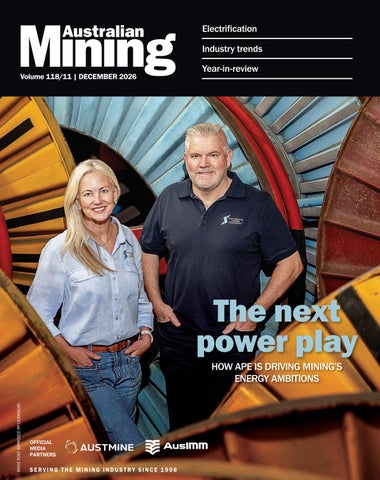
The next power play PRINT POST APPROVED PP100008185
HOW APE IS DRIVING MINING’S ENERGY AMBITIONS
OFFICIAL MEDIA PARTNERS
SERVING THE MINING INDUSTRY SINCE 1908
Your minerals matter and how we get them matters most.
Ideas | Engineering | Delivery | Results MT combines deep process expertise with proven project execution to bring complex mining and mineral processing projects to life.
• • • • •
Modular plants Studies and engineering Pit to plant solutions Lyons Unit Process optimisation
Engineering certainty. Delivering performance. Contact Mineral Technologies today. www.mineraltechnologies.com
info@mineraltechnologies.com
COMMENT
Sharing the power What if the next big step in mine electrification comes down to sharing more than just the same postcode? A new power deal in the Pilbara is putting that idea to the test.
Prealene Khera Editor
M
ining companies are used to building things for themselves – roads, railways, processing plants, and power infrastructure are generally designed around the needs of a particular operation, with the cost and responsibility borne solely by the company developing them. But a recent agreement between PLS and Fortescue got me thinking about whether it might be time to share a little more of the load. The two Pilbara miners have signed a 20-year power purchase agreement that will make PLS the first external customer of Fortescue’s Green Grid. Under the deal, PLS will secure at least 325 gigawatthours of electricity a year for its Pilgangoora lithium operation, supporting its planned P2000 expansion. There is a pretty handy incentive for PLS, which expects the agreement to reduce forecast operating costs by around $15–20 per tonne compared with the estimates used for the expansion’s final investment decision. Access to a greater share of renewable energy will also provide capacity for potential underground mining and future fleet electrification, giving the company some room to plan for what comes next. Fortescue has something to gain, too, having spent years developing its Green Grid to support its own ambition to move away from fossil fuels. Opening that infrastructure to another mining company creates a new revenue stream while helping a neighbouring operation access lower-cost power. It is a different way of getting a return from an investment that was originally intended to serve its own operations. This idea of sharing infrastructure could have some appeal in other mining regions, particularly where several operations are working within reach of one another. Electrification comes with a sizeable bill, and the cost of getting power to equipment can be just as important as the price of the equipment itself. Sharing some of that investment could help make projects more commercially attractive, although the practicalities will depend heavily on the location and requirements of each site. Distance, available capacity and reliability all need to be considered before anyone starts running power
Chairman John Murphy Chief executive officer Christine Clancy Managing Editor Paul Hayes paul.hayes@primecreative.com.au Editor Prealene Khera prealene.khera@primecreative.com.au Journalists Ethan Benedicto ethan.benedicto@primecreative.com.au Jackson Haddad jackson.haddad@primecreative.com.au Adam Daunt adam.daunt@primecreative.com.au
between neighbouring operations. PLS, for example, will invest up to $150 million in transmission connections and supporting infrastructure, including a new 220-kilovolt link to Fortescue’s Turner River solar farm. Electricity supply is targeted to begin in 2029, around the time production is expected to start at P2000. The agreement also sits within Fortescue’s much broader push to electrify its own operations, with plans for 1.5 gigawatts of solar generation, 900 megawatts of wind, substantial battery storage and more than 600km of transmission infrastructure. The company has also introduced battery-electric locomotives into its Pilbara rail network and is progressing electric mining equipment as it works towards eliminating fossil fuels from its Australian iron ore operations by 2030. While much of the attention around mine electrification tends to land on the machines themselves, I think the PLS and Fortescue deal is a good reminder that the supporting infrastructure should be weighed up equally because an electric fleet cannot run on charging points alone; it needs a power system capable of keeping up with the demands of a working mine. Yes, it’s not as easy as flicking a switch. There will be different ways to approach that challenge, and not every operation will have a neighbouring Green Grid to call on. But the industry does not need to go it alone every time. Indeed, if Australia wants to retain its mining throne, we might want to consider sharing the power.
Prealene Khera Editor
Engelbert Schmidl engelbert.schmidl@primecreative.com.au Client Success Manager Janine Clements 02 9439 7227 janine.clements@primecreative.com.au Sales Manager Jonathan Duckett 0498 091 027 jonathan.duckett@primecreative.com.au Business Development Managers James Phipps 0466 005 715 james.phipps@primecreative.com.au Rob O’Bryan 0411 067 795 robert.obryan@primecreative.com.au
AUSTRALIANMINING 3 DECEMBER 2026
Front cover
Australian Power Equipment (APE) is built on decades of hands-on electrical and industrial experience. Founded by industry veterans who bring deep roots in power generation, utilities, resources and infrastructure, APE delivers tailored, safe and cost-effective equipment and engineering solutions across Australia’s most demanding environments. It combines technical know-how with pragmatic service: whether sourcing critical transformers, switchgear or energy systems, it aims to get a job done on time and on budget, with safety and reliability always front of mind. At the heart of APE is its commitment to innovation, sustainability and community. The company believes every project is an opportunity to do things better, reducing environmental impact, supporting regional capability and uplifting local communities.
Art Director Michelle Weston michelle.weston@primecreative.com.au Subscription Rates Australia (surface mail) $120.00 (incl GST) Overseas A$149.00 For subscription enquiries please contact 03 9690 8766 subscriptions@primecreative.com.au Prime Creative Media 379 Docklands Drive, Docklands, Vic 3008 www.primecreative.com.au © Copyright Prime Creative Media. All rights reserved. No part of the publication should be reproduced or copied in any form or by any means without the written permission of the publisher. Printed by Brougham Press 865 Mountain Hwy, Bayswater VIC 3153 03 9873 5144 Published 11 issues a year
Cover image: Australian Power Equipment
In this issue 38
7
7
Electrification
10
Electrification
12
Electrification
Mining electric possibilities In an age of electrification, Australian Mining examines whether the technology, infrastructure and operational foundations are ready to support the next generation of mines. Inside the electrification transformation Australian Power Equipment is helping mining operators build resilient, adaptable and sustainable electrical infrastructure to power the energy transition.
22
Industry trends
70
38
Industry insight
72
Year-in-review
58
Industry events
76
Workforce
Pilbara’s powerful partnership Fortescue and PLS have joined forces in a landmark power agreement that could signal a new era of shared energy infrastructure.
Reflecting on change Industry leaders look back on the developments that shaped the mining sector over the past 12 months as it heads into 2027. The big picture with ‘The Big Australian’ BHP vice president of innovation Marley Palin is challenging conventional thinking on some of mining’s biggest problems, bringing fresh ideas to the fore. Mining hits prime time The mining calendar in 2026 was packed with major equipment reveals, industry debate and recognition of the people pushing the sector forward.
Commodities
Copper’s supply test The looming shortfall of copper is sharpening the mining industry’s focus on project delivery, exploration and processing technology. Unearthing 2026 Major investments, shifting commodity markets and ambitious projects have helped define another consequential year for Australian mining. The mining employment equation A peak industry body is calling for greater investment in the Northern Territory’s workforce as its resources pipeline grows.
52
44 AUSTRALIANMINING 4 DECEMBER 2026
WHO WE ARE OTR Tyres is Australia’s leading independent partner for off‑highway tyres, wheels, consumables and service solutions. With nationwide manufacturing, service hubs, and on‑site support teams, we provide the most comprehensive ground‑contact offering in the country. With deep expertise across mining and heavy industry, OTR Tyres is trusted by major operations to deliver safe, compliant, and cost‑effective solutions built for tough Australian conditions.
est Outperform The R
WHAT WE DO TYRE SOLUTIONS • Massive range & stocks of earthmover, truck & LV tyres. • Full range from 6” through to 63” from leading global brands.
Mining tyre and wheel experts. OTR Tyres is at the forefront of tyre, wheel and service innovation, proudly supporting Australia’s mining, construction, transport, agricultural and industrial
• Tyre fitting, rotation, change‑outs and on‑site support. • Tyre pressure management and haul profile optimisation. • Tyre valving, O‑rings & tooling
WHEEL & RIM SOLUTIONS • Wheels, rims, assemblies & components. • Australian manufactured with in‑house design. • Test, repair & certification under Australian Standards AS4457.1. • Latest MID and MRD compliance.
ON-SITE SERVICES • Mobile fitting capability for large OTR assemblies. • Dedicated tyre & wheel technicians for major mining operations. • On‑site wheel, rim & tyre management programs. • Tyre Handlers, mine site spec for sale or hire.
TRAINING • Industry‑accredited Cert II tyre fitting and safety training. • RTO provided on‑site or at OTR facilities.
sectors. We deliver unmatched capability, performance and reliability across every site and every haul road. Our commitment is simple, if your tyres or wheels stop, your production stops - so we’re here to keep you moving.
WITH SERVICE HUBS AND MANUFACTURING FACILITIES ACROSS AUSTRALIA, OTR TYRES PROVIDES RAPID RESPONSE AND CONSISTENT SUPPORT WHEREVER YOU OPERATE.
Phone 1300 OTR TYRES or visit www.otrtyres.com Perth | Mildura | Gold Coast | Brisbane | Emerald | Mackay | Mount Isa | Gladstone | Muswellbrook | Karratha | Port Hedland | Kalgoorlie | Geraldton
Directors Andrew Cockbain and Abby Crawford
POWERING INDUSTRY. PROTECTING TOMORROW. At Australian Power Equipment (APE), we deliver more than high-voltage power solutions – we deliver peace of mind. From brand-new transformers to expertly refurbished equipment, we help industries stay switched on with smarter, faster, and more sustainable options.
11kV Switchgear
Our circular economy model means we don’t just supply power—we give old equipment new life. By refurbishing quality assets from decommissioned sites, we minimise waste, reduce lead times, and keep urgent projects moving. It’s better for business and better for the planet. But our commitment doesn’t stop there. We actively support wildlife conservation and rewilding efforts across Australia – because powering progress should never come at the cost of our environment. With a nationwide network and a lean, responsive team, APE sources and delivers critical equipment when and where it’s needed most. Whether it’s mining, infrastructure, or renewables, our clients trust us to keep operations running and downtime to a minimum.
Type 241 cable
Backed by decades of experience and a clear vision for the future, we’re proud to be shaping a more sustainable tomorrow. AGENTS FOR
2000kVA transformer
1300 040 500
Trusted. Tested. Tomorrow-ready.
E info@australianpowerequipment.com.au W www.australianpowerequipment.com.au
ELECTRIFICATION
Mining electric possibilities In an age of electrification, Australian Mining examines whether the technology, infrastructure and operational foundations are ready to support the next generation of mines.
A
clear shift is underway in the mining industry, driven by operators’ ambitions to reduce emissions, improve efficiency and progressively move away from dependence on diesel-powered equipment. From battery-electric haul trucks to renewable energy systems and dynamic charging infrastructure, the technologies supporting this electrification transition are becoming more prominent across Australian mine sites. Yet beneath these developments lies a more complicated question: is the industry equipped to support electrification at the scale required for modern mining operations? According to University of Queensland (UQ) professor Peter Knights, the answer is multi-layered, and it is first evident in the sector’s significant progress in developing and implementing electric mining technologies. Knights also believes the widespread adoption of these technologies will require a fundamental reconsideration of how mines are designed, operated and maintained.
The opportunity, he said, extends beyond the capabilities of individual machines, encompassing electrical infrastructure, energy security, planning, workforce development and the financial realities of transitioning entire fleets. However, electrification is progressing at different rates across the mining industry. “Let’s start by separating underground and surface mining,” Knights told Australian Mining. “Underground mining is significantly more advanced on its electrification journey than surface mining is.” This distinction, according to Knights, is central to understanding the industry’s current position, particularly as miners move from small-scale trials toward industrial deployment. While electrification is often discussed as a single technological transition, underground and surface mining have followed markedly different development pathways. Knights said that in underground hard-rock operations, the motivation to electrify has historically extended beyond decarbonisation.
Diesel particulate matter (DPM) has long been a significant occupational health concern in enclosed mining environments. Knights pointed to historical legal developments in North America as a catalyst for greater investment in underground electrification, with original equipment manufacturers (OEMs) subsequently accelerating the development of electric mining machinery. “We saw a lot of the North American underground mines started to invest in underground electrification,” he said. “You had the major underground OEMs, Epiroc, Sandvik, Caterpillar, all investing in electrified drills.” These developments progressively expanded beyond tethered drilling equipment to include battery-electric loadhaul-dump machines, underground trucks and trolley-assisted systems. Crucially, smaller underground equipment has made the transition more achievable. “Underground mines then had smaller capacity equipment, which are 40 to 60-tonne underground haulage trucks that lend themselves to
electrification much more readily than the large capacity equipment in surface mines,” Knights said. “I would say that surface mines have been lagging underground electrification by probably at least a decade in terms of the technology.” Underground operations also benefit from reduced requirements for diesel ventilation, presenting a potentially compelling operational case for electrification alongside improvements in air quality. Surface operations, on the other hand, have not experienced the same immediate incentives. Instead, Knights said decarbonisation commitments, environmental, social and governance (ESG) considerations, social licence expectations and energy security have largely driven their transition. Yet even these motivations are influenced by a mine’s location and the electricity available to support its operations. According to Knights, electrification does not necessarily translate into substantial emission reductions when electricity is still generated from fossil fuels.
Image: JasonBennee/stock.adobe.com
Large-scale surface mining presents technological and infrastructural opportunities for electrification.
AUSTRALIANMINING 7 DECEMBER 2026
Image: Adwo/stock.adobe.com
ELECTRIFICATION
Electrifying heavy mining equipment requires operators to balance productivity, payload capacity and power requirements.
“The scope to reduce emissions by mine electrification depends greatly on the carbon intensity of the available electricity,” he said. Knights highlighted South Australia and Tasmania as states where cleaner electricity supplies could strengthen the emission-reduction argument. In remote regions, operators may need to invest in renewable generation and energy storage infrastructure to achieve comparable emissions outcomes. “Otherwise, mining companies are looking at having to invest significant amounts in clean energy production and also potentially storage because, of course, we need 24–7 power in a mine,” Knights said. He also said this demonstrates an important distinction between electrifying equipment and decarbonising an entire mining operation. Without reliable, low-emissions electricity, the environmental and commercial benefits of electrification can vary considerably.
The heavy haulage pivot
Perhaps the biggest technological opportunity for surface mining electrification lies in the enormous scale of equipment required to move material efficiently. Australia’s largest open-cut operations rely on haul trucks capable of transporting hundreds of tonnes of material, creating challenges Knights said are far more pronounced than those encountered underground. He said the relationship between battery capacity, equipment weight and operational productivity remains a critical limitation.
“If you take a large 200- and 300-tonne capacity truck, you need a very large battery on a machine like that,” he said. “So the battery is in the order of anywhere between 18 and 28 tonnes.” Although the removal of a conventional diesel engine offsets some of this additional weight, Knights said electrification could ultimately reduce the payload available to operators. The hurdle becomes more complicated when considering the energy required to move these machines continuously through deep open pits. “That battery will only give you one, possibly two cycles down into a large pit,” Knights said. “One of the issues with that is deep cycling a battery is not optimal for battery life, and these batteries are not cheap.” Repeatedly discharging batteries through a substantial proportion of their capacity can affect their service life, adding another financial consideration to the transition. Consequently, operators must balance equipment productivity against battery longevity, charging availability, and replacement costs. Knights believes these trade-offs demonstrate why surface mining electrification remains at a relatively early stage of technological maturity. “I believe that we’re still sitting in about six or seven out of a nine-point scale,” he said, referencing technology readiness levels. “And that is because we are still trying different charging strategies.” These approaches include stationary charging, battery swapping and systems capable of supplying electricity to equipment while it remains in motion.
Knights pointed to battery-electric haul truck trials involving BHP and Rio Tinto in the Pilbara as examples of the challenges associated with conventional plug-in charging. Referencing industry estimates, he suggested charging downtime could remove about 1000 operating hours annually from a truck otherwise expected to deliver around 6500 hours of operation. When the availability of equipment is fundamental to the economics of large mining operations, Knights said that represents a substantial productivity consideration. “So I don’t see that as being a feasible solution,” he said. “Not unless we can significantly increase the battery recharge rate, and that technology is changing quite rapidly.” While advances in battery technology and charging systems may progressively reduce these limitations, the industry is still determining which combinations can deliver the reliability required for commercial deployment. Part of this mix is whether what Knights describes as conventional mine designs can support the infrastructure needed for electric equipment, a point particularly evident in the growing interest in dynamic charging systems. Rather than requiring haul trucks to leave service for stationary charging, dynamic systems can supply electricity while vehicles travel along designated sections of haul road. These technologies offer a potential solution to charging downtime, but introduce different engineering and planning considerations.
AUSTRALIANMINING 8 DECEMBER 2026
“In surface operations, increasingly it’s looking like we need some type of trolley system with dynamic charging,” Knights said. “And that is charging of the battery whilst you’re actually heading up the ramp.” Traditional overhead trolley systems have been used in the industry for decades, although their infrastructure can limit equipment mobility and complicate changes to mine layouts. Knights suggested that side-mounted charging systems, including technologies being developed by BluVein, could offer an alternative. However, the installation of permanent electrical infrastructure along haul roads fundamentally changes the way operators must approach mine planning. “That charging rail is akin to making highways in your mine, because it’s a significant capital expense to install it,” he said. “And once you install it on a ramp, you don’t want that ramp to be moving every one or two years.” This creates a strong link between a mine’s physical configuration and the financial viability of electrification, with Knights saying that operations with established, long-term haulage routes may be better suited to dynamic charging infrastructure than those requiring frequent adjustments to benches, ramps and haul roads. “The electrification is going to be more suited to mines where you have semipermanent ramps,” Knights said. “In other words, you have a ramp which is not going to move for a significant amount of time. So it justifies the infrastructure spend on the sidemounted rail.” Knights suggested that certain coal operations, where overburden haulage ramps can remain in place for extended periods, could be particularly suitable. Nevertheless, the implications extend beyond determining where to install charging infrastructure, especially seeing as mine sequencing, equipment movements and infrastructure investments may all need to be reconsidered to accommodate electric haulage systems. Beneath the surface, underground operations face different challenges. Despite their comparatively advanced adoption of battery-electric technology, charging-station placement can introduce safety and ventilation considerations. Knights explained that some underground mines position charging infrastructure near ventilation raises to help limit the consequences of potential battery fires. “These fires showcase a prime example of how electrification affects mine design,” he said. Across underground and surface operations, Knights said, these examples demonstrate that electrification cannot
ELECTRIFICATION
Beyond electricity
While technological development remains critical, Knights believes one of the industry’s greatest limitations may be its ability to develop the workforce required to implement and maintain increasingly complex electrical systems. Battery-electric equipment introduces new requirements in terms of high-voltage electrical maintenance, diagnostics, charging infrastructure and operational safety. Knights highlighted the need for electricians qualified to work with high-voltage direct-current systems, particularly as surface mining fleets begin incorporating equipment operating at hundreds of volts. “We are going to require significantly more electricians qualified in that highvoltage DC. We don’t have them in the country at the moment,” he said. Furthermore, this is compounded by competition from other industries pursuing their own electrical infrastructure expansions. Emerging data centres, in particular, are creating additional demand for electrical skills at a time when mining operators are preparing for sophisticated technological requirements. “So a tech skill availability is going to be a major hurdle associated with electrification in the surface industry,” Knights said. At the same time, electrical safety adds another important dimension, especially as rapid charging systems must manage significant electrical loads and the connection between high-voltage power supplies and mobile equipment creates potential flashover hazards. According to Knights, automated connection systems may become crucial in managing these risks. “There’s a real risk of flashover hazards there because you’re dealing with high voltage – from 600 to 1000 volts,” he said. “One of the issues is how you just couple a battery with an external supply.” Dynamic charging could offer additional benefits by allowing batteries to receive smaller, more frequent charges, which Knights said may help extend battery life by reducing the need for deeper discharge cycles, strengthening its potential commercial appeal. However, electrical expertise alone will not be sufficient to manage the transition. Knights believes the mining industry must also reconsider the capabilities required of its planners, engineers and operational personnel. “The skills required are not just the electricians for the mine, but it actually
is going to revolve around considering a new way of planning the mining operations,” he said. “It challenges traditional thinking because we have a lot of conventional mine planners who are going to have to learn to adapt to the new technological availability.” Likewise, the transition towards electrification is also intrinsically connected to the industry’s continued adoption of automation. This transition is also connected to the industry’s continued adoption of automation; for example, Knights said the increased weight of battery-electric equipment may reduce payload capacity, requiring operators to identify other opportunities to recover productivity. One potential solution is to improve equipment utilisation through automated operations. “One way we can work the truck faster is if we automate the entire system,” Knights said. “So we have fewer people exposed to risk.” Automation could therefore become an important component of the broader electrification equation, supporting equipment utilisation while at the same time reducing people’s exposure to operational hazards. This, in turn, is an equation that Knights said must be handled with considerable care, as the combination of these technologies represents a large undertaking. “This is not a minor transition for the surface mining industry to go from manually operated diesel trucks to fully autonomous electrified trucks is quite a transition,” he said.
Rather than treating automation and electrification as separate technological developments, the industry may need to consider them as interconnected elements of future mine operations.
Who will electrify first?
Beyond the engineering and workforce considerations, the transition towards industrial-scale electrification ultimately depends in large part on the economics of implementation. Electric haul trucks, charging infrastructure, power generation and supporting systems require substantial capital investment, potentially creating significant barriers for operators without sufficient financial resources. Knights suggested that the companies best positioned to undertake this transition are those with long-life mineral reserves and the capacity to absorb higher upfront costs. “In general, these are your iron and coal miners, and these operators are the ones I would expect to first see electrification and automation coming in,” he said. Iron and coal mines’ typically extensive resource bases and long operating horizons provide greater opportunities to recover capital expenditure through lower longterm operating costs. Other commodities and operations with shorter remaining mine lives, with Knights pointing to gold as an example, may face a more difficult investment proposition. Knights believes industrial-scale electrification could require a return on investment measured over several years rather than an immediate financial benefit.
Electrical infrastructure is integral to supporting the electrification of underground mining operations.
AUSTRALIANMINING 9 DECEMBER 2026
While larger companies may be positioned to invest in integrated electric fleets, renewable generation and permanent charging infrastructure, smaller operators may have to adopt more selective approaches. Knights said this suggests electrification will progress unevenly, influenced as much by the economic circumstances of individual mines as by developments in technology. In addition, the necessary technologies are developing, but effective implementation depends on aligning multiple systems, from electricity generation and charging infrastructure to mine design and workforce capabilities. Equally, the industry must establish whether those investments can deliver sustained productivity improvements over the life of an operation. Australia’s underground mining sector has already demonstrated that electrification can become a practical and commercially meaningful component of mine operations. The challenge facing surface mining is to translate those advances into a considerably larger and more demanding operating environment. The economics will also depend on how effectively charging can be integrated into production schedules without compromising haulage productivity. This raises the question of whether mines themselves can be designed, equipped and operated to realise the full potential of electrification at an industrial scale. AM
Image: Adwo/stock.adobe.com
be approached simply as a replacement program for existing machinery. Instead, the infrastructure must become an integral consideration in the planning and development of the mine itself.
ELECTRIFICATION
Inside the electrification transformation Australian Power Equipment is helping mining operators build resilient, adaptable and sustainable electrical infrastructure to power the energy transition.
E
lectrification is gaining momentum across Australia’s mining industry, as major miners invest in technologies to reduce diesel dependence and improve operational efficiency. In April 2026, Fortescue announced a $US680 million investment in renewable energy infrastructure in the Pilbara, while BHP and Rio Tinto are collaborating with Caterpillar to trial battery-electric haul trucks at BHP’s Jimblebar iron ore mine. These developments reflect the industry’s growing investment in electrified operations and the infrastructure required to support them. While electric haul trucks, excavators and underground mining equipment often capture the headlines, a much larger transformation is taking
place behind the scenes, and supporting these technologies requires sophisticated electrical networks capable of delivering reliable power across some of Australia’s most demanding operating conditions. For Australian Power Equipment (APE), the opportunity extends well beyond supplying individual components. It lies in helping mining operators develop integrated electrical infrastructure that responds to immediate operational requirements while anticipating future needs. From specialised mining cables and switchgear to transformers and rapidly deployable substations, APE is bringing together technical expertise and established international manufacturing partnerships to inspire the next generation of Australian mining.
The growing demands on electrical networks
As more mining equipment transitions from diesel to electrically-powered operations, site electrical infrastructure will be asked to perform new roles and meet new demands. Electrification requires more than simply increasing power supply, with mines needing to consider how electricity is distributed across expanding operations, how equipment is protected, and how electrical networks can accommodate changing loads and operational requirements. For many operators, this means expanding existing networks, introducing additional generation, such as solar and wind energy, and ensuring critical infrastructure can operate reliably in demanding environments and changing weather conditions. Electrical cables are central to this transformation. “As the number of electrically powered machines and installations grows, so too does the need for specialised cable systems capable of safely and reliably delivering power throughout a mine, across both fixed and mobile plants,” Australian Power Equipment co-director Abby Crawford said. Extreme temperatures, abrasive surfaces, mechanical stresses, ultra-violet (UV) exposure, moisture and continuous movement can all affect cable performance and longevity. Through its partnership with international cable manufacturer Üntel Kablo, APE supplies specialised mining, tunnelling and trailing cables designed for demanding applications. This relationship extends beyond conventional supply arrangements. Working directly with Üntel’s engineering and manufacturing teams, APE has collaborated on cable specifications developed to withstand the unique challenges of Australian mining conditions.
Images: Australian Power Equipment
Reliability is an investment, not an expense
Australian Power Equipment directors Abby Crawford and Andrew Cockbain.
As mining operations expand their electrical infrastructure to electrify and limit emissions, procurement decisions will play a central role in determining long-term performance. While the initial purchase price remains an important consideration, it represents only one component of the overall cost of ownership. For electrical infrastructure operating in harsh environments, factors including durability, maintenance requirements, operational efficiency
AUSTRALIANMINING 10 DECEMBER 2026
and downtime, and repairability can significantly influence lifecycle value. A cable that requires frequent replacement, for example, may prove considerably more expensive over time than an appropriately specified alternative offering greater longevity. Similarly, electrical equipment that can be maintained, refurbished or redeployed may deliver additional value long after its initial installation. “Electrification brings an opportunity to look beyond individual equipment purchases and consider the performance of the electrical network as a whole,” Australian Power Equipment co-director Andrew Cockbain said. “Correct specification, equipment quality and the ability to maintain reliable operation over time are fundamental. It’s about engineering solutions that deliver lasting value, rather than focusing solely on the initial cost.” Alongside critical cable installations, switchgear, transformers and substations also play essential roles in regulating, transforming, distributing and protecting electrical power across mining operations. As electrical networks become more complex to support renewable energy and hybrid power systems, ensuring these components work together effectively becomes increasingly important. APE supplies a comprehensive range of switchgear, transformers and associated power distribution and power quality equipment, supporting everything from individual installations to complex site-wide electrical networks. Mining is rarely static. New extraction areas are developed, infrastructure is relocated, production requirements change and temporary power demands can emerge with little warning. APE’s rapidly deployable containerised power systems provide an adaptable solution to these challenges. By incorporating electrical infrastructure into transportable, modular configurations, these systems can provide power distribution capacity where and when it is required, without necessarily committing to a permanent installation. This flexibility can be particularly valuable for remote operations, mine expansions, temporary projects and changing production environments, especially in extreme conditions where cyclonic rated equipment is required. It also creates opportunities to redeploy infrastructure as site requirements evolve, extending the useful life and potential value of the original investment.
ELECTRIFICATION
Connecting renewable energy to mining operations
Electrification is creating opportunities for mining operators to integrate a greater diversity of energy sources. Solar generation, battery energy storage and hybrid power systems are becoming even more relevant to the way remote operations plan and manage their electricity supply. But without transformers, switchgear, substations and associated electrical systems, which provide essential connections between generation assets and site infrastructure, this energy is inaccessible. APE understands the equation, ensuring power quality, voltage regulation, equipment compatibility and future expansion form part of its engineering considerations. While electrification offers opportunities to reduce operational emissions, it also presents an important question: how can the infrastructure supporting this transition be managed more sustainably? Manufacturing, transporting, installing and eventually replacing electrical equipment all contribute to its environmental footprint. For APE, circular-economy principles have long been an important consideration in equipment sourcing and supply. Alongside manufacturing new equipment to specification, the company offers refurbished and repurposed transformers and other suitable electrical assets, providing alternatives where equipment condition, engineering requirements and compliance standards allow. By identifying opportunities to extend equipment life, refurbish existing assets and redeploy infrastructure into new applications, APE helps customers prioritise both its commercial and environmental imperatives. Importantly, circular thinking does not mean compromising quality or safety. Appropriate assessment, testing, engineering verification and compliance remain essential. Nor does sustainability automatically mean replacing existing infrastructure with new equipment. In many circumstances, extending the useful life of a well-maintained asset can represent a practical and responsible alternative. The same principles apply to cable systems, where durable specifications, appropriate maintenance and consideration of end-of-life material recovery can contribute to reducing waste. As the industry invests in new electrical infrastructure, considering an asset’s complete lifecycle from the outset offers an opportunity to build more sustainable practices into the foundations of electrification.
Australian Power Equipment supplies a range of switchgear, transformers and associated equipment to suit specific mine site needs.
Electrification is creating opportunities for mining operators to integrate a greater diversity of energy sources.
Powering what comes next
Electrification represents more than a change in the machinery operating on mine sites; it’s an opportunity to reconsider the electrical infrastructure that underpins mining productivity, reliability and longterm sustainability. Success will depend on solutions that are technically sound,
appropriately specified and sufficiently flexible to accommodate an evolving industry. “Electrification is creating enormous opportunities for mining, but it’s also an opportunity to think differently about the infrastructure we invest in,” Crawford said. “At Australian Power Equipment, we
AUSTRALIANMINING 11 DECEMBER 2026
believe the best solutions consider more than today’s immediate requirements. “They look at longevity, reliability, adaptability and the value an asset can deliver throughout its lifecycle. “That’s how we help our customers build infrastructure that supports both operational performance and a more sustainable future.” AM
ELECTRIFICATION
Image: Fortescue
L–R: PLS’s Dale Henderson and Fortescue’s Dino Otranto.
Pilbara’s powerful partnership Fortescue and PLS have joined forces in a landmark power agreement that could signal a new era of shared energy infrastructure and mining electrification across the Pilbara.
P
LS has secured a minimum of 325 gigawatt-hours of electricity per annum for its Pilgangoora lithium operation in Western Australia following a landmark agreement with fellow Pilbara mining giant Fortescue. The 20-year power purchase agreement (PPA), executed between PLS subsidiary Pilgangoora Operations and Fortescue subsidiary FMG Clean Energy, will see the lithium producer become the first external customer of Fortescue’s Green Grid network. Supporting Pilgangoora’s forecast power demand under its recently approved P2000 expansion, the agreement is expected to deliver materially lower operating costs, enhanced long-term energy security and a substantially higher share of renewable energy in the operation’s power mix. It also marks a significant step in Fortescue’s ambitions to commercialise its growing renewable energy infrastructure, extending the benefits of its electrification strategy beyond its own operations.
“We are pleased to partner with Fortescue and become their first external Green Grid customer,” PLS managing director and chief executive officer (CEO) Dale Henderson said. “We commend Fortescue’s leadership in bringing its vision for large-scale, loweremissions power infrastructure across the Pilbara to life, and strongly support the opportunity for shared infrastructure to benefit industry across the region.” Under the agreement, PLS expects to reduce its forecast unit operating costs by approximately $15–20 per tonne compared with the 10-year average estimates underpinning the P2000 expansion’s final investment decision (FID). It will invest up to $150 million in transmission connections and supporting power infrastructure between the 2026– 27 and 2028–29 financial years (FY27– FY29), with electricity supply targeted to commence in 2029. The project will also connect Pilgangoora to Fortescue’s Turner River solar farm through approximately 25km of new 220-kilovolt transmission
infrastructure, of which PLS will fund and own around 20km. With capacity exceeding 100 megawatts, the connection will accommodate P2000’s power requirements while providing additional capacity for potential underground mining and future fleet electrification. “This agreement further strengthens our low-cost position at Pilgangoora, improving our competitiveness and resilience through lithium market cycles,” Henderson said. “Access to lower-cost, lower-emissions power will deliver further improvements to the economics of our recently approved P2000 Project expansion, beyond those announced at FID, while providing capacity to support future growth.” The agreement comes at a pivotal time for PLS, which is preparing to significantly expand production at one of the world’s largest independent hard-rock lithium operations. In October, the company approved a $1.9 billion FID for its P2000 expansion, targeting approximately two million
AUSTRALIANMINING 12 DECEMBER 2026
tonnes of annual spodumene concentrate production capacity through the construction of its new Jimmagunya processing plant. First production is expected during the September quarter of 2029, placing the expansion’s commencement alongside the targeted introduction of Fortescue’s electricity supply. PLS had previously committed $175 million in pre-FID expenditure to progress long-lead procurement, engineering and early works, ensuring the project could advance while retaining flexibility around its investment timing. More recently, PLS delivered record Pilgangoora spodumene concentrate production of 267,600 tonnes in the September quarter, a 25 per cent increase supported by the restart of its Ngungaju processing plant. Unit operating costs also declined 12 per cent to $539 per tonne, strengthening the operation’s cost position ahead of its next phase of development. The Fortescue agreement provides another opportunity to improve
ELECTRIFICATION
The miner introduced its first two battery-electric locomotives into its Pilbara rail operations earlier this year, demonstrating the potential to replace diesel-powered equipment in one of mining’s most energy-intensive applications. The company has subsequently reported progress across battery-electric excavators, drills, water carts, loaders and other equipment, with its electrification program centred on efficiency alongside emission reductions.
These efforts have been underpinned by record FY26 iron ore shipments of 201.3 million tonnes, illustrating the scale at which Fortescue is seeking to implement its energy transition. From PLS’s perspective, connecting to the Green Grid is expected to reduce Pilgangoora’s power-related emissions intensity by up to 80 per cent from its FY23 baseline by 2030. The agreement will complement the operation’s existing generation
infrastructure, including gas, solar, diesel and battery storage, with additional on-site generation retained to manage potential interruptions to supply. While the arrangement remains subject to construction and regulatory conditions, it offers a potential model for how mining companies can work together to reduce energy costs, support future growth and accelerate the sector’s transition towards loweremissions operations. AM
Pilgangoora’s solar farm in Western Australia.
The PLS Pilgangoora crushing plant.
Images: PLS
these economics, particularly as PLS navigates the cyclical nature of global lithium markets. PLS’s longer-term outlook is also supported by a multi-year spodumene offtake agreement with Canmax Technologies, under which the Chinese manufacturer will receive 150,000 tonnes of concentrate annually, with options for additional supply. Beyond concentrate production, PLS has also opened Australia’s first mine-site lithium mid-stream demonstration plant at Pilgangoora. Using electric calcination technology, the facility is designed to process approximately 27,000 tonnes of spodumene concentrate annually into around 3000 tonnes of lithium phosphate, creating opportunities to capture greater value from Australia’s lithium resources. Together, these developments highlight the growing importance of reliable and competitive electricity supply as PLS expands its production capacity and its position in the battery materials value chain. As for Fortescue, the agreement represents another milestone in its transformation from an iron ore producer into an emerging supplier of large-scale renewable energy. The company has been progressing its Real Zero strategy, targeting the elimination of fossil fuels from its Australian iron ore operations by 2030. In April, Fortescue announced a $953 million investment to accelerate the development of a 200-megawatt Pilbara green energy project, supporting renewable generation beyond its own decarbonisation requirements. Its broader Green Grid plans include 1.5 gigawatts of solar generation, 900 megawatts of wind, 4–5 gigawatt-hours of battery storage, and more than 600km of transmission infrastructure. This network is designed to support the company’s transition away from diesel and gas while creating opportunities to supply electricity to other industrial customers across the region. Fortescue CEO of metals and operations Dino Otranto said the agreement demonstrates how infrastructure originally developed for the company’s operations can create broader commercial opportunities. “We started building the Green Grid for our own operations, but we could see strong demand for cheap, green, reliable power across the Pilbara and an opportunity to supply other customers too,” Otranto said. “This agreement is an important first step and cements our role as an energy supplier. It will help power PLS’s expansion, support economic growth in the region, and create a new, long-term revenue stream for Fortescue.” Fortescue has also been advancing electrification across its mobile mining equipment and transport networks.
AUSTRALIANMINING 13 DECEMBER 2026
ELECTRIFICATION
Image: pkproject/stock.adobe.com
Reliable connectivity underpins increasingly interconnected mining operations.
Connecting the electric mine As mining embraces electrification, Madison Technologies is ensuring the networks connecting tomorrow’s fleets are ready for the transition. fleet of around 300 haul trucks to batteryelectric power, with modelling cited by Madison Tech suggesting each truck could require six 15-minute charges a day. Across a fleet of that size, this would amount to approximately 1800 charging events each day. Each event would require coordination between fleet management, charging infrastructure and the site’s energy supply, with information passing between connected systems rather than being managed by the truck or charger alone. Coordinating this charging process instead depends on the operational communications network connecting machines, power infrastructure and control systems. “Electrification is changing the way mines operate, but the technology is only as effective as the networks supporting it,” Cisco channel manager at Madison Tech, Nev Nikolic said. “Working with Madison Technologies means integrators can access the right solutions and expertise to build reliable, connected operations.” The importance of reliable connectivity can be observed at brownfield operations. According to Madison Tech, communications infrastructure at these sites was often designed for an earlier generation of mining equipment, with networks built around fewer connected devices, lower data demands and infrastructure that did not account for high-power charging systems.
Therefore, introducing electrification into this environment places additional demands on network capacity, reliability and recovery, with potential consequences extending from commissioning delays to interruptions in production. Madison Tech said that as electrification introduces greater interdependence between equipment, charging systems and power infrastructure, a network disruption can affect multiple aspects of an operation simultaneously. This also increases the importance of maintaining visibility across connected systems, particularly where equipment availability and production
Connected infrastructure is essential to maintaining efficiency across modern mine sites.
AUSTRALIANMINING 14 DECEMBER 2026
schedules depend on coordinated energy management. “Many existing mine networks were never designed to support the volume of connected equipment electrification introduces,” Madison Tech networking engineer Corey Nesbitt said. “Planning connectivity from day one means you avoid a lot of rework, get a network you can rely on, and leave room for the network to grow.” According to Madison Tech, addressing these challenges begins before equipment arrives on site. Its recently developed battery energy storage systems (BESS) Connectivity FAQ outlines common sources of network issues,
Image: Jason Bennee/stock.adobe.com
M
ining electrification is often seen through the lens of trucks, batteries, and solar farms, but it also relies on something less visible – communications networks. These networks connect equipment, power infrastructure and control systems, and must be adequately equipped to meet the demands of a modern and interconnected mine site. As a premier connected infrastructure distributor, Madison Technologies (Madison Tech) is helping bridge the gap between mining’s electrification ambitions and the framework required to realise them. Working alongside Cisco, a global technology company specialising in networking and communications infrastructure, Madison Tech supports the deployment of industrial networking solutions through design validation, hardware pre-configuration, laboratory testing and local technical support. As Australia’s first Cisco Operational Technology Supplier (OTS), Madison Tech provides systems integrators with access to Cisco’s industrial portfolio without requiring them to become Cisco partners. This gives integrators a way to source industrial networking equipment while drawing on Madison Tech’s configuration, testing and local technical support as electrification projects move from pilots to fleet plans. Madison Tech pointed to Fortescue as an example. The miner plans to convert its
including inadequately tested design assumptions, unresolved integration requirements and commissioning processes that overlook system recovery. Rather than treating communications infrastructure as an addition to electrification, Madison Tech said it advocates for networks designed around the operational requirements of the equipment they support. This includes establishing redundant communication pathways, accounting for environmental conditions and validating how systems respond when connections fail. The company’s approach emphasises simplicity and repeatability, ensuring networks can be expanded and maintained without unnecessary complexity; Cisco’s industrial networking portfolio supports these requirements, designed to maintain communications across fixed infrastructure and moving equipment. At substations and charging hubs, Cisco’s Catalyst IE9300 and compact IE3100 industrial switches provide the foundations for resilient network architecture. A fibre ring configuration can be designed to recover from a cable break in under a second, helping maintain communications between charging infrastructure and critical control systems. Madison Tech said that standardising these configurations also allows operators to expand charging capacity without redesigning their entire communications
network, a level of flexibility that becomes integral as operators progressively introduce electrified equipment rather than replacing entire fleets at once. A communications network capable of accommodating additional charging stations, connected assets and energy management systems can therefore support a staged transition, allowing infrastructure investment to follow the changing requirements of the operation. However, in this case, connectivity becomes more complex than just fixed infrastructure. Haul trucks operate continuously across changing terrain, where interruptions to wireless communication can affect telemetry, positioning information and remote-control capabilities. Cisco’s Ultra-Reliable Wireless Backhaul technology, supported by its rugged Catalyst IW9167E access point, is designed for moving industrial assets, with specified latency below 10 milliseconds and seamless handovers between wireless access points. While these technologies provide the foundation, Madison Tech’s role extends to ensuring these systems operate reliably throughout their lifecycle, especially since BESS and hybrid microgrids add integration complexity, particularly when batteries, inverters, charging equipment, and control systems come from different manufacturers. Madison Tech said its BESS guidance emphasises that the issue is
Image: Madison Technologies
ELECTRIFICATION
Cisco’s Catalyst IE9300 industrial switch provides highperformance networking for demanding mining environments.
not necessarily equipment diversity, but how effectively these systems communicate, highlighting that shared protocols, consistent configurations, and clearly defined integration points are essential to maintaining predictable performance. To address these requirements, Madison Tech works with integrators to validate designs, review equipment specifications and pre-configure hardware before deployment. In remote mining operations, these preparations can be especially valuable, including firmware testing, network segmentation, and redundancy behaviour, reducing the likelihood of unexpected issues during commissioning. In addition, maintaining preconfigured spare equipment and documented replacement procedures can reduce recovery time after hardware failures, while locally available technical support helps limit extended disruptions.
Cybersecurity is another important consideration as electrified operations are beginning to introduce growing numbers of connected assets and third-party equipment providers. Madison Tech said that Cisco’s Cyber Vision offers visibility into connected operational technology devices and their communications, while Cisco Secure Equipment Access provides controlled, zero-trust remote access for authorised manufacturers. Together, these capabilities help support Madison Tech’s broader emphasis on building networks that are secure, scalable and straightforward to maintain, especially as electrification’s conversation extends well beyond the equipment replacing diesel-powered machinery. To Madison Tech, the success of this transition will depend equally on the infrastructure connecting it all. After all, you can’t electrify what you can’t connect. AM
ATLAS COPCO
GENERATORS - LIGHT TOWERS- COMPRESSORS RELIABLE POWER WHEN IT MATTERS MOST.
RUGGED, PORTABLE, AND JOB-READY
DESIGNED FOR TOUGH ENVIRONMENTS & DEMANDING WORKLOADS.
Atlas Copco’s extensive range of generators, light towers and compressors are engineered for maximum uptime while providing uncompromising efficiency in the toughest environments. Whether you need reliable onsite power, precision-engineered air flow, or high-intensity illumination, our equipment delivers the sustainable performance and rugged durability your project demands.
PH: 1800 733 782 www.atlascea.com.au AUSTRALIANMINING 15 DECEMBER 2026
ELECTRIFICATION
Charging towards a diesel-free future BHP is looking to put more power behind its emissions ambitions, partnering with Caterpillar on an energy system that could keep battery-electric haul trucks running while reducing diesel consumption.
T
he Big Australian is preparing to trial Caterpillar’s Dynamic Energy Transfer (DET) system at its Jimblebar iron ore operation in Western Australia’s Pilbara region during the 2026–27 financial year (FY27), forming part of its goal to reduce diesel consumption across mining operations. This technology would let batteryelectric haul trucks charge while moving, which BHP said could potentially reduce time spent stationary and address a key productivity challenge associated with fleet electrification. At the same time, the trial forms part of the miner’s broader efforts to achieve net-zero operational greenhouse gas emissions by 2050, with the company identifying diesel displacement as a major opportunity to reduce emissions beyond 2030. BHP group officer for sustainability and social value Maria Palomar said replacing diesel-powered equipment would
require changes beyond introducing electric machinery. “They would need new charging, power and operating models, and those changes can affect safety, productivity, cost, congestion and reliability at scale,” she said. While electrification remains BHP’s preferred long-term pathway to replace diesel, the company has acknowledged that the transition will require substantial changes to the infrastructure and operating practices supporting its mining fleets. According to BHP, a theoretical current-generation 220-tonne-class battery-electric haul truck equipped with a three-megawatt-hour battery would require six to eight charging stops every 24 hours, each lasting approximately 30 minutes. By comparison, a conventional dieselpowered haul truck typically requires
one 15-minute refuelling stop over the same period. BHP said it estimates the additional charging requirements could result in approximately 1000 lost hauling hours annually for a single truck, potentially increasing to 100,000 hours across a fleet of 100 vehicles. While BHP said the figures represent a theoretical comparison rather than downtime recorded during its existing battery-electric truck trials, they illustrate the potential operational implications of replacing diesel-powered fleets. For large mining operations that depend on continuous material movement, additional charging time could affect the amount of ore transported throughout the day. Introducing more trucks to compensate for lost hauling capacity could also increase capital expenditure, maintenance requirements, congestion and demand on supporting infrastructure.
“Adding more trucks may recover some of those tonnes, but it would also bring more capital, more congestion, greater power demand, more maintenance and additional supporting infrastructure,” Palomar said. “At that point, we would not just be changing the truck; it would change the design and performance of the whole mining system itself.” These challenges have prompted BHP to examine alternative charging arrangements that can support electric haulage without substantially affecting production. Earlier in September, the company said it was assessing a combination of static and dynamic charging, with the latter potentially providing electricity to trucks along long, high-traffic haul routes. Dynamic charging could allow battery-electric trucks to receive power during normal operations, reducing their
Replacing diesel-powered equipment requires changes beyond introducing electric machinery. AUSTRALIANMINING 16 DECEMBER 2026
ELECTRIFICATION
dependence on stationary charging facilities while potentially lowering onboard battery storage requirements. The approach could also affect mine planning, where haul routes, power infrastructure and vehicle movements would need to be coordinated to support the charging system. Palomar said the technology could change the productivity equation for battery-electric haulage. “We see potential for a future system that combines static and dynamic charging, with dynamic charging focused on long, high-traffic haul routes where it can deliver the most value,” she said.
Testing the technology
Technology could change the productivity equation for batteryelectric haulage.
In FY2026, BHP began a trial involving two Wabtec FLXdrive batteryelectric locomotives at its Western Australia Iron Ore (WAIO) operations, a program expected to expand in FY27 to include two battery-electric locomotives supplied by Progress Rail, allowing the miner to evaluate technologies from different manufacturers in the same operating environment. The trials will examine battery performance, infrastructure requirements and suitability for Western Australia’s heavy-haul rail network. Simultaneously, BHP is also evaluating the potential integration of 360-tonneclass battery-electric haul trucks at its Chilean copper operations, although electric models of this size are not yet available for trials. Alongside battery-electric technology, BHP said it is assessing hybrid equipment, power-agnostic platforms and sustainably sourced biofuels as potential alternatives for reducing diesel consumption, with both the WAIO and the Chilean operations demonstrating the need for more than a single electrification solution for BHP’s portfolio. The company does not currently expect large-scale battery-electric equipment deployment across its operations until after FY2030, reflecting the time required to develop and validate suitable technologies. Meanwhile, electrifying BHP’s mining fleets also brings the question of how the additional electricity demand will be supplied. The miner reported that its operational greenhouse gas emissions in FY2026 were 33 per cent below its FY2020 baseline, while renewable sources accounted for 80 per cent of electricity at its operated assets globally. Renewable electricity accounted for 35 per cent of supply at Copper
Images: BHP
BHP’s planned DET trial builds on its existing battery-electric haul truck program at Jimblebar, where two Caterpillar 793 XE Early Learner trucks began proof-of-concept testing in March 2026. Conducted in collaboration with Caterpillar and Rio Tinto, the trial is examining the performance of approximately 220-tonne-class batteryelectric trucks under mining conditions. BHP’s 2026 annual report outlined the importance of testing not only the trucks themselves, but also the charging infrastructure, energy management systems, maintenance requirements and operating practices needed to support them. The company expects to commission high-power static charging infrastructure and Caterpillar’s DET technology at Jimblebar during FY27, and together, these systems will allow BHP to examine whether charging can be integrated into existing haulage operations while maintaining the safety, reliability and productivity required at a large-scale iron ore mine. The trial will also help determine how well dynamic charging could complement static charging and reduce the operational limitations of current battery technology. However, BHP said the equipment and energy transfer technologies remain under development and are not yet commercially available. Its annual report also highlighted the importance of workforce capability, safety controls and power management in enabling large-scale electrification. These requirements extend beyond installing charging equipment, with changes potentially needed to maintenance procedures, mine planning and operational practices. The company is consequently using proof-of-concept trials to establish how the various components of an electric haulage system can operate together before making larger investment decisions. While Jimblebar is a key testing ground for BHP’s electric haulage ambitions, similar considerations are shaping the company’s approach to other mining and transport equipment.
Additional charging time could affect how much ore is transported throughout the day.
South Australia and up to 30 per cent at Western Australia Iron Ore’s Port Hedland operations. BHP Mitsubishi Alliance also moved to 100 per cent renewable electricity from July 2026, based on forecast demand. These developments have supported BHP’s target of reducing operational emissions by at least 30 per cent by FY2030, although the company said it expects its emissions reduction pathway to remain uneven as production expands. In particular, BHP’s growing copper portfolio highlights the need to coordinate future production with the energy infrastructure required to support it, as shown by the miner’s goal of targeting Copper South Australia production of approximately 500,000 tonnes annually by 2035 and potentially 650,000 tonnes by 2040. Such growth brings additional considerations around energy supply, operational efficiency and the technologies required to support expanding mining operations. Beyond its own operations, BHP is also pursuing partnerships to reduce emissions
AUSTRALIANMINING 17 DECEMBER 2026
across commodity supply chains, including a pilot with Amazon to examine environmental attribute certificates for copper and a renewed partnership with China Baowu focused on lower-emissions steelmaking technologies. While these initiatives address different stages of the mining value chain, they form part of BHP’s wider approach to emissions reduction through technological development and industry collaboration. In haulage, however, BHP said the immediate priority remains establishing whether electric fleets can meet the operational demands of large mining systems. Palomar said the company’s trials would help inform future investment decisions. “Each trial is designed to build the evidence base: what works, what does not, and what still needs to mature before major investment decisions are made,” she said. With DET testing planned for FY27, BHP’s Jimblebar program could provide important insights into how batteryelectric haulage can move beyond early trials towards deployment at scale. AM
ELECTRIFICATION
Powering South Australia South Australia’s copper and critical minerals ambitions are gathering momentum, and its transmission network is becoming central to the next phase of industrial growth. to set the new global standard for a modern economy, where rapidly growing business and industry are supported by clean energy.” Realising that opportunity, ElectraNet said it requires a transmission network capable of supporting large industrial loads, accommodating developments across geographically dispersed regions and maintaining reliable electricity supply. South Australia’s mining ambitions have grown in significance throughout 2026, particularly as copper producers look to increase output to meet global electrification demand. In October, BHP outlined a substantial expansion of its Olympic Dam resource base, reporting a maiden 10.73-billiontonne block-cave mineral resource at the South Australian operation. The announcement reinforced BHP’s longer-term ambition to lift Copper South Australia production to approximately 500,000 tonnes per annum by 2035 and potentially 650,000 tonnes by 2040. While the resource remains subject to further assessment, it highlights the scale of industrial development under consideration. BHP is also progressing studies for an Olympic Dam smelter and refinery expansion, alongside investments across its broader South Australian copper operations.
Given copper’s essential role in renewable energy generation, electrical networks and electric vehicles, South Australia is well positioned to supply a commodity fundamental to the energy transition. However, ElectraNet said rising electricity demand is not confined to established copper operations. The report identified the Eyre Peninsula and Upper Spencer Gulf as major emerging industrial demand centres, with proposed developments spanning minerals processing, green metals, desalination and renewable energy. Unlike gradual residential or commercial demand growth, large industrial facilities can introduce substantial electricity requirements as individual projects commence operations. In response, ElectraNet has outlined transmission developments intended to strengthen the network and create additional capacity for industrial growth. Among the most significant is the proposed Northern Transmission Project (NTx), which would establish a highcapacity electricity corridor connecting Adelaide, the Mid North and Upper Spencer Gulf. The project comprises two sections: NTx South, linking Adelaide with Bundey near Robertstown, and NTx North,
extending towards the Whyalla and Cultana region. Together, ElectraNet said the proposed infrastructure would establish a north– south transmission pathway with more than 2000 megawatts of transfer capability, improving access to renewable electricity while enabling new industrial connections. It would also strengthen electricity supply to Greater Adelaide, improve resilience against extreme weather and reduce constraints affecting renewable generation. “Transmission infrastructure will be vital to create an electricity superhighway, taking energy from the source to where it is needed, and managing the peaks and troughs of demand,” Emms said. “So while South Australia has an exciting economic opportunity ahead, we must have the ability to take it. It is vital that we get the planning right and that regulators and governing bodies continue to evolve with us as we tackle truly unique energy circumstances.” Further west, the proposed Eyre Peninsula Upgrade would strengthen transmission capability between Cultana and Yadnarie, building on the Eyre Peninsula Link commissioned in 2023. ElectraNet’s preferred solution includes upgrading existing doublecircuit lines from 132 kilovolts (kV)
Image: adrianad/stock.adobe.com
S
outh Australia’s mining future is becoming a question of power, extending beyond the minerals that lie beneath its surface. As the state looks to capitalise on its copper, magnetite and critical minerals resources, the electricity infrastructure needed to extract, process and refine these commodities is emerging as a defining consideration for future projects. This intersection sits at the centre of ElectraNet’s 2026 Transmission Annual Planning Report (TAPR), which states annual electricity consumption could more than double from approximately 12 terawatt-hours (TWh) to over 25TWh by 2041, with mining and minerals processing among the drivers. ElectraNet chief executive officer (CEO) Simon Emms said the state’s mineral endowment and renewable energy resources presented a significant economic opportunity. “South Australia is facing a jobs boom as industries seek to access the state’s unique combination of valuable minerals and world-class wind and solar renewable energy,” Emms said. “As industries such as mining, steelmaking, defence and artificial intelligence (AI) expand, the demand for electricity in the state is set to grow significantly. We have the opportunity
South Australia is well positioned to supply a commodity fundamental to the energy transition.
AUSTRALIANMINING 18 DECEMBER 2026
ELECTRIFICATION
Anticipating future demand remains crucial in the electrification process.
Image: Peter/stock.adobe.com
to 275kV, supported by substation works. Additional infrastructure could follow if sufficient industrial demand is committed, with developments remaining subject to regulatory assessment and investment approvals. However, South Australia’s electricity transition has already achieved significant milestones. In the early 2000s, coal and gas accounted for more than 90 per cent of the state’s electricity supply. By 2025, renewable generation supplied more than 75 per cent of annual electricity consumption, with the state targeting 100 per cent net renewable electricity by 2027. Yet increased renewable generation adds complexity for industries that depend on continuous, reliable electricity. The TAPR describes how renewable output can fluctuate substantially within a single day, increasing the need for storage, flexible generation, and transmission capacity. For mining operations, particularly energy-intensive processing facilities, this level of electricity reliability is directly linked to operational continuity and production performance. Electrification therefore extends beyond replacing diesel-powered equipment with battery-electric alternatives. It also involves the substations, transformers, distribution systems and energy management technologies needed to support an interconnected operation.
ElectraNet said it is also investigating system-strength solutions, network protection upgrades and operational technologies designed to maintain stability as conventional generation retires. With transmission infrastructure becoming inseparable from South Australia’s industrial ambitions, the report said traditional reactive approaches to network planning are no longer sufficient.
PULSE Key Features
• • • •
Monitoring •• Parameters • •
Why Pulse
• • • •
Instead, development must anticipate future demand while remaining responsive to the investment decisions of mining companies and other industrial proponents. “New transmission will be essential to connect new generation and storage to existing customer demand, and to meet increasing demand from electrification and emerging industrial expansion,” Emms said.
As copper production and downstream processing expand, electricity infrastructure will play a greater role in determining where and how industrial growth takes place. South Australia has demonstrated what renewable energy investment can achieve. Its next opportunity is ensuring the transmission network is ready to power the mining developments that follow. AM
REAL TIME BELT CLEANER CONDITION MONITORING SYSTEM
Real Time Monitoring Early Fault Detection Wireless Connectivity Cloud Dashboard
Blade life Blade / surrounding temperatures in real time Identify abnormal vibrations & imbalance Continuous battery level indication Advanced Technology Over Competitors. Prevents Belt Cleaner Failures and Conveyor Downtime Reduce manual inspection Higher Productivity. Greater Profitability
“Smart solutions for Asset monitoring and Reliability” THEJO ENGINEERING LIMITED INDIA: +91 96770 44702
AUSTRALIA: +61 89434 4811
MARKETING@THEJO-ENGG.COM BRASIL: +55 19996238339
CHILE: +56 963603525
AUSTRALIANMINING 19 DECEMBER 2026
WWW.THEJO-ENGG.COM SAUDI ARABIA: +96 6568524806
UAE: +971 544023729
ELECTRIFICATION
Image: CAPS Australia
CAPS has an extensive portfolio of compressed air and power generation solutions.
Full power ahead CAPS Australia helps mines through remote power challenges with portable generators and engineered solutions suited to local conditions.
N
ot every site has access to mains electricity. Remote operations often need to generate power on site, with equipment capable of handling the demands of the local environment. For CAPS Australia director of operations Paul Goodwin, selecting the right power solution means understanding the specifics of each operation, from the power requirement to the conditions the equipment must operate in. With an extensive portfolio of compressed air and power generation solutions, the company has the expertise to assist mining customers through this process. From compact equipment for workshops to large-scale systems capable of powering mine sites, CAPS’s offering is designed to deliver the reliability and performance needed for specific conditions. “Not every mine site has enough power from the grid or sometimes it is more efficient to install a genset than it is to run cable, so we provide solutions for remote power generation,” Goodwin told Australian Mining. “We offer various global brands that are suited to Australian operations, backed up by local support and servicing.” Electricity is critical across a wide range of mining applications,
from conveyors, lighting and underground ventilation to pumping systems and processing infrastructure. However, not every application requires the same power setup. A mine might need generation for an isolated pump or a specific work area rather than extending electrical infrastructure across the entire site. Depending on the application, that requirement could be temporary or ongoing. “Another challenge for mining is portability, and with our containerised units, our customers can effectively commission them anywhere to provide power,” Goodwin said. CAPS is the Australian distributor of the Mitsubishi Generator series and Airman portable diesel generators, which both can act as a form of back-up power supply for critical operations, or even during emergencies. Goodwin said a key strength of the Mitsubishi Generator series is the utilisation of Mitsubishi Heavy Industries’ “renowned diesel engines”, which are crafted in Japan to deliver reliable performance, enhanced fuel efficiency and reduced emissions. He added that the Airman portable diesel generators also provide these capabilities, with the bonus of being
compact enough to be transferred around sites on utes and service trucks. Its containerised systems can be positioned where power is required, while ancillary fuel tanks can support longer periods of operation. The company also offers equipment for purchase or hire, giving mines options when expanding operations, responding to breakdowns or managing changes in production without committing to the upfront capital cost of purchasing additional equipment. Power generation also has a role to play in supporting compressed air requirements. While larger compressors are generally electrically powered, sites without a suitable mains supply can use a diesel generator alongside a compressor to provide the required power. Selecting the equipment is only part of the job. Systems must also be engineered to withstand the conditions at each site, including extreme heat, dust and humidity. This can involve adapting filtration and cooling requirements to suit the local environment. “We ensure that all our solutions fit the operating conditions that they will actually be working in,” Goodwin said. “What might run well in Queensland in a hot, humid environment is different to what works in the Pilbara in a dusty
AUSTRALIANMINING 20 DECEMBER 2026
environment or even in central New South Wales.” Alongside equipment selection and engineering, local service support is central to CAPS’ offering. Its network of 10 branches across the country provides sales, rentals, maintenance and technical support across major mining regions, backed by the company’s broader capabilities following its acquisition by Ingersoll Rand. “It’s a 24/7 service that we provide to customers on top of providing the equipment and engineered equipment. When our customers pick up the phone, they’re talking to a local CAPS team member, rather than waiting on an international call centre,” Goodwin said. “The vast majority of customers across CAPS will have a technician standing in their workshop within two to three hours.” That combination of capability and local support, according to Goodwin, is what gives CAPS the ability to take on large-scale projects. “We have the people and the geographical locations to support local mining operations,” he said. “Our fleet of service technicians is constantly working across the country to support and maintain mining equipment, and CAPS prides itself on working with customers to engineer a solution.” AM
Ventilation - Large Diameter Shaft Drilling
Australian Shaft Drilling (ASD): Leaders in Large-Diameter Ventilation Shaft Drilling ASD specialises in large-diameter ventilation shaft drilling using advanced vertical blind boring technology—one of Australia’s safest construction methods. Since 2004, we’ve completed 54 shafts for coal and metalliferous mining operations, continually refining our approach to ensure safety, efficiency and reliability.
Why Choose Blind Boring? Blind boring enables the completion of shafts ahead of underground development, minimising project delays and enhancing overall efficiency. Beyond ventilation, this method offers cost-effective solutions for: > Mine Access: Establishing safe and reliable entry points. > Mine Haulage: Facilitating efficient material transportation. > Tunnel Access: Providing pathways for construction and maintenance. > Emergency Egress: Ensuring critical escape routes for enhanced safety.
How Does Blind Boring Work? Our blind boring methodology begins with the excavation of a presink to allow for the installation of the drilling tools. The drilling phase involves the use of a specialised drill head to cut through varied strata, with cuttings extracted via reverse circulation, ensuring efficient material removal and minimal surface disruption. Once drilling is complete, the liner is installed and securely grouted into place. This method ensures structural integrity and is adaptable to a range of geological conditions, including weak clays, uncemented sand, sedimentary materials, basalt and granite, ensuring optimal outcomes for each project.
mackay PO Box 9094, Slade Point QLD 4740 370 Airstrip Road, Nebo QLD 4742 Ph: (07) 4951 4831
Commitment to Safety Safety is the foundation of our operations. We have maintained an impressive record of 7,948 days without a Lost Time Injury (LTI), and as of February 2026, our Medical Treatment Injury Frequency Rate (MTIFR) stands at 2.44 per million hours—demonstrating our commitment to maintaining the highest industry standards.
Drilling & Lining Capabilities > Shaft Diameters: From 2.2 meters to 7.3 meters, tailored to project requirements. > Lining Options: Including steel, concrete or a combination, selected based on strata conditions and shaft lifespan.
Innovation, Precision and Reliability With a focus on cutting-edge technology, precision-driven processes and a steadfast commitment to safety, ASD continues to provide industry-leading shaft solutions for Australia’s mining sector.
INDUSTRY TRENDS
Reflecting on change Industry leaders look back on the developments that shaped the mining sector over the past 12 months as it heads into 2027.
T
his year has brought plenty of opportunities for the mining sector, from the global competition for critical minerals to the drive to make equipment more productive. Across the sector, investment in technology, workforce development and operational improvements is helping miners navigate rising costs and changing regulatory requirements while building more resilient operations. Advances in artificial intelligence (AI), automation and data analysis are also opening new possibilities for improving safety, efficiency and asset performance. The past 12 months have also reinforced the strategic importance of Australia’s resources sector, according to the Association of Mining and Exploration Companies (AMEC). Additionally, the Minerals Council of Australia (MCA) has highlighted the need for investment, policy certainty and technological development if the country is to maintain its position in the global minerals market. Those priorities are reflected in the perspectives of original equipment manufacturers (OEMs), such as Komatsu, Liebherr and Minprovise, whose insights reveal how operators and suppliers are adapting machinery, maintenance and material handling to changing industry demands.
Turning potential into projects AMEC chief executive officer Warren Pearce believes the global demand for critical minerals has put Australia’s resources sector firmly in the spotlight.
“We’ve seen governments increasingly recognise the importance of building secure supply chains for mineral supply, but at the same time still dealing with pressure from rising operating costs and regulatory complexity,” Pearce said. “However, recognition must translate into action. Australia has so much geological potential, but without investment in exploration and a competitive policy environment, we risk missing the opportunity to turn that potential into the mines of tomorrow.” Pearce identified regulatory uncertainty, lengthy approvals, rising costs and access to investment as major challenges. Duplication between state and federal requirements, complex land access arrangements and uncertainty around environmental approvals and cultural heritage continued to create barriers. Proposed changes to Capital Gains Tax (CGT) arrangements had also raised concerns about future exploration investment. “We need governments to recognise that every additional delay or cost makes Australian projects less competitive,” Pearce said. “Strong environmental and cultural heritage protections must coexist with a more practical approvals system.” In 2027, Pearce said the priority should be getting projects, particularly critical minerals developments, out of the pipeline and into action. Improved land access, faster approval decisions and continued exploration investment would help drive productivity and future discoveries. The MCA’s outlook similarly centres on attracting investment and developing projects more quickly. MCA chief economist Dr Ross Lambie said Australian mining had continued to adapt and overcome serious challenges, including diesel and energy price spikes, global conflict, and growing workforce shortages. “Mining never stands still and there is a constant need to evolve to meet growing demand for our world-class minerals – especially thermal and met coal, iron ore, metals and critical minerals – while mining responsibly and reducing our environmental impact,” Lambie said. He said Australia needed to develop more mines, more quickly, to remain a magnet for global minerals investment. That would require stable and competitive tax settings, regulatory certainty, skills and infrastructure, alongside more reliable energy and fewer duplicated approval processes.
Image: Igor Makarov/stock.adobe.com
Liebherr-Australia said there was growing use of digital twin models in 2026.
AUSTRALIANMINING 22 DECEMBER 2026
INDUSTRY TRENDS
Image: John/stock.adobe.com
Rising costs, workforce shortages and regulatory uncertainty shaped decisions across the sector.
Lambie also called for workplace policy settings that support cooperation, flexibility and innovation. Looking to 2027, he said more efficient use of capital would be central to improved performance. “The mining industry’s capital stock has reached just over one trillion dollars, a level it has remained at for almost a decade,” Lambie said. “If Australia’s economy is to muscle up during an era of sudden shocks and surging megatrends, the government and the mining industry must work together.” Technology continued to influence mining operations in 2026. Pearce said the industry was using AI, geological data analysis and automation to improve safety and efficiency, while also helping smaller explorers better target discoveries and maximise limited budgets.
Lambie also echoed this sentiment, explaining that automation and AI were taking people out of harm’s way and improving productivity. Applications included monitoring critical plant equipment, predicting potential equipment failures and analysing satellite imagery and geological datasets to identify promising mineral deposits. He also highlighted advances in on-site support for psychological safety, alongside physical safety, and the MCA’s work to secure Federal Government investment in AI-supported environmental approvals while retaining human decision-making.
Machinery for changing demands
According to Liebherr-Australia executive general manager of sales, marketing, training and solutions Brian Boitano,
technology investment is closely tied to changing mining conditions and more selective capital allocation. Boitano said operations were going deeper and processing lower-grade ores as accessible, high-grade hard rock deposits continued to deplete. He also described tighter capital markets, with investment increasingly favouring projects offering measurable returns. Sustainability-related investments were expected to show direct reductions in water, energy and Scope 1 and 2 emissions. “After early irrational exuberance, the industry has begun to reexamine the entire supply chain in delivering corporate targets, realising that the availability, efficiency, and economics of infrastructure and zero carbon solutions still require more time to be run to ground,” Boitano said.
AUSTRALIANMINING 23 DECEMBER 2026
“This, combined with political winds of change, have led the industry to reset expectations and goals as it relates to zero emissions.” Boitano identified data silos and workforce capability gaps as barriers to making the most of technology. He said mine sites generate terabytes of equipment telemetry daily, but much of the information remains isolated in vendor-specific dashboards. “Maintenance managers and superintendents become overwhelmed by contradictory signals rather than given direct, clear actionable decisions,” Boitano said. He said technology adoption was outpacing workforce retraining, while cooperation between OEMs and third-party software remained a challenge.
INDUSTRY TRENDS
One development Boitano highlighted was the growing use of digital twins. Improvements in AI models have expanded their application from medium and long-term planning into daily shift planning, allowing managers to simulate traffic flow, pit changes and plant blending constraints before they were executed. Boitano also sees changes in the equipment mix as an important trend. As electric rope shovels (ERS) reach the end of their lives, he said miners are increasingly considering ultra-class hydraulic excavators as replacement options.
He said the economics of rebuilding ERSs versus replacing them with 800-tonne hydraulic excavators was increasingly weighing in favour of hydraulic machines. Battery electric trucks (BET) are another area to watch. Boitano said Liebherr’s T264 battery electric truck would begin operating in real-world conditions in the Pilbara in 2027. “This will allow engineers, maintenance, and operations teams to better understand operating parameters, continue to improve on them, and get us closer to financial parity with current diesel fleets,” Boitano said.
Investors put pressure on equipment supply
Komatsu director of sales and service Matt Langbridge said merger and acquisition activity in the underground coal sector had brought renewed activity during 2026. He said new investment from commodity traders seeking secured offtake and entities revitalising older assets had been supported by stable demand and increasing coal prices. The shift had brought a different approach from smaller, more agile organisations and a renewed sense of urgency around bringing
Image: Art N More/stock.adobe.com
Image: poco_bw/stock.adobe.com
Australian mining has continued to adapt and overcome challenges, including diesel and energy price spikes.
Technology helped improve safety across the year.
AUSTRALIANMINING 24 DECEMBER 2026
production online. Langbridge said these investors were less inclined to spend years planning and developing projects, creating a need for equipment suppliers able to support rapid start-up. At the same time, labour market capacity, particularly in central Queensland, was constrained as several longwall mines returned to operation. “Uncertainty around commodity pricing also drove investors to look at getting returns over a shorter period of time, which has led to a renewed focus on cost in the industry,” Langbridge said. To meet demand for faster equipment delivery, Komatsu implemented a stock equipment philosophy, holding selected complete machines in stock and maintaining a pipeline of other machines that can be delivered more quickly than traditionally available. “As an industry we also need to find the best ways to meet the labour shortage, potentially a mix of recruiting, retraining and finding shift patterns that are both attractive and remain safe,” Langbridge said.
INDUSTRY TRENDS
Image: Viktor Posnov/stock.adobe.com
AMEC said 2026 reinforced the strategic importance of Australia’s resources sector.
Langbridge identified intelligent fleet management as an opportunity to increase uptime in 2027. He believes combining manual and automated monitoring could help predict equipment changeouts or repairs and prevent unplanned downtime. He said fleet data could also support fast, targeted pit stop style overhauls, minimising the time machines are away from site. Komatsu is working to establish these as an alternative to traditional full overhauls.
Reliability starts with understanding the asset
While new machinery and digital tools are shaping the sector, Minprovise also highlighted the importance of improving existing bulk material handling assets. Minprovise executive general manager Peter Firth said mining operations had placed greater emphasis on achieving safe, reliable performance from existing infrastructure. Ageing assets, limited workforce availability and pressure to reduce downtime had shifted the focus
from repairing equipment quickly to understanding why recurring problems were happening. “At Minprovise, our answer is to challenge, understand, improve,” Firth said. “That means challenging past practice instead of repeating it, using conditionbased data to target the work that matters and planning shutdowns, so the plant runs better afterwards. Every intervention should leave you knowing more about the asset than you knew before.” Firth said variability remained a major challenge for bulk handling equipment operating in demanding conditions. Reactive maintenance, poor access, manual handling and line-of-fire exposure could add risk and time to routine work. The shortage of skilled tradespeople added further pressure. He said maintainability needed to be considered throughout an asset’s lifecycle, with operators and engineers working together to identify tasks that were difficult, slow or unsafe and engineer out the problems.
Digital monitoring, automation and improved condition data were giving operations greater visibility of equipment performance. However, Firth said some of the most valuable innovation was practical, drawing on the experience of the people maintaining equipment. At Minprovise, this thinking has influenced maintenance solutions and equipment design, including the newly launched Minprovise Apron Feeder Series. “Meaningful innovation shouldn’t simply introduce new technology,” Firth said. “It should make work safer, maintenance more predictable and assets more available.” For 2027, Firth said operations had an opportunity to make better use of information generated through inspections, shutdowns and maintenance events. That knowledge could support earlier decisions, better scopes and condition-informed maintenance. He also emphasised training apprentices, developing skilled tradespeople and
AUSTRALIANMINING 25 DECEMBER 2026
strengthening collaboration between operators, engineers and suppliers. “The strongest operations won’t necessarily have the newest equipment. They’ll be the ones that understand their assets best, build capable teams, plan earlier and systematically remove risk and variability,” Firth said. While there are many different priorities for 2027, they are all interconnected. AMEC and the MCA have highlighted the importance of investment, efficient approvals, competitive settings and the skills and infrastructure needed to develop Australia’s mineral resources. The perspectives from Komatsu, Liebherr and Minprovise point to the operational changes needed to support that ambition: faster access to machinery, more intelligent maintenance, better use of data, capable workforces and equipment choices that reflect conditions at each operation. Based on the lessons of 2026, the task for 2027 is to turn those into practical improvements by making better use of capital, people, technology and the assets already in service. AM
A1_Aus-Mining_Mission Resiliency_Dec26.indd 1
10/29/26 10:21 AM
MINING EQUIPMENT
OTR Tyres serves some of the biggest mining companies and contractors.
Three at the wheel
L
ong before the establishment of OTR Tyres, its directors had spent decades working together on various small businesses. However, with more than 100 years of combined tyre-related industry experience, Darryl Bentley, Rob Williams and Mick Stupar decided in 2017 that it was time for a new challenge. “For all three of us, working in the tyre industry has been a major part of our lives,” Bentley told Australian Mining. “So, we decided to start OTR Tyres off with just a few of us involved, and we’ve grown the business organically all the way through.” Today, OTR Tyres is a one-stop shop for off-road tyres, wheels and axles, serving as an independent distributor of all major brands. With a focus on heavy machinery, Bentley said OTR Tyres is trusted by some of the largest mining companies and contractors across coal, gold, copper and iron ore, including Fortescue, Rio Tinto, Glencore and Mineral Resources. Bentley said the company also serves the agricultural, earthmoving and transport industries, along with major original equipment manufacturers (OEMs), such as Komatsu, Hitachi and John Deere. From humble beginnings with a small team, the company now has various sales, distribution and service centres in key mining regions across the country – Western Australia (WA) and Queensland, as well as wheel manufacturing hubs in New South Wales and Victoria.
Williams said the introduction of OTR Tyres’ manufacturing facilities has given the company the ability to service and tailor its products for large-scale mining companies and contractors. “We’re a much more capable company now compared to the beginning,” he said. “Over time, we’ve developed our offering to produce our own brand of earthmoving tyres and wheels. “We also now have an extensive range of global partners, which gives us the flexibility to find the best product for our customers’ vehicles.” OTR Tyres has a major focus on direct mine-site supply, providing products as small as a wheel valve cap to those as big as a 63-inch (1.6m)-diameter tyre. Stupar said this direct-supply approach helps ensure mining customers not only receive the products they need quickly, but also the required services. “At OTR Tyres, we understand that fleet needs and equipment are critical to our customers’ businesses,” he said. “That’s why we aim to minimise vehicle downtime and the extra costs associated with it.” With a broad range of capabilities, OTR Tyres offers tyre inspections and pressure checks, tyre servicing, including on-site coverage, call-out and emergency repairs, tyre fitting options, wheel services, and fleet maintenance. Additionally, the company has a fleet of forklift tyre handlers that can be provided as a short-term or permanent solution to change heavy machinery tyres. “We really pride ourselves on being able to service the equipment that
OTR Tyres has various sales, distribution and service centres in key mining regions.
we provide the wheels and tyres for,” Bentley said. “Our motto here is that service is our business – if we look after our people, our people will look after our customers. That’s our key to success.” Although the scale of the OTR Tyres has changed over the years, all three of the directors’ hands-on involvement has remained. Williams said he, Bentley and Stupar all still make the day-to-day decisions and run the practical operations to ensure OTR Tyres provides the highest level of customer support. “Our collective passion for providing great customer service begins with taking the time to get to know our customers and their business needs,” he said. “We match specific requirements with the right tyres, wheels and service at the
AUSTRALIANMINING 27 DECEMBER 2026
10:21 AM
right price, and constantly strive to deliver outstanding service and products.” OTR Tyres has seen many milestones over the years, according to Stupar, including growth in revenue, its customer base and locations. Most recently, the company opened a new store in Bunbury, WA, to service the southwest of the state. This achievement came not long after the opening of a second store in Geraldton, which has been catering to the Midwest. As OTR Tyres looks to its future, Stupar expects the team to drive further expansion. “We’ve got a great team of people who are very loyal and have been with OTR Tyres for a long time,” he said. “The company has continually grown, and it’s quite humbling to see what it has become and to know our hard work has paid off.” AM
Images: OTR Tyres
OTR Tyres has been built around a shared ambition among its three directors: keeping mine sites moving by reducing downtime.
INDUSTRY INSIGHT
Rinehart’s new riches Iron ore remains the backbone of Hancock Prospecting’s success, but its ambitions now stretch across a much broader resource landscape. minerals explorers to Saudi Arabian copper and gold projects and technology giant SpaceX. Hancock Iron Ore (HIO), which brought Roy Hill and Atlas Iron under one banner in July 2025, produced 71.5 million tonnes during FY26 and generated $1.8 billion in net profit. The division supported $2.6 billion in dividends, taking cumulative dividends from the two operations to $18.1 billion. Meanwhile, the Hope Downs joint venture with Rio Tinto produced 36.5 million tonnes on a 100 per cent basis and contributed $500 million to Hancock’s net profit. The $2.3 billion Hope Downs 2 development delivered first ore in February, with its two new pits expected to provide annual capacity of 31 million tonnes once fully ramped up. Elsewhere, Hancock officially opened its McPhee Creek mine in October, adding another source of ore for processing through Roy Hill. The proposed Mulga Downs development represents another growth
opportunity, targeting production of approximately 10 million tonnes annually over a mine life of around 17 years. A final investment decision is targeted for the end of 2026, subject to outstanding approvals. Hancock’s investment portfolio includes rare earths producers Lynas Rare Earths and MP Materials, developer Arafura Rare Earths and emerging explorers across several commodities. The holdings provide exposure to materials used in advanced manufacturing, defence technologies and electrification. Hancock has strengthened its position in Brazilian rare earths and niobium developer St George Mining, committing $20 million to a $60 million placement supporting development of the Araxá project. During the past year, Hancock also committed capital to ASXlisted G50 Corp as part of a $26.25 million placement. The investment supports exploration at G50’s Golconda project in Arizona and White Caps project in Nevada, where the
Hancock Iron Ore produced 71.5 million tonnes during the 2026 financial year.
company is pursuing gold, gallium and antimony opportunities. The gallium and antimony exposure is particularly significant given efforts by the United States to strengthen domestic critical minerals supply chains. Hancock has also backed Ballard Mining, which raised $61 million to accelerate drilling and early development at its Mount Ida gold project in Western Australia.
Hancock reported a net profit after tax of $2.79 billion on revenue of $11.67 billion for the 2026 financial year.
Image: MDBPIXS/stock.adobe.com
H
ancock Prospecting’s $50 billion empire is expanding well beyond its Western Australian iron ore heartland, with Gina Rinehart’s privately owned mining group building a portfolio spanning rare earths, copper, gold, energy and international exploration. The scale of that expansion is evident in Hancock’s latest financial results, which reveal a company using earnings from its established iron ore operations to pursue opportunities across Australia and overseas. For the financial year ended June 30, 2026, Hancock reported a net profit after tax of $2.79 billion on revenue of $11.67 billion, while total assets climbed to $50.3 billion, up from $43.9 billion a year earlier. Although net profit declined from $3.08 billion in FY25, total comprehensive income, which includes gains and losses on Hancock’s investment portfolio, rose from $3.53 billion to $5.15 billion. The results highlight the financial capacity underpinning investments extending from Australian critical
AUSTRALIANMINING 28 DECEMBER 2026
Image: Peter/stock.adobe.com
INDUSTRY INSIGHT
Copper has emerged as another investment target, with Hancock committing approximately $8.77 million to acquire a 13.5 per cent strategic stake in ASX-listed White Cliff Minerals. The investment supports exploration at White Cliff’s Rae project in Canada, where the company is pursuing a potential district-scale copper opportunity. Other portfolio companies highlighted in Hancock’s annual results include Azure
Minerals, which is progressing the Andover bankable feasibility study, and Liontown, which moved into positive cash flow. Hancock is also progressing two exploration joint ventures in Saudi Arabia, extending its interests into a jurisdiction seeking to develop its mineral resources industry. The first is a 50:50 partnership with ARTAR and Gold & Minerals Company covering the Al Hajar North copper and
gold exploration licence. The second, established with Saudi mining company Maaden in December 2025, involves Hancock’s Midana Exploration holding a 49.9 per cent interest in exploration licences covering approximately 350 square kilometres. Initial exploration is focused on the Nabita Ad-Duwahi Gold Belt. Hancock subsequently secured five exploration licences through a Saudi Arabian licensing round and appointed Geoff Day as chief executive of its Saudi operations. The investments come as Rinehart raised concerns about Australia’s ability to attract capital amid rising costs and regulatory requirements. “Every year government charges ... and regulations keep climbing, and investment is increasingly deciding to head overseas,” Rinehart said in Hancock’s FY26 results announcement. While Hancock continues to invest substantially in Australian mining developments, its Saudi Arabian ventures provide early-stage exposure to copper and gold opportunities outside its established operating base. Energy and technology also broaden the portfolio for the company. Hancock Energy is the largest natural gas reserve holder in Western Australia’s Perth Basin, with its proposed Belisama development progressing towards a final investment decision.
The project could supply 210 terajoules of gas per day, equivalent to up to 20 per cent of Western Australia’s domestic gas market, with first gas targeted for 2029. Hancock has warned that federal policy uncertainty and outstanding approvals are weighing on investment decisions. The company has also reached an agreement with Strike Energy concerning the processing of West Erregulla gas through Belisama, subject to final agreements and investment approval. In Queensland, Hancock’s 49.9 per cent-owned Senex Energy recorded EBITDAX of $261 million, an 89 per cent increase, following completion of its $1 billion Atlas and Roma North expansion projects. Beyond resources and energy, Hancock acquired eight million shares in SpaceX during its June 2026 initial public offering. The company described the investment as a long-term position in a business at the forefront of space technology, artificial intelligence and global connectivity, linking the opportunity to the importance of mined materials in spacecraft, satellites and associated infrastructure. Hancock’s financial position provides considerable flexibility to continue pursuing opportunities across its portfolio, but the question now is how many of those investments will develop into substantial operating businesses capable of contributing alongside its established iron ore empire. AM
Over 65% of lung cancers can be successfully treated when found early. Lung screening is free and could save your life.
Rural and Remote Audiences Supported by
Talk to your doctor or healthcare provider about lung screening.
AUSTRALIANMINING 29 DECEMBER 2026
In partnership with
A
COMMODITIES
Image: Phawat/stock.adobe.com
Gold continues to dominate, even in a changing investment landscape.
The power of gold
S
Behind Australia’s golden exploration boom lies a changing investment landscape, where opportunity is being measured beyond the drill bit.
G
old’s dominance among Australia’s largest listed explorers has created opportunities for consolidation, with cash-rich companies positioned to acquire smaller projects rather than relying exclusively on their own exploration programs. An analysis of the top 50 companies among approximately 750 ASXlisted explorers revealed a significant concentration of cash at the upper end of the market, with gold remaining the dominant commodity exposure. According to BDO audit and assurance partner Dave Andrews, the distribution of capital provides an insight into where the next wave of mining investment and merger activity could emerge. The concentration is particularly significant considering that exploration expenditure has declined relative to cash holdings, suggesting larger companies are preserving capital for other purposes. “Gold continues to be dominant,” Andrews said. He also said companies generating operating cash flow were accumulating substantial reserves, with potential uses ranging from shareholder dividends to acquisitions designed to replenish mineral resources and extend production. “If you’re in the smaller end of that space, and you think you’ve got a pretty good prospect and project on your hands, then you’d be sitting there thinking,
someone please come and snap me up,” Andrews said. He also pointed to the proposed OceanaGold–Ausgold transaction and activity involving larger Australian producers as evidence of an active mergers and acquisitions (M&A) market. However, he suggested the most attractive opportunities were not necessarily the largest undeveloped deposits. For established producers, acquiring nearby resources can provide a relatively efficient means of extending mine life without committing to entirely new processing infrastructure. “If you’re in Laverton, for example, and you’ve got a couple of producing assets, there might be some attractive ground nearby that you could leverage quite efficiently because all your gear is there and you’ve got a mill. All you really need is access to a pit,” Andrews said. “That might be an attractive M&A opportunity to acquire a junior that holds the ground. If the ore is compatible with what you’re already processing, you can feed it straight into your mill without having to make changes to your processing facilities. Essentially, you’re just buying extra ounces.” Regional consolidation strategies pursued by Genesis Minerals and Ramelius Resources illustrate the advantages of established production hubs, where compatible ore within trucking distance
of a mill offers a more straightforward pathway than a greenfield project. “If you’ve got a mill, then you’re clearly starting in front,” Andrews said. Existing mining leases and approvals can also improve the economics of acquiring smaller deposits, creating opportunities for junior explorers near established operations, particularly through farm-in or jointventure arrangements. Strong gold prices are expanding the range of potentially economic resources. Andrews said companies were reassessing lower-grade material, historical workings and deposits previously considered marginal. “Prices are high, therefore everyone’s cut-off grades are lower,” he said. He also identified the potential to reprocess historical tailings and waste material that may now offer attractive returns. While gold dominates the explorer rankings, other commodities are attracting greater investor interest. Andrews identified tungsten as a mineral whose profile had risen considerably over the past two years, alongside renewed attention on rare earths. Copper also remains important to the global energy transition, particularly because of its role in electricity transmission.
AUSTRALIANMINING 30 DECEMBER 2026
“You would anticipate more is required in that kind of a copper pursuit if we’re going down the path we are on around transmission of energy,” he said. Lithium presents a different investment proposition. Although demand continues to grow, Andrews said that substantial global supply and the ability to bring additional production online could maintain pressure on prices. This makes operating costs especially important for lithium producers seeking to withstand commodity-price volatility. Rare earths, meanwhile, are benefiting from a different set of market forces. US efforts to secure critical mineral supplies outside of China are creating further opportunities for Australian-listed companies to attract international investment. “There is absolutely capital available, and they’re hungry for rare earths in particular,” Andrews said. He said some ASX-listed companies were considering US listings, dual listings or other avenues to access American capital markets. While accessing international capital markets adds complexity, available investment is creating new opportunities for Australian explorers, and for gold companies in particular, the next wave of growth could be shaped as much by consolidation as by exploration itself. AM
C
AIR & POWER
SOLUTIONS
Engineering & delivering air and power solutions to drive operational efficiency.
COMPLETE AIR & POWER SOLUTIONS
CAPS.COM.AU
MINING EQUIPMENT
A faster route back to production FleXeDrive is designed to reduce the engineering and procurement work involved when Australian mining operations replace or upgrade critical conveyor drives. Traditionally, determining the required power, speed and components involved a lengthy quotation and design process. Wagner said detailed drawings were produced after the customer placed an order, with material procurement and fabrication following design approval. This meant the process would take more than 12 weeks. Instead, during selection, SEWEURODRIVE provides a catalogued range, supported by drawings, threedimensional models, and pricing. The Australian-designed system uses separate motor and gearbox base modules, allowing the two halves to be combined around the power and speed requirements of an application. The range covers 88 motor and gearbox combinations, including 12 gearbox sizes and eight motor-frame heights, with power outputs of 18.5–630 kilowatts (kW), nominal torque of 13.6–134 kilonewton metres (kNm) and output speeds of 17–120 revolutions per minute (rpm).
“The customer selects the drive straight from the catalogue based on power, speed and options,” Wagner said. “The drive can be built and delivered in two to six weeks, depending on the urgency and workload.” SEW-EURODRIVE stocks the FleXeDrive components in Australia and assembles the packages in Melbourne. SEW-EURODRIVE’s preferred starting points are the original equipment drawings and catalogues. However, these records may be incomplete or unavailable when machinery has operated for many years. “This will not prevent us from being able to design and supply a drop-in replacement with millimetre precision, using advanced 3D scanning technology to capture the existing drive and surroundings,” Wagner said. The interface points are standardised but can be customised where the installation requires it. According to Wagner, much of the time saved comes from simplifying the entire installation process, beginning with parameter
selection and continuing through the supply of the assembled package. For one mineral-processing conveyor, greater throughput required increased speed and the installation of a more powerful motor and an upgraded gearbox. With only a few months remaining before the next shutdown, the operation used FleXeDrive to meet the project window. At another lithium operation, FleXeDrive was installed as part of the original plant before production requirements changed. Wagner said the subsequent upgrade involved replacing the motor module, with minimal downtime and changes to the remaining package. Common interfaces may also reduce the range of spare parts an operation needs to hold. Rather than replacing the entire drive when requirements change, an operator may be able to replace an individual module, subject to application and engineering assessment. “There is not a single disadvantage of FleXeDrive … it is, in my opinion, setting the new standard in industrial conveyor drives,” Wagner said. AM
Image: SEW-EURODRIVE
A
n ageing conveyor drive rarely fails at a convenient time. And if it does, the mechanical problem can quickly become a production problem as engineers identify the arrangement, develop a replacement and wait for components to arrive. SEW-EURODRIVE developed FleXeDrive so the engineering and component preparation can occur before a breakdown. The drive solution, including the motor, gearbox, support frame and ancillaries, is pre-engineered and stocked as modules rather than designed entirely to order. SEW-EURODRIVE national industrial gears product manager Guido Wagner said speed was important where conveyor availability influenced plant production. “Apart from the expected technical challenges of replacing old for new or boosting production, there is the challenge of getting it done quickly, as lost production time equals lost profit,” Wagner said. “FleXeDrive’s greatest strengths as a drop-in replacement are its versatility, options and fast delivery.”
FleXeDrive is a versatile conveyor drive replacement.
AUSTRALIANMINING 32 DECEMBER 2026
AIMEX RELAUNCHED GET INVOLVED, EXHIBIT NOW
MINING A SMARTER FUTURE
TAP PNG
into
Turn connections into business
26-27 May 2027
The Sheraton Port Moresby Stanley Hotel & Suites
BOOK YOUR STAND!
WEBINAR
Closing the pit-to-plant gap Mineral Technologies has examined how mine planning and engineered feed delivery systems can unlock more value from new and existing process infrastructure. material characteristics, groundwater conditions and required production rates determine which mining methods are practical before their relative costs could be compared. “A lower cost mining system doesn’t necessarily make sense if it creates problems with feed consistency, recovery or plant availability,” he said. Kuhn said truck-and-shovel operations illustrate why the journey must be assessed across the mine life. These fleets are flexible and well understood, but haulage can become a major operating cost as the active mining area advances further from the plant. Longer distances increase cycle times and reduce each truck’s productivity, with the webinar noting that additional equipment and operators may eventually be required simply to sustain the same
delivery rate, increasing both operating expenditure and capital requirements. Haul-road construction and maintenance were also discussed, noting that they can both add further cost in unconsolidated deposits. Loaded trucks travelling on loose, sandy material require regular grading, watering and road maintenance, while poor surfaces increase rolling resistance, fuel consumption and tyre wear. “You need to look at the entire system, not just the cost of digging the material out of the ground,” Kuhn said. MT’s passion for process design and recovery was again on show when project manager JD Lyons said that every process or handling stage presented another opportunity to preserve a mineral particle’s value or to lose it through practices such as dumping into pipelines, unstable ramp-up
and ramp-down periods, overflows, or incorrect deportment during separation. “Once a particle of valuable mineral is mined, it sets in motion a series of events, each presenting an opportunity to capture value or lose it,” Lyons said. Going further, the discussion explored how inconsistent delivery creates cost at the plant because the mining system must provide enough material to maintain production, but reliability involves more than avoiding a complete feed interruption. Grade, particle size, clay content and mineral assemblage can all change how downstream equipment performs. Lyons said feed control can help prevent mining variability from passing directly into the separation circuit. The Lyons Unit combines surge capacity with density control, classification and
The webinar looked at ways mining operations could unlock more value from their existing infrastructure.
AUSTRALIANMINING 35 DECEMBER 2026
Images: Mineral Technologies
M
ining companies can invest heavily in processing performance while continuing to lose value before material reaches the plant, particularly when longer haul distances, repeated handling and inconsistent feed prevent downstream equipment from operating as intended. Mineral Technologies (MT) explored this problem during its pit-to-plant webinar with Australian Mining, bringing mine planning and the engineering of feed delivery systems into the same discussion. Participants heard that by looking at mining methods and process plant feed systems holistically, value can be unlocked, risk lowered and project economics improved. MT principal mining engineer Andrew Kuhn said the analysis begins with the deposit. Geometry, depth,
WEBINAR
feed preparation, allowing upstream and downstream systems to be managed around steadier operating conditions. “Having a Lyons Unit gives you the best chance of recovering your mineral,” Lyons said. “Upstream delivery systems can be managed more effectively with feedback, incoming pipelines don’t have to be dumped, and downstream systems can be calibrated on steady-state conditions.” The unit receives material before classifying, storing and delivering it to downstream processes. Lyons said it could be designed with sufficient capacity to continue receiving feed regardless of downstream equipment status, reducing the need to dump material when the plant is interrupted. Autogenous classification can deslime or classify the incoming material before it is stored at its maximum wet capacity. It can then be re-slurried and delivered under conditions selected for subsequent processes. This connection between delivery and processing also changes how mines assess repeated handling. Kuhn said every loading, hauling, dumping, stockpiling and reloading step added cost and introduced another opportunity for disruption or material loss. Mining recovery and dilution also need to be considered in processing alongside those movements, especially when the objective is to recover as much economic material as practical without sending unnecessary waste to the plant, where it consumes handling and processing capacity. The location of the plant or orereceiving system can have an equally important influence on cumulative movement. Kuhn said a useful starting point was the tonnage-weighted centre of the ore mass, which could help minimise total transport across the operation rather than optimising only the initial mining area. The final location must still account for topography, infrastructure, access, environmental constraints and the direction in which the mine will advance. Once the mining sequence is established, haul distance changes can be incorporated into production schedules to forecast truck requirements and costs. “I generally approach that by developing the mining sequence and comparing the cumulative costs of the different options over time,” Kuhn said. “That gives you a much better answer than simply comparing a truck-haulage rate against a pumping rate at one particular distance.” Depending on the deposit, relocating receiving or slurrying equipment nearer to the active mining area – for example, using the MT Mobile Mining Unit (MMU) – may be preferable to hauling everything to a fixed point. Mobile mining units and slurry pumping systems
A consistent feed rate can help optimise the plant’s performance in a mining operation.
can reduce truck movements, rehandling and road maintenance, particularly where material will already be processed wet. MT’s Field Screening Unit (FSU) can also play an important part in the wet transportation chain. It rejects oversize closer to the mining area to reduce return haulage and removes coarse particles from the onward pumping journey, reducing abrasion on pipes and pumps as well as the risk of settling in the line, which can lead to bogging. These systems entail their own requirements, as particle size, slurry density, pumping distance, water availability, water recovery, and energy demand must be evaluated alongside pipeline infrastructure and the capital required to move or install equipment. The same application-specific approach determines how a Lyons Unit is configured. Lyons said most feed-material types could be accommodated, ideally after prescreening to 25mm or less, with test work used to establish feed density and the vessel sized around normal and transitional operating cases. Although the technology has primarily been used for feed reception,
The objective is not necessarily to deliver the cheapest tonne of ore to the plant. It is to deliver the right material at the right rate” – Mineral Technologies principal mining engineer Andrew Kuhn storage and preparation, MT is progressing its application in several other areas. Lyons said these include high-density tailings applications and using the Lyons Unit to buffer finishing stages, where variable head feed grades can overload downstream circuits. MT is also further refining its use in classification as a standalone piece of separation equipment. These applications reflect the broader pit-to-plant principle: improving one part of the operation should not transfer instability or cost somewhere else. A delivery system may, for example, reduce diesel use and truck movements while increasing the importance of pumping power and water management. Flexibility also matters because mining conditions change through a deposit. Some delivery systems can be relocated
AUSTRALIANMINING 36 DECEMBER 2026
or adapted more readily than others, and an option that performs well during the opening years may become less economical as distances, feed characteristics or production requirements change. Kuhn said conventional haulage could remain the best choice in some applications, while longer-life deposits could justify changing the materialdelivery system once accumulated savings outweighed the additional capital required. “At the end of the day, the goal isn’t necessarily to deliver the cheapest tonne of ore to the plant,” Kuhn said. “It’s to deliver the right material, at the right rate, in a way that results in the lowest overall cost of producing the final mineral products while maintaining a reliable supply of feed over the life of the mine.” AM
HUNTER VALLEY MINING EXPO
Be there from the beginning
Register for the inaugural Hunter Valley Mining Expo
REGISTER
FOR FREE
Brought to you by the organisers of
Newcastle Entertainment Centre, Broadmeadow, NSW 19-20 May 2027
INNOVATION
The big picture with the Big Australian BHP vice president of innovation Marley Palin is challenging conventional thinking in some of mining’s most complex areas, bringing fresh ideas to the fore
O
ver the course of almost 150 years, BHP has been at the forefront of addressing the mining industry’s challenges. But success with established practices does not necessarily guarantee they will work into the future. That’s why the Big Australian is applying new ways of thinking as the industry evolves, an approach spearheaded by the company’s vice president of innovation Marley Palin. Palin first joined BHP because she was drawn to the scale of the issues facing the resources sector and the opportunity to tackle them head-on. “I love companies and industries with big, tricky problems. When you look at the demand for critical minerals, I don’t think there’s a bigger problem for us to tackle,” Palin told Australian Mining. BHP celebrated its 140th anniversary in 2025, but Palin said its history alone will not determine its future. “What got us here isn’t necessarily what is going to set us up for the next 140,” she said. Instead, the opportunity for innovation will play a significant role in keeping pace with a rapidly evolving industry.
Palin said BHP remains open to experimenting with technology, developing partnerships with Indigenous communities and engaging with innovation ecosystems around the world. However, she said innovation requires more than simply introducing new technology. It also involves changing how people think about the industry and creating an environment where different perspectives can contribute to solving its biggest challenges.
Innovation without compromise Facing operational risks is a constant in mining, but Palin believes experimentation can identify new ways of keeping people safe. Safety is the starting point for every conversation with her team, influencing which technologies BHP pursues and how they are tested.
“Safety is the number-one priority for us. It is woven into our portfolio and it is a non-negotiable,” Palin said. That requirement means BHP must approach innovation differently, particularly when testing technologies that have not yet been proven in an operational environment. “Going faster and trialling and experimenting new things; whilst it can drive innovation, it can also sometimes increase the risk profile,” Palin said. Rather than introducing unproven technologies directly into active operations, BHP focuses on testing solutions away from the frontline. The process involves identifying a problem at a mine and developing a solution and testing it at dedicated sites, partner sites or in simulated environments. For example, one of BHP’s iron ore operations simulated above-ground and
underground environments to trial a technology without exposing workers to additional risk. “We can test that technology, we can see if the value case is there without ever putting anyone in harm’s way,” Palin said. This approach allows the company to investigate the potential of new technologies while maintaining its safety requirements, with the value case assessed well before a solution reaches the frontline.
Bringing the frontline along
Successful innovation, according to Palin, depends as much on the people involved as the technology itself. BHP’s innovation process involves bringing employees into projects from the initial problem-framing stage through to testing and implementation.
Image: JHVEPhoto/stock.adobe.com
BHP is applying new ways of thinking as challenges evolve.
AUSTRALIANMINING 38 DECEMBER 2026
Image: Michael Evans/stock.adobe.com
INNOVATION
BHP vice president of innovation Marley Palin believes experimentation can identify new ways of keeping people safe.
Palin believes BHP has a role in catalysing innovation beyond its own operations.
Image: Maksym Dragunov/stock.adobe.com
Workshops for frontline workers help the team understand operational challenges and identify details that might otherwise be overlooked. “When we’ve identified a problem, we start with a really intentional framing workshop with all of our frontline staff to find out the nuances of what really matters and what we may not be understanding that our workers are seeing on a day-to-day basis,” Palin said. That involvement continues as technologies are tested, with BHP bringing employees from different operations together to share experiences and learnings. When testing a technology at Olympic Dam in South Australia, for example, Palin said the company may bring team members from its Escondida operations in Chile to see how the solution works at another copper asset. This gives employees an opportunity to understand the technology and consider how it could be applied at their own operations. The miner is also investing in technology and artificial intelligence (AI) fluency, helping employees build a foundational understanding of emerging tools. Palin said this is important in clarifying new technology, reducing nervousness among frontline workers and demonstrating how it can enable them to perform their jobs more safely and efficiently. She also believes innovation should be accessible to employees with decades of operational experience,
giving them opportunities to explore possibilities beyond their immediate working environments. Palin said the entrenched BHP value to ‘seek better ways’ underpins much of this thinking. “So much of our job in innovation is taking frontline workers and team members that have got this incredible experience at BHP and showing them the world of possibilities,” she said.
Celebrating successful trials is another part of the process. “I have a big philosophy in my team that when we land a successful pilot, we take a cake on site,” Palin said. The idea behind this, she said, is to recognise the workers who helped deliver a breakthrough and who will ultimately help take the technology through implementation and into the business.
AUSTRALIANMINING 39 DECEMBER 2026
Structure behind the ideas
While innovation is often associated with creativity and experimentation, Palin believes discipline is essential to delivering tangible results. “I am a big believer that innovation thrives in an incredible amount of discipline and structure, and I actually think this is where mining as an industry adds so much to the innovation space,” Palin said.
INNOVATION
Image: Aerial View/stock.adobe.com
BHP’s Olympic Dam site in South Australia.
BHP’s operating system provides a framework for determining which problems to pursue and how to assess potential solutions. Each initiative needs a clear value case, an identified sponsor within the relevant asset, a plan to reduce technology risk, and an understanding of costs, timeframes and safety requirements. Palin said the team remains focused on BHP’s strategy and is prepared to walk away from projects that cannot demonstrate sufficient value. “We’re ruthless on value,” she said. “Everything in my portfolio is anchored to a real asset business case today, and if the value profile doesn’t stack up, then it’s just not something we will touch.” This also helps the team avoid becoming distracted by emerging technologies simply because they are attracting industry attention. Instead, Palin gives technical specialists clear boundaries within which they can explore ideas, experiment and challenge established thinking. “My job is to give the technical team a very clear framework to innovate,” she said. While some ideas may fall outside those boundaries, that can be acceptable when it is an intentional decision rather than an attempt to chase the next promising technology. Palin said BHP also recognises the importance of making its business and operations more accessible to potential innovation partners.
Image: WILL PHOTOGRAPHY/stock.adobe.com
BHP simulated above-ground and underground environments to trial a technology without exposing workers to additional risk.
AUSTRALIANMINING 40 DECEMBER 2026
INNOVATION
Assembling the right expertise
BHP’s use of AI to simulate research and development for a leaching project demonstrates how the company is bringing different capabilities together to tackle complex problems. The project focused on exploring new leaching oxidants, and Palin said it was the first time BHP had used AI in this way to simulate research and development. The team combined in-house leaching expertise with university partners, data scientists experienced in geochemistry, Microsoft’s AI infrastructure capabilities and stakeholders familiar with implementing solutions at Escondida. Palin likened the process to “assembling the Avengers”, bringing together the expertise needed to take a project from concept to implementation. She said having these capabilities involved from the beginning was important because the project required specialists who could understand both the scientific
problem and how it could be translated into an AI application. The fact that the application had not previously been used at BHP led the team to draw on precedents from the pharmaceutical industry. The data scientists helped translate a scientifically robust process into a data infrastructure model, while the operational stakeholders provided an understanding of what it would take to implement a new oxidant at the asset. However, not everyone was immediately convinced. “I had a lot of conversations with our deep-leaching experts who told us this was never going to work,” Palin said. These conversations created “productive tension”, allowing specialists to challenge
Safety is the numberone priority for us. It comes at the start of every conversation and end of every conversation with my team. It is weaved into our portfolio and it is a non-negotiable” – Marley Palin, BHP vice president
assumptions and assess evidence from different technical perspectives. Rather than relying on one area of expertise, the multidisciplinary approach helped to ensure the team could consider the technical requirements alongside the practical realities of implementation.
Balancing today and tomorrow
BHP divides its innovation efforts between opportunities that can deliver near-term value and longer-term challenges that could influence future growth. Palin said about 70 per cent of the portfolio focuses on opportunities where technology can deliver a value case within the next two to three years. The remaining 30 per cent targets longerterm challenges that could have broader implications for BHP and the industry. Copper accounts for most of the innovation portfolio, according to Palin, but BHP also looks to reproduce successful projects across its operations. “We continue to have opportunities to replicate innovation projects across our assets,” she said. “Something that works really well at Escondida, we can typically tweak, replicate that back at Olympic Dam, and sometimes replicate that at our potash assets, Jansen, sometimes in iron ore.” This approach provides an opportunity to extend the value of an innovation
beyond the operation where it was first developed, potentially delivering benefits across BHP’s global business. Palin also believes BHP has a role in catalysing innovation beyond its own operations, particularly where industrywide challenges require collaboration between miners, start-ups and researchers. She said being a market leader comes with a responsibility to demonstrate what is possible and help drive change across the industry. Palin pointed to BHP’s relationships with Indigenous communities, its position on environmental challenges and its female representation as examples of areas where the company has sought to lead by example. She believes the same approach can be applied to innovation, particularly when the problems facing mining are too significant for individual companies to solve alone. Ultimately, Palin believes the industry must be prepared to identify its biggest challenges and bring the right people together to solve them. “BHP has got such a great historical track record of showing the industry what’s possible,” Palin said. “I love that we can play in that in innovation. If we’re not vocal, if we don’t shout it from the rooftops, some of these challenges aren’t going to get solved.” AM
Image: BGStock72/stock.adobe.com
Mining can be a very complicated industry, with its own language and technical terminology sometimes creating barriers to collaboration. BHP spends considerable time considering how it can establish more effective global partnerships, including recognising when industry acronyms can hinder rather than help communication.
BHP divides its innovation efforts between opportunities that can deliver near-term value and longer-term challenges.
AUSTRALIANMINING 41 DECEMBER 2026
The place to buy earthmoving equipment
Earthmovers
www.tradeearthmovers.com.au
Start your online search now
excavator Suggested Excavators Excavators › Excavator Parts Excavators › Excavator Parts › HITACHI Machinery Attachments › Buckets › ROO ATTACHMENTS Excavators › Excavator Parts › KOMATSU Machinery Attachments › Grabs › ROO ATTACHMENTS Excavators › 0-7 tonnes Excavators › Excavator Parts › CATERPILLAR
Earthmovers
www.tradeearthmovers.com.au
COAL
Image: Jameson Resources
Jameson’s Crown Mountain project is in the Elk Valley, British Columbia.
Met coal comes in from the cold Jameson Resources is attracting renewed investor interest in its Crown Mountain development as global steel demand grows.
A
fter spending much of the past decade struggling to attract investment, metallurgical coal is showing signs of a resurgence, with new industry research suggesting its long-term price benchmark may need to be reconsidered. The argument is underpinned by growing steel demand from emerging Asian economies, billions of dollars in investment by international steelmakers seeking to secure long-term supplies, and the increasing difficulty of developing new mines. For Jameson Resources managing director Michael Gray, the opportunity has been building for years. “I’ve always thought there’s greater risk on supply than there is on demand,” Gray told Australian Mining. After three decades in the steelmaking coal industry, Gray has witnessed the challenges of bringing new projects into production, even as global steel
consumption has expanded. Now, with Jameson advancing its Crown Mountain steelmaking coal project in British Columbia, Canada, that conviction is attracting renewed investor interest. The ASX-listed developer recently raised approximately $9.73 million through an accelerated non-renounceable entitlement offer and additional placements, almost doubling its original $5 million target. The raising attracted support from established coal investors, including Matt Latimore-led M Resources, King George Investments and Tribeca Global Natural Resources Fund. Gray said the response reflected Jameson’s progress towards environmental approval and improving market conditions. “We’ve really made some key milestones in the last 12 months towards approval, and I guess there’s some good tailwinds in the coal market as well,” he said.
The involvement of experienced coal investors also reflects growing interest in development opportunities beyond Australia’s established coalfields.
A changing landscape for steelmaking
China’s industrial expansion has driven much of the metallurgical coal industry’s growth in recent decades, but attention is increasingly shifting towards India and Southeast Asia. Gray pointed to forecasts indicating that India’s annual steel production could increase from approximately 160 million tonnes to 300 million tonnes by 2035. Meanwhile, Vietnam, Indonesia, Malaysia and other Southeast Asian economies are expanding their steel industries to support infrastructure, housing and industrial development. “As those countries get increased economic development, steel consumption increases,” Gray said. “It’s about infrastructure and housing and electricity and all those other things.” Much of this new steelmaking capacity is expected to rely on conventional blast furnace technology. While electric arc furnaces offer an alternative production pathway, they depend heavily on recycled steel, which remains scarce in developing economies still building their initial infrastructure. Gray said this creates continued demand for metallurgical coal, estimating that conventional steel production
AUSTRALIANMINING 44 DECEMBER 2026
consumes approximately 700kg of coking coal per tonne of steel. The outlook is consistent with research released by Australian metallurgical coal developer Rangal Met. Its 100-page report, Premium Low Volatile Hard Coking Coal – Is the Historical Long-Term Price Benchmark Still Appropriate?, examines structural changes in steelmaking demand and the availability of future premium coal supply. The research argues that the historical long-term real price benchmark of approximately $US250 per tonne may no longer adequately reflect market conditions. Rather than forecasting a precise future price, Rangal Met identifies grounds for a materially higher long-term equilibrium as import-dependent steelmaking expands and replacement supply becomes increasingly difficult to develop. The report also identifies limited scrap availability and growing competition for electricity, including demand from artificial intelligence, data centres and transport electrification, as potential constraints on the transition towards electric arc furnace steelmaking. On the supply side, regulatory processes, infrastructure requirements and capital costs are limiting the industry’s ability to bring new premium metallurgical coal mines into production. “At the same time, we’re seeing a lack of new supply in steelmaking coal, and that’s really where that gap is,” Gray said.
COAL
Image: Scanrail/stock.adobe.com
Major producers have increasingly turned to acquisitions rather than greenfield developments to expand their portfolios. Rangal Met points to multibilliondollar transactions involving Elk Valley Resources, Blackwater, Illawarra Metallurgical Coal, Jellinbah, and Kestrel as evidence of the strategic value placed on existing production. International steelmakers including Nippon Steel, JFE Steel, POSCO and JSW Steel have also committed substantial capital to upstream metallurgical coal assets, reflecting the importance of securing reliable supplies for long-life steelmaking operations.
The Canadian advantage
Premium steelmaking coal is making a comeback.
Canada has well-established coal mining infrastructure to back up its resource base.
Image: Overflightstock/stock.adobe.com
For Australian coal developers, the opportunity is complicated by the economics of bringing new mines into production. Gray believes Queensland’s royalty regime, rising labour and fuel costs, and lengthy regulatory processes are undermining the competitiveness of Australian metallurgical coal. British Columbia presents a much different proposition. Crown Mountain is in the Elk Valley, an established coal-producing region with a mining history stretching back more than a century, extensive infrastructure and an experienced workforce. Gray is careful not to suggest Canada’s regulatory environment is straightforward. “Approvals can be complicated in Canada. There’s no doubt about that,” he said. Both countries have demanding assessment processes, but Gray believes the extent of opposition to coal developments differs significantly. He argues that established coalproducing communities in British Columbia generally have a different relationship with the industry from that experienced by some Australian projects facing prolonged legal and environmental challenges. Engagement with First Nations remains a substantial part of Crown Mountain’s development process, with Jameson working towards long-term partnerships that could provide employment and economic development opportunities. The company is also seeking to establish a Shared Prosperity Agreement with the Yaq ̑it ʔa·knuqⱡi’it First Nation. Beyond approvals, Gray sees operating costs as another important advantage. He expects Crown Mountain to sit within the first quartile of the global metallurgical coal cost curve, citing the project’s relatively shallow resource alongside lower labour and fuel costs in Canada. “Canada is absolutely a first-world country. But what it’s demonstrating now is that it’s got a cost advantage over Australia,” he said.
Together, the established mining infrastructure, access to export markets and potentially competitive operating costs underpin Jameson’s development strategy.
The next step for Crown Mountain
Following the capital raising, Jameson’s immediate priority is completing its final environmental assessment application. Gray said the company received confirmation from government authorities in May that its application review work had been completed, allowing it to proceed towards final submission. Jameson is now consolidating the documentation and providing draft chapters to reviewers and First Nations
representatives for comment, to submit the completed application before the end of 2026. Once submitted, the process provides for a 150-day review involving preparation of a final assessment report, draft conditions and a recommendation to the responsible minister. Jameson is targeting a ministerial recommendation around mid-2027, with an environmental certificate potentially following around the same period. Further permits would still be required before construction could proceed, but Gray believes securing the certificate would significantly improve Crown Mountain’s financing prospects. Jameson is already engaging with potential steelmaking customers and
AUSTRALIANMINING 45 DECEMBER 2026
sees opportunities for strategic investment as producers seek to secure future supplies. Following certification, the company plans to advance additional permitting alongside engineering, procurement planning and funding discussions. The larger-than-anticipated capital raising provides flexibility to bring some engineering work forward, with Gray expecting the funding to support Jameson’s activities beyond the end of 2027. Gray is confident of translating investor confidence and favourable market conditions into development progress. “We raised more than anticipated, which means we can probably spend a little bit more money earlier on some of that engineering work to try and bring that forward a little,” he said. AM
DIGITAL TECHNOLOGY
Keeping a closer eye on wear Bradken’s ground-engaging tools, mining buckets and undercarriage solutions now offer even more value with remote wear-monitoring capabilities. Temperature monitoring made precise
Bradken SmartRoller is designed to improve undercarriage performance by enabling real-time, continuous remote monitoring of roller temperatures. The company said SmartRoller reduces unplanned downtime, maximises productivity, reduces stoppages and optimises propel times, while improving fleet management processes and condition-monitoring capability. By removing people from the machine envelope and the direct line-of-fire zone, the solution also enhances on-site safety. Not only does it provide autonomous real-time temperature monitoring of rollers, but it also ensures the data is delivered directly to the operator in the cabin. Temperature trends can indicate wear progression, while early alerts enable proactive replacement to help prevent failures and reduce downtime. With real-time temperature monitoring capabilities, SmartRoller can reduce the manual process of
on-the-ground temperature measurements during tramming, supporting a faster return to production. SmartRoller can also be seamlessly integrated with Bradken load rollers. Bradken business development manager Matthew Thurston said the company’s next-generation digital products, such as GETVision and SmartRoller, provide customers with clear visibility over the performance of Bradken’s mobile plant products. “By understanding the wear of the equipment, planned maintenance is scheduled more effectively,” Thurston said. “We have been a reliable partner to our customers for decades, and we will continue to be by evolving our products and solutions to meet the needs of their operations.” That commitment to continuous improvement is also reflected in Bradken’s digital inspection tools, which are designed to help customers make more informed maintenance decisions. The company’s Inspect solution is an
app designed for operators to conduct field inspections. The platform enables operators to easily record and assess wear equipment, add notes and upload photos both on and offline, delivering more efficient, comprehensive inspections in one easyto-use system. Bradken Insite brings all the company’s digital solutions together in one cohesive reporting platform. Its dashboard displays data and analysis of wear rates of assets, enabling wear prediction for maintenance and shutdown planning. This provides personnel with real-time insight into the status of all connected assets. “Bradken leverages over 100 years of expertise in parts design and manufacturing, combining advanced data analysis and expert simulations to help customers optimise productivity, availability, safety, efficiency and energy consumption,” Thurston said. “We will continue to develop great solutions that equip the resource sector to advance further, sustainably.” AM
Bradken SmartRoller is designed to improve undercarriage performance.
Image: Bradken
B
radken has long been supporting the mining and resources industries by designing digital solutions that help customers operate more efficiently. The company’s suite of digital solutions aims to help its global customer base gain maximum benefit from their mobile plant products, improve on-site safety and reduce downtime. Bradken’s wear monitoring solutions are a large part of this, covering the company’s ground-engaging tools (GET) range, including Eclipse and Zenith GET, as well as undercarriage products. The company’s vision-based loss detection and monitoring solution, GETVision, also offers a new approach to monitoring and maintaining groundengaging tools for hydraulic shovels and excavators. Comprising a robust high-resolution camera, GETVision has an enhanced artificial intelligence (AI) machine learning system that delivers reliable GET loss detection on all components, including bucket points – also known as teeth – adaptors, lips and shrouds. Its modules also deliver real-time updates, with immediate loss detection alerts and monitoring capabilities. This digital solution delivers actionable alerts and metrics that can help improve on-site safety, productivity and GET availability. The system tracks wear and damage to the points, sends alerts to the operator when points are worn beyond acceptable limits or have been damaged or lost, ensuring excavation equipment is always working at peak performance. Bradken said GETVision supports a proactive approach to reducing unscheduled maintenance and production downtime, preventing downstream machinery issues and enhancing overall safety. This is because the system can alert operations teams with precise metrics, enabling swift responses to potential issues. Apart from monitoring wear on points, it detects and alerts to point and adaptor loss, as well as lip and wing shroud loss. With GETVision, Bradken said teeth replacement can occur at the optimal time, reducing transportation and manufacturing costs. Maintenance teams also don’t have to enter hazardous zones for monitoring. In addition, dig cycle is monitored to maximise operational requirements and sustainability goals.
AUSTRALIANMINING 46 DECEMBER 2026
Co-located with
29–30 SEPTEMBER 2027
Adelaide Showground
MINING SERVICES
FLS vice president for life of mine solutions Terry Galvin wants miners and original equipment manufacturers to challenge one another on the long-term performance of their equipment.
Building stronger partnerships As deposits and operating conditions evolve, FLS vice president for life of mine solutions Terry Galvin explains why miners should challenge OEMs to keep improving asset performance.
A
processing plant in most cases will remain in one location for decades while the ore moving through it changes from bench to bench, but all too often the equipment and configuration selected against an original specification is left to serve an operation that no longer looks the same. FLS vice president for life of mine solutions Terry Galvin believes that reality should change the way mining companies work with original equipment manufacturers (OEMs). Instead of allowing the relationship to narrow after commissioning, operators should continue to challenge suppliers to adapt equipment, wear parts, and services, and to improve their contribution as mine plans evolve. “Buying a mill, for example, isn’t the same as buying tonnes. You meticulously meet every line in a specification and quite often still have a plant that doesn’t perform the way you need it to. The conversation we ought to be having before we sign the order is: will this still look good five or even ten years from today?
And how can we work together to ensure we continue to meet the planned results over time,” Galvin told Australian Mining. Technical specifications remain essential when a crusher, mill, screen or pump is selected, but they describe the required duty at a particular point in time. Galvin said the more valuable discussion concerns how the equipment will support availability, throughput and cost per tonne throughout its operating life. Galvin said this shifts the focus to what happens after commissioning, when changes in ore, operating constraints, and personnel begin to influence performance. “You can have the same mill in place for 20 years, but you won’t have the same ore going through it. We know that before we build the plant. The question is how far ahead we’re prepared to look,” he said. “For example, as an operator, there is a lot of intelligence available surrounding the operation, but what if we found ways to work closer with OEMs to share those insights? If we know from the modelling that harder ore is coming, why would we
wait until the mill starts struggling? But instead, we started looking at liners, the operating speed and what that change means for the rest of the circuit. I think we would be much further ahead given the fact that some of these decisions take time to get right.” A conventional supplier relationship can create an invisible boundary between the mine and OEM. The operator may share only the information required for a transaction, while the manufacturer responds to the stated specification without seeing the wider operational problem. Galvin said finding ways to remove that boundary allows both organisations to define the required outcome more clearly and examine its root causes. The OEM can then draw on process specialists, equipment expertise, and experience from other operations, while site teams contribute detailed knowledge of the orebody and how the plant behaves. “The site knows its ore and the way the plant is being run. We know our
AUSTRALIANMINING 48 DECEMBER 2026
equipment and what we’ve seen at other mines. If we’re not sharing that information, we’re both working with half the picture,” he said. This becomes important because mining operations are dynamic rather than static environments, and the inputs and variables across the operation can change over time. Material extracted during initial stripping may differ considerably from the ore encountered 10 or 20 years later, with changes in grade and competency affecting the way downstream equipment performs. A five-year operating view can help the mine and OEM prepare for those changes before they disrupt production. Galvin used a grinding mill to explain how this could work without redesigning the asset from first principles. Process specialists could examine metallurgy and operating speeds, then compare that information with the direction indicated by block-model simulations. The resulting plan might identify one operating mode for the next
MINING SERVICES
Site teams, meanwhile, may not be aware of the full technical capability available within a large OEM. A transactional process can keep those groups apart even when their combined experience could expose a better solution. Honest discussion becomes particularly important when equipment fails to meet a key performance indicator. Galvin said operators should be comfortable telling an OEM that an asset needs to perform better, as this creates a golden opportunity to innovate, whether through investigation of alternative methods or products, or, in some cases, the development of completely new technologies to meet the need. Mines can extend that challenge into the future by asking how an asset will respond to forecast ore changes, what technologies could support it and where upgrades or different consumables may become necessary. Galvin said the industry often assumes manufacturers will resist partnerships where performance is firmly at the centre; often they are prepared to develop commercial arrangements around a defined operational outcome when they understand the mine’s direction and can have input in the plan. “In my experience, the best results come when the operating team and the OEM are genuinely working together. The operator understands the plant and its operating challenges, while the OEM brings equipment knowledge, technical expertise and the experience gained from supporting other operations. Bringing that knowledge together is where you start to see real improvements,” he said. This places greater responsibility on the OEM to undertake the technical work behind its proposal, but it also asks the operator to share enough information for the supplier to contribute effectively. The result is closer to a joint operating plan than a conventional equipment transaction. Galvin expects these relationships to become more important as artificial intelligence and other technologies accelerate the rate at which mining operations can use data to drive performance, and will become increasingly dependent on the ability to combine industry experience from different jurisdictions and domains into a shared excellence model for the site. Although the tools will continue to change, Galvin said the central strategic question would remain whether the equipment continues to deliver the result for which it was installed. “The best results come from working together over time. Combining the operator’s understanding of the plant with the OEM’s technical expertise and broader experience helps identify opportunities for improvement as operating conditions change; the winning question for the industry is how the next five years look together,” he said. AM
Closer collaboration between operators and original equipment manufacturers can help connect mine plans with equipment performance and future technology.
If we’ve been supporting a site for a number of years and can’t point to where we have helped each other improve, then we’re not doing enough” – FLS vice president for life of mine solutions Terry Galvin
AUSTRALIANMINING 49 DECEMBER 2026
Terry Galvin reiterated that the best results come when the operating team and the OEMs genuinely work together.
Images: FLS
90 days, another for the following three years and a different requirement beyond that period. “Before we start talking about spending sustaining capital on an asset, we should first understand what’s holding back its performance. It could be the liner design, operating speed or something further upstream in the circuit. Too often we focus on the equipment itself without properly understanding the broader process and where the real constraints sit,” Galvin said. This approach also changes the role of innovation, as new technology is applied where its capabilities can help the mine’s assets continue to deliver their intended outcome. An example of this can be seen in robotic technology being developed to identify pegging in screens. A customer who purchased the screen several years earlier could not have specified a tool that did not yet exist, but continued engagement with the OEM provides an avenue to apply the technology once it becomes available, and often actually drive the development. A mine does not always need to replace an asset or undertake a major redesign to improve performance; adjustments to operating parameters, consumables, or maintenance practices can yield incremental gains that compound over time. Galvin said even a modest improvement could carry considerable economic value, while changes to maintenance methods could also make work safer and easier. He cited the example of improving how teams maintain a high-pressure grinding roll, where better task design may reduce physical effort and lost production time. “Even a one per cent improvement in a large processing plant can deliver significant value. But it needs to translate into better overall plant performance, not simply higher throughput in one part of the circuit. We need to understand where the constraints are and focus on improvements that deliver a measurable benefit to the operation,” Galvin said. “A good example from a [high-pressure grinding roll] installation in the southern hemisphere where we worked closely with the site, together we improved roll life, planned maintenance more effectively and changed how we support the HPGRs. “The production gains are important, but so is making maintenance more predictable, with the right parts, people and preparation in place. That makes a real difference to the crews doing the work and to the operation.” Trust does not require either party to pretend the OEM already understands every aspect of the mine. Galvin said manufacturers possess extensive knowledge of their equipment but cannot know every specific site nuance, application, or constraint without input from the operator.
MINING INVESTMENT
Image: Vera/stock.adobe.com
Australian companies are looking beyond traditional markets to international mining ventures.
Exploring a new frontier As investment in mining and minerals processing accelerates internationally, Australian companies are finding new opportunities to take their expertise global.
A
ustralia’s mining equipment, technology and services (METS) sector is looking beyond its traditional markets, with a new wave of international mining investment presenting fresh growth opportunities. At the forefront of this expansion is Saudi Arabia, the United Arab Emirates (UAE), Morocco, Egypt and Türkiye, where growing demand for mining technology and expertise is opening doors for Australian companies, according to a recently launched report by Austmine and the Australian Trade and Investment Commission (Austrade). Developed through Austrade’s Accessing New Markets Initiative (AMNI), Australian METS Opportunities in the Middle East, North Africa and Türkiye identifies opportunities spanning exploration, mine development, minerals processing, automation, water management and workforce development. Austmine chief executive officer (CEO) Tony Davis said Australian companies are already demonstrating their capabilities across the region. “Saudi Arabia, the UAE, Morocco, Egypt and Türkiye are all investing significantly in mining, creating opportunities for Australian METS companies across the region,” he said. “Australia has built some of the world’s
leading mining technologies, services and expertise, and we are already seeing Australian companies apply that capability successfully in these markets. “No METS, no mining, and that ethos applies as much to this region as it does to the Pilbara.” Saudi Arabia represents one of the most significant opportunities, according to the report, with the country seeking to unlock an estimated $US2.5 trillion in mineral resources under its economic diversification strategy. Saudi Arabian mining giant Maaden has also outlined a $US110 billion investment ambition over the next decade, encompassing gold, phosphate and aluminium production. Additionally, exploration expenditure in Saudi Arabia has surged, increasing from approximately $US50 million in 2020 to an estimated $US346 million in 2025. Australian company Fleet Space Technologies has already capitalised on this momentum, progressing from initial exploration pilots with Maaden to a fouryear strategic partnership signed in 2025. The agreement covers more than 12,000km² of exploration prospects across the Arabian Shield, a mineral-rich geological region containing significant gold, copper and other mineral deposits. Fleet Space has also expanded its presence
in Saudi Arabia through a local joint venture and an established in-country office, demonstrating how Australian METS companies are investing in local partnerships and building a long-term presence in the market. Elsewhere, Morocco’s phosphate industry is expanding through OCP Group’s $US13 billion investment program, creating opportunities in minerals processing, water recycling and energy management. Egypt is similarly pursuing mining reforms and new exploration programs, with established operations such as the Sukari gold mine providing opportunities for specialist mining services. Australian mining services provider Capital Limited has operated in Egypt since 2005, expanding from exploration drilling into production drilling and broader mining services while developing a workforce of more than 600 people. Meanwhile, Türkiye offers opportunities in a more established mining sector, where operators are seeking improvements in productivity, recovery, and operating efficiency. Austin Engineering, an Australian manufacturer, has demonstrated this potential through its lightweight haul truck bodies, securing repeat orders following successful trials at Eldorado Gold’s Turkish operations.
AUSTRALIANMINING 50 DECEMBER 2026
The UAE offers another avenue for growth, combining industrial demand from aluminium, steel and quarrying with its position as a regional trade and logistics hub. However, the report stresses that these markets cannot be approached through a single export strategy. Austmine’s survey of 29 Australian METS companies identified Saudi Arabia as the leading priority market over the next one to three years, attracting 37.9 per cent of responses, followed by Tür kiye at 24.1 per cent and the UAE at 20.7 per cent. Despite this interest, identifying appropriate customers, establishing local partnerships and navigating procurement requirements remain significant hurdles. “Each market is very different, and companies need to work out which one best suits their capability and understand who makes the buying decisions,” Davis said. “For many, having the right local partner and relationships will be important, and that is where Austmine and Austrade can help. “We have worked together to support Australian METS companies in markets such as Latin America, and we see a similar opportunity to support companies looking to build their presence across this region.” AM
AUSTRALIAN
DECARBONISATION AWARDS
September 2027
Australia’s first cross-sector awards where net zero leaders are recognised Find out more
MINING EQUIPMENT
Innovation across the circuit With falling grades, tighter water supplies and rising energy costs placing greater demands on processing circuits, Metso has introduced a range of technologies to help mining operations recover more metal while using fewer resources.
A
lmost a century after vertical roller mills entered industrial service, Metso and Loesche are adapting the established technology for a new generation of mineral-processing flowsheets seeking to grind ore with less energy and water. The Metso Loesche vertical roller mill (VRM) is among a raft of innovative technologies launched this year, alongside three new primary crushers, the GFF hybrid flip-flow screen and the Sampo Cell coarse-particle flotation solution. Together, they change what is possible across a flowsheet, rather than focusing on a single machine. The launches reached the market as Australian project activity strengthened during 2026, with Metso vice president of minerals Asia Pacific David Tulloch pointing to continued momentum in copper and gold and a rapid acceleration among both greenfield and brownfield lithium projects. For many projects, the question is shifting from which machine to buy to which flowsheet delivers the lowest total cost of ownership and where can innovation unlock value. Metso vice president of high-pressure grinding rolls (HPGR) and dry grinding Bjorn Nielsen said the company had considered VRMs within its grinding teams for some years before forming a partnership with Loesche. Loesche developed the VRM almost 100 years ago and has more than 2400 references across cement and other industrial applications. Its industrial record is established, but the technology has remained under used in mineral processing. “We have been considering the concept of vertical roller mills internally for at least five to 10 years across various parts of Metso’s grinding teams,” Nielsen said. “Loesche has also been pushing further into minerals and mining more recently. Commercially, it was the right time for both companies to form a partnership and make it work.” Mineral processing introduces different ore, wear and availability requirements from cement production, and bridging that gap is where the engineering
effort lies. The Metso Loesche VRM uses mining-focused wear materials and integrated process control to support stable operation and rapid ramp-up. Depending on the application, the VRM could replace an HPGR, a horizontal mill or a tertiary stirred mill while simplifying the surrounding circuit. Metso estimates overall comminution and classification energy savings of up to 40 per cent against incumbent technologies in suitable applications, a meaningful figure given the power consumed by comminution in typical mineral processing plants. Nielsen said the VRM added another option rather than providing a universal answer. “Taking one step back, we are technology agnostic. It is about determining what is best for the project and the customer,” he said. “The VRM is another string to the bow. In the most suitable applications, there can be significant benefits from using a vertical roller mill, including potential energy savings of up to 40 per cent compared with incumbent technologies. “We can also improve flotation recoveries by introducing water later in the flowsheet because we are protecting the sulphide grains and not oxidising them, which can improve the flotation response.” Dry operation can reduce water use during grinding and prepare material for magnetic separation, coarse beneficiation or other dry-beneficiation technologies. An integrated classifier enables the VRM to create more than one controlled product stream. “One VRM application involves using the air classifier underflow. The machine has an integrated classifier and we can take the oversized material out rather than recycling it internally,” Nielsen said. “That allows us to produce material within the preferred range for coarseparticle flotation while retaining a fine product. We are producing two product streams from one machine, enabling development of coarse beneficiation flowsheets within a highly energy-efficient and compact arrangement.” This creates a possible connection with Sampo Cell, although the coarse particle
The Primarok, Optirok and Durarok crushers address different primarycrushing applications, feed characteristics and installation constraints.
flotation technology does not require a VRM or feed pre-classification. Its froth-feeding principle introduces slurry directly into the froth under lowturbulence conditions, helping coarse particles remain attached to air bubbles and enabling recovery at sizes often lost in conventional flotation circuits. Sampo Cell can be used for frontend gangue rejection or for scavenging valuable particles from intermediate or final tailings. It operates without fluidisation water or additional concentrate-dewatering stages, simplifying its integration into an existing plant. The technology has operated continuously in industrial-scale scavenger duty at a Chilean copper mine since March 2026, with Metso reporting increased total plant recovery at the customer-operated installation. Tulloch said the benefit of connecting technologies becomes clear when project economics such as energy use, water consumption, capital investment and total cost of ownership are assessed across the flowsheet.
AUSTRALIANMINING 52 DECEMBER 2026
“If the VRM prepares material for coarse particle flotation, for example, the operation can potentially recover more valuable minerals earlier in the flowsheet and/or reject gangue,” he said. “That could mean a smaller downstream flowsheet, less capital equipment, better recovery, lower energy use and reduced water consumption. “Whether a VRM is coupled with coarse-particle flotation or used independently depends on the flowsheet. Ultimately, it is about enabling the most sustainable production of metal.” In 2026 Metso launched three new primary crushing ranges. Primary crushing decisions can shape energy use, throughput and maintenance for everything downstream. Primarok, Optirok and Durarok apply different crushing principles to particular feed and installation requirements. Building on over a century of gyratory crusher experience, the Metso Primarok is engineered to handle demanding primary crushing applications with ease. Built with faster, safer and easier maintenance
MINING EQUIPMENT
We are producing two product streams from one machine. That enables this type of flowsheet within a highly energyefficient and compact arrangement” – Metso vice president of HPGR and dry grinding Bjorn Nielsen partners to test alternative flowsheet arrangements, including through testwork at its Australian facilities, before project assumptions become fixed. Tulloch said cost of ownership is also shaped long after commissioning, with Metso’s regional support footprint intended to keep assets operating and allow them to be modernised as requirements change. “When we sell a piece of equipment, it is not a 12-month proposition for our customers, it is an investment in a longterm asset with the expectation of service and support from Metso” he said. “It is very humbling that we regularly receive enquiries about support for equipment that was sold more than 35 years ago. We support those assets through having people and service facilities located
as close to the customer as possible. The most recent significant investment in Australia is our Karratha Service Centre, in the heart of the Pilbara and as close as practicable to some of our biggest customers. Metso has over 1200 employees in Australia supporting customers.” Nielsen said growing interest in alternative flowsheets allowed established project assumptions to be tested against another credible option. “Different technical solutions also produce different commercial outcomes,” he said. “One may involve higher capital costs but offer operating and sustainability benefits, or the reverse may apply. It depends on what is suitable for the project and the customer.” For miners making decisions that will shape energy, water and cost outcomes for decades, innovation may be less about any single machine than about the ability to compare credible options early, backed by local testing and longterm support. AM Metso and Loesche are adapting vertical roller mill technology with a long industrial history for modern mineral-processing applications.
Images: Metso
access, the Primarok stands out with the highest availability in its class, minimizing downtime and keeping production volumes consistently high. Optirok is an evolution of the primary jaw crusher for high-capacity duties where space or height is limited, combining integrated scalping with a high reduction ratio for hard, abrasive material. Durarok is Metso’s new primary-sizer suited to sticky or moisture-sensitive feed and soft-to-medium-hard ores. “It is not every day that you release a new primary gyratory crusher to the market and it’s incredibly exciting to be able to release three new ranges of primary crushing solutions in the one year,” Tulloch said. The same application-led principle applies when comparing the VRM with HPGRs and other grinding technologies. Several machines may meet a technical requirement while producing different capital, operating and sustainability outcomes, which is why total cost of ownership, rather than purchase price, is the more useful yardstick. “Being able to draw from the complete suite of crushing and grinding technologies allows us to work with customers to select and validate the most appropriate option for their situation,” Nielsen said. These discussions can begin during scoping studies or an existing plant expansion where Metso’s regional teams work with customers and engineering
The Sampo Cell uses a froth-feeding principle to recover coarse particles under low-turbulence conditions.
AUSTRALIANMINING 53 DECEMBER 2026
INDUSTRY INSIGHT
When connectivity becomes strategic An executive roundtable has put the spotlight on the need for stronger operating systems to support mine site connectivity.
A
The executive roundtable was hosted by Australian Mining in association with Telstra. Executives from a range of mining companies, such as Rio Tinto, Fortescue and Hancock Iron Ore were in attendance for the roundtable.
Images: Prime Creative Media
s mining operations continue to develop in complexity, so too do the operating systems underpinning mineral processing, with connectivity positioned at the forefront of strategic decisions more than ever before. With mining operations typically in remote regions of Australia, the need for strong connectivity has moved from being a ‘nice-to-have’ to underpinning key decision-making across the industry, with the use of artificial intelligence (AI) offering additional opportunities. To discuss these challenges head-on, Telstra brought together senior representatives from some of Australia’s biggest mining companies for an executive industry roundtable examining how connectivity can support productivity, safety and the next wave of digital transformation. Hosted by Australian Mining in Perth on October 21, the Mining and Natural Resources Roundtable consisted of representatives from companies including Rio Tinto, Fortescue and Hancock Iron Ore who discussed the growing role of connected technology and its impact on their operations and people. The discussion centred on how reliable, secure connectivity is becoming an increasingly important part of modern mining, linking people, equipment, operational technology and data across remote sites, underground operations and the broader supply chain. As mining companies expand their use of automation, remote operations and realtime monitoring, network performance is increasingly tied to operational requirements. Applications such as predictive maintenance, connected worker systems and integrated pit-to-port logistics depend on information being available when and where it is needed. AI is adding to that demand. Research prepared for Telstra, in partnership with Oxford Economics, indicates AI adoption in Australian mining increased by more than 16 per cent between 2022–25, as companies apply the technology to areas such as production optimisation, equipment failure prediction, worker safety and operational decision-making. The research, due for release in early 2027, focuses on how the sector’s view of connectivity has changed, with a large
majority noting it has become more important to their operations over the last five years, with around 80 per cent of those surveyed saying they were likely or certain to increase connectivity investment over the next two years. Vast commercial upside was also cited, suggesting improved connectivity could lift revenue in 2035 for the average large mining enterprise by approximately $77 million under a practical improvement pathway. For wider economic benefits, enhanced mining connectivity could contribute almost $9 billion to Australia’s gross domestic product in 2035. These figures are scenario-based estimates rather than guarantees, but they illustrate the potential scale of the opportunity as mining companies seek to improve performance and make greater use of digital technologies. The roundtable’s focus extended beyond network infrastructure and investment to the challenge of turning technology into measurable operational value. This was discussed in terms of balancing the need
for innovation whilst adhering to internal guidelines and regulation. Attendees noted that there is no set ‘gold standard’ for this, with many highlighting the need for increased empowerment amongst workers to try, test and safely “try to break” new systems in a sandbox-style environment to ensure they are both stable and reliable. One suggestion centred around a testing environment where organisations can stress test new systems before they are formally launched, with executives noting the move could also support AI adoption amongst the workforce as they are directly involved in decision-making. Connectivity was outlined as a key driver in productivity, asset utilisation and safety improvement as well as business resilience, but benefits depend on how effectively systems are integrated into day-to-day operations. Workforce skills, governance, funding and collaboration between mining companies and technology partners are also important considerations. The discussion also considered the practical barriers to
AUSTRALIANMINING 54 DECEMBER 2026
progress, including legacy systems, technology integration, limited staff capability and uncertainty about the costs and benefits of investment. With mining assets operating across long lifecycles, connectivity strategies must also be flexible enough to accommodate changing requirements as projects move from development into production and beyond. The roundtable highlighted a broader shift in how connectivity is viewed across the sector – from a supporting utility to a strategic operational capability. The takeaways for those in attendance were clear: connectivity is foundational to the new wave of mining, with organisations that treat it as a strategic capability best positioned to reap the benefits from new opportunities. Looking to the future, it is clear that the challenge for the mining industry will be to align network performance with business priorities, while developing the skills, partnerships and systems needed to translate that capability into safer, more productive operations. AM
Ben Cartwright Host Australian Mining Podcast
Joachim Braun, Division President Process Industries, ABB
James Sorahan, Executive Director - Victoria Division, Minerals Council of Australia
LI S TE N NOW
S E A RC H “AU STR ALI AN MINING”
The Australian Mining Podcast gives unparalleled insight into the industry. From technological advancements and sustainability practices to the newest regulatory changes and mine announcements, the podcast provides a platform to showcase the knowledge listeners need to stay ahead.
HEAT PROTECTION
A mercurial summer
Site-specific planning helps mining operations prepare for changing weather conditions.
A
strong El Niño is set to shape Australia’s weather over the coming months, bringing with it an increased likelihood of above-average temperatures across much of the country. The Bureau of Meteorology expects the climate pattern to persist into autumn 2027, with unusually high maximum temperatures forecast between November and January. This outlook gives mine operators an opportunity to review how their sites prepare for extreme weather before summer conditions take hold, with the nation’s peak workplace health and safety body, the Australian Institute of Health and Safety (AIHS), encouraging employers to make climate-related hazards part of everyday safety planning, with particular attention to extreme heat, bushfires, smoke and severe weather. AIHS chair Celia Antonovsky said mining operations had particular considerations to account for in their summer planning. “Mining is particularly exposed to extreme heat, bushfires and severe weather because work is often remote, outdoors and high-risk, and deteriorating conditions can affect workers, critical infrastructure and access to emergency support,” she told Australian Mining.
“Operators need to stop treating extreme weather as an occasional emergency and start planning for it as a foreseeable operational risk.” According to government health data from 2024, extreme temperatures are Australia’s most frequent cause of extreme weather-related injury, hospitalisations and deaths, accounting for an average of 710 hospitalisations a year in 2021–22. The rate was 1.6 times higher during El Niño years. Antonovsky said heat exposure could affect workers before symptoms became obvious, making it important for mine-site leaders to consider how work is designed and scheduled. “Heat is particularly dangerous because it can progressively impair concentration, judgement and physical performance before a worker develops obvious heat illness, which can amplify other risks on a mine site,” she said. “Leaders need to manage the whole heat load through work design, including scheduling, workload, personal protective equipment (PPE), hydration, acclimatisation and appropriate work-rest and cooling arrangements, rather than simply telling workers to drink more water.” Preparation also needs to account for the practical conditions workers may face.
Image: Taras Vyshnya/stock.adobe.com
From rising temperatures to storm threats, Australia’s summer outlook is putting mine-site weather preparedness on the radar.
“Good preparedness means monitoring conditions, having clear triggers for modifying or stopping work, and ensuring workers have access to cooling, hydration, suitable shelter, reliable communications and safe evacuation arrangements,” Antonovsky said. “Most importantly, workers need the authority to stop or change the work when conditions become unsafe, without pressure to keep production moving.” A new international standard is providing guidance on incorporating climate change into workplace health and safety management. Its risk-based approach supports the integration of climate-related hazards into routine risk assessments and safety
Image: Tanes/stock.adobe.com
Effective heat management helps workers stay safe and perform their tasks through summer.
AUSTRALIANMINING 56 DECEMBER 2026
planning, rather than leaving them to an annual review. Antonovsky said workers should have a direct role in shaping that heat strategy on sites, drawing on their experience of how changing conditions affect their tasks and the controls they rely on. “Ask them what changing weather and extreme conditions actually mean for the work they do, because they will often identify vulnerabilities that aren’t obvious in a policy or risk register,” she said. “Then build that knowledge into everyday risk assessments, controls and practical training, backed by clear leadership and the confidence for workers to stop, change or postpone work when conditions become unsafe.” AM
Safe to Work Insights:
Air quality in modern mining How monitoring, engineering controls and respiratory protection can help reduce airborne contaminant exposure.
Download and read the ebook now
Welding safety
Cabin protection
Respiratory controls
INDUSTRY EVENTS
Mining hits prime time The mining calendar in 2026 was packed with major equipment reveals, industry debate and recognition of the people pushing the sector forward.
F
rom a 48m³ mining bucket in Mackay to conversations about an $8.1 trillion resource opportunity in Western Australia, Prime Creative Media’s 2026 events covered considerable ground. Across the four gatherings – the PNG Mining and Industrial Exhibition and Conference (PNG Expo), the Queensland Mining & Engineering Exhibition (QME), WA Mining Conference and Exhibition and the Australian Mining Prospect Awards – thousands of attendees had the opportunity to rub shoulders with major equipment manufacturers, mining companies and technology suppliers, while celebrating some of the industry’s best.
The Pacific pathway
PNG Expo 2026 brought more than 900 industry professionals together with 100 exhibitors and 43 expert speakers, reflecting the activity and investment opportunities across Papua New Guinea’s (PNG) resources sector. Established miners including OK Tedi, Newmont, Harmony Gold, K92, PanAust and Geopacific Resources joined equipment manufacturers and service providers such as Komatsu, XCMG, Sandvik and Hastings Deering on the exhibition floor. Mining, resources and heavy industry professionals accounted for 40 per cent of
attendees, while nearly half of registered delegates held management or business leadership positions. The mix provided plenty of opportunity for companies working across different parts of the supply chain to meet and discuss their respective projects and capabilities. Prime Creative Media head of marketing – events Molly Hancock said the response reflected the importance of the event to PNG’s mining and industrial sectors. “The exhibition brought together the people, technologies and businesses driving PNG’s resources industry, creating an environment where valuable conversations quickly turned into genuine business opportunities,” Hancock said. The range of organisations represented also reflected the breadth of PNG’s mining industry, where established operations and new project opportunities rely on support from equipment suppliers, engineering firms and specialist contractors.
Queensland flexes resources strength
Mackay was the meeting place for Australia’s regional mining industry in July, with around 6500 people attending QME 2026 alongside more than 360 suppliers.
The three-day exhibition gave visitors the chance to get close to some of the industry’s largest machinery, including Hitachi LANDCROS’ EX1200-7 excavator, fitted with Bradken’s EX80007BH bucket. The 48m³ cast beam linerless backhoe bucket is Bradken’s largest manufactured bucket and attracted plenty of attention on the exhibition floor. Liebherr’s PR776 G8 hydrostatic dozer was another major attraction, while exhibitors including Milwaukee Tools, Fulton Hogan, Epiroc, Hastings Deering, Brooks/XCMG and Flexco Australia showcased equipment and services supporting operations across the country. There was also a strong focus on technology, with Flexco introducing its digital conveyor rip detection solution to the Australian market. Madison Technologies used the event to discuss the growing adoption of LTE and 5G communications on mine sites, including the role of hybrid Mesh and LTE systems. The conference program gave attendees a chance to consider some of the industry’s broader challenges, with sessions covering artificial intelligence, workforce mental health and quantum sensing for critical minerals exploration. Queensland’s investment outlook also featured prominently. Minister for Natural Resources and Mines Dale Last
Images: Prime Creative Media
Expert speakers explored the future of PNG’s resources sector.
AUSTRALIANMINING 58 DECEMBER 2026
announced a review of the state’s Financial Provisioning Scheme, aimed at removing unnecessary barriers to investment while maintaining environmental safeguards. A partnership between the Resources Centre of Excellence, The University of Queensland and Mining3 was also announced, bringing together research and industry expertise to accelerate the commercialisation of critical minerals technologies.
Western Australia cements mining position
WA Mining 2026 returned to the Perth Convention and Exhibition Centre in September following sold-out editions in 2024 and 2025. Automation, decarbonisation and digital innovation were central to this year’s event, with dedicated Decarbonisation and Transformative Tech zones showcasing technologies being developed and adopted across mining operations. The scale of Western Australia’s resources industry provided a backdrop to discussions about future investment. Opening the event, WA member of the legislative assembly David Scaife said the state’s mineral and petroleum industries generated about $225 billion in sales during the previous year, supporting around 136,000 full-time equivalent jobs.
INDUSTRY EVENTS
Chamber of Minerals and Energy WA head of economics Aaron Walker also presented an industry outlook, including analysis commissioned from EY-Parthenon estimating $8.1 trillion in remaining saleable mineral and energy products across 27 commodities. While the resource base presents significant opportunities, discussions also considered the practical requirements for developing projects, including infrastructure, approvals, workforce availability and investment certainty. Energy transition was another major conference topic, particularly the challenge of reducing emissions while maintaining production. A panel featuring representatives from Minerals Research Institute of Western Australia, Zenith Energy, Bellevue and Gold Fields examined the technologies available to mining companies and the commercial considerations involved in adopting them. Solar, wind and battery storage were identified as established options already delivering emissions reductions, while replacing diesel-powered equipment remained a more difficult proposition. Gold Fields senior global energy manager James Koerting also discussed the technical and economic challenges associated with battery-electric trucks, explaining that the company had moved its target to 2035 to reflect technology readiness. The panel’s message was grounded in the realities of mine-site operations: renewable energy projects can deliver substantial reductions, but new technologies must demonstrate that they can meet the demands of large-scale mining.
The exhibition floor at WA Mining 2026 connected suppliers, distributors and buyers from across the mining sector.
The latest in mining machinery and technology was on display at QME 2026.
The night recognised the people, projects and organisations advancing Australian mining.
Mining’s crème de la crème
The 2026 Australian Mining Prospect Awards brought the industry together for a different reason, recognising the people and organisations behind some of its strongest achievements. Held at Fraser’s Kings Park in Perth on September 16, the black-tie gala recognised excellence across 20 awards, covering individual achievement and organisational performance. The categories spanned leadership, safety, technology, sustainability, workforce development and operational performance, with the refreshed program also recognising the growing importance of digital transformation, autonomous operations, and community engagement.
Prime Creative Media chief executive officer Christine Clancy opened the evening by acknowledging the practical and innovative nature of the mining industry. “One of the things I love most about mining is that it’s full of people who get things done,” Clancy said. “You are so innovative, resilient, practical and always evolving.” The awards recognised achievements across the industry, from established leaders and emerging professionals to specialist contractors and mine operators. Categories such as the Mining Leader of the Year and Rising Star Award recognised individual contributions, while Excellence
AUSTRALIANMINING 59 DECEMBER 2026
in Digital Transformation and Excellence in Autonomous Operations acknowledged advances in technology and mine-site performance. Head of awards and conferences Caitlyn Douglas said the program had been updated to better represent the work taking place across the sector. “The Prospect Awards have always been about recognising the people, projects and ideas that push Australia’s mining industry forward,” Douglas said. With another year of industry gatherings behind it, the focus now turns to the projects, partnerships and achievements that will bring mining professionals together in 2027. AM
INDUSTRY EVENTS
Expanding the mining conversation AIMEX 2027 will connect mining companies and suppliers with an expanded program covering project investment, energy and the next generation of industry talent.
A
sia-Pacific’s International Mining Exhibition (AIMEX) will return to Adelaide in September 2027 with an expanded program that connects mining investment, operating priorities, and the technologies being developed for the industry’s next phase. AIMEX will run at the Adelaide Showground from September 28–30, following its first South Australian edition in 2025. As Australia’s longest-running mining exhibition, it is expected to feature more than 250 domestic and international suppliers of equipment, technology and professional services serving the mining and resources supply chain. The biennial event relocated to South Australia in 2025 under a
10-year agreement. Its return will continue that transition while broadening the involvement of mining companies, investors, researchers, students and international representatives alongside the established supplier exhibition. Cable manufacturer TriCab has joined AIMEX as a platinum sponsor. TriCab state manager for South Australia and the Northern Territory Neil O’Loughlin said exhibitions could shorten the process of identifying operational requirements and discussing available products. “AIMEX is a great chance to get everyone in one place,” O’Loughlin said. “Operators, contractors, suppliers and safety specialists all turn up with the same aim of making mining better.
“Conversations that would normally take months of emails and meetings can happen over a few days, and it’s a good way to find out what the industry needs and what solutions are available.” TriCab’s involvement also reflects the role suppliers play beyond the equipment most visible across a mine. Electrical infrastructure supports production, automation and site safety, making direct feedback from operators important when products are developed or refined. “We’ve been part of the Australian industry for nearly 50 years, and supporting AIMEX is a good way to stay close to the people we work for,” O’Loughlin said. “Cable isn’t the most visible part of a mine, but it’s a
AIMEX is set to return to South Australia in 2027.
AUSTRALIANMINING 60 DECEMBER 2026
critical backbone. Our OneCircuit and OneDrum offerings were both designed with that in mind, and AIMEX is a good place to explain the thinking and hear how they perform in the field.” A major addition to the 2027 event will be the inaugural Asia-Pacific Mining Investment Summit, which will run alongside AIMEX. The summit is intended to connect mining and exploration companies with institutional investors, fund managers, analysts and investment advisers. Its Investment Pavilion will place participating mining companies on the exhibition floor, where they can meet financiers alongside the suppliers whose equipment and services may be required
INDUSTRY EVENTS
developers with dedicated exhibition space alongside equipment manufacturers and technology providers. State pavilions and international delegations will widen the event’s geographic reach. Their inclusion is intended to connect exhibitors with mining companies, trade representatives and prospective partners from elsewhere in Australia and overseas, reinforcing AIMEX’s Asia-Pacific remit from its Adelaide base. Energy will receive dedicated coverage within the conference as mines consider decarbonisation, fleet electrification and the resilience of site power systems. South Australia provides a relevant setting for those discussions because its established resources sector is developing alongside investment in renewable energy and emerging industrial technologies. AIMEX is also working with Adelaide University on an initiative connecting
Ideas are best when they’re shared with others, especially face-to-face” – Prime Creative Media head of events marketing Molly Hancock students and universities with the exhibition. The program will bring academic research and commercial technology into a single environment while introducing emerging professionals to career opportunities in critical minerals, automation, and sustainable mining. Sponsors, speakers and senior guests will have access to a new VIP experience, with an expedited registration process and a meeting lounge. The wider event week will include the Adelaide debut of Mines
in the Vines, an investor-relations series connecting ASX-listed resources executives with investors, and the Australian Mining Prospect Awards. Prime Creative Media head of events marketing Molly Hancock said faceto-face discussion remained important as operating practices and mining technologies changed. “Ideas are best when they’re shared with others, especially face-to-face,” Hancock said. “As mining sees unprecedented development in the way work is done, managed and overseen thanks to the introduction of more integrated and autonomous workflows, sharing these ideas on an international scale helps accelerate growth. “AIMEX puts all of these issues – and opportunities – at the heart of its offering, bringing together those that dare to think differently.” AM
The exhibition is expected to feature more than 250 domestic and international suppliers.
AIMEX will bring key industry personnel together.
AUSTRALIANMINING 61 DECEMBER 2026
Images: Prime Creative Media
as projects advance. This format connects project development with the practical requirements of moving an asset towards construction and operation. Across two days of half-day sessions, participating companies will deliver 10-minute presentations covering their projects, strategies and growth plans. Senior representatives will remain at the event throughout the program, creating opportunities for discussions beyond the presentations themselves. The AIMEX conference will also evolve into a premium program located in a dedicated space on the exhibition floor. Developed with industry bodies, its sessions will examine the decisions shaping mining investment, energy use and technology adoption while keeping conference delegates close to exhibitors. Mining companies will have an expanded presence with the return of the Mining Pavilion. Alligator Energy, Magnetite Mines and Kantra Copper have already committed to the Pavilion, which provides operators and project
INDUSTRY EVENTS
Strengthening the Pacific link PNG Expo will return in 2027, bringing with it another opportunity to explore connections, opportunities and collaboration in one of the world’s most rapidly-evolving minerals markets.
A
PNG Expo’s conference program will highlight key opportunities for the resources industry.
Images: Prime Creative Media
s Papua New Guinea’s (PNG) resources sector continues to develop in size, scope and complexity, engaging with key industry players has never been more important. And as orebodies become more complex and expertise needed on site grows, collaboration across the industry will underpin future success. Events such as the PNG Mining and Industrial Exhibition and Conference (PNG Expo) allow for this collaboration to take place while making way for crucial discussions. Returning to Port Moresby on May 26–27, 2027, PNG Expo will connect the mining, resources and supporting industries for two days of business opportunities, industry insight and strategic connections. Following its highest-attended edition in 2026, PNG Expo is set to build on its growing momentum, reinforcing its position as a premier industry gathering for PNG’s resources sector. “The growth of PNG Expo has been nothing short of sensational and we’re so happy that we can continue to provide a platform to bring mining’s ecosystem together,” Prime Creative Media head of events marketing Molly Hancock told Australian Mining. Returning to the Sheraton Port Moresby Stanley Hotel & Suites, PNG Expo 2027 will bring the entire mining lifecycle together – from mining companies, suppliers and contractors to technology providers and industry leaders – providing a central platform to develop business relationships, exchange knowledge and explore opportunities. The expanded exhibition floorplan introduced in 2026 will remain in place, reflecting exceptional demand and significant year-on-year growth. The larger exhibition environment will provide exhibitors with increased opportunities to showcase equipment, technologies, products and services, while giving attendees greater access to suppliers and solutions supporting the industry’s development. “Our focus has always been connection, and our record-breaking attendance and expanded show floor continues to strengthen that focus. More companies committed to growing the sector in one room, more key industry decision makers, more opportunities to connect,” Hancock said. With PNG’s mining and resources sector continuing to present opportunities across exploration, development,
operations and supporting infrastructure, the event provides a dedicated meeting place for organisations looking to strengthen their presence, establish new partnerships and engage directly with industry decision makers. Beyond the exhibition, networking also remains central to the PNG Expo experience. The program will feature dedicated opportunities for industry engagement, including the Networking Event and Official Dinner, alongside informal conversations and connections throughout the two-day gathering. These activities are designed to encourage face-toface engagement, strengthen existing relationships and create opportunities for collaboration between organisations. “These more informal settings allow attendees to continue discussions on the show floor in a much more relaxed atmosphere, something we’ve found to be fruitful in agreements being made and professional connections strengthened,” Hancock said. The conference will again be curated in collaboration with the editorial team
at PNG Mining – a sister publication of Australian Mining – providing a platform for industry experts and thought leaders to discuss the issues, opportunities and challenges shaping PNG’s resources landscape. The 2026 conference explored a broad range of topics, including investment, critical minerals, sustainability, infrastructure, connectivity, procurement and logistics, workforce development, safety and community engagement. The 2027 program will build on these discussions, creating further opportunities for industry to share knowledge, examine emerging priorities and consider the future direction of PNG’s mining, resources and supporting industries.
A central meeting place
One of PNG Expo’s biggest strengths lies in bringing a broad cross-section of industry together, from mining, energy and petroleum companies to broader government bodies, landowners, infrastructure providers, dealers, contractors and suppliers from PNG and across the wider region.
AUSTRALIANMINING 62 DECEMBER 2026
The 2026 conference featured contributions from organisations including OK Tedi Mining, Geopacific Resources, Kumul Petroleum, Harmony Gold, PanAust, the World Bank, Asian Development Bank, Investment Promotion Authority and the US Embassy, demonstrating the breadth of participation across the resources landscape. “It was brilliant to see so many key industry players attend PNG Expo this year and we’re really excited to boost these numbers even further in 2027,” Hancock said. By hosting the exhibition, conference and networking activities at a single venue, PNG Expo also provides a convenient and secure environment for attendees to maximise their time engaging with industry. Building on the success of its recordbreaking 2026 edition, PNG Expo 2027 will continue to strengthen connections across PNG’s resources community whilst bringing the people, businesses and ideas supporting the sector’s growth together. AM
Don’t miss an issue – subscribe today
Combining the resources of our respected editorial team with the knowledge and insights of some of the best and brightest minds in the sector, Mining keeps you up-to-date with the latest news, discussions, innovation and projects in the Australian mining sector.
@MiningMagAus
Mining-Magazine
@mining-mag
SCAN TO SUBSCRIBE
www.miningmagazine.com.au
INDUSTRY EVENTS The Hunter Valley is an important mining region in Australia.
Bringing the Hunter together From regional policy and workforce development to practical environmental services, the inaugural Hunter Valley Mining Expo will give the industry a dedicated forum in Newcastle. that account for local conditions and the intended goal can support positive environmental outcomes. Envirostay said its approach was to develop tailored solutions and use monitoring to support measurable results over the longer term. Pellin said attending HVME would help the company address the environmental challenges confronting mine operators and identify where its services could assist. That practical exchange will sit alongside a conference examining the economic, workforce and policy questions that will influence the Hunter’s longerterm development as a region. Coal remains a major employer and export industry in the Hunter, supported by established infrastructure, specialist supply chains and a workforce with deep practical knowledge. The conference program will examine how those strengths can continue to serve the region as technology, regulation, and energy markets evolve. The session, Setting the Standard: The Hunter Model,
will explore the case for an approach to transition shaped by the Hunter’s economic and industrial circumstances. It will consider factors like existing infrastructure, mining communities and international demand alongside national emissions ambitions. Yancoal Australia chief executive officer Sharif Burra, Hunter Valley Operations general manager David Foster and UNSW Sydney chair of mining engineering Professor Serkan Saydam will contribute operational, industry and research perspectives. A second panel, A Workforce Built for the Future, will focus on the people required to implement change. Automation, digital systems, and shifting regulatory expectations are altering the capabilities required across mining operations, but the Hunter also holds extensive knowledge developed through mining, maintenance, safety, and heavy industry. Yancoal Australia general manager – health and safety Aaron McGuigan, Hunter Jobs Alliance coordinator Justin
Mining is a key supporter of the local Hunter Valley community.
AUSTRALIANMINING 64 DECEMBER 2026
Page and Glencore health, safety and training manager Kristy Prior will examine reskilling, transferable capabilities and the roles of industry, government and education providers. The exhibition will extend those discussions by connecting visitors with companies that provide equipment, technology, and specialist services for mine sites. The Mining Pavilion, exhibition floor, and conference will bring operators together with contractors, researchers, service providers, and technology companies supporting the region. The event will run from 10am–5pm on both days, with free attendee registration available through the event website. Pellin said events such as HVME allowed industry participants to compare experiences and develop stronger responses to shared challenges. “Events like HVME bring operators, contractors and specialists together to share challenges, ideas and new approaches,” he said. “That collaboration is valuable to all of us as the industry evolves.” AM Images: Michael Evans/stock.adobe.com
T
he Hunter Valley has spent generations building the people, knowledge and infrastructure that underpin one of Australia’s most important mining regions. In May 2027, a new industry gathering will turn that experience towards what comes next. The inaugural Hunter Valley Mining Expo (HVME) will bring mining companies, suppliers, engineers and industry leaders to the Newcastle Entertainment Centre on May 19–20. Its exhibition and conference have been developed around the operational priorities and longer-term questions facing the region’s mining community. Silver sponsor Envirostay will be among the specialist businesses contributing to those conversations. The company supports mining operations through rehabilitation, erosion control and vegetation management, combining technical expertise and specialised products with environmental monitoring technologies. Envirostay national manager James Pellin said the company was sponsoring the event to strengthen its industry relationships and showcase its collaborative approach to the market. “Strong environmental outcomes are built through collaboration,” he said. “HVME gives us the opportunity to strengthen industry relationships and help support mining operators with the challenges they face and create outcomes that address these challenges.” Environmental services, including land management and rehabilitation,
Australian Mining Insights:
Next Generation Mining Guide A practical look at the technologies helping mining operations become safer, smarter and more connected.
Download and read the ebook now
Artificial intelligence
Automation
Connectivity
INDUSTRY EVENTS
South Australia’s mining investment moment As South Australia rises up the global mining investment rankings, its copper strength, exploration incentives and regulatory reforms set the stage for a major new investment summit in Adelaide.
S
Images: Prime Creative Media
outh Australia is strengthening its appeal to mining investors, with improving global rankings, exploration incentives and proposed regulatory reforms helping build momentum ahead of a major new investment summit in Adelaide. The state has climbed from 35th to fourth place in the Fraser Institute’s global mining investment attractiveness rankings, while also claiming the top position worldwide for mineral potential. The dramatic improvement comes as Adelaide prepares to host the inaugural Asia-Pacific Mining Investment Summit (APMI Summit) on September 29–30, 2027, bringing mining companies, investors and capital providers together at the Adelaide Showgrounds. While South Australia’s established position as a copper powerhouse is central to its appeal, government initiatives aimed at encouraging exploration and providing greater regulatory certainty are broadening its investment proposition.
A global investment standout
South Australia’s rise was among the most significant developments in the Fraser Institute’s most recent Annual Survey of Mining Companies, which measures how mining and exploration companies perceive investment conditions across global jurisdictions. The state’s investment attractiveness index increased by 26 points, lifting its ranking from 35th out of 82 jurisdictions in 2024 to fourth out of 68 in 2025. Association of Mining and Exploration Companies (AMEC) chief executive officer Warren Pearce said the results reflected improving sentiment towards South Australia’s mining sector. “South Australia’s rise into fourth place globally reflects improving policy perceptions and renewed confidence in the state. It’s likely the strong performance of copper is also proving to be a key factor,” Pearce said. The result placed South Australia immediately behind Nevada, Ontario and Saskatchewan, which occupied the first
three positions. For South Australia, the challenge will be converting its favourable investment perceptions into new discoveries, development commitments and operating mines.
For junior explorers, access to funding and improved geological information can be particularly important when capital is limited and the commercial potential of a discovery remains uncertain.
Exploration incentives build momentum
Reforms target investment certainty
One initiative designed to support that transition is the South Australian Government’s new $12.4 million Plan for Accelerating Exploration program, known as PACE Minerals. The program attracted applications from 43 companies in its opening round, highlighting industry interest in the state’s exploration opportunities. PACE Minerals will provide grant funding over four years to support high-potential projects, reduce earlystage exploration risk and help unlock new discoveries. It also aims to generate geoscientific and groundwater datasets that could improve understanding of prospective areas and support future exploration activity.
Proposed changes to South Australia’s mining legislation could provide further support for companies undertaking exploration programs. The Statutes Amendment (Energy and Mining Reforms) Bill 2026, introduced to State Parliament, includes a proposed special circumstance extension allowing exploration licence holders to apply for up to five additional years beyond the existing 18-year tenure limit. The South Australian Chamber of Mines and Energy (SACOME) has welcomed the proposed changes, describing them as a positive step towards strengthening investment certainty. The industry body said the extension would recognise the complexity of mineral exploration and provide additional time for companies to complete meaningful programs where delays may be outside their control. Exploration and project development can involve lengthy technical investigations, regulatory processes and changing market conditions, making tenure certainty an important consideration for companies committing capital. The proposed extension would establish a mechanism through which eligible licence holders could seek longer tenure in special circumstances, rather than automatically granting additional time. Together with PACE Minerals, the reforms address two considerations for exploration investment: access to earlystage funding and sufficient time to evaluate prospective mineral assets. They also provide context for South Australia’s improving investment outlook, although the Fraser Institute survey does not establish how much individual policy initiatives contributed to the state’s rise.
Adelaide prepares to welcome mining capital South Australian Treasurer and Minister for Energy and Mining Tom Koutsantonis.
AUSTRALIANMINING 66 DECEMBER 2026
Against this backdrop, Adelaide will host the inaugural APMI Summit alongside the Asia-Pacific’s International Mining Expo (AIMEX) 2027. The two-day summit, delivered by
INDUSTRY EVENT
Prime Creative Media, will provide a platform for exploration companies, emerging producers and established mining businesses to engage with institutional investors, fund managers, analysts and investment advisers. Prime Creative Media chief executive officer Christine Clancy said the event was being launched at a significant time for the resources industry. “Mining companies need meaningful opportunities to connect with investors who understand the sector and the longterm potential of resource projects,” Clancy said. “The Asia-Pacific Mining Investment Summit has been designed to create those connections, bringing together companies seeking capital and investors looking for the next generation of resources opportunities.” The summit will feature an investorfocused program, allowing participating mining companies to pitch their projects, strategies and growth opportunities directly to active investors and industry professionals. A dedicated Investment Pavilion will provide an environment for companies to showcase opportunities, meet prospective partners and develop relationships with capital providers. While South Australia’s copper industry provides a natural backdrop, the summit’s scope will cover base metals, precious metals, battery minerals, critical
minerals and other resources sectors, with companies from across Australia taking part. The event will draw on Prime Creative Media’s established involvement in the mining and wealth management industries. The company organises the Queensland Mining & Engineering Exhibition, Hunter Valley Mining Expo and WA Mining Conference & Exhibition, while its financial services publications include Money Management, Investor Daily, Independent Financial Adviser, Super Review and SMSF Adviser.
Connecting projects with investors
The APMI Summit has established strategic partnerships with the Stockbrokers and Investment Advisers Association (SIAA) and Mines In The Vines to strengthen engagement between mining companies and the investment community. SIAA chief executive officer Maria Lykouras said the partnership would support discussions about the opportunities and challenges facing the resources sector. “SIAA Principal Members play an active role in raising capital for the Australian mining sector, contributing to economic growth across Australia,” Lykouras said. “Being part of the APMI Summit provides an opportunity for us to contribute to important discussions
Image: BHP
The APMI Summit will be held alongside the AsiaPacific’s International Mining Expo in 2027.
BHP’s Olympic Dam is one of the world’s most significant deposits of copper, gold and uranium.
around the key factors, challenges and opportunities impacting the sector today and into the future.” Mines In The Vines will bring its Investor Access experience to the summit, creating additional opportunities for companies to engage with a curated investor network. Founder Nathan Lodge said the partnership would provide an environment designed to encourage meaningful engagement between companies and capital providers. “Our goal is to create meaningful connections between presenting companies and our curated investor network in a relaxed, high-quality environment that encourages genuine conversations and supports long-term relationships,” Lodge said.
AUSTRALIANMINING 67 DECEMBER 2026
The partnerships reflect a central and important challenge facing emerging mining companies: identifying investors that are prepared to support projects through the lengthy and capitalintensive transition from exploration to production. South Australia’s rise in the Fraser Institute rankings provides a compelling indication of improving international perceptions, but maintaining that position will require continued investment and project development. With Adelaide preparing to welcome mining companies and capital providers from across the Asia-Pacific, the state has an opportunity to translate its growing global appeal into the funding and relationships needed to advance future resources projects. AM
FEATURE CALENDAR >> 2027
IN EVERY ISSUE • Productivity and efficiency • Automation • Workforce management • Prospect Awards • Innovation • Technology • Industry insight
FEB
MARCH
APRIL
Crushing and screening
Maintenance Event Coverage: Underground Operators
Mineral processing
MAY
JUNE
JULY
Efficiency and optimisation Event Coverage: Hunter Valley Mining Expo
ESG technology
Surface mining
AUGUST
SEPTEMBER
OCTOBER
Digital mining and automation Event Coverage: WA Mining Conference and Exhibition
Underground mining Event Coverage: AIMEX
Bulk material handling
NOVEMBER
DECEMBER
Mine waste management
Electrification
For more information, please contact: James Phipps | Business Development Manager james.phipps@primecreative.com.au | +61 466 005 715
BOOK NOW
AusIMM’s annual Australian Mining Week returned to London in 2026.
AusIMM showcases Australian mining in London AusIMM’s fifth annual Australian Mining Week brought industry, government and investors together in one of the world’s major centres for mining decisionmaking, reinforcing the country’s standing as a trusted resources destination.
D
eveloped and delivered by AusIMM, the peak body for resources professionals, the week (October 12–16) highlighted Australian mining’s role as a credible supplier, leader and destination for resources investment in an increasingly competitive landscape. AusIMM chief executive officer Stephen Durkin said the high-impact program brought Australian expertise to an influential audience. “Australian Mining Week highlights Australia’s world-class mining leadership in an era of economic uncertainty and global competition for strategic resources,” he said. “In this environment, the leadership of resources professionals is more important than ever. “Australia’s ability to remain competitive will depend on our capacity to maintain trust, develop capability and translate our resources advantage into long-term economic and social value.” The program’s Thought Leadership Series at Australia House opened with a welcome from High Commissioner to the United Kingdom Jay Weatherill.
Durkin then delivered an opening keynote and led a panel featuring ICMM president and chief executive officer Rohitesh Dhawan, BHP chief development officer Catherine Raw and Rio Tinto chief people officer Georgie Bezette. The discussion explored what leadership looks like in a complex global environment, including how the sector maintains trust, develops the next generation of talent and demonstrates its value to society. Panellists considered the role of responsible stewardship in creating shared value, the growing importance of resources to international partnerships, and how the sector can continue attracting the people and capabilities needed for its future. Those questions of trust and capability carried into the following day’s Critical Minerals Forum, where the focus shifted from Australia’s strategic opportunity to the practical challenge of delivery. Convened by AusIMM and Accenture under the theme ‘Capital to Delivery’, the forum examined how critical minerals
projects can be financed, developed, traded and delivered responsibly. The forum opened with a welcome from Accenture’s Marco Ribas and an address by Durkin, who said Australia’s critical minerals advantage was its trusted mining ecosystem underpinned by professional excellence. Durkin said leveraging this advantage was key to realising Australia’s potential. “Australia is not simply a mature mining jurisdiction. It is also a future growth story. Making the most of this opportunity will require collaboration across the entire critical minerals investment and project-development ecosystem,” he said. Keynote speakers included Vale Base Metals chief technical officer Chris McCleave and Vulcan executive chair Dr Francis Wedin. Attendees explored technology, innovation and social performance, as well as the collaboration required among companies, governments, investors, and downstream partners. The week also featured the inaugural Western Australia State of Energy Forum, hosted by AusIMM and the Western
AUSTRALIANMINING 69 DECEMBER 2026
AusIMM president Chris Carr spoke at Australian Mining Week.
Australian Government. The forum examined Western Australia’s resources and energy proposition, international investment environment and the partnerships needed to translate the state’s resource potential into long-term economic opportunity. Australian Mining Week was backed by a number of organisations including Accenture, Byrnecut, Fleet Space Technologies, Sandvik, Sedgman and ERM, with support from the Australian and Western Australian governments, the Minerals Council of Australia and Austmine. AM
Images: AusIMM
INDUSTRY EVENTS
COMMODITIES
Copper’s supply test A long road to new supply
BNEF estimates that closing the copper supply gap will require $332 billion in new mines. Yet bringing a new mine into production takes an average of 17 years, highlighting the difficulty of delivering sufficient capacity before shortages become more pronounced. Declining ore grades and years of under-investment in exploration are adding to that pressure. BNEF head of metals and mining Martin Tengler said the outlook for transition commodities had changed considerably. “Investment in new supply and advances in battery technology have eased many of the concerns we saw just a few years ago,” Tengler said. “The challenge now is less about whether the world can produce enough metals overall, and more about whether the right materials will be available when and where they are needed.” That distinction places project timing and location at the centre of the supply challenge. An improvement across most transition commodities does not resolve copper’s particular development constraints. The long lead time also puts greater weight on the performance of brownfield operations. While new projects move through development, established mines
must contend with grade changes, maintenance requirements and interruptions to production. The copper demand scenario outlined by BNEF is supported by global asset manager Ninety One, whose head of natural resources Paul Gooden describes a resources sector facing pressure from several directions. Conflicts are draining energy supplies, artificial intelligence is increasing demand for electricity and metals, and fertiliser and input disruption is threatening the next agricultural cycle. Years of constrained investment and increasingly fragmented supply chains could make those pressures difficult to reverse. Gooden said the current market differed from the China-led commodity supercycle of the 2000s, with constrained supply, geopolitical fragmentation and regional resource security playing greater roles. “This is the revenge of the old economy,” Gooden said. “For years, investors have been captivated by the digital economy, but artificial intelligence (AI), data centres and electrification all depend on the physical world. You cannot build a data centre without copper and aluminium, and you cannot run one without power.”
New BHP CEO Brandon Craig has outlined copper’s importance to BHP’s future.
Electricity drives the next challenge
Proposed US data centres requiring 200 gigawatts of power illustrate the scale of the infrastructure demands accompanying the growth of artificial intelligence. Data centre expansion adds another source of metals demand alongside electric vehicles, electricity grids and other electrification technologies. It also highlights the relationship between access to materials and access to reliable energy infrastructure. “The AI revolution is running up against a very physical constraint: electricity. Hyperscalers are planning data centres on an unprecedented scale, but the grid simply cannot keep pace,” Gooden said. “These facilities need enormous amounts of reliable power, and they need it quickly. Natural gas is increasingly becoming part of the answer.” Gooden said the race to build AI infrastructure was also becoming a race to secure energy. The resulting pressure on infrastructure is consequently reshaping metals markets,
The Resolution copper project in the US is a joint venture between Rio Tinto and BHP. AUSTRALIANMINING 70 DECEMBER 2026
Image: Rio Tinto
G
lobal shortages of metals critical to the energy transition are expected to ease significantly over coming decades, but copper remains a major exception, with a looming supply deficit estimated to require up to $332 billion in new mining investment. BloombergNEF’s (BNEF) Transition Metals Outlook 2026 report forecasts that nine of the 10 materials studied will have sufficient long-term supply capacity through 2050, marking a substantial improvement on previous projections. However, copper supply could fall 20 million tonnes short of global demand by 2050, representing a deficit equivalent to 44 per cent of projected consumption. The report forecasts copper shortages emerging as early as 2028, driven by growing demand from electric vehicles, electricity grids and other electrification technologies. Global copper demand is expected to increase 61 per cent between 2026 and 2050, reaching almost 46 million tonnes annually. Demand from electrified transport alone is projected to rise 244 per cent to 11.4 million tonnes over the period. Those projections highlight the scale of the task for the mining industry in finding, developing and operating enough copper capacity to support an increasingly electrified economy.
Image: BHP
The looming shortfall of copper is sharpening the mining industry’s focus on project delivery, exploration and processing technology.
COMMODITIES
increased volumes and productivity improvements supported the result. Approximately 57 per cent of Rio’s exploration and evaluation expenditure during the half went towards copperrelated work, including its Resolution joint venture in Arizona and the Winu greenfield copper-gold deposit in Western Australia. Fortescue, meanwhile, is pursuing copper as one of its pathways to diversify beyond iron ore. It plans to begin drilling at Cañariaco in Peru by the end of 2027, alongside exploration programs in Argentina, Kazakhstan, Canada and Australia. Its Toowong processing technology adds another dimension to that effort by treating high-arsenic concentrates that can be difficult or expensive to process conventionally.
Fortescue has completed its first commercial sale of more than 40 tonnes of copper concentrate treated using the technology, reducing arsenic concentrations from as high as 7 per cent to below 0.25 per cent. The sale is modest in scale, but the process could have wider applications across the industry by improving the economics of difficult deposits. Together, these programs illustrate the range of work required to address copper’s projected deficit: expanding existing operations, exploring for new deposits and developing ways to process challenging material. With shortages forecast from 2028 and new mines taking an average of 17 years to reach production, the industry’s central task is turning those efforts into additional supply. AM
Miners build their copper capabilities
BHP, Rio Tinto and Fortescue have all identified copper as an important part of their strategies, with their activities spanning established operations, growth projects and processing technology. Copper became BHP’s largest earnings contributor in financial year 2026, accounting for more than half of group earnings for the first time. Its growth pipeline includes the Escondida New Concentrator in Chile, an expanded mineral resource base in
Copper cathodes ready for shipping.
The widespread adoption of electric vehicles is driving copper demand.
AUSTRALIANMINING 71 DECEMBER 2026
Image:Jose Luis Stephens/stock.adobe.com
South Australia and further opportunities across the Americas. Olympic Dam recorded its highest production in more than 20 years, reinforcing the importance of BHP’s South Australian operations. However, the September quarter also demonstrated the operational challenges facing producers. Copper output was affected by planned grade declines, maintenance, severe weather in Chile, safety stoppages and a conveyor failure at Carrapateena. Rio Tinto’s latest half-year results similarly demonstrated copper’s growing importance, with Oyu Tolgoi in Mongolia continuing to ramp up. The company’s copper business delivered underlying EBITDA of $US5.7 billion in the first half of 2026, an increase of 84 per cent. Higher realised prices,
Image: Artūrs Laucis photo/stock.adobe.com
although immediate supply conditions remain uneven. Copper inventories have risen sharply as material is redirected into the US amid tariff uncertainty, while Chilean production has fallen to its lowest level in six years. Ninety One natural resources portfolio manager George Cheveley said those competing signals made the current copper market particularly difficult to interpret. “I’ve been analysing copper markets since 1998, and this is one of the strangest I’ve seen. Some investors see a market heading for a significant deficit, while others see oversupply. Both can point to evidence supporting their view,” Cheveley said. For the industry, the inventory movements underline Tengler’s point about materials being available where and when they are needed. Rising stocks in one market can coexist with falling production elsewhere and a substantial projected longterm shortfall. Delivering additional copper therefore involves more than responding to a demand forecast. It requires sustained exploration, new mine development and dependable output from operating assets.
YEAR IN REVIEW
Image: Todayphoto/stock.adobe.com
Investment and development continue to shape Australia’s mining sector.
Unearthing the year that was Major investments, shifting commodity markets and ambitious projects have helped define another consequential year in mining.
T
he year 2026 has been one of big shifts for Australia’s mining industry. Critical minerals have taken on greater strategic importance, gold has remained a major focus for producers and investors, and a new generation of projects has edged closer to development. The year has also brought significant corporate developments, with billiondollar transactions reshaping the ownership landscape and international partnerships strengthening Australia’s position in global supply chains. At the same time, mining companies have continued to look for ways to lift productivity, improve operational performance and reduce their environmental footprint. The result is an industry balancing immediate commercial demands with longer-term decisions about where to invest, what to produce and how to operate. Some of the year’s biggest developments have been found in the boardroom, others at the project level, but each indicates the forces shaping Australian mining’s next chapter.
Critical minerals move into the strategic spotlight Australia’s critical minerals sector has built momentum over several years,
but 2026 has brought a sharper focus on turning the country’s resource potential into a more prominent role in global supply chains. Governments and international partners are emphasising the need for reliable access to materials needed for advanced manufacturing, defence and the energy transition, giving the nation’s deposits renewed strategic significance. The challenge now involves moving beyond identifying promising resources and establishing the projects, processing capacity and commercial relationships needed to supply international markets. Australia’s geological endowment provides a strong starting point, but the opportunity will depend on how effectively projects progress to production and how much value they can retain through domestic processing. The Federal Government’s updated Critical Minerals Strategy reflects that ambition, with priorities including accelerating strategically important projects, attracting international investment, strengthening supply chains and building a skilled workforce. The strategy also recognises the importance of infrastructure and engagement with First Nations communities as developments progress.
Likewise, international partnerships have become an important part of that effort, with the Australia–US critical minerals framework continuing to translate into project-level support. In October, Export Finance Australia conditionally approved up to $70 million for Astron’s Donald rare earths and mineral sands project in Victoria, alongside a $110 million commitment from the National Reconstruction Fund Corporation. The proposed funding brings Donald closer to a final investment decision (FID), which Astron is targeting for the final quarter of the year. The project is being developed through a joint venture with US-based Energy Fuels, which has the right to earn a 49 per cent interest by funding most of the Phase 1 equity. Australian-produced rare earth concentrate is also intended for processing at Energy Fuels’ facilities in Utah. The development demonstrates how overseas partnerships can help get capital-intensive projects off the ground, while also raising questions about Australia’s position in the value chain. Securing investment and market access is important, but building more domestic processing capability will be central to the country’s ambition to
AUSTRALIANMINING 72 DECEMBER 2026
become a strategic supplier. Lithium has also regained momentum after a difficult period for producers, with stronger prices and renewed investment supporting several projects. The recovery has brought attention back to developments delayed or placed on care and maintenance during the downturn; for example, Core Lithium’s Finniss operation in the Northern Territory reached an important milestone in September when it produced its first spodumene concentrate from the recommissioned processing plant. The achievement followed the restart of mining at the Grants open pit in May and an FID in March, with the company now working towards its first shipment of newly produced concentrate, targeted for the December quarter. Global Lithium has taken a different approach to advancing its Manna project in Western Australia, with an integration study examining how existing infrastructure at IGO’s Nova operation could support development. The study found that repurposing the infrastructure could reduce Manna’s estimated preproduction funding requirement by 59 per cent, with the company targeting a final investment decision also in the December quarter.
YEAR IN REVIEW
Strong prices are supporting renewed investment across Australia’s gold sector.
Image: Anastasiia/stock.adobe.com
The renewed activity comes against a more complex market environment, with the September Resources and Energy Quarterly forecasting Australian lithium export earnings to rise from almost $10.2 billion in 2025–26 to more than $16.6 billion in 2026–27. Higher prices and increased export volumes are expected to support that growth, although the report also anticipates global supply remaining ahead of demand in the near term. That contrast is important for a sector emerging from a period of subdued prices and delayed investment. Improved market sentiment has created opportunities, but project economics, financing and the ability to compete in a changing market will determine which developments make it into sustained production.
Gold takes centre stage
Global demand is strengthening Australia’s position in critical minerals supply.
Image: Steve Lovegrove/stock.adobe.com
In a seemingly unending show of prowess, strong gold prices have helped make the precious metal one of the defining industry stories in 2026, supporting investment, exploration and renewed interest in Australian producers. Geopolitical uncertainty and demand for safe-haven assets have reinforced gold’s appeal, while the country’s established production base has provided companies with opportunities to increase output. The September Resources and Energy Quarterly estimated an average gold price of US$4400 an ounce in the third quarter of 2026 following a period of strong price movements. Gold export earnings were forecast at $68 billion for 2026–27, placing it behind iron ore as Australia’s second-largest resources export by value. The market’s strength has also brought renewed attention to the value of established Australian gold assets, particularly those held by producers with the scale and resources to expand output. One of the year’s biggest corporate developments came in September, when Northern Star rejected a confidential acquisition proposal from Gold Fields that valued the Australian company at close to $38 billion. The proposed transaction would have brought together two substantial gold portfolios, with Gold Fields pointing to the strategic benefits of combining their operations and assets. However, Northern Star’s board rejected the offer, arguing it did not reflect the underlying value of the business, ahead of important growth milestones including the commissioning and ramp-up of the Fimiston Mill at Kalgoorlie Consolidated Gold Mines. The approach highlighted the appetite for scale among global producers and the strategic importance of Australian gold. Strong market conditions can influence corporate activity, with major operators
weighing the benefits of expansion against the cost and complexity of acquisitions. Smaller producers are also working to increase output and establish longer-term production profiles, using development opportunities to build on existing operations. Meeka Metals, for example, is progressing development of the Fairway decline at its Murchison Gold Project in Western Australia. Surface infrastructure and portal establishment at Fairway, at Turnberry, were completed in September, with underground development beginning
in early October. The mine has an initial probable ore reserve of 620,000 tonnes at 2.5 grams per tonne gold for 50,000 ounces, with first ore expected in January 2027. The new decline is being developed alongside a production ramp-up at Meeka’s existing Andy Well underground mine in Western Australia’s northern Murchison region, with a second ore source intended to support higher output and reduce reliance on a single mining area. The project reflects a wider theme across the gold sector:
AUSTRALIANMINING 73 DECEMBER 2026
making the most of existing processing infrastructure while bringing new deposits into production. In an environment where higher prices can improve a project’s economics and strengthen the case for investment, sustained growth still depends on converting resources into mineable reserves, delivering development schedules and maintaining reliable operations. This means producers’ performance rests on their ability to turn favourable market conditions into consistent production.
YEAR IN REVIEW
From project pipeline to production
A series of project approvals, funding decisions and development milestones has helped move Australia’s mining pipeline closer to the next stage of growth in 2026. Reaching an FID is a significant achievement, but it also marks the beginning of a more demanding phase in which construction schedules, contractor availability, infrastructure and capital costs come under greater scrutiny. Copper has provided a notable example of that progression, with KGL Resources approving development of its Jervois copper project in the Northern Territory in October. Construction is expected to begin in early 2027, with first concentrate production targeted for the first half of 2028. The project is expected to produce about 30,000 tonnes of copper a year at a steady state, alongside silver and gold. Its development funding combines existing cash reserves, proceeds from a streaming agreement and recently raised equity, with 60 per cent of project costs already contracted as KGL moves towards execution. The decision comes as copper attracts attention well beyond the traditional mining market, with demand from electricity networks, data centres and clean energy technologies expected to support consumption over the coming years. Bringing new supply online remains difficult, however, with complex development requirements and long lead times standing between a promising deposit and commercial production. Other commodities have also seen projects progress towards development, including scandium, a specialised material with potential applications in aerospace, defence and advanced manufacturing. Sunrise Energy Metals approved an FID for its Syerston scandium project in New South Wales in November, clearing the way for construction. The company is targeting first commercial production in the second half of 2028, with the operation designed to produce up to 60 tonnes of high-purity scandium oxide a year. The project is intended to establish a new source of primary scandium supply outside China, although developing markets for less-established commodities can require close coordination between producers and customers. The broader project pipeline includes developments at different stages, from early works and financing through to construction and commissioning. The sector’s next test is converting this activity into reliable new supply, with the importance of delivery growing as projects move from planning into execution. Australia’s resource base remains a major advantage, but the ability to bring developments online on schedule and
within budget will determine how much of that potential becomes production.
The smarter mine takes shape
Technology continued to move from the margins of operations into the decisions that shape everyday performance, with artificial intelligence (AI) becoming a more prominent part of the industry’s digital ambitions. Miners are exploring its use in geological modelling, predictive maintenance, autonomous equipment and processing optimisation, aiming to make operations more predictable and improve decision quality. Research published this year by BHP and innovation advisory firm Mind the Bridge found that almost 70 per cent of mining companies globally were integrating AI into their operations. Australia accounted for 74 per cent of the US$900 million invested in mining AI cited in the research, underlining the country’s position as an important market for the technology. The applications range from analysing geological data to identifying equipment faults before they cause unplanned downtime, with the potential to improve performance across different parts of an operation. At MMG’s Dugald River zinc mine in Queensland, an AI-powered system developed with Hatch uses a digital twin
of the flotation circuit to help improve zinc recovery and plant profitability. The system combines process models, machine learning and advanced process control to adjust plant operations in response to changes in incoming ore, an application that demonstrates how digital tools can support performance improvements within existing infrastructure, rather than relying solely on major equipment upgrades or new developments. Autonomous equipment and predictive maintenance are also changing how operators manage assets and plan work, with data from machines and processing systems helping teams identify emerging issues and respond to changing conditions. This gives workers reliable operational information that clarifies equipment performance and supports more informed maintenance decisions. Integrating these systems across complex mine environments remains a significant challenge, particularly when new technology must work alongside existing equipment and processes. Data quality, cybersecurity and workforce capability are also becoming more important as operations become more connected. The value of digitalisation will ultimately be measured by its contribution to the operation, whether that means improving recovery, reducing
New projects are moving Australia’s resource pipeline towards production.
AUSTRALIANMINING 74 DECEMBER 2026
downtime or supporting safer decisions. Technology alone will not deliver those outcomes; its success depends on how effectively it is integrated into site processes and used by the people responsible for running the mine.
Powering the next generation
The move towards lower-emissions mining has brought greater attention to the infrastructure needed to support electrification, with battery-powered vehicles and equipment only one part of a much larger operational change. Replacing diesel-powered machines is a complex process that goes beyond introducing new equipment, particularly at remote sites where electricity supply and network capacity can be major constraints. Substations, transformers, switchgear, cabling and charging systems all have a role to play in supporting electric fleets and equipment. Energy storage and renewable generation may also form part of the mix, depending on the location, power requirements and operating profile of the mine. Planning that infrastructure is central to making the transition viable, as electrical systems need to accommodate current demand while allowing for future changes to equipment and production. Power availability, connection approvals, capital costs and equipment lead times can
YEAR IN REVIEW
all influence the economics and timing of electrification. Electricity cost and reliability will remain major considerations for operators, particularly those weighing the benefits of reduced diesel consumption against the expense of building and maintaining new infrastructure. Lower fuel use can help reduce emissions and exposure to fuel price volatility, but the business case will differ between operations. Remote mines face their own distinct set of challenges, with limited access to grid power often requiring a combination of on-site generation, storage and renewable energy. Hybrid systems can provide an alternative, although each operation needs an approach suited to its location and energy profile. The transition is also influencing demand for the commodities mined in Australia, with copper essential to electrical networks and power infrastructure and lithium a major input for batteries and energy storage. The resources sector is thus both a supplier of materials for the energy transition and an industry working through its own operational changes. That dual role gives Australian miners an opportunity to contribute to the technologies reshaping global energy systems, while also requiring investment in the infrastructure needed to reduce
emissions at home. The pace of change will depend not only on the availability of electric equipment but on the ability to deliver reliable power across the mine.
The people behind the progress
The expansion of mining projects and adoption of new technologies have placed fresh demands on the industry’s workforce, with companies needing to develop skills that support both established operations and changing ways of working. Traditional mining and engineering expertise remains essential, but automation and more sophisticated data systems are creating demand for additional technical capabilities. The skills required on site are evolving to include greater knowledge of electrical systems, software, data analysis and digital maintenance. And, according to the Mining and Automotive Skills Alliance’s 2026 Workforce Insights Report, technological change, the shift towards net zero and changing workforce expectations are forces reshaping the skills required across industries. Attracting new workers is only part of the challenge; existing employees also need opportunities to develop the capabilities required to work alongside new equipment and systems, and employers must ensure training keeps pace with operational change while maintaining the practical
experience and technical knowledge needed to run complex sites. Project development then adds another layer of demand, as construction and commissioning require specialist contractors and trades, often in regional and remote locations where competition for workers can be strong. Once projects move into production, operators need to retain the experience required to maintain equipment, manage processes and respond to operational challenges. As people remain central to building projects and keeping operations running, the industry must deliver its growth plans by addressing workforce requirements, especially since investment in equipment and infrastructure can create the conditions for expansion but still requires the people to run them.
Looking towards the next stage
The developments of 2026 point to a mining sector balancing immediate operational demands with longer-term strategic opportunities, with different commodities and companies facing distinct market conditions. Critical minerals have moved further into the conversation around national security and supply chain resilience, while gold has benefited from strong market conditions and project decisions have
helped move new developments closer to production. Technology is changing how mines manage information and equipment, while electrification is bringing new demands for power infrastructure and workforce capability. Each trend presents opportunities for the sector but also requires sustained investment and careful execution. The September Resources and Energy Quarterly forecast total Australian resources and energy export earnings of about $422 billion in 2026–27, up from $403 billion in 2025–26. It also pointed to differing conditions across commodities, with iron ore earnings expected to face pressure from rising supply and more moderate demand, while lithium and copper will benefit from stronger longer-term demand prospects. Those differences will shape investment decisions in the next year, with some producers focused on lifting output from established operations while others work to secure funding, develop infrastructure or bring new projects through construction. Australia’s resource base continues to provide significant opportunities, but the next chapter will be defined by the ability to turn those opportunities into results. Delivering projects, building the infrastructure to support them and developing the workforce to run them will determine how much of the industry’s potential is realised. AM
Image: Parilov/stock.adobe.com
Image: MaxSafaniuk/stock.adobe.com
Autonomous haul trucks are changing how mines manage daily operations.
AUSTRALIANMINING 75 DECEMBER 2026
WORKFORCE
The mining employment equation A peak industry body is calling for greater investment in the Northern Territory’s workforce as its resources pipeline grows.
Image: Chalabala/stock.adobe.com
A
mining boom is only as strong as the workforce behind it. In the Northern Territory (NT), the challenge is not about attracting billions of dollars in investment, it centres on ensuring local workers have the skills to turn that investment into long-term jobs and regional growth. With 16 advanced mining projects representing $6.1 billion in planned capital investment, according to the Minerals Council of Australia (MCA), the Territory has significant opportunities ahead. However, the MCA said without early workforce planning, the region risks missing out on a substantial share of the benefits. The MCA’s Territory Ready: Building Territory capability for the next generation of resource development report estimates the project pipeline could create around 3200 construction jobs and 2800 operational jobs. MCA executive director for Northern Australia Cathryn Tilmouth said the Territory needed to start developing its workforce before projects reached construction. “Workers in the Northern Territory need the skills and capability to take full and immediate advantage of the tremendous opportunities presented by rapid growth in demand for our minerals,” Tilmouth told Australian Mining. “There can be long lead times for developing highly skilled professionals, so once construction commences the demand for workers will have peaked and it could be too late to identify and skill up a local workforce if it doesn’t already exist.” The urgency from the MCA comes as the NT Government announced five major mining projects had reached a final investment decision (FID) or secured committed funding since 2024, representing more than $5 billion in announced capital investment. These include Arafura Rare Earths’ Nolans project, KGL Resources’ Jervois copper project, Tennant Mines’ Nobles gold operation, the restart of Core Lithium’s Finniss lithium operation and Newmont’s Tanami mine expansion.
Minerals Council of Australia is pushing for the Territory to start developing its mining workforce.
Tilmouth said demand for the Territory’s critical minerals was being driven by the clean energy transition, technological advancements and the need to diversify global supply chains. “We have an abundance of minerals, and mine them responsibly with worldleading environmental, social and governance standards,” she said.
Closing the skills gap
While the project pipeline presents significant employment opportunities, developing the specialist workforce required to support it remains a major challenge. According to Tilmouth, the MCA’s 2025 NT skills summit identified more than 50 role shortages across approximately 30 occupation types in the resources sector. These shortages span four broad areas: exploration and discovery, including geoscience and technical specialists; mining and processing, covering engineering, trades and plant operations; corporate and support roles, including administration, management and digital systems; and environment and safety,
including environmental, heritage and rehabilitation professionals. Nationally, mining skills shortages increased 68.5 per cent between 2021 and 2025, according to the MCA report. In the Territory, specialist occupations such as geoscience, environmental, social and governance (ESG), mine closure and rehabilitation, process operations and mining engineering have limited local education and training pathways. Building those pathways will be important to ensuring Territorians can move into technical and professional resources careers as projects progress. Tilmouth said a proactive approach to workforce planning would help the industry capture more of the employment opportunities created by the pipeline. “If we take the urgent action required to plan future workforce needs proactively – including developing school-based vocational education and training and tertiary education pathways – our industry can help Territorians capture the highlypaid, long-term, highly-skilled operational and technical jobs on offer from a growing industry,” she said.
AUSTRALIANMINING 76 DECEMBER 2026
The MCA’s report recommends stronger collaboration between government, industry and education providers to identify occupations where sustained demand could support local training. It also highlights opportunities to increase participation among groups currently underrepresented in the resources workforce. Women account for around 19 per cent of the Territory’s minerals workforce, while Aboriginal people represent about 11 per cent, according to the report. Strengthening pathways from school into vocational education and training (VET) and tertiary study could help broaden participation while building a deeper local skills base. The Territory’s existing workforce also provides a foundation for this development, with operational, trade and supervisory roles already recording strong local participation. The MCA believes this creates opportunities to build career pathways into more specialised technical, supervisory and leadership positions.
WORKFORCE
Preparing the Territory for its mining pipeline will also require investment in local businesses and infrastructure. In 2024–25, the resources sector generated $4.6 billion in economic value, directly spent $1.2 billion in the Territory and purchased $617.4 million in goods and services from 859 Territory businesses, according to the MCA report. Mining supported a workforce of 5447 people and contributed $514.3 million in government payments, taxes and royalties during the period. The MCA believes there is further potential for local businesses to capture
supply-chain opportunities as projects advance. Earlier communication of procurement requirements could give Territory suppliers more time to develop their capabilities and compete for contracts. The report also identifies coordinated investment in roads, rail, ports, energy and logistics as important to reducing costs and strengthening supplychain reliability. Its eight priority actions span local business competitiveness, common-user infrastructure, specialist workforce development, education pathways, workforce participation,
Preparing the Territory for its mining pipeline will also require investment in local businesses and infrastructure.
attraction and retention, coordinated planning and a stronger evidence base for measuring local economic benefits. Tilmouth believes the priority is ensuring the Territory is ready to translate its project pipeline into lasting opportunities rather than waiting until construction creates an immediate demand for workers and services. “The Territory has strong foundations and huge mineral potential,” she said. “It’s time to get cracking and ready ourselves to transform future investment into long-term local jobs, stronger businesses and more resilient regional communities.” AM
Image: adrianad/stock.adobe.com
Developing skills is only part of the workforce challenge, with the Territory also needing to attract and retain the specialist workers required to support its growing resources sector. The MCA report identifies younger and mid-career professionals, including engineers and geologists, as potential targets for attraction initiatives. However, attracting these workers must be matched with opportunities for professional development, mentoring, career progression and stronger professional networks. Housing, childcare, healthcare, education and regional services will also influence whether workers and their families choose to establish long-term roots in the Territory. The report recommends linking workforce attraction with settlement support, partner employment opportunities and broader regional liveability measures. It also acknowledges the continued role of fly-in, fly-out (FIFO) workers, with the objective not being to eliminate FIFO arrangements but to identify occupations where greater Territorybased participation could strengthen local capability. Tilmouth said developing a locally based skilled workforce would deliver benefits beyond individual mining projects. “In turn, this creates long-term regional growth from a locally-based skilled workforce which means greater economic benefits to the Territory, population stability and stronger community infrastructure,” she said.
Building beyond the workforce
Image: Steve Lovegrove/stock.adobe.com
Making the Territory a place to stay
The NT has 16 advanced mining projects representing $6.1 billion in planned capital investment.
AUSTRALIANMINING 77 DECEMBER 2026
INDUSTRY EVENTS
A WI
Im A
M
tter
rrow Tomo
M VOLU
rial A Be Indust ting d Altra era in w rd an Rexno rs in a ne ands with egal he r of R rd IPS us ned br d to end ge ow er m en Ren Rexno obal ions. ry. ering The gl into Regal ain Solut deliv vy Indust ucts tr n Motio rial Power train prod g and Hea in er Indust class pow ns to Min io ld ut wor train Sol Power
Crea
CONFERENCES, SEMINARS AND WORKSHOPS Event submissions can be emailed to prealene.khera@primecreative.com.au
Hunter Valley Mining Expo Newcastle Entertainment Centre, Broadmeadow, NSW May 19–20, 2027 The Hunter Valley Mining Expo will focus on the equipment, technologies and services supporting mining operations across the region. Its exhibition and conference program will cover operational efficiency, coal industry developments, automation, digital mining, workforce development and mine-to-market logistics. Sessions will also examine issues such as methane regulation, post-mining land use and the region’s future energy pathways. A Mining Pavilion and networking activities will provide further opportunities to connect with regional businesses and industry representatives. • huntervalleyminingexpo.com.au PNG Mining and Industrial Exhibition and Conference (PNG Expo) Sheraton Port Moresby Stanley Hotel & Suites, Port Moresby, PNG May 26–27, 2027 PNG Expo will feature an exhibition of equipment, products and solutions from local and international businesses servicing Papua New Guinea’s mining, resources and industrial sectors.
A free-to-attend conference program, developed in collaboration with the PNG Mining editorial team, will examine issues and opportunities shaping the region’s industries. Networking activities, including dedicated drinks and an official dinner, will also provide opportunities to develop business relationships and connect with project decision-makers. • pngexpo.com Global Resources Innovation Expo (GRX27) Brisbane Convention & Exhibition Centre, Brisbane, Qld June 22–24, 2027 Hosted by Austmine and AusIMM, GRX27 will feature a conference, industry exhibition, technical content and innovation showcases focused on developments across the resources sector. The event will cover opportunities to improve productivity, safety, sustainability and operational performance through technology and collaboration. Its Innovation Zone will showcase emerging technologies from start-ups, small businesses and researchers, while the GRX Industry Awards will recognise achievements across the mining and METS sectors. • grx.au
Diggers & Dealers Mining Forum Goldfields Arts Centre, Kalgoorlie, WA August 2–4, 2027 Diggers & Dealers is an annual mining investment forum featuring corporate presentations from listed mining and exploration companies alongside an exhibition of more than 159 industry exhibitors. Its audience includes miners, explorers, brokers, bankers, investors, financiers and mining service providers from Australia and overseas. The program provides companies with an opportunity to present their projects and investment prospects, while delegates can participate in networking activities and arrange visits to regional mine sites. • diggersndealers.com.au Asia-Pacific’s International Mining Exhibition (AIMEX) Adelaide Showground, Adelaide, SA September 28–30, 2027 AIMEX will return to Adelaide with an expanded exhibition floorplan, including outdoor space and new areas dedicated to transformative technology and research and development. The program will feature a conference developed in partnership
AUSTRALIANMINING 78 DECEMBER 2026
lp an he IPS c tions. xnord lu rexno al Re rtrain So g e .regal R e ut www l Pow find o .com ct to d Industria rd ta ackay n M no co lrex en Get in h end to @rega ane Brisb it stralia w au s. u yo sale tle 6
258 72 1300 with Australian Mining, alongside the National Mining Marketplace, which will examine the intersection of mining, energy and innovation. The exhibition will also showcase digital solutions and technologies supporting the next phase of mining operations. • aimex.com.au urne
ey Sydn
-
-
Melbo
WA Mining Conference and Exhibition (WA Mining) Perth Convention & Exhibition Centre, Perth, WA Dates to be confirmed WA Mining provides a platform for Western Australian mining companies and suppliers to examine developments in technology, operational performance and sustainable resource development. Its conference program covers topics including digital and autonomous transformation, decarbonisation, investment, workforce development and project approvals, while the exhibition features equipment, technologies and services for mining operations. The event also includes a Mining Pavilion, giving participating companies an opportunity to showcase their capabilities to industry professionals. • waminingexpo.com.au
as Newc
Join Australia’s premier mining resource. DECISION-MAKERS
23 IMARC 20 A WIRTGEN GROUP COMPANY
COMMODITY SPOTLIGHT
AWARDS PROSPECT MINERALS L CA ITI CR | FEBRUARY 2024
ENT AGEM MAN
WASTE MINE G MININ PNG
AUTOMATION
VOLUME 116/01
ER 2023
/11 | DECEMB VOLUME 115 ERS Impressively strong. -MAK ISION . DECent Amazingly intellig
MOBICAT MC 120 PRO
r
2023 MBER | NOVE 5/10 ME 11 VOLU
rrow Tomo
Bette rial Indust Altra in d and new era ith a w ers in d brands d en ne to ow d en en ry. ering deliv vy Indust nd Hea
TO LOOKINGURDO E WN TO THE THE FLEUINATDINEGRS SET NCH
CRU
THOSUURGFHACTNEEMFOR 2024 A NEW ERA IN CRUSHING THEINSTCOEDAYC’SES G
MC 120 PRO
E ON TFHIT O FACE
AND SCREENIN
UR RESO OR SECT
TENANCE OPERATION. WITH INTUITIVE, LOW-MAIN nt preAND RUGGEDNESS, COUPLED crusher and the largest independe POWERFUL PERFORMANCE an impressively powerful the concept actively supports mobile jaw crusher features The MOBICAT MC 120 PRO The intuitive SPECTIVE operating MC 120 PRO: performance up to 650 t/h! touchscreen. The MOBICAT S screen in its class – for maximum and precisely – simply by quickly – IA PARTNER task every MED for OFFICIAL user in finding the ideal setting pack. power The intelligent www.kleemann.info
PRINT POST APPROVED PP100008185
Guildford WA 6055VED PP10000818 Highway (off Ivy St) · South APPRO LTD · Lot 2, Great Eastern PRINT POST WIRTGEN AUSTRALIA PTY · www.wirtgengroup.com/australia +61 448 030 420 RS T: +61 8 6279 2200 or Mobile RTNE IAL
OFFIC
lp an he IPS c tions. d.com xnord lu rexnor al Re rtrain So .regal e www Perth l Pow om nord.c
galrex
a@re
astle Newc
ane
-
-
A PA MEDI
85 000081 VED PP1 APPRO POST PRINT
SER
VING
THE
MIN
ING
INDU
OFFICIAL MEDIA PARTNERS
5
STR
Y SI
NC
SERVING
THE MIN
ING IND
USTRY S
INCE 19
08
SERVING THE MINING
INDUSTRY SINCE 1908
08 E 19
y Macka
Brisb
• Access unparalleled industry insights, news and trends. • Explore exclusive interviews, business profiles, newsworthy innovation, and the latest on regulation. • Australian ustralian Mining provides all information in one reputable source. AustralianMining
OzMining
Australian-Mining
SUBSCRIBE