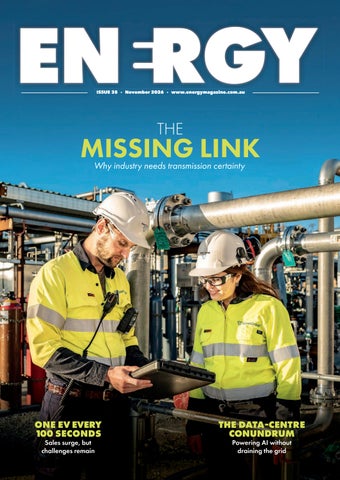
ISSUE 35 · November 2026 · www.energymagazine.com.au
THE
MISSING LINK Why industry needs transmission certainty
ONE EV EVERY 100 SECONDS Sales surge, but challenges remain
THE DATACENTRE CONUNDRUM Powering AI without draining the grid
The industrial connectivity partner behind Australia’s critical industries. Thirty years supplying Australia’s critical industries means we know what’s on the shelf, what’s been discontinued, and what your site will need in five years.
Stocked & dispatched same day
Pre-configured before it ships
Local technical support
Industrial-grade hardware on the shelf, ready to move when your project can't wait.
Devices labelled, tested, and set up to your spec, so commissioning moves fast.
Advice on selection, integration, and post-installation from Australian engineers.
1800 72 79 79 | madison.tech
NOVEMBER 2026
Published by
Chairman John Murphy Chief Executive Officer Christine Clancy Publisher Sarah Baker Managing Editor Eugene Duffy Editor Tom Parker Art Director Alejandro Molano Designer Danielle Harris National Media Executive Michael Ingram-Casha P: 0423 266 991 michael.ingram@primecreative.com.au Client Success Manager Cait Pillay Head Office Prime Creative Pty Ltd 379 Docklands Drive Docklands VIC 3008 Australia P: (03) 9690 8766 info@primecreative.com.au www.primecreativemedia.com.au Cover image: Hazer Group
Scan to subscribe to Energy’s weekly newsletter – delivered to your inbox every Tuesday afternoon.
Editor’s welcome
C
oordination is emerging as one of the defining challenges of Australia’s energy transition, as the country works to bring new generation, transmission and industrial demand online. It’s a theme that runs throughout this edition of Energy, beginning with our conversation with CSIRO Energy Systems Research director Dr John Ward. Fresh from engagements in Europe, Dr Ward discusses how Australia and its international counterparts are confronting the challenge of maintaining electricity system stability as conventional generation retires and electrification accelerates. From grid-forming inverters to synchronous condensers, the technologies are evolving. But ensuring they work together is another matter. This brings us to our cover story, where Beyond Zero Emissions (BZE) chief researcher Matt McKee argues Australia is building the right projects in the wrong order. We explore how poorly sequenced transmission development is constraining renewable energy investment and industrial decarbonisation, particularly in Western Australia’s Kwinana and Port Hedland precincts. In our ‘Solar and PV’ section, we turn our attention to the infrastructure supporting commercial and industrial solar adoption. Australian Power Equipment demonstrates the importance of electrical infrastructure in integrating renewable generation into a working poultry operation, while Sigenergy showcases a multi-site solar and battery rollout designed to halve electricity costs for an agribusiness operating across NSW.
Elsewhere, Decon Corporation shares insights from its visit to the China International Supply Chain Expo (CISCE), where advances in automation and manufacturing offer lessons for Australia’s growing clean energy supply chain. We also tackle the data-centre conundrum from several angles. AXA XL examines the supply-chain risks accompanying Australia’s datacentre construction boom, while we also explore what challenges and opportunities this rapidly growing industry poses for renewable energy and network planning. Electric vehicles are also on the docket. While sales of passenger EVs are soaring, the same can’t be said for commercial vehicles. What can be done to rectify this? Rounding out this edition, we take a deep dive into the future of Australia's wind energy industry, where rising construction costs and weaker investment signals are complicating an already congested development pipeline. Happy reading. Tom Parker Editor
If you have a story idea, tip or feedback regarding Energy, I’d love to hear it. Drop me a line at tom.parker@primecreative.com.au, and don’t forget to follow us on social media – find us on LinkedIn, X or Facebook. Energy acknowledges Aboriginal Traditional Owners of Country throughout Australia and pays respect to their cultures and Elders past and present.
www.energymagazine.com.au
3
Contents CSIRO 10
The coordination challenge
CSIRO’s Dr John Ward explains why coordination could define the next phase of Australia’s energy transition.
COVER STORY 14
Powering the precincts
Beyond Zero Emissions is calling for transmission planning to reflect the future energy needs of Australia’s industrial precincts.
SOLAR AND PV 18
14
What lies beneath
One agribusiness solar project reveals how renewable generation can be an operator’s trump card.
20
Power in numbers
Sigenergy and Lenergy are helping a poultry breeder tackle grid exposure across its NSW sites.
FUTURE GRID 22
From data to delivery
Bentley Systems is demonstrating how connected data is helping accelerate one of Australia’s largest transmission projects.
26
When networks go dark
When AirBridge wanted to extend the reach of its formidable ARNI emergency communications solution, Madison Technologies stepped up to the plate.
38
UTILITY AWARDS 34
Celebrating the sector’s best
The 2026 Utility Awards winners have been announced. Who took home the chocolates?
INDUSTRY INSIGHT 40
A global blueprint
Decon Corporation is drawing on global supply chains and local manufacturing to support Australia’s expanding energy transition.
ELECTRIC VEHICLES 46
One EV every 100 seconds
The figures are looking increasingly healthy, but how is Australia really tracking regarding the adoption of electric vehicles?
DATA CENTRES 48
No longer a niche customer
Does Australia’s growing data-centre fleet pose more challenges or opportunities?
4
56
Energy Magazine
REGULARS 3
Welcome from the Editor
6
Project Watch
58
Industry movements
Directors Andrew Cockbain and Abby Crawford
POWERING INDUSTRY. PROTECTING TOMORROW. At Australian Power Equipment (APE), we deliver more than medium and highvoltage power solutions – we deliver peace of mind. From brand-new transformers to expertly refurbished equipment, we help industries stay switched on with smarter, faster, and more sustainable options.
11kV Switchgear
Our circular economy model means we don’t just supply power—we give old equipment new life. By refurbishing quality assets from decommissioned sites, we minimise waste, reduce lead times, and keep urgent projects moving. It’s better for business and better for the planet. But our commitment doesn’t stop there. We actively support wildlife conservation and rewilding efforts across Australia – because powering progress should never come at the cost of our environment. With a nationwide network and a lean, responsive team, APE sources and delivers critical equipment when and where it’s needed most. Whether it’s mining, infrastructure, or renewables, our clients trust us to keep operations running and downtime to a minimum.
Type 241 cable
Backed by decades of experience and a clear vision for the future, we’re proud to be shaping a more sustainable tomorrow. AGENTS FOR
2000kVA transformer
1300 040 500
Trusted. Tested. Tomorrow-ready.
E info@australianpowerequipment.com.au W www.australianpowerequipment.com.au
PROJECT WATCH
Where the work is
A
Project Watch highlights the projects shaping Australia’s renewable energy future, from transmission and storage to network reliability.
ustralia’s energy transition is moving from plans and pipelines into construction, commissioning and major network upgrades, with projects progressing across every part of the electricity system. From large-scale transmission links and battery storage systems to new substations and network automation, infrastructure investment is reshaping
how electricity is generated, stored and delivered across the country. The scale and diversity of this work reflects the changing demands on Australia’s energy system, as renewable generation expands alongside growing electricity demand and the need for a more resilient grid. This edition of Project Watch tracks some of the projects at the centre of
Penrith BESS, NSW
Community Power Network, NSW Ausgrid is pioneering a first-of-its-kind trial to create a local market for surplus rooftop solar, by incentivising homes and commercial and industrial (C&I) customers, including large rooftop owners like warehouses, to generate more electricity than they need. Surplus solar will be stored in community batteries and released in the evenings, with profits from operating the batteries shared with customers through annual bill rebates. The model is designed to unlock savings for households without solar while helping solar owners earn more from their exports. The trial encompasses 13 suburbs across Sydney and the Central Coast, with Ausgrid targeting battery installations in 2027. The Community Power Network aims to benefit 32,000 Ausgrid customers. Image: Ausgrid.
6
Energy Magazine
that transformation, highlighting key milestones from construction and equipment installation through to approvals and commissioning. Across the following pages, Energy looks at projects spanning multiple states and technologies, providing a snapshot of where major energy infrastructure is being built, upgraded and brought online.
A 2.4MW solar farm is being built in Leonora, WA. Image: Horizon Power
Leonora power ro ect W Major progress is being made on the Leonora power project in Western Australia’s Goldfields, with construction of the new hybrid energy system well underway. The project, being delivered by Horizon Power in partnership with Pacific Energy, recently reached a significant milestone with the successful installation of all 3780 solar panels at the new solar farm. Attention is focused on the continued installation and commissioning of the hybrid power station, as well as the grid extension works required to connect the new hybrid power station to Leonora’s existing electricity network. Once operational, the new power system will comprise 3.9 megawatts (MW) of diesel generation, a 2.4MW solar farm and a 9.9MWh battery energy storage system, supporting greater integration of renewable energy into the town’s power supply.
Construction has commenced on the Penrith battery energy storage system (BESS), the first project in Ausconnex’s privately funded $65 million-plus battery storage program across Greater Western Sydney. The medium-voltage facility will deliver almost five megawatts (MW) of power and 17MWh of storage and is expected to take around eight months to complete. Part of an eight-site portfolio, the program will provide a combined 40MW and 136MWh of storage, enough to supply around 40,000 homes for up to three hours. The batteries will improve renewable energy utilisation, strengthen grid reliability, support growing electricity demand, and create jobs and skills opportunities across Western Sydney. The Penrith BESS forms part of an eight-site portfolio. Image: Ausconnex
PROJECT WATCH
Self-healing network expansion, NSW Endeavour Energy is expanding its self-healing network, using fault location, isolation and supply restoration (FLISR) and large area restoration (LAR) to improve reliability and resilience across the electricity network. Advanced automation detects faults, isolates affected sections and restores power through alternative supply pathways within minutes, without manual intervention. FLISR is enabled across 47 per cent of the network and restores supply to around half of customers affected by high-voltage faults in under 90 seconds. LAR is live on eight substations, with a further 23 planned. Endeavour Energy is strengthening the network today, helping ensure safe and reliable power for customers and communities.
Construction is underway for a new Humpty Doo substation. Image: Jason Bennee/stock.adobe.com
FLISR has been critical to keeping Endeavour Energy’s NSW network online. Image: Endeavour Energy
Humpty Doo substation, Northern Territory Construction has begun on a new $2.7 million zone substation at Humpty Doo in the Northern Territory, with the project set to increase electricity network capacity in a growing rural area. The new substation will improve the reliability and resilience of electricity supply for local homes and businesses, while providing additional capacity to meet future demand. Design work covering the project’s civil, electrical, structural and earthing components has been completed, with construction now progressing on site. Power and Water Corporation’s mobile substation will be used during the works to maintain electricity supply while the existing infrastructure is replaced. The temporary facility will allow the upgrade to proceed while minimising disruption to customers.
Reeves Plains battery project, o th stra ia Construction of the 250MW, four-hour Reeves Plains battery project powers ahead, with more than a quarter of all 194 battery units now on-site. The battery storage equipment is now being installed as the remaining units are delivered, with 89 inverters to also be delivered to site over the coming months. The battery units, manufactured by CATL, and the inverters, supplied by Power Electronics, are each approximately the size of a standard 20-foot shipping container. Developed by Alinta Energy, Reeves Plains is a 250-megawatt BESS with four hours of storage, capable of powering the equivalent of around 300,000 households. Alinta engaged Genus as its delivery partner.
Stage 2 of Reeves Plains will add another 250MW of storage. Image: Alinta Energy
www.energymagazine.com.au
7
PROJECT WATCH
HumeLink, NSW Six giant 500kV shunt reactors have been deployed for Transgrid’s 365km HumeLink transmission project. Each weighing more than 120 tonnes, the shunt reactors will be installed at the Maragle, Bannaby and Gugaa substations. They are among the first three-phase 500kV reactors to be used in Australia. Shunt reactors absorb reactive power to help regulate voltage and improve the stability and efficiency of long-distance transmission lines. The six units will provide reactive power compensation within a complex 500kV double-circuit transmission loop as part of the HumeLink project.
The Central–West Orana REZ spans roughly 20,000 square kilometres. Image: EnergyCo
HumeLink is one of NSW’s largest energy infrastructure projects. Image: Hitachi Energy
NBN solar sleeve, Victoria NBN Co is trialling a flexible solar panel sleeve designed to maintain fixed wireless services during power outages, with the potential to supply up to 40 per cent of a site’s daytime electricity demand. The month-long proof-of-concept trial is taking place at a live fixed wireless site in New Gisborne, Victoria, where solar panels have been wrapped around the north-facing side of a 40m-high monopole. Developed by Decon Corporation, the system uses thin, bendable solar laminate technology integrated with existing battery storage to provide an alternative power source during mains outages. The solution is designed to keep equipped sites operating for up to 12 hours during an outage, potentially maintaining connectivity for nearby customers.
Central–West Orana REZ, NSW The first high-voltage cables have now been strung between transmission towers in the landmark Central–West Orana renewable energy zone. The project remains on track for energisation from 2028 and will provide access to enough renewable energy and storage capacity to power up to 2.7 million homes during periods of peak demand. Stringing involves installing high-voltage conductors between transmission towers to create a continuous pathway for electricity. With 64 towers now standing, crews will progressively install cables between towers along the network. The transmission network will extend from Elong Elong through Merotherie to Barigan Creek.
8
Energy Magazine
The solar laminate can be installed on existing monopoles. Image: NBN Co
PROJECT WATCH
SEC Renewable Energy Park, Victoria
Over 400 people have worked on the SEC Renewable Energy Park. Image: SEC Victoria
SEC’s Renewable Energy Park in Horsham, Victoria has connected to the grid for the first time, marking a major milestone as the project moves towards commercial operation in 2027. The connection marks the transition from mechanical completion into commissioning and energisation, a staged process involving the safe connection and testing of the solar farm’s electrical infrastructure before it begins generating electricity. The solar farm will now progress through hot commissioning and hold point testing. This staged process will involve gradually switching on and testing key components, including substations, transformers, underground cables, inverters and other electrical equipment.
New zone substation, Victoria AusNet is investing $85 million in a new zone substation and associated network upgrades in Beveridge, to support growth across northern Melbourne. The two-stage project will provide additional electricity infrastructure for existing and new communities across Beveridge and surrounding areas. The first stage of the project has included ground preparation and drainage works, installation of zone substation structures, transformers and control rooms, as well as new overhead and underground electricity connections. Stage two is scheduled to commence in 2027 and will deliver further network upgrades, with completion targeted for March 2028.
Forty-six wind turbines are being installed at Lotus Creek. Image: Chris Mirek Freeman/stock.adobe.com
A new substation is being built to support growth in Melbourne’s north. Image: Matt Krumins
Lotus Creek wind farm, Queensland EnVentus wind turbines are arriving and being installed at the Lotus Creek wind farm in central Queensland. Lotus Creek will connect with Powerlink’s 275kV network through the construction of 14km of new transmission line. A new Powerlink substation is also being built, named Glencoe substation. The project adds to Vestas’ deployment of its EnVentus turbine, which recently surpassed 15GW of installed capacity worldwide. Earthworks and access track development are also progressing. Commissioning at Lotus Creek is scheduled to commence in the fourth quarter of 2026.
Do you have any projects to promote? Contact tom.parker@primecreative.com.au to share your stories.
www.energymagazine.com.au
9
CSIRO
The coordination challenge
F
CSIRO’s Dr John Ward explains why coordination could define the next phase of Australia’s energy transition.
rom Australia to Europe, the US and beyond, electricity systems are grappling with different versions of the same problem: how to electrify more of the economy without compromising affordability or system stability. It’s a challenge Dr John Ward has been examining both at home and abroad and will discuss at COP31 in November, which he will attend as part of Australia’s delegation. When Energy spoke with the research director of CSIRO’s Energy Systems Research program, he was between engagements in Brussels, Belgium, gathering insights from European countries navigating their own energy transitions. These learnings feed directly into his work back home, where CSIRO is working with the Australian
CSIRO’s Dr Julio Braslavsky explains how smart inverter technology can be used to balance grid operation in real-time.
10
Energy Magazine
Energy Market Operator (AEMO) on challenges facing Australia’s own electricity system. At the heart of that work is one recurring theme: coordination. Dr Ward said “strategic electrification” has been a prominent discussion point internationally, following a landmark announcement from the COP31 Presidency in June urging for the contribution of electricity to global energy demand to increase from 20 per cent in 2026 to 35 per cent by 2035. Delivering that electrification, which Dr Ward called a “direct pathway to decarbonisation”, depends on an electricity system capable of remaining stable through rapid change, which is complicated by evolving generation profiles, loads and demand patterns.
Striking that balance is a challenge confronting Australia and its global counterparts. “Ensuring system stability during such change has been a key topic of discussion,” Dr Ward said. “As conventional coal-fired generation exits the system, the question is: what replaces this that can support system strength and inertia?” Dr Ward said Australia is leading the way in the adoption of grid-forming inverters, which help resist sudden frequency changes by emulating the rotating mass of coal or gas turbines. This technology also provides voltage support by injecting reactive power to support weak grid areas during faults, among other system stability capabilities. Another option is to continue the adoption of synchronous generation,
CSIRO
through synchronous condensers. This replicates the stabilising “spinning weight” of coal generators. Fast frequency response (FFR), when paired with batteries, is emerging as a digital solution to grid stability. This software-driven option can detect grid disturbances and inject or absorb power, responding in milliseconds. In November 2025, AEMO commenced market engagement on a Zero Synchronous Generation trial, which initially considers isolated sub-networks solely stabilised by inverter-based resources (IBR) as part of efforts to operate the National Electricity Market without synchronous generation. “AEMO’s studies suggest that the power system could be securely operated without any synchronous generators online,” AEMO said. “However, such operating scenarios have not been validated in live field trials.” The Zero Synchronous Generation trial commenced in July 2026. Loads are also changing, Dr Ward said, with the increase in electrification paired with new demand streams entering the market, such as data centres, which are reaching
Dr John Ward, research director of CSIRO’s Energy Systems Research program.
profiles “we never envisaged five years ago”. Smarter utilisation
While the adoption of grid-forming solutions will serve as a key plank for the National Electricity Market in the years to come, Dr Ward argued more could be done from a utilisation standpoint.
“We’re in a unique position where electricity demand is going up and the cost of generation is going down,” he said. “Despite this, delivered electricity prices have been going up – a byproduct of integration costs and the need to build out networks. “If we continue to invest in network infrastructure, such as poles, wires, substations and transformers, at today’s costs, with the same utilisation, we’re going to see continued substantial increases in our electricity costs on a per-energy-delivered basis.” Dr Ward said Australia’s energy system had “a fair bit of headroom”, with the opportunity clear: how do we get a higher output through our existing assets, and use them more flexibly? “If we can do that, even though energy use and infrastructure costs are going up, we’ve got a golden opportunity to get the cost of energy on a per unit basis down,” he said. Demand flexibility has been a central component of CSIRO’s work through FlexCost – Australian-first research costing the demand-side resources underpinning the electricity system. Through FlexCost, CSIRO explores why Australia’s energy transition is just as much a demand challenge, shaped
Images: CSIRO
CSIRO researcher Stuart Hands uses the photovoltaic emulator to simulate output of a PV system.
www.energymagazine.com.au
11
CSIRO
CSIRO’s Renewable Energy Integration Facility recently underwent a $3 million upgrade to double its power testing capacity.
by how and when electricity is used, as it is a supply challenge. “We must recognise flexibility and efficiency as core system assets, not secondary considerations,” CSIRO chief energy economist Paul Graham told Energy in a June 2026 feature. “Once we understand their cost and role, they can be integrated more strategically into planning, markets and policy alongside generation, storage and networks.” FlexCost project director Dr Chris Dunstan said the research focuses on demand flexibility solutions that provide ‘shed’ services, which involve offering incentives to reduce electricity demand by turning down equipment during extreme peak usage periods, and ‘shift’ services, which involve moving electricity consumption to periods of low prices. ‘Shape’ services will also be analysed, where demand is adjusted to follow a preferred load profile. This could involve electric vehicles or customer batteries absorbing excess solar and wind generation and feeding it back when demand is high. “In FlexCost Stage 1, CSIRO established the methodology behind the research; the next step will be to release the findings as part of FlexCost
12
Energy Magazine
Stage 2, which is expected before the end of 2026,” Dr Dunstan said. Governments are increasingly implementing demand-flexibility initiatives, including Victoria’s Midday Power Saver scheme and the Federal Government’s Solar Sharer Offer, whereby households can access three hours of free electricity from 11am to 2pm – when demand is at its lowest and solar power is most abundant. Dr Ward said while affordability is, “as much as anything else”, a key headwind disrupting Australia’s energy transition, there’s a false dichotomy that you can’t “decarbonise the system and have affordable energy”. “Our challenge is to find pathways where we can do both simultaneously,” he said. s energy e
ciency the answer?
Another interesting discussion point was the role energy efficiency plays in alleviating strains on the electricity system. Dr Ward said this concept is increasingly clashing with the need for greater utilisation. “Energy you’re not using is the cheapest energy you have access to, but the subtlety of this is different from what it was ten years ago,” he said.
“Historically, when we looked at building energy efficiency, we’d look on an annual basis at the total amount of heating and cooling, and that would be the metric for assessing how efficient a building is. “But now in the National Electricity Market (NEM), about 20 per cent of the time we’ve got negative prices. Being efficient at a time when you’ve got spare network capacity and negative energy prices – that’s not the time to be focused on energy efficiency.” When the NEM faces underutilisation, for example, what loads can be brought on that would otherwise go to waste? “This is when there’s an opportunity for flexible load types,” Dr Ward said. “Simultaneously, energy efficiency has to bite at times where infrastructure is constrained, as that’s when you’ll get the greatest benefit.” Energy efficiency is another key cog of CSIRO’s FlexCost research, with the cost of demand-side efforts such as improving household insulation or installing more efficient air conditioners set to be analysed. The Victorian Government has been active on the energy efficiency front, with new staged regulations rolling out from March 1, 2027 until 2030.
CSIRO
This will require all hot water and heating appliances that break and cannot be repaired in rental properties to be replaced with a heat pump water heater or an efficient electric reverse cycle air-conditioner. At the start of a lease from March 1 next year, Victorian rental properties must also include four-star showerheads and energy-efficient cooling in the living area. Elsewhere, the Federal Government is investing $15.2 million to coordinate state and territory energy efficiency measures through the National Energy Performance Strategy (NEPS), while the ACT has also been an active proponent through its Energy Efficiency Improvement Scheme (EEIS). Next steps
For Australia to hit its target of 82 per cent renewable energy
penetration by 2030, coordination will be key. Australia already experiences periods where renewable generation is sufficient to meet demand. South Australia’s grid has been entirely powered by rooftop solar on multiple occasions. The constraint, Dr Ward said, is ensuring generation is available in the right regions and supported by the transmission capacity needed to move electricity across the system. “What’s stopping us getting to higher renewables penetration? It’s not just the existence of variable generation; it’s the coordination piece,” Dr Ward said. “If you don’t have the transmission in place, is there a way to shift loads, generation and energy storage to hit that target?” How Australia solves that challenge could have relevance well beyond
the NEM. Backed by a world-leading renewable generation and storage network, the country is setting an example for international jurisdictions to follow. “Australia provides a strong case study for what can be achieved,” Dr Ward said. “Our network is unique, our technologies are pioneering, and our frameworks offer lessons for energy systems internationally.” International engagements around these topics include working with partners in Southeast Asia to share research outcomes, fostering crossborder collaboration and knowledge sharing, and enhancing regional energy cooperation. For Australia, the opportunity to 2030 is therefore not simply to build more capacity, but to make better use of an increasingly renewable system.
Battery and grid emulators inside CSIRO’s upgraded Renewable Energy Integration Facility.
www.energymagazine.com.au
13
COVER STORY
Powering the precincts From Kwinana to Gladstone, Australia’s industrial precincts face a transmission challenge.
T
he challenge facing Australia’s energy transition could be illustrated in one salient point. “We’re building the right projects in the wrong order.” According to Beyond Zero Emissions (BZE) chief researcher Matt McKee, too much of the renewable energy and transmission infrastructure underpinning Australia’s future energy system is being developed in siloes, creating sequencing issues. This is evident in the National Electricity Market (NEM) spanning Queensland, New South Wales, South Australia, Victoria and Tasmania, and the South West and North West Interconnected Systems in Western Australia. The Kwinana and Port Hedland precincts are facing a particular energy squeeze, which was clearly illustrated in BZE’s Powering Up Western Australia report launched at WA Energy Week in September. Powering Up Western Australia combines regional readiness assessments – built with input from over 60 locals and experts over
14
Energy Magazine
the past year – to identify how infrastructure, industry and investment can move together to capture WA’s clean industry opportunity. To McKee, Kwinana and Port Hedland are “two very different beasts”. “Kwinana has historically been known for its industry symbiosis – which is not just related to the mining sector,” McKee told Energy. “The byproducts of one facility feed into the facility next door, and the byproducts of that facility support another application elsewhere. Historically they’ve been one of the best in the world at sharing and collaborating in that space.” But the tide has turned. “With the closure of some facilities – BP’s oil refinery, BHP’s Nickel West processing facility and Alcoa’s Kwinana facility – about 40 per cent of that symbiosis has been lost,” McKee said. “Decarbonisation in Kwinana is occurring because facilities are closing down, not because the industry that exists is getting cleaner or producing differently.”
McKee said there’s a real risk that the existing industry either closes down or changes materially from what it is today. BZE believes the delivery of key transmission corridors can help revive this $15.7 billion strategic industrial area. “A critical enabler to move Kwinana … to a globally competitive powerhouse for green metals, clean chemicals and refined critical minerals is to fast-track delivery of the Clean Energy Link – North (CEL-North) transmission project,” the Powering Up Western Australia report stated. Spanning 354km from Malaga to Three Springs, CEL-North will help transfer one gigawatt (GW) of renewable energy from the Wheatbelt and Mid-West regions to Perth, providing affordable energy for growing industrial loads. This will de-risk Kwinana projects backed by the WA Government’s $1 billion Strategic Industries Fund, such as ACCIONA’s $696 million Kwinana energy recovery project, the $75 million NeoSmelt pilot facility backed by BHP, Rio Tinto and
COVER STORY
According to AEMO, Australia needs around 6000 kilometres of new transmission lines by 2050. Image: PoweringWA
BlueScope, and the region’s various hydrogen ventures. In July, work began on 11km of new CEL-North transmission lines, including a 6km line between the Padbury substation and Wangara substation;
and a 5km line between the Henley Brook substation and the Northern Terminal in Malaga. These works are set for completion in mid-2027. The 470-megawatt (MW) Parron Maam Marang, 130MW Kondinin, and 550MW Marri wind farms will be the immediate beneficiaries of CEL-North. Synergy signed power purchase agreements (PPAs) for 100 per cent of Parron Maam Marang and Kondinin’s output in March. Water Corporation will procure 330MW of Marri’s capacity once it is up and running. While this is encouraging, BZE finds two of these projects – the Parron Maam Marang and Marri wind farms – occupy just under three quarters of additional hosting capacity created by CEL-North. “With no published timelines and delivery dates to expand transmission capacity along this route beyond Clean Energy Link – North, it leaves the majority of approved generation with no clear path to grid connection,” BZE said. According to BZE, additional transmission projects, such as Clean Energy Link – East and Clean Energy Link – Kwinana, must be prioritised to unlock WA’s expanding renewable energy pipeline and feed the growing electricity needs of Kwinana. The WA Government has declared these priority projects under the State Development Act 2005, aimed to streamline approvals and ensure
whole-of-government coordination. They are also supported by the state’s $1.4 billion Clean Energy Fund. There has been no further news on CEL-East and Kwinana’s development since the Clean Energy Fund’s announcement in April. Port Hedland
Home to the world’s largest bulk export port, Port Hedland offers its own unique opportunities, and these aren’t just constrained to iron ore. Port Hedland and the Pilbara region that feeds it are looking to move beyond dig-and-ship operations into green metals – a downstream processing exercise that upgrades raw materials into a higher-grade product before it leaves shore. McKee said Port Hedland is “very much a growth story”. “The challenge we see there is if we continue digging and shipping iron ore away, the value-add of clean manufacturing – green iron and steel – will go to our trading partners,” he said. “In recent years, we’ve seen the Simandou mine in Africa enter the fray – seen as the ‘Pilbara killer’. If we don’t increase that value-add, the Port Hedland region could be overrun by other mining regions globally.” A key proponent of value-adding its operations, Fortescue produced its first green metal from its Christmas Creek mine in the Pilbara in August, marking the first successful operation of its electric smelting process.
Transmission is critical to providing renewable energy for industrial precincts, such as Kwinana and Port Hedland. Image: Hazer Group
www.energymagazine.com.au
15
COVER STORY
Another green metal proponent is Element Zero, which plans to develop a multi-billion-dollar downstream processing facility in Port Hedland, dubbed the ‘Pilbara Iron Super Hub’. Calix is planning its own green iron demonstration plant, titled the ‘ZESTY project’, with a location of the facility still to be determined. The Australian Renewable Energy Agency provided $44.88 million for Calix’s efforts, with ZESTY’s total capital expenditure expected to be $89.93 million. With backing from major iron ore miner Rio Tinto, McKee said Calix plans to eventually build a downstream facility in Port Hedland. So what transmission challenges does this create? “If Port Hedland is to build and operate these green metals facilities, the amount of electricity needed in this region is ten times what it currently is, and bigger than any one company can deliver themselves,” McKee said. “There is a plan being developed called the Pilbara Energy Transition (PET) Plan, which discusses certain corridors and transmission lines that need to be built, but none of those projects have delivery dates associated with them.” Four distinct corridors have been outlined by the PET Plan: the Hamersley Range, Great Sandy Desert, Burrup (Murujuga) and Chichester Range corridors.
A rich pipeline of renewable energy is being developed in regional Western Australia. Image: PoweringWA
16
Energy Magazine
These aim to connect valuable inland renewable energy resources with strategic industrial areas (SIA) on the Pilbara coast, including the Burrup, Boodarie and Maitland SIAs, moving from isolated, single-user builds to common-user, shared facilities. The Hamersley Range and Great Sandy Desert corridors will be particularly critical for Port Hedland, connecting new energy sources with the Boodarie SIA located 12km south of the port city. The WA Government points to the Burrup (Murujuga) corridor as an early success story, with a long-term common use transmission solution designed in partnership with Traditional Owner groups on Murujuga Country, as well as Horizon Power and industry stakeholders, Yara, Woodside and Perdaman. While APA Group has been selected as Burrup’s project developer, the project still requires concessional financing from the Federal Government’s Rewiring the Nation fund before it can go ahead. McKee stressed a matter of urgency on these transmission corridors. “If we want to develop these multi-billion-dollar facilities in Port Hedland, we need clarity on the size of these transmission projects, when they’re going to be delivered, and how they’re going to feed into the system, so the facilities have certainty to make investments,” he said.
East coast perspectives
Eastern-state experiences provide a useful point of comparison as WA determines the scale of its next transmission investments. As electricity demands increase, capacity constraints have emerged across parts of the NEM. McKee said WA should consider that experience when sizing transmission infrastructure. “If we undersize transmission – and a transmission line sticks around for 50, 60, 70, even 100 years – then sizing it too small now limits our potential upside down the road, or we have to build a secondary line,” he said. WA’s long distances and sparser population make it important to build the appropriate capacity once. CEL-North demonstrates the risk: its additional capacity is substantial, yet much of it is already accounted for, while in Port Hedland, right-sizing transmission infrastructure could unlock a downstream revolution that sets up the Pilbara mining industry for decades to come. WA can look to Victoria for salient examples, particularly between Melbourne and Ballarat – a 220kV transmission corridor currently constrained in its capacity to support a groundswell of renewable energy development in the state. This is prompting the development of the 550kV Western Renewables Link, which remains in a planning phase.
COVER STORY
The Kwinana industrial precinct is relying on the Clean Energy Link transmission projects. Image: Chris Grose
The Hunter beyond Tomago
BZE’s work in the Hunter found a different sequencing challenge to those emerging in WA. In July 2026, the NSW Government approved the Hunter Transmission Project (HTP), comprising 110km of new 500kV transmission between Bayswater and Olney. The project will provide a new electricity route from the Central–West Orana and New England REZs to reach the Hunter, Sydney and Wollongong. But McKee said while approval of the HTP is a win, it has been touted as “the saviour of the Tomago aluminium smelter”, which accounts for more than 10 per cent of NSW electricity consumption. “Our lesson for them is that you actually have an entire industrial base in that area that wants to get involved,” McKee said. “Let’s not just focus on a single facility – let’s look at the entire industrial ecosystem.” After facing uncertainty around its future, Tomago recently secured an electricity agreement extending to 2038, with its supply expected to transition to 100 per cent renewable sources from 2033. The agreement will be accompanied by $1.1 billion of investment in the smelter, including $100 million for decarbonisation and demandresponse capability. Elsewhere, Orica recently reached a final investment decision on its Hunter Valley Hydrogen Hub at Kooragang Island. The project will use a 50MW electrolyser to produce renewable hydrogen, replacing approximately 7.5 per cent of the natural gas feedstock used in Orica’s ammonia production. Another project within the Port of Newcastle Clean Energy Precinct is the Macquarie–Idemitsu Green Hydrogen Hub overseen by Macquarie Group, Japan’s Idemitsu and Energy Estate, while AGL’s Hunter Energy Hub
will require additional electricity supply created by the HTP, with Fortescue Future Industries exploring hydrogen opportunities here. Gladstone growth
Gladstone is becoming its own success story, demonstrating how a region can pivot from traditional industries to embrace future technologies and the need to find cleaner ways of operating. Accounting for around 20 per cent of Queensland’s electricity consumption, Powerlink expects industrial electrification in Gladstone could add between 1–2GW to local demand. Rio Tinto has signed agreements covering 2.7GW of prospective renewable capacity to help repower its Gladstone operations, stemming from European Energy’s proposed 1.1GW Upper Calliope solar farm, 80 per cent of Windlab’s proposed 1.1GW Bungaban wind project, and Edify Energy’s Smoky Creek and Guthrie’s Gap solar–BESS projects. The company estimates the projects could reduce emissions by about five million tonnes annually if supported by adequate firming and transmission. Rio Tinto and Sumitomo are also developing a hydrogen calcination pilot at the Yarwun alumina refinery. The project remains part of Rio Tinto’s decarbonisation program despite its decision to reduce Yarwun’s production by 40 per cent from October 2026. Elsewhere in the precinct, Alpha HPA is constructing the second stage of its HPA First facility. The plant is designed to produce more than 10,000 tonnes of high-purity alumina products each year and has secured $400 million in Federal Government financing support. Powerlink’s Gladstone transmission project is intended to meet this emerging demand while preparing the network for the potential retirement
of the Gladstone power station in March 2029. Its first stage comprises an 87km double-circuit 275kV line between Calvale and Calliope River. The Queensland Government committed $501 million to move the project into construction, with completion targeted for March 2029. A second double-circuit line is planned between Bouldercombe and Larcom Creek, via a new Gladstone West substation. Powerlink is targeting completion of the broader second stage in 2030. In parallel with the Gladstone transmission project, McKee said it was imperative the Queensland Government prioritised renewable energy development in the state to unlock resources industrial operations require, now and in the future. “There’s a lot happening in Gladstone that the Queensland Government is risking holding up,” he said. “The investment in renewables would power the region in 2029 and beyond, and we see industry wanting renewables.” Since the Liberal Party was elected over Labor in October 2024, the Crisafulli Government has prioritised its existing coal-fired fleet over the renewable energy resources that can support the state long into the future. Above all, Queensland aims to deliver “affordable, reliable and sustainable” energy for the state. BZE’s National Action Plan provides a common framework for examining regional opportunities, but this doesn’t mean applying one model across the Kwinana, Port Hedland, Hunter and Gladstone regions is prudent. Kwinana needs further transmission planning before CEL-North’s capacity is absorbed. Port Hedland requires defined delivery dates for commonuser infrastructure capable of supporting green metals. In the Hunter, approved transmission investment must not only support Tomago, but a host of emerging industrial projects, while Gladstone will see surging electricity demand, but will there be renewable energy infrastructure to supply this? Across each region, the central issue is whether transmission capacity and delivery schedules align with the industries they are expected to support. The projects may be right; the challenge is building them in the right order.
www.energymagazine.com.au
17
SOLAR AND PV
What lies beneath
One agribusiness solar project reveals how renewable generation can be an operator’s trump card.
S
olar PV is now commonplace in Australian industry, with more than 5.6 gigawatts of panels installed by commercial and industrial (C&I) businesses across the country. While panels may be the most visible part of a renewable energy project, what sits behind them is perhaps the most important part of the equation. This includes an interconnected network of transformers, switchgear, cabling, protection systems and distribution infrastructure determining how that generated power moves safely and efficiently to where it is needed. For one Australian agribusiness, that meant connecting onsite solar generation into the electrical network supplying a working poultry operation.
Australian Power Equipment (APE) supplied a complete power network consisting of ring main unit (RMU) power, an earthing transformer and power factor correction/statcom as part of the electrical infrastructure transforming and distributing power throughout the chicken farm. This case study represents a much broader shift taking place across Australian industry. As businesses generate more of their own electricity, the conversation around solar is expanding from generation alone to the infrastructure required to make renewable energy genuinely useful, with requirements to channel that energy safely across complex site locations.
From generation to utilisation
For an operating business, electricity has to do more than simply exist within the network. It needs to arrive at the correct voltage, where and when it is required, while maintaining the reliability, protection and power quality necessary for the equipment it serves. In agribusiness, that requirement is particularly important. Modern agricultural operations can rely heavily on electrically powered ventilation, heating and cooling, pumps, processing systems, lighting, refrigeration and automated equipment. For poultry operations, maintaining environmental conditions is fundamental to the welfare of the birds Australian Power Equipment supplied a complete power network for an agribusiness installing on-site solar generation.
18
Energy Magazine
SOLAR AND PV
and the continuity of the business. Power reliability therefore remains critical regardless of whether that electricity originates from the grid, onsite solar, battery storage or a combination of sources. Australian Power Equipment technical director Andrew Cockbain said this is why electrical infrastructure needs to be considered early in renewable energy projects. “The panels are producing the energy, but you still need to distribute that power into the right part of the network, at the right voltage and with the appropriate protection and power quality,” he said. “The transformer, switchgear, cables and protection systems are what allow that generation to become usable power within the operation.” That infrastructure also needs to be designed around the site’s unique characteristics. Some businesses may consume the majority of their solar generation as it is produced. Others may combine generation with battery storage or retain a grid connection for additional capacity and redundancy.
Images: Australian Power Equipment
The complete electrical system
The growing adoption of solar presents an opportunity to think more broadly about how businesses design their electrical systems. This is particularly relevant for businesses expanding existing sites or gradually electrifying more of their operations. A site originally designed around one level of demand may need to accommodate new generation, additional electrical loads, electric machinery or energy storage over time. Transformer capacity, cable ratings, switchgear, protection, power factor and power quality can all become part of that conversation. For Australian Power Equipment, this systems-based approach reflects the way the company already works across mining, renewable energy, utilities, infrastructure and industrial projects. APE supplies new and refurbished transformers, switchgear, cable, substations, earthing equipment and power-quality solutions, allowing equipment to be considered as part of an integrated electrical network rather than simply as individual products. The ability to incorporate refurbished and repurposed
Australian Power Equipment directors Andrew Cockbain and Abby Crawford.
equipment can also create additional options where project timeframes, budgets or sustainability objectives necessitate extending the operating life of existing electrical assets. Australian Power Equipment co-director Abby Crawford said the expansion of solar creates an opportunity for businesses to consider both energy generation and the infrastructure surrounding it. “Solar presents an enormous opportunity for Australian industry, but the greatest value comes from looking beyond generation and considering the entire electrical system,” she said. “For businesses, particularly those operating in regional and energyintensive environments, the ability
to generate, manage and use more of their own energy can become part of their sustainability strategy and operational resilience.” Australia’s continued investment in solar PV will inevitably place greater focus on the systems sitting behind generation. The panels will remain the most visible symbol of that transition. But the transformers, switchgear, cables, substations and protection systems operating quietly behind them will play an equally important role. Because generating renewable electricity is only half the story. The real value begins when that energy can be reliably connected, transformed and delivered to where it can actually be used. www.energymagazine.com.au
19
SOLAR AND PV
Sigenergy and Lenergy helped a poultry breeder save $700,000 in electricity costs.
Powering poultry production
L
A solar-plus-storage solution from Sigenergy is expected to save a poultry genetics company $700,000 in annual electricity costs.
energy and Sigenergy recently delivered a 1.21MW solar and 1.58MWh storage rollout across 11 poultry production farms in four regional NSW locations. Ranked number one globally in the S&P Global Energy H1 2026 Residential Energy Storage Market Tracker with 14 per cent market share, Sigenergy has built its commercial platform around modular, scalable systems designed for exactly this kind of multi-site rollout. The client, a globally significant poultry genetics company and major supplier of parent stock and grandparent stock to the Australian broiler industry, operates a network of production, quarantine, and hatchery facilities across regional New South Wales. Poultry production is energyintensive by nature. Maintaining precise temperature, ventilation, and lighting conditions across multiple sheds, 24 hours a day,
20
Energy Magazine
drives significant baseload electricity consumption. For the company’s regional farms in Goulburn, Wellington, and Wagga Wagga, that translated into substantial grid exposure and rising energy costs. With electricity bills a material operational cost, and mounting pressure from global parent company sustainability targets, the company began exploring whether large-scale solar and battery storage could deliver the financial and environmental outcomes it needed. The challenge was doing so across a diverse portfolio of sites with different roof configurations, load profiles, and grid connection circumstances. The solution
Lenergy, a specialist commercial and industrial clean energy installer and Sigenergy Platinum partner, was engaged to design and deliver a staged solar-plus-storage rollout across the portfolio.
The solution needed to work across different site typologies: smaller 100kW roof-mounted systems on production farm sheds in Goulburn and Wellington, ground-mounted arrays on Wellington’s open sites, a 250kW quarantine facility in Wagga Wagga, and a large-scale 510kW hatchery build in Goulburn currently underway. Each installation required careful system design to maximise self-consumption, manage export limitations, and size storage to shift load through peak tariff periods. For the smaller production farms, Lenergy deployed Sigenergy’s SigenStor 25T-40 and 15T-40 hybrid inverter platform, delivering 100kW of solar generation paired with 160kWh of battery storage per site, enough to cover a large farm shed’s load through peak tariff periods without drawing from the grid. For the larger commercial installations at Wagga Wagga and the Goulburn hatchery, the system
SOLAR AND PV
scales up to Sigenergy’s SigenStack commercial inverter range, paired with SigenStack 12kWh battery modules: 38 units delivering 456kWh at the Wagga Wagga quarantine facility, and 63 units delivering 756kWh at each of the two Goulburn hatchery sites. Sigenergy’s modular architecture was a key factor in the selection. SigenStack units require no concrete plinth, are IP66-rated for outdoor installation, and include a built-in energy management system, simplifying design and commissioning across varied site conditions. The Sigen Cloud platform, powered by Sigen AI, manages monitoring and optimisation across all sites from a single interface. The results
Images: Sigenergy
With 1.21MW of solar generation capacity and 1.58MWh of battery storage now installed or underway across 11 sites, the combined system is projected to more than halve the client’s total electricity costs, delivering estimated annual savings of approximately $700,000. Beyond the financial return, the installations significantly reduce grid energy consumption across the client’s NSW operations, directly supporting their global sustainability targets and lowering the carbon intensity of Australian poultry production. The project also demonstrates the scalability of commercial and industrial
(C&I) solar-plus-storage for agricultural and agribusiness operators. Large energy users in regional areas with consistent baseload demand profiles and significant daytime solar generation potential are well placed to benefit from the staged, multi-site rollout Lenergy and Sigenergy delivered. “During the design phase we looked at a few options, such as a containerised solution, but finding a suitable spot for a shipping container is easier said than done,” Lenergy chief operating officer Winston Bell said. “Sigenergy’s modularity, and the fact we could fit so much battery capacity into such a small footprint, was a massive advantage on these sites. “With tens of thousands of hens on each farm, safety was non-negotiable. We needed a system we were completely comfortable leaving next to the sheds, and Sigenergy was hands down the best fit, supported by SigenStack’s six-layer battery safety architecture. Getting to commission one of the first SigenStacks in the country was super exciting.” Sigenergy managing director – Australia and New Zealand, Will Hall, echoed Bell’s sentiment. “This is exactly the kind of project our commercial platform is built for: multiple sites, varying configurations, and performance that has to be bulletproof,” he said. “We’re proud to partner with Lenergy on this outcome
C&I clean energy installer Lenergy was engaged to design and deliver the rollout of Sigenergy systems.
and look forward to supporting the next phase of their energy transition.” In C&I businesses more broadly, Hall said the status quo is being made “increasingly untenable”, with energy costs one of the top three operating expenses. “We see this acutely in agriculture and food production, where you have large, consistent baseload demand with very little flexibility to shift consumption away from peak periods,” he said. “These operators have been grid price-takers for decades. Solar-plusstorage fundamentally changes that equation.” Hall said the economics of C&I solar-plus-storage were compelling “right now”, which was recognised by the client early. “Solar generation offsets most daytime consumption, and battery storage lets you capture excess generation and deploy it during peak tariff windows rather than drawing from the grid,” he said. “For an operation running around the clock with consistent load profiles, the payback case is very strong. “We offer a genuine end-to-end C&I solution. The SigenStor hybrid inverter platform handles smaller commercial sites efficiently, and the SigenStack commercial inverter range scales up to larger installations without requiring a completely different ecosystem.” This project is a strong proof point for what Sigenergy’s C&I solar-plus-storage platform can do at scale: 11 sites across four locations, multiple system configurations, spanning 100kW production farm installations right through to a 510kW hatchery build. Whether other C&I operators can expect similar results depends on their load profile, tariff structure, and how well the system is designed. “Our fundamentals are strong across most of the C&I sectors we work in: agriculture, manufacturing, cold storage, logistics, hospitality,” Hall said. “Any business with high daytime energy consumption, significant demand charges, or grid reliability concerns is a strong candidate. The key is pairing the right system size and storage capacity to the specific site, which is exactly what Lenergy did here.” www.energymagazine.com.au
21
FUTURE GRID
Bentley was supported by AI provider APD Group, which developed agents to interconnect Bentley’s applications.
From data to delivery
B
Bentley Systems is demonstrating how connected data can reduce rework, accelerate design and strengthen project decision-making.
entley Systems has made a material impact on one of Australia’s largest transmission projects. The software pioneer helped Clean Energy Link – North achieve a 15 per cent reduction in engineering design time, a 20 per cent improvement in documentation speed and accuracy, a 30 per cent reduction in coordination cycles, and a 20 per cent reduction in downstream rework. Two key milestones were delivered 38 per cent ahead of schedule, while 8000 work hours were saved. “Clean Energy Link – North is trying to unlock around a gigawatt of renewable energy as the WA Government aims to retire all coal-fired generation in the state by 2030,” Bentley Systems senior director – solutions engineering Joe Travis told Energy. “But the energy is only going to reach homes and businesses if the
22
Energy Magazine
grid is designed in the right manner in the first place. This is where we have played a central role. “Clean Energy Link – North has celebrated the best of what Bentley offers, with several of our platforms – MicroStation, Bentley Infrastructure Cloud, Synchro, OpenUtilities and PLS-CADD – deeply involved in its design phase.” Bentley was supported by artificial intelligence (AI) provider APD Group, which developed agents to interconnect Bentley’s applications. Within this, there was one critical vehicle. “Data has been key to all that we’ve achieved,” Travis said. “With about a dozen applications used within this project, AI agents have helped take data from one application to the next. “This ensures each specialised application is doing the job it’s meant to do, ensuring consistency across
the software ecosystem and creating efficiencies across the project.” After OpenSite helped Clean Energy Link – North with the early ‘where and how’ of the project such as site feasibility and terrain models, MicroStation served as the primary computer-aided design (CAD) platform, providing high-precision 2D/3D designs of assets such as solar farms, substations, structural components and site works. This was supported by PLS-CADD, which produced transmission line designs and analysed clearances, and OpenUtilities, which helped design, map and manage connecting utility infrastructure. All these design files and models were then stored and managed in ProjectWise, within Bentley Infrastructure Cloud, becoming part of a connected data environment (CDE). “Once MicroStation generated the detailed engineering models and
FUTURE GRID
drawings, these were checked into ProjectWise in Bentley Infrastructure Cloud so everyone could work from a single, governed source of truth,” Travis said. “Our 4D platform, SYNCHRO, then turned designs into a buildable, time-phased plan, linking MicroStation and grid models to the construction schedule, enabling teams to see how the project will be built over time.” With geoscience platform Seequent and drone data collector Talon, technologies from Bentley’s end-toend offering can be adapted to suit any Australian energy project. “Bentley can cover the complete lifecycle from generation to transmission, distribution, substations, and even behind the meter,” Travis said. “We aim to ‘follow the electron’ from where it’s first generated all the way to where it’s consumed as energy.” Laying the foundations
Image: Bentley Systems
Drone technology is playing a growing role in utility environments, significantly cutting mapping and surveying timelines and generating more precise and abundant data of project sites. At the advent of a project, drones can be used for feasibility purposes, flying greenfield sites to understand terrain and potential infrastructure layouts. They are also proving valuable for site management priorities. “At a solar farm, for example, drones can conduct thermal imaging, reality
modelling and create a digital twin of the project using iTwin Capture,” Travis said. “This data can help operators identify hotspots, equipment issues, and maintenance needs across thousands of solar panels. “It can take a human a few days to walk a solar farm and inspect each panel. With a predefined flight path, drones can see where the problems are within an hour.” They can help mitigate fire risk, advising of where vegetation needs to be cut or managed. This is supported by Bentley’s PLS-CADD application, which features its own in-built vegetation management module. Then there’s Talon. “Talon, a company Bentley Systems recently acquired, can fly distribution or transmission networks and take 50 to 60 pictures of every power pole or tower, then move to the next,” Travis said. “This creates an accurate digital twin of each pole or tower, which in turn, allows for easy population of asset data, inspections, vegetation management, and regulatory compliance. “Bentley’s use of AI with these models can drastically reduce the cost of maintaining existing infrastructure and identifying potential flaws. “Engineers can visualise a leaky transformer, a split pole or vegetation risks. Instead of people walking and tapping poles, you can now map and model hundreds, if not thousands of poles per day, and analyse them from the office.”
Travis used a case study from the US to further illustrate the role of drones. “A US utility needed a new transmission line to be built across a river, with a decommissioned tower nearby,” he said. “Instead of going through years of permitting to build a new tower, by using drone technology and platforming these insights on Bentley’s software, the existing tower was determined feasible with some refurbishment. “This saved the client the time and costs that come with a new build.” While engineers might spend less time in the field thanks to drones and automation, their expertise remains critical for data interpretation. “Instead of relying solely on field crews to visually inspect each structure, utilities can capture and analyse large numbers of poles remotely,” Travis said. “They can focus on validating AI findings, stress testing design assumptions and refining digital twins so projects can move from design to delivery more smoothly.” In other words, AI and drones extend the reach of engineers, but they don’t replace their judgement. “AI can replace the manual, mundane and tedious work, not the jobs that engineers are trained to complete,” Travis said. “Infrastructure should never be built based on AI models alone; engineers must be actively involved throughout any project and give the final sign-off.”
A substation represented in Gaussian splatting.
www.energymagazine.com.au
23
FUTURE GRID
A substation represented in reality mesh.
Ausgrid, Essential Energy, Transgrid and Powercor are using drones, LiDAR and AI to inspect lines and manage vegetation ahead of the summer season, in an effort to boost reliability and resilience through bushfire prevention. With the El Niño seasonal outlook looking increasingly bleak, prompting the potential for more heatwaves and bushfires, drone technology is becoming increasingly integral to hardening the grid.
Imagery from Bentley Systems’ Orbit 3DM platform.
Building the bigger picture
While drone data is helpful, it’s software that brings this to life. This is where Bentley plays a central role, ingesting and hosting data that not only serves a key purpose today but underpins critical decisions made 10, 20 or 30 years in the future. “That first drone capture gives you the foundation,” Travis said. “You can then augment it with CAD drawings, GIS (geographic information system) data, and IoT sensors. Importantly, you can make that data visible and digestible to many stakeholders, not just the CAD or GIS technician. “Data will outlive us all. It will outlive you, me, the employees that use it, and all the hardware and software it sits on. Utilities are still using data from 10 or 20 years ago. Imagine what the data we’re capturing today will mean 20 years from now.
24
Energy Magazine
“If we can solve the permitting equation, we’ll see quicker design-tobuild projects than ever before.” Power lines are fine for 90 per cent of the year, but the engineering is critical for the other 10 per cent, and the once-in-a-decade extreme that can bring a network down. “Utilities will try to design and build for the worst event possible, but as strong as we build transmission towers, extreme weather runs its own course,” Travis said. “If an event does cause damage, with the right digital twins and data, you can rebuild much faster knowing what was out there before.” Data has limitless capabilities, underpinning how a project is organised, strategised and expanded.
But only when data is homogenised can it achieve the greatest results. “Data is incredibly powerful, but its real value comes when it can move freely between different systems and disciplines,” Travis said. “If every application is speaking a different language, you’re only ever seeing part of the picture. “When data is homogenised and brought into a connected environment, engineers, designers, construction teams and asset owners can all work from the same information. “That’s when you can turn data into better decisions – not just during design and construction, but across the entire lifecycle of the asset.”
CRANE COMPLEX WIRING LIMITS ON GROWTH
Sigenergy's C&I energy solution installs faster scales easier and keeps your business running when it matters most Built to stack and scale
Handles the hard stuff
Stays on when it counts
See everything everywhere
Modular 12kWh battery
150% peak output
Seamless switchover
Full system visibility
you grow
and AC startup loads
disruption
Cloud
blocks, added as
power for motors, lifts
to backup power, zero
Talk to a Sigenergy specialist about your site → sigenergy.com/au/business Built for commercial and industrial sites, Sigenergy's modular battery storage stacks into place without cranes or special equipment and scales one module at a time as your energy needs grow. Paired with our C&I inverter's industry-leading peak output and seamless backup switchover, it's a system engineered to keep critical operations moving, whatever the load.
and control via Sigen
FUTURE GRID
AirBridge has deployed 68 ARNI units for the SES in far north Queensland. Images: AirBridge Networks
When networks go dark
W
When AirBridge wanted to extend the reach of its formidable ARNI emergency communications solution, Madison Technologies stepped up to the plate.
hen a cyclone brings down a tower or flooding knocks out an exchange, remote communities can quickly go dark. Calls and internet access disappear, leaving emergency crews with limited ways to coordinate a response. AirBridge Networks developed ARNI (AirBridge Rapid Network Infrastructure) to address this challenge: a self-contained trailer that can be deployed without existing infrastructure and restore a working network within minutes. Starlink (SpaceX) provides the satellite uplink, while Rajant Corporation’s Kinetic Mesh extends connectivity on the ground and adapts as conditions change. This allows emergency crews to quickly restore communications and focus on the task at hand – coordinating a response, requesting supplies and checking on isolated
26
Energy Magazine
residents – instead of losing the first critical hours to a dead network. Building a communications package that was self-powered, satellite-linked, mobile and reliable enough for emergency services was no easy task, and many have tried. AirBridge’s solution, developed with specialist partners including Madison Technologies, is now being deployed across Australia and New Zealand, with expansion into the Asia-Pacific, including Vanuatu and Singapore, planned for the final months of 2026. Energy sat down with AirBridge Networks founder and chief executive officer Doug Stephens to learn more. “In a previous life, I was a solution architect for Telstra and held a senior role with the Torres Strait Islander Regional Council,” he said. “Those experiences quickly showed me the shortfalls of terrestrial connectivity.” AirBridge went to work to develop
a small mobile setup to start with, which Stephens called “essentially a car battery, an inverter, and a Starlink connection”. ARNI has since evolved into a tactical communications package, which can fit in a briefcase, be towed behind a vehicle, or be lifted by two people into a helicopter for disaster response. As ARNI matured, AirBridge set out to push its coverage well beyond the trailer itself and brought in Madison Technologies to help. “We could bring in a trailer and provide two gigabytes of connectivity, but it was only useful within about 30 or 40 metres,” Stephens said. “Pushing beyond that is what led to the relationship with Madison. “We can now extend ARNI’s reach by creating a kinetic mesh of daisychained assets – a tactical vest, a suitcase, or other units.”
FUTURE GRID
AirBridge’s in-house engineers led ARNI’s network architecture design, with Madison Technologies supporting the selection and pressure testing of Rajant’s Kinetic Mesh hardware. Using BreadCrumb wireless nodes and InstaMesh software, Rajant’s Kinetic Mesh solution establishes a peer-topeer network that can quickly adjust to movement and environmental changes. First responders can access realtime aerial surveillance through drone video feeds, gain a comprehensive view of disaster zones and make faster and more informed decisions in critical situations. Kinetic Mesh also unlocks extended network coverage through information relay points, ensuring connectivity reaches remote or infrastructuredamaged areas where traditional communication systems often fail. Madison’s engineers worked alongside AirBridge’s team through the integration. “Timelines were tight and Madison’s technical guidance gave us the confidence to know the solution was rock solid, freeing us up to focus on remaining aspects of the build,” Stephens said. ARNI is battle hardened to perform in freezing temperatures and extreme heat, and can withstand torrential rain, gale-force winds and demands imposed by natural disasters, heavy mud and dust. These units can even be dropped from a helicopter.
The ARNI trailer can restore a working network within minutes.
AirBridge has deployed 68 ARNI units for the State Emergency Service (SES) in far north Queensland, while at least half a dozen councils – including the Northern Peninsula, Carpentaria, Pormpuraaw, and Aurukun – rely on them to ensure people’s safety. In another Queensland use case, units mounted on a jet ski helped coordinate a rescue on the Noosa River after a man’s leg got caught in an outboard motor. With the help of ARNI, first responders could communicate with a helicopter and coordinate a response.
AirBridge Networks founder and chief executive officer Doug Stephens.
AirBridge built ARNI from scratch and has spent years refining it in the field. Madison Technologies has helped bolster the networking components. “This wasn’t a group of C-suite executives sitting down to discuss strategy,” Stephens said. “We were in the dirt together, troubleshooting, ‘That’s not working. This isn’t doing it. Why not?’ “Through the trials of research and development, there’s always been a common respect between us. The enthusiasm from the Madison team shows they’re invested and passionate about making sure the final solution is fit for purpose and best in market.” What started with the Control trailer sees Madison Technologies now advising the many ARNI variations coming to market. This includes the Atlas trailer, the Proton mesh extender node, the Deploy unit and beyond – the ARNI product line is now represented by 10 variations and counting. And this is just the beginning. “As we expand ARNI further, we’re looking at security cameras, edge AI and camera integration: how to use RTSP (real-time streaming protocol) feeds and make live video behave the way we need. Madison Technologies will be part of that,” Stephens said. “Being able to rely on an engineeringled distributor such as Madison has been critical. They not only supply the technology we need but can educate us on how disparate technology families work together. This has been the essence of the ARNI solution.” www.energymagazine.com.au
27
FUTURE GRID
Beyond the meter Bluecurrent interim CEO Richard Fink explains why Australia’s smart meter rollout is the foundation for a more flexible grid.
T
o Richard Fink, the smart meter rollout involves more than just swapping out boxes at homes and businesses. “That’s a very surface view of what we do,” the interim chief executive officer of Bluecurrent told the Energy Magazine Podcast. “More than being a hardware or meter provider, Bluecurrent is increasingly becoming a data and infrastructure business.” Since December 2025, Bluecurrent has been involved in a national movement, with reform from the Australian Energy Market Commission (AEMC) requiring all legacy meters in the National Electricity Market (NEM) to be replaced by the end of November 2030.
28
Energy Magazine
Almost 12 months into that program, Fink said the rollout was progressing smoothly. He estimated smart meter penetration across the NEM was at about 64 per cent as of June 2026, with deployment gathering pace through scheduled replacement programs. “It’s been a large undertaking,” Fink said. “It’s required smart meter providers, field service providers (FSPs), retailers and network operators to work together to ensure the rollout keeps pace with the timeline, while customers are looked after.” Doorstep to data
Internally, Bluecurrent has coined its role in the market as the ‘doorstep to data’, which rings true given the
company owns and manages 2.8 million smart meters across Australia and New Zealand and processes more than two billion data intervals each day. Underpinning this scale is an operation that spans field deployment and the digital infrastructure and software that drives every smart meter. Installation is the visible part: a field technician removes one device and installs another. The less visible requirement is that the meter communicates accurately once the technician leaves, creating a dependable stream of interval data without another visit to the property. This creates better visibility at the grid edge to inform network planning and help retailers design offers around
FUTURE GRID
Victoria followed suit with its Midday Power Saver scheme on October 1, granting eligible smart-meter households with free electricity during the same timeframe. inding fle i i ity in hot water
All legacy meters in the National Electricity Market must be replaced with smart meters by the end of November 2030. Image: Bluecurrent
when customers use electricity. It also empowers consumers to be active participants in the energy transition through orchestration of their rooftop solar and battery storage systems. Australia’s growing footprint of smart meters is already influencing policy. Since July, the Federal Government’s Solar Sharer Offer has required retailers in New South Wales, South Australia and south-east Queensland to offer three hours of free electricity from 11am to 2pm. Customers do not need rooftop solar to participate, but they do require a smart meter. By encouraging households to shift activities such as charging electric vehicles, running appliances or heating water into periods of abundant solar generation, the offer aims to convert daytime oversupply into customer savings while reducing pressure during evening peaks.
The rollout comes as Australians increasingly adopt rooftop solar, home batteries and electric vehicles to participate in the energy transition and lower their bills. These devices are converting a one-way transmission pipeline into a dynamic, two-way pulse of shared energy that must be coordinated and measured. “Australians have more ways to generate energy at a household or business level, but also more flexible ways of using that energy,” Fink said. “The industry is trying to bring these two curves together in the most efficient way possible. “If done correctly, we can improve the resilience of the system and hopefully mitigate costs.” For Bluecurrent, the biggest proof point for flexible usage is electric hot water, which stores energy as heat and allows consumption to move into periods of abundant renewable generation. “We’ve found that about 25 per cent of average home electricity use comes from heating up hot water,” Fink said. “If an average household uses 50 litres of hot water a day, that equates
to roughly 13 kilowatt-hours of power, which is roughly the size of a Tesla Powerwall battery. “If we can help homes manage their hot water cylinder and push charging into times where prices are low and there’s less stress on the network, research suggests that this could have the same impact as two million home batteries in Australia.” Bluecurrent’s dynamic load control (DLC) technology uses compatible smart meters to timeshift electric hot-water heating in response to preset market and network conditions. Across Australia and New Zealand, the company has access to as much as 1.5GW of controllable load, enabling retailers to reduce peak demand without requiring customers to actively manage their systems. “DLC is successful because we’ve taken the mental load off the customer,” Fink said. “They don’t need to do anything; the system works on its own in the background. “Rather than charging the hot-water system when prices are high and everyone is using electricity, we can shift that demand into periods when there is more renewable generation and costs are lower.” As a cost-effective alternative to rooftop solar and home batteries, Bluecurrent’s DLC hot-water solution could enable more renters, apartment residents and lower-income
Bluecurrent interim chief executive officer Richard Fink. Image: Bluecurrent
www.energymagazine.com.au
29
FUTURE GRID
Bluecurrent owns and manages 2.8 million smart meters across Australia and New Zealand. Image: Bluecurrent
households to lower their bills and participate in the energy transition. “This solution opens up savings to a larger demographic,” Fink said. “Active installations in New Zealand show that this technology can save consumers around $14 on their energy bill every month.” Making fle i i ity invisi
e
The Australian Energy Market Operator’s 2026 Integrated System Plan – the NEM’s least-cost development roadmap to 2050 – expects rooftop solar, home batteries and electric vehicles to pair strongly with grid-scale generation and storage moving forward. Realising their system-wide value will depend on how these resources are coordinated. For Fink, the next stage is developing controls that respond to prices and grid conditions without requiring constant customer involvement. “Right now, we are almost requiring customers to be energy experts,” he said. “Between now and 2030, much more of that work should be done behind the scenes. “Customers might set their parameters once, but things should then happen for them. They should receive the benefits without having to continually manage the system.” That could see systems automatically charge a battery when prices are low or run a dishwasher at optimal times before its owner returns home. Smart appliances will widen the pool of
30
Energy Magazine
Hot water use represents an overlooked opportunity in the energy transition. Image: Ausgrid
flexible loads, while machine learning could make meter data more useful. Fink said emerging tools can identify the characteristic electricity-use pattern of individual appliances from whole-ofhome data, reducing the need to install a sensor on every device. “Every appliance in your house has a little usage fingerprint,” he said. “Using smart meter data, innovative companies, particularly in the US and Europe, are using AI and machine learning to work out the different energy machinations within a household. “This can empower a smarter home, and one that harnesses demand flexibility to unlock cheaper power at more times of the day.” Once the smart meter rollout is complete in 2030, its enduring value will depend on whether it can inspire
better decisions across the energy system, while making participation simpler for customers. “The next step in the energy transition will be centred on orchestration and intelligence,” Fink said. “How can we leverage smart meters to convert consumers from active to passive participants, and how can we create a more balanced energy market overall? “This is where Bluecurrent can play a central role, not just in the provision of smart meters, but in the intelligence and insights that come with it.” The Energy Magazine Podcast is avai a e on a ma or video and streaming at orms
FUTURE GRID
No turning back Fresh data reveals that once Australians know how far the grid build has come, 76 per cent say we should finish the job.
Words by Dominique van den Berg, Energy Networks Australia chief executive
According to an ENA survey, Australians feel they aren’t properly listened to when transmission projects are developed. Image: Dorothy Chiron/shutterstock.com
A
sk most Australians how far the energy transition has progressed and they’ll tell you it’s barely started. Six in 10 said exactly that in a national study commissioned by Energy Networks Australia (ENA) this year, involving 1540 Australians. The reality is quite different. The build is roughly half done, and once respondents learned of this, 76 per cent said Australia should finish the job. That tells us the problem isn’t public resistance. It’s public awareness.
32
Energy Magazine
The pace is accelerating. Renewables grew from about a third of generation in May 2022 to half in the final quarter of 2025. More than nine gigawatts (GW) of large-scale renewables and storage connected to the National Electricity Market last financial year, doubling the year before. 3.4GW of rooftop solar was installed during this period. Households installed more than 13GWh of battery storage in a single year through the Cheaper Home Batteries program, while electric and
plug-in hybrid vehicles made up 36 per cent of new light vehicle sales in August 2026, and EVs were Australia’s best-selling car. This is not a transition waiting at the starting line. It is on rooftops, in garages and already on the grid. What Australians want
The public’s reasoning is practical, not ideological. ENA research found 83 per cent of respondents agree the ageing grid must be updated to keep the power on, and 87 per cent want it upgraded
FUTURE GRID
in a way that delivers the cheapest electricity for customers in the future. Almost 60 per cent believe running coal-fired power stations beyond their intended life is unsafe and unreliable. The engineering supports this – the plants were built to last up to 40 years, and their average age is now 38. Extending them is a bet on ageing plant nearing the end of its design life, with customers carrying the risk. The choice isn’t between upgrading our ageing infrastructure and avoiding cost, because the grid must be upgraded regardless. The choice is whether we do it efficiently now or pay more later if we delay. A gap of our own making
If the public can’t see the progress, the industry must own part of that. We talk fluently about gigawatts, interconnectors and ISP milestones, but rarely about what those projects mean for a household bill or a regional town. Successful infrastructure is also invisible. When the lights stay on, nobody notices the substation upgrade or the new connection. Nor do they notice the distribution network managing two-way power flows from millions of homes. Meanwhile, delays and contested routes dominate coverage. These
communities aren’t properly listened to when transmission projects are developed. Every kilometre of new line crosses someone’s farm, someone’s view, someone’s town. Trust must be earned through genuine consultation, clear local benefits and honest information about what is being built and why. Progress and respect aren’t competing goals. Without respect, we won’t secure the progress. That responsibility extends to everyone commenting on the transition: share the information honestly, and don’t turn it into a point-scoring exercise. Energy Networks Australia chief executive Dominique van den Berg. Image: ENA
stories deserve scrutiny, but on their own they suggest a project that never left the drawing board. That perception has consequences. If people believe we’ve barely begun, turning back looks cheap. It isn’t. Every network, developer and regulator has a stake in telling the progress story plainly, project by project and community by community. The part we must get right
Our research also carries a warning. Australians are concerned that
Finish the job
Australians have given clear instruction. Finish what’s been started, do it at the lowest sustainable cost, and bring communities along. Our job as an industry is to show the progress, share the benefits and deliver on all three. We’re halfway there. Now is not the time to turn around. Energy Networks Australia is the national industry body representing Australia’s electricity and gas networks. ENA’s members provide more than 16 million electricity and gas connections across Australia.
Australian households recently installed more than 13GWh of battery storage in one year. Image: Phonlamai Photo/shutterstock.com
www.energymagazine.com.au
33
UTILITY AWARDS
Celebrating the sector’s best
A
The 2026 Utility Awards winners have been announced. Who took home the chocolates?
ustralia’s utility sector is home to some of the country’s most dedicated and forward-thinking professionals and organisations – and the winners of the 2026 Utility Awards are leading by example. Without further ado, here are this year’s award winners, announced at a gala dinner in Melbourne on October 27.
Utility of the Year
Unitywater Unitywater has won numerous awards for its Wamuran Irrigation Scheme, which delivers up to 2.6 gigalitres of climate-resilient recycled water to agriculture each year while cutting nutrient loads reaching the Caboolture River. Unitywater’s Digital Metering Program has also conserved more than one billion litres of water and helped customers save $6.6 million through early leak detection.
34
Energy Magazine
Rising Star in Utilities
Cohen Robinson, Utilizer Joining Utilizer early in its life, Cohen Robinson has spent seven years building the firm’s entire technology and operations backbone while rising to director. He engineered utility management platform Utilified from scratch and in April 2026, he launched the Empower Portal, a client-facing energy intelligence platform giving more than 1000 businesses direct visibility of their contracts, usage and market position. Utility Person of the Year
Aaron Mulhall, SES Between May 2025 and April 2026, Aaron Mulhall led Specialised Energy Solutions (SES) through a period of exceptional growth while strengthening the company’s technical, operational and workforce capabilities across Australia’s utility-scale
renewable energy sector. By April this year, the company had grown to more than 100 specialists delivering utility-scale electrical solutions. Customer Experience Person of the Year
Daniel Vasek, James Cumming Since joining James Cumming in 2024, Daniel Vasek has committed to elevating service levels and customer experiences at the family-owner filter coal manufacturer. He has markedly improved how James Cumming looks to its customers – always communicating thoroughly and setting the right expectations on what’s possible pre-transaction and post-transaction. Field Excellence Award
TasNetworks Following devastating bushfires in December 2025, TasNetworks’
UTILITY AWARDS
Dolphin Sands emergency delivery team replaced more than 50 damaged or destroyed power poles, reconductored sections of powerline and restored electricity to almost 200 customers. This helped reconnect a community recovering from one of Tasmania’s most destructive bushfire events.
The 2026 Utility Awards recognised companies and employees from across Australia.. Image: kamonrat/stock.adobe.com
Diversity & Inclusion Program of the Year
Jemena and Zinfra Through its Diversity, Inclusion and Belonging program, Jemena and Zinfra have focused on increasing participation and retention of underrepresented groups, with employee engagement increasing by 11 per cent since 2020 to 77 per cent (9 per cent above utilities industry average). Project Delivery Team of the Year
Sydney Water The Sydney Water delivery team recently completed the connection of a pre-treatment plant within a live drinking water network that supplies more than four million people every day. The facility improves the system’s ability to manage variations in raw water quality following extreme weather events.
Safety Excellence Award
SA Water SA Water has developed an innovative digital site visualisation platform using high-resolution drone imagery and 360-degree photography. First implemented at the Finger Point wastewater treatment plant, the virtual tour enables users to remotely navigate the facility and understand site conditions in a highly visual and interactive way. Utility-Supplier Partnership of the Year
TasWater A collaborative approach between TasWater, UGL and CPB Contractors enabled the development of the Selfs Point sewer transformation through three interconnected assets: the upgraded Selfs Point sewage treatment plant, the new Macquarie Point sewage pump station and a 4.3km sewer pipeline linking the facilities. Cross-Utility Collaboration of the Year
National Energy PKI Involving input from 13 of the 16 distribution networks, Energy Networks Australia and Synergy came together to fund and establish the National Energy PKI – a world-first national framework for securing distributed energy. NEPKI has provided a scalable platform capable of supporting millions of devices and new technologies.
The 2026 Utility Awards showcased how much talent is driving the industry forward. Image: kamonrat/stock.adobe.com
Decarbonisation Initiative of the Year
Saunders Aqua Metro The Waverley Spillway demonstrates Saunders Aqua Metro’s Maximise
Reuse and Recycling principle in action. The company worked with the client and specialist contractors to safely remove non-friable asbestos and recycle most of the concrete, avoiding landfill and saving 10.4 tCO₂e. Digital Transformation Project of the Year
South East Water Across its software delivery lifecycle, South East Water has achieved a consistent 20–30 per cent improvement in productivity by reducing the manual effort required to produce and validate requirements, user stories, test cases, and other key delivery artefacts. Teams spend less time creating documentation and more time solving business problems. Network Innovation Award
Western Power for The Lab With more than 40 per cent of homes and businesses in WA generating their electricity through solar, The Lab is helping virtual power plants to operate at scale. The Lab enables end-to-end interoperability testing required to deliver dynamic operating envelopes across multiple inverter technologies. Utility Project of the Year
The Fitzroy to Gladstone pipeline The Fitzroy to Gladstone pipeline is the largest infrastructure project undertaken by Gladstone Area Water Board, addressing a long-standing strategic risk: Gladstone’s reliance on Awoonga Dam as the single source of bulk water. The $983 million project has strengthened resilience for a region supporting more than $6 billion in annual gross regional product. www.energymagazine.com.au
35
WIND ENERGY
A second wind
Australia has no shortage of proposed wind projects, but converting the pipeline into generating assets remains challenging.
36
Energy Magazine
WIND ENERGY
O
f more than 42,000 megawatts (MW) of wind capacity in the development pipeline in Australia, 59 per cent of projects underpinning this were awaiting one or more approvals as of September 2026, while 33 per cent were approved but yet to be contracted. This left a small slice (8 per cent) of the pipeline that was either approved and contracted, or under construction. A growing backlog of wind projects is snagged in the system, and this isn’t just because of extended timelines for government approvals. In releasing its Wholesale electricity market performance report in August, the Australian Energy Regulator (AER) said wind faced “higher construction costs” and “weaker investment signals”.
The economics of wind
A small proportion of successful Capacity Investment Scheme projects have progressed to construction. Image: Damitha Jayawardena/shutterstock.com
According to CSIRO’s GenCost 2025–26 report released in July, capital costs for onshore wind infrastructure regularly averaged below $2500/kW prior to 2022–23. In recent years, this has climbed to nearly $3500/kW. There is positivity on the horizon, however, with capital costs easing from their recent peak in 2025–26 and projected to continue trending downward. CSIRO expects costs to fall below $2500/kW early next decade. “Onshore wind is one of the technologies … most impacted by recent global inflationary pressures,” the GenCost 2025–26 report stated. “The updated … data indicates that the cost pressures are stabilising. However, due to the Iran war, no further improvement in costs is expected in 2026.” CSIRO doesn’t expect onshore wind capital costs to fully stabilise until 2035. “After 2035, wind costs are projected to decline only a modest amount,” the report stated. “Global equipment cost reductions from learning are offset by local increases in land and installation costs. “While equipment costs fall the most in stronger climate policy ambition scenarios, these scenarios also experience the strongest increase in installation costs due to greater construction activity.” Wind’s point of difference is it can generate electricity across a broader range of hours than solar, reducing
its exposure to depressed daytime prices. But in its Wholesale electricity market performance report, the AER found this revenue advantage was not enough to offset the elevated cost of new projects. The AER went a step further in the report, suggesting wind was facing weak price signals for new entry, and future business cases could weaken as wholesale revenue potential is weighed down by higher renewable energy saturation. This is where energy storage and time-shifting can play a critical role. “Renewable projects’ revenues may be supported by increasing demand during periods of excess renewable generation, such as during the day when solar generation is optimal, either through increased storage or demand shifting,” the report stated. The way that Australia’s evolving energy system is orchestrated could be the key to creating more periods of high demand, and therefore higher revenues, with benefits all-round for generation and storage assets. The AER suggested hybrid projects could also be an answer to boosting the economics of wind projects. Creating certainty
Squadron Energy executive general manager – customer and energy markets Walter Shutte suggests Australia doesn’t have a capital problem; it has a certainty and durability problem. “Our transition is largely funded internationally,” he said during a panel discussion at Australia Wind Energy this year. “Equity has a choice to invest globally, and it’s very fluid – can move to wherever it needs, and ultimately where it decides to invest is driven by the returns and the risk profile that it takes.” Shutte said while Australia has done some “great work” in positioning itself strongly in this regard, more can be done. He pinned this on two main uncertainties, including either the extension of or lack of clarity surrounding coal-fired power stations, which is impacting market pricing and making investment decisions “very difficult”. “The near-term uncertainty around coal … is putting significant pressure www.energymagazine.com.au
37
WIND ENERGY
on the revenue line of our projects in the pre-FID phase,” Shutte said. He called for greater policy clarity on the future of coal-fired power stations, which would “allow us to plan better”. It comes after Origin Energy recently extended its Eraring coal-fired power station closure date from August 2027 to April 2029 following advice from the NSW Government. Since the Liberal Government took over from Labor in Queensland in October 2024, energy policy has favoured the state’s coal-fired fleet, abolishing the plan to phase out coal by 2035. Instead, plants have been reset to their full “technical lifespans”, guaranteeing coal remains in the grid until at least 2046. Originally set to retire in 2028, the Callide B coal-fired power station has been extended until at least 2031, while the Tarong coal-fired plant’s closure date has been pushed back from 2032 to at least 2037. Conversely, Rio Tinto is looking to close its Gladstone power station in March 2029 – six years ahead of its initial 2035 closure date, favouring renewable generation to power its local aluminium operations instead. Tilt Renewables executive general manager – corporate affairs Angela Catt said Australia finds itself in an “interim situation” where the transition to adding new renewable generation and storage can’t yet justify pulling coal-fired generation out. “I often think about it as walking up the stairs. We’re going up, adding capacity and firming one step at
a time, but we can’t pull out the older generation until we reach a certain height,” she said at Australia Wind Energy. “When we’re in that transition, the market doesn’t necessarily send the right investment signals, and so that’s where we need policies such as CIS (Capacity Investment Scheme) to come in and provide those signals in a temporary way. “Then eventually what we’ll see is that older generation coming out, we’ll see new demand, maybe from data centres coming in … and then we’ll start to see the bright investment signals, but they’re just not here yet.” Bridging the investment gap
The AER highlighted additional investment headwinds in its Wholesale electricity market performance report, including limitations associated with exchange-traded contracts, which allow market participants to hedge their exposure to NEM spot prices. “Exchange-traded contracts are generally available around three years ahead, which is a short period relative to the life of new generation assets,” the regulator stated. “This limits the ability of market prices alone to support long-term investment. “While investors can secure revenue through longer-term contracts, such as power purchase agreements, these can be difficult to obtain, increasing reliance on government support.” While there had been 11 CIS tenders granted at the time of writing, the AER noticed a disconnect between announced capacity and what had been financed and constructed. Rio Tinto is looking to close its Gladstone power station in March 2029. Image: Tammy27/shutterstock.com
38
Energy Magazine
“A relatively small proportion of successful Capacity Investment Scheme projects have progressed to financial commitment or completion,” the regulator stated. “This likely reflects a range of factors, including project lead times, planning and approval processes and changes in project costs. “To date, only 214MW has been completed. Most of the approved capacity has only been publicly announced, with just 9.2GW anticipated and 2.6GW committed.” These figures will likely have evolved since the release of the Wholesale electricity market performance report in August, but not to the point where this argument doesn’t still stand. The Federal Government is working to introduce an alternative to the CIS, with federal and state ministers agreeing on draft legislation for what’s called the Electricity Services Entry Mechanism (ESEM). The ESEM is set to feature three new model electricity contracts designed to close the “tenor gap” – the financial mismatch between the long-term funding requirements of
WIND ENERGY
CSIRO expects costs for onshore wind infrastructure to fall below $2500/kW early next decade. Image: Steve Tritton/shutterstock.com
project developers and the shorterterm requirements of energy buyers. With a goal to pass the ESEM into law by March 2027, the first tenders under the scheme are expected by the end of next year. The approvals equation
Project approvals and permitting is its own beast, with this process involving a vast ecosystem of stakeholders beyond just developers and regulators. Traditional Owners, private landholders, local councils and communities are just some of the voices that must be heard in the development of a renewable energy project. Shutte said Squadron Energy was “bending over backwards” to ensure “we do the right thing by societies”. He acknowledged the challenge can also be bigger than them, which the company is finding in NSW-designated renewable energy zones (REZs). “What we’re finding now is it’s okay if there’s just one project involved, but if multiple projects aren’t coordinated, that has a major impact on societies and communities,” Shutte said. “We should be doing better on that.”
The Clean Energy Council (CEC) called community engagement “one of the defining challenges of renewable energy project delivery” in its recently released Renewable Energy Risk and Insurance Index. Drawing on 213 survey responses from renewable energy developers, investors, operators and financiers, the CEC found 58 per cent of respondents rated community engagement and support as difficult, with 66 per cent saying it has become harder over the past three years. “Most significantly, nearly three-quarters (73 per cent) said community opposition or social licence risk has directly changed the way they engage with communities,” the report said. One survey participant expressed the challenges posed by REZs, suggesting the volume of projects being developed proximate to each other was affecting communities across health, environmental, tourism and other socio-economic impacts. Governments across Australia have introduced sweeping legislative and structural changes to compress project assessment timelines.
Long-awaited reforms to the Environment Protection and Biodiversity Conservation Act have been a key part of this, which were officially passed in lateNovember 2025. A new Streamlined Assessment Pathway is meant to expedite timeframes for operators “who provide sufficient information upfront”, while new bilateral agreements between Federal and State Governments aim to remove duplication in the project assessment and approval process. Defined ‘go’ and ‘no go’ zones are meant to provide greater clarity for project planning. For Australia’s wind sector, streamlining approvals could help move more projects through the development pipeline, but an approval does not guarantee construction. With another 33 per cent of proposed capacity already approved but yet to be contracted, stronger and more durable investment signals will be just as important in converting Australia’s substantial wind pipeline into operations. This is a task for governments, regulators and industry alike. www.energymagazine.com.au
39
INDUSTRY INSIGHT
Decon’s bendable solar laminate solution is designed to run sites for up to 12 hours during a power outage. Image: NBN Co
A global blueprint
A
Decon Corporation is drawing on global supply chains and local manufacturing to support Australia’s expanding energy transition.
ustralia’s energy transition is creating a supplychain squeeze. With around 15 gigawatts (GW) of coal and gas generation scheduled to retire over the next decade, the Australian Energy Market Operator (AEMO) expects around 40GW of generation and storage projects to enter the NEM by the early 2030s, backed by 6000km of new transmission lines by 2050. Behind this pipeline sits a unique challenge: securing the equipment and manufacturing capacity needed to turn proposed projects into operating assets. This mission is being championed by Australian-owned and operated Decon Corporation – a specialised manufacturer of hydrid energy solutions and electrical equipment for a range of industries including telecommunications, utilities, and commercial and industrial (C&I) end markets.
40
Energy Magazine
For Decon director – commercial and sales operations Andrew Cowper, a recent trip to China offered a window into the industrial capability required to support Australia’s energy transition. Cowper attended the China International Supply Chain Expo (CISCE) 2026 in Beijing in June as part of an Austrade-led delegation, with Australia participating as Guest Country of Honour. “What stood out most was the speed and precision of fully autonomous production – entire lines operating with almost no human intervention, delivering volume, consistency and quality at a pace that’s hard to replicate elsewhere,” Cowper told Energy. “I also saw how far China has advanced in areas directly relevant to Decon: energy storage systems, power electronics, smart manufacturing and integrated supply-chain automation. “The level of vertical integration – from raw materials through to finished systems – is extraordinary.”
Scaling the transition
As an infrastructure build underpinned by more variable generation, storage, transmission and gas firming accelerates, attention is also turning to how clean energy equipment can be produced more efficiently at scale. In September, ARENA committed $49 million to help Hysata expand electrolyser manufacturing at Port Kembla, citing the need for greater manufacturing capacity and repeatable production processes. ARENA-backed 5B is similarly increasing production of its prefabricated Maverick solar technology through modular design and automated assembly. For Cowper, seeing these principles embedded throughout China’s manufacturing sector reinforced the direction Decon is already taking. “Seeing China’s scale, automation and manufacturing discipline validated that our focus on standardisation, modular design and high-volume
INDUSTRY INSIGHT
repeatability is exactly where the market is heading,” he said. “What I saw in China confirmed that the future is built around speed, precision and integrated supply chains. Decon is already aligning to that model and we’re bringing those global insights straight into the Australian market.” Decon Corporation’s R&D capability has seen it become a technology pioneer in the telecommunications industry, with the company developing a range of inspired solutions that don’t budge in mission-critical situations. Decon recently deployed a solar panel ‘sleeve’ for NBN Co to keep fixed wireless services running during power outages, with the flexible solar laminate solution being tested on a live nbn fixed wireless site in the Macedon Ranges, Victoria. The trial aims to demonstrate how solar generation backed by battery storage and other energy saving features can help improve network reliability and resilience while reducing energy demand. The bendable solar laminate solution is designed to run sites for up to 12 hours during a power outage, with early results suggesting the system can meet the power needs of up to 40 per cent of site demand during daylight hours.
NBN’s partnership with Decon demonstrates the value of developing local solutions for Australian infrastructure challenges. “This is an important initiative for nbn and through our partnership with Decon, we’re … demonstrating how local innovation, paired with the latest in renewable technology can help strengthen Australia’s connectivity and resilience,” nbn chief technology officer Guy Scott said. “The initial trial demonstrated the potential of the curved solar solution in reducing our overall carbon footprint through more solar and batteries. “Now we’ve moved into the operational phase and believe this solution could help improve the resiliency of the nbn network by keeping selected fixed wireless sites online during mains-related outages.” NBN’s deployment provides a practical example of how Australian manufacturing can complement global supply chains to support the needs of local critical infrastructure, where ontime delivery and equipment reliability are essential. Where Australia should compete
Given the scale of manufacturing present overseas, Cowper said
Australia’s opportunity lies in “targeted sovereign capability” – the areas that underpin national resilience and critical operations. This translates into two key priorities for Decon, starting with sovereign power storage and telecommunications manufacturing. “We already manufacture critical infrastructure for telco networks, shelters, enclosures and energy ready systems,” Cowper said. “CISCE reinforced that Australia must retain and grow sovereign capability in these domains, especially power storage systems that support communications continuity, remote operations and national resilience.” Australia is already directing investment towards strengthening this domestic capability. Under its 2026 investment mandate, the National Reconstruction Fund Corporation (NRFC) considers sovereign capability and supplychain resilience when assessing investments, with renewables and low-emission technologies among its priority areas. In January, the NRFC invested $75 million in Alpha HPA to support development of Australia’s first commercial-scale high-purity alumina
Decon has deployed Smart Power Cells across Australia to provide backup power for telecommunications infrastructure. Image: Decon Corporation
www.energymagazine.com.au
41
INDUSTRY INSIGHT
Decon Corporation’s Andrew Cowper joined an Austrade-led delegation to visit China in June. Image: Decon Corporation
facility in Gladstone. The facility is expected to produce 10,000 tonnes annually, increasing domestic production of a critical material used in lithium-ion batteries. More broadly, the NRFC has identified scaling Australian manufacturing capability as an opportunity to capture more of the value created by the energy transition onshore, while reducing reliance on imported components. For Cowper, expanding local capability does not mean attempting to replicate the scale of established global manufacturing centres. “Not every component needs to be built domestically,” he said. “For large-scale, repeatable assemblies and energy-storage technologies, our international partners give us access to world-class manufacturing at competitive cost and speed. “That allows Decon to bring global best practice into Australia while keeping sovereign control over the critical elements supporting the local energy transition.” Global scale, local capability
Decon is applying that model to power and telecommunications infrastructure. The company manufactures shelters, enclosures and energy-ready systems locally, while using international supply chains to access components and technologies produced more competitively at scale. Cowper said CISCE gave Decon direct access to partnership
42
Energy Magazine
opportunities with global manufacturers. “We identified opportunities in three key areas,” he said. “This included advanced manufacturing partners who can support high-volume, repeatable production for our standardised enclosures and power systems; and energy storage suppliers with mature, export-ready products. “We’re also extending partnerships with integrated supply chain solutions that reduce lead times, improve cost certainty and strengthen resilience across our telco and energy programs. “These are active, commercially viable opportunities that enhance our competitiveness, reduce landed cost and support faster national deployment.” Cowper said Decon’s leadership in hybrid and power storage systems is helping Australia’s energy industry unlock new ways of operating. “We are one of the largest manufacturers of hybrid power solutions, including our Smart Power Cell platform, which uses advanced green battery chemistries such as sodium metal chloride to deliver up to a 20-year service life,” he said. Decon has deployed Smart Power Cells across Australia to provide backup power for telecommunications infrastructure, including 33 units installed across five Queensland local government areas through NBN’s disaster-resilience program. The company has also deployed the technology at remote sites through
the NSW Bushfire Technology Pilots Program and trialled the system with Telstra at an off-grid site. Decon said more than 80 Smart Power Cells operating nationally had collectively avoided more than $1 million in generator costs after more than four years in deployment. The company is also experiencing increased uptake of its flexible solar solutions, with its partnership with NBN Co a key endorsement of this. “We are integrating solar generation into more of our telecommunications designs and builds,” Cowper said. “This includes solar on poles, shelter walls, roofs and even fence compounds enabling sites to harness renewable energy in locations where solar has traditionally not been utilised. “Importantly, we are deploying and integrating these designs with our telecommunications partners, enabling them to roll out renewable-ready infrastructure at scale.” From ambition to delivery
If Australia is to achieve its 2030 renewable energy goals, many puzzle pieces need to fall into place. The Clean Energy Council’s Renewable Energy Risk and Insurance Index, released in September 2026, found 85 per cent of respondents – pooling the perspectives of renewable energy developers, investors, operators and contractors, to name a few – identified grid connections as a growing operational risk. While 68 per cent of respondents stated that grid connection and registration is difficult or very difficult, 56 per cent of respondents said it has become harder over the last three years. Labour shortages were rated as the most likely and severe workforce risk, while 81 per cent described state and environmental approvals as difficult or very difficult. Alleviating these constraints requires sector-wide collaboration. “Meeting the 82 per cent target by 2030 will not only require faster infrastructure deployment and expanded power-storage capacity, but stronger coordination across jurisdictions and supply chains,” Cowper said. “Only then can we iron out the roadblocks facing project development – working together to ensure technologies have a clear
INDUSTRY INSIGHT
pathway to deployment and projects are derisked.” Manufacturing certainty is also key, with plenty of lessons learned at CISCE 2026 applicable to Australia. “China is showing the world how to deliver standardised, efficient infrastructure,” he said. “The manufacturing approaches showcased at CISCE – modular designs, automation and
high-volume repeatability – can be applied locally.” This creates a unique opportunity for Australia to pair partnerships made in international supply chains with domestic manufacturing. For Decon, that means fostering a stronger onshore base while drawing on global capability where necessary. “CISCE reinforced that strong
global partnerships combined with targeted domestic capability can accelerate Australia’s progress,” Cowper said. “Decon is focused on both, and we look forward to working with our telecommunications partners, alongside industry and government, to help deliver the next phase of Australia’s clean-energy and infrastructure evolution.”
Decon Corporation is a rapidly growing manufacturer of core telecommunications and electrical infrastructure products. Image: Decon Corporation
www.energymagazine.com.au
43
INDUSTRY INSIGHT
Electrifying Australia
The drive to electrify Australian households and businesses has increased with the launch of Electrify Australia. Words by Lotte Wolff, Energy Consumers Australia executive manager – advocacy and policy
A
ustralians step up to the plate when given opportunities to lower their bills. More than 500,000 batteries have been installed in Australian homes, assisted over the last year by the Federal Government’s Cheaper Home Batteries program. Solar panels now cover more than four million roofs nationwide, and in August 2026 Australians bought more new electric cars than any other type, driven by more affordable models and rising fuel prices. Electrification is the next big opportunity to lower energy bills, but action from many Australians is less decisive. Many households are starting to go all electric, but many others still install new gas appliances or cannot make the switch. That’s why over 40 organisations have launched Electrify Australia, a campaign for messaging and robust policies to support electrification across the country. For households, the benefits are clear and the solutions are here
44
Energy Magazine
Energy Consumers Australia executive manager – advocacy and policy Lotte Wolff. Image: Energy Consumers Australia.
now. Energy Consumers Australia’s Stepping Up report found that in 2030, an all-electric home saves more than $2000 compared to a dual-fuel home. The Victorian Government has identified that similar savings are already available for new, all-electric homes. Households with solar and
a battery stand to save even more. All-electric homes are also healthier, safer and more comfortable, potentially saving more than $4 billion per year in asthma costs attributable to burning gas in homes. So why are we not moving faster? Partly because replacing a gas appliance is harder than buying a new car or putting solar panels on your roof. It can mean coordinating multiple tradies, upgrading wiring and finding space for a heat pump, and often with a rush because the hot water system has just failed with no notice. The easiest way back to a hot shower is another gas system. We are also sending mixed messages about the role of gas in homes. Gas networks, the market operator and some governments recognise that there will be little to no role for household gas in 2050, yet the Federal Government’s Future Gas Strategy emphasises choice. While Victoria and the ACT have set a clear direction on electrification, other states and territories are hesitant
INDUSTRY INSIGHT
that without intervention, the network component of household gas bills will more than quadruple by 2050, and total bills will escalate dramatically. Ens ring everyone
ene ts
Despite supporting electrification through incentives, the Federal Government has been reticent to clearly signal the centrality of electricity in the future energy system. This ambiguity leaves households confused about what the right decision is. Electrify Australia is calling for a national vision setting out the central role of electrification powered by renewables in every sector of the economy. The people who would benefit most are often least able to make the switch. Whether it is a private or social housing tenant unable to upgrade a leased property or an owner struggling financially, these hurdles put those least able to transition at the greatest risk.
That’s why Electrify Australia is calling for an Electrified Households package. It would provide new federal funding to support electrification upgrades, tied to minimum energy efficiency standards for rentals being in place. Support for electrification can include time-limited finance options to assist landlords in meeting the standards, or additional funding for state-run energy programs. Fully funding the electrification of social housing is important to ensure those least able to electrify are not the last on the gas network. Australians have shown time and time again that they will lead the economy towards a better energy future when the direction is clear and the support is there. Electrification can be the next chapter, if governments give households a clear signal and the support they need to act.
According to Wolff, every gas appliance installed today locks a household into 10-15 years of higher bills. Image: Leka Sergeeva/shutterstock.com
to put in place any policies that can be perceived as a ban on gas for households. The confusion shows in the data. Only 44 per cent of Australians feel positively about electrifying homes, and just a third think electrifying will reduce energy bills, despite overwhelming evidence to the contrary. By stark contrast, over 80 per cent of Australian business leaders see electrifying their operations as a viable option to bring down their energy bills over the long term. This uncertainty is costly. Every gas appliance installed today locks a household into 10-15 years of higher bills and the risk that their gas appliance becomes a stranded asset as demand for gas declines. As fewer people remain connected, the fixed costs of gas networks will be spread across a shrinking group, driving up prices for those who remain connected. CSIRO modelling commissioned by Energy Consumers Australia shows
According to Wolff, all-electric homes are healthier, safer and more comfortable. Image: Ausgrid
www.energymagazine.com.au
45
ELECTRIC VEHICLES
One EV every 100 seconds
The figures are looking increasingly healthy, but how is Australia really tracking regarding the adoption of electric vehicles?
The EVC believes more needs to be done to boost EV charging infrastructure in Australia. Image: Ausgrid
O
n the surface, sales of electric vehicles (EVs) in Australia are soaring. In August, more than 27,000 battery EVs were sold, overtaking petrol vehicles, which recorded 25,824 sales, for the first time in a single month. EV sales increased 171 per cent compared with August 2025. The Electric Vehicle Council’s (EVC) State of EVs 2026 report recorded 157,957 EV sales in the first six months of the year, including 54,241 plug-in hybrids – equivalent to one purchase every 100 seconds. Australia’s combined EV fleet reached approximately 612,000 by June. Despite this, the surge conceals significant differences in industry adoption. “This is a tale of two transitions: electric trucks and vans remain stuck at the starting line, at barely one per cent of new sales,” the report stated. The EVC warns that current uptake remains insufficient for the more than five million EVs the Climate Change Authority estimates Australia needs on the road by
46
Energy Magazine
2035 to support its emissions reduction pathway. Closing that gap requires closer attention to the investment barriers facing commercial operators and the charging arrangements needed to support wider adoption. Making fleet investment work
Last-mile delivery presents a strong starting point for commercial electrification, with short urban routes offering a more amenable EV environment than long-haul freight. A delivery van that completes its route within its battery range and parks overnight can recharge between shifts, avoiding charging stops during the working day. The EV market is also becoming more accessible in commercial sectors. The State of EVs 2026 report found 16 electric van models available in Australia, with two entering the market below $50,000 during 2026. Lower fuel and servicing expenses strengthen the financial proposition, but uptake remains modest: electric vans represented approximately 1.1 per
cent of new van sales in the first half of 2026. Trucks are further behind. Of approximately 35,000 trucks sold in Australia during 2025, barely 200 were electric. This deficit has prompted the Clean Energy Finance Corporation (CEFC) to establish a $70 million financing package with Volvo Group, supporting interest rate discounts of up to 0.5 per cent for eligible customers leasing electric trucks. The CEFC acknowledged the cost of entry is a “major barrier” for fleet operators wanting to adopt electric trucks. “Offering a competitive finance discount helps lower the premium associated with … technology,” the CEFC said. “Sharing the risk aligns lenders, manufacturers and end customers in building momentum to help decarbonise the transport sector.” The EVC said more can be done, urging governments to introduce financial incentives such as toll discounts or tax concessions that reduce upfront costs.
ELECTRIC VEHICLES
An NSW stamp duty exemption between September 2021 and December 2023 covered eligible electric vans and light trucks under 4.5 tonnes, valued up to $78,000, but excluded heavy trucks. Tasmania also waived stamp duties on eligible new and used electric vans and light trucks registered between July 2021 and June 2023. In its 2026 Integrated System Plan (ISP), the Australian Energy Market Operator (AEMO) found electricity consumption from road transport could reach 61 terawatt-hours (TWh) by 2050, with approximately 31TWh coming from corporate fleets and commercial vehicles. This creates a sense of urgency, the EVC suggests, with the need to secure land, grid connections and the required network investment before this demand arrives. Long-haul operations face a more difficult infrastructure challenge. Charging must be made available along freight corridors, while sites also need bays and turning space that accommodate trucks and their trailers, allowing them to charge without uncoupling or obstructing other vehicles. Multiple proponents are exploring freight opportunities, with the Australian Renewable Energy Agency (ARENA) committing up to
$25.3 million to NewVolt’s three planned electric truck charging hubs in Melbourne. This would provide charging infrastructure for heavy and medium-sized vehicles. New Energy Transport (NET) also has the backing of the Federal Government’s Investor Front Door initiative, which supports NET’s heavy electric truck depot at Wilton, southwest of Sydney. This depot is expected to open in late 2027, initially supporting 50 trucks, with capacity set to expand to 200. Funding infrastructure alone cannot resolve connection delays. The EVC recommends electricity market reforms that coordinate freight infrastructure with expected fleet growth. This includes planning connections for staged expansion rather than sizing them only for a site’s first users, reducing the need for further upgrades down the line. Who can charge at home?
For households, access depends heavily on where EVs are parked. Apartment residents must navigate shared electrical infrastructure and owners-corporation approval. Even where installation is technically feasible, residents may require approval to run charging cables through common property, for example.
Under NSW’s proposed Right to Charge bill, owners would give their strata committee written notice before installing an EV charger on their lot. The committee would have three months to object on reasonable grounds, unless regulations specify another period. Owners would pay installation costs and cover reasonable operating and maintenance costs, including repairs to common property damaged by the installation. Owners corporations would still need to meter each resident’s charging and manage the building’s available electrical capacity. By staggering charging or limiting power when demand is high, multiple vehicles could recharge overnight without all drawing maximum power at once. At the time of writing, the Right to Charge bill had passed through the Legislative Assembly (the lower house) in NSW. Record sales show rising EV demand but boosting growth beyond passenger vehicles requires purchase support and charging infrastructure suited to freight operators. As the State of EVs 2026 report highlights, apartment residents require more than installation rights, with the need for charging infrastructure that bills users individually and shares the building’s available electrical capacity.
New Energy Transport helped Australia complete its first all-electric, end-to-end freight delivery in March. Image: New Energy Transport
www.energymagazine.com.au
47
DATA CENTRES
Risk in transit
T
Australia’s data centre boom is creating new logistical challenges, with critical equipment increasingly exposed to supply-chain disruptions.
he world’s data-centre fleet boasts 12,000 facilities and counting – more than 5500 of which are located in the US. Within this, Australia has been billed as the world’s third-largest destination for data-centre investment, with a pipeline exceeding $155 billion as of September 2026. This equates to 1.2 gigawatts (GW) of planned capacity (up from 451 megawatts in 2015). Analysis from commercial real estate company JLL found 16.2GW of datacentre capacity was either planned for construction or being actively built in Australia. This is creating a resourcing squeeze, with the Australian Energy Market Operator (AEMO) forecasting electricity consumption from data centres could increase from about 5 terawatt-hours (TWh) in 2025–26 to
Australia was recently recognised as the world’s third-largest destination for data-centre investment. Image: GoAerials/shutterstock.com
48
Energy Magazine
34TWh by 2035–36 in the National Electricity Market, rising from about 3 per cent of total grid demand to 13 per cent. The Victorian Government recently announced regulation that would require new data centres in the state to match their electricity consumption with new renewable generation and storage. As part of the Victorian Government’s Sustainable Data Centre Action Plan, developers will also be required to front connection costs and those related to any network upgrades. The Federal Government will legislate new AI and data centre standards in early 2027, with large-scale data centres facing legal obligations regarding how they manage energy, water use,
grid connection costs, community engagement and siting. In announcing its policy in July, the Federal Government acknowledged the surge of data centre investment came as Australia was transforming its electricity system to reduce emissions. With a significant portion of Australia’s renewable energy and electrical infrastructure sourced from overseas, an uptick in project development creates an uptick in international delivery and cargo. AXA XL head of marine – Australia Tom Hughes said while we traditionally think of the cloud as “weightless”, every data centre comes with its own “shipping manifest” exposed to weather, handling damage, congestion and delay. “In many ways, Australia is importing the nervous system of its digital
DATA CENTRES
Transformer lead times now exceed 12 months for most units. Image: Ashley Whitworth/shutterstock.com
economy through a relatively small number of gateways,” he told Energy. “With development having been largely concentrated in New South Wales and Victoria to this point, separate data centre, renewable and grid projects often rely on the same manufacturers, vessels, ports, storage yards, specialist carriers and transport routes. “That means one port closure, flood, vessel casualty or damaged production batch could disrupt several projects that look unrelated on paper.” Providing tailored project cargo insurance and risk management expertise to safely transport oversized equipment across Australia, AXA XL is known for creating solutions from complex logistical challenges. For Sameen Naveed, a senior marine claims specialist at AXA XL, cargo for a data-centre development forms part of a broader infrastructure chain. “Damage to a critical component can affect not only the shipment itself, but also contractor sequencing, grid connection, testing, commissioning and, ultimately, operation of the data centre,” she told Energy. “Australia’s logistics profile adds further complexity. Much of the specialist equipment is manufactured offshore and transported through ports before travelling long inland routes to
renewable energy, grid-connection and data-centre sites. “Each transfer of custody, storage period and handling operation introduces another opportunity for damage and another potential causation issue.” Naveed said the financial consequences can therefore be “considerably greater than the value of the damaged cargo”. “A single loss may result in additional transport, storage, contractor and testing costs, as well as delays to wider project milestones,” she said. High demand
Transformers are one piece of equipment making their way through international supply chains to support Australia’s energy transition, with the dispersion of renewable energy generation necessitating more of these systems be built across the grid. Transformers are also installed at data-centre sites to step down high-voltage electricity from the grid into safe, usable levels for servers and cooling systems. “Transformers are among the most critical items because they are customised, heavy, sensitive to shock and vibration, difficult to repair and often have limited replacement availability,” Hughes said.
“High-voltage switchgear, circuit breakers, power-conversion systems and BESS equipment are also in strong demand and are essential to energisation and commissioning.” Because of the essential nature of certain equipment, Hughes said lead-time risk was becoming just as important as physical damage risk. “A data centre campus worth billions of dollars may still depend on a single bespoke transformer, protection panel, pump or chiller,” he said. “If that item is damaged, the issue quickly becomes much bigger than the equipment itself: can commissioning still go ahead, will contractual milestones be missed, and is there even a manufacturing slot available for a replacement?” Rystad Energy’s May 2026 Grid Equipment Market Outlook found that transformer lead times exceeded 12 months for most units and 24 months for the largest. For developers unable to repair or substitute a damaged unit, securing a replacement could push project timelines well beyond the original schedule. The AI supercycle is also running straight into the renewable transition, Hughes explained, creating a further squeeze. “Technology companies, Australian utilities and renewable developers are all competing for the same constrained www.energymagazine.com.au
49
DATA CENTRES
For data centres, lead-time risk is becoming just as important as physical damage risk. Image: Rawpixel.com/shutterstock.com
global supply of grain-oriented electrical steel, copper windings, transformers, switchgear and powerconversion equipment,” he said. “For project cargo insurers, that scarcity can turn a straightforward physical loss into a much larger delay. Damage to one bespoke transformer may mean losing a production slot and holding up both the data centre and the renewable or grid project intended to power it.” With replacement equipment potentially taking years to secure, developers cannot rely on insurance alone to mitigate the consequences of a damaged component. Practical contingency plans must be put in place. “Developers should identify whether local repair is possible, whether a spare or substitute is available, which specialists can inspect and test the equipment and how an alternative unit could be transported to site,” Naveed said. “For cooling and water-dependent systems, the same planning should consider temporary cooling, system redundancy, alternative water arrangements and the operational effect of a partial cooling failure.” With electrical assets increasingly becoming prized commodities, data centre developers must plan their inventory early. This includes identifying critical cargo during feasibility and design rather than shortly before shipment. “Procurement planning should record realistic replacement lead times, available manufacturers, transport dimensions and single-point dependencies,” Hughes said. “It should also establish whether substituting a
50
Energy Magazine
component would require redesign, recertification or further grid approval. “Cooling technologies involve different trade-offs between electricity and water use. The assessment should therefore consider the selected cooling system, its power requirements, water source, local availability and resilience during drought or infrastructure interruption.” By addressing these considerations during site selection and design, data centre developers can identify potential constraints early, reducing the risk of costly redesigns and delays during the approvals process. Renewables surge
Australia’s push for data centres to underwrite their power usage with renewable energy is likely to drive further investment in the solar, wind, battery, transmission and electrical infrastructure that will underpin it. As these projects progress in parallel, their reliance on shared international supply chains will increase, creating greater exposure to disruptions that could impact multiple developments simultaneously. What does this mean for cargo insurers such as AXA XL? “It represents a substantial opportunity but also a more interconnected risk environment,” Hughes said. “Underwriters will increasingly need to assess how damage to a critical component could affect renewable generation, grid connection, contractual milestones and data-centre commissioning.” From a claims perspective, Naveed said increasingly interconnected projects will make causation and delay analysis more complex.
“A delayed data-centre opening may involve insured transit damage alongside manufacturing defects, contractor delays, grid-connection issues, regulatory approvals or incomplete utility infrastructure,” she said. This underlines the need for greater coordination between different insurance streams, such as marine cargo, DSU (delay in start-up), construction and operational insurance. With a development pipeline exceeding $155 billion as of September 2026, Australia’s data centre opportunity is clear. Yet the scale of this investment brings its own challenges: ensuring the supply chains and infrastructure supporting these projects can withstand disruption. “The question is no longer just how much cargo will need to move, it is whether the ports, specialist carriers, transport routes, grid connections, cooling systems and global manufacturers behind that cargo can keep up – and how many linked projects could be affected when something goes wrong,” Hughes said. “The best projects work through these dependencies early, while there is still time to do something about them. Insurance can pay for an insured loss, but it cannot manufacture a replacement transformer, reopen a blocked transport corridor or restore a lost place in a global production queue.” For developers, understanding these risks before construction begins could be the difference between delivering a project on schedule and facing costly delays.
EVERYTHING YOU NEED TO KNOW ABOUT THE ENERGY TRANSITION Our weekly newsletter delivers the latest news, insights and product releases direct to your inbox. Subscribe at: energymagazine.com.au Reaching more than 10,000 energy decision makers, our weekly newsletter is a great opportunity to promote your company. For advertising details, contact: michael.ingram@primecreative.com.au
DATA CENTRES
No longer a niche customer Does Australia’s growing data-centre fleet pose more challenges or opportunities?
NEXTDC is one of Australia’s leading data centre proponents. Image: ArDanMe/shutterstock.com
D
ata centres are increasingly permeating the electricity conversation in Australia, adding to a demand discussion already heavily influenced by the rise of industrial electrification. Above that stands the need for decarbonisation, with data centres seen as a key enabler of Australia’s renewable energy industry – helping underwrite a sector calling out for more financiers. In fact, under legislation set to be established in early 2027, the Federal Government will require new data centres to match their energy demand with new renewable energy capacity. “This would ensure that growth in data centre electricity demand supports the energy transition by bringing forward new clean energy sources,” a September consultation paper stated. The demand forecasts are clear, with the Australian Energy Market Operator’s (AEMO) 2026 Electricity
52
Energy Magazine
Statement of Opportunities (ESOO) report suggesting electricity consumption from data centres could rise from about 5 terawatt-hours (TWh) in 2025–26 to 34TWh by 2035–36. It’s a significant shift, and it’s also one that comes with considerable uncertainty. AEMO’s 2026 forecast considered 225 known data centre projects progressing through the connection process, representing around 67GW of proposed connection capacity – up from 38GW in the 2025 ESOO report. Proposed capacity does not necessarily translate into actual demand. More than 40 per cent of projects had either dropped out or moved backwards in connection status since the previous year’s forecast. AEMO has consequently adjusted its methodology to account for project attrition, the difference between connection capacity and actual consumption, and the
time required for facilities to reach full operation. For network businesses, this makes forecasting particularly important. A new kind of load
Data centres are not simply another source of incremental electricity demand. Large facilities can require hundreds of megawatts of capacity and may be concentrated in specific geographic areas. Their connection can therefore have broader implications, potentially requiring investment in transmission and distribution infrastructure. In the first quarter of 2026, 11 large-scale data centre projects representing 5.4GW of maximum demand were progressing through the transmission connection process. Around 60 per cent of this capacity was located in NSW, with the remainder in Victoria. The scale of these connections means network planning needs to consider
DATA CENTRES
not only whether sufficient capacity exists today, but how quickly it can be expanded as projects are built out. There is also a timing challenge. A data centre gradually increases towards its nameplate capacity, creating a different demand profile from a conventional large industrial customer. “Data-centre operators often indicate that new facilities may take five to 10 years to reach capacity,” the 2026 ESOO report stated. Usage is also unique. “Consistent with international experience, mature data centres in aggregate are projected to utilise around 50 per cent of their network connection capacity and operate constantly with only minor increases in consumption during working hours,” the report continued. Data centres are also only one part of Australia’s changing electricity landscape, with electrification of transport, heating and industrial processes all contributing to NEM electricity demand increasing by more than 40 per cent over the next decade. At the same time, around 15GW of coal and gas generation is scheduled to retire. The power question
Reliability is a fundamental consideration for data centre operators. As these facilities operate continuously, their electricity requirements cannot simply be treated in the same way as flexible residential or commercial loads.
That raises a broader question for Australia’s energy transition: how should new, energy-intensive industries be powered as the electricity system moves towards a greater share of renewable generation? This has increasingly become a policy question. Under proposed standards put forward by the Federal Government, new data centres will be required to match their electricity demand with new renewable generation, although some states may seek federal approval for alternative arrangements that permit coal and gas generation. The national standards are keenly scrutinising the cost equation, with a “no net costs” principle informing the legislation. “(This) is intended to make sure (data centre) developers are responsible for alleviating pressures their projects create,” the 2026 consultation paper stated. “To achieve this, the AI standards could require data centres to demonstrate how they will pay for required infrastructure, manage energy and water demand, avoid adding to local and system constraints, and provide enduring benefits to hosting communities, before they are developed.” The national AI standards are set to be legislated in early 2027, providing clear frameworks with which Australia’s data centre, electricity and renewable energy industries can move forward in unison.
Planning for growth
There are also questions around how the cost of infrastructure required for major new loads should be allocated, particularly where investment is driven by a small number of very large customers. AEMO has recognised this challenge, with its forecasting work intended to provide greater visibility of emerging demand and support timely investment decisions. How much of the projected data centre demand ultimately materialises will depend on factors including AI adoption, project financing, construction timelines and connection outcomes. But the trajectory is clear: data centres are no longer a niche electricity customer. Their growth is becoming a material factor in Australia’s energy demand outlook and, in turn, in decisions about generation, networks and system planning. For an industry already managing the simultaneous challenges of electrification, ageing infrastructure and the orchestration of variable renewable generation, the data centre boom adds another layer of complexity. The question is no longer simply how Australia will power its homes and traditional industries. Increasingly, the electricity sector must also consider how it will power the infrastructure underpinning the country’s rapidly expanding digital economy.
Electricity consumption from data centres could rise to 34TWh by 2035–36. Image: Oselote/shutterstock.com
www.energymagazine.com.au
53
DATA CENTRES
Building Australia’s digital future
A
The first Data Centre Build Expo will launch in 2027, leading knowledge-sharing in this emerging industry.
ustralia’s data centre boom is creating demand for more than computing power and digital technologies. Behind every new facility is a complex construction and infrastructure project, requiring specialist expertise across power, cooling, water, connectivity, fire protection, engineering and building systems. It is this physical side of the data centre industry that a new event, Data Centre Build Expo, will showcase when it launches in Melbourne in 2027. Taking place at the Melbourne Convention and Exhibition Centre from September 15–16 next year and co-located with Converge Expo – the premier event for
54
Energy Magazine
Australia’s construction industry, Data Centre Build Expo will bring together contractors, engineers, developers, operators, suppliers and infrastructure specialists responsible for turning data centre projects into operational facilities. The inaugural event has secured its first sponsor, with Bürkert Australia joining as a Silver Sponsor. This was quickly followed by Westkon Precast coming onboard as a Platinum Sponsor. Bürkert Australia national engineering manager Nelson Chymiak said the event aligns with the company’s work across valves, flow measurement, pressure monitoring and water quality management. “Bürkert Australia decided to sponsor Data Centre Build Expo
because the event brings together the organisations responsible for delivering the physical infrastructure behind Australia’s digital future,” Chymiak said. “This closely aligns with our expertise in intelligent fluid control, including valves, flow measurement, pressure monitoring and water quality management for critical cooling and utility systems.” Building the hardware
Data Centre Build Expo has been developed in response to a gap in the events landscape, with much of the conversation around data centres focused on artificial intelligence, cloud computing, software and digital technologies.
DATA CENTRES
Data Centre Build Expo takes place from September 15–16 in Melbourne. Image: Gorodenkoff/stock.adobe.com
While these technologies are driving demand for data centre capacity, the facilities themselves require significant physical infrastructure to operate. The event will cover areas including structural construction, specialist building materials, HVAC, precision cooling, power systems, fibre infrastructure, fire protection and specialist engineering. Prime Creative Media head of marketing – events Molly Hancock said the event is intended to create a dedicated meeting place
Data Centre Build Expo will showcase everything that goes into building data centres. Image: Faruk/stock.adobe.com
for the businesses delivering this infrastructure. “There is a huge amount of conversation happening around AI and the digital technologies driving demand for data centres, but someone still has to physically build these facilities,” Hancock said. “Data Centre Build Expo is about the people and solutions making that happen.” The event will also feature a two-day Data Centre Build Conference, examining challenges across the project lifecycle, from planning and design through to construction, commissioning and operations. For Chymiak, one area of change will be the way cooling systems are designed as rack densities increase and liquid cooling becomes more prevalent. “As rack densities increase and liquid cooling becomes more important, precise fluid control and monitoring will be essential to maintaining performance, efficiency and uptime,” he said. Chymiak identified cooling-water management, liquid-cooling applications, coolant distribution units, water quality monitoring and integration with broader building and data centre management platforms as areas of growing importance. “A data centre is much more than the IT equipment it houses. Its performance depends on the successful integration of power, cooling, water, fire protection, safety, building systems and control infrastructure,” Chymiak said. A connected approach
Data Centre Build Expo will bring together businesses working across
the construction and infrastructure supply chain, including data centre owners, operators and developers, contractors, engineering and consultancy firms, facilities teams, utilities and infrastructure providers. Many companies have already committed to exhibiting at Data Centre Build Expo, such as Lanco Group, AUMA, Civilcast, FTI GROUP, Westkon Precast and Dincel Structural Walling. Its co-location with Converge Expo is intended to connect data centre specialists with a broader construction and infrastructure audience. The 2025 Converge Expo attracted 5927 attendees, with 65.4 per cent holding purchasing power and 45.1 per cent working as contractors or subcontractors. Hancock said the opportunity is not simply to showcase products, but to facilitate practical conversations between those delivering projects. “The industry is moving quickly, and there is a real opportunity to bring together the people who are solving these challenges every day,” Hancock said. “We want Data Centre Build Expo to be a place where those conversations can happen openly, with practical insights that can translate into better project outcomes.” For Bürkert Australia, that exchange will be an important part of its involvement. “We hope to build stronger relationships across the data centre supply chain and increase awareness of the role that intelligent fluid control can play in improving facility performance,” Chymiak said. The company will also share its experience across cooling, water and process control applications, while gaining insight into the challenges facing data centre developers, operators, contractors and engineering teams. Data Centre Build Expo aims to provide a dedicated forum for that conversation, bringing the physical delivery of Australia’s digital infrastructure to the centre of the discussion. Data Centre Build Expo will take place at the Melbourne Convention and Exhibition Centre on September 15–16, 2027, co-located with Converge Expo. For more information, visit datacentrebuildexpo.com.au www.energymagazine.com.au
55
PROJECT SPOTLIGHT
Red Cliffs terminal station is the main transmission connection point serving the city of Mildura.
Grid meets growth AusNet’s $100 million Red Cliffs terminal station upgrade is preparing the Mallee for growing demand and renewable energy.
56
Energy Magazine
Approximately 27,000 customers receive electricity through the local distribution network supplied via the station, which also provides an important interconnection between Victoria and New South Wales. AusNet executive general manager – transmission Liz Ryan said the investment would strengthen a critical part of Victoria’s electricity transmission network. “Red Cliffs terminal station has supported communities across northwest Victoria for more than 60 years,” Ms Ryan said. “This investment will help maintain a reliable flow of electricity into the local distribution network that supplies homes, farms and businesses across the region.” Works began in December 2025 to replace equipment that has been operating since the terminal station was established in 1963.
Ms Ryan said the existing transformers required replacement to prevent failures in the power supply. “As these assets age, the risk of failure increases,” she said. “Replacing them will help maintain a reliable electricity supply for local communities and businesses, while mitigating safety risks and supporting the region’s growing energy needs.” The project includes the installation of two 150MVA 220/66kV transformers and two 33MVA 66/22kV transformers. Two of the new transformers will soon be operational, with the remaining two scheduled for delivery and installation during 2027. The project is expected to be completed in February 2028. Preparing for renewable growth
The upgrade comes as the Mallee’s role in Victoria’s energy system continues to evolve.
Images: AusNet
F
or more than 60 years, Red Cliffs terminal station has been a critical part of the Mallee region’s electricity network in north-west Victoria. Now, as ageing infrastructure meets a rapidly changing energy system, the station is being upgraded to support the area’s next phase of growth. AusNet is investing $100 million to replace ageing transformers and upgrade the terminal station, strengthening electricity supply across north-west Victoria while preparing the network for increasing renewable generation and changing power flows. Red Cliffs terminal station is the main transmission connection point serving the city of Mildura and surrounding communities, including Merbein, Robinvale, Ouyen, Red Cliffs, Colignan and Werrimull.
PROJECT SPOTLIGHT
Close to 200MW of large-scale solar generation is already connected at, or downstream of, Red Cliffs terminal station, while the station is expected to play an important role in supporting renewable energy development in the Murray River renewable energy zone. As the energy system in the Mallee continues to evolve, Ms Ryan said the Red Cliffs terminal station is playing an increasingly important role supporting both local electricity supply and the transition to renewable energy. “To support these changes, the network requires reliable infrastructure capable of meeting higher demand and managing increasingly complex power flows,” she said. The upgrade has been designed around forecast future network requirements, with detailed planning and economic assessments informing the scope of works. “The upgrade has been designed with future growth in mind,” Ms Ryan said. “The solutions align with the region’s long-term network development plan and allow for the installation of additional transformers should future demand, generation connections or network requirements increase.”
At the Shepparton terminal station, two transformers are being replaced alongside a new control building to support electricity supply across the Goulburn Valley. At the South Morang terminal station, two transformers are being replaced to address ageing infrastructure and maintain reliability for customers in Melbourne’s growing northern suburbs.
For Red Cliffs, the investment comes as the Mallee takes on a growing role in Victoria’s renewable energy system. With further transformers due to be installed in 2027, the upgrade will support reliable electricity supply while underpinning the region’s changing energy needs.
Additional transformers are due to be installed at Red Cliffs in 2027.
Greater visibility
The infrastructure upgrade is accompanied by new monitoring and control technology, giving operators greater insight into network conditions. “This technology gives us greater visibility, enabling our operators to have more oversight and respond quickly to faults, supporting the network’s reliability,” Ms Ryan said. AusNet has engaged suppliers and contractors to support construction of the four new transformer bays, including businesses providing steel fabrication, welding, concrete works, crane hire and other equipment. “Wherever possible, we have sourced goods and services locally to maximise benefits for the region,” Ms Ryan said. “Many contractors working on the project are also staying in local accommodation and supporting local businesses throughout the construction phase.” The Red Cliffs upgrade is one of several projects AusNet is undertaking as Victoria’s electricity infrastructure is upgraded and the network adapts to new generation and changing energy requirements. www.energymagazine.com.au
57
INDUSTRY MOVEMENTS
People on the move Showcasing the recent personnel changes in the energy sector, including Momentum Energy, Snowy Hydro and Jemena.
Momentum Energy
Hydro Tasmania’s mainland retail business, Momentum Energy, has appointed experienced energy and telecommunications executive Michael Briggs as its new chief executive officer. Briggs will formally commence in the role in November, bringing more than 20 years of executive experience across large consumer businesses in Australia and overseas. His career has spanned strategy, customer experience, sales, marketing and operations, with a focus on customer and commercial outcomes. Briggs joins Momentum Energy from AGL, where he was program director for its telco transformation. Snowy Hydro
Jemena
Jemena’s executive general manager – electricity networks, Shaun Reardon, has announced his decision to step down from the role. Reardon joined the organisation in 1996 and has been an executive general manager since 2007. As executive general manager – electricity networks, and prior to that, executive general manager – networks, he was responsible for the oversight of Jemena’s electricity and gas distribution businesses servicing more than two million customers. Peter Iancov will commence as acting executive general manager – electricity networks, in addition to
his role as Zinfra’s managing director and group chief strategy officer. An external recruitment process is being held to find a replacement. Clean Energy Regulator
Tony Chappel was recently appointed chief executive officer and chair of the Clean Energy Regulator (CER). Chappel joins the CER from the New South Wales Environment Protection Authority (EPA), where he has served as chief executive officer since 2022, leading one of Australia’s largest environmental regulators. CER executive general manager Carl Binning will continue as acting chair and CEO until Chappel commences in mid-September. Australian Energy Regulator
The Australian Energy Regulator has its first permanent chief information officer since becoming a standalone agency at the start of July. Daniel Woolstencroft started in the CIO role on September 14, having previously led IT at another Australian Public Service agency. “I’m looking forward to working with an amazing team of people to build the future of digital and data services for the AER,” he wrote in a LinkedIn post.
Image: Slava/stock.adobe.com
The Federal Government recently announced the appointment of the Hon Sussan Ley and Merryn York to the Snowy Hydro board. Operating the original Snowy Scheme as well as gigawatts of electricity generation across Australia, Snowy Hydro is currently developing the Snowy 2.0 project, providing large-scale storage to
support cheaper, cleaner and more reliable power as ageing coal-fired generators retire. “Sussan brings extensive experience in government and regional Australia, as well as a strong understanding of Snowy 2.0 and Merryn brings decades of experience across Australia’s electricity system, including transmission planning, system design and the integration of renewable energy,” Minister for Climate Change and Energy Chris Bowen said.
58
Energy Magazine
Australia’s dedicated exhibition for building the future of data centre infrastructure 15–16 SEPTEMBER 2027 Melbourne Convention and Exhibition Centre (co-located with Converge Expo)
BOOK YOUR STAND