UP2030 URBAN PLANNING & DESIGN READY FOR 2030
JUSTICE SPATIAL CONCEPTUAL MODEL
LOPEZ, ROCCO & GONÇALVES
UP2030 SPATIAL PLANNING & DESIGN READY FOR 2030

Funded by the European Union. Views and opinions expressed are however those of the author(s) only and do not necessarily reflect those of the European Union or the European Climate, Infrastructure and Environment Executive Agency (CINEA). Neither the European Union nor the granting authority can be held responsible. This project has received funding from the Horizon Innovation Actions under the grant agreement n° 101096405.
This Spatial Justice Conceptual Model has been developed within the framework of the UP2030 Horizon project, generously funded by the European Union. As a cornerstone contribution to work package three, this conceptual model aligns with the project's overarching goals of innovating and enhancing spatial justice in urban planning and design by 2030. Furthermore, it is a complementary resource to the spatial justice benchmarking tool developed by the Delft University of Technology (TU Delft). This integration ensures that the conceptual model not only provides theoretical insights and practical guidance for advancing Spatial Justice but also aligns with cutting-edge research and tools designed to measure and improve spatial justice outcomes. Through this collaborative effort, the evaluation aims to empower practitioners, scholars, and policymakers with the knowledge and strategies needed to create more equitable, inclusive, and just urban environments, reflecting the shared commitment of the UP2030 Horizon project and its contributors to fostering Spatial Justice on a global scale.
COLOPHON
SPATIAL JUSTICE CONCEPTUAL MODEL
THE SPATIAL JUSTICE CONCEPTUAL MODEL (SJCM) IS BASED ON AN EXTENSIVE LITERATURE REVIEW AT THE INTERSECTION OF JUSTICE, SPATIAL JUSTICE, AND PLANNING. THE SJCM CONCEPTUALISES SPATIAL JUSTICE BY DEFINING APPLICABLE COMPONENTS AND GOALS FOR EACH JUSTICE DIMENSION (RECOGNITION, PROCEDURAL, AND DISTRIBUTIVE). WHEN APPROACHED AS AN ANALYTICAL FRAMEWORK, IT ALLOWS FOR A STRUCTURED AND COMPREHENSIVE WAY OF ASSESSING HOW ASPECTS OF SPATIAL JUSTICE ARE CONSIDERED IN PLANNING AND DESIGN, WHILE DRAWING ATTENTION TO THE UNDERLYING COMPONENTS THAT BUILD EACH DIMENSION.
KEYWORDS: SPATIAL JUSTICE CONCEPTUAL MODEL, SOCIO-TECHNICAL URBAN TRANSITIONS TO SUSTAINABILITY, JUST TRANSITIONS, BENCHMARKING SPATIAL JUSTICE
EDITED BY HUGO LOPEZ
ROBERTO ROCCO
JULIANA GONÇALVES
PUBLISHED BY TU DELFT OPEN PUBLISHING | DELFT UNIVERSITY OF TECHNOLOGY, THE NETHERLANDS
ISBN/EAN: XXXX DOI: XXXXXXXX
THIS WORK IS LICENSED UNDER A CREATIVE COMMONS ATTRIBUTION 4.0
INTERNATIONAL (CC BY 4.0) LICENCE © 2024 PUBLISHED BY TU DELFT OPEN ON BEHALF OF THE AUTHORS
THE ELECTRONIC VERSION OF THIS BOOK IS AVAILABLE AT HTTPS:// XXXX
DESIGNED BY ROBERTO ROCCO
COPYRIGHT CLEARANCE MADE BY THE TU DELFT LIBRARY COPYRIGHT TEAM
Every attempt has been made to ensure the correct source of images and other potentially copyrighted material was ascertained, and that all materials included in this book have been attributed and used according to their license. If you believe that a portion of the material infringes someone else’s copyright, please contact roberto rocco at r.c.rocco@tudelft.nl

RECOGNITION
SPATIAL JUSTICE
DISTRIBUTIVE PROCEDURAL
PREFACE
INTEGRATING JUSTICE INTO URBAN PLANNING AND POLICY-MAKING
INTEGRATING JUSTICE INTO URBAN PLANNING AND POLICY-MAKING IS ESSENTIAL FOR CREATING EQUITABLE, SOCIALLY SUSTAINABLE, AND RESILIENT CITIES THAT CATER TO THE NEEDS OF ALL CITIZENS, THUS ATTAINING TRUE SUSTAINABILITY. BY “TRUE SUSTAINABILITY”, WE MEAN THE SIMULTANEOUS OCCURRENCE OF SUSTAINABILITY’S THREE CRUCIAL DIMENSIONS (SOCIAL, ENVIRONMENTAL AND ECONOMIC), WHICH ARE MUTUALLY DEPENDENT AND MUTUALLY REINFORCING.
WHAT IS SPATIAL JUSTICE
Since everything happens somewhere, space plays a definitive role (albeit not deterministic) in how social processes shape up. At the same time, justice is a human institution that serves as both a moral and legal framework that seeks to balance
individual rights with the common good, ensuring that all members of a society have the opportunity to lead fulfilling and prosperous lives.
At the heart of the idea of justice lies a profound question: How can we live together? And how can we inhabit our planet? In light of our current unsustainable practices, we are also compelled to ask: How can we revolutionise our interactions with our cities, our planet, and one another to nurture a world where both human and ecological well-being are realised?
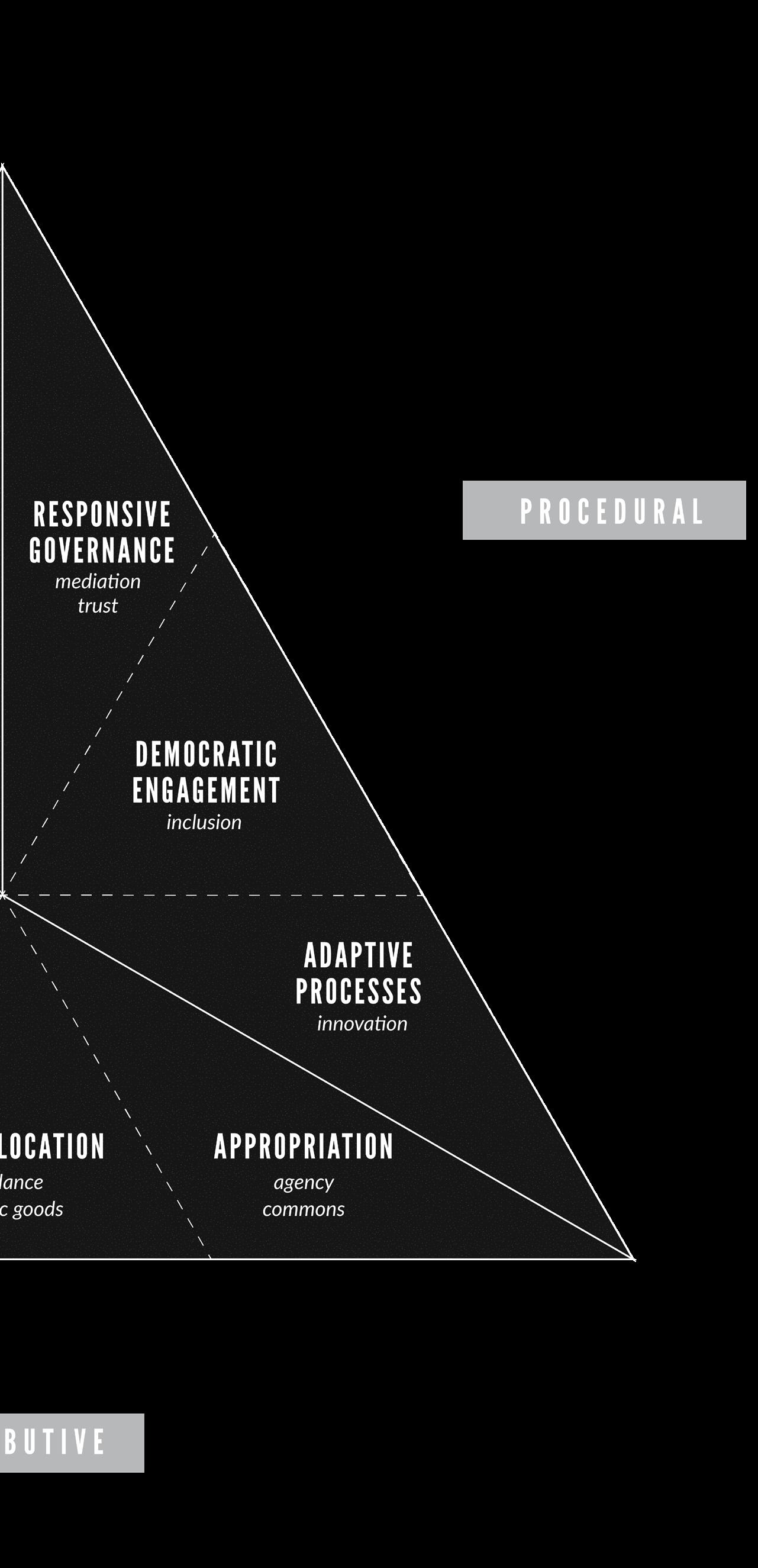
RECOGNITION
focuses on the validation, protection, and fostering of identities, practices, and socioeconomic and institutional arrangements of non-hegemonic individuals, collectives and communities.
DISTRIBUTIVE
focuses on the fair allocation, access, and appropriation of the burdens and benefits of human association in cities and communities.
SPATIAL JUSTICE
PROCEDURAL
focuses on the processes and governance of the built environment to not reproduce, maintain, or create new inequalities. In turn, reinforcing many levels of engagement from the residents and enhancing democracy.
Spatial justice seeks to rectify imbalances that create disparities in how different groups experience their environment. It advocates for a more just allocation of spaces and resources that support a community's livelihood and for more democratic and empowering processes that allow that to happen.
Spatial Justice encompasses three fundamental, indissociable and mutually-supporting dimensions: distributive, procedural, and recognition.
The Distributive dimension concerns the equitable distribution of resources, benefits, and burdens of our lives in society across different geographical areas or communities. It strives to ensure that no group or locality is systematically disadvantaged regarding access to essential services, amenities, or economic opportunities. The Distributive dimension addresses issues like fair allocation of public goods, infrastructure, and environmental quality to prevent spatial inequalities.
The Procedural dimension focuses on the fairness of decision-making processes related to urban development and planning. It emphasises inclusive governance, that ensures participation, transparency, and accountability. In this dimension, a wide range of stakeholders should have a voice in shaping policies, regulations, and development plans, ensuring that decision-making procedures are open, accountable, and considerate of diverse perspectives, with particular attention to the pleas of disadvantaged or historically oppressed communities.
The Recognition dimension concerns the acknowledgement and validation of cultural identity, historical trajectories, and various social groups' specific needs and aspirations. It emphasises respecting the rights and values of marginalised and vulnerable communities, acknowledging their unique experiences, and addressing historical injustices. This dimension also involves recognising and supporting collectives that practice non-hegemonic forms of care, highlighting interconnectedness and
interdependency, such as solidarity networks and a "care economy". It also emphasises the transformation of values, building on a plurality of possible worlds and the aspirations of citizens to foster novel socioeconomic and institutional arrangements that affirm the ideals of justice. This can be found in Indigenous communities, social movements' occupations, and other organisational structures that mobilise solidarity networks mediating participation and self-determination in such territories.
Therefore, these dimensions are integral and essential to Spatial Justice and need to work in concert to ensure that urban development not only distributes resources fairly but also recognises the diverse needs and aspirations of urban populations and actively engages them in the decision-making processes.
WHY IT MATTERS TO URBAN PLANNING AND POLICYMAKING
The necessity for Spatial Justice arises from acknowledging that space is not a neutral backdrop to human activity but is actively produced, shaped, and contested by social processes, power dynamics, and institutional practices. At the same time, justice must underscore all actions taken to promote sustainability, as it is the foundational virtue of social institutions, just as truth is for systems of thought. Therefore, any law or institution, no matter how efficient or well-organised, must be reformed or abolished if it is unjust (Rawls, 1971).
In the evolving discourse about how to steer our cities and communities towards a fair and sustainable future, the concept of spatial justice emerges as both a "meaning-giver" and a "sense-maker" for
urban development policy and projects. It provides a critical lens through which the spatial dimensions of justice and equity can be understood and addressed.
In urban development, space is not neutral; it reflects (produces?) and reproduces social inequalities and power dynamics. By applying spatial justice principles, urban planners and policymakers can recognise and analyse the ways in which urban spaces either perpetuate inequality or contribute to more equitable outcomes.
As a "meaning-giver", Spatial Justice provides a more profound framework for understanding the complex interactions between space, society, and the environment. It helps us reflect on how urban
and policy-making risk exacerbating social inequalities, allowing environmental degradation and economic disparities, and ultimately undermining the urban social fabric of cities.
The integration of justice dimensions into urban planning and policymaking is not only a moral imperative but also a practical necessity for addressing complex urban challenges that require collective imagination and collective action. Justice-oriented planning aims to reorient urban development to address social sustainability consistently and, in turn, make groups (and thus the city) more resilient to shocks and stresses. Furthermore, a justice-based approach can drive innovation and sustainability by fostering
POOR URBAN PLANNING AND POLICYMAKING
CAN EXACERBATE EXISTING INEQUALITIES, CONCENTRATING DISADVANTAGE IN CERTAIN AREAS WHILE
PRIVILEGING OTHERS.
policies and projects impact different communities and individuals, particularly those who are marginalised or disadvantaged. This perspective gives meaning to collective, public action, fostering a holistic approach to urban development that considers the spatial implications of policy decisions and seeks to create socially inclusive, empowering and regenerative environments.
As a "sense-maker", Spatial Justice encourages a systematic value-based rethinking of urban development based on a clear three-dimensional framework that addresses multiple aspects simultaneously.
Urban areas are mosaics of diverse communities with unique needs, aspirations, and challenges. Without a justice-oriented approach, urban planning
environments where diverse ideas and solutions are welcomed and where social equity is seen as integral to economic prosperity and environmental stewardship. Integrating spatial justice with social sustainability is essential for good policy design. By doing so, cities can become places of care, resilience, and solidarity, capable of meeting current and future challenges.
WHY IT MATTERS TO SUSTAINABILITY JUST SUSTAINABILITY TRANSITIONS: LEAVING NO ONE BEHIND
As overlapping socio-ecological crises affect cities and regions, the intersection between Spatial Justice and social sustainability is a critical nexus where equitable access to urban spaces and resources meets the long-term livelihood of communities.
Social sustainability refers to a community's ability to develop processes and structures that not only meet the needs of its current members but also support future generations' ability to live healthy and prosperous lives. It is the bedrock on which environmental sustainability can be grounded and is founded on well-functioning political, institutional and legal systems that deliver just outcomes regarding the distribution of environmental, economic and social burdens and benefits of development and growth.
A key aspect of social sustainability is the ability to establish institutions that can steer and govern a community's socioeconomic and environmental development. Thus, environmental or economic sustainability is not possible without social sustainability. In fact, Spatial Justice is a pillar of sustainability. It advocates for policies and practices that foster a balance between these dimensions to achieve longterm sustainability and true resilience.
At this intersection lies the understanding that for human institutions to be sustainable, they must also be just. By integrating Spatial Justice values in social sustainability, urban initiatives can foster environmentally and economically sustainable societies characterised by social cohesion that does not undermine plurality, equal opportunity, and the fostering of a strong sense of belonging and care for the commons between inhabitants.
Just sustainability transitions encompass the holistic transformation of socio-technical systems towards more sustainable and equitable futures, ensuring that no one is left behind. The concept of a “just transition” integrates social justice with environmental sustainability, highlighting that efforts to address climate change and environmental degradation must also tackle social inequalities.
Socio-technical transitions to sustainability involve profound, systemic changes in energy production, consumption patterns, transportation, and other fundamental systems. To address it, many urban concepts like the smart city, the 15-minute city, and the circular city have emerged as "best practices". These and other narratives around sustainability, adaptation, and resilience often lack a justice perspective. The Spatial Justice lens reinforces that resilience and adaptation should address not just a matter of physical infrastructure or environmental management but also systemic inequalities that would still keep communities susceptible to harm. Moreover, critical research has shown that these initiatives have often exacerbated inequalities and created new forms of dispossession (Shelton, 2015; Wiig, 2016; Thatcher, 2016; Savini, 2019; Amorim, 2021).
Just transitions recognise that technological innovations alone are insufficient for sustainability; they must be accompanied by changes in social practices, cultural norms, regulatory frameworks, and economic structures. In addition, some scholars argue that the focus of cities on strategies and action comes at the expense of efforts in developing coherent longterm city visions. An imbalance between vision, strategy and action leads to the disconnection between
short-term action and long-term planning. A major criticism of current sustainability visions is their reliance on so-called "experts," which often leads to exclusionary processes and business-as-usual outcomes detached from citizens’ lived experiences. This lack of a collective vision can result in public detachment, protests, political polarisation, and threats to democracy.
Spatial Justice aims to rectify historical, ongoing, and planned reinforcing of spatial inequalities. It then requires an active engagement with diverse groups to understand their specific needs and vulnerabilities and to ensure that the benefits of transitions, such as new technologies, jobs, and improved environmental conditions, are accessible to all and affect 'everyday life' positively. Addressing injustices thus means imagining, planning, and acting another ‘everyday life’. This approach emphasises a deep transformation of values, embracing the plurality of human experiences, cultures, and ontologies to foster novel socioeconomic and institutional arrangements (Escobar, 2018).
WHY EVALUATE SPATIAL JUSTICE CONSIDERATIONS
To bring about change, Spatial Justice requires a re-evaluation of planning and policy to better account for its various dimensions and aspects, including a justice-based approach with spatial considerations.
Despite growing interest in Spatial Justice, assessment tools are lacking, with the distributive dimension often receiving the most focus. This highlights the need for a comprehensive assessment method. It is crucial to develop a guiding framework that integrates equity, participation, empowerment, agency, democracy, and recognition to support the development
of just urban environments. This involves addressing the three dimensions of Spatial Justice: recognition, procedural, and distributive. The Spatial Justice Conceptual Model was developed to address this and other limitations and forms the basis for many other tools. This tool is part of the Spatial Justice Package, which includes a handbook, an evaluation dashboard, a playbook, and a benchmarking tool, in the forms of publications, webpages, and software-based tools. Both processes and outcomes are important in that effort. The goal of this publication is to provide a framework that makes Spatial Justice more applicable in urban sustainability transition plans. It is the basis of a package of tools and approaches that assist in the evaluation, comparison, monitoring, and recommendations for academic and practitioner purposes to address the call for redistribution of benefits and burdens, for engaged communities and responsive governance, and that urban planning and design fosters a pluriverse of livelihoods in the city and morethan-city urban areas.
SPATIAL JUSTICE CONCEPTUAL MODEL
OVERVIEW
This component focuses on respecting and protecting identities and communities in relation to their rights and duties in procedures and the distribution of benefits and burdens.
This component focuses on learning from, implementing aspects, or supporting alternative collective practices that support and protect individuals and groups in marginalised or vulnerable conditions.
This component focuses on enhancing the broader societal input of marginalised communities. It emphasises the values, territorialities, and epistemic contribution to influencing novel socioeconomic and institutional arrangements.
This component focuses on the ease of reach to the material or service by enhancing opportunities, and empowering people to design their lives.
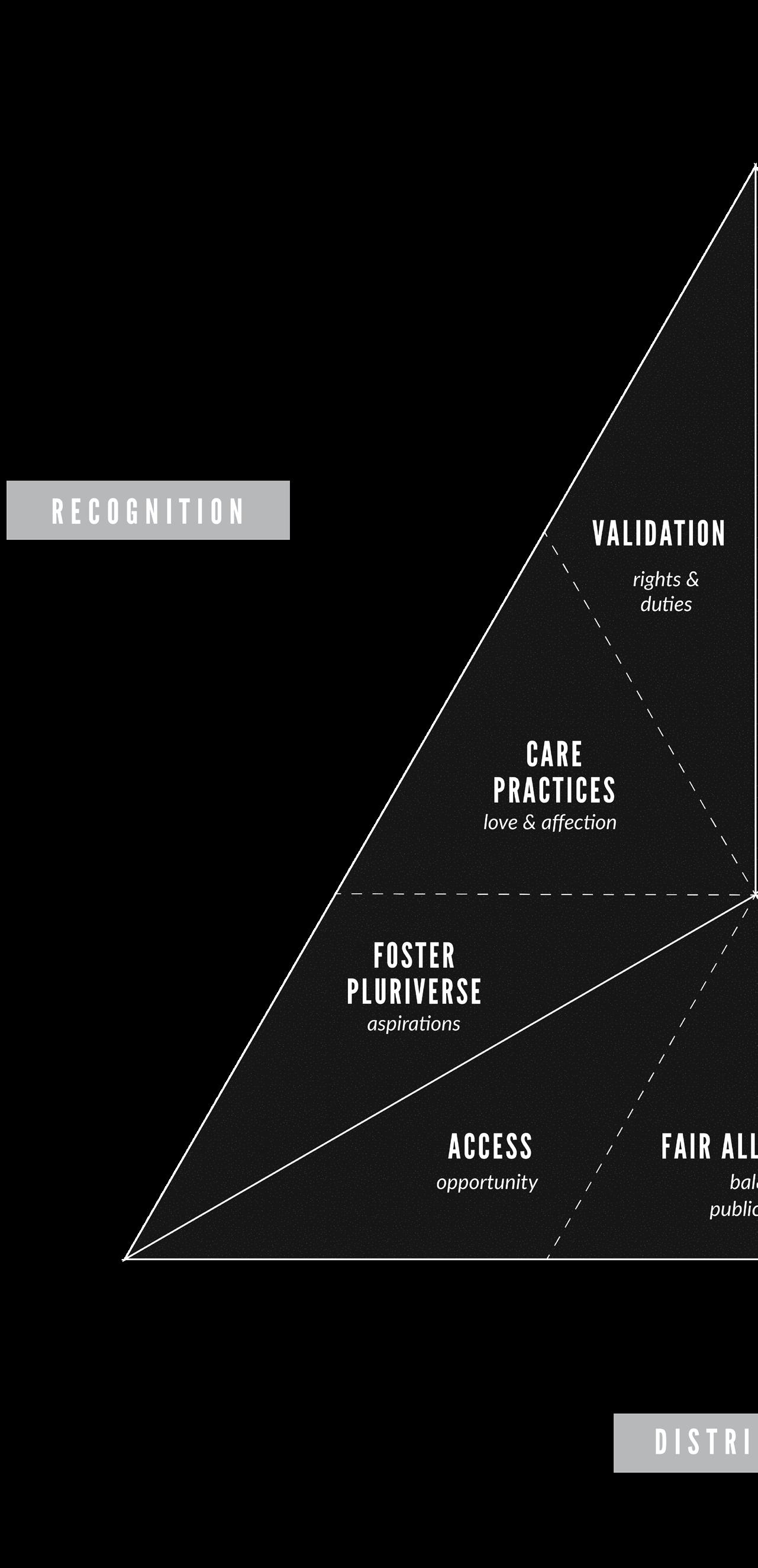
This component focuses on the and service provision and the sustainability
the fair allocation of material the burdens and benefits of sustainability transitions.
This component focuses on the ability to build trust through mediation to uphold justice and legitimatise social sustainability, building consensus among several actors.
This component focuses on residents' levels of participation, involvement, and empowerment during all phases of the decision-making process, as well as their freedom and trust to negotiate.
This component focuses on the institution's flexibility and adaptability to evolving circumstances, incorporating feedback, and adjusting policies, practices, and programs to better align with justice considerations.
This component concerns people's ability to transform, programme, and use the allocated and accessible materials and services.
PURPOSE OF THE SPATIAL JUSTICE CONCEPTUAL MODEL
The Spatial Justice Conceptual Model unpacks the concept of Spatial Justice into a more applicable framework. The existing typology of Spatial Justice distinguishes three dimensions, namely recognition, procedural and distributive. To further unpack each dimension, it proved beneficial to develop subcategories. The Spatial Justice Conceptual Model (SJCM) breaks down the concept of Spatial Justice into more applicable components and goals that build each dimension (Recognition, Procedural and Distribution). These are laid out in this chapter.
The SJCM aims to support the application of the concept of spatial justice, encompassing many aspects and frameworks for equity, inclusion, and diversity from a planning perspective since every action happens in space. It also aims to expose sustainability transition discourses, narratives, and proposals to the values of spatial justice, validating the concept's potential not only as a normative perspective but also as a rigorous analytical tool for examining and evaluating urban sustainability transitions.
Its use is multifaceted, and it is used in many steps of an academic or practitioner's work. When approached as an analytical framework, it allows a structured way of assessing the levels of justice while drawing attention to the underlying components that build each dimension. Another output is its use as the conceptual framework of a tool for benchmarking spatial justice. The Spatial Justice Benchmarking Tool (SJBT) is a (qualitative) evaluation tool designed to measure the application of justice considerations in urban governance and planning of a city or region. It provides a score by assigning levels of justice of their attainment against the highlighted components
of the Spatial Justice Conceptual Model and visualisations in a dashboard that assist the reflection and improvement of processes (and outcomes) towards spatial justice. This tool is further unpacked in another part of this document.
Lastly, its contributions to academic and societal purposes are also many. From an academic perspective, we consulted and drew inspiration and connections to many bodies of literature across disciplines and also from city experiences to identify different aspects and sketch out the components and their subcategories (also seen as criteria). From a societal perspective, one of the contributions of developing this Spatial Justice Conceptual Model is the potential to contribute to democratic processes that recognise inequality and injustice in areas, sectors, and procedures, and even target certain groups and individuals. Especially in the current context of socio-technical transition and the fast changes it proposes, we hope it is received as a contribution to claims for justice in urban governance, planning and design.
THE COMPONENTS OF EACH DIMENSION
The components are the result of an extensive literature review that unpacks each dimension (Distributive, Procedural, and Recognition) into more applicable subcategories.
In the context of a framework, a component refers to a fundamental element or building block that contributes to the overall structure and functionality of the framework. Components are distinct but interdependent parts or aspects devised by literature and practical knowledge. They give the framework more structure, provide a systematic approach for addressing justice considerations, and enable users to apply the framework to analyse and address issues related to their context in a more nuanced approach
to spatial justice in planning.
DISTRIBUTIVE DIMENSION
In general, this dimension concerns the spatial distribution of the burdens and benefits of human association in cities and communities (Rocco, 2023). Three components under this dimension guide the redistribution: fair allocation, access, and appropriation. They are organised in this way following the planning perspective for Spatial Justice.
FAIR ALLOCATION
This component is about the fair allocation of burdens and benefits. It is not only about the provision of public goods and infrastructure - public goods, basic services, cultural goods, economic opportunities, and healthy environments (Rocco, 2014) - but it encompasses broader social and environmental dimensions.
"Fair Allocation" does not primarily seek equality of outcomes, but emphasises to correct spatial disparities and inequalities, aiming to address the origin of inequality in the first place, leading to more distributed outcomes. Since the pursuit of justice requires gaining control over the processes producing unjust urban geographies.
Some criteria under this component are the perspective of "Resilience" as the ensuring of a community's integrity among environmental degradation. And of "Compensation" as the measures addressing the origin of inequalities. For example, historical reparation of unequal distribution of resources is compensated by current urban sustainability transitions.
ACCESS
This component is about the ease of reach to material or service by enhancing opportunities.
The issue of accessibility is central to this discussion and to the idea of increased life chances - which is the ability of households and individuals to access educational, economic and environmental opportunities and to design their lives upwards.
Some criteria under this component are the physical connectivity of spaces beyond the provision of benefits, improving their connection and avoiding fragmentation. For example, the provided parks are connected via green routes, or schools have safe and continuous bike lanes towards them. Another criterion is "Capacitation," which contributes to individuals' capabilities and skills development that aid working opportunities. It means the allocation and accessibility of materials or services contribute to opportunities for development, empowerment, and well-being, allowing people to pursue their goals and aspirations.
APPROPRIATION
This component is about people's ability to transform, programme, and use the allocated and accessible materials and services. It concerns the nurturing of the commons in cooperation and reciprocity. It challenges the spatial inequalities perpetuated by privatisation and market-driven development, which often lead to the exclusion and marginalisation of low-income and vulnerable populations.
Some criteria in this component are the idea of "Programming", or the ability to curate the community's appropriation. It assists in aligning spaces with cultural values and identities, promoting respect, inclusivity, and innovation. For example, public markets with local producers managing the space. This is
related to engaging communal management and maintenance. According to Elinor Ostrom (2009), common goods can be efficiently controlled when a collective ensures their administration and maintenance.
PROCEDURAL DIMENSION
In general, this dimension concerns that procedures and governance of the built environment should be ensured so that it does not reproduce, maintain, or create new inequalities. "The procedures through which decisions are taken to allocate burdens and benefits of development must also be just. Fair, inclusive and accountable procedures are likely to deliver just outcomes" (Rocco, 2023).
Solón expands that the procedural dimension, as a practice, is not only the changes to the structures of political power but the management of the "commons" as a community, allowing the members to "care" for the element and, at the same time, reproduce and enrich their forms of social organisation" (Solón, 2019).
The components that address how questions of inclusivity and fairness in community engagement and decision-making are addressed; and what we understand as constitutive elements of a real democracy. These are democratic engagement, adaptive processes, and responsive governance. The auxiliary literature and the experiences of participation processes aid in unpacking this dimension.
DEMOCRATIC ENGAGEMENT
This component is focused on how people are empowered and how this engagement is fairly ensued, from giving a voice to direct action. Engagement encompasses a broader, more continuous interaction between the community, collectives and individuals,
and government entities. It includes not only participation in decision-making but also efforts to inform, educate, and communicate with citizens in a twoway dialogue, fostering a more profound, ongoing relationship and collaboration.
Urban governance is complex and multifaceted, requiring input and collaboration from all sectors of society to address the challenges and opportunities cities face. Democratic engagement shows a commitment to making urban policies and projects more democratic and truly sustainable, reflecting the needs, aspirations, and expertise of the residents.
Some of its criteria are not only about mechanisms for meaningful participation and inclusion of individuals, collectives, and communities during decision-making but also the space for advocacy groups to highlight important societal issues. In some cases, marginalised and vulnerable groups need others to act as spokespersons. Advocacy aims to bring about change, whether through public awareness, offering support, contracting advocacy services, or influencing policies on a particular issue. In summary, advocacy helps people express views, thoughts, and concerns and have access to information and guidance in a way they can understand.
ADAPTIVE PROCESSES
This component focuses on how the institution self-actualises to become more just in its processes, evaluations, assessments, and provision. It means it is adapting to the needs and barriers of its population, understanding and assessing their capabilities, incorporating other ways of knowing, being fair in external collaborations, and ensuring that justice considerations are embedded in its processes - also when dealing with other sectors in society (businesses, NGOs, academia, etc).
Justice must underscore all actions taken to promote sustainability. It is the foundational virtue
of social institutions, just as truth is for systems of thought. Therefore, any law or institution, no matter how efficient or well-organised, must be reformed or abolished if it is unjust (Rawls, 1971).
Some criteria are continuous evaluation and improvement, which address emerging challenges and evolving needs, including mechanisms for monitoring progress and identifying unidentified barriers that hinder just processes and outcomes. This can happen through working group meetings, workshops, and mini-labs that focus on developing new ideas and exploring what justice means in a certain context. It also means a further step in ethical approaches addressing unethical intra-institutional interactions. For example the concentration of power and ensuring that roles and responsibilities are fitting and well-distributed within the institution while promoting ethical interactions.
RESPONSIVE GOVERNANCE
Delivering justice requires a continuous commitment, being responsive to the needs and aspirations of the broader community it serves. This component focuses on the ability to build trust in processes through mediation in view to uphold justice and legitimatise social sustainability among several actors. It includes matters of acceptability, compliance, support, and suitability, ensuring that processes (benefits, support, and projects) will not be interrupted by governmental changes and that burdens will be distributed in a just way. This enhances the perception of legality, integrity and transparency.
Some criteria include the institution's role in facilitating and developing programmes and initiatives that underscore broader considerations of justice values. It encompasses the drafting and monitoring of plans taking into account a spatially just framework.
RECOGNITION DIMENSION
Recognition is a vital human need. This dimension is focused on individualities, collectives, and communities. It concerns the acknowledgement, protection, and respect for individual and collective identities, experiences, and cultural expressions. It is attentive to conditions that determine the historical and ongoing marginalisation, discrimination, and misrepresentation of certain groups in society. Then, it focuses on the acknowledgement and fostering of individual, collective, and community ancestral or novel socioeconomic arrangements rather than an integration of differences into a hegemonic and stable status quo. Thus, it contributes to planning and designing spaces that respect and celebrate differences and increase recognition, which is a core aspect of Spatial Justice.
VALIDATION
In general, this component is attentive to a legal aspect regarding the intrinsic value or dignity of individuals and groups, and their actions as a moral agent. It emphasises a form of respect and protection that provides space for recognition in a broader definition of rights and duties, which includes constitutions, standards, regulations, guidance documents, international agreements and best practice precedents.
An important criterion is the idea of "Differentiation", which understands that the need for justice is different across groups and individuals. This is the validation and respecting the experiences, perspectives, and needs of individuals and groups most in need of fair redistribution and responsive institutions since the feeling of injustice is different accross individuals and groups. In that regard, the "Wheel of Power and Privilege" by Sylvia Duckworth is a powerful tool against nonrecognition (being rendered invisible via the authoritative representational,
communicative, and interpretative practices of one's own culture). Adopting an intersectional lens is considering how multiple dimensions of identity (e.g., race, gender, class, etc) intersect to shape individuals' experiences of injustice and marginalisation. The challenge is not “to be” but “to learn to interrelate” with the other contradictory parts of the whole. Existence is not something given but a relational concept. By applying an intersectional lens, spatial planners and policymakers can better understand the specific barriers marginalised communities face and develop targeted strategies to dismantle these barriers, thereby advancing spatial justice.
CARE PRACTICES
This component focuses on learning from, implementing aspects, or supporting alternative collective practices that support and protect individuals and groups in marginalised or vulnerable conditions. It highlights actions from collectives that support others in marginalised and vulnerable conditions (humans and non-humans). It refers to "everyday practicesthat includes activities, affective attitudes, and ethical values joining bodies, subjectivities, policies, and materials in everyday life" (Drotbohm, 2022). It also means "getting involved, engaging in and, as a result, being tightly linked to the management of the commons" (Solón, p.95).
Care is a position. The concept of care first appeared among feminist theorists as a structure in knowledge practices, not only individual but accounting to the world. Some of the assumptions of this theory say that individuals are understood to have varying degrees of dependence and interdependence on one another and that other individuals affected by the consequences of one’s choices deserve consideration in proportion to their vulnerability. Care acknowledges not only vulnerability but also interconnectedness and interdependence. Different from
the idea of a ‘social contract’, which in a functionalist view rewards the performativity of each part, interdependency is a condition for a society, creating life-sustaining webs to support its limitations when it is impossible to care for everything equally. This helps to keep the sustainability transitions accountable for their limitations when the ambition to control and find solutions to what is being cared for is still suggested inside a world that runs in a productive logic. Another valuable concept is the idea of ‘situated knowledge’, which means that “knowing and thinking is inconceivable without a multitude of relations that also make possible the worlds we think with” (Bellacasa & de la Bellacasa, 2012). In other words, a position of care cannot be translated in the same way in different territorial circumstances. Positions of care highlight the obligation to constant fostering and may assist, in this era of uncertainties, to think of pathways for careful transformations in sustainability transitions.
Some examples are the "care networks", and the need to support these alternative economies. Since it is not a matter of scale-up, but a matter of connecting through solidarity networks. It includes social solidarity and mutual support networks within communities, including informal networks, community-based organisations, and grassroots initiatives that provide assistance and advocacy for vulnerable populations. Moreover, it is also important to learn from these care practices. In its "duty of care", institutions have the opportunity to increase the functioning of these initiatives and act as a partners.
FOSTER PLURIVERSE
This component emphasises a deep transformation of values where the character of the transition builds on a pluriverse of possible worlds inhabiting and co-visioning, co-building the transition and fostering novel socioeconomic and institutional
arrangements. Pluriverse is defined as the recognition and fostering of diverse ways of knowing, being, and interacting in the world. It is the proactive shift away from a singular, homogenising worldview towards one that embraces the multiplicity of human experiences, cultures, and ontologies. Plurality, in Arturo Escobar's framework, encompasses not only cultural diversity but also ecological diversity and the diversity of ways of organising society. It emphasises the interconnectedness of all beings and systems and acknowledges the value of different perspectives in addressing complex socio-ecological challenges.
It is also important to mention that although it affirms plurality and respects it, it still affirms the ideals of justice - understanding that not everything is possible to conciliate (for example, discrimination, racism, intolerance, and aspects of capitalism, productivism, and extractivism).
In practice, it calls for a reimagining of urban spaces as sites of empowerment, equality, and justice, where the needs and voices of all residents, especially those historically marginalised, are recognised and valued in the shaping of urban futures. Not only that, but it can also develop innovative ways to consider future generations in urban planning when understanding how to use resources and direct sectoral developments. It can also be attentive to emerging spaces that enact justice in the built environment in its processes and outcomes. For example, in prefigurations of degrowth, postdevelopment, Buen Vivir,
the rights of nature, and transitions to post-extractivism. In the example of degrowth, it advocates for a planned downscaling of 'less necessary' activities and a planned increase of activities that fulfil 'basic needs'.
USEABILITY
This typology is a valuable analytical tool to analyse and understand grievances of unfair allocation of benefits and burdens, procedures that maintain inequalities, and misrecognition.
An analytical framework is a structured approach or set of principles used to analyse and interpret data, phenomena, or systems. It provides a systematic way to organise information, identify patterns, and draw conclusions about a particular subject or topic of study. In that sense, the Spatial Justice Conceptual Model works as a step further in giving meaning and making sense of the evolving discourse about how to foster cities and communities towards fair and sustainable futures. It serves as an analytical lens through which urban planners, policymakers, and researchers can examine spatial phenomena and urban governance assessing Spatial Justice through its components.
It can also integrate other processes for evaluating Spatial Justice considerations, one of which is the Spatial Justice Evaluation Dashboard. It is a platform for organising, storing, and visualising the evaluation of spatial justice considerations in urban planning and governance.
It facilitates comparisons between different cities and governance models, calling for an alignment with the principles of Spatial Justice. This assessment helps identify the strengths and weaknesses of urban planning and governance, guiding refinements toward a justice-based approach in policies, processes, and actions. The Dashboard enhances communication
by fostering a better understanding when applying justice considerations. It offers a comprehensive evaluation system that provides a lens for ongoing monitoring and development, encouraging critical thinking by outlining the various components and stages of Spatial Justice in urban planning and design decisions. Additionally, it assists in the identification of gaps and shortcomings in justice considerations, highlighting trends in learning gaps and reminding institutions of key values. By assessing visions, strategies, plans, and projects against the Dashboard, it informs justice efforts are considered at every stage of the planning cycle that needs evaluation, supporting just urban sustainability transitions.
As an example of its application, the UP2030 project has provided the environment to assess justice considerations in the urban sustainability transition plans of 10 cities in Europe and one in South America with the Spatial Justice Conceptual Model being used as an analytical framework. Furthermore, it can be used in several document formats, including processes, models, plans, projects, reports, and visions. For instance, governance models, participation frameworks, public policy, policy recommendations, institutional guidelines, specific programmes and initiatives in city planning, visioning frameworks, etc.
LIMITATIONS
It is important to acknowledge that any framework, while helpful, simplifies reality. When exploring complex concepts like Spatial Justice, we walk a fine line between recognising complexity and addressing it in a more objective manner. Thus, while we attempt to distil knowledge, we must be mindful of the risk of oversimplification and the potential to reinforce certain perspectives.
We understand that our framework does not fully resolve the complexities of spatial justice or offer a
definitive guide to applying justice in urban governance. Issues such as power imbalances and dominant norms will persist. Therefore, we acknowledge that our framework has limitations, and the components we have identified are not exhaustive or unwavering to change.
CHALLENGES & FUTURE DIRECTIONS
TOWARDS A JUST CITY: REFLECTIONS AND A MANIFESTO
REFLECTING ON THE NEW ROLE OF PLANNERS AND POLICYMAKERS
BUILDING COALITIONS FOR CHANGE
A MANIFESTO FOR THE JUST CITY RESEARCH AND EDUCATION
In the quest for spatial justice, the convergence of new governance styles that foster hope as a political action and embrace insurgent forms of planning that challenge neo-liberal forms of governance heralds a transformative path towards creating just cities. This approach means a departure from conventional, technocratic, top-down urban planning paradigms, advocating instead for participatory, inclusive, and responsive governance that empowers communities and values grassroots initiatives.
Hope, as a dynamic and collective force, drives this shift, motivating citizens to envision and work towards equitable urban futures. It fuels the belief that, through collective action and innovative governance, it is possible to overcome spatial injustices that marginalise and disenfranchise citizens.
Insurgent planning, with its roots in the lived experiences and aspirations of local communities, offers practical and imaginative strategies to reclaim and reshape urban spaces. It challenges the status quo and provides a platform for voices historically silenced in urban development narratives.
As we reflect on the journey towards spatial justice, it is clear that the integration of hope and alternative forms of planning within new governance models is not merely desirable but essential. This approach redefines the relationship between urban spaces and their inhabitants, fostering environments where equity, sustainability, and community thrive within practices of care and restoration of the planet and our relationships with each other.
The call to action is clear: to build just cities, we must collectively commit to these principles, fostering an urban governance that is as adaptive, resilient, and diverse as the communities it serves. Through this commitment, the vision of just and inclusive cities becomes not just a hopeful aspiration but an achievable reality.
REFLECTING ON THE NEW ROLE OF PLANNERS AND POLICYMAKERS
Within the transformative framework aimed at fostering hope and embracing alternative planning practices towards spatial justice, the roles of planners and policymakers evolve significantly. This new paradigm necessitates a shift from traditional, technocratic, hierarchical approaches to more collaborative, flexible, and community-centred roles. Planners and designers become facilitators of change, connectors, and co-creators rather than sole authors of urban futures.
FACILITATORS OF COMMUNITY EMPOWERMENT
Planners and policymakers must prioritise empowering communities to lead the charge in shaping their environments. This involves creating platforms for genuine participation and ensuring that all voices, especially those from marginalised groups, are heard and valued. It's about facilitating processes where community insights and aspirations directly influence planning decisions, thereby democratising urban development.
CONNECTORS BRIDGING DIVERSE STAKEHOLDERS
In their new role, planners and designers act as connectors, bridging gaps between various stakeholders, including government entities, private sectors, non-profits, and community groups. By fostering partnerships and facilitating dialogue, they can create synergies that leverage the strengths and resources of different sectors towards common goals of spatial justice and sustainable urban development.
CO-CREATORS IN URBAN DEVELOPMENT
Adopting a co-creative approach, planners and designers work alongside communities and other stakeholders in the design and implementation of urban projects. This collaborative process ensures that development initiatives are grounded in local contexts and needs, leading to more effective and sustainable outcomes. Co-creation fosters a sense of ownership among all participants, enhancing the resilience and adaptability of urban spaces.
ADVOCATES FOR EQUITY AND SUSTAINABILITY
Planners and designers must also advocate for equity, sustainability, and justice within urban governance frameworks. This involves challenging entrenched power dynamics and advocating for policies and practices that prioritise the well-being of both human and non-human inhabitants. It requires a commitment to questioning and reimagining existing systems to pave the way for more just and sustainable urban environments.
LIFELONG LEARNERS AND INNOVATORS
Finally, in this evolving landscape, planners and designers need to be lifelong learners, open to innovation and adaptation. The complexities of modern urban challenges necessitate a willingness to explore new ideas, learn from both successes and failures and continuously adapt strategies in response to changing conditions and insights. This learning mindset is crucial for navigating the uncertainties of the future and ensuring that urban development remains responsive to the needs of all inhabitants.
The shift towards hope and alternative planning practices in urban development calls for planners and designers to embrace these new roles, embodying flexibility, collaboration, and a deep commitment to
justice and sustainability. By doing so, they can contribute to creating urban environments that not only meet the needs of the present but are also resilient and equitable spaces for future generations.
BUILDING COALITIONS FOR CHANGE
Building coalitions for change within the framework of hope and alternative planning practices towards spatial justice requires strategic, inclusive, and empathetic approaches. These coalitions must bring together diverse stakeholders, including community groups, non-profits, academics, policymakers, and the private sector, united by the common goal of creating fair, sustainable, and just urban spaces. Key strategies to effectively build and sustain such coalitions include:
1. IDENTIFY COMMON GOALS
Start by identifying shared goals and visions among potential coalition members. Even groups with diverse interests can find common ground in broader objectives like sustainability, equity, or community empowerment. Clear, shared goals provide a foundation for collaboration and action.
2. FOSTER INCLUSIVE ENGAGEMENT
Ensure the coalition-building process is inclusive, actively reaching out to and involving a wide range of stakeholders, especially those from marginalized or underrepresented communities. Use participatory methods to engage community members, ensuring everyone has a voice in shaping the coalition’s direction and priorities.
3. BUILD ON EXISTING NETWORKS AND RELATIONSHIPS
Leverage existing networks and relationships to foster trust and collaboration among potential coalition members. Building on the foundations of trust can accelerate the formation of effective coalitions and enhance their resilience.
4. EMPHASIZE INTERSECTORAL COLLABORATION
Encourage collaboration across sectors by highlighting the interdependent nature of urban challenges and the benefits of diverse perspectives and resources. Intersectoral collaboration can lead to innovative solutions that no single sector could achieve alone.
5. DEVELOP CLEAR COMMUNICATION CHANNELS
Establish clear and open channels of communication among coalition members to facilitate effective coordination, share information, and address conflicts constructively. Regular meetings, shared online platforms, and transparent decision-making processes can support this.
6. CREATE A FRAMEWORK FOR ACTION
Develop a clear framework for collective action that outlines roles, responsibilities, and strategies for achieving shared goals. This framework should be flexible enough to accommodate the dynamics of coalition work while providing enough structure to guide concerted efforts.
7. CAPITALIZE ON DIVERSE STRENGTHS
Recognise and capitalise on the diverse strengths, resources, and expertise that each member brings to the coalition. This might include community knowledge, academic research, policy influence, or financial resources, among others.
8. CELEBRATE ACHIEVEMENTS AND LEARN FROM SETBACKS
• Regularly acknowledge and celebrate the coalition’s achievements to maintain motivation and momentum. Equally important is the willingness to learn from setbacks, using them as opportunities to adapt strategies and strengthen the coalition’s resilience.
9. SUSTAIN ENGAGEMENT THROUGH SHARED VALUES
• Keep the coalition engaged and motivated over time by emphasizing shared values and the ethical imperative of working towards spatial justice. Shared values can help sustain commitment even when faced with challenges or slow progress.
10. ADVOCATE FOR SYSTEMIC CHANGE
• Use the coalition’s collective voice to advocate for systemic changes in policies, practices, and societal norms that perpetuate spatial injustices. Effective advocacy can leverage the coalition’s diverse membership to speak powerfully on issues of common concern.
Building coalitions for change in the context of spatial justice requires a commitment to collaboration, diversity, and action. By uniting around shared goals and leveraging the strengths of a broad range of stakeholders, these coalitions can drive significant transformations in urban planning and governance, moving us closer to achieving fair, sustainable, and just cities.
Together, we are building the foundation for cities that not only meet the needs of their current inhabitants but also anticipate and adapt to the needs of future generations. Our collective journey towards spatial justice continues, and we look forward to the innovative solutions and collaborations that will emerge as we strive to make our urban spaces fairer for all.
https://just-city.org
ACKNOWLEDGEMENTS
This Spatial Justice Manual represents the collective effort of numerous individuals and organisations committed to advancing the principles of spatial justice in urban planning and design. As we present this work, we extend our deepest gratitude to all those who have contributed their knowledge, expertise, and passion to this project.
Special thanks are due to the European Commission, whose financial support through the research project "Up2030 Spatial Planning and Design Ready for 2030" has been indispensable. Their commitment to fostering innovative and sustainable approaches to spatial planning and design is deeply appreciated and has been a guiding light for our work.
We are particularly grateful to the Centre for the Just City and our colleague, Caroline Newton, whose insights, dedication, and unwavering support have significantly enriched the content and vision of this manual. Caroline's expertise and commitment to spatial justice have been invaluable in shaping the direction and outcomes of our work.
Our heartfelt appreciation also goes to the coordination team of the UP2030 project—Trinidad, Catalina, Leon, and Nilo. Their leadership, coordination, and diligent efforts have been central to the success of this project. Their ability to bring together diverse perspectives and expertise has not only facilitated the smooth progression of the project but has also ensured that our collective endeavours remain aligned with our core mission of promoting spatial justice.
Furthermore, we wish to acknowledge the contributions of all researchers, practitioners, and community members who have engaged with us throughout this project. Your experiences, challenges, and victories have been instrumental in shaping the practical and theoretical foundations of this manual.
Lastly, we extend our thanks to the readers and future users of this manual. Your commitment to applying the principles of spatial justice in your work and communities is crucial for creating more equitable, sustainable, and inclusive urban environments. We hope that this manual serves as a valuable resource in your endeavours and inspires continued efforts towards achieving spatial justice worldwide.
Together, we are building the foundation for cities that not only meet the needs of their current inhabitants but also anticipate and adapt to the needs of future generations. Our collective journey towards spatial justice continues, and we look forward to the innovative solutions and collaborations that will emerge as we strive to make our urban spaces fairer for all.

HUGO LOPEZ
RESEARCH FELLOW UP2030 AT THE DELFT UNIVERSITY OF TECHNOLOGY.
h.lopez@tudelft.nl
ROBERTO ROCCO
ASSOCIATE PROFESSOR OF SPATIAL PLANNING & STRATEGY AT THE DELFT UNIVERSITY OF TECHNOLOGY.
r.c.rocco@tudelft.nl
JULIANA GONÇALVES THE AUTHORS
ASSISTANT PROFESSOR OF SPATIAL PLANNING & STRATEGY AT THE DELFT UNIVERSITY OF TECHNOLOGY.
j.e.goncalves@tudelft.nl
REFERENCES
Bachmann-Medick, D. (2016). The Cultural Turns: New Orientations in the Study of Culture. Walter de Gruyter.
Brenner, N., Marcuse, P., & Mayer, M. (2012). Cities for People, Not for Profit: Critical Urban Theory and the Right to the City. Routledge.
Carvalho, H., Royer, L., José, B. K., & Rocco, R. (Forthcoming). Revisiting social resilience in informal settlements: The strength and the limits of Paraisópolis community action during the COVID-19 pandemic in São Paulo. In L. Rajendran (Ed.), (Provisional Title). RSA.
Caseff, G. (2020). 'Prefeito' de Paraisópolis empodera moradores e vira exemplo mundial [Paraisópolis 'mayor' empowers residents and becomes a global example]. Folha de Sao Paulo. https://www1.folha.uol.com.br/empreendedorsocial/2020/12/prefeito-de-paraisopolis-empodera-moradores-e-vira-exemplo-mundial.shtml
G10. (2020). G10: Bloco de Líderes e Empreendedores de Impacto Social das Favelas. G10. Retrieved 10 September from http://www.g10favelas.org
Harvey, D. (2003). The Right to the City. International Journal of Urban and Regional Research, 27(4), 939-941.
Harvey, D. (2008). The Right to the City. New Left Review, Sept/ Oct(53), 23-40. https://newleftreview.org/issues/ii53/ articles/david-harvey-the-right-to-the-city
Harvey, D. (2012). Rebel cities : from the right to the city to the urban revolution. Verso.
Holston, J. (2009). Insurgent citizenship : disjunctions of democracy and modernity in Brazil. Princeton University Press. IBGE. (2010). Pesquisa Nacional por Amostra de Domicilios (PNAD). In. Brasilia: IBGE.
Iveson, K. (2011). Social or spatial justice? Marcuse and Soja on
the right to the city. City, 15(2), 250-259.
Komukai, D. (2019). Primeiro G10 Favelas: as dez comunidades mais ricas do Brasil se unem [First G10 Favelas: Brazil's ten richest communities unite]. ECOA. https://www. uol.com.br/ecoa/ultimas-noticias/2019/11/25/primeiro-g10-favelas.htm
Lefebvre, H. (1968). Le Droit à la ville. Anthropos.
Maciel, C. (2022). Pesquisa Traça Perfil de Moradores de Heliópolis e Paraisópolis. Agência Brasil. https://agenciabrasil.ebc.com.br/geral/noticia/2022-11/pesquisa-traca-perfil-de-moradores-de-heliopolis-e-paraisopolis
Marcuse, P. (2009a). From critical urban theory to the right to the city. City, 13(2-3), 185-197.
Marcuse, P. (2009b). Searching for the just city debates in urban theory and practice. Routledge,. http://www.columbia. edu/cgi-bin/cul/resolve?clio7793612.001
Marcuse, P. (2009c). Spatial Justice: Derivative but Causal of Social Injustice. Espace et justice/Space and Justice, 1(Sept 2009).
Marcuse, P., & Kempen, R. v. (2002). Of States and Cities: The Partitioning of Urban Space Oxford Geographical and Environmental Studies.
Marcuse, P., & van Kempen, R. (2000). Globalizing Cities: a New Spatial Order? Blackwell.
Newton, C., & Rocco, R. (2022). Actually Existing Commons: Using the Commons to Reclaim the City. Social Inclusion, 10(1). Quintella, S., & Moretti, J. (2019). Principal líder de Paraisópolis, Gilson Rodrigues quer uma nova favela, Com visão estratégica, ele pretende transformar projetos sociais em negócios sustentáveis [Gilson Rodrigues, the main leader of Paraisópolis, wants a new favela. With a strategic
vision, he wants to turn social projects into sustainable businesses]. Veja Sao Paulo. https://vejasp.abril.com.br/ cidades/capa-paraisopolis-gilson-rodrigues
Rocco, R., & Ballegooijen, J. v. (2018). The Political Meaning of Informal Urbanisation. In R. Rocco & J. v. Ballegooijen (Eds.), The Routledge Book on Informal Urbanisation. Routledge.
Rocco, R., José, B. K., Carvalho, H., & Royer, L. (2021). The Impact of Socio-Spatial Inequity: COVID-19 in São Paulo. In B. Doucet, R. v. Melik, & P. Filion (Eds.), Global Reflections on COVID-19 and Urban Inequalities (Vol. Volume 1: Community and Society, pp. 129-140). Bristol University Press.
Soja, E. (2008, 12-14 March 2008). The city and spatial justice. Spatial Justice, Nanterre.
Soja, E. (2009). The City and Spatial Justice. Justice Spatiale/ Spatial Justice, 1(September 2009).
Soja, E. (2010). Seeking Spatial Justice. University of Minnesota Press.
Souza, F., & Barifouse, R. (2019). Paraisópolis, 100 anos: como loteamento de luxo virou favela mais famosa de SP, BBC Brazil. BBC. Retrieved 5 May from https://www.bbc.com/ portuguese/brasil-50694377
Centre for the Just City
Centre the City
THE
CENTRE FOR THE JUST CITY
The Centre for the Just City was founded at the Faculty of Architecture and the Built Environment at the Delft University of Technology in response to the pressing challenges of rampant social inequalities affecting urban spaces’ cohesion and sustainability.
Recognising the vital need to address these issues, the Centre emerged as a platform for research, education, and outreach activities to create just cities.
Since its inception, the Centre has been at the forefront of bridging theory and practice, fostering collaborations, and influencing policies and actions that contribute to making cities equitable, sustainable, and inclusive.
Our values are Equity, Respect, Excellence and Diversity
We believe in fostering cities and communities where opportunities and resources are distributed fairly and every individual’s rights and dignity are upheld.
We are committed to cultivating a culture of mutual respect, recognising and valuing the diversity of perspectives, and encouraging dialogue and understanding.
Our commitment to excellence drives our research, education, and outreach efforts, ensuring rigour, innovation, and impact.
Embracing diversity in all its forms, we value the plurality of experiences, cultures, and ideas as essential components of creating inclusive and just urban environments.
SPATIAL JUSTICE
CONCEPTUAL MODEL
The Spatial Justice Conceptual Model allows for a structured and comprehensive way of assessing how aspects of spatial justice are considered in planning and design.
The transformation of society presupposes a collective ownership and management of space founded on the permanent participation of the “interested parties,” with their multiple, varied, and even contradictory interests. It thus also presupposes confrontation […].
Henri Lefebvre, THE PRODUCTION OF SPACE, OXFORD /CAMBRIDGE (MASSACHUSETTS),BLACKWELL, 1991.