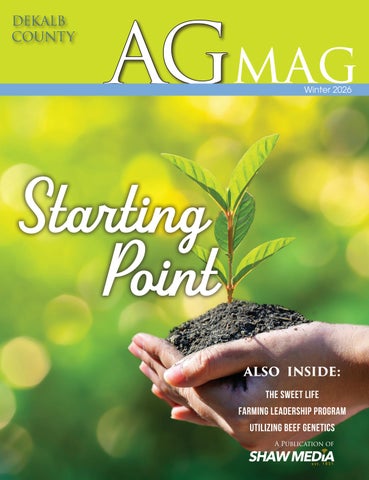
DEKALB COUNTY
agmag Winter 2026
Starting Point ALSO INSIDE: THE SWEET LIFE FARMING LEADERSHIP PROGRAM UTILIZING BEEF GENETICS A Publication of est. 1851
DDC_AgMag_112026.indd 1
11/3/2026 3:03:50 PM
ONE TO GROW. Proud Agribusiness partner since 1857.
A handshake you can rely on and the tools, financing and expertise to move you forward.
/agribusiness Member FDIC
2 | DeKalb County AG MAG | Winter 2026
DDC_AgMag_112026.indd 2
11/3/2026 3:03:50 PM
DeKalb County
agmag 4
FARMER REAPS BENEFITS FROM LEADERSHIP PROGRAMS Improving communication skills, learning new farming techniques and enhancing their business plans.
6
STARTING POINT
8
THE SWEET LIFE
Enrollment numbers are rising for conservation program
Stings don’t deter interest in beekeeping
10 UTILIZING BEEF GENETICS Breeding dairy females and produce beef-on-dairy cross calves
agmag
DeKalb County
Published by Shaw Media Project Manager: Lisa Angel
Design & Layout: Courtney Weed Articles and advertisements are property of Shaw Media. No portion of DeKalb County Ag Mag may be produced without written consent of the publisher.
Winter 2026 | DeKalb County AG MAG | 3
DDC_AgMag_112026.indd 3
11/3/2026 3:03:51 PM
Ryan Frieders (left) talks about his farming operation during an event where he welcomed a group of global soy buyers to tour his farm in northern Illinois.
Farmer reaps benefits from leadership programs By Martha Blum mblum@shawmedia.com
P
articipating in leadership programs provides a variety of opportunities for farmers that include improving communication skills, learning new farming techniques and enhancing their business plans.
Ryan Frieders, who grows corn and soybeans on his farm near Waterman, has completed several leadership programs and currently serves as the District 1 director of the Illinois Soybean Association and is a member of the American Soybean Association board of directors.
Farmers from all over the United States were in the class, including those who raise wheat, cotton and rice. “It was a really neat combination of similar-minded, forwardthinking farmers,” Frieders said. Learning about succession planning and long-term business planning at this leadership program has helped Frieders’ family farming operation.
“I’m a seventh-generation farmer, and I have worked with my Texas A&M’s TEPAP, or The Executive Program for Agricultural grandpa, my parents, and I have kids that I want to be able to Producers, is a two-year commitment. “This program is for farmers farm,” he said. who are interested in maximizing their business decisions and long-term strategy skills,” said Frieders, who completed it in 2020. “In those seven generations, the structure of the farm business has changed, and giving future generations the opportunity to be “I went to Texas for one week each year to do in-person training, able to afford to farm has changed, as well,” Frieders said. and they bring in professional speakers,” he said. “There is a substantial amount of work that you do on your own throughout “We learned about using trusts for the farmland in the the year to prepare for the sessions.” right way,” he noted. “And how to start to transition the business ownership before death. That is something people did not Through this program, Frieders learned skills such as how to find talk about before. You farmed until you died and then the next the right employees, how to develop a good succession plan and generation took over, but that doesn’t really work anymore.” how to find new markets and be aware of new trends. During the Illinois Agricultural Leadership Foundation’s Ag “Part of doing any program like that is the networking,” he said. “I Leadership Program, Frieders traveled to Poland, Ukraine and the met hay farmers from Canada, and there was a cattle farmer in my Czech Republic. “We learned how farming is different in different class from Calgary.” areas of the world,” the farmer said. 4 | DeKalb County AG MAG | Winter 2026
DDC_AgMag_112026.indd 4
11/3/2026 3:03:52 PM
“It was neat to be able to see the different styles of farm ownership whether it was the communist style of farming in the Ukraine or the very traditional style of farming in Poland where they had small farms of 10 to 15 hectares,” he said. Some of these farms were growing specialty crops, and some were selling their items directly to consumers. “The bits and pieces that you learn are definitely the benefit of being a participant,” Frieders said. “You are also sharing because you can’t just go and be a consumer of other people’s ideas; you have to be a participant.” During the Illinois leadership program, Frieders learned about different communication skills and styles and how to be the best communicator he can be. “People communicate and listen differently, so you need to be open to different communication styles,” he said. “Try to be aware of the situation you are in so that you can have conversations and take advantage of the time that you have together,” he advised. Serving as a director for both the state and national soybean groups has given Frieders the opportunity to participate in several additional leadership programs — including Syngenta’s Leadership At Its Best, the ASA-Corteva Young Leader Program and Illinois SoyLeader. “There are all kinds of opportunities for people to take advantage of when they get involved with commodity organizations, the
HARVEST YOUR OPPORTUNITIES GROW YOUR FUTURE Agriculture plays a vital role in our economy. With quality instructors and state-of-the-art facilities, Kishwaukee College is training the next generation to meet the demands of the agriculture business.
Farm Bureau or agricultural professional organizations,” he said. Leadership programs are available to farmers of all ages. The ISA offers a 20 Under 40 program that is open to producers under 40 years of age. “I do not think you can be too young to start making yourself a better leader or communicator,” Frieders said. “I think it is important to keep people engaged whether they go directly to the farm after high school or they go to a junior college, vocational school or a university,” said Frieders, who graduated from North Central College with a degree in finance and accounting and completed his master’s degree in crop science from the University of Illinois. “We have to continually engage with young people so that they know what opportunities are available,” he said. “If they do not know what they are missing, they will never realize it.” Frieders encourages all people to get involved when they are given an opportunity to participate in a leadership program. “Don’t put yourself in a box and think that you are not a good leader or communicator and that you don’t farm enough acres,” the farmer said. “People will learn from your experiences, and you will learn from them,” Frieders said. “We need all different types of leaders,” he said. “I guarantee there is something that you know that is valuable to other people and that you can share, to make our state better.”
AG-RELATED DEGREE PROGRAMS • • • • •
Agribusiness Agriculture Diesel Power Technology Horticulture Pre-Veterinary
AG-RELATED CERTIFICATES • • • • • • • • • •
Advanced Welding Technology Basic Welding Technology Cannabis & Hemp Cultivation Diesel Power/Equipment Repair Floral Horticulture Foundations of Agribusiness Foundations in Horticulture Greenhouse/Garden Center Landscape Design/Construction Turf & Grounds Management
AG-RELATED SHORT-TERM TRAINING • •
Truck Driver Training Veterinary Assistant
PLANT THE SEEDS OF YOUR SUCCESS AT KISH. Learn more at kish.edu. 21193 Malta Rd | Malta, IL 60150 | 815-825-2086 Winter 2026 | DeKalb County AG MAG | 5
DDC_AgMag_112026.indd 5
11/3/2026 3:03:52 PM
Starting Point
Enrollment numbers are rising for conservation program By Tom C. Doran tdoran@shawmedia.com
W
hen Alexa Skirmont first became a Precision Conservation Management specialist five years ago, there were no farmers enrolled in her northern Illinois region.
“I started with zero farmers, but to be honest, I have not had to cold call or reach out to farmers probably since the first year. People are calling me all the time, wondering about the programs, how they can get involved. A lot of the time it’s landowners that want their farmers to be a part of it, too,” she said. Interest in her region has since grown to 64 producers and about 50,000 acres. PCM is a conservation program of the Illinois Corn Growers Association and its partners, applying financial analysis to in-field conservation practices to help farmers adopt practices that impact environmental goals without risking their bottom line, as well as providing financial incentives. Skirmont, a PCM specialist in DeKalb, Ogle, Lee and Winnebago counties, works one-on-one with farmers to provide technical support, cost-sharing programs and personalized data analysis. The program’s footprint has expanded since it began 11 years ago in Illinois and now includes parts of Kentucky, Missouri and Nebraska.
Soybean plants sit under a cover crop of cereal rye.
The number of farmers and size of acreage also continue to grow year over year. PCM currently has over 605 farmers enrolled, representing over 660,000 acres. PCM is fully funded through program partnerships, meaning there is no cost to enroll. Farmers who sign up also receive a $750 signup bonus, over two years, and an annual field-by-field profitability and environmental analysis each February. The are additional cost-share financial incentives through PepsiCo for cover crops, nitrogen reduction and reduced tillage; Farmers for Soil Health’s pay-for-practice cover crop program; and in Illinois counties eligible for the Regional Conservation Partnership Program. PCM is supported by more than 30 organizations with a vested interest in improving the sustainability of commercial agriculture. Farmers enrolling in PCM have a wide range of practices on their farms. “Not every farmer that I work with plants cover crops or does minimum tillage. I have a lot of farmers that are doing conventional practices, but it’s a great comparison, a great data set we have in northern Illinois. I have really great farmers,” Skirmont said. “A lot of those first farmers that enrolled in PCM in northern Illinois had been using cover crops or doing no-till for 10, 20 years, and they had never been paid for things such as programming and cost share.
6 | DeKalb County AG MAG | Winter 2026
DDC_AgMag_112026.indd 6
11/3/2026 3:03:55 PM
“Those were my main growers because a lot of the time, a conventional farmer isn’t going to want to give someone their data, if it’s not doing anything to benefit them essentially.
is published. We want to make sure all of our farmers get that information first before the aggregated anatomized data is published in the summer,” Skirmont said.
“The ideal farmer for PCM is someone that is at least interested in conservation or even just interested in economics. I believe every farmer should be interested in that, just seeing where they could potentially make more profit.”
Career Path
As part of the program, PCM looks at the economics of different farming systems with data-driven analysis. The program focuses on nitrogen timing; overwinter, winter-terminate, partial overwintering, or no cover crops; and no-till, strip-till, one-pass light tillage and two-pass medium tillage.
“I was not involved in agriculture in high school. I was part of FFA because my boyfriend at the time, now my husband, was in it. I just followed his lead, and that’s why I got into agriculture, too. I went to college, not really knowing what I wanted to do, and he proposed the idea of going into ag business. I took my first few classes, and I was like, ‘This is great, I love this,’” she said.
Here are some key points based on the northern Illinois dataset from PCM: • A one-pass of light tillage to farmers in northern Illinois — it’s a
win-win for soil health and profitability. The data show this as being the most profitable practice on both corn and soybean fields in the region year after year. • For fields with a Soil Productivity Rating below 135 in northern
Illinois, overwintering cover crops ahead of corn has proven to be a profitable practice. This highlights an opportunity for farmers to improve soil health on some of their less productive acres without negatively impacting their bottom line. • When it comes to nitrogen rates, farmers may be surprised
to learn that PCM data shows leaner rates tend to be more profitable. Applying less than 150 pounds of N per acre had the highest returns in high-SPR corn fields, while 151 to 175 pounds came out on top in low-SPR corn fields. This is one of the easiest adjustments farmers can make to improve financial and environmental outcomes.
Enrollment Process
The process typically begins with a phone conversation between the farmer and a specialist such as Skirmont. “We’ll talk a little about program, make sure it’s good fit. The next step is for me to come out to the farm. That first meeting usually take an hour, hour and a half. That would be our enrollment meeting. That’s when I would map all the farmer’s fields,” she said. “We like to get two years of data for the time that we’re meeting. So, if the farmer was enrolling right now, I would get the past two years yield of data. That’s just to make a good baseline for the farmer’s data set so when they get their Resource Analysis and Assessment Plan report in the wintertime, it has information on it, not just a one-year thing where it doesn’t really show you a whole lot of information.” During the fall, the farmers send yield information to PCM specialists via texts or other means. Overall, the program takes about three to four hours total of oneon-one meetings or phone calls over the year. “At the end, we do the RAAP report in February or March. We like to be done by the middle of March because the information
Skirmont’s path toward becoming a PCM specialist certainly wasn’t apparent after graduating from Burlington Central High School.
Skirmont earned an undergraduate degree at Illinois State University in ag business and business administration and received her master’s degree in international agriculture at Oklahoma State University. “I came home after I graduated right when COVID was about to happen. There weren’t a lot of jobs available. I ended up bartending for a few months, and then I got a job at Conserv FS in Marengo. I was doing retail there. It was a great experience. I am not cut out for sales. It takes a special type of person to do that and that was not me and that was very evident. I was there for about 13 months,” she said. Skirmont was hired by PCM in May 2021. “It’s such a great job, and I can’t thank PCM enough,” she said. “When I worked for FS, my favorite part was visiting with my farmers, whether that was infield or just at the kitchen table or anything. This job gave me the flexibility to do that with my growers. “When we’re doing our RAAP reports, it’s in the middle of winter, we’re sitting at the kitchen table, maybe his wife is there and she’s making us a cup of coffee. A lot of the time, their kids might be home from school, and they’re kind of running around listening to me. “It’s just really cool to be able to learn and get to know these farmers, their families and their operations. I think they’re just so special because they are giving us their data and information, and I want them to feel confident in me and trust me.”
THINKING ABOUT SELLING FARMLAND?
If you’ve been considering selling land, now is the ideal time since current inventory is limited. We have multiple program options available for potential sellers.
COMPLIMENTARY MARKET ANALYSIS
Learn your land’s value! Whether you are thinking about buying or selling farmland, conducting 1031 trades, or simply curious about today’s market, we can provide a fact-driven analysis to help you understand your options before making any decisions. Contact us to discuss your farmland goals. ®
ROOSTER AG’
FARMLAND / COMMERCIAL REAL ESTATE | FARM MANAGEMENT | APPRAISALS | SECTION 180 VALUATION |
MASTERS OF THE 1031 TRADE!
630-774-5887 | www.roosterag.com Winter 2026 | DeKalb County AG MAG | 7
DDC_AgMag_112026.indd 7
11/3/2026 3:03:55 PM
While presenting a program several years ago, Tom Montavon put a drop of honey on his finger, a honeybee landed on it and he was able to pet the bee without any “consequences.” Provided photo/Charter Grove Honey Farm
The
Sweet Life
Stings don’t deter interest in beekeeping By Tom C. Doran tdoran@shawmedia.com
T
he phrases “getting bit by the bug” and “busy as a bee” aren’t just idioms for Tom Montavon, who has operated Charter Grove Honey Farm in Sycamore for about 25 years.
Montavon grew up on a dairy farm and was interested in raising livestock, but he was fascinated by honeybees. “A guy at my grandfather’s dairy farm had bees. I was always intrigued by them, and I’d go watch him a little bit,” he said. One day he pitched in for his uncle at the dairy farm where the hives were located to chop feed for the cattle. The chopper was pulled by an International Harvester 856 tractor. “We had turned up the tractor’s horsepower, and the bees didn’t like it. They stung the living snot out of me,” Montavon said. “It was hot. I was wearing a sweatshirt, a guy gave me a veil to wear and I still got stung, but it never deterred me from it. I was just more intrigued.”
After graduating from college with a business degree, Montavon’s interest in farming and raising livestock stuck with him. “I wanted to get back into livestock. My kids were in high school, but I didn’t have facilities for four-legged animals. I saw an advertisement for honeybees and got bit by the bug,” he said. Montavon started with one hive. The bees all died that next spring. “Knowing what I know now, it was from queen failure,” Montavon said. The bump in the road didn’t stop him as he continued to increase the number of hives, and customer demand for the honey grew. “We started another hive after losing that first one, and then we added another one. We started figuring some things out and doing better. We had six or eight hives for the longest time, and once we started getting a little bit of honey out, it just snowballed. To be honest, I can’t produce enough honey for what everybody wants,” he said.
8 | DeKalb County AG MAG | Winter 2026
DDC_AgMag_112026.indd 8
11/3/2026 3:03:56 PM
“I love it. I like working with animals on the farm. I got into bees, and they were just so fascinating, just completely different than anything else in agriculture. That’s what’s so amazing about it. I just got bit by the bug. “I didn’t have anybody help me, which I’m glad now I didn’t, because I paid attention to what the bees needed, and that’s what I did for them. You can’t think like a human with bees because they’re completely different.” Charter Grove Honey Farm eventually grew to over 100 hives, but Montavon has downsized a bit in the last few years to about 65 — “simply because I’m in my late 60s, so it’s more challenging.” Honey production was down slightly this year to about 50 pounds per hive due to the weather. “It was just too cold, too wet. People don’t realize when it rains, if it’s a windy rain, it washes the nectar out, and only a very small percentage of blossoms will put nectar back in itself,” Montavon said. “So, it’s a one and done for the nectar. If the rain washes the nectar out of the blossoms, you have nothing. They’ll get pollen, but they won’t get any nectar.”
“I know some people don’t like to share information. I learned 90%-plus of it by myself, and I’m willing to share and help other people. If they get another honey farm, I really don’t care because everybody’s honey is a little bit different. That part doesn’t bother me, not like some people.” Montavon has been a guest speaker numerous times to share his beekeeping knowledge and experiences. He recently was a presenter at the Outdoor Stewardship Days, an event held through the partnership between the Ogle County and Lee County Soil and Water Conservation Districts and attended by area third graders. “We talked about bees and this year, judging by the number of tasting spoons I used, I’m guessing we had probably 150-plus kids go through that event. It’s a lot of fun,” he said.
Nothing Like It
Beekeeping is a unique calling. “The bees are just so entertaining to me. I like how you go out there, you work with them and you get to see what they do in a short period of time. There’s nothing else like it in agriculture,” Montavon said.
“It’s very enjoyable. I’ve been asked many times, if I had to go back to work, what would I want to do. I would want to work While presenting a program several years ago, Tom Montavon put a drop of honey on his finger, a honeybee landed on it and he was able to pet the bee without any Marketing with my bees in the growing part of the farming season and then “consequences.” Provided photo/Charter Grove Honey Farm It doesn’t matter if one produces corn, soybeans, meat, combine corn. vegetables or honey, any financial success hinges on demand. “If you get bit by the bug, you’re screwed. It’s not the cheapest Montavon’s honey was initially sold out of the family’s house thing to get into. You have to watch what you’re doing just like through word-of-mouth. everything else.” “Then we got enough hives, and at that point I was still working full-time construction, too. We did the Genoa farmers market and markets here and there, and it just snowballed from there. It doesn’t take much to sell your honey. Once you get a following, it’s an easy thing to sell. It’s amazing,” he said. “I have such a great following of people that want my honey, it’s unbelievable. I’ll get people coming 30, 40 miles away, and they will buy a couple big containers at a time. I know you have people selling meat and they get their following. I would imagine the whiskey producers have their following, too, but it’s sort of neat that way. “We provide raw, unfiltered honey. Ours will crystalize and people complain about it, but it’s a good thing because it proves that it’s raw honey. You have just got to know.”
FEATURED BUILDING OF THE MONTH Every month we spotlight popular building designs. Including specs, pricing, & customizable features.
THROUGH THROUGH NOVEMBER OCTOBER
The outdoor farmers markets have wrapped up for the season as sales transition to indoor craft fairs. “We continue to sell out of the house. We have a couple local stores that sell our honey, plus there will be two or three craft fairs through the winter,” Montavon said. “To be honest, it sells itself. I put on my Facebook page where I’m going to be at, and they show up for it.”
Mentorship
Montavon, who served for several years as an Illinois Department of Agriculture apiary inspector, enjoys sharing his beekeeping experiences and knowledge with others. “We help probably four or five new beekeepers get started every year. We still get a lot of phone calls,” he said.
SM-CL2357604
(800) 552-2981 FBiBUILDINGS.COM/BOTM-DEKALB
Winter 2026 | DeKalb County AG MAG | 9
DDC_AgMag_112026.indd 9
11/3/2026 3:03:56 PM
beef
Utilizing genetics in dairy herds impacts industry By Martha Blum mblum@shawmedia.com
U
the lower one-third for genetic index in his herd. “To supplement that we started using sexed semen on the top 20% of the herd, so we have not lost on replacement heifers at all,” the dairyman said about his herd that includes Brown Swiss and Holstein cows.
“We have been using beef semen in our herd for a couple of reasons,” said Bill Deutsch, who owns a 150-head dairy herd near Sycamore.
“It has been nice to have these beef calves,” he said. “The premiums have helped our cash flow.”
tilizing beef semen to breed dairy females and produce beef-on-dairy cross calves is impacting dairy herds in several ways.
“I shifted so we do not have to raise calves in the middle of winter in the hutches because of labor,” he said. “So, we started breeding our females that calve from Christmastime to March 1 with beef semen, and the calves are sold to the beef grower.” In addition, Deutsch uses beef semen to breed all the cows on
In addition, since the dairyman is using sexed semen for his higher-quality cows, he is also increasing the productivity of the entire herd quicker. “My production has shifted to components — total fat and protein combined — instead of pounds of milk shipped, because I am paid
10 | DeKalb County AG MAG | Winter 2026
DDC_AgMag_112026.indd 10
11/3/2026 3:03:58 PM
“Older cows have less and lower intensity heats, lower conception rates, and they are not good candidates for sexed semen,” Staley said. “I really believe in genomics, but if you do not have enough heifers, it does not matter what their genome is because you need every heifer,” he said. “Genomics work if you have a lot of heifers because you can cull the bottom 20%.” It will be important for dairymen to focus on heifer health and heifer maturity. “We need to feed the right milk proteins, spend money on the heifers and pay attention to them,” the veterinarian said. “And we need to weigh the heifers.”
Beef-sired calves from dairy dams are filling approximately 20% of the U.S. fed cattle supply.
on protein and fat,” Deutsch said. “Lately, I have been breeding a little more for protein because the pay price has shifted to more premiums on protein than fat.”
Cattle Inventory
Over the last 65 years, the national beef herd has been declining for several reasons including drought conditions and the age of cattlemen.
Staley looked at the top dairy herds across the nation and found that these operations do two things. “They raise mature heifers, and they create and retain healthy mature cows,” he said. “These herds with 100-pound milk production cows do not have 50% cull rates.” The veterinarian encourages dairymen to determine the reasonable heifer inventory for their herd based on their culling rate. “You need to start building your heifer inventory today, because it is a three-year process,” Staley said. “Dairy dynamics have changed fundamentally, and they are not going back anytime soon,” he said. “The new normal replacement rate will be from 26% to 28%, and there will be 12% more older cows that are prone to chronic and subclinical diseases.”
“That created a void of feeder cattle,” said Gavin Staley, technical services veterinarian at Diamond V. But the beef-on-dairy cross calves have helped fill a good percentage of the void, said Staley during a presentation at World Dairy Expo. “We have a dairy heifer inventory that is expected to calve of 2.5 million head, which is the lowest in 48 years,” he said. “And the U.S. dairy herd has grown to 9.7 million head which is the highest in 31 years.” Staley questions what dairy herds will look like in the future with a 26% cull rate. “Dairymen are going to keep a lot of older cows that require more care and attention,” the veterinarian said. “We are going to need to keep cows healthier for longer, and it is all about prevention and innate immunity,” he said. “And tied into that is genetics because cows that are able to stay longer in the herd have a genome that allows them to do that.” With a higher percentage of older cows in a herd, Staley said, he expects the somatic cell counts in the bulk tank will increase. “We can’t cull the cows like we used to because we don’t have the replacement heifers, and there may be more repeat mastitis cases,” he said.
Animal Health
Therefore, it will be important for dairymen to be really good at detecting potential problems. “I think we are going to need the activity monitoring a lot more to pick this stuff up,” the veterinarian said. Winter 2026 | DeKalb County AG MAG | 11
DDC_AgMag_112026.indd 11
11/3/2026 3:03:59 PM
AWE INSURANCE AGENCY Ad
HERE TO SERVE YOU HERE FOR WHAT MATTERS We build trust with comprehensive coverage and extraordinary service. You can count on us to make you a priority and to be here for what matters most. Trust in Tomorrow.® Contact us today.
“Trust in Tomorrow.” and “Grinnell Mutual” are registered trademarks of Grinnell Mutual Reinsurance Company, SI. © Grinnell Mutual Reinsurance Company, SI, 2026.
SM-CL2357275
DDC_AgMag_112026.indd 12
11/3/2026 3:03:59 PM