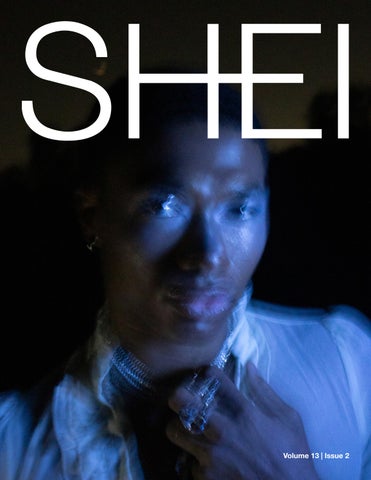
Volume 13 | Issue 2
SHEI MAGAZINE
STANFORD LIPSEY STUDENT PUBLICATIONS 420 MAYNARD ST, ANN ARBOR, MI 48109
editor-in chief CERIDWEN ROBERTS creative director HANNAH RUFFIN publisher ANA CANO marketing director CHRISTIAN HERNANDEZ operations director RENATA PEREZ ROSILLO managing digital editor XOCHITL SANTANA VEGA managing digital editor MADISON KNOWLTON digital features editor LOLA POST design editor CAROLINE KEGG design editor CORNELIA OVREN digital fashion editor JILLIAN VAN STEE digital content editor JANE MAXWELL digital photo editor BEE WHALEN digital beauty editor GABRIELE SHEPHEARD print fashion editor ELENA SHAHEEN print fashion editor KAAVYA CHAVAN print features editor ISIDORA PURRIER print photo editor LILLY VYDARENY print photo editor CHARLES DECOSTER print beauty editor GRETCHEN BROOKES video editor LOGAN DILLEY finance coordinator AUBREY HEATON finance coordinator KATIE BURGIN public relations coordinator ALIA GAMEZ social media coordinator DANICA SCHIRN social media coordinator ANJANI PATEL professional development lead TAYLOR DEREY communications coordinator ELI ORTA
BEAUTY Gretchen Brookes, Gabriele Shepheard, Yun-Hsi (Megan) Chiang, Ella Graeb, Lexsie Nguyen, Adrienne Feige, Annabelle Chang, Rachel Xu DESIGN Caroline Kegg, Cornelia Ovren, Ashley Turney, Bailey Ellul, Jaycee Mitchell, Jasmine Barnes, Allen Hoover, Riley Kim, Mia Hsu FASHION Elena Shaheen, Kaavya Chavan, Jillian Van Stee, Mya Weiss, Sally Jang, Reagan Hakala, Rita Hajjar, Lucy Smith, Millie Kocis, Ava Istamboulian, Katie Kim, Eliza Zook, Paige Bishoff, Eva Park, Chloe Johnstin, Amelia Kincaid, Sydney LaDue, Layla Garcia, Siri Beijar, Safaat Hassan, Alexis MacDonald, Sonni Morais, Grace Totten, K’amor Smith, Macea Suarez, Indigo Ogiste, Bee Whalen, Rida Salim PHOTO Lilly Vydareny, Charles Decoster, Bee Whalen, Anwita Poluru, Jaden Moxlow, Zhixian Xiong, Paige Bishoff, Flavia Cardoso, Patrick Cardona-Cosner, Deema Aboughanem, Hannah Cherkin, Melissa Castillo-Alejo, Samantha Tandy, Jintong He FEATURES Isidora Purrier, Lola Post, Raymond Zou, Bianca Done, Ana Sharshar, Abby Weinburg, Christopher White, Ada Gong, Zaara Sultan, Alanna Lee, Amrita Arumugam DIGITAL CONTENT Jane Maxwell, Victoria McCabe, Alexander Pirog, Felicia Wang VIDEO Logan Dilley, Ammar Yaser, Hannah Cherkin, Skyy Farlow, Felicia Wang PUBLIC RELATIONS Alia Gamez, LeAnh Vong, Sunjana Kaur, Grace Totten, Sophia (Sonni) Morais, Valeria Jurado, Shriya Gangineni, Annelise Gray, Grace Wilson SOCIAL MEDIA TEAM Jane Maxwell, Danica Schirn, Anjani Patel, Jaden Johnson, Zoe Feit, Eva Park, Aanya Arora, Reagan Hakala COMMUNICATIONS Taylor Derey, Eli Orta, Sonia Samuel, Elizabeth Wolf, Karelle Lomami FINANCE Katie Burgin, Aubrey Heaton, Brenna Likosky, Julia Feitler
TABLE OF CONTENTS Le
4
LETTERS FROM THE EDITORS
Bi
6
BISMUTH
C
12
Ex
CARBON
24
EXCESS AND EXPLOITATION
34
He Na Bc HELIUM
H
WE SHOULD ALL BE A LITTLE MORE SALTY
46
LESSONS OF WATER AND LIFE
O
HYDROGEN & OXYGEN
22
48
36
BIOCOUTURE: FROM FLORA TO FASHION
Ra RADIUM
56
Ar
38
ARGON
Gr
64
THE RADIUM GIRLS
3
LETTERS FROM THE EDITORS SHEI VOLUME 13 ISSUE 2: ELEMENTAL
I
n the stars, in our blood and bones, deep down in the earth, and in all that we interact with and wear are: The Elements. The Periodic Table of Elements is so much more than a map of scientific understanding, it also stands as a timeline of human discovery and curiosity. It holds the stories of countless lives dedicated to understanding and experimentation.
This edition of SHEI explores the beautiful, delicate and balanced, yet complicated nature of a world held together by this Table of Elements. In shoots such as Argon and Helium, the SHEI team explores the personification of these elements with their individual intricacies and personalities. While the shoot Hydrogen and Oxygen dives into the beauty of the bonds between elements. While the understanding and exploration of the Periodic Table of Elements throughout history has led to many wonderful feats. The understanding of these powerful tools, with no doubt, is a great responsibility. This edition of SHEI will also explore the human interaction that comes when scientific discovery interacts with economic greed. In fashion, this is clear in the use of synthetic polymers and dyes in the fast fashion industry, which have detrimental effects on our ecosystems, our health, and the working conditions of an industry that has discovered how to cut corners. In the magazine, the shoots Carbon and Radium will explore the human effect of industrial exploitation. It is important to remind ourselves that this exploitation exists in the present. As a fashion magazine we are cognizant that what we wear has been sewn, cut, pinned, and dyed by another human. That the synthetic materials we wear will outlast our own lives, and the synthetic dyes used to color them will exist in our waters for far longer. With scientific understanding comes exploration, and progress, but for who?
beauty,
Ceridwen Roberts editor-in-chief
If I were given the opportunity to break my life down into all the elements that created who I am today, I’d do so in a heartbeat. To see all the pieces that contributed to my current persona would be a beautifully painful experience. I think the twelve different places I’ve called home would each be there, accompanied by an array of memories with my younger brother. But what else? As you’re flipping through SHEI’s elemental edition, consider the elements that take up the most space in your own life. I wonder how many versions of ourselves we have to become and work through before we recognize the person we will finally settle with. How much of who we are is a product of our surroundings, and how much comes from the things we choose to hold onto? There are pieces of our lives that ground us and others that set us ablaze. Even the parts of our lives we wish we could leave behind have a way of finding their places in how we present ourselves. The SHEI features writers were able to explore the elements and concepts most meaningful to them, and each piece left me curious. On a molecular level, the elements are the building blocks of the world around us, from the air we breathe to the bodies we inhabit. Elements are the backbone of everything around us — the one thing keeping us all scientifically connected. But still, it’s fascinating that just a few elements were able to create such a diverse world and set of experiences. We are one in the same, yet encounter the world so differently. With this edition, I hope you find something that resonates with you, challenges you, or makes you reconsider your lived experiences. More than anything, I hope these stories remind you that there is no single thing that defines a person, even if we’re all composed of oxygen, carbon, hydrogen, and nitrogen. Thank you for choosing SHEI! Lola Post digital features editor
5
BISMUTH
7
9
shoot director millie kocis photographer melissa castillo-alejo stylists bee whalen, sally Jang, rida salim beauty millie kocis graphic designer mia hsu model kennedy engel
CARBON 13
diamond noun : a crystaline carbon that is the hardest known mineral
15
: a nonmetallic chemical element with atomic number 6 that forms compounds with many other elements and is a constituent of organic compounds in all known living tissues, it appears in nature in different allotropes, including hard transparent diamonds, and soft graphite
19
graphite noun : a composite mineral in which carbon fibers are the reinforcing material
shoot director jaden moxlow photographer patrick cardona-cosner stylist sonni morais indigo ogiste macea suarez beauty yun-hsi (megan) chang graphic design cornelia ovren model jamaur houston sunny diallo
21
writer isidora purrier lola post graphic designer caroline kegg
T
he ultra-wealthy have always loved a precious gem — from royalty to celebrity, the rich show their excess through their accessories. Even average, middle-class women feel that it’s a luxury to be gifted a genuine-stone piece of jewelry. But at what cost are these gems running? And I don’t mean the thousands of millions of dollars that it costs to buy them, I mean the labor that goes into crafting diamond rings and emerald cufflinks. The reality behind the sparkling Bulgari necklace is much uglier than it appears. The cost of these gems often comes in the form of back-breaking labor done by enslaved people and even children. Throughout history, precious stones have been labeled as status symbols. Starting in ancient Egypt, wealthy figures used gems as symbols and protective omens, attaching them to jewelry, dishware, and even caskets to aid in the transition to the afterlife. These practices expanded to other cultures throughout the world, the main commonality being that they primarily remained within wealthy communities. As precious gems have become more widely-accessible in recent years, people have begun to lose touch with how these gems are harvested. We’ve all heard stories of couples fighting over ring size when it comes to engagements. When a celebrity couple
gets engaged, the press release almost always includes the carat count of the ring. Even in the 21st century, we still use these precious gems as a status symbol, something that signifies our position in society, our wealth, our lavish lifestyle. Yet these same gems are mined in incredibly dangerous and grueling conditions. Diamonds and other precious stones have wreaked havoc on countries and communities where the local population would generally not be able to afford the finished product. Yet, they pay for them in labor and in blood. For decades, various mines in Africa used profits from mining these precious gems to fuel civil wars and oppressive regimes that cost hundreds, if not thousands, of lives. On top of that, the people mining are sentenced to long hours of work in unsafe conditions, meaning the harvested gems are the product of unjustifiable labor. The diamonds that get mined under these conditions have even been coined “blood diamonds,” reflecting the physical sacrifice they require. These diamonds and other precious jewels funnel into the open market and become engagement rings or tennis bracelets, of which people bedeck themselves without a second thought. Outside of those mines, there has been quite a lot of
discourse around mined diamonds vs. lab-grown diamonds. Even though lab-grown diamonds contain the same chemical composition and are impossible to distinguish from the “real” ones, many people still hang on to their mined diamonds and the idea of the “romance” of wearing something that was formed in the earth for thousands of years. Yet there is little romance in the lives of people who are mining these precious gems, the work is taxing with little reward. And when labgrown diamonds are often sold at a fraction of the cost of mined diamonds, a moral dilemma arises. Why would a person value romance, which is undetectable by the human eye, over the lives of physical labor workers, especially when the more ethically-produced diamonds are so much cheaper? When precious gems have been viewed as status symbols throughout time, it’s easy to trust hefty price tags and overlook where these stones came from or who paid the real price to produce them. However, the dehumanizing work it takes to produce these gems won’t dissipate until the demand dwindles. If presented with the opportunity to collect a new piece of luxury jewelry, take the source into account. And while the top 1% flock and party in their dripping diamonds, it is worth remembering the labor that went into those pieces.
23
27
31
Skirt - Eva Park Sleeveless Top - Xochitl Santana Vega
shoot director zhixian xiong photographers flavia cardoso zhixian xiong stylists eva park layla garcia mya weiss sydney ladue beauty rachel xu graphic designer ashley turner model alana bobbitt
33
M o r e d l e L Be t u t i L o h A All S We P
early white, its crystals sparkle. It’s ever ubiquitous, yet still it can fit in the palm of your hand. It kisses your skin on a sunny day at the beach, while the ocean waves melt your worries away. For thousands of years, this element, sodium, has been with humanity through many of our endeavors, big and small. Or as we more commonly call it, salt! Salt carries so much history and power, whether we realize it or not. Sir Humphry Davy, the scientist who discovered sodium, stated that its weight is 23, and while I admire his monumental triumph, I would argue that the weight sodium carries is immeasurable. Household to household, culture to culture, it is certainly irreplaceable and will continue to be. All the way back in 77 A.D., Pliny the Elder boldly claimed in his book, Naturalis Historia, “Without salt, by Hercules, one cannot have a civilized life.” With agriculture on the rise, meat consumption got put on the back burner — there had to be a way to prepare crops and preserve meat at the same time, and salt let them kill two birds with one stone. Safe to say, these miniscule white grains were near and dear to the Romans’ hearts. To the east, in China, a whole field of pharmacology was developed in 2700 B.C. to study over forty different varieties of salt for their medicinal uses! People were quickly realizing this mineral that’s been embedded into our planet for so long was transformative when brought to the surface.
Food is a universal language that has been with humanity since the dawn of time — something that was initially just for sustenance but later turned into a way for communities and cultures to connect across the globe. No matter where you are, the common denominator is always salt. Even though a person might add a pinch, dash, or sprinkle (or any other frivolous form of measurement their heart desires), a small amount of it can completely transform a dish. One might think salt only carries significance in the world of food, but that is far from the truth. In the world of spirituality, salt holds a tremendous amount of power. In many cultures, salt is used to ward off evil spirits and protect the home. In Japan, a ceremony called misogi removes spiritual dirt, or kegare. The person being cleansed dons white cloth, then performs breathing exercises, after which they submerge themselves in a natural body of saltwater. In South Africa, in the Kalahari Desert, salt is retrieved from their very own underground saltwater regions for exfoliation material. This salt is coarse and contains larger crystals, which is perfect to use for baths that scrub away impurity in the literal sense. However, by doing so, spiritual cleanliness is achieved. All around the world, this otherwise commonplace object is given so much meaning, elevating its place in society.
Wouldn’t you know it, it simply wasn’t enough for salt to be life-changing here on Earth. Stars have often been regarded as something magical throughout history and human stories, but who couldn’t help but see them as such? Glowing balls of light that are so out of reach that we can’t help but wonder about everything there is to know about them. Well, these fascinating enigmas light-years away from us also contain… sodium! In fact, stars with the perfect amount of sodium in their life cycle allows them to live longer and — gracefully! — reach their old age. In a way, the stars are in our kitchens, bestowing their flavourful magic on our food. As an Indian woman, salt has its special place in my home, too. Above the front door at my childhood home hangs a balled up cloth filled with salt, placed there by my mother for protection. It has greeted me every time I enter for as long as I can remember. A process called nazar utarna, or “evil eye clearing” in Urdu, is a more direct way to ward off evil energy by taking a clump of salt in your hand and moving your arm in a clockwise direction in front of whom you wish to protect. This little tradition has become all too familiar to me, something I go through every time I visit home from college. Although the entire process takes less than a minute, it provides a sense of comfort that can only come from knowing I’m protected in a meaningful way.
Though unassuming, these tiny white granules have transformed the state of the world and bridged relationships within families and communities. Salt is a crucial part of many people’s lives, and if forsaken, would be tragic for the cultures using it as lifeblood for protection and the chefs who just don’t feel complete without it. From the stars to our hearts and our countertops, salt has been a constant in our ever-evolving, fast-paced world. In every corner of the globe, salt speaks its own language. writer zaara sultan graphic designer cornelia ovren
y t l SA
35
vtv
FROM FLORA TO FASHION
Biocouture
FROM FLORA TO FASHION
I
f there was one main pioneer of Biocouture in its early days, it would be Suzanne Lee, who actually coined the term “Biocouture” itself. In her journey working with microbial cellulose to create her biodegradable works, she also co-founded Biofabricate, whose main mission is to drive biomaterial innovation for all sectors to make the world more sustainable. The company’s motto, “Our material world. Built with biology,” encapsulates Lee’s energy from the beginning, as both an innovator and designer. Her range is prolific — shirts, jackets, even kimonos. She creates her choice of material, bacterial cellulose, in a kombucha-like style, culturing bacteria and yeast into a green tea solution to form cellulose sheets via fermentation. These sheets are then used to create fashion designs we now know as Biocouture. Then, what is Biocouture, really? It’s fashion. Technology. Innovation. Sustainability. That’s the beauty of Biocouture: it can be anything. Biocouture is the intersection of biotechnology and design that uses microbes or other natural elements to make biodegradable garments. Like Lee, other Biocouture artists use natural materials to replicate properties of traditional materials
like cotton, linen, and leather. Since this material is made of natural fibers, clothing items are easily compostable and returned back into the environment they came from once their wearing lifetime comes to an end. Beyond design, Biocouture also has a leading impact in the ongoing “Materials Revolution” and has cemented itself as an important part of sustainability. Recently, society has been struggling with a fast fashion problem: trendy styles get mass produced, and when they no longer are stylish, they all end up in landfills and build up waste. Biocouture is the exact opposite of that: it creates long-lasting materials that can be returned back to the environment after use. Cellulose, for example, is an organic compound composed of carbon, hydrogen, and oxygen. These elements are a part of the natural world, and in turn, biocouture’s building blocks are these very elements. Biocouture serves as an exemplary model for how simple chemical elements can translate into complex structures: from elements to molecules to simple structures transforming to the art we know today as fashion. And it becomes the responsibility of the designers to give back to the world and the elements that make up it. Another prominent Biocouturist is Piero D’Angelo, who uses a slightly different approach than Lee. Though not formally trained in bioengineering, D’Angelo curated his own system of using lichens, organisms composed of symbiotic relationships between fungi and photosynthetic algae. D’Angelo enjoys working with lichens because not only are they common to find and able to thrive in wide environmental niches, they also offer a diverse range of colors, patterns, and textures. Inspired by these fungal organisms, D’Angelo’s motto, “Grow your own couture,” represents his art, as each organisms’ growth eventually creates his garments. In addition to fashion design, D’Angelo involves himself in the entrepreneurial sector of Biocouture, even selling DIY fashion kits, promoting Biocouture and environmental awareness amongst the general public. Another one of his favorite materials is slime mold, scientifically
known as physarum polycephalum. The process of caring for this material is comparable to raising a sourdough starter: a prolonged modality requiring conditions that are close to perfection. However, his numerous editorials and pieces have proven to be successful — not only in getting his name out there, but also for Biocouture as a whole. With the plethora of pieces and techniques of Lee, D’Angelo, and other passionate Biocouturists, Biocouture’s impact has even been able to branch towards the world of fashion and pop culture. Designer Paula Ulargui Escalona’s plant-based designs were used for Loewe’s Spring/Summer 2023 runway show. Olivia Ruben also continued to bring Biocouture into the foreground, designing photosynthesis-coated garments that actively release oxygen to the environment. Not only were her wearable pants sold for three hundred dollars each, her collection was featured in Vogue Magazine and earned a partnership with Machine-A. From Suzanne Lee’s early experiments to its influence on the stages of high fashion and sustainability, the art of Biocouture has come a long way. Yet, perhaps the most important thing about Biocouture goes beyond the clothing itself. Biocouture is the manifestation of a shift in the fashion industry, where clothing can be grown and returned to the environment to literally become the building blocks of future garments. Although Biocouture still faces many challenges, it is a step in the right direction of implementing sustainability into design. After all, if something as simple as bacteria can transform into a jacket, who knows what else the elements of the natural world have for us?
writer ada gong graphic designer riley kim
37
ARGON 18
39
41
43
photographer(s): paige bishoff grace totten siri beijar stylists grace totten k’amor smith beauty annabelle chang graphic designer jasmine barnes model ava long black top and scarf sewn by grace totten
45
writer alanna lee graphic designer caroline kegg
“
The ocean is your teacher” my dad tells me. I nod, clutching my first board as waves pound over my head, saltwater in my senses, my mouth, my nose, my ears. Despite the three millimeters of rubber that hug my body to keep me warm, water hijacks my protective outer layer and seeps into my skin. More than anything I feel awake as I take deep breaths of sea air and hoist myself up onto my board. I let waves pass under me; they lift and drop me in a graceful dance. The moment feels singular and precious. This is what it feels like to be alive. Water is life, but what does that mean? Yes, water sustains life and without it we would all die, but it is much more than that. The ocean gives and embodies life, and provides a reason for living which defies an expectation of purpose. I have grown up near water my whole life and derive strength from its continuing presence. So, what is it that we can learn from water? Not just the ocean, but the element itself, the element that is life and sustains life. For Hawaiians, the ocean is the lifeblood of a people. It is a source of food, of recreation, and connects people and places across vast distances. Ancient Hawaiians navigated ocean currents to inhabit new islands, and so the ocean is a means of homecoming and an integral part of the Hawaiian identity. The respect shown to family, friends, and neighbors is mirrored in the relationship between the ocean and its people. One such dimension of this relationship is the art of surfing. Surfing as a form of recreation originated in the Pacific, but is a practice which transcends sport. Surfing in Hawaii is a spiritual activity which embodies harmony with the ocean. The ‘break’ where waves crest is an intermediary place where the ocean interacts with the shore. Sea and land are inte-
grated bodies and exist in tandem; if the land is home, the ocean is the way home. And so, the balance between both constitutes life. Surfing is the bridge representing this balance, not only in a physical sense, but in a spiritual sense as well, and is why it is so valued among the Hawaiian community. In Buddhist philosophy, water is symbolic of impermanence. Water is a formless body which adapts and changes fluidly. Its ability to adapt according to circumstance makes water a valuable metaphor in Buddhism for the inevitability of change and resistance to grasping. Water flows willingly over new surfaces moved by different winds. I have witnessed chaotic coastal waters with large waves and high tides. It is as magnificent as it is terrifying. But chaos can leave as quickly as it comes and waters that were restless moments ago can settle to stillness. And so, as the cycle continues of calm and unease, I am reminded of the many ups and downs of existence on earth. I think often people view happiness as an end goal rather than a state of being. Feelings, even happiness and contentment, are temporary. Life is about embracing change and accepting all feelings, even the unpleasant ones. Buddhists believe in the flexibility of living and experiencing, and water is interpreted as a symbolic example for this idea of how to live. Many Buddhist philosophers observe these faculties of water when practicing meditation. Just as the ocean connects people across distance, water facilitates interpersonal feelings of compassion and connectedness. Water can be likened to mental sustenance. If we imagine ourselves to be trees, we absorb
water to grow roots. We form connections through an interlocking of roots and build forests, deep and lush. Water provides clarity and oversees the process of self-realization which allows us to create meaningful connections. I am reminded of surfing and how, for the most part, it is a solitary sport. But the ocean is a communal space; in reality, I am not alone in a lineup. I am surrounded by people who experience similar feelings of restoration and nourishment when in water. I suppose we are like a forest in that way, our roots extend in acknowledgement of a shared passion. All this aside, the ocean can be merciless. The force of a wave if caught in a break is scary; it is not a passive force. Growing up surfing, I have encountered fear and failure, been slammed by waves, taken a nose dive and fallen off my board. The ocean, while being merciless in form, offers a safe place to fall. When I fall, I fall in water, and it allows me the chance to try again. Yes, it is scary in the moment, the wave holds me under and I emerge gasping for breath. The paradox exists that the ocean is a source of fear while simultaneously teaching us how to overcome that fear. Failure is a fear common in everyday life. But we have reason to get up and try again, and we are made better for it. I think of rejection when I think of failure, and the feeling is comparable to being caught in a break. But risk is part of forming human connection, and we suffer by being unwilling to take that risk. Rejection may feel like falling, but we fall in water and remain buoyant. The ocean is a teacher, a teacher of many things. That fact has become apparent to me as I have grown older. Water is much more than life, it is a life force that is dynamic and flowing. It nurtures growth and moves mountains, and the lessons we learn from water are infinite.
47
Hydrogen &
Oxygen
49
51
53
photographers deema aboughanem jintong he stylist lucy smith katie kim alexis macdonald eliza zook beauty rachel zu graphic designer allen hoover models samantha marchena berit hayes
55
Radium
59
61
shoot director safaat hassan photographers hannah cherkin stylists chloe johnstin ava istamboulian amelia kincaid lucy smith beauty ella graeb graphic designer bailey ellul model jazlyn eve gaton lana olivia smith
63
I writer ana sharshar graphic designer caroline kegg
The Radium Girls
t was 1917 when the United States of America joined World War I under its 28th president, Woodrow Wilson. As troops made their way to France, something was missing from their belongings, something that would supposedly help put an end to the disaster of combat. That something was a glow in the dark watch. Grace Fryer was hired in 1917 to work at the United States Radium Corporation factory in New Jersey. With wages triple the average factory worker, Fryer, among 70 other girls, was ecstatic to land a job that paid $18 a week. These girls, as well as hundreds of others in Illinois, New York, and Connecticut, were instructed with dial painting the fine points on watches so that soldiers would be able to tell the time in the dark. While working to increase the chances of a U.S. victory, these women had no idea that what could cost a life could cost them their own. Radium is an incredibly strong, dangerous, and powerful element that allows items coated in it to glow in the dark. Hundreds of women in these factories were equipped with paint made of radium powder and zinc sulfide and paintbrushes made of camel hair that caused the brush feathers to easily spread apart. The women were instructed by professionals to lick the tip of the brush in order to keep it in fine-point condition. They reiterated that radium was an extremely safe element and that ingestion could even be beneficial to maintaining a youthful appearance, encouraging the women to proceed with work. Believing the radium was safe, the women showed up day after day, even playing around with the radium, as it made their teeth glow when they shut down the lights at the end of a long day. Some women even reported that their hair would glow as they left for the night, creating an illuminating halo. These same scientists who provided reassurance that radium ingestion was safe simultaneously avoided it themselves. When handling radium, scientists took precautionary measures such as wearing protective gear, masks, and using tongs. The money-hungry factory executives hid the dangers with their economic motives, prioritizing profit over protection. Throughout the 1920s, the women began to notice a difference in themselves. Many began to develop issues with their teeth and jaws and experienced joint pain and severe anemia from the years of radium built up in their systems. Grace Fryer began to lose teeth two years after she quit her factory job in 1920 and started working as a bank teller. Soon, her jaw began to disintegrate, and it took five years until doctors even suspected it could have been from her years of radium ingestion. When radium seeps into the bloodstream, human bodies begin treating it like calcium. It becomes engraved into the skeletal system and emits alpha radiation that destroys bone marrow and tissue from the inside out. This leads to the crumbling of the jaw and teeth and weakening of our bones, making them more susceptible to snapping.
Grace Fryer, after losing all her teeth, parts of her jaw, and suffering from a collapsed spine that required her to obtain a steel back brace, was able to testify in U.S. court against radium because of the National Consumers League, an advocacy organization for worker safety, and Walter Lippmann, a noted journalist who took her case seriously. With their help, the story went nationwide and promoted safe and healthy workspaces for women and children. In May of 1927, Fryer and five foreign dial painters sued the U.S. Radium Corporation for $250,000 each to cover medical expenses and pain. But, the legal process continued to get pushed back. The corporation’s lawyers continued to file motions and extensions that would prolong the process. The hope was that the women would die before the case reached court, ultimately dismissing it. Finally, a settlement arose with $10,000, medical expense coverage, and $600 annually until death. Four of the five women, including Fryer, died before the age of 37 in the 1930s. These women were stained with the consequences of the advice from the rich until their death. The Radium Girls were a turning point in the rights for the working class. They carved a path of safety and security for everyone in the work force and highlighted the dangers of radium that forever changed the way it was managed. Corporations could be held accountable and the idea that they could be immune to legal action was broken down. The bravery of these dying women broke the stigma of the untouchable enterprise. Following the radium girls, factories introduced protective gear, ventilation, and materials to handle dangerous chemicals. In 1936, the Illinois Occupational Diseases Act was passed to cover the medical costs of any form of poisoning that may take place within the workplace. For many years after the radium girls experienced symptoms, there were no answers. They went from doctor to doctor with no help, no tests, and no urgency. Women’s healthcare is equally as important as workers’ rights, yet it seems to continuously be undermined in their story and in our current reality. The radium girls are a model to fight for equality in healthcare. It shouldn’t take the first male death from radium for an autopsy to take place. Today, abortion is still one of the most polarizing medical procedures that protect female autonomy and protect death from further pregnancy complications. Nearly 70,000 women die a year globally from unsafe abortions due to restrictive laws. How many women does it take to realize that change is essential to well-being? We should refuse to let women, workers, and anyone walking around to leave and endure suffrage without answers. The radium girls took on one of the biggest fights despite being overlooked and embracing their courage today can pivot our society for good. These issues continue to burrow in our society and it’s detrimental to keep fighting for equal healthcare, research for women’s health, and safe workforce conditions.
65