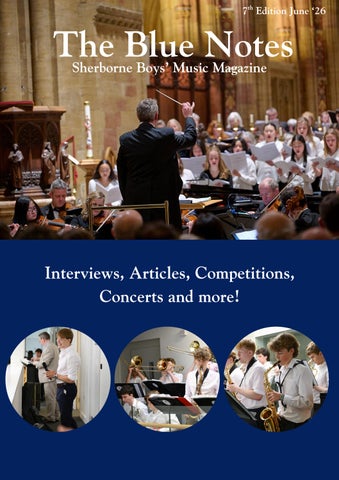
7th Edition June ‘26
The Blue Notes Sherborne Boys’ Music Magazine
Interviews, Articles, Competitions, Concerts and more!
CONT Table of Contents
Pg.2
The B u
Sherborne Boys’
INTERVIES, CONCERT ARTICLES
04 05 12
>> Welcome and Editor’s Notes
>> Interview with the Choral Scholars 2025-2026 Desert Island Discs with Mr Eadon
>> Friday Lunchtime Recital:
Pianists, Organists, Singers, Strings, and more...
TENT Table of Contents
Pg.3
ue Notes
Music Magazine
STORIES AND MORE...
>> Articles, Stories and more
26
>> Save the dates
42
>> Thanks…
45
Welcome The Blue Notes - Edition 5 - Feb ‘26
Pg.4
Welcome to the 7th Edition of The Blue Notes. As usual, the Music School — along with the rest of Sherborne — seems to get busier by the week. The closer we get to the end of term, the more the place fills with rehearsals, last‑minute run‑throughs, and that familiar mix of nerves and excitement. It’s been another stretch of hard work from both the musicians and the staff, all pushing to deliver an excellent final few weeks of music. Throughout this edition, you’ll find a round‑up of the final concerts and competitions of the year, as well as articles from members of staff who are moving on. Each piece has its own story, and I have very much enjoyed reading all of them. I hope you enjoy reading this edition as much as we’ve enjoyed putting it together.
An interview with The Choral Scholars
Sebastian Young and Lucas Selby-Jerrold Interview by Sirtaaj G (4a)
Pg. 5 What’s one moment from your year in the Music School that you’ll still be talking about in ten years’ time?
Mr Young: I think it was the first day we got here. We'd all settled in. We'd all got to know each other. We'd all unpacked. And we were in Mr. Eadon’s garden enjoying a barbecue. It was a beautiful summer's evening. It was at that moment that I knew I was in the right job, at the right time, in the right place. It just hit me, and to be honest with you, I could have taken another job or I could have gone straight to university. I very nearly didn't end up here. But I remember the feeling of relief I felt at that moment, that I knew I'd made the right decision, and I carry that forward to this day. But it was that moment on the very first day. So, that will always stick with me.
Mr Selby-Jerrold: There have been a lot of memorable moments this year, but one I’ll still be laughing about in ten years’ time was when my car handbrake got stuck on in the Sports Centre car park and, late at night after Chamber Choir, Mr Eadon (presumably deciding I couldn’t drive) repeatedly revved it to try and get it unstuck. When that failed, around eight people ended up behind the car trying to push it free, which rather sums up the Music School - everyone immediately gets stuck in to help.
Which piece of music will always remind you of your time at Sherborne, and why?
Mr Selby-Jerrold: The main one has to be Liszt’s Après une Lecture du Dante, mainly because I slightly overestimated my ability when I decided I could definitely learn it after famously saying “how hard could an FRSM be?” I played it so much over the year that people regularly told me to “PLEASE PLAY SOMETHING ELSE” after hearing the same passages repeated endlessly.
Mr Young: There could be many answers to this question because we've done some brilliant music, particularly in the Abbey Choir and at the Boys’ Choir. Mr Eadon and Mr Henderson are excellent at compiling music lists. But I think if I had to pick one, it would be Vaughan Williams' Easter from his Five Mystical Songs. I had the immense privilege of singing that baritone solo, on Easter Sunday twice in Sherborne Abbey in front of hundreds of people. It was a real, real honour, and it has probably been the highlight of my musical journey to date. It will mark my musical progression here at Sherborne. Therefore, I've had a real connection to that piece, not least because it's a beautiful piece of music, but also because it has encapsulated my musicianship to date.
Looking back, it’s far funnier than it felt at the time, especially given the 3am wake-up for the recovery truck, which didn’t arrive until 9am, before the problem was finally solved with a hammer!
How has working with the staff in the Music School changed the way you think about music-making or performance?
Mr Young: The music staff here are actually incredible. I don't say that lightly. I say that because I mean it. I think working with them has made me realise it takes a whole team to make music. It's not just a oneman trip. It doesn't just require a musical virtuoso. It requires the accompanist. It requires technical staff. It requires us to put out the stands and chairs. It requires Miss McCormick to do copious amounts of admin. And it's all those bits and pieces that have made me realise it's a huge team effort. I think that's why we're a successful music school. It's because we realise that and we employ a huge amount of people to different areas of strengths. Recognising, crucially, that music is a multifaceted field.
The Choral Scholars at Sherborne Boys are gap‑year musicians who form part of the Music School’s daily running, supporting both the School Choir and the Sherborne Abbey Choir. They sing regularly in services and concerts, contributing to the musical life of both communities. Beyond their performances, they play an active role in rehearsals and day‑to‑day activity in the Music School, helping to keep the department organised, responsive, and running smoothly. Their presence strengthens Sherborne’s choral tradition while giving them a formative year of musical growth and real professional experience.
An interview with The Choral Scholars
Sebastian Young and Lucas Selby-Jerrold Interview by Sirtaaj G (4a)
Pg. 6
If you could give next year’s scholars one piece of advice, what would it be?
Mr Young: Now, this is an interesting question because one of next year's choral scholars happens to be my very good friend from school. So, I feel like I'm sort of already qualified to answer this, having already given one of them some advice. I think if I remember correctly, the advice I gave him was something along the lines of really just make the most of every second of your time here because it's short and it goes by quickly. It feels like it was just yesterday that we arrived here. Make the most of every second, every second of practise, every second of advice, every second of support, every inch of every lesson that you get your hands on, every second of evensong, you know, every breath counts. Make it happen because this year goes fast and it's copious.
Mr Selby-Jerrold: One thing I didn’t expect was how different the pace of working life feels compared with school. You suddenly have far more independence and flexibility, which took a bit of adjusting to at first, but I really enjoyed having the chance to shape my own routine and try new things.
How has this year shaped your plans for university, conservatoire, or your future musical path?
Mr Selby-Jerrold: I’ve really enjoyed hearing about the completely different routes people have taken into music. Spending time with the VMTs quickly makes you realise there’s no single music career template people seem to arrive there through all sorts of unexpected directions. I partly took the role to work out whether I wanted music to remain a serious part of my life long-term and, although I’m going on to study engineering, the year has definitely confirmed that I’d like music to remain a huge part of my future, whether that’s singing in a cathedral choir, playing in orchestras, or in some sort of engineering capacity.
Mr Young:
What skill—musical or non-musical—did you develop this year that you didn’t expect to?
The support I've received here has been outstanding.
Mr Selby-Jerrold:
I've gone from being a somewhat shaky musician, particularly in choral work, to someone who can at least get by, and that means I've opened up a lot of doors at university for things like choral scholarships, instrumental playing, et cetera. I am now, in all seriousness, aiming at much higher schemes for music-making than I would have if I hadn't done this year.
My cooking skills! At our accommodation, we host a three-course fine-dining competition on some Saturdays, based on the show Come Dine With Me. The judges (each other) are famously harsh, but I now know that, no matter what, there must always be candles and napkins!
An interview with The Choral Scholars
Sebastian Young and Lucas Selby-Jerrold Interview by Sirtaaj G (4a)
Pg. 7
What skill—musical or non-musical—did you develop this year that you didn’t expect to? (cont.)
If you could relive one day from this year, which would it be and why?
Mr Young:
Mr Young:
I expected to develop this skill, but I didn't expect it to develop this much, and I think I'm going to put it down to keyboard skills and my ability to prepare music in advance. Before this year, I was a much more dependent musician.
I think I would say the Christmas period, which lasts about 24 hours. It was incredible, it genuinely was, and having not been an ex-cathedral chorister, having not sung in the capacity of the Abbey before, Easter or Christmas, was absolutely magical.
I depended on rehearsals; I depended on other people to prepare, practise, and deliver music to at least a highly advanced standard. Now, on the other hand, I'm able to do that much more independently. That's not to say I don't need to rehearse; I'm not saying I don't need other people's support. It just says that I'm able, because of my increasing music ability, particularly on the keyboard and in singing as well, I'm able to output a much more professional response independently, and that can only be a good thing.
Everything from Midnight Mass, the incense, the amount of uplifting music, and the joy that was filled in the Abbey on that day, and don't get me wrong, I was absolutely shattered afterwards, but I felt like I'd worked for my tiredness, and I felt hugely fulfilled, and just glorious.
What’s one thing you hope the boys remember about you?
Mr Young: I came to education with a vision, and I genuinely mean that. When people ask me, and I tell them that I went from studying at an independent senior school for five years to working at another independent senior school less than two months later, they look at me like I'm mad, and that's probably because I am. But I do it because I want to make a difference to people's lives, and as cliché as it sounds, I think that working in education can, whether it's working in the Music School office, whether it's working in the Bursary , whether it's working in the Sports Centre, whether it's in the classroom, wherever it may be, I believe that we as educational professionals have the ability to influence a boy's life at such a critical phase of development. I also think that it doesn't matter how small that is, that fulfils me. I hope that that can be reflected in a boy, no matter how tiny it may be, in the future, so I hope they remember me positively.
What’s a piece of advice you’d give to your past self on your first day here? What will you miss most about the Sherborne Music School community?
Mr Young: The people. Everyone. Genuinely. I mean that. Not only the Choral Scholars, whom I just adore, but they're also my best friends, and I love them. But also people like Alex, Dan, Laura, Clare, Benjamin and all the full-time staff, as well as the VMTs. Everyone here is ridiculously friendly; there hasn't been a single interaction that has made me think I'm in the wrong place. It is an amazing Music School, and we often take it for granted, but it's the people that make it brilliant, and they're inspirational, they're hard-working, they're committed, they're talented people.
Mr Selby-Jerrold: Probably school services - hearing the boys absolutely belt out the final hymn and then somehow find even more volume for the final prayer afterwards.
Mr Selby-Jerrold: Get involved in everything. There’s so much to learn, especially behind the scenes - and considering I arrived being famously useless with amps and cables, I definitely picked that up quite quickly (although that may still be debatable). The year gives you a really unusual chance to pick up all sorts of musical and practical skills, meet lots of different people, and see how everything works.
Mr Young: Never, ever think that you've done enough, because you probably haven't. There's always more that you can put in.
Desert Island Discs with the Director of Music, Mr Eadon
Interview by Sirtaaj G (4a)
Pg. 8
Disc No.1 – Mass in B Minor, BWV 232: 27 Dona nobis pacem – Johann Sebastian Bach Why did you choose this piece? Bach's B Minor Mass, to my mind, is one of the greatest pieces by the greatest composer. The performance I've chosen is a historically informed one. A lot of the pieces I've chosen are things that remind me of really happy times in my life. And one of my happiest times was on a tour in the south of France, where we were doing just this piece. There's an earlier movement that has a horn solo, and I was sharing a room with the French horn player all the way around. He was horrifically nervous every night because he only had one aria to accompany, and it is really famously hard, so he would always be winding himself up. And I was there to play continuo on a really battered old chamber organ that barely worked. And I really should have been the one nervous. It was a chance to get to know this piece because we did it six times in a week or something. But this final movement is a slow crescendo, and it's a fugue, and it's Bach at his dramatic and musical best, because it just becomes this inexorable plea for peace. I think there's just something wonderful about it anyway, in today's troubled times, but it's such an affirming piece. When I'm out on that desert island, I’ll need a bit of this from time to time.
Is this one for dancing around the fire, or sitting quietly at sunset? This is a piece for starting off sitting quietly and rising up with it and getting excited by it because it's such an enormous climax. You get the trumpets and the drums coming in by the end and it just lifts you up in a way that very few pieces do.
Disc No.2 - Belshazzar’s Feast: 5. Praise ye, the God of gold – William Walton Why did you choose this piece? The second choice is a movement from Walton's Belshazzar's Feast, which if I could, I'd take the whole piece with me. This recording is one that my dad made with the Bournemouth Symphony Orchestra. It has our own French horn teacher, Bomber Harris, playing in it from the mid-1990s and Bryn Terfel sings the solos. The whole piece becomes a massive, joyous party. It starts with the Israelites as slaves, as captives. “How shall I sing the Lord's song in a strange land” is one of the lines. And then there's this enormous feast and the music goes mad for this sort of crazy party that happens. And this chap, Belshazzar, uses all of the Israelites’ sacred crockery that is reserved for festivals. God, in the night kills him, so the piece becomes this even bigger party because the captor is now slain and gone. This particular movement is during the party and Belshazzar is praising all his different gods; they praise the God of brass and the brass instruments go crazy; they praise the God of iron - so an anvil is hit in the background. They praise the God of wood, so the xylophone has its moment. The God of silver involves a saxophone and flutes. The word painting is brilliant. It feels really jazzy and cool. It's a piece that I sang first as a school boy in the Lower Sixth and that I've been fortunate enough to sing a couple of times since. I've even played in one of the offstage brass choirs on the trombone as well, so it's a piece that both reminds me of some really happy memories of being a performer. And it reminds me of my dad a bit as well, who engineered this particular recording.
What moment in your life does this track take you back to?
The first time I came across this piece, I was in the Lower Sixth. So I suppose at that stage you're quite impressionable musically anyway. And having sung a lot of Walton as a treble when I was a chorister, I knew what I was in for and I knew I was going to like it.
Desert Island Discs with the Director of Music, Mr Eadon
Interview by Sirtaaj G (4a)
Pg. 9
Disc No.3 – Rachmaninov: Vespers, Op.37: V. Nyne otpushchayeshi – Sergei Rachmaninoff Why did you choose this piece? This represents my time as a chorister – although I'm not actually singing on this particular recording (it is my little brother's last recording, I think, as a chorister). The particular movement I have chosen is a setting of the Nunc Dimittis, a text that we sing quite regularly here in the Abbey with the Choir, although this is in Church Slavonic, a Russian dialect. It features a beautiful accompaniment from a really legato chorus. Above that, this tenor solo, in this case sung by James Gilchrist, who's one of our country's top tenors, just floats above, representing the voice of Simeon. And then at the very end of the movement, the second basses descend to an incredibly low bottom B-flat. It's an extraordinary piece of singing. Rachmaninoff knew the choirs he was writing for because all of the Russian choirs have basses that can get down to this extraordinary note, and not many English choirs do. There are a few guys around who basically go around singing this piece because they are deep basses, but this movement is just, this is a proper sitdown by the campfire and just relax piece.
Does this remind you of a particular person or place? It's extraordinarily beautiful because it's recorded in the chapel at King's College, Cambridge; it makes me think of the architecture and beauty of that space: the only place in the world that has an even better fan vaulting than Sherborne Abbey.
Disc No.4 - Siegfried-Idyll, WWV 103 (Arr.E.H. Lemare for Organ) – Richard Wagner, recording by Alexander Eadon on Arundel Experience, Willowhayne Records
Why did you choose this piece? So, the next piece, I got slightly cheeky here because I thought, well, actually, I'm going to be on a desert island potentially for some time because I'm not the most practical chap, and it's going to take me a long time to fashion a canoe out of a tree. So I've chosen a piece that's nearly twenty minutes long, and slightly cheekily, it's my own recording of it. It's a transcription of Wagner's Siegfried-Idyll. This had been written as a birthday present to his wife, and her birthday was on Christmas Eve, which is when they celebrate Christmas in Germany. And it was for 16 players of the Zurich Tonhalle. He had managed to get them into the house secretly, and they played this piece at six o’clock in the morning. That's a nice little wake up for her because it starts very gently. It gets to an enormous climax in the middle and then subsides again. It has always slightly weirded me out because I've always assumed that Cosima Wagner, as the lady of the house, would have been listening to this thinking, well, this is beautiful, but, oh, we don't really have enough food in the house to feed another 16 people on Christmas Eve. How are we going to rustle up breakfast for them? So I'm not quite sure about the practicalities of how it all worked. But it's a beautiful piece.
Disc No.5 - Mass for Double Choir: I. Kyrie – Frank Martin Why did you choose this piece? The next piece is the Frank Martin, the Kyrie from the Mass for Double Choir. Again, if I could have the whole mass, I would take that to the desert island. But I sort of narrowed it down to this first movement. Frank Martin is a Swiss composer, his dad was a Calvinist minister. There's no reason for him to have written a Catholic mass, but he did. He then locked it in a drawer and it was only discovered after his death. And it is the most exquisite setting of this text. Brilliant for the liturgy and so impassioned. And it is so harmonically rich. Being set for eight part choir means that there are all sorts of textures that he explores. And this recording by Westminster Cathedral Choir was recorded at the same time as I was a chorister; though it pains me to say, I genuinely believe that of all of the male only choirs, this is the absolute best that any of them ever sounded. The sound that James O'Donnell, who was the Director of Music then at the time at Westminster Cathedral, got out from the choir is incredible. I was really lucky when I was an organ student to have him teaching me.
Desert Island Discs with the Director of Music, Mr Eadon
Interview by Sirtaaj G (4a)
Pg. 10
Disc No.5 cont. If you could play this track to your younger self, what would you want them to hear in it? This is a piece that I have recorded as a conductor, with a professional singing group that I used to run when I was a freelancer in London, the London Poulenc Singers. I've known this piece since I was a chorister myself, it's always been a favourite.
Disc No.6 - Requiem: Sanctus – Maurice Durufle Why did you choose this piece? As and when I die, this is one of the pieces that I would like played at my funeral. Probably the whole thing. But the Sanctus, which is one of the middle movements of the piece, it has this arch-like structure. A lot of the pieces I've chosen have an arch-like structure – and I did think about why this was: it's probably because it was the favourite structure of one composer whose music I haven't chosen, which I'm slightly surprised I didn't, but the music of Herbert Howells, who's an English pastoralist who lived in the 20th century. So maybe a lot of the music I've chosen sort of reminds me of his music because of that. The Duruflé Requiem is a gorgeous piece of music. It uses the Catholic plainchant of the Requiem Mass and harmonises it in the most opulent possible way. And the Sanctus is probably the highlight of it. It starts off with this bubbling organ semiquaver accompaniment. The plainchant comes in on top, harmonised sopranos and altos. And then it develops into this massive moment where it goes from D minor into E flat major with this enormous top B flat from the sopranos and the tenors, and then it subsides again. And it's a pretty magical piece.
Would this song help you feel less lonely on the island — or would it make you miss home more? I think all of these things would make me miss home. But I think when I'm there on the Desert Island, there's going to be things that I want to be reminded of. And I think that's probably the main driver behind this. I could give you about a hundred other pieces that I would have chosen if I could to have with me on that desert island. So it was a real challenge narrowing it down to eight. I think if you were to ask me all of these questions again next week, I might have a totally different set of eight pieces.
Disc No.7 - Inland Waterways – The Songmen Why did you choose this piece? So the next piece is Inland Waterways, which is a setting of John Betjeman's poem, which mentions Tewksbury Abbey, where I was the organist for a couple of years. And while I was there, I used to sing in the choir whenever I wasn't playing as well as deputising at Gloucester Cathedral. I, along with five friends formed a close harmony group called The Songmen. And the second alto, who's a very close friend of mine even now, Ben Sawyer, decided that we needed a sort of trademark piece and that there wasn't really the right sort of thing out there so he wrote this himself. He took a John Betjeman poem that mentions Tewkesbury, where we were all based, and sets this slightly poppy, slightly Bob Chilcott-esque piece and it's really beautiful. And it just takes us through the River Avon and the River Severn that converge on Tewkesbury.
Desert Island Discs with the Director of Music, Mr Eadon
Interview by Sirtaaj G (4a)
Pg. 11
Disc No.7 cont. How does this piece connect with you? And how did this shape your career? Again, this reminds me of a time when I was in a top close harmony group. And I suppose that group shaped me professionally a lot. We had a wonderful trip out to have a week of master classes with the King's Singers in Lubeck, Germany, and so it sort of reminds me of that time in my life when we were out to sort of conquer the world. I then left the group to pursue my career as a schoolmaster. I moved from there to Oundle. But the group carried on for a good few years although sadly it's stopped now. But I think the recordings are still available out there. And some of them are really splendid.
Disc No.8 - Dance Movements: III. Lento (for the brass) – Philip Sparke Why did you choose this piece?
There's a picture of me playing this piece in my office. This is a piece that comes from the Dance Movements by Philip Spark. It is a piece for wind band. As a teenager I was in the National Youth Wind Ensemble. It was the only group in the country of its type, a one per part ensemble, playing pieces that other groups wouldn't dare. So the greatest of this ensemble-type in the world is the American Air Force Band: an amazing group. But there are a couple of pieces that had been written for them that they felt were too unperformably tricky. So we played them in a Prom at the Royal Albert Hall live on Radio 3 instead! This isn't one of those pieces. We played this piece as a sort of the big crowd pleaser at the end. And this third movement is proof that all you really need is brass! It starts off with harmon-muted trumpets and a little bit of harp. And you hear a gorgeous French horn solo. Then a trombone emulates it. And again, there's an arch-like structure, this enormous crescendo through the first two thirds of the piece. It's very clearly an American piece. It's quite cheesy and quite film music-esque. And the other three movements, similarly, big, cheesy, film music-esque. But for me, I think on that island, potentially alone, this is something that can just centre me a little bit.
If you could only take one of your eight tracks with, would this be the one - and why? You are a cruel taskmaster, Sirtaaj. Cruel. I hope you are able to convey just how long this takes to choose through the medium of print. Part of me wants to say the Wagner Siegfried Idyll, because there's eighteen minutes of it. However, I suppose if I needed to start to work and create shelter and potentially transport off the island, the thing that's going to gee me up the to do that is going to be the Walton Belshazzar's Feast extract.
You already have the bible or any other religious text of your choice, plus the complete works of Shakespeare, waiting for you when you arrive – what book and luxury item would you take with you – and why? So I'm not a huge reader of fiction. I quite enjoy it when I do. But I really enjoy technical books and I really enjoy biographies. I especially enjoy badly ghostwritten biographies of sports people, which is a real guilty pleasure. But I think I would probably take with me, again, something to ground me, something to centre me, something to remind me a bit of home. And I think the books that I enjoyed most while growing up were the Biggles books. Biggles was a fictional World War One fighter pilot ace. So I would choose W.E. John's Biggles Learns to Fly, the first book in the set. I think I would choose to take an organ to do a bit of practice while I'm there. I'd thought about a razor and a toothbrush and some practical things. But I thought, actually, you know what, I could use the time while I'm there to do some organ practice. So an organ of my own. That would be great.
What is your favourite thing about music at Sherborne? I have a tremendous set of colleagues who I respect and adore in equal measure. They all have incredible talent. I am humbled by colleagues further around the school on a daily basis. It's a privilege to work alongside them. But the real jewel in our crown are the boys here who are relentlessly talented, often hardworking and constantly pleasantly surprising.
What skills would help you survive? So one book that I do remember reading was the SAS Survival Guide. And I'm slightly surprised I didn't choose that as the book that I need, but I think I remember enough of it. So I think the skills I have, I'm always quite happy to have a go. And those people reading this that know of my DIY “skills”, not the right word, my DIY “efforts”, will appreciate that I would certainly have a good go at fashioning the things that needed to be created from what we find in the environment around us. But it wouldn't be brilliant.
How do you think you’d manage being alone on the island? As an organist, I've spent a lot of my time in large ecclesiastical buildings at the dead of night on my own. So I think I'd be all right, at least for a while. It would take me a long time to fully go mad, though I expect I would.
Friday Lunchtime Recitals Cheap Street Church, 1.45pm
Pianists, Organists and Singer - 24 April The Blue Notes
Pg. 12
To begin the Friday Lunchtime Recitals of the Trinity Term, we were delighted to hear from a small but talented group of pianists, organists, and singers. Opening the concert was our first vocalist, Sebbie K (U6f) ARSM, with a poised and expressive performance of Mozart’s In diesen heil’gen Hallen. Sebbie followed this with Purcell’s Evening Hymn, delivering a beautifully controlled and engaging performance, showing off great vocal control throughout. We then welcomed Frazer F (5f) to the organ, performing Herbert Howells’ Psalm‑Prelude No. 2, Set 1. Frazer offered a colourful and thoughtfully paced reading of this piece, before Sirtaaj G (4a) took to the piano with Terry Seabrook’s A Waltz for Autumn.
Oliver B (L6e) Our next vocalist, Sam B (U6f) ARSM, continued the afternoon’s high standard with Schubert’s Das fischermädchen, sung with a lovely sense of line and character. He was followed by Oliver B (L6e), who brought charm and personality to If I Were a Rich Man from Fiddler on the Roof, capturing the humour of the piece with confidence.
Sebbie K (U6f)
Frazer F (5f)
Sherborne Abbey Festival Friday 01 May, 1.30 pm
Sherborne Boys Chamber Music and Ensembles The Blue Notes
Pg. 13 The next of our weekly lunchtime recitals took place as part of the annual Sherborne Abbey Festival and featured various Chamber Music Ensembles from Sherborne Boys. To begin the concert, we heard the Symphonic Strings, joined by two singers, Sebbie K (U6f) ARSM and Benji R (L6c). They were also joined by Ian L (L6d) ATCL LTCL on the harpsichord. Under the leadership of Miss Allen, the group performed both Bach’s Gebt mir meinen Jesum (St Matthew Passion) and Henry Purcell’s Arise ye subterranean winds (King Arthur). Next, the Clarinet Quartet took to the stage, consisting of pupil clarinetists Benji R (L6c), Sam R (U6e), Will L (U6d) and Ben H (L6b). Together, the group gave a moving and exciting performance of the two movements of Ravel’s Trois Chansons II.
Trois beaux oiseaux du Paradis and III. Ronde.
We then heard from the Scholar’s String Trio, comprising Nathaniel B (4e), Sam O’B (4e) and Frazer F (5f). Under the leadership of Nathaniel, the group gave a thrilling and lively performance of Haydn’s London Trio No.1, I. Allegro Moderato. The group worked well together and showed great musicianship throughout their performances.
Ian L (L6d, Sch. Mus) ATCL LTCL
Ian took to the stage as our soloist for the afternoon, playing Olivier Messiaen’s Préludes pour Piano. Ian performed three preludes, La Colombe, Cloches d'Angoisse et
Larmes d’Adieu, and Un Reflet dans le Vent. As usual, Ian gave a breathtaking performance, showing great musicianship and control. Frazer F (5f) followed, playing the Abbey’s Organ. Frazer performed Howells Psalm-Prelude Set 1, No. 2. Frazer showed great technical ability and phrasing throughout his performance, and was swiftly followed by the Sherborne Boys Brass Band. Under the direction of Mr Costin, the Brass Band delivered the first three movements of Gustav Holst’s Second Suite in F for
Military Band, Op. 28 No. 2, arr. Robert Costin. I. March: Morris Dance, Swansea Town, Claudy Banks; II. Song Without Words: “I’ll Love My Love”; III. Fantasia on the “Dargason”. The Brass Band gave an excellent performance overall and brought an end to another wonderful Lunchtime Recital.
Benji R (L6c, Sch. Mus) singing with the Symphonic String The Brass Band under the direction of Mr Costin
Sherborne Abbey Festival Friday 01 May, 5.00 pm / Saturday 02 May, 11.00 am Sherborne Boys Swing Band, Chamber Choir and Barbershop The Blue Notes
Pg. 14
Swing Band - directed by Mr Marks
Chamber Choir and Barbershop - article written by Mr Eadon
Following a successful concert at Sherborne Abbey, our renowned Swing Band took to the stage once again, this time in the Schools’ BSR. Under the direction of Mr Marks, and fresh from last term’s spectacular Dinner and Jazz event, the band delivered another outstanding evening of big‑band brilliance.
On the 2 May, the Chamber Choir and Barbershop gave their annual Sherborne Abbey Festival concert to a superbly full Abbey audience. The music included many pieces that the Chamber Choir had sung through the year. In the first segment, Viadana’s Exultate Justi and Bruckner’s Locus Iste preceded a set of Marian pieces – Grieg’s Ave Maris Stella, Witt’s Ave Maria and Eccard’s great Candlemas setting of When to the temple Mary went. The Chamber Choir sang particularly exquisitely, having sung Choral Evensong in Westminster Abbey only a week earlier. The next three numbers were sung by the Barbershop – You raise me up in a particularly slushy arrangement by Mr Eadon, Blue Moon, with Charlie M (U6d) crooning the tune famously, and finally the King’s Singers’ arrangement of the somewhat zany cult classic I’m a train. The latter choice was fortuitous as the original King’s Singers’ bass, Brian Kay, was in the audience and commented most favourably afterwards about the quality of the ensemble singing.
They opened with four high‑energy instrumental numbers, including, Cotton Tail, Spain, Sir Duke, and Caravan as they set the tone with tight ensemble playing. The spotlight then shifted to our vocalists, beginning with Forest P (U6b), who brought warmth and charm to Fly Me to the Moon and The Lady Is a Tramp. Sam B (U6f) followed with stylish renditions of Nice ’n’ Easy, Mr Zoot Suit, and Let’s Face the Music and Dance, before Hector S (5m) took the mic for a beguiling performance of Miss Jones. Archie G (U6f) kept the energy high with Straighten Up and Fly Right, and Sam returned once more for a charismatic take on Gigolo. To close the evening, the band reclaimed the stage with two iconic classic including Pennsylvania 6‑5000 and Sing, Sing, Sing before rounding off another successful and enjoyable evening of jazz.
Finally the Chamber Choir retook to the stage to entertain with two songs by the recently late American satirist Tom Lehrer – I hold your hand in mine and Poisoning Pigeons in the Park – both starkly sombre in subject matter, but with deliciously up-tempo melodies to off-set any potential sadness. Finally, three songs by quintessential musical comedians Flanders & Swann – The Gasman Cometh, Slow Train and (complete with audience participation) The Hippopotamus. It remains an enormous privilege for our boys to take their place in the lineup of the Festival, nestling, this year at least, alongside such luminaries as the Clarinettist Julian Bliss, Baroque collective Solomon’s Knot and one of the most famous British vocal ensembles The Tallis Scholars.
Friday Lunchtime Recitals Cheap Street Church, 1.45pm Strings - 8 May The Blue Notes
Pg. 15
This week’s Lunchtime Recital was given by our fabulous string players, where we enjoyed a variety of ensembles and solo performances ranging from a double bass quartet to individual instrumentalists. To begin the concert, we heard from the Bass Quartet performing Henry Mancini’s Baby Elephant Walk. The group, Lucas (5b), Henry C (3b), Xander G (SPS), and Benedict H (3b) played with great ensemble awareness and musicianship throughout. Following this, Nathaniel B (4e) took to the stage to perform the first two movements, Introduzione and Serenata, from Stravinsky’s Suite Italienne. Nathaniel showcased tidy ornamentation in the opening movement, followed by a second movement marked by excellent control and beautifully expressive passages. We next heard from our first cellist of the afternoon, Zeeshan M (L6f), who performed the Prelude (1st movement) from Bach’s Suite for Solo Cello No. 1 in G, BWV 1007. Zeeshan delivered a performance full of movement and warmth, producing a rich and resonant sound. He was followed by Eason T (4f), who gave a lovely rendition of Mozart’s Allegretto (4th movement), offering a polished and well‑executed performance. Zeeshan M (L6f, Sch. Mus)
Frazer F (5f, Sch. Mus)
Sam O’B (3e) then performed Dvořák’s Allegro risoluto (from Sonatine in G, Op. 100). Sam opened with great confidence, which continued throughout his expressive and controlled playing, resulting in a highly polished performance. We then heard from Frazer F (5f) on the cello, performing Borowski’s Adoration. Frazer’s piece highlighted his rich tone and expressive playing, maintaining excellent control from start to finish. Finally, we came to the last performance of the afternoon, given by Marc F (U6a), ARSM, as he performed Andante: 2nd Movement from Mozart’s Concerto in G, K. 216). Marc delivered a beautifully nuanced performance, demonstrating a wide range of dynamics and tidy ornamentation throughout. Marc F ARSM (U6a)
Friday Lunchtime Recitals Cheap Street Church, 1.45pm Woodwind and Brass - 15 May The Blue Notes
Pg. 16
Review written by Mr Eadon
15 May saw a Brass and Woodwind Lunchtime Concert. Gabriel I (4g) started off with the slow movement from Haydn’s Trumpet Concerto. He played with a gorgeously smooth tone, with effortless-sounding high notes and really floaty legato lines. Harry S (4d) played a Flute Duet by Kummer alongside Mrs Jackson. The joy in their musical partnership was palpable and the music was elegance and grace personified. All listeners could feel the strongly-conveyed sense of the piece’s architecture. Patrick H (3f) was next – and making his FLR debut with his Bassoon! He played the famous Montagues and Capulets by Prokofiev with real rhythmic precision and a feel for the dance that this piece accompanies.
Manu M (4g, Sch. Mus)
Mrs Jackson and Harry S (4d)
Perseus W (4c, Sch. Mus)
Sirtaaj G (4a Sch.Mus) played the Andante from Hummel’s Trumpet Concerto. There was a lovely sense of line and some very tidy ornamentation in this characterful performance. Perseus W (4c Sch.Mus) entertained the audience with a charming rendition of A Nightingale sang in Berkeley Square – he showed off his sweet Flute tone and tremendous breath control, all whilst making it sound effortless. After Perseus came Charlie S (L6f Sch.Mus) playing the Prelude by Anthony Donata, a mid-twentieth century French composer. Charlie’s trumpet playing smoothed out the piece’s angular phrases – the piece’s wide tessitura was made to feel very small in such expertise. Finally Manu M (4g Sch.Mus) played Piazzolla’s Oblivion on his Oboe. Manu projected a gloriously wistful quality through his silky tone and played the understated Jazz of the piece delightfully.
Friday Lunchtime Recitals Cheap Street Church, 1.45pm
Instrumental and Vocal Soloists - 22 May The Blue Notes
Pg. 17
As the half-term came closer, a group of musicians stayed on to perform in one of our weekly Friday Lunchtime Recitals, this time being treated to a group of Instrumental and Vocal Soloists. To begin the concert we first heard from our Brass Trio consisting of four form musicians, Sirtaaj G (4a), Luke A-D (4a) and Ianto D (4f), as they played James Bland’s Bring me back to the old Virginny. Together the group showed a real sense of dynamic and understanding for the piece with some crisp articulation throughout. Next to the stage was Luke A-D (4b) this time on the Piano. Luke performed Mendelssohn's Music Sketch in B Flat, Luke showed great ownership and confidence around the keyboard as well as showing a great sense of understanding for the phrasing throughout. Now we heard from Cedric v-S (L6a) on the viola. Cedric played the first movement of Telemann's Viola Concerto in G, Cedric showed a great sense of understanding for this piece and worked well with his accompanist, Mr Davey, showing great musicianship. We then heard from Sirtaaj G (4a) on the piano as he played Leon Berry’s arrangement of Christopher Columbus.
Nathaniel B (4e, Sch. Mus)
Hector S (5m, Sch. Mus)
Ianto now took to the stage for his FLR singing debut. Ianto showed amazing control over his voice, showcasing his vocal range with real emotion throughout. Hector S (5m) came next, with a rendition of Pink Floyd’s ‘Shine on you Crazy Diamond’. Hector’s performance demonstrated great technical control over his guitar and the technology itself, as well as great sensitivity to effects such as reverb throughout. To close another successful and enjoyable concert, we now heard from Nathaniel B (4e). Nathaniel performed Monti’s Czardas. Throughout his performance, Nathaniel showed great control over his violin, ownership of faster passages, and great intonation throughout. This week’s concert was another successful and enjoyable one for all the musicians to show off their talents before a well-deserved half-term break.
Friday Lunchtime Recitals Cheap Street Church, 1.45pm Third Form - 05 June The Blue Notes
Pg. 18
As we came to our last Friday Lunchtime Recital delivered by pupils, we were treated to the talented musicians in the Third Form, who performed on saxophones, bassoons, double basses, and more. To begin the concert, we first heard from Eason T (4f) as he delivered a wonderful performance of Piazzolla’s Café 1930 (from Historie du Tango) on the Tenor Saxophone. Eason showed a strong sense of panache and stylistic flair throughout. We then moved onto Henry C (3b) on the Double Bass. Henry performed Dmitri Kabalevsky’s Cavalryman and, throughout his performance, showed great control over his instrument and communicated well with his accompanist in ensuring a smooth and successful performance. Edward G (4d) then took to the stage on the Bassoon, making his Friday Lunchtime Recital debut, as he performed Cowell’s Ragoon. Edward maintained an assured tone throughout, with a real grasp of the music's demands. As we moved away from our instrumentalists, Jack H (3f) took to the stage as he made his FLR debut. Jack sung Bart Howard’s Fly Me to the Moon. Throughout his performance, Jack showed great confidence, a strong sense of feel, and matched the style of this piece flawlessly. Fred M (4a) then took to the stage on the Alto Saxophone as he played Andrew Wilson's Summer Samba. Fred delivered his piece with great style and an assured tone, demonstrating strong synergy with his accompanist.
Henry C (3b, Sch. Mus)
We then heard from Patrick H (3f), this time on the bassoon. Patrick played Ceaser Cui’s Orientale and showed great control over his bassoon throughout, showing its many tonal colours. Next came James T (3e) performing MacGregor’s Lowside Blues. James showed a great understanding of this piece and showed classy stage presence throughout. Sam O’B (3e) took to the stage to close the concert, this time on the violin. Sam played Igor Stravinsky’s Chanson Russe. Throughout his performance, Sam played confidently, showing great intonation and expression. James T (3e, Sch. Mus)
Friday Lunchtime Recitals Cheap Street Church, 1.45pm The Choral Scholars - 12 June The Blue Notes
Pg. 19
c
To close off the final FLR of the year, our team of Choral Scholars took to the stage along with Mr Eadon to deliver an afternoon full of wonderful music. With all of the Choral Scholars helping within the Music Department throughout the year, this Lunchtime Recital was the perfect way to end their time at Sherborne by showcasing their musical talent.
Mr Selby-Jerrold (Sch. Cho)
To begin the concert, we first heard from Mr Sebastian Young, Mr Lucas Selby-Jerrold, and Mr Finaly Lyall, as they took to the stage singing Grassi’s Justorum animae and Beati mundo corde as well as Byrd’s Agnus Dei from his Mass for three voices. Together, the group gave each piece a beautiful shape, with flowing melodic lines and great vocal control, and their voices complemented one another throughout. We then heard from Mr Selby-Jerrold as he performed the 3rd movement of Bortkewicz’s Four pieces for Piano, Op. 3. Throughout his piece, Mr Selby-Jerrold showed great clarity as well as being sensitive to dynamic markings - and made light of the challenges posed by playing a piece for only the left hand. Next Mr Lyall played Piazzolla’s Ave Maria on the Double Bass. Mr Lyall showed great control throughout his piece, providing smooth melodic lines, and delivered a well-rounded performance. Mr Young then took to the stage on the violin as he played Jules Massenet’s Meditation from Thais. Mr Young showed great care and understanding for this piece, and he maintained excellent control over his instrument, capturing its pure beauty. We then heard our second singing number of the concert, with all three choral scholars this time joined by Mr Eadon. Together, the group sang Nicholas Hare’s arrangements of Sing Low, Sweet Chariot and Lennon and McCartney’s Yesterday. As a group, each performance featured smooth melodic lines that shone throughout, as well as immaculate phrasing that really stood out in each member's performance.
Left to right: Mr Eadon, Mr Lyall, Mr Young, Mr Selby-Jerrold
As the concert came to a close, we heard the final number from all four performers in a group they called Scholares Brassum. The group consisted of Mr Lyall on the tuba, both Mr Young and Mr Eadon on the trombone, and Mr Selby-Jerrold on the French Horn. The first piece performed was an arrangement of Randy Newman’s You’ve Got a Friend in Me. A sonorous introduction was followed by the tune, which was handled expertly in the trombone department. As a group, they showed great communication in supporting each other's parts, making the performance even more enjoyable. The group then finished on a high as they performed Anthony O’Toole’s Blowfest II. The piece included high-octane runs, which were handled flawlessly by Mr Lyall on the tuba, as well as fast melodic lines from both Mr Young and Mr Selby-Jerrold. This piece brought a wonderful end to a great concert given by this year's Choral Scholars, and we wish them the best of luck in their future studies at the Royal Academy of Music, and the universities of Durham, Exeter and Oxford.
Joint Schools’ Choral Evensong at Westminster Abbey The Blue Notes
Pg. 20
Thursday 23 April, 5.00 pm Article written by Mr Eadon The Sherborne Boys’ Chamber Choir and Girls’ Madrigal Society combined forces once again for a Choral Evensong engagement. Having already visited Wells and Exeter Cathedrals this year, it is not normally the done thing to have such a visit in the Trinity Term, in order to avoid exams, but an invitation had been received from Westminster Abbey (our reputation had preceded us) so it seemed churlish to spurn such an exclusive offer. On arrival we went to St Margaret’s Church (just next door to the Abbey) to warm-up and prepare. We were then ushered in to the Abbey itself, firstly for the customary processional rehearsal with the Vergers, then to the music with the day’s Duty Organist. We were allocated the Abbey’s Organ Scholar Francois Cloete (due to time constraints practising in the Abbey, visiting organists are never allowed to play), who accompanied us with as much warmth and support as his greeting suggested. The Choirs sang the canticle setting in D Major by George Dyson, as they had in Wells Cathedral the previous term. On this occasion it was directed by Mr Cracknell. Mr Eadon then directed Elgar’s setting of Psalm 48, Great is the Lord, a large-scale epic with moments of march-like grandeur, a scherzo-esque section (with a virtuoso pedal part for the organist) and a solo section, gloriously declaimed by Sebbie K (U6f). The Joint Choir really raised their game, befitting the historic venue, as the orchestra had at Cadogan Hall last term, to fill the vast space with gorgeous choral sound.
Invitations to sing at Westminster Abbey do not come around all that often, so it was wonderful to see many parents, teachers and relatives amongst the usual Abbey congregation. There were around six hundred worshippers – which, so the writer is told, is about average for a Thursday Choral Evensong, from tourists and regular worshippers to the famed Royal Peculiar.
Courtsfest 2026 The Blue Notes
Pg. 21
Saturday 25 April, 8.00 pm Article written by Head of RocSoc - James W (U6b)
CourtsFest this year took place on the first Saturday back after the Easter holidays, as it does every year. As always, the Sixth Form only event had a great atmosphere, with this year's edition treating attendees to doughnuts, pizza, and party games in the Courts, - a welcome return after the Easter break. On the performing side, there were a variety of bands performing a wide range of genres throughout the evening. The energy was fantastic, with each act bringing something different to the stage and keeping the crowd engaged throughout. Sherborne Boys’ acts were as follows.
DT9:
Lower Sixth Band:
Fuse:
Forest P – Vocals James W – Drums Hector W – Guitar Thomas M – Bass
Solomon M – Drums Thomas M – Bass Ben H – Guitar Seb Q – Vocals Louis R – Guitar
Eddie R – Drums Will P – Guitar Edmund W – Guitar & Vocals John H – Bass
Glass Onion: Charlie S – Vocals & Guitar Esme A – Piano & Vocals James W – Drums Thomas M – Bass Eddie E – Guitar
Gauge The Room: James W – Drums Charlie D – Guitar & Vocals Hector S – Guitar & Vocals Freddie L – Bass & Vocals
As Head of RocSoc it was a privilege to be involved in bringing CourtsFest together this year. Performing across four bands and 15 songs in a single evening was an experience unlike any other...exhausting in the best possible way! A special mention must go to Fuse, a Fifth Form band who more than held their own on a Sixth Form stage - a hugely impressive performance from some very promising musicians. Events like this are a reminder of just how much musical talent exists across the School, and CourtsFest gives that talent exactly the platform it deserves.
Strings: A Year in Review, 2025-2026 Article written by Nathaniel B (4e, Sch. Mus) The Blue Notes
Pg. 22
This year has been stride-to-stride for the strings. We have been involved in both in- and out-of-school events, with particular highlights including Bryanston's Strings Day and the Sherborne Abbey Festival. Our main string ensemble, Symphonic Strings, has performed in three concerts this year. We played in the ‘Mince Pies’ Chamber Music Concert, the Sherborne Abbey Festival and the end-of-term Gala Concert. We started the year with the ‘Mince Pies’ Concert, where we performed Corelli’s Christmas Concerto. Soloists included Nathaniel B Sch.Mus (4e), Marc F ARSM (U6a) and Sam OB Sch.Mus (3e) on the violin as well as Frazer F Sch.Mus (5f) on the cello. At this year’s Sherborne Abbey Festival, we accompanied two singersoloists, Benji R Sch.Mus (L6c) and Sebbie K ARSM (U6f), in their performances. Pieces included Gebt mir meinem Jesum weider from St Matthew Passion, where Marc F ARSM also had a solo, and Arise ye subterranean winds from The Tempest respectively. For this year’s Gala Concert, we performed again, accompanying our singers and playing a movement from Olympiad, as well as more arias.
Alongside the many school events this year, we were also included in external events. A particular highlight, including the Bryanston String Day. Zeeshan M Sch.Mus (L6f), Cedric VS Exh.Mus (L6a), Frazer F Sch.Mus, Lucas C (5b), Sam OB Sch.Mus and Nathaniel B Sch. Mus enjoyed a day of masterclasses and rehearsals hosted by Trinity Laban, which has a Conservatoire in London. The day finished with a concert where we performed Serenade by the Swedish composer, Dag Wiren.
Strings: A Year in Review, 2025-2026 Article written by Nathaniel B (4e, Sch. Mus) The Blue Notes
Our smaller ensembles have thrived as well; for example, our Scholars Trio - comprising Sam OB Sch. Mus, Frazer F Sch. Mus and Nathaniel B Sch. Mus performed in the Abbey Festival as well as at the weekly Lunchtime Recitals in the Cheap Street, on both occasions performing the first movement of Haydn’s London Trio. The Double Bass Quartet – Henry C Sch.Mus (3b), Lucas C, Benedict H (3b) and Xander G (SPS) - have also performed another lunchtime recital as they delivered a rendition of Mancini’s Baby Elephant Walk. We also heard a performance from the third form violinists, with members consisting of Sam OB Sch. Mus, Arthur G (3d) and Eason T Sch.Mus (3f) – as they performed Rossignol’s Les Cloches de Compostelle. The regular Friday Lunchtime Recitals are a great way to get used to performing in front of an audience of 50 to 100! In these weekly concerts, a wide range of pieces have been played, from the 1700s to modern times, from Bach to Stravinsky. This year’s Symphonic Strings consisted of Marc F ARSM, Freddie F Exh.Mus (U6a), Inigo R Exh.Mus (U6g), Cedric VS Exh. Mus, Zeeshan M Sch. Mus, Frazer F Sch. Mus, Lucas C, Nathaniel B Sch. Mus, Henry C Sch. Mus, Sam OB Sch. Mus, Mr Young Sch.Cho.
Pg. 23
Brass: A Year in Review, 2025-2026 Article written by Mr Costin, Brass Co-ordinator The Blue Notes Brass has enjoyed another busy and successful year, with pupils contributing enthusiastically to a wide range of musical events across the school community. From formal concerts to ceremonial occasions, brass players have continued to play an important role in the musical life of Sherborne. Highlights for the Brass Band this year included performances at the Festive Shopping Day, the Mince Pies Chamber Music Concert, the Gala Concert, and the Commemoration Service, as well as contributions to the Christmas Carol Services through the traditional descants. Repertoire for the Festive Shopping Day and Mince Pies concert included spirited performances of Christmas Medley for Brass and We Wish You a Merry Christmas, which helped create a lively and festive atmosphere. The band also featured in the lunchtime brass concerts, where pupils performed Bugler’s Holiday with great energy and commitment. Across the year, the ensemble continued to develop in confidence and musical cohesion, with pupils contributing enthusiastically to both ceremonial and concert performances across the wider life of the school.
Pg. 24
Brass: A Year in Review, 2025-2026 Article written by Mr Costin, Brass Co-ordinator The Blue Notes
The lunchtime brass concerts provided particularly valuable opportunities for solo and ensemble performance. Pupils performed a wide-ranging and varied repertoire, from Beethoven, Haydn, Hummel and Boyce through to lighter works by Bernstein, Wilson and Leroy Anderson. It was especially pleasing to see students performing with growing confidence both as soloists and in chamber groups. Among the ensembles, the Junior Brass Trio and later Brass Trio performances stood out, with Sirtaaj Grewal, Luke Anderson-Diaper and Ianto Davies giving polished and enjoyable performances in repertoire ranging from Beethoven’s Symphony No. 7 to Carry on Trumpets! and March of the Missilemen. Members of the Brass Band this year included Archie G (U6f), Hugo T (U6d), Sirtaaj G (4a), Luke A-D (4b), Gabriel I (4g), James T (3e), Louis R (L6e), Archie S-B (U6f), Jack M (5a), Sam O’B, Ianto Davies, and our excellent Choral Scholars, Sebastian Young and Fin Lyall. Particular praise should go to leavers Archie G, Hugo T, and Archie S-B for their commitment and contribution to Brass throughout their time at Sherborne. All three have been enthusiastic and reliable members of the ensemble over a number of years, contributing generously to concerts, services, and school events. They will be greatly missed, and we wish them every success for the future. It has been encouraging to see the continued growth of brass playing across the school, with pupils performing with increasing musical maturity, confidence and stylistic awareness. Their commitment, reliability and willingness to contribute to the wider musical life of Sherborne have been greatly appreciated throughout the year.
Pg. 25
The Blue Notes
Pg. 26
Articles
Harmonies, Stories and Tunes
The Life and Works Series: Fredrick Chopin
The Blue Notes
Pg. 27
Article written by Nathaniel B (4e) Sch.Mus
One of the leading composers of the romantic era, he is most well-known for his piano works, so it comes as no surprise that he was a prodigy in his younger years. So who was he? Frederic Chopin was born in the village of Zelazowa Wola in 1810. His father was a bookkeeper, his mother from a noble background but she also played an instrumental role in teaching Chopin the piano. From the age of six he started playing and started writing his own compositions. By the age of seven he had composed his first piece that we know of: Polonaise in G minor. By the age of eight he made his debut in a charity concert. Three years later he played for the Russian tsar Alexander I. When Chopin was sixteen his parents enrolled him in the newly formed Warsaw University of Music. The school was directed by Joseph Elsner. This could not have been a better choice for the young Chopin, as Elsner trained him to become the romantic composer we love today. He was put into a course of composition and under Elsner’s watch he flourished in his two years there. Eventually Chopin insisted on pursuing a wider range of musical experience so his parents - being ever supportive raised the money to send him to Vienna where he made his performance debut in 1829. On his return home Chopin started writing his first etudes. After this he intended to visit Germany and Italy for more study, but by the time he was in Vienna news reached him that the Polish were revolting against Russian rule. This meant that amid rising tensions in Europe he had to stay in Vienna until July of 1830. Chopin decided that from Vienna he should set out to Paris. While he was there, he quickly discovered that it was the perfect place for him, Paris being the centre for romantic society in Europe at that time. He soon became friends with the younger generation of composers that happened to be in Paris including Franz Liszt and Hector Berlioz, and for a brief lime Bellini and Mendelssohn. Chopin had a relatively high income from teaching and composing, which meant that he didn’t have to perform in concerts for which he had a great hatred and preferred only to perform if he was in need of the extra money. Chopin made his Paris debut in 1832, but he was quick to find that his delicate playing did not appeal to the Paris audiences who in larger concert halls could hardly hear him. However, an introduction to the Rothschild banking family and with the help of his manners and fancy dress, he was soon a favourite within the houses of Paris both as a recitalist and a teacher. He also composed many smaller pieces while he was there including two poetic books of etudes.
The Life and Works Series: Fredrick Chopin
The Blue Notes
Pg. 28
Article written by Nathaniel B (4e) Sch.Mus
Chopin found himself in many love affairs throughout his youth but none of them lasted a year. In 1838 he met George Sand. They rented a villa for a while on a Spanish island and spent an idyllic summer before Chopin became terribly ill, and when rumours that he had tuberculosis reached the villa owner they were promptly ordered out. They could not find anywhere else to stay so they ended up in a monastery in a remote village to stay for the winter. They went to Marseille in March 1839 where Chopin recovered in the months which followed before he left for Paris again. 1839 was reportedly his happiest, most productive year and yet health was a recurring worry for him, so he and Sand moved to the country to give Chopin fresh air. Chopin’s relationship started to break down with Sand as he became more lively and wanting to go back to Paris while Sand wanted to take it more slowly. So by 1848 their relationship had ended and Chopin moved back to Paris. He arrived just in time for the revolution from which he had become depressed, so in February 1848 he accepted an invitation to visit England and Scotland. He loved London but struggled with the number of formal events that he had to attend in addition to the lessons he gave.
As a result, Chopin lacked the strength to keep socialising. He couldn’t compose either now because of his declining health; he was deteriorating fast it was said that he only weighed 45 kilos. Chopin made his last public appearance in a concert at Guildhall in November 1848 where he raised money for Polish refugees as a final patriotic gesture. He went back to Paris later that year and died the following year on October 17 1849, at the age of just 39. His body was buried at Pere Lachaise Cemetery where his heart was removed at his own request as he was afraid of being buried alive. His heart was smuggled back to Warsaw where it was consecrated. Though this isn’t the end of the story for his heart strangely enough as I went down a rabbit hole and intend to share what I found! It turns out that during WW2 the Germans seized it for ‘safe keeping’. It turns out it was a gift for an SS officer Heins Reinefarth who kept a collection of curios. Then it was to be returned to the Bishop of Warsaw, and a film crew was to film it for propaganda but at the moment the heart was to be transferred the spotlights malfunctioned. It was eventually returned after being hidden in a home out of fear the Germans would take it again. At an inspection in 2014, scientists confirmed that the cause of death was tuberculosis.
The Works of Scraibin The Blue Notes
Pg. 29
Alexander Nikolayevich Scriabin was a monumental figure in the history of western classical music and was regarded as the primary Russian Symbolist composer and a major figure of the Russian Silver Age. He has, throughout history, fascinated many artists, and continues to do so nowadays, being especially popular amongst teenage musicians. Born in Moscow on the 6th of January 1872, he attended a cadet school before entering the Moscow conservatoire to study piano and composition with Sergei Taneyev and Anton Arensky, in the same class as Sergei Rachmaninoff. From that point on, Scriabin and Rachmaninoff remained friendly rivals, whose music departed from late Romanticism. Unlike Rachmaninoff, who had had episodic periods of depression and recovery, Scriabin went through a dramatic theological transformation throughout his lifetime, influencing his compositions which are now commonly divided into three main periods of works by musicologists. His major outputs include the ten monolithic piano sonatas, numerous preludes (nearly 90) and poems for piano, three grand symphonies, two symphonic poems (are categorized as the fourth and fifth symphonies by some), numerous sets of piano etudes, a piano concerto, and other miniatures for piano. In fact, a substantial number of his works are for the piano; yet as a pianist himself, he was remarkably brilliant at orchestration (unlike Chopin), where one can observe exotically lush textures and harmonies in his symphonic output. Scriabin’s ‘early period’ of composition, the first, is considered to include the works from his earliest pieces up to Op. 29 (the second Symphony), ranging from the 1880s up until 1903. This includes the first three Piano Sonatas, which adhere to romantic tradition and employ traditional harmony. Perhaps the most notable event in this period of his lifetime was the injury of his right hand, through excessive strain whilst practicing Liszt and Chopin. As a result, Scriabin’s works tend to include unusually virtuosic left-hand parts, such as large leaps, wide chords, and awkward passages to compromise for a weaker right hand. However, Scriabin had other distinct styles, characterized by the frequent use of syncopation and anacrusis, upward yearning themes, and his fondness for the dominant function and addedtone chords (especially the dominant 13th).
Figure 1: Nikolai Zverev with his students, including Scriabin (second from the left) and Rachmaninoff (fifth from the left)
Figure 2: The left-hand part from Scriabin's Étude Op. 8 No. 12
His ‘middle period’ is often attributed to a growing interest in certain branches of philosophy, namely mysticism, theosophy, and Russian cosmism from 1903 to 1907. He was also increasingly captured by the aesthetics of German authors such as Wagner and Nietzsche, who wrote a lot about musical and philosophical thought. Subsequently, from philosophy, Scriabin absorbed these common themes: the importance of art, cosmos, monism, destination, and a common task for humanity. Some of his middle period works include a poem written by the composer himself, in order to explain their purpose in a wider, philosophical context. The period begins with his Fourth Piano Sonata, Op. 30, a work dedicated to light itself; in the poem accompanying it, he describes it as a ‘flight at the speed of light, straight towards the Sun, into the Sun’. Some musicologists even claim the length of this sonata was designed to match the time taken for light to travel from the Earth to the Sun. Harmony in this era becomes more chromatic and dissonant, yet still mostly adheres to traditional harmony and tonality: dominant chords become so extended that they lose their function as a tension creator. As the period continues, less and less dominant chords resolve conventionally according to voice leading, instead the dissonant extensions act as ‘additional colouring’ to the chord, according to Dr Peter Sabbagh. This ‘colouring effect’ is highly influential to later 20th century composers, notably Olivier Messiaen. This period was also the time when Scriabin’s idiosyncratic and highly creative express markings developed. A few examples include ‘avec un céleste volupté’, which translates literally to ‘with heavenly voluptuousness’, or ‘mystérieusement sonore’, meaning ‘mysteriously sonorous. The ‘middle period’ does not end abruptly but acts as a transition into more radical compositional methods. The Fifth Sonata, Op. 53, and the Poem of Ecstasy, Op. 54 (two twinned works that were both completed in Switzerland), mark this transition.
The Works of Scraibin The Blue Notes
Pg. 30
Figure 4: The Mystic Chord (voiced in fourths)
The late works, in my opinion, are the bravest inventions in the history of music. The Sixth Sonata, for example, is a Netherstar with dark and evil themes intended to depict the omnipresent Unknown. The composer was reportedly so terrified of what he had written to the point where he refrained from playing it in public and even wrote the Seventh Sonata as an exorcising ritual against the Sixth, dedicated to ‘flashing angels of light’.
Figure 3: The opening of the Fifth Piano Sonata Op. 53, including the accompanying poem
During the middle period, ideas from theosophy and mysticism merely serve as a motivation for the form and structure of the piece. Scriabin’s musical language eventually evolved even further to unite those themes with the music itself – one major way of achieving that was through symbolism. From the fifth sonata onwards, Scriabin’s music becomes extremely thematically dense: every motif can be traced to symbols such as ‘the eternal feminine’, ‘sacrificial dances’, ‘occult’, ‘light’, ‘divine summons’ (or ‘fanfare’) and many more. This marks the true ‘late period’, from 1907 until his death. Tonality in these late works have been attenuated to the point of virtual extinction: as a matter of fact, all the late sonatas (6-10) have no written key signature. However, this style of ‘atonality’ was still extremely different to what Arnold Schoenberg was experimenting with in Vienna at a similar time. Tonal centres still exist in the sense that they are implied, mainly from dominant sevenths. Scriabin would employ the tonic if it was absolutely necessary, but he preferred the concept of a tonic being in distant perspective rather than actually sounding. Perhaps his most famous musical signature, which he had developed throughout his lifetime and only matured during the time of his late period, was the mystic chord. Symbolically, it was described by the composer as ‘the chord of the pleroma’, a theosophical term meaning ‘totality of divine power’. It was intended to represent God and cosmic fullness, serving as a consistent background to his late works, similar to an ambience. Therefore, all of harmony and melody united to revolve around this chord. Musicologists theorize that this chord developed from combining the octatonic set and the French sixth, with a slight adjustment of pitches to both allow for its function as a dominant (through [F , E], [C, B ], and [E, D]). Leonid Sabaneyev, the musicologist and Scriabin’s biographer, interpreted this chord as an approximation of the overtones from the root; given the associations between overtones and colours, it is possible that Scriabin developed a subconscious liking of the chord as he (claimed he) had synaesthesia.
♭
♯
Figure 5: Alexander Scriabin
Throughout Scriabin’s late era, he had been drafting his ‘Mysterium’, which he thought would be his magnum opus. The work was planned to be synesthetic, exploiting other senses such as colours, smells, and touches. He wrote: ‘There will not be a single spectator. All will be participants. The work requires special people, special artists and a completely new culture. The cast of performers includes an orchestra, a large mixed choir, an instrument with visual effects, dancers, a procession, incense, and rhythmic textural articulation. The cathedral in which it will take place will not be of one single type of stone but will continually change with the atmosphere and motion of the Mysterium. This will be done with the aid of mists and lights, which will modify the architectural contours.’ Scriabin intended the performance to be in the foothills of the Himalayan mountains, with the event lasting a week, and followed by the end of the world where the human race transforms into ‘nobler beings’.
The Works of Scraibin The Blue Notes
Pg. 31
Mysterium was never completed. Scriabin died suddenly from septicaemia caused by an infected pimple in April of 1915. 72 pages of his sketches were compiled and edited by the Russian composer and musicologist Alexander Nemtin as a prelude to Mysterium, titled ‘Prefatory Action’. It took Nemtin a whole 26 years to reform this sketch into a three-hour-long work. Scriabin’s innovations are often mapped to be the ‘mother spore’ to many modernist styles. A group of Russian composers aimed to carry on his legacy, blending music with philosophy – they included Sergei Protopopov, Nikolai Roslavets, Samuil Feinberg and Nikolai Obukhov. A few surviving works of theirs were published, but many of these Mystic pieces remain lost due to the ban on avant-garde music by the Soviet government, who were new in power. Most manuscripts were subsequently burnt and destroyed. In western Europe, Olivier Messiaen (as mentioned) took a huge influence in Scriabin’s associations between colour and sound, whilst Kaikhosru Sorabji took Scriabin’s textural and harmonic language in the late period as a launchpad for even more complex works. Karol Szymanowski sought to apply the same symbolism Scriabin used for folklore and mythology instead. Figure 6: 'Chord of exhaustion and collapse' near the end of Scriabin's 7th Piano Sonata
Figure 7: Structural analysis of Scriabin's Prelude Op. 74, No. 3
If it were not for his untimely death during the peak of his career, Scriabin might have revolutionised 20th century music even more than he already did. Some musicologists suggest the possibilities of alternate tuning systems and microtonal music being employed, others suggest the creation of an entirely new form of art. Whether these would ever have come to fruition remains unknown, but his extraordinary imagination and relentless innovation mark his place as one of the most visionary and influential composers in history. Figure 8: Structural analysis of Scriabin's 8th Piano Sonata
A Sound Track to Room 12 The Blue Notes
Pg. 32
Article written by Dr Mertens
When Sirtaaj asked me if I was leaving and mentioned The Blue Notes, I expected him to say he would be compiling short interviews with leaving staff about their musical interests – I wasn’t expecting to have to write an article with a minimum of 450 words and at least 2 illustrations! Not being an expert in anything musical and having some niche interests, I tried to get around this problem by thinking about what I would say if I were to be asked and landed on the idea of sharing some of the music I have listened to when in Room 12 and the boys are safely away. Living near Bridport has meant that my classroom has been my “home from home”, particularly on duty days or during report season, so I have had plenty of time to put the speakers on my whiteboard to good use. I cannot begin to remember everything I’ve listened to, but on reflection, there are recordings and artists that come to mind, and I invite you to listen along and travel down some of the rabbit holes that I’ve tried not to lose myself in. I’ll start with report writing – not being a fast writer in the sense of getting words from my head onto paper or screen, minimal distractions are key, but music is helpful for concentration. My current go-to now is Through the Night on BBC Radio 3, as it goes on for six hours (Custos will throw me out before it runs out) and has no ads. The only decision is which episode – my main criteria here is a focus on baroque compositions, as I’m less likely to get drawn into listening very closely. When I’m looking for a particularly calming atmosphere, Scarlatti’s Piano Sonatas are my default, with the recordings by Ivo Pogorelich and Alice Aderbeing the versions I return to, and a favourite amongst them is Sonata in D minor K.9/L.413, here played by Alicia de Larrocha.
A traditional pizzica dance
Whether it is during writing reports or passing the time until duties, I have gone down some early music rabbit holes. An early discovery was the ensemble L’Arpegiatta, led by Christina Pluhar. What makes them particularly interesting are the links they make with other genres and the sheer joy of their performances. The first concert I found was Teatro d’ Amore, which was based on their CD of the same name. In it, they explore the madrigals and arias of Monteverdi, but also make some links to jazz rhythms. A more recent release (Music for a While) is more experimental and has jazz improvisations on Purcell, which, to my non-musical ear, do work. Their performances also include some corny but amusing musical horsing around, for example, Ciaccona del Paradiso e del Inferno, which is about how great it is in heaven and how horrible in hell – you can guess who is singing which part (for a version with English subtitles, but too cringe-inducing even for me, see English Lyrics). I learned about an energetic traditional southern Italian dance called a pizzica through their jazzy interpretation (Pizzica di San Vito) sung by the Italian singer and dancer Vincenzo Capezzuto. Through watching that, I had to find out about the traditional version, which is more flowing, but still very fast, and is performed here by the Orchestra Etnomusa di Sapienza. The dance is a romantic, courtship dance, stemming from a time when touching a member of the opposite sex was frowned on, but now any combination of people dance it, much like a Saturday night social (The Salento Feeling). Through the concerts and clips from L’Arpegiatta, I’ve been introduced to a number of singers, most recently, Luciana Mancini, singing both early music and traditional-ish music from Latin America, for example, Yo vengo regando flores and El currucha. These are both Afro-Venezuela songs (merengue criollo), and also great for Spanish vocabulary. The forays in Latin America led me to a YouTube channel specialising in the music of the colonial era (Enrique Guerrero Música Virreinal ), and the mix of musical cultures that arose.
A Sound Track to Room 12 The Blue Notes
Pg. 33
Earlier “finds” were the counter-tenor Philippe Jaroussky (Jaroussky in Versailles) and the tenor Marco Beasley. As well as early music, Beasley also sings traditional Italian music, especially from around Naples, see Kingdom of Naples street music. The first piece in that concert brought me back to Pluhar, and a version with English subtitles – talk about fast singing and an excellent piece for practising Italian vocabulary, especially of a fishy kind: Lo Guarracino. It is about a chromis (a type of damselfish) who is trying to find a bride and incites a fight which involves almost every species of fish you can imagine. One find, when I was writing reports pre my “Through the Night” rule, and was definitely a distraction, was an exquisite concert with Beasley and Kiya Tabassian, a Canadian/Persian setar player and singer. The programme brings together the music of Italy and the Middle East around the time of da Vinci: Da Vinci's Bridge, Constantinople. I had to be strict with myself and return to it once I got home, or my reports would not be written.
On Saturdays, with social duties looming, and enough time spent at my desk, I have indulged myself on a few occasions by pushing the desks aside and reviewing my knowledge of Greek dancing – I was part of a group in the Netherlands, while working on my PhD. I won’t bore you with the learn to dance videos, but here is a taste of two of my favourite dances, the ikariotikos, here with the less traditional music we used ΙΚΑΡΙΩΤΙΚΟΣ, and a zonaradikos (Zonaradika - Thraki). Investigating Greek dance videos led me down some other rabbit holes, one of them ending up at Georgian dances, for which I was very sorry my knees and talent would not allow me the high jumps of the male dances; I also suspect there is some sort of Health and Safety policy against them (“ერისიონი” ცეკვა მთიები, Georgian Dancers Push Their Physical Limits for Tradition). The high-spirited dances, though, sadly stem from the conflict the country has experienced over the centuries. Finally, a piece I discovered recently, while in the United States a couple of years ago, but was a soundtrack for my last Michaelmas reports – a jazz version of Handel’s Messiah, Too Hot to Handel: A Gospel Messiah. As it is no longer available on BBC iPlayer, my challenge to the Music School is a Sherborne Boys production of it. I would definitely be back for that! In the meantime, here are some snippets: Preview - Too Hot to Handel: Messiah, Every Valley from Too Hot To Handel.
Dr Mertens joined Sherborne in 2013 and has since been a valued member of the Mathematics Department, known for her patience, and unwavering commitment to her pupils. Alongside her teaching, she has served as a dedicated tutor in the Digby, offering steady guidance and support to the boys in her care. She also plays a key role in the school’s EPQ programme. Beyond academics, she has been an advocate leader of the Saturday Walking Group, taking boys out into the country lanes of Sherborne, a tradition that began with the very first walk in January 2020 and has since become a much‑loved part of the weekend rhythm.
Muscles, Maxillae and Music The Blue Notes
Pg. 34
Article written by Mr Ridgway
I first attended Sherborne School in 1981. It was Spring and I was a chorister on a residential RSCM course, staying in the open dorm at the top of Abbey House, being woken from sleep every 15 minutes by the abbey bell, singing in our abbey and in Bath Abbey. Music was already a significant part of my life, playing various musical instruments and, as I grew older, one that I seriously considered continuing professionally. In those days of schooling, education led one either down the path of science or the arts and there was little or no overlap. When it came to university, I had to make the choice of one or the other, though because I wanted to keep both doors open, I applied (naively) to Cambridge in the hope that I might be able to sneek into the choral world through the back door of a Biology degree into King’s or St John’s College. A place at Cambridge was not meant to be but you might think my degree at Durham University might offer me chances to do the same. The reality was that evensong was not compatible with afternoon lectures and practicals. Arts subjects had four lectures per week. I, as a scientist, had 30 timetabled hours. After finishing at Durham, I made enquiries into becoming a lay clerk but then, as chance would have it, a teaching job came up at Sherborne in the Biology Department. Here, I was offered the perfect combination of music and science. Being a countertenor, a voice often in demand, I found myself in five choirs in my first five years. It was a time when I decided to seize the opportunity to try and make my way in singing in a more professional capacity. Every few weeks, I would travel to London for training with a teacher of the Guildhall.
Muscles, Maxillae and Music The Blue Notes
Pg. 35
Article written by Mr Ridgway
Unfortunately, the physical demands on my voice were starting to tell. Perhaps dealing with 20 boys in the classroom didn’t help, either? I was struggling with my vocal range and flexibility and I knew I needed intervention. For a while I took lessons in, and practised the Alexander technique. This, I thought, would do the trick, but although I became adept in controlling and relaxing my body musculature, there seemed to be more of a deep-rooted block. I then sought professional help from a Soprano in Southampton. She had been an up-and-coming star, but in her late teens and early 20s, she had had dental work to remove some teeth to make room for others. Within a few years, she had become a singer without a voice. She had been approached by an orthodontist, who immediately diagnosed her condition as a result of muscular tension and torsion, resulting from a cross-bite and TMD (temporo-mandibular disfunction). As a boy, and a child of the 70s when dental ‘fill and drill’ was the norm, I too had had similar work done by my dentist to remove premolars to make space in my maxillae for my adult teeth. A clicking jaw and tinnitus were just some of the symptoms. And so I began on a seminal programme of orthodontics and physiotherapy to widen my maxillae to what would have been their adult norm, together with osteopathy and muscle physiotherapy to address and correct muscle balance in my neck and chest. Over the years, such knowledge and interventions have become more common and a more holistic treatment in performance art increasingly important.
Mr David Ridgway has been a key member of Sherborne’s Biology Department for over three decades, joining the school in 1990 and serving for seventeen years as Head of Biology. Beyond the classroom he has contributed to the school’s wider story, co‑authoring Old Yet Ever Young, the modern history of Sherborne School, and providing much of the photography that brings the book to life. His long service, steady presence, and unwavering commitment to academic excellence have made him one of Sherborne’s most respected and enduring teachers.
Whilst I began to feel the benefits of my treatment, science took over my life once more, when I became Head of the Biology Department. Also, starting a family took priority over what might have been a more bohemian lifestyle as a singer. Music of all kinds remains a constant companion and the artistic side in me is very much fulfilled with my move into portrait photography, over the last 15 years. So, to you, I would say feed your artistic passions. Listen to your creative self and be open to new ideas. You never know where they may take you.
From Thomas Tallis to Tinie Tempah The Blue Notes
Pg. 36
Article written by Mr Boyd-Williams
I grew up in South Wales, where, for many, singing is not a hobby but a condition of being. Rugby crowds sing. Congregations sing. School children sing. I was a chorister who also loved rugby. While my peers were arguably doing more exciting, sun-filled activities in their summer holidays, I attended several Royal School of Church Music courses - week-long immersions in choral singing, culminating in services at great church buildings. Winchester. Salisbury. Bath Abbey. When I was 13, my father changed his career and became a priest. This led to me moving from a high school in Cardiff to attend a comprehensive school in a former mining community, just outside the Rhondda Valley. At my former school, I don’t recall singing being part of the culture, therefore nothing prepared me for the wall of sound that exploded in my first assembly at Tonyrefail Comprehensive. This was a school at which it was cool to sing. It was inclusive. For everyone. Not just for an elite few. I remember the Deputy Head, Mr Griffiths, being extremely gifted at bringing the best voice out of everyone assembled. After a couple of years there, I became a boarder at Christ College, Brecon, where I continued to sing in the chapel choir. I even reached the dizzying heights of Head Chorister. We sang regularly and to a high standard, covering a broad repertoire of English and European Church music. I also began to train as an opera singer for a period, and in my gap year performed a small number of concerts - each one paying me the princely sum of a hundred pounds, which at the time felt like a big deal. I sang once before Sir Geraint Evans, who said my voice was “quite good”. The Education of Listening
What choral singing gave me was not just an experience of music, but a discipline of attention. In a choir, you learn to listen as hard as you sing. You have to hear what is happening around you - the tuning, the balance, the breath, the phrase and adjust yourself accordingly. It is, in the most literal sense, a training in how to be part of something bigger than yourself. I did not realise at the time that this was one of the most useful things I would ever learn. At university, the music changed focus. I learnt to play the guitar, and along with some friends, formed an indie band named The Jennies. We performed with a great deal of enthusiasm if not an equal quantity of technical precision. In recent years I’ve started to play the ukulele because it’s so portable. Recently, Mr Crawford and I performed a rendition of Ben E. King's Stand By Me in a Sixth Form assembly. I was on ukulele. He was on guitar. The response was, respectful.
From Thomas Tallis to Tinie Tempah The Blue Notes
Pg. 37
Against Musical Snobbery I have loved many kinds of music over my life, and I have come to feel strongly that ranking them is a fool’s game. Jools Holland once said that you cannot judge one piece of music to be better than another - what matters is the impact it has on someone's soul. I believe that. Whether it is Thomas Tallis writing for the Chapel Royal in the sixteenth century, or a rap artist in twenty-first century South-East London, the question is the same: does it move you? Does it reach something in you that words alone cannot?
I am also, with some pride, a late starter on the piano. I had lessons as a younger person, under a teacher who expressed his pedagogical disappointment in wrong notes by striking my fingers with a metal ruler. This, understandably, arrested my progress. Nonetheless, for decades afterwards, whenever I passed a piano, I felt the pull - I wanted to play. So at the age of forty-five, I sat my Grade One. Grade Two followed at forty-six. Both with Merit! A change of job intervened and disrupted the practice routine, but the intention is very much alive. One day soon I will return to it. I have a friend of ninety who plays the piano every day. That is my ambition. A Lifelong Love, Not a Qualification As a teacher and housemaster over many years, one of the things that has saddened me most is a particular phenomenon I have witnessed more than once: a student completes their Grade Eight examination, returns to the boarding house, chucks the flute in the corner and announces - with evident relief - that they never have to play that instrument again. Something has gone wrong when that is the outcome of a musical education.
We speak often in schools about developing lifelong habits in sport and physical well-being. We want young people to leave us not just capable of participating in certain sports, but genuinely in love with the idea of keeping active for the rest of their lives. Music deserves exactly the same ambition. The goal is not a certificate. The goal is that, at fifty, or seventy, or ninety, a person still reaches for an instrument because it brings them joy. I have been fortunate at Sherborne to work somewhere that takes music seriously - the Friday lunchtime concerts, the extraordinary energy of Courtyard Fest, the diversity of what gets performed. I hope we continue to push music further into the everyday life of the school: into assemblies, into informal spaces, into moments where it is encountered rather than scheduled. Because one of music's great gifts is precisely that it does not require expertise to be meaningful. Sometimes the simplest piece, played with honesty and enjoyment, is as beautiful as anything.
Mr Alex Boyd‑Williams joined Sherborne in 2022 as Deputy Head (Sixth Form), arriving with a rich background from roles at Framlingham, Uppingham, Aiglon College in Switzerland, and Millfield, where he built a reputation for thoughtful leadership and exceptional pastoral care. Since coming to Sherborne he has become a steady, trusted presence for Sixth Formers, guiding boys through university choices, apprenticeships, and career pathways. Alongside his leadership responsibilities, he has taught English and Entrepreneurship and played a key role in strengthening the Careers & Pathways provision, helping refine Sherborne’s approach to UCAS, personal statements, and post‑18 planning. His calm manner, generosity with time, and ability to make daunting decisions feel manageable have made him an invaluable mentor whose influence is felt daily across the Sixth Form.
From Thomas Tallis to Tinie Tempah The Blue Notes Milan, and What Comes Next
In August my family and I move to Milan, a city that understands music as an institution and as a way of life. Verdi was from there. La Scala is there. There is a building - the Casa di Riposo per Musicisti, Verdi's own creation - that houses retired musicians in their old age, because he believed they deserved to be cared for. A city that provides a home for its musicians is a city that gives importance to the arts. I intend to keep singing and hopefully find a choir. I intend to return to the piano. I intend to keep playing the guitar and ukulele. I intend, eventually, to sit in the red velvet of La Scala and let the sound - as it did in those English cathedrals, forty years ago - find me and change me a little. Music is not a phase. It is not a qualification. It is not something you complete. It is something that accompanies you through your life, if you let it - changing its form as you change yours, meeting you wherever you are. I have been singing and enjoying music-making, in one form or another, since I was a boy standing in a cathedral listening to the sound of my own voice disappearing into the stone – and I do not intend to stop.
Pg. 38
A Tribute to Alex Eadon Written by Simon Eadon
The Blue Notes Alex Eadon was appointed Director of Music in the autumn of 2024. He was fortunate in that he took over a Music department that was already a well-oiled machine with excellent staff. Tracing his background takes us back to where he was born in west London in the same year that the compact disc was launched in Europe. His mother was a BBC assistant film editor. His father was a recording engineer with the Decca Record Company and an organist of spectacular mediocrity and scant technique. However, one of his regular gigs was recording the choir of King’s College, Cambridge. It was during sessions there that the then Director of Music, Sir Stephen Cleobury, suggested that if Alex (now seven years old) was interested, he and his father should come up to attend an Evensong. After the service Cleobury would see what Alex’s voice was like. The Evensong in question contained a lot of music by Kenneth Leighton. His music can be quite angular and not as comfortable and easy on the ear as that of Stanford or Parry, for example. Alex’s reaction after the service was brim-full of excitement. He thought it was all tremendous. Hearing music performed to a professional level by boys and undergraduates in a chapel full of people clearly made a huge impression. He and his father were taken to Cleobury’s college rooms and Alex was then taken into the study where there was a piano. The songs sung and subsequent aural tests were tentative at best. Eventually, they both emerged. ‘Your son’s not a dead cert.’ said Cleobury with classic British understatement. ‘If he can deliver a greater range and more power, bring him to the voice trials later in the year.’ Alex lapped up every opportunity to be coached. Much to everyone’s surprise he was accepted as a chorister at King’s from where he gained a music scholarship to Harrow School. As a pupil there, he ran the Safe Sextet – the school’s close harmony group. The Royal Albert Hall is held in special affection: it was there he sang as a King’s chorister, played trombone in the National Children’s Wind Ensemble, and played the organ while a pupil at Harrow. Although offered the Organ Scholarship at Downing College, Cambridge, he went to the Royal Academy of Music to study the organ. He ran two choirs in London which, coincidentally, sang services in Sherborne Abbey when the Abbey Choir was on holiday. His first job was at Tewkesbury Abbey, working at Dean Close School, which provided the choristers for the Abbey Choir. He was also a founder member of the a cappella group The Songmen. It was there that he met his wife-to-be, Nicki. They both moved to Oundle School: he as Choral Master and she as a house Matron.They were married in the School Chapel. Alex eventually moved to Eastbourne College as number two in the Music department. Some years later, he took up his first Director of Music post at King Edward VI School in Southampton. With parents living just outside Sherborne, when the position of Director of Music became vacant at Sherborne Boys’, he applied successfully for the post. Alex has a rare talent for making it actually enjoyable to truffle out real musical expression from his pupils by tapping into their technique and rehearsing rigorously. His charges were often amazed at just how powerful their performances could be. His broad sense of humour would ensure that rehearsals were light-hearted but extremely productive. Early on in Alex’s time at Sherborne, on a visit with music students to a concert given by pianist Sir Stephen Hough and the Bournemouth Symphony Orchestra at The Lighthouse in Poole, they were all able to meet Sir Stephen afterwards and spend time with him. Alex has useful contacts! Singing Evensong at Westminster Abbey this April will rank as a musical highlight for all those involved. It has been twenty years since the school last sang there. Indeed, it will remain as a highlight for many pupils long after they have left the school.
Pg. 39
The Music School 2025-26 Article written by Sirtaaj G (4a), Editor-in-Chief
The Blue Notes As ever, the Music School has been busy. As the final weeks of the academic year fall upon us, the Music School shifts into its usual end‑of‑term rhythm. The timetable begins to tighten, rehearsals are multiplying, and suddenly every ensemble is everywhere at once. It’s the point in the year when the building feels permanently alive! Despite the vast number of concerts and rehearsals taking place, the Music School moves through it all with its usual focus, humour, and organisation, ready to deliver a final week of music not only for the school but also for the wider Sherborne community. This is also the time when we say goodbye to our departing staff and Sixth Form musicians — people who have shaped the musical life of Sherborne through their time here. Over their five years here, they have dedicated numerous hours to various ensembles, choirs and orchestras, making music at Sherborne possible. And of course, the Music School wouldn’t be the Music School without the rest of the staff who pour in countless hours each day. Miss McCormick continues her ongoing battle with the printer — one which she sometimes wins through sheer determination and the ability to produce a programme at record speed. Mrs Jackson leads rehearsals that somehow balance calm and zen. Mr Davey, as accompanist, remains the person who can sight‑read anything placed in front of him, even if it might look like it was written during a power cut. Miss Allen ensures that the Strings players are all in check, and uses her well-learned skills to dodge any flying strings that come her way, and Mr Marks keeps the Music School world of jazz spinning, aiming to send all the boys off into the holidays with their feet tapping. Together, they form the “backbone” of the Music School and ensure that the day-to-day running of the department is smooth whilst also enjoyable.
Pg. 40
The Music School 2025-26 Article written by Sirtaaj G (4a), Editor-in-Chief
The Blue Notes But most of all, I want to turn your attention to both Mr Eadon and Mr Costin, who leave us at the end of this term. Mr Costin leaves us to take on a new and exciting opportunity in North Carolina. Mr Costin joined Sherborne in 2022 as Head of Academic Music and Brass Co-ordinator and since then has taken on the role of School Organist. I think it is safe to say that he has been a constant source of musicianship and reliability to the Music School. Whether accompanying choirs, teaching pupils, or performing, he has been a steady presence in the Music School. His contribution has been immense, to both The Blue Notes and to the Music Department and his absence will be felt by staff and pupils alike. I would like to turn to Mr Eadon now. It was around this time last year that I approached Mr Eadon about starting The Blue Notes. Without hesitation, he simply said, “Why not?” and that was that. From that moment he supported the idea, encouraged every edition, and helped guide the magazine from just a concept to the publication you’re now reading in its seventh edition. For the past two years, Mr Eadon has been a central figure not only to the magazine but also with the support he has given to multiple musicians and pupils. He has been present in rehearsals, concerts, and the day‑to‑day life of the department, and his impact on the musical community here has been enormous. As he moves on to new opportunities, we say goodbye with huge gratitude. Thank you, Mr Eadon — for the encouragement, the trust, and the belief not in just this publication but all pupils in general.
Pg. 41
Save the Dates: The Blue Notes
Pg. 42
Come and enjoy:
Early Evening Jazz Sunday 21 June 2026, 5.45 pm, The Music School Join us for an evening of music from the Swing Band and Jazz Ensemble in an open-air concert outside the Music School.
Come and enjoy a:
Battle of the Organs Wednesday 24 June 2026, 7.30pm, The Chapel, Sherborne Boys The Chamber Choir is joined by pupil organists in a ‘Battle of the Organs’ featuring the School’s two instruments.
Come and enjoy the:
Gala Concert Friday 26 June, 7.30pm , BSR, Sherborne Boys Come and enjoy an evening of music from Concert Orchestra, Wind Band, Chamber Choir, Symphonic Strings, Close Harmony and Chamber Ensembles.
Save the Dates: The Blue Notes
Pg. 43
Come and hear:
Choral Evensong at Bath Abbey Thursday 12 November 2026, 5.30pm, Bath Abbey The Sherborne Boys Chamber Choir join forces with the Sherborne Girls Madrigal Society as they sing Choral Evensong in Bath Abbey.
Come and enjoy:
A Night at the Musicals Friday 13 November, 7.30pm, The Gransden Hall, Sherborne Girls Come and enjoy A Night at the Musicals performed by a variety of ensembles from both Sherborne Boys and Sherborne Girls.
Come and enjoy:
Music & Readings for Christmas Monday 07 December, 7.30pm , The Chapel, Sherborne Boys A festive service of carols, hymns, and readings by pupils from Sherborne Boys. Featuring the Sherborne Boys Chamber Choir
Closing Notes... Of all the wonderful things I have seen and heard in the Music School at Sherborne Boys during my tenure, seeing Sirtaaj develop The Blue Notes has been a genuine highlight. May it continue to be an outlet for musical journalism, comment, criticism and entertainment! Another classic edition comes to a close with my comment - not that it is needed: The Blue Notes continues to speak for itself - I just hope you have enjoyed reading it as much as I did! Mr Eadon, Director of Music
With thanks to... Mr Eadon Mr Marks Miss McCormick Miss Allen Mr Costin Miss Tucker Ms McKay Mrs Jarrett
Mr Young Mr Selby-Jerrold Mr Ridgway Dr Mertens Mr Boyd-Williams Ian L (L6d) James W (U6b) Nathaniel B (4e)
Photograph Credit: Miss McCormick, Katharine Davies, Len Copland and Josie Sturgess-Mills
The Blue Notes Sherborne Boys’ Music Magazine
@sherbornemusicschool
Edited and designed by Sirtaaj G (4a)