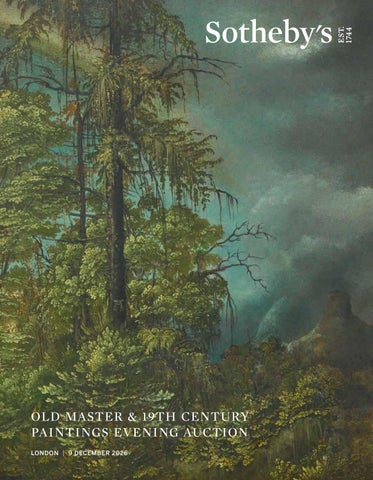
OLD MASTER & 19TH CENTURY PAINTINGS EVENING AUCTION LONDON | 9 DECEMBER 2026
FRONT COVER LOT 8 BACK COVER LOT 11 THIS PAGE LOT 25
LOT 25
LOT 34
OLD MASTER & 19TH CENTURY PAINTINGS EVENING AUCTION AUCTION IN LONDON 9 DECEMBER 2026 7:00 PM
ALL EXHIBITIONS FREE AND OPEN TO THE PUBLIC
Thursday 3 December 9 am – 4:30 pm Friday 4 December 9 am – 4:30 pm Saturday 5 December 12 pm – 5 pm Sunday 6 December 12 pm – 5 pm Monday 7 December 9 am – 4:30 pm Tuesday 8 December 9 am – 4:30 pm Wednesday 9 December 9 am – 12 pm 34-35 New Bond Street London, W1A 2AA +44 (0)20 7293 5000 sothebys.com FOLLOW US @SOTHEBYS #SOTHEBYSOLDMASTERS
TO LEARN MORE ABOUT THE PROPERTY IN THIS SALE, PLEASE VISIT SOTHEBYS.COM/L26036
LOT 21
SPECIALISTS Alex Bell Chairman Emeritus, Sotheby’s UK and Old Masters, Worldwide +44 (0)20 7293 5420 alex.bell@sothebys.com
ENQUIRIES Charlotte Chapman Associate, Old Master Paintings +44 (0)20 7293 5275 charlotte.chapman@sothebys.com
George Gordon Deputy Chairman, Sotheby’s Europe & Chairman Old Masters Worldwide +44 (0)20 7293 5414 george.gordon@sothebys.com
Claude Piening Senior Director, Senior International Specialist, 19th Century European Paintings +44 (0)20 7293 5658 claude.piening@sothebys.com
Julian Gascoigne Senior Director, Specialist, British Pictures 1550–1850 +44 (0)20 7293 5482 julian.gascoigne@sothebys.com
Emma Gordon Specialist, 19th Century European Paintings +44 (0)20 7293 5548 emma.gordon@sothebys.com
Chloe Stead Senior Director Global Head of Private Sales, Old Masters Paintings +44 (0)20 7293 4565 chloe.stead@sothebys.com
Teresa Les Spalthoff Business Strategist Old Master Paintings +44 (0)20 7293 5095 teresa.lesspalthoff@sothebys.com
Elisabeth Lobkowicz Senior Director, Head of Department, Old Master Paintings +44 (0)20 7293 5165 elisabeth.lobkowicz@sothebys.com Giorgio Bowler Specialist, Head of Day Sale, Old Master Paintings +44 (0)20 7293 5421 giorgio.bowler@sothebys.com Alice Da Costa Associate Specialist, Head of Mid-Season Sale, Old Master Paintings +44 (0)20 7293 5285 alice.dacosta@sothebys.com
Nicole Percoco Executive Assistant, Client Liaison, Old Master Paintings +44 (0)20 7293 6414 nicole.percoco@sothebys.com Alexina Dykes Executive Assistant, Client Liaison, Old Master Paintings +44 (0) 7809500187 alexina.dykes@sothebys.com
SALE NUMBER
L26036 “ETHAN”
BIDS DEPARTMENT
+44 (0)20 7293 5283 bids.london@sothebys.com
Telephone bid requests should be received 24 hours prior to the sale. This service is offered for lots with a low estimate of £3,000 and above.
PRE-SALE COORDINATOR
Connie Chau connie.chau@sothebys.com +44 (0)20 7293 5721
C L I E N T E X PE R I E N C E
For invoices, payment inquiries, delivery & collection Please contact:
+44 20 7293 5220 UK.CX@sothebys.com
Alison MacQueen Global Business Operations Director, Old Master Division +1 212 606 7344 alison.macqueen@sothebys.com
TO LEARN MORE ABOUT THE PROPERTY IN THIS SALE, PLEASE VISIT SOTHEBYS.COM/L26036
LOT 27
CONTENTS 5 AUCTION & EXHIBITION INFORMATION 7 SPECIALISTS AND ENQUIRIES 10 OLD MASTER & 19TH CENTURY PAINTINGS EVENING AUCTION: LOTS 1–34 260 HOW TO BID 261 EXPLANATION OF SYMBOLS 264 INDEX
TO LEARN MORE ABOUT THE PROPERTY IN THIS SALE, PLEASE VISIT SOTHEBYS.COM/L26036
PROPERTY FROM AN IMPORTANT PRIVATE COLLECTION
1
THE MASTER OF FRANKFURT act. Antwerp 1490–1515
Saint Catherine; Saint Barbara a pair, both oil on panel the former: 74 x 29.5 cm.; 29⅛ x 11⅝ in. the latter: 74.5 x 29.5 cm.; 29⅜ x 11⅝ in. (2)
£ 100,000-150,000
P R OV E N A N C E
L I T E R AT U R E
Dr. Wilhelm Alexander Freund (1833–1917), Berlin;
M.J. Friedländer, ‘Der Meister von Frankfurt’, in Jahrbuch königlichen preussischen Kunstsammlungen, vol. XXXVIII, 1917, p. 149, no. 36;
With Kurt Walter Bachstitz, The Hague, 1921 (as one panel); By whom sold to Albert Keller (1879–1939), New York, by November 1928 (as one panel); With Schaeffer Galleries, New York, April 1956 (as one panel); Cliché Gray, New York, before 1961 (according to a mount in the KIKIRPA Friedländer archive; as one panel); With Kunsthandel P. de Boer, Amsterdam, 1961 (as two panels); J. van Praag, Blaricum, by July 1961; Thence by inheritance to his widow; By whom gifted to a private collector; By whom anonymously sold (‘Property from a Private Collection’), Amsterdam, Sotheby’s, 10 May 2011, lot 10; Where acquired by the present owner. EXHIBITED
The Hague, Bachstitz Gallery, Exhibition of Primitive Masters, September 1922, no. 12 (as one panel); New York, Kleinberger Galleries, Loan Exhibition of German Primitives for the benefit of the American Red Cross, November 1928, no. 24 (as one panel); Laren, Singer Museum, Nederlandse Primitieven uit Nederlands particulier bezit, 1 July – 10 September 1961, nos 67 and 68 (as two panels).
M.J. Friedländer, ‘Die Primitiven-Ausstellung im Haag’, in Der Cicerone, vol. XIV, no. 20, July 1922, p. 814; C. Gronau, The Bachstitz Gallery, Catalogue of Paintings and Tapestries, Berlin 1922, vol. I, no. 3, reproduced; W. Ayrshire, ‘The Philosophy of the Picture Frame’, in International Studio, vol. LXXXIV, June 1926, p. 55, reproduced in colour; M.J. Friedländer, Die Altniederländische Malerei. Quentin Massys, vol. VII, Leiden and Berlin 1929, p. 138, no. 130d (as a copy after the triptych in the Bode Museum, Berlin); M.J. Friedländer, Early Netherlandish Painting. Quentin Massys, vol. VII, Leiden and Brussels 1971, p. 76, no. 130d, reproduced pl. 103d (as a copy after the triptych in the Bode Museum, Berlin); S.H. Goddard, The Master of Frankfurt and his Shop, doctoral diss., University of Iowa 1983, vol. II, pp. 386–87, no. 75, reproduced fig. 131 (as Workshop of the Master of Frankfurt, circa 1508); S.H. Goddard, ‘The Master of Frankfurt and his Shop’, in Verhandelingen van de Koninklijke Academie voor Wetenschappen, Letteren en Schone Kunsten van België: Klasse der Schone Kunsten, vol. XLVI, no. 38, 1984, pp. 149–50, no. 75 (as Workshop of the Master of Frankfurt, circa 1508).
The present panels depict one of the most enduring saintly pairings in early sixteenth-century Netherlandish art. Saint Catherine of Alexandria and Saint Barbara, presented here in a harmonious counterpoint, were both ‘Capital Virgins’ – a group of early Christian martyrs, also including Saint Margaret of Antioch and Saint Dorothea – who enjoyed widespread devotion. With a sophisticated modelling of the figures and a sumptuous carpet of foliage, these two panels are an exquisite example from the Master of Frankfurt’s later career, executed circa 1508–11. Originally conceived as a single painting, the panel was separated into the pair we see today at some point between 1956 and 1961. They were therefore not conceived as separate wings of a triptych, distinguishing them from the artist’s roughly contemporary Virgin and Child with Saint Anne in the Bode Museum, Berlin (fig. 1), where Saints Catherine and Barbara appear on separate shutters.1 Instead, it is possible that the single panel of two saints was intended to be one wing of an altarpiece, with another pair of saints on the other side.
10
Buyers are liable to pay the hammer price (as estimated above), the buyer’s premium, together with any applicable taxes and Artist’s Resale Right (which will depend on the individual circumstances). Refer to complete cataloguing and Conditions of Business available at SOTHEBYS.COM
11
Fig. 1 The Master of Frankfurt, Virgin and Child with Saint Anne, circa 1515. Oil on panel, central panel: 87 x 55 cm. Bode Museum, Berlin. © Wikimedia
In the present work, the left panel depicts Saint Catherine in a voluminous blue mantle, and one can see the Master’s eye for detail in the meticulously painted pearls and gold embroidery. Underneath, she wears a red brocade that is decorated with vermillion stems, leaves and pomegranates – this pattern is known as the ‘pomegranate motif’, and it appears to have been used exclusively in the Master’s workshop.2 Around her neck hangs a jewelled cross, while a twisted gold cord encircles her waist and terminates in a single drop pearl. Catherine embodies the Master’s ideal of female beauty, with her high forehead, delicately arched brows, luminous complexion and gently curved chin. The traces of delicate underdrawing visible in the outline of her veil, the contour of her nose, around her softly upturned lips, and along her chin suggest a degree of adjustment during execution. Framed by an ornate headdress, her golden hair descends in long strands to her waist. She is depicted with her characteristic saintly attributes; the sword she holds in her right hand alludes to her beheading, whilst the book she holds in her left hand, pressing gently into her bosom, reflects her status as the patron saint of scholars. Saint Barbara is similarly portrayed as a figure who possesses remarkable dignity and poise, wearing a red mantle that falls in broad, sculptural folds. In her right hand, she holds a white ostrich feather, a reference to the tradition where she received a feather from the Christ Child in a vision. Beneath her mantle, she wears a dark gown with quilted sleeves, which is decorated at the hem with the aforementioned pomegranate motif. According to legend, Barbara was the beautiful daughter of the pagan nobleman, Dioscurus, who confined her to a tower in an effort to conceal her from suitors – this tower can be seen to the right of the saint. During her imprisonment, she converted to Christianity, and she was so ardent in her faith that she commissioned a workman to add a third window to her tower, as a reference to the Holy Trinity. Upon discovery of this, her father was so furious that he ordered her execution. Catherine and Barbara were a favourite iconographic choice for Netherlandish altarpieces, and they frequently appear in the paintings of the Master of Frankfurt and his workshop.3 Notable examples include the Saint Catherine and Saint Barbara in the Mauritshuis, The Hague. These were executed circa 1510–20 and are therefore slightly later than the present lot (fig. 2 and fig. 3), but the modelling for the Catherine figure is similar to the present work. Due to the larger scale of the Mauritshuis panels, there is more space for the Master to include vignettes of secular and religious life; one can see, for instance, the brightly dressed archers and cavalry to Catherine’s left, whilst behind her head are the faint markings of the scaffolding used to erect the Crucifixion. In the present lot, due to the limitations of space, three cursory figures are visible in the background, subtly rendered in quick, skilful brushstrokes. 12
Fig. 2 The Master of Frankfurt, Saint Catherine, circa 1510–20. Oil on panel, 158 x 71 cm. The Mauritshuis, The Hague. © Wikimedia
Fig. 3 The Master of Frankfurt, Saint Barbara, circa 1510–20. Oil on panel, 158 x 71 cm. The Mauritshuis, The Hague. © Wikimedia
The identity of the Master of Frankfurt remains elusive, with scholars speculating that he was Hendrik van Weuluwe (c. 1460–1533).4 As an anonymous artist, the Master takes his name from two altarpieces that are in Frankfurt-am-Main and which were executed in his so-called Frankfurt period (circa 1490–1506): one is the Altarpiece of the Holy Kinship in the Historisches Museum, which was made for the Monastery of the Dominican Order in Frankfurt, circa 1505;5 the other is the Crucifixion Triptych, commissioned by the patrician Humbracht family, in the Städel Museum.6 His name is misleading, however, as he likely never visited Frankfurt and was instead active in Antwerp. One of the earliest known dated paintings in Antwerp is the Master of Frankfurt’s Portrait of the Artist and his Wife;7 inscribed with the date 1496, this painting features the coat-of-arms of the Antwerp guild of Saint Luke, and shows that the Master was working in Antwerp by at least the mid-1490s. In recent years, the Master of Frankfurt has become best understood not as a single artistic personality but as the collective production of a sophisticated Antwerp workshop. Around the turn of the century, there was an increase in productivity and output in the workshops of artists such as Quentin Massys (c. 1465–1530) and Joos van Cleve (c. 1485–1540/41). The Master of Frankfurt appears to have taken advantage of this boom by adapting his shop practices and drawing on a shared repertory of stock compositions and motifs; in the present panel, this is evidenced by the pomegranate motif on the brocades, and the pairing of Catherine with Barbara, which was subtly adapted in various compositions. One such example are the closely related panels of almost identical dimensions, formerly in the collection of Mr and Mrs Edwin S. Webster, Massachusetts, and sold at Christie’s, New York, 23 May 2024, lot 3, the provenance of which has at times been confused with that of the present pair.8 When still joined as a single panel, these paintings were formerly in the collection of Dr Wilhelm Freund (1833–1917), the distinguished Berlin gynaecologist and collector, before subsequently entering the ownership of Albert Keller (1879–1939), the New York-based hotel executive who served as president of the Ritz-Carlton Hotel Corporation. We are grateful to Peter van den Brink, who has endorsed the attribution to the Master of Frankfurt on the basis of digital images. Oil on panel, central panel, 87 x 55 cm.; inv. no. 575, Bode Museum, Berlin. For the frequency of this brocade pattern in the Master’s workshop, see Goddard 1984, p. 115. 3 Goddard has identified ten surviving examples featuring the two saints. See Goddard 1984, p. 113. 4 For a discussion of the historiography, see Goddard 1984, pp. 42–50. 5 Mixed media on oak wood, central panel, 212 x 126 cm.; inv. no. B 259-B 261, Historisches Museum, Frankfurt. 6 Mixed media on oak wood, central panel, 118.3 x 77.3 cm.; inv. no. 715, Städel Museum, Frankfurt. 7 Mixed media on oak wood, central panel, 118.3 x 77.3 cm.; inv. no. 715, Städel Museum, Frankfurt. 8 Oil on panel, 69 x 27 cm: https://www.christies.com/en/lot/lot-6481046?ldp_breadcrumb=back This pair was previously sold at Sotheby’s, New York, 16 June 1977, lot 42, reference to which Goddard (see Literature) erroneously included under the entry for the present panels (also with incorrect lot number 22), along with further mistakenly conflated lines of provenance. 1
2
14
PROPERTY OF A PRIVATE COLLECTOR
○ ⋑
2
GHERARDO DI JACOPO STARNA, CALLED STARNINA Florence, documented 1387–d. before 1413
The Presentation of the Christ Child in the Temple tempera and gold ground on panel 32.7 x 51.5 cm.; 12⅞ x 20¼ in. ǂ £ 600,000-800,000
P R OV E N A N C E
L I T E R AT U R E
With Rudolph Schmidt & Co., Berlin;
E.W. Rowlands, The Collections of the Nelson-Atkins Museum of Art: Italian Paintings, 1300-1800, Kansas City 1996, pp. 80–82, under no. 8, reproduced p. 78, fig. 8b;
Mr. Gore, London; Bought in Berlin or London, circa 1900; Thence by descent until anonymously sold (‘The Property of a Gentleman’), London, Sotheby’s, 8 July 1999, lot 59; With Rob Smeets, Milan, 2001; With Richard L. Feigen, New York; From whom acquired by the present collector, by 2005. EXHIBITED
Madrid, Museo Thyssen-Bornemisza, and Valencia, Museu de Belles Arts de València, El Renacimiento Mediterráneo: Viajes de artistas e itineraries de obras entre Italia, Francia, y España en el siglo XV, 31 January – 2 September 2001, no. 7.
G. Fattorini, in Galleria Nazionale di Parma. Catalogo delle opera dall’antico al cinquecento, L. Fornari Schianchi (ed.), vol. 1, Milan 1997, p. 62, under no. 59; A. de Marchi, in Sumptuosa tabula picta: Pittori a Lucca tra Gotico e Rinascimento, exh. cat., M.T. Filieri (ed.), Lucca 1998, p. 271, under no. 30, reproduced p. 268, fig. 160; M. Bollati, in El Renacimiento Mediterráneo: Viajes de artistas e itinerarios de obras entre Italia, Francia, y España en el siglo XV, exh. cat., M. Natale (ed.), Madrid 2001, pp. 173–78, no. 7, reproduced in colour; C.B. Strehlke, Italian Paintings 1250-1450 in the John G. Johnson Collection and the Philadelphia Museum of Art, Philadelphia 2004, pp. 395–96 and 398, panel F, n. 5, reproduced p. 396, fig. 76.7; S. Weppelmann, Geschichten auf Gold: Bilderzählungen in der frühen italienischen Malerei, exh. cat., Berlin 2005, pp. 143–47, reproduced in colour; A. De Vries, ‘Opere e giorni: alcune considerazioni sulla produzione e sul funzionamento della bottega di Gherardo Starnina’, in Nuovi studi sulla pittura tardogotica: Intorno a Lorenzo Monaco, Florence 2007, p. 61, reproduced p. 62, fig. 7; L. Kanter, in Italian paintings from the Richard L. Feigen collection, L. Kanter and J. Marciari (eds), New Haven and London 2010, pp. 60–64, reproduced in colour.
This characterful and colourful panel depicting Christ’s Presentation in the Temple was only recognised by Federico Zeri in 1992. It originally formed the right-hand part of the predella for a triptych by Gherardo Starnina dating to circa 1404–05 (fig. 1). The central panel is now divided into a lower half depicting the Death of the Virgin (John G. Johnson Collection, Philadelphia) and the upper half, the Assumption (Fogg Art Museum, Cambridge); the wings depict full-length figures of Saints Michael the Archangel, James the Greater and John the Baptist, and Saints John the Evangelist, Peter and Paul (Museo Nazionale di Villa Guinigi, Lucca); and the other two predella panels represent the Nativity (private collection, Turin), which would have been on the left of the central panel, the Adoration of the Magi (Nelson Atkins Museum of Art, Kansas City). The seven disparate identified elements of the triptych have been partially reunited on a number of occasions since 1993, though never in their entirety.
16
Buyers are liable to pay the hammer price (as estimated above), the buyer’s premium, together with any applicable taxes and Artist’s Resale Right (which will depend on the individual circumstances). Refer to complete cataloguing and Conditions of Business available at SOTHEBYS.COM
17
Fig. 1 Original configuration of Starnina’s Dormition altarpiece, circa 1404 –8.
Starnina is now recognised as one of the key and most pioneering artists working in early-fifteenth century Florence. His œuvre is characterised by a markedly refined and elegant expression of the International Gothic style, which exerted a strong influence over his successors, as well as his contemporaries, including Lorenzo Monaco (1370–1425). According to Vasari, Starnina studied with Antonio Veneziano (active 1369–88), and having enrolled in the Compagnia di San Luca in Florence in 1387, led an itinerant career, working in Toledo and Valencia from circa 1393 to 1401, after which time he returned to Tuscany.1 The artist is generally believed to be one and the same as the Master of the Bambino Vispo (whose moniker refers to the recurrent depiction of a particularly lively Infant Christ),2 the works attributed to whom share the unusual synthesis of the International Gothic style and a Florentine trecento interest in the depiction of space and volume; Carlo Volpe notes affinities with the work of Rossello di Jacopo Franchi and Giovanni Toscani.3 The present panel shares the same height as the other two now separated predella panels and is the same width as the Nativity scene; the background settings, sheds and figure types in the Nativity and Adoration of the Magi correspond exactly; and the punch decoration in the haloes throughout the three panels is consistent. Although Andrea de Marchi at one stage tentatively questioned the combination of scenes from the Infancy of Christ with a Marian theme for the central element of the altarpiece,4 he and all other scholars to have published the works now unanimously accept the reconstruction described above (although there are still questions over whether there may also once have been pinnacle panels).5 And other examples of the same iconographic arrangement may be found in Starnina’s own œuvre – namely, the altarpiece he painted for the Acciaiuoli chapel in the Certosa di Galluzzo, just outside Florence, dated to circa 1404–07. The scene here clearly depicts both the Old Testament ritual of ransoming back from God the first-born male child of a Hebrew family, and the characters who partook in this episode from Christ’s early life. The Virgin is in the centre of the composition, receiving Christ back over an altar table with a flame symbolising the sacrifice of redemption, from Simeon – the devout man in Jerusalem to whom the Holy Spirit had revealed that he would see the Messiah before he died (his words in the gospel of Luke (2:29–32) form the Nunc Dimittis: ‘Lord, now lettest thou thy servant depart in peace …’). Behind these figures is a priest of the temple, and to the right is the prophetess Anna, identified by the inscribed scroll that she holds, wearing a blue dress and a red cloak. To the left, Saint Joseph enters the temple holding two pigeons – the price of ransom prescribed by Mosaic law – while two bystanders bear witness. The same elements may be found in Giovanni del Biondo’s 1364 altarpiece of the same subject, painted for Santa Maria degli Angeli, Florence, and today in the Galleria dell’ Accademia.6 18
Fig. 2 Angelo Puccinelli, Altarpiece (reconstruction adapted from González-Palacois 1971): Dormition and Assumption of the Virgin with Saints Nicholas of Bari, John the Baptist, James Major (?), Catherine of Alexandria, Francis, Lawrence, and Clare of Assissi, and the Blessed Urban V and Two Angels, 1386. Tempera and tooled gold on panel, overall approximately 196 x 98 cm. Centre panel: Lucca, church of Santa Maria Forisportam. Lateral panels: last recorded Radensleben, Germany, von der Quast Collection. Present location unknown. © Wikimedia
No documentary evidence records the original location for the triptych, but several suggestions have been made, all revolving around Lucca and its environs. The lateral panels with saints (today in the Villa Guinigi, Lucca) were found in the parish church at Tramonte, near Brancoli, outside Lucca, in the nineteenth century; prior to this they were said to have been in the monastery of San Michele Arcangelo e San Pietro, in Brancoli. Since Saints Michael and Peter both feature in these wings, it is possible that the altarpiece was produced for the Brancoli monastery, and this theory is supported by Strehlke. On the other hand, Rowlands observed that the subject of the central panel would have been fitting for the church of Santa Maria Assunta, at Piazza, near Brancoli. And Filieri recorded the commission of an altarpiece in 1407 for the parish church of Lammari, also near Lucca, described in 1647 as representing the Burial and Assumption of the Virgin with Apostles and Saints. De Marchi, however, considered all these churches too parochial for such a significant work, and instead proposed as an intended setting the church of San Michele in Foro, in Lucca itself, for which an altarpiece is documented as being painted in 1404 (tantalisingly without description). The precise dating of the altarpiece is also debatable, and scholars have long highlighted the difficulty of ordering works executed in the last decade of Starnina’s career when he returned to Florence from Spain at some point between 1401 and 1403, and before his death sometime between 1409 and 1413. The two firm points of reference for his artistic career in these years are the nearly destroyed frescoes in the chapel of Saint Jerome in Santa Maria del Carmine, Florence, recorded as having been finished by 1404, and the fragmentary remains of frescoes in Santo Stefano, Empoli, commissioned in 1409, which display a more restrained and monumental quality than both the present panel and its original altarpiece.
20
Fig. 3 Gherardo Starnina, Würzburg Triptych. Tempera and gold ground on canvas on wood; central panel 161.8 x 77.7 cm, left panel 138.7 x 79 cm, right panel 139 x 79.2 cm. © Martin von Wagner Museum der Universität Würzburg, Foto: André Mischke
Strehlke posited that the altarpiece (and therefore this painting) may date to 1408, if it was intended for the monastery of San Michele Arcangelo e San Pietro, as it was in that year that the monastery was transferred from Benedictine nuns to Augustinian canons by the local bishop; the church of Santa Maria Forisportam, Lucca, was part of the same reform movement, and contained an altarpiece by Angelo Puccinelli – the leading Lucchese artist of the previous generation – dating to 1386, depicting the same subject as Starnina’s work (fig. 2).7 Indeed, Puccinelli’s triptych clearly provided the model on which Starnina based his design – not only iconographically, with the details of the palm tree in the centre and Christ to its right unique features to these paintings, but also stylistically, including the geometric tiles on which the saints in the wings stand, and in its size and proportions. The repetition of this format would have served as visible unification between the two churches. There is also an argument, however, for an earlier dating of 1404–05, through the altarpiece’s stylistic similarities with Starnina’s Würzburg triptych (fig. 3).8 The Würzburg painting embodies a particularly expressive Late Gothicism which may be read as combining the influence of Iberian models, with intricate drapery design and vivacious colours (and it is possible that an Iberian assistant even collaborated with Starnina on the work), with a more Florentine concern for three-dimensionality in both the depiction of figures and space. Some scholars have interpreted these qualities as the culmination of Starnina’s artistic development at the end of his life, while others see them as the immediate sequel to his return from Spain, shortly after 1403. If the latter theory is correct, then De Marchi’s hypothesis regarding San Michele in Foro and a possible date of 1404 would not be unreasonable. So far no paintings have been incontrovertibly connected to Starnina’s Spanish period. The association was first proposed by J. van Waadenoijen in ‘A Proposal for Starnina: Exit the Maestro del Bambino Vispo?’, in The Burlington Magazine, vol. XCVI, no. 851, 1974, pp. 82–91. Boskovits does not accept the theory and sees Starnina as a pupil of Agnolo Gaddi, identifying the anonymous master with the Spanish artist, Miguel Alcaniz. 3 C. Volpe, ‘Per il completamento dell’altare di S. Lorenzo del Maestro del Bambino Vispo’, in Mitteilungen des Kunsthistorischen Instituts in Florenz, vol. XVII, nos 2/3, 1973, pp. 347–60. 4 See A. de Marchi, in Da Baduino ad Algardi: Pittura e scultura a confront, exh. cat., Turin 1990, pp. 19 and 23. 5 See Kanter 2010, p. 64. Fattorini suggested a Coronation of the Virgin in the Pinacoteca Nazionale, Parma, as a central pinnacle for the complex (Fattorini 1997, p. 62, no. 59). 6 Tempera and gold ground on panel, 217.5 x 200 cm.; inv. no. 1890 n. 8462, Galleria dell’ Accademia, Florence. 7 Tempera and gold ground on panel, 196 x 98 cm. See A. Gonzalez-Palacios, ‘Posizione di Angelo Puccinelli’, in Antichità viva, vol. 10, no. 3, 1971, pp. 3–9. 8 Tempera and gold ground on panel, approximately 79 x 415 cm.; inv. nos. F20, F20a and F20c, Martin von Wagner Museum, University of Würzburg, Germany. 1
2
21
PROPERTY OF A PRIVATE COLLECTOR
3
ANTONIO VIVARINI Venice circa 1415–1476/1484
Saint Peter Martyr exorcising the devil disguised as the Madonna and Child tempera on poplar panel 52.7 x 35.6 cm.; 20¾ x 14 in. ǂ £ 400,000-600,000
P R OV E N A N C E
Probably Church of Saints Giovanni and Paolo, Venice; Lucien Félix Claude-Lafontaine (1840–1909), Paris; Thence by inheritance within the family until sold, Paris, Galliéra, 10 April 1962, lot 7 (as Italian School, late 15th century); With Wildenstein, New York; From whom acquired by the present collector, 2012. EXHIBITED
Paris, Musée Jacquemart-André, La Collection Alana, Chefs-d’œuvre de la peinture italienne, 13 September 2019–20 January 2020, no. 35. L I T E R AT U R E
M. Valsecchi, ‘A poco prezzo due capolavori misconosciuti,’ in Il Giorno, 13 May 1962; R. Pallucchini, ‘Giunti ai Vivarini,’ in Arte Veneta, 1967, vol. 21, pp. 200–1, reproduced fig. 252; F.R. Shapley, Paintings from the Samuel H. Kress Collection, Italian Schools, London 1968, pp. 31–32; F. Zeri and E.E. Gardner, Italian Paintings, A Catalogue of the Collection of the Metropolitan Museum of Art, Venetian School, New York 1973, p. 89; Katalog der ausgestellten Gemälde 13.-18. Jahrhunderts, Berlin 1975, p. 460, under cat. nos 66 and 67;
G. Kaftal, Iconography of the Saints in the Painting of North East Italy, Florence 1978, p. 848, no. 236B(18), reproduced fig. 1114; F. Zeri, ‘Rinascimento e Pseudo-Rinascimento’, in Storia dell’arte italiana, vol. I, pt. 2, Turin 1983, p. 570, reproduced fig. 317; C. Lloyd, Italian Paintings Before 1600 in The Art Institute of Chicago, Chicago 1993, p. 296; R. Piva, ‘I diavoli e Circe incantatrice’, in I tempi di Giorgione, R. Maschio (ed.), Rome 1994, p. 276, no. 1, reproduced fig. 475; K. Baetjer, European Paintings in the Metropolitan Museum of Art By Artists Born Before 1865, New York 1995, p. 68; Gemäldegalerie Berlin, Gesamtverzeichnis, Berlin 1996, p. 127; P. Humfrey, ‘A New Panel by Antonio Vivarini from the St Peter Martyr Polyptych’, in Venezia Cinquecento, Studi di storia dell’arte e della cultura, 2014, vol. 24, no. 48, p. 15 note 2, no. 5; M. Vinco, Antonio Vivarini in San Zanipoloa Venezia, Iconografiae nuovi documenti, Florence 2018, pp. 19, 21, 42–43, and 46, reproduced fig. 8; M. Vinco, in La Collection Alana, Chefs-d’œuvre de la peinture italienne, exh. cat., P. Curie and C. Falciani (eds), Paris 2019, p. 124, no. 35, reproduced.
Specialising in elaborate multi-panel altarpieces set within Gothic architectural frames, Antonio Vivarini led Venice’s most important family workshop prior to the emergence of the Bellini. This panel, painted circa 1450, formed part of an altarpiece illustrating the life of Saint Peter Martyr, probably created for the altar dedicated to the saint in the Venetian church of Santi Giovanni e Paolo.1 The ensemble dates to the brief period between the death of Vivarini’s brother-in-law and collaborator Giovanni d’Alemagna and the beginning of his partnership with his elder brother Bartolomeo.
22
Buyers are liable to pay the hammer price (as estimated above), the buyer’s premium, together with any applicable taxes and Artist’s Resale Right (which will depend on the individual circumstances). Refer to complete cataloguing and Conditions of Business available at SOTHEBYS.COM
23
Fig. 1 Antonio Vivarini, The Investiture of Saint Peter Martyr, circa 1445. Oil on poplar panel, 54.1 x 35.9 cm. Gemäldegalerie, Berlin. © Wikimedia
Fig. 2 Antonio Vivarini, Saint Peter Martyr’s Vestment Miraculously Survives a Fire, circa 1445. Oil on poplar panel, 54.2 x 35.9 cm. Gemäldegalerie, Berlin. © Wikimedia
The remarkable panel illustrates one of Saint Peter Martyr’s most rarely represented miracles: his exposure of a false image of the Madonna and Child, shown with horns, bat-like wings, a tail, and cloven feet, possessed by the devil. A nobleman kneels before the altar; he had hosted the saint during his travels in Lombardy but had since been converted by heretics. Hoping to likewise convert Peter, they brought him to their false church, where he revealed their deception by raising a monstrance containing the consecrated Host before the statue. His act unmasked the devil within the false idol and restored the nobleman’s true faith. In addition to the present work, seven panels from the original altarpiece are known today2 (figs 1–7): The Investiture of Saint Peter Martyr in Bologna and Saint Peter Martyr’s Vestment Miraculously Survives a Fire (Berlin, Gemäldegalerie, inv. nos 66, 67); Saint Peter Martyr Exorcises a Woman Possessed by a Devil (Art Institute of Chicago, inv. no. 1983.384); Saints Agnes, Catherine, and Cecilia Visit Saint Peter Martyr in his Monastic Cell in Como (Galleria dell’Accademia, Venice.); Saint Peter Martyr Prays Before a Crucifix (sold New York, Christie’s, 9 June 2022, lot 50); Saint Peter Martyr Heals the Severed Limb of a Young Man (New York, Metropolitan Museum of Art, inv. no. 37.163.4); and The Funeral of Saint Peter Martyr in the Basilica of San Simpliciano in Milan (sold, Milan, Porro, 29 May 2014, lot 28). The ensemble likely flanked a central standing figure of Peter – either painted or sculpted – surrounded by twelve or sixteen vertically arranged narrative panels recounting his life and martyrdom. Comparable in format to Agnolo degli Erri’s circa 1485 altarpiece dedicated to Saint Vincent Ferrer,3 this type of devotional ensemble, popular in thirteenth-and fourteenth-century Italy, served to promote the saint as a moral exemplar for worshipers. Born in Verona and educated at the University of Bologna, Saint Peter Martyr (1205–1252) joined the Dominican order and rose through its ranks to become inquisitor for Milan in 1234. Renowned throughout Italy for his sermons and disputations with heretics, he was murdered on the road from Como to Milan in 1252 and canonised by Pope Innocent IV the following year. As the first Dominican saint, his cult spread rapidly across Europe, and his image proliferated widely, reinforcing his status as a model of unwavering faith. he altarpiece must have been disassembled by 1790, when the panel in the Art Institute of Chicago is recorded in the collection of Giovanni Vianelli, T Chioggia. Catalogo di Quadri esistenti in casa il Signor D.n Giovanni D.r Vianelli Canonico della Cattedrale di Chioggia, Venice 1790, p. 25. A 1733 inventory of the Confraternities of Saints Vincent Ferrer, Peter Martyr, and Catherine of Siena includes ‘quadri con soaze nere e dorade con li miracoli di S. Vicenzo n. 13’ (13 paintings in black and gold frames depicting miracles of St. Vincent), which may refer to this altarpiece, though confusing the two Dominican saints. 2 In 1937, Georg Pudelko connected the two panels in Berlin with those in the Metropolitan Museum and the Art Institute of Chicago, and attributed them to Vivarini. 3 Now dismembered, the panels are in the collections of the Galleria Estense, Modena; the Ashmolean Museum, Oxford; and the Kunsthistorisches Museum, Vienna. For a reconstruction, see D. Benati, La bottega degli Erri e la pittura del Rinascimento a Modena, Modena 1988. 1
24
Fig. 3 Antonio Vivarini, Saint Peter Martyr Exorcises a Woman Possessed by a Devil, circa 1450. Tempera on panel, 54.8 x 35.5. Art Institute of Chicago, Chicago, inv. no. 1983.384. © Wikimedia
Fig. 4 Antonio Vivarini, Saints Agnes, Catherine, and Cecilia Visit Saint Peter Martyr in his Monastic Cell in Como. Gallerie dell’Accademia, Venice.
Fig. 5 Antonio Vivarini, Saint Peter Martyr Prays Before a Crucifix. Tempera and gold on panel, 65.7 x 47.6 cm. Private Collection.
Fig. 6 Antonio Vivarini, Saint Peter Martyr Heals the Severed Limb of a Young Man, circa 1450. Tempera and gold on wood, 53 x 33.3 cm. The Metropolitan Museum of Art, New York. © Gift of Samuel H. Kress Foundation, 1937
Fig. 7 Antonio Vivarini, The Funeral of Saint Peter Martyr. Present location unknown.
25
PROPERTY OF A PRIVATE COLLECTOR
4
JACOPO DEL CASENTINO Florence 1297/1300–1349 Pratovecchio
Saint Catherine; Saint John the Baptist; Saint Andrew; and Saint John the Evangelist; all with prophets in roundels above a set of four, all tempera on poplar panel, gold ground, in integral frames Saint Catherine: 113.6 x 48.5 cm.; 44¾ x 19⅛ in.; Saints John the Baptist, Andrew, and John the Evangelist: 114 x 48.7 cm.; 44⅞ x 19¼ in. (4) ǂ £ 500,000-700,000
P R OV E N A N C E
Probably William Young Ottley (1771–1836), London, possibly acquired during his stay in Italy, 1791–98; Thence by inheritance to his brother Warner Ottley (d. 1847), London; His posthumous sale, London, Foster & Son, 26–30 June 1847, lot 23 (‘Jacopo del Cassentino [sic.] The Evangelist and Saints’), for 12 guineas to Anthony, or lot 24 (‘Jacopo del Cassentino [sic.] Four Saints in compartments’), for 10 guineas to Smith; Probably Charles Somers-Cocks, 3rd Earl Somers (1819–83), Eastnor Castle, Herefordshire; Probably thence by descent to his cousin, Philip Reginald Cocks, 5th Baron Somers (d. 1899), Eastnor Castle, Herefordshire; Thence by descent to his grandson, Arthur Herbert Tennyson Somers-Cocks, 6th Baron Somers (1887–1944), Eastnor Castle, Herefordshire;
With Wildenstein & Co., New York, circa 1949; From whom acquired for the Menil Foundation, San Felipe, Houston, Texas, 1960, no. 60-01; By whom gifted to the Fine Arts Department, University of St. Thomas, Houston, 1960; Anonymously offered by the Menil Foundation (‘The Property of a Private Collection’), New York, Christie’s, 18 May 1995, lot 184, where unsold; Acquired for the present collection in 2001. EXHIBITED
Birmingham, City Museum and Art Gallery, Commemorative Exhibition of the Art Treasures of the Midlands, 1934, no. 272 (as Florentine School, 14th century; lent by Lord Somers); Houston, University of St. Thomas, Desiderio’s Cathedral, 19 March – 30 April 1961, unnumbered.
These four gabled panels are significant works in the œuvre of Jacopo del Casentino, who may be counted among the leading figures in Florentine painting in the second quarter of the fourteenth century in the wake of Giotto (d. 1337). Jacopo was clearly held in high esteem by his contemporaries, who elected him the first consigliere of the newly founded Painter’s Guild in Florence, the Compagnia di San Luca, in 1339. Although few other documentary records regarding his life and career survive, scholars have reconstructed Jacopo’s artistic personality and body of work based on a handful of signed and dated paintings: the signed triptych in the Gallerie degli Uffizi, Florence;1 the Presentation in the Temple in the Nelson Atkins Museum of Art, Kansas City, dated 1330;2 and a damaged Madonna and Child of 1342 in the church of Santa Maria in Crespino sul Lamone, Marradi.3 The present set of four originally made up the lateral panels of a now dismantled polyptych, which may be dated to circa 1330–35, the central element of which was first identified by Richard Offner in 19304 as the Madonna and Child in the Musées royaux des Beaux-Arts de Belgique, Brussels (fig. 1).5 Offner went on to include Jacopo in his catalogue of the so-called ‘Painters of the Miniaturist Tendency’, highlighting his small, devotional works, but the present panels exemplify the artist’s ability to maintain a delicacy of line and finesse of execution even on a substantial scale, combining both the naturalistic Sienese influence of Duccio and the Lorenzetti, and the sculptural monumentality of Florentine, Giottesque examples, which co-existed around 1330.
26
Buyers are liable to pay the hammer price (as estimated above), the buyer’s premium, together with any applicable taxes and Artist’s Resale Right (which will depend on the individual circumstances). Refer to complete cataloguing and Conditions of Business available at SOTHEBYS.COM
27
Fig. 1 Jacopo del Casentino, Reconstruction of the dispersed polyptych. Central panel (Musée des Beaux-Arts, Brussels) flanked by the panels in the present lot
L I T E R AT U R E
R. Offner, Studies in Florentine Painting. The Fourteenth Century, New York 1927, p. 29; R. Offner, A Critical and Historical Corpus of Florentine Painting: The Fourteenth Century. Works attributed to Jacopo del Casentino, Section III, vol. II, part II, New York 1930, pp. 92 and 144, reproduced plate LIX; Commemorative Exhibition of the Art Treasures of the Midlands, Birmingham 1934, p. 72, no. 272 (as Florentine School, 14th century); M. Salmi, ‘Jacopo del Casentino’, in Atti e memorie dell’Accademia Petrarca di lettere, arti e scienze, vol. XXXV, 1949–51, p. 25; L. Berti, ‘Jacopo del Casentino. S. Caterino d’Alessandria; S. Jacopo minore; S. Giovanni Evangelista’, in Bollettino D’Arte, vol. XXXVII, series IV, no. 1, January–March 1952, pp. 55–57; R. Offner, A Critical and Historical Corpus of Florentine Painting: The Fourteenth Century. Addenda and Corrigenda, Section III, vol. VIII, New York 1958, p. 198; University of St. Thomas, Houston, Desiderio’s Cathedral, exh. cat., Houston 1961, unpaginated, reproduced; E.K. Waterhouse, ‘Some notes on William Young Ottley’s collection of Italian Primitives’, in Italian Studies presented to E.R. Vincent, C.P. Brand, K. Foster, and U. Limentani (eds), London 1962, pp. 276 and 279; B. Berenson, Italian Pictures of the Renaissance: Florentine School, London 1963, vol. I, p. 102; M. Cämmerer-George, Die Rahmung der Toskanischen Altarbilder im Trecento, Strasbourg 1966, p. 69; P. Dal Pogetto, Omaggio a Giotto, exh. cat., Florence 1967, p. 32, under no. 13;
28
B.B. Fredericksen and F. Zeri, Census of pre-nineteenthcentury Italian paintings in North American public collections, Cambridge, Massachusetts 1972, pp. 101, 381, 410, 418, 444, 466 and 587; R. Fremantle, Florentine Gothic painters from Giotto to Masaccio. A guide to painting in and near Florence 1300– 1400, London 1975, p. 118, reproduced figs 233 and 234 (Saints Catherine and John the Baptist only; as owned by Institute for the Arts, Rice University, Houston); M. Boskovits, A Critical and Historical Corpus of Florentine Painting: The Fourteenth Century. The Painters of the Miniaturist Tendency, Section III, vol. IX, Florence 1984, p. 58, n. 203; Musées royaux des Beaux-Arts de Belgique. Catalogue inventaire de la peinture ancienne, Brussels 1984, p. 48, under inv. no. 3976; R. Offner and K. Steinweg, A Critical and Historical Corpus of Florentine Painting; The Fourteenth Century. Elder Contemporaries of Bernardo Daddi, M. Boskovits and M. Gregori (eds), Section III, vol. II, Florence 1987, pp. 490 and 492, reproduced plates CCXVI and CCXVIII–CCXX; A. Ladis, ‘Jacopo del Casentino’, in The Dictionary of Art, J. Turner (ed.), London and New York 1996, vol. XVI, p. 838; A. Labriola, ‘Un dipinto di Jacopo del Casentino e alcuni appunti sull’antica cattedrale di Santa Reparata a Firenze’, in Arte Cristiana, vol. XCI, no. 818, September – October 2003, pp. 336–37, reproduced pp. 338–39, figs 5a–5e; A. Labriola, in The Alana Collection. Newark, Delaware, USA. Italian Paintings from the 13th to the 15th century, M. Boskovits (ed.), Florence 2009, pp. 74–81, reproduced in colour.
29
The elegant, colourful figures of the saints here stand out against gilded backgrounds, with punched halos, and surrounded by spandrels decorated with stylised golden dragon motifs (which also adorn the Brussels panel). The saints are framed by a trefoil arch under a pointed arch – a structure first employed architecturally by Arnolfo di Cambio in the façade of Florence Cathedral, circa 1294, which was subsequently adopted by Giotto in his polyptych for the Badìa, circa 1300.6 In the gables are small trefoils containing effigies of prophets holding scrolls, without any further identifying attributes. The saints, by contrast, are depicted in an iconographically traditional way (although the figure of Saint Andrew was initially believed to represent Saint Philip – corrected by Offner in 1958).7 Saints Catherine and John the Evangelist are particularly graceful, especially in relation to other examples within Jacopo’s œuvre – namely, the dismembered polyptych panels depicting the same saints in the Church of San Prospero, Cambiano, Castelfiorentino.8 The delicate palmette motifs embroidered on Saint Catherine’s robe reappear in the figure of the Virgin in Jacopo’s Virgin and Child between saints and angels,9 which, along with her fur-lined sleeves, golden bejewelled crown, and green robe with its fine cord, reflect the prevailing Gothic taste for worldly refinement. By contrast with the other figures, Saint John the Baptist is shown frontally and again compares favourably to another version by Jacopo, in the Galleria dell’ Accademia, Florence.10 The central Madonna and Child, today in Brussels, is also clearly the high-quality prototype that provided the model for at least one other workshop version.11 Saints John the Baptist and Catherine were particularly venerated in Florence at this time, and the presence of Saint Andrew may also indicate the original intended location for the altarpiece – possibly the church of Sant’ Andrea, destroyed in 1889. Ada Labriola speculates as to whether the polyptych may have been commissioned by the Amieri family, who patronised the high altar of the church, and if it may be identified as the ‘panel in the sacristy of saints in the ancient manner’ mentioned by Bishop Pietro Niccolini on 20 January 1634 (since the main altarpiece had been replaced with one by Cosimo Rosselli in the late fifteenth century.12 In any case, the aforementioned comparative high quality and luxuriant luminosity of these panels suggest that they were created for a prestigious setting.
30
Fig. 2 Pacino di Bonaguida, Saint John the Evangelist, 1305–10. Tempera and gold ground on panel, 70.5 x 48.4 cm. Galleria dell’ Accademia, Florence, inv. no. 1890, 8699. © Catalogo generale dei Beni Culturali
Although a chronology of Jacopo’s works is extremely hard to establish, the elongated proportions of these panels, which allow space for the images of the prophets, are in contrast to the rather stockier format of works with lower triangular gables that are generally assumed to be earlier within his œuvre, dating to 1315–25. And the relatively simple punched decoration of the saints’ haloes here is equally in contrast to the more elaborate punch marks that Jacopo appears to have shared with Bernardo Daddi’s workshop later in his career, post-circa 1335.13 These elements have led scholars to an almost unanimous acceptance of a date of circa 1330–35 for the panels. Sixteenth-century sources mention Jacopo among the pupils of Giotto, alongside Taddeo Gaddi (1290–1366) and Bernardo Daddi (1290–1348), and some of the artist’s earlier works, such as the decoration of the Velluti Chapel in Santa Croce, or the fine Crucifix in the Kisters collection, Kreuzlingen (which is based on Giotto’s famous example for Santa Maria Novella), would seem to corroborate this. Scholars have also identified affinities with the work of Giottesque artists including the Master of St. Cecilia (active circa 1290–1320) and Pacino di Buonaguida (1280–1340) – specifically here in the solidity of the volumes and somewhat conventional facial expressions, with the image of Saint John the Evangelist especially comparable to Pacino’s version of the saint in his polyptych painted for San Procolo, Florence (fig. 2).14 At the same time, a certain grace and naturalism more associated with contemporary Sienese artists, such as Ugolino di Nerio (1280–1349), have been identified in Jacopo’s work, and the present panels and separated Madonna and Child follow a similar (though reduced) formula to Ugolino’s now dispersed high altar for Santa Croce, Florence. Jacopo’s large panel depicting Saint Lucy, comparable in dimensions to the present works, likewise shares these characteristics and was consequently formerly attributed to the Sienese school and Ambrogio Lorenzetti.15
31
Note on Provenance Although the original intended location for these panels and their earliest provenance is unknown, it seems very likely – as first proposed by Waterhouse – that at the beginning of the nineteenth century they were in London, in the collection of William Young Ottley (1771–1836). Ottley had travelled extensively in Italy in the 1790s and formed a notable collection of paintings and drawings, including almost eighty Trecento works, among which were twelve of the aforementioned dispersed panels of Ugolino di Nerio’s Santa Croce altarpiece, as well as later paintings such as Botticelli’s Mystic Nativity and Raphael’s Dream of Scipio Africanus (all today in the National Gallery, London). He would go on to publish several books, including the first chronological survey of the Italian school by a British art historian – The Italian School of Design, 1823 – and The Most Eminent Masters of the Early Florentine School, 1826. He spent the last three years of his life as Keeper of Prints and Drawings at the British Museum. After his death, these paintings appear to have passed to William’s brother Warner (d. 1847), whose posthumous sale in 1847 listed two lots by Jacopo, one of which presumably refers to this set: ‘The Evangelist and Saints’, or ‘Four Saints in compartments.’16 When Offner first published the panels in 1927 they were by that time in the collection of Arthur Herbert Tennyson, 6th Baron Somers (1887–1944), at Eastnor Castle in Herefordshire. It is most likely that they came into his possession by inheritance from his grandfather’s cousin, Charles Somers-Cocks, 3rd Earl Somers (1819–83), who was also a collector of Italian primitives, including the large-scale Saint Catherine of Alexandria with six Virtues (sold London, Sotheby’s, 4 July 2018, lot 39), and its two flanking panels, today in the Bob Jones Museum, Greenville, South Carolina. Signed and inscribed: JACOBUS. DE. CASENTINO. ME .FECIT; tempera and gold ground on panel, 39 x 42 cm.; inv. no. 1890.9258, Gallerie degli Uffizi, Florence. Inscribed: 1330; tempera and gold ground on panel, 107.1 x 66.9 cm.; inv. no. F61-59, Nelson Atkins Museum of Art, Kansas City. 3 Tempera and gold ground on panel, 213 x 122.5 cm. 4 Although Offner himself later doubted this identification, it has otherwise been met with unanimous acceptance by subsequent scholars. 5 Tempera and gold ground on panel, 97 x 52 cm.; inv. no. 3976, Musées royaux des Beaux-Arts de Belgique, Brussels. 6 Tempera and gold ground on panel, 91 x 334 cm.; inv. no. Dep. Santa Croce n.7, Gallerie degli Uffizi, Florence. 7 The saint is identifiable as Andrew due to the long processional cross and the green cloak. 8 Tempera on panel, 63.5 x 30.5 cm. 9 Tempera on panel, 51.6 x 29.5 cm.; inv. no. 842, Städel Museum, Frankfurt. 10 Tempera and gold ground on panel, 117.5 x 43 cm.; inv. no. 1890.8571, Galleria dell’ Accademia, Florence. 11 Tempera on panel, 85 x 46 cm.; sold London, Christie’s, 9 July 1993, lot 61. 12 Labriola 2009, p. 80. 13 See E.S. Skaug, Punch marks from Giotto to Fra Angelico..., Oslo 1994, vol. I, p. 122. 14 Tempera and gold ground on panel, 70.5 x 48.4 cm.; inv. no. 1890.8699, Galleria dell’ Accademia, Florence. 15 Tempera and gold ground on panel, 130.5 x 67.8 cm.; sold New York, Christie’s, 15 April 2008, lot 4. 16 The sale of property of the Rev. John Fuller Russell, held at Christie’s, London, 18 April 1885, included three lots (87–89) of twelve saints altogether, described as ‘whole-length figures in pointed compartments.’ Recorded as coming ‘from the Ottley Collection’, they are identified with Ottley’s attribution to Jacopo del Casentino, though they are listed according to Waagen’s assessment as ‘Early Sienese School.’ Without further details of dimensions, and with the number of panels and description deviating from the present works, it seems unlikely that they are one and the same as these paintings. 1 2
32
33
PROPERTY FROM AN IMPORTANT PRIVATE COLLECTION
5
ATTRIBUTED TO SANDRO BOTTICELLI AND
WORKSHOP OF SANDRO BOTTICELLI Florence 1444/5–1510 Florence
The Madonna and Child enthroned with Saint John the Baptist and an angel oil on poplar panel, a tondo diameter: 86.3 cm.; 34⅜ in.
£ 700,000-1,000,000
P R OV E N A N C E
Probably Dominique Vivant, Baron Denon (1747–1825), Paris; Probably by whose Estate posthumously sold (‘Description des objets d’arts qui composent le cabinet de feu M. le Baron V. Denon’), Paris, Masson, Boucher and Bonnefons de Lavialle, 2 May 1826, lot 13, for 265 francs (as Botticelli); Del Nero collection, Rome, before 1890 (according to a mount at the Fototeca, Biblioteca Berenson); With Georges-Joseph Demotte (1877–1923), Paris (as School of Botticelli; according to an undated mount at the Witt Library);
Confiscated from the Van Buuren residence, Haarlem, August 1942 and transferred to the bank Lippmann, Rosenthal & Co., Amsterdam; By whom sold, Cologne, Lempertz, 2 June 1943, lot 7, for RM 19,000 (as School of Botticelli); Private collection, Cologne; Thence by descent until sold (pursuant to a settlement agreement between the consignor and the heirs of Léo Nardus), Cologne, Van Ham Kunstauktionen, 14 November 2014, lot 502 (as Botticelli and Studio); Where acquired by the previous owner;
Léo Nardus (né Leonardus Salomon), Paris;
By whom sold, New York, Sotheby’s, 25 January 2017, lot 11 (as Botticelli and Studio);
By whom entrusted to Arnold van Buuren, Haarlem, 1921, later passing into joint ownership;
Where acquired by the present owner.
By whom offered (‘Collection A. van Buuren’), Amsterdam, Mak van Waay, 26–27 May 1925, lot 9 (as Botticelli), where bought in;
Flanked by a youthful Saint John the Baptist on one side and a graceful angel on the other, the Madonna tenderly cradles the Infant Christ in the fold of her green mantle, as He kicks His legs and reaches up towards His Mother’s face with a caress. The image, conceived as a devotional tondo on an impressive scale, is instantly recognisable as a product of the Florentine Renaissance and one of its most revered and distinctive exponents, Sandro Botticelli. This painting bears many of the hallmarks of Botticelli’s late work, most probably datable to the last five years of his career, between 1505–10, when the artist was working with the assistance of members of his studio, and his designs and motifs were being popularised by other contemporaries.
34
Buyers are liable to pay the hammer price (as estimated above), the buyer’s premium, together with any applicable taxes and Artist’s Resale Right (which will depend on the individual circumstances). Refer to complete cataloguing and Conditions of Business available at SOTHEBYS.COM
35
L I T E R AT U R E
S. Reinach, Répertoire de peintures du Moyen Age et de la Renaissance (1280-1580), vol. III, Paris 1910, p. 457, reproduced (as attributed to Botticelli); G. Mandel, in L’opera completa del Botticelli, C. Bo (ed.), New York 1967, and Milan 1978 (2nd ed.) p. 99, under no. 93 (as a variant of the Galleria Borghese tondo); R. Lightbown, Botticelli, London 1978, vol. II, p. 142, under no. c50; and rev. ed. Paris 1990, p. 401, under no. c50 (as a variant of the D’Abernon tondo); N. Pons, Botticelli, Catalogo Completo, Milan 1989, p. 80, under no. 91 (as a variant of the Galleria Borghese tondo); R.J.M. Olson, ‘Botticelli’s “Madonna of the Magnificat”: New Discoveries about its iconography, patron, and serial repetition’, in Sandro Botticelli (1445–1510): Artist and Entrepreneur in Renaissance Florence, G.J. Van der Sman and I. Mariani (eds), Florence 2014, pp. 149 and 155, n. 98, reproduced p. 148, fig. 13 (as Workshop of Sandro Botticelli, a variation on Botticelli’s Madonna of the Magnificat).
Fig. 1 Alessandro di Mariano Filipepi, called Botticelli, and Studio, Madonna of the Magnificat, circa 1490. Tempera on panel, diameter: 97 cm. Bob Jones University Art Gallery, Greenville, South Carolina. © Wikimedia
Although the figure of the Baptist here appears to be unique within Botticelli’s œuvre, as well as paintings by his assistants and followers, several elements of the composition are known in a number of versions both by the artist himself and his studio. Lightbown regards the prototype for all the variants as the Madonna and Child with an Angel, formerly in the collection of Lord D’Abernon (though now of unknown whereabouts),1 of which an almost identical version is in the Bob Jones University Art Gallery, Greenville, South Carolina, dated to 1490, also attributed to Botticelli and Studio (fig. 1).2 In both these paintings the same angel with the book open at the Magnificat appears on the left, but is the only accompanying figure, and stands in front of the architectural elements, rather than behind, as here. More recently, Roberta Olson (see Literature) has discussed the present work in relation to Botticelli’s spell-binding Madonna of the Magnificat (fig. 2), circa 1483, in the Gallerie degli Uffizi, Florence.3 Although none of the angels holding the open pages of the Magnificat in that painting serve as a direct prototype for the figure here, the pervasive power of this image was clearly memorable and influential even a couple of decades following its execution. In the D’Abernon and Bob Jones University paintings the Christ Child stands upright on the Madonna’s lap, but the model for the Madonna and cradled Christ Child here may rather be found in Botticelli’s Madonna and Child with the Infant Saint John the Baptist in the São Paolo Museum of Art, São Paolo, dated to the 1490s (fig. 3).4 The figure group also appears in a tondo in the Indianapolis Museum of Art, now recognised as by the Master of the Campana Panels (active Florence, early 16th century), demonstrating the reach of Botticelli’s designs beyond his studio.5 In both these paintings and the present work, the model for the Madonna is exactly the same, including in the colouring of her vestments, though variations occur in her veil – that in this version is by far the most refined and delicately painted in its diaphanous folds. Neither the São Paolo nor Indianapolis tondi include the attendant angel, however, and they also depict the Baptist at different ages. The tondo in the Galleria Sabauda, Turin, formerly attributed to Botticelli’s workshop, does represent the same combination of an angel holding an open book (though it is not legible) also behind a parapet, and a young Saint John the Baptist, but its analogies with the present work are otherwise limited, since it is of an earlier date in the 1490s.6
36
Fig. 2 Sandro Botticelli, Madonna of the Magnificat, circa 1483. Oil on panel, diameter: 118 cm. Uffizi Gallery, Florence © Wikimedia
Through this combination of designs, this painting typifies some of the eccentricities of Botticelli’s late works, which – as here – frequently result in discrepancies in proportion and balance within the composition. For example, the Madonna’s hands here (and in the São Paolo painting) are smaller relative to her figure than in the D’Abernon model, and she is also placed slightly off-centre, so that the baldacchino trimmed with pearls (reminiscent of Rosary beads) above her is not symmetrically visible. In this particular detail Olson sees the influence of Raffaellino del Garbo (1466–1527) and his teacher, Filippino Lippi (1457–1504); similar jeweldraped baldacchini occur in Raffaellino’s Madonna and Child enthroned with Saints Francis of Assisi and Zanobi, with donors, circa 1500,7and his tondo, the Madonna and Child with Saints Mary Magdalene and Catherine of Alexandria, circa 1510.8 While the angel on the left leans forward with the curve of the tondo format, Saint John the Baptist tilts away, contrary to what we expect from a traditionally harmonious Renaissance composition; his figure is the most unusual element of the painting, and may yet hold the key to identifying a so far nameless hand in the Botticelli workshop. The tondo testifies to the prevailing power of Botticelli’s designs, and his workshop’s inventiveness in their recapitulation. The artist here is clearly concerned with the careful depiction of specific details, like the pleated linen beneath the drawstrings on the Madonna’s cuff, the beautiful transition of colour in the yellow drapery of the angel, and the precise foreshortening in the nails of the figures’ hands and the Child’s feet. The freehand underdrawing visible through infrared reflectography – particularly in the figure of the angel, where changes may be observed in the position of the hands, the eyebrows, and the fluttering pages of the book,9 along with shifts in the placement of the stone ledge – demonstrates that the composition was not mechanically transferred from a cartoon but that the artist was thinking throughout this process and modifying his drawing as he laid it out. The use of oil, rather than egg tempera, is also characteristic of Botticelli’s late paintings.
37
Fig. 3 Alessandro di Mariano Filipepi, called Botticelli, Madonna and Child with the Infant Saint John the Baptist, 1490–1500. Tempera on panel, diameter: 75.5 cm. São Paolo Museum of Art, São Paolo. © Wikimedia
Note on Provenance The earliest known presumed owner of this painting was Dominique Vivant, Baron Denon (1747–1825) – artist, author, diplomat and archaeologist. At the invitation of Napoleon, Denon joined the Egyptian campaign of 1798–1801, during which time he made dozens of sketches and written accounts, which formed the basis of his two-volume Voyage dans la basse et la haute Egypte – this seminal work defined Denon’s reputation as an archaeologist and an artist, and came to inspire Egyptian Revival architecture and decorative arts, as well as providing a foundation for modern Egyptology. Following the publication of the volumes in 1802, Denon was appointed by Napoleon as the first director of the Louvre (or Musée Napoléon), where the Denon Wing commemorates him to this day; he was also head of the museums of Versailles and overseer of French monuments – all positions he maintained even after the first Restoration. The eighteen-day posthumous sale of his property in 1826 comprised almost one thousand paintings, drawings, and miniatures;10 almost one-thousandfour-hundred antiquities; over eight-hundred prints; and curiosities including a reliquary containing fragments including the bones of Molière, La Fontaine, El Cid, and a half-tooth belonging to Voltaire. At the start of the twentieth century, this painting was owned by the Old Master dealer Léo Nardus (born Leonardus Salomon, 1868–1955), a Dutch artist turned dealer, who was also a fencing competitor at the 1912 Stockholm Olympics. Nardus was a major figure on the American art market around the turn of the century – no less than thirteen works today in the National Gallery of Art, Washington, passed through his hands, including Rembrandt’s Lucretia and Constable’s Wivenhoe Park, Essex – although his reputation was damaged thanks to unscrupulous business dealings.11 He returned to Europe in 1908 and built up his own significant private collection of paintings. In 1921, he decided to leave France, where he was then living, for Tunisia – a country he had always loved – and entrusted around one-hundred-and-fifty paintings to his friend and fellow art dealer Arnold van Buuren in Haarlem who, by mutual agreement, came to own them jointly. In 1942 Van Buuren, who was of Jewish descent, was forced to surrender these works to the German looting bank Lippmann, Rosenthal & Co., in Amsterdam; some works were sold to or by Mak van Waay auction house in Amsterdam in 1943, but the present painting was sold in Cologne in that same year. It remained in Cologne until it was sold following a settlement agreement with Léo Nardus’ heirs, in 2014. See Lightbown 1990, p. 401, no. c50, reproduced. T empera on panel, diameter: 97 cm.; inv. no. 52.33, Bob Jones University Art Gallery, Greenville, South Carolina. 3 Tempera on panel, diameter: 118 cm.; inv. no. 1890.1609, Gallerie degli Uffizi, Florence. 4 Tempera on panel, diameter: 75.5 cm.; inv. no. MASP.00009, São Paolo Museum of Art, São Paolo. 5 Oil on panel, diameter: 80 cm.; inv. no. 2014.85, Indianapolis Museum of Art, Indianapolis. See L. Mattedi, ‘Un plagiario di genio? Nuove indagini sul profile artistico del Maestro dei pannelli Campana’, in Arte Cristiana, vol. CIX, no. 926, pp. 365–66, reproduced in colour p. 367, fig. 4b. 6 Tempera on panel, diameter: 120 cm.; inv. no. 110, Galleria Sabauda, Turin. The Turin painting was clearly the prototype after which the painting given to the Circle of Botticelli, sold at Christie’s, London, 16 April 1999, lot 100, derives, along with the tondo in the Walters Art Museum, Baltimore (inv. no. 37.422), attributed to the workshop of Botticelli, which does not include the angel. 7 Tempera on panel, 200 x 141 cm.; inv. no. 1890.3165, Museo del Cenacolo di Andrea del Sarto a S. Salvi, Florence. 8 Tempera originally on panel, transferred to canvas, diameter: 128.3 cm.; inv. no. NG4903, National Gallery, London. 9 In an expertise accompanying the painting at its sale in 2014 (see Provenance), Prof. Gaudenz Freuler suggested the figure of the Baptist was executed by a separate hand, namely Agnolo di Donnino del Mazziere, who was trained in Ghirlandaio’s workshop. Freuler compared the saint in the present painting to Agnolo’s Pax, in a private collection, and the angel in his Madonna and Child with an Angel, in the Courtauld Institute Galleries, London (inv. no. P.1947.LF.21). While there are indeed stylistic parallels between these examples, to date no documentary evidence has been found linking Agnolo di Donnino del Mazziere to Botticelli’s workshop that can confirm the hypothesis. 10 The description of what is presumably this painting in the 1826 sale catalogue, lot 13, is as follows: ‘La Vierge assise près de son prie-dieu, tient l’enfant Jésus embrassé. Près d’elle le jeune saint Jean est en prière. Les ajustements sont rendus avec soin et d’un goût excellent: on voit déjà dans ce tableau rare et curieux, qui date de l’origine des arts en Italie, un sentiment de formes élevé, joint à l’exacte observation de la nature. H. 33 pouces. – Largeur 27 pouces. B.’ 11 For a full account of Nardus’ time in the United States, see E. Quodbach, ‘A forgotten episode from America’s history of collecting’, in Simiolus, 2021, vol. 43, no. 4, pp. 353–75. 1
2
38
PROPERTY FROM AN IMPORTANT PRIVATE COLLECTION
6
PIETRO DI CRISTOFORO VANNUCCI, CALLED PERUGINO Città della Pieve circa 1450–1523 Fontignano
The Holy Family with the Infant Saint John the Baptist and an angel inscribed on the reverse: Di Gio:ni da Pordone oil on poplar panel 87.6 x 67.1 cm.; 34½ x 26⅜ in.
£ 120,000-180,000
P R OV E N A N C E
With Paola Ventura, Florence; Private collection, Cortona, by 1971; Anonymous sale (‘Property from a Private European Collection’), London, Christie’s, 6 December 2018, lot 24, for £187,500; Where acquired by the present owner.
Datable to the final years of his career, this vibrant devotional panel was painted by one of the most influential artists of the Italian Renaissance: Pietro Perugino. Characteristic in style and reprising various motifs the painter had deployed successfully across earlier pictures, this painting was likely executed in Umbria, where Perugino worked almost exclusively during his latter years. Although the master’s workshop was no longer active by 1513, he continued to take on a select number of individual commissions. These include – among other well-known works – the Virgin and Child with St Constantius and St Herculanus of 1515–17 (fig. 1), which hangs today in the Galleria Nazionale dell’Umbria, Perugia.1 The present panel belongs to a similar period and, much like the painting in Perugia, bears all the hallmarks of the experienced master’s celebrated style.
40
Buyers are liable to pay the hammer price (as estimated above), the buyer’s premium, together with any applicable taxes and Artist’s Resale Right (which will depend on the individual circumstances). Refer to complete cataloguing and Conditions of Business available at SOTHEBYS.COM
41
Fig. 1 Pietro Perugino, Virgin and Child with St Constantius and St Herculanus, 1515–17. Tempera on panel, 80 x 55 cm. Galleria Nazionale dell’Umbria, Perugia. © Wikimedia
Fig. 2 Pietro Perugino, Virgin and Child with Saints Rose and Catherine of Alexandria (?), circa 1493–95. Oil on poplar panel, 86.5 x 63 cm. Kunsthistorisches Museum, Vienna. © Wikimedia
The Virgin is seated at the centre of the composition, her eyes cast downwards towards the Christ Child, who sits on her proper left knee, while the infant Saint John the Baptist leans over her other leg, creating a sense of balance. On the plane behind them, an angel and Saint Joseph stand on either side of the Virgin, thus maintaining spatial harmony. Their mirrored stances, likewise echoed by the tilt of their heads, prompt the viewer to compare their appearances. The angel’s youth – as evidenced by his flowing, golden locks, flushed cheeks, and porcelain, unlined complexion – contrasts with Joseph’s aged visage and furrowed brow, prompting reflection on the transience of life and the Christ Child’s fate. In its dimensions, compositional arrangement and handling, this painting compares most closely with Perugino’s aforementioned Virgin and Child in Perugia (see fig. 1). Both works exhibit sketchy, expressive brushwork and paint has been applied in thin layers, as was typical of this period.2 Perugino coined this format much earlier in his career, as demonstrated most clearly by his Virgin and Child with Saints Rose and Catherine of Alexandria (?) of around 1493–95, in the Kunsthistorisches Museum, Vienna (fig. 2).3
42
Fig. 3 Detail of Pietro Perugino, Adoration of the Magi, 1504. Fresco, 650 x 700 cm. Oratorio di Santa Maria dei Bianchi, Città della Pieve. © Wikimedia
Fig. 4 Detail of Pietro Perugino, Lamentation, 1495. Oil on panel, 220 x 195 cm. Galleria Palatina, Pitti Palace, Florence. © Wikimedia
The mature artist’s habit of reprising successful designs and motifs from earlier works is likewise attested by the figures’ particular poses in the present panel. Indeed, the Christ Child’s pose is taken from the Adoration of the Magi of 1504 in the Oratorio di Santa Maria dei Bianchi, Città della Pieve (fig. 3).4 Furthermore, the inclined head of the Virgin is strikingly similar to the head of the standing female mourner, upper left, in Perugino’s Lamentation of 1495, which is today in the Galleria Palatina at the Pitti Palace, Florence (fig. 4).5 The face of the kneeling Nicodemus, in the same picture, is very close to that of Saint Joseph here. Inv. no. 262; tempera on panel, 80 x 55 cm. J.A. Becherer, Pietro Perugino: Master of the Italian Renaissance, exh. cat., New York and Michigan 1997, p. 190, no. 13. 3 Inv. no. 132; oil on poplar panel, 86.5 x 63 cm. 4 Fresco, 650 x 700 cm. 5 Inv. no. 164; oil on panel, 220 x 195 cm. 1
2
43
PROPERTY OF A PRIVATE COLLECTOR
○ ⋑
7
FRANCESCO D’UBERTINO, CALLED BACHIACCA Florence 1494–1557
Descent from the Cross oil on poplar panel 98.8 x 84.6 cm.; 38⅞ x 33⅜ in. ǂ £ 450,000-550,000
P R OV E N A N C E
Possibly Gloria Profili Venturi, Rome (d. 2023) (according to a record in the Fototeca Zeri of unknown date); Private noble collection, Emilia; Whence anonymously sold (‘Proprietà di una famiglia Patrizia Emiliana’), Florence, Sotheby’s, 9 October 1971, lot 26, for 1,800,000 Lire; With Giorgio Neerman, Gabinetto delle Stampe, Milan, by May 1975; Private collection, Paris, 2005; Whence acquired, 1 May 2006. EXHIBITED
Milan, Gabinetto delle Stampe, Dipinti del XV e XVI secolo, May – June 1975, no. 20; Paris, Musée Jacquemart-André, La Collection Alana. Chefs d’œuvre de la peinture italienne, 13 September 2019 – 20 January 2020, no. 54. L I T E R AT U R E
Antichità viva, vol. X, no. 4, Florence 1971, p. 69; Gabinetto delle Stampe, Dipinti del XV e XVI secolo, Milan 1975, no. 20, reproduced; S. Padovani, ‘Andrea del Sarto: ipotesi per gli inizi’, in Arte Cristiana, vol. LXXVI, no. 726, May – June 1988, pp. 209–10, and 215–16, n. 44, reproduced p. 211, fig. 19;
W. Angelelli and A.G. De Marchi, Pittura dal Duecento al primo Cinquecento nelle fotografie di Girolamo Bombelli, S. Romano (ed.), Milan 1991, p. 236, under no. 485; S. Padovani, in Domenico Puligo (1492–1557). Un protagonista dimenticato della pittura fiorentina, E. Capretti and S. Padovani (eds), exh. cat., Florence 2002, p. 140, under no. 35; R.G. La France, Francesco d’Ubertino Verdi, il Bachiacca, 1494-1557: ‘Diligente Dipintore’, doctoral diss., Institute of Fine Arts, New York University, 2002, no. 25; D. Franklin, ‘La fortuna della ‘Deposizione’ della Santisstma Annunziata nel Cinquecento’, in Filippino Lippi e Pietro Perugino. La ‘Deposizione’ della Santissima Annunziata e il suo restauro, E. Falletti and J. Katz Nelson (eds), Livorno 2004, p. 68; R.G. La France, Bachiacca. Artist of the Medici court, Florence 2008, pp. 171–73, no. 30, reproduced fig. 12; S. Padovani, in The Alana Collection. Italian Paintings and Sculptures from the Fourteenth to Sixteenth Century, M. Boskovits (ed.), Florence 2011, vol. II, pp. 28–36, no. 5, reproduced; C. Falciani, in La Collection Alana. Chefs d’œuvre de la peinture italienne, exh. cat., P. Curie and C. Falciani (eds), Paris 2019, pp. 151 and 163, no. 54, reproduced in colour.
This vibrantly coloured and atmospheric Deposition is considered the prime of the two versions of this subject painted by the Florentine artist Bachiacca, and dates to circa 1520. Taking inspiration both from a sculpture by his contemporary and fellow citizen, Jacopo Sansovino (1486–1570), and the graphic example of Northern European prints, Bachiacca infuses this scene with his own unique style, employing a kaleidoscopic palette that serves to enhance the air of fantasy and pathos in this striking and memorable image. The theatrical colouring, meticulous attention to detail, and the elaborate entanglement and multitude of figures, all embody the spirit of early Mannerism and Florentine taste around the second decade of the sixteenth century. The panel would have been intended as a personal, devotional object either for a Florentine citizen, or for a member of a religious congregation.
44
Buyers are liable to pay the hammer price (as estimated above), the buyer’s premium, together with any applicable taxes and Artist’s Resale Right (which will depend on the individual circumstances). Refer to complete cataloguing and Conditions of Business available at SOTHEBYS.COM
45
Fig. 1 Jacopo Sansovino, The Descent from the Cross, circa 1508. Gilt wax and wood, in full relief, 97.8 x 89.5 cm. Victoria and Albert Museum, London. © Victoria and Albert Museum, London
The central part of the composition finds its source in a wax modello of circa 1508 by the sculptor and architect Sansovino (fig. 1),1 created – according to Giorgio Vasari – for Bachiacca’s teacher Pietro Perugino (1446–1523), who used it as the basis for a presumably lost painting, as well as for his now damaged Deposition fresco of 1517 in S. Maria dei Servi in Città della Pieve. Interestingly, Sansovino’s model itself appears to have been inspired by a painted example –the Descent from the Cross for the high altar of SS. Annunziata, Florence, commissioned from Filippino Lippi in 1503–04, and completed after his death by Perugino in 1505–07 – specifically in the placement of ladders on either side of the Cross and the motif of the figures lowering the body of Christ, almost interwoven with these geometric structures.2 Bachiacca may have had direct access to the Sansovino wax model in Perugino’s studio, where the latter apparently placed it in a tabernacle with painted angels in the sky and a landscape background, or must at least have had knowledge of drawings (and perhaps a lost painting) made after it. Indeed, a number of works relate to the same invention. Further to Perugino’s fresco and the two versions by Bachiacca, these include: the painting on canvas, now given to the School of Perugino, in the Museo, Bassano del Grappa (81 x 76 cm.); the panel in the Pinacoteca Manfredini, Seminario Patriarcale, Venice, ascribed variously to Andrea del Sarto, Domenico Puligo and Visino (89 x 74 cm.); the panel in the Palazzo Arcivescovile, Milan, attributable to the circle of Giulio Romano; and at least three anonymous Italian sixteenth-century derivations on panel, formerly in the Mulé collection, Rome, and the Castelli and Saibene collections, Milan, as well as Bob Jones University Art Gallery, Greenville, South Carolina (86.4 x 73 cm.).3
46
Fig. 2 Francesco d’Ubertino, called Bachiacca, Descent from the Cross, circa 1530. Oil on panel, 93 x 71 cm. Gallerie degli Uffizi, Florence, inv. no. 1890, 511. © Catalogo generale dei Beni Culturali
In its essential elements, Bachiacca follows the sculptural composition closely, including in the mirrored poses of the limp body of Christ and the Virgin. However, unlike Sansovino, Bachiacca manipulates almost all of the figures so that their faces are visible – this is most obvious in three of the four men who lower Christ, particularly the figure in green bearing most of His weight; and we are likewise able to see the expressions of the group of women mourning on the left. Bachiacca also moves the figures carrying one of the thieves to the middle ground – and adds the whimsical detail of the dog tugging at the loose toga – positioning Saint John the Evangelist weeping in profile in front of the right-hand cross instead; he moves the other thief to the right foreground, rather than by the left-hand ladder, where Mary Magdalene comes to stand (as she does in the Perugino School painting in Bassano), her pink robe providing symmetry with the figure of Saint John; and he repositions the ladder from the good thief’s cross to that of Christ. Fascinatingly a number of these details also differ from Bachiacca’s other version of the design – the painting today in the Gallerie degli Uffizi, Florence (fig. 2).4 The Uffizi panel is of smaller dimensions than the present work, and lacks several elements that we see here, namely: the crown of thorns and nails on the pink cloth at the foot of the Cross, the slender tree in the background to the right (typical of works produced in the first half of Bachiacca’s career), and the rainbow – a relatively unusual feature – over the rocky peak beyond. Certain other motifs are also more developed in the present painting: in the Uffizi picture the figure of Saint John is shown in a stylised pose of mourning with arms raised (probably derived from Perugino), unlike the more human and sympathetic image here; and in the background to the left, the horsemen, rather than riding towards the Cross as in the Uffizi picture, are here shown moving away from the scene – which makes much more narrative sense. All in all, the larger format of the present panel allows for a more expansive and complex arrangement of the figures and landscape, which are also defined by a more subtle gradation of – nevertheless vividly chromatic – tones, with the partial darkening of the luminescent sky adding to the narrative.
48
Fig. 3 After Lucas van Leyden, Golgotha, 1517. Engraving, Rijksmuseum, Amsterdam. © Rijksmuseum
The painting also exemplifies Bachiacca’s ability to find inspiration from and combine various sources – beyond those of Sansovino and Perugino. The figure of the Magdalene appears to be a composite figure from the artist’s own repertoire: the upper half of the Madonna from the Madonna and Child with Saint Elizabeth and the Infant Saint John,5 and the lower half of Saint Joseph from Joseph receiving his brothers, of circa 1515–18.6 Harking back to Antiquity, the dead thief lying on the ground appears to be based on the sculpture of the dying Niobid from the 5th century BCE (today in the Palazzo Massimo, Rome). The background of the composition, however, looks to Northern Europe – in particular, Lucas van Leyden’s engraving of 1517, depicting Golgotha (fig. 3).7 The conical mountain in the background, atop which stands an imaginary city, as well as the group of horsemen emerging from behind the small hill with the tree on the right are transcribed exactly, and the city gate of Jerusalem on the left-hand side is also a variation on that in Lucas’ print. In his 2008 monograph, La France dates the present panel to circa 1521 – a dating also accepted by Padovani (2011, see Literature). La France considers the Uffizi painting a later version, possibly executed not until the late 1520s or 30s, which Padovani disagrees with, on the grounds that the Uffizi painting is covered with a darkened varnish, which prevents accurate assessment of the palette and drawing; she proposes a similar dating to the present work, while acknowledging the Uffizi panel as a secondary version. Gilt wax and wood, in full relief, 97.8 x 89.5 cm.; inv. no. 7595-1861, Victoria and Albert Museum, London. Oil on panel, 334 x 225 cm.; inv. no. 1890 n. 8370, Galleria dell’ Accademia, Florence. See La France 2008, p. 173. 4 Oil on panel, 93 x 71 cm.; inv. no. 511, Gallerie degli Uffizi, Florence. 5 Oil on panel, 71 x 53.3 cm.; formerly Canonica della Parrochia, Asolo, Italy. 6 Oil on panel, 36.2 x 142.2 cm.; inv. no. 1218, National Gallery, London. 7 Engraving, 30.6 x 43.3 cm.; inv. no. DYCE.1959, Victoria and Albert Museum, London. 1 2 3
49
PROPERTY FROM A SWISS PRIVATE COLLECTION
○ ✧
8
ALBRECHT ALTDORFER Regensburg 1475–1538
A thickly wooded landscape with a rainbow behind the trees and a distant outcrop to the right beneath a cloud-laden sky signed with the artist’s monogram on the trunk of a larch centre left: AA (see detail) oil on parchment glued to panel, transferred from an earlier panel, also probably of limewood 23.4 x 19.8 cm.; 9¼ x 7⅞ in. ǂ £ 3,000,000-5,000,000
P R OV E N A N C E
Harrach collection, Vienna, by an unknown date; Possibly to be identified in an annotated manuscript inventory in cursive script probably dating from the 19th century and in a later typed transcript as no. 219: Eine Landschaft mit einem grossem Baum; From whom acquired by the father of the present collector in 1957.
‘The first independent landscapes in the history of European art were painted by Albrecht Altdorfer.’
Until the appearance of this painting in 2026, only two pure landscape oil paintings by Altdorfer were known: one in the National Gallery in London and one in the Alte Pinakothek in Munich (figs 1 and 2). A second and particularly famous painting in Munich is almost a pure treescape, but it includes the tiny figures of St George mounted on a white charger killing the dragon with a lance in the lower left corner and thus must be defined as a narrative subject (fig. 3). Detail of signature
50
Buyers are liable to pay the hammer price (as estimated above), the buyer’s premium, together with any applicable taxes and Artist’s Resale Right (which will depend on the individual circumstances). Refer to complete cataloguing and Conditions of Business available at SOTHEBYS.COM
51
Fig. 1 Albrecht Altdorfer, Landscape with a Footbridge, circa 1518–20. Oil on parchment attached to panel, 42.1 x 35.1 cm. National Gallery, London. © Wikimedia
52
Fig. 2 Albrecht Altdorfer, Landscape with Castle, circa 1522-25. Oil on parchment attached to panel, 30.5 x 22.2 cm. Alte Pinakothek, Munich. © Wikimedia
53
Fig. 3 Albrecht Altdorfer, St George and the Dragon, 1510. Oil on parchment attached to panel, 28.2 x 22.5 cm. Alte Pinakothek, Munich. © Wikimedia
54
Fig. 4 Albrecht Altdorfer, The Battle of Alexander at Issus, 1529. Oil on lime panel, 158.4 x 120.3 cm. Alte Pinakothek, Munich. © Wikimedia
55
In his monograph on Altdorfer as a painter of landscapes, not the first but certainly the most comprehensive and enlightened survey, Christopher Wood’s opening words quoted above make clear how important a pioneer Altdorfer was. He continued to characterise Altdorfer’s landscapes thus: ‘most are entirely empty of living creatures, human and animal alike. These pictures tell no stories. They are physically detached from any possible explanatory context… They are complete pictures, finished and framed, which nevertheless make a powerful impression of incompleteness and silence.’1 Simon Schama illustrated the Munich St George on the cover of his remarkable book Landscape and Memory. Of its artist he wrote: ‘It was the astounding achievement of Albrecht Altdorfer, in particular, to make the forest itself the natural protagonist of this German difference. And in his drawings, woodcuts, and paintings, Altdorfer managed exactly to produce images of German trees and woods that in their startlingly dense and writhing forms proclaimed an unmistakable difference from anything attempted in Italian art.’2 The landscapes in London and Munich are, like this one, painted on parchment. All were glued to wooden panel supports, almost certainly at a later date, possibly around 1600. In addition to the three oil paintings, Altdorfer painted three others in watercolour and gouache on paper, but in all of them pen and ink delineates the form of the landscape, so these are by medium and support properly considered as drawings. They, and five uncoloured pen and ink drawings plus nine landscape etchings by Altdorfer do however provide context for the three pure paintings, as do the landscape backgrounds in Altdorfer’s history paintings which will also be considered.3 Albrecht Altdorfer was born and died in Regensburg, an ancient Roman city often known by its Latin name Ratisbona, situated on the Danube midway between Nuremberg and Passau and almost equidistant from Munich and Nuremberg, and spent most of his career there, but a journey south into the Alps probably around 1511 or slightly earlier provided him with a visual repertoire of exotic mountainous landscapes and seemingly limitless panoramas that bore fruit in later paintings, most notably in his most famous work, The Battle of Alexander at Issus (usually just known as The Battle of Issus; fig. 4), painted in 1529 for Duke Wilhelm IV of Bavaria, and now probably the most famous painting in the Alte Pinakothek in Munich.4 From 1513 he was in the service of the Emperor Maximilian I in Innsbruck, but amid the turmoil of the Reformation he retreated to Regensburg, and seems to have remained there for the remainder of his life, enjoying a measure of prosperity and practicing architecture as well as painting, drawing and print making. Altdorfer is known as one of the founders with Wolf Huber of the Danube School. The term is misleading and was not coined until the late 19th century, but as has often been observed, the wooded, often very densely wooded landscapes that Altdorfer depicted in works such as this painting, are drawn from the forests on either side of the Danube downstream from Regensburg, where deciduous trees grow but evergreens predominate. Altdorfer usually chose a low viewpoint, especially in his earlier works – he certainly has done so in this painting – which allows, or encourages, the trees to dominate, and limits the possibilities for distant vistas to open up. They are not merely verdant but damp, as the moss dangling from the boughs of larches makes clear,5 and the sense of claustrophobia that is sometimes inferred from them may well be intentional: where there are no people or animals, the human mind is more inclined to sense threat, as the tellers of countless German nursery rhymes and authors of fables such as the Brothers Grimm knew.
56
Fig. 5 Albrecht Altdorfer, Landscape with Satyr Family. 1507, Oil on lime panel, 23.1 x 20.4 cm. Gemäldegalerie, Berlin. © Wikimedia
On the other hand, dense forests have long been regarded in German culture as a source of renewal, a tradition that goes back well before Altdorfer’s time. Altdorfer would certainly have been aware of this. In the Middle Ages the concept of the fearsome Wild Man living in the forest was a widely understood meme6 but by the late 15th century, and under the influence of more widespread Classical learning, it had undergone something of a metamorphosis to include satyrs so that an alternative Sylvan life far away from the corruption of urban life came to be seen as an idealized existence. Altdorfer made drawings of a Wild man in 1508 and Forest people – a Wild man and his family – in circa 1508.7 One of Altdorfer’s earliest dated paintings, from 1507 (fig. 5), is known as the Satyr family, but as Larry Silver observed, Altdorfer most likely had in mind in this painting a ‘freer existence that is close to primeval nature and in harmony with even its fiercest denizens (eg. the unicorn). The wilderness can only be seriously threatened from the civilized forces outside it. That is why the satyr stirs to protect his domain…’.8 Ideas of this nature were taking shape across Europe, for example in Spenser’s Faerie Queen, in the myth of Robin Hood and his merry men in Sherwood Forest, and of course almost a century later in several of Shakespeare’s plays, and onwards to W.B Yeats’s Lake Isle of Innisfree. Much closer to Altdorfer’s time and place, the Nuremberg poet Hans Sachs (much later the hero of Wagner’s Die Meistersinger von Nürnberg) wrote in 1530 the Lament of the wild man about the unfaithful world (Klage der wilden Leute über die ungetreue Welt), one of several tracts he wrote that use the wild man as a spokesman about society’s ills. While Sach’s Lament is
57
Fig. 6 Detail of Wolf Huber, Landscape with a Bridge. Pen and black ink with grey wash on paper, 9.2 x 13.7 cm. Museum of the Lubomirski Princes at the Ossoliński National Institute, Wroclaw.
a satirical, his Edenic evocation of an ideal life in the forest rings true: ‘Now since the world is thus immersed in cunning and unfaithfulness, we have decided to forsake it and to escape to where its falseness cannot reach us. We keep house in the wild woods together with our uneducated children. We feed on wild fruit and roots, drink the clear water of springs.’9 And it continues in the same vein. While Sachs was writing a few decades after Altdorfer painted this landscape, the artist was probably already aware of the publication of Tacitus’s 1st century AD Germania in Nuremberg in 1473, which described the early Germans who had no temple buildings but chose to worship in a home made of dense forest groves, in contrast to the decadent Romans. As Simon Schama put it, ‘In other words the wild men and the ancient Germans had merged together in the imagined woodland home.’10 Uniquely in Altdorfer’s paintings the present landscape has no figures or even wildlife nor any evidence of human activity save the grey monolith of a distant castle keep.11 The forest is the pure subject of the painting, its setting not a landscape but a gloomy cloudscape, the only sense of another life the rainbow that arcs above. If the forest is the setting for anything, it is the unimpeded thoughts of the observer, looking at the painting but imagining himself in it. As he walked through the dense Danubian forests in the winter of 1933, Patrick Leigh Fermor’s mind was drawn back to the Altdorfers he had seen a couple of weeks earlier in the Alte Pinakothek in Munich: ‘unless the woods and the undergrowth are goblin country…’. A few pages further on he continues: ‘some of his countrypictures – wildernesses with no scriptural episode, nothing human, not even a tumbling Icarus to justify their existence – are the first pure landscape paintings in Europe.’12
58
59
This landscape is the smallest and most densely forested of Altdorfer’s pure landscapes in any medium.13 A vista does open up to the right to the distant castle atop a rocky outcrop, but the entire foreground and most of the left-hand half of the painting consists of undergrowth and trees, there being, like the Munich St George, Altdorfer’s most densely vegetated composition, little separation between the one and the other. The distant castle has parallels in the other two pure but more open landscapes: the Munich Danube landscape has a distant view of one corner of Schloss Wörth just to the east of Regensburg, and the London landscape, which has a repoussoir of the edge of a Romanesque building, has a distant view through the opening in a bridge to a church steeple. Comparable castles on rocky outcrops occur in drawings and etchings by the artist’s brother Erhard Altdorfer.14 The Munich St George is the most densely forested of all of the landscape group, consisting solely of trees and undergrowth except for the figures and a small opening yielding a strictly limited vista to distant blue hills and nothing else. In this sense the present painting probably sits between the Munich St George which is dated 1510 and the other two. Various dates have been suggested for each, but Susan Foister has pointed out that the London landscape probably bore a possibly reliable date of 1516, that several elements in it are close to works from 1518, and that it most likely dates from before 152015, whereas the span of dates proposed for the Munich landscape lie between 1522 and 1525, as Christopher Wood notes.16 This would suggest that a dating between 1510 and the more open and less densely forested landscapes of circa 1516–18 and into the 1520s would make sense for the present landscape, perhaps circa 1513–15. The handling of the dense leafage is not dissimilar to that in the otherwise more open National Gallery London landscape. Larry Silver however has kindly suggested that the present landscape should be dated a year or two earlier, perhaps shortly after the 1510 dated works, and thus closer to 1512.17 The castle atop a rocky outcrop in it bears some resemblance to one that appears to the right, and also seen sotto in su, of a drawing by Altdorfer’s approximate contemporary Wolf Huber (fig. 6).18 Huber’s drawing also includes a bridge to the left reminiscent of the one in the London landscape. Susan Foister thinks that Altdorfer may have been thinking of a specific site in his London landscape and suggests that Huber and Altdorfer may have known it, rather than one borrowing a motif from the other. The same may be true of this castle, especially since its structure appears in more detailed form in the underdrawing (see fig. 16). Atmosphere The Munich St George with its intensely overbearing forest setting displays a palpable mood enhanced by the starkly reduced crepuscular distant landscape: the lighting in the painting is mostly internal.19 There is little atmospheric contribution to mood in the London landscape: the sky is blue and that is that. The Munich landscape on the other hand is set in the late afternoon so that the warm evening light from a sun that will set soon imbues the scene. The distant sky glows a warm yellow, and above it the undersides of clouds are lit up: a darker blue sky appears above. Apart from its dense trees and undergrowth the salient characteristic of the present landscape is the rainbow that arches behind the evergreens so that this is a specifically atmospheric picture and in meteorological terms: it has just rained which is one reason why everything is so damp.20 This factor might argue for a later date and is lent further support by Altdorfer’s most atmospheric landscape, the richly coloured Landscape with sunset in pen, watercolour and gouache on paper in Erlangen which is usually dated circa 1522 (fig. 7).21 The blood red sunset sky is very moody and arguably terrifying: it reminds one of the red and orange sun setting beyond the mountains that lie beyond the lake that lies beyond the city that lies beyond the mass slaughter of the Battle of Issus. That painting must have drawn on the Erlangen sunset, or on one very like it. It may not however be the case that a Drang nach Atmosfäre is a consistent progressive characteristic of Altdorfer’s chronology because, for example, the Resurrection of Christ, one of the panels comprising the St Florian altarpiece in Vienna, showing Him and a vast glowing yellow halo silhouetted against a terrifying blood-red sky dates from 1518 (fig. 8).22 On the other hand, while these works are partly forested, they are all more open in their compositions, so that in none of them is there any sense that the forest is the subject. It is more likely that the rainbow in this painting, like the baleful cloudy sky and uncultivated forest, is emblematic of the power of nature, exacerbated by the sotto-in-su viewpoint, so the viewer is dwarfed by it and held in its thrall. In this sense, and specifically because of the rainbow, in this small painting Altdorfer’s artistic development can be seen. The forest is no longer the fearful abode of Wild men, hermit saints and saints slaughtering dragons, but is in metamorphosis towards the embodiment of a more spiritual imagery, brought to mind without human presence because of the rainbow seen between the trees and the troubling sky above them. As Larry Silver has pointed out, while no rainbow appears elsewhere, other celestial phenomena and heavenly apparitions do, within a few years, appear increasingly in Altdorfer’s art in drawings and above all in prints, so this landscape may serve to chart his development in this direction.23 The rainbow in the present painting is the principal meteorological element that evokes mood, but Altdorfer has also reminded us that the ultimate source of illumination is the sun. It is barely hinted at by a brief lightening of the sky in the clouds and a pallid reflection on the edges of adjacent clouds: this is a baleful hinted-at sun driven almost to invisibility by the cloud-cover, is not presented to us as an obvious source of life other than in its light refracted in the rainbow.
60
Fig. 7 Albrecht Altdorfer, Landscape with Sunset, circa 1522. Pen, watercolour and gouache on paper, 20.2 x 13.3 cm. University Library, Erlangen. © Wikimedia
Fig. 8 Albrecht Altdorfer, The Resurrection of Christ, 1518. Oil on spruce panel, 70.5 x 37 cm. Kunsthistorisches Museum, Vienna. © Wikimedia
61
Fig. 9 Albrecht Altdorfer, Landscape with Woodcutter, circa 1522. Pen, watercolour and gouache on paper, 20.1 x 13.6 cm. Kupferstichkabinett, Berlin. © Wikimedia
Fig. 10 Albrecht Altdorfer, Christ Taking Leave of his Mother, circa 1515–1518. Oil on lime panel, 141 x 111 cm. National Gallery, London. © Wikimedia
Vegetation There is a measure of creative expression in all of Altdorfer’s trees, and as with his fellow Danube School artists, one does not look for botanical precision in his paintings, drawings and prints. In the literature on Altdorfer evergreen trees – often the same trees – are described as fir, pine, conifer and larch. The prominent tree on which Altdorfer has placed his signature here is probably a European Larch (Larix decidua) which grows in abundance in the forested hills of central Europe.24 Because of the damp climate which it favours it often bears Beard Lichen (Usnea), which can clearly be seen here. Similar lichen-bedecked trees are to be seen throughout Altdorfer’s art, including in both of the other pure landscape paintings. One such is the effective subject matter of a work in watercolour and gouache on paper of circa 1522 in Berlin (fig. 9).25 It is not certain if the other trees and the bushy undergrowth in the present work are deciduous or evergreen: probably a mixture of both. Vegetation was an important facet of the works of German limewood sculptors of Altdorfer’s time and earlier, and of the carved interior architecture of churches. As Simon Schama put it, Altdorfer ‘belonged to a religious world where sculptors and architects had, from the middle of the fifteenth century onward, ornamented church interior with living bowers, the columns and vaults sprouting tendrils and leaves. In some of the most elaborately organic examples in south Germany, twists of boughs and branches, bursting with foliage, rose into a living, naturally canopied tabernacle.’ There is nothing domesticated about Altdorfer’s forest in the present painting, but the understanding that the natural realm can invade the human one requires the understanding of the former. Altdorfer also painted landscapes in the backgrounds of his history paintings, including trees close to the picture plane as well as distant prospects. These are often painted in the same way as in the present picture, with green leaves modelled with yellow highlights. The Christ taking Leave of his Mother from circa 1515–18 in the National Gallery, London is a good example (fig. 10), as is the Resurrection of Christ in Vienna and the Susanna bathing dated 1526 in Munich.26 Inevitably the trees in these paintings are not the subject of the works, and are subsidiary, so lack the intense density and expressiveness of the present landscape. Furthermore, Altdorfer often adapted the trees to a reverse pyramidal form, so that the dense foliage fills more of the sky and leaves the lower parts sparser so as to leave room for other elements.
63
Fig. 11 Albrecht Dürer, Fir, circa 1495. Watercolour and gouache on paper, 29.5 x 19.6 cm. British Museum. © The Trustees of the British Museum
Fig. 12 Albrecht Dürer, Lime Tree, circa 1493–4. Watercolour and gouache on parchment, 34.3 x 26.7 cm. Museum Boymans-van Beuningen, Rotterdam.
Signature The present picture is signed in monogram on the bole of the most prominent larch (see detail). The Munich landscape is also signed in the same way on the base of a similar tree lower left. The Munich St George is signed in monogram on the base of one of two prominent trees to the lower right and dated 1510. The London landscape has an Altdorfer monogram at the top which, though heavily strengthened, probably records an original signature, and it was formerly dated 15..6, a date which scholars have found plausible.27
64
Fig. 13 Albrecht Dürer, A Pond in the Woods, circa 1495. Watercolour and gouache on paper, 26.2 x 37.4 cm. British Museum, London. © The Trustees of the British Museum
Size This is the smallest of Altdorfer’s landscape paintings, measuring 23.4 x 19.8 cm. The London landscape measures 42.1 x 35.2 cm.; the Munich landscape 30.5 x 22.2 cm. and the Munich St George 28.2 x 22.5 cm. The present painting is thus on a piece of parchment of approximately the same height as the width of the Munich two, and its width is about half the height of the London one. Of the landscapes in gouache and watercolour on paper the Erlangen Sunset and the Berlin Tree with woodcutter are smaller still and of almost exactly the same size: 20.2 x 13.3 cm, and 20.1 x 13.6 cm, respectively, as was a now lost Landscape with church formerly in the Koenigs collection: 20.4 x 13.8 cm.28 Altdorfer used a vertical format for all his coloured landscapes in any medium. It is apposite to note that in all of Altdorfer’s painted landscapes including this one – paintings in oil on parchment and works in gouache on paper – the tallest tree or trees are cut off by the top of the composition. The same is true of most of his drawings and his prints of both upright and landscape format. There was another landscape painting by Altdorfer, now lost, described in a guide to the Imperial picture gallery in Vienna in 1783: landscape ‘with a tall fir tree in the middle of a wild mountainous landscape, with a lake, a city on the banks of a lake, and a castle on the mountain visible in the distance.’29 It was in oil(?) on parchment attached to panel, approximately 35 x 25 cm., signed AA and dated 1532 on the trunk of a tree.
65
Fig. 14 Gerard David, Forest Scene, outside wings of Nativity Triptych with Donors and Saints Jerome and Leonard, circa 1510–15. Oil on wood, 30.7 x 89.9 cm each. Mauritshuis, The Hague, on loan from the Rijksmuseum, Amsterdam. © Wikimedia
Precursors Although he made no pure landscapes in oil paint, Albrecht Dürer, who certainly exerted a profound influence on Altdorfer, made numerous landscapes and natural history studies in watercolour and gouache on paper and vellum. He made a study of a larch on paper (British Museum, London), in circa 1495, and of a lime tree (linden) on vellum (Museum Boymans van Beuningen, Rotterdam) in circa 1493–94, and an open landscape with a pond, a sunset and evergreen trees, the ones to the left alarmingly truncated, on paper, circa 1495, (also British Museum, London; see figs 11, 12 and 13).30 Aspens, which have pendant seed pods, also feature often in Altdorfer’s paintings. Although it is unlikely that Altdorfer and Gerard David were aware of each other’s work, the pure wooded landscapes on the reverses of David’s Nativity altarpiece The Hague, the Mauritshuis (fig. 14) painted in Bruges in the second decade of the 16th century and thus roughly coeval with the present work remind one uncannily of Altdorfer’s dense treescapes. Altdorfer’s own earliest treescapes in dated paintings are from 1507: three small works in Berlin on panels measuring circa 23 x 20 cm. depicting a Satyr Family, and Saints Francis and Jerome, the latter two probably pendants.31 They are less naturalistic in their depiction of foliage and the trees and ground vegetation are clearly subordinate to the figures, so on stylistic grounds alone they must predate the pure landscapes by some years, although the development of style between them and the St George of just three years later is starkly clear. The present landscape is clearly more advanced than the St George, in which the foliage is more etiolated and stylized, but given the stark development from the trio of 1507 dated works to the St George, and the different function of the treescape in the St George where it forms a backdrop to the narrative, albeit an all-encompassing one, Larry Silver’s suggestion that this landscape could be dated circa 1512 makes sound sense. It surely predates the London and Munich landscapes and thus can claim to be the earliest pure landscape oil painting in Western art. This Altdorfer landscape is clearly more advanced than his St George, in which the foliage is more etiolated and stylized, but given the stark development from the trio of 1507 dated works to the St George, and the different function of the treescape in the St George where it forms a backdrop to the narrative, albeit an all-encompassing one, Larry Silver’s suggestion that this landscape could be dated a few years later, perhaps circa 1512 makes sound sense, although it may date from slightly later, perhaps circa 1513–15. In any event surely predates Altdorfer’s London and Munich landscapes and thus can claim to be the earliest pure landscape oil painting in Western art. 66
The present lot
Technical information Susan Foister reproduced and discussed an infrared reflectogram of the London landscape in her extensive catalogue entry (fig. 15).32 An infrared reflectogram of the present painting conducted by Tager Stonor Richardson also shows extensive free underdrawing, most at least in pen and ink and most visible where there is not thicker overlying paint which partly obscures it (fig. 16). As the Tager Stonor Richardson report (available here) points out, the underdrawing shows similarities in style and handling with Altdorfer’s drawings. In both paintings the paint does not closely follow the underdrawing, which can be said to be a characteristic of Altdorfer’s method in general.33 In particular it shows successive ridges of mountains in the distance which appear in the finished painting as ridges of clouds – here there are parallels with the London landscape – and a more clearly defined form of the castle atop a rock which is rectangular and with window openings and steps rising up to it at the right indicated. These successive lines of mountainous ridges s is a characteristic of Altdorfer’s landscape drawings, as the Tager Stonor Richardson report points out,34 and also of his etchings. Beyond the castle’s more defined form in the underdrawing there is a suggestion of a possible further building, as TSR noticed.35 Behind and in front of the rocky outcrop trees are indicated which were omitted in paint, and the form of the foliage in the right foreground differs – it is more vertically orientated in the underdrawing. The underdrawing stops before the right edge of the painting. Like the London landscape there are curlicues of under-drawing in the lower register. Curiously, there is the possible indication of a figure in the lower left corner, omitted in the painting. Tager Stonor Richardson have also confirmed that Altdorfer appeared to have painted the rainbow over the already realised sky, rather than underdrawn and reserved.36
67
Fig. 15 Infra-red reflectogram of NG 6320
68
Fig. 16 Infra-red reflectogram of the present lot
69
Fig. 17 The present lot before cleaning shortly after its acquisition in 1957
Fig. 18 NG 6320 before cleaning by Dr Rudolf Pfister
Foister’s entry also includes extensive technical notes.37 Catherine Hassall has taken samples from near the perimeter of the painting, and has found that like the National Gallery landscape, finely ground azurite was used mixed with lead white under the green layers, which are of verditer mixed with lead white, the darker layers including carbon black and iron oxides, and the yellow highlights of the leaves are a mixture of ochre and lead white with some lead-tin yellow. Condition At some point the present landscape suffered from damage, probably from water, and was cleaned shortly after its acquisition in 1957.38 Fortunately, the damage, recorded in an old photograph (fig. 17), was largely limited to a steep vertical v-shape to the right of the centre and did not impinge on the trees to the left. Presumably at the same time the painting was transferred from the original panel which, to judge from the number of flight holes on the surface had suffered from woodworm, and for the same reason was probably limewood (linden) or possibly beech. The new support of unidentified timber was presumably cradled at the same time. It is probably the case that poor adhesion between the oil paint and the parchment support accelerated the paint loss in the affected area: the London landscape suffered greater damage from unknown causes as a photograph taken before it was cleaned by Dr Rudolf Pfister, son of the owner, in Munich in circa 1910 shows (fig. 18).39 We are indebted to Simon and Tom Bobak of Bobak Conservation for this information, for their raking light photograph (fig. 19), and for their report which is available on request. Simon Howell’s condition report dated 31 October 2026 is also available on request. He found a fibrous white support consistent with parchment. He notes that the paint layer has a natural perimeter to the paint at the top, bottom and left edges, and although due to later retouchings he could not see a natural edge to the right, the underdrawing revealed in appears to stop before the edge of the painting. In short, there is no evidence to suggest the painting has been reduced in size on any edge. The London landscape was glued to an oak panel originating in Southern Germany in the early 17th century.40 The Munich landscape was glued to a beechwood support and the Munich St George to a limewood (linden) support, both probably around 1600.
70
Fig. 19 This painting under raking light
The Harrach Collection It is not known when this painting entered the Harrach collection. It will have been kept at the Palais Harrach (the Stadtpalais), at Freyung 3, in Vienna, but may have been placed in storage during the Second World War. The Palais Harrach was built by Graf Ferdinand Bonaventura I von Harrach to designs by Domenico Martinelli in 1696–8, and from 1870 to 1970 it housed the picture collection of Graf Aloys Thomas Raimund von Harrach. The collection was not permanently rehoused at Schloss Rohrau on the borders of Lower Austria and Burgenland until the 1960s, after the present work left the collection. In the cursive script manuscript Harrach inventory which probably dates from the 19th century, and in the later typed copy, this painting is possibly listed as no. 219: Eine Landschaft mit einem grossen Baum in enem braunen Rahmen mit Goldleiste (Landscape with a big tree in a brown frame with gold fillet). It does not give the artists of any works (oddly, except when they are copies): for example the following no. 220 is laconically described as Dachs und Hund (badger and hound).41 The manuscript inventory for no. 219 is annotated in pencil as in the Gelbersalon (Yellow Saloon, crossed out), Papierzimmer (Paper Saloon, also crossed out) and corrected to Gelbersalon, and annotated in a blue pencil Wien (Vienna). Other paintings are annotated Rohrau, so this tells us that no. 219 was in, or sent to, Vienna. There are no other paintings in the inventory which could be identified with the present work. Of the other Altdorfer landscape paintings, all were in Bavarian collections until the early 19th century. Two emerged in just over a decade: the St George via the Boisserée brothers in Cologne from Nikolaus Gottfried Kränner in Regensburg in 181642 and the Munich landscape from the Oettingen-Wallerstein collection near Nördlingen, a few kilometres from the Danube fruther upstream, in 1528. The landscape in the National Gallery, London, emerged later, from an unidentified collection in Aschaffenburg in Northern Bavaria, via the Munich auctioneer Hugo Helbing in 1908–10. 71
Image courtesy of the owner
Image courtesy of George Gordon
Abbreviated bibliography Leigh Fermor 1977 Patrick Leigh Fermor, A Time of Gifts, London 1977 (2004 ed.) Silver 1983 Larry Silver, ‘Forest primeval: Albrecht Altdorfer and the German wilderness landscape,’ in Simiolus, vol. 13, 1983, pp. 5–43. Wood 1993 Christopher S. Wood, Albrecht Altdorfer and the Origins of Landscape, London 1993. Schama 1995 Simon Schama, Landscape and Memory, London 1995 (2004 ed.) Schawe 2006 Martin Schawe, Alte Pinakothek. Altdeutsche und altniederländische Malerei, Munich 2006. Leonard et al. 2011 Mark Leonard, Carole Namowicz & Anne Woollett, ‘Albrecht Altdorfer’s Crucifixion (Museum of Fine Arts, Budapest),’ in Studying Old Master Paintings: Technology & Practice, National Gallery Technical Bulletin 30th Anniversary Conference Postprints, Marika Spring (ed.), London 2011 Zaunbauer 2020 Julia Zaunbauer, in Albrecht Altdorfer. Maître de la Renaissance Allemande, exh. cat, Paris 2020. Foister 2024 Susan Foister, National Gallery Catalogues. The German Paintings before 1800, vol. I, London 2024. TSR 2026 Tager Stonor Richardson, report on Albrecht Altdorfer, Wooded Landscape with a Rainbow, c1515, oil on parchment glued to panel, 25 x 16 cm, 30 October 2026
Wood 1993, p. 9. Schama 1995, p. 99. 3 Wood 1993 includes a checklist of landscapes by Altdorfer in all media on pp. 312–3. 4 See Schawe 2006, pp. 66–71, reproduced, and Wood 1993, pp. 9–10, 19, 22–3, 201–2, 230, 264, 266–7, reproduced figs. 8–10. 5 This writer was sceptical of the veracity of evergreens bedecked with dangling moss in German art until he visited the forested regions of Bavaria, the Tyrol and Bohemia. The Tiepolos must have experienced something similar on their cisalpine journey to Würzburg: thereafter the same motifs freely occur in the paintings and drawings of Giambattista and especially his son Giandomenico Tiepolo. 6 See R. Bernheimer, Wild Men in the Middle Ages: A Study in Art, Sentiment and Demonology, Cambridge, Mass. 1952 and T. Husband, The Wild Man: Medieval Myth and Symbolism, exh. cat., New York 1980. 7 Pen and white heightening on red grounded paper, 216 x 149 mm., London, British Museum; pen and white heightening on grey-brown grounded paper, 193 x 140 mm., Vienna, Albertina; see Silver 1983, p. 10, reproduced figs 7 and 8; Wood 1993, p. 144, reproduced fig. 105 t and p. 87, fig. 46. 8 Oil on panel, 23 x 20.5 cm., Berlin, Gemäldegalerie; see Wood 1993, p. 86, reproduced fig. 45; Silver 1983, pp. 5, 11, reproduced fig. 1. 9 Silver 1983, pp. 11–12. 10 Schama 1995, p. 97. 11 There is the possible indication of a figure visible in the underdrawing in the lower left corner, but if so Altdorfer omitted it from the painting. See fig. 15. 12 Leigh Fermor 1977, pp. 133, 138. 13 The Munich St George is even more densely vegetated. 14 See for example Zaunbauer 2020, pp. 240–3, nos. 64a & b and 65a, reproduced. 15 Foister 2024, pp. 76–83, esp. p. 82, reproduced; Wood 1993, pp. 138, 141, 145, 161–2, 198, 262, reproduced fig. 99; Zaunbauer 2020, p. 236, no. 62, reproduced. 16 Wood 1993, p. 138, 141, 145, 161, 194-5, 198–9, 261, 262, reproduced fig. 100; Zaunbauer 2020, no. 63, reproduced. 17 Email, 7 November 2026. 18 Wroclaw, Museum of the Lubomirski Princes at the Ossolinski National Institute; pen and black ink with grey wash on paper, 92 x 137 mm.; see Foister 2024, p. 80, reproduced. 19 Schawe 2006, p. 57, reproduced; Wood 1993, pp.138–152, reproduced pp. 132–3, figs 95 and 96.
72
This is the only rainbow in any known work by Altdorfer. ood 1993, pp. 102–3, 138, 180, 190, 193–4, 200, 258, 260, reproduced fig. 102 W and 103. 22 Inv. no. 6796, see https://www.khm.at/en/artworks/the-resurrection-50 23 Email, 7 November 2026. We are most grateful to Larry Silver for advocating this line of thought. He discussed Altdorfer’s use of celestial phenomena in an article in 1999: L. Silver, `Nature and Nature’s God: Imanence in the Landscape Cosmos of Albrecht Altdorfer,’ in Art Bulletin 91, 1999, 194-214. 24 We are grateful to Andreas Gröger for letting us know that in his opinion the tree here is an Aspen (Erle). Email, 28 October 2026. 25 Wood 1993, pp. 9, 12, 22, 138, 180–93, 258, 261, 263, 281, reproduced fig. 1. 26 Foister 2024, pp. 84–93, reproduced; Wood 1993, 23, 162, 191, 195, 244, reproduced fig. 13; Schawe 2006, p. 64, reproduced. 27 Foister 2024, pp. 76, 82, the signature reproduced in detail p. 78, fig. 2. 28 All listed in Wood 1993, p. 312. 29 Christiaan von Mechel, Verzeichnis der Gemälde der kaiserlich-königlichen Bilder Gallerie in Wien, Vienna 1783, p. 257, no. 90; see Wood 1993, pp. 138, 312. 30 Wood 1993, pp. 16, 143, 183, 212, reproduced figs. 3, 74, 151. 31 Wood 1993, pp. 97–9, 121, 138, 145-6, 153, 162, 175, 190, reproduced figs. 45, 48, 49; G. Messling in Zaunbauer 2020, pp. 48–51, nos 2a and 2b (Saints Francis and Jerome), both reproduced, the Satyrs family reproduced fig. 15. 32 Foister 2024, p. 79, fig. 5. 33 See Leonard et al. 2011, p. 98. 34 TSR 2026, pp. 3-4. 35 TSR 2026, p. 6. 36 TSR 2026, p. 11. 37 Foister 2024, pp. 768. 38 It is recorded in the collection of the father of the present owner, who had already had it restored, in Zurich on 21 January 1958. 39 Foister 2024, p. 76, fig. 1. Pfister saw the painting again in 1938 and remarked that a waterfall had been added in the interim. It was last cleaned in 1962 after entering the National Gallery. 40 Foister 2024, p. 76. Dendrochronology reveals an earliest plausible date of use for the panel of 1603. 41 We are indebted to Veronika Korbei for her research in the Harrach archives at Schloss Rohrau. 42 See H. Kier & F. G. Zehnder, Lust und Verlust II, Cologne 1998, p. 397, no. 198.
1
20
2
21
PROPERTY FROM A DISTINGUISHED PRIVATE COLLECTION
○
9
BERNHARD STRIGEL Memmingen 1460–1528
Portrait of Emperor Maximilian I oil and tempera on limewood panel 18.7 x 15.5 cm.; 7⅜ x 6⅛ in. ǂ £ 400,000-600,000
P R OV E N A N C E
Probably Chevalier Joseph Guillaume Jean Camberlyn d’Amougies (1783–1861), Brussels; By descent in the Camberlyn d’Amougies collection to the Dowager Camberlyn d’Amougies, by at least 1886; Thence by descent to her son Joseph, Chevalier Camberlyn d’Amougies, Pepingen; His sale, Amsterdam, Frederik Muller, 13 July 1926, lot 606 (as Hans Strigel), for 2,300 florins; With Zacharias Max Hackenbroch, Frankfurt am Main, by 1928; Castiglione collection, Vienna; Baron Heinrich Thyssen-Bornemisza de Kászon et Impérfalva (1875–1947), Schloss Rohoncz, Rechnitz, and Villa Favorita, Castagnola, Lugano, by 1930 until at least 1958; By family descent until sold (‘The Property of Baron Heinrich Thyssen-Bornemisza, removed from the Villa Favorita, Castagnola, Lugano’), London, Sotheby’s, 27 November 1963, lot 117, for £1,800, to Agnew; With Thomas Agnew & Sons Ltd., London, 1963; Heinz Kisters (1912–1977), Kreuzlingen, 1964; Thence by inheritance and descent to the present owner.
This portrait of this immensely important figure is the finest small-scale profile depiction of him and certainly the best in any format to remain in private hands. Through the medium of portraiture Bernhard Strigel made a significant contribution to shaping the dynastic image of Holy Roman Emperor Maximilian I (1459–1519; reg. 1493–1519). A pivotal figure in late medieval and early Renaissance Europe, Maximilian bridged two centuries, embodying medieval ideals of chivalry, while also pioneering the modern Habsburg dynasty and using art and propaganda to shape imperial identity. Like few before or after him, he was intent on disseminating his likeness through portraiture in all media, including medals, coins, woodcuts, engravings and paintings. This small and meticulously rendered half-length profile portrait, once in the Thyssen-Bornemisza collection, succeeds admirably as a likeness of the Emperor and serves also as an instrument of political representation, reinforcing his image as ruler, knight and patriarch of a powerful dynasty.
74
Buyers are liable to pay the hammer price (as estimated above), the buyer’s premium, together with any applicable taxes and Artist’s Resale Right (which will depend on the individual circumstances). Refer to complete cataloguing and Conditions of Business available at SOTHEBYS.COM
actual size
75
EXHIBITED
L I T E R AT U R E
Brussels, Academie Royale de Belgique, Exposition de tableaux de maîtres anciens, 1886, no. 80 (as Mathias Grünewald);
L. von Baldass, ‘Die Bildnisse Kaiser Maximilians I’, in Jahrbuch der Kunsthistorischen Sammlungen des Allerhöchsten Kaiser hauses, vol. 31, Vienna 1913–14, p. 273;
Bruges, Librairie Nationale d’Art et d’Histoire, Exposition de la Toison d’or à Bruges, June – October 1907, no. 23 (as Mathias Grünewald);
R.J. Heinemann, Stiftung Sammlung Schloss Rohoncz, Castagnola 1937, vol. I , no. 399;
Brussels, Musées Royaux Beaux-Arts de Belgique, Exposition des primitifs septentrionaux, May – June 1923, unnumbered (as Mathias Grünewald);
G. Otto, Bernhard Strigel, Munich and Berlin 1964, pp. 68 and 102, no. 60, reproduced fig. 128;
Frankfurt am Main, Z.M. Hackenbroch, Ausstellung altdeutscher Bildnisse des 15.und 16. Jahrhunderts aus Eigenem und aus Privatbesitz, June – July 1928, no. 24;
K. Löcher, ‘Studien zur oberdeutschen Bildnis-Malerei des 16. Jahrhunderts’, in Jahrbuch der Staatlichen Kunstammlungen in Baden-Württemberg, IV, 1967, p. 32;
Munich, Neue Pinakothek, Sammlung Schloss Rohoncz, 1930, no. 307;
A. Stange, Kritisches Verzeichnis der deutschen Tafelbilder vor Dürer, vol. II, Munich 1970, p. 214, nos. 941b and 942a;
London, Thomas Agnew & Sons Ltd., ‘Small Pictures for Small Rooms’. A collection of cabinet pictures by Old Masters ranging from the 15th to the 19th centuries, 7 April – 9 May 1964, no. 19, reproduced; Innsbruck, Landhaus, Maximilian I, 1 June – 5 October 1969, no. 552; Freiburg, Augustiner museum, Kunstepochen der Stadt Freiburg: Ausstellung zur 850-Jahrfeier, 24 May – 26 July 1970, no. 262; Kreuzlingen, Evangelischen Kirchengemeindehaus, Meisterwerke aus der Sammlung Heinz Kisters, 17 July – 8 August 1971, no. 40; Cologne, Historischen Archivs der Stadt Köln, Europa, Gedanke und Wirklichkeit, 25 April – 15 July 1979, no. 68; Innsbruck, Schloss Ambras, Hispania–Austria. Die Katholischen Könige Maximilian I. und die Anfänge der Casa de Austria in Spanien, 3 July – 20 September 1992, no. 151; Wetzlar, Reichskammergerichtsmuseum, Kaiser Maximilian I. Bewahrer und Reformer, 1 August – 31 October 2002, no. 602; Burgos, Casa del Cordón, and Bruges, Onthaalkerk Onze-Lieve-Vrouw (Church of Our Lady), La belleza y la locura. Felipe I el Hermoso, Rey de Castilla y último Duque de Borgoña (Brujas, 1478–Burgos, 1506)/ (Deschoonheidendewaanzin. Filips de Schone, Koning van Castlië en laatste hertog van Bourgondië), 21 September – 30 December 2006 and 7 February – 1 April 2007 (transferred to Valencia before the end of the exhibition); Valencia, Almudín, Museo de la Ciudad, A la búsqueda del Toisón de oro. La Europa de los Príncipes. La Europa de las Ciudades, 23 March – 30 June 2007, no. 97, reproduced in colour; Brussels, INGArt Center, Brillante Europe, 23 October 2007 – 17 February 2008; Bern, Historisches Museum, and Bruges, Bruggemuseum & Groeningemuseum, Karl der Kühne (1433–1477). Kunst, Krieg und Hofkultur, 25 April – 24 August 2008 and 27 March – 21 July 2009, no. 169, reproduced in colour pl. 81.
76
R.J. Heinemann, Sammlung Schloss Rohoncz, Castagnola 1958, p. 102, no. 399;
D. Köpplin, Cranachs Ehebildnis des Johannes Cuspinian von 1502. Seine christlich-humanistische Bedeutung, Doct. diss., Basel University, 1973, p. 260 n. 784; H. Wiesflecker, Kaiser Maximilian I: Das Reich, Österreich und Europa an der Wende zur Neuzeit, vol. V, Munich 1986, pp. 374 and 756 n. 86; L. Madersbacher, in Hispania–Austria. Die Katholischen Könige Maximilian I. und die Anfänge der Casa de Austria in Spanien, A. Rosenauer and A.Kohler (eds), exh. cat., Innsbruck 1992, pp. 340 and 341, no. 151, reproduced in colour; K. Schütz, in Die Katholischen Könige Maximilian I. und die Anfänge der Casa de Austria in Spanien, A.Rosenauer and A.Kohler (eds), exh. cat., Innsbruck 1992, pp. 341– 42, under no. 152; Y. Hackenbroch, Enseignes: Renaissance Hat Jewels, Florence 1996, pp. 193 and 202, reproduced in colour fig. 199; H. Schmidt, in Kaiser Maximilian I. Bewahrer und Reformer, G. Schmidt-von Rhein (ed.), exh. cat., Ramstein 2002, p. 288, no. 602, reproduced in colour p. 189; A. Eisenbeiß, Einprägsamkeit engros: Die Porträts Kaiser Maximilians I. Ein Herrscherbild gewinnt Gestalt, Doct. diss, Heidelberg University, 2005, pp. 231ff., and 285, fig. 190; F. Kisters in Karl der Kühne (1433–1477). Kunst, Krieg und Hofkultur, S. Marti, T.-H. Borchert and G. Keck (eds), exh. cat.,Historisches Museum, Bern, and Bruggemuseum & Groeningemuseum, Bruges, 2008–9, pp. 355–56, no. 169, reproduced in colour pl. 81; D.Eichberger, ‘Official Portraits and Regional Identities. The case of Emperor Maximilian I (1459–1519)’, in H. Karner, I .Ciulisová and B.J. García García (eds), The Habsburgs and their Courts in Europe, 1400–1700. Between Cosmopolitism and Regionalism, arthistoricum. net, 2014, p. 113, n. 37. https://doi.org/10.11588/ arthistoricum.86.81.
Fig. 1 Detail of Bernhard Strigel, The Adoration of the Magi, 1507–8. Oil on panel, 193 x 69.5 cm. Schloß Salem, Salem, Baden-Württemberg.
Fig. 2 Bernhard Strigel, Portrait of Maximilian in armour, circa 1507. Oil on panel, 77x 48 cm. Formerly Strasbourg; destroyed in 1947.
Strigel depicts Emperor Maximilian in a golden ochre brocade robe with a wide fur collar and a black cap adorned with a gold hat badge (or enseigne) showing a figure in prayer. The distinctive features of his physiognomy are carefully delineated, notably the strongly protruding nose and the drooping lower lip; and a powerful sense of verisimilitude is conveyed by the painstaking attention paid to the wrinkles around the eyes, the rendering of the mass of reddish blond hair enlivened by the definition of individual strands and the shadow of an incipient beard. Over his shoulders the Emperor wears the gold chain of the Order of the Golden Fleece. One of the most prestigious chivalric orders, it was founded by Duke Philip the Good of Burgundy (1396–1467) and was later adopted by Maximilian when in 1477 he married Mary of Burgundy (1457–1482), thereby uniting the Burgundian and Habsburg dynasties. With this alliance the order passed to the Habsburgs and became closely tied to their dynastic authority, reinforcing their claim to Burgundy and the Netherlands. In this masterful example Strigel combines precise realism with courtly eloquence. Maximilian is positioned before a parapet; behind him a rich red cloth—its folds crisply defined and its edges trimmed with gold—serves as a sumptuous backdrop. In his left hand he holds a scroll and with his right he points outside the window to a path that leads into the landscape. Beyond is a church, barely visible behind two large trees, and next to them a smaller dead tree, emblematic of past suffering in time of war. In the sky a bird of prey—likely a hunting falcon— attacks a stork or a heron, symbolizing the struggle between good and evil.1 The stork, ready to counter-attack, may be seen as Maximilian protecting his land and upholding peace against war. To underscore the drama of the scene, dark clouds approach in the wake of the falcon, against a peaceful blue sky beyond. The message of peace espoused by this gem-like portrait must surely have had additional resonance in the wake of the Peace of Basel, the treaty of 1499 between Emperor Maximilian and the Swiss Confederation that ended the Swabian War. A fascinating instance of this rare motif depicting two birds in combat is found in Cranach the Elder’s portrait of Anna Cuspinian of about 1502–3, which forms the pendant to that of Joannes Cuspinian, her husband, the prominent humanist scholar, who later entered the diplomatic service of Emperor Maximilian (Sammlung Oskar Reinhart, Winterthur), showing that this motif had resonance among Vienna’s elite.
77
Fig. 3 Workshop of Strigel after a prototype by Strigel, Portrait of Maximilian in armour, 1507, or shortly after. Oil on oak panel, 81.4 x 49.2 cm. Staatsgalerie in der Katharinenkirche Augsburg, Bayerische Staatsgemäldesammlungen. © Wikimedia
Fig. 4 Bernhard Strigel, Portrait of Maximilian in armour, circa 1507. Oil on panel, 60.7 x 40.9 cm. Gemäldegalerie, Kunsthistorisches Museum, Vienna. © Wikimedia
In accordance with this message of peaceful Habsburg rule is Maximilian’s desire to present himself as an exemplar of Christian piety. As discussed by Yvonne Hackenbroch in her study of enseignes, the Holy Roman Emperor’s devotion to the Virgin and Child was partly based on imperial tradition, linked as it was to the apparition of the Virgin of the Apocalypse to the Emperor Augustus. It is conveyed here by the hat badge worn by Maximilian in this portrait, which depicts him in minute detail kneeling in prayer before the Virgin of the Apocalypse. Maximilian thus aligns himself with Augustus, the greatest peacemaker of all time. A major cultural patron, Maximilian commissioned works from Albrecht Dürer (1471–1528), Hans Burgkmair (1473–1531), Joos van Cleve (act. c. 1511; d. 1541/2) and Strigel, among others. Less concerned with psychological depth, Strigel’s approach projects dignity, restraint and dynastic identity. His style is marked by clarity of line, sumptuous surfaces and compositional balance. He avoids overt expressiveness, highlighting instead attributes of status: richly detailed costume, heraldic motifs, and gesture. This sobriety gives his subject a sense of authority and permanence. Maximilian’s ‘Apelles’ Born into a family of artists in Memmingen in Swabia, southern Germany, Strigel probably trained in the family workshop. His early work reflects the influence of the Ulm painter Bartholomäus Zeitblom, whom he assisted in the early 1490s. During that decade he became an independent master, painting religious works and portraits. Although there are no known portraits by Strigel of Maximilian from the 1490s, it is possible that he first came into contact with the Emperor as early as 1494, when for an extended period he stayed in Memmingen accompanied by a large entourage. Strigel’s earliest and most important work to include a likeness of him is his Altarpiece of the Virgin for the monastery at Salem, of 1507–8, which depicts Maximilian in profile as one of the Magi in the Adoration, kneeling before the Virgin and Christ Child and deferentially removing his hat (fig. 1). Also datable to this period is a half-length portrait by Strigel of Maximilian in gold armour and coronation regalia, which the Emperor donated to the Knights Hospitaller in Strasbourg as a token of thanks following an extended stay there in spring 1507 (destroyed in 1947; fig. 2). The painting was sent from Constance, where Maximilian had spent some months that summer on the occasion of the Imperial Diet and so it is presumed to have been painted there, perhaps as a repetition of a lost original taken from life.2 Subsequently the Emperor had Strigel create further versions as gifts, which vary in their background design and show differing levels of quality and workshop participation.
78
Fig. 5 Circle of Dürer, Portrait of Emperor Maximilian, circa 1504. Oil on panel, 54.6 x 36.1cm. Gemäldegalerie, Berlin. © Wikimedia
Fig. 6 Bernhard Strigel, Portrait of Emperor Maximilian, circa 1508. Oil on panel, 39.4 x 30.2 cm. Bearsted Collection, Upton House, Warwickshire, National Trust.
Strigel’s Portraits of Maximilian Strigel created two principal types of representations of Maximilian: one as a distinguished private citizen, shown in strict profile (identifiable as a ruler only by the Order of the Golden Fleece)—as exemplified by the present portrait; the other, as a ruler in full regalia and wearing armour, in slight three-quarter profile, with attributes comprising crown, coronation mantle, sceptre and sword. The destroyed Strasbourg portrait of 1507 corresponds with this latter type, as does a painting of Maximilian from the Staatsgalerie Augsburg—arguably the best surviving example of the type—that includes a distinctive scene of hunting chamois in the rocky landscape beyond (fig. 3).3 Numerous other repetitions are recorded, including examples in the Kunsthistorisches Museum, Vienna (already referred to above; fig. 4), and in the Bayerisches Nationalmuseum, Munich. The other type, in strict profile, as seen here, is more intimate in character, and as Gertrud Otto points out, captures the emperor’s human side. The pure profile view had been adopted some years before for a bust-length portrait of 1504 in the Gemäldegalerie, Berlin, formerly attributed to Strigel but now given to an artist in Dürer’s circle (fig. 5).4The likeness is closely based on a drawing in reverse attributed to Ambrogio de Predis, datable to around 1502–7, which shows Maximilian in pure profile at a younger age than in the present painting, and so differs from this and later works discussed below that share the same typology.5 Worth mentioning in this context is one other example that is a hybrid of the two compositional types, namely a singular portrait by Strigel in the Bearsted Collection at Upton House, Warwickshire, datable to c. 1508, in which Maximilian is depicted in three-quarter view but rather than wearing armour, he is shown instead as a private citizen by a window in accordance with the full-profile typology, his hands crossed over his chest and holding a piece of paper inscribed in German with part of a petition (fig. 6).6 In the latter he appears younger than in the present portrait and his clothing less elaborate. It is possible that the Bearsted portrait marks a transitional formulation and that the fullprofile type evolved from it.
79
Fig. 7 Bernhard Strigel, The Family of Emperor Maximilian I, after 1515. Oil on panel, 72.8 x 60.4 cm. Gemäldegalerie, Kunsthistorisches Museum, Vienna. © Wikimedia
Vienna 1515 The opportunity for Strigel to create a new portrait of Maximilian from life arose when in July 1515 he was summoned to the imperial court in Vienna as the Emperor’s court painter to portray the imperial family. This was occasioned by the double engagement of Maximilian’s grandchildren Ferdinand and Maria to Anne and Louis, the children of Vladislaus II of Hungary, thereby uniting in marriage the Habsburg and the Jagellonian dynasties. This major commission resulted in the creation of one of the earliest group portraits in German art (Gemäldegalerie, Kunsthistorisches Museum, Vienna; fig. 7). The date of this commission likely serves as the terminus for the present portrait and other related works that follow a similar format in their depiction of the Emperor on his own. A painting datable to c. 1515 formerly in the collection of Dr Albert Figdor, now in the Gemäldegalerie, Berlin, of the emperor wearing a red cap and red coat lined with light brown fur, is likely based on the Vienna group portrait as the delineation of his profile is very closely comparable and it shares with it the distinctive detail of showing him with parted lips, not a feature of the present work (fig. 8).7
81
Fig. 8 Bernhard Strigel, Portrait of Emperor Maximilian, circa 1515. Oil on limewood panel, 36.7 x 27.7 cm. Gemäldegalerie, Berlin. © Wikimedia
A small-scale portrait of the Emperor preserved at the Kunsthistorisches Museum— similar in size and format to the present work—was thought by Otto probably to have been created at that time, although more recently scholars have suggested it is by a later imitator (fig. 9).8 The composition is analogous but somewhat simplified, most obviously in the less sophisticated interpretation of the backdrop and the less complex window opening painted parallel to the picture plane. By contrast, the present work’s animated characterisation of the sitter and detailed rendering of elements such as the hat badge (absent in the Vienna painting), brocade fabric and treatment of the fur, argues for its greater refinement. As early as 1930 Bucher and Friedländer recognised this painting as one of Strigel’s autograph portraits of Maximilian. More recently, in the most extensive discussion of the picture and by comparison with the Vienna portrait, Lukas Madersbacher has noted its high painterly quality, fluid brushwork and virtuoso highlights, proposing a dating of about 1510–15. This date range is also adopted by Hartmut Schmidt. Indeed, its warmer tonality overall, coupled with the lively and lifelike appearance of the sitter, rank it among the very best portraits of the Emperor. Soon after his sojourn in Vienna in 1515, Strigel returned to his home city. In 1520, the year after Maximilian’s death, he was back again. An important testimony of his status is given in a lengthy inscription on the reverse of the group portrait of the Viennese humanist and court advisor Dr Johannes Cuspinian and his family painted by him that year in Vienna (Private collection), where Strigel refers to himself as Emperor Maximilian’s court painter. Drawing a boastful analogy with Apelles—the most celebrated painter of ancient Greece, who alone was called upon to portray Alexander the Great—he states that he alone was ordered by edict to paint Emperor Maximilian: ‘solus edicto Caesarem Maximilianum ut olim Apelles Alexandrum pingere iussus’. The inscription yields other valuable information about him: Strigel, citizen of Memmingen, ‘with his left hand and making use of a magnifying glass’, was by that date nearly sixty years old.9 Not only does this primary document establish the artist’s birth date, it also records that he was ennobled by Maximilian, although it remains uncertain whether
82
Fig. 9 After Bernhard Strigel, Emperor Maximilian I, late 16th century. Oil on panel, 22 x 16.2 cm. Gemäldegalerie, Kunsthistorisches Museum, Vienna. © Wikimedia
this distinction conferred an actual title or merely entailed a payment. The many municipal posts Strigel held in Memmingen over the years and the official representations he made as a mediator at the court in Innsbruck and elsewhere in the religious conflicts of the period are testament to the high esteem in which he was held. Strigel’s most expressive portraits of Maximilian and those with greatest vitality are ones that must have been based on direct observation. Combining bold compositional design with subtle details, this finely modelled likeness brings the Emperor to life, showing not only his striking features but also conveying something of his resolute character. Its inclusion in the Toison d’Or exhibition—a hugely ambitious undertaking that explored the artistic legacy of the Burgundian court—held in Bruges in 1907 (albeit with an erroneous attribution to Matthias Grünewald), is a measure of the portrait’s importance and its prestigious history. he same motif features also in Strigel’s Portrait of Maximilian in golden armour in the Gemäldegalerie, Kunsthistorisches Museum, Vienna (inv. 922), oil on T panel, 60.7 x 40.9 cm.; reproduced as fig. 4 in the present text. 2 Otto 1964, pp. 66 and 101, no. 55, fig. 124; oil on panel, 77 x 48 cm. 3 Otto 1964, pp. 66 and 101, no. 56, fig. 125; oil on oak panel, 81.4 x 49.2 cm. 4 Ident. Nr. 2111; oil on panel, 54.6 x 36.1 cm.; Otto 1964, pp. 65–66 and 101, no. 54, fig. 123, where erroneously given to Strigel. The inscription is incomplete. 5 Ident. Nr. KdZ 10; charcoal on paper, 373 x 253 mm. https://id.smb.museum/object/946380. 6 National Trust 446803; oil on panel, 39.4 x 30.2 cm. 7 Ident. Nr. 2110; oil on limewood panel, 36.7 x 27.7 cm.; inscribed upper right: Maximiliani primi/ Romanorum Imperatoris/ Archiducis Austrie Effigies; Stange 1970, p. 214, no. 943a. 8 Inv. 828; oil on panel, 22 x 16.2 cm.; Otto 1964, pp. 66 and 101, no. 58, fig. 126. 9 ANNO HVMANÆ REPARACIONIS MDXX: MENSE OCTOBRI/ LEONE X . PONT. MAX . QVVM CAROLVS V. PHILIPPI CASTELLÆ/ REGIONIS AC GRANATÆ REGIS FILIVS AQVISGRANI I REGE/ RO CREARETVR AC RO . CÆSAR DESIGNARETVR BERNARDI/ NVS STRIGIL . PICTOR . CIVIS MEMINGEN.NOBILIS.QVI SOLVS/ EDICTO CÆSARE MAXIMILIANV . VT OLIM APELLES ALEXAN/ DRVM PINGERE IVSSVS HAS IMAGINES MANV SINISTRA PER/ SPECVLA FERME SEXAGENARIVS VIENNÆ PINGEBAT (In the year of human reparation [i.e. salvation] 1520 in the month of October when Leo X was Pope, while Charles V, son of Philip, King of Castille, Leon and Granada, was being created King of the Romans at Aachen and being designated Caesar, Bernhard Strigel, painter, citizen of Memmingen, noble, who alone having been ordered by edict to paint Caesar Maximilian, as once Apelles [painted] Alexander with his left hand, through a looking-glass, at nearly sixty years old he painted these likenesses at Vienna’). 1
83
PROPERTY FROM AN IMPORTANT PRIVATE COLLECTION
10
THE MASTER OF THE MUNICH CRUCIFIXION ALTARPIECE active Cologne circa 1510–20
The Birth of Saint John the Baptist; The Beheading of Saint John the Baptist a pair, both oil on panel, marouflaged the former: 114.8 x 61.3 cm.; 45¼ x 24⅛ in. the latter: 114.6 x 64.7 cm.; 45⅛ x 25½ in. (2)
£ 200,000-300,000
P R OV E N A N C E
L I T E R AT U R E
Baron von Brencken, Germany;
L. Dumont-Wilden, La Collection Michel van Gelder, Brussels 1911, pp. 20–21, reproduced in the supplement pl. 24 (as hanging in the salle gothique);
With Jacques A. van Dam, Berlin; From whom acquired by Michel van Gelder (1864– 1929), Château Zeecrabbe, Uccle, on 23 September 1907, for 23,750 francs; Thence by descent to William van Gelder; By whom sold (‘The Property of William Van Gelder formerly in the collection of the late Michael Van Gelder of Uccle, Brussels’), London, Christie’s, 14 May 1971, lots 82 and 83, for 2,800 guineas each to ‘De Broglie’ (as Pierre des Mares);
G. Ring, ‘Pierre des Mares’, in Jahrbuch für Kunstwissenschaft, 1924/25, p. 113, pl. 35, reproduced figs 11 and 12 (as Pierre Des Mares); F. Winckler, ‘Pierre des Mares’, in Allgemeines Lexikon der bildenden Künstler, U. Thieme and F. Becker, vol. XXIV, Leipzig 1930, p. 86 (as Pierre Des Mares).
With Galerie Alain Tarica, Paris; Where acquired by Yves Saint Laurent (1936–2008) and Pierre Bergé (1930–2017), Paris, in 1988; Their sale, Paris, Christie’s, 25 February 2009, lot 70, for €457,000 (as German School, early 16th century, formerly identified as by Pierre Des Mares); Where acquired by the present owner.
Painted in Cologne in the opening decades of the sixteenth century, this striking pair of panels belongs to a small group of closely-related works associated with The Master of the Munich Crucifixion Altarpiece. Respectively depicting the birth and death of Saint John the Baptist, these paintings preserve many of the peculiarities and refinements associated with this rare and elusive artist, to whom only a handful of works have been attributed. In 1907, they entered the celebrated collection of Michel van Gelder (1864–1929), considered to be amongst the most ambitious assemblages of early pictures and works of art formed in Belgium in the early twentieth century. They remained in his family collection for over half a century before being acquired by Yves Saint Laurent (1936–2008) and Pierre Bergé (1930–2017) in 1988.
84
Buyers are liable to pay the hammer price (as estimated above), the buyer’s premium, together with any applicable taxes and Artist’s Resale Right (which will depend on the individual circumstances). Refer to complete cataloguing and Conditions of Business available at SOTHEBYS.COM
85
Fig. 1 The Master of the Munich Crucifixion Altarpiece, Saint Catherine Refusing Idolatry and The Beheading of Saint Catherine, circa 1510–20. A pair, both oil on oak panel, respectively 120 x 83.7 cm., and 123.5 x 84 cm. Stadtmuseum, Gemäldegalerie, Berlin. © Gemäldegalerie, Berlin / Jörg P. Anders
The first panel depicts the birth of Saint John the Baptist, an episode recounted in the Gospel of Luke. In the upper part of the composition, Saint Elizabeth lies in bed beneath a sumptuous crimson canopy, attended by a young woman who offers her a bowl. In the foreground, two vividly attired women carefully bathe the newborn Saint in a shallow basin. The two episodes depicted in the architectural setting beyond relate instead to the life of the Saint’s father, Zechariah. In the upper left, an angel appears to Zechariah while he ministers at the altar, announcing that his wife will bear a son who is to be named John. In the upper right, following the child’s birth, Zechariah regains his power of speech after writing his son’s name on a tablet, having previously been struck mute for doubting the angel’s prophecy. The companion panel depicts the dramatic culmination of the Saint’s life: his beheading at the command of Herod. The executioner, clad in an elaborate blue and yellow costume, dominates the foreground, standing over the Saint’s decapitated body, while Salome, elegantly dressed in an intricately patterned gown, holds a platter in readiness to receive his head. The narrative continues in the background, where Salome is shown presenting the severed head to King Herod and his retinue, gathered around a richly appointed banquet table. The identity of The Master of the Munich Crucifixion Altarpiece remains elusive, and the name conventionally given to this artist derives from a triptych in the Staatsgalerie in der Neuen Residenz, Bamberg (part of the collections of the Bayerische Staatsgemäldesammlungen, Munich), depicting the Crucifixion flanked by two scenes from the life of Saint Maurice.1 The designation encompasses a small group of closely related paintings that appear to have originated from the same workshop. The master was formerly identified as Pierre Des Mares (see Literature), on the basis of an inscription on the hem of a figure’s robe in the Munich altarpiece; this French-sounding name, however, is now generally understood to refer to the work’s patron rather than its painter. Among the works most closely comparable to the present panels are two scenes from the life of Saint Catherine: Saint Catherine Refusing Idolatry and The Beheading of Saint Catherine, in the collection of the Stadtmuseum, Gemäldegalerie, Berlin (fig. 1).2 Executed on panels of similar dimensions, these paintings share the same elongated figure types, distinctive facial features and angular treatment of drapery, as well as a closely related palette and the characteristic use of couleurs changeantes. Three further works, which are thought to have formed part of a single triptych before its dismemberment in the early nineteenth century, have also been associated with the master’s workshop: a small Crucifixion in the Philadelphia Museum of Art,3 and two side wings depicting four standing saints in the Alte Pinakothek, Munich.4 entral panel: inv. no. WAF 557; oil on oak panel, 130 x 227.5 cm. Right wing: inv. no. WAF 558; oil on oak panel, 130 x 107.8 cm. Left wing: inv. no. WAF 559; oil C on oak panel, 128.8 x 107.5 cm. Reproduced in Ring in Jahrbuch für Kunstwissenschaft, 1924/25, pls 30 and 31, figs 1–3. Ring in Jahrbuch für Kunstwissenschaft, 1924/25, pl. 33, reproduced figs 8 and 9. 3 Inv. no. 746; oil panel, transferred to canvas, 62.9 x 48.3 cm. 4 Right wing: inv. no. WAF 1101; oil on oak panel, 71 x 28.8 cm. Left wing: inv. no. WAF 1102; oil on oak panel, 70.8 x 28.9 cm. Reproduced in Ring in Jahrbuch für Kunstwissenschaft, 1924/25, pl. 32, figs 4–7. 1
2
86
PROPERTY FROM A EUROPEAN PRIVATE COLLECTION
○ ✧
11
LUCAS CRANACH THE ELDER Kronach 1472–1553 Weimar
Samson defeating the Lion signed with the insignia of the winged serpent lower right, and with inventory number lower right: 589 oil on beechwood panel, cradled, possibly very slightly reduced along the upper margin 25 x 18 cm.; 9⅞ x 7⅛ in. ǂ £ 2,000,000-3,000,000
P R OV E N A N C E
L I T E R AT U R E
Electoral Saxon Kunstkammer, Dresden, by 1659;
J.A. Steinhäuser, Lit. A et B. Inventaria Sr. Königl. Majestät in Pohlen und Churfürstl. Durchl. zu Sachsen große, wie auch kleine Cabinets und andere Schildereyen..., MS, 1722-1728, ff. 82r, 123v, 128r, 161v and 191v, no.B 589;
Whence purchased by the Director of the Cabinet of Prints and Drawings, Carl Heinrich von Heineken (1707– 1791), Altdöbern, Lower Lusatia, in 1755 until 1769, when dispersed following his departure from Dresden; With Leiser, Heidelberg, by 1922; Mrs. Emil J. Schiff, Berlin-Grunewald, by 7 May 1926 (according to a mount at the RKD); Friedrich ‘Fritz’ Gutmann (1886–1944), Bosbeek House, Heemstede, acquired from the above in 1928; Sent by the above to the dealer Paul Graupe & Cie, Paris, for safekeeping in April 1939; Confiscated from the above on 11 February 1941 (inv. no. GU 4); Acquired by Karl Haberstock in January 1941 and sold to Reichskanzlei on 10 March 1941 for the Kunstmuseum Linz (inv. no. 1621); Recovered by Allied Monuments Men and Transferred to the Central Collecting Point Munich on 15 July 1945 (inv. no. 4492); Repatriated to the Netherlands and handed over to the Stichting Nederlands Kunstbezit (SNK), The Hague, on 29 April 1946; Repurchased through A. Mensing, Amsterdam, on 4 February 1954 by Mr. B.E.F.W. Gutmann and Mrs. L.V. Gutmann; From whom acquired by P. de Boer, Amsterdam, 1954; With Otto Wertheimer, Paris and Basel, by 1960; From whom acquired by the late father of the present owner in 1960. EXHIBITED
Paris, Musée des Arts Décoratifs, Chefs-d’œuvre de la curiosité du monde: 2e exposition internationale de la C.I.N.O.A., 10 June – 30 September 1954, no. 11; King’s Lynn, Fermoy Art Gallery, German art of the fifteenth and sixteenth centuries, 23 July – 6 August 1966, no. 17; Basel, Kunstmuseum Basel, Lukas Cranach. Gemälde, Zeichnungen, Druckgraphik, 15 June - 8 September 1974, no. 514. 88
J.A. Steinhäuser, Sr. Königl. Majt. in Pohlen und Churfürstl Durchl. zu Sachßen, Schilderey-Inventaria sub lit. A. et B., MS, 1741–1747, ff. 230v, 312v, 333r and 413v; ‘Verzeichnis derjenigen Schildereyen, welche auf Befehl des Herrn Premier Ministre, Grafen von Brühl, von dem Cammer-Rath von Heineken Mense Septbr: 1755. Aus dem Bilder-Vorrath im Holländischen Palais zu Neustadt ausgesuchtet, und an denselben verabfolget worden’, in Acta Commissionis..., Sächsisches Hauptstaatsarchiv Dresden, Locat 4525, vol. IV a, ff. 190r and 190v, no. 589B; M.J. Friedländer and J.Rosenberg, Die Gemälde von Lucas Cranach, Berlin 1932, pp. 52–53, under no. 118; S. Roche (ed.), Chefs-d’œuvre de la curiosité du monde: 2e exposition internationale de la C.I.N.O.A., exh. cat., Paris 1954, no. 11, reproduced pl. 9; D. Koepplin, in Lukas Cranach, Gemälde, Zeichnungen und Druckgraphik, D. Koepplin and T. Falk (eds), exh. cat., Basel and Stuttgart 1974, vol. I, p. 425, reproduced in colour p. 327, pl. 20 and vol. II , pp. 592, 604 and 607–8, no. 514; M.J. Friedländer and J. Rosenberg, The Paintings of Lucas Cranach, London 1978, pp. 97–98, no. 140A; M.J. Friedländer and J. Rosenberg, Die Gemälde von Lucas Cranach, Basel, Boston and Stuttgart 1979, p. 98, no. 140A; D. Koepplin, ‘Ein Cranach-Prinzip’, in Lucas Cranach. Glaube, Mythologie und Moderne, H. Spielmann and W. Schade (eds), exh. cat., Hamburg 2003, pp. 145–47, reproduced in colour fig. 14; K. Kolb, ‘Cranach – Die Gemälde in Dresden und ihre Geschichte’, in Cranach. Gemälde aus Dresden, H. Marx, I. Mössinger and K. Kolb (eds), exh. cat., Cologne 2005, pp. 137–38, reproduced in colour fig. 58; K. Kolb, ‘Dokumentation zum Dresdener CranachBestand’, in Cranach. Gemälde aus Dresden, H. Marx, I. Mössinger and K. Kolb (eds), exh. cat., Cologne 2005, pp. 529, 564 and 567;
Buyers are liable to pay the hammer price (as estimated above), the buyer’s premium, together with any applicable taxes and Artist’s Resale Right (which will depend on the individual circumstances). Refer to complete cataloguing and Conditions of Business available at SOTHEBYS.COM
89
Fig. 1 The present panel examined under infra-red reflectography
L I T E R AT U R E C O N T I N U E D
S. Goodman, The Orpheus Clock: The Search for My Family’s Art Treasures Stolen by the Nazis, London 2015, pp. 84, 125, 186, 192, 257 and 326; M. Oppel, in Cranach in Weimar, W. Holler and K. Kolb (eds), exh. cat., Dresden 2015, p. 68; K. Kolb, ‘Carl Heinrich von Heineken und die CranachRezeption im 18. Jahrhundert’, in Cranach im Gotischen Haus in Wörlitz, R. Melzer (ed.), exh. cat., Munich 2015, pp. 182, 185, 187 and 192, reproduced in colour fig. 3;
M. Hofbauer, Corpus Cranach: Lucas Cranach I und Lucas Cranach II, Verzeichnis der Gemälde unter Berücksichtigung von Werkstattumfeld und Epigonen, Heidelberg 2022, p. 28, no. CC-BAT-070-002, reproduced; Samson defeating the lion, in Cranach Digital Archive: https:// lucascranach.org/en/PRIVATE_NONE-P012/ (Accessed 01.04.2026).
Lucas Cranach the Elder (1472–1553) was one of the most important artistic figures of the German Renaissance, whose influence upon the development of German painting in the sixteenth century was profound. This small panel depicting the story of Samson defeating the lion is an exceptionally refined example of Cranach’s smallscale paintings of biblical and mythological themes that he painted from the 1520s onwards. One of his smallest and most intimate works in this vein, it is signed with his device of a winged serpent, granted to him by his principal patron Frederick III ‘the Wise’, Elector of Saxony (1463–1525) and used on his works from 1508 until 1534. It is one of only two paintings of the subject by him that survive, and the only one left in private hands. The meticulous detail and high degree of finish of this panel, revealed by the superb state of preservation of the painted surface, indicate that Cranach intended it to be viewed at close hand. It was undoubtedly meant as a sophisticated chamber piece suitable for a personal cabinet or kunstkammer. Its heroic Biblical subject, emblematic of strength and fortitude, would have been readily appreciated by the knowledgeable aristocratic connoisseurs and patrons at the Elector’s humanist-leaning court in Wittenberg, where Cranach had been made Court Painter in 1505 and in whose service he would remain until his death. Cranach’s portrayal of the subject is taken from the Book of Judges (14: 5–9) in the Hebrew Bible, in which the invincible hero Samson displays his legendary strength by defeating a lion with his bare hands. The painter has here created a powerful, highly charged image, entirely focused on the struggle between man and beast. Samson is portrayed sitting atop the lion, pinning its front paws to the ground and prising open its jaws. The scene of the struggle is set not in the lands of the Bible but against a backdrop of lush, verdant foliage and distant mountains, evoking the Saxony of Cranach’s own day. In the distance a castle is seen perched atop a rocky outcrop, a feature which recurs in a many of the backgrounds of Cranach’s works. Recent examination of the panel by means of infra-red reflectography (fig. 1) reveals Cranach’s usual fluent preliminary under-drawing in brush and wash, with the details of the hair and beard of Samson and the mane and coat of the lion picked out with particular care in a finer, darker brush. A slight alteration to the position of Samson’s left leg is also visible. In keeping with Cranach’s meticulous technique for works on this small scale, the finer details of the painting such as the fur and claws of the lion are all then rendered in oil with the greatest precision, and the armour, hair and beard of the hero confidently picked out with precise and finely executed brushstrokes. Unusually, but perhaps wisely, Samson himself is shown wearing gilded armour, without his usual attribute of the jawbone of an ass. His defeat of the lion had been interpreted by the church since medieval times as symbolic of the struggle of Christ with the devil in much the same way as David’s encounters with the same beast (I Samuel: 17, 34–36). Samson was also, of course, a figure symbolic of great physical strength and bravery, and in this regard, Cranach deftly blends Christian iconography with tales of the legendary deeds of mythological heroes such as Hercules – himself famed for his slaying of the Nemean lion – in a way that would have been appreciated by the erudite audience of the Wittenberg court. Cranach painted this subject on only two occasions. The other version is a larger but closely related variant on beechwood panel, today preserved in Schloss Weimar in Thuringia, Germany (fig. 2).1 The two paintings, despite their different scales, share a great deal in both their design and handling. The basic composition of both works, but particularly that in Weimar, is clearly derived from a woodcut by Albrecht Dürer (1471–1528) of around 1497–98 (fig. 3).2 The present panel is smaller and more compact in design than that in Weimar, which has a much more vertical emphasis. The figures of both Samson and the lion are, however, very comparable in both works, both set against backgrounds of foliage and differing in only minor details. In the Weimar picture Samson is depicted in a simple tunic and sandals rather than armour, but with his attribute of the jawbone of an ass, which lies on the ground to his right, and he forces the lion down with his leg rather than his bended knee. The presence of the jawbone allows us to confirm the identify the figure in both panels as Samson rather than Hercules.
91
Fig. 2 Lucas Cranach the Elder, Samson defeating the Lion, circa 1520–25. Oil on beechwood panel, 57 x 38.1 cm. Schloss Weimar, Thuringia, inv. no. G836 © Wikimedia
Fig. 3 Albrecht Dürer, Samson defeating the Lion, c. 1497–98. Woodcut, 40.6 x 30.2 cm. Metropolitan Museum of Art, New York, inv. no 24.63.111. © Gift of Georgiana W. Sargent, in memory of John Osborne Sargent, 1924
The present Samson defeating the lion and the Weimar panel remain the only known paintings of the subject in oils by Cranach, and scholars have been unanimous in dating both works to the 1520s.3 Prior to this date Cranach’s only treatment of the subject was in graphic form, in a woodcut of 1509 depicting a Jousting tournament in Wittenberg, in which a free copy of the Dürer print appears as a tapestry or banner hanging from the Elector’s grandstand (figs 4 and 5).4 Again, the Weimar picture is closer to the woodcut, particularly in the positioning of Samson’s outstretched leg. A woodcut from the Cranach studio of Samson and the lion from the second volume of Luther’s German translation of the Old Testament from 1524 shows the only dated example of the theme from this decade but here the figure group appears in reverse in a much broader narrative landscape.5 A precise date in the 1520s for the present picture is, however, more difficult to establish with certainty. In their catalogue of the Cranach exhibition in Basel in 1974 Dieter Koepplin and Tilman Falk suggested a possible dating to around 1525-30 for the present work on the basis of stylistic parallels with Cranach’s Family of Fauns, formerly in the Fürstenberg collections in Donaueschingen and today in the Würth Collection in the Johanniterkirche in Schwäbisch Hall in Germany, which is executed on a beechwood panel of roughly similar dimensions measuring 27.3 x 18.2 cm. (fig. 6).6 This has been dated by scholars to circa 1528–30, a date supported by dendrochronological analysis undertaken in 1994.7 Many stylistic parallels exist between the two works, particularly in the handling of the disposition of the screen of foliage and the distant landscape. In terms of its heroic subject and similar size, Koepplin also compares the present panel with that of Hercules and Antaeus, an equally small panel which he dated to around 1530 and which is preserved today at Compton Verney in Warwickshire.8 This subject did not form part of a larger series, but in the same manner as the Samson, served as a single emblematic cabinet piece, whose owner, especially among the princely classes, would have understood – and identified himself with – the legend of the classical Greek hero Hercules and his triumph of cunning over the brute strength of the giant Antaeus.
92
Fig. 4 Lucas Cranach the Elder, The Second Tournament with the Tapestry of Samson and the Lion, 1509. Woodcut, 29 x 41.3 cm. © Sotheby’s
Fig. 5 Detail of Lucas Cranach the Elder, The Second Tournament with the Tapestry of Samson and the Lion, 1509. Woodcut, 29 x 41.3 cm. © Sotheby’s
This is not to say that Cranach’s cabinet paintings of Old Testament and mythological themes were typically conceived as individual works. Many examples were painted as pairs or as part of a series. No known companion panel for the present version of Samson defeating the lion is known, and its dimensions are unique within Cranach’s surviving œuvre, suggesting that it may have been painted as an individual commission for a private patron.9 If, however, the upper edge of the panel has indeed been slightly reduced then, of course, it might originally have matched the dimensions of the Würth panel of a Family of Fauns. Although the pairing of such a subject with a figure from the Old Testament would be unusual, both panels share the motif of the lion. The other version of this composition in Weimar, however, has been tentatively paired with another panel depicting Samson and Delilah, today preserved in the Metropolitan Museum of Art in New York (fig. 7).10 The two panels are of very similar dimensions and stylistically of similar date, and the two subjects would complement each other, together narrating the fall of the invincible Samson at the hands of his seducer, the beautiful Delilah, who cut off his hair and with it his strength, and betrayed him to his enemies the Philistines (Judges 16: 17–21). Such themes illustrating Weibermacht (the power of women) and Weiberlist (the cunning of women) formed an important part of Cranach’s work in this format and vein.11 Dendrochronological analysis of the panel in the Metropolitan Museum supports its general dating to around 1528–30,12 and the Weimar panel may therefore be of a similar date, rather later than its present dating to the first half of the 1520s.
93
Fig. 6 Lucas Cranach the Elder, Family of Fauns, circa 1528–30. Oil on beechwood panel, 27.3 x 18.2 cm. Würth Collection, Johanniterkirche Schwäbisch Hall.
Fig. 7 Lucas Cranach the Elder, Samson and Delilah, circa 1528–30. Oil on beechwood panel, 57.2 x 37.8 cm. The Metropolitan Museum of Art, New York, inv. no. 1976.201.11. © Bequest of Joan Whitney Payson, 1975
Note on Provenance Although its very earliest history is unknown, this panel has the particular distinction of having formed part of the famous Gemäldegalerie assembled in the 18th century by Frederick-Augustus I (1670–1733), Elector of Saxony, King Augustus II of Poland (fig. 8). One of the pre-eminent European patrons and collectors of art of his time, Augustus was known as ‘the Strong’ due to his physical strength, and it is likely that a subject such as Samson might have appealed to his taste. By the time of the General Inventory of the Gemäldegalerie, compiled between 1722 and 1728, the picture was firmly recorded in Dresden as an autograph work by Cranach under inventory number ‘B 589’, the number painted at the lower right of the panel and preserved to this day.13 By this time, the picture formed part of the extensive royal holdings, which encompassed not only the curated gallery display but also a substantial reserve of paintings (Bildervorrat) housed in the Holländisches Palais in the Neustadt. Under the reign of Augustus, shifting taste led to the marginalisation of early German painting at court, and much of Cranach’s work came to be regarded as unsuitable for prominent display, instead being consigned to these reserve holdings.
94
Fig. 8 Nicolas de Largilliere, Augustus the Strong (1656–1746), circa 1714–15. Oil on canvas, 146 x 115.5 cm. The Nelson Atkins Museum of Art, Kansas. © Wikimedia
Fig. 9 Carl Heinrich von Heineken (1707–1791), Frontispiece from New Library of Fine Sciences and Freyen Arts, Volume 26.1. © Wikimedia
In 1755, part of this reserve became the object of a carefully regulated disposal. Carl Heinrich von Heineken (1707–91) (fig. 9), then serving as a court councillor and Director of the Royal Print Room (Kupferstichkabinett), was authorised to review the royal picture stock and to select works deemed surplus to requirements.14 Acting in the presence of the gallery inspector Johann Anton Riedel, Heineken assembled a group of 173 paintings, which he acquired from the Saxon court for a fixed total purchase price of 7,900 Taler. Both the selection and the price received the express approval of Frederick Augustus II, King Augustus III of Poland (1696–1763), confirming that the transaction represented a sanctioned alienation from reserve holdings rather than an informal removal from the collection. Heineken was appointed Overseer of the Royal Picture Gallery the following year, in 1756. In 1763, following the deaths of his patrons Count Heinrich von Brühl (1700–63), as well as Augustus III, and the devastation of Saxony during the Seven Years War, Heineken was arrested by the Prussians on suspicion of financial mismanagement and exiled from Dresden. In 1769 he was acquitted and thereafter withdrew with his collection to his residence in Altdöbern, Lower Lusatia, where he operated quietly as a collector, dealer, and art historian until his death.
95
Fig. 10 Atelier Merkelbach, Fritz Gutmann with his son, Bernhard (1923). © Wikimedia
Friedrich Bernhard Eugen ‘Fritz’ Gutmann (1886–1944) (fig. 10), who later owned this picture, was the son of Eugen Gutmann (1840–1925), who founded the Dresdner Bank in Berlin in 1872. Gutmann ran the London branch of the Dresdner Bank before the First World War and, from 1918, ran their branch in Amsterdam. He was a noted collector in his own right, and assembled a significant collection, primarily of Renaissance gold and silver, but also of paintings and works of art, including several pictures by Cranach. The fate of the family’s collection, its looting by the Nazis and subsequent recovery by the Monuments Men and Women is movingly recounted by Fritz’s grandson, Simon Goodman, in his book The Orpheus Clock (2015). We are grateful to Simon Goodman for his kind assistance in compiling the provenance of this lot. eechwood panel, 56.7 x 38 cm. Friedländer and Rosenberg 1979, p. 98, no. 140. B Cranach may also have been familiar with another drypoint etching by the anonymous late 15th-century Upper Rhenish Master known as the Master of the Housebook. See Koepplin 2003, p. 147, fig. 15. 3 Woodcut illustrations of Samson and the lion were produced by the Cranach workshop for the title page of Martin Luther’s Interpretation of the Song of Moses from the Latin translated by the humanist lawyer Justus Jonas (1493–1555) and published in Wittenberg in 1532, and again for the revised edition of the Bible in German published in 1534. 4 The tournament took place on the 15th and 16th November. 5 The Bible was the first to be translated into the German vernacular and was published by the Wittenberg printer Hans Lufft (1495–1584). Cranach and his workshop produced 117 woodcuts for its illustration. 6 Inv. no. 6545. Koepplin 1974, pp. 601–2, no. 502, and Friedländer and Rosenberg 1978 p. 122, no. 266. Koepplin in Schade 2003, p. 147, retains this dating. 7 Examination undertaken by Pieter Klein, Hamburg, 3 March 1994. Currently twenty-six works by Cranach are known to have been painted on panels made from the same tree. 8 Oil on panel, 27.3 x 18.2 cm. Friedländer and Rosenberg 1978, no. 268. 9 Many of Cranach’s panel sizes were standardised for reasons of production. A good example would be those depicting the reformer Martin Luther and his colleague Philip Melanchthon, which were produced in numbers and typically measured only 18.5 x 15 cm. About a dozen individual subject paintings are also known, divided between portraits and other subjects, which were produced in an almost miniature circular format of only 15 cm. diameter. These are all generally dated to around 1525–27. See, for example, that of Lucretia sold London, Sotheby’s, 4 December 2013, lot 3. 10 Inv. no. 1976.201.11. Beechwood panel, 57.2 x 37.8 cm. See J.P. Waterman, in German Paintings in The Metropolitan Museum of Art, 1350–1600, Maryan W. Ainsworth and Joshua P. Waterman (eds.), New Haven 2013, pp. 59–62. 11 In addition to Samson and Delilah examples of the theme would include the Biblical heroines Judith with the head of Holofernes and Bathsheba and David, and classical figures such as Phyllis and Aristotle or Omphale and Hercules. 12 The analysis gives an earliest possible felling date of circa 1525 which would suggest a likely date of usage towards the end of the decade. 13 Although this inventory provides the earliest documentary record of the painting in Dresden, it is likely that the panel had entered the royal collection at an earlier date, for Dresden has possessed, since the sixteenth century, the largest holding of works by Cranach and his workshop and continues to do so today. 14 Heineken’s most notable achievement at Dresden was the acquisition of Raphael’s Sistine Madonna of 1512, one of the Gemäldegalerie’s greatest treasures, in 1754. 1
2
97
PROPERTY FROM THE COLLECTION OF DR HINRICH BISCHOFF
12
LUCAS VAN VALCKENBORCH Leuven after 1535–1597 Frankfurt-am-Main
Autumn: Archduke Matthias of Austria with members of his court at the Vintage in Koblenz dated and monogrammed lower right: 1597 / L / VV oil on oak panel 41 x 63.5 cm.; 16⅛ x 25 in.
£ 400,000-600,000
P R OV E N A N C E
L I T E R AT U R E
Private collection, Sweden, by the 1930s;
Sotheby’s Preview, November–December 1980, p. 27, reproduced in colour;
Anonymous sale (‘The Property of a Gentleman’), London, Sotheby’s, 10 December 1980, lot 12; With Richard Green, London; With Verner Åmell Ltd., London, 1994; From whom probably acquired by Dr. Bischoff; Thence by inheritance.
Kunst-preis-Jahrbuch, Munich 1981, p. 644; Bruegels tid: Nederländsk konst, 1540–1620, exh. cat., Stockholm 1984, pp. 91-92, reproduced fig. 191; A. Wied, Lucas und Marten van Valckenborch, Lingen 1990, pp. 30, 46, 184, no. 92, reproduced p. 46, fig. 18 and plate 24.
EXHIBITED
Stockholm, Nationalmuseum, Bruegels tid. Nederländsk Konst 1540-1620, 21 September 1984—6 January 1985, no. 191; Vienna, Kunsthistorisches Museum, on loan, until 2016.
Lucas van Valckenborch stands just behind his patron, Archduke Matthias of Austria (1557–1619), in this sweeping autumnal landscape suffused with a cool, brilliant light. Signed with the artist’s distinct monogram LVV and dated to 1597 – the final year of his life – this mature work depicting the Archduke with members of his court at the Vintage in Koblenz ranks among Valckenborch’s finest. It serves as a compelling testament to his meticulous mastery of panoramic views and court portraiture, and at the same time exemplifies the height of Flemish landscape painting at the very end of the 16th century.
98
Buyers are liable to pay the hammer price (as estimated above), the buyer’s premium, together with any applicable taxes and Artist’s Resale Right (which will depend on the individual circumstances). Refer to complete cataloguing and Conditions of Business available at SOTHEBYS.COM
99
Fig. 1 Lucas van Valkenborch, Portrait of Archduke Matthias, c. 1583. Oil on canvas, 132.5 x 96 cm. Kunsthistorisches Museum, Vienna. © Wikimedia.
Set on a lush, gentle slope of a vineyard overlooking a richly detailed cityscape, Valckenborch’s scene unfolds across multiple planes. Archduke Matthias, adorned in a vibrant blue costume with a tan doublet, stands in the lower left foreground. Two figures presenting him with baskets of grapes flank him, as he reaches toward that held by a lady in his entourage. Following along behind him are the rest of his court, led by a Hungarian nobleman in a striking red kaftan, axe slung over his shoulder, and a lady dressed in yellow, among others. Valckenborch’s inclusion of his self-portrait near the Archduke serves as a subtle assertion of artistic presence and courtly proximity. Throughout the rest of the scene various figures fill tuns, tread grapes, and prepare for the Vintage, providing a vivid evocation of seasonal labour and rural abundance. Lucas van Valckenborch was born around 1535 into an artistic family in Leuven (Louvain), and he trained and worked for much of his early years in Flanders. In the years that followed his return to Antwerp in 1576, his growing reputation attracted the attention of Archduke Matthias of Austria, who appointed him court painter in Brussels in 1579. When Matthias’s tenure as governor of the Spanish Netherlands ended in 1582, Lucas accompanied him to Linz and continued to travel with the Archduke over the next decade, visiting court cities such as Vienna and Prague. By 1592–93, Lucas had joined his family in Frankfurt, where he remained active until his death in 1597.
100
Fig. 2 Lucas van Valkenborch, Landscape with an Imperial Walk and Schloss Neugebäude, c. 1593. Oil on copper, 21.5 x 36.2 cm. Kunsthistorisches Museum, Vienna. © Wikimedia.
Archduke Matthias of Austria served as Regent of the Netherlands from 1577 to 1582. Afterward, he resided in Linz in Upper Austria, where he was appointed Statthalter in 1595. He subsequently became Regent of Hungary and King of Bohemia, and in 1612 was elected Holy Roman Emperor. The identification of the Archduke in the present picture is confirmed by comparisons with other portraits by Valckenborch, most notably a life-size likeness of Matthias (fig. 1) and small group portrait of him walking in a landscape with his brothers, Emperor Rudolf II and Archduke Ernst, both in the Kunsthistorisches Museum, Vienna (fig. 2).1 The latter work likewise features a self-portrait, further underscoring Valckenborch’s dual reputation as both landscape painter and portraitist. This panel, painted in Frankfurt in 1597, is among the last known works by Lucas van Valckenborch. Compositionally, it compares closely to other panels from the final years of his career, including his Landscape with Emperor Rudolf II taking the waters (1593) in the Gemäldegalerie, Kunsthistorisches Museum, Vienna (fig. 3);2 and his Landscape with a well near Bad Schwalbach (1596) in the Herzog Anton Ulrich-Museum, Braunschweig.3 Alexander Wied suggests that the present painting may originally have been conceived as part of a series of seasons and associates it with two other paintings: Landscape with Elegant Company (Spring)4 and a Landscape with Resting Harvesters (Summer) in a private collection.5 All three share identical dimensions, monograms and dates. Wied also tentatively proposes A View of Antwerp in the Winter in the Städel Museum, Frankfurt, as the possible fourth panel of the cycle, but while it matches the dimensions of the others, its date remains uncertain.6
101
Fig. 3 Lucas van Valkenborch, Landscape with Emperor Rudolf II taking the waters, c. 1593. Oil on canvas, 24.5 x 40cm. Kunsthistorisches Museum, Vienna. © Wikimedia.
Many attempts have been made to identify the finely rendered city that stretches across the right distance. The presence of both the Archduke and the artist suggests a setting of significance to the pair. Certain architectural elements have led some to suggest in the past that the view is of Cologne and Linz,7 and Alexander Wied proposed that the scene may represent an imaginative construct of views gathered and sketched throughout his travels.8 Recently, however, Dr. Adriana Concin, to whom we are grateful, has identified this as a view of Koblenz, a city at the confluence of the Moselle and the Rhine that boasts comparable steep hills and vineyards. The former: inv. no. 3400, oil on canvas, 132.5 x 96 cm., Wied 1990, no. 58. The latter: inv. no. 9863, oil on copper, 21.5 x 36.2 cm., Wied 1990, p. 169, no. 68. Inv. no. 5655; oil on panel, 25.3 x 30.2 cm.; Wied 1990, p. 170, no. 69, reproduced pl. 19. 3 Inv. no. 54; oil on panel, 26.5 x 34.7 cm., dated and monogrammed lower centre: 1596 / L / VV; Wied 1990, p. 180, no. 86, reproduced. 4 Oil on panel, 41 x 64 cm., dated and monogrammed lower right: 1597 / L / VV; Wied 1990, pp. 183–84, no. 90, reproduced. 5 Oil on oak panel, 41.3 x 63.5 cm., signed and dated with monogram centre left: 1597 / L / VV. Wied 1990, pp. 46–47, no. 91, reproduced. 6 Inv. no. 668; oil on panel, 42.5 x 63.5 cm., dated and monogrammed on the trees at left; Wied 1990, p. 163, no. 58, reproduced pl. 15. Wied records the date as 15(8?)(9?), but the Städel Museum records it as 1593. 7 For example, this was proposed in the 1984–1985 exhibition at the Nationalmuseum, Stockholm. The view here, however, differs from the view of Linz painted by Valckenborch in the Städel Museum, Frankfurt. Inv. no. 158, oil on panel, 23.6 x 36 cm., monogrammed and dated lower centre: 1593 / L / VV. Wied 1990, pp. 165–66, no. 63. 8 Wied 1990, pp. 46–47. 1
2
102
103
PROPERTY FROM AN ESTEEMED EUROPEAN COLLECTION
13
PIETER BRUEGHEL THE YOUNGER Brussels 1564–1637 Antwerp
The Visit to the Farm signed and dated lower right: P. BREVGHEL. [1]620. oil on panel 40.4 x 57 cm.; 16 x 22½ in. ǂ £ 400,000-600,000
P R OV E N A N C E
L I T E R AT U R E
Anonymous sale, Paris, Palais Galliera, 5 December 1962, lot 2;
G. Glück, Bruegels Gemälde, Vienna 1935, p. 75, no. 52; and 1963 ed., p. 105, no. 52;
With Galerie Robert Finck, Brussels, by 1963; From whom acquired for the present collection, 22 April 1971.
Die Weltkunst, 1 December 1963, vol. XXXIII, no. 18, p. 13, reproduced; and 15 June 1968, vol. XXXVIII, no. 12, p. 478, reproduced;
EXHIBITED
G. Marlier, Pierre Brueghel le Jeune, Brussels 1969, p. 260, no. 6, reproduced in colour p. 259, fig. 155;
Brussels, Galerie Robert Finck, Tableaux de Maîtres Flamands du XV au XVIII siècles, 30 November – 15 December 1963, no. 14;
J. Folie, in P. Roberts-Jones (ed.), Bruegel. Une dynastie de peintres, exh. cat., Brussels 1980, p. 152, no. 90, reproduced in colour;
Paris, Grand Palais, 2ème Biennale Internationale des Antiquaires, 26 September – 18 October 1964, no. 14 (exhibited by Galerie Robert Finck);
K. Ertz, Pieter Brueghel der Jüngere. Die Gemälde mit kritischem Œuvrekatalog, Lingen 1988/2000, vol. I, pp. 475 and 482, no. E [=Echt/Autograph] 463*, reproduced (as with Galerie de Jonckheere, 1995).
Florence, Palazzo Strozzi, 4a Biennale Mostra Mercato Internazionale dell’Antiquariato, 18 September – 18 October 1965, no. 20 (exhibited by Galerie Robert Finck); Brussels, Galerie Robert Finck, Trente-trois tableaux de Pierre Brueghel le Jeune dans les collections privées belges, 19 April – 18 May 1969, no. 21; Brussels, Palais des Beaux-Arts, Bruegel. Une dynastie de peintres, 18 September – 18 November 1980, no. 90.
This painting is a particularly high-quality example of a design that is relatively scarce within the extensive œuvre of Pieter Brueghel the Younger. Klaus Ertz records only eleven unquestionably autograph versions of the subject, nine of which are signed, and six of which are dated between 1611 and 1635; the present painting, signed and dated 1620, is the second earliest dated painting of the group.1 Unlike many of the Younger’s compositions, which demonstrably derive from those of his father Pieter Bruegel the Elder (d. 1569), the prototype for this scene is less obvious. Both Pieter the Younger and his brother, Jan Brueghel the Elder (1568–1625), produced versions in monochrome and in colour, leading to a general belief that they most likely all follow a lost work en grisaille by their father. Other suggestions, however, propose that Jan may have been responsible for inventing the design, possibly in response to examples of similar themes by Marten van Cleve (1527–81).
104
Buyers are liable to pay the hammer price (as estimated above), the buyer’s premium, together with any applicable taxes and Artist’s Resale Right (which will depend on the individual circumstances). Refer to complete cataloguing and Conditions of Business available at SOTHEBYS.COM
105
Fig. 1 Jan Brueghel the Elder, Visit to the farm, circa 1597. Oil on panel, 30.2 x 47 cm. Koninklijk Museum voor Schone Kunsten, Antwerp. © Wikimedia
Fig. 2 Jan Brueghel the Elder, Visit to the farm, circa 1597. Oil on copper, 27 x 36 cm. Kunsthistorisches Museum, Vienna. © Wikimedia
The scene is set in a busy, common room of a peasant dwelling, with figures engaged in a variety of activities. A man and a woman churn butter in a large barrel in the background; a single figure sits at the table set for six with a large pat of butter and loaf of bread, helping himself to a bowl of milk, observed by a woman just leaving the room with a large jug; and a man with his back to us and a hat pulled low over his face is seated on a bench, scraping the inside of a pot; in the foreground, a woman holding a baby has been interrupted in the act of breastfeeding and reaches out to feel the heat of the fire, which warms a large bubbling cauldron in the centre of the composition, on the other side of which sits a small child; a dog has curled up among the blankets in the baby’s cradle in the corner. To the right, a patrician couple has entered through another door beside an open staircase – the gentleman hands the peasant man a sugar loaf, while the lady has produced a coin from her purse for the bare-footed child before her; behind these figures is an attendant woman holding a basket and in obviously finer dress than the peasant family – the only character to look directly out at the viewer, she appears to address the audience as a fellow observer. The vivid colours of the figures’ clothing and the blazing fire provide bright accents contrasting with the otherwise monochromatic setting; Brueghel employs fluid variations of ochre, beige, bistre and raw sienna to describe the packed-earth floor, the wattle-and-daub walls, the furniture, and darker areas of the background. Indeed, the interior presents a plethora of naturalistic details that may inform our understanding of everyday life, building construction, food, and the tools and utensils in use around the turn of the seventeenth century.2 The expensive black dress of the wealthy couple is consistent with bourgeois fashions of the late sixteenth century – similar costumes may be found in works by Van Cleve and Lucas van Valckenborch (1530–97). Pieter Bruegel the Elder painted two works en grisaille that would later serve as models for his sons’ commercial output: The Death of the Virgin (1564, Upton House, Warwickshire), and Christ and the woman taken in adultery (1565, Courtauld Gallery, London). In the absence of such an example in the case of the present subject, some scholars have proposed Jan Brueghel the Elder’s monochrome versions in the Fondation Custodia, Paris (which was itself formerly attributed to Bruegel the Elder),3 and in the Koninklijk Museum voor Schone Kunsten, Antwerp (fig. 1)4 – both of which are believed to date to the last years of the sixteenth century – as possible prototypes for the rest of his and his brother’s iterations. Equally, however, the very existence of Jan’s grisailles is probably the best evidence for a lost work by his father, since no other original monochrome paintings in either of the brothers’ œuvres are known. Jan also produced a coloured repetition on copper, dated
106
Fig. 3 Marten van Cleve, Visit to the wet nurse, 1572. Oil on panel, 50.5 x 100 cm. Städel Museum, Frankfurt. © Städel Museum, Frankfurt am Main
to circa 1597 – today in the Kunsthistorisches Museum, Vienna (fig. 2)5 – which, although strikingly different in palette to this and other panels by Pieter the Younger, may have served as the direct model for his brother’s subsequent versions begun over a decade later, none of which are en grisaille. The exact nature of the narrative – which appears to be devoid of satire or social critique – has likewise been a perennial source of debate for scholars: some interpret the scene as a visit from an affluent landlord to bestow gifts upon his tenants who have just welcomed another baby; others speculate as to whether the seated woman is a wet nurse charged with the care of the elegantly-dressed couple’s infant. The latter theory is informed by similar works by Marten van Cleve, where this story line is more obvious – namely his paintings in the Kunsthistorisches Museum, Vienna (circa 1566),6 and the Städel Museum, Frankfurt (dated 1572; fig. 3),7 and in the copy in the Philadelphia Museum of Art (after Van Cleve, dated 1624)8 – but in these works the patrician couples are much more actively engaged and interested in the respective babies than they are here. In light of the discussions over the development of the design, it is particularly interesting to note motifs in Van Cleve’s paintings, such as that in Frankfurt, that are repeated or adapted in those by the Brueghels: the butter churn, the round table set with a white cloth across the centre, the fire-lit (albeit much smaller) pot, the half-finished bowl with spoon beside the nursing mother, the cradle into which a cat (rather than a dog) has crept, the woman with a jug at an open door, and the high-backed bench. Whether Van Cleve himself was inspired to depict this subject and these details by a lost work by Bruegel the Elder, or whether his paintings represent a possible source for a design by Jan Brueghel the Elder, remains an open question.9 t the time of publication Ertz questioned the date of 1611 inscribed on the panel he lists as no. E 462, but it was clearly read as such when subsequently sold A at Sotheby’s, London, 9 July 2008, lot 17. Two other panels are dated 1622, another 1625, and the latest 1635; see Ertz 1988/2000, pp. 482–83, nos E 464, 464a, 465, and 466. 2 Ertz suggests that some of these background details may have been executed by the Brueghel workshop (see Ertz 1988/2000, pp. 475 and 482, under no. E 463*). The asterisk after the catalogue number, however, signifies that he inspected the painting in the original, following which he listed the work as one of the ‘Echt’ – ‘Genuine or Autograph’ – versions by Pieter Brueghel the Younger. 3 Inv. no. 431; oil on panel, 28.5 x 42.7 cm. 4 Inv. no. 645; oil on panel, 30.2 x 47 cm. 5 Inv. no. 674; oil on copper, 27 x 36 cm. 6 Inv. no. 969, oil on panel, 123 x 144 cm. 7 Inv. no. 1931; oil on panel, 50.5 x 100 cm. 8 Inv. no. 424, oil on panel, 73.7 x 105.1 cm. 9 Klaus Ertz argues against the existence of an original model by Pieter Bruegel the Elder and regards Jan Brueghel the Elder as the inventor of the design, inspired by Van Cleve; see Ertz 1988/2000, pp. 479 and 481. 1
107
PROPERTY FROM THE SAUNDERS COLLECTION
14
AMBROSIUS BOSSCHAERT THE ELDER Antwerp 1573–1621 The Hague
Still Life with tulips, roses, narcissi, and other flowers in a glass beaker signed lower left: · A.B · oil on copper 25.1 x 16.8 cm.; 9⅞ x 6⅝ in. ǂ £ 600,000-800,000
P R OV E N A N C E
L I T E R AT U R E
Hungarian noble family, by the late 19th century;
L. J. Bol, The Bosschaert Dynasty: Painters of Flowers and Fruit, Leigh-on-Sea 1960, p. 61, no. 16, reproduced pl. 10;
From whom acquired by a private collector, circa 1955; Thence by descent to Roman Herzig, Vienna; From whom acquired via private sale, Sotheby’s, New York, by Jordan and Thomas A. Saunders III, 2013. EXHIBITED
A.K. Wheelock Jr., in With Observation and Imagination: Still Lifes, Genre Scenes, Portraits, and Landscapes from the Saunders Collection, A.K. Wheelock, Jr. (ed.), exh. cat., New York 2021, pp. 23–25, 164, no. 2, reproduced.
Richmond, Virginia Museum of Fine Arts, Elegance and Wonder: Masterpieces of European Art from the Jordan and Thomas A. Saunders III Collection, 20 March 2023 – 30 January 2025, no. 2.
Painted circa 1614, this exquisite still life embodies the brilliance and clarity of Ambrosius Bosschaert the Elder’s finest pictures. A pioneer of the specialist genre of flower painting, Bosschaert presents an exquisite bouquet composed of flowers that bloom at different times of the year—an impossibility made utterly convincing by his meticulous technique. Like many of his best works, the present painting is executed on copper, an expensive support that enabled him to achieve an exquisite gloss and delicacy of finish. Each petal and leaf is rendered with astonishing precision and a keen sense of observation extends to the creatures inhabiting the scene: a fly, perched on the stone ledge at lower right, serves to counterbalance the artist’s monogram at lower left; a caterpillar inches along the stem of a blue columbine; and a delicate butterfly alights on a tulip. Arranged in a studded glass beaker, the bouquet includes an assortment of blooms, some of which, though common today, were extremely rare in the early seventeenth century. These spectacular specimens include a pink cyclamen with variegated leaves, a deep red autumn pheasant’s eye, a large yellow double kingcup (or marsh marigold), and a pair of flame tulips. Tulips in particular were passionately collected and traded, with some of the more exotic varieties (like flame tulips) selling for astronomical prices. A number of these blossoms, including the pink rose at the top of the arrangement and the red-and-white tulip at left, appear in other works by the artist, suggesting that Bosschaert relied on drawn studies to compose this harmonious floral display. This beautifully preserved still life can be dated to 1614 or slightly earlier based on its affinities with two paintings, both of which Bosschaert signed and dated that year: Still Life with a Basket of Flowers in the Getty Museum, Los Angeles (inv. no. 83.PC.386), and Still Life with Flowers in a Roemer in the National Gallery, London (inv. no. NG6549), which is particularly close in style and execution.1 Many of the same floral specimens are repeated across the bouquets, including the yellow and white polyanthus narcissus, rose seen from behind, and bluebells. 1
108
We are grateful to Dr. Fred G. Meijer who suggested this dating via email correspondence, 2008.
Buyers are liable to pay the hammer price (as estimated above), the buyer’s premium, together with any applicable taxes and Artist’s Resale Right (which will depend on the individual circumstances). Refer to complete cataloguing and Conditions of Business available at SOTHEBYS.COM
109
PROPERTY FROM A PRIVATE COLLECTION, SWITZERLAND
15
SOUTHERN NETHERLANDISH ARTIST ACTIVE IN FRANCE, CIRCA 1535 Saint Jerome in his Study oil on walnut panel 84 x 62 cm.; 33⅛ x 24½ in. ǂ £ 300,000-500,000
P R OV E N A N C E
EXHIBITED
Possibly Richard Kaufmann (1849–1908), according to an annotation by M.J. Friedländer on a card in the RKD archives;
M.J. Friedländer, Early Netherlandish Painting: Joos van Cleve, Jan Provost, Joachim Patinir, vol. IXa, Leiden 1972, p. 58, no. 39c (as formerly private ownership, Berlin; present location unknown).
Possibly Mrs. Basch, by 1907, according to an annotation by M.J. Friedländer on a card recorded in the RKD archives; Possibly Pataley collection, Berlin, by 1926, according to an annotation by M.J. Friedländer on a card recorded in the RKD archives that he saw it in a bank in this year; Johannes (d. 1977) and Hertha Schmoll (d. 1979), Berlin, by 1936; Thence by descent in the family to the present owners, the grandchildren of the above.
Dating to circa 1535, Saint Jerome in His Study was executed by a highly skilled artist from the Southern Netherlands. The painting reveals close familiarity with early sixteenth-century Antwerp practice, particularly the work of Joos van Cleve and his workshop, while also reflecting the broader tradition of depictions of Saint Jerome rooted in the influential imagery and texts of Albrecht Dürer and Erasmus, respectively. Technical evidence—notably the use of a walnut support with a calcium carbonate ground—indicates that the panel was likely produced in France, where many Netherlandish artists were active at the court of Francis I. Such a work thus serves as a visual document of the wide dissemination and adaptation of Antwerp models, particularly those of Saint Jerome, across Europe.
110
Buyers are liable to pay the hammer price (as estimated above), the buyer’s premium, together with any applicable taxes and Artist’s Resale Right (which will depend on the individual circumstances). Refer to complete cataloguing and Conditions of Business available at SOTHEBYS.COM
111
Fig. 1 Albrecht Dürer, Saint Jerome in His Study, 1492, in Hieronymus Epostolea, Basel, Nicolaus Kesler, publisher, 1497, British Museum, London 1900,0613.16. © The Trustees of the British Museum
Fig. 2 Hieronymus Wierix, Saint Jerome in His Study, after a print by Albrecht Dürer, 1514. Rijksmuseum, Amsterdam RP-P-OB-66.978. © Rijksmuseum
Saint Jerome is shown here as a contemplative scholar in his study, surrounded by objects that emphasise his role as translator of the Bible and the transience of worldly life. Wearing his traditional red robe and hat, he engages directly with the viewer through an intense gaze. He leans on a table covered with a green cloth, on which several objects are arranged. The book is open to a miniature of the Last Judgment on the left-hand page, while the right displays the opening lines of the Gospel of John (1:1) from Jerome’s own Vulgate translation. The text, beginning with a decorated initial I, reads: ‘In principio erat Verbum, et Verbum erat apud Deum, et Deus erat Verbum.’1 Other objects on the table—including an inkwell, quill, and spectacles—refer to Jerome’s work as a translator of the Bible. Also present are a partially rolled sheet of parchment, a copper candlestick with a candle, and a candle snuffer. With his left hand, Jerome gestures towards a highly detailed skull, which, like the extinguished candle, serves as a reminder of mortality. Jerome is seated within a carefully articulated interior. Behind him hangs a rich green curtain, above which is a Renaissance medallion flanked by two putti. To the left of the curtain, a glass bottle rests on a shelf, beneath which a brush hangs. Light enters the space through two windows: on the ledge of the left window sits a stone goblet, while the window on the right opens onto a distant cityscape with a church spire. By the 15th century, Saint Jerome was one of the most popular saints in the Low Countries, and in art he was most often represented in two ways: either as a hermit in the desert—often accompanied by a lion, from whose paw he is said to have removed a thorn2—or as a learned cardinal in his study. An example combining these traditions appears in a woodcut by Albrecht Dürer, produced in Basel in 1492 (fig. 1). In this print, a solitary Jerome is shown in his study, surrounded by books in Greek, Latin, and Hebrew, although the main emphasis remains on the legendary episode involving the lion.
112
Fig. 3 Albrecht Dürer, Saint Jerome in His Study, 1520–21, Museu Nacional de Arte Antiga, Lisbon. © Wikimedia
Fig. 4 Jan Sanders van Hemessen, Saint Jerome in his Study, circa 1530–35, Museum Snijders & Rockoxhuis, Antwerp. © Wikimedia
In the second quarter of the sixteenth century, depictions of Saint Jerome changed markedly, especially in Antwerp, where the saint’s traditional attributes of the lion and the cardinal’s hat were more frequently omitted. Erasmus, who was in Antwerp from 1520-1521, partly contributed to this shift. In his 1516 critical edition of Jerome’s writings, Opera omnia, Erasmus introduced a new biography of the saint based on Jerome’s own texts—a biography that encouraged a focus on Jerome’s scholarly identity and led artists to discard the legendary elements of the lion and the supposed cardinalate. Dürer similarly contributed to iconographic change. For example, his print of Saint Jerome in his Study (fig. 2), which is monogrammed and dated 1514, the cardinal’s hat and lion are minimised (the hat hangs on the wall, and the lion appears as a tame companion). Instead, the attention is focused on Jerome’s scholarly activity at his lectern. While in Antwerp in about 1520-1521, Dürer gifted this print to no less than twelve artists and clients,3 and the engraving would go on to have a wide influence in Antwerp and beyond. It was Dürer’s painted version, however, that proved even more important. In 1521, during his Antwerp visit, he produced a painting for the Portuguese merchant Ruy Fernandes de Almeida (fig. 3, now Lisbon, Museu Nacional de Arte Antiga).4 Here, Dürer abandoned the full-length format in favour of a more close-up, half-length view. He omitted the lion and the cardinal’s hat, instead bringing Jerome into immediate focus as a scholar amongst a crucifix, writing tools, and a skull.5
113
Fig. 5 Marinus van Reymerswale, Saint Jerome in his Study, 1541, Museo del Prado, Madrid. © Wikimedia
Dürer’s reimagined humanist vision of Jerome inspired numerous artists, especially those active in Antwerp, including the likes of Pieter Coecke van Aelst, Jan Sanders van Hemessen (fig. 4), Marinus van Reymerswaele (fig. 5), Quinten Massys (fig. 6), and Jan Massys (fig. 7), all of whom produced their own variations on the theme. But it was Joos van Cleve and his workshop who were especially prolific on the subject (figs 8–9), creating numerous versions that varied in scale and detail. As dean of the Antwerp painters’ guild, Joos van Cleve likely encountered Albrecht Dürer in Antwerp and produced several variants based on his models. Van Cleve situates Jerome in a more elaborate interior than Dürer, often a small study with an arched window. These compositions served as models for numerous artists, mainly in Antwerp, and fuelled large-scale production of Saint Jerome scenes during Van Cleve’s lifetime and well beyond his death (1540/41). The painter of the present painting betrays a familiarity with Van Cleve’s compositions, combining elements from the various versions known by the artist, his workshop, and close circle. The saint’s pose—head resting on his right hand and gesturing toward a jawless skull—recalls both Dürer’s painting and Van Cleve’s smaller panels (for example, the version in Princeton, fig. 8), while the expanded interior with a deeper spatial view and a window onto a city alignes more with the larger version at the Harvard Art Museums (fig. 9). However, the absence of elements such as the cardinal’s hat, crucifix, and niche brings it closer to Van Cleve’s smaller variants. A distinctive feature is the open manuscript displaying a full-page miniature of the Last Judgment. Unlike Van Cleve’s versions, where the book is closed or turned away, this motif likely derives from Marinus van Reymerswaele, who repeatedly included such manuscripts (see, for example, fig. 5). Several technical elements about the panel may reveal clues as to its possible author. The walnut panel, a support uncommon in the Netherlands, points to its execution in France. The use of a calcium carbonate preparatory ground aligns with the Northern European practice (Southern panels were often prepared with gesso). Given the painting’s close compositional links to the Antwerp artists Joos van Cleve and Marinus van Reymerswaele, it seems most plausible that the painter was from the Southern Netherlands but may have worked in France employing locally available materials. Using locally available materials was standard practice among artists. Leonardo da Vinci, for instance, painted on poplar in Italy but switched to walnut during his time in France. Similarly, the Flemish painter Justus of Ghent worked on poplar while in Urbino, rather than the oak customary in the Southern Netherlands. Joos van Cleve likewise adapted to his surroundings: during his stay at the French court in the early 1530s, he painted a portrait of Eleanora of Austria on French oak. Although Francis I is celebrated for his enthusiasm for the Italian Renaissance, he also supported contemporary Flemish artists, acquiring works by Van Cleve through the
114
Fig. 6 Workshop of Quinten Massys, Saint Jerome in his Study, circa 1533, Kunsthistorisches Museum, Vienna. © Wikimedia
Fig. 7 Workshop of Jan Massys, Saint Jerome in his Study, circa 1530–40, Museo del Prado, Madrid. © Wikimedia
Antwerp dealer Joris Vezeleer. Alongside Van Cleve, numerous Northern and Southern Flemish painters were drawn to France by the opportunities offered by court commissions at Fontainebleau, including the likes of Jean Clouet and Bartholomeus Pons. It is likely within this dynamic artistic exchange and cultural context that the present work was created. Although most variants and copies of Joos van Cleve’s Saint Jerome in His Study were produced in workshops in the Southern Netherlands—particularly in Antwerp—it is clear that related works were also created elsewhere in Europe. The present painting belongs to this wider dissemination. Both its technical execution, which is exceptionally refined, and its material qualities—including the use of walnut as a support and azurite for blue pigments—indicate a work of high value by a highly accomplished artist. When compared with the autograph works of Joos van Cleve, however, the present painting must be attributed to a different hand. The execution is markedly distinct: the modelling of Saint Jerome’s face, for instance, is unusually smooth and highly finished. Whereas Van Cleve often worked with relatively transparent paint layers that allow the underdrawing to remain visible, here the paint, though still thin, is more opaque, largely concealing any preparatory drawing. Brushwork is almost imperceptible, and the saint’s features are rendered with a polished surface that diverges from Van Cleve’s typical handling. The treatment of the skull is also noteworthy; it appears to be constructed directly from the prepared ground layer, a distinctive technique that may prove useful for future discussions around attributions.
115
Fig. 8 Joos van Cleve, Saint Jerome in his Study, 1528, Princeton University Art Museum, Princeton. © Wikimedia
Fig. 9 Joos van Cleve, Saint Jerome in his Study, 1521, Harvard Art Museums, Cambridge. © Wikimedia
This painting is recorded in the RKD database with incorrect dimensions. These are likely taken from the assumption that this is the same painting of Saint Jerome that is recorded in the 1901 catalogue of Richard Kaufmann’s collection as no. 17. That painting measured 42 x 32 cm. and was called the Master of the Death of the Virgin, an earlier moniker for Joos van Cleve. That individual work appears to be the same Saint Jerome that appears as Joos van Cleve in the 1917 auction of Richard Kaufmann’s collection as lot 186. That sale includes a description of the painting, noting it is of Saint Jerome outdoors kneeling in a landscape. That painting is recorded by Friedländer in his volume on Joos van Cleve as no. 42 and illustrated plate 58. This seems to provide confirmation that the provenance for another painting has been incorrectly conflated with that of the present work. We are grateful to Micha Leeflang for her assistance in the cataloguing of this lot. Her extensive report, which forms the basis of this essay, is available upon request. As translated: In the beginning was the Word, and the Word was with God, and the Word was God. An example of this traditional representation is Saint Jerome in his Study from the workshop of Jan van Eyck (oil on paper on panel, 20.5 x 13.3 cm, Detroit Institute of Arts, Detroit, inv.no. 25.4; see New York 1994, no. 1). 3 R. Fry (ed.), Durer’s Record of Journeys to Venice and the Low Countries, Albrecht Durer, New York 1995, p. 45-46, 49, 51–52, 63–64, 70. See also Micha Leeflang, Joos van Cleve, A Sixteenth- Century Antwerp Artist and his Workshop, Brepols/Turnhout 2015, p. 18. 4 Albrecht Dürer, Saint Jerome in His Study, 59.5 x 48.5 cm, Lisbon, Museu Nacional di Arte Antiga, inv. no. 28. About this painting, its meaning and influence, see: Astrid Harth and Maximiliaan Martens, ‘Albrecht Dürer’s iconic image of Saint Jerome: making, meaning and reception’, in Susan Foister and Peter van den Brink (eds.), Dürer’s journey’s: travels of a Renaissance artist, London, National Gallery Company/ Yale University Press 2021, pp.252–65. 5 As noted in Albrecht Dürer’s travelogue and diary; see R. Fry (ed.), Dürer’s Record of Journeys to Venice and the Low Countries, New York, 1995, p. 39. Dürer visited Quinten Massys at his home in Antwerp, and he may have seen the motif of the hand on the skull in an earlier composition of St. Jerome by Quentin Massys (Harth and Martens 2021, pp. 447–48). 1 2
117
16
QUINTEN MASSYS THE YOUNGER Antwerp 1543–1589 Frankfurt am Main
The Martyrdom of Saint John the Evangelist signed and dated at centre, on the cauldron: M.D. [L]XX / OPVS QVINTINI MASSIIS oil on panel 113 x 159.1 cm.; 44½ x 62⅝ in. ǂ W £ 150,000-200,000
P R OV E N A N C E
The Church of the Old Beguinage, Antwerp; From whom acquired by a private collector, with approval from the Bishop of Antwerp; By whom anonymously sold, Antwerp, Amberes Veilingen, 15 October 2007, lot 244 (as Flemish School, second half of the sixteenth century); There acquired.
Quentin Massys the Younger descended from a dynasty of Antwerp artists, being the son of Jan Massys (1509–1575) and the grandson of one of the most important Netherlandish artists in the first half of the sixteenth century, Quentin Massys the Elder (circa 1465–1530). As indicated by the fragmentary date on the cauldron, he completed this large and dynamic panel of The Martyrdom of Saint John the Evangelist in 1570 at an early phase of his career, before his entry into the Antwerp Guild of Saint Luke in 1574 and prior to his successful sojourn in London from 1581-1588 as a portrait painter at the Tudor Court of Elizabeth I. At some point in this painting’s lifetime, the L in the date of MDLXX was removed, so as to suggest an execution of 1520 and an authorship by his famed grandfather. Rightfully, however, the painting has been returned to the small yet accomplished corpus of works belonging to Quentin the Younger, and it helps to shed more light on the style and life of this rare Flemish artist, about whom quite little is known.
118
Buyers are liable to pay the hammer price (as estimated above), the buyer’s premium, together with any applicable taxes and Artist’s Resale Right (which will depend on the individual circumstances). Refer to complete cataloguing and Conditions of Business available at SOTHEBYS.COM
119
Fig. 1 Quentin Massys the Elder, Right wing of the Saint John Altarpiece of the Guild of the Joiners, circa 1508–11. Koninklijk Museum voor Schone Kunsten, Antwerp. (c) Lukas - Art in Flanders VZW / Bridgeman Images
At the center of this composition is Saint John the Evangelist, who, as told in the Golden Legend, was thrown naked into a cauldron of boiling oil on the orders of Roman Emperor Domitian after refusing to make a sacrifice to a false god. He miraculously survived unscathed, however, to the shock of all onlookers. He emerges here from the center of a scalding vat with raised arms and an upward gaze, while his red robe and book have been discarded in the foreground. In clear contrast to Saint John’s serene appearance, both beseeching and thankful at the same time, are the two tormentors to his left and right who twist and turn as they prod and kindle the flames below. These three figures fill the entire foreground of the composition, their powerful and balanced movements anchored by firm stance of Saint John. They are set apart from the myriad of figures in the background, Emperor Domitian, soldiers and other onlookers who fill the streets on horseback and foot, with lances, spears, and banners raised high above. Although there is much commotion within the background of the composition, the overall atmosphere of the scene is steadied by the unwavering calmness of the martyr. His brightly illuminated and athletic figure serve as a clear focal point within the otherwise very energetic composition.
120
Fig. 2 Maertin de Vos, St. Paul at Ephesus, 1568. Royal Museums of Fine Arts of Belgium, Brussels. © J. Geleyns - Art photography.
This painting arose during an important period of artistic resurgence in Antwerp in the years following the Iconoclastic Fury that wracked the city in 1566, destroying and plundering many religious works that adorned the churches and cathedrals. In the years that followed, a number of younger artists tirelessly set out to meet the renewed demand for replacing the altarpieces and religious works that had been lost. The present work is a testament to Quentin the Younger’s position within this thriving moment, and although little is known about its early life, until recently it formed part of the collection of the Church of the Old Beguinage in Antwerp (see Provenance), suggesting its original setting may have been unsurprisingly one of a religious nature. Among the most important and prolific artists of this post-iconoclastic era was Marten de Vos (1532–1603), one of the leading artists in Antwerp before the age of Peter Paul Rubens. An interesting visual dialogue arises when comparing the composition of the present lot to that found in a series of five large panels depicting the life of Saint Paul that de Vos painted for the dining room of the Antwerp merchant Gillis Hooftman, in particular his Saint Paul among the Rioters in Ephesus of 1568 (fig. 1). Their notable similarities help to add further color to the early career of Quentin the Younger, illustrating how in addition to inheriting a familial artistic tradition, he was clearly influenced by the visual culture in Antwerp during the late 1560s and early 1570s, yet he developed his own distinct style that distinguished him both from his contemporaries and from those that preceded him. At the same time, the present work highlights the enduring influence of his grandfather’s (Quentin the Elder’s) rendering of The Martyrdom of Saint John the Evangelist (fig. 2), directly inspired by a woodcut of the same subject by Albrecht Dürer that served as the first image in his 1498 Apocalypse series. Quentin the Elder’s iteration of the subject formed the interior right wing of his Saint John Altarpiece, a triptych that was commissioned in 1508 for the chapter of the joiners’ guild in Antwerp Cathedral and completed by 26 August 1511. This triptych was among the most important in Quentin the Elder’s oeuvre, known by not only Quentin the Younger but also by artists and audiences throughout the Netherlands. Though the cathedral was sacked during the iconoclastic frenzy of 1566, the triptych was protected. Later, in about 1581, Marten de Vos saved this triptych again by preventing its sale to Queen Elizabeth I. It was subsequently bought by the city and placed in the Stadhuis and then returned to the cathedral in 1599.
122
Fig. 3 Quentin Metsys the Younger, Sieve Portrait of Queen Elizabeth I, 1583. Oil on panel. Pinacoteca Nazionale, Siena. © Wikimedia
In comparing the right wing of the altarpiece to the present work, it becomes clear that Quentin the Younger adapted specific visual details and tropes from his grandfather’s composition. The figures of Saint John, with their concave abdomens and upraised arms and gaze, are mirrored in the cauldrons, and though the costume of the Emperor has been altered, the head of his white horse is still prominently featured. In addition to the crammed gathering of figures, perhaps the most notable similarities are the grimacing faces of the martyrs’ tormentors, which clearly echo the grotesque heads of Leonardo da Vinci. Quentin the Younger inherited these expressions from his grandfather, by way of his father Jan Massys, with whom he likely trained, and it is interesting to note the nearly identical faces of the tormentor at right of the present work and of the male figure in Quentin the Elder’s famous Ill-Matched Lovers of circa 1520-1525.1 Quentin the Younger’s known body of work is quite small, and in addition to this lot, only two other signed and dated paintings by him are known: his Vision of the Prophet Ezekiel of 15682, last seen on the art market in 2011, and his Vanitas Vanitatum of 1572 in a private collection, Barcelona, depicting a reclining female and a figure of cupid.3 In 1895, another painting by Quentin the Younger was discovered in an attic in the Palazzo Reale in Siena, this depicting a Portrait of Elizabeth I, the same individual who was thwarted in buying the Quentin the Elder’s Saint John Altarpiece a few years prior (fig. 3).4 Washington, D.C., National Gallery of Art, inv. no. 1971.55.1. Oil on oak panel, 43.2 by 63 cm. Oil on canvas, 237 by 218 cm. See L. Buijnsters-Smets, Jan Massys: een Antwerps Schilder uit de zestiende eeuw, Zwolle 1995, p. 226, not reproduced 3 Buijnsters-Smets 1995, p. 227, reproduced. 4 See Giovanni Battista Moroni, Il Cavaliere in nero: L’immagine del gentiluomo nel Cinquecento, exhibition catalogue, Milan 2005, pp. 98-100, no. 5, reproduced. 1 2
123
17
SEBASTIANO LUCIANI, CALLED SEBASTIANO DEL PIOMBO Venice circa 1485–1547 Rome
Head of Christ oil on poplar panel, extended along the upper edge, unframed 41.4 x 28.8 cm.; 16¼ x 11⅜ in.
£ 200,000-300,000
P R OV E N A N C E
Private collection, Italy; Whence acquired by the present owners, in 2020.
Datable to 1525–26, this powerful depiction of Christ constitutes an important addition to the œuvre of Sebastiano del Piombo. Painted in Rome, where the Venetian artist had settled from 1511 at the invitation of Agostino Chigi (1466–1520), Christ’s physiognomy bears resemblance to that of several figures in Sebastiano’s best-known works from the same period. Particularly noteworthy in this regard are the Portrait of a Humanist of around 1520, in the National Gallery of Art, Washington (fig. 1),1 and the Portrait of a Lady from the mid-1520s, today in the National Gallery, London (fig. 2).2 Across all three pictures, Sebastiano’s figures are distinguished by their imposing stance, characteristically rounded foreheads and sharply defined noses. Most poignant, however, is the remarkable intensity of their gazes, which lends each figure a compelling psychological presence.
124
Buyers are liable to pay the hammer price (as estimated above), the buyer’s premium, together with any applicable taxes and Artist’s Resale Right (which will depend on the individual circumstances). Refer to complete cataloguing and Conditions of Business available at SOTHEBYS.COM
125
Fig. 1 Sebastiano del Piombo, Portrait of a Humanist, circa 1520. Oil on panel, transferred to board, 134.7 x 101 cm. National Gallery of Art, Washington, inv. no. 1961.9.38. © National Gallery of Art
Fig. 2 Sebastiano del Piombo, Portrait of a Lady, mid-1520s. Oil on panel, 117 x 96 cm. National Gallery, London. © Wikimedia
Sebastiano has set Christ’s head against a plain, dark background, focusing the viewer’s attention exclusively on His visage. Angular beams of light flank His face, directing concentration towards His eyes, which are locked in a forceful and penetrating gaze. Christ’s arched eyebrows and parted lips, suggestive of an intake of breath or the beginning of speech, further enhance the sense of tension. His hair and beard are remarkable in their quality; the artist has delineated each and every strand using delicate brushstrokes. Christ’s red robe injects some colour into the scene and the trim around His neckline is typical within Sebastiano’s work. Comparable examples appear in the Pietà of around 1516–17 in the Museo Civico, Viterbo,3 and The Raising of Lazarus of 1517–19, in the National Gallery, London (fig. 3).4 Examination of the panel under infrared reflectography suggests the presence of a dark priming or underpaint containing carbon (fig. 4).5 Jill Dunkerton and Helen Howard have noted Sebastiano’s increasing preference for darker grounds as his career progressed, with grey painting surfaces – including unprimed slates – becoming commonplace by the 1520s.6 Like the reflectogram of the present work, those of Sebastiano’s aforementioned Pietà of 1516–17 and Flagellation of Christ, datable to 1525, both of which reside in Viterbo,
126
Fig. 3 Detail of Sebastiano del Piombo, The Raising of Lazarus, 1517–19. Oil on panel, transferred to board, 381 x 289.6 cm. National Gallery, London, inv. no. NG1. © Wikimedia
are dark in appearance, owing to unevenly applied grey primings typical of his Roman phase.7 As such, underdrawing in these paintings can be hard to identify using technical images, as is the case for this picture. The reflectogram of the present panel also reveals wide, brushy priming along Christ’s neck. A similar preparatory technique has been identified in Sebastiano’s Daughter of Herodias of 1510 and The Raising of Lazarus in the National Gallery, London.8 At least three other versions or copies after this composition survive, attesting to its popularity among the artist’s patrons and subsequent generations alike. The picture in a private Roman collection, which is likewise on poplar, also seems to be autograph.9 In that work, beams of light are just visible at the top of Christ’s head, in addition to those on either side of His face, thus demonstrating how the present painting probably appeared prior to adjustments to its upper edge. Another version on copper, the attribution of which has not yet been settled, is in a private collection, France. A third, catalogued as ‘follower of Sebastiano del Piombo, sixteenth century’, was sold at Koller in 2018.10 The Koller picture may be a direct copy of the present work; Christ’s tendrils of hair follow precisely the same patterns and the painting’s upper edge is cropped at a comparable point, minus the extension to the present panel.
127
Fig. 4 Infra-red reflectogram of the present lot
Fig. 5 Sebastiano del Piombo, Christ as Salvator Mundi, before 1530. Black chalk and white highlights on blue paper, 28 x 22.5 cm. Musée du Louvre, Paris, inv. no. 5057. © GrandPalaisRmn (Musée du Louvre) / Thierry Le Mage
The picture in a Roman private collection has been dated by Costanza Barbieri and Paul Joannides to the same period as the present panel.11 Barbieri draws comparisons with other paintings Sebastiano painted between 1520 and 1530, as well as pointing to a drawing of Christ in the Musée du Louvre, Paris, for which 1530 is regarded as the terminus ante quem (fig. 5).12 On account of an inscription on the back of the panel in Rome, reading ‘[...] del marchese Ernandes di Gaeta’, Barbieri hypothesises that the work was commissioned by one of Sebastiano’s pro-imperial Spanish patrons, namely Luis Fernández de Córdoba y Zúñiga (c. 1480–1526).13 Luis’ wife, Elvira, died in childbirth in 1524, while the political tensions that would culminate in the Sack of Rome in May 1527 were already becoming increasingly palpable, giving rise to a widespread sense of uncertainty. These circumstances may have provided resonant context for the commission of an such an intensely devotional image. Joannides has instead proposed that this design was devised for Pope Clement VII (1478–1534), for whom Sebastiano worked between 1523 and 1534. We are grateful to Paul Joannides and David Ekserdjian for endorsing the attribution to Sebastiano del Piombo following first-hand inspection of the painting. Both scholars date the panel to around 1525–26. Inv. no. 1961.9.38; oil on panel, transferred to hardboard, 134.7 x 101 cm. Inv. no. L1059; oil on panel, 117 x 96 cm. 3 Oil on panel, 270 x 225 cm. 4 Inv. no. NG1; oil on panel, transferred to composite board, 381 x 289.6 cm. 5 These IRR images are available upon request, alongside a report produced by Tager Stonor Richardson. 6 J. Dunkerton and H. Howard, ‘Sebastiano del Piombo’s Raising of Lazarus: A History of Change’, in National Gallery Technical Bulletin, vol. 30, 2009, p. 33. 7 R. Bellucci and C. Frosinini, ‘La Pietà di Sebastiano del Piombo: da un cartone di Michelangelo? Tra indagini tecniche e letterarie’, in Notturno Sublime: Sebastiano e Michelangelo nella Pietà di Viterbo, C. Barbieri (ed.), exh. cat., Viterbo 2004, pp. 97–105, figs 4, 5 and 11. See also R. Bellucci and C. Frosinini, ‘Il proceso di elaborazione dell’immagine in Sebastiano del Piombo: la Pietà e la Flagellazione di Viterbo’, in La Pietà di Sebastiano a Viterbo. Storia e tecniche a confronto, Rome 2009, pp. 149–70. 8 Inv. no. NG2493; oil on panel, 54.9 x 44.5 cm. J. Dunkerton and M. Spring, ‘Titian’s Painting Technique to c. 1540’, in National Gallery Technical Bulletin, vol. 34, 2013, p. 13; and Dunkerton and Howard 2009, p. 33. 9 Oil on poplar panel, 41 x 31.5 cm. 10 Oil on panel, 38.7 x 28.4 cm. Zurich, Koller, 23 March 2018, lot 3018. 11 C. Barbieri, ‘Un inedito Sebastiano del Piombo e il duca di Sessa’, in Venezia Cinquecento, no. 38, 2009, pp. 5–23. Joannides has shared his thoughts on the present work and the painting in Rome privately. 12 Inv. no. 5057; black chalk and white highlights on blue paper, 28 x 22.5 cm. Barbieri also references a drawing in the Gabinetto Disegni e Stampe degli Uffizi, Florence (inv. no. 1792F), though this is now widely considered to be by Polidoro da Caravaggio (c. 1499–1543). 13 Barbieri 2009, p. 23. 1
2
129
PROPERTY FROM A DISTINGUISHED PRIVATE COLLECTION
18
JACOPO ROBUSTI, CALLED JACOPO TINTORETTO Venice 1518–1594
Portrait of a gentleman seated near a window, two money bags on the windowsill, a view of a fortified town below oil on canvas 104.6 x 84.5 cm.; 41⅛ x 33¼ in. ǂ £ 500,000-700,000
P R OV E N A N C E
L I T E R AT U R E
With Galerie Sedelmeyer, Paris, until 1913;
Illustrated catalogue of the twelfth series of 100 paintings by Old Masters of the Dutch, Flemish, Italian, French and English Schools, exh. cat., Paris 1913, pp. 78–79, no. 52, reproduced (as Jacopo Tintoretto);
With Robert Langton Douglas, London, from 1924–26; With A.S. Drey, Munich (according to a mount at the Witt Library, London); Kurt Glogowski (1890–1960), Berlin; By whom sold (‘The Property of Herr Kurt Glogowski, of Berlin’), London, Sotheby’s, 9 June 1932, lot 85 (as Jacopo Tintoretto); Where acquired by Ettore Modigliani (1873–1947), Director of the Pinacoteca di Brera, Milan; From whom acquired by Count Verbania, Como, Italy; Anonymous sale, Villa d’Este, Lake Como, Christie’s, 1 June 1971, lot 384 (as Jacopo Tintoretto); Where acquired by David Carritt Limited, London;
E. von der Bercken and A.L. Mayer, Jacopo Tintoretto, Munich 1923, vol. I, pp. 58 and 259, vol. II, reproduced pl. 59 (as Jacopo Tintoretto); A. Venturi, Storia dell’ Arte Italiana. La Pittura del Cinquecento, vol. IV, Milan 1929, pp. 512–13, reproduced p. 515, fig. 359 (as Jacopo Tintoretto); B. Berenson, Italian Pictures of the Renaissance, Oxford 1932, p. 557 (as Jacopo Tintoretto); E. von der Bercken, Die Gemälde des Jacopo Tintoretto, Munich 1942, pp. 53 and 105, no. 37, reproduced pl. 320 (as Jacopo Tintoretto);
From whom acquired by the present owners, in March 1979.
B. Berenson, Italian Pictures of the Renaissance, Venetian School, London 1957 (and subsequent eds), vol. I, p. 170 (as Jacopo Tintoretto);
EXHIBITED
P. de Vecchi, L’opera completa del Tintoretto, Milan 1970, p. 134, no. F 28, reproduced p. 136 (as attributable to or executed by the workshop of Tintoretto, although possible autograph interventions could not be ruled out; under other works attributed to Tintoretto);
Paris, Sedelmeyer Gallery, 100 paintings by Old Masters of the Dutch, Flemish, Italian, French and English Schools, 1913, no. 52 (as Jacopo Tintoretto).
Rich in colour and commanding in presence, this impressive portrait by Jacopo Tintoretto can be dated to the early 1550s, when the artist was reaching maturity.1 It was over these years that the Venetian painter honed his experimental energy to forge a distinct style, comprising dramatic composition, painterly freedom and vivid colouring. Tintoretto’s abilities at this stage of his career are attested by some of his best-known works which date to the period, such as Saint George and the Dragon of about 1555 in the National Gallery, London,2 and Susanna and the Elders of circa 1555–56 in the Kunsthistorisches Museum, Vienna.3 In portraiture, too, the artist excelled during these years, as evidenced by his Portrait of a man of 1548 at the Staatsgalerie, Stuttgart (fig. 1),4 the picture at the Musée des Beaux-Arts et d’Archéologie, Besançon,5 and the portrait at the National Gallery of Art, Washington, which is datable to 1552–56 (fig. 2).6 These likenesses share similar dimensions, strikingly comparable compositional designs, and sitters that exhibit a powerful psychological presence, much like the present example.
130
Buyers are liable to pay the hammer price (as estimated above), the buyer’s premium, together with any applicable taxes and Artist’s Resale Right (which will depend on the individual circumstances). Refer to complete cataloguing and Conditions of Business available at SOTHEBYS.COM
131
L I T E R AT U R E C O N T I N U E D
P. Rossi, Jacopo Tintoretto, I ritratti, Venice 1974 (and subsequent eds), p. 138, reproduced fig. 188 (as Jacopo Tintoretto (?), under uncertain or erroneous attributions; an opinion made on the basis of an old photograph); Artemis Fine Arts, A Selection of Italian Paintings, 15th–18th Century, London 1978, unpaginated, no. 10, reproduced (as Jacopo Tintoretto); R. Pallucchini and P. Rossi, Tintoretto: Le opere sacre e profane, Milan 1982, vol. I, p. 236, no. R 7; vol. II, p. 614, reproduced fig. 607 (as Jacopo Tintoretto; revised opinion after seeing the work firsthand); M. Sclosa, Le finestre di paesaggio nei ritratti di Domenico Tintoretto a Leandro Bassano, PhD thesis, Venice 2009, pp. 90–91, no. DT.5, reproduced p. 214, fig. 30 (as Domenico Tintoretto).
Fig. 1 Jacopo Tintoretto, Portrait of a man, 1548. Oil on canvas, 113 x 91 cm. Staatsgalerie, Stuttgart. © Staatsgalerie Stuttgart
‘I know only a few portraits by Tintoretto which are so rich and interesting in colour [...] It is brilliantly painted, and the characterization is forcible and convincing’, wrote Langton Douglas in 1925, when the present work passed through his hands (see Provenance).7 Indeed, although this gentleman is yet to be identified, Tintoretto has certainly endowed him with a strong sense of personality. His outward gaze, which makes direct eye contact with the viewer, betrays a solid sense of confidence. His purple velvet jacket and fur shawl call attention to his status, while the bags of money in the background likely hint at his profession.8 The bold use of turquoise directs the viewer’s focus to the open window and landscape background, in which a fortified town is set within a valley. That the town is split over two levels prompted Meri Sclosa to propose that it could represent Bergamo,9 which is characterised by its Città Alta and Città Bassa. When the portrait was published by Artemis Fine Arts in 1978, though, they drew comparisons with the hilltop town of Asolo, in Treviso.10 Peter Humfrey has suggested that this landscape may have been executed by Marten de Vos (1532–1603), who worked in Venice at the start of his career, from 1552–56. The same notion was expounded by Robert Echols in relation to the landscape background in the aforementioned portrait in Washington (see fig. 2).11 Until the later twentieth century, this picture’s attribution to Jacopo Tintoretto was unquestioned. Pierluigi Vecchi first doubted its autograph status in 1970,12 which perhaps incited Paola Rossi, who – at that time – only knew the work by way of old photographs, to publish the painting under uncertain attributions in her 1974 monograph on the artist.13 By 1976, however, Rossi had withdrawn all of her doubts, following examination of the canvas in person.14 She subsequently published the work as autograph in her seminal text, co-authored by Rodolfo Pallucchini, of 1982.15 In her PhD thesis of 2009, Sclosa attributed the picture to Jacopo’s son, Domenico Tintoretto (1560–1635).16 This view is not shared by Humfrey, to whom we are grateful for endorsing the attribution to Jacopo on the basis of digital images. Note on Provenance In the early twentieth century, the portrait was owned by Kurt Glogowski: a significant collector of European decorative arts, especially Renaissance maiolica, bronzes, textiles and carpets. Maiolica from Glogowski’s collection is today held by a number of prestigious institutions, such as the Fitzwilliam Museum in Cambridge, the Metropolitan Museum of Art, New York and the J. Paul Getty Museum, Los Angeles. Italian painting of notable
132
Fig. 2 Jacopo Tintoretto, Portrait of a Venetian Senator, 1552–56. Oil on canvas, 110.5 x 88 cm. National Gallery of Art, Washington. © Wikimedia
quality also appears to have peaked Glogowski’s interest, as attested by his ownership of the present painting, as well as Sandro Botticelli’s Bust of a young woman, which hangs today at the Museum of Fine Arts, Houston.17 When Glogowski sold this portrait in these Rooms in 1932 (see Provenance), it was acquired by Ettore Modigliani, the director of the Pinacoteca di Brera, Milan, from 1908–34. Modigliani was one of the most important Italian museum directors of his day. An influential scholar and organiser of international exhibitions, he was likewise a key figure in protecting Italian masterpieces during periods of war and political upheaval. Most interestingly, perhaps, for his connection to the present work, Modigliani had a particular understanding of Venetian art. During his directorship of the Pinacoteca, he sought out the acquisition of works by Bartolomeo Veneto (act. 1502–1531), Giambattista Tiepolo (1696–1770) and Canaletto (1697–1768), among other artists from the region. Modigliani advised Count Verbania of Como on his collection and sold this picture to him a short time later. The portrait remained in Como until 1971, when it was bought by David Carritt at a sale at Villa d’Este (see Provenance). It was subsequently acquired by the current owners in 1979, rendering its present appearance at auction the first time it has been offered on the open market in almost 50 years. e are grateful to Peter Humfrey for proposing this dating. Paola Rossi dated the work around 1554–60: Pallucchini and Rossi 1982, vol. I, p. 236, no. R 7. W Inv. no. NG16; oil on canvas, 158.3 x 100.5 cm. Inv. no. 1530; oil on canvas, 146 x 193.6 cm. 4 Inv. no. 2665; oil on canvas, 113 x 91 cm. 5 Inv. no. 896.1.146; oil on canvas, 110 x 90 cm. 6 Inv. no. 1943.7.10; oil on canvas, 110.5 x 88 cm. 7 Private correspondence; recorded on a mount at the Witt Library, London. 8 Douglas titled the picture: Portrait of a Venetian Banker. Private correspondence; recorded on a mount at the Witt Library, London. 9 Sclosa 2009, p. 91, no. DT.5. 10 Artemis Fine Arts 1978, unpaginated, no. 10. 11 For Echols’ online entry on the Washington picture, please refer to the National Gallery of Art website. 12 Vecchi 1970, p. 134, no. F 28. 13 Rossi 1974, p. 138. 14 Private correspondence; a copy is available upon request. 15 Pallucchini and Rossi 1982, vol. I, p. 236, no. R 7. 16 Sclosa 2009, pp. 90–91, no. DT.5. 17 Inv. no. 44.554; tempera on panel, 38.7 x 24.8 cm. 1
2 3
133
PROPERTY FROM AN ITALIAN PRIVATE COLLECTION
19
FRANCESCO FURINI Florence 1604–1646
A sea-nymph, possibly Galatea oil on canvas 93.5 x 75.5 cm.; 36⅞ x 29¾ in. ǂ £ 40,000-60,000
P R OV E N A N C E
In the collection of the present owner’s family for at least three generations.
Recently rediscovered in an Italian private collection where it has remained for at least three generations, this alluring depiction of a sea nymph, possibly Galatea, represents an exciting addition to Francesco Furini’s œuvre and ranks among his most beautiful treatments of the female nude. Sandro Bellesi, to whom we are grateful, dates the canvas to the artist’s early period, towards the end of the 1620s or early 1630s, when Furini’s painting still retained the strong naturalistic influence of Caravaggio (1571–1610), absorbed during his time in Rome, as well as in Florence through the presence of Artemisia Gentileschi (1593–1654). Against a dark background, the nymph is presented in a languid, half-reclining pose, her luminous flesh emerging from the enveloping shadows. In her hands she holds an assortment of pearls, coral and shells. These attributes situate the figure within the aquatic realm and suggest her identification as Galatea, the celebrated Nereid of Ovid’s Metamorphoses, while enhancing the painting’s celebration of feminine beauty and the natural world. The depiction of mythological figures and allegorical personifications as alluring female nudes recurs throughout Furini’s œuvre. The present canvas finds parallels in several works by the artist, including his Allegory of Faith, dated circa 1633–34 and now in the Galleria Palatina, Florence, which features a female figure of comparable type;1 Acis and Galatea, dating to 1626–28, in the Alte Pinakothek, Munich;2 and the monumental Hylas and the Nymphs, painted in circa 1632, also in the Galleria Palatina.3 Together, these comparisons place the painting within Furini’s early exploration of the female nude, characterised by a naturalistic rendering of the body and a sensuous treatment of the flesh, that would become a defining feature of his art. 1 2 3
134
I nv. no. 428; oil on canvas, oval, 65 x 42 cm.; G. Cantelli, Francesco Furini e i Furiniani, Pontedera 2010, pp. 120–21, no. 45, reproduced in colour pl. XXXI. Inv. no. 9886; oil on canvas, 73.8 x 115.7 cm.; Cantelli 2010, pp. 97–98, no. 7, reproduced in colour pl. IX. Inv. no. 3562; oil on canvas, 230 x 261 cm.; Cantelli 2010, p. 110, no. 29, reproduced in colour pl. XX.
Buyers are liable to pay the hammer price (as estimated above), the buyer’s premium, together with any applicable taxes and Artist’s Resale Right (which will depend on the individual circumstances). Refer to complete cataloguing and Conditions of Business available at SOTHEBYS.COM
135
PROPERTY FROM A DISTINGUISHED PRIVATE COLLECTION
20
CARLO SARACENI Venice 1579–1620
The Drunkenness of Noah oil on copper, unframed 40.6 x 54.8 cm.; 16 x 21⅝ in. ǂ £ 120,000-180,000
P R OV E N A N C E
Private collection, Sweden, by March 1972. L I T E R AT U R E
M. Waddingham, ‘A Landscape Masterpiece by Saraceni’, in The Burlington Magazine, vol. 114, no. 828, March 1972, p. 159, reproduced fig. 26 and in detail fig. 1; G. Papi, in La “schola” del Caravaggio. Dipinti dalla Collezione Koelliker, G. Papi (ed.), exh. cat., Ariccia 2006, p. 108, under no. 26; V. Di Giuseppe Di Paolo, in Carlo Saraceni 1579–1620. Un Veneziano tra Roma e l’Europa, M.G. Aurigemma (ed.), exh. cat., Rome 2014, p. 196, under no. 17; G. Papi, in Carlo Saraceni 1579–1620. Un Veneziano tra Roma e l’Europa, M.G. Aurigemma (ed.), exh. cat., Rome 2014, p. 252, under no. 40.
Described by Gianni Papi as ‘uno dei maggiori esempi dell’attività paesaggistica del pittore veneziano’,1 this luminous copper ranks among Carlo Saraceni’s most accomplished landscapes and is arguably the finest to remain in private hands. Painted in Rome in the opening decades of the seventeenth century, it belongs to a particularly significant moment in Saraceni’s career, when his close engagement with the German painter Adam Elsheimer (1578–1610) was beginning to yield a distinctive and highly personal approach to landscape painting. While the influence of Elsheimer is evident in the choice of support and the treatment of nature, Saraceni brings to the subject his own Venetian sensibility, creating a verdant landscape that combines the jewel-like refinement of the northern tradition with the colour and lyricism of his native Venice.
136
Buyers are liable to pay the hammer price (as estimated above), the buyer’s premium, together with any applicable taxes and Artist’s Resale Right (which will depend on the individual circumstances). Refer to complete cataloguing and Conditions of Business available at SOTHEBYS.COM
137
Fig. 1 Carlo Saraceni, The Drunkenness of Noah, 1613–14. Oil on canvas, 96 x 129 cm. Koelliker Collection, Milan. © Wikimedia
Fig. 2 Carlo Saraceni, Good Samaritan, circa 1608–10. Oil on copper, 40.5 x 53 cm. Museum der bildenden Künste, Liepzig.
The subject is taken from the Old Testament (Genesis 9:20–27) and depicts the drunkenness of Noah. Having planted a vineyard, Noah drinks its wine and becomes intoxicated, falling asleep naked outside his tent. He is discovered by his sons Ham, Shem and Japheth, who approach their father backwards, carefully averting their eyes as they attempt to cover his nakedness. Saraceni captures the episode at the moment of this discovery, with the three sons closely gathered at the left of the composition, their gestures and contrasting reactions providing a counterpoint to the abandoned figure of Noah, who lies stretched across the rocky foreground. This figure is reproduced identically in another, later variant of the subject in the Koelliker collection, Milan (fig. 1).2 Yet it is the luxuriant landscape that ultimately dominates the composition. A tree rises at its centre, its dense foliage silhouetted against the luminous sky, while the wooded hills recede towards a distant horizon where buildings punctuate the landscape and a small herd of animals, accompanied by their herdsman, animates the scene. The biblical episode becomes almost incidental to the expansive natural setting, in which the human figures appear absorbed into a world of abundant and enveloping vegetation. Landscape painting occupies a relatively small but particularly distinguished place in Saraceni’s œuvre. Arriving in Rome from Venice in the closing years of the sixteenth century, he became one of the most accomplished followers of Caravaggio, although his artistic personality was shaped equally by his Venetian inheritance and, above all, his close association with Elsheimer, whose circle he joined shortly after arriving in the city. The relationship between the two painters is particularly evident in their small-scale landscapes on copper, where their shared interest in asymmetrical compositions and carefully observed natural detail has often led scholars to confuse their works.3 Yet Saraceni’s response to Elsheimer was never simply imitative. Through the influence of his Venetian formation, with its echoes of Giorgione and Savoldo, he tempered the German painter’s closely observed naturalism with a more lyrical sensibility and a distinctive treatment of colour and foliage. This work is closely related to Saraceni’s Good Samaritan in the Museum der bildenden Künste, Leipzig, dated by Valeria Di Giuseppe Di Paolo to circa 1608–10 (fig. 2).4 The two paintings share a closely related conception of the biblical narrative within an expansive natural setting, although the figures in the Leipzig composition are more tightly compressed into the lower left corner. Both works also reveal a further development in Saraceni’s treatment of landscape. Moving beyond the more closely structured settings of his earlier compositions,5 he opens the landscape to the light, introducing softly undulating hills, winding paths and luxuriant vegetation. As Malcolm Waddingham observed: ‘For the first time in landscape art, nature threatens to engulf the ruins’.6 ‘ One of the most accomplished examples of the Venetian artist’s landscape painting’; Papi in Ariccia 2006, p. 108, under no. 26. Oil on canvas, 96 x 129 cm. Reproduced in Papi in Rome 2014, pp. 250–52, no. 40, reproduced in colour. The inscription on the reverse of the present painting, identifying the artist as Adam Elsheimer, is a telling example. 4 Di Giuseppe Di Paolo in Rome 2014, pp. 196–97, no. 17, reproduced in colour. 5 For example, the series of six mythological landscapes formerly in the Farnese collection, now in the Museo Nazionale di Capodimonte, Naples, dating to circa 1605–1608. Reproduced in colour in A. Rullo, in Carlo Saraceni 1579–1620. Un Veneziano tra Roma e l’Europa, M.G. Aurigemma (ed.), exh. cat., Rome 2014, pp. 184–89, nos 8–13. 6 Waddingham in The Burlington Magazine 1972, p. 159. 1
2 3
138
139
PROPERTY FROM A COLLECTION FORMED BY JOHN T. DORRANCE
✧
21
REMBRANDT HARMENSZ. VAN RIJN Leiden 1606–1669 Amsterdam
Study of a man with dishevelled hair, bust-length signed and dated wet-in-wet centre right: Rembrandt. ft / 1635 oil on oak panel, comprising three vertical planks 66.5 x 52.6 cm.; 25½ x 20¾ in. ǂ £ 6,000,000-8,000,000
Fig. 1 Detail of the present lot, signature and date, under natural and under raking light.
140
Buyers are liable to pay the hammer price (as estimated above), the buyer’s premium, together with any applicable taxes and Artist’s Resale Right (which will depend on the individual circumstances). Refer to complete cataloguing and Conditions of Business available at SOTHEBYS.COM
141
P R OV E N A N C E
L I T E R AT U R E
Jean-Baptiste Auguiot (1799–1874), Paris;
C. Vosmaer, Rembrandt: sa vie et ses œuvres, The Hague 1877, p. 508;
His posthumous sale, Paris, Hôtel Drouot, 1 March 1875, for 3,200 francs (both according to Hofstede de Groot, but not to be found in the catalogue);
W. von Bode, Studien zur Geschichte der holländischen Malerei, vol. III, Braunschweig 1883, p. 596, no. 293;
Prince Anatole Demidoff (Anatoly Nikolaievich Demidov, 1st Prince of San Donato, 1813–70), San Donato, Florence;
E. Dutuit, L’Œuvre Complet de Rembrandt, Paris 1881– 85, vol. III, pp. 21 and 51;
His sale, Florence, on the premises, 15 March 1880, lot 1035;
E. Michel, Rembrandt, Paris 1893, pp. 217 and 563 [English ed., London 1903, vol. I, p. 217, vol. II, p. 238];
Where acquired by Léopold Goldschmidt (1830–1904), Paris (according to Van Bode 1883, under Literature); With Charles Sedelmeyer, Paris, 1898 (when in the collection of the above);
C. Sedelmeyer, Catalogue of 300 paintings, Paris 1898, p. 144, no. 127, reproduced;
Rodolphe Kann (1845–1905), Paris;
W.R. Valentiner, Rembrandt. Des Meisters Gemälde, Stuttgart and Berlin 1908, p. 355, reproduced plate 190;
From whom acquired on 23 December 1898 by Thomas Agnew & Sons, London;
C. Hofstede de Groot, A Catalogue Raisonné…, vol. VI, Rembrandt & Nicolaes Maes, London 1916, p. 222, no. 415;
By whom sold on 26 January 1899, for 2,500 guineas to R.W. Hudson, London (possibly Robert William Hudson (1856–1937), Stanhope House, Park Lane);
W.R. Valentiner, Rembrandt Paintings in America, New York 1931, no. 58;
Francis Otto Matthiessen (1833–1901), New York; His posthumous sale, New York, American Art Association, 1–2 April 1902, lot 134, for $16,000 to Fischof; With Eugène Fischhof, New York; William Bateman Leeds Snr (1861–1908), New York; Presumably by inheritance to William Bateman Leeds Jnr (1902–71), Cat Cay, Bahamas and New York, 1908 (see Valentiner 1908, under Literature); By whom sold, London, Sotheby’s, 24 March 1965, lot 54, for £140,000 to Acquavella; With Acquavella, New York, until before 1970; From whom acquired by John T. Dorrance (1919–89), Pennsylvania; Thence by descent. EXHIBITED
Amsterdam, Stedelijk Museum, Rembrandt: Schilderijen bijeengebracht ter gelegenheid van de inhuldiging von Hare Majesteit Koningin Wilhelmina, 8 September – 31 October 1898, no. 34 (lent by Léopold Goldschmidt).
A. Bredius, Rembrandt schilderijen 630 afbeeldingen, Utrecht 1935, p. 9, no. 205, reproduced [also German ed., Vienna 1935]; K. Bauch, Rembrandt Gemälde, Berlin 1966, p. 9, no. 167, reproduced plate 167; A. Bredius, Rembrandt. The complete edition of the paintings, rev. ed. H. Gerson, London 1969, p. 565, no. 205, reproduced p. 166; P. Lecaldano, The complete paintings of Rembrandt, London 1969, p. 104, no. 174, reproduced (here and in all previous literature as by Rembrandt); G. Schwartz, Rembrandt, zijn leven, zijn schilderijen, Maarsen 1984 [English ed., Rembrandt, his life, his paintings, London 1985, p. 380 (concordance to Bredius/ Gerson, annotated as ‘The present author is not convinced that Rembrandt had a hand in this painting’); J. Bruyn, B. Haak, S.H. Levie, P.J.J. van Thiel, and E. van de Wetering, Stichting Foundation Rembrandt Research Project, A Corpus of Rembrandt Paintings, vol. III, Dordrecht, Boston and London 1989, pp. 637–39, no. C 100, reproduced (as 17th Century, but not by Rembrandt); B. Schnackenburg, in The Mystery of the Young Rembrandt, E. van de Wetering et al., exh. cat., Kassel 2001, pp. 117–18, reproduced p. 116, fig. 31 and detail p. 93, fig. 3 (as Rembrandt Studio); J. Giltaij, Het grote Rembrandt boek, Zwolle 2022, p. 155, no. 225 (as Workshop of Rembrandt). E N G R AV E D
Jacquemart, in the Gazette des Beaux-Arts and the Demidoff sale catalogue.
142
A middle-aged thick-set man with his bulky head leaning forward, gazes intently to the viewer’s left. His greying, greasy curly hair is un-combed and stands up from his head, his moustache and beard are equally unkempt and his gnarly forehead is rough-hewn. To the right the painting is signed and dated Rembrandt. ft / 1635 (fig. 1), painted with swift strokes impressed into the still wet paint of the background. Scientific reports including dendrochronology confirm that a date of 1635 is both wholly plausible and entirely consistent with Rembrandt’s authorship of this painting. In particular, the paint into which the signature and date were inscribed forms the background, which intermingles with the hair on all sides of the subject’s head, which in turn intermingles with his collar and coat: in short this painting was all painted and completed in one campaign, with no evidence of any pause in the painting process after the brown sketch layer, nor between the painting and the signing and dating of it. It is most unlikely that it could have been painted by a pupil and signed by Rembrandt immediately upon completion, before the paint had started to dry. While this may have occurred with a handful of formal commissioned portraits, especially pendants, Ernst van de Wetering considered this practice unlikely where tronies and other works are concerned, as he made clear in his summary Corpus.1 Of the pupils and assistants that were with Rembrandt in 1635, the only artist who might conceivably have adopted Rembrandt’s style and vigour, although there is no evidence of this in works by him that are dated or datable circa 1635, was Govert Flinck. We are grateful to Tom van der Molen, whose Flinck catalogue raisonné was published in 2025 and who saw this painting prior to cleaning in early autumn 2025, for confirming that Flinck was not responsible for this painting and for suggesting that it should be reconsidered as an autograph work by Rembrandt. Tronie is the Dutch word for a fanciful portrait or character study of a male or female model usually wearing fancy, often lavish and exotic and sometimes oriental costumes, which may include military clothing and armour, and often include hats or turbans. Like his tronie-like self-portraits, Rembrandt painted tronies for sale, which is why they are generally signed and often dated, and there is plenty of evidence that, like his selfportraits, there was a considerable demand for them in Amsterdam in the 1630s. This dishevelled man is not, like many tronies, exotically dressed and it is more likely that he was intended as a character study, his rough appearance, tousled hair and unkempt moustache and beard of a piece with his character and larger-than-life depiction, painted in a rough manner.2 While it may have been in the Auguiot collection and its sale in Paris in 1875, The Man with dishevelled hair is first definitively recorded in the Demidoff sale in 1880, whereafter it entered the literature of Rembrandt and is included in all subsequent catalogue raisonnés of Rembrandt’s paintings as a signed and dated autograph work until it was doubted by Gary Schwartz in 1984, and rejected by the Rembrandt Research Project in 1989, following its inspection of it in New York in October 1971 by Rembrandt Research Project members Bob Haak and Ernst van de Wetering. It was not seen or discussed again by scholars until Bernhard Schnackenburg, when rehabilitating the Kassel 1632 tronie of an old man that the RRP had also rejected, discussed it in his chapter about Young Rembrandt’s “Rough Manner” in the Kassel exhibition catalogue of 2001, where it is reproduced from an old black and white photograph but with a colour detail of the centre of the subject’s face. The painting was omitted from the catalogues of Christian Tümpel and Volker Manuth et al., as well as the summary Rembrandt Research Project volume VI, but does not otherwise appear to have been discussed by Rembrandt scholars, apart from Jeroen Giltaij, who reproduced an old photograph of it and wrongly repeated Gerson’s assertion that the signature was not authentic, nor has it been studied in the original. Gary Schwartz, who had been the first to doubt the picture, saw it in the summer of 2025, and was convinced of Rembrandt’s authorship, which he now accepts without any reservation. Volume III of the Rembrandt Research Project Corpus placed the present painting immediately before another rejected work, C 101, and discusses it in the context of another, from Volume II, C 53.3 Both are tronies like the present work and both are authentically signed and dated: 1635 and 1632, respectively; and both have since been rehabilitated in print in both the Rembrandt Research Project’s summary corpus written by Ernst van de Wetering (2017), the catalogue raisonné of Volker Manuth, Marieke de Winkel and Rudie van Leeuwen (2019), and most recently by Tom van der Molen in his Govert Flinck catalogue raisonné under rejected attributions to Flinck, who had been suggested as the possible author of both paintings by the Rembrandt Research Project.4 There is now a common consensus that they are both authentic works by Rembrandt. A close comparison with each is fruitful.
143
Fig. 2 Rembrandt van Rijn, Bust of an Old Man with a Golden Chain, 1632. Oil on panel, 58 x 46.5 cm. Hessen Kassel Heritage, Kassel, inv. no. GK233. © Wikimedia
Rembrandt, Bust of an old man, Kassel, Gemäldegalerie Alte Meister5 (fig. 2) This tronie of an old, bearded man in Kassel is signed and dated 1632, and while the original Rembrandt Research Project doubted the signature and date, its date of execution of 1632 and authentic signature is now unchallenged. Painted three years earlier than the present work, it displays characteristics such as the use of a sharp implement to draw lines of the hair and beard into the wet paint which Rembrandt had largely, although not entirely, ceased to deploy by the mid-1630s. In other respects, however, it shows considerable similarities with the present work. The painting of the deeply cut furrows of the forehead, with short dabs of very thick paint, is strikingly similar, as are the three deep vertical furrows, the left one curving over the subject’s left eye (see details figs 3 and 4). Similar too is the treatment of the eyes and eyebrows (see details figs 5 and 6). The principal difference is that the skin of the Kassel tronie’s face is sallower and the folds of the skin sagging under his eyes greyer, because he is intended to be significantly older. The model is seen almost straight on, his flattish face turned slightly to his right, whereas in The man with dishevelled hair the model’s head is turned more to his right, so that we can see his ear, which is beautifully painted in half-tones (see detail fig. 7). The poses differ further in the positioning of the head and upper torso. In the Kassel tronie the model’s left shoulder is turned towards us, while in The man with dishevelled hair the model’s pose is a more sophisticated contrapposto, so that as he turns to his right his right shoulder turns towards us, and his left, in shadow, away from us. Rembrandt left the mouth of The man with dishevelled hair unseen, covered by the long bristles of his unkempt moustache, but seen from a distance we are left in no doubt that his mouth is partly open. The handling of the face in the Kassel tronie is painted with almost as much vigour as The man with dishevelled hair, where, by contrast the rapid and undoubtedly sketch-like handling permeates the entire picture.
144
Fig. 3 Detail of Rembrandt van Rijn, Bust of an Old Man with a Golden Chain, 1632. Oil on panel, 58 x 46.5 cm. Hessen Kassel Heritage, Kassel, inv. no. GK233. © Wikimedia
Fig. 4 Detail of the present lot
Fig. 7 Detail of the present lot. © Shepherd Conservation
Fig. 5 Detail of Rembrandt van Rijn, Bust of an Old Man with a Golden Chain, 1632. Oil on panel, 58.4 x 46.5 cm. Hessen Kassel Heritage, Kassel, inv. no. GK233. © Wikimedia
Fig. 6 Detail of the present lot
145
Fig. 8 Rembrandt van Rijn, Bust of a Man in Oriental Dress, 1635. Oil on panel, 71.9 x 54.6 cm. Rijksmuseum, Amsterdam. © Rijksmuseum, Amsterdam
Rembrandt, Bust of a man in oriental dress, Amsterdam, Rijksmuseum6 (fig. 8) As with the Kassel tronie and The man with dishevelled hair, the Rembrandt Research Project doubted both the painting itself and specifically the authenticity of the signature on this painting, but both the signature and the date of 1635 are now generally accepted (see below). They also criticised the ‘almost excessively illusionistic treatment of the turban’ but perhaps they were unaware that turbans such as this were usually wound in advance, starched to hold their shape and kept on stands (as they were in the Ottoman Empire). This is why in this painting and others the turban looks as if it was plonked on the model’s head so that the bands that comprise it do not push into the folds of the face as they would if freshly wound. Thus, like most of the models for Rembrandt’s tronies we do not see their hair, and in this case with the low brow of the turban we do not see much of the forehead. The eyes, especially the left, lit eye, the brushstrokes at its left and the start of the folds of the forehead of the Rijksmuseum tronie are notably similar (see fig. 9 and fig. 10). So too are the highlights on the nose (fig. 11 and fig. 12).
146
Fig. 9 Detail of Rembrandt van Rijn, Bust of a Man in Oriental Dress, 1635. Oil on panel, 71.9 x 54.6 cm. Rijksmuseum, Amsterdam. © Rijksmuseum, Amsterdam
Fig. 10 Detail of the present lot
Fig. 11 Detail of Rembrandt van Rijn, Bust of a Man in Oriental Dress, 1635. Oil on panel, 71.9 x 54.6 cm. Rijksmuseum, Amsterdam. © Rijksmuseum, Amsterdam
Fig. 12 Detail of the present lot
147
Fig. 13 Rembrandt van Rijn, Laughing Soldier, circa 1629–30. Oil on copper, 15.3 x 12.2 cm. The Mauritshuis, The Hague. © Wikimedia
In The man with dishevelled hair, the lighting is stronger and comes from a steeper angle than in the Kassel and Amsterdam tronies. It illuminates the greasy dishevelled curls of the model’s greying hair from above, so that individual curls cast shadows over his forehead. The lighting of his face is stronger than in the Kassel tronie and much stronger than the almost diffused light of the Amsterdam one, which is why the furrows of his brow appear so deep, especially in raking light, as they do in the Kassel tronie and The man with dishevelled hair. The left cheek of The man with dishevelled hair is in deep shadow and his nose casts a long slanting shadow, but the light picks up individual stiff bristles in his moustache and softer strands of his beard on his chin. The hairs of his right eyebrows are caught in the most direct light and are painted in white. Most strikingly the strong lighting illuminates his white shirt, the folds of which cast shadows. It is in this part of the painting that Rembrandt’s virtuosity in handling a brush laden with thick paint is most apparent: the entire painting was probably painted in one go, but one has the impression that this part was painted in minutes, with much of the zigzag of the folds of shirt emerging from under the dark mauve coat formed of a single brushstroke, the long curving stroke of the hem of its collar likewise. Despite this scintillating directness, the light now falls in a more diffuse manner over the modelling of his upper chest and the subtle declivity of his Adam’s apple. As remarked above, we are unused to seeing wild unkempt (dishevelled) hair in a Rembrandt tronie, fine or sketch-like, because most have headgear of some sort. This is perhaps why we are reminded of the headstudies painted by Rubens, Van Dyck and Jordaens in Antwerp fifteen or more years earlier. This underscores
148
Fig. 14 Rembrandt van Rijn, Self-portrait, 1660. Oil on canvas, 80.3 x 67.3 cm. Metropolitan Museum of Art, New York. © Bequest of Benjamin Altman, 1913
the sketch-like character of this painting, but even within Rembrandt’s known œuvre of tronies there are those painted in a rough manner and those that are markedly smoother in handling. Most of Rembrandt’s male portraits, tronies and figures are not bare-headed, but in each of those that are, his approach differs. Rembrandt painted in the rough manner that Van Mander had described in 1604 in the context of Titian’s late style, for the most part in his late works, but also in some early paintings, especially in a few tronies from around 1630 and some self-portraits, he consciously adopted a rough manner.7 A good example of Rembrandt wilfully adopting a rough manner early in his career is the Laughing soldier in The Mauritshuis, The Hague, with its rapid, broad handling and short staccato brushstrokes (see fig. 13).8 It was considered doubtful though not rejected outright by the first iteration of the Rembrandt Research Project.9 Christian Tümpel suggested that the brushwork may have been a response to Frans Hals, and observed that Rembrandt, like other artists, adapted his style to the function of the painting, in the sense that portraits, unlike tronies, ‘normally demand a smoother, more meticulous style.’10 The variability in brushwork is found within the group of small-scale works on copper that Rembrandt painted around 1630, so that the Bust of an old woman at prayer in Salzburg and the Self-portrait with beret and gathered shirt in Stockholm are painted with small, fine, accumulated brushstrokes, whereas the Mauritshuis Laughing soldier and the self-portrait in the Getty Museum are broadly and energetically painted with swift brushstrokes, which demonstrates that from early in his career Rembrandt varied his approach to the act of painting freely according to purpose or the effect intended.11
149
Fig. 16 Detail of Rembrandt van Rijn, Bust of a Bearded Old Man, 1633. Oil on paper, mounted on panel, 10.6 x 7.3 cm. The Leiden Collection. © The Leiden Collection
Fig. 15 Rembrandt van Rijn, Bust of a Bearded Old Man, 1633. Oil on paper, mounted on panel, 10.6 x 7.3 cm., illustrated here slightly enlarged. The Leiden Collection. © The Leiden Collection
Fig. 17 Detail of the present lot. © Shepherd Conservation
Throughout his career Rembrandt adapted his style according to purpose. In his self-portrait of 1660 in New York we see short, almost staccato dabs of pink paint to build up the most strongly lit part of the forehead, and we also see curls of greying hair painted in a manner reminiscent of the present much earlier work (see detail, fig. 14).12 The free handling of paint in swirling strokes of blended paint to depict unkempt curls of hair is seen early in Rembrandt’s small grisaille sketch in oil on paper of the Bust of an old man in the Leiden Collection, New York (see fig. 15).13 In it, though in miniature, we see the same mixing of grey and brown pigments in rapid, white highlighting to the curls, economic brushstrokes, with some curls that rise up from the head silhouetted against a neutral background (see figs 16 and 17). The infrared reflectograms of both paintings are comparable.14 In the intervening year, 1634, Rembrandt painted a similar head, that of Saint Thomas in The incredulity of Saint Thomas in Moscow (see detail fig. 18), again in the head of St Joseph in The Holy Family of circa 1634 in Munich, and yet again in the head of Abraham in Abraham’s Sacrifice in the Hermitage, St Petersburg (see details figs 19 and 20).15 In portraiture the use of highlights in unkempt curled hair occurs in Rembrandt’s 1633 Portrait of a man in a red doublet in The Leiden Collection (see detail fig. 21).16 From around 1635, the date of The man with dishevelled hair, Rembrandt returned to painting large-scale history paintings, and in them he adopted a rough manner. These include Flora in the National Gallery, London, Minerva in her study in The Leiden Collection, New York (both 1635) and The blinding of Samson in the Städel, Frankfurt.17
150
Fig. 18 Detail of Rembrandt van Rijn, The Incredulity of Saint Thomas, 1634. Oil on oak panel, 53 x 50 cm. Pushkin Museum of Fine Arts, Moscow.
Fig. 19 Detail of Rembrandt van Rijn, The Holy Family, 1634. Oil on canvas, 183.5 x 123 cm. Alte Pinakothek, Munich. © Wikimedia
Fig. 20 Detail of Rembrandt van Rijn, Abraham’s Sacrifice, 1635. Oil on canvas, 193 x 132 cm. State Hermitage Museum, Saint Petersburg. © Wikimedia
Fig. 21 Detail of Rembrandt van Rijn, Portrait of a man in a red doublet, 1633. Oil on oval panel, 63.5 x 50.5 cm. The Leiden Collection. © The Leiden Collection
152
Fig. 22 Rembrandt van Rijn, The Flight into Egypt, 1634. Oil on panel, 52 x 40.1 cm. Private Collection
Flemish head studies Ronni Baer used the Leiden Collection head sketch to exemplify Rembrandt’s interest in head studies made in Antwerp. Of it she wrote: ‘For this oil sketch Rembrandt used a loaded brush and broad strokes to capture the old man’s tousled hair, unruly beard, intense expression, and the fall of light on his body. This rough technique, like the compositional type, reflects Rembrandt’s interest in Flemish painting.’18 While it is highly unlikely that Rembrandt ever travelled to Antwerp, it seems likely that oil sketches probably including head studies by Antwerp artists such as Rubens, Van Dyck and Jordaens were known in the Northern Netherlands. The evolution of Rembrandt’s composition of The Flight into Egypt, revealed by X-Rays, shows that he must have been familiar with Rubens’s nocturnal Flight into Egypt in Kassel and, or Rubens’s related oil sketch, whether preparatory or for an engraving (see figs. 22, 23 and 24).19 It is not known where either painting was in the seventeenth century but tellingly both are first recorded in the Northern Netherlands: the painting in the Johan van Schuylenburgh sale in The Hague in 1735 and the oil sketch in the sale of Jacques Ignatius de Roore in The Hague in 1747. Rembrandt’s business partner until 1635 and cousin by marriage, Hendrick van Uylenburgh, evidently had connections with Antwerp, since in 1620, acting as an art dealer, he had arranged the shipment of twelve paintings of Apostles to the King of Poland. Rembrandt’s ‘Rough’ manner Traditionally, Rembrandt’s rough manner has been mostly associated with his late works, from the 1650s and 1660s, when Titian’s influence weighs on him. Nicola Suthor’s introduction sets out the purpose of her book Rembrandt’s Roughness in terms that are germane. Her book focuses on ‘an idiosyncratic aspect of Rembrandt van Rijn’s style: the rough facture as graspable in the handling of the paint and surface texture’ so that ‘…the rough structure of the medium subtly, and even subliminally, captures and engages the imagination of the beholder.’20
153
Fig. 23 Sir Peter Paul Rubens, The Flight into Egypt, 1614. Oil on oak panel, 40.5 x 53 cm. Schloss Wilhelmshöhe, Hessen Kassel Heritage, Gemäldegalerie Alte Meister, Kassel. © Wikimedia
Fig. 24 Sir Peter Paul Rubens, The Flight into Egypt, circa 1630. Oil sketch on panel, 48.8 x 64 cm. Calouste Gulbenkian Museum, Lisbon.
As Suthor has observed however, this is also a facet of some of his early work: ‘Even in his early years, Rembrandt’s effective experimentation with the technique of daubing pushed the boundaries of representational possibility.’ The Mauritshuis Laughing soldier is undoubtedly painted in a manner that can certainly be described as rough, and Suthor goes on to describe the inchoate and wilfully ambiguous background of another work of 1630, Jeremiah lamenting the destruction of Jerusalem.21 The entirety of Rembrandt’s Still Life with Peacocks of circa 1639 is painted in a rough manner: not merely the plumage of the peacocks where thick paint is applied rapidly to create the impression of multicoloured and luminous feathers without the painfully meticulous delineation of, say, Rembrandt’s pupil Gerard Dou; but also the head of the small girl observing them, whose curls are far more cursorily indicated than the dishevelled hair of the present model.22 Rembrandt, Oil study of an old man, Kingston, Queen’s University23 (fig. 25) This painting is perhaps the best example of Rembrandt’s early rough manner. Like the present work, the Kassel and Amsterdam tronies and many other authentic paintings by Rembrandt that are now accepted as such by a broad consensus, this small-scale study was rejected by the first iteration of the Rembrandt Research Project. Ernst van de Wetering wrote a lengthy and detailed history of this process of rejection, which he had opposed from the outset, and its subsequent readmission, focussing on this picture and the questioned Mauritshuis Laughing soldier of around the same date.24 The old man’s deep-cut furrowed brows painted with short staccato brushstrokes anticipated The man with dishevelled hair. Furthermore, the old man is strongly lit from above, so
154
Fig. 25 Rembrandt van Rijn, Oil study of an old man, circa 1630–31. Oil on oak panel, 24.3 x 20.3 cm. Agnes Etherington Art Centre, Queen’s University, Ontario. © Wikimedia
that projecting and whitening hairs from one of his brows catch the light – here done with incised lines – as they do in the present work (see detail fig. 26). The same phenomenon can be observed in the outermost bristles of the left eye of the Kassel tronie where they too catch the light. The Kingston Oil study of an old man is usually dated circa 1630–31, but its handling is unlike the Mauritshuis Laughing soldier (which is markedly closer to the Getty self-portrait), and it was etched in reverse by J.G. van Vliet in 1634, so it might well date from a year or two later.25 Van Vliet seems to have made a habit of etching in reverse Rembrandts that the Rembrandt Research Project initially rejected and subsequently rehabilitated: another such is The Good Samaritan in the Wallace Collection, which is dated 1630.26 The closest points of comparison in Rembrandt’s œuvre are in oil paint on panel, but a drawing now in a private collection in pen and brown and grey ink and brush and grey ink of a gnarly elderly man with dishevelled hair, albeit behind a more receding hairline, is similar in approach (fig. 27).27 He is looking with his head turned to his left while his torso is angled in contrapposto in a similar mise-en-page. His eyebrows protrude, his eyes are set back and his mouth, as in many drawings of elderly models by Rembrandt, is hidden behind his bristly moustache. His rough curls of thick hair were first drawn in pen and brown ink and then painted in grey ink. Closer in date to The Man with dishevelled hair is a compositional sketch of Jesus surrounded by His Disciples, signed and dated 1634 in the Teylers Museum, Haarlem in which a tousled-haired and scrubby-bearded Disciple is drawn with pen and brown ink and grey wash in a manner that is comparable to the present model.28
155
Fig. 26 Detail of Rembrandt van Rijn, Oil study of an old man, circa 1630–31. Oil on oak panel, 24.3 x 20.3 cm. Agnes Etherington Art Centre, Queen’s University, Ontario. © Wikimedia
“superficial brilliance of execution”29 While they acknowledged that ‘the subject-matter, lighting and even the handling of paint show unmistakeable similarities with the work of Rembrandt’, The Rembrandt Research Project insisted that the attribution of The man with dishevelled hair to Rembrandt could not be maintained, likening it in ‘its rather exuberant manner of painting’ to the Kassel tronie.30 Like the rehabilitated Kassel and Amsterdam tronies, along with many other works that are now considered to be by Rembrandt, the present painting fell afoul of an overly prescriptive art-historical concept of what a Rembrandt should look like in the epoch when they were each examined by members of the Rembrandt Research Project in the years around 1970 (1968, 1970 and 1971). In his commentary on the Rijksmuseum tronie in his summary Corpus, Ernst van de Wetering comments on how his predecessors (including himself ) were too exclusive in their methods:31 ‘What happened here, as so often in the three early Volumes of the Corpus, is that the painting was judged too strictly against a preconceived notion of how Rembrandt would have painted such a work.’ A few sentences later he explains this in greater detail:- ‘Over the last decades, however, we have repeatedly had to acknowledge the demonstrable fact that Rembrandt did not routinely apply standard stylistic and technical formulae. Rather he observed reality and applied his tools with a fresh interest each time he began to paint.’ That Rembrandt often painted in completely different ways in the same year (and probably month and week) can be demonstrated even within the extremely pared down corpus of Rembrandt paintings in the first three volumes of the Corpus – of the paintings demoted to C numbers in all three a significant number are now widely recognised as by Rembrandt – so the writing, so to speak, was always on the wall whether or not the veracity of signatures was disputed. On the subject of signatures, and in particular the possibility that Rembrandt may have added signatures to works painted by pupils, whose works he is known to have sold, Van de Wetering continued: ‘To date, however, there has been no proof that he signed these works; in fact, apart from some portraits there is much that speaks against this suggestion.’32 In the light of this, it seems highly unlikely that The man with dishevelled hair, painted in one campaign with confidence, energy and assuredness but without evident pause, so that abutting paint intermingles throughout wet-in-wet, and once completed authentically signed and dated, also wet-in-wet into the original lit right background, could have been painted by anyone other than the artist who applied the signature and date: Rembrandt. ft / 1635. We are grateful to numerous scholars who have seen and commented on this painting both before and after cleaning, and especially to Otto Naumann for his invaluable help in researching and understanding it.
156
Fig. 27 Rembrandt van Rijn, Bust of an Old Man in Profile, circa 1630. Pen and brown ink, brush in grey and black, red chalk, 11 x 10.5 cm. Private Collection.
Technical reports In preparation for tree-ring analysis a technical report on the panel was prepared by Tom Bobak and Michaela Burdelski of Bobak Conservation in July 2025, and is available on request. A tree ring analysis was conducted by Ian Tyers in July 2025, and his report, Dendrochronological Report 1644, is available on request. All three vertically-orientated planks are of Baltic oak, with the latest heartwood ring dating from 1614, no sapwood, and a possible earliest plausible date of use from after circa 1620. No boards were identified as coming from trees from which boards were used as the supports for other paintings. An examination of materials and techniques within the painting was conducted by Dr Nicholas Eastaugh of Vasarik and completed on 12 July 2026. It is available on request. Infra-red reflectography and false-colour infra-red reveal that the model’s coat once had a zig-zag pattern along the upper-edge near the collar. Some adjustments in the design are also revealed in the contours of the shoulders of the coat. Elemental analysis shows that Rembrandt used a mixture of black-white pigments for painting the irises of the eyes, a feature identified in other Rembrandt paintings.33 This is present here. The painting has a brown sketch layer, visible in the infrared reflectogram. Prior to Simon Howell’s cleaning in 2026, The man with dishevelled hair was last conserved, or at any rate varnished, by Mario Modestini in New York, who applied a varnish comprising 50% Synvar synthetic varnish and 50% Talens Rembrandt varnish, according to his label on the reverse, dated May 1966. It seems likely that the cradling of the reverse of the panel, which Tom Bobak has kindly informed us is of a type used in the USA in the 1960s, was done then too. Provenance Léopold Benedict Goldschmidt (1830–1904) was a banker, the son of Benedict Goldschmidt and Jeanette Kann. He was married to Regine Bischoffsheim and related by marriage to the Rothschild family, so was thus connected by descent and marriage to four of the leading collecting dynasties in France in the late 19th century. Jimmy Goldsmith, Jemma Goldsmith, and the Green politician Zac Goldsmith are among his descendants. He collected across a variety of categories, including Antiquities and Renaissance and later sculpture as well as paintings by Fragonard and Dürer, and he was also the patron of Gustave Moreau. His collection was housed in a NeoClassical palace overlooping the Parc Monceau designed for him by the Dutch architect Willem Bouwens van der Boijen and erected in 1872 at, appropriately, 19 Rue Rembrandt. Valentiner records that this painting was in the possession of William B. Leeds when he published his Rembrandt catalogue in 1908, and William B. Leeds of Cat Cay, Bahamas and New York was the named consignor to Sotheby’s in 1965. The likelihood is that the owner listed by Valentiner was William Bateman Leeds Snr (1861–1908), because his only son William Bateman Leeds Jnr was born in New York in 1902. William Leeds Jnr inherited a vast fortune, dying in the US Virgin Islands in 1971. We are grateful to Nikolaus Karlson for his help with the Agnew’s provenance. 157
Abbreviated bibliography RRP vol. I J. Bruyn, B. Haak, S.H. Levie, P.J.J. van Thiel, and E. van de Wetering, Stichting Foundation Rembrandt Research Project, A Corpus of Rembrandt Paintings, vol. I, The Hague, Boston and London, 1982. RRP vol. II J. Bruyn, B. Haak, S.H. Levie, P.J.J. van Thiel, and E. van de Wetering, Stichting Foundation Rembrandt Research Project, A Corpus of Rembrandt Paintings, vol. II, Dordrecht, Boston and Lancaster, 1986. RRP vol. III J. Bruyn, B. Haak, S.H. Levie, P.J.J. van Thiel, and E. van de Wetering, Stichting Foundation Rembrandt Research Project, A Corpus of Rembrandt Paintings, vol. III, Dordrecht, Boston and London, 1989. RRP vol. VI E. van de Wetering, Stichting Foundation Rembrandt Research Project, Rembrandt’s Painting Revisited. A Complete Survey, Dordrecht 2015. Reprinted in 2 vols, Dordrecht 2017. Suthor 2018 N. Suthor, Rembrandt’s Roughness, Princeton and Oxford 2018. Manuth et al., 2019 V. Manuth, M. de Winkel and R. van Leeuwen, Rembrandt. The Complete Paintings, Cologne 2019.
As discussed below: see RRP vol. IV, p. 551. Rembrandt’s rough manner was referred to in retrospect by Houbraken (albeit in the context of his late work) but Karel van Mander in 1604, citing Vasari (and other commentators) describing Titian’s late work, executed in ‘crude brushstrokes and blotches’ that looked coherent from a distance but could not be viewed up close (cited by Suthor 2018, p. 17). 3 RRP vol. II, pp. 648–53, no. C 53, reproduced, and RRP vol. III, pp. 640–45, no. C 101, reproduced. 4 T. van der Molen, Govert Flinck 1615–1660, Zwolle 2025, pp. 442–43, nos. V34 and V35, both reproduced. 5 Kassel, Gemäldegalerie Alte-Meister, Hessen Kassel Heritage, inv. GK233, signed and dated 1632, oil on panel, 58 x 46.5 cm.; RRP vol. II, pp. 648–53, no. C 53, reproduced (as a well-preserved 17th-Century imitation of Rembrandt); RRP vol. VI, p. 521, no. 82, reproduced with detail (as by Rembrandt); Manuth et al., 2019, p. 686, no. 282, reproduced, and detail p. 99 (as by Rembrandt). 6 Amsterdam, Rijksmuseum, inv. no. A 3340; signed and dated centre right: Rembrandt ft / 1635, oil on panel, 71.9 x 54.6 cm.; RRP vol. III, pp. 640–45, no. C 53, reproduced (as a well-preserved painting done in Rembrandt’s manner but with an execution so different from his that it cannot be accepted as an authentic work); RRP vol. VI, pp. 550–51, no. 141, reproduced p. 232 (as by Rembrandt); Manuth et al., 2019, p. 688–89, no. 288 (as by Rembrandt). 7 Manuth et al., 2019, p. 369. Rembrandt’s rough manner is discussed in great detail by Nicola Suthor (see Suthor 2018). 8 The Hague, Mauritshuis, inv. no. 598; oil on copper, 15.3 x 12.2 cm.; see RRP vol. VI, pp. 496–97, no. 35, reproduced with detail and p. 44, fig. 49; Manuth et al., 2019, pp. 680–81, no. 272, reproduced. 9 RRP II, pp. 431–37, no. B 7, reproduced, under the category headed Paintings Rembrandt’s authorship of which cannot be positively accepted or rejected. 10 Manuth et al., 2019, p. 680. 11 The first three are on copper plates circa 15 x 12 cm., whereas the slightly earlier (circa 1628) self-portrait in the Getty is larger; see RRP vol. VI, pp. 496–97, 487, nos. 332–35, 18, respectively, all reproduced. 12 New York, Metropolitan Museum of Art, inv. no. 14.40.618; see RRP vol. IV, p. 665, no. 282, reproduced p. 417; Manuth et al., 2019, p. 614, no. 169, reproduced p. 474. 13 New York, The Leiden Collection, inv. no. RR-116; see RRP vol. VI, p. 529, no. 103, reproduced p. 172; p. 686, no. 283, reproduced. https://theleidencollection. com/artwork/bust-of-a-bearded-old-man/ (accessed November 05, 2026). 14 See https://rkd.nl/technical/5018110. We are grateful to Petria Noble for pointing this out (email, 16th November 2026). 15 Moscow, Pushkin Museum of Fine Arts, inv. no. Ж-2619; oil on panel, 53 x 50 cm.; see RRP vol. VI, pp. 541–42, no. 127, reproduced p. 209; Manuth et al., 2019, p. 530, no. 53, reproduced; Munich, Alte Pinakothek, inv. no. 1318; oil on canvas, 183.5 x 123 cm.; see RRP vol. IV, p. 544, no. 131, reproduced p. 215; Manuth et al., pp. 530–31, no. 54, reproduced; St Petersburg, Hermitage, inv. no. 72; see RRP vol. VI, pp. 548–49, no. 136, reproduced p. 226; Manuth et al., 2019, p. 500, no. 11, reproduced p. 233. 16 The Leiden Collection, New York, inv. no. RR-108; oil on panel, 63.5 x 50.5 cm.; see RRP vol. VI, p. 526, no. 92, reproduced p. 160; Manuth et al., 2019, p. 654, no. 227, reproduced. 17 We are grateful to Petria Noble for this suggestion (email, November 2026). 18 R. Baer, in Rembrandt’s Journey, C.S. Ackley (ed.), exh. cat., Boston 2003, p. 31. 19 Rembrandt, The Flight into Egypt, signed and dated 1634, private collection, see RRP vol. V, pp. 543–544, no. 130A, reproduced p. 214; Rubens, The Flight into Egypt, signed and dated 1614, Kassel, Staatliche Museen, inv. no. GK 87; Rubens, The Flight into Egypt, oil sketch, Lisbon, Fundaçao Calouste Gulbenkian, inv. no. 78; for both see H. Devisscher and H. Vlieghe, Corpus Rubenianum Ludwig Burchard. Rubens. The Life of Christ before the Passion. The Youth of Christ, London and Turnhout 2014, vol. I, pp. 237–41, nos. 50 and 51a, reproduced vol. II, plates 178 and 182. 20 Suthor 2018, p. 8. 21 Suthor 2018, pp. 101ff, reproduced figs 45 and 46. 22 Suthor 2018, p. 979, reproduced figs 40 and 41. 23 Agnes Etherington Art Centre, inv. no. 46-031; RRP vol. I, pp. 576–80, no. C 22, reproduced; RRP vol. VI, pp. 20, 40–41, 42–47, no. 44, reproduced p. 104 and p. 42, fig. 47; Manuth et al., 2019, p. 682, reproduced, and actual size p. 67. 24 RRP vol. VI, pp. 40–47. 25 Otto Naumann has proposed a dating of the Kingston Oil study of an old man to circa 1632, the date of the Kassel tronie (email, 27 October 2026). 26 RRP vol. II, pp. 607–16, no. C 48, reproduced; RRP vol. VI, pp. 501–2, no. 42, reproduced p. 103; Manuth et al., 2019, pp. 521–22, no. 41, reproduced. 27 Formerly San Francisco, Addison Fine Art, pen and brown ink, brush in grey and black wash over some indications in red chalk, 110 x 105 mm.; see P. Schatborn, in Rembrandt. The Complete Drawings and Etchings, P. Schatborn and E. Hinterding (eds), Cologne 2019, p. 165, no. D216, reproduced (enlarged). Some of the grey wash may have been added later. We are indebted to Otto Naumann for pointing out the similarities with the present painting. 28 Haarlem, Teylers Musuem, inv. no. o*74; see Schatborn 2019, pp. 48–9, no. D14, reproduced. We are indebted to Jan Six for this suggestion. 29 RRP vol. III, p. 639. 30 RRP vol. III, p. 639. 31 RRP vol. VI, p. 551. 32 Tom van der Molen has published paintings that he believes to be by Govert Flinck that have Rembrandt signatures, including a Saint Paul in the Kunsthistorisches Museum in Vienna. See T. van der Molen, Govert Flinck 1615-1660, Zwolle 2025, pp. 200-1, no. 30, reproduced. 33 Nicholas Eastaugh thinks that this singular technique is unique to Rembrandt and a few pupils such as Gerbrand van den Eeckhout and Samuel van Hoogstraten, but this has not thus far been substantiated. 1
2
158
THE PROPERTY OF A DUTCH FAMILY
22
SAMUEL VAN HOOGSTRATEN Dordrecht 1627–1678
Portrait of a youth, presumed to be the painter Willem Drost, half-length in a fancy coat, his arm resting on a ledge oil on canvas 71 x 59.7 cm.; 28 x 23½ in. ǂ £ 120,000-180,000
P R OV E N A N C E
EXHIBITED
Count Lubomirski, Lemberg (Lviv), before 1790;
The Hague, The Mauritshuis, 1910 (lent by Count Raczyński);
Count Edward Aleksander Raczyński (1847–1926), Rogalin Castle, near Poznan Kunst (bears label on the reverse); His son, Count Roger Adam Raczyński (1889-1945), Polish Ambassador to Romania from 1938 (bears his label on the reverse and number 39); Possibly Count Edward Raczyński (1891–1993); With Duits Ltd., London, by 1963 (as Barent Fabritius); Sidney James van der Bergh (1898–1977), Wassenaar, from 1963; By whom sold, London, Christie’s, 30 March 1979, lot 117 (as Samuel van Hoogstraten, Portrait of a Young Man); With Ronald Cook, London; With K. & V. Waterman, Amsterdam; Karel and Clara Waterman, Amsterdam;
Delft, Museum Het Prinsenhof; Antwerp, Stedelijk Museum voor Schone Kunsten, The Painter and His World: From Jan van Eyck to Van Gogh and Ensor, 19 December 1964 – 14 March 1965, no. 62; Leiden, Museum De Lakenhal, Oude Meesters. 17e-eeuwse meesters uit Nederlandse particuliere verzamelingen, 5 August – 30 1965, no. 27; Chicago, The Art Institute of Chicago; Minneapolis, The Minneapolis Institute of Arts; Detroit, The Detroit Institute of Arts, Rembrandt after Three Hundred Years, An Exhibition of Rembrandt and His Followers, October 1969 – April 1970, no. 71; Amsterdam, Rembrandt House Museum, Samuel van Hoogstraten: The Illusionist, 1 February – 4 May 2025, unnumbered.
Thence by family descent to the present owners.
One can understand why this portrait of a rather intense youth with recessed dark eyes was considered a self-portrait, and indeed he does superficially resemble the presumed Hoogstraten self-portrait dramatically posed in a painting in Manchester City Art Gallery and to a lesser degree the self-portrait of circa 1649 in the Hermitage, St Petersburg, all three of which are by the same artist.1 He does not however even slightly resemble the range of some ten presumed Hoogstraten self-portraits, which clearly all portray the same sitter, from circa 1644–5, nor the signed and inscribed 1648 drawn selfportrait in Munich, nor the certain but admittedly later self-portrait identified in an inscription in the Museum Simon van Gijn in Dordrecht, which was later engraved. Sumowski conveniently reproduced the present painting in the middle of the array of Hoogstraten self-portraits, which helps to make clear that the features captured in this portrait are not those of Hoogstraten himself.
160
Buyers are liable to pay the hammer price (as estimated above), the buyer’s premium, together with any applicable taxes and Artist’s Resale Right (which will depend on the individual circumstances). Refer to complete cataloguing and Conditions of Business available at SOTHEBYS.COM
161
L I T E R AT U R E
W. Martin, ‘Mauritshuis’, in Bulletin van den Nederlandschen Oudheidkundigen Bond, vol. III, 1910, p. 173, reproduced no. 2 (as unknown pupil of Rembrandt around 1650); J. Kronig, ‘Zwei Selbstbildnisse von Samuel van Hoogstraten’, in Kunstchronik, vol. XXV, 1914, p. 58 (as a self-portrait by Hoogstraten);
J. Judson, in Rembrandt after Three Hundred Years, E. Haverkamp-Begemann and J. Judson (eds), exh. cat., Chicago 1969, pp. 74 and 133, no. 71, reproduced (considers the sitter to be the same as in the Draftsman now in Hartford which is attributed to Hoogstraten [Valentiner 1908]);
K. Lilienfield, Arent de Gelder: sein Leben und Kunst, The Hague 1914, p. 243, under no. 33 (as possibly by Rheynier van Gerwen);
G. Eckardt, Selbstbildnisse niederländischer Maler des 17. Jahrhunderts, Berlin 1971, p. 25, reproduced fig. 12 (as a self-portrait by Samuel van Hoogstraten around 1645–46);
W. Sumowski, ‘Nachträge zum Rembrandt Jahr 1956’, in Wissenschaftliche Zeitschrift der Humboldt-Universität zu Berlin, 1957–58, p. 258, reproduced fig. 41;
W. Sumowski, Gemälde der Rembrandt-Schüler, vol. II, Landau/Pfalz 1983, p. 1297, no. 853, reproduced p. 1336 (as by Hoogstraten of Willem Drost);
H. van Hal, Portraits of Dutch Painters and Other Artists of the Low Countries: Specimen of an Iconography, Amsterdam 1963, p. 144, no. 4 (as a self-portrait by Hoogstraten);
J. Bikker, Willem Drost (1633–1658). A Rembrandt pupil in Amsterdam, Rome and Venice, doctoral diss., Utrecht 2001, pp. 220–21, under no. R22, and n,3 (as by Hoogstraten, so-called Portrait of Willem Drost in fancy dress);
A.B. de Vries, in The Painter and His World: From Jan van Eyck to Van Gogh and Ensor, A.B. de Vries (ed.), exh. cat., Delft 1964, no. 62, reproduced fig. 29;
J. Bikker, Willem Drost (1631–1659), New Haven and London 2005, pp. 11, 154 and 189, under no. R23, n.3 (as by Hoogstraten, debatably of Willem Drost);
A.B. de Vries, ‘Old Masters in the Collection of Mr. and Mrs. Sidney van den Bergh’, in Apollo, vol. LXXX, 1964, p. 357, reproduced fig. 10 (as a self-portrait by Hoogstraten, circa 1645, under the influence of Rembrandt’s London self-portrait of 1640, costume Venetian);
L. van Sloten, ‘Rembrandt and Van Hoogstraten: Deceiving the Eye,’ and D. de Witt, `Van Hoogstraten as a teacher,’ in Samuel van Hoogstraten: The Illusionist, D. de Witt and L. van Sloten (eds), Zwolle 2024 (published to accompany the exhibition in the Rembrandthuis), pp. 48–49 and 131, reproduced figs. 33 and 107 (as by Hoogstraten, presumably of the painter Willem Drost, circa 1648);
A.B. de Vries, in Oude Meesters. 17e-eeuwse meesters uit Nederlandse particuliere verzamelingen, A.B. de Vries (ed.), exh. cat., Leiden 1965, no. 27, reproduced fig. 6; A.B. de Vries, Verzameling Sidney J. van den Bergh, Wassenaar 1968, no. 72, reproduced (as ‘perhaps a selfportrait by Hoogstraten, circa 1648–50, Hoogstraten’s authorship is not generally accepted, certainly not by B. Fabritius; W. Drost would be a possibility here’);
L. van Sloten and D. de Witt, Van Hoogstraten. RKD Studies, online: https://vanhoogstraten.rkdstudies.nl/ catalogus-schilderijen/rembrandts-impact/
A.B de Vries first raised the possibility that this might be a self-portrait by Drost in 1968. Werner Sumoski explored this idea more thoroughly, observing that the same young man is portrayed in a sketch-like painting believed by all modern scholars to be a self-portrait by Willem Drost (fig. 1). This work, which is signed D.f. was sold at Sotheby’s in New York in January 2016 from the collection of Dr Hinrich Bischoff.2 In his catalogue entry for a painting that he rejected as by Drost, Jonathan Bikker suggests that it is rather by Hoogstraten, to whom it had been attributed in the past, and compared its handling in a footnote to the present work, which he characterised as The so-called Portrait of Willem Drost in Fancy dress.3 While confirming Sumowski’s attribution of the painting to Hoogstraten, Bikker hedged his bets about the identification of the sitter while acknowledging that the works are connected: ‘It must remain debatable whether this work actually depicts the younger artist, or that these perceived physiognomic similarities are the result of a common approach to facial construction. But that a connection exists cannot be doubted.’4 That this work is by Hoogstraten is now beyond doubt. It is clearly not a self-portrait of him, and the close resemblance between it and the young man in Drost’s self-portrait make it highly likely that it is a portrait of Drost. The bone structure of the face of the teenage boy, the angular nose and the hair in both are markedly similar, and he has dark eyes, albeit more closed in the present portrait. Most recently, in 2024, the curators of the Hoogstraten exhibition at the Rembrandthuis were sufficiently confident as to identify it as a portrait presumably [of ] the painter Willem Drost.5 Hoogstraten’s presentation of Drost in fancy dress and with his right arm resting on a presumed window opening derives from Rembrandt’s painted and etched self-portraits, as Leonore van Sloten observed.6
162
Fig. 1 Willem Drost, Self portrait as a young man, head and shoulders. Oil on oak panel. Private Collection. © Sotheby’s
Hoogstraten painted a self-portrait in exactly this pose in a window, also in a fancy coat with slashed sleeves.7 The protruding elbow in these paintings is an illusionistic challenge which foreshadows Hoogstraten’s later career as an illusionistic painter. Samuel van Hoogstraten probably entered Rembrandt’s studio in 1642–43, when aged fifteen or sixteen and he probably returned to Dordrecht by the end of 1647. Jonathan Bikker suggests that Hoogstraten may well have completed his apprenticeship to Rembrandt by 1644, when he first sighed and dated paintings, and may thereafter have given instruction to Willem Drost in Amsterdam, probably, although not certainly, within Rembrandt’s workshop.8 There is no contemporary documentary evidence that Drost was a Rembrandt pupil, but it is highly likely that he was, from 1645 onwards, in which case his close association with Hoogstraten most likely dates from circa 1646–47 when Drost was still only thirteen or fourteen and Hoogstraten nineteen or twenty. This painting was conserved by Johanneke Verhave of Restauratie Atelier Rotterdam about three years ago. Her subsequent report is available on request. umowski 1983, p. 1298, no. 857, reproduced p. 1340; and Van Sloten 2024, p. 53, reproduced p. 51, fig. 13. Hoogstraten’s authorship of this work is not S universally accepted. 2 Bikker 2005, pp. 95–96, no. 21, reproduced. 3 Bikker 2005, p. 154, no. R23, reproduced. 4 Bikker 2005, p. 11. 5 Van Sloten 2024, pp. 49 and 140. 6 Van Sloten 2024, pp. 48–49, an etched Rembrandt self-portrait from 1639 reproduced fig. 32. 7 Sumowski 1983, p. 1206, no. 852, reproduced p. 1355; see also V. Manuth, in Rembrandt Hoogstraten. Farbe und Illusion, exh. cat., Vienna 2024, p. 74, reproduced p. 73, fig. 30. 8 Bikker 2005, p. 11. 1
163
THE PROPERTY OF A DUTCH NOBLE FAMILY
23
SIMON JACOBSZ. DE VLIEGER Rotterdam 1600/1–1653 Weesp
A placid summer estuary scene with a kaag weighing anchor and fisherman loading creels into a rowing boat or weyschuit signed and dated on a piece of wood lower centre: S . DE . VLIEgER 1626 (or possibly 1629) oil on oak panel 29.5 x 57.5 cm.; 11⅝ x 22⅝ in. ǂ £ 200,000-300,000
P R OV E N A N C E
L I T E R AT U R E
Jhr. Johan Emilius Abraham van Panhuys (1836–1907), Landgoed Nienoord, Leek (Gr.);
Tentoonstelling van oude kunst in het Frans Halsmuseum. Catalogus, exh. cat., Haarlem 1936, p. 24, no. 50 (as dated 1626);
By inheritance to his daughter Jkvr. Anna Susanna Hermina (Anneke) Hobbesdr. van Panhuys (Nienoord, Leek 1901–1978 Haarlem), Borg Nienoord, Lewel, Gr.; Who in 1928 married Heinrich Wolfgang, Baron Herwarth von Bittenfeld (Berlin 1901–1968 Heemstede), with the painting recorded at Heemstede by 1932; Thence by inheritance in the same house in Heemstede to the late owners until 2026. EXHIBITED
Haarlem, Frans Halsmuseum, Tentoonstelling van oude kunst in het Frans Halsmuseum, 4–26 April 1936, no. 50.
J. Kelch, Studien zu Simon de Vlieger als Marinemaler, doctoral diss., Berlin 1971, pp. 12, 37 and 162, no. 72 (as dated 1626); C. van Hasselt, Dessins de Paysagistes Hollandais du XVIIe Siècle, exh. cat., Paris 1968, vol. I, p.174, under no. 173, n.2 (as dated 1626); G. de Beer, The Golden Age of Dutch Marine Painting. The Inder Rieden Collection, Leiden 2019, vol. I, p. 90, reproduced p. 91, fig. 75; vol. II, p. 587, reproduced fig. 35.3 (as dated 1626).
Set in a calm on an estuary or inland sea with limited tidal rise and fall, this enchantingly tranquil painting is full of activity. Three men, one wearing a red smock, are unloading their catch from wicker creels into a weyschuit rowing boat near a jetty with a windlass. A little further away thirteen men are preparing to set sail in a kaag with its anchor raised and its mainsail acockbill, the skipper wearing a red cloak at the helm, while four figures, one probably a woman, draw up in a small rowing boat. Another similar vessel is ghosting towards the shore, while further away four more are in line, on a reach, sails set but flags hang limply. There is no perceptible wind, but the set of the sails of the vessels under sail indicate that any anticipated or past movement of air is from the left of the picture plane, while a cumulus cloud formation in the centre background billowing upwards driven by the heat suggests that there will be rain to come; indeed, there is a suggestion that the rain is falling on the horizon, showing that there too is no wind.1 The vessels, figures and cloudscape are faithfully reflected in form, tone and colour in the subtly rippled water.
Fig. 1 Detail of the present lot
164
Buyers are liable to pay the hammer price (as estimated above), the buyer’s premium, together with any applicable taxes and Artist’s Resale Right (which will depend on the individual circumstances). Refer to complete cataloguing and Conditions of Business available at SOTHEBYS.COM
165
Fig. 2 Simon Jacobsz. de Vlieger, River Landscape with a Tank. Pen and brown ink on paper, 10.1 x 19.3 cm. Fondation Custodia, Paris, inv. no. 6299.
De Vlieger painted his signature and the date wet-in-wet on a piece of wood prominently displayed in the foreground (fig. 1). The first three digits of the date can clearly be read, but the last digit is either an upright 6 or a slanted 9 – it has always been read as a 6 but the figure does not resemble the first 6 in the date. In either case, however, this is a remarkable manifesto of De Vlieger’s early genius, and his second-earliest dated painting. There is indeed no reason why the artist, already at the end of his 20s, should not have painted what might appear to us to be a rather precocious work. His first dated painting is from 1624, and by the early 1630s he was painting marines and beach scenes with an equally low (or even lower) viewpoint, in a very muted palette in which silvery greys predominate. It is perhaps because he continued to paint stormy scenes and dramatic imagined rocky coasts in the style of his Mannerist forbears, and also because he painted tonal seascapes with a low viewpoint throughout the rest of his career that an early masterpiece such as this work takes us by surprise. De Vlieger’s presumed teacher Jan Porcellis was adopting a tonal style of near-monochrome painting by the mid1620s, so his own adoption of this style, at the same time that Van Goyen and Ruysdael were also experimenting with it, should not surprise us, although his accomplished fluency in it is a welcome surprise. Nonetheless, the appearance of this painting, unseen since 1936, may well prompt a reassessment of De Vlieger’s chronology – few of his paintings and none of his drawings are dated – as well as of his importance as a pioneer of Dutch marine art. De Vlieger’s singular contribution to Dutch marine painting, nowhere better nor earlier demonstrated than in this painting, is the tranquil summer setting, evoking a very distinct mood, with pastel shades to convey a specific kind of humid light. We are inevitably curious about what is going on: is the kaag arriving or departing, and are the fishermen returning with their catch or about to set their creels? Like later painters such as Aelbert Cuyp a few miles upstream in Dordrecht and De Vlieger’s own Rotterdam pupil Jan van de Cappelle, Simon de Vlieger imbues his tranquil subject with a timeless monumentality. It is perhaps this monumentality that proceeds from tranquillity of mood and compositional order that illustrates why Jan Kelch once referred to De Vlieger’s baumeisterliche Gesinning (master builder’s mindset’).2
166
Fig. 3 Borg Nienoord near Leek in Friesland. © Wikimedia
At variance with the usual tendency to date De Vlieger’s paintings and drawings to the last decade of his life is a pen drawing of a calm estuary scene in the Fondation Custodia, Paris, which is similar in approach to this painting (fig. 2). Carlos van Hasselt dated it circa 1625–30, citing the present painting.3 Apart from the similarities in the small vessels and the distant shoreline, the drawing of the figures is similar in both painting and drawing. De Vlieger painted this work in his native Rotterdam, where his early training is undocumented, a couple of years after his marriage. He moved onwards in 1634 to Delft, a few kilometres away, and then onwards four years later to Amsterdam, where he remained until 1650, moving thence to the village of Weesp, where he died. Jan Kelch suggested that this painting, as well as the oval Calm of 1624 in The Hermitage, St Petersburg, might be identifiable in Dutch 17th-century inventories as ‘een stil watertje’ or ‘een moy weertje.’4 Gerlinde de Beer, to whom we are grateful for her helpful suggestion, speculated that its composition may have been prompted by coloured drawings by Hendrick Avercamp, noting that later on he certainly borrowed motifs from such a source, and drawing a parallel with Avercamp’s pen, ink and watercolour River Landscape with a Ferry of circa 1625–30, in Budapest, in which the horse and cattle ferry is supplanted in the present De Vlieger by the fishing boat.5 We are also grateful to Gerlinde de Beer for pointing out that De Vlieger indicated two further small rowing vessels, both probably weyschuits, one with two figures in it, in underdrawing but omitted them when completing his painting.6 These two pentimenti are just visible to the naked eye beyond the prow of the weyschuit in the right foreground. His composition is undoubtedly more successful without them. We are most grateful to Dr Franz Ossing for his advice on the meteorological conditions that De Vlieger has depicted in this work. His report is available upon request.
167
Fig. 4 An interior photograph of the present lot hanging between two windows, in an old, gilt frame.
Fig. 5 An interior photograph taken in November 1932, of the present lot hanging above a sideboard in the dining room.
Over a century of family ownership Apart from an exhibition that lasted less than a month in 1936, this painting has remained unseen in the possession of a single family since before 1907, and probably from somewhat earlier than that in the 19th century. The Van Panhuys family lived at Borg Nienoord near Leek in Friesland, a few kilometres to the west of Groningen (fig. 3). An interior photograph (fig. 4) shows the De Vlieger hanging between two windows in a gilt frame but not the one it has now. Johan Emilius Abraham (known as Bram) van Panhuys was Burgemeester and later Commisaris of the King in Groningen. On 6 November 1907 the carriage bringing him and his wife, son and daughter-in-law back to De Nienoord fell into a canal in thick fog and in a tragic accident all four of them plus a servant were drowned, leaving only two infant children, one of whom, Anneke, inherited this painting.7 De Nienoord remained in the possession of the family until it was sold in the 1950s, and it is now a museum.8 In 1928 Anneke married Heinrich Wolfgang, Baron Herwarth von Bittenfeld, scion of a Prussian dynasty, who moved to the Netherlands in the 1920s. Following their marriage they built a house in Heemstede, near Haarlem. An interior photograph taken in November 1932 (fig. 5) shows the De Vlieger, reframed in the frame it has today, hanging above a sideboard in the dining room, where it remained until recently. Gerlinde de Beer, advised by meteorologist Franz Ossing, studied the weather conditions in a De Vlieger Calm in the Inder Rieden collection, see De Beer 2019, vol. II, p. 545, under no. 31, esp. figs 31–34, with key to clouds. Dr Ossing’s report on the meteorological conditions in the present picture is available upon request. We are indebted to Gerlinde de Beer for this quotation (email, 7 October 2026). Jan Kelch had planned to write a monograph on De Vlieger with a catalogue raisonné, but it never saw the light of day. 3 Paris, Fondation Custodia, inv. no. 6299; pen and brown ink on paper, 101 x 193 mm.; see Van Hasselt 1968, vol. I, pp. 173–74, no. 173, reproduced vol. II, plate 99. Van Hasselt knew it from a photograph taken in 1936, presumably at the time of the Haarlem exhibition. 4 Kelch 1971, p. 12. 5 De Beer 2019, vol. I, pp. 91–92, the Avercamp coloured drawing reproduced fig. 76. 6 Email, 27 October 2026. 7 https://zuurdiek.nl/19-10-1957-het-ongeluk-van-de-familie-van-panhuijs/ 8 https://www.landgoednienoord.nl/landgoed/historie/ 1
2
168
169
PROPERTY FROM A PRIVATE COLLECTION, GERMANY
24
JACOB VAN RUISDAEL Haarlem 1628/29–1682 Amsterdam
A wooded landscape with a path and figures signed and dated lower centre: Ruisdael 1647 oil on oak panel 44.4 x 36 cm.; 17½ x 14¼ in. ǂ £ 80,000-120,000
P R OV E N A N C E
With Hans Wendland, Lugano, acquired during his Lugano Residency (1926–1933) and recorded as no. 81 in his 1947 inventory; With Galerie Sanct Lucas, Vienna, by 1971; With Xaver Scheidwimmer, Munich, by 1972; From whom acquired by a private collector; From whom acquired again by Xaver Scheidwimmer, Munich, 1985. L I T E R AT U R E
G. Keyes, ‘Jan Lagoor’, in Tableau, January/February 1979, p. 44, no. 49, reproduced (as Jan Lagoor and as bearing a false signature and date); S. Slive, Jacob van Ruisdael: A Complete Catalogue of his Paintings, Drawings, and Etchings, New Haven and London 2001, p. 332, no. 449, reproduced (as an early work by Ruisdael and rejecting Keyes attribution to Lagoor).
Painted in 1647, when Jacob van Ruisdael was only about eighteen years old, this panel illustrates his remarkable instinct for capturing woodlands with naturalistic depth and sensitivity even at the earliest moments of his career. A gentle, golden light filters through the canopy of trees, illuminating a quiet corner of a forest—likely inspired by those surrounding his native Haarlem—where densely clustered trees and lush foliage rise, captured with thick strokes of varied greens, earth tones, and soft autumnal reds and yellows. Subtle touches of white glimmer across the leaves, foliage and trees, further enhancing the play of light. Through the centre of the composition recedes a narrow footpath, along which two small figures amble into the distance, a detail that draws the viewer into the depths of the scene.
170
Buyers are liable to pay the hammer price (as estimated above), the buyer’s premium, together with any applicable taxes and Artist’s Resale Right (which will depend on the individual circumstances). Refer to complete cataloguing and Conditions of Business available at SOTHEBYS.COM
171
Fig. 1 Jacob van Ruisdael, Path in the Woods, 1646. Oil on panel, 23.4 x 18 cm. Statens Museum for Kunst, Copenhagen.
The son of Isaack van Ruisdael, Jacob van Ruisdael emerged as an independent artist in Haarlem in 1646, two years before his admission to the city’s Guild of Saint Luke in 1648. According the guild regulations, he would have trained for three years as an apprentice, likely from 1643–1646, followed by two years as a vrije gast in 1646 and 1647, during which time he was allowed to sign and date his works even before he was formally recognised as a master.1 His works from these two years, including the present panel, reveal a precocious artist with a confident brush and artistic vision. Although George Keyes catalogued this as by Jan Lagoor, Seymour Slive rejected this proposition in his seminal catalogue raisonné on the artist, instead finding the work wholly consistent with the output of the young Ruisdael. He compares it closely to other works from this early period, including a Wood with a Sunlit Path formerly in the Stöcker collection,2 an Entrance to a Wood in the Akademie der bildenden Künste in Vienna,3 and a small Path in the Woods from 1646 in the Statens Museum for Kunst in Copenhagen (fig. 1).4 When comparing the latter work to the present, the progression in Ruisdael’s technique is evident. Within the span of a year, he captured scenes with a far greater sense of clarity, detail and spatial depth, a feat achieved partly through his focus on the interplay of light and shadow. .J. Walford, Jacob van Ruisdael and the Perception of Landscape, New Haven and London 1991, p. 48. E Oil on panel, 47 x 39 cm., signed and dated 1646 lower left. Slive 2001, pp. 251–52, no. 308, reproduced. 3 Inv. no. 1368, oil on panel, 57.4 x 47 cm., monogrammed lower right. Slive 2001, pp. 323–24, no. 434, reproduced. 4 Inv. no. Sp. 575, oil on panel, 23.4 x 18 cm., signed and dated 1646 lower left. Slive 2001, p. 266, no. 331, reproduced. 1
2
172
173
PROPERTY FROM AN ESTEEMED EUROPEAN COLLECTION
○ ✧
25
GIOVANNI ANTONIO CANAL, CALLED CANALETTO Venice 1697–1768
Venice, a view of the Riva degli Schiavoni looking East, with the Library, Campanile di San Marco, and Palazzo Ducale on the left; Venice, a view of the Molo looking West, with the Palazzo Ducale, Piazzetta and Library on the right, the church of Santa Maria della Salute beyond a pair, both oil on copper the former: 44.8 x 60 cm.; 17⅝ x 23⅝ in. the latter: 44.5 x 59.8 cm.; 17½ x 23½ in. (2) ǂ £ 4,000,000-6,000,000
P R OV E N A N C E
Acquired from the artist in Venice by Owen McSwiny (1676–1754), probably in 1727; By whom sold to Sir William Morice, 3rd Bt. (circa 1707–1750), Werrington Park, Devon (now Cornwall), by 27 September 1730; Thence by inheritance to his second cousin, Humphry Morice, MP (1723–1785), The Grove, Chiswick; John, 2nd Earl of Ashburnham (1724–1812), Ashburnham Place, East Sussex, by whom acquired along with the collection of forty paintings, en bloc for £4,000, after the death of the above, 1786; Thence by family descent to Lady Catherine Ashburnham (1890–1953), Ashburnham Place, East Sussex;
Her posthumous sale (‘The Ashburnham Collections: Sold by order of the Trustees of the Ashburnham Settled Estates and the Executors of Lady Catherine Ashburnham’), London, Sotheby’s, 24 June 1953, lots 47 and 48, for £2,800 and £3,000, respectively, to Longden; Private collection, West Country, United Kingdom; Whence anonymously sold (‘Another property removed from a West Country House’), London, Christie’s, 4 July 1986, lot 63; Where acquired. EXHIBITED
New York, The Metropolitan Museum of Art, Canaletto, 31 October 1989 – 21 January 1990, nos 16 and 17.
These remarkable paintings are among some of the earliest works – and two of fewer than a dozen on copper – by Canaletto, the greatest exponent of eighteenth-century Venetian vedute. The pictures depict some of the most famous and recognisable sights of La Serenissima and the view looking West, with Santa Maria della Salute in the distance, constitutes the prototype for this composition that Canaletto, as well as his contemporaries and followers, would go on to repeat in numerous iterations, such was its popularity. The pair boast an exceptional, virtually unbroken, provenance from their execution in the mid-1720s, when they were sold by Owen McSwiny – who acted as Canaletto’s first agent, encouraging his production of small, picturesque views for British tourists – until today, including a period of over one-hundred-and-sixty years in the famed Ashburnham collection at Ashburnham Place, East Sussex.
176
Buyers are liable to pay the hammer price (as estimated above), the buyer’s premium, together with any applicable taxes and Artist’s Resale Right (which will depend on the individual circumstances). Refer to complete cataloguing and Conditions of Business available at SOTHEBYS.COM
177
L I T E R AT U R E
A catalogue of the pictures of John, 2nd Earl of Ashburnham, typed MS, begun May 1760, National Gallery, London, NG72/35/2: ‘Cannaletti Small […] a Reserved part of Mr. Morice’s Collection […]’; and begun 1793: ‘Nos 75 and 76, Cannaletti Small […] reserved out of Humphry Morrice Esqr. Collection […]’; J.J. Cartwright, The travels through England of Dr Richard Pococke, successively Bishop of Meath and of Ossory, during 1750, 1751, and later years, London 1888, vol. I, p. 134; List of pictures at Ashburnham Place, Sussex, the property of the late Earl of Ashburnham, typed MS, circa 1893, National Gallery, London, NG72/35/1: ‘Canaletto Small view of Venice’ and ‘Canaletto Ducal Palace etc., (small)’, as hanging in the Entrance Hall; ‘Ashburnham Place, Sussex, A seat of the Earl of Ashburnham – I’, in Country Life, vol. 39, iss. 994, 22 January 1916, reproduced p. 115, figs 5 and 6, in the Entrance Hall; P. Toynbee (ed.), ‘Horace Walpole’s Journals of Visits to Country Seats, etc.’, in The Walpole Society, vol. XVI, 1927–28, p. 78 (recorded in the collection of Humphrey Morice, The Grove, in 1781); C. Hussey, ‘Ashburnham Place, Sussex – II’, in Country Life, vol. 113, iss. 2936, 23 April 1953, p. 1249, reproduced p. 1247, figs 3 and 4, in the Entrance Hall;
178
W.G. Constable, Canaletto, Oxford 1962, vol. II, pp. 219–20, no. 89, and pp. 232–33, no. 117, reproduced vol. I, plates 27 and 29; and J.G. Links, rev. ed. Oxford 1976 and 1989, vol. II, p. 228, no. 89, pp. 243–44, no. 117, and p. 685 (Addenda, rev. ed. 1976); L. Puppi, in L’opera completa del Canaletto, G. Berto (ed.), Milan 1968, p. 91, nos 24 and 25, reproduced; J.G. Links, Canaletto and his patrons, London 1977, pp. 28–29, reproduced plates 31 and 32; J.G. Links, Canaletto. The complete paintings, London 1981, p. 16, nos 20 and 21, reproduced; J.G. Links, Canaletto, London 1982, p. 62, reproduced p. 63, plates 54 and 55; and rev. ed. 1994, p. 77, reproduced in colour pp. 70–71, plates 58 and 59; A. Corboz, Canaletto. Una Venezia immaginaria, Milan 1985, vol. I, pp. 49–50; vol. II, p. 576, nos P43 and P44, reproduced; K. Baetjer and J.G. Links (eds), Canaletto, exh. cat., New York 1989, pp. 8, 58, 104, 112, and 108–09, nos 16 and 17, reproduced in colour pp. 110 and 111; J. Ingamells, A Dictionary of British and Irish travellers in Italy 1701–1800, New Haven and London 1997, p. 679; J.G. Links, A supplement to W.G. Constable’s Canaletto, London 1998, p. 10, no. 89; T.D. Llewellyn (ed.), ‘Owen McSwiny’s Letters: 1720– 1744’, in Lettere artistiche del Settecento veneziano, vol. 4, 2009, pp. 84–87, 136, 338 and 341, ns 244 and 353.
Fig. 1 Giovanni Antonio Canal, called Canaletto, Venice, a view of the Salute, circa 1727. Oil on copper, 45 x 60 cm. Musées de la Ville de Strasbourg, Musée des Beaux-Arts, Strasbourg. © United Archives/WHA / Bridgeman Images
The View of the Molo, looking West is taken from a bird’s-eye perspective and encompasses the former main landing stage in front of the Doge’s Palace in the right foreground, beyond which are the two granite columns of Saint Mark and Saint Theodore in the Piazzetta – in front of these, moored at the quay is a fusta, a single-masted galley, covered with a red and yellow striped cover. Beyond stand the Library, the Mint, the Public Granaries (demolished in 1808 and replaced by a garden) and the Fonteghetto della Farina (later the Venetian Accademia di Pittura e Scultura) behind, with the entrance to the Grand Canal, the church of Santa Maria della Salute and the Customs House on the Punta della Dogana, and the island and canal of the Giudecca on the left. The silhouette of the prow of a gondola in the lower left corner hints at the rest of the lagoon that lies beyond the picture frame. The tone is warm, bathing the façade of the Doge’s Palace in yellowish pinks and whites, but with variegation in the fall of light and shadow on the stonework, evoking the sense of a captured moment in time; the direction and length of the shadows cast by the numerous figures populating the quay suggest that it is late morning. The water in the canal is calm and flat, and the sky is equally placid, with soft white clouds streaked almost imperceptibly across a sunny blue. Both these pendants exemplify Canaletto’s remarkably limited palette of
180
Fig. 2a Giovanni Antonio Canal, called Canaletto, Venice, a view of the Rialto Bridge from the South, circa 1727. Oil on copper, 46 x 62.5 cm. The Earl of Leicester and Trustees of the Holkham Estate, Holkham Hall, Norfolk. © Wikimedia
Fig. 2b Giovanni Antonio Canal, called Canaletto, The Grand Canal from Campo S. Vio, circa 1727. Oil on copper, 46 x 62.5 cm. The Earl of Leicester and Trustees of the Holkham Estate, Holkham Hall, Norfolk. © Bridgeman Images
natural earth pigments, but this view in particular is animated with flashes of strong locally-applied reds, yellows, blues and whites in the figures and boat coverings to provide subordinate focal points throughout the composition. Canaletto repeated this view many times, though none with the same nuances of light and shadow as here, often in conjunction with another in the opposite direction. Later autograph versions of this view, all on canvas, include those in: the Gemäldegalerie, Berlin (inv. no. 1652); The Wallace Collection, London (inv. no. 516); and two from the Samuel H. Kress collection, USA, gifted to the Columbia Museum of Art, South Carolina (inv. no. CMA 1954.55), and the El Paso Museum of Art, Texas (inv. no. 1961.1.49). In the View of the Riva degli Schiavoni looking East from near the mouth of the Grand Canal, the view is taken from a lower standpoint, as if from a boat or a pier. It is dominated on the immediate left by the Granaries (the recession of which Canaletto exaggerates by reducing the number of windows at the eastern end of the building), with the Campanile behind, followed by the Mint, Library, Piazzetta and Doge’s Palace, beyond which are visible the dome and campanile of S. Giorgio dei Greci, and almost the entire extent of the Riva degli Schiavoni. Canvascovered booths are set up along the quay, and the fusta, the covered and masted barge, is again moored in front
181
Fig. 3a Giovanni Antonio Canal, Venice, a view of the Grand Canal to the North, circa 1727. Oil on copper, 45.7 x 61 cm. The Trustees of the Goodwood Collections, Goodwood House, West Sussex.
Fig. 3b Giovanni Antonio Canal, The Rialto Bridge from the North, circa 1727. Oil on copper, 45.7 x 61 cm. The Trustees of the Goodwood Collections, Goodwood House, West Sussex.
of the Doge’s Palace; in the foreground a small harbour has been formed with wooden posts, between which lies another covered vessel, the crisp whites and blues of its striped, wrinkled awning one of the most arresting and lyrical passages of the painting. By contrast with the former, the light is more diffuse and the rather heavier clouds in the sky here are built up more thickly with scumbled impasto, while still allowing the purplish ground to come through to inform the overall slightly darker tonality. Though Canaletto repeated this view in several examples, including the paintings in the National Gallery, London (inv. no. NG940) and in the Egerton Collection at Tatton Park, all of these tend to extend from a point closer to the columns by the Piazzetta – this version is unique in its wide panoramic scope of the Riva. Canaletto only executed a small number of paintings on copper in the first few years of his career, possibly abandoning its use as a support after 1730 because of expense or difficulty in acquiring plates. Owen McSwiny (for more on whom see Note on provenance below) supplied all these views on copper from Venice to English patrons. On 28 November 1727, McSwiny wrote to Charles Lennox, 2nd Duke of Richmond (1701–50) that he was sending him: ‘Two of the Finest pieces, I think he [Canaletto] ever painted and of the same size with Mr. Southwell’s little ones (which is a size he excells in) and are done upon copper plates’,1 and refers to two more paintings he had already commissioned. By 27 September 1730, when McSwiny wrote to his friend John Conduit John Conduit (1688–1737; Master of the Mint and married to Sir Isaac Newton’s niece) of a separate commission, he again refers to these copper pendants, by which time he had sold a third pair to William Morice (see Provenance): ‘I hope you’l like ‘em when they are done […] The Two copper plates of the D. of Richmd Two of Mr Southwell & Two of Sir Wm Morice are in his buon gusto – nay compare these with any other you know & you’l soon discern ye difference.’2
182
Fig. 4a Giovanni Antonio Canal, The Riva degli Schiavoni looking East, circa 1729. Oil on copper, 44.1 x 59.7 cm. The Duke of Devonshire and the Trustees of the Chatsworth Settlement, Chatsworth, Derbyshire. © Reproduced by permission of Chatsworth Settlement Trustees / Bridgeman Images
Fig. 4b Giovanni Antonio Canal, Venice, a view of the Molo looking West, circa 1729. Oil on copper, 44.1 x 59.7 cm. The Duke of Devonshire and the Trustees of the Chatsworth Settlement, Chatsworth, Derbyshire. © Reproduced by permission of Chatsworth Settlement Trustees / Bridgeman Images
The other early coppers, which may all be dated to between 1726 and 1730 and are all of very similar dimensions, are: an individual view of the entrance to the Grand Canal, today in the Musées de la Ville de Strasbourg, Musée des Beaux-Arts (fig. 1);3 the pendants of the Grand Canal looking East, and with the Rialto Bridge from the South (figs 2a and 2b), almost certainly bought by the 1st Earl of Leicester (1697–1759) and taken by his widow to Holkham, Norfolk, where they remain in the Coke collection;4 the pair looking in opposite directions from the Rialto Bridge, first owned by the 2nd Duke of Richmond, and still at Goodwood House (figs 3a and 3b);5 and the paintings acquired either by 2nd Duke of Devonshire (1672–1729) or his son, the future 3rd Duke (1698–1755), which still hang at Chatsworth, and are closer-cropped versions of the views here (figs 4a and 4b).6 All these paintings, along with the present works, were brought together for the first time since they were painted in the seminal exhibition at the Metropolitan Museum of Art, New York, in 1989, as a group of nine. The pair referred to by McSwiny as originally belonging to ‘Mr Southwell’– the politician Edward Southwell MP (1705–55), of Kings Weston, Bristol, who travelled in Italy between 1725 and 1726 – remain untraced, and their identification with any of the aforementioned copperplates is improbable for reasons of provenance, style or subject. They were (or are – if they ever re-emerge), however, most likely the earliest of the group, commissioned when Southwell was in Venice in June to July 1726, and would then bring the number of Canaletto’s paintings on copper to eleven.7 In the 1989 Metropolitan Museum exhibition catalogue, in the absence of the Southwell pendants, the present pair were posited as the first of the coppers,8 with Viola Pemberton-Piggott suggesting a date from around 1726 on the basis of their execution.9 Stylistically they share many characteristics with other early works by Canaletto from the mid-1720s, particularly in the treatment of the architecture and the distinctively slender figures with small heads. Such similarities may be found in the earliest of the series of twelve, small-
184
Fig. 5a Giovanni Antonio Canal, Venice, a view of the Piazza San Marco, circa 1726. Oil on canvas, 46.2 x 74.6 cm. Private collection.
Fig. 5b Giovanni Antonio Canal, The Molo looking West, circa 1726. Both oil on canvas, 46.2 x 74.6 cm. Private collection.
format paintings of the Grand Canal commissioned by Joseph Smith and engraved in Visentini’s Prospectus Magni Canalis Venetiarum (1735), which Canaletto produced during the same years 1726–30,10 and even those painted for Stefano Conti in 1725,11 in their generally darker tonality, strong blues and blacks in the water and boats, the contrasts of light and shade in the buildings, and in the broad brushstrokes in the skies. These qualities are also abundantly evident in the rediscovered Southwell pair on canvas of 1726 (see footnote 7; figs 5a and 5b), which are likewise freely painted on a dark ground, and equally share an air of drama associated with Canaletto’s earliest work. The later copper plates – namely the Goodwood paintings,12 and those at Chatsworth, which are believed to date to circa 1729 – in parallel with the later Smith paintings, are executed in a lighter palette with more pastel tones and sketchier brushwork. But in all the paintings on copper, which chart the development of Canaletto’s technique on a small scale, there is never a compromise in topographical description or the articulation of detail. The present pair reward close inspection of the faces and clothes of the tiny figures and the minute precision of the black outlining of the architectural elements. Indeed, they exemplify McSwiny’s observation to the Duke of Richmond on 28 November 1727, that Canaletto’s ‘Excellence lyes in painting things which fall immediately under his eye’13 – an impression that was the key to Canaletto’s success, belying what Links describes as the artist’s ‘subtle manipulation of the facts to achieve greater reality.’14 Taken together, all the copperplates represent somewhat of a change from Canaletto’s earliest works, which must partly be accounted for by the supports themselves, but also probably by McSwiny’s involvement in the commissions and his direction for well-lit views of well-known sites, specifically designed to appeal both to Grand Tourists and those who had never visited Venice. In this way, they foreshadow the commercial concerns that would inform Canaletto’s later output.
185
Fig. 6 Peter van Bleeck, Portrait of Owen McSwiny, 1737. Oil on canvas, 76.8 x 63.8 cm. National Portrait Gallery, London. © Wikimedia
Fig. 7 Nicolas Poussin, Landscape during a thunderstorm with Pyramus and Thisbe, 1651. Oil on canvas, 191 x 274 cm. Städel Museum, Frankfurt. © Wikimedia
Note on Provenance These paintings were first handled by Owen McSwiny (1676–1754) (variously spelt MacSwinny, McSwiney, Swiny or Swinny; fig. 6) – one of the most extraordinary characters of the eighteenth century, who operated at different times as an actor, impresario, theatre manager, agent and dealer in paintings, sculpture and prints, and as an art collector himself. Giampietro Zanotti (1674–1765), painter and art historian, described McSwiny as possessing ‘as sound a knowledge of good pictures, books and antiquities as it is possible to have.’15 Born in Ireland, over the course of his life McSwiny travelled extensively in Europe and tried his hand at a range of enterprises. From circa 1720, however, he was based in Venice for just over ten years, and during that time acted as Canaletto’s first agent. McSwiny had lodged with and learnt accountancy from Joseph Smith (circa 1674–1770) before 1722, but it was not until 1730 that Smith – who operated alongside the Irishman during this decade and remained his lifelong friend – took on the role of agent and patron more comprehensively. In 1746, when Canaletto required an introduction to the Duke of Richmond when he came to London, it was to McSwiny that Smith wrote to facilitate this, drawing on their erstwhile connection. McSwiny was undoubtedly a key figure in Canaletto’s early career and in the introduction of his works to English collectors. Indeed, in 1722 McSwiny was responsible for Canaletto’s first recorded commission for an Englishman as part of the series of capricci depicting imaginary tombs and monuments to commemorate notable British worthies of the late seventeenth and early eighteenth centuries, devising – in Francis Haskell’s words – ‘a scheme of great originality’, from the leading Venetian and Bolognese artists of the day.16 Twentyfour compositions were planned altogether (of which twenty are known today) celebrating figures of the Enlightenment like Newton and Locke, and others connected with the Glorious Revolution; they were executed between 1722 and 1730 as collaborations between artists including Piazzetta, Sebastiano and Marco Ricci, Pittoni, Cimaroli, Creti and Canaletto – who painted the tomb, ruins, and landscape in the Tomb of Archbishop Tillotson.17 McSwiny sold ten of these paintings to the patron of the project, Lord March, later 2nd Duke of Richmond, to decorate the dining room at Goodwood. The remaining fourteen pictures were bought in 1729 for 1,500 guineas by William Morice, 3rd Bt. (circa 1707–1750) which Smith characterised in a letter to Samuel Hill on 26 November that year as ‘a fortunate hitt for him [McSwiny].’18 By 27 September 1730, when he wrote to John
186
Fig. 8 Pompeo Batoni, Diana and Cupid, 1761. Oil on canvas, 124.5 x 172.7 cm. Metropolitan Museum of Art, New York. © Wikimedia
Fig. 9 Pompeo Batoni, Portrait of Humphry Morice, 1761. Oil on canvas, 117.5 x 172.8 cm. Private collection. © Wikimedia
Conduit (see Note above), McSwiny had also sold Morice the present pair of paintings by Canaletto. Llewellyn argues convincingly that Morice most likely acquired the pictures from McSwiny prior to his trip to Venice in 1729, probably in London, although so far there is no documentary evidence to prove this conclusively.19 William Morice made his Grand Tour in 1729–30, visiting Rome, Naples, Florence, Padua and Venice, where he stayed between November 1729 and March 1730, when he sat to Rosalba Carriera Morice formed the greatest collection of old master paintings at the time in Cornwall – at Werrington Park, near Launceston, which Richard Pococke described in as early as October 1750, singling out the present pictures: ‘In the old house are some good pictures, as the views of Canaletti…’20 The core of the collection was comprised of an exceptional group of seventeenth- and eighteenth-century landscapes, many of which were engraved during Morice’s lifetime such was their significance.21 These included: two works by Nicolas Poussin painted for Cassiano dal Pozzo, Rome – The Mystic Marriage of Saint Catherine (National Galleries of Scotland, Edinburgh, inv. no. NG2319), and Landscape during a thunderstorm with Pyramus and Thisbe (Städel Museum, Frankfurt, inv. no. 1849; fig. 7); Claude Lorrain’s Ariadne on Naxos (Arnot Art Museum, Elmira, New York); and the Salvator Rosa pendants – Saint Philip baptising the Eunuch (Chrysler Museum of Art, Norfolk, Virginia, inv. no. 71.525), and Saint John the Baptist preaching in the Wilderness (Saint Louis Art Museum, Missouri, inv. no. 72:1970). Upon William Morice’s death on 24 January 1750, his second cousin, Humphry Morice (1723–85), inherited the collection and Werrington Park, with its remarkable landscape garden filled with Classical temples and grottoes. Although Morice also inherited control of his cousin’s four parliamentary seats in Cornwall, and was MP for Launceston and Newport between 1750 and 1780, he sold Werrington Park in 1775 to Hugh Percy, 1st Duke of Northumberland (1714–86), and kept the collection at his villa in Chiswick – The Grove. It was here that Horace Walpole saw the pictures in 1781, recording: ‘Two small Canallettis. good.’22 Morice also took an interest in Italian art, visiting Rome on several occasions between 1761 and 1783. There he acquired Pompeo Batoni’s Diana and Cupid (Metropolitan Museum of Art, New York, inv. no. 1982.438; fig. 8) in 1762, and subsequently sat to the artist for Batoni’s only Grand Tour portrait of a sitter in a reclining pose, surrounded by his beloved dogs, to form a pendant (formerly in the collection of Sir Richard Graham, Norton Conyers, Yorkshire; fig. 9). Morice later died in Naples in 1785, having retired there following years of ill health.
187
Fig. 10 Francesco da Rimini, Vision of the Blessed Clare of Rimini, circa 1330–40. Egg tempera and gold ground on panel, 55 x 60 cm. National Gallery, London. © Wikimedia
Fig. 11 Rembrandt van Rijn, The Mennonite Preacher Anslo and his Wife, 1641. Oil on canvas, 173.7 x 207.6 cm. Gemäldegalerie, Berlin. © Wikimedia
A year after Humphry Morice’s death, John, 2nd Earl of Ashburnham (1724–1812), acquired the entire Morice collection of forty paintings for a sum of £4,000. The 2nd Earl had succeeded his father at the age of thirteen in 1737. In his early twenties, in 1745, he made his Grand Tour with his tutor Edward Clarke, and developed a profound interest in the Arts, which lasted a lifetime. Two notebooks chart the development of Ashburnham’s collection. One begun in May 1760 (see Literature) shows that he was actively acquiring works from as early as 1754, and documents purchases up to and including the Morice paintings in 1786. These views by Canaletto are numbered amongst ‘a reserved part of Mr. Morice’s Collection the whole of which I purchased for £4000, the remainder were sold for £900.’23 The ‘remainder’ that were auctioned for a comparatively small sum must have included the allegorical tomb paintings devised by McSwiny. The other Ashburnham notebook, begun in 1793, records his participation at many of the major auctions of the period, such as the Orléans sale in 1798.24 The considerable collection that the 2nd Earl would come to amass comprised a number of important works now in major museums: two more paintings by Poussin – the Triumph of Pan (National Gallery, London, inv. no. NG6477), and the Triumph of Bacchus (Nelson-Atkins Museum of Art, Kansas City, inv. no. 31-94) painted for Cardinal de Richelieu and acquired by Ashburnham at the Delmé sale in 1790; early Italian works including Francesco da Rimini’s Vision of the Blessed Clare of Rimini (National Gallery, London, inv. no. NG6503; fig. 10); two paintings by Rembrandt – his double portrait of The Mennonite preacher Cornelis Claesz Anslo and his wife Aeltje Gerritsdr Schouten (Gemäldegalerie, Berlin, inv. no. 828L; fig. 11), bought
188
Fig. 12 Ashburnham Place, East Sussex © Country Life/ Future Publishing Ltd
at the Dundas sale in 1794, and the Portrait of a man rising from his chair (Taft Museum of Art, Cincinnati, Ohio, inv. no. 1931.409); as well as works recently on the market, including Luca Carlevarijs’ View of the Piazzetta (Christie’s, New York, 4 February 2026, lot 45). These coppers descended in the Ashburnham collection at Ashburnham Place, East Sussex (fig. 12), through successive generations: George, 3rd Earl (1760–1830); Bertram, 4th Earl (1797–1878); Bertram, 5th Earl (1840– 1913); Thomas, 6th Earl (1855–1924); and lastly to Lady Catherine Ashburnham (1890–1953), who inherited the estates upon the extinction of the Earldom with her uncle the 6th Earl’s death in 1924. In 1916 the Canalettos were photographed for Country Life magazine hanging in the grand Entrance Hall amongst portraits by Lely, Kneller and Van Dyck, with other Venetian vedute (figs 13 and 14), including the panoramic view of the Bacino di San Marco (Christie’s, London, 11 July 2001, lot 100, as Studio of Canaletto). While the legendary library largely put together by the 4th Earl was sold piecemeal to raise funds around the turn of the century (mostly to the British Library, though the 6th-century Ashburnham Pentateuch, and the Codex Ashburnham – two collections of manuscript pages by Leonardo da Vinci – are in the Bibliothèque Nationale, Paris), the remainder of the contents of the house and paintings were not fully dispersed until after Lady Catherine’s death (at Sotheby’s in June and July 1953), when the Reverend John David Bickersteth (1926– 91), great-grandson of the 4th Earl, inherited not only the estate but also vast repair bills and death duties. This pair subsequently made its last appearance on the market almost exactly forty years ago.
189
Fig. 13 View of the Riva, looking East hanging in the grand Entrance Hall at Ashburnam Place © Country Life/ Future Publishing Ltd
190
Fig. 14 View of the Molo, looking West hanging in the grand Entrance Hall at Ashburnam Place © Country Life/ Future Publishing Ltd
Transcribed in Links 1977, p. 26. Transcribed in Links 1977, p. 28. Oil on copper, 45 x 60 cm.; Musées de la Ville de Strasbourg, Musée des Beaux-Arts. See Baetjer and Links 1989, p. 120, no. 22. 4 Both oil on copper, each: 46 x 62.5 cm.; Viscount Coke & the Trustees of the Holkham Estate. See Baetjer and Links 1989, pp. 116–17, nos 20 and 21. This is possibly the pair that was originally intended as a second set of pendants for the Duke of Richmond, referred to in letters from McSwiny to the Duke of Richmond from 1727 to 1729, which he appears either to have never received or refused. 5 Both oil on copper, each: 45.7 x 61 cm.; The Trustees of the Goodwood Collections. See Baetjer and Links 1989, pp. 105–08, nos 14 and 15. 6 Both oil on copper, each: 44.1 x 59.7 cm.; The Duke of Devonshire and the Trustees of the Chatsworth Settlement. See Baetjer and Links 1989, pp. 112–15, nos 18 and 19. 7 Two equally early pendants, dating to 1726 (both oil on canvas, each: 46.2 x 74.6 cm.), were discovered in a barn in Devon connected with the Southwell estate in 2002, before being offered at Sotheby’s, London, 10 July 2002, lot 79 (now in a private collection, and on long-term loan for five years to Bristol Museum & Art Gallery, as of 2025). The pair are listed as two of ‘Four Views of Venice… Canaletti’ in a manuscript inventory of goods at Kings Weston House in 1778 – the other two views were presumably the now lost coppers, which may have been those sold in Edward, Lord Clifford’s (1777–1833) sale at Christie’s, London, 20 April 1833, lots 61 (‘A view on the Great Canal at Venice’) and 79 (‘St. Mark’s Quay’). 8 Baetjer and Links 1989, p. 109. 9 V. Pemberton-Piggott, in Baetjer and Links 1989, p. 58. 10 Twelve paintings, all oil on canvas, each between 46.5 to 49.9 x 78.5 to 80.3 cm.; all in the Royal Collection. See M. Clayton, Canaletto in Venice, exh. cat., London 2005. 11 Two pairs, all oil on canvas, each between 89.5 to 90.5 x 131.4 to 135.9 cm.; all in a private collection, Toronto. See Baetjer and Links 1989, pp. 87–98, nos 8–11. 12 Confusion over the dating of the Goodwood paintings arises from the seemingly conflicting evidence of their style and execution, which would appear to be circa 1730, and the documentary evidence from the McSwiny letters of 1727. 13 Transcribed in Links 1977, p. 26. 14 Links 1994, p. 78. 15 Transcribed in Links 1977, p. 25. 16 F. Haskell, Patrons and Painters, 2nd ed. New Haven and London 1980, p. 287. 17 Oil on canvas, 221 x 139.7 cm., private collection. See Baetjer and Links 1989, pp. 100–01, no. 12. Nine of the series were engraved in a volume published firstly in Paris in 1736, and then in London in 1741, titled the Tombeaux des Princes. 18 W.H. Chaloner, ‘The Egertons in Italy and the Netherlands, 1729–34. With two unpublished letters from Joseph Smith, sometime H.M. Consul at Venice’, in Bulletin of the John Rylands Library, vol. 32, 1950, p. 162. 19 See Llewellyn 2009, pp. 86–87 and 135. 20 Cartwright 1888, p. 134. 21 Joseph Goupy engraved both the Rosas in 1724; Francis Vivares engraved the Claude in 1742; and Vivares and Jean-Baptiste Chatelain engraved the Frankfurt Poussin, after a drawing by Goupy, before 1750. 22 Toynbee 1927–28, p. 78. 23 Typed MS, begun May 1760, National Gallery, London, NG72/35/2. 24 Typed MS, 1793, National Gallery, London, NG72/35/2. 1
2 3
191
PROPERTY FROM AN ESTEEMED EUROPEAN COLLECTION
26
ANTONIO JOLI Modena 1700–1777 Naples
Naples, Cuccagna in the Largo di Palazzo; Naples, the Largo San Ferdinando during Carnevale, with the royal carriage approaching the Palazzo Reale a pair, both oil on canvas each: 49.7 x 76.4 cm.; 19⅝ x 30⅛ in. (2) ǂ £ 300,000-500,000
P R OV E N A N C E
Escriva de Romani Collection, Spain; Anonymous sale (‘The Property of a Lady’), London, Christie’s, 22 April 1994, lots 23 and 24; Where acquired by the present owners. L I T E R AT U R E
C. Beddington, in Capolavori in Festa. Effimero Barocco a Largo di Palazzo (1683–1759), S. Cassani (ed.), exh. cat., Naples 1997, p. 178, under nos 1.19–21; R. Toledano, Antonio Joli, Turin 2006, pp. 351 and 353, nos XIX.2 and XX.2, reproduced (as present whereabouts unknown).
These meticulously rendered and lively compositions document the festivities taking place during Carnevale in the city of Naples as witnessed by Antonio Joli, one of the most acclaimed and sought-after vedutisti of the eighteenth century. Not only are they important historical documents illustrating local traditions, but they also offer a valuable visual record of the architecture and layout of the Vesuvian city around 1756–58. They form part of a larger group of views of Naples by the artist and are among the most important early painted depictions of the city’s urban centre.1
192
Buyers are liable to pay the hammer price (as estimated above), the buyer’s premium, together with any applicable taxes and Artist’s Resale Right (which will depend on the individual circumstances). Refer to complete cataloguing and Conditions of Business available at SOTHEBYS.COM
193
Fig. 1 Giuseppe Vasi, The Cuccagna erected on 16 November 1747 in celebration of the birth of Prince Philip (1747–1777), son of Charles VII (1716–1788), King of Naples, 1749. Engraving, 49 x 71.2 cm. © Getty Research Institute Digital Collections, Los Angeles
The first canvas depicts the Largo di Palazzo, before its transformation into the neoclassical Piazza del Plebiscito in the early nineteenth century, with the façade of the Palazzo Reale to the left. At the centre of the composition, a remarkable artificial mound known as a cuccagna provides the focal point of the festivities. These elaborate, ephemeral structures were erected for particularly important occasions, notably during Carnevale, and were decorated with huge quantities of fruit, cheese, meat (including livestock), bread and wine (fig. 1). At a given signal from the king, the population was invited to storm the structure and claim its contents. In some instances, they could take the form of monumental towers, reaching as much as twenty metres in height, within which a variety of goods were displayed. Contemporary accounts also describe the particularly violent spectacles that could accompany these events, with live animals exposed to the crowds and sometimes killed in the ensuing scramble. The term derives from the medieval Latin Cucania, referring to Cockaigne, an imaginary land of luxury and ease, where food and material pleasures were available in abundance, in contrast to the hardships of everyday life. Although these celebrations were in part intended as an act of generosity towards the Neapolitan population, they frequently descended into scenes of considerable disorder and violence. Such spectacles eventually fell out of favour and were abolished under Francis I of the Two Sicilies (1777–1830) in the nineteenth century. The second view depicts the Largo San Ferdinando, now Piazza Trieste e Trento, and is a much rarer subject in Neapolitan art. The composition offers a particularly animated account of the celebrations, with the square filled with spectators, carriages and elegantly dressed figures, all gathered to witness the royal procession. At the centre is the magnificent royal carriage, richly ornamented with gilded figures and unicorns and drawn by a team
194
Fig. 2 Antonio Joli, Naples, Cuccagna in the Largo di Palazzo, 1756–58. Oil on canvas, 49.5 x 77.5 cm. Lord Montagu of Beaulieu, Palace House, Beaulieu.
Fig. 3 Antonio Joli, Naples, the Largo San Ferdinando during Carnevale, with the royal carriage approaching the Palazzo Reale, 1756–58. Oil on canvas, 52 x 78.7 cm. Duke of Buccleuch, Bowhill House, Selkirk.
of white horses, which advances through the crowd towards the Palazzo Reale. To the right of the composition is the Church of San Francesco Saverio, originally built for the Jesuit Order and completed in 1665. Following the suppression of the Order in 1767, it was rededicated to San Ferdinando in honour of the reigning Bourbon king. Both works are known in two further variants of comparable dimensions, with minor differences in the compositions, respectively in the collections of Lord Montagu of Beaulieu at Palace House, Beaulieu (fig. 2),2 and the Duke of Buccleuch at Bowhill House, Selkirk (fig. 3).3 Those works form part of a large series of Italian vedute originally commissioned between 1756 and 1758 by a young John Montagu, Marquess of Monthermer, 1st Baron Montagu of Boughton (1735–1770), during his exceptionally extensive Grand Tour, which lasted nine years. The series comprises no less than thirteen views of Naples, making it one of the largest and most comprehensive series of views of the city, comparable in ambition to that commissioned at the beginning of the century by Don Luis de la Cerda Fernández de Córdova Folch de Cardona y Aragón, 9th Duke of Medinaceli and Viceroy of Naples (1660–1711), from Gaspar van Wittel (1652/3–1736). Joli’s series is particularly noteworthy for its inclusion of subjects that are rarely encountered in Neapolitan vedute, documenting not only the city’s principal monuments but also its public celebrations, popular customs and everyday activities. The present pair is especially significant in this respect, offering a vivid record of the spectacle and social life of eighteenth-century Naples. Toledano 2006, p. 352, no. XX.1, reproduced. Toledano 2006, p. 350, no. XIX.1, reproduced. 3 M. Manzelli, Antonio Joli. Opera Pittorica, Venice 1999, p. 53. 1
2
195
PROPERTY FROM AN IMPORTANT SWISS COLLECTION
27
FRANCESCO GUARDI Venice 1712–1793 Cannaregio
Venice, a view of the Lagoon oil on canvas 33.1 x 53.6 cm.; 13 x 21⅛ in. ǂ £ 600,000-800,000
P R OV E N A N C E
EXHIBITED
Dr James Simon (1851–1932), Berlin;
Munich, Neue Pinakothek, Sammlung Schloss Rohoncz Gemälde, 1930, no. 140;
With A.S. Drey, Munich; Richard Zinser, Stuttgart, by 1926; By whom given on consignment to Julius Böhler, Munich, on 31 December 1926, until 8 August 1928, when returned to Zinser; With Galerie Caspari, Munich, by 1928 (according to a mount at the Witt Library, London); Baron Heinrich Thyssen-Bornemisza (1875–1947), by 1930; By inheritance to his daughter, Baroness Gabrielle Bentinck-Thyssen (1915/17–1999), Paris; Thence by descent to Baron Adolph Bentinck (1905–1970) and Baroness Gabrielle Bentinck-Thyssen (1915/17–1999), Paris; Their sale (‘Old Master Paintings from the BentinckThyssen Collection’), London, Sotheby’s, 6 December 1995, lot 84; With Colnaghi, London and New York, by 1996; Private collection, Switzerland; Thence by inheritance to the present owner.
Venice, Palazzo Ducale, I Vedutisti Veneziani del Settecento, 10 June – 15 October 1967, no. 144; Paris, Institut Néerlandais, Choix de la Collection Bentinck, 20 May – 28 June 1970, no. 45; Düsseldorf, Kunstmuseum Düsseldorf, Die Sammlung Bentinck-Thyssen, 23 October 1970 – 3 January 1971, no. 20; Bielefeld, Kunsthalle Bielefeld, Landschaften aus vier Jahrhunderten aus dem Kunstmuseum Düsseldorf, 14 January – 4 March 1973, no. 25; Lausanne, Fondation de l’Hermitage, La Collection Bentinck-Thyssen, de Breughel à Guardi, 27 June – 28 September 1986, no. 57; Lausanne, Fondation de l’Hermitage; Paris, Musée Marmottan; Tokyo, Kumamoto-Toyama-Miyagi; Brussels, Palais des Beaux-Arts; Luxembourg, Musée de l’Etat, La Collection Bentinck-Thyssen. De Breughel à Guardi, 1986–1987, no. 57; Passariano, Villa Manin, Da Canaletto a Zuccarelli: il paesaggio Veneto del Settecento, 8 August – 16 November 2003, no. 122.
Praised by Antonio Morassi as a ‘squisita opera giovanile, di timbro azzurro-argenteo [...] di alto afflato poetico’,1 this lyrical veduta belongs to a relatively small group of paintings by Francesco Guardi in which the Venetian lagoon assumes an almost all-encompassing presence. Characterised by wide expanses of blue and silvery tones, the motionless waters of the lagoon reflect the changing colours of the sky, blurring the distinction between the two and imbuing the scene with a poetic, almost impressionistic quality. This picture also boasts a distinguished provenance, having belonged initially to Dr James Simon (1851–1932), arguably the most important benefactor of Berlin’s public museums, before entering the collection of Baron Heinrich Thyssen-Bornemisza (1875–1947), the eminent collector whose holdings formed the basis of the celebrated museum that bears his family name in Madrid.
196
Buyers are liable to pay the hammer price (as estimated above), the buyer’s premium, together with any applicable taxes and Artist’s Resale Right (which will depend on the individual circumstances). Refer to complete cataloguing and Conditions of Business available at SOTHEBYS.COM
197
L I T E R AT U R E
R. Heinemann, Sammlung Schloss Rohoncz, exh. cat., Munich 1930, p. 42, no. 140; R. Heinemann, Sammlung Schloss Rohoncz, Zurich 1937, vol. I, p. 65, no. 174; A. Morassi, ‘Circa gli esordi del vedutismo di Francesco Guardi con qualche cenno sul Marieschi’, in Studies in the History of Art dedicated to William E. Suida on his eightieth birthday, London 1959, pp. 348–49, reproduced fig. 15; H. Voss, ‘Francesco Guardi und Francesco Tironi, in Pantheon, vol. 24, March–April 1966, p. 103, reproduced fig. 5 (as Francesco Tironi); P. Zampetti, I Vedutisti Veneziani del Settecento, exh. cat., Venice 1967, pp. 320–21, no. 144, reproduced; A. Morassi, ‘The ‘Lagoonscapes’ of Francesco Guardi’, in Apollo, vol. XC, no. 89, July 1969, pp. 38–39;
Fig. 1 Francesco Guardi, View towards Murano from the Fondamenta Nuove, Venice. Oil on canvas, 31.7 x 52.7 cm. The Fitzwilliam Museum, Cambridge. © The Fitzwilliam Museum, Cambridge
H.G. Gmelin, Landschaften aus vier Jahrhunderten aus dem Kunstmuseum Düsseldorf, exh. cat., Bielefeld 1973, pp. 7 and 25, no. 25, reproduced; A. Morassi, Guardi: Antonio e Francesco Guardi, Venice 1973, vol. I, pp. 224–25 and 432, no. 657; reproduced vol. II, fig. 612; L.R. Bortolatto, L’opera completa di Francesco Guardi, Milan 1974, pp. 119 and 121, no. 533, reproduced; F. Daulte, La Collection Bentinck-Thyssen, de Breughel à Guardi, exh. cat., Lausanne 1986, p. 134, no. 57, reproduced in colour; A. Morassi, Guardi: I dipinti, Venice 1993, vol. I, pp. 224– 25 and 432, no. 657; reproduced vol. II, fig. 612; D. Succi, in Da Canaletto a Zuccarelli: il paesaggio Veneto del Settecento, A. Delneri and D. Succi (eds), exh. cat., Passariano 2003, pp. 414–15, no. 122, reproduced in colour.
Fig. 2 Francesco Guardi, Venice, a view of the Lagoon with the Fondamenta Nuove looking towards the Casino degli Spiriti. Oil on canvas, 32 x 52.6 cm. © Sotheby’s
The composition is dominated by an expansive stretch of water, with the distant buildings of the lagoon punctuating the horizon. In the foreground, an array of boats animates the otherwise tranquil scene: gondolas and working craft move across the water, their occupants engaged in everyday activities. This work is particularly close in design and execution to a pair of canvases in the Fitzwilliam Museum, Cambridge, respectively depicting a View towards Murano from the Fondamenta Nuove (fig. 1)2 and a View of the Lagoon with the Forte di San Nicolò di Lido.3 It also bears similarities to a view of the lagoon sold at Sotheby’s London in 2006 for £1,240,000 (fig. 2).4 Of near-identical dimensions, these works share a closely related palette of pearlescent tones, a wide and atmospheric sky, and a foreground animated by vessels teeming with human activity. Particularly noteworthy, too, is the zattera (raft), depicted to the left of the composition, which also appears in another lagoon view by Guardi in a private collection in Milan.5 Morassi drew attention to the exceptional rarity of this type of vessel in eighteenth-century painting, its inclusion lending these almost dreamlike compositions a documentary dimension, and revealing Guardi’s interest in the quotidian life of the lagoon.6 Praised by scholars for their poetry and originality, Guardi’s vedute lagunari are generally regarded as among his most imaginative creations. In these paintings, the artist departed from the established tradition of Venetian view painting, in which the city’s monumental architecture and recognisable landmarks typically provide the principal focus. Instead, he made the lagoon itself the protagonist, reducing the built environment to a narrow strip along the horizon and allowing the expanses of water and sky to determine the mood of the scene. The lagoon exerted a particular fascination for Guardi, who is known to have lived along the Fondamenta Nuove, on the northern edge of Venice, affording him direct access to the views across the waterfront that inspired many of the paintings in this group.
198
Fig. 3 Willi Döring, Portrait of James Simon (1851–1932) at the desk in his study, 1901. Oil on canvas, 97.3 x 86 cm. Gemäldegalerie, Berlin. © Staatliche Museen zu Berlin, Gemäldegalerie / Volker-H. Schneider
The precise chronology of these lagoon views, however, remains a matter of scholarly debate. Although a number of examples are signed or monogrammed, the scarcity of dated works has made it difficult to establish a definitive sequence, and they have generally been considered by scholars to be youthful productions. Morassi assigned most of the group to circa 1745–50, while allowing for a few exceptions dating from between 1760 and 1780. More recently, Dario Succi has proposed a later and more concentrated chronology, suggesting that the paintings were executed around 1759–61. Note on Provenance In the early twentieth century, this painting belonged to Dr James Simon (fig. 3), a prominent German collector. Born into a German-Jewish family, Simon amassed his considerable fortune through the textile industry and by 1911 was reputedly the sixth wealthiest man in Germany. His interests extended well beyond collecting, encompassing archaeology and the advancement of public cultural institutions. He financed excavations in Egypt, Mesopotamia and Central Asia, while his collections ranged from Medieval, Renaissance and Baroque sculpture to Old Master paintings, works on paper, Japanese woodblock prints and European folk art, many of which he donated to the German state. Among the most celebrated objects associated with his patronage are the bust of Nefertiti and the Ishtar Gate of Babylon with its Processional Way, now displayed in Berlin’s Neues Museum and Pergamon Museum, respectively. His gifts to the Gemäldegalerie included Andrea Mantegna’s Madonna and Child,7 and Giovanni Bellini’s Portrait of a young man.8 This work is next recorded in 1930 in the collection of Baron Heinrich Thyssen-Bornemisza, who during the 1920s and 1930s emerged as one of the foremost collectors of his generation. Born in 1875, he was the third son of the iron and steel magnate August Thyssen (1842–1926). Following his marriage in 1906 to the daughter of the Hungarian Baron Bornemisza, he acquired Hungarian citizenship and adopted the family name and title. His collecting activities intensified after his acquisition of the Villa Favorita at Castagnola, near Lugano, in 1932, where he installed his rapidly expanding collection. Formed with the guidance of leading scholars and connoisseurs, the collection included Gentile Bellini’s Annunciation (Museo Nacional Thyssen-Bornemisza, Madrid),9 and Rembrandt’s Cupid blowing a soap bubble (Liechtenstein Princely Collections, Vienna).10 ‘ An exquisite youthful work, in a blue-silvery tonality […] of poetic inspiration’; Morassi 1993, vol. I, p. 432, no. 657. Inv. no. 189; oil on canvas, 31.7 x 52.7 cm.; Morassi 1993, vol. I, p. 432, no. 658; reproduced vol. II, fig. 613. 3 Inv. no. 185; oil on canvas, 31.7 x 52.7 cm.; Morassi 1993, vol. I, p. 429, no. 639; reproduced vol. II, fig. 602. 4 Oil on canvas, 32 x 52.6 cm.; Anonymous sale (‘The Property of an English Private Collection’), London, Sotheby’s, 5 July 2006, lot 15, for £1,240,000; Morassi 1993, vol. I, p. 425, no. 617; reproduced vol. II, fig. 585. 5 Morassi 1993, vol. I, p. 430, no. 645; reproduced vol. II, fig. 607. 6 Morassi 1993, vol. I, p. 225. 7 Inv. no. S.5; tempera on canvas, 48.4 x 32.2 cm. 8 Inv. no. S.12; oil on poplar panel, 32.2 x 27 cm. 9 Inv. no. 38; tempera and oil on panel, 113 x 124 cm. 10 Inv. no. GE880; oil on canvas, 75 x 93 cm. 1
2
201
PROPERTY FROM AN IMPORTANT PRIVATE COLLECTION
28
GIOVANNI DOMENICO TIEPOLO Venice 1727–1804
The Virgin and Child with the Infant Saint John the Baptist inscribed on the cloth hanging from the crucifix: ECCE oil on canvas 87.9 x 69.5 cm.; 34⅝ x 27⅜ in.
£ 120,000-180,000
P R OV E N A N C E
Possibly Wittelsbach Collection, Starnberg Castle; Transferred to the Bavarian State, by circa 1803; Museumsverein für das Würmgaumuseum, later Starnberger Museumsverein, Starnberg, by circa 1914; Whence taken on commission by Julius Böhler, Munich, on 18 August 1938; From whom acquired by Paul Cassirer, Amsterdam, on 14 July 1950; From whom acquired and by descent to the previous owners; By whom sold (‘Property of [the] Heirs of Franz Koenigs’), London, Christie’s, 8 July 2021, lot 32; Where acquired by the present owner.
This hitherto unpublished canvas by Giandomenico Tiepolo – the eldest surviving son of Giambattista Tiepolo – is likely to have been executed during the artist’s early maturity. Intimate in scale and freely painted, with passages of delicate impasto retained in the drapery, the picture can be dated to the 1770s and ’80s, when the artist produced some of his most remarkable work. It was over these years that Giandomenico emerged from under his eminent father’s wing as an independent and successful artist in his own right, following Giambattista’s death in 1770.
202
Buyers are liable to pay the hammer price (as estimated above), the buyer’s premium, together with any applicable taxes and Artist’s Resale Right (which will depend on the individual circumstances). Refer to complete cataloguing and Conditions of Business available at SOTHEBYS.COM
203
Fig. 1 Giovanni Domenico Tiepolo, Holy Family. Oil on canvas, 50.8 x 38.1 cm. Formerly with Hallsborough Gallery, London. © Photo Library of the Federico Zeri Foundation
Giandomenico has situated the figure group in front of a simple, dark background, to focus the viewer’s attention entirely on their interaction. By contrast, the Virgin, Christ Child and Saint John the Baptist are bathed in light, which dances across the Christ Child’s tunic and creates golden highlights in Saint John’s hair. The earthy tones used to block out the Virgin’s mantle and Saint John’s vest are balanced by Giandomenico’s bold use of primary colours – red, blue and yellow – to delineate the Virgin’s clothing and the lining of the Christ Child’s tunic. Each of the figures has been positioned on different levels within the composition, which endows the scene with a sense of movement and dynamism. In his 1971 monograph on the artist, Adriano Mariuz lists six similar compositions,1 though none include the figure of the infant Saint John, as here (see, for example, fig. 1).2 He dates the group to the 1770s and ’80s, after Giandomenico had returned to Venice following an extended sojourn in Spain. Giambattista had been summoned to Madrid by King Charles III (1716–1788), who commissioned him to paint the throne room ceiling frescoes at the Palacio Real. He stayed to complete, among other works, the seven extraordinary altarpieces for the Franciscan church of San Pascual in Aranjuez, of which four survive at the Museo Nacional del Prado, Madrid.3 Upon Giambattista’s death in March 1770, shortly before the installation of these pictures, Giandomenico returned to Venice, where – while continuing many of his father’s traditions – he truly began to forge his own reputation. The present work can be dated to these years and constitutes an excellent example of Giandomenico’s predilection for more tender, intimate scenes, rather than adhering strictly to Giambattista’s grandiloquence. The attribution to Giandomenico was first proposed in 2000 by George Knox, on inspection of colour transparencies. It has recently been endorsed by Keith Christiansen, to whom we are grateful, on the basis of digital images. A. Mariuz, Giandomenico Tiepolo, Venice 1971, pp. 112, 114, 117, 128, 130 and 133, reproduced pls 283 and 292–96. Formerly with Hallsborough Gallery, London; oil on canvas, 50.8 x 38.1 cm. Inv. nos P000363, P000583, P003007 and P007096; all oil on canvas, 281 x 155 cm., 53 x 40 cm. (a fragment), 224.9 x 176 cm. and 153 x 278 cm.
1 2
3
205
PROPERTY FROM AN IMPORTANT SWISS COLLECTION
29
FRANCESCO GUARDI Venice 1712–1793 Cannaregio
Venice, the Island of Santo Spirito oil on canvas 46.5 x 61.5 cm.; 18⅜ x 24¼ in. ǂ £ 120,000-180,000
P R OV E N A N C E
L I T E R AT U R E
Anonymous sale, Carcassonne, Carcassonne Enchères, 17 November 2001;
D. Succi, in Da Canaletto a Zuccarelli: il paesaggio Veneto del Settecento, A. Delneri and D. Succi (eds), exh. cat., Passariano 2003, pp. 418–19, no. 124, reproduced in colour;
With Galerie Grippaldi, Monte Carlo; Private collection, Switzerland; Thence by inheritance to the present owner. EXHIBITED
D. Succi, Francesco Guardi. Catalogo dei dipinti e disegni inediti, Pordenone 2021, vol. II, pp. 153–55, no. 203, reproduced in colour.
Passariano, Villa Manin, Da Canaletto a Zuccarelli: il paesaggio Veneto del Settecento, 8 August – 16 November 2003, no. 124.
Painted at the height of the artist’s powers, this lyrical view of the island of Santo Spirito in the Venetian lagoon is a rare and exciting recent addition to Francesco Guardi’s œuvre. It belongs to a small group of paintings depicting the islands in the vicinity of Venice that Guardi produced late in his career. Here, his rapid, feathery and almost impressionistic brushwork animates the lagoon, populated by a variety of vessels and their occupants, whose diminutive figures appear as bright dashes of white, yellow, red and blue against the broad expanse of dark water. In the background, the nowdemolished church of Santo Spirito is bathed in the warm glow of the afternoon sun, which suffuses the architecture and sky with a soft, golden light.
206
Buyers are liable to pay the hammer price (as estimated above), the buyer’s premium, together with any applicable taxes and Artist’s Resale Right (which will depend on the individual circumstances). Refer to complete cataloguing and Conditions of Business available at SOTHEBYS.COM
207
Fig. 1 Antonio Visentini, The Island of Santo Spirito, 1777. Engraving, 8 x 17.4 cm.
In the centre of the composition stands the island’s principal landmark, the church and monastery of Santo Spirito, whose origins date back to the twelfth century. The church visible in the present work, however, was begun by the Augustinian Canons Regular shortly before the outbreak of the War of the League of Cambrai in 1509, and was largely completed to designs by Jacopo Sansovino (1486–1570). The complex once housed important artworks, most notably three ceiling paintings by Titian depicting Cain Slaying Abel, The Sacrifice of Abraham and David Slaying Goliath. Following the suppression of the religious order in 1656, these paintings were transferred to the church of Santa Maria della Salute, while the monastery subsequently fell into decline. The church itself was demolished during the Napoleonic period, making Guardi’s view an important visual record of the appearance of the island’s architecture at the end of the eighteenth century. This work has been dated by Dario Succi to the early 1780s (see Literature) and is likely to have been inspired by Antonio Visentini’s (1688–1782) engraving of Santo Spirito illustrating Teodoro Viero’s (1740–1819) celebrated Isolario Veneto, published in 1777 (fig. 1).1 The island features only rarely in Francesco Guardi’s œuvre. It appears as a backdrop in a handful of his vedute, including a canvas formerly in the collection of Alice Tully (1902–1993) sold in New York in 1995 for $63,000,2 and a work attributed to Guardi in the Gallerie dell’Accademia, Venice.3 By contrast, Guardi’s nephew Giacomo (1764–1835), frequently depicted the island, including in a small painting on panel in the Museum of Fine Arts, Budapest.4 or a discussion on Visentini’s engravings of the islands of the Venetian lagoon see D. Succi, La Serenissima nello specchio di rame: splendore di una civiltà F figurativa del Settecento. L’opera completa dei grandi Maestri Veneti, Crocetta del Montello 2013, pp. 218–24. Important Old Master Paintings from the Collection of Alice Tully, New York, Christie’s, 11 January 1995, lot 30. 3 Inv. no. 705; oil on canvas, 22.3 x 32 cm. 4 Inv. no. 633; oil on panel, 16.5 x 23 cm. 1
2
208
209
THE PROPERTY OF A LADY
30
HUBERT ROBERT Paris 1733–1808
Ruined temple interior with figures and a flock of sheep; River landscape with figures resting by Classical ruins a pair, both oil on canvas 98 x 130.3 cm; 38⅝ x 51¼ in. (2) ǂ W £ 100,000-150,000
P R OV E N A N C E
Louis Henri Joseph de Bourbon, Prince de Condé (1756–1830), Château de Chantilly, Chantilly; By whom gifted to his mistress, Sophie Dawes, Baronne de Feuchères (1790–1840); Thence by descent in the family; With Gustave Keller, Paris, from 29 October 1921; From whom acquired by Maria de los Remedios Unzué de Alvear (1862–1950), Buenos Aires, on 12 January 1922; Juan Manuel Paz Anchorena (1894–1979), Mar del Plata, by 1968; Thence by descent to his daughter Teresa Paz Anchorena de Rey Pastor (d. 2024); Thence by descent to the present owner. EXHIBITED
Buenos Aires, Museo Nacional de Arte Decorativo, El Arte de Vivir en Francia del Siglo XVIII, En las colecciones argentinas, 24 September – 4 November 1968, nos 30–31.
Unseen on the open art market for over a century, this wonderfully evocative pair of capriccio landscapes represents a significant rediscovery within the œuvre of Hubert Robert. Combining Classical monuments with lively scenes of everyday life, these works exemplify Robert’s imaginative approach to landscape and the qualities that established him as the pre-eminent French landscape painter of the late eighteenth century. Their significance is further enhanced by an illustrious provenance: they are first recorded in the collection of Louis Henri Joseph de Bourbon (1756–1830), Prince de Condé, at the Château de Chantilly, before being presented to his mistress, the celebrated Sophie Dawes (1790–1840), Baronne de Feuchères. In the early twentieth century, the paintings made their way to Argentina, where they have remained until the present day.
210
Buyers are liable to pay the hammer price (as estimated above), the buyer’s premium, together with any applicable taxes and Artist’s Resale Right (which will depend on the individual circumstances). Refer to complete cataloguing and Conditions of Business available at SOTHEBYS.COM
211
Fig. 1 Hubert Robert, Figures on horseback departing a ruined, vaulted building with colonnades. Oil on canvas, 71.5 x 87 cm. © Sotheby’s
Both works offer contrasting interpretations of the capriccio. In the first, a monumental colonnaded gallery, partially open to the sky, frames a scene of pastoral activity, with shepherds tending their flock while other figures rest among the scattered ruins. On the right, Robert includes the celebrated ancient Laocoön, now in the Musei Vaticani, Rome, arguably the most emblematic Classical sculpture to have survived from Antiquity. The sculptural group also features in another work by the artist in the Virginia Museum of Fine Arts, Richmond.1 The imposing architectural setting in this work recurs in several of the artist’s compositions, including a canvas sold at Sotheby’s, New York, in 2018 from the collection of J.E. Safra for $212,500 (fig. 1),2 and in a drawing in the Musée des Arts décoratifs, de la Faïence et de la Mode, Marseille.3 The companion painting presents a lighter, more expansive setting. To the right, a richly ornamented monumental fountain and architectural façade rise above the surrounding landscape, their projecting cornices and Classical columns overgrown by vegetation. Washerwomen and young children are gathered at its base, playfully interacting with each other. Beyond them, the landscape extends towards a river, where boats carry figures across the water, while distant Classical buildings and hills recede into the distance. Hubert Robert spent eleven years in Italy, arriving in Rome in 1754, where he developed a lifelong fascination with ancient architecture and the picturesque character of ruins, earning him the sobriquet ‘Robert des Ruines’. During his sojourn, he made numerous drawings and studies of Classical monuments, archaeological remains, and the surrounding countryside, building up a repertoire of motifs that would inform his compositions throughout his career. Although he occasionally depicted recognisable sites, Robert’s landscapes are more often imaginative constructions, combining architectural and topographical elements observed on his travels with invented structures and freely adapted motifs. Returning to Paris in 1765, Robert was admitted to the Académie Royale the following year as a painter of architecture and became a regular exhibitor at the Salon, attracting commissions from aristocratic patrons and foreign dignitaries. In 1778, he was appointed designer of the King’s gardens and granted lodgings in the Louvre, testifying to his considerable standing at court.
212
Fig. 2 Pierre-Louis Delaval, Portrait of Louis Henri Joseph de Bourbon, Prince de Condé (1756–1830), 1826–30. Oil on canvas, 218.5 x 144 cm. Musée Condé, Chantilly. © Wikimedia
Fig. 3 Aimée Brune-Pagès, Portrait of Sophie Dawes, Baronne de Feuchères (1790–1840). Oil on canvas, 120 x 90 cm. Private Collection. © Wikimedia
Note on Provenance These paintings were formerly in the collection of Louis Henri Joseph de Bourbon (fig. 2),4 Prince de Condé, at the Château de Chantilly, the historic seat of the Bourbon-Condé family. The last Prince de Condé, he was a prominent member of the French nobility whose life spanned the final decades of the Ancien Régime, the Revolution and the Bourbon Restoration. They subsequently passed as a gift to his mistress, Sophie Dawes (fig. 3), Baronne de Feuchères, whose extraordinary life provides a particularly intriguing chapter in their history. Born on the Isle of Wight into a family of modest means, Dawes rose from humble origins to become the companion of one of the wealthiest and most influential men in France. Their liaison began in 1810, and in 1818 the Prince arranged her marriage to Baron Adrien Victor de Feuchères (1785–1857), who was led to believe that she was the Prince’s illegitimate daughter. Dawes eventually became a prominent figure in court society, known as the ‘Queen of Chantilly’, and secured a substantial inheritance from the Prince. His death in mysterious circumstances in August 1830, shortly after he had made a will leaving her a considerable fortune, provoked widespread speculation, although she was never prosecuted. In the early twentieth century, the works entered the collection of María de los Remedios Unzué de Alvear (1862–1950), one of Argentina’s wealthiest heiresses. Following her marriage to Ángel Torcuato de Alvear (1858–1905), brother of Marcelo Torcuato de Alvear (1868–1942), who later became President of Argentina, she became known for her extensive philanthropic activities, supporting charitable institutions and contributing to the construction of schools, hospitals and religious buildings. The paintings subsequently passed into the collection of Juan Manuel Paz Anchorena (1894–1979), remaining in Argentina thereafter. I nv. no. 62.31; oil on canvas, 119.38 x 162.56 cm.; Y. Jackall, in Hubert Robert, 1733–1808. Un peintre visionnaire, G. Faroult and C. Voiriot (eds), exh. cat., Paris 2016, pp. 234–35, no. 56, reproduced in colour. Oil on canvas, 71.5 x 87 cm.; ‘Property from the Collection of J.E. Safra’, New York, Sotheby’s, 1 February 2018, lot 73, for $212,500. 3 Inv. no. 68.184; light brown wash and watercolour over black ink on paper, 38 x 49 cm. 4 Inv. no. PE 440; oil on canvas, 218.5 x 144.5 cm. 1
2
213
PROPERTY FROM THE ABERCAIRNY COLLECTION, PERTHSHIRE
31
POMPEO BATONI Lucca 1708–1787 Rome
Portrait of James Francis Edward Moray (1739–1768), half-length, wearing a red jacket trimmed with gold thread, resting his left arm on a pedestal and holding a tricorn hat oil on canvas, unlined 74.6 x 61.9 cm.; 29⅜ x 24⅜ in.
£ 200,000-300,000
P R OV E N A N C E
L I T E R AT U R E
By descent in the family of the sitter, Abercairny House, Perthshire.
Probably Abercairny House: Display of statuary and other furnishing, list of silver and plated articles, prints and pictures 1746–1846, MS, National Records of Scotland, Edinburgh, GD24/1/627/10 (‘Money to be payd by Mr Moray [when abroad 1763]: To Pompeo Battoni for his portrait / Zechins 30’); A.M. Clark, Pompeo Batoni. A Complete Catalogue of his Works with an Introductory Text, E.P. Bowron (ed.), London 1985, p. 289, no. 260, reproduced pl. 240 (as James Francis Edward Moray); J. Ingamells, A Dictionary of British and Irish travellers in Italy, 1701–1800, New Haven and London 1997, p. 674 (incorrectly identified as Alexander Moray); E.P. Bowron, Pompeo Batoni. A Complete Catalogue of his Paintings, New Haven and London 2016, vol. I, pp. 320–22, no. 264, reproduced in colour (incorrectly identified as Alexander Moray); V. Coltman, ‘Scots in Europe. ‘Making a Figure’: Painted Portraiture on the Grand Tour’, in Art and Identity in Scotland. A Cultural History from the Jacobite Rising of 1745 to Walter Scott, Cambridge 2019, pp. 37–42, reproduced fig. 6 (as James Francis Edward Moray).
Painted in Rome during James Francis Edward Moray’s (1739–1768) Grand Tour, this dashing portrait depicts the young Scottish aristocrat in a vivid red coat richly trimmed with gold braid, his left arm resting upon a pedestal and his hand holding a fringed tricorn hat. Through a combination of virtuoso handling of costume and lively characterisation, this elegant portrait exemplifies Batoni’s pictorial skill and refinement, which established him as the leading and most fashionable portraitist in Rome in the mid-eighteenth century. Preserved in exceptional condition, the painting has remained in the sitter’s family collection at Abercairny House, Perthshire, since its commission, its unlined canvas retaining the full delicacy of Batoni’s broad yet sensitive brushwork.
214
Buyers are liable to pay the hammer price (as estimated above), the buyer’s premium, together with any applicable taxes and Artist’s Resale Right (which will depend on the individual circumstances). Refer to complete cataloguing and Conditions of Business available at SOTHEBYS.COM
215
Fig. 1 Attributed to Jeremiah Davison, Portrait of James Francis Edward Moray (1739–1768), late 1740s. Oil on canvas, 137.2 x 124.5 cm. The Duke of Atholl Collection.
Fig. 2 Detail of the reverse of the present lot
James Francis Edward Moray (fig. 1) was the eldest son of James Moray (1705–1777), 13th Laird of Abercairny, and his wife Lady Christian Montgomerie (d. 1748). His life was marked by persistent ill health, and he died in 1768 in Canterbury, whilst undertaking the long journey home from Madeira. He travelled extensively throughout Italy between 1759 and 1763, having entered the Academy at Turin on 6 November 1759. According to James Stuart-Mackenzie (1718–1800), British Minister at Turin at the time, ‘his vivacity exceeded the strength of his Constitution’ at times, although ‘He is mighty good temper’d’.1 In May 1761 he was recorded at Genoa and Pisa, before arriving in Rome by November 1762, where the present portrait was presumably painted. His companion at the time was Archibald Menzies (d. 1777), later commander of customs in Scotland, who sat for Anton von Maron (1733–1808) the following year (Harvard Art Museums, Cambridge).2 On 25 November, both gentlemen were given passports for Naples, and in April of the following year they left Italy and sailed to Marseille. By the middle of the eighteenth century, Batoni had established himself as the most celebrated painter among the international artists working in Rome. The traveller, archaeologist and explorer James Bruce (1730–1794) declared Batoni ‘the best painter in Italy’, while the poet and travel writer Anna, Lady Miller (1741–1781) stated that he was ‘esteemed the best portrait painter in the world.’3 His reputation rested in large part on his portraits of Grand Tourists, for whom Rome offered an essential encounter with classical antiquity and the artistic achievements of the past. His sitters were mostly presented in contemporary dress, often accompanied by objects that conveyed their classical learning, refined taste and cultural erudition. Until recently, the sitter in this portrait had been incorrectly identified as his younger brother, Alexander Moray (1743–1784), 14th Laird of Abercairny, despite a nineteenth-century label on the reverse of the canvas correctly identifying James Francis Edward (fig. 2). The identification was clarified in 2019, when Prof. Viccy Coltman reassessed previously unpublished epistolary correspondence in the National Records of Scotland (see Literature), establishing that James Francis Edward, rather than his younger brother, undertook the Grand Tour and commissioned the present portrait from Batoni. The misidentification appears to have originated with Ingamells’s 1997 reference, which identified the sitter as Alexander Moray. Edgar Peters Bowron (see Literature) lists two known copies of the present work: one at Duff House, Fife, and the other at Welbeck Abbey, Nottinghamshire.4 We are grateful to Prof. Viccy Coltman for her assistance in the cataloguing of this lot. Ingamells 1997, p. 674. Inv. no. BR57.147; oil on canvas, 76.2 x 63.5 cm. Both quoted in Clark 1985, p. 7. 4 The latter has provisionally been identified by Bowron as a copy of the present lot on the basis of a digital image; however, Francis Russell has suggested that it appears to be autograph. 1
2 3
216
217
PROPERTY FROM THE ABERCAIRNY COLLECTION, PERTHSHIRE
32
SIR JOSHUA REYNOLDS, P.R.A. Plympton, Devon 1723–1792 London
Portrait of the Hon. Anne Townshend (1756–1825), full-length, standing in a landscape and wearing a red dress, a lace bonnet and a string of pearls oil on canvas 91.5 x 71.2 cm.; 36 x 28 in.
£ 80,000-120,000
P R OV E N A N C E
L I T E R AT U R E
Probably commissioned by the sitter’s mother, Caroline Townshend, née Campbell, 1st Baroness Greenwich (1717–1794), Adderbury House, Oxfordshire;
A. Graves and W.V. Cronin, A history of the works of Sir Joshua Reynolds, P.R.A., vol. IV, London 1901, pp. 1422– 23, reproduced opposite p. 1344;
Probably by descent to her daughter and the sitter’s half-sister, Lady Frances Scott, later Lady Douglas (1750–1817), wife of Sir Archibald James Edward Douglas, 1st Baron Douglas of Douglas (1748–1827), Bothwell House, Lanarkshire;
Exhibition of works by the Old Masters and Deceased Masters of the British School, exh. cat., London 1908, p. 38, no. 144;
Thence by descent to their daughter, the Hon. Frances Elizabeth Douglas (1790–1854), wife of Major William Moray-Stirling, 17th of Abercairny and Ardoch (1785– 1850), Abercairny Abbey, Perthshire; Thence by descent. EXHIBITED
London, Royal Academy, Exhibition of works by the Old Masters and Deceased Masters of the British School, 6 January – 14 March 1908, no. 144;
E.K. Waterhouse, Reynolds, London 1941, p. 41; Pictures from Perthshire Houses: An exhibition of works from private collections in the county of Perth, exh. cat., Perth 1951, p. 6, no. 21; L. Herrmann, ‘The Drawings by Sir Joshua Reynolds in the Herschel Album’, in The Burlington Magazine, vol. 110, no. 789, December 1968, p. 657; D. Mannings, Sir Joshua Reynolds: A complete catalogue of his paintings, New Haven and London 2000, text volume, p. 446, no. 1757, plates volume, reproduced p. 339, fig. 750.
Perth, The Art Gallery, Pictures from Perthshire Houses: An exhibition of works from private collections in the county of Perth, 29 May – 16 June 1951, no. 21.
Dated by David Mannings to 1763, when Anne Townshend was just seven years old, this endearing portrait has remained in the collection of her descendants ever since.1 Likely commissioned by Anne’s mother, Caroline Townshend, 1st Baroness Greenwich, the painting probably passed subsequently to Anne’s half-sister and, in turn, to her daughter, who married into the Moray-Stirling family of Abercairny. The work’s first appearance on the open market, therefore, constitutes a unique and exciting opportunity to acquire such a charming likeness by one of the most influential portraitists of the eighteenth century.
218
Buyers are liable to pay the hammer price (as estimated above), the buyer’s premium, together with any applicable taxes and Artist’s Resale Right (which will depend on the individual circumstances). Refer to complete cataloguing and Conditions of Business available at SOTHEBYS.COM
219
Fig. 1 Anthony van Dyck, The Three Eldest Children of Charles I, circa 1635. Oil on canvas, 133.8 x 151.7 cm. Queen’s Gallery, Windsor Castle, Windsor. © Wikimedia
Standing in a landscape, a church perhaps visible in the distance at left and another building at right, Anne is depicted wearing a red overskirt with slashed sleeves, which has been hitched up over a blue petticoat. Her golden locks are covered by a lace cap adorned by pink ribbon, while her shoes are embellished with rosettes. The string of pearls draped across her neckline serves to remind the viewer of her family’s status. In 1968,2 Luke Herrmann argued that Reynolds took inspiration for Anne’s pose from Van Dyck’s portrait of The Three Eldest Children of Charles I of around 1635 (fig. 1), which is in the Royal Collection.3 A pen and wash drawing in the Herschel Album of the figure of Princess Mary standing with hands clasped, which is attributed to Reynolds, can be likened to Anne’s stance in the present work. Reynolds has, however, slightly modified the positioning of Anne’s head; unlike Van Dyck’s depiction of Mary, whereby the Princess looks out at the viewer from a slight angle, Anne faces her audience head on. This adjustment creates a sense of immediacy and endows Anne’s likeness with a greater degree of realism. Her stance aligns more closely with what would be expected of a child of just seven years of age, rather than conforming to the norms of formal portraiture. Anne’s mother, Caroline, 1st Baroness Greenwich, who likely commissioned the present work, was the daughter of John Campbell, 2nd Duke of Argyll (1680–1743), and his wife, Jane Warburton.4 Caroline’s sister was the renowned diarist Lady Mary Coke (1727–1811). A likeness of Caroline by Reynolds remains in the collection of the Duke of Buccleuch and Queensberry at Bowhill, on account of her first marriage to Francis Scott, Earl of Dalkeith (1721–1750).5 Anne’s father, Charles Townshend (1725–1767), who was Chancellor of the Exchequer under William Pitt the Elder (1708–1778), likewise sat for Reynolds on at least three occasions. The surviving portraits of Charles all hang today in private collections.6 Mannings 2000, text volume, p. 446, no. 1757. Herrmann 1968, p. 657. 3 Inv. no. RCIN 404403; oil on canvas, 133.8 x 151.7 cm. 4 Perth 1951, p. 6, no. 21. 5 Mannings 2000, text volume, p. 405, no. 1580; plates volume, reproduced fig. 238. 6 Mannings 2000, text volume, p. 446, nos 1758–60; plates volume, reproduced figs 168, 857 and 1740. 1
2
220
221
ARMAND HAMMER: THE PRIVATE COLLECTION
✧
33
IVAN KONSTANTINOVICH AIVAZOVSKY Feodosia 1817–1900
The Naval Blockade of Crete signed in Cyrillic and dated lower right: Aivazovskii / 1887; signed, dated and inscribed in Cyrillic on the reverse: Aivazovskii / 1897 / Krit oil on canvas 142.5 x 107 cm.; 56⅛ x 41⅛ in. The present work is included in the numbered archive of the artist’s work compiled by Gianni Caffiero and Ivan Samarine. ǂ W £ 2,000,000-3,000,000
Ivan Aivazovsky’s The Naval Blockade of Crete is part of a small series of large-scale works the artist created in 1897, in response to the crisis unfolding on the island of Crete, then under Ottoman rule. The documentary character of the work – its depiction of current events, and documentation of contemporary battleships – is nonetheless secondary to Aivazovsky’s focus on the interplay of air, light and water. It was this that eternally preoccupied him and defined his hugely successful career as one of Europe’s foremost painters of seascapes. The painting’s unusual vertical format, a composition defined by the high horizon line, the impressive scale, and the vivid palette of turquoise, blue, purple and orange, make this not only one of Aivazovsky’s most successful pictures from the last decade of his life, but also one of the most impressive and fascinating works by the artist to come to auction in recent years.
222
Buyers are liable to pay the hammer price (as estimated above), the buyer’s premium, together with any applicable taxes and Artist’s Resale Right (which will depend on the individual circumstances). Refer to complete cataloguing and Conditions of Business available at SOTHEBYS.COM
223
Fig. 1 Ivan Aivazovsky, The European Fleet Anchored off the Coast of Crete. A Scene from the Greco-Turkish war of 1897, 1897. Oil on canvas. Novosibirsk State Art Museum, Novosibirsk.
Fig. 2 Reverse of the present lot
Aivazovky’s life spanned nearly the entire 19th century, and he was truly a man of his time. Self-made, wealthy and well connected, he travelled extensively. His early trips had brought him to Western Europe and Constantinople; later, he visited Egypt for the opening of the Suez Canal in 1869 and even travelled to America in 1892. He showed a keen interest in politics and current affairs, especially when they concerned issues close to him. Aivazovsky had been born into an Armenian family in Feodosia, a Black Sea port in Crimea with Ancient Greek heritage. He supported and advocated on behalf of Armenian communities, and admired Greek culture and was sympathetic to the Greek struggle for independence. Aivazovsky painted the present work during the Cretan Revolt of 1897–98. It depicts the naval blockade of Crete by the International Squadron, which was made up of warships from the Great European Powers – the United Kingdom, France, Italy, the Russian Empire, the German Empire and Austria-Hungary. While Greece had gained its independence in 1830, following a war which lasted almost a decade, Crete remained part of the Ottoman Empire. Greek Orthodox Cretans aspired to a union with Greece, giving rise to tensions and several uprisings throughout the century. In early 1897, a new wave of sectarian violence prompted a revolt by the Greek Orthodox population. The Greek government decided to intervene by sending forces to take military control of the island. The European Powers, keen to avoid an escalation and a full-scale war between Greece and the Ottoman Empire, sent an international expeditionary force. The International Squadron operated from February to December 1897. During this time, it imposed a blockade on Crete as well as on some Greek ports, and supported European forces on Crete, including by shelling the island. Undoubtedly, Aivazovsky would have closely followed the revolt and the operations of the International Squadron in Cretan waters. Indeed, in 1897 alone, he produced at least six large paintings relating to Crete, making this one of his most ambitious projects of the 1890s. While Aivazovsky painted variations on various subjects throughout his life, near identical versions of the same subject made within a brief period of time are rare. It is therefore particularly noteworthy that he painted at least three versions of the present composition,
224
Fig. 3 Ivan Aivazovsky, Gunboat off Crete, 1897. Oil on canvas, 103 x 156 cm. Private Collection. © Wikimedia
all of which date from 1897. In addition to the present work, superior to the others in quality, from the collection of Armand Hammer, another is at the Central Naval Museum in St Petersburg, and a third version is in the collection of the Novosibirsk State Art Museum (fig. 1). Interestingly, the subject of the painting kept at the Central Naval Museum has not been correctly identified. There, the painting is titled Ships in the Bay of Feodosia, Celebration in Honour of Ivan Aivazovsky’s 80th Birthday. This was not corrected in the catalogue of the 2016 Aivazovsky exhibition at the State Tretyakov Gallery in Moscow. In the chronology of the artist’s work and life, there is no mention of Crete or paintings depicting the naval blockade. Instead, it lists Ships in the Bay of Feodosia from the Central Naval Museum among the main works from that year.1 While Aivazovksy indeed turned eighty in 1897, the topography, the Greek flag on the sailing boat, and the battleships flying the flags of the European Powers clearly identify the scene, as does the inscription ‘Krit’ (Crete) on the reverse of the present work (fig. 2). It must be assumed that the painting is not inscribed on the reverse, or that the canvases have been lined. Compositionally, all three works are identical, and differ only in minor details. The vertical format is unusual for large-scale works by Aivazovsky, and together with the high horizon, which is above the centre of the canvas, creates a sense of drama. One’s attention is drawn to the sailing boat in the foreground, with its sails glowing in the morning sun. In the background, positioned along the coast, are the battleships of the Great Powers. The depiction of such modern ships is rare for Aivazovsky, who preferred painting sailing ships even late in the century. The scene is bathed in morning light, filling the sky and reflecting in the choppy sea. The sea and sky occupy the majority of the canvas, and the effects of light on water are its main subject. The sailing boat with its Greek flag also has a symbolic meaning. The Greek Orthodox population of Crete desired a union with Greece, something which the European Powers opposed. Indeed, while the revolt ended with the withdrawal of the Ottoman troops from the island, and Crete being granted autonomy, the island remained part of the Ottoman Empire, until 1913. While working on the present painting, perhaps Aivazovsky was more hopeful; hinting with this sailing boat drenched in the morning sun at the promise of a new dawn for the Greek nation.
225
Fig. 4 Ivan Aivazovsky, The European Squadron off the Island of Crete, 1897. Oil on canvas, 101 x 156 cm. Private collection
As if in contrast to these three pictures, Aivazovsky painted two works which show a more conventional approach to naval painting. Similar in composition and identical in size, both paintings show battleships in the foreground, with the hilly coastline spanning the width of the canvas. Both are landscape format, with a lower horizon. One is a day scene, lit by an unseen sun; the other is lit by a moon which is just outside the composition. The day scene, Gunboat off Crete (or The Allied Naval Blockade of Crete), was last sold at Sotheby’s in 2002 (fig. 3), whereas the night scene was sold at auction in Sweden in 2006 (fig. 4). Lastly, the Samara Art Museum owns a large panoramic view of the Cretan coast seen from the coastal mountains onto bay with the warships, with Greek troops descending towards the sea (The Island of Crete, 1897, oil on canvas, 120 x 155 cm.). Political events on Crete had already captured Aivazovsky’s attention thirty years earlier: like many Europeans, he was deeply affected by the events unfolding on the island, and especially the explosion at the Arkadi monastery in November 1866, which killed hundreds of civilians, many of them children. Aivazovsky wrote to the collector Pavel Tretyakov: ‘At present, I am working on paintings of the Greek uprising on the island of Crete. I have completed a huge one. One depicts the explosion of the Arkadi Monastery […] Two more paintings are set on Crete: one depicts our frigate taking in the unfortunate Greeks, and the other (at night) shows the Greek steamship ‘Izvestny’ landing volunteers on the island…’.2 In the summer of 1867, Aivazovksy exhibited paintings dedicated to the Cretan revolt in Odessa and St Petersburg in order to raise money for Cretans.3 The monumental painting depicting the explosion at Arkadi Monastery, measuring 197 by 235 cm., is now part of the collection of the National Gallery of Greece and usually on view at the Nafplion Annex, while the painting showing Greek refugees boarding the Russian frigate is at the Aivazovsky Museum in Feodosia (On the Island of Crete, 1867). Possibly conceived as a commemorative gift, or possibly a commission, Aivazovsky painted at least three versions of the present composition. It is the most ambitious and successful among all of Aivazovky’s Cretan works, and stands out among the artist’s late œuvre. Presented at auction on an unlined canvas, this version is further distinguished by its provenance, having been kept for decades in the private collection of Armand Hammer. Hammer’s passion for art collecting began in Soviet Russia, where he had arrived in 1921. During a decade in Moscow, Hammer acquired Russian and European works of art, which he brought back to America, where he and his brother established Hammer Galleries. The gallery handled many important Russian paintings, iconic works by Fabergé, rare icons and other Russian works of art, including other paintings by Aivazovsky. Hammer never parted with this work and hung it in his offices. There, it was once captured on a photograph taken during a meeting with ex-President Jimmy Carter. . Karpova and G. Churak (eds), Ivan Aivazovskii. K 200-letiyu so dnya rozhdeniya, exh. cat., Moscow 2016, p. 339. T Karpova and Churak 2016, p. 334. The quote is erroneously dated 8 March 1887, instead of 1867. 3 Karpova and Churak 2016, p. 330.
1
2
226
PROPERTY FROM A DISTINGUISHED PRIVATE COLLECTION
○ ✧
34
JOSEPH MALLORD WILLIAM TURNER, R.A. London 1775–1851
Rome, from Mount Aventine oil on canvas, unlined 92.7 x 125.7 cm.; 36½ x 49½ in. W Estimate upon request
P R OV E N A N C E
EXHIBITED
Commissioned by Hugh Andrew Johnstone Munro of Novar (1797–1864);
London, Royal Academy, 1836, no. 144;
By family descent until sold (‘The Novar Collection formed by that distinguished amateur, the late Hugh A. J. Munro, Esq. The intimate friend and Executor of JMW Turner RA.’), London, Christie’s, 6 April 1878, lot 98, to Davis for 5,850 guineas (on behalf of the 5th Earl of Rosebery and his wife Hannah Rothschild); Archibald Primrose, 5th Earl of Rosebery (1847–1929), Prime Minister of Great Britain (1894–1895); Thence by family descent until sold (‘Property from the collection formed by the 5th Earl of Rosebery’), London, Sotheby’s, 3 December 2014, lot 44; Where acquired by the present owners.
London, Royal Academy, Winter Exhibition, 1896, no. 8 (lent by the 5th Earl of Rosebery); London, Whitechapel Art Gallery, J.M.W Turner, RA. 1775–1851: an exhibition of pictures from public and private collections in Great Britain, February–March 1953, no. 89; London, Tate Gallery and Royal Academy of Arts, Turner, 16 November 1974 – 2 March 1975, no. 515; Ferrara, Palazzo dei Diamanti, Turner e l’Italia, 16 November 2008 – 22 February 2009, no. 93; Edinburgh, National Gallery of Scotland, Turner & Italy, 27 March – 7 June 2009, no. 93; Budapest, Museum of Fine Art, Turner and Italy, 15 July – 15 August 2009, no. 93; On long term loan to the National Gallery of Scotland, 1978–2013 .
Based on detailed sketches he made during his second trip to Rome in 1828, this painting is unique among Turner’s late works in being both a direct commission and a contemporary view of an actual place. A panoramic view of the Eternal City, the great wellspring of late eighteenth and early nineteenth century European culture, it holds a particularly special place within his œuvre. The man who commissioned it was perhaps his most important late patron, the artist’s close friend and executor Hugh Andrew Johnstone Munro of Novar (1797–1864). An amateur artist himself, who travelled on sketching tours with Turner, Munro was one of the greatest collectors of his generation. In 1878, following Munro’s death, the painting was acquired by the 5th Earl of Rosebery, later Prime Minister of Great Britain, to celebrate his marriage to Hannah Rothschild, the greatest heiress of her day. It remained undisturbed in the hands of their descendants until 2014, during which time it spent thirty-five years on display at the National Galleries of Scotland in Edinburgh. This exceptional, unbroken provenance in part accounts for its exceptional condition. The canvas remains unlined, with every flick of the artist’s brush, every scrape of his pallet knife preserved in immaculate detail. So well preserved is the picture, in fact, that the artist’s fingerprints can still clearly be seen in the paint along the canvas edges. Turner is not only the most celebrated artist of the British canon, but perhaps the most significant landscape painter in European history. His late works – the paintings he produced from the 1830s until his death in 1851 – are considered by many to be the artist’s supreme achievement. It is upon these pictures, particularly in the eyes of the modern era, that Turner’s artistic significance ultimately rests. Fewer than a dozen major, large-scale works from this period remain in private hands and, in terms of condition, subject matter and provenance, this is arguably one of the most important. Indeed, it is perhaps the greatest and most important view of Rome ever painted. It is hard to overstate its significance. 230
Buyers are liable to pay the hammer price (as estimated above), the buyer’s premium, together with any applicable taxes and Artist’s Resale Right (which will depend on the individual circumstances). Refer to complete cataloguing and Conditions of Business available at SOTHEBYS.COM
231
Fig. 1 J.M.W. Turner, R.A., after John Robert Cozens, Rome: The Tiber with the Aventine on the left, 1794–1797. Blue and brown wash with traces of black chalk on paper, 27.5 x 48.5 cm., National Galleries of Scotland, Edinburgh. © National Galleries of Scotland
The subject of the work – the city of Rome – is one that held a particularly personal resonance for Turner. Rome in Turner’s day was the cradle of western civilisation and the centre of the European art world from the Renaissance to the Enlightenment. It was the Holy Grail for artists of the Grand Tour era, and, as both a subject and source of inspiration, the city captivated him for over twenty years. As early as the 1790s, when he was in his early twenties, Turner had copied views of Rome by John Robert Cozens in the collection of his early patron Dr Thomas Monro (fig. 1). His interest in the landscape of Italy had been fired by his study of the great works by Claude which were to be seen in many British collections, including The Mill (fig. 2), which during Turner’s time was in the collection of the great John Julius Angerstein in London and was later acquired in 1824 by the National Gallery in London, where it remains today. In 1818-19 Turner had worked on illustrations for James Hakewill’s Picturesque Tour of Italy, which included many of Italy’s most famous sites, based on sketches made by the author, as well as producing views inspired by drawings made in Rome by another early patron, Sir Richard Colt Hoare. Despite this, Turner was only able to visit the city twice during the course of his life. Born in 1775, only three years before France entered the American Revolutionary War on the side of the rebel colonies, Turner was fourteen years old when the Bastille was stormed, lighting the spark that would ignite the French Revolution, and he was in his early 20s when Napoleon Bonaparte became First Consul. For almost the whole of the first forty years of his life, Britain and France were at war and continental travel was inaccessible. He had glimpsed Italy briefly in 1802 during the short-lived Peace of Amiens, but was forced to turn back following the resumption of hostilities, and it was not until 1819 that he finally made it to the Eternal City – firmly labelling his sketchbook for the journey ‘Route to Rome’. On his return to England Turner produced a number of topographical watercolours of the city, such as the luminous Rome from Monte Mario (private collection, fig. 3), based on the many sketches he had made on his journey. These works constitute his first production of Roman subjects based on actual, first-hand experience of the city, and significantly they eschew the obvious views along the Tiber and vignettes of the Forum, which had previously been the mainstay of the city’s iconography. Instead, Turner re-invented the topography of Rome, with sweeping panoramas of the city.
232
Fig. 2 Claude Lorrain, Landscape with the Marriage of Isaac and Rebekah (‘The Mill’), 1648. Oil on canvas, 152.3 × 200.6 cm., National Gallery, London. © National Gallery, London.
Fig. 3 J.M.W. Turner, R.A., Rome from Monte Mario, 1820. Watercolour on paper, 29.8 x 41.5 cm., National Galleries of Scotland, Edinburgh. © Image Courtesy of Sotheby’s
This painting is based on a series of five detailed sketches made on consecutive pages in Turner’s sketchbook during his second trip to Rome in 1828 (figs. 4, 5, 10, 11 and 13), and few paintings by his hand capture the city so precisely or magically – indeed, as previously mentioned, it is unique among his œuvre. Recalling the sweeping panoramas of his earlier watercolours, the view depicts the city as seen from the Aventine Hill, looking north across the ancient ruins towards the distant Vatican. It is without question Turner’s most serene and beguiling vision of the eternal city, composed with a Claudian grandeur and nobility that is powerfully evocative. Like Claude, an artist with whom Turner maintained a dialogue in his work through his career, the brilliancy of the view is ‘blended and subdued by an almost visible atmosphere’ that heightens the splendour of the whole.1 With infinite subtlety he captures the first cool rays of morning light as they dispel the rising mist from the Tiber and bathe the architecture in a soft golden glow. With thin, wetly applied glazes of translucent paint he blurs the boundaries of river, bank and city, bleeding the forms together in the haze of light and air. It is an enduring, timeless image, as if something from a dream. And yet every detail of the city is accurately portrayed. The soft sunlight picks out a column here, a portico there, rounded domes shimmering above the haze and the glow of innumerable marbled façades. In the foreground the view is dominated on the left by the busy waterfront of Trastevere – the Ripa Grande – animated by the bustling comings and goings of the dock yards in the early morning and backed by the imposing façade of the Ospizio di San Michele, which gleams white in the soft sunlight. In Turner’s day this whole area was an important and busy port. Known as the Porto di Ripa it was one of the main arteries of the city, servicing the shipping and goods which came up from the port of Ostia on the Mediterranean. Behind the hospice rises the Janiculum Hill and the colossal mass of St Peter’s Basilica silhouetted against the skyline; a monumental symbol of Christianity casting its shadow across the ruins of pagan antiquity. As the eye sweeps to the right across the picture the view takes in the Villa Mellini twinkling in the distance atop Monte Mario. Closer to the viewer the adjacent domes of Santa Andrea della Valle and San Carlo ai Catinari can clearly be seen standing proud of the densely packed city, whilst the centre of the composition is dominated by the Ponte Emilio, today known as the Ponte Rotto, jutting out into the river, its broken span blending into the mist and the reflections on the water as it disappears like an eerie ghost of glories past.
233
Fig. 4 and Fig. 5 J.M.W. Turner, R.A., from Rimini to Rome Sketchbook [Finberg CLXXVIII], Rome, from Mount Aventine, 1828-9. Graphite on paper, 97 x 132 mm. The Tate Galleries, London. © Tate, London 2014
To the right of the bridge the Capitoline Hill and the Campidoglio pierce the horizon, whilst the view sweeps round with the curve of the river to incorporate many of the celebrated ruins of antiquity; including the ancient Forum Romanum; the Palatine Hill; and the Circus Maximus. Close to the bank the circular Temple of Hercules Victor is clearly defined. Thought to be a temple of Vesta in the nineteenth century, it is the earliest surviving mostly intact marble building in Rome and the only surviving one made of Greek marble. Further to the right the distinctive seven story Romanesque Campanile of Santa Maria in Cosmedin rises above the old Forum Boarium, Rome’s ancient cattle market; whilst on the far right, faintly outlined through shards of light piercing the mist, can just be seen the arches of the Colosseum peeking out from behind the dark foliage of the near foreground (a small note of artistic licence on Turner’s part). From the lower right, close to the picture plane, soars a high rising umbrella pine, one of the classic sights of the Roman landscape. Breaking the skyline, it gives added height to the composition and allows the viewer’s eye to rise with the aerial perspective. Found in their hundreds in the Borghese Gardens, and on both the Pincian and the Aventine hills, these ubiquitous symbols of the Roman Campagna feature heavily in Turner’s work from this period and are used to similar effect in works such as Childe
234
Harold’s Pilgrimage – Italy, of 1832 (fig. 6). Here the tree is given added significance, working as a subtle piece of misdirection, an artistic sleight of hand. Turner has elevated his viewpoint such that it is not the foreground figures, or even the line of the horizon, which are at the eye level of the viewer, but the small broken branch twothirds of the way up the trunk of the pine. The tree also anchors the composition, counterbalancing the long line of the façade of the hospice which thrusts its way into the picture, leading the eye ‘to where it should go – the matchless distance’.2 Through all this sweeps the ethereal Tiber itself – the life force of Rome – with reflected dawn light dispelling the mist from the river and infusing the atmosphere with a hazy golden glow. It is as if the Eternal City itself is waking from slumber, coming to life and emerging, vibrant and alive, into the dawn of a new era. In the foreground, Turner’s inclusion of a small figure group adds a humanity so typical of his work. A bustling priest hurrying to early morning service encounters a young girl, possibly a servant from one of the great palazzi in town risen early to bring in fresh produce from beyond the city limits, who drops respectfully to her knees as he passes. It is a small but beautiful little action which lends an immediacy and sense of reality to the pictorial metaphor.
235
Fig. 6 J.M.W. Turner, R.A., Childe Harold’s Pilgrimage - Italy, 1832. Oil on canvas, 142.2 x 248.3 cm., The Tate Gallery, London. © Tate, London 2014
Fig. 7 J.M.W. Turner, R.A., The Temple of Jupiter Panellenius Restored. Oil on canvas, 116.9 x 177.8 cm. © Image Courtesy of Sotheby’s
This concept of an awakening, or rebirth, was important for Turner. Like Byron he was deeply concerned with the liberty of ancient civilizations and their emancipation from the tyranny of foreign oppression. It was a theme that he had explored in the pair of paintings he showed at the Royal Academy in 1816, The Temple of Jupiter Panellenius, with the Greek national dance of the Romaika (Northumberland Collection, Alnwick Castle) and The Temple of Jupiter Panellenius Restored (private collection, fig. 7), which addressed the rising contemporary concern over the occupation of Greece by the Ottoman Empire. During Turner’s own lifetime Rome had twice been invaded and subjugated by foreign rulers. First in 1798, during the French Revolutionary War, when the Papal States had been defeated by an invading army and subjected to French Rule; and again between 1808 and 1814 when Napoleon had invaded and this time annexed Rome as part of the French Empire. The Napoleonic Wars cut off access to Italy for foreign travellers and restricted the flow of cultural tourism which was the city’s life blood. As previously mentioned, it was not until 1819 that Turner was finally able to travel there, and by the time of his second visit to Rome in 1828 the city once again hummed with the busy and lucrative activity of artisans, dealers and merchants. Artists from across Europe and Scandinavia flocked to the city, be they painters, sculptors, musicians, poets or writers. Turner was invigorated by the atmosphere he found in Rome in the late 1820s, and it is this rejuvenation amidst the crumbling ruins of antiquity which he depicts so beautifully in this painting. With this in mind Turner’s viewpoint is significant. The Aventine Hill had long held an association with liberty in ancient Roman history. During the 6th century BC, according to Livy, it was on the Pons Sublicus, which bridged the Tiber at the base of the Aventine, that Horatius Cocles famously stood alone in defence of the city against the invading Etruscan army. It was also here, at the summit of the hill, that the first Roman temple to the goddess Libertas was constructed during the 2nd century BC, following Rome’s victory over the Carthaginians in the Second Punic War. It is no coincidence therefore that the artist chose to portray the city seen from this particular spot, and it lends importance to the account of Sir Charles Eastlake, Turner’s friend and fellow artist with whom he stayed in Rome, that he took such particular care to select the view.3
236
Fig. 8 J.M.W. Turner, R.A., Palestrina - Composition, 1828. Oil on canvas, 140.3 x 248.9 cm., The Tate Galleries, London. © Tate, London 2014
Fig. 9 J.M.W. Turner, R.A., Regulus, 1828, reworked 1837. Oil on canvas, 89.5 x 123.9 cm., The Tate Galleries, London. © Wikimedia
Commission and Critical Reception Unusually for a late work by Turner, this painting appears to have been a direct commission, from his close friend and patron, Hugh Andrew Johnstone Munro of Novar (1797–1864). An amateur artist himself, who travelled on sketching tours with Turner, Munro was one of the greatest collectors of his generation and would later become Turner’s executor. Munro wanted a picture of ‘modern Rome from a fine point that included the Tiber and some of the chief antiquities’ to add to his outstanding collection of Old Masters and contemporary British paintings. 4 Exactly when the picture was painted is difficult to know. The general consensus among art historians, however, seems to be that the picture was at least designed, mapped out and the design committed to canvas in Italy. Turner’s second trip to Rome was very different to his 1819 sketching tour, when he had filled his sketchbooks with quick topographical scenes and studies from the antique, and he returned to the city with the definite intention of painting oils. Leaving London in August 1828 he stopped in Paris, from where he wrote to Charles Eastlake requesting that he prepare several large canvases with ‘the best of all possible grounds and canvas’ ahead of his arrival. 5 Working from Eastlake’s studio at 12 Piazza Mignanelli, near the Spanish Steps, soon after his arrival Turner began work on a painting intended for Lord Egremont, believed to be Palestrina - Composition (Tate Britain, London, fig. 8), and showed three oils executed in Rome in a small exhibition on the Quirinal Hill. Recent analysis of the stretcher of the present painting, as discussed below by Simon Howell, suggests that it is of Italian manufacture, supporting the theory that the picture was begun in Rome in 1828, and completed back in London some time later. The canvas, however, appears to be of a finer weave than that normally associated with Italian paintings of this date and certainly very different from that found on a painting such as Regulus (Tate Britain, London, fig. 9), which is known definitely to have been produced in Rome in 1828 and was shown at the Quirinal exhibition. The same, however, can be said of the canvas support for Palestrina – Composition, previously discussed, which is equally on a relatively fine weave canvas but thought to have been painted in Rome. Perhaps Turner’s specific
237
Fig. 10 and Fig. 11 J.M.W. Turner, R.A., from Rimini to Rome Sketchbook [Finberg CLXXVII], Rome, from Mount Aventine 1828-9. Graphite on paper, 97 x 132 mm., The Tate Galleries, London. © Tate, London
demand to Eastlake regarding the quality of canvas supplied is significant. However, as Rome, from Mount Aventine was not exhibited at the Royal Academy until 1836, it seems clear that the gestation of the painting took several years. This method of working was not at all unusual for Turner, who often held onto pictures and reworked them over extended periods of time. Between 1828 and 1836, working on an off on the picture in the studio alongside other masterpieces such as Childe Harold’s Pilgrimage – Italy (1832, Tate Britain, London, fig. 6) and Staffa, Fingal’s Cave (1832, Yale Centre for British Art, New Haven), Turner worked gradually towards the picture’s glorious conclusion at the Academy, applying successive layers of colour and transforming what had been a fairly straightforward commission into something infinitely more sublime. Indeed, these years produced some of the artists most celebrated works, and Turner would have been actively working on this picture in his studio alongside paintings such as Ulysses deriding Polyphemus – Homer’s Odyssey (1829, National Gallery, London); Caligula’s Palace and Bridge (1831, Tate Britain, London); Venice: The Dogana and San Giorgio Maggiore (1834, National Gallery of Art, Washington); Keelmen Heaving in Coals by Moonlight (1835, National Gallery of Art, Washington); Venice from the Porch of the Madonna della Salute (Metropolitan Museum of Art, New York); and The Burning of the Houses of Parliament (1835, Philadelphia Museum of Art).
238
The Academy exhibition of 1836 was an important milestone in Turner’s career. It marked a crucial moment in the critical reception of his work that was to have significant repercussions. Turner exhibited three paintings at the Royal Academy’s summer exhibition that year – Rome, from Mount Aventine (the present picture); Mercury and Argus (National Gallery of Canada, Ottawa, fig. 12); and Juliet and her Nurse (Colección de Arte Amalia Lacroze de Fortabat, Buenos Aires, fig. 29). The exhibition divided opinion, and although some critics responded positively to what they saw, all three pictures, and the last in particular, came under scathing attack from the Rev. John Eagles (1783–1855) in a review published by Blackwood’s Magazine. Of this picture Eagles commented; ‘A most unpleasant mixture, wherein white gambouge [sic] and raw sienna are, with childish execution, daubed together’.6 It was this attack, and the glib superficiality of Eagles’ response to the works, which fired the young John Ruskin’s impassioned defence of Turner’s art; a defence which would later be expanded into his great magnum opus, published in five volumes between 1843 and 1860 – Modern Painters. Although, at Turner’s request, Ruskin’s rebuttal was never published, his prose descriptions of Turner’s canvases were a tour de force that paralleled the pictures themselves and were justification alone for the artist’s work. Praising Turner’s ‘many coloured mists… such as you might imagine to be aethereal spirits’ which ‘with the beauty of uncertain light… move and mingle’ upon the canvas, whilst
239
Fig. 12 J.M.W. Turner, R.A., Mercury and Argus, 1836, partly repainted 1840. Oil on canvas, 151.8 x 111.8 cm., National Gallery of Canada, Ottawa. © Wikimedia
‘the spires of the glorious city rise indistinctly bright into those living mists like pyramids of pale fire… amidst the glory of the dream’.7 Ruskin’s prose gave the lie to the common misconception among contemporary reviewers that Turner’s bravura handling of paint was the result of affectation rather than feeling, a tendency to ‘fly off into mere eccentricities’.8 To Turner’s admirers, however, the exhibition was a triumph. In addition to this picture, Munro, who by this stage had become one of the most ardent collectors of his work, also bought Juliet and her Nurse – Turner’s dazzling view of Venice – and would have bought all three pictures if he had not been ‘ashamed of taking so large a haul’.9 Many of the critics responded favourably as well, and of this picture the Morning Post espoused on ‘this is one of those amazing pictures by which Mr Turner dazzles the imagination and confounds all criticism. It is beyond praise’;10 whilst the Athenaeum called it ‘a gorgeous picture, full of air and sunshine.’11 Though Turner’s late works were often misunderstood or unappreciated by contemporaries and vilified by his detractors during his lifetime, to later generations they have been recognised as the work of a visionary that presage the development of modern art in the late nineteenth and twentieth centuries. And yet, as was clearly elucidated in Tate Britain’s groundbreaking 2014 exhibition Late Turner: Painting Set Free, though he may have been solitary in his style, Turner was not an artist who retreated from an engagement with contemporary events. Indeed, he remained fully engaged with developments in aesthetic debate throughout his life, and his art should properly be understood not simply in the pejorative terms of the nineteenth century, as simply some whimsical fantasy, a mad experiment with abstraction, or ‘childish’ daubing, but as a sustained and active effort to communicate certain truths about the world in which we live. Neither are the subjects of his late paintings merely the pretext for some formal experimentation in abstraction, heedless of the demands of patrons or the reaction of critics. Quite the contrary, they were intimately grounded in the artist’s concern for concepts of painting that he had refined over the course of his career – the exploration of visual perception and natural phenomena, the depiction of modern life and the course of history, and the social and ethical contexts that determine the endeavours of mankind – as well as a commitment ‘to present these truths in a highly sophisticated way, handling paint freely and using the resources of light and colour to choreograph the pictorial structure of his work’.12 The astonishingly well preserved surface of this painting bears all the marks of Turner’s genius, and in very few other works can the techniques, honed over a lifetime of experience working both in oil and in watercolour, be seen to such dazzling effect. Turner’s inimitable technique is discussed below in greater detail by Ian Warrell, suffice to say here that the student hoping to understand the intricate subtleties and expansive range of his skill need look no further than the breathtakingly preserved surface of Rome, from Mount Aventine. A painting which remains as fresh today as the day it left the artist’s easel.
240
Fig. 13 J.M.W. Turner, R.A., from Rimini to Rome Sketchbook [Finberg CLXXVIII], Rome, from Mount Aventine, 1828-9. Graphite on paper, 97 x 132 mm., The Tate Galleries, London. © Tate, London 2014
241
‘ This man Turner, he learnt a lot from me.’ MARK ROTHKO
Fig. 14 Mark Rothko, Red on Maroon, 1959. Oil paint, acrylic paint, and glue tempera on canvas; 266.7 x 238.8 cm., Tate, London. © 1998 Kate Rothko Prizel & Christopher Rothko ARS, NY and DACS, London.
Turner’s Late Paintings As professor Sam Smiles has commented, Turner’s ‘setting free of paint’ should be seen not as some rash reaction to the decrepitude of old age, or the sudden vagaries of an increasingly eccentric visionary, but as a ‘continued development of ideas about painting that he had refined over the course of his career.’ 13 The significance of Turner’s achievement was in ‘elaborating a convincing way of representing natural phenomena in all their complexity’. What his critics ‘attacked as incomprehensible or fantastic should properly be understood as a further development of a credo he had adopted throughout his career when attempting to engage with the diversity of material substance and visual perception. Turner’s pictures are multifaceted and their meanings sometimes elusive primarily because he did not use painting to illustrate a subject (as was true of so many of his contemporaries), but instead made the best use of what painting can do as a means of distilling experience and conveying ideas’.14 The titles of his work and the iconography within them are merely there to prompt chains of thought and associations within the viewer’s mind, however they ‘do not exhaust a picture’s meaning; it is in the texture of the painting, the disposition of forms, the articulation of space, the orchestration of colour and the structures of the painted surface that the meaning is embodied and from which it will emerge when the viewer is fully engaged with the work’. What is apparent in all of Turner’s works is ‘the sense of a highly creative mind grappling with the problem of finding a more adequate way of representing what he knew, drawing on all his technical resources to develop an image rich enough to accommodate what he had discerned’.15
242
A – The Janiculum Hill
F – Basilica of Chiesa di San Carlo ai Catinari
J – The Capitoline Hill
B – St Peter’s Basilica
G – The Pantheon
K – The Campidoglio
C – The port of Ripa Grande
H – The Ponte Rotto (also known as the Ponte
L – Temple of Hercules Victor
D – The Villa Mellini on Monte Carlo
Emilio)
M – The Campanile of Santa Maria in Cosmedin
E – The Ospizio di San Michele a Ripa Grande
I – The River Tiber
N – The Colosseum
243
The world which Turner’s late works inhabit is above all dynamic. They present us with an environment that is mutable, ever changing, ‘where solid forms become tremulous in light, water turns into vapour, diurnal and seasonal rhythms of light transmogrify the landscape they illuminate. This ever-shifting world is the stage on which humanity plays out its destiny’. There is no sense in Turner’s final works that his brush was ‘free to be autonomous, such that subject matter was merely the excuse for a dazzling display of painterly invention’. Far from it, indeed it was his very ‘understanding of what unrestricted practise would permit which gave him scope to tackle subjects whose complexity could not have been revealed in any other medium.’ If there is a modernist lineage in these last works, it is based not just on the virtuosity of his brushwork, but on the fact that subsequent generations have recognised in his work an unshakable commitment to the image ‘as an important contributor to the development of knowledge, articulating truths that were inexpressible in any other way’.16 It is precisely this articulation of otherwise incommunicable truths, combined with Turner’s deconstruction of form to better convey transient natural phenomena, that so inspired and influenced subsequent generations of artists, from the Impressionists of the nineteenth century to the abstract expressionists of the twentieth. Indeed, he continues to do so today. Having studied Turner’s work in London in the 1870s, whilst seeking refuge from the Franco-Prussian war, Monet returned to France and painted Impression, Sunrise in 1872, the work that gave the Impressionist movement its name. Indeed, he maintained a dialogue with Turner in his work throughout his career, particularly in his late London series. When Monet exhibited his thirty-seven views of the Thames at Durand-Ruel’s gallery in Paris in 1904, the art critic Gustave Kahn commented: ‘If it is true that Turner liked to compare certain of his works to certain of Claude Lorrain’s, then one might place certain Monets beside certain Turners. One would thereby compare two branches, two moments of Impressionism, or rather... integrate two moments in a history of visual sensitivity’.17 Sixty years later, Mark Rothko famously quipped “This man Turner, he learnt a lot from me,” on viewing an exhibition of the British artist’s work at New York’s Museum of Modern Art in 1966. A laconic remark that belied a deep admiration for Turner’s work and recognised a shared aesthetic that dissolved literal, solid forms into glowing, immersive washes of pure colour and light; as well as a mutual philosophy that viewed paintings not as static representations, but as dynamic mediums capable of enacting deep human emotion. Rothko’s admiration for Turner was so profound that he later donated a major group of his Seagram Murals to the Tate (fig. 14), expressing a specific wish that his work be housed and displayed in proximity to the museum’s masterpieces from the Turner Bequest – an historic echo of Turner’s own stipulation that his two paintings donated to the National Gallery, Dido building Carthage and Sun Rising through Vapour, should hang alongside the gallery’s masterpieces by the artist who had been his own lodestar – Claude. Turner is indeed looking towards Rothko in those close-to-abstract fields of hazy colour that dominate passages of his late work – such as the sweep of the misty river, here; or the rich golden band of sky, which melts with the distant horizon. As the eye travels back and forth over the rich impasto and loaded brushstrokes of Rome, from Mount Aventine, which have been left undisturbed for nearly two hundred years, we are as close to this extraordinary genius as we can ever hope to be.
244
120%
L I T E R AT U R E
J. Ruskin, Modern Painters, vol. I, London 1843;
G. Reynolds, Turner, London 1969, pp. 150 and 168;
‘The Collection of H. A. J. Munro, Esq., of Novar, No. 113, Park-Street, Grosvenor Square’, in Art Union, vol. 9, London, July 1847, p. 253;
M. Butlin and E. Joll, The Paintings of J.M.W. Turner, New Haven and London 1977, text vol., p. 217, no. 366, plates vol., reproduced in colour pl. 344;
J. Ruskin, Praeterita, Orpington 1886–89, p. 399;
A. Wilton, The Life and Work of JMW Turner, London 1979, p. 282, no. P366;
J. Burnet and P. Cunningham, Turner and his Works, London 1852, pp. 29 and 117, no. 188; W. Thornbury, The Life of J.M.W. Turner, R.A., London 1862, vol. I, pp. 231–32; W. Frost, A.R.A. (revised by H. Reeve), A Complete Catalogue of the Paintings, Water-Colour Drawings, Drawings and Prints in the Collection of the late Hugh Andrew Johnstone Munro Esq of Novar, at the time of his Death deposited in his House No. 6 Hamilton Place London with some Additional Paintings at Novar, privately printed 1865, p. 95, no. 121; W. Thornbury, The Life of J.M.W. Turner, R.A., second ed., 2 vols., London 1877, pp. 105 and 578; C.F. Bell, A List of the Works contributed to Public Exhibitions by J.M.W. Turner, R.A., London 1901, p. 130, no. 201; Sir W. Armstrong, Turner, London and New York 1902, pp. 120 and 228; E.T. Cook and A. Wedderburn, The Works of John Ruskin, London 1903–12, vol. III, pp. xviii, 636 n.; xxxv, p. 217; i, p. xxxiii; A.J. Finberg, The Life of J.M.W. Turner, R.A., second ed. revised by H.F. Finberg, Oxford 1961, pp. 359 and 400, no. 469; J. Lindsay, J.M.W. Turner, His Life and Work: A Critical Biography, New York 1966, p. 182; J. Gage, ‘Turner’s Academic Friendships: C.L. Eastlake’, in The Burlington Magazine, vol. cx, 1968, p. 682;
M. Kitson, ‘Turner and Claude’, in Turner Studies, vol. II, no. 2, Winter 1983, pp. 10 and 14; E. Joll, M. Butlin and G. Verchi, L’opera completa di Turner 1820–1851, Milan 1982, p. 198, no 402, reproduced; M. Butlin and E. Joll, The Paintings of J.M.W. Turner, revised edition, New Haven and London 1984, text vol., p. 217, no. 366, plates vol., reproduced in colour pl. 370; A. Wilton, Turner in his Time, London 1987, pp. 187 and 206; C. Powell, Turner in the South. Rome, Naples, Florence, New Haven and London 1987, pp. 7, 37, 106, 160, 164 and 165, reproduced fig. 159; J. Holloway, ‘H A J Munro of Novar’, in Review of Scottish Culture, no. 7, Edinburgh 1991, pp. 10–11, reproduced fig. 1; J. Hamilton, Turner. A Life, London 1997, p. 271; I. Warrell, et al., J. M. W. Turner, exh. cat., London 2008, p. 152; J. Hamilton, et al., Turner & Italy, exh. cat., Edinburgh 2009, pp. 87, 89 and 129–34, reproduced in colour, pl. 93, and in detail pls 143–48, and p. 78; I. Warrell, Turner’s Sketchbooks, London 2014, p. 146; H. Kaspar, ‘Second Italian Tour 1828–9’, January 2025, revised by Matthew Imms, October 2025, in David Blayney Brown (ed.), J.M.W. Turner: Sketchbooks, Drawings and Watercolours, Tate Research Publication, February 2025, https://www.tate.org.uk/art/researchpublications/jmw-turner/second-italian-tour-r1210657, accessed 04 September 2026.
E N D N OT E S Quoted by P. Simpson in Turner Inspired in the Light of Claude, exh. cat., London 2012, p. 15. 2 Thornbury 1862, vol. 1, p. 105. 3 Thornbury 1862, vol. 1, pp. 231–2. 4 Thornbury 1862, vol. 1, pp. 231–2. 5 Letter from Turner to Sir Charles Eastlake, quoted in Butlin and Joll 1984, p. 174. 6 Blackwood’s Magazine, July – December 1836, vol. XL, p. 551. 7 Quoted in Butlin and Joll 1984, p. 216. 8 Blackwood’s Magazine, July – December 1836, vol. XL, p. 551. 9 Butlin and Joll 1984, p. 218. 10 The Morning Post, 3 May 1836. 11 The Athenaeum, 14 May 1836. 12 S. Smiles, ‘Turner In and Out of Time’, in Late Turner – Painting Set Free, exh. cat., London 2014, p. 14. 13 Smiles 2014, pp. 21-2. 14 Smiles 2014, p. 21. 15 Smiles 2014, p. 23. 16 Smiles, p. 22-3. 17 G. Khan, ‘L’Exposition Claude Monet’, in Gazette des Beaux-Arts, ser. 3, vol. 32, July 1904, pp. 82–88. 1
HIGHLIGHTS FROM OLD MASTER PAINTINGS DAY AUCTION 10 DECEMBER 2026 | 11 AM
PROPERT Y FROM AN IMPORTANT SWISS COLLECTION
BERNARDO CANAL Venice 1664–1744
Venice, a view of the Grand Canal looking north-east from Palazzo Balbi towards the Rialto Bridge oil on canvas 80.3 x 132.5 cm.; 31⅝ x 52⅛ in.
£ 60,000 – 80,000
PROPERT Y FROM THE ABERCAIRNY COLLECTION, PERTHSHIRE
THOMAS GAINSBOROUGH, R.A. Sudbury 1727–1788 London
Portrait of Archibald James Edward Douglas (1748–1827), 1st Baron Douglas, three-quarter length, wearing a red double-breasted jacket with a lace cravat and cuffs, resting his left arm of a pedestal in a wooded landscape bears inventory number lower right: 122 inscribed on the pediment lower right: By T. Gainsborough inscribed along the margin upper left: Archibald 1st Baron Douglas / of Douglas Castle oil on canvas 127.7 x 102.5 cm.; 50¼ x 40⅜ in.
£ 60,000 – 80,000
PROPERT Y FROM A PRIVATE EUROPEAN COLLECTION
JAKOB PHILIPP HACKERT Prenzlau 1737–1807 Florence
A Roman campagna landscape, a herd of goats and a figure playing with a dog in the foreground signed and dated lower centre: J. Ph. Hackert f. 1777• oil on canvas, laid on board 63.3 x 87.3 cm.; 24⅞ x 34⅜ in.
£ 80,000 – 120,000
250
ROMAN SCHOOL, LATE 17TH CENTURY The Mystic Marriage of St Catherine oil on canvas 56.6 x 75.8 cm.; 22¼ x 29⅞ in.
£ 30,000 – 40,000
THE PROPERT Y OF A LADY
FR ANCISCUS GIJSBRECHTS active Leiden 1672–in or after 1676
A trompe-l’œil still life of a half-open cupboard with gilded vessels, silver coins, a trumpet, a recorder, and an album of engravings indistinctly signed lower right on the cupboard door oil on canvas 116 x 81.1 cm.; 45⅝ x 32 in.
£ 50,000 – 70,000
PROPERT Y FROM A PRIVATE EUROPEAN COLLECTION
HUBERT ROBERT Paris 1733–1808
A pair of landscapes depicting figures conversing and an artist sketching by Roman ruins one signed at centre: H.ROBERT / St L. a pair, both oil on canvas 32.8 x 24.5 cm.; 12⅞ x 9⅝ in. (2)
£ 60,000 – 80,000
251
JACQUES-CHARLES OUDRY Paris 1720–1778 Lausanne
Portrait of Linda, a Pekingese, in a landscape signed and dated on a stone lower centre: J.C. Oudry 1766 inscribed lower left: Linda oil on canvas 51.8 x 68.3 cm.; 20⅖ x 26⅞ in.
£ 8,000 – 12,000
PROPERT Y FROM A DISTINGUISHED PRIVATE COLLECTION
DAVID TENIERS THE ELDER Antwerp 1582–1649
The Adoration of the Magi oil on copper, the reverse stamped with the coppersmith’s mark of Peeter Stas (c. 1587–1610) with the date 1608 and the coat-of-arms of the city of Antwerp incised and dated on the reverse: HANS◦GOYVAERTS ⁹/₁₂ 1608 (VA in ligature) 66 x 54.8 cm.; 26 x 21⅝ in.
£ 30,000 – 50,000
PROPERT Y FROM DINMORE MANOR, HEREFORDSHIRE
JACOB MORE Edinburgh 1740–1793 Rome
A view of Lake Albano, near Rome, with figures dancing in the foreground, Castel Gandolfo beyond oil on canvas 149.7 x 201.4 cm.; 59 x 79¼ in.
£ 20,000 – 30,000
252
PROPERT Y FROM AN IMPORTANT SWISS COLLECTION
MICHELE MARIESCHI Venice 1710–1743
Capriccio of Saint Mark’s Basilica, Venice oil on canvas 37.8 x 45.5 cm.; 14⅞ x 17⅞ in.
£ 40,000 – 60,000
PROPERT Y FROM A DISTINGUISHED BRITISH PRIVATE COLLECTION
SIMON PIETERSZ. VERELST The Hague 1644–1721 (?) London
Still life with poppies, pink and white roses, iris, marigolds and other flowers in a glass vase, on a stone ledge oil on canvas 64 x 54 cm.; 25¼ x 21¼ in.
£ 40,000 – 60,000
THE PROPERT Y OF A LADY
AERT VAN DER NEER Gorinchem 1603–1677 Amsterdam
A moonlit landscape with a burning village signed with monogram lower right: AVDN oil on canvas 68.5 x 95 cm.; 27 x 37½ in.
£ 30,000 – 40,000
253
THE PROPERT Y OF A LADY
LODEWIJK TOEPUT, CALLED IL POZZOSERR ATO Antwerp circa 1550–circa 1605 Treviso
The Rest on the Flight into Egypt oil on copper 25.3 x 32.8 cm.; 10 x 12⅞ in.
£ 20,000 – 30,000
ABR AHAM DE VRIES The Hague (?) c. 1590–1649/50
Portrait of a man signed, dated and located centre right: Fecit Lutetia A / Vris Hollandu[s] / Ao. 1634 . oil on canvas 55.3 x 46.3 cm.; 21¾ x 18¼ in.
£ 20,000 – 30,000
PROPERT Y FROM THE SVEN A. BEHRENDT COLLECTION
PHILIPS WOUWERMAN Haarlem 1619–1668
An extensive river landscape with travellers and huntsmen before an inn signed in monogram lower left, on the well: PHILS W (PHILS in ligature) oil on canvas 61 x 68.4 cm.; 24 x 26⅞ in.
£ 100,000 – 150,000
254
JAN CLAERHOUT THE YOUNGER d. 1665 Haarlem
A wooded landscape with travellers on a path signed lower right: JClaerhout (JC in ligature) oil on panel, circular 51.7 x 51.1 cm.; 20⅜ x 20⅛ in.
£ 20,000 – 30,000
THE PROPERT Y OF A GENTLEMAN
GIOVANNI DA GAETA active Gaeta second half of the 15th century
The Visitation tempera on poplar panel 209.8 x 103.3 cm.; 82⅝ x 40⅝ in.
£ 60,000 – 80,000
ATTRIBUTED TO JAN BRUEGHEL THE YOUNGER AND WORKSHOP Antwerp 1601–1678
Christ on the road to Emmaus oil on copper, the reverse engraved with a poem by Pieter van Lisebetten (1630–1678) dated 1667 38.5 x 58.6 cm.; 15⅛ x 23⅛ in.
£ 25,000 – 35,000
255
HIGHLIGHT FROM
ABU DHABI | 10 DECEMBER 2026
PROPERT Y FROM A DISTINGUISHED PRIVATE COLLECTION
506 ALFRED DE DREUX 1810 - 1860
The Intruder signed Alfred de Dreux and dated 1846 (lower right) oil on canvas 130.5 by 98 cm. 51 ¼ by 38 ½ in. Executed in 1846. PROVENANCE
Private Collection, USA Szymanski Gallery, Beverley Hills Acquired from the above in 1979 by the present owner EXHIBITED
San Diego, Orr’s Gallery, Spectacle of Realism, An exhibition of 19th Century European and American Paintings, 20 October - 30 November 1968, no. 21 London, Tate Britain; Minneapolis, The Minneapolis Institute of Art and New York, The Metropolitan Museum of Art, Constable to Delacroix, British Art and the French Romantics, London: 5 February - 11 May 2003; Minneapolis: 8 June - 7 September 2003 and New York: 7 October 2003 - 4 January 2004, no. 98 L I T E R AT U R E
Marie-Christine Renauld, Alfred De Dreux, le cheval, passion d’un dandy parisien, Paris 1997, pp. 44, 161, illustrated Exh. Cat., Tate Britain, Constable to Delacroix, British Art and the French Romantics, London 2003, p. 181, illustrated Marie-Christine Renauld, L’univers d’Alfred de Dreux, 1810-1860, suivi du catalogue raisonné, Paris 2008, p. 66, no. 285, illustrated
✝ $ 1,500,000-2,000,000
256
257
How to Bid
1. BROWSE
2. REGISTER
3. BID
Go to sothebys.com or the Sotheby’s app to find works you are interested in.
Sign up to place bids.
Bid before and during the auction, from anywhere in the world.
FOR ASSISTANCE WITH REGISTRATION AND BIDDING Enquiries@sothebys.com US +1 212 606 7000 UK +44 (0) 20 7293 5000 HK +852 2822 8142 sothebys.com/bidonline FOLLOW US @SOTHEBYS
We have provided these materials as a convenience for our clients. Please note that all lots are being offered for sale subject to Sotheby’s Conditions of Business for Buyers (which include our Authenticity Guarantee) that can be located on the relevant sale page on www.sothebys.com or by scanning the QR code below, the Conditions of Business for Sellers (which are available upon request), glossary of terms, and any other notices or announcements in the sale catalogue on the relevant sale page on www.sothebys.com or in the saleroom. Please contact enquiries@sothebys.com to request a physical copy of our Conditions of Business.
SYMBOL KEY
□ Reserves Unless indicated by a box (□), all lots included in this sale are offered subject to a reserve. A reserve is the confidential hammer price established between Sotheby’s and the seller and below which a lot will not be sold. The reserve is generally set at a percentage of the low estimate and will not exceed the low estimate for the lot. If any lots included in a sale are offered without a reserve, these lots are indicated by a box (□). If every lot included in a sale is offered without a reserve, a Special Notice will be included to this effect and the box symbol will not be used for each lot.
○ Guaranteed Property The seller of lots with this symbol has been guaranteed a minimum price from one auction or a series of auctions. This guarantee may be provided by Sotheby’s or jointly by Sotheby’s and a third party. Sotheby’s and any third parties providing a guarantee jointly with Sotheby’s benefit financially if a guaranteed lot is sold successfully and may incur a loss if the sale is not successful. A third party providing a guarantee jointly with Sotheby’s may provide an irrevocable bid, or otherwise bid, on the guaranteed property. If the Guaranteed Property symbol for a lot is not included in the printed or pdf auction catalogue (where applicable), then Sotheby’s will notify bidders that there is a guarantee on the lot by one or more of the following means: the lot’s specific webpage will be updated to include the guaranteed property symbol, a notice will be added to the Sotheby’s webpage for the auction, or a pre-sale or pre-lot announcement will be made indicating that there is a guarantee on the lot. If every lot in a sale is guaranteed, a Special Notice will be included to this effect and this symbol will not be used for each lot.
⋑ Irrevocable Bids Lots with this symbol indicate that a party has provided Sotheby’s with an irrevocable bid on the lot that will be executed during the sale at a value that ensures that the lot will sell. The irrevocable bidder, who may bid in excess of the irrevocable bid, may be compensated for providing the irrevocable bid by receiving a contingent fee, a fixed fee or both. From time to time, a Sotheby’s shareholder may be an irrevocable bidder. If the irrevocable bidder is the successful bidder, any contingent fee, fixed fee or both (as applicable) for providing the irrevocable bid may be netted against the irrevocable bidder’s obligation to pay the full purchase price for the lot and the purchase price reported for the lot shall be net of any such fees. From time to time, Sotheby’s may enter into irrevocable bid agreements that cover multiple lots.
In such instances, the compensation Sotheby’s will pay the irrevocable bidder is allocated to the lots for which the irrevocable bidder is not the successful purchaser. Under such circumstances, the total compensation to the irrevocable bidder will not exceed the total buyer’s premium and other amounts paid to Sotheby’s in respect of any lots for which the irrevocable bidder is not the successful bidder. If the irrevocable bid is not secured until after the auction catalogue is printed or any pdf auction catalogue is finalised (where applicable), Sotheby’s will notify bidders that there is an irrevocable bid on the lot by one or more of the following means: the lot’s specific webpage will be updated to include the irrevocable bid symbol, a notice will be added to the Sotheby’s webpage for the auction, or a pre-sale or pre-lot announcement will be made indicating that there is an irrevocable bid on the lot. From time to time, Sotheby’s or any affiliated company may provide the irrevocable bidder with financing related to the irrevocable bid. In addition, from time to time, an irrevocable bidder may have knowledge of the amount of a guarantee. If the irrevocable bidder is advising anyone with respect to the lot, Sotheby’s requires the irrevocable bidder to disclose his or her financial interest in the lot. If an agent is advising you or bidding on your behalf with respect to a lot identified as being subject to an irrevocable bid, you should request that the agent disclose whether or not he or she has a financial interest in the lot.
⊻ Interested Parties Lots with this symbol indicate that parties with a direct or indirect interest in the lot may be bidding on the lot, including (i) the beneficiary of an estate selling the lot, or (ii) the joint owner of a lot. If the interested party is the successful bidder, they will be required to pay the full buyer’s premium and overhead premium. In certain instances, interested parties may have knowledge of the reserve. In the event the interested party’s possible participation in the sale is not known until after the printing or creation of a pdf auction catalogue, then Sotheby’s will notify bidders that an interested party may bid on the lot by one or more of the following means: the lot’s specific webpage will be updated to include the interested parties symbol, a notice will be added to the Sotheby’s webpage for the auction, or a pre-sale or pre-lot announcement will be made indicating that an interested party may bid on the lot. ⊕ Property Subject to the Artist’s Resale Right Purchase of lots marked with this symbol (⊕) will be subject to payment of the Artist’s Resale Right, at a percentage of the hammer price calculated as follows: Portion of the hammer price (in €) Royalty Rate From 0 to 50,000
4%
From 50,000.01 to 200,000
3%
From 200,000.01 to 350,000
1%
From 350,000.01 to 500,000
0.5%
Exceeding 500,000
0.25%
The Artist’s Resale Right payable will be the aggregate of the amounts payable under the above rate bands, subject to a maximum royalty payable of 12,500 euros for any single work each time it is sold. The maximum royalty payable of 12,500 euros applies to works sold for 2 million euros and above. Calculation of the artist’s resale right will be based on the pound sterling / Euro reference exchange rate quoted on the date of the sale by the European Central Bank.
◉ Restricted Materials Lots with this symbol have been identified at the time of cataloguing as containing organic material which may be subject to restrictions regarding import or export. The information is made available for the convenience of buyers and the absence of the symbol is not a warranty that there are no restrictions regarding import or export of the Lot. Please also refer to the section on Endangered Species in this Guide and the Conditions of Business for Buyers. A buyer’s inability to export or import any lots with this symbol cannot justify a delay in payment or a sale’s cancellation.
∏ Monumental Lots with this symbol may, in our opinion, require special handling or shipping services due to size or other physical considerations. Buyers are advised to inspect the lot and to contact Sotheby’s prior to the sale to discuss any specific shipping requirements.
✧ Premium Lot In order to bid on “Premium Lots” ( in print catalogue or ✧ in the lot’s specific webpage) you will be requested to complete a Premium Lot pre-registration application. You must arrange for Sotheby’s to receive your pre-registration application at least three working days before the sale. Please bear in mind that we are unable to obtain financial references over weekends or public holidays. Sotheby’s decision whether to accept any pre-registration application shall be final. If your application is accepted, you will be provided with a special paddle number. If all lots in the catalogue are “Premium Lots”, a Special Notice will be included to this effect and this symbol will not be used.
Cryptocurrency Payments Sotheby’s will accept cryptocurrency as payment for lots with this symbol, within the parameters specified in the Conditions of Business for Buyers applicable to the sale and only on the terms and conditions set out therein as of the date of the sale. Please review those terms and conditions if you are interested in paying in cryptocurrency, and contact Post Sale Services for more information.
W – Property stored and to be collected from the Sotheby’s Greenford Park Warehouse Please note that property can only be released once payment has been received in full and cleared funds and the Sotheby’s Post Sale Services team in New Bond Street will need to prepare a release note prior to you collecting. If you are sending your own authorised agent to collect property from Sotheby’s on your behalf, please provide a letter of authorisation, a copy of your paid invoice and photographic ID or a completed release of liability form (provided by Sotheby’s Post Sale Services).
♦ Wines and spirits offered in bond available duty paid Lots marked ♦ are in bond, available duty paid. Please refer to the section entitled ‘VAT and Other Tax Information for Buyers at Wines and Spirits Sales’ for further information on such lots.
♢ Wines and spirits offered in bond only
Lots marked ♢ are sold in bond only. Please refer to the section entitled ‘VAT and Other Tax Information for Buyers at Wines and Spirits Sales’ for further information on such lots.
261
NOTES
262
NOTES
263
INDEX Aivazovsky 33 Altdorfer 8 Bachiacca 7 Batoni 31 Bosschaert 14 Botticelli 5 Brueghel 13 Canaletto 25 Casentino 4 Cranach 11 Furini 19 Guardi 27, 29 Hoogstraten 22 Joli 26 Massys 16 Master of Frankfurt 1 Master of Munich Crucifixion 10 Perugino 6 Del Piombo 17 Rembrandt 21 Reynolds 32 Robert 30 Saraceni 20 Southern Netherlandish artist 15 Starnina 2 Strigel 9 Tiepolo 28 Tintoretto 18 Turner 34 Valckenborch 12 Vivarini 3 Vlieger 23
264
LOT 33