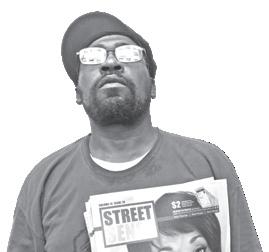
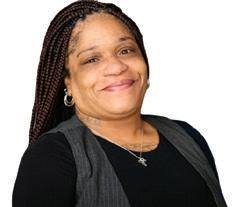
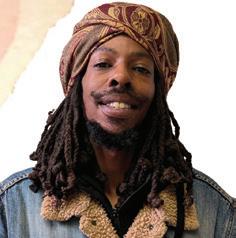
e provide people experiencing homelessness and poverty in D.C. with a low barrier economic opportunity to earn an income. Each one of our vendors functions as an independent contractor for Street Sense Media, managing their own business to earn an income and increase stability in their lives.
Vendors pay per paper
$3
You pay Vendors keep all of your contribution!
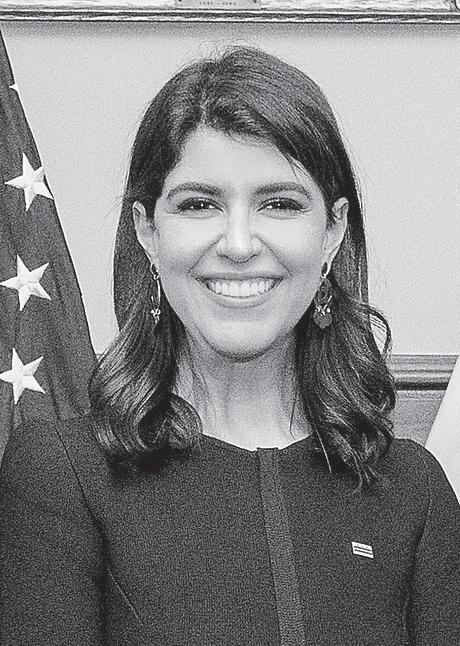
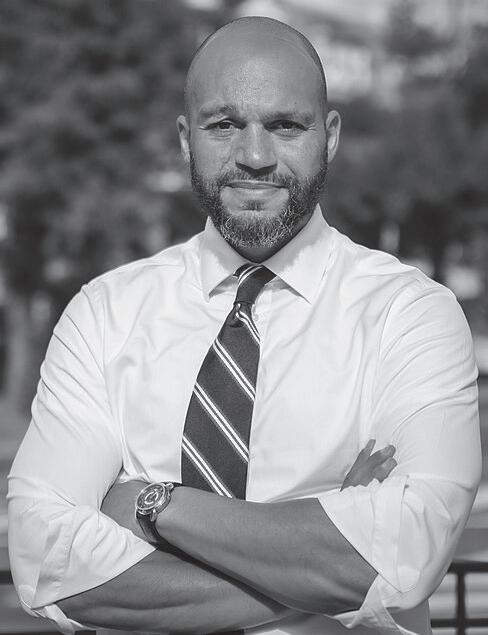
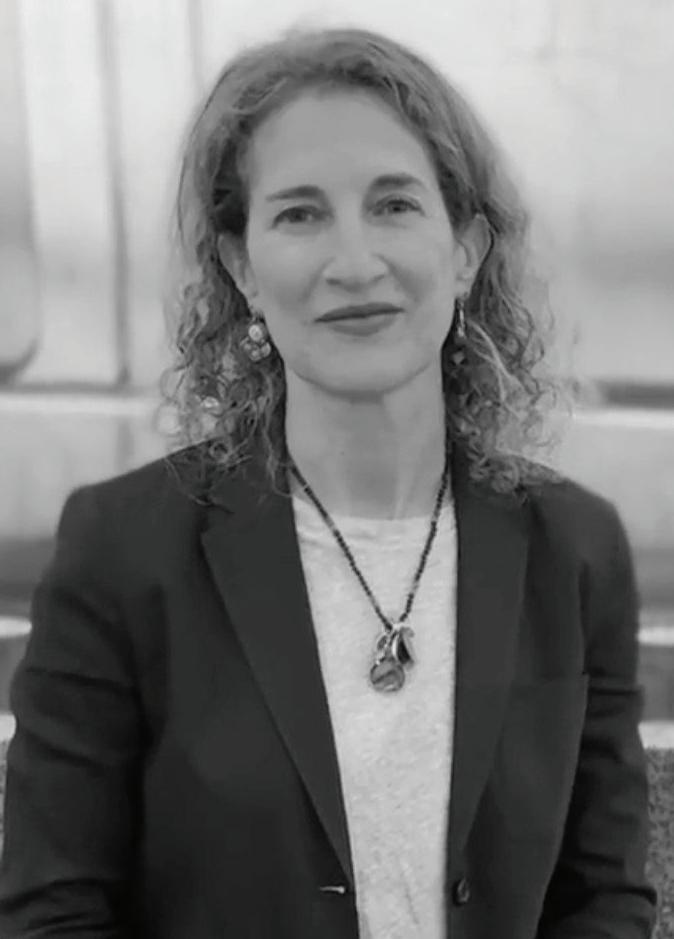
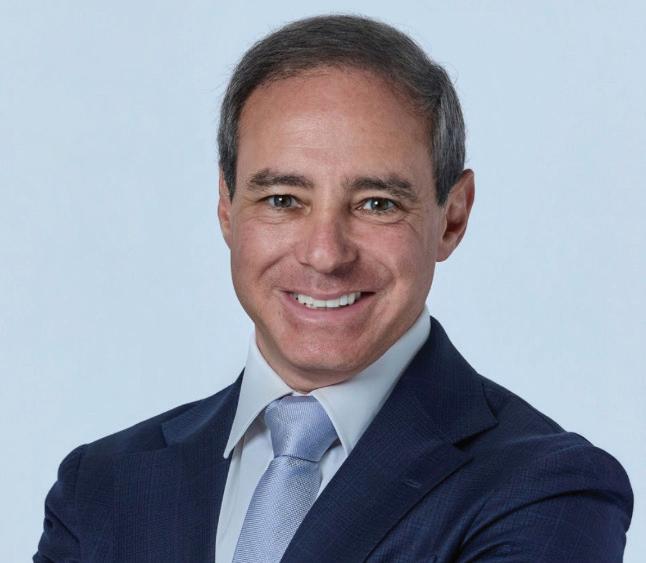
The Cover COVER DESIGN BY KEVIN AKAKPO, PHOTOS COURTESY OF CAMPAIGNS
Abel Putu, Abraham Aly, Archie Thomas, Aida Peery, Akindele Akerejah, Alia Haug, Amia Walker, Andre Brinson, Andre Baltimore, Andrew Anderson, Angie Whitehurst, Angela Morris, Anthony Carney, Apollos Robinson, Beverly Sutton, Brian Holsten, Brianna Butler, Cameé Lee, Carlos Carolina, Carlton Johnson, Charles Armstrong, Chris Boone, Chris Cole,
Chon Gotti, Conrad Cheek, Craig Thompson, Cynthia Herrion, Daniel Ball, Darrel Stone, Darlesha Joyner, David Snyder, Debora Brantley, Degnon Dovonou, Dominique Anthony, Don Gardner, Drake Brensul, El-O-Him, Elizabeth Windsor, Elynora Houston, Eric Glover, Eric Jamison, Eric Thompson-Bey, Evelyn Nnam, Faith Winkler, Flegette Rippy, Frederic John, Frederick Walker, Gerald Anderson,
Gloria Prinz, Gracias Garcias, Greta Christian, Henry Johnson, Invisible Prophet, Ivory Wilson, Jacqueline Gale, Jacqueline Turner, James Davis, James Hughes, James Lyles III, Jay B. Williams, Jeanette Richardson, Jeff Taylor, Jeffery McNeil, Jemel Fleming, Jenkins Dalton, Jennifer McLaughlin, Jewel Lewis, John Littlejohn, Josie Brown, Julienne Kengnie, Kenneth Middleton, Kannon
Brown, Katrina Anige, Kendarius Tucker, Kym Parker, L.Q. Peterson, Lawrence Autry, Leo Hughes Jr, Levester Green, Lillie Thomas II, Marc Grier, Marcus McCall, Mars, Maurice Carter, Melody Byrd, Melveon Harp, Milan Stevenson, Monique Rivers, Nikila Campbell, Patricia Donaldson, Patty Smith, Paul Martin, Phillip Black, Qaadir El-Amin, Queenie Featherstone, Rachelle Ellison, Randall
Smith, Rashawn Bowser, Reginald Black, Reginald Denny, Reneece Brinkley, Ricardo Meriedy, Richard Mooney, Rita Sauls, Robert Reed, Robert Vaughn, Robert Warren, Rochelle Walker, Ron Dudley, Ronnell Wilson, S. Smith, Sasha Williams, Saul Presa, Shawn Fenwick, Sheila White, Shuhratjon Ahmadjonov, Stephen Lennon, Starchild BLK, Susan Wilshasen, Sybil Taylor, Tasha Savoy, Tim Holt,
Warren
Williams, Tony Morris, Vincent
Wayne
Wendell Williams, Wendy Brown, William Hargrove, William Shuford, Willie Futrelle, William Young, Zero
BOARD OF DIRECTORS Clare Krupin, Chris Curry, Cole Ingraham, David Grant, Jonquilyn Hill, Matt Perra, Michael Vaughan Cherubin, NanaSentuo Bonsu, Phil Telfeyan
Tonya
Watts, Warning Label,
Stevens,
Hall,
Mayor’s proposed budget cuts D.C. Interagency Council on Homelessness staff to one
ELIZABETH SHORT
Editorial Intern
Among the losers in this year’s budget fight could be the city’s office focused on homelessness.
Mayor Muriel Bowser’s proposed budget for fiscal year 2027, which she released in April, includes cuts for the office of the Deputy Mayor for Health and Human Services (DMHHS) and the Department of Human Services (DHS). These will be felt severely by D.C.’s Interagency Council on Homelessness (ICH), Deputy Mayor for Health and Human Services Wayne Turnage testified at a May 11 hearing.
Under the proposed budget, the office would have just one staff member to coordinate meetings across homeless services and create and implement the city’s new plan to end homelessness. The cut to the ICH comes in a budget that also proposes reducing homeless services programs and permanent supportive housing.
The ICH is the sole office in the District dedicated exclusively to homelessness. The council brings together advocates, homeless service providers, representatives from local government, and community members who have experienced homelessness to inform and guide policy on homelessness. The ICH runs weekly meetings to discuss the state of homelessness in the city and coordinate solutions.
The ICH is responsible for completing D.C.‘s “Homeward” plans, which have governed the District’s response to homelessness during Bowser’s time as mayor. While the latest plan, Homeward DC 2.0, expired in September 2025, the ICH has yet to issue Homeward DC 3.0, partially due to a staffing shortage.
The ICH has not had a full staff in years, and had only one employee for several months last year during the mayor’s hiring freeze. When short on staff, the office has sometimes had to scale back on meetings and delay legally mandated reports on homelessness in the District.
The proposed fiscal year 2027 budget eliminates seven full-time positions, including five that are currently filled. If the budget passes as is, the only remaining employee would be executive director Theresa Silla, who has been the council’s only consistent staff member since 2021.
This comes just months after Rachel Molly Joseph, DMHHS chief of staff, testified ICH had brought on new staff to “kickstart” the council’s update to its annual priorities. (As of January, the office was still operating on its 2024 priorities.) However, this new budget would eliminate all of these positions.
“What changed was the lack of dollars to pay for the positions,” Turnage testified at a May 11 Committee on Health budget oversight hearing, referencing cuts at DHS, which partially funds ICH. “The agency that funds those positions is under significant stress, and given the other challenges they had. So we, at the end of the day, decided that we should do as much as we can to preserve as much as we can of the funding agency, and as a result those positions were eliminated.”
The city created three of the new staff positions with the possibility of them being short-term. The staff will work through September to support the completion of Homeward D.C. 3.0. At the May 11 meeting, District officials said they expect to present the plan in June, before the proposed layoffs. Joseph testified that two vacant positions within DMHHS could be repurposed to support ICH efforts if needed. Silla, the ICH’s executive director, did not testify at the May 11 Committee on Health budget oversight hearing and did not respond to a request for comment.
Turnage stressed the struggle these budget cuts would create for Silla and her work at the ICH. “I don’t want to dismiss the difficulty that the ICH director will have in continuing to do the kind of work that she has expertly provided,” he said. “It will be a challenge with no staff. And frankly, we will have to huddle with her to see how we can best move forward in the absence of the support she customarily has.”
EVENTS AT SSM
ANNOUNCEMENTS
□ The office will be closed Monday, May 25, for Memorial Day.
□ The May vendors meeting is Friday, May 22, from 2:00 p.m. - 3:00 p.m. Come for business, community, and pizza!
□ The yoga workshop will now start the day on Thursdays! Every Thursday from 9:30 a.m. - 10:30 a.m. Come get a mid-morning stretch in!
□ Find a list of vendor announcements and other useful information just for you at streetsensemedia. org/vendor-info.
BIRTHDAYS
CHIEF EXECUTIVE
OFFICER
Brian Carome
DIRECTOR OF PROGRAMS
Darick Brown
DIRECTOR OF VENDOR
EMPLOYMENT
Thomas Ratliff
EMPLOYMENT SPECIALIST
Esmat Amin
Reginald Black May 23
ARTIST/VENDOR
VENDOR PROGRAM
ASSOCIATES
Aida Peery, Chon Gotti, Nikila Smith
VENDOR PROGRAM
VOLUNTEERS Ann Herzog, Aiden
Eisenschenk, Beverly Brown, David Fucillo, Roberta Haber, Stephen Lennon
EDITOR-IN-CHIEF Annemarie Cuccia
DEPUTY EDITOR
Donte Kirby
EDITORIAL INTERNS
Eric Jamison May 24
ARTIST/VENDOR
Aubrey Butterfield, Elizabeth Short, Kordell Martin, Natalie Note
WEB INTERN Zachi Elias
GRAPHIC DESIGN INTERNS
Arisha Shumael, Kevin Akakpo
ARTISTS-INRESIDENCE
Alexandra Silverthorne (Photography), Bonnie Naradzay (Poetry), David Serota (Illustration), Willie Schatz (Writing), Molly Pauker (Watercolor), Debbie Menke (Watercolor), JM Ascienzo (Yoga)
Ron Dudley May 30
ARTIST/VENDOR
EDITORIAL VOLUNTEERS
Andrew Chow, Anne Eigeman, Chloe DiStaso, Dasia Jones, Eli Robinson, Nora Scully, Rachel Santarsiero, Sara Mangelsdorf
VENDOR CODE OF CONDUCT
Read this democratically elected code of conduct, by vendors, for vendors!
1. I will support Street Sense Media’s mission statement and in so doing will work to support the Street Sense Media community and uphold its values of honesty, respect, support, and opportunity.
2. I will treat all others, including customers, staff, volunteers, and fellow vendors, respectfully at all times. I will refrain from threatening others, pressuring customers into making donations, or engaging in behavior that condones racism, sexism, classism, or other prejudices.
3. I understand that I am not an employee of Street Sense Media but an independent contractor.
4. While distributing the Street Sense newspaper, I will not ask for more than $3 per issue or solicit donations by any other means.
5. I will only purchase the newspaper from Street Sense Media staff and volunteers and will not distribute newspapers to other vendors.
6. I will not distribute copies of “Street Sense” on metro trains and buses or on private property.
7. I will abide by the Street Sense Media Vendor Territory Policy at all times and will resolve any related disputes with other vendors in a professional manner.
8. I will not sell additional goods or products while distributing “Street Sense.”
9. I will not distribute “Street Sense” under the influence of drugs or alcohol.
10. I understand that my badge and vest are property of Street Sense Media and will not deface them. I will present my badge when purchasing “Street Sense” and will always display my badge when distributing “Street Sense.”
Homelessness rises in D.C., Virginia, drops in Maryland
KORDELL MARTIN Editorial Intern
Homelessness in D.C. and Virginia rose by 4.4% and 5%, respectively, in 2025, according to this year’s Point-in-Time (PIT) Count results. D.C. Mayor Muriel Bowser and the D.C. Department of Human Services released the results for the 2026 PIT Count on May 12.
This year, icy conditions prevented the District and some counties in Maryland and Virginia from conducting the usual canvassing of unsheltered residents. Instead, the unsheltered count relied on data collected by outreach groups. People staying in shelters were counted as usual.
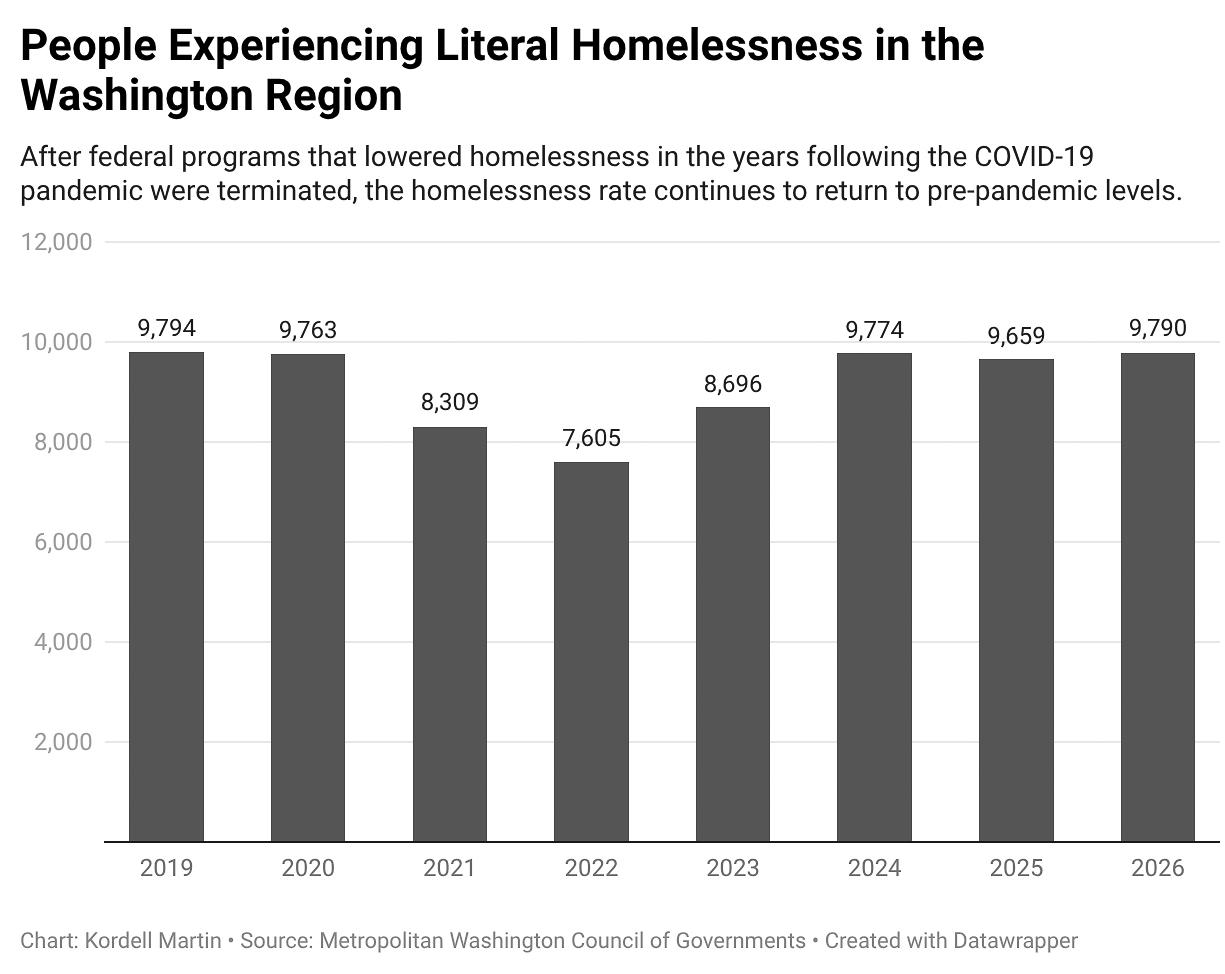
The rate of homelessness across the Washington region remained relatively steady, increasing slightly by 1.3%, according to a report from the Metropolitan Washington Council of Governments (COG), released May 13. There are 9,790 people experiencing homelessness in the region — 131 more than recorded in the 2025 count. 1,230 people, 13% of this population, are unsheltered. Another 28,899 formerly homeless individuals in the region are in Permanent Supportive Housing, Rapid Rehousing, and other forms of supportive housing.
The PIT Count is often considered to be an undercount as it aims to tally a region’s overall homeless population in a singular night, not the course of a year. Factors such as weather, timing, and location can affect the accuracy of these estimates, and the count does not capture people staying with family, friends, or in hotels with no permanent place to live.
During a COG meeting on May 13, Christine Hong, chief of Services to End and Prevent Homelessness in Montgomery County, said the region’s homelessness rate is reverting to preCOVID-19 pandemic levels, as the area is no longer experiencing the impacts of the termination of pandemic-era programs. Federal funding through the CARES Act and the American Rescue Plan Act initially helped homelessness drop by 22% between 2020 and 2022. With the expiration of funding, homelessness ticked back up in 2023 and 2024. Homelessness has increased by 3% this year compared to the 2019 count.
“The main takeaway is that regional homelessness is no longer increasing at the pace seen in 2023 and 2024 and is in line with the year immediately preceding the pandemic,” Hong said.
D.C. rate rises
During the count on Feb. 4, D.C. recorded 5,363 people experiencing homelessness. This was a 4.4% increase from 2025, representing 225 people. The city saw a 9.3% decrease in unsheltered residents, though 13% of the homeless population remains unsheltered. This decline may reflect the impact of President Donald Trump’s federal takeover of the District last year. Many residents were forced to leave encampments in August as the Metropolitan Police Department conducted encampment closures. The District holds 56% of single unsheltered adults in the Washington region.
Despite family shelter entries declining by 30% this year, family homelessness rose by 15.6%, according to the 2026 COG PIT Count analysis. In her press release, the mayor attributes this increase to longer stays in family shelters as the city prioritizes permanent housing services over temporary services.
Samuel Kenney, senior housing and homelessness planner for the Metropolitan Washington Council of Governments, told Street Sense the COG did not identify a specific reason for the rise in the District’s homeless population, since factors vary among different jurisdictions.
“This could be a variety of things. Weather can be a factor. So if more people are likely to be sheltered when it’s very cold, which it was, sometimes it’s easier to count those people because they are in a shelter.”
Kenney said the results from this year’s PIT Count are largely in line with the results from the 2025 count.
Maryland rate drops
Homelessness in the surrounding Maryland suburbs declined by a combined 10% to 1,903 people. Most of this decrease was recorded in Montgomery County, which holds the highest homeless population in Maryland. The county’s homeless population dropped by 390 people, 26% lower than the 2025 PIT Count.
Family homelessness in the county dropped by 53% to 378 people after a sharp increase last year to 712 individuals. Hong said this drop is attributed to the county’s investment in its Short-term Housing and Resolution Program (SHaRP), as housing costs and the cost of living are major drivers of homelessness among low-income families.
“The investment in SHaRP has allowed us to also reduce our emergency shelter expenses for families this year by 59%,” Hong said. “The most important thing, though, is that we are saving so many families from the trauma of a long-term experience of homelessness.”
However, Prince George’s County added 175 individuals to its homeless population this year, a 29% increase from 2025. Ten percent of people experiencing homelessness in the two counties remained unsheltered.
An uptick in Virginia
Four Virginia counties and the city of Alexandria experienced a combined 5% uptick in homelessness, with 2,524 people experiencing homelessness in the area. Homelessness in Loudoun County jumped by 25%, with an additional 63 residents experiencing homelessness. Alexandria recorded the second-highest percentage increase in homelessness after Loudoun County, with its homeless population rising 14%.
Fairfax County holds the largest homeless population in the Virginia portion of the metropolitan area, with 1,365 residents experiencing homelessness. The suburban county recorded an additional 43 residents experiencing homelessness compared to last year. Arlington County and Prince William County both experienced a small, 1% reduction in homelessness. The analysis recorded a total of 214 unsheltered residents across the Virginia counties, accounting for 8% of the area’s homeless population.
Following the increases in D.C. and Virginia, Kenney said the strongest response to homelessness in the region is a coordinated system of services. He described a system that prevents entries into homelessness, provides safe shelter, shortens the time people are experiencing homelessness and helps people find permanent housing options.
“That is what the homeless services system is designed to do,” Kenney said. “We have to be aware that 9,700 people is entirely too many.”
Advocates push back against proposed cuts to homelessness services
AUBREY BUTTERFIELD Editorial Intern
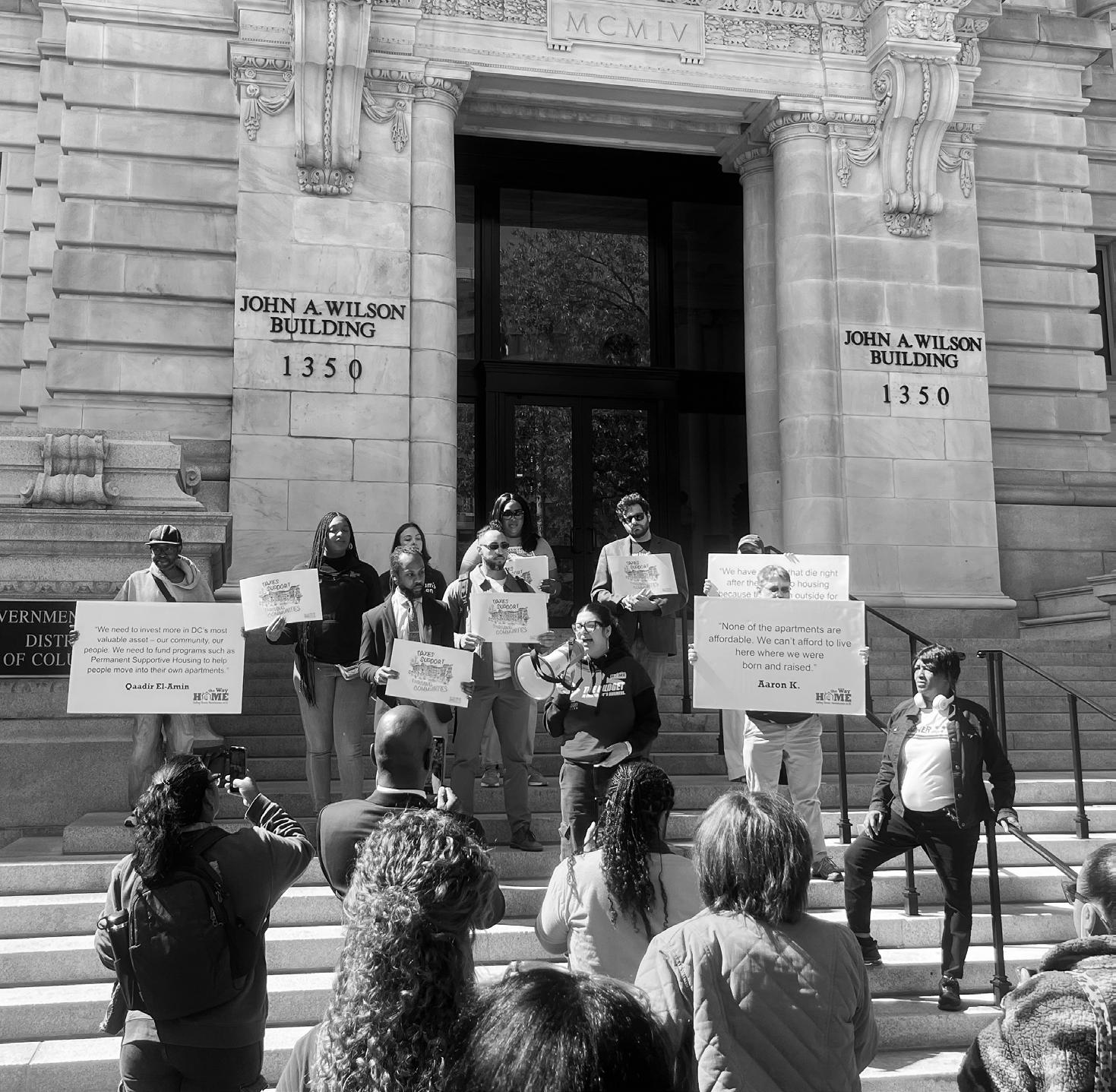
In early May, a small group of homeless services advocates traipsed through D.C.’s Wilson Building, bearing strange gifts for the city’s leaders: small wooden banks in the shape of houses. The banks were empty, representing what advocates see as a lack of investment in ending homelessness in the city’s proposed budget. They want them full.
Following a proposed 7.5% decrease in the Department of Human Services’ (DHS) funding in Mayor Muriel Bowser’s fiscal year 2027 budget, the agency has projected cuts, including to pillars of D.C. homelessness services. Advocates, led by the Way Home Campaign, have decried these reductions, testifying at an April 30 budget oversight hearing and holding a rally at the Wilson Building.
On May 12, before going inside to deliver their house-banks, a group of about 40 people gathered, calling on the D.C. Council to reverse cuts to homeless services and add funding for new vouchers to bring people out of homelessness. While lawmakers have been insistent it is a tough budget year and the city has to make cuts to valuable programs, advocates from Miriam’s Kitchen, Everyone Home DC, the Fair Budget Coalition, and other groups argued D.C. can find ways to fund programs important to its residents, including through a wealth tax.
At least some councilmembers agree. During a May 19 budget discussion, Ward 1 Councilmember Brianne Nadeau suggested D.C. add a tax on income earned from investments, based on a 2025 report from the Institute on Taxation and Economic Policy. It found adding a 2% local tax on wealth already reported and taxed by the federal government could generate $120 million. The tax would apply to income earned from interest, dividends, and capital gains for households making over $250,000, and would impact 9% of D.C. taxpayers.
Other councilmembers suggested alternative ways to raise revenue. Ward 3 Councilmember Matt Frumin brought up both a temporary increase to the income tax and a tax on second homes. Council Chairman Phil Mendelson, who is generally opposed to tax increases, said he had found an additional $420 million in revenue the council could add to programs. More formal proposals are expected in the coming weeks.
Advocates who testified at the April 30 hearing hoped any additional money could be used to reverse cuts to core programs supporting people who are homeless and those at risk of homelessness, including Temporary Assistance for Needy Families (TANF), the Emergency Rental Assistance Program (ERAP), and Permanent Supportive Housing (PSH) vouchers.
A substantial number of public witnesses raised concerns regarding the capacity limits of PSH. Bowser’s budget doesn’t add any PSH vouchers, meaning those in need of housing through the program will have to wait. PSH is set to lose over $4.4 million in funding in FY27, raising concerns for current voucher holders. According to advocacy group the Way Home Campaign, the cuts could put up to 200 households currently receiving PSH at risk of losing their housing. DHS is still working to secure the $15 million necessary to maintain all current PSH vouchers, officials said at a May 6 hearing.
Even if all existing vouchers are protected, advocates argue there’s a high unmet need for PSH vouchers. The Way Home Campaign identified at least 1,284 individuals and 782 families it says would benefit from the voucher, and is asking the council to add vouchers to cover those households.
The group also wants the city to reverse cuts they say would mean fewer services at day centers, including the elimination of Shirley’s Place, a day center run by Everyone Home D.C. According to the group’s website, the center served nearly 10,000 meals in 2025. In the May 6 hearing, DHS officials said the center was doing great work, but the city has three other drop-in centers, so DHS made the difficult decision to cut funding.
Advocacy groups also rang alarm bells about shrinking resources for at-risk populations within the homeless community, including victims of domestic violence and D.C.’s youth.
Advocates for survivors of domestic violence noted homicides and domestic-violencerelated crime have spiked, despite the overall decrease in crime in the District. These advocates emphasized those at risk of homelessness are at greater risk of experiencing domestic violence and funding for programs supporting victims must be maintained. Programs specialized for assisting survivors of domestic violence are projected to lose $685,000 in funding.
Youth homeless funding, meanwhile, is projected to take a $2.3 million hit, Rachel White with D.C. Action explained at the May 12 rally. This includes cuts to programs preventing youth homelessness like the Pass Program and the Strengthening Teens Enriching Parents Program alongside cuts to permanent supportive housing, transitional housing, drop-in centers, and workforce development. The decrease will mean 28 fewer beds for youth, according to the Way Home Campaign.
Flo White, a case manager at Sasha Bruce Youthwork and a former homeless youth, emphasized the challenges youth face, including often waiting six to nine months to be placed in a housing program and a lack of familial support. White worries youth curfews will criminalize young people in search of housing.
“When you cut funding to youth homelessness programs, you are not just cutting numbers on a spreadsheet. You are cutting access to safety,” White said. “It looks like young people sleeping outside, young people being forced to choose between unsafe situations in the streets, and it looks like increased exposure to violence, exploitation, and long-term trauma.”
D.C. residents also spoke out about cuts to programs for low-income residents, like food assistance and eviction prevention.
Currently, TANF is projected to lose over $16 million from its cash assistance program. This means TANF benefits, which are already dropping for some families this year, will be entirely eliminated for families who have been on the program for more than five years in October 2027. Public witness Monique Jackson, who relies on the program for housing payments and basic needs, said TANF is designed as temporary aid, and those receiving TANF are truly in need of the assistance. People qualifying for TANF are also limited in other sources of financial support.
Even though the program doesn’t provide for the full needs of families, Jackson said D.C. families like hers rely on TANF. As the mother of a young son working on her education following the loss of her job due to budget cuts and health issues, Jackson said she “could not envision” the harm that would come to her and her son if the program is cut.
“Any cuts will place me lower below the poverty line than I already fall in,” Jackson said. “Cuts to TANF would tremendously affect me and my family in a truly devastating way.”
Additionally, ERAP, which covers rent for low-income residents in cases of emergency, is expected to be cut by $1.6 million. The program has been successful in preventing evictions, according to Philip Johnson, a legislative advocacy fellow to the United Planning Organization. However, ERAP has been a target for cuts for years, with the council often coming in to restore funding the mayor cut.
Johnson testified that without proper ERAP funding, more expensive systems such as homeless shelters, emergency rooms, and the court system will bear the brunt of the consequences of growing evictions. He said the program requires $30 million, because the city has failed to provide an adequate alternative system for the program.
“Prevention is cheaper than a crisis response,” Johnson said. “If ERAP is not for low-income residents facing eviction, where is the funded alternative?”
The council is meeting over the coming weeks to develop its budget recommendations, including any new taxes. A first vote on the budget is expected on June 9, at which point advocates will learn if their banks, now sitting in councilmembers’ offices, will remain empty.
Annemarie Cuccia contributed reporting.
Community advocates gather on the steps of the Wilson Building to ask for more money for the homeless services system this year. Photo by Annemarie Cuccia
D.C. PRIMARY VOTER GUIDE
D.C.’s primary election is next month.
Here’s what to know
Part 1: Meet the mayor, AG, and delegate candidates
ELIZABETH SHORT Editorial Intern
OHow to vote
n June 16, D.C. will hold its primary election, which will determine who is on the ballot this November. The Democratic nominees will all be heavily favored to win in the November general election; over 75% of D.C. voters are registered as Democrats, and D.C. has never elected a Republican mayor. Seats up for election city-wide include the D.C. mayor, attorney general, non-voting delegate to the House of Representatives, and two at-large D.C. Council seats. Wards 1, 3, 5, and 6 will also elect councilmembers.
All D.C. residents, including U.S. citizens and non-citizens, who will be at least 18 by the general election on Nov. 3, 2026, can register to vote with a party in this election.
Residents can register to vote or update their registration online or with a registration form through May 26. Registration forms are available online, at the Board of Elections office (1015 Half St. SE #750), or at most public libraries. Voters registered as a Democrat, Republican, or D.C. Statehood Green can vote in the June 16 election, though there are only competitive races in the Democratic primary this cycle. Independent voters cannot vote in the primary election, but can vote in a special election for an at-large seat on the council.
All residents can register to vote during early voting or on Election Day by bringing proof of D.C. residency to the polling center. People experiencing homelessness can use the address of a shelter, park, or intersection, as long as they can provide documentation of residency within the District (this could be an occupancy statement from a D.C. shelter or a current D.C. ID).
Early voting will run from June 8 to June 14. On Election Day, polls across the District will be open from 7 a.m. to 8 p.m. Voters can go to any voting center regardless of their address. Every registered voter will also receive a ballot in the mail (paid postage is included). To vote by mail, the completed and signed ballot must be postmarked by June 16, and must arrive by June 26. Track ballots on BallotTrax.
Ranked-choice voting
This election will be the first time D.C. voters will use ranked-choice voting. Voters will have the opportunity to vote for up to five candidates per election, ranking candidates in order of preference, starting with their favorite at rank one.
Ranked-choice voting does not split one person’s vote between different candidates. Rather, it allows the vote to go to a second or third choice candidate if the voter’s first choice doesn’t have substantial support. In the first count, everyone’s vote goes to the candidate they ranked at number one. At this point, if no candidate gets 50% of the votes, the candidate with the fewest votes is eliminated, and their votes are redistributed to the candidates each voter ranked second, and so on. A candidate only wins by receiving 50% of votes. Races with only two candidates do not use ranked-choice voting.
Brandon Bush-Thompson, engagement coordinator from Rank the District, said the new voting system will allow voters to focus more on values and policy, instead of casting votes based on who is most likely to win.
Voters should select one candidate for multiple rankings or multiple candidates for one rank, he said, as it could invalidate their ballot. Instead, voters should choose their favorite candidate as rank one, and then select any other candidates they would be comfortable with seeing in office in order of preference. Voters do not have to fill all five ranks.
“If there’s a candidate who you do not like, do not rank them at all,” Bush-Thompson said. If a voter ranks a candidate, they are signifying they would be comfortable with the candidate getting their vote, he said.
Advocates argue ranked-choice is more inclusive than standard voting and the process results in more equitable and representative elections. Bush-Thompson said this system gives voters the opportunity to share their voices in a more democratic way. “If there was ever an opportunity for people’s voices to be heard, this is a system that could give us that opportunity,” he said. “I’m really hoping that people take advantage of it in that way.” he said. “I’m really hoping that people take advantage of it in that way.”
The candidates
D.C. is a different city than it was when it held its last election in 2024. Last August, the Trump administration took over law enforcement powers in the city and cracked down on visible homelessness. Local programs addressing homelessness and poverty are at risk due to changes in funding at both local and national levels. The newly elected lawmakers will shape the District’s response to these issues, among others.
This election comes shortly after Mayor Muriel Bowser released her budget for fiscal year 2027, which included significant cuts to D.C. homeless services, supportive housing vouchers, and additional safety net programs, including domestic violence services and Temporary Assistance to Needy Families.
Street Sense asked all the candidates on the ballot about these issues and more. This guide includes a summary of their responses. Find full responses for each candidate on our website.
Attorney general
The attorney general is responsible for enforcing the District’s laws and for representing the interests of D.C. residents. The winner of the Democratic primary will run against Republican Manuel Rivera in November.
Brian Schwalb is the incumbent attorney general. Since Schwalb took the position in 2023, the office has secured millions of dollars from landlords for tenants living in illegal conditions. This includes a $41 million judgment against the former owners of the Marbury Plaza apartment complex for inhumane conditions. The office won the judgment, which was one of the largest housing conditions judgments made against a landlord in United States history, in November. Schwalb’s office has also gone after landlords for housing voucher discrimination and exploiting the housing voucher system.
“In a second term as Attorney General, I will continue enforcing DC’s housing laws to protect tenants from exploitation, and ensure a fair, safe, and competitive housing market for all District residents and for law-abiding housing providers who are entitled to compete on a level playing field,” Schwalb wrote in response to Street Sense’s questionnaire.
When the Trump administration began to use federal troops to remove homeless encampments across the District, Schwalb’s office released an advisory about the rights of people experiencing homelessness. Schwalb said he would continue to publish accessible advisories. “And when those rights are violated, I will use the full authority of [Office of Attorney General for the District of Columbia] — through enforcement, litigation, and legal intervention — to protect vulnerable residents and uphold the District’s laws,” he wrote.
Read Brian Schwalb’s full questionnaire on our website.
J.P. Szymkowicz is the advisory neighborhood commissioner for Foxhall. According to his campaign website, Szymkowicz will fight “for solutions that address the root causes of crime,” including affordable housing. He also says he will hold landlords accountable and enforce housing codes. Szymkowicz did not respond to Street Sense’s questions.
Brian Schwalb. Photo courtesy of Brian for DC
Delegate
Eleanor Holmes Norton, who has been D.C.’s non-voting delegate to the House of Representatives since 1991, is retiring. For the first time in over three decades, the District will have a new delegate. This delegate represents the D.C. in the U.S. House of Representatives, but cannot vote on bills, and has traditionally led advocacy for D.C. statehood. The Democratic nominee will run against Republican Denise Rosado. Councilmembers Robert White and Brooke Pinto are considered favorites in the race.
Trent Holbrook is an attorney who has worked for Congresswoman Eleanor Holmes Norton for the last eight years. There is nothing on his campaign website about housing or homelessness. He did not respond to Street Sense’s questions.
Greg Jaczko, a physicist, served as the chairman of the U.S. Nuclear Regulatory Commission during Barack Obama’s presidency and is a lecturer at Princeton.
In response to Street Sense’s questions, Jaczko said he would prioritize Housing First supportive housing models, “focusing specifically on expanding Permanent Supportive Housing and restoring the federal credit programs — decimated by recent administrations — that help first-time buyers and low-income residents bridge the gap to stability.”
Jaczko said he firmly opposes a national camping ban and called the Johnson v. Grants Pass decision, which allows cities to arrest people sleeping outside, a “policy failure…Instead of punishing individuals for a lack of options, the federal government should be accelerating the transfer of underutilized federal land to the District to create the permanent, service-supported housing that actually solves the root cause,” he wrote. Jaczko pledged to have an open-door policy and promote engagement with unhoused D.C. residents. “By ensuring those with lived experience have a direct line to my office, I will ensure our policy decisions are informed by the reality on the ground,” he wrote.
Read Greg Jaczko’s full questionnaire on our website.
Brooke Pinto is an attorney who has worked in the D.C. Office of the Attorney General and is the Ward 2 councilmember and chair of the Judiciary and Public Safety Committee. As councilmember, Pinto voted for a bill advocates say would have weakened tenant protections, and against bills that increased funding for permanent housing and would have paused encampment closures in the winter. She has been involved with the opening of the Aston, the city’s first non-congregate shelter, which is in her ward, though some advocates have criticized her for supporting a lower cap on the number of people the shelter can serve.
On Pinto’s campaign website, she has a proposed housing plan for the District, calling housing the “fight of our generation.” Nationally, Pinto has proposed to make rent tax-deductible, similarly to mortgage interest for homeowners, and changes to the tax code and zoning laws to encourage developers to build more housing. She also supports the shift to non-congregate shelters, like the Aston: shelters that are “smaller, supportive, dignity-centered housing that gets people into stable situations faster and keeps them there. I will fight for federal capital to build additional noncongregate bridge housing models like the Aston, in neighborhoods across DC and America.” Pinto did not respond to Street Sense’s questions.
Robert White is an attorney who has served as an at-large representative on the D.C. Council since 2016 and ran for mayor in 2022. Serving as a councilmember, White voted for a law that increased taxes on millionaires to fund permanent housing and a bill that would have suspended encampment clearings during hypothermia season, and he voted against a bill advocates said would have weakened rights for renters. He’s been outspoken about issues around homelessness in the past, speaking to residents at the McPherson Square encampment before its closure in 2023 and asking for the closure to be delayed.
Since 2023, he has served as chair of the Council’s Committee on Housing, leading oversight of the D.C. Housing Authority as the agency transitioned to a new board and responded to federal audits. Investing in affordable housing will be a priority for White, according to his campaign website: “Lowering the cost of living and building economic mobility by launching a bold D.C. Forward Economic Plan to secure federal resources for affordable housing, workforce development, and jobs—particularly for residents without college degrees.” White also told the Ward One Democrats he would prioritize housing, childcare, and affordability, and pledges to address housing insecurity on his website. White did not respond to Street Sense’s questions.
Kinney Zalesne has experience working in nonprofit, business, and public sectors in D.C. Working for nonprofit Peer Forward, Zalesne worked with students experiencing homelessness to ensure they could attend college. “As delegate, I will ensure that my constituent services personnel conducts outreach to individuals in shelters and experiencing homelessness,” she wrote in response to Street Sense’s questions.
Zinney said she would fight to protect national housing and homelessness funding. “The root cause of homelessness for most people is a lack of affordable housing,” she wrote. As delegate in the House, she said she would advocate for increased federal funding of affordable housing, “including expanding Low-Income Housing Tax Credits and supporting community land trusts that permanently protect affordability.” She also supports modifying the Height Act to allow taller buildings in downtown D.C.
She said she would also use her position to ensure the U.S. Department of Housing and Urban Development “is executing its mandate to the highest standards” when it comes to funding services dedicated to ending homelessness. Zalesne said she would not support the criminalization of homelessness or a national camping ban.
Read Kinney Zalesne’s full questionnaire on our website.
Kinney Zalesne. Photo courtesy of Kinney for DC
Greg Jaczko. Photo courtesy of Greg Jaczko for Congress
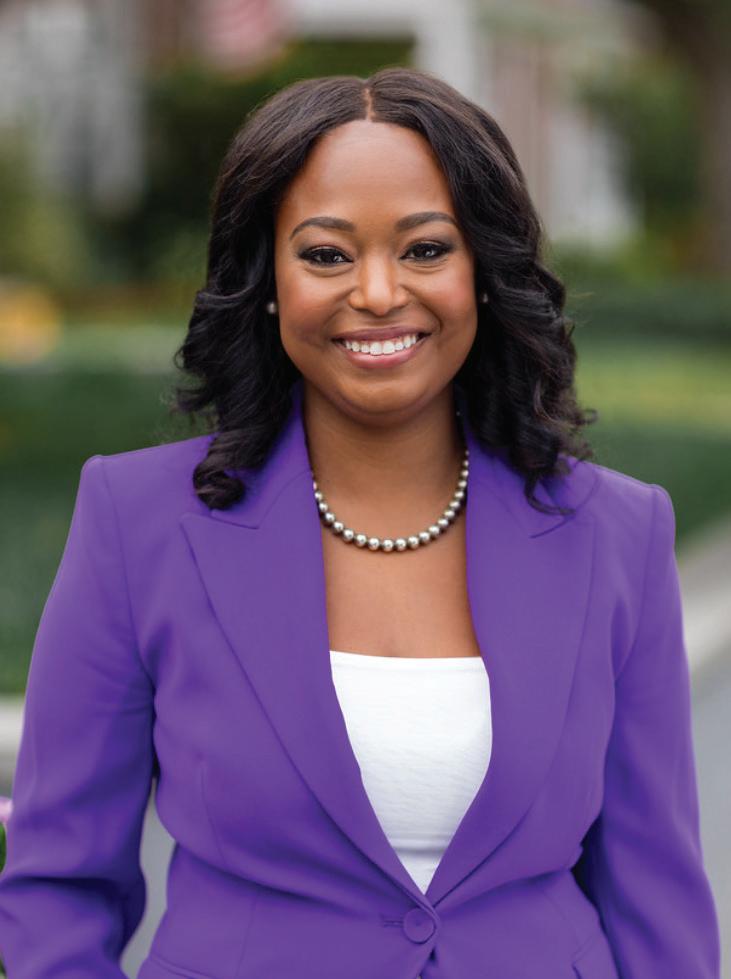
Brooke Pinto. D.C. Council portrait
Robert White. D.C. Council portrait
D.C. PRIMARY VOTER GUIDE
Mayor
D.C. will have a new mayor for the first time since 2015. Bowser, who won three consecutive mayoral elections starting in 2014, did not opt to run for re-election in 2026. The mayor oversees the local government, including law enforcement and the District budget.
Councilmember Janeese Lewis George and former Councilmember Kenyan McDuffie are considered heavy favorites in the Democratic mayoral primary. There is no Republican nominee for mayor. The winner of the primary will run against the Green Party’s Robert Gross in November, and a number of independent candidates.
Kenyan McDuffie was elected to the council in 2012, first representing Ward 5 and then the city at-large from 2022 until this January. While serving on the council, McDuffie voted for a bill that advocates say would have weakened tenant protections, and against bills that increased funding for permanent housing and would have suspended encampment clearings during hypothermia season. He has chaired the Committee on Judiciary and Public Safety and the Committee on Business and Economic Development. McDuffie has spoken about the need for more affordable housing, but he has called his opponent, Lewis George’s housing goal unrealistic. “It is rhetoric. It is not reality. I’m delivering reality,” he said in a recent debate. McDuffie has proposed creating 12,000 new units in five years. In response to Street Sense’s questionnaire, he wrote he would work to streamline permitting and expand the use of the District Opportunity to Purchase Act for affordable housing preservation.
He also argued he’s been able to strengthen tenant protections, such as legal representation. “As Mayor I will pair those protection with the kind of supply growth that gives tenants actual leverage,” he wrote. McDuffie argued he has supported the expansion of advisory groups that bring lived experiences to policy, such as the D.C. Commission on Poverty. He said he would take this further by “giving residents who have experienced homelessness genuine decisionmaking authority over how homelessness services are designed and funded, moving well beyond consultative input to real power over program structure and resource allocation.”
For shelters, McDuffie said the city does not have enough beds, and wrote he would “shift away from large congregate shelter models toward smaller, trauma-informed, non-congregate facilities that provide privacy and dignity.”
When it comes to encampment closures, McDuffie argued Bowser’s administration has violated city law by not providing enough notice before closures. “My encampment policy will be grounded in dignity, legal compliance, and a Housing First commitment…As Mayor, I will require that every closure is preceded by meaningful outreach and followed by real housing and service options, including shelter referrals, behavioral health connections, and permanent housing pathways,” McDuffie wrote. In terms of supportive housing, McDuffie told Street Sense he would protect Emergency Rental Assistance funding, expand the Local Rent Supplement Program, and reform Rapid Re-Housing to end arbitrary time limits so that families do not lose housing before they have somewhere else to live. “Keeping people housed costs far less than managing the downstream consequences of displacement across Medicaid, hospitals, and the criminal justice system,” he wrote. Read Kenyan McDuffie’s full questionnaire on our website.
Gary Goodweather is a veteran and real estate developer running for office for the first time. Goodweather is proposing a Housing Accelerator Office to plan housing projects, and would create “permanently affordable housing through community-owned land, mixedincome public social housing, more affordable workforce housing, and an Equity Map so every neighborhood does its fair share.” Goodweather has also committed to building 50,000 new homes by 2032 and to advocate for stronger protections for renters. He also proposed a Cooperative Conversion Program “to help tenants buy their buildings and create long-term stability” and provide a path to homeownership.
Goodweather said D.C. needs more low-barrier and non-congregate shelter options. He said he would advocate for a “full-service housing facility” includes medical, psychological, mental health, and skill training services.
In response to Street Sense’s questions, Goodweather wrote that he would not support encampment closures without connecting people with housing and storage services, adding his policy would be based on Maslow’s Hierarchy of Needs, with housing at number one. “It is the city’s responsibility to provide safe, appropriate housing or shelter, along with transportation, storage for belongings, ID replacement help, health care, behavioral health support, and case management. People should receive clear notice, repeated outreach, and options that meet their actual needs,” he wrote.
Goodweather said he “would not accept a budget that abandons new housing vouchers while thousands of residents remain unhoused or housing insecure.” With a limited budget, he said he would invest in housing vouchers, rapid rehousing, and eviction prevention, as well as social housing, community land, and cooperative ownership. Goodweather is also proposing a “Section 8 to Equity pathway that helps families move from vouchers toward ownership when possible.”
Goodweather also committed to establishing paid advisory roles for people with lived experience of homelessness and requiring Dashboard to track the city’s progress toward its housing goals.
Read Gary Goodweather’s full questionnaire on our website.
Janeese Lewis George is the Ward 4 councilmember, elected in 2020. Serving on the council, she voted for a law that increased taxes on millionaires to fund permanent housing and a bill that would have suspended encampment clearings during the winter. She voted against a bill advocates said would have weakened tenant protections, and a law that restructured the D.C. Housing Authority board. She’s the chair of the Committee on Facilities. In her campaign, Lewis George has proposed creating 72,000 new units of affordable housing by 2030, arguing an ambitious mayor is best equipped to face the housing crisis head-on. “I will also launch Dignified Homes DC, a social housing program that builds publicly owned, mixedincome housing with permanently affordable units,” she wrote in response to Street Sense’s questionnaire. She said she would improve the Housing Production Trust Fund, defend and restore the Tenant Opportunity to Purchase Act, and expand the Safe at Home program, which helps seniors age in their homes.
Lewis George said the city doesn’t have enough shelter to meet the need, and she would support expanding low-barrier and non-congregate homeless shelter options. “Shelter should be a short-term solution. The goal is to make sure no one is stuck in shelter because the city failed to create enough permanent housing,” she wrote. She also argued that she has supported tenants rights in introducing the Do Right By Tenants Act in 2023, “so tenants are not left to enforce the law themselves.”
In terms of encampments, Lewis George said her administration would not clear residents “without a stable path to permanent housing.” Her approach to homelessness will be guided by Homeward DC 2.0, and her administration would work to connect people living in encampments with “shelter, healthcare, treatment, recovery, stable housing, and wrap-around services,” she wrote. “No encampment should be closed unless and until there is a plan for every encampment resident that meets their needs.”
Lewis George also said she would commit to funding enough housing vouchers to address chronic homelessness while also investing in other programs: “Critically, when residents move into housing, they must be connected to real support, including reliable mental health care, trauma-informed support, and wrap-around services,” she wrote. “Furthermore, we must protect our existing community. As we create more deeply affordable housing, we must also preserve existing affordable housing that is at risk of being lost and support vulnerable residents, like seniors, to stay in their homes and age with dignity.”
As a councilmember, Lewis George said she has benefited from learning from people experiencing homelessness. “As mayor, I will continue to listen to and focus on the voices of people with lived experience, particularly by ensuring strong resident voices on the Interagency Council on Homelessness,” she wrote.
Read Janeese Lewis George’s full questionnaire on our website.
Gary Goodweather. Photo courtesy of Gary Goodweather for DC mayor
Janeese Lewis George. Photo courtesy of Janeese Lewis George for DC Mayor
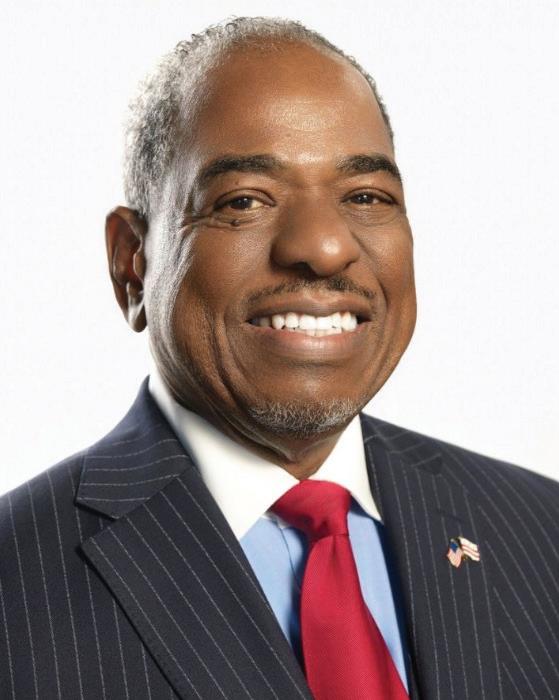
Kenyan McDuffie. Photo courtesy of Kenyan McDuffie for Mayor
Vincent Orange represented the District as an at-large member on the D.C. Council from 2011 through 2016. He has worked as an attorney and accountant.
Orange has proposed building “at least 1,000 highquality, small-footprint homes (not ‘tiny houses’) for seniors, working residents, and recent graduates, delivered by DC-based small businesses.” He said he would accelerate creating affordable housing with the Housing Production Trust Fund and prioritize units for low- to moderate-income families. “I will expand pathways to ownership and stability by strengthening rent support, leveraging public land, and requiring stronger affordability set-asides in new developments,” he wrote.
Orange said he would expand non-congregate shelter options and transitional housing, adding smaller sites for privacy in shelters. He said he would work to reduce overcrowding and shorten shelter stays.
“Ultimately, the goal is not just more beds—but faster pathways from shelter to permanent housing,” he wrote.
For encampment clearings, Orange said he would only carry them out when “adequate housing or shelter options are available and clearly offered,” and that closures should include outreach, case management, options for storage, and placement opportunities. “We should measure success not by how many encampments we close—but by how many people we successfully move into stable housing,” he wrote.
Orange wrote that, given the city’s limited resources, he would prioritize vouchers for D.C.’s “most vulnerable residents.” He wrote that he would work to maximize federal funding for vouchers, improve the program’s efficiency, and ensure funded vouchers are in use. “At the same time, my broader economic plan—jobs, apprenticeships, and income growth — reduces housing instability at its root,” he wrote.
Orange said he has worked with people impacted by incarceration to design programs in the past, and that he would make sure input from people with lived experience is included at every step in the policy process.
Read Vincent Orange’s full questionnaire on our website.
Rini Sampath is a technology executive who has lived in D.C. for 10 years. This is her first time running for office.
In response to Street Sense’s questions, Sampath wrote she would work to expand affordable housing and that she would fully fund the Housing Production Trust and Local Rent Supplement Program. She said she would pursue zoning reform to encourage the construction of more housing and strengthen enforcement of housing code violations.
In terms of shelters, Sampath said she would conduct a shelter capacity audit upon entering office and prioritize expanding non-congregate options. She also said she would work with LGBTQ+ organizations to ensure that these shelter options are safe and supportive. “I will treat the shelter system not as a permanent solution but as emergency infrastructure — the goal is to move people through shelter and into stable housing as quickly as possible, which requires both adequate shelter capacity and a functioning housing placement system on the other end,” she wrote.
Sampath said the District should not close an encampment if there are not sufficient housing and shelter options. Before closures, Sampath’s team would work to ensure that people have “been offered a genuine, appropriate alternative” to living outside. She said that these clearings should not happen during extreme weather, and that she would ensure belongings in encampments would be placed into storage and not discarded.
“The Mayor’s decision to include no new housing vouchers in this budget while thousands of DC residents are on waitlists for housing assistance is a choice I would not make,” Sampath wrote. She said she would protect Emergency Rental Assistance and work to streamline the voucher process.
Sampath also said she would “establish a formal advisory structure for homelessness and housing policy that includes people with lived experience of homelessness.” She said this would include stipends for participation and decision-making authority.
Read Rini Sampath’s full questionnaire on our website.
Two additional candidates, Ernest Johnson and Hope Solomon, will appear on the ballot. Neither responded to Street Sense’s questions. Johnson, a real estate broker, and Solomon, a former federal worker, both mention affordability on their websites, but neither specifically mentions housing or homelessness.
Vincent Orange. Photo courtesy of Orange for Mayor
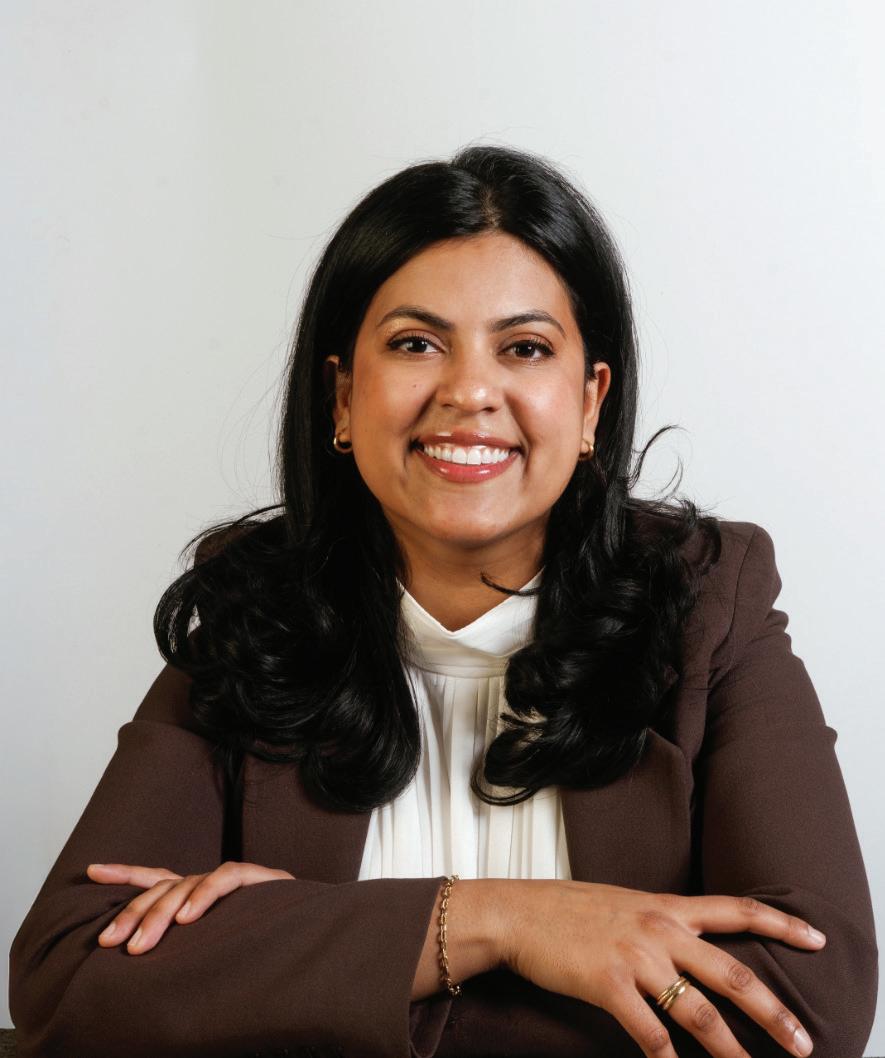
Rini Sampath. Photo courtesy of Rini for Mayor
Permanent supportive housing facade
To the readers who have been in permanent supportive housing: please document publicly what you have experienced. This is crucial to preventing the cover-up of violence. If you live in permanent supportive housing, you know about the nonprofits with staff connected to the community, a community that intentionally creates violent living conditions.
These places are not all created to be safe. The word safe is diabolically reversed with greed and hate. Misogynistic behavior living in permanent supportive housing is not omitting anything, suspiciously.
Each unit has clients who are too comfortable living in public housing. Some have lived in public housing for many years. 20 or more. Many of the residents have family who are connected within the community. Residents have demanded I follow made-up rules that aren’t on paper with suspicious behavior and words. Should I believe the units are overseen by an official, and they make women believe their autonomy is theirs to keep the housing? I don’t know.
Think about all clients’ safety first. Don’t forget the slum landlords who are creepy and predatory. Stop asking popular weirdos to use their property when a nonprofit can afford to run its own housing. The contracts to collect government money while being predatory are enabling violence. This is universal, of course, and predatory can be any type of behavior. In my experience, individuals who run housing programs wrongfully believe we as clients owe them something; our autonomy, mental health, wellness, and safety aren’t prioritized. Their propaganda is selective to assist clients in job resources, referrals, and other services.
An article distributed by Behavioral Health News on supportive housing in New York stated, “many staff members are regularly experiencing trauma, and programs cannot address the causes of that trauma or support residents in the way they deserve. This is a dangerous combination. In fact, it creates a vicious cycle: these issues lead to heavy turnover, and supportive housing staff become less experienced.” Staff believe they are experts on mental health crises, even though they are a crisis to a client.
Being burned out as staff is a weight to carry and a dangerous combination. I’ve researched court cases here in D.C. and other states about living standards in permanent supportive housing. Many have had similar experiences. I’ll research more personal accounts of living conditions and behavior issues from the staff. Staff members can become vicious when we do not obey their made-up rules, which is suspicious behavior. Yes, this relates to the budget expectations. In current events, I’ve watched and listened to many organizations pleading and begging for money to support clients in the 2027 budget hearings. Arrogant laughs and demands for funding so no civilian should suffer. Neither the civilians working for these nonprofits nor the public officials sacrifice their salaries or assets to help support other human beings. Their energy and distaste for humanity are absurd.
Nobody cares about housing and the lives that need it. I feel too many selfish monsters fuel their lives with greed and lack the comprehension of empathy. It’s more of the “how can we spend money and pretend we care about the vulnerable?” When police and other organizations went and tore up the tent communities, they were full of crap. They had so much anger and hate. All the nonprofits that say they care about the homeless, they don’t. Big and powerful enough to beg for money, but not to prevent tearing up lives. Greed, proceeds, reputations. Please do not be fooled by the fact that every party is against the president.
There is this whole uproar about defending housing. Don’t believe the hype, especially from the ones who say they protect the homeless or protest. I’ve met many individuals who lived in the tents on the streets. Some worked three jobs. They told me their stories about why they chose not to live in shelters and supportive housing. It had nothing to do with mental health or addiction issues. The homeless community living in tents felt it was safer on the streets. They didn’t have threats of being forced into a psych hospital to keep their jobs. Rent is too high.
I asked the individuals I’ve met for suggestions on where to live, and they said not supportive housing. It was a matter of the staff’s dangerous behavior toward clients when they could not control an individual, taunting, using antagonistic behavior enforced through victimization. Some say these places can be a safe place, but that’s not true for everyone. If anyone says they feel unsafe, that makes you unstable. Because your reality is not societal acceptance relating to misogynistic conspiracy theories.
In past months, I’ve been made to feel threatened if I don’t listen to the crisis intervention team and police. I called to ask about self-defense and the laws. Six cops plus staff, security, and a crisis team showed up at my door. I was told not to report anyone or anything. They taunted me and laughed. One cop tried to speak with me. No, she stood there and let them laugh. Days later, the staff bragged about what they did to me. Yes, I became triggered after I asked them to leave politely multiple times. My existence irritates monsters.
Victimization is apparently my fault, and a double standard. One resident seems to believe she can get into my face and scream with her fist clenched. Another old dementia client said I did something to her when I just ignored her. They orchestrate violence between each other. Forget it, if I call the police on anyone here, I’m the outsider. The second time, staff members called the crisis intervention team as retaliation, without mentioning what other clients and they had done to me. I was asked about medications and other therapy services. Medications so I can be doped up. I have trauma from medications and allergic reactions. But that doesn’t matter, because I have to obey predators. I don’t need a support system of weirdos and abusers. Should I say what other abusive sentences the crisis intervention team said? I’ve been made aware there isn’t anything I can do about it, they are protected, and I don’t have a case. Case management is just as bad; they don’t do anything. Their definition of help, instead of assistance, is to take individuals from their homes by force. They do this even though Title 42 of the U.S. Code prohibits government agents or law enforcement from engaging in a “pattern or practice” of conduct that deprives individuals of their rights, while Title 18 makes it unlawful for officials to conspire to injure, threaten, or intimidate citizens, preventing them from enjoying their constitutional rights. I should be grateful to have housing. Oh gosh, I shouldn’t complain (abusive projections from others); it’s against the rules because if I mention I’ve been doxed at multiple living locations, especially here where I reside, there’s something wrong with me, not anyone else. Definitely don’t say you’re being stalked or harassed because you have to accept it, no matter what. I cannot talk loudly, cry, be frustrated, have night terrors, or discuss others’ deranged behavior toward me in my apartment. It’s wrong if I speak to a staff member too much, while others can. I can’t discuss their wrongs as abusers. Addicts and alcoholics are screaming in the hallway, waking up other residents, violating rules. There is too much jealousy and envy, not only from staff but also from clients. The environment is made to compete against each other. That’s speculation, of course. For funding purposes, I feel there is a privileged attitude when too many officials are involved in housing personally, and civilians’ lives don’t matter in so many pretenses. Their intentions and lack of comprehension of safety are perpetrated through paranoia and greed. When selfishness consumes the growth for housing, public funding meetings can be obscure, discussing commodities. The neighborhoods where much permanent supportive housing is located are safety concerns, even if there is a facade to look clean and safe. Many housing locations are situated intentionally for greedy purposes and destructive waves.
Everyone, including those who say they don’t support the president and his cabinet, wears masks. They are running rampant without due process. Government officials seem to believe they are experts on civilians’ autonomy and mental health. Officials in any government rank believe that if you are diagnosed, everything is mental illness, and an individual can be controlled by predation, extortion, bribery, violence, and other means. There have been so many deaths by police relating to crisis calls, especially with the disabled (deaf, etc ) and nonverbal civilians.
Right is not harming someone else for sport. A human being has a crisis, but not what’s going on in the government with civilian lives being at stake, perpetrated by chaotic decisions. Because officials don’t care or want to stop the chaotic abuse by individuals. My question is, will there still be civilian lives left to control or steal money from? Forget about housing and funding. How is a civilian’s life a crisis because creeps have a weird need to control, but no one needs to stop the historically repetitive current events? Our lives are only a crisis due to current events and inherited belief systems that are not worthy of adulthood.
Anyway, if you hold any position in life and believe gossip or let someone control you through gossip because they don’t like someone or said no, that’s unhealthy, even if you believe it’s not. This is a form of abuse through coercive control. A Buddhist takes years to reach Nirvana, but a false god fulfills an ego to destroy humanity historically, disrupting peace on women’s autonomy and enslaving the oceans of growth.
It seems like I’m the problem in this scenario, but all this started after reporting a case manager in a shelter for not helping me, and eveything became retaliatory as I moved forward. Invisible Prophet is an artist/vendor with Street Sense.
Illustration by Invisible Prophet
This is about today’s youngsters, whose mindset I truly understand because I’ve been there in my younger years. Helping them requires much more than just a “curfew.” Knowing what I know ‘bout being young and wild in the hood or growing up in a war-torn environment, it’s all a mindset. I barely made it out of the hood with my life. With no one to guide me and no one positive to listen to, I went on a destructive path to nowhere… other than prison or death. SMH.
Not using how I was raised as an “excuse” for my bad behavior. But I was raised by a loving mother who had other heavy issues to deal with, like her large family and life in the hood. I thank the people out there who are helping and saving the youngsters who need and want help, but feel like there is none. I recently was talking with a Caucasian woman about Y/N in Southeast and some of its hoods. She helps youngsters by setting their minds straight and helping them finish school, then finish college.
I flashed back to my life as a youth. My heart went out to her with love and thanks for her work. Vision, vision, vision is what they truly need to see. If there’s a vision, there’s hope. No vision? No hope. Nothing to look forward to. I finally saw my vision. It hit me in my face in my time of real trouble: kicked out of school, just out doing street shit, dealing drugs, and caring about only me.
Now I see the whole picture, meaning outside the box. So let’s be honest and be real. Let’s develop good ideas and programs to really help the kids. Let’s show them how to escape environments where death is all around them, that they have support and many people they can trust. And let’s realize we need to address their mental trauma and the pervasive Y/N mindset. That takes love and support. We can provide both.
Andre Brinson is an artist/vendor with Street Sense.
Why is nothing being done?
The District of Columbia and the surrounding counties in Maryland and Virginia are some of the highest-income counties in our country. With the rates of homelessness on the rise, do our politicians do enough to help the people who voted them into office? I question if they care about how critical and serious a position these people are in. We don’t have many options but to hope our representatives are doing everything they can to help people get back on their feet. In other words, find or create affordable housing. At some point, these individuals were living normal lives, but there’s job loss, rising rent, mortgage rates that balloon, and they simply cannot afford to cover all the extremely high costs of living expenses, i.e., groceries, health care, and prescriptions that are unaffordable. People have to choose among getting their meds, food, and bills.
Why do our reps, our local congresspeople, allow this? Why do they take bribes, kickbacks, and incentives, which in turn end up hurting people? The U.S. and Australia are the only countries in the world that allow “Big Pharma” to advertise on local TV and publications such as newspapers and magazines. Why?
Big Pharma earns billions from U.S. citizens. As well as the food industry, which will do whatever is necessary to keep the status quo. We need to hold our local reps and congresspeople accountable for their reckless behavior and inability to make changes. They are ill-equipped to lead!! They need to take action for the people or be removed from office. The two industries work hand-in-hand to rob U.S. citizens of their Medicare. Their physicians insist they need to use scare tactics if they want to live a normal, healthy life. Furthermore, some patients who pay can’t believe the prices for people on Medicare. Other countries only pay a fraction of what Big Pharma charges in the U.S. Why are they allowed to get away with this? Why is nothing being done to help people who simply cannot afford these prices, which in turn can lead to having to choose between buying medicine, having a roof over their head, and being able to feed their families? Why is nothing being done? Do the reps care? Are they doing their jobs? Something needs to change.
Really, Donald?
WARNING LABEL
You know and I know bribing a judge and a cop is illegal. But bribing the people of the USA to keep voters and not upset the public? Really, Donny Boy, this again? You say you don’t care about the people of this great nation, yet you promise to give $2,000 to everyone. I think that is the most honest thing you’ve said in both of your terms.
I understand you are only interested in covering your own assets. To keep voters after that whole SNAP cuts thing, which, by the way, the city of Washington D.C. covered to help the people of not just D.C., but this great nation.
I doubt you realize how in debt you are to this country. You serve the people of the United States of America. Not the other way around.
Really Donald? You know I know the twitch you got in your eye is your career falling apart, kicking into overdrive. Donny Boy, you’re fired!!!
Warning Label is an artist/vendor with Street Sense.
From hotel to shelter:
A construction manager on the conversion of 25 E Street
As cities across the United States grapple with homelessness — driven by population growth and a shortage of available housing — the construction industry is tasked with developing faster and more cost-effective solutions. The process of repurposing existing, underutilized buildings — known as “adaptive reuse” — is a viable strategy to meet these demands. The recent conversion of a hotel building at 25 E Street in D.C. into a homeless shelter demonstrates how this approach can be implemented.
The project entailed transforming a 10-story hotel — spanning 50,000 square feet of usable space — into a comfortable shelter featuring 102 rooms and 192 beds. Completed within 14 months, the development illustrates how using existing infrastructure can reduce construction time compared to projects built from the ground up.
One of the primary advantages of adaptive reuse is efficiency. By preserving the building’s main systems, teams can focus on the interior renovations necessary to adapt the space, streamlining the process. However, this efficiency also brings challenges. Existing buildings typically require a rigorous assessment, and very old buildings feature structural constraints, outdated mechanical and ventilation systems, and layouts and intended uses that do not comply with current standards.
In this project, bringing the building into compliance required multiple design changes and solutions during construction. These included modifications to integrate accessibility standards, life safety systems, patient examination clinics, administrative offices, and a dining hall that can be converted into dormitories. Ensuring compliance with ADA regulations was also a key priority.
Another critical factor in adaptive reuse projects is inspection and regulatory approval. 25 E Street required coordination with both third-party inspection agencies and local authorities. Maintaining progress depended on continual communication, documentation, and handling revisions efficiently.
Beyond technical implementation, adaptive reuse projects must also consider the user experience. The inclusion of amenities such as communal areas and dining facilities can significantly enhance the functionality and livability of repurposed spaces. These elements play a crucial role in promoting stability and well-being.
Location also contributes to the success of such developments. Properties located near transportation hubs and services offer added value by increasing accessibility for residents. The 25 E Street project is centrally located, directly opposite Union Station. This strengthens the role of adaptive reuse as part of a broader urban planning approach.
Adaptive reuse can deliver significant savings, particularly in densely populated city centers with high costs for land and new construction. Additionally, the environmental benefits of reusing existing structures reduce material consumption and, consequently, construction waste.
The 25 E Street project demonstrates adaptive reuse can serve as a scalable model to address urgent housing needs. By combining efficient construction practices with careful design and management, existing buildings can be transformed into functional, standard-compliant, and effective spaces that respond to urgent social needs.
ANDRE BRINSON
WILLIAM HARGROVE
William Hargrove is an artist/vendor with Street Sense.
ZEKERIYE ASLAN
Zekeriye Aslan is an architect and project manager specializing in affordable housing development, with experience managing large-scale construction projects in New York City and adaptive reuse hotel-to-shelter conversions in Washington, D.C.
This Memorial Day
L.Q. PETERSON Artist/Vendor
Time to remember lost lives of sacrifice.
The selfless souls, soldiers at war with a cause.
Fighting for family, country, future generations, and strangers alike.
Men and women who died to create a better reality than their own.
They traveled to foreign lands, across seas, to ensure that we could succeed.
Arms and laced up boots, today we honor and salute the brave lost souls who fought for freedom on this Memorial Day.
A street vendor finally finds himself
BRIAN HOLSTEN Artist/Vendor
Whoever thought about what I am from, I care to be away from my past ideas of being. I never sold newspapers in Chelsea, a fearsome American community where I lived outside social acceptance derived from not being understood.
No one thought of my name until I delivered the news about an evolving community by holding the newspaper like a salesman with a punchline. The comedy script of my name is influencing a new awareness when buyers read the sensational headlines.
The editorials and opinions written must be up-to-date thoughts; I advocate, but I have a past lifetime.
No one realizes I released my attitudes of my past experiences by a transfer of a newspaper that pushed for those social changes through real stories and realism from everyone’s personal testimony, whose tentacles, like those of an octopus, touched a once afar public, identifying me as vendor Brian.
Letting God
RONNELL WILSON Artist/Vendor
Letting go and letting God Is a great place to start, Especially when life’s troubles seem so hard
It opens up a chance to learn, Allowing God to reduce the burn
The battle’s not yours, let it be less of your concern
Writing prayers daily is a tool To lessen the chance of you being a fool It’s ok to put God on a pedestal
He gives me plenty of energy His forgiveness is a key, can’t you see?
God’s love will always live within me
Budget
season
RACHELLE ELLISON
Artist/Vendor
Budget season is so rough.
Because of the limited resources, it’s never enough To house and help all in need. The unhoused, the city can barely feed.
There is no housing or human needs for so many. D.C. has the money for stadiums and raises, there, it’s all good and plenty.
It’s sad they have to choose between food and medication.
That’s why we need to come together and advocate with passion and dedication.
We have to stand strong together so the unhoused don’t slip through the cracks. This is the nation’s capital, There are no resources we should lack.
And the beat goes on
MARCUS MCCALL
Artist/Vendor
Dear reader,
The 1980s have been on my mind. The classic slow jams, Teena Marie, Curtis Mayfield, Sade’s “Smooth Operator.” Even though I was born in 1989, it’s like I can hear my mother turn up the radio while she was drunk off malt beer and high off drugs, mostly crack cocaine.
I was raised with an old school soul and I love music, who doesn’t? Something about it brings calm, relaxing energy to my body and mind. Today’s world, with this and that new technology, how much does love cost today? When I was young, a kid’s love was free with pure emotions and some good music to express myself. Now it’s about the money. Put your money where your mouth is, put up or shut up, no more kisses or hugs. The brain never sleeps when the heart is pumping. The radio is on in my mind. I can hear songs like Beyonce and Jay-Z’s “Part II (On the Run),” Jaheim’s “Anything,” Monica’s “So Gone,” and Aaliyah’s “4 Page Letter.” With voices singing in my head, the music speaks clear messages that we sometimes miss in life till later, like Faith Evans and Eve’s song “Love Is Blind.” Thirty-six years old, homeless, and strong-minded!!
My friend and God
ROBERT REED
Artist/Vendor
I had a friend who got hurt. He hit a tree and hurt his back, and he fell down. We prayed and prayed. God does heal people, if you just pray to Jesus and keep praying. My friend recovered.
Love songs
ROCHELLE WALKER
Artist/Vendor
D.C. thoughts
FREDERICK WALKER
Artist/Vendor
I like Kenyan McDuffie for mayor. He helps the homeless and supports the city’s curfews. I am excited for the Washington Commanders to leave Northwest Stadium and come home! I also want the D.C. Housing Authority to make houses more affordable to help the homeless not be homeless.
“I Will Always Love You,” that Whitney Houston gem always sticks with me. Then there’s Jackie DeShannon and Dionne Warwick’s “What the World Needs Now is Love” and that’s a fact!
These songs have run down for seven decades to help explain who or what is being loved, what a person loves, how to love, and what love is. Believe it or not, you can love someone or something so much that you’re willing to die for them. But, DON’T do that! I grew up in the District, and every time I hear these songs, I think about love, about peace, and bout how what the world surely needs now is love, sweet love. That kind of love will take you out of this world!
ELYNORA HOUSTON Artist/Vendor
An all-wheel-drive (AWD) vehicle has been on my mind! Low miles and a great exterior are non-negotiable. My next vehicle will probably have at least 130,000 miles realistically. I prefer a V-6 engine. Any color but orange will suit me fine!
I know the differential fluid must be changed. I also know of other automobile maintenance that must be done! I previously had a Pontiac Vibe that had an AWD system. I hope to receive my one wish one day soon! Cruising on the highway, listening to a variety of music is my main goal. John Rich’s “The Righteous Hunter” and “Revelation” are some of my daily rotation songs!
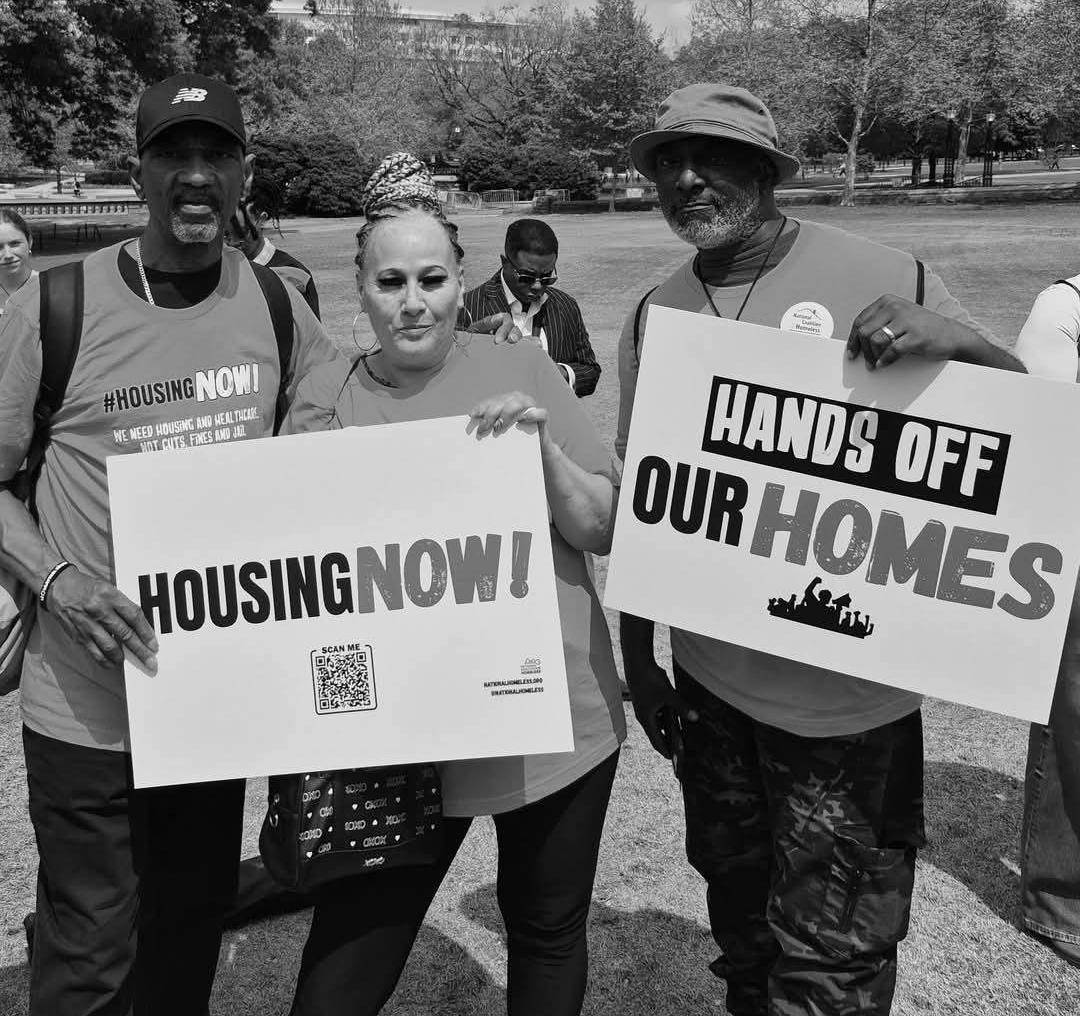
Rachelle Ellison (center) at a housing rally.
Photo courtesy of Rachelle Ellison
If these walls could talk
DON GARDNER
Artist/Vendor
If these walls could talk, they would not scream. They would whisper — because pain grows tired of being loud.
They would tell you how many prayers were swallowed by silence, how many tears dried before they fell, how many nights hope sat beside despair and refused to leave.
These walls remember names that never made the records, faces that passed through and were never asked their story. They remember survival wearing the clothes of shame, faith dressed in doubt, truth hidden for safety.
If these walls could talk, they would confess love was never absent — only buried.
Pressed between fear and endurance. Waiting for someone brave enough to listen without fixing, to hear without judging.
Some walls were built to protect. Some to divide.
Some to imprison.
But every wall has heard a heart break, and every crack is proof that light is persistent. It is not here to accuse you. It is here to ask you — to stand still long enough to hear what survived.
If these wells could talk… would you listen?
Sista woman song
MONIQUE RIVERS Artist/Vendor
To sista woman:
You be a precious jewel
A diamond in the rough called America
You be everything I am to be
You be jazz classical
You be hope for the blues
You be inspirational gospel
And a provoking p-funk all-star
Turned revolutionary hip-hop
And you weren’t born of a woman
You came out of the earth
Like your kinfolk, Daisy and Rose
Defying pesky weeds
Threatening to inhibit
The beauty you bring
Cuz ism schisms act as fertilizers
To your incessant growth
And we Nu daughters
Be coming of age, strong and wise,
Good men
Under your dynamic tutelage
We come from far and wide
From ghettoes and colleges
Take off our shoes
Wash our hands and faces
To cleanse ourselves for sacred spaces
Called struggle
Cuz you are a superstar gardener
Planting seeds for Nu births
Melding Black girls into Nubian women
And we are foreign exchange students
Taking notes on how a raven flew out of an American prison
With undaunted wings, strong and free
Carried and nurtured a daughter
And maintained an impeccable garden
Cuz we have a whole field of lilacs in full bloom
And now we need to learn how to fly
CARLOS CAROLINA, BKA POETIC JUSTICE Artist/Vendor
For all the good men
Who ain’t make it here, I hope I make it in, I gotta make it clear
We gotta love each other, We gotta wanna win
Yeah, I was preaching that While we was pitching tents
I don’t think they really know, Our struggle was really real We had to grind for real We had to grind to live
I don’t think they really know How we survived for real
I’m still shedding tears
For all my fallen friends
JOSIE BROWN
Artist/Vendor
New Year’s is a year to start anew
New Year’s is a great time to be cool
New year’s a year to use your tools
New Year’s is a year to spread the good
New Year’s is a year to break the rules
New Year’s is a year to rest assured and be sure!
New Year’s is a year to endure, and that’s that
I lost a lot of friends, I gotta shake my head
Some got caught slipping, Some was in the mix
Either way I think about it, It makes me shed a tear, But then I wipe my eyes And thank God for another year
When I get myself together, I wanna have another kid
When I get my life together, I wanna help all my friends
I got faith in the city I grew up within, But we gotta love each other That’s if we wanna win
Real live!
For my souljahs in the sky, I gotta keep my head high, Because I know that makes them proud
Memories that’re in my head, Of good times we done had, Even while we was in the struggle, I wish that I could bring them back
If I could, I would have tried to show them How to do it better
Then again, I should have showed them, It wouldn’t be no should’ve–could’ve
Why it always seems we lose the ones We love best?
Like the ones who make us laugh, They be the ones who seem to pass
Gotta cherish one another, Because “time” goes too fast
Now I’m holding on to memories Of times we use to have
“Got dang”
Trained to go
CHRIS COLE Artist/Vendor
April 4, 3:43 a.m.
I will go. I will flee. I will leave.
I will BOB AND WEAVE!!! and annihilate every assassin you send to silence me. I will fight EVERY BATTLE, even though the WAR is already lost.
You can’t have me. You can’t take me. This body doesn’t have a cost. I’ve been broken, but I’m healing! You want me to just fall off...
You attack me at every angle...!!! Disperse bigger and smarter demons every time I conquer — and pause to catch my breath...
But I’m still standing, I’m still fighting... SATAN, you will not stop me from becoming my BEST! For I am covered by Jehovah, the ONLY ONE whom I can trust. I am sure of my power and no longer driven by lust.
I will sit patiently alone in my palace, watching copper turn to rust — before I surrender my dignity and let just any old man touch.
Jehovah will send my husband who will rise to MY occasion — protect, desire, love me, and sweep me off my feet.
No longer will I have to walk alone in this world, illuminating these dark and treacherous streets.
He will hold my hand and comfort me... and a lifetime of pain, tears, trauma, and betrayals will finally be RELEASED.
“A dream without a plan is a hallucination.”
- Uncle Mike
MELODY BYRD Artist/Vendor
FUN & GAMES
Across
1. Central points, as of ideas
6. Common digital doc format (abbr./init.)
9. “r u b n real?” alternative (textese/init.)
14. Sufficient (MAPLE anagram)
15. More than just a fib
16. Biblical king who ordered Christ’s arrest
17. Cold War contest that raged between the U.S.S.R. and the U.S. (2 wds) (5,4)
19. Touches up a written item
20. “Star Trek” captain Jean ____ Picard
21. Assign one, two, three or four stars to a movie, say
22. Letters for England’s Charles III (abbr./init.)
23. Part of a list
25. A motley assortment of things
30. The so-called Lone Star State
32. Jubilance (TOENAIL anagram)
33. The sea personified
37. Yiddishers’ laments
38. Famous TV title-role for Miley Cyrus (6-7)
42. Poker prize
43. Lunches and brunches, fancily speaking (SPAREST anagram)
44. Blue liqueur named for a caribbean island
47. “Holy cripes!”
51. The emigration of highly skilled, trained or intelligent people from a particular country, economic section or field (2 wds,) (5,5)
55. Word that typically follows library or precedes line
56. Caviar
57. Letter-shaped fastener (1-3)
59. Black gunk
60. ____ card (bank account plastic)
63. Occasion often experienced by poets... or by solvers who have the correct entries at 17-, 25-, 38- and 51-Across
65. Mindless to a degree just short of insane, in two senses
66. Cocka____ (schnoodle relative)
67. Bed sheets and stuff
68. Contents of some books with many notes
69. African antelope with curved horns
70. America’s avian symbol
Down
1. Illuminated like much of New Orleans’s French Quarter
2. Attribute (to) (TIME UP anagram)
3. Elon Musk co. concerned with travel to Mars
4. R.N.’s forte that includes cheerfulness and smiles, briefly (abbr./init.)
9. Typical ethnicity of Tibetan guides who accompany Mt. Everest climbers
10. Like a branding iron just pulled from the fire (2 wds.) (3,3)
11. ____ Lanka
12. Parking place
13. QB’s gains (abbr.)
18. Fan sound?
22. Washington’s Mount St. ___
24. Educator Horace
26. Columbus’s Italian birthplace
27. Singer Celine
28. “Naked Maja” painter Francisco ____
29. The middle parts of Argentina and Kenya?
31. One of 100 in D.C. (abbr.)
34. “Don’t wanna rain on your ____. but...” (bad news intro, often)
35. Where an MD goes for take-out? (3,2) (incls. abbr./init.)
36. Strike caller in a mask, briefly
38. Sixty minutes, collectively
39. Gilette razor brand since 1977
40. Mechanical comm. device for the deaf and hard-of-hearing (abbr./init.)
41. “In your dreams!” (2 wds.) (2,2)
42. Highly toxic chemical long banned by the EPA (abbr,/init.)
45. Broadcasting a show, as on radio or TV
46. Bills with Franklin on them, slangily (1-5)
48. Term for passing bad checks
49. Canine’s coat
50. Blissfully calm and collected
52. Suffix after “mar,” “walk,” or “jog”
53. “I believe ____” (words one longs for from a parent, partner, coach or friend) (2 wds.) (2,3)
54. ___ Lock (PC key)
58. Marketing or vision prefix
60. To run something or someone down, in contemporary slang
61. Brian of ambient music
62. Big name brand in roll-on antiperspirants
63. Dungeons & Dragons, e.g. (abbr./init.)
64. Spanish aunt
This crossword puzzle is the original work of Patrick “Mac”McIntyre. It is provided to us courtesy of Real Change News, a street paper based in Seattle, Washington. Learn more about Real Change News and the International Network of Street Papers at realchangenews.org and insp.ngo.
PIECE OF THE WEEK
Writer’s note: This was a dedication I wrote unto and in the voice of Elette McRae of Northeast D.C. It was read at her funeral service. A happy Mother's Day to the moms, especially mine, Mrs. Gladys C. Whitmyer-Taylor, who has been featured our very own Street Sense Media as my special guest.
Time and time again l ask myself why? A question that can only be answered by the Most HIGH.
My presents to the Most HIGH are my children, for they are the future. I realize my time has passed.
Free at last, I pray with my last that this peace will last and last and last until again my time has passed.
COMMUNITY SERVICES
Academy of Hope Public Charter School
202-269-6623 // 2315 18th Pl. NE
202-373-0246 // 421 Alabama Ave. SE aohdc.org
Bread for the City 1525 7th St., NW // 202-265-2400 1700 Marion Barry Ave., SE // 202-561-8587 breadforthecity.org
Calvary Women’s Services // 202-678-2341 1217 Marion Barry Ave., SE calvaryservices.org
For further information and listings, visit our online service guide at StreetSenseMedia.org/service-guide
Stock merchandise, organize shelves, assist customers, and maintain store appearance.
Requirements: Teamwork, reliability, ability to lift items.
Pay: ~$17–$20/hr
Apply: shorturl.at/poIeL
Package Handler
FedEx // Beltsville, Maryland
Part-Time (Onsite)
Load, unload, and sort packages in a warehouse environment.
Requirements: Ability to lift packages, stand for long periods, follow safety rules.
Pay: ~$18–$22/hr
Apply: shorturl.at/YngtW
Barista
Compass Coffee // Navy Yard
Full-Time (Onsite)
Craft drinks that uphold the quality standards of Compass Coffee, while creating a welcoming atmosphere, and providing legendary customer service.
Requirements: Maintain regular and consistent attendance and punctuality. Available to work flexible hours.
Pay: $17.75 - $19.75/hr
Apply: tinyurl.com/CompassBarista
Precious gifts
NIKILA CAMPBELL Artist/Vendor
Why would one kick and hit
A precious gift?
Two created, but one dipped
So the stayer starts to sip
Starts to hit God’s precious gifts
How many precious gifts screamed
With no one to care or hear?
Is that when the saying “deaf ears” appeared?
A lot of gifts don’t make it from then to now
If they do,
They have a negative sound
But they remember how it felt to literally hit the ground
God’s gifts grow to have gifts of their own
And repeat the beat down
Let’s play and change roles
To understand each other
And take care of our precious gifts
I once was a precious gift who grew up to be dissed
So am I destined to hit?
Ready set brought clarity
Cain, not Abel, showed us we are able
Jay taught breathing and living without rolling a jay
I’m surrounded by a different painted wall
I’m amazed at this room, built on support before the teaching began I hope I can throw the new me into the future
And my kids and grandkids throw themselves
With the support of each other’s intangible thoughts to help and build
Leave break and broken in the past
Primogeniture sanguine
EL-O-HIM Artist/Vendor
High, I am the Most High, with the Most High to have the Most High, in the Most High, and need no more than what is, was, and evermore to be the Most High. Earthly and divine right, I am that, and there is no greater he than I, for it is I that is in him as in all things (thoughts) made manifest. That I (infinite), I “AM” (come in the light) as all things made manifest, flesh and for the glory from pain and the greater glory to gain like birth, as from knowledge to wisdom to be I, the Most High, in the flesh. High, and be the source from which all flows, like father like son. I am that I am, in the flesh, as “I am” in the flesh like before in my mother’s womb, I come again in the flesh and say “I” with the body aligned with father as head, freely willed into existing as the understanding of infinite knowledge and infinite wisdom. The born again and again like beliefs birth faith, bringing the manifest forth to know, come again into existence as wisdom in knowing from being witness, witnessed. A child becomes as evident of all that exists, as a thought useful and carried out as the understanding.
As I may conceive a concept, as seed to earth and grow in the thought as the likeness and image, given life, an existence to be as a sacrifice to stand true in honor of the source from which it came, knowledge and wisdom being the understanding through the test of time, and gains, that unfold attributes to be virtuous of
the everlasting scenes to come seen from the unseen, with insight and intuition for merit to be every word in actions, works, and deeds to uplift humanity.
I, son, exists in mother with father, the source from which all of life flows. All in one as one to be one for all and all for one, all shall say I to I as we and us are one.