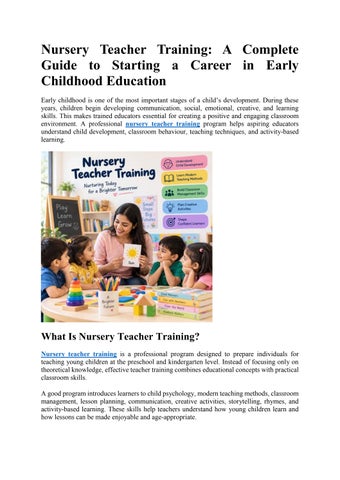
Nursery Teacher Training: A Complete Guide to Starting a Career in Early Childhood Education Early childhood is one of the most important stages of a child’s development. During these years, children begin developing communication, social, emotional, creative, and learning skills. This makes trained educators essential for creating a positive and engaging classroom environment. A professional nursery teacher training program helps aspiring educators understand child development, classroom behaviour, teaching techniques, and activity-based learning.
What Is Nursery Teacher Training? Nursery teacher training is a professional program designed to prepare individuals for teaching young children at the preschool and kindergarten level. Instead of focusing only on theoretical knowledge, effective teacher training combines educational concepts with practical classroom skills. A good program introduces learners to child psychology, modern teaching methods, classroom management, lesson planning, communication, creative activities, storytelling, rhymes, and activity-based learning. These skills help teachers understand how young children learn and how lessons can be made enjoyable and age-appropriate.
Why Is NTT Important for Aspiring Teachers? Teaching young children requires patience, creativity, communication, and an understanding of their developmental needs. A trained nursery teacher can create activities that encourage children to participate rather than simply memorize information. An ntt teacher course can help learners develop practical abilities such as preparing teaching aids, organizing classroom activities, communicating with children, managing groups, and creating simple lesson plans. These skills are particularly useful in preschool environments where learning often takes place through play, stories, music, art, and hands-on activities. Professional training can also improve confidence. New teachers learn how to respond to different learning behaviors and create a safe, supportive environment where children can explore and express themselves.
What Do Students Learn During the Course? A well-structured nursery teacher training course covers several important areas of early childhood education. Common learning areas include:
Child psychology and development Modern teaching techniques Classroom management Lesson planning and curriculum design Communication and personality development Arts, crafts, and creative activities Rhymes, storytelling, and activity-based learning
These subjects are important because preschool education is not limited to textbooks. Teachers need to understand how children interact, communicate, play, and learn through different experiences.
Who Can Pursue an NTT Program? An NTT program can be suitable for students who want to enter the teaching profession, individuals interested in early childhood education, homemakers looking for professional opportunities, and people considering a career change. Candidates who have completed 10th or 12th can pursue the program, while prior teaching experience is generally not required. A typical course duration is one year, with regular, online, and distance learning options available. However, students should always check the latest admission requirements before enrolling in any teacher training program.
Choosing the Right Learning Mode
Modern teacher training programs may offer different study formats. Regular classroom learning provides direct interaction with trainers and fellow learners, while online and distance learning can offer greater flexibility for students, working professionals, and homemakers. When selecting an ntt teacher course, consider the curriculum, practical exposure, teaching methodology, faculty experience, certification, study materials, and career support. A useful program should provide more than a certificate; it should help learners develop skills that can be applied confidently in real classroom situations.
Career Opportunities After NTT Completing a professional nursery teacher training course can open pathways into different early childhood education environments. Depending on qualifications and employer requirements, graduates may explore roles such as:
Nursery Teacher Preschool Teacher Kindergarten Teacher Daycare Teacher Early Childhood Educator Childcare Coordinator Private Tutor
Potential workplaces include preschools, play schools, nursery schools, Montessori institutions, daycare centers, kindergartens, and private educational organizations. Some trained educators may also use their knowledge when planning to establish or manage a preschool or daycare center, subject to applicable local requirements.
Why Early Childhood Education Matters Early childhood education helps shape a child's communication, creativity, confidence, social behavior, and learning habits. Teachers play an important role in creating an environment where children feel comfortable asking questions, participating in activities, and developing new skills. Play-based learning, storytelling, drawing, music, role-play, puzzles, and creative activities can make classroom experiences more engaging. A trained teacher understands how to use these activities according to children's age and developmental needs.
How to Become a Better Nursery Teacher Completing a training program is only the beginning of professional development. Successful early childhood educators continue improving their teaching skills by observing children, learning new educational approaches, experimenting with age-appropriate activities, and developing effective communication.
Teachers should also focus on patience and empathy. Young children may learn at different speeds, so comparing one child with another is rarely helpful. Instead, educators can encourage participation, recognize individual progress, and make learning enjoyable. Creative teaching is another important skill. Storytelling, drawing, music, role-play, puzzles, movement activities, and simple classroom projects can make lessons more interactive while supporting children's social and cognitive development.
Why Choose AIECCE for Teacher Training? AIECCE offers NTT, PTT, and NPTT teacher training programs with regular, online, and distance learning options. The NTT program focuses on theoretical and practical learning, child development, classroom management, modern teaching methods, lesson planning, creative activities, and activity-based learning. For learners comparing teacher-training options, AIECCE can be considered based on its course structure, learning flexibility, practical focus, certification, and career-oriented approach. Students should review the current course details and select a learning mode that matches their educational and career goals.
Final Thoughts Early childhood educators have an important responsibility because their teaching can influence how children develop confidence, communication, creativity, and positive learning habits. Choosing the right nursery teacher training program can provide the foundational knowledge and practical skills needed to begin this rewarding profession. Whether you are a student, career changer, or someone passionate about working with young children, a structured ntt teacher course can be a useful step toward developing professional teaching abilities. With the right training, continuous learning, and a child-focused approach, aspiring educators can prepare themselves for meaningful opportunities in early childhood education.
Author AIECCE Team The AIECCE Team creates informative resources for aspiring teachers and education professionals. Our content focuses on practical teacher training, early childhood education, teaching skills, and career development.