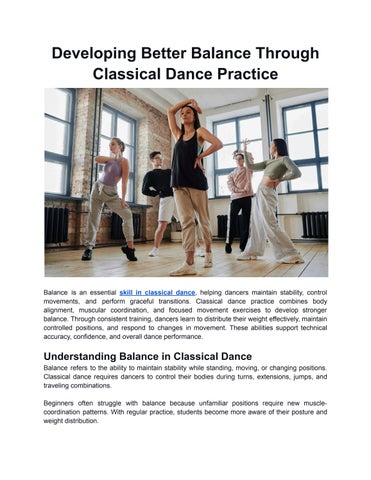
Developing Better Balance Through Classical Dance Practice
Balance is an essential skill in classical dance, helping dancers maintain stability, control movements, and perform graceful transitions. Classical dance practice combines body alignment, muscular coordination, and focused movement exercises to develop stronger balance. Through consistent training, dancers learn to distribute their weight effectively, maintain controlled positions, and respond to changes in movement. These abilities support technical accuracy, confidence, and overall dance performance.
Understanding Balance in Classical Dance Balance refers to the ability to maintain stability while standing, moving, or changing positions. Classical dance requires dancers to control their bodies during turns, extensions, jumps, and traveling combinations. Beginners often struggle with balance because unfamiliar positions require new musclecoordination patterns. With regular practice, students become more aware of their posture and weight distribution.
How Balance Works The body maintains balance through cooperation between the muscles, joints, nervous system, and sensory organs. Dancers use visual information, inner-ear signals, and body awareness to maintain stability during movement.
Why Balance Matters for Dance Technique Balance supports accurate movement and helps dancers perform steps with greater confidence. Without adequate stability, dancers may struggle to maintain positions or connect movements smoothly.
Improving Movement Accuracy Balanced dancers can concentrate on foot placement, arm positioning, and musical timing without making frequent corrections. This supports consistent technical performance.
Supporting Graceful Transitions Smooth transitions require controlled changes in weight distribution. Dancers must move between positions while maintaining an organized torso and stable supporting leg.
Body Alignment Creates a Stable Foundation Proper alignment helps dancers distribute their weight efficiently. The relationship between the head, spine, pelvis, hips, and feet influences overall stability.
Maintaining Correct Posture Dancers aim to keep the spine elongated, shoulders relaxed, and the pelvis controlled. This posture supports balance without creating unnecessary stiffness.
Coordinating the Upper and Lower Body
During a leg extension, the supporting leg provides stability while the arms and torso help organize body position. Coordinating these areas allows dancers to maintain greater control.
Core Strength Supports Better Balance Core muscles help stabilize the torso during standing positions and movement transitions. The abdominal, back, and pelvic muscles contribute to postural support.
Maintaining Torso Stability During an arabesque, the dancer extends one leg behind the body while maintaining balance on the supporting leg. Core stability helps control unwanted torso movement.
Controlling Body Position Strong core coordination allows dancers to make small adjustments without losing alignment. However, maintaining stability should not require excessive muscular tension.
Foot and Ankle Control Improve Stability The feet and ankles provide the foundation for many classical dance movements. They support body weight, help manage pressure distribution, and contribute to balance adjustments.
Strengthening the Supporting Foot During single-leg positions, the supporting foot must remain stable. Dancers should avoid excessive inward or outward ankle rolling. Controlled exercises help improve foot awareness and muscular support.
Practicing Relevés Relevé involves rising onto the balls of the feet.
This movement challenges balance because the supporting area becomes smaller. Practicing slow rises and controlled lowering helps develop ankle stability.
Static Balance and Dynamic Balance Classical dance training develops both static and dynamic balance. These abilities require different forms of movement control.
Static Balance Static balance involves maintaining a position without traveling. Examples include: ● Holding retiré ● Standing in relevé ● Maintaining an arabesque ● Balancing on one leg These exercises help dancers develop stability and body awareness.
Dynamic Balance Dynamic balance involves maintaining control while moving. Turns, traveling steps, jumps, and directional changes require continuous muscular adjustments. Practicing dynamic movement helps dancers develop coordinated responses to changing body positions.
How Weight Distribution Influences Balance Weight distribution describes how body weight is supported across the feet or supporting surfaces. In ballet, dancers frequently transfer weight between different positions.
Understanding the Center of Mass The center of mass represents the average location of the body's weight. When dancers lift a leg or change arm positions, this location shifts.
The body must adjust to maintain stability.
Managing Weight Transfers During a pas de bourrée, dancers shift their weight between the feet through a sequence of small steps. Accurate weight placement helps maintain smooth movement and balance.
Turning Exercises Develop Rotational Stability Turns are challenging because dancers must maintain stability while rotating. Proper turning technique requires coordination between the supporting leg, torso, arms, and head.
Preparing for Pirouettes A pirouette begins with an organized preparation. The dancer positions the supporting foot, coordinates the arms, and keeps the torso aligned before rotating.
Using Spotting Spotting involves maintaining a visual reference point while coordinating head movement during rotation. This technique supports directional awareness and turning consistency.
Pliés Improve Lower-Body Control Pliés are fundamental classical ballet exercises involving controlled knee bending. They help dancers coordinate movement through the hips, knees, and ankles.
Maintaining Proper Alignment During a plié, the knees should generally follow the toes. This relationship helps maintain appropriate lower-body alignment.
Preparing for Movement Pliés help dancers prepare for jumps, turns, and traveling steps. Controlled bending allows the body to adjust weight and prepare for the next movement.
Proprioception Strengthens Body Awareness Proprioception is the ability to sense body position and movement without relying entirely on vision. This sensory ability contributes to balance and coordination.
Recognizing Body Position Dancers must recognize where their arms, legs, and torso are positioned during different movements. Repeated practice helps students become familiar with these relationships.
Improving Stability Through Awareness As body awareness develops, dancers may recognize small balance changes more quickly. This supports controlled adjustments during challenging positions.
Musical Timing Supports Balanced Movement Music provides structure for classical dance combinations. Dancers use rhythm, tempo, and phrasing to coordinate their movements.
Coordinating Steps With Musical Counts Counting helps dancers organize weight shifts and movement transitions. For example, a teacher may ask students to rise into relevé over two counts and lower over another two counts.
Controlling Movement Speed
Slow adagio exercises emphasize sustained balance. Faster allegro combinations require quick adjustments and precise coordination. Practicing different tempos helps dancers improve movement versatility.
Developing Balance Through Progressive Training Balance improves through repeated practice and gradually increasing movement challenges. Beginners should develop foundational stability before attempting advanced combinations.
Starting With Supported Exercises The ballet barre provides support during early balance training. Students can practice relevés, tendus, and single-leg positions while developing confidence.
Progressing Toward Independent Balance As stability improves, dancers may gradually reduce their reliance on external support. They can then practice longer holds, coordinated arm movements, and controlled transitions.
Practical Ways to Improve Dance Balance Dancers can strengthen balance through consistent practice and appropriate instruction. Helpful strategies include: ● Practice standing on one leg with proper posture. ● Perform slow relevés on both feet. ● Strengthen core muscles gradually. ● Maintain proper hip, knee, and ankle alignment. ● Practice controlled pliés and tendus. ● Develop foot and ankle stability. ● Use musical counts during movement. ● Practice weight transfers between both legs. ● Hold balancing positions for comfortable periods. ● Coordinate arm movements with leg extensions. ● Seek feedback from qualified dance instructors. ● Include sufficient rest between demanding sessions. Students should avoid forcing positions or attempting advanced movements before developing adequate control.
Persistent pain, dizziness, or significant balance problems should be discussed with a qualified healthcare professional.
Stronger Balance Develops Through Consistent Dance Practice Classical dance practice provides structured opportunities to improve balance, muscular coordination, and body awareness. Exercises such as pliés, relevés, tendus, and single-leg positions challenge dancers to maintain stability while controlling movement. As students develop stronger alignment and weight-distribution skills, they become better prepared for turns, jumps, and traveling combinations. These improvements support technical accuracy and more confident performances. Progress varies depending on individual ability, experience, and training consistency. With patient practice, qualified instruction, and appropriate physical preparation, dancers can develop stronger balance and greater confidence in classical dance.
FAQ How does classical dance improve balance? Classical dance challenges balance through controlled positions, weight transfers, muscular coordination, and repeated movement exercises.
Which ballet exercises help improve balance? Relevés, pliés, tendus, retiré holds, and supported single-leg balancing exercises can help develop stability.
Why is core strength important for dance balance? Core strength supports torso stability, proper alignment, and coordinated movement during balancing positions.
Can beginners improve balance through classical dance? Yes. Beginners can gradually develop balance through fundamental exercises, consistent practice, and qualified instruction.
How long does it take to improve balance through ballet? Improvement varies depending on practice frequency, physical ability, experience, and training quality. Consistent practice over time can support better stability and coordination.