THE ESSENTIALS:
SERVING PLANT-POWERED, FIBER-RICH MEALS IN K-12 SETTINGS
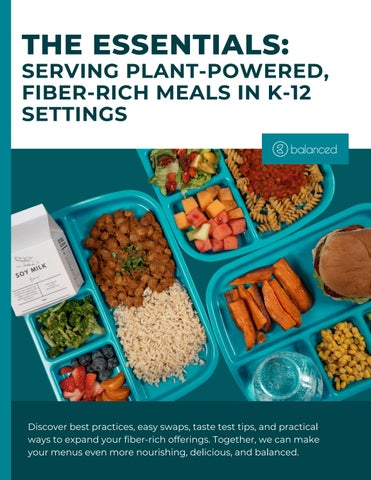
Discover best practices, easy swaps, taste test tips, and practical ways to expand your fiber-rich offerings. Together, we can make your menus even more nourishing, delicious, and balanced.
The Power of Plants For Health Up to 97% of American children do not eat enough fiber, a nutrient found only in plants.1 Plants are rich in fiber, vitamins, and minerals that promote digestion, immunity, and steady energy. Plant proteins are cholesterol-free and lower in saturated fats than animal proteins.2 Early exposure encourages children and adolescents to enjoy fruits, veggies, and whole grains throughout their lives, helping to lower the long-term risk of diet-related diseases such as high blood pressure and diabetes.3,4
For the Planet Plant-powered diets create a more sustainable food system, supporting the protection of our planet for future generations. According to the National Institute for Health, eating a plant-rich diet has the potential to reduce diet-related land use by 76%, diet-related greenhouse gas emissions by 49%, and green and blue water use by 21% and 14%, respectively.5
For Inclusivity Food allergies affect nearly 8% of children in the United States - and that number is on the rise.6 Many common allergens (egg, dairy, fish & shellfish) can be avoided by swapping them out for plant proteins. Many students come from diverse cultural backgrounds and are growing up in an increasingly global food landscape. Serving meals that reflect a variety of flavors and traditions helps them feel seen and supported. 1
USDA, Agricultural Research Service, 2021. Usual Nutrient Intake from Food and Beverages, by Male/Female and Age, What We Eat in America, NHANES 2015-2018 Available www.ars.usda.gov/nea/bhnrc/ 2 Yokoyama, Y., Levin, S. M., & Barnard, N. D. (2017). Association between plant-based diets and plasma lipids: A systematic review and metaanalysis. Nutrition Reviews, 75(9), 683–698. https://doi.org/10.1093/nutrit/nux030 3 Kim, H., Caulfield, L. E., Garcia‐Larsen, V., Steffen, L. M., Coresh, J., & Rebholz, C. M. (2019). Plant‐based diets are associated with a lower risk of incident cardiovascular disease, cardiovascular disease mortality, and all‐cause mortality in a general population of middle‐aged adults. Journal of the American Heart Association, 8(16). https://doi.org/10.1161/jaha.119.012865 4 Satija, A., Bhupathiraju, S. N., Rimm, E. B., Spiegelman, D., Chiuve, S. E., Borgi, L., Willett, W. C., Manson, J. E., Sun, Q., & Hu, F. B. (2016). Plantbased dietary patterns and incidence of type 2 diabetes in US men and women: Results from three prospective cohort studies. PLOS Medicine, 13(6). https://doi.org/10.1371/journal.pmed.1002039 5 Gibbs, J., & Cappuccio, F. P. (2022). Plant-based dietary patterns for human and planetary health. Nutrients, 14(8), 1614. https://doi.org/10.3390/nu14081614 6 Gupta, R. S., Warren, C. M., Smith, B. M., Blumenstock, J. A., Jiang, J., Davis, M. M., & Nadeau, K. C. (2018). The public health impact of parentreported childhood food allergies in the United States. Pediatrics, 142(6). https://doi.org/10.1542/peds.2018-1235
Best Practices & Beliefs For Implementing Plant-Powered Meals It’s a marathon, not a sprint. Manageable change takes time. Stay flexible and optimistic. Model enthusiasm and excitement. Involve your team, students, and community in the process. Conduct taste tests. Encourage and incorporate feedback. Use descriptive terms that make meals sound exciting and appetizing. Be persistent, especially with younger students. It takes several exposures for children to develop a taste for new foods.
Getting Started Start Where You Are, Start Small, Start Familiar Identify Opportunities for Easy Swaps Maintain Familiarity Start with familiar meals by using existing recipes and student favorites, simply swapping out all or some of the animal protein for plant proteins like beans, peas, lentils, and tofu. Examples: Swap beef and cheese burritos for bean and cheese burritos. Add chickpeas to the salad bar in place of chicken, or even next to the chicken at first. Use 100% whole grain pastas and rice for your existing recipes.
Transition with Blended Dishes Start by blending plant proteins with meat at first, gradually decreasing the amount of meat over time. This gradual shift makes it easier for students to adapt while reducing cost and increasing nutrition. Examples: Try pasta sauce with half lentils and half beef, then increase the amount of lentils over time until it is 100% lentil sauce. Make chili using half beans and half meat, increasing beans gradually until it is 100% bean chili.
Try Meat Analogues Today’s plant-based nuggets, burgers, and sausages are kid-friendly and USDA-creditable when labeled correctly. Look for Child Nutrition (CN)-labeled products to ensure compliance with federal meal patterns. Use them sparingly as a bridge while gradually increasing whole-food, plant-based proteins. Example: Swap in plant-based nuggets on “chicken nugget day” with the same dipping sauces students expect.
Messaging Matters Emphasize that changes are not all-or-nothing. Highlight expanding options rather than replacing everything. Avoid labels like vegan, vegetarian, healthy, or meatless. Focus on benefits that resonate—such as fiber-rich, nutrient-dense, energyboosting, brain-boosting, global cuisine, or climate-friendly meals. Center your community’s values—learn what matters most and weave that into your messaging. Consider creating a theme (e.g., “Plant-Powered Day” or “Meals that Power Your Mind and Body”).
Contact us for FREE resources customized for your K-12 programs:
Posters
Handouts
Stickers
Lesson Plans
Building Buy-In Engaging Your Team & Community for Change Your staff are the face of your program. Their attitudes influence how students respond. When staff are informed, confident, and excited, students will be more willing to try new meals. Similarly, families’ attitudes towards your menu changes can have an impact on students’ willingness to try a new dish. Before making any changes, explain why it matters. When your school community feels connected to the mission, they will want to champion it with you. Buy-in isn’t optional, it is essential.
How to Build Buy-in Communicate Early and Often Share updates via newsletter, social media, your website, and flyers. Make announcements in staff meetings and at school events. Explain what’s changing and why it matters.
Ask for Feedback Show students, staff, and families that their voices matter! Use surveys, comment boxes, and invite conversations.
Build Excitement Promote new dishes with photos, student reviews, and “featured dish” highlights. Create anticipation by announcing to students and families the exciting new foods they’ll be trying the next day.
Educate with Empathy Use simple, positive messaging: “Nutrient-packed, fiber-rich meals to help students feel and do their best!”
Taste Test Tips Best Practices for Successful Sampling Have Fun! Students will pick up on the attitude of adults. Aim to foster a fun environment that promotes joy and curiosity. Make sure all adults that will be present during the taste test are informed and can help support the experience. Just one bite! Don’t put pressure on students. Let them know it’s no big deal if they like it or not. Encourage them to start with “just one bite.” Include a way to gather feedback. Ask for feedback using sticker charts, voting boxes, or QR codes to surveys for older students. Feedback can then be used to help inform what is added to the regular menu.
Successful Taste Tests Why They Matter & How to Conduct Them Why Improve students' long-term health by serving and promoting fiber-rich, nutrient-dense menu options. Meet student demand by serving dishes that are culturally-inclusive and climate-friendly.
Who Your Team Empower your team with knowledge behind why you are conducting taste tests and provide guidance on best practices. Students Engage students by creating a safe, positive environment to try new things. Families Connect with families to share recipes and encourage trying new foods at home.
How Select a food based on your program goals. Sample with staff to build buy-in and excitement. Inform families and your school community of the upcoming taste test. Taste test using small, low-pressure samples with students during lunch. Gather feedback by inviting students to share what they think. Make menu changes based on feedback from staff and students. Decide if the food will be added to the regular menu and make a plan of action.
Sourcing Products Directory & Child Nutrition-Approved Vendors for Plant-Based Products Balanced’s PlantBased Product & Vendor Directory
plant-based crumbles, various seasonings holly@eatdeeplyrooted.com
Find what you need - fast! Looking for plant-based products that work in schools? Balanced’s Plant-Based Product & Vendor Directory is the most extensive directory of fiber-rich, plant-based items for institutional food service. Search by protein type, brand, K-12 creditable and more Connect directly with vendors and request samples Discover new favorites or reliable staples Visit plantbasedvendors.com to get started.
plant-based lentil crumbles deepad@inlandempirefoods.com
plant-based burgers, meatballs, chicken nuggets, chicken patties, and crumbles jbetsy.fuentes@impossiblefoods.com
yuca potato fries jchristopher.mosera@micfood.com
plant-based chicken, beef, sausage, tenders, burgers, meatballs, and ravioli chefrob@futurefoods.us
plant-based chicken nuggets and patties jmegan.reece@rebellyous.com
plant-based whole-grain ramen noodles abot@palmettogf.com
Need More Support? We’ll help you reach your goals! Balanced wants to support you in creating realistic, manageable change by providing menu analysis and design support, procurement assistance, marketing materials & ideas, and more. All at no cost to you. If you’d like personalized guidance and coaching, reach out today.
Contact: Michelle Saletan Institutional Support Manager MichelleS@Balanced.org
Balanced is a nutrition security and public health advocacy organization committed to preventing and reducing the impact of diet-related disease for children, families, and communities around the world. With a special emphasis on nutrient-based interventions, Balanced’s Advocacy, Institutional Support, Nutrition Research and Policy programs focus on shifting the proportion of health-promoting foods on menus through an increase of dietary fiber and a reduction of foods high in saturated fats, excess sodium, and ultra-processing. Combining both public awareness campaigns and practical implementation support, we provide resources, training, and tools to partner organizations and food service teams working to improve the healthfulness of their menus. www.balanced.org
@thebalancedorg