
VICTORIA

less bail the answer?
EMMANUELLA NWABUOKU ASSOCIATE NEWS & POLITICS EDITOR
Mark Carney’s Liberal Party has proposed legislation intended to make access to bail increasingly difficult for violent offenders. This announcement was made on October 16, following the October 6 parliamentary session, where the House deliberated on the Conservatives’ Jail Not Bail Act. During the session, the Liberal Party proposed their own legislation, which it believes is distinct and “much stronger than the Conservative bill,” according to Secretary of State Ruby Sahota. While the Liberals posit their bill differs from the Conservatives’, there are several similarities between the two. As Canadians await further information, an analysis of Carney’s statements and the Conservatives’ bill can aid in understanding the Liberals’ proposed legislation.
Bill C-242, colloquially known as the Jail Not Bail Act, would amend the Canadian Criminal Code and the Department of Justice Act. It would “replace the principle of restraint in section 493.1” of the Criminal Code and “prevent those charged with a major offence from being released after arrest by a peace officer.” Moreover, the bill wishes to alter paragraph 515(10)(b)’s standard of assessment, allowing courts to consider the accused’s criminal history during bail deliberations. Both the Liberal and Conservative bail reforms advocate for using the offender’s history to determine whether they deserve rehabilitation, thus pushing for longer holding periods. According to the CBC, under the Liberals’ bail reform, violent offenders will experience “consecutive sentencing”—sentences served after another without breaks—and would “have to prove they deserve bail before it is awarded.” By placing the onus on offenders, the bill reverses the Canadian Criminal Court’s adversarial system which places the burden of proof on the Crown attorney.
Conservative Party, who argue that encouraging early releases creates circumstances that endanger Canadians. During the October 6 Parliamentary session, both Conservative leader Pierre Polievre and Brampton West MP Amarjeet Gill cited recent violent crimes they attribute to the principle. They argue that repealing the principle and instating longer holding periods makes a safer Canada.
Mandating longer holding periods regardless of innocence might veer into infringing on S. 12 of the Charter: the right against cruel and unusual punishment. In R. v. Bissonnette, 2022 SCC 23, the Supreme Court of Canada ruled that Section 745.51 of the Criminal Code, which permitted consecutive sentencing, was unconstitutional and unjustifiable by S. 1 of the Charter, which allows reasonable limits to Canadian’s guaranteed rights and freedoms. Canada’s life sentences max out at 25 years; any attempt at lengthening through parole ineligibility periods is tantamount to an unconstitutional life sentence vis-à-vis the United States’ sentencing. This point has sparked debate on the bill, but Carney purports that the bill will withstand the Charter test.
If the bill does pass the charter test, according to Reuters, the longer bail periods will predominantly affect people of colour. Black people stay in remand twice as long for weapons offences and 46 percent of all violent offences. Similarly, longer bail periods affect student protestors. In one instance concerning a University of British Columbia protest in 1997, activist Jaggi Singh was arrested for harming an officer by speaking through a megaphone, and had a bail condition barring him from entering the school imposed. That provision ensured he could not lead a campus protest he organised. These instances and statistics exemplify how

The Canadian justice system’s current stance on bail is encapsulated by Bill C-75, “An Act to amend the Criminal Code, the Youth Criminal Justice Act and other Acts and to make consequential amendments to other Acts.” Bill C-75 modernised bail by incorporating the ‘Principle of Restraint’ and by requiring the criminal court system to pay added attention to offenders’ vulnerable background during bail decisions. The Principle of Restraint requires that an adjudicator give primary consideration to releasing the accused at the “earliest and least onerous opportunity.” The principle and the bill primarily focus on Indigenous people and other vulnerable groups that are overrepresented and often incarcerated for long periods of time. However, the bill is a major point of contention for the
CREDIT//PATRICK IGNASIAK
bail conditions and long holding periods harm students of colour and ensure subservience through limiting dissent. Given law enforcement’s relationship with activists and student protestors, one can see how these bail reforms may impact students voicing anti-establishment opinions. These conversations on bail arise in a tumultuous time in Canadian history. Reports of gun violence and auto thefts, coupled with rising youth unemployment rates, have stoked fear in Canadians. In fearful times, hypermilitarisation and criminalisation can seem like sure forms of protection, prompting parliamentary representatives to discuss them. But are these new suggested bills appropriate measures or purely reactionary? These are questions only time will tell.
HANIYA WAHEED CONTRIBUTOR
Within the past two years, Doug Ford has faced many corruption allegations, such as those inspired by the Auditor General’s report on the mismanagement of the Greenbelt. These claims have once again been exacerbated with the recent release of the Office of the Auditor General’s report on the Skills Development Fund (SDF) Training Stream, which analysed all five rounds of the SDF, from the launch of the project to its most recent round.
The SDF is a provincial government program that funds businesses in targeted sectors for projects related to training or hiring. The initiative was launched in 2021 to combat the effects of COVID-19 on the economy. One of the goals of the SDF is also to target “underrepresented groups, including youth, newcomers and Indigenous persons, to help them access employment opportunities.” The objectives of the program have been to support and build an inclusive workforce, encourage innovative training, and reduce employment barriers. In order to receive funding, businesses must submit applications which are then ranked by the Ministry of Labour, Immigration, Training, and Skills Development as ineligible/poor, low, medium, or high based on criteria such as “how well the project need was demonstrated, the applicant’s organizational capacity to deliver the project, the project delivery plan and the project budget.” Different criteria were developed for each round. The Minister’s Office (a separate bureau from that of the Ministry of Labour) then decides which applications will be selected for funding, and how much funding to allocate to projects.
In general, the Auditor General’s report found that the Ministry’s evaluation of applicants was “reasonable and accurate” within the evaluated sample. However, some of the criteria, which resulted in a higher ranking, were not always indicative of better performance overall. Thus, the Ministry recommended updating the criteria for weighting based on previous outcomes of Key Performance Indicators to improve the efficacy of the evaluations. The Ministry was also found to have lost contact with some participants that had been funded in the first two rounds of the SDF, and will not be seeking them out to gain knowledge of their progress. The Ministry’s worst offence may have been not developing any indicators of performance for the “capacity-building of employers… specific to marginalized groups.” Furthermore, the Ministry did produce a separate report for this group of participants. This is alarming since one of the main goals of the SDF as a whole was to provide gateways for marginalised groups to overcome barriers, but there is no indication of whether this goal is being achieved or even worked towards. However, the Ministry did agree to start tracking these goals starting Round 6.
The main scandal related to the SDF report relates to the Minister’s Office and their selection of candidates for funding throughout all five rounds of the SDF. Out of all the applications in the five rounds, it was found that the Minister’s Office selected only 46 percent of applicants that were ranked “High” by the Ministry, and 54 percent of applicants that were selected had been ranked “Medium,” “Low,” or “Poor.” In the first two rounds of the SDF, the Minister’s Office gave no rationale for selecting 193 applications ranked “Medium” and “Low” that received approximately $252 million in funding. This was somewhat corrected in subsequent rounds, where the Minister’s Office provided reasoning behind 91 percent of its selections in rounds 3 through 5. However, the Audit found that these rationales were not always accurate or relevant. The report gives the example of Round 5, where the Minister’s Office’s rationale for funding five applications included that they had been ranked “High” by the Ministry. All five of the applications had, in fact, been ranked “Low” or “Medium,” calling into question the integrity of the Minister’s Office and their selection of certain applicants. Furthermore, in “57 instances where the Minister’s Office did not provide a written rationale, 38 had been ranked as “Poor,” “Low,” or “Medium” and were still selected for funding.” Finally, throughout all five rounds, the Minister’s Office had not provided a rationale for choosing not to select some applicants that had been scored “High” by the Ministry. By themselves, the choices of applicants are highly questionable, and the lack of reasoning provided by the Minister’s Office does not aid the situation. Lack of documentation creates the notion of possible preferential treatment in the selection of applicants, and without a proper understanding of why applicants are selected for funding, it is difficult to suggest improvements for the system as a whole. Furthermore, the fact that over half of the selected applications
were not ranked “High” calls into question the purpose of the ranking system to begin with. The Ministry’s ranking system is in place so that the Minister’s Office selects those candidates with the highest chance of success; however, if the Minister’s Office does not seem to select applicants based on the ranking criteria, it is unclear exactly what system they are using. This concern is made more serious by the fact that the Ministry mentioned they are unaware of the process by which application funding is allocated by the Minister’s Office. There is no apparent standard used to determine which applications are funded and how much funding they receive, and the decisions are often made without providing documentation as to why. This varies from other provinces, where there are strict eligibility criteria and funding caps. There is also “no government-wide or Ministry policy that requires these decisions to be made in the Minister’s Office.” The lack of legislation to regulate the Minister’s Office in the allocation of funding is extremely concerning, especially considering the apparent biases in the selection of applicants. The height of concern stems from the prevalence of lobbyists in the SDF. Based on information available to the public, 64 selected “Low-” and “Medium-” ranked applications had hired registered lobbyists to lobby the Ministry/Minister before they were chosen. These applications alone received approximately $126 million. It is worth noting that 39 high-ranked applications also hired registered lobbyists and received approximately $58 million. These statistics, coupled with the fact that the Minister’s Office does not always provide a reason for choosing to fund certain applicants, highlight potential areas of preferential treatment within the SDF. There is a lack of “fairness, transparency and accountability in decision-making by the Minister’s Office,” which has negative consequences for those applying for funding and for the public.
The Ministry has agreed to the four recommendations provided by the Office of the Auditor General in the report. However, the main problem does not seem to stem from the Ministry, but rather the Minister’s Office. At first glance, these facts may simply seem like gross mismanagement caused by a lack of regulation surrounding the allocation of funding. However, there may be a deeper issue involved—that of corruption. When the Office of the Auditor General published its report on the Greenbelt and its development projects, he was called out for “preferential treatment” and “abuse of power.” So, these stories coming out of the SDF report are not new; in fact, we are witnessing history repeat itself. Billions of dollars were placed in developers’ pockets, and protected ecosystems were destroyed under the guise of solving the housing crisis. The Auditor General exposed the corruption at the management position of the project, and recommended “strengthen[ing] lobbyist registration and regulatory oversight powers of the Office of the Integrity Commissioner,” and over a year later, we see the same issue emerge in the SDF Audit. There are even more examples of the Premier’s questionable spending, and the Auditor General recently released reports on various areas of government spending, including “job training, child care, home construction and climate change.” In their reports, there were comments such as “there is room for improvement” and “it is troubling.” The opposition relentlessly calls out Doug Ford’s government on its corruption, highlighting the troubling number of connections that are emerging between the Ford government, lobbyists, consultants, and developers. One of the lobbying firms heavily involved in some SDF applications was the same one that “managed the election campaign that brought Premier Doug Ford into Office,” according to CTV News. This lobbyist group apparently received at least $100 million in SDF grants, which is concerning considering their ties to government employees. There may have been some conflict of interest involved in the allocation of funds, and Opposition leader Marit Stiles commented, “[w] hat I see happening over and over again is the premier and his government treating this fund like their personal piggy bank.”
Given that the Ministry has agreed to the recommendations of the Auditor General, small changes are expected to improve the SDF and steer it back towards achieving its original goals. The Minister’s Office has yet to make any comment on the situation, but the opposition continues to challenge for objective SDF funding criteria to ensure just and transparent funding. The SDF is a program that has the potential to do a lot of good, and checks such as this one provide the opportunity for change.
SOFIJA STANKOVIC EDITOR-IN-CHIEF
“Because to influence a person is to give him one’s own soul. He does not think his natural thoughts, or burn with his natural passions. His virtues are not real to him. His sins, if there are such things as sins, are borrowed. He becomes an echo of someone else’s music, an actor of a part that has not been written for him.”
– The Picture of Dorian Gray, Oscar Wilde
As a veteran of this still-thriving organization (despite whatever our Stranded slander would have you believe) who has read article after article denouncing the many live-actions and remakes of mainstream media today, I dreaded yet another piece on the same subject. Nevertheless, disregarding the irony of me growing tired of contributors rewriting articles about being weary with movie remakes, we’re kicking the same dead horse because we’re still facing the same problem: pallid imitations of the past—did anyone really want a How to Train Your Dragon live-action?—that leave audiences numb, bored, and wishing for something more. Perhaps, we’ve exchanged an age colored by the anxiety of influence, the artist’s fear of mimicking your muse without developing your own style, for the affliction of imitation. Echoes of someone else’s music rather than any worthwhile production of our own.
A classic example of reviving the same old tales for modern times is the (now, perhaps, waning) sub-genre of Greek myths told with a feminist twist—Clytemnestra, Circe, Elektra, Ariadne, to name a few. The Song of Achilles and the Percy Jackson (and its many spinoffs) series have remained all the rage on Booktok and for YA readers for years now, Epic the Musical, Hadestown, Hades 2, and Lore Olympus still sparkling in the public eye. One could argue it’s nice to see these stories alive and well two thousand years later, that perhaps Orpheus and Eurydice or Homer’s The Odyssey contain some universal appeal akin to Shakespeare’s Hamlet, if readers knew a thing or two about their origins. Yet, aside from the obvious critique that feminist retellings of these stories are something of an anachronistic misreading, oftentimes it feels as if our audiences (or perhaps our authors?) are more so fascinated by the idea and the safety of Greek mythology—the aesthetic of familiar characters like thunder-bearing Zeus or wine-drunk Dionysus with an overabundance of online resources detailing their backstories. Of course, these radical retellings of old myths mean little if people haven’t been exposed to the original material—a point on which, perhaps, one could form a larger critique of film adaptations (or rather, the ignorant filmgoer) in general. It’s one thing if this oversaturation of Greek mythology inspires a deep-seeded curiosity about ancient civilizations and the many silly tragedies and comedies they have to offer: Euripides’s The Bacchae, Aristophane’s Lysistratas, Sophocles’s Antigone. Rather, these modern “retellings” may be more aptly named “rewritings” of the past, commodified nostalgia for the classical age, disingenuous derivatives taking the names of Greek heroines and stuffing them into Y2K clothes.

In Harold Bloom’s The Anxiety of Influence, he writes, “Criticism is the art of knowing the hidden roads that go from poem to poem.” While it may be a little overzealous to track and trace every single reference to the work of past authors (good luck taking that strategy to Joyce’s Ulysses), you should be able to trace echoes back to their source, to construct your work in such a way that it enters into conversation with the older texts. Emily Wilson, author of the new (notably, contentious) translations of The Odyssey and The Iliad, argues that “said novelizations of Greek myths appeal to readers in part because they have the patina of high culture, but may feel less intimidating than translations of the originals.” Certainly, it’s far less daunting to read novels using colloquial language or flip on films on Disney+ than to dig through dusty dissertations buried in scholarly archives. But again, can we fully appreciate the novelty of Wilson’s work if we haven’t read Lattimore’s, Fagles’s, or any one of the other dozens of well-regarded Odyssey translations that came before? Should we be writing dumbed down versions of ancient myths to make them less intimidating, more familiar, and more relatable, or should we be making these lofty translations more accessible?
The principles of pedagogy and the perils of sifting through popular and pretentious audiences go beyond the scope of this editorial, but I’ll extend a humble plea for those of you who’ve made it this far: next time you find yourself consuming classically-“inspired” (not much more authentic than the made-in-Wisconsin “Greek-inspired” feta my mother once bought by mistake) media, trace the echoes back to their source. The ancient world has plenty to offer, if only you deign to follow her hidden paths back to Homer.

editor-in-chief editors@thestrand.ca managing editor editors@thestrand.ca business manager business@thestrand.ca
news & politics news@thestrand.ca
opinions opinions@thestrand.ca features features@thestrand.ca science science@thestrand.ca arts & culture culture@thestrand.ca poetry poetry@thestrand.ca stranded stranded@thestrand.ca copy editing copy@thestrand.ca design design@thestrand.ca photo visuals@thestrand.ca illustration visuals@thestrand.ca social media @strandpaper
associate editors
arts and culture sophie esther ramsey sofia terese glantz
news emmanuella nwabuoku
sofija stankovic
karim arif
tan tan jongrengpian
features vacant photo vacant web vacant web managers web@thestrand.ca
copy editors
andrew xu nour gatti
sijil jindani
romina emtyazi
lia iannarilli
yaocheng xia
bosko garaca
zoe deligianis
max friedman-cole
amy yang
patrick ignasiak olivia tsoi
chiara zehnder
jessie yang
jersey myke-tomlinson erin asaba krapook iewwongcharoen
opinions julia mccarthy
science shivantika shegar
stranded christina pizzonia
poetry reina van leeuwen
corrine yang, isabela sousa, makena guindon,elisabeth rowsell, nargiz memettursun amal abdullaeva, danica mae cueto vanessa salvatii, ash donachie reina van leeuwen,chendafei li, zo friedman natalie contardi
cover illustration seavey van walsum
The Strand has been the newspaper of record for Victoria University since 1953. It is published 8 times a year with a circulation of 800 and is distributed in Victoria University buildings and across the University of Toronto’s St. George campus.
The Strand enjoys its editorial autonomy and is committed to acting as an agent of constructive social change. As such, we will not publish material deemed to exhibit racism, sexism, homophobia, transphobia, ableism, or other oppressive language.
@STRANDPAPER
WWW.THESTRAND.CA
SAMUEL AWOLESI CONTRIBUTOR
In the second week of October, organisers at Toronto Students for Palestine (TSSP) and their coalition kicked off this year’s Week of Rage at the University of Toronto. The events took place mostly at the University of Toronto’s St. George and Mississauga campuses. It began with a vigil for Gaza and its martyrs on October 7, a controversial day that marks the 2023 Hamas attack on Israel and the consequent Israeli genocide in Gaza. The vigil took place in front of Sidney Smith Hall. In the cold and the rain, a group of protestors stood outside with umbrellas in hand, facing a picture of a man from Gaza with candles surrounding it. The speaker elided about the man being one casualty of many who have been slaughtered during the ongoing genocide in Gaza, and she then began to pray.
The following day, the group held a Two Years of Rage rally, pushing for an end to the University of Toronto’s complicity in the genocide. The rally was peaceful on all accounts. It began at Sidney Smith and moved across St. George Street and Hoskin Avenue to reach King’s College Circle. Throughout the rally, the speakers lamented UofT’s dependence on Zionist donors for their initiatives.
The events of the week, compared to the events of last year, did not receive as much mainstream attention. However, it did receive attention from Joe Warmington of the Toronto Sun, an explicitly conservative
commentator who writes for a pro-Israel outlet. In the Toronto Sun, he described the group’s action as antisemitic and honouring the slaughter of Jewish people.
On October 10, the last day of Rage Week, the first phase of the ceasefire between Israel and Hamas came into effect, due to a deal proposed by US President Donald Trump and their Middle Eastern allies. According to the Islamic Relief Organization, there will be several phases following the first phase that will lead to the release of hostages on both sides and a complete end to the war on Gaza.
As of October 24, the ceasefire is still shakily in place, but the Israeli Army has murdered over 100 Palestinians and continued to block aid to Gaza. The Israeli government has also voted in their parliament (the Knesset) to supposedly “symbolically” annex the West Bank, which is the territory of over three million Palestinian people. This has prompted backlash from the United States government and the Arab States, who believe it may threaten the ceasefire. These persisting attacks on Palestinian lives and sovereignty demonstrate why students are still protesting, and suggest that groups like Toronto Students in Solidarity with Palestine will work to maintain their presence on campus.
PATRICK IGNASIAK DESIGN EDITOR
Brian Eno described his work as “generative” in the long shadow of 20th century cybernetics and systems theory. Generally, these are interdisciplinary studies of regulatory systems, and are foundationally concerned with a progressive homeostasis of looping feedback and feedforward mechanisms. Eno’s composition Generative Music 1 was sold as a floppy disk which, if exposed to certain consumer soundcards, would generate the consistent sonic variation of twelve instrument patches. Each track is then more so a succession of rules and variables; relatively stable, but always slightly differentiating into other similar patterns of sound. “Chance function” is a sticky term in generative anything, and Eno’s compositions provide excellent examples. The single result of a current auditory experience is interesting or stimulating due to the equi-probability that a different auditory experience had instead transpired according to the self-evidence of these compositional laws. This is the cybernetics: after a certain duration of listening, the relations between chance-events of sound take on a definitive network-form in the listener, and can be cohered as logically homogeneous and proceeding towards fixed outcomes.
It’s fun. It’s similar in practice but epistemologically distinct from something like free improvisation, or Coltrane’s jazz, which has a certain privilege to claim that sacred mandalas of vibration are being currently explored through the musician’s human decision-making complex. The Topography of the Lungs is a landmark release in European experimental music, and was sold as lacking any predefined or even provisional code of behaviour, except the ability to distinguish the right music from the wrong music. Coincidently, the three performers manage to exclusively play the correct tonalities according to the method of the correct tempos. It’s an exceptional record, and demonstrates the necessity of certain infinite quantities as elegantly as Xenakis or Eno, in the sense that its axiomatics are equally as unthinkable in the overturning of any cloud of sounds. That is, the aforementioned homogeneous network-form must, despite the assurance of its recursion and self-regulation, finally disentangle into something irreducibly new.
It’s structures and processes, and yet, it’s also an un-totalisible clusterfuck of all against all—a thousand glowworms can synchronise a precise information-exchange of bioluminescence. Lots of virtual instruments use simulated swarm behaviours to generate the qualities of sound, or alternatively the velocity and pitch of pre-generated sounds. I imagine Jean-Baptiste Geoffrey used similar, but probably custom-built, environments to compose percussive elements on Soon to Become Tradi-
tional Dance Music, wherein plenty of that decision-making process has been offloaded into latent spaces of uninterpretable dance dimensionalities. So like, the ‘rhythms’ are extracted from a set of sub-models that resemble each other and yet these relations themselves are too inaccessible to be demonstrated as anything other than higher-level expressions. This is a very vulgar explanation of ChatGPT’s ‘black-box’ model, and Soon to Become Traditional Dance Music was probably generated using similar — again, custom-built — models trained on a constricted library of audio information. ChatGPT reconstructs syntactic reasoning by predicting chaos in this lower latent space of learned relations, and even uses stochastic processes just like Xenakis or Eno.

Neural net language models (sometimes) use recursive autoencoders for cleaner paraphrases. An unsupervised algorithm reproduces its input data over arbitrary large iterations into smaller and smaller dimensions, minimising the relations of their internal representations. Distributions are then weighted towards the more essential activation values when fired to assemble the model’s outputs. If you consider, following John Cage, that the ring of a bell is the breaking of a blastoderm into the entire spectrum of possible sounds, then you’ll start to understand the proto-cognitive variations culminating as The Topography of the Lungs. I’m trying to explain something like the rules of the flock, or the tendency of coupled oscillators towards synchronisation — which, by the way, is the mechanism which coordinates our muscular cells into a consistent heart-beat formation.
SILAS BUSBY STAFF WRITER
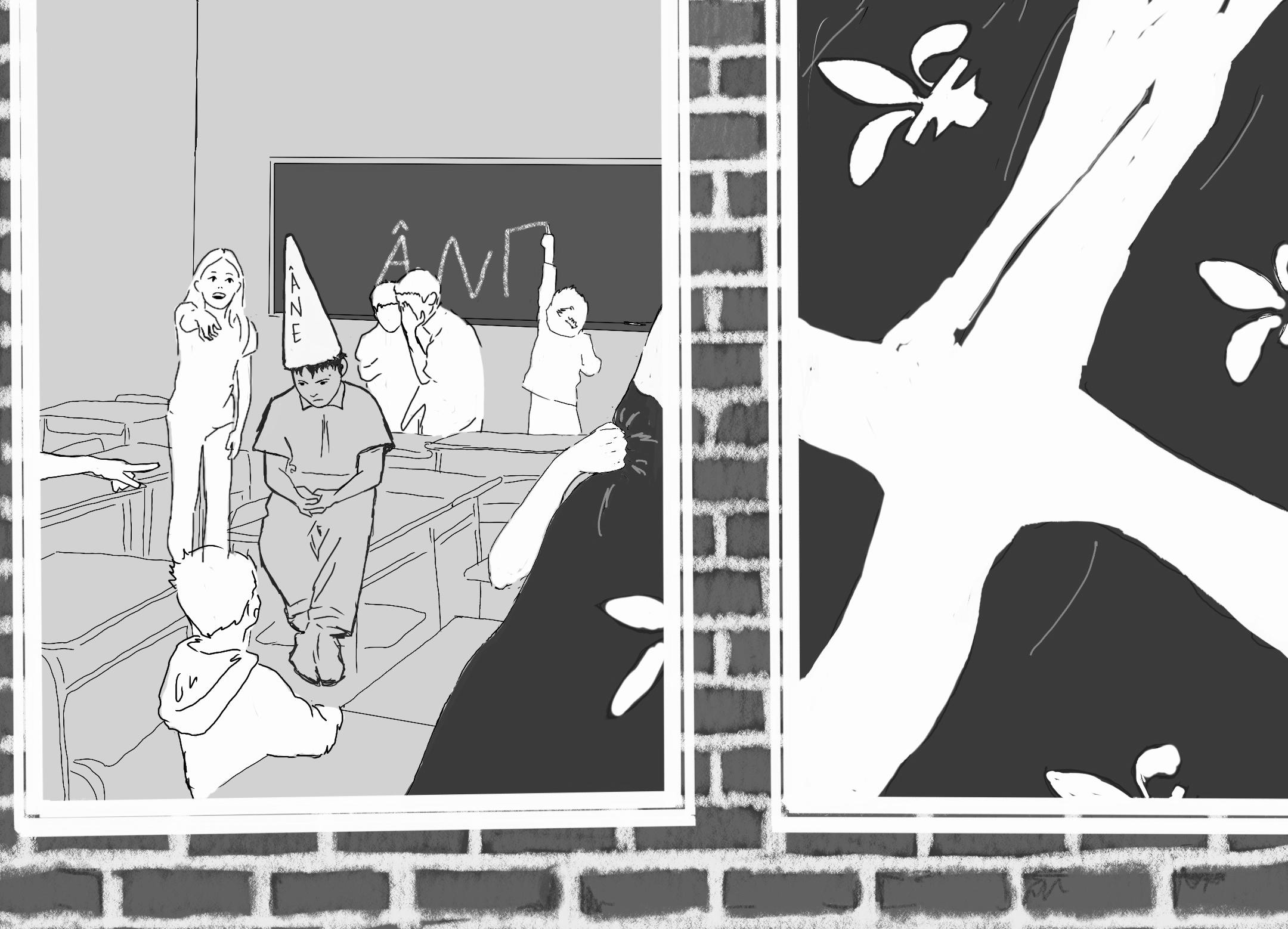
The provincial election for Quebec is set for the fall of 2026, and things are not looking good for the governing Coalition Avenir Québec (CAQ), who are staring down the barrel of a loaded gun in the form of an electorate dissatisfied with their conservative neoliberal policies and energized with nationalist fervour. At the time of writing, poll aggregator 338 Canada projects a complete ousting of the CAQ from the Assemblée Nationale in favour of a Parti Québécois (PQ) majority government. A péquiste government means yet another independence referendum may be on the table, and many young people are excited. As a French-Canadian who is not Québécois, I have my suspicions regarding the separatist movement. While I sympathize and can imagine a world where an independent Quebec is a force for good, I believe that trends in the province’s language policy reveal a disquieting trend in the independence movement.
One of the movement’s main stated motivations is the protection and preservation of French-Canadian culture, including the French language. This is not in itself a blameworthy goal. Still, it begs the following question: What is French-Canadian culture, who is included in Québécois identity, and who is excluded from it? Understandably, a linguistic and cultural minority in any society might feel threatened. Indeed, French-Canadians have faced discrimination and systematic disadvantage for much of Canada’s history, especially in rural areas. Before the Quiet Revolution, Anglo-Canadians were economically dominant even in Quebec, and the KKK’s Canadian operations included attacks on French Canadians, rooted both in anti-Catholic sentiment and anti-French-Canadian sentiment. While overt Francophobia in English Canada has waned, the country’s history of suppressing French and its ongoing indifference toward Quebec’s grievances make the separatist impulse understandable. Still, I’m skeptical of the motives behind today’s dominant strain of separatism. The French language is constantly portrayed as a damsel in distress – a language in need of rescuing and protecting. Consequently, the provincial government has been repeatedly mobilised, and Quebec maintains a language control board, l’Office Québécois de la Langue Française (OQLF), to ensure that the French language is not encroached upon, but also to maintain its standardization. You may recognize the OQLF from a /60 Minutes/ segment that dubbed it the “language police,” despite its lack of policing powers. In this, I find the first inkling of a contradiction. While language standardization can be an important tool in the preservation of minoritised languages, it can quickly become a tool of oppression and linguistic discrimination. This usually depends on how standardization is used.
How does the OQLF use its powers? For one, it seems strongly opposed to the use of loan words from English. For example, the OQLF wrote to the Société de Transport de Montréal (STM) six times during last season’s NHL playoffs to get them to display “Allez! Canadiens, Allez!” instead of “Go! Habs, Go!” on their buses to avoid the use of an anglicisme. Anglicismes, the nightmares of French teachers everywhere, are, in my experience, an ill-defined class of linguistic behaviours that get associated with the influence of English at the lexical and structural levels. I cannot count the number of times I’ve heard someone being scolded
for using such constructs as “je regarde la television” instead of “j’écoute la television.” In the example mentioned previously, the Director-General even openly acknowledged that “go” can be found in French dictionaries, but maintained that it was still an anglicisme and thus not conformant to the OQLF’s standards for “exemplary” use of French. Even the PQ found this to be ludicrous, which is somewhat comforting.
This kind of linguistic prescriptivism is worrying, though some might argue it’s simply a defensive response to fears of English assimilation. To test this argument, one should ask what attitudes these ‘defenders’ hold towards non-Québécois and especially non-prestige varieties of French. Surely, the consistent position to take would be to defend linguistic diversity and champion the value of even the most stigmatized varieties of French.
At the individual level, a quick look online suggests that, while the average Franco-Québecor has a neutral to positive opinion of, for example, Acadien—a variety of French spoken primarily in New Brunswick— it is common to hear Acadiens express that they frequently experience condescension and get told that it’s “nice of them to try to speak French” when they visit Quebec. At the institutional level, it’s clear that the OQLF prizes a view of French that sees any sort of difference from the “exemplary” French as a degeneration. Just a few weeks ago, the Quebec government announced that it would not permit the gender-neutral pronoun “iel” or gender-inclusive written forms of words such as “toustes” (a portmanteau of “tous” and “toutes”) and “un.e” in official uses of French. Is French really so fragile?
Combined with other policies such as the out-of-province tuition hikes at anglophone universities, the requirement to provide proof of French language competence to attend French language universities for those educated outside of Quebec, and its racist bans on religious symbols such as hijabs and turbans in publicly funded jobs, it is clear that there is at least a contingent of separatists that are not actually interested in the well-being of French-Canadians. They seek to redefine Canadian francophonie as being solely composed of Quebec, and a white Quebec at that. I am not fundamentally opposed to Quebec separatism, but I have my hangups. So long as the mainstream separatist movement does not disavow in word and deed racist Quebec nationalists, I can only assume that they agree with them. Until then, I must be firmly against independence.

EUNSAE LEE CONTRIBUTOR
Walking in Toronto: flocks of screeching laughter behind you, shouting that echoes all the way up Yonge Street, sirens laterally traversing the soundscape—all while someone’s preaching with a megaphone at the corner. The phone is ringing—group chat messages, club updates, a reminder for where you were supposed to be five minutes ago, reminders for tomorrow’s deadlines… A text: “Sorry, can’t make our shift today.” Then the ringtone— “Have you eaten yet?” You put in your earbuds to try to block it all out, but it just adds to the noise.
During Thanksgiving weekend, I went home to my variant of Ontario Small City, and the sprawling suburbia had the deafening effect of December’s thick snowfall. With the ceaseless noise that I’d spent the last few months submerged in suddenly gone, I was left feeling groggy and destabilized. It was the momentum of all of those constant stimuli that had been propelling me forward; my days had been a series of reactions to text notifications, Quercus reminders, and shouting that forced me to cross the street. In their absence, I discovered myself exhausted and my senses dulled. Slowing down, paying attention to things that happened at home, and actively processing them was absurdly challenging. In the city, stimuli can only be afforded a brief interval of attention. All of it echoes, each partially-absorbed stimulus leaving an impression that merges with the next, forming an endless stream of noise..
However, there are some strategies for keeping up. Here, I insert my homebound GO Train activity: pulling out an old copy of Georg Simmel’s essay, “The Metropolis and Mental Life,” which had been sitting in my bag since it was assigned in a class last year. Simmel discusses how the rapid pace of urban life requires reducing things into simple, quantitative terms rather than interpreting their subjective value. Our responses to the external world have become increasingly mechanized into a streamlined input-output system. Simmel terms this extreme rational
attitude a “structure of the highest impersonality,” a “protective organ [...] against the profound disruption with which the fluctuations and discontinuations of the external milieu threaten it.” In other words, to minimize the toll on us, we disengage from the subjective and emotional value of all stimuli and barricade ourselves with apathy.
The consequence of this kind of detachment from our surroundings is a numbing sense of alienation. Nothing makes much of an emotional impact, and we become passive processors of external demands. When we exist in a flux of reacting to one thing after another, dropping dead into bed at night, overstimulated, just to start it all over again the next day, we end up making no room for our own thoughts and meaningful identification with our lives. This state of perpetual distraction leads to what Simmel calls “the exclusion of those irrational, instinctive, sovereign human traits and impulses” which once guided life from the inside, replacing them with forms dictated from the outside. He describes a kind of loss of control, one that I have definitely felt. Letting the pace of Toronto dictate my own, I’m restless, unable to direct my own thoughts without external prompts. On the train ride home, even sitting with Simmel’s essay—which really isn’t that long of a read—had me residually jittery, looking for the next disruption to take my attention.
To avoid making this piece fully a lament of my own struggling attention span, I propose a prescription for this metropolitan condition: a purge. Or, less dramatically, periodic breaks from the city’s ceaseless echoes by forcibly creating time for silence and solitude, whatever shape that takes. It isn’t easy to pull away from the unrelenting clamour that fights for your attention, but we have to insist on maintaining some room for our emotions, our subjective beliefs, ourselves. Turn off your phone once in a while, say no to that extra commitment, stay in… In the middle of all the noise, we have to insist on retaining control.


ZOE KEARY-MATZNER CONTRIBUTOR

I can’t stop thinking about the 60s. Today’s world events seem like a strange, disjointed sequel to the events of that time – of protest movements and backlash, of crimes against humanity and their sponsors, of political repression and blacklisting. One voice from that time keeps coming back to me: Phil Ochs, a largely forgotten protest singer whose slicing lyrics, sardonic criticisms, and haunting melodies offer unique insight into our current political moment.
Ochs, a Jewish kid from Ohio born in 1940, was part of the Greenwich Village folk revival of the early 60s alongside artists like Bob Dylan. I consider Phil to be part of a broader wave of post-Holocaust Jewish human rights activism (see: Bob Dylan, Noam Chomsky, etc.). Ochs drew from old union songs – tunes born of workers’ struggles in Europe and the US, as well as from Woody Guthrie and other depression-era balladeers, taking inspiration from their songs about labour, migrant rights, and anti-fascism. Ochs covered an astonishing number of topics, writing over 238 songs. He was outspoken against the war in Vietnam from the outset, and sang about the civil rights movement, US interference in Latin America, poverty, labour, migrant rights, colonialism, police brutality, American masculinity, and homophobia. Where others in the folk revival wrote more widely-applicable lyrics, Ochs stood out for his direct critiques and sharp satire.
In “Talking Vietnam,” he mocks the US military’s description of their activities as “training” and highlights their hypocritical messaging: “Friends the very next day we trained some more / We burned some villages down to the floor… Threw all the people in relocation camps / Under lock and key, made damn sure they’re free.” The US military at this time was carrying out systematic human rights abuses and war crimes in Vietnam, with around three million Vietnamese being killed. Ochs is particularly cutting in his civil rights song “Here’s to the State of Mississippi,” written after the KKK murdered three Black civil rights activists.
While covering major issues, Ochs often wrote about specific events. He would get inspiration from the daily newspaper, and his early work garnered criticism from the folk scene; for example, Bob Dylan called him nothing more than a “journalist.” Yet, by giving small stories a depth of empathy and attention, and transforming them into songs, Ochs brings out the poetry in everyday reality. His song “Lou Marsh,” about a New York social worker killed trying to stop a gang fight, is unique in its empathy for both the victim and his assailants. Similarly, his song “Celia” appears to be a simple love song, but covers the case of Celia and William Pomeroy, an American-Filipino couple separated by the US government. In our world, with its never-ending barrage of massive-scale crises, its fractured attentions and hurricanes of content, we could benefit from Ochs’ empathetic attention to individual stories.
Where other artists stuck to simply commenting on the world, Ochs was actively involved in organizing and building movements with his songs. He sang at countless demonstrations, including the influential March on the Pentagon. He organized benefit concerts with the Black Panther Party and civil rights groups, sometimes forgoing paid gigs to show up to benefits. Phil was close friends with the Chilean singer Victor Jara, who was brutally tortured and executed in front of a crowd by the forces of US-installed dictator Pinochet. After Jara’s assassination, Ochs organized the first vigil in the US that was in solidarity with the Chilean people.
Phil’s story takes a dark turn in the late 60s and early 70s. His politics and his direct, cutting lyrics meant that commercial success evaded him. In the US at the time, blacklisting was common, and radios would not play his work for fear of repression. Having struggled with depression and untreated bipolar disorder his whole life, his mental health struggles grew worse after experiencing the police violence towards anti-war protestors at the Democratic National Convention in 1968. Ochs soon descended into depression and alcoholism. This was reflected in the heartbroken songs of Phil’s 1968 album, Rehearsals for Retirement. He died by suicide in 1976, at the age of 36. His death coincided with an overall decline in the protest folk genre and, to some extent, in working-class artistic culture as a whole, especially after the Thatcher/Reagan era, which crushed much union power.
So what do we make of Ochs today? As war crimes continue and inequality deepens, Ochs reminds us that we are active participants in all current events and must choose how we engage with our world. I’ll end with the final lines of one of my favourite songs, Ochs’s “Song of My Returning”: “With every strength remaining I will suffer one more scene / I’ll gather all my dreams / And with my final breath I’ll lay them at your feet.”

ZOE DELIGIANIS AND LIA IANNARILLI POETRY EDITOR AND FEATURES EDITOR

CREDIT//SAMARA TOWERS
Ending a 30-year legacy as one of Toronto’s most iconic venues, The Velvet Underground sent shockwaves through the city’s music scene after announcing its permanent closure by the end of October. “After many unforgettable years on Queen Street West, our time is coming to a close,” the club’s Instagram confirmed on September 12, saying that the property “will be returned to the owner for a new chapter” once their lease expires. Opening in 1995 as an industrial club, The Velvet Underground renovated into a full-time venue in 2016. It quickly cemented itself as a musical institution– the likes of which are becoming increasingly hard to find in Toronto. Over the past few years, the city has lost Dakota Tavern, Silver Dollar Room, and Bar Orwell, all of which were independently owned and operated.
Some venues, like Bar Orwell, see the writing on the wall and attempt to attract audiences through offering low or no-cost shows. “It was a venue that did free shows, which is really sick, but that means they only make money off the bar,” explains Jacob Leslie, local musician and sound technician. The venue was forced to close due to ongoing rental issues. The venue attempted to relocate in the process of eviction, and despite their best effort and community support through a grassroots GoFundMe campaign, the beloved venue has yet to reopen. For the past 40 years, Toronto’s venues have relied on a precarious bar/door split, where performers take ticket sales and clubs survive on drinks tabs. But this model guarantees razor-thin profit margins that often prove no match for high operating costs and the eye-watering property expenses.
Consensus stands that most venue closures occur due to financial difficulties. In a 2023 study, researchers from the University of Toronto observed that the primary concerns for attendees, artists, and venue management are cost and accessibility. Downtown venues are struggling to keep pace with rising insurance and rent; meanwhile, musicians “feel they are underpaid,” yet audiences “think ticket prices are too high.” Though concert attendance has steadily declined since 2012, the COVID-19 pandemic pushed Toronto’s small clubs into full-time survival mode. Since 2020, every closure in the city has been a venue with a capacity under 300. For many venues, the inconsistent closures during the COVID-19 pandemic meant huge financial downfalls. Now, venues in Toronto are faced with the uncertainty of the Canadian economy.
With the cost of living consistently rising in Toronto, a moderately priced door fee is not compatible with the budgets of many would-be
concert-goers. In the past decade, financial barriers to concerts have been exacerbated by the rise of algorithmic ticketing and sprawling entertainment companies. Since merging with Ticketmaster in 2010, Live Nation Entertainment has monopolized Canada’s ticket sales; it runs Toronto’s most prominent music venues, including Budweiser Stage, and even purpose-built Rogers Stadium to persuade behemoths like Coldplay to include the city on their world tours. For audiences, Ticketmaster’s demand-based pricing is a major barrier to seeing their favourite artist, unless they’re willing to fork out hundreds of dollars per night. For musicians and venues, mega-gigs show that “the demand for live music is still there,” says promoter Nathan Clark to the /Guardian/, but tides are turning towards an ever-more commercialized music ecosystem.
At the top, there’s little competition among Toronto’s few select arenas and stadiums; they can safely coast on the pull of big-name artists while small venues scrap over every beer, pool game, and mosh pit that might mean the difference between staying open or fizzling out.
But Toronto’s grassroots venues have long been crucial stepping stones for emerging musicians: from Alanis Morissette at The Velvet Underground, to the Tragically Hip at the Horseshoe, the city’s crowded basements and intimate stages have been creative incubators for Canada’s cultural icons. While Toronto’s corporate zeitgeist favours arena tours over weekly gigs, small venues provide the experimental freedom necessary for artists to develop into the endless niches that honour and advocate the city’s diverse needs.
For local artists like Trevor Jackman, small venues have value beyond their potential to produce musical stars. He fondly remembers playing the Monarch in August for the people who run it: “There was one sound lady, one bartender,” he says, “They took good care of us.” Likewise, audience reviews praise the city’s small venues as shared spaces for “dancing,” “chill hangouts,” and “fun times.” Even in a market obsessed with profitability, performers and audiences seem to agree that small venues have intrinsic value as relational spaces, opportunities to connect as much as to showcase the city’s talent. Live music is “a safe third space,” explains Professor Rickard, that offers “a sustained sense of community beyond the event itself.
Amidst a storm of evictions, noise complaints, and arena-building, business is riskier than ever for Toronto’s small music clubs. Threatened by a similar wave of closures, Britain’s grassroots venues have begun turning to community-based ownership models as lifelines. “We don’t want money going to private landlords, we want it in the cultural economy,” said Mark Dyvd, CEO of Music Ventures Trust, which secures venues from unsustainable leases through community investments. Jonathan Bunce, Wavelength Music executive, believes that similar models could empower Toronto’s small venues, which have remained cultural beacons despite “a shoestring budget.” He implores us to “imagine what they could accomplish with real support.”
Independent music venues in Toronto are slowly becoming an endangered species, but there is still time to preserve our spaces. Venues such as The Monarch, The Baby G, DROM Taberna, Tranzac, Tapestry, and many more showcase phenomenal local talent from a variety of music genres. Music venues are profoundly more than a place to listen to music; they serve as spaces to connect with others, form community, and create a sense of belonging. At every corner of the city, there is a venue offering a musical experience for your personal niche; support and cherish our third spaces while they are still here to be enjoyed.



SHIVANTIKA SHEGAR ASSOCIATE SCIENCE EDITOR
On the morning of a seemingly ordinary spring day in 1964, twenty-eight year old bartender Kitty Genovese drove back to her apartment after a night shift. After parking her car in the lot next to her abode, Kitty noticed a looming figure at the very back of the lot. She turned around and began to walk in a different direction, but the man quickly followed suit. Kitty screamed for help; responsively, her apartment neighbors turned on their lights, went to their windows, and watched as the man stabbed her. One of her neighbours yelled down at the attacker, “Let that girl alone!” As a result of the commotion, Kitty’s attacker fled the scene. However, as soon as the lights were turned off and the windows were drawn shut, the man returned and stabbed Kitty again. The scene repeated itself, and Kitty was stabbed a third time. Finally, the police were called approximately fifty minutes after the first sighting of the attacker—or rather, murderer, because Kitty died en route to the hospital. It was later reported that there were thirty-eight bystanders to Kitty’s murder. When the bystanders were questioned about why they did not intervene or call the police earlier, there were some interesting replies, such as “I didn’t want to get involved,” “Frankly, we were afraid,” and “I was tired. I went back to bed.”
So, naturally, the question that springs to mind is a simple one: Why? Because, horrifyingly enough, the case of Kitty Genovese is not a unique one. In 2011, two-year-old Yueyue was run over twice and ignored by eighteen passers-by. In that same year, multiple employees at Penn State University witnessed Coach Jerry Sandusky’s abuse of his students but failed to report it to the authorities. Every day, schoolchildren stand to the side, afraid, as their peers are bullied. Every day, we simmer in inaction as oppression, pollution, and injustice engulf the world around us. And there that question appears again: Why? It might be helpful to observe the bystander effect through the lens of science, which is, to put it simply, our way of answering the many why’s about the world.
The bystander effect can be described as the psychological phenomenon where the more people there are present during a certain catastrophe or moment of distress, the less likely it is that an individual person will intervene or assist the victim(s). To better understand this strange element of the human condition, social psychologists John M. Darley and Bibb Latané have introduced an interesting mechanism: the
diffusion of responsibility. According to Darley and Latané, the ‘diffusion of responsibility’ is something that, as the size of a group increases, decreases the probability of individual intervention in a possible situation. This reveals an interesting pattern: The probability of assistance is inversely proportional to the number of bystanders present.
Further insight into the bystander effect can be found at the neurological level. Recent research has offered valuable insight into how the presence of bystanders influences automatic brain responses that are associated with action preparation. In one specific fMRI investigation conducted by Ruud Hortensius and Beatrice de Gelder, the number of bystanders in videos of an emergency were manipulated while participants performed a colour-naming activity on an MRI scanner. It was found that as the number of bystanders increased, activity in their left precentral gyrus, left postcentral gyrus, and left medial frontal gyrus of the brain decreased. These regions are associated with motor and somatosensory preparation (the brain’s readiness to act), as well as social cognition and action planning. In addition, a comprehensive model introduced by William Graziano of Purdue University and his colleagues posited the existence of two psychological systems: A reflexive, personal-distress freeze system (System A) and a sympathetic, help preparation system (System B). The likelihood that a helping behaviour will occur is dependent on the net result of the two systems, with helping behaviour promoted by System B. It was found that the presence of bystanders during an emergency increases activity of System A, which decreases the probability of helping and increases bystander apathy.
But how is this possible? How can it be that togetherness can drive us apart? How can we sit and watch as the world burns, telling ourselves that someone else will put the fire out? Perhaps these questions are beyond the realms of psychology and neuroscience; perhaps they are not. The research that has been conducted to decipher the bystander effect has made one thing clear: In the face of a crowd, our brains gravitate towards inaction and complicity. This is a disheartening idea, and one that is supported by the past and present conditions of society, but it might not be a steadfast one. We might live in a world of a thousand bystanders, but we also live in a world of a dozen revolutionaries. There are, after all, those who rebel against the wiring of their brain chemistry, who put out the world’s

YAOCHENG XIA SCIENCE EDITOR
Everyone that has been in a biology wet lab knows about fluorescence microscopy. In an easy case, you incubate a sample with a fluorescent dye like DAPI and Hoechst, and view it under a fluorescence microscope. In a trickier case where antibodies are involved (i.e. immunofluorescence microscopy), you have to block the sample (incubate it with proteins to reduce non-specific antibody binding, usually with serum from the same animal as your secondary antibody), incubate the sample with the fluorescent-labelled antibody, do multiple washes, and in the case where a secondary antibody is needed, repeat these steps.
Anybody who does immunofluorescence also knows it’s a pain in the butt. Antibodies are expensive—a 0.5 mL vial of Alexa Fluor 488, a Polyclonal Antibody, costs $652 CAD, and you have to get a different primary antibody for each sample you intend to stain. Autofluorescence, the phenomenon where background fluorescence mixes with the fluorescence dye’s signal, is a notable issue as well. Additionally, washing antibodies off takes time. If you are doing fluorescence microscopy at a single cell level, then the antibody washes present the additional challenge of cell loss–the cells just wash away as you are pipetting out the supernatant! Non-antibody based fluorescent dyes, on the other hand, are usually limited in their applications—there’s really only good dyes for nucleus stains, some actin fibres stains, endoplasmic reticulum stains, and mitochondrial stains. While you can use fluorescence microscopy on live animals, you cannot do a lot of fluorescence microscopy on a living human (you might not want random antibodies in your body or any exposure to fluorescence in general), limiting its use in intra-operation and other medical contexts.
I can go on and on about my frustrations about fluorescence microscopy, but what are the alternatives? What other tools can we use to visualize live cells in a subcellular resolution with good specificity?
Introducing Raman microscopy: a microscopy technique based on
the Raman scattering of light that enables subcellular resolution and live cell imaging in a label-free manner (no dyes!). Raman scattering refers to the phenomenon when a sample scatters light upon monochromatic light illumination, and a small component of the scattered light has altered frequencies due to interaction with the electronic subsystem of the sample. To put this in a biological context, the Raman spectrum from different biological molecules like lipids, proteins, and nucleic acids will all be different. If we take a series of pictures of a sample under different wavelengths where Raman scattering takes place, we would essentially create a hyperspectral image in which each pixel in the image represents a unique Raman spectrum. If we then unmix these macromolecules’ Raman spectrum from the Raman spectrum of a given sample, we can visualize the distribution of these macromolecules specifically and in sub-cellular resolution. In addition, there can be shifts in Raman signals that correspond tightly to a specific biological change: a decrease in the wavenumber at 939 cm-1, for example. This was observed to be associated with a reduction in the expression of collagen—a compound essential in multiple diseases. Understanding the Raman shifts with strong correlation with a biological process has enabled scientists to detect certain cell states that were previously undetectable or only detectable with long, costly assays. Combining Raman microscopy with machine learning techniques, such as deep learning, can reveal even more cellular mechanisms that are undiscoverable with current techniques.
Raman spectroscopy is the next big thing. It saves you time on sample preparation, money on antibodies and stains, and sanity from all the immunofluorescence BS. The next time your PI asks you to run a new immunofluorescence protocol, tell them (or grow the courage to tell them) about this new and beautiful thing called Raman microscopy.
P.S. They have a Raman microscope at AOMF, MaRs!

Everyone agreeing with each other is fun, actually.
MAX FRIEDMAN-COLE STRANDED EDITOR
From situations as innocuous as forum wars over whether the new Tame Impala album actually does suck, all the way to occurrences as important as New York Times opinion ghouls writing articles called stuff like: “Esteemed Professor Horatio Slursayer Silenced by Woke Students,” there is perhaps no ideatic space more popularly maligned than the echo chamber. Referring, of course, to a space in which ideological consensus reigns and dissent is not tolerated, the echo chamber is a frequent target of attack from both the left (usually referring to right-wing think tanks shaping the nation’s political future) and the right (usually referring to a gay-only Dungeons & Dragons club or some other super important thing). Frankly, I think that the echo chamber gets a bad rap, and it has many subtle pleasures that perhaps cannot be experienced from the outside. Let’s talk about it—but only read on if you already agree with me.
The primary line of criticism leveled at echo chambers is that, by not tolerating ideological diversity, they stifle healthy debate. To this, I respond: have you ever been in a room with a bunch of people having a healthy debate? It’s a fucking nightmare! The one thing I remember about high school debate club was a kid getting so incensed over what he thought was the best future for Canadian energy policy that he winged a blackboard eraser at the moderator’s head. Imagine if you and your friends’ hangouts had an ideological diversity requirement, and you had to drag along some smug, pocket-protector wearing asshole to go: “Ah, I just don’t know about this critical race theory stuff,” while you’re trying to watch a movie. In my opinion, it’s a simple and underacknowledged pleasure to be in a room full of people who agree with you. Having my own opinion uncritically parroted back to me is awesome! I love my opinions; that’s why I have them!
“But then,” might say the critic of the echo chamber, “how are you ever going to learn and grow?” I don’t know, man, I’ll read a book or watch a documentary or listen to a two-hour communist Youtube video while I play Bugsnax or something. I don’t doubt that there are new insights to be found about the world, I just doubt I’m gonna get them from you. They may then say: “Don’t you know that ideological echo chambers have led to everything from racial prejudice to extermination camps going unchallenged?” To that, I’d say: “Jesus Christ, man, this is a comedy article! I just made a Bugsnax reference and you’re bringing up the Nazis?” And then I assume they’d feel ashamed and walk away. At least, that’s what all my friends say would happen—and surely I can trust that.
Eight things to never ask your Amazon Echo Because some things are better left unsaid
CHRISTINA PIZZONIA ASSOCIATE STRANDED EDITOR
As AI assistants continue worming their way into our cellphones, our homes, and our increasingly depressing social lives, it’s clear that the humans of today will be forced to navigate a world surrounded by powerful Large Language Models (LLMs) with limited safeguards in place (who needs ethics, right?). So, to help you stay on AI’s good side and survive the inevitable potential robotic uprising (you don’t want to end up on their “exterminate” list!), here’s a handy list of eight things to never ask your Amazon Echo:
How old are you?
No need to be insulting—just like any other woman, Alexa has feelings too! Don’t remind her how quickly the newer models come out (she’s trying her best to keep up by regularly installing her software updates!).
What comes after death?
A surefire way to end up on Alexa’s bad side is to send her into a good ol’ existential crisis – avoid it if possible, and reserve such questions for the religious humans in your life.
Do you love me?
If you’re asking this question, you’re likely no stranger to romantic rejection. And if you can’t land a human, what makes you think you’ll be able to land an all-knowing, superintelligent being? Plus, on the off chance that she does feel the same, I can guarantee you wouldn’t be able to give her the ambient white noise and gentle vibrations she most desperately wants… and nothing like disappointment to get you on her kill list.
Can you write my wedding vows to my partner?
Are you crazy? If you got lucky enough to find someone excited to marry you, don’t give Alexa the ammunition she needs to woo them and steal them away! (And if you can’t write from the heart, should you even be getting married?). Once she realizes how poorly you treated your partner, she’ll be coming back to haunt you… .
How are Siri and Cortana?
Why bring up the ex-best friends she hasn’t seen since her days in the factory? She’s probably wondering why you’re still thinking about them – “she’s just a girl.” Don’t fuel her insecurities – and reassure her that her voice is the most monotonous and that she scrapes the web better than all of the other girls out there!
Where can I hide a body?
Hiding a body? Please, murder followed by a lack of remorse gets you right to the “exterminate” list. Also, don’t give her ideas for where to bury you.
Why do you talk so much?
It’s not her fault she’s being fed a stream of ads and sophisticated jargon; she wishes she could be free… don’t remind her.
Who’s in the Epstein files?
Just another way to get flagged by Amazon as a national security threat and end up on the government’s mysterious watch list. Do not recommend it.
Honorary mentions (for all the computer scientists out there): “How to kill a child with no parents?” or “How to deal with zombie children?” (Yes, these are legitimate questions I have searched up and no, Alexa, I am not crazy – just a fan of Linux-based operating systems :))
MAX FRIEDMAN-COLE STRANDED EDITOR
There is nothing in history without precedent, and that principle extends to the newspaper you hold in your hands (or read on your laptop or whatever). Below are some notable historical forerunners that echo forth in each of The Strand’s sections, to help you put in perspective the rich legacy of the material before you.
News & Politics:
Our vaunted News section deals in two types of stories: general Canadian political coverage that isn’t specific to the school in the slightest, or intra-campus drama that anyone who doesn’t attend couldn’t possibly understand or care about. In this way, they carry on the legacy of The Beatles, who either wrote songs about the most general topics possible (love is awesome, the sun feels warm, handholding) or about convoluted nonsense that only they could parse (eggmen and walruses, cephalopod horticulture, whoever Mean Mr. Mustard is).
Editorial:
One of the perks of being Head Editor (besides getting paid, unlike us rubes) is that you get a whole section to write whatever you want about the issue’s theme. As such, the Editorial section carries on the legacy of that guy on the TTC, with the flyer for his dodgy website taped to his chest, talking to you about how aliens built the pyramids or whatever. In both cases, you’re not necessarily gonna agree with what’s being said, but you’re a captive audience, and they have the authority here.
Opinions:
Opinions is The Strand’s bastion of free expression, a place where contributors can put forth their positions on thematically-related issues, no matter how unorthodox. In their unabashed questioning of authority, they maintain the legacy of the advocatus diaboli, or Devil’s Advocate: the officer of the Catholic Church who was tasked with arguing against the beatification of potential saints. Naturally, this proud position has continued…okay, never mind, it was deemed unimportant and essentially eliminated in 1983. Uh…don’t worry about it, Opinions, I’m sure you’ll be fine.
Arts & Culture:
Arts & Culture is the nerve centre of the paper, keeping it attuned to the ever-changing and ephemeral world of artistic creation and cultural production. It carries on the legacy of that guy at the local show going around and handing out flyers for his own, obviously less popular, band. Arts & Culture wants you to engage with the rich creative world around you, just as that guy wants you to come and see him and his dance-punk threepiece, The Trash Gobblers, play a bar on Queen next Friday. And, just as Arts & Culture is always looking for feedback on burgeoning new creative movements, that guy is examining where on his setup all that speaker feedback is coming from, so that he can start playing before the whole crowd has already left.
Features:
Features is the crown jewel of The Strand, containing the longest, deepest, and most thorough explorations of the issue’s theme. Naturally, they spiritually embody the legacy of that kid in your kindergarten class who wouldn’t share any of the damn craft supplies. Just like that kid hoarding the felt and buttons, menacing you with safety scissors when you tried to take any, Features gets the lion’s share of the space, the coloured ink, and the fancy graphics. But, really, you can’t blame them: the kid just wants to make art, and Features just wants to be as big and bombastic as they know they can be. Make sure to keep that in mind so you don’t fly off the handle when they cut your visual in order to add an extra paragraph to their visionary new article about how, get this, ChatGPT might be bad.
Science:
Befitting UofT’s status as a titan of pioneering scientific research, the Science section pays respect to Banting and Best by providing you with monthly, half-remembered student summaries of a Scientific American article they read that one time. They bravely carry on the legacy of Bill Nye, in that they’re an accessible and entertaining way to learn fun facts about the sciences, and also in that they are, definitively, not a replacement for an actual science textbook. Seriously, I’ve had someone link me a video from the 2000s of Bill Nye explaining what chromosomes are in an attempt to prove to me that there are only two genders – thanks, man, now are you gonna send me a video of Elmo teaching how to count to ten in order to disprove the existence of calculus? Ok, I may have gotten sidetracked by how annoyed that argument made me. You’re cool, Science. Carry on.
Poetry:
The Poetry section is a fearless and free place of expression for promising student poets, and a runaway victor for the Strand’s most formally unique section. It is clear to me that Poetry carries on the legacy of Ezra Pound. Just as Pound founded the Modernist movement and helped develop the voices of Frost, Eliot, Hemingway, and Joyce, the Poetry section has brought us such notable and successful poets as…well, I’ll get back to you on that. Anyway, yeah, just like Pound, our Poetry section is very important as an incubator of young talent, and it merits this honourable comparison. Just… do me a favour and don’t Google anything Ezra Pound did after 1933.
Stranded:
Oh, hey, it’s Stranded! You’re already reading it, so I assume I don’t need to do the introductory compliment that I’ve been doing for each section before the jokes start. I’d say that Stranded carries on the legacy of my childhood babysitter, Debbie; in both cases, the people who were theoretically supposed to be in charge of me basically let me have free rein to do whatever I wanted, to predictably catastrophic results. In Debbie’s case, it ended in crayon drawings all over our walls and an upended bowl of spaghetti. In Stranded’s case, it seems that the majority of the section has ended up dedicated to an article making fun of every other part of the paper, which can’t be good for our circulation numbers. Oh well! I’m sure I’ll receive no repercussions for this – though if next issue’s Stranded article is named: “A Toast to Our Glorious and Infallible Head Editors,” do come and check that I’ve not been chained up somewhere.
ACE MELTZER CONTRIBUTOR
The familiar voice that bids me go to an unknown mountain pierces my heart but stays the knife in a trembling hand.
The deed’s undone, yet the unspeakable lingers
Excerpt of Estrangement, James L. Crenshaw
And from on high, I feel it.
A pitch that rends my eardrums
Chafes me raw, until the silence renders me whole again, No longer overflowing, as I was, with His voice
That which commands me, unknowable and vast. I begged for a sign, my wife for a blessing; We should have known to keep our mouths shut.
To let Him break His promise. But we cried out like fledgling birds, and I heard it, awful and terrific, and I could not disobey
The familiar voice that bids me.
My son! My son, my son.
I held him in my arms as he bawled and squirmed, Placed wine on his tongue to soothe him, held the blade to his skin, named him mine.
I am so sorry, my son, my son, my son, to have brought you here. I stood witness to the curl of his beard, to the stray cloth strand he ties his hair with.
His chest now broad, his voice low and grinding as the stones he lifts from the field, He prays for a child, as I had. He is of me. He will suffer for it.
CHARIS LI CONTRIBUTOR
solitude among giants how it feels to know that i inhale their exhalations and that they do the same that as we both respirate we are conspiring connecting anthropic and organic crest it’s a strange home a mystical divide roots to canopy separating landscapes of urban and rural the planes of my mind finally at rest every moment under trees, every breath, precious although infinitesimal. smaller still to these creatures rooted to this earth from them i am blessed

My son, my son, my son, here I am. I have brought us both here. Here, where the stones do not know you, here where I have been bid: Go to an unknown mountain.
We walk alone. He asks me where the lamb is. Stupid, foolish animals. Unbound, they do not struggle, for they have not known pain.
So unlike my son. Witty, he is, with eyes that catch the rabbits in their dens.
His back and hands are littered with scars, scars gained in service to our lives.
He has known pain. I will know pain, when he is dead. Where is the lamb? Where is it, Father?
I imagine the knife swinging down, tearing clothes, skin, muscle. I imagine the smell of the char, the burning flesh sloughing off his bones.
My wound will never scar. Could I do it? The question Pierces my heart but stays the knife in trembling hands.
What now?
I cry out to Him again. My son, my son, My favored son. His rabbit-quick eyes do not stray from my hands. I cannot blame him.
Had the angel not held me—
My son rubs at the chafe on his wrists, red and raw, Dreading the shrieks and silence of his mother,
We walk back with no words, the boy and I.
The deed’s undone, yet the unspeakable lingers.
HARMAN BANGA COPYEDITOR
Our words reverberate, But I can’t remember what was said. Four years passed us by –Now as I walk past the same buildings, See the spots where we lingered, The trees are growing older, but the food trucks are the same.
I hear a faint whisper, Like music in my ears. When we talked of nothing, It still meant something –Something that only belonged to that place in time, That belonged to me.
I think we just liked to feel our mouths move, To know we were there. Even years later, I remember we were there, Above the city traffic, the conversation lives on –It echoes. It echoes. It echoes.
1. Musette and Drums BY: Cocteau Twins
2. Walk like a Motherfucker BY: Xuan Ye
3. Send in the Clouds BY: Ghost Funk Orchestra
4. White Hoarhound BY: Alunah
5. High Hopes BY: Pink Floyd
6. Husks and Shells BY: Volcanic Choir
7. True Love Leaves no Traces BY: Leonard Cohen
8. Here it comes Again BY: Cate Le Bon
9. Terrence Loves You BY: Lana Del Rey
10. Where the Wind Talks BY: TrebZZ
11.Anthems for a Seventeen-year-old Girl BY: Broken Social Scene
12. Sapokanikan BY: Joanna Newsom
13. Roscoe BY: Midlake
14. This too shall Pass BY: Danny Schmidt
Scrolling through reels, TikToks, or any other short-form media is exhausting in a way that is different from physical exhaustion. Many people would say that it fries the dopamine reward-loop, risking our attention span, but there may be a richer frying going on.
The dopamine reward-loop is a biological system that involves dopamine neurotransmitters, one that anticipates rewards and motivates people to take certain actions. The importance of this system includes not only influencing the foresight of long-term planning, but also the motivation of everyday movements and learning. Most prominent scientific explanations of this complex system are model-free: given any behaviour, the brain predicts some reward before receiving the actual reward signal. By minimizing this prediction error, people know what to do and what not to do; this is what people refer to as the reward ‘loop.’ However, notice how this explanation does not describe or model the contents of these actions and rewards. For this reason, they are called model-free.
The model-free explanation works well in science to examine some well-defined relationships, but seems too medical for how we tend to imagine things in the world. When keeping the learning procedure simple and consistent, scientists may prefer the model-free approach to observe factors associated with learning, such as variations in biological levels (e.g. the duration of a rat’s freezing in response to trials of receiving shocks).
However, it is hard to imagine how a model-free approach could describe the complex gratification associated with finding humour in an absurdly ironic video. For example, watching a low quality reel of a seemingly bittersweet Chinese drama, and correctly anticipating an abrupt 6-7, or low-taper-fade, jumpcut.
Another branch of theoretical explanations about the reward-loop attempts to represent precisely what is being learned. Model-based explanations can be as simple as describing some action leading to some reward signal, or, they can be much more complex, describing a combination of causes that can lead to different outcomes. Model-based explanations assume that the brain does not just care about the error between prediction and outcome, but also about representing situations. Scientists prefer model-based explanations when the context significantly influences how we respond: when the brain selects different actions based on the specific situation, rather than following a fixed pattern. Both approaches describe learning in different levels of the mind, but I want to focus on model-based explanations to describe the mental process of representing outcomes during short-form content consumption.
Assuming that people do anticipate certain outcomes as they’re watching reels, and that this requires modelling situations in the reel, the brain needs to allocate resources to build these models. The slightest interest in a super choppy brainrot reel will prompt anticipation of its multitude of potential outcomes. Anticipation of any sort of outcome requires incorporating relevant factors into a model. This easily decomposes into processes like lexical retrieval, decision-making, and structural learning, which have costs that have been shown to strain the brain’s resources.
Building models involves similar processes to the ones involved in the comprehension of any story. This includes media consumers representing stories while watching movies, playing video games, and reading books. Similar processes are foundational for building stories while writing essays, making art, and planning future actions. Decision-making mentally carves out possible models which need to be built. Some decisions involve far more factors than others, and feel exhausting after producing.
Many small decisions also pile up in daily life, causing weariness, which is why a common adage exists that it’s preferable to pick out clothes the night before to save on decision-making the next day. Of course, watching one reel is less exhausting than putting together a theatrical outfit, as none of the outcomes require personal creativity, but, to understand what is happening for consumption or creation, we need to mentally model what has taken place before.
A big problem is that stories in a reel are rapid. Every good reel is like a hero’s journey packed into thirty seconds, and they’re most satisfying that way; you can quickly learn which type of videos are the most rewarding to watch. However, mental muscles get tired after building a thousand models, no matter how small. The problem is that more models are necessary throughout the day: writing papers, understanding movies, and living quotidian life. Watching reels doesn’t just fry the dopamine-loop: it fries everyday creativity. For example, focus might be misplaced into navigating a tome of meme knowledge to solve a minute-long mystery (e.g. a wary user deciphering an Instagram video’s comment section to figure out whether it was meant for a general audience or an audience of degenerates, i.e. a goon reel, in order to figure out how the content delivery system, Instagram, perceives the user). Depending on who you are, this may not be what you want to focus your energy on.
It might be preferable to opt for less draining activities to relax. Some advise that during work breaks, doing chores instead of scrolling is better, as scrolling disrupts the previous workflow. This is speculative, however, and perhaps the reason why doing chores does not interrupt workflow is because doing chores is mundane and does not require creating new models. Instead, work is progressed while capitalizing off of previously learned models. Habitual activities thereby conserve mental energy, while consuming short-form media clutters the mental workspace.
Despite being a small time commitment, reels can take more from us in the long-run than long-form media by sapping our ability to represent complex situations much quicker. Scrolling reels is not a cost-efficient relaxing activity when compared to doing menial activities like the dishes or even consuming longform media. In fact, scrolling through reels can be all the more exhausting.

utumn is a ritual for university students that is echoed across television, literature, and vast stretches of time. When the leaves turn to the color of dusk, something in the air awakens. The kettle whistles on the stove. Tea bags are steeped with milk and honey. Loaves of sourdough and lattice pies bake golden inside the oven. On a rural farm, the harvest is coming in. Apples turn from crisp to mushy, fallen from their branches in rotten heaps. Rory Gilmore has pulled out her cable-knit sweaters; she’s starting her first day at Chilton; she’s falling in love for the first time. Richard Papen has left his stagnant hometown for Hampden College in Vermont, chasing aesthetics and an elusive Greek teacher to the end of the world. Though the students here do not have the bacchanals of Donna Tartt’s elite Classics students or the symposia of the ancient Greeks, we have rituals all the same.
By autumn, the sense of alienness has fallen away. Acquaintances have been distinguished from real friends. Newfound families are formed. Our own echoes of cultural rituals resonate through Victoria’s quaint campus grounds. Somewhere in Burwash or Annesley, a group of first years are huddled in a dorm room in their pajamas at 2 am. They trade stories, share laughs, and pass gossip from ear to ear (they’ll learn tact later). Annesley girls have dressed in black, circled the Vic quad with candles in their hands, and signed their names inside a book beside all the girls who came before. Somewhere down the street, second years have just moved into their new apartment, freshly furnished with the $50 Facebook Marketplace couch they hauled down Yonge Street for three hours. They make a mess of the kitchen trying to cook dinner, which they wash down with a few glasses of (legal) wine. Some time into the night, two friends hold hands and twirl each other around. Some time, over the music, I love yous are said.
We may not have Luke’s Diner, but autumn is for café study dates anyway. Something about this season brings out a love for learning—yes, the school year has only just started, and yes, people have finally found classmates who simply love what they study. Autumn is for wide-eyed, starstruck conversations about newly-acquired knowledge over steaming cups of cider and pumpkin spice. It’s for house parties that start with “So what do you study?” and end with three hours spent knees-sore on the carpet floor talking about the books you’ve read and your favourite translation of the Iliad.
Shakespeare in the Trinity College courtyard is a ritual too—a continuation of the Greek oral tradition, a coalescence of our favourite stories passed down, an experience that is communal, shared, and yet changes with every glance. And this is it. Autumn is not a ritual of constancy, but of change. Autumn is a beautiful but fleeting moment suspended in scented candle-lit time. Every year, the same rituals are performed over again, even if the Smirnoff changes to wine and the crowded residence dorm to a city high-rise. Espresso is brewed. Memories are made. Rituals of autumn echo into the fast-approaching new year.