TR
UT H
& RE A SO
N
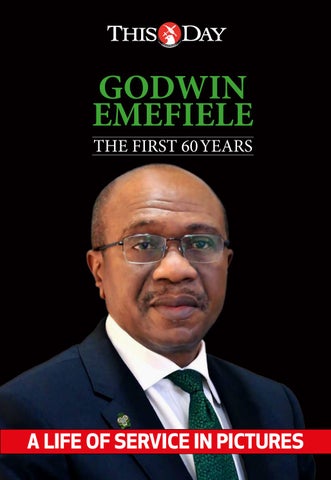
GODWIN EMEFIELE THE FIRST 60YEARS
A LIFE OF SERVICE IN PICTURES 1
2
3
EMEFIELE: A LIFE OF SERVICE OBINNA CHIMA AND JAMES EMEJO
W
hen the tenure of the then Governor of the Central Bank of Nigeria (CBN), Mallam Sanusi Lamido was coming to an end in 2014, a lot of Nigerians jostled for the plum jobs. Even when the names of some top bank chief executives, economists and even some deputy governors at the central bank then were being bandied about, nobody mentioned his name. He was not even from the geo-political zone that most people thought the job would go to considering that he comes from same region with President Goodluck Jonathan. But against all odds, Mr. Godwin Ifeanyi Emefiele was nominated for the job of the CBN Governor, a position on February 20, 2014. Having put up an impressive performance at his screening before the Committee and thereafter the entire Senate on March 26, 2014, his appointment as the 11th (10th indigenous) Governor of the CBN was confirmed and he assumed the position on June 3, 2014. Typically, in Nigeria’s political scene, it is usually not easy for a public officer who was appointed by a government to be retained in office when an opposition government wins an election. But Emefiele survived all the darts thrown at him when the President Muhammadu Buhari-led government took over and even went ahead to become the first CBN Governor to get a second term since 1999, following his reappointment in 2019. Indeed, the Ika-born banker who celebrates his 60th birthday today, has lived a remarkable and eventful life. Despite rising to the pinnacle of his career he has remained himself and has held onto the ideals of unyielding rectitude, selfless service and unwavering commitment to the welfare and well-being of the common man. There is something about Emefiele that appeals to you from a distance. In more ways than one, your first encounter with him is likely to leave a humbling experience in you. His calm and dignified mien resonates long after you may have left him; his very simple nature underscores a man unimpressed by the grandeur and prestige of his office. Big titles and big talk are hardly a part of him.
THE EARLY YEARS
E
mefiele was born on August 4, 1961. He attended Government Primary School, Victoria Island, Lagos in 1973 and Maryland Comprehensive Secondary School, Ikeja, Lagos State, for the West African School Certificate (WASC) in June 1978. He proceeded to the famous University of Nigeria, Nsukka (UNN), where he studied Banking and Finance and obtained a Bachelor of Science Degree (B.Sc.) (Second Class Upper Division) in June 1984. In October 1986, he obtained a Master of Business Administration (MBA) Degree in Finance also from UNN, winning the Best Graduating Student Award. He later engaged in Executive studies at Stanford University, Harvard University (2004) and Wharton Graduate School of Business (2005), where he took courses in Negotiation, Service Excellence, Critical Thinking, Leading Change and Strategy. Before his banking career, he lectured Mathematics of Finance and Insurance at the UNN and University of Port Harcourt. The young Emefiele started his banking career at the Nigerian American Merchant Bank (First Bank of Boston) and later joined Zenith Bank Plc at its inception in 1990. “Growing up, my parents, recognised that the only way to brighten my chances for a better future was to provide me with a good education. I witnessed their toils as they struggled to pay my school fees, sometimes using proceeds from a small palm-oil plantation we cultivated in our hometown. “I sympathised with their inability to sufficiently support me through those periods, despite all the luxuries that some of my peers had. With their relentless reminders, I remained diligent and determined to accomplish my dream of becoming a leader in my chosen field of finance. “When I look back at some of my peers in school who focused on other things besides hard work and dedication to excellence, I see a different turn in their journeys through life. For this and many other reasons, I remain eternally grateful to God and to my parents for the principles they imparted in me,” Emefiele told a gathering of students and academics at the University of Lagos, recently. “I am a believer in destiny. Every man’s life has been ordained by destiny but you cannot say because your life is ordained by destiny you will not work. Hard work and focus will lead you to achieve your destiny otherwise that which was ordained for you will not materialise,” he had told THISDAY. For some inexplicable reason, his childhood fascination was to be a doctor, but he switched to Banking and Finance. “I wanted to be a doctor, I wanted to study medicine in school but really can’t remember what happened that made me decide to change to banking and finance. I don’t know why I suddenly made that switch, but I did and even became a lecturer,” he added.
THE FAMILY MAN Emefiele is married to Margaret and they are blessed with two sons: Godwin Pammichukwu Jnr. and Andrew Olisehike Emefiele. Although Emefiele is said to be closely knitted with both his nuclear and extended family , this attribute was truly demonstrated by two events in 2016 that happened 7 months apart. At the burial of his mum in April 2016, Emefiele left no one in doubt that his late mum meant much to him emphasising that she had raised them up with strict Christian and Biblical principles. Emefiele said: “I enjoin mothers to bring up their children in the way of God, correct them when they are wrong and teach them to be hard working in life, they will turn out to be good citizens of the society.” The second event which happened in October 2016 was the dramatic kidnapping of his wife, Margaret. Although she was rescued within 24 hours , the CBN governor left no one in doubt about his closeness with his family: “I am grateful to security agencies for their gallantry in bringing my wife back home within 24 hours in compliance with the directive of President Muhammadu Buhari. “My gratitude to the Delta and Edo State governments, friends and well wishers who, through their actions, prayers and goodwill, helped to bring this harrowing experience to a joyful end. “I reaffirm my resolve to continue to serve the nation diligently with all his heart without any fear of intimidation,” Mr. Emefiele said in a statement after the event
4
5
ZENITH BANK YEARS Emefiele was an integral part of the team that transformed Zenith Bank Plc from a start-up to one of Africa’s largest banks with over 10,000 staff and N1.17 trillion in shareholders’ funds as of December 2020, as well as subsidiaries in Ghana, Sierra Leone, Gambia, South Africa, Dubai, China and the United Kingdom. On account of his uncommon diligence, exceptional motivation, and undying integrity, he rose quickly through the ranks of the bank and was appointed Executive Director in 1996. In this position, Emefiele oversaw the banks affairs in Corporate Banking, Treasury, Financial Control and Strategic Planning, and was later appointed Deputy Managing Director in 2001. Emefiele who typically as someone from the Niger Delta is fluent in pidgin English and also speaks Yoruba fluently, played key roles in the bank’s expansion beyond Africa’s shores as Zenith became t h e first Nigerian bank in 25 years to be licensed by the Financial Services Authority (FSA) in the United Kingdom for the commencement of banking operations in April 2007. In August 2010, he became the Group Managing Director and Chief Executive Officer of Zenith Bank Plc, and its subsidiaries in Ghana, Sierra Leone, The Gambia, South Africa, China, and the United Kingdom. Under Emefiele’s leadership, Zenith Bank strengthened its position as a leading financial institution in Africa, winning recognition and endorsement at home and abroad for giant strides in key performance areas like corporate governance, service delivery and deployment of cutting-edge ICT. The bank also won several awards, both domestic and international.
EARLY YEARS AT CBN When the former Group Managing Director/ Chief Executive Officer of Zenith Bank Plc, arrived on his first day as the CBN governor in June 2014, his task was huge. He carried with him the burden of high expectation as the institution then was perceived to be going through a turbulent time, considering the manner in which Sanusi was suspended. Investor confidence, both local and international was shaken. The sharp fall in crude oil prices that year, which led to significant revenue shortfall in Nigeria was a concern. Additionally, the economic outlook for the country and some of its peers in the Organisation of Petroleum Exporting Countries (OPEC) was gloomy, as oil prices had been widely estimated to remain weak in the medium term. These resulted to pressure on the country’s external reserves. But despite these challenges when he took over and which have seen the economy slip into recession twice under the present administration mainly due largely to exogenous factors, the CBN under Emefiele has continued to steer the economy in the right direction through its monetary policy and aggressive development finance interventions.
GODWIN EMEFIELE , A TRUE SYMBOL OF LOYALTY By Jim Ovia One of the most commonly used words in the Nigerian public space today is ‘Loyalty’. It is also an attribute that is very much in short supply. Only few Nigerians are loyal to their friends, their colleagues, their ideals, their bosses or, indeed, any abiding principles, especially where money and power are involved. But then, loyalty is a two-way thing: We repose utmost trust in other people only when we feel secure and safer because of their presence in our lives, and they feel the same about us. When I set out to establish Zenith Bank, Godwin Emefiele was one of the first persons I invited to join me on what has turned out to be an incredible journey. Faithful, diligent, and honest in his dealings, he was young, he was intelligent and humble. He was a team player. He was loyal to me as a friend and direct boss as well as to the ideals of the bank. And he rose by dint of hardwork to become my successor as Managing Director and CEO. These same attributes that endeared Godwin to me would later recommend him to President Goodluck Jonathan, who first appointed him the Governor of Central Bank of Nigeria (CBN) in 2014, and President Muhammadu Buhari, who not only graciously retained him but gave him an unprecedented second term in office - only a second time in the history of the Central Bank. The career trajectory of Godwin is a testimony to his strength of character. From a humble beginning as an assistant lecturer at the University of Port Harcourt before he ventured into banking, Godwin has never sought the limelight nor crave any position. He has always preferred his work to speak for him. It is therefore no surprise that at 60, he has become a living proof of that immortal Biblical passage in Proverbs Chapter 22, Verse 29: “Seest thou a man diligent in his business? he shall stand before kings; he shall not stand before mean men.”
6
7
CENTRAL BANKER OF THE POOR The CBN Act of 2007 charges the bank with the overall control and administration of the monetary and financial sector policies in the country. Although the four key objectives of the CBN includes to ensure monetary and price stability; issue legal tender currency in Nigeria; maintain external reserves to safeguard the international value of the legal tender currency; promote a sound financial system in Nigeria; and act as banker and provide economic and financial advice to the federal government, the bank has continued to perform major developmental functions, focused on all the key sectors of the economy. Central banks in developing economies aim at the promotion and maintenance of a rising level of production, employment and real income in the country. This they do by working in alignment with the fiscal authorities for effective policy transmission. That is why the CBN under Emefiele has continued to pay significant attention to the development finance role of the CBN by supporting efforts of the fiscal authorities. Chief among them is the development of policies that targets rural dwellers as well as poverty alleviation. This has seen the Emefiele-led CBN in the past seven years champion the diversification of the Nigerian economy away from heavy dependence on crude oil and other items that can be produced in the country. Some of these initiatives include the Anchor Borrowers Program (ABP), Nigeria Incentive-Based Risk Sharing System for Agricultural Lending (NIRSAL) and the National Collateral Registry. Also, the CBN introduced the Real Sector Support fund; a facility meant to provide cheap funding at no more than nine per cent to new projects in the agriculture and manufacturing sectors; aimed at boosting output and creating jobs. In the agriculture sector, ABP has ensured that Nigeria emerged from being a net importer of rice to becoming a major producer of rice. In fact, presently, over one million farmers across more than 16 different commodities have so far benefited from the ABP, which has generated millions of jobs across the country.
SUPPORT FOR MSMES/ FINANCIAL INCLUSION The CBN has contributed significantly to the development of micro, small and medium scale enterprises (MSMEs) in Nigeria. Apart from galvanising policy support for SMEs development through its mandates, the CBN has rolled out massive developmental interventions in some critical sectors of the Nigerian economy, especially in agriculture, manufacturing and SMEs. Attention has also been paid to advancing knowledge and innovation through various initiatives targeted at promoting youth’s entrepreneurship, research and development. Some of the specific achievements that we have recorded in this area are highlighted below. As part of its development finance interventions to directly support SMEs, the bank has introduced several schemes and initiatives including the SME Credit Guarantee Scheme (SMECGS), Micro, Small and Medium Enterprises Development Fund (MSMEDF),
8
Youth Entrepreneurship Development Programme (YEDP) and Agri-business/ Small and Medium Enterprises Investment Scheme (AGSMEIS). Others are the Entrepreneurship Development Centres (EDCs), National Collateral Registry (NCR), Creative Industry Financing Initiative (CIFI), Targeted Credit Facility (TCF) and the Nigeria Youth Investment Fund (NYIF). One of the most recent schemes targeted at channelling low-interest wholesale funds to the MSME segment is the MSMEDF. This scheme has recorded the disbursement of over N83.9billion to 216,704 beneficiaries at end of 2020. The obligor limit ranges from N500,000 for micro enterprises to N50 billion for SMEs financed by banks and Development Finance Institutions (DFIs). Also, the initiative offers 10 per cent of the total loans for start-up businesses, two per cent to economically active persons living with disabilities (PLWD) and 60 per cent of the Fund’s wholesale component dedicated to women entrepreneurs or women led MSMEs in order to promote financial inclusion. Under the AGSMEIS, an initiative of the Bankers’ Committee, in collaboration with the CBN set up to improve access to affordable and sustainable finance by agribusinesses and MSMEs, a total of N111.7 billion has been disbursed to 29,026 beneficiaries.
YOUTH EMPOWERMENT The Emefiele-led central bank also launched several youth investment-friendly programmes and interventions to empower Nigerian youths with necessary inputs to build successful SMEs and other businesses. One of such schemes is the Youth Entrepreneurship Development Programme (YEDP) which was launched in 2016, to enhance the deployment of the ingenuity and resourcefulness of Nigerian youths to achieve maximum economic development. Under the scheme, a total of N173.4 million has been disbursed to over 67 beneficiaries. The target beneficiaries are members of the National Youth Service Corps (NYSC), non-NYSC (but with not more than five years post-NYSC), holders of verifiable tertiary institution certificates, and artisans with First School Leaving Certificate or a technical certificate or accredited proficiency certificate from the National Board for Technical Education (NBTE). Similarly, the Federal Executive Council on the 22nd of July 2020 approved the sum of N75 billion for the establishment of the Nigeria Youth Investment Fund (NYIF) for the period of 2020 - 2023 to be funded by the CBN. The objective of NYIF is to improve access to finance for youth and youth-owned enterprises for national development. Under the scheme, N2.04billion has been disbursed to 7,057 beneficiaries, of which 4,411 were individuals and 2,646 SMEs. Furthermore, the bank has provided substantial support to some selected higher institutions in the country in order to enhance training, and quality. This formed the basis for the construction of centres of excellence in eight universities across the country, two of which have been completed, with others at various stages of development. “We would be writing to all universities, to begin to conduct some kind of entrepreneurship development competition programme. “If you truly say you are a graduate of agriculture, are you coming out of the university to begin to look for a job in a company or you are graduating with your certificate to go into agriculture business? So, we would like to encourage universities,” he said recently.
SUPPORT FOR CREATIVE INDUSTRIES
Furthermore, the Emefiele-led central bank established the Creative Industry Financing Initiatives (CIFI) aimed at improving access to long-term, low-cost financing to entrepreneurs and investors. It covers a wide range of sub sectors in the creative industries, some of which include, movie and music production, fashion and ICT. Among the target opportunities is the graduate software development loan. While the disbursement is in phases, in line with the agreed milestone, a sum of N3.1 billion has so far been disbursed to 341 beneficiaries. Another area championed by the bank towards SMEs development relates to entrepreneurship and youth training. The CBN in 2006 in collaboration with Small and Medium Enterprises Agency of Nigeria (SMEDAN), National Directorate of Employment (NDE), National Poverty Eradication Programme (NAPEP) and Industrial Training Fund (ITF), began the establishment of Entrepreneurship Development Centre [EDC] across six geo-political zones of Nigeria. The centres were mandated
9
the production of key staple items, which is in line with the government food security objectives. The CBN boss, at the inaugural meeting of the Steering Committee (SteerCo) for the repositioning of the NCX said the federal government’s premier commodity exchange had not been able to catalyse agricultural production due to several structural and idiosyncratic challenges.
COVID-19 INTERVENTION
to develop entrepreneurship spirit amongst Nigerians and provide insight into the tools, techniques, and framework for managing all functional areas of business enterprise, including production, marketing, personnel, and finance. These initiatives have significantly helped to bridge the skilled labour gap among SMEs.
10
In line with the first-responder approach, the Emefiele-led central bank acted swiftly, almost when the first case broke out in the country by unveiling a raft of measures to moderate the impact of the virus on households, businesses as well as the economy. Precisely, Emefiele announced an extension of the moratorium on the apex bank’s interventions programmes, interest rate reduction, creation of a N100 billion targeted credit facility; N100 billion health sector intervention facility and N1 trillion for the manufacturing sector. Some other measures included strengthening the central bank’s Loan to Deposit Ratio (LDR) policy and regulatory forbearance. In addition, Emefiele was also instrumental to the formation of the private-sector-led Coalition Against COVID-19 (CACOVID), which was able to mobilise billions of naira and has immensely supported the country’s COVID-19 fight by setting up healthcare facilities across the country as well as in distributing palliatives to states. The health sector facility provided loans to pharmaceutical companies to expand/open their drug manufacturing plants in the country and also for hospitals and healthcare practitioners to expand/build health facilities. Furthermore, the Targeted Credit Facility was introduced in March 2020 as a stimulus package to cushion the effects of COVID-19 pandemic on households and MSMEs across the country.
RESUSCITATING THE NIGERIAN COMMODITY EXCHANGE
CACOVID: DRIVING PRIVATE SECTOR COALITION
Emefiele at the beginning of the year announced the suspension of the planned to privatisation of the Nigeria Commodity Exchange (NCX) by the federal government with immediate effect and spearheaded efforts to reposition the exchange. Part of the measures to revamp the moribund company was the investment of at least N50 billion by the apex bank through the InfraCo structure. According to the CBN governor, the move followed the unfortunate arbitrage opportunities which the government had noticed in the private sector arrangement and which had become an obstacle in moderating food prices in the country. Under the proposal, President Muhammadu Buhari had approved the revalidation of CBN’s 59.7 per cent majority shareholding stake in the NCX, to enable it implement far reaching measures, which also included the reconstitution of NCX’s board and board committees and appointment of chairman by the CBN, The CBN is further required to engage the Nigeria Postal Service on possible utilisation of its assets to develop model warehouses across the federation. Emefiele pointed out that the repositioning drive of the NCX will open up the country’s agricultural sector and bring succour to Nigerian farmers who have suffered in the hands of “people who are arbitraging, people who take their products for peanuts and then sell and make lots of money.” He added, “We believe this would stop by the time this happens and we can on the part of government see to it that we are able to moderate prices in the way that it is good for our economy.” The CBN governor argued that notwithstanding the gains so far recorded by the various interventions by the apex bank and the federal government in the agricultural sector, there are still significant challenges within the Nigerian agricultural commodities value chain that would need to be addressed, in order to accelerate investment and productivity in the sector. He explained that poor infrastructure and logistics had impeded the movement of produce from farm to market and/or processing centers resulting in massive revenue losses to farmers. He also identified other challenges to include limited storage and preservation facilities, lack of adequate liquidity to support offtake of agricultural goods, unavailability of pricing information to market participants as well as activities of middlemen who currently aggregate commodities with the sole aim of manipulating prices for selfish gains. He said these core issues that affect Nigeria’s commodity market must be addressed in order to properly harness the benefits that the agriculture sector could provide to our economy. Emefiele maintained that an effective and efficient commodity exchange ecosystem remained critical in achieving the aforementioned objectives, through its provision of an organised platform for farmers to trade products in a transparent and efficient market. He said the intervention by the federal government alongside the CBN had implemented several intervention schemes in the agriculture and manufacturing sectors, aimed at boosting employment generation and wealth creation, reducing dependence on imported food items, conserving foreign exchange earnings, and spurring economic growth. These interventions, he said in agriculture, particularly the Anchor Borrowers’ Programme (ABP) and Commodity Development Initiative (CDI) sought to strengthen key agricultural commodities’ value chains, enable improved productivity in the agricultural sector, and increase sourcing of inputs locally by stakeholders in the manufacturing sector. He stressed that these programmes had also helped to improve self-sufficiency in
The role of the Governor of the Central Bank of Nigeria (CBN), Mr. Godwin Emefiele, in making Coalition Against COVID-19 (CACOVID) a huge success cannot be quantified. As a private sector task force in partnership with the federal government, the Nigeria Centre for Disease Control (NCDC) and the World Health Organisation (WHO) - and with the sole aim of combating the Coronavirus (COVID-19) in Nigeria, the central bank under the able leadership of Emefiele, led deposit money banks and private sector operators in the country to support the federal government in procuring equipment and materials to combat the COVID-19 menace in the country. The movement helped to raise over N30 billion to provide various forms of palliatives including food and medical resources to vulnerable Nigerians and helped to minimise the impact of the pandemic. Emefiele had said the move became imperative after series of consultation and engagement with compatriot stakeholders in the private sector, on the need to support the government during the critical period to whittle down the impact of the virus on the economy. Emefiele who led the Bankers’ Committee and the private sector led by businessman, Alhaji Aliko Dangote, said it became imperative to form the COCOVID to urgently combat the unfolding pandemic as it was fast spreading in the world. According to him, the federal government had made giant strides in the fight against the virus adding that the private sector needed to step in, and support efforts already being made. Coupled with the efforts of the federal government, the Coalition committed to providing and equipping medical facilities in the six geopolitical zones in the country. These included the creation of testing, isolation and treatment centers,
11
Happy
as well as provision of Intensive Care Units (ICUs) and molecular testing labs. The interventions initially began with Lagos where 1,000 beds were provided, Kano (500 beds), Rivers (210 beds), Abuja (200 beds), Enugu (200 beds) and Borno (200 beds). The facilities were subsequently spread across Katsina, Ogun, Bayelsa, Anambra, Bauchi and Plateau States. While Nigerians groaned under the harsh impact of the pandemic, Emefiele, assured that the relief materials mobilised under the apex bank-led private sector CACOVID will be distributed in all the states of the country.
th
SUPPORT FOR INFRASTRUCTURE DEVELOPMENT No doubt, the dearth of infrastructure remains one of the major challenges plaguing the development the Nigerian economy, largely due to funding gaps. According to the CBN, “Infrastructural development remains grossly inadequate relative to the nation’s requirements due to lack of funds”. In a bid to address the problem, the apex had in 2010 established the Infrastructure Finance Office with the mandate to evolve a sustainable financing framework to stimulate long-term financing for infrastructure development in the country among others. Emefiele, in his year- year Policy Thrust of the CBN (2019 - 2024), had outlined measures to boost infrastructure development to grow the economy. Although the CBN has had several interventions to boost infrastructure particular the N300 billion Power and Aviation Intervention Fund (PAIF) among others, the recent establishment of the N15 trillion Infrastructure Development Company, (InfraCo) is the boldest and most comprehensive attempt under Emefiele to fix infrastructure in the country. According to Emefiele, the country needed about N35 trillion investments in infrastructure to achieve double-digit growth especially amidst the adverse impact of COVID-19 pandemic. He said InfraCo will utilise local and international funding for the rebuilding of critical infrastructure across the country for an initial period of five years. Emefiele had also committed to support the development of a Robust Payment System Infrastructure stressing that an efficient payment system was vital to the effectiveness of monetary policy interventions. He believes that having a robust payment infrastructure will help to reduce the cost involved in payment for goods and services. “The Payment Services Management Department in the CBN will work to enable the buildup of a robust and secure payments infrastructure in Nigeria that is reliable and easy to access. We will reinvigorate our efforts at driving the cashless initiative across the country, due to the immense efficiency gains that will be derived from it, and the impact it could have on our financial inclusion drive,» he said in his five-year blueprint.
Mr. Godwin
Emefiele
Governor, Central Bank of Nigeria
On August 4, 1961, the heavens bestowed on Agbor, Delta State and Nigeria a rare breed of a genius. From a twinkling star in schools across Lagos and Nsukka to Ivy League Universities in the United States, you shone like a thousand stars. As the Nation's Number One Banker, your financial wizardry and string of successes on corporate banking, treasury, financial control, strategic planning and financial inclusion and interventionist policies at the Nation's Apex Bank are pointers to a greater Nigeria
A LOVER OF CHELSEA FC Emefiele loves to watch football. If you think his favourite football club would be Arsenal, Manchester United, then you need to think again. “I am a Chelsea fan; I know a lot of people would expect me to be an Arsenal fan, but I am a big supporter of Chelsea club,” he also told THISDAY. But the surprise does not stop there, he equally loves driving. “I like to drive myself particularly on weekends, I enjoy driving myself.”
I pray that the good Lord will continue to uphold you and grant you good health in the service of fatherland. Like a true Diamond, keep shining. Congratulations, Mr Governor
CALLED TO SERVE; PREPARED FOR THE JOB There is a sense in which it could be said that Godwin Emefiele, the serving Governor of the Central Bank of Nigeria was not only called to a life of service; he was, indeed, prepared for that role. The quality of input and depth of achievements by him since he came to the saddle in 2014 have ,indeed, confirmed that assertion. He is about the first CBN governor to have integrated the implementation of the country’s fiscal and monetary policies in ways could be felt in the lives of Nigerians. Not only did he arrange, for instance, for farmers to get loans, through the Anchor Borrowers Programme he put in place, he has also ensured through his well integrated Offtakers’ anchor, that what they produced were not left in the store houses, wasting, as was the experience in the past.
Signed:
His Excellency,
Prince Dapo Abiodun, MFR Governor, Ogun State
Igbega Ipinle Ogun, Ajose Gbogbo Wa Ni
12
13
14
15
On behalf of the government and people of Abia State, I wish you
many happy returns as we
celebrate you today and always.
Mr. Godwin Em
efiele, CBN Go
16
vernor 17
6 18
19
20
21
60
th
Mr Godwin Emefiele (CON) Governor, Central Bank of Nigeria
The Management and Staff of
African Industries Group felicitates
Mr. Godwin Emefiele (CON) Governor, Central Bank of Nigeria
on his 60th Birthday
Best wishes on your birthday today. Life’s milestones are not counted, they are celebrated. May the Lord grant you continuous good health, boundless energy and greater wisdom. You are indeed a rare gift to Nigeria.
Happy Birthday!
22
SIGNED: Management, African Industries Group
23
24
25
26
27
28
29
30
31
32
33
SUPPORTING AGRICULTURE NATIONWIDE
34
35
GODWIN EMEFIELE: FIRST 60 YEARS IN PICTURES
36
37
GODWIN EMEFIELE: FIRST 60 YEARS IN PICTURES
38
GODWIN EMEFIELE: FIRST 60 YEARS IN PICTURES
39
GODWIN EMEFIELE: FIRST 60 YEARS IN PICTURES
40
GODWIN EMEFIELE: FIRST 60 YEARS IN PICTURES
41
GODWIN EMEFIELE: FIRST 60 YEARS IN PICTURES
42
GODWIN EMEFIELE: FIRST 60 YEARS IN PICTURES
43
GODWIN EMEFIELE: FIRST 60 YEARS IN PICTURES
44
GODWIN EMEFIELE: FIRST 60 YEARS IN PICTURES
45
GODWIN EMEFIELE: FIRST 60 YEARS IN PICTURES
46
GODWIN EMEFIELE: FIRST 60 YEARS IN PICTURES
47
GODWIN EMEFIELE: FIRST 60 YEARS IN PICTURES
48