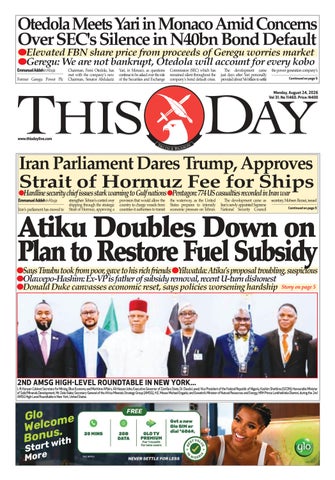
Otedola Meets Yari in Monaco Amid Concerns Over SEC's Silence in N40bn Bond Default Elevated FBN share price from proceeds of Geregu worries market Geregu: We are not bankrupt, Otedola will account for every kobo
Emmanuel Addeh in Abuja
Former Geregu Power Plc
Chairman, Femi Otedola, has met with the company’s new Chairman, Senator Abdulaziz
Yari, in Monaco, as questions continue to be asked over the role of the Securities and Exchange
Commission (SEC) which has remained silent throughout the company's bond default crisis.
The development came just days after Yari personally provided about N6 billion to settle
the power generation company’s Continued on page 5
Monday, Monday,August January24, 6, 2026 2025 Vol Vol29. 31.No No10865. 11460. Price: N400
www.thisdaylive.com TR
UT H
& RE A S O
N
Iran Parliament Dares Trump, Approves Strait of Hormuz Fee for Ships Hardline security chief issues stark warning to Gulf nations Pentagon: 774 US casualties recorded in Iran war
Emmanuel Addeh in Abuja
Iran’s parliament has moved to
strengthen Tehran’s control over shipping through the strategic Strait of Hormuz, approving a
provision that would allow the country to charge vessels from countries it authorises to transit
the waterway, as the United States prepares to intensify economic pressure on Tehran.
The development came as Iran’s newly appointed Supreme National Security Council
secretary, Mohsen Rezaei, issued Continued on page 5
Atiku Doubles Down on Plan to Restore Fuel Subsidy
Says Tinubu took from poor, gave to his rich friends Yilwatda: Atiku’s proposal troubling, suspicious Olawepo-Hashim: Ex-VP is father of subsidy removal, recent U-turn dishonest Donald Duke canvasses economic reset, says policies worsening hardship Story on page 5
2ND AMSG HIGH-LEVEL ROUNDTABLE IN NEW YORK...
L-R: Kenyan Cabinet Secretary for Mining, Blue Economy and Maritime Affairs, Ali Hassan Joho; Executive Governor of Zamfara State, Dr. Dauda Lawal; Vice President of the Federal Republic of Nigeria, Kashim Shettima (GCON); Honourable Minister of Solid Minerals Development, Mr. Dele Alake; Secretary-General of the Africa Minerals Strategy Group (AMSG), H.E. Moses Michael Engadu; and Eswatini’s Minister of Natural Resources and Energy, HRH Prince Lonkhokhela Dlamini, during the 2nd AMSG High-Level Roundtable in New York, United States
2
MONday AUGUST 24, 2026 • T H I S D AY
MONday AUGUST 24, 2026 • T H I S D AY
3
4
MONday AUGUST 24, 2026 • T H I S D AY
5
T H I S D AY • MONDAY, AUGUST 24, 2026
PAGE FIVE
Dangote Refinery Expands Free Fuel Delivery to Kano, Imo, Others, Targets Lower Pump Prices Marketers laud initiative as refinery absorbs delivery costs to reduce distribution expenses, ease pressure on consumers
Peter Uzoho
Dangote Petroleum Refinery and Petrochemicals has expanded its free petroleum products delivery initiative to Kano, Imo, Anambra, and Nasarawa states, a move expected to reduce distribution costs for independent petroleum marketers and create room for lower petrol prices at the pump. The initiative, which began with deliveries to Lagos, Ogun, Rivers, Kaduna, and Delta states, as well as Abuja, was
designed to bring petroleum products closer to marketers and retailers while removing the cost of transporting products over long distances from the refinery to various parts of the country. By absorbing the delivery cost, the refinery is reducing one of the key expenses built into the downstream distribution chain. Announcing that, in a statement yesterday, Group Executive Director, Commercial Operations, Oil & Gas, WAEP
and Fertiliser, Fatima AlikoDangote, said the initiative was designed to ensure that the benefits of domestic refining translated into tangible savings for businesses and consumers. Aliko-Dangote said, “The value of domestic refining must ultimately be felt beyond the refinery gate. By absorbing the cost of delivering petroleum products to our customers, we are removing a significant component of the distribution burden and creating room for those savings to flow through
the value chain to consumers. “Our goal is to make fuel distribution more efficient, reduce avoidable costs and support more competitive pump prices across Nigeria." The expansion had been welcomed by Independent Petroleum Marketers Association of Nigeria (IPMAN), which said the initiative would significantly reduce some of the financial and logistical pressures confronting independent marketers and contribute to lower prices for
consumers. National Publicity Secretary and Public Relations Officer of IPMAN, Chinedu Ukadike, said the initiative addressed a longstanding challenge in the petroleum products distribution chain, where marketers committed substantial funds to product purchases and might then have to wait for extended periods before their orders were loaded and transported. “This gesture, if sustained, will be able to alleviate the sufferings of independent
Dangote
marketers,” Ukadike said. “There has been the issue of financial hold-up, whereby marketers pay for products and are not loaded for days and weeks, and they suffer unnecessary hardship bringing the product down,” he added.
ATIKU DOUBLES DOWN ON PLAN TO RESTORE FUEL SUBSIDY
Chuks Okocha, Emmanuel Addeh, Adedayo Akinwale in Abuja and Ayodeji Ake in Lagos
Former Vice President Atiku Abubakar yesterday doubled down on his proposal to restore a targeted petrol subsidy, accusing President Bola Tinubu of running a contradictory economic policy that removes support from poor Nigerians while granting tax credits, concessions and other incentives to major investors in the petroleum industry. Atiku, through a statement issued by his Senior Special Assistant on Public Communication, Phrank Shaibu, described the federal government’s claim that petrol subsidy had been abolished as one of the biggest economic frauds being sold to Nigerians, arguing that public resources were still being deployed to
cushion costs and support investment in the same sector. The former vice president said the Tinubu administration had transferred the burden of economic adjustment to households, even as it provided fiscal support to major petroleum investors. “Tinubu stood at Eagle Square and declared that subsidy was gone. Petrol prices exploded, transportation costs soared, food prices followed, businesses buckled and household purchasing power collapsed. Nigerians were told there was no alternative and that enduring this pain was the necessary price of economic reform. “But when major oil investors knock on Tinubu’s door, the sermon changes. Suddenly, government intervention is good economics; tax credits are necessary; fiscal concessions are
strategic; and private investment must be ‘de-risked.’ Apparently, subsidy is only evil when poor Nigerians benefit from it,” he stated. Atiku questioned the rationale for providing fiscal incentives to petroleum investors while rejecting what he described as targeted intervention to reduce the burden of high energy costs on households. He specifically cited the government’s Deep Offshore Oil and Gas Projects Incentives framework, under which qualifying petroleum developments can receive production tax credits, arguing that the policy demonstrated that government intervention remained part of the administration’s economic approach. The former vice president also challenged the administration’s
explanation of energy-security expenses recorded by the Nigerian National Petroleum Company Limited (NNPC), arguing that the figures showed that public resources continued to absorb petroleum price differentials despite the declaration that subsidy had been removed. According to Atiku, NNPC’s 2023 accounts recorded approximately N4.84 trillion as energy-security expenses and related shortfalls, while its 2024 audited financial statements recorded about N7.13 trillion under energy-security expenses. He said NNPC had explained that the expense arose partly from the difference between the exchange rate used to determine the regulated PMS ex-coastal price and the prevailing exchange rate when import obligations were settled.
Atiku maintained that the description of the expenditure as an energy-security expense or shortfall did not alter its economic effect. “Nigerians do not eat semantics. Whether the government calls it subsidy, under-recovery, shortfall or energy security, public resources were being used to bridge a gap between economic cost and the price at which petrol was sold. You cannot abolish subsidy at the podium and resurrect it in the accounts under an alias,” he said. The former vice president accused the administration of operating what he described as two economies in one country, with market-driven policies imposed on households while investors received fiscal incentives designed to reduce investment risks.
IRAN PARLIAMENT DARES TRUMP, APPROVES STRAIT OF HORMUZ FEE FOR SHIPS
a stark warning to Gulf countries against joining Washington’s economic campaign, threatening that Tehran would prevent oil from leaving the Persian Gulf if regional states supported the US. The moves have further raised the stakes in the conflict between Iran and the United States, with shipping through the Strait of Hormuz already severely disrupted and global energy markets exposed to the possibility of prolonged supply constraints. The Iranian parliament’s National Security and Foreign Policy Commission approved Article 3 of a proposed law on the security and development of the Strait of Hormuz. The provision would permit
Tehran to collect fees from vessels belonging to countries that Iran authorises to pass through the waterway. The proposed charges would cover maritime and navigation services, environmental services, fuel supplies under special circumstances, insurance, safety and security services, as well as other services provided to vessels during transit. Commission spokesperson Hassan Qashqavi said the authorised vessels would be required to pay for the services. “Based on Article 3, a fee will be charged for services including maritime, environmental, fuelling under special conditions, insurance, safety, and other services provided in the Strait of
Hormuz,” he said. The payments could be made in Iranian rials or another currency designated by Tehran. The measure is contained in a proposed “Strategic Action Plan to Ensure the Security and Development of the Strait of Hormuz,” with Iranian state media reporting that the parliamentary commission approved the provision on Sunday. However, the proposal must still be considered by the full parliament before being forwarded to the Guardian Council, which reviews legislation for compliance with Iran’s Constitution and Islamic principles. Where disagreements remain
between parliament and the Guardian Council, the Expediency Council could be called upon to resolve them. Qashqavi maintained that the proposed legislation recognised freedom of navigation under international law while also protecting the sovereignty and security interests of countries bordering the Strait of Hormuz. He referred to the 1982 United Nations Convention on the Law of the Sea and cited Oman’s position on the relationship between international maritime rules and national sovereignty. “The Persian Gulf and the Strait of Hormuz have their own rules and conditions, and in this regard, after accepting the 1982 Convention on the Law of
the Sea, the country of Oman immediately issued a political declaration emphasising that the provisions of this convention should not violate the country’s national sovereignty and national security,” he said. The proposed fee regime comes at a time when Iran is already exercising greater control over access to the waterway. Tehran has allowed some vessels to transit the strait while restricting wider commercial movement. It recently granted permission for a number of Iraqi oil tankers to cross Hormuz, underscoring the selective nature of access during the conflict. Rezaei Threatens Gulf States As Tehran moved to formalise its control over the waterway,
“The government can protect a multibillion-dollar oil investment from risk, yet it says protecting the Nigerian worker from crushing hardship is bad economics,” Atiku said. “It can bend policy to make every barrel of crude more profitable, but tells a struggling mother that making the litre of petrol she needs to take her children to school more affordable is irresponsible,” he added. He argued that the success of economic reform should be measured by its impact on citizens rather than by the removal of a particular policy. “Economic reform is not a competition over how much suffering a President can impose on his citizens. Removing subsidy without adequate buffers while simultaneously providing fiscal Continued on page 36
Iran's security chief, Rezaei, warned Gulf countries against supporting Washington’s economic campaign. “If the countries surrounding Iran join the Americans in their economic war, not a drop of oil will leave the Persian Gulf and the Strait of Hormuz,” Rezaei said, according to Iran’s Tasnim news agency. “We will also target other oil export routes from the Persian Gulf,” he added. The warning came as President Donald Trump’s administration prepared to move the conflict into a new phase centred on economic pressure, sanctions and restrictions on countries Continued on page 33
OTEDOLA MEETS YARI IN MONACO AMID CONCERNS OVER SEC'S SILENCE IN N40BN BOND DEFAULT outstanding bond obligation. Otedola disclosed the meeting yesterday in a post on his Instagram page, posting glowing pictures of both current and former chairs of the power company. “Such a lovely afternoon today, 23 August 2026, with His Excellency Senator AbdulAzeez Yari at Hotel de Paris in Monaco, Southern France Congratulations on your appointment as DG of the Presidential Campaign Council,” he wrote. The meeting is significant
coming against the backdrop of the default over Geregu’s N40.09 billion Series 1 Senior Unsecured Bond, after the company failed to meet a scheduled repayment of about N6 billion due on July 28, 2026. Geregu officials said that the N40 billion which was saved in a bank account was nowhere to be found after the takeover. Market analysts have accused Otedola of using the funds to acquire shares of First Bank whose share price has increased from N21.70 as at December 31st 2024
to a staggering N129.95 as at close of trading last Friday. A whopping 500 per cent without any key market fundamentals driving it and despite the Central Bank of Nigeria (CBN) banning them from paying dividends. For context the bank closed December 31,2025 at N47.90 The sharp appreciation in FBN Holdings’ share price has also raised concerns among market participants over whether proceeds from the disposal of Geregu shares may have contributed to the buying pressure around
the financial services group. The concern is heightened by the close association between the two companies through Otedola, whose influence spans both investments. But comparatively, while the share price of FBNHoldco surged by 500% between January 31, 2024 when Otedola took over as chair, and last Friday, August 21, 2026, that of Zenith rose by 247 per cent (from N35.10 to N122.00). Besides, GTCO shares appreciated by 209 per cent within the same period from N41,00 to
N127.00, while UBA’s grew by 50 per cent from N29.90 to N45.10, just as Access Bank which like FBNHoldco did not pay dividend recorded a marginal growth of 18.9 per cent from N22.70 to N27.00. However, all these banks paid dividends except FBN Holdco and Access Holdco Zenith Bank paid a total dividend of N10 for 2025 financial year after its share price rose from N35.10 to N122.00, GTCo paid a dividend of N12 per share and its price increased from N41.00 to N127.00. This then raises fresh
posers over why FBNHoldco that witnessed a price surge from N21.70 to N129.95 despite not paying any dividend. The Geregu case has also shifted focus to the role of the SEC in the unfolding scenario. What has it done to investigate and disclose the Geregu default? Was there fraud at the power company, especially considering the fact that the funds that were sitting pretty in the company's account had disappeared at the Continued on page 35
6
MONday AUGUST 24, 2026 • T H I S D AY
7
T H I S D AY • MONDAY, AUGUST 24, 2026
NEWS
Group News Editor: Goddy Egene Email: Goddy.egene@thisdaylive.com, 0803 350 6821, 08074010580
PRIZE WINNERS FROM 2026 GRADUATE MANAGEMENT ACCELERATED PROGRAMME COHORT 21 CLASS OF UBA...
Group Chairman, United Bank for Africa, Tony Elumelu (7th left); Group Managing Director, UBA, Oliver Alawuba, (5th left); Group Head, Human Resources, Modupe Akindele (3rd left) and Executive Director, Finance, Ugo Nwaghodoh, flanked by prize winners from the 2026 Graduate Management Accelerated Programme (GMAP) Cohort 21 Class of UBA Academy, during the graduation ceremony held for over 374 trainees from across Africa, in Lagos, last Thursday
Analysts Back Atiku on Refinery-linked Subsidy, Knock Tinubu Govt over Uncushioned Mass Suffering Say the vulnerable have been left on their own Dismiss claim that ex-VP is proposing old consumption subsidy
Peter Uzoho
A growing number of economic and energy analysts have continued to back former Vice President Atiku Abubakar’s proposal for a refinery-linked subsidy model while slamming the Bola Tinubu administration for failing to cushion the effect of subsidy removal on Nigerians. Their position came after Atiku, the presidential candidate of
African Democratic Congress (ADC), pledged last week to restore subsidy if elected in 2027, citing lack of transparency on how savings have been spent. The presidency had since dismissed the plan as “ignorant” and “retrogressive”. But speaking to THISDAY, Professor of Economics at the University of Ibadan, Professor Adeola Adenikinju, said though he did not support going back to
the pre-2023 subsidy, he agreed with Atiku that government had not been transparent and had failed to protect the poor. Adenikinju stated, “Atiku has some points on its side. One is that it has come to the public notice that the Nigerian National Petroleum Company Limited (NNPCL) is still claiming some amount of money for what they call economic stability or energy security, which runs also
into a lot of money. That has to be defined.” He called on NNPCL to clarify if other forms of subsidy still existed and to explain the “energy security” allocation. Adenikinju, a long-time advocate of subsidy removal, said the old regime destroyed refineries, pipelines, and depots, and fuelled corruption. “All my professional life, I have argued for the withdrawal
of subsidy,” he said, adding, “We and what government is doing don't have to go through that to benefit their livelihoods." again.” The professor said the But he knocked the vulnerable had been abandoned, implementation of the subsidy adding that what the government removal by the Tinubu has done with the removal of administration. subsidy is the failure to take care Adenikinju stated that the of the poor. greatest gain from the subsidy According to him, there is no removal was the alignment of serious mechanism to mitigate incentives that had attracted the effect on the poor. billions in investment while the To address that, Adenikinju greatest failure was that Nigerians suggested short-term palliatives, were not feeling it. such as discounted crude supply He said, “When you withdraw to Dangote and other domestic the subsidy, your savings, it refineries to reduce the pump should not go to the general prices of petrol and diesel, and budget that you share. Because production subsidies or tax people would then not be able credits for manufacturers and becoming increasingly similar to see a one-to-one mapping small and medium enterprises all around the world. between the subsidy removal (SMEs) battling high energy costs. She urged public sector leaders to strengthen public CPPE: Economic Reforms Have Laid trust and govern wisely in an increasingly complex world, Foundation for Investment, Growth, Tasks in order to create sustainable Govt on Transitioning to Productivity impact and measurable value Dike Onwuamaeze revenues have strengthened, the for the people they serve. foreign-exchange market has Speaking on Governance The Centre for the Promotion of become more stable, external Fitness Model, Brown said, Private Enterprise (CPPE) has reserves have improved, the trade “Fitness is not about another stated the federal government's surplus has expanded and investor definition of governance. It's not economic reforms have delivered confidence has recovered and the another governance framework, measurable microeconomic gains real GDP growth strengthened but the capacity to govern. Just that have laid the foundation for to 3.89 per cent in Q1 2026, from as physical fitness prepares investments and economic growth. 3.13 per cent in Q1 2025. our bodies to respond to life's "These are important The CPPE also said that demands, governance fitness the "next phase of reform foundations for investment and prepares governing bodies must therefore focus much growth. But macroeconomic to faithfully apply timeless more strongly on productivity, stability is a means, not an end. principles under changing competitiveness and household The real test is whether stability conditions.” translates into higher productivity, welfare." It stated these yesterday in its stronger investment, more jobs, commendation to the Minister of lower poverty and improved Finance for the presentation of the living standards." Yusuf, however, argued that The two books, coming economic reform scorecard whose after her first, ‘Roses in the data provided greater clarity to the transmission of the gains of Thorns: An Autobiography,’ the fiscal and macroeconomic the reforms is still incomplete, keep alive a sterling family outcomes of the reforms and pointing out that "the next phase literary legacy established by her addressed important concerns must move decisively from stabilisation to productivity; from father, Christian Atani Okpofaa in the public discourse. According to the Chief higher government revenues to Otobotekere (the Okun XIX and Amananaowei of Tombia), the Executive Officer of CPPE, better development outcomes; and late poet-King of Tombia, Bayelsa Dr. Muda Yusuf, "the reforms from improving macroeconomic State, who wrote 14 books before have delivered measurable indicators to tangible gains in jobs, macroeconomic gains: government incomes and living standards." his death in 2023.
Experts: Intelligence, Not Technology Skills Will Drive Sustainable Governance Emma Okonji
Public sector leaders and stakeholders have stressed the need for global leaders to gain intelligence oversight beyond technology skills in order to promote effective governance that can translate into better performance and meaningful value for the citizens. The stakeholders spoke in Lagos at a public sector leadership forum organised by Centre for Public Sector Governance (CPSG), in partnership with Society for Corporate Governance Nigeria (SCGN), the British Council, and Bureau of Public Service Reforms (BPSR). The forum had the theme,
‘Governance for PerformanceGlobal Practices to Create Public Value’. According to the stakeholders, the principles of governance are timeless, but the world in which the principles are applied is not. They stressed that global leaders did not need to become technologists or experts in technology to govern effectively, but they need sufficient intelligence to govern the opportunities, the risks, the ethics, the data and the consequences of technologies that are being deployed globally. In her opening remarks, Chief Operating Officer (COO) of CPSG, Dr. Oyebisi Taiwo, said, “As public sector leaders and stakeholders, we share
responsibility to strengthen the institution, embrace effective global practices, and build systems that deliver measurable results.” The keynote speaker and CEO, Governance Solutions and The Professional Director Institute, Dr. Debra Brown, who spoke on the challenges of governance, said the greatest challenge facing those entrusted with governance was often not that they could not see. Brown said the biggest was often about believing that they were seeing clearly when actually they were not. According to her, although countries are different in cultures and economies, the challenges facing those who govern are
Tinubu, Diri, Fubara to Attend Walson-Jack’s Books' Presentation Olawale Ajimotokan in Abuja
President Bola Tinubu and Governors of Rivers State, Siminalayi Fubara as well as Duoye Diri of Bayelsa State, are among the dignitaries expected to attend the presentation of two books by the Head of the Civil Service of the Federation, Mrs Didi Esther Walson-Jack.
The books, ‘I Planted: A Memoir of Purposeful Service’ and ‘Beyond the Mandate: A Memoir on Leadership, Legacy, & Labour of Public Service’, which detail Walson-Jack’s experiences as a state and federal public servant, are to be presented in Abuja on August 25. Also expected at the event are the President of the
Senate, Senator Godswill Akpabio; Speaker of the House of Representatives, Hon Tajudeen Abbas; Secretary to the Government of the Federation, Senator George Akume; the Chairman of the Nigeria Revenue Service (NRS), Dr Zacchaeus Adedeji, permanent secretaries, service chiefs and members of the diplomatic corps.
8
T H I S D AY • MONDAY, AUGUST 24, 2026
NEWS
VISIT TO TRAIN 7 PROJECT SITE AT NLNG BONNY PLANT...
L-R: Manager, Nigerian Content Development, Dagogo Buowari; Permanent Secretary, Ministry of Petroleum Resources and Chairperson of the NLNG Local Content Committee (LCC), Mrs. Patience Oyekunle; Project Director, Train 7 Project, Ali Uwais; and Manager, Contracts, Procurement & Materials, Tolulope Longe, during a visit to the Train 7 Project site at the NLNG Bonny Plant to gain firsthand insight into the project’s progress and assess its readiness...recently
Alliance: Abu Dhabi $5bn Facility Raises Transparency, Risk Concerns Says Tinubu’s reforms yielding gains but poverty, food insecurity remain high Urges FG to publish terms, drawdowns, collateral, utilisation of facility Queries N11.85tn borrowing, N30.64tn govt spending Says naira lost 29% value in four years
Emmanuel Addeh in Abuja The Alliance for Economic Research and Ethics has raised concerns over the transparency and risk implications of the federal government’s $5 billion Total Return Swap facility with First Abu Dhabi Bank, urging the government to disclose the material terms of the financing arrangement. The group, in an analysis of the economic reforms scorecard recently presented by the Minister of Finance and Coordinating Minister of the Economy, Taiwo Oyedele, said the facility involved
public institutions, public collateral and public repayment obligations and should therefore be subjected to adequate public scrutiny. The analysis, titled: “The $5 Billion Abu Dhabi Financing: A Scorecard of Transparency, Risk and the Road Ahead”, was released by the organisation following Oyedele’s presentation of the government’s “Nigeria’s Economic Reforms: By the Numbers” scorecard on Wednesday. The group led by a former President of the Nigerian Association of Chambers of Commerce, Industry, Mines and Agriculture (NACCIMA) and
T. Rowe Price: Nigerian Equities Still Has Growth Prospects Despite 64% Global Rally South African bank looks to expand presence in Nigeria
Emmanuel Addeh in Abuja
Despite a 64 per cent year-to-date rally that has made Nigeria’s equities market the secondbest performing stock market globally after South Korea, global investment firm T. Rowe Price has said the Nigerian market still has room for further growth. Johannes Loefstrand, who manages about $310 million in frontier-market assets at T. Rowe Price, said structural reforms undertaken by the federal government had improved the investment outlook and created opportunities for active stock pickers. Speaking on Bloomberg TV’s Next Africa, Loefstrand said he was “excited” about Nigeria’s prospects, pointing to the removal of fuel subsidy and liberalisation of the foreign exchange market as key policy
shifts that had changed investor sentiment. Nigeria’s stock market has recorded one of the strongest performances globally this year, with the Nigerian Exchange (NGX) benefiting from improved macroeconomic conditions, stronger corporate earnings and increased participation by domestic investors. The rally has, however, occurred against a backdrop of relatively limited foreign participation, with international investors facing additional market frictions, including the transition to a T+1 settlement cycle and uncertainty surrounding Nigeria’s status in global equity indices. T+1 settlement means that equity transactions are settled one business day after they are executed, requiring investors to have funds available more quickly to complete trades.
ex-Chairman of the Organised Private Sector of Nigeria (OPSN), Dele Oye, argued that some of the figures required greater context and clearer distinctions between revenue, borrowing, projections and independently verified outcomes. According to the analysis, the Ministry of Finance reported approximately N20.4 trillion in incremental federal government resources arising from the reforms, comprising N5.43 trillion in the federal government’s estimated share of subsidy savings, N3.12 trillion in other incremental revenues and N11.85 trillion in incremental borrowing. It noted that borrowing accounted for about 58 per cent of the stated incremental resources, stressing that the figure should therefore not be presented as N20.4 trillion of “free cash” generated by the reforms. “Borrowing is financing, not internally generated revenue. The better statement is that the reforms created fiscal space and changed the financing mix; they
did not generate N20.4 trillion of free cash,” it stated. The organisation also drew attention to the government’s estimate of N30.64 trillion in additional expenditure pressures, including N9.39 trillion for wage adjustments, wage awards, allowances and related personnel costs; N9.37 trillion arising from the exchange-rate impact of external debt service; N6.47 trillion for strategic infrastructure; and N3.14 trillion for electricity support. It said the figures presented a mixed fiscal picture, with the government having reduced a major subsidy burden while simultaneously increasing spending on wages, infrastructure and other obligations and relying substantially on borrowing. The group argued that the more important question was whether the reforms had made Nigeria’s fiscal system more resilient and productive while providing adequate protection for vulnerable households. On inflation, the organisation noted the decline in headline
inflation but cautioned that disinflation should not be confused with a reduction in the overall price level. It said the ministry had highlighted headline inflation of 15.91 per cent in June 2026, while the National Bureau of Statistics (NBS) subsequently reported 15.43 per cent in July, with food inflation at 20.31 per cent. “The direction is encouraging. The lived experience remains difficult,” it stated, arguing that the government’s economic scorecard should also track food inflation, real wages, employment quality and poverty. The group said stronger foreign reserves and improved foreign exchange market stability were positive developments but warned against treating reserves as ordinary budget revenue. It noted that the government’s reserve position should be accompanied by clear information on the definition and date of the reserve figure, as well as the extent to which assets were freely available or affected by
external obligations and financing arrangements. On the government’s counterfactual argument that failure to implement the reforms could have resulted in more severe economic dislocation, the organisation said the risks were credible but cautioned that a counterfactual remained a policy model rather than an established historical fact. It said the government should disclose the assumptions underlying its “no reform” scenario and explain the alternative sequences of reforms and social protection measures that were considered. Turning specifically to the Abu Dhabi facility, the organisation criticised the government’s response to questions over its disclosure. Oyedele had said the government would not publish details of how it was spending funds from the facility, insisting that it would publish how it spent government money and that there was “nothing special about that loan.”
REA, Alpha Morgan Bank Seal N50bn Deal to Fund Renewable Energy Projects in Nigeria $119m Japanese financing expected for mini-grids, says Aliyu Bank: It's an attempt to generate measurable economic and social impact
Emmanuel Addeh in Abuja
The Rural Electrification Agency (REA) and Alpha Morgan Bank at the weekend signed a N50 billion financing agreement to support renewable energy projects and accelerate electricity access in unserved and underserved communities across Nigeria. The financing partnership is
expected to provide a bridge for renewable energy developers implementing projects under REA programmes, enabling them to secure the funds required to execute projects before accessing catalytic grants tied to project performance. Speaking at the Memorandum of Understanding (MoU) signing ceremony in Abuja,
the Managing Director of REA, Abba Aliyu, said the partnership had become necessary because Nigeria's electricity demand was set to rise significantly, driven by population growth and the increasing dependence of economic activities on electricity. He said the country was entering what he described as “the era of electricity”, with power expected
to become increasingly central to transportation, agriculture, healthcare, education, digitalisation and artificial intelligence. “Electricity is going to drive almost every single thing that we are going to do. Electricity will drive transportation, electricity will drive agriculture, electricity will drive health, education, and everything we do,” Aliyu said.
MONday AUGUST 24, 2026 • T H I S D AY
9
10
T H I S D AY • MONDAY, AUGUST 24, 2026
NEWS
US-INL COMMENDS NDLEA’S OPERATIONAL SUCCESSES...
L-R: Chairman/Chief Executive Officer of NDLEA, Brig Gen Mohamed Buba Marwa (Rtd) presenting a copy of NDLEA quarterly magazine to the Country Director of the United States International Narcotics and Law Enforcement Bureau (INL) Nigeria, Mr. Derek Tolliver, when the latter led a delegation from the US Government Accountability Office on a meeting with the NDLEA boss at the agency’s headquarters in Abuja ... recently
Atiku to Tinubu: Nigerians Deserve Transparency on $5bn Abu Dhabi Loan
Chuks Okocha in Abuja
Former Vice President and presidential candidate of African Democratic Congress (ADC), Atiku Abubakar, has called on Nigerians to demand accountability from the Tinubu-led All Progressives Congress (APC) government over its rising debt profile, warning that unchecked borrowing risks trapping future generations in unsustainable debt. In a statement issued Sunday by the Atiku media office, the former vice president accused the Tinubu administration of incompetence and financial impropriety, citing a lack of transparency in recent loan agreements. He specifically criticised the government’s handling of the $5 billion facility from First Abu Dhabi Bank, insisting that taxpayers deserve full disclosure of how such funds will be utilised. According to Atiku, ''Since assuming office on May 29, 2023, President Bola Tinubu’s administration has contracted significant new debt.” According to the Debt Management Office, the Tinubu administration has added N72 trillion of fresh debt stock, bringing the total indebtedness to N159.35 trillion as at early 2026,
Atiku disclosed. Despite the borrowing, Atiku said Nigerians remained poorer and less secure. “Poverty levels have risen from 56 per cent in 2023 to between 61 per cent and 63 per cent under the Tinubu administration, leaving over 140 million citizens trapped in multidimensional poverty,” he stated. Atiku criticised Minister of Finance and Coordinating Minister of the Economy, Taiwo Oyedele, for dismissing public calls to explain the Abu Dhabi loan. Oyedele had stated that the facility was approved by the National Assembly and intended to refinance more expensive debts, but refused to disclose spending details. “The government is obliged to explain every loan taken on behalf of Nigerians,” Atiku said. “Every Kobo borrowed matters because citizens — both living and unborn — will bear the burden of repayment. Yet these loans have failed to improve their material wellbeing,” he added. He stated that the federal government was required to pledge securities worth about 133 per cent of the loan amount as collateral, making transparency even more critical. Atiku reminded Nigerians that
both the International Monetary Fund (IMF) and Fitch Ratings had raised concerns about the
financing structure, citing risks to transparency and sovereign debt sustainability.
He urged Nigerians to hold the government accountable, stressing that borrowing without
clear results undermines trust and jeopardises the country's economic future.
AMSG Takes Africa’s Raw Mineral Export Crisis to UNGA, Pushes Continental Value Addition Folalumi Alaran in Abuja
The Africa Minerals Strategy Group (AMSG) is set to push Africa’s growing campaign against the export of raw and minimally processed minerals to the global stage, with a highlevel roundtable scheduled for September 21, 2026, in New York, on the sidelines of the 81st United Nations General Assembly. The meeting comes as the Democratic Republic of Congo (DRC), Zimbabwe, Namibia and Tanzania intensify measures to restrict the export of unprocessed or minimally processed minerals in a bid to retain greater economic value within their economies. AMSG said the developments reflect a fundamental shift in Africa’s mineral agenda, from simply extracting and exporting resources to capturing more of the value generated from them through processing, manufacturing and integrated
supply chains. The Third AMSG High-Level Roundtable on Critical Minerals Development in Africa, themed “From Resources to Wealth: Continental Cooperation for Mineral Value Addition,” will bring together African leaders, ministers, investors, development finance institutions, multilateral organisations and global industry players. The roundtable will be chaired by President Bola Ahmed Tinubu, Chairperson of the AMSG General Assembly. The DRC recently suspended exports of copper and cobalt concentrates, while Zimbabwe suspended exports of raw minerals and lithium concentrates in February 2026 to accelerate domestic value addition. Namibia has also restricted exports of unprocessed lithium, cobalt, manganese, graphite and rare earth minerals, while Tanzania previously imposed restrictions on exports of
unrefined metallic minerals. Nigeria has similarly maintained that the era of exporting minerals from the pit to the port must end. According to AMSG, however, individual national measures cannot deliver the scale of transformation Africa requires. The group said the continent needs coordinated action to establish integrated processing hubs, strategic transport and energy corridors, harmonised policies, transparent and traceable supply chains and financing mechanisms capable of supporting mineral-linked infrastructure and value addition. The New York roundtable is expected to culminate in the adoption and signing of the Continental Integration and Economic Assurance Declaration (CIEAD), building on the Mutual Assured Development (MADE) Framework launched at the African Natural Resources and Energy Investment Summit (AFNIS) 2026 in Abuja.
CIEAD is designed to provide an architecture for continental cooperation on mineral value chains, strategic infrastructure, policy coordination, investment mobilisation and Africa’s collective position in the global critical minerals economy. A proposed CIEAD Finance Window will also seek to mobilise capital for mineral processing, infrastructure, technology and other components of Africa’s emerging mineral value chains. The Minister of Solid Minerals Development and Chairperson of the AMSG Ministerial Steering Committee, Dele Alake, said Africa must decide whether it would continue exporting its resources and importing finished value or develop the industrial capacity to create that value locally. “Africa’s critical minerals are no longer simply a geological opportunity; they are a strategic economic opportunity,” Alake said.
NDPHC Lauds NPA over Recovery of Abandoned Power Equipment at Seaports Peter Uzoho
The Niger Delta Power Holding Company Limited (NDPHC) has commended the Nigerian Ports Authority (NPA) for its intervention in facilitating the recovery of several abandoned power equipment cargoes at various seaports across the country. Managing Director/Chief Executive Officer of NDPHC, Jennifer Adighije, gave the commendation when the company's management paid
a courtesy visit to the NPA management at its headquarters in Lagos. Speaking during the visit, Adighije said the engagement was aimed at strengthening the strategic partnership between both organisations and deepening collaboration in areas of mutual interest. She expressed NDPHC’s appreciation to the NPA Managing Director/Chief Executive Officer, Dr. Abubakar Dantsoho, and his management team for their support in
facilitating the recovery of the company’s abandoned cargoes at different seaports. According to her, the NPA’s intervention had prevented significant financial losses and saved NDPHC several billions of naira that could otherwise have been lost. Adighije noted that efficient logistics and timely clearance of critical equipment remained important to the successful implementation of power infrastructure projects, stressing the need for sustained
collaboration between agencies and organisations operating across the energy and maritime sectors. She said NDPHC valued the support received from the NPA and looked forward to further strengthening the relationship in the interest of Nigeria’s power sector and the wider economy. Responding, Dantsoho expressed delight at the visit and reaffirmed the NPA management’s commitment to supporting initiatives and partnerships that contribute
to national development and improve the lives of Nigerians. He congratulated NDPHC on its contributions to the development of Nigeria’s power sector, noting that the authority remained open to meaningful engagements with the company. Dantsoho assured the delegation of the NPA’s continued support for initiatives that advance the interests of both organisations and contribute to the growth of
the national economy. He wished NDPHC continued success and stressed that his doors would remain open for productive discussions and partnerships. The engagement underscores the importance of inter-agency collaboration in removing logistical bottlenecks that can delay critical infrastructure projects, particularly in the power sector where the timely delivery of equipment is essential to improving electricity supply across the country.
MONday AUGUST 24, 2026 • T H I S D AY
11
12
MONday AUGUST 24, 2026 • T H I S D AY
MONday AUGUST 24, 2026 • T H I S D AY
13
14
MONday AUGUST 24, 2026 • T H I S D AY
MONday AUGUST 24, 2026 • T H I S D AY
15
16
MONday AUGUST 24, 2026 • T H I S D AY
MONday AUGUST 24, 2026 • T H I S D AY
17
18
WEDNESDAY, 11, AUGUST 2026 • T H I S2026 D AY T H I S D AY • MARCH MONday, 24,
business/MOnEYGUIDE
Tax Ombud, OGFZA Collaborate to Deepen Investor Confidence, Attract FDI Eromosele Abiodun
As part of efforts to increase Nigeria’s tax-toGDP ratio, the Office of the Tax Ombud and the Oil and Gas Free Zones Authority (OGFZA) have resolved to explore inter-agency collaboration aimed at attracting more foreign direct investment (FDI) into the country’s oil and gas free zones by addressing tax and feerelated grievances through effective and efficient mediation services provided by the country’s foremost tax dispute-resolution institution. The resolution was disclosed during a courtesy visit to OGFZA by the Tax Ombud/ Chief Executive, Dr. John Nwabueze, who described the proposed collaboration as a panacea for promoting fair, transparent, predictable and investor-friendly tax administration within Nigeria’s oil and gas free
zones. Speaking further, he said: “I am very much aware that OGFZA regulates and coordinates activities in the zones, grants permits and licences, administers incentives, and resolves disputes among stakeholders. The Office of the Tax Ombud complements these functions by providing an independent channel for reviewing and resolving complaints relating to taxes, levies, regulatory fees, customs duties and excise matters.” Nwabueze added that the two government agencies could collaborate in areas including taxpayer complaint resolution, clarification of tax incentives, review of systemic complaints, and the promotion of transparency and accountability. These efforts, he said, would contribute to increased voluntary tax compliance and a higher tax-to-GDP ratio, which
is critical to national development and consistent with the Renewed Hope Agenda of President Bola Ahmed Tinubu. Responding, the Managing Director/ Chief Executive Officer of OGFZA, Usman Bamanga Jada, told his visitor that investors in Nigeria’s oil and gas free zones have benefited from incentives, tax exemptions and customs duty concessions deliberately introduced by the Federal Government to encourage sustainable FDI inflows into the country, as well as private-sector-driven infrastructure development and employment generation. Usman noted that collaboration with the Office of the Tax Ombud to advance OGFZA’s mandate was timely, as it would help build investor confidence and promote business activities, particularly within the special economic zones that the Authority is championing across the country.
RockPay Targets Digital Payments through Social Finance Finacial technology company, RockPay, has launched its digital finance platform in the country, offering users a single platform for making payments, growing businesses and raising funds for personal and community needs. RockPay, which is designed for individuals, businesses and communities, brings together peerto-peer transfers, payment requests, QR code payments, payment links and business profiles, while also providing a donation feature for fundraising. Speaking on the launch, Francis Osaji, Founder and Chief Executive Officer of RockPay, said the platform was created to solve everyday challenges faced by
Nigerians. “RockPay was built to connect businesses with customers, simplify digital payments, and make it easier for people to raise money for the things that matter most. We wanted to create a platform where accepting payments, supporting causes, and growing businesses feel as natural as using social media,” he said. “RockPay addresses the growing need for a more connected financial experience by eliminating the need to use multiple applications for payments, fundraising, and business transactions. Through searchable business profiles, QR code payments, payment links, and transparent f u n d r a i s i n g
campaigns, users can seamlessly transact while building stronger relationships with customers and their communities. “RockPay is more than a payment app, it is a complete solution provider built essentially to help small businesses grow, socialise, give them real market visibility, and raise funds with ease. Whether you are a business owner looking to get discovered and accept payments faster through your business profile, QR codes and payment links, or an individual who wants to raise money for school fees, medical bills or a community project through our verified donation feature, RockPay was built for you,” he added.
Rotary Club Hosts District 9111 Governor Bakare, Donates to Orphanage
Rotary Club of Akowonjo is set to welcome the District 9111 Governor, Rotarian Bukola Bakare and her entourage on Monday, August 24, 2026, as the club prepares for an official visit that promises to spotlight its commitment to service, leadership and sustainable community impact. The visit will bring the District Governor faceto-face with the current leadership and members of the club as they strengthen collaboration and align their service priorities with the vision of Rotary International District 9111 for the 2026–2027 Rotary year,”Create Lasting
Impact.” Led by its Impact President, Rotarian Oladapo Bankole, the Rotary Club of Akowonjo is expected to use the occasion to showcase its programmes, priorities and plans for creating lasting impact in the communities it serves. According to Rotarian Bankole, “For us at Rotary Club of Akowonjo, the DG visit is therefore more than a ceremonial engagement, but an opportunity to reinforce the club’s commitment to service, inspire its members and demonstrate how collective action can translate Rotary’s ideals into tangible benefits for
communities.” The Chairman Planning Committee, Rotarian Oyin Sale disclosed that the August visitor will pay courtesy visits to the Executive Chairman Alimosho Local Government, Hon. Akinpelu Ibrahim Johnson and the Palace of Alaye of Orisunbare, HRH Oba Akeeb Adebowale Rauf Abokuwa 1. She further revealed that the DG will conduct Ward round at Krown Hospital at 11, Alhaji Sekoni Str, Off Alimosho Road; and conduct meeting with the board and fellowship with Rotarians, sponsors, friends of Rotary and partners.”
MARKET INDICATORS MONEY AND CREDIT STATISTICS (MILLION NAIRA) October 2025
Month
Money Supply (M3)
119,037,577.07
-- CBN Bills Held by Money Holding Sectors
9,291.49
Money Supply (M2)
119,028,285.58
Quasi Money
79,681,419.97
-- Narrow Money (M1)
39,346,865.60
---- Currency Outside Banks
4,646,794.28
---- Demand Deposits
34,700,071.33
Net Foreign Assets (NFA)
34,804,442.84
Net Domestic Assets(NDA)
84,233,134.23
-- Net Domestic Credit (NDC)
99,199,655.08
---- Credit to Government (Net)
24,787,980.96
---- Memo: Credit to Govt. (Net) less FMA
0.00
---- Memo: Fed. and Mirror Accounts (FMA)
0.00
---- Credit to Private Sector (CPS)
74,411,674.12
--Other Assets Net
2,603,854.03
Reserve Money (Base Money)
36,641,142.21
--Currency in Circulation
5,057,881.01
--Banks Reserves
31,583,261.21
--Special Intervention Reserves
284,361.95 • Source - CBN
Money Market Indicators (in Percentage) Month
October 2025
Inter-Bank Call Rate
October 2025
Minimum Rediscount Rate (MRR) Monetary Policy Rate (MPR)
27.00
Treasury Bill Rate
15.07
Savings Deposit Rate
7.43
1 Month Deposit Rate
11.37
3 Months Deposit Rate
11.32
6 Months Deposit Rate
11.12
12 Months Deposit Rate
11.78
Prime Lending rate
18.89
Maximum Lending Rate
29.56
NSE MARKET INDEX CAP
0.75%(52%YoY)
Index
0.9% (29%Y/D) • Monetary Policy Rate - 27%
OPEC DAILY BASKET PRICE As At 24TH NOVEMBER , 2025
The price of OPEC basket of twelve crudes stood at $63.14 a barrel on Monday, according to OPEC Secretariat calculations. The OPEC Reference Basket of Crudes (ORB) is made up of the following: Saharan Blend (Algeria), Djeno (Congo), Zafiro (Equatorial Guinea), Rabi Light (Gabon), Iran Heavy (Islamic Republic of Iran), Basrah Medium (Iraq), Kuwait Export (Kuwait), Es Sider (Libya), Bonny Light (Nigeria), Arab Light (Saudi Arabia), Murban (UAE) and Merey (Venezuela).
19
T H I S D AY • MONday, AUGUST 24, 2026
mARKET NEWS
Amid Recapitalisation, NGX Insurance Index Records -8.65%YtD Performance Kayode Tokede Despite the recent insurance sector recapitalisation, the Nigerian Exchange Limited (NGX) Insurance Index has depreciated by 8.65 per cent Year-till-Date (YtD) to emerge as the worstperforming segment on the bourse.
The 8.65 per cent YtD performance as of August 21, 2026 makes the NGX Insurance Index the only major sectoral index that is in negative territory. Other Indices, NGX Banking, Oil & gas, Consumer Goods, Industrial Goods and All-share indexes have recorded gains of 63.18 per cent, 85.76 per cent,1.62 per
P R I C E S MaiN Board
cent, 82.84 per cent and 53.81per cent, as of August 21, 2026, respectively. The poor performance marks a sharp reversal of a positive two-year trend. In 2024, the insurance index delivered a return of 107.74 per cent, making it the second-best performing sector after oil and gas, which gained 159.81 per cent.
F O R
S E C U R I T I E S
DEALS
Market Price
quantity traded
The sector also maintained a strong rally in 2025, outperforming the all-share index and delivering a return of about 79 per cent to shareholders by August of that same year. The poor performance also reflects the financial results of several insurance companies. For AXA Mansard
T R A D E D
value traded ( N )
MaiN Board
A S
O F
Insurance Plc, revenue rose by 22 per cent to N160.56 billion for the year ended December 31, 2025. However, profit before tax plunged by 81 per cent to N6.12 billion from N31.69 billion recorded in 2024. A look at the share price of some companies under the sector showed AXA Mansard Insurance that
A U G U ST DEALS
began the year at N13.70 per share but has since lost 13.14 per cent off that price valuation to close August 21, 2026 at N11..90 per share. AXA Mansard also began the year at N13.70 and has lost approximately 13.1 per cent, while Sunu Assurances Nigeria Plc has fallen by about 45.5 per cent to N3.00 per share after opening the year at N5.50 per share.
2 0 / 2 6 Market Price
quantity traded
value traded ( N)
T H I S D AY MONDAY AUGUST 24, 2026 20 TR
UT H
& RE A S O
Monday August 24, 2026 Vol 27. No 11450
N
opinion@thisdaylive.com
www.thisdaylive.com
THE LABOUR PARTY CONUNDRUM
CHIKA ESOMONU argues for the speedy resolution of crisis within the party
See page 21
WHEN THE PLAN BREAKS Leaders should know when to persevere and when to change course, writes LINUS OKORIE
See page 21
EDITORIAL
THE RENEWED CASE FOR CATTLE RANCHING
See page 22
1
JOSHUA OCHEJA argues the need to set aside political considerations in the analysis of subsidy regime
ZACCH ADEDEJI'S ARITHMETIC
I watched the recent interview of the chairman of the National Revenue Service (NRS), Zacch Adedeji, on Sunday Politics on Channels TV. He said, "We would have been spending about ₦53 trillion yearly on petrol subsidy if President Bola Tinubu had not removed the scheme." This is not what most Nigerians love to hear. The reason is obvious, and I don't have to mention it. But he said it and indeed opened a new vista of understanding in the whole subsidy regime as practiced in the country before now. What is subsidy, and how has it been funded since it was introduced by the General Yakubu Gowon military regime in 1973 to cushion Nigerians against rising inflation and equalize fuel prices nationwide? In 1977, the General Olusegun Obasanjo military regime institutionalized it through the Petroleum Price Control Act of 1977 by unifying retail prices—not just for petroleum products across the country, as other essential commodities were also covered. In the case of local pump prices, the government absorbed the difference between local pump prices and production/import costs. This was the beginning of the subsidy albatross that almost consumed the country. There was an oil boom in the 1970s, and the government used public funds to bridge the gap without any reasonable strain on the economy. It was a populist policy that was meant to be temporary. Obasanjo has a history of establishing populist policies that were mostly time-bound. The mistake was that the adoption of some of these policies became permanent. Our development over the decades came with its attendant constraints on our revenue generation. There were various competing needs that were just as important as subsidizing petroleum production and consumption costs. As the years went by, the subsidy regime became unsustainable. But its removal was politicized so much that it became a national anthem. It wasn't like it was convenient for successive administrations, but the political implications of removing subsidy payments were also advanced by political advisers, while economic advisers spoke in hushed tones. We ran a fiscal deficit regime that no administration ever acknowledged in the pages of newspapers. I recall before taking office, Muhammadu Buhari questioned the very existence and authenticity of the subsidy regime, calling it a scam created by middlemen. Midway through his administration, he described it as "a
heavy burden on the national treasury" and an "unsustainable fiscal drain." This gave birth to the enacting of the Petroleum Industry Act (PIA) of 2021. In 2021, the Emir of Kano, Sanusi Lamido Sanusi, at the unveiling of his book “For the Good of The Nation,” said the “country cannot continue to borrow to fund consumption”, in reference to the subsidy payments. Ngozi Okonjo-Iweala, former finance minister and DirectorGeneral of the World Trade Organisation, at the unveiling of her book “Fighting Corruption is Dangerous: The Story Behind the Headlines” published in 2018, described fuel subsidy as "a regressive policy that disproportionately benefited wealthy oil marketers, smugglers, and higher-income car owners rather than the poor it was publicly claimed to protect." She concluded that the scheme created "a breeding ground for fraud and rent-seeking" at the expense of national development. These two examples are some of the contentious debates on the fuel subsidy regime as a whole. But there is another dimension. The dimension of borrowing to fund consumption. A March 2022 report in Premium Times—headlined "Nigerian govt to use $2.2 billion from Eurobond money for fuel subsidy"—exposed the depth of our fiscal dilemma. The then Finance Minister, Zainab Ahmed, conceded that rising global oil prices had pushed the nation into a precarious position due to refined product imports. With the annual subsidy bill climbing toward ₦3 trillion against 2022 net federal retained earnings of only ₦5.30 trillion (out of ₦12.59 trillion gross federally collected revenue), the math became impossible. The federal government could no longer finance the policy through conventional earnings, leaving it no choice but to deploy $2.2 billion in borrowed Eurobond capital to fund domestic fuel consumption.
What was the economic rationale? Looking at post-2022 figures, funding subsidies was mathematically impossible against net federal revenues of ₦11.93 trillion in 2023, ₦21.43 trillion in 2024, and ₦23.06 trillion in 2025. To claim the regime was sustainable is the height of delusion—a classic piece of voodoo economics detached from balance sheet realities. Why did we resort to borrowing to fund subsidy? This was the central point Zacch Adedeji emphasized when he noted that the subsidy regime had become structurally unviable. Continually borrowing to sustain the regime is akin to pouring water into a basket. What happens when water is poured into a basket? It drains straight through the gaps, and no matter how much water you pour or how fast you pour it, the basket will never hold it. The NRS chair gave a scary projection of what subsidy payment would have been if the President had not discontinued it, given what is happening in Iran, and its impact on the global oil market. He said subsidy payment would have gulped over "76 per cent of the Nigerian budget." I don't need to be an economist to understand the implications of such a situation. What were the options if subsidy was not removed? To continue borrowing to fund a regime that has several question marks? I think the decision of President Tinubu to remove subsidy was a reality-check decision in my estimation. The NRS boss dramatized his position by stating that subsidy is not an income. He was correct. He questioned the rationale behind the advocacy that the government should have created a buffer before the removal of subsidy. He asked: "What do you call a buffer? Subsidy is not an income. It is like you are borrowing money to buy a product for ₦10 and selling it for ₦3." This is called deficit-financed consumption— using high-cost borrowed capital to fund temporary consumption rather than wealth-generating assets. The original intent behind the subsidy regime has been eroded by a shrinking purse that is barely enough to meet our needs. Subsidizing consumption when surplus revenue exists is one thing; borrowing to finance it is an unviable enterprise that does little more than deepen our fiscal vulnerabilities. Dr. Ocheja is a military historian and alumnus of the Nigerian Defence Academy.
T H I S D AY
321
MONDAY AUGUST 24, 2026
CHIKA ESOMONU argues for the speedy resolution of crisis within the party
THE LABOUR PARTY CONUNDRUM Since the Independent National Electoral Commission (INEC) released the official campaign timetable for the 2027 general elections, political parties and candidates are expected to begin public campaigns – in form of rallies, media advertisements, voter engagement, and grassroots mobilization. This development has again brought to fore the need for the Supreme Court to speedily resolve the judicial problem of the Labour Party (LP) as the lower courts overstepped bounds by wading into LP’s internal affairs. Instructively, millions of ordinary Nigerians - workers, artisans, traders, students, transporters, joined the LP movement because they saw it as theirs and decided to own, promote and protect the party during elections. That is why this moment hurts that a party built, supported and promoted by ordinary Nigerians can be taken away by court orders and elite bargains. The dispute is whether our courts will protect the rule of law, or normalize judicial hijack of political parties. We enjoin the apex court to revisit its earlier verdict of April 4, 2025 when it said: “We will not be used to hijack a party.” That day, their Lordships did three critical things that the lower courts ignored or overlooked. First, they protected jurisdiction. The court reminded everyone that judges do not run parties and pointed everyone back to the constitution and the party’s own rules. Second, it affirmed that membership, discipline, and leadership of a political party are its internal matters. It did not declare anyone the national chairman. It did not dissolve any NEC. It said, in essence: “This house has its own landlord. Go settle it there first.” That is judicial wisdom. Third, it preserved the status quo ante. The apex court neither declared Abure’s seat vacant nor installed a new leadership. By refusing to make that declaration, it left things as they were before the litigation and told the parties to go back to their constitution. That was the law. As we await a ruling expected to address the areas where the lower courts missed it, four legal pillars demand Supreme Court’s attention. First, jurisdiction was breached when the Federal High Court issued an order directing INEC to recognise the Nenadi-LP faction. That directive crossed from adjudication into administration. If this stands, any member can run to court tomorrow to install a national chairman or executives in any party. That is nothing more than judicial endorsement and a judicial hijack, not rule of law. Section 6 of the Constitution vests judicial power in courts to interpret laws, not to run political parties. Section 82(1) of the Electoral Act 2022 also places the conduct of party congresses and leadership succession within party
constitutions. Second, internal affairs were inverted: The Court of Appeal described the Nenadi-LP NEC as a product of “doctrine of necessity.” With respect, necessity cannot override a party’s constitution. You cannot use a legal phrase to break into a house and then call it renovation. April 4, 2025 told us to stay out. The lower courts walked in. The Supreme Court has consistently held that matters of party membership, discipline, and leadership are non-justiciable internal affairs. The purpose is simple: judges are not delegates of party conventions. Yet the lower courts cited internal affairs and then did the opposite. The Court of Appeal, in its ruling described the Nenadi-LP faction’s NEC as arising from a “doctrine of necessity” thereby constituting a label used to justify stepping into the internal management of the party and validating a parallel structure. That is not deference. That is intervention. You cannot use the shield of “internal affairs” to justify the very intrusion the doctrine forbids. Third, the April 4, 2025 status quo precedent was destroyed by misapplying the Supreme Court decision. The lower courts did what the Supreme Court deliberately refused to do on April 4, 2025. They declared a winner. They altered the status quo. They turned judicial restraint into judicial action. On April 4, 2025, Nigeria’s highest court reminded us that courts must exercise restraint where party constitutions provide internal mechanisms. The principle was to prevent forum shopping and judicial overreach. Both the Lifu order and the Appeal Court’s “doctrine of necessity” reasoning stand in direct tension with that guidance. As the final custodian of its own pronouncements, only the Supreme Court can reconcile the record and ensure the April 4, 2025 judgment is applied as intended: hands off internal leadership, unless a clear constitutional breach is shown. Here, no such breach was proven, only competing claims that deliberately shifted attention away from the sanctity of the 2024 Owerri LP convention to the issue of claiming INEC leadership recognition within the party. Esomonu writes from Abuja
Leaders should know when to persevere and when to change course, writes LINUS OKORIE
WHEN THE PLAN BREAKS
In August 1914, Ernest Shackleton and his crew sailed from England aboard the Endurance with an extraordinary ambition: to become the first expedition to cross Antarctica from coast to coast. It was a bold mission, but within months, the Antarctic ice had trapped their ship. By October 1915, the Endurance was crushed by the pressure of the ice and sank. Shackleton’s original mission was over. But his leadership had only just begun. This distinction matters because leadership is often measured by whether people achieve the goal they set out to accomplish. Yet some of the most important moments in leadership occur when the original goal becomes impossible. What does a leader do when the plan no longer works? Do they continue pursuing a dead objective because abandoning it feels like failure? Do they blame circumstances? Do they wait for someone else to provide an answer? Or do they have the courage to redefine success? Shackleton chose the latter. His expedition had failed in its original objective, but he immediately understood that the priority had changed. The mission was no longer about crossing Antarctica. It was about bringing every member of his crew home alive. That shift from achievement to responsibility is one of the most important distinctions in leadership. Leaders must know when to persevere and when to change direction. Persistence is admirable, but persistence without judgment can become stubbornness. A leader who refuses to change course simply because a decision has already been made is not demonstrating commitment; they may simply be protecting their ego. The world of business is filled with organizations that failed to make this distinction. Nokia did not fail because it lacked talented engineers or a powerful brand. It failed to respond effectively enough to a fundamental shift in the mobile-phone industry. Blockbuster did not lack customers or resources. Its difficulty was recognizing quickly enough that the business it had mastered was changing. In both cases, the challenge was not simply technological. It was strategic. The environment had changed, but the organization struggled to change with it. This is why leaders must develop what I would call the courage to abandon the familiar. There is a natural human tendency to become attached to plans, strategies and ideas once we have invested time, money and reputation in them. Leaders are especially vulnerable because changing direction can feel like admitting that they were wrong. But leadership is not about being right forever. It is about being responsible enough to respond when reality proves that the old
answer is no longer sufficient. Shackleton’s story is remarkable because his expedition faced uncertainty for months. His crew endured extreme cold, isolation and hunger while their route home remained uncertain. Yet historians have repeatedly noted Shackleton’s attention to morale and the daily well-being of his men. He understood something that many leaders overlook: people cannot live on strategy alone. When uncertainty stretches from days into months, people need rhythm, communication, purpose and confidence that their leader is not losing perspective. Shackleton maintained routines. He kept his men occupied. He understood individual personalities and adjusted his approach accordingly. He knew that maintaining the psychological strength of the team was as important as solving the physical problems confronting them. There is a lesson here for organizations navigating difficult times. When uncertainty rises, leaders often communicate more about numbers than people. Revenue is down. Costs are rising. The market is changing. Targets have been revised. All of these matter. But people also want to know: What does this mean for us? What are we trying to protect? What do you expect from me? Do you still believe we can come through this? A leader’s job during uncertainty is not to manufacture false optimism. It is to create credible hope. Credible hope does not pretend that the situation is easy. It acknowledges the difficulty while giving people a reason to believe that their collective effort still matters. This is especially relevant for African organizations. Our businesses operate in environments where uncertainty can become a permanent feature of the operating landscape. Economic volatility, infrastructure challenges, currency pressures, technological disruption and changing consumer behaviour require leaders who can adapt without becoming directionless. The answer cannot always be another five-year plan. Linus Okorie MFR is a leadership development expert spanning 30 years in the research, teaching and coaching of leadership in Africa and across the world. He is the CEO of the GOTNI Leadership Centre.
22 4
T H I S D AY MONDAY AUGUST 24, 2026
EDITORIAL
Editor, Editorial Page PETER ISHAKA Email peter.ishaka@thisdaylive.com
I
THE RENEWED CASE FOR CATTLE RANCHING The plan to set up modern ranching settlements is overdue
n a renewed push to end recurring farmer-herder clashes and transform the livestock sector in the country, the federal government has announced plans to rehabilitate 417 grazing reserves and establish modern ranching settlements in six major conflict-prone areas. The Minister of Livestock Development, Idi Maiha listed the flashpoint states of Benue, Plateau, Nasarawa, Kaduna and Adamawa, as well as the Federal Capital Territory (FCT) as priority areas, adding that a pilot scheme in Plateau State is already on to test a livestock production model aimed at reducing cattle movement. To secure the buy-in of critical stakeholders, the government has sought the support of the Grand Patron of Miyetti Allah, Sultan of Sokoto, Muhammadu Sa’ad Abubakar, and consulted pastoral communities for the transition from nomadic livestock production to ranching. Nomadic livestock production is becoming increasingly unsustainable because of disappearing grazing routes due to farming, urbanisation and infrastructure development. The ministry therefore envisaged a ranching model that would transform grazing reserves into economic communities with housing, veterinary clinics, schools, healthcare facilities, solar power and earth dams for pasture irrigation. We have on several occasions made this point: In the history of humanity, the stage of development at which man wandered for a livelihood belongs to the stone age. It was in the bid to stem the incessant violent clashes between herdsmen and farmers, that almost all the states in the southern part of the country as well as two states in the North (Benue and Taraba) banned open grazing by livestock. With little variations that take care of peculiarities in these states, the law prohibits movement of livestock and open grazing as well as the carrying of firearms or other offensive weapons by herders. But to end the nomadic culture, we need a short, medium and long-term plans that would involve all the stakeholders.
It is heartwarming that the real conversation about how to modernise the way we rear cattle in the country has started, especially considering the threat nomadism continues to pose to our national security. When in August 2021 former President Muhammadu Buhari insisted on his controversial pledge to revive the contentious grazing routes for herders, the decision pitted him against sections of the country where open grazing has been banned because of the criminality and insecurity associated with it. As we argued then, even if the grazing routes were still valid, they can only facilitate further clashes between settler farmers and migrant herders. Besides, by allowing some people, including foreigners, to roam the length and breadth of Nigeria, our territorial integrity is being violated. We also violate the rights of these animals and endanger the health of citizens through exposure to the elements and a cocktail of diseases. While migrant cattle herding has ceased in most parts of the world, it is unfortunate that Nigeria is still saddled with the problem. Modern ranches have replaced roving herds while beef production has become a modern mechanised industrial undertaking. Breed improvement would enable herders to keep fewer but more productive animals, besides reducing pressure on land. The federal government should therefore create the platform for a wholesale discussion on the future of animal husbandry in relations to the transition from nomadism to ranching. A package of incentives, including soft loans, liberal access to land, training, and provision of inputs to herders and others can help facilitate the transition and ameliorate the challenges associated with it. If done properly, we can then employ and re-train the herdsmen in modern settled cattle farming. The animals will be healthier; the handlers will earn decent incomes, have decent accommodation, own property, and have schools for their kids. Ancillary industries will also emerge, and employment opportunities will blossom. It is time to impose civilisation on cattle farming.
If done properly, we can employ and re-train the herdsmen in modern settled cattle farming. The animals will be healthier; the handlers will earn decent incomes T H I S D AY
EDITOR SHAKA MOMODU DEPUTY EDITOR WALE OLALEYE MANAGING DIRECTOR ENIOLA BELLO DEPUTY MANAGING DIRECTOR ISRAEL IWEGBU CHAIRMAN EDITORIAL BOARD OLUSEGUN ADENIYI EDITOR NATION’S CAPITAL IYOBOSA UWUGIAREN THE OMBUDSMAN KAYODE KOMOLAFE
T H I S D AY N E W S PA P E R S L I M I T E D
EDITOR-IN-CHIEF/CHAIRMAN NDUKA OBAIGBENA GROUP EXECUTIVE DIRECTORS ENIOLA BELLO, KAYODE KOMOLAFE, ISRAEL IWEGBU DIVISIONAL DIRECTORS SHAKA MOMODU, PETER IWEGBU, ANTHONY OGEDENGBE DEPUTY DIVISIONAL DIRECTOR OJOGUN VICTOR DANBOYI SNR. ASSOCIATE DIRECTOR ERIC OJEH ASSOCIATE DIRECTOR PATRICK EIMIUHI CONTROLLERS ABIMBOLA TAIWO, UCHENNA DIBIAGWU, NDUKA MOSERI DIRECTOR, PRINTING PRODUCTION CHUKS ONWUDINJO TO SEND EMAIL: first name.surname@thisdaylive.com
Letters to the Editor
Letters in response to specific publications in THISDAY should be brief (150-300 words) and straight to the point. Interested readers may send such letters along with their contact details to opinion@thisdaylive.com. We also welcome comments and opinions on topical local, national and international issues provided they are well-written and should also not be longer than (750- 1000 words). They should be sent to opinion@thisdaylive.com along with photograph, email address and phone numbers of the writer.
LETTERS
NIGERIA AND PUBLIC INFRASTRUCTURE THEFT
The rate at which public infrastructure is being vandalised and stolen across Nigeria, particularly in the Federal Capital Territory, Abuja, has reached an alarming level that can no longer be ignored. What was once regarded as isolated acts of petty criminality has gradually become a serious threat to public safety, government investment and the effective functioning of cities. Across Abuja, the brazen removal of public infrastructure has become so widespread that urgent and coordinated action is now required. One of the most disturbing examples is the widespread theft of manhole covers. In several parts of Abuja, open manholes have become a common sight following the removal of their metal covers by vandals. This poses a serious danger to pedestrians, motorists and other road users, particularly at night. Beyond the immediate safety risks, the theft of these covers demonstrates the extent to
which public property is being systematically stripped for the purpose of making quick money. The problem, however, goes far beyond manhole covers. Bridge rails, railway tracks, underground cables, solar street lights, electrical installations and other public facilities have also become targets. Infrastructure installed with taxpayers’ money is being dismantled and carted away, often with little or no resistance. The consequence is that facilities designed to improve public safety, transportation, security and the quality of life of citizens are being destroyed by individuals motivated by short term financial gains. A major destination for these stolen materials is the network of makeshift scrap markets popularly referred to as “pantaker markets” in Abuja and its environs. These markets provide an avenue through which stolen public infrastructure can allegedly be disposed of with relative
ease. The existence and continued operation of such markets should therefore be treated not merely as a commercial issue, but as a security and public infrastructure concern requiring the attention of relevant authorities. Even more troubling is the role of those who purchase these materials. It is difficult to accept that buyers of manhole covers, cables, bridge components, railway materials and other government infrastructure would always be unaware of their origins. Where such materials are offered for sale under suspicious circumstances, buyers should be expected to exercise due diligence. Anyone who knowingly purchases stolen public property is not merely engaging in commerce; such a person is helping to sustain the criminal network responsible for the theft. Tochukwu Jimo Obi, Obosi, Anambra State
23
T H I S D AY • MONday AUGUST 24, 2026
Politics
Acting Group Politics Editor DEJI ELUMOYE Email: deji.elumoye@thisdaylive.com 08033025611 sms only
M O N D AY D I S C O U R S E
2027: As Tinubu Constitutes Campaign Council, Banks on Mbah in S’East...
That President Bola Tinubu of the ruling All Progressives Congress constituted his Campaign Council at the weekend ahead of the January, 2027 poll, appears good on paper, but the taste of the pudding will be in the eating, writes Deji Elumoye.
Tinubu
T
he lifting of ban on presidential campaign by the Independent National Electoral Commission effective August 19, 2026 set the stage for the 2027 presidential contest. Various political parties and their presidential candidates are beginning to put their houses in order. Although the opposition appears fragmented, especially with the collapse of the much-expected coalition under the platform of African Democratic Congress (ADC), President Bola Tinubu, has left no one in doubt that he is not under any delusion that the 2027 election contest would be a walk in the park. After all, one of the agelong cardinal rules of politics is not to underestimate your opponent. It was not surprising, therefore, that he went all out in constituting a 233-member All Progressives Congress (APC) Presidential Campaign Council. The number and calibre of personalities empaneled clearly show a determination to successfully navigate the presidential election challenge and its numerous landmines. To underscore his understanding of the task before the party, Tinubu named himself at the helm of his reelection bid as the Chairman of the Campaign Council (PCC). He will work with a body of advisers namely pioneer national Chairman of the APC, Chief Bisi Akande; former Ogun state Governor, Chief Segun Osoba; ex-Imo State Governor, Senator Rochas Okorocha; former national Chairmen of APC, Senator Abdullahi Adamu, and Mai Mala Buni and former presidential aide, Senator Florence Ita-Giwa. According to a statement released by presidential spokesman, Bayo Onanuga, on Saturday, the PCC also has the Vice President Kashim, Kashim Shettima and the APC National Chairman, Prof. Nentawe Yilwatda, as Vice Chairman I and Vice Chairman II, respectively, while Governor of Imo State, Senator Hope Uzodimma is to serve as the Secretary. APC National Secretary, Senator Ajibola Bashiru and Special Adviser to the President, Hadiza Bala-Usman, will serve
Mbah
as deputy Asistant Secretaries. Also, former Governor of Zamfara State and incumbent Senator, Yari Abdullaziz, will serve as the DirectorGeneral of the PCC, President of the Senate, Senator Godswill Akpabio; House Speaker, Hon. Tajudeen Abbas; and Governor of Yobe State, Mai Mala Buni, were appointed Deputy Director-Generals each in the South and North zones. They are to work with Senator Bamidele Opeyemi and Senator Jibril Barau in the South and North, respectively. Governor of Enugu State, Dr. Peter Mbah, was appointed as Zonal Coordinator for South East, Governor Bassey Out of Cross River, and Governor Babajide Sanwo-Olu of Lagos were named the Coordinators for South South and South West Zones, respectively. Other Zonal Campaign Coordinators are Governor Umar Bago of Niger (North Central), Senator Ali Modu Sheriff (North East) and Governor Ubah Sani (North West). Former National Chairman of the APC, Senator Adams Oshiomhole will serve as Deputy Director-General in charge of Mobilisation, while the President’s Chief of Staff, Hon. Femi Gbajabiamila, will serve as Deputy Director-General, Administration. A ranking member of the National Assembly, Hon James Abiodun Faleke, who played a pivotal role in the 2022/2023 campaign, has returned
as Deputy Director-General for Election Planning, Coordination and Monitoring, working with Senator Olushola Adeyeye in the South West, Dr Ngozi Olejeme in the South South, Senator Uche Ekwunife in the South East, Muntaqha Rabe in the North West, Ahmed Muhammed Ketso in the North Central, and Senator Sani Danladi in the North East. Muiz Adeyemi Banire will lead the legal directorate as director, with Dr Liman Hassan and Babatunde Ogala as deputies. Other members are Attorney-General of the Federation and Minister of Justice, Prince Lateef Fagbemi, former governor Ibrahim Shema, Worgu Boms and Dr Kingsley Tochukwu Udeh. Tinubu has charged Members of the Council to work tirelessly to overcome those, who want to take Nigeria backwards and ensure victory for the APC in the January 16, 2027 polls. “We have delivered on our campaign promises and set our country on a path of economic progress. We are definitely out of the dark tunnel and are now at the cusp of reaping the benefits of a prosperous economy that will benefit all Nigerians. “As we march into the campaign season, we have many achievements to trumpet—let us confidently showcase our record and inspire hope in every corner of our nation. Let us soundly defeat all those forces who plan to take our country backwards,” he charged the team. Meanwhile, Mbah’s appointment as the Coordinator for APC’s PCC in South East has underhandly caught the attention of political
With the PCC constituted, the taste of the pudding will now rest in the eating. Will the PCC deliver Tinubu’s second term? Can Mbah and other South East APC leaders turn around the party’s fortunes in the region come 2027? Only January, 2027 poll can tell.
observers and analysts. And the reasons are not far-fetched. The APC has serially recorded its worst presidential results in the South since first outing in 2015. While ex-President Goodluck Jonathan of the Peoples Democratic Party (PDP) got 2,464,906 votes (about 92.5 per cent), the eventual winner, former President Muhammadu Buhari of the APC garnered 198,248 votes (about 7.5 per cent) of the votes cast in the region in the 2015 presidential election. In 2019, APC’s Buhari polled 403,968 votes whereas the PDP’s Alhaji Atiku Abubakar got 1,693,485. APC recorded its worst results in the region in 2023. Entangled in internal squabbles by principal actors, plus the Mr. Peter Obi wave fueled by the perceived denial of PDP’s ticket, the Labour Party garnered 89.42 per cent of South East votes, while Tinubu struggled with 127,605 votes (5.83 per cent). Enugu State contributed only 4,772 votes to Tinubu, the least nationally. South East sentiments towards APC was not equally helped by what they saw as Buhari’s scorched mistreatment of the region as par his ontroversial “95 per cent and 5 per cent” statement. For instance, for Buhari’s eight years, the South East was not considered fit for the headship of any security or paramilitary agency. For these and more reasons, Tinubu needed someone that could turn around the fortunes of the party in the region. Although Mbah joined the APC in October 2025, less than a year ago, he has obviously earned Tinubu’s trust and appears to have learned the art of APC’s internal politics quite fast. This fact is underscored by the emergence of his preferred candidates as members of the Zonal Executive Committee at the South East APC congress as well as during the national convention in Abuja, which notably produced Dr. Ben Nwoye as the Deputy National Chairman (South). NOTE: Interested readers should continue in the online edition on www.thisdaylive.com
T H I S D AY • MONday, AUGUST 24, 2026
24
FEatures
Group Features Editor: Chiemelie Ezeobi Email chiemelie.ezeobi@thisdaylive.com,
CARSPO 2026: Policing the Path for 2027 Election Security As Nigeria inches closer to the 2027 General Elections, the Nigeria Police Force in collaboration with Lenders Consult International, is once again convening the Conference and Retreat for Senior Police Officers (CARSPO) this time with electoral security squarely in focus. The sixth edition, holding September 21 to 23, 2026 in Owerri, Imo State, will bring senior police officers together under the theme "Developing a Nigeria Police Roadmap for Effective Management of Security During Elections," aiming to concretise strategy for protecting voters, personnel and materials ahead of the 2027 general elections. Chiemelie Ezeobi reports
W
ith few months to go before Nigerians return to the polls in 2027, questions of electoral security are once again moving to the front burner and this time, the Nigeria Police Force (NPF) wants a clearer script to follow. Why you may ask? Every election cycle in Nigeria brings the same anxious question: can the police keep the process safe? So even though Nigeria's 2027 General Elections may still be some months away, the Nigeria Police Force isn't waiting to start planning. Which is why from September 21 to 23, 2026, senior officers will gather in Owerri, Imo State, for the sixth edition of the Conference and Retreat for Senior Police Officers (CARSPO), where the Force in collaboration with Lenders Consult International, hope to hammer out a working roadmap for keeping voters, personnel and materials safe through the next election cycle. Themed "Developing a Nigeria Police Roadmap for Effective Management of Security During Elections," CARSPO 2026 will bring together senior police officers, policing experts and relevant stakeholders to examine emerging electoral security challenges and develop practical strategies for safe, peaceful and credible elections. According to the Force, deliberations at this year's edition will focus on Intelligence-led Policing, Police-Community Partnerships, digital technologies, Artificial Intelligence, and other contemporary approaches to strengthening police operations before, during, and after elections. The conference, primarily involving officers of the rank of Commissioner of Police and above, is expected to provide an opportunity for strategic engagement and the development of practical measures to strengthen the Force's capacity for election security management, and will facilitate the development of actionable strategies for the protection of voters, electoral personnel, candidates, electoral materials and the general public during the 2027 General Elections. The opening ceremony is scheduled for 10:00 a.m. on Monday, September 21, in Owerri, Imo State. Announcing the conference, Force Public Relations Officer, CSP Ani Iniedu, said the Nigeria Police Force remains committed to strengthening strategic leadership, professionalism and operational preparedness towards ensuring a peaceful, safe and secure environment for the 2027 General Elections. Lenders Consult Reaffirms Commitment At a press conference held recently at the Force Headquarters, Abuja, to announce the sixth edition of the conference, the Managing Director and Chief Executive Officer of Lenders Consult International, Mr Shina Philips, reaffirmed the organisation's commitment to supporting the Nigeria Police Force in strengthening security arrangements ahead of the 2027 General Elections. Philips said the organisation's partnership with the Nigeria Police was aimed at supporting the Force in developing effective strategies to secure the electoral process and maintain public order during the 2027 elections, adding that the conference will provide an opportunity for senior police officers and other stakeholders to deliberate on strategies for effective election security management. He said the partnership was aligned with the vision of the Inspector-General of Police, IGP Olatunji Rilwan Disu, NPM, psc(+), who recently emphasised the critical role of the police in ensuring electoral stability. According to him, the IGP had noted that "stability of the electoral process largely depends on the Police as the lead agency in internal democracy." Philips said Lenders Consult International
R-L: CSP Salisu Agesa, O/C FPCB; CSP Ani Iniedu anipr, Force Public Relations Officer; Shina Philips, MD/CEO Lenders Consult Int'l; and DSP Y.A Abubakar, at a press conference to announce the 6th edition of the Conference and Retreat at the Force Headquarters, Abuja...recently
R-L: Inspector-General of Police, IGP Olatunji Rilwan Disu with Managing Director and Chief Executive Officer of Lenders Consult International, Mr. Shina Philips
had partnered the Nigeria Police since 2019 to support policing initiatives and promote modern approaches to policing in Nigeria. Speaking on the organisation's consistency in sustaining the platform, Philips said: "Since inception, when we first got approval to organise the Conference and Retreat for Senior Police Officers, we have worked to secure sponsorship for every single edition. We consider this our contribution to support the selfless and patriotic work of the Nigeria Police," he said. The Lenders Consult CEO also called for greater support for the Nigeria Police from Nigerians, stressing that securing society and maintaining public order should not be left solely to government. "While commending the government's efforts, we emphasise that Nigerians need to support the police in fulfilling their constitutional mandate to secure our society and maintain public order," Philips said. He noted that the conference had continued to expand its scope and attract international participants, adding that Nigeria, as the "Giant of Africa," was playing a leading role in the adoption of modern policing methods. Philips pledged that Lenders Consult International would continue to work with the Nigeria Police authorities to ensure that the conference remained focused on providing practical and cutting-edge solutions to contemporary policing challenges. He expressed appreciation to the Inspector-General of Police, the Force Management Team and the entire Nigeria Police Force for their continued support for the programme since its inception in 2019. He also thanked the Imo State Governor, Senator Hope Uzodimma, CON,
for agreeing to host the conference in Owerri for the third time. What CARSPO Has Delivered Over the Years The commitment behind this year's edition is rooted in a track record built over five previous editions. Since the maiden edition in 2019, hosted by the Lagos State Government, the conference has been held in various locations, including Uyo, Owerri, and Abeokuta, reflecting its national significance and growing institutional acceptance. Bringing together officers from the rank of Commissioner of Police and above, the retreat has provided a rare opportunity for commanders to engage in peer review and cross-fertilisation of ideas on policing and security challenges. Through this process, senior officers have been encouraged to critically assess crime patterns, operational gaps, and resource deployment strategies, with an emphasis on daily crime analysis at command levels, improved situation reporting (SITRE), and enhanced analytical capacity that has strengthened decision-making across the Force. The retreat has also reinforced the importance of evidence-based policing. By focusing on better management of crime scenes, improved intelligence gathering, and the creation of offenders' registers for profiling, the conference has helped shift policing from reactive responses toward more proactive and intelligence-led operations. On technology, discussions at the retreat have consistently pushed for the digitalisation of police processes, the strengthening of the Force Intelligence Bureau (FIB), and an overhaul of the
Force's Information and Communications Technology (ICT) Department. Emphasis on linking police data with other organisations and agencies has improved information sharing and coordination in criminal investigations, while proposals for fusion centres for intelligence integration reflect a growing recognition that modern policing requires collaboration, data analysis, and real-time information exchange. The retreat has also encouraged capacitybuilding for policing cyberspace, promoting partnerships with technology companies and specialised agencies to equip officers with the skills needed to combat cyber-related offences. Community policing has remained a central theme across editions, with the retreat emphasising the need for officers to engage actively with schools, motor parks, housing estates and local associations. A related outcome has been the push to implement community radio platforms for policing communication, designed to improve information dissemination and strengthen relationships between police and the communities they serve. The conference has also reinforced discipline and operational accountability within the Force. Regular briefings by the Force High Command, improved information management, and an emphasis on fact verification have strengthened internal communication, while the canvassing for the reintroduction of pocket notebooks and the biometric capture of all police personnel have improved documentation, transparency and identity verification. The retreat has also encouraged greater caution in the use of social media by officers, recognising the need for responsible communication in an era of rapidly spreading information. Beyond the Force itself, the conference has encouraged collaboration with agencies such as the Federal Inland Revenue Service (FIRS) and private sector organisations, including oil and gas associations, to support resource mobilisation, equipment acquisition and operational efficiency. A Roadmap for 2027 Taken together, these cumulative gains form the backdrop against which CARSPO 2026 is being convened. With the 2027 General Elections on the horizon, the Force and its long-standing partner are positioning this year's Owerri retreat not merely as another edition in the series, but as the platform on which senior police leadership will build a concrete, actionable strategy for securing Nigeria's next electoral cycle, ranging from the protection of voters and electoral personnel to the safeguarding of materials and the wider public, before, during and after the polls.
25
T H I S D AY • Monday, August 24, 2026
BUSINESSWORLD R A T E S MONEY MARKET
A S
REPO
A T
Group Business Editor Eromosele Abiodun Email oriarehu.eromosele@thisdaylive.com
08056356325
A u g u st
S & P INDEX
2 1 , 2 0 2 6
S & P INDEX
EXCHANGE RATE
OPR
25.34%
CALL
23.25%
INDEX LEVEL
595.26
1/4 to daTE
0.24%
N1,381/ 1 US DOLLAR*
OVERNIGHT
25.18%
1-MONTH
21.37%
1-DAY
0.10%
YEAR TO DATE
-10.99%
*AS AT Fri., August 21, 2026
3-MONTH
22.41%
MONTH-TO-DATE
0.24%
Investors Transact N10.68tn Stocks in Seven Months on Improving Macro-economic Conditions
Kayode Tokede On the back of stronger domestic participation, improving macroeconomic conditions and rising investor confidence, the Nigerian equities market sustained its positive run in the seven months of 2026, placing Nigeria among the world’s strongest-performing equity markets in dollar terms. Analysis of trading numbers showed that investors transacted an estimated N10.68 trillion in worth of stocks in seven months of 2026, about 126.01per cent Year-on-Year (YoY) increase over N4.73
trillion in the comparable period of 2025. A breakdown of trading numbers showed that domestic institutional investors transacted N6.71trillion shares during the period, 145.02 per cent YoY increase over N2.74trillion in seven months of 2025. Conversely, retail domestic investors sold N3.97 trillion shares in seven months of 2026, up by 99.8 per cent when compared to N1.99 trillion in seven months of 2025. According to the Nigeria Exchange Limited (NGX) Domestic and Foreign Investors Report, domestic
investors have continued to dominated the Nigerian stock market transactions, attributable to reforms by capital market regulators. But some capital market analysts attributed the performance to the National Pension Commission’s (PenCom) decision to raise equity limits for pension funds in February 2026, among other factors. The new policy resulted to injection of fresh liquidity into the stock market last week as the stock price of some blue-chip companies advanced significantly. PenCom on February 9,
2026, revised investment limits for ordinary shares in RSA Funds I, II, III, and VI-Active. PenCom had amended Section 9 of its investment regulations, increasing equity allocation caps across multiple Retirement Savings Account (RSA) fund classes: RSA Fund I moved from 30 per cent to 35 per cent; RSA Fund II from 25 per cent to 33 per cent; RSA Fund III from 10 per cent to 15 per cent; while RSA Fund VI (Active) from 25 per cent to 33 per cent. Investors on the Nigerian stock market recorded
strong returns in the seven months of 2026, with market capitalisation gaining N58.97 trillion in seven months of 2026 despite volatility. As at the close of trading activities July 31, 2026, the market capitalisation of listed stocks closed for trading at N158.326 trillion, representing an increase of N58.9 trillion or 59.32 per cent from N99.376 trillion it closed for trading in 2025. Of the N158.326 trillion market capitalisation, Airtel Africa Plc and seven other blue chip stocks are controlling 63.98per cent or N101.29 trillion of the
Nigerian stock market. The gains in seven months of 2026 mark one of the strongest performances in recent years for the NGX, driven largely by price appreciation in banking, consumer goods, industrial and oil & gas stocks. Market analysts attributed the rally to improved corporate earnings expectations, high yields on fixed income assets that drew liquidity into the market, and investor positioning ahead of H2 2026 earnings season. The story continues online on www.thisdaylive.com
PwC: Nigeria’s Economy to Grow 4.2% in H2, Reform Gains Yet to Reach Households Sunday Ehigiator
Nigeria’s economy is projected to grow by 4.2 per cent in the second half of 2026, driven by higher crude oil production and stronger performance in dominant sectors, but the country is struggling to translate recent macroeconomic stability into inclusive growth, PricewaterhouseCoopers (PwC) has said. The assessment was
contained in its H2 2026 Nigeria Economic Outlook, titled “Unlocking Nigeria’s Reform Dividend: From Macroeconomic Stabilisation to Inclusive Growth.” The report said Nigeria had recorded significant gains in macroeconomic stabilisation, including improved foreign exchange stability, moderating headline inflation, stronger external reserves, increased revenue mobilisation, higher
capital inflows and resilient economic growth. However, it warned that structural constraints and the transitional costs of reforms continued to limit the impact of those gains on households and businesses. “Macroeconomic stabilisation has improved, but structural constraints and reform-transition pressures have moderated the pace of inclusive
growth,” the report stated. According to PwC, real Gross Domestic Product (GDP) grew by 3.89 per cent year-on-year in the first quarter of 2026, compared with 3.13 per cent in Q1 2025. It attributed the expansion largely to ICT, Finance and Insurance, Construction and Agriculture, which grew by 10.98 per cent, 8.54 per cent, 6.38 per cent and 3.15 per cent respectively.
ICT growth was supported by rising data usage and broadband adoption, while stronger financial intermediation and digital transactions boosted Finance and Insurance. Construction benefited from increased infrastructure and building activity, while Agriculture was supported by higher crop production. Despite the growth, PwC said performance remained
weak in some sectors, with electricity contracting by 15.30 per cent amid lower generation availability, while Oil and Gas grew by only 2.57 per cent. Trade and Real Estate also recorded relatively weak growth of 2.08 per cent and 2.29 per cent respectively, reflecting high operating, logistics, financing and building costs. The story continues online on www.thisdaylive.com
M a r k e t d ata A s at F r i d ay, A u g u s t 2 1 , 2 0 2 6 BONDS Description Price Yield Change Updated Time (%) ^13.98 23August 96.03 17.03 0.00 21, 2026 FEB-2028 August ^21.00 200.00 21, 105.29 17.04 2026 MAR-2028 ^19.30 17August 104.70 17.00 0.00 21, APR-2029 2026 ^14.55 26August 94.79 17.00 0.00 APR-2029 21, 2026 ^18.50 21August 103.43 17.37 -0.05 21, FEB-2031 2026
BILLS Maturity NTB 3-Sept26 NTB 8-Oct26 NTB 5-Nov26 NTB 3-Dec26 NTB 7-Jan27
Discount Yield
Change (%) Updated Time
Maturity
15.78
15.92
August 0.00 21, 2026
15.70
16.08
August -0.01 21, 2026
16.60
17.25
August -0.07 21, 2026
16.77
17.67
August 0.00 21, 2026
18.77
August -0.01 21, 2026
HAAI CP X 7-SEP-26 PCLL CP V 25-SEP-26 AGRO CP IV 7-DEC-26 DAIL CP II 26-NOV-26 JVIL CP XXIV 29-DEC-26
17.46
CLEARED NAIRA-SETTLED NDFS
CPs Discount Yield 22.41
22.72
22.16
22.53
21.68
22.63
20.08
20.73
21.40
22.48
Change (%)
Updated Time
August 0.01 21, 2026 August 0.04 21, 2026 August -0.36 21, 2026 August -0.27 21, 2026 August -0.54 21, 2026
Contract Tenor Contract (Month)
Current Rate ($/₦)
Updated Time
–
–
–
––
–
–
–
–
–
–
–
–
–
–
–
–
–
–
–
–
26
Monday, August 24, 2026 • T H I S D AY
BUSINESSWORLD
PERSPECTIVE
How Digital Payments Are Democratising Access to Commerce and Financial Services
Olufunmi Fagbulu
Visa’s ecosystem extends beyond people carrying physical cards. A consumer may interact with a fintech application without seeing the network and partnerships working behind it. The payment experience may appear simple. The infrastructure supporting it is not.
A
cross Africa, a significant economic transformation is taking place through ordinary transactions. It happens when a market trader receives a digital payment for the first time. It happens when a small business sells to a customer outside its immediate community. It happens when an entrepreneur begins to build a reliable record of revenue and cash flow. In each case, digital payments are doing more than replacing cash. They are opening doors to the formal economy and giving more people the ability to participate in commerce. The progress is measurable. Account ownership in Sub-Saharan Africa increased from 49 percent of adults in 2021 to 58 percent in 2024 according to data from World Bank. The region also has the highest use of mobile money accounts in the world. This growth is creating new opportunities to save, transact and build greater financial resilience. Yet public understanding of the organisations enabling digital payments has not always kept pace with this change. In Nigeria, many people know Visa mainly as the name printed on a bank card. For some, the brand is most closely associated with premium cards, international travel and affluent consumers. That perception captures only one part of the picture.
What sits behind the card Most people know Visa as the logo on a payment card. In reality, Visa is the technology and payments network that connects banks, merchants, fintechs and consumers. While banks issue Visa cards and manage customer relationships, Visa helps transactions move securely and reliably between everyone involved. Today, Visa’s network connects around five billion payment credentials, more than 14,500 financial institutions and over 175 million merchant locations across more than 200 countries and territories. Why does this matter? Because a strong payments network creates opportunities far beyond making a purchase. It enables a merchant in Lagos to accept payments from more customers, gives an entrepreneur the confidence to sell online, helps fintechs bring innovative products to market, and allows consumers to pay securely wherever they choose to shop. The more connected the ecosystem becomes, the easier it is for businesses of every size to participate in the digital economy.
One network, many customers One of the biggest misconceptions about Visa is that it primarily serves affluent consumers. In reality, Visa’s ecosystem is designed to support people at every stage of their financial journey. Across Nigeria, Visa works with banks and financial institutions to offer a range of products that meet different customer needs. Everyday consumers use Visa Classic and Visa Debit cards to pay bills, shop online, withdraw cash and make purchases securely from their bank accounts. Customers looking for additional spending power and lifestyle benefits can access Visa Gold and Platinum cards, while frequent travellers and high-net-worth individuals
Inclusion requires partnership
may choose Visa Signature or Visa Infinite cards, which offer additional benefits. A recent launch like the Visa Signature Debit Multi-Currency Card and the Visa Value Naira Debit Card introduced with FirstBank, demonstrate this approach in practice. One product caters to customers who travel and transact internationally, while the other is designed for everyday spending and digital payments within Nigeria. That distinction matters because financial inclusion is not about giving everyone the same product. It is about ensuring that a university student, a salary earner, a market trader, a small business owner and a frequent international traveller can all access payment solutions that meet their needs. Different products may serve different customers, but they all connect to the same secure payments network that enables people and businesses to participate more confidently in the digital economy.
businesses, this can reduce one of the practical barriers to joining the digital economy. A digital payment record can also make a business’s activity more visible. Many small businesses have limited collateral, few formal records and little access to conventional credit. A consistent transaction history can help financial institutions and fintechs understand the business’s revenue patterns and design more appropriate financial services. Digital payments do not automatically guarantee access to credit. However, they can create the reliable information needed to assess businesses that have traditionally been difficult to serve. This is where the impact goes beyond convenience. A payment can become the start of a broader financial relationship, creating pathways to savings, insurance and working-capital finance.
Enabling local innovation Fintechs are also central to this
Why digital acceptance transformation. Across Africa, matters for small businesses fintech companies are building The same principle applies to merchants. For a small business, the ability to accept digital payments can bring immediate benefits. It gives customers more ways to pay. It reduces dependence on cash. It can make sales and cash flow easier to track. It can also allow the business to sell online and reach customers beyond its physical location. Visa works with banks, acquirers and payment partners that help merchants accept payments. It also supports technologies such as Tap to Phone, which can allow small businesses to accept contactless payments using compatible smartphones rather than traditional payment terminals. For the smallest
wallets, merchant tools, remittance services and digital financial products around local consumer and business needs. Visa’s role is not to replace these innovators. It is to help them connect to established payment infrastructure and scale their services. Through initiatives such as Fintech Fast Track, Visa Ready and Visa Developer, fintechs can access technology, certification pathways, enablement partners and application programming interfaces. Visa currently works with more than 2,000 fintechs globally. This allows fintechs to focus more of their resources on solving customer problems rather than building every part of the payment’s infrastructure themselves. It also shows why
No single company can deliver financial inclusion on its own. Banks provide regulated financial services and customer relationships. Fintechs develop new products and user experiences. Mobile network operators provide connectivity and distribution. Payment facilitators and acquirers help merchants accept digital payments. Regulators create the rules that protect consumers and support responsible innovation. Payment networks help connect these participants. The progress made through mobile money is an important example. It shows how technology, distribution and partnerships can bring millions of people into the financial system. The next stage must make it easier for wallets, bank accounts, merchants and payment networks to interact. For consumers, this means being able to pay and receive money without needing to understand the underlying technology. For merchants, it means being able to serve customers across different channels and payment methods. For fintechs and financial institutions, it means being able to develop products that respond to local needs while drawing on secure, interoperable infrastructure. The objective is not to force every transaction through one product. It is to build an ecosystem in which different products and platforms can work together effectively.
A broader measure of progress The future of digital payments should not be measured only by the number of cards issued or transactions processed. It should be measured by whether a small merchant can accept payments affordably and securely. Whether an entrepreneur can reach customers outside their immediate location. Whether a fintech can bring an inclusive product to market. And whether consumers can choose payment options that reflect their everyday needs. From where I sit, this is the broader role Visa must continue to play in Africa. It includes serving affluent and internationally mobile customers, but it does not begin or end there. It also means supporting everyday consumers, enabling merchants, partnering with financial institutions and helping fintechs bring new ideas to market. The card may be the most visible symbol of Visa. The larger story is the network behind it and the economic connections that network makes possible. When digital payments are accessible, secure and relevant to the people using them, they do more than move money. They give more people the confidence and ability to participate in commerce. That is the real measure of a more inclusive payments ecosystem. • Olufunmi Fagbulu, is the Senior Director, Merchant Sales & Acquiring, Visa West Africa
27
T H I S D AY • Monday, August 24, 2026
BUSINESSWORLD
NEWS
FMDQ Market Averages N2.98tn Daily Turnover in Seven Months Stories by Nume Ekeghe Trading activity across the FMDQ market averaged N2.98 trillion daily in the first seven months of 2026, as transactions across foreign
exchange, fixed-income and money market instruments remained substantial. Data from FMDQ showed that the market recorded total turnover of N426.51 trillion across 143 business days
during the period, translating to an average daily turnover of N2.98 trillion. In dollar terms, total turnover stood at $310.18 billion, while average daily turnover was $2.17 billion. The data showed that foreign exchange transactions accounted for N143.34 trillion of the total turnover, while OMO Bills recorded N126.35 trillion. Repurchase Agreements/ The initiative comes amid growing concerns over food security, agricultural productivity and the continued exclusion of farmers from formal financial DataPro, a leading credit rating agency and compliance systems across Africa. FCMB noted that consulting firm in Nigeria, although agriculture has rated Foremost Capital contributes about 24 per Limited with BBB+ in its cent of Nigeria’s GDP, only assessment of the company’s six per cent of farmers in key performance indices, Africa currently have access marking a major feat in to formal credit. The Bank its operations in less than said this long-standing two years. The latest rating of the financing gap continues to inform the development company, is an important of broader, more inclusive independent recognition of lending models that its financial and operational leverage relevant AgTech standards, sending signals clients, investors, solutions, including weather to counterparties, regulators data, soil intelligence, and USSD-enabled technology and the wider market that the management remains platforms.
FCMB Deepens Agritech with AI Advisory in Local Languages First City Monument Bank has unveiled plans to deepen its agritech strategy by deploying AI-powered advisory services in major Nigerian languages, as part of efforts to improve access to finance and support for smallholder farmers. According to the bank’s Agritech Alumni Impact Report covering 2018 to 2026, the bank will continue to support the growth and scale-up of innovative AgTech companies developing solutions across the agricultural value chain, including AI-powered platforms that provide farmers with real-time advisory and support in local languages such as Hausa, Yoruba and Igbo.
Open Repos also recorded significant activity during the period, with turnover of N59.31 trillion, while FGN Bonds accounted for N38.84 trillion. Treasury Bills recorded N37.02 trillion in turnover, while Foreign Exchange Derivatives accounted for N17.72 trillion. Other instruments recorded comparatively lower turnover, with Unsecured Placements/
Takings generating N2.66 trillion, Eurobonds N930.47 billion and Sukuk Bonds N330.60 billion. The figures showed that activity was spread across several segments of the market, with the foreign exchange and fixed-income instruments accounting for substantial portions of overall transactions. Foreign exchange turnover of N143.34 trillion represented
the largest contribution among the individual product categories, followed by OMO Bills at N126.35 trillion. Combined, both categories accounted for N269.69 trillion of total market turnover. Repurchase Agreements/ Open Repos, which recorded N59.31 trillion, also contributed significantly to the market’s overall activity, reflecting the scale of transactions in shortterm liquidity instruments.
Foremost Capital Secures Investment Grade Rating of BBB+ fully committed to world-class standards at all levels of its business operations. Specifically, the DataPro BBB+ rating of the company provides an independent assessment of its financial strength and operating capacity, a strong liquidity position, supporting its ability to meet financial obligations and manage client investment activities, and improvements in the company’s capitalisation, profitability, asset base and overall financial position. Similarly, with the company’s assets under
management growth of 250% from July to December 2025, the rating demonstrates its growing presence and capacity within the investment management industry, a stable outlook and provides a positive indication of the company’s direction and potential for continued improvement. Commenting on the company’s latest performance feat, the Managing Director/ CEO, Emmanuel Akehomen, said: “This BBB+ rating from DataPro is a significant milestone, validating our robust governance, liquidity
and operational resilience. For our clients, it serves as an independent assurance of our stability and capacity for sustainable growth. “We intend to leverage this strengthened market credibility to attract highvalue mandates and optimize portfolio performance. Moving forward, we remain committed to deepening our market share through disciplined risk management and innovative investment strategies that consistently deliver superior, long-term value for our investors,” he added.
Lighting Up Africa: Genesis Energy on Building Africa’s Industrial Future Beyond Capital Oluchi Chibuzor
A
frica’s energy story is entering a pivotal chapter. The question is no longer whether the continent has the resources or ambition to industrialise, but whether it can build the infrastructure, mobilise investment and forge the partnerships required to turn that potential into sustained economic growth. That question was at the heart of the 2026 Africa Energy Forum (AEF) in Cape Town, held under the theme, ‘Building Africa’s Industrialised Future’. Bringing together policymakers, investors, developers, financiers and technology leaders, the forum focused on a fundamental challenge: how Africa can move from ambition to execution and from abundant resources to lasting value creation. For Genesis Energy, the conversations reinforced a view that has shaped its approach to energy development across the continent. The company sponsored a hosted boardroom on “Financing Africa’s Gas Infrastructure Deficit,” convening senior leaders including Lagos State Commissioner for Energy and Mineral Resources, Hon. Biodun Ogunleye; Samir Salé, Country Managing Director for Mozambique at Globeleq; and Nthato Minyuku, Head of Africa Government Affairs, Market Development & Growth at Siemens Energy. Additionally, Genesis also participated
in high-level closed-door executive sessions and a panel examining “How has the recent Geopolitics impacted international attitudes to Gas,” bringing a development and investment perspective to the changing global energy landscape. Across discussions on regional gas infrastructure, energy technology, global market dynamics and integrated energy systems, Genesis Energy executives explored what this means in practice — and what it will take to build energy systems capable of supporting Africa’s next phase of industrial growth. A main takeaway from AEF 2026 was that Africa’s infrastructure gap is increasingly seen as its most promising investment opportunity. The continent’s advantage isn’t just in natural resources but in modern infrastructure above ground. Forward-thinking investors are moving beyond isolated projects.
Maximising Domestic Value with Local Gas Chains Discussions on natural gas revealed a key shift in the regional narrative. The debate is no longer about whether natural gas plays a role, but how Africa can maximize local economic benefits from its resources. Executive Vice President of Project Development and Investment at Genesis Energy, Melissa Fadzai
Sikwila, emphasised the importance of local value creation saying: “There is an enormous amount of gas in Nigeria, for example, that gets wasted because of a lack of domestic liquefaction plants. The industry has to learn fast and fail forward.” Processing and using gas locally opens immediate opportunities for power, manufacturing, jobs, and economic independence. Landmark projects like Genesis Energy’s 84MW gas-fired IPP at Port Harcourt Refinery in Nigeria demonstrate how replacing expensive diesel and HFO with cleaner, locally processed gas sustains economic value within host countries. A key theme emerging from the discussion was that the greatest barriers to scaling energy infrastructure in Africa are no longer just technical, they are commercial, financial, and institutional. The discussion reinforced that Africa’s energy transition will be driven as much by collaboration as by technology. As projects increase in scale and complexity, success depends on creating ecosystems where governments, developers, investors, DFIs, regulators and technology providers work together to structure bankable projects and allocate risk effectively. While the technology to deliver reliable,
clean energy already exists, unlocking investment requires innovative financing, coordinated planning and strategic partnerships. This shift highlights that the future of energy development in Africa is not just about deploying technology—it is about building the commercial and institutional frameworks that enable projects to move from concept to reality.
Turning Energy Potential into Progress The conversations at AEF 2026 reinforced a conviction that has shaped Genesis Energy’s work across Africa for more than two decades: unlocking the continent’s potential requires more than capital. It requires the infrastructure, partnerships and execution to turn viable projects into reliable energy that powers businesses, communities and economies. This aligns with its vision of: LIGHTING UP AFRICA, ONE COMMUNITY AT A TIME. From gas-to-power and solar to battery storage and other clean energy solutions, Genesis continues to develop, finance and operate energy infrastructure across the continent. With more than 300MW in operational and implementation projects and a development pipeline exceeding 4GW, the company remains focused on building the dependable clean energy ecosystem needed to drive Africa’s sustainable growth.
28
Monday, August 24, 2026 • T H I S D AY
BUSINESSWORLD
NEWS
ISACA Global President Celebrate Nigeria IT Professionals Oluchi Chibuzor
The Global CEO of Information Systems Audit and Control Association (ISACA) , Erik Prusch has praised the resilience of Nigerian IT professionals as the Lagos Chapter of the body marks its 30 years of impactful leadership. Speaking in Lagos, acknowledged the role the Lagos Chapter has played in setting the standard across Africa. According to him, “The success that Lagos has had over the last 30 years has really demonstrated what being a chapter in ISACA is and being a leader in a continent such as Africa. It’s an amazing event when you can gain the expertise that we’ve been able to gain within a growing region of the world like this. And the leadership that this part of the world is creating is going to further the global efforts that ISACA has in general. The amazing thing is whether or not we’re talking about artificial intelligence or cyber security or IT audit or privacy or security in general, ISACA leads the way. “We lead the way in terms of not only the expertise and credentials that we create but by building workforces for tomorrow that allow nations and allow companies to continue to expand because they’re leveraging technology the right way.” Urging business leaders and regulatory bodies on cyber security and governance issues, Prusch said that they must have the right workforce. “The message to global leaders, leading organisations, enterprises, companies is that you need to have the right workforce. A workforce that’s trained and has been developed to be able to lead your organisations into the future, that help accelerate your growth and be able to leverage new technologies before they actually come to market,” he said. On his part, President of ISACA Lagos Chapter, Mr. Justus Osuji, said that the celebration provided an opportunity to reflect on three decades of professional service,
leadership, knowledge development and contribution to the growth of information systems audit, cybersecurity, governance, risk, compliance and emerging technology in Nigeria and beyond. According to him, “The essence of having the ISACA Nigeria chapters is for us to collaborate to come together to expand the reach of ISACA to all parts of Nigeria. That is the essence of the
collaboration we are having to enable us to reach out to other locations in Nigeria. All the chapters have their strengths. “We have the Abuja chapter there that has the central government with them. We have Lagos that has the business hub with them. Port Harcourt has the oil sector with them. So we are collaborating to bring together all these potentials to be able to reach out more to Nigerians.”
29
T H I S D AY • Monday, August 24, 2026
BusinessSpecial Tantita :
Editor: Goddy Egene goddy.egene@thisdaylive.com 0803 350 6821
Leveraging Tech, Partnerships fo r O il As s e ts Pro t e c t i o n
Goddy Egene
is equipped for multiple payload configurations with both VTOL and fixed-wing options
minimizing unauthorized movement. “Early detection of potential threats is crucial for preventing damage and ensuring timely responses. Our integrated alarm systems are designed to detect and notify security teams of intrusions instantly. Our perimeter Intrusion Detection Systems (PIDS) detect breaches along fences or walls, issuing immediate alerts,” it said. There are also glass Break and door sensors installed on doors and windows send alerts if forced entry is detected, preventing unauthorized access. “Our systems integrate with mobile devices to notify security personnel in real time, ensuring swift response to incidents. Seamless communication between security teams ensures coordinated responses to emergencies and real-time decision-making,” it stated. Continuing, it said: “Our advanced radio systems ensure uninterrupted communication across facilities, even in remote locations. We design and equip control rooms with video walls and communication consoles, providing centralized oversight for largescale operations. Emergency Notification Systems enable quick dissemination of alerts to relevant stakeholders during emergencies, minimizing confusion and delays”.
Operational modalities
Stakeholders’ assessment
TSSNL said that it integrates advanced technology into all aspects of security operations, providing real-time monitoring, rapid threat detection, and seamless communication. Its technology and system integration solutions are designed to enhance security infrastructure, streamline operations, and prevent incidents before they occur. It delivers end-to-end solutions that ensure our clients’ facilities remain secure while improving efficiency and response times. To achieve efficiency in its operations, TSSNL deploys surveillance technology to protect infrastructure from vandalism, theft, and unauthorized access. It offers a range of surveillance systems customized to meet the specific needs of our clients. The company installs high-resolution cameras with night vision and thermal imaging to monitor activities 24/7, ensuring that no event goes unnoticed. Its surveillance systems allow for remote monitoring through secure networks, giving authorized personnel access to live footage anytime, anywhere. Also, its cameras with motion sensors and AI capabilities can automatically detect unusual activity, triggering alerts for immediate response. According to TSSNL, controlling access to critical areas ensures that only authorised personnel have entry, reducing the risk of insider threats or unauthorized access. “Systems such as fingerprint scanners, facial recognition, and retina scanners ensure secure and efficient access management. RFID Smart Card Systems allow for restricted access to key areas and provide a record of entry logs for enhanced accountability,” it said. The company said it also installs turnstile gates and automated barriers to control entry points in high-security facilities,
Chairman of the House Committee on Host Communities, Dekor Dumnamene Robinson, had said the contributions of TSSNL and its leadership to national security deserve appreciation. Also, in one of the strongest endorsements yet of the firm’s operations, lawmakers under the Joint Committee of the House of Representatives on Host Communities and Public Petitions and other stakeholders also commended TSSNL for what they described as effective and patriotic service in safeguarding Nigeria’s critical oil infrastructure. They specifically cited the recovery of crude oil production, reduction in pipeline vandalism and restoration of relative peace in oil-producing communities as major achievements recorded under the leadership of High Chief Government Ekpemupolo, popularly known as Government Ekpemupolo. “TSSNL, in partnership with NNPCL, has rendered demonstrably effective service in the protection of crude oil pipelines and the recovery of national crude oil production,” they stated. The Joint Committee had also passed a unanimous vote of confidence on the company and called on the federal government and NNPCL to approve a long-term renewal of the surveillance contract to consolidate gains already achieved in the fight against crude oil theft and illegal bunkering. “Tompolo and his team have served this country at great personal risk. They have kept the economic lifeline of the nation running and restored peace to communities that had not experienced peace in decades,” he said. The National Chairman of Host Communities of Nigeria Producing Oil and Gas (HOSTCOM), His Highness Benjamin Style Tamaranebi JP
T
echnology and partnerships are playing a crucial role in ensuring effective and proactive protection of oil assets in today’s dynamic security landscape. Tantita Security Services Nigeria Limited (TSSNL) is combining both in ensuring that oil assets are efficiently protected and production quota met. The company continues to partner with global players to enhance the company’s capacity to carry out its surveillance operations on Nigeria’s oil installations. This has led to oil production surge, increasing stability and peace in the Niger Delta region. Technology is at the centre of oil assets protection. That explains the continued reliance on technology and competent manpower to ensure that Nigeria’s oil assets are protected and oil production guaranteed. It has also been established that continued oil production surge, peace and stability in the Niger Delta are expected to boost government revenue, external reserves and the broader fiscal outlook. These achievements have been linked to the impressive performance of TSSNL in the Niger Delta region. For many stakeholders, improvement in oil production and stability in the Niger Delta will enhance revenue, external reserves and the broader fiscal outlook. Hence, the Federal Government of Nigeria’s appointment of TSSNL to protect oil assets and ensure peace and stability in the Niger Delta comes to play. TSSNL is working in collaboration with other security outfits to achieve its goals. The company’s operations had ensured the security of oil pipelines, ensuring the uninterrupted flow of petroleum resources, and ensuring that Nigeria migrated from a position of constant loss management to stability, planning, growth and development. TSSNL’s operations have transformed the oil and gas landscape and allowed Nigeria to expand oil production quota and significantly cut rampant oil theft. Its track record in mitigating risks associated with oil pipelines has positioned it as a reliable partner in preserving Nigeria’s economic backbone. As stakeholders advocate the continued collaboration with TSSNL, the imperative of securing oil infrastructure remains at the forefront of efforts to ensure the nation’s sustainable development. In the development process of any society, certain assets contribute to the advancement of society and its people. These assets ensure economic or monetary benefits for the people. These assets could be regarded as operating assets, non-operating assets or leased assets, among others. The impact of TSSNL’s operations was captured in a recent survey, with majority of the respondents attributing the de-escalation of security incidents in the Niger-Delta region to the pipeline surveillance operations executed by TSSNL.
Partnerships and tech deployment TSSNL has contracted a hi- tech security company, Textron Systems, to deliver three unmanned aircraft that would enhance the company’s capacity to carry out its surveillance
Pip e l i ne operations on Nigeria’ s oil installations. Under the contract agreement, Textron Systems, USA, is mandated to deliver three Aerosonde Mk. 4.7 vertical takeoff and landing (VTOL) unmanned aircraft systems (UAS) to the surveillance company. The systems will be delivered in a fully ITAR-Free configuration designed for ease of export to international customers. These aircraft will significantly enhance security operations for the protection of Nigeria’s vital oil and gas infrastructure. The sale also includes options for training and additional aircraft to support planned capability expansion, building on a previous Foreign Military Sale (FMS) contract to the country. The Aerosonde Mk. 4.7 VTOL UAS offers a runway-independent configuration powered by Hybrid Quadrotor technology, enabling vertical takeoff and landing. Its proven performance and benchmarksetting reliability make it an adaptable solution for security operations across Nigeria’s high-risk sectors. “The Aerosonde Mk. 4.7 VTOL UAS is a mature, highly reliable, and industryproven autonomous solution that will provide Tantita Security Services with transformational capability to execute their security operations,” said David Phillips, Senior Vice President, Air, Land and Sea Systems. “The Aerosonde system’s demonstrated performance and benchmark-setting reliability will enable the Tantita team to expand its capabilities to protect the oil and gas infrastructure essential to Nigerian security and prosperity.” This award builds on support the Aerosonde UAS family of systems has been providing to international customers over the last several years. The Aerosonde UAS offers multimission capability built upon a family of systems that have amassed over 700,000 flight hours in some of the world’s most challenging environments. The system has conducted operations across the globe and currently operates on over 10 U.S. Navy ships. The system
The story continues online on www.thisdaylive.com
30
DIGITAL ASSET MARKETS
T H I S D AY • MONDAY, AUGUST 24, 2026
with Nicky Okoye
( digitalassets@anabelgroup.com )
The Inheritance Paradox of Digital Assets
I
n the 21st century, the battle for capital is not just about growth; it is about strategic positioning. As we witness global GDP approaching $200 trillion by 2050, the real-world mechanisms for raising and deploying capital are undergoing a seismic shift. The old financing model, which involved travelling to Geneva, London or New York with “caps in hand”, is becoming increasingly inadequate for the scale of the infrastructure Africa requires to support its growing youth bulge. This is especially true for Nigeria, which is projected to reach a population of over 400 million by 2050. In my opinion, the rise of digital asset markets and the tokenisation of real-world assets (RWA) are two of the most fundamental shifts in global finance and capital, and they will rewire the financial architecture of our nation-state, sub-nationals and regions. I took a serious look at Lagos, for instance; it will tell any knowledgeable observer that the challenge of growing its megacity status cannot depend on federal or state budget allocations, or even traditional borrowing. The GIAC estimates that Lagos will need to raise a staggering N20 trillion over the next five years, for infrastructure requirements alone, just to remain competitive as a viable investment destination. Across Africa and the Caribbean, we continue to observe that billions of dollars in public assets, including idle land and buildings, pipelines and power plants, are considered “dead capital,” sitting on balance sheets yet unable to generate revenue or liquidity. In my opinion, a unique strategy to unlock these dead assets is not only required but is imperative. Why Tokenisation Matters for SubNationals Tokenisation of real-world assets (TRWA) is the process of digitally representing ownership of a physical or financial asset on a blockchain. This sounds like a simple act of transformation, but it offers three very powerful transformative value positions which are tailor-made for sub-national financing: 1. Financial Inclusion: Real-World Asset (RWA) Tokenisation allows sub-national governments to fractionalise large state-owned assets, such as a portfolio of infrastructure projects or state-owned buildings, into digital asset-backed tokens. This dramatically lowers the minimum investment amount, enabling ordinary citizens to invest as little as one thousand naira directly in their State’s development. This approach can transform the way governments meet their capital needs by providing a channel for the vast pools of household savings held outside the traditional banking system. All sub-nationals across Nigeria and Africa should consider this now. 2. Unlocking Illiquid (Dead) Assets: RWA Tokenisation creates liquidity for assets that are traditionally illiquid. For instance, we can convert a 30-50-year asset such as a toll road or a power-generating plant into tradable, digital, asset-backed tokens, creating new, vibrant markets for public infrastructure and making it easier to attract and exit investments. 3. Efficiency and Cost Reduction: By automating settlement and compliance with “Smart Contracts”, RWA tokenisation drastically reduces reconciliation time, counterparty risk, and operational costs. This makes a lower minimum investment viable and creates a more efficient, transparent digital-asset-based capital market. RWA Tokenisation is a New Strategic Toolkit for Sub-Nationals As we observe the adoption of Tokenisation strategies by Nation States and Sub-Nationals, it’s exciting to study what is already happening across Africa.
L – R: His Excellency, Dr Alex Otti, Executive Governor of Abia; Dr Nicky Okoye, Founder, Global Investment Advisory Community; Dr Oby Ezekwesili, Former Vice President, World Bank Group and former Minister of Education, FGN, at a Sub-National Policy conference
Pioneering Efforts in Africa: In Ghana, the partnership between GFX and Libera is exploring the tokenisation of government-issued financial instruments to provide inclusive access to regulated financial instruments. This is supported by the Bank of Ghana’s regulatory sandbox and Ghana’s upcoming Virtual Asset Services Providers Bill. Transformative Vision in Nigeria: Our Global Investment Advisory Community partnered with the Nigerian SEC in April 2025 to launch a Digital Asset Markets Strategy for Nigeria’s capital market industry. Our strategy is aligned with the regulatory provisions of the Investment and Securities Act 2025. Lagos State, which participated in our Digital Asset Market Strategy unveiling, announced that it is preparing to launch a groundbreaking securitisation initiative for over 300 state-owned assets, with a specific vision to create room for RWA tokenisation and fractional investment. The Sub-National “Crypto Valley” Strategy To illustrate the long-term potential, I have taken another look at the city of Zug, Switzerland, a small canton that has since positioned itself as Europe’s “Crypto Valley.” By creating a progressive regulatory environment and offering low corporate tax rates, the Zug local authorities attracted a thriving community of blockchain foundations, fintech companies, and institutional investors. This has transformed Zug from a historic trading hub into a modern centre of commerce and digital finance. This Crypto Valley Strategy approach is not limited to Switzerland. With the right strategic support, I expect that sub-national regions across Africa and the Caribbean can create similar Crypto and Digital hubs. The Global Investment Advisory Community has already demonstrated the power of international partnerships by leading a delegation of Nigerian capital market executives on a technical roadshow to Zug and Geneva, securing technical capacity-building on RWA tokenisation from leading experts at the EU Business School and engaging with the best of Switzerland’s wealth management and digital investment bank community. Zug, Switzerland: The Original “Crypto Valley” The city of Zug remains the benchmark for a successful digital asset hub, having built its position through foresight, regulatory clarity, and the strategic attraction of flagship projects. I can attest to this, having been there and witnessed its strategic positioning within the European digital asset ecosystem. In 2017, FINMA issued the world’s first clear guidelines on Initial Coin Offerings (ICO), framing blockchain as an opportunity rather than a risk, while other
major jurisdictions were still considering bans. Institutional Innovation: In 2019, the world’s first crypto banks emerged, including SEBA Bank and Sygnum, which received Swiss banking licences and subsequently integrated crypto services into a traditional, regulated framework for the first time globally. This created a hybrid banking model that institutional investors trusted. Early Adoption: In 2016, Zug became the world’s first municipality to accept Bitcoin for tax and fee payments, a small step that normalised digital currency use in public administration. The Ecosystem Today: By early 2025, 1,749 blockchain companies were registered in Switzerland and Liechtenstein. Industry giants like Ethereum, Solana, and Cardano are based in Zug, and even BlackRock chose the Zug “Crypto Valley” for its European Bitcoin ETP. Challenges and Lessons: Today, Zug faces competition. The rise of global competitors like Dubai and Singapore, combined with stricter financial regulations, indicates that building a new hub today requires a more deliberate, regulatory-integrated strategy than in the “Wild West” early years. Key Pillars for Sub-Nationals: Zug, as a Crypto Valley, demonstrates the power of the first-mover advantage, provides regulatory clarity, and underscores the importance of attracting a flagship project to anchor an ecosystem, such as Ethereum. However, the model is becoming harder to replicate; modern hubs must also contend with global competition and heightened regulatory standards. Lugano, Switzerland, a Second Attempt and the “Plan B” Municipal Model Lugano is a Swiss municipality that offers a second Swiss model of local government, integrating digital assets into its payment systems through its collaboration with Tether. The Digital Municipal Initiative: Lugano launched the “Plan B” initiative, which facilitated the use of cryptocurrencies to pay taxes and municipal services. Digital Significance: The partnership with Tether, a major stablecoin issuer, demonstrates a municipal-level strategy to adopt digital assets as a functional part of daily life and public finance. This model is now being exported, with Tether replicating this partnership in other jurisdictions. Digital Asset Markets, Nation Building, and Enterprise Development Nation-building should be primarily focused on job creation, rising standards of living for citizens, and sustainable economic prosperity for the nation-state and its citizens. In this respect, all nation-building efforts at the national
and sub-national levels must consider how digital asset markets can stimulate enterprise development and entrepreneurship. In my opinion, nothing will affect entrepreneurship and enterprise development more significantly than implementing our GAIC digital asset markets Strategy and the sub-nationals’ ability to expand access to capital through the blockchain’s global reach. Nicky Okoye; Global Investment Advisor’s opinion Our growing community, the GIAC, is a strategic private coalition of global and local Investment Banks, Capital Markets operators, and Fintech firms dedicated to adopting digital asset markets in Nigeria and across Africa. We are not just theorists. We are practitioners building the digital plumbing, systems, networks and investment infrastructure required to make the promises of the 21st-century digital economy a reality. We currently provide guidance to ministries of finance, governors’ offices, and national enterprises by giving them the tools, strategies, and networks needed to position themselves in the global digital asset market now and in the future. Key points to note: Providing Strategic Technical Guidance: The GIAC provides sub-national, executive-level capacity building on the processes, technologies, and funding strategies for tokenising real-world assets. Facilitating International Partnerships: The GIAC builds unique international bridges to renowned blockchain hubs such as Zug in Switzerland, Singapore and Hong Kong, facilitating strategic alliances that usher in best practices and large-scale foreign investment. Supporting Legislative and Regulatory Frameworks: The GIAC works closely with local and international regulators, as well as legislative committees, including Nigeria’s Senate Committee on Capital Markets, to create a supportive legal basis for digital asset markets to thrive, ensuring innovation-driven investment is balanced with investor protection. The future belongs to sub-national authorities and governments willing to think creatively and leverage every possible resource. By embracing the tokenisation of real-world assets, sub-nationals can position their states and regions at the forefront of 21st-century capital-formation structures. This is our generation’s opportunity to rewrite the narrative. Indeed……Great Things are Happening. •Dr Nicky Okoye Global Investment Advisor Founder, Global Investment Advisory Community (GIAC)
31
T H I S D AY • MONDAY, AUGUST 24, 2026
NEWS
30TH ANNIVERSARY AND 28TH GRADUATION CEREMONY OF THE NBC SUPPLY CHAIN ACADEMY...
L-R: People and Culture Director, Nigerian Bottling Company (NBC), Jolomi Fawehinmi; Managing Director, Nigerian Bottling Company, Goran Sladic; Founder, Bolarinwa Seyon James Foundation, Princess Damilola Sonayon-James; Supply Chain Director, Nigerian Bottling Company, Franz Schepping; Head of Supply Chain, Coca-Cola HBC Region 3, Jevgeni Rudkovski; and Plant Manager, NBC Ikeja Plant, Chukwuemeka Nwaeze, during the 30th Anniversary and 28th Graduation Ceremony of the NBC Supply Chain Academy held in Lagos...recently
Oby Ezekwesili: Only Thing Working for Tinubu's Govt Is Macroeconomic Stability Says inflation remains high, poverty skyrocketing Decries lack of performance reports, ‘recurring budgets within budgets’
Emmanuel Addeh in Abuja Former Minister of Education, Dr Oby Ezekwesili, has said the only significant achievement of President Bola Tinubu’s administration so far is its handling of macroeconomic stability, arguing that Nigerians are yet to feel the benefits of the government’s economic reforms. Ezekwesili, who spoke at the weekend in an interview with News Central TV, said although the government had made some progress in stabilising the foreign exchange market by adhering to market principles, the development had not translated into improved living conditions for ordinary Nigerians.
She said the country could not be said to be “out of the woods” when poverty remained widespread and the cost of living continued to rise, stressing that economic growth without productivity and structural reforms would not deliver prosperity. “The only thing that, as I said at the beginning, we can give to them is they are getting a handle on macroeconomic stability. So, for example, the volatility we have with foreign exchange rate is quieter because they are abiding by market principles for foreign exchange policy. “Then you look at inflation. Inflation, even though they use the methodology to crash it in
terms of the numbers, but the real thing is that the cost of living for the average citizen is still pretty high,” she emphasised. She argued that the inflationary crisis experienced by the country was avoidable, describing it as the consequence of poor management and a combination of policy choices. “The inflation that spiked did not have to happen. It was a poor management of a combination of policies that led to that runaway kind of inflation that we had,” she said. The former minister said the government’s interpretation of macroeconomic indicators should not obscure the structural weaknesses that continue to
constrain Nigeria’s ability to generate jobs, increase household incomes and improve living standards. She explained that productivity remained at the heart of the problem, noting that countries could not become globally competitive without producing more efficiently. “What do you have? You have a complete lack of productivity in yours compared to the others. So without productivity, you can’t even be competitive globally,” she said. Ezekwesili said Nigeria was still suffering from structural misalignment arising from economic policy choices that had failed to address the underlying
constraints to productivity and economic opportunity. She also criticised the federal government’s approach to budgeting, describing the continued operation of different budgets simultaneously as evidence of weak fiscal management. “The other thing is you look at the budget. You see that there is a problem. You have budgets within budgets,” she said. Ezekwesili compared Nigeria’s budget execution with China’s, arguing that the Asian country passes an annual budget and executes it effectively before moving on to the next fiscal cycle. “In our own case, I think there was a time they said 2024 is still open, 2025 is still open, 2026
is on,” she said, describing the situation as “recklessness in terms of fiscal choices and decisions.” She further accused the administration of failing to provide Nigerians with adequate performance records that would allow citizens to properly assess its achievements. “And also this is a government that does not give you performance record. It’s almost like the young ones keep screaming about publishing the performance record before something gets done,” she said. The former minister therefore urged the government to be more open about the challenges confronting the economy and acknowledge that significant problems remained unresolved.
Nigeria's First Lady Distributes Food Items, FG Targets 5m Households Cash to Vulnerable Groups in Bauchi for National Grassroots LPG Segun Awofadeji in Bauchi First Lady, Senator Oluremi Tinubu, presented food items worth millions of naira to vulnerable groups, including persons with disabilities, in Bauchi State under the Social Investment Programme of the Renewed Hope Initiative (RHI). The food items were formally handed over to the first lady of Bauchi State, Hajiya Aisha Bala Mohammed, at the Rilwanu Suleiman Adamu Square, Government House, Bauchi, on Saturday, for distribution to beneficiaries. Speaking at the ceremony, Mrs. Tinubu, who is the national chairman of the RHI, said the food outreach scheme was launched in March 2024 to provide food items to persons with disabilities and other vulnerable groups, support their families, and improve their
wellbeing. Represented by wife of the vice president and National Vice-Chairman of RHI, Hajiya Nana Shettima, the first lady said the initiative was designed to complement the Renewed Hope Agenda of President Bola Tinubu by supporting Nigerians to strive towards achieving their aspirations irrespective of their circumstances or social status. She said RHI had also launched the National Community Food Bank Programme as part of efforts to address food insecurity and malnutrition, improve access to nutritious food, combat child malnutrition and support the healthy growth and development of children. "Since its initial launch in the North-East, in Borno State, we have so far covered four geopolitical zones and will soon launch the programme in the
remaining two zones, Insha Allah," she said. Mrs. Tinubu disclosed that the intervention had been made possible through the generous support of two donors who had committed to supplying two truckloads of food items to the RHI every month. She identified one of the donors as the Abdul Samad Rabiu Africa Initiative, while the other donor preferred to remain anonymous. She said the consignment presented in Bauchi was donated by the anonymous donor. She expressed appreciation to both donors for their generosity and sustained commitment to supporting vulnerable Nigerians. The first lady further disclosed that food items had so far been distributed to 28 states and the Federal Capital Territory, with Bauchi becoming the 29th
beneficiary. She announced that Katsina and Akwa Ibom states would be the next beneficiaries of the programme. Mrs. Tinubu commended the first lady of Bauchi State, Ambassador Aisha Bala Mohammed, for her dedication to the successful implementation of RHI programmes and her commitment to supporting vulnerable groups in the state. She subsequently handed over the food items to Aisha Bala Mohammed for distribution to the beneficiaries. In her remarks, the first lady of Bauchi State and North-east Zonal of the RHI, Hajiya Aisha Bala Mohammed, commended Mrs. Tinubu for the intervention, describing the provision of food items and financial support to vulnerable groups as timely and meaningful.
Penetration Programme (NGLPP)
Okon Bassey in Uyo
The federal government has reiterated that five million Nigerian households will benefit from the National Grassroots LPG Penetration Programme (NGLPP) by 2030 as the drive to expand access to clean cooking energy is being intensified. The programme, launched in Bayelsa State on July 28, 2026 was inaugurated in Akwa Ibom State by the Minister of State for Petroleum Resources (Gas), Rt. Hon. Ekperikpe Ekpo making it the second activation in the nationwide rollout under the Decade of Gas Initiative by the federal government. Speaking at the Ibom Leadership and
Entrepreneurial Development Centre, Uyo, Ekpo said the programme was designed to move Nigerian households away from firewood, charcoal, kerosene and other traditional cooking fuels to cleaner, safer and more efficient LPG. According to the minister, the initiative would cover the 36 states of the federation and the Federal Capital Territory, targeting one million households annually, five million homes by 2030 and more than 10 million households by 2060. He disclosed that Akwa Ibom has been allocated 27,000 filled LPG cylinders, the largest allocation under the programme so far, for distribution to verified beneficiaries across the state.
T H I S D AY • MONDAY, AUGUST 24, 2026
32
NEWS
5TH CORONATION ANNIVERSARY OF OLU OF WARRI...
L-R: Executive Governor of Delta State, Rt. Hon. Sheriff Oborevwori; His Majesty Ogiame Atuwatse III, the Olu of Warri Kingdom; His Wife, Her Majesty, Olori Atuwatse III, Queen Consort, Warri Kingdom; and Executive Governor of Lagos State, Mr Babajide Sanwo-Olu at the 5th Coronation Anniversary at the Aghofen Palace, Warri, Delta State, last Friday
Crisis Rocks NDC Over Alleged Replacement of National Assembly Candidate in Rivers Adedayo Akinwale in Abuja
A fresh crisis is rocking the Nigerian Democratic Congress (NDC) following the alleged replacement of the House of Representatives candidate on the Independent National Electoral Commission (INEC) portal. Recall that the National Election Committee led by
Dr. Osusu Osusu had on 29 May 2026 conducted a direct primary to elect the House of Representatives candidate for Port Harcourt Federal Constituency 1. The electoral committee publicly declared Prince Abele Wobo winner with 292 votes. However, a group, the Social Accountability Forum in a statement issued Sunday
and jointly signed by its Coordinator, Elechi Kingsley, and Secretary, Godspower Nyebuchi said despite the declaration, the name of Hon. Manuchim Umezurike, the current member representing the Constituency, was uploaded on the INEC portal in place of Prince Wobo. The group noted: “Prince Abele Wobo lawfully emerged
as the candidate of the NDC for Port Harcourt Constituency 1. The result was announced publicly by the Chairman of the National Electoral Committee, Dr. Osusu Osusu.” The group alleged that Hon. Umezurike did not participate in the primary as he was still a member of the All Progressives Congress (APC) at the time.
NDLEA Uncovers New Thailand-Nigeria Drug Route, Seizes N4.4bn Loud at Lagos ports 101-year-old great-grandmother arrested for selling cannabis; cocaine hidden in fufu intercepted
Michael Olugbode in Abuja The National Drug Law Enforcement Agency (NDLEA) has uncovered a new maritime route being exploited by international drug syndicates to smuggle synthetic cannabis into Nigeria, following the seizure of 1.49 tonnes of “Loud” worth more than N4.4 billion at the Apapa and Lekki ports in Lagos. The consignments, shipped from Thailand, mark the agency’s first recorded seizure of illicit drugs trafficked into Nigeria from the Southeast Asian country through the maritime corridor, raising fresh concerns over the emergence of Nigeria as a destination and transit point for international drug trafficking networks. The breakthrough was part of a nationwide series of operations by NDLEA operatives between August 15 and 22, which also resulted in the destruction of 10 tonnes of cannabis, interception of cocaine concealed inside edible cassava flour popularly known as fufu, and the arrest of a 101-year-old woman allegedly involved in retail cannabis sales. At the Apapa Port, NDLEA operatives, working with the
Nigeria Customs Service and other stakeholders, discovered 1,090.5 kilogrammes of Thai Loud concealed in a container declared to contain dry fish, rice, vehicle spare parts, turmeric soap and inverter batteries. The consignment, examined on Friday, August 21, according to a statement on Sunday by the spokesman of the anti-narcotics agency, Femi Babafemi, was packed in 54 cartons containing 2,181 sachets of 500 grammes each. Babafemi said at the Lekki Deep Sea Port, another container under NDLEA surveillance was jointly examined last Wednesday. Four of seven pallets wrapped in black nylon were found to contain 400 kilogrammes of Thai Loud, packed in 96 cartons comprising 400 parcels. The remaining three pallets contained 798 rims of A4 paper, which investigators said had been used as a cover for the illicit consignment. Both containers had been loaded at the Port of Laem Chabang in Thailand, exposing what the NDLEA described as a new trafficking route being exploited by international drug
syndicates. The latest seizures came amid a string of operations across several states, highlighting the expanding scale and sophistication of illicit drug trafficking networks operating through Nigeria’s ports, borders, waterways and inland routes. In one of the most unusual arrests recorded during the operations, NDLEA operatives in Ogun State nabbed a 101-year-old great-grandmother, Esther Ogunmabo, at Ilisan on Saturday, August 15, with 90 grammes of skunk packaged in retail sachets. The centenarian reportedly told investigators that she sold the cannabis to residents in the area after her provisions shop was destroyed by fire. She further claimed that one of her daughters, who lives in Lagos, arranged for supplies to be delivered to her every four days, which she then sold in small quantities. Following the arrest, NDLEA Chairman/Chief Executive Officer, Brig. Gen. Buba Marwa (retd.), directed that the elderly woman be granted bail and placed on counselling because of her advanced age.
Her daughter, however, was arrested in connection with the alleged drug dealing. In Akwa Ibom, NDLEA operatives intercepted a wooden boat on the high seas last Friday, following intelligence that illicit drugs were being transported to fishing settlements in Cameroon. Three suspects were arrested aboard the vessel, which was heading towards Ine Isu, Ine Mbah and Ine Ikot Itie Udung fishing ports in Cameroon. They were identified as Eekpo, 29; Otobong Etukudoh, 33; and Kingsley John, 27. According to Babafemi, Eekpo was found with 1.120 kilogrammes of skunk, while Etukudoh had 42.06 kilogrammes of the substance. John was arrested with 435 grammes of skunk and 20 grammes of cocaine cleverly concealed inside a large wrap of edible cassava fufu. A total of 42.622 kilogrammes of illicit drugs was recovered from the three suspects. In Ondo State, NDLEA operatives destroyed 10,000 kilogrammes of skunk cultivated across four hectares during a raid on a cannabis farm in Ijare forest, Ifedore Local Government Area.
“Having been denied a return ticket by the APC, some people in the NDC are now in connivance to legitimize an illegality. They are trying to forge documents to support the substitution since the matter is already in court," the group stated. The group claimed that pressure was mounted on Dr. Osusu to recant the result and issue a new one in favour of the substituted candidate, but he allegedly refused. “They are now trying to discredit and disclaim the entire primary conducted by Dr. Osusu Osusu because he refused to compromise his integrity." The group described the development as a direct
assault on internal democracy, warning that it could destroy public trust in the party ahead of 2027. It called on the NDC national leadership to immediately correct the anomaly and restore Wobo’s name on the portal to preserve the integrity of the party and electoral process. The group added: “It is undemocratic and dangerous to conduct an open primary, declare a winner, and then substitute him in the dead of night. That is the definition of impunity." It noted that the matter has been taken to court, with Umezurike reportedly served through substituted means.
Save-A-Life Founder: We’re Reversing Nigeria’s Medical Tourism, Raising Life Expectancy
Blessing Ibunge in Port Harcourt
Founder of Save-A-Life Mission Hospital, Port Harcourt, Dr. Richard Okoye, has said Nigeria can reverse its medical tourism trend and improve its poor life expectancy through sustained investment in technology, local healthcare capacity and collaboration with Nigerian medical professionals abroad. Okoye, a medical scientist, said he chose to remain in Nigeria despite the mass migration of medical professionals, popularly known as “Japa”, and instead invested in building what he described as a world-class, fully digitalised healthcare system. Speaking during a press conference in Port Harcourt yesterday, he expressed concern that Nigeria’s doctorto-patient ratio had deteriorated significantly, particularly in rural communities, where access to
medical care remains limited. According to him, the challenge goes beyond the number of doctors leaving the country, as the migration also represents a depletion of expertise and quality in the healthcare system. He said the situation had contributed to Nigeria’s low life expectancy, stressing that maternal and child health remained major determinants of the country’s health outcomes. Okoye said his intervention began in 2014 when he conceived the idea of developing technology capable of embedding international standards of medical practice into healthcare delivery. He disclosed that work on the technology commenced in the United States in 2016 and had since evolved into a digital healthcare ecosystem deployed at Save-A-Life Mission Hospital and in underserved communities.
33
T H I S D AY • MONDAY, AUGUST 24, 2026
NEWS
DIRI WELCOMING EMUKOWHATE TO GOVERNMENT HOUSE...
Governor of Bayelsa State, Senator Douye Diri (left), and the Finance Commissioner and representative of the Director-General, National Pension Commission, Dr. Charles Emukowhate, during a courtesy visit to Government House, Yenagoa ... recently
Ex-Liberian President Warns African Leaders: Democracy at Risk When Elected Govts Become Tyrannical Fubara, NBA president charge lawyers to defend rule of law, judicial independence
Blessing Ibunge in Port Harcourt Former Liberian President George Weah has warned African leaders against undermining democracy through political manipulation, pressure on the judiciary and the weakening of institutions, saying an elected leader can become a tyrant if he governs without respect for constitutional checks and balances. Weah gave the warning yesterday as keynote speaker at the 66th Annual General Conference of the Nigerian Bar Association (NBA), held in Port Harcourt, Rivers State, where he charged lawyers across Africa to defend the rule of law and protect citizens from abuse of political power. Speaking on the theme, “Beyond Limits,” the former Liberian president said democracy must not be reduced to the conduct of elections, stressing that its survival depended on strong institutions, particularly an independent judiciary and a
fearless legal profession. “Democracy does not survive on the strength of elections alone. Elections are now the doorway into democracy, not the house itself,” Weah said. According to him, the greater threat to democracy was not only military coups or defeated politicians refusing to accept election results, but also elected governments that gradually weaken democratic institutions after assuming office. He warned that leaders could manipulate budgets, appointments and institutions, while pressuring judges and legislatures until they ceased to function as checks on executive power. “A tyrant with a certificate of return is still a tyrant,” he declared, urging the legal profession to ensure that court decisions remained binding irrespective of political considerations. Weah, who was President of Liberia from 2018 to 2024, also cited his decision to concede defeat in Liberia’s 2023 presidential election before
the final results were formally announced, saying he placed the will and peace of his country above personal ambition. He said the decision demonstrated that political leaders must understand that public office was a temporary stewardship and that no position was worth sacrificing national peace and democratic stability. The former football star also challenged African countries to move beyond the narrative of “brain drain” by deliberately creating systems that would allow professionals in the diaspora to contribute their expertise to national development. He urged African governments to promote “brain circulation,” noting that lawyers, academics and other professionals working abroad could be mobilised to support legal, judicial and institutional reforms at home. Weah said the legal profession had a critical role in ensuring that democracy, justice and human rights were protected, urging lawyers to embody
discipline, hard work, respect, perseverance and spiritual strength. He said the true measure of a lawyer was not the number of cases won or the titles attained, but the courage to stand when the country needed courage and to speak when justice needed a voice. Declaring the conference open, Rivers State Governor, Siminalayi Fubara, urged the bar and bench to rise above political pressure, technicalities, corruption and other impediments to justice. Fubara said judges must possess the courage and integrity to hold both government and citizens accountable to the Constitution, stressing that public confidence in the judiciary depended on impartiality and sound legal reasoning. The governor disclosed that his administration had expanded access to justice through the appointment of more judges and establishment of additional courts, including the construction of a Federal High Court building, which
IRAN PARLIAMENT DARES TRUMP, APPROVES STRAIT OF HORMUZ FEE FOR SHIPS and companies continuing to trade with Iran. Rezaei also criticised Trump’s handling of the conflict, arguing that the US attacks had increased global interest in acquiring nuclear weapons. “Trump’s recklessness, with his attacks on Iran, has increased the desire of people around the world to acquire nuclear weapons, especially when they saw that membership in the International Atomic Energy Agency and the (Nuclear
Nonproliferation Treaty) NPT was ineffective in preventing attacks from the United States,” he said. “Trump has created nuclear insecurity instead of nuclear security,” he added. Rezaei said Iran had accepted international nuclear safeguards, remained a member of the NPT and complied with inspections. “Iran is the only country that is ahead of all other countries in its commitment to nuclear regulations,” he said.
Pentagon Records 774 US Casualties Meanwhile, American military casualties in the war with Iran have risen to 774, including 18 deaths, according to the latest figures from the Pentagon’s casualty reporting system. The Defense Casualty Analysis System showed that 756 US service members have sustained injuries since the war began on February 28. The
figures are now divided into two reporting periods, reflecting the changing diplomatic and military circumstances of the conflict. The first period, designated Operation Epic Fury, accounts for 14 deaths and 417 wounded personnel. Seven of the deaths in that category were classified as hostile deaths, including service members killed in action or those who subsequently died from their wounds.
he said would be handed over before the end of the year. He also reaffirmed the state government's commitment to the administrative and financial autonomy of the Rivers State Judiciary and pledged continued partnership with the NBA in strengthening the rule of law. Earlier, the outgoing NBA President, Afam Osigwe, said the decision to return the conference to Port Harcourt was
deliberate after the association withdrew the event from the city in 2025 following the declaration of a state of emergency and suspension of democratic institutions in the state. Osigwe said the NBA had promised to return once democratic governance was restored, adding that the association had kept its word because “agreement is agreement.”
Tinubu Deserves Second Term for Fuel Subsidy Dividend, Says Anosike Boniface Okoro in Umuahia
The 2027 governorship candidate of the Peoples Democratic Party (PDP) in Abia State, Dr. Kelechi Anosike, has said President Bola Ahmed Tinubu deserves a second term, crediting the administration’s fuel subsidy removal policy for the massive infrastructure development across the 36 states and the Federal Capital Territory (FCT). In a statement by his Media Unit, Anosike argued that the policy has tripled allocations and ended the era of states borrowing to pay salaries, noting that the “welfare dividend” must now reach ordinary Nigerians. “If anyone is asking, why should President Tinubu get a second term? What has he done to earn a second term? They should be referred to those projects, those massive developments in the 36 states and FCT. All these are just
one policy that yielded all those results,” he said. “Before now, states used to borrow money from banks to pay salaries and pensions. Since the president introduced this policy, no state has gone to any bank to borrow money. The banks are also strengthened,” he added. The Abia PDP governorship candidate, however, cautioned that the economic burden of fuel subsidy removal has been transferred to citizens, and urged governors to deliberately convert increased resources into direct welfare programmes. “If Nigerians are asked to bear the pain of subsidy removal, Nigerians must also receive the welfare dividend of subsidy removal. That should become a new social contract,” Anosike stated. He described himself as “a welfarist” and said “the welfare of the people is my paramount consideration.”
34
T H I S D AY • MONDAY, AUGUST 24, 2026
NEWS
COURTESY VISIT...
L-R: Managing Director/Chief Executive Officer, Oil and Gas Free Zone Authority (OGFZA), Alh. Usman Bamanga Jada, and Tax Ombud/Chief Executive, Office of the Tax Ombud, Dr. John Nwabueze, during latter's courtesy visit to OGFZA in Abuja... recently
Tinubu’s Campaign List is an Assembly of Discredited Yes Men, Says Opposition APM Declares patriotic Nigerians won’t campaign for president’s re-election Melaye heads to court over Zacch Adedeji’s role in campaign
Chuks Okocha in Abuja
Allied Peoples’ Movement (APM) has dismissed President Bola Tinubu’s Campaign Council list as an assembly of disconnected “yes men” and discredited politicians, who do not command the requisite public affinity, loyalty, and confidence to drive a winning presidential campaign. APM, in a statement by its National Publicity Secretary, Abubakar Yusuf, declared that the campaign council list was populated mostly by known political sycophants, inconsistent characters, and ideology turncoats, including failed state governors, who were recently booed in Osun State, and ethically challenged politicians seeking official cover for corruption charges and other atrocities they committed against
Nigerians. The statement came as former Kogi West Senator Dino Melaye threatened legal action against the appointment of the chairman of Nigeria Revenue Service (NRS), Zacch Adedeji, into Tinubu’s 2027 presidential election campaign council. Melaye, a chieftain of African Democratic Congress (ADC) in Kogi State, in a video posted on his official X account on Sunday, questioned Adedeji’s appointment as Deputy Director of fundraising for the campaign council, stating that his position as head of the country’s revenue agency could create a conflict of interest. Dismissing the composition of Tinubu’s campaign council, APM stated, ''The campaign list as published by the Tinubu Presidency has finally confirmed our earlier stand that President
Tinubu is not in the shape to command the support of patriotic citizens because of his horrible performance in office. ''The choice of Campaign Director General in former Zamfara State Governor Abdul-Aziz Yari under whose failed watch banditry and mass killings escalated in the state, whose government refused to implement the national minimum wage for workers, and under whose administration youth unemployment, out-of-school children, and general living standard came to their worst figures, speak volumes of President Tinubu’s view of governance. ''If after three and half years in power, President Tinubu could not garner the capacity to assemble a credible team, then it is clear that, indeed, he has no business being in charge
of a nation as complex and demanding as Nigeria. ''In any event, our party did expect President Tinubu to enjoy the support of well-meaning Nigerians given his calamitous failures in governance. ''This is because any Nigerian supporting President Tinubu’s re-election is directly endorsing the re-election of a hopeless and rudderless administration under whose failed watch no fewer than 628,000 Nigerians have been killed, with over 2.2 million others, including children, abducted in just three and half years following the Tinubu administration’s lack of commitment to the security, safety and wellbeing of our citizens” APM added, ''How can any well-meaning Nigerian campaign for an administration that has ruined our economy with ill-
300 Students Benefits from Monday Onyeme Foundation Scholarship Omon-Julius Onabu in Asaba A total of 301 undergraduates from different institutions of higher learning at the weekend smiled as they emerged winners of the Monday Onyeme Scholarship scheme for Aniocha/Oshimili Federal Constituency. Under the scholarship scheme, each of the beneficiaries would receive a minimum of N200,000 each, having successfully scaled the aptitude test organised for the applicants held at the Dennis Osadebay University, Asaba. The annual scholarship scheme is sponsored by Sir
(Dr.) Monday Onyeme, who is the deputy governor of Delta State. Addressing the students, Onyeme, sponsor of annual scholarship scheme and who supervised the aptitude test, said that the scheme was designed to encourage and support undergraduates from Delta North Senatorial District. According to him, "for this year's scholarship scheme, six hundred and fifty (650) undergraduates from Aniocha/ Oshimili Federal Constituency were shortlisted for the aptitude test, four hundred and seventy-four (474) candidates appeared and sat for the test,
while a total of three hundred and one (301) candidates passed." While congratulating the successful applicants, Onyeme said, "What we witnessed today is an improvement on what we witnessed last year, and for this year, eight persons will be taken from successful students from each ward in Aniocha/Oshimili Federal Constituency. "Also, all successful students will get N200,000 each; the top scorer from Aniocha/Oshimili Federal Constituency will get an additional N200,000, while the candidates in second and third place will get an additional N150,000 each."
He disclosed that candidates from Ika Federal Constituency would take their turn for the aptitude test on the next day. Miss Ubaka Treasure from Aniocha South Ward 4, scored 45 marks to emerge as the top scorer from Aniocha/Oshimili Federal Constituency, while Ubaka Daniel, who is from Aniocha North, and Ojenuwa Chukwueme, from Oshimili South, scored 44 to finish in joint second place. The top scorer, Ubaka Treasure, a student of International Relations from Admiralty University, Ibusa, thanked God and the Monday Onyeme Foundation for kind gesture.
advised and ill-implemented anti-people policies resulting in the crippling of our national productive sectors, pushing over 140 million Nigerians below poverty line, with over 33 per cent unemployment rate and a comatose national infrastructure?'' APM counselled the Tinubu campaign council to note that their mission was dead on arrival, saying the Osun governorship election experience should serve as a pointer to them that Tinubu cannot win the 2027 presidential election.
2027: ADC’s Dino Melaye Heads to Court over Adedeji’s Role in Tinubu’s Campaign Former Kogi West Senator Dino Melaye threatened legal action against the appointment of the chairman of Nigeria Revenue Service (NRS), Zacch Adedeji into President Bola Tinubu’s 2027 Presidential Campaign Council. Melaye, a chieftain of the African Democratic Congress (ADC) in Kogi State, questioned Adedeji’s appointment as Deputy Director of Fundraising, arguing that his position as head of the country’s revenue agency could create a conflict of interest. He made the remarks in a video posted on his official X account on Sunday. Melaye said he would approach the court on Monday to challenge Adedeji’s participation in the campaign council, particularly his role in fundraising. “As a lawyer, by the grace of God, on Monday, I’m going to court. We have to test that,” he said. Melaye stated that Adedeji, as a public servant, was bound by the Public Service Rules and public service ethics, and questioned how he could
simultaneously oversee national revenue collection and serve in a political campaign fundraising structure. “If that is not conflict of interest, I don’t know what else it would be,” Melaye said. He also criticised Tinubu’s decision to chair the APC Presidential Campaign Council, describing the arrangement as unprecedented and “disgraceful”. He maintained, “This is the first time in the history of the universe and the entire world that a presidential candidate of a political party will double as the chairman of the presidential campaign council for his own election.” According to Melaye, Tinubu’s decision to personally lead the campaign council suggests that the president lacks confidence in members of his party and government to deliver the 2027 election. He also described the campaign council as excessively large and questioned the rationale behind its structure. APC released the membership of its 2027 Presidential Campaign Council on Saturday, naming Tinubu as Chairman, Vice President Kashim Shettima as Vice Chairman I, and APC National Chairman Nentawe Yilwatda as Vice Chairman II. Former Zamfara State Governor Abdulaziz Yari was appointed Director-General, while Imo State Governor Hope Uzodimma was named Secretary. Ogun State Governor Dapo Abiodun was listed as Director of Fundraising, with Adedeji named Deputy Director of Fundraising. Melaye vowed to continue opposing Tinubu’s bid for a second term, saying his planned legal action is part of efforts to challenge irregularities surrounding the administration and APC’s campaign structure.
T H I S D AY • MONDAY, AUGUST 24, 2026
35
NEWS
MEDIA PARLEY ON INSIGHTFUL CONVERSATION...
L-R: Chief Technical Officer, Mr. Emmanuel Mshelia; MD/CEO, Mr. David Olurin; Head of Business Development & Commercial, Ms Ndutimobong Sunday; and Executive Director, Operations & Logistics, Mr. Bamitale Akindele, all of Cardinal Touch Company Limited, during an exclusive media parley hosted by Cardinal Torch Company Limited for an insightful conversation on the company’s outlook and upcoming initiative, held recently in Victoria Island, Lagos
Onoja: We Must Cut Funding Sources to Terrorists, Deny Them Freedom of Action
Linus Aleke in Abuja
Commander of Nigeria Security and Civil Defence Corps (NSCDC) Mining Marshals, John Onoja, has said the government and other critical stakeholders in the fight against violent extremism must prioritise efforts to cut off sources of funding to terrorists
and deny them the essential oxygen they need to continue terrorising innocent Nigerians. Onoja also vowed to sustain efforts to dismantle illegal mining cartels and disrupt illicit financing linked to banditry, kidnapping, and terrorism. He made the commitment when members of Defence Correspondents Association
of Nigeria (DECAN) paid him a courtesy visit at his office in Abuja at the weekend. Onoja said the mining marshals would remain uncompromising in enforcing mining laws and restoring sanity to a sector whose activities had increasingly assumed security dimensions. According to him, illegal
mining is not only an economic and environmental threat but also a potential source of funding for criminal and terrorist groups. He said, “It is not necessarily about picking up weapons and fighting bandits or kidnappers. We must ask: how do the people in those forests feed? How do they get money?”
NAF Vows to Deny Extremists Freedom to Threaten Vulnerable Places in North West Linus Aleke in Abuja
The Nigerian Air Force (NAF) has vowed to deny terrorists, bandits, kidnappers, extremists and hostile elements the freedom to threaten vulnerable communities, as the Service intensified joint operations against emerging security threats in the North-West. The Service revealed that it
had also strengthened its air presence in Sokoto State to support ongoing joint security operations in the zone. The pledge came barely 24 hours after NAF platforms deployed under Joint Task Force North-East, Operation Hadin Kai, delivered precision-guided munitions against identified terrorist enclaves in forests
in Monguno and Biu Local Government Areas of Borno State, killing more than 26 terrorist fighters at identified locations. Speaking on the ongoing joint operations under Operation Fansan Yamman, the Chief of the Air Staff, Air Marshal Sunday Kelvin Aneke, said the NAF would continue to optimise the employment of
air power to deliver decisive effects in support of ongoing joint operations. He stressed that the evolving security environment required a combination of timely intelligence, responsive air power and seamless integration with surface forces, noting that the Service remained focused on maintaining operational readiness.
OTEDOLA MEETS YARI IN MONACO AMID CONCERNS OVER SEC'S SILENCE IN N40BN BOND DEFAULT
point of takeover? What is the nexus between the missing N40 billion and the recently elevated FBNHoldco share price? Who are the beneficiaries? How much taxes were paid in the $750 million Geregu transaction? Will the move to settle the matter amicably in Monaco coverup the fundamental questions around the Nigerian Exchange? What guardrails are in place to protect global investors? The meeting, however, comes at a time when the N6 billion intervention by Yari has brought the immediate bond crisis under temporary control, even as questions over the negligence of the CBN and the SEC continue. Observers have called out the SEC on its role or the lack of it in the ongoing crisis, asking questions about when the regulator is going to issue a public statement on what transpired, amid bond
holders’ apprehension and alleged diversion of monies belonging to the company. But when THISDAY contacted the SEC, a reliable source who pleaded anonymity simply said: “ There's no problem. We are investigating it and having discussions.” Besides, THISDAY reached out to Geregu Power on the state of affairs in the firm and whether the company has now become bankrupt and unable to pay its debt. “We are not bankrupt and can never be bankrupt. It's the old management led by Femi Otedola and Akin Akinfemiwa who was then the CEO of Geregu Power (who is now a Director of First Bank), that were trying to mess things up with the bond obligation they failed to fulfill. In spite of that, the chairman (Yari) stepped in after friends intervened for him to stem the tide.
“Despite that, the former leadership will be made to account for the funds ultimately. They can't get away with it. But we are not bankrupt,” the official with knowledge of the goings-on within Geregu told THISDAY. Yari, who emerged chairman after MA’AM Energy Limited acquired control of Geregu in December 2025, had blamed the company’s former majority owner and chairman, Otedola, and former Chief Executive Officer, Akin Akinfemiwa, for the circumstances surrounding the default. The new management had raised questions over the utilisation of funds expected to have been available to meet the bond obligation. The bond was issued in July 2022 under a N100 billion multi issuance programme, with a seven year tenor and a 14.5 per cent coupon. The default involved the eighth
coupon payment and fourth scheduled principal repayment, with about N6 billion falling due. Yari subsequently indicated that he personally provided the funds used to settle the obligation, effectively shielding the company and its investors from a prolonged default. The intervention came after Agusto & Co withdrew the A rating assigned to Geregu and its bond following the default, citing concerns surrounding the company’s financial information and the need for independent verification. The bond episode has also exposed questions around the transition between the former and current ownership of Geregu. Otedola sold his controlling interest in the company for about $750 million in December 2025, transferring control to the new owners and ushering in Yari as chairman.
Onoja said disrupting the illicit flow of funds to criminal groups would weaken their operational capacity and make banditry and terrorism less attractive. He said, “We want to make criminality less lucrative. You can only make it less lucrative if the illicit flow of finances to terrorist groups is disrupted.” He said the mining marshals had adopted intelligence-led operations involving the identification, arrest, investigation, and
prosecution of offenders to ensure that perpetrators were brought to justice. Onoja said the operation would continue to maintain a presence across mining communities under its deterrence strategy, despite limitations in manpower and logistics. He stated, “I do not take your role for granted. The sanitised mining sector of our dream will be achieved through collaboration, and the major stakeholder in that collaboration is the media.”
Ondo 2027: Aiyedatiwa’s Alleged Backing of Opposition Candidate Sparks Controversy I won’t support anyone against APC, says gov Fidelis David in Akure Fresh political realignments in Ondo State have stirred controversy within the All Progressives Congress (APC), following allegations that Governor Lucky Aiyedatiwa, has shifted his support from the party’s Ondo South senatorial candidate, Isaac Kekemeke, to Mathew Oyerinmade, of the Peoples Democratic Party (PDP). Kekemeke, a former SouthWest Vice Chairman of the APC and known ally of the governor, was backed by Aiyedatiwa in the run-up to the party’s National Assembly primary, where he emerged as the APC candidate for Ondo South. The governor had insisted on Kekemeke despite the fact that the Ondo South senatorial ticket was the only one among his three preferred senatorial choices across the state that was retained by the APC National Working Committee (NWC). However, political developments in the state have fuelled speculation that
Aiyedatiwa might have changed his position and thrown his weight behind Oyerinmade, a former APC member, who is now associated with the PDP and expected to contest the Ondo South senatorial seat. The speculation has nevertheless generated debate among APC members, particularly over the alleged decision to abandon Kekemeke midway in favour of Oyerinmade, whose movement to the PDP has yet to be formally confirmed by the party in the public domain. Oyerinmade had earlier been listed among Aiyedatiwa’s preferred aspirants for the Ile-Oluji/Oke-Igbo/Odigbo Federal Constituency during the APC primary. He subsequently lost the primary to Hon. Festus Adefiranye and challenged the outcome in court, but his case was dismissed. Sources within political circles in the state have alleged that Oyerinmade’s decision to pursue the Ondo South senatorial ticket on the PDP platform had the backing of the governor.
T H I S D AY • MONDAY, AUGUST 24, 2026
36
NEWS
NBA ANNUAL GENERAL CONFERENCE 2026 IN PORT HARCOURT...
L-R: Governor of Rivers State, Siminalayi Fubara and George Weah, former President of Liberia, at the 2026 Annual General Conference of the Nigerian Bar Association (NBA) in Port Harcourt, yesterday
2027: We'll Keep Our Campaign Promises, APC Campaign DG, Yari, Assures Nation Senator charges council on economic hardship
Adedayo Akinwale and Sunday Aborisade in Abuja
The Director-General of the All Progressives Congress (APC) Presidential Campaign Council, Senator Abdul’Aziz Yari, has assured the nation that the ruling party would fulfill all the campaign promises made to Nigerians. Yari gave the assurance yesterday when he arrived at the Nnamdi Azikiwe International Airport, Abuja. His arrival in the nation's capital marked his official assumption of duties following
his appointment as the DirectorGeneral of APC campaign council by President Bola Tinubu. Speaking to journalists, Yari said the ruling party would keep its promises. He noted: “I want to assure Nigerians that whatever promise we make during campaign, we shall keep to our promises. Today, we have seen him as president and by God's grace, he shall be the president come 2027.” Addressing the crowd of supporters who converged on the airport reception area,
the former Zanfara governor expressed gratitude for the reception, attributing their presence to a shared national vision and spiritual support for the administration. “The crowd are here to pray for me and for the success of Mr. President. Our party is synonymous with keeping to our words. We pray that Almighty Allah will give him the wisdom to lead this country. “We assure Nigerians that we shall fulfill all our campaign promises. We pray that our party will continue to be the party to lead the country after
President Tinubu’s second term."
Kano APC Senator Charges Yari Campaign Council on Economic Hardship The Senator representing Kano South Senatorial District, Suleiman Abdurrahman Kawu Sumaila, has urged the Director General of the Presidential Campaign Council, Senator Abdulaziz Yari, and members of the council to make Nigerians’ economic hardship, grassroots engagement and internal party unity central to
the All Progressives Congress (APC)’s campaign for the 2027 elections. Sumaila, who is also the APC senatorial candidate for Kano South and Chairman of the Senate Committee on Downstream Petroleum Sector, said the party’s quest for victory would depend largely on its ability to reconnect with citizens. He also stressed the need to address their concerns and heal internal divisions ahead of the elections. In a goodwill message congratulating Yari on his appointment as Director General
of the Presidential Campaign Council, the senator cautioned that the APC could not afford to be disconnected from the realities confronting ordinary Nigerians as it prepares to campaign for the re-election of President Bola Ahmed Tinubu and other candidates contesting on the party’s platform. “As an APC Senatorial candidate running on the same ballot and alongside the President, representing the 16 local government areas of Kano South, I recognise the magnitude of the task before us,” Sumaila said.
general election that could reverse what he described as hard-won economic adjustments. “Economic policy cannot be reduced to election-season promises. Nigerians deserve to know precisely where the money will come from, what sectors will bear the cost and whether such a policy can be sustained without reopening the fiscal pressures that necessitated reform in the first place,” Yilwatda said. He maintained that subsidy removal was a difficult but necessary decision, although its consequences required complementary measures to cushion the impact, expand social intervention and strengthen productive sectors. According to him, the real test of leadership was not the ability to promise immediate relief for electoral advantage, but the courage to take difficult decisions, explain them honestly to citizens and remain committed to policies capable of producing sustainable growth. Yilwatda warned that reversing the reforms without a credible
alternative could undermine investor confidence, worsen fiscal pressures and jeopardise the gains being pursued by the administration. He urged Nigerians to scrutinise competing economic programmes ahead of the 2027 elections and distinguish between policies designed to address structural problems and promises that could provide short-term political appeal while creating longer-term fiscal difficulties. The APC chairman also criticised what he described as ideological and organisational inconsistency within the opposition, arguing that politicians who continually move from one political platform to another could not credibly claim to offer the stability and clarity required to govern a complex country. He said the 2027 election should be a contest of ideas, competence and credible policy alternatives, rather than a competition over who could make the most attractive promises at the last minute.
ATIKU DOUBLES DOWN ON PLAN TO RESTORE FUEL SUBSIDY cushions to investors in the same petroleum industry is not courage. It is selective economics dressed up as reform,” he argued.
Ex-VP Says He Will Rejig Old Subsidy Regime Atiku, however, clarified that his proposal did not amount to a return to the previous subsidy regime, which he described as opaque and vulnerable to abuse. “This is precisely why the Atiku Economic Recovery Plan rejects Tinubu’s false choice between the corrupt subsidy regime of yesterday and the cruel shock therapy of today. Atiku is not proposing a return to an unlimited, opaque and corruption-ridden subsidy racket. “What he proposes is a targeted, capped, transparently budgeted and independently audited intervention with a clearly defined exit mechanism, accompanied by accelerated domestic refining, competition, mass transportation and measures to restore household purchasing
power,” the statement added. He said the same principle used by the government to reduce investment risks could be applied to households bearing the consequences of high petrol prices. “If the government can legitimately de-risk investment, why is it economic heresy to de-risk survival?” he asked. Atiku said he supported foreign investment and performance-based incentives for businesses but opposed what he called unequal treatment between corporate investors and ordinary Nigerians. He called on the federal government to disclose the beneficiaries and value of major petroleum tax credits, remissions and other incentives, alongside the investments delivered in return. “These concessions belong to the Nigerian people and must never become instruments of patronage dispensed behind closed doors,” he said. Atiku said the ultimate test of Tinubu’s economic policies should
be whether Nigerians were better off, businesses were becoming more productive, jobs were being created and household incomes could meet basic living costs. “The Atiku Economic Recovery Plan is founded on a fundamentally different philosophy: markets must work, investment must earn a fair return and public finances must be protected, but the Nigerian citizen must remain the ultimate beneficiary of economic policy,” he said.
Yilwatda: Proposal Troubling, Suspicious But the National Chairman of the All Progressives Congress (APC), Prof. Nentawe Yilwatda, yesterday rejected Atiku’s proposal to reverse the removal of petrol subsidy, describing it as a troubling policy U-turn that raised questions about the opposition’s preparedness to govern Nigeria. Yilwatda spoke during a visit to the headquarters of the City Boy Movement in Abuja, where he inspected the organisation’s
facilities and interacted with its leadership. In a statement issued by his Special Adviser on Media and Information Strategy, Abimbola Tooki, the APC chairman said Nigerians deserved more than election-season declarations, particularly on a policy with major implications for public finances. He said any proposal to restore a costly subsidy regime must be subjected to rigorous scrutiny because of the enormous fiscal burden subsidies had placed on public finances and the distortions they had created in the economy. Yilwatda said the opposition had been challenged repeatedly over the past three years to tell Nigerians what it would do differently if entrusted with power, but that no serious, coherent and convincing alternative had emerged. He said it was therefore suspicious that, after more than three years without a comprehensive governing agenda, Atiku was presenting a policy about four months before the 2027
monday august 24, 2026 • T H I S D AY
37
NEWS xtra
EMPOWERING STUDENTS...
Governor of Abia State, Dr. Alex Otti (left), presenting a certificate to one of the best graduating students of Cohort 3 of the Abia TechRise ICT Skills Development programme in Umuhia…recently
Bandits Abduct Monarch, Another Monarch’s First Wife, Others in Kwara Communities Hammed Shittu in Ilorin
About 10 suspected bandits have reportedly abducted the traditional ruler of Igbesi town and other residents of the town in Isin Local Government Area of Kwara State. Also, a woman identified as Iya Ayoka, the first wife of the Baale of Dabu community in Ifelodun Local
Government Area of the state, was reportedly kidnapped in the town. The latest attack on Kwara South senatorial communities happened despite the recent establishment of the Nigeria Army battalion formation in Omu-Aran town in Irepodun LGA of the state. THISDAY checks revealed that the monarch was said to
have been abducted during a fierce attack by the suspected bandits over the weekend in the town. It was gathered that the monarch and other residents were said to have been taken to an unknown destination
while the suspected bandits were yet to call any of the families for ransom. Also, the first wife of the monarch of Dabu community, popularly called Iya Ayoka, was said to have been abducted in the town in
Ifelodun LGA of the state by suspected bandits. The abduction of Iya Ayoka, according to THISDAY checks over the weekend, has further increased fears among residents of Dabu and surrounding communities, particularly amid
concerns over the activities of armed groups operating in parts of Kwara South. Residents have continued to call for urgent intervention by security agencies to prevent further attacks and rescue those already in captivity.
YPP Raises Concern over Citizens’ Exclusion, Calls for Extension of Voter Registration
Sanwo-Olu, Gbenga Daniel to Discuss AlexEnumahinAbuja Abraham Simon Adedotun, many Nigerians, particularly young revised the timetable, setting an the party’s FCT senatorial people who had not yet completed earlier operational deadline and Elections, Insecurity at Freedom Online Lecture TheYoungProgressiveParty(YPP) and later extending the final phase to candidate, Blessing Ufedojo the registration process.
Challenges facing the economy and insecurity, especially associated with elections in a developing economy like Nigeria, will be the focus of discussion at the seventh yearly lecture of Freedom Online on September 3 in Lagos. Freedom Online, according to a statement by its Managing Director/Editor-in-Chief, Gabriel Akinadewo, is focusing on how to tackle insecurity during the lecture “because it has become a monster, threatening to consume the nation-state called Nigeria. “What does the future hold for Nigeria after the 2027 general elections? How will the election be conducted in a way that will be acceptable
to all? Will the outcome lay a solid foundation for the future of the country? “We believe that actions of politicians, security agents and INEC officials, before, during and after the election will, one way or the other, decide the fate of the more than 200 million Nigerians in this geographical space. Obviously, insecurity, part of which is thuggery during elections, leads to poverty, underdevelopment and other social vices. Nigeria’s political, economic and social fabric is disintegrating because of this time bomb and the outcome of the election will go a long way to decide Nigeria’s future in global affairs.”
John Todd of Charterhouse Lagos Gets Chieftaincy Title
Charterhouse Lagos’ Founding Head and Director of Education, John Todd, has been honoured with the traditional chieftaincy title of AARE Oluko of Ogombo Kingdom by the Oba of Ogombo, HRM Alaiyeluwa, Oba Muslim Abiodun Ogunbo (Ogudu Oshadi of Ogombo Kingdom). The ceremony, held last Saturday, brought together traditional rulers, representatives of the Lagos State Government, community leaders, members of the Charterhouse Lagos leadership team and other distinguished guests. According to a statement, the title recognises Mr Todd’s
contribution to education in Nigeria, as well as his pivotal role in the establishment and development of Charterhouse Lagos. “As Founding Head, he has been instrumental in bringing the vision of a world-class British education to Nigeria while building a school that is firmly connected to its local community and Nigerian heritage. The honour also acknowledges his relationship with the Ogombo community and his commitment to education, youth development and community engagement,” the statement added.
has called on the Independent National Electoral Commission (INEC) to extend the Continuous Voter Registration (CVR) exercise over fears that eligible Nigerians who are yet to register could be excluded from participating in the 2027 general election. The Federal Capital Territory (FCT) Chairman of the YPP, Hon.
Benyeogor, who made the call at the weekend, appealed to the electoral umpire to reconsider the closure of the registration exercise and provide another opportunity for eligible citizens to register. In a joint statement issued to journalists in Abuja, Adedotun and Benyeogor claimed that the closure of the CVR could disenfranchise
Meanwhile, they charged INEC to remain an impartial umpire and take steps that would strengthen public confidence in the electoral process and Nigeria’s democracy. Recall that the Commission had initially scheduled the 2025–2026 CVR exercise to run until August 30, 2026. The Commission subsequently
July 26, 2026. On July 26, INEC said the registration exercise would close that day, urging eligible Nigerians who had not registered to take advantage of the remaining time. The Commission later ruled out another extension, saying further delays could affect its preparations for the 2027 elections.
Taskforce Hails FG’s Proposed Bill to Decriminalise Attempted Suicide
OnyebuchiEzigboinAbuja
The National Taskforce on the Decriminalisation of Attempted Suicide has commended the Federal Executive Council’s approval of the proposed amendment to Nigeria’s mental health legislation to decriminalise attempted suicide, It said transmission of the bill to the National Assembly for consideration is a step in the right direction. A statement signed by the
chair of the Taskforce, Prof. Cheluchi Onyemelukwe, said that the step is a significant development in Nigeria’s mental health reform journey and represents an important step towards aligning the country’s laws with its evolving public health, mental health and human rights commitments. According to her, the present milestone is the outcome of sustained work over the past two years. Onyemelukwe noted that
while Nigeria was strengthening its mental health policy and developing a national suicide prevention framework, attempted suicide continued to be criminalised under Section 327 of the Criminal Code and Section 231 of the Penal Code. She said the continued existence of these provisions was increasingly difficult to reconcile with a public health approach to suicide prevention. Onyemelukwe urged the National Assembly to give
the proposed amendment the necessary legislative attention. She said: “The position of the Task Force is therefore hinged on one cardinal truth; a person who survives a suicide attempt should be met first with appropriate health and psychosocial interventions, not criminal prosecution.” The chair noted that decriminalisation is not a removal of the state’s responsibility to protect life, nor does it diminish the seriousness of suicide.
Kumuyi Re-Appoints Ex-Fashola’s Aide, Prof Ope-Davis, into Anchor Varsity Council SundayOkobi
The Chancellor and Proprietor of Anchor University, Ayobo, Lagos, Pastor William Folorunso Kumuyi, has reappointed former Governor Babatunde Fashola’s aide and University of Lagos Professor, Tunde Ope-Davies, as a member of the university’s Governing Council. The reappointment, which took immediate effect, is for another term of four years. The reappointment, according
to a statement from the university, is a testament to Professor OpeDavies’s invaluable service during the university’s formative decade, particularly in his unique capacity as the representative of the Host Community, an institution builder and thoroughbred university administrator. It said: “Since the university was founded 10 years ago, Prof. Ope-Davies has been instrumental in bridging the gap between academia and the wider Lagos community,
embedding Anchor University firmly within the fabric of its immediate environment. “As a distinguished scholar from the University of Lagos, and often described as the Father of Digital Humanities in Nigeria, Prof. Ope-Davies has worked tirelessly to ensure that Anchor University is not just a centre of learning, but a partner in the development of its host community.” His philosophy of connecting “gown to town has translated
into tangible initiatives that have enhanced the university’s relevance and deepened its roots in the region. The statement noted that Ope-Davies’ notable contributions include pioneering the institutionalisation of community engagement, most famously through the establishment of the university’s first Distinguished Public Lecture series delivered by the Speaker of the Lagos State House of Assembly, Rt Hon. Mudashiru Obasa.
38
T H I S D AY • MONDAY, AUGUST 24, 2026
MONDAYSPORTS
Group Sports Editor Duro Ikhazuagbe
Email duro.ikhazuagbe@thisdaylive.com
08111813083 SMS Only
Simeone Apologises to Lookman as Fans Boo Alvarez over Another Atletico Draw
Duro Ikhazuagbe
After playing Super Eagles forward, Ademola Lookman, out of position in Atletico Madrid’s first two games of the 2026/2027 La Liga season, Manager, Diego Simeone, has apologized to the Nigerian. Lookman who is now playing in the unfamiliar top striking role because of the absence of Alexander Sørloth and Julián Álvarez who are both recuperating from injuries,
has fired blanks in both games. Alvarez who played in Atletico’s second game of the new season against former Samuel Chukwueze’s Villarreal, was booed by his own fans amid speculation about his future as his side drew 2-2 with Villarreal. The Argentine international striker had said during the World Cup that he wants to leave Atletico to “fulfil my dream”, and has since been linked with moves to
Sanwo-Olu Says EKO 2026 ‘ll Harness, Retain Nigeria’s Young Talents Lagos State Governor, Babajide Sanwo-Olu, has said the inaugural National Intermediate Games, EKO 2026, will provide a vital platform to identify, harness, and retain Nigeria’s young sporting talents before they progress to the elite level. Scheduled for October 1–15, the Games are expected to feature between 14,000 and 15,000 athletes. Governor Sanwo-Olu described the event as a landmark opportunity to strengthen grassroots sports development and create pathways for emerging athletes to realise their potential. He noted that Lagos accepted the hosting rights after the National Sports Commission selected the state as the venue for the maiden edition of the National Intermediate Games. “We are going to be the first state and the first host of this sports festival that will help us achieve what we have all been talking about. We want to hold grassroots sports. We want to encourage young people before they begin to leave. We want to nurture and develop all our children,” Sanwo-Olu said. The governor spoke during an inspection of ongoing
rehabilitation works at Teslim Balogun Stadium, Surulere — one of the major venues for the Games. He explained that the competition would not only help discover and develop talents but also establish a system capable of retaining promising athletes in Nigeria. Sanwo-Olu added that Lagos’ investment in sporting infrastructure formed part of a broader strategy to strengthen sports development across the state. Over the past three years, his administration has embarked on comprehensive upgrades of facilities in Surulere, Ifako, Bariga, Ikorodu, Epe, Agege, and Badagry. At Teslim Balogun Stadium, the governor inspected the football and athletics arenas, indoor sports hall, volleyball court, and swimming pool. He revealed that the main bowl was undergoing major reconstruction, with the football pitch upgraded to FIFA standards and natural grass already installed. The tartan track is expected to be completed within four to six weeks, while work on the swimming pool and other facilities will be finished ahead of the Games.
Arsenal and Barcelona ahead of transfer deadline day on 1 September. But after the game at their home ground at the Metropolitano Stadium, Simeone apologized to Lookman. “I apologized to Ademola Lookman, first, in the locker room, telling him: ‘I know it’s not your place, you were supposed to help us because right now Alexander Sørloth is injured, Julián Álvarez is recovering very well, and he’s the one helping us.’ Simeone said via Futbol Fantasy. The Argentine manager praised Lookman’s effort and team contribution but acknowledged that the Nigerian has been unable to fully showcase his strengths. “I understand, and I know him, that he’s a good guy. He’s putting in a tremendous effort, especially in the team’s work,” he added.
The Atletico boss said Lookman thrives on dribbling, scoring goals and taking on defenders one-on-one, promising to restore him to a more suitable role once the club’s forwards are available. “He’s missing what he enjoys, which is dribbling, scoring goals, and taking on defenders one-on-one. And we’re going to give him that back, obviously, when we have the forwards available to share those spaces on the field that make us better as a team,” he concluded. The former Atalanta forward has endured a slow start to the campaign, failing to score in Atlético Madrid’s opening two matches against Málaga and now Villarreal. His struggles have been attributed to a change in position, with the Nigeria international deployed as a centre-forward in both matches. With the summer transfer
Ademola Lookman
window about to end, it is expected that the Atletico manager will be keen to
retain his available strikers and restore Lookman to his preferred support striking role.
Salah Fires His First Brace in Turkey as Pressure Mounts on Onuachu over Goals Drought
Mohamed Salah scored a brace in his first Turkish Super Lig start for Trabzonspor - and almost had a hat-trick - as they beat Istanbul Basaksehir 2-1 last night. For Super Eagles striker, Paul Onuachu, who was Goal King of the Turkish Super Lig last season with 22 goals, the pressure has started building as his goals have dried up this new season. Onuachu has now failed to score in seven straight league games since the tail end of last season. Salah played behind him in the Trabzonspor set up yesterday. According to Fotomac, Trabzonspor Coach Fatih Tekke and his assistants have met with Onuachu on his goals drought, while the more experienced players in the team like Salah and Stefan Savic are doing everything to boost his confidence. league, defeating First Deep The 34-year-old Egypt forward Water 65-49 points to record left Liverpool on a free transfer their sixth victory with their this summer, having scored 257 only loss coming against MFM. The other game saw defending champion Dolphins losing yet another game, as they were defeated by Royal Aces 49-39 points. MFM top the conference Nigerian sprinter, Kanyinsola with seven wins with Victoria Ajayi, finished 4th in the men’s Queens in second position with 100m at the Silesia Diamond six victories and one loss while League with a time of 9.94secs First Bank trailed in third with behind Jamaican Oblique Seville who broke the Meeting Record five wins and two losses. Bayelsa Blue Whales to take the crown in 9.83s. occupied the fourth position American sprinters, Kenny with four wins and three losses Bednarek (9.87s), and Christian with Royal Aces just a position Coleman (9.93s), placed second behind after winning three and third, respectively at the Meet. games from seven played.
goals for the club in nine years. Having initially been expected to move to Saudi Arabia, he instead joined the Turkish team on a two-year deal, earning £280,000 a week. This was his third appearance for Trabzonspor, having come off the bench against Kasimpasa
last weekend and started in their Europa League play-off first-leg defeat by Ferencvaros. And he got off the mark for his new club after taking the ball off away goalkeeper Muhammed Sengezer before scoring via a deflection and the inside of the post.
After Eldor Shomurodov had levelled from the spot, Salah restored his side’s lead with a first-time finish from 10 yards out. The veteran was shown a yellow card for diving when going down in the box with 11 minutes to go.
MFM Ends Zenith Bank League’s Atlantic Conference Phase 1 Unbeaten
Two-time winner of the NBBF/Zenith Bank Women Basketball League, MFM Women Basketball team, has laid down the gauntlet as they look forward to win back the title they lost to Dolphins last season after ending the First Phase of the Atlantic Conference unbeaten. The phase was concluded on Saturday with MFM beating record holder of the league, First Bank, 62-37 points in the final game played at the Indoor Sports Hall of the National Stadium, Surulere, Lagos. Also on Saturday, Bayelsa Blue Whales defeated IGP Queens 69-32 points with Victoria Queens maintaining their surprise run in the
Mohamed Salah (right) scored a brace in Trabzonspor’s 2-1 win against Istanbul Basaksehir...last night
Kanyi Ajayi, Ezekiel Nathaniel Miss Podium in Silesia Diamond League South African representatives, Gift Leotlela (9.95), Akani Simbine (9.96s), were fifth and seventh while Cameroon’s Emmanuel Eseme (9.99s) was ninth respectively. Botswana’s Collen Kebinatshipi stole the spotlight at the Silesia Diamond League, smashing the meeting record to win the men’s 400m in a stunning 43.59 seconds.
Kebinatshipi produced a commanding performance to lead the field home, with American Rai Benjamin finishing second in 43.83s, his first-ever sub-44-second performance in the event. South Africa’s Zakithi Nene completed the podium in 44.37s, underlining the strength of African sprinting on the Diamond League stage.
Kanyisola Ajayi.
39
T H I S D AY • MONDAY, AUGUST 24, 2026
BACKPAGE CONTINUATION NINE FAKE AGENCIES COMETH
to get rich quickly but he did not want to work,” so he sold to the King a fake coat and said only good people could see it. This Nigerian scramble to create fake agencies promises to eclipse the 19th century European Scramble for Africa, led by German Chancellor Otto von Bismarck, when agents of 14 colonial powers sat down around a drawing board, pencil and ruler in hand, and partitioned Africa the way you partition a birthday cake. Why should anyone waste his time smuggling arms, rustling cattle or running baby factories when all you have to do is to print a [fake] presidential appointment letter, deliver it to the SGF’s office and get choice office space allocated to you in the Federal Secretariat, deliver another copy to the Head of Service’s office, get a waiver to employ hundreds of staffers and get several directors deployed to you, then cross over to the Accountant General’s office and get a treasury subhead, take the same letter to the [rubber stamp] National Assembly to speedily pass it into law, then get a letter to Central Bank to open several accounts, with money pumped into them for you to host foreign ambassadors and international conferences? It is as easy as that. Never mind that last Friday, ICPC chairman Dr. Musa Adamu Aliyu said President Tinubu ordered the arrest of Prince George Buchi Nwabueze and also ordered the immediate suspension of three Federal Permanent Secretaries, without saying precisely what they did. It is a new development, that the Presidency could suspend people even before investigation is complete. The suspensions however stopped short of the Big Fish in whose office the fake agency was said to be domiciled. Trust Nigerians. We have since learnt that nine new [fake] agencies are hidden in several key federal ministries and agencies, hidden in the budget, approved by the National Assembly and already feasting on funds in authorized accounts. All the new agencies have artfully created for themselves specific mandates
carefully tailored to address the Federal Government’s decades-old obsessions. Our sleuths have discovered that there is a [fake] Presidential Task Force on World Cup Sweepstakes. It was founded, allegedly, by an Olympic medalist together with a former lawn tennis champion who once dominated the Ogbe Hard Court and Kaduna Clay Court tournaments. They sold it to the Government with a mouth-watering mandate, which is to ensure that Super Eagles win next year’s Africa Cup of Nations and the 2030 World Cup, for Super Falcons to win next year’s FIFA Women’s World Cup and for Nigeria to grab ten gold medals at the 2028 Summer Olympics, and finish ahead of Cuba. I am not sure about this one, but rumours have it that there is a [fake] Special Debt Relief and Reparations for Slavery and Colonisation Commission, located somewhere on the Fifth Floor of the Finance Ministry. Founded by a former Central Bank top shot and a reputable international finance guru, it proposed to government a scheme that will bring in $200 billion in reparations and debt relief by the year 2040, which will wipe out all our budget problems. I don’t blame the government for allocating choice office space to this agency, speedily waiving for it the embargo on employment, deploying two dozen experts from the Debt Management Office and creating for it a First Line Charge in the Federation Account. Nigeria is full of rumour mongers masquerading as investigative reporters. One reporter told me there is a [fake] Presidential International Artifacts Recovery Task Force, founded by a specialist arts curator, who has hired an international arts expert from Poland. Its mandate, carefully crafted, is to retrieve Benin bronze and Nok artifacts, retrieve Danfodio's books that Hugh Clapperton took away, retrieve remains of Dan Baskore's horse, Rabeh ibn Fadlallah's head that fell into Chari river when French shot him, as well as King Jaja of Opobo's royal beads that the British hid in the Canary Islands.
Another “eye witness” swore that there is, hidden in the cellars of the Federal Ministry of Education, a [fake] Special Task Force on No Child Fails Examination. Top Education Ministry officials hurriedly accepted it because it promised to unveil a formula that, within ten years, no child anywhere in Nigeria will fail NECO, WAEC or JAMB exams, that every child will get at least 300 points in UTME. The founders of this agency, one of them a professor emeritus and the other a veteran school principal, said in their memo that even though Professor Ishaq Oloyede made stellar achievements at JAMB, he did not make sure that every child passes UTME. They assured government that they will correct this mistake. Federal Ministry of Health did not want to be left behind in this [fake] agencies scramble. I hear that there is a [fake] Health For All by 3000 AD Actualisation Task Force, that Health Ministry gave it well furnished premises in one of its Teaching Hospitals. Remember, back in 1975, World Health Organisation [WHO] promised us Health For All by the Year 2000 AD, which was never achieved. This [fake] agency, founded by a professor of Community Health, promises to wipe out malaria, cholera, guinea worm, sickle cell and COVID from Nigeria by the Year 3,000. Federal Government is very happy to divert money from the war against banditry in order to finance it. Look here, there is in existence a [fake] Presidential Panel on River Rechanneling, Lagoon Clearance, Pond Drainage, Flood Control and Tsunami Combatting. Rumours are that soon after the 2027 elections, the man who founded it, said to be a hardworking but rambunctious minister in charge of a key portfolio, will be redeployed there to tackle this existential threat. He is the only one in Nigeria who can shout at an earthquake or at a tsunami when it approaches our coastline and force it to retreat. Hidden in the Federal Ministry of Justice, someone told me, is a [fake] Presidential Commission on Constitution Rewriting, Restructuring and Cloning.
Founded by a SAN and a Law Professor, it proposes to extract key elements from the Constitutions of India, Russia, Zimbabwe, Mongolia, Saudi Arabia, China and Japan and graft them into our 1999 Constitution. Yet another sleuth said there is a [fake] Presidential Commission on National Territorial Expansion. This commission is so special that it was allocated space right inside State House. The President is not happy that Nigeria has only 923,000 square kilometres of territory, compared to Canada’s 9.9 million km2 and Russian Federation’s 17 million km2. A top official was said to have expressed dismay that Nigeria covers only one time zone while Russia covers eleven time zones. So, one former head of a key security agency founded this commission, with a mandate to regain Bakassi Peninsula, regain the whole of Lake Chad, absorb all the Gulf of Guinea, regain for Nigeria all Yoruba speaking parts of Benin Republic, all Efik speaking parts of Cameroon, all Fulfulde speaking parts of Chad and westwards all the way to Fouta Djallon, and all Hausa speaking parts of Niger Republic, Mali, CAR and millions of Hausa speakers in Sudan, who got stranded on their way to Mecca. Remember, we once had a Federal Ministry of Cooperation and Integration in Africa. Having disbanded it, the Presidency, I hear, has handed over its old offices to a [fake] Presidential National Taskforce on Total Africanisation. Founded by a former diplomat who worked in ECOWAS, African Union and United Nations, its mandate is to ban wearing of European style coats and suits, ban Northern Nigerians from wearing Arabstyle jallabiya and abaya, ban eating of pizza and drinking French wine, replace military, police, paramilitary and NYSC uniforms with adire. In the 1970s when Tai Solarin visited Nairobi and saw whole families sitting on the same table for dinner, he said Kenya should be expelled from OAU. This Taskforce aims to ban video games in Nigeria and restore grandmothers telling tales by moonlight.
RESTORING FUEL SUBSIDY WILL REVERSE NIGERIA’S ECONOMIC GAINS also extended more than N400 billion towards landmark social investment initiatives like the Nigerian Education Loan Fund, NELFUND (N223.8 billion), the MOFI Real Estate Investment Fund, MREIF (N150 billion) and the Nigerian Consumer Credit Corporation, CREDICORP (N50 billion). Renewed domestic and foreign investor confidence founded on the reforms have helped make the Nigerian stock market the world’s best performing in 2026, pushed the external reserves to the highest level in almost 20 years, and helped the country grow oil production to exceed its OPEC quota for the first time in years. The additional fiscal space has also supported wage adjustments, minimumwage obligations and pensions, while expanding the capacity for investments in education, healthcare, agriculture, electricity, security and other critical areas of national development. Nigeria is also entering a new phase in its petroleum sector, with marked expansion in domestic refining capacity. Reversing policy now will undermine this progress and introduce fresh uncertainty for investors at precisely the time Nigeria
should be consolidating domestic refining and strengthening energy security. Our Reform Scorecard also assesses the economic harm that the reforms have helped Nigeria avert. Had the subsidy regime remained unaddressed, petrol scarcity would have returned, pushing prices above N3,000 per litre on the black market. The legacy Ways and Means financing, which stood at about N30 trillion in May 2023 and has since been curtailed, would have doubled to N60 trillion or more. The Scorecard projects that, without the reforms, the inherited situation of 27 States unable to reliably pay salaries would undoubtedly have worsened. There is another important argument being overlooked. Nigeria already carries a second energy subsidy, on electricity consumption, which cost the country an additional N3.14 trillion between June 2023 and December 2025. This subsidy helps bridge the gap between actual power production costs and the capped tariffs paid by most consumers. Reintroducing a petrol consumption subsidy on top of this would deal a double blow to Nigeria's fiscal position. The above illustrate an important
point: restoring subsidy would almost instantly return Nigeria to the economic conditions of 2022, recreating the same fiscal pressures, distortions, scarcity and incentives for arbitrage that made the old system unsustainable in the first place. We are not claiming that the reforms have solved all of Nigeria’s economic challenges; there is indeed still much work to be done to translate improved fiscal capacity into better services, jobs, infrastructure and living standards. But the proper response to the hardship associated with reform is not to dismantle the reform; it is to accelerate the benefits – which remains what the Tinubu administration is resolutely focused on. The objective is clear: to move public resources away from subsidising consumption and towards investing in the Nigerian people and the productive foundations of lasting prosperity. This is also why the debate over restoring subsidy must ultimately come down to hard choices. Do we restore petrol subsidy, or sustain student loans and consumer credit for young Nigerians? Do we restore subsidy, or preserve higher allocations to states and local
governments? Do we restore subsidy, or continue funding roads, rail, power and security? Do we restore subsidy, or strengthen the fiscal capacity required to expand healthcare, education and social protection for vulnerable Nigerians? It is equally significant that the Organised Private Sector and the wider economic community have cautioned against reversing the reform, recognising that fiscal sustainability, policy stability and a competitive downstream petroleum sector are essential to investment, job creation and economic growth. Nigeria cannot build tomorrow’s economy by returning to yesterday’s unsustainable subsidy regime. We have moved beyond that model. We do not downplay or deny the challenges associated with subsidy removal and other major reforms. President Bola Ahmed Tinubu, GCFR and his administration are daily working – and succeeding – at translating these sacrifices into improved living standards, stronger public services and greater economic opportunities for the Nigerian people. Mohammed Idris, FNIPR is the Honourable Minister of Information and National Orientation
MONDAY, AUGUST 24, 2026 • T H I S D AY BACK PAGE LEAD PHOTOGRAPH
Price: N400
2026 AFRICA SOCIAL IMPACT SUMMIT...
L:R: Emily Ajakaiye, DM, Community Relations, NEPL; Esther Icha, Corporate Social Responsibility Manager, Seplat Energy; Prof. B.T.O Ikegwuoha, Hon. Commissioner for Education, Imo State; Prof. Ubong Essien Umoh, Hon. Commissioner for Education, Akwa Ibom State; Prof. Ngozi Osarenren, Professor of Counselling, Faculty of Education, University of Lagos, Nigeria; Prof. Suwaiba Said Ahmad, Honourable Minister of State for Education, Federal Republic of Nigeria; Samson Ezugworie, Chief Operating Officer, Seplat Energy; Osayi Izedonmwen, Founder & CEO, Teesas Education; Chioma Afe, Director of External Affairs, Seplat Energy; Professor Enase Okonedo, Vice Chancellor, Pan-Atlantic University; Chikaodili Onyemerela, Director of Programmes, British Council Nigeria and Chairman, Board of Directors of British Council Programmes Nigeria LTD/GTE; Mr. Endomwanyi Otamere, Permanent Secretary, Edo State Ministry of Education, during the Seplat Energy Education Session, which explored key issues and opportunities in education, at the 2026 Africa Social Impact Summit ... recently
MAHMUDJEGA VIEW FROM THE GALLERY
Nine Fake Agencies Cometh
T
he discovery by the Independent Corrupt Practices and Other Related Offences Commission [ICPC] last week of a [fake] National Brands Development and Made in Nigeria Special Project Office, neatly hidden inside Secretary to the Government of the Federation’s offices, hot on the heels of the scandal over the [fake] Presidential Foreign Investment Promotion Council headed by Mathew Adeyemi, a scramble has started in Nigeria to create many more, Adeyemi much more useful [fake] agencies. Look, money is difficult to get in British lad complained that government Nigeria. A few years ago when a policies had made money difficult to
get in Britain, a member of the British House of Lords said he was 90 years old but could not remember any time in the past when money was easy to get. Imagine; if that was the situation in Britain, here in Nigeria, where it was the same British that first brought this money and imposed it on us, money is doubly difficult to find. We are hustling for money day and night, come rain come shine. Over the years, Nigerians have tried many fast money-making schemes ranging from 419 to drug trafficking to money laundering to ghost workers to budget padding to kidnapping to small arms
smuggling to fake currency printing to bank fraud to hacking people’s accounts to baby factories to ritual killing to oil bunkering to pipeline vandalism to cattle rustling to floating human rights and civil society groups with the hope of attracting foreign money. Nigerians have now invented another clever scheme of finding easy money, all thanks to Mathew Adeniyi Adeyemi and to Prince George Buchi Nwabueze. It is reminiscent of the story we read in our primary school English textbooks, about a man called Abdul, who “wants Continued on page 39
MOHAMMEDIDRIS GUEST COLUMNIST
Restoring Fuel Subsidy Will Reverse Nigeria’s Economic Gains
T
he renewed call for the restoration of petrol subsidy under any guise demands a clear-eyed examination of what Nigeria has gained from reform and what the country would have to surrender by reversing course. The scale of the problem is important to remember. In 2022, when Nigeria was struggling with declining oil production and weak revenues, the country spent about $10 billion on fuel subsidies. The World Bank also warned that the subsidy was consuming resources that could otherwise have gone into education, healthcare, infrastructure and social protection. This is the system that the administration
of President Bola Ahmed Tinubu inherited and boldly decided to change. At the Federal Government’s recent presentation of “Nigeria’s Reform Scorecard: The Benefits, Costs and Harms Prevented,” the Honourable Minister of Finance and Coordinating Minister of the Economy, Dr. Taiwo Oyedele, disclosed that subsidy savings mobilised N15.8 trillion in resources for the Federation between June 2023 and December 2025. Of this amount, approximately N5.43 trillion accrued to the Federal Government, N6.52 trillion to states and N3.88 trillion to local governments. It is important to explain these figures honestly. The N15.8 trillion is not sitting in a government account as a separate
pool of cash called “subsidy savings.” It represents resources released within the Federation’s wider fiscal system and made available across the three tiers of government. The additional resources available to states and local governments have strengthened their capacity to meet salaries and pensions obligations and to invest in infrastructure and essential services, including primary healthcare, basic education, roads and other needs. At the federal level, the broader fiscal space created by the reforms has supported major investments and obligations that would have been considerably more difficult to sustain under the old subsidy regime.
The Federal Government’s Reform Scorecard records approximately N6.47 trillion in additional expenditure on strategic infrastructure, covering major investments in transport, housing, agriculture, security and other strategic projects. These include major national corridors such as the Lagos-Calabar Coastal Highway, Sokoto-Badagry Superhighway, and the Trans-Sahara Superhighway. The reforms have also made room for significant investments in human capital and social support. Over 10 million Nigerian households have benefited from social transfers. The Administration has Continued on page 39
Printed and Published in Lagos by THISDAY Newspapers Limited. Lagos: 35 Creek Road, Apapa, Lagos. Abuja: Plot 1, Sector Centre B, Jabi Business District, Solomon Lar Way, Jabi North East, Abuja . All Correspondence to P.O. Box 54749, Ikoyi, Lagos. EMAIL: editor@thisdaylive.com, info@thisdaylive.com. TELEPHONE Lagos: 0802 2924721-2, 08022924485. Abuja: Tel: 08155555292, 08155555929 24/7 ADVERTISING HOT LINES: 0811 181 3085 0811 181 3086, 0811 181 3087, 0811 181 3088, 0811 181 3089, 0811 181 3090. ENQUIRIES & BOOKING: adsbooking@thisdaylive.com (ISSN: 1117-871X).