Stock Market Sheds N2.1tn as Investors React to CBN’s Revised Open Market Operation Framework Equities sustain eight-day losing streak as investors take profit
Kayode Tokede
The Nigerian stock market lost
about N2.1 trillion in market capitalisation last week as investors reacted to the Central
Bank of Nigeria’s (CBN) revised Open Market Operations (OMO) framework, which opened
participation in the market to individuals, corporates and non-bank financial institutions.
Specifically, the market capitalisation of the Nigerian Exchange Limited (NGX),
which opened the week at Continued on page 5
Discos Embark on Load Shedding as Power Grid Suffers Partial Collapse, Generation Plunges to 1,132MW…Page5 Sunday, August 23, 2026 Vol 31. No 11459
www.thisdaylive.com TR
UT H
& RE A S O
N500
N
US Lawmaker Fumes over Plateau Killings, Accuses Nigerian Government of Failure to Protect Citizens… Page 6
Wike: I Won't Risk Losing Rivers, FCT for APC Presidential Campaign DG's Job Mocks Amaechi, Saraki, Tambuwal, Lalong for losing their states
Olawale Ajimotokan in Abuja
The Minister of the Federal
Capital Territory (FCT), Mr. Nyesom Wike, has explained why he could not have served as the Director-General (DG)
of President Bola Tinubu's 2027 Presidential Campaign Council, saying he is not a member of the All Progressives Congress
(APC) and does not want to risk losing Rivers State and the FCT in the 2027 general election.
Wike mocked a former Minister of Transportation, Rotimi Amaechi; former Senate President, Senator
Bukola Saraki; former Governor of Sokoto State, Continued on page 5
Tinubu Asks APC Campaign Council to Defeat Forces Seeking to Take Nigeria Backwards
President heads campaign council; Yari emerges as DG, accepts appointment Shettima, Yilwatda named vice chairmen; Uzodimma secretary ADC: APC campaign council a rehabilitation centre for corruption suspects
Deji Elumoye and Chuks Okocha in Abuja President Bola Tinubu yesterday charged the members of the highpowered Presidential Campaign Council of the All Progressives Congress (APC) for the January 2027 presidential election to defeat all those forces who planned to take Nigeria backwards. The ruling APC yesterday announced the constitution of the campaign council with President Tinubu as Chairman. At the same time, former Governor of Zamfara State and serving Senator, Abdulaziz Yari and Governor Hope Uzodimma of Imo State emerged as the Continued on page 5
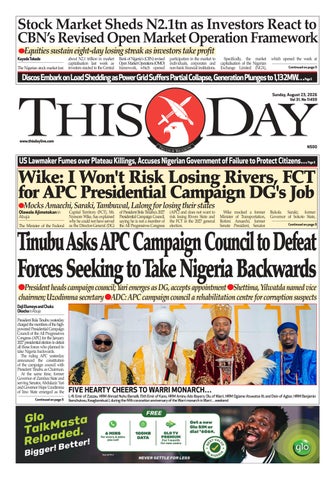
FIVE HEARTY CHEERS TO WARRI MONARCH…
L-R: Emir of Zazzau, HRM Ahmad Nuhu Bamalli; 15th Emir of Kano, HRM Aminu Ado Bayero; Olu of Warri, HRM Ogiame Atuwatse III; and Dein of Agbor, HRM Benjamin Ikenchukwu, Keagborekuzi I, during the fifth coronation anniversary of the Warri monarch in Warri…weekend
2
SUNday, AUGUST 23, 2026 • T H I S D AY
SUNDAY, AUGUST 23, 2026 • T H I S D AY
3
4
SUNday, AUGUST 23, 2026 • T H I S D AY
5
AUGUST 23, 2026 • T H I S DAY, T H E S U N DAY N E W S PA P E R
NEWS
Discos Embark on Load Shedding as Power Grid Suffers Partial Collapse, Generation Plunges to 1,132MW
Emmanuel Addeh in Abuja
Electricity Distribution Companies (Discos) yesterday commenced load shedding across their networks following a sharp deterioration in power generation on the national grid, which plunged to 1,132.02 megawatts (MW) at 8:30pm. The development, which pointed to a partial collapse of the national grid, was reflected in real-time data on the Nigerian Independent System Operator’s
(NISO) grid performance dashboard, as several major generating plants recorded zero output. Eko Disco in a notice to its customers, confirmed the supply disruption, stating: “We are experiencing load shedding across our network. This is due to low allocation from the grid. Please bear with us.” The low grid allocation came as only 10 generating companies were contributing to the system at the time of the 8:30pm reading,
with a number of major power plants recording no generation. Earlier, it had fallen to as low as 700MW before the ramp-up. However, at 9pm it had risen to 1,793.79MW as authorities worked to restore supply to the over 4,000MW reported earlier in the day. Jebba Hydroelectric Power Plant was the largest contributor at 483MW, followed by Omotosho at 162.80MW, Olorunsogo at 115MW, Paras Energy at 80.10MW and Afam
III Fast Power at 76.10MW. Dadinkowa contributed 37.82MW, Omoku generated 34.70MW, while Sapele Steam recorded 24.80MW. However, Egbin, Geregu, Geregu NIPP, Kainji, Delta, Alaoji NIPP, Ihovbor NIPP, Okpai, Shiroro, Taopex, Trans Afam Power and Zungeru were all recording zero output on the dashboard at the time. The sharp fall in generation meant that the volume of electricity available for
transmission to Discos was significantly constrained, forcing distribution companies to reduce the amount of power supplied to customers. The latest development adds to concerns over the stability of Nigeria’s electricity system, which has suffered repeated system disturbances and grid collapses in recent years. NISO and other relevant power sector authorities had yet to issue an explanation for the sharp reduction in generation
as of the time of filing this report. This is the first grid disturbance under the new Minister of Power, Joseph Tegbe. Nigeria’s power system remains heavily dependent on gas-fired generation, while the transmission network continues to face capacity and reliability constraints. Previous assessments had also identified ageing infrastructure, vandalism and inadequate gas supply, among factors that had contributed to electricity supply disruptions.
TINUBU ASKS APC CAMPAIGN COUNCIL TO DEFEAT FORCES SEEKING TO TAKE NIGERIA BACKWARDS
Director-General and Secretary, respectively. According to a statement issued by presidential spokesperson, Bayo Onanuga, Vice President Kashim Shettima will serve as vice chairman of the council. The party’s Chairman, Professor Nentawe Yilwatda, will also serve as vice chairman; APC National Secretary, Senator Ajibola Bashiru and Special Adviser to the President, Hadiza Bala-Usman, will serve as deputy and assistant secretaries. Meanwhile, the African Democratic Congress (ADC) has described the APC campaign council as a “rehabilitation
centre” for persons facing unresolved corruption questions. Tinubu charged all council members to work tirelessly to deliver victory for the party in the January 2027 elections. He has also encouraged the leaders of the various directorates to reach out to other party members who may not have been formally listed to join their crucial efforts. “We have delivered on our campaign promises and set our country on a path of economic progress. We are definitely out of the dark tunnel and are now at the cusp of reaping the benefits of a prosperous economy that will benefit all Nigerians. As we
march into the campaign season, we have many achievements to trumpet—let us confidently showcase our record and inspire hope in every corner of our nation. Let us soundly defeat all those forces who plan to take our country backwards,” explained. According to the statement by Onanuga, President Tinubu, as chairman of the council, will work with a body of advisers, namely: Pioneer National Chairman of the APC, Chief Bisi Akande; former Ogun State Governor, Chief Segun Osoba; ex-Imo State Governor, Senator Rochas Okorocha; former national chairman of APC,
Senator Abdullahi Adamu; and former presidential aide, Senator Florence Ita Giwa. The statement disclosed that the Senate President, Senator Godswill Akpabio; the Speaker of the House of Representatives, Hon. Tajudeen Abass; and Governor Mai Mala Buni of Yobe State have been appointed as deputy directors-general for the campaign in the south and the north, respectively. The statement noted that they would work with the Senate Leader, Senator Bamidele Opeyemi and Deputy Senate President, Senator Jibril Barau, in the two zones. Continuing, the statement
explained that the former National Chairman of the APC, Senator Adams Oshiomhole, would serve as deputy directorgeneral in charge of mobilisation. In contrast, the President’s Chief of Staff, Hon. Femi Gbajabiamila, will serve as deputy director-general for administration. The statement added that a member of the House of Representatives, Hon. James Abiodun Faleke, who played a pivotal role in the 2022/2023 campaign, has returned as deputy director-general for election planning, coordination and monitoring. Faleke, according to the
statement, will work with zonal directors, including Senator Olushola Adeyeye in the South-west; Dr Ngozi Olejeme in the South-South; Senator Uche Ekwunife in the South-east; Muntaqha Rabe in the Northwest; Ahmed Muhammed Ketso in the North-central; and Senator Sani Danladi in the North-east. Similarly, Ms Stella Okotete, Abdullahi Garba Ramat and Audu Maikori will serve as secretaries of the election planning directorate. Muiz Adeyemi Banire will lead the legal directorate as director, with Dr. Liman Continued on page 9
WIKE: I WON'T RISK LOSING RIVERS, FCT FOR APC PRESIDENTIAL CAMPAIGN DG'S JOB Senator Aminu Tambuwal; and former Governor of Plateau State, Senator Simon Lalong, for losing their states while serving as DGs of presidential campaign councils at different times. The minister spoke yesterday after inspecting the ApoKarshi and Kubwa-Bwari roads in Abuja, a day after the Presidency announced the composition of the APC Presidential Campaign Council and named former Zamfara State Governor, Senator Abdulaziz Yari, as its DirectorGeneral. Asked whether he would
have wanted to be part of the council, Wike recalled previous campaign DGs who lost their states while campaigning for their presidential candidates. Wike said, "In 2015, the Minister of Transport was the governor of Rivers State. "He was the DG of Muhammadu Buhari. Before you knew it, I pulled the carpet off his feet. He lost. He didn't get 25 per cent. "In 2019, he was Minister of Transport; he became the DG, and he lost his state too. Bukola Saraki was the DG of Atiku's 2019 campaign. He was running around doing
'Atikulated'. "I called him, 'Why are you doing Atikulated? Go home!' He lost his state! Lost his own seat, too! In 2023, Aminu Tambuwal became DG of Atiku. He lost his state! "In the same 2023, Lalong was the DG of APC, the present President. He lost his state!" Wike said he was not prepared to join the list, adding that his priority was to deliver the FCT and Rivers State rather than occupy a campaign position. "I don't want to lose my state! I will be in my state. I have two states: FCT and
Rivers. What is important is that you can deliver those two states. So, it is not about being DG. "If you are DG and you don't win your state, what is the essence of the DG?" he queried. The FCT minister also cited his non-membership of the APC as another reason he could not have headed the council, while maintaining that he would continue to support Tinubu's re-election. "I am not a member of the APC. So, the issue of their Presidential Campaign Council is off the table. "When we were fighting for
the President to be President in 2023, we were not members of the APC Presidential Campaign Council, but we were fighting. "So, we had our own strategies on how the president would emerge," he said. Wike said his support for Tinubu's re-election would instead operate through a cross-party "Rainbow Coalition" involving politicians backing the President in their respective states while remaining members of their political parties. "Mind you, when we formed the Rainbow Coalition, so many parties were coming together, working together in some states
to make sure that the President wins," he said. Wike also argued that political relevance should be judged by electoral results rather than campaign titles, saying the performance of different states would become clear after the 2027 elections. "Nobody should use that as a yardstick to judge who will be the governor of any state. I think there is only one clear state that will produce a governor. It is my state. It is very clear. "The other ones, we don't know what will happen," he said.
STOCK MARKET SHEDS N2.1TN AS INVESTORS REACT TO CBN’S REVISED OPEN MARKET OPERATION FRAMEWORK
N156.624 trillion, declined by N2.09 trillion, or 1.33 per cent, to close at N154.534 trillion. Similarly, the NGX All-Share Index (ASI) fell by 3,268.04 points, or 1.35 per cent, from 242,619.20 points at the beginning of the week to 239,351.16 points at the close of trading. The bearish performance was driven largely by profit-taking in some highly capitalised stocks, including Aradel Holdings Plc, MTN Nigeria Communications Plc, Zenith Bank Plc and First HoldCo Plc. Aradel Holdings declined by 9.99 per cent week-on-week to close at N1,374.20 per share, while MTN Nigeria fell by 3.2 per cent to N779 per share. First HoldCo dropped by 7.2 per cent to N129.95 per share, while Zenith Bank declined by 0.5 per cent to N122 per share. Guaranty Trust Holding
Company Plc (GTCO) also depreciated by 1.2 per cent to close at N127 per share. Similarly, Unilever Nigeria Plc shed 3.6 per cent to close at N114 per share, while Stanbic IBTC Holdings Plc declined by 3.2 per cent to N156.10 per share. The losses came against the backdrop of the CBN’s decision to widen access to its OMO market, potentially increasing competition between equities and high-yielding fixed-income instruments for investors’ funds. The Acting Director, Financial Markets Department of the CBN, Okey Umeano, announced in a circular dated August 12, 2026, that participation in both the primary and secondary OMO markets would be open to all eligible investors through Deposit Money Banks (DMBs). “OMO participation (primary and secondary markets) shall
be open to all eligible investors through Deposit Money Banks (DMBs). “Eligible investors include individuals, corporates and non-bank financial institutions. DMBs shall continue to submit bids and settle transactions on behalf of their customers,” the circular stated. With OMO bills now accessible to individuals and other eligible investors through banks, rather than being largely restricted to institutional market participants, analysts believe the policy could divert some funds from equities to the fixed-income market, particularly given the attractive yields on offer. Since the policy was announced on August 12, the domestic equities market has recorded eight consecutive trading sessions of losses. Market capitalisation, which
stood at N157.494 trillion at the close of trading on August 12, declined by N2.96 trillion, or 1.9 per cent, to N154.534 trillion on August 21. The revised OMO framework coincided with the apex bank's aggressive liquidity management. On August 13, the CBN offered N600 billion worth of OMO bills, with stop rates reaching 20.39 per cent. The 103-day and 138-day instruments attracted total subscriptions of N4.9 trillion, while successful bids amounted to N2.6 trillion. Analysts tracking developments in the fixedincome market expect elevated OMO yields to gradually filter through to deposit rates as banks compete to retain funds that could otherwise migrate to higher-yielding instruments. Over time, the development
could also encourage a gradual convergence between Treasury Bill and OMO yields, narrowing the roughly 400-basis-point gap currently separating instruments with comparable tenors. The latest auction formed part of one of the CBN’s most aggressive liquidity sterilisation exercises this year, coming shortly after the apex bank injected a net N5.21 trillion into the banking system, including a single N2.48 trillion OMO repayment on August 11. It also followed a combined N4.7 trillion mopped up through OMO auctions on August 3 and 4, while more than N7 trillion was absorbed through similar auctions in July alone. The sustained demand recorded at successive auctions, despite the substantial liquidity already withdrawn from the financial system, suggests that
liquidity conditions remain robust enough to support continued participation in OMO instruments. With OMO stop rates at about 20.4 per cent, significantly above yields on comparable Treasury Bills, the instrument has emerged as an increasingly attractive risk-free investment option. Looking ahead, Cordros Research said it expected sentiment in the equities market to remain subdued in the near term, particularly in the absence of fresh catalysts. “We expect market sentiment to remain cautious in the absence of clear near-term catalysts. “In addition, the CBN’s revised OMO framework could temper market participation, as attractive short-term fixed-income yields may continue to compete with equities for investor flows,” Cordros stated.
6
T H I S DAY, T H E S U N DAY N E W S PA P E R • AUGUST 23, 2026
NEWS
STRATEGISING AHEAD OF 2027…
L-R: Hon. Unyime Idems; former Petroleum Minister, Chief Don Etiebet; President of the Senate, Senator Godswill Akpabio; Speaker, Akwa Ibom State House of Assembly, Udeme Otong; Senator Emmanuel Ibok Essien; and wife of the Minister of State for Petroleum Resources (Gas), Mrs. Esitmbom Ekpo, during the meeting of the critical stakeholders of the All Progressives Congress in the Akwa Ibom North West Senatorial District in Ikot Ekpene Local Government Area…yesterday
US Lawmaker Fumes over Plateau Killings, Accuses Nigerian Government of Failure to Protect Citizens
Sunday Ehigiator
A member of the United States House of Representatives, Chris Smith, has accused the Nigerian government of failing to protect its citizens and hold perpetrators accountable following the recent killings in Plateau State. Several residents were killed on August 16 in Jwak Maitumbi community, Mangu LGA of
Plateau State, while about 45 residential shelters and large quantities of crops were destroyed. Less than 48 hours later, suspected Fulani militia invaded Bin-Per community in Kombun district of Mangu and killed at least 23 people, including women and children, in what appeared to be a reprisal. On Thursday, troops of
Operation Enduring Peace foiled an attempted attack on Manja community in the same LGA after receiving information about armed herders moving with cattle in the area, reportedly destroying farmlands and attempting to attack the community. In a statement at the weekend, Smith called on the Nigerian government to take immediate action to protect Christian
communities and bring the perpetrators of the attacks to justice. “Despite denials by Nigerian government actors, Christians continue to be slaughtered while Nigerian officials fail to provide adequate protection or hold the perpetrators accountable,” Smith said. “Enough is enough. The Nigerian government must fulfill
Obi Targets Youths in 150-day Campaign, Says Biggest Match is in Nigeria Chuks Okocha in Abuja
With 150 days to the January 16, 2027 presidential election, the presidential candidate of the Nigeria Democratic Congress (NDC), Peter Obi, said he would take his campaign straight to the youths in town halls, campuses, online spaces, and football communities. As millions of Nigerian youths settle to watch Manchester United, Arsenal, Real Madrid, Barcelona and others, Obi argues that the biggest match is in Nigeria. In a direct letter to Nigerian youths released at the weekend, Obi said Europe’s football spectacle should be more than entertainment. In the letter titled “Beyond
Football: The Match for a Better Nigeria,” Obi praised the organisation, discipline, and excellence that make European leagues the envy of the world. “The answer is not a lack of talent. Nigeria has produced world-class footballers who have excelled in Europe because they found systems that reward merit, invest in infrastructure, ensure security, and are governed with competence and accountability. “Great football does not exist in isolation. It grows where there is good governance.” He listed what makes the difference: Stadiums, academies, transport, healthcare, security, electricity and institutions. “Nigeria has the talent. What we have lacked is leadership that creates an enabling environment
for that talent to flourish.” “The Nigeria you admire abroad can be built here. But it starts with your vote. “Imagine a Nigeria where our local league is competitive, our stadiums are full every weekend, our clubs attract sponsorship, our coaches receive proper training, and young footballers no longer see emigration as their only path to success.” “Nigeria will not emerge through wishful thinking. It will emerge when young Nigerians decide that elections matter as much as football matches,” Obi said. Obi framed the 2027 election as bigger than politics. He called it a choice between a nation that exports talent because it is respected, and one
whose citizens leave because governance has failed them. “Cheer for Manchester United, Arsenal, Chelsea, Liverpool, Manchester City, Barcelona, Real Madrid, Bayern Munich, PSG, Inter, AC Milan, or any club you support. Enjoy every match. But when the final whistle blows, remember that the greatest match awaiting Nigerian youths is not in Europe. It is in Nigeria.” “It is the match for good governance. It is the match for jobs, security, education, sports development, and national renewal. And unlike football, where only twenty-two players are on the pitch, every Nigerian youth has a place in this match.” Obi’s charge was blunt: “Stand up. Mobilise. Vote. Defend your vote.”
APM Petitions EFCC, N’Assembly over Alleged N12tn Missing Subsidy Fund, Demands Investigation
Chuks Okocha in Abuja
Following the alleged disappearance of a whopping N12 trillion from the proceeds realised by the removal of the petrol subsidy, the Allied Peoples’ Movement (APM) has petitioned the Economic and Financial
Crimes Commission (EFCC), demanding an investigation into the matter. In a statement issued by the party’s National Publicity Secretary, Abubakar Yusuf, the party stated that its demand was “predicated on the claim by the Minister of Finance and Coordinating Minister of the
Economy, Taiwo Oyedele, that only N15.8 trillion was realised as subsidy removal saving, while existing government data as announced by his predecessor, Wale Edun shows that an estimated $20 billion, (N27 trillion) had been saved as at November 2024. "The missing N12 trillion
further fuels the allegations in the public space that the bulk of the subsidy savings have been stolen by corrupt officials and cronies of the Tinubu-led All Progressives Congress (APC) administration to fund their wasteful lifestyle to the detriment of millions of suffering Nigerians."
its most basic responsibility of protecting its citizens.” According to the statement, Smith spoke alongside the Assistant Secretary of State for African Affairs, Frank Garcia, who urged the Nigerian government “to meet their commitments to protect Christian communities and to hold perpetrators of violence accountable”. “The U.S. State Department’s recent public message underscores the urgent need for concrete action—not more assurances—as deadly violence continues to devastate vulnerable communities,” the statement quoted Smith as
saying. “Instead of spending millions of dollars—$9 million, to be exact—in an attempt to improve its image in Washington, the Nigerian government should redirect those resources towards protecting its people and addressing this grave security crisis.” Earlier this year, the US House of Representatives introduced the Nigeria Religious Freedom and Accountability Act, which would require the US Secretary of State to compile and submit to Congress a comprehensive report on US efforts to address the “religious persecution” and mass atrocities in Nigeria.
Post-election Reconciliation Deepens in Osun as Adeleke Welcomes Oyebamiji’s Call for Peace
Yinka Kolawole in Osogbo
Osun State Governor, Ademola Adeleke, has commended the governorship candidate of the All Progressives Congress (APC), Mr. Bola Oyebamiji, over his call for peace in the state following the conclusion of the election in the state. Oyebamiji had in a statement called on his supporters and party members to maintain peace and order, saying he respected the decision of the Independent National Electoral Commission (INEC) on the poll but would not go against his party’s decision to review the poll outcome. Reacting to the statement, Governor Adeleke described Oyebamiji’s peace advocacy as “a positive tone after weeks of heated campaign and election season”. The governor, who also met with President Bola Tinubu after the poll, described the peace advocacy by the APC candidate as a good development for the
Osun people who experienced trauma and violence over the last two months ahead of last governorship election. The governor said he reviewed the pre-election climate of fear and conflict, noting that his team never subscribed to violence as a weapon of political campaign even when under severe pressure in the countdown to the elections. “I am forever a man of peace. It is heartwarming that my brother, Oyebamiji, is also preaching peace. I assure him that my supporters have not and will not attack APC members. “Elections have come and gone and we are all winners. The common task for us all is to sustain delivery of democratic dividends and good governance to the good people of Osun State. “I welcome Mr Gboyega Oyetola, Bola Oyebamiji and other opposition leaders to join hands with me to take Osun to greater heights. We are all important stakeholders in this Osun project,” Adeleke stated.
7
AUGUST 23, 2026 • T H I S DAY, T H E S U N DAY N E W S PA P E R
NEWS
STRATEGIC ENGAGEMENT WITH DEVELOPMENT PARTNER…
L-R: Chief Executive Officer, Natural Eco Capital Limited, Dr. Eugene Itua; Director, Planning Research and Data Management, Services Department, Nigerian Maritime Administration and Safety Agency, Aishatu Jidda; Director General, NIMASA, Dr. Dayo Mobereola; Director, Marine Environment Management Department, NIMASA, Dr. Oma Ofodile; and Executive Director, Operations, NIMASA, Mr. Fatai Adeyemi, at a strategic engagement with Itua in Lagos…recently
2027 will Be Fight Between Nigerians and Oppressors, Says Kwankwaso South-east KNN targets 5m votes for Obi-Kwankwaso
Chuks Okocha in Abuja
The vice-presidential candidate of the Nigeria Democratic Congress (NDC), Senator Rabiu Musa Kwankwaso, has described the 2027 general election as a
battle between Nigerians and those he called “the oppressors”, urging citizens to unite beyond political party lines to rescue the country. Kwankwaso reportedly made the declaration when he received
a delegation of South-east leaders and stakeholders of the Kwankwaso National Network (KNN), led by the group’s Southeast Zonal Coordinator, Dr Ukpai Iro Ukpai, at his Maitama, Abuja residence.
Ukpai, who disclosed this in an interview with jouurnalists in Umuahia, said the delegation was at the former Kano State governor’s residence to brief him on KNN’s activities and mobilisation efforts towards
US Judge Strikes Down Trump's Visa Ban against Nigeria, 74 Other Countries
Sunday Ehigiator
A United States District Court in Manhattan has nullified the President Donald Trump administration's policy suspending the processing and issuance of immigrant visas to applicants from 75 countries, including Nigeria. In a ruling delivered on Friday, U.S District Judge Jeannette Vargas described the January directive by the State Department as patently unlawful and said it exceeded the statutory authority
of Secretary of State Marco Rubio. The policy, which took effect on January 21, had barred the issuance of immigrant visas to nationals of 75 countries because they posed "a high risk for becoming a public charge" and of relying on U.S. government cash assistance. Affected countries are: Afghanistan, Albania, Algeria, Antigua and Barbuda, Armenia, Azerbaijan, Bahamas, Bangladesh, Barbados, Belarus, Belize, Bhutan, Bosnia-
Herzegovina, Brazil, Cambodia, Cameroon, Cape Verde, Colombia, Cuba, Dominica, DR Congo, Egypt, Eritrea, Ethiopia, Fiji, Gambia, Georgia, Ghana, Grenada, Guatemala, Guinea and Haiti. Other countries on the list are: Iran, Iraq, Ivory Coast, Jamaica, Jordan, Kazakhstan, Kosovo, Kuwait, Kyrgyzstan, Laos, Lebanon, Liberia, Libya, Moldova, Mongolia, Montenegro, Morocco, Myanmar, Nepal, Nicaragua, Nigeria, North Macedonia, Pakistan, Republic
of Congo, Russia, Rwanda, Saint Kitts and Nevis, Saint Lucia, Senegal, Sierra Leone, Somalia, South Sudan, St. Vincent and the Grenadines, Sudan, Syria, Tanzania, Thailand, Togo, Tunisia, Uganda, Uruguay, Uzbekistan and Yemen. President Donald Trump had, early in the year, published a list of welfaredependent rates among immigrants, noting that about 33.3 per cent of Nigerian immigrant households received some form of public assistance.
Terrorists’ Commanders, Fighters in Disarray as NAF Airstrikes Pound Enclaves in Borno Forests, Kill Over 26 Linus Aleke in Abuja
The military said the leadership of terrorist groups operating in the North-east, including commanders and fighters, was in panic mode as the Air Component of Task Force North-East, Operation Hadin Kai (OPHK), continued to deliver precision-guided munitions against identified terrorist enclaves in forests in Monguno and Biu Local Government Areas (LGA) of Borno State, killing more than 26
terrorist fighters at the identified locations. This comes as terrorist fighters in the North-east Theatre of Operations continued to surrender to the state forces following acute hunger, insecurity and factional clashes within terrorist enclaves. According to a statement by the Acting Military Information Officer of the Joint Task Force North-East, Operation Hadin Kai, Captain Mohammed Goni, the coordinated air operations
followed credible intelligence, and confirmatory Intelligence, Surveillance and Reconnaissance (ISR) missions that identified the movements and concentrations of suspected terrorists. The strikes, he said, successfully degraded the identified targets and disrupted attempts by terrorist elements to assemble, regroup and operate freely within the theatre. Goni said: “In one of the operations, an armed reconnaissance platform detected
and tracked suspected terrorists around the Aduwa axis in Monguno LGA before identifying a larger concentration within a settlement. Following appropriate operational procedures and authorisation, a precision strike was conducted against the identified target. Subsequent Battle Damage Assessment indicated significant effects on the terrorist concentration, with about 16 terrorists neutralised in two precision strikes.
securing a landslide victory for the Obi-Kwankwaso ticket in the South-east in 2027. According to Ukpai, Kwankwaso told the delegation that growing dissatisfaction with the state of affairs in the country had created a strong desire among Nigerians for a political reset. He said the 2027 election should not be reduced to a contest between political parties but viewed as a decisive choice about the future of Nigeria. “It is not about me, it is about us,” Kwankwaso was quoted as saying, while urging KNN members and supporters of the
alliance to remain committed to the struggle beyond the 2027 election. The former Kano governor also reportedly said the outcome of the recent Osun governorship election had shown that votes could count in 2027 if Nigerians remained resolute in defending their mandates. He urged Nigerians to resist electoral fraud and vote selling, stressing that no immediate personal gain is more important than the future of the country. Kwankwaso, according to Ukpai, charged KNN leaders to intensify grassroots mobilisation ahead of the election.
Umar Ardo: Why Peter Obi, AbubakarAtikuCan’tFormCoalition
Chuks Okocha in Abuja
A political strategist and convener of the League of Northern Democrats, Umar Ardo, has stated that the presidential candidate of the African Democratic Congress (ADC), Atiku Abubakar, lacked the inclination to withdraw from the presidential race. He noted that the presidential candidate of the Nigeria Democratic Congress (NDC), Peter Obi, can step down, but doing so would deny him his support base. He explained that if Atiku were to express a willingness to withdraw, he would likely retain his support base. However, he emphasised that it is highly improbable that the 2023 Peoples Democratic Party (PDP) presidential candidate would take such
a step. Ardo said that while Obi could easily step aside, his supporters might not react favourably to such a decision, highlighting these as the two significant challenges hindering a robust merger ahead of the presidential election. Speaking on ARISE NEWS, Ardo said, “My view is that Atiku does not have the propensity by himself to say, ‘I will step down.’ If he says so, he will not have a problem with his support base. But the issue is that he is highly unlikely to say that. “Then Peter Obi has the propensity to say, ‘I will step down.’ But if he says so, he will not have his support base. He will not be able to carry his support base. His support base will not go with him. So, now, these are the two problems.
8
T H I S DAY, T H E S U N DAY N E W S PA P E R • AUGUST 23, 2026
NEWS
MUSLIM WOMEN GATHER IN UMUAHIA…
Representative of the First Lady and Wife of Vice President, Hajia Nana Shettima (left), exchanging pleasantries with some of the Muslim clerics at the 41st National Conference of the Federation of Muslim Women's Associations in Nigeria in Umuahia, Abia State…weekend
IPMAN Urges Dangote to Deliver Fuels Directly to Northern States for Uniform Prices PENGASSAN pushes for consolidation of reforms in oil industry
Onyebuchi Ezigbo in Abuja and Peter Uzoho in Lagos
To maintain a uniform pump price for petroleum products across the country, especially in the northern parts, the Independent Petroleum Marketers Association of Nigeria (IPMAN) urged the Dangote Petroleum Refinery Company
at the weekend to deliver fuel directly to more states. The association's National Publicity Secretary and Public Relations Officer, Chief Chinedu Ukadike, made the appeal in a voice note released to select reporters in Abuja. This is just as the Petroleum and Natural Gas Senior Staff Association of Nigeria
(PENGASSAN) urged the federal government to sustain efforts to implement reforms and incentives to stimulate investment in the country's oil and gas industry. Ukadike said: "We want to commend the management of Dangote Refinery for making this possible, and we are also appealing to them to extend it further to other states, especially
those in the northern areas, so that petroleum products will be bought uniformly," he said. According to him, "This will reduce the hardship Nigeria is facing." The spokesman commended the refinery for extending its free petroleum product distribution scheme to Imo, Anambra and other states, describing the
Troops Intercept 180 Units of Superpower Explosives Bound for Terrorists in Zamfara Linus Aleke in Abuja
The Nigerian military has said that troops of the Joint Task Force (JTF) North-West, Operation Fansan Yamma, intercepted no fewer than 180 units of superpower explosives destined for terrorists in Katsina State. The military revealed that the explosives were detected and intercepted by troops along the Kaura-Zurmi Road in Zurmi Local Government Area (LGA) of Zamfara State during an intelligence-led clearance operation. Speaking during the weekly briefing on the operational
activities of troops of the Armed Forces of Nigeria across the federation, the Director of Defence Media Operations, Major General Michael Onoja, said that troops also apprehended the suspect conveying the illicit explosives to terrorists in Katsina State to cause havoc. “On 15 August 2026, another suspect was arrested in Gusau, Zamfara State, in connection with the same explosives supply chain. On 16 August 2026, troops arrested suspected collaborators of a notorious terrorist kingpin along the Sakajiki-Kwanar Guiwa Road in Kaura Namoda LGA of
Zamfara State, recovering cash and motorcycles intended for onward delivery to the kingpin’s camp. “In a series of rescue operations between 17 and 19 August 2026, troops recovered a combined total of 28 abducted victims across Bukkuyum LGA in Zamfara State; Sabuwa and Kankara LGAs in Katsina State; and Isa LGA in Sokoto State, with all victims subsequently handed over to local authorities for reunification with their families,” Onoja said. In a related development, troops unmasked and apprehended six additional informants linked to
the abduction of an immigration officer’s family, as well as staff and students of the Federal Polytechnic, Kaura Namoda. “On 19 August 2026, troops also arrested a suspected terrorist informant in Shanono LGA of Kano State for allegedly monitoring troop deployments and equipment on behalf of terrorists,” Onoja added. He further revealed that 47 terrorists and their family members surrendered to troops of Operation Hadin Kai within the period under review, citing hunger as one of the reasons for their surrender.
SEC Proposes N30m Registration Fee, N2bn Capital Requirement for Crypto Firms The Securities and Exchange Commission (SEC) has proposed a new regulatory framework for Nigeria’s digital asset industry, prescribing registration fees of N30 million and minimum capital requirements of up to N2 billion for operators in the rapidly expanding market. Under the proposed Rules on Digital and Virtual Asset Operations, Custody and Markets, Digital Asset Exchanges (DAXs), Digital Asset Custodians
(DACs), Digital Asset Platform Operators (DAPOs), Digital Asset Offering Platforms (DAOPs) and Real World Asset Tokenisation Platforms (RATOPs) would each be required to pay a registration fee of N30 million. The proposed rules also impose significantly higher minimum capital requirements on operators as the commission moves to strengthen prudential safeguards and establish clearer operational standards
for businesses participating in the country’s digital asset ecosystem. Under the framework, DAXs and DACs would each be required to maintain a minimum capital of N2 billion, while DAPOs, DAOPs and RATOPs would have a minimum capital requirement of N500 million each. Virtual Asset Service Providers (VASPs) would be required to maintain minimum capital of N200 million.
The latest move by the SEC forms part of the federal government’s broader effort to establish a coordinated regulatory regime for the digital asset market, following recent measures covering virtual assets and their taxation. The commission also proposed that regulated entities maintain a fidelity insurance bond equivalent to at least 25 per cent of their minimum paid-up capital.
gesture as one that would ease the hardship faced by independent marketers. Ukadike gave the commendation while speaking on the impact of the initiative, which he said was aimed at ensuring petroleum products reach final consumers at more affordable prices. "This gesture, if sustained, will be able to alleviate the sufferings of independent marketers," Ukadike said. "There has been the issue of financial hold-up, whereby marketers pay for products and are not loaded for days and weeks, and they suffer unnecessary hardship bringing the product down." He said the Dangote Refinery had made the process
significantly easier for marketers, adding that many were now seeing quicker returns on their investments. According to Ukadike, the initiative had also reduced the risks associated with product haulage, since marketers now have petroleum products delivered closer to their point of need. He noted that this development was already reflected in retail pump prices. Ukadike commended the management of Dangote Refinery for the initiative and appealed for it to be extended to more states, particularly in the northern part of the country, to ensure uniform pricing of petroleum products nationwide.
Ogoni Youths Demand 500 NNPC Jobs as Oil Exploration Resumption Sparks Divisions Blessing Ibunge in Port Harcourt The youths of oil-rich Ogoni ethnic nationality in Rivers State have demanded 500 job slots from the Nigerian National Petroleum Company (NNPC) Limited as part of the planned resumption of oil exploration in the area. This figure is against the already released 40 slots by the company. Also, the youths on the platform of the Ogoni Youth Federation (OYF) have moved to convene a national congress of youths to address issues related to oil exploration, which has sparked palpable divisions in the area. Speaking in Port Harcourt at the weekend during the inauguration of the Planning Committee for the congress, the President-General of
OYF Worldwide, Legborsi Yamaabana, said the congress would address all issues arising from the planned resumption of oil production. Yamaabana commended President Bola Tinubu on his efforts to reopen oil businesses in the area, but quickly noted that Ogoni stands at a crossroads amid issues surrounding the resumption of oil operations. He said: “The Ogoni nation stands at a critical crossroads in its history. We acknowledge the renewed political attention of the Federal Government of Nigeria under the leadership of His Excellency, President Bola Ahmed Tinubu (GCFR), particularly regarding the proposed resumption of oil and gas exploration in Ogoniland after more than three decades of suspension.
9
AUGUST 23, 2026 • T H I S DAY, T H E S U N DAY N E W S PA P E R
NEWS
IN BROTHERHOOD WE STAND IN USA…
L-R: Public Relations Officer, Akokwa USA, Chief Adol Nwokeji; Mrs. Uche Agina; Immediate Past President, Akokwa USA, Nze Agina Onuoha; former Chairman of Board of Trustees, Akokwa USA, Dr. Anayo Ukeje; Mrs. Chibuzor Agba; National Coordinator, Akokwa USA, Mazi Kingsley Agba; and Chief Whip, Chief Jude Onwuelingo, at the Bi-annual Convention of Akokwa USA in Los Angeles, California…weekend
FG Engages Israeli, French Manufacturers to Produce Two Next-generation Communication Satellites
Chindeu Eze
The Federal Ministry of Communications, Innovation and Digital Economy, and the Nigeria Communications Satellite (NIGCOMSAT) Limited are engaging the Israeli and French manufacturers to produce two next-generation communication satellites for Nigeria. NIGCOMSAT said in a statement yesterday that the satellites, NigComSat-2A and NigComSat-2B, will be delivered by Israel Aerospace Industries (IAI) and Thales Alenia Space of France. The company said the project has moved into its next phase following the Federal Executive Council (FEC) approval for the acquisition and deployment of the satellites. NIGCOMSAT said the next stage includes formal
engagement with the technology partners, contract finalisation and technical planning ahead of the manufacture, launch and eventual deployment of the satellites. The Managing Director and Chief Executive Officer of NIGCOMSAT, Jane Nkechi Egerton-Idehen, said the approval was a significant milestone for the company and Nigeria. She said the satellites would strengthen Nigeria’s national satellite capacity, expand connectivity and support critical communications across the country. “Our priority is to translate this investment into measurable value for Nigerians and position NIGCOMSAT for stronger impact within the global satellite and digital economy,” Egerton-Idehen said.
The Acting Head of the Corporate Affairs Division at NIGCOMSAT, Stephen Kwande, told TheCable that the launch would be in two phases, with the first in 2028.
“The process has just started; that is, the approval. The launch will be in two phases, one hopefully by the end of 2028 and the second in 2029 or 2030,” he said.
“There was discussion in March, and the Federal Ministry of Communications, Innovation and Digital Economy is handling most aspects of the launch and discussions.
“We are under the Federal Ministry of Communications, Innovation and Digital Economy. So, the Ministry and NIGCOMSAT Ltd are engaging the manufacturer.”
LCCI Calls for Strengthening of Local Pharmaceutical Manufacturing Capacity for Health Care Delivery
Dike Onwuamaeze
The Lagos Chamber of Commerce and Industry (LCCI) has called for the strengthening of Nigerian pharmaceutical manufacturing capacity to build an efficient healthcare economy that creates jobs, attracts investment and emerges as a technology-intensive industry. This call was made by the President of LCCI, Mr. Leye Kupoluyi, at the recent “LCCI Medical, Pharmaceuticals
and Allied Services Group Symposium” with the theme “Transform Care: The Business of Healthcare in a Digital World.” Kupoluyi said that the strengthening of local pharmaceutical manufacturing capacity was a critical dimension in the transformation of Nigeria’s healthcare delivery because Nigeria cannot achieve health security while remaining excessively dependent on imported medicines, active
pharmaceutical ingredients, vaccines, diagnostics, and medical consumables. He said: “Local pharmaceutical manufacturing is, therefore, simultaneously a health-security strategy, an industrial policy, and an investment opportunity,” he said. The president of LCCI pointed out that local manufacturing should ultimately translate into greater availability, competitive pricing, and improved access to essential medicines for Nigerians.
He said restrictions on imported alternatives may inadvertently contribute to supply constraints and higher prices where domestic production capacity or competition is insufficient to meet demand. “We, therefore, advocate for a periodic review of medicines affected by the Ceiling List based on verifiable domestic production capacity, market competition, medicine availability, and price movements.
TINUBU ASKS APC CAMPAIGN COUNCIL TO DEFEAT FORCES SEEKING TO TAKE NIGERIA BACKWARDS Hassan and Babatunde Ogala as deputies. The statement identified the other members of the legal directorate to include: Attorney General of the Federation and Minister of Justice, Prince Lateef Fagbemi; former governor of Katsina State, Ibrahim Shema; Worgu Boms; and Minister of Innovation, Science and Technology, Dr Kingsley Tochukwu Udeh. The statement also explained that the Minister of Information and National Orientation, Mohammed Idris Malagi, will serve as the Coordinating Director for Media and Strategic Communication, alongside Dele Alake, Onanuga, and Lanre Issa-Onilu. The media directorate also includes Tunde Rahman, Sunday Dare, Daniel Bwala, and Felix Morka, who have been assigned
as coordinating deputy directors. Abdulaziz AbdulAziz will work with three others, namely Temitope Ajayi, Arabinrin Aderonke, and Frederick Nwabufor, as coordinating secretaries of the media directorate. Segun Dada will serve as Director, New Media, the same role he performed in 2022, while Solomon Arowolo will serve as Secretary, New Media. The campaign council also appointed five spokespersons, led by Dele Alake. Other spokespersons are Alwan Hassan, Ayobami Oyalowo, Kemi Asekun-Shittu and Adamu Fanda.
Yari Accepts Appointment as Campaign Council DG Meanwhile, Senator Yari has
accepted his appointment as Director-General of the APC Campaign Council for the 2027 election. Yari, who represents Zamfara West in the Senate, expressed gratitude to President Tinubu and the APC leadership for entrusting him with the responsibility. “I accept this responsibility with deep gratitude and full seriousness. “My sincere thanks go to President Bola Tinubu and the party for the trust placed in me, and to our party leadership for the confidence. I do not take it lightly,” Yari said. He described the campaign as more than an electoral contest, saying it would be “a conversation with the Nigerian people in every state, every language, every faith about the future we are building
together.” The former Zamfara State governor pledged to conduct the campaign with discipline, unity and respect for all Nigerians, adding that work would begin immediately. Yari also called on Nigerians across political divides to choose progress over division, saying the APC would seek to earn public confidence through its record rather than “noise.” “By the grace of God, and with the effort of us all, we will deliver victory in January 2027,” he concluded.
ADC: APC Campaign Council a Rehabilitation Centre for Corruption Suspects Meanwhile, the ADC has
described the APC campaign council as a “rehabilitation centre” for persons facing unresolved corruption questions. In a statement by the ADC National Publicity Secretary, Mallam Bolaji Abdullahi, the party questioned the inclusion of former officials Betta Edu and Ngozi Olejeme, calling on the government to disclose whether outstanding corruption cases involving them had been resolved or if this appointment is Tinubu’s way of pardoning corrupt officials affiliated with his party. The ADC spokesman argued that most of the individuals assembled for the President’s campaign lacked credibility, insisting that the 2027 general election will be a referendum on Tinubu's performance over the last three years.
Abdullahi said: ''We have taken note of the composition of President Bola Ahmed Tinubu’s 2027 campaign council. What should ordinarily be a political task team ends up looking like a rehabilitation system for individuals carrying unresolved questions of corruption and public accountability. ''We note, especially, the inclusion of former Humanitarian Affairs Minister, Betta Edu, who President Tinubu suspended following the controversy surrounding the attempted transfer of N585 million into a private account, as well as Former NSITF Chairman Ngozi Olejeme, who has faced EFCC prosecution over allegations of financial malpractices, among others whose names carry a pungent odour of corruption.
10
SUNday, AUGUST 23, 2026 • T H I S D AY
SUNDAY, AUGUST 23, 2026 • T H I S D AY
11
T H I S D AY, T H E S U N D AY N E W S PA P E R • AUGUST 23, 2026
12
NEWS
PROMOTING PUBLIC RELATIONS…
L-R: Director, Corporate Communications, IHS Towers, Sylva Ifedigbo; Chairman, Nigerian Institute of Public Relations (NIPR), Lagos Chapter, Dr Samuel Ayetutu; Special Adviser on Public Relations, Documentation and Repository to Lagos State Governor, Mr. Olusegun Fafore; General Manager, Country Services, TotalEnergies Nigeria, Adesua Adewole; and Lead Consultant Addefort and Conference Convener, Mr. Olabamiji Adeleye, during the 13th Lagos Public Relations Stakeholders’ Conference in Lagos…recently
Amnesty Demands Probe into Movement of Unidentified Bodies from Imo Mortuaries to Unknown Destinations Wale Igbintade
Amnesty International (AI) has called for an urgent investigation into reports alleging that hundreds of unidentified bodies were being moved from mortuaries in Imo State to unknown destinations. The human rights organisation, in a statement issued yesterday, said it was deeply concerned by reports concerning the movement of the bodies from mortuaries, including Ngor Okpala General Hospital. At the same time, bodies had also reportedly been seen at Mbieri General Hospital. The statement was signed by Michael Christian, the Social Media and Communications
Officer at Amnesty International Nigeria. Amnesty International urged the Imo State Government and other relevant authorities to clarify the circumstances surrounding the bodies and their movement immediately. The organisation said it had obtained what it described as “horrifying videos” showing stages of the movement of dead bodies at night. According to the group, the videos showed large numbers of bodies, with the majority reportedly at skeletal level. The Director of Amnesty International Nigeria, Isa Sanusi, called on the Imo State Government and relevant authorities to account for all the bodies, establish their
Kenya Recognises Okorodudu’s Africa’s Next Supermodel Initiative The Kenyan Government, through the Ministry of Tourism and Wildlife, has recognised African fashion entrepreneur and founder of Africa’s Next Supermodel, Joan Okorodudu, for her contribution to the development of the continent’s fashion and modelling industry. The recognition adds to Okorodudu’s decades-long career spanning sports, beauty pageantry, fashion, modelling, entrepreneurship and youth empowerment. An Olympian and former beauty queen, Okorodudu emerged Miss Nigeria Kaduna in 1981 before becoming first runner-up at the Miss Nigeria pageant, an achievement for which she won a brand-new car. She later transitioned into fashion and entrepreneurship, focusing on discovering African talent, creating international opportunities and promoting African models and designers on the global stage. Through Africa’s Next Supermodel, ISIS Models Africa and other fashion initiatives, Okorodudu has worked to identify emerging talents across
the continent and connect them with opportunities in the international fashion industry. The Kenyan recognition is significant against the backdrop of Nairobi’s role as a base for Africa’s Next Supermodel and Okorodudu’s efforts to link fashion with tourism, youth empowerment, cultural exchange and economic opportunity. Africa’s Next Supermodel has attracted participants from several African countries while creating opportunities for young talents, including those from disadvantaged backgrounds and refugee communities. Okorodudu said the recognition reinforced her belief in the potential of Africa’s creative industry. Her words: “This recognition is not just about me or Africa’s Next Supermodel. It is about every young African girl and boy who dreams of having an opportunity to compete on the global stage. We have always believed that African talent can stand confidently alongside the best anywhere in the world.
identities and causes of death, and explain when, where and how the bodies came to be in the mortuaries. Sanusi also demanded an explanation of where the bodies were being taken. “Imo State Government and relevant authorities must immediately account for all the bodies, establish their identities and causes of death, and explain when, where and how they came to be in the mortuaries and where they are now being taken,” Sanusi said.
He further called for the preservation of all bodies, mortuary records, medical records, and other relevant evidence to prevent interference with any investigation arising from the allegations. Amnesty International also raised concerns over allegations that some of the deceased may have been victims of unlawful killings during security operations in Imo State. Sanusi said such allegations must be subjected to prompt, independent and impartial
investigation. “Allegations that some of the deceased may have been victims of unlawful killings during security operations in Imo State must be promptly, independently and impartially investigated,” he said. The organisation called on the authorities to ensure that all the bodies are properly identified and subjected to appropriate forensic examinations, including autopsies where necessary. It also urged the authorities to promptly inform families and
provide them with information concerning the whereabouts and circumstances surrounding the deaths of their relatives. Amnesty warned that no body or evidence connected to the allegations should be concealed, destroyed, disposed of or otherwise interfered with. It further called for criminal investigations and prosecution of anyone suspected of responsibility for unlawful killings or other human rights violations, where there is sufficient admissible evidence.
Okpebholo Presents Staff of Office to Alimikhena as New Okumagbe of Uwanno Kingdom Governor Monday Okpebholo of Edo State yesterday has presented the staff of office to Senator Francis Alimikhena as the new Okumagbe of Uwanno Kingdom, Agenebode, Etsako East Local Government Area. Okpebholo presented the staff of office to the new traditional ruler at about 2:39 p. m., on Saturday in Uwanno. Recalls that Alimikhena was a two-term senator, who represented Edo North Senatorial District. The governor, while delivery his speech, said it was a great honour to witness the historic occasion of the coronation of His Highness,
Alimikhena, as the Okumagbe of Uwanno Kingdom. According to him, on behalf of the government and good people of Edo, I warmly congratulate you on your rise to this revered throne. “Your Highness, you come to this throne with a wealth of experience gained from decades of distinguished public service, including two terms as a Senator of the Federal Republic of Nigeria. “You have served at the highest levels of government, and your experience in leadership, governance and community development will surely be valuable in your new role,” he said.
He, however, said that traditional leadership carries a unique and sacred responsibility. “As the Okumagbe, you are now the father of all. I therefore urge you to govern with wisdom, humility, fairness and an open heart. “Please, carry everyone along and ensure that no son or daughter of Uwanno feels left behind. “I also call on every son and daughter of Uwanno to give His Highness their support, cooperation and loyalty. Let us put aside our differences, and unite around the common good of Uwanno Kingdom,” he added. The governor noted that the
strength of any kingdom lies in the unity of its people, adding that where there is unity, there is peace, and where there is peace, there is progress. Okpebholo expressed confident that his reign would usher in a new era of peace, unity, progress and prosperity for Uwanno Kingdom. Earlier, Senator representating Edo North Senatorial District, Adams Oshiomhole, while congratulating Alimikhena as the Okumagbe of Uwanno Kingdom, also commended him for all his development strides attracted by him to his people and state.
ArewaThinkTank Urges UK, Foreign Governments to Leave Nigeria Alone Sunday Ehigiator The Arewa Think Tank has urged the United Kingdom and other foreign governments issuing travel warnings on parts of Nigeria to exercise restraint and “give Nigeria some breathing space” as the country moves towards another election. The group’s Convener, Muhammad Alhaji Yakubu, who spoke on four major national issues, said foreign security advisories should not create unnecessary tension or portray the entire country as unsafe. Yakubu was reacting to a fresh travel warning by the UK reportedly covering 11 states in Nigeria, saying Nigeria understood the responsibility of foreign governments to provide security advice to their citizens but urged them to be measured in communicating such concerns. “We want to send a strong mes-
sage to the UK and all these foreign countries issuing travel warnings against some states in Nigeria. We are peaceful. Why should it always be when we are moving towards an election that they issue these threats?” he asked. According to him, Nigeria should be allowed to manage its democratic affairs without what he described as undue external pressure. “They should allow us breathing space to do our thing in our own way. If they are doing their elections, we don’t issue threats to their citizens or African citizens in their countries.” He, however, acknowledged the responsibility of foreign governments to advise their citizens on security matters, but said such warnings should not unnecessarily alarm people or create the impression that the whole country is unsafe. On the domestic political debate
over the economy, the Arewa Think Tank backed the position attributed to the Presidency’s spokesperson, Bayo Onanuga, concerning what it described as unrealistic promises by politicians ahead of the next election. Yakubu specifically cautioned Nigerians against campaign promises to restore the petrol subsidy, arguing that the removal of the subsidy under President Bola Tinubu had provided state governments with greater resources to meet their financial obligations. “Since Tinubu removed the fuel subsidy, state governments have been able to pay salaries and they have been able to do so many things.” He questioned how governments would finance salaries and other public responsibilities if the subsidy were restored. “If you return the fuel subsidy,
where will you get the money to pay? And where will you get money for states to share?” he asked. Yakubu urged Nigerians to scrutinise political promises ahead of the next election rather than accepting what he described as “wild and fairy tales” from politicians seeking votes. “Nigerians should be wise. They should open their eyes. They shouldn’t believe all these wild and fairy tales of promises being made by politicians,” he said. He also appealed to Nigerians to give the Tinubu administration time to consolidate its economic reforms. “We should allow Tinubu to complete his eight years and solidify this foundation he has started.”
SUNDAY, AUGUST 23, 2026 • T H I S D AY
13
14
SUNday, AUGUST 23, 2026 • T H I S D AY
SUNDAY, AUGUST 23, 2026 • T H I S D AY
15
16
SUNday, AUGUST 23, 2026 • T H I S D AY
T H I S DAY, Th e S U N DAY N e w S PAPe r •August 23 , 2026
BUSINESS
17
Editor: Festus Akanbi 08038588469 Email: festus.akanbi@thisdaylive.com
When Better Numbers Meet Emptier Pockets The President Bola Tinubu administration has stronger reserves, slower inflation, improved revenues and a more orderly foreign exchange market to show for three years of painful reforms. Yet, for millions of Nigerians whose incomes have been overwhelmed by food, fuel and other living costs, the promised recovery remains frustratingly out of reach, writes Festus Akanbi
T
here is an awkward contradiction at the centre of Nigeria's economic story. The government has increasingly persuasive data showing that some of its most controversial reforms are working. Yet many Nigerians offer an equally compelling response: if the economy is improving, why does daily survival still feel so difficult? That gulf between macroeconomic recovery and household experience has become perhaps the greatest political and economic challenge facing President Tinubu. The administration's latest Reform Scorecard makes a formidable case for the decisions taken since May 2023. Finance Minister Taiwo Oyedele says the reforms generated N20.4 trillion in incremental federal resources between June 2023 and December 2025. Subsidy reforms produced N15.8 trillion in savings for the federation, of which N5.4 trillion accrued to the federal government and N10.4 trillion to states and local governments. These are hardly insignificant achievements. The government has dismantled a petrol subsidy system it says was quietly bankrupting the country and unified a fragmented foreign exchange market notorious for arbitrage and rent-seeking. The premium between the official and parallel foreign exchange markets, according to Oyedele, has fallen from more than 60 per cent to below five per cent. Foreign reserves provide another encouraging picture. Gross reserves have risen from about $35 billion to $52.5 billion, while net reserves increased from roughly $3 billion to $34.8 billion. Real GDP growth has strengthened from a baseline of 2.31 per cent to 3.89 per cent. Even the states appear healthier. According to the government, 27 states could not reliably pay salaries in May 2023; today, none is in that position. So why are Nigerians not celebrating? The answer lies in the difference between repairing an economy and repairing household finances. The administration itself admits that the surgery has been brutal. Petrol, which sold for about N185 per litre before the subsidy removal, subsequently climbed to between N1,100 and N1,400, according to the government's scorecard. The Monetary Policy Rate rose from 18.5 per cent to 26.5 per cent, sharply increasing the cost of borrowing. And although headline inflation had fallen to 15.91 per cent by June 2026 and food inflation to 17.52 per cent, declining inflation does not mean prices are returning to their old levels. It simply means they are increasing more slowly. That distinction is crucial. A family whose food bill doubled during the inflationary shock does not suddenly recover because inflation moderates. A worker whose salary has lost much of its purchasing power due to the naira's depreciation remains poorer unless income catches up. A small business confronted with higher electricity tariffs, transport costs, interest rates, and imported input prices cannot celebrate foreign reserve accumulation while struggling to meet payroll. This is where the government's persuasive spreadsheets collide with lived experience.
A Lagos-based market The hardship is particularly visible in fuel costs. Data from the NBS put the average retail price of petrol at N1,596.25 per litre in May 2026, compared with N1,027.76 a year earlier. It also cites an SBM Intelligence index indicating that the cost of preparing jollof rice has more than doubled since Tinubu assumed office. Behind those figures are millions of household adjustments: fewer meals, cheaper proteins, postponed medical treatment, smaller accommodation and growing dependence on informal borrowing. The experience of Grace Adama, an Abuja health-sector worker earning N135,000 monthly, captures that reality. She says her salary barely lasts one week. She has moved into cheaper accommodation, removed meat from her diet and resorted to short-term borrowing to meet bills. No government scorecard can easily persuade such a citizen that prosperity has arrived. Yet, dismissing the reforms altogether would be equally simplistic. Tinubu inherited genuine structural problems. Petrol subsidy imposed an enormous fiscal burden, while multiple exchange rates rewarded access and arbitrage rather than productivity. Foreign exchange shortages constrained businesses, and monetary financing had become increasingly dangerous. Oyedele argues that without
reform, Nigeria could have faced something considerably worse: a widening parallelmarket premium, deeper foreign-exchange scarcity, states unable to pay salaries, and an unsustainable expansion in Ways and Means financing. The argument has economic merit. Its political weakness is that governments are rarely judged against disasters that did not happen. Nigerians judge governments against the lives they are actually living. That is why the administration's counterfactual- how bad things might have become without reform- will struggle to resonate with a family spending most of its income on food and transport. There is also the question of where the additional fiscal resources have gone. The government says incremental federal expenditure reached N30.64 trillion. Of this, N9.39 trillion went to wage adjustments and allowances, N9.37 trillion to external debt servicing and N6.5 trillion to strategic infrastructure. Those figures help explain another paradox. Reform may have created fiscal space without an equivalent improvement in living standards because enormous resources are being absorbed by wages, debt obligations, and infrastructure rather than by an immediate increase in disposable household income. Social protection has also struggled to match the scale of the shock. Reports say that 9.2 million households have been enrolled in the cash-transfer system against a target of 15 million, with beneficiaries receiving at most three N25,000 transfers since 2023. Against the cumulative increase in food, rent, transport and energy costs, the inadequacy
is obvious. The next stage of reform must therefore look fundamentally different from the first. Macroeconomic stabilisation was necessary, but stabilisation is not prosperity. Stronger reserves must eventually support currency stability. Higher revenues must become visible in functioning hospitals, schools, roads and public transport. Agricultural reforms must reduce food costs. Improved investor confidence must translate into factories, businesses and jobs rather than principally financial-market gains. Credit must become affordable enough for productive enterprises to expand. Above all, wages and household incomes must begin recovering in real terms. The Tinubu administration may ultimately be proved right that removing the subsidy and correcting the foreign exchange regime prevented a much deeper economic crisis. Indeed, its own scorecard notably describes poverty and household welfare as "unfinished business". That acknowledgement may be more important than declaring victory. For Nigerians, economic recovery is intensely personal. It is measured at the petrol station, in the market, in school fees, rent, electricity bills and what remains from a salary at the end of the month. Until the impressive improvement in Nigeria's macroeconomic numbers produces an equally visible improvement in those everyday realities, the administration will continue confronting its most stubborn economic paradox: the statistics may increasingly say recovery, while millions of Nigerian households are still waiting to feel it.
18
T H I S DAY, Th e S U N DAY N e w S PAPe r •August 23 , 2026
Perspective Solewant Group Deepens African Expansion Drive as Roadmap Plus Moves from Strategy to Execution Segun Peters
W
hat began as a 10year strategic plan is steadily taking physical form across Solewant Group’s operations. At the beginning of 2025, Solewant Group set in motion its Roadmap Plus 2025–2035, a long-term growth and industrial development programme conceived around a straightforward proposition: that an African energy services company seeking to compete internationally must continue to invest deliberately in its people, plants, products and technical solutions. The programme marked a new phase in the development of a business that began in Nigeria more than two decades ago and has progressively built capabilities in steel pipes, pipeline coating, fabrication, construction, corrosion protection, field-joint services, technical training and industrial manufacturing. The Group’s business around steel pipes, pipe coating, fabrication, construction and protection of metal and concrete assets serving the oil, gas, water, refinery, petrochemical and allied industries has continued to move in an upward trajectory. Roadmap Plus was therefore not conceived simply as an expansion document. It was designed as an investment programme through which existing capabilities would be deepened, new industrial facilities developed and the Group’s Nigerian manufacturing base progressively connected to opportunities elsewhere in Africa. That strategy is now becoming visible. From Roadmap Plus to New Industrial Capacity One of the earliest major investments under the new phase was the expansion of the Group’s manufacturing capabilities at the Solewant Industrial Park, Alode-Eleme/ Onne, Rivers State. In July 2025, Solewant commissioned a specialised pipe bend and fitting multi-layer coating facility, developed in partnership with its foreign OEM partners to address a longstanding technical challenge associated with applying protective multi-layer coating systems to bends, tees, flanges and other irregular pipeline components. The facility expanded Solewant’s existing capability beyond conventional straight-line pipe coating and provided an in-country solution for components that are particularly vulnerable to corrosion where coating integrity is compromised. The facility was developed with Euro-American OEM partners and is already supporting pipe-bend coating requirements for Nigerian energy-sector projects. That investment was followed in 2026 by another significant step: the commissioning of the Solewant Specialty Protective Coatings and Paints Limited manufacturing plant. The plant represents a deliberate move by Solewant from being predominantly an applicator and provider of industrial coating solutions into the domestic manufacture of protective coating materials and paints themselves. The facility was formally commissioned on 31 July 2026 at the Group’s industrial complex in Rivers State, Nigeria. At the inauguration and flag off of the project, the Group’s Chief Executive Officer and its Managing Director, Mr. Solomon Ewanehi said the project is one of the flagship investments under Roadmap Plus and linked it directly with Solewant’s wider objective of strengthening domestic manufacturing, skills development, technology transfer and Nigeria’s industrial value chain. That distinction is important. For an industry in which considerable quantities of specialised coatings, paints and associated industrial materials have historically been imported, local manufacturing is not merely another product line. It potentially retains manufacturing expenditure, technical knowledge, laboratory capability, employment and industrial experience within the domestic economy. Eleven Formulated SSPC & Paints Products for a Wider Market The next phase of Solewant Group’s
Namibian Vice President, Lucia Witbooi (left), and Group Managing Director/CEO of Solewant Group, Mr. Solomon Ewanehi, at the justconcluded Namibian Oil and Gas Conference (NOGC) 2026, in Windhoek, Namibia product-development drive came on 17 August 2026, shortly before the Namibia Oil and Gas Conference in Windhoek, with the presentation of eleven formulated coating and paint products developed under Solewant Specialty Protective Coatings & Paints Limited. The portfolio comprises Solguard Emulsion Paint, Solguard Matt Paint, Solguard Silk Paint, Solguard Alkyd Gloss Enamel, Solguard Red Oxide Metal Primer, Solguard Zinc-Rich Epoxy Primer, Solguard High-Build Epoxy Coat, Solguard Acrylic Polyurethane Coat, Novaguard 100% Solid Epoxy, Novaguard 100% Solid Polyurethane and Novaguard 100% Solid Polyurea. The range has been formulated to serve both decorative and industrial applications. The Solguard decorative coatings provide qualities such as good hiding power, adhesion, weather resistance, washability and durable finishes for residential, commercial and institutional environments, while the industrial systems extend into corrosion protection, UV resistance, chemical resistance, abrasion resistance, waterproofing and long-term protection of steel and other critical assets. At the higher-performance end of the portfolio, the Novaguard systems are solvent-free, fast-curing protective coatings designed for demanding applications requiring strong corrosion, abrasion, impact and chemical resistance, with the Novaguard 100% Solid Epoxy also formulated as a zero-VOC system that cures to form a durable, seamless protective barrier. For Solewant Group, the significance of the portfolio goes beyond the introduction of eleven products. It strengthens the Group’s progression from coating application and asset protection into the formulation and manufacture of protective materials, while creating a broader product platform for Nigerian and regional African markets. The development also brings more elements of the Group’s industrial value chain together — from steel pipes and fabrication to coating technology, protective-product formulation, application, testing, inspection and technical manpower development — further positioning Solewant as an integrated provider of industrial protection and engineering solutions. Namibia Becomes the Next Strategic Step The timing is significant since Namibia is moving rapidly from petroleum exploration into the more demanding questions of development, investment, local content, supply-chain readiness and preparation for eventual production. The 2026 Namibia Oil and Gas Conference brought government, operators, investors, financiers, contractors and service companies together in
Windhoek against this background. Solewant Group’s participation to NOGC 2026 was led by the Groups CEO, Mr. Solomon Ewanehi, and accompanied by the Groups’ Executive Director and MD of SSPC, Mr. Matthew Aganren, Group Executive Director and MD of Pipes and Metals Industries Ltd, Engr. Segun Edun, Executive Secretary, Solewant Energy Training Institute, Dr. Ben Ubleble, Group General Manager, Business Development and Strategy, Dr. Felix Onyela, Solewant Group Namibia Country Manager, Ms. Selma Matheus amongst others. For Solewant, Namibia therefore represents more than geographical expansion. It provides an opportunity to test a model that has taken more than two decades to develop in Nigeria: combining industrial plants, engineering capability, technical manpower, technology partnerships and in-country manufacturing within one operating ecosystem. The message taken to Windhoek was consequently centred on productive African content. Solewant Group argued that Namibia’s petroleum opportunity should ultimately be measured not only by barrels produced or revenues received, but by the engineers, technicians, competitive indigenous contractors, manufacturing capability, technology and durable businesses that remain in the country. As Solomon Ewanehi put it during the Namibia engagement, finding oil and benefiting from oil are not the same thing. The more consequential question is what the resource eventually produces for the country in jobs, businesses, technical capability and industrial infrastructure. The Group’s position was equally clear on timing: African-centred local-content development cannot wait until major contracts have already been awarded. The period before full production should be used to qualify technicians, strengthen suppliers, establish certification and quality systems, develop financing mechanisms and build partnerships through which knowledge and responsibility can genuinely be transferred. SETI carried the same argument into the Contractors Masterclass where Dr. Ben Ubleble, ES SETI argued that training should be tailored for the project pipeline, not merely for certificates. Skills development, as he argued, should be connected to forecast work packages, recognised competency standards, supervised industrial exposure and eventual contractor competency enhancement in readiness for the boom that is about to set in to Namibian economy. From Conference Engagement to Bilateral Business The wider Namibia programme also opened
another important chapter: strengthening commercial relationships between Nigerian and Namibian businesses. Against the backdrop of the Namibia Oil and Gas Conference, Solewant Group’s engagements brought greater attention to the possibilities for Nigerian industrial expertise, technology, manufacturing and energy-sector experience to participate in Namibia’s emerging petroleum economy. The broader direction is consistent with Namibia’s current investment agenda. The 2026 NOGC itself is organised by the Economic Association of Namibia, the Namibia Investment Promotion and Development Board and Hanns Seidel Foundation in strategic partnership with NAMCOR, reflecting the country’s effort to connect petroleum development with investment and wider economic participation. The Namibia–Nigeria business engagement, involving investment-promotion and diplomatic stakeholders from both countries, therefore provided an appropriate climax to Solewant’s Windhoek programme: moving the conversation beyond conference participation towards practical trade, investment, industrial partnerships and business-to-business relationships. For Solewant Group, that is precisely where Roadmap Plus is intended to lead. The company that spent its earlier years building Nigerian capacity in pipeline coating is progressively developing into a broader African industrial group—manufacturing steel pipes, coating and protecting infrastructure, fabricating industrial components, developing protective products, training technical manpower and establishing platforms through which those capabilities can participate in other African markets. The Journey Returns to Port Harcourt With the Namibia programme concluded, attention now turns back to Nigeria—but with the African conversation continuing. Solewant Group will host the 10th Africa Energy Summit from 26–27 November 2026 in Port Harcourt, under the theme: “Scaling Innovation, Financing and Industrial Capacity for Africa’s Energy Security.” The theme follows naturally from the events of the past two years. Africa possesses enormous energy resources, but the continent’s long-term energy security will depend increasingly on whether those resources can support competitive domestic industries, viable indigenous contractors, bankable projects, technical skills and technologies capable of operating to international standards. •Peters, a global energy analyst, writes from Houston, Texas, United States See concluded part on www. thisdaylive.com
OPI NION
119
T H I S D AY • 23 AUGUST, 2026 Vol 30 No 11186 T H I S D AY MONDAY MARCH 14, 2022
opinion@thisdaylive.com
www.thisdaylive.com
Sim Fubara is a soldier of peace, reckons IKE OKONTA
T
THOUGHTS ON GOVERNOR FUBARA’S PORT HARCOURT DECLARATION
he rainbow is a mix of primary harmonious colours. It usually appears in the sky after rainfall. Sim Fubara, governor of Rivers State’s declaration last June in a major speech in Port Harcourt, that he had joined the Rainbow Coalition, the political family founded by his predecessor, Nyesom Ezenwo Wike, is therefore doubly significant. Fubara’s speech bespeaks the return of political harmony in Rivers State. It also signifies the complete cessation of hostilities between himself and Mr Wike. Governor Fubara also stated in this speech that he was in full support of Kingsley Chinda, the All Progressives Congress governorship candidate in Rivers State, and that he would do all that was within his power to ensure Chinda’s victory in the election come 2027. He also urged all Rivers State people to line up behind the Rainbow Coalition and make sure that the political programme of unity between members of the Peoples Democratic Party (PDP) and All Progressives Congress (APC) that former governor Nyesom Wike had initiated in the state found a solid footing and produced victory for all the candidates it would field during the general elections next year. The first condition for economic development in a state is peace and harmony. In making a bold move for peace amongst members of the political class in Rivers State, Governor Sim Fubara is saying that what is uppermost in his mind is the economic development of the state. Building peace so that development will ensue is no easy task. It takes humility, perseverance and a willingness on the part of major political actors to put the ordinary people first and their own personal interest last. This is exactly what Sim Fubara with his recent Port Harcourt declaration has done and he deserves fulsome commendation.
EDITORIAL
AS 2027 POLLS CAMPAIGNS BEGIN…
See Page 45
Incidentally, this selfless and visionary declaration is only one in many milestones in the field of Rivers State development recorded by Sim Fubara. In his eight years as governor, Nyesom Wike radically transformed the physical landscape of Port Harcourt, the capital. Roads and flyovers sprung up all over the city where there was none before. The traffic congestion that had hitherto blighted Port Harcourt, making it difficult for commuters to drive about and attend to business and leisure, vanished and the city quickly returned to its moniker: “the Garden City.” Nyesom Wike also earned the name, “Mister Project.’’ In his nearly four years in office, Governor Fubara has continued in Wike’s footsteps and has executed major infrastructural projects in Port Harcourt and all over the state that have endeared him to the people of the state. It used to be that other Nigerians mockingly called Rivers “the one city state’’, referring to the fact that Port Harcourt was the only city in the state with modern facilities. But it is no longer so. On Sim Fubara’s watch, development has spread to several other towns in the state so much so that many residents of Port Harcourt are now eagerly relocating to these towns. This is what is known as performance. Health and education are also areas that have earned Governor Fubara’s attention. Nyesom Wike in his eight years refurbished dilapidated primary and secondary
school buildings in various towns and villages in the state. Fubara, following his predecessor’s example, not only continued the project of refurbishment but also paid attention to the plight of primary and secondary school teachers. He has not only ensured that they are regularly paid their salaries, but that they also receive backup equipment required to do their work diligently. Health, the popular saying goes, is wealth. It can therefore be said that the people of Rivers State are presently reaping enormous dividends in the health sector thanks to Governor Fubara’s visionary intervention. Primary and secondary health institutions in the state are in robust condition. The specialist and university teaching hospitals are thriving and doing their work well. As a matter of fact it is now known that medical doctors in other parts of the country are relocating to Port Harcourt and environs where the conditions of service are very attractive, thanks to Governor Fubara. It used to be the case that Port Harcourt and the wider state were the hot bed of youth militancy. The Ijaw Youth Council used Port Harcourt as its headquarters in the many battles with the oil companies and the Nigerian government as its members pressed for a fair share of the oil revenue obtained from the Niger Delta. Nyesom Wike led the work of pacification by reaching out to these angry youths and
addressing some of their demands. Sim Fubara has continued and indeed further extended the project of peace, making it known to these militant youths that the doors of Government House in Port Harcourt are open to them. Environmental remediation and care are also uppermost in Fubara’s mind. This writer was visiting Port Harcourt last June when Bille, a town some 40 kilometers from Port Harcourt exploded in a surge of gas and oil leaks, polluting farmlands and streams where the people obtained drinking water. Bille leaders sent a delegation to Governor Fubara and asked for his intervention. Fubara not only made money available to buy palliatives, he sent his personal representatives to Bille to investigate this gas and oil blowout and to identify the oil company operating in the area and urge it to take remedial action. Governor Sim Fubara has also excelled in the work of promoting inter-ethnic harmony in Rivers State. His predecessor in office, Nyesom Wike, has a favourite saying – “I nye ndi eba, inye ndi eba,’’ meaning “You give to this side, you also give to that side.’’ This is wonderful political and ethical philosophy, ensuring balance, harmony and the politics of give and take. It can be boldly said that Governor Fubara’s approach to inter-ethnic relations is grounded in this ethical balance, wherein no ethnic group in Rivers State is favoured more than the rest and each has a sense of belonging in the wider Rivers family. It is a testimony to Sim Fubara’s sense of fair play and all-roundedness that there has not been reports of any ethnic group in the state complaining bitterly that it has been ignored in the provision of infrastructure and social amenities while others are more favoured. Under the governor, the ethnic groups in the state, large and small, are united and marching ahead in the journey of development. The supply of development funds is not infinite, and so the governor has had to be careful and frugal, apportioning funds in areas where they are urgently needed and extending a reassuring hand to other ethnic groups that their own time would surely come. I end this short essay as I began it. Governor Sim Fubara is a soldier for peace and harmony in Rivers State. This is not an easy task in a big multi-ethnic state impatient for peace and development. In extending an olive branch to his predecessor and founder of the Rainbow Coalition, Fubara has signalled that uppermost in his mind is the development of Rivers State, which only political harmony will bring about. Nyesom Wike is also of a similar mind, and jointly, the two political gladiators have teamed up to give Rivers State a new lease of life founded on peace. It is for this reason that I commend Governor Sim Fubara. Dr Okonta was until recently Leverhulme Career Fellow in the Department of Politics, University of Oxford
20
T H I S DAY, Th e S U N DAY N e w S PAPe r •August 23 , 2026
International
International Law and Refund of Deportation Bills: The Case of Nigeria and Ghana versus South Africa
I
nternational law and reimbursement of deportation bills is quite interesting a topic in intra-African relations for various reasons. First, there is no general rule regulating the need to reimburse countries that deport or repatriate unwanted people. Secondly, the politics of refund of deportation bills is not only creating a diplomatic row between and among Nigeria, South Africa and Ghana, but is also raising several questions about the future of continental unity and integration. Thirdly, in the absence of a regulating rule of law, it is either the deporting state accepts to fund the deportation as a result of its own policy of unwanted immigrants, or the deportee is made to pay if the domestic law allows, or the airline that is carrying the deportee in violation of immigration law. The problems in this case are many. First, deportees do not want to leave the deporting state. They are coerced to leave against their will. When they are coerced to leave, it is most often when they are ill-prepared. Little or no time is given to them to prepare and leave in decency. This is why they are always rushed out and are put in the next available airline or shipping vessel. South African government has deported many unwanted Africans and has exceeded its deportation budget. The insolvency created as a result of the deportation has prompted the South African government to demand for reimbursement from some Governments, including those of Nigeria and Ghana. Both countries have refused. Secondly, in most cases, deportees are always insolvent at the time they are arrested and prosecuted, or arrested and immediately deported. In this time of forced evacuation, there is nothing the deportee could do other than accepting to be a liability to the deporting state. This means there is nothing the deporting state can do than either to pay for the deportation or keep the unwanted person in detention. This situation is true of the airline carrying the deportee contrarily to the immigration laws of the deporting state. An airline can be sanctioned by way of refusal of next landing right but this can also warrant the application of the rule of reciprocity. In this regard, how do we deal with the emerging diplomatic row between South Africa, on the one hand, and Nigeria and Ghana, on the other hand?
International Law and Deportations There are different forms of deportations in international law and relations. They include refoulement, repatriation, and expulsion. The concepts of refoulement and repatriation are different in meaning but can at times be synonymous in application. Normally, refoulement is by definition the opposite of repatriation. Repatriation is the return of a person to his or her home country, generally on the basis of consent. Refoulement is the illegal forced return of a refugee or asylum seeker to a place where his or her life has the potential to be seriously threatened. Repatriation occurs at the end of conflicts or when environmental conditionings of life are not inclement back home. Repatriation is legitimate it is free and done by choice. Repatriation is meant to be voluntary and safe while refoulement is forced and unsafe. But both concepts can be synonymous when people are compelled to repatriate against their will to a dangerous territory where their life may be threatened. In this type of situation, repatriation becomes a refoulement. The two concepts should also not be confused with the notion of expulsion which is the formal legal action by a host government forcing a non-citizen to leave its territory for reasons ranging from immigration infractions to security law violations. Again, repatriation may not be synonymous with deportation. Repatriation is the return of a person to his home country voluntarily on either humanitarian, legal or administrative reasons. When people are stranded or are prisoners of war or migrant workers and they found themselves in irregular situations, they may be repatriated. Travelers considered to have the potential of becoming a landed immigrant, or landed tourist can be repatriated. On the contrary, deportation is the act of forced removal of a foreign national by a government, especially as a result of violation of immigration laws or lack of legal status. In general, it is used in cases of non-citizens living illegally or found to have committed certain offences. In the context of Nigerians and Ghanaians in South Africa, it is more of deportation or expulsion. Without whiff of doubt, an act of deportation, repatriation, or refoulement can lead to a demand for reimbursement of deportation bills by a deporting state. What is made clear under international law is that such a demand can only be legitimate if there is a valid existing treaty, bilateral accord, or a financial framework providing for such reimbursement. As regards refoulement, it is a French word that means an act of extraditing, or deporting to a country or place where there is the risk of torture, inhuman treatment, or persecution. Article 33(1) of the 1951 Refugee Convention
34 to facilitate the assimilation and naturalization of refugees. In the same vein, the Convention Against Torture (CAT), adopted on 10 December, 1984 and which entered into force on 26 June, 1987, similarly prohibits’ Contracting States from expelling, returning or extraditing any person to another state where there are substantial grounds for believing they would be in danger of being tortured. The International Covenant on Civil and Political Rights (ICCPR), which was adopted in 1966 and entered into force on 23 March, 1976, similarly provides in its Article 13 that ‘an alien lawfully in the territory of a State Party to the present Covenant may be expelled therefrom only in pursuance of a decision reached in accordance with law and shall, except where compelling reasons of national security otherwise require, be allowed to submit the reasons against his expulsion and to have his case reviewed by, and be represented for the purpose before, the competent authority or a person or persons especially designated by the competent authority.’ The essence of the foregoing references is to suggest that, grosso modo, acts of deportation, repatriation, expulsion, refoulement, etc. are regulated and are allowed only in the context of serious dangers to national security. Secondly, there is no reason to suggest that there are no Nigerians, Malawians, Ghanaians, etc. that have entered South Africa for fear of persecution in their home countries. In other words, are there no Nigerian or Ghanaian or Zimbabwean asylum seekers among the victims of South Africa’s xenophobic attacks? If there are, has South Africa not violated international law? Is South Africa’s xenophobic attacks consistent with the quest for United States of Africa? Why should there be reimbursements for South Africa’s disregard for international law?
Tinubu
Mahama
specifically provides for the principle of Non- refoulement, that is, it bans the act of refoulement. Refugees are not to be returned to territories where their life or freedom would be threatened because of their race, political opinion, nationality, religion or membership of a given stratum of society. Refoulement can be direct, in which case a refugee is returned to the very country where they face danger; or indirect, in which case a person is sent to a third country that may return such a person to a country to face persecution or serious harm. What is noteworthy here is that the principle of non-refoulement, especially in the context of an asylum seeker, who is trying to escape persecution, cannot be deported back to the state where he is likely to be tortured, imprisoned, or persecuted. The principle of non-refoulement has attained the status of a customary international law. It has become a fundamental norm or peremptory norm that cannot be derogated. Consequently, in the context of reimbursement of deportation bills, what really is the status of Nigerians and Ghanaians deported by the South African government? Are they hardened criminals? Are they refugees or asylees? Is there truly any record of Nigerians and Ghanaians posing a serious threat to the security of South Africa? These questions are necessary because the only exception to the rule of non-refoulement is when an asylum seeker or people constitute(s) a serious danger to the security of their host state. In fact, Article 31 of the 1951 Convention on refugees unlawfully residing in the country of refuge are still supposed to be protected. The Article says “the Contracting States shall not impose penalties, on account of their illegal entry or presence, on refugees who, coming directly from a territory where their life or freedom was threatened…’ Additionally, Article 32 prohibits expulsion: the “Contracting States shall not expel a refugee lawfully in their territory save on grounds of national security or public order.” More importantly, Article 33 on prohibition of expulsion or return (refoulement), stipulates that ‘no Contracting State shall expel or return (refouler) a refugee in any manner whatsoever to the frontiers of territories where his life or freedom would be threatened on account of his race, religion, nationality, membership of a particular social group or political opinion. Rather than expulsion, Contracting States are required under Article
International Law and Refund of Deportation Bills necessarily raise not simply the future of international law but also that of the United States of Africa. First, at the level of international law, Jeremy Bentham formulated the word ‘international ‘to replace ‘Law of Nations,’ which he considered ambiguous. For him, ‘international’ means ‘between nations.’ But the concept of ‘international’ has moved beyond the postulation of the 1780 coinage of Jeremy Bentham. International can refer to what is bilateral, plurilateral, and multilateral. Consequently, international law, which, grosso modo, is considered to have a universal character, is de facto being unconsciously redefined to imply restricted scope. There is international law à la United States, and international law that is no longer driven by rules, but by nationalism, whims, and caprices. Will the emerging new world order be defined by rules of law? At the level of Africa, it was because of the quest for continental integration and political unity that Africa was divided into five regions by the 1991 Abuja Treaty Establishing the African Economic Union. Today, Africa is increasingly treading the path of disintegration. Members of the Alliance of Sahel States have withdrawn from the ECOWAS. Guinea Conakry has indicated its withdrawal from the ECOWAS monetary union with effect from 2027. Nigeria and Ghana are currently in a diplomatico-deportation bill imbroglio with South Africa. Quo Vadis Africa? When will Africa be African? When will Africa stop being the dumping ground for unwanted criminals in Europe and America?
Nigeria and Ghana versus South Africa Deportation is an important foreign policy tool in the protection of national sovereignty. All sovereign nations use it as a right to send out of their territories unwanted foreigners. What is noteworthy about it as of today is that it is more frequently used by the big powers, especially by the United States of Donald Trump. But, more disturbingly, Africa has been the choice for the third-country deportees, that is, undocumented migrants who are not being returned directly to their home countries. Explained differently, Africa has become the deportation network centre for unwanted criminals, undocumented migrants, and convicted persons in the United States. Many African countries like Rwanda, Uganda, Eswatini, South Sudan, Ghana, Cameroon, and the Central African Republic, have received the third-country deportees in exchange for money. The United States does not want convicted criminals on US territory and is asking African leaders to accept them with U.S. financial support. The latest in the expansion of the deportation network is Liberia, in West Africa. As noted by Ayodeji Adegboyega in his ‘Trump expands US deportation network in Africa as Liberia agrees to take 1,200 people,’(businessinsider. com; 19 August, 2026), Liberia has agreed to take 1,200 people deported from the United States over the next 12 months. The United States is to provide support for Liberia for accepting to host the 1,200 persons. The first group of 20 arrived in Liberia on Friday, 21st August, 2026. The deportees can seek asylum in Liberia or choose to leave after arrival. This type of deportation not only raises the daftness, so to say, of many African leaders. Put interrogatively, why will people considered unfit to stay or live on the soil of the United States be acceptable to live in Africa, especially when they are not citizens, when they are third-country deportees? Something appears to be fundamentally wrong with African mentality. This wrongness is also not far-fetched at the level of intra-African politics. Let us look at one dimension of funding of deportations in Africa. The dispute between Nigeria and Ghana, on the one hand, and South Africa, on the other, is about payment of deportation of Ghanaians and Nigerians from South Africa to Ghana and Nigeria respectively. Repatriation and deportation of foreign nationals is considered too financially burdensome for the Government of South Africa to carry alone. Consequently, the Government adopted a policy of making countries of origin pay part of the costs of deportation of their citizens. In this regard, South Africa is asking for $18.5 million (R292 million) from Nigeria, Malawi, and Ethiopia as reimbursement for the costs of deporting and repatriating more than 82,000 of their undocumented citizens. This amount largely exceeds Pretoria’s initial $3.8 million budget. As explained by the South African Department of Home Affairs, expenses for transport, temporary centers like Musina, and staff overtime were unforeseen and unavoidable. Government does not want South African taxpayers to be solely responsible for the deportation of foreign nationals The $18.5 million bills include the costs of transportation, accommodation, security, and administrative expenses. Besides, the South African government argues that countries that can organize voluntary repatriation flights should also be able to share responsibility for deportation costs. As further explained by the South African government, this policy is still under discussion and is yet to become official government policy. However, both Ghana and Nigeria have been reacting to the policy proposal as if the policy is already in force. Ghana objected to South Africa’s request for payment for various reasons. Ghana raised questions about the number of its citizens involved and the circumstances surrounding anti-migrant incidents. Besides, Ghana raised concerns about the xenophobic attacks against African nationals in South Africa at the level of the African Union. And perhaps more significantly, Ghana has also argued that it repatriated all its citizens from South Africa by itself using chartered flights organized by its government and diplomatic missions. Therefore, there is no good basis for any payment of deportation bills by Ghana. And true enough, as we noted above, international law does not require any state of nationality to reimburse another state for deportation expenses unless there are bilateral agreements or readmission agreements, or regional agreements to that effect. Some States negotiate specific commitments on deportation. The question therefore is: do both countries have any agreement on the basis of which there can be negotiation?
Read full article online on www. thisdaylive.com
45
T H I S D AY • SUNDAY AUGUST 23, 2026
EDITORIAL
Editor, Editorial Page PETER ISHAKA Email peter.ishaka@thisdaylive.com
N
AS 2027 POLLS CAMPAIGNS BEGIN...
Electioneering should be defined by issues and programmes
ow that the formal political campaigns for the 2027 general election have officially kicked off, we least expect that our politicians will obey certain ground rules. As the frequent eruptions have demonstrated, the fault lines in our federation are many. Inter communal relations remain fraught with occasional conflicts and intense anger. Non state actors and sectarian extremist groups remain active while many citizens are still frozen in their ethnic, religious and regional cocoons. We therefore expect political gladiators to be more conscious of the sensitivities of our fragile nationhood on the campaign podiums. In this environment, the utterances of politicians could easily become tools for magnifying artificial differences and aggravating latent tension. To the extent that mutual respect and an understanding of our common differences are vital ingredients for national cohesion and unity, our politicians must not allow a seasonal campaign frenzy to undermine our hard-won unity. A fact-based knowledge of national issues should inform the policies and programmes that political combatants advance to help their cause. Our public must see their campaigns as friendly fire, not as hostile exchanges. The News Agency of Nigeria (NAN) once carried out a survey which revealed that prices of machetes usually go up before the campaign seasons and drop immediately after elections. It has long been established that there is a nexus between do-or-die politics and organised crime in Nigeria. Over the years many cults and criminal gangs have owed their origins to political campaign organisations. It is also a fact that most of these notorious criminals usually graduate from motor parks to political thuggery before eventually venturing into the more lucrative business of robbery, kidnapping, and banditry. Considering what transpired in the recent Osun State gubernatorial election, everything must also be done to eschew violence during this campaign season. Besides, anti-corruption agencies, especially the Economic and Financial Crimes Commission (EFCC), should also steer clear of acts that could
be deemed partisan like it also happened during the recent Osun State gubernatorial election. While we subscribe to the notion that the law should be no respecter of persons, it is also important that the EFCC be sensitive in their operations. For these agencies to be seen as credible by the public they serve, attempts to intimidate or blackmail individuals and groups because of their political persuasions should be avoided. Meanwhile, Section 92 of the 2026 Electoral Act (as amended) prescribes limits to how much candidates can spend on their elections, but there is neither a way to monitor such expenses nor a method to enforce compliance. According to the electoral act, a presidential candidate can spend a maximum amount of N10 billion while the spending limit for a governorship candidate is N3 billion. A senatorial candidate is allowed to spend up to N500 million while that of a House of Representatives candidate is pegged at N250 million. For State Assembly election, the limit is N100 million. The neglect of the relevant campaign financing limits and what candidates do with such donated monies even after elections has deepened the impression that what obtains in Nigeria is a transactional political culture with inbuilt ethos for corruption. As it is, the issue of campaign expenses in Nigeria is largely riddled with unwholesome practices. In a milieu where political godfathers sponsor candidates for executive offices as business investments for which they expect bountiful rewards, there is an urgent need to reduce the corrupting influence of anonymous money. In almost all instances where an incumbent president or governor is seeking re-election, public money is lavishly used. More worrying is what the accumulated funds are most often used for: to buy consumables which are distributed at campaign rallies, pay off some local operatives, procure the services of muscle men, compromise electoral and security officials, and buy votes on election days. Our democracy can be meaningful if campaigns for public offices are tied to issues and programmes.
A fact-based knowledge of national issues should inform the policies and programmes that political combatants advance to help their cause. The public must see their campaigns as friendly fire, not hostile exchanges S U N DAY N E W S PA P E R EDITOR DAVIDSON IRIEKPEN DEPUTY EDITORS FESTUS AKANBI, EJIOFOR ALIKE MANAGING DIRECTOR ENIOLA BELLO DEPUTY MANAGING DIRECTOR ISRAEL IWEGBU CHAIRMAN EDITORIAL BOARD OLUSEGUN ADENIYI EDITOR NATION’S CAPITAL IYOBOSA UWUGIAREN THE OMBUDSMAN KAYODE KOMOLAFE
T H I S DAY N E W S PA P E R S L I M I T E D EDITOR-IN-CHIEF/CHAIRMAN NDUKA OBAIGBENA GROUP EXECUTIVE DIRECTORS ENIOLA BELLO, KAYODE KOMOLAFE, ISRAEL IWEGBU DIVISIONAL DIRECTORS SHAKA MOMODU, PETER IWEGBU, ANTHONY OGEDENGBE DEPUTY DIVISIONAL DIRECTOR OJOGUN VICTOR DANBOYI SNR. ASSOCIATE DIRECTOR ERIC OJEH ASSOCIATE DIRECTOR PATRICK EIMIUHI CONTROLLERS ABIMBOLA TAIWO, UCHENNA DIBIAGWU, NDUKA MOSERI DIRECTOR, PRINTING PRODUCTION CHUKS ONWUDINJO TO SEND EMAIL: first name.surname@thisdaylive.com
Letters to the Editor
Letters in response to specific publications in THISDAY should be brief(150-200 words) and straight to the point. Interested readers may send such letters along with their contact details to opinion@thisdaylive.com. We also welcome comments and opinions on topical local, national and international issues provided they are well-written and should also not be longer than (950- 1000 words). They should be sent to opinion@thisdaylive. com along with the email address and phone numbers of the writer
S
LETTERS
SOUTH AFRICA’S BLOOD MONEY BILL
outh Africa wants money. The government of South Africa has levied Nigeria, Ethiopia and Ghana. The levy is the sum of $18.5m for expenses incurred in repatriating citizens of those countries due to xenophobia. The bill is for blood money. • In May, nationalist criminals attacked Black migrants in South Africa. Entire families were terrified. Shops and residences were looted. Migrants were beaten. Some were killed. • It was xenophobia cut loose. The attacks drew Africa’s ire. At the World Cup, Africans were up in arms. When South Africa lost its opening match to Mexico before being knocked out by Canada, African cheers and jeers rang loud. • Diplomatic ties have frayed. The Ghanaian government pushed back a South African state visit. Nigeria also made its disappointment known with motions in parliament and diplomatic delegations dispatched to protest.
• Nigerians have had a go too. Tyla, the Grammy Award-winning South African singer, was to tour Nigeria. The pushback and backlash from Nigerians forced her to remove Nigeria from her tour list, much to the amusement of Nigerians. • The demand is bizarre. The South African government is not a debt collector. • Consequently, no country owes it a dime for its failure to rein in xenophobia. The cheeks to even ask for reimbursement. It should cover its costs. African countries must be wary of taking actions that burn their fingers. • While African solidarity cannot be used as a blank cheque for illegalities, it also cannot be used as rod to beat African backs. • South Africa is not a victim. This makes this demand by its government absolutely curious. • The real victims left more than a month ago driven out of South Africa by xenophobic criminals
threatening harm. They left with nothing. • Many of them left business and properties. • Rather than this laughable attempt at cross border blackmail, South Africa should talk about its plans to compensate them. • The road ahead is arduous. • Black Africans have been a lightening rod for racism all over the world. It is heartbreaking that discrimination against Africans is happening in Africa where hands should be joined to fight it. • South Africa should act fast. What is at stake is African solidarity and not illegal migration. • Instead of this lame attempt at extortion, there should be restitution, apologies, and commitment to preclude a repeat. • This bill is a distraction. • Africa currently has enough challenges; it cannot afford more. South Africa should concentrate on repairing diplomatic ties and cleaning up its image according to other Africans.
• Xenophobia is a scandal. There is nothing to gain from it. It brings no benefits now or in the future. •The criminals who assaulted and robbed other Africans may have felt powerful in the moment, but that was all it was. True power lies in unity. • It is not a unity in denial but one which seeks solutions to problems. Illegal migration is a problem. But xenophobia is not a solution to it. If anything, it is an even bigger problem. • Africans should reject bias. • Their continent has a painful
history with discrimination. The greatest lesson from the discrimination of apartheid, colonialism, and racism remains that it benefits no one. • Africa should note this.
Kene Obiezu is a lawyer and writer.
46
T H I S D AY, T H E S U N D AY N E W S PA P E R • A U G U S T 23, 2026
GLITZ ENTERTAINMENT
Jaafar Jackson Says ‘Michael’ Sequel Will Shed Light on Abuse Claims
A
Stories by Vanessa Obioha
s production on the sequel to ‘Michael’ approaches, Jaafar Jackson, who plays his uncle, pop icon Michael Jackson, hopes the second instalment will offer a deeper look at the allegations that shaped the later
years of the singer’s life. ‘Michael’ has reportedly surpassed $1 billion in global box office earnings, but the first film covers only the early part of Jackson’s career. The story ends around the release of his 1987 album ‘Bad,’ six years before the first sexual abuse allegation against the singer emerged in 1993. For Jaafar, the twopart structure provides an
Jaafar Jackson plays his uncle Michael Jackson
opportunity to explore a side of Michael that has often been filtered through the accounts and interpretations of others. In an interview with GQ Middle East, he stated that the sequel could provide audiences with a more comprehensive picture of the singer, particularly during the more challenging years of his career. “There’s been so many stories told about Michael from so many different people,” Jaafar said. “This is to tell Michael’s story finally from the point of view of himself.” While the screenplay for the second film is still being developed, Jaafar acknowledged that he has little control over how extensively it will address the allegations and controversies surrounding his uncle. However, he hopes the film will allow audiences to hear Michael’s perspective. “I think the second film will give even more insight from his point of view, because at the end of the day, [the allegations] are always from someone else’s,” he said. He added that the issue had been a source of concern for the Jackson family, particularly what he described as the absence of Michael’s own voice in accounts of his life. “That’s really the issue we’ve been having as a family – not having Michael’s voice being heard,” Jaafar said. “I think that’s very, very important, especially in the late years.” For Jaafar, understanding Michael’s later years also requires looking at the person he was before global fame transformed him into one of the most recognisable entertainers in the world. He believes the first film establishes that foundation by taking audiences back to Jackson’s childhood and early career, before exploring the pressures that accompanied his extraordinary success. “This first film focuses on Michael from his roots,” he said. “So you get that idea of who he was before he had all the success and became the icon that people
DOTTi The Deity Explores His Musical Colours on ‘Cocoa Hue’
N
igerian singer, songwriter and multi-instrumentalist DOTTi The Deity is set to release his sophomore album, ‘Cocoa Hue,’ on August 28. The 12-track project draws from the artist’s diverse musical influences, blending African traditions with contemporary N i g e r i a n sounds, soul, jazz, gospel, pop and Yo r u b a
Dotti
influences. At its core, the album reflects DOTTi’s experiences and evolving artistic identity. The project features collaborations with Fuji veteran Adewale Ayuba, songwriter Shorae Moore, Afrobeat musician Mádé Kuti and rapper and Big Brother Naija winner Laycon. Production is led by SiBU, with additional contributions from Duktor Sett and Cobhams Asuquo. The combination gives the album a broad sonic palette while allowing DOTTi’s musicianship and storytelling to remain central. The title ‘Cocoa Hue’ reflects the album’s concept of variety. Like cocoa, which can take on different flavours and textures, the project brings together different sides of the artist’s musical personality. Ahead of the release, DOTTi
has been taking the album directly to listeners through the Cocoa Circuit, an intimate listening experience staged in homes and communities. The initiative has allowed audiences to encounter the music outside the conventional listening-session format while building anticipation for the album. The campaign will culminate in a live concert, THE COCOA XP, scheduled for September 12 at Bature Brewery, Victoria Island, Lagos. ‘Cocoa Hue’ follows DOTTi’s debut album, ‘Madam Dearest, Pt. 1,’ and marks another stage in the development of an artist known for combining jazz, soul, gospel, Yoruba folk and contemporary African music. Released under Flytime Records and distributed worldwide by Virgin Music, the album is managed by Lanre Lawal under the Clockwyce Music Enterprise imprint.
are familiar with.” Jaafar also described his uncle as someone who retained a sense of kindness despite the controversies and challenges that followed him. “He never stopped treating people with kindness. He never stopped believing in and wanting to look for the good in people,” he said, adding that he
hopes that aspect of Jackson’s personality will remain evident in the sequel. While details of Michael 2 remain under development, Jaafar believes the second film could provide room to explore the more complicated chapters of Jackson’s life and the controversies that surrounded him.
LIFE Foundation Brings Art and Culture into Teen Leadership Camp
F
or the teenagers who participated in the 2026 Teen Leadership Camp organised by the Literacy Integration and Formal Education (LIFE) Foundation, leadership lessons extended beyond the usual conversations about confidence, public speaking and career choices. Over four weeks in Lagos, participants from Nigeria, France and Belgium were also introduced to different forms of creative expression and encouraged to think about the place of art and culture in society. Held from July 27 to August 21, the camp was themed “Developing Emotionally Intelligent Leaders” and brought together teenagers for workshops, debates, community service projects and team-building activities. The arts featured as part of the camp’s wider effort to expose participants to different ways of thinking and expressing themselves. Through creative sessions and conversations around art and culture, the teenagers were encouraged to look beyond conventional academic and career paths and consider how creativity can shape the way they understand themselves and their communities. The camp also provided an opportunity for the teenagers to interact with professionals from the creative industry. Among the guest speakers were actress Ini Edo and Chioma Ude, founder of the Africa International Film Festival (AFRIFF), who brought perspectives from Nollywood and the film industry into the conversations. Nero Asibelua of the Society for Art Collection also participated in the programme, offering the teenagers another perspective on the relationship between art, society and cultural expression. These encounters formed part of a broader programme that included sessions on emotional intelligence, public speaking, environmental protection and career exploration. Participants also took part in community service and team-building activities designed to improve collaboration, critical thinking and communication. For LIFE Foundation, the inclusion of art and culture was part of creating a more rounded experience for young people. Rather than presenting leadership solely through the lens of professional achievement, the camp exposed participants to different forms of expression and encouraged them to engage with issues beyond their immediate environment. Speaking at the closing ceremony, Camp Coordinator Vivian Asibelua reaffirmed the foundation’s commitment to raising compassionate, emotionally intelligent and purpose-driven young people who can contribute meaningfully to their communities. The programme brought together facilitators from different professional backgrounds, including Dr. Nkechi Ali-Balogun, Fortune Amadi, Dr. Chizor Malize, Evelyne Onwueme, Dr. Enahoro Okhae, Lady E. Lauretta Asemota, Nicola Tofomowo, Stephanie Busari and Leticia Bertrand. Other guest speakers included Ola Williams of Microsoft, Chief Leo Stan Ekeh of Zinox and Ado Oseragbaje of Heritage Oil. Walter Wagbatsoma served as patron. Founded in 2004 by Elvira Salleras, LIFE Foundation is a nonprofit organisation focused on education, leadership development, mentorship and community-based initiatives for children and young people.
Participants at LIFE Teens Leadership Camp
T H I S DAY, Th e S U N DAY N e w S PAPe r •August 23 , 2026
47
ARTS & REVIEW/Books
Chidi Amuta’s HOMAGE: Return to Familiar Places Donald Thompson
I
n a market of numerous recent routine memoirs, Chidi Amuta has enlivened the landscape with his memoir, ‘HOMAGE: Return to Familiar Places’ From a writer of limitless verbal capacities, this book is likely to awaken the Nigerian literary and journalistic landscape with its fresh insight and stylistic brilliance. To the general reader, this new book offers food for the mind. For the reader with an eye for language at its finest and ears for the resonance of history, here is an irresistible offering. For the perceptive reporter, here is depth and exclusivity wrapped in elegance. This memoir has been long awaited. It is at once the story of a remarkable life, the historical sketch of a nation in which that life has been possible as well as a vast experiment in the expressive possibilities of a language in which this writer is a celebrated wordsmith and master craftsman. The book is a poem in places, animated prose in others, emotive historical narrative in some areas and modern journalism in many respects. This unusual memoir has a liturgical structure because it is an act of personal worship. It follows a religious ritualistic flow. It commences with a ‘processional’, which opens with an ‘Awakening’, progresses to a poetic ‘invocation’ and ends naturally, like all acts of worship, with a ‘recessional’. The ‘Awakening’ is a sort of ground preparation. It lays the carpet, as it were, of the cultural and emotional landscape of the journey of memory. ‘Invocation’ is a poetic convocation of the major spiritual personae that inspired this work and the writer’s sensibility. The major deities of the author’s ancestry are invoked. The dominant images are those of the powerful gods of thunder, the earth, fertility and other custodians of communal memory. The myths of Amuta’s childhood and the major beliefs of his rural community are all brought to bear through the power of verse. He literally invokes these multiple divinities of his ancestry to come forward and aid his journey into memory land. Consistently, Amuta pays homage to ancestry, to a place he calls ‘memory land’, a place where most things lie forgotten or are ‘forever remembered’. Part of this processional sequence addresses the entire memoir to his first child, UZO. The memoir becomes a message sent through UZO as an emissary of her generation to partake in the experiences of the author’s departing generation. It is a reliving of the landscapes of his rural pastoral childhood. It is somehow a subtle lament of his guardian angels, persons who shaped his life’s journey but are now mostly departed and extinct. He nostalgically recalls the days spent in the farm with his mother, at home with his grand father at the periodic seasonal rituals of ancestral worship. A childhood of rural innocence and simple ways and means is perennially in our face. The guardian angels of this universe are the departed ancestors, the elders who are high priests and sages rolled into one. They are the custodians of ancient wisdom and communal memory, an invisible library which is also a museum. The real life story begins with the story of his birth which comes to us through a stylistic ruse. The story of AMUTA’s beginnings is told not by the author himself since he was just being born but by a more credible source: his maternal grandmother who witnessed these beginnings. She is a medicine woman and medium, a link between the spirits and the living, a woman who communes with departed spirits and converses with plants to extract their medicinal powers and mystic wisdom. She reveals the date, place and circumstances of Amuta’s ‘ordinary’ birth in extraordinary circumstances. The village rituals that accompany the arrival of a child are relived and captured in their religious essence. The rituals of birth are animated by women adorned with chalk on their faces. Among these people, the welcoming of a child is a combination of worship, dedication and ancient baptism. All are completed for this child whose birth chord is buried with coins beneath the kola nut tree at the back of the family kitchen.
Book Review This narrative strategy of the ‘borrowed’ voice outsources the narrative of his beginnings to an adult voice with the experience and cultural depth to locate the birth of this child in its rounded boundless totality . The grandmother holds the narrative in trust until the young child can ‘see’ and speak for himself while growing up in the pastoral innocence of Umuguru village. From here, the narrator becomes the child himself as he relives life growing up in the village. The ‘I’ of the young protagonist replaces the borrowed voice of experience . We follow him through the narrow village pathways and days in the farm with his mother. We share his ancient fears on dark nights and lonely pathways as his naked feet trudge the muddy pathways of the village. We accompany him to the village school where he learns to count, read and scribble. We learn of his early disdain for school with the regimentation and overbearing teachers. This boy prefers the shade of forest plants to the lifeless barrenness of the cemented classroom floor. Even this early, his passion for knowledge and excellence come as a form of rebellion to school regimentation. He wants to excel in school exams to ‘bribe’ his parents and teachers to leave him out of the depressing regimentation and oppressive authority of school. His adolescent years in Aba are full of exploits with peers. The stark contrast between village innocence and the fetid stench of the crowded urban ghetto hit the young boy like a sledge hammer. Electric lamps hide the ugliness of the city which they call ‘modern’! He recalls the peer group adventures of adolescence and the spatial segregation of the colonial era urban Nigeria .There is ‘European Quarters’. There is ‘Town’ and there is ‘Over Rail’, the dinghy abode of the
underclass where he and his friends belong. In this place, everything is shared. Life among the urban underclass comes across as a self -submergence in urban yard ghetto culture of shared everything- toilet, kitchen, refuse bin and excremental odour. The sweet aroma of peppered fish and yam slices roasted in oil in open Street corners in the evenings mixes freely with the stench of the night soil man’s wares. Easily the most emotionally fraught part of this book is the author’s recollection of his experiences during the Nigerian civil war. The suspension of schooling and return to the village as the war raged is the most telling part of this book. War is death in abundance. It is also life lived at the limits of reality and existence . Tragedy as daily lived experience, the ever presence of death and its celebration as a grim part of life comes alive. People die. The hums of death and dying meet and mix with the songs of heroic courage and survival. Others live to celebrate survival or just the frequent rituals of passage. At the political level, the war comes to shatter the illusion of stability and nationhood of childhood founded in the immediate post independence era. The war ends with a shattering of yet another childhood world, the alternative hopes raised by Biafra. A return to a united Nigeria sounds frightening but real. The more overtly political aspects of this book belong in the last university experience segments of the story. His post war university days only prepare him for careers in the new Nigeria. His initial fascination with the high culture of the academia gradually gives way to more realistic options. Amuta recalls his dramatic change of career from academics to high profile journalism. It is through journalism that he experiences what may be called his adult baptism into public life. Journalism hones his
talents as a public communicator. Words convey ideas. Ideas communicate influence and influence appeals to those who hold power over men. People of power seek people of ideas so that they can rule the world. The classic relationship between the pen and the sword of power comes alive in the career of this writer. His exposure to key political figures like Dr. Nnamdi Azikiwe, Moshood AbIola and Ibrahim Babangida are as revealing as his encounters with some world leaders. He comes away from these encounters with one shocking discovery: in spite of titles and political importance, all humanity is one. We all seek validation. When Amuta recalls his interviews and interactions with statesmen abroad and at home, the memoir reads more like the best of modern journalism. His trips to interview presidents in Harare , Kampala and Banjul read like the travelogues of the best itinerant journalists. His reportage of encounters with Abiola, Babangida and Azikiwe belong in the best traditions of biographical journalism. As an autobiography, HOMAGE reveals uncommon insights into the personal life of this remarkable writer, public figure and citizen of the world. In ill health and times of adversity he comes across as intensely human and vulnerable. Brief ill health and hospitalization in London reveal his mortal vulnerabilities. His sense of family is rather intense as shown in his love for his children and his wife, Jane. The chapter on his brief experience of near -death experience is mystical as it is chilling. The transition from life , coma and drift into lifelessness in a London hospital is mystical realism at its best with the intense play with transitional colours, sounds and images; life becoming death and near death transitioning back to life. In the process of this narrative, Amuta reveals the key persons that have shaped his life so far. These are his maternal grandmother, his father, his mother, his late younger brother and his wife Jane. This remarkable ‘literary memoir ‘ ends with a section on ‘Reflections’ on the Nigerian idea. In three very creative pieces drawn from AMUTA’s influential weekly columns, Amuta illuminates , through the power of metaphor , the contradictions that define and have held Nigeria hostage from attaining its manifest destiny. Issues of inclusiveness, diversity, dangerous politics, monumental corruption and atrocious governance are communicated through befitting metaphors. This very remarkable and unusual book ends on a pseudo fictional note of conditional optimism. The writer as an actively engaged citizen of Nigeria somehow manages to rise above merely hinting at and suggesting his political preferences and ideological slant. The memoir ends on an interesting creative note. An obviously imaginary passenger plane in its last moments of an evening descent into Abuja depicts the unity of all Nigerians in spite of their diverse origins . The turbulence of our collective national experience compels all of us ‘passengers’ on a national flight to unite in a prayer for safety. The final moment of turbulence and uncertainty as the aircraft descends in turbulence reveals to the passengers in this early evening landing the commonality of their fate as well as the beauty of the land below. When the plane finally touches down safely, all the passengers break into a unanimous song of gratitude and prayers irrespective of their faiths and diversity. The memoir then ends in a philosophical valedictory sign-off: “As I head out towards the fountain of my being, I behold once again the images of familiar places and hear the receding echoes of the familiar voices that shaped this journey. In the dark silhouettes of forgotten days, I embrace the fulfillment of my journey and the object of my mission. Then I heave the sigh that relieves us all of our earthly burdens “ This is a rounded remembrance. It succeeds as history in hiding. But above all, this is an arresting narrative and a seamless hybrid of poetry, enervating prose and powerful storytelling. Through the bold and conscious linguistic and stylistic experimentation in HOMAGE, Amuta may have birthed a novel genre in Nigeria’s rich literary heritage. This may be the birth of the ‘literary memoir’. • Thompson is of the School of Oriental and African Studies, London.
A
WEEKLY PULL-OUT
23.8.2025
ADEMOLA AND ‘DAVIDO’ ADELEKE: UNSHAKABLE BOND AND LOYALTY
One of the major talking points from the recently held Osun governorship election is the unflinching support of the Nigerian singer Davido for his uncle, Governor Ademola Adeleke. The election, Vanessa Obioha writes, has once again put their bond in the spotlight EDITED BY: VANESSA OBIOHA/vanessa.obioha@thisdaylive.com.
T H I S D AY, T H E S U N D AY N E W S PA P E R • A U G U S T 23, 2026
49
COVER
S
ince Governor Ademola Adeleke emerged victorious in his re-election bid last weekend, there’s been a renewed interest in his relationship with his nephew, the awardwinning Nigerian singer Davido. On the internet, videos and photos of them together resurfaced, indicating that their bond didn’t just start yesterday. In one video, a younger Davido is being playfully interviewed while his uncle can be seen smiling in the background. Another shows the governor dancing with the singer at Davido’s traditional wedding. In another instance, an emotional Governor Adeleke told his nephew on the phone, after he was declared the winner of the election, that he should come and hug him. The governor was also seen dancing to Davido’s song during a television interview as he celebrated his re-election. But none of these captured the essence of their relationship like the photo Davido posted of him and his uncle on the evening of Saturday, August 15, as the election results were collated. The photo captioned “Batman and Robin, Us Against the World” captures what has become increasingly evident about their relationship. Batman and Robin, the famous DC Comics duo, are known for working together, with Robin standing beside Batman in his fight against the criminals of Gotham City. Batman is the more powerful and experienced figure, while Robin is his trusted sidekick. In their own way, Davido and his uncle have also become a familiar pair, particularly whenever there is a political battle to fight. From campaign rallies and social media battles to family celebrations, Davido has repeatedly positioned himself beside his uncle. Sometimes he has been a campaigner; at other times, a defender. And occasionally, he has simply been the nephew who wants to see his uncle win. Since Adeleke became governor of Osun State in 2022, Davido has made little attempt to conceal where his loyalty lies. While he had been vocal about certain social issues, it was his involvement in his uncle’s campaign that really spotlighted his political side. Davido comes from a family of businessmen and politicians. His grandfather was a politician while his father is a billionaire businessman. His late Uncle, Isiaka Adeleke, was a senator and the first civilian governor of Osun in 1992. Ademola took the political baton and has perhaps drawn Davido into that political sphere as well when he appointed him the Chairman of the state’s Sports Trust Fund last year. His support during the governor’s re-election campaign was particularly conspicuous. He used his enormous social media following to canvass support, joined campaign rallies and grassroots engagements, and at one point announced that he would put his music career on hold for two months to campaign for his uncle. Davido has said in an interview that he charges about $600,000 for a show and performs several times a month. At the four-shows-a-month pace he described, that would amount to about $2.4 million in potential monthly performance fees. Putting his music career on hold for two months therefore meant stepping away from potentially millions of dollars in performance fees. The singer was named chairman of the Imole Youth Campaign Mobilisation Team by his uncle and has participated in several grassroots engagements across the state. During one of his earlier campaign appearances, Davido told supporters that he believed his uncle had performed well and deserved another term in office. He has also met with commercial motorcycle and tricycle riders as part of efforts to mobilise young voters. Days before the August 15 election, Davido wrote to the United States President, Donald Trump and the
Us Against the World
Governor Adeleke and Davido
international community, calling for close monitoring of the elections amid concerns over possible disruption of the democratic process. If Davido’s support for his uncle is most visible during elections, it is on social media that he has often been most combative. On X alone, the artist has over 17 million followers, and on Instagram has nearly 31 million followers. On Saturday, the singer used his platforms to monitor the elections, calling the electoral umpire, the Independent National Electoral Commission (INEC), to upload results or make their party agents available at polling units. When he thought the results were no longer being collated, Davido claimed in a post that Senate President Godswill Akpabio had called the Collation Centre to stop the collation of results, an allegation that was not independently established. Each time he believed the election results were compromised, he went after the opposition party members. For instance, he called out James Faleke, the APC representative of Ikeja Federal Constituency in the House of Representatives, for allegedly putting pressure on INEC to alter the Osun result and addressed him directly, saying, “James Faleke, stop putting pressure on INEC to change Osun
election result. Respect the wishes of Osun people. We don’t want Oyetola and AMBO.” Davido also had a spat with human rights activist, Omoyele Sowore, after the latter had described his uncle as “brainless” in an interview. Sharing a clip of the interview on X, he responded by calling Sowore an “Arindin,” a Yoruba term used to describe someone considered foolish or unintelligent. The activist fired back, accusing the Adeleke family of using Osun as a private estate. Even his association with his uncle’s re-election campaign came with its own controversy. The singer came under fire in July when a viral video by social media activist Martins Ose, popularly known as VeryDarkMan (VDM), claimed that their relationship deteriorated after he turned down an alleged N50 million offer to campaign for his uncle, the governor of Osun. VeryDarkMan’s claim has not been independently established. For all the controversy that accompanied his involvement, Davido has maintained that his interest was never to become involved in Nigeria’s politics. When APC National Youth Leader Dayo Israel cited Davido’s influence in the outcome of the governorship election in his analysis of the party’s failure to win the state, the singer responded that he had only backed his family and done his job.
“Nigerian politics is evil, and I don’t want to be part of it till God helps us,” he wrote on X. He had earlier announced plans to pursue a master’s degree in political science in the UK next year. Whether Davido eventually changes his mind and takes over the political baton from his uncle remains to be seen. Perhaps that is what makes his “Batman and Robin” caption so fitting.Their public appearances together may often be on political battlefields, but the relationship itself goes beyond politics. The childhood videos, the wedding celebrations, the campaign rallies and the emotional embrace after Adeleke’s victory all point to something more personal. Moreover, their relationship shows what is rarely seen in many wealthy families in Nigeria, where envy, rivalry and malice can sometimes keep family members apart. In the Adeleke household, there appears to be little trace of this as family members continue to support and work with one another. The governor himself has children who are also in the entertainment industry, including Sina and B-Red, further deepening the family’s connection to the industry. Batman and Robin may have been partners in the fight to protect Gotham, but for Davido and his uncle, the fight appears to be only one part of the story. Whatever may be happening behind closed doors, the Adelekes continue to present a united family front, and Davido, at least publicly, remains firmly beside his uncle.
50
HighLife Why Kayode Ogunsua is Suddenly on Everyone’s Radar
T H I S D AY, T H E S U N D AY N E W S PA P E R • A U G U S T 23, 2026
with KAYODE ALFRED 08116759807, E-mail: kayflex2@yahoo.com
...Amazing lifestyles of Nigeria’s rich and famous
How Abike Dabiri-Erewa’s NiDCOM Reshaped Diaspora Conversation in Toronto
For most of its existence, the Nigerians in Diaspora Commission (NiDCOM) has been best known for its rescue operations, from negotiating prisoner transfers to intervening when Nigerians are mistreated abroad, to pushing for repatriation when things go badly for citizens overseas. Abike Dabiri-Erewa, who has chaired the commission since 2018, has built a reputation on exactly that work. In Toronto last week, she added an entirely different dimension. NiDCOM organised the first Nigeria Diaspora Economic Conference, NiDEC 2026, across three days and two venues in Ontario, drawing investors, government officials, fintech leaders, state governors, and members of the Nigerian-Canadian community under the theme “Invest Nigeria; Thrive Abroad.” It was the commission’s most explicitly economic undertaking to date. President Bola Tinubu, represented by Chief of Staff Femi Gbajabiamila, told the gathering that remittances, while valuable, must become the floor of diaspora engagement rather than its ceiling. The argument was
that Nigeria’s economic indicators now justify the confidence that investment requires, as seen with a GDP growth of 3.89 per cent in the first quarter of 2026, inflation easing to 15.91 per cent, foreign reserves at $45.4 billion at the close of 2025, and an IMF projection of 4.1 per cent growth for the full year. The conference identified agro-processing, healthcare, technology, energy, housing, and export manufacturing as priority sectors. It called on the diaspora to move beyond scattered individual transactions into professionally governed investment clubs, sector funds, and co-investment platforms with proper governance and due diligence structures. Governors Charles Soludo of Anambra and Dauda Lawal of Zamfara attended, as did several federal ministers. Ontario’s Minister of Citizenship and Multiculturalism led the Canadian delegation. The conference communiqué pointed to one thing: success will be measured by bankable projects and actual investment commitments, not the volume of discussions held. A post-conference accountability mechanism was recommended to track what actually moves from conversation to transaction.
Dabiri-Erewa
Apart from that, the closing resolution may be the most honest line produced all week; for Dabiri-Erewa, the Toronto gathering marked a structural attempt to convert Nigeria’s diaspora goodwill into something more permanent than wire transfers home.
Olalekan Adebiyi: The Man Behind Nigeria’s New Road-Building Renaissance Ogunsua
Kayode Ogunsua has spent years working quietly at the edges of Nigeria’s commodities trade. That quiet is ending, with his cocoa empire and a reported $30 million stake in FCMB Group pushing him into the centre of the country’s business conversation. Ogunsua is Managing Director and Chief Executive Officer of Olatunde International Limited, one of Nigeria’s largest non-oil exporting firms and a dominant force in West African agribusiness. Under his leadership, the company ships over 20,000 metric tonnes of cocoa beans annually, with volumes peaking above 42,000 metric tonnes in recent years, valued at roughly $212.9 million. One might think that that scale came from processing alone. In truth, Ogunsua built a sophisticated procurement network anchored by bonded export warehouses across major cocoa-producing states, with his Akure facility in Ondo State functioning as a federally approved inland dry port. The Akure facility allows direct container loading and customs clearing, letting shipments bypass Nigeria’s often congested coastal terminals entirely, a logistical advantage few competitors in the sector can match. His financial reach now extends well beyond cocoa. Through his company, Ogunsua holds 3.43 billion shares in FCMB Group, a position valued at approximately $30 million as of August 2026, making his family a principal shareholder in the bank. That equity stake has placed him among the top 30 richest investors active on the Nigerian Exchange, a striking rise for a businessman whose introduction to commodities trading began modestly. According to reports, Ogunsua learned the trade from his mother, who sold small quantities of cocoa beans while he was still an undergraduate at the old Ondo State University in AdoEkiti. The business has since become a family enterprise. His son, Adekola, now directs operations and logistics, while Tejumade Ogunsua oversees business development, extending a trading legacy into its next generation.
Adebiyi
Nigeria’s infrastructure gaps have created room for a new class of builders, and Olalekan Adebiyi has quietly become one of the most consequential names among them. As founder of Laralek Ultimate Construction, the man has built over 1,000 roads and multiple major bridges nationwide.
Adebiyi’s company has grown into Nigeria’s leading indigenous infrastructure firm, competing directly against multinational construction giants while holding to strict standards on durability and execution, a rare feat for a locally owned outfit in a sector long dominated by foreign players. His engineering philosophy rests on what colleagues describe as the Three Es, namely, Endurance, Excellence, and Economy. Roads under his supervision are built to withstand heavy, sustained traffic rather than simply meet minimum requirements for commissioning. That philosophy shows in his landmark projects. He delivered the 10-lane Oshodi-Murtala Muhammed International Airport Road and the extensive Ayobo-Ipaja road network, both landmark links across South-west Nigeria’s most congested corridors. What makes Adebiyi’s story unusual is his construction mastery that earned him an
Honorary Fellowship from the Nigerian Society of Engineers, the body’s highest honour for non-engineers. Laralek’s operations now support a workforce exceeding 2,000 employees, including more than 350 qualified Nigerian engineers, giving the company a role in building technical capacity well beyond the roads it constructs. Colleagues in the industry have taken to calling him a genius, a nod to his preference for letting finished infrastructure speak rather than courting publicity or media attention. That reticence has not slowed his output. Bridges, highways, and newly opened routes carry his signature across South-west Nigeria, each one a quiet argument that indigenous firms can match, and sometimes surpass, what multinational contractors deliver. For Adebiyi, the work continues without fanfare. His growing body of completed projects suggests a builder less interested in recognition than in what a well-constructed road can do for the people who depend on it daily.
How Ademola Adeleke Humbled Gboyega Oyetola Osun State has delivered its verdict twice now, and both times the answer has favoured Ademola Adeleke over Gboyega Oyetola. In the August 2026 governorship election, Adeleke secured a second term, polling 511,067 votes under the Accord Party platform. His closest challenger, Bola Oyebamiji of the All Progressives Congress, scored 444,815 votes despite carrying the full weight of federal backing and Oyetola’s political machinery behind his campaign. The rivalry between the two men stretches back to 2018, when Oyetola first defeated Adeleke in a controversial rerun election, a result the Supreme Court later upheld after Adeleke’s legal challenge failed. That defeat did not end Adeleke’s ambitions. In 2022, he unseated the incumbent Oyetola outright, polling 403,371 votes against Oyetola’s 375,027, a result the Court of Appeal and Supreme Court both affirmed after Oyetola contested it. The 2026 result confirms that the 2022 victory was no accident. Adeleke has now built what looks like a durable political constituency, one capable of withstanding a well-resourced federal campaign built specifically to reclaim the
state. Part of that durability rests on governance choices Adeleke made in office. His administration cleared large volumes of inherited half-salary arrears and pension debts left behind by previous APC administrations, a move that strengthened his standing with civil servants. Oyetola, now Nigeria’s Minister of Marine and Blue Economy, brought institutional credibility and corporate finance experience to the contest, but that profile could not overcome Adeleke’s grassroots connection with Osun’s electorate a second time. The two men are not without common ground. Adeleke has voiced support for Southwestern solidarity behind President Bola Tinubu’s 2027 re-election bid, suggesting cooperation with APC figures like Oyetola remains possible on federal matters. For now, though, the Osun ballot has spoken twice, and the lesson is the same each time: political structure and federal backing count for little against a candidate voters have decided to trust.
Oyetola
T H I S D AY, T H E S U N D AY N E W S PA P E R • A U G U S T 23, 2026
51
HIGHLIFE
Who is After Governor Lucky Aiyedatiwa? The Questions Behind the Ondo Power Equation
Aiyedatiwa
A quiet unease is building around the Ondo State Government House, centred on the working relationship between Governor Lucky
Aiyedatiwa and his deputy, Dr Olayide Adelami. None of the claims driving the speculation has been independently confirmed. The most concrete allegation involves money. Sources close to the matter claim more than N180 million in running costs, travel allowances, and other entitlements owed to the Deputy Governor’s office have gone unpaid for months, straining its ability to function. Questions have also touched the Commissioner for Finance, Mrs Omomumi Isaac, with claims that her office played a role in withholding the payments. Neither she nor the state government has offered a public account of what actually happened. A second category of concern is political rather than financial. Some stakeholders allege Adelami has been sidelined from appointments and grassroots decisions typically reserved for a sitting deputy governor, including reported difficulty influencing a councillor selection in his own ward.
If accurate, that would suggest a deliberate narrowing of the deputy’s role rather than routine friction. Which is odd because Aiyedatiwa served as deputy under the late Governor Oluwarotimi Akeredolu during a period marked by open institutional tension. A third thread involves the Ministry of Local Government and Chieftaincy Affairs, led by Amidu Takuro. Claims suggest matters within that ministry’s remit, an area where the deputy governor typically holds coordinating responsibility, have proceeded without adequate consultation with Adelami’s office. Even symbolic gestures have drawn scrutiny. Adelami has reportedly missed recent Government House religious observances, including the monthly Night of Praise and Sunday chapel services, though absences of this kind rarely confirm anything on their own.
Beyond the Spotlight: Miriam Olusanya’s Low-Key Leadership at GTBank Miriam Olusanya has led Guaranty Trust Bank Nigeria since July 2021, making her the first woman to hold the MD position in the bank’s 35year history. She has done it without a single viral moment, without a signature public persona, and apparently without any interest in acquiring one. Olusanya joined GTBank in 1998 as an executive trainee. She spent the next two decades working through the institution’s ranks, becoming an Executive Director in 2018 before ascending to the top role three years later. Her academic path is equally deliberate: a pharmacy degree from the University of Ibadan, an MBA in Finance and Accounting from the University of Liverpool, and executive programmes at Harvard Business School, INSEAD, Wharton, and Cranfield. Her specialisation runs through asset and liability management, financial markets, wholesale banking, and corporate finance. She inherited a bank with one of the strongest brand identities in Nigerian financial services.
GTBank has long set the pace for customerfacing innovation and corporate aesthetics in the industry. Sustaining that without losing the discipline underneath it demands a different kind of attention than building it from scratch. Olusanya’s industry footprint extends well beyond GTBank’s internal operations. She chairs SANEF, the CBN-backed Shared Agent Network Expansion Facilities initiative driving financial inclusion across Nigeria. She sits on the board of NIBSS, the Nigeria Inter-Bank Settlement System. She chairs the Financial Market Sub-Committee of the Bankers’ Committee and serves as Vice Chairman of the body of bank CEOs. Far beyond ceremonial titles, these place her at the centre of decisions that influence how money moves across the Nigerian economy. None of that activity generates much press. She appears comfortable with that arrangement, letting the institution and its numbers carry the conversation while she occupies the room where the actual decisions are made.
Olusanya
In an industry that rewards long-term credibility over short-term noise, that may be the most sophisticated positioning available.
Prince Aderemi Sijuwade Marks 40 in Royal Style Prince Aderemi Sijuwade turned 40 in midAugust 2026, and he marked it far from the noise of Lagos, gathering family and friends for an intimate celebration in the English countryside instead. The prince is the son of the late Oba Okunade Sijuwade, Olubuse II, who reigned as the 50th Ooni of Ife, and Olori Oladunni Sijuwade. That lineage places him at the centre of one of Yorubaland’s most prominent royal houses. The setting suited the occasion. Rolling countryside landscapes replaced the spectacle typical of Nigerian celebrations, offering instead a quieter, more understated form of grandeur, one that’s easily described as the kind that comes naturally to those who have never needed to perform their status. Born on August 16, 1986, Prince Aderemi built a career well beyond palace walls. He attended Atlantic Hall in Lagos before graduating from the University of Essex in 2007 with a degree in Management and Economics. That foundation helped mould a business portfolio spanning real estate, hospitality,
Sijuwade
technology and energy. He founded Clarence Gate Group, a holding company built around sustainable African enterprises, and co-founded 355 Hospitality Group, which runs a chain of boutique hotels and
restaurants across Nigeria. He also co-founded Design Protocol Limited, a real estate development firm, and has served as director of the Sijuwade Group since 2012, overseeing family interests in oil, gas, infrastructure and trading. Beyond business, Prince Aderemi has taken on the task of preserving his father’s legacy, directing archival projects in partnership with organisations including Caladium Consulting to document the late Ooni’s reign for future generations. His personal life carries its own royal chapter. He married Olabisi Folawiyo, daughter of billionaire industrialist Chief Wahab Folawiyo, in a widely publicised wedding in March 2017, and the couple now have children together. At 40, Prince Aderemi occupies a rare intersection of heritage and enterprise, comfortable enough in his lineage that the milestone needed no announcement beyond good company, good style and an English countryside willing to host a Yoruba royal story for an afternoon.
Will Governor Okpebholo Write Another WAEC? The Curious Politics of Social Media Insults Every Nigerian politician eventually learns that the internet keeps better records than the civil service ever could, and Governor Monday Okpebholo of Edo State just found that out the hard way, courtesy of an old WAEC slip and a very unbothered Afrobeats star. The trouble began at an APC campaign event ahead of theAugust 15 Osun governorship election, where Okpebholo took aim at Osun Governor Ademola Adeleke, mocking his well-known style of always dancing while campaigning for APC candidate Bola Oyebamiji. Adeleke’s nephew, David Adeleke, known globally as Davido, was not amused. He responded by posting what was presented as Okpebholo’s 2008 WAEC result on Instagram, dated to Liberty Comprehensive College in Jos. That might have passed quickly, except that Davido saw fit to add commentary such as, “Edo people, behold your governor.” The document, still unverified by either Okpebholo’steamortheWestAfricanExaminations Council, reportedly shows a C5 in Mathematics, D7
grades across several subjects, and a quasi-fail grade in Government. As commentators have exclaimed, it is hardly a transcript built for framing. Legal practitioner and author Timothy Tugbiyele publicly urged Davido to apologise. Why? He thinks that political disagreement should never curdle into personal humiliation, particularly against a sitting governor. But is Davido having any of it? No! In a televised interview on August 18, he said he would never apologise, insisting Edo residents deserve to know the academic record of the man governing them. The exchange has since dragged in opposition supporters online, further fuelled by a separate incident in which Okpebholo warned Labour Party leader Peter Obi about security clearance ahead of a Benin City visit. Somewhere in all this, the actual questions facing bothmen,Adeleke’srecordinOsunandOkpebholo’s in Edo, have quietly left the chat, replaced by a duel over decade-old report cards. Agovernor’s worth, whatever his WAEC grades
Okpebholo
once said, is ultimately measured by roads, schools, hospitals and salaries paid on time, not by how many subjects he passed as a teenager in Jos. At least, that’s what some observers are saying. Said observers also believe that, no, Okpebholo probably will not be sitting WAEC again anytime soon. But if Nigerians keep grading their leaders strictly on governance, plenty of politicians on both sides of this feud might want to start revising.
Oyakhilome
How Pastor Chris Oyakhilome Stepped into the World of Auto Deals
Pastor Chris Oyakhilome has taken Christ Embassy somewhere few Nigerian mega churches have gone before. The founder and President of the Loveworld Global Fellowship unveiled a range of electric vehicles under the Tsion brand at an invitation-only event called The New Economy Unveiling 2026. The lineup included the Tsion Passion, Tsion Falcon, Vision series, Vision Coupe, and OG series, with Oyakhilome revealing that OG stands for Of God. Some design elements, including the steering wheel, remained works in progress at the time of the unveiling. Footage from the programme surfaced on social media days later, drawing reactions from across Nigeria’s church community. Pastor Bolaji Idowu of Harvesters International Christian Centre called it proof that the church’s influence now extends well beyond the pulpit. Idowu described the moment as evidence that ministries no longer need to wait on secular institutions for solutions, framing it as spiritual capability translating directly into marketplace results. The move places Oyakhilome within a small but established lineage of clergy who have built manufacturing operations alongside their ministries. R.G. LeTourneau, an American industrialist and lay preacher, held over 300 patents for heavy earth-moving equipment while channelling most of his profits into evangelism. Closer to home, Bishop David Oyedepo of Living Faith Church operates Dominion Publishing House, an industrial press producing millions of books annually, alongside largescale agribusiness and food processing ventures under the church’s commercial arm. Pastor Akachi Nwoke of The Afternoon Church has followed a similar path through kmobile, a company manufacturing consumer electronics and solar-electric hybrid vehicles within the same broad ecosystem as Oyakhilome’s venture. Proponents of this model point to job creation and financial independence from tithes as key motivations, alongside a theology that encourages Christians to build influence across business and technology rather than confining ministry to spiritual matters. Whether Tsion vehicles reach commercial production at scale remains to be seen, but the unveiling itself signals a church willing to test its resources far outside the sanctuary.
52
T H I S D AY, T H E S U N D AY N E W S PA P E R • A U G U S T 23, 2026
LOUD WHISPERS
with JOSEPH EDGAR (09095325791)
David Adeleke: Parlaying Influence and Social Impact
Davido
When we were working on the Maddtimes Coffee table book, David Adeleke came into view. The book was designed to curate true power and influence. We were looking at people who impact society and influence outcomes without holding elective or appointed positions. It was in that search that Davido emerged. As expected, he made the list of the most powerful and influential Nigerians, and what happened in Osun State really vindicated his inclusion in the 538-page book. The role he played, especially in mobilisation, engagement and, very importantly, guarding of the votes, was very critical to the outcome of the elections. It is even reported that he claimed to have received phone
AKIN SAWYERR: A DANIEL HAS COME TO JUDGEMENT Akin Sawyerr is the head honcho at the Nigerian Education Loan Fund. His job is to administer one of President Tinubu’s main policies, which is to impact education by providing the much-needed succour to our students so that they can meet their educational objectives in a much easier way. Anyway, I have learnt that the man and his Fund have so far disbursed about N322 billion in institutional fees and have touched about 1.6 million students through dedicated upkeep allowance. Something funny, however, happened to me in London, where I am. My brother Edson had pushed his brother Awopetu to see my play. Awopetu, having enjoyed himself thoroughly, called me to thank me and, in the process, mentioned that his brother Sawyerr would have loved to see the play too. I said aghhhh, which Sawyerr and he said, the NELFUND Sawyerr. I quickly told him that I would be interested in talking to Sawyerr, and voila, the next thing, I was on a call with him. I met a very passionate individual as he spoke eloquently and energetically about his role at NELFUND. “Edgar, I want to raise N1 trillion into the fund. I want to do some things that would robustly impact my responsibilities at
NELFUND.” I said yes oooo, I agree. We now proceeded to talk about his plans and how he would go about it. I left that conversation really refreshed and went to sleep, only for me to wake up this morning to see that President Tinubu has directed that the EFCC and the Capital market people should redirect their “loose” funds towards the NELFUND. Apart from the capital market one that may have some legal restrictions, I think very succinctly that this directive is one of the most brilliant policy moves by President Tinubu, as the educational sector, which has been in a comatose state for aeons, really needs this boost to rev up. For Akin, I think he has the platform and some of the resources he needs to begin to push very aggressively towards his goals. I really do wish him well. Well done, bro.
Sawyer
Onaiyekan
CARDINAL JOHN ONAIYEKAN: AGE IS NOT JUST A NUMBER If at 80 and above, you cannot stand on principles, then you are nothing but an efulefu. Cardinal has proven once again that he is very far from an efulefu, as he has come out to say that at his age, he cannot be afraid of anybody and anything.
calls from such prominent Nigerians like the Senate President and Alhaji Dangote to bring down his tweets as they were obstructing - kurukere moves. In a live interview, he asserted that - I defeated 17 governors with all their immunity, state funds and power and my people, that truly is the case. David has consistently shown that he has the full potential of crossing that very thick line that most celebrities have failed to cross. The line is being able to convert huge social media followership to votes. The likes of Funke Akindele, Yul Edochie, Kate Henshaw and many more have tried in the recent past and failed very woefully. In fact, Funke Akindele’s own was much more spectacular as
she didn’t even get up to 20,000 votes in her bid to be Deputy Governor of Lagos despite having over 20 million followers on social media. David is looking stronger in this space as Nigerians have felt his mobilisation power not only in this Osun case, but in the early days of the #EndSARS protest, and in his philanthropy where he has mobilised billions of naira into worthy causes. Sadly, he has said politics is not for him, calling it evil. This, for me, is a sad turn for Nigeria because I really believe that if rightly guided, he could lead a revolution of a new kind of socially engaged leadership in our country. Well, the man has done his bit, and we can only just remain grateful. Thank you, Aburo.
For me, it is the “ants” around the Presidency who are falling over themselves to “fight” an old man for standing on principles that have problems. They have shown that they are not well brought up, sycophants and barely elected muppets who, despite seeing the truth of his stance, try to rubbish and bully a man who walks around with such moral force. When I read so many press releases from the government side, their desperation makes me shake my head. What exactly has that man said that is so wrong? If these people had the power, they would promulgate the dreaded decree and use it to strangle this Bishop. Abi na Cardinal- I don’t know the difference. How for the life of me would you be attempting to bully an old man who only spoke his conscience beats me, and they will now be the ones shouting - We are omoluabi, etc. Which kind of yeye omoluabi who cannot, at best, remain silent or even speak in even tones when replying to a man who has just spoken his truth? They are even lucky that a cardinal is a cardinal. If he were not a cardinal and he was of the other variant, he would have just tied his red tape on his forehead, carried his cow horn, spit
on it and turned all these so-called mumu spokesmen to toads. What is all the disrespect and insult about? I just tire.
Fubara
SIM FUBARA: THE FORGOTTEN MAN OF HISTORY It was Aare Dele Momodu that brought this one back to my reckoning o. To me, he had become a political fossil. You know those things they used to tell us about dinosaurs. That is how I have viewed him as something that has gone to prehistoric times. Aare, in replying to the perennial loudmouth of Nigerian politics, Mr. Wike, who had gone to the market to shout that he would have defeated Adeleke if the President had unleashed him on Osun, reminded him that Adeleke was no Fubara. That is how Aare Momodu now set up Fubara for blasting this morning o. Mbok, it really pains me how I would have risked my life to support this one if I were a resident in Rivers State. I had “chopped” his first gra gra and believed that this was a strong and principled man who was standing in the face of tyranny and bullying. Little did I know that this one was worse than a sheep. He was only bleating at the time for some selfish reasons, and the moment he got what he wanted, the fight left him.
Elumelu
53
T H I S D AY, T H E S U N D AY N E W S PA P E R A U G U S T 23, 2026
The way Fubara folded up and went under the table needs to be studied by scholars of political cowardice. Kai, the thing really pain me as we say on the streets. He just caved in without a whimper, pulled out of the race and started carrying briefcase for his masters, with his big eyes looking like what we used to call “okpolo” in Shomolu. This is what is now giving his “Shaolin Master” Oga the confidence to be shouting that he would have done wonders in Osun. Please, let me ask, which state can Wike win in a fair and square election? Can he even win that Rivers, which is now looking like a conquered territory, let alone Osun, where the voters have shown a huge sense of political sagacity? It’s only a matter of time. E no far again. Come and beat me, if you can. TONY ELUMELU: DON’T CALL ME TONY The young girl stood up and called Tony and immediately threw herself into the core of a socio-cultural turbulence. Don’t call me Tony, Mr. Elumelu fought back, please call me Mr. Elumelu or TOE or Chairman, and immediately, Nigerian society went on fire. The brimming battle between the generations exploded, and the arguments started. To fight back, some goons immediately posted a clip of a young girl somewhere outside the country and in an interview where he was called Tony, and he smiled. That was immediately thrown off, because culture is different There, if you marry two wives you go to jail, but here you marry 16 and get chieftaincy title. So you can call me Joe in America but don’t try it here. Anyways, the debate continues furiously, and Dr. Abati is pulled in when he kicked against a colleague shouting Rueben on air. Now the issue delves into corporate culture where some of these new banks insisted that it’s first name basis o. So why is Mr. Elumelu a champion of first name policy now being in the forefront of this fight, some have queried? Well, my argument is still very strong on this matter. I stand with Tony on this as every right-thinking ‘elder’. It is very, very wrong for these children to be calling Tony, Fola, Aig, Joe up and down no matter the corporate culture. So the responsibility on this then goes back to Mr. Elumelu on this particular matter to do something. If it is true that it’s the UBA policy like it’s being bandied, then the policy must be changed immediately. The era has changed; outcomes are different, and it’s not working again, especially with the madness that we see amongst this generation. My happiness in this matter is that, for once, our generation is now sticking together and standing and speaking out with one voice as this ‘insult’ hits us in totality. My own is simple: call me Joe and get a very dirty slap; I promise you. HERBERT WIGWE: IN MEMORIAM Kai, time has passed o and another year has rolled by. Herbert died around this time that year, and Nigeria was touched. His passing hit Nigeria the way Princess Diana’s death hit the UK. You know those days in literature when they will be telling us that when a common man dies, he dies, but when a prince dies, even the moon and stars will moan. That is what happened when Herbert passed with his lovely wife and son in an unfortunate helicopter crash in far-away America. The whole earth stopped for Nigeria. People are now asking themselves, some time later, where were you when you heard the news? Exactly how Americans still ask what your grandfather was doing when they shot JFK. The man was insanely brilliant, beautifully honest and a kind soul. He touched lives,
including my own, and this is why even in death, he still has many followers. Herbert was not a human being o. He came to this world for a purpose, and the moment he fulfilled the purpose, he left just like that. He no waste time, I tell you. We should not only be carrying our hypocritical faces and mourning him in songs and tributes, but we should at least try to emulate him, since emulating Jesus is looking quite impossible for a lot of us. Let us use Herbert and do low-hanging
LOUD WHISPERS fruit and try to emulate him, especially in the way he quickly became his brother’s keeper. Continue to sleep well, bro, and say hi to Chizzy and your boy.
Pele. It is well.
CHIDINMA ADETSHINA: I AM CONFUSED This beauty queen is still in South Africa fighting to belong. The people say they don’t want you, and you carry your Igbo/Yoruba name and shout “I
IBRAHIM BABANGIDA: A SOLDIER, A STATESMAN AND A COMMA Kai, baba is 85 years old, and he looks very far from that dashing young and very handsome dribbler who turned our heads 360 in this Nigeria. President Tinubu has said it; the man is the most impactful leader we have had. Everything good and bad lies at his feet. From the building and movement to Abuja down to the Third Mainland Bridge and creation of states were all attributed to him. The SAP debates, student riots, corruption, creation of the larger-than-life First Lady and other such negatives of national life, his feet also. Even the rewarding of sportsmen with huge sums of money, na him. But what history will know him for is the debacle that was June 12, and that is the sad part of his very brilliant public service. All his brilliance ended in that cul-de-sac, to the point that whenever his own portion of Nigerian history is written, it will end in that dark spot. The man and his acolytes have tried everything to erase that, including
launching books which generated so much money, all failing to wipe out the shame of that one chance where he could not stand up to be the Army General that he was. All the “shalaye” since then have fallen into a bottomless pit as Nigerians and history refuse to listen to his cries. Sadly, he will carry that dark cloud all through the remainder of his days and after that, anytime we talk about the debilitating crap that is our democracy, his name will be on that headline. He should have just let Abiola be. Who knows if that one sef would not have even driven us into a bigger gutter, but then again, we will never know. The only consolation to Nigerians is that IBB, in his room, every night will be rueing the day he took that decision, and that is enough pain for him. So let’s leave him. We now have a new and more deadly fish to fry; his own past tense, even though the effects still live with us. Thank you.
am South African.” I hear she holds dual citizenship, which is legally correct, but the Nigerian part of her life is really not her business right now. The case continues to throw up the crap that is today’s South Africa, as xenophobia and ethnic discrimination continue to bite that their society, but then again, a girl who was born there, lived all of her life there, has friends and roots there, and one morning one crowd just wakes up and says, “You are not one of us.” Her case is not like the Igbo traders who just went to open shop ooo; even at that, they still do have some legal cover and should never be made to face what they are facing. Her own case is even stronger by virtue of the fact that she was born there and has legitimate papers. Wait o. I have seen where they have alleged that the papers were somewhat illegally secured by her mother, and she too has not helped her case by coming to Nigeria to represent us in a pageant after they refused her. How do you fly out and represent your other country and then rush back again to say I am South African? Me, I really do not know the facts or even understand the issues; hence my confusion. Mbok, anybody that understands it better should kindly call me and explain. Let me ask my question: the girl has Igbo and Yoruba names, her father is Nigerian, her mother is from another South African country, she was born in South Africa, holds dual citizenship and represented Nigeria in an international pageant. If you were the judge, how would you rule? As for me, the only question that I am interested in is: is she married? Would she come to Shomolu? OMOTOLA JALADE-EKEINDE: THE WHOLE NINE YARDS This beauty has thrown mothballs into the fire. We have all been hearing of the wahala that comes with movie distribution in Nigeria. Almost everybody has complained, and only the very strong dare to go there. People have been asking my little self here too - Edgar, won’t you go into movies, and I will be telling them, mbok, leave me where I dey o. Anyways, mummy says that out of over N100 million her latest movie made at the box office, na only N22 million they give her. Kai, she just dashed the money to one NGO in anger. See this play in London here; it is 80% of the money they gave me o. Nobody gave me 20% o. In fact, I get daily alerts as tickets are being sold. After all, they calculate my money, deduct their fee, deduct tax and give me the rest. Our own must be different: all sorts of hidden charges, bloated costs to the point that you will be asking yourself what just happened. You can imagine borrowing money to shoot movies only for some scallywags to now come and steal everything because they own the cinema. Mbok my sister, don’t just cry; you need to use your weight and fight this thing. Let’s go to court. Let’s even test some of these things in court and see how it will stand. Thank you. ZIK AND OBEY: LONDON STOOD STILL Please, let me just use this opportunity to thank my sponsors, cast and crew and everybody, including those that did not pay for tickets but got complimentary tickets for the runaway success of my two plays in London last week. Thank you all so, so much. I cannot talk much here for obvious reasons, but let me just say thank you all, and God bless you all. Amen.
Babaginda
54
T H I S D AY, T H E S U N D AY N E W S PA P E R • A U G U S T 23, 2026
Adebayo Adeoye bayoolunla@gmail.com; 08054680651
SOCIETY WATCH
Almost Uhuru for Luxury Estate Boss, Sijibomi Ogundele For luxury real estate entrepreneur and Sujimoto Holdings founder, Dr. Sijibomi Ogundele, the long, bruising road out of a financial storm may finally be nearing its end. After 14 months of intense financial pressure, Ogundele has disclosed that his company has repaid more than N40 billion owed to banks and private lenders, with a pledge to clear all legitimate outstanding obligations by January 1, 2027. The disclosure offers a glimpse into a challenging chapter in the life of the flamboyant property entrepreneur, whose business, like many others in Nigeria’s luxury real estate market, has had to contend with inflation, currency volatility, rising construction costs, weak purchasing power and sluggish demand. According to Ogundele, Sujimoto went almost three years without selling a single unit while carrying monthly overheads of about N126 million and operational commitments exceeding N500 million. To keep its projects alive, retain workers and meet obligations to suppliers and clients,
the company resorted to borrowing from commercial banks, private lenders, friends and family. Some of the facilities, he revealed, eventually carried effective costs of up to 100 per cent, worsening the company’s liquidity crisis. Ogundele described the period as one of the most difficult seasons of his entrepreneurial journey. Yet, amid the turbulence, the businessman insists that Sujimoto never abandoned its responsibilities. The completion and handover of its Lucrezia development, he said, remains evidence of the company’s determination to honour its commitments to homeowners. For Ogundele, the crisis has become an expensive but valuable lesson in corporate finance. He now says future expansion will be driven by stronger liquidity management, sustainable capital structures and strategic partnerships rather than aggressive borrowing. The lesson will reportedly shape the financing model for the proposed 69-storey Leonardo luxury residential development. As creditors await the fulfillment of his
Ogundele
promise, Ogundele remains optimistic that January 1, 2027, will mark a new beginning for Sujimoto.
Afolabi Kazeem: From Luxury High Life to NDLEA Spotlight Adeleke
Some stories arrive quietly, almost unnoticed. Others announce themselves with the unmistakable drama of flashing lights, security operatives, luxury automobiles and the sudden intervention of the National Drug Law Enforcement Agency (NDLEA). The unfolding case involving 49-year-old
Afolabi Kazeem Michael, founder of KC Luxury Group, belongs firmly in the latter category. For years, Afolabi occupied a rather enviable corner of Nigeria’s new-money luxury ecosystem. His name became associated with automobiles, jewellery, designer fashion and the sort of extravagant lifestyle that social media has transformed into a daily spectacle. His Instagram universe, by all appearances, was less a personal page and more a moving catalogue of luxury. From exotic cars to high-end jewellery and carefully curated appearances, Afolabi cultivated the image of a man who had mastered the art of living large. His automobile collection, in particular, became a subject of fascination among followers and luxury enthusiasts. Among the vehicles associated with him were two limited-edition Mercedes-Maybach models created in collaboration with the late fashion designer Virgil Abloh, alongside other eyewateringly expensive automobiles.
For Ambassador Yusuf Maitama Tuggar, politics has never been a mere pastime. It is a long, winding journey of service, conviction, relationships and, inevitably, contests that sometimes end in victory and at other times in disappointment. The former Minister of Foreign Affairs is no stranger to the intricacies of political life. A seasoned politician with years of experience in public service, Tuggar has distinguished himself as a man with a high reputation, integrity, forthrightness and a firm commitment to his convictions. For him, politics is as much about principles as it is about power. Recently, his ambition to secure the All Progressives Congress (APC) governorship ticket in Bauchi State suffered a setback. The outcome was certainly not what he had hoped
for. Having invested considerable energy and political capital in the contest, it would be unrealistic to expect him not to feel disappointed. After all, behind every political ambition is a human being with aspirations and emotions. But while the governorship ticket may have eluded him, Tuggar has refused to disappear from the political scene. Rather than walk away from the APC following the outcome, he has remained within the fold, continuing to identify with the party and keeping faith with the political platform to which he belongs. That response perhaps says as much about the man as the ambition itself. In the unpredictable theatre of Nigerian politics, losing an election or a party primary does not necessarily signal the end of a political career. If anything, seasoned politicians
Let the Dancing Continue as Adeleke Secures Second Term The drums are set to roll again in Osun State, as Governor Ademola Adeleke’s political journey takes another celebratory turn following his emergence for a second term. For a man whose public persona has often been defined by an unmistakable love for music and dancing, the latest political victory has provided yet another reason to move to the rhythm. Adeleke, fondly associated with his energetic dance steps at public events, has never hidden his passion for entertainment. Over time, his dancing has evolved beyond a personal pastime to become an unexpected part of his political identity, earning him both admiration and playful commentary from supporters and critics alike. But behind the colourful dance moves is a political story that has continued to attract attention. His return for another term represents a fresh opportunity to consolidate the policies, programmes and development initiatives of his administration while responding to the expectations of the people of Osun. For his supporters, the August 15 victory is a validation of the political structure and grassroots appeal that have remained central to Adeleke’s administration. The atmosphere among his loyalists has understandably been one of celebration, with music, praise and, inevitably, dancing taking centre stage. The governor’s political journey has also been an interesting blend of family legacy, personal ambition and popular culture. Coming from the influential Adeleke family, he has successfully carved out his own space in Osun’s political landscape, transforming what was once viewed by some as an unconventional political persona into a formidable electoral brand. And so, as the congratulatory messages continue to pour in, one can almost imagine the familiar scene: music playing, supporters cheering and the governor once again displaying those signature dance steps that have become synonymous with his public appearances.
Kazeem
Then came the jewellery, clothes, lifestyle, and perhaps most importantly, the generosity. Afolabi was not just selling luxury; he appeared to embody it. But the carefully constructed picture of affluence has now been dramatically interrupted by allegations that have attracted the attention of the NDLEA. According to reports, Afolabi was apprehended at the Murtala Muhammed International Airport while preparing to board a business-class flight to Paris, France. The circumstances surrounding the reported arrest and the allegations against him have since generated considerable interest, particularly because of the contrast between the glamorous public persona he projected and the serious nature of the accusations now surrounding his name. He remains entitled to due process and the presumption of innocence until a competent court determines otherwise.
Yusuf Tuggar’s Political Journey Not Yet Over
Tuggar
understand that politics is a marathon of possibilities, alliances and changing circumstances. Tuggar appears to belong to that school.
Ramat Lawal’s Date with History
Lawal
It was an evening of culture, glamour and celebration at the palace of His Royal Majesty, Oba Abdulateef Atanda Adams Akinwumi I, the Onikate of Ikateland, Surulere, Lagos, as the monarch marked his 10th year on the
throne with the installation of distinguished personalities as traditional chiefs. Among the notable honourees was an accomplished businesswoman and founder of the Northern People’s Political Group (NPPG), Ramat Lawal, who was conferred with the prestigious title of Yeye Asiwaju of Ikateland. The recognition was a fitting acknowledgement of her contributions to healthcare awareness, women empowerment and community development. A respected entrepreneur and philanthropist, Lawal has, through her various initiatives, continued to touch lives, particularly through the Ramat Women Support and Empowerment Foundation (RAWSE Foundation), where she
serves as President. The foundation is committed to women empowerment, youth development, education and healthcare, reflecting her passion for building stronger communities and creating opportunities for vulnerable groups. Described at the ceremony as a woman of compassion, humility, inclusivity and service, the new Yeye Asiwaju said her humanitarian activities were never driven by the desire for accolades but by a genuine passion for transforming lives. “My goal is not just charity … or for any applause in the community, but to show love, care, compassion and a deep passion for touching and transforming lives,” she said.
23.8.2026
Paintings Marked by Meaning In Faith Omole’s first solo exhibition, the simple mark morphs into a cryptic language of identity, memory and cultural inheritance. Okechukwu Uwaezuoke writes
C
olour, in fact, does the main work here. Neon-like motifs—almost a kind of luminous calligraphy, evoking both Nsibidi writing and contemporary street-art scribble—seethe against the deep violet backdrop, leaving an impression of frenzied movement and heat. From this termite-dense, near-black field of Adinkra-like symbols, spirals and Uli-inspired motifs, human figures begin to resolve themselves, their forms becoming more distinct as the eye gets accustomed to the visual thicket. In all, 12 such motif-strewn works are on display, each inviting viewers to look beyond the immediate image and consider the meanings lurking within each mark. They leave room for viewers to bring their own experiences and associations to the encounter. Small wonder, then, that Faith Omole chose ÀÀMÌ—a Yoruba word for sign, mark or symbol—as the title of her first solo exhibition. Presented by Fehinti Contemporary, it opened on Saturday (August 22) evening at The Art Hotel, its venue partner, in Victoria Island, Lagos. The exhibition is supported by Svetlo, Sevigram, Vascan, Mirthline, Creative Co. And Iwalewa Gallery of Arts. According to Fehinti Contemporary, it is “an invitation to pay attention to the marks we encounter, the meanings we give them and the stories they can carry”. For Omole, too, the exhibition grows out of an exploration of “human connections with one another, with the divine and with the environment”. Losing her father when she was only two left an absence that continues to shape her understanding of love, loss and belonging. “My works transform these experiences into reflection on vulnerability, trust and healing,” she says. “Inspired by my continuous exposure to symbolic systems, I seek to preserve, archive and reimagine ancient visual languages across different cultures, building a lasting body of knowledge which future generations can carry forward.” A cursory glance through the displayed paintings alone should suffice for the viewer to understand that, with this artist, a mark is rarely just a mark. Beneath it can lurk a memory, a cultural residue, a declaration of identity or an idea that words cannot quite articulate. Her paintings—or, better still, the impressions they leave on viewers—hover somewhere between recognition and interpretation: an image may appear familiar while remaining cryptic. Omole, who describes herself as largely self-taught, is interested in that mysterious interplay between what is seen and what is understood. It has become the theme song of her studio practice. Rather than treating symbols as decorative accessories, she turns them into a kind of visual vocabulary. Around them gather memories, emotions and experiences, as though the paintings were stories with their sentences deliberately withheld. The paradox is that symbols are supposed to make communication easier. After all, they condense complicated ideas into recognisable forms. Yet once transplanted from one context into another, they can become elusive, their meanings shifting along with them. Even their histories acquire new associations as viewers bring their own memories to the encounter. Omole seems less interested in resolving that ambiguity than in putting it to work. Then there is her background in activism, which has also shaped this impulse towards storytelling. The paintings may indeed be concerned with belonging, cultural pride, resilience and personal reflection, but they avoid treating African identity as a museum specimen preserved behind glass. Instead, Omole reworks inherited visual languages for
a contemporary audience, allowing old symbols to enter new conversations. The larger question lurking behind ÀÀMÌ is a deceptively simple one: how does a mark come to mean something? The Kogi State native has developed a practice rooted in African identity, cultural symbolism and social consciousness. Her preferred medium is acrylic on canvas, but the paint is only part of the conversation. Traditional Adinkra symbols, cowries and other cultural motifs enter her compositions alongside expressive figures, creating layered images in which heritage and contemporary experience jostle for attention. A work that leaves the artist’s studio with one set of intentions can acquire another life in the exhibition space. A viewer may recognise a symbol immediately; another may misread it; someone else may attach to it a memory that has little to do with what the artist intended. Provided, of course, that anyone lingers long enough to look. The encounter is also the culmination of a practice that has been gathering momentum. Omole’s progression towards a solo presentation has been relatively rapid but hardly haphazard. Since her early group exhibitions in 2022 and 2023, she has appeared in a succession of exhibitions, art fairs, residencies and international presentations. Her résumé lists the Kuenyehia Prize exhibition in Accra, the Ga-Yoruba billboard project in New York, the Don’t Be A Square exhibition in Venice, the Abu Dhabi Art Fair, the RMB Latitudes Art Fair and several editions of +234 Art Fair. She has also participated in residencies including Kuta Art Foundation’s programme and the Reimagining Hope Residency at MADhouse. Along the way, she has worked across different spheres of the art ecosystem—as a studio assistant, curatorial assistant, gallery manager and curator. She currently works as Gallery Manager and Curator at The Children Art Gallery in Lagos, while also serving as an Art and Fashion Business Development Officer at Malimbe Inflight Magazine. Her academic background, intriguingly, is not in fine art but microbiology, for which she earned a BSc from Obafemi Awolowo University in 2022. Perhaps that unlikely route explains something about Omole’s practice. Artistic identity, for her, does not seem to be a fixed category. It is forged instead from different experiences, disciplines and inheritances. Her paintings, similarly, refuse to be confined within a single vocabulary. Back to the exhibition, which is curated by Kelechi Omenka. It holds up a mirror to a moment when symbols are everywhere, from corporate logos and political insignia to religious emblems, fashion motifs and the shorthand of social media.Contemporary life is awash with signs, but the speed with which they are consumed leaves little time to wonder what they mean. Omole’s paintings ask for the opposite: a pause, a second look, perhaps even the admission that a familiar sign may not be quite as familiar as it first appeared. In an age of relentless scrolling, that is a surprisingly radical demand. There is also something ambitious about choosing ÀÀMÌ as the title of a first solo exhibition. For an artist moving from the babel of group exhibitions to speaking in her own voice, the title carries a fitting challenge.
A Refuge Made of Bodies I, acrylic on canvas 25 inches X 32 inches, 2026
Another work by the artist
Faith Omole
EDITOR: Okechukwu Uwaezuoke/ Okechukwu.Uwaezuoke@thisdaylive.com
56
T H I S DAY, Th e S U N DAY N e w S PAPe r •August 23, 2026
Arts & review/Potpurri
Poongryu Festival Deepens Nigeria-Korea CulturalTies Yinka Olatunbosun
B
eyond the global surge of K-pop and K-dramas, a quieter, deeper rhythm is bringing West Africa and East Asia into closer cultural conversation. On Saturday, August 15, Terra Kulture in Victoria Island, Lagos, became the setting for this exchange as the 2026 Poongryu Festival unfolded in a lively celebration of Korean and Nigerian creativity. Rooted in the ancient Korean philosophy of Poongryu—a concept centred on living in harmony with nature, appreciating music and art, and sharing meaningful moments with others—the festival offered more than an afternoon of entertainment. It presented culture as a form of connection, dialogue and diplomacy. Organised by the Korean Cultural Centre Nigeria (KCCN), under the leadership of Director Jeon Joo-ho, the festival brought together age-old Korean traditions and contemporary youth culture. It also commemorated Korea’s National Liberation Day, known as Gwangbokjeol, observed annually on August 15. Meaning “restoration of light”, Gwangbokjeol commemorates Korea’s liberation from Japanese colonial rule in 1945. Marking the occasion in Lagos gave the celebration an added resonance, highlighting shared narratives of resilience, independence and cultural preservation. Speaking at the event, the Ambassador of the Republic of Korea to Nigeria, Yo-an Jeong, said the festival could not have taken place on a more meaningful day. Poongryu, he explained, has no single English equivalent but embodies a distinctly Korean appreciation of music, nature, beauty and art. Beyond these aesthetic dimensions, he said, the concept encompasses moral and spiritual values handed down through generations, helping to shape what he described as the Korean spirit of respect, responsibility, harmony, discipline and service to others.
The Choori Band in performance at Terra Kulture, Lagos
FESTIVAL Jeong recalled that Korea spent 36 years, from 1910 to 1945, under Japanese colonial rule, during which efforts were made to suppress the Korean language, identity and cultural traditions. Yet, despite the difficult period, Korean families and communities preserved their language, traditions and sense of cultural identity. On August 15, 1945, colonial rule ended and Korea regained its freedom. The day subsequently became known as Gwangbokjeol. Jeong explained that gwangbok means “the restoration of light”, a reference to the recovery of Korea’s freedom and national sovereignty. But the culture that survived colonialism did more than
endure, he noted. It continued to evolve and eventually became a formidable global cultural force now broadly known as K-Culture. “The K-Pop you listen to, the Korean dramas you watch, and the Korean films enjoyed around the world are modern expressions of a cultural spirit with deep roots in Korean history,” he said. For Jeong, the encounter between Korean culture and Nigeria’s creativity, passion and energy demonstrated how cultural exchange could deepen friendship between nations. That encounter was made especially vivid by Choori Band, the six-member traditional Korean music and dance ensemble that travelled from Korea for the festival. Known for adapting traditional Korean performance for contemporary audiences, the group combines music,
dance, storytelling, humour and audience participation. Its Lagos performance brought together traditional rhythms, Korean folk instruments, expressive choreography and modern sounds, creating an energetic interpretation of Korean traditional arts. The result was less a museum piece than a living tradition testing its ability to speak to a new audience. The Nigerian side of the cultural exchange was equally prominent. The third-place winners of the 2026 Lagos K-Pop Dance Festival took to the stage with a spirited dance performance, while the first-place winner of the 2026 K-Pop Singing Competition delivered a vocal performance. Their participation, Jeong said, demonstrated the extent to which Korean popular culture is being embraced and creatively reinterpreted by young Nigerians. Here, K-pop was no longer simply something consumed from a distance; it had become material for local expression. The festival’s significance, therefore, extended beyond its performances. It formed part of a growing calendar of cultural initiatives aimed at strengthening bilateral relations between Nigeria and Korea. Through music, dance and shared cultural experiences, the event created a space in which audiences could encounter Korea not simply as a distant Asian nation but as a culture with histories, values and artistic traditions that could enter into dialogue with Nigerian experience. Among those attending was cultural icon Nike Okundaye, who described the festival as a reflection of the growing partnership between Nigeria and Korea. She also pointed to the positive outlook and creativity of Nigerians as qualities capable of producing meaningful results. At Terra Kulture, the Seoul-Lagos connection was consequently less an abstract diplomatic ambition than a lived experience: Korean traditions meeting Nigerian energy, young Lagos performers moving to K-pop rhythms, and an ancient philosophy of harmony finding a contemporary audience thousands of miles from its birthplace.
Reflection Explores Identity, Memory and Human Experience at One Art Gallery Yinka Olatunbosun
I
Introspective art took centre stage in July when One Art Gallery, Anthony Village, Lagos, hosted Reflection, a group exhibition that brought together seven emerging artists exploring introspection, identity, memory and the complexities of human experience. Curated by Olamide Faloore, the exhibition opened with a reception on Saturday, July 4, and ran until July 17, drawing collectors, creatives and culturally curious audiences who gathered to engage with the works and the conversations they provoked. Featuring Hycenth David, Oluwapelumi Fagbemi, Darlington Raymond, Moses Oyeleye, Wisdom Madunacho, Samuel Joseph and Christopher Ohia, Reflection presented a varied range of artistic voices working across painting, drawing, mixed media and photography. Despite their differences in medium and visual language, the artists shared an interest in examining the self in relation to wider cultural and social realities. The exhibition encouraged contemplation through works and installations that rewarded lingering attention. Figurative forms dissolved into symbolism, abstraction became a vehicle for conceptual storytelling, and familiar materials were deployed in unexpected ways to expand narrative possibilities. Rather than offering meanings at a glance, many of the works invited viewers to slow down
A view of the exhibition hall
EXHIBITION
and allow their significance to unfold through sustained observation. Darlington Raymond, for instance, presented The Weight of Tenderness and Resting Between Thoughts, among other works. His emotionally charged figurative paintings explored tenderness, vulnerability, resilience and the quieter emotional landscapes of intimacy and self-reflection. His figures became meditations on presence and care, as well as on the quiet strength that can emerge from stillness. Christopher Ohia turned his attention to socio-political
realities through expressive figurative paintings. Using the human figure as both subject and vehicle for commentary, he examined the pressures of contemporary life and encouraged viewers to consider critically the social and political conditions that shape everyday existence. Through surreal compositions combining oil and acrylic, Samuel Oluebubechukwu Joseph explored the relationship between cultural heritage and modern technology. His Home Coming series proposed alternative ways of thinking about identity and coexistence, staging a dialogue between inherited traditions and contemporary technological innovations. Working primarily in charcoal and graphite, Hycenth
David presented psychologically charged works that questioned systems, identity, spirituality and societal expectations. His meticulous charcoal drawings moved beyond surface appearances, employing symbolic veils and layers of realism to provoke reflection on the complexities of post-colonial African experience. Photography featured prominently in the works of Oluwapelumi Fagbemi and Wisdom Madunacho. Fagbemi's poetic black-and-white images employed ballet as a metaphor for resilience, discipline and the pursuit of balance amid life's pressures. Madunacho's photographic body of work, Umu Ada, reflected on memory, valour, migration and womanhood, while also considering the enduring strength of Igbo cultural heritage. Moses Oyeleye showcased works from his multimedia Ephemerality series, in which flowers became metaphors for the fragility of human existence. Executed through his distinctive ballpoint-pen technique, the fragmented compositions explored transformation, emotional resilience and the fleeting nature of time. Across its two-week run, Reflection created a contemplative environment in which visitors encountered not only individual artworks but also broader questions of belonging, memory, self-awareness and the quiet vulnerabilities that shape human experience. The accompanying receptions further opened up these exchanges, giving audiences opportunities to meet the artists and spend more time with the ideas embedded in their works.
Genevieve Kesena Paints the Scars Gold Okechukwu Uwaezuoke
H
ealing is sometimes bandied about as one of contemporary art’s favourite claims. Genevieve Kesena, however, has little patience for it. If her paintings heal at all, they do so the hard way: by confronting what hurts. A recent interview with the Lagos-based artist offers a clearer glimpse of how she works. The blank canvas, for her, is less a place of display than of confrontation. She recalls painting simply “to breathe through the brush”, using colour and texture to express what words could not. It is the sort of remark that, coming from another artist, might sound suspiciously like the language of the wellness industry. Kesena escapes that trap because her paintings never try to romanticise suffering. They face it directly, allowing the work itself—not the artist’s testimony—to make the case. That outlook finds its clearest expression in her use of gold leaf. It is not there simply to decorate the surface
ENCOUNTER or lend the work an air of significance. Instead, it draws the eye to places where the painting has been reworked, where doubt, revision and persistence remain visible. The scars are not hidden beneath the gold but marked by it. Kesena seems less interested in disguising damage than in acknowledging that it forms part of the work’s history. The scribbles that run across her canvases make the same point. Rough, restless and deliberately unresolved, they bear little resemblance to the polished mark-making so often celebrated in gallery texts. They look less like marks made by a mind that has found the answer than by one still feeling its way towards it. Kesena knows that experience is seldom orderly. Her paintings have no interest in pretending otherwise. Her biography could easily have become the dominant story. Raised in Nigeria’s Middle Belt, with paternal roots in Delta State and maternal ties to Cross River, then travelling through 31 states, Kesena has encountered enough cultural traditions to occupy an artist for decades. To her
credit, she avoids turning that experience into a catalogue of ethnic references or a celebration of diversity for its own sake. Identity, in her work, is less a fixed inheritance than something layered and continually taking shape. The titles of her series return to this preoccupation again and again. “Into the Deep” explores emotional terrain with unwavering focus. “The Great Divide” examines the boundaries people draw around themselves, whether cultural, social or psychological. Interwoven proposes that many of those boundaries are more porous than they first appear, while her recent engagement with Nsibidi, one of Africa’s oldest systems of signs, reaches back into history not to indulge nostalgia but to recover a visual language that still feels remarkably alive. Kesena also avoids another trap: treating historical symbols as ready-made cultural credentials. She has no interest in reproducing Nsibidi signs wholesale, recognising that such literal borrowing would reduce a complex symbolic system to decorative quotation. Instead, she draws on its logic, rhythm and underlying sensibility to grapple with unmistakably contemporary concerns—migration, fractured identities and the uncertain business of belonging.
One of her works The result avoids the familiar nostalgia that often accompanies invocations of heritage. Africa’s intellectual traditions are not presented as museum relics preserved behind glass, but as living systems of thought that remain capable of illuminating the present and, where necessary, unsettling it.
T H I S DAY, Th e S U N DAY N e w S PAPe r •August 23 , 2026
CICERO
57
Editor: Ejiofor Alike SMS: 08066066268 Email: ejiofor.alike@thisdaylive.com
IN THE ARENA
Lessons from Osun Poll for INEC in 2027 Despite the commendations the Independent National Electoral Commission received for its performance in the Osun State governorship election, the poll offers it an opportunity to address the obvious shortcomings ahead of the 2027 general election, Davidson Iriekpen writes
T
he Osun State governorship election may have come and gone, but it offered the electoral umpire, the Independent National Electoral Commission (INEC), an opportunity to test its systems and logistics ahead of the 2027 general election. As Nigerians anxiously await the 2027 elections, they would not want to experience the late arrival of electoral officials at polling units, the failure of the Bimodal Voter Accreditation System (BVAS), and the refusal to upload the Form EC8A result sheets on the Result Viewing portal (IReV). Recall that INEC had declared the incumbent, Governor Ademola Adeleke of the Accord Party (AP), the winner, having polled 511,067 votes to defeat his closest rival, Bola Oyebamiji of the All Progressives Congress (APC), who scored 444,815 votes. Though the relatively peaceful conduct of the election and the acceptance of the result by major stakeholders attracted commendation for INEC, the Nigeria Police Force and other security agencies, assessments of the poll by observers also revealed that the commission still has work to do, particularly in the areas of technology, logistics and voter access to casting their votes. For INEC, though the most important lesson from Osun is that a credible election is possible when the process is properly planned, adequately resourced and closely monitored, the challenge is whether those standards can be maintained when the commission moves from managing a single-state election to a nationwide exercise involving thousands of officials, multiple elections and 176,846 polling units. Even though INEC Chairman Professor Joash Amupitan has, on many occasions since his appointment last year, reiterated that the 2027 general election would be the best in the country's history, some of the off-cycle elections he has conducted have dimmed the people's hopes. They therefore saw the Osun election as a litmus test for the commission. Fortunately, the commission did not disappoint Nigerians in the Osun election, conducting a fair, free, and transparent poll. However, despite the commendations INEC received for a job well done, electoral materials and officials arrived late at polling units, and BVAS devices failed in several polling units, delaying voting in some places and preventing some voters from casting their ballots. Also, for inexplicable reasons, during the upload of Form EC8A result sheets on the IReV portal, the process was suddenly suspended for nearly four hours, creating anxiety and tension and giving rise to suspicion that it was being manipulated in favour of a particular political party. For instance, the British High Commission, while congratulating the Osun State Governor, Senator Ademola Adeleke, on his re-election, also raised concerns over
Amupitan issues believed to be capable of tainting the credibility of the exercise. It said the issues included alleged vote-buying, voter interference, and overcrowding linked to the limited and slow deployment of BVAS devices. The high commission urged INEC to examine recommendations from credible election-monitoring organisations, including the Nigeria Civil Society Situation Room, as part of efforts to improve transparency, accountability and public confidence. Looking beyond Osun, the British mission warned that the circumstances surrounding an off-cycle governorship election could differ considerably from those of the 2027 general election. It noted that the Osun exercise benefited from additional personnel and resources, arrangements that may be more difficult to reproduce when electoral authorities are simultaneously managing nationwide presidential, governorship and legislative elections. “We hope that the experience of the Osun election will help inform further improvements that strengthen the integrity, inclusiveness and credibility of future electoral processes,” it said.
Similarly, the Coalition of Democrats for Electoral Reform (CODER) commended INEC for the peaceful conduct of the poll in the state. CODER, in a statement jointly signed by Michael Popoola Ajayi and Alhassan Adamu, said its assessment of the electoral process showed noticeable improvements in the management of the election compared with challenges recorded during previous electoral exercises. The coalition particularly praised INEC for its handling of logistics, deployment of electoral materials and personnel, voter accreditation through the BVAS, professional conduct of its officials, collation of results and uploading of polling-unit results on the IReV. It also commended the commission for the eventual declaration of the election result, describing the effective deployment of technology, especially BVAS and IReV, as factors that contributed to greater transparency and public confidence in the process. Also speaking at a press conference in Osogbo, Yiaga Africa said that the Osun poll had demonstrated that INEC can deliver a
credible electoral process. It added that its observers found that the commission and security agencies largely passed the test of election-day preparedness. Speaking through the Chair of the 2026 Osun Election Observation Mission, Dr. Asmau Maikudi, Yiaga Africa said the election provided an important test of Nigeria’s new Electoral Act 2026 and the capacity of electoral institutions ahead of the 2027 general election. It charged INEC to reproduce its performance at the concluded governorship election across the 176,000 polling units in the 36 states in the 2027 elections. However, the organisation identified gaps in the implementation of electoral technology, particularly cases involving biometric authentication and the use of downloadable Permanent Voter Cards (PVCs). According to Yiaga Africa, downloadable PVCs were presented for accreditation in 23 per cent of polling units. At the same time, observers reported that some voters presenting digital documents were denied accreditation at 7% of polling units. It said its most significant concern was not the accuracy of the announced results but the circumstances surrounding voters’ choices, citing widespread reports of vote buying and voter inducement. Yiaga Africa said its independent statistical analysis showed that INEC’s official results were consistent with the ballots counted at polling units. Its estimates placed the Accord Party between 50.3 per cent and 54.0 per cent, ADC between 1.4 per cent and 2.1 per cent, and APC between 43.0 per cent and 46.8 per cent of the vote. One of the major takeaways from the Osun governorship election is that credible elections are not illusions. They are doable with adequate planning and preparation. All the persistent shortcomings of INEC in conducting elections must be put aside. For many years, Nigerians have had to doubt whether they will ever witness a truly free, fair and credible election in their lifetime. This is why, as they look forward to the 2027 elections, Amupitan must ensure that he holds tenaciously to his much-touted integrity and credibility to address the credibility deficits that have followed elections in the country. He must also present himself as an impartial umpire who is committed to the sanctity of the ballot, and not as a servant of political interests. All the commission need to do is adequate planning. Nigerians do not want to hear that the BVAS failed incessantly or that there were glitches on the IReV. They want to see early and continuous uploading result sheets on the portal. On the massive vote-buying that took place in Osun, many are wondering why the Economic and Financial Crimes Commission (EFCC) did not show strong presence in the state to checkmate the malaise. They hope that they won't replicate same negligence in 2027.
POLITICAL NOTES
High Expectations as Campaigns for 2027 Begin
Tinubu
As the campaigns for the January 16, 2027 presidential and National Assembly elections officially kicked off last Wednesday, Nigerians have great expectations from the various political actors. The campaigns are scheduled to end 24 hours before Election Day. President Bola Tinubu of the All Progressives Congress (APC) is seeking a second term, with other big wigs such as former Vice President, Atiku Abubakar of the African Democratic Congress (ADC) and former governor of Anambra State, Mr. Peter Obi of the National Democratic Party (ADC) seeking to unseat the president. Nigerians want the presidential candidates to use the 150-day campaign window to engage the people on policy, development plans and practical solutions, instead of resorting
to hate speech, ethnic mobilisation and divisive rhetoric. The start of the presidential campaign should begin a serious national conversation about the future of the country, not another cycle of empty promises, name-calling and exploitation of religious and ethnic fault lines. As the candidates and their supporters move across the country, they need to conduct their campaigns with restraint, decorum, civility and respect for the constitutional rights of opponents and citizens. Nigerians deserve to know in clear and measurable terms what each of the candidates will do differently if elected, and how such programmes will be funded and implemented. Candidates should go beyond manifestos and slogans and explain the specific strategies, institutions, timelines and resources to be deployed.
The candidates must provide detailed strategies for ending terrorism, banditry, kidnapping and other violent crimes affecting communities across the country. They should also present economic blueprints that will move Nigeria from an import-dependent and consumptiondriven economy to one built on production, manufacturing, agriculture, technology and value addition. They must explain how they will reduce inflation, expand employment, support small and medium enterprises, attract investment and create an enabling environment for industries nationwide State governments should not impose excessive fees on political billboards that could restrict political communication. While they have the right to regulate outdoor advertising, such rules must not be used to suppress expression or deny opposition parties fair access to voters.
T H I S DAY, Th e S U N DAY N e w S PAPe r •August 23 , 2026
58
BRIEFINGNOTES
Governors' Undue Interference in Off-season Elections
The growing culture whereby the Nigerian governors and other top political leaders abandon their states and official duties and converge on other states where off-cycle governorship elections are being held should be outlawed in future amendment of the Electoral Act, as it threatens Nigeria's fragile democracy, Ejiofor Alike reports
N
igerian governors, principal officers of the National Assembly, ministers and other political appointees have developed a notorious culture of abandoning their states and official duties and invading other states where the Independent National Electoral Commission (INEC) is conducting offcycle governorship elections. On the surface, the presence of governors in states holding governorship elections is to show solidarity with their colleague-governor, and mobilise support for the candidate of their political party. But the real motive for the unusual presence of these political leaders is simply to mount pressure on INEC officials and security agents and explore opportunities to manipulate the people’s will in favour of their political party. They normally embark on this anti-democratic mission several weeks ahead of the election by setting up national campaign councils made up of governors and other political leaders from the different parts of the country. Instead of allowing the political parties in the affected states to set up campaign councils internally to deal with local elections in their states, campaign committees made up of external forces are constituted at the national level to interfere in the democratic rights and internal affairs of states in a country that runs a federal system of government. With their unguarded actions and utterances, these external forces create tension and an atmosphere of apprehension, bullying and intimidation in the state that is preparing for the governorship election. The August 15 governorship election in Osun State was not different. In a federal system of government, governors have no authority or control over other states outside their own states. But some governors made unguarded utterances, which were a direct interference in the affairs of the people of Osun State. Prominent among these governors was Senator Monday Okpebholo of Edo State, who threw caution to the winds and mocked his Osun State counterpart. Few weeks to the election, Okpebholo, who is neither a resident of the state nor a stakeholder in the politics of the state, launched a blistering attack on Governor Adeleke, mocking his penchant for dancing and accusing him of neglecting governance. However, Okpebholo betrayed his real motive when he insinuated that his attack on the governor was not due to his genuine concerns for the welfare of the people of the Osun State but to settle personal scores with Adeleke for associating himself with the former Edo State governor, Godwin Obaseki. Okpebholo said, “That man is Obaseki’s friend; you know, we kicked Obaseki out of Edo; so, we have to kick his friend out of this place too. Edo people 'chop' Obaseki’s money but they never
APC governors campaigning in Osogbo.... recently vote for him, but they kick him out; so, we have to kick his friend out of this place too.” Okpebholo's inglorious attempt to influence the choice of Osun people elicited angry reactions from both Adeleke and Edo State governor’s supporters, which aggravated tension and apprehension in Osun State ahead of the election. In his reaction, Governor Adeleke’s nephew and Afrobeats singer, David Adeleke, popularly known as Davido, made mockery of Okpebholo by displaying a very poor West African Examinations Council result, which allegedly belongs to the Edo State governor, on his Instagram Story. Davido accused Okpebholo of leaving Edo State to attack his uncle in Osun. Apparently worried that Governor Hope Uzodimma of Imo State might use his position as the Chairman of the 276-member APC National Campaign Council for the governorship election to truncate the will of the people of the state, Davido had appealed to the Imo State governor to use his influence to ensure a peaceful and credible governorship election in the state. However, the musician did not mention Uzodimma's name but had referred to him as "Our daddy from Imo State." But in an unguarded utterance, one of Uzodimma’s overzealous aides identified as his Senior Special Assistant on Electronic and Creative Media, Ambrose Nwaogwugwu, issued a statement, advising Davido to
prepare to employ Governor Adeleke as a dancer after his electoral defeat. Although Uzodimma issued a counter statement through his Chief Press Secretary (CPS) and Special Adviser on Media, Mr. Oguwike Nwachuku, dissociating himself from the statement issued by Nwaogwugwu, the implication of the subtle threat message released by the overzealous aide was not lost on Nigerians. However, Uzodimma's assurance and Davido's appeal did not stop the Senate President, Senator Godswill Akpabio; Speaker of the House of Representatives, Tajudeen Abbas, and no fewer than 10 APC governors from trooping to Osogbo when they were neither election observers nor INEC officials. No wonder Adeleke was said to have defeated the APC’s governorship candidate, Bola Oyebamiji and about 10 APC governors, who campaigned for him. However, their presence in Osun State could not guarantee victory for the APC. While boasting that he would have succeeded where these governors and APC leaders failed, the Minister of the Federal Capital Territory (FCT), Nyesom Wike claimed that if President Bola Tinubu had wanted APC to win at all cost, he would have sent him there and Adeleke would have lost the election. Many believe that Wike's revelation apparently confirmed the fears that political leaders' real motive for converging on states holding off-season elections is to manipulate the results of the polls. Reacting, former President Goodluck Jonathan
NOTES FOR FILE
warned that the growing practice whereby influential government officials converge on states where offcycle elections are being conducted could threaten Nigeria’s fragile democracy. Jonathan, in a statement titled “Osun and the Need to Set New Boundaries for Political Conduct in Off-Cycle Elections,” posted on his verified X handle, @GEJonathan, last Tuesday, said the practice is “unusual” and should not become the norm in a democratic society. “The growing practice whereby serving governors, senior political office holders, party leaders and other influential government functionaries, accompanied by large numbers of aides and heavy security details from outside a state, converge on states where elections are being conducted” could have serious consequences for Nigeria’s democratic stability. The former president recalled that when similar circumstances occurred during the Anambra and Ekiti governorship elections in 2013 and 2014, respectively, when he was president, he ordered party leaders and senior government officials to leave the states immediately. The campaign for governorship election is an internal affair of each state and should be left for the people of the affected state to handle. The presence of political leaders from other states and the increasing deployment of political power and governmental influence during off-season elections is not compatible with the principles of free, fair and peaceful democratic competition, and should be outlawed during future amendment of the Electoral Act to save Nigeria's democracy.
As IG Moves to Stop Mob Attacks in Nigeria
Disu
Last week, the Inspector General of Police, Tunji Disu, directed state police commands across Nigeria to treat every case of mob action as homicide, warning that anyone involved in jungle justice will face criminal prosecution. Disu said the directive applies not only to those who physically assault or kill suspects, but also to individuals who organise, encourage or facilitate mob attacks. The police chief’s warning followed a series of disturbing videos of alleged mob attacks circulating on social media, amid concerns over the continued prevalence of extrajudicial killings across the country. He added that those who video the event and circulate them, and those who mobilize the crowd,
or those who block the police from intervening, are liable. Disu said Nigerian law provides for severe penalties for murder, citing Section 319 of the Criminal Code and Section 221 of the Penal Code. He also warned that criminal liability could extend to people who help organise or facilitate mob violence under Section 516 of the Criminal Code. The IG’s statement comes against the backdrop of the July 26 killing of 25-year-old University of Jos graduate, Ibrahim Mbaya, popularly known as Ibee, who was reportedly attacked in Jos after being accused of stealing an iPhone 12. He urged Nigerians to hand suspected criminals over to law enforcement authorities rather than taking matters into their own hands, adding that the
new approach would involve detailed investigations using forensic and intelligence resources to identify and prosecute those responsible for mob violence. Sadly, Nigeria is a country where a group of people can gather in broad daylight and kill anyone for religious or ethnic reasons and nobody will be brought to justice. It is not as if the country does not have laws to prosecute people who engage in mob action of jungle justice. But each time it happens, the political class will shield the perpetrators from justice for religious reasons while the police will look away, and the menace will fester. Now that the Nigeria police have woken up to its responsibility of protecting lives, Nigerians expect Disu to muster the political will to walk his talk.
T H I S DAY, Th e S U N DAY N e w S PAPe r •August 23 , 2026
59
POLitY
El-Rufai’s Renewed Gambit With Ethnicity and Injurious Religious Sentiments
Ali Ahmed Yusuf
T
here are moments in the life of a man, especially one, who has held several public offices, when silence is not weakness, restraint is not surrender and sobriety is not an admission of guilt. They are, rather, the minimum requirements of dignity when the law has summoned one to account. For Mallam Nasir El-Rufai, former Governor of Kaduna State, such a moment ought to be now. He is facing criminal proceedings arising from allegations of corruption, abuse of office, financial impropriety and related offences allegedly committed during his eight-year tenure. He denies the allegations and, like every accused person, is entitled to the presumption of innocence and a fair hearing. But the right to a fair hearing does not confer the right to choose the religion, ethnicity or geographical origin of the judge before whom a case is heard. Nor does it permit a defendant to turn a criminal proceeding into another theatre of Kaduna’s old ethno-religious anxieties. Yet that appears to be the troubling direction of El-Rufai’s latest gambit. In petitions seeking the removal of Justice Darius Hyet Khobo from his corruption trial, El-Rufai raised allegations of judicial bias and placed particular emphasis on the judge’s Christian faith and Southern Kaduna origin. He alleged that the judge had participated in gatherings with political, religious and community leaders in Southern Kaduna where commitments were supposedly made to deny him bail and secure his conviction. These are serious allegations. But the independent three-member body constituted by the Chief Judge of Kaduna State to investigate the petitions found no evidence to substantiate them. Its report, dated August 18, 2026, was categorical that the allegation was unproven and that there was no basis for transferring the case. The following day, the Chief Judge accepted the report and directed Justice Khobo to continue with the hearing and determination of the matter in accordance with the law and fairness. That decision deserves more than passing attention because this matter goes beyond one defendant or one judge. It touches a much larger question: whether Kaduna, after decades of painful ethno-religious suspicion, is finally prepared to move beyond the politics of identity. Kaduna cannot afford a return to the poisonous logic that makes citizens judge public institutions through the prism of faith and geography. A judge is not impartial or partial because he is Christian or Muslim. Neither does his place of birth determine the quality of his judicial reasoning. If that were the standard, the Nigerian judiciary would become impossible to constitute. The courtroom is where identity must yield to evidence and law. The question before a judge is not whether the accused is Muslim or Christian, Hausa or Fulani, from Northern Kaduna or Southern Kaduna. The question is whether the prosecution has established its case according to law. That is why El-Rufai’s argument is so troubling. To suggest that a Christian judge from Southern Kaduna cannot fairly determine a case involving a former governor is to give ethnic and religious identity a judicial significance it should never possess. It risks reinforcing precisely the prejudices responsible leadership ought to extinguish. Kaduna has known too much suffering from such thinking. The state’s history contains painful episodes in which political grievances became entangled with religious and ethnic suspicion. Communities have paid heavily for the manipulation of these fault lines, and the scars remain. Every responsible leader should therefore understand that language capable of reopening old wounds must be deployed with extraordinary restraint. El-Rufai, more than most, should understand this. He governed Kaduna for eight years and cannot be unaware of the combustible nature of its social composition. Whatever one’s assessment of his administration, Kaduna’s politics during that period became deeply polarised, with the relationship between Northern and Southern Kaduna frequently framed through
El-Rufai an adversarial lens. The consequences of such polarisation do not disappear merely because an administration has left office. Since Governor Uba Sani assumed office on May 29, 2023, his administration has placed considerable emphasis on reconciliation, inclusion, interfaith understanding and the rebuilding of confidence across Kaduna’s historic divides. The governing philosophy has sought to make Kaduna a state in which citizens do not have to negotiate their belonging through ethnic or religious identity. That effort should be encouraged, not undermined. Kaduna must not be dragged back into a politics in which every disagreement is assigned a religious colour and every institutional decision interpreted through an ethnic lens. The people deserve a political culture in which a Christian judge can preside over a case involving a Muslim defendant without his faith becoming an argument against his competence; where a Southern Kaduna indigene can determine a case involving a political figure from elsewhere without his ancestry becoming evidence of bias; and where the law is allowed to speak without the interference of primordial suspicion. There is nothing wrong with El-Rufai challenging a judicial ruling. There is nothing wrong with seeking recusal where a defendant genuinely believes there is a likelihood of bias. There is nothing wrong with appealing an interlocutory decision with which he disagrees. These are legitimate avenues provided by law. Indeed, the investigating body made precisely this point. It noted that many of the complaints contained in the petitions were already before the High Court through the application for recusal and before the Court of Appeal through the pending appeal. It therefore considered it inappropriate for administrative powers to be deployed in a manner that might bypass or pre-empt judicial determination. That is the proper order of things. If the ruling is wrong, the appellate courts can correct it. If the judge is biased, the court can determine the application for recusal. If the prosecution cannot prove its allegations, El-Rufai will be acquitted. If the allegations are proved, the court will pronounce accordingly. What is unacceptable is the attempt, deliberate or otherwise, to make the religious or ethnic
identity of the judge part of the substantive argument for justice. The independent body was equally clear about the most extraordinary allegation in El-Rufai’s personal petition: that Justice Khobo had attended several gatherings where he allegedly promised that El-Rufai would never be granted bail and would eventually be convicted. The petition said the information came from the former governor’s “network of loyalists.” Yet when the opportunity came to substantiate the allegation before the investigating body, no evidence was produced. The larger issue is the political language surrounding the petition. Nigeria has spent decades struggling against the habit of reducing public institutions to the identities of the individuals who occupy them. The judiciary cannot function under such a burden. If judges are to be assessed primarily by their faith or ethnicity, judicial independence becomes hollow. A judge must be presumed capable of performing his duty until evidence establishes otherwise. That presumption is particularly important in a corruption trial involving a former governor. Such a case is inherently politically charged. The defendant is a prominent former public office holder; the allegations concern the administration he once led; his supporters have political loyalties and his opponents have political grievances. The only institution capable of rising above those competing interests is the court. It is therefore precisely at such a moment that everyone should lower the temperature rather than raise it. El-Rufai should defend himself with the full force of the law. He should challenge every piece of evidence he considers defective, contest every proposition he considers unsustainable and appeal every decision he believes to be erroneous. But he should do so within the institutional framework created for that purpose. His present circumstances demand legal discipline, not political improvisation. The charges against him remain allegations until determined by a competent court. That is the protection the law gives him. He should, in turn, extend the same respect to the institutions through which that protection is exercised. Kaduna has no need for another contest between North and South, Muslim and Christian,
indigenous and outsider. The state has suffered sufficiently from those artificial binaries. Its future depends on convincing its citizens that they can coexist without constantly looking over their shoulders for the next ethnic or religious provocation. Governor Uba Sani’s administration has a responsibility to sustain that atmosphere, but so does every former leader of the state. El-Rufai, having occupied the highest political office in Kaduna for eight years, has an even greater responsibility to avoid language capable of reopening old divisions. He should therefore resist the temptation to turn a judicial dispute into an ethnic or religious controversy. He should allow the courts to determine whether the charges against him have merit. That is where his innocence can be established if the evidence supports it; that is where the prosecution can be defeated if its case is deficient; and that is where any legitimate complaint about judicial conduct can receive a lawful remedy. Under the able, mature, inclusive and very sober leadership of Governor Uba Sani, Kaduna, in the last three and half years, has moved beyond the primitive idea that religion and ethnicity should determine who can dispense justice. Its people must insist that it stays there. The state belongs equally to Muslims and Christians, to Northern and Southern Kaduna, and to every ethnic community that calls it home. Its institutions must reflect that equality, and its political leaders must learn to speak to that common citizenship rather than to the fears that divide it. El-Rufai has every right to defend himself. He has no right to make Kaduna’s old divisions part of that defence. The former governor should therefore brace up for his day in court, meet the allegations squarely and allow justice to take its course. That would be the dignified response expected of a former governor. More importantly, it would spare Kaduna another needless journey into the dangerous politics of primordial sentiment. The state has suffered enough. It is time to let Kaduna be bigger than the divisions of its past. •Dr. Yusuf, a university teacher, reside in Samaru, Zaria
60
T H I S DAY, T H E S U N DAY N E W S PA P E R • AUGUST 23, 2026
B AC K PAG E C O N T I N UAT I O N OSUN POLLS: THE DAYS AFTER AND IMPLICATIONS FOR 2027 Ife Central, Iwo, Ejigbo, Ifelodun, Odo-Otin, Ila and Ayedaade, while AMBO won 11 LGAs, including Ilesha East, Ife South, Boripe, Irepodun, Obokun and Olorunda. Accord Party’s campaign focused on continuity and workers’ welfare, while the APC’s focused on a refreshing change to a dancer-governor and the benefits of aligning with the centre, the gains of which are already manifesting in Osun and South-West. At the Arise Television Town Hall conversation on Tuesday, August 11, AMBO amply demonstrated his brilliance, regaling the audience with his deep academic background and achievements as MD of Osun Investment Company and as Commissioner for Finance in the state. He was practical, honest and pragmatic, giving granular details of what he did in office and the legacy he left behind. Losing Osun may seem like a setback for the APC, having failed to win the state. But President Bola Tinubu snatched victory from the jaws of defeat for the APC when, at 2.00 am on Sunday, at a time the election results had yet to be formally announced, he called Governor Adeleke to congratulate him on his victory. He told the governor that the people of Osun had spoken and given him a mandate to lead them for another four years. That call was instructive: it changed the political calculus. It portrayed the President as a dyed-in-the-wool democrat, a statesman and a father of all. It also shored up the legitimacy and credibility of the electoral process, showing that the government had allowed the electoral system to run unencumbered. Given the often acknowledged might and power of the centre in Abuja, President Tinubu could have outmuscled the governor and his political family if he had chosen that path, in the mould of former President Olusegun Obasanjo’s do-or-die politics, which
INEC Chairman, Amupitan
reared its ugly head in the disastrous 2003 and 2007 elections. Following his victory, an elated Governor Adeleke restated his earlier position to work for President Tinubu’s re-election in 2027. He promised to put everything into the task, including collaborating with the APC members in the state. Governor Adeleke doubled down on this resolve on Thursday, August 20, when he visited President Tinubu at Aso Rock, Abuja, to present his certificate of return. He thanked the President for ensuring a free and fair election. President Tinubu again congratulated him, urging him to see his victory as the will of God and the resolve
BACK TO THE PETROL SUBSIDY QUESTION The Tinubu administration has also contributed to keeping the subsidy issue active. There is no coordinated and faithfully implemented plan for cushioning the well-anticipated harsh effects of the reform, especially on the poor. The cash transfer of a meager N75,000 in total to 15 million households has been poorly and shamefully implemented. The commitment to lowering food prices has been half-hearted. A presidential directive on temporary removal of duties on some imported food items was subjected to debate even in government after the presidential order and was not implemented immediately. Official response to the need to use some of the of the windfall from the war in Iran and other fiscal measures to mitigate the pass through of the global energy shock was appallingly cold when compared to what was done by other countries like Indonesia, Brazil, Malaysia and India that did not experience the very recent domestic shocks we were still recovering from. All these factors combine to make the contention over petrol subsidy a live debate and a potential electoral issue. This is exactly what Alhaji Atiku Abubakar, the presidential candidate of the African Democratic Congress (ADC), has tapped into. “If elected, I will bring back the oil subsidy,” Atiku declared in Hausa in a live session on Facebook on Wednesday. This is a major shift, as Atiku had always canvassed for and promised to implement the removal of petrol subsidy. Some members of his team have been hard at work, filling in the blanks and providing clarifications. He is not reviving the old subsidy regime but proposing a sanitised one, they have said. They have deployed a lot of fancy words, but the summary of it all is that Atiku intends to give discounted crude oil to Nigerian refineries so that petrol can be sold to consumers in Nigeria at a lower price than it presently is. He did not say he is returning petrol to N185 per litre or to any other price. He also plans to pre-screen and monitor the refineries, to pre-determine how much the country can afford to spend on subsidy, and to remove the subsidy totally at some point (though he did not say exactly when). “The principle is simple: the subsidy will follow
the barrel,” Atiku is reported to have stated in his economic recovery plan that hopefully would be shared with the public soon. “We will move subsidy from importation to production, from middlemen to Nigerian refineries, and from unverifiable claims to verifiable barrels... Crude allocation, refinery intake, production yields, inventories and domestic deliveries would be reconciled, ensuring that every subsidised barrel can be followed from allocation through refining to the Nigerian consumer...Our objective is not permanent subsidy. It is to use temporary and disciplined support to build a refining industry strong enough eventually not to need subsidy.” Atiku has been criticised by the presidency and others for his flip-flop on petrol subsidy. I don’t have any issue with people changing their positions. Everyone has a fundamental right to change their mind, including presidential candidates. What name people call such candidates is also not my concern. My issue is that I don’t think the Atiku plan is the genius idea that its promoters think it is. It may have electoral value (especially in certain constituencies) but when placed against different plans to adjust or remove petrol subsidies in more than four decades in the country, the Atiku plan is not novel, not practical, and not helpful for the economy. I think it will set the country back and, ultimately, put at greater risk the poor that he appears to be appealing to. The plan is based on many ill-digested ideas and shaky assumptions that reveal limited knowledge of the current operations of the oil sector. One, the plan assumes that the Federation has enough of unpledged barrels of crude oil to meet domestic petrol needs. With the Petroleum Industry Act 2021, the idea of Federation crude as we used to know it has been altered. Joint venture assets have been transferred to the national oil company as its working capital in exchange for dividends to the Federation. Yes, the Federation (as the sole shareholder of NNPCL through MOPI and MOFI) can direct the company to use its unpledged barrels for a strategic purpose. The owner here is the Federation and not just the Federal Government. But it would be good to know how many unpledged barrels NNPCL has and be mindful of how this plan may
of the Osun people. He, however, enjoined the governor to embrace unity and reconciliation, enlarge his coast, and refrain from stigmatising anyone. Accord Party’s seeming friends in the opposition see the Osun win as the much-needed oxygen. African Democratic Congress presidential candidate and former Vice President, Alhaji Atiku Abubakar, and some opposition chieftains described the Osun election as “proof that Nigerians are asking for an alternative in 2027.” But an attempt by the ADC to cash in on the victory and spin it as a product of combined efforts was quickly debunked by Governor Adeleke, impact the company’s ability to meet its other obligations to the Federation and its capacity to invest for its operations. Even with the PIA, the Federation still gets crude oil from profit oil, tax oil and royalty oil from Production Sharing Contracts (PSCs) because these statutory payments are supposed to be made in-kind (paid with oil). Total Federation take from these sources keeps swinging, and may not be significant enough, as some of it have been pledged for commodity-backed loans. The in-kind payments are also expected to be monetised based on a recent executive order. Assuming, for the sake of illustration, that the Federation and its company do not have enough crude for domestic consumption, what then happens to Atiku’s plan to swap discounted crude for subsidised petrol? Does it mean the government (meaning, the Federation and not just FG) would buy crude at market price and sell to the refineries at a lower price? Yes, there is a domestic crude supply obligation requirement for oil-producing companies under Section 109 of the PIA. But can the government force private oil companies to sell crude oil at a discounted price to refineries or government will buy the crude from them at premium and sell at discount to the refineries? Or that the refineries, which are private entities (and not government corporations or companies), would buy crude at market price and apply to be reimbursed by the government? And if so, are you sure this is the kind of business that refineries want to do? Or does it mean that we will have a dualpricing regime for petrol if refineries are combining discounted and premium barrels of crude oil to meet domestic petrol needs. By the way, we once had a two-tier price for petrol. This was in 1989 when petrol was sold to commercial vehicles at 42 Kobo and to private ones for 60 Kobo. The arrangement collapsed swiftly, and it does not take a genius to figure out why. Relatedly, what Atiku is proposing is a form of swap of crude oil for petrol that would be sold at a discount. We have had different iterations of swaps, and none worked optimally or eliminated the fiscal pressures, even under the military. Atiku seems to think that policing
who said he had no working pact with any party or any coalition. Now, will the Accord Party’s victory give the opposition any momentum to begin coalition talks, and a South-West base from which to challenge APC’s dominance in the region? I do not think so. What does the Osun election then mean for January 2027? Three implications stand out. One, the South-West remains competitive. With Osun in the Accord Party and Oyo State still ruled by recalcitrant Governor Seyi Makinde who has ported to the Allied People’s Movement in pursuit of an ill-advised presidential ambition, the South-West cannot be called an APC monolith. However, with Governor Adeleke’s pro-Tinubu stance and the son-of-the-soil syndrome favouring the President, a fierce battle for the region’s votes in 2027 is unlikely. The second implication is the referendum effect. Voters in Osun somehow used this off-cycle poll to judge the centre. The opposition will frame the result as a rejection of the economic reforms that had initially proved challenging. APC will argue it was a local contest in which local issues like the “half-salary policy” that prevailed during the administration of former APC Governor Rauf Aregbesola in the state, and internal contradictions within the party, created a negative impact. Thirdly, the Osun election would mean an early start to 2027 politicking, though the presidential election campaign officially kicked off on August 19. For President Tinubu, with five months until January 2027, Osun’s voting outcome suggests a need to recalibrate. The countdown to 2027 has officially begun, and the opposition thinks it has got the first headline. *Rahman is Senior Special Assistant to President Tinubu on Media & Special Duties. the process would make the difference. He appears to assume that the state capacity for such policing exists and seems to think that even if such exists deploying it to police just one product is sensible. He also appears to be suggesting that what makes the difference in whether the subsidy is gamed or not is whether it is production or consumption that is being subsidised. Indeed! The Atiku plan also assumes that private refineries have the incentive to embrace his proposal and in return will be comfortable to have intrusive government officials all over their operations just because they are going to get some of their crude oil at a preferential price and which may not positively impact their bottom-line. This is equally a big assumption to make. So, what happens if a major refiner declines to participate in the scheme because it does not align with its business strategy? You will close them down? The plan promises to use “disciplined support to build a refining industry strong enough eventually not to need subsidy.” The logic here is mind-blowing: local refining capacity is weak and uncompetitive because crude oil is not available to local refiners at a discount, therefore providing discounted crude for some time to the refineries would strengthen them and eventually make subsidy unnecessary at some point. Elementary logic teaches that when the premise is flawed, the conclusion cannot be sound. It is good to “accelerate” local refining capacity for many reasons, including creating jobs, boosting energy security, and saving and earning foreign exchange etc. But increased local refining will only have marginal impact on the price of petrol and other refined products, as the core determinant of the price of refined petroleum products remains the price of crude oil, over which Nigeria does not have any control. Atiku also promises to sunset the petrol subsidy he is planning to restore. Basically, he is saying he intends to reintroduce petrol subsidy, then remove it. This easily gives away the game, and puts the promise in the same league as the now fashionable pledges by some presidential Continued on page 61
61
AUGUST 23, 2026 • T H I S DAY, T H E S U N DAY N E W S PA P E R
B AC K PAG E C O N T I N UAT I O N PRELIMINARY OBSERVATIONS ON ADELEKE’S RE-ELECTION impunity prior to the election. They were walking on people’s heads. They let it be known that they would do anything, foul or fair, to uproot Adeleke. Accord leaders were arrested and detained by the police a few weeks before the election. Alhaji Teslim Igbalaye, secretary to the state government (SSG), was arrested for “vote buying”. That was a new one to me. How do you prove vote buying two weeks before voting? Wonderful. One of Osun state’s bank accounts was also frozen by the EFCC. If the APC is subjected to similar scrutiny during elections, many of us would not complain. But why is the opposition the only one on the radar? Three, without prejudice to his performance as governor, I am happy that Adeleke has refused to tone down his dancing to please his critics. I love it when people are comfortable in their own skins in an age when people-pleasing is the in-thing. A lot of people have lost themselves trying to please the crowd. Social media has become the death of many young people who are body-shamed and bullied. People have to pretend to be what they are not and try to paint a fake picture of themselves just to belong. Adeleke is real. He does not care a hoot. He has been derided for his dancing for years but he keeps moving his feet and body. For all you care, he is burning more calories than his critics. That said, I have also observed with amusement some conversations around the election. I saw read many comments that made me ask the question: “Why are we like this in this country?” If you believe all that you read, the Osun governorship was a battle between good and evil, hawks and doves, saints and sinners — with Accord being the light and the APC being the darkness. All the violence and vote buying
were perpetrated by only the APC, while Accord was squeaky clean — according to the WhatsApp narratives. “APC brought money, people collected it and voted for their conscience.” Those on the ground know that both parties engaged in vote buying and violence. After he was declared winner, Adeleke re-affirmed his endorsement of President Bola Tinubu of the APC for a second term in office. Anger erupted elsewhere. They said Adeleke had betrayed “the Nigerian masses” who voted for him as a sign of protest against “economic hardship” in the land. From the videos I saw on Twitter (that’s what I still call it), most of those complaining were obviously not from Osun and did not vote in the governorship election. I was wondering why they were crying more than the bereaved. If the “suffering masses” opt to vote for the man that “inflicted economic hardship” on them, how is that my problem? Who has headache, who is swallowing paracetamol? Many people still don’t want to agree that politics, as the maxim goes, is local. A state can vote PDP in a governorship election and APC in presidential. A zone can vote APC in senatorial and PDP in governorship. There are many things in the mix when it comes to electoral politics: partisanship, primordial sentiments, war chest, etc. Sometimes, people vote by default setting: “My own is my own”. A Yoruba proverb says you can’t have a daughter with a shapely waist and choose to put beads on the waist of another person’s daughter. A random study of Nigeria’s electoral history — even as recent as 2023 — will show that voters can indeed choose different parties for different offices. But this begs the question: will Osun
voters actually support the APC in the 2027 presidential election? Nobody can say for sure. Osun politics has consistently been one of the most competitive in Nigeria in many election cycles. In 2019, APC’s Muhammadu Buhari, a sitting president, defeated PDP’s Atiku Abubakar by 347,634 to 337,377 votes — a margin of just 10,000 votes. It got more interesting in 2023 as Atiku defeated Tinubu, supposedly the homeboy, by 354,336 to 343,945. The 10,000-vote gap does not tell the whole story — Atiku, with the full backing of Adeleke (then of the PDP), won in 20 of the 30 LGAs. Adeleke proved to the APC that he was the biggest politician in Osun. We can even go as far back as 2015. Buhari defeated PDP’s Goodluck Jonathan by 383,603 to 249,929. That was not a walkover. In 2011, Osun was the only state in southern Nigeria that Jonathan did not win. He would have equalled President Olusegun Obasanjo’s feat of winning the 17 southern states in 2003. No other candidate has recorded that sweeping regional victory in our history, north or south. Jonathan’s failure in Osun in 2011 was attributed to Aregbesola, who had become governor via an election petition. The PDP had been deriding him as a court-made governor, so he wanted to prove to them that he was actually on the ground. But can Aregbesola prove another point in 2027? In the last three governorship elections, Adeleke has more than shown that he has the strongest support base in the state. In 2018, Chief Adegboyega Oyetola was declared winner by a margin of 482 votes. The rumour in town was that Adeleke had indeed won by 6,000 votes but APC strategists found a way of getting INEC to cancel some results and declare the election
inconclusive. The APC did a deal with Senator Iyiola Omisore, then of the Social Democratic Party (SDP), got the EFCC off his back and his seized passport was returned to him. That clearly deal gave Oyetola the edge in the supplementary election. Adeleke can claim to have won the 2018, 2022 and 2026 elections. Ironically, the brains behind the 2018 magic have now fallen out with the APC hierarchy and have found themselves in political wilderness, although some of them have nestled in the ADC. The long and short of it, therefore, is that the Osun electorate (not “electorates”, as Nigerian grammar) can be said to have a mind of its own. Assuming that the voters would opt for Tinubu in 2027 is sort of a gamble, even though conventional wisdom suggests that the election might follow primordial — rather than partisan — lines. There were over one million votes in the state governorship election and Osun is a classic swing state. That massive vote bank must look very alluring to Tinubu and Atiku. My final observation, or question, for now is: where did Tinubu really stand on Adeleke? On the surface, he looked neutral, having ordered the EFCC to unfreeze the state’s account. Chief Nyesom Wike, the FCT minister, also said the president would have sent him to Osun if he really wanted to win. It appears Wike sees himself as omnipotent — an attribute we usually reserve for God. But the deployment of soldiers to Osun for the election — something only the commander-in-chief can do — and the way they intimidated Accord supporters would tend to contradict the neutrality claim. I am genuinely lost on how neutral Tinubu was, but Adeleke appears fully pleased. That should settle it.
VOTE SUBSIDY Alhaji Atiku Abubakar dropped a banger on Thursday: he will restore petrol subsidy if he is elected president next year. This should resonate well with ordinary voters who can point to higher petrol prices as the reason for the rising cost of living. Atiku used to classify subsidy as fraud but now says it is the removal that is a fraud. Confused? Don’t be: the ADC presidential candidate wants to win an election and what better way to connect with the grassroots than to make this earthshaking promise even if he does not intend to restore the subsidy? If I were Atiku, I would further promise to make $1 equal to N1. That is what millions of people want to hear and it will surely win plenty votes. Politics.
UNCENSORED CENSUS Dr Paul Enenche, senior pastor of Dunamis International Gospel Centre, has called for a census to determine the number of Christians and Muslims in Nigeria. He was reacting to comments by Sheikh Sani Yahaya Jingir, the Islamic cleric who said Muslims would use their numbers to re-elect a Muslim-Muslim presidential ticket. Incidentally, religion was removed from the census questionnaire in 1992 because of Nigeria’s religious tension. Ethnicity was omitted in 2006 because of the supremacy battle among the country’s biggest ethnic groups. I don’t know what big purpose religion will serve but I support Enenche’s proposal as long as no one will reject the outcome if it doesn’t favour them. Deal?
NAIRA RAIN The three tiers of government shared N3.007 trillion for July 2026 — the highest ever in nominal terms. This was about N500 billion more than the June share. The federal government got N1.14 trillion while states and LGAs received N943.35 billion and N673.64 billion respectively. Oil-producing states shared an additional N243.47 billion as 13 percent derivation. So what? This would be good news if it translates to more paved roads, more hospital beds, equipment and drugs, more libraries and laboratories in secondary schools, and more clean water. It is the duty of every citizen to put the leaders under pressure to deliver the goods. Action!
NO COMMENT The speed with which the Nigeria Football Federation (NFF) sacked the technical crew of the Super Falcons after Nigeria failed to win WAFCON and were eliminated from the 2027 Women’s World Cup was fishy and alarming. The NFF also quickly set up a “fact-finding committee” made up entirely of football people without an independent management expert to act as a third eye. What is fact finding? What facts are they going to find? The Super Eagles failed to qualify for two FIFA World Cups in a row and the Golden Eaglets last played at the U-17 World Cup in 2019. Just when you thought it was the NFF itself that should be sacked, the subject has turned itself to the predicate. Hahahaha…
to return to using more than 90% of FG’s revenue to service debt and relying on ways and means (which got to almost N30 trillion at some point) to keep up the illusion. You may even get back to rationing dollars and disguising your external reserves to sustain the lie. And you may return to that era in the early 1980s when citizens had to queue up to buy essential commodities like soap and milk because we were short of dollars to import final and intermediate goods. Nigeria’s fiscal health is much better than it was in 2022 (when, by the way, we spent $10 billion on just petrol subsidy alone). The recovery is still fragile, and should not be subjected to the kind of experimentation that Atiku is promising. Besides, the proposed reversal will likely send a wrong signal to investors and may set off a chain of adverse reactions. This does not mean that subsidy by itself is bad. However, Nigeria’s experience of more than five decades shows that subsidising petrol is regressive, wasteful and an inefficient way for using scarce public resources. This also does not mean that the Tinubu administration could not have handled things better or that
there are no alternatives to its approach. There are many things to do to cushion the effects of high energy prices on households and businesses and to provide meaningful support to the poor who disproportionately shoulder the burden of petrol subsidy removal. Taking social protection more seriously, subsidising mass transit and removing duties on imported food items come readily to mind. There is also the need to make the gains of subsidy removal more visible and better felt by the populace. This could be through earmarked investments in human and physical infrastructure delivered through either a centralised structure like PTF or a decentralised arrangement where each tier of government will allocate a portion of its extra allocation from the Federation Account to areas that will provide clear and meaningful reliefs to citizens. Increase in FAAC revenues and improvement in macro-economic indicators cannot continue to be the only answer to concerns about the undeniable pains of reforms. But the answer also cannot be to just restore petrol subsidy as Atiku is proposing.
And Four Other Things…
BACK TO THE PETROL SUBSIDY QUESTION candidates to spend only one term in office if elected. Once petrol subsidy is returned, you strengthen the social and political constituency for it, and it will be difficult to remove it again. Restoring petrol subsidy will return the country to some of the fiscal pressures it has been wrestling with for four decades. The seductive line about transferring the subsidy from importation to production and from middlemen to refineries assumes that the fiscal pressure and distortions are recent. In 1986, General Ibrahim Babaginda effected a 97% increase in the price of petrol, citing fiscal pressures. In 1986, petrol was being refined in Nigeria by government-owned refineries. When you sell petrol at a price significantly lower than your neighbouring countries, you incentivise smuggling. Even the military, with near absolute control over security, could not stop smuggling. This means that the promise to cap what we spend on subsidy is just glib talk. We will soon return to subsidising the West African subregion, and the subsidy bill will keep expanding. The removal of petrol subsidy, alongside other reforms, has expanded the fiscal space
for the three tiers of government. Accruals to the Federation Account have ballooned in nominal terms in the last three years. For example, N5.15 trillion accrued as gross FAAC revenue for the month of July 2026 alone, which represents about 42% of the gross revenue of N12.36 trillion for the whole of 2022. Look at that again: the gross revenue for one month, admittedly in nominal terms, is more than 40% of the gross revenue for an entire year. The revenue boon means that all tiers of government can meet their expanding obligations, including the increase in their wage bills due to the more than doubling of the minimum wage after the removal of petrol subsidy. The Atiku subsidy has to be paid for and returning petrol subsidy will necessarily reduce what is available at FAAC without reducing the obligations of the Federal Government, states and LGAs. Workers will not agree to a reduction in minimum wage just because you are restoring petrol subsidy. You are likely to go back to the time when governments across the board were struggling to pay salaries and to meet their other obligations. You are likely
62
Engagements
T H I S DAY, Th e S U N DAY N e w S PAPe r •August 23 , 2026
with Chidi Amuta
email: chidi.amuta@gmail.com
Babangida at 85: From ‘Evil Genius‘ to Beneficent Oracle
W
hen in February 2025 Babangida released his long awaited memoir, A Journey in Service, the book launch at the Congress Hall, Abuja Hilton Hotel, was filled beyond capacity. A combined team of the military and secret police had a hard time for several hours managing access and controlling the crowd of people who were intent on crowding the venue most of them just to catch a glimpse of Babangida who has remained something of a rock star icon but mostly out of public view since after he exited office as military president in August 1993. Back in his Minna retirement home, Nigeria’s former military president receives a daily throng of visitors. His personal staff have, in the last 33 years since he left office, prepared a daily schedule of visitors, meetings and appointments similar to that of a serving head of state. Hardly any day passes without these engagements which Babangida religiously honours except he travels out of the country. This daily stream of visitors range from traditional rulers, politicians, political aspirants to community leaders and youth activist leaders. They come from across Nigeria to pay homage to the man most Nigerians fondly call IBB (Ibrahim Badamasi Babangida). The callers come to Babangida to derive inspiration, ask for counsel, seek endorsement or get media validation for their sundry projects, mostly in the areas of politics and leadership. Somehow, these group and individual visits to Babangida in Minna have become somewhat like pilgrimages for many. Thus, a man who soon after leaving office in controversial circumstances in 1993 described himself as the “Evil Genius” has since transformed into an “oracle” on leadership and political matters. His numerous visitors are more of political pilgrims paying homage to a political divinity. Yet the man remains his simple unassuming and self-effacing self. He neither seeks to impress nor impose. He neither hands down political injunctions nor gives out manuals on “how to do it” in leadership. He instead disarms his guests with his characteristic equanimity , easy carriage and unmistakable generosity of spirit which tends to make the pilgrims want to return ever so often. His openness of approach and choice of dialogue fits an essentially democratic temper for a man who was a military ruler and prefers to humorously call himself a “dictator”. Yet Babangida’s persisting and growing attraction remains a paradox. When in 1993 he annulled a good presidential election won by M.K.O Abiola , he became famed as an enemy of the people and of democracy. But the passage of time and his recent admission of responsibility for the June 12, 1993 annulment have shifted attention to Babangida’s developmental legacies. People now look around and point at his numerous infrastructure, institutional and policy legacies. He is credited with undertaking Nigeria’s most far reaching political and economic reform agenda. Yet he bears the burden of sabotaging its most credible presidential election which his administration conducted. Babangida’s persisting popularity among ordinary Nigerians remains somewhat ironic and puzzling. A man vilified by the older political clan for the June 12, 1993 presidential annulment .A former leader most investigated for allegations of corruption but never indicted or found culpable for a single act of corruption. Yet a leader credited with by far the highest volume of infrastructure, policy and institutional reforms in Nigerian history so far. With an increasing pantheon of former leaders (both military and civilian), Babangida’s reputation and legacy have remained solidly in place. The reason for this fondness lies in a mixture of the man’s personal electricity and the sheer courage of the landmark things that happened under his watch as a leader. This suave smiling combat
Babangida general assumed office, choosing to be referred to as “President” instead of the familiar Head of State. With friends and associates across the length and breadth of Nigeria, Babangida touched most Nigerians in places that evoked both pain and pride in nearly equal measure. Never before nor since after him has any other leader struck this equilibrium. That, to my mind;, is the secret code of the IBB mystique and enduring myth. Between 1985 and 1993, Babangida presided over a far reaching economic, political, and social reform agenda. He ascended power at a troubled time in Nigeria’s history. The economy had tanked under a stifling state control. Scarcities of basic goods prevailed. Rationing and endless queues were everywhere. Babangida’s immediate response to the regime of scarcity, rationing and controlled exchange rate was to liberalize the economy. He opened locked warehouses, freed the exchange rate from a fixed government control and replaced it with a market determined regime. He followed up with a barrage of other economic reforms . Privatization and commercialization of unprofitable government owned enterprises followed in rapid succession. From an economy that was dominated and controlled by government, Babangida moved decisively towards private sector dominance of the economy. The migration of Nigeria from a state controlled and over regulated economy towards a free market and more open economy dominated by the private sector is Babangida’s enduring economic legacy. No subsequent administration has dared reverse this decisive move. Critics of Babangida’s economic reform agenda however insist that his adoption of an IMF-inspired Structural Adjustment Programme without the cushioning effect of an IMF loan unleashed unnecessary hardship of Nigerians. The poorer segments of the population were marginalized. Others argue that the military regime did not have a democratic mandate
to undertake such far reaching measures. Key politicians and citizens accused the government of not having a compassionate human face. The more contentious reform area of the Babangida years was however in the political realm. He imposed a two party political system with manifestos, emblems and constitutions handed down by military fiat. In a rash of political idealism, Babangida insisted on replacing Nigeria’s ageing political class with a “new breed” of younger less corrupt politicians. This entailed placing a ban on old breed politicians with the attendant resistance and political opposition. Babangida’s political reform was easily the most contentious area. The political class insisted that a political reform cannot be imposed from above by an unelected government. Parties are meant to arise from the civil populace who form them voluntarily in response to political needs. In addition, a situation in which the leadership of the two parties were hand picked and imposed by government was both strange and arbitrarily. Worse still, a military ban of individual politicians was condemned at home and abroad as authoritarian and undemocratic. It was part of the vision of Babangida’s reform agenda to strengthen the Nigerian state through the creation of strong institutions. So, he proceeded to create institutions to guide strategic areas of national life. Some of these include : A National Electoral Commission, Narcotics Enforcement Agency, Food and Drugs Administration Control Agency, National Broadcasting Commission and Deposit Insurance Commission. Most of these institutions remain active today. Many have equally acknowledged the courage of the Babangida administration in the movement of Nigeria’s capital from the overcrowded rustic chaos of old Lagos to the more breathable centrally located new city of Abuja. On the symbolic date of 12th December(12/12) 1991, Babangida physically moved the federal capital to the new city of Abuja, still under massive construction. He moved the presidency into the just completed
Aso Rock Villa, its permanent home. Beyond economic and political reform, Babangida undertook numerous strategic infrastructure and industrial projects. These ranged from major highways to airports, refineries, petrochemical plants and military barracks. These included the road network in central Abuja, Lagos Third Mainland Bridge, the Abuja -Kaduna Highway, the Petrochemical and Refinery complex in Port Harcourt. Here again, a number of Nigerian critics have asserted, without concrete evidence, that Babangida’s massive infrastructure development may have oiled the engine of official corruption. Yet none can deny that the projects were successfully implemented and moved Nigeria’s development stride forward. It has been admitted that Babangida carried out most of these projects at a time when international oil prices hovered between $9 and $12 a barrel. Beyond domestic policy, under Babangida’s leadership, Nigeria’s foreign policy assumed a more activist and Afrocentric complexion. For the first time, Nigeria projected its regional power to stabilize the West Africa sub region with military interventions to end bloody civil wars in Liberia and Sierra Leone. Nigeria’s leadership under the famous ECOMOG initiative was globally credited with restoring peace, stability and democracy to both countries. Key sectors of the populace were obviously marginalized. Women were sidelined. Therefore the administration adopted a conscious gender sensitive posture. The administration was gender sensitive, recognizing the past neglect of women and the need to empower them. The plight of women received robust attention through the Office of the First Lady. Mrs. Maryam Babangida actively pursued a policy of Better Life for Rural Women which sought to empower rural and underprivileged women in general through economic and agro-based empowered programmes. As a conscious policy, the government introduced several poverty alleviation programmes and institutionalized them. These included the creation of a Peoples Bank and a Community Bank both designed to give access to the poor to credit facilities. Babangida constantly tasked his team to seek ways of mitigating the inequality that was increasing in the society. In spite of embracing a free market system, Babangida believed that it was the responsibility of a compassionate government to give capitalism a “human face” by mitigating the alienating effects of market competition. The introduction of a market economy alienated many. Vested interests in the old government dominated economy activated the opposition of vested interest to the military government. Also, the imposition of a two --party political system meant the opposition of a political class long used to a multi -party culture. Social unrest and mass discontent fueled political opposition. Occasional riots, demonstrations, labour unrest sent a clear message on the need for the state to don a more compassionate face. An atmosphere of unrest and turmoil gave Babangida’s reform agenda a bad public image. Student protests, endless labour strikes and general unrest were convenient hiding grounds for a largely political revolt against military rule in general. These were joined by multipronged schemes by the officer corps of a politicized military who were intent on toppling Babangida to have their turn in power. Harassed and tormented by soldiers and political leaders alike, Babangida balked under pressure to nullify the transition presidential election of June 12, 1993. This was the tragic end of an illustrious reform agenda in the history of Nigeria. This troublesome ending has left Babangida in Nigeria’s leadership history as perhaps a leader more sinned against than sinning. Over three decades after he left office, Babangida has turned into Nigeria’s most popular former leader from social media reactions to his events, recollections and birthdays.
T H I S DAY, Th e S U N DAY N e w S PAPe r •August 23 , 2026
63
SundaySPORTS
Edited by: Kunle Adewale Email: kunle.adewale@thisdaylive.com 08111813082 SMS ONLY
S’ Eagles Defender, Ajayi Inspires Hull City to Upset Man Utd 2-0
S
uper Eagles defender, Semi Ajayi yesterday inspired newly-promoted Premier League side, Hull City to beat Manchester United 2-0 at the MKM Stadium. The Nigeria international was on the scoresheet as the Tigers who are returning to the English top tier for the first time in nine years secured a shock 2-0 victory over the Red Devils. Ajayi smashed home from close range after Manchester United failed to properly clear a corner kick, giving the Tigers the lead during the first half, while, debutant Nobel Mendy headed home Hull City’s second goal just a few minutes before the end of the opening half to put the hosts in a commanding position. United came into the season high on confidence after their end to the 2025-26 campaign under Michael Carrick, where they finished third to qualify for the Champions League, and some new summer signings.
Results Hull City 2-0 Man Utd Ipswich 2-1 Sunderland Everton 2-0 Palace Nottm Forest 0-1 Leeds Brentford 3-0 Tottenham
Fixtures
Man City v Bournemouth Brighton v Aston Villa Newcastle v Liverpool
But it was Sergej Jakirovic’s Tigers - promoted through the play-offs last season - who impressed on their home turf with two defenders on the scoresheet. Ajayi gave them the lead when he lashed in after Oli McBurnie’s initial effort was tipped on to the post by United keeper Senne Lammens. And fellow defender and club-record signing Nobel Mendy scored on his debut when he headed in from Regan Slater’s free-kick to seal a superb success in their first Premier League game since a 7-1 home loss by Tottenham in May 2017. Tigers keeper Konstantinos Tzolakis was not as busy as he might have expected, but made five saves, including one to stop a Bryan Mbeumo effort late on. United came into the season high on confidence after their end to the 2025-26 campaign under Michael Carrick, where they finished third to qualify for the Champions League, and some new summer signings. But it was Sergej Jakirovic’s Tigers - promoted through the play-offs last season - who impressed on their home turf with two defenders on the scoresheet. Ajayi gave them the lead when he lashed in after Oli McBurnie’s initial effort was tipped on to the post by United keeper Senne Lammens. And fellow defender and club-record signing Nobel Mendy scored on his debut when he headed in from Regan Slater’s free-kick to seal
Messi Fined for Slapping Opponent in MLS Game
I
nter Miami’s Lionel Messi has been fined for slapping Philadelphia Union’s Quinn Sullivan during their side’s Major League Soccer (MLS) 2-2 draw on Wednesday. Messi, 39, slapped Sullivan around the back of the head towards the end of the game as he complained the Union player had elbowed him after he played the ball. Sullivan reacted angerily to the slap, but the referee quickly intervened. TheMLSconfirmedMessihad been fined, but did not reveal
Messi slaps opponent
the amount. Messi scored Miami’s second goal at Subaru Park, finding the back of the net for the first time since his father passed away. The Argentina international was not the only one to clash with Sullivan, as Miami’s Ian Fray was also fined by the MLS. Fray grabbed the neck of Sullivan after both players got tangled up with one another when Sullivan lost his footing in the box. Abad-tempered game ended with two red cards as Miami’s Yannick Bright and Sullivan’s brother Cavan were both sent off in stoppage time. Cavan’s one-game suspension, however, has now been rescinded after review. Miami are currently second in the Eastern Conference, seven pointsbehindleadersNashville. Messi is back in Miami having beeninArgentinaforthefuneral of his father, who was also his agent. Jorge Messi died aged 68 following a long illness, and in a tribute to his father, Messi suggested he may not continue playing football for much longer.
Semi Ajayi celebrates scoring Hull City’s first goal against Manchester United at the MKN Stadium, yesterday
a superb success in their first Premier League game since a 7-1 home loss by Tottenham in May 2017.
Tigers keeper Konstantinos Tzolakis was not as busy as he might have expected, but made five saves, including one to stop
a Bryan Mbeumo effort late on. Since Hull were relegated from the Premier League in 2017, they have been down to
League One and back before beating Middlesbrough 1-0 in the Championship play-off final to seal promotion last season. Their team was a mix of EFL stalwarts and new signings with Senegal defender Mendy, Greece goalkeeper Tzolakis and Swedish winger Elliot Stroud making their debuts. That combination was best highlighted by the second goal in the 38th minute. Slater, who joined the club initially on loan from Sheffield United in League One - and only cost £50,000 when he signed permanently-swunginaballfor Mendy - a £20m-plus purchase from Rayo Vallecano - to power in a header past Lammens. That came after Nigeria international Ajayi - released by West Brom last summer after refusing to take a pay cut - had scored his side’s first Premier League goal since Sam Clucas in that humbling defeat by Spurs.
Arsenal Urge Osimhen to Lower Wages for Emirates Move
A
rsenal h o p e to complete a move for Vi c t o r Osimhen by the end of this transfer window as they remain in talks to land the Nigerian striker. Osimhen is a long-term target for Arsenal, as the Nigerian consistently proves that he is one of the best attackers in the world, and this summer could be the time they finally sign him. Osimhen has been doing well at Galatasaray, where he is one of the first names in the team and consistently delivers in domestic and European
Osimhen
competitions. The striker would be open to the move as he wants to prove that he can shine at a top team
like the Gunners, making this a deal Arsenal could potentially complete in the next few days. However, Metro Sport
reports that Arsenal have asked him to lower his wage demands if he wants to complete a move to the Emirates this summer. Osimhen is one of the bestpaid footballers in Europe, and Arsenal simply cannot afford his current wages. That is why they have requested that he lower his demands to secure a move to their team. The request could prove crucial to the negotiations, as Arsenal need to find an agreement that works for both the club and the striker. Osimhen would need to decide whether joining the Gunners is important enough for him to accept a lower salary.
Serena Williams Returns to CompetitiveTennis for the FirstTime in Four Years
T
he dream team of Serena Williams and Carlos Alcaraz have signed up to the US Open mixed doubles championship, but the American great won’t be playing in the women’s singles. Williams will make a competitive return to the US Open alongside defending men’s
US Open
champion Alcaraz after the pair were handed a w ild card entry. It will be Williams’ first competitive match at Flushing Meadows since 2022 when she lost to Ajla Tomljanovic in the third round. The American 23-time Grand Slam singles champion and six-
time US Open winner - who returned to tennis this summer - won the mixed doubles title in 1998 with Max Mirnyi. Williams, who played singles at Wimbledon and doubles with older sister Venus at the Cincinnati Open, won’t be playing singles in New York, after USTA handed their final women’s wild card to Sofia Kenin. “Jamie Murray, speaking on
Rodri to Miss Barcelona La Liga Opener Against Elche
B
arcelona coach Hansi Flick has confirmed new signing Rodri will miss Sunday’s La Liga opener against Elche, but the midfielder could make his debut against Athletic Bilbao next week. Rodri joined Barcelona from Manchester City in a deal that could reach 76.5 million euros, with Flick revealing that the Spain international is expected to link up with the squad on Monday. “He’s very concentrated, focused, our plan is that he will arrive on Monday with the team,” Flick said.
“This is the plan. He’s a fantastic player, a leader, and his personality is very great.” Barcelona are still searching for another striker after Robert Lewandowski and Ferran Torres left the club, leaving Flick with several options for the opening game. One player who has impressed during preseason is 18-year-old Hamza Abdelkarim, who scored four goals in the club’s friendly matches. “Hamza is having a really great pre-season,” Flick said. “He’s a number nine, he’s young, and he has a lot of potential, and also he scored goals.
Sky Sports Tennis, said: “Serena obviously hasn’t played a singles match since Wimbledon but I don’t know if she feels physically ready to get back on the singles court and compete or maybe she doesn’t feel she can do that altogether. “She’s going to play some doubles with her sister Venus and she’s got a fun event in the mixed doubles. I personally expected to see her across the US Open Series after Wimbledon - to play more matches with a view to competing in New York but obviously that’s not the case.” Alcaraz announced this week he would return to defend his singles title after being sidelined since April with a right wrist injury. World No 1 Aryna Sabalenka will partner four-time US Open winner Novak Djokovic and Jessica Pegula will team up with fellow American Taylor Fritz following withdrawals by their previous teammates Jack Draper and Elena Rybakina, respectively.
Price: N500
AUGUST 23, 2026 • T H I S DAY, T H E S U N DAY N E W S PA P E R
BACK PAGE LEAD PHOTOGRAPH
CONGRATULATIONS TO OKUMAGBE…
The new Okumagbe of Uwanno Kingdom, HRH Senator Francis Alimikhena, after being presented with a staff of office by Governor Monday Okpebholo in Agenebode, Etsako East Local Government Area of Edo State…yesterday
SIMONKOLAWOLE SIMONKOLAWOLELIVE!
simon.kolawole@thisdaylive.com, sms: 0805 500 1961
Preliminary Observations on Adeleke’s Re-election
L
et me instantly confess that I was delighted Senator Ademola Adeleke won the August 15, 2026 governorship election in Osun state. The Accord candidate outscored Chief Bola Oyebamiji of the All Progressives Congress (APC) by 511,067 votes to 444,815, coasting home with a margin of 66,252. Dr Najeem Salam of the African Democratic Congress (ADC) came a distant third with 17,180 votes, leading to insinuations
Gov Adeleke
that his party folded for Accord to stop the APC. Ogbeni Rauf Aregbesola, the
WAZIRIADIO
ADC leader in the state, would rather eat grass than see the APC reclaim the governorship. But many in the APC would rather take Salam’s tally as core evidence that Aregbesola is a political lightweight. Why was I delighted Adeleke won? One, I believe in a competitive democracy with multiple choice. The APC already controls 31 of the 36 states. The entire north, minus Bauchi, is APC. The entire south, minus Anambra, Abia, Oyo and Osun, is APC. At this rate, the whole country would be painted in APC colours.
I stopped watching the German league because Bayern Munich were always sure to win it. The Scottish league is all about Celtic. For me, there is no joy watching a one-sided affair. APC members and supporters are not complaining though. They would be glad to have all the states in their party. The Peoples Democratic Party (PDP) was in that mode until the tables turned in 2015. Two, I was completely irritated by APC’s Continued on page 61
POSTSCRIPT
Back to the Petrol Subsidy Question
T
he rare consensus on petrol subsidy removal among the three leading presidential candidates in the 2023 election cycle and the absence of a major pushback when President Bola Tinubu terminated the subsidy regime in his inaugural speech could have led some to think that removing subsidy on petrol is a settled issue in Nigeria. It is not. To start with, many Nigerians still believe that
petrol subsidy was about the only tangible thing that they enjoyed from their country and that it should not have been taken away from them. Two, the pressure that petrol subsidy exerted on the country’s finances was not visible to or the business of all, and when acknowledged, that pressure was adjudged tolerable but for corruption and mismanagement. Equally obscured from public view, even when all the signs were there, was how close Nigeria was to an economic collapse in 2023 which made
petrol subsidy removal one of the inevitable measures needed to steer the country away from the edge of the precipice. However, as an averted collapse does not have the same resonance as an actual crash, the danger that Nigeria faced in 2023 and its ramifications remain at best conceptual or appear as simply scaremongering to many. Most importantly, there was the legitimate worry about the immediate and potentially lingering impact of petrol subsidy removal on
the costs of energy, transportation and food, which would disproportionately affect the poor who happen to be a significant segment of our population. That worry became poignantly prophetic post-June 2023. The cost-of-living crisis that swiftly followed the removal of petrol subsidy and the devaluation of the national currency put the contention about subsidy removal actively in play. Continued on page 60
TUNDERAHMAN GUEST COLUMNIST
Osun Polls: The Days After and Implications for 2027
O
sun State woke up last Sunday with the same government it went to bed with: that of Governor Ademola Adeleke. With Adeleke’s victory in the August 15 election, the opposition may be having a new talking point for 2027. The governor ran on the Accord Party platform, polling 511,067 votes to defeat his main challenger, Asiwaju Munirudeen Bola Oyebamiji of the All
Progressives Congress, who got 444,815 votes. Governor Adeleke thus earned a second term and a critical triumph in the last off-cycle poll before the January 2027 presidential election. Besides giving the Accord Party a South-West state and the only state in the country, the result turns Osun into the opposition’s rallying cry heading into the next general elections. For APC’s Oyebamiji, branded as AMBO, the votes he polled, representing around 40% of the total votes, are significant. However, the
66,252-vote winning margin was far more than the 28,344-vote difference between Adeleke and Alhaji Adegboyega Oyetola in the 2022 election. Though Governor Adeleke’s re-election has sunk in, the August 15 election has continued to dominate discussions in Osun. In his usual boisterous and energetic manner, the governor was in church last Sunday for thanksgiving, during which he sang and danced to no end. The local APC, on its part, said it is still studying the results after which it will decide on its next
line of action. As some political analysts predicted, the election was decided in Accord Party strongholds like Ede North, Ede South, and Ife Central, which delivered massive margins for the party, while Osogbo, Iwo, and Ilesha East stayed competitive but could not overturn the deficit. In all, Adeleke won 19 Local Government Areas, including Ede North, Ede South, Osogbo,
Continued on page 60
Printed and Published in Lagos by THISDAY Newspapers Limited. Lagos: 35 Creek Road, Apapa, Lagos. Abuja: Plot 1, Sector Centre B, Jabi Business District, Solomon Lar Way, Jabi North East, Abuja . All Correspondence to P.O. Box 54749, Ikoyi, Lagos. EMAIL: editor@thisdaylive.com, info@thisdaylive.com. TELEPHONE Lagos: 0802 2924721-2, 08022924485. Abuja: Tel: 08155555292, 08155555929 24/7 ADVERTISING HOT LINES: 0811 181 3085, 0811 181 3086, 0811 181 3087, 0811 181 3088, 0811 181 3089, 0811 181 3090. ENQUIRIES & BOOKING: adsbooking@thisdaylive.com. (ISSN: 1117-871X).