Mele Kyari: Oil Pricing, Output Key to Nigeria’s Revenues Oil price jumps to $66 on supply cut extension prospect Ejiofor Alike and Peter Uzuhu with agency reports The newly-appointed Group Managing Director of the Nigerian National Petroleum
Corporation (NNPC), Alhaji Mele Kyari, yesterday said crude oil pricing and volume of production were key factors in ensuring sustainable revenue generation for the
country. Kyari said this in Vienna, while addressing journalists on the sidelines of the 176th Meeting of the Organisation of Petroleum Exporting Countries
(OPEC) Conference. The new NNPC boss, who is Nigeria’s OPEC National Representative, was represented at the meeting by Mr. Bala Wunti.
Kyari, who will assume office on July 8, assured the global audience that Nigeria would continue to support Continued on page 8
Atiku Gets 10 Days to Prove Petition...
Page 6
Mele Kyari
Tuesday 2 July, 2019 Vol 24. No 8849. Price: N250
www.thisdaylive.com TR
TODAY'S WEATHER
ABUJA 25°C-33°C
MAIDUGURI 31°C-31°C
UT H
& RE A S O
ENUGU 25°C-28°C
N
KANO 27°C-33°C
LAGOS 24C-27°C
PORT HARCOURT 20°C-30°C
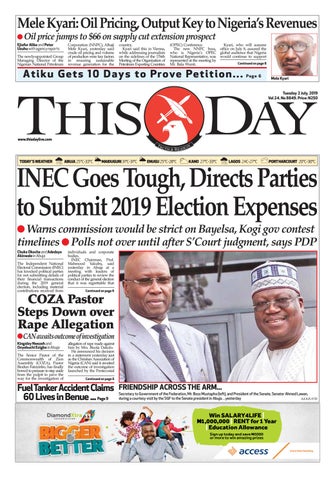
INEC Goes Tough, Directs Parties to Submit 2019 Election Expenses Warns commission would be strict on Bayelsa, Kogi gov contest timelines Polls not over until after S’Court judgment, says PDP Chuks Okocha and Adedayo Akinwale in Abuja The Independent National Electoral Commission (INEC) has knocked political parties for not submitting details of their financial transactions during the 2019 general election, including material contributions received from
individuals and corporate bodies. INEC Chairman, Prof. Mahmood Yakubu, said yesterday in Abuja at a meeting with leaders of political parties to review the conduct of the general election that it was regrettable that Continued on page 6
COZA Pastor Steps Down over Rape Allegation CAN awaits outcome of investigation Kingsley Nwezeh and Onyebuchi Ezigbo in Abuja The Senior Pastor of the Commonwealth of Zion Assembly (COZA), Pastor Biodun Fatoyinbo, has finally bowed to pressure to step aside from the pulpit to pave the way for the investigation of
allegation of rape made against him by Mrs. Bisola Dakolo. He announced his decision in a statement yesterday just as the Christian Association of Nigeria (CAN) said it awaited the outcome of investigation launched by the Pentecostal Continued on page 6
Fuel Tanker Accident Claims 60 Lives in Benue ... Page 9
FRIENDSHIP ACROSS THE ARM... Secretary to Government of the Federation, Mr. Boss Mustapha (left), and President of the Senate, Senator Ahmed Lawan, during a courtesy visit by the SGF to the Senate president in Abuja‌yesterday julius atoi
:LQ 6$/$5< /,)( _ _ 1 5(17 IRU <HDU _ (GXFDWLRQ $OORZDQFH 6LJQ XS WRGD\ DQG VDYH 1 RU PRUH WR ZLQ DPD]LQJ SUL]HV
2
TUESDAY JULY 2, 2019 • T H I S D AY
TUESDAY JULY 2, 2019 • T H I S D AY
3
4
TUESDAY JULY 2, 2019 • T H I S D AY
TUESDAY JULY 2, 2019 • T H I S D AY
5
6
TUESDAY, ͺ˜ ͺ ˾ T H I S D AY
PAGE SIX
Atiku Gets 10 Days to Prove Petition Buhari allotted six days Alex Enumah in Abuja The Peoples Democratic Party (PDP) and its presidential candidate, Alhaji Atiku Abubakar, yesterday told the Presidential Election Petition Tribunal that they had proposed to call 400 witnesses or more to prove their petition challenging the victory of President Muhammadu Buhari, and his All Progressives Congress (APC), at the February 23 poll, within 10 days. The 10 days is less than the 14 days’ period prescribed under paragraph 16(3) of the First Schedule to the Electoral Act 2010 as amended. But that was part of the agreement reached yesterday by all the parties to the petition on the modalities and structure for the hearing of the petition filed by Atiku and the PDP at the tribunal.
Among some of the propositions made, which is subject to the approval of the panel is that hearing in the substantive matter commences on Thursday, July 4. Lead counsel to Atiku and PDP, Dr. Levy Uzuokwu (SAN), who spoke on behalf of all the lawyers in the matter, gave a summary of decisions reached by the parties. He told the tribunal that all parties agreed that the petitioners instead of the 14 days allowed by law for them to call witnesses in the case would spend 10 days while the respondents, Buhari and the APC, would use six days. On time to be allotted to each witness to be called, parties agreed on five minutes for ordinary witnesses and 10 minutes for their cross examination, while 10 minutes was agreed for star/expert/ subpoenaed witnesses,
20 minutes for their cross examination and three minutes for their re-examination. On the issue of documents, it was agreed that parties should indicate their objection if any at the point of tendering but address on the objection should be isolated from the main address. They also agreed that all documents should be tendered from the bar, and that parties should list and exchange schedule of documents they intend to rely on in the petition. In respect of final addresses, parties agreed that respondents should file their final addresses seven days after the close of evidence, petitioners five days, while three days is for reply on point of law. Atiku and PDP are among three other petitioners challenging the outcome of the
presidential poll that handed a second term to Buhari. Some of the grounds on which the petition is anchored include substantive non-compliance with the electoral laws, intimidation, and suppression of voters in stronghold of opposition among others. Atiku specifically claimed he won the presidential poll going by results obtained from a controversial central server of the Independent National Electoral Commission (INEC), and as such the five man presidential panel should nullify the election of Buhari and declare winner in his stead. Meanwhile, the tribunal has fixed Wednesday, July 3, for ruling in the pre-hearing application brought by Atiku, seeking to set aside the proceedings of June 11, 2019. Justice Garba had earlier
reserved ruling shortly after parties in the petition had argued their briefs but announced Wednesday at the end of the day's proceedings. After Atiku's lawyer adopted his written address as his argument, counsel to Buhari, Chief Wole Olanipekun (SAN), asked the tribunal to refuse the application on the grounds that records of the said proceedings have been transmitted to the Supreme Court. Olanipekun submitted that since an appeal has been filed at the apex court on the same issues the petitioners cannot ask the court to look into the same issues. Lead counsel to INEC, Mr. Yunus Usman (SAN), however, said although the commission did not file any brief, it objects to the application. Similarly, APC's lead
counsel, Mr. Lateef Fagbemi (SAN), also objected to the motion and agreed with the position of the president with the exception that the records of court have been transmitted to the apex court. Fagbemi submitted that the tribunal can still look at the application but cannot grant it because the law is settled that if a preliminary objection is filed and not argued it is deemed to have been abandoned. According to him, the petitioners filed a preliminary objection to their motion but failed to argue it on June 11, when the 3rd respondent (APC) moved its motion seeking to remove some paragraphs of the petitioners’ petition. "Since they did not argue it, it can be deemed to have been abandoned," Fagbemi said.
“This step enables me to submit to the concerns of my spiritual mentors as they consider all the issues that have been raised against me. “Though I do not understand all that is happening, I trust the Lord to lead and guide me one step at a time." The leadership of CAN has, however, said it is awaiting the outcome of the investigation being carried out by the Pentecostal bloc of the association on the allegation against Fatoyinbo before it could make further pronouncements. THISDAY gathered from sources at CAN that due to
the sensitive nature of the allegation against the pastor, it has directed that proper investigation be carried out to ascertain the truth. Meanwhile, the police have raised the security alert level in the FCT to forestall a breakdown of law and order arising from possible clashes between opponents and supporters of Fatoyinbo. The FCT police commissioner said the command had deployed policemen in all the entry points to Abuja as well as potential flashpoints. "We have deployed our men in all the entry points to the city and we are ready
for any eventuality. Our men are everywhere and we are focused on maintaining law and order," he said. He also said the police were yet to receive any formal complaint against Fatoyinbo for them to act on. Ciroma stated: "They want to drag the police into this by all means but as an institution, we can only act on a formal complaint. We need that and we need to have witnesses to push such a case. "If they (the church) have resolved it; that is okay. We are interested in maintaining law and order. Our men are everywhere to ensure the peace in the nation's capital."
only the dates but also venues and time for the primaries. "I urge you to avoid persistent rescheduling of your primaries or late minute change of venue which sometimes disenfranchise your members and make effective monitoring by the commission difficult. Where political parties opt for direct primaries, there should be proper register of members otherwise it will amount to conducting an election without the voters’ register." He also said the meeting was called to enable both INEC as the electoral umpire and parties’ leaders as participants to exchange ideas on how to improve the electoral process and conduct elections whose outcomes would not generate much acrimony. "I want to assure you that we shall give expeditious consideration to the actionable recommendations from this meeting that fall within the powers of the commission to handle administratively. We shall also work with IPAC to ensure that the required amendments to the legal framework are given speedy consideration by the National Assembly," he said. On other activities of INEC, the chairman said: "As we prepare for the Bayelsa and Kogi governorship elections, we are also preparing for a bye-election in Plateau State. Late last week, we received the declaration of vacancy from the Speaker of the
State House of Assembly in respect of Pengana State Constituency following the death of its elected member shortly after he was declared winner in the State Assembly elections held nationwide on 9th March 2019. "This will be the first byeelection so soon after the general election and barely a month after the inauguration of the state assembly. A date will be announced by the commission before the end of this week,” he said.
COZA PASTOR STEPS DOWN OVER RAPE ALLEGATION Bloc of the association before reaching a decision on the matter. The rape allegation, which triggered a nationwide outrage and led to protests on Sunday in Abuja and Lagos, has, however, prompted the Federal Capital Territory (FCT) Police Command to raise security alert level in a bid to forestall any breakdown of law and order in the nation's capital. Meanwhile, the Commissioner of Police, FCT Command, Mr. Bala Ciroma, yesterday reiterated his earlier statement that there was no formal complaint against the COZA pastor. Fatoyinbo’s decision to
stand down followed Sunday's massive protests, held at the Lagos branch and Abuja headquarters of the church, organised by concerned Nigerians and human rights groups. The groups demanded the immediate resignation of the pastor as well as police investigation of the allegation. Fatoyinbo, in the statement yesterday, said his decision to step aside was based on the advice of his elders. He was accused by Bisola, a former member of his church and wife of a Nigerian musician, Mr. Timi Dakolo, of raping her when she was 16 years old.
In the statement, Fatoyinbo said: "I have taken time to pray and seek spiritual counsel from Christian leaders around the world, who feel very concerned about the ongoing reports in the media. “I have solicited their guidance on actions I should take that is honouring to our Lord Jesus Christ and the work He has called me to do. “Drawing from their counsel and that of the leadership of Commonwealth of Zion Assembly and owing to my love for God’s work and the sacred honour of my calling, I have decided to take a leave of absence from the pulpit of the church.
INEC GOES TOUGH, DIRECTS PARTIES TO SUBMIT 2019 ELECTION EXPENSES none of the political parties had submitted its financial records, three months after the announcement of the results of the general election as provided for in Electoral Act 2010 as amended. He, therefore, directed the parties that participated in the general election to submit immediately their financial records for the election as well as audited accounts of their parties after the election. But the National Publicity Secretary of the Peoples Democratic Party (PDP), Mr. Kola Ologbondiyan, faulted INEC’s position, saying as far as the opposition party is concerned, the election is not over yet as the party is still at the tribunal. INEC said the submission of the financial records must contain details of financial contributions by individuals and corporate bodies. The electoral commission also charged the political parties to make early preparations for the Kogi and Bayelsa State governorship elections slated for November 16 to avoid late-minute rush. Yakubu said: "I wish to remind you that the Electoral Act 2010, as amended, requires each political party to submit two election expenses reports to the commission. First is the disclosure of material contributions received from individuals and corporate bodies three months after the announcement of the results of the general election
as provided for in Section 93(4) of the Electoral Act. So far, no political party is in compliance. "Secondly, parties are required to submit audited returns of their election expenses within six months after an election as provided for in Section 92(3) [a] of the Electoral Act. Although we are still within the timeframe provided by law, so far only one party has filed its returns. Similarly, the commission notes that only one presidential candidate has submitted financial expenses report. We wish to remind leaders of political parties of their obligations under the law.” Responding to the allegation by INEC that the parties have not submitted their financial records, Ologbondiyan told THISDAY that the election would not be over until after the election tribunals and the Supreme Court must have delivered judgments on various petitions challenging the outcome of the election. "We are still at the tribunals. The elections are not over. The party will comply with all relevant electoral laws when we finish our petitions at the tribunal - this time the Supreme Court. So, PDP has not breached any electoral law as regards submitting our financial records to INEC," he stated. On his part, the spokesman of the All Progressives Congress (APC), Mallam Lanre Issa-Onilu, said he was not in a position to confirm
immediately why the ruling party had not submitted the records. “I am not in a position to confirm to you immediately; I can find out soon and I will feed you back later,” he said. Also at the meeting, Yakubu told political parties' leaders that the conduct of party primaries and nomination of candidates for the 2019 general election was acrimonious, resulting in court cases on the participation or otherwise of political parties and candidates in elections in many constituencies. He said this made the management of electoral logistics and post-election litigations more challenging to the commission. "At the moment, there are 809 cases challenging the conduct of primaries by political parties in regular courts across the country. This figure is more than the number of petitions challenging the conduct of the main election currently before the election petition tribunals nationwide. "It is, therefore, imperative for political parties to build their capacities for internal democracy, voter mobilisation and financial procedures. Effective running of the political parties is crucial to our democratic consolidation. I want to reassure you that for our part, the commission will continue to work with IPAC as enshrined in the Code of Conduct for political parties," he added.
He also told the political parties' leaders to be fully prepared for the forthcoming elections in Kogi and Bayelsa States. He said: "In the next few months, governorship elections will hold in Bayelsa and Kogi States. The elections will hold simultaneously in the two states on Saturday, November 16, 2019. The commission has already released the timetable and schedule of activities for the elections. Party primaries are scheduled to hold from August 18, to September 5, 2019. The deadline of September 5, 2019 is firm and fixed.” According to him, the conduct of primaries and nomination of candidates must be transparent and democratic in accordance with the provisions of Section 87 of the Electoral Act as well as INEC regulations and guidelines. The commission also expects strict compliance with all rules and regulations by all parties wishing to nominate candidates for the elections as INEC would not accept any nomination arising from primaries conducted after the deadline. He said: "So far, three political parties have given us notices indicating the dates for their primaries for both Bayelsa and Kogi governorship elections. The commission once again reminds party leaders to do the needful. In doing so, you should indicate not
TOP GAINERS NGN NGN CORNERSTONE 0.02 0.22 NPFMFB 0.09 1.14 CHIPLC 0.02 0.28 ACADEMY 0.02 0.29 CHAMS PLC 0.02 0.31 TOP LOSERS NGN REDSTAR 0.55 4.95 TRANSCORP 0.11 1.02 ETI 1.00 10.00 GTBANK 2.30 30.60 UNILEVER 2.30 30.70 HPE Nestle Nig Plc ₦1,390.00 Volume: 104.438 million shares Value: N1.138 billion Deals: 3,067 As at yesterday 1/7/19 See details on Page 31
% 10 8.5 7.6 7.4 6.9 % 10 9.7 9.0 6.9 6.9
TUESDAY JULY 2, 2019 • T H I S D AY
7
8
TUESDAY, ͺ˜ ͺ ˾ T H I S D AY
NEWS
PDP Probe over Lawan, Gbajabiamila Undemocratic, Says Oshiomhole Adedayo Akinwale in Abuja The National Chairman of the All Progressives Congress (APC), Adams Oshiomhole, has said that the main opposition party, the Peoples Democratic Party (PDP) is going down in history as the party that seeks to investigate how its members in the National Assembly voted to elect leaders of the ninth assembly using secret ballot system. The leadership of the PDP had resolved to support Senator Ali Ndume and Hon. Umar Mohammed Bago for Senate President and Speaker of House of Representatives respectively, while also directing its members in the National Assembly to vote according to the decision reached by the party. However, following the emergence of Senator Ahmed Lawan as Senate President and Femi Gbajabiamila as Speaker of the House of Representatives, the National Working Committee (NWC) of the PDP set up a factfinding committee on the role played by some of its members during the election of the presiding officers of the National Assembly. But Oshiomhole while playing host to the National Assembly members from
Kano State led by the Deputy Governor, Nasir Gawuna, in his office in Abuja yesterday, commended the National Assembly caucus of the party for electing the party’s choices as the principal officers of the ninth assembly. He said, “Our party members in the two chambers proved their complete loyalty. The way and manner they did, such that the PDP that was calling for secret ballot because they didn't want people to know how people voted are now the one conducting an enquiry on who voted for who among them. “This is a complete violation of the essence of secret ballot. The idea of secret ballot is that nobody should know who voted for who. Now, PDP is going down in history as a party that seeks to investigate how people voted in the secret ballot. “That is a gross violation of the most basic principles of democracy with regards to secret ballot. That is why we are better and different and I'm very proud of all of you," he said. Oshiomhole noted that he had been extremely excited by the level of cooperation that members of the two chambers had extended to
Oshiomhole the party, stressing that it could have been impossible if they insisted that they wanted to go and fight to finish. The chairman added that it was that mutual respect, loyalty to the party and indeed to President Muhammadu Buhari that made this very easy. He stated: "I am deliberately appreciative of the fact that you have very senior people in the two chambers of National Assembly, who by any definition could have aspired for any of those positions that have already been determined namely: Senate President, Deputy Senate President, House Speaker and Deputy Speaker because if we look at the voting pattern of the country,
there is no question that Kano delivered the highest number of votes. "This is a fact that nobody can wish away, it cannot be overemphasised by those numbers because politics is a game of numbers. It is those numbers that made us win the Presidency. Without that numbers, we won't be in the office. Incidentally, I reflect between the President's vote and the first runner up, Atiku. It is about 3.8 million. If you delete Kano votes from that, the votes will come down. If part of those votes swing to the other side (PDP), so, no one can downplay the value of the support this party enjoys from the good people of Kano State as represented by you honourables. “As we are having conversations, we have to ask ourselves, as a national party, we do have obligations to try to reflect and ensure that the six geopolitical zones are well represented. In doing so, we recognise that if we are not in power, we will not be able to talk of representation. "So, we cannot, even in doing that, downplay the role of numbers and so, it is based on this that we are having regards to sacrifices that other people have made. To whom much is given,
much is expected, Kano has given us a lot as a party, has given a lot to our President and we must therefore reciprocate," he said. Oshiomhole noted that the party appreciated the leadership that Kano State Governor, Abdulahi Ganduje has provided, saying that not only in terms of governing Kano State, but also his contribution to strengthen the APC. The chairman stressed that he has handled very sensitive national assignment for the party, emphasising that his commitment to the party was not in doubt whatsoever. The chairman explained: “This is the sentiment that formed the idea of zoning the leadership of the house to Kano and of course, you will also realise that the gentleman who happens to be my namesake as far as my collation goes, is the most senior ranking member in the house of representatives. “By going with this tradition, people will realise the benefits of loyalty, consistency and of team spirit. When people learn from that, Nigerian democracy will mature much more. I have no doubt whatsoever. “The only appeal I want to make is that we have been
able to make this progress only to the extent that members have agreed to move together. To be honest there is no criteria that you will use that you can't find other people qualified for the position. "So, it required kind of spirit of give and take for people to say you, among all of us, not necessarily because you are the best, so, it is my hope that going forward, those who will now become principal officers of the two chambers, they are first among equals. “They have assumed their positions because their colleagues have allowed to provide leadership not because they are better than them. But everybody cannot be in leadership position.” Earlier, Gawuna said that the National Assembly members from Kano came visiting to thank the chairman for zoning the position of Majority Leader to Kano State and for endorsing Hon. Alhassan Doguwa, for the position. He assured that Doguwa would do well because he has been loyal to the party, while also reaffirming the loyalty of Kano State to the party and their support for the chairman and members of the National Working Committee.
intensify efforts to ensure full conformity with the ‘letter and spirit’ of the ‘Declaration of Cooperation,’ despite the obvious domestic challenges this may pose. We will work to stabilise production by improving the security architecture of producing regions and through continued engagement with local communities, particularly in the Niger Delta region.”
cuts amid surging United States output. OPEC members agreed yesterday to extend oil production cuts by nine months, an OPEC delegate said. Kazakh Energy Minister, Kanat Bozumbaev, also confirmed yesterday that most ministers representing OPEC and non-OPEC countries at talks in Vienna favour extending their global oil output deal by nine months. “The majority (of ministers) have spoken in favour of nine months,” he said. Iraq’s Oil Minister, Thamer Ghadhban, also said yesterday that his government and the rest of OPEC seek to control global oil inventories and restore balance to the oil market which faces “huge challenges”, according to a ministry statement. Ghadhban met his Saudi and Russian counterparts on the sidelines of the ongoing OPEC meeting in Vienna. They discussed oil market developments and exchanged views on extending oil supply cuts, the statement said. OPEC will hold talks today with Russia and other allies, which Ghadhban said would involve discussing production cuts, compliance of oil producers and market movements. “Targets set by the oil producers have not been reached yet due to the huge challenges that face the global oil market, and we seek with the rest of (OPEC’s) members to
control global inventories and restore balance to the market to support oil prices,” Ghadhban was quoted as saying. These decisions should be taken unanimously by OPEC’s members, he added. OPEC and its allies led by Russia have been reducing oil output since 2017 to prevent prices from sliding amid soaring production from the United States, which this year has become the world’s top producer ahead of Russia and Saudi Arabia. OPEC and its allies look set to extend oil supply cuts this week at least until the end of 2019 as Iran joined top producers Saudi Arabia, Iraq and Russia in endorsing a policy aimed at propping up crude oil prices amid a weakening global economy. Russian President, Vladimir Putin, said on Sunday he had agreed with Saudi Arabia to extend existing output cuts of 1.2 million barrels per day (bpd) by six to nine months. Saudi Energy Minister, Khalid al-Falih, said the deal would most likely be extended by nine months and no deeper reductions were needed. Oil prices have come under renewed pressure in recent months from rising United States supplies and a slowing global economy. US crude oil output in April rose to a fresh monthly record of 12.16 million bpd, according to the United States Energy Information Administration, even though shale production growth likely peaked last year.
MELE KYARI: OIL PRICING, OUTPUT KEY TO NIGERIA’S REVENUES the declaration of cooperation that had helped in restoring stability in the global oil market. “Through the Declaration of Cooperation, greater stability is restored globally, Nigeria believes that having the right price and volume can support our aspiration and ensure a sustainable revenue generation,” he said. According to Kyari, a continuation of the declaration was the way to go. He said a six-month extension was too short a time and would not have the required impact in curbing uncertainty and volatility which existed before the cooperation “So a nine-month extension is the way to go considering the objective of the declaration, that is why Nigeria supports the initiative and is also grateful that big nations are committed to it,” Kyari said. He further expressed the commitment of the NNPC in revamping refineries, noting that in-country refining of crude through multiple channels and collaboration would ensure the nation becomes a major petroleum product exporter by 2020. “Nigeria’s objective at today and tomorrow’s OPEC is to support the declaration of cooperation that has so far succeeded in restoration of global oil markets stability. Further to this, Nigeria’s hope is to secure appropriate quota for its export and optimal price.” Meanwhile, Nigeria has reaffirmed its strong
support for the nine-month extension in oil production cut under the ‘’Declaration of Cooperation,’’ which seeks to improve global oil market stability among OPEC members. Head of the Nigerian Delegation to the meeting, Dr Folashade Yemi-Esan, said this during the press conference, while welcoming the commitment by Saudi Arabia and Russia on the proposed extension. ‘’Nigeria strongly endorses this commendable commitment and support this position, we believe that an extension of nine months is preferable to six months, as it offers greater certainty to the market, thereby reducing market volatility,’’ Yemi-Esan added. She said that the nation recognised the transformational impact which the ‘’ declaration of Cooperation’’ has had on the global oil market with 24 oil producing countries working together and contributing to improved market stability. Yemi-Esan who is the Permanent Secretary of the Petroleum Resources ministry noted that the development had benefited consumers and producers as well as impacted positively on the health of the global economy. He added: “The convening of the 176th Meeting of the OPEC Conference and the 6th OPEC and non-OPEC Ministerial Meeting offers the Nigerian delegation the opportunity to reaffirm our strong support for the ‘Declaration of Cooperation.’ “When the ‘Declaration
of Cooperation’ was first signed on 10 December 2016, participating countries recognised the uniquely challenging circumstances in Nigeria, particularly related to the security situation in producing regions of the Niger Delta, and graciously agreed to exempt Nigeria from the voluntary production adjustments. Nigeria appreciates this act of solidarity and thanks all participating countries for their steadfast support during the challenging period. “Following the 5th OPEC and non-OPEC Ministerial Meeting on 7 December 2018, Nigeria voluntarily agreed to re-commit to the collective endeavor to adhere to adjustments in production levels. We have also supported this undertaking by actively participating and engaging in the Joint Ministerial Monitoring Committee. “We acknowledge and welcome the recent expression of commitment by the Kingdom of Saudi Arabia and the Russian Federation following the meeting of the G20 in Osaka, Japan, to continue the ‘Declaration of Cooperation’ for a further nine months. Nigeria strongly endorses this commendable commitment and supports this position. We believe that an extension of nine months is preferable to six months, as it offers greater certainty to the market, thereby reducing market volatility. “With presidential elections over and the reelection of President Muhammadu Buhari, Nigeria will
Oil Price Jumps to $66 on Supply Cut Extension Prospect In a related development, crude oil prices were up yesterday as the OPEC and its allies looked on track to extend supply cuts until at least the end of 2019 at their meeting in Vienna this week. The global benchmark, Brent crude futures initially rose as high as $66.75 per barrel and finally settled at $65.99 per barrel, $1.25 higher than its Friday price tag. United States crude futures climbed $1.22 to $59.69 a barrel, after earlier hitting their highest in over five weeks at $60.28. Iran - under United States sanctions alongside OPEC ally, Venezuela, yesterday joined top producers, Saudi Arabia, Iraq and Russia in supporting an extension of a supply cut deal until at least December. The OPEC, Russia and other producers, an alliance known as OPEC+, met yesterday and continues today to discuss supply
9
TUESDAY JULY 2, 2019 ˾ T H I S D AY
NEWS
Group News Editor Ejiofor Alike Email Ejiofor.Alike@thisdaylive.com, 08066066268
Fuel Tanker Accident Claims 60 Lives in Benue George Okoh in Makurdi A petroleum tanker accident in Ahumbe village along AlliadeMakurdi federal highway in Gwer East Local Government Area (LGA) of Benue State, yesterday claimed 60 lives with several others injured. An eyewitness, who
identified himself as Austin, said the tanker was carrying fuel from the eastern part of the country, heading to Makurdi when it fell after a failed bid to dodge a pot hole. He explained that the villagers went to scoop fuel when the tanker exploded, and caught fire, killing over
IG Orders Manhunt for Killers of DPO, Three Others in Bayelsa Kingsley Nwezeh in Abuja Following the attack on Agudama Ekpetiama Police Station, Yenagoa, Bayelsa State, by unknown gunmen yesterday, the Inspector General of Police (IG) Mohammed Adamu, has ordered a massive manhunt for the perpetrators of the dastardly act. A statement in issued by Force Spokesman, Frank Mba, a Deputy Commissioner of Police (DCP), said the IG condemned the attack which resulted in the death of the Divisional Police Officer, SP Ola Rosanla with three other police officers and left two others injured. He said that no stone would be left unturned in apprehending the perpetrators and bringing them to book. Meanwhile, the IG has ordered the immediate deployment of crack detectives from the IG-Intelligence Response Unit (IRT), the
Forensic and Homicide sections of the FCID and Special Operatives of the Marine Police Department to Yenagoa to complement the efforts of the Bayelsa Police Command in carrying out discrete investigation into the unfortunate incident. “The IG, while paying tribute to the fallen heroes, condoles the families of the four Cops who paid the supreme price in the service of their fatherland, describing the incident as a classic example of the risk and sacrifices the Police are exposed to in their daily task of protecting our homeland. “The IG enjoins the Agudama Ekpetiama Community and the entire people of Bayelsa State to remain calm and to avail the Police with credible information that will help the law enforcement agencies towards apprehending the criminals”, he said.
I’m Innocent, EFCC on a Wild Goose Chase, Says Saraki Deji Elumoye in Abuja, Martins Ifijeh and Esther Oluku in Lagos Former President of the Senate, Dr. Bukola Saraki, has described as a wild goose chase, the reported probe of his four-year tenure as Senate president by the Economic and Financial Crimes Commission (EFCC), insisting that he is innocent. Saraki, in a statement issued yesterday by his Media Adviser, Yusuph Olaniyonu, the former Senate president said nothing good would come out of the investigation as his tenure had nothing to do with award of contracts and finances of the eighth National Assembly. According to the statement, “while the EFCC claims that it is investigating the Office of the Senate President between 2015 and 2019, we make bold to say that it is just on a wild goose chase. “That office has nothing to do with contract awards and handling of the finances of the National Assembly. These are functions of the bureaucracy of the National Assembly, otherwise known as the National Assembly Management”. On EFCC’s persistent probe of Saraki’s tenure as Governor of Kwara State between 2003 and 2011, the statement maintained that all the issues the anti-graft agency is raising now were the same issues that were contained in four of the charges filed before the Code
of Conduct Tribunal (CCT) and taken before the Court of Appeal and the Supreme Court. “The CCT case went beyond the subject matter of asset declaration. They raised issues about the assets, how and when they were acquired, the sources of their funding and the banking transactions of Saraki. That is why we maintain that since the issues have been determined by the courts up to the Supreme Court, the EFCC is just on a persecution and smear campaigns with its current investigations. “At the time the CCT charges were filed, it was generally believed some of the charges should not have been lumped up with the asset declaration issues. However, in their desperation to nail Saraki, some of the charges that contained insinuations that Kwara State funds were paid into accounts owned by him and companies in which he has interests were filed. And twice, the charges went before the highest court in the land and he was discharged and acquitted. “It is also the reason that Saraki believes that the current investigation constitutes an infringement on his fundamental human rights. And in the exercise of his belief in the judiciary, he filed a case seeking the court’s intervention for the protection and enforcement of the rights,” the statement explained.
64 persons and injuring several others. According to him, “his petrol tanker was loaded with fuel and travelling along the road but had a mishap close to Ahumbe village in Gwer East Local Government Area. So, the people went to the scene of the incident to scoop fuel. “In the process of evacuating the fuel, they were hitting the mental tanker with another iron so as to have enough space to drain the fuel more freely.
Then suddenly the tanker caught fire and exploded, killing the people”. “Another vehicle - a bus with about 14 passengers ran into the spot and the entire passengers on board were all consumed by the explosion. All the passengers in the bus also got burnt,” Austin stated. The Benue State Sector Commandant of the Federal Road Safety Corps , Baba Aliyu confirmed the incident, saying that they have so far
recovered over 10 dead bodies, while over 50 injured persons have been evacuated and taken to various hospitals in Aliade, the headquarters of Gwer East. “We are yet to ascertain the number of people that have died. Until we are able to put out the fire and conduct proper search before we will be able to know the actual figures of people that died. As am talking to you now, the fire and smoke are still coming out from the nuzzle
of the tanker. “The explosion burnt down all the shops that the fuel split on”. Also, the Information Officer, Gwer East Local Government Council, Mr. Christopher Avi, said over 50 persons were burnt to death while over 70 sustained severe injuries in a tanker explosion at Ahumbe. He explained that the victims were burnt to death while over 70 persons were rushed to four different hospitals for treatment.
AWARD FOR EXCELLENCE…
L-R: Chair, Board of African University of Science and Technology, Dr. Ngozi Okonjo-Iweala; best graduating student, Mrs. Rahama Sani; and Chairman, Governing Council, Prof. Oye Ibidapo-Obe, during the eighth graduation ceremony of the University in Abuja…yesterday
End the Killings, Sultan Tells FG Onuminya Innocent in Sokoto The Sultan of Sokoto Sa’ad Abubakar III, has urged the federal government to take proactive measures in order to end the incessant killings across the country. He stated this yesterday at Sokoto State University while inaugurating the 180,000 litre- solar water treated plant built by the Nigerian National Petroleum Corporation (NNPC) in collaboration with Belema Oil and donated to the university.
He added that government had to do something before it got out of hand. The Sultan said he was worried how the security in the country was being politicised, “As a former military officer, who served this country for about 31 years, things were not like this before - the killings are everywhere; Enough! It is high time the government took action before it gets out of hands,” he said. “Some unscrupulous politicians are using politics to create
tension in the country for their selfish interest,” he said. He further explained that some disgruntled elements want Nigeria to explode. “I said Nigeria will not explode but they will explode. If anybody is being killed in the South-west, and North, they will say it is Fulani herdsmen. The killing is not only in the South, West or East, it is also in the North,” he added. On his part, the President and founder of Belema Oil, Mr. Jack rich Tein, said the
project was part of his efforts to ameliorate the suffering of humanity through the provision of scholarship to students, portable water, critical infrastructure and youth empowerment. “You know Nigeria is a great country blessed with human and natural resources, hence a need to harness it through technology,” he added. Jack urged youth to be peaceful, saying to achieve one’s dreams or aspiration is not by violence.
NAMA Lists Measures Taken to Improve Nigeria’s Airspace Chinedu Eze The Nigerian Airspace Management Agency (NAMA) yesterday listed measures already taken by the federal government to improve communication in the Nigerian airspace, assuring pilots and other industry stakeholders that the rainy season would not pose any unusual challenge. Since the onset of the raining season there have been flight delays and sometimes cancellations due to unfavourable weather conditions. But the Managing Director of NAMA, Captain Fola Akinkuotu, said the airspace is safe, adding that in the last three years tremendous efforts had been made to reposition navigation infrastructure in Nigeria’s airspace. This, he said, has led to execution of so many projects by the federal government, including the installation of Category 3
Instrument Landing System (ILS) at the Lagos and Abuja airports in addition to the one already installed at the Kaduna airport about two years ago. He said the agency is working tirelessly to upgrade radio communication to cover the whole airspace so that no matter which part of the country the aircraft is flying, it would be able to have ground- to-air and air-to-air radio communication. Akinkuotu gave the explanation while receiving the Chief Operating Officer of the newly established Ibom Air, Mr. George Uriesi, who led a delegation to the agency’s headquarters in Lagos. He reiterated that the agency had taken drastic steps to tackle communication challenges especially in the upper airspace in the past couple of years, saying that significant progress was being made in that direction. Akinkuotu said this has seen to
the upgrading of communication infrastructure in phases. According to him, radio communication in the ground control, covering 65 nautical miles at the 32 air traffic control units in Nigerian airports is perfect, adding that this was done under phase one of the project. He added that the second phase which is the tower control, also covering 65 nautical miles and critical for landing and take-off, is perfectly working in all the 32 airports in the country. The third phase, which he referred to as “approach communication,” covering up to 130 nautical miles is working perfectly in all the 32 air traffic control units in the country. Akinkuotu admitted that although the last phase, which is the Area Control or Upper Airspace Communication may have a few challenges, he attributed these to the creation
of new routes. Concerted efforts, he said were being made to address these challenges, one of which was the deployment of the Total VHF Coverage of Nigeria in 2010 which he said was limited by the architecture of eight VHF remote radio stations deployed then. He adding that the agency had just taken delivery of Extended Range VHF radio systems to replace old the radios in eight remote sites while six more are to be added, making them 14 in number. “There is also the deployment of 54 VSAT nodes, inside the Aeronautical Information Services Automation project. This project has lingered through all the regimes in NAMA but we are currently making efforts to see to the final takeoff of the automation project which we believe would boost our communication system,”
Cont’d on page 11
10
TUESDAY JULY 2, 2019 ˾ T H I S D AY
NEWS
RUGA: Southern, Middle Belt Leaders, Ortom Challenge FG to Show Proof of Gazetted Lands Segun James in Lagos and George Okoh in Makurdi Southern and Middle Belt Leaders Forum (SMBLF) and Governor Samuel Ortom of Benue State yesterday challenged the federal government to show proof of the gazetted lands for RUGA settlements in the 36 states. In a statement signed by Mr. Yinka Odumakin, South-west; Prof. Chigozie Ogbu, Southeast; Senator Bassey Henshaw, South-south; and Dr. Isuwa Dogo, Middle Belt; the leaders said that they were particularly interested in two claims in the government’ statement issued by the presidential spokesman, Mr. Garuba Shehu. Shehu had claimed that the federal government had gazetted lands in all states of the federation but because the idea was not to force the programme on anyone, the government limited the take-off to the dozen states with valid requests. But in their reaction, the
leaders said: “We are interested in having the Gazette number and its content as we know per the constitution and laws of the country that all land in each state of the federation is vested in the governor. In what capacity and with which authority did the federal government gazette land in all states of Nigeria?’ “This Freudian slip from the presidency signposts a dangerous sign of deployment of federal might to overawe the federating units in a desperate bid to promote the interest of one ethnic group over those of over 350 other ethnic nationalities across Nigeria,” the leaders explained. SMBLF also quoted Shehu as saying that 12 governors had applied to the federal government to give land in their states for the take-off of the programme, and insisted that “we want to know the identities of those governors from the Presidency as well”. “We must say that we find
laughable the admonition to state governors by the Presidency, though we are dealing with an unfolding tragedy,” the leaders added. They also accused the presidency of claiming to be finding peaceful resolution to the Fulani herdsmen terror on farmers, which the presidency “cheekily dubbed farmersherders conflict,” when they are “only allegedly offering money to the herdsmen and now looking for territories for them all over the country .What have they offered the farmers ?Nothing!” They accused the federal government of forcing violent
herders on armless communities. The group reminded the presidency that by pampering the marauding herdsmen, it is sending message to other groups in the country that only the violent gets it by force . On his part Ortom said in a statement issued by his Chief Press Secretary, Terver Akase, that there has never been any land for grazing reserves or grazing route in Benue State. “We wish to make it clear that no land in Benue State has been gazetted for grazing routes, grazing reserves, cattle colonies and Ruga settlements, contrary to the presidency’s claim.“We expect the federal government
to publicly tender documents of the claimed gazetted lands in Benue State to put the matter to rest. “The federal government should show titles to the lands it claims to have in Benue State, the evidence of compensation it paid to owners of such lands, as well as the purpose for which the lands were acquired. “The Benue State Government has already made known its stand on the Ruga settlements matter that the state will not be part of the project. “This was why the government and people of the state rejected the attempt to impose the Ruga settlements
projects on them without the consent and approval of the governor who controls and administers all lands in the state in trust for the people.” The governor restated his stand that there was a law in the state which encourages ranching and prohibits open grazing of livestock. “The law is a win-win for herders and farmers, as it protects all. Anyone who intends to establish a livestock ranch in Benue State is encouraged to follow the procedure stipulated by the Open Grazing Prohibition and Ranches Establishment Law 2017,” Ortom said.
Gunmen Kill Two Policemen, Cart away Rifles in Rivers A group of unidentified gunmen yesterday shot and killed two policemen in Port Harcourt, the Rivers State capital. The gunmen had attacked the two policemen at a checkpoint and immediately carted away their rifles. The incident, which happened at Ojoto axis of Port Harcourt, close to where building materials are sold, caused anxiety as residents and passersby scampered for safety when they heard the sound of gunshots. It was gathered that the gunmen left immediately after
the operation that lasted for three minutes. When contacted, the State Police Public Relations Officer, Mr. Nnamdi Omoni, confirmed the incident, adding that the hoodlums attacked and killed two policemen. Omoni added that two rifles belonging to the cops were taken away by the hoodlum. “I don’t have much detail about what happened, but I can confirm to you that today, two policemen were attacked and killed at Ojoto in Port Harcourt. The bandits also took away their rifles,” he added.
Fresh Crisis Looms as Workers Serve Strike Notice over Minimum Wage Onyebuchi Ezigbo in Abuja Following the refusal of the federal government to implement the new national minimum wage, workers yesterday threatened to embark on fresh strike. Already, eight industrial unions in the public services of the federal and 36 state governments under the aegis of the Trade Union Side (TUS) of the Joint National Public Service Negotiating Council (JNPSNC) said it “has commenced mobilisation of its members nationwide to prepare them for the next line of action.” But they said a meeting of officials of the TUS of the JNPSNC across the country was being arranged with the sole aim of “setting the records straight and at the same time preparing for appropriate trade union measures to be deployed to get justice for public service employees.” While alerting Nigerians on the imminent strike, the TUS acting Chairman, Simon Anchaver; and Secretary, Alade Lawal, in a strike notice in Abuja, said they “may have to embark on industrial action if the current state of affairs as regards the issue of consequential adjustment arising
from the new national minimum wage of N30,000.00 per month remains the same.” “The government has a predetermined position and only called labour in to rubberstamp its hidden agenda. With this turn of event, it is quite clear now that some fifth columnists in this administration are hell-bent on pushing President Muhammadu Buhari to enter into a collision course with millions of Nigerian workers in the public service. This is very sad. “It is indeed perplexing that political office holders whose monthly take-home pay runs into millions of naira, are the ones working behind the scene to ensure that public service employees, especially core civil servants continue to receive starvation wages. “This is why the eight trade unions in the public service have resolved that enough is enough and that if the federal government fails to call its officials to order and direct them to negotiate openly the issue of consequential adjustment arising from the new national minimum wage, millions of workers at the federal and 36 states public services will have no other alternative than to take some necessary trade union actions to seek redress.
ENGAGEMENT WITH PARTIES…
L-R: Chairman, Independent National Electoral Commission (INEC), Prof. Mahmood Yakubu; INEC National Commissioner, Dr. Mustaf Lecky; and INEC National Commissioner, Mrs. May Agbamuche-Mbu, during a meeting between the commission and leaders of political Julius Atoi/THISDAY IMAGES parties in Abuja...yesterday
Killings: We Won’t Allow Foreigners Take over Ekiti Land, Fayemi Vows Victor Ogunje in Ado Ekiti The Governor of Ekiti State, Dr. Kayode Fayemi, has vowed that no outsider would be allowed to take over the land of Ekiti people. Fayemi made this vow yesterday when he visited the people of Orin-Ekiti in Ido/Osi Local Government Area to commiserate with them on the recent killings of some farmers in Ekiti State by suspected herdsmen. One of the farmers killed by suspected herdsmen was Mr. Emmanuel Ilori, an All Progressive Party (APC) leader. He warned non-indigenes wishing to do business in Ekiti State to always respect the culture of the indigenes of the state and
pursue their interests in line with the laws of the land. He also stated that soldiers, armed policemen and members of other security agencies would be deployed in the state to maintain the security of live and properties. Fayemi, who addressed community leaders and residents of the affected community during the visit, said that he was saddened by the killing of Ilori, whom he described as a one of the leaders of his party, the All Progressives Congress (APC) in the town. The governor, who addressed his audience in Yoruba during the visit, said that investigation had commenced on the attack,
which took place on Saturday, June 29. He promised that the state government would do everything possible to arrest the killers and bring them to justice. He, however, condemned the opposition elements for making a political capital out of the incident by alleging that he was planning to give Ekiti land to “outsiders” in exchange for future political ambition. According to Fayemi: “Nobody is going to take our land in Ekiti. It is only the governor of Ekiti State that has power over the land of Ekiti. So, only persons that the governor gives land in Ekiti that can use the land of Ekiti.
“I want you to regard all negative comments being peddled around that some people are coming to take over Ekiti land, take over Orin land, take over Ido land, as mere hearsay. It cannot happen in Ekiti except I am no longer the governor of Ekiti State. Our land is not even enough for us. “Adequate security of our people is my utmost concern in Ekiti and Nigeria. Therefore, I want our people to ignore all the lies and falsehood some individuals are spreading around. Those saying these things are only playing politics with the matter. But, this is not politics. Security is an issue that concerns all of us.”
Nembe Chiefs Hail NDDC for Completing N24bn Ogbia-Nembe Road Chiemelie Ezeobi Chiefs in Nembe, a coastal community in Bayelsa State have commended the Niger Delta Development Commission (NDDC), for completing the N24 billion Ogbia-Nembe Road, which has opened up land access to the community for the first time in history. The road, constructed in partnership with Shell Petroleum Development Company (SPDC),
covering 29 kilometres through swampy terrain with spurs to 14 other communities, is to be commissioned shortly, according to the acting Managing Director of the commission, Prof. Nelson Braimbaifa. At the last Niger Delta Stakeholders Forum in Port Harcourt, Braimbaifa said the “Nembe – Ogbia road will open up the whole area for renewed economic and agricultural growth.”
Over the weekend, the Opu Nembe Bassambiri Council of Chiefs, through its secretary, Chief Afrebo Okpoma, said with the completion of the OgbiaNembe Road, the communities in the area have been spared the dangers of travelling through the waterways. Present at the interview were other members of the council of chiefs including, Chief Senanyo Daniel Ben-Kuro, the chairman and the youth leader.
Okpoma said: “Before the road construction, we were traveling through our waterways, but since its completion, we now drive in with our vehicles.” Listing the benefits of the road, Okpoma said it had reduced the rate of theft in the communities, adding that “when we were travelling through the waterways, there is always these bad boys confronting the passengers and robbing them.
TUESDAY JULY 2, 2019 ˾ T H I S D AY
11
NEWS
Nigeria May Lose Identity to Diversity, Says Obasanjo Femi Ogbonnikan in Abeokuta Former President Olusegun Obasanjo yesterday raised
the alarm that Nigeria may lose her identity due to the mismanagement of the country’s diversity with impunity, adding
Recapitalisation: FG Recommends Mergers, Acquisitions for Insurance Sector Ebere Nwoji The federal government yesterday warned firms in the insurance sector against any action targeted at undermining the recent directive for recapitalisation of insurance and reinsurance companies and urged the operators to embrace mergers and acquisitions. President Muhammadu Buhari gave the warning yesterday while declaring open in Abuja, the ongoing 2019 National Insurance Conference, with the theme: “Disruption, Innovation and Business Growth.” He said instead of working against the success of the exercise, operators should explore available options, including mergers and acquisitions, as means of achieving their continued existence. His warning came on the heels of threats by some investors and operators to challenge the industry regulator’s bid to increase the industry’s minimum paid up share capital by over 300 per cent. President Buhari said his
administration would prefer to see the operators utilising avenues that would help upgrade their capital rather than fighting the policy through any means. He also said the Ministry of Finance would collaborate with National Insurance Commission (NAICOM) and insurance sector stakeholders to achieve 40 per cent financial inclusion rate by the year, 2020. According to the President who was represented by the Permanent Secretary of the Ministry of Finance, Mahmud Isah-Dutse, “the insurance Industry has rules and regulations that all insurance companies must follow and this will cause them to struggle to understand and implement the rules, new technologies and innovations. “With the recapitalisation directive issued recently, we expect operators to be truthful to themselves and consider all opportunities available for continued existence. While this could include mergers and acquisitions, it should not include fighting the policy just because you cannot raise the additional capital.”
Finally, Buhari Approves Sack of NHIS Boss, Usman Martins Ifijeh Eight months after sending the Executive Secretary of the National Health Insurance Scheme (NHIS), Prof. Yusuf Usman on compulsory leave, President Muhammadu Buhari has now approved the termination of his appointment. His compulsory leave on October 31, 2018 followed recommendations of report by an independent fact-finding panel which found him to have breached administrative protocols governing NHIS. In a statement made available to THISDAY last night, and signed by the Director of Media and Public Relations, Federal Ministry of Health, Boade
Akinola, President Buhari has therefore replaced him with Prof. Mohammed Nasir Sambo as the new Executive Secretary. Akinola said: “Similarly, President Buhari also approved the dissolution of the Governing Board of NHIS and directed the Permanent Secretary in the ministry to exercise full powers of the council pending the constitution of a new board. “President Buhari has also approved the appointment of Dr. Chikwe Andreas Ihekweazu as Director General of the Nigeria Centre for Disease Control (NCDC). The appointment is in line with the provisions of section 11(1) (3) of the Nigeria Centre for Disease Control (Establishment) Act, 2018,” she added.
NAMA LISTS MEASURES TAKEN TO IMPROVE NIGERIA’S AIRSPACE Akinkuotu said. The NAMA boss said that in line with the International Civil Aviation Organization (ICAO) Aviation System Block Upgrade (ASBU), which stipulates that Air Navigation Service Providers (ANSPs) provide alternative means of communication, the agency in 2015 deployed the Automatic Dependent Surveillance-Contract/Controller Pilot Data Link Communication (ADS-C/CPDLC) in Kano and Lagos Area Control Centres (ACCs) to decongest radio frequency, saying that the facility was up and running in the entire airspace. “The high-powered very high frequency (VHF) Jotron radios installed at Lagos
and Kano were recently commissioned by the former Minister of State, Aviation, Senator Hadi Sirika, who tested them with a British Airways pilot and the pilot replied him with 5/5, meaning “excellent” and this facility is available and serviceable. “We are awaiting when the 2019 budget becomes operational, to extend the range of the Jotron radios and when this is implemented on full terrestrial base systems, we would have the maximum range required to cover the entire airspace and beyond.” Akinkuotu also pledged the cooperation of the agency towards making Ibom Air a strong brand.
that many Nigerians are not happy with the country and are ready to pull out of the union. Speaking at the 9th Toyin Falola Annual International conference held at Babcock University, Ilishan-Remo, Ogun State, Obasanjo said that Nigeria may not move forward if the country continued to lose its identity to diversity . The former president who was a distinguished guest of honour at the conference with the theme: “Religion , the State and Global Politics,” also presented a paper titled, “Towards a re-unification of the sacred and secular: Religious interventions in politics.” He argued that both religious leaders and politicians cannot be separated. “You can’t take one and leave
the other. You can’t take politics and leave religion and you can’t take religion and leave politics; they are together. “We are so badly handling our diversity that we are losing our identity. As long as we are doing that, we are going nowhere. “The management of diversity must be right - religion, politics and ethnicity are part of our diversity which must be well managed. “When you mismanage diversity with impunity, it is particularly annoying. It can lead to what we may not want it to lead to. “I don’t know of any Nigerian who doesn’t wish Nigeria well, but, I know many Nigerians who are unhappy and want to leave Nigeria. “Our issue is so because, what they expect from Nigeria they
are not getting it”. “The role of religious leaders and religion is to lead but, lead them also to also to let politicians learn a best lesson. “God is a Nigerian because, what we have gone through in Nigeria and what we are going through, probably, Nigeria should not be on the map of the world. That’s why I say God is a Nigerian”. While delivering his keynote address, Catholic Bishop of Sokoto Diocese, Prof. Mathew Kukah, argued that religion has failed in Africa. “We are carrying Western identity whether it is Christianity or Islam. This identity has continued to play out in our daily lives. “Only in Nigeria we can go to war because of religion, We
are not going to go to war because, of no water; we are going to go to war because, we don’t have road . But, we are not going to go to war because we don’t have decent housing, we are not going to go to war because of lack of salary, we are not going to go to war because of injustice, but we can go to war in the name of God”. The cleric lamented that most countries with substantial Muslims and Christians population have not known peace. He said, “Nigeria seems to be like a polygamist who is married with two wives. Somehow, Christians are complaining that they are treating Muslims better, Muslims are complaining that they are treating Christians better.
TAX ON THEIR MINDS…
R-L: Inspector General of Police, Mr. Mohammed Adamu; wife of Kwara State Governor, Mrs. Olufolake Abdulrahaman; Chairman, Joint Tax Board; Mr. Babatunde Fowler; and Vice President Yemi Osinbajo, at the flag-off ceremony of the new Joint Tax Board Tax Identification Number Registration System in Abuja… yesterday
New JTB Registration System will Spark Economic Devt, Says Osinbajo James Emejo in Abuja Vice President Yemi Osinbajo has said the new Joint Tax Board Tax Board Tax Identification Number (TIN) registration system and national taxpayer database will trigger sustainable economic development in line with various strategic initiatives and programmes of the federal government. The vice president said this yesterday while flagging of the new national TIN registration system in Abuja. He added that the initiative is deserving of commendation
as it is in line with international best practices. According to him, tax administration must evolve alongside contemporary economic developments. “The new TIN Registration System leverages on existing data from a variety of authorised identity management agencies, and the data from both individuals and corporate bodies are reliable and verifiable. Taking advantage of the current trends in information communications technology, it will indeed ensure convenience for the taxpayer, while achieving
operational efficiency for the tax administrator, all dovetailing into enhanced revenues for governments at all tiers to fund their respective social-economic drives,” Osinbajo said. The vice president, who commended JTB over the initiative, added that all agencies critical to the optimal success of the new TIN system such as the Central Bank of Nigeria (CBN) and Nigeria Inter-Bank Settlement System (NIBBS) and National Identity Management Commission (NIMC) have been directed to fully cooperate with the
JTB, especially in providing relevant individual records. Speaking earlier, JTB Chairman, Mr. Tunde Fowler, said the new the new system would add immense value to tax-revenue administration in the country in terms of processes and procedures, as well as efficiency. According to Fowler, the new system will ensure a coordinated and systematic approach towards managing revenue generation as well as tax information sharing between and among tax authorities within and outside the country.
Lawan: Public Procurement Act Breeds Corruption Deji Elumoye in Abuja President of the Senate, Dr Ahmed Lawan, yesterday decried the loopholes inherent in the 2007 Public Procurement Act. The provisions of the Act, he argued, actually breeds corruption in the system and frustrated project implementation in the last 12 years. Lawan, who spoke while receiving in audience the Secretary to the Government of the Federation, Boss Mustapha, however promised that the Senate will carry out holistic
review of the Act as a way of sanitising the entire process of contracts awards and executions .He emphasised that the Act as it is presently, is frustrating as far as contracts awards and execution are concerned. Holistic review and amendments, according to him, are urgently needed, which will surely be kick-started from the Senate very soon . “The Public Procurement in Nigeria as far as I can see is not the best in the world. The Public Procurement Act must be reviewed and amended; we
must see how we can make it more practical and holistic within the shortest possible time. “From the stage of bidding to mobilisation, the costing of any government contracts must be uniform in order to avoid imbalances and embarrassment in the processes. A situation where about 20 agencies of government buy the same brand of vehicles at grossly different prices is not good. “Market prices must be determined and adhered strictly to, in ensuring that Nigerians are not shortchanged through
abuse of processes or over invoicing. Even the 15 per cent mobilisation fee is specified in the Act but realities on ground is more of demobilising contractors than mobilising them with attendant loopholes for fraudulent practices”. He added that pending the planned review, the Senate would ensure that its standing committee on Public Procurement , will be made up of members who have the required knowledge and experience of the entire process.
12
TUESDAY JULY 2, 2019 ˾ T H I S D AY
NEWS
Court Orders Permanent Forfeiture of Patience Jonathan’s N9.2bn, $8.4m Davidson Iriekpen Finally, a Federal High Court in Lagos yesterday ordered the permanent forfeiture of the sums of N9.2 billion and $8.4 million recovered from a former First Lady, Mrs. Patience Jonathan. The presiding judge of the court, Justice Mojisola Olatoregun, ordered that the funds should be forfeited to the federal government. The judgment followed an application by the Economic and Financial Crimes Commission (EFCC), which said the funds were proceeds of crime. Though Mrs. Jonathan, through her lawyers, Chief Ifedayo Adedipe (SAN) and Chief Mike Ozekhome (SAN), opposed the application and insisted that the funds were
legitimately her own, the judge held that she had “no doubts, at all, that these monies are proceeds of unlawful activities.” She said the respondents “failed to dispel the suspicion created by the movement of the monies within the meaning and contemplation of the Advance Fee Fraud and other related offences Act, coupled with the various extrajudicial statements of the Bureau De Change agents which were not controverted by the respondents.” “In all of this, taking into consideration the overwhelming evidence provided by the applicant, the mode, the circumstances and the manner involved, using fictitious names, etcetera, to lodge monies in her name by named and unnamed individuals and BDCs, I cannot come to a conclusion by any sense of responsibility that these
monies are proceeds of lawful activities within the meaning and contemplation of of the provisions of the Advance Fee Fraud and other related offences Act 2006; the Money Laundering Act 2004 and the Economic and Financial Crimes Commission Act 2004 and other laws enforceable under the EFCC Act 2004.” Justice Olatoregun said the respondents “failed to show cause why the monies should not be permanently forfeited to the Federal Government of Nigeria.” Apart from Mrs Jonathan, other respondents in the application taken before the judge by the EFCC were Globus Integrated Services Ltd, Finchley Top Homes Ltd., Am-Pm Global Network Ltd, Pagmat Oil and Gas Ltd, Magel Resort Ltd and Esther Oba.
Former Punch Chairman Loses Daughter The death has occurred at Parkside Hospital, London of the Managing Director of Aframero Limited, Mrs. Yetunde Alatede Oghomienor. She died on Wednesday, June 26, at the age of 48. She is survived by her husband, Mr. Leslie Oghomienor, who is the Chairman of Russel Smith Group and two children Merede and Ajua Oghomienor, and her parents, Chief Ajibola and Mrs. Iyabo Ogunshola. After attending Queen’s College Lagos, she obtained a Bachelor’s degree in Accountancy from the University of Lagos and a
Master’s in International Business from Birbeck College, University of London. Along the way, she completed the examinations for Associateship of Chartered Institute of Bankers in United Kingdom and the European SAP software certification for Finance. After working with Shell Petroleum Company in the Netherlands, she returned to Nigeria and was employed by Lead Bank before establishing Aframero Limited, a company dealing with all aspects of wooden furniture materials. Mrs. Oghomienor was an active member of the
Wood Committee of the Manufacturers’ Association of Nigeria (MAN). She was also an Associate of WINBIZ (Women In Management, Business and Public Service) and served on its various committees, particularly the 2018 WINBIZ Annual Lecture Committee and the 2018/2019 WINBIZ Women in Politics Committees. At the Interior Designers’ Association of Nigeria, she was chairman of its Membership Committee from 2015 – 2018. She was also a member of the Board of Trustees of Stanford Seed Transformation Network Nigeria.
Enugu Community, Miyetti Allah, Deny Herders, Cattle Expulsion The people of Agbada Nenwe in Aninri Local Government Area of Enugu State; members of the Hausa/Fulani community and Miyetti Allah Cattle Breeders Association of Nigeria (MACBAN) in the South East zone, have denied the video trending on social media over the purported expulsion of some herders and their cattle out of the community. It would be recalled that the Enugu State Command of the Nigeria Police had in the wake of the news report on social media denied that no such incident occurred, explaining that after a preliminary investigation, it was revealed that what transpired was “only the movement of cattle and herders from Cross River State through Uburu in Ohaozara Local Government Area of Ebonyi State and a neighboring town for grazing”. Speaking when Governor
Ifeanyi Ugwuanyi of Enugu State led the State Commissioner of Police; the Director of Department of State Services (DSS); the Garrison Commander, 82 Division of the Nigerian Army, Enugu; the Speaker, Enugu State House of Assembly; the state Commandant of Nigerian Security and Civil Defense Corps, and other relevant stakeholders, to Agbada Nenwe yesterday, on a fact-finding visit, the traditional ruler of the community, Igwe Francis Imo, said the video is untrue, stressing that “nobody drove the Fulani community out of Agbada Nenwe”. Also speaking, the Chairman of Aninri LGA, Hon. Ezekiel Chukwu, said that immediately he got wind of the rumour he “rushed to the community with the security agencies in the council and could not establish the occurrence of such incident”. On their part, the leaders of
the Northern community and Miyetti Allah Cattle Breeders Association of Nigeria, South East zone, who appreciated Ugwuanyi for his commitment to peaceful co-existence of all Nigerians resident in Enugu State, pointed out that they have not come across any herder or Fulani man who has complained that he was molested or chased out from the community. In his presentation, the Sarkin Hausawa, Enugu State, Alhaji Abukakar Yusuf Sambo, said: “We have been enjoying peaceful co-existence in Enugu State and we are here to say that mischief makers will not succeed”. In his submission, the Chairman of MACBAN, South East Zone, Alhaji Gidado Siddiki, cautioned against “the harm our individual or group unruly act can cause the wider society beyond our immediate environment”.
Angry Youths Set Imo Police Station on Fire Angry youths yesterday set a police station on fire in Obowo Local Government Area of Imo State. Rampaging youth were said to have broken into the station, setting all those in the cell free before setting the station on fire. The officers, who were on ground, were said to have fled after losing the bid to control the angry mob.
TheCable gathered that the attack was in retaliation of the death of a resident of the community who was allegedly shot dead by a policeman on Sunday. “A resident of Otoko in Obowo LGA was killed by a trigger-happy policeman yesterday and today, the youth stormed there in their numbers. After overpowering
the officers, they set the police station on fire,” a source said. The state Commissioner of Police, Rabiu Ladodo, confirmed the incident, vowing that the police would get to the root of the matter. “I am here now at Obowo where the youth burnt one of the police stations. I am presently there now,” he said.
TUESDAY JULY 2, 2019 • T H I S D AY
13
14
T H I S D AY ˾ ˜ Ͱ˜ Ͱͮͯͷ
COMMENT
Editor, Editorial Page PETER ISHAKA Email peter.ishaka@thisdaylive.com
SOUTHWEST SECURITY AND GOVERNORS’DILEMMA Abiodun Komolafe writes that the recent Southwest security summit was timely
O
sun Economic and Investment Summit is reportedly put on hold! Earlier scheduled to take place between 25th and 27th, June 2019, reports had it that the postponement was not unconnected with the security situation across the country from which Osun State is not isolated. If this is the true position, then, the decision was a buck
well spent. Without being immodest, the Southwest as a bloc is in need of programmes and policies that can help it recalibrate its socioeconomic consciousness. But can there be economic prosperity in the face of diverse development challenges on the socio-political-cum-economic front? So, needless to repeat that the just-concluded Southwest Security Summit, organised to “sustain the status of” the region “as the safest to live, invest and recreate”, was timely. In their separate addresses on the occasion, Governor Kayode Fayemi of Ekiti State advocated state police in “policing lapses in the country” while Governor Gboyega Oyetola of Osun State urged his counterparts to “invest heavily in technology to be ahead and win the war” because “security wars are fought and won on the altars of intelligence gathering, planning and implementation.” Well, it is no longer news that security is a current issue that has become relevant globally. The presence of it brings about prosperity while the absence of it leads to general social instability! Even in its narrowest sense, investments are secured only when the people feel secured. For us in the Southwest, insecurity has for some time become the greatest geopolitical threat and it is as if the powers-that-be are caught napping. Basically, growing population amidst hemorrhaging economy, high rate of unemployment, poor or decaying infrastructure, and unholy alliances between poor budgeting and implementation are some of the hindrances facing security in this part of the country. Besides, bad governance, influx of light arms from neighbouring countries, porous borders, coupled with our politicians’ ‘use-of-thugs-and-dump’ attitude have also been seen to be responsible for a climate of fear and insecurity. Others are unprofessional conducts that are capable of tampering with intelligence, lack of 21st century-compliant equipment, poor selection process and training, poor salary and motivation, and lack of intra- and inter-agency collaborations among those that are statutorily saddled with the responsibility of protecting lives and property in the region. Indeed, Nigerians expect President Muhammadu Buhari to proactively degrade this sense of shame that is currently troubling our Israel before he returns to Daura with his “reputation of integrity” in 2023. But then, history has shown without fail that the Southwest is one region whose rich heritage can’t be blackmailed or contaminated with illegitimate steps. Owu war (1820-1827), Ijaye revolt (1860-1865), Kiriji conflict (1877-1893), Ogun Adubi (1918), Operation Wetie (1962), Agbekoya uprising (1968-1969), even the violent protests which attended the outcomes of the 1983 elections, have presented the region as a no-nonsense zone when it comes to the protection of lives and property of its people. Let it be known to the invaders that, if Gani Adams wants to live
INVESTMENTS ARE SECURED ONLY WHEN THE PEOPLE FEEL SECURED. FOR US IN THE SOUTHWEST, INSECURITY HAS FOR SOME TIME BECOME THE GREATEST GEOPOLITICAL THREAT AND IT IS AS IF THE POWERS-THAT-BE ARE CAUGHT NAPPING
true to his office as Aare Ona Kakanfo, it is possible to invoke the primordial powers to come to the rescue of Yorubaland; but that may not augur well for a society as modern as ours. Why did I say so? The geographical spread of the Southwest is not one where hoodlums cannot be fingered and flushed out because there are no abandoned or uninhabited lands in the whole region. Even, the hills belong to somebody! So, whoever doubts the powers of these ancient gods to act when their help is sought may end up blaming himself. It is therefore time the president woke up from his classic castle-in-the-sky mode and does something before this crisis snowballs into wars that are capable of consuming the entire country. Take it or leave it: if there is peace in the Southwest, there will be peace in Nigeria. It is as simple as that! The ‘DAWN Strategy Road map’ urges “the Southwest people” to “use the current national situation … as an opportunity to raise awareness and enlarge surveillance capacity”, based on “local knowledge and community ownership.” While I have no problems with state or community policing as a way out of this crisis, can this prescription be a ‘cure-all’, indigenous strategy and how do we define its selection process and ‘rules of engagement’, especially, in a deeply confusing clime that recklessly places personal benefices above communal togetherness? Won’t its broth perceive the odour of the frustration and ‘order-from-above’ that corrupted similar efforts in the past? Can restructuring do the trick of tenderness and the freedom of healing in this interesting microcosm, where ethnic and political divisions are deep; and where life is with each passing day becoming cheap? Above all, how far can the creation of vigilance groups go as a remedy for insecurity in our region? As Fayemi remarked at the event, “all criminal activities are heavy but they are not insurmountable.” To get out of this security mess therefore, the welfare of the officers and men who are putting their lives on the line to secure the lives and property of Nigerians must be prioritized while legislations which prescribe stiffer penalties for perpetrators of, and willing collaborators in crime must be put in place and seen to be effectively operational. While not sparing social media users with bad intentions, activities of fifth columnists and disgruntled politicians who are criminally bent on rubbishing the government because it is being led by a Fulani man should also be looked into. The possibility of the so-called bandits being active members of the Boko Haram on a mission to source funds from the Southwest for its activities in the North East is another angle that must be interrogated. If resources also permit, investments in technology to determine who rules us as well as the establishment of Security or Traffic Radio to give information on the security situations in the region will go a long way in curbing the menace of insecurity. Lastly, benefits of installation of massive hidden security cameras (CCTVs) in strategic places across the Southwest are also enormous. May the Lamb of God, who takes away the sin of the world, grant us peace in the Southwest! Komolafe wrote from Ijebu-Jesa, Osun State
SEC AND THE RULE OF LAW
The Securities and Exchange Commission must act within the law, writes Emmanuel Idongesit
L
ike a thief in the night, in the early hours of Sunday, June 30, and in a manner that has disappointedly become tradition for the Securities and Exchange Commission (SEC), the commission made known to the media its intent to partner with the Federal Inland Revenue Service (FIRS), the Nigeria Stock Exchange (NSE) and the Corporate Affairs Commission (CAC) by sharing findings from its investigation into Oando PLC. The assumption is that through this partnership the company and its executive management can be further sanctioned. If the SEC goes ahead with this action it will be in clear violation of the interim injunction obtained by Oando’s principals Adewale Tinubu, the Group Chief Executive and Omamofe Boyo, the Deputy Group Chief Executive which restrains SEC, its servants and agents from directing or requesting any agency of the government to act upon its decisions contained in its letter of 31st May pending the hearing. I have followed the SEC and Oando saga closely over the past few weeks and I must say that if the stories are indeed true then SEC’s actions will be nothing short of a brazen disregard for the rule of law and an abuse of power. You would recall that the SEC had on May 31, 2019 released findings from the forensic audit into Oando including sanctions, and in the stealth of the night of June 2, setup an interim management team to oversee the affairs of the company, without formal notice to the organization. However on June 3, a Federal High Court in Lagos granted an interim injunction to Oando’s principals restraining the SEC and associated agencies, such as the FIRS, NSE, CAC and the likes from acting on the May 31 sanctions pending the court’s hearing of the suits. The case which was heard on June 13 and 24 respectively, has since been adjourned to July 22.
The purported reports in the media is that the commission plans to release the forensic audit report to these government agencies even though Oando is yet to see the report which it will allegedly pay a whopping N130 million for, using shareholder funds. What is worrisome is why the SEC is bent on acting above the law by disregarding the court injunction all in a bid to replace the management of Oando regardless of the damning effect this action will have on the company, the regulator and the country at large. If the SEC does go ahead with this action it will give credence to Paul Usoro’s (SAN), President of the Nigerian Bar Association (NBA), opening remarks at the recently concluded NBA National Executive Committee Meeting held in Abuja. Paul Usoro addressed the issue of the state of the rule of law in Nigeria; he spoke about a penchant of Nigerian governmental authorities disobeying court orders. The principal role of the judiciary is to protect the rule of law and ensure supremacy of law. It safeguards the rights of the individual, settles disputes in accordance with the law and ensures that democracy does not give way to individual or group dictatorship. It is an independent body and a vital institution in a democracy. Thus it is frightening when regulators who play a similar role in society, one of safe guarding citizens and who understand better than most the importance of rules and compliance, intentionally decide to ignore and disobey the judiciary and rule of law. It’s terrifying when this is no longer speculation but a bold proclamation of the reality of today’s judiciary by the President of the NBA. The SEC and all other agencies should be reminded that the federal government of Nigeria is made up of three distinct arms: legislature, executive and judiciary whose powers are vested by the constitution of Nigeria in the National Assembly,
the President and the Federal Courts including the Supreme Court respectively. The law of Nigeria is based on the rule of law, the independence of the judiciary and British Common law. We operate a democratic regime and if indeed SEC and other governmental agencies proceed to investigate and sanction Oando despite a court injunction then all characterizations of regulatory rascality will be true and as a people we must not condone this. Putting Paul Usoro’s comment into perspective, what judge would want to rule on a case against an agency that has publicly disregarded its rulings? The SAN explained that “If you ask any counsel of note they will tell you a significant consideration in planning the strategy for the prosecution of any case that the government, notably the federal government has an interest in, is the concern as to whether the presiding judge has the backbone and fiber not to be looking continually behind his or her shoulder to decipher how the government wishes the matter to be determined.” This state of affairs totally undermines the independence of the judiciary and the ability of judges to act independently and confidently without fear or favour in dispensing justice to all manner of men and this seems to be the case being played out. Going back to the trend of events between the SEC and Oando, this won’t be the first time the SEC has been in contempt of court. Whether the SEC wants to admit it or not the delay in notifying the police to leave Oando’s head office on receipt of the court injunction and then the suspension of the company’s Annual General Meeting (AGM) was in contempt of court. The President’s most recent move in inaugurating a Board for SEC, after four years is a step in the right direction. It’s the executive heeding the clarion call to put SEC’s house in order so that they can effectively regulate corporate governance
first by having good corporate governance themselves. A board finally means that the Acting Director General Mary Uduk cannot take any actions without their review and approval; if over the last four years the SEC has at different times over reached its authority the hope is that a board will finally bring some sanity, transparency and due process to the regulator. If the media reports are indeed true let the other agencies – FIRS, CAC and the NSE sit up and ensure that they stay on the right side of the law. If on the other hand these media reports are just the act of trouble makers seeking to continue to stir this Oando- SEC saga let the agencies take note and not be deceived into making a mockery of the Nigerian judiciary. Any action that puts them in contempt of the court has far reaching implications for the country. According to Paul Usoro, “The International Bar Association bye-line is if you take care of the rule of law, the rule of law will take care of you. The rule of law has a profound impact and effect on how our society operates, without the rule of law society gradually descends into a state of anarchy and democracy becomes a mere pretension. Democracy itself cannot survive without the rule of law. It would be revealing if we were to have proper and verified statistics on the investment opportunities that have been lost to Nigeria because of these twin pervasive challenges – insecurity of lives and property and the erosion of the rule of law. As an Association of Lawyers, we must constantly rise up to challenge our leaders on these twin fronts. We must hold our leaders accountable for security of lives and property while also defending and promoting the rule of law in our society.” Emmanuel is a Legal Practitioner and Activist
15
T H I S D AY TUESDAY, JULY 2, 2019
EDITORIAL Troop Morale And The Insurgency The authorities could do far more for a change
A
t a recent ‘transformational leadership’ workshop organised by the military for its middle cadre officers, the Chief of Army Staff, Lt-General Tukur Buratai attributed the latest round of operational setbacks in the battle against the Boko Haram insurgents to sabotage, low morale and lack of commitment on the part of officers. Although Buratai has withdrawn the statement, following a barrage of criticisms, the damning verdict on his men has nonetheless raised a lot of pertinent questions: Why are the troops unwilling to perform ‘assigned tasks’ when the implications are very clear? Why are they ‘insufficiently committed’ to the crucial task of bringing down the insurgency? What is responsible for the implied chronic indiscipline problem in the force? By all admission, the Boko Haram insurgency has been a cheeky and unacceptable violation of Nigeria’s territorial integrity, an assault on our sovereignty and a scar on our humanity. While we must commend our military for their sacrifices over the years, EVERY ANTIrepeated incidents in INSURGENCY WAR IS the past few months FIRST A PSYCHOLOGICAL have put doubts in OPERATION. THE TROOPS the minds of most Nigerians about their ON THE BATTLEFIELD capacity to finish off the MUST THEMSELVES BE CONSTANTLY MOTIVATED war against the brutal insurgents in good AND IN FACT ‘DRUNKEN’ time. Since the beginADHERENTS AND ning of the year, Boko ADVOCATES OF THE Haram terrorists and NATIONAL SPIRIT the factional Islamic State West Africa Province (ISWAP) have, through daring raids, attacks and seizures, put a lie to the much-touted view that the war against insurgency is ‘technically over’. In fact, Boko Haram and terror affiliates have exacerbated their asymmetrical warfare and executed successful attacks, invaded and overrun military bases, and in the process killed hundreds of civilians and military personnel. In a report compiled by ‘Nigeria Mourns’, a media tracking group released last week, the insurgents killed
Letters to the Editor
64 persons in Borno State alone out of the 310 lost to a combination of banditry, kidnapping and terrorism in the tragic month of May. Only last Wednesday, the Boko Haram terrorists attempted to sack a military base at Goniri in Yobe State with seven gun trucks reportedly seized. The murmurs of doubts about the capacity of the state vis-à-vis that of the insurgents became louder recently when the Commanding Officer of the 158 Battalion of the Nigerian Army, Lt.-Col. Amanda Azubuike and 25 others fell victim of the Boko Haram assault on Kareto village, 130 kilometres from Maiduguri, Borno State capital.
W
T H I S DAY EDITOR BOLAJI ADEBIYI DEPUTY EDITOR YEMI AJAYI, DAVIDSON IRIEKPEN, MANAGING DIRECTOR ENIOLA BELLO DEPUTY MANAGING DIRECTOR KAYODE KOMOLAFE CHAIRMAN EDITORIAL BOARD OLUSEGUN ADENIYI EDITOR NATION’S CAPITAL IYOBOSA UWUGIAREN MANAGING EDITOR JOSEPH USHIGIALE
T H I S DAY N E W S PA P E R S L I M I T E D EDITOR-IN-CHIEF/CHAIRMAN NDUKA OBAIGBENA GROUP EXECUTIVE DIRECTORS ENIOLA BELLO, KAYODE KOMOLAFE, ISRAEL IWEGBU, IJEOMA NWOGWUGWU, EMMANUEL EFENI DIVISIONAL DIRECTORS BOLAJI ADEBIYI, PETER IWEGBU, ANTHONY OGEDENGBE DEPUTY DIVISIONAL DIRECTOR OJOGUN VICTOR DANBOYI SNR. ASSOCIATE DIRECTOR ERIC OJEH ASSOCIATE DIRECTORS PATRICK EIMIUHI, SAHEED ADEYEMO CONTROLLERS ABIMBOLA TAIWO, UCHENNA DIBIAGWU, NDUKA MOSERI DIRECTOR, PRINTING PRODUCTION CHUKS ONWUDINJO TO SEND EMAIL: first name.surname@thisdaylive.com
TO OUR READERS Letters in response to specific publications in THISDAY should be brief (150-200 words) and straight to the point. Interested readers may send such letters along with their contact details to opinion@thisdaylive.com. We also welcome comments and opinions on topical local, national and international issues provided they are well-written and should also not be longer than (9501000 words). They should be sent to opinion@thisdaylive.com along with the email address and phone numbers of the writer.
ON THE FATOYINBO RAPE ALLEGATION
I
f you still haven’t read or heard anything about the rape allegations leveled against the founder and leader of the Commonwealth Of Zion Assembly (COZA), Pastor Biodun Fatoyinbo, it means you have been living in outer space. If you have read or heard about it, then it’s all good. Whichever the case, you should know that the issue is worth pondering over as it underscores one of the major problems deeply woven into our societal structure: female oppression. Since the allegation by a former member of COZA, Busola Dakolo, broke last Thursday, the media space, especially the social media, has seen a plethora of support for the victim and condemnation of the preacher, and an almost equal quantity of repudiation of the accuser’s claims. The support for her has been unifying as people from all walks of life have given their two cents on what they feel is just a modicum of the high level male chauvinism in the country, and that for me, is a step in the right direction. Of course Mrs Dakolo’s story may need to be scrutinized in order for a baseline consistency to be achieved because false rape accusations are not unheard of, but the manner to which some people who do not believe her story call her names is the reason many rape victims keep mum. Victims’ fear of being branded as social pariahs is why the rape culture seems to be rife in a century that supposedly recognizes equal treatment and respect of every individual
hile we believe that the capacity for havoc by Boko Haram has been degraded by the military whose officers and men deserve commendation for their sacrifices, it is also true that the policy put in place to win the war in the last two years in particular is ineffective and inadequate and it is draining the army and the authorities of the goodwill of most Nigerians. Part of the reason is that many of the officers and men in the frontlines are not adequately taken care of and properly psyched to do their job. Even though the army chief recently relocated to Maiduguri for a pep talk with his men in the frontlines in the face of recent losses, it is not once in a while thing. Every anti-insurgency war is first a psychological operation. The troops on the battlefield must themselves be constantly motivated and in fact ‘drunken’ adherents and advocates of the national spirit. Therefore, when the source of troop morale in any war is reportedly in short supply or missing, there is a problem. In the current phase of the war against insurgency, food and other welfare items are reportedly rationed, besides issues of outstanding payments and entitlements to families of fallen officers and men. This is not to mention guns and ammunition vital for the successful prosecution of any war. But even more important is leadership. Strong indications have emerged that senior military officers and the fighting troops hold serious grudges against the continued stay in office of service chiefs who have outlived their usefulness. It is time for President Muhammadu Buhari to ease them out.
as a basic human right. That a social media influencer could boldly tweet that the Ademola ordeal may have been ‘consented rape’ shows what can be wrong with us as humans sometimes. A 16-year-old consenting to be raped, by an older person in her family’s house? Due to the attention given to Busola’s story, she may just be Nigeria’s version of the Italian actress, Asia Argento in the Harvey Weinstein sexual abuse allegations in 2017 in that she could pave the way for other victims to have the courage to come forward and further broaden the #MeToo movement. The impressive turnout of women in the simultaneous Abuja and Lagos protests against the pastor speaks volumes of the anger they feel and had suppressed because speaking up alone in the past may have led to mockery and ridiculous hush-hush from not just the male gender, but also from women folks who feel the need to deride and slut-shame rape victims while hiding behind the curtains of cultural beliefs, social expectations and unfortunately, misinterpreted religious scriptures. Sexual and physical assaults are without a doubt the major forms of female oppression caused by our patriarchal social structure but it goes deeper than that. There are other subtle forms of emotional, psychological, and intellectual abuses like gender positioning, satirical condescension, mansplaining, and even the sending of unsolicited phallus pictures, et cetera. Isah Suleiman Kandi, Abuja
THE OSUN ELECTION PETITION TRIBUNAL
I
t did appear that justice would be finally served at the Osun State Gubernatorial Election Petition Tribunal when news media outlets announced that a five-member justices of the Supreme Court, headed by Olabode Rhodes-Vivour, will hear and determine the arguments before the court. See, this is Nigeria where religious consideration still decides key policy and political issues, thus the Christian-dominated five-member panel looked set to uphold the initial judgement of the lower court that ruled in favour of Ademola Adeleke (a Christian convert, I pressume) and quash the technicality-based judgement of the intermediate court (Muslim-dominated) that ruled in favour of Gboyega Oyetola, a Muslim. It was clear for all, legal and non-legal types, to see that the person who was in the lead at the close of original polls was Ademola Adeleke and if anyone at the top desired to cause mischief that one would command that results be cancelled at some polling units in order to make case for re-run. That was the substance of what happened on the day of the polls plus the fact that figures were spuriously added and subtracted from official tallies in order to ensure that a certain candidate scored as low as possible. The Justice Rhodes-Vivour panel was obviously going to rule on substance. What suddenly happened before this panel could meet?
Mr. Gboyega Oyetola embarked on a wild tour of corridors of power at Abuja, especially visiting the Nigerian Army boss, Yusuf Buratai, and singing effusive praises of the NA. There must be something about a fear factor pushing these civilian types to schmooze with the “enemy.” Apparently, Mr. Oyetola’s visit to Buratai “yielded something” because, instead of the Justice Rhodes-Vivour five-member panel to adjudicate at the apex court, a fresh seven-member panel suddenly popped up to hear the arguments of the counsels to the parties in the ongoing dispute and a date for final determination of the case has been fixed around mid-July 2019. At this juncture, let me refer all of us to the situation at Kebbi State this moment; the Acting Chief Judge, Asabe Karatu, is being denied full confirmation because she is a Christian convert who has been adjudged to “turn her back” on Islam. Similar situation with Ademola Nurudeen Adeleke. What can we surmise here? Apparently, if “renegades” cannot be put to death by “betraying” their religion as a result of turning apostates owing to the fact that Nigeria has heavily secularised because of British colonialism then these “traitors” must be “dealt with” in other fashions by denying them what matters to them most at this moment. Sunday Adole Jonah, Department of Physics, Federal University of Technology, Minna, Niger State
16
TUESDAY JULY 2, 2019 • T H I S D AY
TUESDAY JULY 2, 2019 • T H I S D AY
17
18
T H I S D AY ˾ TUESDAY JULY 2, 2019
POLITICS
Group Politics Editor NSEOBONG OKON-EKONG Email nseobong.okonekong@thisdaylive.com (08114495324 SMS ONLY)
TRENDING NEWS
Talking Stealthy Steps Like a Thief in the Night Adibe Emenyonu writes that the political crisis in the ruling All Progressives Congress (APC) in Edo State, which led to the nocturnal inauguration of nine out of the 24 members has deep inferences for governorship election in the state, next year
B
efore and after the March 9 House of Assembly in Edo State, the ruling All Progressive Congress (APC) controlled 20 out of the 24 members that constitutes the house. Then, there was no stiff opposition from the Peoples Democratic Party (PDP), that had just four seats. Then came the House of Assembly election and the APC won all the state constituency seats. Shortly after, the feat became, 24-over-24 became a slogan . The sweat victory, however, came after the initial tears that followed the trashing by the PDP in the National Assembly election. Against all permutations, The PDP won five out of the nine federal constituency seats; and two senatorial seats out of the three. Worst for the APC was the abysmal performance in Edo South district which parades notable names like Governor Godwin Obaseki, former APC National Chairman, Chief John Odigie-Oyegun; immediate past Minister of State Health, Dr. Osagie Ehanire, APC current Secretary, Lawrence Okay; former chairman of the party, Chief Osaro Idah; former deputy governor, Dr. Pius Odubu and a host of others. Based on this outcome, Obaseki was said to have literally wept and vowed to right the wrongs with the state assembly polls. The resolution apparently paid off as the state APC recorded 24 out of the 24 seats. Ordinarily, with such victory in its kitty, the expected harmony and smooth relationship within the party many say would further strengthen the state assembly. This thinking, however, remained in the realm of imagination as the victory rather than being a blessing has led to a lot of ripples, as a result of the sharing of election booty at the centre of quarrel. Today, the party is divided into two: torn between those loyal to the APC National Cjairman, Adam Oshiomhole and followers of Governor Godwin Obaseki. While six are on the side of the governor, 18 are perceived to be backed by the APC National Chairman. Before the present crisis engulfed the assembly the party in conjunction with the governor was said to have called a meeting with elected members of the house intimating them of the party position, as to who takes what regarding principal officers of the house. At the meeting, the party had zoned the Speaker to Edo Central; the deputy speaker to Edo North, excluding Estako, that had produced the Deputy Governor; while the majority leader was to come from Edo South. Curiously, the meeting did not discuss names of those to occupy such position neither were members elect approached on who should be elected into any of the principal offices in the house. But in a twist, information began to fly that Obaseki wants Frank Okiye (Esan North East I), a former Majority leader of the assembly who decamped from PDP to APC, while Oshiomhole preferred former speaker, Victor Edoror (Esan Central). Incidentally, both are from Edo Central where the speakership position was zoned. This, nevertheless, created division within the assembly. Not only that, it also created a wide gulf between Oshiomhole and Obaseki; generating a fight of supremacy between the two. Apparently, realising that going to battle with ill-equipped infantry, the governor in connivance with the party chairman, Anselm Ojezua conspired and drafted the Clerk, Alhaji Yahaya Omogbai as the chief executioner. In order to perfect the plan, the clerk, on Monday, June 19, informed all the elected members of a proclamation from the governor for the inauguration of the assembly and promised to get back. This, he never did but choose to inform just six of those said to be loyal to the governor. Sensing that six will not be enough, the plotters decided to employ an unusual tactics to perform the inauguration at about 9.30 pm. Before this, three members from the other side were alleg-
From right: Edo State Governor, Mr. Godwin Obaseki; National Chairman of APC, Comrade Adams Oshiomhole; and Edo State APC Chairman, Mr. Anselm Ojezua edly abducted to be part of the inauguration as later confirmed by Eric Okaka (Owan East) and Nosa Okunbor (Orhionmwon East) who told reporters they were forcefully dragged to the hallow chambers to give what was done a legitimacy. Okaka specifically said, “I didn’t know where they brought a suit for me to wear. The oath taking was an illegal one because I am a child of light.” This was after some legal experts were said to have been engaged to look at the constitutionality of the act when carried out. Having given their nod, the plot was carried out with security agencies giving cover and the house was inaugurated with nine members and Okiye, (Esan North East) and Yekini Idiaye (Akoko-Edo II) emerged as speaker and deputy speaker respectively. When the information broke out at the wee hours of next day, there were reactions for and against the propriety or otherwise of what happened at the assembly. Explaining the legality of the action, a top government functionary accused the 18 lawmakers of failing to do the needful before rushing to the press to embarrass the governor over non transmission of proclamation. To the official, who is a lawyer but refused to have his name mentioned, the constitution stated the procedures to proclaim an assembly. He said the constitution only stated that after the governor’s swearing in, he shall issue a proclamation. The governor, he argued was not sworn in on May 29 and so nobody should apply what happened in other states to Edo. According to him, “Obaseki was already a sitting governor when the state lawmakers were elected. The constitution did not provide for such situation.” Besides, he said: “The assembly already had a quorum before it was inaugurated. Section 105 (3) of 1999 Constitution did not specify whether a quorum should be at plenary or at committee level. He maintained that after every election there are processes. First, he said is the Independent National Electoral Commission (INEC) which issues Certificate of Return; the Code of Conduct Bureau (CCB) for assets declaration before approaching the clerk for inauguration. The anonymous state official asked how many of the elected lawmakers fulfilled all the requirements and presented himself to the clerk and refused? He pointed out that the constitution stipulates that it is only the the governor can
issue proclamation and send it to the clerk who shall read it to members who present themselves. In a counter, a member from Uhunmwode, Washington Osifo said the law requires the inauguration of the entire members and not a few at odd hours, insisting he and others were not invited for the inauguration ceremony. Osifo disclosed that the clerk merely called to inform that he is in possession of the governor’s proclamation and promised to call back in 30 minutes time which he never did until at about 9.30 pm when photographs of the inauguration began to filter into their mobile phones. Similarly, a Benin-based legal practitioner, Mr. Douglas Ogbankwa, faulted the inauguration on the ground that due process was not followed. He said the inauguration process requires clerk of the house to issue notices to all members-elect before the date of the inauguration, adding that in the instant case, there is no evidence to show that such notices were issued, as a video clip that went viral, showed one of the lawmakers-elect wearing a suit atop a short while subscribing to the oath of office. Such outfit, he declared, is forbidden by the 2015 Rules of the House. Besides, Ogbankwa explained that the rules stipulate the sitting time of the assembly as 10 am and not at night, arguing further that the issue of quorum, can only come into play after the house has been inaugurated and has commenced sitting. Even at that, he queried why only the Clerk and no other staff of the House was present at the inauguration. According to Ogbankwa, “The whole thing is a charade and cannot stand the test of law.” Lending its voice, the Benin-based Civil Society Organisation condemned the show of shame at the Edo assembly, saying the minority rule foisted on the assembly is an assault on the collective intelligence of people of the state. The group under the umbrella of Joint Action for the Advancement of Democracy in Edo (JAADE), said with the rule of minority over majority in the Edo State House of Assembly (EDHA), the state has been plunged into a political crisis with the inauguration of nine members-elect out of 24. At a press conference, the group stressed that the state is fast degenerating into a theatre of war prompted by the action of those responsible for what happened. Leader of JAADE, Mr. Aiyemenkhue Edokpolo who was flanked by other executive members during the briefing, noted that stakeholders are worried by the violence that followed the midnight inauguration of nine out of 24 members-elect on the 17th of June, during
which some members-elect were assaulted at a hotel in Benin City. He condemned what he described as the varying tendencies behind the impasse in the Edo assembly and called for a proper inauguration of the house as well as the immediate and unconditional restoration to the ideal democratic order where a proper inauguration for the 24 members-elect would be done freely and fairly. According to Edokpolor, “This is clearly a case of conjuring minority rule in an assembly that is organically positioned as the melting pot of democratic ethos, and the indefatigable symbol of democracy all over the world. We believe that Edo is a congregate of some of the most enlightened Nigerians; and thus we view the motor park styled inauguration of the assembly as a generational disgrace that some nine members in a show of unnecessary bravado outplayed their colleagues in an unholy hour to install minority rule. “This, in our view, is most uncivilised, barbaric, and a threat to the democracy and peace. This is happening at a time when Nigerians are in a sober reflection of the watershed of June 12, 1992 elections, when some nationalists shared their blood to regain democracy from military rule”. In spite the call by the Human Rights body, the Okiye-led assembly as presently constituted has sworn in two other members from the other camp. They are Emmanuel Okoduwa (Esan North East II) and Sunny Ojiezele (Esan South East), thus swelling the number of those in his camp and further depleting the numerical strength of the other faction. With all this, it is clear that the battle for 2020 governorship has begun as Obaseki has demonstrated that he is not the political neophyte of yesterday but a matured grandmaster. But how far he can go depends on Oshiomhole’s attitude. The APC National Chairman is keeping his strategy close to his ches. Again, whatever political victory Obaseki garnered remains pyrrhic. Before daring Oshiomhole, he should have understood the rules of the game, and that is “you don’t dare the master while running your first tenure.” Little wonder, political analysts are of the opinion that Obaseki was quick to fight Oshiomhole. They are of the view that he who fights before a second term ticket usually has a bitter tale to tell. How all these intrigues will play out remains anyone’s guess. One thing is sure. The unfolding drama is about the Edo governorship contest in 2020.
19
T H I S D AY ˾ TUESDAY JULY 2, 2019
TRENDING NEWS
The Walls Are Closing in On Yahaya Bello Vanessa Obioha writes that by deploying desperado tactics against likely opponents in the race for the All Progressives Congress governorship ticket, Governor Yahaya Bello may be afraid that Kogi State is slowly slipping out of his grip
Bello
B
y now, the growing concerns over the pathetic plight of Kogi State, should have alerted the sitting Governor, Yahaya Bello that he is no longer the anointed ruler of the state. Whatever anointment he enjoyed in the past four years has certainly dried up. But like the recalcitrant biblical Egyptian ruler Pharaoh, Bello’s mind is hardened. He simply will not let the people of Kogi go. He is adamant in achieving his re-election bid. Responding to the various pillory against him by his detractors, Bello evinced a Draconian spirit, stating that he would win his re-election bid either directly or indirectly. This has been his attitude since President Muhammadu Buhari was reelected. His victory has somehow enlarged Bello’s ego. He walks around with a chip on his shoulders, his pockets filled with golden coins. Of course, in a state where most of the indigenes live in fear and squalor, mouths will always drool for his coins and Bello is very aware of that. What he is however ignorant of is that not all souls are impoverished. This is the stark reality that Bello is gradually waking up to. Recently, the youths of Kogi displayed their disapproval of his government in a loud protest at the Unity Fountain arena in Abuja. In very candid terms, they rejected the governor from Okene, pleading with the ruling party All Progressives Congress to “change Bello.” It is not the first time that Bello would display his cruelty. Who can forget in a hurry how he arrested Mohammed Audu, one of the sons of the late Prince Abubakar Audu, whose votes he inherited after Audu’s untimely death. Thinking the younger Audu was a threat to his miraculous emergence as the new governor of Kogi state, Bello dumped all manner of criminal allegations on him, confident that he would lock him away for life.
Oshiomole
The prosecuting officer at the time Gabriel Otowu charged the accused with criminal conspiracy, causing grievous hurt, mischief, armed robbery and attempted culpable homicide, contrary to sections 97(1), 248, 327, 298 and 229 of the Penal Code. But Providence had a better plan. While Bello and his police lapdogs were building a case against Audu, the people were revolting against the inhumane act, calling for Audu’s immediate release. Bello was left with no choice than to abandon his seemingly perfect plan. Audu would later be released on a N100,000 bail. That experience didn’t deter Bello from alleging last year that Audu was complicit in the gun-running allegations levelled against Senator Dino Melaye. Once again, Audu had to launder his image from the dirty tricks of Bello. One may be forced to wonder why Bello’s desperado tactics targets Audu. Is he afraid that Kogi is slowly slipping away from his grip? From all indications, this must be a trying period for Bello. With just a few weeks to the APC primary, he must be fidgeting if the will of the people will stand. There should really be no other resolution. Kogites are tired. Tired of being the butt of jokes as outstanding salaries and pensions keep piling up, infrastructure development nonexistent while their governor squander their collective wealth in his loyalty campaign at Aso Rock. Kogi state deserves to be a pride of the nation. Its unique location at the central region of the country is a good pointer to the abounding wealth it possesses. Its peculiarities go beyond being a Confluence State, it is the only state in Nigeria that shares a boundary with 10 other states. It shares a boundary with FCT and Niger state in the north, Nasarawa in the Northeast, Anambra in the south, Enugu in the southeast, Edo in the southwest, Benue to
the east, and Ondo, Ekiti, Kwara to the west. Kogi is also notable for connecting the nation’s capital to 22 southern states, serving as a national and international gateway for both road and air travellers. With the unique opportunities it offers, it is unthinkable that in the almost four years Bello has been in office, he did not initiate a blueprint that will harness the potentials of the road networks to generate and increase revenue for the state. Instead, he allowed the people to wallow in abject poverty, unabashedly punishing them for putting their fate in his hands. However, as much as the clamour for Bello’s removal is reaching the highest heavens, Kogites must not make the mistake of appointing another thorn in their flesh. The main goal should not end in ousting Bello from power, rather it must be about electing a true visionary, someone whose political mind is not only for dirty games and greed but for the people. A leader whose priority is the welfare of the people, keen on making Kogi the wealth of the nation. For that particular search, Kogites need not look far. The family of His Royal Highness, the late Alhaji Audu Oyidi, the Orego Attah of Ogbonicha has chosen to support Muhammed Abubakar Audu as a governorship candidate in the forthcoming Kogi State November 16, 2019 gubernatorial election. Intestingly, three of the late former Governor Audu have indicated interest in the top office. They are Yahaya Audu, Muhammed Audu and Mona Mustapha Audu. Mona first flagged off his political campaign with the launch of his political party of interest, YPP, in Lokoja. He subsequently indicated interest in chasing his ambition on the platform of the APC. Yahaya Audu on the other hand first ran for the Kogi East senatorial seat before he decided to fulfill his political ambition via gubernatorial
contest. The family, comprising His Royal Highness, Alhaji Tijani Audu; Alhaji Ibrahim Audu; Hajia Hawawo (Aya); Hajia Ramatu Audu; Hajia Nana Audu; Hajia Teina; and other members, in its resolution also reached out to Yahaya Audu to drop his ambition in favour of Muhammed Audu who is the preferred candidate. “This is a new dawn in Audu’s family, as the support is premised on the family’s desire to present a more politically mature member to carry on the sterling personality, legacy and grand social standing the Audu’s family is known for. “Muhammed Audu, a grassroots politician has been an active member of the APC right from when Prince Abubakar Audu was alive, and has contributed immensely to the development of the party. He is also the rallying point of contact known to the political friends and allies of the late Prince Abubakar Audu. It is therefore uncharitable to allow Muhammed to lose all the goodwill and supports that are the necessary condiments in any successful political outing,” they said. Mona Mustapha Audu and Yahaya Audu have by this resolution, lost the total support and goodwill of the family. They are therefore enjoined by the family to support Muhammed Audu for the sake of love, unity, progress and synergy. The information obtained from a very close member of the family reveals that the family believes in Muhammed more than in anyone else, and that Muhammed is more capable of and trusted in delivering the dividends of democracy. It was noted that Prince Abubakar Audu projected the family well to the world. The family therefore cannot afford to have anything less than what Prince Abubakar Audu planted. Muhammed, it is believed, is the perfect scion of Abubakar Audu that has the clout capable of ensuring a successful political contest.
20
T H I S D AY ˾ Ͱ˜ Ͱͮͯͷ
FEATURES
Group Features Editor: Chiemelie Ezeobi Email chiemelie.ezeobi@thisdaylive.com, 08152252325
Empowering Nasarawa Youths through ITF Igbawase Ukumba reports on how the Industrial Training Fund recently provided startup kits to about 300 graduate trainees of its National Industrial Skills Development Programme in Nasarawa State
W
ithin the last two years, the Industrial Training Fund (ITF), through the National Industrial Skills Development Programme (NISDP) and other skills acquisition programmes, equipped about 450,000 Nigerian youths nationwide, and about 2,000 youths from Nasarawa State with skills for employability and entrepreneurship. In this regard, shortly before the 2019 general election, the ITF trained about 11,000 Nigerians in various trade areas namely: welding and fabrication, plumbing and pipe-fitting, tailoring, aluminum, tiling, Plaster of Paris (PoP), as well as photography. consequently, about 300 indigenes of Nasarawa State also benefited and were trained in various trades that were carefully selected based on their potentials to directly impact on the economy of the state and the country in general. Perhaps, the ITF's monitoring and evaluation of its earlier graduate trainees indicated that where training occurs without the accompanying empowerment tools, the results become less impactful. Hence bearing this in mind, the ITFdecided to empower beneficiaries of its skills acquisition programmes with start-up-kits; which the 300 indigenous graduate trainees of the NISDP from Nasrawa State were similarly empowered recently in Lafia, the state capital. Consequently, the ITF organised a closing ceremony of its National Industrial Skills Development Programmes on June 20, 2019 in Lafia, to present the start-up-kits to the 300 graduate trainees from Nasarawa State. In a welcome address at the presentation ceremony, the Director General/Chief Executive of the ITF, Sir Joseph Ari, said the NISDP was one of the numerous skills acquisition intervention Programmes introduced and Implemented by the ITF, to facilitate the achievements of the President Muhammadu Buhari administration's policy on job and wealth creation. The ITF boss, who was represented at the closing ceremony by a Deputy Director of the fund, Ayo John Kayode, said: "It is our conviction that training the youths and women without equipping them, defeats the core objective of the Programme of the present administration to create wealth and grow the economy." "Owing to our desire to fill the skills gaps identified by the ITF/UNIDO survey, our target this year is to vigorously work to equip Nigerians with lifelong skills in the agriculture, construction, transport and services sector that were identify by the survey to have great potential for job creation," Ari noted. Perhaps, the ITF's initiative to equip about 300 of its graduate Trainees in Nasarawa State as one of the NISDP beneficiaries received commendation from the governor of the state, Engr. Abdullahi Sule. The governor described the ITF's gesture as a worthwhile programme aimed at empowering both women and youths which was in line with the policy trust of President Muhammadu Buhari. Governor Sule, who spoke at the occasion through the Secretary to the State Government, Aliyu Ahmed Tijjani, said: "I am happy to say that this initiative of the ITF is in tandem with our administration's trust that is anchored on wealth creation, employment generation and poverty alleviation through skills acquisition and youths employment." "It is for this reason that this administration has made it fit to synergise with appropriate institutions in order to create jobs through capacity building and skills acquisition programmes for the gainful employment of our teeming youths and women in the state." The Nasarawa State governor continued by reiterating that his administration places high premiums on skills acquisition, entrepreneurship training and development as well as provision of technical backup and consultancy. Giving the growing number of youths with enormous potential in the society yet not gainfully employed, Governor Sule said: "Let me call on the beneficiaries of this programme to make judicious use of this opportunity to achieve self-reliance for the benefit of the
A cross section of graduate trainees at the closing ceremony
Secretary to Nasrawa State Government presenting start-up-kits to one of the graduate trainees society. Therefore, I charge you not to sell this kits; as doing so will defeat the objective of the programme." The ministry of special education, science and technology that is saddled with the responsibility that all the youths are giving the skills that were required to make them self-reliant had a delegation led by the permanent secretary, Dr. Janet Angbazu, to the ITF's presentation of start-up-kits to its 300 graduate trainee in Nasarawa State. The ministry which also encourage individuals to develop their own talent by teaching new skills to improve on those acquired to emphasise innovation and creativity, has been involved in doing what the ITF was doing through the state government owned Relevant Technology Institutions, said the permanent secretary of the ministry. She added: "We have been training over 100 skills acquisition in the state and about 1,000 have benefited from this, whereas 2,000 are awaiting graduation." Dr. Janet, having seen the enormity in the provision of skills acquisition to women and youths in the society, said that the state government could not do that alone hence government appreciates ITF for partnering with Nasarawa State government to ensure that those gaps are bridged because the state has many youths that have no job. "There are graduates that have nothing doing. They are wandering the streets and have become a burden to the parents and the society. But
Governor Sule is prepared that our youths are empowered, and this is the beginning of it," she stated. The happiness of the people over ITF's intervention to empower youths of the state to become self-reliant knew no bounds as it was expressed by the immediate past commissoner for housing and urban planning, Sa'adatu Yahaya. She said that Nasarawa State was happy that ITFwas partnering the state because the governor of the state is a technician. According to the erstwhile commissoner, "when Governor Sule came on board, he pledged that he was going to support technical persons. "He promised to revamp the Assakio Technical College in order to also contribute in training the youths on skills acquisition so that we can reduce youth restiveness in the state. So what ITF is doing is really helping the government to reduce youth restivenesse and idleness by enabling youths to acquire skills and meet the needs of our economy”, Sa'adatu concluded. To a director in the Nasarawa State ministry of industries and investment, Abubakar Mohammed Akau, the ministry has been giving its own moral support as well as ensuring value addition in all of ITF's activities taken place in the state. The director continued: "One of such supports that we have made to ITF is presentations at the state executive council meetings of the activities of ITF as well as other entrepreneurial skills acquisition that we have been offering in the state. Ours is to see value addition. Once the
value is added, the product will be marketed in a very conducive market environment." Akau assured ITF that the industries and investment ministry of the state has provided all the markets for all of its products. "We have also ensured that all the resources that government is putting across to you is being valued by people of the state." "I want to call on both the government and individuals that the only way we can promote these graduates is to patronise them. Once we do that, there will be sustainability. If we don't sustain them, this project cannot be sustained and we may not be encouraged to come up with another group of participants as we can see today," he maintained. To the beneficiaries, it was all assurances to their benefactor, the ITF, of their readiness to make judicious use of the tools donated to them by applying the skills they have acquired on the tools to help grow the state and the nation's economy. In her submissions, Hasfat Ahmed said they were lucky to have been selected to participate in the programme, even though she said the training was not easy passing. "A three months intensive programme, but with commitment and passion, we have carried out what we are celebrating today”, she said. On his part, Usman Yahaya promised to take very good care of the opportunity to support himself. "I will not sell my start-up-kits but will use it to practice what I have been taught so that I will bring food to the table," he pledged.
21
T H I S D AY ˾ Ͱ˜ Ͱͮͯͷ
FEATURES
Ruling the Technovation Challenge The Standard Bearers School, an all-girls Brainsquad, recently won the Regional 2019 Technovation Challenge by creating a fund-raising app called ‘Handsout’ to help less-privileged children go to school, Yinka Olatunbosun reports
The Brainsquad team
G
irls are bent on ruling the world of technology in Nigeria. A group of young girls aged 10 -11 years from Standard Bearers School (SBS) Lekki, Lagos, have won the zonal pitch in the same category of the Technovation challenge held at the prestigious Lagos Business School (LBS) which qualifies them for the semi-final round. The BrainSquad team made of Ivana Mordi, Munachi Chigbo, Jadesola Kassim, Ayomikun Ariyo and Pandora Onyedire, after research, came up with an idea of building a fund-raising app called ‘Handsout’ to help less privileged children go to school and get a good education. Their studies showed that over 10 million children drop out of school in Nigeria, primarily for the lack of funds. What then triggered the creation of ‘Handsout’was the widely reported building collapse that affected a school at Itafaji, Lagos Island as well as the viral news of Success Adegho, a young girl who was sent out of school because her parents could not pay her school fees. The BrainSquad are currently waiting for the final selection of teams in Africa as the judges in Silicon Valley decide which teams will go on to represent the continent at the finals later this year. In the meantime, they are working on
improving on their app following their judges’ advice, to finalise its launch. BrainSquad team leaders, Munachi Chigbo and Jadesola Kassimare of
Handsout will serve as a hub for children by children where donors’ funds can be directed to the children who need it, using charities like International Women’s Society (IWS) and Slum2School. Credible NGOs who work directly with children and orphanages around Nigeria are expected to apply on behalf of the children so people who need the funds are reached
the view that the app will enable organisations and well-meaning individuals to donate funds and study materials for many indigent school children. The Proprietress, SBS, Mrs. Modupe Adeyinka-Oni expressed her joy at witnessing the milestone reached by the all-girls group in appropriating technology to solve a global problem. “The children have shown that they can stand shoulder to shoulder with their peers worldwide and tackle global problems heads on. It is an integral trait for developing the leaders of tomorrow which we lay emphasis on at SBS. The Nigerian 2018 winners in the Junior category called Team ‘Save-A-Soul" developed a mobile application called ‘FD Detector ’ to tackle the problem of fake drugs in the country. “The FD Detector team was selected from over 2,000 mobile app developers to represent Africa at the world pitch and God willing, we see Brainsquad doing the same,” she said. She further revealed that ‘BrainSquad’ is partnering Stanbic IBTC Bank Trustees to open a trust to handle all cash donations and are looking to partner with organisations and foundations to select the recipients as well as logistic companies to assist with transportation of any non-cash donations to designated communities. Handsout will serve as a hub for
children by children where donors’ funds can be directed to the children who need it, using charities like International Women’s Society (IWS) and Slum2School. Credible NGOs who work directly with children and orphanages around Nigeria are expected to apply on behalf of the children so people who need the funds are reached. “It is estimated that if only 100,000 people donate a minimum of N1,000 every month, they will get a great deal of children off the streets and back in schools.” The plan is to support children in primary and secondary schools across Nigeria and have capped the maximum scholarship at N50,000 per term. This could be less, depending on the average fees obtainable in each region. The Technovation Challenge, sponsored by Microsoft encourages girls to develop an app that will solve real world global problems through technology. From there, they canbecome Tech Entrepreneurs and leaders. In 2018, nearly 20,000 girls across the globe participated in building apps and starting businesses that solved pressing problems in their communities such as gender violence, autism, speech disabilities and gender inequality. The BrainSquad app, irrespective of the final outcomes of the judges will be launched in Nigeria.
22
TUESDAY JULY 2, 2019 • T H I S D AY
A
WEEKLY PULL-OUT
02.07.2019
WHO IS AFRAID OF ASSET DECLARATION?
MOB ACTION
2/DASHBOARD
02.07.2019
Propriety of Court raising Issue which is not in Litigation, Suo Motu PAGE 4
Lagos Judiciary holds Special Valedictory Court Session for Justice Oke PAGE 5
‘Lagos Mobile Court Not for Revenue Generation’ PAGE 5
Reconsider the Exigencies of Appointing New Supreme Court Justices at this time, Group Tells CJN
QUOTABLES ‘Our legal system is strong, but it could do better, if we introduce necessary reforms. Borrow a leaf from the jurisprudence against corruption, in countries like Singapore. Don’t forget that, Lee Kuan Yew was a British trained Barrister, but he reformed the system in his country, so much so that, Singapore is now the toast of many countries, in terms of decent lifestyle.’ – Professor Akin Oyebode, Professor of International Law and Jurisprudence, former Vice-Chancellor, University of Ado Ekiti, Ekiti State ‘We have a situation, in which Nigerians are being killed in droves, in the thousands, and all the people who run the security agencies that are responsible for protecting the Nigerians that are being killed, none of them has paid any price, or suffered any consequences. And, the idea that you don’t have to perform under the Government, is real. That needs to change.’ – Dr Chidi Anselm Odinkalu, former Chairman, National Human Rights Commission (Nigeria), Senior Legal Officer for Africa, Open Society Justice Initiative
PAGE 6
‘Being a Good Lawyer, takes a Consistent and Continuous Resolve at Self-Development’ PAGE 6
COLUMNISTS DR. MIKE OZEKHOME, SAN, OFR, FCIARB, PH.D, LL.D Constitutional Democracy, means a system of government, in which political and governmental power, is defined, limited and shared by a grundnorm called the Constitution, which provides inbuilt checks and balances. This column seeks to fiercely discuss constitutional, legal and political issues, with a view to strengthening, deepening and widening the plenitude and amplitude of democracy and good governance, without fear or favour. The writer of this column, Dr. Mike Ozekhome, SAN, is a Constitutional Lawyer, Human Rights Activist, Pro-Democracy Campaigner, Notary Public and Motivational Speaker. He co-founded the Civil Liberties Organisation (CLO), Nigeria's pioneer human rights league, on October 15,1987, the Universal Defenders of Democracy (UDD), in 1992, and with Chief Gani Fawehinmi and others in 1998, the Joint Action Committee of Nigeria (JACON), to push out the military. In his early days, he lectured at the University of Ife. Dr. Ozekhome is an author of many books. He is also a Special Counsel at the International Criminal Court (ICC), at The Hague.
DR. KUBI UDOFIA Dr. Kubi Udofia holds a Doctorate degree in Law from the University of Nottingham, a Certificate in International Risk Management from the Institute of Risk Management, London, a Masters degree in Corporate Law from University College London, and a Bachelors degree from University of Uyo, in Nigeria. Called to the Nigerian Bar in 2007, Dr. Udofia is a scholar-practitioner, and routinely provides a wide range of contentious and noncontentious legal services, to both local and foreign firms. Dr. Udofia is an acknowledged expert, in Insolvency and Restructuring law in Nigeria
ONIKEPO BRAITHWAITE EDITOR JUDE IGBANOI DEPUTY EDITOR AKINWALE AKINTUNDE REPORTER TUNDE BUSARI GROUP HEAD OCHI OGBUAKU II ART DIRECTOR
/3
The Real Obstacles to FDI
A
A Waste of Time! fter the decision of the Presidential Election Tribunal, not to permit the Petitioners in the matter of Atiku Abubakar v Muhammadu Buhari to inspect the Independent National Electoral Commission (INEC) Server, which was purportedly used to store data relating to the conduct of the 2019 Presidential elections, I started to give that particular issue some thought. For those of us that do not know, in very basic terms, a Server is “a computer with some special features. The function of a computer server is to store, retrieve and send computer files and data to other computers on a network”. Servers are used commonly in a lot of organisations, to connect the computers of their staff to each other, transmit information, and so on. I listened intently to a hot argument between two friends, on the Server matter. The Instigator of the argument was of the opinion that, the Peoples Democratic Party (PDP) and Alhaji Abubakar’s application was silly and a waste of time, because the Petitioners had no case – they had lost the election, fair and square – therefore, they should accept defeat (and let us rest). The other pugnacious Agitator, responded in disgust, that it was obvious that the application to inspect was meritorious, but unfortunately, it was a waste of time, because he believed that INEC was ‘not so independent’, and therefore, unlikely to make its Server available to the Petitioners for inspection, even if it had one. At least, they both agreed on one thing, even if it was for different reasons – that the Petitioners’ application, was a waste of time! Learned Senior Advocate, Robert Clarke, in a television interview a couple of weeks ago, echoed sentiments similar to that of the Agitator. He said: “A man conducts an election, you are challenging that election. Do you think that he’s going to support you? Do you think he’s going to make evidence available to you, to nail him? No!”. I was troubled by the Learned Senior Advocate’s comment, more so when the Tribunal then refused the application, on the ground that, it would be determining an issue for determination in the substantive suit, at an interlocutory stage. I mused on the decision, for several reasons.
President Muhammadu Buhari
My Thoughts First, INEC is established as a Federal Executive Body by Section 153 of the 1999 Constitution of the Federal Republic of Nigeria (as amended)(the Constitution), to inter alia organise, undertake and supervise elections to some offices, including that of the President and Vice President (Third Schedule Part 1 F Section 15(a) of the Constitution). It therefore, goes without saying that, in this election, it is only the results generated by INEC that are recognised as being authentic, by virtue of its constitutional role. The question is that, is it forbidden for the authenticity of those results to be questioned? The answer is a resounding, ‘No!’. The next question is, in challenging the results generated by INEC, would it be inappropriate for the challenger to inspect all the documentation and materials, which were used to arrive at the final results that were generated? Again, my answer to this question, would be, ‘No’. In our jurisdiction, we have always had provisions for discovery, inspection and interrogatories, within our various civil procedure rules. As Lawyers, you know that we regularly make requests for documentation and so on, which are vital to our cases, but in the ‘proper custody’ of the opposing party in the suit. With the advent of technology, there is now ‘electronic discovery’ aka ‘ediscovery’, which is simply the ‘discovery of electronic data and records’. I therefore, did not fully follow the Tribunal’s rationale, in making that decision. It is trite that, he who alleges must prove. How do you prove, without evidence? If we apply the relevance test, surely the information or materials in the proper custody of INEC, whether documentation or electronic data, would certainly be relevant in prosecuting the case. Undoubtedly, if the Petitioners are not permitted to inspect how the results they are disputing were generated, especially to check if the results were fiddled with, as they claim, they might as well withdraw the petition, since INEC will obviously only make available the same final results which they are disputing. No wonder, Mr Clarke, SAN described the process as being more than uphill task, for a Petitioner to win an election petition. I was extremely tickled, when he then told viewers about a brother Silk of his, who only handles election petitions on behalf of the Respondent,
and never on behalf of the Petitioner, because of this. Electoral Act Secondly, Section 151(1) of the Electoral Act 2010 (EA) provides inter alia that, an Election Tribunal may order an inspection of documents or any other packet in the custody of the Chief National Electoral Commissioner, if it is satisfied that the inspection is required for instituting, maintaining or defending an election petition. I would imagine that, this provision would have been one of the ones that the Petitioners’ counsel relied upon - alas! all to no avail. Freedom of Information Act Thirdly, there is the Freedom of Information Act 2011 (FOIA), which was promulgated so that, the public can have access to public records and information (and to enhance our nascent democracy, I would imagine). Section 1(1) of the FOIA provides for the right of any person to access or request for information whether or not contained in written form, which is in the custody or possession of any public official, agency or institution. Interestingly, Section 1(2) of the FOIA provides that an applicant for such information, need not demonstrate any specific interest in the information being applied for. More interesting is Section 2(1) of the same FOIA, which compels all public institutions to record and keep information about all their activities, operations and businesses. So, when for instance, the National Assembly continues to shroud the salaries of its members in mystery, to the extent that Professor Itse Sagay, SAN, the Chairman of the Presidential Committee Against Corruption (PACAC) openly tells the Senate President, to desist from misleading Nigerians, by claiming that Senators earn N750,000 as their monthly salary, when according to Prof, they earn N15 million as their monthly take-home pay. The FOIA clearly evinces the fact that, we are well within our rights to apply to be furnished with the details of the National Assembly salaries, for no reason other than, we have enquiring minds and we’d like to know! It is our right to freedom of information, as enshrined in Section 39 of the Constitution. Furthermore, we can institute legal proceedings, to compel any public institution, to comply with the FOIA.
Former Vice-President Atiku Abubakar
ONIKEPO BRAITHWAITE
THE ADVOCATE onikepo.braithwaite@thisdaylive.com onikepob@yahoo.com
“IT IS CERTAINLY BEGINNING TO LOOK AS IF OUR PUBLIC INSTITUTIONS HIDE ESSENTIAL OR VITAL INFORMATION FROM NIGERIANS, WHEN THEY MAY HAVE ERRED, OR ARE INVOLVED IN ISSUES THAT SIMPLY CANNOT BE JUSTIFIED” Anything Fishy? It is certainly beginning to look as if our public institutions hide essential or vital information from Nigerians, when they may have erred, or are involved in issues that simply cannot be justified. Of course, these institutions are able to get away with this most sophistical behaviour, because there seems to be little or no accountability, in our system. If our Senators truly earn N15 million on a monthly basis, that is, approximately $41,666, when some of them do not possess better qualifications than majority of workers, who recently had their minimum wage increased to N30,000 a month – approximately $83.33, it is no surprise that the National Assembly has continued to hide their remuneration from Nigerians, since their salaries are exorbitant, unjustifiable and immoral, especially as Nigeria was recently christened the ‘poverty capital’ of the world. Were the recently concluded elections, not free and fair? If that be the case, INEC should be only too eager to put PDP, Alhaji Atiku Abubakar and their team to shame, by giving them the access they desire, to happily prove them wrong! If INEC does not have a Server, when the Petitioner goes to inspect, they will discover for themselves, that INEC does not have one, and this discovery will possibly reduce the weight that can be attached to the averments of the Petitioners, going forward. As I have said in the past, the world is watching. And, when we portray ourselves as a country where our public institutions have absolutely no regard for the rule of law, we not only show ourselves up, but prove that our environment is not really prepared for foreign direct investment (FDI), as weak legal institutions and lack of transparency, are certainly big obstacles to FDI.
4/LAW REPORT
02.07.2019
Propriety of Court raising Issue which is not in Litigation, Suo Motu
T Facts
he 1st Respondent instituted an action in Suit No: FHC/L/CS/1223/99 against the Appellant and seven others, claiming inter alia, the sum of USD 1,672,351.50 for the supply of 667.591 Chrome Magnesite Bricks. The trial court found for the 1st Respondent, and entered judgement for the sum claimed or its equivalent in Naira at the prevailing Central Bank of Nigeria Exchange Rate on 23/02/94, being the date of the supply by the 1st Respondent; with 21% interest thereon, from 24/04/1994 till date or the date of payment of the debt, whichever is earlier. Consequent upon the judgement of court, the 1st Respondent received through its agent, the sum of N142,000,000.00 in Bond Security. In order to realise the balance of the judgement sum and interest as awarded by the court, the 1st Respondent initiated garnishee proceedings against the Appellant at the Federal High Court, Abuja, for the sum of US $17,187,511.89. The Appellant and the 2nd and 4th Respondent raised preliminary objections to the competence of the garnishee proceedings, on the ground that the judgement debt had been fully paid. The court upheld the objection; discharged the 3rd and 4th Respondent as Garnishees, and set aside the Decree Nisi earlier granted in favour of the 1st Respondent. The Court of Appeal however, upturned the decision of the Federal High Court and remitted the suit for hearing of the garnishee proceeding. The Appellant, who was dissatisfied with the decision of the appellate court, appealed to the Supreme Court. The 1st Respondent filed a Cross-appeal, and raised a preliminary objection to the competence of the main appeal. Issues for Determination The issues for consideration in the Preliminary Objection were (1) Whether this appeal is not incompetent in its entirety, and ought to be struck out together with the lone issue. (2) Assuming without conceding, that the appeal is competent, whether the portion of the Appellant’s brief of argument challenging the power of the trial court to award interest rate allegedly higher than as provided in the Rules, is not liable for striking out. Arguments Arguing the preliminary objection, counsel for the 1st Respondent submitted that, the two grounds of the Appellant’s Notice of Appeal, involve questions of mixed law and fact, and that the grounds require leave of court to appeal against the decision. Counsel urged the court to strike out the issue formulated from the incompetent grounds, and the arguments of the Appellant thereon. It was submitted for the 1st Respondent that, irrespective of the appellation given to the grounds by the Appellant (Errors of Law), a close examination of the grounds, would reveal their nature. Ground one of the Notice of Appeal, it was submitted, relates to the Appellant’s complaint against the finding of the lower court on the balance owed the 1st Respondent, after discounting the sum of N142 million Naira in securities paid to it, which finding is of fact. By Ground No. 2, the Appellant challenged the interest on the judgement sum, which it complained, was ordered to be paid to the 1st Respondent beyond the date it is otherwise entitled to. This ground, as submitted by the 1st Respondent, was purely a ground of fact. Counsel posited that, by Section 233(3) of the 1999 Constitution of the Federal Republic of Nigeria, the Appellant ought to have first sought and obtained the leave of court before filing the appeal, failure of which should attract a dismissal of the grounds. Counsel submitted further that, the Appellant did not raise the issue of construing the judgement of the trial court either at the garnishee proceedings or before the Court of Appeal; thus, the Appellant cannot take advantage of the findings of the Court of Appeal on the outstanding judgement debt owed the 1st Respondent, to make a totally new case of praying the court to construe the decision of the trial court – ATANDA v COMMISSIONER FOR LANDS AND HOUSING KWARA STATE (2018) 1 NWLR (Pt. 1599) 32 at 58-59. The Appellant, on its part, responded that the two grounds of appeal challenge the construction the lower court placed on the judgement of the trial court, which does not raise issues of fact. While the first ground questions the conclusion of the lower court on the balance of the judgement sum, the second ground challenges the wrong conclusion as to the applicable interest on the judgement debt. The two grounds, being of law, do not require leave of court – BRITTANIA-U (NIG) LTD v SEPLAT DEV. CO. LTD (2016) 4 NWLR (Pt. 1503). Court’s Judgement and Rationale Pronouncing on the preliminary objection which touched
Hon. Musa Dattijo Muhammad, JSC
In the Supreme Court of Nigeria Holden at Abuja On Friday, the 8th day of March, 2019 Before Their Lordships Musa Dattijo Muhammad Kumai Bayang Akaa’hs John Inyang Okoro Ejembi Eko Sidi Dauda Bage Justices, Supreme Court SC.254/20188 Between Ajaokuta Steel Company Ltd.........Appellant And 1. Greenbay Investment & Securities Ltd. 2. Federal Ministry of Mines & Steel Development 3. Central Bank of Nigeria 4. Debt Management Office ...........Respondents (Lead Judgement delivered by Hon. Musa Dattijo Muhammad, JSC)
on the jurisdiction of the court to determine the appeal, the Supreme Court held that, the right of appeal is conferred by the Constitution which provides in Section 233(1), (2) and (3) to the effect that, the Supreme Court shall have jurisdiction to the exclusion of any other court of law in Nigeria, to hear and determine appeals from the Court of Appeal, and appeal shall lie as of right from the decision of the Court of Appeal, where the ground of appeal involves question of law alone. Evident from the Record of Appeal, is the fact that the decision being appealed against, is in respect of Appeal No: CA/A/718/2016 against the Ruling of the Federal High Court
“JUDGEMENT OF COURT, MUST BE CONFINED TO THE ISSUES RAISED BY THE PARTIES. THE COURT IS NOT COMPETENT, TO SUO MOTU, MAKE A CASE FOR EITHER OR BOTH PARTIES, AND PROCEED TO GIVE JUDGEMENT ON THE CASE, CONTRARY TO THE CASE OF THE PARTIES”
in FHC/ABJ/M/03/2017 dismissing the application of the 1st Respondent seeking the Order Nisi made against the Appellant, to be made Absolute. There was no appeal against the judgement of the Federal High Court, Lagos (Suit No: FHC/L/CS/ 1223/99). At the garnishee proceedings before the Federal High Court in Abuja, the Judge circumscribed what the proceedings related to, in his determination of whether the proceedings can be maintained against the 3rd Respondent. The Judge found that, the 1st Respondent having appointed a certain Dr. Soso Nuhu to negotiate, demand, and receive the judgement debt on its behalf, and the said agent, having accepted the sum of N142 million Naira in security as full and final payment, that an indemnity was executed by the 1st Respondent through the agent. These facts were held by the court to have been concealed by the 1st Respondent, when it applied for and obtained the Order Nisi attaching the account of the 3rd Respondent. Neither the Appellant nor the Respondents made the extent of the Appellant’s indebtedness to the 1st Respondent or the interest that accrued on same, an issue, either at the trial court or the Court of Appeal. It was not an issue for consideration before the trial court, but the issue was raised suo motu by the Court of Appeal, in the course of determining an issue of whether an agent of a disclosed principal can act beyond the scope of his employment, and whether the decision of the court dismissing the garnishee proceedings was not perverse. To the extent that the issues were not raised by the parties, and when raised suo motu by the court, the parties were not heard thereon, no competent ground of appeal could arise from such issues proceeded upon, without jurisdiction. Judgement of court, must be confined to the issues raised by the parties. The court is not competent, to suo motu, make a case for either or both parties, and proceed to give judgement on the case, contrary to the case of the parties – MATTEW OKECHUKWU ENEKWE v INTERNATIONAL MERCHANT BANK OF NIGERIA PLC (2006) LPELR-1140(SC). The Supreme Court relied on IKENTA BEST NIGERIA LTD v A-G RIVERS STATE (2008) 6 NWLR (Pt. 1084) 612 at 642 to draw the distinction that a Judge cannot only be accused of raising an issue suo motu if the fact does not exist in litigation.... A Judge by the nature of his adjudicatory functions, can draw inferences and arrive at conclusions. In this case, the issue on appeal before the Court of Appeal, was solely the competence of the 1st Respondent’s garnishee proceedings, given the objection of the Appellant that the judgement debt had been fully paid, through the agent. The weighty issue of the Appellant’s indebtedness as affected by the prevailing exchange rate of the dollar at the Central Bank and the applicable interest, were weighty issues raised by the Court of Appeal. These issues are manifestly outside litigation, and cannot give rise to competent grounds of appeal. Given the foregoing, the Supreme Court struck out the grounds of appeal and the issue for determination; the appeal being incompetent, it was also struck out, accordingly. Consideration of other submissions of counsel on grounds of law and fact, were adjudged unnecessary. With regard to the Cross-appeal, the Appellant had raised an objection to its competence, on grounds inter alia, that in spite of the steps taken by the 1st Respondent in furtherance of the order of the Court of Appeal, by seeking and obtaining leave of the trial court to modify the Order Nisi granted to it, the 1st Respondent had further filed a Cross-appeal to the Supreme Court seeking the same reliefs as those pending at the trial court. The Appellant challenged the Cross-appeal, for being an abuse of court process – A-G LAGOS v A-G FEDERATION & 35 ORS (2014) 4 SC (PT. II) 1 AT 50. The Supreme Court upheld the objection of the Appellant, stating that it is an abuse of the process of the Supreme Court, for the 1st Respondent to seek by way of Cross-appeal, the same relief it seeks at the trial court. Appeal Struck out; Cross-Appeal Dismissed. Representation Oladipo Tolani with Kabir Momoh, P.O. Olusuyi and M.M. Baba for the Appellant/1st Cross-Respondent. O.I. Olorundare, SAN with E.G. Shaibu, A. Ogbontolu, Anaka Iveren Iyunana for the 1st Respondent/Cross-Appellant. A.B. Mustapha (SSC, Federal Ministry of Justice) for the 2nd Respondent/Cross- Respondent T.A. Gazali (CSC, Federal Ministry of Justice) with Adedayo Ogundele (SSC) and Musa Abdul (SSC) for the 4th Respondent. Reported by Optimum Publishers Limited (Publishers of the Nigerian Monthly Law Reports (NMLR))
02.07.2019
NEWS/5
NBA-SBL 2019 CONFERENCE DINNER L-R: Governor of Lagos State, Babajide Sanwo-Olu, pioneer Chairman, NBA-SBL, George Etomi, Speaker, House of Representatives, Federal Republic of Nigeria, Femi Gbajabiamila, Chairman, NBA-SBL, Seni Adio, SAN, with NBA President, Paul Usoro, SAN in the background at the opening ceremony dinner of the 2019 NBA-SBL Conference,last Wednesday
L-R: Onikepo Braithwaite, Editor, This Day Lawyer, Seni Adio, SAN, Chairman, NBA-SBL, Yeye Otunba (Mrs.) Bjong Lawal-Solarin, Executive Director, NI-Nor Architects Limited, former President, Soroptimist International of Nigeria and Otunba Yinka Lawal-Solarin, Chairman, Literamed Publications Nigeria Limited
Lagos Judiciary holds Special Valedictory Court Session for Justice Oke Akinwale Akintunde Lagos State Judiciary last Thursday, held a special Valedictory Court Session for the former Chief Judge of the State, Justice Opeyemi Oke. The event, which was held at the Foyer, Lagos High Court, Igbosere, attracted stakeholders in the Judiciary, including Judges and Magistrates. Also in attendance, were former Attorney-General of the State, Mr. Adeniji Kazeem, SAN, the first lady silk, Chief Folake Solanke, SAN, first female Life Bencher, Mrs. Hairat Balogun, while the Body of Senior Advocates of Nigeria (BOSAN) was represented by Mr Tunji Ayanlaja, SAN. They all eulogised the former Chief Judge as ‘a jurist of positive change, and first class reformer of criminal justice administration’. The acting Chief Judge of Lagos State, Hon. Justice Kazeem Alogba, described Justice Oke as advocate of positive change in the administration
of justice. Justice Alogba who read the citation of his predecessor, described her as an achiever and a jurist with distinctive leadership qualities, emphasising that Justice Oke cherishes her oath of office and integrity. Ayanlaja said those who appeared before Justice Oke would attest to the fact that, “she was a Judge par excellence”. He described the former Chief Judge of the State, as one who had a hard stance for integrity, adding that, she had an infectious mannerism, which he said she retained to date. “Justice Oke took to the Bench as an analogue Judge, but retired as a digital Judge; came in as a Christian, but retired as a redeemed Christian; came in as a Judge, but left as a Chief Judge; came in as a mother, but left as a grandmother”, he stated. Mrs. Balogun said that, as
soon as she was appointed Chief Judge, Justice Oke carried out wide ranging reforms in the State Judiciary, more than her predecessors, and for which she would continue to be remembered for. She listed some of the reforms initiated by Justice Oke, and urged the acting Chief Judge and staff of the State Judiciary, to be courageous in sustaining her legacies. Chief Solanke remarked that, despite her short tenure which was less than two years, Justice Oke recorded a “very impressive performance”, adding that, that was why she made it a point of duty, to come to Lagos to honour her yesterday at the special court session. Solanke reeled out the achievements of the former Chief Judge, and urged staff of the State Judiciary to emulate her, particularly her anti-corruption fight. The Chairman of Ikorodu
Branch of the Nigerian Bar Association (NBA), Bayo Akinlade, who spoke on behalf of the five branches of NBA in Lagos State, said Justice Oke was ”bold and courageous”, particularly on how she confronted corruption in the Judiciary, frontally. ”I am particularly impressed with the Mission Statement and Commitment Statement” she introduced, which he noted, gave a new direction to services of the Judiciary in the State. Justice Oke, in her response, thanked the Judges,Magistrates and staff of the Judiciary, for their love and support for all the reforms initiated, and making her tenure a success. “I want to appeal to you, to continue in your support of our policies which are all geared towards delivering speedy and efficient justice to the good people of Lagos State, whom we serve”, she said.
Supreme Court: Parties in Arbitration must Abide by Errors they Made, Condoned Akinwale Akintunde The Supreme Court of Nigeria has ruled that, parties in a contract must also be bound by errors and mistakes they made, condoned and invariably waived, just as they are bound by the terms of their contract. The Apex Court, in a unanimous decision by all five Justices stated this in its decision, in an appeal emanating from an arbitration dispute between Dr. Charles Mekwunye and Christian Imoukhuede, wherein the Court of Appeal had nullified an arbitrary award in a tenancy arbitration agreement between the parties, on the basis of an error in the agreement. Dr. Mekwunye had in 2006 dragged Imoukhuede before an arbitration panel, over a tenancy dispute between them. After the arbitration panel delivered its award in favour
of Mekwunye, Imoukhuede approached the High Court of Lagos to nullify the arbitrary award, which the High Court refused. He further approached the Court of Appeal, seeking to nullify the decision on several grounds, including that there was an error in the arbitration agreement. Imoukhude through his Lawyers, contended at the lower court, that while part of the arbitration clause in the tenancy agreement had stipulated that any dispute between parties must be settled by Chartered Institute of Arbitrators London, Nigeria branch, there was no such known body as the only Arbitration body then was Chartered Institute of Arbitrators, UK, Nigeria branch. In its decision, the Court
of Appeal giving a literal meaning to the interpretation of the clause, allowed the appeal, and reversed the earlier decision of the arbitration panel affirmed by the High Court. However, the Supreme Court, in the lead judgement delivered by Justice Mary Peter-Odili held that, "The argument is that “the Chartered Institute of Arbitrators, London, Nigeria Chapter” is non-existent, making the referral to a non-existent body, unenforceable. Indeed, parties are bound by their contract. However, where such terms or expression will not be absurd or is unambiguous, the intention of the parties, is read into the contract. "Furthermore, the Respondent was a party to the Tenancy Agreement and read same before appending his
signature or subscribed to be bound by same. If he knew and believed that Chartered Institute of Arbitration London, Nigeria Chapter" was non-existent, why did he agree to be bound by same? "I agree with the interpretation given by the trial court, and I stand by it. Since parties are bound by the terms of their contracts, they must also be bound by errors and mistakes they have condoned and waived. The error, having been condoned by the Respondent, is part and parcel of their contract, and shall be interpreted so by me." On the issue of whether the lower court was right, when it held that two parties to the arbitration agreement must have a say in the appointment
CONTINUED ON PAGE 6
SERAP holds Town Hall Meeting on Corruption in the Police, Health, Education, Judiciary and Electricity Sectors Peter Taiwo Socio-Economic Rights and Accountability Project (SERAP) will tomorrow, Wednesday, July 3, 2019 hold a town hall meeting on corruption in the Police, health, education, Judiciary and electricity sectors. In a statement signed by SERAP’s Deputy Director, Mr. Kolawole Oluwadare, the meeting, which will be held at Osun Hall, Lagos Airport Hotel, Ikeja, is aimed at bringing together citizens who are affected by corruption in the Police, Judiciary, Education, Health and Electricity sectors in Nigeria; as well as anti-corruption agencies and other public agencies; Lawyers; human rights activists; civil society leaders; the media and other stakeholders, such as trade unions, market women, taxi drivers’ associations, student associations, landlord associations, artisans, spare parts dealers, and vulcanisers. “The meeting also aims to encourage and sensitise the citizens, to push for an end to corruption in the Police, education, health, Judiciary and electricity sectors, in particular, and to actively participate in the fight
against corruption in general. “The meeting will also provide an opportunity for the public to raise and discuss their complaints about corruption in the Police, education, health, Judiciary and electricity sectors. The complaints received at the meeting, as well as the conclusions and recommendations, will be sent to anti-corruption agencies and other appropriate agencies and authorities”, he stated. SERAP is a non-profit, nonpartisan, legal and advocacy organisation devoted to promoting transparency, accountability and respect for socio-economic rights, in Nigeria. SERAP received the Wole Soyinka Anti-Corruption Defender Award, in 2014. It has also been nominated for the UN Civil Society Award and Ford Foundation’s Jubilee Transparency Award. SERAP serves as one of two Sub-Saharan African civil society representatives on the governing Committee of the UNCAC Coalition, a global anti-corruption network of over 380 civil society organisations (CSOs), in over 100 countries.
‘Lagos Mobile Court Not for Revenue Generation’ Akinwale Akintunde
Innocent, Guilty are Sent to Prison”. He said the report raised concerns, and presented unsubstantiated facts about the operations of the courts. According to him, while the Lagos State Ministry of Justice appreciates public criticisms, which serve as an evaluation mechanism for improved service delivery, it frowns at narratives that misrepresent its activities and processes, to the good people of Lagos State. “It is, therefore, necessary
The Lagos State Ministry of Justice has debunked insinuations that Lagos Special Offences (Mobile) Court, was set up to generate revenue for the State. The Deputy Director, Public Affairs, Ministry of Justice, Kayode Oyekanmi, in a statement issued last Tuesday, said, rather, the Court was set up to correct wrong behaviour in the society. Oyekanmi stated this, in reaction to a publication in the newspapers (not THIS DAY) with the headline:“Lagos Mobile Court Where the CONTINUED ON PAGE 15
6/
02.07.2019
Reconsider the Exigencies of Appointing New Supreme Court Justices at this time, Group Tells CJN Akinwale Akintunde A human rights advocacy group, Access to Justice, has called on the acting Chief Justice of Nigeria, to reconsider the exigencies of appointing new Supreme Court Justices at this time. The group in a statement signed by its convener, Mr. Joseph Otteh, stated that, while the Supreme Court could do with additional Justices, the circumstances and context within which any appointment will take place now, are not expedient for the Judiciary’s integrity. According to Access to Justice, many Nigerians (and members of the international community) will see any appointments to the Supreme Court at this time, coming at the behest of the Presidency, as an extension of the government’s ploy to exercise political control of the court, and influence the outcomes of election petitions that come before it. “On June 9 2019, the news media reported that President Buhari asked the acting Chief Justice of Nigeria, Hon. Justice Tanko Muhammad, to initiate the process of appointing five new Justices of the Supreme Court. The President said he was “…pleased to request that, you initiate in earnest, the process of appointing
additional five Justices of the Supreme Court of Nigeria, to make the full complement of 21 Justices…”. The President said this was in line “with the government’s agenda of repositioning the Judiciary in general, and Supreme Court, in particular, for greater efficiency, with a view to reducing the backlog of appeals pending at the Supreme Court. “The acting Chief Justice of Nigeria, appears to have accepted the invitation. On June 11th, two days after the President’s request was published, he reportedly asked Supreme Court Justices to nominate “suitable candidates for consideration, for appointment as Justices of the Supreme Court of Nigeria.” “The Supreme Court has not had a full bench of 21 Justices since the transition to civil rule in 1999, in spite of calls for it to do so. Why does it have to be a Presidential “request” that should trigger the Judiciary into filling longstanding vacancies at the Supreme Court? There are notable concerns, flowing from the Judiciary’s response to the Presidency’s request. “First, the Judiciary gives the impression, inferably, that it has no mind of its own, and cannot control its own business or determine what is in its own best interest. Nigeria’s judicial
branch is created as an independent arm of government, with powers and responsibilities over the affairs of the Judiciary. The Constitution and the Nigerian people, expect the Judiciary to exercise full autonomy over matters relating to the appointment, discipline and removal of Judges, without interference from other branches of government, just as the Judiciary does not interfere in appointments made by other arms of government. “The Judiciary has not told the Presidency when, for example, to appoint cabinet Ministers since May 29, 2019 when this administration began another term. The Judiciary ought to march to the beat of its own drum, not another’s. The move to fill up all vacant Supreme Court positions, following from the President’s advice or direction, unfortunately casts the Judiciary as an institution that lacks real substance in the concept of its independence; as a lackey arm, subordinate to the direction of the executive branch. “Given the Presidency’s role in the sobering events leading to the removal of the past Chief Justice of Nigeria, Hon. Justice Walter Onnoghen (rtd) and the instatement of a new (acting) one, the Nigerian Judiciary ought to maintain
SUPREME COURT: PARTIES IN ARBITRATION MUST ABIDE BY ERRORS THEY MADE CONTINUED FROM PAGE 5 of the arbitrator, the Apex Court held that, the Respondent having submitted himself to the arbitration clause, can no longer resile out of the decision, simply because he is challenging the appointment of a sole arbitrator which he subscribed to. The court held that, the Respondent conceded
to the appointment of a sole arbitrator, by partaking in the arbitration proceedings, and cannot now turn around to challenge the decision of the arbitrator. On the issue of whether the lower court has the power to set aside an arbitral award, the Apex Court held that, once all necessary
conditions for the award of costs has been met by the arbitration panel, no court can nullify such award, since parties willingly submitted themselves for arbitration. The Apex Court then affirmed the arbitrary award, compelling Imoukhuede to pay same to Dr. Mekwunye.
considerable distance from other branches of government, as part of its efforts at rebuilding its public image that has, for a long while now, remained below par. It has not done so in this case, but is, rather, further hurting its public perception and sending an invidious, counter-productive message to Nigerian Judges nationwide, that the Judiciary should take cognisance of the body language of the executive, and hearken to its requests, wishes and demands. “Secondly, even in initiating the process for appointments to the Supreme Court, the (acting) Chief Justice is also not adhering to the terms of the Extant Revised NJC Guidelines & Procedural Rules for the Appointment of Judicial Officers of All Superior Courts of Record in Nigeria made on 3rd November, 2014, by the National Judicial Council, of which he is Chairman. “The Rules require, with respect to appointment of Justices to the Court of Appeal and the Supreme Court, that the President of the Court of Appeal/Chief Justice of Nigeria write “to Heads of Courts, serving Justices of Court of Appeal/ Supreme Court of Nigeria, and President of the Nigerian Bar Association, asking for nomination of suitable Judicial Officers/Legal Practitioners for appointment as Justice of Court of Appeal/ Supreme Court of Nigeria”. The Rules show that, nominations for Supreme Court positions must come from a broad spectrum of officials and persons, and not from the Supreme Court Justices alone. The Guidelines show that, even academics can be considered, and not only serving Judges/Justices or practicing Lawyers. The acting Chief Justice’s stipulated eligibility criteria, would effectively exclude academics from being considered for appointment to the Supreme Court, in violation of the existing Judicial Appointment Guidelines”, the statement added.
Legal Personality of the Week Adedunmade Onibokun
‘Being a Good Lawyer, takes a Consistent and Continuous Resolve at Self-Development’ have been influential in my life, including my parents and mentors, who come from different political and social backgrounds. Two of my influences in the legal profession include, Mr. Wemimo Ogunde, SAN whose law firm I had interned every holiday since my second year in the University, and Mr. Oba Nsugbe, QC, SAN who had also given me the opportunity to intern under him, while I studied for my LLM in London. Both men have a strong passion for the law, and as a young student, I was able to learn a lot under their tutelage.
Please, give a brief introduction of yourself My name is Adedunmade Onibokun, I am a commercial lawyer and the Principal Partner at Adedunmade Onibokun & Co., a full service commercial law firm located in Ikeja, Lagos. I also publish Nigeria’s first online legal education platform, “Legalnaija” (the Nigerian Blawg), via www.legalnaija.com and @legalnaija, across all major social media platforms. Through the Blawg, I contribute daily to eradicating legal illiteracy in Nigeria, by educating Nigerians on the law, and I have been doing that actively, since 2012. Have you had any challenges in your career as a Lawyer, and if so, what were the main challenges? In legal practice, every day is challenging in its own way, whether you are appearing in court or representing clients elsewhere, you never run short of new challenges. However, some that may stand out include, starting my own practice and growing that practice to world class standard; publishing my book - Legal Rights & Obligations Under Nigerian Law; ensuring @Legalnaija remains at the forefront in its bid to empower Nigerian citizens with legal education and information, and striving to be a better Lawyer daily. What was your worst day as a Lawyer? As a young Lawyer, I had made a little error during trial by objecting to the wrong document, and though it did not affect my client’s case because we were able to remedy same, the Judge made a comment about it, and I chastised myself for making such a silly mistake. I immediately reported the error to my Principal at that time, but the experience helped me learn how to be thorough in my work, and reduce inadvertent mistakes of counsel. What was your most memorable experience as a Lawyer?
Adedunmade Onibokun
My first brief as a solo practitioner, though with hindsight, I realised I had undercharged the client. But, at that time, it was the highest professional fee I had earned, and it came within two months after I started out on my own. It surely encouraged me to be more resilient, and keep up the good work. The first time @Legalnaija got 500 views in one day sometime in 2013, is also a highlight, I remember telling everyone who cared to listen, as I was passionate about the change the Blawg could make in the lives of average Nigerians who couldn’t afford a Lawyer to represent them, or even educate them on the appropriate legal information required to help them out of a legal problem. That has been a while now, as the Blawg now records a modest number of about 2000 views daily. Who has been most influential in your life? There are quite a number of people who
Why did you become a Lawyer? In my family, I am a second generation Lawyer, and the influence of the legal profession within my home while I growing up, was strong on my decision to become a Lawyer. I remember sometime in my primary school, we had played dress-up, where students would come to school dressed as different professionals, including Doctors, Architects and even Police Officers, but on that day, I wore a Lawyer’s wig and gown, so I guess I always had it coming. What would be your advice to anyone wanting a career in law? Law is a beautiful profession, and I will always encourage people to study law. But, anyone who wishes to have a career in law must understand that it takes a lot of hard work to become one of the most sort after Lawyers in any area of law, and a lot has to do with having a good reputation. Also, there are many areas of legal practice that are yet to be fully exploited, especially here in Nigeria. Being able to identify such areas and becoming an expert in them, could shoot one ahead of one’s peers. In the words of F. Lee Bailey, author of ‘To be a Trial Lawyer”, “A Lawyer’s education is far too important to be left entirely to law schools. No school, regardless of how good it may be, is capable of teaching the potential Lawyer all there is to know about the profession
and business of law”. No law school graduate should regard his or her legal education as complete, unless he or she has begun to develop skills of advocacy, legal drafting, legal research and negotiation. The recipe for becoming an outstanding Lawyer, is however, not beyond your grasp, neither is it too far-fetched. To be successful, it takes a conscious, consistent and continuous resolve at self-development. A Lawyer must garner the requisite knowledge and skills, and keep abreast of changes in the law and its practice, including the benefits and risks associated with relevant technology, and engage in continuing study and education. More importantly, a Lawyer must be excellent in all things, and at all times. If you had not become a Lawyer, what other career would you have chosen? I would have been involved in business. While in my teens, I would write business ideas in my notebook, and brainstorm with my friends on how we could set them up. During one of such brainstorming sessions, my Dad called me aside to ask me if I really wanted to be a Lawyer, or a businessman. So, I definitely would have run businesses, in whatever expression or areas I felt was most lucrative. Where do you see yourself in ten years? In ten years, I will be a part of one of the biggest law firms out of Africa, and I hope to be given the opportunity to serve in public office. I believe a lot in Nigeria, and I am sure our future as a nation, will be greater than our past. Our individual prosperity can also be assured with the right legislation, political will, and impactful leadership. In a democratic society like ours, Lawyers play a vital role as the custodians of justice, the conscience of the people, and a bridge between the government and its people. I hope to use this role, to better the lot of the Nigerian people.
02.07.2019
/7
TALKING CONSTITUTIONAL DEMOCRACY DR. MIKE OZEKHOME, SAN
SMS only to 08098898888
Is Democracy the Best form of Government? (Part 3)
I
Introduction n the last two weeks, we discussed democracy as a form of government, which appears to be the most popular across the world. We shall, today, commence our discussion on other forms of government.
Autocracy The English word autocratic comes from the combination of two Greek words. The literal definition of the word means “self-rule”. This is a form of government in which a monarch or a group of individuals headed by a supreme ruler, possesses absolute power. Autocracy became a specific phenomenon, in Russia. Its roots can be traced back to the Grand Principality of Muscovy and the Prince’s struggle against the boyar oligarchy; it was further developed theoretically, under the Russian Empire. Autocracy is also associated with the theory of Moscow, as the Third Rome. Ivan IV ‘The Terrible’ (1546–84) was the first ruler of Muscovy to elevate autocracy to a political craft, based on divine right. The main promoters of theocratic absolutism were, the archpriests Joseph of the Volokolamsk Monastery and Philotheus of Pskov, and the secular writer I. Peresvetov. With the decline of the boyar duma, the idea of autocracy was left unchallenged. Subsequently, Peter I adopted autocracy, as the official doctrine of his empire. The Tsar was proclaimed ‘the absolute monarch,’ who did not have to account for his actions to anyone. Feofan Prokopovich, former Professor of the KyivanMohyla Academy, in his Pravda Voli Monarshei (The Justice of the Monarch's Will), summed up the arguments in favour of autocracy. Self-coronation, which was practiced by the Russian monarchs from 1742, instead of consecration by the highest church hierarchy, enhanced the status of the autocrat, especially in relation to the church. In theory and practice, the Tsar became the head of the Orthodox church, and, after abolishing the patriarchate in 1721, Peter administered the church through the Holy Synod. Under Nicholas I autocracy was proclaimed in the official motto of the Russian Empire— ‘Orthodoxy, Autocracy, and Nationality’ (in the sense of Russian nationalism). The concept of ‘official nationality’ was elaborated by Count Sergei Uvarov, Minister of Education and President of the Saint Petersburg Academy of Sciences. Among other promoters of autocracy were, Prince Viktor Kochubei, a Ukrainian by origin, who served as a Russian diplomat and President of the Council of Ministers, and the jurist, Konstantin Pobedonostsev. Characteristics of Autocracy Autocracy is characterised by, the concentration of power in a single centre, be it an individual dictator or a group of power holders, such as a committee or a party leadership. This centre relies on force to suppress opposition, and to limit social developments that might eventuate in opposition. The power of the centre is not subject to effective controls or limited by genuine sanctions: it is absolute power. In contrast, non-autocratic government is characterised by the existence of several centres, each of which shares in the exercise of power. Non-autocratic rule allows the development of social forces, that generate a variety of interests and opinions. It also subjects the power holders to reciprocal controls, and to effective sanctions of law. In appearance, autocracy may sometimes be difficult to distinguish from non-autocratic rule. Often, autocracies attempt to borrow legitimacy, by adopting the language of the constitutions of non- autocratic regimes, or by establishing similar institutions. It is a common practice, for example, in many modern totalitarian States, to establish institutions—parliaments or assemblies, elections and parties, courts and legal codes—that differ little in appearance, from the institutional structures of constitutional democracies. Similarly, the language of totalitarian constitutions, is often couched in terms of the doctrines of popular rule or democracy. The difference is that, in totalitarian regimes, neither
“TWO FEATURES OF CONSTITUTIONAL DEMOCRACY, REQUIRE EMPHASIS IN CONTRASTING IT WITH MODERN TOTALITARIAN GOVERNMENT: THE CONSTITUTION, OR BASIC LAW, AND THE POLITICAL PARTY
President Muhammadu Buhari
the institutions nor the constitutional provisions act as effective checks on the power of the single centre: they are essentially facades for the exercise of power, through hierarchical procedures that subject all the officials of the State, to the commands of the ruling individual or group. The underlying realities of autocratic rule are always the concentration of power in a single centre, and the mobilisation of force to prevent the emergence of opposition. Totalitarianism, as already noted, has been a chief form of autocratic rule; it is distinguished from previous forms, in its use of State power to impose an official ideology on its citizens. Nonconformity of opinion, is treated as the equivalent of resistance or opposition to the government, and a formidable apparatus of compulsion, including various kinds of State police or secret police, is kept in being to enforce the orthodoxy of the proclaimed doctrines of the State. A single party, centrally directed and composed exclusively of loyal supporters of the regime, is the other typical feature of totalitarianism. The party is at once, an instrument of social control, a vehicle for ideological indoctrination, and the body from which the ruling group recruits its members. Differences between Totalitarianism and Constitutional Democracy In the modern world, constitutional democracy is the chief type of non-autocratic government. The minimal definition in institutional terms of a constitutional democracy, is that it should provide for a regularised system of periodic elections with a free choice of candidates, the opportunity to organise competing political parties, adult suffrage, decisions by majority vote with protection of minority rights, an independent judiciary, constitutional safeguards for basic civil liberties, and the opportunity to change any aspect of the governmental system through agreed procedures. Two features of constitutional democracy, require emphasis in contrasting it with modern totalitarian government: the constitution, or basic law, and the political party. A constitution, as the example of British constitutional democracy suggests, need not be a single written instrument; indeed, the essence of a constitution, is that it formalises a set of fundamental norms governing the political community and determining the relations between the rulers and the people, and the interaction among the centres of power. In most modern constitutional democracies, however, there is a constitutional document providing for fixed limitations on the exercise of power. These provisions usually include three major elements: an assignment of certain specified State functions to different State organs or offices, the delimitation of the powers of each organ or office, and the establishment of arrangements for their cooperative interaction; a list of individual rights or liberties that are protected against the exercise of State power; and a statement of the methods by which the constitution may be amended. With these provisions, a concentration of power in the hands of a single ruler is prevented, certain areas of political and social life are made immune to governmental intervention, and peaceable change in the political order, is made possible. The political party, is the other chief instrument of constitutional democracy, for it is the agency through which the electorate is involved in both the exercise and transfer of power. In contrast with the centralised, autocratic direction of the totalitarian single-
party organisation, with its emphasis on ideological conformity and restricted membership, the political parties of constitutional democracy are decentralised, concerned with the integration of many interests and beliefs, and open to public participation. In constitutional democracies, there is usually some measure of competition among two or more parties, each of which, if it cannot hope to form a future government, has some ability to influence the course of State action. The party in a constitutional democracy, is at once, a means of representing a mass electorate in the exercise of power, and also a device for allowing the peaceful replacement of one set of power holders with another. Dictatorships have dominated global politics for hundreds of years, from the Pharaohs of Egypt to the absolute monarchs of Europe. Though democracy has since spread to much of the world, about a third of today’s countries are still ruled by dictatorship. And yet, compared to democracies, we know very little about how dictatorships work, who the key political actors are, and where decision-making powers lie. Political processes are opaque, and information is often intentionally distorted. Political survival depends not on maintaining the favour of voters, as in democracies, but on securing the backing of a considerably smaller coalition of supporters. The absence of a reliable third party to enforce compromises among key players, means that power-sharing deals lack credibility and the threat of forced ouster is omnipresent. Uncertainty, pervades authoritarian politics. Modern autocrats respond to this uncertain environment, in a variety of ways. They use political parties, legislatures, elections, and other institutions typically associated with democracies, to lessen their risk of overthrow. Despite the façade of democracy, these institutions are key components of most autocrats’ survival strategies; those that incorporate them, last longer in power than those that do not. The specific ways in which autocratic institutions are used, and the extent to which they can constrain leadership choices to prevent consolidation of power into the hands of a single individual, however, vary enormously from one dictatorship to the next. Better understanding of the conditions that push autocracies down a path of collegial versus strongman rule, remains a critical task, particularly given that, the latter is associated with more war, economic mismanagement, and resistance to democratisation. Types of Autocracy Non-Hereditary Dictatorship Mainly, autocratic governments have been hereditary monarchies. It seems likely that, the existing dictatorships, if they do not become democracies, will shift to hereditary monarchies in time. At the moment the rulers of North Korea, the area which used to be the Belgian Congo, and Syria, are relatives of the previous autocrat. Libya, Iraq and Cuba, show signs of moving in the same direction. Since most of the existing autocracies are not hereditary, I will start by discussing them, and then turn to hereditary monarchies later. The first thing to be said about non-hereditary dictators, is that they have obtained their position by climbing the slippery pole. They are normally highly intelligent, personally brave, because the contest for dictatorships is dangerous, and rather unscrupulous. They have proven their mastery of intrigue and battle, albeit the battle is mainly within the bureaucracy. Still a number of them have engaged in the kind of battle in the bureaucracy, which sometimes is fatal. Almost all of them have been efficient in disposing of their rivals, by deadly or less than deadly means. In all this is hardly a selection process, that will lead to the noble and just reaching ultimate control. Still, there is no reason to believe that, the winners have bad motives. They are unusually ambitious, but not necessarily wicked in any other respect. They are as likely to choose a government policy that will benefit those subjected to the dictatorship, as is a democratically elected President. In both cases, intelligence, energy, ambition, and a lack of too many scruples, are necessary. Once he has achieved power, the autocrat will realise that the higher officials in his government, would like to replace him. They are the instruments that he must use in governing, but they are also his rivals. Keeping the system balanced so that he makes use of their talents, while preventing one of them from making use of him as a stepping stone to ultimate power for himself, is a difficult task, and one which he must master if he is to stay in power. Of course, any knowledge of the history of such autocracies will show that, not all of them succeed in that task. (To be continued). THOUGHT FOR THE WEEK “In nation after nation, democracy has taken the place of autocracy”. (John Polanyi).
8/COVER
02.07.2019
02.07.2019
COVER/9
Who is afraid of Asset Declaration? Asset declaration, has been one of the touchy issues, in the past 20 years of Nigeria’s democracy. It is on record that, most Nigerian politicians and public office holders, have an aversion towards declaring their assets, even though it is provided for, in the 1999 Constitution and Code of Conduct Act. Hopefully, Nigerians may not have long to wait, before this narrative changes. Armed with the provisions of the Freedom of Information Act 2011, a request was made by Nigeria’s internationally acclaimed civil society organisation, Socio-Economic Rights and Accountability Project (SERAP) to the Code of Conduct Bureau (CCB), to “provide information on asset declarations by successive Presidents and State Governors between 1999 and 2019, including details of declarations made immediately after taking office and thereafter, and for those who have left public offices, at the end of their term of office”. Not getting the desired response, SERAP instituted legal proceedings, to compel the CCB to make public, the asset declarations of Nigeria’s public office holders. Deputy Director of SERAP, Kolawole Oluwadare, and Jide Ojo write about why SERAP is in court, questioning how asset declarations of certain public officials were able to make it out of the CCB into the hands of third parties, while others are kept secret, and the importance of asset declaration, especially with regard to the fight against corruption Making a Case for Public Declaration of Assets by Public Officers in Nigeria
A
Origin of Asset Declaration in Nigeria sset declaration is a globally recognised tool, to check corruption and aid good governance. Historically, the statutory roots of asset declaration in Nigeria dates back to 1979, when asset declaration featured prominently in the 1979 Constitution. In the 1999 Constitution of the Federal Republic of Nigeria (as amended) (the 1999 Constitution), Sections 52, 94, and 185 mandate public officers to declare their assets immediately after taking office, and thereafter. Specifically, Paragraph 11, Part 1, Fifth Schedule to the 1999 Constitution compels public officers to “immediately after taking office and thereafter: at the end of every four years; and at the end of his term of office, submit to the Code of Conduct Bureau a written declaration of all his properties, assets, and liabilities and those of his unmarried children under the age of eighteen years”. The Code of Conduct Bureau (CCB) (established by Section 153 of the 1999 Constitution), was created to administer asset declaration by public officers, by virtue of Paragraph 1, Part I, Third Schedule of the 1999 Constitution. Paragraphs 1 to 16, Part II, Fifth Schedule of the 1999 Constitution, list the categories of public officers who must periodically declare their assets, to include President, Vice President, Governors, Deputy Governors, President and Deputy President of the Senate; Speaker and Deputy Speaker of the House of Representatives; all lawmakers at the State and Federal levels, and other political appointees. Process of Asset Declaration Asset declaration forms, providing details of all assets owned and acquired before and while in office, are submitted by public officers to the CCB, which has the statutory duty to investigate and prosecute offences of non-compliance or false declaration of assets, before the Code of Conduct Tribunal (CCT). The CCT can impose punishment of vacation of office, disqualification from the holding of any public office for a period not exceeding ten years, and seizure and forfeiture to the State of any property acquired in abuse of office, upon a guilty verdict. It is to be noted that, these sanctions are without prejudice to the penalties that may be imposed by any law, where the conduct also constitutes a criminal offence. The CCB, by its primary functions, unarguably plays a pivotal role in checking corruption by public officers, in Nigeria. Accountability and transparency, being major components of good governance, thus, employs asset declaration as an effective mechanism to buy public trust in government. This justifies the provisions of paragraph 3(c), Part I, Third Schedule of the 1999 Constitution, that the CCB shall retain custody of asset declarations and make them available for inspection by any citizen of Nigeria, on such terms and conditions as the National Assembly may prescribe. Yet, there has been continued resistance to increasing public demand for asset declaration of public officers, to be made public.
President Muhammadu Buhari
CCB Chairman, Dr. Muhammed Isah
SERAP’s Advocacy SERAP has advocated consistently, for public declaration of assets, and in the minimum, public access to asset declaration forms of public officers. For instance, SERAP sent a Freedom of Information (FOI) request to the CCB, to provide details of asset declarations submitted to the CCB by successive Presidents, Vice Presidents, Senate Presidents, Speakers of House of Representatives, State Governors and Deputy Governors from 1999 to 2019. SERAP also requested that, the information be published widely by the CCB.
tive discharge of its mandate. At any rate, asset declaration forms of public officers submitted to the CCB, are public documents by virtue of Section 102(b) of the Evidence Act. Most importantly, public interest of accountability and transparency in disclosure of the details of asset declarations, clearly outweighs any claim of protection of the privacy of public officers entrusted with the duty to manage public funds, among other public functions.
CCB’s Response to SERAP The CCB declined the FOI request, citing, amongst other reasons, that doing so “would offend the right to privacy of President’s and State Governors.” CCB’s position is untenable, and rather flawed. It is in interest of the Nigerian public, transparency and accountability, to publish details of asset declarations of public officers. Such disclosure will improve public trust in the ability of government to fight corruption, and aid the CCB in the effec-
“PUBLIC DECORATION OF ASSETS, WILL ALSO DISCOURAGE CORRUPT TENDENCIES AND ABUSE OF OFFICE AMONGST PUBLIC OFFICERS, IN VIEW OF EASY VERIFICATION OF THEIR SOURCES OF WEALTH AND A COMMON ‘MONITORING’ BY THE PUBLIC”
Vice-President, Prof. Yemi Osinbajo, SAN
The argument hitherto, has been that, the National Assembly is yet to prescribe terms and conditions for public inspection of asset declarations, as required by paragraph 3(c), Part I, Third Schedule of the 1999 Constitution. This argument has been defeated by the enactment of the Freedom of Information Act (FOIA), by the National Assembly in 2011. While elected public officers may not be constitutionally obliged to publicly declare their assets, the Freedom of Information Act 2011 has now provided the mechanism for the CCB to improve transparency and accountability of asset declarations, by elected public officers. Importance of Public Declaration of Assets Public declaration of assets, will discourage corrupt tendencies and abuse of office amongst public officers, in view of easy verification of their sources of wealth, and a common ‘monitoring’ by the public. The 1999 Constitution seeks to prevent corruption and abuse of office, through its provisions on the declaration of assets, not just by judicial
officers, but by all public officers including elected officials, like Presidents and Governors. Nigerians can longer accept the excuse by high-ranking government officials that declaring their assets before the CCB is enough, as such pretext is not supported by the oaths of office by elected public officers. The failure by public officers, including successive Presidents and State Governors, to voluntarily make public their asset declarations, would seem to suggest that, they have something to hide. False declaration of assets, helps corrupt public officers get away with looting of public funds. Many public officers take advantage of lack of public access to their asset declarations, to make false declarations to cover up assets illegally acquired by corruption and abuse of office. The persistent refusal of public officers to make public their asset declarations, has been particularly harmful to the country, especially given the widespread evidence of grand corruption among politicians holding public offices in Nigeria. The Government can use the opportunity presented by the former Chief Justice of Nigeria’s case,
“THE FAILURE BY PUBLIC OFFICERS, INCLUDING SUCCESSIVE PRESIDENTS AND STATE GOVERNORS, TO VOLUNTARILY MAKE PUBLIC THEIR ASSET DECLARATIONS, WOULD SEEM TO SUGGEST THAT, THEY HAVE SOMETHING TO HIDE” to increase the accountability of public officers through public asset declarations, if it is not to be accused of witch-hunting the Judiciary . Kolawole Oluwadare, Deputy Director, SocioEconomic Rights and Accountability Project (SERAP)
10/COVER
02.07.2019
Anti-Corruption: Why CCB Should Respect FOI Act Jide Ojo “While elected public officers may not be constitutionally obliged to publicly declare their assets, the Freedom of Information Act 2011 has now provided the mechanism for the CCB to improve transparency and accountability of asset declarations, by elected public officers.” - SocioEconomic Rights and Accountability Project in a June 21, 2019 lawsuit against the Code of Conduct Bureau
T Introduction
he impact of corruption on our country, is palpable. It is visible in our underdevelopment, in spite of our enormous natural resources. Nigeria has wasted five cycles of oil boom. Trillions of Naira are lost to thieving political office holders and their accomplices in the civil service, as well as organised private sector. Dilapidating infrastructure and heightening insecurity, are all byproducts of mis-governance and misappropriation of public resources. In order to combat the scourge of corruption, successive administrations had established different anti-corruption agencies. Among them are the Police, the Judiciary , Economic and Financial Crimes Commission (EFCC), Independent Corrupt Practices and Other Related Offences Commission (ICPC), Office of Auditor-General of the Federation and those of the States, Bureau of Public Procurement, Fiscal Responsibility Commission, Nigeria Extractive Industry Transparency Initiative, as well as the Code of Conduct Bureau and Code of Conduct Tribunal. Code of Conduct Bureau and its Functions CCB was established by Section 153 (1) of the 1999 Constitution of Nigeria, as amended. By virtue of Paragraph Three of the Third Schedule of the Constitution, CCB is empowered to carry out the following functions: (a) receive declarations by public officers made under paragraph 12 of Part I of the Fifth Schedule to this Constitution; (b) examine the declarations in accordance with the requirements of the Code of Conduct or any law; (c) retain custody of such declarations and make them available for inspection by any citizen of Nigeria on such terms and conditions as the National Assembly may prescribe; (d) ensure compliance with and, where appropriate, enforce the provisions of the Code of Conduct of any law relating thereto; (e) receive complaints about non- compliance with or breach of the provisions of the Code of Conduct or any law in relation thereto, investigate the complaint and, where appropriate, refer such matters to the Code of Conduct Tribunal. These are five out of the seven responsibilities conferred on CCB by the Nigerian Constitution. Paragraph 11 of the Fifth Schedule of the Constitution states as follows: (1) Subject to the provisions of
this Constitution, every public officer shall within three months after the coming into force of this Code of Conduct or immediately after taking office and thereafter - (a) at the end of every four years; and (b) at the end of his term of office, submit to the Code of Conduct Bureau a written declaration of all his properties, assets, and liabilities and those of his unmarried children under the age of eighteen years. (2) Any statement in such declaration that is found to be false by any authority or person authorised in that behalf to verify it shall be deemed to be a breach of this Code. (3) Any property or assets acquired by a public officer after any declaration required under this Constitution and which is not fairly attributable to income, gift, or loan approved by this Code shall be deemed to have been acquired in breach of this Code unless the contrary is proved. High Profile Personalities Caught in the Web These legal provisions were put in place, to check corrupt enrichment by elected political office holders. Some high profile public officials who have been dragged by the CCB to its sister agency, Code of Conduct Tribunal (CCT) on the basis of alleged false asset declarations include, former Lagos State Governor, Asiwaju Bola Ahmed Tinubu, immediate past Senate President, Dr. Bukola Saraki, and early this year, immediate past Chief Justice of Nigeria, Walter Onnoghen. Out of the three, it was only Onnoghen who was found culpable of the allegations of false asset declaration. According to Paragraph 18 (2) of the Fifth Schedule of the Nigerian Constitution “The punishment which the Code of Conduct Tribunal may impose shall include any of the following - (a) vacation of office or seat in any legislative house, as the case may be; (b) disqualification from membership of a legislative house and from the holding of any public office for a period not exceeding ten years; and (c) seizure and forfeiture to the State of any property acquired in abuse or corruption of office.” SERAP, CCB, and the Court A Civil Society Organisation working on anticorruption through public interest litigation, Socio-Economic Rights and Accountability Project, better known as SERAP, wrote to the CCB seeking access to the asset declaration form of Presidents, Vice Presidents, Governors and Deputy Governors, who have been in power in Nigeria since 1999. However, the CCB declined the request, premised on the Freedom of Information Act 2011, on the basis that “Asset declaration form is private information.” And that, its disclosure will intrude on the right to privacy of the people whose asset declaration forms are being sought. This refusal prompted SERAP to file a suit (FHC/L/CS/1019/2019), demanding the following reliefs: AN ORDER granting leave to the Applicant to apply for judicial review, and to seek an order of mandamus directing and compelling the Respondent to compile and make available to the Applicant, information on specific details of asset declarations
“IF I MAY ASK, HOW DID DENNIS AGHANYA, THE AUTHOR OF THE PETITION AGAINST FORMER CHIEF JUSTICE OF NIGERIA, WALTER ONNOGHEN, LAY HANDS ON THE ASSET DECLARATION FORM OF THE FORMER CJN? AGHANYA, A FORMER MEDIA AIDE TO PRESIDENT MUHAMMADU BUHARI, IS SAID TO BE THE EXECUTIVE SECRETARY OF THE ANTI-CORRUPTION AND RESEARCH BASED DATA INITIATIVE”
Former Chief Justice of Nigeria, Justice Walter Onnoghen at the Code of Conduct Tribunal
submitted to the Code of Conduct Bureau by successive Presidents, Vice Presidents, Senate Presidents, Speakers of House of Representatives, State Governors and Deputy Governors from 1999 to 2019, and to publish widely, including on a dedicated website, any such information. AN ORDER granting leave to the Applicant to apply for judicial review, and to seek an order of mandamus directing and compelling the Respondent to compile and make available to the Applicant, information on the number of asset declarations so far verified by the Code of Conduct Bureau, and the number of those declarations found to be false and deemed to be in breach of the Code of Conduct for Public Officers by the Bureau, and to publish widely, including on a dedicated website, any such information. AN ORDER granting leave to the Applicant to apply for judicial review, and to seek an order of mandamus directing and compelling the Respondent to immediately take cases of false asset declarations to the Code of Conduct Tribunal for effective prosecution of suspects, and include banning the politicians involved from holding public offices for at least a period of 10 years, and seeking refund of stolen public funds, as part of the reliefs to be sought before the Tribunal. My Argument I am of the considered view that, the refusal of the CCB to oblige SERAP of the requested information about the asset declaration forms of the aforementioned public officials, is a breach of Paragraph 3 (c) of the Third Schedule which urged the CCB to: “retain custody of such declarations and make them available for inspection by any citizen of Nigeria on such terms and conditions as the National Assembly may prescribe.” The Freedom of Information Act 2011 is a legislation of the National Assembly. As rightly observed by SERAP, “Sections 1, 2, 4, 7, 9, 20 and 31 of the FOI Act are clear and unambiguous, stating a clear intention to make public information such as details of asset declarations by Presidents and State Governors more freely available to the members of the public, and a clear obligation on the part of public institutions to proactively keep proper records, in a manner that facilitates public access to such information or record.” If I may ask, how did Dennis Aghanya, the author of the petition against former
Chief Justice of Nigeria, Walter Onnoghen, lay hands on the asset declaration form of the former CJN? Aghanya, a former media aide to President Muhammadu Buhari, is said to be the Executive Secretary of the Anti-Corruption and Research Based Data Initiative. How did those who wrote petition against Bukola Saraki and Bola Tinubu, lay hands on their asset declaration forms? Perhaps, it was CCB officials who discovered the discrepancy, when they carried out verification exercise on the forms. However, in the case of Onnoghen, we were informed that the CCB was yet to verify his asset declaration form. So, who tipped off Aghanya to write that petition? What is sauce for the goose, is sauce for the gander. SERAP should not have been denied access to the information being sought, because as a responsible Non-Governmental Organisation, it is just seeking to assist CCB in doing its job of making public officials accountable. Paragraph 3 (e) of the Third Schedule of the Constitution says CCB shall “receive complaints about non-compliance with or breach of the provisions of the Code of Conduct.” How can people or an organisation complain, when they are denied access to information filed by these public officials? I do know that, the law deliberately makes the filing of the asset declaration forms secret, so that those public officials are not exposed to danger of attacks; more so in a society like ours, where insecurity is now prevalent. That being said, in the interest of public accountability, it important to still make the asset declaration forms of political office holders available to responsible interested organisations, willing to assist CCB to cross check the declarations. There have been complaints that, the Bureau is not well resourced to carry out its verification exercise of the assets declared by public officials. It is therefore, important for it, as well as other anti-corruption agencies to be well funded, in order to make them more efficient. We have also had former Presidents and Governors, who voluntarily made their asset declaration forms public. These include, former President Umaru Musa Yar’Adua, ex-President Goodluck Jonathan as Vice President, and incumbent President Muhammadu Buhari. This is a step in the right direction, worthy of being emulated. Jide Ojo, Executive Director, OJA Development Consult
02.07.2019
/11
INSOLVENCY DISCOURSE DR. KUBI UDOFIA
k.udofia@live.com
The Efficacy of Insolvency-related Termination Clauses in Commercial Agreements (Part 2)
T Background
he first part of this article, examined the core principles of insolvency law, against which the enforceability of insolvency-related termination clauses may be gauged. This concluding part, examines the enforceability of insolvency-related termination provisions, in certain commercial agreements.
Statutory restrictions A convenient starting point are commercial agreements, which are subject to statutory restrictions on alienation or transfer of interests in assets. An insolvency-related termination clause requiring an insolvent to transfer such assets, will be unenforceable. For example, Section 38(1) of the Nigerian Communications Act 2003 imposes a restriction on the transfer of licence, without the prior written approval of the Nigerian Communications Commission. Recently, this provision prevented a consortium of 13 banks from taking over Emerging Markets Telecommunication Services Ltd (formerly trading as Etisalat Nigeria), following its default in repaying a $1.2 billion loan. Similarly, Section 22 of the Land Use Act 1978 requires the prior consent of a Governor, for a lawful transfer of a statutory right of occupancy. Further, under paragraph 14 of the First Schedule to the Petroleum Act 1969 and the relevant Department of Petroleum Resources Guidelines, ministerial consent is required for transfer of interest in oil and gas assets: Moni Pulo Ltd v Brass Exploration Ltd (2012) 6 CLRN 153; Lekoil 310 Ltd v Minister of Petroleum Resources & Ors, Suit No: FHC/L/482/2018. Without prejudice to the effect of the pari passu rule and the anti-deprivation principle, a purported transfer of such assets on the ground of insolvency of the holder without the requisite statutory consent, will be illegal and of no effect. Licences and Land Leases Insolvency-related termination clauses in licenses and land leases, may not be objectionable: MMI Stockbrokers Ltd v LSE Ltd [2001] 1 WLR 1150 at 1164, 1174. The court in Whitmore v Mason (1861) 2 J & H 204 at 212-213 had stated that the underlying principle is expressed in the maxim cujus est dare ejus est disponere, meaning he who gives anything, can also direct how the gift is to be used. Licensors and lessors do not make absolute transfer of their interests in licences and land leases, respectively. They usually retain reversionary interests. In consequence, the interests of licensors and lessors are limited to the period stated in their licences and lease agreements, respectively. Termination of licenses and land leases on the insolvency of the licensees or lessees, do not have the effect of depriving the insolvent licensees or lessees of assets which, otherwise, would have been available to their creditors. Rather, it involves the termination of a limited interest by the grantor (i.e. the licensor or lessor), in accordance with the terms of the licences and lease agreements: Butters v BBC Worldwide Ltd [2010] 3 WLR 87 at 114. Instructively, the UK Government, on 26 August, 2018, announced plans to revise the law with a view to prohibiting enforcement of insolvency-related termination clauses in relation to contractual licences, without the leave of court. The rationale is to boost corporate rescue, and restructuring efforts. Chattel Leases Operating leases, involve renting of equipment for a period which is less than the useful life of the equipment. In contrast, in finance leases, the rental periods are usually for the major part of the equipment’s useful life. Finance leases are designed to enable lessors recover costs of purchasing the equipment as well as other financing costs. Consequently, the finance lessee bears risks associated with ownership, and amortises the full value of the chattel over the term of the lease through rental payments. In both operating and finance leases, the lessee has only possession and use of the chattel, while the lessor retains ownership. Consequently, termination of chattel leases and repossession of chattels upon the lessee’s insolvency, will not amount to depriving the insolvent lessee of assets which ought to be available to its creditors. Such termination will understandably cause hardship to an insolvent lessee in a finance lease, given the manner in which they are structured. A liquidator may mitigate this hardship by seeking equitable relief from forfeiture: On Demand Information Plc v Michael Gerson Plc [2003] 1 AC 368 at 379. Indemnity and Guarantee Agreements An indemnity agreement holds a party (i.e. the indemnitee) harmless for specified liabilities, damages, losses or burden. A
typical indemnity agreement will provide for the compensation or protection of the indemnitee from specified liability, which may arise from a transaction or during a specified period. In Mayhew v King [2011] BCC 675, a clause for the cessation of an indemnity right on the indemnitee’s insolvency was challenged, on the ground that it deprived the insolvent of a valuable asset. The court ruled that, the forfeiture provision was an attempt to extinguish the indemnitee’s right on insolvency, and amounted to withdrawing an asset from the insolvent’s estate which would otherwise be available to the general body of creditors. Instructively, the court rejected the argument that, the indemnity right was a chose in action which was subject to a precondition -- making it a flawed asset. The foregoing analysis, should also apply to guarantee agreements. Conditional Sale Contracts and Retention of Title Transactions In conditional sale contracts, the seller retains ownership of the goods, pending when the buyer satisfies specified conditions or payment obligations. This is notwithstanding that, the buyer may take possession of the goods. Consequently, where a buyer becomes insolvent, a seller may repossess its goods without being in violation of either the pari passu rule or the anti-deprivation principle. Such repossession would be harsh to an insolvent buyer, who has made substantial payments to the seller. A liquidator may recover such payments on the ground of total failure of consideration, given that the goods which were the primary aim of the contract, are no more available: Olusoga v Adetola [2018] 12 NWLR (1634) 483 at 504C-D. A simple retention of title (ROT) clause in a transaction, ensures that title in goods remain with the seller pending when the buyer performs specified obligations: Section 19(1) of the Sale of Goods Act 1879 (SOGA). Consequently, repossessing the goods on a buyer’s insolvency, may not violate any principle of insolvency law. In practice, sellers often employ complex ROT clauses to enhance their protection,
“INSOLVENCY-RELATED TERMINATION CLAUSES MAY BE UNENFORCEABLE, WHERE THEY ARE IN BREACH OF INSOLVENCY LAW’S PARI PASSU RULE OR ANTI-DEPRIVATION PRINCIPLE. ENFORCEABLE INSOLVENCYRELATED TERMINATION CLAUSES, CAN EFFECTIVELY INSULATE SOLVENT PARTIES FROM THE INSOLVENCIES OF COUNTERPARTIES”
given that simple ROT clauses provide limited protection. For instance, a sub-sale by a buyer to a third party for value without notice, will not be impeachable: Section 25(1) of SOGA. Complex ROT clauses usually seek to extend the seller’s proprietary interest, beyond the original goods. This may include, granting the seller interest in the proceeds of sub-sale, in unmixed goods after sub-sale, in goods in related transactions etc. A potential snag with certain complex ROT clauses, is that they risk being re- characterised as charges, and consequently, being void for non-registration: Section 197(1) of Companies and Allied Matters Act 1990. Hire-Purchase Agreements In a hire-purchase agreement, a hirer hires goods, and in return, makes instalment payments to the owner, with an option to purchase the goods at the expiration of the agreement. Title in the goods does not pass to the hirer, prior to the exercise of the option: Kelly v Lombard Banking Co [1959] 1 WLR 41. Accordingly, an insolvency-related termination clause, ought not to be objectionable. However, some English authorities have held that, a hirer’s instalment payments and/or his option to purchase, confer limited proprietary interest in the goods on the hirer: Transag Haulage Ltd v Leyland DAF Finance Plc [1994] BCC 356 at 365. The potential consequence of this would be that, an insolvency-related termination clause would amount to stripping the insolvent of assets. A hirer makes instalment payments, for hiring the goods. The instalment payments are not consideration for purchase of the goods: Helby v Matthews [1895] AC 471 at 481. Consequently, an insolvent hirer’s estate may be unable to make recoveries on the basis of total failure of consideration. In Kelly v Lombard Banking Co. Ltd [supra] Lord Denning L.J. dismissed an argument by the hirer, that there was total failure of consideration, because a hire-purchase agreement was terminated before it could exercise the option to purchase. A liquidator may mitigate a hirer’s hardship (where the finance company retains instalment payments and also repossesses the goods), by seeking equitable relief from forfeiture: Bridge v Campbell Discount [1962] AC 600 at 631. Instructively, Section 9 of the Hire-Purchase Act 1968 imposes restriction on an owner’s right to recover possession of goods other than by court action, where the hirer has paid a specified proportion of the hire-purchase price. Further, Section 3(a) of the Hire- Purchase Act 1968 voids any agreement for an owner to enter into the hirer’s premises, for the purpose of repossessing hired goods. Conclusion Insolvency-related termination clauses may be unenforceable, where they are in breach of insolvency law’s pari passu rule or anti-deprivation principle. Enforceable insolvency-related termination clauses, can effectively insulate solvent parties from the insolvencies of counterparties. However, such enforceable ipso facto clauses, may impede or frustrate corporate rescue or restructuring efforts. It is for this reason, that Section 365(e) of the US Bankruptcy Code outrightly invalidates ipso facto clauses. In a similar vein, the UK Government has announced plans to introduce legislation, to invalidate ipso facto clauses in transactions relating to supply of goods and services and contractual licences.
12/
02.07.2019
Advocacy for a Repeal of the Oaths Act and Abolition of Swearing This article by Augustine Memudu, discusses the practice of swearing of oaths, and concludes that all laws and enactments requiring any form of oath swearing, should be repealed, while affirmation of truth, cam remain valid, as for instance, many oaths developed by the courts, are regarded as being meaningless or blasphemous, to the religions to which they apply
T
Swearing of Oaths ‘for this and that’ he season of swearing-in ceremonies; the taking of oaths of offices by elected officials, is still here with us. In court rooms, swearing of oaths to tell the truth proceed hourly and daily. Religious writings, admonish mankind not to swear. We are familiar with the injunction in the book of Matthew in the Bible. Jesus Christ forbids oath taking in Matthew 5: 33–37 and James 5:12 which states; “But above all things, my brethren, swear not, neither by heaven, neither by the earth, neither by any other on oath: but let your yea be yea; and your nay, nay; lest ye fall into condemnation”. St. Paul, on the other hand, seems to welcome oath taking. See, Hebrews, 6:13– 17. I prefer the authority of Jesus Christ, the Son of God, over St. Paul. Our laws require us to swear in court, in public office and increasingly in private offices and ceremonies. The Oaths Act and Oath laws of States, Constitutions and other legislation of countries, contain provisions that require that witnesses giving oral evidence in court, deponents to affidavits, certain class of public office holders upon assumption of office, swear on the Bible, the Koran, or on a metal or other object. Evidence that is not sworn, is not admissible in court proceedings, and a public officer is mandatorily required to swear oaths of allegiance, oaths of secrecy, etc. Several swearing in ceremonies are conducted by officials of religious bodies, and some are conducted in houses of religion. The requirement to swear oaths in courts and other public places, is one clear example of the stupidity of copying foreign customs and practices, without question. It will help to trace the history of oaths and affirmations in the English common law, and question why it is deemed necessary in court proceedings and public offices. History of Oath Swearing The Law Reform Commission of Ireland published a Report in December 1990, with the title, ‘Report on Oaths and Affirmations’. The Report clearly shows that the requirement for oaths is rooted in pre-Christian superstition. “The practice of administering an oath in judicial proceedings, is rooted in the ancient concept of judicium dei, or divine judgement, shared by the early forms of proof in Anglo-Saxon law. These included trial by ordeal, trial by battle and computation. These forms of proof, have themselves been traced to a pre-religious, indeed, pre-animistic period of history, when supernatural beings were unknown and men were believed to possess magic powers which could be invoked through an uttered curse. In this form, the oath was a traditional self-curse, which could be used as security for a promise. As divine beings gained significance, the curse ceased to exist as an independent force, though it continued to work magically through the medium of the gods. Eventually, the God of monotheistic religions, acted as executor of man's oath. He was thought to respond to its magic, and it was believed to affect his actions with determinative power. While pre-Christian Greek and Roman law occasionally employed oaths, many philosophers expressed grave doubts about their evidentiary efficacy and moral value. Testimonial oaths were, nevertheless, institutionalised in Roman jurisprudence in the fourth century A.D., when Constantine, believing that he was following Christian practice, required witnesses' statements to be sworn. This provision was later incorporated into the Code of Justinian, and from that source it was adapted, primarily through the Canon law, to all of European Christendom. Whether the oath had any foundation in Christianity, is a matter of controversy. Both Jewish and Christian authorities recognise that, there is no warrant in the Bible for the requirement of a witness's oath, and several Biblical passages suggest censure. Moreover, the Canon law was initially hostile to the reception of oaths, preferring to base its decisions on documentary and testimonial evidence. It was only later, under the influence of Roman and Germanic law, that the oath became established as a rational means of proof, and assumed, in criminal cases, the form of an oath of purgation.... At first, by this “appeal to supernatural sanctions”, any person who swore falsely could expect the swift and certain vengeance of an omnipotent god, bound to intervene on the side of truth... Thus, a sworn witness who remained unharmed after testifying, was presumed to have been adjudged by God to have spoken the truth. As the law entered a less
superstitious age, the notion that truth was evidenced by the absence of an immediate physical manifestation of divine retribution, was supplanted by the effect of the oath on the 'mind and emotions' of the witness.” Silving’s Essays on Criminal Procedure (1964) examines the origins and development of the oath in detail, and concludes that, the oath remains essentially a primitive self-curse. In copying foreign judicial customs and practices of the Common law of England, Nigeria thoughtlessly imported primitive superstition! The Lord’s Prayer given to mankind by Jesus Christ opens; ‘Our Father, Who art in Heaven! Hallowed Be Thy Name! These opening sentences, ought to guide man on how he should regard his Creator. A name that is hallowed is certainly not one to put to flippant everyday use, in such places as court rooms and in written affidavits. A name that is hallowed is revered, is held sacred, and may not be uttered by the creature in such manner as the carefree and unserious rattling-off, as is done in our courts and for public oaths. Only in the most worshipful reverence and in sacred moments of communion with your Creator, may the name be used, preferably, involuntarily. Surely, we do not call the name of our parents or our earthly kings, in their presence. How much more the Creator, who in His omnipresence is Almighty? It is helpful to take note that, in the entire Lord’s Prayer given by Jesus Christ, wherein he taught us to pray, the name of the Creator is not used. In this respect, the International Commission of Jurists, British Section (cited in The Law Reform Commission of Ireland Report on Oaths and Affirmations) notes that, the oath is “only too often regarded as a necessary formality, and rattled off with little outward sign of sincerity or understanding of its implications”. On this view, for Christians and others, the ancient institution of the oath has no special significance for the witness, over and above some other form of non-religious promise to tell the truth – it has become a technical adjunct to the law of perjury, “more a genuflection performed out of habit, than a ceremony sacred or significant to the law”. The Almighty Himself, commands us in His Ten Commandments, not to use the name of the Creator in vain! In the book, The Ten Commandments of God, Abd-ru-shin writes on The Second Commandment: Thou Shalt Not Take The Name Of The Lord Thy God In Vain! “The Name awakens and gathers the concept in man! Whoever dishonours a name and dares to debase it, thereby debases the concept! Bear this in mind, at all times!
“THE REQUIREMENT TO SWEAR OATHS IN COURTS AND OTHER PUBLIC PLACES, IS ONE CLEAR EXAMPLE OF THE STUPIDITY OF COPYING FOREIGN CUSTOMS AND PRACTICES, WITHOUT QUESTION”
This clear Commandment of the Lord, however, is the least observed of all the Ten Commandments, thus, the most transgressed. This non-observance takes a thousand different forms. Even though man thinks that many of these transgressions are quite harmless, only superficial expressions, nevertheless, it remains a transgression of this explicitly given Commandment! ... Where is reflection, where the least stirring of the intuition? You, too, have become completely deadened to it, and listen calmly when the most sacred of all concepts is thus, trampled into the dirt of everyday life! But, do not be deceived! The debit account in the beyond is therewith mercilessly charged for each one who has sinned in this respect! And just this is not so easy to expiate, because it is attended by such far-reaching ill consequences, which must avenge themselves unto the third and fourth generation, unless one day there is some person in this chain of descendants who recognises this evil practice and calls a halt to it.... Yet, not only the individual human being, but also the authorities have shown their opposition to this Commandment for centuries, in that they forcibly demanded of human beings the taking of oaths, compelling them to commit the transgression with the threat of earthly punishment, if they did not comply with the demand. But, the punishment in the beyond is far more severe, and it falls upon all those who exacted the oath, not upon those who had to take it under pressure. Also, Christ once more said explicitly: “Let your communication be yea or nay; for whatsoever is more than these cometh of evil!” And indeed, the authorities had the power to give the decisive weight to the Yes or No by punishing a deception before the court, in the same way as perjury! In this way, they were able to raise the value of the words before court to that level which they needed to give a judgement. It was not necessary to lead people by force to the transgression of God's Commandment, on that account!.... Beware of continuing to pass over this Commandment lightly! From now on, watch yourselves and your surroundings keenly! Reflect that, if you faithfully keep nine of the Commandments and disregard one of them, you will still be lost in the end! When a Commandment is given by God, that is already proof that it must not be taken lightly, that it is absolutely imperative that it be fulfilled! Otherwise, it would never have been given to you.... You will have to render account, of this conduct of yours!”” Non-Universality of Use of Oaths The use of oaths, is not universal. Legal systems that do not use oaths include China, Japan, Poland, Russia and Switzerland. Adherents of the Jewish faith, are enjoined to avoid taking oaths. See Ganzfried and Goldin, Code of Jewish Law (revised edition) Vol IV page 70. The Oaths Act 1969 of India, permits both Muslims and Hindus to affirm, rather than take an oath in court. The Law Reform Commission of Ireland Report on Oaths and Affirmations noted that, several difficulties arise with the legal requirement for oath taking. ‘...first, ...many of the oaths developed by the courts, are, in fact, regarded as either meaningless or blasphemous by the laws of the religions to which they are meant to apply’, states the report. It goes further, ‘A final difficulty which arises, relates to the improbable spectacle of persons desiring to be sworn in a manner which is neither contrary to the common law nor impracticable, but which is either so ludicrous in the eyes of ordinary people, as to bring the whole procedure into disrepute, or which is so scandalous, as to stretch the bounds of freedom of worship. Subject always to an inquiry as to the genuineness of the belief, it has been pointed out in this connection that, there would appear to be no bar on a Satanist invoking the Devil, or on a member of an obscure sect which worships goldfish or snake from taking an oath which he claims to be binding, while holding a goldfish or snake in his hand’. Afterall, not all pagans believe in the use of iron! All laws or enactments or provisions in enactments requiring swearing of oaths at any forum, should be repealed. Affirmations of truth in place of swearing remain valid. In courts, Judges may remind witnesses that, the law of perjury will apply to them if they are found at the end of the hearing or trial, to have given false testimonies. Augustine Mamedu, Barrister and Solicitor; Nigeria, England & Wales and Republic of Ireland
02.07.2019
/13
NBA-NEC Bemoans Nigeria’s Insecurity and Poverty
T
he Nigerian Bar Association has expressed serious concerns over the state of insecurity, and the level of poverty in the nation, which it described as pervasive. Rising from its quarterly National Executive Committee (NEC) meting at the NBA National Secretariat in Abuja last week, the Association considered several issues of national importance. In a communiqué signed by the NBA President, Mr. Paul Usoro SAN, NEC unanimously resolved that: State of the Nation NEC deplored the pervasive state of insecurity of lives and property in Nigeria, pointing out that “no part of our country is safe” and “no one indeed, is safe . . . and yet, we have governments in place, at the Federal, State and Local Government levels, and the primary business of government, is the protection of lives and property”. NEC condoled with the families of the NBA members who have died in the hands of criminals, in 2019. It called on the security agencies to secure the release of Mr. Lowuruga Obadiah Yabura, the past Chairman of NBA Wukari Branch, who was kidnapped along Wukari- Takum Road in Taraba State on April 2, 2019, and has not been seen nor heard from ever since, even though ransom price was paid for his life. NEC further called on the security agencies, to unravel, apprehend, and bring to book, the criminal gangs that carried out the dastardly acts against NBA members – Messrs Nwashindi, Igwe and Yabura. It pointed out that, “it is . . . in the interest of the government, as much as it is in the interest of the governed, for lives and property to be secured and safe” and “therefore, demands from our governments at all levels, this basic minimum of their debt to us, to wit, security of lives and property in the land”. On Rule of Law NBA-NEC focused on two critical components of the Rule of Law, the independence of the Judiciary, and the independence of the legal profession, and resolved that, “The independence of the Judiciary” means “not only the independence of tenure and control of funds, but also the latitude” for a Judge “to have an independent and uncontrolled mind to reach decisions and dispense justice fairl, to all manner of men without fear or favour”; “Our Judges are threatened, intimidated and blackmailed, mostly by the executive arms of government, and their agencies, both at the Federal
NBA President, Paul Usoro, SAN
and State levels”, resulting in “our Judges, from the lowest to the highest cadre, today” operating “under an oppressive and pervasive climate of fear and insecurity”; and “This state of affairs totally undermines the independence of the Judiciary, and the ability of the Judges to act confidently, without fear or favour in dispensing justice to all manner of men”. NEC further deplored recent incidents where “it was reported, and it has not been denied, that a Chief Judge was walked out of an official function at the instance of the executive arm of government”, and “in another State . . . the Governor has taken it upon himself to displace a sitting Chief Judge, without any input from the National Judicial Council (‘NJC’)”. It was further pointed out that: “There can be no independence of the Judiciary, when our Judges . . . “are intimidated, threatened and blackmailed by State agencies and their officials”. “If Judges can dissent amongst themselves, then it should be expected and it is a right that inheres in the office, for Their Lordships to dissent from the opinions, wishes and thinking of State officials, whether at the Federal or State Governments”, and “such dissent should not result in the
casting of aspersions on the Judges and/or the blackmail and intimidation of the Judges”. NEC reminded “the men of power today”, that they “may be the ones who most need the independence of the Judiciary tomorrow when they are out of power, or are competing for political power”, and pointed out to them and everyone that, “if you take care of the rule of law, the rule of law will take care of you”. Independence of the Legal Profession NEC pointed out that: “The independence of the legal profession is threatened, when Lawyers are not able to practice their trade without let or hindrance”; “when Lawyers are branded as criminals, merely because of their professional functions and responsibilities”; and “when Lawyers are targeted as a group, and stigmatised merely because of their professional duties”. Other Issues NEC commended the President and the National Officers for paying 10% of the BPF to Branches, and encouraged the President to also conclude the revival and reinstitution of the insurance policy scheme for members, as soon as possible.
NBA Ikeja Commences 2019 Law Week, Focuses on Fight Against Corruption Akinwale Akintunde The Nigerian Bar Association (NBA), Ikeja Branch, has commenced its 2019 Law week. Activities marking the Law Week commenced on Sunday, June 30, with a thanksgiving service at the Archbishop Vining Memorial Church, GRA, Ikeja. Addressing journalists yesterday, on the Law Week with the theme: ‘Corruption: Legal Kaleidoscope’, the Branch Chairman, Prince Dele Oloke, said the theme is just apt in Nigeria of today, where everybody is fighting, or pretending to be fighting corruption. Oloke added that, when there is any anomaly that opposes the signals to show that the fight is being won, then we hear that corruption is fighting back. “Many sensational news of accused persons would have filled the pages of our tabloids, as well as social media, and sometimes, our regular electronic media, falling prey to fake news, only for the accusers who have to prove
their averments, falling like a pack of cards in the face of the law. The issue then becomes that, the Courts and Judges are corrupt. “We want to stand for integrity, we want to stamp out corruption, but let our media houses also take note that, media condemnation of an accused person will not make the person guilty, because in Nigeria, an accused is presumed innocent until proven guilty. “We want to unequivocally state that, we are against corruption in any form. It is an aberration, to our nation. It has been the hindrance to our FDI (Foreign Direct Investment); we must all join hands to fight it”, Oloke stated. On the activities for the Law Week, he said the week is packed full of activities, ranging from health, to sports, to advocacy, to lectures, to fun, and so much more. According to him, on Tuesday July 2, the Branch will be visiting Ikoyi Prison, to give hope and advice to the prisoners. “We want to encourage them to come out of the prison, and be ready for a second lease of life”, the
NBA Chairman added. He also noted that, the members of the Branch will on Wednesday, render pro bono services to Lagos residents, and Ikeja under the bridge, will be the location. According to him, Thursday will feature the Annual Lecture, tagged ‘The Role of Lawyers in Anti-Corruption Process’, which is in the memory of Alao Aka Bashorun at Adeyemi Bero Hall, Alausa. The Lecture which will be chaired by Supreme Court Justice, Kudirat Kekere-Ekun, will be delivered by Professor Bolaji Owasanoye, Chairman, Independent Corrupt Practices and Other Related Offences Commission (ICPC). Oloke said activities marking the Law Week, will climax with a luxurious Dinner at Raddisson Blu Hotel at GRA Ikeja on Friday, where former Gov. Babatunde Fashola, SAN will deliver the dinner speech. The Branch Chairman commended Dr. Muiz Banire, SAN, who is the Chairman of the Planning Committee for 2019 Law Week, and Dr. Fred Odutola, FIoD, the Alternate Chairman, for their efforts.
14/
02.07.2019
Oando PLC Crisis: A Review of SEC’s Powers as Interpreted by the Court of Appeal in S.E.C v BIG TREAT PLC & ORS This article by Efe Etomi and Elivis Asia, questions the powers of the Securities and Exchange Commission (SEC), to suspend the Annual General Meeting of Oando Plc, in a bid to sanction the company for alleged infractions. They conclude that, such application of institutional powers, may prove to be repulsive and toxic, to investment inflow in Nigeria
T
Rule 45, to be issuing houses, underwriters, brokers, receiving banks, registrars, trustees, fund managers, rating agencies etc. The view of the court which suggested that SEC rules is inconsistent with Sections 315 of the ISA, did not take into cognisance, the intention of the legislature in using the term ‘capital market operators’ as argued above, and the wide latitude given to SEC to make rules and regulations.
Introduction
he Securities and Exchange Commission’s (SEC) investigation report and sanctions on Oando Plc, reignites the jurisprudential debate on the extent of the powers of SEC to control public companies in Nigeria. On 10 June, 2019, the news broke that SEC suspended the proposed Annual General Meeting of Oando. The obvious question here, is whether the Regulator has the power to do so. In attempting to answer this question, the decision of the Court of Appeal in SEC v Big Treat Plc & Ors delivered on 31 January, 2019, which interpreted the powers of SEC in Section 13 (v) of the Investments and Securities Act (ISA), is very germane. Section 13 (v) of the ISA empowers SEC to do ‘whatever’ it deems fit with a ‘capital market operator’, in order to protect investors. This power is further strengthened and defined in Part VII of ISA, which provides for inspections and investigations by the Commission. The question has always been, whether public companies are capital market operators for the purpose of application of the Section, and in what manner should SEC exercise its powers generally, under Section 13 of the ISA. The Court of Appeal tried to answer these questions, in the Big Treat case. Big Treat’s case An investigation was conducted by SEC into the affairs of Big Treat Plc, in 2008. The report of the investigation alleged inadequate internal control systems, and a breakdown of corporate governance in the company. On the basis of the report, SEC imposed sanctions, by seeking to appoint interim management for the company. When the management of the company resisted, the Commission applied to the Federal High Court in 2010, and obtained ex-parte orders restraining Big Treat’s foreign Directors (Pamela Wu, Harries Wu, Steve Wu) and two entities owned by them (New Frontier Engineering and Construction Company Ltd and Skyone Group of Companies Ltd), from obstructing the Commission in appointing interim management to take charge of the day to day administration of the company. Big Treat applied to the Federal High Court to discharge the order, on the basis that the company was not a registered capital market operator performing specific functions in the capital market, as defined by Section 315 of the ISA and Rule 28 (now 45) of Securities and Exchange Commission Rules and Regulations (SECR). The Court agreed with Big Treat, and set aside the ex-parte orders. SEC appealed to the Court of Appeal. Decision of the Court of Appeal The Court of Appeal allowed the appeal, and held that Big Treat is a capital market operator subject to Section 13 (v) of ISA. The court reasoned that, since Big Treat’s securities are registered with SEC and is subject to filing returns and other accounts as provided by the ISA, the company is a capital market operator. The court further stated that, the provision of SECR which define capital market operators, must be construed in accordance with Section 315 of the ISA. Comments The above decision of the Court of Appeal, is debatable. There is considerable merit in the argument that, a public company is not a capital market operator to which Section 13 (v) of the ISA, is applicable. The reference to capital market operator in this Section has peculiar significance, it is not intended to include public companies whose sole interest in the capital market, is share listing and registration of securities. Public companies do not register with SEC as capital market operators as envisaged by Section 13 (v) of the ISA. A review of all the paragraphs in Section 13, show that only paragraph (v) has the phrase ‘capital market operators’. It is obvious that, the legislature was deliberate in using the phrase. The grundnorm of statutory interpretation, is that a statute must be construed to give effect to the intention of the legislature. Part VI of the ISA, makes provisions for regulation of capital market operations. This part also defines what constitutes the business of capital market operation, and who a capital market operator is. The details of the provisions in Sections 38-44,
Group Chief Executive of Oando PLC, Wale Tinubu
are obviously not intended to apply to a public company, simply because its securities are registered, or that it files accounts with SEC. The accounts that a public company files with SEC under the ISA, are different from that contained in Sections 38-44. For example, a public company is not expected to maintain trust accounts in the tenor of Sections 40-44, simply by the mere fact of being a public company. Therefore, the definition of a capital market operator under Section 315, must be interpreted within the context of the specific provisions dealing with capital market operations. It is submitted that, the provisions of Part VIII dealing with registration of securities by public companies and specifying the kind of accounts they are under obligations to file, has no relationship with the intent of the legislature in using the phrase ‘capital market operators’. Furthermore, from a review of the entire provisions of the ISA, the legislature carefully referred to public companies as issuers of securities, in a context different from ‘capital market operators’. Section 284 of the ISA which defines the jurisdiction of the Investments and Securities Tribunal (IST), for example, distinguishes between capital market operators and issuers of securities. If the intent of the draftsman was to regard public companies as ‘capital market operators’, simply because their securities are required to be registered with SEC, it would have said so expressly, and not left it to conjecture. The term obviously means, experts and professionals who have been registered by SEC to assist public companies and investors in the market. The above interpretation, is supported by SEC Rules and Regulations. Section 313 of the ISA empowers SEC to make rules and regulations prescribing the extent of application of the ISA. The Section practically empowered SEC, to modify the extent of applicability of the Act! In the exercise of this power, SEC defines capital market operators currently in
“WHETHER THE ALLEGATIONS RELIED UPON IN BIG TREAT’S CASE ARE TRUE OR NOT, IT IS WORRISOME AND UNCONSTITUTIONAL FOR SEC TO BE ALLOWED TO WREST CONTROL AND MANAGEMENT OF A PUBLIC COMPANY EX- PARTE, BEFORE THE COMPANY IS HEARD”
Oni v S.E.C Another case relevant to the scope of Section 13 of the ISA, is Oni v S.E.C which the Court of Appeal also referred to. Here, the issue was whether SEC’s powers extend to membership of the boards of directors of all or any companies registered and regulated under the Companies & Allied Matters Act. The Court of Appeal held that, SEC has the power to disqualify persons considered unfit from being employed in any arm of the securities industry, including directorship positions in public companies pursuant to Section 13 (bb) of the ISA. This decision is justifiable, to the extent that Section 13 (bb) is a general provision which applies to all regulated entities, including public companies unlike Section 13(v) which specifically mentions capital market operators. There is something significant about Oni’s case, which should be the condition sine qua non for the exercise of any of the powers contained in Section 13 of the ISA. In Oni’s case, Cadbury, its directors, including Oni, the external auditor and the Registrars, were invited before sanctions were imposed. The effect of this is that, even where SEC can exercise its powers under Section 13 of the ISA against public companies and directors, such powers are not intended to be arbitrary. The persons or companies sought to be sanctioned, must be given fair hearing in a manner that is in tune with the constitutional right to fair hearing. A major criticism of the decision in Oni’s case however, is that the sort of sanctions imposed, ought to have been obtained from the court, or, as it is now the case under the ISA, from the Investments and Securities Tribunal. The Right to fair hearing The powers of SEC as interpreted by the Court of Appeal in Big Treat case, are too wide and draconian; such powers should not be confirmed on an ex-parte application. Even if SEC had such power, it ought to have obtained a positive order of the court or tribunal, before exercising it. The action at the Federal High Court, merely sought to rubber stamp the appointment of interim management over Big Treat. Whether the allegations relied upon in Big Treat’s case are true or not, it is worrisome and unconstitutional for SEC to be allowed to wrest control and management of a public company ex- parte, before the company is heard. US Securities and Exchange Commission’s practice In the United States (US) where we copy our securities law from, the Securities and Exchange Commission (US SEC), does not possess the powers to take over the management of a public company, and its general powers over the securities market cannot be exercised without fair hearing. According to the US SEC on its website, the Commission cannot impose sanctions, without the decision of either the federal court or administrative law Judge, depending on the type of sanction or relief that is being sought. Whilst the Commission may bar someone from the brokerage industry in an administrative proceeding for example, an order barring someone from acting as a corporate officer or director, must be obtained in federal court. Conclusion There is a dangerous trend in applying institutional powers, in a manner repulsive and toxic to investment flow in Nigeria. Investors would definitely think twice, before investing in a country where regulatory action can lead to losing control of a public company within a twinkle of an eye. It is hoped that, the Supreme Court will have the opportunity to make final pronouncements on the extent of the powers of SEC, to regulate public companies and re-affirm its disdain for draconian ex-parte orders and breach of the constitutional right to fair hearing. Efe Etomi, Partner, and Elvis E. Asia, Senior Counsel, Chief Rotimi Williams’ Chambers, Lagos
02.07.2019
THE LIGHTER SIDE/15
LEGAL HUMOUR
We Hold Your Brief TOBI SONIYI Dear Counsel, I was accosted last week on my way from work, by two LASTMA officials at Mile 2 Bus Stop, while dropping off a colleague of mine. They forced me to park off the road, and alleged that I stopped at a wrong spot. They insisted on driving my car to their office, and this resulted in an argument and altercation. They claimed that, my offence attracts a fine of N20,000, which I had to pay at their office. It took the intervention of another colleague of mine in the car and a passerby, before they accepted N5,000 from me, and let me off the hook. When I narrated my ugly experience at my office the next day, most of my colleagues told me that I did the wrong thing. That LASTMA is not the Police, and that I should have called their bluff, and accompanied them to their office. What did I do wrong? Should I have allowed them to arrest me, and detain my car? W. O., Festac Town, Lagos.
Many Lagosians, including my humble self, have at one time or the other, fallen into the hands of LASTMA officials. In my own case, they alleged I was making a call in traffic, along Osborne Road, Ikoyi. The truth is that, the traffic wasn’t even moving. I however, got off, when they discovered I didn’t have any money on me, and the traffic behind me was building up. I would like to draw your attention to the fact that, the Federal High Court in 2016 declared that, LASTMA can neither arrest nor impose fines on traffic offenders. The judgement of Hon. Justice Okon Abang clearly declared that, Sections 9, 11, 12 and 13 of the law establishing LASTMA, are unconstitutional, void and of no effect. The Judge even awarded damages of N500,000, against LASTMA. Abang J also ruled that, the four sections of the LASTMA law, are contrary to Section 36 of the Constitution, which gives the right of fair hearing, to every Nigerian. LASTMA therefore, does not have the power to arrest traffic offenders or to impose fines. It is a court of law that is Dear W.O., empowered, to impose fines on anybody You are not alone, in this dilemma. who contravenes the law.
‘LAGOS MOBILE COURT NOT FOR REVENUE GENERATION’ to address the distortions in the report, put issues in proper perspective, and further enlighten the public on the operations and workings of the Special Offences (Mobile) Court established by the State Government in 2016, pursuant to the Special Offences Court Law, Ch. 8 of Lagos State 2015. “The Court was established to address identified societal challenges rather than being a revenue generating venture, as erroneously insinuated in the publication. “Recently, the Governor of Lagos State, Mr. Babajide Sanwo-Olu pronounced that his government will ensure traffic Orderliness through advocacy and enforcement of the extant Laws of the State on traffic, particularly the ROAD TRAFFIC LAW, Ch. R5 and the SPECIAL OFFENCES COURT LAW, Ch. S8, both of Volume 9, Laws of Lagos State. “For the avoidance of doubt, the Special Offences Court has clearly stipulated proceedings, and its procedures are certainly in consonance with the provisions of the Constitution of the Federal Republic of Nigeria,
A man went to a brain store, to get some brain for dinner. He sees a sign remarking on the quality of professional brain, offered at this particular brain store. So, he asks the Butcher: "How much for Engineer brain?" "Three dollars an ounce." "How much for Architect brain?" "Four dollars an ounce." "How much for Lawyer brain?" "100 dollars an ounce." "Why is Lawyer brain so much more?" "Do you know how many Lawyers you need to kill, to get one ounce of brain?" ˾˾˾ A grade school teacher was asking students what their parents did for a living. "Tim, you be first," she said. "What does your mother do all day?" Tim stood up and proudly said, "She's a Doctor." "That's wonderful. How about you, Amie?" Amie shyly stood up, scuffed her feet and said, "My father is a mailman." "Thank you, Amie," said the teacher. "What about your father, Billy?" Billy proudly stood up and announced, "My daddy plays piano in a whorehouse." The teacher was aghast, and promptly changed the subject to Geography. Later that day, she went to Billy's house and rang the bell. Billy's father answered the door. The teacher explained what his son had said, and demanded an explanation. Billy's father said, "I'm actually an Attorney. How can I explain a thing like that, to a seven-year-old?" ˾˾˾ A Dublin Lawyer died in poverty, and many Barristers of the City subscribed to a fund for his funeral. The Lord Chief Justice of Orbury was asked to donate a shilling. "Only a shilling?" said the Justice, "Only a shilling to bury an Attorney? Here's a guinea; go and bury 20 more of them." ˾˾˾ A Lawyer and a Physician had a dispute over precedence. They referred it to Diogenes, who gave it in favour of the Lawyer, as follows: "Let the thief go first, and the executioner follow."
CONTINUED FROM PAGE 5
particularly on the principle of fair hearing, which has been one of the guiding principles of the State Special Offences Court. “As a standard procedure, the Charge is read to the Defendant and his plea taken, to determine the course of the case. If he pleads guilty, he may at the discretion of the presiding Magistrate, be convicted on his plea. “It is therefore, important to note that, non-custodial sentences are prominent in deserving cases, as well as the options of fines rather than imprisonment. “Furthermore, the fines and penalties for infractions are clearly stipulated in the Laws of the State, as enacted by the Legislature; it is unfortunate therefore, to misconstrue fines as revenue driven, rather than as a corrective process for the erring individual. “The Laws are essentially designed, to elicit responsible societal behaviour. “Without doubt, it is the State Government’s belief that, a reduction in the commission of these offences, is a major yardstick in determining how society has
progressed. “The Special Offences Court Laws, in the case of a not-guilty plea, provides for the prosecution to present its case and the defence to put up its own argument, as well. Counsel from the Office of the Public Defender (OPD) are always available where the Defendant chooses the option, but the accused person also has the liberty to choose any other legal practitioner to represent him. “It must be pointed out that, the State Government has, over the years, believed in the principle of fair hearing and will continue to ensure the speedy conclusion of cases brought before it. “The introduction of a non-custodial sentencing, is a process to prevent and eradicate court congestion. “Lagosians are therefore, enjoined to partner with the Government, in its move to ensure that the crime rate is reduced to the barest minimum, in Lagos State. "In conclusion, the Lagos State government solicits the support of all residents, towards ensuring total compliance with the laws of the State”, he stated.
23
T H I S D AY ˾ Ͱ˜ 2019
BUSINESSWORLD R A T E S MONEY MARKET OVERNIGHT OBB
A S
A T
REPO 9.21 % 8.71 %
CALL 1-MONTH 3-MONTH
9% 9.88 % 10.25 %
J U N E
2 1 ,
S & P INDEX INDEX LEVEL 1-DAY MONTH-TO-DATE
Group Business Editor Obinna Chima
Email obinna.chima@thisdaylive.com 08152447875
2 0 1 9
393.76 % 0.05 % -0.30%
S & P INDEX 1/4 TO DATE 1.85 % YEAR TO DATE 10.307 %
EXCHANGE RATE N306.95/1US DOLLAR* *AS AT LAST FRIDAY
Quick Takes First Bank Marks CRS Week
STRENGTHENING PARTNERSHIP
L-R: Deputy Project Director, Africa and UK, GRG Banking, Mr. Wayne Qiu; General Manager, China, Mr. Adam Lee; Ag. CEO, CWG Plc, Mr. Adewale Adeyipo, and Sales Manager, Africa GRG Banking, Mr George Kaloutas, during a courtesy visit to CWG Plc in Lagos... recently PHOTO: AKINYELE ABAYOMI
NNPC Spends N956bn on Petrol Subsidy, Others in 13 Months Stories by Chineme Okafor in Abuja An operations and financial report of the Nigerian National Petroleum Corporation (NNPC) has shown that the state oil company spent monies worth N956,765,767,585 on various costs it incurred between October 2017 and October 2018, a period covering 13 months. The report obtained from the NNPC website, explained that top on the list of the corporation’s costs was its expenditure on ensuring that the pump price of petrol to Nigerian stayed at N145 per litre as ordered by the federal government. The NNPC described the cost it incurred on this as under-recovery, for which it claimed N771, 391,262,249
E CO N O M Y (N771 billion) for the period under consideration. The NNPC, however, said it imported 21,100,118,126.30 (21 billion) litres of petrol through its Direct Sales-Direct Purchase (DSDP) crude for product swap scheme between January 2018 and January 2019. Also, there was a claim of N155, 177,555,159 (N155 billion) for repairs and maintenance of petroleum pipeline across the country. It stated that between January 2018 and January 2019, it recorded a total of 2,278 break points on its pipeline, with the highest of 264 breaks recorded in December 2018, while the lowest of 82 was recorded in May 2018. The corporation equally
recorded deficits of N2, 478,250,203 (N2.4 billion) and N27, 718,697,974 (N28 billion) on crude oil and products loses respectively. According to the NNPC, within the period, it supplied the highest volume of gas for power generation in the country in March 2018 – 854 million standard feet per day (mscf/d) which resulted in 3492 megawatts (MW) per day of power generation, and the lowest of 615mscf/d in September which also led to the generation of 2303MW per day of electricity. On the average, it noted that its gas supply to the power sector within the period was 742mscf/d resulting to 2944MW of daily electricity generation. Furthermore, on the economics of natural gas
produced, the corporation stated that between January 2018 and January 2019, a total of 300.35 billion cubic feet (bcf) of gas was flared in Nigeria, while 468.23bcf was monetised and sent to the domestic economy with the power sector getting 291.04bcf and domestic industries – 177.19bcf. Another 1342.99bcf of gas was monetised for the export market where the Nigerian Liquefied Natural Gas (NLNG) got 1199.79bcf of the supply for the period, leaving the balance of 79.94bcf; 38.96bcf and 27.30bcf for the Escravos Gas to Liquid (EGTL); Natural Gas Liquids/ Liquefied Petroleum Gas (LPG); and West African Gas Pipeline (WAGP) respectively. Continued on page 24
NERC Outlines Distribution Models for Discos to Satisfy Customers The Nigerian Electricity Regulatory Commission (NERC) has alleged that no electricity distribution company (Disco) in the power sector has been able to meet the demands of electricity consumers in the country since the sector was reformed in 2005. It explained that the Discos have largely neglected the demands of the consumers, with service apathy mostly experienced in areas they don’t consider economically viable. For this reason, NERC stated that it has proposed to have the Discos allow their electricity distribution responsibilities shared with willing parties under six new franchise models. This, it added would ensure a good number of Nigerians have access to electricity.
E CO N O M Y “The sustainability of this traditional regulatory framework is increasingly becoming difficult due to continued technological improvements and advancement in the capabilities of Distributed Energy Resources (DER). “Additionally, since the commencement of the power sector reforms in 2005, the Discos in Nigeria are unable to satisfactorily meet stakeholders’ expectations in the provision of access to safe and reliable electricity services to all customers within their franchise territories, especially those areas that are not considered to be economically viable,” said the NERC in a consultation paper on distribution franchise proposal it is considering, and want inputs
from stakeholders. It stated that, “introducing sub-franchising of Discos’ operations and coverage areas is expected to improve quality of supply of electricity to customers through investment in metering, billing, collection and network rehabilitation and expansion.” According to the regulator, proposals for franchising arrangements could either be initiated by Discos or customer groups within a specified geographical boundary. In the case of a community making such proposal, NERC stated that it has to be through a registered association declaring its interest and thus initiating a franchising arrangements in the areas of supply, metering, billing and collection including additional investment in the
distribution networks where appropriate. “Additionally, any unserved or underserved community have the option of exploring the provisions of NERC’s regulation on Independent Electricity Distribution Network (IEDN) in finding solutions to their supply challenges as may be applicable. “The overarching objective of the proposed regulation on distribution franchising is to facilitate the development of favourable business models that would attract third party investments in the supply of adequate, safe, reliable and prudently priced electricity to customers of Discos,” it explained. In addition, it said dependContinued on page 24
First Bank of Nigeria Limited,p has announced that the third edition of its Corporate Responsibility & Sustainability (CR&S) week is billed for July 1st and 6th 2019, in the six geopolitical zones of the country and the bank’s business locations in Ghana, Gambia, Guinea, Senegal, Sierra Leone,DRCongoandTheUnitedKingdom. Thebankinastatementsaid the2019editionwasthemed:RipplesofKindness,PuttingYouFirst.The CR&Sweekwasdriventoamplifythebank’scultureof“EmployeeGiving &VolunteeringProgramme,”withafocusonreinforcingthevaluesofthe Bank’s SPARK (Start Performing Acts of Random Kindness) initiative through a wide range of strategically designed activities. SPARK is a values-based initiative designed to raise consciousness that promote kindness to one another. Amongst the activities to be carried out in the course of the week is the NiceCommentsDay;adaysetasidetofosterwordsofencouragement, supportandkindnesstopeoplearoundyou,regardlessofones’familiarity orcloseties.TheBankrecognisesthatkindwordsarelargelyinstrumental to lighting up one’s day and also bringing out the best in one. SpeakingontheCorporateResponsibility&Sustainability(CR&S)Week 2019, the Group Head, Marketing and Corporate Communications of FirstBank, Folake Ani-Mumuney, said: “Our 2019 CR&S week is aimed at reinforcing FirstBank’s corporate culture of encouraging giving and volunteering among its employees and the larger society. “Webelievethateveryactofkindnessgoesalongwayinleavinganindelible impactinthelifeofpeoplewhichindeedunderscoreswhyitisimportant for everyone to Start Performing Act of Random Kindness. No matter how little, every act of kindness indeed makes the world a better place.”
Phillips Consulting Organises Forum
PhillipsConsultingissettoholditsannualdigitallearningroundtableon 3rdJuly,2019inLagos.Theeventisexpectedtoexpandtheconversation ondigitaltransformationwithafocusonhoworganisationalleaderscan raise digital intelligence in their workplace. In a statement by the Managing Consultant, ModupeThomas Owoseni said,“Digitaltransformationisnotjustabouttechnology,butalsoapeoplecentric initiative. Therefore, for any organisation to stay relevant in the knowledgeeconomy,theyneedtoempowertheiremployeeswiththeright skill to align with the demands of the current wave of digital disruption.” Onhispart,theseniorpartnerresponsibleforPeopleTransformationand Learning, Mr. Paul Ayim said,“For digital transformation to be effective, organisations need to focus on fostering an environment that allows employees learn in a seamless and borderless manner, effectively embedding learning in their workflow. “Thiswillequipemployeeswiththeknowledgerequiredtomakesignificant inputsintoidentifiedtransformationefforts.Delegatesattheeventwill be thrilled by the delightful Country Head of Human Capital at Stanbic IBTC,FunkeAmobi;whowillbedeliveringthekeynoteaddressfocusing onwhatCEOs,DirectorsofHRandChiefLearningOfficesmustdotoshift theconversionbeyondjusttalktoactionablestepsthatwillraisethedigital intelligence of their workforce, thus getting ready for what lies ahead.”
Shell, Exxon Eye Return to Somalia
Royal Dutch Shell and Exxon Mobil are looking to return to Somalia ahead of an oil block bid round later this year, the East African country’s oilministrysaid.ShellandExxonMobilhadajointventureonfiveoffshore blocks in Somalia prior to the toppling of dictator Mohamed Siad Barre in the early 1990s. ThecountryhasexperiencedinstabilitysinceBarreleftandisbattlingal Shabaab, an Islamist group that frequently carries out bombings in the capital, Mogadishu, and elsewhere in the country. The exploration and development of the five offshore blocks was suspended in 1990 under what is known as a “force majeure”, but Shell and Exxon have accrued rentalstothegovernmentsincethen,Shellsaidinastatement.According to Reuters, Exxon declined to comment and referred inquiries to Shell. The country currently does not produce any oil but production could transform the economy as early stage seismic data has shown there could be significant oil reserves offshore. “(An)agreementwassignedinAmsterdamonJune21st2019andsettles issuesrelatingtosurfacerentalsandotherincurredobligationsonoffshore blocks,” the ministry said. Theforcemajeureremainsinplace,regardlessoftherecentdevelopment, Shell added.
“On the average we do have face to face contact with 20,000 people annually across the country in our various investors programme. In a country with 190 million people and with about 65 per cent of that population under the age of thirty; we need to find new ways to reach these potential investors” CEO, NSE,
Mr. Oscar Onyema
24
T H I S D AY ˾ Ͱ˜ Ͱͮͯͷ
BUSINESSWORLD NNPC SPENDS N956BN ON PETROL SUBSIDY, OTHERS IN 13 MONTHS With regards to its upstream subsidiary, the Nigerian Petroleum Development Company (NPDC), it said it production figures for the period was 52,726,528 barrels of oil, which it added translated to 133,148 barrels a day oil and 6.94 per cent of the country’s total oil output for the period. It explained that out of all of NDPC’s solely operated assets, the Okono Okpoho field in Oil Mining Lease (OML) 119, produced most of its oil - 59.46 per cent.
NERC OUTLINES DISTRIBUTION MODELS FOR DISCOS TO SATISFY CUSTOMERS ing on the terms of the franchise agreement, the new proposal would stimulate prudent investments in filling the funding and infrastructure gap in the distribution sector; bridge power supply deficit; improve customer satisfaction in terms of availability, quality of electricity supply and customer services; and facilitate adoption of advanced technologies in the design and operations of modern grid systems that can offer cheaper and flexible alternatives to customers. The NERC also stated that the current power generation level in the country was significantly lower than the customer load demand in the various Discos across the country, and to bridge this supply deficit, the franchisee may procure from other sources of power outside the Discos’ contracted capacity with the Nigerian Bulk Electricity Trading Plc (NBET) on a bilateral arrangement through the national grid or from embedded generation sources. “In this regard, the bulk power procurement regulation and embedded generation regulation shall be applicable as appropriate,” it added, noting however that the franchisee will operate under the overall guidance of the Discos’ license, just as the Discos remain responsible to the NERC for compliance with its licensing terms and conditions.
NEWS
EFInA Moves to Bridge Gender Gap in Financial Inclusion Emma Okonji In order to bridge gender gap and to facilitate an all-inclusive growth in financial inclusion, EFInA has stressed the need to involve more females in the financial services agent network. Speaking at its 10th Agent Network Breakfast Series meeting, which held in Lagos recently, EFInA argued that there was enough research to support the argument that women were better savers than men. The organisation also argued that although women had been proven to be better planners for their families’ future needs, yet globally, they are less likely than men to have a bank account and are underrepresented generally among the financially included adult population. According to the group, the EFInA Access to Financial Services in Nigeria (A2F) 2018 survey revealed that 55.9 per cent of the financially excluded adults were female. “Many studies have revealed the importance of Agent Network in driving access to financial services, especially at the last mile. In order to drive the deployment of widespread Agent Networks in Nigeria and close the gender gap in financial access, there is need to encourage more participation of women in agent banking,” the group explained during its breakfast meeting. Programme Specialist, Agent Networks at EFInA, Henry
Chukwu, in his presentation at the breakfast meeting, which centred on ‘Assessing the Impact of Female Agents in Driving Financial Inclusion’, highlighted gender gaps in financial access in Nigeria and other markets; gender dynamics in agent banking; the business case for female agents; factors influencing better representation of women in agent banking and considerations for formulating strategy for female agents.
Chukwu noted that women participation in agency business was one of the ways to reduce gender gaps in financial access. His presentation was followed by that of IDEO.org, an organisation that practices human-centered design to solve challenges and improve the lives of people in poor and vulnerable communities. Ideo. org in its presentation on Women and Money, provided insights on barriers hindering the uptake and usage of digital
financial services by women. Head, Distribution and Engagement at Shared Agent Network Expansion Facility (SANEF), Mrs. Uche Ben-Uzoebo, also shared information on initiatives that have been put in place to support Agent Network Providers in on-boarding agents. She mentioned that part of SANEF’s plan was to introduce basic products and special accounts with benefits designed to attract
the unbanked. The event also featured a northern based female agent, Framah Godfrey, who said the major challenge faced by potential female agents in starting the agency business was lack of capital. She said Agent Network Providers could encourage more female participation in agency business by putting up an effective liquidity management system and also reduce network issues to the barest minimum.
TAX MATTERS
L-R: Chief Marketing Officer, FCMB Pensions Limited, Mr. Osarhieme Osaghae; Executive Director, Business Development, First City Monument Bank (FCMB), Mrs. Bukola Smith; Director of Enforcement, Federal Inland Revenue Service (FIRS), Mr. Emeka Obiagwu; Group Head, SMEs/Business Banking Group, FCMB, Mr. George Ogbonnaya; Tax Controller, Medium Tax Office (Lagos Island FIRS 2), Mr. Olalekan Oluwemimo and Head, SME Advisory,FCMB, Mr. Oluyemi Rufai, during a seminar on Tax Matters organised by the bank for Small and Medium Scale Enterprises in Lagos...recently
Again, NECA Warns against Fuel Subsidy, Rising Debt Burden Chris Uba The Nigeria Employers’ Consultative Association (NECA) has once more expressed concern over what it described as the country’s unsustainable fuel subsidy regime and the burdensome debt profile of the country. Speaking in Lagos, the Director-General of NECA, Mr. Timothy Olawale, said that the fuel subsidy regime had proved to be unsustainable and a major leakage in national revenue mobilisation. Olawale, noted that a former Central Bank of
Nigeria(CBN) Governor and Emir of Kano, recently stated that in 2011, the country made US$16 billion from petroleum sales and spent US$8.2 billion to subsidise imported petroleum products, adding that the government was yet to learn from his advice. “The non-deregulation of the petroleum sector has fuelled the continued dependence on offshore sources for petroleum products, supply perennial shortage of petroleum products and unimaginable corruptions in the management of the subsidy dispensation, “ said NECA Director General.
These, he said, remained a major concern for organised businesses. Giving insight into the need for urgent deregulation of the downstream oil sector, Olawale said, “over the last decade, the country has spent over N9 trillion on fuel subsidy, about N15.5 trillion on capital expenditure, N2.1 trillion on health and about N3.9 trillion on education. “This is a misplacement of priority and shows that critical developmental items such as education, health and infrastructure have suffered due to the expenditure on fuel
subsidy.” He noted that, “the fuel subsidy regime has succeeded in creating phony and emergency billionaire at the expense of millions of pauperised Nigerians.” In the same vein, Olawale expressed concern over the growing debt stock of the country, with huge percentage of the budget, over the last decade going to debt service. He insisted that, “borrowing could have been permissive, given the state of the economy in 2015 but not to the clearly humongous level it has turned out to be. Incurring debt for
developmental purposes is not in question, but the over N24.39 trillion debt stocks, taking over 20 per cent of annual national budget to service should be enough source of worry. “Though the argument of debt to GDP ratio is tenable, the IMF warned that Nigeria’s Debt-to-GDP Ratio, though good, is risky and cannot be guaranteed going forward.” He counselled that, “government should do well to manage the rising debt profile, both at the states and federal levels as this trend portends a gloomy future for the nation.”
FG to Partner Private Sector on Solid Minerals Raheem Akingbolu Group Business Editor
Obinna Chima
Capital Market Editor
Goddy Egene
AgriBusiness/Industry Editor
Jonathan Eze
Comms/e-Business Editor
Emma Okonji
Senior Correspondent
Raheem Akingbolu (Advertising) Correspondents
Chinedu Eze (Aviation) Eromosele Abiodun (Maritime) James Emejo (Finance) Ebere Nwoji (Insurance) Chineme Okafor ((Energy) Reporters
Nume Ekeghe (Money Market) Nosa Alekhuogie (ICT)
The federal government has promised to deepen its diversification process through partnership with private sector to further open up the solid minerals sector. The government said it has also recognised the need to put in place sound policies and programmes to promote the metal processing industry in order to maximise the gains in the sector. Speaking at a two-day conference organised by Kian Smith Gold Refinery on Gold West Africa in Lagos, the Director, Investment Promotion Department, Federal Ministry of Industry, Trade and Investment, Nigeria,
Olukemi Abimbola Arodudu, said the country was serious about attracting sustainable investor in the area of gold mining and processing in Nigeria, hence the need to create an enabling environment for investors. The theme of the conference was: The future of African Gold – developing the West African Gold Economy.” Arodudu who spoke on behalf of the Permanent Secretary in the ministry, disclosed that federal government had designed a zero per cent import duty on machinery in the sector as well as allowing tax exception for miners. She, however, admitted that bureaucracy has remained
a clog in the work of government but assured stakeholders that everything would soon be firmed up to enhance a seamless operation. “As we all know, a lot of things must be put into process in formulating government policies and this also slow down processes. Even though the process is slow, with understanding and cooperation of all stakeholders, we will soon get there because government is committed to further open up the solid mineral industry. “Much as I understand the fact that gold mining and processes are not where they should be in Nigeria, I know there is no
policy gap that cannot be bridged. Therefore, very soon, stakeholders in the Gold industry will be proud of their collaboration with government. “One of the critical areas of focus of the Economic Recovery and Growth plan (ERGP) selected to achieve the diversification of the Nigerian economy is the solid minerals sector because of the huge deposit of the mineral resources in the country which include the Gold deposits. We will therefore support every policy and strategy aimed at promoting industrial processing of solid minerals in the country,” she said. The director further added that
the importance of promoting the gold sub sector in Nigeria and indeed West Africa cannot be over emphasised. “It is no secret that currently, activities in the sub sector is centred on countless artisanal miners and that the gold mined by these miners are mostly exported through middle men thereby denying the country of the economic benefits in the gold value chain” Speaking on the challenges facing the industry, Vice Chairman, Kian Smith Gold Refinery, Nigeria, Nere Teriba, expressed concern over lack of data to guide the government on the potential of The Gold industry in Nigeria.
25
T H I S D AY ˾ Ͱ˜ Ͱͮͯͷ
BUSINESSWORLD
ENERGY
Assessing Baru’s Claim on Oil Output Chineme Okafor reviews claim of achievements by the outgoing Group Managing Director of the Nigerian National Petroleum Corporation, Dr. Maikanti Baru, especially that under his watch, the country maintained a crude oil production level of above two million barrels per day
T
he outgoing Group Managing Director of the Nigerian National Petroleum Corporation (NNPC), Dr. Maikanti Baru, had following his imminent retirement from the corporation, stated his accomplishments within the period he led the corporation. Appointed in July 2016, as successor to erstwhile minister of state for petroleum resources, Dr. Ibe Kachikwu, Baru, is expected to step down from his position this month, for a new man – Mallam Melee Kyari, who has been appointed to replace him. The outgoing NNPC boss, however made some claims recently which necessitated a fact-check by THISDAY. According to a recent statement, Baru during his investiture as a fellow of the Nigerian Academy of Engineering (NAE) at the University of Lagos, said he was able to make a success of his career because of his engineering background. He explained engineering prepared him for the tasks he was responsible for during his work years. He further described engineering as a branch of study which tasks the brains and sharpens people’s ability for logical thinking and problem-solving, adding that it helped to solve existential problems. Baru, in this regard listed his achievements at the NNPC, and said in the statement which was signed by the Group General Manager, Public Affairs of NNPC, Mr. Ndu Ughamadu, that under his watch, Nigeria maintained (crude oil), “production levels well above two million barrels per day.” He equally explained that the crude oil production capacity of NNPC’s upstream subsidiary – the Nigerian Petroleum Development Company (NPDC), was also increased under his watch; while a boost in gas production to the extent that NNPC became the largest supplier of gas to Nigeria’s power sector was achieved. Speaking further on his achievement, Baru said the corporation under him saved the country enormous financial resources through its Direct Sale Direct Purchase (DSDP) petrol supply scheme which prioritised NNPC as the major importer of petroleum products in the country on account of its dysfunctional refineries in Port Harcourt, Warri and Kaduna. Baru, added on the list of his achievements that the NNPC under him helped rid Nigeria of huge financial commitments on cash-call funding for oil production by developing workable alternative funding arrangements. He said the NNPC also created a sustainable teamwork between the oil industry and host communities in the Niger Delta to limit security challenges that affected oil production some years back, and as well instituted transparency in NNPC’s contracting of major projects. On the cost of crude oil production per barrel in the country, Baru said NNPC under him reduced it from $27 to $22, and further explored opportunities in frontier basins to boost Nigeria’s oil reserves base and production amongst others he mentioned. Fact Check To establish that Nigeria maintained two mbd oil production level under Baru, THISDAY accessed and analysed the monthly operations and financial reports of the NNPC from August 2016 – a month after Baru was appointed to lead the NNPC. The reports indicated that while oil production averaged two mbd between August 2015 and
February 2016, it however fell to 1.9 mbd in March 2016, and was at 1.6mbd in July (when Baru was appointed). It further fell to 1.5 mbd in August, and rose to 1.6 mbd in September. Between October, November and December, the production figures were 1.7mbd, 1.9mbd and 1.5mbd, effectively showing that in Baru’s first five months, Nigeria did not produce up to two mbd of oil. On year-to-date oil and condensates production for 2016, the corporation stated that average daily production was 1.8 mbd, and not 2mbd. It said at that time that: “In December, 2016, crude oil production in Nigeria slowed down to 1.58mbd which represents 18.23 per cent decrease relative to November 2016 production and also lagged behind December, 2015 performance by 24.04 per cent.” It suggested that militancy in the Niger Delta was responsible for the production slump, adding: “Federal
In December, 2016, crude oil production in Nigeria slowed down to 1.58mbd which represents 18.23 per cent decrease relative to November 2016 production and also lagged behind December, 2015 performance by 24.04 per cent
government’s engagement with the militants has continued to enhance production. Issues that overshadowed production during the period includes shutdown of Trans Niger Pipeline (TNP) and Nembe Creek Trunk Line (NCTL) due to pipeline leakages, shut down of Agbami Terminal for mini Turn Around Maintenance and the subsisting force majeure at Forcados and Brass Terminals. “Areas much affected by the militant activities are the onshore and shallow water assets, where government take is high.” Also, in 2017, the corporation’s report showed that except in July when oil production averaged two mbd, the rest of the months were below that, indicating that the 2017 year-to-date daily average production figure was 1.8 mbd. In 2018, the report showed that only in February and October did the country achieve 2 mbd production feet, while the other 10 months were below that level. It noted that on the average, the year-to-date production figure for the year was 1.7 mbd. Thus, from the reports of the corporation, Nigeria in 2016 and 2017 maintained an average oil production level of 1.8mbd respectively, and 1.7mbd in 2018. There was no part of the corporation’s operations report that showed oil “production levels well above 2 million barrels per day,” as claimed by Baru at his induction in Lagos. In addition, Baru, said the corporation saved Nigeria huge financial resources on petrol importation through the DSDP - type of swap pact which replaced the crude-for-product swap deal the government of President Goodluck Jonathan had, and whereby a certain amount of crude is exchanged in return for the equivalent amount of refined petroleum products. While the arrangement has been acclaimed for mostly ensuring that petrol supply remained steady and uninterrupted in Nigeria, the NNPC report however stated that in 2016, the corporation committed 127mb of
crude worth N1.381 trillion or $5.531 billion to the initiative. In 2017, the figure was 105mb of oil worth N1.754 trillion or $5.756 billion; and in 2018, it was 117mb valued at N2.489 trillion or $8.160 billion. Furthermore, on this, Baru in December 2018, told journalists that the corporation at a point in the year recorded under-recoveries (deficit) of N80 on every litre of petrol it imported into the country to keep the price per litre of petrol at N145. He had added that the under-recovery for December 2018 was between N20 and N25 a litre. Also, the World Bank in its 2018 report, ‘Nigeria Biannual Economic Update’ said the country spent N731 billion subsiding petrol consumption. It had also said the NNPC deducted $2 billion from its gross oil revenue prior to the transfer to the federation account for the unbudgeted fuel subsidy or cost under-recovery. On cash call payments to international oil companies (IOCs), the paper found from NNPC’s report between January 2016 and January 2017, the joint venture cash call account was credited with $2.50 billion; between January 2017 and January 2018, it was $2.97 billion and between January 2018 and January 2019, it was $4.39 billion. However, it could not confirm how much of the JV debt arrears the NNPC has settled with the IOCs. With regards to pushing down cost of production from $27 to $22 per barrel, it could not be verified how true this was because it has remained a subject of debate. For instance, in August 2017, Kachikwu claimed the cost of production in Nigeria was too high at $32 per barrel, while Dafe Sejebor, the Group General Manager in charge of National Petroleum Investment Management Services (NAPIMS), said in an earlier statement that NNPC had driven down the cost of crude oil production from $78 dollars per barrel that it was as at August 2015 to $23 per barrel. But Baru, in Lagos said under him, it reduced from $27 to $22, but this could not be verified from NNPC’s report.
26
T H I S D AY Ëž Í°Ëœ Ͱ͎ͯ͡
Tackling Poverty through Family Farming Oluchi Chibuzor writes that President Muhammadu Buhari’s plan of lifting 100 million Nigerians out of poverty can be achieved through family farming
T
he plan by President Muhammadu Buhari’s administration to lift 100 million Nigerians out of poverty in 10 years coincides with the 10-year plan of the United Nations Decade of Family Farming between 2019- 2028. Family farming (including all the family-based agricultural activities) is a means of organising agricultural, forestry, fisheries, pastoral and aquaculture production that is managed and operated by a family. It is predominantly reliant on the family labour of both women and men. The family and the farm are linked, co-evolve and combine economic, environmental, social and cultural functions. Recent United Nations report on family farming noted that family farmers everywhere and everyday have shown that they can be productive and adapt to producing food in their locality and serving so many functions, and, “are custodians of biodiversity, preserving landscape and maintaining community and cultural heritage. “Also, they have the knowledge to produce nutritious and culturally appropriate food as part of local traditions.� The report explained that nothing comes closer to the paradigm of sustainable food production than family farming. “Family farmers, when supported with affirmative policies and programmes, have a unique capacity to redress the failure of a world food system that, while producing enough food for all, still wastes one third of the food produced, fails to reduce hunger and the different forms of malnutrition, and even generates social inequalities,� it added. Nigeria with the current population projected to be about 200,828,854, based on the latest United Nation estimates, equivalent to 2.6 per cent of the total world population, ranks number seven on the list of countries by population. In achieving a global food security toward meeting the SDGs, United Nation (UN) declared the period between 2019-2028 as global action year noting that agriculture today stands at a crossroads because it faces increasing pressure to provide sufficient, affordable and nutritious food for a growing population, to coping with climate change and the degradation of natural resources, including water scarcity, soil depletion and biodiversity loss. The global body said the pervasive and persistent social and economic inequalities between rural and urban areas had led to an unprecedented level of urbanisation, and cities that have limited absorptive capacity face issues related to social marginalisation and sometimes conflict. It added that to feed the world and do it sustainably, an urgent and radical shift in our food systems is necessary. According to the United Nations Decade of Family Farming 2019-2028, if the Global Action Plan is to be effective, “transformative actions must address a complex set of interconnected objectives, encompassing economic, social and environmental dimensions.� The United Nation’s report stated that, “In view of these challenges, the United Nations proclaimed the United Nations Decade of Family Farming (2019-2028) in December 2017, providing
the international community an extraordinary opportunity to address family farming from a holistic perspective, in order to achieve substantial transformations in current food systems that will contribute to achieving the 2030 Agenda for Sustainable Development.� The body further stated that by placing family farming at the centre of the international agenda for a period of ten years, this Decade of Family Farming would provide an unprecedented possibility to achieve positive change throughout global food systems. “The purpose of the plan is to mobilize concrete, coordinated actions to overcome challenges family farmers face, strengthen their investment capacity, and thereby attain the potential benefits of their contributions to transform our societies and put in place long-term and sustainable solutions,� the report said. Retirees’ Perspectives Many people like Mr. Abia Paul, who is a retired banker, currently engages in family farming. He believes that family farming should be encouraged by government for all citizens, saying China is a model of family farming in the world because Mao Zedong started the revolution in China by mobilising the Chinese to start farming on any available land which took china from poor country to powerfully rich nation they are today. “So if anybody wants to venture into family farming, he may not need too much capital, but must have passion, little capital and if by nature they have land anywhere, he can start in a very humble way,� he said. He encouraged anybody who wants to start faming to do a survey and plan how he would set up his farm, noting that without such plan, a new farmer was likely going to fail. Paul, said the farmer would have to plan the area of farming he want to go into if it is agrarian, food cropping,
raising of poultry, piggery, Aquaculture, fruits and other herbs. He added: “In my own case and point of view having studied finance and banking, worked for a long time in the banking system, with that basic experience in credit banking and management, I decided to go into farming because that will give me a very good way of exercising my passion for plants, fish, and fruits and herbal plants. “So when I started, before I retired I bought a wet land, people do not know the purpose of the wet land. So I started by using my own vision and dreams to stabilise the wetland and also using consultant in aquaculture to assist me to raise up aquatic natural pond,� he disclosed. In a recent national broadcast recently, the President Buhari had noted the need for the country to be self-reliance in food production. He had said, “We have water, arable land, forests, oil and gas and vast quantities of solid minerals. We are blessed with an equitable climate. However, the bulk of our real wealth lies in agriculture, livestock, forestry and mining. We possess all the ingredients of a major economic power on the world stage, agreeing to the fact that this resources can only be driven by the rural farmers.� Paul added: “I try to integrate my children into it by teaching them the nitty-gritty of farming and the benefits and idea of it. They have bought into it and they are doing what am doing and take delight in doing it. They know all the healing plants I know, like the plant for whitlow, blood pressure, strokes and some other ones down the line. “They have learned a lot of things down the line on several local herbs and help in planting and harvesting the vegetables we consume at home from the farm, and very medicinal leaves like apple, almond, sycamore that are very good to me, because I used them personally in treating
myself.� But another farmer, Mr. Christopher Aiyeru, explained that family farming problems ranges from tussle of ownership, power struggle and profit sharing when the business finally begins to make profits. “The critical areas that need to be addressed is if all the family members would be supportive to the project and not be exploitative when the business starts to yield income,� he added. Opportunities The Decade of Family Farming believes that family farmers have unique potential to promote transformative changes on how food is grown, produced, processed and distributed, which enhances territorial development. “Enabling and supporting family farmers to attain diversified, innovative and dynamic agricultural systems can increase the availability of nutritious, sustainably produced and culturally appropriate food, which can incentivise healthy diets while promoting the transition towards context-specific, diversified, resilient and sustainable food systems,� he said. According to croplife international, “Smallholder family farms are essential to rural economies all over the world, they face particular challenges that large-scale farmers do not, but they still find ways to support their families and communities.� “Poor family farmers can shift from subsistence to creating income generation opportunities in rural areas: Social protection policies and resilient livelihoods are keys to exiting poverty traps and providing opportunities. “Family farmers can implement resilient and highly productive agricultural practices that create income generation opportunities: Policies to improve their access to natural resources, productive inputs and tailored services unleash their productive potential,� they added.
How the Presidency Can Eradicate Fuel Subsidy Pedro Ukokobili
T
he presidency led by President Mohammed Buhari has immensely transformed the fuel subsidy scheme designed to drain Nigeria economy. The presidency have saved Nigeria treasury from economic looters and fraudsters. The Senate Joint Committee on Petroleum Resources revealed that between 1999-2015 fuel subsidy scheme gulp about N10 trillion from Nigeria’s treasury. But under the new fuel subsidy scheme called under recovery scheme or direct-sales direct purchase (DSDP) scheme NNPC GMD affirmed that between 2016 and March 2019, about 29.5 million metric tons (or 39 billion
litres) of petroleum products have been supplied under the DSDP scheme. This volume represents over 90 per cent of the national requirement of about 55 million litres daily. With its pricing framework lower than the Petroleum Products Pricing Agency (PPPRA) benchmark, the GMD said the DSDP has ensured a significant reduction in product demurrage cost by about 84 per cent as well cost savings of about $2.2 billion over the years. However, the DSDP scheme is still found to be mired in corruption to certain extent. For instance, Emmanuel Ibe Kachikwu (2018) revealed that data from the NNPC showed an under-recovery incurred cost of N190.314 billion between January 2017 and January
2018. To this end, the presidency and the new management of NNPC led by Mele Kyari should develop a new template called Zero Agency Contract for petroleum refining. The Zero Agency contract is an engagement contract which will oblige oil companies and refinery to gain access to 445,000 Barrels Nigeria Crude Oil for domestic refining, but require the oil company or refinery to refine the crude oil to the specified products as approved by NNPC and retain 5,000 Metric Tonnes of the refined specified products as compensatory benefits for transport and refining cost. The aforementioned scheme was designed to free Nigeria government and NNPC Group from under recovery incurred cost presently
eating up NNPC fund generation strategy. This strategy was designed to strengthen the NNPC Group and reposition Nigeria economy. We can not afford to open our economy to economic fraudsters and looters. Zero Agency Contract for petroleum refining is a new template for fuel subsidy that would eradicate corruption from NNPC Group and Nigeria economy. I call on President Mohammed Buhari, Mele Kyari and Senate Committee on Petroleum resources to expedite action by introducing this scheme for 2019/2020 petroleum lifting contract for domestic refining. -Ukokobili wrote in from Lagos
27
T H I S D AY Ëž Í°Ëœ Ͱ͎ͯ͡
Unicorn to Commit $300m to Africa’s Digital Revolution Oluchi Chibuzor The Unicorn group, organisers of the Africa TechMoney has disclosed that it has committed about $300 million over the next 10 years towards the Africa technology ecosystem space to solve the continent’s biggest challenges. The company stated this at the first edition of the TechMoney conference, with a theme: “Africa TechMoney: Where tech and Money Meet,� held recently in Lagos. The Chairman, Unicorn Group, Kola Abiola, who said digitalisation offers innovation and finance across Africa. He also said the TechMoney and innovation summit was to support tech talent and startups to secure investment and become bankable, while adding it would inspire, educate and connect leaders from government, private sector, academia and entrepreneurs on the latest innovative and disruptive technologies. According to him, “With a Nigerian youth population of 72 per cent, median age of 18.4 and an urban population estimated at 51.9 per cent with similar percentages continent wide, this initiative will provide much needed hope by creating world class solutions to African problems. “This will in turn unlock the entrepreneurial potential of Africa’s youth and in summary create jobs of the future while ushering the continent into the fourth revolution,� he said. Meanwhile, the Vice-president, Professor Yemi Osinbajo, in a
speech delivered by Ambassador Adeyemi Dipeolu, said investment was critical in boasting technology development in Africa. “Recognising that indigenous innovation is the fastest, cheapest and smartest way to solve challenges in the various sectors of the economy, the Nigerian government is building and supporting innovation hubs “The Launchpad Hub which is expected to be completed and opened by the end of the year will cater to the technical needs of young student innovators who need the right environment to create disruptive ideas and find innovative solutions across all sectors. Our expectation is that the space will be a magnet for creative and dynamic thinking. “The key thing then is that Nigeria and indeed other African countries must position their economies to take advantage of the huge opportunities that exist in digital technology and to mitigate the challenges that will most certainly arise. On his part, the Deputy Governor, Lagos state, Dr. Obafemi Hamzat, represented by Mr. Segun Adeniji, Permanent Secretary, Lagos State Ministry of Science and Technology, said the current administration is determined in its plan to make the state a 21st century through transportation, education, education, technology and health. “Innovation plays an important role in catch-up and growth in a global economy, we truly believe that state can leapfrog through technology and innovation,� he said.
Meyer Plans to Build New Factory Oluchi Chibuzor Meyer Plc one of the leading paint, industrial and marine coating manufacturers in Nigeria has announced that it is not indebted to the Asset Management Corporation of Nigeria (AMCON), even as it disclosed plan to build a 50, 0000 litres per day modern production factory. The chairman of the company, Mr. Kayode Falowo, who disclosed this at the company’s 47th Annual General Meeting (AGM), held in Lagos, recently, said AMCON’s debt which had been a major burden for some years was successfully negotiated to a sum and paid off. “As a major player in the painting industry but unfortunately there was a reversal in the fortune of the company and part of what we met as a new board of the company was a heavy load of indebtedness which had been pass on to AMCON and working with our colleague we have been able to wind down all outstanding amounts. “As of today the company is debt free, so one of our midterm strategy is to reposition the company through various initiative to improve our production capability to a facility of about 50,000 litres per day. “So will think is time for us to move on to build a new production facility and that is why we
are relocating from our current location to provide us with the opportunity for re-engineering our own processes that is in line with modern trend in Manufacturing sector,� he said. He said this was a major milestone to the quest of ensuring financial stability of the company as revenue declined by 12 per cent from N 1.097 billion in 2017, to N 970.13 million in 2018 and gross profit increased by 16 per cent from N332.80 million in 2017, to N385.55 million in 2018. He also added the increase in gross profit is attributed to the significance efficiency recorded in the procurement of raw materials, with Profit After Tax (PAT) increasing by 219 percent from loss position of N267.84 million in 2017 to N319.19 million in 2018. Meanwhile, the AGM witnessed the ratification of a new Managing Director, Devashish Nath, who noted that the modern factory would increase the company’s market share. “We would be having better technology in the new production plants that will definitely boast our share values in the coming years, and would keep working to improve our operational efficiency, to get economics of volume,� he added. Earlier, shareholders urged the company to turn around the fortune of the company so that they can start receiving dividend.
German Envoy Advocates Skilled Labour Force Ugo Aliogo As part of efforts to address skills gap in Nigeria, the German Embassy has expressed the need for development and training of youth. Speaking at the presentation of Austrian-German-Swiss Business Outlook (AGSBO) 2019, a Delegate in the German Embassy, Dr. Marc Lucassen, noted the huge skill gap in the technical fields, adding that the Embassy was willing to partner with government on training. He also stated Embassies of Germany, Austria and Switzerland are very active in the area of skills development across the country, noting that development collaboration was very important. According to him, “We are
willing to partner with Nigeria in solving the problem of skilled labour and one of our major constraints is the availability of skilled labour. One of the things we want to do is to establish a large German vocation centre which will not necessarily be for Germans, but whoever is willing in being part of the vocational training scheme in terms of financing, on job and off job training. “In Adamawa, I established 10 vocational training centres, with 2,800 apprentices. Therefore, I understand clearly what the issues are, especially the needs and reality and how to bridge the gap. But it is very long way. If you want to train somebody professionally, you need two or four years. You need to train
people on the job, they have to learn and understand the craft, and it is expensive. “It is an issue and it is constraint from the political perspective. What the German companies are doing presently is that they are training in house which is very expensive.� In his remarks, the Consul General of Switzerland in Lagos, Mr. Yves Nicolet, commended the delegation of German Industry and Commerce in Nigeria for presenting the survey, adding that the challenges that the Swiss companies face in the country were similar to those by Germany and Austria. He explained that it was important to know not only the problems that could be faced in
Nigeria, but also what kind of successes can be obtained. Nicolet, maintained that it was important to know how the Swiss companies perceive the situation in the country and the future of the economy, what the expectations and objectives of those companies are. Also speaking at the briefing, the Commercial AttachĂŠ, Austrian Embassy, Mr. Hannes Scheiner, said since 1960s, Nigerians have been choosing Austrian lace textiles as well as Guinea brocade and damask for their traditional attires, and we are currently working on re-launching ‘Austrian lace’. He added that the country’s main export product is high quality machinery for the manufacturing industry.
COURTESY VISIT
L-R: CEO, K4 Twins Enterprise,Mrs. Adunola Arowolo; Managing Director/CEO, Polaris Bank, Tokunbo Abiru;Executive Director, Fate Foundation, Adenike Adeyemi;Directorate Head, Southern Business, Polaris Bank, Ayo Abina, and CEO, Diet Munchies, Mrs. Beauty Johnson, when participants of Class 24 of Fate Foundation’s Emerging Entrepreneurs Program (EEP) paid a visit to Polaris Bank headquarters in Lagos...recently
Nestle Unveils ‘Maggi Signature’ Brand Oluchi Chibuzor Nestle Nigeria has unveils its latest product known as ‘Maggi Signature’ as it continues to promote healthy lifestyle. Speaking at the official launch recently in Sagamu, Ogun State, the Managing Director/Chief Executive Officer (MD/CEO), Nestle Nigeria, Mauricio Alarcon, said it was specially designed for the Nigeria cuisine. He said the addition of the ‘Maggi Signature’ range to the company’s product portfolio was in line with maggi simply good commitments.
Alarcon, added that the commitment includes using familiar and common ingredients, which is another step towards fulfilling their ambitions to help individuals and families live healthier, happier lives. “At Nestle, we continue to support families to make healthier food choices every day by consistently delivering high quality nutritious products and providing nutrition education. Our aim is to encourage and support families to choose healthier lifestyles. This is in line with our purpose which is enhancing quality of life
and contributing to a healthier future,�he said. Meanwhile, Nestle Nigeria Category Manager, Culinary, Nwando Ajene, noted that, Maggi Signature Jollof, Miya and Pottage were designed to help take everyday Nigerian dish to the next level, adding that the product had been tailored to suit the local tastes and cooking habits of the different regions countrywide. “Signature Jollof seasoning helps the authentic party Jollof, Signature Miya accentuates the zoin taste of your favourite northern soups while Signature
‘Pottage’ seasoning brings to life that ‘correct pottage taste,’ Ajene added. On his part, the Secretary to the Ogun state Government (SSG),Mr. Olatokunbo Talabi, reaffirms the state’s commitment in providing an enabling environment that would ensure the growth of already existing businesses and promote new investments, adding the State Governor had taken note of the major roads leading into industrial estates such as the Atan-Agbara road, Ota industrial estate intra-road, Ogijo-Sagamu road and especially Sagamu-Abeokuta expressway.
Outdoor Practitioners, Others Urged to Deepen Research, Innovation Raheem Akingbolu Players in the outdoor, TV and other traditional media platform have been urged to prepare ahead of a digital revolution if they want to remain relevant. They have also been advised to strengthen their research and innovating abilities to make them be at par with other practitioners across the world. Speaking at the 34th Annual General Meeting of the Outdoor Advertising Association of Nigeria, OAAN, recently in Abeokuta, the Chief Executive Officer of Media Perspectives, a media
buying agency, Jude Odia, said with changing landscape, the way traditional Advertising practitioners played it 20 years ago, has changed in today’s market as a result of digital solutions. According to him; “If spend is increasing on digital, as it is now, it is not because clients are spending more money but diverting budget from other media platforms,� Looking at the various challenges confronting the outdoor industry, such as media debt, vacant billboards and overregulation, he said it is not that
outdoor is shrinking. “Globally outdoor is growing but the industry in Nigeria needs innovation to grow. In Nigeria the problem is that Outdoor has not fused itself into the new eco-system; therefore, it is losing relevance and connectivity and value. Let’s get back into the eco-system and be relevant and command, and be active on the table� he said. With digital transformation changing the game and business, Odia stated that Outdoor and by extension other traditional media platforms can only become relevant through innovation
informed by research, partnerships, data, M&As, strong association to constructively engage with regulators and increase the barrier into entering the Outdoor industry. As advertisers are discovering new cost effective ways of achieving their objective, the media expert advised Outdoor practitioners to ride on the digital trend or face extinction. “It is important we recognise these trends because they shape our business�, as digital can be integrated into billboards and these boards can do much more to add value.
28
T H I S D AY t TUESDAY JULY 2, 2019
PROPERTY & ENVIRONMENT Lagos Encourages Distortion of Masterplan for Pecuniary Gains, Say Stakeholders Bennett Oghifo Some patriots in Lagos say they are committed to the orderly growth and development of the state, but believe their effort is being constrained by governance structures that, over the years, are manned by people with alleged pecuniary interest alone. Some stakeholders in Lagos believe the growth and development of the state is stunted because its masterplan, and future outlook is being inordinately altered for monetary reasons by those who stand to benefit greatly. Between the Lagos government and some powerful residents, it is difficult to say who wants this distortion more, according to the concerned citizens that discussed the situation with journalists, recently. Regardless, the government says it is reacting to the whims of residents, particularly of those in communities it planned for structured growth like Magodo, Lekki, Victoria Island, Ikoyi, among others. These developments are controlled by the New Town Development Agency (NTDA), which the stakeholders accuse of complicity in the distortion of the state’s mansterplan. The General Manager of NTDA, Mr. Wasiu Akewusola believes otherwise, and in a recent statement about the situation in Magodo alleged that the residents had already turned the area into mixed-use with illegal conversion of residential buildings to schools and offices, and that this compelled the government to review the masterplans to
A car park turned into a housing estate in Lekki, Lagos
developmental plans. The review of Magodo Residential Scheme II, he said was done to legalise the illegal conversion of residential buildings to other uses. But the second vice chairman of Magodo Residents Association (MRA), Mrs. Kemi Omotoso urged the state government to stop the planned commercialisation of the estate and incursion of the wetlands to save the environment, the eco-system, as well as restore the peace in the estate. Before Magodo, Victoria Island was planned and built as a purely residential enclave with little commercial activity, but now almost 95 per cent of the property there has been
converted to commercial use. Regrettably, Ikoyi, a model of pristine living, is losing its mind, as next generation homeowners of property, who hardly share the concept of their forebears, find the purchase offer irresistible. Reacting to the situation in Lekki, the Chairman of Lekki Residents’ Association, Chief Kehinde Otitoju agreed that some of their members are responsible for the distortion. “They sell their property and move elsewhere.” Chief Otitoju showed THISDAY the masterplan of Lekki, saying he was in the area before most of the structures there were built. “I have been living in Lekki Peninsula since 1999 and I have been an active participant in Lekki affair.”
On the conversion of plots for a Police Station and parking lot to other use, he said Lekki Phase I was well-planned with sites and services, including police stations and parking lots. There were designated “Police Post, access roads and parking in Year 2000 Lekki Map with Olubunmi Owa Street yet to be written. Same Area Map in August 2017. But now, as from 2018, the parking, access road and Police Post were fraudulently sold and are being developed by a Chinese construction company as housing estate, thereby creating parking problems for adjoining buildings, including the over 10-storey CBC plaza.” Owners of these buildings had banked on the 1,200 capacity car park and Police Station for parking and
Brains and Hammers to Build N7.8Bn Resort Estate for Shell, Mobil Cooperatives Bennett Oghifo The management of Brains and Hammers Limited, a leading player in the Nigerian real estate sector, has announced a first-ofits-kind working relationship with the cooperative society of major International Oil Companies (IOCs), particularly Shell and Mobil. The first of such unions was demonstrated with a groundbreaking ceremony for the development of an exquisite property which is named CoopEast Resort Estate. The partnership provides for the delivery of 117 housing units across three hectares of land behind NICON Beach Resort in Etiosa Local Government Area of Lagos State.
The property which is named CoopEast Resort Estate is expected to be fully built and ready for occupation in two years, starting from the ground breaking event which takes place last Saturday. Chairman of Brains and Hammers, Mr. Adebola Sheidu said they have built over 4,000 homes and that 95 per cent of them were sold off-plan. “Before we start a project, we always ensure we have subscribers so we can bridge the gap of financial challenges. According to Sheidu, who put the value of the first phase of CoopEast Resort Estate at N7.8 billion, a major challenge in the real estate business was lack of long-term funding and
high interest rate, adding that small businesses are suffering in the country on account of these. “You have to be quite creative to survive in the real estate industry in Nigeria. It is very important to start with subscriber-base for the project to succeed. That is what we are known for. In most of our projects, we work with our subscribers from the very beginning.” The subscribers to CoopEast Resort Estate are mainly members of Shell Cooperative Society with a sprinkling from Mobil Cooperative. The President of Coopeast (Shell Cooperative), Chief Hyginus Chika Onuegbu said they belonged to the Shell East Staff Investment Cooperative Society (CoopEast) and that they saw
L-R: Executive Director, Brains and Hammers, Mrs. Ifeoma Okoye; Chairman of Brains and Hammers, Mr. Adebola Sheidu; President, Coopeast (Shell Cooperative), Chief Hyginus Chika Onuegbu; and President of Mcoop (ExxonMobil Cooperative), Mr. Shola Sofolahan, at the ground-breaking ceremony… recently
investment opportunities in Lagos real estate market. Onuegbu said the CoopEast Resort Estate was over-subscribed in the first three months, stating that the first phase of the project was gone, and that the second phase would soon be open and that for this, a tripartite agreement would be signed to ensure that Mcoop was include in the deal. He said they were in Lagos to invest and create value and appealed to the Lagos state government to “take us as Lagosians and give us whatever opportunity that they are giving to others because we are top investors in Lagos State.” President of Mcoop (ExxonMobil Cooperative) Mr. Shola Sofolahan said though they were the first to hook on to the estate, but that due to some hitches they dropped the ball and Shell Cooperative picked it up. As things stand, not all members of the Mobil cooperative are beneficiaries of this project, because most pulled out of the deal during the lull. As a way forward, he requested “a tripartite agreement that will tie this relationship together so that nobody will be worse off.” On the project, the Director of Sales for Brains and Hammers, Mr. Omo Osobase, explained the involvement of his company in the project. He said, “This is the first time we are working with a Cooperative and we hope to deepen that relationship, because cooperative is the way forward.
immediate security, respectively. The LRA Chairman said, “I know of two police posts inside Lekki, one inside Mobolaji Johnson/Maruwa Estate and the second one along Daytona Street, off Abayomi Sonuga Street, off Fola Osibo Road. Both police posts are under Maroko Provisional Police Officer (DPO).” Recently, concern was expressed by a resident of Lekki, Mr. James Anifowose, who said he was gravely disturbed by the distortion of the Lagos masterplan because it affects lives. He said a city is an economic system that is guided by a masterplan, which he described as a future plan, and that with the distortion of this plan, Lagos had a big social problem, but that there would be huge benefit if the government intervened. He called for an inquiry into masterplan abuse in Lagos state, saying its distortion is counterproductive, as it erodes the confidence of foreign and local investors. Investors, he said feel cheated when they see unauthorised changes in the masterplan that encouraged them to invest. The masterplan looks good, with schools, play area, among others and they buy the land and build, but that less than 10 years after, the area falls apart, on account of technicalities like ‘change of use’ thrown up by government officials. “There is nothing wrong with change of use, but when there are stakeholders, it must be done with the consent of stakeholders. Two things stand out for me; the irresponsibility of Lagos state government about the masterplan and the loss of integrity.”
He said the state is in big crisis, adding that regardless of whatever it was called, there will be no change in the outcome. “Both people and plan must develop and the way to develop is to look back and ask who is responsible for what; the local government has so much responsibility but they have been silenced. According to Anifowose, Lekki has a bastardised masterplan, explaining that “Lekki was strictly a residential area with specific Central and Northern Business Districts. These are the commercial areas, but as you can see every other building is being commercialised. “The masterplan has everything set in it, indicating where the police station should be, petro station, and other services. We woke up and saw that the police station was gone.” Most of the stretch of Olubunmi Awa Street, on the right, is designated as public parking in the masterplan, he said and that the building specification there is each should be a minimum of 10 floors. He said the masterplan is sabotaged by the residents/ building owners and by the government, wondering who is complaining about its distortion. “The NTDA has lost control of the situation, whatever they say or do is subject to the express fiat of the governor,” describing the governor as the chief planning regulator of the state. He said there was a huge social problem in Lagos and wondered if Governor Babajide Olusola Sanwo-Olu would be able “to step in and intervene. He should try and intervene.”
Propertymart Allocates Plots to Subscribers at Fairmont Hilltop Estate
Subscribers to the Fairmont residential scheme, a home ownership initiative by Propertymart Real Estate Investment Limited, a leading real estate company, have commended the company for delivering on its promise of instant physical allocation of plots upon payment of 30 per cent initial deposits. The subscribers gave the commendation at the weekend when they were allocated their plots of land at Propertymart’s The Fairmont Hilltop Estate, Alagbado, Lagos State. One of the allottees, Suraj Wahab, praised the company for its commitment to helping prospective home-owners achieve their dreams of home ownership conveniently and transparently. He said, “I commend Propertymart for staying the course. I knew the time they started the Fairmont Scheme at Arepo, but I never believed it would be a reality. I thought it was just a 3D imagery. Some weeks ago, when I went there, I was surprised that the structures I saw on display then were actually on ground and people have been living there. That was what spurred me to give this a try.” Wahab also hailed the company’s consistency, noting that it’s not easy for a business to have survived 10 years if it wasn’t doing things right. “For a company to begin operations and still be waxing strong in 10 years means they are doing something right. Besides, there are solid pieces of evidence to show for their activities. It is commendable.” Another investor, Lateef
Raheem, who came with his wife and children, also praised Propertymart and The Fairmont Estate, noting that the company is bringing Magodo’s standard to Alagbado. He said, “Fairmont Hilltop Estate is going to be an excellent location to build our home. We are looking at the standard of Magodo here in Alagbado, with the view and the structures. Propertymart is genuine, a big thump up for them.” Also, an elated Mrs. Funke Balogun-Odu, another subscriber, said: “I just paid 30 per cent, and the allocation has been given to me. The environment is cool, it looks like a country home. I’m delighted with my relationship with Propertymart, and I will be telling others about The Fairmont Hilltop Estate.” One of the early investors in the residential scheme, Mrs. Ogechi Onyedum, expressed happiness and satisfaction with the estate, noting that, “the environment is very nice, serene and is on a hilltop which gives you a beautiful view. I can boldly say that Propertymart delivers on their promise, and I will refer them to others.” While commending the beautiful location and Propertymart’s integrity, another allotee, Mrs. Adejoke Atiku, said it was a dream come true for because she didn’t believe initially that she would get her allocation once she paid the 30 per cent deposit. “This estate is going to be a very standard place; I really appreciate the location. I know the company wants it to be a mega estate, and it will certainly stand out.
29
T H I S D AY t TUESDAY JULY 2, 2019
PROPERTY & ENVIRONMENT
Julius Berger Now Strongly Strategised For Optimal Efficiency, Says MD Richter Bennett Oghifo Julius Berger Plc., has advanced into a strong phase of growth and is now strongly strategised for optimal efficiency, increasing profitability and healthy shareholder value. The company’s Managing Director, Dr. Lars Richter stated this at the company’s Annual General Meeting Thursday in Abuja, he also said that notwithstanding the challenges yet to be faced, Julius Berger’s confidence is bolstered by the company‘s robust order backlog and diversified portfolio which includes projects of national priority, funded reliably from outside the Federal Budget. He said despite challenges in the building and construction sector of the Nigerian economy, construction giant, Julius Berger Nigeria Plc would continue to be in a strong position to succeed.
Julius Berger’s strength, he said is further reinforced by it‘s commitment to innovation and the pioneering of state-of-the-art construction technologies, and by its leading quality management systems, unmatched HSE performance, and highly skilled and dedicated workforce, adding that Julius Berger has a firm competitive edge in Nigeria’s construction sector, underpinned by it’s unbending pledge to quality, reliability and integrity. Speaking on ongoing projects by Julius Berger, Richter said that since its flag-off in June 2018, considerable progress has been achieved on the Abuja-KadunaZaria-Kano Road, adding that the company was working across all three road sections simultaneously. He said, The objective is to deliver a timely solution for the complete rehabilitation of this key infrastructure which connects half
of Nigeria’s population residing in the North to the rest of the country.“ The Managing Director said they had pioneered the use of cold recycling methodology, on the project and that this provides for the milled-off pavement to be recycled and improved for reuse in paving the base layer of the road. “This solution offers many social and environmental benefits… and leads to a more cost effective and timely road rehabilitation. “Our strategy is to rollout this solution for other future projects… and we believe that as the pioneers of Cold Recycling methodology in Nigeria, that Julius Berger is in the position to revolutionise road rehabilitation across the nation.“ The Lagos-Shagamu Expressway, he disclosed has seen delays and even work stoppage in the
past, due to funding challenges. However, Dr. Ritcher said that since the resumption of work, a steady pace of progress is being achieved. He said considering that the expressway was now financed via the Presidential Infrastructure Development Fund, we presume that we will be able to achieve an uninterrupted pace of work with the new funding structure. “It is widely understood that this road has a significant impact on the development of Lagos, on the nation’s economic advancement and on safety and quality of life for so many individual road users. Julius Berger remains fully committed to completion of this complex project, for the benefit of all.“ On the Bodo-Bonny Road, the Chief Executive told shareholderst that in the past year, the company
L-R: Executive Director Administration, Julius Berger (JB) Plc., Alh. Zubairu Ibrahim Bayi; former Managing Director, JB, Wolfgang Goetsch; Vice-Chairman, JB, Dr. George Marks; and Director and Board member, JB, Dr. Ernest Nnaemeka Azudialu-Obiejesi, at the 49th AGM of the company in Abuja… recently
has also made progress on the construction of the Project. Technically, the road is a massive and highly challenging undertaking with a scope of work comprising not only roads, but also several bridges and cross culverts… to be realized in a very tough natural environment, through low-lying marsh and swampy areas with tidal movements. Socially and economically, the road is a milestone project for the advancement of the Niger Delta. As the first road link between the Island and the mainland, the BodoBonny Road will enable greater access for the development of infrastructure on Bonny Island, particularly in view of the NLNG Train 7 Project which we all hope will come on stream soon. He added that as the first major contractor to enter Bonny Island over 20 years ago, Julius Berger has the experience and the technical knowhow to deliver the needed solutions the way and pace the company is working now. On the Okpai Power Plant, Phase 2, Dr. Ritcher said that Julius Berger’s expansion into the Power Sector has proven successful. He said this is because with the commissioning of the Azura IPP, the high potential tender for the Ikeja Power Plant, and the success we continue to achieve in carrying out our scope of work on phase 2 of the Okpai Power Plant. The scope comprises mainly piling, foundation and infrastructure works for the extension of the existing power plant. Construction activities continue to meet client expectations as well as the highest Health, Safety and Environmental industry standards. Besides, he said Julius Berger has been able to align itself as a strong logistics partner by handling the clearing, marine
Edo Devt Property Authority to Revive Red Brick Production Factory Adibe Emenyonu in Benin City
Pazino: Contributing to an Eco-friendly Environment Pazino Engineering and Construction Company Ltd (Pazino ECC) has forged a partnership with Lagos State Parks and Garden Agency (LASPARK) as part of its corporate social responsibility (CSR). According to Business Development Manager, Pazino ECC, Ms Abe Soyemi, the company was aware of the environmental impact of modern activities and would guard against any degradation. “We are environmentally conscious and responsible. Every Estate in Pazino has particular design that accommodates a nature park or garden. We
don’t just put up brick and mortals, we are conscious of nature, we intend to conserve the environment . Conserving nature and natural resources is actually paramount to our business; it’s our number one motto. We have a lot more to contribute; it’s one of the reasons we’re partnering with LASPARK. “We are in the real estate business and of course, when it comes to real estate, we are talking about housing and shelter ; we are talking about the very foundation of infrastructure that provides support and give resources and livelihood for society at large.
It’s not possible for us to be in such an industry and not be socially responsible and not be aware of our impact of our activities on the environment,” Soyemi added. Apart from conservation of the environment, Pazino ECC also partners LASPARK in the area of education, where it recently fully sponsored a Children’s Day debate competition. That was why Pazino, which is one of the leading real estate firms in the country sponsored Miss Rivers State and Miss Female Inspire of Rivers State University of Science and
Technology. At a reception for winners of the two prestigious pageants, Soyemi, told THISDAY that the company sponsored the events to encourage academics amongst the young females. “We were approached by the university and we saw this as an opportunity to give back in our own way, introduce ourselves to the community and let them know that we’re not just here to sell our products and services, but also here to be part of the Port Harcourt communities and other Rivers state communities,” she explained.
transport and land transport of the Plant’s Gas Turbine, adding, this was done via Julius Berger Services Nigeria’s Warri Port operations, together with Julius Berger’s land transport fleet. Power is a key sector for the future of Nigeria and for Julius Berger. We now have the proven experience and knowhow to continue growing our portfolio in the sector. Emphasising that In terms of mega-projects, Julius Berger’s latest project, Dangote’s Petroleum Refinery Project is clearly one where the company is proving its expertise, Dr. Ritcher said that Julius Berger has been successful in delivering the needed basic infrastructure within its scope of work, and due to good performance, have achieved additional scope. Even as he highlighted the giant strides oft he company in several other spheres, the Managing Director was hopeful that Julius Berger will continue to strengthen ist core construction business, balancing drive for efficiency and effectiveness with commitment to a standard of excellence second to none. He was thus quick to announce that I would like to mention that just last month, we have been awarded a substantial building project, the NSA headquarters in Abuja, further bolstering our portfolio of key acquisitions. Stressing that as the company is in a phase of growth, our aim is to grow with efficiency in resource utilisation and administration, to ensure a strong profit and shareholder value. Furthermore, to remain competitive and cost effective, we will continue to engage in and build on strategic partnerships key to improving domestic procurement, where the required quality is available. We will continue to aggressively tender for high potential projects that fit to our strategy and strengths.
As part of efforts to boost housing development, the Edo State Government has concluded plans to revive its Red Brick Production Factory operated by Edo Development and Property Agency (EDPA) in Benin City, the state capital. The Executive Chairman, EDPA, Isoken Omo, who disclosed this in Benin City, said plans are ongoing to revive the factory to meet the need for alternatives in addressing the high cost of procuring the conventional or imported building materials. “We discovered that the old EDPA had machines for red bricks, which have gone moribund. We have gotten approval to bring the factory back to life,” she noted. She said the factory would
be located at Ugbiyokho axis of Ekehuan Road, for the production of red bricks and interlocking bricks for internal and external use, adding, “We have contacted engineers to assess the old brick machines and they said the machines are still okay. We will buy two additional machines to meet market demand for the products. We already have interested buyers who have approached us and want us to revive the brick factory.” Omo said that the construction of the factory would commence as soon as the designs are ready, noting, “Land preparation has commenced. The land has been fenced and we have sent the plan for the factory to engineers for the designs. Once the designs are ready, the construction work will start at the site. The bricks will also be used in some of our housing projects.”
Alaro City Partners Bureau Veritas to Enhance Quality
Alaro City, the new inclusive city in the Lekki Free Zone, has appointed Bureau Veritas, a global leader in testing, inspections and certification, to ensure quality and international best practice in all construction within the city. Alaro City, launched in January 2019, is planned as a 2,000-hectare integrated mixed-
use, city-scale development with industrial and logistics locations, complemented by offices, homes, schools, healthcare facilities, hotels, entertainment and 150 hectares of parks and open spaces. The project is a joint venture between the Lagos State Government and Africa’s largest new city developer, Rendeavour.
“In line with our culture of best practice, we are pleased to appoint Bureau Veritas, a leading global quality services firm with a strong Nigerian presence, to ensure that all construction work within Alaro City complies with regulations and meets international standards,” said Odunayo Ojo, CEO of Alaro City. “As we boost
foreign direct investment in Nigeria and create tens of thousands of jobs, we will work with trusted partners in various fields to ensure that our culture of high standards is sustained.” Halima Maibe, Commercial and Sales Manager of Bureau Veritas, said the appointment will result in enhanced quality
inspections at Alaro City in respect to all activities related to construction of the new city. “We are excited about this opportunity to deploy our high quality services to assist builders in Alaro City to meet and exceed standards quality, safety, environmental protection and social responsibility,” she said.
Alaro City, which is located in the North West Quadrant of the Lekki Free Zone, lies in the growth path of Lagos, one of Africa’s fastest-growing cities with a population of over 20 million. Alaro City is adjacent to the future international airport, the region’s largest deep-sea port, and major Nigerian and international companies.
16
TUESDAY JULY 2, 2019 • T H I S D AY
30
T H I S D AY ˞ ˜ Ͱ˜ 2019
BUSINESS/MONEYGUIDE
Kyari: Crude Oil Pricing, Production, Key for Revenue Generation in Nigeria Peter Uzoho The newly appointed Group Managing Director of the Nigeria National Petroleum Corporation (NNPC), Mr Mele Kyari, on Monday said crude oil pricing and volume of production are key factors in ensuring sustainable revenue generation for the country. Kyari, said this in Vienna, while addressing journalists on the sidelines of the 176th Meeting of the OPEC Conference. The new NNPC boss, who is Nigeria’s OPEC National Representative was represented at the meeting by Mr. Bala Wunti. Furthermore, Kyari assured the global audience that Nigeria would continue to support the declaration of cooperation that has helped in restoring stability in the global oil market. “Through the Declaration of Cooperation, greater stability is restored globally, Nigeria believes that having the right
price and volume can support our aspiration and ensure a sustainable revenue generation,� he said. According to Kyari, a continuation of the declaration was the way to go. He said a six-month extension was too short a time and would not have the required impact in curbing uncertainty and volatility which existed before the cooperation “So a nine-month extension is the way to go considering the objective of the declaration, that is why Nigeria supports the initiative and is also grateful that big nations are committed to it,� Kyari said He further expressed the commitment of the NNPC in revamping refineries, noting that in-country refining of crude through multiple channels and collaboration would ensure the nation becomes a major petroleum product exporter by 2020. “Nigeria’s objective at today and tomorrow’s OPEC
is to support the declaration of cooperation that has so far succeeded in restoration of global oil markets stability Further to this, Nigeria’s hope is to secure appropriate quota for it cause export and optimal price.� Meanwhile, Nigeria has reaffirmed its strong support for the nine-month extension in oil production cut under the ‘’Declaration of Cooperation,’’ which seeks to improve global oil market stability among OPEC members. Head of the Nigerian Delegation to the meeting, Dr Folashade Yemi-Esan, said this during the press conference, while welcoming the commitment by Saudi Arabia and Russia on the proposed extension. ‘’Nigeria strongly endorses this commendable commitment and support this position, we believe that an extension of nine months is preferable to six months, as it offers greater certainty to the market, thereby reducing market volatility,’’ Yemi-Esan added.
NAHCOTargets Improved Revenue through Digitalisation Obinna Chima The Nigerian Aviation Handling Company Plc (NAHCO) said it has embarked on a business transformation project expected to result to a “quantum leap� in its revenue in the next five years. The company said digitalisation would play a vital role in achieving the target. The Group Managing Director, Nacho Aviance, Mrs. Olatokunbo Fagbemi, said this during a media briefing in Lagos at the weekend. According to her, the transformation agenda became necessary after a review of NAHCO’s business process by KPMG, last December. She also assured shareholders of the company which is listed on the Nigerian Stock Exchange of returns on their investments She explained: “Three key thing came out from the review
process with KPMG - one was we are going to take a quantum leap and then in the next five years we are going to double our revenue by five times, which will be roughly four times what we have in 2018.� Fagbemi, said as part of the transformation process, the one of the decisions that was taken was that the company should operate a group structure. This, she stressed was expected to drive efficiency in the company’s operations and enhance its revenue. “We also have our plan to build our people and also on culture transformation. There is a perception both within and without that this is a government entity and that can affect the way things are done. So, one of the things we are doing is complete transformation of our culture and building our culture on safety, quality and security - the key pillars of
aviation - because everything about aviation is safety. “For us digital transformation is about how we use the digital platforms and system, to enhance the business and how we will be more efficient. That is part of our five-year transformation plan.� In addition, Fagbemi said the company is also working towards diversifying its operations so as it achieve its targets of higher revenue. “One of the things we are looking at is that our business, if you take mainland cargo option for example, we are a logistics company and one of the first things that happen when I came is that since logistics is not just about the air, it is also about land and sea, our focus now is how do we diversify our business to begin to look at the other mode of transportation. Aviation is just a part of the transport system,� she added.
L-R: Managing Director/CEO, Unity Bank Plc, Mrs. Tomi Somefun receiving an award from prime promoter of Unboxed conferences and YP, Lagos, Mr. Wale Adenuga, during a breakfast roundtable held in Lagos...recently
MARKET INDICATORS MONEY AND CREDIT STATISTICS Money Supply (M3)
31,794,803.44
-- CBN Bills Held by Money Holding Sectors
6,333,064.28
Money Supply (M2)
25,461,739.17
-- Quasi Money
14,773,076.98
-- Narrow Money (M1)
10,688,662.18
---- Currency Outside Banks
1,711,763.59
---- Demand Deposits
8,976,898.59
Net Foreign Assets (NFA)
18,990,400.78
Net Domestic Assets(NDA)
12,804,402.66
-- Net Domestic Credit (NDC)
26,062,986.22
---- Credit to Government (Net)
2,980,229.66
---- Memo: Credit to Govt. (Net) less FMA
7,093,619.43
---- Memo: Fed. and Mirror Accounts (FMA)
-4,144,571.43
---- Credit to Private Sector (CPS)
23,082,756.56
--Other Assets Net
13,258,583.57
Reserve Money (Base Money
6,811,192.37
--Currency in Circulation
2,100,129.91
--Banks Reserves
4,366,259.05
Month
March 2018
Inter-Bank Call Rate
Solomon Elusoji
Monetary Policy Rate (MPR)
14.00
Treasury Bill Rate
11.84
Savings Deposit Rate
4.07
1 Month Deposit Rate
8.82
3 Months Deposit Rate
9.72
6 Months Deposit Rate
10.93
12 Months Deposit Rate
10.21
Prime Lending rate
17.35
Maximum Lending Rate
31.55
Despite approving an increase in the country’s minimum wage last April, the federal government has not been able to commence its implementation as labour unions disagree on how to calculate percentage increase across all levels of public service. The federal government had proposed, in addition to the adjustments of the minimum wage of those who are already on level one to level six to reflect the new minimum wage, a consequential salary adjustment of N10,000 per month across the board for all the harmonised salary structure to ensure equity. This gave rise to the additional cost implication of N158,771,830,326.00 per annum, which has already been captured in the 2019 budget. According to a source if government accepts labour proposals, the resultant additional cost would be about N500,813,
as labour is now demanding. “They had a table that ensured that no one was cheated,� he said. “If they present the table, we will look at it, but they have not presented the table. As it is now, what the federal government is offering is useless and cannot be taken. They should give us paperwork on what they are saying and we will respond officially.� At a final meeting of the committee set up by the federal government to negotiate the implementation structure last Thursday, government and labour representatives could not agree on a definite percentage. The meeting was a follow up to the inaugural meeting of the committee held in May. The Head of the Civil Service of the Federation, Winifred Oyo-Ita, is the chairman of the committee while Chief R. Egbule, Chairman, National Salaries, Incomes and Wages Commission, is the Secretary.
Ëž Ă™Ă&#x;ĂœĂ?Ă? Ě‹
Money Market Indicators (in Percentage)
‘Why New Minimum Wage has not been implemented’ 183,739.00 per annum which is far above the budgeted sum. However, labour leaders are adamant that officers on level seven to 14 should also get an additional 30 per cent of their salaries, while those on level 15 to level 17 should have 25 percent of their current monthly earnings added to their salaries. “You can’t give absolute figure for minimum wage increase,� Secretary General of the Trade Union Congress, Mr Musa Lawal, told THISDAY. “It is a percentage issue and we told them right from time. It is a question of percentage. Somebody who was on N18,000 who moves to N30,000, what is the difference? It is the percentage difference we are looking for; anything short of that is zero and we are not taking it. That is the position of labour.� Lawal, also noted that it was incorrect to say previous minimum wage reviews had not reflected percentage as increase
(MILLION NAIRA)
NOVEMBER 2018
15.16
Minimum Rediscount Rate (MRR)
Ëž Ă™Ă˜Ă?ĂžĂ‹ĂœĂŁ ÙÖÓĂ?ĂŁ Ă‹ĂžĂ? Ě‹ ͯ͹Ϲ
OPEC DAILY BASKET PRICE Ëœ Í°Íś Ͱ͎ͯ͡
The price of OPEC basket of fourteen crudes stood at $65.60 a barrel on Friday, compared with $65.61 the previous day, according to OPEC Secretariat calculations. The OPEC Reference Basket of Crudes (ORB) is made up of the following: Saharan Blend (Algeria), Girassol (Angola), Djeno (Congo), Oriente (Ecuador), ZaďŹ ro (Equatorial Guinea), Rabi Light (Gabon), Iran Heavy (Islamic Republic of Iran), Basra Light (Iraq), Kuwait Export (Kuwait), Es Sider (Libya), Bonny Light (Nigeria), Arab Light (Saudi Arabia), Murban (UAE) and Merey (Venezuela). SOURCE: OPEC headquarters, Vienna
31
T H I S D AY ˾ ˜ Ͱ˜ Ͱͮͯͷ
MARKET NEWS
NSE All-Share Index Falls 1.2% as Market Opens on Bearish Note Goddy Egene The stock market opened the second half (H2)of the year on negative note as the Nigerian Stock Exchange (NSE) All-Share Index fell by 1.2 per cent to close at 29,614.61 yesterday. After appreciating in the last two days of the first half of the year, it was expected that the positive trend would be sustained this week. However, profit-taking in bellwethers such as Guaranty Trust
Bank Plc, Dangote Cement Plc, Nigerian Breweries Plc and Ecobank Transnational Incorporated led the market to a negative close. Market capitalisation shed N155.2 billion to close at N130.050 trillion. Also, activity level weakened as volume and value traded fell 56.7 per cent and 78.9 per cent to 107.4 million units and N1.1 billion respectively. Transcorp Plc (21.9 million shares), FBN
P R I C E S MAIN BOARD
F O R DEALS
Holdings Plc (12.4 million shares) and Zenith Bank Plc (8.5 million shares) were the top traded stocks by volume while GTBank(N232.6 million), Zenith Bank Plc (N168.6 million) and Guinness Nigeria Plc (N84.8 million) led by value. However, performance across sectors was mixed as two of the five indices tracked recorded gains. The NSE Oil & Gas Index led by 0.5 per cent. The NSE Insurance Index followed with a gain of 0.3
S E C U R I T I E S
MARKET PRICE
QUANTITY TRADED
VALUE TRADED ( N )
per cent. Conversely, the NSE Banking Index plunged 3.1 per cent trailed by the NSE Consumer Goods Index that shed 1.7 per cent, while the NSE Industrial Goods Index went down by 0.2 per cent. Redstar Express led the price losers with 10 per cent, trailed by Transcorp Plc with 9.7 per cent, just as ETI and GTBank Plc dipped by 6.9 per cent among others. On the positive side,
T R A D E D MAIN BOARD
A S
Cornerstone Insurance Plc led the price gainers with 10 per cent, trailed by NPF Microfinance Bank Plc with 8.5 per cent. Consolidated Hallmark Insurance Plc chalked up 7.6 per cent, just as Academy Press Plc garnered 7.4 per cent. Forte Oil Plc was equally the price gainers on a day the new management of the company was on the floor of the stock exchange to sound the closing gong. The new Chief Executive
O F
Officer of Forte Oil Plc, Mr. Olumide Adeosun had assured stakeholders that the petroleum marketing firm would remain listed on the exchange continue to deliver improved returns going forward. However, speaking on the future plans for the company, Adeosun said the new owners were in for long term investment and wanted every stockholder to hold his or her shares.
2 7 / 0 6 / 2 0 1 9 DEALS
MARKET PRICE
QUANTITY TRADED
VALUE TRADED ( N)
32
TUESDAY, JULY 2, 2019 ˾ T H I S D AY
MARKET NEWS
Nigerian Breweries Raises N15bn to Support Short term Funding Goddy Egene Nigerian Breweries Plc has raised N15 billion commercial paper (CP) to support its short term funding needs. The fund was raised through its Series 3 and 4 CP programme that was launched on June 24, 2019. While Series 3 would be for a tenor of 91 days, Series 4 would be for 172 days.
Earlier this year, the company had successfully concluded the Series 1 and 2 of its renewed N100 billion CP programme. According to the company, in addition to providing an opportunity for non-equity investors to invest in the company, the CP programme continued to support its cost management initiatives with the overall aim
A Mutual fund (Unit Trust) is an investment vehicle managed by a SEC (Securities and Exchange Commission) registered Fund Manager. Investors with similar objectives buy units of the Fund so that the Fund Manager can buy securities that willl generate their desired return. An ETF (Exchange Traded Fund) is a type of fund which owns the assets (shares of stock, bonds, oil futures, gold bars, foreign currency, etc.) and divides ownership of those assets into shares. Investors can buy these ‘shares’ on the
of reducing its cost of fund. It noted that the CP also served as an additional source of funding for the company. Nigerian Breweries Plc paid a dividend of 243 kobo to shareholders for the year ended December 31, 2018. The dividend, which amounted to N19 billion, was the total profit recorded for the year.
floor of the Nigerian Stock Exchange. A REIT (Real Estate Investment Trust) is an investment vehicle that allows both small and large investors to part-own real estate ventures (eg. Offices, Houses, Hospitals) in proportion to their investments. The assets are divided into shares that are traded on the Nigerian Stock Exchange. GUIDE TO DATA: Date: All fund prices are quoted in Naira as at 28Jun-2019, unless otherwise stated.
However, some shareholders had hailed the company for paying 100 per cent dividend to them at a time when many quoted companies were finding it difficult to pay dividends to shareholders. For instance, Mr. Nornah Awoh, had expressed appreciation to the board and management of Nigerian Breweries Plc for the efficient management of
resources which has helped to sustain positive outlook for the business despite challenging operating environment. “Even with the introduction of excise duty by the government last year, the company was still able to fulfil its promise to the shareholders and still be competitive,” he said. The Chairman of Nigerian Breweries Plc, Chief Kola Jamodu
explained to the shareholders at the company’s annual general meeting (AGM) that its performance for 2018 financial year was good though there was a decline in profit. And the company has also recorded a decline in profit after tax (PAT)for the first quarter ended March 31, 2019 to N8.025 billion from N10.2 billion in 2018,
Offer price: The price at which units of a trust or ETF are bought by investors. Bid Price: The price at which Investors redeem (sell) units of a trust or ETF. Yield/Total Return: Denotes the total return an investor would have earned on his investment. Money Market Funds report Yield while others report Year- to-date Total Return. NAV: Is value per share of the real estate assets held by a REIT on a specific date.
DAILY PRICE LIST FOR MUTUAL FUNDS, REITS and ETFS MUTUAL FUNDS / UNIT TRUSTS AFRINVEST ASSET MANAGEMENT LTD aaml@afrinvest.com Web: www.afrinvest.com; Tel: +234 818 885 6757 Fund Name Bid Price Offer Price Yield / T-Rtn Afrinvest Equity Fund 147.43 149.68 -6.21% Afrinvest Plutus Fund 100.00 100.00 8.11% Nigeria International Debt Fund 278.83 278.83 2.05% ALTERNATIVE CAPITAL PARTNERS LTD info@acapng.com Web: www.acapng.com, Tel: +234 1 291 2406, +234 1 291 2868 Fund Name Bid Price Offer Price Yield / T-Rtn ACAP Canary Growth Fund 0.88 0.89 4.85% ACAP Income Funds 0.77 0.77 34.62% AIICO CAPITAL LTD ammf@aiicocapital.com Web: www.aiicocapital.com, Tel: +234-1-2792974 Fund Name Bid Price Offer Price Yield / T-Rtn AIICO Money Market Fund 100.00 100.00 13.30% AIICO Balanced Fund 2.33 2.36 4.99% ARM INVESTMENT MANAGERS LTD enquiries@arminvestmentcenter.com Web: www.arm.com.ng; Tel: 0700 CALLARM (0700 225 5276) Fund Name Bid Price Offer Price Yield / T-Rtn ARM Aggressive Growth Fund 15.35 15.81 -7.50% ARM Discovery Fund 343.05 353.39 -3.81% ARM Ethical Fund 28.75 29.61 1.79% ARM Money Market Fund 1.00 1.00 13.25% AXA MANSARD INVESTMENTS LIMITED investmentcare@axamansard.com Web: www.axamansard.com; Tel: +2341-4488482 Fund Name Bid Price Offer Price Yield / T-Rtn AXA Mansard Equity Income Fund 96.27 96.95 -4.86% AXA Mansard Money Market Fund 1.00 1.00 12.70% CAPITAL EXPRESS ASSET AND TRUST LIMITED info@capitalexpressassetandtrust.com Web: www.capitalexpressassetandtrust.com ; Tel: +234 803 307 5048 Fund Name Bid Price Offer Price Yield / T-Rtn CEAT Fixed Income Fund 1.83 1.83 13.49% CHAPELHILL DENHAM MANAGEMENT LTD investmentmanagement@chapelhilldenham.com Web: www.chapelhilldenham.com, Tel: +234 461 0691 Fund Name Bid Price Offer Price Yield / T-Rtn Chapelhill Denham Money Market Fund 100.00 100.00 13.66% Paramount Equity Fund 12.03 12.14 1.90% Women's Investment Fund 106.64 107.38 3.01% CORDROS ASSET MANAGEMENT LIMITED assetmgtteam@cordros.com Web: www.cordros.com, Tel: 019036947 Fund Name Bid Price Offer Price Yield / T-Rtn Cordros Money Market Fund 100.00 100.00 12.86% Cordros Milestone Fund 2023 98.91 99.37 Cordros Milestone Fund 2028 98.87 99.18 CORONATION ASSEST MANAGEMENT investment@coronationam.com Web:www.coronationam.com , Tel: 012366215 Fund Name Bid Price Offer Price Yield / T-Rtn Coronation Money Market Fund 1.00 1.00 12.33% Coronation Balanced Fund 0.83 0.84 -2.99% Coronation Fixed Income Fund 1.21 1.21 100.00% EDC FUNDS MANAGEMENT LIMITED mutualfundng@ecobank.com Web: www.ecobank.com Tel: 012265281 Fund Name Bid Price Offer Price Yield / T-Rtn EDC Nigeria Money Market Fund Class A 100.00 100.00 12.49% EDC Nigeria Money Market Fund Class B 1,000,000.00 1,000,000.00 12.39% FBNQUEST ASSET MANAGEMENT LTD invest@fbnquest.com Web: www.fbnquest.com/asset-management; Tel: +234-81 0082 0082 Fund Name Bid Price Offer Price Yield / T-Rtn FBN Fixed Income Fund 1,207.39 1,208.23 8.06% FBN Heritage Fund 142.04 142.98 -0.52% FBN Money Market Fund 100.00 100.00 12.86% FBN Nigeria Eurobond (USD) Fund - Institutional 117.34 117.80 6.21% FBN Nigeria Eurobond (USD) Fund - Retail 117.29 117.75 6.43% FBN Nigeria Smart Beta Equity Fund 133.88 135.75 -10.75% FIRST CITY ASSET MANAGEMENT LTD fcamhelpdesk@fcmb.com Web: www.fcamltd.com; Tel: +234 1 462 2596 Fund Name Bid Price Offer Price Yield / T-Rtn Legacy Money Market Fund 1.00 1.00 11.28% Legacy Debt Fund 3.44 3.44 6.03% Legacy Equity Fund 1.11 1.13 -8.92% Legacy USD Bond Fund 1.05 1.05 2.36% FSDH ASSET MANAGEMENT LTD coralfunds@fsdhgroup.com Web: www.fsdhaml.com; Tel: 01-270 4884-5; 01-280 9740-1 Fund Name Bid Price Offer Price Yield / T-Rtn Coral Growth Fund 3,049.57 3,078.88 2.16% Coral Income Fund 2,929.23 2,929.23 6.91% GREENWICH ASSET MANAGEMENT LIMITED assetmanagement@gtlgroup.com Web: www.gtlgroup.com ; Tel: +234 1 4619261-2 Fund Name Bid Price Offer Price Yield / T-Rtn Greenwich Plus Money Market Fund 100.00 100.00 12.96% Nigeria Entertainment Fund 108.50 109.07 1.06% GROWTH & DEVELOPMENT ASSET MANAGEMENT LIMITED assetmanagement@gdl.com.ng Web: www.gdl.com.ng ; Tel: +234 9055691122 Fund Name Bid Price Offer Price Yield / T-Rtn GDL Money Market Fund 10.00 10.00 12.99%
INVESTMENT ONE FUNDS MANAGEMENT LTD enquiries@investment-one.com Web: www.investment-one.com; Tel: +234 812 992 1045,+234 1 448 8888 Fund Name Bid Price Offer Price Yield / T-Rtn Abacus Money Market Fund 100.00 100.00 12.18% Vantage Balanced Fund 2.16 2.18 0.52% Vantage Guaranteed Income Fund 1.00 1.00 15.74% Kedari Investment Fund (KIF) 132.09 132.17 5.69% LOTUS CAPITAL LTD fincon@lotuscapitallimited.com Web: www.lotuscapitallimited.com; Tel: +234 1-291 4626 / +234 1-291 4624 Fund Name Bid Price Offer Price Yield / T-Rtn Lotus Halal Investment Fund 1.21 1.23 5.56% Lotus Halal Fixed Income Fund 1,115.89 1,115.89 6.82% MERISTEM WEALTH MANAGEMENT LTD info@meristemwealth.com Web: http://www.meristemwealth.com/funds/ ; Tel: +234 1-4488260 Fund Name Bid Price Offer Price Yield / T-Rtn Meristem Equity Market Fund 10.82 10.91 -5.94% Meristem Money Market Fund 10.00 10.00 11.49% PAC ASSET MANAGEMENT LTD info@pacassetmanagement.com Web: www.pacassetmanagement.com/mutualfunds; Tel: +234 1 271 8632 Fund Name Bid Price Offer Price Yield / T-Rtn PACAM Balanced Fund 1.29 1.31 4.83% PACAM Fixed Income Fund 11.62 11.69 4.33% PACAM Money Market Fund 10.00 10.00 12.05% SCM CAPITAL LIMITED info@scmcapitalng.com Web: www.scmcapitalng.com; Tel: +234 1-280 2226,+234 1- 280 2227 Fund Name Bid Price Offer Price Yield / T-Rtn SCM Capital Frontier Fund 124.96 125.68 3.56% SFS CAPITAL NIGERIA LTD investments@sfsnigeria.com Web: www.sfsnigeria.com, Tel: +234 (01) 2801400 Fund Name Bid Price Offer Price Yield / T-Rtn SFS Fixed Income Fund 1.04 1.04 7.22% STANBIC IBTC ASSET MANAGEMENT LTD assetmanagement@stanbicibtc.com Web: www.stanbicibtcassetmanagement.com; Tel: +234 1 280 1266; 0700 MUTUALFUNDS Fund Name Bid Price Offer Price Yield / T-Rtn Stanbic IBTC Balanced Fund 2,374.24 2,386.61 2.57% Stanbic IBTC Bond Fund 204.66 204.66 7.64% Stanbic IBTC Ethical Fund 0.90 0.91 -4.74% Stanbic IBTC Guaranteed Investment Fund 258.00 258.10 6.42% Stanbic IBTC Iman Fund 154.33 156.02 -5.41% Stanbic IBTC Money Market Fund 100.00 100.00 12.83% Stanbic IBTC Nigerian Equity Fund 7,990.53 8,078.01 -5.92% Stanbic IBTC Dollar Fund (USD) 1.12 1.12 2.99% UNITED CAPITAL ASSET MANAGEMENT LTD unitedcapitalplcgroup.com Web: www.unitedcapitalplcgroup.com; Tel: +234 803 306 2887 Fund Name Bid Price Offer Price Yield / T-Rtn United Capital Balanced Fund 1.20 1.22 0.87% United Capital Bond Fund 1.72 1.72 7.77% United Capital Equity Fund 0.72 0.73 1.38% United Capital Money Market Fund 1.00 1.00 13.25% United Capital Eurobond Fund 111.42 111.42 3.88% United Capital Wealth for Women Fund 1.13 1.14 3.85% QUANTUM ZENITH ASSET MANAGEMENT & INVESTMENTS LTD service@quantumzenithasset.com.ng Web: www.quantumzenith.com.ng; Tel: +234 1-2784219 Fund Name Bid Price Offer Price Yield / T-Rtn Zenith Equity Fund 10.56 10.74 0.08% Zenith Ethical Fund Zenith Income Fund Zenith Money Market Fund
11.24 22.14 1.00
11.38 22.14 1.00
-5.25% 14.79% 12.28%
REITS NAV Per Share
Yield / T-Rtn
5.40 121.98 52.56
-44.85% 3.61% 1.58%
Bid Price
Offer Price
Yield / T-Rtn
9.74 98.81 82.50
9.84 100.88 83.98
-7.67% -15.78% -6.98%
Fund Name FSDH UPDC Real Estate Investment Fund SFS Skye Shelter Fund Union Homes REIT
EXCHANGE TRADED FUNDS Fund Name Lotus Halal Equity Exchange Traded Fund SIAML Pension ETF 40 Stanbic IBTC ETF 30 Fund
VETIVA FUND MANAGERS LTD Web: www.vetiva.com; Tel: +234 1 453 0697 Fund Name Vetiva Banking Exchange Traded Fund Vetiva Consumer Goods Exchange Traded Fund Vetiva Griffin 30 Exchange Traded Fund Vetiva Industrial Goods Exchange Traded Fund Vetiva S&P Nigeria Sovereign Bond Exchange Traded Fund
funds@vetiva.com Bid Price
Offer Price
Yield / T-Rtn
3.65 6.18 13.26 10.78 144.54
3.69 6.26 13.36 10.98 146.54
-8.74% -18.76% -9.49% -12.70% 9.69%
NAV Per Share
Yield / T-Rtn
111.37
17.40%
INFRASTRUCTURE FUND Fund Name Chapel Hill Denham Nigeria Infrastructure Debt Fund
The value of investments and the income from them may fall as well as rise. Past performance is a guide and not an indication of future returns. Fund prices published in this edition are also available on each fund manager’s website and FMAN’s website at www.fman.com.ng. Fund prices are supplied by the operator of the relevant fund and are published for information purposes only.
TUESDAY JULY 2, 2019 ˾ T H I S D AY
11
NEWS
Nigeria May Lose Identity to Diversity, Says Obasanjo Femi Ogbonnikan in Abeokuta Former President Olusegun Obasanjo yesterday raised
the alarm that Nigeria may lose her identity due to the mismanagement of the country’s diversity with impunity, adding
Recapitalisation: FG Recommends Mergers, Acquisitions for Insurance Sector Ebere Nwoji The federal government yesterday warned firms in the insurance sector against any action targeted at undermining the recent directive for recapitalisation of insurance and reinsurance companies and urged the operators to embrace mergers and acquisitions. President Muhammadu Buhari gave the warning yesterday while declaring open in Abuja, the ongoing 2019 National Insurance Conference, with the theme: “Disruption, Innovation and Business Growth.” He said instead of working against the success of the exercise, operators should explore available options, including mergers and acquisitions, as means of achieving their continued existence. His warning came on the heels of threats by some investors and operators to challenge the industry regulator’s bid to increase the industry’s minimum paid up share capital by over 300 per cent. President Buhari said his
administration would prefer to see the operators utilising avenues that would help upgrade their capital rather than fighting the policy through any means. He also said the Ministry of Finance would collaborate with National Insurance Commission (NAICOM) and insurance sector stakeholders to achieve 40 per cent financial inclusion rate by the year, 2020. According to the President who was represented by the Permanent Secretary of the Ministry of Finance, Mahmud Isah-Dutse, “the insurance Industry has rules and regulations that all insurance companies must follow and this will cause them to struggle to understand and implement the rules, new technologies and innovations. “With the recapitalisation directive issued recently, we expect operators to be truthful to themselves and consider all opportunities available for continued existence. While this could include mergers and acquisitions, it should not include fighting the policy just because you cannot raise the additional capital.”
Finally, Buhari Approves Sack of NHIS Boss, Usman Martins Ifijeh Eight months after sending the Executive Secretary of the National Health Insurance Scheme (NHIS), Prof. Yusuf Usman on compulsory leave, President Muhammadu Buhari has now approved the termination of his appointment. His compulsory leave on October 31, 2018 followed recommendations of report by an independent fact-finding panel which found him to have breached administrative protocols governing NHIS. In a statement made available to THISDAY last night, and signed by the Director of Media and Public Relations, Federal Ministry of Health, Boade
Akinola, President Buhari has therefore replaced him with Prof. Mohammed Nasir Sambo as the new Executive Secretary. Akinola said: “Similarly, President Buhari also approved the dissolution of the Governing Board of NHIS and directed the Permanent Secretary in the ministry to exercise full powers of the council pending the constitution of a new board. “President Buhari has also approved the appointment of Dr. Chikwe Andreas Ihekweazu as Director General of the Nigeria Centre for Disease Control (NCDC). The appointment is in line with the provisions of section 11(1) (3) of the Nigeria Centre for Disease Control (Establishment) Act, 2018,” she added.
NAMA LISTS MEASURES TAKEN TO IMPROVE NIGERIA’S AIRSPACE Akinkuotu said. The NAMA boss said that in line with the International Civil Aviation Organization (ICAO) Aviation System Block Upgrade (ASBU), which stipulates that Air Navigation Service Providers (ANSPs) provide alternative means of communication, the agency in 2015 deployed the Automatic Dependent Surveillance-Contract/Controller Pilot Data Link Communication (ADS-C/CPDLC) in Kano and Lagos Area Control Centres (ACCs) to decongest radio frequency, saying that the facility was up and running in the entire airspace. “The high-powered very high frequency (VHF) Jotron radios installed at Lagos
and Kano were recently commissioned by the former Minister of State, Aviation, Senator Hadi Sirika, who tested them with a British Airways pilot and the pilot replied him with 5/5, meaning “excellent” and this facility is available and serviceable. “We are awaiting when the 2019 budget becomes operational, to extend the range of the Jotron radios and when this is implemented on full terrestrial base systems, we would have the maximum range required to cover the entire airspace and beyond.” Akinkuotu also pledged the cooperation of the agency towards making Ibom Air a strong brand.
that many Nigerians are not happy with the country and are ready to pull out of the union. Speaking at the 9th Toyin Falola Annual International conference held at Babcock University, Ilishan-Remo, Ogun State, Obasanjo said that Nigeria may not move forward if the country continued to lose its identity to diversity . The former president who was a distinguished guest of honour at the conference with the theme: “Religion , the State and Global Politics,” also presented a paper titled, “Towards a re-unification of the sacred and secular: Religious interventions in politics.” He argued that both religious leaders and politicians cannot be separated. “You can’t take one and leave
the other. You can’t take politics and leave religion and you can’t take religion and leave politics; they are together. “We are so badly handling our diversity that we are losing our identity. As long as we are doing that, we are going nowhere. “The management of diversity must be right - religion, politics and ethnicity are part of our diversity which must be well managed. “When you mismanage diversity with impunity, it is particularly annoying. It can lead to what we may not want it to lead to. “I don’t know of any Nigerian who doesn’t wish Nigeria well, but, I know many Nigerians who are unhappy and want to leave Nigeria. “Our issue is so because, what they expect from Nigeria they
are not getting it”. “The role of religious leaders and religion is to lead but, lead them also to also to let politicians learn a best lesson. “God is a Nigerian because, what we have gone through in Nigeria and what we are going through, probably, Nigeria should not be on the map of the world. That’s why I say God is a Nigerian”. While delivering his keynote address, Catholic Bishop of Sokoto Diocese, Prof. Mathew Kukah, argued that religion has failed in Africa. “We are carrying Western identity whether it is Christianity or Islam. This identity has continued to play out in our daily lives. “Only in Nigeria we can go to war because of religion, We
are not going to go to war because, of no water; we are going to go to war because, we don’t have road . But, we are not going to go to war because we don’t have decent housing, we are not going to go to war because of lack of salary, we are not going to go to war because of injustice, but we can go to war in the name of God”. The cleric lamented that most countries with substantial Muslims and Christians population have not known peace. He said, “Nigeria seems to be like a polygamist who is married with two wives. Somehow, Christians are complaining that they are treating Muslims better, Muslims are complaining that they are treating Christians better.
TAX ON THEIR MINDS…
R-L: Inspector General of Police, Mr. Mohammed Adamu; wife of Kwara State Governor, Mrs. Olufolake Abdulrahaman; Chairman, Joint Tax Board; Mr. Babatunde Fowler; and Vice President Yemi Osinbajo, at the flag-off ceremony of the new Joint Tax Board Tax Identification Number Registration System in Abuja… yesterday
New JTB Registration System will Spark Economic Devt, Says Osinbajo James Emejo in Abuja Vice President Yemi Osinbajo has said the new Joint Tax Board Tax Board Tax Identification Number (TIN) registration system and national taxpayer database will trigger sustainable economic development in line with various strategic initiatives and programmes of the federal government. The vice president said this yesterday while flagging of the new national TIN registration system in Abuja. He added that the initiative is deserving of commendation
as it is in line with international best practices. According to him, tax administration must evolve alongside contemporary economic developments. “The new TIN Registration System leverages on existing data from a variety of authorised identity management agencies, and the data from both individuals and corporate bodies are reliable and verifiable. Taking advantage of the current trends in information communications technology, it will indeed ensure convenience for the taxpayer, while achieving
operational efficiency for the tax administrator, all dovetailing into enhanced revenues for governments at all tiers to fund their respective social-economic drives,” Osinbajo said. The vice president, who commended JTB over the initiative, added that all agencies critical to the optimal success of the new TIN system such as the Central Bank of Nigeria (CBN) and Nigeria Inter-Bank Settlement System (NIBBS) and National Identity Management Commission (NIMC) have been directed to fully cooperate with the
JTB, especially in providing relevant individual records. Speaking earlier, JTB Chairman, Mr. Tunde Fowler, said the new the new system would add immense value to tax-revenue administration in the country in terms of processes and procedures, as well as efficiency. According to Fowler, the new system will ensure a coordinated and systematic approach towards managing revenue generation as well as tax information sharing between and among tax authorities within and outside the country.
Lawan: Public Procurement Act Breeds Corruption Deji Elumoye in Abuja President of the Senate, Dr Ahmed Lawan, yesterday decried the loopholes inherent in the 2007 Public Procurement Act. The provisions of the Act, he argued, actually breeds corruption in the system and frustrated project implementation in the last 12 years. Lawan, who spoke while receiving in audience the Secretary to the Government of the Federation, Boss Mustapha, however promised that the Senate will carry out holistic
review of the Act as a way of sanitising the entire process of contracts awards and executions .He emphasised that the Act as it is presently, is frustrating as far as contracts awards and execution are concerned. Holistic review and amendments, according to him, are urgently needed, which will surely be kick-started from the Senate very soon . “The Public Procurement in Nigeria as far as I can see is not the best in the world. The Public Procurement Act must be reviewed and amended; we
must see how we can make it more practical and holistic within the shortest possible time. “From the stage of bidding to mobilisation, the costing of any government contracts must be uniform in order to avoid imbalances and embarrassment in the processes. A situation where about 20 agencies of government buy the same brand of vehicles at grossly different prices is not good. “Market prices must be determined and adhered strictly to, in ensuring that Nigerians are not shortchanged through
abuse of processes or over invoicing. Even the 15 per cent mobilisation fee is specified in the Act but realities on ground is more of demobilising contractors than mobilising them with attendant loopholes for fraudulent practices”. He added that pending the planned review, the Senate would ensure that its standing committee on Public Procurement , will be made up of members who have the required knowledge and experience of the entire process.
34
TUESDAY JULY 2, 2019 • T H I S D AY
TUESDAY JULY 2, 2019 • T H I S D AY
35
36
TUESDAY JULY 2, 2019 • T H I S D AY
TUESDAY JULY 2, 2019 • T H I S D AY
37
˜ ͺ˜ ͺ ˾ T H I S D AY
38
TUESDAYSPORTS
Group Sports Editor Duro Ikhazuagbe Email duro.ikhazuagbe@thisdaylive.com 0811 181 3083 SMS ONLY
Eagles Return to Training as Mikel Doubtful for Clash with Ghana
Super Eagles training ahead of Saturday’s Last 16 game in Cairo
After Nigeria suffered an embarrassing 2-0 defeat by debutants Madagascar in their last Group B match of the ongoing AFCON 2019,
Rohr led Eagles back to training yesterday to begin plotting how to make amends. However, Captain of the team John Obi Mikel who suffered
a knock during the clash with Madagascar on Sunday is not likely to be fit for Nigeria’s next game of the tournament on Saturday in Cairo. There is no confirmation yet even as speculations are rife here that Nigeria is likely to take on Ghana’s Black Stars in the Round of 16. The former Chelsea star was substituted after 59 minutes of the better to be forgotten 2-0 loss to the Islanders.
Eagles medical team will determine whether Mikel will be able to play in the Round of 16 tie. Bursapor defender Abdullahi Shehu is yet to recover from a hamstring complaint. The Franco-German gaffer who admitted at Sunday’s post-match press conference that there were injury concern in the Nigerian team was quick to say that SC Paderborn 07 full back Jamilu Collins has recovered and will likely get a starting shirt.
Ola Aina was deployed as a left-back in all the group matches only because Collins had been on the sidelines after suffering a training ground injury on June 21. ‘’I am still confident because we have everybody now fit only Shehu perhaps. We have recovered Collins, our left-back with a left foot,’’ said Rohr. ‘’We will be able to have Ndidi in good fitness after 45 minutes of rest, Iwobi is very fit, one
more match today for Ighalo, ninety minutes and Musa also, we’ll have more rhythm in the offensive department. ‘’Now we are waiting for our opponent, we don’t know yet. We are preparing very well for the next match, I am still confident because I have a team who can play much better than they did Sunday.’’ The Super Eagles recovery session on Monday lasted for about one and a half hours.
ALLEGED $8.4M FRAUD
Court Adjourns to Sept 26 Suit against NFF President, Four Others Four Nigerians Qualify for Tokyo 2020 Paralympic Games Nigeria’s participation in the table tennis event of the Tokyo 2020 Paralympic Games was confirmed yesterday at the 2019 Africa Para Table Tennis Championship holding in Alexandria, Egypt as four players secured their places in Japan. Victor Farinloye will be debuting at the games after the Nigerian sealed his place in the men’s Class 8 after emerging champion at the tournament. Also Rio 2016 Paralympian – Ahmed Koleosho returned to the games after emerging champion in the men’s Class 3. Sydney 2000 gold medalist, Tajudeen Agunbiade had an easy ride to the final in the men’s Class 9, where he defeated Egypt’s Hussein Hussein 3-1 to emerge as champion as well as secure his pass to Japan. Olufemi Alabi, also a Paralympian will be returning to the global sports fiesta in Japan after he had to work hard to beat South Africa’s Theo Cogill 3-2 to win the men’s Class 10 and booked his place at Tokyo 2020. 2018 Commonwealth Games silver medalist, Faith Obazuaye is now in vantage position to qualify after the Nigerian star emerged champion in the women’s Class 10. To validate her eventual qualification,
Obazuaye needs to attend a Factor 20 tournament in Europe within the next six months to be sure of making it to Tokyo 2020. The qualification of the four players became clear following their participation at the Jordan Open earlier this year while the inability of Obazuaye to have featured in any competition must have put her qualification on hold. Nasiru Sule who was initially aiming for fifth appearance at the Paralympic Games lost the slot to Egypt’s Abdelghafar Kamal Ayman, while Faith Obiora also lost the qualification to an Egyptian parliamentarian – Faiza Mahmoud who will become the first female African to feature in four Paralympic Games. But the most unlucky Nigerian in Egypt was Isau Ogunkunle who was aiming for his debut in Tokyo as the Ogun State-born national champion in the men’s Class 4 narrowly lost to African champion – Egypt’s Mohamed Sameh Eid Saleh. Ogunkunle had earlier in the group stage defeated the Egyptian 3-2 but in the final, the experience of the veteran came to fore as he claimed the title at 3-2 to secure a place at Tokyo 2020 as the first African para table tennis player to be featuring in five Paralympic Games.
Alex Enumah in Abuja Justice Ijeoma Ojukwu of the Federal High Court sitting in Abuja, on Monday fixed September 26 for mention in an alleged fraud case involving President of the Nigeria Football Federation (NFF), Amaju Pinnick and four others. The Special Presidential Investigation Panel (SPIP) is prosecuting Pinnick and his co-defendants on a 17-count charge bordering on criminal breach of trust and fraud to the tune of $8.4m. However following the absence
of the defendants in court, Justice Ojukwu consequently issued a bench warrant for the arrest of the 2nd to 5th defendants. Those being prosecuted alongside Pinnick include; NFF Secretary, Sanusi Mohammed; the 1st Vice-President, Seyi Akinwumi; the 2nd Vice-President, Shehu Dikko and an Executive Committee member, Yusuf Fresh. The defendants who are also charged with failure to declare their assets, are accused of stealing $8.4 million, paid by the Federation of International Football Association (FIFA) to Nigeria for participating in the
2014 World Cup in Brazil. The NFF officials are also accused of taking cash through a web of schemes, including payments received for “fake friendlies” -- games that never happened -- as well as unexplained payments to match-agents. At the resumed hearing, counsel to the NFF officials, explained to the court why the defendants were not in court to take their plea. He said his clients are currently on a national assignment in the Arab Republic of Egypt, where Nigeria’s Super Eagles
is participating in the ongoing 32nd Africa Cup of Nations finals. In a short ruling, Justice Ojukwu then issued a bench warrant for the 2nd to 5th defendants , exempting the 1st defendant, Pinnick who is also President of the AFCON Organizing Committee, to be produced at the next sitting in court. Justice Ijeoma made it clear that the warrant would cease to be of any effect once the defence counsel is able to produce evidence that the 2nd to 5th defendants were listed among the delegates to be in Egypt.
Lokosa Hails Sunusi, Udoh over Eunisell Boot Feat Eunisell Boot inaugural winner, Junior Lokosa, has congratulated Sunusi Ibrahim and Mfon Udoh for emerging 2019 winners of the prestigious award which celebrates the Highest Goal Scorer, in the Nigeria Professional Football League. The duo received cheques of N2million each and Eunisell replica Boots, respectively, at a glittering ceremony, held last Friday, in Lagos. Lokosa, now with Esperance of Tunisia sent his congratulatory message from Tunis, via Skype. “Eunisell Boot has changed my life and be assured that your lives will change as winners of this award. “I congratulate you for your feat,” he said. Lokosa scored 19 goals in 2018 to enter the history books as inaugural winner of the Eunisell Boot and received a cheque of N3.8million. Eunisell values each goal at N200,000.
L-R: Group Managing Director of Eunisell, Chika Ikenga presenting the 2019 Eunisell Boot Award to joint winners, Mfon Udoh of Akwa United and Nasarawa United’s Sunusi Ibrahim…last Friday, in Lagos. Chief Executive Officer of Eunisell, Ramesh Hullur claps in admiration of their feat
39
˜ ͺ˜ ͺ ˾ T H I S D AY
TUESDAYSPORTS
Mane Double Sends Senegal into Knock out Phase Sadio Mane scored twice Monday evening as Senegal eased to a Group C victory over Kenya and booked their place in the last 16 of the Africa Cup of Nations. The Liverpool forward had a first-half penalty saved by Kenya keeper Patrick Matasi, before adding to Ismaila Sarr’s volley with a placed effort. Mane then converted a second spot-kick after Philemon Otieno was sent off for a dangerous tackle on Sarr late on. Senegal face Uganda in the last 16 on 5 July.
Kenya could still qualify as one of the best four thirdplaced teams, depending on the results in the final games in Group E and F. However, Monday’s result means DR Congo definitely qualify from Group A with a superior goal difference. Elsewhere, Napoli midfielder Adam Ounas scored twice and picked up an assist on his first appearance at the Africa Cup of Nations as Algeria maintained their 100% record with victory over Tanzania. Ounas set-up Leicester
striker Islam Slimani for the opener before netting twice in a dominant first-half display. Algeria, who finish top of Group C, were already through to the last 16 with wins in their opening two games. They will face one of the best third-placed teams in the next round. With qualification already
secured, Algeria coach Djamel Belmadi made nine changes to the starting XI - handing a start to Slimani, who has been kept out of the team by in-form Al Sadd striker Baghdad Bounedjah. And Slimani took his chance after half an hour, netting his 27th international goal on his 61st appearance following a wonderful reverse through
ball from Ounas. That was the breakthrough Algeria were searching for and Ounas made it 2-0 five minutes later after linking up with Slimani on the edge of the box to score his first international goal on just his seventh appearance. Tanzania, who had defended well for the first half an hour, could do nothing to prevent a
third on the stroke of half-time as Slimani’s threaded pass found Ounas again and the midfielder coolly rounded the keeper before slotting into an empty net. Algeria had more chances after the break - Mohamed Salim Fares volleying Ounas’ delivery wide before hitting the outside of the right post from close-range.
Wimbledon: Teen Shocks Venus Williams in First Round Fifteen-year-old American qualifier Cori Gauff caused a stunning upset yesterday by defeating five-time Wimbledon champion Venus Williams in the first round. World number 313 Gauff beat Williams - 24 years her senior at 39 - 6-4 6-4. Fellow American Williams had won four Grand Slam titles - including two at Wimbledon - before Gauff was born.
“It’s the first time I have ever cried after winning a match,” said Gauff, who previously said Venus and sister Serena were her “idols”. “I don’t know how to explain how I feel. “I definitely had to tell myself to stay calm, I had to remind myself that the lines are the same lines, the courts are the same size and after every point I told myself ‘stay calm’.”
Kovacic Seals £40m Permanent Chelsea Switch from Real Madrid Chelsea have signed Croatia midfielder Mateo Kovacic from Real Madrid for £40m, despite being under a two-window transfer ban. Kovacic spent last season on loan with the Blues, helping them win the Europa League, and joins on a five-year deal. Chelsea had already registered the 25-year-old when he was on loan and did not require another registration. The transfer ban issued by world governing body Fifa runs until the end of January 2020. Chelsea transfer ban: Blues take appeal to Court of Arbitration for Sport Chelsea take their appeal
against a two-window transfer ban imposed by Fifa to the Court of Arbitration for Sport. The suspension, which followed an investigation into the Stamford Bridge club’s signing of foreign under-18 players, is being appealed against at the Court of Arbitration for Sport. Chelsea have not asked for the ban to be lifted until the appeal is heard. Kovacic made 32 Premier League appearances for the Blues last season, although former manager Maurizio Sarri regularly switched him with England midfielder Ross Barkley.
Wilfried Zaha (right) scored on his first start for Cote d’Ivoire at the 2019 AFCON yesterday
Zaha Helps Cote d’Ivoire Coast to Last 16 Arsenal transfer target Wilfried Zaha scored as Cote d’Ivoire moved into the last 16 of the Africa Cup of Nations with a thumping 4-1 win over Namibia. Max Gradel’s volley and Ryan Nyambe’s own goal gave the Elephants a 2-0 lead before Joslin Kamatuka pulled a goal
back for Namibia. But Zaha added a third with a right-foot shot after cutting in off the left before Maxwel Cornet’s placed fourth. Cote d’Ivoire finished second behind Morocco in Group D. After two failed penalty appeals and scuffing a closerange shot into the arms of
Namibia goalkeeper Lloyd Kazapua, Zaha, 26, had cut a frustrated figure. But the Crystal Palace winger made amends with a trademark strike on his first start at the tournament to take the game away from the Brave Warriors. Namibia, who had lost narrowly in both their previous
group matches, had started brightly but were punished by Peter Shalulile’s failure to score from two glorious first-half chances with the score at 0-0. They finish bottom of the group three points behind South Africa who lost to Morocco in the other game.
TRANSFER NEWS…
Mikel Joins Trabzonspor on Two-year Deal Super Eagles Captain, John Obi Mikel has joined Turkish Super Lig club Trabzonspor on a two-year deal with the option of an additional one year. The Turkish club announced the news of Mikel’s switch on their website Monday afternoon. The 32-year-old former Chelsea midfielder who won the UEFA Champions
League with the Blues in 2012, was a free agent after leaving Championship side Middlesbrough in May. Mikel, who has made two appearances for his country at the ongoing Africa Cup of Nations in Egypt, has previously played in Norway and China, but achieved success in England with Chelsea. “A two-year and an additional year agreement was signed with the free captain of the Nigerian
national team,” the Turkish club announced on their website. The midfielder made 249 Premier League appearances for Chelsea in an 11-year spell, which ended when he left Stamford Bridge two years ago. He also won two league titles, three FA Cups and the Europa League in 2013. The Black Sea Storm already have compatriots Ogenyi Onazi and Anthony Nwakaeme in their squad
and will compete in next season’s Europa League after finishing fourth in 2018-19 season. Mikel has won a total of 89 caps for Nigeria, playing for them in the past two World Cups and helping the Super Eagles win the 2013 Africa Cup of Nations. He was also one of Nigeria’s three over-age players as the African side won a bronze medal at the 2016 Olympics in Rio.
Ikoyi Club Honours Swimfest Winners
L-R: Male Coach, Swim Squad, Ariyo Omowanle; Medalist, Maria Permar; Mr. Kunle Adeniji; Medalist, Master Kayo Adeniji; Kashope Obatoyinbo; Chairman, Swimming Section, Ikoyi Club 1938, Oloyede Obatoyinbo; Medalist, Abduljabar Adama; and another medalist, Wemilore Babalola, during the Ikoyi Club 1938 Germany 2019 Welcome back party for the team… in Lagos
The Swimming Section of Ikoyi Club 1938 witnessed a glamorous Sunday as the club staged a reception party in honour of the victorious swimming team that emerged winners of this year’s Neptun-Nehein Swimfest in Arnsberg, Germany. It was an amazing day for the swimmers who maintained the country’s number one position at the Swimfet meet. Nigerian team emerged champions back-toback-to-back between 2017 and 2019. The young swimmers from the club amassed 42 gold, 48 silver and 27 bronze medals to beat other swimmers from 11 countries from various parts of the world to the number one position. The chairman of the
swimming section of the club, Oloyede Obatoyinbo, said he was elated about the development which is a big boost to the talent development drive of the club. Prizes were given to some of the swimmers who excelled at the Germany event as a way of appreciating their efforts. A young male swimmer, 11-year-old AbdulJabar Adama who won 11 individual gold medals and one relay silver was the best performer at the event. 12-year-old Kayo Adeniji, also a male, received the overall second prize for winning four gold, four silver and two bronze medals at the event. Adeniji also won one relay gold and a relay
silver at the tournament. Two swimmers - a female, Maria Perner,(14), and nine-year-old Kolashope Obatoyinbo – were joint third. Perner won four gold, three and two silver medals while Obatoyinbo won same number of medals at the international swimming fiesta. Club’s swimming section chairman, Obatoyimbo said the club was proud of producing future champions for Nigeria. “The way we are grooming swimmers here gives me hope that very soon, Nigeria will be competing keenly at continental and global stage. “We are so proud of these young swimmers and will continue to encourage them to attain higher heights,” Obatoyimbo noted.
Tuesday July 2, 2019
TR
UT H
& RE A S O
N
Price: N250
MISSILE EFCC to Saraki
“Saraki’s arraignment cannot be stopped by any court order. We have already protested against the restraining order to the Chief Judge. We will not waste time in arraigning the former senate president once the order granted by Justice Taiwo is vacated and the case is transferred to a different judge. Saraki will have his day in court soon; nothing can stop it” – EFCC boasting that former Senate President, Bukola Saraki, must face trial for allegedly looting of the Kwara State coffers during his administration.
TUESDAY WITH REUBENABATI abati1990@gmail.com
Rape and the Senior Pastor of COZA
C
OZA is the acronym of a church in Abuja, Nigeria, known as the Commonwealth of Zion Assembly. It is one of those Pentecostal churches that dot every street of Nigeria where the Pastors claim to have a direct phone line to God, and are majorly regarded by the congregation as the anointed voice and representatives of God on earth. Pentecostalism in Nigeria is almost synonymous with perfection and anointment, a man only needs to claim that he has been called by God, and that he sees visions and can perform miracles, before you know it, he becomes the leader of multitudes and every day, people take their problems to him, to help them intercede with God and bring miracles into their lives. In a country where poverty is a menace, where uncertainty rules, the present is dark, the past is unreachable, and tomorrow is hellish, religion sells. What the people do not understand, they hand over to God. They hang their lives on the neck of religion. They seek extra-terrestrial, mystical interpretations for the unknown. Pastors, clerics, and spiritualists of all kinds prosper in Nigeria because they are trusted, and they are patronized by the people with all that they have. Members of the congregation refer to them as Daddy, and their wives as Mummy. In some denominations, people subject themselves to all kinds of denigration and depersonalization in the presence of pastors and their wives. It doesn’t matter that many of these churches are either not registered or that the founder/pastor only a few weeks earlier used to be an unemployed graduate or a wandering, lost, disoriented Nigerian also looking for a way to survive the terror of being Nigerian. Once he calls the name of God and he quotes the Holy Books and lays claims to Nostradamic distinction, a ready crowd immediately surrounds him; lost, troubled souls who are also in search of meaning, they open doors for him, fawn on him, and grant him the stature and the importance that he seeks. But these men and women of God, many of who wield more influence than the Government of Nigeria, and enjoy a celebrity status far beyond the reach of political figures, are not necessarily the saints that they claim to be. Professor Wole Soyinka in a fictive representation: The Trials of Brother Jero and Jero’s Metamorphosis, long before now offered a prophetic and grippingly realistic description of the double-facedness and the contradictory persona of these so-called men of God. The Halleluyah tradition in Nigeria, equaled on the Islamic side by Jihadist fervor, may have rescued many Nigerians from depression and suicide, to the extent that a maniacal devotion to God provides many a reason for living and becoming, relevance and hope, but it is also, whatever its colour, Christian or Muslim, a ready source of many afflictions in Nigeria. This is an irony that is often played out, to the consternation of the community. There is a prominent church leader in Nigeria (Rev. King) who is today on the death row. He was accused of turning a woman into a sex slave and eventually being the cause of her death. The spiritual father turned killer. The assumed savior as assassin. The biggest irony is that years after his incarceration, members of the man’s church have refused to disband. They have kept the church going. They believe that their boss is going through an equivalent of “The Last Temptation” and that he will return from death’s door-post. This kind of mad devotion to so-called men of God is one of the biggest problems in Nigeria. Each time the bubble bursts, the people reel in disbelief or they resort to anger. They are shocked to discover that the man they regard as saint is not a saint. They call him daddy but he is worse than an animal. They trust him but he is most undeserving. He
Fatoyinbo is at best a flawed being like every one else. In Nigeria, every man of God who falls rises again elsewhere. Religion in Nigeria is at best a scam, or so it seems, in other words a cover for the Nigerian problem and the lack of commitment to a rational solution. This is the problem that bad Christians and bad Muslims have caused. I have said all of this to provide a thematic context for the unmasking, the “thingification” and the humiliation of the Senior Pastor of the Commonwealth of Zion Assembly (COZA), Pastor Biodun Fatoyinbo in the past few days. It is the biggest story in Nigeria at the moment, having made the front pages of newspapers for two days, and the front page of every online tweet and social media in general as a trending story. Senior Pastor Biodun has been dressed in a robe worse than that of the fictive Brother Jero. He has been accused of rape by Mrs Busola Dakolo, wife of Timi Dakolo, one of the most original voices in Nigerian music. In an original and best-scoop-of-the-yearinterview with Chude Jideonwo of YNaija, a good advertisement for the positive side of social media, Mrs Dakolo disclosed that when she was 17, Pastor Fatoyinbo of COZA raped her. There is no point repeating the details of the encounter, except to note that some commentators and friends of Pastor Fatoyinbo have tried to dig holes in Mrs Dakolo’s narrative. Why didn’t she put up some resistance? Why didn’t she shout? Why did she allow a second encounter? Why did she keep quiet for so long? Why is she just speaking up now after three kids? Is she seeking fame? The man gave her Krest soft drink and she took it? By the way, don’t be surprised if Krest is suddenly revived- it is the biggest marketing beneficiary of the Fatoyinbo rape saga. And is she playing games? Blackmailing a man of God? What we can hold on to however, is the fact that at the time she was allegedly raped, she was 17 years old, and that in itself makes the event a serious crime. It is unlawful to have carnal knowledge of a minor. The age of consent in Nigeria is 18. Pastor Fatoyinbo who has since issued a statement on the matter insists that he has never raped anyone in his life. He is yet to tell us however whether or not he had carnal knowledge of Busola Dakolo at a time she was a minor. That is the question he is yet to address, his wife, Modele’s spirited, I-stand-by-my-husband defence notwithstanding. For the avoidance of doubt, rape is a serious felony in Nigeria as it is elsewhere. It is despicable. In Popoola v. State, Muntaka Coomasie JSC (as he then was), described the offence as “heinous and heartless”. Sylvester Ngwuta, JSC added
that “it should rank next to capital punishment.” Sections 357 and 358 of the Nigerian Criminal Code prescribes imprisonment for life for the offence of rape. The Penal Code of Northern Nigeria is just as strong on the issue. Whereas there are decided cases which uphold the spirit of the extant law on rape in Nigeria, including Upahar v The State, Okoyomon v. The State, Ezigbo v. The State, reporting rape, proving rape and getting justice for rape is one of the most difficult tasks under Nigeria’s criminal justice system. Date rape, spousal rape and acquaintance rape are often very difficult to prove. To start with, there is the cultural stigma of identifying as a rape victim. Many families would not want their daughter to be identified as a rape victim. Who will marry a girl who has been gang raped or who was defiled by an uncle, or has had an early experience of incestuous rape? Families and victims prefer to cover up and suffer in silence. When it comes to rape, the Nigerian Police is also useless. One of my favourite skits is that of a comedian (Okey Bakassi?) on the reaction of Nigerian policemen to reported date rape. As a rule, the average Nigerian man does not believe that a married man can rape his wife or girlfriend. Something he bought with his money and sweat? Meanwhile, the extant law is unhelpful. To prove rape in a Nigerian court, you must provide evidence. There must be witnesses and “the fact of penetration” beyond the “labia majora” must be proved. This doesn’t make sense. No adult woman will submit herself to the indignity of medical proof that is suggested. And do criminals invite witnesses to the scene of crime? The law defines rape as “Unlawful carnal knowledge of a woman or girl, without her consent, or with her consent, if the consent is obtained by force, or by means of intimidation of any kind, or by fear of harm…”. The law criminalizes male-female relationship. Is it possible for a woman to rape a man? How about lesbian rape? Or gay rape? How about violence in marital sexual relations? Curiously, advocacy on the need to revise the laws on rape and sexual assault in Nigeria has met, consistently with a brick wall. It is perhaps partly for these reasons that Busola Dakolo’s delay in crying out is understandable and also why her revelations may revive the debate on a necessary review of the extant laws and procedures on rape in Nigeria. Her public outcry has already spawned a #ChurchToo movement in Nigeria, almost exactly after the fashion of the #MeToo movement in the United States. On Sunday, a group of aggrieved Nigerians stormed the Abuja headquarters of the COZA church. They set up barricades and a sit-in. They asked that Pastor Biodun Fatoyinbo should be prosecuted. Their minimum demand was that he should step down as Senior Pastor of the Church. The Pastor was protected we are told, by a contingent of church members, the police and the military. Senior Pastor Fatoyinbo reportedly got to the church late and everything was hush-hush, rush-rush on Sunday. His wife took the microphone and defended her husband. The Pastor also defended himself, even if he didn’t offer an apology or an explanation on the relationship between him and the lady in question. He postponed a seven-day church programme and we are told he has stepped aside as Senior Pastor. This same Pastor was accused of sexual harassment and deceitful sexual encounter in 2013. He responded in the same manner then. He stepped aside briefly and allowed the dust to settle, and he stepped back and life continued. In the saner societies that Nigerians love to reference and emulate, the COZA church would have been empty last Sunday or this Sunday perhaps. But no, that won’t happen. Religion in Nigeria is a
special form of mass hypnotism. Most Nigerians worship the cleric, not God. I suspect that Pastor Fatoyinbo and his fans believe that this too will pass. They will find a passage in the Bible to justify it and that will be the end of the matter, with no effect whatsoever on the balance sheet of the COZA enterprise. As it is, if Busola Dakolo is looking for justice, she won’t get it. The security agencies won’t arrest Pastor Biodun Fatoyinbo. They will rather protect him as they did on Sunday. Even if they investigate him, nothing will come out of it. There will be no legal trial. Forget it, Pastor Biodun won’t sue anybody. In any case, Busola Dakolo herself unwittingly revealed that the evidence was destroyed shortly after the felony was committed and note this: there are no witnesses. But Mrs Dakolo has the moral high ground. By speaking out, she has put the issue of rape back on the front burner in Nigeria. Our country is known for its toleration of child abuse, human rights violations and the depersonalization of vulnerable persons. Adults rape minors including babies, kidnapping is rife, women are treated as objects. Before now, the big scandal had been about sex-for-marks in our higher institutions, but now, there are more stories about incestuous rape, gang rape and date rape, and rape in the church. Ms. Dakolo may not get justice but she may have started a revolution. Since her public outcry, more Nigerian women have come forward to tell harrowing stories of rape. All of a sudden, it is no longer a thing of shame for a known Nigerian woman to talk about having been raped. My only concern here is that everything in Nigeria tends to become an opportunistic industry. Not all the stories that are now being told may be true; some copy-cats will use the opportunity to malign prominent persons, and seek to share a part of the limelight. Besides, the story is incomplete: how about men who were raped by women in positions of power, authority and influence? Will they also tell? However, this is what the Busola Dakolo story is all about: power relations, sexual negotiation, misogyny, the abuse of privilege and the moral stature of religious leaders. This is not just about Senior Pastor Biodun Fatoyinbo and his private life, it should be a wake up call for the body of Christ in Nigeria, that is the Church. Whatever may be the denomination, the Church exercises such powers over the mind of the congregation that should not be abused. The Catholic Church understands this dilemma better than any other congregation, given the many reported cases of abuse of the cassock by Catholic priests across the world. Pentecostal pastors offer themselves as some kind of modernist alternative, but to see them behaving badly diminishes the very idea of the church itself. In the end, families and individuals must learn the right lessons and take appropriate steps to protect themselves. Clerics of whatever hue are human beings too. There are thieves, rapists, fraudsters, con-artists and all sorts of criminals among them, just as there are good ones too. It is true: the garment does not make a monk. The fact that a man can quote passages of the Holy Book, without missing a line, does not make him Holy. Pastors claim that they know the mind of God, and that he speaks to them and directs them. Does anyone really know the mind of God? What exactly is the mind of God? What we call anointing is at best a myth, and the biggest excuse for the formation of a cult of personality. Busola Dakolo and YNaija have helped to shape a critical aspect of the Nigerian conversation. Both parties deserve our commendation for their courage. But until concrete evidence surfaces, Pastor Biodun Fatoyinbo can comfortably insist on his innocence.
Printed and Published in Lagos by THISDAY Newspapers Limited. Lagos: 35 Creek Road, Apapa, Lagos. Abuja: Plot 1, Sector Centre B, Jabi Business District, Solomon Lar Way, Jabi North East, Abuja . All Correspondence to POBox 54749, Ikoyi, Lagos. EMAIL: editor@thisdaylive.com, info@thisdaylive.com. TELEPHONE Lagos: 0802 2924721-2, 08022924485. Abuja: Tel: 08155555292, 08155555929 24/7 ADVERTISING HOT LINES: 0811 181 3085, 0811 181 3086, 0811 181 3087, 0811 181 3088, 0811 181 3089, 0811 181 3090. ENQUIRIES & BOOKING: adsbooking@thisdaylive.com