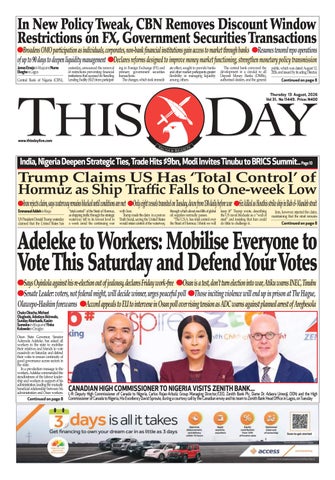
In New Policy Tweak, CBN Removes Discount Window Restrictions on FX, Government Securities Transactions
Broadens OMO participation as individuals, corporates, non-bank financial institutions gain access to market through banks Resumes tenored repo operations of up to 90 days to deepen liquidity management Declares reforms designed to improve money market functioning, strengthen monetary policy transmission James Emejo in Abuja and Nume Ekeghe in Lagos Central Bank of Nigeria (CBN),
yesterday, announced the removal of restrictions preventing financial institutions that accessed its Standing Lending Facility (SLF) from participat-
ing in Foreign Exchange (FX) and primary government securities transactions. The changes, which took immedi-
ate effect, sought to provide banks and other market participants greater flexibility in managing liquidity among others.
The central bank conveyed the development in a circular to all Deposit Money Banks (DMBs), authorised dealers, and the general
public, which was dated August 12, 2026, and issued by its acting Director, Continued on page 8
Thursday 13 August, 2026 Vol 31. No 11449. Price: N400
www.thisdaylive.com TR
UT H
& RE A S O
N
India, Nigeria Deepen Strategic Ties, Trade Hits $9bn, Modi Invites Tinubu to BRICS Summit... Page 10
Trump Claims US Has ‘Total Control’ of Hormuz as Ship Traffic Falls to One-week Low Iran rejects claim, says waterway remains blocked until conditions are met Only eight vessels transited on Tuesday, down from 130 daily before war Six killed as Houthis strike ship in Bab el- Mandeb strait
Emmanuel Addeh in Abuja
US President Donald Trump yesterday claimed that the United States has
“total control” of the Strait of Hormuz, as shipping traffic through the strategic waterway fell to its lowest level in a week amid the continuing war
with Iran. Trump made the claim in a post on Truth Social, saying the United States would retain control of the waterway,
through which about one-fifth of global oil supplies normally passes. “The U.S.A. has total control over the Strait of Hormuz. I think we will
keep it!” Trump wrote, describing the US naval blockade as a “wall of steel” and insisting that Iran could do little to challenge it.
Iran, however, rejected the claim, maintaining that the strait remains Continued on page 8
Adeleke to Workers: Mobilise Everyone to Vote This Saturday and Defend Your Votes Says Oyinlola against his re-election out of jealousy, declares Friday work-free Osun is a test, don’t turn election into war, Atiku warns INEC, Tinubu Senate Leader: voters, not federal might, will decide winner, urges peaceful poll Those inciting violence will end up in prison at The Hague, Olawepo-Hashim forewarns Accord appeals to EU to intervene in Osun poll over rising tension as ADC warns against planned arrest of Aregbesola Chuks Okocha, Michael Olugbode, Adedayo Akinwale, Sunday Aborisade, Kasim Sumaina in Abuja and Yinka Kolawole in Osogbo Osun State Governor, Senator Ademola Adeleke, has asked all workers in the state to mobilise their relatives and friends to vote massively on Saturday and defend their votes to ensure continuity of good governance across sectors in the state. In a pre-election message to the workers, Adeleke commended the steadfastness of the labour leadership and workers in support of his administration, lauding the mutually beneficial relationship between his administration and Osun workers. Continued on page 8
CANADIAN HIGH COMMISSIONER TO NIGERIA VISITS ZENITH BANK...
L-R: Deputy High Commissioner of Canada to Nigeria, Carlos Rojas-Arbulú; Group Managing Director/CEO, Zenith Bank Plc, Dame Dr. Adaora Umeoji, OON; and the High Commissioner of Canada to Nigeria, His Excellency David Sproule, during a courtesy call by the Canadian envoy and his team to Zenith Bank Head Office in Lagos, on Tuesday
2
THURSDAY, AUGUST 13, 2026 • T H I S D AY
THURSDAY, AUGUST 13, 2026 • T H I S D AY
3
4
THURSDAY, AUGUST 13, 2026 • T H I S D AY
5
THISDAY • THURSDAY, AUGUST 13, 2026
NEWS
Group News Editor: Goddy Egene Email: Goddy.egene@thisdaylive.com, 0803 350 6821, 0807 401 0580
SANWO-OLU INAUGURATES FRESH FOOD HUB AT PEN CINEMA, AGEGE...
L-R: Secretary to the Lagos State Government, Barr. ‘Bimbola Salu-Hundeyin; wife of the Governor of Lagos State, Dr. Ibijoke Sanwo-Olu; Governor Babajide Sanwo-Olu; his Deputy and APC Governorship Candidate for the 2027 Lagos State Governorship Election, Dr. Obafemi Hamzat; his running mate, Princess Damilola Sonayon-James; and Commissioner for Agriculture and Food Systems, Ms. Abisola Olusanya, during the inauguration of the new Fresh Food Hub, facilitated by the Lagos State Ministry of Agriculture and Food Systems, at Pen Cinema, Agege, Lagos, yesterday
West African Regulators Intensify Move to Build Regional Fuel Pricing, Trading Hub NMDPRA: Infrastructure, capital, data critical to price benchmark Lokpobiri: Deregulation has unlocked investment in Nigeria’s downstream Eyesan says rising refining capacity, oil output good for market integration Verheijen: Why refining capacity alone can’t guarantee energy security Emmanuel Addeh in Abuja West African petroleum regulators Tuesday intensified efforts to establish an integrated regional refined petroleum products market capable of supporting credible pricing benchmarks and positioning the sub-region as a major fuel trading hub. The push formed the central focus of the 2026 West African Refined Fuel Market (WAFRFM) Conference, organised by the West Africa Regulators Forum (WARF), the Nigerian Midstream and Downstream Petroleum Regulatory Authority (NMDPRA) and S&P Global Energy. The conference, held under the theme: “Funding West Africa Infrastructure & Distribution to Create a Transparent Market for Regional Price Benchmarks,” brought together regulators, governments, refiners, traders, financial institutions, infrastructure investors and other industry stakeholders to deliberate on the development of the regional fuel market. The discussions centred on the need to move beyond increased refining capacity to build the infrastructure, financing structures, regulatory systems, data architecture and market liquidity required to enable petroleum products to move efficiently across West Africa and allow prices to increasingly reflect regional market fundamentals. Speaking at the conference, the Authority Chief Executive (ACE) of the NMDPRA, Mallam Umar Rabiu, said the region had made progress since the inaugural conference in 2025, but stressed that institutional developments must now be matched by investment and execution.
He said the 2025 conference had established a roadmap towards a West African refined products reference market, with emphasis on reliable refining capacity, stronger logistics and storage networks, interconnected ports, roads, rail and pipelines, harmonised standards, transparent market data and cross-border cooperation. According to him, developments over the past year included the institutionalisation of regional regulatory cooperation through WARF, progress towards West African reference pricing and deeper collaboration with S&P Global Commodity Insights on market reporting and benchmark expertise. However, Rabiu, who is the current chairman of WARF warned that a reference price alone could not create a trading hub. “A reference price is not by itself a trading hub. A conference is not a market. Regulatory cooperation, important as it is, cannot substitute for the physical infrastructure, commercial liquidity, market information and operational excellence on which a credible trading hub must stand,” he said. He identified infrastructure, capital, data and regulatory cooperation as critical foundations for creating a credible regional benchmark. Rabiu pointed out that Africa has the resources, demand and increasingly the refining capacity, but needed to efficiently connect production to consumers through refineries, pipelines, storage terminals, jetties, ports, rail networks, roads, marine logistics, strategic reserves and digital trading platforms. “The objective is not infrastructure for infrastructure’s sake. The objective
is infrastructure that reduces the cost of moving energy, increases security of supply, improves inventory visibility, expands the number of credible market participants and creates the physical liquidity upon which transparent pricing depends,” he said. Rabiu also urged investors to view the region’s infrastructure deficit as an opportunity, citing potential investments in pipelines, product transportation, storage, marine terminals, refinery expansion, road and rail logistics, gas infrastructure, digital commodity exchanges, product-tracking systems and integrated regional logistics corridors. He noted, however, that capital would only flow into projects that were bankable, with predictable regulation, understood risks and
sustainable returns. The NMDPRA chief also stressed the importance of operational efficiency, warning that infrastructure without operational excellence could create expensive bottlenecks. “Our ports must become more efficient. Our terminals must improve turnaround times. Our pipelines and storage systems must operate safely and reliably. Our refineries must pursue sustained utilisation, reliability and competitive yields,” he said. He further called for improved data transparency, noting that credible price discovery required sufficient transactions, willing participants, reliable reporting and confidence that market information reflected actual commercial activity. “Markets operate on information. Benchmarks
The Securities and Exchange Commission (SEC) yesterday fixed 5:00 p.m. on the first business day after a transaction (T+1) as the settlement deadline for stocks and commodities traded and settled through the Central Securities Clearing System (CSCS). The Commission made this
clarification in a circular to capital market operators and other market participants as part of the implementation of the T+1 settlement cycle in the Nigerian capital market. According to the SEC, all transactions in the affected securities must be fully paid by 5:00 p.m. T+1 to ensure compliance with the standard Delivery versus Payment (DvP) settlement procedure.
completely deregulating. “Today, the midstream and downstream are completely deregulated. That is why we are seeing renewed interest,” Lokpobiri emphasised. The minister said Nigeria must look beyond its domestic market and position itself to serve the wider West African market, arguing that the region could benefit from the country’s growing refining capacity. He stressed the importance of processing resources locally rather than exporting raw materials and subsequently importing refined products at significantly higher costs. “We export our raw cashews. We export our raw agro-products outside. They refine them. We process them. And we buy them back ten times the price,” he said.
Nigeria Meets OPEC Quota for Third Straight Month Despite Overall Output Fall NUPRC blames July decline on operational issues in Erha, Akpo fields
Emmanuel Addeh in Abuja Nigeria has met and exceeded its Organisation of the Petroleum Exporting Countries (OPEC) crude oil production quota for the third consecutive month, despite a decline in overall production in July 2026, latest data from the Nigerian Upstream Petroleum Regulatory Commission (NUPRC) has shown. According to the figures from the upstream regulator, Nigeria produced
an average of 1.505 million barrels per day of crude oil in July, slightly above its OPEC quota of 1.5 million bpd. An additional 0.17 million bpd of condensate brought the country’s combined crude oil and condensate production to 1.67 million bpd during the month. The performance represented a modest but significant improvement in Nigeria’s ability to consistently meet its OPEC commitment, following years of production shortfalls caused by
T+1 Settlement: SEC Fixes New Deadline for Stocks, Commodities Kayode Tokede
operate on trust,” he said. Also speaking, the Minister of State, Petroleum Resources (Oil), Senator Heineken Lokpobiri, said Nigeria’s deregulation of the midstream and downstream petroleum sectors had created renewed investor interest and opened opportunities for greater regional integration. According to him, the federal government took a bold decision to completely deregulate the downstream sector, creating an environment capable of attracting investment and unlocking the potential of the industry. “Before this government came, nobody had the courage to turn around the downstream. Not even the military leaders had the courage. But at the breaking point, he (President Bola Tinubu) took the boldest decision of
It warned that where a broker/ dealer’s trading account was not adequately funded to meet its settlement obligation within the prescribed period, the default would be managed in line with the CSCS Default Management Procedure and the applicable transaction settlement guidelines of the relevant exchange. The Commission also clarified that foreign portfolio investors
are not required to prefund their accounts for trades in the Nigerian capital market. However, it said capital market operators facilitating transactions on behalf of foreign portfolio investors must establish and maintain appropriate controls and processes to ensure timely funding and completion of settlements within the prescribed timeframe.
operational disruptions, crude theft, pipeline vandalism, ageing infrastructure and investment constraints. However, the latest figures also showed that the improvement in quota compliance came amid a month-on-month decline in overall output. According to the NUPRC statistics, average combined production of crude oil and condensate fell by about 4 per cent in July compared with the previous month of June which was 1.735 million bpd. Total production (oil and condensate) in January was 1.62 million bpd; it was 1.48 million in February; 1.56 million bpd in March; 1.66 million bpd in April and 1.7 million bpd in May. However, the upstream regulator attributed the July decline largely to operational challenges at the Erha and Akpo fields, which affected production during the period under review. “These disruptions constrained production volumes and contributed significantly to the overall reduction in national crude oil output,” the
commission said. Despite the challenges at the two fields, the NUPRC said production operations across most other producing assets remained relatively stable, with operators implementing measures to maintain production efficiency and minimise the impact of operational constraints. Daily production also fluctuated considerably during the month. The highest combined crude oil and condensate output recorded in July was 1.78 million bpd, while the lowest stood at 1.57 million bpd. The figures underlined the continuing volatility in Nigeria’s upstream sector, where disruptions at major producing assets can have a noticeable impact on national production. The distinction between crude oil and condensate is important in assessing Nigeria’s performance against its OPEC quota because while total liquids production averaged 1.67 million bpd, condensate is not included in the crude production quota set by OPEC.
6
THURSDAY, AUGUST 13, 2026 • THISDAY
NEWS
OSOBA’S GRANDSON BAGS FIRST CLASS IN COMPUTER SCIENCE...
Damilola (middle) with his grandparents, Aremo Osoba (left) and Beere Derin Osoba, when Damilola graduated with a first-class degree in Computer Science from Royal Holloway, University of London, United Kingdom
$300m Arbitration against Nigeria: Firm Tells FG Ghanaian Never Invested in Disputed Estate Warns legal action scheme to defraud Nigeria Asks EFCC to investigate, arrest, prosecute alleged fraudsters
Alex Enumah in Abuja The federal government has been warned to be wary of the ongoing arbitration against Nigeria, at the International Chamber of Commerce (ICC), Paris, France. Specifically, the federal government was warned that the arbitration was another scheme to defraud the country of hundreds of million dollars, over investment that were never made in the country. A faction laying claim to the ownership of the claimant, JonahCapital Nigeria Limited, Dr Adeniran Olatokunbo Ogunmuyiwa, who sounded the warning described as false the claim of the faction
which instituted the arbitration that it invested over $300 million in providing infrastructure at the disputed property. Among others, Ogunmuyiwa has called on the Economic and Financial Crimes Commission (EFCC) to investigate the Ghanaian faction and compel them to produce conclusive evidence of capital importation into Nigeria, including Certificates of Capital Importation (CCI), bank statements, foreign inward remittance records, Central Bank of Nigeria (CBN) documentation, foreign exchange records, investment agreements, audited accounts, payment vouchers, evidence of payments to contractors
and suppliers, records of payments allegedly made for the acquisition, development or financing of the River Park Project, and any other documentary evidence capable of establishing that the alleged $300,000,000.00 was actually brought into Nigeria and applied to the project. Minister of the Federal Capital Territory (FCT), Nyesom Wike recently confirmed that the country had been dragged before the ICC in France, over dispute surrounding the development of Plot 4, Cadastral Zone E30, Lugbe West, Abuja, now known as River Park Estate. Some Nigerian investors and their counterparts from Ghana had
been locked in legal battle, over the authentic ownership of the property, acquired by JonahCapital Nigeria Limited, vied a Development Lease Agreement (DLA) in 2007. However, following the termination of the lease agreement last year, the Ghanaian faction commenced arbitration against the FCDA, on grounds that the agreement has up till 2030. Reacting, Ogunmuyiwa, who is a director and founder of JonahCapital Nigeria Limited, maintained that JonahCapital had at no time invested in the development of the River Park estate project, adding that the arbitration was aimed at defrauding the country.
Recapitalisation: Former Insurance Commissioner Advises FG to Shun Favouritism, Give Fair Play a Chance Ebere Nwoji
A former Commissioner for Insurance and Chief Executive officer of insurance sector regulator, National Insurance Commission (NAICOM), Alhaji Mohammed Kari, has called on the federal government to allow a fair playing field in the ongoing recapitalisation exercise in insurance sector if the sector must flourish like its counterparts in other climes. Kari, was former Managing Director and Chief Executive officer of both hitherto federal government owned NICON Insurance Corporation and Nigeria Reinsurance Corporation. In an open letter to the minister of finance on the ongoing recapitalisation exercise in the insurance sector, he advised the federal government to resist the urge to grant special carve-outs or act as an informal court of appeal for failing operators insisting that NAICOM was the state’s empowered regulator therefore must be permitted to apply the law equally to every company whether privately owned, historically created or under asset management control. “Honourable Minister, Nigeria’s insurance sector has enormous untapped potential, but it can
only realise that potential if the government allows a level playing field to flourish. “I trust that it is through this uncompromising stance that the Federal Ministry of Finance, which bears the ultimate responsibility for managing Nigeria’s economy, will give the right impression to investors, insurers, and reinsurers the world over. “By upholding regulatory integrity and refusing to shield non-compliant operators, your ministry will demonstrate that Nigeria is serious about financial discipline, thereby building lasting global confidence in the Nigerian insurance sector”, he stated. The former Commissioner wrote against the backdrop of petition written by the owner of NICON Insurance Ltd and Nigeria Reinsurance Corporation over withdrawal of operating licenses of the two companies because of their inability to meet the minimum required capital. The development prompted the minister to halt NAICOM’s action of appointing liquidators for both companies. In a sub-title of the open letter captioned “Equal rules for a maturing industry” Kari noted
that building a self-reliant, highly capitalised Nigerian insurance market requires consistent standards. According to him, under the Nigerian Insurance Industry Reform Act (NIIRA) 2025 and NAICOM’s Minimum Capital Requirement Guidelines, the regulator established a framework to ensure all operators hold genuine financial backing to protect policyholders. “The central issue here is not whether statutory requirements feel inconvenient or demanding to any individual operator; financial regulations, by their very nature, impose rigorous demands. The fundamental question is simply this: are the rules applicable to everybody?” He noted that over 90 percent of operators have diligently followed the statutory process raising fresh capital, depositing required reserves in the Central Bank on Nigeria (CBN), undergoing verification, and settling regulatory fees, as required by the law. He noted further that these institutions did not seek special exemptions rather they invested heavy resources to comply with the law and earn their place in a modern financial sector. In his words, “In contrast,
NICON and Nigeria Re continue to seek special dispensation through political channels, petitioning your ministry to suspend regulatory directives, capital checks, and escrow requirements.
In a letter of Disavowal of the Purported ICC Arbitral Proceedings to the FCT minister, Ogunmuyiwa argued that the Ghanaians have no right to make any claim on behalf of JonahCapital, especially when they are not the owners or directors of the company. “We have become aware of the news going round and the arbitral proceeding purportedly commenced by Jonahcapital Nigeria Limited against the Federal Government of Nigeria and at first glance, it is a blatant attempt to defraud the Federal Government of Nigeria by foreign actors who have no right whatsoever to make the claim they are making on behalf of the company. “As the man who signed the Development Lease Agreement between Jonahcapital Nigeria Limited/FCDA, I write this letter to bring to your attention Sir, the fact that there is indeed an ownership tussle within JonahCapital Nigeria Limited that has resulted in several alterations between 2024 to 2026 and it is important to state that JonahCapital Nigeria Limited as a company was not incorporated
by the Ghanaians laying claim to it and the company was not sold to them either”, Ogunmuyiwa stated in a letter dated August 10 2026. While they accused one Ghanaian, Samuel Esson Jonah of manipulating documents in February 2024, to lay claims to ownership of JonahCapital, the Nigerian faction stated that the company did not provide any form of infrastructure on the disputed property. “Most importantly, is the fact that the said Samuel Jonah now claims in arbitral proceeding ongoing at the ICC that JonahCapital Nigeria Limited provided infrastructure worth over three hundred million dollars in River Park Estate. “This is a clear fraud as JonahCapital Nigeria Limited as a company in all its existence never provided any infrastructure or funding towards the development of River Park Estate. “As the founding director and shareholder of the company from its incorporation till date, I state categorically that the infrastructure in River Park Estate was funded by Paulo Homes Limited whom we have that agreement with.
Air Peace COO: Unions Responsible for Passengers’ Claims over Disrupted Flights Airline recorded N2bn loss
Chinedu Eze
The Chief Operating Officer of Air Peace, Mrs. Toyin Olajide, has said the labour unions which singled out the airline for picketing on Tuesday would be held legally and financially responsible for passenger compensation and possible lawsuits. Olajide made this known in a press conference held in Lagos yesterday, disclosing that the airline lost about N2 billion during the picketing of its operation by the National Union of Air Transport Employees (NUATE) and the Air Transport Services Senior Staff Association of Nigeria (ATSSSAN).
She explained that because the picketing constituted an unexpected and uncontrollable external disruption beyond the carrier’s operational control, it falls under the legal principle of force majeure because the airline did not have any control or influence to what happened. She said if passengers whose flight plans were disrupted decide to legally push for redress in court, they would sue the unions. Also, the financial liabilities will “fall squarely” on the unions that instigated the blockade. “Legally, passengers are not entitled to compensation from Air Peace because what happened was entirely out of the scope of
the airline’s operations. “However, if passengers insist on compensation through legal channels, then the unions that caused this disruption will have to bear the brunt.” The unions leaders in a statement issued a day before the disruption, had cited two primary grievances—unpaid five per cent Ticket Sales Charge (TSC) debts to the Nigeria Civil Aviation Authority (NCAA) and restrictions on workers from joining unions. But Air Peace said all the domestic airlines are not unionised, except Aero Contractors and Arik Air, wondering why it was exclusively targeted when virtually all domestic operators share similar debt structures and non-unionised workforces.
7
THISDAY • THURSDAY, AUGUST 13, 2026
NEWS
ENIOLA BELLO’S ‘SHADOWS’ NOW AVAILABLE IN BOOKSTORES AND ON AMAZON...
L-R: Chairman, Nigerians in Diaspora Commission (NiDCOM), Abike Dabiri; Managing Director, THISDAY Newspaper, Eniola Bello; and Chairman, United Nigeria Airlines, Obiora Okonkwo, at the public presentation and launch of the two-volume book, Shadows, authored by Mr. Bello, in Abuja...recently
Sanwo-Olu: Nigeria on Course to Achieving $1tn Economy, Nation Improving Under Tinubu Reno Omokri explains why president should be re-elected
Emmanuel Addeh in Abuja Governor Babajide Sanwo-Olu of Lagos State has said Nigeria is getting better under President Bola Tinubu, expressing confidence that the administration is on course to achieving its target $1 trillion economy by 2030. Sanwo-Olu, who spoke in Lagos during a meeting with former presidential aide, political commentator and ambassador-designate, Reno Omokri, said the federal government’s reforms, particularly in the oil and gas sector, were creating the conditions for increased investment and economic growth. “If you look at what has happened in the oil and gas industry. Not only have we gone beyond the era of oil queues and the rest of it, yes, we can say that given the adjustment, but the bottom line is it’s available, it’s affordable, and it’s accessible,” the governor said. He said the federal government’s recent efforts to attract fresh capital into the oil and gas industry further demonstrated the potential of the ongoing reforms. “If you also see, I was just reading two or three days ago, the President just brought up another initiative to unlock
over $50 billion in investment into the oil and gas industry,” Sanwo-Olu said. Describing it as phenomenal, the Lagos state governor stressed that the Tinubu government was creating the right environment for economic development. “That’s phenomenal. $50 billion just by policy changes and creating the enabling environment to unlock that kind of potential. I believe that with this government, it’s clear that we’re on our way to $1 trillion (economy) by 2030. If we miss it, maybe by a year, but we’re certainly on our way to it,” he added. The governor also commended Tinubu’s social and economic policies, saying improvements in the welfare of pensioners were among the measures demonstrating the administration’s commitment to what he described as “shared prosperity”. “I have been a beneficiary. I’ve been a strong advocate of what we’re doing and what we’re doing very, very well. And we cannot deny the fact that things are a lot better than they used to be,” he said. Sanwo-Olu added that the President had recently approved an increase in pensions under the contributory pension scheme despite concerns about the cost
of the measure. “The President just increased the pensioners on the contributory pension scheme. He just increased their figures. I was just complaining to him last night, saying that you can’t do this, we can’t afford it. He said, no, he has to do it,” he said. For his part, Omokri argued that the impact of the Tinubu administration’s economic policies could be seen beyond
Elders of Ikpeshi/Egbigere Clan in Akoko Edo Local Government Area of Edo State have petitioned Governor Monday Okpebholo, seeking his intervention in the prolonged chieftaincy dispute in the community. The petition, dated August 10, 2026, was signed by Elder Amedu Aiyeregbere, described as the eldest man in Ikpeshi/Egbigere Clan; Elder Johnson Abdulraman, eldest man in Ucha Kindred; Elder Charles Dakwo, eldest man in Ewani Kindred; Elder Omoh Umoru, eldest man in Eminesama Kindred; Chief Augustine Jawa; and Chief Anthony Osumah.
Titled “‘Save Our Soul’ Cry to His Excellency, Senator Monday Okpebholo to Rescue Ikpeshi People from Oppression and Victimization,” the document urged the governor to intervene in the longstanding dispute over the traditional rulership of the clan. The elders said the dispute had resulted in tension within the community and alleged that a number of residents had been displaced from their homes. They called on the governor to take steps to restore peace and enable displaced members of the community to return to their homes and businesses. The petition referred to a number
home about, and then they had federal allocation of just three billion Naira every month. Their wage bill was N3.7 billion,” Omokri said. “That means that they can’t pay salaries. That’s why Osun State and 26 other states could not pay salaries. As I speak to you today, this is 2026, Osun receives N15 billion every month as federal allocation,” he added. Omokri said the increase in al-
Cross-border Lending: Court Upholds AFREXIM’s Right to Recover $25m Facility from Patnasonic Wale Igbintade
The Court of Appeal in Lagos has upheld the right of the African Export-Import Bank (AFREXIM) to demand repayment of a USD 25 million facility granted to Patnasonic Industries Limited, in a judgment with potentially significant implications for cross-border lending and commercial contracts in Nigeria. In its judgment, the appellate court allowed the appeal filed by AFREXIM in the dispute arising from
Ikpeshi Elders Petition Okpebholo Over Prolonged Chieftaincy Crisis Wale Igbintade
headline economic indicators, urging Nigerians to consider how the reforms were affecting states, workers, students and infrastructure. He cited Osun State as an example, saying the state’s monthly federal allocation had risen substantially from the period before Tinubu assumed office. “Before President Bola Tinubu became President, Osun had an IGR that was really nothing to write
locations, alongside wage and social interventions, had helped improve the capacity of governments to meet their obligations. He also pointed to the federal minimum wage and the regular payment of salaries as evidence of the reforms’ impact, arguing that millions of workers had benefited from the changes. “We have 1.1 million public and civil servants in Nigeria at the federal level, and about 800,000 in the states, that’s two million people who, hitherto, were not getting salaries,” he said.
of court proceedings arising from the chieftaincy dispute, including Suit No. HIG/23/2012, Appeal No. CA/B/287/2015 and Supreme Court Appeal No. SC/CV/221/2021. The petitioners also referred to Suit No. HIG/28/2020 and Suit No. HIG/21/2024, relating to claims concerning the traditional stool of Zaiki of Ikpeshi/Egbigere Clan. They further cited judgments delivered on December 17, 2019 and May 7, 2025 in Suit Nos. HIG/2/2018 and HIG/26/2024. The elders also drew the governor’s attention to the June 19, 2025 crisis in the community and the criminal proceedings arising from the incident.
the repayment of a receivables-backed dollar facility of up to USD25,000,000 granted to Patnasonic under a 2012 Loan Agreement. Sterling Bank Plc acted as the local administration agent under the facility. The dispute arose after AFREXIM demanded repayment of the outstanding indebtedness in United States dollars rather than its naira equivalent. Patnasonic Industries Limited and its Chairman, Chief Patrick Chidolue, subsequently instituted proceedings before the High Court of Lagos State challenging AFREXIM’s position. The Lagos State High Court, on June 25, 2024, found in favour of Patnasonic and Chidolue and dismissed AFREXIM’s preliminary
objections. Dissatisfied with the decision, AFREXIM appealed to the Court of Appeal, while Sterling Bank also filed a related appeal. On the appeal, Chuks Nwachukwu represented the first and second respondents, Patnasonic Industries Limited and Chief Patrick Chidolue. In the judgment, the Court of Appeal resolved all six issues raised by AFREXIM in its favour, agreeing substantially with the submissions of the bank’s lead counsel, Onyemauche Ibezim of KENNA. On jurisdiction, the appellate court held that the parties were bound by the terms of their freely negotiated agreement conferring jurisdiction on the English courts.
The court also held that AFREXIM, as an international financial institution, enjoyed diplomatic immunity and further found that the original action instituted by Patnasonic was statute-barred. Beyond the jurisdictional questions, the Court of Appeal proceeded to determine the substantive issues surrounding the facility. It held that the loan remained a United States dollar obligation and was therefore repayable in full in dollars, at the exchange rate prevailing on the date of repayment. The court also held that AFREXIM’s demand for repayment in dollars constituted a legitimate exercise of its contractual rights under the facility agreement.
JICA Awards Scholarships to 18 Nigerians to Promote Innovation, Devt Folalumi Alaran in Abuja The Japan International Cooperation Agency (JICA) has awarded scholarships to 18 Nigerian professionals and students under various Japanese education and human-resource development programmes aimed at strengthening capacity, promoting innovation and deepening bilateral relations between Nigeria and Japan. The beneficiaries were unveiled on Wednesday at the Orientation and
Send-Forth Ceremony for the 13th Batch of the Africa Business Education Initiative (ABE Initiative), held in Abuja alongside participants in the Agri-Net, PREPARE, KIZUNA, and Education and Governance Long-Term Programmes. In his remarks, Ambassador of Japan to Nigeria, Suzuki Hideo, said the ABE Initiative was more than a scholarship opportunity, describing it as an investment in Nigeria’s young professionals and the country’s future.
He said human-resource development was recognised as one of the foundations for sustainable growth, economic transformation and resilient societies at the Ninth Tokyo International Conference on African Development (TICAD 9), held in Yokohama, Japan, in August 2025. According to him, investing in talented young Nigerians would produce innovators, policymakers, researchers, entrepreneurs and leaders capable of tackling emerging challenges.
8
THURSDAY, AUGUST 13, 2026 • THISDAY
EIGHT
NGX Group Woos Hong Kong Exchange, Seeks Strategic Collaboration
Ndubuisi Francis in Abuja
Nigerian Exchange Group (NGX) has expressed its desire to enter a strategic collaboration with the Hong Kong Exchange and Clearing (HKEX), alluding to the significant value in strengthening institutional cooperation between both exchanges. NGX Group Chairman, Dr. Umaru Kwairanga, disclosed the plan yesterday when he engaged officials of HKEX in the East Asian country. According to the talking points, which were made available to
THISDAY, Kwairanga stated that HKEX had established itself as one of the world’s leading exchange groups and an important gateway connecting global capital with Asia. The NGX Group, he explained, shared a similar ambition within Africa, to build a globally-competitive market infrastructure that supports economic development, innovation, and efficient capital allocation. Kwairanga said, “We, therefore, see significant value in strengthening institutional cooperation between our two exchanges.” He added that capital markets
were evolving rapidly. The NGX Group chairman stated that exchanges currently no longer simply constituted venues for trading securities, but had become platforms for economic development, technological innovation, sustainable finance, and international capital connectivity. He stated, “As this evolution continues, partnerships between exchanges will become increasingly important. “We believe NGX Group and HKEX can jointly contribute to shaping stronger financial linkages between Africa and Asia.”
He pointed to strategic areas for collaboration, including institutional partnership, cross-border market development, technology and innovation, sustainable finance, and Africa–Asia Investment promotion. Kwairanga expressed the readiness of NGX to welcome the development of a formal cooperation framework between NGX and HKEX that provides structure for long-term engagement. Such cooperation, he said, could include annual executive meetings, technical working groups, and knowledge exchange.
On cross-border market development, Kwairanga stated that areas of collaboration might include cross-border listings, depositary receipt structures, ETF development, international investor access, and capital market integration. He stated, “We are particularly interested in hearing from HKEX’s experience in: exchange technology, Artificial Intelligence, market surveillance, digital infrastructure, data commercialisation, and product innovation. “Another area of mutual interest is sustainable finance. Potential collaboration could include: Green
Dr. Umaru Kwairanga finance, climate disclosure, ESG reporting, transition finance, and carbon market development.”
ADELEKE TO WORKERS: MOBILISE EVERYONE TO VOTE THIS SATURDAY AND DEFEND YOUR VOTES
Separately, at the Arise News Town Hall, the governor alleged that one of his predecessors, Olagunsoye Oyinlola, was against his re-election because he was jealous of the Adeleke family. He said Oyinlola had a habit of resenting anyone from the Adeleke family. The governor’s comments came as the presidential candidate of African Democratic Congress (ADC), former Vice President Atiku Abubakar, warned the Independent National Electoral Commission (INEC), security agencies, and the President Bola Tinubu administration against militarising the Osun State governorship election or deploying state institutions for partisan advantage. Atiku gave the warning at the ADC National Youth Leadership Summit in Abuja. For his part, Leader of the Senate, Senator Opeyemi Bamidele, advised all stakeholders in the Osun State
election to prioritise the pursuit of peaceful and credible polls. In a statement issued yesterday in Abuja, Bamidele declared that voters, not federal might, would decide the winner of the Osun State governorship election. Meanwhile, the presidential candidate of Accord Party, Dr. Gbenga Olawepo-Hashim, warned those beating the drums of war over the election to be wary of the consequences of their actions, saying they may end up at the International Criminal Court. Olawepo-Hashim stated this in a statement yesterday. That was as Accord Party appealed for urgent diplomatic intervention by European Union (EU) to de-escalate rising political tension in Osun State ahead of Saturday’s election. The appeal was contained in a letter by Accord Party’s National Chairman, Chief Maxwell Mgbudem,
dated August 12, 2026, and addressed to Ambassador and Head of the EU Delegation to Nigeria and ECOWAS, Gautier Migot. Amid the rising tension, ADC said it had received credible reports about plans to arrest its National Secretary and Osun indigene, Ogbeni Rauf Aregbesola, in the days leading to Saturday’s governorship election. ADC warned against the move, in a statement by National Publicity Secretary of the party, Bolaji Abdullahi. In other developments, Osun State Police Command questioned the senator for Osun East Senatorial District, Francis Fadahunsi, over inciting statements credited to him in a viral video ahead of Saturday’s election. Fadahunsi denied any inciting motive in the video, where he was heard saying, “kill any Accord member,” during a protest at the palace of the Owa Obokun of Ijesaland. He
insisted he only meant that APC supporters should “kill Accord Party in Osun with their votes”. But National Human Rights Commission (NHRC) called for the immediate suspension and arrest of Fadahunsi, in a statement by the commission’s Executive Secretary, Chief Tony Ojukwu. NHRC said the remarks attributed to Fadahunsi amounted to incitement to murder, electoral violence, and voter intimidation. In the meantime, INEC announced that the governorship candidate of Social Democratic Party (SDP) for the Osun State election, Dr. Francis Ajala, and his running mate, Faseke Oladipo, had been added to the ballot for the election on Saturday. INEC National Commissioner, and Chairman, Information and Voter Education Committee, Mohammed Haruna, explained, in a statement, that the action was taken in compliance with the judgement of the
TRUMP CLAIMS US HAS ‘TOTAL CONTROL’ OF HORMUZ AS SHIP TRAFFIC FALLS TO ONE-WEEK LOW tacked by Houthis. British maritime killed aboard a cargo vessel off Yemen but did not name the ship. blocked. The Persian Gulf Strait Authority said in a statement that “claims and repeated posts by U.S. officials that the Strait of Hormuz is no longer blocked do not change the reality”, adding that the waterway would not be reopened until Iran’s conditions were accepted. The dispute came as commercial shipping through the strait continued to collapse. Only eight vessels were tracked transiting the waterway on Tuesday, according to Kpler data reported by Reuters, below a 10-day average of about 12 vessels and the lowest daily figure since August 5. Before the war began on February 28, about 130 ships passed through the strategic waterway each day. The disruption has heightened concerns over global oil supplies and energy prices, with the International Energy Agency (IEA) cutting its 2026 oil demand forecast as the prolonged closure of the waterway weighs on consumption. Brent crude was trading around $89.08 a barrel early Wednesday, while US benchmark West Texas Intermediate (WTI) stood at $83.53. The IEA said global oil supplies rose by 2.4 million barrels per day in July to 101.5 million bpd, but remained 6.3 million bpd below the level recorded a year earlier. It now expects global oil supply to fall by an average of 4.3 million bpd this year, citing renewed hostilities and maritime disruptions in July and early August. “The ongoing closure of the Strait of Hormuz and elevated fuel prices continue to weigh on oil consumption,” the agency said. The crisis has also spread beyond the strait, with renewed attacks by Iran-backed Houthi rebels on shipping in the Red Sea raising fears of further disruption along another critical global trade route. At least six people were reportedly
in an attack attributed to the Houthis, marking the first known deaths from Houthi attacks on shipping in the region during the latest escalation. The United States has also intensified enforcement of its blockade of Iranian ports. US Central Command said an American military helicopter fired two Hellfire missiles at the engine room of a Panama-flagged vessel, the Vela Nova, after the crew allegedly ignored repeated warnings and attempted to sail towards Iran. CENTCOM said the vessel was no longer transiting to Iran in violation of the blockade, adding that US forces had disabled three non-compliant vessels, boarded two and redirected 55 commercial vessels attempting to bypass the blockade as of Tuesday. Meanwhile, diplomatic efforts to de-escalate the conflict remain uncertain. A senior Iranian source told Reuters that there had been no discussions on extending a ceasefire because, from Tehran’s perspective, no ceasefire had been established. The source said talks through mediators were focused on the possibility of Washington returning to an interim agreement and establishing a timeframe for implementing commitments, but added that there had been “absolutely no progress” on the issue. Also, four crew members and two rescuers were killed in an attack by Iran-backed Houthis on a cargo ship in the Bab el-Mandeb strait on Tuesday, Yemen’s transport ministry said, while the U.S. military said it struck a container ship attempting to sail toward an Iranian port. The fatalities aboard the Egyptianowned Tihamah, would mark the first deaths in a Houthi strike on shipping since the Iran war began on February 28. Later in the day, the Houthis confirmed they attacked a ship in the Bab el-Mandeb, which they said was carrying Saudi military equipment
The British navy-affiliated agency UK Maritime Trade Operations (UKMTO) reported one incident in the strait on Tuesday, saying a ship was hit by an unknown projectile. Reuters was able to confirm the cargo ship as Tihamah by the shape of the deck and mast of the ship, which matched archive imagery of the vessel. Corroborating visuals from the dock matched satellite imagery and topography mapping of the area. Ship-tracking data showed the vessel Tihamah near Murad, Yemen, on August 11. The date was verified by two Yemeni coast guard sources and two military officials in the government who said a small cargo ship was at-
security company Ambrey also said there was an attack on the vessel on August 11. Three Pakistanis were killed in the attack, Pakistan’s foreign minister confirmed. The Yemeni ministry said one Indonesian was also killed, adding the crew lost control of the vessel after being attacked. Two rescuers from the National Resistance Forces (NRF), an anti-Houthi force, were also killed when the Houthis struck again after rescue crews arrived, the Yemeni Coast Guard said. Ten people were injured, including seven crew members, two Coast Guard personnel and one NRF member, according to the Coast Guard.
Federal High Court, Abuja. Addressing workers in the state, Adeleke said, “The time for action has come. As formal workers at state establishments, I task you to mobilise informal workers, artisans, and professional bodies. We must remain strong in defence of our constitutional rights to vote and be voted for. “We must defend the gains of the last three and half years plus. Ours is a worker-friendly government, which has delivered across board to labour and Osun people. We cannot and must not allow a return to the dark days.” At the Arise News Town Hall, the governor alleged that Oyinlola was against his second term bid because he was jealous of the Adeleke family. Adeleke was responding to a question from one of the panellists regarding his strained relationship with Oyinlola, a member of the governor’s former party, Peoples Democratic Party (PDP). He stated that Oyinlola was in the habit of working against anybody from the Adeleke family, recalling how he worked against his elder brother and political mentor, the late former governor, Isiaka Adeleke, popularly known as Serubawon. He added that Oyinlola worked against him during his first contest for the governorship seat in the state and during his second contest that brought him to office in 2022. Adeleke also narrated how Oyinlola had come to him after becoming governor and complained that he did not have a car, and he immediately bought one for him, yet the former military governor aligned with the opposition against the Accord Party candidate.
He, however, assured the audience that the Oyinlola factor would be inconsequential in the outcome of the election. Adeleke declared Friday, August 14, as work-free, to allow public service workers to participate in the Saturday governorship election. In a circular by Head of Service, Elder Ayanleye Aina, the government said the decision was to enable workers to travel, where necessary, to prepare to exercise their voting rights on Saturday. The circular stated that all categories of workers were covered in the work-free day declaration, except those on emergency and essential duties.
Atiku to INEC, Tinubu: Osun is a Test, Don’t Turn Governorship Election into War
Presidential candidate of African Democratic Congress (ADC), Atiku Abubakar, warned Independent National Electoral Commission (INEC), security agencies, and the Tinubu administration against militarising the Osun governorship election or deploying state institutions for partisan advantage. Speaking at the ADC National Youth Leadership Summit in Abuja, Atiku declared, “Osun is a test of Nigeria’s capacity to conduct credible elections ahead of the next general election.” He said the scale and posture of security deployment around the election resembled preparations for war rather than a civil democratic exercise. Atiku said, “Elections are civil engagements, not military operations. Continued on page 35
IN NEW POLICY TWEAK, CBN REMOVES DISCOUNT WINDOW RESTRICTIONS ON FX, GOVERNMENT SECURITIES TRANSACTIONS
Financial Markets Department, Okey Umeano. The apex bank said the changes followed a review of developments in the FX, money and fixed-income markets. Under the revised framework, institutions that accessed CBN’s discount window will no longer lose access to the facility because of their participation in the Nigerian Foreign Exchange Market (NFEM) or primary auctions of government securities. The decision effectively dismantles two of the restrictions previously associated with access to the central bank’s liquidity support window. CBN, however, retained the restriction on participation in Open Market Operations (OMO) auctions by institutions that accessed the Discount Window on the same day. The new framework also provides for the return of tenored repurchase, or repo operations, which had been suspended. Repos allow the central bank to inject or absorb liquidity against eligible securities for a specified period, giving
monetary authorities greater flexibility in calibrating liquidity conditions in the banking system. CBN said it could now conduct repo operations across approved tenors ranging from four to 90 days, with the measure expected to support more effective liquidity management, improve money market functioning and strengthen monetary policy implementation. The move represents another adjustment to the central bank’s operating framework as it seeks to improve the functioning of the financial markets and strengthen the transmission of monetary policy. Under the revised OMO framework, participation in both primary and secondary markets has also been broadened to all eligible investors through Deposit Money Banks (DMBs). The eligible investors include individuals, corporates, and non-bank financial institutions. CBN said DMBs would continue to submit bids and settle transactions on behalf of their customers, effectively widening the pool of investors able
to participate in OMO transactions through the banking system. The apex bank, however, maintained its control over the scale and timing of OMO interventions, stating that the volume, tenor and frequency of issuances would continue to be determined by prevailing liquidity conditions and monetary policy objectives. It also retained the existing single-bid auction structure for OMO transactions. The review build on earlier reforms of CBN monetary policy and financial market operating framework, particularly its efforts to improve liquidity management and ensure that market-based instruments play a more effective role in monetary policy implementation. CBN had in October 2022 issued guidelines governing access to the Discount Window, while its OMO auction participation framework dated back to 2019. The revised rules now differentiate more clearly between market activities that should restrict access to central bank liquidity and those that should not.
In particular, participation in the FX market and government securities auctions will no longer constitute grounds for restricting access to the Discount Window. The retention of the OMO restriction, however, indicates that the CBN continues to maintain safeguards against simultaneous access to its liquidity window and participation in its own same-day liquidity-management operations. The resumption of tenored repo operations is also significant for liquidity management, as the four-to-90-day tenor range gives the CBN an additional instrument for managing liquidity beyond very short-term operations. Rather than limiting OMO participation primarily to a narrower group of institutional participants, the revised framework expressly brings individuals, corporates and non-bank financial institutions within the eligible investor base. CBN said all banks, authorised dealers, and market participants were required to ensure strict compliance with the new directives.
9
THISDAY • THURSDAY, AUGUST 13, 2026
NEWS
UNION BANK’S COURTESY VISIT TO OLAM NIGERIA CORPORATE HEADQUARTERS...
L-R: Vice-President Treasury, Olam Nigeria Limited, Mr. Neeraj Gupta; Managing Director/Chief Executive Officer, Union Bank of Nigeria, Mrs. Yetunde B. Oni; Country Head, Olam Nigeria Limited, Mr. Anil Nair, and Head Corporate Banking, Union Bank of Nigeria, Mr. Ali Kadiri during the bank’s courtesy visit to Olam Nigeria Limited corporate headquarters in Iganmu, Lagos on Monday
EFCC Recovers N115bn, $84m NDDC Levies from Oil Firms 24 companies found indebted to commission as 19 others get clean bill of health
Sunday Aborisade in Abuja The Economic and Financial Crimes Commission (EFCC) has recovered more than N115 billion and $84 million in outstanding statutory levies owed the Niger Delta Development Commission (NDDC) by oil companies, as the Senate intensified its investigation into the findings of the 2021–2023 Nigeria Extractive Industries Transparency Initiative (NEITI) Oil and Gas Sector
Audit Report. The disclosure was made on Wednesday by the EFCC representative, Mr. Francis Oka-Phillips Usani, when he appeared before the Senate Committee on Public Accounts, chaired by Senator Ibrahim Hassan Dankwambo, which is probing alleged non-remittance of statutory obligations by oil companies and other entities in the extractive sector. Usani told the committee that the EFCC investigated 43 oil companies
following the NEITI findings and established that 24 companies operating in the Niger Delta had outstanding liabilities relating to the three per cent statutory levy payable to the NDDC. According to him, the affected companies were indebted to the NDDC to the tune of N76.883 billion and $81.077 million, while the remaining 19 companies were cleared after the commission’s investigation. He said, “At the commencement
of investigation, EFCC invited 43 oil companies, out of which 24 operating within the Niger Delta were found to have outstanding liabilities in the sums of N76,883,705,907.17 and $81,076,655.00, while the remaining 19 other oil companies were given clean bill of health.” Usani explained that following the investigation and pressure mounted by the anti-graft agency, some of the indebted companies paid their outstanding obligations directly to
FG Unveils Mechanisation Policy, Targets 4,000 Tractors Annually to Achieve Food Sovereignty New strategy targets machinery leasing, spare parts, digital fleet management, agro-processing James Emejo and Deborah Adekoya in Abuja Minister of Agriculture and Food Security, Senator Abubakar Kyari, yesterday unveiled a new National Agricultural Mechanisation Policy and National Agricultural Mechanisation Investment Strategy, to usher a commercially viable mechanisation ecosystem capable of driving food sovereignty and transforming agriculture. Speaking at a High-Level National Policy Dialogue on Agricultural Mechanisation in Abuja, the minister said the investment strategy included plans for a mega tractor assembly plant capable of producing between 2,000 and 4,000 tractors annually. He stressed that the country must move beyond tractor procurement, adding that the current administration was seeking to shift the country from fragmented public interventions to sustainable, private-sector-enabled mechanisation services. Kyari said the policy and investment strategy were designed to provide the framework for mobilising capital, technology, skills and entrepreneurship around agricultural mechanisation, while ensuring that machinery becomes accessible to farmers when and where it is needed. According to him, the federal government’s Renewed Hope National Agricultural Mechanisation Programme (RH-NAMP) had
commenced the procurement and deployment of 2,000 tractors and more than 9,000 assorted implements and spare parts, describing it as the largest single agricultural mechanisation programme undertaken in Africa. The minister however, cautioned that the success of the intervention would not be measured by the number of tractors acquired. He said, “The real test is whether those machines become productive economic assets, maintained, financed, utilised, monitored and accessible to our farmers.” Kyari said modern mechanisation must cover the entire agricultural value chain, including land preparation, planting, irrigation, crop protection, harvesting, threshing, processing, storage, logistics and transportation. The facility, he said, was aimed at reducing the country’s dependence on imported machinery, developing domestic industrial capacity, creating jobs and establishing a sustainable mechanisation economy. The minister called on investors to see the emerging sector as more than an opportunity to supply tractors, saying that government was seeking long-term partners to build an agricultural technology and services ecosystem. Kyari said Nigeria’s large agricultural economy, expanding agro-processing activities, young population and unmet demand for machinery services provided a
significant investment opportunity He added that young Nigerians, women and persons with disabilities would be integrated into the mechanisation economy as equipment operators, technicians, engineers, entrepreneurs, equipment managers and service providers. The minister cited Borno State as an example of what could be achieved when state governments commit to agricultural transformation, noting that Governor Babagana Zulum had distributed 200 truckloads of fertiliser and unlocked more than a dozen solar-powered irrigation systems. Kyari also singled out TracTrac Mechanization Services Limited for training young Nigerians as mechanisation service providers and deploying small-scale tractors to smallholder farmers. He stressed that government could not mechanise agriculture alone, assigning complementary roles to the federal government, states, private investors, financial institutions, development partners, research institutions and farmers. He said, “The federal government provides policy, standards, coordination and investment architecture, the States are to support with land access, infrastructure and implementation. The private sector is to invest, innovate and deliver services.” He added that financial institutions would need to develop appropriate
financing, leasing and risk-sharing instruments, while development partners would provide catalytic finance, technical expertise and institutional support. Earlier, Permanent Secretary, Federal Ministry of Agriculture and Food Security, Dr. Marcus Ogunbiyi, said the country must confront its mechanisation deficit if it was to convert its agricultural potential into higher production, productivity and food security.
the NDDC. He disclosed that the companies had so far paid N6.709 billion and $16.994 million directly to the commission. The EFCC official further told the committee that, from the recoveries made by the commission on behalf of the NDDC, N73.373 billion and $67.070 million had been released to the development commission, while N3.510 billion and $14.005 million remained in the EFCC’s recovery account. “Out of the sums so far recovered by the commission on behalf of NDDC, total sums of N73.373 billion and $67.070 million have been released to NDDC, leaving the balance of N3.510 billion and $14.005 million in the EFCC recovery account,” he said. The development represents a major breakthrough in the Senate’s ongoing scrutiny of the financial obligations of oil companies, particularly the statutory levies expected to fund development interventions in the oil-producing Niger Delta region. Explaining the scope of the EFCC investigation, Usani said the commission concentrated primarily on the unpaid three per cent statutory levy due to the NDDC as identified in the NEITI audit report.
He, however, said the commission was also conscious that the companies might have other outstanding statutory obligations and taxes payable to the Federal Government. “The EFCC focused on one primary pillar identified in the NEITI report, which is unpaid three per cent statutory levies due to NDDC. However, we did not lose sight of the fact that there could be other unpaid statutory obligations and taxes due to the Federal Government,” he said. The committee, meanwhile, rejected an attempt by TotalEnergies EP Nigeria Limited to respond to queries raised against the company in the NEITI audit report, citing inadequate representation at the investigative hearing. The committee consequently directed the Managing Director of TotalEnergies EP Nigeria Limited to appear personally before it at a date to be fixed next week. Similarly, the committee gave what it described as a final opportunity to the Managing Directors of South Atlantic Petroleum Limited, Oando Oil Limited, Famfa Oil Limited and Green Energy International Limited to appear personally before the panel and respond to queries arising from the audit report.
2027: Don’t Allow External Actors Use Parliament to Advance Political Interests, Agbese Tells Lawmakers
Adedayo Akinwale in Abuja
The Deputy Spokesman of the House of Representatives, Hon. Philip Agbese has urged members to be cautious not to allow the parliament to be used to advance the interests of external political actors ahead of the 2027 elections. Agbese stated this in a statement issued Wednesday while reacting to the recent calls by some lawmakers under the aegis of Save Democracy Group for the National Assembly to suspend its recess because of pressing national challenges, including insecurity and the non-payment of contractors handling constituency projects.
While acknowledging the concerns raised by his colleagues, he questioned the timing of the demand, particularly with the 2027 general elections approaching. Agbese noted: “One cannot say the highly respected lawmakers are wrong but the timing is suspicious. “The 2027 elections are just by the corner and one must be careful not to be seen to be running errands for highly vested political interests outside the parliament.” Agbese, however, acknowledged concerns over the non-payment of contractors who had executed constituency projects, saying the issue should not be ignored or politicised. He stressed the 10th National As-
sembly is taking the lead in initiating bills and policies designed to address the needs of Nigerians, contrary to claims that lawmakers merely endorse proposals from the executive. The Deputy Spokesperson noted that the House had been working on several people-oriented legislative initiatives, including the establishment of state police, before the executive introduced its own bill on the matter. He said the executive’s recent initiative on state police should rather be viewed as an effort to harmonise proposals from both arms of government and avoid unnecessary duplication and expenditure, instead of being seen from the perspective of a rubber stamp parliament.
10
THURSDAY, AUGUST 13, 2026 • THISDAY
NEWS
2026 SURPLUS DISTRIBUTION BY NOOR TAKAFUL INSURANCE LTD...
L-R: Vice Chairman, Noor Takaful Insurance Limited, Aminu Tukur; Managing Director, Noor Takaful Insurance Limited, Rilwan Sunmonu; Chairman, The Alternative Bank, Muhtar Bakare; Executive Director, The Alternative Bank, Korede Demola-Adeniyi; and Board member, Noor Takaful Insurance Limited, Hilda Ozoh, during the distribution of 2024 surplus payment to The Alternative Bank at the 2026 Surplus Distribution by Noor Takaful Insurance Limited held in Lagos on Tuesday
India, Nigeria Deepen Strategic Ties, Trade Hits $9bn, Modi Invites Tinubu to BRICS Summit
Michael Olugbode in Abuja
India and Nigeria are deepening their strategic partnership across trade, investment, defence, energy, healthcare, agriculture and technology, with bilateral trade climbing to about $9 billion in the 2025–26 financial year, the Indian High Commissioner to Nigeria, Abhishek Singh, has disclosed. Singh made the disclosure during a media briefing in Abuja, where he outlined the expanding relationship between the two countries and identified new opportunities for stronger economic and strategic cooperation. The latest trade figure represents a substantial increase from the $7.13 billion recorded in 2024 and 2025, reinforcing the growing importance of economic relations between Africa’s largest economy and one of the world’s major emerging powers. According to the envoy, IndiaNigeria relations have evolved significantly from their traditional foundations of historical goodwill and oil trade into a broad-based strategic partnership covering security, technology, food security, healthcare, agriculture and global governance.
“India-Nigeria relations are no longer defined only by historical goodwill or oil trade,” Singh said, stressing that the partnership was increasingly becoming multidimensional. Singh disclosed that more than 200 Indian companies are currently active in Nigeria, with investments covering pharmaceuticals, manufacturing, power, construction, consumer goods, healthcare and services. He said many of the companies were not simply importing products into Nigeria but had established factories and production facilities in the country. The investments, he added, have resulted in employment for close to 100,000 Nigerians, making Indian companies collectively one of the country’s largest private-sector employers. The High Commissioner said the growing presence of Indian businesses reflected the confidence of investors from his country in Nigeria’s market and its long-term economic prospects. Energy security, he said, remains a critical pillar of the strategic relationship, with crude oil and liquefied natural gas continuing to play important roles.
But cooperation, according to Singh, was expanding beyond traditional oil trade to include Indian investments in Nigeria’s oil and gas industry, pipeline security, compressed natural gas conversion and liquefied petroleum gas infrastructure. He stressed that India’s population of about 1.4 billion and Nigeria’s population of more than 230 million create enormous energy demand in both countries. “This is all the more reason that the two great democracies, India and Nigeria, should cooperate more in the field of energy security,” he said. The High Commissioner described defence and maritime security as another important pillar of the relationship, noting that cooperation between the two countries dates back several decades. India, he said, supported Nigeria in establishing the National Defence Academy in Kaduna as well as the Naval College in Port Harcourt. The two countries also face common security challenges, including terrorism, violent extremism, piracy, organised crime and illicit trafficking. Singh said cooperation therefore covers intelligence sharing, counterterrorism, defence training and maritime security, particularly in
Niger Delta Youth Back Ogoni Oil Resumption, Demand Stakeholder Inclusion Blessing Ibunge in Port Harcourt
The President-General of the Ogoni Youth Federation and Spokesman of the Niger Delta Ethnic Nationalities Youth Leaders Forum, Legborsi Yamaabana, has commended the resilience of Niger Delta youths, while backing the federal government’s efforts to resume oil and gas operations in Ogoniland. Yamaabana, in a statement to mark the 2026 International Youth Day, yesterday, also called for greater inclusion of young people in consultations and operational frameworks surrounding the planned resumption of activities in Oil Mining Lease (OML) 11.
He praised youths across the Niger Delta for their contribution to peace and stability, noting that their cooperation with government authorities and security agencies had helped create an environment conducive to increased oil production and national revenue. “The recent gains in Nigeria’s oil output are a direct result of the commitment to peace demonstrated by our youth,” he said. According to him, young people in the oil-producing region are increasingly committed to ending economic sabotage and working with security agencies and government institutions to promote sustainable development.
On Ogoniland, Yamaabana appealed for calm among youths and announced plans to convene an Ogoni Youth Congress in the coming days to deliberate on critical issues affecting young people in the area. He also commended President Bola Tinubu for efforts to restart oil and gas operations in Ogoniland after more than three decades, describing the successful resolution of the long-standing shutdown of OML 11 as a potential historic milestone for the administration. While pledging the support of Ogoni youths for the resumption of exploration activities, Yamaabana stressed that young people must be directly involved in the process.
the Gulf of Guinea. He disclosed that a Nigerian naval delegation was scheduled to travel to India for bilateral discussions, describing the continuing engagement as evidence of the depth of defence relations between the two countries. Defence equipment and sales, he added, also remains areas of collaboration. The High Commissioner said India’s development partnership with Nigeria had also produced tangible results, including $395 million in concessional lines of credit. He said India had further provided extensive technical and professional training to Nigerians through the Indian Technical and Economic Cooperation (ITEC)
programme. Nigerians have benefited from ITEC training in areas including auditing, teaching, rural development, electrification and other specialised fields, while members of the Nigerian Armed Forces have continued to receive training at leading Indian defence institutions. Singh said India’s development assistance was based on sharing its strengths in areas that correspond with Nigeria’s own development priorities. Among the areas identified are affordable medicines, Digital Public Infrastructure, agriculture, skills development, food security, climate-resilient development and space applications. Singh added that healthcare
was another major area of bilateral cooperation with India’s strength in pharmaceutical manufacturing, noting that the country was widely recognised as a major global supplier of medicines and remains one of the largest exporters of pharmaceutical products to Nigeria. He said cooperation was also expanding into Digital Public Infrastructure, space applications, agricultural mechanisation, food security and climate-resilient development. These, he said, represent some of the new frontiers of India-Nigeria cooperation. The High Commissioner traced the recent momentum in bilateral relations to increased high-level political engagement.
Mbah’s Drive to End Capital Flight in Health Tourism on Course
Emmanuel Ugwu-Nwogo in Umuahia
Governor Peter Mbah’s drive to reverse medical tourism and halt the attendant capital flight remains on course, the Chief Executive Officer(CEO) of Enugu International Hospital (EIH), Professor Sam Agwu, has said. He gave the assurance while speaking with journalists at the site of the 300-bed health facility located on Rangers Avenue Enugu, which is almost ready for inauguration with state of the art medical equipment already installed. “Enugu International Hospital represents a translation of Governor Mbah’s vision into reality. He wants to reverse medical tourism,” he said. Available records show that Nigeria currently loses an estimated $1.2 billion to $2.39 billion annually to outbound medical travel or medical tourism undertaken by political leaders and the rich. It is also estimated that nearly 60 per cent of the capital outflow is driven by four clinical specialities: oncology, cardiology, nephrology and orthopaedic surgery.
But Prof. Agwu said the Enugu International Hospital was specifically conceived to make available here in Enugu all those advanced medical services that privileged Nigerians seek overseas. He assured that “we will be able to scale down the outflow by 40 percent within the first year of operation” going by topnotch medical services and cutting-edge medical equipment that would be available at the facility. According to him, after stemming the tide of Nigerians going abroad in search of healthcare, EIH would be positioned to start attracting patients from outside Nigeria, including Europe and America. The reason, he said is that oversea patients would find it cheaper to come to Enugu and access the same high quality medical care they receive in their own countries. “We’re going to have different sections, centres of excellence. Okay, so we’re going to have cancer centre. And within the cancer centre, we’re going to be having medical, surgical, and radiology treatment for cancers. “Then we’re going to have the
cardiac and vascular centre, where we can carry out open heart surgery, how we can basically treat vascular nature of the body,” he said. Prof. Agwu revealed that a “top notch cardiothoracic surgeon is coming in from UK to be the chief medical officer of this place. And that will give us a double edge, because he will not only run the medical outfit here, he’s going to help us train a lot of cardiac surgeons in this facility”. He further stated that EIH would have nuclear medicine capability, emphasising that “we’re going to be having one of the most modern state-of-the-art equipment for nuclear medicine”. “It’s called a PET (positron emission tomography) scan, and there are very few in the world, all over the world. I think there’s about two, two modern ones in Nigeria. We’re going to produce the nuclear material called cyclotron, here on site,” he said. Prof. Agwu stated that nuclear medicine is very helpful in the treatment of cancer as “the management of cancer (using CT scans) now has now gone beyond organ level”.
11
THURSDAY, AUGUST 13, 2026 • T H I S D AY
AN OPEN LETTER TO THE HONOURABLE MINISTER OF FINANCE The Honourable Minister of Finance & Co-ordinating Minister of the Economy Federal Ministry of Finance Abuja, Nigeria
ENFORCING A LEVEL PLAYING FIELD IN THE NIGERIAN INSURANCE INDUSTRY AND SUPPORTING STATUTORY REGULATORY MANDATES
I
Dear Honourable Minister,
write this as an open letter to you, deliberately choosing a public medium in the interest of total transparency. The matters surrounding regulatory compliance, market capitalisation, and financial stability in the Nigerian insurance sector affect not just a few boardroom executives, but the entire economic architecture of our nation. By placing these arguments in the public domain, it is my intention to ensure that National Insurance Commission (NAICOM) as the statutory regulator, the broad community of insurance operators, international reinsurers, and most importantly, the insuring public are fully aware of the principles at stake. Transparency is the bedrock of market discipline, and public scrutiny remains the best antidote to regulatory compromise. I have had the unique privilege of serving as Managing Director of Nigeria Reinsurance Corporation (Nigeria Re.),Managing Director of NICON Insurance(NICON) and subsequently as the Commissioner for Insurance and Chief Executive of NAICOM. Having sat on both sides of the table; first leading these two flagship institutions and later regulating the entire sector; I possess a unique, deep, and unbiased vantage point on the structural mechanics of Nigerian insurance. It is precisely because of this singular background, free from commercial bias or political expedience, that I feel duty-bound as a deeply concerned stakeholder to address you directly on what the Insurance industry needs most: a truly level playing field. If Nigeria is to refine and strengthen its insurance sector to compete globally, it needs more than just passing a piece of legislation, the market must operate under fair, transparent, and equal rules for every player. Regrettably, the current landscape is being distorted once more by a troubling and re-occurring pattern. As NAICOM enforces critical statutory reforms to strengthen the industry's financial bedrock, NICON and Nigeria Re have once again approached your Ministry seeking political intervention to bypass regulatory requirements. This resort to executive lobbying creates an uneven playing field. It penalises law-abiding operators while granting preferential exceptions to legacy institutions that have failed to adapt. From pillars of capacity to a divided playing field To understand why a fair market structure is essential, one must look at how these entities began. Established by the Federal Government in 1969 and 1977 respectively, NICON and Nigeria Re were created as the bedrock for domestic capacity. They were mandated to retain premium capital within Nigeria, underwrite public assets, build local expertise, and cushion the economy against systemic risk, which they did effectively. Indeed, virtually most of the first, second, and third generations of insurance practitioners in Nigeria and to a large extent West Africa, either worked in these pioneer organisations or were directly trained by them. They served as the premier institutions of excellence and professional development for the entire industry. It is precisely because of this glorious legacy that it pains the industry so deeply today to watch these same organisations continue to retard the progress of the Nigerian Insurance industry. Following the privatisation exercise of the mid-2000s, this proud heritage was severely eroded. Transferred under controversial circumstances to core investors associated with weak governance and excessive leverage, both entities gradually lost their market leadership. Over time, persistent governance failures, balance-sheet over hangs and unpaid claims fractured their operations, which required intervention at various intervals by NAI COM and Asset Management Corporation of Nigeria (AMCON), Rather than allowing the market to refine itself through equal competition, legacy status has repeatedly been used as a shield against the very standards required of everyone else. Equal rules for a maturing industry Building a self-reliant, highly capitalised Nigerian insurance market requires consistent standards. Under the Nigerian Insurance Industry Reform Act (NIIRA) 2025 and NAICOM's Minimum Capital Requirement Guidelines, the regulator established a framework to ensure all operators hold genuine financial backing to protect policyholders. The central issue here is not whether statutory requirements feel inconvenient or demanding to any individual operator; financial regulations, by their very nature, impose rigorous demands. The fundamental question is simply this: are the rules applicable to everybody? In a healthy market, the answer must be an unequivocal yes. The response from the broader industry demonstrates that compliance is achievable. Over 90% of operators have diligently followed the statutory process raising fresh capital, depositing required reserves in the Central Bank on Nigeria (CBN), undergoing verification, and settling regulatory fees, as required by the law. These institutions did not seek special exemptions; they invested heavy resources to comply with the law and earn their place in a modern financial sector. In contrast, NICON and Nigeria Re continue to seek special dispensation through political channels, petitioning your Ministry to suspend regulatory directives, capital checks, and escrow requirements. When compliance is treated as mandatory for 90% of the market but optional for a selective few, the concept of statutory regulation collapses into favouritism. Allowing a handful of operators to play by a separate set of rules undermines the principles of fair competition and discourages the very investment needed to refine the market. What obtains in other sectors: The precedent of regulatory discipline Honourable Minister, one must ask a fundamental question: where else in Nigeria's financial
ecosystem does this happen? At no time do we witness such unhealthy behaviour in other regulated sub-sectors. When the CBN or the Pension Commission (PENCOM) announces recapitalisation deadlines or statutory capital increases for their regulated entities, we never see their executives running to the Federal Ministry of Finance to lodge complaints or seek political interventions to weaken the regulator's hand. Those operators understand that financial discipline is non-negotiable and that statutory requirements are enforced by the regulatory authority established by law, not negotiated through political patronage. Those models are best for financial regulation. Why then should insurance operators treat regulatory compliance as a matter open to political lobbying? Why should the Ministry of Finance be patronised to intervene in pure regulatory enforcement? Allowing insurance companies to treat the Ministry as an informal court of appeal against NAICOM degrades the stature of Commission, promotes regulatory arbitrage, and projects an image of an industry that refuses to mature. This is one reason why I felt in the Insurance industry had been short-changed, by giving the Ministry a regulatory role in the previous insurance laws. Honourable Minister, the NIIRA 2025 has provided very clearly in Section 8(6) & (9) the procedure to follows if an operator's license is cancelled, and no mention of the Ministry of Finance is made, so why should the Ministry breach the law of the Federal Republic by entertaining such overture and even overruling the regulator? Why executive intervention harms fair competition Honourable Minister, despite the section referred to above, it is globally accepted that a government may occasionally intervene to rescue or support a consequential player in the financial sector, strictly where its distress poses a genuine “too big to fail” systemic risk whose collapse would trigger a wider economic catastrophe. However, one must examine the reality of the two institutions in question today. These are no longer the market giants they once were decades ago. Having suffered years of steep decline, loss of market share, and severe operational shrinkage, their current market footprint is virtually insignificant. Their failure or strict regulatory discipline poses absolutely zero systemic risk to the Nigerian financial system or the broader economy. Why then should government intervene to shield operators whose distress carries no systemic consequence whatsoever? Rescuing or granting regulatory concessions to insignificant, chronic defaulters cannot be justified under any sound macroeconomic policy. When political intervention steps in to shield such non-systemic entities from standard regulatory checks, the equilibrium of the market breaks down: · It creates unfair advantage: Operators that meet compliance targets, carry the full cost of regulatory fidelity, while non-compliant firms that secure political exemptions operate with an artificial cost advantage. · It disincentivises real capacity building: When political lobbying becomes an alternative to recapitalisation, companies are discouraged from making the hard structural choices necessary to refine their balance sheets and operations. · It distorts investor confidence: Both domestic and international investors look for predictable, transparent environments. A playing field where rules can be bent for select players frightens away patient capital. · It weakens policyholder protection: Regulatory standards exist primarily to guarantee that when disaster strikes, claims are paid promptly. Shielding insolvent entities directly exposes policyholders to unmitigated risk. The path forward: Restoring global confidence Honourable Minister, Nigeria's insurance sector has enormous untapped potential, but it can only realise that potential if the government allows a level playing field to flourish. The Federal Government must resist the urge to grant special carve-outs or act as an informal court of appeal for failing operators. NAICOM is the state's empowered regulator; it must be permitted to apply the law equally to every company, whether privately owned, historically state-created, or under asset management control. I trust that it is through this uncompromising stance that the Federal Ministry of Finance, which bears the ultimate responsibility for managing Nigeria's economy, will give the right impression to investors, insurers, and reinsurers the world over. By upholding regulatory integrity and refusing to shield non-compliant operators, your Ministry will demonstrate that Nigeria is serious about financial discipline, thereby building lasting global confidence in the Nigerian insurance sector. Please accept this as a plea from many that can not voice their frustrations. Yours sincerely, Alh. Mohammed Kari (Wazirin Bauchi) Former Managing Director, Nigeria Re, Former Managing Director, NICON, Former Commissioner for Insurance / CEO, NAICOM
12
THURSDAY, AUGUST 13, 2026 • T H I S D AY
5TH OBSEQUIES Mrs. Precilla Alolo Ocheja (30/3/63 to 13/8/2021)
My Pristy, our Sunshine, you were an epitome of humanity. You touched lives. You changed circumstances with your gentle love that made burdens seem lighter. we s ll struggle to accept your transi on but the fragrance of your love is ever abiding. Our children and grandchildren treasure you dearly. You are blessed as "Blessed are the dead who die in the Lord from now on... They will rest from their labor, for their deeds follow them." Rev.14:13 Signed: Sen. Emmanuel Dangana Ocheja (For the family)
THURSDAY, AUGUST 13, 2026 • T H I S D AY
13
14
THURSDAY, AUGUST 13, 2026 • T H I S D AY
15
THURSDAY, AUGUST 13, 2026 • T H I S D AY
TRANSCENSION The Great Alpha, University of Nigeria, Nsukka and the Graduate Chapters announce the transcension of Alphite Uche Martin Onyejesi.
ALPHITE UCHE MARTIN ONYEJESI 8th May 1968 – 21st April 2026
PROGRAMME MASS Thursday 13th August 2026 • 6pm St. John’s Catholic Church, Rumukwurushi, Port Harcourt SERVICE OF SONGS Tuesday 18th August 2026 • 5pm The Pavilion Event Centre, 13 Evo Road, GRA, Port Harcourt FUNERAL MASS Friday 21st August 2026 • 10am St Gabriel’s Catholic Church, Akwu Akokwa, Ideato North, Imo State INTERMENT Immediately after the Funeral Mass at Engr. Uche Onyejesi’s Home, Akwu Akokwa, Ideato North, Imo State THANKSGIVING MASS Sunday 23rd August 2026 • 7am St Gabriel’s Catholic Church, Akwu Akokwa, Ideato North, Imo State S I G N E D B Y: A L P H I T E K E N E O K W U J E
16
T H I S D AY • THURSday AUGUST 13, 2026
Politics
Acting Group Politics Editor DEJI ELUMOYE Email: deji.elumoye@thisdaylive.com 08033025611 sms only
Oyebamiji and His PROSPER Agenda for Osun’s Renewal
The statewide campaign of the All Progressives Congress flag-bearer for the coming Saturday, August 15, 2026, governorship poll in Osun State, Munirudeen Bola Oyebamiji, offers the electorate an opportunity to critically interrogate his contrasting records, governance philosophies and development agendas that will define the next chapter in Osun’s political evolution. Writes Jonathan Eze.
W
ith the Osun gubernatorial election less than three days away, the State of the Living Spring is once again at a defining political crossroads. Like every democracy, elections offer more than an opportunity to change governments; they provide citizens the chance to evaluate leadership, measure performance and decide which vision is best suited to address their collective aspirations. In Osun, the debate has so far centred less on personalities than on governance, how public resources have been managed, which policies have delivered tangible benefits, and who possesses the competence to move the state to its next phase of development. The contest presents voters with two distinct governance experiences. On one side is the record of the All Progressives Congress (APC) administration led by former Governor Gboyega Oyetola between 2018 and 2022; on the other is the administration of Governor Ademola Adeleke, who now seeks re-election under the Accord Party following his defection from the Peoples Democratic Party (PDP). The APC candidate and former Commissioner for Finance, Munirudeen Bola Oyebamiji (AMBO), had since built his campaign around a seven-point development blueprint christened the PROSPER Agenda. Ultimately, the election will be determined by how the electorate weighs the performance of the past against competing promises for the future. Oyetola’s Administration’s Record of Fiscal Prudence and Gradual Development The government of former Governor Oyetola
Oyebamiji
projected itself as one driven by fiscal discipline and institutional stability. Official government records indicate that budget implementation improved significantly during the period, while the state reportedly reduced its inherited
debt burden by about ₦97 billion. Supporters of the administration argue that these measures created room for sustained investment in critical sectors despite financial constraints. Economic development featured prominently
in the administration’s priorities. Thousands of small and medium-scale enterprises benefited from state and federal intervention programmes, while collaboration with the Central Bank of Nigeria facilitated over ₦6.5 billion in funding for more than 31,000 MSMEs. The government also pursued investmentdriven initiatives, including the Dagbolu International Trade Centre and Dry Port and the revival of the Abere Free Trade Zone to stimulate industrial growth and employment. Infrastructure development also received considerable attention. More than 500 kilometres of roads were reportedly constructed or rehabilitated across the state, alongside major township roads and rural road networks. The Olaiya Flyover in Osogbo became one of the administration’s flagship projects, while investments were equally made in fire stations, rural electrification and water supply. The administration invested heavily in education and healthcare, allocating substantial portions of the state budget to both sectors. It established the University of Ilesa, recruited about 2,500 teachers, expanded the O’MEALS school feeding programme and upgraded learning facilities. In healthcare, 332 primary healthcare centres were revitalised, the Osun Health Insurance Scheme was expanded to cover hundreds of thousands of vulnerable residents, and specialist health facilities were upgraded, particularly during the COVID-19 pandemic. NOTE: Interested readers should continue in the online edition on www.thisdaylive.com
Osun: Between Davido’s Threat and Tinubu’s Assurance of Credible Poll Chris Akinfosile writes on the need for President Bola Tinubu to ensure that the choice of the electorate is not tampered with as voters go to the poll on Saturday, August 15, 2026 to elect a governor for Osun state.
Tinubu
A
combustible mix of local political desperation, international pop star clout, historical ghosts, and a White House already scrutinizing Nigerian affairs is converging on Osun State ahead of its next governorship election. At the centre of the storm is a president who, with one stroke of his pen, recently demonstrated the very democratic statesmanship now demanded of him. The question is whether he will resist the fatal temptation to subvert the Osun ballot and, in doing so, shield his own legacy, his nation’s fragile peace and its economic future. Global music icon, David Adedeji Adeleke, known universally as Davido, has issued a threat that no sitting Nigerian leader can afford to dismiss as celebrity bluster. The United States citizen and nephew
Davido
of Osun State Governor, Senator Ademola Adeleke has declared he will personally report any attempt to falsify the imminent governorship election results to United States President Donald Trump. Given that President Trump is already directing an expansive probe into security and corruption anomalies inside Nigeria, Davido’s intervention strips away whatever diplomatic insulation Abuja once enjoyed. It places the ballot box under the glare of a superpower whose sanction powers can cripple Nigerian institutions and individuals alike. The election in question is not a distant abstraction. Political temperatures in Osun are already at fever pitch, and the bloodbath must be avoided since
horrific violence will spell widespread danger for all Nigerians without much exception and stands as a blood soaked dress rehearsal for next year general elections, so President Bola Tinubu must now decide whether the ruling party’s ambition is worth the gathering storm. Governor Adeleke cried foul, claiming the federal government sought to cripple his administration and tilt the electoral field. Then, in a dramatic reversal, President Tinubu’s order for the EFCC to unfreeze the State government accounts, earned him rare praise from opponents who see a president rising above partisan spite to defend constitutional governance. That moment of grace is what Davido, in his own incendiary way, is now calling on the presidency to replicate in the upcoming governorship election. Speaking via a video
message that has since gone viral and was verified by his management, the multiple Grammy nominee stated, “I’m a proud American citizen. If I see one attempt to steal my uncle’s mandate, I will fly to Washington myself and place the evidence on President Trump’s desk. Don’t think I’m joking. Trump is already digging into Nigerian corruption, and I will make sure Osun is Exhibit A.” Davido, who commands a social media following larger than the population of most African nations, has effectively transformed a subnational election into an international flashpoint. -Dr Akinfosile writes from Lagos. NOTE: Interested readers should continue in the online edition on www.thisdaylive.com
17
T H I S D AY • THURSDAY, AUGUST 13, 2026
TRIBUTE
Strategic Underwriting of the Life of Olusegun Ayo Omosehin @59 By Tola Ogunnubi
T
oday, with a heart full of gratitude, I join the entire insurance community, colleagues, friends, and the beautiful family of Mr. Olusegun Ayo Omosehin, our distinguished Commissioner for Insurance and Chief Executive Officer of the National Insurance Commission (NAICOM), in celebrating the gift of his life. Allow me to take you back to a rainy September evening in 2004. I was standing in the car park under the Apongbon Bridge on Lagos Island, an insurance agent living solely on commission, when I spotted a sharply dressed man. With the boldness that only hunger and hope can give, I approached him, hoping to underwrite a policy. He listened with quiet amusement, smiled, and then asked a question that would change the course of my life: “Would you like to work in an insurance company where you earn a steady monthly salary instead of living on commission alone, as a graduate of Actuarial Science from the University of Lagos?” I seized the offer without hesitation. He gave me an address in Ikoyi. Two days later, on a wet Thursday morning, I arrived before 7:30 a.m. The office was not yet open, so I waited outside and watched the staff arrive, all well dressed, purposeful, and professionally looking. In that moment I silently prayed that I would one day belong to that fold. When the doors finally opened, I met Mr. Moruf Apampa, then Assistant General Manager (and today the MD/CEO of one of our leading insurers). He welcomed me with warmth, praised my boldness, and later took me upstairs to meet the Managing Director. There, seated with quiet authority, was Mr. Olusegun Ayo Omosehin, MD/CEO of Admiral Insurance Company Limited. He looked at me briefly, as if assessing both the risk and the potential in equal measure, and asked just one question: “Are you ready to work?” I answered “Yes.” He simply said he liked my person. No further formal interview. No lengthy assessment. Just a handshake and a start date of 4th October 2004. In the language of our industry, that was pure strategic underwriting of talent (smiles), a decision taken on character and promise rather than on paperwork alone. That day, my path crossed with a man who would become far more than an employer. Originally inclined toward the foreign service, he chose instead the path of insurance in June 1993 at Crusader Insurance Plc. Hailing from Ilaje Local Government Area of Ondo State, he was educated at United Anglican Primary School, Abe-alala, and C&S Academy, Ugbo-nla, before earning a Second Class Upper degree in Political Science from the then Ondo State University (now Ekiti State University) in 1990. After National Youth Service in Ikot-Ekpene, he obtained a Master of International Law and Diplomacy from the University of Lagos in 1992 and later an M.Sc. in Economics from the same institution.
Olusegun Ayo Omosehin
His professional armory was further strengthened at Lagos Business School and the Saïd Business School, University of Oxford. He became an Associate of the Chartered Insurance Institute of Nigeria in 1996 and is today a Fellow (FIIN), as well as a Fellow of the Institute of Directors and the Nigerian Institute of Management. At Custodian and Allied Insurance, he rose to Divisional Head of Operations. In 2003 he took the helm at Admiral Insurance, a long-standing loss-making company, and restored it to profitability within his first year, proving once again that disciplined underwriting and sound risk selection can rewrite even the most difficult accounts. After the 2007 industry consolidation he led AIICO General Insurance through a comprehensive transformation. In 2010 he assumed leadership of Mutual Benefits Assurance Plc, repositioning it especially in the oil and gas segment over a decade of steady growth. In 2020 he became Managing
Director of Old Mutual Nigeria Life Assurance Company Limited, continuing his pattern of strengthening balance sheets and institutional culture. As the 25th Chairman of the Nigerian Insurers Association, he championed market discipline, self-regulation, insurance awareness, human capital development, and the faithful enforcement of compulsory insurances, always with the quiet conviction that a credible industry is the best protection for both policyholders and practitioners. In April 2024, President Bola Tinubu appointed him the seventh Commissioner for Insurance and Chief Executive Officer of NAICOM. Since assuming office, he has steered the Commission with a clear five-point agenda: protecting policyholders and restoring public confidence through a better claims-settlement culture; strengthening NAICOM’s own regulatory capacity; safeguarding the solvency and financial soundness of operators; fostering innovation; and expanding accessibil-
ity and penetration across the nation. Under his watch the Nigerian Insurance Industry Reform Act (NIIRA) 2025 has been advanced, a major recapitalization exercise successfully concluded, and the Insurance Policyholders’ Protection Fund established which are all steps toward a more resilient, trustworthy, and inclusive market. The successful completion of the insurance sector recapitalization exercise is a strong indication heralding a new era of insurance in Nigeria. Driven by the NIIRA 2025, signed into law by President Bola Tinubu on 31 July 2025, this reform forms part of broader financial-sector initiatives aimed at supporting a US$1 trillion economy by 2030. These reforms have seen insurance stocks lead market gains (contributing, for instance, to a N481 billion rise in market capitalization in a single session), with several names posting strong double-digit percentage gains as confidence in the sector grew and its contribution to the nation’s GDP strengthened. Beyond the titles and the turnarounds, he remains a pioneer of many firsts, a devoted husband, a wonderful father, a reliable and responsible boss, supportive to a fault, and a defender to the end. His frequent reference is admirable; he would often say, “Oga Tola, look I started early and I am grateful to God for His grace. I have been lucky by working hard.” His corrective glance still speaks a million words of guidance and care. In the vast ledger of life, where destinies are underwritten by the invisible hand of Providence, he appears, from time to time, as a rare soul whose presence becomes both premium and protection to all who walk under his shadow. He is a man whose life is itself a master policy of excellence, written in the indelible ink of integrity, wisdom, and quiet strength. He is not merely a boss; he is a sanctuary. He is not merely a mentor; he is a living lighthouse, standing firm on the rocky shores of ambition, casting a steady beam that guides young sailors safely through the fog of uncertainty into the harbour of purpose. Over two decades later, Mr. Omoschin remains my coach, mentor, preceptor, torchbearer, and living exemplar. He is an insurance industry enigma, a man whose career has been one long masterclass in risk management, institutional turnaround, and the patient building of trust. On this special day, as you mark your 59th birthday, I thank God for the gift of your life and for the privilege of walking part of this journey under your mentorship. May the years ahead bring you continued success, long life, sound health, peace of mind, a bountiful harvest from every seed you have sown in career and family, and the joyful fulfilment of every good dream still held in your heart. To all admirers, friends and family, please join me in wishing my boss, mentor, and role model a truly happy birthday. Thank you, and may Heaven continue to underwrite every good intention of your life. •Tola Ogunnubi NAICOM, Abuja
18
T H I S D AY • THURSday, AUGUST 13, 2026
FEatures
Group Features Editor: Chiemelie Ezeobi Email chiemelie.ezeobi@thisdaylive.com,
Dr. Adefunke Soyibo: 19 Years On, Betting Big on Affordable Furniture at HNK Interiors
Dr. Adefunke Soyibo, Founder and CEO of HNK Interiors and HNK Designs Centre, recently commissioned the new HNK Interiors Manufactory and unveiled the HNK Design Centre in Lekki, Lagos. The event was flagged off by Senior Pastor of Trinity House, Pastor Ituah Ighodalo, who cut the tape and prayed for both the space and its founder. It was more than a launch. It was proof that Nigerian design can build, manufacture, and dream big - all under one roof. After 19 years in business and five years in manufacturing, HNK is betting big on local production, faster delivery, and furniture Nigerians can actually afford. Writes Mary Nnah
T
he launch comes 19 years after HNK began and 5 years after it ventured into manufacturing. According to Soyibo, the goal is simple: scale local production, cut delivery times, and make quality furniture available to more Nigerians. The message was clear. Nigerian creativity can design, build, and manufacture world-class pieces — all under one roof. This wasn’t just another opening. It was a statement. After nearly two decades in interiors and five years in production, HNK is doubling down on Made-in-Nigeria, faster turnarounds, and furniture the average Nigerian can afford. Outgrowing Small For Dr. Soyibo, the move was inevitable. HNK started in 2007, and five years ago opened its first furniture manufacturing company in Nigeria. But the space quickly became too tight. “Five years after that, we realised that the space was no longer conducive. It was becoming rather too small. And we were not able to achieve as much as we wanted to,” she said. The solution wasn’t just a bigger factory. It was a purpose-built space to express creativity, keep up with fastchanging interior trends, and showcase everything HNK can manufacture locally. “We decided it was time to move into a more purpose-built space where we will be able to express ourselves more. Our turnaround time can be faster. And above all, to be able to express ourselves better.” 90% Made in Nigeria Walk through the new Design Centre, and you will see kitchen cabinets, walk-in closets, wall panels, velvet baths, rattan lampshades, and “HNK Casa” - a staged restaurant setting for baby showers, bridal showers, and intimate dinners. “A good 90% of what you see here, we made at the HNK Interiors factory,” Dr. Soyibo said. “We’re trying to promote the Made in Nigeria business.” The push is driven by economics as much as pride. With rising exchange rates, full importation is pricing out the average Nigerian. “If we are going to keep up with importation alone, we won’t be able to meet up. A lot of people won’t be able to afford our stuff.” So HNK imports what can’t be sourced here - like foldable plywood and certain fabrics - then assembles and finishes in Lagos. Rattan lampshades are sourced locally, then styled and sprayed in-house. “We want the quality to be high, but at the same time we want it to be affordable. So we are merging the two. That local control also means speed. A client who wants a dining chair in beige instead of wine? “Give us three days. We will turn
“I started with Nigerian guys. Yoruba boys and Igbo boys. It was a nightmare,” she said. “Until we discovered the Benin Republic artisans. They pay attention to detail. They are not lazy.” Her survival mantra: “When there is a will, there is a way. The power issue has been there before we were born. You’re not going to say because you have all those issues, you are not going to do what you have to do.”
Dr. Adefunke Soyibo, Founder and CEO of HNK Interiors and HNK Designs Centre, addressing guests at the event
Senior Pastor of Trinity House, Pastor Ituah Ighodalo cutting the tape to flag off the centre officially
it around.” A Showroom That Pays for Itself The Design Centre isn’t just for display. It’s designed to generate income and stay fresh. The plan is to change the entire setup every quarter. Old pieces won’t go to waste - HNK will hold “yard sales” with 30-50% discounts. In the meantime, the space rents by the hour, minimum two hours. There’s “The Globe” for album promos, “The Velvet Bath” for talk shows, a “dialogue zone” with podcast mics, and “The
HNK Concert” - a 25-30 seater for training, corporate meetings, and surprise parties. “If you are a fashion designer, you sell wigs, you sell hair products come do a video shoot. Change your outfit. Be very happy. Bookings are live at www.hnk.org/design-centre”, she said. The Hard Parts: Power, People, and Purpose Manufacturing in Nigeria comes with power issues, logistics, and staffing challenges. Dr. Soyibo was blunt about finding skilled artisans.
The Sector is Evolving Dr. Soyibo believes Nigerian design is in a golden era, helped by hard work, the internet, and AI. “If you are very creative, the sky is not even the limit because you can FRIDAYachieve so much more.” She started HNK in 2007 with a small idea. Today, the company serves other designers as a one-stop shop and is already dreaming of more HNK centres. In his remarks, Pastor Ighodalo called it “discovery of purpose.” “Start small, grow big. Start small, grow big. But start small. That’s the most important thing.” In his remarks, Senior Pastor of Trinity House, Pastor Ituah Ighodalo, called the launch a “discovery of purpose” and a lesson in faith-driven growth. “Start small, grow big. Start small, grow big. But start small. That’s the most important thing,” he told guests. “What we are seeing here today is the result of vision, hard work, and staying power.” He commended Dr. Soyibo for building steadily over 19 years and for choosing to invest in Nigeria at a time when many businesses are looking outward. “This is not just about furniture or interiors. This is about nation building. When you manufacture here, you employ here. When you train here, you build capacity here. That is how nations grow,” he said. Pastor Ighodalo then cut the ceremonial tape and offered prayers for the new HNK Interiors Manufactory and HNK Design Centre, dedicating the space, the staff, and the founder to God. “We pray that this place will be a centre of creativity, of excellence, and of prosperity. That every hand that works here will be blessed, and every client that walks through here will find beauty and value”, the cleric prayed. He added that businesses like HNK are proof that Nigeria’s creative sector can compete globally if given the right support and mindset. As the prayers ended, guests toured the facility - “Every single piece of furniture you see here tonight, we manufactured at HNK Manufacturing. To the glory of God,” Dr. Soyibo said.
19
T H I S D AY • THURSday, AUGUST 13, 2026
perspective
Benin Artifacts: How Museum Attack, Handover to Oba is Threatening US-Nigeria Treaty Crusoe Osagie writes that the attack on the museum in Benin City and the propriety of an individual taking sole possession of globally significant artifacts puts the future of cultural restitution in jeopardy
T
he battle over the ownership and custody of Nigeria's returned Benin artefacts has moved beyond an internal Nigerian dispute. It is now threatening to undermine one of the country's most important international cultural-property arrangements — the bilateral agreement with the United States designed to protect Nigerian heritage from illicit trafficking. That is the uncomfortable reality confronting Nigeria as Washington considers the future of its cultural-property restrictions on Nigerian archaeological and ethnological material. The question is no longer simply whether the Benin Bronzes should return home. They should. The deeper question is what happens to them after they arrive — who owns them, who has custody, where are they kept, who can access them, who can study them, who can exhibit them and, most importantly, who is ultimately accountable for their safety? The events surrounding the Museum of West African Art (MOWAA) in Benin City have transformed those questions from theoretical concerns into an international credibility crisis. In November 2025, protesters disrupted a preview event at MOWAA, forcing the evacuation of visitors and international guests. The confrontation was rooted in a dispute over the museum's relationship with the Oba of Benin and the custody and display of returned Benin artefacts. The museum's opening was subsequently postponed, while the controversy escalated into a wider political and institutional battle. For a country seeking the continued cooperation of the United States in protecting its cultural heritage, the optics could hardly be worse. A treaty built on mutual confidence The United States and Nigeria signed their bilateral cultural-property agreement on January 20, 2022. Implemented under the U.S. Cultural Property Implementation Act, the agreement allows the United States to impose import restrictions on specified categories of Nigerian archaeological and ethnological material. The restrictions cover archaeological material dating approximately from 1500 BCE to 1770 CE, as well as certain categories of ethnological material extending into the modern period. The underlying purpose is straightforward: to prevent the illicit trafficking of Nigerian cultural property into the United States and to support the preservation of Nigeria's heritage. This is an important international instrument. It means that American customs and lawenforcement authorities can act to prevent certain Nigerian cultural objects from entering the United States without the documentation required under the agreement. But such arrangements are based on a fundamental assumption: that the country asking the international community to protect its heritage has credible systems for protecting, documenting and accounting for that heritage at home. That assumption is now under pressure. The United States is not being asked merely to recognise the historical wrong committed against the Kingdom of Benin in 1897. It is being asked to help Nigeria protect cultural property as a matter of continuing national policy. And that requires more than moral arguments about colonial plunder.It requires institutions, inventories, chain-of-custody records, professional museums, security and a clear answer to the question: who is responsible? The Benin Bronzes could disappear again The Benin Bronzes occupy a unique position in the history of restitution. British forces invaded Benin City in 1897, looted the royal palace and dispersed thousands of objects across Europe and North America. The objects subsequently became some of the most important and celebrated African
palace and the previous administration of Governor Godwin Obaseki. Whatever one's position on the competing claims, the international implication is troubling. A museum supported by international partners suddenly found itself caught in a domestic struggle involving the traditional institution, the state government, federal authorities, donors and the museum's trustees. This is precisely the sort of institutional instability that can make foreign museums and governments hesitate before surrendering priceless cultural objects. The restitution movement depends on trust. And trust is fragile. Some of the repatriated Benin Bronze
works in the world's great museums. The restitution movement has therefore been driven by a powerful moral proposition: objects taken through colonial violence should be returned to their communities of origin. That argument has gained extraordinary momentum. Germany, for example, reached an agreement with Nigeria concerning the return of Benin Bronzes, with UNESCO describing the 2022 arrangement as involving the return of 1,130 objects and broader cultural cooperation, including archaeological research, museum training and support for a new museum in Benin City. The Netherlands and other European countries have likewise returned objects. The international restitution movement is therefore producing precisely the outcome Nigeria has long demanded. But restitution creates a new obligation. Once an object is returned, the receiving country assumes responsibility for proving that it can protect what the world has entrusted to it. That is where Nigeria's current predicament becomes particularly serious. Placing the artefacts entirely under the Oba In 2023, the Federal Government formally recognised the Oba of Benin as the custodian of returned Benin Bronzes. The decision has fundamentally altered the institutional landscape surrounding restitution. The problem is not the cultural authority of the Oba. There is no question that the Benin monarchy is central to the history and meaning of the artefacts. The objects were looted from the royal palace in 1897. The Oba therefore has an entirely legitimate and profound cultural interest in their restitution and interpretation. The problem is the absence of a sufficiently robust institutional framework separating cultural custodianship from exclusive administrative control. That distinction matters enormously. A traditional institution can be the symbolic guardian of a people's heritage without becoming the sole institutional gatekeeper of nationally and internationally significant cultural property.
Indeed, the distinction is at the heart of the international museum system. The objects are not merely valuable possessions. They are historical records, works of art, archaeological evidence and sources of scholarship. Their significance extends beyond the walls of a palace.Researchers need access. Students need access. Museums need access. Future generations need access. The Nigerian public needs access. And international partners whose institutions surrendered the objects need confidence that they have not simply exchanged one uncertain custody arrangement for another. The museum confrontation The events at MOWAA in November 2025 should therefore not be dismissed as an isolated disturbance. They exposed the consequences of failing to resolve the institutional question before the artefacts began returning in significant numbers. MOWAA was conceived as a major cultural institution in Benin City, with international backing and substantial investment. The museum was designed to provide modern conservation, research and exhibition infrastructure and was initially associated with plans to accommodate returned Benin artefacts. But by the time of its planned opening, the Bronzes were not going to be displayed there. The dispute erupted publicly when protesters entered the museum during a preview event. International and Nigerian guests were evacuated. MOWAA subsequently clarified that it did not own or claim title to the Benin Bronzes and said its focus was broader West African art, research, education and conservation. That clarification is important. But it does not make the underlying problem disappear. A multimillion-dollar museum built with international support had become embroiled in a dispute over whether an institution devoted to art, conservation, research and public education had the legitimacy to participate in the stewardship of the very cultural heritage that had helped inspire its creation. That should alarm everyone involved in the restitution movement. Because the message being transmitted internationally is potentially devastating: Return the artefacts to Nigeria — and then watch Nigeria fight over where they should go. The land controversy made matters worse The crisis subsequently expanded beyond the artefacts themselves. In November 2025, Edo State Governor Monday Okpebholo revoked the Right of Occupancy previously granted to MOWAA. The action came amid the escalating controversy involving the museum, the Oba's
The United States asking difficult questions This is why the renewal of the U.S.–Nigeria cultural-property agreement matters. The agreement is not an unconditional declaration of faith in Nigeria. It is a reciprocal cultural-protection mechanism. The United States has effectively accepted an obligation to restrict the importation of specified Nigerian cultural materials because those materials are regarded as part of Nigeria's cultural patrimony and are vulnerable to illicit trafficking. But Washington can reasonably ask: If Nigeria cannot clearly demonstrate who has custody of returned objects, how can American authorities confidently distinguish legitimate cultural circulation from illicit trafficking? If national institutions, state governments and the palace can assert competing claims, who is legally accountable when an object disappears? If a museum can become the subject of physical confrontation because of disagreements over cultural authority, what does that say about the security environment for returned objects? And if returned artefacts are placed outside conventional public museum structures, how does Nigeria demonstrate that they remain accessible for scholarship, conservation and public education? These are not anti-Nigeria questions. They are precisely the questions that a serious heritage-protection regime should ask. Nigeria, demanding foreign security, perpetuating uncertainty at home The strongest argument against Nigeria's position would not come from a foreign museum defending its possession of a Benin Bronze. It would come from Nigeria's own failure to establish an unimpeachable system of stewardship after restitution. This is the central danger. The international community has been persuaded that returning the Benin Bronzes to Nigeria is morally and historically justified. But the next stage of the argument requires Nigeria to demonstrate that restitution will result in better stewardship, not simply a change in the location of custody. There should therefore be a single authoritative national inventory of returned Benin artefacts. Every object should have a unique identification number. Its provenance should be documented. Its ownership status should be clear. Its custodian should be identified. Its physical location should be known. Its conservation status should be recorded. Its movements should be traceable. And the public should be able to consult an authoritative digital record. NOTE: Interested readers should continue in the online edition on www.thisdaylive.com
T H I S D AY THURSDAY AUGUST 13, 2026 20 TR
UT H
& RE A S O
Thursday August 13, 2026 Vol 27. No 11441
N
1
opinion@thisdaylive.com
www.thisdaylive.com
HAPPY BIRTHDAY, RAY EKPU NYAKNNO OSSO pays tribute to Ray Ekpu, Veteran Journalist and co-founder of Newswatch, at 78
See page 21
2027 ELECTIONS: WHAT INEC MUST DO
SAMSON ITODO writes what the electoral body should do to build trust in election results
See page 21
EDITORIAL
WAEC RESULTS AND MATTERS ARISING
See page 22
OPEYEMI BAMIDELE urges all to play by the rules in the governorship election
OSUN 2026: AN APPEAL FOR PEACEFUL ELECTION The governorship election in Osun State is just 48 hours away. It is a critical process that presents the state’s 2.339 million registered voters another defining moment to painstakingly reflect before casting their ballots for the candidate who will best serve their collective interests. The registered voters, as shown in the INEC records, spread across 30 local government areas, 332 wards and 3,763 polling units that cut across the state. Perhaps, like never before, the process is indeed a defining moment that freely offers the people the power to choose their next governor. The moment is not just significant because the state is at a point of inflection. It is obviously so because of the promises the next poll holds for the future of Osun State or how it will shape its public governance in the next four years, even for the unborn generation that the policies and performance of the next government will either guarantee their futures or disappoint their aspirations outright. This perspective has undoubtedly reignited the enthusiasm, energy, and commitment that the people of Osun State have demonstrated since political parties began rolling out their campaign manifestos. This is the beauty of democracy across the universe. On the one hand, it allows office seekers to present themselves to the people, indeed the electorate, who occupy the exalted seat of the ultimate judge in every democracy. On the other hand, it gives the people the power to determine who governs or leads them based on their public records. This thesis is now more rapidly than any time in the past shaping and reshaping the perception and thinking of Osun’s teeming voters now that they are presented with a credible alternative, whom the power of propaganda and the force of incumbency could not just suppress or shove down to the wastebin of history. What is now left at this crucial time is for all party candidates to brace up for the contest; walk into the ring of the ultimate judges and patiently wait for the outcome of their decisions. This should be a hard lesson for all political actors that the power to decide still lies in the hands of the people and not in the incumbent. If actually the candidates are in the race to serve their people, they should submit themselves to the electoral regime and be guided by the provisions of the Constitution of the Federal Republic of Nigeria, 1999 (as amended). That is why the people of Osun State must collectively vote for
peace and shun any form of violence in the guber context. As witnessed in the last 9-12 months that the electioneering has effectively commenced in the state, the contest is between the incumbent governor, Senator Ademola Adeleke and the governorship candidate of All Progressives Congress (APC), Mr. Bola Oyebamiji. Different projections have been made about the outlook of each of the governorship candidates, the outcome of the process for the state and its implications for both indigenes and residents at large. Unlike the 2022 election that we lost purely to lack of internal cohesion, the APC is now better positioned to reclaim the state’s seat of political power. The reasons are pure and simple, and they are not connected to the claims of Governor Adeleke that Osun APC is using federal might to defeat the incumbent. This claim is unfounded and even untrue. Unlike 2022, Osun APC is now more cohesive and prepared not just to regain the political control of the state, but also to reposition it posterity. But this cannot be said about Adeleke’s political structure, which ran into turbulence midway into his first administration. What Governor Adeleke has lost due to his poor relationship management skill has now been the gain of Osun APC. Some indicators attest to the increasingly improving public perception of Osun APC and its governorship candidate. One of the indicators is evident in the disintegration of the Peoples Democratic Party (PDP), the political establishment that helped Governor Adeleke to win the 2022 governorship contest. This tendency has now become more complicated when the faction of the PDP to which Adeleke owed his allegiance lost the legal battle to control the party and secure the recognition
of the electoral umpire. The tendency compelled Governor Adeleke to opt for the Accord Party, a largely unknown political party, to pursue his re-election. In practice as much as it is in principle, the viability of political structure is a time-tested determinant of victory in any electoral contest. Structure, in this sense, does not directly translate to incumbency. Rather, it is about the political capital a political party has been able to build over time. It is also about confidence or deep-seated trust the people have sustainably invested in their preferred political parties. It is about enduring influence political parties convincingly command across all the strata of a republic. It is the viability of the political capital that wins elections and not the power of incumbency. This is one formidable factor that now places the APC at a vantage position to win the next governorship poll in Osun State. Can ACCORD pull such a formidable political capital to its advantage in the next Osun race? The outcome of the 2026 poll will answer this question more empirically. But from what we can see, the profile of ACCORD is little known in Osun's political environment until Governor Adeleke recently pitched his tent with the party. In terms of performance, the party has not won any governorship election in our recent history. Before now, it won some state and federal legislative seats in Oyo State between 2011 and 2019 because of the influence of former Oyo State Governor and now Olubandan of Ibadan, Oba Rashidi Ladoja. Even then, his influence alone could not secure him victory in the 2011 guber contest. It can be argued that some remnants of the PDP are still with Governor Adeleke. But what is the political strength of these remnants? Can they defeat Prince Olagunsoye Oyinlola in his areas of political influence? Can they override the influence of the Turaki-led PDP faction that has already pledged their support to the APC in the next guber election? Apparently, the ACCORD lacks a formidable political structure that can mobilise muchneeded support for its governorship candidate and guarantee his re-election next Saturday. This pattern reinforces the view that the APC remains the foremost contender in the next Osun poll. Senator Bamidele, CON, Leader of the Senate, and Chairman, South-West Caucus in the National Assembly
T H I S D AY
321
THURSDAY AUGUST 13, 2026
SAMSON ITODO writes what the electoral body should do to build trust in election results
2027 ELECTIONS: WHAT INEC MUST DO
Election results management remains the most contested and consequential phase of Nigeria’s electoral process. It is the point at which votes cast by citizens are translated into electoral outcomes. It is here that the inconceivable becomes routine: results are altered, substituted, or manufactured outright; officials are compromised; and security agencies, shedding the garb of neutrality, interfere with collation to engineer a preferred outcome, mostly to protect a regime or oust an incumbent. This is the stage at which the integrity, independence and resilience of the Independent National Electoral Commission (INEC) face their most severe test. One opportunity to strengthen confidence was the reform of the Electoral Act in 2026. Although the Act makes electronic transmission of polling-unit results to the IREV portal mandatory, the proviso allowing the physical result sheet to override the results transmitted electronically makes the result management process vulnerable to manipulation, and it defeats the entire purpose of electronic transmission. This is of utmost concern because evidence shows the physical result sheet is the classic instrument of manipulation. Where a result has been altered on paper, it is the altered figure that governs collation even when the image on the IReV is the accurate reflection of what transpired at the polling unit. Whatever its stated rationale, the proviso provides legal protection for the very manipulation that electronic transmission was designed to prevent. In its policy brief, Securing the Vote: Electronic Transmission and Collation of Election Results, Yiaga Africa examined the legal and procedural framework that will govern the 2027 elections. One conclusion is particularly important: some of the processes most likely to shape public confidence in election results remain insufficiently visible to the citizens they are designed to reassure. The good news is that many of these weaknesses can be addressed administratively. INEC does not have to wait
for another amendment to the Electoral Act. It can act now. Here are seven steps INEC should take to rebuild trust in election results; First, INEC needs to publish a comprehensive results transmission protocol. Nigerians are entitled to know, in plain language, the full journey of an election result. INEC should publish, in clear and accessible language, the complete journey of a polling-unit result from declaration at the polling unit to its appearance on the IReV portal. At present, an important part of that journey remains opaque: the internal or “backend” process through which electronically transmitted results pass before they become publicly visible. The purpose of this process, who performs it, what constitutes validation, what actions can be taken on a transmitted result and how long the process should take have not been sufficiently explained to the public. This opacity creates what, in technology governance, is effectively a black-box problem: citizens can observe the input and the eventual output but cannot adequately understand what happens in between. In an environment already characterized by low trust, unexplained processes inevitably generate suspicion, misinformation and political narratives. The pattern of IReV uploads makes this issue even more important. During the recent Ekiti election, Yiaga Africa’s Election Results Analysis Dashboard (ERAD), which monitored uploads to IReV, recorded the first results on the portal at 4:10pm By 4:14pm., 283 results had appeared. Later, 748 results appeared within approximately five minutes, between 6:32pm and 6:37pm. There may be perfectly legitimate technical explanations for such upload patterns. But that is precisely why INEC should explain the architecture. In election administration, unexplained system behavior creates an information vacuum, and information vacuums are quickly filled by suspicion, misinformation and political narratives. INEC should also explain the newly introduced electronic EC8A process. Polling officials are now required to enter figures from the physical result sheet into an electronic version on the Bimodal Voter Accreditation System (BVAS). Nigerians deserve clarity on the function of this electronic record, where it is transmitted, how it is stored, whether it is used for reconciliation or validation, and what happens when it conflicts with the physical EC8A or its scanned image. Itodo is an election, democracy, and public policy enthusiast. He serves as the Executive Director of Yiaga Africa, Principal Partner of the Election Law Center and Chairperson of the African Union Advisory Group on AI in Peace, Security and Governance.
NYAKNNO OSSO pays tribute to Ray Ekpu, Veteran Journalist and co-founder of Newswatch, at 78
HAPPY BIRTHDAY, RAY EKPU
Ray Ekpu is celebrated as a living legend because his life and career have helped shape modern investigative journalism in Nigeria. Here are the reasons, facts, and ideas that highlight his enduring legacy. One, he co-founded Newswatch in 1984, a publication that transformed Nigerian journalism through fearless investigative reporting and in-depth analysis. He s trengthened Investigative Journalism. Ekpu helped to reinforce investigative journalism as a core genre of journalism practice in Nigeria. He is a C hampion of Press Freedom. Throughout his career, he defended and still defends the constitutional right of the press to report without fear or intimidation. He is a V oice Against Corruption. His writings consistently exposed corruption, abuse of power, and poor governance. He is a symbol of c ourage under Military Rule. He continued publishing during periods of military dictatorship, despite censorship, harassment, and the risk of imprisonment. Ray Ekpu is b uilder of modern news magazine Journalism. He helped introduce a magazine style of journalism that emphasized research, context, and analytical reporting rather than simply reporting daily events. He is M entor to Journalists. Many of Nigeria's leading editors, reporters, and media executives learned from his example and leadership. Ekpu r aised professional standards. He promoted accuracy, fairness, fact-checking, and ethical journalism at a time when these principles were under pressure. He set A genda. His editorials and investigative reports influenced public opinion and shaped national conversations on governance and democracy. Ekpu is a D efender of Democracy. His journalism strengthened democratic values by holding leaders accountable. H e got International Recognition. His work earned respect beyond Nigeria, enhancing the country's reputation for courageous journalism.
He is M aster Storyteller. He combined investigative rigor with engaging writing, making complex national issues accessible to ordinary readers. He is c ontributor to Nigeria's democratic Journey. His reporting documented critical political events and contributed to the nation's democratic development. Beyond writing, he helped build Newswatch into one of Africa's most influential news magazines. He is a r ole model of Integrity. His career demonstrated that journalism should serve the public interest rather than political or commercial interests. Ray Ekpu is p reserver of National History. His articles and commentaries now serve as valuable historical records for scholars, students, and researchers. He is an i nspiration to young Journalists. His career continues to encourage younger generations to pursue truth with courage and professionalism. He is an a dvocate of intellectual Journalism. He promoted thoughtful analysis, evidence-based reporting, and informed public debate. Ekpu remains an e nduring influence. Decades after founding Newswatch, his ideas, columns, and journalistic philosophy continue to influence Nigerian media. Ray Ekpu is a living legend worth celebrating. At 78, he represents resilience, excellence, integrity, and unwavering commitment to truth. His life's work has left an indelible mark on Nigerian journalism and deserves celebration by journalists, academics, students, policymakers, and all who value a free press. Ray Ekpu's legacy is not measured only by the stories he wrote, but by the generations of journalists he inspired, the institutions he helped build, and the enduring culture of investigative reporting he fostered in Nigeria. His contributions make him one of the true architects of modern Nigerian journalism. Osso is Founder, blerf.org
22 4
T H I S D AY THURSDAY AUGUST 13, 2026
EDITORIAL
Editor, Editorial Page PETER ISHAKA Email peter.ishaka@thisdaylive.com
WAEC RESULTS AND MATTERS ARISING
Examination malpractices distort the accuracy of educational evaluations of students through the appropriate state ministries of education. he depressing state of education in the Dangut has also identified logistics challenges, late country was again highlighted last week registration by schools, and rising inflation as some when the West African Examinations of the major difficulties encountered during the exaCouncil (WAEC) released the results of mination. the 2026 West African Senior School Persistent examination malpractices reflect the Certificate Examination (WASSCE). Allong-standing decay in the education sector across the though the number of candidates whose results were country. Besides, the sharp academic decline over the withheld over alleged examination malpractices is years could be attributed largely to the utter neglect of lower than what was recorded in 2025, it is still uncomthe learning environment. Most schools lack the bafortably high. “All the cases are being investigated, and sic educational infrastructure. This is also true of stafreports of the investigations will be presented to the apfing. From Kaduna to Benin City, Kebbi to Sapele, propriate Committee of the Council for consideration the facilities in most schools have either collapsed or and final decisions,” said the Head of WAEC’s Nigeria rundown, while the quality of the education being ofNational Office, Amos Dangut, who attributed many of fered is suspect. There are today, classrooms without the cases to the increasing use of mobile phones in exateachers, or where there are, many pupils can hardly mination halls and organised cheating in some schools. differentiate between blue Dangut said rogue and black. websites sold fake examiA thorough overhaul of our nation questions to candiThe re-introduction of reading and library classes as compulsory education system should be dates and parents, adding initiated and implemented some suspects have been components in primary and secondary schools will help to urgently to curtail this maarrested. We hope that laise. This should include there will be a diligent stimulate and inculcate the reading culture in students addressing the problem of prosecution to bring the inadequate funding, poor culprits to justice. Examination malpractices not only teaching quality, and related issues. In addition, meaT H I S D AY undermine fairness and equal opportunity, but they EDITOR SHAKA MOMODU sures should be enforced to prevent examination also distort the accuracy of educational evaluations of DEPUTY EDITOR WALE OLALEYE malpractice, while increased surveillance, and stricter students. But over the years, misconduct of all stripes MANAGING DIRECTOR ENIOLA BELLO penalties should be imposed. The legislature needs has become pronounced in our examinations. From DEPUTY MANAGING DIRECTOR ISRAEL IWEGBU to update the laws with severe sanctions to act as a CHAIRMAN EDITORIAL BOARD OLUSEGUN ADENIYI cheating with the aid of phones or other electronic deEDITOR NATION’S CAPITAL IYOBOSA UWUGIAREN deterrent to students, teachers, institutions, and pavices to collusion, bribery, impersonation, to obtaining THE OMBUDSMAN KAYODE KOMOLAFE rents alike. The re-introduction of reading and library exam questions before the exam as in the present case, classes as compulsory components in primary and seexamination malpractices pose a significant risk to the condary schools will help to stimulate and inculcate dependability of examination results and certification the reading culture in students. of the students. T H I S D AY N E W S PA P E R S L I M I T E D Indeed, the crisis in our educational sector is so total EDITOR-IN-CHIEF/CHAIRMAN NDUKA OBAIGBENA Today, rather than read their books and prepare GROUP EXECUTIVE DIRECTORS ENIOLA BELLO, KAYODE KOMOLAFE, and frightening that nothing short of a well-thoughtadequately for exams, many students at various leISRAEL IWEGBU out strategy will do for any meaningful change to ocvels look for an opportunity to cheat. It is even more DIVISIONAL DIRECTORS SHAKA MOMODU, PETER IWEGBU, cur. We need short, medium and long terms plan with disheartening to know that some parents connive with ANTHONY OGEDENGBE clear objectives and measurable timelines to reform DEPUTY DIVISIONAL DIRECTOR OJOGUN VICTOR DANBOYI school authorities to perpetrate this social malady. This the entire system. In the interim, we must fashion out SNR. ASSOCIATE DIRECTOR ERIC OJEH portends great danger to the quality of our human capiASSOCIATE DIRECTOR PATRICK EIMIUHI ways by which the federal, states and local governtal and by extension, our workforce. The WAEC boss CONTROLLERS ABIMBOLA TAIWO, UCHENNA DIBIAGWU, NDUKA MOSERI ments, and stakeholders from the private sector would has said that some supervisors and invigilators caught DIRECTOR, PRINTING PRODUCTION CHUKS ONWUDINJO come together to save post-primary education in NiTO SEND EMAIL: first name.surname@thisdaylive.com aiding examination malpractices would be sanctioned geria.
T
Letters to the Editor Letters in response to specific publications in THISDAY should be brief (150-300 words) and straight to the point. Interested readers may send such letters along with their contact details to opinion@thisdaylive.com. We also welcome comments and opinions on topical local, national and international issues provided they are well-written and should also not be longer than (750- 1000 words). They should be sent to opinion@thisdaylive.com along with photograph, email address and phone numbers of the writer.
LETTERS
AKTH’S SCHOOL OF PARAMEDIC TECHNOLOGY
The Aminu Kano Teaching Hospital (AKTH) School of Paramedic Technology represents a strong transformative contribution to the healthcare delivery system in the country. The Chief Medical Director of AKTH, Professor Abdurrahman Abba Sheshe said the paramedic school was accredited by the National Board for Technical Education (NBTE) after meeting the Board's accreditation criteria thus becoming one of the several schools under the hospital’s umbrella. Other accredited schools in the hospital include the College of Nursing Sciences which offers specialised post-basic nursing programmes in Paediatric, Nephrology, Critical Care, and Perioperative Nursing; School of Health Information Management (SHIM) which trains professionals in health data and medical records management. The hospital also has the School of Laundry and Dry-
cleaning Technology, which teaches hygienic laundry and the Community Health Officers' Training School, which trains senior community health workers. Professor Sheshe said that the schools were established to bridge critical gaps and enhance healthcare delivery to patients. The Paramedics School has a comprehensive curriculum to effectively train skilled personnel capable of managing complex emergency and trauma cases at AKTH, or in any other healthcare facility in Nigeria. Paramedical personnel constitute the first line providers of medical care in emergencies. The initial treatment they give either in ambulances ferrying traumatised persons to hospitals or in accident and emergency rooms save lives, reduce pain, stabilize serious injuries and stop bleeding before full treatment. Students at the AKTH School of Paramedics Technology would be taught how to engage in a range of life-saving interventions including advanced airway manage-
ment. This simply means they will learn how to secure open airways for unconscious or severely injured patients using specialized intubation equipment and techniques. They will learn how to provide rapid Cardiac Care by skillfully performing Cardiopulmonary Resuscitation (CPR) and operating automated external defibrillators (AEDs), an intervention aimed at restoring heart rhythms during sudden cardiac arrest. The students would be taught techniques in emergency medication administration, such as safely delivering urgent intravenous (IV) or intramuscular drugs to treat anaphylaxis, severe pain, acute asthma attacks or cardiac crises on the scene of an emergency situation before reaching hospital. Salisu Na'inna Dambatta is an advocate for healthcare journalism
23
T H I S D AY • Thursday, August 13, 2026
BUSINESSWORLD R A T E S MONEY MARKET
A S
REPO
A T
Group Business Editor Eromosele Abiodun Email oriarehu.eromosele@thisdaylive.com
08056356325
A ugust 1 2 , 2 0 2 6
S & P INDEX
S & P INDEX
EXCHANGE RATE
OPR
25.34%
CALL
23.25%
INDEX LEVEL
595.26
1/4 to daTE
0.24%
N1,383.00 / 1 US DOLLAR*
OVERNIGHT
25.18%
1-MONTH
21.37%
1-DAY
0.10%
YEAR TO DATE
-10.99%
*AS AT Wed., August 12, 2026
3-MONTH
22.41%
MONTH-TO-DATE
0.24%
Telecoms Subscribers’ Growth Hits 189M as MTN Maintains Lead with 96.9M
Stories by Emma Okonji Telecoms subscribers’ number across networks reached 189,675,650 in the month of May 2026, up from 188,009,171 in April 2026, according to the recent statistics released by the Nigerian Communications Commission (NCC), which THISDAY obtained from its official website. According to the statistics, MTN alone has 96,977,835 subscribers, with a market penetration of 51.19 per cent, followed by Airtel which has 65,450,286 subscribers, with a market penetration of 34.55 per cent, and Globacom, which
has 23,468,730 subscribers, with a market penetration of 12.39 per cent, while T2 has 3,538,021 subscribers, with a market penetration of 1.87 per cent. MTN has maintained the lead position for several years across networks, after rolling out its services in Nigeria in 2001. While unfolding activities for its 25th anniversary celebration this week in Lagos, the Chief Financial Officer at MTN Nigeria, Modupe Kadri said MTN spent N1.6 trillion in the last 18 months on network expansion, coverage, capacity
building and customer experience, with a promise to further invest in network expansion in the coming years to further enhance its service quality delivery. From the statistics released by NCC, telecoms subscriptions reached 177,426,286, with a teledensity of 81.84 per cent in November 2025, and the number further increased to 179,642,333, with a teledensity of 82.87 per cent in December 2025. As at January 2026, telecoms subscriptions increased again to 182,225,258, with a teledensity of 84.06 per cent. In February 2026, telecoms
subscriptions further increased to 184,603,928, with a teledensity of 85.16 per cent. In March 2026, telecoms subscriptions increased again to 185,718,018, with a teledensity of 85.67 per cent. There was a further increase in telecoms subscriptions in April 2026 to 188,009,171, with a teledensity of 86.73 per cent, before reaching 189,675,650, with a teledensity of 87.50 per cent in May 2026. Teledensity, according to NCC, is measured as the number of active telephone connections per one hundred inhabitants living within an area and is expressed as a
percentage figure. Giving reasons for the continuous increase in telecoms subscriptions and teledensity since November 2025, the Chairman, Association of Licensed Telecoms Operators of Nigeria and spokesperson for telecoms operators in Nigeria, Gbenga Adebayo, attributed the continuous growth to stable telecoms operating environment, powered by regulatory excellence of the telecoms regulator, the Nigerian Communications Commission (NCC), and the fair policy on tariff and investments from the Federal
Government of Nigeria. Consistent with Section 89 Subsection 3(d) of the Nigerian Communications Act 2003 (NCA 2003), the NCC is mandated to monitor and report on the state of the Nigerian telecommunications industry, provide statistical analyses and identify industry trends with regard to services, tariffs, operators, technology, subscribers, issues of competition and dominance, with a view to identifying areas where regulatory intervention would be needed. The story continues online on www.thisdaylive.com
ITU to Address Digital Divides, Green Digital Transformation at World Policy Forum The International Te l e c o m m u n i c a t i o n s Union (ITU), the United Nations agency for digital technologies will be discussing opportunities, challenges and policies that will address global digital divides and green digital transformation at the Seventh World Telecommunication/ Information and Communication Technology Policy Forum 2026 (WTPF-26) in The Bahamas. According to a recent report by the ITU Secretary
General, Doreen BogdanMartin, the WTPF-26 shall not produce prescriptive regulatory outcomes; however, it shall prepare reports and adopt nonbinding opinions by consensus for consideration by member states, Nigeria inclusive, with the aim to accelerate an inclusive, sustainable, resilient and innovative digital future. “The purpose of WTPF is to provide a venue for exchanging views and information and thereby
creating a shared vision among policy-makers worldwide on challenges and opportunities arising from the new and emerging telecommunication/ICT services and technologies. It will also consider any other policy issue in telecommunications/ ICTs, which will benefit from a global exchange of views, in addition to the adoption of opinions reflecting common viewpoints,” Bogdan-Martin said. Themed: ‘Accelerating
an Inclusive, Sustainable, Resilient, and Innovative Digital Future’, the forum will address five key areas: Bridging digital divides, particularly on gender and age as well as skills and connectivity; Green digital transformation: climate change and environmental sustainability; Resilience of telecommunication/ICTs; Space connectivity; and Strengthening ICT-centric innovation ecosystems and entrepreneurship. According to the
report, “As technological breakthroughs in areas such as Artificial Intelligence (AI), Quantum Computing, Space Technologies and others reshape the global digital economy, it is essential to address a wide range of interconnected issues while designing public policy interventions that can maximize opportunities and address the challenges related to the adoption and use of new and emerging telecommunication/ICT services and technologies.
“Looking towards 2026 and beyond, and recognising the limited time left for the global community to make progress on the 17 UN Sustainable Development Goals (SDGs), it is imperative for policymakers and other stakeholders to adopt a holistic and complementary approach for developing the integrated policy frameworks necessary to address the topics presented in the theme.” The story continues online on www.thisdaylive.com
M a r k e t d ata A s at W e d n e s d ay, A u g u s t 1 2 , 2 0 2 6 BONDS Description Price Yield Change Updated Time (%) ^13.98 23August 95.03 17.58 0.00 12, 2026 FEB-2028 August ^21.00 20104.61 17.67 0.00 12, 2026 MAR-2028 ^19.30 17August 102.64 18.00 0.00 APR-2029 12, 2026 ^14.55 26August 92.75 17.92 0.00 APR-2029 12, 2026 ^18.50 21August 101.38 18.02 -0.12 12, FEB-2031 2026
BILLS Maturity NTB 6-Aug26 NTB 3-Sep26 NTB 8-Oct26 NTB 5-Nov26 NTB 3-Dec26
Discount Yield
CPs
Change (%) Updated Time
Maturity
16.22
16.43
August -0.01 12, 2026
16.25
16.67
August -0.01 12, 2026
16.21
16.90
August -0.01 12, 2026
16.50
17.45
August 0.00 12, 2026
18.13
August -0.01 12, 2026
DANS CP XVI 14-JUL-26 HAAI CP X 7-SEP-26 PCLL CP V 25-SEP-26 AGRO CP IV 7-DEC-26 UACN CP II 16-JUL-26
16.89
Discount Yield 20.62
20.69
21.97
22.80
21.63
22.69
21.28
23.34
18.60
18.67
CLEARED NAIRA-SETTLED NDFS Change (%)
Updated Time
August 0.00 12, 2026 August -0.01 12, 2026 August -0.01 12, 2026 August -0.23 12, 2026 August -0.01 12, 2026
Contract Tenor Contract (Month)
Current Rate ($/₦)
Updated Time
–
–
–
–
–
–
–
–
–
–
–
–
–
–
–
–
–
–
–
–
24
Thursday, August 13, 2026 • T H I S D AY
BUSINESSWORLD
NEWS
L-R: Director, Legal Services, Nigerian Maritime Administration and Safety Agency (NIMASA), Heaky Dimowo; Chief of the Naval Staff, Vice Admiral Idi Abbas; Director General, NIMASA, Dr. Dayo Mobereola; Commander, Maritime Guard Command (MGC), Commodore Reginald Adoki, during the NIMASA/NAVY MOU signing ceremonies at the Naval headquarters in Abuja… recently
LCFE Gets NMDPRA Licence to Trade, Clear Petroleum Liquid
Eromosele Abiodun
The Lagos Commodities and Futures Exchange (LCFE), has secured a licence from the Nigerian Midstream and Downstream Petroleum Regulatory Authority (NMDPRA) to facilitate the trading and clearing of petroleum liquids, in a development expected to deepen price discovery, transparency and investment in Nigeria’s energy market. The approval provides LCFE with the regulatory foundation to establish a structured marketplace for petroleum liquids, linking the
physical petroleum market with Nigeria’s capital market through regulated trading, clearing and settlement infrastructure. The licence was unveiled in Abuja at a stakeholder event attended by senior representatives of the NMDPRA, Securities and Exchange Commission (SEC), S&P Global Ratings, Central Securities Clearing System (CSCS), Alliance Law Firm and other participants in the capital and petroleum markets. LCFE Managing Director/ Chief Executive Officer, Akin-Akeredolu-Ale, said the approval marked a
‘AI, Digital Technology to Transform Energy Industry’ Artificial intelligence, machine learning and other digital technologies are set to reshape the global energy industry over the next decade, but their greatest value will come from strengthening, not replacing, human expertise,
Group Business Editor Eromosele Abiodun Deputy Business Editor Chinedu Eze Comms/e-Business Editor Emma Okonji Asst. Editor, Energy Emmanuel Addeh Asst. Editor, Money Market Nume Ekeghe Correspondents KayodeTokede(CapitalMarkets) James Emejo (Finance) Ebere Nwoji (Insurance) Reporter Peter Uzoho (Energy)
Chief Business Officer and Executive Vice President of Ryder Scott, Tosin Famurewa, has said. He made the remarks at a panel session during the NAICE 2025 themed, “Building resilient energy systems in a rapidly evolving landscape” in Lagos. He identified decision support, reservoir management and operational efficiency as three areas where artificial intelligence could have the greatest impact over the next five to 10 years. “AI gives us an opportunity to extract insights from data at a scale and speed that simply wasn’t possible before,” Famurewa said. He explained that AI systems could analyse thousands of development scenarios, identify patterns and reduce the amount of time engineers spend on repetitive analytical work.
defining moment for Nigeria’s commodities market, noting that the infrastructure required to support petroleum liquids trading was now increasingly coming together. “The issuance of this marks a defining moment for Nigeria’s commodities market. It gives us the regulatory foundation to
bring petroleum liquids into a transparent, structured and technology-enabled marketplace, connecting the physical energy market with Nigeria’s capital market,” he said. Akeredolu-Ale said the emerging market architecture would incorporate technologyenabled trading, two-way
quotations, contract trading and settlement, as well as licensed collateral managers to strengthen oversight and risk management. NMDPRA Chief Executive, Mallam Rabiu Abdullahi Umar, said the authority’s priority was to create a predictable, equitable and transparent regulatory
environment capable of attracting investment and supporting the sustainable growth of the energy market. According to him, the PIA, market deregulation and the emergence of large-scale domestic refining capacity have fundamentally altered Nigeria’s position in the global energy market.
NCC Calls for Improved Collaboration to Address Fibre Cuts
Oghenevwede Ohworiole in Abuja
The Nigerian Communications Commission (NCC), has blamed the high rate of fibre cuts during road constructions on inadequate collaboration amongst major stakeholders, especially with the Ministry of Works. The commission said such
collaboration would reduce the high rate of fibre cuts that usually occur during road construction. The Executive Vice Chairman (EVC) of the NCC, Dr. Aminu Maida, while speaking at a stakeholders’ workshop on the protection of fibre optic cables, with the theme: Secure today: Connect Tomorrow’ in Abuja, said
there was need for greater collaborations between major stakeholders. Maida stated that there were over 5000 fibre cuts in the last six months during road constructions and rehabilitation across the country, due to inadequate collaboration. “In the first six months of this year alone, over 5,000
fiber cut incidents were reported from road excavation, construction, and related civil work. Many occurred because there was little or no coordination between works before they began, or before the first shovel entered the ground. For this, I must emphasize that this is not about assigning blame,” Maida said.
Google Selects Six Nigerian Creators for Emerging News Voices Growth Lab
Stories by Emma Okonji
The Google News Initiative (GNI) has selected six Nigerian independent news creators to join the sub-Saharan Africa cohort of the Emerging News Voices Growth Lab. They include: Onlinebanker, Adetunji Films, More Branches T, Wearegst, Iswellthecapitalist, and The Republic. They are among 20 emerging news creators from
across the region taking part in the multi-month virtual programme, which runs through late September 2026. Creator-led digital journalism is changing how Nigerians, especially younger audiences, find and consume news. Social-first channels and digital-native platforms increasingly drive news discovery, yet the newsrooms behind them often run lean, with limited
access to the tools, training and revenue expertise available to established publishers. The GNI Growth Lab is built to close the gap. News Partnerships Lead, Middle East and Africa at Google, Marianne Erasmus, said: “Independent news creators and digital-native newsrooms are shaping how Africans, and Nigerians in particular, find and understand the news. The
Growth Lab gives these creators what growing newsrooms need most: practical AI skills, a clear video and audience strategy, direct relationships with their readers and a path to sustainable revenue. When emerging voices build capability and financial independence, the whole news ecosystem becomes more resilient, diverse and sustainable.”
GITEX Nigeria Set to Reinforce Nation’s Digital Transformation Ambition
The second edition of GITEX Nigeria, West Africa’s largest Tech, Artificial Intelligence (AI) and Startup event, which spotlights Nigeria’s progress from aspiration to action, reinforcing its position as one of Africa’s leading AI and digital economy growth
markets, is scheduled to hold simultaneously across Abuja and Lagos from from August 31–September 3, 2026. The GITEX Nigeria event, under the patronage of President Bola Ahmed Tinubu, and supported by the Federal Ministry of Communications,
Innovation and Digital Economy, in collaboration with the National Information Technology Development Agency (NITDA), is endorsed by the Lagos State Government and organised by KAOUN International, the global organiser of GITEX events.
Themed: ‘Beyond Connectivity, The Bridge to Sovereign Innovation’, the event comes as Nigeria advances its national digital transformation agenda through landmark reforms that are translating future-oriented policy into measurable delivery.
25
T H I S D AY • THURSDAY, AUGUST 13, 2026
MARKET NEWS A Mutual fund (Unit Trust) is an investment vehicle managed by a SEC (Securities and Exchange Commission) registered Fund Manager. Investors with similar objectives buy units of the Fund so that the Fund Manager can buy securities that willl generate their desired return. An ETF (Exchange Traded Fund) is a type of fund which owns the assets (shares of stock, bonds, oil futures, gold bars, foreign currency, etc.) and divides ownership of those assets into shares. Investors can buy these ‘shares’ on the
floor of the Nigerian Stock Exchange. A REIT (Real Estate Investment Trust) is an investment vehicle that allows both small and large investors to part-own real estate ventures (eg. Offices, Houses, Hospitals) in proportion to their investments. The assets are divided into shares that are traded on the Nigerian Stock Exchange. GUIDE TO DATA: Date: All fund prices are quoted in Naira as at 10th August 2026, unless otherwise stated.
Offer price: The price at which units of a trust or ETF are bought by investors. Bid Price: The price at which Investors redeem (sell) units of a trust or ETF. Yield/Total Return: Denotes the total return an investor would have earned on his investment. Money Market Funds report Yield while others report Year- to-date Total Return. NAV: Is value per share of the real estate assets held by a REIT on a specific date.
DAILY PRICE LIST FOR MUTUAL FUNDS, REITS and ETFS MUTUAL FUNDS / UNIT TRUSTS
AFRINVEST ASSET MANAGEMENT LTD aaml@afrinvest.com Web: www.afrinvest.com; Tel: +234 818 885 6757 Fund Name Bid Price Offer Price Yield / T-Rtn Afrinvest Equity Fund 890.72 901.87 44.33% Nigeria International Debt Fund 417.93 417.93 10.64% Afrinvest Plutus Fund 100.00 100.00 14.78% Afrinvest Dollar Fund 120.55 120.55 8.87% Afrinvest Halal Fund(AHF) 118.87 118.87 13.34% Web: www.alphamorgan.com, Tel: +2347018898523 Fund Name Bid Price Offer Price Yield / T-Rtn ALPHA MORGAN BALANCED FUND 3,176.64 3,198.21 44.59% AIICO CAPITAL LTD ammf@aiicocapital.com Web: www.aiicocapital.com, Tel: +234-1-2792974 Fund Name Bid Price Offer Price Yield / T-Rtn AIICO Money Market Fund 0.00 0.00 0.00 AIICO Balanced Fund 0.00 0.00 0.00 AIICO Eurobond Fund 0.00 0.00 0.00 Web:www.anchoriaam.com, Tel: 08166830267; 08036814510; 08028419180 Fund Name Bid Price Offer Price Yield / T-Rtn Anchoria Money Market 100.00 100.00 0.00% Anchoria Equity Fund 1.82 1.82 11.60% Anchoria Fixed Income Fund 592.88 601.59 44.89% ARM INVESTMENT MANAGERS LTD enquiries@arminvestmentcenter.com Web: www.arm.com.ng; Tel: 0700 CALLARM (0700 225 5276) info@anchoriaam.com Fund Name Bid Price Offer Price Yield / T-Rtn ARM Aggressive Growth Fund 1.00 1.00 16.74% ARM Discovery Balanced Fund 1.24 1.24 5.12% ARM Ethical Fund 1.43 1.43 11.85% ARM Eurobond Fund 1.28 1.28 13.32% ARM Fixed Income Fund 1.20 1.20 12.37% ARM Short Term Bond Fund 1.07 1.07 4.89% ARM Shariah Fixed Income Fund 1.06 1.06 4.54% ARM Short Term Eurobond Fund 72.08 74.25 36.08% ARM Specialized Dollar Fund 1,407.63 1,450.07 33.41% ARM Money Market Fund 0.00 0.00 -100.00% AVA GLOBAL ASSET MANAGERS LIMITED info@avacapitalgroup.com Web: www.avacapitalgroup.com; Tel 08069294653 Fund Name Bid Price Offer Price Yield / T-Rtn 122.18 122.18 9.08% AVA GAM Fixed Income Dollar Fund 1,340.00 1,340.00 15.24% AVA GAM Fixed Income (Naira) Fund 1.00 1.00 17.00% AVA GAM Money Market Fund AXA MANSARD INVESTMENTS LIMITED investmentcare@axamansard.com Web: www.axamansard.com; Tel: +2341-4488482 Fund Name Bid Price Offer Price Yield / T-Rtn 0.00 0.00 0.00 AXA Mansard Equity Income Fund 0.00 0.00 0.00 AXA Mansard Money Market Fund CAPITAL EXPRESS ASSET AND TRUST LIMITED info@capitalexpressassetandtrust.com Web: www.capitalexpressassetandtrust.com; Tel: +234 803 307 5048 Fund Name Bid Price Offer Price Yield / T-Rtn 2.96 2.96 13.45% CEAT Fixed Income Fund 8.97 9.20 81.93% Capital Express Balanced Fund(Formerly: Union Trustees Mixed Fund) CARDINALSTONE ASSET MANAGEMENT LIMITED mutualfunds@cardinalstone.com Web: www.cardinalstoneassetmanagement.com; Tel: +234 (1) 710 0433 4 Fund Name Bid Price Offer Price Yield / T-Rtn 1.11 1.11 9.98% CardinalStone Fixed Income Alpha Fund 1.31 1.31 7.68% CardinalStone Dollar Fund 2.84 2.88 58.83% CardinalStone Equity Fund 1.71 1.72 37.40% CardinalStone Balanced Fund 1.00 1.00 18.43% CardinalStone Money Market Fund CHAPELHILL DENHAM MANAGEMENT LTD investmentmanagement@chapelhilldenham.com Web: www.chapelhilldenham.com, Tel: +234 461 0691 Fund Name Bid Price Offer Price Yield / T-Rtn Chapel Hill Denham Money Market Fund 0.00 0.00 0.00 Nigeria Bond Fund 0.00 0.00 0.00 Nigeria Dollar Income Fund 0.00 0.00 0.00 Paramount Equity Fund 0.00 0.00 0.00 CORDROS ASSET MANAGEMENT LIMITED assetmgtteam@cordros.com Web: www.cordros.com, Tel: 019036947 Fund Name Bid Price Offer Price Yield / T-Rtn Cordros Money Market Fund 100.00 100.00 16.06% 115.65 115.65 11.86% Cordros Fixed Income Fund 128.45 128.45 14.21% Cordros Halal Fixed Income Fund Cordros Dollar Fund ($) 117.62 117.62 6.06% Cordros Milestone Fund 300.31 302.40 34.14% CORONATION ASSETS MANAGEMENT investment@coronationam.com Web:www.coronationam.com, Tel: 012366215 Fund Name Bid Price Offer Price Yield / T-Rtn Coronation Money Market Fund 1.00 1.00 19.13% Coronation Balanced Fund 2.73 2.78 38.30% Coronation Fixed Income Fund 1.58 1.58 7.90% Coronation Premium Fixed Income Fund 1.07 1.07 9.14% Coronation Dollar Fund 1.03 1.03 5.15% CFG Asset Management Limited Portfoliomanagers@cfgafrica.com Web:https://cfgafrica.com/cfg-am/ , Tel: 02018870020 Fund Name Bid Price Offer Price Yield / T-Rtn CFG Ethical Fund 1,255.73 1,255.73 20.87% CFG AM Naira Fixed Income Fund 1,089.35 1,089.35 14.91% CFG AM Fixed Income Dollar Fund 0.00 0.00 0.00% EDC FUNDS MANAGEMENT LIMITED mutualfundng@ecobank.com Web: www.ecobank.com Tel: 012265281 Fund Name Bid Price Offer Price Yield / T-Rtn EDC Nigeria Money Market Fund 0.00 0.00 0.00 EDC Nigeria Balanced Fund 0.00 0.00 0.00 EDC Nigeria Halal Fund 0.00 0.00 0.00 assetmanagement@emergingafricafroup. EMERGING AFRICA ASSET MANAGEMENT LIMITED com Web:www.emergingafricagroup.com/emerging-africa-asset-management-limited/, Tel: 08039492594 Fund Name Bid Price Offer Price Yield / T-Rtn Emerging Africa Money Market Fund 0.00 0.00 0.00 Emerging Africa Bond Fund 0.00 0.00 0.00 Emerging Africa Balanced Diversity Fund 0.00 0.00 0.00 Emerging Africa Eurobond Fund 0.00 0.00 0.00 Emerging Africa Halal Fund 0.00 0.00 0.00 FBNQUEST ASSETS MANAGEMENT LIMITED invest@fbnquest.com Web: www.fbnquest.com/asset-management; Tel: +234-81 0082 0082 Fund Name Bid Price Offer Price Yield / T-Rtn First Asset Money Market Fund 100.00 100.00 15.45% First Asset Bond Fund 1,767.98 1,767.98 10.23% First Asset Dollar Fund 133.97 134.01 7.94% First Asset Halal Fund 154.31 154.31 14.25% First Asset Specialised Dollar Fund 130.74 130.78 8.12% First Asset Balanced Fund 601.09 606.16 40.17% First Asset Smart Beta Equity Fund 594.28 602.90 31.09% First Asset Blended Dollar Fund 113.20 113.20 1.26% FCMB ASSET MANAGEMENT LIMITED FCMBAMhelpdesk@fcmb.com Web: www.fcmbassetmanagement.com; Tel: +234 1 462 2596 Fund Name Bid Price Offer Price Yield / T-Rtn FCMBAM Money Market Fund 0.00 0.00 0.00 FCMBAM USD Bond Fund 0.00 0.00 0.00 FCMBAM Debt Fund 0.00 0.00 0.00 FCMBAM Equity Fund 0.00 0.00 0.00 FCMB-TLG Private Debt Fund 0.00 0.00 0.00 FSL ASSET MANAGEMENT LIMITED Adeniran.Daniel@fsl.ng Web: https://www.fsl.ng/asset-management ; Tel: +2348062727759 Fund Name Bid Price Offer Price Yield / T-Rtn FSL Money Market Fund 0.00 0.00 0.00 FSL Euro Bond 0.00 0.00 0.00 FIRST ALLY ASSET MANAGEMENT LIMITED blossom.omojughare@first-ally.com Web: https://first-allyasset.com/ ; Tel: +2348023217850 Fund Name Bid Price Offer Price Yield / T-Rtn FAAM Money Market Fund 1.00 1.00 18.38% FSDH ASSET MANAGEMENT LTD coralfunds@fsdhgroup.com Web: www.fsdhaml.com; Tel: 01-270 4884-5; 01-280 9740-1
Fund Name Bid Price Offer Price Yield / T-Rtn Coral income fund 0.00 0.00 0.00 Coral money market fund 0.00 0.00 0.00 FSDH HALAL FUND 0.00 0.00 0.00 FSDH dollar fund 0.00 0.00 0.00 Coral Balanced Fund 0.00 0.00 0.00 HILLCREST CAPITAL MANAGEMENT dabbey@hillcrestcapmgt.com Web: https://hillcrestcapmgt.com/; Tel: +2348075144540, 0214540094 Fund Name Bid Price Offer Price Yield / T-Rtn Hillcrest Balanced Fund 2.77 2.79 31.41% LOTUS CAPITAL LTD fincon@lotuscapitallimited.com Web: www.lotuscapitallimited.com; Tel: +234 1-291 4626 / +234 1-291 4624 Fund Name Bid Price Offer Price Yield / T-Rtn LOTUS HALAL FIXED INCOME FUND 1,304.21 1,304.21 9.52% 3.80 LOTUS HALAL INVESTMENT FUND 3.87 37.21% 97.51 LOTUS HALAL EQUITY EXCHANGE TRADED FUND 107.77 66.29% LOTUS WAQF ENDOWMENT FUND 1,589.18 1,589.18 27.33% MERISTEM WEALTH MANAGEMENT LTD info@meristemwealth.com Web: www.meristemwealth.com/funds/; Tel: +2348028496012 Fund Name Bid Price Offer Price Yield / T-Rtn Meristem Equity Market Fund 0.00 0.00 0.00 Meristem Value ETF 0.00 0.00 0.00 Meristem Growth ETF 0.00 0.00 0.00 Meristem Fixed Income Fund 0.00 0.00 0.00 Meristem Dollar Income Fund 0.00 0.00 0.00 Meristem Money Market Mutual Fund 0.00 0.00 0.00 MANGO ASSET MANAGEMENT jetadafe@mangoam.com Web:https://mangoam.com/; Tel: +234 7030839517 Fund Name Bid Price Offer Price Yield / T-Rtn Mango Naira Money Market Fund 1.00 1.00 16.68% NORRENBERGER INVESTMENT AND CAPITAL MANAGEMENT LIMITED enquiries@norrenberger.com Web: www.norrenberger.com, Tel: +234 (0) 908 781 2026 Fund Name Bid Price Offer Price Yield / T-Rtn Norrenberger Money Market Fund (NMMF) 100.00 100.00 18% Norrenberger Islamic Fund (NIF) 107.52 107.52 18% NORRENBERGER DOLLAR FUND (NDF)-----($) 105.77 105.77 14% NORRENBERGER TURBO FUND (NTF)-----(N) 106.56 106.56 12% PAC ASSET MANAGEMENT LTD info@pacassetmanagement.com Web: www.pacassetmanagement.com/mutualfunds; Tel: +234 1 271 8632 Fund Name Bid Price Offer Price Yield / T-Rtn PACAM Balanced Fund 10.00 10.00 #ERROR! PACAM Fixed Income Fund 12.94 13.11 65.65% PACAM Money Market Fund 4.31 4.34 21.62% PACAM Equity Fund 2.91 2.94 46.88% PACAM EuroBond Fund 159.57 165.90 -4.03% SCM CAPITAL ASSET MANAGEMENT LIMITED info@scmcapitalng.com Web: www.scmcapitalng.com; Tel: +234 1-280 2226,+234 1- 280 2227 Fund Name Bid Price Offer Price Yield / T-Rtn The Frontier Fund 0.00 0.00 0.00 SFS CAPITAL NIGERIA LTD investments@sfsnigeria.com Web: www.sfsnigeria.com, Tel: +234 (01) 2801400 Fund Name Bid Price Offer Price Yield / T-Rtn SFS Fixed Income Fund 1.09 1.09 16.04 SFS REIT 0.00 0.00 1.40 UH REIT/SFS 0.00 0.00 5.24 UPDC REIT 0.00 0.00 0.00 STANBIC IBTC ASSET MANAGEMENT LTD assetmanagement@stanbicibtc.com Web: www.stanbicibtcassetmanagement.com; Tel: +234 1 280 1266; 0700 MUTUALFUNDS Fund Name Bid Price Offer Price Yield / T-Rtn Stanbic IBTC Money Market Fund Stanbic IBTC Guaranteed Investment Fund Stanbic IBTC Bond Fund Stanbic IBTC Dollar Fund (USD) Stanbic IBTC Shariah Fixed Income Fund Stanbic IBTC Enhanced Short-Term Fixed Income Fund Stanbic IBTC Balanced Fund Stanbic IBTC ETF 30 Fund Stanbic IBTC Ethical Fund Stanbic IBTC Imaan Fund Stanbic IBTC Nigerian Equity Fund SIAML Pension ETF 40 Stanbic IBTC Aggressive Fund Stanbic IBTC Conservative Fund
STL ASSET MANAGEMENT LIMITED Web: WWW.STLASSETMGT.COM; Tel: 8136115170 Fund Name STL MONEY MARKET FUND STL BALANCED FUND STL DOLLAR FUND
UNITED CAPITAL ASSET MANAGEMENT LTD Web: www.unitedcapitalplcgroup.com; Tel: +234 01-6317876 Fund Name United Capital Money Market Fund United Capital Sukuk Fund United Capital Fixed Income Fund United Capital Nigerian Eurobond Fund United Capital Global Fixed Income Fund United Capital Stable Income Fund United Capital Equity Fund United Capital Balanced Fund United Capital Wealth for Women Fund United Capital Children Investment Fund VETIVA FUND MANAGERS LTD Web: www.vetiva.com; Tel: +234 1 453 0697 Fund Name Vetiva Banking Exchange Traded Fund Vetiva Consumer Goods Exchange Traded Fund Vetiva Griffin 30 Exchange Traded Fund Vetiva Money Market Fund Vetiva Industrial Goods Exchange Traded Fund Vetiva S&P Nigeria Sovereign Bond Exchange Traded Fund Vetiva USD Fixed Income Fund QUANTUM ZENITH ASSET MANAGEMENT & INVESTMENTS LTD Web: www.quantumzenith.com.ng; Tel: +234 1-2784219 Fund Name Zenith Balanced Strategy Fund Zenith Income Fund Zenith Income Fund Zenith Money Market Fund ZEDCREST INVESTMENT MANAGER LIMITED Web: www.zedcrestwealth.com; Tel: +2348075881240 Fund Name Zedcrest Money Market Fund Zedcrest Fixed Inocme Fund Zedcrest Dollar Fund Zedcrest Equity Fund
REITS Fund Name SFS REIT UPDC REIT EXCHANGE TRADED FUNDS Fund Name Chapel Hill Denham Nigeria Infrastructure Debt Fund
1.00 398.15 259.56 1.71 158.19 178.74 13,524.05 501.09 6.78 1,470.95 61,299.80 721.83 17,161.97 11,041.57
1.00 398.15 259.56 1.71 158.19 178.74 13,657.68 509.72 6.89 1,490.18 62,110.77 734.48 17,415.05 11,092.84
15.42% 5.67% 0.20% 2.59% 11.39% 12.34% 40.27% 61.24% 51.89% 3224.58% -26.91% 75.09% 35.29% 17.66%
jemenike@stlassetmgt.com Bid Price 0.00 0.00 0.00
Offer Price Yield / T-Rtn 0.00 0.00 0.00 0.00 0.00 0.00 unitedcapitalplcgroup.com
Bid Price 1.00 1.17 1.90 121.58 1.21 129.12 2.44 2.81 2.19 1.49
Offer Price Yield / T-Rtn 1.00 15.38% 1.17 9.47% 1.90 8.33% 121.58 5.87% 1.21 6.77% 129.12 14.62% 2.46 42.33% 2.83 36.79% 2.20 36.25% 1.49 36.36% funds@vetiva.com
Bid Price Offer Price Yield / T-Rtn 0.00 0.00 0.00 0.00 0.00 0.00 0.00 0.00 0.00 0.00 0.00 0.00 0.00 0.00 0.00 0.00 0.00 0.00 0.00 0.00 0.00 service@quantumzenithasset.com.ng Bid Price Offer Price Yield / T-Rtn 45.78 46.29 34.88% 53.35 53.83 33.37% 32.66 32.66 7.74% 1.00 1.00 16.10% investmentoperations@zedcrest.com Bid Price 1.00 1.48 1.55
Offer Price 1.00 1.48 1.55
Yield / T-Rtn 18.63% 13.61% 7.02%
1.92
1.94
89.14%
NAV Per Share
Yield / T-Rtn
13.75 0.00
0.00% 0.00%
Bid Price
Offer Price
Yield / T-Rtn
0.00
0.00
0.00
The value of investments and the income from them may fall as well as rise. Past performance is a guide and not an indication of future returns. Fund prices published in this edition are also available on each fund manager’s website and FMAN’s website at www.fman.com.ng. Fund prices are supplied by the operator of the relevant fund and are published for information purposes only.
26
WEDNESDAY, MARCH 11, 2026 • T H13, I S2026 D AY T H I S D AY • THURSDAy, AUGUST
business/MOnEYGUIDE
Caverton Group Reduces Q2 Loss, Grows Revenue by 41% Kayode Tokede
Caverton Offshore Support Group Plc has reported half-year results that point to a business finding its footing again, with revenue accelerating through the second quarter and losses narrowing markedly from the first three months of the year. The group’s half-year revenue for the six months ended June 30, 2026 came to N14.7 billion. Second-quarter revenue of N8.6 billion was 41 per cent higher than the N6.1 billion recorded in the first quarter, while the quarterly loss narrowed to N3.7 billion from N5.0 billion — an improvement of some N1.2 billion quarter on quarter. The Group closed the half year with a loss of N8.7 billion, with net finance costs of N8.4 billion remaining the principal weight on the bottom line — underscoring why the Group’s debt restructuring programme
sits at the centre of its recovery plan. Beneath the headline loss, the operating picture is firmer. Operating profit before administrative costs reached N7.3 billion, a margin of roughly 50 per cent on revenue, reflecting the disciplined cost management that first showed through in the Group’s first-quarter numbers. The clearest driver of the recovery is Caverton Marine. Through its relationship with Stena Bulk, one of the world’s leading tanker operators, the Group now participates in three Suezmax tankers trading internationally a rare source of foreigncurrency revenue for a Nigerian-listed company. That relationship is being deepened through Unity Shipping Worldwide, a joint venture with the Nigerian National Petroleum Company and Stena Bulk that pairs NNPC’s national position and Stena Bulk’s fleet with Caverton’s
indigenous operating platform. Closer to home, the Group’s OMIBUS platform, developed with Shanghai-based electric-propulsion OEM Explomar, is bringing battery-electric passenger ferries to Lagos waterways. Commenting on the performance, Olabode Makanjuola, Group Chief Executive Officer, said: “The first half of the year tested us, but the direction of travel is now visible in the numbers. Quarter on quarter, we are working to build up our revenue to narrow losses. Our marine business units, from international tankers to electric ferries, are scaling. Meanwhile our aviation relaunch is on track for the second half, and our cost base is tighter than it has been in years. There is distance still to travel, but Caverton is moving from stabilisation to recovery, and we intend to finish 2026 with that momentum intact.”
WACOT, BOA Launch 2026 Sesame Outgrower Programme WACOT Limited, a member of TGI Group, has launched the 2026 Sesame Outgrower Programme in Jigawa State, expanding support for more than 10,000 smallholder farmers through a strengthened partnership with the Bank of Agriculture (BOA), under the Renewed Hope Smallholder Support and Value Chain Programme, to improve access to finance, quality inputs, extension services, and sustainable farming practices. The programme, which commenced with the distribution of agri inputs in Medu Village
in the Gagarawa Local Government Area of Jigawa State, as part of WACOT’s long-term commitment to strengthening Nigeria’s agricultural value chains and improving farmers’ productivity and livelihoods. Speaking at the launch, the Managing Director of WACOT Limited, Mr Naveen Chaurasia, said the company’s investment reflects its commitment to building a sustainable agricultural ecosystem that benefits both farmers and global markets. “At WACOT Limited, part of the TGI Group, we
are guided by two clear priorities. First, we are committed to maintaining the international quality standards our customers expect, ensuring nothing compromises the quality of our sesame. Second, as both a buyer and participant across the value chain, we recognise that improving farmers’ livelihoods strengthens the entire ecosystem.” Head of Corporate Responsibility and Sustainability at TGI Group, Yosola Onanuga, said the programme continues to evolve to meet the changing needs of farmers.
CHI Life Assurance Meets NAICOM Recapitalisation Requirement CHI Life Assurance Limited, has said that it has been certified by the National Insurance Commission (NAICOM) to have met the recapitalisation requirements for the new capital regime in the insurance sector. CHI a subsidiary of Consolidated Hallmark Holdings Plc, said the achievement positions it among Nigeria’s financially strong and well-capitalised life insurance companies. Managing Director/ Chief Executive Officer of CHI Life Assurance Limited, Tope Ilesanmi, commenting on the company’s new position said: “With a solid financial foundation
and an expanding customer base, CHI Life Assurance continues to strengthen its position as a trusted provider of life insurance solutions for individuals, families, SMEs and corporate organisations.Today, CHI Life Assurance stands on a solid financial foundation with shareholders’ fund of N11.2 Billion, Total Assets of N13.7 Billion, Claims Paid of N224 Million, and a Solvency Margin of 110 per cent.” According to him, these indicators underscore our ability to honour claims promptly and provide sustainable financial protection to
individuals, families and businesses. Speaking, the Executive Director, Operations, Patience Ugboajah, said the recapitalisation and successful portfolio integration demonstrate the company’s operational readiness and customer-focused culture. “Financial strength must always translate into an exceptional customer experience. Our continued investment in people, technology and operational efficiency has positioned us to deliver seamless service while maintaining the
highest standards of excellence,” he said.
L-R: Influencer/Content Creator, Demilade Akingbe, Head of Marketing, Aspira Nigeria Limited, Barbara Onianwah; Brand Ambassador, Viva Detergent, Hilda Baci; Managing Director, Wasche Point Laundromat, Ruth Okunnuga; Brand Influencer, Ejemeka Obisinachi and Management Consultant, Wasche Point, Adesuwa Ekwale, at the Aspira Nigeria Mini Lifestyle Brunch in Lagos... recently
MARKET INDICATORS MONEY AND CREDIT STATISTICS (MILLION NAIRA) October 2025
Month
Money Supply (M3)
119,037,577.07
-- CBN Bills Held by Money Holding Sectors
9,291.49
Money Supply (M2)
119,028,285.58
Quasi Money
79,681,419.97
-- Narrow Money (M1)
39,346,865.60
---- Currency Outside Banks
4,646,794.28
---- Demand Deposits
34,700,071.33
Net Foreign Assets (NFA)
34,804,442.84
Net Domestic Assets(NDA)
84,233,134.23
-- Net Domestic Credit (NDC)
99,199,655.08
---- Credit to Government (Net)
24,787,980.96
---- Memo: Credit to Govt. (Net) less FMA
0.00
---- Memo: Fed. and Mirror Accounts (FMA)
0.00
---- Credit to Private Sector (CPS)
74,411,674.12
--Other Assets Net
2,603,854.03
Reserve Money (Base Money)
36,641,142.21
--Currency in Circulation
5,057,881.01
--Banks Reserves
31,583,261.21
--Special Intervention Reserves
284,361.95 • Source - CBN
Money Market Indicators (in Percentage) Month
October 2025
Inter-Bank Call Rate
October 2025
Minimum Rediscount Rate (MRR) Monetary Policy Rate (MPR)
27.00
Treasury Bill Rate
15.07
Savings Deposit Rate
7.43
1 Month Deposit Rate
11.37
3 Months Deposit Rate
11.32
6 Months Deposit Rate
11.12
12 Months Deposit Rate
11.78
Prime Lending rate
18.89
Maximum Lending Rate
29.56
NSE MARKET INDEX CAP
0.75%(52%YoY)
Index
0.9% (29%Y/D) • Monetary Policy Rate - 27%
OPEC DAILY BASKET PRICE As At 24TH NOVEMBER , 2025
The price of OPEC basket of twelve crudes stood at $63.14 a barrel on Monday, according to OPEC Secretariat calculations. The OPEC Reference Basket of Crudes (ORB) is made up of the following: Saharan Blend (Algeria), Djeno (Congo), Zafiro (Equatorial Guinea), Rabi Light (Gabon), Iran Heavy (Islamic Republic of Iran), Basrah Medium (Iraq), Kuwait Export (Kuwait), Es Sider (Libya), Bonny Light (Nigeria), Arab Light (Saudi Arabia), Murban (UAE) and Merey (Venezuela).
27
T H I S D AY • THURSDAy, AUGUST 13, 2026
mARKET NEWS
Stock Market Down N2.93tn in Two Days on Profit-taking
Kayode Tokede
The Nigerian stock market in the last two days has depreciated by N2.93 trillion amid massive investors profit-taking in listed blue chip companies quoted on the Nigerian Exchange Limited (NGX). The stock market that historically crossed the N160trillion mark when it
gained N1.91 trillion or 1.2 per cent in the opening of trading activities this week has witnessed negative sentiment by investors for the last two days. Specifically, the market capitalisation on Wednesday closed for trading at N157.494 trillion, about N2.92 trillion or 1.82 per cent drop from N160.422 trillion it opened for trading on Tuesday. The breakdown revealed that investors lost N1.76 trillion on Wednesday as profit taking
P R I C E S MaiN Board
and renewed selling pressure triggered a broad market decline, while the NGX All-Share Index (ASI) lost 2,756.48 basis points or 1.12 per cent to close at 243,967.09 basis points. The downturn was driven by price depreciation in large and medium capitalised stocks amongst which are; BUA Foods, Unilever Nigeria, HBM Nigeria, UACN and Zenith Bank. The stock price of BUA Foods dropped by 10 per cent or N84.50 per share to close at
F O R
S E C U R I T I E S
DEALS
Market Price
quantity traded
N760.60 per share. On Tuesday, the stock market closed the trading session on a bearish note, as losses in MTN Nigeria Communications (MTNN) Plc and 25 others caused the overall capitalisation to close lower by N1.17 trillion. The stock price of the telecommunication company depreciated by 4.73per cent or N40 per share to close at N805.00 per share on NGX. As a result, the NGX ASI declined by 1,806.18 basis
T R A D E D
value traded ( N )
MaiN Board
A S
O F
points or 0.73 per cent, to close at 246,723.57 basis points. Amid the downward trend, the stock market in its Year till Date (YtD) performance dropped to 56.78per cent as of August 12, 2026. Analysts had warned that extremely weak market breadth leaves the rally vulnerable, with banking stocks now the sole swing factor. While strong half year (H1) 2026 earnings and recapitalisation activity should support financials, any loss of
A U G U ST DEALS
momentum by the banking heavyweights could trigger a broad market reversal. Speaking on market outlook for this week, Cordros Securities Limited said, “we expect trading to remain choppy as investors continue to selectively rotate into counters supported by strong earnings momentum, robust cash flow generation and attractive interim dividend prospects.
1 2 / 2 6 Market Price
quantity traded
value traded ( N)
T H I S D AY • THURSday, AUGUST 13, 2026
28
Health & lifestyle
Group Features Editor: Chiemelie Ezeobi Email chiemelie.ezeobi@thisdaylive.com, Tel: 07010510430
Dr. Adegbajo Odedina: Building Haven Pediatrics to Fight Nigeria’s Child Mortality Crisis
Dr. Adegbajo Odedina once planned to join the wave of Nigerian doctors leaving the country. But he walked away from that plan and from a comfortable life abroad to come home with a mission. Faced with Nigeria’s staggering child and neonatal mortality rates, the pediatrician and neonatologist set out to build something different: a hospital that treats only children. What started as a modest 9-to-5 clinic in GRA, Ikeja, has grown into Haven Pediatrics, a 24-hour mono-specialist facility. Here, there are no adult wards. Just pediatric consultants, a NICU, and every sub-specialty a child might need, all under one roof. For premature babies and children with complex conditions, it is a place built for one purpose: to give them specialists, equipment, and roundthe-clock care and a real fighting chance. Writes MARY NNAH
A
this problem off your hands. If it is a planned delivery, we can come with an ambulance and transport incubator, receive the baby, stabilize, and transfer to our facility. The babies that come this way are the ones that recover with little or no side effects.”
t 1am on a quiet night, the phone at Haven Pediatrics rang. A baby, just 4 days old, was being rushed in from a general hospital in the Iyana Ipaja axis. The child was already on a makeshift “bottle CPAP” - tubes in a bottle of water being used to push oxygen. “We see this too often,” said Dr. Adegbajo Odedina, Chief Medical Director of Haven Pediatrics. “By the time some babies get to us, they have lost precious hours.” Four hours later, that baby was on a proper CPAP machine, in a temperaturecontrolled incubator, under the watch of a pediatrician. It is the save Dr. Odedina left the UK for. There Is Something I Can Fix Dr. Odedina trained and worked in both public and private hospitals in Nigeria and abroad. Like many doctors, he once planned to leave for good. “Several years ago, I made up my mind, like the average Nigerian doctor, to pack my bags and leave the country,” he recalled. “But while I was there, I was very uncomfortable, and I had to come back. I came back with the mindset that there is a need in my community here.” That need is stark: Nigeria has one of the highest under-five and neonatal mortality rates in the world. A neonate is a child in the first 28 days of life. Premature babies are the most vulnerable. “So I teamed up with some friends, and we decided that we are going to start a hospital exclusively for children, where they can get quality, affordable care.” On March 20, 2025, Haven Pediatrics opened in GRA, Ikeja. Not a mother-andchild hospital. Not a general hospital. Just children. One Roof, Every Pediatric Specialty Haven started as a 9am to 5pm clinic. Within months, it went 24 hours a day, with admissions. What makes it different, Dr. Odedina insists, is simple: there is always a pediatrician. “You have access to a pediatrician every day of the week. On Sundays, we are not seated there, but there is a doctor available. And if need be, a consultant will come.” But it goes deeper. Haven is a “monospecialist” hospital, meaning everything inside it is about pediatrics and pediatric subspecialties. “We have pediatric cardiology for children with heart problems. Neurology for brain problems. Nephrology, gastroenterology, rheumatology, orthopedic surgery, neonatology, endocrinology, ENT, optometry, speech therapy, behavioural disorders,” Dr. Odedina listed. “We also do school health screening, all immunizations, and work closely with dental facilities. It’s a one-stop place. Everything is pediatrics; you will find it under one roof. You can call us, chat with us on Instagram or WhatsApp, and we will book an appointment.” The consultants, he said, are not fresh graduates. “They have several years’
Dr Adegbajo Odedina experience. They work in several places in and out of the country. In fact, one of my teachers in postgraduate medical school is also part of our team”, he noted. Beyond the people is the infrastructure. “There is no issue of power. The lab is fully functional. It is clean. It is comfortable. We have the equipment to back it up,” he says. The N2 Million Lifeline For Preemies Haven’s most expensive service is its Neonatal Intensive Care Unit (NICU). And that is deliberate. “For as little as 2 million Naira, you have access to NICU for about a week,” Dr. Odedina explained. “You don’t have to pay everything at once”, he added. In a country where NICU care in some private hospitals “costs an arm and a leg,” he believes Haven is among the cheapest. Registration is ₦10,000. Consultations run from 9 am to 6 pm, Monday to Saturday. The NICU itself is built for the smallest fighters. The ventilators can support babies from 0.4kg, though Haven’s minimum acceptance is 26 weeks because of infection control. The unit is deep-cleaned three times a week and cleaned daily. Staff observe strict hand-washing and gowning protocols. Why does it matter? Because premature babies die from very basic failures. “The lungs are not mature. They struggle to breathe. They cannot control
temperature. Blood sugar is all over the place. And infections,” Dr. Odedina explained. “Imagine a 26-week baby delivered in a church. There is no skill there to resuscitate. Some centers still slap newborns, causing fractures.” At Haven, babies get surfactant the expensive medication that helps immature lungs expand and CPAP or ventilators if needed. “The machine we have can take over the breathing of the child and tell you exactly what measure of oxygen the child is getting. Not guessing with a bottle.” Why Babies Are Born Too Early As a neonatologist and trainer in neonatal resuscitation, Dr. Odedina sees the root causes daily. “The number one problem is that most mothers still don’t go for antenatal care. They don’t register at hospitals. Some still go to deliver in churches and other places where they are not monitored,” he said. Conditions like high blood pressure, diabetes, and untreated infections can trigger early labour. IVF pregnancies with multiple fetuses also overstretch the womb. “When you register, your BP, blood sugar, and urine are checked and treated. And if early delivery is inevitable, we give injections to help the baby’s lungs mature before arrival.” That is why Haven now partners directly with obstetricians and IVF centers. “We tell them: we can take
Fighting The ‘GRA Is For Big People’ Perception Haven’s biggest challenge isn’t medicine. It’s perception. We struggle with people hearing ‘Ikeja GRA’ and assuming it’s going to cost an arm and a leg,” Dr. Odedina admitted. “I don’t want to create an impression that this is an elitist hospital. My goal in life is to save as many children as possible.” The hospital is actively courting referrals. They have partnered with schools and churches like Archbishop Vining Memorial Church Cathedral. They have engaged hospitals and HMOs - Haven works with over 15 major Health Management Organisations in Nigeria. When the NICU opened, the Chairman was the CMD of LASUTH, Prof. Adetokunbo Fabamwo. “A lot of prominent pediatricians were there, and they all gave their thumbs-up”, he pointed out quickly. He even sees diaspora patients flying in from the UK to see Haven’s allergist, dermatologist, ENT, and cardiologist because of long waiting times abroad. “And yes, Iya Sukurat in Bariga can access care here,” he said. “Through outof-pocket payment plans, and through HMOs. Our prices are comparable to, or even lower than, the private arms of many teaching hospitals.” More Than NICU Dr. Odedina is quick to say Haven is not just about premature babies. “We don’t want us to just focus on NICU. Any specialty in pediatrics, Haven offers it.” He also holds a senior position at a government children’s hospital on Lagos Island. He said there is no conflict. “I’ve never diverted a patient. But I see the challenges there. This is highly capital intensive. The kind of equipment and cleaning we do is difficult to sustain in government hospitals.” The Mission For Dr. Odedina, it comes back to one thing: survival. “The peculiarity with premature babies is that there are too many things that can go wrong. I can have a 26-week baby and discharge that baby without any issue. Meanwhile, a 33-week baby may die. Nobody can guarantee survival. But we can guarantee you the best chance.” Haven Pediatrics is still young. But its message is clear: every child deserves a pediatrician, the right equipment, and a fighting chance, whether you come from GRA or Bariga. “Call us. Chat with us. Come in,” Dr. Odedina said, adding, “Because the world needs all the good that we can do for our children.”
29
T H I S D AY • THURSDAY, AUGUST 13, 2026
RIGHT OF REPLY Saraki’s Shadow and Abdulrazaq Political Mirror: Who is really fighting for Relevance in Kwara
By Abdulyekeen, Mohd Bashir
T
here is something rather amusing about the argument that Bukola Saraki is suddenly fighting for political relevance in Kwara. For about 7 years now, Governor AbdulRahman AbdulRazaq has spent a remarkable portion of his political life chasing Saraki’s shadow. Yet after the years in office, he has still not come close to matching the former Senate President in intellect, political organisation, leadership and, most importantly, the understanding of democratic politics. Saraki has been out of government in Kwara for years and still remains a reference point in the state’s political conversation. So, who exactly is struggling for relevance? The growing closeness between the G-15/TOP and the PDP is something that has been giving the Governor Abdulrahman Abdulrazaq’s camp headache and they should really be worried. These are not people who woke up one morning and suddenly decided to realign themselves with the former governor. They were part of the same APC structure that produced AbdulRazaq. They saw the government from inside. They participated in the politics that brought it to power. If some of them are now finding their way back towards Saraki and the PDP, perhaps the more honest question is not what Saraki is doing to regain relevance, but what AbdulRazaq has done to make former allies look elsewhere. There is nothing superior to a man’s ego. For the G-15/ TOP to look at the man they once opposed and decide that working with Saraki again is preferable to continuing with AbdulRazaq tells its own story. It is difficult to convince Kwarans that all these people suddenly became bad politicians while the man at the centre of the government remains perfect. Loyalty is no longer the currency of APC politics in Kwara. Interest is. Many of the people standing with the Governor today are not necessarily there because they are loyal to Abdulrahman AbdulRazaq. They are there because they have something to gain from remaining close to power. That is politics, of course. But let us not dress interest up as loyalty. Who, then, is more desperate to retain power? Is it the G-15/TOP that is questioning the direction of a government they once supported, or the Governor who wants to replace the party’s internal competition with his own anointed candidate? A Governor who cannot allow a genuinely competitive process within his own party but wants to determine who succeeds him should perhaps be the last person accusing others of political desperation. The truth is that AbdulRazaq’s greatest political gamble may not be the opposition. It may be his belief that his own political preference can be transferred to another man simply because he occupies the Government House today. President Bola Ahmed Tinubu does not see AbdulRazaq as some indispensable Queen on the Kwara chessboard. With or without him, the President knows how to navigate Kwara politics. To describe AbdulRazaq’s political position as some guaranteed federal insurance is therefore
Bukola Saraki
Bukola Saraki
a little delusional. Whatever calculations are being made in Abuja, the will of Kwarans will still matter at the ballot. APC should also look carefully at the people it is taking into the 2027 contest. Take the three senatorial candidates. In Kwara South, Lekan Adewoye is a candidate whose public personality and record have raised questions. A quick search of his name on Google brings up reports and allegations concerning fraud running into millions of naira. Punch Newspapers reported that the EFCC arraigned him and his companies over alleged stealing and obtaining property by false pretence involving $680,622.65. The case concerns construction materials supplied by a German company between 2013 and 2014. He pleaded not guilty, so this is not a conviction. But it is certainly a pattern that must not be overlooked. And what exactly has he done in Kwara South to make the people believe that he deserves to represent them? If his strongest qualification is that he received the ticket from the man who handed it to him, then the relationship may be more with AbdulRazaq than with the people of Kwara South. A senator should not owe his political existence to a Governor more than he owes it to his constituents. In Kwara Central, we have Abdulrahman Abdulrazaq, a former Governor seeking
another political role after eight years in which, by every reasonable measure, the state has struggled economically and developmentally. He presents himself as a political godfather, yet one of the criticisms surrounding his politics is the deliberate prevention of strong and independent political figures from emerging around him; no ranking senator, no independent power centre. Kwara Central will not suddenly lower the bar because somebody wants another political appointment. Then there is the Kwara North candidate, a former director of a government agency who, until the emergence of this ticket, remained relatively unknown to many Kwarans, both online and offline. Where is the grassroots support? Where is the political connection with the people? Where is the record that makes the candidate more than simply another beneficiary of a ticket handed down from above? The irony is that the same people now accusing the G-15 of disloyalty are the ones who have made loyalty increasingly transactional. When political interests are protected, everyone is loyal. The PDP has become a safe haven for members of the G-15 because they have apparently come to the conclusion that whatever problems they had with Saraki are preferable to what they have experienced under AbdulRazaq. They
have made their choice. And whether one agrees with them or not, they have every moral right to make it, if they believe their interests are better protected elsewhere, why should anyone expect them to remain in a house where they no longer feel welcome? Saraki, for all the criticisms that can be made against him, has demonstrated something AbdulRazaq has struggled to demonstrate: the ability to maintain political relationships beyond the people currently useful to him. He built alliances. He created political structures. He governed. He went to Abuja. He returned. He lost elections. Yet he did not burn every bridge behind him. AbdulRazaq spent many years of political battles which have left him with fewer friends and more former allies than when he started. That is the part the propaganda cannot explain. President Tinubu can work with whoever emerges from Kwara. The President’s political future does not begin and end with AbdulRazaq. If APC loses Kwara, it will not mean Tinubu has lost Nigeria. The people of Kwara will simply have made their choice. Kwara APC should be more worried about its candidates than about Saraki’s alleged desperation. •Abdulyekeen, Mohd Bashir, a Kwaraborn political analyst, writes from Ilorin
30
SOStainabilityWeekly
THURSDAY, AUGUST 13, 2026 • THISDAY
with
Oke Epia
e-mail: sostainability01@gmail.com Whatsapp: +234 8034000706
Trends and Threads
Beyond the Billions: Measuring Impact of Nigeria’s Huge Investment on Youths By Augustina Augustine
E
very August 12, International Youth Day in Nigeria feels less like a celebration and more like an audit. This year, that audit matters more than usual. In recent years, the federal government has rolled out, relaunched, or rebranded a dense alphabet of youth programmes: NIYA, NYIF, SUPA, iDICE, N-Power, etc. Each one of these comes with its own budget line, bureaucracy, press conference, and beneficiary count. What has been harder to find is the impact these actually have. Has the number of young Nigerians who wake up with dignified, income-generating work increased? According to the National Bureau of Statistics (NBS), Nigeria’s overall unemployment rate was 4.3 percent by the second quarter of 2024, down from 5.3 percent in the first. Youth (aged 15–24) unemployment was 6.5 percent in that same quarter, having fallen from 8.4 percent earlier in the year. However, these official figures do not give any joy. In fact, they tend to attract disbelief. The State of the Nigerian Youth Report 2025, published by Plan International and ActionAid Nigeria and unveiled at a House of Representatives youth event, put youth unemployment at 53 percent, describing close to 80 million young Nigerians as jobless. The report noted that roughly 1.7 million graduates leave universities and polytechnics every year into a market that cannot absorb them. The two sets of figures are not exactly contradictory: they are just measuring different indices and reflecting separate realities. The NBS counts anyone who works even one hour a week, including unpaid work on a family farm, as employed. By that yardstick, informal hawking, subsistence farming, and one-hour side gigs all count as “jobs.” And this is where the real story of Nigeria’s youth employment lives; not in the headline unemployment rate. Translated into plain language: most working-age Nigerians who report having “work” are underpaid, informally engaged, and just one bad season away from having nothing. This is the realistic yardstick against which each of the fanciful youth programmes of the government should be judged. Flurry of Programmes and the Architecture of Empowerment The National Directorate of Employment (NDE), Nigeria’s oldest labour-focused agency, has recently anchored its work in the Renewed Hope Employment Initiative (RHEI). Phase I, implemented in 2024, reportedly trained 32,886 unemployed Nigerians, with 4,683 resettled with business start-up support. Phase II reportedly trained a further 33,692 beneficiaries in market-driven skills, though as of mid-2025, none had been formally resettled, and 4,651 trainees were still owed outstanding stipends. NDE Director-General, Silas Agara, attributed this situation to the non-release of the 2025 capital budget. The Nigerian Youth Academy (NiYA), launched by President Bola Tinubu in March 2025, is the administration’s newest flagship, targeting digital literacy, technical skills, entrepreneurship, and creative-industry training for an ambitious 7 million young people. By December 2025, it had rolled out the NiYA Gigs platform and reportedly backed more than 200 youth-led ventures with ₦1 million each, alongside ₦500,000 grants to over 100 informal-sector operators. If these funds actually get to actual
• Ayodele Olawande, Minister of Youth Development
• Dr. Jumoke Oduwole, Minister of Industry, Trade and Investment
• Muhammadu Maigari Dingyadi, Minister of Labour and Employment
end-users, then this is money well-spent, even if still modest relative to the scale of the youth unemployment crisis. The National Youth Investment Fund (NYIF) got a ₦110 billion approval in 2024 to relaunch what the Ministry of Youth Development called a cornerstone of youth entrepreneurship financing. The Small and Medium Enterprises Development Agency of Nigeria (SMEDAN) runs perhaps the widest menu of interventions: a Conditional Grant Scheme offering ₦50,000 to micro-enterprises for formalisation; a Cluster Development Support programme to formalise 250,000 MSMEs nationwide; a ₦5 billion grant programme for student entrepreneurs that began disbursement in the North-West; and, most recently, the Inspire-Create-Start-and-Scale (ICSS) Grow Fund, launched in partnership with Jaiz Bank and German development cooperation to connect trained young entrepreneurs to actual financing rather than leaving them with a certificate and no capital.
The Bank of Industry (BOI), the government’s big-ticket development-finance vehicle, offers the clearest quantitative picture of any agency in this space and arguably the most encouraging one. In its first-ever Annual Development Impact Report, BOI disclosed total disbursements of ₦644.9 billion in 2025, supporting an estimated 1.68 million jobs. Youth-owned enterprises reportedly received ₦12 billion in direct financing. The bank says it achieved over 95 percent disbursement performance on the Federal Government’s ₦200 billion MSME Industrialisation Fund, and has begun deliberately reporting impact: jobs created, farmers linked to processing chains, enterprises retained rather than disbursement totals alone. It is a small but important shift in institutional culture which other youth-employment programmes would do well to emulate. The Industrial Training Fund (ITF) and Nigeria’s Technical and Vocational Education Training (TVET) have taken on new significance as the government leans into skills-based rather
than certificate-based training. N-Power: A Case Study in Failed Empowerment No programme better illustrates the gap between spending and impact than N-Power. Between 2016 and 2020 alone, the scheme is reported to have cost the Federal Government close to ₦475 billion, according to figures presented to the House of Representatives Committee on Public Accounts. However, under President Tinubu, N-Power has been cut back due to reported corruption. In January 2024, the President suspended all programmes run by the National Social Investment Programme Agency (NSIPA), including N-Power, conditional cash transfers, and school feeding, pending an investigation into alleged mismanagement of funds, including a reported diversion of roughly ₦585 million by the supervising ministry. The suspension lasted well over a year in practical terms, leaving thousands of beneficiaries, some already owed nine to twelve months of stipends, without pay or clarity as to the next steps. By February 2025, the government lifted the freeze and promised to clear the backlog. By July 2025, following legal action from some beneficiaries and intervention by the national assembly, the government acknowledged a ₦81 billion arrears bill for stipends owed since 2022 and 2023, money that, officials admitted, had simply not been provided for in either the 2024 or 2025 budgets and had to be sourced through emergency service-wide votes. Separately, reports in 2024 pointed to unresolved obligations of around ₦108 billion connected to the same programme, with the agency’s own leadership unable to fully account for the delay. Thousands of young Nigerians genuinely worked as N-Power teachers, health aides, and agricultural extension volunteers. N-Power is a story about what happens when a government cannot answer, in real time, how much it owes, to whom, and why. That is an accountability failure as much as a funding one, and it is precisely the kind of failure that outcome-based monitoring and impact-focused reporting is designed to prevent. Who Is Grading the Homework? It is hard to tell if Nigeria has a single, unified system for measuring whether its youth-employment spending works. Responsibility is scattered across the Ministry of Youth Development (which runs NiYA and co-owns NYIF), the Federal Ministry of Labour and Employment (which oversees the NDE), the Ministry of Humanitarian Affairs and Poverty Alleviation through NSIPA (which ran N-Power until its suspension exposed serious gaps), the Ministry of Industry, Trade and Investment (which houses SMEDAN), and the Bank of Industry, which reports to its own board and, increasingly, to the presidency.
The story continues online on www.thisdaylive.com
THISDAY • WEDNESDAY, 12,13, 20262026 THISDAY • THURSDAY,AUGUST AUGUST
Flakes Flakesand andFlaks Flaks
SOS Alert
SOStainabilityWeekly SOStainabilityWeekly
5 31
“
Nigeria’s oil sector is facing renewed public scrutiny after allegations of policy underperformance, questionable transactions, and renewed contract controversies surrounding senior leadership at NNPC and the NUPRC.
–A group, Oil and Gas Professionals Forum, protesting alleged insider abuse of the recently conducted oil mining licensing round
The The Methane Methane Meltdown: Meltdown: Time Time for for NUPRC, NUPRC, NNPCL NNPCL to to Shape Shape Up Up L ast Friday, Friday, Nigeria’s Nigeria’s ast Guardian Newspaper Newspaper Guardian published aa bold bold but but published damning report on damning report on methane emissions. The report methane emissions. The report highlightedregulatory regulatoryfailures, failures, highlighted corporate negligence, and the corporate negligence, and the contradictory behaviour behaviour ofof aa contradictory state mouthing mouthing commitment commitment state net zero zero but but engaging engaging inin toto net unfettered exploration exploration ofof unfettered fossil fuels. Unexpectedly, fossil fuels. Unexpectedly, there has been helter-skelter there has been helter-skelter inin boardrooms inin Lagos, Lagos, Abuja, Abuja, boardrooms and the Western headquarters and the Western headquarters companies, regulators, regulators, and and ofof companies, contracted lobbyist lobbyist firms. firms. contracted Sadly, this this frenzied frenzied reaction reaction Sadly, not about about the the deleterious deleterious • Oritsemeyiwa isis not • BashirBayo Bayo Ojulari, Ojulari, • Oritsemeyiwa Eyesan, CEO NUPRC • Bashir Eyesan, CEO NUPRC consequences ofof greenhouse greenhouse consequences Group CEO NNPCL Group CEO NNPCL gas (GHG) (GHG) emissions emissions on on the the gas oppressed, suppressed, suppressed, and and oppressed, repressed host communities investment, The picturesque picturesque newspaper newspaper investment, and and the the bottom bottom The repressed host communities theNiger NigerDelta. Delta.ItItisisabout about line reportcaptured capturedthe thescale scaleofof lineofofthe thefirms firmsand andregulators regulators report ofofthe the reputation, reputation, security security ofof ininthe Nigeria’smethane methaneemissions emissions thecentre centreofofthe thescandal. scandal. Nigeria’s the
The TheGreen GreenLedger: Ledger: NSIA, NSIA,Global Global Influence Influencefor forNigeria’s Nigeria’sCarbon CarbonMarket Market
SS
OStainability OStainability began began this this Green Green Ledger Ledger Series Series byby spotlighting spotlighting sixsix federal federal government government entities entities with with clear clearmandates, mandates,direct directand andindirect indirect responsibilities responsibilities inin Nigeria’s Nigeria’s burgeoning burgeoning carbon carbon market market ecosystem. ecosystem. These These were were the theministries ministriesofofenvironment; environment;industries, industries, trade, trade, and and investments; investments; the the National National Council CouncilononClimate ClimateChange Change(NCCC); (NCCC);the the Financial Financial Reporting Reporting Council Council (FRC); (FRC); the the Nigeria Nigeria Upstream Upstream Petroleum Petroleum Regulatory Regulatory Commission Commission(NUPRC); (NUPRC);and andthe theNational National Environmental EnvironmentalStandards Standardsand andRegulations Regulations Enforcement Enforcement Agency Agency (NESREA). (NESREA). We We continue continuethis thispart partofofthe theseries serieswith witha focus a focusonon the theNigeria NigeriaSovereign SovereignInvestment InvestmentAuthority Authority (NSIA). (NSIA). The TheNSIA NSIAhas hasdone donenotable notablegroundwork groundwork ininbuilding buildingthe thearchitecture architectureofofNigeria’s Nigeria’s evolving evolving carbon carbon market. market. Even Even though though the themarket marketisisstill stillmostly mostlya aconversation conversation about aboutpotential potentialrather ratherthan thana amarket marketwhere where money moneychanges changeshands handsforforverified verifiedtonnes tonnesofof carbon carbonavoided avoidedororremoved, removed,it itisisthe thejob jobofof entities entitieslike likethe theNSIA NSIAtototurn turnpromise promiseinto into reality. reality.The Theauthority authoritywas wasappointed appointedtotothe the intergovernmental intergovernmentalcommittee committeesetsetupuptotodrive drive Nigeria’s Nigeria’sCarbon CarbonMarket MarketActivation ActivationPlan. Plan. Furthermore, Furthermore,the theNSIA NSIAsits sitsininthe theOne OnePlanet Planet Sovereign SovereignWealth WealthFund FundInitiative, Initiative,a aclub clubofof global globalfunds fundstrying tryingtotobake bakeclimate climaterisk riskinto into how howthey theymanage managemoney. money. The Theauthority authorityhas hasalso alsoput putitsitscapital capital where whereitsitsmouth mouthis.is.Through ThroughCarbon CarbonVista, Vista,a a joint jointventure venturewith withglobal globalenergy energytrader traderVitol, Vitol, NSIA NSIAinvested investedananinitial initial5050million milliondollars dollars inincarbon carbonavoidance avoidanceand andremoval removalprojects projects across acrossinfrastructure, infrastructure,agriculture agricultureand andenergy. energy. The Theauthority authorityisisalso alsobacking backingsolar, solar,battery battery storage storage and and diesel-displacement diesel-displacement projects; projects; and andhas hasa aguarantee guaranteecompany companytotomake makegreen green investments investmentsless lessfrightening frighteningforforthe theprivate private capital capitalthat thatstill stillhesitates hesitatesatatNigeria’s Nigeria’sdoor. door. These Theseefforts effortshave havenot notgone goneunnoticed unnoticed
• •Aminu AminuUmar-Sadiq, Umar-Sadiq,CEO CEONSIA NSIA
• Olayemi Cardoso, CBN Governor • Olayemi Cardoso, CBN Governor
internationally. internationally.InIn2025, 2025,NSIA NSIAwas wasnamed named Sovereign Sovereign Wealth Wealth Fund Fund ofof the theYear Year atat the theSustainable SustainableInvestment InvestmentAwards Awardsand and posted posteda aperfect perfectscore scoreononthe theGlobal GlobalSWF SWF Governance, Governance,Sustainability Sustainabilityand andResilience Resilience Scoreboard, Scoreboard,a arare rarebragging braggingright. right.It Ithas hasalso also been beenaccredited accreditedasasa aDirect DirectAccess AccessEntity Entityofof the theGreen GreenClimate ClimateFund, Fund,the theworld’s world’slargest largest dedicated dedicatedclimate climatefund, fund,which, which,inineffect, effect, means meansNigeria Nigerianow nowhas hasa more a moredirect directpipe pipetoto global globalclimate climatemoney, money,rather ratherthan thanhaving havingtoto gogothrough throughsomeone someoneelse’s else’stap. tap. There Thereisisnonodoubt doubtthat thatthe thearchitecture architecturefor for Nigeria’s carbon emissions trading isis rapidly Nigeria’s carbon emissions trading rapidly taking takingshape. shape.Stakeholders Stakeholdersare areincreasingly increasingly shifting shiftingfocus focustotothe theactual actualbenefits benefitsthat that spread spreadthrough throughthe thevalue valuechain. chain.Real Realvalue value isis when when money money moves moves from from someone someone who whowants wantstotooffset offsetororreduce reduceemissions emissions totosomeone someonewho whoisisactually actuallydoing doingthe the reducingreducing-for forexample, example,a afarmer farmerrestoring restoring degraded degradedland, land,a acompany companyswapping swappingdiesel diesel generators generatorsfor forsolar, solar,a acommunity communityadopting adopting clean cleancookstoves cookstovesinstead insteadofoffirewood. firewood.This This isiswhere wherethe theopportunity opportunityreally reallykicks kicksin.in.
And Andthe thenumbers numbersmake makethe thescale scaleofofthe the opportunity opportunityhard hardtotoignore. ignore.The Thefederal federal government’s government’sCarbon CarbonMarket MarketActivation Activation Policy Policyestimates estimatesthe thecountry countrycould couldgenerate generate between betweenroughly roughly8787and and125 125million milliontonnes tonnes ofof greenhouse greenhouse gas gas reductions reductions through through carbon carbonmarket marketactivities, activities,with witha acumulative cumulative market marketvalue valueofofupuptoto2.52.5billion billiondollars dollarsbyby 2030. 2030.More Morerecent recentgovernment governmentprojections, projections, made madeahead aheadofofNigeria’s Nigeria’scarbon carbonmarket market framework framework approval approval before before COP30 COP30 inin Belém, Belém, have have pushed pushed that that ambition ambition further, further,totoasasmuch muchasas3 3billion billiondollars dollarsa a year yearinincarbon carbonfinance financeinflows inflowsover overthe the next nextdecade. decade.Independent Independentanalysis analysisfrom from a aColumbia ColumbiaUniversity Universitycapstone capstoneproject project done doneininpartnership partnershipwith withNSIA NSIAput putannual annual carbon carboncredit creditpotential potentialatat8 8toto1818million million tonnes tonnesacross acrossforestry, forestry,agriculture agricultureand andclean clean cooking cooking alone, alone, sectors sectors where where ordinary ordinary Nigerians, Nigerians,not notjust justcorporations, corporations,stand standtoto earn. earn.
The Thestory storycontinues continuesonline onlineon on www.thisdaylive.com www.thisdaylive.com
challenge challengeininaaway waythat thatshould should make makeclimate-conscious climate-consciousprivate private and and institutional institutional investors investors rethink rethinkthe thereal realimpact impactofoftheir their financing financingofofNigeria’s Nigeria’supstream upstream petroleum petroleumexploration explorationon onhost host communities, communities,the theenvironment environment and and the the planet planet –– the the triple triple bottom bottomline. line. The The Nigerian Nigerian Upstream Upstream Petroleum Regulatory Petroleum Regulatory Commission (NUPRC) Commission (NUPRC) and and operators, operators, such such asas the the state-owned state-ownedNigerian NigerianNational National Petroleum Petroleum Corporation Corporation Ltd Ltd (NNPCL), (NNPCL), called called out out by by the the report, report, should should pick pick up up the the challenge challenge inin good good faith. faith. The The Commission Commissionshould shouldenforce enforcethe the methane methaneabatement abatementregulations regulations itit has has soso commendably commendably put put together. together. This Thispage pagehas hasmade made this this call call inin aa previous previous piece. piece. For For emphasis, emphasis, we we reproduce reproduce aapart partofofthe thepublication publicationthus: thus: “The “The NUPRC NUPRC deserves deserves credit credit for for issuing issuing itit (regulations). (regulations). However, However, the the same same NUPRC NUPRC directive directive acknowledges acknowledges that that the the Commission Commission observed observed ‘technical ‘technical capacity capacity limitations limitations and and infrastructural infrastructural MRV MRV gaps’ gaps’ during during implementation. implementation. And And the the underlying underlying problem problem isis deeper deeper than than technical technical capacity. capacity.The TheNatural NaturalResource Resource Governance Governance Institute Institute (NRGI), (NRGI), inin aa September September 2024 2024 report, report, documented documented that that Nigeria’s Nigeria’s MRV MRVsystem systemprimarily primarilyrelies relieson on self-reporting, self-reporting,that thatindependent independent and and empirically empirically verified verified measurements measurements are are scarce, scarce, and and that thatthere thereisisaaten-fold ten-foldvariance variance between betweenthe thelowest lowestand andhighest highest estimated estimated methane methane emissions emissions reported reportedby bythe thegovernment governmentand and third-party third-partysources. sources.AAten-fold ten-fold variance. variance.That Thatisisnot notaamarginal marginal error error— —ititisisaacredibility credibilitycrisis. crisis. The The NUPRC NUPRC must must make make all all emissions emissions data data submitted submitted by by companies companies publicly publicly accessible accessible on onits itswebsite websiteand andthrough throughthe the NEITI NEITI audit audit process. process. ItIt must must also also mandate mandate independent independent third-party third-party verification verification ofof self-reported self-reporteddata dataimmediately, immediately, asas the the carbon carbon market’s market’s credibility credibilitydepends dependson oncredible credible enforcement.” enforcement.” The The Guardian Guardian report report would would perhaps perhaps not not have have been been soso hard-hitting hard-hitting ifif the the NUPRC NUPRC had had heeded heeded our our advocacy. advocacy. SOStainability SOStainabilitywill willcontinue continueon on this thispath pathuntil untilregulations regulationsare are enforced. enforced.Not Notjust juston onmethane methane emissions emissions but but on on all all climate climate commitments commitmentsNigeria Nigeriawillingly willingly made. made.
32
GamingWeek
T H I S D AY • Thursday, August 13, 2026
Edited by Nseobong Okon-Ekong | gamingweek1117@gmail.com | Tel: 08114495324
Why Africa Needs Stronger Public Health Response for Responsible Gambling TR
UTH
& R E ASO
N
This article by Iyke Bede is a collaborative effort between GAMINGWEEK and GambleAwareNG’s newsletter, Safe Gaming for Africa. It examines why shifting the conversation from personal blame to public health and prevention could become one of the most important steps towards reducing gambling-related harm across the continent
A
s gambling markets expand rapidly across Africa, a growing body of responsiblegambling advocates is calling for a fundamental change in how gambling harm is understood and addressed. Rather than placing the burden entirely on individuals to gamble responsibly, they argue that governments, regulators, operators and communities must build prevention, early intervention and consumer protection into gambling ecosystems before harm becomes entrenched. It is tempting to look at someone struggling with gambling and conclude that the problem began and ended with personal choices. But beneath the surface lies a more complicated reality—one shaped by social pressures, the gambling environment, access to betting products, advertising, technology and the circumstances in which people make decisions. For decades, gambling-harm conversations have focused heavily on personal responsibility, with individuals encouraged to exercise discipline and selfcontrol. While personal agency remains important, that approach can overlook the wider conditions that influence gambling behaviour long before harmful patterns become apparent. The South African Responsible Gambling Foundation (SARGF) has been at the forefront of efforts to change that narrative, advocating for gambling harm to be treated not simply as an individual problem but as a public health concern with consequences for families, communities and economies. “ O u r greatest milestone has been to
redefine how South Africa views gambling addiction, moving it away from an isolated individual ‘problem’ and creating awareness that gambling problem is not an individual burden but a national public health crisis,” said Sidongile Simelane-Quntana, Executive Director of the South African Responsible Gambling Foundation. That perspective fundamentally changes where responsibility lies. Instead of asking only why an individual continues to gamble, a public health approach asks what makes harmful gambling more likely, who is exposed to those risks and what can be done to intervene before serious consequences emerge. The foundation’s Taking Risks Wisely (TRW) programme reflects this preventive philosophy. Simelane-Quntana said concerns about gambling behaviour can emerge much earlier than many people realise, with exposure and attitudes formed during childhood potentially carrying into adolescence and tertiary education. “We are seeing that the appetite for gambling is being triggered in early childhood development,” stated SimelaneQuntana. “By the time these children reach tertiary education, they aren’t just experimenting; many are already actively experiencing severe gambling harm.” The implication is significant. If harmful gambling patterns are allowed to develop over many years, universities and other institutions may simply inherit problems that began much earlier. That is why prevention, she argues, must start early. The Foundation is expanding interventions while equipping teachers, healthcare professionals,
student support personnel and community leaders with the knowledge to recognise warning signs and respond before gamblingrelated harm becomes more severe.
Challenging the normalisation of gambling Another central concern is the growing normalisation of gambling, particularly among younger people. The increased visibility of betting in everyday life, coupled with marketing and digital accessibility, can make gambling appear less like a high-risk activity and more like an ordinary form of entertainment. “Our aggressive push in public education is to dismantle how gambling is being normalised in our society. This normalisation creates a culture of acceptance among young children, making a high-risk activity look like a harmless everyday hobby,” SimelaneQuntana explained. For Africa’s emerging gambling markets, this presents both a challenge and an opportunity. As more countries develop sophisticated betting and gaming industries, they have the chance to incorporate responsible-gambling safeguards at the foundation of those markets instead of waiting until widespread harm becomes visible. “Harm reduction should be approached from a public health perspective, recognising that gambling-related harm extends beyond the individual. Gambling harm affects families, communities and the broader economy,” she said. “Prevention, early intervention, treatment and recovery support should be integrated into the gambling ecosystem from the onset, rather than introduced only once harm has become evident.” That approach represents a significant departure from the familiar call for individuals to “gamble responsibly”.
From responsible gambling to punter protection For Simelane-Quntana, the emphasis needs to shift from responsibility placed
primarily on the gambler to protection built into the gambling environment. “Our priority should not simply be encouraging individuals to gamble responsibly,” Simelane-Quntana noted. “Our priority should be punter protection.” Such protection, she explained, requires regulators to establish effective consumer safeguards while operators incorporate responsible-gambling measures into product design, marketing practices and customer engagement. It also requires better data. Reliable information about gambling behaviour can help regulators, researchers and operators identify emerging risks, determine which groups may be particularly vulnerable and assess whether interventions are actually reducing harm. But regulation and industry participation must not come at the expense of independent research. The foundation works with operators, regulators and responsible-gambling organisations, while its legislative mandate under South Africa’s National Gambling Act allows it to undertake objective research and provide evidence-based recommendations while maintaining its independence. For Simelane-Quntana, the ultimate test is not whether organisations can demonstrate compliance on paper, but whether gambling environments are genuinely safer for consumers. “It is unrealistic to expect individuals to consistently regulate their behaviour in an environment specifically designed to encourage continued play,” she said. That raises a broader question for Africa’s gambling industry: should success be measured by how well consumers are told to control themselves, or by how effectively the system protects them? The answer increasingly appears to favour the latter.
The invisible population Perhaps the most compelling reason for a public health approach is that many people experiencing gambling-related harm never appear in treatment statistics. “The people who come forward to seek counselling or treatment are only the visible tip of the iceberg,” Simelane-Quntana said. Some individuals who interact with support services may initially contact them over account-related questions or concerns about The story continues online on www.thisdaylive.com
33
THISDAY • THURSDAY, AUGUST 13, 2026
NEWS
PRESENTATION OF MEDICAL FUNDS...
L-R: Director, Medical Rehabilitation, Appliances and Mobility Aids, Mr. Folorunso Viavonu; General Manager, Lagos State Office for Disability Affairs (LASODA), Mrs. Adenike Oyetunde-Lawal; Beneficiary of the Medical Intervention Programme, Miss Faizah Adeola Adediran; and Director, Finance and Accounts Department, LASODA, Dr. Taofikat Kasumu, during the presentation of medical funds to Persons with Disabilities at the LASODA premises in Alausa Ikeja... recently
ECOWAS Targets $294 Billion Climate Finance Gap, Moves to Unlock W’Africa’s Carbon Market Potential Michael Olugbode in Abuja
The Economic Community of West African States (ECOWAS) has stepped up efforts to establish a regional carbon market platform as the bloc seeks to bridge a $294 billion climate-finance gap and unlock West Africa’s vast potential in international carbon markets. The move took centre stage in Abuja, yesterday, at a three-day regional workshop convened to validate the framework for establishing the platform, bringing together
representatives of ECOWAS Member States, regional and international organisations, technical and financial partners and climate experts. Speaking on behalf of the ECOWAS Commission leadership, a representative of the Commission, the Director for Environment and Natural Resources, Mr. Christophe Deguenon, conveyed greetings from the President of the ECOWAS Commission, Omar Alieu Touray, and the Commissioner for Economic Affairs and Agriculture, Kalilou Sylla, while expressing appreciation
to Nigeria for its continued support for regional climate initiatives. The ECOWAS representative said the urgency of the initiative was underscored by the growing vulnerability of West Africa to climate change, warning that rising temperatures, climate-induced displacement and environmental degradation were threatening livelihoods and economic development across the region. According to an ECOWAS presentation, temperatures in West Africa could rise by between
1.5°C and 3°C by 2050, based on projections by the Intergovernmental Panel on Climate Change (IPCC). The World Bank, it added, estimates that nearly 32 million people could be forced into internal displacement as a result of climate impacts. The representative noted that, in response to the crisis and the global goal of limiting temperature increases to 1.5°C, ECOWAS Member States had adopted Nationally Determined Contributions (NDCs), progressively increasing
NILDS Moves to Strengthen Democracy, Challenges Youth to Define Nigeria’s Political Future Sulaiman urges strategic leadership ahead of 2027 elections As NGCI demands ideological clarity, greater youth participation
Sunday Aborisade in Abuja The National Institute for Legislative and Democratic Studies (NILDS) has intensified efforts to strengthen Nigeria’s democratic institutions ahead of the 2027 general elections, with its leadership emphasising strategic institutional preparedness while youth advocates have challenged a political system they described as lacking ideological direction. The twin developments emerged from separate NILDS programmes in Marrakech, Morocco, and Abuja, where policymakers, legislators, academics and youth leaders canvassed stronger institutions, political accountability, civic participation and a more purposeful democratic culture. At an international executive leadership course for members of the NILDS Governing Council in Marrakech, the Director-General of the Institute, Professor Abubakar O. Sulaiman, warned that Nigeria’s democratic institutions must anticipate emerging challenges rather than merely react to them. The four-day programme, organised by NILDS’ Centre for Advanced Executive Education Programme (CAEEP), is themed, “Strategic Leadership and Institutional Readiness for Legislative Excellence: Interrogating Topical Issues on
Nigeria’s Democratic Development.” Sulaiman said the programme was not designed merely to provide participants with a break from Abuja but to create an environment where they could “think, reflect, learn, interrogate and prepare” for the challenges confronting Nigeria’s democratic institutions. He described the Governing Council as the highest policy organ of NILDS, stressing that its responsibilities went beyond routine supervision to providing the strategic direction, relevance and ambition required to keep the Institute responsive to Nigeria’s evolving democratic needs. “The quality of decisions taken by the Council has implications not only for NILDS but also for the capacity of the National Assembly to effectively discharge its constitutional responsibilities,” he said. According to him, rapid technological advancement, increasing demands for accountability, complex security challenges and the emergence of artificial intelligence had fundamentally altered the environment in which democratic institutions operate. He therefore urged institutional leaders to move beyond conventional approaches to leadership and develop the capacity to anticipate and shape change. “Strategic leadership is not simply
about managing institutions. It is about anticipating change, shaping it and positioning institutions to remain relevant,” Sulaiman said. He noted that although democracies had different histories and political realities, successful institutions shared common principles, including professionalism, innovation, institutional memory, continuous capacity development, public engagement, effective use of technology and adaptability. The NILDS DG also placed the leadership programme in the context
of the 2027 general elections, saying the Institute must begin preparations early to ensure that it is positioned to support the National Assembly through the electoral transition. He said NILDS would be expected to contribute to the induction and orientation of newly elected legislators, preserve institutional knowledge and promote continuity by equipping lawmakers with knowledge of parliamentary procedures, legislative processes, oversight responsibilities and the constitutional framework.
their climate-mitigation ambitions through successive reporting cycles. But as national ambitions increase, so too does the amount of financing required to implement them. The ECOWAS representative disclosed that the bloc’s Regional Strategy for Access to and Mobilization of Climate Finance, adopted in 2022, had estimated the region’s financing requirements at $294 billion, based on conditional needs contained in the Member States’ second-generation NDCs. “Four years later, with the submission of NDCs 3.0, these needs have significantly increased,” the representative said, attributing the rise to stronger national climate ambitions and the growing urgency to mobilise climate finance at scale. The regional climate-finance strategy had identified the establishment of a regional framework for the operationalisation of Article 6 of the Paris Agreement as one avenue for addressing the financing deficit. The ECOWAS representative said the framework would help West African countries leverage their enormous environmental assets through carbon markets and attract additional resources for climate action. West Africa, according to the Commission, possesses significant natural capital capable of generating high-integrity environmental and social carbon credits. This includes more than 350
million hectares of agricultural land, major forest blocks and mangrove ecosystems, as well as enormous opportunities for restoring degraded landscapes. The Commission, however, acknowledged that the region has yet to fully exploit these opportunities. Despite its considerable carbonmarket potential, West Africa remains insufficiently active in international carbon markets, with regulatory weaknesses, limited technical capacity, inadequate tracking systems and certification challenges continuing to constrain participation. It was against this backdrop that the ECOWAS Commission launched an ambitious regional process in 2024 to develop a harmonised framework for establishing a regional carbon market platform. The initiative is aligned with the ECOWAS Vision 2050 and the African Union’s Agenda 2063. The proposed platform will be built around four key principles: transparency, environmental integrity, inclusive governance and the valuation of Member States’ climate efforts. In his opening remarks, Nigeria’s Minister of Environment, Balarabe Lawal, said the regional initiative was both timely and strategic, stressing that climate change posed serious threats to the economies, ecosystems, food security and livelihoods of West Africans.
130 Upstream Firms Benefit from $400m NCDF Support
Okon Bassey in Uyo
About 130 indigenous companies in Nigeria’s upstream oil and gas industry have received more than $400 million support from the Nigerian Content Development Fund (NCDF), Managing Director of the organisation, Emmanuel Yusuf, disclosed yesterday. Yusuf spoke in Uyo during the portal launch of the Nigerian Content Fund Compliance Certificate, organised by the Nigerian Content Development and Monitoring Board (NCDMB) for stakeholders. He said the portal would provide a digitised process that would enhance
quick access to funds. The managing director explained that the digitalised system would ensure efficient services where impact becomes measurable as operators and contractors would be able to access funding easily, regulators will enjoy improved data collation, and investors’ confidence will increase. The initiative, he said, aligned with the nation’s vision to improve the ease of doing business, digital transformation, and accountability, adding that the Nigerian Content Fund Compliance Certificate was vital for the oil and gas industry. “The Nigerian Oil & Gas Industry Content Development Act specifies
that the sum of one percent of every contract awarded to any operator, contractor, sub-contractor, alliance partner or any other entity involved in any project, operation, activity or transaction in the upstream of the Nigerian oil and gas industry shall be deducted at source and paid into the fund. “This certificate is proof of compliance, the key that unlocks access to the Fund, and assurance that obligations are being met in line with national development goals. Over the years, the Fund has been transformative. “Nigerian Content has risen to over 60 per cent, meaning more value,
jobs, and expertise now reside within our country. More than $400 million has supported over 130 indigenous companies, addressing the critical challenge of access to finance. “Strategic initiatives like Project 100 have strengthened local capacity, while innovative financing tools, including a $100 million equity investment scheme, ensure sustainability. But as progress expands, our systems must evolve,” Yusuf stated. In the past, he stated that compliance confirmation was handled manually, wherein companies submitted physical documents, waited for verification, and endured delays that often stretched into weeks.
34
THURSDAY, AUGUST 13, 2026 • THISDAY
NEWS
2026 CIBN ANNUAL BANKING AND FINANCE PRESS CONFERENCE...
L-R: Second Vice President, Chartered Institute of Bankers of Nigeria (CIBN), Dr. Peter Ashade; Executive Director, Wema Bank PLC, Mr. Segun Opeke; President/ Chairman of Council, CIBN, Dele Alabi; Head, Business Banking, Jaiz Bank, Mrs. Abimbola Aiyepe; and Registrar/Chief Executive Officer, CIBN, Mr. Akin Morakinyo, at the 2026 CIBN Annual Banking and Finance Press Conference held in Lagos on Wednesday
PDP: For APC, Election is War, Blood is the Price for Power
Chuks Okocha in Abuja
The Tanimu Turaki-led Peoples Democratic Party (PDP) has carpeted the ruling All Progressive Congress (APC) over the violence in Osun State, stating that the ruling party believes that election is war and blood is the price for power. In a statement by National Publicity Secretary, Interim National Working Committee (INWC), Ini Ememobong, the party said, ‘’Nigerians and, in fact, the entire civilised world, received with tremendous shock the statement made by Senator Francis Fadahunsi in a viral video where he said, ‘So, we have come to tell you, up till the day of the election, if we see them, it is killing.’ ‘’This statement, though uncivilised and appalling, is not strange, coming from the All Progressives Congress, whose presidential candidate has been quoted to have said “Political power is not going to be served in a restaurant. ‘At all cost, fight for it, grab it,
and run with it.’ and that ‘all is fair in politics’. “These and many more hurtful rhetoric have been deployed by the ruling party unapologetically, and this has raised the political temperature of the country to unprecedented fever-pitch levels.”
PDP stated, ‘’Elections were not structured as a do-or-die contest but as an opportunity for the masses to freely choose their leaders. What Nigerians face instead is a ruling party that has normalised warlike rhetoricintimidating the people, silencing
The party added, ‘’Furthermore, the president, APC, and their officials should cease the deployment of anti-democratic narratives and threats, all in the name of political communication. “Civility must take centre stage in our political communication,
and the elections must be a true reflection of the will of the people, freely given through the ballot.” Ememobong said that was the irreducible minimum, which the government and all political parties must adhere to, in the interest of democracy and the country.
Kwankwaso Tackles Jingir over Renewed Call for Muslim-Muslim Ticket Ahead 2027
I stand by my words, says cleric Listen to bishops, stop attacks on clerics, Kwankwaso National Network tells Tinubu Says bishops echoed pains of millions, urges dialogue not confrontation Boniface Okoro in Umuahia and Ahmad Sorondinki in Kano The vice presidential candidate of Nigeria Democratic Congress (NDC), Senator Rabiu Kwankwaso, has faulted comments by Sheikh Sani Yahaya Jingir advocating a Muslim-Muslim presidential ticket ahead of the 2027 general election, describing them as
divisive and detrimental to national unity. Kwankwaso, in a statement in Kano, said he was “deeply concerned” by remarks made by the national chairman of Jama’atu Izalatil Bid’ah Wa’ikamatis Sunnah, JIBWIS, at an event in Kano at the weekend. Kwankwaso said, “At this critical moment in our nation’s history,
ADC Launches Code of Conduct for Public Office Holders Ahead 2027 General Election unfulfilled political promises, stressing ment representatives. Chuks Okocha in Abuja The African Democratic Congress (ADC), Tuesday, in Abuja unveiled a set of governance principles and ethical guidelines to regulate the conduct of public office holders elected on the platform of the party in the 2027 general election. The guidelines were contained in a document titled: “The Orange Book”, formally launched by the party as part of its efforts to establish standards of accountability for its elected representatives. In a joint statement issued by the National Chairman of the party, Senator David Mark, and National Secretary, Rauf Aregbesola, the party said the adoption of the document was a response to what it described as decades of corruption, weakened institutions and the erosion of public trust by elected officials and govern-
the opposition, and working to impose a predetermined outcome on the electorate in 2027. ‘’To this end, we specifically demand a transparent investigation of the Senator Fadahunsi incident and other threats to peaceful and transparent elections in Osun State.”
According to the statement, the principles are intended to ensure that leaders elected on the ADC platform conduct themselves in accordance with the values of public service, accountability and responsible leadership. The party leadership said its elected officials would be expected to follow a different approach to governance, anchored on service, personal sacrifice and ethical leadership. “We are not asking Nigerians to follow us blindly; we are calling them to stand with us shoulder to shoulder, as guardians of a new national covenant rooted in service and accountability,” the statement said. The ADC leadership said the new code was also informed by growing public dissatisfaction with
that elected representatives on its platform would be required to remain accountable to the people. It said The Orange Book would serve as a framework for guiding the conduct of ADC public office holders and reinforcing the party’s commitment to responsible governance. Earlier, the National Publicity Secretary of the party, Bolaji Abdullahi, described Mark as a driving force behind the party’s current direction. Abdullahi said the ADC was seeking to provide an alternative approach to governance, with particular emphasis on discipline and accountability among elected representatives. “Our party will do something differently by instilling discipline among the elected representatives to be accountable to the people,” he said.
statements that promote division and disunity must be firmly discouraged. “It is particularly troubling to hear such rhetoric from a religious leader of Sheikh Jingir’s stature and influence.” The former defence minister stressed that Kano people did not support narratives capable of polarising the country along religious lines. “Let it be clearly stated: the good people of Kano do not endorse or support these divisive remarks,” Kwankwaso stated. He added that political and religious leaders had a responsibility to promote peace and reconciliation. He stated, “We must not lend our voices to utterances capable of undermining the very foundation of our nationhood.” Kwankwaso also spoke governance, saying Nigerians would use the 2027 polls to judge the current administration. He stated, “The 2027 general election will be an opportunity for Nigerians to reward good governance with resounding support and to reject poor performance at the polls. “This administration has earned the latter.” However, Sheikh Jingir insisted he stood by his position. In a BBC Hausa interview monitored in Kano, the Izala leader said he had no regrets supporting the Tinubu-Shettima Muslim-Muslim ticket. Speaking at a recent Hisba mass wedding ceremony in Kano, Sheikh
Jingir had said his support for MuslimMuslim tickets predated the emergence of President Bola Tinubu and Vice President Kashim Shettima. He defended his position, saying, “I stand on my position that Nigerians should vote massively for MuslimMuslim tickets.” Jingir said as a citizen, he was entitled to his political preference, just as Christians were free to support candidates of their choice. The cleric said his position was shaped by what he described as historical marginalisation of Muslims, citing his experience in Plateau State. “In my state, where we were before its creation, Christians said we did not belong and that we should be expelled,” he said. Jingir further alleged that past electoral processes produced disparities in the distribution of political offices, which he believed justified Muslims seeking representation at the top.
Listen to Bishops, Stop Attacks on Clerics, Rabiu Kwakwanso’s Group Advises Tinubu Kwankwaso National Network (KNN), South East chapter, called on President Bola Tinubu to heed the message of the Catholic Bishops rather than allow aides to attack them over their assessment of the state of the nation. In a statement by its Zonal Coordinator, Dr. Ukpa Iro Ukpai, the group condemned “unwarranted verbal attacks and intimidation” of
the bishops following their recent comments on governance and worsening hardship in Nigeria. According to KNN, the bishops “deserve commendation, not condemnation, for speaking truth to power” at a time when millions of Nigerians are battling economic hardship, rising cost of living, unemployment and insecurity. “Their intervention, in our considered view, reflects the mood of millions of Nigerians who are struggling daily with the harsh economic realities in the country and yearning for meaningful changes in governance,” the statement said. The group faulted what it called the presidency’s habit of “attacking the messengers” instead of engaging the substance of the concerns. KNN stated, “Democracy does not confer immunity from criticism on those in government. Indeed, the strength of democracy lies in the ability of leaders to listen to opposing views, especially when such views come from respected voices representing large sections of the society,” It stressed that the Catholic bishops were not political opponents of Tinubu but “patriotic Nigerians and spiritual leaders who have a responsibility to speak on issues affecting the welfare, dignity and future of the people they serve”. KNN urged the president to restrain his aides and supporters from further verbal attacks and, instead, invite the bishops for “constructive dialogue”.
35
THISDAY • THURSDAY, AUGUST 13, 2026
NEWS
SUPPORT FOR PEOPLE LIVING WITH SICKLE CELL ANAEMIA...
L-R: Programme and Grants Consultant, Sickle Cell Foundation of Nigeria, Efua Edeh; Beneficiaries, Farida Adedeji; Niniola Hadijat; Group Corporate Communications and Events Manager, Dufil Prima Foods, Mr. Temitope Ashiwaju; Beneficiary, Praise Marvel; and Senior Manager, Sickle Cell Foundation of Nigeria, Mr. Caleb Audu, during the presentation of cash support by Dufil Prima Foods towards the provision of medications for people living with Sickle Cell Anaemia at an outreach programme in Lagos, yesterday
Northern Senators Demand Permanent Solution to Shiroro Flooding Sunday Aborisade in Abuja Northern Senators Forum (NSF) called on the federal and Niger State governments to move beyond annual emergency responses and develop a permanent solution to recurring flooding in Shiroro, Minna, and other vulnerable communities in Niger State. The forum, in a statement by its Chairman, Senator Abdulaziz Yar’adua, expressed deep sympathy for victims of the latest
flooding in Minna, Chanchaga, Bosso, and Shiroro local government areas, saying the repeated destruction of lives, homes, farms, and livelihoods demanded urgent and coordinated intervention. The senators specifically called for the immediate development of a Shiroro Flood Management Master Plan, backed by a comprehensive review of the operations of the Shiroro, Kainji and Jebba dams, permanent flood forecasting and early-warning
systems, and a floodplain resettlement programme for vulnerable communities. The forum said, “We extend our deepest sympathies to the government and good people of Niger State, particularly the victims of the recent flooding in parts of Minna, Chanchaga, Bosso and Shiroro local government areas. “We commiserate with families who have lost loved ones, homes, farms, businesses and livelihoods
to this unfortunate disaster. Our thoughts and prayers are with all those displaced and undergoing hardship during this difficult period.” The senators acknowledged the response of National Emergency Management Agency (NEMA) and Niger State Emergency Management Agency (NSEMA) in assessing and documenting the effect of the disaster. But it warned that emergency relief alone could not address a crisis
that had become recurrent. The forum stated, “While we acknowledge the swift response of NEMA and NSEMA in assessment and documentation, we note with concern that this flooding is part of a recurring pattern in Shiroro and other riverine communities.” It urged the federal and state governments, working with local authorities, to immediately distribute relief materials to verified victims and provide temporary shelters equipped with basic
health and sanitation facilities. The forum also demanded the deployment of emergency evacuation and early-warning teams to flood-prone communities before the rainy season reaches its peak. “Short-term measures must, therefore, be activated immediately,” the senators said, stressing that communities must be sensitised to heed safety advisories and desist from building on water channels.
ADELEKE TO WORKERS: MOBILISE EVERYONE TO VOTE THIS SATURDAY AND DEFEND YOUR VOTES
Ballot papers are not bullets. Voters are not enemy combatants. Opposition members are not insurgents.” He questioned why such overwhelming security capacity was not being deployed against terrorists, kidnappers, and bandits killing Nigerians and attacking communities. Atiku warned INEC against “mysterious glitches, unexplained delays or manipulation”, demanding timely arrival of materials, unhindered voting, honest counting, and transparent transmission of results. He stated, “The police belong to Nigeria. The military belongs to Nigeria. INEC belongs to the Nigerian people. None of them belongs to the APC. “The world is watching Osun. Nigerians are watching. History is taking notes. Let the people vote. Let every vote count. And let the will of the people prevail.” Atiku also raised fresh questions over the Chicago State University (CSU) certificate Tinubu had submitted to INEC, insisting that reported discrepancies in the document deserve explanation. He said the certificate submitted to INEC reportedly bore June 22, 1979 date, while another produced in connection with CSU records before June 27, 1979, reportedly had differences in signatures and description of the degree. Atiku asked why the names or signatures associated with university officials whose tenures came years after 1979 reportedly appeared on documents bearing that date. He asked whether they were subsequently produced replacement certificates and, if so, who authorised them.
He invoked Section 137(1)(j) of the 1999 Constitution, which provided for disqualification where a presidential candidate had presented a forged certificate to INEC, stressing that the exact document submitted to INEC should be authenticated. Atiku stated, “Who produced the certificate Tinubu submitted to INEC? When was it produced? Who authorised it? Why does it differ from the other version, and does Chicago State University authenticate the exact document submitted to INEC? “If a young Nigerian would be required to explain such discrepancies before getting an ordinary job, why should the man seeking Nigeria’s highest job be exempt from the same standard?”
Senate Leader: Voters, Not Federal Might, Will Decide Winner, Urges Peaceful Election Leader of the Senate, Senator Opeyemi Bamidele, yesterday, declared that voters and not federal might would decide winner of the Osun governorship election. Bamidele urged all political parties, candidates, their supporters, and the electorate to place peace, credible voting, and the collective interest of the state above partisan considerations. He said the election represented a defining moment for the 2.339 million registered voters in the state, stressing that the ultimate power to determine who governs Osun remained firmly in the hands of the people and not the incumbent governor or the federal government. In a statement, Bamidele said
the electorate, spread across the state’s 30 local government areas, 332 wards, and 3,763 polling units, had a historic opportunity to freely determine the direction of the state for the next four years. He stated, “Perhaps, like never before, the process is, indeed, a defining moment that freely offers the people the power to choose their next governor. “The moment is not just significant because the state is at a point of inflection; it is obviously so because of the promises the next poll holds for the future of Osun State.” According to him, the policies and performance of the incoming administration would have consequences not only for the immediate generation but also for unborn generations, making it imperative for voters to carefully examine the records, programmes and capacity of all the candidates before casting their ballots. Bamidele said the intense electioneering in the state had demonstrated the vitality of democracy, under which political contestants were expected to present themselves and their programmes to the electorate, while voters retained the constitutional power to determine who deserved their mandate. He said, “This is the beauty of democracy across the universe. On the one hand, it allows office seekers to present themselves to the people, indeed, the electorate, who occupy the exalted seat of the ultimate judge in every democracy. On the other hand, it gives the people the power to determine who governs or leads them based on their public records.” He appealed to all candidates to
accept the verdict of the electorate and submit themselves to the electoral process in accordance with the constitution and relevant electoral laws.
chieftains in many states to incite violence without restraints from the national leaders. We want to let everyone know that these actions would not go unpunished.”
Accord Appeals to EU to Olawepo-Hashim: Those Inciting Violence Will End Up in Urgently Intervene in Osun Poll over Rising Tension Prison at The Hague Presidential candidate of Accord Party, Dr. Gbenga Olawepo-Hashim, warned those beating the drums of war over the election to be wary of the consequences of their actions. A few days ago, the senator for Osun East in the upper chamber, Senator Francis Fadahunsi, was reported to have threatened members of Accord Party with dire consequences if they came out to vote on Saturday. Though Fadahunsi later denied issuing such threat, the assertion generated a lot of negative comments across Nigeria. Olawepo-Hashim maintained that Fadahunsi and his co-travellers would end up at the International Criminal Court (ICC), because incitement to political violence and, especially, murder was an international crime under The Hague Statute. He added, “Nigeria being a signatory to the Hague Convention must immediately arrest and prosecute the senator, failing which we shall activate the mechanism for an international arrest warrant at The Hague. “It is not the first time APC supporters would openly incite violence. Already many Accord supporters have been killed and huge numbers wounded. “It is also the past time of APC
Accord Party, yesterday, appealed to the European Union (EU) for urgent diplomatic intervention to de-escalate rising political tension in Osun State. The party asked EU to condemn alleged electoral violence and intimidation, and help ensure a free, fair, credible, transparent, and peaceful governorship election on Saturday. The appeal was contained in a letter by Accord National Chairman, Chief Maxwell Mgbudem, dated August 12, 2026, and addressed to the Ambassador and Head of the EU Delegation to Nigeria and ECOWAS, Gautier Migot. The party said the August 15 election was particularly significant as the last major off-cycle governorship election before the 2027 general election, warning that its conduct and outcome would have far-reaching implications for public confidence in Nigeria’s democratic institutions and electoral process. Accord alleged that the political atmosphere in Osun State had become increasingly tense amid reports of violence, intimidation, arrests, harassment, and deployment of state institutions and security agencies in ways capable of undermining political competition. The party said at least 29 people had reportedly lost their lives, while
several others sustained gunshot injuries in incidents linked to the political environment in the state. It further alleged that more than 60 of its members and supporters had been arrested and detained in Abuja and Nasarawa State under circumstances it said required urgent clarification and independent scrutiny. The party also raised concerns over the reported search at the residences of senior Osun State government officials and the arrest and detention of some officials, including Secretary to the State Government, as well as the reported freezing of the state government’s bank accounts by Economic and Financial Crimes Commission (EFCC). Although the affected officials were later released and the accounts reportedly unfrozen following public concerns and presidential intervention, Accord said the incidents had heightened apprehension over the perceived use of state institutions in the political environment. The party stressed that it did not seek to obstruct legitimate law-enforcement or anti-corruption activities, but urged that such powers be exercised impartially, transparently, and in accordance with due process, particularly during an election period.
Obi to Fadahunsi: Retract Slip, Apologise In a related development, the presidential candidate of Nigeria Democratic Congress (NDC), Peter Obi, condemned the “inflammatory comments and threat-laden rhetoric” attributed to Fadahunsi. Continued on page 36
36
THURSDAY, AUGUST 13, 2026 • THISDAY
NEWS
BODE OTUNOLA’S 50TH BIRTHDAY CELEBRATION...
L-R: Founder, Solomon’s Place, Mr. Muyiwa Oremodu; Chief Executive Officer, Greenhorse Autos Limited, Chief Olumide Ogunkola; and President and Co-CEO, Critical Minerals Financing Corp. (CMFC) Plc, Dr. Israel Ovirih, at the 50th birthday celebration of Mr. Bode Otunola held at the Monarch Center, Lagos ... recently
ADELEKE TO WORKERS: MOBILISE EVERYONE TO VOTE THIS SATURDAY AND DEFEND YOUR VOTES
Obi demanded an immediate retraction and apology, stressing that political leaders have a constitutional and moral responsibility to promote peace, democratic norms, and unity. He urged security agencies to monitor inflammatory statements and guarantee equal protection for voters, election officials, and citizens before, during, and after the poll. According to Obi, the democratic mandate belongs to the people and no individual, irrespective of political office or status, should attempt to influence the electorate through fear, intimidation, or coercion.
ADC Warns Against Arresting Aregbesola African Democratic Congress (ADC) said it had received credible reports about plans to arrest its National Secretary, Ogbeni Rauf Aregbesola, in the days leading to Saturday’s Osun State election. In a statement by National Publicity Secretary of the party, Bolaji Abdullahi, ADC said, ‘’Given the pattern of intimidation, harassment and misuse of state institutions that has increasingly characterised the conduct of this government towards the opposition, we cannot afford to dismiss these reports. ‘’Ogbeni Aregbesola is a former Governor of Osun State, a former Minister of the Federal Republic and the National Secretary of the opposition political party. If any security agency has a lawful reason to invite him, there are established procedures for doing so.” ADC stated, ‘’An arrest on the eve of an election in which his party is participating would invite only one reasonable conclusion: that the purpose is to prevent him from leading and coordinating the party’s election activities. ‘’We, therefore, put the federal government and the security agencies on notice. The eyes of Nigerians are on Osun. Whatever happens before, during and after Saturday’s election will be judged not by the explanations offered afterwards, but by the actions taken now. ‘’The APC federal government must be wary of doing anything that could plunge Osun State into needless crisis. Nigeria is still a democracy, and the government would do well to remember that before Saturday.”
Police Grill Fadahunsi as Senator Accuses Adeleke of Importing Terrorism into Osun The senator for Osun East Senatorial District, Francis Fadahunsi, was grilled by Osun State Police Command for more than two hours over an alleged inciting statement
ahead of Saturday’s governorship election. Governor Ademola Adeleke had called for the arrest of Fadahunsi following a viral video in which the senator was heard saying, “kill any Accord member,” during a protest at the palace of the Owa Obokun of Ijesaland. The protest followed the alleged killing of 12 All Progressives Congress (APC) members within 24 hours in Ilesa, an incident that heightened political tension in the state ahead of the election. But Fadahunsi denied making the statement, insisting that what he said was that APC supporters should “kill Accord Party in Osun with their votes”, as he alleged that more than 40 members of APC had been killed in his district within the last one year. He was invited by the police on Tuesday after the video went viral. Fadahunsi arrived at the Osun State Police Command headquarters about 2:25pm on Wednesday, accompanied by one of his aides, and initially headed towards the office of the Commissioner of Police. He was, however, stopped along the way and redirected to the Department of Criminal Investigation (CID), where he was led into an investigation room by the Commissioner of Police in charge of election duty, Samuel Erale Etifo, alongside other senior police officers. Journalists were barred from the investigation room, which was in a separate building away from the office of the Commissioner of Police, where the senator spent about one hour and 57 minutes. He was subsequently taken to the office of the Commissioner of Police, where he spent another 20 minutes before being returned to the CID. Fadahunsi was later joined at the CID by a former Commissioner for Local Government and Chieftaincy Affairs, Adebayo Adeleke, and a legal practitioner, Edmund Biriomoni. The senator was subsequently released by the police. Addressing journalists after his release, Fadahunsi said he honoured the police invitation and clarified the statement attributed to him. He said, “I came here to honour the police invitation. We have met and I told them what I said, not the one manipulated by the mischievous interpreters of the Yoruba language. “I am a Yoruba man. If a Hausa or Igbo person is interpreting, it may not be correct. Yoruba means a lot of things. What I said was that between now and Saturday, we will kill them with our votes.” He accused Governor Adeleke of allegedly importing political violence and terrorism into the
senatorial district ahead of Saturday’s governorship election. Fadahunsi, who spoke at a press conference in Osogbo yesterday, alleged that more than 40 people had been killed in his senatorial district in the last one year, accusing the state government of failing to prevent the violence. He alleged that 30 members of APC had been killed within the last month, claiming that the violence was designed to intimidate opposition supporters and prevent them from coming out to vote. “Adeleke created terrorism from Ede into Osun East, the stronghold of APC, for us to be destabilised, so that people will not go out en masse to cast their votes,” he alleged.
NHRC Demands Suspension, Arrest of Senator Fadahunsi over Alleged Kill Order National Human Rights Commission (NHRC) called for the immediate suspension and arrest of Senator Francis Fadahunsi, the senator for Osun East Senatorial District, over alleged inflammatory remarks in a viral video ahead of the August 15, Osun governorship election. The commission, led by Executive Secretary, Chief Tony Ojukwu, said the remarks attributed to Fadahunsi amounted to incitement to murder, electoral violence, and voter intimidation. According to NHRC, the senator allegedly instructed supporters to kill members of Accord Party whenever they encountered them and warned that Accord members should not be allowed to vote, even if they possessed voter cards. Ojukwu described the statement as “a licence to kill”, warning that authorities must act before violence occurs. He stated, “This is not politics. This is a licence to kill. A public officer who tells citizens to murder other citizens because of party affiliation must not be allowed to remain in office for one more day.” NHRC called on the senate leadership to suspend Fadahunsi immediately, pending investigation, while urging the police and Department of State Services (DSS) to arrest, investigate, and prosecute him in accordance with the law.
CSOs Rate Adeleke Strongest Candidate The Network of Civil Society Groups in Osun State rated Governor Ademola Adeleke as the strongest candidate among those who participated in the ARISE News Osun Governorship Town Hall Meeting held in Osogbo on
Tuesday. The group said its assessment was based on the candidates’ presentations, governance experience, existing achievements, continuity of projects, and the development needs of the state ahead of the August 15 governorship election. In a statement by Olanrewaju Stephen, the group commended ARISE News for creating an opportunity for the candidates to present their programmes and visions to the electorate, describing such engagements as important to democratic development. The civil society groups said Adeleke had an advantage because, unlike other candidates, he had an existing record of governance that voters could assess. According to the network, the Adeleke administration’s performance could be evaluated through its interventions in infrastructure, road construction, healthcare, workers’ welfare, pensions, and other government programmes. It stated that while a manifesto represented what a candidate promised to do, a governance record provided evidence of what had already been attempted or delivered. The group urged voters to weigh fulfilled promises alongside new campaign pledges.
Osun Speaker Decries Threats of Violence Speaker of Osun State House of Assembly, Hon. Adewale Egbedun, yesterday, decried the current threats of electoral violence and voter intimidation in the state, stressing the need to protect democracy. Egbedun spoke at a press conference in Osogbo, where he addressed members of the international media, representatives of the international community, and foreign partners. The speaker appealed to all institutions committed to democracy, the rule of law, justice, and the protection of human life to deliberately work for the de-escalation of the tension. He said, “As the state stands at a defining moment and approaching Saturday’s election, what should ordinarily be a celebration of democracy, civic participation, and the peaceful exercise of the people’s constitutional rights is increasingly being overshadowed by disturbing statements, threats, intimidation, harassment and allegations of attempts to suppress voters. “I am particularly concerned about the threats attributed to Senator Ade Fadahunsi, a serving senator for that matter, and Francis Eniade, the APC House of Representatives candidate for the Ifelodun, Boripe and Odo-Otin Federal Constituency, threatening people who are not
members or supporters of the APC with violence and death. “Such statements are completely unacceptable in a democratic society. No political ambition is worth the life of one Osun citizen.” Egbedun added, “I am particularly concerned about the video threat made by Francis Eniade, the APC House of Representatives candidate for the Ifelodun, Boripe and Odo-Otin Federal Constituency. “In the said video, Eniade specifically mentioned my name, the Speaker of the Osun State House of Assembly, and issued threats against me as well as other eligible voters within the Odo-Otin, Boripe and Ifelodun Federal Constituency. “This is not merely political rhetoric that should be dismissed or ignored. It is a matter that raises serious concerns about threats to life, voter intimidation and the promotion of political violence ahead of the election.”
CISLAC Raises Alarm Over Electoral Violence, Killings, Others Civil Society Legislative Advocacy Centre (CISLAC) raised concerns over the growing threat of electoral violence, political intimidation, and vote buying ahead of the Osun election. CISLAC said findings from independent monitoring, media reports, and ongoing assessments of the electoral environment indicated a worrying pattern of violence, intimidation and alleged voter inducement that could undermine the credibility of the election and discourage citizens from participating freely. The organisation, in a statement by its Executive Director, Comrade Auwal Musa Rafsanjani, said several election-related incidents had been recorded across different parts of the state in recent months, with reports of killings, shootings, clashes, attacks on political gatherings, destruction of property, and other forms of intimidation. CISLAC stated with particular concern reports about the killing of a 14-year-old boy, Ezekiel Olapade, in Ilobu, Irepodun Local Government Area, after he was reportedly struck by a stray bullet during a clash. Other reported incidents included the killing of Kolade Eluyera in Irewole Local Government Area, as well as the shooting of a political office holder in Osogbo and the killing of a political youth leader in Esa-Oke. While the circumstances and responsibility for some of the incidents remained subject to investigation, CISLAC said the reported loss of lives and increasing tensions across the state demonstrated the urgent
need for all stakeholders to prioritise peace and the protection of citizens.
Oyintiloye Seeks Peace, Decent Engagement A chieftain of APC, Hon. Olatunbosun Oyintiloye, called on political actors in Osun to sue for peace and shun violence ahead of the governorship election. Oyintiloye stressed that APC remained a peaceful political party, appealing to all stakeholders and members of the public to promote peace, tolerance, and responsible political engagement ahead of the election. He made the call while addressing newsmen during an empowerment programme for informal workers organised at his campaign office at his country home in Ibokun, Obokun Local Government Area of Osun State. The programme attracted a large gathering of informal workers, including barbers, hairdressers, fumigators, welders, textile workers, members of the National Union of Tailors and Electrical Workers, market men and women, commercial motorcyclists and members of the Nigeria Automobile Technicians Association (NATA). Equally present were members of non-indigenous communities, including the Igede, Idoma, and Tiv communities from Benue State residing in Obokun Local Government Area. Oyintiloye said the empowerment programme was part of his effort to support hardworking residents and strengthen grassroots participation in governance. He urged the beneficiaries to see the gesture as a demonstration of his commitment to the welfare of ordinary citizens, particularly those whose livelihoods depended on their daily businesses and skills.
INEC Includes SDP Candidate on the Ballot Independent National Electoral Commission (INEC) announced that the candidate of Social Democratic Party (SDP) for the Osun State governorship election, Dr. Francis Ajala, and his running mate, Faseke Oladipo, had been added to the ballot for the election on Saturday. INEC National Commissioner, and Chairman, Information and Voter Education Committee, Mohammed Haruna, in a statement, explained that the action was taken in compliance with the judgement of the Federal High Court, Abuja, delivered on July 22, 2026 in Suit No. FHC/ABJ/CS/344/2026, between SDP and Ajala, on the one hand, and INEC, on the other.
37
thursday august 13, 2026 • T H i s d ay
NEWS
SUPPORT FOR ENHANCED PERFORMANCE…
Chief Press Secretary to the Governor of Delta State, Sir Festus Ahon (left), presenting the keys and documents to a brand-new 18-seater Toyota Hiace bus donated by the Delta State Government to the Chairman, Nigeria Union of Journalists (NUJ), Delta State Council, Comrade Churchill Oyowe in Asaba…recently
Military: Sustained Operational Pressure Forces Terrorist Commanders, Fighters to Surrender to Troops
Linus Aleke in Abuja
The Nigerian military has said that sustained operational pressure by troops of Operation Hadin Kai (OPHK) has continued to compel terrorist commanders and fighters to surrender to the state forces, with the past week recording a significant increase in surrenders. The military noted that the recent operations, which include coordinated ground actions, engagements against identified terrorist positions, and the disruption of terrorist logistics and supply routes, are being conducted to degrade the operational capabilities
of terrorist elements and restrict their freedom of action across the theatre. “During the period under review, the Theatre recorded a 213 per cent increase in terrorist surrenders compared to the preceding week. The development followed continued military operations against terrorist positions and logistics networks in various locations across the theatre. “The increased number of surrenders reflects a growing number of terrorist fighters and associates opting to abandon terrorist activities and submit to established surrender procedures. “In a further manifestation of this emerging trend,
two high-profile terrorist members surrendered to the troops, bringing with them arms, ammunition and other military items,” the
acting Military Information Officer of the Joint Task Force North-East, Operation Hadin Kai, Captain Mohammed Goni, said
in a statement. Captain Goni said the recovery of the weapons further reinforced indications that sustained
military pressure was having a significant effect on the cohesion, morale and operational sustainability of the terrorist elements.
Onne Port Unions Threaten Strike over Bad Roads, E-Call-Up Charges Blessing Ibunge inPort Harcourt
The Association of Nigerian Licensed Customs Agents (ANLCA), Maritime Workers Union of Nigeria (MWUN), Onne Youth Congress and other stakeholders at the Onne Seaport, Rivers State, have threatened to shut down from Monday,August 17, 2026, over the deplorable
condition of roads and other infrastructure at the port. The groups also demanded the immediate suspension of the E-Call-Up System, alleging that it has become a means of imposing arbitrary charges on truckers without corresponding investment in critical port infrastructure. Speaking at a joint press conference at Onne Port,
yesterday, Chairman, ANLCA Onne Seaport Chapter, Ifeanyi Isikaku, who read a communique endorsed by the associations, described the port roads as “death traps,” warning that the condition posed serious risks to truckers, port users and members of the host community. The stakeholders expressed concern over the absence of adequate holding bays,
indiscriminate parking of trucks and the resulting damage to vehicles and trucks operating in the port. Isikaku accused the management of the Nigerian Ports Authority (NPA) of reneging on an earlier commitment to provide sufficient holding bays and other facilities before introducing the E-Call-Up System.
Migration Routes Grow Deadlier Despite Sharp Drop in Arrivals, Says IOM
IOM’s Global Overview of the route, representing a 111 died, an increase of 259 Olugbode in Abuja Migration Routes (January– per cent increase, while per cent. IOM said many Nairametrics Launches Academy to Michael journeys have April 2026) found that deaths arrivals fell by 46 per cent of the deaths were linked Equip Investors with Practical Strategies Migrant to sea crossings that ended become significantly deadlier and disappearances along to 8,577. More than half of the in disasters near Crete. in several major migration the Central Mediterranean Nume Ekeghe
Nigeria’s leading business and financial news platform, Nairametrics, is set to launch the Nairametrics Wealth Academy next month in a bid to expands its thought leadership offering with practical investment education aimed at helping professionals, entrepreneurs and investors make more informed financial decisions. The Wealth Academy will bring together Nigerians in the country and the Diaspora with experienced investment practitioners and thought leaders, providing participants with practical frameworks for analysing investment opportunities, managing portfolios and building long-term wealth. According to Nairametrics, the academy was established in response to the growing reliance by investors on headlines, social media tips, WhatsApp groups and emotions when making investment decisions. Rather than focusing solely on theory, the programmes will cover structured investment
frameworks, business analysis, market cycles and evidencebased decision-making, with participants exposed to current market conditions, Nigerian case studies and global investment opportunities. Commenting on the launch, Founder and Chief Executive Officer of Nairametrics, Ugo Obi-Chukwu, said the Wealth Academy forms part of the company’s broader thought leadership strategy and its mission of creating wealth through information. “For us at Nairametrics, the Wealth Academy is an important part of our broader Thought Leadership franchise and aligns directly with our mission of creating wealth through information,” ObiChukwu said. He noted that Nairametrics currently pursues this mission through its business and financial news platform, NMX 100 corporate ranking platform, DealsBook corporate transactions platform, WISE annual investor fair, Nairalytics research, as well as its thought leadership webinars and seminars.
corridors despite a sharp decline in the number of people arriving in Europe, according to new data released by the International Organisation for Migration (IOM).
Route have more than doubled during the first four months of 2026 compared with the same period last year. A total of 821 migrants died or went missing along
deaths-430-were recorded in January when Cyclone Harry struck the region. The situation was also significantly worse along the Eastern Mediterranean Route, where 244 people
“Fewer arrivals do not mean safer journeys,” IOM Deputy Director-General, Ugochi Daniels, said, stressing that saving lives at sea and on land remains a shared responsibility.
Ex -NUJ Scribe Emerges LP Deputy Guber Candidate in Kano Ahmad SorondinkiinKano Former National Trustee of the Nigeria Union of Journalists (NUJ), Zone A, Abbas Ibrahim, has resigned his position to contest as the deputy governorship candidate of the Labour Party (LP) in Kano State. In a letter addressed to NUJ members, Abbas said his decision followed his emergence as the
Labour Party’s repositioned deputy governorship candidate for the 2027 elections. “With a deep sense of humility, gratitude and comradeship, I wish to inform you that, having emerged as the repositioned Labour Party deputy governorship candidate for Kano State, I have decided to resign my position as NUJ National Trustee, Zone A, to enable me
to devote adequate time and energy to this new responsibility and actively participate in the political process,” he stated. According to him, the move followed “sincere self-reflection” and a resolve to contribute more directly to governance. “I believe that journalism, trade unionism and politics, though different platforms, are all avenues through which
we can serve humanity, defend justice, promote the interests of the people and contribute to the development of our society,” he said. Abbas paid tribute to the NUJ leadership for the opportunity to serve, singling out the NUJ National President, Alhassan Yahya, and Kano State Council Chairman, Suleiman Dederi, for their support.
Heineken’s ‘Bar De Change’ Campaign to Redefine Travel Experience Raheem Akingbolu
The promoters of the Heineken brand from the stable of Nigerian Breweries have assured consumers that the recently unveiled innovative consumer activation platform, tagged ‘Bar De Change’, was
designed to ease one of the common frustrations of international travel as well as enriching the overall travel experience for Nigerian consumers. Considering the place of travelling in human lives, especially in the areas of
education, family bonding, and businesses, it’s safe to describe it as an essential part of human activity. Indeed, it’s more than moving from one place to the other, hence the importance of the Heineken’s initiative to give consumers seamless experiences.
For many Nigerians, every international journey begins with one inevitable stop: the Bureau De Change. Whether travelling for business, leisure, education or a family reunion, exchanging naira for foreign currency is a routine part of the travel process.
38
THURSDAYSPORTS
THURSDAY, AUGUST 13, 2026 • THISDAY
Group Sports Editor: Duro Ikhazuagbe Email: duro.ikhazuagbe@thisdaylive.com
0811 181 3083 SMS ONLY
Super Falcons, S’Africa’s Banyana Banyana in World Cup Second Chance Blockbuster Duro Ikhazuagbe After Nigeria and South Africa were denied direct qualifications to next year’s FIFA Women’s World Cup to be hosted by Brazil, the Super Falcons and Banyana Banyana have another chance this evening to fight for the ‘back door’ tickets via the African playoff. Two teams from Africa will join eight others from Asia, CONCACAF, CONMEBOL, Oceania and Europe to fight for the remaining three slots for the World Cup at an intercontinental playoff scheduled for February next year. Ghana and Cote d’Ivoire who also lost in the quarterfinals of WAFCON 2026 are the two other teams to battle for the second ticket to the playoffs. Venue is the Moulay Rachid Stadium in Casablanca, with kickoff set for 9pm. It is a year and 22 days since both Super Falcons and Banyana Banyana last clash – a turgid and dramatic WAFCON semi final also played in Casablanca, which Nigeria won 2-1 with a spectacular added-time goal by defender Michelle Alozie. The strike knocked then Cup-holders South Africa cold, in a game each time had earlier
scored once from the penalty spot. Banyana Banyana have been victorious over the Super Falcons in three editions of the Women Africa Cup of Nations – 2012, 2018 and 2022. However, those are three of only four competitive matches in which South Africa’s senior women have beaten their Nigerian counterparts, with the 10-time African champions having defeated Banyana in 17 other clashes. Thursday’s encounter could prove even more fierce than any of their
past encounters, with both teams eager to advance and reach the Inter-Confederations Playoff Tournament – the window they have now to reach Brazil 2027 after failing to reach the Women AFCON semi finals. Before last year’s Women AFCON semi-final duel, both teams had fought a titanic battle in two match-days for a spot at the 2024 Olympic Women’s Football Tournament, with Captain Rasheedat Ajibade’s goal from the penalty spot in Abuja separating
the two teams in 180 minutes. Two years earlier, the Banyana had edged the Falcons 2-1 in the two teams’ opening match of the 2022 Women AFCON in Morocco.
Ajibade will still lead out the Falcons today, while the Banyana still have the precocious and lethal Thembi Kgatlana in their ranks. After creating so many opportunities
but failing to hit target in the duel with Cameroon’s Indomitable Lionesses on Sunday, Coach Justin Madugu will surely opt to start with a couple of clinical finishers this evening.
…Chawinga Sisters Fire Malawi to Historic WAFCON Final
Super Falcons will aim to make amends for their inability to defend their WAFCON title by defeating South Africa’s Banyana Banyana and secure a place in the Intercontinental Playoffs next year. Three tickets are on offer to the 2027 FIFA Women’s World Cup
Malawi’s remarkable debut campaign at the CAF Women’s Africa Cup of Nations Morocco 2026 continued on Wednesday as the Scorchers defeated Algeria 3-1 to secure a historic place in the final. The Chawinga sisters once again proved decisive as Tabitha and Temwa combined for all three goals to send Malawi into their first-ever TotalEnergies CAF WAFCON final. Algeria’s task became significantly more difficult early in the first half when Morgane Belkhiter was shown a red card, reducing the North Africans to ten players. Despite Algeria’s resilience, Malawi eventually found the breakthrough in the 33rd minute through Tabitha Chawinga. The captain produced a moment of brilliance, improvising superbly to direct an acrobatic effort
onto the crossbar and into the net for the opening goal. The Scorchers doubled their advantage moments before the break. Temwa Chawinga showed composure inside the area, rounding the goalkeeper after being played through before calmly slotting into an empty net to give Malawi a commanding 2-0 lead at half-time. Malawi resumed the second half on the front foot and nearly added a third in the 51st minute. Temwa Chawinga burst past three defenders with her trademark pace but was unable to keep her effort on target. Algeria responded in the 60th minute to reduce the deficit. A dangerous free-kick from Marine Dafeur caused problems in the Malawi penalty area before Ikram Adjabi reacted quickest to a loose ball and volleyed home to make it 2-1.
PSG Beat Aston Villa to Win UEFA Super Cup Back-to-back JuniorYellowGreens’s Seven-wicket Paris St-Germain made it back-to-back UEFA Super Cup titles after a narrow 2-1 victory over spirited Aston Villa. Desire Doue’s 62nd-minute winner - after a video assistant referee (VAR) check for offside - sealed the success for the Champions League holders in Salzburg. Khvicha Kvaratskhelia thumped in a delightful 20th-minute opener for PSG, before Villa’s Brian Madjo announced himself in fine style with a 45th-minute leveller. The 17-year-old striker became the youngest scorer in the Super Cup when he struck on his debut at the Red Bull Arena. Madjo, an England Under-17 international, had already missed two fine chances - shooting wide and heading over - before volleying in John McGinn’s cross at the back post just before half-time. It marked a perfect ending to an eight-month battle to play, with Villa banned from registering him by FIFA, after he joined from Metz for £10m in January. Villa won an appeal at the start of August through the Court of Arbitration for Sport (CAS) to allow him to play in competitive fixtures.ade
Victory over Rwanda Strengthens Nigeria’s Push to Division 1 Nigeria’s Junior YellowGreens have strengthened their push for a return to Division One of the ICC U19 Men’s Cricket World Cup pathway with a commanding seven-wicket victory over hosts Rwanda in their third league match of the ongoing ICC U19 Men’s World Cup Africa Qualifier Division 2. Playing at the Gahanga Main Oval in Kigali, Nigeria produced a disciplined all-round performance, dismissing Rwanda for 79 runs in 23.1 overs before chasing down the target with 84 for three in 15.2 overs. The result keeps the Junior
YellowGreens firmly in contention, with two matches remaining in the qualification campaign. Nigeria’s victory was built on an impressive bowling display that kept the hosts under sustained pressure throughout their innings. Emmanuel Oladejo led the attack with an outstanding spell of 3/9 from five overs, including two maidens, while Abdullahi Ismail also claimed three wickets for 19 runs from seven overs. Keneth Boniface completed the three-wicket haul with 3/22 from six overs, including two maidens.
Nigeria Golf Summit Excites Lawal Garba BACK-TO-BACK CHAMPIONS OF EUROPE... PSG defeated Aston Villa 2-1 to win the UEFA Super Cup back-to-back...last night
The Chairman of the forthcoming 2nd Nigeria Golf Summit, Lawal Garba, has expressed huge delight about the prospects of the opportunities abound in the event scheduled to take place in Abuja on August 26th and 27th at the NICON Luxury Hotel. Garba is the chairman of Trobell Nigeria Limited and he is also a passionate golfer who sees the summit as a window for many Nigerian golfers to move to the next level. The Chairman said the motive of the summit is to connect with one another
and explore the chances of getting better in the sports and other areas of their respective endevours. “We all belong into respective fields but I believe golf is bringing us together for a purpose. We have to maximize the opportunities of the forthcoming summit to make friends and also learn more about the sport. “The development of golf in Nigeria is also paramount and all these and many more will be on the cards at the summit. I am just so happy that this is happening especially at the right time,” Garba said.
NSC DG, Olopade, Pledges More Support to Sustain Nigeria’s Resurgence in Track & Field 7th Efunkoya U-15 T’Tennis
Director General of the National Sports Commission (NSC), Hon. Bukola Olopade, has said that Nigeria’s resurgence in track and field will get more support to sustain the momentum. Against the backdrop of Team Nigeria’s recent encouraging performances at the Commonwealth Games in Glasgow and the 2026 U20 World Athletics Championships in Oregon, United States, Olopade stressed that it sign of something new happening
that needed encouragement. “There’s a resurgence in our Nigerian athletes without a doubt,” he began. The NSC DG pointed at the performances of Miracle Ezechukwu, Jessica Oji, Kanyinsola Ajayi, Ezekiel Nathaniel, Favour Ashe, Samuel Ogazi and Tobi Amusan, describing their emergence as evidence that “something new, something good is happening” in Nigerian athletics. Olopade, however, cautioned that Nigeria must not allow the encouraging
performances to mask the weaknesses that still exist. “We’re not there. A lot of failures still need to be corrected quickly also,” stressed Olopade , adding that Nigeria still has “a long way to go, technically.” On the performance of Nigerian athletes at the 2026 World U20 Athletics Championships in Oregon, United States, he said it was okay, but that certain areas need urgent improvements like technical preparation, athlete orientation and welfare.
Championships Serves off Today
Hon Bukola Olopade...NSC DG
The Indoor Hall of the National Stadium in Surulere, Lagos, is bracing for a storm of youthful energy as the 7th Adegboyega Efunkoya U-15 National Table Tennis Championships serve off today. 14 states and 20 clubs from across Nigeria are converging on the host city, each carrying the hopes of their budding talents. Lagos, unsurprisingly,
leads the charge with the largest contingent, but challengers from Delta, Edo, Ekiti, Enugu, Osun, Katsina, Kogi, Kwara, Niger, Ogun, Oyo, and Taraba are poised to test their mettle in singles, doubles, and mixed doubles battles. The absence of last year’s champions, Umar Ayoola and Khadijat Musa—now beyond the age bracket—has left the throne vacant.
T H I S D AY • THURSDAY, AUGUST 13, 2026
39
BACK PAGE CONTINUATION ATIKU, OBASANJO AND 2027 POLLS will understand what I am talking about. I was a deputy editor before at THISDAY and a few people in the newsroom treated me with suspicion because I was seen as ‘too ambitious’. The belief was that I was hungry to be elevated hence my editor should be careful lest I tripped him. But Eni-B (Eniola Bello) knew there was no banana peel under his table (apology to Dr. Chuba Okadigbo) so he trusted me and I gave him my loyalty. In retrospect, assuming Eni-B believed the rumour mongers and had tried to undermine me, I doubt if I would have remained loyal to him. That, I guess, is what happened to Atiku but I still believe all the problems can be sorted out. Afterall, we have seen a situation in which politicians fight bitter primaries only to end up running on the same ticket. It happened with President Ronald Reagan and Mr. George Bush. The latter ended up being the VP for eight years before he secured his own turn. And here in Nigeria, the late Chief M.K.O. Abiola and Ambassador Baba Gana Kingibe fought the Social Democratic Party (SDP) primaries in 1993 before running together. All these go to show that Obasanjo and Atiku can still iron out their differences to move forward if they are both prepared to be honest and open towards each other. But no matter the problem between them today, Atiku should also not forget that he was picked as running mate by Obasanjo in 1999 against the run of play. Yet today, he has become the most powerful number two man since the late Tunde Idiagbon because Obasanjo gave him so much latitude to run the show on the economic front.
We all remember that in 1999, Obasanjo stuck by Atiku even at the risk of losing the support of prominent Northerners who felt dissatisfied with the choice. At that period, the Big Boys were Professor Jubril Aminu, Alhaji Adamu Ciroma, Alhaji Bamanga Tukur and Alhaji Abubakar Rimi. Today, I know many people whose only grouse with Obasanjo is the privatisation of public enterprises which is Atiku’s forte. Not a few would swear that the billboards dotting the landscape which proclaim that “when the nation privatizes, the people benefit” should actually read, “when the nation privatizes, Atiku benefits”. The Vice President is himself aware of this negative perception about him which he has denied several times. I have serious disagreements with Obasanjo’s methods, especially regarding the way he has put himself in the hands of a notorious political undertaker, his disposition towards National Assembly and his seeming contempt for public opinion. But the ball is now in his court. He has to show that he can forgive and forget. Again, the President should be firm with his Ministers, however important some of them may consider themselves to be in their own eyes. They should respect the Vice President as their boss. All of them! If anyone advises the president to use Atiku and dump him later, I bet that we may just have seen the end of a battle and perhaps the beginning of the war. A very dangerous war. In the interest of peace, the two of them should settle whatever may be the problem between them. And if they don’t have any, they should call their aides to order. Enough is enough!
ENDNOTE: I wrote the foregoing in October 2002. Three months later, precisely on 4 January 2003, Atiku threw a bombshell at the PDP national convention in Abuja. Just as the voting was about to start, an interview he granted to BBC Hausa Service was aired, saying he was still considering his options. And they were three: One, to run for the PDP presidential ticket; two, to team up with the Second Republic Vice President Alex Ekwueme (now of blessed memory) and three, maintain the status quo by aligning with Obasanjo. He eventually settled for the last option but by then the damage was done. What that says clearly is that the problem between Obasanjo and Atiku did not emanate from ‘Third Term’, it was about Second Term with all the ‘Mandela Option’ machinations at the time. Indeed, following the open declaration of war between Obasanjo and his VP in 2006, Simon Kolawole and I had a memorable encounter with Atiku that I will include in my memoir should I ever write one. Most unfortunate is that we may never know the real cost of that fight between a president and his deputy to Nigeria at a period we had a divided government. In his controversial three-part memoir, ‘My Watch’, Obasanjo said because he “could not succumb to the distraction, diversion and malevolence of an ambitious but unwise deputy,” he had to plant moles in Atiku’s office for most of the time they spent together in government. And it is obvious both are still very suspicious of each other. If there is anything I have learnt about power politics in Nigeria, it is that forgiveness is a rare
commodity. Our politicians preserve grievances and often turn personal conflicts into public issues. Some animosities even date as far back as the First Republic. The central themes are always betrayal and gratitude, loyalty and its absence. Obasanjo is 89, and Atiku will turn 80 this November. If ever there was a time for these two elder statesmen to reconcile and resolve a dispute older than most Nigerians, it is now. But whatever may have transpired between them during their time in office, and however they interpret that history, it remains a personal matter and should not become a national issue, especially in the 2027 general election campaigns. When old personal animosities overshadow political discourse, debate about policies and national priorities is pushed aside. If personal disputes dictate alliances and split institutions, they risk weakening the foundation of democracy and stalling progress for those who deserve leaders focused on the public good. Therefore, a longstanding personal grudge should not prevent any candidate from presenting his case to voters. If Atiku has earned a sixth chance to seek the presidency, the 2027 election should be decided by voters assessing his record and vision for Nigeria. Not by the judgment of his former principal about decisions made two decades ago. For younger Nigerians, there are also lessons to learn. Understanding the roots and recurrence of such rivalries offers them an opportunity to ask how they might encourage more transparent, issue-based politics, and how they themselves can break this vicious cycle by refusing to allow age-old personal grudges to dictate their future.
NEWS
World Bank Group Invests $25 Million in Jumia to Expand Africa’s Digital Commerce
Targets 60,000 sellers, 1,800 direct jobs, 100,000 sales agents Funding to strengthen digital payments across 8 African markets
Emmanuel Addeh in Abuja and Sunday Ehigiator in Lagos The International Finance Corporation (IFC), the private sector arm of the World Bank Group, has announced a $25 million equity investment in Jumia Technologies AG to support the expansion of digital commerce infrastructure across Africa. The investment, announced
yesterday, is expected to help approximately 60,000 local annual active sellers reach broader markets, support about 1,800 direct jobs and create income-generating opportunities for more than 100,000 independent sales agents. According to the IFC, the investment would support Jumia’s next phase of growth across its core African markets by strengthening its integrated online marketplace
and logistics network. The World Bank Group said the investment comes as digital commerce becomes increasingly important to entrepreneurs and small businesses seeking to expand beyond their local markets. It noted that reliable access to online marketplaces, logistics networks and digital payment systems could enable businesses to increase sales, improve productivity and connect
consumers with a wider range of affordable goods and services. “The support of the World Bank Group is a milestone for Jumia and for African e-commerce more broadly. It validates both the discipline we have brought to our business in recent years and the tangible impact our platform has on small businesses, jobs, and consumers across our eight markets,” Jumia Chief Executive
Officer, Francis Dufay, said. “With partners like the IFC, we can accelerate the digital commerce infrastructure Africa needs,” he added. The IFC’s Director for Equity, Funds and Venture Capital, Farid Fezoua, said the investment demonstrated the potential of pan-African e-commerce platforms to expand economic opportunities at scale. “Jumia demonstrates how pan-
Yahyah: Nigeria, Others Need $3bn Settlement Fund to Unlock $3 Trillion Energy Market RHG chair says region must build integrated energy market
Emmanuel Addeh in Abuja
West Africa needs a $3 billion regional settlement facility, harmonised regulations and deeper cross-border integration to unlock a potential $3 trillion cumulative energy market by 2035, the Chairman of RHG Advisory, Suleiman Yahyah, has said. Yahyah, who spoke on the second day of the West African Refined Fuel Market (WARFM) conference in Abuja yesterday, said the region could no longer afford to approach energy development as a collection of individual national projects, arguing that a systems-based approach was needed to rapidly correct existing market imbalances. The conference was organised by the West African Regulators Forum (WARF), the Nigerian Midstream and Downstream Petroleum Regulatory Authority(NMDPRA) and S&P Global Energy. According to Yahyah, West Africa
has reached a critical point in the evolution of its energy market, driven by growing investments in refining, changing global market dynamics and the need to address widespread energy poverty. He stated that thinking only in terms of individual projects would take many years to transform the region’s energy market, while a systems approach could accelerate the process. Yahyah noted that Africa accounts for about 20 per cent of the global population but produces only 7.5 per cent of global hydrocarbons, while more than 600 million people remain in energy poverty. The situation, he added, was also acute in West Africa, where he estimated that about 45 per cent of the population was in energy poverty, with more than 75 per cent lacking access to clean power. To change the situation, Yahyah proposed the development of an
integrated regional energy market in which individual countries would retain regulatory responsibilities while transactions increasingly took place across national borders. “So, essentially, we regulate nationally and transact regionally,” he suggested. He explained that this would require countries to harmonise their regulatory frameworks to enable operators licensed in one West African country to operate and trade in another without having to navigate fundamentally different market rules. The proposed framework, he said, should include common product specifications, shared data standards, modern energy contracts, interconnected infrastructure and a regional dispute resolution mechanism. “If we do that, it is possible that by 2035, we can have a market that is $3 trillion cumulative,” he said. Yahyah identified liquidity as one of the most critical requirements for the
proposed market, calling for central banks, the African Finance Corporation (AFC), the African Development Bank (AfDB), sovereign wealth funds and the African Energy Bank (AEB) to collaborate on establishing a regional settlement facility. “We estimate that this settlement facility will be in the region of $3 billion, but anchored in Naira,” he said. He suggested that the system could build on the existing Pan-African Payment and Settlement System rather than creating an entirely new platform, allowing transactions to be settled across the region while providing a mechanism for conversion into dollars. He also said the eventual system would need to accommodate the proposed Eco currency as the monetary integration process evolves. “Without liquidity, we can’t create an African or West African energy market that is going to be efficient,” Yahyah said. Beyond finance, he identified talent
as another critical component of the regional market, stressing that West Africa needed skilled professionals capable of regulating, trading, analysing and developing the legal and institutional frameworks required for a sophisticated energy market. “Talent is infrastructure,” he pointed out. Yahyah also advocated strategic partnerships with established global market institutions, arguing that African countries should not attempt to recreate methodologies, technologies and market infrastructure that already exist internationally. “We are not going to reinvent the wheel,” he said, urging partnerships with institutions such as S&P Global, Argus and Bloomberg. He said such partnerships should nevertheless be structured around local content requirements and designed to ensure that international players operate as participants in an integrated regional market rather than as isolated entities.
African e-commerce platforms can expand economic opportunity at scale. Our investment supports the company’s next phase of growth while contributing to creating jobs, digitising supply chains and distribution channels and mobilising private investment,” Fezoua said. The World Bank Group said expanding access to digital commerce tools and services would help businesses grow, improve price transparency and contribute to more inclusive and resilient private sector development across the continent. Jumia currently operates in eight African countries and provides an integrated platform comprising an online marketplace, logistics network and payment gateways. The marketplace connects more than 60,000 sellers with customers, while its logistics network facilitates the shipment and delivery of products from sellers to consumers. The company also works with licensed payment service providers and other partners to facilitate transactions on its platform in selected markets. The IFC said its investment was part of efforts to use private-sector solutions and mobilise private capital to create markets and economic opportunities in developing countries. The corporation said it committed a record $71.7 billion to private companies and financial institutions in developing countries in its 2025 financial year. The investment in Jumia therefore places digital commerce infrastructure alongside other areas in which development finance is seeking to strengthen private-sector activity, particularly for smaller businesses that may otherwise face barriers to accessing wider markets.
T H I S D AY • THURSDAY, AUGUST 13, 2026
Price: N400
BACK PAGE LEAD PHOTOGRAPH
MUSLIM WORLD LEAGUE VISITS TINUBU...
Secretary General, Muslim World League and Chairman of the Organisation of Muslim Scholars, Sheikh Mohammed bin Abdukkarim Al-Issa (left) with President Bola Ahmed Tinubu, during a courtesy visit to the president at the Presidential Villa, Abuja, yesterday PHOTO: STATE HOUSE
OLUSEGUNADENIYI THE VERDICT olusegun.adeniyi@thisdaylive.com
Atiku, Obasanjo and 2027 Polls I n October 2002, when it became obvious that then Vice President Atiku Abubakar was moving towards running against his principal, President Olusegun Obasanjo for the People Democratic Party (PDP) ticket, I wrote a column titled, ‘Before Atiku Takes a Dangerous Gamble’. It was both a warning and a counsel that has turned out to be prescient. For the past two decades, at every election season, Atiku has had to confront the ‘Obasanjo Factor’ in his presidential bid. At a recent public event in Lagos, the former president was asked about his greatest mistake in office. He replied that choosing Atiku as his running mate in 1999 was his most regrettable decision. Not surprisingly, the African Democratic Congress (ADC) presidential candidate has responded by reminding the public that he (Atiku) supported Obasanjo financially after his release from prison in 1998. “When he eventually regained his freedom, he had little to his name. I received him, clothed him, ensured he was properly cared for and extended every support necessary for him to regain his footing,” Atiku stated while claiming that the campaign of calumny was because he thwarted Obasanjo’s ‘Third Term’ agenda. Since data from the United Nations Population Fund reveals that between 60 to 63 percent of our population is under the age of 25, it means that most of our citizens were not even born during one of the most consequential political feuds in recent Nigerian history. So, before I conclude, I want to take the readers down memory lane by recalling excerpts from that column of 24 years ago against the background of the never-ending spat between the two old men. ==================================== ...From all available reports, Atiku is either contemplating the idea of challenging Obasanjo for the ruling PDP presidential ticket or he is being goaded into doing so by some political do-gooders. While there is no crime in a politician nursing an ambition, Atiku versus Obasanjo as a presidential contest is not going to be a tea party. It will be messy, dirty and at the end, nobody is going to win. That is why we must intervene before it happens. Assuming Atiku throws his hat into the ring, then we will have on our hands a presidential aspirant who is not in the race because he has a
better vision of Nigeria but rather someone who is running out of grudge, essentially to prove a point to some ‘enforcers’ who imagine that only them know how to plot other peoples’ political downfall. Only a few weeks ago, this same Atiku gleefully told the nation that if he were to choose between being President of Nigeria and being VP under Obasanjo, he would choose the latter. If he now joins the presidential race, it would mean he was either telling a monumental lie then, (in which case we may find it difficult to ever trust him) or he no longer believes in what he said at the period, hence people will still ask: what has changed? We will come to this later. Anybody with an understanding of what is going on in Abuja cannot but see how the power struggle between Atiku and Works and Housing Minister, Chief Tony Anenih, has put Obasanjo in a sort of quandary. Now, Atiku is in a situation in which he is being blamed for the problem the President invited upon himself by his disregard for the National Assembly until the lawmakers decided to fight back. Whatever his misgivings, however, I believe Atiku should count the cost
of what could become the first in history of such a political misadventure. Since we always cite the United States as example in matters like this, and given that our democracy—even though a caricature of the real thing—is patterned after theirs, I have done extensive research to ascertain whether in their history, a sitting Vice President ever challenged his boss for the presidential ticket of their party. I did not find any. And to be doubly sure, on Monday, I sought the assistance of the Public Affairs Department of the United States Information Service (USIS) and their two-day research also did not throw up any such example. I must express my appreciation to Mr Femi Omowunmi who, despite his tight schedules, took time out to help me. The closest we have to this kind of situation is France where Prime Ministers often run against their Presidents and we all know the system is completely different and, in any case, the two office holders in that country are usually from opposing political parties. But all these are even immaterial. Given our environment, a confrontation between Obasanjo and Atiku will throw up a lot of ethno-religious
issues which may tear apart the fabric of the nation, especially at this point. Already, we see a lot of desperation from Obasanjo and we know how dangerous a desperate man could become. In his most recent syndicated interview in six Sunday newspapers, the President read from the portion of a document where he alleged that in February 1999 some Northern leaders wanted him to sign that he would protect ‘Northern interest’ with some specific ‘juicy’ Ministries like Petroleum and Defence reserved for people from the region. He said the document intended making a figurehead of him and anybody who signed was doomed because the real power wielder would be the Vice President. I don’t know why the President had to personally read a document that ought to have been leaked without any trace to him assuming he was well advised. But not only did Obasanjo read extracts from the said document, he did it in a manner that suggests the whole “interview session” was arranged just for him to publicize “the Northern Agenda for power” in 1999. Meanwhile, it would be easy for someone to conclude that the President was whipping up ethnic sentiment yet I don’t think that is the case even when that is the impression created. I recall vividly that during my Easter Monday breakfast meeting with him last year (16 April 2001), Obasanjo said some Yoruba elders also met him and were asking for his ‘ Yoruba agenda’ and he told them he did not know of any Yoruba agenda but rather Nigerian agenda. And I could see how angry he was by such a parochial idea even when I was not a member of the team that visited him. The same man is now being projected by the Oodua Peoples Congress (OPC), an organisation which he had actually pronounced banned, as their man whose “hair must not be touched” as if Ghali Na’Abba is interested in the hair on Obasanjo’s head! Of course, I know it could be annoying the way some northern leaders are carrying on about a nebulous agreement they allegedly made Obasanjo sign which we now know to be untrue. But it will nonetheless be sad if the president allows the political pressure of the moment to push him into becoming a Yoruba candidate. That will be the real tragedy. But in all these, I sympathize with Atiku. Anybody who has been deputy anything Continued on page 39
Printed and Published in Lagos by THISDAY Newspapers Limited. Lagos: 35 Creek Road, Apapa, Lagos. Abuja: Plot 1, Sector Centre B, Jabi Business District, Solomon Lar Way, Jabi North East, Abuja . All Correspondence to POBox 54749, Ikoyi, Lagos. EMAIL: editor@thisdaylive.com, info@thisdaylive.com. TELEPHONE Lagos: 0802 2924721-2, 08022924485. Abuja: Tel: 08155555292, 08155555929 24/7 ADVERTISING HOT LINES: 0811 181 3085, 0811 181 3086, 0811 181 3087, 0811 181 3088, 0811 181 3089, 0811 181 3090. ENQUIRIES & BOOKING: adsbooking@thisdaylive.com (ISSN 1117-871X)