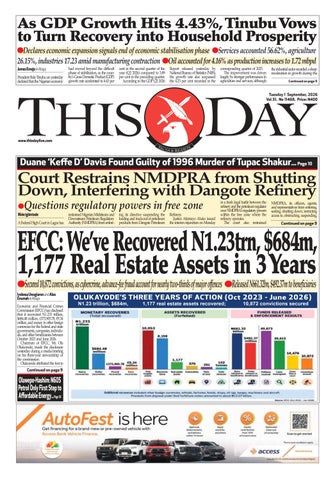
As GDP Growth Hits 4.43%, Tinubu Vows to Turn Recovery into Household Prosperity Declares economic expansion signals end of economic stabilisation phase Services accounted 56.62%, agriculture 26.15%, industries 17.23 amid manufacturing contraction Oil accounted for 4.16% as production increases to 1.72 mbpd James Emejo in Abuja
President Bola Tinubu on yesterday declared that the Nigerian economy
had moved beyond the difficult phase of stabilisation, as the country’s Gross Domestic Product (GDP) growth rate accelerated to 4.43 per
cent in the second quarter of the year (Q2 2026) compared to 3.89 per cent in the preceding quarter. According to the GDP Q2 2026
Report released yesterday by National Bureau of Statistics (NBS), the growth rate also surpassed the 4.23 per cent recorded in the
corresponding quarter of 2025. The improvement was driven largely by stronger performances in agriculture and services, although
the industrial sector recorded a sharp moderation in growth during the Continued on page 9
Tuesday 1 September, 2026 Vol 31. No 11468. Price: N400
www.thisdaylive.com TR
UT H
& RE A S O
N
Duane ‘Keffe D’ Davis Found Guilty of 1996 Murder of Tupac Shakur... Page 10
Court Restrains NMDPRA from Shutting Down, Interfering with Dangote Refinery Questions regulatory powers in free zone
Wale Igbintade
A Federal High Court in Lagos has
restrained Nigerian Midstream and Downstream Petroleum Regulatory Authority (NMDPRA) from enforc-
ing its directive suspending the loading and truck-out of petroleum products from Dangote Petroleum
Refinery. Justice Akintayo Aluko issued the interim injunction on Monday
in a fresh legal battle between the refinery and the petroleum regulator over NMDPRA’s regulatory powers within the free zone where the refinery operates. The court also restrained
NMDPRA, its officers, agents, and representatives from entering, sealing, shutting down, restricting access to, obstructing, suspending, Continued on page 9
EFCC: We’ve Recovered N1.23trn, $684m, 1,177 Real Estate Assets in 3 Years Secured 10,872 convictions, as cybercrime, advance-fee fraud account for nearly two-thirds of major offences Released N661.32bn, $492.37m to beneficiaries
Iyobosa Uwugiaren and Alex Enumah in Abuja Economic and Financial Crimes Commission (EFCC) has disclosed that it recovered N1.233 trillion, $684.48 million, £373,905.78, €9.34 million, and money in other foreign currencies for the federal and state governments, companies, individuals, and other beneficiaries between October 2023 and June 2026. Chairman of EFCC, Mr. Ola Olukoyede, made the disclosure yesterday during a media briefing on his three-year stewardship of the commission. Olukoyede attributed the feat to Continued on page 9
Olawepo-Hashim: N605 Petrol Only First Step to Affordable Energy... Page 26
OLUKAYODE’S THREE YEARS OF ACTION (Oct 2023 - June 2026) N1.23 trillion, $684m,
1,177 real estate assets recovered;
10,872 convictions secured
2
TUESDAY SEPTEMBER 1, 2026 • T H I S D AY
TUESDAY SEPTEMBER 1, 2026 • T H I S D AY
3
4
TUESDAY SEPTEMBER 1, 2026 • T H I S D AY
5
THISDAY • TUESDAY, SEPTEMBER 1, 2026
Group News Editor: Goddy Egene Email: Goddy.egene@thisdaylive.com, 0803 350 6821, 0807 401 0580
NEWS
TINUBU IN LONDON...
Nigeria’s High Commissioner to the United Kingdom, Ambassador Aminu Dalhatu welcoming President Bola Ahmed Tinubu who is on leave to Europe at the United Kingdom on Sunday PHOTO STATE HOUSE.
Shettima: Nigeria Will No Longer Tolerate Dehumanisation of Its Citizens Says South Africans must rethink xenophobic, afrophobic attacks Departs Angola for Nigeria after AU summit
Deji Elumoye in Abuja Vice President Kashim Shettima yesterday declared that Nigeria will no longer tolerate the dehumanisation or mistreatment of its citizens across the globe. He also restated Nigeria’s strong opposition to xenophobic and Afrophobic attacks against Nigerians and other African nationals in South Africa. This is just as the Vice President departed Luanda, Angola, for Nigeria after representing President Bola Tinubu at the 21st Extraordinary Session of the Assembly of Heads of State and Government of the African Union (AU). Speaking to newsmen in Luanda shortly before his departure, Shettima said, “the government and people of Nigeria will no longer countenance a situation whereby our people are dehumanised and
put into very, very unacceptable situations. “But we believe in having very robust conversations with our South African brothers. We don’t want to overheat the polity, but once in a while, you have to make it
very clear, vehemently clear, that certain situations are unacceptable, and we’ll work things out.” According to the Vice President, Nigeria remains committed to resolving concerns with South Africa through dialogue and
peaceful engagement but would continue to make its position clear whenever the dignity and safety of Nigerians are threatened. “Those whose palm kernels were cracked by benevolent spirits should learn to be humble. We were part
The National Agency for Science and and Infrastructure (NASENI), has engaged in a partnership with AfriLab to identify 100 local products that are already in the market which are real problem-solvers. The partnership aims to identify, train and mentor 100 startups with products that are already in the market, refine and improve on them, and give them more visibility in the market. The Executive Vice Chairman (EVC) of NASENI, Khalil Halilu said
Afrophobic attacks, urged South African authorities to protect lives and uphold human dignity in the enforcement of the country’s immigration policies. Shettima had since departed Luanda for Nigeria’s capital, Abuja.
Five African Women Win 2026 Bayer Foundation Award for Health, Food Innovation
Mary Nnah
Five women from Kenya, Ethiopia, Nigeria and Morocco have emerged as winners of the 2026 Bayer Foundation Women Entrepreneurs Award for Africa, securing €25,000 each and six months of accelerator support to scale ventures addressing critical gaps in healthcare and food security.
The winners were announced recently during a virtual Media Parley hosted by the Bayer Foundation and the Impact Hub Network. They were selected from 1,172 global applications, with half of the entries coming from Africa. The Africa cohort forms part of 15 winners globally, with five each from Africa, Asia and Latin America.
The African winners are Dr. Alice Muhuhu, Founder of Aurora Health Systems in Kenya; Beamlak Alemayehu, Founder of Medanit Digital Health in Ethiopia; Omowunmi Christine EmmanuelOgah, Founder of ExCare Health in Nigeria; Funmilayo Ishola, Co-Founder of Dehydrator Hub in Nigeria; and Sokayna Bellam,
NASENI Partners AfriLab to Improve Market Value of 100 Local Products Oghenevwede Ohwovoriole in Abuja
of the struggle for the liberation of our brothers and sisters in Southern Africa, and we feel personally pained that our people have been picked up for humiliation,” Shettima said. The Vice President, while condemning the xenophobic and
the acceleration journey embarked upon by the partnership will at the end identify and refine 100 improved products and solutions and create 100 investable businesses that will create 400 jobs Speaking at the official launch of the NASENI/AfriLab Accelerated programme on Monday in Abuja. Halilu who was represented by his Special Adviser on ICT Bashir Aliyu, said, “at the end of the programme, we are expected to have 100 refined and improved products and solutions, 100 investable businesses with a potential to create 400 direct and indirect jobs through these businesses.”
He added, “These ventures will be challenged and equipped to move from promising startups to scalable businesses. At the end, the top performing ventures will have the opportunity to present their solutions before seasoned investors, industry leaders, policy makers, strategic partners, not as concepts searching for validation, but as businesses that are ready to receive money as investments to scale. This is one of the reasons AfriLab is particularly proud of these partnerships.” In her remarks, the Co Executive Director of AfriLab, Nanko Madu, said, “Our mission is to build a
thriving innovation ecosystem across Africa by strengthening innovation hubs such as the NASENI Innovation Hub, connecting entrepreneurs to opportunities, and fostering collaborations that transform innovation into sustainable businesses, jobs, and economic growth. “When the EVC articulated the vision for an innovation ecosystem capable of translating Nigeria’s ingenuity into commercial and industrial success, AfriLabs, of course, was invited to work alongside NASENI to design, build, and operationalise that vision. Together, we mapped out the technology ecosystem.”
Founder of Jodoor in Morocco. Dr. Muhuhu, a medical doctor, developed Aurora’s AI-powered, offline-capable ECG device that detects more than 50 cardiac conditions. She said the idea was born during COVID-19 while working in a public hospital where patient outcomes depended on access to diagnostics. “Africa has the potential to build world-class technology. We should not only consume innovation, but we can create it,” she said. In Ethiopia, Alemayehu launched Medanit Digital Health, the country’s first multi-channel digital health platform, delivering care through an app, web portal and a national health short code. In Nigeria, Emmanuel-Ogah’s ExCare Health has turned community pharmacies into integrated primary care hubs offering diagnostics, vaccines and medication. “What started as a pharmacy chain now operates five pharmacies, two laboratories and two accredited immunisation centres under the National Primary Health Care Development Agency”, she noted. She said her healthcare journey began after an aunt nearly died from meningitis while the family searched
four states for drugs. Also in Nigeria, Ishola’s Dehydrator Hub is tackling post-harvest losses with solar-powered food processing infrastructure that converts waste into export-ready ingredients. Africa loses an estimated 22 percent of annual food production, valued at nearly $92 billion, according to the Food and Agriculture Organization. In Morocco, Bellam’s Jodoor uses hydroponic farming to cut water use by 80 percent, a model designed for climate-stressed farmland in a region where agriculture accounts for more than 80 percent of freshwater use. Jana Op Den Winkel, Communications and Programme Lead at Bayer Foundation, said the award is designed to do more than recognise achievement. “It’s about asking what these solutions could become if the women behind them have the capital, the networks and the support to scale,” she said. The six-month accelerator will focus on investor readiness, business fundamentals and impact metrics, with winners also gaining visibility at a global event in Amsterdam in October.
6
TUESDAY SEPTEMBER 1, 2026 • T H I S D AY
7
THISDAY • TUESDAY, SEPTEMBER 1, 2026
NEWS
8TH EDITION OF THE CUSTODIAN MENTORS CONFERENCE...
L-R: Founder and Group Managing Director, Custodian Investment Plc, Wole Oshin; Co-Founder and Chief Creative Officer, Livespot360 and Speaker at the Custodian Mentors Conference, Darey Art Alade; Group Managing Director/CEO, TVC Communications and Speaker at the conference, Victoria Abiola Ajayi; Chief Executive Officer, Custodian Social Responsibility Foundation (CSRF), Olubunmi Aderemi; Founder and Principal, Alder Consulting, Leke Alder; and Executive and Behavioural Change Coach, The Catalyst, and Speaker at the conference, Dr. Lanre Olusola, during the 8th edition of the Custodian Mentors Conference held at Eko Hotel, Lagos, last Saturday
FG Delivers 129 FMBN-funded Housing Units, Pledges Additional 122 by Year-end Minister says 100,000 units to be completed before end of Tinubu’s tenure
Emmanuel Addeh in Abuja
The federal government yesterday handed over 129 housing units to beneficiaries of the Federal Mortgage Bank of Nigeria (FMBN) Rent-toOwn housing programme and promised to deliver the remaining 122 units before the end of 2026. The Minister of Housing and Urban Development, Muttaqha Darma, gave the assurance at the
handover ceremony held at the Nasarawa Technology Village, Karu, Nasarawa State. Darma said the 129 beneficiaries had been unable to take possession of their homes after part of the Brains & Hammers Bungalow City, where they were originally allocated houses, was subsequently allocated to security agencies. “Today marks the culmination of a difficult chapter into a new begin-
ning for 129 Nigerian families. The Federal Mortgage Bank of Nigeria is now delivering the keys to 129 of these beneficiaries. I assure the 122 others that before the end of this year, you will also have your keys,” the minister said. He said the delivery fulfilled a commitment by the government to resolve the housing challenge faced by the affected beneficiaries, noting that the 129 units were delivered
before the end of August as earlier promised. The minister said the development was consistent with the housing component of President Bola Tinubu’s Renewed Hope Agenda, stressing that the government’s housing policy was focused on improving the welfare of Nigerians and restoring confidence in public institutions. “Our housing agenda is not
Diri: Premium Trust Bank’s Second Branch Signals Confidence in Bayelsa Economy Inaugurates State Advisory Council
Nume Ekeghe Governor of Bayelsa State, Senator Douye Diri, has described Premium Trust Bank’s expansion in the state as a sign of growing investor confidence in the Bayelsa economy. Diri stated this on while commissioning the bank’s second branch located around the Etegwe/ Edepie roundabout axis in Yenagoa yesterday. In a statement, Diri said the opening of another branch by the financial institution came at a time when Bayelsa was entering a new phase of economic opportunities, particularly
with the expected commencement of operations of the state’s 60-megawatt independent power plant. According to him, improved electricity supply would provide a major boost to businesses and industries by reducing some of the constraints associated with doing business in the state. He said reliable power would stimulate enterprise, attract new investments, create jobs and improve the living standards of residents, adding that the emerging economic environment would also increase the demand for credible financial institutions.
“It will also increase the need for credible and innovative financial partners,” Diri said. The governor said businesses and individuals would require financial institutions capable of providing innovative banking solutions and easier access to capital as economic activities expand. He therefore urged Premium Trust Bank to look beyond Yenagoa and establish branches at local government headquarters and other emerging commercial and university communities across the state, including Amassoma and Otuoke. Diri said expanding banking
services across the state would deepen financial inclusion and make it easier for traders, farmers, fishermen, artisans, civil servants, women, entrepreneurs and young business owners to access financial services. “When banking grows closer to the people, commerce becomes easier, enterprise expands and prosperity spreads,” he said. The governor also urged residents and business owners to take advantage of the peaceful and secure environment created by his administration to build sustainable businesses.
simply about structures. It is about people and about restoring confidence in the public institutions under the present government,” Darma said. He assured Nigerians that more houses would be delivered before the end of the year through the Federal Housing Authority (FHA), FMBN and projects being constructed directly by the Ministry of Housing and Urban Development. He reiterated the federal government’s commitment to delivering 100,000 housing units promised by the President before the end of his tenure. “I will assure Nigerians that 100,000 housing units, as promised by Mr. President, will be delivered before the end of this tenure,” he said. In his remarks, the Managing Director and Chief Executive Officer of FMBN, Shehu Osidi, said the 129 units represented the first batch of 251 housing units expected to be delivered to FMBN Rent-to-Own beneficiaries who could not take possession of their allocated homes under the Bungalow City project. Osidi said the units were funded by FMBN and developed by Modern Shelter Systems and Services Limited at Nasarawa
Technology Village. He described the handover as a demonstration of FMBN’s commitment to its customers, institutional responsibility and effective stakeholder management. “Most importantly, it is a promise kept,” Osidi said. He said the development also demonstrated that FMBN would not abandon National Housing Fund (NHF) contributors who had remained committed to the scheme. “The event we are having today sends a clear message: FMBN will not abandon any NHF contributor who has demonstrated loyalty and commitment to the National Housing Fund and to the Bank,” he said. Giving the background to the development, Osidi said FMBN funded the Bungalow City project in 2019 to provide houses to NHF contributors. He said the subsequent allocation of part of the estate to security agencies meant that some beneficiaries could no longer take possession of their allocated houses. According to him, FMBN subsequently worked with the Federal Ministry of Housing and Urban Development, the National Assembly and other stakeholders to find a solution for the affected beneficiaries.
Young Innovators Showcase Tech Solutions in NCC’s Hackathon, Win N6 Million
persons with disabilities and other cash prizes in recognition of their NAPTIP Rescues 180 Trafficked Emma Okonji outstanding innovations, while all underserved communities. The top three teams received participating teams were presented Three teams have emerged top Children, Arrests FMC Onitsha Nurse winners of the Hackathon organised cash prizes, while all participating with consolation prizes and certifiMichael Olugbode in Abuja
The National Agency for the Prohibition of Trafficking in Persons (NAPTIP) has rescued more than 180 children allegedly trafficked from five states, uncovering a network of suspected criminal groups operating under the guise of civil society and humanitarian organisations. The agency also arrested a nurse at the Federal Medical Centre (FMC), Onitsha, Anambra State, after she was allegedly found in possession of one of the trafficked children.
According to a statement on Monday by the spokesman of the agency, Vincent Adekoye, the latest operation led to the recovery of three children allegedly taken from distressed families in Kajuru, Kaduna State, and moved to a high-rise private building in a choice area of Onitsha. He revealed that another trafficked child was recovered from the care of the nurse at FMC Onitsha. He noted the development has prompted the Director General of NAPTIP, Binta Bello to challenge
the umbrella body of civil society organisations in Nigeria to conduct an internal investigation and flush out criminal elements allegedly using the identity and platforms of legitimate organisations to traffic children. Bello said the agency had uncovered a disturbing pattern in which suspected trafficking syndicates targeted communities devastated by insecurity and other crises, presenting themselves as organisations offering educational assistance and back-toschool programmes.
by the Nigerian Communications Commission (NCC). The three winning teams showcased their technology solutions alongside other teams during the hackathon and won N6 million. SORA emerged as the overall winner of the fourth edition of the NCC’s Hackathon Live Show 2026, clinching the N3 million grand prize, while Clear Signal and IKOR secured second and third places, receiving N2 million and N1 million respectively in a competition designed to develop innovative technology solutions for
teams received consolation prizes and certificates of participation for their contributions to advancing digital inclusion and accessible technology development. The winning teams were announced at the conclusion of the two-day competition, which brought together young innovators from across the country to develop technology driven solutions aimed at expanding digital participation and supporting inclusive economic growth. The top three teams received
cates of participation. The winning solution, SORA, is an inclusive job-matching and adaptive skills platform designed for verified persons with disabilities in Nigeria, helping to connect users with employment opportunities and skills development resources. Clear Signal, which placed second, enables blind, visually impaired, deaf, and hard-of-hearing electricity consumers to receive accessible power outage alerts through voice calls, text messages, and visual notifications.
8
TUESDAY, SEPTEMBER 1, 2026 • THISDAY
NEWS
BIRTHDAY THANKSGIVING...
L-R: Mother of the celebrant, Mrs. Azuka Uwanaka; the celebrant, Mrs. Uchechi Uwanaka Mba-Uzoukwu; Vicar/Archdeacon of the church, Ven. Syrenius B. Okoriko; Husband of the celebrant, Mr. Nduka Mba-Uzoukwu; and father of the celebrant, Chief Anele C. Uwanaka at the 40th birthday celebration of Uchechi at St. Mathew’s Anglican Church, Maitama, Abuja...recently PHOTO: KINGSLEY ADEBOYE
Meta to Charge N14 for WhatsApp Business Messages from October Emma Okonji Businesses that market their products on WhatsApp will no longer do so free of charge, as Meta, the parent company of WhatsApp, will begin to charge all business owners N14 for every business message sent through WhatsApp, with effect from October 1, 2026. According to Meta, the technology company that owns Facebook, Instagram, and WhatsApp, businesses using the WhatsApp platform will be charged about N14 per message for Nigerian numbers by Meta, the parent company of WhatsApp, from October 1, 2026. Ordinary users are not affected by the new development as they will continue to use WhatsApp without paying per message. The targeted businesses include banks, Fintech companies, telecommunications companies, retailers and e-commerce platforms that use WhatsApp to provide customer support, send transaction alerts,
confirm orders, and market their products. Before now, Meta made 98 per cent of its money from selling
digital advertisements across its different apps. Businesses paid Meta to display targeted ads to billions of daily active users based
The federal government has called for increased investment in Artificial Intelligence (AI) to drive the nation’s digital economy and data sovereignty. Secretary to the Government of the Federation (SGF),Senator George Akume made the call, Monday at the opening ceremony of the GITEX Nigeria 2026 Government Leadership and AI Summit in Abuja, themed, “Beyond Connectivity: The Bridge to Sovereign AI and Innovation.” He said Nigeria must move beyond being a consumer of technology to becoming a builder, producer and exporter of digital solutions and artificial intelligence. Akume, who was represented by the Permanent Secretary, Political and Economic Affairs Office, Mrs. Bekearedebo Warrens, stated that government’s digital transformation agenda was being
impressions. The new move to charge business owners with Nigerian numbers for every business mes-
sage, will be an additional stream of income for Meta, which says it spends so much to maintain the WhatsApp platform.
UBTH Cancer Treatment Centre now 100 % Operational, Says CMD
Felix Omoh-Asun in Benin
The Chief Medical Director of the University of Benin Teaching Hospital (UBTH), Prof. Ida Ize-Iyamu, yesterday, said the Cancer Treatment Centre housed by institution is now a world class facility operating at full capacity. Prof. Ize-Iyamu who disclosed this in Benin during the commissioning of the state-of-the-art ambulance, said the centre is now 100 percent operational and one of the biggest in the country. While appreciating President Bola Tinubu for allowing the centre to be sited in the University of Benin Teaching Hospital, Prof. Ize-Iyamu said the centre is one of three in
Nigeria. The CMD expressed gratitude for the ongoing federal support under President Bola Ahmed Tinubu’s Renewed Hope Agenda and pledged judicious use of the ambulance. “We thank President Bola Ahmed Tinubu led federal government under the Renewed Hope Agenda for the invaluable support to UBTH. This donation will enhance our emergency medical services and deliver our mandate to provide quality healthcare delivery,” she stressed. She explained the poor can now access cancer treatment through Cancer Health Fund as approved by the Honorable Minister of Health
FG Canvasses Increased Investment in AI to Drive Digital Economy Oghenevwede Ohwovoriole in Abuja
on demographics, interests and online behaviour, while advertisers used an auction system, setting a budget and bidding for ad
implemented through series of reforms designed to establish foundations of a competitive digital economy. “These reforms capture the very essence of where Nigeria is headed, not merely as a consumer of technology, but as a builder, producer and exporter of digital solutions and artificial intelligence,” he said. According to him, the government’s reforms in digital identity were aimed at strengthening Nigeria’s data sovereignty and establishing a more robust foundation for digital public infrastructure. He said the recently referenced reforms to the National Identity Management Commission (NIMC) framework would strengthen the country’s ability to manage and secure its digital identity infrastructure. Akume also highlighted Project Bridge, through which the government plans to deploy about
90,000 kilometres of fibre-optic infrastructure across the country to connect states, local government areas and wards. The connectivity programme, he stated, was being complemented by telecommunications infrastructure aimed at extending broadband access to millions of Nigerians in underserved communities. The SGF further pointed to the 3 Million Technical Talent (3MTT) programme as a key component of the government’s human-capital strategy. He said the programme had recorded about 1.87 million registrations across all 774 local government areas, with more than 125,000 Nigerians trained, particularly in areas such as cloud computing, AI, cybersecurity and software engineering. Akume said the objective was to develop a workforce capable of creating digital products rather than simply consuming technologies developed elsewhere.
and Social Welfare, Alli Pate, through the office of Mr. President and his renewed hope agenda on health. “So if you are poor, you can receive radiotherapy in the University of Benin Teaching Hospital, courtesy of this administration,” she declared. Prof. Ize-Iyamu who also heaped praises on the Edo State Deputy Governor Dennis Idahosa for his role in bringing about the ambulance, said cancer can be defeated through the centre. “We are the number one cancer treatment centre in the south-south of Nigeria. The centre has state-ofthe-art equipment. “We have a Linear accelerated machine; we have a 16-slice CT (a multi-slice computed tomography) a medical imaging scan that uses X-rays and computers to take many cross-sectional pictures inside the body at the same time, where we simulate the patient’s lesion before the targeted lesions are done using radiotherapy. That machine is the latest in technology in the world,”
she added. Speaking on the ambulance, the CMD stressed that it is a walking theatre. “When I say walking theatre, it’s an ambulance that can do and undo. What it does is that it helps us in evacuating cases of trauma from the site to where they will receive care, which is UBTH. “And before they get to the site of care, a lot of interventions can be done within that ambulance. That’s why we say it’s a walking theatre. And we are privileged to be one of the recipients of this very wonderful gift from the federal government.” She noted that though many challenges are plaguing the institution for the hospital is over 50 years old, they are surmountable. Presenting the ambulance to UBTH on behalf of the federal government, the deputy governor commended the CMD and her management team for driving excellence in healthcare delivery at the tertiary health institution.
The Edo State deputy governor, facilitated the ambulance donation while a member of the House of Representatives formally handed over the vehicle on behalf of the federal government to the UBTH. Hon. Idahosa pledged the Edo State government’s unwavering commitment to supporting sustainable healthcare services and expressed his gratitude to the hospital’s management for providing exceptional medical care to his late mother, Madam Esther Imaguomwanruo Idahosa, during her admission at the facility prior to her passing. “I have been part of the process to attract this donation from my days as a member of the House of Representatives. I thank the President and the Minister of the Federal Republic and the Federal Ministry of Health. They have done fantastically well. However, I want to tell the President of Nigeria that we need more projects in UBTH as it is strategically located in Nigeria.
Lagos Begins Three-Year Plan to Make Primary Healthcare More Resilient
Ayodeji Ake
The Lagos State Government is developing a three-year strategy to close critical gaps in its primary healthcare system as population growth, malnutrition, workforce shortages and disease outbreaks continue to put pressure on health facilities across the state. The proposed strategy emerged from a three-day strategic planning workshop organised by the Lagos State Primary Health Care Board (LSPHCB), with support from the World Bank-backed IMPACT Project and participation from chairmen of Local Government Areas (LGAs) and Local Council Development Areas (LCDAs).
The plan is expected to establish a baseline for primary healthcare services across Lagos, identify infrastructure and workforce deficiencies, clarify responsibilities among government institutions and development partners, and provide a costed framework for healthcare investments over the next three years. Speaking during the workshop, the Lagos State Commissioner for Health, Prof. Akin Abayomi, said primary healthcare remained central to meeting the needs of the state’s rapidly growing population and achieving its long-term development objectives. Abayomi said sustained investment would be required in infrastructure, medical equipment, human resources and healthcare financing, while the
government must also prepare for emerging and persistent public health threats. “The vision is clear: Lagos must build a resilient PHC system capable of serving today’s needs while preparing for the Lagos of tomorrow,” he said. Challenges identified during the planning process included population pressure, climate change, infectious disease outbreaks, antimicrobial resistance, malnutrition, non-communicable diseases, drug abuse, brain drain and shortages of healthcare workers. The Permanent Secretary of the LSPHCB, Dr. Ibrahim Mustafa, described the exercise as a “turning point” for primary healthcare development in Lagos.
9
THISDAY • TUESDAY, SEPTEMBER 1, 2026
Nepal Flood Death Toll Crosses 900 as Rescue Efforts Continue
NINE
Red Cross: More than 90,000 people affected by incident 900 workers trapped underground at hydropower projects
Emmanuel Addeh in Abuja Nepal’s rescue teams, aided by Chinese and Indian experts, were yesterday racing to save more than 900 workers believed to be trapped underground at hydropower projects hit by devastating flash floods, with another 900 already confirmed dead. Nepali officials said that the focus was on reaching the workers in about a dozen hydropower project tunnels blocked by mud and rock debris. The unprecedented deluge of ice, rock, mud and debris on the Nepal-Tibet border on Wednesday caused by a glacier collapse has killed 903 people with 4,247 missing in Nepal, its disaster authority said.
The flood also wreaked havoc across the border in China’s Tibet region, where at least 16 people died and 546 are missing, said Chinese authorities. Pictures and videos shared by rescue teams in Nepal showed earth-moving equipment digging and shovelling mud and rocks under lights in the dark of the night as workers watched. Soldiers used torchlights in a big pit they had created to look for space to get into one tunnel, Al Jazeera reported. “A large amount of debris has been deposited and that is posing us a big challenge to open the tunnels,” Nepal army spokesperson, Raja Ram Basnet, told the Reuters news agency.
“Our main focus is on opening the tunnels,” he added. Hundreds of bodies, many unidentified, have been buried in shallow graves as they began decomposing in the humid weather after being swept down the mountains by the torrent. At a hospital in the capital of Kathmandu, morgues have reached capacity and families are flocking to other hospitals in hopes of finding missing loved ones, reported Al Jazeera. In addition to the 933 missing hydropower workers, some 500 workers from the Truck and Container Association are also missing, said Fernandez.
The Red Cross has estimated that more than 90,000 people are likely to have been affected by the disaster, which China has linked to the effects of climate change. Prime Minister, Balendra Shah, said the flood was an “unprecedented and devastating natural disaster” and it remained challenging to compile a complete assessment of the damage. “Despite the adverse weather, difficult terrain and continuing risks, we are moving forward with determination to save the lives of our citizens,” he said in a Facebook post, adding that nearly 21,000 security personnel were involved in rescue operations, besides civilian workers
and volunteers. While accessibility has been restored on many roads and highways, almost “40 kilometres of roads have been absolutely swept away”, Al Jazeera said. “So there are challenges on the ground in getting this aid to communities, but the authorities, as well as the agencies and their networks are working their way through it.” China’s state-run CCTV said the government has mobilised more than 2,100 rescue workers and allocated at least 220 million yuan ($33 million) to support relief efforts. Equipment and supplies have been airdropped to frontline rescuers, while Chinese soldiers used life-detection equipment
EFCC: WE’VE RECOVERED N1.23TRN, $684M, 1,177 REAL ESTATE ASSETS IN 3 YEARS
the commitment and passionate engagement of his team in the fight against economic and financial crimes and other acts of corruption. He stated, “At my confirmation before the National Assembly, I outlined a three-pronged agenda as the anchor of my stewardship. To the glory of God, we have kept faith with the agenda of proper focusing on the mandate of the EFCC in the overall interests of Nigerians, using the instrumentality of the anti-graft war to stimulate growth in the economy, adherence to the rule of law, commitment to transactional credits, building the image of Nigeria, and optimising foreign direct investments.” Describing asset recovery as a major pillar of his stewardship, the
chairman disclosed, “Between October 1, 2023 and June 30, 2026, the commission recorded recoveries of N1,233,612,040,411.11; $684,478,457.32; £373,905.78; €9,343,803.66 in addition to recoveries in other currencies. “Of the naira amount, approximately N397.26 billion, or 33 per cent, represented direct recoveries for the federal government, while N836.34 billion, or 67 per cent, represented indirect recoveries made on behalf of ministries, departments and agencies (MDAs), state revenue services, companies, individuals, and foreign victims. “Two out of every three naira recovered were on behalf of beneficiaries other than the federal government.” The EFCC boss explained that
within the period, N661.32 billion and US$492.37 million were released to beneficiaries. He said the naira releases included about N325.35 billion paid directly to individuals and corporate bodies, and another N335.97 billion released to various MDAs, Nigerian Revenue Service, and states’ internal revenue services, alongside releases to other public institutions, companies, and individuals. According to him, federal and state tax recoveries amounted to about N288.1 billion, comprising N173.2 billion in federal tax recoveries and N114.9 billion attributed to states’ internal revenue services. An additional N257.2 billion recovery was recorded for federal MDAs, he added.
Olukoyede said the figures demonstrated that asset recovery was not merely about confiscating proceeds of crime, but returning value to the public and legitimate beneficiaries. “Recovery is only truly meaningful when value is returned to the public interest and to rightful beneficiaries,” Olukoyede said. He also highlighted the use of recovered assets for national development, stating that N50 billion each had been allocated from recovered proceeds to Nigerian Education Loan Fund (NELFUND) and Nigerian Consumer Credit Corporation. He stated, “The national impact of recovery is, perhaps, clearest when proceeds of crime are converted into productive social investment.
COURT RESTRAINS NMDPRA FROM SHUTTING DOWN, INTERFERING WITH DANGOTE REFINERY
disrupting, inspecting, supervising, sanctioning or otherwise interfering with Dangote Refinery’s operations at the Lekki Free Zone pending the determination of the refinery’s motion on notice. The order followed an ex-parte application filed by Dangote Petroleum Refinery and Petrochemicals FZE in suit No. FHC/L/CS/1174/2026. The refinery is challenging NMDPRA’s August 24, 2026 directive suspending the loading and truck-out of petroleum products from its facilities. Dangote’s application was argued by a legal team led by Senior Advocates of Nigeria (SANs), Olawale Akoni and Abimbola Akeredolu. Moving the application, Akeredolu urged the court to grant the reliefs sought, relying on a 42-paragraph affidavit deposed to by Wale Aroge, a written address, and documentary exhibits marked A1 to A6. In his ruling, Aluko held that the materials placed before the court raised serious issues requiring determination, particularly whether NMDPRA possessed regulatory or oversight powers over operations within free zones. The judge stated that Dangote’s case was that NMDPRA lacked regulatory powers capable of affecting operations within free zones, including the Dangote Industrial Free Zone. Aluko also referred to a March 2, 2026 letter written by AttorneyGeneral of the Federation, which, according to the judge, “clearly stated” that NMDPRA was not entitled to exercise regulatory
powers or oversight functions over operations within free zones. The judge said he had also considered NMDPRA’s August 24 letter through which the regulator purported to exercise such powers. “The important question, therefore, is whether the defendant can or should be allowed to exercise such regulatory authority pending the determination of the substantive issues before the court,” Aluko held. He said the depositions contained in paragraphs 17 to 32 of Dangote’s affidavit disclosed “serious issues for determination” and demonstrated an urgent need for judicial intervention. According to the judge, the purpose of the application is to preserve the subject matter of the dispute pending the determination of the motion on notice. “What the plaintiff has asked this court to do is to preserve the res pending the determination of the motion on notice,” he said. Aluko further held that the court had an inherent power and duty to preserve the subject matter of litigation and prevent a situation in which it could be destroyed or altered before the substantive application was determined. The judge said Dangote had satisfied the legal conditions required for the grant of an interim injunction. He held, “The law is settled on the conditions which an applicant must satisfy to be entitled to an order of interim injunction. Those conditions have been considered and stated in this ruling, and I find that they have been satisfied in the present case.” The court also took note of
Dangote’s undertaking to indemnify NMDPRA in damages should it subsequently be established that the interim order ought not to have been granted. “Accordingly, I find merit in the application, and the same is hereby granted in terms of the reliefs sought,” Aluko ruled. The judge directed Dangote to file a formal undertaking as to damages and ordered that the interim order and notice of the court be served on NMDPRA. The order effectively bars NMDPRA from implementing the August 24 directive or taking the specified enforcement measures against the refinery, pending the hearing of the motion on notice. Aluko adjourned the suit till September 9, 2026 for hearing of
the motion on notice. The latest case is separate from another suit filed by Dangote Refinery challenging the issuance and renewal of fuel import licences to NNPC Limited and several petroleum marketers. The earlier suit, marked FHC/L/ CS/857/2026, came up before Justice Chukwujekwu Aneke on Monday but was adjourned until October 7 following the judge’s absence due to indisposition. Dangote is challenging the issuance and renewal of the licences, contending that they were issued in breach of an earlier order made by the court on April 29 directing the parties to maintain the status quo as it existed on April 2, 2026. The refinery is seeking, among Continued on page 27
“In August 2024, the federal government directed that N50 billion each be allocated to the Nigerian Education Loan Fund (NELFUND) and the Nigerian Consumer Credit Corporation from proceeds of crime recovered by the EFCC. Further NELFUND and Credit Corp funding from EFCC recoveries (N50 billion each) was subsequently approved in 2026.” The chairman also disclosed that NOK University, a recovered property, had been converted into Federal University of Applied Sciences, Kachia, Kaduna State, with a total of 1,909 students matriculating at the institution in December 2025. Beyond monetary recoveries, Olukoyede disclosed that the commission secured the forfeiture of 10,053 tangible assets under interim and final court orders between October 2023 and July 2026. The forfeited assets, according to him, included 8,198 electronic items, 1,177 real estate assets, 370 automobiles, and 251 plots of land, as well as schools, factories, hotels, shops, oil rigs, barges, machinery, and aircraft. He said, “We also recorded the forfeiture of 102 tonnes of solid minerals. Proceeds from disposal under final forfeiture orders amounted to approximately N12.07 billion and were paid to the federal government.” In the area of enforcement, Olukoyede said the commission, within the same period, “received 49,673 petitions, investigated 39,615 cases, filed 14,476 cases in court, and secured 10,872 convictions”. He said the figures represented a conviction-to-filing ratio of 75.1 per cent, and added that EFCC secured
Napal President, Ram Chandra Paudel to look for the missing. Beijing said 261 foreign nationals from 23 countries were unaccounted for in Tibet. President Xi Jinping, according to state media, called for all out efforts to rescue those missing in the mudslide, and this is the second time that the president has made such a call. China has sent nine tunnel rescue experts to Nepal and shared satellite information with Nepalese authorities, said Yu. 1,370 convictions from 1,889 filings in the first half of 2026 alone. Olukoyede said the commission’s data showed that economic and financial crimes were evolving, with advance-fee fraud and cybercrime accounting for nearly two-thirds of 46,288 offences recorded across nine major typologies between 2024 and 2026. He stated, ‘’Data from petitions and case analysis provides an indication of the shifting trends in the financial crime threat landscape. Our 2024 to 2026 year-to-date category data recorded 46,288 offences across nine major typologies. ‘’Advance fee fraud and cybercrime together represented nearly two-thirds of recorded offences. However, between 2024 and 2025, total recorded offences rose by 24.1 per cent, with notable increases in procurement fraud, bank fraud, cybercrime, and economicgovernance offences. ‘’This tells us something important: the fight against economic and financial crime is not only about grand corruption. Every day, we are protecting citizens, businesses and institutions from fraud, cyber-enabled crime, and other forms of economic exploitation.” The EFCC chairman also disclosed that the commission had continued to prosecute high-profile cases involving former governors, ministers, public office holders, agency heads, financial-sector operators, and corporate officials. He cited recent convictions involving Saleh Mamman, Robert Orya, and Chukwunyere Nwabuoku, stressing that no individual or Continued on page 27
AS GDP GROWTH HITS 4.43%, TINUBU VOWS TO TURN RECOVERY INTO HOUSEHOLD PROSPERITY quarter. Tinubu, in a statement issued by Special Adviser to the President (Information and Strategy), Mr. Bayo Onanuga, said the report could not have come at a better time. Onanuga said the opposition had been trying to diminish the Tinubu administration’s efforts since May 2023 and even promising to reverse the policies if, perchance, Nigerians voted for them. The statement said, “In the past three years, we tried to do the hard part by implementing the necessary reforms to stabilise the economy. Now the economy is stabilised, and we have laid the foundation for a prosperous nation. We didn’t do the reforms to create challenges,
but to ensure prosperity reaches all our people. “The results of the efforts are becoming very clear to all: The Renewed Hope Agenda is working. Because of those tough decisions, today Nigeria has trade surpluses. Our foreign reserves are at their highest in 17 years. “Our credit rating has moved up several notches. We are building roads, railways and superhighways that will last for a long time. Investors who left are returning. Oil and gas production is increasing. “And in our universities - for the first time in a long time - there are no strikes. Our children are in class. And through NELFUND, student loans are putting education within
reach, and affordable credit is going to our civil servants through Creditcorp.” Onanuga stated, “In the next few weeks, we are addressing some of the challenges being faced by our vulnerable population by providing cheaper means of transport, ramping up food production and implementing various relief programmes that will touch lives at the grassroots. “Under our watch, the economy is on the irreversible path to experience even more growth that all homes will feel at the dining table and in their pockets. We are not resting on our oars. “We are fully committed to translating consistent, stronger
economic performance into better microeconomic outcomes for our citizens. We must stay vigilant by ensuring the sustainable progress we are recording remains irreversible.” Meanwhile, the services sector remained the largest contributor to economic output, accounting for 56.62 per cent of real GDP, slightly higher than the 56.53 per cent recorded in Q2 2025. Aggregate GDP at basic prices stood at N119.29 trillion in nominal terms during the quarter, representing an 18.43 per cent increase over the N100.73 trillion recorded in Q2 2025. However, real GDP stood at N53.47 trillion. Continued on page 25
10
TUESDAY, SEPTEMBER 1, 2026 • THISDAY
NEWS
ROYAL COURTESY...
L–R: His Imperial Majesty, Oba Ajibade Gbadegesin Ogunoye III, the Olowo of Owo Kingdom; Chief Taiwo Kabir Adeyemi; and the Executive Chairman, Still Earth Group, Ms Oyindamola Lami Adeyemi, during the revered monarch’s courtesy visit to her Banana Island residence in Lagos at the weekend
Duane ‘Keffe D’ Davis Found Guilty of 1996 Murder of Tupac Shakur Rap legend was only 25 when he was shot 30 years ago Convicted gang leader vows to appeal judgement Emmanuel Addeh in Abuja A Las Vegas jury has found former South Side Compton Crips gang leader, Duane Keith Davis, guilty of the murder of Tupac Shakur, bringing the case to a close nearly 30 years after the famous rapper was gunned down. The jury took about three hours to reach a guilty verdict in a case that relied heavily on multiple confessions from Davis himself, including his description of the killing in the 2019 memoir, Compton Street Legend, the
Guardian UK reported this morning. Shakur was born in 1971 in East Harlem, New York, and rose to fame in the early nineties, with poetic flow that doubled as sharp commentary on social injustice, including systemic racism, police brutality and the struggles felt by marginalized communities. Regarded among the greatest rappers to ever live, Shakur affected generations and continued to be celebrated around the world even years after his life was cut short. He was only 25 years old when he died in the hospital days after
being shot four times in a car near the Las Vegas Strip. Reverence for the rapper has long inspired conspiracy theories about his death as questions swirled around who was involved, why the case remained open for years and even whether Shakur was actually dead. The trial has offered some resolution, even as family members and fans continue to mourn both the man and the years it took to bring details of his death to light, the Guardian report stressed.
Over the weeks-long trial, Marc DiGiacomo, the Clark county district attorney, and Binu Palal, the chief deputy district attorney, brought 25 witnesses to the stand, including some who had to be ordered by the court because they were reluctant to testify in their case against Davis. The 63-year-old man who was accused of instigating the deadly shooting, although not pulling the trigger himself, had spent years telling investigators and interviewers alike of his direct involvement before he was
Firms Invest $4m for Expansion of Solar Mini-Grids in Nigerian States Blessing Ibunge in Port Harcourt To ensure expansion and access to renewable energy in Nigeria, All On and Energise Africa (EA), invested a total of $4million for the development and deployment of solar-powered mini-grids across 19 communities in Jigawa and Bauchi States. The project shall be executed by Maskh Nigeria Limited, a company comprising skilled professionals in renewable energy, construction, engineering, electrification and procurement services. Speaking on the Investment, Chief Executive Officer of All On, Caroline Eboumbou, said the project will bring reliable, affordable and sustainable electricity to households, businesses and public institutions currently without dependable electricity access. While noting the investment is being made under the Demand Aggregation for Renewable energyTechnology (DART) Programme, Eboumbou stated the project is expected to impact 100,000 people, while supporting local enterprise development, improving access to essential services and reducing dependence on traditional energy alternatives. “For communities across Jigawa and Bauchi where energy access
remains limited, decentralised energy infrastructure can play an important role in enabling economic and social activity. “Through the deployment of solar-powered mini-grids, the project will extend reliable electricity to homes, schools, health facilities and small businesses, while creating opportunities for productive use of energy and strengthening local economies. “Energy access is not simply
about connecting communities to electricity; it is about creating the conditions for people and businesses to thrive. “This investment demonstrates All On’s commitment to backing indigenous energy companies that can deliver practical, scalable solutions to some of Nigeria’s most persistent energy access challenges. “This is the kind of catalytic investment that can help move
Nigeria’s energy transition forward in practical and meaningful ways”, Eboumbou added. On his part, Chief Executive Officer of Energise Africa, Ray Coyle, stated that by helping to bring clean, reliable power to 19 communities across Jigawa and Bauchi States, UK investors are supporting lasting social, economic and environmental impact that will benefit thousands of people in Nigeria.
arrested in 2023. Davis’s Attorney, Michael Sanft, tried to frame the stories and statements as the exaggerated and embellished claims of a man hoping to benefit from the public interest and unanswered questions around Shakur’s murder. Prosecutors played eight hours of recordings, taken from four separate events in different years, during which Davis shared in his own words what happened the night of September 7, 1996. Davis wrote that he had hatched the plan to retaliate against Shakur, after the rapper’s entourage beat his nephew, Orlando “Baby Lane” Anderson, in the lobby of the MGM Grand earlier that night. Anderson, who died two years later in an unrelated shootout, was a member of a rival gang in Compton, California. Shakur and the founder of his label, Marion “Suge” Knight, had attended a Mike Tyson boxing match at the casino when the altercation with Anderson took place, and were on their way to an after-party. A white Cadillac pulled up next to them while they were stopped at a red light, and someone in that car began shooting, according to investigators. In his book, Davis claimed to have been in that car, and that he’d brought a .40-caliber Glock with him. “Them jumping on my nephew gave us the green light to want to do something to their ass,” he wrote. “Pac chose
the wrong game to play,” he added. Clark County District Court Judge, Carli Kiern, scheduled Davis’s sentencing hearing for 13 October. Prosecutors had not sought the death penalty against Davis and, after the verdict, voluntarily dropped their efforts to tack a gang enhancement on to Davis’s conviction. First-degree murder in Nevada carries penalties ranging from 20 years to life imprisonment. Davis said he plans to appeal the verdict. While the trial has finally come to an end, family members had been left to wonder for years why it took so long for investigators to reach a conclusion in the case. “We’ve been waiting 30 years to grieve properly,” Zayd Akinyela, Shakur’s cousin told reporters outside the courtroom when the trial was under way. “A lot of people don’t get to grieve until they understand what happened to their loved one and how it happened,” Akinyela said. A Los Angeles Times review of police missteps on the case, published in 2015, detailed how authorities failed to investigate Anderson even after details about the conflict between him and Shakur’s entourage became known. Police also declined to follow a lead from a member of Shakur’s entourage, who claimed he could identify the shooters. That witness died weeks later in a separate shooting, the Times reported.
FG Launches ‘Hire from Nigeria’ Initiative to Match Talent with Global Market
Olawale Ajimotokan in Abuja
The federal government has launched the “Hire from Nigeria” campaign, an initiative that will position the country as a preferred global source of skilled talent and digitally delivered services. Minister of Trade and Investment, Dr Jumoke Oduwole, joined by Minister of Information and National Orientation, Mohammed Idris and Minister Education, Dr Maruf Alausa and the Special Adviser to the President on Media and Public Communication, Dr. Sunday Dare, unveiled the programme, that
aimed to create opportunities for Nigerians to work for international employers from home. She said the programme, in partnership with the private sector partners, including Tech4Dev and NATEP Office, Ministry of Industry, Trade and Investment, would position Nigeria as a trusted global destination for talent and services while translating the country’s demographic strength into jobs, exports and investment. “Hire from Nigeria is therefore much more than a communications campaign; it is a national economic proposition. As we take it to the
global stage at the 81st United Nations General Assembly, our message will be direct: Hiring from Nigeria is not an act of goodwill. It is a sound commercial decision that delivers capability, innovation, competitiveness, and value,” Oduwole said. Minister of Education, Dr. Maruf Tunji Alausa, said the Ministry was strengthening Nigeria’s talent pipeline through curriculum reforms, technical and vocational education, digital skills development and industry-focused training. He reiterated the ministry’s commitment to ensure that Nigerians
are trained, certified and ready for hire in whatever part of the world. He said over 70 per cent of the country’s population comprised of young people below the age of 30, saying “Hire for Nigeria” was one of the ways of bringing demographic dividends to that demography. Alausa said the programme would enable young Nigerians to start companies in parts of the world while contributing to the country’s GDP. He noted that the ministry would in collaboration with the ministry of information establish a Digital Technology Academy where over
35,000 Nigerians would be trained in six core areas of software development methodologies, cybersecurity, IT automation, AI and machine learning, natural language processing and customer computing. The students will receive courseware certification after sixeight months of training. Also, in his remarks, Minister of Information and National Orientation, Mohammed Idris, described the Hire for Nigeria initiative as a major step in placing the country’s human capital at the centre of its engagement with the global economy.
TUESDAY SEPTEMBER 1, 2026 • T H I S D AY
11
12
TUESDAY SEPTEMBER 1, 2026 • T H I S D AY
KAYVEE MICROFINANCE BANK LIMITED ABRIDGED FINANCIAL STATEMENT FOR THE YEAR ENDED 31ST DECEMBER, 2025
STATEMENT OF FINANCIAL POSITION AS AT 31ST DECEMBER 2025 Figures in Naira 2025 2024 Assets Note Cash and Cash Equivalent 6 5,909,556,832 3,008,926,423 Loans and Receivables to customers 7 5,872,705,411 3,273,552,524 Other Assets 8 366,781,469 268,407,627 Right to Use Asset 9 8,624,311 Deferred tax Asset 15b 32,310,449 Financial Asset 10 37,080,000 21,900,000 Intangible Asset 11 3,548,621 5,916,974 Property, Plants and Equipment 12 226,643,845 68,907,533 6,647,611,081 Total Assets 12,457,250,938 Equity and Liabilities
13 14 15a 15b 16
10,007,116,247 322,945,766 365,137,353 10,695,199,366
5,249,218,848 159,768,127 157,191,361 7,232,326 600,000,000 6,173,410,662
Total Equity and Liabilities
16 16c 17 17b 17c
334,545,453 485,454,547 259,086,312 225,069,862 457,895,398 1,762,051,572
220,000,000 71,502,188 68,728,410 113,969,821 474,200,419
12,457,250,938
6,647,611,081
Olatoun Ogunaike Director FRC/2021/PRO/00000022833
Adebayo Joseph Ibileke Director FRC/2013/ICAN/00000002587 INCOME STATEMENT FOR THE 12-MONTH PERIOD ENDED DECEMBER 31, 2025 Notes 2025 2024
Gross Earnings Interest Income 18 3,115,862,154 Interest Expense 19 (1,358,677,471) Net Interest Income 1,757,184,683 Fee and Commission income 20 363,772,141 Total Operating Income 2,120,956,824 Other Income 21 79,687,033 Impairment Charge 22 (160,123,873) Personnel Expenses 23 (233,921,878) Operating expense & Overhead 25 (761,252,286) Depreciation and Amortization 24 (37,631,113) Pro�it before income tax 1,007,714,707 Income tax expense 26a (359,406,329) Deferred tax 26b (39,542,775) Pro�it for the year 687,851,153 Other comprehensive income for the year, net of income tax Total comprehensive income for the year 687,851,153 Earnings per share
The summary �inancial statements, which comprise the statement of �inancial position for the 12month period ended 31st December 2025 and the statement of comprehensive income for the period then ended are derived from the audited �inancial statements of Kayvee Micro�inance Bank Limited for the 12month period ended 31st December 2025. In our opinion, the accompanying summary �inancial information are consistent, in all material respects, with the audited �inancial statements in accordance with Companies and Allied Matters Act 2020 and the banks and other �inancial institutions Act Cap B3 Laws of the federation of Nigeria, 2020 and CBN revised guidelines for Finance Companies in Nigeria. The summary �inancial information do not contain all the disclosures required by the International Financial Reporting Standards, the Companies and Allied Matters Act 2020, the Financial Reporting Council of Nigeria Act 2011, the Banks and Other Financial Institutions Act Cap B3 LFN 2020 and other relevant Central Bank Nigeria revised guidelines and circulars and appropriate guidelines. Regarding the summary �inancial information and the auditor’s report thereon thereof is not a substitute for reading the audited �inancial statements and the auditor’s report thereon. We expressed an unmodi�ied audit opinion on the audited �inancial statements in our report dated 2026. Directors ‘Responsibility for The Summary Financial Statements
The company’s directors are responsible for the preparation of the summary �inancial statements in accordance with the requirements of the Companies and Allied Matters Act 2020, Banks and Other Financial Institutions Act Cap B3 LFN 2020.
Auditors' Responsibility
Approved by the Board of Directors on … … … … … … … ……, 2026 Osarugue Omo-Idehen CFO FRC/2023/PRO/ICAN/001/254914
Opinion
The Audited Financial Statements and Our Report Thereon
Equity Ordinary Share Capital Share Premium Retained Earnings Regulatory Risk Reserve Statutory Reserve Total Equity
Report on the Summary Financial Statements
Summary Financial Information
Liabilities Deposits Liabilities Creditors and Accruals Current tax liabilities Deferred Tax liabilities Deposit for shares Total Liabilities
INDEPENDENT AUDITORS REPORT TO THE DIRECTORS OF KAYVEE MICROFINANCE BANK LIMITED
2.06k
954,882,603 (477,602,583) 447,280,020 212,054,941 689,334,961 262,632,454 (8,641,584) (145,623,842) (407,978,635) (18,229,525) 371,493,829 (140,029,883) (3,524,303) 227,939,643 227,939,643 1.04k
Our responsibility is to express an opinion on whether the summary �inancial statements are consistent, in all material respects with the audited �inancial statements based on our audit procedures which was conducted in accordance with International Standard on Auditing (ISA) 810(Revised). Engagements to Report on Summary Financial Statements.
Report on Other Legal and Regulatory Requirements
As required by the Companies and Allied Matters Act of Nigeria, 2020, we report to you, based on our audit, that: 1. We have obtained all the information and explanations which to the best of our knowledge and belief were necessary for the purposes of our audit; 2. In our opinion, proper books of account have been kept by the Bank, so far as appears from our examination of those books; 3. The Bank's statement of �inancial position and pro�it or loss account are in agreement with the books of account; 4. In accordance with the Central Bank of Nigeria Circular BSD/1/2004, the Bank recorded no insider related transactions and balances for the 12month period ended 31st December 2025; 5. The Company paid no penalty to the CBN or any other regulatory/statutory authority during the 12month period ended 31st December 2025; 6. There was no occurrence of fraud or forgeries in the Company during the 12month period ended 31st December 2025.
Lagos, Nigeria 24th March, 2026
TUNDE FANIYI FRC/2012/ICAN/00000000325 For: TAC Professional Services (Chartered Accountants)
TUESDAY SEPTEMBER 1, 2026 • T H I S D AY
13
14
TUESDAY SEPTEMBER 1, 2026 • T H I S D AY
MY BROTHER AND FRIEND;
SENATOR (DR)
TUNDE OGBEHA,CON @
On the occasion of your 79th birthday, I join friends and well-wishers in celebrating a life of distinguished service, courage and enduring friendship. Your contributions to our nation remain worthy of commendation. As you mark this milestone, I pray that Almighty God grants you continued good health, peace, wisdom and many more fullling years.
Senator (Dr) David A. B. Mark, GCON, National Chairman, African Democratic Congress (ADC).
TUESDAY SEPTEMBER 1, 2026 • T H I S D AY
15
16
TUESDAY SEPTEMBER 1, 2026 • T H I S D AY
TUESDAY SEPTEMBER 1, 2026 • T H I S D AY
17
18
T H I S D AY • TUESday SEPTEMBER 1, 2026
Politics
Acting Group Politics Editor DEJI ELUMOYE Email: deji.elumoye@thisdaylive.com 08033025611 sms only
Lagos 2027: Hamzat’s Head Start, RhodesVivour’s Challenge and Opposition’s Equation
The 2027 governorship election in Lagos State is shaping up as a consequential contest between an entrenched political establishment and an increasingly assertive opposition. With All Progressives Congress’ Obafemi Hamzat enjoying the advantages of party structure and political continuity, and African Democratic Congress’ Gbadebo Rhodes-Vivour seeking to build on his strong 2023 showing, the race is already attracting significant attention. Yet, with several opposition candidates in the field, fragmentation could prove as decisive as voter sentiment. Can the opposition finally convert Lagos’s changing political mood into a coalition strong enough to break the APC’s long-standing hold on power? Jonathan Eze writes.
Hamzat
T
he 2027 governorship election in the Centre of Excellence is shaping up as one of the most consequential sub-national contests in Nigeria. On the surface, the race appears tilted decisively in favour of the ruling All Progressives Congress (APC), whose candidate, Deputy Governor Obafemi Hamzat, enjoys the advantages of incumbency, an entrenched political structure and the backing of virtually the entire establishment of the Lagos APC. But Lagos politics has repeatedly demonstrated that apparent political invincibility can be deceptive. The 2023 governorship election remains the most important warning. Although Babajide Sanwo-Olu eventually won with 762,134 votes, his victory was not as politically comfortable as the numerical margin suggested. Gbadebo Rhodes-Vivour of the Labour Party polled 312,329 votes, while PDP’s Olajide Adediran, popularly known as Jandor, obtained 62,449 votes. Rhodes-Vivour also became the first major opposition candidate in recent Lagos history to seriously threaten the APC’s electoral dominance at the governorship level. The question in 2027, therefore, is not simply whether APC can win Lagos. The more interesting question is whether the opposition can reproduce, consolidate or even surpass the political coalition that produced Rhodes-Vivour’s 2023 performance. Hamzat: Candidate with the Strongest Structural Advantage Obafemi Hamzat enters the contest as the clear frontrunner, and that assessment is less about popularity than political architecture. The Deputy Governor has spent years within the Lagos political establishment. He served as a commissioner during the Bola Tinubu administration and has been deputy governor since 2019. His long association with the Lagos political structure gives him something opposition candidates traditionally struggle to acquire: institutional memory combined with an extensive network of political relationships. More importantly, Hamzat’s emergence
Rhodes-Vivour
was not the product of a bruising APC primary. The Governance Advisory Council (GAC), the influential leadership body of the Lagos APC, adopted him as its consensus candidate in April 2026. Governor Sanwo-Olu subsequently endorsed him, while President Tinubu also publicly endorsed his candidacy. The APC later formally produced him as its candidate. That sequence is politically significant. The greatest danger to an incumbent party is often not opposition but internal fragmentation. Hamzat has, at least for now, avoided that danger. The APC’s principal factions have converged around him, giving the party a considerable head start in the race. His running mate, Damilola Sonayon-James, also adds a potentially important dimension to the ticket, particularly in terms of female mobilisation and grassroots party organisation. The APC presented the Hamzat–Sonayon-James ticket as its 2027 governorship team in June. The APC’s central campaign argument is therefore likely to be continuity: continuity of infrastruc-
Doherty
ture, continuity of governance and continuity of Lagos’ developmental trajectory. But continuity can also become a vulnerability. After nearly three decades of APC dominance, voters may increasingly judge the party not by its historic achievements but by the everyday experience of Lagos residents, transportation, housing, flooding, traffic, environmental management, taxation, cost of living and access to economic opportunities. Hamzat’s greatest challenge may therefore not be defeating Rhodes-Vivour. It may be persuading a younger, increasingly demanding electorate that continuity represents progress rather than political inertia. Rhodes-Vivour: Opposition’s Most Recognisable Challenger If Hamzat possesses the strongest political machine, Gbadebo Rhodes-Vivour possesses perhaps the strongest opposition brand. Rhodes-Vivour’s political significance comes principally from 2023. His 312,329 votes demonstrated that the APC could be seriously challenged in Lagos when the opposition succeeded in mobilising a large urban, youth-oriented and reform-minded constituency. He subsequently moved from the Labour Party to the African Democratic Congress (ADC), where he is again seeking the governorship. However, 2027 is not 2023. The biggest question surrounding Rhodes-
That is why Lagos 2027 should not yet be described as a foregone conclusion, but neither should it be described as an open race. At the moment, it is APC’s election to lose, Hamzat’s race to consolidate, and Rhodes-Vivour’s opportunity to prove that the political earthquake of 2023 was not a one-election phenomenon.
Vivour is whether he can reproduce his previous performance without Peter Obi and the broader Obidient movement that substantially amplified his candidacy in 2023. Rhodes-Vivour himself acknowledges the difference. He has argued that his political structure has expanded since 2023 and that his campaign is now based more heavily on grassroots organisation and community engagement. He has also insisted that the ADC has built a broad opposition coalition capable of challenging the APC. This is potentially important. The 2023 Rhodes-Vivour campaign benefited from a remarkable convergence of factors: Peter Obi’s presidential candidacy, the Obidient movement, youth mobilisation, dissatisfaction with the political establishment and a strong anti-APC sentiment in sections of Lagos. In 2027, the Obi factor will not operate in precisely the same way. Obi has moved into the NDC, while Rhodes-Vivour remains in the ADC. That creates an obvious strategic problem: can Rhodes-Vivour convert a movement that was partly national and presidential in character into a distinctly Lagos-based governorship coalition? If he can, the race becomes considerably more competitive. If he cannot, his 2023 vote total may prove to have been an exceptional rather than reproducible political event. ADC’s Greatest Opportunity Is Also Its Greatest Risk The ADC’s strategic proposition is straightforward: consolidate opposition votes under one platform. That is theoretically the most credible route to defeating APC. The problem is that Lagos opposition politics has historically suffered from fragmentation. In 2023, the combined votes of the Labour Party and PDP candidates exceeded 374,000, more than Rhodes-Vivour individually secured. Yet those votes were divided between competing political structures. NOTE: Interested readers should continue in the online edition on www.thisdaylive.com
LAWYER TUeSday, SEPTEMBER 1, 2026
A TR
UT H
& RE A SO
N
weekly pullout
TR
UT H
& RE A S O
N
Ch
Unlawful Organ Harvesting: Laws and Culpability A Victim of organ harvesting
II
T H I S D AY • TueSday, SEPTEMBER 1, 2026
In this edition
R E Y W LA TU eS day, Se
PT eM Be R 1, 20
A
26
TRU
T H & RE A S
ON
llout weekly pu
TRU
T H & RE A S
ON
Quantum of General Damages for Tortious Breach of Academic Duty of Care Page IV
AWLA: Women Lawyers Demand Level Playing Field at 10th Annual Parley
Ch
Page V
: g n i t s e v r a H Unlawful Organ y t i l i b a p l u C Laws and gan harvesting a Victim of or
LawPavilion Unveils Groundbreaking No-Hallucination AI Page V
Badejo-Okusanya Takes Over Helm of NBA, Promises Bolder Bar
Quotable
Page V
‘The first duty of Government, is protection. When lawful protection is absent, schools close, businesses retreat and communities begin to make dangerous arrangements for their own survival.' -Rt Hon Olufemi Gbajabiamila, CFR, Speaker, House of Representatives 2019-2023; Chief of Staff to the President, Federal Republic of Nigeria
‘Tyrant with Certificate of Return, Still a Tyrant’, Weah Warns Page V
lawyer
onikepo braithwaite: editor, jude igbanoI: deputy editor, peter taiwo, steve aya: reporters
III The advocate
T H I S D AY • TueSday, SEPTEMBER 1, 2026
Bad Behaviour: Between China and Nigeria “For me, it was a reminder of the fact that, nobody would dare misbehave in China.” -Vimbai Mutinhiri-Ekpeyong The Chinese/Nigerian Collaboration and Illegal Mining et, the Chinese (in cahoots with the locals of the countries they plunder), go around misbehaving in other people’s countries, particularly African countries that are richly endowed with mineral resources, like Nigeria. And, mostly, they are able to get away with it. If not, they won’t keep coming. The same China that polices conduct tightly at home, through some of its nationals and companies extracting minerals in Africa with far less restraint, and Nigerian collaborators plus weak enforcement, make it possible. The aforementioned statement made by Vimbai Mutinhiri-Ekpeyong during Arise TV’s Morning Show a couple of months ago, brought to the fore something that has been on my mind for quite a while. Last year, I sat next to a top Government official on a local flight, and he remarked that, if I see the environmental degradation in one of the South West States caused by illegal mining activities of the Chinese, I would cry. It is bad enough that the oil companies have ruined the South South oil producing areas as a result of exploration or should I say exploitation, now other zones in Nigeria, including but not limited to Kwara, Plateau and Niger in North Central, Zamfara in the North West are also being plundered by the Chinese for illegal profit, with the connivance of Nigerians. Some Chinese are also in Ghana illegally mining gold, and Democratic Republic of Congo (DRC) illegally mining gold and cobalt, though maybe not as much as the Ghana galamsey where they engage in illegal mining using Ghanaian fronts for small scale mining reserved for Ghanaians.
Y
Statutory and Constitutional Provisions Though Section 1 of the Land Use Act 1978 (LUA) vests the land within each State in their Governors to hold for and on behalf of the people, for the avoidance of doubt, Section 44(3) of the 1999 Constitution of the Federal Republic of Nigeria (as amended)(the Constitution) vests all the minerals whether under or upon the ground or in the waters, in the Government of the Federation of Nigeria, and only the National Assembly has the power to legislate on matters related thereto (see Item 39 on the Exclusive Legislative List of the Constitution). Section 1(1) of the Nigerian Minerals and Mining Act 2007 (NMMA) restates the same vesting in the Government of the Federation of Nigeria for and on behalf of the people of Nigeria, and that mineral titles (reconnaissance permit, exploration licence, small-scale mining lease, mining lease, quarry lease) are granted only by the Mining Cadastre Office. In fact, Section 1(2) thereof provides that where mineral resources have been found in commercial quantities upon any land, from the commencement of the NMMA, such land stands acquired by the Government of the Federation. The aforementioned Section 44(3) evincing the fact that Surface ownership does not confer mineral rights, appears to be an exception to the well established common law idea of “cuius est solum, eius est usque ad coelum et ad inferos”, that is, “whose is the soil, his it is all the way to heaven and to those below”, because it creates a situation of dual ownership, where minerals whether upon or beneath land are Federalised, though land is State-held. This ownership structure also appears to support a Unitary constitutional system, rather than one of State resource control which would have vested the same minerals in the State Governors for and in trust for the people. Nigeria is not only fabulously endowed with hydrocarbons, minerals, base and precious metals, gem stones, she also has a good showing of rare earth minerals. Nigeria is a country known as one that suffers from “the Resource Curse”, that is, a country that is rich in natural resources, but has been somewhat slow in economic growth and development, leading to high levels of corruption and poor governance, as opposed to countries that are not particularly endowed with natural resources - a country that easily comes to mind is South Korea (SK), one
Onikepo braithwaite Braithwaite onikepo
onikepo.braithwaite@thisdaylive. com onikepob@yahoo.com
The
Advocate “Nobody,Vimbai Mutinhiri-Ekpeyong reminded us, would dare misbehave in China.The question is why anyone should dare, with such ease, on land and minerals the Constitution says belong to Nigerians, do so in Nigeria…..Nigeria is not only fabulously endowed with hydrocarbons, minerals, base and precious metals, gem stones, she also has a good showing of rare earth minerals….Until titles are transparent, sponsors are prosecuted with the extractors, and a fine stops being a substitute for the jail term the law already provides, the plunder will continue - and so will the insecurity it feeds” that was a rural agrarian economy in the 1960s, and without any natural resources has successfully transformed into a First World Country, while Nigeria, with all its endowments, appears to have fallen to the bottom of the barrel, ranked as the poverty capital of the world in 2018 during late President Muhammadu Buhari, GCFR’s administration, struggling with the highest number of out-of-school children globally, and insecurity in several parts of the country. Unfortunately, it is not the Nigerians who are enjoying the benefits of these natural endowments, but some foreign operators, including Chinese nationals and firms, and their Nigerian collaborators that include Government Officials, traditional rulers, politicians, locals and in some cases, armed terrorist groups, while ordinary Nigerians bear the brunt of the insecurity that the illegal activities of these people has helped to escalate, because illegal mining operations have been identified as one of the key factors driving the pervasive insecurity in Nigeria. Though not every foreign or Chinese presence in Nigeria’s mining sector is illegal or unlicensed extraction, smuggling or other unlawful activity, the role of foreign miscreants in this illicit business cannot be ignored, and Nigerians call on the various levels of Government and law enforcement agencies, to arrest and prosecute these people
who are not only ruining our environment and plundering Nigerian resources, but fuelling insecurity. Some successes were recorded in Kwara, where in July 2023, 13 Chinese Nationals linked to a syndicate were arrested by the EFCC for illegal mining activities spanning almost 16 local government areas of the State. These Chinese people entered on tourists visas, didn’t get the necessary work or other permits for their operations, engaged in unlawful extraction and failed to pay royalties to the Federal Government. Estimates in 2025–2026 reporting put annual losses from illegal mining in the region of $9 billion; about 80% of mining in the North-West is described as illegal; NEITI/ANEEJ (May 2026, Reuters) pointed to foreign buyers, especially Chinese actors, dominating informal purchase and export channels, with shell companies and local proxies. Senate reporting has explicitly linked illegal gold mining in Zamfara, Kaduna and Katsina to arms procurement and banditry. Naturally, the Chinese Embassy has denied that its nationals fund terror or have terror links; but, what is documented is illegal extraction, informal buying, and, in the North-West, a mining economy that armed groups tax.
Minister of Solid Minerals Development, Illegal minning site in Nigeria Dele Alake
Offences Section 131-134 of the NMMA sets out various acts that constitute offences punishable with fines of not less than N20 million and imprisonment of not less than five years (see Section 133 of the NMMA), including mineral exploration, quarrying, and the removal, possession and disposal of such minerals not in accordance with the provisions of the NMMA. Section 142 of the NMMA also provides that offences under the NMMA, shall be tried at the Federal High Court. Section 1(8) of the Miscellaneous Offences Act 1983 (MOA) is also an enactment used to prosecute illegal miners and those who trade in the illicit mineral proceeds, with a stiffer punishment of life imprisonment and forfeiture. Unfortunately, it doesn’t appear as if the courts have been meting out the maximum punishment, but levy fines and impose lighter prison sentences instead. The Mexicans The Mexicans have also not been left out. In May 2026, the NDLEA raided an industrial scale methamphetamine factory in Ijebu East, Ogun State where three Mexican nationals and seven Nigerians were arrested, and approximately N50 billion worth of goods were seized. The illegal factory was dismantled, while the suspects were charged at the Federal High Court on an 11 count charge. We are all aware that drugs and violence, are inseparable Siamese twins. Moreover, many of those who have been arrested for terrorism and kidnapping, usually have methamphetamines and other drugs in their possession. Conclusion The Constitution did not vest minerals in the Federation so that they could leave through the back door, with a tourist visa and a local collaborator holding it open. Until titles are transparent, sponsors are prosecuted with the extractors, and a fine stops being a substitute for the jail term the law already provides, the plunder will continue - and so will the insecurity it feeds. China does not permit this at home. Nigeria should not permit it here. And, that is why they keep coming. A visitor’s visa, a local front, a traditional blessing, a quiet Official, too often, a compromised law enforcement officer, and, in the North-West, a tax paid to whoever holds the gun, have proved cheaper than a mining lease, royalties and an environmental plan. When conviction ends in five years with an option of a fine, prosecution is not a deterrent. It is a line item. Ghana calls the same informal gold rush galamsey and has not killed it either; the lesson is not that the phenomenon is uniquely Nigerian, but that no mineral-rich African State can outsource enforcement to indignation. If the Constitution insists that what lies under our soil is Federal property, then the Federal Government must police that claim. Titles should be public. Community Development Agreements should be real. Foreigners who enter as tourists and leave as miners, should face the immigration offence and the mineral offence, not one or the other. Nigerian collaborators — title-holders who front, officials who look away, and anyone who sells protection — belong in the same dock. And, the option of a fine, where the statute offers imprisonment for life, should stop being the default. Nobody, Vimbai Mutinhiri-Ekpeyong reminded us, would dare misbehave in China. The question is why anyone should dare, with such ease, on land and minerals the Constitution says belong to Nigerians, do so in Nigeria. The Nigerian Government should develop a comprehensive policy, including a holistic statutory enactment covering the field of mineral resources, including rare earth minerals and everything pertaining to them, including offences concerning their illegal exploitation and the punishments arising therefrom, In an efficient system, the law must be dynamic, not frozen in the time that it was enacted. The law must speak to new facts, technologies, social change and values, and the reality that not only are rare earth and battery minerals sitting at the centre of a new ‘Scramble for Africa’ to obtain them, a more robust legal framework and better protection of them is urgently required.
IV law report
TueSday, SEPTEMBER 1, 2026 • T H I S D AY
Quantum of General Damages for Tortious Breach of Academic Duty of Care
Facts The Appellant commenced an action against the Respondents at the Federal High Court in 2011 seeking amongst others, an order for the remarking of the courses he undertook during his degree programme in Mechanical Engineering in the Faculty of Engineering at the 1st Respondent’s University, by independent assessors. The case of the Appellant who appeared in person throughout the proceedings was that the Respondents awarded less Cumulative Points Grade Average (C.G.P.A) to him rather than his true scores, and the CGPA awarded to him did not reflect his true scores that would have qualified him for an award of Second Class (Upper Division) degree in Mechanical Engineering. He claimed that the Respondents erroneously awarded him Second Class (Lower Division). On 16th January 2013, the trial court struck out the Appellant’s claim on the ground that it was statute barred. Aggrieved, the Appellant appealed to the Court of Appeal which set aside the judgement of the trial Court, and remitted the case back to the trial court for trial on the merit. During the trial, the Appellant as Plaintiff, testified, tendered documents and called no other witness to support his case. The trial Court expunged certain documents tendered by the Appellant, on grounds that they were inadmissible. The Respondents as Defendants called only one witness who gave evidence in support of their case and tendered certain exhibits. After the close of trial, the trial Court delivered its judgment in which it granted only prayers 5 and 7 of the reliefs claimed by the Appellant and directed the Respondents to have the Appellant’s scripts in courses MEE 202, MEE 307, MEE 308, MEE 301, MEE 305, MEE 309, MEE 311, MEE 302, MEE 352 and MEE 312 remarked by external examiners, and to issue a final result and Honourable Helen Moronkeji Ogunwumiju, JSC transcript reflecting the results of the Appellant. In the Supreme Court of Nigeria The trial Court consequentially awarded the sum Holden at Abuja of N500,000.00 (Five Hundred Thousand Naira) On Friday, the 12th day of December, 2025 as general damages in favour of the Appellant. Aggrieved by the decision, the Respondents apBefore their Lordships pealed to the Court of Appeal while the Appellant John Inyang Okoro cross appealed. The Court of Appeal dismissed Helen Moronkeji Ogunwumiju the Respondent’s appeal in its entirety, while the Obande Festus Ogbuinya cross-appeal filed by the Appellant succeeded in Stephen Jonah Adah part only. The Court of Appeal held that the exhibits Abubakar Sadiq Umar expunged by the trial court are private documents Justices, Supreme Court which do not require certified true copies for their admissibility, contrary to the finding of the trial SC/CV/819/2022 Court that they were public documents. The Court below also held in essence that, the refusal of the Between Respondents as Defendants at the trial Court to Mr Adebayo Afolabi Victor Appellant And produce relevant documents despite being given notice to produce, made them liable for the Ap1. Federal University of Technology, Akure pellant’s claims. The Court of Appeal upheld the 2. The Registrar, Federal University of trial court’s award of the sum of N500,000.00 as Technology, Akure Respondents general damages for the emotional distress and pain suffered by the Appellant, in the course of (Lead Judgement delivered by Honourable Helen Moronkeji Ogunwumiju, JSC) pursuing the action. Still dissatisfied, the Respondents filed a further appeal before the Supreme Court. The Respondents’ concerned the quantum of damages, awarded that the Appellant was not entitled to award appeal which was entered as SC/1022/2019 was by the Courts below. His contention was of damages because most of the claims of the heard, withdrawn and dismissed on 21st June, that it was inadequate. Appellant were by special damages which 2022. Thereafter, the Respondents filed a Notice the Appellant did not adequately prove. of Compliance with the Directions of the Supreme Issue for Determination Court in mediation, which contained documents The Supreme Court formulated a sole issue Court’s Judgement and Rationale detailing the academic transcripts of the Appellant for determination of the appeal, to wit: The Supreme Court held that there is no showing the remarking of his examination scripts Whether the orders of award of damages doubt that in our laws, a University owes by external examiners and a Degree Award of by the trial court and the court below were its students a very serious duty of care Bachelor of Engineering (B.Eng.) Second Class justified in the whole circumstances of this while they are enrolled to study, and in (Hons) Upper Division, as well as evidence of case, as proved by the Appellant. this regard, the University authority has payment of the respective sums of N500,000.00 the legal and the ethical responsibility to and N250,000.00 for damages and costs for an Arguments ensure that students are treated fairly, unsuccessful appeal. The Appellant argued that the quantum of supported appropriately, and not subject Thereafter, the Apex Court proceeded to hear the damages awarded to him was ridiculously to foreseeable harm including academic, instant cross-appeal - Appeal No. SC/CV/819/2022, low, particularly having regard to the trauma, psychological, or procedural harm during after the Appellant regularised the same following emotional distress and setback occasioned their studies. The Court held further that the grant of extension of time within which to file on him by the Respondents’ breach of their while the courts will not wander into the his cross-appeal against the judgement of the Court duty of care to him. exclusive domain of academic judgement of Appeal. The Appellant’s complaint principally The Respondents, on the other hand, argued of the University, they will intervene where the University’s conduct amounts to underhand arbitrariness, incompetence, neglect or breach of standards that the law expects of a responsible academic “…..the award of damages in the circumstances of this case institution. To buttress its reasoning, the cannot be merely perfunctory but must be compensatory, and Supreme Court made reference to its earlier decision in UNIVERSITY OF ILORIN the award of general damages in the sum of N500,000.00 vAKINOLA (2014) LPELR-23275, as well as the decision of the Court of Appeal in granted to the Appellant in 2017 was grossly inadequate to MAUTECH v YARAI (2020) 15 NWLR fully assuage the emotional and physical suffering caused to (PT. 1748) 395. The Apex Court held it was apparent the Appellant by the Respondents for about 10 years” that the Respondents were in breach
of the academic duty of care owed to the Appellant and thus, the Appellant was entitled to general damages as sought by him in relief 8 of his claim at trial. The Court referred to the Respondents’ failure to paste the results of the Appellant’s courses from 200 level and to correct his scores or remark the scores challenged by the Appellant, in spite of the fact that the Appellant had written to the Respondents and travelled back and forth from 2007 to 2011 before they informed him that they would not remark his examination papers. The Supreme Court held that damages refer to the money paid or awarded to a Claimant or Plaintiff, following a successful claim in a civil action The Court distinguished the various heads of damages and held that with respect to a breach of duty in tort as in this case and not contract, the quantum or measure of damages is generally to place the Claimant in the position he or she would have been, had the tort not taken place and this could be in terms of general and/ or special damages. Referring to its decision in ROCKONOH PROPERTY CO. LTD v NITEL PLC & ANOR. (2001) FWLR PT. 67, PG. 885 @ 900, the Supreme Court held that general damages are always made as a claim at large and the quantum need not be pleaded or proved, as it is a reasonable person’s consideration of what is adequate compensation for the non-monetary aspects of the specific harm suffered such as loss, suffering or inconvenience flowing naturally as generally presumed by law from the act of the Defendant. The Apex Court also held that before a Court begins a meaningful assessment of damages, it must be sure of the nature of the claim because in tort, it would be necessary to ascertain tortious conduct occasioning personal injury, economic loss or other social losses or a combination of the losses. The Supreme Court held that in this case, tortious conduct that attracts indemnity was established and while relief for special damages sought by the Appellant was not adequately proved, the Appellant is entitled to general damages as pecuniary compensation obtainable because of his success in the action for wrong done to him by the Respondents’ refusal for several years to remark his script, issue him transcript and certificate to secure gainful employment and for the pain, stress and hardship suffered, including his inability to access a fully funded scholarship for his Masters Degree Programme in the United Kingdom. On the quantum of damages granted to the Appellant by the Courts below, their Lordships held that the award of damages in the circumstances of this case cannot be merely perfunctory but must be compensatory, and the award of general damages in the sum of N500,000.00 granted to the Appellant in 2017 was grossly inadequate to fully assuage the emotional and physical suffering caused to the Appellant by the Respondents for about 10 years. Consequently, the Supreme Court awarded the sum of N18,000,000.00 against the Respondents as damages for breach of the duty of care owed to the Appellant and resultant emotional and physical stress caused to him since 2017 when he finished his course of study at the University, and his results were not released to him. The Apex Court also awarded the sum of N2,000,000.00 as cost of litigation on the said head of claim, and ordered that the sums purportedly already paid to the Appellant by the Respondent should be deducted from the judgement sum and the remainder paid accordingly. Appeal Allowed in Part. Representation Adebayo A. Victor - the Appellant for himself. Ighedosa Imadegbelo with A. Imadegbelo and Samuel Okosun for the Respondents. Reported by Optimum Publishers Limited, Publishers of the Nigerian Monthly Law Reports (NMLR)(An Affiliate of Babalakin & Co.)
V
TueSday,SEPTEMBER 1, 2026 • T H I S D AY
NEWS
President, AWLA, Mandy Demechi-Asagba
Managing Director of LawPavilion, Dr Ope Olugasa
President, NBA, Oyinkansola Badejo-Okusanya, SAN
AWLA: Women Lawyers Demand Level Playing Field at 10th Annual Parley Stories by Steve Aya The African Women Lawyers Association (AWLA), Nigeria Chapter, has called for a renewed, nationwide commitment to empowering women and dismantling the social structures that restrict their personal and professional growth. The charge was delivered during the 10th AWLA Parley and Annual General Meeting in Port Harcourt, centred around the theme "Read Women Beyond Limitations", Delivering the opening address, Chairperson of the Parley Planning Committee, Ngozi Enyosiobi-Abafor, urged women to reject restrictive societal expectations. She
emphasised that gender must never dictate an individual’s worth, rights, or potential, noting that a woman’s strength is measured by her ability to confront challenges and contribute meaningfully to society. Enyosiobi-Abafor also
addressed common misinterpretations of the gender equality movement, clarifying that female empowerment is not an attempt to compete with men. Instead, she stated, the movement drives toward standardising opportunities, so
both genders can collaborate effectively in national development. Keynote speakers Ginika Tor and Hon. Justice S.T. Bello echoed the demand for selfdetermination, urging women to take initiative rather than await societal permission
to excel. They stressed that true success requires defining oneself by character and capacity, alongside building the resilience needed to push past career obstacles. Furthermore, the Speakers condemned female antagonism in professional and social
‘Tyrant with Certificate of Return, Still a Tyrant’, Weah Warns Former Liberian President, George Weah, has warned African leaders against using electoral victory as a licence to undermine democratic institutions, saying an elected leader who governs like a dictator remains a tyrant. Weah gave the warning while delivering the Keynote Address at the 66th Annual General Conference of the Nigerian Bar Association, held
in Port Harcourt, Rivers State, with the theme, “Beyond Limits”. Weah said the threat to democracy was not limited to military coups or defeated politicians refusing to accept election results, stressing that elected leaders could gradually undermine democracy by weakening the Judiciary and Legislature. According to him,
leaders who lean on the Judiciary until it bends to their will, or turn the Legislature into an “echo chamber”, pose a serious danger to democratic governance. “A tyrant with a certificate of return, is still a tyrant”, Weah declared, urging Lawyers and other professionals to remain vigilant in defending constitutional democracy. He said democracy
could not survive merely on the strength of elections, but required strong institutions capable of restraining political power and protecting citizens’ rights. The former Liberian leader also challenged Lawyers and Judges to remain impartial and fearless in the discharge of their duties, insisting that an independent Judiciary
Badejo-Okusanya Takes Over Helm of NBA, Promises Bolder Bar Oyinkansola Badejo-Okusanya, SAN, on Friday assumed office as the 33rd President of the Nigerian Bar Association (NBA), promising to build a stronger, more united and economically empowered Bar, as she became the second female President of the NBA. She was sworn in at the Chief Judge’s Ceremonial Court in Port Harcourt, Rivers State, during the 66th NBA Annual General Conference, succeeding Mazi Afam Osigwe,
SAN, whose two-year tenure ended with the formal transfer of leadership. Her inauguration marked a historic moment for the Nigerian legal profession, coming 34 years after Dame Priscilla Kuye became the first woman to lead the NBA. In her inaugural address, Mrs Badejo-Okusanya sought to move beyond the divisions generated by the contest, declaring that she would be
President not only of those who voted for her, but of every member of the Association. Mrs Badejo-Okusanya told Lawyers that she did not seek the office simply to make history, but to make a difference, describing the mandate as “a trust to be discharged”, rather than a prize to be possessed. She appealed to her former co-contestants and their supporters to join her administration, insisting that
Appellate Court Restores Presco Plc’s 2025 AGM and Corporate Rights Issue The Court of Appeal, Benin Judicial Division, has overturned a controversial Federal High Court decision that previously nullified Presco Plc’s 2025 Annual General Meeting (AGM) and frozen its corporate rights issue. Delivering the judgement in Appeal No. CA/B/220/2025, the appellate court resolved all three key legal issues fully in favour of the agricultural giant, effectively setting aside the lower court’s December 11, 2025 ruling. The complex corporate dispute stems from a suit filed by minority shareholders, claiming
spheres. They called for an end to women tearing each other down, advocating instead for strategic cooperation, active mentorship, mutual support, and structural parity in education and career opportunities for the girl-child across the nation.
to represent approximately 40% equity in Presco. The group had challenged the acquisition of a controlling 60% stake - previously held by SIAT SA and Saroafrica International Ltd - by Oak & Saffron Ltd, asserting that their existing right of first refusal was violated during the takeover transaction. In the original ruling, Justice Prof. C.A. Obiozor of the Federal High Court had granted interlocutory orders favouring the minority shareholders, effectively voiding all decisions made during Presco’s August 19, 2025 AGM.
The lower court order halted share issuances, commanded a return to pre-AGM status, and instructed regulatory bodies - including the Corporate Affairs Commission (CAC) and the Securities and Exchange Commission (SEC)—to withhold recognition of the transaction. Swiftly challenging the verdict within 24 hours, Presco filed eight grounds of appeal, arguing that the lower court erred on critical matters of jurisdiction, constitutional fair hearing, and the legal standards governing injunctions.
the election was over and that the task ahead belonged to the entire profession. “There are no victors, no vanquished in the Nigerian Bar Association. There is only one Bar, one profession”, she said. At the centre of her agenda is the economic welfare of Lawyers, particularly young
and vulnerable practitioners. The new NBA President pledged to pursue better remuneration for Lawyers, strengthen compliance with the Legal Practitioners’ Remuneration Order, and engage relevant authorities on measures capable of improving the economic conditions of members.
protected by a courageous legal profession, is essential to every democracy. He warned against governments that manipulate the Judiciary or compromise judicial independence for political purposes, stressing that court decisions must have effect without requiring political approval. Weah, who served as Liberia’s President from 2018 to 2024, cited his acceptance of defeat in the November 2023 Presidential election, as an example of putting democratic principles above personal ambition. He recalled that he congratulated his successor before the final results were formally announced, saying he did so because “the will of the people must stand above the ambitions of any one man”, in a democracy.
LawPavilion Unveils Groundbreaking No-Hallucination AI In a landmark development for the nation’s Judiciary, legal tech giant LawPavilion Business Solution Limited has officially launched a specialised artificial intelligence platform tailored exclusively for the Nigerian legal sector. Unveiled under the banner theme "Beyond Limits" at the Nigerian Bar Association (NBA) Annual General Conference in Port Harcourt, Rivers State, the tool promises to redefine research methodologies and operational efficiency across law firms and courtrooms nationwide. Addressing delegates at the Conference, the Managing Director of LawPavilion, Dr Ope Olugasa, highlighted that the newly introduced AI engine directly solves the
pervasive industry problem of digital hallucination - a flaw where standard AI models fabricate false case precedents or inaccurate statutory citations. Built from the ground up, the proprietary system is trained strictly on verified local legal instruments, encompassing judgements from the Supreme Court and Court of Appeal, Federal statutes, and regulatory guidelines. "We are very excited to announce to the Nigerian legal industry, that we have built an AI system that does not hallucinate", Olugasa declared. He explained that the infrastructure allows legal practitioners to draft opinions, analyse briefs, and cross-examine cited authorities
with complete confidence, as every result links directly to traceable, authoritative sources within LawPavilion's comprehensive legal repository. Beyond standard research capabilities, the company announced major additions to its ecosystem, including the digital integration of the newly revived, 70-volume SachetBowles Encyclopaedia of Case Laws in Nigeria - spanning precedent decisions from 1957 through 2026 - into its Prime and Primsol platforms. The software has also been upgraded with enhanced analytics to highlight judicial trends, track historical Judge rulings, and translate complex statutory language into plain context.
VI
TueSday, SEPTEMBER 1, 2026 • T H I S D AY
cover
Unlawful Organ Harvesting: Laws and Culpability Reports of stolen and illegally traded kidneys have surged in recent months, with young Nigerians especially at risk. Cases have been recorded in Abuja and in parts of Delta and Plateau States. In some accounts, young men walked into hospitals and offered to sell a kidney. In others, patients who presented for minor procedures, later discovered that a kidney was missing. Still others were lured to private Facilities and pressed into “donation” under the guise of consent. The trade continues. Those who perform the procedures profit, while regulators and enforcement agencies have too often appeared indifferent. Norrison Quakers, SAN; Mandy Demechi-Asagba; George Oguntade, SAN; Okechukwu Nwaguma; Chiamaka Onwusonye andTayo Faloyeexaminethekidneytrade,theNigerian legal framework that governs it, and the liability of the various actors in this criminal commerce Coordinating Minister of Health and Social Welfare, Prof Muhammad Ali Pate Harvesting in Nigerian Medical Facilities Norrison Quakers, SAN Introduction
F
ew forms of criminality are more abhorrent than the unlawful removal or harvesting of a person's organs, under the pretence that the person is undergoing legitimate medical treatment. The gravity becomes even more disturbing where the alleged perpetrators are medical practitioners or other health personnel who exploit the trust reposed in them by patients, and where the hospital or medical facility is used as the instrumentality for the commission of the crime. The patient enters a hospital believing that the institution exists to preserve life, alleviate suffering and restore health. The surgeon is entrusted with the patient's body, at a moment of exceptional vulnerability. That relationship carries with it, not merely a professional obligation, but a profound legal and ethical duty of fidelity. Where a medical practitioner deliberately removes an organ for which the patient never gave informed consent, the conduct cannot properly be characterised merely as medical negligence or professional misconduct. Depending on the circumstances, it may constitute a combination of trafficking in persons for the purpose of organ removal, unlawful removal or dealing in human organs, assault, grievous bodily harm, criminal conspiracy, obtaining by deception, homicide, and other offences recognised by Nigerian law, including kidnapping. Nigeria already possesses significant legal weapons, with which to confront this phenomenon. The principal challenge is therefore, not necessarily the total absence of law, but the
need for the law to be deliberately, systematically and aggressively deployed. The issue deserves to be examined from five perspectives: constitutional protection of the patient; the law governing informed consent and removal of human tissue; trafficking and organ-removal offences; criminal and civil liability; and institutional accountability and regulatory reform. The Patient's Body is Protected by the Constitution Section 33 of the Constitution of the Federal Republic of Nigeria 1999 guarantees the right to life, while Section 34 protects the dignity of the human person, and p ro h i b i t s torture and inhuman or degrading treatment. Section 35 protects personal liberty, and Section 37 guarantees the privacy of citizens. These protections form an important constitutional foundation, for the protection of patients against unauthorised interference with their bodies. The constitutional significance of unlawful organ
“These cases reveal a pattern: vulnerability + deception + professional complicity = organ crime. This is no longer isolated. It is organised crime, hiding in white coats….In tort, this is battery. In criminal law, it is grievous harm + assault. In human rights law, it is slavery”
harvesting is therefore, profound. Aperson does not surrender constitutional protection, merely because he enters a hospital. Nor does the execution of a consent form for surgery, amount to a surrender of ownership or control over every part of the patient's body. Consent to an appendectomy, is not consent to nephrectomy. Consent to a caesarean section, is not consent to removal of an organ unrelated to the procedure. Consent to surgery is not a licence to the surgeon, to do whatever he wishes with the patient's body. The fundamental principle is patient autonomy. The Supreme Court's decision in Medical and Dental Practitioners Disciplinary Tribunal v Dr John Emewulu Nicholas Okonkwo (2001) is particularly important, in understanding the legal significance of patient autonomy. The case concerned a patient's refusal of a blood transfusion, and the Supreme Court recognised the fundamental importance of the patient's right to make decisions concerning medical treatment. The principle has an obvious application to organ harvesting. If the law recognises the patient's right to refuse a life-saving procedure, it necessarily follows that a medical practitioner cannot, without lawful justification, perform a materially different and substantially more invasive procedure than the one authorised by the patient. Informed Consent is the First Legal Barrier Against Organ Harvesting The doctrine of informed consent provides perhaps, the most immediate legal protection against clandestine organ removal. Nigerian law and professional regulation, require appropriate consent before medical interventions. Section 23 of the National Health Act and Rule 19 of the Code of Medical Ethics address informed consent, particularly in relation to medical procedures and surgery. The significance of consent goes beyond the mere existence of a signature on a hospital form. For consent to be meaningful, the patient must understand the nature of the proposed intervention. The professional obligation includes explaining the procedure, its implications and relevant risks and alternatives. The Nigerian Code of Medical Ethics, specifically addresses consent for surgical and diagnostic
procedures. This becomes particularly important in an organharvesting case. A hospital should therefore, be unable to rely simply on a generic document stating: "I consent to surgery". The law should insist upon a clear connection, between the consent given and the procedure actually performed. Where an organ has been removed, the hospital should be required to demonstrate: 1. the medical indication for the removal; 2. the identity of the surgeon who authorised and performed it; 3. the pre-operative diagnosis; 4. the procedure authorised by the patient; 5. the precise contents of the consent form; 6. the operative notes; 7.the anaesthetic records; 8. the nursing records; 9.the histopathological examination of the removed organ or tissue; 10. the identity of every person who handled the specimen; 11. the final diagnosis justifying removal; and 12 the destination and ultimate disposition of the organ or tissue. A discrepancy between the procedure authorised and the procedure performed, should trigger an automatic investigation. Section 48 of the National Health Act is Particularly Significant The National Health Act 2014 contains an important statutory restriction, on the removal of tissue from a living person. Section 48 provides, subject to specified exceptions, that a person shall not remove tissue, blood or blood products from the body of another living person except with informed consent granted in the prescribed manner, or pursuant to the statutory exceptions applicable to emergency medical investigation and treatment. The provision also creates offences for contravention. This provision should be deployed, much more forcefully. Its importance lies in the fact that, the law does not merely regulate transplantation as a medical speciality. It places a statutory restriction upon interference with the human body. The issue becomes even more serious where the tissue or organ is removed: • without consent; • by deception; • under the guise of another operation; • for financial gain;
VII
TueSday, SEPTEMBER 1, 2026 • T H I S D AY
cover
Unlawful Organ Harvesting: Laws and Culpability cont'd from page VI
• for transplantation into another person; • for sale; • at the direction of a third party; or • as part of an organised network. In such circumstances, the conduct moves beyond ordinary medical malpractice, into the territory of serious criminality. Organ Harvesting May Constitute Trafficking in Persons and Kidnapping One of the strongest weapons available to the Nigerian State is the Trafficking in Persons (Prohibition), Enforcement and Administration Act. The legislation expressly recognises removal of organs as an object of trafficking. The statutory definition of trafficking includes recruitment, transportation, transfer, harbouring or receipt of persons through specified means for exploitative purposes, including removal of organs. Even more significantly, section 20 addresses conduct undertaken for the purpose of removing human organs. It criminalises, among other things, obtaining or inducing a person's consent through force, deception, abuse of power or vulnerability for the purpose of organ removal. It also criminalises procuring, assisting or being involved in the removal of human organs and the buying and selling of human organs. The legislation prescribes severe penalties. This is crucial because a clandestine organ-harvesting operation within a hospital may satisfy the ingredients of trafficking even though the victim never travelled anywhere. Trafficking should not be understood exclusively as the transportation of a person from one geographical location to another. The statutory concept is broader. A person can be trafficked for the purpose of organ removal through deception or abuse of vulnerability. The patient who enters hospital voluntarily but is deceived about the operation may therefore be a victim of trafficking. The medical facility may become the location in which the trafficking offence is completed. Kidnapping is an ancillary and, in some cases, the principal offence in organ harvesting. A patient on whom surgery is performed without consent is presumed to have been abducted or kidnapped, which seems to be the case in recent past. Where a persons is taken, abducted, confined or unlawfully deprived of liberty for the purpose of harvesting an organ. Kidnapping is not merely incidental to the offence of organ trafficking, it may constitute a distinct and independently prosecutable offence. The Hospital Mustn’t Become a Sanctuary for Criminality The fact that an alleged offence occurs inside a hospital should never confer immunity upon the perpetrators. Indeed, the use of a hospital makes the offence potentially more serious because the perpetrators exploit an institution whose legitimacy and reputation provide cover for the crime. A hospital may contain: • operating theatres; • anaesthetic equipment; • surgical instruments; • pathology laboratories; • blood banks; • medical records; • pharmaceutical supplies; • mortuaries; • refrigeration facilities; and • trained personnel. Those legitimate facilities, can be abused by a criminal network. The appropriate response is therefore, to investigate the entire chain of responsibility, rather than merely the surgeon. Investigators should examine whether: • the surgeon acted alone; • another doctor recruited the patient; • a hospital administrator authorised the procedure; • nurses participated; • an anaesthetist was involved; • the pathology laboratory processed the specimen; • the organ was transferred elsewhere; • another hospital received it; • a transplant recipient was involved; • money changed hands; or • the hospital knowingly permitted its premises and facilities to be used. The concept of corporate or institutional responsibility therefore, becomes important. Criminal Conspiracy, Aiding and Abetting Organ harvesting is unlikely, in a sophisticated case, to be the work of only one person. A successful prosecution should therefore investigate conspiracy. Where two or more persons agree to commit an unlawful act, or to achieve an unlawful purpose through lawful means, the law of conspiracy may become relevant. Thus, if a surgeon, intermediary and hospital administrator agree that patients will be admitted for apparently legitimate operations but organs will secretly be removed and transferred to third parties, the prosecution should consider the appropriate conspiracy charges in addition to the substantive offences. Similarly, individuals who knowingly facilitate the offence may face liability, depending upon the applicable statutory provisions. The investigation must therefore follow the criminal enterprise, rather than concentrating exclusively upon the person who physically removed the organ.
Victims of Unlawful Organ Harvesting Criminal Law Should be Deployed Where the Removal Causes Serious Injury or Death Where an organ is removed without lawful consent, the prosecution should not assume that the only relevant law is the National Health Act or trafficking legislation. Depending on the facts and applicable Federal or State criminal law, offences involving unlawful violence, assault, causing grievous harm, attempted murder or murder may arise. The criminal classification will depend upon the evidence concerning: • the intention of the perpetrator; • the nature of the procedure; • the organ removed; • the injuries suffered; • whether the victim survived; • whether the victim was deceived; • whether financial benefit was involved; and • whether death was intended or foreseeable. If a patient dies because an organ was deliberately removed for an unauthorised purpose, the matter should be investigated as a potentially fatal criminal offence. and not reduced to a disciplinary issue within the medical profession. Professional Discipline is Necessary but Insufficient The Medical and Dental Council of Nigeria is responsible for regulating the medical and dental professions, and enforcing professional standards. The Medical and Dental Practitioners Act establishes disciplinary mechanisms for dealing with professional misconduct. The disciplinary jurisdiction is important. A practitioner who deliberately removes an organ without consent, may be guilty of extremely serious professional misconduct and may face suspension, removal from the register or other disciplinary consequences under the applicable law. But, disciplinary proceedings must not become a substitute for criminal prosecution. There is a fundamental distinction between: "The Doctor acted unprofessionally" and "The Doctoru committed a serious criminal offence against the person". Where the evidence discloses the latter, the matter belongs simultaneously within the regulatory and criminal justice systems. Professional discipline protects the integrity of the profession. Criminal prosecution protects society and vindicates the victim. Civil proceedings provide compensation and other remedies. All three mechanisms should therefore, operate concurrently where appropriate. The Hospital's Civil Liability Must Also be Examined A patient who suffers unlawful organ removal should not be left solely to the criminal justice system. Civil causes of action may arise in negligence, trespass to the person, battery, assault, breach of duty, lack of informed consent and other applicable causes of action. The law should recognise that unauthorised physical interference with a patient's body, is fundamentally different from ordinary negligent treatment. A surgeon who makes a genuine medical mistake, may face negligence liability. A surgeon who deliberately removes an organ that the patient never authorised, raises a substantially different legal question. The hospital may also face liability where the evidence establishes negligence in recruitment, supervision, credentialing, monitoring or institutional governance,
“The constitutional significance of unlawful organ harvesting is therefore, profound. A person does not surrender constitutional protection, merely because he enters a hospital….Consent to an appendectomy, is not consent to nephrectomy. Consent to a caesarean section, is not consent to removal of an organ unrelated to the procedure…..The fundamental principle is patient autonomy”
or where applicable principles of vicarious liability render it responsible for the conduct of its personnel. The victim should be entitled, where legally established, to seek compensation for: • physical injury; • loss of bodily function; • psychological trauma; • additional medical expenses; • loss of earnings; • future medical care; • disability; and • other consequential losses. Evidence Preservation is Critical Organ-harvesting allegations present an unusual evidential challenge, because the most important evidence may be controlled by the very institution accused of wrongdoing. This makes early preservation of evidence indispensable. Upon a credible complaint, investigators should immediately secure and preserve: Medical records Operating-theatre evidence CCTV where available; and access-control records. Financial evidence Biological evidence • removed tissue; • pathology specimens; • histology slides; • photographs; • DNA evidence where appropriate; and • records identifying the chain of custody. The destruction, alteration or falsification of medical records should itself be treated as a serious evidential red flag, and investigated under whatever criminal provisions are applicable. NAPTIP Should Play a Central Role The National Agency for the Prohibition of Trafficking in Persons is particularly relevant, because organ removal is expressly recognised within the Nigerian anti-trafficking framework. NAPTIP has also publicly acknowledged the need for collaboration with medical and law-enforcement institutions, to combat human organ harvesting. An effective national response should therefore, involve a permanent multidisciplinary framework involving amongst others: NAPTIP; Nigeria Police Force; Medical and Dental Council of Nigeria; Federal Ministry of Health; National Human Rights Commission; financial intelligence and asset-recovery agencies, where financial transactions are involved. The investigation of an alleged organ-harvesting syndicate, should not be left exclusively to the hospital or medical profession. An institution cannot reasonably be expected to investigate itself, where its officers or facilities are implicated. The Law Should Recognise the Vulnerability of Hospital Patients A patient under anaesthesia, cannot protect himself. A patient undergoing emergency treatment, may be unconscious. A frightened patient may lack the medical knowledge, necessary to understand what is being proposed. A poor patient may regard the doctor, as an unquestionable authority. A person admitted to a hospital therefore, occupies a position of considerable vulnerability. That vulnerability is particularly relevant under trafficking legislation, which recognises abuse of vulnerability and abuse of a position of power or authority, as means through which trafficking for organ removal can occur. Consequently, the law should not insist upon the crude stereotype, that an organ-trafficking victim must have been physically kidnapped. Deception within a medical relationship can be as effective as physical force. Hospitals Should be Required to Maintain an Organ-Removal Audit Trail One practical reform would be the establishment of a mandatory Organ and Tissue Removal Register, for every hospital authorised to perform procedures involving removal of organs or non-regenerative tissue.
Every removal should record: 1. patient's identity; 2. diagnosis; 3. indication for removal; 4. consent obtained; 5. identity of consenting person; 6. name and registration number of surgeon; 7. date and time of operation; 8. organ or tissue removed; 9. destination of specimen; 10. pathology reference; 11. recipient, where transplantation is involved; 12. authorisation under applicable transplant regulations; and 13. final disposition of the organ or tissue. The register should be subject to periodic independent audit. A hospital should not be permitted to say years later that "the records cannot be found". Consent Should be Specific, Not Generic A particularly important reform, should concern the language of surgical consent forms. Consent forms should clearly identify the procedure and, where practicable, the organ or tissue intended to be removed. A generic consent to "operation", should not automatically be treated as consent to removal of an organ. Where an unexpected organ must be removed during surgery because failure to do so would immediately threaten the patient's life, the medical justification should be recorded contemporaneously and independently verified where practicable. This would preserve the legitimate emergency exception, without creating a loophole through which deliberate harvesting could be disguised as medical necessity. Independent Post-Operative Review Should be Mandatory in Suspicious Cases Where an organ is unexpectedly removed, particularly where the removal was not clearly contemplated in the pre-operative diagnosis and consent documentation, an independent medical review should be triggered. The reviewing doctor, should not be part of the original surgical team. In cases involving death or unexplained deterioration, an independent forensic investigation or coroner's process may be necessary, depending upon the circumstances and applicable State law. This is particularly important, because the hospital's own records may be central to establishing whether the organ removal was medically justified. Whistleblower Protection is Essential Hospital employees may sometimes be the first persons to discover an organ-harvesting network. The law should protect persons, who make good-faith disclosures concerning suspected organ trafficking. Without protection from retaliation, dismissal, intimidation or professional victimisation, insiders may remain silent. The creation of a secure reporting mechanism, preferably with options for confidential and anonymous reporting, should therefore, form part of the national strategy. Hospitals Should Face Institutional Sanctions Individual criminal prosecution, isn’t enough. Where a medical institution knowingly permits its facilities to be used for organ trafficking, regulatory authorities should have power to impose severe institutional sanctions, including: • suspension of licences; • withdrawal of accreditation; • closure of implicated units; • suspension of transplant privileges; • compulsory independent management; • administrative fines; • mandatory compliance audits; and • referral of responsible directors and officers for prosecution. This is particularly important, because an institution may benefit financially from criminal conduct, while the individual surgeon bears the immediate criminal liability. The law should ensure that, institutional profit cannot be separated from institutional responsibility. Asset Forfeiture Should Follow the Money cont'd on page VIII
VIII cover
TueSday, SEPTEMBER 1, 2026 • T H I S D AY
Unlawful Organ Harvesting: Laws and Culpability cont'd from page VII
Organ trafficking is ultimately, a commercial crime. Where organs are unlawfully harvested for transplantation or sale, there is likely to be a financial trail. Investigators should therefore follow: the patient - the medical facility - the intermediary - the recipient - the payment - the financial beneficiary. Where the law permits, proceeds and instrumentalities of the crime should be subject to freezing, forfeiture and recovery proceedings. This approach can be particularly effective against organised networks, because it attacks their economic incentive. The Role of the Courts The courts have an important role to play, in ensuring that the seriousness of these offences is reflected in appropriate judicial treatment. The courts should distinguish between: • genuine medical error; • ordinary medical negligence; • professional misconduct; • reckless medical practice; and • deliberate criminal exploitation of patients. The latter category should be treated with the full seriousness demanded by the law. At the same time, prosecutions must remain evidence-based. The allegation that an organ was unlawfully removed is extremely serious, and the criminal burden of proof remains upon the prosecution. The answer to a grave allegation is therefore, not relaxed evidentiary standards. It is better investigation, preservation of evidence, forensic expertise and competent prosecution. The Need for Legislative Reform Although Nigeria possesses important legal provisions, there remains a compelling argument for legislative strengthening. Recent Nigerian legal scholarship has identified gaps in the existing framework, including uncertainty concerning the specific legal consequences of harvesting organs without informed consent. The National Assembly should therefore consider a comprehensive Human Organ and Tissue Protection Act or substantial amendments to existing health and antitrafficking legislation. Such legislation should expressly criminalise: 1. removal of a human organ without informed consent; 2. removal through deception; 3. removal under false medical pretences; 4. possession of unlawfully removed organs; 5. purchase or sale of unlawfully removed organs; 6. transportation of unlawfully removed organs; 7. concealment of unlawful organ removal; 8. falsification of medical records to facilitate organ removal; 9. use of medical facilities for unlawful organ harvesting; 10. conspiracy to harvest organs; 11. financing organ trafficking; and 12. destruction or concealment of evidence relating to organ harvesting. The legislation should also prescribe specific duties for hospitals, transplant centres, pathologists and medical practitioners. A National Organ-Traceability System is Required Nigeria should consider establishing a national traceability system for transplantable human organs. Every organ legally removed for transplantation, should have an auditable chain: donor - authorised medical facility - procurement team - preservation - transportation - transplant centre - recipient. The system should ensure that no organ can lawfully enter the transplantation chain, without documentation establishing its provenance. This would make it considerably more difficult for an unlawfully harvested organ, to be introduced into the legitimate medical system. Human Rights Institutions Must be Engaged The National Human Rights Commission should have an active role, in investigating allegations involving unlawful interference with patients' bodily integrity. An organ removed without consent is not merely a medical problem. It is a human-rights violation, a possible criminal offence, a potential tort, and a professional-regulatory breach. The institutional response, should reflect all these dimensions. Conclusion The unlawful harvesting of human organs from unsuspecting patients under the guise of medical treatment, represents one of the most profound abuses of the doctor-patient relationship. It transforms the hospital - from a place of healing, into an instrument of exploitation. Nigeria's existing legal framework already provides substantial tools for confronting the problem. The critical requirement is coordinated enforcement of the various laws. Where credible allegations arise, the response should not stop at asking whether the doctor committed medical negligence. Investigators must ask the much more fundamental questions: Was the patient deceived? Was the organ removed without informed consent? Who authorised the procedure? Who performed it? Who received the organ? Who paid for it? What happened to the organ afterwards? Who else knew? And, ultimately: Was the medical institution itself, used as an instrument of an organised criminal enterprise?
Whistle-blower, VeryDarkMan and Ezekiel Samuel, whose kidney was allegedly stolen The law must be deployed at every level - criminal, civil, constitutional, regulatory, professional and institutional. The central principle should be uncompromising: A patient's trust in a medical practitioner, cannot become a licence to interfere unlawfully with the patient's body. The fight against organ harvesting must therefore, move from occasional reaction to systematic prevention, detection, investigation, prosecution and institutional accountability. The objective should not merely be to punish those who have already committed the crime, but to make Nigerian medical facilities increasingly incapable of being used as safe operating environments for organ-trafficking networks. That is where the true preventive power of the law lies. Norrison Quakers, SAN, Constitutional Lawyer, Lagos Non-Consensual Organ Harvesting in Nigeria: Constitutional Breaches,Trending Cases, and Need for Organ Trafficking Prohibition Act Mandy Demechi-Asagba Introduction: The Jurisprudential Imperative The clandestine and non-consensual surgical excision of human organs, with particular emphasis on kidneys, has ceased to be speculative. It has crystallised into a verifiable pattern of organised criminality. This practice constitutes a direct and egregious assault on the inviolability of the human person, the sanctity of bodily autonomy, and the foundational principles of the rule of law. Recent developments have thrust the issue into the centre of legal and public discourse, demanding urgent legislative and prosecutorial attention. The Emerging Trend: From Allegation to Admissible Digital Evidence What was once dismissed as "urban myth" has now assumed the character of documented fact, substantiated by victim testimony and digital evidence disseminated in the public domain. The Abuja Case The most recent and troubling illustration is captured in a viral video published by social commentator and activist Mr Martins Otse, alias "VeryDarkMan" [VDM]. In the said video, a young man in Abuja alleged that he was induced to present himself at a private medical facility under the pretext of receiving medical treatment, only to later discover that one of his kidneys had been surgically removed without his prior knowledge or consent. The publication of the video elicited widespread public outrage and prompted formal petitions to the National Agency for the Prohibition of Trafficking in Persons [NAPTIP], the Nigeria Police Force, and the Federal Ministry of Health. It further renewed calls for the regulatory audit and investigation of unregistered surgical centres, operating within the Federal Capital Territory.
“One practical reform would be the establishment of a mandatory Organ and Tissue Removal Register, for every hospital authorised to perform procedures involving removal of organs or non-regenerative tissue”
Of greater concern are subsequent community reports emanating from the victim’s locality, indicating that the illicit trade in human kidneys is becoming normalised, with allegations that organs are being offered for sale at the sum of N7 million. Other Notable Incidents, 2023–2025 1. Domestic Raids: Joint operations by NAPTIP and the Nigeria Police Force in Lagos and Ogun State uncovered facilities linked to "baby factories," wherein allegations of secondary organ harvesting were made. 2. Digital Recruitment: Intelligence and media reports indicate the proliferation of Telegram and WhatsApp syndicates functioning as "kidney brokers". These groups openly advertise monetary inducements ranging fromN2 million to N5 million to vulnerable populations, including students and the unemployed, in exchange for organs. 3. Transnational Dimension: R v Ekweremadu, Beatrice Ekweremadu & Dr Obinna Obeta_ EWCC 7*. In this landmark decision, the Central Criminal Court in the United Kingdom convicted a serving Nigerian Senator, his spouse, and a medical doctor for conspiracy to arrange the travel of a Nigerian citizen to the United Kingdom for the purpose of non-consensual kidney harvesting. The case affirmed Nigeria’s position as both a source and transit country, in the global organ trade. The cumulative effect of these incidents is a crisis of public trust in the healthcare system, and a compelling case for immediate statutory intervention. These cases reveal a pattern: vulnerability + deception + professional complicity = organ crime. This is no longer isolated. It is organised crime, hiding in white coats. Constitutional and Fundamental Rights Violated The acts alleged in the Abuja VDM video and confirmed in Ekweremadu violate: 1. Section 34(1)(a) CFRN 1999: Right to Dignity of the Human Person Non-consensual removal, treats the human body as spare parts. The UK Court in Ekweremadu described it as "exploitation of a vulnerable person for reward". 2. Section 33(1) CFRN 1999: Right to Life Unregulated surgery endangers life. Victims are often abandoned post-operation, without follow-up care. 3. Section 35 CFRN 1999: Right to Personal Liberty Luring by false pretences, as alleged in Abuja, amounts to deprivation of liberty. 4. Section 37 CFRN 1999: Right to Privacy and Bodily Integrity The body is the most private property. Surgical intrusion without consent is the gravest breach. 5. Section 17(3)(d) CFRN 1999: Protection from Exploitation Targeting poor young men with offers of money, violates State policy. In tort, this is battery. In criminal law, it is grievous harm + assault. In human rights law, it is slavery. Current Law in Nigeria and Its Inadequacies Statutes 1. National Health Act 2014, Sections 53 & 54: No organ/ tissue removal without Written informed Consent. Commercial dealing in organs is prohibited. No mandatory minimum, no corporate liability, fine or imprisonment. 2. Trafficking in Persons Act 2015, Section 13: "Trafficking for organ removal" = Human Trafficking. Penalty: Minimum 5 years to Life + N1,000,000 fine. Rarely applied to Medical Professionals. 3. Criminal Code Act, Sections 335-338: Grievous bodily harm and assault. 14 years to life imprisonment on conviction. Does not specifically address organ trade. 4. Medical and Dental Practitioners Act:Cap M 8 LFN 2004 MDCN can strike off any doctor involved for Professional Misconduct. No Criminal Sanction. Jurisprudential and Legislative Gaps There exists a significant lacuna in Nigeria’s current legal framework. The statutes do not prescribe mandatory minimum custodial sentences of 20 years for offenders, nor do they impose corporate criminal liability on hospitals and medical facilities that aid or abet such acts. Furthermore, Nigeria lacks a centralised National
Organ Transplant Registry, for the biometric verification and audit of all donation and transplant procedures. To date, there is no reported Nigerian judicial authority, directly addressing the offence of non-consensual kidney harvesting. Consequently, prosecutions have been limited to generic charges of assault occasioning grievous harm and human trafficking under the Trafficking in Persons Act. These charges fail to capture the peculiar gravity and lethality of the offence. A proper appraisal of the medical consequences, reveals the true nature of the harm. Non-consensual kidney harvesting, particularly when conducted clandestinely and without post-operative care or medical counselling, places the victim in grave and continuous danger to life. The victim is reduced to what may be described as a "walking time-bomb", as the absence of a vital organ, coupled with zero follow-up, exposes them to renal failure, infection, and premature death. In both substance and consequence, the act is proximate to homicide. Comparative Jurisprudence United Kingdom - Foreign Authority 1. UK: R v Ekweremadu, Beatrice Ekweremadu & Dr Obinna Obeta EWCC 7 : Landmark conviction. A Nigerian Senator, his wife and a doctor were jailed for 9yrs 8mths, 4yrs 6mths and 10yrs for "conspiracy to arrange travel for organ harvesting". Key Principle: Consent obtained by deception, reward, or power imbalance is invalid. The victim was lured with promise of work in UK. Facts: A 21-year-old Nigerian man was lured to the UK with a promise of work. He was told he was going for "medical tests", to donate a kidney. Decision: Conviction for conspiracy to arrange travel for organ harvesting under Modern Slavery Act 2015, S.2. Legal Principle: Consent procured by deception or financial inducement is legally invalid. This principle applies directly to the Abuja VDM allegations. USA - National Organ Transplant Act 1984 Criminalises buying/selling organs. $50,000 + 5 years. Establishes that organs are not commodities. International Law WHO Guiding Principles 2010 and Council of Europe Convention 2015 both mandate free, informed consent and criminalise trafficking. Legal and Policy Recommendations To arrest the trend exposed by the Abuja VDM video and others, we propose: Enact the "Organ Trafficking Prohibition Act 2026" 1. Offence of Non-Consensual Removal: 20 years to Life + Asset Forfeiture 2. Offence by Facilities: N100M fine + Licence Revocation + Seizure. Directors personally liable 3. Offence of Trafficking/Luring: Life Imprisonment, as seen in Ekweremadu 4. Mandatory Video-Recorded Consent for all surgeries Find attached a draft proposed Bill to domesticate international standards, provide deterrent sentencing, and restore public trust in the healthcare system. Institutional Actions 1. Immediate Investigation: NAPTIP, Police, and MDCN must conclude investigation into the Abuja VDM case and publish findings. Victims cannot be ignored, because the case went viral. 2. National Organ Transplant Registry: Biometric matching like BVAS. No transplant without registration. 3. Joint Task Force: To raid and audit unregistered clinics in FCT, Lagos, Anambra. 4. Victim Compensation Fund: To provide dialysis and transplant for victims like the Abuja young man. Crucial Public Legal Education to Stop Organ Harvesting To stop organ harvesting, the law must be known before it is broken. People need to know 3 things: What is illegal, What are your rights, and Where to report. cont'd on page IX
IX
T H I S D AY • TueSday, SEPTEMBER 1, 2026
cover
Unlawful Organ Harvesting: Laws and Culpability cont'd from page VIII
Conclusion The Abuja VDM viral video, is a wake-up call. The Ekweremadu conviction is a legal precedent. Together, they prove that Nigeria is both a source and destination for organ crime. This is a breach of Sections 33, 34, 35, and 37 of the Constitution. It is modern slavery in a surgical gown. The National Assembly must pass the Organ Trafficking Prohibition Bill 2026 before 2027. MDCN must name and delist every complicit Facility. The law must say clearly: Touch a body without consent, and you lose your liberty. The law must respond with equal severity. A person’s kidney is not a bargaining chip. A hospital is not a market. The ballot is not for sale. Neither is the body. In a nation "Beyond Limitations", our first limitation must be: No one touches your body, without your permission. Justice for the Abuja young man. Justice for all victims. Life imprisonment for the perpetrators. Mandy Demechi-Asagba, President, African Women Lawyers Association -AWLA; former NBA 3rd Vice President, NBA 2022–2024 Organ Harvesting, Government Must Act Swiftly George Oguntade, SAN There is no doubt that the growing menace of kidnapping in Nigeria has assumed an alarming dimension, with increasing public concern about the possible connection between kidnapping, human trafficking and the illegal harvesting and trafficking of human organs. While allegations of organ harvesting must be established by credible forensic and criminal investigation, the possibility that vulnerable Nigerians could be abducted, deceived or coerced for the purpose of organ removal, is too serious to be ignored. The ‘Ekweremadu case’, is illustrative. It is therefore, imperative that the Federal Government treat kidnapping and organ trafficking as interconnected aspects of organised crime wherever the evidence establishes such a connection. Nigeria already has important legal provisions addressing these offences, including the National Health Act 2014 and the Trafficking in Persons (Prohibition), Enforcement and Administration Act 2015. The National Health Act regulates the removal and transplantation of human tissue and organs, while the trafficking legislation criminalises trafficking in persons for exploitative purposes. The Federal Government has also issued Standards and Guidelines for Organ and Tissue Transplantation Services. The principal challenge, therefore, is not simply the absence of laws, but their effective enforcement, coordination and adaptation to the sophisticated methods employed by organised criminal networks. Comprehensive National Monitoring System A comprehensive national system for monitoring organ transplantation, is urgently required. Every legitimate organ transplant should be traceable from the donor to the recipient, with proper documentation of the donor's identity, medical assessment, informed consent, the source of the organ, its transportation and the institution where transplantation takes place. Living donors should be interviewed independently and privately, without the presence of recipients, relatives or intermediaries, and should have an unequivocal right to withdraw consent. Hospitals and medical practitioners involved in transplantation must be subject to rigorous licensing, inspection and audit, with severe criminal and professional sanctions for knowingly participating in illegal organ transactions. There is also a compelling need for a specialised inter-agency mechanism, to investigate suspected organ trafficking. The Nigeria Police Force, NAPTIP, the DSS, EFCC, immigration authorities and the Federal Ministry of Health should work together with forensic pathologists and specialised prosecutors. Where a kidnapped person is found dead or with evidence suggesting unlawful removal of an organ, investigators should employ a rigorous forensic protocol, including autopsy, DNA identification, medical and mortuary records, telephone analysis and financial investigation. Equally important is following the money: recruiters, intermediaries, medical practitioners, hospitals and financiers who profit from the trade must be identified and prosecuted, while the proceeds of crime should be traced and forfeited. Ultimately, Nigeria needs a national strategy based on prevention, detection, investigation, prosecution and victim protection. The State must make it extremely difficult to abduct a person, impossible to lawfully remove an organ without genuine informed consent, and difficult for an illegally obtained
Arrested for unlawful organ harvesting organ to enter the legitimate medical system. At the same time, victims of trafficking must be protected and assisted, rather than treated as criminals. The fight against kidnapping and organ trafficking cannot be won by harsher penalties alone; it requires effective intelligence, modern forensic investigation, accountable security agencies, properly regulated transplantation services and the political will to prosecute powerful individuals who may facilitate or profit from these crimes. George Oguntade, SAN, Lagos Organ Harvesting: More Widespread than Can be Seen Okechukwu Nwanguma Introduction The increasing allegations that patients have had their kidneys or other organs removed without their knowledge or informed consent, are deeply disturbing and deserve urgent attention. While every allegation must be independently investigated before conclusions are reached, the issue cannot simply be dismissed as rumour, particularly given previous cases and allegations reported in Kwara, Plateau and Ekiti State, as well as the recent allegations generating public concern. Legislation Nigeria already has laws, to address such conduct. The National Health Act 2014 requires informed consent in relation to the removal of tissue or organs from living persons, while the Trafficking in Persons (Prohibition) Enforcement and Administration Act criminalises trafficking in persons and related forms of exploitation, including organ trafficking. Where unlawful removal of organs is established, the Police, NAPTIP and relevant health regulatory bodies, including the Medical and Dental Council of Nigeria (MDCN), should work together to investigate and prosecute those responsible. Senator Ekweremadu The case involving Senator Ike Ekweremadu in the United Kingdom is instructive, because it demonstrated that organ trafficking can involve a network of actors, including intended recipients, intermediaries and medical professionals. Investigations in Nigeria must therefore, go beyond the individual surgeon or medical practitioner to uncover the entire chain of responsibility and establish who recruited, transported, facilitated, financed or otherwise participated in the unlawful activity. Offences There is also a need to examine seriously the increasingly disturbing allegations linking kidnapping with organ harvesting. If persons are abducted for the
“The authorities should be able to account for every person taken into custody, every death occurring in custody, and the whereabouts and disposition of every body…. Where bodies are…. allegedly withheld from families….If evidence establishes any connection between unlawful detention or killing, disappearance of bodies and organ trafficking, everyone involved - including Police officers, medical personnel, mortuary operators, brokers and other accomplices - must be held accountable”
purpose of removing their organs, that would constitute an especially grave form of exploitation, involving not only kidnapping but potentially trafficking in persons, unlawful removal of human organs and other serious offences. Law-enforcement agencies should therefore, investigate credible reports of missing or abducted persons with an open mind, including the possibility of organ trafficking where the circumstances provide reasonable grounds for such inquiry. If established, such cases should be treated as organised criminal enterprises, rather than as isolated acts by individual kidnappers. Equally troubling, are testimonies attributed to former detainees of some notorious tactical Police units, suggesting that some persons allegedly subjected to extrajudicial killing, or persons who reportedly died in custody, may not have had their remains released to their families. These allegations raise questions that cannot responsibly be ignored, including what happened to the bodies of persons who allegedly died in custody and whether proper post-mortem, mortuary and burial procedures were followed. The allegations do not, by themselves, establish that organs were harvested, and it would be irresponsible to make such a conclusion without evidence. But, neither should they be dismissed without independent and credible investigation. The authorities should be able to account for every person taken into custody, every death occurring in custody, and the whereabouts and disposition of every body. Where a person dies in custody, there should be proper documentation, an independent post-mortem examination where circumstances warrant, preservation of medical and mortuary records, and notification of and access to the remains by the family. Where bodies are missing, unidentified or allegedly withheld from families, those circumstances should themselves be investigated. If evidence establishes any connection between unlawful detention or killing, disappearance of bodies and organ trafficking, everyone involved - including Police officers, medical personnel, mortuary operators, brokers and other accomplices - must be held accountable. At the same time, allegations must be investigated scientifically, independently and transparently. We need stronger informed-consent procedures, proper and tamper-proof medical record-keeping, traceability and accountability for removed organs and tissues, independent medical investigations, effective mortuary oversight and stronger regulatory supervision of hospitals and medical practitioners. Law-enforcement agencies must also develop the capacity to investigate organ trafficking as a specialised form of organised crime, including its financial and logistical networks. The guiding principle should be simple: patients do not surrender ownership and control of their bodies, by entering a hospital. Consent, bodily autonomy, accountability and justice, must be non-negotiable. Equally, no person who is arrested, detained or abducted should simply disappear from the system. The State has a duty to account for every person in its custody, and to establish the truth about every unexplained death or disappearance. Okechukwu Nwanguma, Executive Director, Rule of Law and Accountability Advocacy Centre (RULAAC) Illegal Organ Removal and Trafficking in Nigeria: Role of Law in Combating Related Crimes Chiamaka Onwusonye Introduction Reports of unlawful organ harvesting and organ trafficking have raised a difficult question: what happens when the institutions entrusted with preserving human life become instruments of exploitation? Organ transplantation, properly regulated, is a legitimate and valuable medical procedure resting on voluntary informed consent, human dignity and the prohibition of commercial exploitation. Where these safeguards are circumvented, the conduct ceases to be medical treatment, and becomes criminal exploitation. This concern is significant in Nigeria, where allegations and criminal investigations relating to organ removal have attracted public attention - including the arraignment, in 2024, of a medical practitioner in Abuja by the National Agency for the Prohibition of Trafficking in Persons (NAPTIP) under the Trafficking in Persons (Prohibition), Enforcement and Administration Act 2015 (“TIPPEAAct”). It is important to distinguish organ donation and lawful transplantation - neither of which is unlawful - from organ trafficking, which is concerned with the exploitation of persons to obtain their organs,
and from unauthorised organ removal, the broader wrong of removing an organ without valid, informed consent, which may occur even without trafficking. The Supreme Court's decision in Medical and Dental Practitioners Disciplinary Tribunal v Okonkwo (2001) 7 NWLR (Pt. 711) 206 remains instructive on patient autonomy, while the National Health Act 2014 gives this principle statutory force. This article examines how Nigeria's legal framework - constitutional, statutory and professional - addresses unlawful organ removal, who may be held liable, the sanctions available, and what reforms are needed for effective enforcement. The Nigerian Legal Framework Nigeria's legal response to unlawful organ removal rests on constitutional protections, health legislation, anti-trafficking legislation and professional regulation. Constitutional Protection of Human Dignity and Privacy Sections 34 and 37 of the 1999 Constitution protect the dignity of the human person and the privacy of citizens respectively. These provisions do not expressly create an offence of organ harvesting, but they provide the constitutional foundation for protecting bodily integrity and autonomy. The National Health Act 2014 Section 48(1) of the NHA provides, subject to statutory exceptions, that tissue, blood or blood products may not be removed from a living person except with the person's informed consent, given in the prescribed manner. Section 48(2) prohibits the removal of non-replaceable tissue from a person below 18 years and prohibits removal for purposes of merchandise, sale or commercial gain. Section 48(3) attaches criminal consequences to contravention: a fine of N1,000,000 or imprisonment for not less than two years, or both. Section 51 of the NHA complements this, by regulating the removal of tissue from a living person for transplantation into another living person. Such transplantation must occur in an authorised hospital, upon requisite written authority, and requires an independent tissue transplantation committee. The Trafficking in Persons (Prohibition), Enforcement and Administration Act 2015 Where unlawful organ removal forms part of an exploitative trafficking arrangement, the TIPPEA Act becomes particularly significant. Section 20(1) criminalises specified conduct undertaken for the purpose of removing a person's organs where circumstances such as force, deception, coercion, abuse of vulnerability or payments or benefits are established, attracting on conviction a minimum of seven years' imprisonment and a fine of not less than n5,000,000. Section 20(2) extends liability beyond the person who physically removes the organ, to anyone who procures, offers, assists or is otherwise involved in the removal, buying or selling of human organs - punishable by the same minimum sentence. Section 20(3) further addresses the enlistment, transportation, delivery, accommodation or receipt of a person under 18 for the purpose of organ removal. Read together, these provisions treat organ trafficking as a networked criminal activity: the law is not confined to the surgeon, but reaches everyone who facilitates the exploitation. The 2025 Standards and Guidelines for Establishing and Coordinating Organ/Tissue Transplantation Services in Nigeria adds a further layer of institutional oversight, though its effectiveness will depend on enforcement. Who May be Held Liable? The Medical Practitioner A medical practitioner who performs an unlawful organ-removal procedure may face multiple, cumulative forms of liability. Criminal liability may arise under the TIPPEA Act where the statutory elements of trafficking cont'd on page X
X cover
TueSday, SEPTEMBER 1, 2026 • T H I S D AY
Unlawful Organ Harvesting: Laws and Culpability cont'd from page IX
or unlawful participation are established. Separately, the practitioner may face professional disciplinary proceedings, since professional discipline and criminal prosecution serve different purposes and may arise from the same conduct. The Supreme Court's decision in Medical and Dental Practitioners Disciplinary Tribunal v Okonkwo (Supra) demonstrates that a practitioner's professional responsibilities are not separate from the patient's autonomy - a practitioner who deliberately exploits a patient's trust to remove an organ without consent should face consequences extending beyond ordinary negligence. The Medical Facility A hospital or medical facility may become legally exposed where it knowingly participates in, facilitates or permits unlawful organ-related activities. Where a Facility is used as a platform for organised trafficking, liability may additionally arise under the corporate-offence provisions of the TIPPEA Act, where the statutory requirements for corporate or officer liability are satisfied. The corporate identity of a hospital should never become a shield, for individuals who knowingly use its facilities to facilitate criminal conduct. Recruiters, Intermediaries and Other Accomplices Organ trafficking frequently involves persons who never enter an operating theatre: a recruiter who identifies a vulnerable donor, an intermediary who arranges transportation, a negotiator of payment, a financier who funds the transaction. Section 20(2) of the TIPPEA Act is particularly important, because it expressly extends liability to persons who procure, offer, assist or are otherwise involved in the removal, buying or selling of human organs. Sanctions and Legal Consequences The legal consequences of unlawful organ removal fall under four principal heads: criminal, professional, corporate/regulatory and civil liability. Criminal Sanctions - Under Section 20 of the TIPPEA Act, qualifying organ-trafficking conduct attracts a minimum sentence of seven years' imprisonment and a fine of n5 million; the same minimum applies to those who assist or participate under Section 20(2). Section 48 of the NHA separately prescribes punishment for unlawful removal of tissue, including a fine of n1million or imprisonment for not less than two years, or both. Professional Sanctions - A medical practitioner may additionally face professional disciplinary proceedings. Depending on the applicable framework and the findings of the disciplinary body, sanctions may include suspension from practice, removal from the professional register, or other disciplinary measures. Sanctions Against Medical Facilities - Where a Facility is implicated, consequences may extend to fines, regulatory sanctions and, where authorised by law, more serious corporate consequences. The TIPPEA Act contains provisions dealing with offences committed by corporate bodies and the responsibility of directors, managers and other responsible officers, where the statutory requirements are satisfied. Civil Remedies - Depending on the facts, an affected person may pursue civil remedies for negligence, trespass to the person, breach of duty and other actionable wrongs, with potential relief including damages for physical injury, medical expenses, loss of earnings and other proven losses. Where the injury is permanent, as the removal of a major organ may be, the assessment of damages must account for both the immediate and continuing consequences of the unlawful intervention. The Ekweremadu Case: A Comparative Perspective The Ekweremadu case is significant for three reasons. First, the law targeted the trafficking arrangement itself - the proposed kidney transplant did not have to occur, before the criminal justice system could intervene. Second, liability extended beyond the medical practitioner: the prosecution demonstrated that organ trafficking can involve medical and non-medical actors occupying different positions within the same criminal enterprise. Third, vulnerability was central to the analysis - the court recognised the exploitation of poverty and desperation, as a defining feature of the organ-trafficking trade. Lessons for Nigeria The UK case offers several lessons, for how Nigeria might strengthen its own response to organ trafficking. First, it underscores the importance of acting before the harm becomes irreversible. The case demonstrated that criminal law can intervene at the recruitment and conspiracy stage, well before any organ is actually removed. Nigeria's enforcement agencies should similarly be resourced and mandated to disrupt trafficking arrangements early, rather than waiting for a completed offence to occur. Second, prosecutors should pursue the whole chain of actors, not just the surgeon. The case confirmed that recruiters, financiers and facilitators can be prosecuted alongside the medical actor who performs the procedure. Section 20(2) of the TIPPEA Act already provides this tool under Nigerian law, so the lesson here is one of enforcement will rather than a legislative gap: prosecutors should be as willing to charge the wider network as their UK counterparts were. Third, poverty and desperation should be treated as aggravating factors, rather than incidental background. The UK court's emphasis on the exploitation of vulnerability is directly relevant to Nigeria, where socioeconomic desperation is often the entry point through which traffickers gain access
to victims. Consent-verification mechanisms should therefore specifically screen for financial desperation as a marker of potential coercion, rather than merely recording that a form was signed. Fourth, Nigeria should build stronger cross-border cooperation. Because Nigerian organ-trafficking schemes frequently have an international dimension, as the Ekweremadu case shows, NAPTIP and Nigerian prosecutors should strengthen mutual legal assistance and intelligence-sharing arrangements with destinationcountry authorities, rather than treating each case as a purely domestic matter. Finally, sentencing should be used as a benchmark, rather than merely a headline. The severity of the UK sentences, reflects a judicial willingness to treat organ trafficking as comparable to other forms of modern slavery. Operating within the minimum sentences already fixed by Section 20 of the TIPPEA Act, Nigerian courts and prosecutors should be encouraged to impose sentences that reflect a similarly serious view of the offence. Kidnapping, Abduction and Violent Organ Removal Not every case of unlawful organ removal fits the trafficking model addressed above, in which a victim is deceived or induced into travelling for a promised reward or procedure. A distinct pattern, increasingly reported in Nigeria, involves the outright kidnapping of victims for the specific purpose of extracting their organs, with no pretence of consent, donation or reward at all. The sealing, in December 2025, of a hotel and mortuary in Imo State - after decomposed and mutilated corpses were discovered following Police intelligence linking the premises to a kidnapping syndicate - illustrates this variant starkly: victims are seized by force and killed for their organs, rather than persuaded through fraud or financial inducement. Earlier legislative alarm in Kogi State over so-called organ theft, reflects the same underlying phenomenon. This conduct sits closer to violent crime than to trafficking in the classic sense, although the two frequently intersect where a kidnapping syndicate also sells the harvested organs onward. Where organ removal is preceded by abduction, Nigerian law supplies an additional and independent basis of liability, separate from the TIPPEA Act. The Criminal Code Act and the Penal Code Act, both criminalise kidnapping, abduction and unlawful confinement, and several States have separately enacted dedicated Kidnapping (Prohibition) laws carrying severe penalties, including death or life imprisonment where the victim dies. These offences do not depend on proof of the deception, coercion or commercial-exploitation elements that Section 20 of the TIPPEA Act requires; the unlawful seizure and confinement of the victim, is itself sufficient to found liability. Arresting the Problem: From Legal Prohibition to Effective Enforcement The existence of legislation is only the first step; the more important question is whether the law can be deployed effectively to prevent the conduct, in the manner illustrated by the Ekweremadu case above. The following measures would strengthen Nigeria's ability to do so: 1. Create a specific offence of unauthorised organ removal - Nigeria should consider amending the National Health Act, or enacting specific legislation, to expressly criminalise the intentional removal of an organ from a living person without informed consent — conduct that may fall outside the technical requirements of trafficking under Section 20 of the
TIPPEA Act, and which currently leaves uncertain the position of a practitioner who removes an organ from an existing patient without consent. 2. Strengthen deterrence for kidnapping-driven organ removal and pursue the demand side - A specific, aggravated kidnapping offence, carrying a mandatory minimum sentence where the abduction is shown to have been for the purpose of organ removal, would supply a deterrent calibrated to the gravity of the harm, rather than leaving such cases to be sentenced as ordinary kidnapping. The demand side of the trade deserves equal attention: much as receiving stolen goods is itself a criminal offence, there is a strong case for treating the knowing purchase of an illicitly obtained organ in analogous terms. This will surely help in deterrence and ensure that a buyer carries out its due diligence before purchase. Tracing the recipients and purchasers of harvested organs - through hospital and transplant records, referral chains and financial payments - offers a practical route into dismantling a syndicate that may succeed where investigation of the abduction alone has failed. A buyer who purchases an organ obtained through kidnapping is not a passive beneficiary, but a participant whose money sustains the enterprise; such a person may be charged under Section 20(2) of the TIPPEA Act for buying a human organ and, depending on the facts and the buyer's knowledge of and proximity to the underlying abduction, as an accessory to the kidnapping for assisting the perpetrators to profit from or conceal the offence. 3. Strengthen independent consent mechanisms - Consent for living-organ donation should not be reduced to the signing of a hospital form. An independent process should verify that the donor understands the procedure and its risks, is acting voluntarily, has not been deceived or unlawfully induced by financial benefit, and understands the right to withdraw consent. 4. Strengthen regulation of transplant facilities - The requirement for authorised hospitals and independent transplantation committees under Section 51 of the NHA should be treated as an active regulatory safeguard, not a mere administrative formality - supported by regular inspections, audits of transplantation records and enforcement against non-compliant facilities. 5. Strengthen inter-agency enforcement - Organ trafficking is unlikely to be addressed effectively by a single institution. All relevant authorities must share intelligence and coordinate investigations. Conclusion The problem of unlawful organ removal sits at the intersection of bodily autonomy, medical ethics, criminal justice and institutional accountability. Nigeria's legal framework is not devoid of protection, yet, the existence of these laws does not guarantee effective protection. The distinction between trafficking and unauthorised organ removal, exposes a gap that deserves legislative attention: a patient who enters a hospital for legitimate treatment and has an organ deliberately removed without consent presents a different - and currently under-addressed problem from the classic trafficking case, and Nigerian law should ensure that neither situation falls through the cracks. Ultimately, the law must do more than punish the removal of an organ after the harm has occurred - it must dismantle the systems of deception, coercion and institutional complicity that make unlawful organ removal possible in the first place. The law must intervene before the operating theatre, not merely after the organ is gone. Chiamaka Onwusonye, Legal Practitioner, Ayodeji, Babajide and Lekan Partners Harvested Kidney Without Consent
“A distinct pattern, increasingly reported in Nigeria, involves the outright kidnapping of victims for the specific purpose of extracting their organs…The sealing, in December 2025, of a hotel and mortuary in Imo State - after decomposed and mutilated corpses were discovered, following Police intelligence linking the premises to a kidnapping syndicate - illustrates this variant starkly: victims are seized by force and killed for their organs….”
Tayo Faloye Ezekiel Samuel’s Story I have been keen to know more about the story of a young man, Ezekiel Samuel, who discovered his kidney was missing and took the matter to VDM. He claimed his left kidney was removed during a hospital visit. He did not give consent, and he did not know how it happened. I only bumped into snippets of the issue twice without the full disclosure. Sequel, the statement that he didn't know how it happened got me curious. How is that possible? Can such a huge theft be concealed? A person cannot go under the knife for such a major
surgery. without absolutely feeling no pain. There will also be a prominent surgical scar after it's done. While the patient is unconscious during the illicit extraction due to general anaesthesia, the physical aftermath makes it impossible to hide that a major operation took place. So, it got me more interested and drove me to dig further before I could fully get the whole stories or episodes pierced together. Ezekiel Samuel was lured to an Abuja hospital by a close friend under the guise of receiving medical treatment for appendicitis, only to have his left kidney harvested without his knowledge. The kidney was harvested in early August 2026, and it took him approximately two weeks to discover that the organ was missing. Following the operation, he began experiencing severe physical discomfort, and unusual post surgery complications. Suspecting that something went wrong during the procedure, he underwent a preliminary medical check that revealed his kidney was gone. It prompted him to seek VDM's intervention. When the Police moved to arrest the friend who lured him to the Facility, they discovered that the friend’s own kidney was also missing. The friend confessed to have willingly sold his own kidney too for N7 million, before acting as a scout to lure Ezekiel into the web, in an act of betrayal Deeper investigations that followed, unravelled a commercial black market organ syndicate operating in Abuja where multiple young residents have been targeted, or induced to sell organs. Since the case was escalated to the Police Force and the DSS, several individuals tied to the syndicate have been arrested, though the specific doctors who performed the illegal surgeries are currently on the run. From what is happening in the country, please be very cautious before undergoing any major surgery. Make sure you do the necessary scans and medical checks to confirm you truly need the procedure, and ensure that your vital organs are intact afterwards. There are unscrupulous doctors, exploiting medical ignorance of patients to perpetrate evil. Because victims trust doctors and cannot see inside their own body, they accept misleading explanations only to discover the truth months or years later, when the damage is done. Never rely on a single, unverified Facility for major surgical recommendations. Always seek a second opinion and independent diagnostic scans at an established, accredited hospital, before consenting to any surgery. Exercise caution with emergency claims. Be highly sceptical if an acquaintance or friend pressures you into a hurried, undocumented medical procedure. Demand formal medical paperwork, patient admission forms, and official identification from the attending medical staff. Verify hospital credentials, as illegal organ syndicates frequently operate through unlicensed backstreet clinics, or compromised staff within fringe medical facilities. This Ezekiel Samuel case reminds me of the Ike Ekweremadu London kidney saga. They're similar, but structurally different. Both expose the dark realities of the black market organ trade involving vulnerable young Nigerians. In Ekweremadu's case, the intent was illegal organ trafficking and exploitation in which the victim was legally supposed to sign off as a voluntary donor, before the bubble burst in the UK. In Ezekiel's case, it was outright organ theft. He was deceived into believing it was about his appendix, only to discover he'd been ripped off a vital organ (kidney). A lot is going on in the country. Hunger and desperation, are leading to terrible things. The revelation that Ezekiel's friend sold his own kidney for N7 million before luring Ezekiel, shows how financial desperation drives peer-to-peer recruitment. Any offers of fast money for medical donations or trials, should be immediately reported to law enforcement. Tayo Faloye, Lagos
T H I S D AY • TUESday SEPTEMBER 1, 2026
Property & environment
XI
NIQS: Stop Waste, Cost Overruns on Nigeria’s Infrastructure Projects
Bennett Oghifo Nigeria cannot afford further waste of scarce infrastructure funds as unrealistic estimates, cost overruns and abandoned projects continue to undermine development, the Nigerian Institute of Quantity Surveyors (NIQS) has warned. The NIQS has thus called for stronger cost discipline and accountability in public infrastructure projects, warning that poor financial planning and weak project management could further deepen Nigeria’s infrastructure deficit. The President of the Institute, QS Dr. Aminu M. Bashir, FNIQS, gave the warning at the induction of 175 new
members of NIQS in Abuja, charging the professionals to become the first line of defence against financial waste in the construction industry. Bashir said Quantity Surveyors had a strategic responsibility to ensure that scarce public resources were properly managed and that infrastructure projects delivered value commensurate with the funds committed to them. He described the profession as the “conscience of cost” in the built environment, stressing that its responsibilities went beyond preparing bills of quantities to include cost planning, procurement advice, risk management, project monitoring and value-for-
money assessment. The NIQS President said the growing infrastructure needs of the country made the role of Quantity Surveyors increasingly critical. According to him, professionals must ensure that projects are properly costed from inception and that financial risks are identified before they become costly problems. He warned the newly inducted members against allowing professional qualifications to outrun competence, urging them to continuously update their knowledge and skills. Bashir also charged them to resist pressure to inflate figures, manipulate variations
or overlook irregularities in project execution. He said professional integ-
rity would be tested when practitioners were asked to approve questionable figures,
certify incomplete work or compromise procurement procedures.
L-R: Nigerian Institute of Quantity Surveyors (NIQS) BOT Chairman, QS Hussain Dikko, FNIQS; NIQS President, QS Dr. Aminu M. Bashir, FNIQS; NIA President, Arc. Sani I. Saulawa, FNIA; NIQS past President, QS Dr. Mohammed Abba Tor, FNIQS; and NIQS Deputy President, QS Bamidele Mafimidiwo, FNIQS, at the induction of 175 new members of NIQS in Abuja... recently
Opatola: FIABCI-Nigeria Must Deepen Government Engagement, Grow Membership Bennett Oghifo The immediate past President of FIABCI-Nigeria, Mr. Akin Opatola, has urged the incoming leadership of the international real estate federation’s Nigerian
chapter to build on the visibility achieved by the outgoing executive, deepen engagement with government and expand membership. Opatola, who spoke on his tenure, said one of his major
objectives when he assumed office two years ago was to make FIABCI-Nigeria more visible, noting that despite the organisation’s more than five-decade history, its activities were largely unknown outside
L-R: Principal Partner, Joe Akhigbe & Associates, Mr. Joseph Akhigbe; former President, International Real Estate Federation (FIABCI) Africa & Near East Region, Mr. Adele Adeniji; new President of FIABCI-Nigeria Chapter, Mr. Ayodeji Odeleye; President, Nigerian Institution of Estate Surveyors and Valuers (NIESV) Mallam Bature Muhammed; immediate past president FIABCI-Nigeria, Mr. Akin Opatola; and Principal Partner, Bode Adedeji Partnership, Mr. Bode Adedeji, at the annual general meeting of FIABCI-Nigeria chapter and induction of new members in Lagos... recently
its immediate professional circle. According to him, the opportunity to host the FIABCI World Congress provided a major platform to reposition the Nigerian chapter and expose it to policymakers and international real estate stakeholders. “We wanted to bring in Aliko Dangote. Unfortunately, we couldn’t get him, but we were able to get the President of the Federal Republic of Nigeria, Bola Ahmed Tinubu,” he said. He added that although the President was in Barcelona and could not attend because the event coincided with a public holiday, the Minister of Defence represented him, while three other ministers and the Lagos State Governor also attended. Opatola said the successful hosting of the World Congress
enabled FIABCI-Nigeria to establish stronger relationships with government officials and policymakers, stressing that real estate development could not be effectively undertaken in isolation. “Real estate is an ecosystem. We need to bring everybody together—in fact, even the government and policymakers,” he said. He noted that FIABCI’s international network had also provided Nigerian professionals with access to global best practices, which could subsequently be introduced into local policy discussions. He disclosed that FIABCINigeria would soon travel to Taichung, Taiwan, alongside officials of the Federal Ministry of Housing and Lagos State Ministry of Lands, to examine
the country’s land administration system. According to him, the initiative reflects the chapter’s decision to ensure that government officials are part of its international engagements. “We thought it wise: let’s not talk to ourselves alone,” he said, adding that a miniroundtable would be held between Nigerian and Taiwanese officials to exchange ideas on land administration and best practices. Opatola also cited the UN Spring Symposium organised by FIABCI in March as another major achievement of his administration. Four officials of the Federal Ministry of Housing, led by Director of Lands, ESV Collins Alabi, participated in the programme, which focused on affordable housing.
Lagos’ Solar Boom Faces Skills Gap as Only 58% Technicians Trained Bennett Oghifo Lagos’ fast-growing transition from petrol and diesel generators to solar energy is facing a critical skills challenge, with only 58 per cent of technicians surveyed in the state having received solar-related training, a new labour-market assessment has revealed. The finding has raised concerns over the capacity of the state’s existing technical workforce to meet rising demand for renewable-energy installations, maintenance and related services as households and businesses increasingly seek alternatives to costly and unreliable fossil-fuel-powered generators. The assessment was conducted as part of a four-month action research project examining the transition from genset-based
livelihoods to solar employment in Lagos. The findings were presented yesterday at a stakeholders’ convening in Lagos attended by informal energy workers, solar installers, technicians, researchers, training institutions, employers, policymakers and development organisations. The research is being undertaken by Dr Eghosa Igudia of De Montfort University, Leicester, and Dr Tim Kelsall of ODI Global/African Cities Research Consortium (ACRC), with support from researchers at the University of Lagos (UNILAG) and the Federation of Informal Workers Organisations of Nigeria (FIWON). Presenting the findings, Igudia said the emerging solar economy was relying heavily on informal channels for skills acquisition, exposing a gap between the
pace of energy transition and the development of a properly trained workforce. According to him, most solar skills development in Lagos currently takes place outside formal education and vocational training systems, with only about half of the participants reporting that they had undergone some form of training. Of those trained, 35 per cent said they first acquired their skills from other technicians, while 36 per cent learnt through apprenticeships and 25 per cent through company-based training. The research further showed that apprenticeship remains the dominant route for practical skills acquisition, with 65 per cent of respondents identifying it as an important learning pathway. Another 23 per cent cited on-the-job learning. The researchers said the
findings underscored the economic importance of the informal sector, which is not only supplying labour to the expanding solar industry but
also functioning as a major component of Lagos’ technical skills-development infrastructure. However, the quality and depth of training remain
concerns. The assessment found that 22 per cent of participants had undertaken solar-related training lasting only between two and seven days.
L-R: General Manager, Stag Engineering Nigeria Limited, Mr Sean Jagun; Founder/CEO, Installer, Chinwe UdoDavis; Dr Eghosa Igudia of De Montfort University; and Director, Environmental sustainability Department (E-waste and Plastic Waste management), Lagos State Environmental Protection Agency, Mrs Adedayo Adebayo; and Dr Adeola Balogun of the Electrical & Electronics, Engineering Department, University of Lagos during the Stakeholders Workshop held in Lagos... recently
Afriland Properties Plc Appoints Agatha Obiekwugo as Board Chairman Bennett Oghifo Afriland Properties Plc has announced the appointment of Agatha Obiekwugo as Chairman of its Board of Directors, succeeding Emmanuel Nnorom, who is retiring after a tenure as Chairman which spanned
more than a decade. Obiekwugo joined the Board of Afriland Properties Plc in October 2018 as a NonExecutive Director. During her tenure, she has served on the Finance, Risk and GeneralPurpose Committee, as well as the Nomination, Audit and
Governance Committee. As Chairman, she will lead the Board in providing strategic oversight as the Company continues to expand its real estate portfolio and strengthen its position in the Nigerian market. An accomplished business
leader, Obiekwugo brings more than three decades of experience spanning banking, commerce, information technology, consulting, and the oil and gas industry. She is the founder and Chief Executive Officer of Adassa Energy Limited, an oil and gas
company with interests across the upstream and downstream sectors. She also serves on the Boards of Heirs Insurance Brokers and Houce Limited. She is a founding member of the Women in Energy Network and a member of the Institute of Directors Nigeria.
Obiekwugo
XII
FEatures
T H I S D AY • TUESday, SEPTEMBER 1, 2026
Group Features Editor: Chiemelie Ezeobi Email chiemelie.ezeobi@thisdaylive.com,
Cardinal Torch: How a 6-Year-Old Nigerian Agribusiness is Rewriting Africa’s Commodity Story
Cardinal Torch Company Limited is betting big on processing. After raising ₦10 billion in the capital market and planning a stock exchange listing, the company says it wants to move Nigeria from exporting raw commodities to producing finished, value-added goods for global markets. Writes MARY NNAH
A
t an exclusive media parley hosted by Cardinal Torch Company Limited, the management laid out an ambition that sounds simple but is radical for Nigerian agriculture: stop shipping raw beans, cashews, and cocoa abroad and start exporting finished products. Six years after it was founded in 2020, the company is trading millions of metric tons of commodities, has just debuted in Nigeria’s debt market, and is building four processing plants across Ogun and Lagos. The goal, executives said, is to create a legacy business that outlives its founders. “We were established in the year 2020, and to date we have done a lot of commodity exports, particularly with cocoa, cashew, sesame and soya. All that we have dealt with in the last six years has been actively exporting raw products,” said Mr. David Oladunjoye Olurin, Managing Director/ CEO of Cardinal Torch Company Limited, adding, “We decided that the next phase of the company is to start processing and value addition.” From Trader to Manufacturer Cardinal Torch positions itself at the intersection of agriculture, technology, logistics, and trade. Its model is full-cycle: sourcing from cooperatives and farmers across Nigeria’s belts, warehousing, quality testing, logistics, processing, and exporting. Today it moves 5,000 MT of maize monthly, 3,000 MT of millet, 3,000 MT of husked brown rice, and 300 MT of grain sorghum for export. On the import side, it brings in 45,000 MT of wheat quarterly, 10,000 MT of soybeans monthly, and other industrial inputs. But trading alone, the company argues, leaves money and jobs on the table. “As the CEO has rightly said, I will speak to the plans of our company as we transition from just being a commodities trading company to an agro processor and eventually a food manufacturing company,” said Emmanuel Mshelia, Chief Technical Officer. Mshelia detailed four flagship projects. First, a 10-ton-per-day raw cashew nut factory in Ogun State, due for commissioning in Q4 2026. It will yield 2.5 metric tons of white kernels daily, with an annual export capacity of about 600 MT. “We hear a lot about value addition, and yes, this is the step that we have taken as a company,” Mshelia said. “In adding value from just the raw material to the finished products, we can have increased monetary value to as high as 200%.” The plant will also extract cashew nut shell liquid for industrial use and burn shells to power boilers - what he called “waste valorisation.” Nigeria produces 280,000 to 350,000 MT of cashew annually, but “more than 80% goes to India or Vietnam. And so they end up processing these raw materials and getting the entire value of it. So we intend to plug that in.” Next is a 250 MT per day soybean solvent extraction plant with a 100 MT per day refinery, starting at 50 MT to allow expansion. With national soybean oil consumption at 2.5–2.6 million MT against production of 1.5–1.6 million MT, Mshelia said “that gap creates opportunity, and that opportunity is what we intend to maximise. The third is a 40-ton cocoa processing plant in Ogun to make liquor, butter, cake and eventually chocolate. “We produce the cocoa, but we intend to import the
L-R: Managing Director/Chief Executive Officer, Cardinal Torch Company Limited, Mr. David Oladunjoye Olurin; Executive Director, Operation & Logistics, Mr. Bamitale Akindele; Chief Technical Officer, Emmanuel Mshelia; and Head of Business Development & Commercial, Ndutimobong Sunday, during an exclusive media parley hosted by Cardinal Torch Company Limited for an insightful conversation on the company’s outlook and upcoming initiative held recently in Victoria Island, Lagos
chocolates at a far higher value than what we have sold to them as raw cocoa beans. So that we also intend to nip it in the bud,” he said. Finally, a pasta, spaghetti, noodles and flour plant plus carbonated drinks at the Lagos Free Trade Zone. All facilities, Mshelia added, will be built to BRCGS and ISO standards. “What we are building are world-class plants that will manufacture world-class goods.” N10 Billion Debut and a Public Future To fund the expansion, Cardinal Torch has established a ₦30 billion Commercial Paper Programme. In July 2026, it issued Series 1 - N10 billion - arranged by FSDH Capital Limited. Olurin said the issuance was deliberately disciplined. “I sit here to proudly tell you that our Series 1, N10 billion commercial paper was very successful. Were you oversubscribed? Yes, we were oversubscribed, but we did not oversubscribe ourselves. We went into the market for N10 billion, and we came out for N10 billion.” The reason, he explained, is governance. “When we get oversubscribed, your subscribers are not typically happy... It's not good for you at the time of redeeming your pledges not to be able to redeem because your plan has been altered.” The paper is already listed on the Nigerian Exchange, a step toward a larger ambition: a full public listing. “The tail end of the company is to list on the exchange. Be it Nigerian Stock Exchange, be it New York Stock Exchange, be it London Stock Exchange,” Olurin said. “For every company that survives after the visionaries, it becomes a public company;
the interest is well protected by the government, by the promoters. It's not a one-man business that will die when the one man eventually leaves... What we are creating is a legacy organisation that will live after so many of us.”
efficient and rewarding.” He stressed that standards start at construction: “When we are just building factories... what we are building are world-class plants that will manufacture world-class goods.”
Risk, Governance and the Supply Chain For Ndutimobong Sunday, Head of Business Development & Commercial, the capital market entry means tighter controls. “This company is six years old. But we have achieved giant strides in the sector in those six years. And that growth is underpinned by our instituting strong governance principles across our operations, Sunday said. She cited FATF/EFCC compliance, in-house vetting, warehouse insurance, transit monitoring, and price hedging via listing on ICE to manage volatility. “When you are in this type of sector, you get a contract. You need to be sure that you are not just delivering, but you are also staying green in the books.”
From Farm to Shelf: Cardinal Treats Beyond B2B, Cardinal Torch is launching “Cardinal Treats,” a premium ready-to-eat cashew brand for Nigerian retailers, with flavours like Coconut Coated, Pepper Spiced, Salted and Caramel Glazed. Export plans target the UK, Dubai, Europe and North America. Future consumer lines include Cardinal Drinks, Soya Oil, Rice and Spaghetti. The company frames this as an impact. For farmers: better pricing and training. For communities: jobs and skills. For the government: non-oil FX earnings. For global buyers: “reliable access to certified, traceable, and sustainably sourced African agricultural commodities.” “Our purpose is to build a resilient agricultural ecosystem where farmers prosper, industries thrive, communities grow, and global markets gain reliable access to premium African commodities”, Akindele noted. “We are building sustainable value chain systems that do what? That connects farmers to markets locally and globally, he said. “ That creates quality jobs that align with the government's agenda for diversification of non-oil revenue. And of course, the United Nations SDG 8 goal of decent jobs and economic growth. ”With processing coming online, a listed commercial paper, and a roadmap to the stock market, Cardinal Torch is betting that Nigeria’s agricultural future will not be in bags of raw nuts at the port, but in branded snacks on shelves from Lagos to London. "Success, they say, doesn't hide. It speaks very loud,” Olurin said. “That is where we are as a company. And we have other plans for the future as we evolve", he noted further.
Sustainability is also operational. The company is aligning with the EU Deforestation Regulation to maintain market access. “We are also ensuring that our prices are hedged... and sustainably sourcing from organizations that are compliant with regulation.” Mr. Bamitale Akindele, Executive Director, Operations & Logistics, reframed operations as people, not trucks. “I see us as a supply chain organisation. I see us as a supply chain because we are the heartbeat of everything we buy and produce. 90% of people see... a truck on the highway. But nobody sees the work behind that,” Akindele said. “The backbone of Cardinal Torch is the people. And I can put my hand on my chest and say that we have a fantastic group of individuals who do fantastic work, which makes the growth that we have achieved in the last six years very
XIII
T H I S D AY • TUESday, SEPTEMBER 1, 2026
FEATURES
Danladi Bako, Quintessential Broadcaster at 69
Dr. Bako
Ayodele Williams
M
allam Nasir Danladi Bako, PhD, OON, is a man of many parts: a journalist, sports enthusiast, technocrat, seasoned administrator, lecturer and humanitarian. He rose from a humble background to become an icon in the firmament of broadcasting. Described by a South African, Mr Lazarus Zim, as a maverick, Mallam Nasir defies so many stereotypes or categorizations, yet he can be described as a thinker, a strategist, an astute communicator and an incurable optimist, whose major pre-occupation in life is how to add value to his community and how to touch the lives of people around him. He has built a strong reputation of deep integrity, dedication and commitment in all his endeavors. Born on 1st September, 1957 to Mallam Tanko and Mallama Aisha Azumi, young Danladi grew up and schooled in Sokoto, Kaduna and Kano, eventually gaining admission into the pre-degree course of the School of Basic Studies, Ahmadu Bello University, Zaria in January 1974. He went on to graduate in English in 1978. Not satisfied with a first degree, he pursued and got admitted into the Department of Mass Communication, University of Lagos and completed the Master of Science program in 1981. Before embarking on his academic journey, he started work at Radio Nigeria, Sokoto (now Rima Radio) in July 1973 as studio manager and reporter as well as Continuity Announcer. He had colleagues like Garba Shuni, who rose to the
position of Head of Service in Sokoto State, Bello Liman, who became Assistant Comptroller General, Nigeria Customs Service and Ramatu Shuaibu Naibi, who later became Director, Federal Medical Center, Birnin Kebbi. Bako was among the pioneer staff at NTA Sokoto when it came on air in February 1976 and grew to become one of the station's most decorated products, getting to become the first NTA Sokoto staff to get a National Honour (Officer of the Order of the Niger) in 2006. Danladi created, presented and produced numerous awardwinning productions like "Take a Chance", "Behind the Headlines", and "Softline". After winning the station's Best Producer, Best Staff awards consecutively in 1980 and 1981, he was sent to a British Council/BBC training outfit, Aidanvision Broadcast Studios, England, for a one-year Advanced Certificate course in News and Programs production from January 1982 to December 1982. On his return, he was promoted to Principal Producer and transferred to NTA Victoria Island, Lagos in January 1984, where he continued his career. He went on to produce numerous award-winning programs from "Second Chance" to detective series "SPACS", crowning his efforts with the creation of the first Breakfast television program in Nigeria and indeed Africa called "Morning Ride" in April 1988 and "MASTERSPORTS" in
1992, both on NTA. He was a member of the Editorial Board of the Independent Newspapers from 2008 to 2014. In 1994, the then Federal Government appointed him Senior Special Assistant to the Hon Minister of Youth and Sports, Chief Jim Nwobodo. One of the successes of which he was a mastermind was the performance of our football team at the 1996 Atlanta Olympic Games in the United States, where Nigeria won her first gold medal in football, beating Brazil and Argentina along the way. Danladi Bako got appointed as Director General, National Broadcasting Commission (NBC) in July 1999 at the age of 41 and left voluntarily in November 2002 to pursue other numerous pet projects. He was turbaned by Sultan Muhammad Maccido on May 12, 2001 as Kogunan Sokoto. The Federal Government appointed him as Member, Cross River Basin Authority Calabar in 2004 and Member/Ag ProChancellor, Abubakar Tafawa Balewa University, Bauchi in 2009. Alhaji Aliyu Magatakarda Wamakko later appointed him Commissioner for Information, Sokoto State from 2012 till 2015. In April 2015, he returned to Ahmadu Bello University, Zaria to pursue a Doctor of Philosophy degree in Development Communication and was awarded the PhD degree in 2019. He accepted an offer to teach Mass Communication at Umanu Danfodiyo University,
Sokoto as a Visiting Staff and started lectures in February 2020. Dr Danladi Bako has attended more than 50 national and international conferences such as National Association of Broadcasters in Las Vegas USA, Sithengi, South Africa and Commonwealth Broadcasters Association in England. He has traveled on the Sultan's delegation to Clarence House to visit Prince Charles, to Chatham House in London, to the American Congress as guests of Senators Ross Finegold and Hilary Clinton. In 2010, he went with Sultan Saad to deliver lectures at Harvard University, Boston Massachusetts, Columbia University, USA and Council for Foreign Relations and United Institute for Peace, Washington. In 2012, he went with the Sultan to the Wilson Center, Washington DC, United States of America. Only last year, in 2025, he was among the Sultan's three-man delegation to the Religion for Peace Conference in Istanbul, Turkey. Kogunan Sokoto, Dr Nasir Danladi Bako remains one of the finest products of Sabeji, Sokoto South Local Government and indeed one of the most diligent, nationalistic and self-effacing brains to come out of the North and from this great country, Nigeria. He was CoDirector, Strategic Communication, APC Presidential Campaign 2023. Congratulations on your birthday! I wish you many more years of meritorious service to the fatherland. •Williams, a journalist, writes from Maitama, Abuja
19
THI S DAY • Tuesday, September 1, 2026
BUSINESSWORLD R A T E S MONEY MARKET OPR OVERNIGHT
A S
REPO 25.34% 25.18%
A T
Group Business Editor Eromosele Abiodun Email oriarehu.eromosele@thisdaylive.com
08056356325
A u g u st
S & P INDEX
3 1 ,
2 0 2 6
S & P INDEX
CALL 1-MONTH
23.25% 21.37%
INDEX LEVEL 1-DAY
595.26 0.10%
3-MONTH
22.41%
MONTH-TO-DATE
0.24%
EXCHANGE RATE
1/4 to daTE YEAR TO DATE
0.24% -10.99%
N1,364/ 1 US DOLLAR* *AS AT MONDAY, August 31, 2026
Abuja, Ikeja, Eko Discos Top as FG Incurs N1.92tn Subsidy Bill in One Year
Emmanuel Addeh in Abuja The federal government incurred a gross electricity subsidy obligation of N1.928 trillion throughout 2025 to bridge the wide gap between cost-reflective energy tariffs and allowed end-user billing rates across the country, with Abuja, Ikeja, and Eko Electricity Distribution Companies (Discos) emerging as the top receivers of the financial intervention. Data released by the Nigerian Electricity Regulatory Commission (NERC) in its 2025 Annual Report revealed that the huge spending
persisted as a result of a subsisting policy directive by the federal government freezing customer tariffs at the approved rates, except those in band ‘A’. A THISDAY analysis of the gross subsidy drawdowns across the distribution utilities showed that Abuja Disco accounted for the single highest absolute subsidy requirement in 2025, recording N278.37 billion in government shortfall funding. In the same vein, Ikeja Disco followed closely with an accrued gross subsidy of N267.37 billion, while Eko
recorded N231.91 billion. Together, these three major utilities absorbed N777.65 billion, representing over 40 per cent of the total subsidy burden incurred by the federal government within the 12-month period. A review of the data indicated that the high cumulative subsidy drawdowns in Abuja, Ikeja, and Eko franchise areas reflected their massive customer density, high commercial energy consumption, and large volume of grid power off-taken compared to other regional distribution
companies. Among the remaining distribution companies, Ibadan Disco recorded a gross subsidy requirement of N239.94 billion, Benin Disco accumulated N178.74 billion, while Enugu Disco accounted for N166.42 billion. Besides, Port Harcourt Disco recorded N148.36 billion as the federal government’s subsidy obligation, Kaduna Disco accounted for N122.70 billion, Kano Disco required N118.52 billion, Jos Disco recorded N102.58 billion, and Yola DisCo posted N73.40 billion. A quarter-on-quarter
breakdown of the overall national subsidy commitment indicated a steady decline over the course of the year. The federal government incurred N536.40 billion in the first quarter of 2025, N514.36 billion in the second quarter, N458.76 billion in the third quarter, and N418.79 billion in the fourth quarter. The regulator attributed the quarterly reduction in federal subsidy exposure to operational adjustments within the power distribution network rather than end-user tariff increases. Specifically, the decline was propelled by a combination of reduced
total energy off-take by Discos relative to previous quarters and an intentional increase in the share of grid electricity allocated to Band A customers from 40 per cent to 45 per cent by the fourth quarter of 2025. The higher energy allocation to Band A consumers therefore undersold non-cost-reflective bands and underscored a strategic regulatory focus on enhancing the quality and commercial viability of supply to high-yield industrial, commercial, and residential consumers. The story continues online on www.thisdaylive.com
Nigeria Customs Hands Over 204 Firearms, Other Components to NCCSALW
Oluchi Chibuzor
The Nigeria Customs Service (NCS), Tincan Island Port Command, has handed over about 204 firearms and other firearms components to the National Centre for the Control of Small Arms and Light Weapons (NCCSALW) This is coming with the recent seizure of firearm components at the command which were subsequently assembled
into 399 pump-action rifles, and were also handed over to the NCCSALW. Speaking at the handling over event in Lagos, Comptroller-General of Customs, Bashir Adewale, said the seizure by Tincan Island Port Command was preceded by credible intelligence and sustained efforts to prevent the importation and circulation of illegally imported firearms into Nigeria. He said that the current
seizure is a further indication that the Service is maintaining heightened surveillance and intelligence-led enforcement against the illicit movement of firearms through the nation’s ports and borders. He explained that the effort was made possible due to the commitment of the service’s brave and dedicated officers to triumphed over evil. According to him, “Based on credible information gathered a 20-foot container
Food name of commodity
Size
State
Rice
50kg
Abuja
50kg
LAGOS
50kg
Plateau
50kg
OYO
50kg
rivers
50kg
Sokoto
Price
₦53,000 – ₦60,000 ₦55,000 – ₦65,000
₦55,000– ₦68,000 ₦55,000– ₦65,000 ₦70,000– ₦82,000 ₦55,000– ₦70,000
with No. TEMU 184536/9, arrived from Turkey aboard vessel MV Algeciras Express on 16 August 2026, was flagged and subjected to a 100 percent physical examination on 18 August, 2026. “After thorough examination, the container was found to contain knocked-down firearm components concealed among declared used goods, including furniture, refrigerators, solar panels
Commodities name of commodity
Sorghum
Size
Price
State
100kg JIGAWA 100kg
Benue
100kg
Kaduna
50kg
Enugu
50kg
Lagos
100kg
Delta
100kg
Abia
and detergent. Further discrepancies were also discovered in the consignment documents, particularly regarding the identity of the consignee. These discrepancies are part of the ongoing investigation into the shipment and those connected to it. “The Command immediately put together a team of experts from the Nigeria Customs Service Armament Unit and that
of the National Centre for the Control of Small Arms and Lights weapons, under the Office of the National Security Adviser, to carry out the assembling of these component parts and a total of 204 MAS 49 ALTER MAGNUM pump-action rifles alongside various numbers of leftover components were uncovered.” The story continues online on www.thisdaylive.com
T o d ay
Price
₦65,000– ₦85,000 ₦70,000– ₦90,000 ₦65,000– ₦85,000 ₦40,000– ₦50,000 ₦42,000– ₦55,000 ₦75,000– ₦95,000 ₦75,000– ₦95,000
name of commodity
Size
State
Price
B EAN S
50kg bag
Ibadan, Oyo
50kg
Lagos
₦65,000– ₦80,000 ₦65,000– ₦80,000
50kg
ABUJA
50kg
Enugu
₦60,000– ₦75,000 ₦65,000– ₦85,000
50kg
Delta
₦70,000– ₦85,000
20
Tuesday, September 1, 2026 • T H ISDAY
BUSINESSWORLD
News Food
name of commodity
Palm oiL
Size
State
Price
₦42,000 – 25cl Lagos ₦50,000
Commodities
name of commodity
Size
Groundnut
100KG Kano N75,000–₦95,000
State
Price
25cl
PH
₦40,000 – ₦50,000
100KG Benue ₦80,000–₦105,000
25cl
OYO
₦45,000 – ₦55,000
100KG Lagos ₦100,000–₦125,000
25cl
IMO
₦40,000 – ₦50,000
100KG Delta ₦105,000–₦130,000
25cl
EDO
₦40,000 – ₦50,000
100KG
25cl Abuja
₦48,000 – ₦60,000
100KG Enugu ₦90,000–₦115,000
Abia
₦95,000–₦120,000
Price
name of commodity
ONIONS
T o d ay
Size
State
Price
₦75,000– 100kg Ibadan ₦100,000 100kg KANO ₦55,000– ₦80,000 ₦80,000– 100kg BENUE ₦110,000 ₦80,000– 100kg Plateau ₦110,000 100kg DELTA ₦95,000– ₦125,000 ₦90,000– 100kg LAGOS ₦120,000 ₦90,000– 100kg ENUGU ₦120,000
name of commodity
Size
Location
Price
MAIZE
50kg
Oyo
₦80,000– ₦105,000
50kg Enugu
₦90,000 – ₦115,000
Abia
₦90,000– ₦115,000
50kg Lagos
₦95,000 – ₦115,000
50kg
Kano
₦70,000– ₦95,000
100kg Benue
₦65,000– ₦90,000
50kg
TCN Unveils Load, Outage Analytics Platform for Grid Reliability Stories by Emmanuel Addeh in Abuja
The Transmission Company of Nigeria (TCN), through its operations department, has held a technical presentation and live demonstration of a new Load & Outage Analytics platform designed to enhance visibility, monitoring, analysis, and management of the transmission network. The Managing Director of TCN, Sule Abdulaziz, who was represented by the General Manager, Project Coordination, Aminu Tahir, noted that while the full system is not yet available, the technology has already provided greater visibility of the transmission network. Abdulaziz emphasised that technical and commercial losses remain a major concern affecting TCN’s performance, stressing the need for improved understanding and analysis of the transmission system, particularly in the
areas of load management and supply-demand matching. According to him, better load management and improved grid stability would help reduce outages, enhance operational efficiency, and lower the costs associated with prolonged interruptions. He added that effective control and maintenance of the system will contribute significantly to reducing losses and strengthening the overall performance and stability of Nigeria’s transmission network. Also, General Manager, Operations, Godwin Aguiyi, explained that TCN’s current reliability reporting is plagued by fragmented data scattered across spreadsheets in different regions, slow manual reporting processes that take days to compile, inconsistent calculation of key performance indicators, and the absence of a proper audit trail. These inefficiencies, he said, delay management decisions and
FG Hands Over 188 Housing Units to Taraba The federal government has officially handed over 188 housing units to the Taraba State Government in Jalingo, as part of its renewed commitment to providing access, increasing affordability and bridging the housing deficit in the country.
Group Business Editor Eromosele Abiodun Deputy Business Editor Chinedu Eze Comms/e-Business Editor Emma Okonji Asst. Editor, Energy Emmanuel Addeh Asst. Editor, Money Market Nume Ekeghe Correspondents KayodeTokede(CapitalMarkets) James Emejo (Finance) Ebere Nwoji (Insurance) Reporter Peter Uzoho (Energy)
The houses were built under the government’s National Housing Programme (NHP), initiatives in all the states of the federation, a statement in Abuja from the ministry of housing stated. Minister of Housing and Urban Development, Muttaqa Darma, performed the handover of the houses to the Taraba State Governor, Dr Agbu Kefas at a ceremony held at the Government House in Jalingo, alongside the Minister of State, Yusuf Ata, and the Permanent Secretary, Dr. Shuaib Belgore. Speaking at the ceremony, Darma described housing as a basic human need and said the project reflects the federal government’s commitment to closing Nigeria’s housing gap. “Housing is one of the most essential needs of any human being. The Federal Ministry of Housing and Urban Development is building these houses across the country. They must be functional, and they must be occupied,” he stated.
weaken national reliability assessments. Aguiyi introduced the new Load & Outage Analytics platform, a streamlit-based application with 13 modules
designed to unify operations. Notably, the platform, according to the TCN, was conceived and built entirely in-house by the operations department, barely one year
after the creation of TCN’s Transmission Service Operator (TSO) department. The system, it stressed, provides region, station, transformer, and feeder
views for load analysis, automatically classifies outages and generates reliability KPI reports, and produces boardready reports in minutes rather than days.
Pi-CNG Backs Tinubu, Govs’ Push to Cut Transport Fares with CNG
The Presidential Initiative on Compressed Natural Gas and Electric Vehicles (Pi-CNG & EV) has welcomed moves by President Bola Tinubu and state governors to ensure that the lower cost of Compressed Natural Gas (CNG) translates into cheaper transportation for Nigerians. Tinubu, following discussions with the Nigeria
Governors’ Forum (NGF) announced that the governors had resolved to take measures to reduce transportation costs in their states, with a focus on leveraging the cost advantages of CNG and electric vehicles. According to the president, the federal government had already made significant investments in the transition, with more than 120,000
vehicles converted to CNG nationwide and over 100,000 additional conversion kits in the pipeline. He also highlighted the continued expansion of conversion centres and refuelling infrastructure across the country. A statement by the Pi-CNG office noted that through the Midstream and Downstream
Gas Infrastructure Fund (MDGIF), more than 100 gas projects are currently being financed, including 15 CNG mother stations and 86 daughter stations. Tinubu also directed the rollout of an additional 500 CNG refuelling stations, bringing the planned nationwide programme to 1,000 stations.
PTDF, SSDC Explore Partnership on Skills Development The Managing Director and Chief Executive Officer of the South-south Development Commission (SSDC), Ms. Usoro Akpabio, has expressed interest in exploring joint training opportunities with the Petroleum Technology Development Fund (PTDF). Akpabio, in a statement by the PTDF, stated that this will be achieved particularly by leveraging
the Fund’s Centre for Skills Development and Training (CSDT) in Port Harcourt to prepare young people in the South-south region for relevant opportunities. She stated this when she paid a courtesy visit to the Executive Secretary of PTDF, Prof. Shuaibu Aliyu at the PTDF Towers, Abuja, where she identified the engagement as an opportunity to explore
a new frontier of partnership between both institutions. The CEO of SSDC proposed the appointment of focal persons by both organisations to identify immediate areas of mutual interest and develop a framework for joint implementation. She noted that PTDF’s existing expertise and infrastructure could be leveraged by the SSDC to expand skills
development initiatives, rather than duplicating existing structures. Responding, Aliyu described the South-south region as a critical part of the country, noting its pivotal role in Nigeria’s oil and gas industry and the significance attached to the region by the Federal Government, as demonstrated by the establishment of the SSDC.
Works Ministry’s Perm Sec, Adeladan, Retires The Federal Ministry of Works has bade farewell to its Permanent Secretary, Rafiu Adeladan, following his retirement from the federal civil service after a career it said was marked by dedication, professionalism, accessibility and untiring commitment to the country. Adeladan also formally handed over
the administration of the ministry to the Director, Finance and Accounts, Alhaji Aminu Ahmed, who assumed responsibility as the Director Overseeing Office of the Permanent Secretary (DOOPS) pending the appointment of a substantive permanent secretary. In his farewell address, Adeladan expressed
profound appreciation to the management and staff of the Ministry for the support, cooperation and cordial working relationship exhibited throughout his tenure. The outgoing permanent secretary urged staff to remain committed to the ministry, the service’s core values, and to sustain
the spirit of teamwork, professionalism, and dedication to duty and the nation. He also assured the gathering that his retirement would not bring an end to his relationship with the ministry, promising that he would remain a dear friend and staunch supporter of the institution.
Peter Uzoho
and Production Services Limited and Vice Chairman of the Society of Petroleum Engineers (SPE) Nigeria, Mr. Etta Agbor told THISDAY that the turning point has been the executive orders signed by President Bola Tinubu aimed at cutting red tape and improving project economics. “In terms of outlook, I will tell you clearly that the
industry is picking up. The operators have a lot more latitude now to quickly move faster because they are now empowered and mandated to take action for projects up to 10 million dollars and below,” he stated. Agbor explained that decisions which previously moved through joint venture partners and the NNPC
Upstream Investment Management Services (NUIMS) often got stuck in lengthy approval cycles. “So typically, what used to go through all the contracting process, go to the JV partners, go to NUIMS, that takes a long contracting cycle to complete. Most of those things are now within their purview, they can quickly do it internally,” he said.
Industry Executives: FG’s Oil Reforms Boosting New Offshore Projects Industry executives have confirmed that recent presidential reforms in the oil sector as well as a surge in indigenous operatorship are unlocking production growth and a new wave of deepwater projects that had stalled for nearly a decade. Chief Executive Officer of SeaQuest Exploration
21
T H I S D AY • Tuesday, September 1, 2026
BUSINESSWORLD
Interview
Rewane: MTN’s Investment in Nigeria Has Impacted Businesses, Economy Managing Director, Financial Derivatives Company, Bismarck Rewane, speaks about MTN’s investment in Nigeria’s telecoms sector in the last 25 years and the impact on Nigerian businesses, the Nigerian economy among other issues. Emma Okonji presents the excerpts: Today MTN is celebrating 25 years of consistent telecommunications service delivery in Nigeria. What has been the impact of its service delivery on the Nigerian economy since 2001when it rolled out its commercial services? n 2000, Nigeria had 250,000 fixed lines which belonged to the Nigerian Telecommunications Limited (NITEL), a state-owned company that operated a monopolistic market. The worst monopolies in the world are state-owned because of the control price and control output. Nigeria went from a state-owned monopoly to a private monopoly, when MTN launched in 2001. From a private monopoly, you can have a duopoly and oligopoly, and all these have to do with few suppliers and very many buyers, which puts the buyers of the commodity the mercy of the producer. So, that’s where Nigeria started from. From 250,000 fixed lines in 2000, Nigeria can boast of over 170 million active lines across all networks as at today, with MTN leading in market share of over 96 million subscribers on its network, which is about 52 per cent market share. Again, in 2000, teledensity was was 0.4 per cent, but that has grown to 79 per cent today. At that time, the total investment was about $500 million. but today, the combined investments in the telecoms sector are over $75 billion. At that time, financial transactions were only carried out in the baking hall. If someone had an emergency at that time, at about 3pm and the person needed money, the person would have to wait till the next day when the banking hall is opened, to carry out any financial transaction. But today, all that have changed, as Nigerians can now transact from their mobile phones, from the comfort of their homes and offices at any time of the day, including weekends. Again, cash was carried physically from one location to another by bank customers, but today cash can be transferred electronically, thereby removing the risk of carrying physical cash, which have greatly impacted the Nigerian economy. Back in 2000, communication was hectic as people go and queue at NITEL exchange to make calls or at telephone kiosks to make calls. People travel long distances to make and receive calls, sometimes it takes days for calls to connect, but today, with GSM that was introduced by MTN and other mobile telecoms operators, it has become a lot easier to communicate with the mobile handsets. Stock market capitalisation, based on consumer spend on recharge cards and airtime for communication as at 2000, was between N2 trillion and N3 trillion, but that has increased today to over N160 trillion, which is a great impact on the Nigerian economy. MTN alone accounts for 10.91 per cent of total market capitalisation. By the time MTN listed on the Nigerian Stock Exchange, market capitalisation rose to between N3 trillion and N4 trillion, and MTN alone accounted for actually 11 per cent of total market capitalisation. So, of the N160 trillion, MTN alone has N16 trillion market capitalisation. Customer dividend payout since MTN listed has grown to between 500 per cent and 600 per cent. In the past five years, MTN has paid out a trillion Naira in dividends to shareholders.
is the number of times that money turns around is huge. So, Money without velocity that is kept without use, does no good to anybody. If the money is not spent, then it doesn’t create jobs. So, we call that the velocity of circulation of money. Today, more Nigerians transact outside the banking halls, using PoS terminals, which has invariably created jobs for several Pos vendors. In 2016, banking sector contribution to real growth was minus four per cent. Guess what, in 2025, the banking sector and financial services, that includes Opay and Moniepoint, now contribute 14.36 per cent.
I
At a time when most operators were finding it difficult to come to Nigeria
What has been the impact of MTN on trade and commerce in the past 25 years? Trade and commerce, which is the engine of growth is largely driven by telecommunications and MTN in particular that has enabled online trading on various online platforms. Today everybody is a trader because they sell or buy things online, driven largely by MTN and other telecoms operators. Trade and commerce were growing at –0.24 in the past, but have grown to 1.77 today, which is almost 900 per cent range growth from trade and commerce alone.
R ewa ne
to invest, MTN took the bull by the horns and invested in Nigeria. For 25 years, what has been the impact of MTN communication services delivery on the Nigerian government? MTN as a company has paid tax as much as N647 billion naira, which is about 20 or 25 per cent of what all the state governments share in one month. That’s one company. So, if that company does not pay tax, what will be shared will be reduced by almost 20 per cent. As at today, the economic growth of the telecoms sector is about 14 per cent, and that is when the Nigerian economy itself is growing by four per cent and we are clapping. 14 per cent is almost four times what the economy is growing. So, if a sector is growing at four times the economic growth, it shows that it has outperformed the economy and has impacted government in a great way. But what is more important is that this same sector, MTN as a company, is growing its revenue at about almost 40 to 45 per cent. The company is outperforming the sector by almost 300 per cent, three times now, but in market share analysis, we say that a company that has about 40 per cent market share is described as a dominant player. A leading player is 20 per cent, and anything below 20 per cent, can be described as a good player. So, MTN is considered as a dominant player. So, whatever it does has a more than corresponding impact on the rest of the economy and the government as a whole, either in terms of employment, linkages, or outcomes. So, MTN, and to a limited extent, its nearest competitor, which is Airtel, has great impact on the economic outcomes for the country. If the telecoms sector contributes only 14 per cent to GDP, it means that if MTN, Airtel, and Globacom shut down their
services today, in nominal terms, it means that the economy will collapse. What has been the impact of MTN services on Nigerians for 25 years? There’s what Economists call the unbalanced growth theory, which means that if there are five or six sectors growing, the unbalanced growth theory tells you that if I take one sector and drive it more than the others, because of its momentum, it will pull others along with it. But if the gravity of the lagging sectors is higher than that of the moving sectors, it will bring the economy down. So, we think that the telecom sector, because of its linkages, is one of those that benefited more from the unbalanced growth theory. So, if we shut down the oil wells today, and we don’t export one barrel within one week, we will not have any foreign exchange to pay for anything. The country will come right to a halt. So, just like I said, the jobs that MTN alone has created, is enormous and far beyond MTN employees in Nigeria. It is the people working in the sectors that are driven by the unbalanced growth. So, if you take the banking sector, for example, the banking sector has grown big with the support of telecoms revolution. MTN and other telcos have evolved from telecommunication services into critical economic infrastructure and catalysts of growth. Banking and financial services, POS, mobile money, and fintech services have grown over the years. Opay’s total transactions, way back in the day, was almost N641 billion in 2023, but total value of Opay’s transactions today is N1.645 trillion. Moniepoint does about N1.4 trillion every day. Broadband penetration moved from37 per cent in 2019, to 56 per cent in 2026, with internet subscribers reaching 157 million. The velocity of money, which
How has MTN impacted the education, manufacturing sectors and election processes in the last 25 years? The manufacturing sector growth in the past was -4. Just like banking, but today, manufacturing has grown to 1.5. So, manufacturing has grown because of this by almost 300 per cent. Growth in education was 1.35 per cent in 2016, but today it has grown to 2.35 per cent, and has has almost doubled. Telecommunications and MTN in particular, has supported online learning and computerbased examinations, where results are released digitally in short time. With the introduction of electronic voting, if well implemented, will reduce vote buying, snatching of ballot boxes and manipulation of election results. How has MTN impacted the health sector through telemedicine in the last 25 years? Today medical doctors consult and carry out surgeries through telemedicine. Patients can see medical doctors online and get medical prescriptions without going to a physical hospital. Again, solar power, from what I understand, and from what the doctors say is that any hospital that has solar energy that the number of deaths from surgery or any intervention reduces by almost 30 to 40 per cent. Because if you are carrying out surgery, then there’s no generator. End of story. So, growth in telemedicine has moved from 3.72 per cent to 9.02 per cent, and currently at 300 per cent. How has MTN impacted the agricultural sector, including media and entertainment in the last 25 years? The media and entertainment sector have grown from 3.72 per cent to 9.02 per cent. Telecoms has very limited impact on agriculture, which grew by four per cent in 2016 and dropped to three per cent in subsequent years. The story continues online on www.thisdaylive.com
22
MARCH 11, 2026 • T H I1,S2026 D AY TWEDNESDAY, H I S D AY • TUESday, SEPTEMBER
business/MOnEYGUIDE
Firms Commit N2bn to Finance Solar Power for 300 Nigerian SMEs Sunday Ehigiator Nomba, a financial services company for African businesses, and Synafare, a fintech focused on renewable-energy financing, have announced a N2 billion commitment to expand access to solar-energy financing for small and medium-sized enterprises (SMEs) across Nigeria. The companies disclosed this in a statement yesterday, saying the new commitment builds on more than a year of collaboration through which Nomba has provided direct financing to SMEs seeking to acquire renewableenergy equipment. Speaking on the initiative, Nomba’s Chief Executive
Officer, Yinka Adewale, said the partnership demonstrated the company’s approach to responsible lending. “At Nomba, we’ve built our credit business on a simple principle: lend responsibly, and lend directly, so the value reaches the merchant without unnecessary friction,” Adewale said. He added: “Our partnership with Synafare has shown what that looks like in one of Nigeria’s most important sectors, solar energy access. Committing N2 billion to scale this model is a statement of confidence in Nigerian SMEs and in what we’ve built together with Synafare.”
The CEO of Synafare, Tobi Esho, said the partnership was designed to address the high upfront cost of solar equipment, which often prevents businesses from transitioning to renewable energy. “Every business we work with wants solar power equipment to run and grow their operations, but the upfront cost of solar products is often out of reach. “What Nomba’s direct financing has done, through the businesses we originate and vet, is close that gap. This N2 billion commitment lets us bring that same impact to a much larger group of Nigerian SMEs,” he added.
OPay DismissesViral Message Claiming Indefinite Shutdown from Today
Sunday Ehigiator
Fintech company OPay has dismissed as false a message circulating on social media claiming that the company will embark on an indefinite break from today, September 1, 2026. The company, in a statement shared via its official social media platform, urged customers
and members of the public to disregard the message, describing it as misleading. OPay said it remains operational and is “not going anywhere,” while cautioning users against spreading unverified information online. The fintech firm advised the public to verify the source of messages before sharing them and to
rely on its official social media pages for authentic updates. “Don’t spread it. Verify it,” the company stated, using the hashtag #OPayisOkay. The clarification comes amid the increasing circulation of unverified claims on social media, with OPay urging its customers to rely only on confirmed information from its official channels.
Union Bank Ampowers 98 Women Entrepreneurs with Skills, Funding Union Bank of Nigeria’s dedicated proposition for women, has partnered with Zuri Circle Network (ZCN) to empower 98 female entrepreneurs through the Fearless Female Founders (FFF) 2.0 Accelerator Programme. The initiative was designed to bridge the gap between women-led businesses and access to capital, business knowledge, mentorship and opportunities for sustainable growth. Speaking on the partnership, Head
of Retail Banking at Union Bank of Nigeria, Vivian ImohItah, reaffirmed the bank’s commitment to creating opportunities for women to achieve greater personal, professional and financial success. “Through alpher, Union Bank remains committed to creating meaningful opportunities for women to thrive personally, professionally, and financially. Our partnership with Zuri Circle Network on the Fearless
Female Founders 2.0 Accelerator reflects our deliberate focus on supporting women entrepreneurs with the tools, networks, knowledge, and financial access they require to build sustainable businesses,” Imoh-Itah said. “By investing in enterprises owned by women, we are not only empowering individual founders but also contributing to economic growth, job creation, and greater financial inclusion across Nigeria,” she added.
L-R: JCI Adviser for Africa and the Middle East, Jide Adeyemi; JCI Nigeria Executive Vice President, South West, Idara Michael; President, JCI Eko, Ololade Damilola Adeyemi and Chief Operating Officer, Soulcommunications PR Limited, Ayodeji Onabajo, at Brand Masterclass organised by JCI Eko in Lagos recently
MARKET INDICATORS MONEY AND CREDIT STATISTICS (MILLION NAIRA) October 2025
Month
Money Supply (M3)
119,037,577.07
-- CBN Bills Held by Money Holding Sectors
9,291.49
Money Supply (M2)
119,028,285.58
Quasi Money
79,681,419.97
-- Narrow Money (M1)
39,346,865.60
---- Currency Outside Banks
4,646,794.28
---- Demand Deposits
34,700,071.33
Net Foreign Assets (NFA)
34,804,442.84
Net Domestic Assets(NDA)
84,233,134.23
-- Net Domestic Credit (NDC)
99,199,655.08
---- Credit to Government (Net)
24,787,980.96
---- Memo: Credit to Govt. (Net) less FMA
0.00
---- Memo: Fed. and Mirror Accounts (FMA)
0.00
---- Credit to Private Sector (CPS)
74,411,674.12
--Other Assets Net
2,603,854.03
Reserve Money (Base Money)
36,641,142.21
--Currency in Circulation
5,057,881.01
--Banks Reserves
31,583,261.21
--Special Intervention Reserves
284,361.95 • Source - CBN
Money Market Indicators (in Percentage) Month
October 2025
Inter-Bank Call Rate
October 2025
Minimum Rediscount Rate (MRR) Monetary Policy Rate (MPR)
27.00
Treasury Bill Rate
15.07
Savings Deposit Rate
7.43
1 Month Deposit Rate
11.37
3 Months Deposit Rate
11.32
6 Months Deposit Rate
11.12
12 Months Deposit Rate
11.78
Prime Lending rate
18.89
Maximum Lending Rate
29.56
NSE MARKET INDEX CAP
0.75%(52%YoY)
Index
0.9% (29%Y/D) • Monetary Policy Rate - 27%
OPEC DAILY BASKET PRICE As At 24TH NOVEMBER , 2025
The price of OPEC basket of twelve crudes stood at $63.14 a barrel on Monday, according to OPEC Secretariat calculations. The OPEC Reference Basket of Crudes (ORB) is made up of the following: Saharan Blend (Algeria), Djeno (Congo), Zafiro (Equatorial Guinea), Rabi Light (Gabon), Iran Heavy (Islamic Republic of Iran), Basrah Medium (Iraq), Kuwait Export (Kuwait), Es Sider (Libya), Bonny Light (Nigeria), Arab Light (Saudi Arabia), Murban (UAE) and Merey (Venezuela).
23
T H I S D AY • TUESday, SEPTEMBER 1, 2026
mARKET NEWS
Stock Market Gains N1.9tn to Close August Positive
Kayode Tokede
The stock market section of the Nigerian Exchange Limited (NGX) sustained its positive momentum to end trading activities for the month of August 2026 as the overall capitalisation rose by N1.9 trillion. The NGX All-Share Index (ASI) gained 2,900.92 basis points or 1.20 per cent to close at 244,199.39 basis
points as the Month-to-Date and Year-to-Date returns settled at -0.4per cent and +56.9per cent, respectively. The gain impacted the NGX market capitalisation as it closed higher at N157.739 trillion. Analysing by sector, the Banking (+3.1per cent), Consumer Goods (+1.7per cent), Oil & Gas (+1.4per cent) and Insurance (+0.9per cent) indices advanced, while the Industrial Goods (-0.7per
P R I C E S MaiN Board
cent) index declined. The upturn was driven by price appreciation in large and medium capitalised stocks amongst which are; Aradel Holdings, MTN Nigeria Communications (MTNN), Nigeria Exchange Group, Zenith Bank and Ecobank Transnational Incorporated (ETI). Investor sentiment was strongly positive as 43 advancers outpaced 16 decliners. Omatek Ventures
F O R
S E C U R I T I E S
DEALS
Market Price
quantity traded
emerged the highest price gainer of 10 per cent to close at N1.65, per share. Ikeja Hotel followed with a gain of 9.95 per cent to close at N42.55, while Sovereign Trust Insurance rose by 9.94 per cent to close at N1.88, per share. Sunu Assurance appreciated by 9.86 per cent to close at N3.12, while Royal Exchange rose by 9.09 per cent to close at 96 kobo. On the other side, Abbey Bank led the losers’ chart
T R A D E D
value traded ( N )
MaiN Board
A S
O F
with 9.41 per cent to close at N7.70, per share. AVA Capital followed with a decline of 7.69 per cent to close at N6.00, while FTN Cocoa Processors declined by 6.25 pe cent to close at N7.50, per share. Tantalizer shed 4.98 per cent to close at N3.82, while Consolidated Hallmark Holdings dipped by 4.60 per cent to close at N6.01, per share. The total volume traded expanded by 0.2 per cent
A U G U ST DEALS
to 606.19 million units, valued at N38.70 billion, and exchanged in 53,471 deals. Transactions in the shares of Access Holdings led the activity with 126.537 million shares worth N3.949 billion. Guaranty Trust Holding Company (GTCO) followed with account of 33.178 million shares valued at N4.435 billion, while United Bank for Africa (UBA) traded 31.490 million shares valued at N1.454 billion.
2 6 / 2 6 Market Price
quantity traded
value traded ( N)
24
TUESDAY, SEPTEMBER 1, 2026 • THISDAY
NEWS
INAUGURATION OF THE 2026/2028 EXECUTIVES OF CITN...
L-R: Immediate Past Chairman, CITN Lagos and District Society, Mr. Ini James Esau; Deputy Registrar, Chartered Institute of Taxation of Nigeria (CITN), Mr. Waidi Ganiyu; Deputy Vice President, CITN, Mrs. Titilayo Fowokan; 20th Chairman, CITN Lagos and District Society, Mrs. Yetunde Olorunleke Olowofoyeku; and President/Chairman of the Council, CITN, Mr. Innocent Chinyere Ohagwa, at the investiture of Yetunde Olorunleke Olowofoyeku, as the 20th Chairman of CITN Lagos and District Society and inauguration of the 2026/2028 Executives held at Alausa, Lagos... recently PHOTO: ETOP UKUTT
NUPRC Retains $300 Copter Levy, Exempts Offshore Operators from TNC Ministerial committee reviews disputed air navigation charges
Emmanuel Addeh in Abuja
The Nigerian Upstream Petroleum Regulatory Commission (NUPRC) has announced that the $300 helicopter levy imposed for air navigational services will remain in force, following a ministerial review. It also clarified that upstream petroleum operators will not pay the Terminal Navigational Charge (TNC) for landings at private offshore facilities and platforms. The commission, in a circular dated August 28, 2026, said the decision followed concerns raised on behalf of upstream petroleum stakeholders over the introduction, structure and operationalisation of the helicopter levy. The NUPRC, in the circular signed by its Commission Chief Executive, Mrs Oritsemeyiwa Eyesan, therefore directed all upstream petroleum operators, licensees, lessees and their helicopter service providers to take note of the outcome of the review and align their contractual, invoicing and cost-recovery arrangements accordingly. According to the NUPRC, the Minister of Aviation and Aerospace Development had constituted a Ministerial Review Committee on March 9,
2026, comprising representatives of the commission, the Ministry of Aviation and Aerospace Development, the Office of the National Security Adviser, the Nigerian Civil Aviation Authority (NCAA), the Nigerian Airspace Management Agency (NAMA), as well as NAMA’s appointed collection consultant. Following its review, the committee, it said, retained the levy of $300 per landing, which remains payable to NAMA through its approved collection mechanism. However, the committee drew a distinction between the helicopter levy and the terminal navigational charge, ruling that the TNC would only apply where a helicopter lands at a government-owned aerodrome. The commission stated that the charge would not apply to landings at private offshore facilities or platforms used in support of upstream petroleum operations. It explained that the TNC would nevertheless remain applicable to helicopter operations outside the upstream petroleum sector, including medical evacuation, private charter and agricultural operations. The NUPRC further stated that the helicopter levy would be treated as a statutory air navigation charge
for cost reporting purposes, with the commission expected to subsequently communicate the applicable classification and reporting requirements to operators. This, it said, would also include guidance on the treatment of any cost element previously recorded in relation to the TNC for upstream helicopter services. The development is expected to provide greater clarity to oil and gas operators and their helicopter service
providers over the costs associated with offshore aviation operations, particularly as companies review their contractual, invoicing and cost-recovery arrangements. The circular also disclosed that NAMA would deploy low-altitude flight monitoring and surveillance systems as part of efforts to strengthen national security and airspace governance. Under the arrangement, flight manifests, movement logs and
offshore activity data would be required from relevant operators, although the NUPRC stressed that the requirements fell within NAMA’s statutory mandate and would be communicated directly by the airspace management agency. Importantly, the ministerial committee also ruled that no new or revised fee, levy or charge with a direct impact on upstream petroleum operations should be introduced without prior consultation with the NUPRC and
other relevant stakeholders. The commission said the requirement was in line with Section 25 of the Petroleum Industry Act (PIA), 2021. The clarification comes amid concerns by operators over the proliferation of charges and levies affecting petroleum operations, with the latest decision seeking to establish clearer boundaries between statutory aviation charges applicable to the upstream sector and those relating to other helicopter operations.
Daily Times to Honour Tinubu, Obasanjo, Jonathan, Dele Cole, Others at Centenary Celebration Dike Onwuamaeze
The Daily Times Nigeria has unveiled the final roll call of distinguished Nigerians, public servants, business leaders, political figures, traditional rulers, professionals and institutions selected for recognition at the “DTN@100 Times Heroes Awards,” as the newspaper house marks its centenary with a landmark celebration in Abuja. The roll call of honours includes the President of the Federal Republic of
Barau Awards Scholarships to Preserve Hausa Language, Culture
Nigeria, President Bola Ahmed Tinubu; former Presidents Olusegun Obasanjo and Dr. Goodluck Jonathan; former Vice President of the Federal Republic of Nigeria, Alhaji Atiku Abubakar. Others are former managing directors of Daily Times, Ambassador Dele Cole, Chief Segun Osoba, Dr. Yemi Ogunbiyi; former Chairman/ Chief Executive of Daily Times, Chief Tola Adeniyi; former editors of Daily Times, Mr. Onyema Ugochukwu and Mr. Sam Amuka-Pemu, founder of The Vanguard Newspaper, and the First Miss Nigeria, Chief Mrs. Grace Oyelede, who was crowned in 1957. The final announcement was made yesterday by the Chairman, DTN@100 Heroes Awards Council,
Mr. Bolaji Okusaga, at a press conference in Lagos, ahead of the much-anticipated awards ceremony scheduled for September 3, 2026, at the THISDAY Dome, Abuja. Okusaga said that the “DTN@100 Heroes Awards” form a major component of the centenary celebrations of The Daily Times, Nigeria’s iconic newspaper of record, which began publication in 1926 and has chronicled the country’s political, economic, social and cultural evolution across a century. He said that the centenary programme is framed around the newspaper’s enduring contribution to journalism, national discourse and nation-building. According to Okusaga, the
awards are conceived not merely as a ceremony of recognition, but as a deliberate effort to preserve national memory and celebrate the individuals and institutions whose leadership, courage, enterprise, public service and innovation have contributed meaningfully to Nigeria’s development. He said: “The Daily Times has spent 100 years documenting the Nigerian story. “Through the “DTN@100 Heroes Awards,” we are taking that responsibility a step further by documenting and celebrating the people and institutions that have helped to write that story through their service, leadership, enterprise and impact.”
Flooding: PINL’s Pipeline Surveillance Saved young people across Africa to take education while strengthening efownership of their cultural heritage forts to preserve and promote the Farms, Aquatic Ecosystem, Says Niger Delta Group
Deputy Senate President urges Ghanaian, Nigerian youth to modernise heritage, acquire skills Sunday Aborisade in Abuja Deputy President of the Senate, Senator Jibrin Barau, has awarded scholarships to two members of the Hausa community in Ghana to study Hausa Language at undergraduate or postgraduate levels in Nigerian universities, as part of efforts to preserve the language and cultural heritage of the people. Barau, who made the gesture at the weekend while attending the 2026 World Hausa Day celebration in Accra, Ghana, also challenged
and deploy it towards building a more prosperous future. The event, organised by Hausa Youth Ghana at the Forecourt of the State House in Accra, brought together members of the Hausa community and other stakeholders to celebrate the language, culture and historical contributions of the Hausa people. The Deputy President of the Senate, who was the Guest of Honour, said the scholarship initiative was intended to support
Hausa language across generations. He urged the youth to pursue quality education, acquire modern skills, embrace innovation, establish businesses, create opportunities for others and contribute positively to the communities in which they live. Barau, who is also the First Deputy Speaker of the ECOWAS Parliament, said the survival of the Hausa language depended largely on its transmission from one generation to another.
Blessing Ibunge in Port Harcourt
The Niger Delta Progressive Alliance (NDPA) has commended Pipeline Infrastructure Nigeria Limited (PINL) for its effective pipeline surveillance and community interventions during the recent flooding in parts of the Niger Delta. The group said PINL’s operational efficiency and sustained maintenance of pipeline corridors helped prevent additional environmental
damage, preserve farmlands and protect aquatic ecosystems from threats associated with pipeline failures and oil spills. In a statement signed by its Convener, Nse Victor Udoh, the NDPA said annual flooding in the Niger Delta poses serious environmental risks, particularly when floodwaters come into contact with damaged pipelines, oil spills and illegal activities around oil and gas infrastructure. The organisation noted the
recent flood season was different, as there were no reported cases of widespread oil contamination of floodwaters, dead fish or the spread of oil into farms and residential areas attributable to pipeline failures. It said the development underscored the importance of preventive pipeline management, stressing that effective infrastructure protection was often measured by disasters that were prevented rather than emergencies that attracted public attention.
25
THISDAY • TUESDAY, SEPTEMBER 1, 2026
NEWS
PREPARATIONS FOR WDD 2026...
L-R: Sector Secretary, Future Energy, Renewables and Climate Action Committee (FERCA), Mrs. Tolulope Akinnubi; National VP (Services), Women in Energy, Oil and Gas (WEOG), Mrs. Toyin Yusuff; Special Adviser to the Lagos State Governor on Climate Change and Circular Economy and a Distinguished Speaker at the World Decarbonisation Day (WDD) 2026, Mrs Titi Oshodi; and National VP (Sectors), WEOG, Dr. Chizoba Anyika, during a courtesy visit to Mrs. Oshodi as part of its preparations for WDD 2026 in Lagos... recently
INEC: We Do Not Nominate or Smuggle Candidates for Parties, to Probe Allegations Says electronic records will expose source of disputed names Publishes 19 guber candidates for Bauchi
Segun Awofadeji in Bauchi and Sunday Aborisade in Abuja The Independent National Electoral Commission (INEC) has dismissed allegations by Nigeria Democratic Congress (NDC) that the commission’s officials removed candidates nominated by the party for the 2027 general election and replaced them with names, allegedly, unknown to the party. NDC had alleged that some
of its candidates were removed from INEC’s list and replaced with persons the party neither nominated nor authorised to contest under its platform, particularly in some House of Assembly constituencies in Anambra State. But in a chat with THISDAY, Chief Press Secretary and Media Adviser to the INEC Chairman, Adedayo Oketola, said the commission had neither the
constitutional nor statutory authority to nominate candidates for political parties, insisting that the responsibility rests squarely with the parties. Oketola, however, said the commission would scrutinise its electronic and documentary records concerning the constituencies identified by NDC, particularly those in Anambra State, to establish how the disputed names came to appear on the candidate
nomination portal. He said the allegation that INEC officials “smuggled” candidates into NDC’s list was too serious to be determined through speculation, stressing that the commission’s electronic audit trail can objectively establish the source and history of entries submitted through the portal. Oketola stated, “For the avoidance of doubt, INEC does not nominate candidates for
political parties. The nomination of candidates is the responsibility of political parties, subject to compliance with the constitution, the Electoral Act 2026, and other applicable laws, regulations and guidelines. “Similarly, the commission does not possess the legal authority to select a candidate for a political party or substitute its own preferred candidate for a person validly nominated by a political
We’ll Keep Reaching Out to AES, Says New ECOWAS Chief Michael Olugbode in Abuja
serious challenges to West African integration since its establishment. Burkina Faso, Mali and Niger formally withdrew from ECOWAS after years of tensions over military rule, sanctions, and the bloc’s approach to constitutional order. But Diop said the separation had not altered the realities binding the two blocs together. He disclosed that ECOWAS and the AES countries shared about 5,250 kilometres of borders, with millions of people continuing to move, trade, and interact across them. He said terrorism, organised transnational crime, irregular migration, and environmental challenges also disregarded political boundaries, making cooperation
between ECOWAS and the AES states imperative. “So, we have no other choice than to work in a solidary, concerted manner for the interest of both spaces,” he said. The new president also warned that ECOWAS itself was “at a crossroads”, urging member states and its institutions to overcome differences and restore confidence in the integration project. He said the commission must operate as a united team capable of responding to the security and socioeconomic pressures confronting the region.
NCS Tincan Island Command Hands over 204 PumpAction Rifles, other Components to NCCSALW
The report showed that the nonoil sector continued to dominate economic activity, contributing 95.84 per cent to real GDP in Q2, although this was marginally lower than 96.08 per cent in Q1 2026 and 95.95 per cent in the corresponding quarter of 2025. On the other hand, the oil sector increased its contribution to 4.16 per cent, compared to 3.92 per cent in Q1 and 4.05 per cent in Q2 2025. Oil production also improved during the period, with average daily crude oil output rising to 1.72 million barrels per day (mbpd), from 1.55 mbpd in Q1 and 1.68 mbpd in Q2 2025. Despite the higher production volume, real growth in the oil sector
The Economic Community of West African States (ECOWAS) has acknowledged the depth of the crisis confronting West African integration, with its new Commission President, General Birame Diop, declaring the regional bloc must rebuild its unity and urgently reopen meaningful engagement with Burkina Faso, Mali and Niger. Diop, who assumed office on Monday, made the declaration in Abuja at the formal handover ceremony from the outgoing Commission President, Dr. Omar Alieu Touray, signalling a potentially significant shift towards reconciliation with the three Sahel countries
Oluchi Chibuzor
The Nigeria Customs Service (NCS), Tincan Island Port Command, has handed over about 204 firearms and other firearms components to the National Centre for the Control of Small Arms and Light Weapons (NCCSALW). This is coming with the recent seizure of firearm components at the command which were subsequently assembled into 399 pump-action rifles, and were also handed over to the
that withdrew from ECOWAS. The new ECOWAS chief said the regional organisation could not allow political differences to permanently sever relations with the three countries, stating that geography, security threats, and the economic interdependence of their populations make cooperation unavoidable. “We have no other choice, because our brothers, our neighbours, our comrades have left us, but geography remains the same,” Diop said. His position placed the question of ECOWAS-AES relations at the centre of his administration’s agenda, as the regional bloc seeks to preserve its relevance amid one of the most
NCCSALW. Speaking at the handling over event in Lagos, Comptroller-General of Customs, Bashir Adewale, said the seizure by Tincan Island Port Command was preceded by credible intelligence and sustained efforts to prevent the importation and circulation of illegally imported firearms into Nigeria. He said the current seizure is a further indication that the Service is maintaining heightened surveillance and intelligence-led enforcement
against the illicit movement of firearms through the nation’s ports and borders. He explained the effort was made possible due to the commitment of the service’s brave and dedicated officers to triumph over evil. “Based on credible information gathered a 20-foot container with No. TEMU 184536/9, arrived from Turkey aboard vessel MV Algeciras Express on 16 August 2026, was flagged and subjected to a 100 percent physical examination on 18 August, 2026.
“We must have a commission that is engaged, a commission that is solidary, a commission that looks in the same direction,” Diop said. His call for renewed unity received backing from Nigeria, with Minister of State for Foreign Affairs, Ambassador Sola Enikanolaiye, urging the new administration to intensify engagement with the AES countries. Representing President Bola Tinubu, Enikanolaiye described Burkina Faso, Mali and Niger as “our brothers and sisters in our shared region and with common challenges and aspirations”.
party in accordance with the law.” He explained that the commission’s candidate nomination portal was specifically designed to receive candidate particulars from political parties through access credentials issued to them. According to Oketola, every activity undertaken through the portal is electronically recorded, making it possible to trace the history of entries and determine where and how particular names were submitted. In another development, INEC, through its Bauchi State Office, at the weekend, published names and biodata of 19 governorship candidates and their running mates contesting the 2027 general election in the state. The list, displayed at the INEC office in Bauchi, contained candidates presented by various political parties seeking to participate in the governorship election. Political supporters and party officials were seen at the INEC office checking the displayed list to confirm the inclusion of their candidates in compliance with the commission’s requirements and the electoral laws.
AS G D P G R O W T H H I T S 4 . 4 3 % , T I N U B U VO W S TO T U R N R E C OV E RY I N TO H O U S E H O L D P R O S P E R I T Y stood at 7.31 per cent year-on-year, substantially below the 20.46 per cent recorded in Q2 2025. However, the sector recorded a strong quarter-on-quarter expansion of 10.91 per cent, reflecting the improvement in output from the preceding quarter. The non-oil sector grew by 4.31 per cent in real terms compared to 3.94 per cent in Q1 2026, and 3.64 per cent recorded in Q2 2025. Agriculture contributed 26.15 per cent to real GDP, compared to 23.16 per cent in the preceding quarter and 26.17 per cent in Q2 2025. Quarter-on-quarter, the sector’s growth stood at 20.69 per cent in Q2. Manufacturing, a key component of the industrial sector, contributed
7.72 per cent to GDP from 9.57 per cent - contracting by 15.85 per cent quarter-on-quarter. Construction’s contribution to real GDP also fell to 3.68 per cent from 4.85 per cent in Q1 and 3.60 per cent in Q2 2025. Trade contributed 17.93 per cent to real GDP compared to 18.28 per cent in the corresponding quarter of 2025. Quarter-on-quarter, the sector’s growth stood at 4.51 per cent. The finance and insurance sector’s contribution to real GDP rose to 3.37 per cent, from 3.76 per cent in Q1. Quarter-on-quarter, growth in real terms stood at -6.49 per cent. Mining and quarrying sector contributed 4.30 per cent to the economy under the review period.
26
TUESDAY, SEPTEMBER 1, 2026 • THISDAY
NEWS
AN AWARD OF EXCELLENCE...
R-L: Running mate to the Lagos State APC Governorship Candidate, Princess Damilola Sonayon-James; Lagos State Deputy Governor and APC Governorship Candidate, Dr. Kadri Obafemi Hamzat; and officials of The Lord’s Chosen Charismatic Revival Ministries, presenting an Award of Excellence to the Deputy Governor.. recently
ADC Defends Atiku’s Subsidy Plan, Says Nigerians Deserve Cheaper Fuel Okogwu canvasses BVN-linked payments, digital tracking Olawepo-Hashim: N605 petrol only first step to affordable energy
Chuks Okocha and Sunday Aborisade in Abuja The African Democratic Congress (ADC) has defended its presidential candidate, Atiku Abubakar’s proposal to reintroduce a form of petrol subsidy if elected president in 2027, insisting that the policy would be fundamentally different from the opaque subsidy regime of the past. The party said yesterday that its proposal was aimed at reducing the burden of high fuel prices on Nigerians while supporting domestic refineries, reducing petroleum imports and strengthening the country’s energy security. The ADC’s position followed criticism from the presidency of Atiku’s proposal to bring petrol prices down to about N600 per litre through a controlled domestic-refining subsidy. In a statement by its National Publicity Secretary, Mallam Bolaji Abdullahi, the party argued that the debate should not be reduced to the N19.1 trillion cost estimate attributed to the proposed intervention, stressing that Nigerians were already paying heavily for high fuel prices through increased transport fares, food prices, production costs and other living expenses. The party said Atiku’s proposal was not a return to the old subsidy regime but a controlled production incentive for Nigerian refineries, backed by a fiscal ceiling and mechanisms to track crude from refinery intake to finished petroleum products. “What the Presidency is attacking therefore is the old subsidy regime that Atiku is seeking to replace, not Atiku’s plan,” the ADC said. The party also challenged the presidency’s use of what it described as a hypothetical $40-per-barrel subsidy figure in criticising the proposal. “We are at a loss as to how the presidency conjured up this phantom figure. But we do not agree with it,” Abdullahi said. The ADC further questioned the rationale for providing fiscal incentives to oil producers while rejecting an intervention designed to lower the cost of petroleum products for Nigerians and strengthen domestic refining. It pointed to offshore oil production incentives of up to $11.50 per barrel and asked why a controlled crude-input incentive for domestic refineries should be dismissed. “If Nigeria can provide a productionlinked fiscal incentive of up to $11.50
per barrel to stimulate offshore oil production, why is a carefully controlled crude-input incentive for domestic refineries dismissed as economic madness when its objective is to make fuel cheaper for Nigerians and build domestic refining capacity?” Abdullahi asked. According to the party, the N19.1 trillion calculation also failed to account for possible foreign exchange savings and wider economic gains that could result from increased domestic refining, including reduced petroleum imports, lower production costs and refinedproduct exports. It added that the economic cost of maintaining high fuel prices should also be factored into the debate. “Doing nothing is not free. It is ultimately more expensive,” the party declared. According to the party, the real debate is what Nigeria should subsidise, why it should do so and who should benefit, insisting that its proposal was a capped, audited and traceable production-support regime aimed at making fuel cheaper while strengthening domestic refining.
Okogwu Backs BVNlinked Subsidy Payments The ADC’s position was reinforced by one of its National Leaders, Dr Chike Okogwu, who argued that Nigeria needed a new, transparent and technology-driven fuel price stabilisation system rather than a return to the subsidy architecture of the past. Okogwu, a former member of the federal government’s Subsidy Reinvestment and Empowerment Programme (SURE-P) Board, stated this in a policy intervention titled: “Subsidy Reimagined: Why Atiku Abubakar Is Right to Put the Nigerian People Before Economic Orthodoxy.” He said the debate over subsidy should move beyond the argument that the policy was inherently corrupt or unsustainable, maintaining that the major problem was the way it had previously been designed, administered, monitored and abused. “The problem was never the idea of cushioning the Nigerian people from an essential commodity’s international price shock, but the manner in which the system was designed, administered, monitored and abused,” he said. Okogwu, who represented Persons With Disabilities on the SURE-P Board between 2012 and 2015, said Atiku, if elected, should not simply announce
that “subsidy is back” but establish a new consumer protection and fuel-price stabilisation system with verifiable controls. He also rejected the characterisation of SURE-P as simply a corruption machine, arguing that the federal government’s component of the programme supported major infrastructure and social intervention projects. He cited the Second Niger Bridge, Loko-Oweto Bridge and railway rehabilitation programmes as examples of projects supported by the programme. “Was SURE-P perfect? No. Was there room for improvement? Absolutely. Were there abuses associated with the broader subsidy architecture in the states and LGAs? Yes. But was the Federal Government SURE-P structure simply a gigantic corruption machine? I reject that characterisation unequivocally,” he said. Okogwu maintained that the federal SURE-P structure he experienced was “overwhelmingly transparent”, claiming that it was “over 97 per cent clean” based on his experience. He argued that the lessons from the programme should be used to create a more accountable subsidy architecture rather than abandon consumer protection. The ADC leader proposed the use of Nigeria’s digital financial and identity infrastructure to ensure that any future subsidy payments were traceable and beneficiaries identifiable. He specifically advocated the integration, subject to privacy and data-protection safeguards, of the Bank Verification Number (BVN) with relevant government identity and payment systems. “Every legitimate beneficiary should be digitally identifiable,” he said. According to him, a modern system should establish who receives the benefit, how much is received, why it is received, where the beneficiary is located, which account receives the payment and how frequently the benefit is received. For petroleum products, Okogwu proposed digital tracking of subsidised litres from refineries to depots, trucks and filling stations, supported by GPS-enabled petroleum logistics and electronic inventory and sales records. “Every litre should have a digital trail. Every truck should have a GPS trail. Every depot should have an electronic inventory trail. Every filling station should have a verified sales
trail. Every naira should have an audit trail,” he said. He also proposed a public dashboard that would enable Nigerians to monitor monthly subsidy expenditure, volumes of subsidised products, domestic refinery participation, average pump-price benefits, verified beneficiaries and fraud prevention. Okogwu’s intervention came amid continuing debate over the impact of petrol subsidy removal and whether savings from the policy had translated into tangible improvements in citizens’ welfare. He said Nigerians had a right to demand accountability for the savings generated since subsidy removal, noting that the federal government had indicated that about N15.8 trillion was mobilised from subsidy removal between June 2023 and December 2025. According to him, approximately N5.4 trillion was attributed to the federal government, while about N10.4 trillion was distributed through the Federation Account to states and local governments. “If the Nigerian people are supposedly benefiting from the savings, why are so many Nigerians feeling poorer?” he queried. He said the answer should not be contained only in official expenditure figures but should also be reflected in the daily economic realities of citizens. Okogwu argued that the increase in petrol prices from about N91 per litre more than a decade ago to over N1,300 in some parts of the country had triggered higher costs across the economy. “Fuel moves food. Fuel moves people. Fuel moves medicine. Fuel moves building materials. Fuel powers generators. Fuel influences electricity costs. Fuel affects water production. Fuel affects farming. Fuel affects manufacturing,” he said. He added that the cost-of-living crisis had been particularly severe for persons with disabilities, the elderly, low-income families, farmers, students and other vulnerable groups. On domestic refining, Okogwu said a redesigned subsidy framework should prioritise Nigerian refineries and reduce the country’s exposure to international supply-chain costs. He proposed a model in which Nigerian crude would be processed by Nigerian refineries to produce fuel for Nigerian consumers rather than exporting crude for refining abroad and subsequently importing petroleum
products. He also called for the establishment of a Domestic Energy Price Stabilisation Mechanism, funded partly from excess petroleum revenues during periods of high international crude prices, to cushion domestic consumers when global oil prices rise sharply. The mechanism, he said, should include a publicly defined subsidy formula, transparent benchmark pricing, domestic-refinery priority, independent audits, parliamentary and civil-society oversight, as well as automatic sunset and review clauses. On Atiku’s proposal to reopen Nigeria’s land borders, Okogwu said the policy should be implemented through controlled and secure trade arrangements that would make legitimate commerce more attractive than smuggling.
…Gbenga OlawepoHashim Insists on N300 Petrol Price Meanwhile, the presidential candidate of the Accord Party, Dr. Gbenga Olawepo-Hashim, has said his proposed N605 per litre petrol price was only the starting point of a broader energy policy that could eventually bring the price down to between N200 and N300 per litre. Olawepo-Hashim, who has been campaigning on an energy security first agenda, said Nigeria could achieve cheaper petrol without returning to the opaque subsidy regime that existed before the 2023 reform. The energy executive noted in a statement issued yesterday that the fundamental question Nigeria should answer is not simply how much petrol sells internationally, but how much it actually costs Nigeria to produce crude, refine it and deliver the finished product to Nigerian consumers. Olawepo-Hashim used a domestic crude production of $45 per barrel in explaining the proposed starting price. This, he said, includes NNPC and standard industry upper limit cost of $30 plus $15 margin. According to him, a standard barrel of crude gives 159 litres. At $57 divided by 159, petrol, he argued, will be approximately $0.3585 per litre. At an illustrative exchange rate of N1,400 to the dollar, he maintained that this translates to about N502 per litre. Other costs include refining costs of $5 per barrel, distribution, transportation
and insurance $7 per barrels. He explained that given that a barrel of crude accounts for 159 litres of a basket of products, unit price to a total of $57 divided by 159 liters gives $0.34 (N501). He, therefore, proposed an Energy Stabilisation Tax of approximately N104 per litre, producing a figure close to the N605 target. He called for an independent forensic audit of the petroleum value-chain, covering crude exploration and production, contracting, procurement, security, transportation, refining, storage, insurance, pipelines and distribution. He insisted the exercise should establish the actual cost of producing and delivering petroleum products rather than relying automatically on international benchmark prices. “Show Nigerians the books. Publish the production cost. Publish refinery cost. Publish transportation. Publish insurance. Publish every margin. Let the data speak,” he insisted. The Accord Party presidential candidate questioned whether Nigerians should automatically bear every international opportunity cost attached to crude produced within Nigeria, arguing that the country should distinguish between the cost of producing energy and the international market value of the resource. He described the conventional justification of subsidy removal as “accounting magic,” arguing that selling a domestically-produced product below an international opportunity price does not, by itself, establish that the government is subsidising the product. The Accord Party presidential candidate noted that Nigeria’s growing refining capacity provides an opportunity to fundamentally change the country’s petroleum economics. He proposed greater support for large scale and modular refineries, regional refining facilities, petrochemical plants, storage infrastructure and crude evacuation systems. According to him, domestic refining should do more than eliminate imports. It should lower the cost of energy, retain value inside Nigeria and create a platform for industrialisation, he pointed out. “We must stop exporting cheap energy and importing expensive products. Nigeria must refine more, manufacture more and export more value-added energy products,” he said.
27
THISDAY • TUESDAY, SEPTEMBER 1, 2026
NEWS
INAUGURATION OF A NEW PREMIUM TRUST BRANCH IN BAYELSA...
L-R: Majority Leader, Bayelsa State House of Assembly, Rt. Hon. Monday Bubou; Managing Director/Chief Executive Officer, Premium Trust Bank, Dr. Emmanuel Emefienim; Governor Douye Diri; Deputy Governor Peter Akpe; and the South-South Regional Head, Aniebiet Offiong, during the inauguration of a new branch of the bank in Yenagoa, yesterday
At G100 Summit, Opposition Parties Moot Recreating 2015 Experience to Oust Tinubu ADC, APM, PRP, SDP others pledge to cooperate Say division will yield victory to APC
Chuks Okocha in Abuja Nigeria’s main opposition political parties met at a summit yesterday in Abuja, with a proposition to re-enact the 2015 alliance experience in a bid to defeat President Bola Tinubu at the 2027 presidential poll. At the meeting summoned by the civil societies groups under the aegis of G100, six political parties pledged to repeat the alliance strategy that was used to defeat then President Goodluck Jonathan of Peoples Democratic Party (PDP) in 2015. African Democratic Congress (ADC), Nigeria Democratic Congress (NDC), Peoples Redemption Party (PRP), the Tanimu Turaki-led Peoples Democratic Party (PDP), Allied Peoples Democratic (APM), and Social Democratic Party
(PDP) pledged to cooperate ahead of next year’s presidential election. They said the purpose of Monday’s meeting was to set the stage for further discussions on an opposition alliance. In his opening address, convener of G100, Salihu Mohammed Lukman, said, “For a brief period between 2013 and 2015, something different happened. Parties that had every reason to distrust one another sat in rooms like this one and did the unglamorous work. “They negotiated. They wrote things down. They agreed on how the candidate would emerge before they knew who the candidate would be. And in 2015, for the first time in the history of this country, a sitting president was defeated at the polls and handed over power peacefully. “We want to be careful about how
we describe that, because it is often described sentimentally, and it was not a sentimental thing. Those men and women were not friends. “Several of them did not particularly like each other, and some of them have spent the years since proving it. What they had was not affection. “What they had was sequence. They agreed on the rules before they knew the outcome. That is the entire secret, and it is not a secret at all.” Lukman continued, “And then, in 2023, we unlearned it. You know the figures better than we do. The winner took just under nine million votes. One opposition candidate took close to seven million. Another took just over six million. “Thirteen million votes on one side of the argument, under nine million
on the other. And the side with fewer votes formed the government, lawfully, constitutionally, and entirely predictably.” Lukman declared, “Distinguished ladies and gentlemen, that is not a conspiracy. Nobody stole 13 million votes. We divided them ourselves, in public and we did it knowing exactly what the consequence would be. “This is not only a Nigerian lesson. In Kenya, in 2002, a party that had governed for 39 years was removed, not by a new idea, but by an opposition that finally agreed to be one opposition. “In Malaysia in 2018, a coalition that had governed for 61 years was removed in much the same way, by people who had been each other’s prosecutors and each other’s prisoners. “In neither case did the opposition
Tinubu Tasks N’Central on Insecurity George Okoh in Makurdi
President Bola Tinubu has called on traditional and religious leaders, communities, youths, women, development partners and the private sector in the North Central to strengthen collaboration with government and security agencies in tackling insecurity and building lasting peace across the region. The president particularly urged traditional and religious leaders to serve as the first line of early warning and trusted voices of reconciliation in their communities, while calling on citizens to share intelligence with security agencies and refuse to shield criminals on the basis of kinship or
sentiment. President Tinubu made the call at the 2026 North Central Regional Security Summit held in Makurdi, Benue State, where he was represented by the Secretary to the Government of the Federation, Senator George Akume. The president also called on women and youths to take their rightful place at the centre of peace-building efforts, while urging development partners and the private sector to see the North Central not merely as a region requiring assistance but as an investment destination with enormous economic potential. Speaking on the theme of the Summit, “Collaborative Approaches to
Strengthening Security and Regional Stability”, Tinubu stressed that no single security agency, tier of government or community could effectively secure the region acting in isolation. According to him, insecurity transcends state boundaries and institutional mandates, requiring security agencies and communities to overcome rivalry, duplication of efforts and the withholding of vital information. “No single agency, no single tier of government and no single community can secure this region acting alone. Insecurity does not respect state boundaries or agency mandates. “Criminals move freely across local government areas while our
responses are too often slowed by rivalry, duplication and the withholding of information. That must end,” the president stated. Tinubu said his administration had deliberately strengthened the nation’s security architecture through enhanced collaboration among the Armed Forces, Nigeria Police Force and intelligence services, as well as the acquisition of new platforms and advanced capabilities for the military. He added that the administration was rebuilding Nigeria’s indigenous defence industry through the Defence Industries Corporation of Nigeria (DICON) Act, while improving the welfare of troops to enhance their operational effectiveness.
EFCC: WE’VE RECOVERED N1.23TRN, $684M, 1,177 REAL ESTATE ASSETS IN 3 YEARS
office holder would be exempt from accountability. “Our principle is simple: no office or title places anyone beyond the reach of the law.” On specialised enforcement, Olukoyede said EFCC recorded 920 cases covering money laundering, unlicensed bureaux de change, illegal mining, virtual assets, and terrorist financing, and secured 212 convictions. He added that the commission recorded 234 bureaux de change cases and 73 convictions within the period, supporting efforts to promote a more formal and transparent foreign-exchange market.
Olukoyede said EFCC enforcement also contributed to Nigeria’s removal from the Financial Action Task Force grey list in October 2025, describing the development as a national achievement. The chairman attributed the commission’s achievements to collaboration with domestic and international law-enforcement and regulatory agencies, including US Federal Bureau of Investigation (FBI), UK National Crime Agency, Royal Canadian Mounted Police, and International Criminal Police Organisation (INTERPOL). He said sustained cooperation
would remain essential as economic and financial crimes became increasingly sophisticated and cross-border. Olukoyede added that the commission was investing heavily in digitalisation projects. He stated, “At the moment, almost 60 per cent of our processes and operations have been digitalised.” He said EFCC was, “Continuing investment in innovation and digitisation, the new Academy, and EFCC 24/7 Cybercrime Rapid Response Centre (E-C2R2) as a strategic response to the growing complexity of cyberenabled financial crimes, and EFCC Radio.”
Olukoyede, while acknowledging that the commission had made significant progress in the last three years, said the work was not finished but continued with renewed determination. He said, “As we look ahead, our priorities are clear: deepen prevention, ensure faster restitution, invest in better investigative technology, and improved professionalism in our engagement with citizens. “We will intensify the fight against corruption and economic crime with respect for due process and unrelenting focus on measurable value for the public.”
win because it had become more virtuous. It won because it had become one. “So, the lesson is not a moral lesson. It is an arithmetical one. And arithmetic, unlike sentiment, does not improve on its own.” Lukman stated, “Let us say something now that may be less comfortable, and we say it as members of this family, not as visitors to it. “We are in the habit of explaining our defeats by pointing outwards, at the ruling party, at the umpire, at the courts. Some of those complaints are legitimate, and this Summit is not the place to re-litigate them. “But if we are honest this morning, we will admit that the opposition in Nigeria has not only been defeated by its opponents. It has, more than once, been defeated by itself. “By parties that could not keep agreements. By individuals, who could not stay the course. And by frameworks that were not spelt out explicitly. “We raise this for one reason only. If we cannot keep faith with one another, no framework we design today will save us. And if we can, we may not
need much of a framework at all. “Now let us come to today, and to why the G100 believes this particular morning is worth your time.” Lukman added, “Over the past weeks, we have sat privately with the leadership of each of the six parties in this room. Those conversations were separate, and they were confidential. “What you told us was consistent: nobody in this hall disputes the arithmetic. Every leader we met understands what division cost in 2023, and what it will cost again in 2027. “What has been missing is not analysis. It is a table. That is what is different about this morning. This is the first time in this cycle that these six parties are not being consulted separately, but are sitting together, hearing each other’s conditions directly rather than through intermediaries or newspapers. Whatever else is achieved today, that will have been achieved, and it cannot be undone. “So let us say very plainly what this Summit is not asking of you, because we would rather say it ourselves than have it whispered in the corridors.”
COURT RESTRAINS NMDPRA FROM SHUTTING DOWN, INTERFERING WITH DANGOTE REFINERY other reliefs, an order setting aside Nigeria’s refined petroleum requirethe licences and restraining the ments, generate export surpluses, Attorney-General of the Federation and support the development of a and relevant regulatory agencies major market for Nigerian crude oil. from issuing or renewing import NNPC Limited, however, urged licences for Premium Motor Spirit the court to dismiss the suit, arguing (PMS), Automotive Gas Oil (AGO), that the Petroleum Industry Act and and Jet A1 pending the determina- Federal Government Backward Integration Policy do not impose tion of the suit. Dangote contended that continued a blanket prohibition on fuel imports. The state-owned oil company issuance of the licences undermined domestic refining and violated maintained that petroleum imports Section 317(9) of the Petroleum remained permissible where necesIndustry Act, which it interpreted as sary to guarantee national supply permitting petroleum imports only security. where there was a proven shortfall NNPC also contended that in domestic supply. NMDPRA acted within its The refinery, which has an statutory powers in issuing the installed capacity of approximately disputed licences, arguing that 650,000 barrels per day, maintains the law permits the licensing of that it has sufficient capacity to meet companies with local refining Nigeria’s domestic refined petroleum capacity or an established track product requirements. record in petroleum trading. It has relied on regulatory data It further maintained that PIA which, according to the company, did not prohibit fuel imports except show that domestic production of where there was a verified domestic petrol and diesel exceeds national supply surplus, arguing that imports consumption. remain a legitimate mechanism for Dangote had argued that the maintaining product availability and refinery was established to meet stabilising prices.
28
TUESDAY, SEPTEMBER 1, 2026 • THISDAY
NEWS
SUREGIFTS UNWRAPPED STAKEHOLDERS FORUM...
L-R: Managing Director of SureGifts, Mr. David Fisayo; Head, Marketing and Communications, SureGifts, Tiyan Omo-Idehen; Founder, Ingenuity HR Solutions, Bolaji Shote; Founder of Talent Factory, Mr. Felix Bissong; and Partnership Lead of SureGifts, Odunola Alabi, during SureGifts Unwrapped Stakeholders Forum held at Landmark Towers in Lagos...recently
Musa, Ojo Reassure Nigerians in Angola as FG Vows to Revive Economy, Security Troops kill over 324 terrorists, apprehend 373 in one month, rescue 21 victims in Kogi Police dismantle criminal hideouts, as bandits kill APC chieftain in Kano
Michael Olugbode, Linus Aleke in Abuja, Ibrahim Oyewale in Lokoja and Ahmad Sorondinki in Kano The federal government has assured Nigerians in Angola that efforts to tackle insecurity and revive the economy were yielding results. Minister of Defence, Gen. Christopher Musa, pledge stronger measures to secure the country’s borders and defeat emerging threats. Musa gave the assurance during an engagement with members of the Nigerian community in Luanda, Angola, on the side-lines of the 21st Extraordinary Session of the Assembly of Heads of State and Government of the African Union (AU). The meeting was coordinated by Chairman/CEO of Nigerians in Diaspora Commission (NiDCOM), Hon. Abike Dabiri-Erewa, while Nigeria’s delegation to the AU summit was led by Vice President Kashim Shettima, who represented President Bola Tinubu. Musa acknowledged the security challenges facing Nigeria, linking some of them to instability in the Sahel and spill-over of threats across national borders. He said the federal government was taking comprehensive steps to strengthen border security and prevent incursions, while increasing the manpower, equipment, and operational capacity of the armed forces and other security agencies. The defence minister assured Nigerians in Angola that the Tinubu administration remained determined to defeat terrorism and other security threats confronting Nigeria. Minister of Interior, Olubunmi TunjiOjo, declared that Nigeria’s economy was recovering, assuring Nigerians in the diaspora that the country is on a growth trajectory. “Nigeria is growing, the economy is growing and Nigeria is on the path of full recovery,” Tunji-Ojo said. The minister also responded to a major request from the Nigerian community for improved consular services, particularly the establishment of a Nigerian passport production centre in Angola. He promised to look into the request, which the community said would ease the difficulties associated with obtaining and renewing Nigerian passports in
the country. Dabiri-Erewa, who coordinated the engagement, commended Nigerians in Angola for their contributions to Nigeria’s development and for projecting a positive image of the country abroad. She assured them that the federal government valued the contributions, concerns and welfare of Nigerians in the diaspora, stressing that their voices are important in shaping policies affecting them. Speaking for the Nigerian community, Secretary of the Nigeria Community Association in Angola, Nnaemeka Francis Obi, commended the government delegation for the engagement, but listed several challenges facing Nigerians in the country. Apart from the establishment of a Nigerian passport office, Obi called for improved healthcare support for Nigerians in Angola and the introduction of direct flights between Nigeria and Angola operated by a Nigerian airline.
Troops Kill Over 324 Terrorists, Apprehend 373 in One Month The Nigerian military said over 324 terrorists and criminals were killed, while 373 were apprehended in August. Troops also rescued 10 National Youth Service Corps (NYSC) members and 21 others during an operation on August 31. Director of Defence Media Operations, Major General Michael Onoja, made the revelation during a press conference at Defence Headquarters (DHQ) in Abuja on Monday. Onoja also revealed that 610 kidnap victims were rescued within the period under review. He stated, “Additionally, 201 insurgents surrendered to troops, while 88 arms and 2,077 rounds of ammunition were recovered. “Similarly, the overall successes recorded in the fight against crude oil theft have continued to frustrate the activities of economic saboteurs. This has resulted in the recovery of 686,800 litres of stolen crude oil products and the destruction of 21 illegal refining sites. “On the whole, the AFN has significantly degraded the capabilities of criminals and terrorists across the nation.”
He explained that the number of bandits and criminals killed or neutralised declined by 20.9 per cent in July but rose sharply by 217.6 per cent in August, while arrests fell by 29 per cent in July before increasing by 8.1 per cent in August. Onoja stated, “Civilians rescued similarly declined by 27.5 per cent in July but increased substantially by 55.2 per cent in August. “In contrast, surrendered terrorists recorded a consistent and remarkable increase, rising from 11 in June to 57 in July and 201 in August, indicating growing pressure on hostile elements and a possible willingness to abandon terrorism. “Arms and ammunition recoveries declined considerably in July but rebounded in August, while crude oil recovery fell by 18.8 per cent in July before surging by 174.2 per cent in August. “Overall, the August figures demonstrate a marked improvement in operational effectiveness, reflecting intensified kinetic and non-kinetic operations, enhanced intelligence and inter-agency cooperation, increased pressure on criminal and terrorist networks, and strengthened efforts to protect civilians and critical national assets.”
Speaking on the rescue of the corps members, Onoja said, “Ten National Youth Service Corps (NYSC) members abducted by suspected kidnappers have been rescued from Egume Forest in Ofu Local Government Area of Kogi State. “The operation was still ongoing, with security forces working to rescue the remaining victims and arrest the suspects. “Members of the public are urged to remain calm and vigilant and to promptly report any suspicious movement or information that could help rescue the remaining victims and arrest the perpetrators.”
Army Troops in Joint Operation Rescue 21 Kidnap Victims in Kogi Troops of 12 Brigade, Nigerian Army, in a coordinated joint operation with the Nigeria Police, Department of State Services, local hunters, and vigilante groups, rescued 21 kidnap victims in Kogi State. This was revealed in a press statement by Acting Assistant Director, Army Public Relations, 12 Brigade, Nigerian Army, Lieutenant Hassan Abdullahi, yesterday in Lokoja. The operation was conducted on August 31 in the Egume and Ochaja forest areas of Dekina Local Government Area.
The operation followed reports of a mass abduction of road users along the Alloma–Ejule–Itobe road axis. Acting on credible intelligence, troops, alongside other security agencies, local hunters, and vigilantes, mobilised from Headquarters 21 Battalion and conducted a coordinated search of the adjoining forests. During the operation, the joint team successfully rescued all 21 kidnapped victims, comprising eight males and 13 females, from the Egume and Ochaja forest areas. One of the male victims sustained a gunshot wound and was promptly evacuated to a medical facility for treatment. The rescued victims were currently in the custody of the troops, while necessary arrangements were being made to hand them over to the appropriate authorities. Chief of Army Staff (COAS), Lieutenant General Waidi Shaibu, commended the troops, personnel of other security agencies, local hunters, and vigilantes for their courage, cooperation, and commitment, which led to the successful rescue of the victims.
Police Dismantle Criminal Hideouts as Bandits Kill APC Chieftain, Buba, in Kano
Kano State Police Command dismantled several criminal hideouts and arrested 244 suspects in August 2026. But gunmen suspected to be bandits killed the chairman of All Progressives Congress (APC) in Rantan Ward, Bebeji Local Government Area, Alhaji Garba Buba, and one other resident. Commissioner of Police, Kano State Command, CP Ibrahim Bakori, disclosed this during a press briefing at Police Headquarters, Bompai, Kano, where he gave an update on the security situation in the state. Bakori said the command’s intelligence-led operations, 24-hour patrols, targeted raids, and community engagement had led to a “drastic reduction in major crimes” across the state. Bakori stated, “All these engagements are being carried out under the directive and guidance of the Inspector-General of Police, IGP Olatunji Rilwan Disu, whose strategic policing vision has greatly strengthened our operational capacity and capabilities.” He said 117 suspected thugs were arrested during coordinated operations in flashpoints across Kano metropolis in August. He added that dangerous weapons and large quantities of illicit drugs were recovered.
Wanted Sylva Dumps APC From Exile, Blasts Tinubu Govt Accuses ruling party of abandoning founding ideals, says Tinubu government disappointed Nigerians
Blessing Ibunge in Port Harcourt
Former Bayelsa State Governor and Minister of State for Petroleum Resources, Timipre Sylva, has resigned from the ruling All Progressives Congress (APC), albeit from hiding, accusing the party of abandoning its founding ideals and the federal government of disappointing the majority of Nigerians. Sylva, a founding member of the APC, announced his resignation in a letter yesterday, electronically delivered to the APC Chairman of Ward 4, Brass Local Government Area of Bayelsa State. The former governor is wanted by Nigerian authorities in connection
with allegations arising from a recently failed coup plot, as well as a separate $14.86 million fraud case. Sylva has denied involvement in any attempt to overthrow President Bola Tinubu, while his whereabouts have not been publicly disclosed. The resignation adds a fresh political dimension to Sylva’s confrontation with the federal government, coming at a time when he is facing criminal allegations and official pressure. In the resignation letter, Sylva said he could no longer remain in a party whose leaders had allegedly embraced the philosophy that “all is fair in politics.” He said he took the decision after wide consultations with his family,
associates, colleagues and sympathisers. “Having consulted widely with my family, associates, colleagues and sympathisers, I wish to formally tender my resignation from the All Progressives Congress (APC), with immediate effect,” Sylva said. Recalling his role as a founding member of the APC, the former minister said he contributed to building the party, but described it as “deeply saddening” that the ideals upon which it was founded had been “so thoroughly and unrecognisably thwarted.” Sylva also took a swipe at the leadership of the party, alleging that its approach to politics had eroded basic standards of decency and morality.
“I cannot, in all good conscience, continue to belong to a Party whose leaders believe that ‘all is fair in politics,’ and have consistently demonstrated that belief in practice. “All cannot be fair in any endeavour of life. The demands of basic decency and morality forbid it,” he said. The former governor further accused the APC-led federal government of disappointing Nigerians, saying he could see neither “a credible attempt nor any possibility of a revamp. “The present Government, formed under the banner of the APC we once loved, has disappointed the vast majority of Nigerians.” He consequently said he was left with no option but to quit the party.
tuesday september 1, 2026 • T H i s d ay
29
NEWS
SEEKING SUPPORT for election…
Senator representing Delta South, Joel-Onowakpo Thomas(left), and Managing Director, Danmotech Limited, Chief Daniel Omoyibo, during a visit by the senator to the industrialist seek the support of Isoko people in the 2027 election in Oleh, Delta State…recently
HRW Warns against Foreign Aid Bill, Govt Control of NGOs Says bill threatens civil society independence
Wale Igbintade Human Rights Watch (HRW) has urged the National Assembly to reject the proposed Foreign Aid (Regulation, Transparency and Disclosure) Bill, warning that it could undermine the independence of civil society organisations and shrink the
civic space in Nigeria. The international human rights organisation said the bill contains provisions that could give government authorities undue influence over the funding and activities of independent organisations. In a statement issued yesterday, HRW said the
bill, introduced by the Senate in May 2026, seeks to regulate foreign aid, grants and donations in Nigeria and establish a regulatory commission to oversee foreign aid. The stated objectives of
the bill include promoting transparency and accountability, aligning aid with national development priorities, preventing the misuse and duplication of projects, and improving public access to information
on foreign-funded activities. However, HRW warned that requiring foreignfunded activities to align with government priorities could expose civil society organisations to excessive government control.
“Independence is essential to the work of civil society organisations working to scrutinize government actions, expose wrongdoing, hold those in power accountable, and advocate reforms.
Donald Duke Faults Subsidy Debate, Says Petrol Should Cost N200 Sunday Ehigiator
sell for about N200 per litre in
According to him, “Look,
can almost sell petrol today at
the ongoing debate among President Bola Tinubu, former Vice President Atiku Abubakar, and former Anambra State Governor, Peter Obi, over petrol subsidy, saying petrol could
fuel subsidy controversy as a “scam,” argued that Nigeria’s crude oil resources and the range of products derived from crude should make petrol significantly cheaper for Nigerians.
consequential ones are diesel and petrol, PMS and AGO, and kerosene, aviation fuel, and all those things. “You sell them at commercial rates, okay? Work it out. You
globally.” His position came amid divergent proposals by Tinubu, Atiku and Obi on how to address the rising cost of petrol and its impact on Nigerians.
Sylvester IdowuinWarri
Delta South, Joel-Onowakpo Thomas, ahead of the 2027 elections. Omoyibo made the call in Oleh last weekend when Senator Joel-Onowakpo paid him a courtesy visit as part of consultations on the unity, political future, and development of Isoko Nation. He urged his kinsmen,
women, and Isoko people at home and in the diaspora to avoid political division and rally behind leaders who, he said, were positioned to attract meaningful development to the area. “Let us not go into opposition. Let us queue behind the governor and our own son, Senator Joel-Onowakpo Thomas,
to consolidate on the good work he has started. That is how Isoko will develop,” Omoyibo said. He stressed that unity remained the greatest political strength of the Isoko people, and urged political leaders, traditional stakeholders, professionals and youths to work together in advancing the collective interests of the area.
if it properly harnessed I don’t believe there’s any N200 a litre, not the N1,000-plus. Medical Expert Raises the The presidential candidate of Nigeria other products derived from subsidy in fuel. For a barrel So that thing about subsidy, I of crude oil, there are about think, is the biggest scam that Peoples Redemption Party crude oil. Alarm over Cervical Cancer the Duke, who described the seven by-products. The two has been perpetrated, maybe (PRP), Donald Duke, has faulted Kemi Olaitan in Ibadan
A South Africa-based medical expert, Dr. Ademola Tosin Ojo, has called on women to pay greater attention to their reproductive health and take preventive measures against cervical cancer, which he described as a major health concern among women. He made the call during a health programme on radio where he sensitised listeners on cervical cancer, its risk factors and the importance of early detection. According to him, cervical cancer affects the cervix, the lower part of the womb that opens into the vagina, stating
that women should not ignore unusual symptoms, including abnormal vaginal discharge or bleeding, and should seek medical attention when such signs occur. He emphasised the importance of regular medical check-ups and screening, noting that early detection can significantly improve the chances of successful treatment. Ojo also enjoined women to avoid risky sexual behaviour, including having multiple sexual partners, which can increase the risk of infections associated with cervical cancer.
Omoyibo, Rallies Isoko APC for Oborevwori, Joel-Onowakpo
A prominent Isoko industrialist and philanthropist, Chief Daniel Omoyibo, popularly known as ‘Danmotech’, has rallied the people of Isoko to close ranks and support the All Progressives Congress (APC), the Delta State Governor, Sheriff Oborevwori, and the Senator representing
Terrorism Charges: Trial of Ogoni Activist, Fixed for September 3
Olowo Seeks Still Earth Group’s Blessing Ibunge inPort Support for Igogo Festival Harcourt The Olowo of Owo Kingdom, His Imperial Majesty, Oba Ajibade Gbadegesin Ogunoye III, has sought the support of the Executive Chairman of Still Earth Group, Ms Oyindamola Lami Adeyemi, towards the successful hosting and promotion of the annual Igogo festival. The monarch requested during a courtesy visit to Adeyemi at her Banana Island residence in Lagos last weekend, as preparations intensify for the centuries-old festival. Also present during the
monarch’s visit was Chief Taiwo Kabir Adeyemi, the father of the host, Ms Adeyemi. The visit, initiated by the Owo Palace, was aimed at strengthening collaboration with prominent indigenes and other stakeholders towards preserving the cultural significance of the festival while broadening its appeal and visibility. Adeyemi, a native of Owo, is expected to play a significant role in supporting the festival, which remains one of the most important cultural events in Owo Kingdom and Ondo State.
A Federal High Court sitting in Port Harcourt, Rivers State, has fixed September 3, 2026, for the hearing of the bail application and possible commencement of trial of the Leader and Spokesman of the Conscience
of Ogoni People, Chief Gani Topba, over alleged terrorism, cybercrime and other offences. Topba is facing a four-count charge filed by the Department of State Services (DSS), including allegations bordering on terrorism, unlawful seizure and detention of oil wells in Ogoniland and cybercrime.
According to the charges, Topba allegedly insisted on seizing and detaining all oil wells in Ogoniland in a bid to compel the federal government to exclude Shell Petroleum Development Company of Nigeria Limited, now Renaissance Africa Energy Company Limited, and its
affiliates from oil-related contracts in the area. The prosecution also alleged that Topba knowingly or indirectly supported the commission of an act of terrorism by making and publishing a video which allegedly maligned the leadership of KAGOTE.
Drug Dependence No Licence to Abuse Rights, NHRC Warns Michael Olugbode inAbuja
The National Human Rights Commission (NHRC) has warned security agencies, rehabilitation centres and other institutions against violating the fundamental rights of persons affected by drug dependence, declaring that drug use does
not strip anyone of their dignity, right to healthcare or protection under the law. The commission said on Monday that Nigeria must move beyond treating drug dependence solely as a lawenforcement challenge and adopt a health-centred and human-rights-based approach
to prevention, treatment, rehabilitation and recovery. Executive Secretary of the NHRC, Dr Tony Ojukwu, stated this in Abuja at a twoday workshop organised in partnership with the United Nations Office on Drugs and Crime (UNODC) and Education as a Vaccine (EVA).
Ojukwu, who was represented by the Commission’s Director of Economic, Social and Cultural Rights, Isioma Nwosa, said people affected by drug dependence remained entitled to all fundamental rights guaranteed under Nigerian law and international human rights instruments.
30
TUESDAYSPORTS
TUESDAY, SEPTEMBER 1, 2026 • THISDAY
Group Sports Editor: Duro Ikhazuagbe Email: duro.ikhazuagbe@thisdaylive.com
0811 181 3083 SMS ONLY
Ndidi Takes Next Step Beyond Football, With the Launch of DIIDS Kunle Adewale
Nigerian international footballer, Wilfred Ndidi, is expanding his journey beyond the football pitch with the launch of DIIDS, a lifestyle brand created for men and women, beginning with premium everyday essentials. After years competing at the highest level of professional football, Ndidi is now putting his
passion for fashion, business and entrepreneurship into building a brand of his own. “Football has given me a platform, but I know there is life beyond the game. DIIDS is an opportunity for me to build something that reflects my interests and can stand on its own as a brand.” For Ndidi, the move into entrepreneurship is part of a broader vision to build a legacy beyond
football. His personal brand, WN — Built for Legacy, reflects his ambition to evolve from elite footballer to entrepreneur, media personality, mentor and builder of opportunities. The journey is rooted in his upbringing in Nigeria, where discipline and hard work shaped his character from an early age. As a young boy, Ndidi helped his mother sell fruit and sold
groundnuts, earning the nickname “Omo Elepa.” Today, that journey continues to influence how he approaches business and life. “I want to leave every place better than I found it. For me, that is what legacy means.” DIIDS represents the beginning of this next chapter, with ambitions to grow from its African roots into a globally recognised lifestyle brand.
END OF ARGENTINA DUTIES FOR LIONEL MESSI.
Inset: L-R: Taye Taiwo, Lionel Messi and John Obi Mikel on the podium at the 2005 FIFA U20 World Youth Championship in Holland
Messi Calls Time on His Illustrious Argentina Career Duro Ikhazuagbe Twenty-one years after Lionel Messi best John Mikel Obi and Taye Taiwo to win the Golden Ball and Golden Boot awards at the 2005 FIFA World Youth Championship in Holland, the petit Argentine forward has called time on his illustrious Albiceleste career for the South American nation. The 39-year-old, who captained Argentina to World Cup glory in Qatar in 2022, has scored 125 goals in 207 appearances, making him the country’s all-time leading scorer and most-capped player. In a statement on social media yesterday, Messi, perhaps, the world’s greatest footballer ever, insisted that there was nothing more for him to prove. He said that he has given everything to the national side but now has “nothing left to give”. “Time is running short, chapters come to a close, and this is one that hurts me deeply.
“I love, have loved, and will always love being part of the national team. “I’ve given it my all, I have nothing left to give, and besides, there are some really great young players coming through behind me who deserve their chance.” At the Holland 2005 championship where he first gave the world a glimpse of what is to come in the next 21 years, Messi denied Nigeria the chance to win the now U20 World Cup when he scored six goals and went ahead to also fire the brace against Nigeria in the final game. Thereafter, Messi blossomed for both country and club, Barcelona. He returned in 2008 to also deny Nigeria the Beijing Olympic men’s football gold medal, contributing largely to the defeat of the Dream Team handled by same Samson Siasia who was in-charge in 2005. The Nigerian lads were aiming to emulate the 1996 generation in Atlanta but Messi’s magic killed that dream.
Amongst several outings at the World Cup against the Super Eagles at the World Cup, three group stage defeats orchestrated by Messi include: South Africa 2010, Brazil 2014 and at the 2018 edition of the Mundial in Russia. Eagles defeats in all three tournaments had Messi’s signatures on them! Signs that Messi was going to hang his boots for Argentina came shortly in early August. Messi said he was considering his future in football after the death of his father, Jorge, who died aged 68 following a long illness. The defeat of Argentina, even as cup holders, at the 2026 World Cup in USA this summer, hasten the decision. The eight-time Ballon d’Or winner said he wrote his retirement message on 21 July, two days after Argentina lost to Spain in World Cup final. He added on Instagram on Monday: “Today, after what happened with my dad, I’m even more convinced than before.” His career will continue at club level
with Major League Soccer team Inter Miami, where he has a contract that runs to the end of the 2028 season. Messi made his debut for Argentina in 2005 as a 63rd-minute substitute in a 2-1 friendly win over Hungary. However, he was shown a straight red card less than a minute later, after he swung his arm and his elbow connected with full-back Vilmos Vanczak. Despite his tough start on the international stage, Messi went on to become one of the all-time greats, winning the World Cup and two Copa America titles with Argentina. He is the second-highest goal-scorer in World Cup history, with 21, behind France’s Kylian Mbappe (22), and second for goals in all internationals (125) behind his great contemporary and rival, Portugal’s Cristiano Ronaldo (146). NB: This reporter was one of the seven Nigerian sports journalists that witnessed Lionel Messi’s career take flight at the World Youth Championship in Holland in 2005
Orban, Sor Win Battle of Four Nigerians in Turkish Super Lig Nigerian international forwards, Gift Orban and Yira Sor, provided the ammunitions with which newly promoted Amedspor SK restated its claim to play amongst the big boys of the Turkish Super Lig as the club on Monday came from behind to beat Trabzonspor 2-1. Interestingly, Super Eagles duo of Paul Onuachu and Chibuike Nwaiwu and the most expensive player in the Turkish lig history, Mohamed Salah all played the full 90 minutes for Trabzonspor yet dropped the three points at stake. Amed’s Yira Sor was forced off after 50 minutes with an injury, making way for Gift Orban. It was Trabzonspor that took an early lead in the 11th minute when Salah found the net, to give the visitors a bright start. But Amed responded before the break, with Sor restoring parity in first half stoppage time to send the two sides into the interval level. Trabzonspor goalkeeper Andre Onana saved Mbaye Diagne’s initial effort, but Orban reacted quickest to
compete in 28 sports across 10 venues, the Games promise to be a landmark in Nigeria’s youth sports development. But beyond the logistics and the spectacle, the LOC recognises that the narrative woven around the event will be just as important as the competitions themselves. At a media parley in Lagos, Gbenga
Omotoso, Chairman of the Media and Publicity Sub-Committee and Lagos State Commissioner for Information and Strategy, underscored the indispensable role of journalists, editors, and broadcasters in ensuring the success of the Games. “We are aware of the power of the media and the significant role it has
played in putting Lagos on the world map,” Omotoso said, describing the press as “formidable partners in progress.” Omotoso praised the media’s longstanding support in projecting Lagos as Africa’s sporting hub, recalling how coverage of past events helped cement the city’s reputation for excellence.
fire home the rebound. Amed continued to push for a second goal and were rewarded in dramatic fashion in the 90th minute when Orban struck to seal the comeback win for the Diyarbakir-based team that gain promotion to the Turkish topflight with 74 points from 38 matches to finish second last term.
Ikpeme Charges Falconets to Go All Out Against Korea Republic Acting General Secretary of the Nigeria Football Federation, Dr Emmanuel Ikpeme has charged the Nigeria U20 women’s team, Falconets, to put in their very best against their Korea Republic counterparts in a friendly match today, in order to sustain the win-mentality they had established in Friday’s defeat of hosts Poland in another friendly game. Mary Mamudu scored in first-half stoppage time to steer the two-time World Cup runners-up to victory at the Municipal Stadium in Brzeg, and the Falconets go up against the Asians in their final warm-up game at the Remes Sports Leisure and Spa Stadium on Tuesday, 1st September. “You did very well in your friendly match against the host nation, by holding your own and eventually emerging victorious. The NFF and
AHEAD U20 WORLD CUP the entire Nigeria nation are proud of you. “The victory over Poland has instilled a win-mentality in you and another victory over Korea Republic on Tuesday will sustain that mindset, enabling you to confront the challenges of the group phase of the World Cup with the needed confidence and vibrancy. I urge you to go for outright victory against the Koreans.” Nigeria will compete in Group F of the championship alongside Spain, China PR and New Caledonia. The Falconets go up against Spain on Monday, 7th September before further group phase games against China on 10th September and New Caledonia on 13th September.
Sabalenka Blocks Out Noise to Overcome Tricky First Round Test Aryna Sabalenka blocked out the noise to overcome a tricky firstround test against Camila Osorio and begin her bid for a historic US Open “three-peat”. The two-time defending champion has suffered a dip in form in recent
LOC Craves for Robust Media Support for Eko 2026 As Lagos prepares to host the maiden National Intermediate Games — Eko 2026 — from October 1 to 15, the Local Organising Committee (LOC) has turned its attention to one of the most powerful forces shaping public perception: the media. With over 15,000 athletes expected to
Gift Orban...
Aryna Sabalenka
US OPEN months after a stellar start to the season in which she reached the Australian Open final and completed the ‘Sunshine Double’ at Indian Wells and Miami. Sabalenka’s position as world number one is now under serious threat and she risks ending the year without a Grand Slam title for the first time since 2022. However, she avoided an early slip-up as she held off a resilient Osorio to win 6-2 6-4 on her return to Arthur Ashe Stadium. “I really feel my best emotions at this stadium so it means a lot to be back and have an opportunity for a ‘three-peat’,” Sabalenka said.
T H I S D AY • TUESDAY, SEPTEMBER 1, 2026
31
BACK PAGE CONTINUATION THE PROBLEM WITH NIGERIAN FOOTBALL
Marines, Lagos Railways Club, the Zik Bombers and legends like Teslim Thunder Balinga Balogun, Peter Anieke, Etim Henshaw and Dan Anyiam. The Nigeria Football Association (NFA) was formed in 1933, and inaugurated in 1945. In those early days, Nigeria’s footballers did not even wear boots. We also witnessed in the 70s and 80s, up till the 90s, the emergence of private and corporate investment in football which served the purpose of branding and created job opportunities for many. Those were the days of teams like Stationery Stores of Lagos, Shooting Stars of Ibadan, Iwuanyanwu Nationale of Owerri, BCC Lions of Gboko, Julius Berger FC, Enugu Rangers, Bendel Insurance, Abiola Babes of Abeokuta, Leventis United, ACB FC, and the Benin City-based New Nigerian Bank FC. The success of these clubs was complemented by the building of stadiums across the country, notably the Ogbe Stadium (now Ogbemudia Stadium, as far back as the 60s but officially opened in 1985), National Stadium Surulere (1971/72), Calabar Stadium (now U.J. Esuene Stadium, 1976/77), and the provision of similar infrastructure over the years. In those golden years of Nigerian football, Nigeria also boasted of football commentators who using the radio as platform and theatre turned football commentary into entertainment. Radio was far more popular in those days for sports broadcasting and the commentators were in a special category of their own. There was Ernest Okonkwo, the iconic football commentator, with his rich vocabulary and beautiful turns of phrase. He was the best. Even when fans went to the stadiums to watch live matches, they went along with their transistor radios. The match on the field was often made far more exciting by Ernest Okonkwo of the Federal Radio Corporation of Nigeria (FRCN). He was the one who named Chief Segun Odegbami, “Mathematical” for his precision displays on the touchline, Christian Chukwu was “Chairman”, Aloysius Atuegbu “Blockbuster”, Yisa Sofoluwe was “Dean of Defence”, Emmanuel Okala was named “Iron Gate, Tallest”, Mudashiru Lawal, “Midfield Maestro” , Sylvanus Okpala was named “Quicksilver” Long before he went into the legal profession, Okonkwo had named Adokiye Amiesimaka, “Chief Justice”. The same Amiesimaka would in later life become the Attorney General and Commissioner of Justice in Rivers state. It was in fact Okonkwo, in full flourish, who described a shot as an “intercontinental ballistic missile!” There was also Ishola Folorunsho with his depth. Other talented sports broadcasters of those years included Kevin Ejiofor, Yinka Craig, Dele Adetiba, Sebastian Ofurum and Tolu Fatoyinbo. Those guys didn’t just run commentary, they provided prime
time entertainment. They spoke impeccable English. There have been other sports journalists after them, male and female, but they deserve special credit for the passion and the distinction that they brought to the task. Ernest Okonkwo was so colourful, he described the weather, the number of persons in attendance, the history of the venue and he knew the story of each player on the field of play. In 1979, in a match between Enugu Rangers and Raccah Rovers of Kano, he gave such a description of Shefiu Baba Otu Mohammed, a Muslim beating three Christians that was commentary as pure poetry. Okonkwo and his likes helped to make football popular, and showed journalism in a good light. Nigeria had good coaches too who captured the public imagination: Otto Gloria, the Brazilian, Clemens Westerhof, the Dutch, Jo Bonfrere, Westerhof’s compatriot, Adeboye Onigbinde, an indigenous coach. Football became a religion in Nigeria. But it is today on a decline. One of the major sad things about Nigeria is that the country has a way of turning every good thing upside down. This is a country where the best and the brightest from other parts of the world once came to earn a living. Nobody comes this way any longer, except they are portfolio investors seeking to take advantage of a mismanaged economy. Nigeria used to have world class, referral hospitals with some of the best doctors and consultants in the world. Our hospitals have become consulting clinics and mortuaries. Nigeria’s national currency used to be stronger than the pounds sterling and the dollar. It was possible to spend the weekend in London and resume work in Lagos on Monday morning. Flight tickets have now become so expensive you can’t indulge in that conspicuous manner, except you are a thief in the corridors of power, private or public. This destruction of all things has been witnessed in leadership, politics, religion, education, value system and even more painfully in football. Nigerian football and sports got trapped in a state of arrested development a long time ago, but things have become worse. There are still a few privately-owned clubs under the auspices of the Nigeria Premier Football League (NPFL), showing in the local football league but they are not like the clubs of old. Nigerians are not even excited about them or their players. When last did the Nigerian league produce a stand-out player? It hurts to see that many young Nigerians these days cannot even successfully name up to four local clubs in Nigeria. They are all devoted fans of clubs in Europe: Chelsea, Manchester United, Arsenal, Manchester City, Liverpool, Real Madrid,
THE PRICE OF CHEAP PETROL
But industrial policy requires a counterfactual. It is not enough that subsidised production increases. The relevant question is how much additional production, investment or competition the subsidy creates that would not have occurred without it. Otherwise, the government risks paying for an outcome the market was already going to deliver. That question is particularly pertinent when the dominant producer has already built its refinery and Nigeria is already considering reforms to domestic crude allocation and pricing. Here lies the first paradox. Supporting the producer that works may help Nigeria build a larger domestic refining industry. It may also strengthen its dominance unless competitors emerge. Meanwhile imported petrol, which industrial policy understandably seeks to displace, provides much of the competitive pressure on domestic prices. Nigeria must somehow reduce dependence on imports without reducing the competition that keeps domestic prices honest. There is another route to competition. Nigeria already owns substantial refining capacity. Were the state-owned refineries operating reliably at commercial scale, the domestic market would look rather different: preferential crude would not flow overwhelmingly to one producer, and imports would not provide quite so much of the competitive discipline. That suggests a broader question. If the objective is a competitive domestic refining industry, should policy concentrate on making crude cheaper for the producer that already works, or on creating more producers that do? Preferential pricing also creates a quite separate policy-design problem: arbitrage. Give one barrel two prices and somebody will eventually discover both. Whenever the same commodity carries materially different domestic and international prices, an incentive arises to capture the difference. That risk exists regardless of who participates in the scheme. It is a consequence of the price structure itself. Independent reconciliation of crude allocations, refinery intake, inventories and output could make diversion harder. Caps could limit fiscal exposure and penalties raise the cost of abuse. But auditing only changes the probability of detection; it does not remove the economic
incentive created by two prices. The wider the gap between the preferential and market prices, the greater that incentive becomes. Nor does verification solve every problem. An audit can establish whether subsidised crude reached a refinery and whether the refinery produced what it claimed. It is less capable of determining how the resulting economic benefit is ultimately divided among the state, the refinery, marketers and motorists. That is usually the work of competition. And there is another complication. A refinery does not turn a barrel of crude entirely into petrol. It produces diesel, aviation fuel and other byproducts, some of which can be sold at market prices domestically or abroad. A discount on crude therefore applies to the whole barrel even if the policy objective is cheaper petrol. Following the barrel is only half the accounting exercise. The other half is following everything that comes out of it. Suppose discounted crude produces cheaper petrol for Nigerian motorists but diesel or aviation fuel from the same barrel is sold at market prices or exported. Has Nigeria subsidised cheaper petrol, or partly subsidised the refinery’s other products? If the refinery retains the market value of those products, should some of that value be netted against the concession on crude? These are not accounting curiosities. They determine who ultimately captures the subsidy. Which leads to pass-through. A $10 reduction in feedstock cost does not automatically become $10 of consumer benefit. Some may become refinery margin. Some may be absorbed in distribution. Some may reach motorists. And cheaper petrol need not translate proportionately into cheaper transport fares or tomatoes. Producers pass savings to consumers most reliably when competition forces them to. In a market with essentially one commercial-scale domestic producer, that matters greatly. If the concession is large enough to make petrol materially cheaper, how much of its value would ultimately accrue to the producer and how much to consumers? And if imports are required to discipline the domestic price, how far can Nigeria reduce import dependence before it also reduces the competition that keeps prices in check? There is a further wrinkle. If government grants a crude discount but also requires a specified amount
Barcelona, Galatasaray in Turkey (because of Victor Osimhen). When Chelsea won the English Premier League in the 2016/2017 season, Nigerian fans of the club in Lagos, threw parties and slaughtered cows. When Arsenal won the same League, 2025/26 season under Mikel Arteta, Arsenal fans chose family attires and held thanksgiving services in Nigerian churches. There are die-hard fans of Liverpool, Manchester United and Barcelona across Nigeria. These are people who have never been to Europe. But Erling Haaland, Kylian Mbappe, Lamine Yamal, and Vinicius Jr. are their idols. They swear by the names of Cristiano Ronaldo and Lionel Messi. Messi announced his retirement from international football yesterday, after earning 207 caps, and his Nigerian fans are already behaving as if they are bereaved!..Messi may not even be able to locate Nigeria on the world map. But there are Nigerians who can recite his life history and footballing accomplishments from memory, the same way they can recite the names of the best forwards, midfielders, attackers and goalkeepers in the world. Ask them about the most popular sport in Nigeria – which football is. They are likely to tell you the stories of how football is dying in Nigeria. The National Stadium in Lagos is now a grand pepper soup joint and a haven for area boys. The last time the Super Eagles qualified for the World Cup was in 2018, in Russia. They missed the World Cup in 2022, Qatar, and 2026 in US, Mexico, and Canada. With the state of things, there is no hope that they will be at the World Cup in 2030 either. The Super Falcons are the most successful female football team in Africa but they were literally disgraced at the last WAFCON held in Morocco. They failed to qualify for the 2027 Women’s World Cup in Brazil. The Nigeria Football Federation (known as NFA until 2008) is so disorganized that the major stories about it are tales of mismanagement, non-payment of players’ bonuses, arrears and political interference in the selection of players. The NFF has failed to grow Nigerian football, instead it has grown a culture of corruption as a way of life. It is in fact considered one of the most corrupt government agencies in Nigeria. In 2024, the Tinubu administration had to bail out the NFF with an intervention fund of N17 billion, there was also an additional $4 billion that came from the Confederation of African Football (CAF) to be used to settle a backlog of unpaid salaries and bonuses. But this has led to serious trouble in the House of Football because nothing was paid, the money has not been accounted for. The Departments of State Services and the Nigeria Intelligence Agency (NIA) set up investigations to
find out in particular, how N17 billion could just disappear without any accountability. The latest that we heard last week, was that the President of the NFF, Ibrahim Gusau, along with other members of the Federation’s 13-person Board simply resigned and walked away. They were only asked to provide evidence and records of how they spent N17 billion! Before this happened, Chief Segun Odegbami, former Green Eagles captain had, in fact, written an appeal to the Nigerian Federal Government asking the President to stop the scheduled September 27 NFF election in Lafia in Nasarawa state. The Gusau-led executive was due to complete its tenure and seek re-election. Odegbami also went to court to question the legitimacy of the NFF. He has also asked for a complete overhaul. The NFF itself set up a Fact-Finding Committee led by Fanny Amun, who eventually resigned from the committee after submitting a damning report which included the finding that the NFF had turned the selection of players for the national team into a cash and carry, pay and play affair. President Tinubu has directed the National Sports Commission (NSC) and other football stakeholders to carry out a comprehensive football reform. The planned NFF September election has been suspended by the NSC. An interim administrative team has been appointed, led by Dr. Emmanuel Ikpeme to oversee the NFF secretariat and the Nigeria Premier Football League. And now, there is much talk about a Normalization Committee which will oversee the affairs of the NFF for three months and some stakeholders have gone to FIFA and the Confederation of African Football (CAF) to present their own side of the story before any other NFF election can take place. Where FIFA comes into the story is the muchvaunted stricture that the world football governing body frowns at any form of political or third-party interference in the affairs of football federations under its Articles 2, and 15 (c ), on the basis of which Nigeria was sanctioned briefly in 2024. This time, there is no political or third-party interference. As the Sports Writers Association of Nigeria, the Guild of Sports Editors and other stakeholders have insisted, the matter is all about the N17 billion that the Gusau-led NFF collected. It is Nigeria’s money generously provided by the Tinubu administration. Nigerians want to know how the money was spent. Reports of poor leadership and established mismanagement, people using football to feed their own egos and ambitions destroy the country’s football potentials. We miss the good old days. Football, like life, is about winning some, losing some, but we have missed the promise that was foretold. Nigerians want the good old days back. The question is: how?
of that discount to appear in the pump price, it must somehow determine the appropriate pass-through. That requires assumptions about yields, costs and margins. At what point does industrial policy become price regulation? The government’s preference for market pricing starts from a different premise: allow petroleum prices to reflect economic costs, preserve public revenue and avoid recreating incentives for arbitrage. There is strong economic logic behind this. Broad fuel subsidies consume fiscal resources and distort prices. Crude is also a public resource. Selling it below its economic value potentially means fewer resources for federal, state and local governments to spend on competing priorities, from infrastructure and debt service to wages, health and education. Any assessment of preferential crude must therefore count forgone revenue as carefully as it counts cheaper petrol. The two approaches have different transmission mechanisms. Preferential crude seeks a relatively direct one: lower feedstock costs should reduce refining costs, which should reduce petrol prices and perhaps other costs downstream. Market pricing works more indirectly. Removing subsidy preserves fiscal resources, improves price signals and supports macroeconomic stability, which should create better conditions for investment, productivity and growth. Neither journey is instantaneous. Macroeconomic gains do not arrive at the kitchen table by direct debit. Neither does a cheaper barrel of crude. Households experience economic policy through wages, employment, transport costs, food prices and purchasing power. The pump price is therefore an incomplete measure of either approach. Nigeria’s deeper problem is not principally an inability to make petrol cheaper. Governments can make almost anything cheaper by requiring somebody else to absorb part of its cost. The harder question is what makes petrol expensive and which components of that cost can genuinely be reduced rather than merely transferred. Feedstock is only one component. Financing, pipelines, storage, transportation, exchange rates, taxes, distribution and refinery efficiency all eventually find their way into the pump price. A dollar permanently removed from those costs is
more valuable than a dollar temporarily hidden by subsidy. That provides perhaps the most useful test of the proposal. If preferential crude merely lowers today’s pump price and requires continuing discounts to sustain it, the intervention may ultimately amount to a different mechanism for subsidising consumption. If temporary support however creates additional investment, capacity, efficiency and competition sufficient eventually to remove the need for the concession, it begins to resemble successful industrial policy. The important word is additional. How large would the discount be? What production or investment would occur because of it that would not otherwise occur? What would be the annual opportunity cost to the public purse? How would the value embedded in other products from the subsidised barrel be treated? How much would reach consumers? And under what conditions would the support end? That is the arithmetic of industrial policy. The government’s caution is understandable. Nigeria has already undertaken the difficult task of moving away from a subsidy regime and has little incentive to recreate its old weaknesses under another name. But the emergence of substantial domestic refining presents a different economic landscape from the one in which the old subsidy was born. Nigeria spent decades subsidising petrol partly because it could not refine enough of its own crude. It now faces a more sophisticated problem: how to exploit the advantages of a giant domestic refinery without replacing dependence on foreign refiners with dependence on one local one. The old argument asked who should pay to make petrol cheap. The better one asks what makes petrol expensive and which of those costs can actually be removed. If preferential crude merely transfers part of the cost from motorists to the public purse, the cost has not disappeared. If better refining, competition and logistics actually remove that cost, something more valuable has happened. There is no such thing as cheap petrol. There are only different ways of paying for it. •Olatunde Akande Development Finance and Investment Professional
THISDAY • TUESDAY, SEPTEMBER 1, 2026
Price: N400
BACK PAGE LEAD PHOTOGRAPH
MEETING WITH NIGERIANS IN ANGOLA...
L-R: Minister of Defence, Gen. Christopher Musa(rtd); Member of Nigerian Community in Angola, Phoebe Santos; Chairman/CEO, Nigerian in Diaspora Commission, Hon. Abike Dabiri-Erewa, and Minister of Interior, Hon, Tunji Olubunmi-Ojo, after a meeting with Nigerians living in Angola on the sidelines of the African Union Extraordinary Summit in Luanda…recently
TUESDAY WITH REUBENABATI The Problem With Nigerian Football abati1990@gmail.com
I
t is sad to see the excitement of Nigerians over football leagues in Europe (The English Premier League, La Liga in Spain, Italy’s Serie A, Germany’s Bundesliga, the Turkish Super League) at a time the House of Football in this country appears to be collapsing, immersed in chaos, more like a shadow of itself. Football used to be regarded as a major unifying factor in Nigeria, a source of deep-seated enthusiasm for the people, regardless of ethnicity, geography or religion, and with Nigeria’s past records in the African Cup of Nations and the Olympics, and spectacular performances in such events as the victory of the Green Eagles in the 1973 2nd All Africa games, the 1980 Africa Cup of Nations, USA ‘94 World Cup debut, Golden Eaglets’ triumph in the U17 Championship in China, the1989 “the Damman Miracle” by the Flying Eagles, the Atlanta 1996 Olympic Games Triumph, and similar feats at the regional and continental level, our agony is writ large. Nigerian ladies have been playing
Ibrahim Gusau football since the 1930s, but competitive female football began to gain ground in 1979 with clubs
like the Jegede Babes and the Ufuoma Babes. By 1990, female football had become established with the founding of the Super Falcons which took part in the first FIFA’s Women’s World Cup in 1991. The Super Falcons hold the record of having won the Women African Cup of Nations, 10 times out of 15! In both male and female football, Nigeria has recorded quite a distinguished history and produced many legends who became so prominent in world football, that indeed at a time it was not uncommon for any Nigerian abroad to be identified as a citizen of the country of a particular footballer. Nigeria is the country of Jay Jay Okocha, Daniel Amokachi, Kanu Nwankwo, Asisat Oshoala, Perpetua Nwokocha, Sunday Oliseh…Before Nollywood gained international acclaim, football placed Nigeria on the map. This is not without a touch of irony. Football was not initially a commercial success, but with the professionalization of football in Europe and the big money that it attracted, which was earned by the early set of Nigerians who found
their ways into European clubs, setting an example, Nigeria became one large footballing field. Many families began to encourage their children who showed footballing talents. There was an explosion in the art of footballing at the secondary school level through such tournaments as the Principal’s Cup, and across the country, many schools paid more attention to football. As early as the 70s, the Principal’s Cup was so popular in Lagos, in particular, that it became a defining field for schools like St. Finbarr’s College, Akoka, St. Gregory’s College, Obalende, Igbobi College, Yaba, and CMS Grammar School, Bariga. Football legends like Stephen Keshi, Henry Nwosu, Samson Siasia, Nduka Ugbade, Adokiye Amiesimaka were products of this vibrant school-level football. The commercial success that came after was, however, built on a strong foundation that actually dated back to the 1940s Nigeria, the days of teams like PWD, Apapa Bombers, the Lagos Continued on page 31
OLATUNDEAKANDE The Price of Cheap Petrol GUEST COLUMNIST
N
igeria has abolished one fuel subsidy. It is now debating whether another, aimed at production rather than consumption, might work. Economists are fond of reminding people that there is no such thing as a free lunch. Nigeria’s petrol market offers a more combustible version of the same lesson: there is no such thing as cheap fuel. There is only the question of who pays for it. For decades the answer was the state. Nigeria exported crude, imported much of the petrol refined from it and paid part of the cost of selling that petrol cheaply at home. By 2023, fiscal pressure, arbitrage and smuggling had made the arrangement increasingly difficult to sustain. Three years later, subsidy has returned to the economic conversation, but with an intriguing change of address. The proposal now being debated would support production rather than consumption. Domestic refineries would receive crude on preferential terms, with the intervention capped, independently audited and tied to domestic supply. Lower feedstock costs, the argument goes, should encourage refining and ultimately make petrol cheaper. The government’s objection is straightforward. Nigeria
President Bola Tinubu has already borne considerable economic and political costs in removing petrol subsidy. Reintroducing a price
concession would surrender public revenue and could recreate distortions the reform was intended to eliminate. Both arguments deserve something better than slogans. Consider a barrel of Nigerian crude worth $80 abroad. Sell it to a domestic refinery for $60 and no subsidy cheque leaves the treasury. No importer submits a claim. Yet $20 of potential public revenue has disappeared. An accountant may struggle to find the subsidy. An economist will not. That does not necessarily make it a bad policy. Governments routinely surrender revenue to encourage activities they want more of. Tax holidays, agricultural credit, export incentives and industrial grants are variations on the theme. The relevant question is not whether government has distorted a price, but what the distortion buys. There is an important distinction here. If an $80 barrel includes freight, handling or other costs that need not arise when Nigerian crude is supplied to a Nigerian refinery, removing them is not necessarily subsidy. It may simply be efficient domestic pricing. Selling the same barrel materially below its economic value is something else. Removing a cost that was never incurred is efficiency.
Surrendering economic value to change commercial behaviour is subsidy. Between the two lies much of the serious policy debate. Nigeria’s petroleum industry has certainly changed. The country now possesses the 650,000 barrel-a-day Dangote refinery. Smaller modular plants exist, but none approaches its scale, while the state-owned refineries have yet to establish sustained commercial production. For practical purposes, Nigeria currently has only one commercial-scale domestic producer of petrol. That makes a production subsidy unusual. At least initially, it would flow overwhelmingly to only one producer. Preferential crude could nevertheless improve refinery economics. Predictable feedstock may increase capacity utilisation and encourage investment. Smaller plants or new entrants might eventually acquire meaningful scale. Imports of refined products and demand for foreign exchange could decline. Today’s highly concentrated domestic refining market might eventually become more competitive. Continued on page 31
Printed and Published in Lagos by THISDAY Newspapers Limited. Lagos: 35 Creek Road, Apapa, Lagos. Abuja: Plot 1, Sector Centre B, Jabi Business District, Solomon Lar Way, Jabi North East, Abuja . All Correspondence to POBox 54749, Ikoyi, Lagos. EMAIL: editor@thisdaylive.com, info@thisdaylive.com. TELEPHONE Lagos: 0802 2924721-2, 08022924485. Abuja: Tel: 08155555292, 08155555929 24/7 ADVERTISING HOT LINES: 0811 181 3085, 0811 181 3086, 0811 181 3087, 0811 181 3088, 0811 181 3089, 0811 181 3090. ENQUIRIES & BOOKING: adsbooking@thisdaylive.com (ISSN 1117-871X)