THE MAGAZINE OF TRINITY COLLEGE
2026 ISSUE #95
THE UNIVERSITY OF MELBOURNE
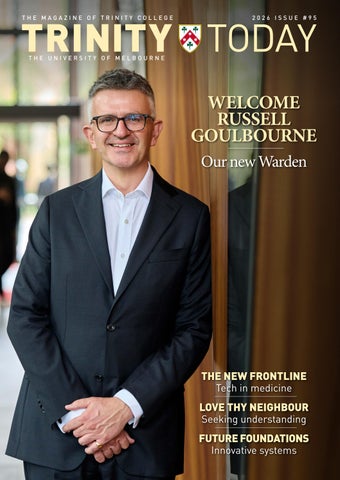
WELCOME RUSSELL GOULBOURNE Our new Warden
THE NEW FRONTLINE Tech in medicine
LOVE THY NEIGHBOUR Seeking understanding
FUTURE FOUNDATIONS Innovative systems
FROM THE WARDEN
Having led Trinity College for almost a year now, I’m delighted to introduce my first edition of Trinity Today. Since commencing as Warden, I have had the opportunity to spend time with students, staff, alumni, donors and friends of Trinity, listening to their stories and learning more about what makes this community so distinctive. One of the great privileges of my role is discovering the extraordinary range of people whose lives have been shaped by Trinity and who, in turn, are making a difference in the world. This year’s edition celebrates many of those people. Trinity Today is inspired by the individuals who see possibilities, take initiative and commit themselves to creating positive change – whether in their professions, their communities or the institutions they serve. Some of those featured in these pages are leading organisations, driving research breakthroughs or tackling complex social challenges. Others are making a difference in quieter ways, through service, advocacy, teaching or community leadership. What connects them is not a single career path or definition of success. Rather, it is a willingness to pursue opportunities and embrace challenges. Together, these stories paint a picture of a community that is curious, ambitious and driven by purpose. I hope you enjoy this edition of Trinity Today. Above all, I hope it leaves you with the same sense of optimism I feel about the communities served by the people who make up this remarkable College community.
THE REVEREND PROFESSOR RUSSELL GOULBOURNE WARDEN AND CEO
We acknowledge the Wurundjeri people of the Kulin Nation, the Traditional Owners of the land on which Trinity College is situated, and we pay our respects to Elders past and present.
TRINITY TODAY 3
SLIDING DOORS
BEYOND ACHIEVEMENT
PAGE 8
PAGE 10
A farewell to Leonie Jongenelis and welcome to Jessica Kerr.
LOVE THY NEIGHBOUR
Pondering the quest for greater understanding between religions. PAGE 20
Detecting health problems earlier, when intervention is still possible.
A SMARTER FUTURE
BUILDING CONNECTION
PAGE 24
PAGE 27
The innovative systems that will shape our world.
QUANTUM LEAP
PLAYING THE LONG GAME
PAGE 30
PAGE 40
Untangling impossibilities: where nothing is ever as it seems.
THE NEW FRONTLINE
The vision of our ninth Warden, Russell Goulbourne.
Martin Stradling's journey to creating novel video games.
PAGE 16
How to design a world where more people can belong.
Snapshot 2026 Introducing Melbourne's Archbishop Opening the gates Taking care of business Life of firsts for Trinity trailblazer The rise of Siena Mayutu Wurmarri Stubbs Connecting with the Old Testament Events 2026 Valete
4 13 14 32 34 36 38 42 47
TELL US WHAT YOU THINK
CONTRIBUTORS
PUBLISHER'S NOTE
Email your feedback about this edition of Trinity Today to tt@trinity.unimelb.edu.au
STORIES: Raelene Frances, the Reverend Professor Russell Goulbourne, Belinda Jackson, Patricia Maunder, Emily McAuliffe, Justin Meneguzzi, Danielle Norton, Jocelyn Pride, Bruce Scates, Louise Wedgwood.
Information in this magazine was understood to be correct at the time of printing. Views expressed in Trinity Today do not necessarily reflect the views of Trinity College.
MANAGING EDITOR: Emily McAuliffe, Communications Manager, Trinity College SUBEDITOR: Simon Mann, MediaXpress DESIGNER: Bill Farr, MediaXpress Aboriginal and Torres Strait Islander peoples should be aware that this magazine may contain records, images or names of deceased people.
IMAGES: Kit Haselden Photography, Evan Mery, Wren Steiner, and supplied by alumni, students and friends of Trinity College. COVER PHOTO: Kit Haselden.
Trinity Today is printed on Pacesetter Satin FSC®, which is manufactured using low environmental impact FSC® certified pulps in a facility that is ISO 14001 Environmental Management System accredited.
snapshot2025 SNAPSHOT 2026 4 TRINITY TODAY
The Choir of Trinity College toured Portugal, Spain and the UK in July, performing a range of concerts and services at venues including Westminster Abbey in London.
The Reverend Professor Russell Goulbourne was installed as Trinity College’s ninth Warden in March by Melbourne Archbishop and Trinity College Council President the Most Reverend Dr Ric Thorpe. The installation service was held in Trinity’s Chapel and was followed by a drinks and canapé reception in the A C C Farran Hall.
In 2027, Trinity College Theological School will celebrate its 150th anniversary. Since 1877, the school has played a central role in Anglican theological education, shaping generations of clergy, scholars and lay leaders. Throughout the anniversary year, we will reflect on this rich heritage, celebrate the school’s enduring influence, and look forward to the next chapter in its life and mission. 'The Next 150 Fund' was launched at the 2026 Archbishop’s Dinner to mark the school’s sesquicentenary and invest in its future. We invite donations if you’d like to support this important work.
The new-look Leeper Library opened officially in September. The renewed space features a mix of independent and group study spaces, and dedicated collaboration rooms with integrated AV technology and acoustic treatments, creating a flexible environment for focused study and shared learning.
The Sharwood Lecture in Church Law was delivered by former Archbishop of Melbourne the Right Reverend Dr Philip Freier (centre) on the topic of Constitutional Anglicanism and the Synodal Governance Journey. The biennial lecture series honours Dr Robin Sharwood AM (1931-2015), the fourth Warden of Trinity College, and is held in both Melbourne and Sydney.
TRINITY TODAY 5
Our Outreach Committee, led by Dion Whitfield (pictured middle back row), was named Best Committee 2026 at the TCAC awards for their significant fundraising and volunteering efforts, with more than $56,000 raised over the year for a range of causes and community initiatives. This included $29,000 raised at the annual Outreach Dinner for the Australian Cancer Research Foundation; $10,500 through the Push-Up Challenge for mental health and suicide prevention, run in collaboration with the Wellbeing & Inclusivity Committee; and $3200 via the Trinity Big Freeze Challenge for FightMND. A student trip to the Tiwi Islands, partnering with Tiwi College, was a major fundraising focus in semester two. The committee also provided volunteering opportunities through ongoing involvement with Ronald McDonald House Charities’ Meals from the Heart program and RIMERN, supporting their work providing essential household goods for people establishing secure housing.
Trinity’s men’s and women’s football teams competed in grand finals, with the men triumphing over Queen’s College and the women runners-up to Ormond College. Trinity cleaned up in the rowing, taking out all four categories at the annual regatta. The Trinity men won the swimming, while the women placed second. Our women’s cricket team won, while the men were runners-up. Trinity won the mixed table tennis, as well as the tennis, and were the overall winners of athletics. During National Reconciliation Week, Trinity competed once again in the annual Buroinjin Cup (pictured) and took out the grand final with a 4-0 win over Ormond.
Trinity hosted 13 visiting scholars in 2026. The first was UK-based Dr Paula Gooder (pictured), a New Testament scholar, who facilitated a Lenten Quiet Day in our chapel in March. Other scholars included Professor Alicia Walker, a professor of medieval art and architecture at Bryn Mawr College in the US; Dr Teresa Almeida Cravo, an associate professor of international relations at the University of Coimbra in Portugal; and Dr Tor Krever, an assistant professor in international law at Cambridge University in the UK.
BAFTA and Emmy‑nominated writer, director and producer Jen Peedom was declared the 2026 Bill Cowan Alum of the Year. Jen is best known for Sherpa, one of the highest‑grossing Australian documentaries of all time. She is now uncovering ‘the greatest climbing story never told’ in her debut narrative feature for Apple Original Films. Tenzing charts the early life of Tenzing Norgay – the mountaineer who, alongside Edmund Hillary, made the first summit of Everest in 1953.
snapshot2025 SNAPSHOT 2026 6 TRINITY TODAY
A portrait of former Warden Professor Ken Hinchcliff and his wife Carole was unveiled in October. It was painted by Australian artist and past Archibald Prize winner Yvette Coppersmith.
Congratulations to Sabrina Leung (TCFS 2019), who was named FS Alum of the Year for 2026. Sabrina is the founder of EnAccess Maps, an app designed to help people with disabilities find accessible venues. You can read more about Sabrina in our story on page 27.
In October, Foundation Studies students celebrated the diverse range of cultures represented among our student body with Culture Fest on the Bulpadock. The event included food trucks and student and staff performances.
Annabelle Moloney (above) was welcomed as Trinity’s Senior Student for 2026-27. She is joined on the Trinity College Associated Clubs (TCAC) by Social Secretary Alice Murray, Treasurer Lia Harris Littleson, Community Rep Issy Hunt, Arts Rep Mimi Koczkar, Indoor Rep Arabella Langdon, Women’s Sport Rep Samantha Arscott, Men’s Sport Rep Oscar Charles and Clubs & Societies Rep Peter Morgan.
Residential students performed the musical Legally Blonde in April and May, with Alice Murray in the lead role as Elle. The musical was directed by Mim Moran and choreographed by Stella Iacono. Students performed the play Present Laughter in October, directed by Harrison Underhill and Alice Murray, with Alex Mingay and Keira Kermode in the lead roles of Garry and Liz Essendine.
TRINITY TODAY 7
Trinity’s Burke Gallery hosted the exhibition Melbourne in Retrospect by James Tyrrell of Harper & Charlie. James is renowned for drawing upon archival photographs of buildings and places in Melbourne, some of them long-gone but not forgotten, to portray the city’s story and our memories of it.
Ella Mcavoy’s (pictured) poem 'Homebuilding' won the 2026 Nakata Brophy Prize for Young Indigenous Writers. Established in 2014 to recognise talented young Indigenous writers in Australia, the prize takes its name from Trinity’s first two Indigenous students, Sana Nakata and Lilly Brophy. The runner-up was Joyrah Sebasio for her poems 'Today, in the missions' and 'My favourite kitchen spot'.
Big congratulations to Catherine Yulianto (January Comprehensive 2025), Zi Jian (Jay) Pang and Samantha Suhendra (February Standard 2025) and Natasha Kengsley (June Fast Track 2025), who were named duxes at our Summer Valedictory Ball in March and also to Wyatt Hsieh (July Comprehensive 2025), Hongting Luo (August Standard 2025) and Chunfang Shi (September Fast Track 2025) who were named duxes at our Winter Valedictory Ball in July.
8 TRINITY TODAY
SLIDING DOORS
A farewell
TRINITY TODAY 9
and a welcome
A
t the end of 2026, we are farewelling Residential College Dean Leonie Jongenelis, pictured left, who is stepping down after eight years in the role. She will be succeeded by Jessica Kerr, who is currently the Director of Workplace Integrity at the University of Melbourne. Leonie has led the Residential College with great care and dedication over her tenure and has always put student wellbeing at the fore. During her time as Dean, Leonie guided the Residential College through a period of significant change and growth. Most notably, she led the community through the challenges of the COVID-19 pandemic, ensuring students remained connected, supported and cared for during an extraordinarily difficult period. For many students, Trinity continued to feel like home because of the leadership and commitment Leonie showed during those years. Leonie has also been a driving force behind important cultural change at Trinity. She has championed student wellbeing, inclusion, safety and belonging, and has overseen the implementation of recommendations arising from the College’s cultural reviews. She has strengthened the College’s scholarship program, and supported Aboriginal and Torres Strait Islander students, championing their engagement and success, while contributing to significant policy reforms, including work on the code of conduct, Sexual Misconduct Policy and Gender-Based Violence Policy. Leonie also played a key role in important improvements to our residential facilities, including the Dorothy building and A C C Farran Hall. Leadership in a residential college is also expressed through countless acts that go unseen, and Leonie’s myriad small actions and conversations that have helped support and inspire our community will be part of her legacy at Trinity College.
J
essica, meanwhile, will join the College in January 2027 and brings extensive experience in higher education, governance and leadership, together with a strong commitment to building safe, inclusive and thriving communities. As the Director of Workplace Integrity, Jessica, pictured above, led the university’s work in organisational culture, psychosocial safety and the management
of complex conduct matters. She is also founder of Culture Matters, an advisory practice supporting organisations across the higher education, government, health and not-for-profit sectors. We thank Leonie with deep gratitude for her service to Trinity and for helping to shape and maintain a strong sense of community in our Residential College, and we look forward to a new chapter for the College under Jessica’s stewardship.
10 TRINITY TODAY
The Reverend Professor Russell Goulbourne is Trinity College’s ninth Warden. Before joining Trinity, he served as Dean of the Faculty of Arts at the University of Melbourne and held senior leadership and teaching roles at King’s College London and the University of Leeds. An alum of Trinity College Theological School, he was ordained as a priest in the Anglican Diocese of Melbourne in 2021. He is also a graduate of the University of Oxford and an internationally respected scholar of French literature, bringing extensive experience in academic strategy, institutional governance and community leadership.
TRINITY TODAY 11
Beyond achievement BY T HE R E V E R E N D P RO F E SS O R RU SSE L L GO U LB O U R N E
W
hen people talk about education, they often focus on outcomes: grades earned, qualifications completed, careers launched, earnings unlocked. While these things can open doors and create opportunities, they are not, on their own, enough. Education is not just about preparing someone to earn a living; it is about enabling them to live well. The challenges facing our society today are complex. Questions of social cohesion, technological change, environmental sustainability, economic inequality and ethical leadership do not lend themselves to simple solutions. They require people who can think critically, work collaboratively, engage respectfully and act with purpose. One of the things that attracted me to Trinity College was its longstanding commitment to developing the whole person. Across our Residential College, Pathways School and Theological School, there is a shared belief that education is about more than the acquisition of knowledge. It is about forming individuals who are curious about the world, attentive to others and eager to serve the common good. That aspiration is one of the threads that connects the many parts of our College community. Our students come from different
backgrounds and bring with them a wide range of life experiences. Some come from metropolitan centres, others from regional and rural communities. Some come to us from the other side of the world, having never previously set foot in Australia. Some are breaking new ground by being the first person in their family to go to university, while others are pursuing advanced academic or vocational pathways. They all bring different perspectives, ambitions and talents.
'Across our Residential College, Pathways School and Theological School, there is a shared belief that education is about more than the acquisition of knowledge.' What unites them is a desire to learn, grow and build a better future for themselves and the communities of which they are a part. And our responsibility as a College – our calling, if you like – is to create an environment in which people know they belong, discover their strengths and become who they are. Living, studying and working alongside people whose experiences differ from our own can be challenging; it can also be transformative. Whether in the dining hall, the classroom, a tutorial,
the chapel or during a late-night conversation, the members of our community learn to listen, to engage constructively with others’ points of view and to debate ideas respectfully. These experiences matter because, among other things, they shape the leaders of the future. The most effective leaders are often those who understand how to bring people together, navigate complexity and work towards outcomes that serve a greater purpose. Trinity helps cultivate those skills. Our Residential College provides opportunities for students to take responsibility, contribute to community life and develop practical leadership skills. Foundation Studies opens doors for students from around the world, helping them make the transition into Australian higher education and careers that cross cultures. Our theological education encourages deep reflection on ethics, meaning and service. The contexts may differ, but these educational endeavours share a common concern with the formation of people who want to make the world better tomorrow than it was yesterday. Across Australia and around the world, our alumni are active in fields as diverse as medicine, law, science, education, business, public service, technology, the arts and ministry. What is striking is not only the breadth of these contributions, but the ways alumni use their expertise in service of something greater than themselves. They lead organisations. They >> conduct research. They mentor
12 TRINITY TODAY
After the Big Freeze 'dunk' to raise money for FightMND.
others. They create opportunities where previously none existed. Their achievements reflect talent and determination, but they also reflect an understanding that with success come responsibility. That idea has deep roots within Trinity’s history and ethos. Our Anglican tradition continues to shape a culture that has at its heart human dignity, service, hospitality and the pursuit of the common good. These values are not confined to any single tradition or worldview. They speak to a broader conviction that education should expand our concern for others and our view of the world. As I have spent my first months as Warden listening to students, staff, alumni and supporters, I have been
struck by the strength of Trinity’s community and by the goodwill that exists across the College. One of my aspirations is that we think about Trinity increasingly as a single community with a shared purpose. While our Residential College, Pathways School and Theological School each have distinct identities and strengths, they are at their best when understood as parts of a larger whole and when they come together to form more than the sum of those parts. For together, they create a richer educational environment than any of them could create alone. This is particularly important as we consider the future. The questions facing society do not sit neatly within institutional
or disciplinary boundaries. They require institutions that are connected, collaborative and purpose-driven. Trinity is well placed to play that role. We have engaged students, committed staff, dedicated alumni and generous supporters. But, most importantly, we have people who are motivated not simply by personal achievement, but by the desire to contribute to the greater good. That gives me great confidence about the future. The task before us is to create opportunities for people to grow in wisdom, character and capability; to equip them to engage thoughtfully with the world around them; and to enable them to use their talents for the benefit of others.
GET TO KNOW OUR WARDEN MY FIRST JOB was as an office clerk in the local education department in Liverpool where my mother worked as a typist – in the days when typing pools were a thing! MY CAREER HIGHLIGHT is having taught the son of my first high school French teacher for his BA in French at the University of Leeds. A SKILL OR HOBBY I’d still like to master is pottery. I did a beginners’ course in wheel throwing during my first couple of months as Warden, thinking that it would help me do something mindful and meditative.
THE HISTORICAL FIGURE I’d most like to meet is Voltaire, as I’ve spent more than 30 years reading and thinking and writing about him. I still don’t really know what he thought about a whole range of things.
AS A CHILD, I wanted to be a schoolteacher when I grew up – and so I’d regularly line up my teddy bears in the backyard at home and teach them their ABCs. But they were a pretty cloth-eared bunch.
AT AGE 18, I wish I’d known that it’s OK to feel different from others and that, actually, there’s a place for everyone in the world, even if it takes time to find it.
THE HIGHLIGHT OF THE WARDEN ROLE so far has been being dunked in a tank of icy water in aid of FightMND. It was all for a good cause – and the endorphin rush meant that afterwards I had the most enjoyable and productive afternoon ever!
THE BEST PIECE OF ADVICE I’ve been given is to know that you’re good enough, whatever the little voice in your head might tell you.
TRINITY TODAY 13
INTRODUCING
Melbourne's Archbishop In late 2025, we welcomed the Most Reverend Dr Ric Thorpe as the Archbishop of Melbourne and President of the Trinity College Council. Ric studied at the University of Birmingham, then worked in marketing with Unilever before training for ministry at Wycliffe Hall, Oxford. He went on to serve as the Bishop of Islington in the Diocese of London, where he focused on helping the Church of England develop new worshipping communities and revitalise existing churches. Earlier in his ministry, he and his wife Louie led a church revitalisation of St Paul’s Shadwell, which went on to support further church plants in East London. Ric founded and led the Gregory Centre for Church Multiplication (CCX) for a decade and continues as a trustee. He has a doctorate in church planting and has trained many leaders at St Mellitus College, London. ‘As the 14th Archbishop of Melbourne and President of Trinity College Council, I’m glad to continue the tradition laid down by Charles Perry – the first Bishop of Melbourne, who helped establish Trinity College as a place where faith, learning and formation can sit together – and to affirm the importance of theological education that is rigorous, faithful and connected to the mission of the church.’
14 TRINITY TODAY
A Gates Cambridge scholar acknowledges his time at Trinity planted the seed of possibility.
W BY J OCE LY N PR ID E
hen Will Smith (TC 2020) was a child, he didn’t dream one day he’d be heading to Cambridge as the first Aboriginal/Torres Strait Islander recipient of a prestigious Gates scholarship to attend Cambridge University. ‘I didn’t even know a place like Cambridge existed,’ he admits. The eldest son of an English mother and Aboriginal father, Will is a proud Wiradjuri, Wemba Wemba/English man
challenging. ‘I was quite shy. Being in a big space, a big pond with so many people, overwhelmed me.’ However, things soon changed when he was invited to Murrup Barak, the University of Melbourne’s centre for Indigenous development. ‘I’d been [at university] for a few weeks and when I stepped through the door, I thought these are my people, they are Aboriginal people who are interested in an intellectual quest like I am.’ Murrup Barak also introduced him to the idea of living at a residential college. ‘I was commuting from Berwick each day, working at my part-time job at night
Set against a competitive landscape, but surrounded by motivated and entrepreneurial people.’ College also helped expand his scholarly interests, and, in 2019, he decided to take a gap year to help clarify his academic direction. ‘When it comes to decision-making, I find I need space and time to think about things,’ he says. Will found his ahha moment sitting on a remote beach in the Faroe Islands surrounded by puffins. ‘To Aboriginal people, there’s something humanistic about being in nature. The universe is somehow flowing into your mind.’
OPENING THE who appreciates how his early life shaped him. ‘I’ve always had an insatiable curiosity for the world,’ he says. ‘Neither of my parents were formally educated, but they inspired me to understand the importance of education.’ Friends also influenced Will’s formative years, especially during secondary school. ‘I was what you would call a rambunctious teenager – always pushing my physical self to the limit.’ Attending Kambrya College in Berwick, south-east Melbourne, brought a different dimension to his competitiveness. ‘I made friends with Nisal and Nihal, who had brown skin like me,’ he says. ‘They were from studious families, and I was determined to be as good as them.’ Grateful to his friends for inspiring him to strive for academic excellence, Will completed Year 12 with an excellent ATAR and headed to the University of Melbourne to study History and the Philosophy of Science. Despite being an outgoing person, Will’s early days at university were
‘I believe solutions lie in a combination of modern and ancient wisdom. Gates is an opportunity for me to explore how I can support and innovate through a research lens.' WILL SMITH
and playing footy for my local team,’ he explains. ‘Sometimes, I was so tired I’d find a couch to curl up on between lectures.’ After being encouraged to apply to live at Trinity – and apply for a scholarship – Will was accepted mid-year, and the College became a game changer for Will’s future. Despite moments of imposter syndrome, Will integrated into Trinity quickly. ‘I felt part of an invigorating young person’s space that made me think about bigger things in the world.
Returning to Trinity in 2020, Will’s focus centred on psychology and philosophy. He ended up graduating from Melbourne University with first-class honours, then returned to Trinity to work as the Indigenous outreach coordinator, helping build the number of Indigenous residents at College. ‘Trinity appreciates Aboriginal people; the enriching environment is special,’ he says. The Aurora Education Foundation then helped drive Will’s international ambitions by sending him to the US and UK on a study tour. After travelling to both countries, Cambridge beckoned, with Will ultimately receiving a Gates scholarship, which signified a proud and precious moment. ‘My ultimate vested interest lies in trying to synergise all the different ways of approaching the problems of psychology for Aboriginal people on a global level,’ he states. ‘I believe solutions lie in a combination of modern and ancient wisdom. Gates is an opportunity for me to explore how I can support and innovate through a research lens.’
TRINITY TODAY 15
GATES
16 TRINITY TODAY
THE NEW FRONTLINE
TRINITY TODAY 17
From cardiac arrest to cancer to suicide risk – a new wave of research involving Trinity alumni is focused on detecting health problems earlier, when intervention is still possible. BY LO UISE WE D GWOO D
O
ne summer’s evening in 2024, Sydney mother Anna Brakey said a very ordinary ‘Goodnight, sweetheart’ to her daughter, Josie, without there being any hint that this would be their last moment together. At 22, Josie was healthy and lively, a strong rower and swimmer. Shockingly, however, Josie Brakey never woke up, becoming one of the 26,000 Australians annually to die from sudden cardiac death, where an electrical problem in the heart makes it stop. In the developed world, sudden cardiac arrest kills more young and middle-aged people than either car accidents, cancer, drug abuse or infectious diseases. Melbourne cardiologist and researcher Associate Professor Elizabeth Paratz (TC 2005) (left) is an expert in sudden cardiac death and has borne witness to many stories like Josie’s. ‘For about a third of young people who have cardiac arrest, the cardiac arrest is the first symptom that there’s something wrong with their heart,’ Elizabeth says. Without the benefit of warning signs, there is no opportunity to intervene and protect a life. Even with Australia’s world-leading access to healthcare, someone having a sudden cardiac arrest outside of hospital has at best a 10 per cent chance of surviving. Knowing who needs help before it’s too late is a question Elizabeth is
endeavouring to answer. Given the atrocious odds of surviving a cardiac arrest, she says, ‘if we can move the needle by one per cent that would mean 330 Australians a year would survive.’ One of Elizabeth’s impressive achievements is the world-first data registry she created in her multi-awardwinning PhD, completed in 2023. The ‘End Unexplained Cardiac Death Registry’ links ambulance, hospital and forensic data on sudden, unexplained cardiac deaths across Victoria. It has uncovered patterns and risk factors in pregnancy, people living with obesity, mental ill-health and other medical conditions. The ground-breaking registry now includes data from 4000 patients but will be exceeded by the predictive clout of the next generation of registries that Elizabeth is currently working on, which will draw insights from hundreds of thousands of patients. As well as providing answers for the bereaved families as to why their loved one died, Elizabeth’s work can help relatives assess and intervene in their own heart health if necessary, preventing further devastating loss. While the topic of the work can be distressing – and ‘every case and every family affects you’ – Elizabeth says we must learn from each tragedy. ‘Our duty now is to really interrogate every case to get as much meaning and learning out of it as we can, so that we can try to prevent it happening in the future and >> improve outcomes going forward.’
18 TRINITY TODAY
W Josh Nguyen is using big datasets to reduce mental ill-health.
I
nvestigating matters of the mind rather than the heart, Trinity alum Josh Nguyen (TCFS 2016) is also using big datasets to buy more time when young lives are at risk. Josh works as a clinical psychologist focusing on marginalised populations, and is also undertaking a PhD through Melbourne University to predict suicidal and self-harm behaviours in young people. Mental ill-health is common among adult Australians, with four in 10 of us directly affected at some time. Josh’s focus on young people is invaluable with most mental health problems beginning between ages 14 and 24. He emphasises that overlooked and untreated illness has enduring costs. ‘The onset of those symptoms, if not treated during that early stage, will lead to more ongoing or more severe outcomes in adulthood,’ Josh says. Of course, the most devastating potential outcome is death by suicide, responsible for one in three deaths among 15 to 24 year olds. To create the chance to intervene and prevent long-term suffering or death, Josh’s research focuses on developing accurate machine learning models, a subset of AI, to predict suicidal thoughts and attempts among youth. The models use large data including clinical, brain imaging and smartphone data. Josh says the current model performs well using simple questions as well as daily smartphone surveys. ‘We ask people about their anxiety,
depression, sleep, and how impulsive they are. Impulsivity is a huge risk factor that makes someone go from thinking about suicide to acting.’ Over the next five to 10 years, he sees the model drawing on passive data from wearable devices such as smart rings and watches to track variables like heart rate and physical activity, saving user effort. Importantly, Josh emphasises the need to ensure the AI model learns from high-quality, unbiased data, and that it isn’t a substitute for human care. ‘It’s not to replace clinicians, but to give clinicians more confidence,’ he explains. One of the crucial benefits of improved suicide risk assessment is the chance to go beyond band-aid solutions. ‘By detecting risk early, we are able to enable a conversation where we don’t rush into preventing people from attempting suicide, but shift the whole conversation into understanding what makes them suicidal,’ says Josh. ‘Because if the sole motivation is just to make sure you don’t attempt suicide, that comes across as almost bureaucratic. The goal is to understand and provide support.’ Josh adds that a common misconception is that asking someone about suicide risk will ‘put the idea into their head’. He disagrees: ‘From clinical experience, and rigorous scientific research, it shows the opposite. Not only does it not increase suicide risk, but it opens up the conversation where young people can feel comfortable sharing.’
hile the main aim of better diagnosis in both Elizabeth’s and Josh’s fields of research might be saving lives, discovering when not to intervene can be equally ground-breaking. For fellow Trinitarian Professor Jeremy Grummet (TC 1990), a practising academic urologist and prostate cancer expert, modern diagnosis is as much about knowing when to simply watch. Of course, some prostate cancers are lethal, with 11 Australian men dying from the disease each day. However, over the last 15 years, Jeremy says the use of magnetic resonance imaging (MRI) has been a ‘massive gamechanger’ in avoiding the previously ‘huge amount’ of overdiagnosis and overtreatment of lower-risk prostate cancers. Prostate cancer treatment, while potentially lifesaving, can come at a real cost to quality of life, such as temporary or permanent incontinence and erectile dysfunction. As the co-founder of the MRI-PRO training program, Jeremy has helped doctors around the world more accurately interpret prostate MRI results, avoiding unnecessary biopsies and treatment. More recently, he has been supervising research into PSMA PET scanning to map the exact location and severity of prostate cancer. This type of scan offers 92 per cent accuracy and detects cancer as tiny as a few millimetres. With more precise imaging comes the possibility of more targeted treatment. Jeremy has also helped pioneer the adoption of focal therapy in Australia. After using advanced imaging to precisely locate the tumour, he explains, ‘we pass electric probes into the prostate and essentially electrocute the tumour to kill it, and we preserve function at far higher rates than we get with robotic surgery or standard radiotherapy’. ‘That, to me, is really exciting … I hate the idea that my therapeutic intervention is actually harming my patient.’ Looking to the future, the next wave of life-saving advancements in prostate cancer diagnosis may come from molecular biology, examining the DNA and RNA inside tumour cells. Jeremy says this will help us further understand which cancers are genuine
TRINITY TODAY 19
'If we can move the needle by one per cent, that would mean 330 Australians a year would survive.'
ELIZABETH PARATZ
'We need to make sure that we provide the imaging capability that's not too prohibitively far from home for patients.' Jeremy Grummet's research helps guide therapeutic intervention for prostate cancer.
threats and which are unlikely to cause problems. On the five-point scale of tumour aggressiveness, about half of prostate cancers are somewhere in the middle, where their progression is harder to predict than the most and likely least aggressive. With the help of AI to process the data, Jeremy expects that the next five to 10 years will reveal more about how these middle-grade tumours behave and who will truly benefit from intervention. Despite these impressive breakthroughs in diagnostic technology, real-world hurdles often keep patients from accessing known best-practice and achieving better outcomes. For example, in the prevention of youth suicide, Josh says that while we can leverage AI to predict suicide risk early and accurately, data alone isn’t enough: we must use that data to drive broader systemic change. ‘As much as we talk about individual symptoms like depression and anxiety, or the environment at school, suicide risk is multifactorial,’ he says. ‘We also need to look at systemic issues: poverty, stigma, discrimination, housing issues ... It’s complex, and it’s important that we don’t narrow it down to just a single factor.’ Similarly, Jeremy highlights the need to provide equitable diagnosis opportunities to all. The cutting-edge cancer imaging that he has helped develop can only deliver superior
diagnosis and treatment if the patient can physically access it. While anyone can have the routine blood test to screen for prostate cancer (usually every two years after age 50), when an MRI or other imaging is subsequently needed, unequal access contributes to the urban-rural health gap. ‘We have a much lower density of MRI scanners in country areas,’ explains Jeremy. ‘So, I think that’s important from a policy point of view across Australia. We need to make sure that we provide the imaging capability that’s not too prohibitively far from home for patients.’ Equitable access is a cause close to Elizabeth’s heart, too. Even as a medical student at Trinity College, Elizabeth hoped to work in international health. Now, as the deputy director of the Timor Leste Hearts Fund, she has helped provide life-saving interventions to more than 100 young Timorese people, with an average age of just 28. From ensuring a young adult’s heart continues beating without pause, to managing the quiet threat of a middlegrade tumour or supporting a struggling teenager, the stakes of diagnosis research could not be higher. Leveraging big data, artificial intelligence, advanced imaging and molecular biology, these three accomplished Trinity alumni are doing their bit to deliver new insights. And, ultimately, they are ensuring fewer families are left asking ‘what if’.
JEREMY GRUMMET
'By detecting risk early, we are able to enable a conversation where we don't rush into preventing people from attempting suicide, but shift the whole conversation into understanding what makes them suicidal.'
JOSH NGUYEN
20 TRINITY TODAY
Love THY neighbour Three theological thinkers ponder the quest for greater understanding between religions and how it can benefit our lives.
TRINITY TODAY 21 BY B E L INDA JACKS O N
A Muslim, a Christian and a Jew walk into …
I
t sounds like the opening to an old joke. Rather, three people from the three major Abrahamic religions walked into Trinity’s auditorium recently to discuss the divergence and intersection of Christianity, Islam and Judaism, and their influence on our daily lives. Their sharing took centre stage at this year’s interfaith conference, hosted by Trinity College Theological School in collaboration with the University of Melbourne, Loyola Institute (ACU) and the University of Divinity. Dr Joshua Ralston, Reader in Christian-Muslim Relations at the School of Divinity, University of Edinburgh, Rabbi Allison Conyer from Melbourne’s Temple Beth Israel synagogue, and Dr Jerusha Rhodes, Associate Professor of Islamic Studies at Union Theological Seminary, joined a panel discussion before speaking to Trinity Today about the connections and differences between their faiths, and how they can engage peaceably in a conflicted and polarised world. ‘With globalisation and our changing patterns of connection in the past three or four decades, events that are far away have a much more profound impact upon us now,’ says Joshua. It’s not an exaggeration to say that now, more than ever, dialogue between the major religions and with the wider population is critical to global harmony, he adds. US-born, Australian-based Rabbi Allison Conyer concurs: ‘The more violence that we see, the more antisemitism or Islamophobia, the more crime – people get scared and threatened of the other.’ Speaking from New York, Jerusha says some faith communities are fomenting conflict and misunderstanding. ‘We don’t have to be too gentle about it,’ she says. ‘They are encouraging polarisation, and I see some breakdown and rupture in relationships – the Palestine-Israel conflict isn’t the only thing going on in the world but it’s a major thing, and it has ruptured a lot of interfaith relationships.’
Dr Joshua Ralston says interfaith dialogue is critical to global harmony.
Joshua says: ‘In an increasingly secular society, we engage combatively. On social media, rather than there being an honest conversation, we end up in a shouting match. People have very little interest online in engaging with learning and dialogue and often are using online [platforms] to reinforce existing ideas.’ The intra-Jewish and intra-Christian conversations are just as heated as the arguments between Christians and Jews, he observes, debating their own selves on topics such as text interpretations or the war on Gaza. ‘But social media doesn’t allow for that complexity,’ he adds. ‘It encourages and rewards these sorts of binaries.’ For Jerusha, meaningful dialogue is not about glossing over differences and simply focusing on what we have in common. ‘Yes, you have Moses and we have Moses, but our Moses is different to your Moses,’ she says. ‘Our differences are exciting and interesting.’ However, Allison believes many people never reach that point of curiosity, with our secular society tending to be indifferent to – or threatened by – religion. ‘They’ve got no desire to learn – why should they? People are just trying to get through their own thing. It’s not going to affect them, they think. They don’t see it as enriching.’
‘But if we’re only talking about learning and information without saying the “so what”, what’s the impact of that?’ asks Jerusha. ‘To me, the impact is clear; we want to learn about each other and learn to interact with each other better so that we can have a less violent world, a world that’s not being destroyed. ‘[People] want to walk down the street safely. They want to not be victimised because of their religious identity. These are lives being shaped and formed, and even lives being lost,’ she continues, referencing Australia’s Bondi massacre in December 2025.
WHERE THERE IS CONVERSATION, THERE IS HOPE
What the three commentators share is optimism. ‘Naturally, people want to be around people who are like them – the same language, the same look, the same cultural expectations. It’s comforting,’ says Allison. ‘But the beauty of the world is that we’re different, and just because someone is different, you don’t have to accept or become [that difference], but to understand that differences exist. As long as it’s done respectfully.’ ‘When I’m in a bar or at a sporting event, and people ask what I do, I say I teach religion, theology, politics,’ says >>
22 TRINITY TODAY heightened now … but we have to be able to talk at a community level without sidelining the big issues in the world and pretend they’re not going on.’
WHEN RELATIONSHIPS REPLACE STEREOTYPES
Rabbi Allison Conyer says we need to engage with people who are different to us.
Joshua. ‘And most people are curious, interested and want to talk about it, but they just don’t have a space to ask questions. ‘Some genuinely want to know, but don’t want to look like a fool – what’s the difference between halal versus kosher? [Between] Sunni and Shia? Do all Muslims not drink?’ As a result, Joshua says educational institutions are in a unique position to foster dialogue through podcasts, free online courses, readings and summer schools. ‘We need to know the history, we need to know who’s been in power, we need to know where stereotypes and all the tropes have come from, to inform community conversations,’ Jerusha adds. ‘In my work, I do engage directly with people who are spreading Islamophobia or antisemitism, but that’s not the greatest impact of my work, or the greatest use of my energy,’ she says. Rather, she singles out her work with the media. ‘The level of religious literacy is so low, and interreligious literacy is also so low, there’s not a lot of understanding or knowledge circulation [among] the public – whether it’s in movies, on social media or more traditional forms of journalism. ‘That’s a wonderful node of intervention because you can educate a few people to just a slightly more complicated view of diversity and they can have a great impact in the world.’
A PEACEFUL COMING TOGETHER
Few exercises are better at creating human connection than simply breaking bread together. Joshua, who has spent 11 years in Scotland, cites examples of community interaction in Edinburgh, such as non-Muslims being invited to join the breaking of fast during Ramadan or for non-Jews to share a Shabbat dinner. ‘You don’t have to take part in the religious aspect, but you can share a meal.’ From years of working in Australian schools, Allison welcomes multicultural days in which students share their food and traditions, and notes the value in ‘physically taking people into different spaces. Some schools visit churches, mosques, temples, Buddhist centres.’ She acknowledges, however, that some people may not feel safe or comfortable entering someone else’s religious space, in which case a neutral space is essential for bringing traditions together. ‘In the US, and in Muslim communities, especially since September 11 [2001], I see a great growth in interfaith efforts – dialogue, talking and learning, and interfaith activism, doing projects together and tending to communities’ needs together, such as affordable housing and antiincarceration,’ says Jerusha. ‘I think the polarisation is so
Allison argues that the more we get to interact with others – in the workplace, in our schools, in our social groups – ‘we will encounter people who are different to us, and the stronger and safer we will feel. Not the other way around. You’re talking, listening, respecting.’ Better understanding also gives people more confidence and skill to be able to differentiate between fake news and stereotypes, she says. Adds Jerusha: ‘If we were to interact in better ways, we might be better able to tackle the issues of violence, of people being slaughtered, of people being forced to migrate. ‘Religious traditions have the answers to the fundamental human questions we are struggling with, such as loneliness or suicide – everything that’s facing us as people. They share repertoires for understanding the human condition, and they each answer these questions differently. That’s the fun of it.’ All three Abrahamic religions are relatives, and also rivals, says Joshua, citing the city of Jerusalem, where he has lived and worked, as an example. ‘All
TRINITY TODAY 23
‘Yes, you have Moses and we have Moses, but our Moses is different to your Moses. We don’t need to focus on our similarities. Our differences are exciting and interesting.’
Learning through another lens
JERUSHA RHODES
three [religions] claim it, but all claim it in very different ways,’ he says. ‘You could imagine a beautiful way of sharing and respect. All three traditions share a general story, a general scripture, the big characters.’ ‘But we differ in how we acknowledge life cycles, our festivals and rituals around the coming of age, over our food, death, marriage and when a baby is born,’ says Allison. ‘We all have different paths to get hopefully to the same place, which is making the world a better place where we all feel safe, respected and valued.’ ‘Basically,’ says Joshua, ‘it’s about how to be a good neighbour.’
Dr Jerusha Rhodes works with the media to improve religious literacy.
In recent years, Trinity College Theological School has expanded its commitment to interfaith learning, introducing units that bring Jewish scholarship directly into the classroom. In 2025, Dr Simon Holloway, Manager of Adult Education and Academic Engagement at the Melbourne Holocaust Museum (pictured), introduced Early Rabbinic Interpretation of the Bible, exploring Jewish traditions of biblical interpretation. The following year, Postdoctoral Research Fellow Dr Natalie Mylonas co-taught From Song of Songs to Lamentations: Biblical Voices in Contemporary Jewish Festivals with Dr Rachelle Gilmour to bring both Jewish and Christian perspectives to one class. For Natalie, who recently became the first Australian to be awarded a prestigious Gingko Foundation Interfaith Fellowship, the courses reflect a broader vision for theological education. ‘A more robust theological education might cover more than one tradition,’ she says. ‘There are many ways of thinking about life and we expand our horizons and appreciate the uniqueness of our own traditions through this kind of exploration.’ The Jewish festivals unit examined how biblical texts continue to shape contemporary Jewish ritual life. Most students came from Christian backgrounds, with many encountering these traditions for the first time. ‘I think [students] were surprised by the richness of the tradition,’ says Natalie. ‘It gave them an understanding of someone else’s tradition and texts that are very
different from their Christian views.’ Simon sees Jewish scholarship as an essential part of understanding Christianity itself. ‘If we wish to engage with an understanding of Christianity in its social and political contexts, we need to also engage with the kinds of things that early Christians studied or knew,’ he suggests. ‘The Jewish milieu of the Gospels is evident in multiple instances.’ Simon’s course also challenged common misconceptions around Rabbinic literature, which he says is ‘famously complex’. For example, many people assume the Talmud is a single book or even the Jewish equivalent of the Bible but, in reality, the Talmud is actually a library. ‘For students who are interested in the reception of the Bible in the church, it’s important to know which sources outside of their traditions church leaders were responding to or reacting against, as well as which sources within their traditions were echoed or rejected by others,’ he says. ‘The only way we can develop an appreciation of such materials is by engaging with them, and we cannot engage with them unless we spend time developing an appreciation of the peculiarities of their style, structure and content.’ For Natalie, the ultimate goal of these classes is not simply to understand Christianity better, but to appreciate Judaism on its own terms. ‘My hope was that students would take away an appreciation for the beauty of Judaism, completely separate from Christianity,’ she says. ‘It’s a lived and rich tradition.’
24 TRINITY TODAY
BUILDING THE FOUNDATIONS OF THE FUTURE From AI-powered infrastructure to critical minerals and sustainable fuels, three Trinity alumni are working on the systems that will shape our future.
AIBUILD is bringing AI-powered technology to a range of industries.
TRINITY TODAY 25 BY E MILY M CAU LI F F E
‘T
he Ayam fish sauce (210ml) is getting low in aisle three – I have prepared an order for you.’ ‘I noticed you got chilly last night, so I warmed the blanket a touch. I also sensed tightness in your right hip, so released a low electrical signal to loosen that to avoid any discomfort.’ ‘My latest skeletal scan of 90-year-old Rosa suggests she might be vulnerable in the event of a fall – can we get the specialist in for an assessment?’ Sitting alongside AIBUILD founder and CEO Yifei Wang (TCFS 2013) in an office in the innovation and research hub Melbourne Connect in Carlton, I watch as cameras monitor stock levels across eight of Melbourne’s KT Mart Asian grocery stores, while artificial intelligence (AI) forecasts demand and supports inventory and ordering decisions on AIBUILD’s Argyx platform. A few doors down, Yifei shows me an under-the-pillow device that monitors sleep – circumventing the need to charge a smart watch or ring overnight and subsequently forgo valuable sleep data. Future development could see this complemented by smart bedding with temperature-control features and technology that relieves muscular tension while you snooze. In the same room I’m introduced to a robot being developed to support aged care. Potential applications include assessing mobility, identifying fall risks and alerting care teams to areas of concern. Longer-term ambitions include companionship through conversation, alongside reminders about medications and exercises. Then there’s a car prototype with wheels that can turn sideways (a welcome development for anyone who struggles with parallel parking); a property management tool being developed to help coordinate inspections and work orders; a system being explored to use waste heat from AI data centres for water purification; and an unmanned boat intended to survey bridges and identify maintenance needs. Yifei reels off example after example of how AIBUILD serves as a conduit between research and development and industry by developing products and building new ventures with its partners,
Yifei Wang is helping to bridge research and development and industry.
ultimately helping technological ideas find practical applications. ‘Engineering students and researchers may have a brilliant idea but they don’t know how to commercialise it … Whereas industry people know the pain points but they don’t have the capability to do all the [research and development],’ explains Yifei. ‘They come from totally different worlds and don’t talk to each other, so AIBUILD is the bridge between those things, helping them grow.’ The company’s beginnings trace back to Melbourne University’s ERC library, where a group of IT students came together for a hackathon and were subsequently approached by a business owner who wanted help setting up an e-commerce site. Yifei, who grew up in Shanghai and was mentored in business by gaming company founder and fellow Trinitarian Hayden Li (TCFS 1998), formalised the company in 2017. By 2018, his team had secured their first Australian innovation patent for a program that transformed property floorplans into three-dimensional models, giving overseas buyers of off-the-plan properties a clearer sense of what they were purchasing. The concept is commonplace now but was revolutionary back then. Then, when Yifei’s grandmother passed away following a fall, he applied his knowledge of robotics and AI to the aged care sector, with a focus on falls prevention and monitoring for other health risks. Along the way, AIBUILD secured government funding for collaborative
research and development projects, working with industry partners and major universities. It has also received support from global technology companies including NVIDIA and Google, and was named a finalist in the Australian Financial Review’s Most Innovative Companies of 2026. ‘AI is going to shake up every single industry – there will be industry revolutions,’ says Yifei.
LAYING THE GROUNDWORK
Artificial intelligence may dominate conversations about the future but every data centre, satellite, drone and smartphone still relies on materials pulled from the ground. ‘People sometimes forget that everything humans consume is either farmed or mined – there are no exceptions,’ says Sam Riggall (TC 1990), CEO of Sunrise Energy Metals, which discovered one of the world’s largest and highest-grade scandium deposits near the small NSW town of Fifield, south-west of Dubbo. Though little known outside industry circles, scandium plays a critical role in everything from aerospace engineering and defence technologies to fuel cells and mobile communications. In what Sam deems a ‘15-year overnight success story’, Sunrise Energy Metals made headlines in 2026 after securing a $US400 million (more than $500 million) loan from the US government. The funds will be used to supply the US defence department with the rare metal once >> extraction begins as part of
26 TRINITY TODAY
Sam Riggall is helping develop the world's first primary scandium mine.
Sunrise’s Syerston project, currently slated for late 2028. ‘If you want to create lightweight, high-performance alloys that have a comparable strength to steel, are heat tolerant, are corrosion resistant, and are 3D-printable, scandium is an incredibly valuable element to be able to alloy with,’ explains Sam. Scandium is also an important input for off-grid fuel cells to power AI data centres. ‘Communities don’t want these massive data centres sucking electricity from the grid and pushing up their power prices … and you don’t want huge turbines turning at a million miles an hour creating noise and particulate emissions,’ says Sam. Scandium is critical to our wireless communications systems, too. It made the leap from 3G to 5G possible and will power the jump to 6G. ‘Your ability to step off a plane in another country and have your phone pick up a completely new signal without interruption is all driven by scandium-containing chips,’ says Sam. Currently, China produces almost 90 per cent of the world’s scandium by treating industrial waste. Once the Syerston project kicks off, however, Australia will have the world’s first primary scandium mine. ‘Access to critical minerals is being weaponised, and we’re in a world where the only solution really is to build your own supply chains,’ explains Sam, who notes that it’s ‘unhealthy’ to have a critical component of a global supply chain concentrated in one place. ‘So, what we’ve agreed is that the support from the US government won’t
Wily Salim is working to turn coconut husks into shipping fuel.
just develop the mine; it will help build the entire supply chain from mining all the way through to refining and metalisation.’ While the market for scandium itself is small, the industries that rely on it turn over trillions of dollars, so a break in the supply chain could be catastrophic. ‘The average consumer doesn’t think about the complexity of these supply chains,’ says Sam. ‘There might be eight or nine companies or more standing between extraction of the raw material and the final component. ‘The weaponisation of these supply chains and what you’re seeing with global geopolitics makes it extremely difficult. With the exception of the Second World War, the world has probably never been more exposed around its global supply chains than it is today.’
POWERING TOMORROW
If critical minerals form one of the building blocks of future technologies, energy is another. For Wily Salim (TCFS 2004), founder and director of Jakartabased KVA, the challenge is not buried in the ground but scattered across Indonesia’s coconut-growing regions, where discarded coconut husks could help fuel the shipping industry. Sitting in a cafe in Melbourne, Wily pulls up a video of a man spearing coconut after coconut on a sharp stake in the ground, tearing at the fibrous casing with weathered hands before swiftly casting it aside, later to be burnt or tossed in the river. This hard, low-paid labour (and associated wastage) is the reality for many Indonesian and smallholder coconut
farmers around the world. However, if KVA’s project can secure the necessary funding, those same farmers will receive additional income through the sale to KVA of the husks that are currently discarded. The company plans to turn the husks into biomethanol at a facility on the Indonesian island of Batam, to be sold as green marine fuel, helping accelerate decarbonisation of the shipping industry. At the same time, Wily hopes it will make coconut farming more sustainable – a livelihood increasingly being squeezed by heavily commercialised palm oil farms. ‘At least now [the farmers] can turn their waste into money and employment,’ says Wily. Meanwhile, Bloomberg projects that, by 2028, the annual demand for methanol as fuel for containerships (as opposed to heavy fuel oil), will be 14 million tonnes, with Singapore – a short ferry ride from Batam – the world’s largest bunkering market. For Wily, the opportunity is a reminder that the transition to a cleaner economy will depend not only on breakthrough technologies, but also on finding new value in resources that are currently overlooked or discarded. ‘The long-term view is that humanity needs to evolve,’ says Wily. ‘Just like if you don’t adopt AI you’ll be left behind, if you don’t adopt renewable energy, you’ll be left behind.’ From artificial intelligence and robotics to critical minerals and renewable fuels, the ambitions of these alumni are the same: to build a future that is smarter, more resilient and more sustainable than the present.
TRINITY TODAY 27
Building connection A woman locked out of restaurants, a lonely international student, the architect as therapist: three changemakers show how we can design a better world in which more people genuinely belong.
BY BE LINDA JAC KS ON
28 TRINITY TODAY
‘One of the core offerings of our charity is employing people with disabilities to assess the venues. They're the ones with full knowledge, the lived experience.’ SABRINA LEUNG
SUPPORTING THE SUPPORTER
A
ccessibility in our society should not be an optional extra, insists Sabrina Leung (TCFS 2019). ‘It’s the foundation of belonging.’ The young entrepreneur didn’t realise she’d found her life’s purpose when she set up EnAccess Maps during her first year at Trinity College during the COVID-19 pandemic. The 19-yearold was ‘desperate to get out of the house’, so she applied to be a disability support worker. ‘It didn’t come from anywhere other than me trying to get income,’ Sabrina recalls. Consequently, she was introduced to Sandra, who was left a quadriplegic following a car accident at the age of 18. Paralysed from the chest down and confined to a powered wheelchair, Sandra was 47 when Sabrina undertook her personal care and household chores, working two shifts a day, seven days a week. ‘My job was to make Sandra’s life easier,’ she says. Then came an unexpected challenge. A lover of fish and chips, Sandra had been determined to discover the best in Melbourne, but negotiating bumpy and sloping footpaths, finding accessible trams and locating venues with wide doors and accessible bathrooms had to be undertaken before getting to the point of sampling any fried delights. ‘I thought, maybe we could build something to review access, rather than the food?’ says Sabrina. ‘ So, I posted on Facebook and people were like, “OMG, we really need this. How is this not already a thing?” ’She continued to work on this
passion project while studying, but Sandra died during Sabrina’s third year. ‘I felt I had to take it as far as I could,’ she reflects. ‘Otherwise, I wouldn’t feel at peace, starting something with Sandra and not completing at least part of the mission, which is to help people with disabilities enjoy new places to eat.’ Five years later, EnAccess Maps has undergone pilot programs with five local councils in Melbourne, with Sabrina and her team of assessors writing full access guides for a range of venues, including local town halls and libraries. ‘One of the core offerings of our charity is employing people with disabilities to assess the venues,’ she says. ‘They’re the ones with full knowledge, the lived experience.’ The guides can get ‘really nitty gritty’, she adds, right down to the detail of which side of a venue’s toilets the grab rails are located. ‘If someone’s had a stroke affecting their right-hand side, they’d look for left-hand marked toilets,’ she explains. ‘It’s so easy to give people that information, to put it on your website. We’re not here to name and shame how accessible you are, but sharing how accessible you are is like telling someone your opening hours. It’s about normalising access. ‘Even if you’re a mothers’ group, you’d love a ramp with auto doors, and you’d want to know if the bathroom has a baby change table.’ Growing up in Hong Kong, Sabrina says she never felt challenged about how she viewed the world. ‘It’s just handed to you. But studying sociology here in Australia really pushed me to unpack ideas, which I think impacts how I view
disability and accessibility in our society. ‘Why are we blaming the individual for being disabled and not question why we’re not building infrastructure that would allow everyone to participate?‘ Good access is good business,’ she continues. ‘One in five Australians has a disability, so if you’re not reporting your access, you’re creating uncertainty, and turning away 4.4 million Australians with a disability, who are willing to pay, bring friends, refer you to more people. You not reporting your information is losing that revenue.’ EnAccess Maps is now a not-forprofit organisation that has secured funding via international entrepreneur incubator Enactus along with various government grants, and has partnered with disability and lifestyle support services in most states. Sabrina’s dream is to build access maps that businesses can embed on their websites, while encouraging them to self-report their access. ‘But my ultimate, ultimate dream is to make it policy that all businesses have to report their access information, otherwise it’s discrimination,’ she says. ‘Grief is a very powerful thing that turns things into a life mission, and I think it really happened for me. I’ve made it my life’s mission to advocate for people with a disability, people who are expected to show up when the world’s not built around them.’
ON BEING A MELBURNIAN
P
eiqi (Kevin) Shi (TCFS 2018) was just 17 when he moved from Shanghai to Melbourne to join Trinity College’s Foundation Studies program and found himself
TRINITY TODAY 29 feeling quite alone. ‘A lot of international students, like me, want to know the [local] culture, but we don’t have the chance,’ he laments. ‘So, we either stay in the same language group or are just by ourselves, living in student accommodation.’ Instead of retreating, Kevin faced his isolation head-on and founded Being a Melburnian, a program with belonging at its heart. The program brings together international students and older Melbourne locals to share culture and connection, possibly by attending a football match together, or by catching up for coffee, or checking out kangaroos in the wild. The options for genuine human connection are endless, says Kevin, who is studying a Master of Social Work. ‘It’s created space for cultural exchange, friendship, belonging and mutual support,’ he says. ‘We [international students] don’t want to feel like tourists – we’re residents in Australia for years, we want to feel like we’re part of society. And many think older people are fragile and need support, but in this program, they can contribute. They have the knowledge a lot of international students need.’ Kevin’s initiative received a $20,000 grant through the University of Melbourne Student Services and Amenities Fee (SSAF) program, and the City of Melbourne has committed $121,930 over two years to June 2028. Monash University and the City of Stonnington have also shown interest in the program. Serendipitously, Being a Melburnian has also partnered with EnAccess Maps, helping assess venue accessibility from the perspective of older members of the
‘What began as a simple idea to help international students feel more connected, welcomed and at home in Melbourne has grown into a community much bigger than I ever imagined.’ PEIQI (KEVIN) SHI
‘The most important thing [as an architect] is understanding and listening to who is going to use a space. Who are we designing it for now, and in the long term?’ LUCY CARRUTHERS
community. Operated by the North & West Melbourne Neighbourhood Centre in North Melbourne, where Kevin is now a board member, it’s open to international students from all tertiary institutions across the local government area. ‘Through these connections, I have seen students become more confident, supported and at home in Melbourne,’ he says. ‘I have also seen older local residents generously share their knowledge, build new friendships and stay actively connected to community life. ‘What began as a simple idea to help international students feel more connected, welcomed and at home in Melbourne has grown into a community much bigger than I ever imagined.’
THE ARCHITECT AS THERAPIST
‘R
eally good design is no accident,’ says architect Lucy Carruthers (TC 1983), ‘and belonging starts with the brief and in understanding the people who will use a building.’ Lucy studied fine arts, history and politics at university in the early-to-mid-1980s, transferring to architecture to follow her passion. ‘The most important thing [as an architect] is understanding and listening to who is going to use a space,’ she says. ‘Who are we designing it for now, and in the long term? ‘When I started working as an architect in the ‘90s, we didn’t think about [stakeholders] that much. 'But what we’ve found – in public buildings, schools and multi-residential housing – is if you have a really broad lens, and you think about people who have very different needs, the better the
design solution will be.’ After stepping away into management consulting, Lucy returned to architecture in 2022 as the managing principal and chief operating officer at ARM Architecture. The firm, founded in Melbourne, designed Australia’s first Indigenous-led tertiary education campus in Shepparton on Yorta Yorta Country. It opened in 2024 and won World’s Best Completed Building for Higher Education and Research at the 2025 World Architecture Festival. ‘For the Munarra project, there were multiple sessions which allowed people to speak,’ says Lucy. ‘You need to understand and help them think about what they want, and sometimes that can be hard if people have not had a building designed for them.’ ARM was also brought in for the refurbishment of the Baillieu Library Special Collections at the University of Melbourne, starting in the basement to shore up the assets, including rare manuscripts and books. ‘But as we went through, we thought about people with mobility needs, a range of neurodiverse needs, and then more conventional users who might not have specific needs but just need a place for solitude on a really bad day.’ Architects need to observe people and how the spaces work and what they look like, she says. ‘Do you want people to linger? Are you designing for vibrancy, or for quiet conversation? ‘This whole idea of co-design and collaboration get bandied about but tell us what you want, and we’ll get it into the brief,’ she says. ‘It’s almost architect as therapist.’
30 TRINITY TODAY
Quantum leap: Untangling 'impossibilities' An open mind and curiosity are essential when it comes to exploring the world of quantum physics, where Trinity alum Peter Hannaford says nothing is ever as it seems. BY JUSTIN MENEGUZZI
A
cat has been placed inside a sealed box alongside a vial of poison. Whether the poison is released depends on a random event involving a single radioactive atom. Until the box is opened, there is no way of knowing what has happened inside. Has the poison been released? And is the cat dead or alive? To Peter Hannaford (TC 1958), Professor Emeritus at Swinburne University of Technology, the cat at the centre of Erwin Schrödinger’s famous 1935 thought experiment is simultaneously dead and alive. This is the paradox at the centre of quantum physics that Peter grapples with each day in an emerging field that promises to shape the modern world. Peter resided at Trinity College while he was studying physics at the University of Melbourne. He would go on to become
a chief research scientist at CSIRO, Australia’s premier science agency, at a time when tuneable lasers were invented, opening a new field of laser spectroscopy – the study of how matter absorbs and emits light with extraordinary resolution. As a leading figure in Australian atomic physics, he was made a Companion of the Order of Australia in 2023. ‘In the 1980s, ultracold atoms were being developed for the first time using laser beams,’ he says. ‘I was just at the right place at the right time. It’s been one of these highly productive fields that I’ve been privileged to be part of.’ Tuneable lasers allow scientists to cool clouds of atoms to extremely low temperatures – less than a millionth of a degree above absolute zero. At such low temperatures, scientists could finally realise in the lab what Einstein had theorised a century earlier. Instead of atoms behaving like particles like they do at regular temperatures, at ultracold temperatures the atoms are moving
slowly and act like waves. When the individual waves begin to overlap, they can form one giant wave – a ‘BoseEinstein condensate’ – as predicted by Einstein 100 years ago. ‘This is the quantum world,’ says Peter. ‘It’s absolutely weird what happens at this scale. Matter behaves in a way you do not expect.’ For instance, scientists found a particle could exist simultaneously in two places at once. They could also break apart a molecule into two atoms, sending them flying off in opposite directions, and the atoms would remember each other, as though they were somehow still attached, or ‘entangled’, even if they were to fly to opposite sides of the universe. Einstein called this ‘spooky action at a distance’ and it’s a mystery that many still struggle to wrap their heads around, much like how Schrödinger’s cat can be both dead and alive at the same time. This ability for a particle to exist in
TRINITY TODAY 31
two states simultaneously and for a pair of particles to remain entangled are at the heart of quantum computing. Whereas computers we use every day are programmed on binary ones and zeroes, quantum computing can accommodate two additional components – one/zero and zero/one – that exponentially expand the number of possible computations. ‘The upshot is that certain problems that would take an ordinary computer an age to solve could be solved by a quantum computer in a matter of minutes or hours,’ explains Peter. The applications for such computing power aren’t theoretical. They are already here. Medical researchers and chemists are beginning to use quantum computers to calculate the most efficient way of producing a drug, unlocking new treatments and medications. The use of quantum communication means information can be coded and transmitted via laser beams in such a way that it cannot be intercepted.
'What Einstein and others theorised 100 years ago, we can now realise in a lab. It is advanced enough to have serious applications.' Meanwhile, quantum sensing can produce sensors so sensitive to Earth’s gravity that it is possible to detect ore bodies beneath the surface without needing to dig. Those sensors can also map the sea floor, allowing submarines to navigate without needing to surface. These possibilities mean there’s a race to build the world’s best quantum computers, with China currently at the forefront of cold-atom quantum technology.
‘I’ve been working on cold atoms since the 1990s and we’re now at an exciting time where the technology has caught up with theory,’ says Peter. ‘What Einstein and others theorised 100 years ago, we can now realise in a lab. It is advanced enough to have serious applications.’ Quantum scientists have already demonstrated that particles can exist in two places at once, but Peter is now researching whether they can exist at two points in time as well. This would be a mind-boggling means of overcoming some existing limitations with electronic devices, unlocking a new field of ‘time-tronics’. It sounds like something out of a science fiction movie, but quantum physics has already shown us that the seemingly impossible is possible. Schrödinger’s cat can be both alive and dead at the same time. It takes curiosity, imagination and a willingness to question everything we thought we knew.
32 TRINITY TODAY
BY PATRIC IA MAU NDE R
T
he world is grappling with profound challenges: from climate change to technological disruption. How we work can exacerbate these problems, but potentially also help solve them. More than simply an engine for endless economic growth, work can contribute to individual wellbeing and the common good. The Trinity community gained valuable insights into this multi-faceted subject thanks to the Gourlay Visiting Professor of Ethics in Business initiative. In April, Professor Gerry George delivered the program’s first 2026 lecture – Venture Meets Mission: Aligning People, Purpose and Profit to Transform Society – and then, in September, Professor Thomas Roulet addressed a vital question: Will the Future of Work be Ethical? We asked these internationally renowned thought leaders just how work can make our world a better place.
THE COMMON GOOD
Group Managing Director at Malaysia’s International Medical University, Gerry argues that when we talk about value in business we should also talk about
TAKING CARE OF BUSINESS values. ‘What values help you create value is just as important as the value that you’ve created,’ he says. However, as society becomes less patient and quick to apply polarising labels, ‘we’ve distanced ourselves from making moral judgements about what is good or bad in business’. In doing so, ‘we are diminishing ourselves in the sense that we are desensitising our humanity.’ Gerry is an advocate for pursuing the common good: the shared goal of improving our communities. ‘It creates a moral basis for making judgements in business,’ he says, including the micro-moral judgements we make in the workplace every day. Gerry demonstrates its importance with a recent Australian example, when a mining company chose to excavate in a specific area and had to ‘backtrack because their focus was only on value extraction rather than values: the socio-cognitive benefits of what we want to preserve in a cultured society.’ So, how do we pursue the common good in our workplaces? By asking ‘why’, ‘how’ and ‘what’. ‘Ask yourself, why should I do it?’ says Gerry, coauthor of books including 2024’s Venture Meets Mission. ‘Why should we make
decisions that are values-based before we generate value?’ He describes this as the framing of ‘what’ we do. The ‘how’ is ‘formalising procedures that allow people to make good decisions’, known as governance. That means asking what we want to achieve or ‘consequential realising’, as Gerry puts it. When framing, formalising and realising are presented in a Venn diagram, he explains, they should overlap. ‘You need to have all three to develop a common-good workplace.’ The Academic Adviser to the Georgetown Entrepreneurship Initiative at Washington DC’s McDonough School of Business, Gerry is also a supporter of entrepreneurs working with governments and communities to solve local problems. He believes the public-private partnership model was designed for a stable world, but ‘our world is now drastically changing all the time’. Public-private collaborations suit this new reality better, he argues, because they aren’t ‘huge partnerships structured over 30 years, but more flexible arrangements’. As an example, Gerry offers the space industry’s entrepreneurial businesses collaborating with
TRINITY TODAY 33
Can work change the world – for the better? Two of Trinity’s visiting Gourlay professors apply their expertise in business ethics, the future of work and entrepreneurship to this complicated question.
Professor Thomas Roulet (left) and Professor Gerry George were the Gourlay Visiting Professors of Ethics in Business in 2026.
governments, whether it’s SpaceX or hundreds of smaller ventures. Their satellite imaging, for instance, feeds into everything from weather forecasting to managing water supplies. Governments don’t collect that data, explains Gerry, so they can be more nimble, functioning as ‘the north star of an ecosystem’ with entrepreneurs coalescing around it.
WELLBEING INTELLIGENCE
Professor of Organisational Sociology and Leadership at Cambridge University, Thomas shares Gerry’s view that there’s an imbalance of value and values in business. He observes that 15 years ago corporate social responsibility was a priority, but ‘now we are at the other side of the spectrum where firms are thinking: how do I maximise profit?’ This can be counterproductive. ‘We still need to care about climate change because this is affecting the bottom line,’ says Thomas. He is seeing a ‘big trend that we shouldn’t care about diversity, equity and inclusion … but evidence shows they are positive things’ – because diverse workplaces, for example, create more innovation by drawing from a broader talent pool. He has also seen some businesses having to re-hire staff
'We think AI is making us work less, but actually the evidence seems to suggest that it’s making us work more – and in social isolation.' when artificial intelligence (AI) doesn’t deliver the expected efficiencies. According to the Forbes columnist and co-author of 2025 book Wellbeing Intelligence, many firms also fail to consider their organisation’s social fabric when introducing AI. ‘They are forgetting that if people use AI instead of asking their office neighbour about something, there’s a loss of social connection,’ says Thomas. He argues that it can erode networks, trust and even the ability to build a workplace culture rooted in strong values. ‘We think AI is making us work less, but actually the evidence seems to suggest that it’s making us work more – and in social isolation.’ The co-chair of a World Economic
Forum leadership council believes how people remain employed and enter the workforce in the AI era must be addressed over the next few years. ‘Maybe we are all replaced by AI and have a basic income provided by the state and we don’t have to work,’ says Thomas, but he doesn’t believe that’s the solution. ‘People build connections, purpose and self-esteem in the workplace.’ That said, redundant jobs are not the answer either, he adds. Whether it’s AI or geopolitical tensions, ‘the challenges of our time require multi-stakeholder approaches’, says Thomas. ‘They require a perspective through private capital and public society, through government initiatives and grassroots contributions.’ Furthermore, instead of striving for the endless growth that contributes to many of today’s problems, perhaps we should consider the wellbeing economy. This concept, which values the wellbeing of people as an output of economic activity, is more than access to tangible essentials such as healthcare and education, according to Thomas. It also promotes ‘happiness, the ability to build meaningful connection and have a fulfilling life’.
34 TRINITY TODAY
BY BRU C E SCATE S AND RAE L E N E FR A N CES
I
n the archives of Janet Clarke Hall, resting between sheets of acidproof paper, lies a fragment of the past. ‘Fragment’, quite literally. The sheet of grey-coloured cardboard fell away from its binding long ago. Buckled and frayed, it had been turned too many times by too many hands across the ages. Pasted on it is a photograph of nine women, residents of Trinity College Hostel, their names printed neatly beneath. The date is 1893. These ‘lady graduates’ (as they liked to be called) look back at us from history. The women can justly be styled ‘changemakers’. The simple fact that they attended Trinity in 1893 made them so. In the 19th century, higher education was largely the privilege of men. It was not until 1881 that women were admitted to the University of Melbourne, their studies confined to the arts. Medicine had remained an exclusively male domain, the (all male) University Council having deemed the study of anatomy an affront to female ‘delicacy’. There is something quietly subversive about this image. It is staged, of course – every studio photograph is – but consider those books and papers littered at the feet of these learned women: the tilted trenchers, the curtains drawn hurriedly aside. It suggests a disruptive element – socalled blue stockings claiming knowledge too long monopolised by men. This was the first cohort of Melbourne’s first women’s college. Always one for classical allusion, Mary Booth dubbed them ‘the nine muses’. Mary, the eldest of the group, is seated at the centre. An arts graduate from the University of Sydney, she had left her family home in Ashfield to ‘take up digs’ in College and study medicine at Melbourne University. That pursuit of an independent life was remarkable enough in itself in 1893. During her long and eventful life that followed, she would prove herself an outspoken social reformer – empowered by the franchise to shape tomorrow. Mary belonged to a generation of single, intelligent, educated middleclass women who reached maturity in the last years of the 19th century and
Life of firsts for Trinity trailblazer Her faith would fortify her for the busy life of a true shaper of tomorrow – and the world we live in today. turned their professional skills towards promoting social change. She was also a complex individual, capable of strong emotions, with a deep private life mirroring an active public one. Above all, she was a creature of paradox. Mary Booth was both a pioneering feminist and a political conservative; an Australian nationalist and an empire enthusiast. Founder of the Anzac Fellowship of Women, she ran a refuge for the battered wives of veterans; though childless she would style herself the mother of Anzac, establishing a ‘Soldiers’ Club’ in Sydney that offered a ‘home fit for heroes’ and sponsoring an immigration scheme to bring the sons of British servicemen to Australia. Like the ‘New Woman’ she personified, she was a product of
modernity, rejoicing in the technological innovation that enabled her to conquer distance and travel the globe. But she was also a champion of nature, leading the movement for national parks in Australia and demanding green spaces in the heart of our cities and towns. Mary urged young women to take up sport and community singing; she read and travelled widely, representing Australia in a series of international conferences abroad. Within a year of that photograph being taken she had travelled (unaccompanied) across the globe, pursuing her medical studies at Edinburgh then returning to Sydney and establishing a practice there. In 1909, she returned to Victoria to help establish the School Medical Service. By then, she commanded an income of some £500 a year – and with that a status and security seldom secured by women. She founded Sydney’s Women’s Club in the same year Australia became a federation, a literary and social network which, for over a century, provided a space and forum for women. The club flourishes to this day as a vibrant expression of
TRINITY TODAY 35
In 1893, Mary Booth arrived at Trinity College Hostel as part of Melbourne’s first generation of university women. Doctor, reformer, environmental campaigner and political pioneer, she would spend the next half-century helping to reshape Australian public life. women’s ‘associationalism’. Mary believed feminism was a matter of cultural as much as political change. Articulate and self-confident, she promoted the work and critical reception of women artists, writers, musicians and actors and became engrossed in all the leading social controversies of her day. From the lively salon of the Princess Ida Club at the University of Melbourne, to the plays, debates, mock parliaments and performances hosted by the Women’s Club in Sydney, Mary unleashed the creative potential of her generation, ‘unbridling the tongues’ of women and inviting them to speak for themselves. In short, Mary Booth’s life reads like a compendium of feminist firsts. She was one of the first female graduates of Edinburgh’s prestigious school of medicine, and was one of the first to contest the NSW parliament – not aligned to any (male) political party but as an independent candidate, running on a ‘Woman’s ticket’ – advancing a far-reaching platform of social reform and demanding proportional
nurtured her feminism. It also provided space and solitude – the scholarly isolation demanded by her exacting regimen of study. And where were Mary’s happy places at College? One was the tennis court. Here women discarded constrictive academic gowns for rational dress, playing energetically and assertively, thrashing the boys from Ormond College in one of the few mixed matches of the season. The other was the Chapel. Regular attendance at religious service was a requirement for all Hostel residents, and on several occasions in her correspondence, she described setting off to Sunday chapel – cutting a handsome figure in ‘all the glory’ of academic gown. In the margins of her letters she drew sketches of where the hostel congregation prayed – a separate women’s alcove set beside the sanctuary. She noted the long pews stretched towards the altar, and gazed up in wonder at the stained-glass windows of the neo-Gothic building. The Chapel struck Mary as a place of calm and beauty. Her faith would fortify her for the busy life of a true shaper of tomorrow – and the world we live in today.
LEFT: Trinity College Hostel tennis team in the 1890s. RIGHT: Residents of the Trinity Ladies Hostel 1893 (Mary Booth pictured front centre).
representation for her sex in the nation’s legislatures. In 1918, Mary was awarded the Order of the British Empire for her contribution to the war effort, soon after the British honours system started admitting women, and she led the earliest pilgrimages to Anzac soldiers' graves. Mary is also noted for first adopting rosemary as an emblem of remembrance, inspired by Shakespeare’s Ophelia. And in all that we see the influence of the college that shaped her – Trinity was Mary’s alma mater. It was there that she founded the first of many clubs, a discussion circle where this privileged group of young ladies would discuss the plight of working women. It was here that she first challenged the authority of men, contesting the judgement of pastor and professor. Trinity offered companionship and the supportive women’s network that
Bruce Scates and Raelene Frances are co-authors of Mary Booth: The woman who shaped the Anzac legend: The Miegunyah Press, Melbourne University Publishing, 2026.
36 TRINITY TODAY
From publishing a photobook about birds to winning one of Australia’s most prestigious short film awards, Yolŋu filmmaker Siena Mayutu Wurmarri Stubbs is bringing the stories, beauty and relationships of her Yirrkala community to audiences across the country.
TRINITY TODAY 37
THE RISE OF SIENA MAYUTU WURMARRI STUBBS BY DANIELLE NORTON
S
iena Mayutu Wurmarri Stubbs, a Yolŋu woman from Yirrkala in North East Arnhem Land, went through school thinking she was going to study science. ‘I wanted to prove that I could do it,’ she says, noting that a short stint at Trinity College as part of the RISE (Residential Indigenous Science Experience) program in 2016 sparked her interest in tertiary study. But around the same time, Siena wrote and published the photobook Our Birds, showcasing the birds in her community and the stories connected to them. ‘I think that’s what actually spurred me to make this next project,’ says Siena, who ultimately went on to study filmmaking. ‘Storytelling is a part of who you are as a Yirrkala person,’ she says. ‘We’re always telling stories and sharing, and that’s the way that we survive. There’s a story behind every plant and every body of water.’ In Siena’s family, the artistic thread is strong. Her grandmother and her sisters were all accomplished artists and her father, Will Stubbs, is a renowned Australian art curator in Yirrkala who has been involved with Trinity College’s Indigenous art collections. Siena’s great uncle was the lead singer of Yothu Yindi, and all of Siena’s nephews are in the band King Stingray. ‘You have to have your “thing” if you want to be in this family,’ says Siena. Siena’s ‘thing’ is filmmaking. Her first short film, Shinkansen, about a mesmeric three-minute ride on a Japanese bullet train, won the Telstra Multimedia Award in 2021 at the NATSIAAs, the National Aboriginal and Torres Strait Islander Art Awards. Then, in 2025, Screen Australia put out a call to First Nations filmmakers to
'I want to share stories and lore from my community that help portray the incredible beauty that we have here.' submit ideas for the Proper Loved Up romantic comedy short film initiative. They were looking for stories focused on romance and love, and Siena was already working on her short film Maŋutji (Catching Eyes), exploring the relationship between two young footballers who develop feelings for each other while respecting the boundaries of cultural kinship rules. As their love evolves, others in the community observe the relationship keenly. Siena initially applied to the program solo but was advised to team up with a producer and reapply, which led her to cold-calling accomplished First Nations producer Libby Collins (First Inventors; Top End Wedding). Libby embraced the idea and together they created Maŋutji, working also with other acclaimed First Nations writers with credits on NITV, SBS and ABC. The film, one of only five chosen to be developed and produced, this year won the prestigious Dendy Award for Best Live Action Australian Short Film at the Sydney Film Festival.
Siena says that finding the stars for her film was challenging. ‘A lot of young Yolŋu people are very humble and don’t like being in front of the camera, but I had to find the perfect stars for my romance film who were vulnerable enough to pretend to be in love on camera, which was a big ask,’ she says. The male lead role went to her cousin, Denzel Marika, who is not a professional actor, while model and actor Cindy Rostron joined as the female lead. ‘Having [Cindy’s] star quality was incredible to bring this story to life,’ says Siena. The film highlights the intricacy of relationships for young people in North East Arnhem Land. In her community of Yirrkala, walking down the street with another person is akin to being married, Siena notes. ‘If you are allowed to be together, and you are choosing to walk down the street publicly, then that says to everyone that you are together. It’s like putting on your Facebook status that you’re in a relationship.’ ‘That’s a really complex concept, and you have to navigate it really carefully,’ she adds. ‘And that’s part of what this story is ... Who do you want to be seen with? Are you sure you want to be seen with them? You’d better be ready with the answers because everyone’s going to be watching.’ With growing confidence in her filmmaking, Siena aspires to telling Yolŋu stories to a wider audience. ‘I want to share stories and lore from my community that help portray the incredible beauty that we have here; beauty in nature, beauty in family relationships, and the rich stories that we have.’ Siena’s film can’t be accessed publicly yet, but there are plans for it to be on free-to-air TV in early 2027 as part of the Proper Loved Up initiative.
38 TRINITY TODAY
The Old Testament can be daunting, even for people who have spent a lifetime in the church. Trinity’s Introduction to the Old Testament unit helps students engage with these ancient texts in new ways, developing the skills to ask better questions rather than supplying easy answers.
CONNECTING WITH THE BY JO CE LY N P R I D E
F
or many readers, the Old Testament can feel bewildering. Its pages are filled with unfamiliar laws, ancient rituals, violence, poetry and stories that seem far removed from modern life. For some, that complexity is fascinating. For others, it becomes a barrier. At Trinity College Theological School, Introduction to the Old Testament helps students approach these texts in a different way. Rather than providing a single interpretation, the subject invites students to explore how the texts were written, how they have been understood across time and what reading them through different lenses can reveal. Dr Rachelle Gilmour, Trinity’s Bromby Associate Professor of Old Testament, has been teaching the subject for many years. Growing up in a family where reading the Bible was part of daily life, she was immersed in the Old Testament from an early age. Later, studying at the University of Sydney inspired her to engage with the texts from an academic perspective. She also developed a passion for ancient languages including Hebrew, Latin, Syriac and Akkadian, and believes an important part of teaching is remaining actively engaged with scholarship. ‘My teaching style is learning
Dr Rachelle Gilmour
alongside the students,’ she says. ‘I believe in not telling people what to think, but helping the class develop their skills in how to think.’ Rachelle is particularly interested in helping students understand both the distance and the proximity of these ancient texts. ‘In class, I’m constantly trying to do two things – help students see the big gap between when the Old Testament was written and modern time, but also see how aspects of the texts are so timeless and can continue to speak to us now.’
LEARNING THROUGH DISCUSSION
Classes are delivered through a blend of in-person and online learning, but discussion lies at the centre of the subject. ‘The dynamic of a discussion-based class is key to its success,’ says Rachelle. Jurist and academic Sarah Derrington AM undertook the Old Testament unit as part of her Master of Theological Studies. ‘Although my father was an Anglican priest and I grew up in the Anglican tradition, I felt I didn’t know enough
Dr Rachel Morgain
theology as opposed to liturgy,’ she says. Fellow classmate Dr Rachel Morgain, Deputy Director of the Melbourne Biodiversity Institute, was also raised in a Christian family with a father as a priest, and is working towards a Master of Divinity. ‘When I heard Old Testament passages in church as a child, they were often short passages explained quickly in the context of a Christian interpretation,’ Rachel reflects. As an anthropologist, Rachel looks at things cross-culturally. ‘By studying the Old Testament texts, I’m asking what does this mean in the context of the culture, the needs, the priorities and the challenges of the people who were writing these texts and how did they evolve over time?’ While many students study the class as a core unit, Introduction to the Old Testament also attracts those seeking to better understand specific theological concepts. Enter Ilya Aront. On a career break from the corporate world, he enrolled in the class as an audit student. Ilya had started questioning his faith
TRINITY TODAY 39
OLD TESTAMENT and not precious or protective of a particular lens. They generally wanted to learn and see how people contended with the same questions trying to benefit from an expansive viewpoint.’
Ilya Aront
as a 21-year-old. ‘In a nutshell, I gave it all up,’ he explains. ‘I was agnostic for around 20 years.’ Now, with a family and enjoying being part of an Anglican church community, Ilya decided to revisit what he calls his stumbling block – the Old Testament. ‘I wanted someone to help me look at it through a scholarly lens.’
A DIFFERENT WAY OF READING
The subject uses a flipped classroom model. Students complete readings before class and then spend time together discussing particular texts, themes and questions. ‘As a judge,’ says Sarah, ‘I was given the Book of Judges to present on and promote a discussion. It was a very interesting experience to appreciate how similar the texts were to what we would think of as multilateral treaties in the modern era.’ One memorable class focused on acting out a reconstruction of the Day of Atonment (Yom Kippur) as described in Leviticus, a book often considered hard
The Hon Justice Sarah Derrington AM
going because it’s based on rules and instructions of how to run rituals. By re-enacting it, the class had a lot of fun, playing the various roles of the priest, goat and other animals, but also realised it didn’t work as a set of instructions. ‘There was no way it could be because it was all out of order and very confusing,’ Rachel suggests. ‘It brings home that the text had a different purpose or set of purposes. Perhaps it was much more about communicating with the people of the time; how the day of atonement works as a purification ritual.’ The exercise encouraged students to move beyond assumptions about what a biblical text is doing and instead consider the historical, literary and theological contexts in which it emerged. ‘[Rachelle] reinforces the importance of looking at the text really closely because every word matters,’ says Rachel. Ilya adds: ‘Throughout the course, I really felt that everyone in the class was sharpening and refining their perspective on what was happening in the texts. Everyone was open-minded,
THE IMPACT
Introduction to the Old Testament may only be a one-semester course, but in the hands of an expert lecturer, combined with the curiosity and openness of willing students, it has the power to leave a lasting impression. For Rachel, the course encouraged her to take the Old Testament more seriously and in its own right. ‘It is a really amazing set of documents from particular parts of the world, at particular points of time, that has had a major impact on three of the world’s major religions.’ Sarah found the course steadied her thinking and made her conscious of reading texts in the Old Testament more carefully. ‘Learning about the canon itself is important in modern life because it does underpin everything on which our society is based.’ The impact for Ilya was also profound, allowing him to accept that the Old Testament is full of mystery and perhaps that’s the way God wants it to be. ‘By being at peace with it – as opposed to having the attitude that if I don’t understand it, it must be false – has made me think the Old Testament does actually bring you closer to God if you approach it the right way.’
40 TRINITY TODAY
Playing the W BY J U S TI N M E NE GUZZI
Inspired by the video game boom of the 1990s and his late grandmother, Martin Stradling always knew he wanted to make games. But the path has been long and winding.
hen Martin Stradling (TC 2004) was 11 years old, he was mesmerised watching a Mario 64 demo being played on a shop’s TV. It was 1996 and video games had broken out of their twodimensional limitations and into a 3D world. Super Mario was cartwheeling, jumping and crushing baddies in a way nobody had seen before. ‘My little mind was blown,’ recalls Martin of that seminal moment. Inspired by the immense worlds built on those video game cartridges, and encouraged by his dad, who taught him how to code, Martin knew he wanted to make games one day. As a teenager, he tried and failed multiple times using his rudimentary coding skills. But like the fortunes of the animated heroes featured
in the games he played, Martin’s quest to build games didn’t take a linear path. After finishing high school in 2003, Martin was awarded a scholarship to Trinity College. As a shy Shepparton kid suddenly in the big city, he recalls being uncertain about what he wanted to do with his life, but gravitated towards computer science. ‘I’d already spent hours learning how to code, so naturally I ended up going down that path,’ he says. Surprisingly, video games weren’t a big part of his campus life; rather, he threw himself into playing as much sport as possible. After graduating, Martin landed a job that ‘paid the bills’ but was always thinking about making video games. ‘I would do a small project here or there. In nine years, I think I made only one game,’ he recalls. But in 2022, Martin finally made the leap and opened his own games studio, Sporktank, a portmanteau of ‘think tank’
TRINITY TODAY 41
long game and his university nickname, ‘Spork’. He gradually scaled back his job so he could focus on his studio, getting contractors to help bring to life the creative aspects of games, such as music and character design, while he focused on the programming. ‘As much as we talk about trailblazing games like Super Mario and The Legend of Zelda, the aspects of those games that I loved the most were the puzzles,’ he explains. ‘I want to make games that get you thinking and create those 'ah-ha' moments where something clicks in your brain.’ Sporktank’s latest game, Rita, follows a chicken that uses the power of crosswords and other puzzles to transform the world around it. It’s a homage to Martin’s late grandmother, affectionately nicknamed ‘Old Chook’, who played Scrabble and other word games with him. As players progress
through Rita’s world, they explore specific memories that Martin has about his grandmother. ‘It’s very light-hearted and fun but, at the same time, I’m also sharing what I want to say about her,’ he says. The project was born out of Martin’s grief after his grandmother passed away in late 2022. Soon after, he attended a game jam, an event where programmers gather to make games from scratch, which is where the building blocks for Rita were first laid. As Martin got deeper into development and began demonstrating Rita at festivals, the whimsical game started to turn heads. It was declared a winner in the PAX 2023 Indie Showcase and a finalist in the Most Anticipated Game category of the Thinky Awards. After four years in development, Rita was finally released on Steam in July this year.
The gaming industry has rocketed since 1996, with global revenues estimated to be five times that of Hollywood’s box office. That phenomenal growth has brought a plethora of issues, from claims of price gouging to addictive gambling mechanics buried within games, but Martin says Rita harks back to a simpler time when games were more wholesome. In an age where major franchises such as Call of Duty and Final Fantasy dominate, playing small might just be subversive. Reflecting on his journey, Martin says patience and persistence were key. Sporktank wasn’t built overnight but pieced together late after work and on weekends. His advice for aspiring game-makers and entrepreneurs? ‘Take the job that pays the bills and do what you need to do, but don’t give up on your dreams.’
42 TRINITY TODAY
EVENTS 2026
↑ KEN HINCHCLIFF FAREWELL n
CLOCKWISE FROM LEFT (L-R): Alex Hinchcliff (TC 2012), Ken Hinchcliff (TC 1976) and Carole Hinchcliff (TC 1978); Ken (centre) with staff, students and choristers involved in the Chapel service; Ken during the dinner service.
↑ AI AND EMPLOYABILITY PANEL n
ABOVE LEFT (L-R): Summer Li (TCFS 2012), Scott Charles (TC 1986), Josh Nguyen (TCFS 2016); Kelvin Li (TCFS 2005), Khaleel Lalji (TCFS 2021), Yufei Su (TCFS 2014), Kriti Rajbar (TCFS 2021), Jennifer Long (TCFS 2012) and Steffi Lee. ABOVE RIGHT: Moderator Imraan Mikayil (TCFS 2022) (left), with panellists Chee Hoong Chung (current student), Emily Chong (TCFS 2004) and Joey Zhou (TCFS 2003).
TRINITY TODAY 43
↑ FLEUR-DE-LYS DINNER n
TOP ROW FROM LEFT: Russell Goulbourne; Carole Hinchcliff (TC 1978), Robin Halls (TC 1976), Genine Wallinga (TC 1977) and Ken Hinchcliff (TC 1976). SECOND ROW: Members of the 1997-98 Trinity cohort; Jamie Gorton (TC 1986), Angus Watson (current student), Lily Taylor (current student) and Melissa Sweetland (TC 1987). THIRD ROW: Albert De Jong and Audrey Moore (TC 2014); Katherine Murray, James Murray (TC 1990), Anna Draffin (TC 1990) and Alicia Darvall (TC 1990); Heather King and John King (TC 1961). BOTTOM ROW: Lucy Raymond (TC 1992), Stephanie Charles, Annabel Paul (TC 1991) and Lisa Unsworth; Charles Taylor (TC 1994), Nick Treweeke (TC 1995), Piers Canty (TC 1994), Luke McDowell (TC 1995), Andrew Wallace (TC 1995), Paul Willows (TC 1992), Luke Gaffney (TC 1995), Nick Thorne (TC 1995), Mark Ross (TC 1995) and James MacGregor (TC 1994).
44 TRINITY TODAY
EVENTS 2026
↑ DRINKS UNDER THE OAK n
CLOCKWISE FROM TOP: Alumni gathered on the Bulpadock; Ken Hinchcliff (TC 1976) addresses the crowd; Christopher Roper (TC 1972) and Campbell Bairstow; Bill Cowan (TC 1963) and Scott Charles (TC 1986).
TRINITY TODAY 45
← FOUNDATION STUDIES ALUMNI REUNION n
FROM LEFT (L-R): Sammy Do (TCFS 2022) and Himesh Weerawardane (TCFS 2022); alumni gathered at the Good Nature Hotel's Grove Bar in the Melbourne CBD.
↑ SENIORS' LUNCH n
CLOCKWISE FROM TOP LEFT (L-R): Campbell Horsfall (TC 1975) and Bill Cowan (TC 1963); David Ross-Edwards (TC 1973), Mark Ross (TC 1973) and Andrew Dix (TC 1974); Margot Foster (TC 1976); Stephen Cordner (TC 1971) and Rosemary Grabau; Bill Mackie (TC 1940), Scott Charles (TC 1986) and William Mackie (TC 1973).
46 TRINITY TODAY
EVENTS 2026
← CORDNER ORATION n
FROM LEFT (L-R): Scott Charles (TC 1986), Christopher Cordner (TC 1968) and Gillon McLachlan (TC 1994); Gillon presenting the Cordner Oration.
↑ INTERCOLLEGIATE ROWING n
REGATTA COCKTAIL PARTY
CLOCKWISE FROM TOP LEFT (L-R): Current students Lizzie Robson, Molly Moore, Annabelle Moloney, Zahra Hoban, Sabrina Koczkar and Charlotte Newman; Ryan Fowler (current student), Lucy Carruthers (TC 1983), Charlotte Newman (current student) and Scott Charles (TC 1986); Lucy Carruthers (TC 1983), Martin Scott (TC 1981), Edwina Sinclair (TC 1983), Tonia Douglas-Scarfe (TC 1983) and Ali Moore (TC 1983).
TRINITY TODAY 47
VALETE We are saddened to acknowledge the passing of the following members of the Trinity College community. A/Prof Thomas Michael Adamson AM (TC 1955) Margaret Cramond Angenent (TC 1989) Dr Brian Frank Austen (TC 1951) Douglas Thomas Baddeley (TCTS 2015) Hon John Michael Batt AM (TC 1954) Dr Geoffrey John Beale (TC 1950) John Gilmour Beaverstock (TC 1976) Ian Herbert Belyea (TC 1944) Jolyon Butler (TCTS 2018) Dr Dianne Alice Clifton (TC 1974) Rt Revd Peter Thomas Danaher (TCTS 1985) Lindsay Bruce Ellis (TC 1964) Dr Robert Fowler (TC 1945) Timothy Charles Gale (TC 1958) Aram McGinn Geleris (TC 2015) Prof Anthony Matthews Gibbs (TC 1952) Bruce Gilchrist Gibson (former staff) Michael John Grey Gorton (TC 1958) Dr William (Bill) Edward Stuart Hasker (TC 1959) Rona Hazel Hatfield (former staff) Revd Charles Henry Helms (TCTS 1957) Rt Revd Hon Dr Peter John Hollingworth AC OBE KStJ SChLJ GC (TCTS 1955) John Michael Lester (TC 1953) William George Lewis (TC 1944) Dr Sylvia Su-Wei Lim-Tio (TC 1980) James Frederick Travers McGregor (TC 1992) Ann McPhee (TC 1975) Alistair Minson (TC 1966) Dr Geoffrey Arnold Mohr (TC 1964) Michael Henry Moore (TC 1946) Sharon Lyndall Mulready (TCTS 2025) Jacinta Pankhurst (staff) Revd Roger William Prowd (TC 1981) Dr Thomas William Quirk (TC 1958) Dr Robert James Ramsay (TC 1966) William Oberin Richter (TC 2025) Emeritus Prof Graham Austin Rigby (TC 1958) Michael Jacques Roet (TC 1955) Emeritus Prof Brian William Smith AO (TC 1957) Prof Donald James Bourne St John AO (TC 1959) John Harold Waite (TC 1953) Revd Dr William George Wakefield (TC 1960) Jack Warin (TC 1951) Dr Nigel Warwick (former staff) Nathaniel John White OAM (TC 1959) John Harold Wilson (former staff) If you are aware of any other Trinity alumni who have recently passed away, let us know at alumni@trinity.unimelb.edu.au
TRINITY COLLEGE • RESIDENTIAL COLLEGE • PATHWAYS SCHOOL • THEOLOGICAL SCHOOL
JOIN YOUR NETWORK Sign up to our online networking platform: mytrinityconnect.com.au
trinity.unimelb.edu.au