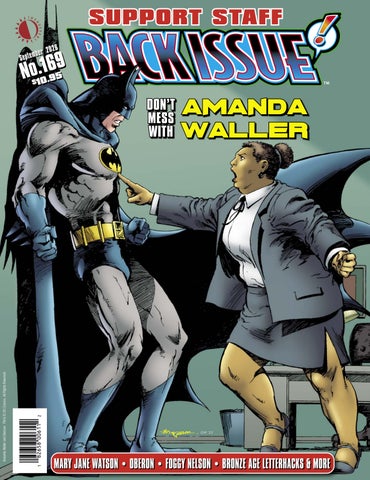


BACK ISSUE ™ issue 169, September 2026 (ISSN 1932-6904) is published monthly (except Jan., March, May, and Nov.) by TwoMorrows Publishing, 10407 Bedfordtown Drive, Raleigh, NC 27614, USA. Phone: (919) 449-0344. Periodicals postage paid at Raleigh, NC. POSTMASTER: Send address changes to Back Issue, c/o TwoMorrows, 10407 Bedfordtown Drive, Raleigh, NC 27614. Michael Eury, Editor Emeritus. Roger Ash, Editor-In-Chief. John Morrow, Publisher. Editorial Office: BACK ISSUE , c/o Roger Ash, Editor, 2715 Birchwood Pass, Apt. 7, Cross Plains, WI 53528. Email: rogerash@hotmail.com. Eight-issue subscriptions: $108 Economy US, $161 International, $39 Digital. Please send subscription orders and funds to TwoMorrows, NOT to the editorial office. Cover artwork by Jerry Bingham. TM & © DC Comics. All Rights Reserved. All editorial matter © TwoMorrows and Roger Ash, except Terry’s Toons © Terry Austin. Printed in China. FIRST PRINTING
by John Kirk

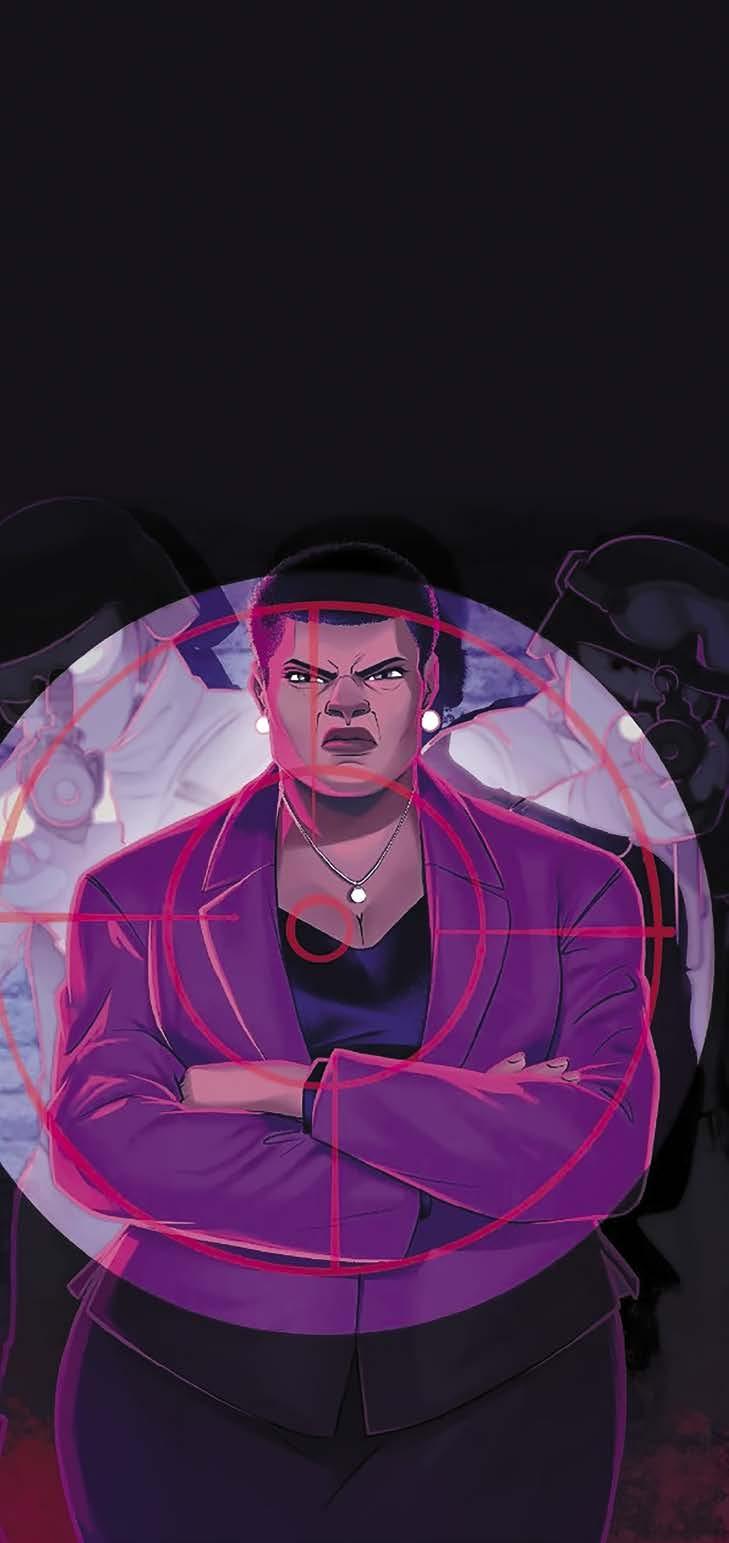
Upon first examination, Amanda Waller wouldn’t be first choice to head up a super-powered covert ops group in the US Government of the 1980s. In fact, she wouldn’t be anyone’s first choice to head up any sort of professional group, governmental or corporate. The ‘80s was a shallow time; appearances mattered and if you weren’t dressed for success or had the right background or look, you were automatically discounted or underestimated. You were the underdog and you didn’t get a chance, unless you pushed things. The odds were against these characters and no one better epitomized that than Amanda Waller. Upon further examination, this underdog would bite hard and force changes to happen.
Through the decades after her ‘80s introduction, readers would see those changes. The comics landscape around her would change, and so would the hard-bitten Projects dweller from the rough side of Chicago. “The Wall,” as she would be come to be known, would change to fit the confines and requirements for the time and medium in which she was featured. While her attitude wouldn’t change, her purpose would.
However, when we first see her—obese, plain looking, a person of color, and unthinkably for the time, a woman vying for power in government of Reagan’s America—Amanda Waller would be the last name on anyone’s list to staff a department, let alone run it. Why? Because in the ’80s, the corporate mindset was that you had to have a certain set of ingredients to be a success and those weren’t in the underestimated Amanda Waller’s make-up. They were in John Ostrander’s vision and that’s what made her seize readers’ attention and gave her character an enduring quality that would make Waller recognizable and appreciated by generations of comic readers.
It’s the ones who go the distance who we underestimate the most.
A CHARACTER BEFORE HER TIME
The unique vision Ostrander had for this character was not only groundbreaking for its time but also in its delivery. This was an unlikely character who was not “dressed for success” but was constantly in battle to maintain her authority over the super-powered beings in her charge. Possessed of no extra-human abilities, she only had a ruthless sense of organization, her willpower, her dedication to her country, and its vast resources behind her. Waller was a new and powerful force to be reckoned with in the landscape of 1980s comics who had no compunction about telling the President of the United States what to do.
Amanda Waller comes under fire in Suicide Squad: Dream Team #3. Cover by Sweeney Boo. TM & © DC Comics.
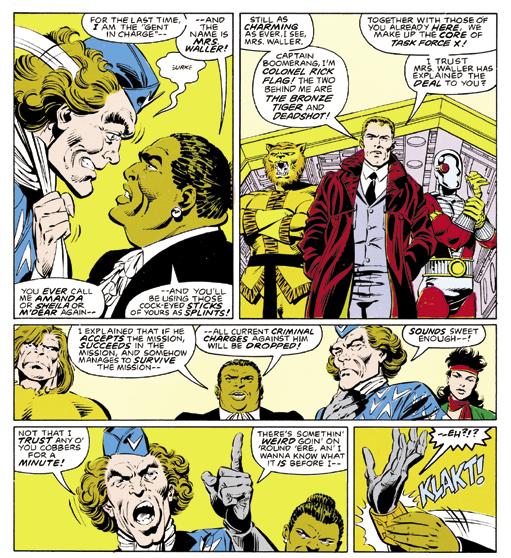
(left) Amanda Waller makes her presence known in Legends #1. Art by John Byrne and Karl Kesel. (right) Waller faces off with Captain Boomerang in Legends #3. Art by John Byrne and Karl Kesel. TM & © DC Comics.
Ostrander tells us about his concept for Amanda Waller in the introduction to the first Suicide Squad Omnibus.
“Another major piece of the Squad puzzle is who would be in charge. The parameters:
“No superpowers. The character would be tough as nails and run everything on their force of will.
“I wanted the character to be African American. DC didn’t have enough black characters, in my opinion, so I wanted this character to be black–character being the key. I wouldn’t write a ‘black character’; I wrote a character who was black.
“I wanted the character to be a woman. Again, not too many top-tier female characters in comics. Actually, I mostly based her on my paternal grandmother, who could freeze me in her tracks when I was 10 with a look. Tough, yes, but human.
“I wanted her to be middle aged and of a certain body type. I wanted her to have lived a life before we met her. And I’m forever looking for ways to subvert stereotypes … every woman in comics seemed to be built like a model or a centerfold. I wanted someone different from that. Also, having a stockier build would be a visual cue to her being immovable. She’s nicknamed ‘the Wall’ for a reason, and I wanted her body shape to look like that.”
Rising to the threat of Darkseid’s attempts to destabilize Earth, Amanda Waller’s introduction in Legends #1 is filled with confrontation and belligerence from the very beginning. With her first meeting with the Suicide Squad (or Task Force X)’s field leader, Colonel Rick Flag, we see her assert herself: her authority when he questions her decisionmaking, but we also see her defend herself against a perceived racial slight. From the get-go, Waller is defended in her initial dealings in the administration of the Squad, but when Flag, a decorated veteran with years of military tradition backs down from this civilian, readers immediately grasp the force of her personality. Of course, John Byrne’s inclusion of garish purple eye shadow
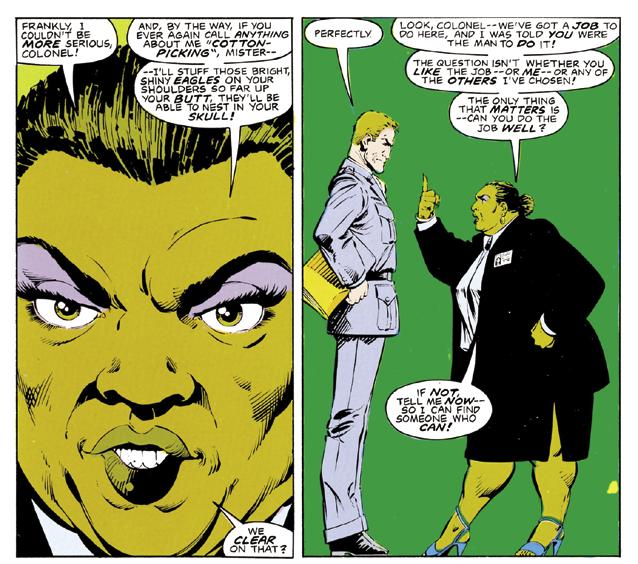
doesn’t hurt in reinforcing how much of an objectionable presence she would prove to be. She’s tough and that simple introduction is enough to get a handle on her. But the level of thought that went into that introduction is key. There was no other character like her in the entire DC continuum at this time. Simple, brutally blunt, and in your face, Waller establishes her presence in a distinctively shocking way.
That first introduction is enough to establish her presence, but the joy in this introduction is that there is more to discover. The brief encounter and dialogue are enough to establish her character, but we are given very little information about her. That information doesn’t become known until a year later in Secret Origins #14, “The Secret Origins of the Suicide Squad” when we learn about Waller’s background.
THE ORIGIN OF THE WALL
To say Waller’s life was hard would be a gross understatement. In this issue of 38 pages, Waller’s personal history gets a six-page short summary of what shaped her character. In the format of a briefing to President Reagan, Waller even manages to take a pot-shot at Reagan’s domestic policies referring to the social assistance programs that her family took advantage of before his presidency. It’s a nice touch in the story that underlines Waller’s fearlessness. Not even the office of the president is enough to intimidate her, but we also get a sense of her core values: dedication, family, patriotism, and protection of these things at any cost.
But even though the treatment is brusque, we learn of the personal losses she endured which gives the reader insight into what motivated this woman to develop such a force of character. We are all shaped by the events in our lives and if the poignancy of these events is reflected on for even a moment, Waller not only becomes more understandable, but even more believable.
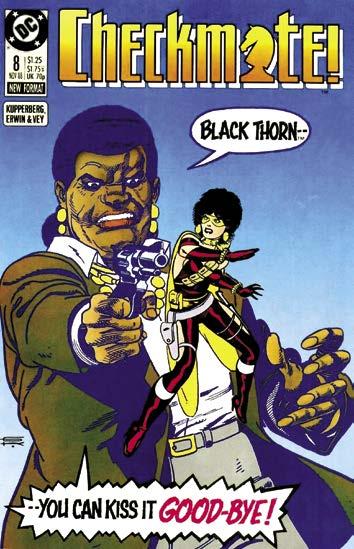
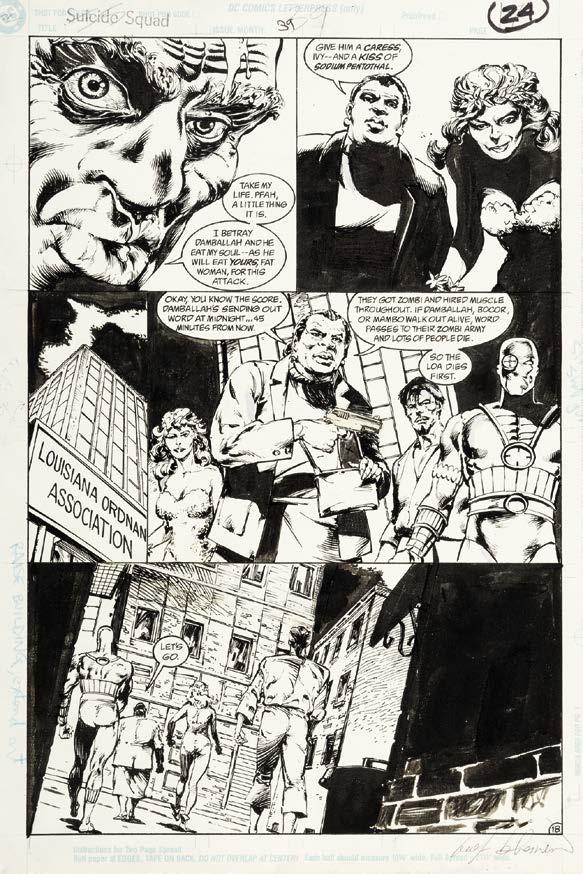
(top) Waller makes her presence known in other governmental organizations such as Checkmate. Cover by Gil Kane. (bottom) Amanda Waller knows how to take charge. Suicide Squad #39 art by Lule McDonnell and Geof Isherwood. Original art scan courtesy of Heritage Auctions (www.ha.com).
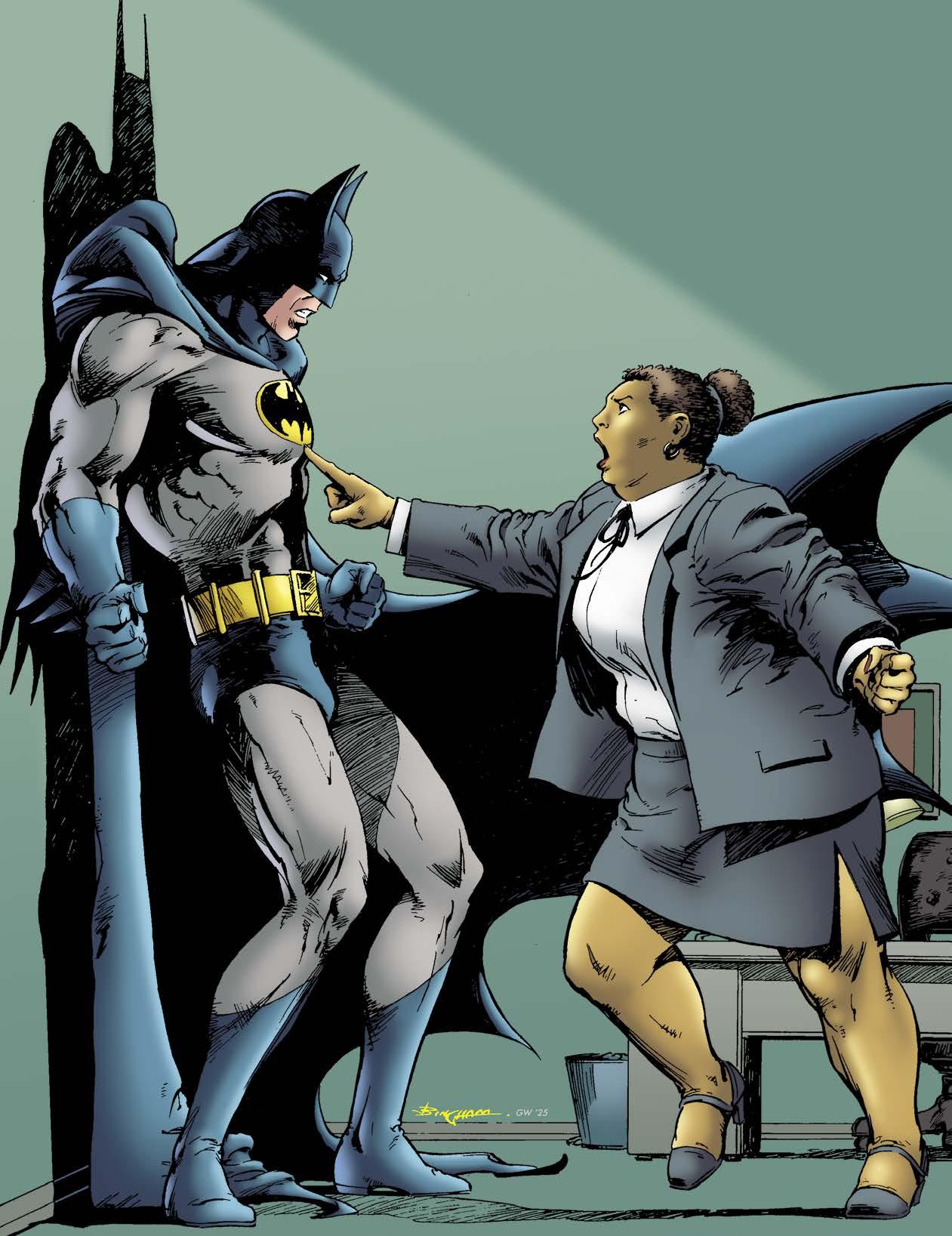
let fly at the other with the rings. Who is going to win? My answer: Amanda, every time.”
She threatens Batman with the discovery of his identity. If the Caped Crusader had a weakness, it would be that and, in some variations, Waller actually was able to make good on her threat. In the pre-New 52 continuity, it’s simply enough of a threat that even Batman takes her seriously and backs down.
BUILDING THE WALL
Waller has no superpowers. She has no personal resources, just what the American government can provide, which was made accessible to her after a long, hard journey of graft, favors, and political influence. She is not military trained, and in her original incarnation, she does not have any political aspirations other than to right the wrongs she sees with the security of her country and create solutions, either offensive or defensive, to those perceived threats. She fits perfectly into the political machinations of any superhero comic and is an excellent foil to add to those stories.
But the Suicide Squad’s frequent encounters with Russian Intelligence and the covert operations they were geared for with other nations meant that there had to be more stories and deeper connections between DC’s superheroes and the American government. Characters like Deadshot were revealing aspects of their pasts that wouldn’t have been revealed. After all, who knew that Deadshot spoke Russian? Or that a dissident intelligence service known as Argent would find its tendrils into the background of the organization? Characters like Sarge Steel or the Forgotten Heroes would gain greater identification and importance. The development of the JLI meant that the governments of the world would now had a say in the dealings with superheroes and this all stemmed from this character. There was a new theme in DC Comics and at the heart of it sat Amanda Waller.
When Checkmate, by Paul Kupperberg and Steve Erwin, hit the shelves, it needed the legitimacy of political characters like Waller to provide it with a degree of governmental authenticity. Waller, as the Queen, was a natural progression of the character and she fit the bill perfectly.
Formed from the crossover with The Doom Patrol/Suicide Squad Special, Checkmate featured characters like Harvey Bullock from Gotham PD, Tom Tresser (aka Nemesis), Valentina Vostok of the Doom Patrol (who also had ties to Russian Intelligence), and former District Attorney, Adrian Chase, who abdicated his civic role and became the Vigilante. DC was ramping up the population of characters who had connections to the government. Influence was being perceived as a superpower in its own right and those who were in the know were just as formidable as those with extranormal abilities.
Waller not only controlled the resources of Task Force X but now she also had the resources of the Checkmate organization as well. Her reach extended throughout all levels of American Intelligence, with advanced technology, military, and superhuman assets at her disposal. Her will was not only formidable, but it began to take on an absolute nature. Checkmate characters like Black Thorn who represented a threat to the way things would be done under the Queen were to be eliminated. By the end of the 1980s, she was at the peak of her power.
Paul Kupperberg remembered this about Waller:
“Amanda was the Wall, a resolute defender of her country with a take-no-prisoners-or-any-B.S. attitude, a woman who said what was on her mind and did what was necessary without any apology. She had the full power and weight of the United States government behind her and nothing but
by Matt Merante
“Will your lawyer talk to God for you?”
—Kitty Wells
Joseph Campbell’s The Hero’s Journey describes eight primary character archetypes which regularly appear in western storytelling: hero, mentor, shadow, ally, threshold guardian, herald, trickster, and shapeshifter. Many would likely say that Franklin Percy “Foggy” Nelson fulfills the ally role throughout the panels of Daredevil They are partially correct. He often shifts between several archetypes throughout his escapades, even performing the role of hero to Daredevil’s shadow self. Like the scales of justice, Foggy keeps Matt in balance. Daredevil walks a fine line between a carefree swashbuckler a la Spider-Man, and a deliverer of violent vigilante justice. Foggy does a lot for Matt Murdock, but at great cost to his relationships, career ambition, mental well-being, and physical health. He is the Samwise Gamgee to Matt Murdock’s Frodoesque burdens. The tale of Foggy Nelson is neither for the faint of heart, nor the totally dour. One can make a strong argument that he may be the real protagonist, depending upon how the evidence is presented. After all, their law firm is called “Nelson & Murdock,” not the other way around. With careful consideration we shall review the case of Foggy Nelson. Is he the best attorney pal a hero could have, a complex companion working out unresolved resentments, or the true unsung hero in Daredevil? We expect our BACK ISSUE jury members to be impartial and balanced when reaching the final verdict. Order in the court, let the trial of Foggy Nelson commence!
OPPOSITES ATTRACT
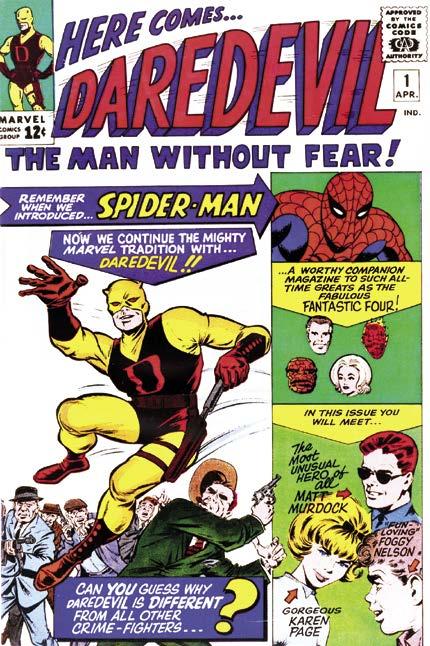
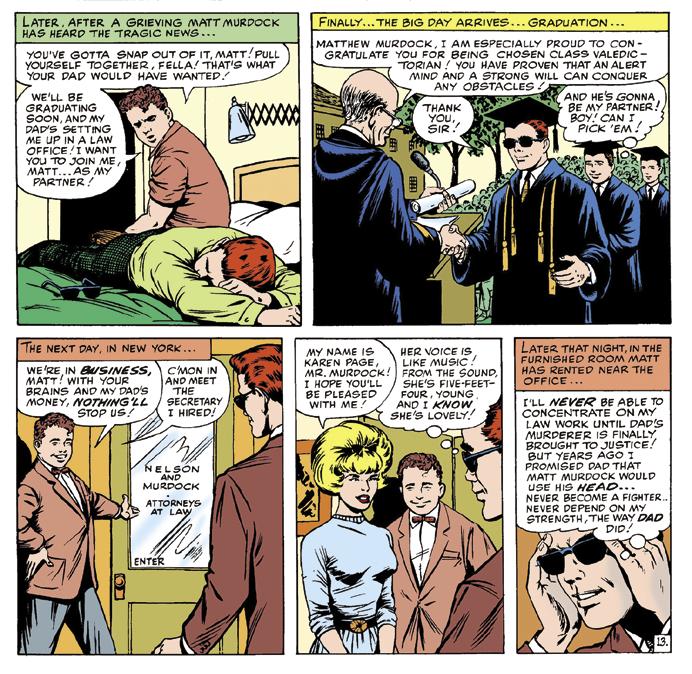
Sometimes the person you room with during your first year of college is not a great match due to conflicting values, habits, schedules, or beliefs. In other instances, they can become dear friends for life. Matt Murdock was fortunate to experience the latter. In Daredevil #1 (Apr. 1964) by Stan Lee and Bill Everett, Matt Murdock attends “State College” (i.e., Columbia) and rooms with Franklin “Foggy” Nelson. Their partnership continues when they attend Harvard Law School. Soon after the tragic demise of Matt’s father, Foggy offers to include him in his new practice: “We’ll be graduating soon, and my dad’s setting me up in a law office! I want you to join me, Matt…as my partner!” The original pairing and contrast seemed simple enough: Foggy was overweight, Matt was thin and fit. Foggy came from the upper crust of social prosperity, while Matt grew up in working class Hell’s Kitchen, the son of a washed-up boxer. In Marvel Age #106 (Nov. 1991) long-time Daredevil penciller Gene Colan noted, “I always loved that Daredevil was serious, and that Foggy provided the humor.” But was the character of Foggy Nelson that simple? Later, it was revealed that their first encounters were not necessarily so copacetic. In DD Vol. 3 #12 (May 2012) Mark Waid and Chris Samnee added some depth to their origin story by describing how Matt was not a fan of Foggy initially. He called him “Foggy” not because he thought he was dim,
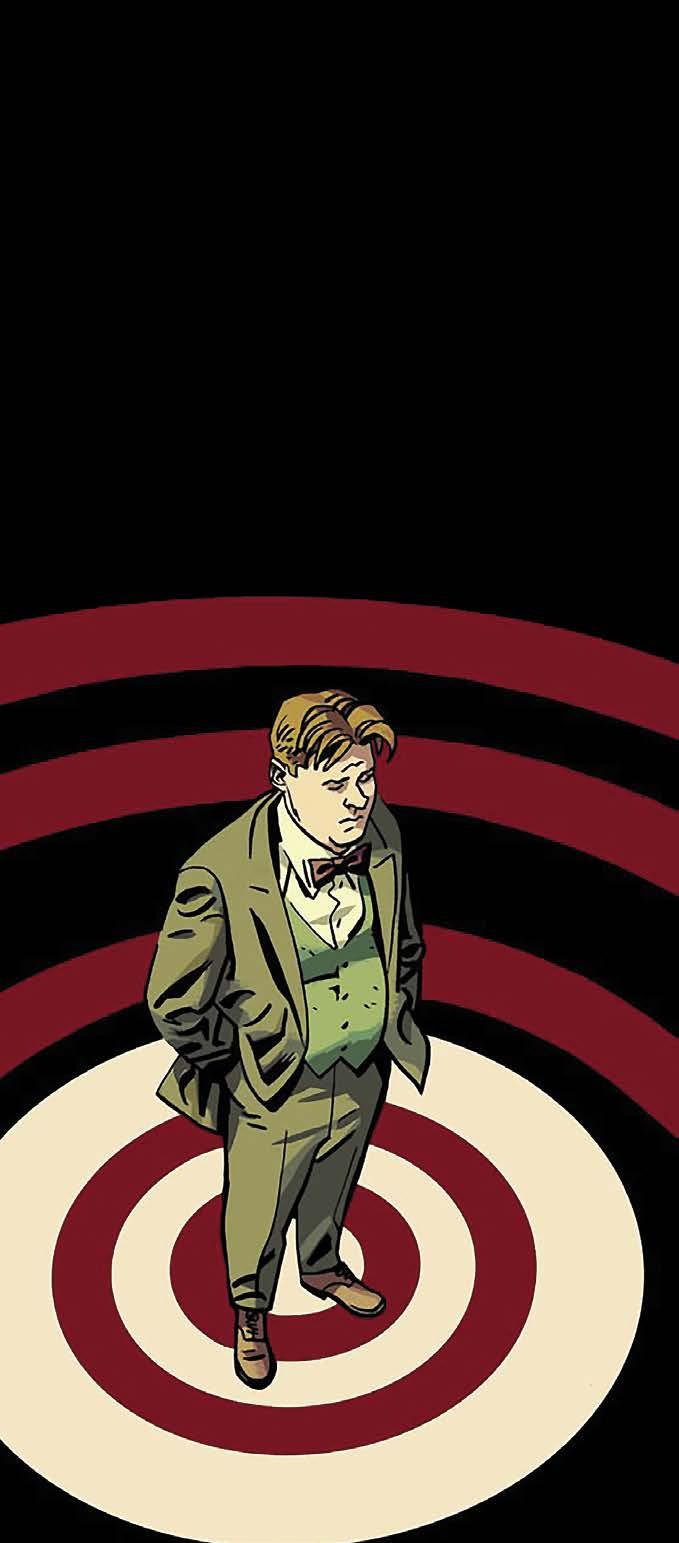
Foggy Nelson’s on target on the cover of Daredevil Vol. 3 #27. Art by Chris Samnee.
TM & © Marvel Characters, Inc.
but because of his obnoxious snoring. It was only after defending Foggy in a mock trial, after being falsely accused of cheating by an unethical professor, that they found common ground and a potential partnership. In correspondence with BI , super scribe Mark Waid described their relationship further, “He’s just such a great counterbalance to Matt in an Odd Couple sort of way. Not only is he messy where Matt is neat, not only does he throw all kinds of garbage food into his body.… while Matt needs to be careful to eat natural foods so they don’t mess with his body chemistry-something he’d feel acutely-they make a great legal team. Matt’s shrewder in court, plays the jury and the judge more cleverly, but Foggy’s the one who knows every legal precedent off the top of his head where Matt would have to look it up.” Foggy concurs with Mr. Waid, as he elegantly describes their contrasting styles in DD #226 (Jan. 1985), “Matt wasn’t good on the details. Never had the patience… Way I always put it, Matt was inspiration, and me, I was perspiration….” The original dynamic of Nelson & Murdock continued early on, including a pseudo love-triangle between the two gents and their legal secretary Karen Page (prior to clear HR guidelines). Karen seemed smitten by Matt while Foggy longed for her. Foggy was often the laughable chubby guy who couldn’t get the girl. It seemed that from early on, Foggy was intended to serve as mostly an ally and sometimes a trickster, in a buffoonish sort of way. Over time Foggy would evolve.
THE GOOD OLD DAYS

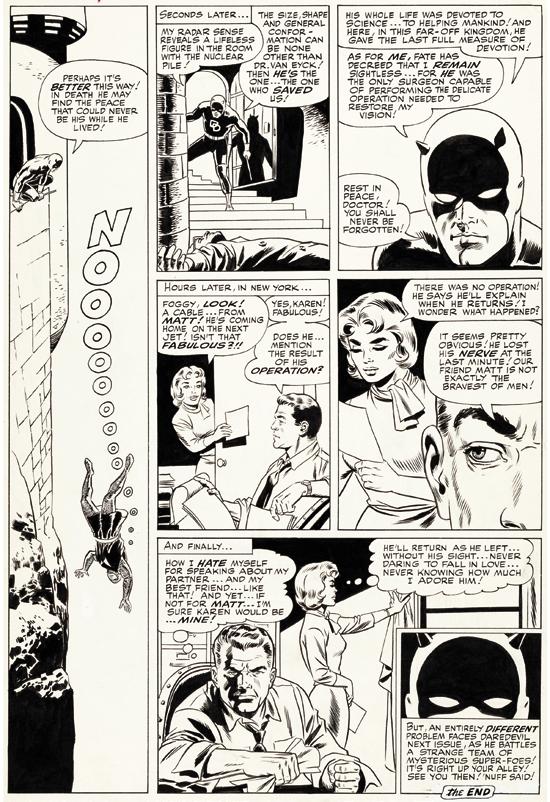
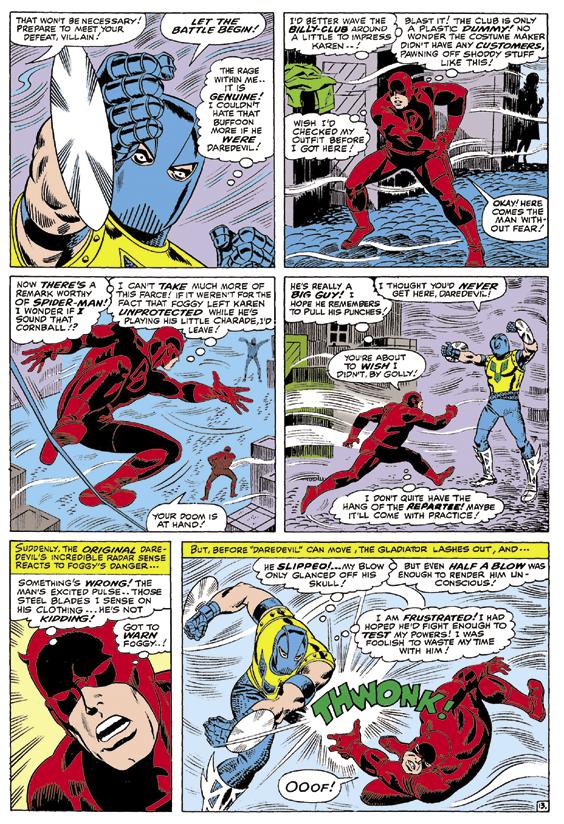
The law offices of Nelson & Murdock allowed for some fun cross-continuity and legal connections in the early going. The Fantastic Four connected with Foggy for some real estate support in DD #2 (June 1964) regarding the lease of the Baxter Building. However, not all the clientele coming in were quite as heroically inclined. Foggy and Matt were sought by more notorious clientele such as the Owl in DD #3 (Aug. 1964), the Purple Man in DD #4 (Oct. 1964), and even Namor, in DD #7 (Apr. 1965). The demand for Foggy as a legal mentor was clearly present from the outset. However, as Foggy’s feelings for Karen Page grew, so did his jealousy. He did not appreciate that Karen preferred the attention of his law partner, Matt. This led to one of his worst personal decisions in DD #17 (June 1966). Succumbing to his lower instincts, or shadow self, Foggy allowed Karen to believe that he may be Daredevil in order to impress her. This happened after an erroneous accusation by Spider-Man. Foggy even went so far as to have a mock costume and “fake” battle prepared to support this outrageous claim. The zealous and lethal Gladiator saw this as an opportunity for himself in DD #18 (July 1966). During the confrontation Gladiator physically outclassed Mr. Nelson immediately and focused his malevolent designs on Karen. Then the actual Daredevil stepped in to bail out both his law associate and love interest!
POLITICS, SHARPSHOOTING, AND MARRIAGE
Many politicians start out in the world of law, and Foggy Nelson was no exception. He ran for District Attorney after several years of practicing law. In DD #48 (Jan. 1969) Daredevil prevents an assassination attempt on Foggy by the Stilt-Man, a villain not exactly designed for a stealthy hit. Foggy then easily wins his election but can now no longer be part of the office of Nelson & Murdock due to his upcoming civic duties. Karen Page soon becomes his secretary, and later Matt his special assistant in DD #58 (Nov. 1969). The “goofball sidekick” shows some unexpected ambition here, and this career move alters the path of the character for a period.
As Nelson’s star rose, so did the attention he gained from an array of forces. In DD #120-123 (May-July 1975), Foggy is recruited by Nick Fury to join SHIELDs directional council, before Hydra can make their own recruiting efforts! Tony Isabella and Bob Brown provided this rollicking yarn featuring the Black Widow, El Jaguar, Blackwing, Silvermane, Man-Killer, Jackhammer, and Dreadnaught. Foggy was the hero for a minute in this tale when in a moment of uncharacteristic rage, he accurately fired a rifle at the chains binding Daredevil and Black Widow from close range…without harming either of them (Franklin Nelson–sharpshooter!?)! After the dust settled, Foggy quickly declined Fury’s
offer. Law was his passion, not active duty in battle. It was a very pragmatic decision.
During DD #130 (Feb. 1976), Foggy lost his District Attorney reelection to rival Blake Tower, while Daredevil fended off the sinister voodoo machinations of Brother Zed. Matt offered him the opportunity to return to his grass roots as an attorney. Foggy and Matt opened a “storefront” law office, serving those without the means to hire highpowered legal representation. He is again an altruistic ally, helping the downtrodden and marginalized survive the turmoil of daily survival. DD #157 (Mar.1979) has Foggy attempting to be a hero again when trying to defend his friends from the Death-Stalker’s Ani-Men. He sneak attacks Ape-Man with a chair, only to be unceremoniously discarded headfirst into a wall. Needless to say, he is unconscious for most of the following issue, DD #158 (May 1979), which featured the debut of a promising up-and-comer named Frank Miller. Nelson provided the comedic relief in DD #166 (Sep. 1980) by Roger McKenzie, Frank Miller, and Klaus Janson. It’s Foggy’s wedding day and he’s going to marry his high school sweetheart, Debbie Harris. Unfortunately, he is dressed in a garish red and green diamond squared tuxedo, resembling a court jester or maybe even a trickster? To make matters worse, he seemingly loses his wedding ring! While Matt fends off an attack from a rampaging
(left) The green-eyed monster rears its ugly head on this page from Daredevil #9. Art by Wally Wood and Bob Powell. Original art scan courtesy of Heritage Auctions (www.ha.com). (right) Foggy attempts to be Daredevil in issue #18 with less than stellar results. Art by John Romita and Frank Giacoia.
TM & © Marvel Characters, Inc.
by Dewey Cassell
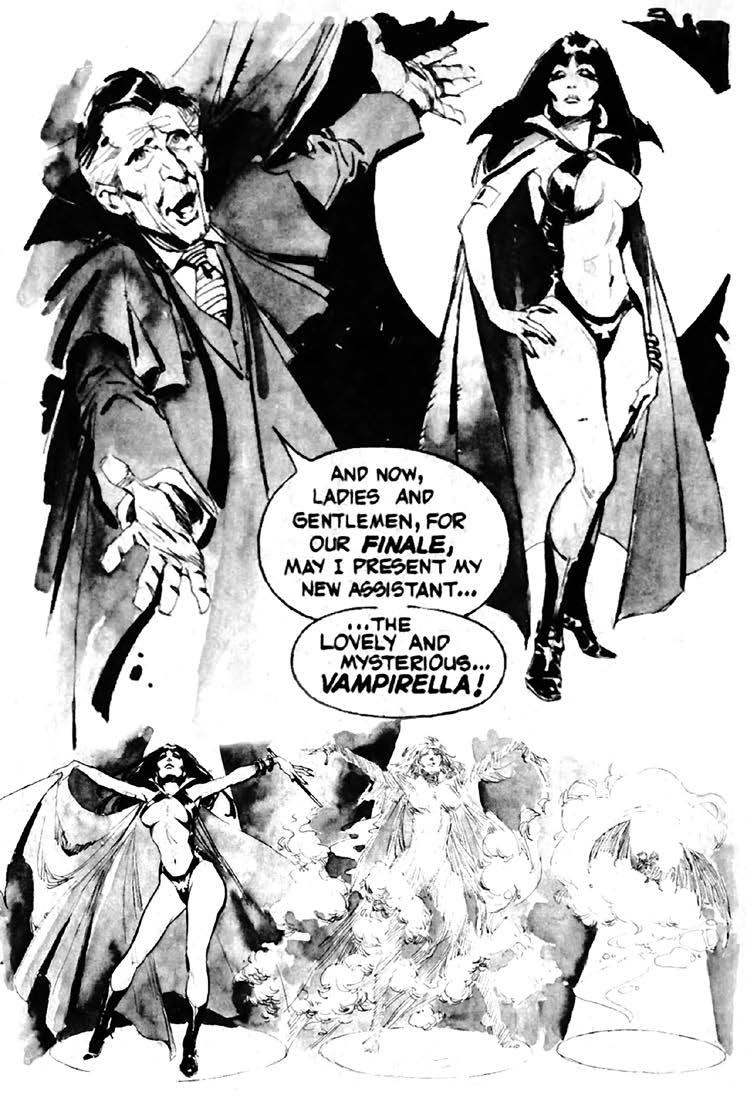
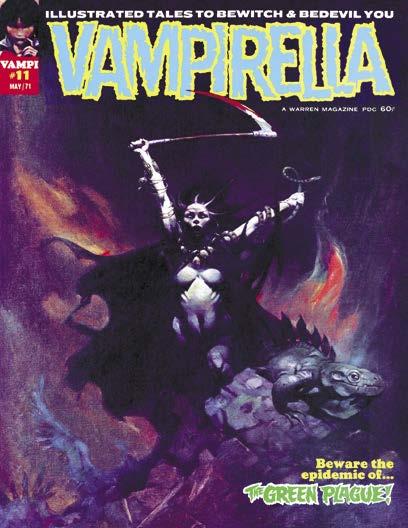
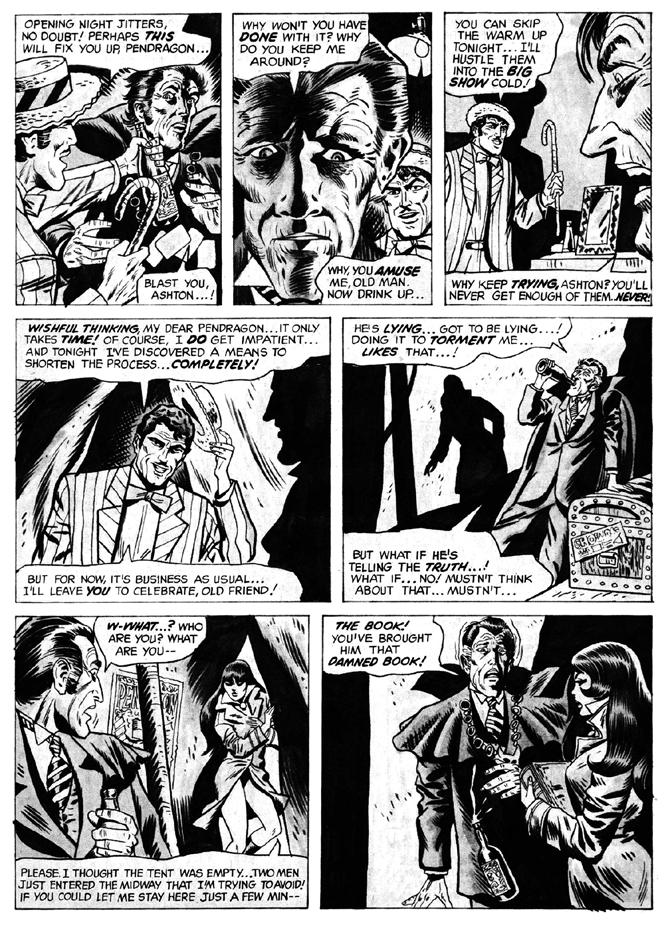
When it comes to being a hero, or even an anti-hero, it is not unusual to find that they have some kind of support in their endeavors. As lonely as that vocation may be, it is difficult to do alone. Some align with teams like the Justice League or the Avengers, who join them in their crusade. Others choose less conspicuous helpers who aid them in the background. The Punisher had Micro. Batman had Alfred. Plastic Man had Woozy Winks. And Vampirella had Mordecai Pendragon. Vampirella was the scantily clad star of her own self-titled black-and-white horror magazine by Warren Publishing, which debuted in 1969. She is an alien with the characteristics of a vampire, who not only hosted the stories, but also appeared in her own adventures. She first encounters Pendragon in the story “Carnival of the Damned” in issue #11 (May 1971), written by Archie Goodwin and illustrated by Tom Sutton. Pendragon was a stage magician working for Ashton’s World of Fun Carnival. He had been kept captive at the carnival for 15 years by one of the seven demon servants of Chaos, Asmodeus, who had partially possessed Ashton. Asmodeus was using the carnival to collect the souls of unsuspecting visitors, but Vampirella was able to defeat Asmodeus and free Pendragon.
Pendragon appears next in issue #13 (Sept. 1971), performing his magic act at a club on the coast of Texas, with Vampirella as his new assistant. The arrangement is beneficial to both Pendragon as well as Vampirella, who is trying to escape the attention of vampire hunter Conrad Van Helsing and his son Adam. The tricks Pendragon performs haven’t improved, but now Vampirella closes the act by transforming into a bat. Pendragon finds her brand of “magic” unsettling, given his prior experience with Asmodeus, and he finds comfort in a bottle, firmly establishing a recurring theme that was introduced in his initial appearance. Together, they travel performing their act and battling the Cult of Chaos.
The issues that follow build on the characterization of both Vampirella and Pendragon, as well as their evolving relationship with the Van Helsings.
Pendragon and Vampirella’s magic act from Vampirella #13. Art by Jose Gonzalez.
TM & © Dynamite.
(top) The cover of Vampirella #11 (art by Frank Frazetta), which featured (bottom) the first appearance of Pendragon.
The stories vary in length but carry forward a loose ongoing continuity from one issue to the next. In issue #21 (Dec. 1972), the entire troupe finds themselves transported into danger, but when Vampirella faces off against a hideous creature, Pendragon steadfastly refuses to leave, saying, “I can run, but the Van Helsings are unable. And the closing of a show is always more meaningful with friends, don’t you think?”
But it is in issue #24 (May 1973) that we finally learn the whole backstory on the often-inebriated magician, in a tale written by Bill DuBay and illustrated by Jose Gonzalez that continues over several issues. When America entered World War II, Pendragon was eking out a living as a stage magician to care for his wife and three-year-old daughter. He was declared physically unfit to serve in the armed forces, so he signed up with the USO and left his wife and daughter behind. While on tour, he sent money home and his wife found work in an electronics plant. She fell in love with the plant manager and wrote to Pendragon asking for a divorce, driving him to find solace in a bottle. What Pendragon didn’t know, until the present day of the story, was that his ex-wife’s new husband abused her regularly. When he struck out at Pendragon’s daughter, his ex-wife fought back and he pushed her through a window, leaving her paralyzed. A family friend took in the mother and daughter and arranged an “accident” for the abusive husband. But Pendragon was completely unaware of what had transpired because he never looked them up after the war. By the end of the story, a drugged Vampirella kills Pendragon’s son-in-law and injures his grandson, leaving Pendragon distraught, though he does not blame Vampirella for what she is. But Pendragon’s estranged wife blames him for all that has happened and unsuccessfully attempts to have him killed.
This story serves not only to make Pendragon a more sympathetic character, rather than a simple drunk, but it also serves to illustrate the complicated relationship that he shares with Vampirella. In his book, From the Stars … A Vampiress (StarWarp Concepts, 2020), Steven A. Roman notes, “The two-part story is probably DuBay’s finest contribution to the series as he shows the reader that there’s far more to Pendragon than just his role as Vampi’s drunken comedic sidekick.” On the surface, it may seem like Pendragon has more in common with Woozy than Micro or Alfred, often acting like a bumbling fool. But unlike Micro or Alfred or Woozy, Pendragon’s relationship with his “hero” seems often marked as much by fear or sadness as by aid and comfort.
From helping Vampirella find her way to serving as a pawn of Dracula to entrap Vampirella, Pendragon plays a variety of roles in his adventures with the Daughter of Drakulon. Perhaps the most common role he plays is one of captive in need of rescue. Unlike the support staff of some heroes, who remain in the shadows, Pendragon has a very public relationship with Vampirella. Coupled with his frail physique and often inebriated condition, he is an easy target for villains who are looking for leverage against the lady in red. For example, in issue #44 (Aug. 1975), Vampirella witnesses a getaway car fleeing a robbery at a blood bank. Concerned that she might recognize them, the robbers kidnap Pendragon as a bargaining chip against Vampirella. She comes to his rescue, thwarting the villains, and satiating her blood thirst in the process. This plot device is
by John Wells
For a subset of Superman fans, fear has a name and it is not Luthor or Brainiac or Doomsday or Darkseid. The creature that strikes fear into their hearts is nothing more than a handsome white pooch called…Krypto. The idea of a superdog in a fluttering red cape is simply a bridge too far for those who prefer to keep their comic books serious and free of anything that one might mistake for children’s literature.
It wasn’t always that way. In the early decades of film, canines like Rin Tin Tin and Lassie became household names. Likewise, threats to comic strip animals such as Little Orphan Annie’s Sandy roused readership as much as real-life perils on the front page. DC’s own Streak the Wonder Dog all but pushed Green Lantern into retirement at the end of his 1940s comic book career and his spiritual successor Rex the Wonder Dog enjoyed a healthy run spanning 1951-1959.
Krypto emerged in Adventure Comics #210, on sale in January 1955, first presenting himself as a stray whose superpowers soon became evident to Superboy. Investigation led the Boy of Steel to a rocket and evidence that the mystery pooch was a test animal from the distant planet Krypton whose journey had been knocked seriously off course. If that wasn’t enough of a coincidence, Krypto also happened to have been the infant Kal-El’s own pet before he had been sent to Earth himself!
Writer Otto Binder, fascinated by the infant space program, clearly took his cues from the U.S. and Russia’s early (and generally tragic) efforts to use animals like monkeys and dogs as proto-astronauts. Krypto was vastly more successful than his real-life counterparts but one must assume that his rocket was equipped with life-preservation qualities that enabled him to survive what must have been at least a decade traveling the stars.
By the end of the first tale, the Dog of Steel had flown back to those stars in search of adventure. Although he’d been reduced to tears more than once over having a playmate who could match him power for power, Superboy also felt a twinge of relief. Krypto was as rambunctious and obstinate as an Earthly dog. Unfortunately, he wasn’t from Earth and a feisty superdog was a handful.
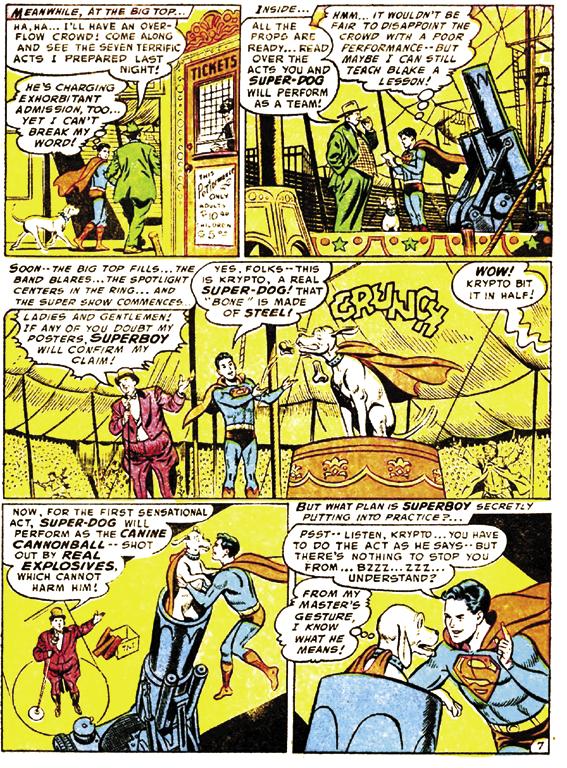
With Curt Swan and Sy Barry on art, Krypto looked pretty much like a real canine save for cartoonishly exaggerated eyes. His early return in 1955’s Adventure #214 further distanced him from true dogs through the addition of thought balloons. The capper was in his third appearance (Adventure #220, 1956). Forced to appear in a circus act alongside Superboy, the pooch acquired a red cape like that of his master and the archetypal Krypto was born. The cartoony eyes evolved depending on the artist but only Swan—by the end of the 1950s—adjusted his style for a genuinely realistic look when illustrating the Dog of Steel.
Meanwhile in Gotham City, a certain Caped Crusader had acquired his own Bat-Hound in June 1955’s Batman #92, a scant three months after Krypto’s debut. Otherwise known as Ace, he was played more realistically—mask aside—with no cartoony eyes and no thought balloons.
Krypto flies into action on the cover of Superman #287. Art by Dick Giordano.
TM & © DC Comics.
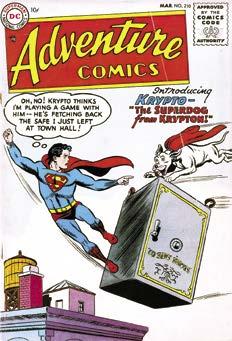
Over the next eight years, he figured into 25 stories. That was a number that Krypto would far surpass thanks to his creator.
Otto Binder must have realized at some point that even a superdog would likely be quite old—if not dead—by Superman’s time. Hence, he penned a tale for 1958’s Jimmy Olsen #29 wherein Superman’s pal met the Dog of Steel. Krypto was as destructive as he had been back in Adventure #210 but this time his behavior was blamed on old age. Miraculously, the superdog quenched his thirst at a virtual Fountain of Youth and he was back to mental and physical sharpness in a heartbeat.
With that story, Binder made it possible for every succeeding writer to broaden the scope of Krypto’s appearances from just the Superboy series to the entire line of Superman-related features. The Boy of Steel’s own strip remained the superdog’s primary home, even allowing him the opportunity to co-found the Legion of Super-Pets (1962’s Adventure #293) and join the frankly cartoonish Space Canine Patrol Agents (S.C.P.A.) in 1966’s Superboy #131. Between 1955 and 1970, Krypto boasted over 150 appearances in various DC stories.
Consequently, Krypto lived on only in reprints, which were still a robust part of DC’s publishing regimen. Indeed, 1960s tales featuring the Dog of Steel—generally drawn by George Papp—were a staple of the Superman Family title (formerly Jimmy Olsen) beginning in January 1974. Starting with issue #165, the original Superboy header on each story was replaced with a “Krypto the Superdog” logo (designed by Gaspar Saladino) that DC continued to use long after Superman Family was a memory.
1974 also saw Aurora reissue a series of 1960s superhero models, with custom comics created as a bonus for buyers. Consequently, a short story featuring Superboy and Krypto (by Marv Wolfman and Dave Cockrum) was produced as one of the inserts.
Krypto debuts in Adventure Comics #210. Art by Curt Swan and Sy Barry.
Once veteran Superman editor Mort Weisinger retired in 1970, however, the Dog of Steel’s heyday was over. In a world where Marvel’s more serious crimefighters had gained considerable traction, the consensus was that super-animals—whether Krypto, Streaky the Super-Cat, Comet the SuperHorse, or Beppo the Super-Monkey—were simply too juvenile for the contemporary superhero reader.
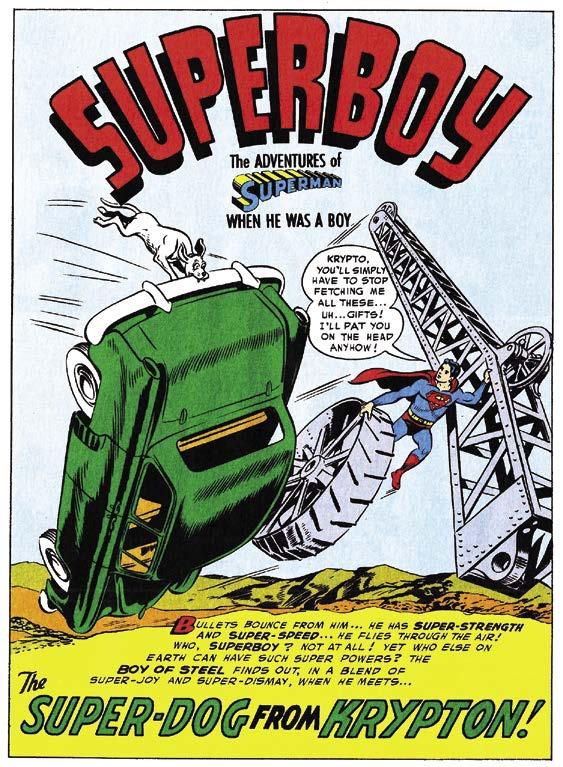
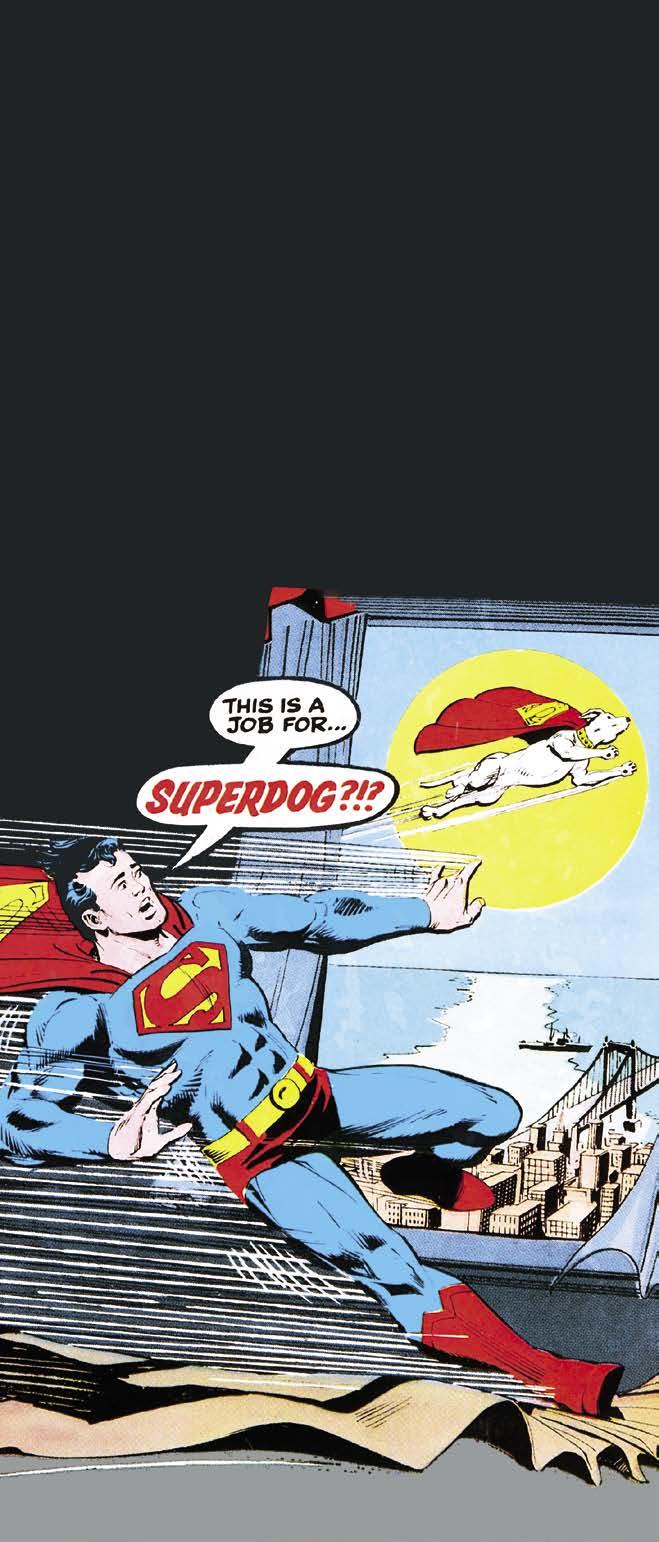
Enter Elliot S. Maggin, a contributor to editor Julius Schwartz’s stable and the regular writer on Action Comics’ Green Arrow feature with artist Mike Grell. The Emerald Archer acquired a four-legged friend in issue #440’s installment (July 1974). Wandering the Star City docks, a strangely familiar white dog looked upward and saw GA—wearing a jetpack—rocket overhead. Attracted by the sight of a flying man, the pooch set out after him, demonstrating a surprising proclivity for fighting crime. Ingratiating himself to Green Arrow, “Demian” —so named by Black Canary—kept up the good work in issue #441 as he helped capture Professor Steelgraves. It was only after the mystery canine vanished into the night that GA and BC realized they’d been assisted by the long-lost Krypto.
by James Heath Lantz
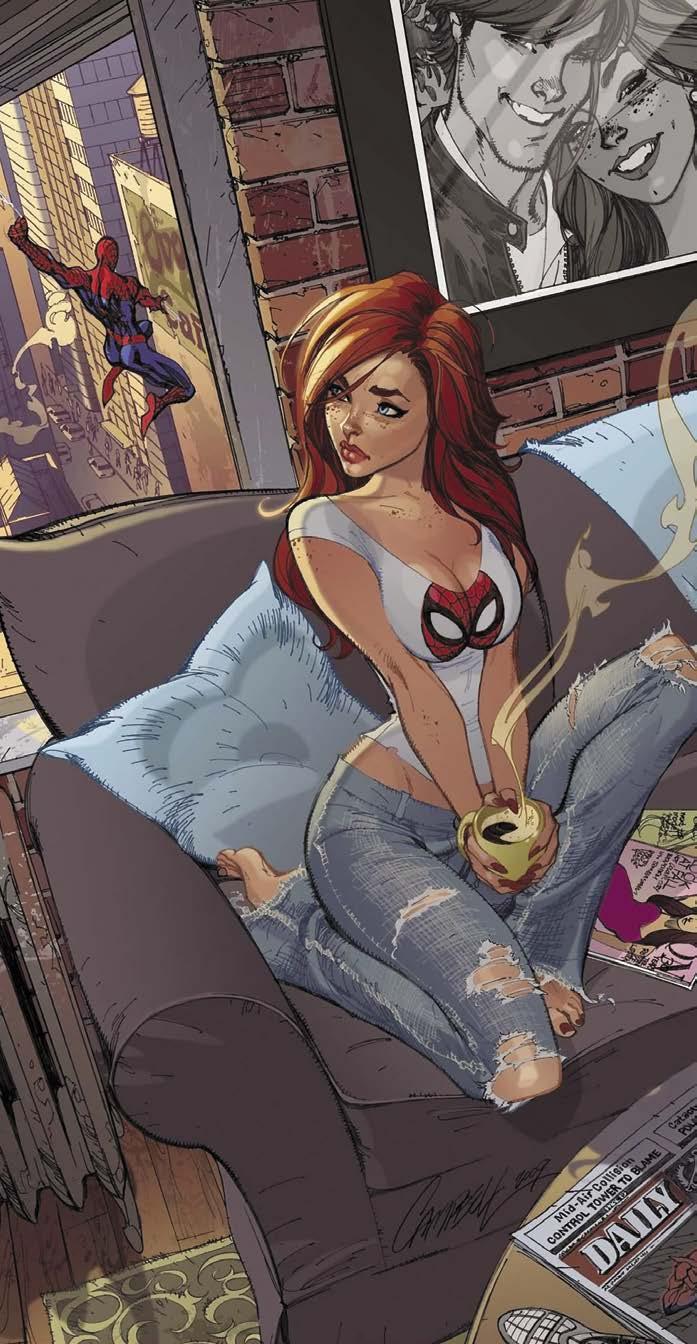
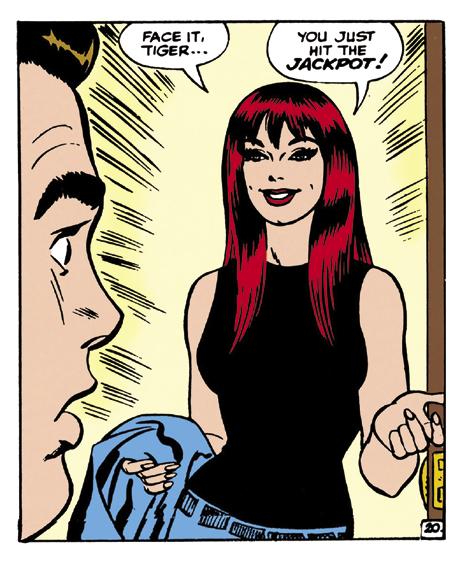
Face it, tigers. You just hit the jackpot. Mary Jane Watson has been perhaps one of the greatest sources of moral support, friendship, and love for Peter Parker during the best and worst times of his life. She’s been a confidant and a wife to Peter, and in spite of rough waters along the way, she’s been supportive of his career as the masked superhuman known as Spider-Man. BACK ISSUE will examine Mary Jane Watson’s life and history in the following pages. These pages are guaranteed to make your hearts skip a webbed beat, Spider-Fans.
THE FIRST DANCE WITH MARY JANE
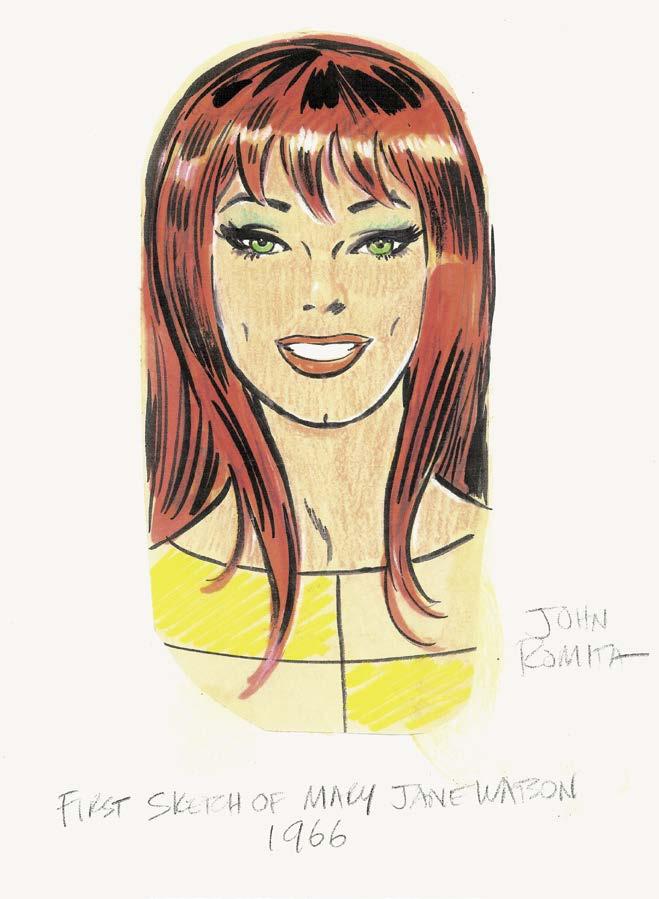
No, we aren’t doing a parody of a Tom Petty song. We are going to take a look at how Mary Jane Watson came into Peter Parker’s life. Mary Jane is first mentioned when Aunt May and her neighbor Anna Watson attempt to bring her and Peter together in The Amazing SpiderMan #15 (Aug. 1964). Stan Lee and Steve Ditko introduced her way back in the March 1965 cover dated #25 (June 1965), though her face is never shown. Mary Jane makes another hidden appearance in #30 (Nov. 1965), and her first full appearance wouldn’t be until the conclusion of issue #42 (No. 1966), drawn by John Romita Sr. Her first bit of dialogue is maybe one of the most memorable in comics. “Face it, tiger... you just hit the jackpot.”
Mary Jane later revealed why she called Peter “Tiger” in ASM #143 (Apr. 1973). She nicknamed him that way in a tongue-in-cheek manner because she saw his calm, bookworm demeanor as an opposite to her seeing the fun in everything. However, we’ll observe as the Spider-Man comics serials evolve, that sense of humor is merely a mask to hide the pain she felt from the abuse she, her mother, and sister suffered. Perhaps Mary Jane Watson saw the tiger within Peter Parker when he was fighting criminals as Spider-Man.
Getting back to Mary Jane’s first appearance, Peter definitely did hit the jackpot when he met her and they joined Aunts May and Anna for dinner. She and Peter hit it off nearly instantly with flirty banter going back and forth between them. Mary Jane even seemed gung-ho about seeing the Rhino rampaging through the streets of New York in ASM #43 (Dec. 1966), something that intrigued a young Spider-Man. With that, the seeds for one of the most popular relationships in the Marvel Universe were planted in those tomes by Stan Lee, Steve Ditko, and John Romita Sr..
Many would think that Mary Jane Watson and Peter Parker are polar opposites when they first see them. Mary Jane is an energetic, fun-loving girl, and Peter is a serious, studious boy who feels like he has the weight of the world on his shoulders, especially after Uncle Ben’s death. Yet, as the years and stories progress throughout the Spider-Man titles, we are given a broader, more in-depth look into these characters’ lives.
Gerry Conway, Alex Saviuk, and Andy Mushynsky explore Mary Jane and Peter’s relationship in the Parallel Lives (May 1989) graphic novel. Loyal BACK ISSUE readers will recall it being discussed in issue #156 with
Mary Jane pines for Peter on the cover of Amazing Spider-Man #601, by J. Scott Campbell.
TM & © Marvel Characters, Inc.
(top) The introduction of Mary Jane in Amazing Spider-Man #42 is perhaps the most famous panel in comics history. Art by John Romita Sr. (bottom) Romita’s first sketch of the now-legendary Mary Jane Watson, 1966.
TM & © Marvel Characters, Inc.
other graphic novels starring Spidey and the rest of the Marvel superheroes. Conway’s story expanded on stories already told by past Spider-Man creative teams while exploring how both Peter and Mary Jane use masks to hide their true selves from the rest of the world, and only they truly know each other. Mary Jane even says early in Parallel Lives that when she first saw Spider-Man on television she liked him because like her, he wore a disguise. Some of Mary Jane and Peter’s captions and dialogue in Parallel Lives are very similar to show just how much alike both characters are. This is particularly true of the scene involving Uncle Ben’s death. There is a re-enactment of the events of Amazing Fantasy #15 (Sept. 1962) from Peter’s point of view. At the same time, we see what’s happening at Mary Jane’s Aunt Anna Watson’s house next door to the Parkers. A shocked and distraught Aunt May is being cared for by Anna and Mary Jane’s mother Madeline while Mary Jane sees Peter enter the Parker home’s front door dressed normally and exit from his bedroom window as Spider-Man. Thus, Mary Jane learns that Peter Parker, her aunt’s best friend’s nephew who she finds cute in a nerdy way, and the red and blue clad Web Slinger named Spider-Man are one and the same. Her surprise over this revelation is hidden by her jovial attitude and one of the reasons Mary Jane avoids her first face-to-face meeting.
Conway, Saviuk, and Mushynsky delved into Mary Jane’s emotions and reasons for not wanting to date Peter. Everyone believed Peter was still the shy, sensitive, studious teenager he was before the radioactive spider had bitten him. Mary Jane, however, knew the truth, and because the abuse her father inflicted upon her, Mary Jane was afraid that Peter Parker would become like Philip Watson. Philip and Madeline Watson married and had two children, Gayle and Mary Jane. Aspiring writer Philip’s abuse became too much for Madeline. She left with Gayle and Mary Jane. They would live with her Uncle Frank. Frank, however, behaved similarly to Philip. This explained Mary Jane’s initial fear of Peter and Spider-Man’s actual mask hiding a monster like the ones within her father and uncle.
Spidey aficionados know that Aunts May and Anna tried bringing Peter and Mary Jane together for a long time. Perhaps those ladies knew that they complemented and, in many cases, needed each other. May Parker and Anna Watson saw something, a spark if you will, in the Spider-Couple that resonated with readers. Creators like Gerry Conway brought that to life even if Stan Lee got the webbed ball rolling.
Kurt Busiek, Pat Oliffe, and Dick Giordano created a blast from the past that expanded on Mary Jane’s attempts to neither see nor think of Peter Parker and his double life as Spider-Man before ASM #42. Set after ASM #14, Untold Tales Of Spider-Man #16 (Dec. 1996), “The Boy Next Door” is the story of Mary Jane seeing Peter Parker and Spider-Man in a different light. Deep down, she wondered who Peter Parker was both in and out of his Spider-Man costume. Yet, when Spider-Man continued to fight Radioactive Man despite the odds being against him, Mary Jane understood that there was more to the Wall Crawler than spider powers and snappy quips. He’s someone
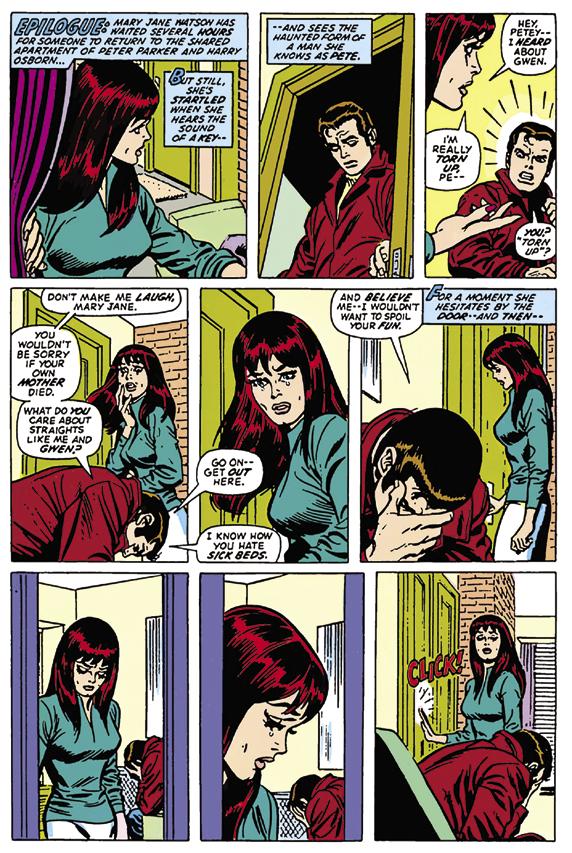
ASM #125 (Oct. 1973). That scene shows Gerry Conway’s ability to go beyond the surface of Mary Jane’s life of the party personality. Mary Jane’s reaction to Harry and Peter’s treatment of her is normal when one considers how her father and uncle were toward her. She is clearly tired of being yelled at by anyone. She runs out of patience and stands up for herself.
Peter and Mary Jane do make up when she witnesses a murder in ASM #127 (Dec. 1973), and she tries to initiate a romance as further issues progress, but Peter, understandably, is not ready for such a relationship so soon after Gwen’s death. Mary Jane puts on her party girl mask to hide how hurt she is. Yet she would understand as time went on.
Peter and Mary Jane finally started dating in ASM #136 (Sept. 1974). If you think their night out was a walk in the park, dear reader, you’d be mistaken. Harry Osborn became the Green Goblin, and he’s learned that Peter Parker is Spider-Man. Peter, meanwhile, recalls Gwen Stacy’s fate and fears the same thing will happen to Mary Jane.
At this point in their relationship, Mary Jane has told nobody, even Peter, that she knows of young Mister Parker’s dual identity. Firstly, because she respects his privacy. Secondly, she realizes the danger of a villain discovering the truth. She has firsthand experience when a bomb planted in
Peter’s apartment by Harry lands her in the hospital. Yet she put on her happy-go-lucky mask in the same way Peter dons his Spider-Man garb. She understands and shares Peter’s fear, but her sense of humor helps cheer up him and Aunt May. This is more proof the Peter needs Mary Jane to ease his mind.
DAY OF THE JACKAL
One villain who really had an impact on Mary Jane and Peter’s romance was Professor Miles Warren, also known as the nefarious Jackal. Warren had fallen in love with Gwen Stacy and blamed Spider-Man for her death. Warren could possibly be considered a foe almost as insidious as Norman Osborn, as his attempts to destroy Spider-Man involve Peter Parker’s personal life.
Meanwhile, Peter and Mary Jane are taking steps to become a romantic couple. She proves to be his anchor when various things make life crazy, including a fight with Mysterio and believing he saw Gwen on the street. Perhaps the greatest moment for the Spider-Couple in this period is when Mary Jane kisses Peter before he leaves for Paris to find a kidnapped J. Jonah Jameson in ASM #143 (Apr. 1975). The captions accompanying the image in the last panel of page seven says it all about Mary Jane and Peter’s love for one another.
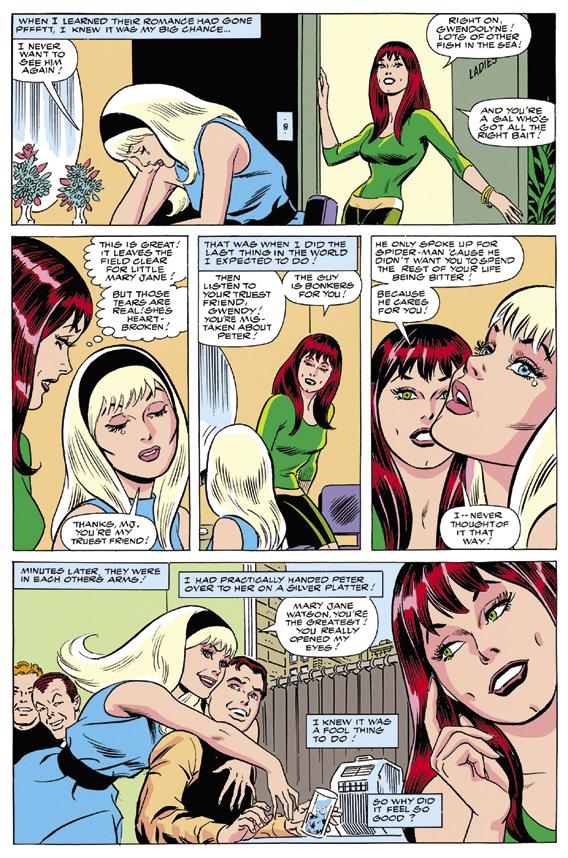
(left) Mary Jane helps bring Gwen and Peter back together in ASM #365’s “I Remember Gwen.” Art by John Romita Sr. (right) Mary Jane doesn’t deserve to be treated like this, but she’s there for Peter anyway. ASM #122 art by Gil Kane, John Romita Sr., and Tony Mortellaro.
by Robert Jeschonek
Great heroes sometimes come in small—and imperfect—packages. Such is the case with Oberon, a man of diminutive stature who has held his own alongside New Gods and Justice Leaguers alike, always making a distinct impression in the process.
Never afraid to speak his mind despite his limited height, thinning gray hair, uncertain physical fitness, and lack of superpowers, Oberon has consistently made a splash among DC Comics heroes. He has gone from working as escape artist Mister Miracle’s sidekick to assistant manager of the Justice League, leaving a trail of villainous types—and some heroic ones, too—to quake in their boots… or at least scowl at the blustering earfuls he delivers.
As he comes full circle—reverting to Mister Miracle’s assistant in the latest New Gods series written by Ram V—now is the perfect time to look back at the roles he has led, the lives he has impacted, and some of his greatest moments on the comics page.
LADIES AND GENTLEMEN! BEHOLD THE MIGHTY MITE!
Oberon first leaped into the spotlight as assistant to the first Mister Miracle, Thaddeus Brown. When New God Scott Free adopted the name after Brown’s death, Oberon came with it, and a beautiful friendship was born.
Through 18 issues of the original 1971-1974 Mister Miracle series, written, drawn, and edited by Jack Kirby, Oberon and Scott worked together to stage a multitude of “impossible” escapes, combat the forces of evil (much of it originating on the evil planet of Apokolips), and train Scott’s successor, Shiloh Norman, in the escapist arts and sciences.
Throughout the series, Oberon served as an irreplaceable partner, providing not only technical expertise related to death traps but a very human presence who grounded the futuristic adventures of Scott and his fellow deities with all their celestial powers and so-advanced-it-might-as-well-be-magic technology. He might not have been a “spring chicken,” might not have had a full head of hair or stood taller than 3 feet 7 inches, but his faith in Scott and indomitable will to never back down in the face of a challenge made him a true powerhouse of the Mister Miracle team.
With his relentless fighting spirit and dedication to battling an evil establishment, Oberon also seemed to embody some of the best qualities of his own creator. Like Jack Kirby, who served in Europe in World War II, Oberon was pugnacious and resistant to the pressures of tyrannical forces. He was scrappy and cynical, yet capable of unwavering belief in someone who represented the values he held most dear.
It’s no accident, many years later, when writer Tom King finally gifted him with a surname, it was “Kurtzberg,” which was Jack’s own birth name.
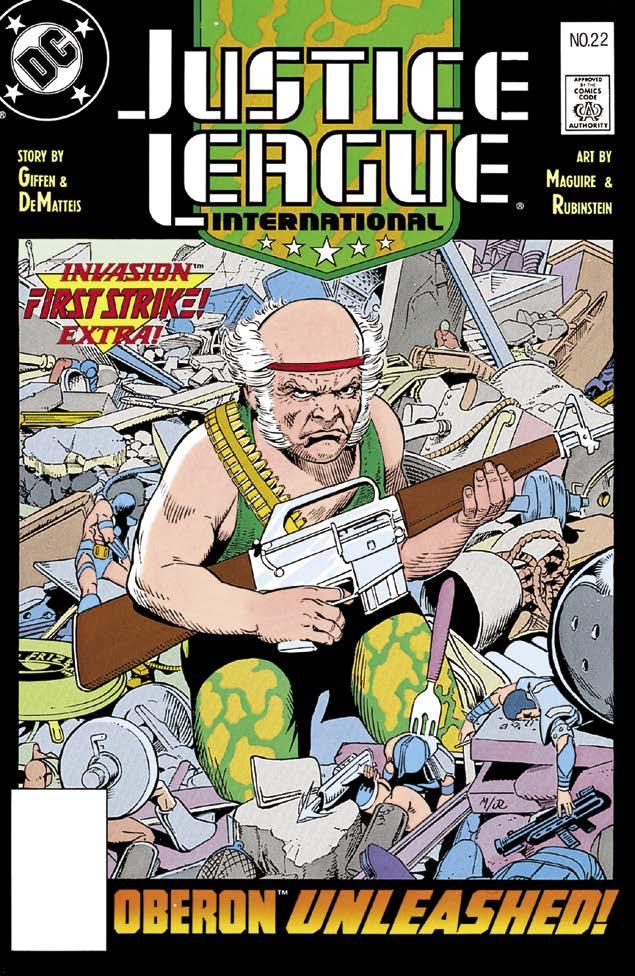
Oberon isn’t afraid to get his hands dirty. Justice League International #22 cover by Kevin Maguire and Joe Rubinstein.
TM & © DC Comics.
ONE SMALL STEP FOR ONE LITTLE PERSON!
When DC Comics resurrected Mister Miracle in 1977, picking up where the first series left off with issue #19 (Sept. 1977), Oberon came along for the ride. The new series ended after just seven issues, but Oberon still found himself front and center as Scott’s best friend and partner.
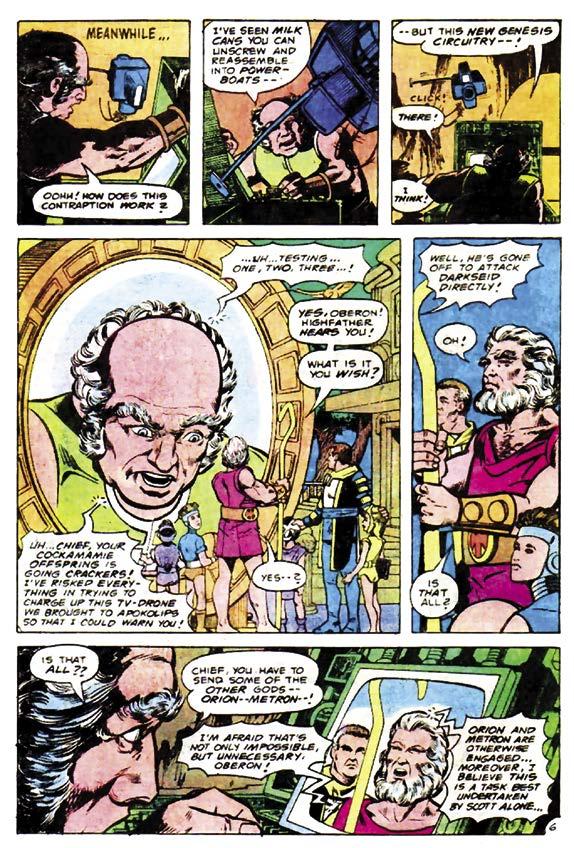
The first multi-issue epic sent Mister Miracle and Oberon on a quest to rescue Scott’s beloved Big Barda from Granny Goodness and her gang of Apokoliptian kidnappers. Written by Steve Englehart and penciled by Marshall Rogers—hot off their wildly popular Batman run in Detective Comics—this storyline even led Scott and Oberon to the dark side of the Moon to face Granny, Kanto, Baron Bedlam, and Vermin Vundabar. They rescued Barda’s physical form, though it took a masterful raid on Apokolips itself to restore her mind to working order. Throughout it all, Oberon did his part to help Scott succeed… though perhaps his most notable moment came in issue #22 (Feb. 1978), when he called the New Gods for help. “Uh… Chief ,” he said, referring to lofty Highfather by a lowly human sobriquet. “Your cockamamie offspring is going crackers!”
Looking back at his work with the character, Englehart remembers Oberon as being “simple but fearless” and “interesting.” “He’s a spunky little guy who’s seen the tricks behind stage magic so much that Scott’s performances don’t faze him, so he’s a good companion, and he has kind of a loopy mind.”
Though Englehart provided Rogers with full scripts, he doesn’t recall how much input the penciler added to the character of Oberon. He does remember, however, that Alan Weiss, a friend of his and Rogers’, got the ball rolling by drawing Oberon in issue #19.
When Englehart and Rogers left the series after issue #22, writer Steve Gerber and penciller Michael Golden jumped aboard as the new creative team. Sadly, the ax fell with issue #25 (Aug.-Sept. 1978), as the infamous cutback event that came to be known as the “DC Implosion” took its toll.
Oberon was destined to return to the spotlight, however… and he would do so in a big way. When next he stepped to the forefront, he would no longer be consigned to sidekick status, limited to a thankless supporting role. Instead, he would be one of the leaders of an international team of the world’s greatest heroes.
And another renowned creative team would be responsible for making him soar.
WATCH THE TRUSTY ASSISTANT BECOME… THE BADASS MANAGEMENT TYPE!
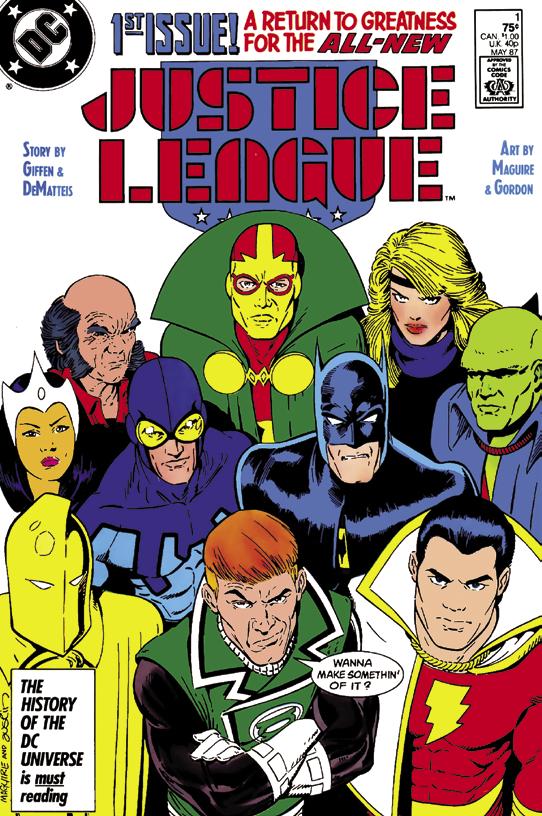
When the first issue of the new Justice League hit the stands in early 1987, its now-iconic cover by Kevin Maguire and Terry Austin featured such notables as Batman, Dr. Fate, Shazam, Black Canary, the Martian Manhunter, Guy Gardner, Mister Miracle… and the one and only Oberon. There he was, scowling in the upper left corner of the group shot, looking a little balder, a little meaner… and a lot
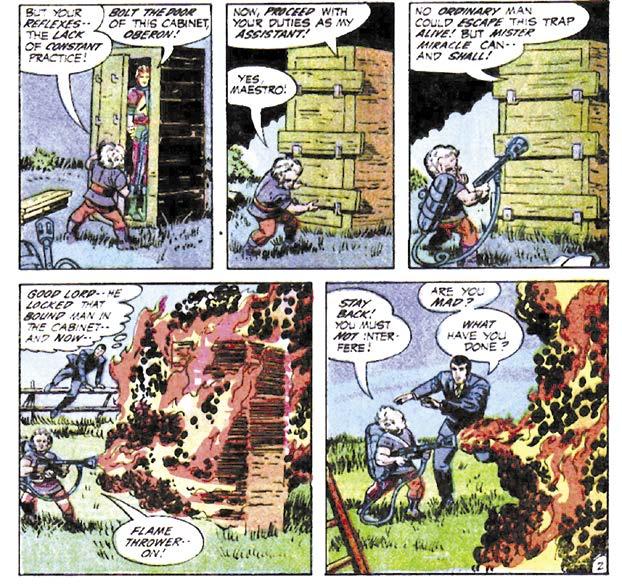
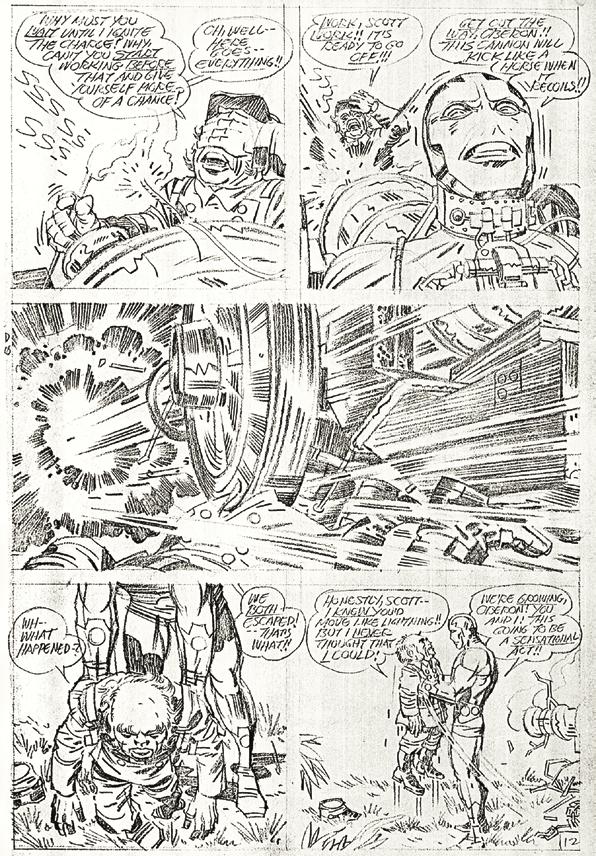
(top) Oberon assists Mister Miracle Thaddeus Brown with his latest stunt. Scott Free can’t believe what he’s seeing. Mister Miracle #1 art by Jack Kirby and Vince Colletta. (bottom) From Mister Miracle #5, Oberon and Scott Free work on a new escape. Pencil art by Kirby. Scan courtesy of John Morrow.
TM & © DC Comics.
more prominent, given his proximity to the latest iteration of the World’s Greatest Heroes.
J. M. DeMatteis, who co-wrote the book with Keith Giffen, did not choose Oberon as a member of the team, but he quickly realized he was the perfect fit. “Oberon and Scott were in place when I came aboard the book,” says DeMatteis. “The entire cast was pretty much dictated by the Powers That Be. But once we started writing him, it became clear that Oberon was important to the series. He brought humanity and heart to the team.”
The first story of the new Justice League series, written by DeMatteis and Keith Giffen, with breakdowns by Giffen, pencils by Maguire, and inks by Austin, did not foreshadow the heights to which Oberon would soon rise... though it did feature him early in the proceedings, smack on page 3. It wasn’t exactly an auspicious introduction, as Guy Gardner started off by insulting him, asking, “What’s the matter, Sneezy—the other six dwarves couldn’t make it?” Things only went downhill from there, as Oberon ended up being tossed around by Guy not once, but twice.
plain Justice League morphed into Justice League International, he received more responsibility and visibility, going from monitor duty attendant to assistant manager of the outfit under Maxwell Lord and J’onn J’onzz, the Manhunter from Mars.

It was not a role that DeMatteis and Giffen had planned for Oberon from the outset. Though DeMatteis had loved the character since he’d first appeared in Kirby’s original Mister Miracle series, he and Giffen came to Justice League with no specific intentions in mind. “Keith and I both wrote intuitively,” DeMatteis explains. “We let the characters lead the way.”
Oberon’s future, however, eventually elevated him to a leadership role. Little by little, as the just
As a team leader and fixer, Oberon proved to be invaluable in many ways. Not only did he bring great organizational skills and a no-nonsense attitude to what was essentially an exercise in herding cats, but he helped hold the chaotic team together when tension and strife threatened to tear it asunder. Always, he succeeded in wrangling the recalcitrant heroes, thanks to the very human qualities that enabled him to stand toe to toe with so many super-powered beings throughout his long career.
(left) Oberon attempts to get Highfather’s assistance in Mister Miracle #22. Art by Marshall Rogers, Rick Bryant, and John Fuller. (right) Oberon joins the Justice League. Cover by Kevin Maguire and Terry Austin. TM & © DC Comics.
by Joseph Norton
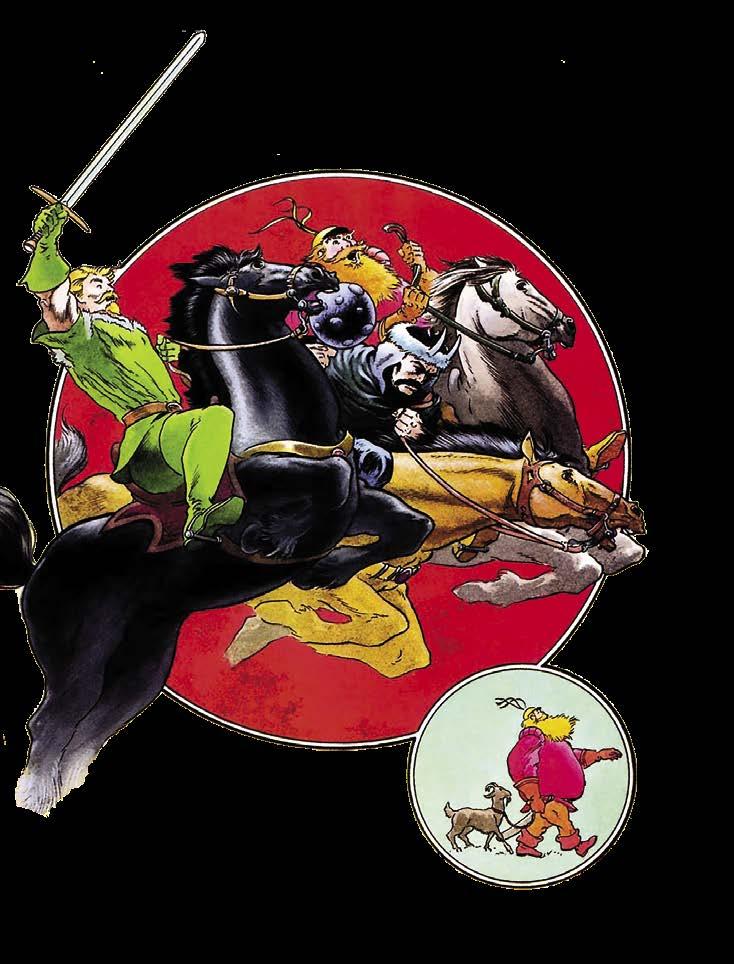

Fandral the Fair. Hogun the Grim. Volstagg the Volumnious. The Warriors Three. Asgard’s finest. They have been the God of Thunder’s most loyal and trusted companions, traveling through the universe on a Viking ship, fighting hordes of trolls, the minions of the evil god Seth, dragons, and the Hulk. They defended the Rainbow Bridge, accused Odin of treason, hosted a cooking show, and faced down New York City cab drivers. The Warriors Three have been by Thor’s side for 60 years, as his trustworthy brothers in arms and drinking companions. Comic books are filled with sidekicks and supporting casts, friends who help keep their secret identities, get captured, then get saved. The Warriors Three have always been better than that. Able to stand out from the rest, able to hold their own, and occasionally headline their own adventures. Join BACK ISSUE in the Halls of Asgard and raise a flagon of ale as we celebrate and sing praise to Fandral, Hogun, and Volstagg; The Warriors Three!
IN THE BEGINNING
The Warriors Three were introduced in the “Tales of Asgard” backup story of Journey Into Mystery #119 (Aug. 1965) titled “Gather Warriors.” Besides Fandral, Hogun, and Volstagg, we also meet other Asgardians like Kroda the Duelist and Magrat the Schemer, but they did not have the same holding power as the Three. In an article from Comic Book Creator #2, Stan Lee talked to Roy Thomas about the origins of the Warriors Three.
“ Roy : I was always curious about those three buddies, Hogun, Fandral, and of course enormous Volstagg. Were those characters your idea or Jack’s? That’s one of those ideas that I could see either you or Jack making up.
“Stan: I made those up. I specifically remember that I did them because I wanted a Falstaff-type guy, a guy like Errol Flynn, and then I wanted a guy like Charles Bronson who was dire and gloomy, riddled with angst. Those three were mine.”
In typical Marvel bombast the Warriors Three were carved, complexities-free in Marvel’s early days. Fandral certainly evoked Errol Flynn, sporting a flamboyant mustache and always a flair for the maidens. His swashbuckling ways telegraphed with word balloons filled with “Thou may not have all the combat to thyself! Fandral will share the exaltation with thee!” Hogun lived up to his name, brooding looks, fiery temper, coded vaguely Eastern by ‘60s standards. His characteristics played broadly, often with variations of this typical speech “Know you ’tis Hogun the Grim you face, Hogun doth live for battle!” His anger was justified by an off panel murdered family which is what counted as character development
Wonderful artwork of the Warriors Three by Charles Vess excerpted from the cover of Marvel Fanfare #34.
TM & © Marvel Characters, Inc.
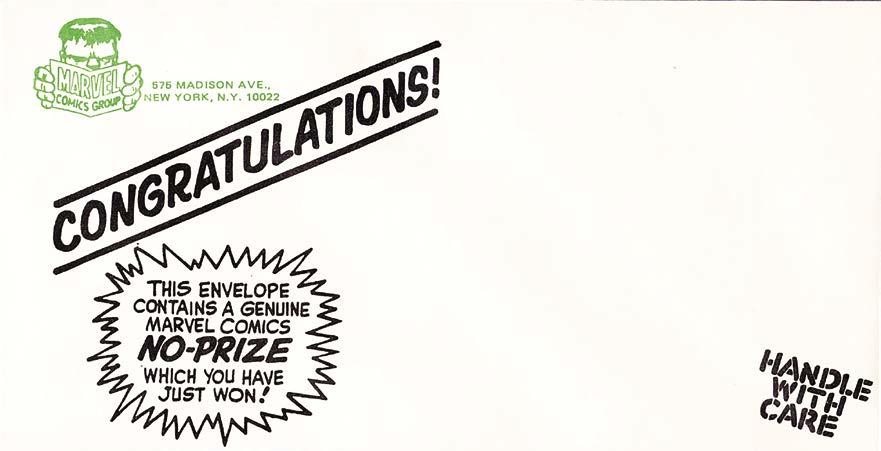
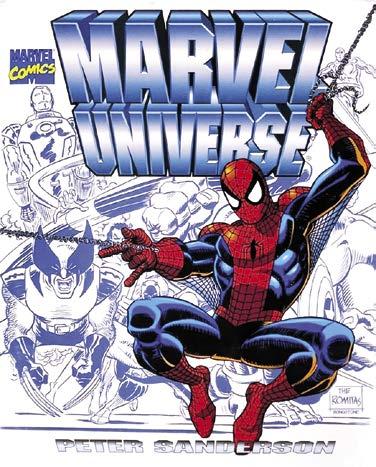
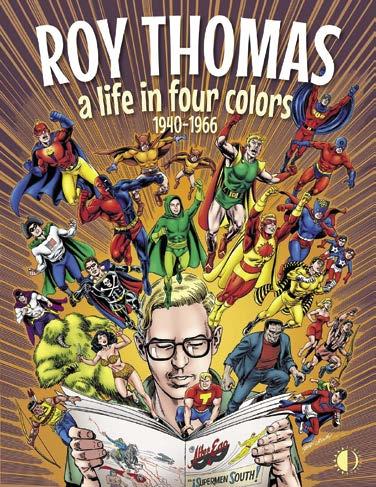
(top) You gotta do a lot to win a NoPrize. (middle) Peter Sanderson’s book, Marvel Universe Cover by John Romita Sr. and John Romita Jr. (bottom) Roy Thomas’ autobiography is now available from TwoMorrows. Art by Jerry Ordway.
IF YOU ENJOYED THIS PREVIEW, CLICK THE LINK TO ORDER THIS ISSUE IN PRINT OR DIGITAL FORMAT!
BI: How did you feel the first time you saw your letter/name in print? How did you feel as time went on and you had letters published fairly regularly?
SANDERSON: I was of course pleased when I got my first letter in print. It was the first thing I wrote that had ever been published! It was very satisfying to be published regularly in comics letters pages.
THOMAS : It was a thrill to see my first letter in print in Green Lantern #1. Each subsequent one also made me feel good, of course there’s nothing quite like the first time.
EURY: I was on Cloud Nine! My first published letter was excerpted in the lettercol of Brave and Bold #112 and featured my fanboy-ish appeals for Jack Kirby-created characters teaming with Batman the fact that #112 teamed Batman with Kirby’s Mister Miracle might’ve prompted the editor to include my Kirby cries. Nonetheless, high school student ‘Mickey’ Eury had his name published in a ‘funnybook’!
MACCHIO: I was elated and I thought, this is really something special.
BI: Did the fact of having letters printed encourage you to write more?
THOMAS: Sure.
MACCHIO: After my first letter, I said, “You know, there’s a lot of things going on in the books.” As I got older, I looked in the letter columns and there are a lot of things I like in common with the other writers, and I found it fascinating. So, I said, “I’m just gonna do it,” and I wound up writing letters all the time to so many of the Marvel books, and they kept getting published.
(84-page FULL-COLOR magazine) $10.95 (Digital Edition) $4.99 https://twomorrows.com/index.php?main_page=product_info&cPath=98_54&products_id=1886
EURY: Not at first. I remember having a complete letter printed, not just an excerpted remark, in Shazam #25, where I had written to share possible editorial ideas. It wasn’t until the early 1980s when my tastes had matured a bit, before I started to write to lettercols again, this time with analyses of the stories I was reading rather than simple fan wishes.
BI: Did you find that you wrote more to the editors that printed your letters?
SANDERSON: The only comics editor I wrote to at first were Julius Schwartz at DC and whoever was doing the letter columns at Marvel.
THOMAS: Naturally. That’s why I wrote more letters to Julius Schwartz’s mags than even to Marvel. But I wrote more to Marvel than were printed.
MACCHIO: I never used it as an incentive to write to a comic that particularly was the one that would print more of my letters. I would always write when something struck me that I either wanted to compliment them on or critique them on.
EURY: My motivation to write was to comment on a story that I was moved by and given my love for team-ups as well as Batman and Superman, I tended to write to Murray Boltinoff and Julius Schwartz the most.
BI: Did you ever have correspondence with a pro or another letter writer due to your printed letters?
EURY : In the early 1980s I began corresponding with other fans through APAs (Amateur Press Alliances). It was through the fabled Legion APA, Interlac , where I first met Mark Waid, Tom and Mary Beirbaum, and Colleen Doran, with whom I’d later work at DC.