NOVEMBER 8, 2016 | VOLUME XCVIII | ISSUE XV DENOUNCING ROWLING SINCE 1918
U
P / 04
P / 09
P / 12
P / 13
P / 15
NEWS
CULTURE
OPINION
SCIENCE
SPORTS
AMS lobbies for affordable education
Carrie Fisher is coming to Fan Expo
The good, bad and the ugly of the AGM
Using drones to study bowhead whales
’Birds win Canada West championship
THE UBYSSEY
,
PAGE 2
NOVEMBER 8, 2016 TUESDAY
YOUR GUIDE TO UBC EVENTS & PEOPLE
EVENTS
2
OUR CAMPUS
Ryo Sugiyama curates a piece of Japan at UBC WEDNESDAY NOVEMBER 2 TO 15 OPERATION CHRISTMAS CHILD 11 A.M. @ CPA HALL Pick up a box for $5 and fill it up with goodies for a child in Haiti, Costa Rica, Chile, Ukraine and other places. $5
WEDNESDAY NOVEMBER 9 LASOC PROFTALKS 11:30 A.M. @ BUCHANAN TOWER Mingle and learn more about the professors in the Law and Society department! $5 non-member / free for members
Sugiyama was in some way fated for the Nitobe Memorial Garden.
Leo Soh Our Campus Coordinator
THURSDAY NOVEMBER 10 GIMMIE SHELTER 9 P.M. @ THE PIT Brought to you by BVP and BOS UBC, enjoy a great benefit concert at the Pit! $8 to $10
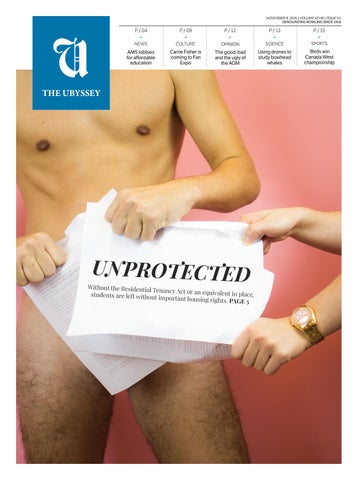
ON THE COVER PHOTO BY Joshua Medicoff DESIGN BY Aiken Lao
Want to see your events listed here? Email your event listings to printeditor@ubyssey.ca
U THE UBYSSEY
EDITORIAL
Photo Editor Josh Medicoff photos@ubyssey.ca
Coordinating Editor Jack Hauen coordinating@ubyssey.ca Our Campus Coordinator Design Editor Leo Soh Aiken Lao ourcampus@ubyssey.ca printeditor@ubyssey.ca News Editors Sruthi Tadepalli & Samantha McCabe news@ubyssey.ca Culture Editor Samuel Du Bois culture@ubyssey.ca Sports + Rec Editor Olamide Olaniyan sports@ubyssey.ca Video Producer Kate Colenbrander video@ubyssey.ca Opinions + Blog Editor Bailey Ramsay opinions@ubyssey.ca Science Editor Koby Michaels science@ubyssey.ca
NOVEMBER 8, 2016 | VOLUME XCVIII| ISSUE XV
BUSINESS Business Manager Ron Gorodetsky business@ubyssey.ca
President Tanner Bokor president@ubyssey.ca
Web Developer Peter Siemens peter@ubyssey.ca
Operations Assistant Aine Coombs operations@ubyssey.ca
The New Student Union Building 6133 University Boulevard Vancouver, BC V6T 1Z1 Online: ubyssey.ca Twitter: @ubyssey
Copy Editor Office Administrator Miguel Santa Maria Olivia Law copyeditor@ubyssey.ca advertising@ubyssey.ca STAFF
LEGAL
Natalie Morris, Matt Langmuir, Bill Situ, Gabey Lucas, Julia Burnham, Sophie Sutcliffe, Rachel Ong, Lucy Fox, Emma Hicks, Jeremy JohnsonSilvers, Diana Oproescu, Stephanie Wu, Emmanuel Villamejor, Moira Wyton, Patrick Gillin, Mischa Milne, Sebastian Mendo, Isabelle Commerford, Katharina Friege, Hana Golightly, Lauren Kearns, Ben Geisberg, Joshua Azizi, Sarah Pribadi, Zubair Hirji
The Ubyssey is the official student newspaper of the University of British Columbia. It is published every Tuesday by The Ubyssey Publications Society. We are an autonomous, democratically run student organization and all students are encouraged to participate. Editorials are chosen and written by the Ubyssey staff. They are the expressed opinion of the staff, and do not necessarily reflect the views of The Ubyssey Publications Society or the University of British Columbia. All editorial content appearing in The Ubyssey is the property of The Ubyssey Publications Society. Stories, opinions, photographs and artwork contained herein cannot be reproduced without the expressed, written permission of The Ubyssey Publications Society. The Ubyssey is a founding member of Canadian University
CONTACT Editorial Office: SUB 2208 604.822.2301 Business Office: SUB 2209 ADVERTISING 604.822.2301 INQUIRIES 604.822.2301
Press (CUP) and adheres to CUP’s guiding principles. The Ubyssey accepts opinion articles on any topic related to the University of British Columbia (UBC) and/or topics relevant to students attending UBC. Submissions must be written by UBC students, professors, alumni, or those in a suitable position (as determined by the opinions editor) to speak on UBC-related matters. Submissions must not contain racism, sexism, homophobia, transphobia, harassment or discrimination. Authors and/ or submissions will not be precluded from publication based solely on association with particular ideologies or subject matter that some may find objectionable. Approval for publication is, however, dependent on the quality of the argument and The Ubyssey editorial board’s judgment of appropriate content.
Submissions may be sent by email to opinion@ubyssey.ca. Please include your student number or other proof of identification. Anonymous submissions will be accepted on extremely rare occasions. Requests for anonymity will be granted upon agreement from four fifths of the editorial board. Full opinions policy may be found at ubyssey.ca/ submit-an-opinion It is agreed by all persons placing display or classified advertising that if the Ubyssey Publications Society fails to publish an advertisement or if an error in the ad occurs the liability of the UPS will not be greater than the price paid for the ad. The UPS shall not be responsible for slight changes or typographical errors that do not lessen the value or the impact of the ad.
A Japanese tea garden is the more functional of the two traditional Japanese gardens — it hosts the chado, or tea ceremony, and serves as a leisure space for the household. Ryo Sugiyama is the curator of UBC’s very own tea garden: Nitobe Memorial. Sugiyama was in some way fated for the garden. Upon arriving in Canada on a one-year work visa in 2005, he visited the garden and met Junji Shinada, the previous curator. Five years later, when Shinada retired, he contacted Sugiyama to take the reins from him. “Me and my wife are from the same university, and she’s a horticulturalist as well. I heard of the Japanese garden at UBC, so we came here and we met [Shinada]. We didn’t exchange any contact info — we didn’t have smartphones at the time. Then after three, four years, I got a phone call from him. He said he was going to retire, then asked me to take over,” said Sugiyama. During his time at Chiba University, where he graduated with a master’s degree in landscape science, Sugiyama was taught by a disciple of Kannosuke Mori, the original designer of the garden who oversaw its construction in 1963. Measuring in at 2.5 acres and featuring a harmonic medley of local and exotic plant species, the garden itself is a daunting facility to maintain, even for multiple gardeners. But not only does Sugiyama curate the garden by himself, he is a perfectionist and the catalyst behind the garden’s perennial beauty. “My title is curator, but basically I’m a gardener,” he said. “The staff
from the botanical garden — they can come to help me and they are good horticulturalists, but they don’t know how to maintain Japanese style. That’s why I have to do all the pruning. Usually, if this was in Japan, [there are] at least two full-time gardeners.” Maintaining Japanese style, and creating an authentic Japanese space in Canada, is a task that Sugiyama takes seriously. It is also a difficult one — the lack of manpower, diversity of plants and the Vancouver climate are challenges that Sugiyama must face and overcome. “It’s different and difficult — the plants are different. You don’t have many conifers in Japanese gardens in Japan. [It’s] not a great climate [especially for a] cherry tree — it’s kind of wet. In Japan, we have a dry winter, but Vancouver is a wet winter — so I have to be careful about the timing of pruning. Most plants grow twice [as fast in] Japan, so that means I need to maintain more,” he said. Despite this, as of May 2016, the Nitobe Memorial Garden is considered by experts to be one of the best traditional Japanese gardens in North America and one of the top five outside Japan. The garden was created in memoriam of Dr. Inazo Nitobe (1862-1933), a renaissance man who was crucial in bridging Japanese-Canadian relations. It is for this reason that the garden features an oasis — symbolizing the Pacific — and a bridge between the two sections of the garden, each side symbolizing Japan or Canada, and decorated by their respective maple trees. Sugiyama explained how the Nitobe stone lantern, located north of the garden entrance, is
PHOTO JOSHUA MEDICOFF/THE UBYSSEY
a physical marker of JapaneseCanadian history at UBC. “It was brought from Japan just two years after Nitobe passed away. This was placed ... on campus, but during the Second World War, many people [were] against Japan, so this was damaged,” he said. Once then UBC President Norman Mackenzie — who worked with Nitobe for UNESCO — found out, he cooperated with the Japanese community to create the Memorial Garden. As the garden’s curator, Sugiyama believes he has a responsibility to bear witness to this history. He wants to understand its history, and pass on the knowledge to visitors. “This garden is a place for understanding Japanese garden and Japanese culture. [It is] also the place for the people which come from all over the world to communicate with each other,” he said. Sugiyama regrets that the garden is located adjacent to Place Vanier Residence — students often hop the garden walls and party. And while Sugiyama can relate — he was a student once, too — he wants students to show more respect for the facility. “Just respect the garden — even night time, just stay on the path, don’t break anything and if you drink or smoke, take all the garbage,” he said. Ultimately, Sugiyama carries on Nitobe’s legacy by curating a piece of Japan at UBC. “I hope people understand what Japanese garden is, and also I like people to feel something peaceful or something warm when you walk around — that’s my goal.” U
NEWS
NOVEMBER 8, 2016 TUESDAY
EDITORS SRUTHI TADEPALLI + SAMANTHA MCCABE
3
TUITION //
Students rally against “price tag” on education Moira Wyton Staff Writer
On November 2, dozens of UBC students and community members gathered at the flagpole near the Rose Garden to mobilize against increasing costs of postsecondary education in Canada and the “price tag” put on attending UBC. Organized by the UBC Social Justice Centre in partnership with the Canadian Federation of Students and the Young Communist League, the rally was one of 40 events that took place across Canada to coincide with the National Student Day of Action. “It’s not just about raising consciousness, but getting people to realize that it’s a real privilege for a lot of people to get education,” said Tania Talebzadeh, a fourth-year arts student and chair of the Social Justice Centre. “We are not all alike and we come from different life situations, but that should not block us from getting education.” The chanting protesters moved via Main Mall from the flagpole to the Nest, where a series of passionate speeches were delivered from rally organizers and representatives of various UBC and community organizations, including the UBC Women’s Centre and the Left Alternative. Students in attendance were concerned with the Board of
Governors’ 2015 decision to increase tuition fees for both domestic and international students by two per cent and 48.5 per cent respectively. Speakers also aimed to stress the impact of such decisions on marginalized students at UBC, including those who are Indigenous. “[UBC] talks about the ‘best of the best’ being here and there’s a lot of First Nations students who should be here, but ... it’s all about the funding,” said Rodney Little Mustache, a First Nations second-year arts student, before addressing protesters at the rally. “Every student who has the dream to do better for themselves and their community should be here, because they’re the ‘best of the best’ as well.” Students in attendance saw the rally as an opportunity to engage themselves in a relevant dialogue on campus. “I’m just feeling tired of being used by UBC for our money and not really knowing where it’s going,” said Nisha Takhar, a thirdyear student in the faculty of land and food systems, and an attendee of the rally. “I think it’s really important for me as a student to take the initiative … to know what’s going on in the university.” As the rally’s organizers plan their next steps, they are focused on making students’ voices heard in decision-making at UBC despite “not seeing any partnership” with UBC administration present at today’s event.
Students protest outside the AMS Student Nest.
“[The UBC administration] lets you protest ... but they don’t actually do anything about it,” said Talebzadeh. “It’s just not paying attention and like a pseudo-form of caring.” UBC’s VP Students Louise Cowin did, however, note that UBC not having a formal channel for incorporating feedback from student protests is far from it not
caring about students’ discontent. “UBC certainly encourages respectful student protest on campus,” said Cowin. “Were we to have been notified of the protest, we would have happily sent a representative to listen directly to what students were saying.” Despite the lower-thanexpected turnout and lack of administrative presence,
PHOTO SOPHIE SUTCLIFFE/THE UBYSSEY
organizers were “heartened” by the enthusiasm shown by speakers and participants alike. “It’s about getting together, the mentality of having someone to have your back and being stronger as a student body,” said Talebzadeh. “From here, we’re looking to keep disturbing, keep agitating and continuing to encourage students to mobilize for their rights.” U
ENVIRONMENT //
Sustainable Future Fund might not be implemented anytime soon
FILE PHOTO JOSHUA MEDICOFF/THE UBYSSEY
MSCI and members of UBCC350 attend the UBC BoG Endowment Responsible Invesment Policy committee meeting.
Sophie Sutcliffe Senior Staff Writer
The timeline for the implementation of the recently approved Sustainable Future Fund (SFF) has been relaxed after a meeting and consultation session on October 13. Last month, the UBC Board of Governors’ Endowment Responsible Investment Policy
Committee heard presentations from UBCC350, the climate change advocacy group that originally advocated for the divestment referendum, and MSCI — a company that offers an index through which UBC can create a sustainable investment portfolio for the SFF. After this meeting, it was decided that the timeline for the actual creation of the fund would be extended by an unspecified amount.
The Sustainable Future Fund is intended to be an investment fund slated specifically for investments in sustainable initiatives — which differentiates it from UBC’s other investment portfolios. The definition of sustainability in question may vary. According to Aaron Bailey, one of the student representatives on the Board, this is so they can “really get to the roots of the offerings
and the products that are available, as well as what the community is asking from us.” Bailey noted that the subcommittee is now looking at whether to stick with the lowcarbon high ESG (environmental, social and governance) rating model initially proposed, or to switch to a fossil fuel free fund. “I wouldn’t say that they’re ruling out the low carbon fund (index categorization) as an option … but my take on the meeting is that we’re really going to be listening to the community throughout this process,” said Bailey. “We’d rather slow down the process and get it right,” he said. The subcommittee heard from both groups in a meeting on October 13, heavily attended by UBCC350 members. During the meeting, both groups presented their case and Alastair Fraser, a PhD student in environmental economics, was also given the opportunity to ask MSCI questions about the methods used in calculating environmental impact and voice other concerns that UBCC350 had about the presentation. “Our main argument going into the responsible investment committee [was] the fact that the Sustainable Future Fund, in its designation of being low carbon, still includes some really big fossil fuel companies,” said Stephanie Glanzmann, the student
coordinator of UBCC350, in an interview following the meeting. “Because the creation of the Sustainable Future Fund was what we saw [as] a counterproposal to divestment, it was just a hard blow because it was so far from what students and faculty asked for.” Priti Shokeen, one of the two representatives for MSCI who presented at the meeting, had a different view of UBC’s proposed use of a low carbon emissions model. “We have two main approaches [for these funds]. One is the exclusion approach, in which you basically eliminate any companies which have fossil fuel reserves. From a stranded assets perspective, that is something very desirable,” said Shokeen. “From a real impact perspective, we also want to be taking into account current emissions. So the low target carbon index is taking both the current emissions as well as the reserves equation into account, and we’re reducing the overall impact.” Despite the outcome, UBCC350 said they were encouraged by the event and felt like the Board was doing a better job of listening to them then in the past. “I feel like, and I don’t want to pre-emptively say this, but I feel like it was a little bit of turning the corner,” said Glanzmann. “In the past, dealing with UBC governance, it’s been such an uphill battle, and it was very cool to enter the room and actually feel like you’re being heard for the first time.” U
4 | news | TUESDAY NOVEMBER 8, 2016 FINANCE //
AMS lobbying provincial government for more affordable education
HEALTH //
Your free flu shot may not be free — here’s why
Diana Oproescu Senior Staff Writer
The AMS is currently lobbying the provincial government to consider three recommendations in hopes of reducing the financial burden for university students. Every year, the AMS submits a report making recommendations for the provincial government’s budget. This year, they’re recommendations centre on three main things — operating grants, student loans and the U-Pass BC program. “All of the three points are about affordability for students, and that’s something we really wanted to focus on and something we thought was appropriate for this committee given that they’re going to be making recommendations of what the provincial government’s budget should look like moving forward,” said AMS VP External Kathleen Simpson. Sometime in the next few months, the provincial government’s minister of finance will inform the AMS which recommendations will be taken into account in the final budget.
OPERATING GRANTS The most recent data available from Statistics Canada shows that in BC, the amount of postsecondary funding from the government has decreased from 69 per cent in 1990 to 55 per cent in 2009, while the amount funded by students has increased from 24 per cent to 35 per cent in the same time period. In response to this trend, the AMS has made the recommendation that the provincial government ensure that per-student operating grants increase annually by the same
PHOTO COURTESY PAUL JOSEPH
UBC’s flu shots are free to all students, faculty and staff. PHOTO JOSHUA MEDICOFF/THE UBYSSEY
The U-Pass program makes a big difference in terms of affordability, according to AMS VP External Kathleen Simpson.
amount as the domestic tuition cap. “The idea there is to really balance the burden between the province and students,” said Simpson. The Ministry of Advanced Education’s 2016–2019 service plan states that despite their anticipation that post-secondary institutions will need to create more student spaces due to economic and enrolment trends, they have not supported institutions with an increase to the operation grants.
STUDENT LOANS BC is currently one of the provinces that charges the highest student-loan interest rate in the country, with a rate of 2.5 per cent plus prime. “[The provincial government is] actually using student loans to generate a profit and we would love to see them start to make commitments to reducing
It works in theory, but will it work in the real world? At U of T’s School of Public Policy, we’ll help you find out.
U of T’s School of Public Policy and Governance
puts research and practice in the same classroom. From climate change to human rights, today’s challenges require both a firm rooting in powerful ideas and a motivation for real-world action. Through its Masters program in Public Policy (MPP), U of T is tapping into Canada’s leading research faculty to shape the next generation of policy leaders.
www.publicpolicy.utoronto.ca
that profit so that it’s a non-profit opportunity to students,” said Simpson. The report submitted by the AMS shared that “across Canada, surveys show that approximately half of all students graduate with debt incurred in order to pay for their education, with approximately 40 per cent relying on government student loans. At UBC, 12 per cent of students reported that the reason they will not complete their program in four years is due to a reduced course load for financial reasons.” The financial stress on postsecondary students is evident, as one in six students also shared that they might need to abandon their studies for financial reasons. The high interest rates on student loans also result in an unfair situation for some students, which is also a concern expressed by the AMS through their budget recommendations. “Students who are able to pay for their tuition costs up front end up paying significantly less than their peers who have to take out loans to pay for the same education, creating a fundamentally inequitable situation,” noted the AMS budget recommendation report. The AMS would also like to see a reduction in the interest charged on student loans as a first step in eliminating interest on student loans all together.
U-PASS BC “What we really want to do is hit the ground running really early with all the student associations that are involved in the U-Pass, and really iterate right from the beginning that this is a really important program that means a lot to students and makes a big difference in terms of affordability,” said Simpson. The U-Pass BC is an essential service for post-secondary students, which has been clearly demonstrated at the most recent U-Pass referendum where 97 per cent voted in favour of continuing the pass. Why does the U-Pass matter so much? According to the AMS report, the U-Pass saves money for students struggling with the
rising costs of education and living in BC. “A student who uses the U-Pass for 12 months saves over $1,500 on public transit every year in comparison to a fullpriced, three-zone pass that would allow them comparable transit access,” reads the report. In July 2015, the Government signed a contract ensuring that the U-Pass program would continue until April 2018. The AMS would like to see the funding for the U-Pass BC become a long-term priority by ending the current cyclical contract and instead developing a “long-term, standardized and affordable U-Pass BC program indexed to inflation.”
IS THIS REALISTIC? Simpson is optimistic about the provincial government considering the AMS’s report. “[There is] quite a bit of unity among student associations in asking for really similar things,” said Simpson. “All these points are ultimately asking for funding, so it’s really up to the province to put in order which ones they see as being of higher priority. We know what the priorities are for students and we hope that students vote on those priorities as well.” Simpson also shared that one of the AMS’s goals for this year is to “push student voices to the forefront” as the provincial election comes up in May 2017. The AMS has established a goal of a 70 per cent eligible voter turnout rate for all of UBC. In order to help them achieve this goal, they are currently recruiting a volunteer team. “We are looking for people who are really passionate about these issues and who want to help get other students on board to vote,” said Simpson. “Since it will have been six months after September, all domestic students will be eligible to vote,” said Simpson. “If I can get any message across to students this year, it’s that the provincial elections probably don’t seem that exciting, but they’re actually super important to what matters to students.” U
Samantha McCabe News Editor
Students have been flocking to get their flu vaccinations, and will likely continue to do so throughout the duration of the flu season. All of the spots on campus to get the shots are heavily advertising them. But if you’re an international student or even just a domestic student without the Medical Services Plan of BC (MSP), the only truly free place to get your flu shot is through UBC. For students with MSP, the shots given out by commercial pharmacies (like Shopper’s Drug Mart) on campus usually don’t come out of the student’s pocket — meaning that the student can walk in, get their arm poked and walk out. But anyone else will be charged through their healthcare provider, the AMS Health and Dental Plan, or have to pay up front. For students on the Health and Dental Plan, the cost of the vaccine takes away from the $150 in coverage each student gets — for vaccines specifically — from the AMS. If the student then wants to charge other vaccines to their Health and Dental Plan, they will have fewer funds with which to do so. In addition to this, technically this year’s Health and Dental Plan only covers 70 per cent of each vaccine that a student wishes to get. However, many commercial pharmacies still don’t make the student pay anything up front, taking the 30 per cent hit in profit margin, and saving the AMS money. Each pharmacy varies in the price that they charge for their flu shots — some are up to $30, some are much less than that, which then changes how much the student’s health plan is affected as well as how much is charged to the Health and Dental Plan’s vaccine costs. Regardless of your domestic or international status, or what kind of health coverage you have, UBC’s flu shots are free to all students, faculty and staff. U Visit UBC’s website for more information on their vaccinations.
FEATURES
NOVEMBER 8, 2016 TUESDAY
WORDS SOPHIE SUTCLIFFE / PHOTOS JOSHUA MEDICOFF
n or a Act hout y c w it na n l Te re lef t rig hts. a i t a n g side ents u si n e Re e, st ud a nt ho h t t t hou plac impor Wit lent in iva eq u
5
6 | features | TUESDAY NOVEMBER 8, 2016
L
ast December, fourth-year student Manuel Kissoczy decided that he wanted to take a semester off from studying at UBC to work in Switzerland. Kissoczy, an international relations major who was living in Marine Drive residence at the time, decided to try to sublet his spot in residence to another UBC student while he was away. Kissoczy had subleased during the summer semester before, so he contacted his residence life manager thinking that it would be a non-issue. “The first time [that I subleased], I didn’t actually have to meet with anyone. [This time], to get approved, I had to meet with the residence life manager twice and email back and forth, and it was just a really big issue apparently,” said Kissoczy. “They said they would get back to me within the week, but it took them two weeks to respond.” That response, which Kissoczy received on December 18 — two days before his flight out of Vancouver — was an email informing him that because he would not be registered in any courses the following term, he was no longer eligible to live in student housing and that he would need to cancel his contract. Although Kissoczy had moved out December 20 regardless due to his flight, he was informed in a subsequent email that he had to move out by “no later than the end of term 1,” December 23 — which would have given him five days notice. Kissoczy was also charged a $300 cancellation fee, reduced from the usual 25 per cent of full contract fees for students who cancel their residential housing. Andrew Parr, the managing director of Student Housing and Hospitality Services (SHHS), declined to comment specifically on Kissoczy’s case.
Parr wrote in an emailed statement to The Ubyssey that “in general, a resident of UBC student housing must be a bona fide student of UBC.” He also wrote that “when [someone’s] student status ends, they are required to leave residence within a reasonable time in order to open up the space for another active student.” While SHHS’s response in Kissoczy’s case was consistent with their practices and the contract that Kissoczy signed, it was only legal due to a loophole in provincial legislation. BC’s Residential Tenancy Act (RTA), which guarantees certain housing rights for tenants in the province such as effective notice for entry and eviction, restrictions on rent increases and freedom from unreasonable disturbance, does not apply to students living in university housing and as such, these students are not guaranteed these rights. If the RTA had applied in Kissoczy’s case, he could not have been forced to cancel his contract due to his student status, as the act forbids discrimination based on these grounds. Even if this clause in the Act no longer applied and Kissoczy would have to move out due to his eligibility, the Act also states that when tenants no longer qualify for a rental unit, “a notice under this section must end the tenancy on a date that is not earlier than two months after the date the notice is delivered.” With that clause in place, Kissoczy would have had until February 18 to move out. Kissoczy’s situation isn’t the only one in which the university has come under fire for not guaranteeing students the housing rights afforded to most under the RTA. When the west building of Ponderosa Commons opened in September 2013, residents of the building were upset over the state of the residence, with many asking for financial compensation for exces-
sive construction noise, flooding, lack of services and problems with the elevators, among other concerns. At the time, Parr acknowledged the issues that the residents experienced, but SHHS did not provide financial compensation for the majority. Students complained that construction workers had been showing up at their doors without advance notice and even entering students’ rooms without permission. This would have been in direct violation of the RTA, as the Act states that landlords must give at least 24 hours written notice before entering a unit. SHHS did, however, financially compensate students living in Ponderosa whose units were flooded, and provided them with alternate housing while their units were under repair. While there are many merits to having the RTA apply to students, according to Parr, there is some reasoning as to why this Act would not be suitable for student housing. “If we were part of the RTA in its current whole language, we would not be able to only have students reside here. Someone could move in with us, could graduate and stay on with us — and not be a student, and take up a space that otherwise is built and delivered for the purpose of student use,” said Parr. The other reason that Parr cited was the complexity and length of the dispute resolution process used in the RTA. “It’s an incredibly arduous process … not just for the landlord or for in this case, UBC, but incredibly arduous for a student,” said Parr. “These appeal processes sometimes take one or two years, so they would extend beyond the current contract period, they would take up a huge amount of the student’s time and really not be an effective way to address some of the standards and situations that arise in residence.
NOVEMBER 8, 2016 TUESDAY | features | 7
“And that would be unhealthy for our community, I think, and it would also be unattainable or ineffective for students pursuing an appeals process.” Kathleen Simpson, the VP External of the AMS, says that the SHHS’s appeal process is inadequate. “Unfortunately, [students] don’t have a lot of rights,” said Simpson. “They could potentially make a case to the Ombudsperson that procedural fairness has not been followed, but that doesn’t mean that the university doesn’t have the ultimate right to evict them.” Parr disagrees. “We have a robust appeals process in place — it’s arm’s length, and it allows students who are feeling disenfranchised or feel like we haven’t provided the right conclusions to an investigation to apply for an appeal and to work through that appeal process,” he said. “It is a very transparent process, it’s an open process … In its current form, [it] is effective, quick and responsive to students’ needs.” The AMS, which is currently lobbying the government for a separate RTA-like act for those in student housing, did acknowledge that the RTA would probably not work well in a university housing setting. “We don’t necessarily see the RTA as being a good fit because it is not particularly made for students and the particularity of student housing,” said Simpson. “But we think that that doesn’t mean that students are not entitled to the same protection that the RTA gives every other renter in the province.” The Residence Hall Association (RHA), an elected body of students that rep-
resents residents at UBC, has decided not to support the AMS’s lobbying campaign, saying that they instead want to take on an educational role in the campaign. “We want to support the AMS under a different capacity in that we could perhaps educate students and sort of mobilize the student body by letting them know what’s going on, inspiring them to think critically,” said Avery Wong, president of the RHA. In an email to the AMS, the RHA cited concerns about continued collaboration with SHHS as justification for not participating in the campaign, instead choosing to maintain their good relationship with the SHHS. “The RHA has a very close relationship with [SHHS] and as such, a lot of our residents trust Housing (SHHS) and they feel that if we were able to talk to them, that would be one way of setting about change,” said Wong on the decision. “I understand that laws are a very great way to keep people accountable … but the RHA as a whole has always been an organization that chooses to work with Housing, because we feel that maintaining a long-term relationship with Housing would build trust, which is sort of why they consult us.” At the time of the interview, Wong then said that SHHS had not yet told him their
position on the lobbying campaign in order to give the RHA an opportunity to make their own decision. Parr, however, emphasized that while he is not in agreement with some of the aspects of the AMS’s campaign, he is not opposed to it as a whole. “I do not begrudge the AMS at all,” said Parr. “It’s their right, and I really support the fact that they’re working with other schools and presenting a case that’s important to them to the province. And I would — I support the process they are undertaking. I guess where my support isn’t as great is in some of the recommendations.” While Kissoczy didn’t comment on the proposed new Act, he did say that the situation and lack of rules at UBC left him confused and unsure of what his rights were. “I checked the rules about housing … There’s no UBC Tenancy Act — there’s only guidelines and the contract,” said Kissoczy. Simpson also elaborated that while the majority of students don’t experience problems with SHHS, the lack of legislation makes students unsure of what rights they have, and gives UBC too much leeway in the rights they grant students. “UBC says that they do their best to follow best practices, but that doesn’t mean that they are not able, if they wanted to, to evict people with very short turnaround,” said Simpson. “A lot of students may not even realize that the RTA doesn’t apply to them, and really one of the goals of our campaign is to inform students about what rights they can expect and what other rights we can ask for together.” U
US PRESIDENTIAL SHOWDOWN AT THE PIT PRESENTED BY PSSA
TUESDAY
MON
Compete to find out who’s the smartest! Prize for the top player or team.
TUE
SPECIAL ELECTION NIGHT EDITION! LIVE BROADCAST
Legendary! Your degree is not complete without at least one Pit night story.
THU
FRI
Themed nights and bands! Follow us on Facebook for the weekly Thursday Showcase at The Pit.
Rising stars! Best up-and-coming DJs on the scene.
CULTURE
NOVEMBER 8, 2016 TUESDAY
EDITOR SAMUEL DU BOIS
PRINCESS LEIA //
9
MUSIC //
Mariza dazzles her audience
Really, the best part of Fan Expo is always the costumes.
PHOTO COURTESY CYNARA GEISSLER
What to see at Fan Expo Vancouver Samuel Du Bois Culture Editor
If Halloween’s end left you still longing to dress up in your carefully prepared costume and go out like it’s nobody’s business, Fan Expo Vancouver might be just what you need. Taking up over 250,000 square-feet of the Vancouver Convention Centre East Building and featuring a slew of events, three days almost doesn’t seem like enough time to see everything that the convention has to offer.
WHO’S COMING Carrie Fisher. Yes, Princes Leia herself will be gracing the convention centre on Saturday and Sunday. If you want her autograph, you’ll have to pay the absurd fee of $80. Photo opportunities are a whopping $120. Probably better to risk getting beaten up by security and ambush her while she’s going to the bathroom. Odds are the
hospital bills will still be cheaper than the autograph. Tom Felton is also taking a break from whatever he does these days to sign your stuff on Saturday and Sunday as well. Because he isn’t Carrie Fisher, his autographs and photo opportunities are a bit cheaper at $60 and $80 respectively. Kevin Smith will be hosting An Evening With Kevin Smith on Saturday. What that entails is not exactly clear, but I doubt it will include an explanation as to why Yoga Hosers was so terrible. Other notable guests include Alex Kingston (Doctor Who), Christopher Lloyd (Back to the Future), Jewel Staite (Firefly) and more. Saturday and Sunday seem to be the days to have run-ins with celebrities, so if that’s what you are going for, don’t waste your money on a Friday ticket. If you were hoping to see Gillian Anderson (X-Files), Jason Priestley (some show called Beverly Hills, 90210), Karen Gillian
(Doctor Who) or Caity Lotz (DC’s Legends of Tomorrow), then you are out of luck. All four have cancelled.
EVENTS If celebrities are the only thing you’re going for, then you are really missing the point of Fan Expo. The true enjoyment is in the dressing up in cosplay with other fans, and attending workshops and panels while blowing loads of money on expensive merchandise. The exhibitor and retail areas are perfect if you are looking to spend most of this month’s rent money on comic books and action figures. The really unique parts of the expo have to be the Artist Alley and Small Press/Indy Pavilion. These are fantastic opportunities to meet face-to-face with artists of all calibre — from established illustrators and writers, to fringe internet comic-artists, this is the perfect place to meet with the creativity and talent that make events like Fan Expo possible. Look for The Ubyssey’s own Julian Yu, whose artistic abilities will be familiar to many through his contributions to the comic strip Life on Campus. The Fictionals, an improv group, are putting on their hilarious Improv Against Humanity: Fan Expo Edition 2016 show on Saturday at 5:30 p.m. If you like improv, Cards Against Humanity or both, this is definitely worth your while. Their act has been a staple at the Rio Theatre for ages and it is fantastic. There is also the after party to check out. It takes place on Saturday at 9 p.m. in CLUB FIVESIXTY. Tickets are $15 and limited to 400. Door prizes and mysterious surprise appearances are alluded to, but not guaranteed. There is plenty more to take in at this year’s Fan Expo Vancouver — from fantastic costumes to sketch duels and workshops. Even on a tight budget, there are plenty of things to enjoy that require nothing more than the price of admission.U Single day passes start at $30. A three day pass costs $79. They are available at fanexpovancouver. com/tickets
PHOTO COURTESY EMILY COOPER
The concert was a deeply personal expression of what Fado can be.
Melicia Zaini Contributor
The rich, melancholy melodies of Fado music are steeped in the history of the Portuguese. Fado, explains playwright Elaine Avila, is the feeling of saudade — the happiness of beautiful days long gone and the pain of knowing they will never return. On November 2, I had the immense pleasure of watching Mariza’s return performance in the Chan Shun Concert Hall, and experienced how music can truly transcend barriers and cultivate cross-cultural connections. I stepped into the packed concert hall and heard the excited murmurs of the audience. The lights soon dimmed and the crowd became still. A guitar started playing and Mariza began singing — silhouetted by the warm glow of a spotlight. Following tradition, she began her set with a tribute to Amalia Rodrigues, a very iconic and internationally renowned Fadista. Her strong, soulful voice was complemented beautifully by Pedro Jóia and José Manuel Neto on guitar, YAMI on bass and Vicky Marques on drums. A perfect symphony rose up and brought us all into the world of Fado, as well as the world of Mariza. In this concert, Mariza focused on performing songs from her most recent album, Mundo. She says that although the title of the record means “world,” it is not inspired by her travels. Rather, it is her way of sharing the person that she is today. She first started singing Fado as a child growing up in Lisbon and now, on her world tour, she sings against a backdrop of images from her native city. Fifteen years after her first album, Fado em Mim, she truly has come a long way. Mariza is now hailed as “the living voice of Fado,” with numerous accolades from all over the world, including a 2017 Latin GRAMMY nomination for Mundo — putting her in the same ranks as Amalia Rodrigues. “Is Fado a sad music?” she asked the crowd, recounting
repeated questions from numerous interviewers. This remark was met by hearty laughter. To Mariza, Fado evokes the feelings of life — sadness, yes, but also love, jealousy and happiness. She instructed us to sing along with her, and encouraged us to add more and more energy as we went. During “Padoce de Céu Azul (Little Piece of Blue Sky),” she instructed us to sing “Once forever, once for all” during the chorus with her. “Music is to have fun,” she said, and she launched into teaching us how to sing a chunk of Portuguese from “Rosa Branca (White Rose).” Throughout the night, Mariza would engage the audience in a light banter, revealing to us stories about her family. Although her songs are immersed in her Portuguese roots, she also draws inspiration from her African heritage. Her music is an eclectic blend of Fado with Cape Verdean mornas and rhythm and blues classics. It was her last night on tour, and she was eager to go back home to her husband and son. She dedicated several songs to her husband, and also invited us to think of the loves that make us feel complete. At the end of the night, she managed to transport us from the concert hall to the streets and tavernas of Portugal. She invited us to imagine ourselves in Lisbon, and listen to “the sound of tradition.” “It’s mine and yours, this Fado,” said Mariza. But in her heart, she explained, Fado is more than music — it is fate, it is destiny. She repeated, “It’s mine and yours, this destiny.” She closed her set by singing “Paixão (Passion)” and blowing a kiss to the audience. In return, we gave her four standing ovations. The flurry of excitement and liveliness from the crowd called for an encore. Mariza sang as we clapped and vocalized along, and she stepped down from the stage to shake our hands and thank us for coming. I eagerly await her next triumphant return to Vancouver and I encourage you to do the same. U
10 | culture | TUESDAY NOVEMBER 8, 2016 CONTRAPTIONS //
You can now buy your tickets from Arts and Culture’s new trolley Katharina Friege Staff Writer
Did you miss out on the latest UBC Theatre performance because you forgot to buy tickets online? You didn’t hear about that modern art installation in the Art History, Visual Art and Theory (AHVA) department’s Gallery until after it was already over? You’ve seen vague posters about an upcoming concert, but can’t quite remember the date, venue or who was even supposed to be playing? Fear not! The latest UBC Arts & Culture project is here to help you! At least with the first step — namely, providing information and selling tickets. What they have introduced is a mobile ticket booth, or more precisely, a ticket-trolleytricycle hybrid which will roll around campus bringing the tickets to you. The goal of the Ticket Trike is to raise awareness about the latest events and cultural activities available on campus while also selling tickets right there and then. The ticket booth on wheels was designed and built by UBC mechanical engineering alumnus Jonathan Tippett. In 2007, he co-founded Energy Awareness Through Art (eatART), which focuses on combining engineering and artistic creation in order to draw attention to the role that energy plays in daily life, as well as its social and environmental impacts. The connection between art and engineering has long been a central interest for Tippett. “I consider engineering to be another
medium for creative expression,” he said. “I’ve always been a great studier of form and how it relates to function, and a fan of beautiful things.” It is fitting then that he was selected to build the Ticket Trike, which is all kinds of fancy. In the most basic terms, it is a ticket booth placed on the back of a custom-built tricycle. But it also has a whole bunch of embellishments. “It’s got music so it kind of attracts attention and creates a buzz, and we’ve put a kind of elaborate lighting scheme in there, so you can change the lights around the top,” said Tippett. Most importantly for the upcoming rainy months, the entire booth is waterproof with an aluminum frame, sealed seams and impermeable paint. It also has a protractible awning to protect the culture-hungry and ticketpurchasing masses from the damp Vancouver elements. According to Tippet, the goal of the Ticket Trike is simple — “The idea is to create greater access to all of the amazing venues on campus.” Zooming from one end of campus to the other, the trike will be able to bridge the gap between the engineering and arts corners on campus, covering everything else in-between on its way. “One of my favourite things about the project was to be able to bring my engineering skills back to benefit my old campus,” said Tippet. “It’s nice to know that something I created outside of my schoolwork is cruising
The wildest and most creative student design will be selected for the trolley’s exterior.
around, bringing joy and helping spread arts and culture around campus. I’m kind of proud of that.” The one thing that the Ticket Trike is still missing is any kind of exterior art or decoration. So Arts & Culture teamed up with the SEEDS Sustainability Program to launch a design competition in order to change that, with the submission period officially ending on Monday,
October 24. The hope was that the artistic designs would be as wild, creative, interactive and innovative as possible. Tippett will be a judge on the panel, and will help decide which design submission will be implemented and turned into a reality. “I always like art that demonstrates technical skill and ability,” he said. “The artwork
PHOTO COURTESY DEB PICKMAN
will have to be visually engaging and creative, and contractive and functional.” So now there are no more excuses for missing out on all the arts and culture UBC has to offer. Just keep an eye out for the new Ticket Trike moving around campus — soon to be decked out in the artistic glory befitting the artsy-engineering hybrid that it is. U
THEATRE //
The Elephant Wrestler is a fine addition to The Cultch’s creative legacy
PHOTO COURTESY JOHN MCDERMOTT
The play was an excellent addition to Vancouver’s Diwali Fest.
Sean Harbottle Contributor
I arrived at the Historic Theatre of The Cultch as a nervous and apprehensive outsider, only to be welcomed into two wonderful, diverse families over the course of one night. One real — the assorted characters of The Cultch community celebrating Vancouver Diwali — and one unreal — the magic of Southern India, conjured through the magic of Jacob Rajan’s performance in The Elephant Wrestler. Guests, soaked by the rain, were invited to warm up at the
show’s opening reception, with complimentary biriani provided by Siddhartha’s Kitchen. Rohit Chokhani, the artistic producer of this year’s Vancouver Diwali Festival, explained that the festival opener, the excellent Piya Behrupia, was a representation of northern Indian folk songs and dance, having received funding and support from the Globe Theatre in London in order to present their version of a Twelfth Night adaptation. Representative of another half of the Indian storytelling tradition, The Elephant
Wrestler is essentially a oneman show, although musician Adam Ogle still used a number of characters in order to represent southern Indian Chai-Wallah storytelling and to showcase the diversity of Hindu theatre. The Elephant Wrestler is a play that reflects the contrasting characters and concepts of modern India — how the Chai Wallah stories can exist in the age of Starbucks and how strong females can coexist with father figures. We follow Kutisar, a Chai Wallah whose life is turned upside down when seven orphan children arrive at his tea stand, whose songs draw a crowd larger than Kutisar has ever had — and bring more profits in a day than he makes in a month. The singing also attracts the unwanted attention of the organised criminals of Bangalore, as well as the fateful protection of Officer Punchkin — whose relationship (or lack thereof ) with the eldest daughter sustains much of the action. A group of individuals, with interests and identities in the modernization of India, come together to form a remarkable family — but the unique and slowly changing identities of each character also ensure its undoing. Officer Punchkin is named as “the elephant wrestler” — a man of large stature who wrestles with his responsibilities to his family, to his police service and to his own needs.
Choosing which responsibility he finds most important is what defines the course of the narrative, both directly and indirectly. But the real elephant wrestler of the piece, at least to me, was the man who portrayed him, the main narrator, the seven orphaned sisters, a chicken and most remarkably, the moon. Chokhani counted 17 roles which, unbelievably for such a concise piece, seemed to be too low a number instead of an exaggeration. This was not only a showcase for an individual actor’s capacity and talent though. David Ward, the musician, provided a vivid and real soundtrack of wonder and terror. Meanwhile, under Justin Lewis’s direction, Rajan went out into the audience, flirted, antagonised and literally brought the characters of the family to the spectators and the spectators into the family. In our last moments together, Kutisar said that life is like a cup. It is yours alone to decide what fills it. He allowed himself a cup of chai before the lights fell, finally being able to enjoy his life’s work, having made the chai throughout the course of the play. The people of The Cultch seemed to have decided what life their theatre should take on in Vancouver — Tony Wong, the vice chair of the organization’s board, spoke of the creative risks The Cultch has taken. Projects such as the Grow-A-Show program
that allows local artists to use the spaces and theatres to realize their vision, the ticket donation program that supports local charity fundraisers and the experimental shows put on from New Zealand to India all show an inclination towards making decisions based on cultural merit as opposed to financial gain. The greatest reward for risks that The Cultch has taken seems to be the diverse family that they have established — a half-hour reception preceded The Elephant Wrestler’s premiere, where board members, artists, designers and supporters alike all shared their stories. The production began when one person had pitched a show to another, which in turn, brought more people together. Another speaker had seen the show in its earliest incarnation in a living room. One cultivated a bromance, and another had helped accommodate the space to another performance’s needs. It felt like we were watching a family — one not dissimilar to the one The Elephant Wrestler movingly portrays. Its very existence at The Cultch is evidence of their continued commitment to diversity and creativity over profit and turnover. I hope that with The Elephant Wrestler, Indian Ink Theatre and the people of The Cultch can enjoy the fruits of their labour just as much as I did. U
NOVEMBER 8, 2016 TUESDAY | culture | 11
NIGHT TIMES IV These nocturnal dreams are excerpts from Night Times at the Press Bar, located in the Morris and Helen Belkin Art Gallery on campus. Record your dreams and contribute to the next issue of Night Times at the Belkin as part of Julia Feyrer and Tamara Henderson: The Last Waves, on through December 4. For more information about the exhibition, visit belkin.ubc.ca
October 8, 2016 Chocolate… ground, covered everything – the rything Eve . the trees, the clouds in. aga OK bad in the world was was g hin Then I woke up. Everyt covered in shit.
October 16, 2016 Stranded I dreamt that I was stranded on an island surrounded by water. I wanted to jump onto a nearby platfor m but there was a reptile-like creatur e swimming around,
October 19, 2016 Wax sculpture I was in a boarding school and was not allowed to leave. The one attractive blonde man who seemed to be the least abusive member of the staff was my only friend. He then tried to pour boiling wax over me to make a sculpture.
October 13, 2016 a mushroom was growing out I couldn’t of my temple. It was the size of a loonie and the colour of my skin but then got grey at the end. mirror. the in pull it off, attached like a skin tag. I spent all that time looking
october 20, 2016 I dreamed I was late for my incense making class.
october 22, 2016 I dreamt we were on T’s houseboat and her neighbours were dressed in red and white and I had to poo and she asked I keep the toilet bowl clean.
november 2, 2016 I had a dream that a man stabbed me in the wings and it hurt so badly I woke up. I was in pain until I realized I don’t have wings, my shoulders hurt instead.
November 3, 2016 There was a couple each in sleeping bags that murdered each other lying in our apartment, they were there. why red wonde and wriggling around. I watched them
November 3, 2016 A group of buffalo were singing “Larger than Life” by the Backstreet Boys.
October 30, 2016 I’m running around an oval dirt track in a wooded rural area, accompanied by an old friend. There are many deer standing in the centre of the oval and many rabbits sitting on the track. When my friend and I approach the rabbits, they grow wings and fly out of harm’s way. I decide they are flying foxes (all while being aware in the dream that flying foxes are bats and that the creatures in the dream are rabbits). I round the track again and the rabbits fly away one more time. November 3, 2016 I dreamt that I could enter a different dimension with each new tone I heard.
November 4, 2016 I was dating a great. friend of mine. It was
November 4, 2016 I dreamed that I was learning to drive, and all was going pretty well, I was dri ving along, but then I started to shrink in the seat. I kept shrinking dow n gradually until first my hands couldn’t reach the steering wheel and then my feet couldn’t reach the pedals. It was awf ul.
November 4, 2016 I found two kittens and after we made sure our dogs weren’t going to eat them we decided to adopt them. After awhile, they grew up and it turned out they were raccoons but we still thought that was cool. My cousin and I bought ferret leashes for them at the pet store. But a week later the small one died because no one knew how to take care of raccoons. People started spreading a rumour that my dad had poisoned them because he hated them. I was worried the whole time about contracting rabies.
OPINIONS
NOVEMBER 8, 2016 TUESDAY
EDITOR BAILEY RAMSAY
12
POLITICS //
Last Words: Good and bad ideas from the AMS Annual General Meeting Ubyssey Staff
The AMS had their Annual General Meeting last Monday and although they didn’t meet quorum, quite a few things were discussed. Here are a few things that we at The Ubyssey think are good and bad. GOOD IDEA: COFFEE CART AMS President Ava Nasiri mentioned that the AMS was
considering implementing a rolling cart that would travel around the Nest in response to long lines at Uppercase. Anything that brings coffee closer to our faces without us needing to actually walk somewhere is okay by us. BAD IDEA: SCHOOL BUS AMS President Ava Nasiri asked the crowd what they thought about the AMS buying a school bus and running it along the
Broadway corridor. The idea was met with silence and a couple of questions — how many stops would it make? (One, at Cambie.) How much would it cost? (Ten dollars a month.) How would you check that only students were using it? (Not sure.) Should we be focusing on repaying the debt of the Nest instead of buying buses? (Maybe.) Who knows, it might be a great idea, but we’ll stick to the 99 for now.
GOOD IDEA: TOONIE TUESDAYS AT THE PIT Mini-beers. Two dollars. We’ll get our data journalists to see whether the cost per millilitre is better than a full pint, but we’ll put this one in the “tentatively good idea” column for now. GOOD IDEA: MORE STUDENT OVERSIGHT Student Services Manager Hussam Zbeeb briefly mentioned that
he was working on a student feedback session for AMS services like SafeWalk, the Sexual Assault Support Centre and the Food Bank. Nasiri brought up the idea of having more general meetings throughout the year so that execs could be more directly accountable for their portfolios. Neither idea is official yet and we’ll see how good a job they do at advertising them to students, but the general idea of more feedback is a good one. U
STUDY ABROAD //
ADVICE//
Ask Natalie: Calling people out and what it means when he asks for a break Their campus: Finding likeNatalie Morris and ask how they would feel if you Advice Columnist were saying those things to them. minded people in If they are any good, they’ll start “Dear Natalie, keeping an eye on her, maybe even Edinburgh I have this friend — well she’s making sure you never have to be not really my friend, more like a person my friends are friends with so I see her a lot — but she’s really rude to me. It’s only when we’re alone or when other people can’t hear, so none of my other friends notice. I’m afraid to bring it up because what if they side with her and I lose all my friends? They’ve known her longer and I’m only closer to two of them compared to her. I’m getting tired of her snide comments and I’m worried I’m going to snap and start yelling at her sometime, and everyone will think I’m the rude one. What do I do?” Okay, your first step is to talk to the two friends you’re closest with. Be honest and bring examples. When they start making excuses for her, which they will (don’t take it personally — they’re just trying not to rock the boat), bring them up
alone with her and they’ll notice when she says something. Next, you should talk to her if you haven’t already. Say, “Hey I don’t know what your deal is, but why are you so rude to me?” She’ll probably make excuses too, but something will happen. Either she’ll realize that how she’s been acting is not great and try to cut it out, or she’ll double down on the comments. If she does this, start publicly calling her out. Be calm and she’ll be the one who will look bad. Say things like, “That’s incredibly rude. Why would you say that?” and “Okay [friend], this is the third time you’ve [insert bad thing here] to me. So what’s your problem?” loud enough that other people will hear. Sure you’ll be rocking the boat, but if you don’t, you’ll be in the water soon anyway.
Hannah Scott Contributor
FILE PHOTO HANNAH TANNA/THE UBYSSEY
If she starts to be rude to you, start publically calling her out.
If it continues and your friends don’t say anything, bail on them all. If they can’t back you up against something as simple as a mean girl, they don’t have your back at all. University is a beautiful time to make friends — find some good ones.
“a mile of charisma with a soul-scarring voice” - The New York Times
Diego El Cigala C H A N C E N T R E AT U B C
Tickets and info at chancentre.com
$15 student rush
tickets available!
chancentre.com/students
“What does it mean when he asks for a break?” It means he wants all the benefits of a break-up without any of the consequences of a break-up. “When a potential relationship fizzles out, I always take it hard, even after one date. Why?” Because you think that the ideal life you should be leading includes a romantic partner instead of a happy, healthy you. A romantic relationship doesn’t make someone happy and being single doesn’t mean they’re incomplete. “Two of my co-workers just started a relationship and it’s PDA 24/7. It’s annoying, but we don’t want to crush their new relationship with our cold hearts. Help?” Ah, can there be a new a budding relationship without huge amounts of PDA? Yes. Tell them to check their relationship at the door. It’s not your cold heart that makes it uncomfortable for you — it’s your eyes. Tell whichever one you’re closest with to cool it, but mention that you all support their tonsil hockey off-ice. Maybe not those words, but the sentiment should be the same. “Midterms!! :(“ I’m sorry, I can’t hear you. I’m in my happy place. I’m in Paris. Exams are just big jokes being played on us. La la la la, midterms aren’t a thing. I’m not going to cry during finals. Work hard and you shall have success. Or at least pass the class! D’s do get us degrees, even if they don’t get the approval of our parents. Also, where’s that fall reading break we’ve been talking about for years? I’m looking at you, Ava. U Need advice? Contact Natalie anonymously at asknatalie@ubyssey. ca or at ubyssey.ca/advice and have your questions answered!
For me, “home” has always been a place where I feel like I belong. This is my first time building a life for myself from scratch, and I thought a lot about the idea of belonging before I left and when I first arrived. It seemed a daunting task to make friends, find hobbies, join clubs (“societies” here), figure out what to eat and where to study, while also simultaneously not failing all my courses. There are hundreds of societies at the University of Edinburgh, from athletics and choirs, to academic cohorts and groups of enthusiasts (Harry Potter, Game of Thrones, wine, video games, etc.). Rather than over-committing and signing up for all the ones that sounded vaguely interesting, I chose a select few that reminded me of the activities I enjoy in Vancouver. In carving out these communities for myself, I hoped to ease the transition from one home to another, but I didn’t expect to feel a sense of belonging so quickly. I’ve had so many moments of clarity and I already know that it’s going to be really hard to leave Edinburgh in December. Being here has taught me that it’s possible to feel like an outsider who still somehow belongs. When I talk to friends and family in Vancouver, I miss my life there, but the pangs of homesickness don’t devalue the amazing experiences I’m having here. I no longer feel like a pin on a map, placed here at random — rather, I feel like I’m at the centre of a Venn diagram where one side is Edinburgh and the other is Vancouver. I know I’m at home when the girls in my Brownie unit want to hold my hand during circle time, when new friends and I take advantage of travel opportunities, when I bake with my flatmates, when my a cappella group nails a piece I arranged and when I finish a great yoga class. Meeting like-minded people through yoga, a cappella, choir, university courses and Girl Guides has convinced me that there will be like-minded people anywhere I go — I just have to have the guts to seek them out. U
SCIENCE
NOVEMBER 8, 2016 TUESDAY
EDITOR KOBY MICHAELS
13
RESEARCH //
UBC is using drones to study Arctic bowhead whales James Vogl Contributor
From delivering packages for Amazon to being mounted with a chainsaw (because why not), drones have been put to some creative uses as they become more popular and less expensive. One UBC researcher has been using them for a slightly more scholarly purpose — studying bowhead whales in the Canadian Arctic. PhD student Sarah Fortune has spent the last four summers in Cumberland Sound, Nunavut, collecting data to help predict how changing climate will impact the region’s bowhead whales. Bowheads are baleen whales that make their home in Arctic waters from northern Canada to Alaska, and are one of the world’s longest-living mammals, having been documented as being as much as 211 years old. Fortune and her team have focused on studying the feeding habits of bowheads, namely determining the type and quantity of zooplankton they eat. Using this information in combination with models of how climate change will impact zooplankton, they will be able to predict how the bowheads might migrate in the future. Knowing where the whales are likely to go will be important for fisheries managers, especially as shipping traffic and oil and gas exploration increase with melting Arctic ice, as well as for the Inuit groups that still practice subsistence hunting of bowheads. To identify what kind of organisms the whales were
consuming, the team collected samples of zooplankton, analyzing where they could be found in the water column, then combining that information with data about the dive tracks of whales collected from satellite tracking tags. With that information in hand, Fortune and her team then needed to determine how much zooplankton the whales consumed — for that, they turned to a technique called photogrammetry. Photogrammetry uses measurements like width, length and shape taken from images of whales in order to determine facts like age and body condition. From that information, energy requirements can then be calculated, telling the researchers how much zooplankton a bowhead needs to eat to stay healthy. This was where the drone, which Fortune and her team used for the first time this summer, came in. Beyond being downright beautiful, the images they collected provided much better data than could be gathered in the past. Traditionally, photogrammetry observations were taken from boats or small aircraft that would orbit above a whale or group of whales while researchers collected images. According to Fortune, however, those collection techniques have big limitations that the use of drones can address. One of the biggest is cost. Compared to renting a light aircraft, the cost of using a
Drones are cheaper and easier to operate than aircrafts, making whales easier to study.
commercial drone service like that used by Fortune and her team is just a fraction of an aircraft. Another is the superior image quality and ease of observation allowed for by drones. While a plane has to do tight circles around a whale in order to collect images — a demanding maneuver for a pilot — drones make the process much easier. “With the drone, you can easily hover over a whale and you can follow an individual whale for long periods of time,” said Fortune. “That’s something you can’t do with planes.” Being a fjord with high cliffs rising steeply out of the shallow waters where bowheads spend much of their time, it is a difficult and dangerous flying environment for a pilot. This makes drones
ideal in Cumberland Sound, said Fortune. Using a drone eliminated any safety risks, and allowed the researchers to observe the whales in areas that, even by boat, were previously inaccessible because of their shallow depth. There are, however, some disadvantages to using drones, according to Fortune. Due to its limited battery life, the drone had to return to the research boat every eight to twelve minutes before being sent out again and the range of the drone was also limited to about a kilometre, since the operator always had to maintain visual contact. Despite those limitations, however, Fortune sees a great deal of value in the use of drones for whale research — a practice that has been steadily gaining popularity in the marine biology community.
SCREENSHOT VIA VDOS GLOBAL 2016
Besides Fortune’s study, drones have also been used in photogrammetric studies of killer whales off the coast of Vancouver Island and blue whales off the coast of Chile. They are even being used as a way to non-invasively collect lung lining samples from the blow exhaled by whales when they surface. That’s right and it’s called the Snotbot. Going forward, Fortune hopes to put drones to use to conduct a much broader survey of the Cumberland Sound bowheads to gather more complete demographic data about the population. Drone technology continues to rapidly advance, and with studies like Fortune’s proving their value in marine mammal research, they are likely to become an increasingly important scientific tool in the years to come. U
PROFILE //
On the origins of scientists: BCCA’s Martin Krzywinski
PHOTO JOSH MEDICOFF/THE UBYSSEY
“Reassessing your mental state and assessing your level of uncertainty is very valuable,” said Krzywinski.
Nivretta Thatra Contributor
You’re an early-career scientist — a UBC undergraduate sitting in HEBB 100 or a graduate student thrown into an unfamiliar field — and your state of perpetual confusion stands in sharp contrast to your competent, confident mentors. Even the most eccentric of professors seem to always know what they are doing. You assume bewilderment does not befit the scientific expert. You try
to hide your confusion and you stop asking “‘naive” questions, mimicking an expert’s all-knowing stance. But Martin Krzywinski — scientist at the BC Cancer Agency (BCCA) and inventor of Circos and Hive plots — readily admits, “I’m always very confused by biology.” Rather than quelling his state of confusion, Krzywinski chooses to dive deeper into that experience. “Reassessing your mental state and assessing your level of uncertainty is very valuable,” he said.
Krzywinski finds that confusion is the first step in the process of knowing and discovery. Doubts can resurface throughout this process, but are purposefully lost on the outsider looking in. “Science has to be communicated clearly, not in the same confusing state as it proceeds, because then nobody would understand any of it. Creating clarity is a confusing process,” he said. For the better half of 20 years, Krzywinski created visualizations for
genomic data collected at the BCCA. Results are only as robust as their statistical significance, so Krzywinski relied on the math he took for his master’s in physics to ensure he was depicting accurate data. His work became widely recognized, and he now helps scientists worldwide better communicate their data by writing two columns for the academic journal Nature Methods. In one of the columns, called Points of Significance, he explained statistics in a relatable way for biologists and uses Points of View, the second column, to explain visualization. When writing about statistics or making artful depictions of biological data, sometimes Krzywinski can simply sit down and create. “I’ve been doing it for so long that there’s stuff that comes out of me,” he said. Other times, he must learn new skills to be able to produce highquality products. Like fledgling scientists, he struggles to fill in the gaps. “When something is really hard, I am not in ‘the zone.’ It is like walking uphill and every step is painful because I don’t know what the next step is. Things don’t work. But that process, that deep confusion, is what allows you to develop the intuition so you can be in the zone at other times,” he said. Krzywinski retrospectively refers to his career as a continued attempt to think about his own logic-gaps.
“You are born one giant, big gap. There is no structure around this gap — the gap is endless and you just keep piling in gap-filler until you create something that is like a person,” he said. “And nobody cares about what I don’t understand!” said Krzywinski “They always care about filling in the holes and filling in the gaps.” In his view, the external pressure to learn more is inevitable. It is up to each scientist to internally motivate themselves to communicate explicitly to others exactly what they do not know — to speak clearly about their confusion. For those that find discomfort in saying “I don’t know,” Krzywinski asks that we reexamine the feeling in the context of an open and collaborative scientific environment. “What’s uncomfortable is thinking that I know more than I do,” he clarified. “Actually, saying ‘I don’t know’ is very safe.” What more can early scientists ask for than to be part of an institution where “I don’t know” is a safe statement? Hopefully, mentors like Krzywinski will continue to encourage us to lay bare our confusions, and then how we overcame them. The more we expose our thinking process — the only tangible way to guarantee that one has a process of discovery rather than random guesses — the more we will gain confidence in our path to expertise. U
SPORTS+REC
NOVEMBER 8, 2016 TUESDAY
EDITOR OLAMIDE OLANIYAN
14
TOP OF THE WORLD //
VOLLEYBALL //
Women’s hockey is firing on all cylinders
PHOTO JEREMY JOHNSON-SILVERS/ THE UBYSSEY
The Thunderbirds beat the Wesmen in straight sets on both nights.
’Birds sweep Winnipeg in home opener Salomon Micko Benrimoh Staff Writer
The Thunderbird women’s volleyball team improved to a 4-0 record in conference play and a 10-2 total record this weekend after beating the University of Winnipeg Wesmen twice — each time in straight sets of 3-0. The first game on Friday saw UBC jump out to take the first set, more than doubling the Wesmen’s score at 25-10. The Wesmen came back in the next two sets to make it close — especially in the second set that went into several match-points — but ultimately the ’Birds came out on top, winning both sets by scores of 26-24 and 25-21, respectively.
Saturday night’s game played out in almost the exact same way as the previous night. With a small but surprisingly noisy crowd at the War Memorial gym, the T-Birds again stormed out to a double-digit lead before winning the set by a final score of 25-14. As the team looked to be cruising their way to another easy victory, the ’Birds were all smiles, embracing each other kill after kill. The smiles went away after the second set started. The Wesmen had caught a second wind and jumped out to a surprising lead over the ’Birds. But before their lead could reach double digits, UBC rebounded to come back and eventually win the set by a final score of 25-18.
The Wesmen’s energy was nowhere to be found in the third and final set, and the ’Birds shut out their Manitoban opponents for the second night in a row by winning it 25-11. With ample time to rest and dominating performances already in the books, it looks like the Thunderbirds will be a tough opponent to beat this season. U The team is now 4-0 in conference play and the Thunderbirds will look to maintain their perfect conference record in their next set of matches in two weeks when they travel to Kamloops to take on the Thompson Rivers Wolfpack on November 18 and 19.
THE CDM’S
learn more
MASTER OF DIGITAL MEDIA thecdm.ca
PROGRAM
Is this innovative program the graduate degree for you? Industry-Focused Master’s Degree Graduate from 4 Major Universities Competitive Scholarship Opportunities
INFO SESSION NOVEMBER 17
JOIN US ON NOVEMBER 17, 2016 at 6 PM CENTRE FOR DIGITAL MEDIA 685 GREAT NORTHERN WAY VANCOUVER, BC Register online at thecdm.ca/info-session
a collaboration between
learn more
thecdm.ca
FILE PHOTO JEREMY JOHNSON-SILVERS/ THE UBYSSEY
The team has a 9-1 record, and are at the top of the Canada West League.
Bill Situ Staff Writer
Going into the season, the bar was set high for the UBC women’s hockey team. With the second-place finish last season and nine senior players on the team, coaches and players expected a successful season ahead. As it turns out so far, the team is living up to those expectations. Last weekend, the ’Birds played a doubleheader against the Manitoba Bisons on home ice and came out on top 3-2 and 6-2 against a team that had not lost a single game going into the match. The two-game sweep of the Bisons also extended the team’s winning streak to six games. With the wins against Manitoba, UBC now holds a 7-1-0 record, and is first place in the Canada West Division — their best performance by far in recent years. So what exactly is making the team so successful? The answer: the team’s been strong on all fronts of the ice. As fifth-year forward Stephanie Schaupmeyer put it after the 6-2 victory against the Bisons — where she recorded two goals and four points over the weekend — “[the ’Birds’] scoring can come from any lineup and that’s a huge advantage of the team.” Clearly, the stats prove that she really did mean what she said. UBC currently ties Manitoba for the most points for of all CIS teams with 28. While it is still early in the season, a number of the team’s skaters have multipoint weekends under their belts, including Cassandra Vilgrain, Mathea Fischer, Nicole Saxvik and Schaupmeyer herself. Vilgrain currently leads the CIS in total points with 12.
“[UBC’s] scoring can come from any lineup and that’s a huge advantage of the team.” — STEPHANIE SCHAUPMEYER, FORWARD
What’s more. the offensive power isn’t just coming from the power forwards — a good number of the scoring plays are also coming from the defence, which is exactly what the team is working toward. “We’ve been preaching a lot about having our [defence] … being a secondary threat in the offensive zone,” said UBC head coach Graham Thomas. On the other end of the ice, the ’Birds’ defence has also done a lot to keep opposition in check. With the exception of the a 5-3 loss against the Saskatchewan Huskies on October 8, the team hasn’t allowed more than two goals in all its other games. For goaltending coach Pasco Valana, this is reassuring. Since all three goalkeepers are firstyears at UBC, it is a sign that the departure of last year’s starters hasn’t caused any significant problems. The season is far from nearing its end, but with the way that the ’Birds are currently playing, few can doubt that the team is destined for yet another successful season. U The ’Birds will be battling the University of Regina cougars on Friday, November 18 and Saturday, November 19 at home in the Doug Mitchell Thunderbird Arena.
NOVEMBER 8, 2016 TUESDAY | SPORTS+REC | 15 CHAMPIONS //
’Birds win second consecutive Canada West title Bill Situ Staff Writer
After a 1-0 semifinal win against MacEwan University on Saturday, the UBC women’s soccer team faced the undefeated Select Six tournament hosts — the Trinity Western University Spartans — in the Canada West gold medal match. Relying on exceptional defence, the Thunderbirds were able to hold off the Trinity offence and win 3-0, capturing their 15th Canada West championship title. “That was a full-team performance. We’ve been talking since August that we’re a team that’s going to push through November,” said Jesse Symons, who is in his first year as the UBC head coach. “I’m very impressed with the mindset that they came in with this game.” For players who were with the T-Birds last season, like fourthyear striker Jasmin Dhanda, the Canada West gold was their second consecutive championship title. “We just came out today and worked our hardest. We knew we were playing an undefeated team, so we’d have to work extra hard. It was great,” said Dhanda. In the 26th minute, the ’Birds were first to get onto the scoreboard when UBC defender Meagan Pasternak delivered a cross from the right side of the box to neatly set up forward Amelia Crawford for the one-timer from the penalty spot, which went into the top right corner of the net. The ’Birds struck again in the 43rd minute on a near identical play to the first goal. This time, it was
PHOTO MATT LANGMUIR/THE UBYSSEY
The ’Birds held back the Trinity Western offence for most of the game, and shut them out 3-0.
Jasmin Dhanda who netted the goal, with the assisting pass from Sydney Jennings. Despite the Spartans’ immense pressure on the ’Birds in the first half, they were unable to find the score sheet. Put simply, the ’Birds were able to capitalize on the few chances they had.
“[The Spartans] had a lot of weapons up front, and I think our back four and Marlee [Maracle] … controlled the Trinity attack from start to finish for the most part,” said Symons. UBC was able to pressure the Spartans more in the second half. Trinity keeper Carmen Mostat
came up big on two occasions, robbing Madison Guy’s volley in the 61st minute and Jasmin Dhanda’s counter attack in the 75th. The ’Birds would finally get their insurance goal from Rachel Jones in the 88th minute. “We got a few early goals and
that kept us up. The last third one was just to finalize everything and we’re glad to go,” said Dhanda. U With the win against the Spartans, the ’Birds will go on to the CIS National Championship next week in Wolfville, Nova Scotia.
THRILLING //
’Birds take down Rams 40-34 in Hardy cup semifinal a 19-yard field goal. With 30 seconds remaining on the clock, T-Bird kicker Greg Hutchins answered with a 40-yard field goal to even things up at 3-3. After the low-scoring affair in the first period, the second quarter saw some of the game’s momentum pick up. Midway into the second frame, Hutchins scored another field goal to double UBC’s lead to 6-3.
PHOTO COURTESY CAITLIN TAYLOR
Football will be facing off against the University of Calgary Dinos in the Hardy Cup final.
Bill Situ Staff Writer
After narrowly clinching the playoff spot, the Thunderbird football team defeated the topranked University of Regina Rams 40-34 in the Hardy Cup semifinals to earn the ticket to the finals.
The game was a close match-up, and a showcase of the two teams’ quarterbacks and receivers. UBC’s Michael O’Connor and Regina’s Noah Picton were neck-in-neck in passing yards, with 397 and 364 respectively. On the other side of the ball, T-Bird receiver Will
Watson finished the night with 116 receiving yards, while Rams receiver Riley Wilson caught 184. The first period started with strong defensive plays by both teams, which kept the game scoreless until the final three minutes of the first period, when Regina’s William McGee kicked
UBC’s Michael O’Connor and Regina’s Noah Picton were neck-in-neck in passing yards, with 397 and 364 respectively. Less than a minute later, the ’Birds successfully blocked a punt at the Regina 35-yard line. T-Bird linebacker Colton Z`ayshley then picked the ball up and ran it 27 yards into the Rams’ end zone for UBC’s first touchdown of the game. In the final three minutes before halftime, UBC’s Marshall
Cook and Regina’s Atlee Simon both scored touchdowns, making the score 20-10 in favour of the T-Birds. Scoring in the third frame then opened with a team safety by UBC before McGee picked up his second field goal of the game. With a little over four minutes remaining in the third, T-Bird running back Ben Cummings pulled the team ahead by another touchdown, capping off a 75yard drive on nine plays. On the ensuing Rams possession, T-Bird defensive lineman Treymont Levy forced a fumble on the Regina 29yard line before Hutchins kicked another field goal to bring UBC up 32-13. At the start of the final quarter, David Mann caught an 11-yard pass from O’Connor to extend the ’Birds’ lead to 39-13. Midway into the frame, the Rams answered with a drive that saw Wilson pick up 75 receiving yards, which ended in yet another touchdown for Simon. Despite trailing 40-20, the Rams continued to show resilience. Simon and Ryan Schiebein scored two touchdowns in the final two minutes of gameplay to make the final score 40-34 in favour of the T-Birds. U UBC will continue its road trip on Saturday, November 12 to play against the University of Calgary.
16 | GAMES+COMICS | TUESDAY NOVEMBER 8, 2016
COURTESY BESTCROSSWORDS.COM
CROSSWORD PUZZLE ACROSS 1- Hard, in Havana; 5- San Antonio landmark; 10- Elevator man; 14- ... ___ saw Elba; 15- Summary; 16- Roy’s “singin’ pardner”; 17- Describe; 18- Knight’s weapon; 19- Joy Adamson’s lioness; 20- So to speak; 22- Mischievous person; 24- Jazz flutist Herbie; 25- Wrestling surfaces; 26- Addison’s collaborator; 29- Thing that vibrates; 33- Praying figure; 34- I cannot ___ lie; 35- Kid of jazz; 36- Catalog; 37- Nancy Drew author Carolyn; 38- Actor Pitt; 39- Vane dir.;
40- Style; 41- Bobby of the Black Panthers; 42- Unselfish; 44- One engraving; 45- Easy stride; 46- Boring, so to speak; 47- Clan emblems; 50- Sycophant; 54- Fiend; 55- ___ we all?; 57- Western pact; 58- Actor Guinness; 59- “The Family Circus” cartoonist Bil; 60- Dressed; 61- Head of France; 62- Alleviates; 63- Electric fish; DOWN 1- Boxer Oscar ___ Hoya; 2- “Exodus” author; 3- Do followers; 4- Salve; 5- She’s a Dahl; 6- Get to know; 7- Skin disorder; 8- Brit’s raincoat; 9- Performable; 10- Black Sea port; 11- Apply powder to
COURTESY KRAZYDAD.COM
oneself; 12- Role for Ingrid; 13- Authenticating mark; 21- Mickey’s creator; 23- Razor name; 25- Pooh’s creator; 26- Mends a shoe; 27- Triple; 28- Artist’s support; 29- Swerves; 30- Synagogue scroll; 31- Papal garment; 32- U-Haul competitor; 34- Uptight; 37- Remembrance; 38- To befall; 40- Grab, slangily; 41- RR stops; 43- Swindle; 44- Thrills; 46- Sesamum indicum; 47- Precisely; 48- Eyeball; 49- Waste allowance; 50- Votes for; 51- Ivy League school; 52- List finish; 53- Staffs; 56- “Michael Collins” actor; COURTESY KRAZYDAD.COM
COMIC ANTHONY LABONTE/THE UBYSSEY