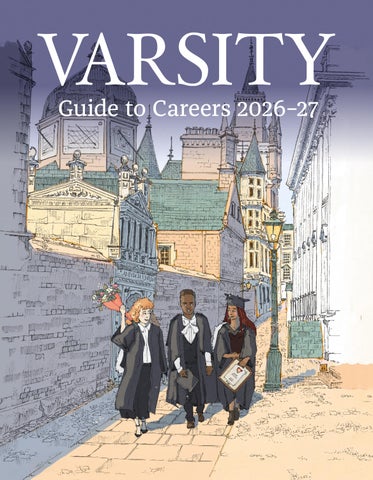
Guide to Careers 2026–27
2 Varsity Guide to Careers 2026-27
Welcome to the latest edition of the Varsity Guide to Careers! MANAGING EDITOR & ADVERTISING
MARK CURTIS
DESIGN & ART DIRECTION
ANDREW BROWN
COVER ILLUSTRATION
LYRA BROWNING
VARSITY MICHAELMAS EDITORS 2026
DAISY BATES BIBI BOYCE
FEATURING
SOPHIE DENNY HANNAH GILLOTT JESS MA ISABEL DEMPSEY YAN-YI LEE
PRINTED BY
SHORT RUN PRESS LIMITED
As finalists, we hear the words ‘panic’ and ‘master’s’ thrown around endlessly. Graduation looms, and between spring weeks and return offers, the pressure of securing that graduate job can feel insurmountable. Amid this uncertainty, we must not forget that the world is our oyster… should we choose to take it. The alumni accounts in this guide speak to the highs and lows of the job market that we nervously await. But, more importantly, they also provide testimonies of hope: through hard work, perseverance, and a little bit of chance, they find themselves succeeding.
Our perceptions of ‘success’ will change, and for the better. Embracing this lack of linearity is the best thing we can do. We’ve watched many of our friends graduate this summer and disperse into a great range of careers. From radio and journalism apprenticeships to investment banking and thinktanks, there is truly no limit to the opportunities out there. Wherever you may find yourself and at whatever point, we wish you the best of luck in all to come – we’re all in the same boat. Daisy Bates and Bibi Boyce
VARSITY PUBLICATIONS LTD 1 TRUMPINGTON STREET, CAMBRIDGE CB2 1QA TEL: 01223 337575 WWW.VARSITY.CO.UK BUSINESS@VARSITY.CO.UK VARSITY GUIDE TO CAREERS 2026-27 is published by Varsity Publications Ltd. ©2026 VARSITY Publications Ltd. All rights reserved. No part of this publication may be reproduced, stored in a retrieval system or transmitted in any form or by any means electronic, mechanical photocopying, recording or otherwise without prior permission of the publisher.
Leaving Cambridge is not just a physical shift, but a mental one, too. We are no longer at the top of the food chain. That takes some getting used to. Instead of seeing this as a negative, try to remember that this change marks the beginning of our lives.
Varsity Guide to Careers 2026–27
3
Your career at d-fine We are a European consultancy firm focussed on analytical and quantitative topics and the development of sustainable solutions to bring about positive change for our clients. What does d-fine offer you? - Diversity: Work with clients on topics ranging from financial engineering and machine learning through to climate risk and healthcare - International: Collaborate in project teams staffed across Europe - Education: Acquire new skillsets to broaden your technical and professional repertoire Who do we look for? Master’s or PhD-level graduates in STEM fields How can I apply? Please go to our Job Portal
4 Varsity Guide to Careers 2026-27 www.d-fine.com
Berlin, Dusseldorf, Frankfurt, Hamburg, London, Milan, Munich, Stockholm, Utrecht, Vienna, Zurich
d-fine d-fine is a European consultancy firm with over 1,800 employees, distributed across eleven offices in seven countries. Our focus is on quantitative issues and the development of sustainable technological solutions. d-fine's consulting approach is based on years of practical experience driven by employees with analytical and technological skills. This combination has proven itself with more than two hundred clients across all sectors of the economy, owing to its bespoke fit, efficiency and sustainable implementation. To expand our consulting team, we are looking for students or graduates of physics, mathematics, computer science, engineering, economics or other natural sciences with quantitative or technological specializations. You must have an excellent academic record, be fluent in English
and have a high mathematical and/or technological affinity. In addition to strong analytical skills and a resultoriented approach, we attach great importance to social competence. A “team-first” approach is at the core of our company philosophy and is reflected in project structures, employee development and incentive systems. Our aim is that you feel at home with us and remain motivated for the long term. That is why we offer you, in addition to exciting projects, a collegial team, attractive career and salary model, and a wide range of additional benefits, such as our extensive training program as part of the d-fine Academy. We are continually looking for new talent and would welcome your application to join d-fine.
Optiver Optiver is a leading technology- and research-driven trading firm. Our Engineers, Quantitative Researchers and Traders build the models and systems that power trading across global financial markets, providing liquidity with our own capital and at our own risk. Petabytes of market data processed daily, 1M+ financial instruments priced and 100+ exchanges connected by our technology give those teams an unusually direct view of whether an idea works.
Starting here from Cambridge
The work stays hard because markets are non-stationary: distributions shift, relationships change and what worked last quarter can stop working. Quantitative Researchers build models that have to survive live deployment. Software Engineers build the market data, pricing, research and execution systems, some under nanosecond constraints, others across petabyte-scale datasets. Traders decide how a forecast becomes a position and how much risk to carry.
Interns start with a technical bootcamp and trading fundamentals taught by our in-house education team of former Traders, Researchers and Engineers. From there, you take on a problem your team genuinely needs solved, working with the same simulations and production tools as everyone else.
A strategy only holds up when the research, data, system behaviour, market context and risk constraints make sense together. That’s why Researchers, Engineers and Traders stay close to the same problem from design through to production.
You do not need a finance background. We hire mathematicians, physicists, computer scientists and engineers, then teach the markets. Whether you first experience Optiver through one of our multi-day programmes, a summer internship or a graduate role, learning is built into the experience.
Graduates begin with the Global Optiver Academy: structured onboarding alongside a global cohort of new joiners from across our offices, before moving into their teams. European roles are based in Amsterdam and London.
Varsity Guide to Careers 2026–27
5
Finding my way… Sophie Denny graduated from St. John’s College in 2025 with a degree in English Literature.
6 Varsity Guide to Careers 2026-27
From one dream to another… I remember writing a Varsity article at the end of Lent 2025 attempting to make sense of my conflicting emotions as I approached my final term at Cambridge. One day I was determined to stay in Cambridge forever, having fallen in love with a place that had been my dream university for years. The next, I’d be editing our latest Varsity print edition or watching Victoria Derbyshire present Newsnight and be filled with an intense desire to one day sit on that sofa. Until then, my life plan (decided in primary school) was: study English at Cambridge, become a BBC newsreader, go on Strictly Come Dancing, write books, and somehow fit in a PhD. So, when I didn’t get my dream apprenticeship with the BBC and instead found myself falling further in love with dissertation-writing and 18th-19th-century literature, my future didn’t look quite as clear-cut as primary school-me had decided. However, I decided to stick to the next part of the original plan and give broadcasting a go, knowing I’d regret it if not. Having secured a place on the broadcast journalism master’s at City University, I sent an email to KMTV, a local TV broadcaster, to get a sense of what I’d signed myself up for. Little did I know but that email would be key in securing my first job. The master’s gave me the skills I needed and confirmed that newsreading was the direction I wanted to go in. We had to complete ten days of work experience, so naturally I went back to KMTV, this time with more knowledge of media law and better editing skills. Helping with live reports, filming a story about potholes and, importantly, getting to know the people who worked there, was invaluable.
As my master’s came to an end, the relentless cycle of job applications began – as did the rejection emails. But a message from KMTV’s channel director saying they were looking for their next senior video journalist apprentices gave me a glimmer of hope. I completed the application, did the interview and, on the final night of my family holiday, received a call saying I’d got the job! Knowing how difficult it can be to break into the industry, I felt very lucky to have secured this first foot in the door. During that phone call, the channel director said he was impressed by the time I’d spent with them on work experience and brought up my pothole report. Perhaps I was naïve to be surprised that he’d remembered that report – or even noticed me during my work experience – but it shows the importance of making the most of every opportunity. Now, there’s a running joke in the newsroom that if you write a thank you card after your work experience, you’re guaranteed a job (three of us in the team have thank you cards pinned up on the wall). Now, I spend my days meeting different people, telling all kinds of stories, and getting to build my onscreen portfolio early on in my career. Now, reading has once again become a source of relaxation – an escape from the relentless (but exhilarating) cycle of local journalism. And through my job, I’m still uncovering and telling stories; still writing and analysing; still putting myself in others’ shoes. The pull of Cambridge still surfaces – as it always will – but I also know there’s still plenty of time. Maybe academia will return in my future, or maybe it won’t. Right now, all I know is that I’m very lucky to be living out another of my childhood dreams.
Varsity Guide to Careers 2026–27
7
Ready for a Rewarding Role? Our vision is to be a leading global partner consistently striving for meaningful and outstanding contributions that improve people’s health and lives.
APPLY NOW
As part of this, we offer:
1
Award-winning company culture
2
Giving back via pro bono projects
3
Rapid and tailored career progression
4
Training and development opportunities
FIND OUT MORE: recruitment@costellomedical.com 8 Varsity Guide to Careers 2026-27
If you want to be inspired by colleagues to be the best you can be, make lifelong friends and do meaningful work, it's the place for you! Anonymous Employee Survey
Costello Medical Costello Medical is a rapidly expanding global healthcare agency dedicated to advancing healthcare through specialised services in medical communications, market access, and health economic and outcomes research. With a commitment to excellence and innovation, we collaborate with a diverse range of clients, including leading pharmaceutical and medical technology companies, patient advocacy groups, public health organisations, and charitable foundations. Our strong, enduring client partnerships enable us to make a tangible and measurable impact, supporting the successful launch and adoption of novel therapies and medical devices across a broad spectrum of disease areas. At the core of our mission, we are dedicated to improving patient outcomes and healthcare efficiency by providing scientifically robust, strategically tailored solutions. Our multidisciplinary teams work closely with clients to develop compelling medical narratives, facilitate evidence-based decision-making, and address the complex challenges facing the healthcare industry today. This client-centric approach, combined with our deep scientific expertise, ensures that we deliver innovative insights and impactful results.
Our vision is to foster a vibrant community of the very best professionals, constantly striving to challenge ourselves and deliver outstanding contributions to healthcare. We believe in cultivating a dynamic, inclusive, and inspiring workplace where talent and collaboration thrive. As part of our commitment to social and environmental responsibility, we are proud to be a certified B Corporation, affirming our dedication to using business as a force for good. This commitment to our people, clients, and the planet has seen us recognised through our inclusion in The Top 100 Companies to Work For list for five consecutive years, underscoring our dedication to creating a fun, friendly, and high-quality environment. Guided by our core values - integrity, innovation, excellence, and support - we aim to deliver services of the highest standards while maintaining a supportive and engaging workplace culture. By aligning our goals with our clients’ needs and health priorities, Costello Medical continues to shape the future of healthcare, making meaningful contributions that benefit patients, healthcare providers, and society at large.
Cisco-Ensoft Location: Harpenden About us: us We are an engineering team within Cisco that works with global service providers and web hyperscalars, developing cutting edge software that connects the world. The Internet depends on the code we write. It’s challenging work that matters, and it’s also fun: excelling at writing complex software is what we enjoy. Our team is entirely composed of people who arrived as young, exceptional graduates from top universities. The pathway is there to develop into any of the roles in the team, from the directors and management line to our industry-leading technical experts. It’s an ideal environment for bright, creative people with an interest in software. Graduates sought: sought Computer Science knowledge and coding experience are obviously valuable, but they aren’t essential if you can show us that you are enthusiastic about a career in software and have the right aptitude. Graduate salary: Competitive. Including extensive compensation plan: bonus, pension, 10 days to give to your preferred charity, birthday day off on us, and much more. Applications: The application process is really simple. Just follow the links at cs.co/ensoft to upload a CV. Interviews Applications will be held in autumn term via video, only requiring a couple of hours of your time.
Varsity Guide to Careers 2026–27
9
Use of AI for CV writing “I’m sorry, Sarah. I can send you a CV, but I used AI to write it,” my prospective client almost whispers. I wait to receive a monstrous version of a CV until… Oh, this is quite good! The CV is fluent, well written and awash with key words. What is not to like? So is it ok to use AI to write a graduate CV? Yes and no: Yes, AI can be a useful CVwriting assistant when used to identify keywords, check spelling and grammar or improve sentence structure; and no, because a skill AI lacks is genuine human curiosity. What I notice is that I cannot ‘see or hear’ the client in the AI-generated CV. The CV lacks human authenticity, which is exactly what recruiters seek. In a graduate job market increasingly influenced by AI, a human-written CV is a powerful way to demonstrate this authenticity as well as credibility and individuality. Graduates combining genuine, personal content with careful editing create CVs that are ATS-friendly whilst being engaging for the person who makes the hiring decision. Interestingly, the Chartered Institute of Personnel and Development (CIPD) reports via the Prospects of Jisc’s Early Careers Survey 2026 that 73% of students and graduates use AI during the application process. However, 89% of candidates felt it was unfair for recruiters to use AI in the recruitment process with
62% of the candidates surveyed saying they are against use of AI for CV screening. Notably, 98% of Fortune 500 companies use AI to simplify recruitment according to Forbes. Yet, these companies will often reject what they suspect are AI-generated CVs. How do you ensure that your CV does not fall into this category? By carefully applying your natural yet professional writing style to your CV, whilst avoiding generic phrases such as ‘proven track record’, ‘resultsdriven’ and ‘team player’. Also, be sure to detail your specific contribution to a project. Were you the ideas generator or team spokesperson? Sharing these details adds more depth than simply stating ‘co-delivered a project’. A CV must reflect the applicant in their best light and whilst AI can help, recruiters want to understand a graduate's experience, achievements, personality and potential contribution to their organisation. A CV written by a human can communicate this content in ways that AI is not programmed to achieve. Until AI is genuinely curious about you, ensure your CV is written by a human. Sarah Lovell
Da Vinci Da Vinci is a proprietary trading house founded in 2015 and specialised in solving market inefficiencies, identifying opportunities based on volatility arbitrage and delta1 strategies and providing liquidity to the markets. We are headquartered in the home of the world’s first stock market, Amsterdam, and we have offices in Miami and Mumbai. Today, we trade on the most prominent exchanges across Asia and the US. Our vision is set on sustainable growth and collaboration across teams and offices.
10 Varsity Guide to Careers 2026-27
We always keep our work smart and innovative and are building a team of trading enthusiasts. The key to our success is hiring not only intelligent but inventive, laser-focused and highly efficient individuals. Across all departments; trading, quantitative research and development alike, Da Vinci is made up some of the sharpest minds and most passionate players in the industry. We are non-hierarchical and support employees in exploring their interests and strengths, placing no limit on personal growth.
Varsity Guide to Careers 2026–27
11
Start your career at
IMC Amsterdam
No siloes. No hierarchies. Just great ideas. As a leading global market maker, IMC uses algorithmic trading and advanced technology to buy and sell securities on multiple trading venues worldwide. Across Europe, the US, and Asia-Pacific, our technologists and traders collaborate to explore, design, and develop the software, hardware, advanced networks, and algorithms that drive our trading strategies and provide essential liquidity to financial markets. Our enduring success is testament to the strength of our values. We fuse creative freedom, open feedback, and quick iteration to empower some of the world’s most talented people. We recognize the best ideas today – and collaborate across teams, borders, and time zones to make them even better tomorrow. And while we work hard, we
12 Varsity Guide to Careers 2026-27
have lots of fun doing it. It's a unique culture that sets us apart. As we like to say, there's only one IMC. We’re looking for the brightest minds in: ● Engineering ● Computer Science ● Maths ● Statistics ● Physics ● Economics ● Finance
CAREERS IN TRADING
CAREERS IN ENGINEERING
With outstanding mathematical and analytical skills together with curiosity and a drive to excel, you’ll love solving complex problems. You will spot new opportunities in the market and go after them with a talented engineering team to have a direct impact on our business.
As an Engineer at IMC, you won’t just be writing code; you’ll be responsible for spotting opportunities and developing new technology — from advanced networks, algorithms, or anything in between. Find your niche as you use your creativity to problem-solve and create solutions to the world’s most challenging problems.
● Develop, maintain, and improve trading models, algorithms, and systems ● Trade a range of financial instruments ● Manage the execution and risk of complex trading portfolios ● C ross-functional collaboration with our developers and engineers to understand and improve our technical infrastructure
● Develop cutting-edge technology in software, hardware, advanced networks and algorithms ● Write code in a collaborative environment where independence is also valued ● Explore challenging problems in latency and data analysis ● Partner with traders around the globe to improve our systems
Trading roles:
Technology roles:
● Graduate Trader
● Graduate Software Engineer
● Graduate Quant Researcher
● Graduate Hardware Engineer
● Graduate Research Analyst
● Software Engineer Intern
● Trader Intern
● Hardware Engineer Intern
BENEFITS ● Travel to one of our offices in Amsterdam, Chicago or Sydney for the Global Traineeship ● Extensive and ongoing professional development training programs ● In-house chef providing gourmet breakfast, lunch and snacks ● Social activities and weekly Friday night drinks
GRADS & INTERN PROGRAMS
● Annual international company weekend away
Join the world’s most innovative trading firm and go beyond the obvious.
● Wellbeing program with subsidised fitness classes
Explore careers on: imc.com/careers
● In-house gym and massage
@imctrading | #LifeatIMC
● Volunteering days and dollar matching for charity donations
Varsity Guide to Careers 2026–27
13
Why the world needs creatives now In uncertain times, it can be tempting to think of the arts as a luxury. Yet perhaps this is exactly when creativity matters most – when we need new ideas, fresh ways of connecting, and bold perspectives.
Theatre for Community & Education, and collaboration is central - students work closely with peers and industry professionals, creating networks that last well beyond graduation.
“When someone pursues a career in the arts, they are choosing a path of collaboration, empathy and imagination - in other words, the skills and values that allow societies to innovate and thrive,” says Kate Budgen, Joint Course Leader of MA Performance.
That balance of rigour and community makes the experience transformative. As MA Musical Theatre graduate Melisa reflects: “The course not only taught me the performance skills I needed to navigate through the industry but also provided me a diverse community of creatives who I still collaborate and work with today.”
With careers now stretching over decades, pursuing work you truly care about has never been more important. For many, the arts provide that. “With Music Direction, you're absolutely surrounded by creativity and creative people” enthuses Rich Bates, MA/MFA Music Direction Course Leader, “Nothing is quite so rewarding as conducting a company of people you care about through a show you've worked on together.” Mountview’s MA programme is built to turn passion into a profession. Degree options include Acting, Creative Producing, Musical Theatre, Directing, Dramatic Writing, Music Direction and
Mountview’s MA graduates go on to impressive careers. Notable names include director Michael Longhurst (Next to Normal, West End/Broadway), actor Melissa Kiplagat (Country Queen, Netflix), actor/writer Anne Odeke (Princess Essex, Globe), and Olivier-winner Will Close (Dear England, National Theatre). For graduates weighing their next steps, the message is clear: the arts are not just a calling but a profession - one that offers challenge, collaboration and purpose. Mountview.org.uk
TURN YOUR PASSION INTO A PROFESSION
EMILY ABOUD - Director, Playwright and Theatremaker Winner of the Evening Standard Future Theatre Award Associate Artist at the Bush Theatre Artistic Director of Lagahoo Productions MA Theatre Directing Graduate (2017)
14 Varsity Guide to Careers 2026-27 MV-CCG_PG_HalfPg (Sep 26).indd 1
mountview.org.uk
Photo by Steve Gregson Photography
Rewarding and intellectually rigorous postgraduate degrees in Performance, Stage and Production Management, Theatre for Community and Education, Creative Producing, Directing, Dramatic Writing and Music Direction.
04/09/2026 14:37
Finding my way… Hannah Gillott graduated from Sidney Sussex College in 2025 with a degree in History. If you are very lucky, and willing to travel about 3,000 miles, it is possible to graduate from Cambridge and stay within its bubble. That is, it is possible to move to Cambridge Massachusetts. When I graduated in 2025 with a BA in History, I knew I wasn’t done with education quite yet. I had spent my third year abroad, in Spain and then Mexico, and fourth year was a whirlwind. I trawled through archives to write my dissertation, returned to write for Varsity, and to join the board, and spent nights feeling really very old in my college bar. It all went by too fast, and graduation was like waking up from a feverish dream. Luckily, I was able to keep studying: I had been awarded a fellowship to study for a year at Harvard. I spent the summer travelling, and then ended up in Boston on a hot, bright blue, August morning. I had packed my life into two 23kg suitcases, which I now had to carry up four flights of stairs and into a brand new life. Harvard was magical. Red brick buildings dotted campus Lego pieces, and in January, two storms rolled through Boston. They dumped a few feet each of snow, snow so fluffy you couldn’t even roll it into a ball, snow that just fell through your fingers like sand. The year flew by, and so did our 14-week terms. The American education system allows for a lot more breadth – I took classes in philosophy, history, critical theory, and even journalism. My journalism class was taught by Darcy Frey, a former New York Times features writer. He was soft spoken, but deeply passionate about both what we write, and how we do it. It reminded me of being back in Cambridge, of working on a weekly essay, something defined more by its form than its content, I always felt. I learnt a lot at Harvard, from my professors,
but also from teaching. I lead two undergraduate seminar groups in discussions about the history and philosophy of technology, and while the atmosphere in the classroom was never acrimonious, it was weighted. Technology is increasingly shaping how we think about careers, and my students all had different approaches to it. One, for example, would be heading back to his home state of Wyoming after graduation, to work building data centres. Others had turned away from tech, working exclusively with pen on paper. I found myself somewhere in between. I returned to London in July. I suppose the Cambridge bubble has to burst at some point. It has taken a while to settle back into life this side of the Atlantic, and stepping forwards often looks remarkably like stepping backwards. I moved back in with my Dad and younger brother, and found myself with no job and no structure, walking the same roads to the same benches I had frequented in lockdown, way back in sixth form. My life exploded – I was glad to be back with old friends, and was looking for jobs with a brave new world at my feet – and yet it also shrunk, somehow. I was unemployed and felt I was spinning very, very, fast, but only on the spot. After a little while, I found a job working for a Labour MP in London as a caseworker. Perhaps my students had influenced me; I was drawn to the idea that I would spend time working with people, face to face, and maybe, if I was lucky, helping them as best I could. Journalism, though, is something I hope will be in my future. Or at least, I hope that writing with and for other people will be. From Cambridge, UK, to Cambridge, MA, and back to London, now, I have kept the same diary – which helped me write this piece. There is still nothing like putting pen to paper.
Varsity Guide to Careers 2026–27
15
Careers in engineering, science & technology ECM Selection, helping graduates, PhDs and professionals find top roles with leading UK science and technology companies for over 30 years. At ECM Selection in Cambridge, our personal approach is there to provide you with exciting options when you are looking for a job. Over the years, we have worked with graduates, PhDs and postdocs as well as experienced industry veterans, throughout their careers.
Do you work with all types of companies? Everything from start-ups and university spin-spinouts to boutique specialists and multinationals. We have worked with companies with unicorn status, as well as those starting out in a garden shed.
How about internships, placements, sponsorship?
I’ve heard stories about variable experiences with recruitment agencies. Why are ECM different? Whilst some agencies may match keywords to recruit in technical areas they don’t fully understand, ECM consultants all have technical backgrounds and industry experience in the sectors for which we recruit. Some agencies are also primarily concerned with filling a particular job, rather than finding the right role for the person. In contrast, ECM offer a more personal, relaxed and “non-pushy” service. There are no salespeople here and we don’t spend our days talking people into things. We’d rather find ideas for people that they like, and will help them progress their career in whatever direction they choose.
We can help with permanent, full-time positions after graduation. Visa sponsorship is typically reserved for senior or very specialist jobs due to government criteria.
Sounds like a great service, but is there a catch? Do I need to pay…
How about research?
Our service and advice is absolutely free to candidates. If you’re in an area we cover, ECM would be happy to see what opportunities we can help with.
We work with R&D teams and research groups in product development and applied technology, with a strong scientific angle, rather than fundamental scientific research.
Why should I use a recruitment agency? It’s important for your CV to stand out from the crowd since graduate and PhD-level competition is very high. A recruiter who knows the company well can advise and guide here and on interviews and job offers. Provided they have a sufficiently strong reputation, and are specifically engaged by the company and understand their business, a recruiter’s introduction can be a real asset.
Don’t you just find jobs on the internet, and suggest them to people? Far from it. All the roles ECM offer are with companies who specifically asked for our help, are pleased to hear from us and whom we may have known and been building relationships with for years. Our “non-pushy” approach extends to companies as well!
16 Varsity Guide to Careers 2026-27
Great, so I’m interested, what should I do next? In plenty of time before you graduate, registers with us on our website, https:// www.ecmselection.co.uk/university. Or call ECM Selection on 01223 813399 to discuss your search with one of our consultants. If we can help, we’d be pleased to. We may ask for a copy of your CV for our reference, but that will only be sent to companies with your express permission in each case, after we’ve spoken with you.
Varsity Guide to Careers 2026–27
17
Finding my way… Jess Ma graduated from Corpus Christi College in 2021 with a degree in Human, Social and Political Sciences. It didn’t feel that long ago when I spent my days out in the streets interviewing student campaigners or cooped up in the Varsity office churning out articles and page layouts before the print deadline hit, with a few more essay deadlines looming behind. Fast forward to five years later, my life seemed like a continuation of this lifestyle. I returned home to work as a journalist after graduation, with work ricocheting between absolutely anywhere in Hong Kong – from an outlying island to inside a prison – and the 24/7 newsroom. However, the similarity stops there. Life after Cambridge was a whole new world that followed nothing like the predictable terms of university or the familiarity of the Cambridge bubble. But rest assured despite all the culture shocks, our training through the Cambridge grind (and the corresponding crazy fun) will get us through whatever challenges ahead. The first thing that I realised was that progress in life is not linear like that in university. With no more eight-week terms, exams and results structuring my days, sometimes it could feel difficult to measure where I’m at in my career or when to take breaks. But the lack of metrics also meant that it would be up to me to create my own structure – it’s not about what others expect of you, but what you really want for yourself. Take breaks before you really need to and carve out pockets of time and space for other pursuits – it’s worth the extra effort to not let hectic work schedules or the feeling that you have to live up to what a Cambridge graduate is supposed to look like, take over your choices. To me, that looked like sending that final email reply on the train so I can make it to a dance class on time, or taking weekdays off occasionally for a quiet recharge. The non-linear way life unfolds beyond Cambridge has also meant unexpected turns in my career, and in turns reaping unexpected rewards. I had wanted to become a political journalist, and I now cover security and legal
18 Varsity Guide to Careers 2026-27
affairs. These areas are of course interrelated, but it was by accepting an opportunity I didn’t expect that set me off on a new path to achieve what I had wanted to do. Looking back, I was grateful for being open and letting the opportunity carry me forward. I also didn’t expect that covering a city would bring me beyond its borders – from Bangkok to Astana – and bring me to speak onstage. Your career blueprint would morph as you go along and you may walk down a path that your student self may not recognise, but letting the world expand possible avenues to achieve what you want is an integral part of the process, and perhaps the beauty of real-world chaos too. Another realisation was that unlike a degree, a career is not just about the quality of work produced, even though that would be a prerequisite. With the refrain of academic rigour that we are all used to, I had thought journalism would be a way to get close to that in the real world. But very quickly into the job, I had to negotiate access with gatekeepers from public relations executives to social workers, cultivate relationships with elusive sources and whistleblowers, and persuade editors – all to get a story published. Student society experience, rather than academic rigour, would come in handy here. To make things happen, sorting out the human relationships and excelling at the task are inseparable – and I wish I had figured that out sooner. My days of essay crises may be over, but the stamina and efficient critical thinking gained continue to affect how I approach work. From breaking news to longform analyses, I find myself returning to the analytical thinking and timemanagement skills honed back then. Leaving the Cambridge bubble means opening up to possibilities far and wide – from unexpected career turns to meeting people from all walks of life. Don’t just stick to what you think life should look like, for we are no longer constrained by the few mainstream sectors listed in a careers survey now. Let yourself be surprised, and dive in.
Jane Street Jane Street works differently. We are a quantitative trading firm active on more than 200 trading venues across 45 countries. As a liquidity provider and market maker, we help form the backbone of global markets. Our approach is rooted in technology and rigorous quantitative analysis, but our success is driven by our people. Our bright, beautiful offices in the heart of New York, London, Hong Kong, Amsterdam, and Singapore are open and buzzing with conversation. We come from many backgrounds and encourage travel between our larger and smaller offices to share perspectives. Some of our best ideas come from bumping into a visiting colleague at the office coffee bar.
has required constant invention – of new trading strategies, technology, and processes. We’ve found this is easier when you hire humble, kind people. They tend to help each other, and prioritize teamwork over titles. We invest heavily in teaching and training. There’s a library and a classroom in every office, because deepening your understanding of something is considered real work. Guest lectures, classes, and conferences round out the intellectual exchanges that happen every day. People grow into long careers at Jane Street because there are always new and interesting problems to solve, systems to build, and theories to test. More than twenty years after our founding, it still feels like we’re just getting started.
Markets move fast. Staying competitive as we’ve grown
Varsity Guide to Careers 2026–27
19
Adaptable. Perceptive. Future Head of Year? Not an average graduate scheme. FIND OUT MORE
Teach First x Teach Lead Change A child’s future should be full of promise and possibilities. For a child growing up in poverty, all too often their future is already written. More likely to fall behind in school. More likely to leave without the grades they need. And more likely to remain in poverty for the rest of their lives. Education can flip the script – creating opportunities and bringing hope.
Teach Lead Change is a graduate scheme like no other. Through the programme we develop the next generation of teachers and leaders who will shape the future of education. Starting in the classroom, this two-year programme equips participants with the knowledge, skills and leadership capabilities to improve outcomes for children facing the greatest disadvantage.
Teach First is an education charity that trains brilliant teachers to serve in the areas that need them most. Since 2003, we’ve reached over 1.5 million pupils facing the toughest challenges. We’ve trained over 20,000 teachers to work in schools where they’ll make the biggest difference. And we are building a movement intent on making sure that every child, no matter their background, gets the opportunities they deserve. We believe that change is possible, and together we can make it happen.
With leadership at its core, Teach Lead Change is designed to stretch and challenge participants, building the confidence, resilience and transferable skills to lead change throughout their career. Alongside a community of like-minded individuals, participants become part of a network committed to rewriting the future for pupils, schools and communities.
20 Varsity Guide to Careers 2026-27
Finding my way… Isabel Dempsey graduated from Robinson College in 2024 with a degree in English. I’d never failed before. My greatest disappointments by the time I started Cambridge were bumming my English literature GCSE (I got a 7), being bad at French (I got an 8), and failing to become headgirl. Through grit and determination, I glided through my A-levels, secured my Cambridge First and rose up the ranks of Varsity. I’d done everything I’d been told to do. Surely, I thought, my dream job in journalism would be waiting in the wings. I got close, multiple times – a few final rounds, some helpful feedback, commiseratory work experience – but never close enough. Stomach-sickening anxiety left me wobbling beneath steely stares, words garbling round my mouth, twisted up in ‘like’s and ‘um’s. And so those scant few graduate schemes that don’t ask for a journalism qualification, hundreds of hours of unpaid experience, or a connection in the industry, were snatched from my grasp. By the time I sent in my application to do a journalism master’s, I felt like I’d failed. As my peers glided into jobs free from this multi-grand burden, I was embarrassed by my inability to secure a job on the prestige of my Cambridge degree alone. Starting my master’s, I was overconfident. I’d edited a paper before. I’d interviewed authors and internet celebs. I’d written features. Made social posts and designed spreads. And yes that all helped. But if there’s one thing I learnt, it’s that there's always so much more to learn. It wasn’t as easy as I’d hoped. My days were spent running around London with a Dictaphone, scrolling through Facebook groups, desperately dialling up councillors, and tightrope-walking group project politics. And doing all that while living out of a suitcase with a dodgy wheel, unceremoniously dragging the dreaded thing between Essex, London, and my weekend shifts at the Charles Dickens museum.
Coming out of Cambridge jobless I thought I was behind. I soon realised that I was very much ahead. Most people on my course were at least two or three years my senior, some even older. They’d all done gap years, post-uni years off, dabbled in an industry here, taken a pub job there. Graduating Cambridge, I felt like I was a sitting time-bomb – an employer, the only detonator. No longer suffocated by the bubble, I realised there was no real rush. Whilst I saw it as a failure at the time, I likely wouldn’t have clinched my current job without my post-grad degree. I probably would’ve got a position in journalism eventually, but not without some serious sacrifice. Lying awake at night, doom-scrolling LinkedIn, I still wonder if I did the right thing. But as I incessantly compare myself to my peers, I force myself to remember that the grass doesn’t always look as green as it does by the phone screen glow. These days, I’m living the good life. I write about Michelin star restaurants and swanky hotels. I meet and interview celebs you’ve actually heard of. I know it sounds like I’m showing off, but it’s only stringing these experiences together – competition spreadsheets, online uploads and SEO drivel lost in the punctuation – that I can begin to feel a surge of pride. Sure, it’s not hard-hitting stuff, but I know there’s decades left in my life for that. If I’d gone straight into this job from uni, I would’ve been a mess. Too nervous to hop on a call with strangers. Too awkward to make small talk at events. Clueless and cocky, without a real understanding of how the media industry actually works. An opportunity to learn more and improve is never a failure, and nothing you do at the infantile age of 21 can really be deemed a failure anyway. You’ve got a whole lifetime ahead of you. Why rush?
Varsity Guide to Careers 2026–27
21
Could the INSEAD PhD be your next step? INSEAD, one of the world’s leading and largest business schools, is now accepting applications for the PhD in Management, for entry in mid-August 2027. Each year, we select 16–18 exceptional individuals into our doctoral programme across eight fields: Accounting, Decision Sciences, Entrepreneurship, Finance, Marketing, Organisational Behaviour, Strategy, and Technology & Operations Management.
Now accepting applications for the mid-August 2027 intake at inse.ad/phd-apply. Deadline: 04 January 2027.
The INSEAD PhD is a highly intensive and rigorous programme designed for individuals with a strong passion for research and a clear drive to build a successful academic career at top business schools worldwide. Unlike many other doctoral programmes, it seeks to admit research partners for its faculty, not research assistants.
*Optional; #https://inse.ad/phd-financing
The programme is fully integrated across INSEAD’s Europe (France) and Asia (Singapore) campuses, allowing students to study in both locations and benefit from our strategic partnerships with The Wharton School (PhD Exchange)* and Sorbonne Université (Dual-Degree)*, as well as access to our state-of-the-art Behavioural Lab in Paris. As many leading universities aim to internationalise their curriculum and faculty, the INSEAD PhD gives students a significant advantage with its global format over most management schools. With a strong track record of placements at top business schools worldwide, our graduates are well-positioned for long-term success in academia. We welcome applicants from diverse academic backgrounds, including economics, engineering, psychology, sociology, and the sciences, who demonstrate strong academic performance and faculty recommendations, competitive GMAT or GRE scores, and a clear motivation for research and a career in business academia. All admitted students receive five years of full funding#, such as a tuition fee waiver, stipend, research/ conference budget, and international health insurance.
22 Varsity Guide to Careers 2026-27
Want to learn more about the INSEAD PhD? Please email ann.julaton@insead.edu inse.ad/why-insead-phd | inse.ad/phd
PhD in Management A life of intellectual leadership and influential scholarship. The INSEAD PhD offers a truly global experience. With campuses in Asia and Europe, the programme combines rigorous research training with a vibrant, international community of scholars. PhD students benefit from close collaboration with world-class faculty and strategic alliances with The Wharton School and Sorbonne Université, gaining exposure to cutting-edge research and innovative teaching. Graduates go on to launch successful academic careers at top business schools worldwide, producing impactful research that shapes the future of business and society. At the INSEAD PhD, we nurture the brightest and most creative minds from diverse backgrounds, equipping them with the best available tools, mentorship, and global perspective needed to become leading researchers in management.
Could the INSEAD PhD be your next step? Apply now for entry in the mid-August 2027 intake.
Scan to contact us
inse.ad/why-insead-phd inse.ad/phd-apply inse.ad/phd Information is correct as of 10.09.26 Varsity Guide to Careers 2026–27 23
Finding my way… Yan-Yi Lee graduated from Newnham College in 2023 with a PhD and MPhil in Education. Leaving Cambridge felt like being caught in a sudden draft – frightening at first, until I learned to trust where the gust was taking me. Coming from Taiwan, my next steps had always seemed like a no-brainer: pack up my life at Newnham and head home to secure a professorship in Taipei. A Cambridge doctorate is a powerful currency in East Asia – a golden ticket to respect, stability, and a clear, comfortable trajectory. Yet, a quiet intuition kept nudging me that it wasn’t quite right. Over the years, the Taiwan I knew had quietly shifted; most of my friends had moved abroad, and whenever I returned, I no longer felt familiar. I was untethered, unable to even decide which continent would make sense as a next step. I could end up in Australia, Kazakhstan, or anywhere in between; paradoxically, that limitless freedom was paralysing. Then came the week of my hardbound thesis submission, and a single weekend changed everything. I met my partner the moment my student life ended. It felt unavoidable: he was a friend of a friend, and that day, he was just there in my kitchen. Up until that point, I had only ever believed in hate at first sight, but there he was – love at first sight. Just like that, the abstract question of belonging grounded itself into something real. I stayed – for so much longer than planned – right here in Cambridge. Choosing love and stability over familiar (but inconveniently nomadic) academia meant stepping off the pre-imagined path. Roles in my immediate discipline were discouragingly hard to find, and it came as no surprise that there was no blueprint. To move forward, I had to look sideways.
24 Varsity Guide to Careers 2026-27
Looking back at that phase of my life, I am incredibly grateful for Varsity and the opportunities it gave me to build a small reputation as a writer. My portfolio in scientific writing allowed me to pivot into a career that never left the scientific sphere (despite my degree in Education!). What started as a leap of faith in 2023 quickly gathered momentum. Over the past 3.5 years, I’ve had three distinct roles. I worked hard and moved up quickly, carving out a trajectory on my own terms. So far, I've worked at the prestigious Nature brand and I am currently Research Engagement Manager at Alzheimer’s Research UK. I cannot emphasise enough what a privilege it is to be in this role. Dementia is the UK’s leading cause of death – and living in the UK today as an immigrant, it gives me a profound sense of purpose to support UK researchers in defeating the country’s primary killer. The truth is, part of me still mourns the researcher I used to be. There is a specific kind of grief in surrendering an identity I worked years and years to build, even when I knew in my gut that the alternative, pre-planned life wasn't the best fit. I learned that it's okay to miss the comfort of the map while being somehow relieved that I ended up off-script. I may no longer be in academia, but I have never stopped championing those who chose to stay, supporting them until they make those key discoveries that shall one day change lives drastically. Looking at the life I have now, I have everything to be grateful for. We often treat a PhD as an anchor, believing it locks us into a singular, expected destination. But leaving Cambridge taught me that a degree isn't an anchor at all – it’s the experience and identity you built during a degree that counts, and it’s quite okay for it to take you to places you never knew about.
Launch your career in trading, technology, or research Discover graduate and internship opportunities designed to empower you with the tools, training, and mentorship needed to solve the industry’s toughest challenges. Experience a flat, collaborative culture where great ideas come from anywhere, and your growth is supported from day one.
Scan to apply Varsity Guide to Careers 2026–27
25
26 Varsity Guide to Careers 2026-27