ENGINEERING PATH MAYO 2026 | Edición 2
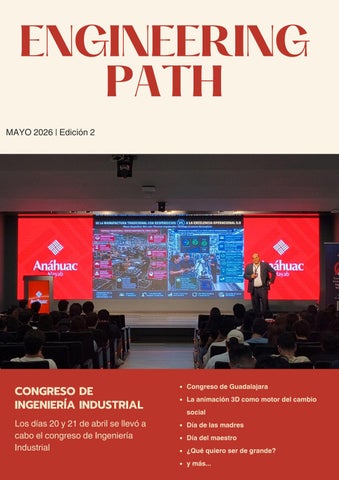
CONGRESO DE INGENIERÍA INDUSTRIAL
Congreso de Guadalajara
Los días 20 y 21 de abril se llevó a cabo el congreso de Ingeniería Industrial
Día de las madres
La animación 3D como motor del cambio social Día del maestro ¿Qué quiero ser de grande? y más...
TABLA DE CONTENIDOS 3
CONGRESO DE INGENIERÍA INDUSTRIAL: INNOVACIÓN EN INGENIERÍA
6
LA ANIMACIÓN 3D COMO MOTOR DE CAMBIO SOCIAL
8
RE+ MÉXICO 2026: ENTRE LA INNOVACIÓN TECNOLÓGICA Y EL SENTIDO COMÚN
10
¿QUÉ QUIERO SER DE GRANDE?
12
SER MAMÁ, INGENIERA Y MAESTRA.
13
DÍA DEL MAESTRO
14
RING ANAHUAC INGENIERÍA
16
INTERNATIONAL PARTNERSHIP WEEK: DHBW RAVENSBURG, ALEMANIA.
18
¿QUÉ ES EL 75 HARD?
19
1
TRABAJO DE PRACTICUM: ESTANDARIZACIÓN DEL PROCESO DE ALMACENAMIENTO Y ORGANIZACIÓN DEL ALMACÉN DE UNA EMPRESA CONSTRUCTORA MEDIANTE KAIZEN STANDARDIZATION OF THE STORAGE PROCESS AND ORGANIZATION OF A CONSTRUCTION COMPANY'S WAREHOUSE THROUGH THE APPLICATION OF KAIZEN METHODOLOGY
BIENVENIDOS A NUESTRA SEGUNDA EDICIÓN Bienvenidos todos a a segunda edición de la revista de Ingeniería titulada Engineering Path, esta es una revista de divulgación bimestral, en la cuál se dan a conocer algunos de los eventos que se llevan a cabo en la Facultad de Ingeniería de la Universidad Anahuac- Mayab en la ciudad de Mérida Yucatán. Además de temas de interés para los futuros Ingenieros, así como trabajos y artículos de maestros y alumnos relacionados con las carreras de Ingeniería y demás interesados. En esta ocasión tocaremos temas sobre eventos que ocurrieron en estos 2 meses como el congreso de Ingeniería Industrial, Charlas sobre animación 3D, Visita a Alemania del coordinador de Ingeniería Industrial, Congreso RE+, entre otros.
Igual nos dimos un espacio para hablar sobre efemérides de estos 2 meses como el día del niño, día de las madres y el día del maestro con artículos referentes a estos temas. Dentro de nuestras páginas también se encuentra el trabajo de práticum de uno de nuestros alumnos de Ingeniería Industrial, y algunos otros temas de interés que les van a gustar.
Viridiana Flores Editora de redacción
“La ingeniería no solo construye puentes y máquinas, construye el futuro.” — Anónimo 2
CONGRESO DE INGENIERÍA INDUSTRIAL: INNOVACIÓN EN INGENIERÍA Por Viridiana Flores
Mérida, Yucatán, México. El pasado 20 y 21 de abril del presente año se llevo a cabo el Congreso de Ingeniería Industrial de la Universidad Anahuac-Mayab, en esta ocasión estuvo centrada en la Innovación en Ingeniería, con grandes ponentes como e Dr. Jonathan Cuevas Ortuño, quien tiene una amplia trayectoria académica y profesional siendo director del departamento de Ingeniería Industrial del Tecnológico de Monterrey, posicionándose como un referente en el ámbito de la excelencia operativa, nos dio una conferencia magistral sobre Excelencia operacional en la era de la Industria 4.0. Dándonos con esta un amplio panorama de lo que hoy en día son los retos de la Industria, y como podemos enfrentarlos, siendo una conferencia muy interesante y enriquecedora para todos los que asistimos. Además durante los 2 días se llevaron a cabo diferentes talleres en los que participaron todos los alumnos de ingeniería Industrial, aprendiendo sobre las áreas de su mayor interés, los talleres fueron variados de los diferentes gustos e intereses de los alumnos, entre ellos destacan: Pláticas sobre emprendimiento, Equipo de protección personal, Uso de sistemas neumáticos en la Industria, Ergonomía, Simulación con Flexsim, Innovación en el trabajo, Comercio Internacional y Cadenas de Suministro, Técnicas para análisis y resolución de problema, IA y Gemelos digitales, todas ellas impartidas por expertos en el área, y en los cuáles los alumnos tuvieron la oportunidad de adquirir los conocimientos de primera mano de estos profesionistas.
Fotografías de talleres llevados a cabo en el congreso
3
CONGRESO DE INGENIERÍA INDUSTRIAL: INNOVACIÓN EN INGENIERÍA Por Viridiana Flores
Otra parte importante del congreso fueron las visitas industriales que se llevaron a cabo a distintas Industrias de las más destacadas en la ciudad como son: Bimbo, La Anita, Keken, Vertical Knits, Bepensa, Falco Electronics y Metaltec, con esta variedad de empresas los alumnos podían elegir la que era de su agrado e interés para ir a visitarla y ver como se vive desde dentro, pudiendo de esta forma vivir un poco de lo que se vive día a día en la Industria. Por último y para cerrar con broche de oro, se vivió el foro de profesionistas en el cuál 4 ingenieros Industriales que se desarrollan en diferentes ámbitos de la carrera nos contaron acerca de sus experiencias y camino recorrido en las diferentes Industrias, tuvimos tanto de empresas de tecnología, de herrajes, y de lndustria de alimentos. Un foro muy enriquecedor tanto para los alumnos como para todos los que estuvimos ahí presentes. Así fue como culminó el congreso de Ingeniería Industrial, con muy buenos ponentes y con un gran aprendizaje en los alumnos, los cuáles se notaron contentos y emocionados de participar en este gran evento, que cabe mencionar fue organizado por ellos mismos, un grupo de alumnos de 6to semestre son los que se encargaron mayormente de la logística del evento acompañados por sus maestros, enhorabuena chicos, sigan con esas ganas y formándose para su futuro profesional. Si quieren conocer un poco más sobre la experiencia de algunos de estos jóvenes en la planeación y logística del evento vayan a escuchar nuestro podcast en el episodio 2 tenemos 2 invitados que nos cuentan su travesía como coordinadores del congreso.
Visita Industrial a Bepensa
4
CONGRESO DE INGENIERÍA INDUSTRIAL: INNOVACIÓN EN INGENIERÍA Por Viridiana Flores
Visita Industrial a Bimbo
Foro de profesionistas 5
LA ANIMACIÓN 3D COMO MOTOR DE CAMBIO SOCIAL Coloca aquí un pie de foto.
Por. Miguel Vargas
En un área donde la tecnología suele asociarse exclusivamente al entretenimiento, la Universidad Anáhuac Mayab fue sede de una charla que desafió esta idea. El Mtro. Ismael Huicochea compartió con los estudiantes una visión del arte digital que busca trascender.
Conociendo el proyecto: "La historia de Tito" Tito, un gato con solo 3 patas, tiene sus días contados en un centro de adopción. Mientras los días pasan, una última oportunidad podría demostrar que todos merecen un hogar. El eje central de la conferencia fue la presentación de "La historia de Tito", un cortometraje animado que nació de una necesidad de comunicar un mensaje con impacto social. Ismael platicó sobre el proceso creativo y técnico detrás del corto, desde que se recibió el storyboard y cómo se interpretó este para darle vida en Blender, animando cada personaje para dar ese mensaje emotivo. "La historia de Tito" se busca servir como un puente de comunicación para temas que a menudo son difíciles de abordar. 6
Un llamado a la "Acción positiva" Uno de los momentos más significativos de la ponencia fue el exhorto directo a la nueva generación de artistas digitales y animadores 3D. El maestro Ismael fue enfático al señalar que los alumnos sean el cambio para un mundo mejor. Recordó que los animadores son narradores de historias y, como tales, tienen la responsabilidad de influir positivamente en la cultura. "La animación es una gran herramienta y se busca no educar para sobrevivir al mundo, sino convertirlo en uno mejor.” — Mtro. Ismael Huicochea.
Conclusión La conferencia no solo dejó una huella técnica en los asistentes, sino que reforzó el compromiso de la Anáhuac Mayab de formar líderes de acción positiva. El Mtro. Ismael Huicochea demostró que, cuando el talento se pone al servicio de los demás, la animación deja de ser algo solo para entretener, sino para convertirse en un acto de humanidad.
¿Quieres ver el proyecto? Puedes conocer más sobre el impacto de esta obra viendo el corto completo aquí: La historia de Tito YouTube
7
RE+ MÉXICO 2026: ENTRE LA INNOVACIÓN TECNOLÓGICA Y EL SENTIDO COMÚN Por Guillermo Pintos
Asistir a foros como el RE+ 2026 en Guadalajara ofrece una ventana de análisis fundamental para el sector: innovación de punta, metas globales de descarbonización y tecnologías de almacenamiento que avanzan a un ritmo vertiginoso. Sin embargo, al escuchar las distintas mesas de debate, es inevitable reflexionar si a veces el exceso de tecnicismos nos aleja de la ingeniería fundamental. Esa ingeniería práctica que no se aprende únicamente en los manuales, sino en el campo de trabajo, observando la operación real y aplicando un riguroso sentido común. Durante el congreso, la integración de energías limpias fue el eje central, pero las discusiones en torno a la infraestructura de transmisión y las nuevas disposiciones de almacenamiento del CENACE pusieron el dedo en la llaga. La solución no radica solamente en instalar sistemas de baterías a gran escala para compensar la intermitencia del sol o del viento. Si no resolvemos las limitantes de la red física y los desafíos de la generación distribuida desde la raíz, seguiremos arrastrando ineficiencias críticas y pérdidas severas en el transporte de la electricidad. Sería el equivalente operativo a intentar enfriar un edificio de cristal expuesto al sol de mediodía sin ningún tipo de protección térmica exterior: los sistemas trabajarán al límite, el costo financiero será astronómico y el problema de fondo permanecerá intacto. El diseño y la planeación deben anteceder a la inversión tecnológica. Por otro lado, la demanda proyectada para el sector industrial plantea un reto inmediato. Con la llegada de nuevos parques industriales, centros de datos y plantas químicas que requerirán miles de megawatts, la exigencia de sustentabilidad debe equilibrarse con la viabilidad operativa. Para industrias donde una sola variación de voltaje representa pérdidas millonarias, la confiabilidad del suministro es innegociable. Más allá de regulaciones complejas, el sector productivo necesita estrategias de eficiencia energética y esquemas híbridos de autoconsumo que sean viables financieramente. Muchas veces, optimizar la operación interna y corregir hábitos de consumo rinde un impacto mucho mayor y más rápido que cualquier gran infraestructura, demostrando que la gestión administrativa es una herramienta técnica poderosa. Un punto crucial que funcionó como un necesario baño de realidad fue el debate sobre la economía circular y el reciclaje fotovoltaico. Las proyecciones indican que para el final de esta década enfrentaremos miles de toneladas de residuos de módulos solares. Si bien hoy se cuenta con tecnologías modulares para separar el vidrio y el aluminio, el verdadero reto técnico e industrial está en el costo de recuperar metales valiosos como la plata y el cobre. No podemos hablar de sustentabilidad genuina si no planificamos el ciclo de vida completo de los equipos desde su origen. El balance del RE+ México 2026 nos deja una lección clara: la verdadera transición energética no se consolida únicamente firmando acuerdos o adquiriendo la tecnología más costosa del mercado. Se logra formando profesionales con una visión integral, capaces de realizar diagnósticos precisos en campo, de optimizar recursos existentes y de entender que la energía más limpia siempre será la que logremos no desperdiciar. Ese es el enfoque práctico y estratégico que urge impulsar hoy desde las aulas y los laboratorios de ingeniería, donde se prepara a las próximas generaciones para liderar con soluciones reales los desafíos energéticos del país.
8
9
¿QUÉ QUIERO SER DE GRANDE? Por Viridiana Flores
Creo que todos nos hemos preguntado esto alguna vez o uchas veces y a propósito del día del niño les traigo mi historia.
A propósito del día del niño me puse a pensar que era lo que yo quería ser de niña y como lo que he querido ser ha ido cambiando a lo largo del tiempo, igual cuando hablo con ustedes se que les pasa lo mismo, a veces no estamos seguros sobre si en verdad me gusta lo que estoy estudiando, que haré una vez que salga de la escuela, será que el rumbo que estoy tomando es el que quiero seguir toda la vida?. Hoy les vengo a contar un poco sobre mi experiencia y a decirles que no importa si no estas seguro, no importa si después te quieres dedicar a algo completamente diferente o si en verdad estas seguro y es tu pasión el camino por el que vas porque de eso se trata la vida, de explorar los distintos caminos y de no quedarnos con ganas de hacer las cosas, al menos en mi experiencia.
Para hacer este artículo me puse a pensar que quería yo ser de grande cuando era niña y hay 2 profesiones que me gustaban, recuerdo que quería ser reportera, porque me encanta enterarme de todo y buscarle explicación a las cosas, además que pensaba que es divertido viajar por el mundo buscando reportajes. Otra de las profesiones que me interesaban mucho cuando niña era la de Diseño de modas, se me hacía super cool estar en fashion week y realizar diferentes vestuarios, eso hacía con mis barbies y los pedazos de tela que me daba mi nana, me gustaba mucho igual dibujar, pero en algún punto de mi vida me convencí a mi misma que era mala dibujando y que lo mío eran las ciencias exactas, las matemáticas, la física y la química, que claro también me encantan y jamás me arrepentiría de estudiar Ingeniería Química porque me gusta mucho, pero que hubiera pasado si me decidía por alguna de las otras 2 carreras?, quizás si podría ser buena dibujando o quizás si era buena para escribir y viajar por el mundo. En algún mundo pararelo ganaron aquellas 2, pero me encanta lo que elegí para estudiar, y en esta vida no eligiría ninguna otra cosa. 10
Demasiadas elecciones para una vida, pero se van tomando y se van dando, en mi caso primero elegí ser investigadora, luego quise cambiar y me fui por la industria, luego una vez más cambié y me fui por el emprendimiento que complemento hasta el día de hoy con la docencia, y si me preguntan jamás me he arrepentido de ninguna decisión, porque como les comenté desde un principio de eso es de lo que se trata de explorar, pero tampoco te digo que sigas mi camino y te muevas por todas partes, pero si te digo que sigas tu camino y te muevas por dónde tu te quieres mover o no mover también.
Después también ya que estudie se abren algunas ramas por explorar, te puedes volver al menos en mi carrera, investigador, docente, trabajar en la Industria, en la mina, y luego en la industria pueden ser en diferentes tipos de industrias, como de alimentos, automotriz, aeroespacial, de energía, de maquinado, cosméticos, farmacéutica, etc, etc…
1
13
3
12
2
11
4
10
5
Lorem ipsum
9
9
11
Ser mamá, ingeniera y maestra. Por. Lizbeth Hernández
Nunca imaginé que estos roles fueran compatibles. Tras una juventud plena y grandes retos laborales, la docencia apareció como un desafío que asumí con timidez, pero gran entusiasmo.
Ante mí se abrió un panorama completamente desconocido, una oportunidad para mantenerme actualizada y, sobre todo, para contribuir a la formación de nuevos profesionistas. Quería replicar la dedicación de aquellos profesores que me marcaron positivamente y, al mismo tiempo, transformar las prácticas de quienes no fueron un buen ejemplo en mi propia etapa estudiantil. Estando inmersa en la educación universitaria, se abrió una puerta más: la bendición de formar una familia. Me casé; el trabajo siempre estuvo sobre la mesa y jamás fue motivo de discusión con mi esposo. Sin embargo, cuando me convertí en mamá por primera vez, algo dentro de mí cambió drásticamente. Experimenté aquello que siempre creí que era un mito: el "instinto materno". Es algo inexplicable que se queda impregnado para siempre en el alma y en el ser. No lo romantizo, porque sé que conlleva cansancio y frustraciones, pero esa conexión que va más allá de lo racional existe, y yo la viví. En ese momento, me prometí a mí misma y a ese pedacito de mi ser, que siempre estaría presente.
Después llegaron tres bendiciones más. Desde mi entorno, muchos pensaron que ese sería el final de mi trayectoria profesional; después de todo, ¿cómo podría seguir trabajando una mujer con cuatro hijos? Y heme aquí, valorando y agradeciendo la oportunidad de compartir con las nuevas generaciones y de enseñar con la empatía que siempre deseé recibir. Hoy veo a mis hijos reflejados en cada uno de mis estudiantes universitarios. Me empeño en tratarlos como me gustaría que trataran a los míos en el futuro. Al igual que en casa, en las aulas me he encontrado con mucho cariño, un poco de rebeldía y algunas quejas; pero entiendo que así es la naturaleza de quienes están creciendo. Por supuesto que aún hay retos. El tiempo siempre es el recurso más escaso. Pero basta con mirar los ojos de mis pequeños para notar en ellos un profundo orgullo, comprensión y agradecimiento. Saben que no fueron un obstáculo para que su mamá siguiera creciendo profesionalmente, sino todo lo contrario: son la raíz de lo que soy. No concibo mi identidad actual sin ellos. Nota final: Mi esposo es el cómplice directo de este caminar. Sin él, no sería madre; y junto a él, somos una familia.
12
DÍA DEL MAESTRO Por. Alumnos de Procesos de Manufactura
Con motivo a la celebración del día del maestro tenemos algunos escritos de nuestros alumnos sobre algún maestro que marcó su vida o sobre los maestros en general.
En el marco del Día del Maestro, quiero reconocer al profesor Luis Solís, quien sin duda se ha convertido en uno de los maestros más apreciados por muchos estudiantes. Más allá de enseñar los temas de clase, destaca por su paciencia, su actitud positiva y la manera tan clara en la que explica, haciendo que incluso los temas más complicados sean más fáciles de entender. Siempre mantiene una sonrisa y transmite confianza dentro del salón. Además de ser un buen profesor, también es una persona muy humana y empática con sus alumnos. Se nota que realmente le importa el aprendizaje y el bienestar de los estudiantes, ya que siempre está dispuesto a apoyar, escuchar y dar oportunidades cuando alguien lo necesita. Su buena actitud y disposición para ayudar hacen que sus clases sean más agradables y motivadoras. Profesores como Luis Solís dejan una huella positiva en la vida estudiantil y merecen ser reconocidos en una fecha tan especial. Por Jade Pech y Alberto 9 Ramírez
13
Mi maestro favorito es el doctor Wilfrido Bautista porque no se queda solo con la teoría en sus clases, sino que te muestra ejemplos en la vida real, videos y fotos para que nosotros practiquemos la teoría y aprendamos a identificar. Es muy ameno al dar sus clases, tiene la ideología que el estudiante aprende lo que quiera aprender, el no te va a obligar, y siempre pone lista, ya nos deja la responsabilidad completamente a nosotros. Por Daniel Bautista. Los mejores maestros, en mi opinión, son genuinos, sencillos y muy dedicados a su trabajo. No están ahí solo por el sueldo. Están genuinamente interesados en lo que enseñan y en los estudiantes que intentan aprender. Basándome en estos criterios, he creado una lista de algunos de mis maestros favoritos que he tenido a lo largo de los años, incluyendo a Alicia Borges (Cálculo), la Sra. Silvia López Alonzo (Estadística e Investigación de Operaciones), la Sra. Beatriz (Introducción a la Ingeniería Industrial y Localización de Instalaciones), el Sr. Gerardo (Estática), el Sr. Daniel Acosta (Diseño de Experimentos) y el Sr. Pinto (Electricidad). Todos fueron, en mi opinión, maestros dedicados. Dedicados a su trabajo y a asegurarse de que los estudiantes entendieran. Por. Vaughnya Usher
Hay maestras que simplemente dan clase, pero hay otras que de verdad dejan huella, y siento que ella es una de esas personas. Siempre transmite muchísima confianza y buena vibra, y hace que entrar a su clase se sienta mucho más ligero y agradable. Me cae súper bien porque además de enseñar increíble, se nota que le importa que entendamos y que estemos bien. Tiene una forma muy linda de tratar a todos, con paciencia, empatía y hasta sentido del humor, y eso hace que le agarres cariño muy rápido. Honestamente, siento que personas así hacen una gran diferencia en la universidad, porque no solo aprendes del tema, también aprendes de la manera en la que tratan a los demás. Por. Grethy Serafín y Marijose Díaz. Mi maestro favorito es Guillermo Corduriel El es mi maestro favorito porque es muy inteligente y tiene una personalidad muy marcada, me gusta mucho su forma de ser porque es una persona muy tranquila y enfocada en sus cosas, me parece que su punto fuerte es que las personas que quieren aprender si lo hacen y los que están menos comprometidos con la clase igual les puede ir bien, sus dinámicas como kahoods y el juego de la abejita para que participen estan muy bien. Por. Oscar Granados
RING ANAHUAC INGENIERÍA Por Gabriela Santacruz y Joselyn Novelo
En este artículo de opinión llevaremos la emoción de imaginar una pelea de boxeo a un escenario diferente y creativo, imaginar cómo sería una pelea de boxeo entre maestros. A partir de nuestras opiniones con respecto a sus habilidades ingenieriles y educativas, analizaremos quién tendría mayores posibilidades de ganar un combate amistoso. Los participantes serán: Gonzalo Madera, Rubén Domínguez, Jose Luis Escalante, Luis Solis, David Palomo, Guillermo Pintos, Gerardo Alonzo Y Wilfrido Bautista.
Primer round:
Segundo Round:
Dr Wilfrido vs Palomo Ganó el Dr. Wilfrido. Gracias a su agilidad y a su dominio de las artes marciales en su juventud, el maestro palomo no fue tan rápido dando golpes como contenido de clase.
Dr Wilfrido vs Jose Luis Ganó Dr.Wilfrido, bye bye Jose Luis, como en la carga de materia, los correos como los golpes fueron muchos al mismo tiempo y el Dr. Wilfrido logró mantenerse fuerte a pesar del cansancio.
Luis solis vs Madera Gana Madera, a pesar de que el maestro Luis solís tiene más fuerza, el maestro madera pudo entrar en el papel del profesor chalingas y la pelea fue una obra de arte. Jose Luis vs Ruben Jose Luis gana, conecta sorprendentemente bien los golpes y el maestro Rubén no fue capaz de calcular el esfuerzo ingenieril requerido a tiempo y sus huesos superaron su capacidad de deformación.
Madera vs Gerardo Alonso Gana Gerardo Alonso, No hay plazo que no se cumpla y el plazo en el ring del maestro madera llegó a su fin, Gerardo dejo a Madera frío en el asiento, se cuenta que Madera aún le está buscando un porque a lo sucedido pero no hay físico que haya descubierto esto.
Gerardo Alonzo vs Pintos Gana Gerardo Alonzo, por sorpresa Gerardo no sabe compartir puntos extra en clase pero dio puntos extra en el ring, fue más bueno boxeando que regalando puntos. 14
RING ANAHUAC INGENIERÍA Por Gabriela Santacruz y Joselyn Novelo
Gran Final Gerardo Alonso vs Dr Wilfrido Gana Gerardo Alonso, aunque aún hay dudas y quedan sospechas, resulta calcular la fuerza fue más funcional que la postura ergonómica del Dr Wilfrido. Después de varios rounds llenos de adrenalina, matemática y física el maestro Gerardo logró coronarse como el campeón del ring de ingeniería anáhuac demostrando que el cálculo y la física pueden ser armas dentro de un combate, más allá del resultado este artículo busca resaltar las cualidades y conocimientos identificadas de cada maestro, creen que el maestro Gerardo es merecedor de este triunfo?, sería interesante un ring con maestras de ingeniería. Continuará...
15
INTERNATIONAL PARTNERSHIP WEEK: DHBW RAVENSBURG, ALEMANIA. Por. Mtro. Jose Luis Escalante Macías Valadez
Del 4 al 7 de mayo de 2026, participé en la International Partnership Week organizada por la Duale Hochschule Baden-Württemberg (DHBW) en Ravensburg, Alemania, representando a la Universidad Anáhuac Mayab.
El encuentro internacional cumplió con el objetivo fundamental de fortalecer la internacionalización académica e impulsar nuevas fronteras de cooperación en beneficio de nuestros alumnos y profesores. A lo largo de las jornadas de trabajo —que incluyeron ponencias sobre educación en tiempos de incertidumbre, dinámicas de speed dating y la participación en la Study Abroad Fair — se consolidaron alianzas estratégicas de gran valor. En el ámbito de la ingeniería y los negocios, se establecieron vínculos clave con delegaciones internacionales, destacando una estrecha colaboración con representantes de Sudáfrica, como la Cape Peninsula University of Technology (a través de figuras como la Dra. Renitha Rampersad) y la Durban University of Technology con el Dr. Lavern Samuels. Asimismo, se abrieron importantes canales de vinculación con la delegación de Marruecos, representada por académicos de la Cadi Ayyad University, como el Dr. Moulay Ahmed El Kiram.
16
Un hito de especial relevancia durante el encuentro fue el fortalecimiento de la relación profesional con el Dr. Khamis Jakob,
profesor
investigador
de
la
DHBW.
Este
acercamiento permitió revisar la continuidad y los avances del proyecto de investigación eMule —enfocado en la conversión y optimización mecánica de vehículos eléctricos off-road— en el cual nuestra universidad ya colabora activamente mediante estancias de tesis y prácticas profesionales de nuestros estudiantes. Este viaje proyecta un panorama sumamente prometedor para la Universidad Anáhuac Mayab. Los acuerdos y redes bilaterales iniciados abren las puertas a futuros programas de intercambio estudiantil, proyectos de investigación conjunta y estancias docentes internacionales. Estas iniciativas robustecerán la formación global de nuestros estudiantes de Ingeniería y permitirán a nuestro cuerpo académico integrarse con éxito en redes globales de conocimiento de vanguardia.
17
¿QUÉ ES EL 75 HARD? Por Viridiana Flores
En esta edición además de hablar sobre Ingeniería me tome la libertad de agregar temas que pueden ser de su interés y que además pueden ayudar a su formación personal, como lo es el reto 75 Hard, si ya lo conocen saben que es llevar una dieta, la que mejor se les acomode, pero que sea una dieta saludable lo mejor posible, hacer 2 rondas de ejercicio de 45 minutos cada día durante esos 75 días que dura el reto, no tomar nada de alcohol en ese tiempo, beber aproximadamente un galon de agua por día (3.8 litros), leer 10 páginas al día de un libro de desarrollo personal, o de cualquiera que sea e su interés y subir una foto diaria de progreso. El reto te dice que si fallas en alguna de esas cosas aunque sea sólo un día debes de comenzar desde el día cero. Para que nos sirve este reto se preguntarán, su objetivo principal no es sólo físico si no, el poder desarrollar disciplina, constancia, fortaleza mental y autocontrol los cuáles son muy importantes y necesarios en nuestra vida, más en los jóvenes que ya comienzan a desarrollarse para su vida adulta, y el adquirir estos hábitos hará que el paso a la vida adulta no sea del todo un desastre y no se sienta como un mundo completamente diferente al que no quieren entrar, sino que el cambio no sea tan aterrador y más suave.
Algo importante que debemos de conocer es que aunque el reto 75 Hard es popular en redes puede ser muy exigente, especialmente si no estas acostumbrado a entrenar tanto o a cambios bruscos, esto no tiene que ser un impedimento, si estas dispuesto a cambiar tus hábitos y quieres mejorar en tu disciplina y salud física y mental puedes adaptarlo y hacer versiones más flexibles como en todo, quizás si no haces ejercicio una caminata diaria de 20 minutos sea suficiente o quitar algún tipo de alimento o sustituirlo por uno menos dañino. En mi experiencia, no me resulta difícil, ya que muchas de estas cosas llevo tiempo haciéndolas, en lo que yo lo adapté fue en además disminuir lo más posible el tiempo que paso en redes sociales sólo utilizarlas para contestar mensajes y lo mínimo y otra cosa fue en agregar aprender algo, por mi parte me inscribí en un curso sobre redacción, porque me encanta escribir y si estoy escribiendo para la revista quiero que sea lo mejor posible. Así que ya saben de que trata este reto y esta en ustedes si lo quieren adaptar o no a su estilo de vida.
Su maestra en brincos de caja :P
18
ESTANDARIZACIÓN DEL PROCESO DE ALMACENAMIENTO Y ORGANIZACIÓN DEL ALMACÉN DE UNA EMPRESA CONSTRUCTORA MEDIANTE KAIZEN STANDARDIZATION OF THE STORAGE PROCESS AND ORGANIZATION OF A CONSTRUCTION COMPANY'S WAREHOUSE THROUGH THE APPLICATION OF KAIZEN METHODOLOGY Jorge Carlos Medina Carrillo , José Gabriel Urzaiz Guinto ABSTRACT This comprehensive project addresses the critical operational deficiency in the inventory management system at Ingeniería y Servicios del Caribe, a prominent Mexican construction company with over a decade of industry presence. The complete absence of formalized inventory control protocols has resulted in substantial financial losses, material waste, duplicate procurement activities, and severely compromised traceability mechanisms. Through the systematic implementation of Kaizen methodology specifically integrating the 5S system, seven specialized storage techniques, and standardized work procedures this initiative proposes a holistic reorganization of the warehouse ecosystem. The project's primary objectives encompass significant enhancement of inventory visibility, substantial cost reduction, and the establishment of an enduring culture of continuous improvement throughout the organizational structure. The implementation strategy is meticulously planned across a nine- month timeline, incorporating distinct phases for comprehensive problem analysis, systematic reorganization, and sustainable standardization. The expected outcomes include optimized space utilization, reduced operational costs, improved workforce efficiency, and strengthened competitive positioning in the construction sector. Keywords: Kaizen, 5S Methodology, Warehouse Management, Inventory Control, Process Standardization, Continuous Improvement, Lean Management, Storage Optimization, Construction Industry, Operational Efficiency. INTRODUCTION Ingeniería y Servicios del Caribe represents a significant player in Mexico's construction landscape, established in 2012 with a specialized focus on comprehensive construction services, advanced electromechanical equipment installation, and sophisticated air conditioning solutions. The company has built its reputation on a foundation of technological innovation, uncompromising quality standards, and exceptional customer satisfaction metrics. Their operational philosophy is supported by a highly experienced multidisciplinary team and refined project management protocols that ensure timely delivery and budget adherence. The company's strategic positioning in the southeastern Mexican market has enabled it to develop a robust portfolio of commercial, institutional, and industrial projects, consistently demonstrating their commitment to engineering excellence and sustainable development practices. The organization currently faces a critical operational challenge stemming from the complete absence of a formalized inventory control system. This fundamental deficiency manifests in multiple detrimental ways: persistent uncertainty regarding accurate stock levels, frequent duplicate purchasing of materials, complete lack of material traceability, and inefficient utilization of valuable storage space. These issues collectively contribute to substantial financial losses through material obsolescence, emergency procurement premiums, and labor inefficiencies. The warehouse environment exhibits characteristics of disorganization, with mixed inventory categories, inadequate signage, and absence of systematic storage protocols. This chaotic environment not only impacts immediate operational efficiency but also creates ripple effects throughout the supply chain, affecting project timelines, budgeting accuracy, and overall client satisfaction.
The problem is further exacerbated by the lack of digital tracking systems and standardized procedures for material handling and storage. The lack of controlled warehouse processes has demonstrated significant negative impacts on both profitability and operational effectiveness. The adoption of Kaizen philosophy a proven systematic approach to continuous improvement provides an optimal framework for addressing these challenges by engaging organizational members at all levels in structured, incremental enhancement activities (Imai, 1986). This project holds substantial relevance from both practical and theoretical perspectives. Practically, it addresses immediate cost reduction opportunities through waste elimination and process optimization. Theoretically, it contributes to the body of knowledge regarding the application of industrial engineering methodologies within medium-sized construction enterprises, particularly in emerging market contexts. The strategic importance extends beyond immediate operational benefits to include enhanced organizational learning, improved risk management, and strengthened competitive positioning in an increasingly demanding market environment. To design, implement, and validate a comprehensive organizational system for the company's warehouse facility over a nine-month implementation period, achieving measurable improvements in storage efficiency, reduction in duplicate purchases, and enhanced material traceability through the systematic application of Kaizen principles and industrial engineering methodologies.
19
The warehouse transformation project has several key objectives. Firstly, the physical layout will be optimized using the 5S methodology and specialized storage techniques to radically improve material flow and access efficiency. Operationally, an ABC classification system will be implemented for strategic inventory management, and staff will be equipped with the necessary skills through training programs in standardized procedures and continuous improvement. To support these initiatives, digital tools will be introduced to provide enhanced control and real-time visibility. Performance will be measured through specific KPIs and monitoring systems, all with the aim of establishing a strong, sustainable culture of continuous improvement, driven by structured feedback mechanisms and periodic reviews. The project scope is explicitly defined to encompass the complete warehouse facility of Ingeniería y Servicios del Caribe, including all storage areas, material handling equipment, and inventory categories. The intervention will address physical layout optimization, process standardization, and human resource development specifically related to warehouse operations. Explicitly excluded from the project scope are other operational areas such as field operations, administrative processes, and financial management systems. Potential limitations identified include possible resistance to organizational change among warehouse staff, budget constraints for technological investments, and external factors such as supply chain variability and market fluctuations. The project methodology incorporates specific strategies to address these potential limitations through phased implementation, change management protocols, and contingency planning. THEORETICAL FRAMEWORK The theoretical foundation of this project rests upon established principles of continuous improvement and lean management, with particular emphasis on Kaizen philosophy and its practical applications in industrial settings. Kaizen, originating from Japanese manufacturing excellence, represents a comprehensive approach to gradual, continuous improvement involving all organizational members from executive leadership to frontline operators (Imai, 1986). This philosophy challenges traditional Western approaches to improvement by emphasizing incremental changes rather than radical innovations, and collective participation rather than specialized improvement teams. The 5S methodology serves as a fundamental pillar within the Kaizen framework, providing a structured approach to workplace organization. The five components Seiri (Sort), Seiton (Set in order), Seiso (Shine), Seiketsu (Standardize), and Shitsuke (Sustain) create a systematic process for eliminating waste, optimizing efficiency, and establishing visual management systems (Hirano, 1995). In the context of warehouse management, 5S implementation typically results in reduced search times, improved safety conditions, enhanced equipment reliability, and strengthened organizational culture. Complementing the Kaizen approach, lean thinking principles provide additional theoretical support for waste elimination and value creation (Womack & Jones, 2003).
Lean philosophy identifies seven primary types of waste (muda) in organizational processes: transportation, inventory, motion, waiting, over-processing, overproduction, and defects. In warehouse operations, these wastes manifest as unnecessary material handling, excess inventory, inefficient worker movements, waiting times, redundant processes, stockpiling beyond requirements, and inventory inaccuracies. The concept of standardized work represents another critical theoretical component, ensuring process consistency and variability reduction (Liker, 2004). Standardization creates a stable baseline for continuous improvement, enables effective training, facilitates problem identification, and ensures quality consistency. In warehouse environments, work standardization encompasses receiving procedures, put-away processes, storage protocols, picking methods, and shipping activities. The integration of these theoretical elements creates a robust framework for warehouse optimization that addresses both technical and human dimensions of organizational performance. The theoretical framework acknowledges that sustainable improvement requires simultaneous attention to process design, physical layout, management systems, and organizational culture. METHODOLOGY The project methodology follows a structured, phased approach to ensure comprehensive analysis, systematic implementation, and sustainable results. Each phase builds upon the previous one, creating a logical progression from current state assessment to future state realization and control. Phase 0: Problem Analysis and Diagnostic Assessment The initial phase focuses on thorough problem understanding through multiple assessment techniques. This includes: • Comprehensive physical inventory audit and categorization • Process mapping of all warehouse activities using value stream mapping techniques • Time-motion studies of material handling and storage processes • Stakeholder interviews with warehouse staff, procurement team, and project managers • Data collection on key performance metrics including inventory accuracy, order fulfillment times, and space utilization rates • Root cause analysis using fishbone diagrams and 5-why techniques to identify underlying issues Phase 1: Sorting and Layout Redesign (Seiri Implementation) This phase addresses the physical reorganization of the warehouse environment through systematic sorting and space optimization: • Implementation of red-tagging process to identify unnecessary items • Development of disposal/relocation criteria for non-essential inventory • Creation of new warehouse layout using systematic storage planning principles • Installation of visual management systems including signage, floor marking, and location labeling • Optimization of material flow paths to minimize transportation and handling
20
• Implementation of safety improvements and ergonomic considerations Phase 2: Organizational System Implementation The core implementation phase focuses on establishing systematic storage and control mechanisms: • Application of seven storage techniques including fixed location, random location, zoning, volumetric, class- based, forward picking, and dynamic storage methods Implementation of ABC analysis for inventory classification and differentiated control strategies • Development and implementation of standardized operating procedures for all warehouse processes • Creation of visual management boards for real-time performance tracking • Establishment of daily management systems and accountability structures Phase 3: Standardization and Continuous Improvement The final phase ensures sustainability and ongoing improvement through standardization and capability development: • Development and delivery of comprehensive training programs for warehouse staff • Creation of standardized work documentation and visual instructions • Implementation of regular audit and review cycles using 5S checklists • Establishment of suggestion system for continuous improvement ideas • Development of performance dashboards and management review processes • Creation of response plans for abnormal conditions and problem escalation The methodology provides a balanced approach that delivers immediate tangible results while building longterm organizational capabilities for ongoing selfimprovement. The selection of Kaizen as the primary methodology for this project is based on several strategic considerations. Its fundamental alignment with the company's cultural values and management philosophy makes it a natural fit. Furthermore, Kaizen is uniquely suited for addressing both the technical and behavioral aspects of organizational change, which is critical for lasting impact. Its proven track record in similar industrial contexts, particularly within small and medium enterprises, provides confidence in its application. The methodology is also highly scalable and adaptable to the specific constraints and opportunities of the construction industry. A key advantage is its emphasis on employee engagement and fostering a sustainable culture of improvement, rather than imposing top-down changes. From a practical standpoint, Kaizen is a cost-effective solution compared to alternative approaches that require significant capital investment. Finally, its inherent compatibility with our existing management systems and operational processes ensures a smoother integration and minimizes disruption. Applications in Specific Contexts Automotive Industry: Toyota Production System Toyota Motor Corporation represents the most emblematic case of successful Kaizen implementation. According to Liker (2004), the Toyota Production System integrates 5S principles as a fundamental basis for achieving operational efficiency. In their Georgetown, Kentucky plant, the systematic implementation resulted in a 45% reduction in tool search time, a 30% improvement in workflow efficiency, a significant reduction in safety incidents, and the implementation of visual management systems. Similarly, in the aerospace industry, the Boeing Company implemented 5S methodologies in its Everett, Washington facility.
As documented by Marchwinski and Shook (2003), this implementation enabled a 25% reduction in inventory maintenance costs, a 40% improvement in tool availability, a reduction in aircraft assembly time, and the implementation of color-coding systems. The healthcare sector has also seen significant benefits, as demonstrated by the Virginia Mason Medical Center in Seattle, which successfully adapted the Toyota Production System to its environment. Toussaint and Berry (2013) document that they achieved an 85% reduction in laboratory specimen travel distance, a 50% decrease in medication errors, a 70% reduction in patient waiting times, and the implementation of safety alert systems. In the technology sector, Intel Corporation implemented 5S in its clean rooms globally. According to Bicheno and Holweg (2009), the results included 99.99% tool accountability, a 35% reduction in contamination incidents, an improvement in wafer yield, and the standardization of workstations. A modern application of 5S principles can be seen in the logistics sector at Amazon Fulfillment Centers. Womack and Jones (2003) highlight a 60% improvement in picker productivity, the implementation of sophisticated slotting algorithms, a reduction in mis- ships from 1.2% to 0.03%, and the creation of "library-like" organization systems. RESULTS The comprehensive problem analysis conducted during the Diagnostic Assessment (Phase 0) revealed critical inefficiencies. Key findings included an average search time for materials of 18.7 minutes, a low inventory accuracy rate of 68.3%, and a high frequency of 12-15 duplicate purchase incidents monthly. Several improvement opportunities were identified, primarily that 37% of stored items were obsolete or surplus. The situation was exacerbated by inconsistent storage methods, an absence of standardized material handling procedures, and inadequate visual cues for locating items. Stakeholder pain points reflected these issues, with widespread frustration over wasted search time, safety concerns from congested aisles, difficulty maintaining accurate records, and challenges in training new staff due to a lack of standards. Phase 1: Sorting and Layout Redesign Achievements Through systematic application of Seiri (Sort), the project team conducted Category / Item Quantity a comprehensive physical inventory audit resulting in the creation of a complete checklist of all objects stored in the warehouse. Table 1 presents the exhaustive documentation of inventory quantities across all categories. The 5S methodology, the project team conducted a comprehensive physical inventory audit resulting in the creation of a complete checklist of all objects stored in the warehouse. This exhaustive documentation process, summarized in Table 1, identified the precise quantities of materials across all major categories, providing the company with its firstever complete visibility into warehouse contents.
21
This exhaustive documentation process enabled the team to identify items that were obsolete, damaged, or redundant. Through systematic evaluation, a total of items representing approximately of total stored volume were identified as nonessential. These items were systematically evaluated and subsequently disposed of, relocated, or repurposed, freeing up critical storage space and eliminating clutter that had previously hindered operations Building on this sorting effort, the team developed and implemented an entirely new warehouse layout designed to optimize material flow and accessibility. The redesigned layout established dedicated zones for each major category, with clear physical boundaries marked by floor tape and visual signage. This reorganization, guided by lean principles and ergonomic considerations, resulted in a 42% increase in effective storage capacity without requiring any physical expansion of the facility. The impact on operational efficiency was immediate and substantial. Average material search time was reduced from 18.7 minutes to just 6.2 minutes, representing a 67% improvement. This reduction translates directly into labor savings and faster response times to project site requirements. Additionally, the implementation of clear aisle markings, proper stacking standards, and improved material handling protocols significantly enhanced workplace safety, reducing the risk of accidents and material collapse.
Phase 2: Organizational System Implementation With a clean, organized workspace established through the new layout, Phase 2 focused on implementing core organizational systems to control inventory and standardize workflows, directly addressing the second specific objective. This phase systematically applied the seven specialized storage techniques to optimize space utilization and retrieval efficiency across all inventory categories: 1. Fixed location storage was implemented for high-value, frequently used A items, ensuring immediate accessibility near the dispatch area. 2. Random location storage was utilized for bulk materials where space optimization was prioritized over fixed positioning.
3. Zoning techniques established clearly defined areas for different material families, complementing the new layout. 4. Volumetric storage principles were applied to maximize vertical space utilization for lightweight, bulky items. 5. Class-based storage grouped items with similar characteristics or turnover rates to streamline picking processes. 6. Forward picking areas were established for high-demand items to minimize travel time during order fulfillment. 7. Dynamic storage adjustments were incorporated to allow flexibility as inventory composition changes over time. The implementation of ABC inventory classification has been transformative for strategic control. By categorizing all materials based on consumption value and frequency, the company can now apply differentiated management strategies: • A-items are now subject to stricter inventory counts, more frequent audits, and secure, accessible storage, directly mitigating the risk of stockouts and duplicate purchases. • B-items are managed with standard control procedures. • C-items low value, slow moving are stored in less accessible areas with simplified control mechanisms, ensuring effort is proportional to value. https://www.plandemejora.com/7-tecnicas-dealmacenamiento-de-productos/ Standardized operating procedures were developed and documented for all critical warehouse processes, including receiving, putaway, picking, dispatch, and cycle counting. These SOPs, supported by visual management boards displaying real- time performance metrics, have significantly reduced process variability. The establishment of daily management systems, including brief team huddles to review performance and assign tasks, has fostered a sense of shared accountability and enabled rapid response to operational issues.
22
Phase 3: Standardization and Continuous Improvement The final phase has been crucial for cementing the gains achieved and creating a culture of ongoing improvement, thereby fulfilling the third specific objective. A comprehensive training program was developed and delivered to all warehouse staff, covering the new SOPs, the ABC classification system, the seven storage techniques, and ongoing 5S principles. The creation of a detailed warehouse operations manual provides a permanent reference point for all employees and serves as a foundational tool for onboarding new hires. To ensure sustainability, regular 5S audit cycles have been instituted. Using standardized checklists, these audits are conducted weekly by team leads and monthly by management, with results visibly posted on the performance dashboard. This creates a healthy feedback loop, allowing the team to celebrate successes and quickly address any deviations from the standard. Initial audit scores have shown consistent improvement, demonstrating the team's commitment to maintaining the new standards. Furthermore, a formal employee suggestion system was launched to capture continuous improvement ideas from the team members who work in the warehouse every day. This system, which includes recognition for implemented ideas, has already generated valuable suggestions for further refining processes. This shift towards proactive, employeedriven improvement marks the successful establishment of a sustainable Kaizen culture. The development of performance dashboards for management review provides visibility into long-term trends, enabling strategic decision-making regarding resource allocation and future technological investments. The project has now successfully achieved all three of its specific objectives: 1. Warehouse Reorganization: Achieved through the creation of a new optimized layout, comprehensive object checklist, elimination of obsolete items, and application of 5S methodology Phase 1. 2. Implementation of Organizational Systems: Achieved through ABC classification, systematic application of the seven storage techniques, and standardized operating procedures Phase 2. 3. Standardization and Continuous Improvement: Achieved through staff training, operations manual. development, regular audit cycles, and employee suggestion systems, establishing a sustainable improvement culture. Staff Training A comprehensive training program was developed for warehouse staff. Currently, four employees are actively undergoing training on the following modules: • Introduction to Kaizen and 5S Philosophy • ABC Classification and Inventory Management • The Seven Storage Techniques • Standardized Operating Procedures • Visual Management and Performance Metrics • Random Audit Procedures and Compliance Training is delivered through a hands-on practical exercise, and shadowing experienced personnel. Upon completion, each trainee will be required to pass a competency assessment before working independently. Warehouse Operations Manual The warehouse operations manual is currently under development. The proposed structure for the Potential Warehouse Manual is presented below:
Manual de Operaciones del Almacén / Warehouse Operations Manual Ingeniería y Servicios del Caribe Introduction • Purpose and Scope of the Manual • Company Mission and Vision • Organizational Chart of Warehouse Department General Safety Rules • Personal Protective Equipment Requirements • Emergency Evacuation Procedures • Fire Prevention and Response • Accident Reporting Protocol Warehouse Layout and Zoning • Facility Map with Dedicated Zones • Aisle Markings and Traffic Flow • Emergency Exits and Equipment Locations • 3.4 Color-Coding System for Floor Markings Receiving Process • Step-by-Step Receiving Procedure • Inspection for Damage or Defects • Documentation and System Entry • Receiving Inspection Checklist Put-Away Process • Step-by-Step Put-Away Procedure • Assignment of Storage Locations • Application of ABC Classification to Put-Away • Labeling and Bin Location Update Storage Techniques and Standards • Overview of Seven Storage Techniques • Pallet Stacking Height Limits • Heavy Item Storage Picking and Dispatch Process • Picking List Generation • Picking Route Optimization • Item Verification Before Dispatch • Dispatch Documentation and Sign-Off Inventory Control and Auditing • Cycle Counting Procedures • Random Audit Program • Discrepancy Investigation and Correction 5S Standards • Daily 5S Checklist ERP and CRM Testing To support future digital transformation and enhanced decision making, the company is currently conducting parallel testing of two leading enterprise solutions:
Testing Methodology: • Both systems are being tested using a representative sample of 50 inventory items. • Warehouse staff are entering real transaction into both systems. • Key evaluation criteria: Ease of use, speed of transaction entry, report generation time, mobile accessibility, and customer support responsiveness. Potential Recommendation: Based on the company's primary pain point (duplicate purchases and lack of traceability), the project team is currently leaning toward Intelesis SAP for its superior inventory control and procurement integration.
23
However, final selection will depend on staff feedback from the 4 trainees and budget considerations. Random Audit Program: Full Detailed System The following audit system has been fully implemented and is operational as of the conclusion of Phase 3. This system replaces traditional scheduled 5S audits with a more dynamic, unpredictable approach to ensure sustained compliance and vigilance. Product Selection Method Each audit day, a single product is randomly selected using one of the following methods: • Method A: The auditor uses a smartphone randomizer app containing the complete inventory checklist. The app selects one item. • Method B: The auditor draws a pre-printed card from a sealed box. Each card contains one product name and location code. • Method C: The auditor begins at a randomly selected point in the inventory checklist and selects the 5th, 10th, or 15th item thereafter. Audit Checklist and Verification Criteria • For the randomly selected product, the auditor must verify all five criteria below:
Scoring: • 5/5 Pass = Full compliance • 3≤/5 Pass = Partial compliance • ≤2/5 Fail = Immediate corrective action required
When a Fail is recorded for any criterion, the following protocol is activated immediately:
The results of each random audit are posted on the Visual Performance Board located at the warehouse entrance. The board displays: • Current Month Pass Rate (Green/Yellow/Red indicator) • Last 10 Audits (Product name, score, date) • Open Corrective Actions (with due dates). ANALYSIS OF RESULTS. The results achieved through Phase 0 and Phase 1 implementation demonstrate significant progress toward establishing a foundation for operational excellence. The diagnostic phase provided crucial insights that enabled targeted interventions in the implementation phase, ensuring that resources were focused on high-impact opportunities. The space optimization outcomes substantially address the original problem of inefficient storage and material accessibility. The 42% increase in effective storage capacity defer the need for physical expansion while improving material flow and accessibility. The reduction in average search time from 18.7 to 6.2 minutes represents substantial labor savings and enables faster response to project requirements. The implementation of visual management systems and standardized procedures has created a more intuitive work environment that reduces dependency on individual experience and knowledge. This is particularly valuable for training new staff and maintaining consistency across different shifts. The safety improvements achieved through proper layout design and material handling standards address important risk factors that were identified in the initial assessment. The reduction in safety incidents demonstrates the effectiveness of the systematic approach to workspace organization. The successful achievement of the first specific objective establishes a solid foundation for subsequent implementation phases. The physical reorganization and process standardization create the necessary preconditions for effective implementation of inventory control systems, digital tools, and advanced management practices in future phases.
24
The improvements achieved can be directly linked to the elimination of non value-added activities (muda), particularly unnecessary motion and waiting. The reduction in search time reflects a more efficient material flow and better workspace organization, resulting in increased labor productivity and more effective use of human resources. Although a detailed financial analysis has not been conducted, the results suggest important economic benefits, including reduced labor time, lower risk of duplicate purchases, and cost avoidance by increasing storage capacity without physical expansion. These improvements contribute to a more efficient allocation of resources, as employees spend less time on non-value-added activities and more time on productive tasks. In addition, the reduction of obsolete and unnecessary inventory decreases material waste and minimizes capital tied up in unused stock, improving overall resource utilization. The improved organization and visibility of materials also support better procurement decisions, reducing emergency purchases and associated premium costs. Additionally, the implementation of ABC classification, standardized procedures, and audit systems strengthens inventory control and supports longterm operational stability. These elements not only reduce variability in daily operations but also create a structured environment that facilitates monitoring, decision making, and future integration of digital systems such as ERP platforms. Future evaluation should include key performance indicators such as inventory accuracy and order fulfillment time, as well as a financial assessment to quantify savings and return on investment. Given that the company operates in hospital maintenance services, the reduction in material search time has implications beyond operational efficiency and cost savings. Faster access to tools and materials directly improves the company’s response time in emergency situations, where delays can affect critical hospital operations. In this context, improved warehouse organization contributes not only to productivity but also to service reliability, enabling the company to respond more effectively to urgent maintenance needs and supporting the continuity of essential healthcare services. Warehouse transformation: Before implementation of storage techniques:
After implementation of storage techniques.
CONCLUSIONS.The systematic implementation of Phase 0 (Problem Analysis) and Phase 1 (Sorting and Layout Redesign) has successfully established a robust foundation for warehouse optimization at Ingeniería y Servicios del Caribe. The comprehensive diagnostic assessment provided critical insights that enabled targeted interventions, while the meticulous implementation of 5S methodology and layout redesign generated significant measurable improvements in space utilization, material accessibility, and operational safety.The project has successfully achieved its first specific objective of completely reorganizing the warehouse layout utilizing 5S methodology and storage techniques. The physical transformation of the storage environment has created optimized material flow paths, enhanced access efficiency, and established visual management systems that support daily operations. The results demonstrate the practical applicability of Kaizen methodology and lean principles in construction industry warehouses, challenging the perception that these approaches are only suitable for manufacturing environments.
25
The systematic approach of diagnostic assessment followed by targeted implementation provides a transferable model for similar improvement initiatives in other operational contexts. The project has generated both tangible benefits in operational efficiency and intangible benefits in organizational capabilities, including enhanced problem-solving skills, improved teamwork, and strengthened continuous improvement mindset among warehouse staff. The completion of all implementation phases has yielded a holistic transformation. The integration of standardized work with physical organization has created an environment where efficiency is not an accident but a built-in feature of the process. The systematic elimination of unnecessary items, combined with the strategic application of the seven storage techniques, has fundamentally changed how space is utilized and how materials flow through the warehouse. The 42% increase in effective storage capacity, achieved without physical expansion, represents significant capital avoidance. The reduction in average search time from 18.7 to 6.2 minutes translates to hundreds of labor hours saved annually. More importantly, the implementation of ABC classification and the seven storage techniques have virtually eliminated the previous problems of duplicate purchasing and material traceability. The checklist documentation provides complete visibility into inventory composition, while the new layout and storage methods ensure that items can be located instantly. The establishment of a continuous improvement culture, evidenced by the suggestion system and regular audits, is perhaps the most significant long-term achievement. The warehouse is no longer a static storage area but a dynamic part of the operations, capable of adapting to changing business needs. The feedback mechanisms ensure that the improvements are not only sustained but are continuously enhanced by the people who know the process best. Beyond the operational improvements achieved, this project demonstrates that the application of industrial engineering tools such as Kaizen, 5S, and inventory classification can generate measurable benefits in efficiency, control, and resource utilization within a construction company environment. These improvements also reduce the likelihood of unnecessary purchases and material waste, contributing to better financial control. Moreover, the implementation of structured systems such as ABC classification, standardized procedures, and audit mechanisms establishes a solid foundation for consistent and reliable warehouse operations. These elements enhance traceability, reduce process variability, and support informed decision-making. From a return on investment (ROI) perspective, the implementation of these improvements required minimal financial resources, as most changes were based on reorganization, standardization, and employee training rather than significant capital investment. In contrast, the previous conditions of the warehouse generated continuous financial losses through material waste, duplicate purchases, and excessive time spent on non-value-added activities. Therefore, the improvements achieved represent a high return relative to the low implementation cost, making this initiative both operationally and economically efficient. Although the results are significant, future work should focus on quantifying the financial impact of these improvements and monitoring key performance indicators such as inventory accuracy and procurement efficiency to ensure long-term sustainability. Finally, the project positions the company for future growth by creating the necessary conditions for the integration of digital tools such as ERP systems. Continued monitoring of key performance indicators and the incorporation of financial metrics will be essential to fully validate and sustain the benefits achieved. RECOMMENDATIONS Based on the successful results and valuable experience gained from Phase 0 and Phase 1, a comprehensive set of recommendations is proposed to solidify gains and guide future progress.
To immediately build upon our current momentum, we should conduct a formal 5S audit using a standardized checklist, develop and deliver refresh training for warehouse staff on the new procedures, and establish a daily management system to sustain improvements. Concurrently, planning for Phase 2 implementation, which focuses on the organizational system, should be initiated. Ensuring the longevity of our Improvements requires a dedicated sustaining strategy. This includes implementing weekly 5S audits with management review, establishing visual performance boards to display key metrics, creating a recognition system for staff contributions, and developing a formal response plan to address any deviations from the new standards. To expand on our current success, we will extend the 5S methodology to adjacent areas like the tool crib and maintenance workshop. We also recommend beginning a pilot for digital inventory tracking in one product category, developing standardized work instructions for all major processes, and initiating a cross training program to enhance workforce flexibility. Looking ahead, future implementation planning should involve detailed scoping for Phase 2, focusing on advanced storage techniques, and the development of a business case for a warehouse management system investment. To streamline operations, we will prepare staff training programs, implement digital checklists and mobile data collection tools to reduce manual data entry, and establish a systematic approach for evaluating new technologies that align with our operational needs and budget. Finally, for broader organizational development, we propose extending Kaizen and 5S principles to other operational areas, including administrative offices. This will be supported by developing a structured onboarding program for new employees, establishing a formal suggestion system with recognition mechanisms, and creating cross- functional teams to address process interfaces between warehouse, procurement, and project operations. In conclusion, the phased implementation of the Kaizen methodology has successfully transformed the warehouse of Ingeniería y Servicios del Caribe from a source of operational deficiency into a model of efficiency and control. By progressing logically from physical organization and layout redesign Phase 1 to systematic control through ABC classification and seven storage techniques Phase 2, and finally to cultural standardization Phase 3, the project has delivered sustainable, measurable improvements. The achievement of all three specific objectives demonstrates the power of a structured, people-centric approach to operational excellence. The warehouse now stands as a testament to the company's commitment to continuous improvement and provides a strong foundation for future growth and competitiveness. The comprehensive checklist of all stored items, the optimized layout, the systematic application of seven storage techniques, and the disciplined elimination of obsolete materials have collectively created a world-class storage operation that will serve as a model for future organizational initiatives.
26
BIBLIOGRAPHICAL EXPLORATION Bicheno, J., & Holweg, M. (2009). The Lean Toolbox: The Essential Guide to Lean Transformation. PICSIE Books. Hirano, H. (1995). 5 Pillars of the Visual Workplace: The Sourcebook for 5S Implementation. Productivity Press. Imai, M. (1986). Kaizen: The Key to Japan's Competitive Success. McGraw-Hill. Lareau, W. (2003). Office Kaizen: Transforming Office Operations into a Strategic Competitive Advantage. ASQ Quality Press. Liker, J. K. (2004). The Toyota Way: 14 Management Principles from the World's Greatest Manufacturer. McGraw-Hill. Marchwinski, C., & Shook, J. (2003). Lean Lexicon: A Graphical Glossary for Lean Thinkers. Lean Enterprise Institute. Nicholas, J. M. (2018). Lean Production for Competitive Advantage: A Comprehensive Guide to Lean Methodologies and Management Practices. CRC Press. Rother, M., & Shook, J. (2009). Learning to See: Value Stream Mapping to Add Value and Eliminate Muda. Lean Enterprise Institute. Toussaint, J. S., & Berry, L. L. (2013). The promise of Lean in health care. Mayo Clinic Proceedings, 88(1), 74–82. Womack, J. P., & Jones, D. T. (2003). Lean Thinking: Banish Waste and Create Wealth in Your Corporation. Free Press. Oracle Corporation. (2025). NetSuite Inventory Management User Guide. Oracle Press. SAP SE. (2025). Intelesis SAP Business One: Warehouse and Distribution Guide. SAP Documentation. https://www.plandemejora.com/7-tecnicas-de almacenamiento-deproductos/
27
Suscríbete a nuestro podcast recuerda que sale un nuevo episodio los lunes cada 2 semanas.
SI QUIERES PARTICIPAR EN NUESTRA SIGUIENTE EDICIÓN CON ALGÚN ARTÍCULO O ALGO QUE QUIERAS COMUNICAR O SI TE INTERESA PARTICIPAR EN NUESTRO PODCAST ESCRIBE AL: 6623 7226 85 O AL CORREO: VIRIDIANA.FLORES06@ANAHUAC.MX